Systematic Review

Rare Earth Elements in the Energy Transition: A Review of the Demand-Sustainability-Risk Nexus and Future Perspectives


by
Victor Osvaldo Vega-Muratalla
1,
Luis Fernando Lira-Barragán
1,
César Ramírez-Márquez
1,*,
Mahmoud M. El-Halwagi
2 and
José María Ponce-Ortega
1,*
1
Chemical Engineering Department, Universidad Michoacana de San Nicolas de Hidalgo, Avenida Francisco J. Múgica, SN, Building V1, Ciudad Universitaria, Morelia 58060, Michoacan, Mexico
2
Chemical Engineering Department, Texas A&M University, College Station, TX 77843-3122, USA
*
Authors to whom correspondence should be addressed.
Eng 2026, 7(5), 211; https://doi.org/10.3390/eng7050211
Submission received: 30 March 2026 / Revised: 22 April 2026 / Accepted: 29 April 2026 / Published: 1 May 2026
(This article belongs to the Section Chemical, Civil and Environmental Engineering)

Abstract

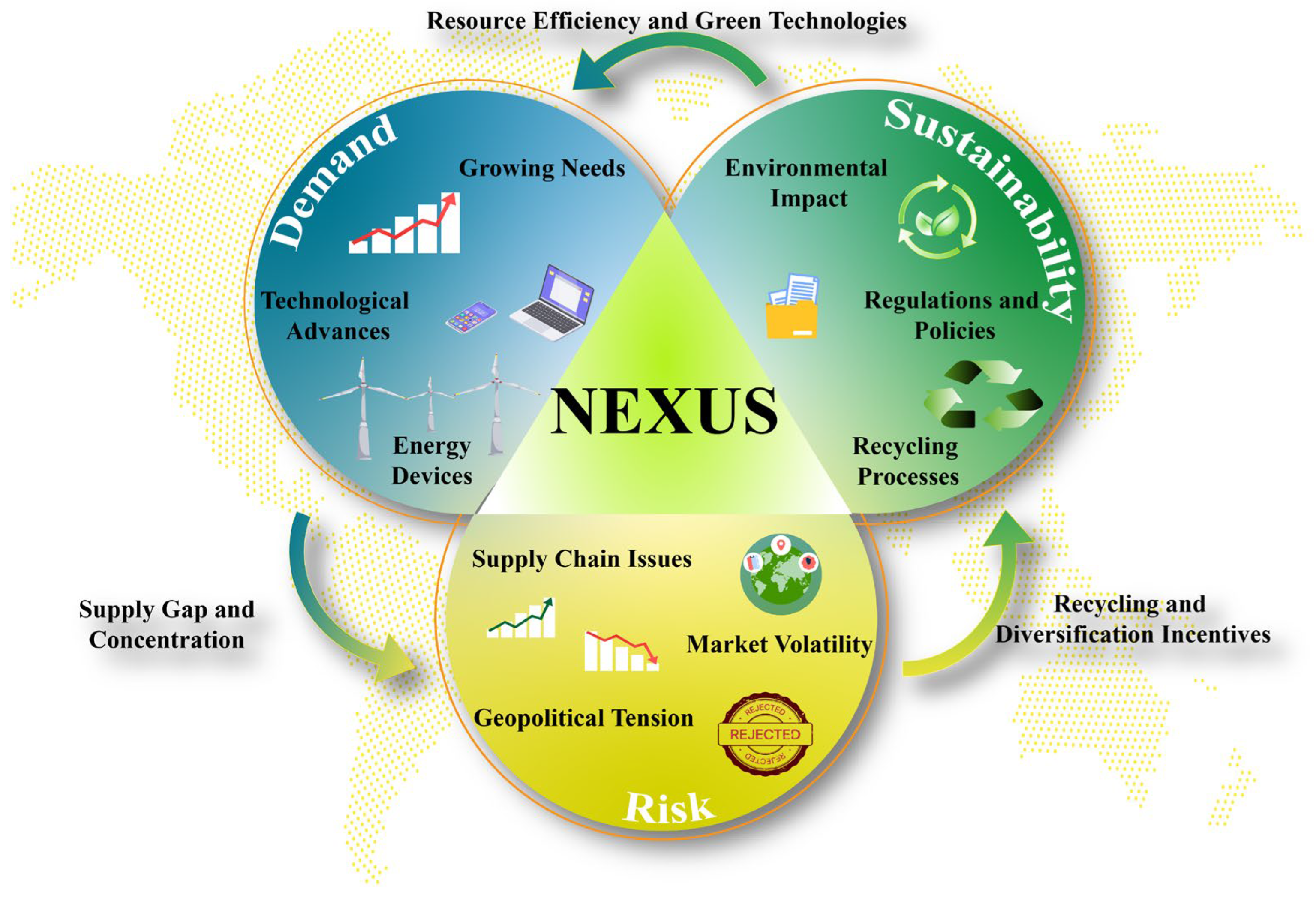
The global transition toward renewable energy and decarbonization is intrinsically linked to the management of critical materials. Rare Earth Elements (REEs) are no exception, as they play a strategic role at the center of climate goals. Therefore, this review provides a comprehensive assessment of the REE landscape, explicitly addressing the proposed Demand-Sustainability-Risk Nexus (DSR-Nexus), which integrates technological demand, environmental sustainability, and geopolitical supply risks. A systematic review based on PRISMA methodology was conducted to analyze scientific contributions published between 2015 and 2026, revealing a significant research imbalance. By 2025, while 87% of works focus on resource availability, production, and recycling, only 1.4% address the global supply chain and its geopolitical implications. Key findings highlight that China’s dominance in mining, processing, and refining capacities, accounting for 69.5%, 92%, and 94%, respectively, creates structural vulnerabilities for future environmental goals. In contrast, emerging producers such as Malaysia and the United States are expected to contribute 9% and 8% of refining capacity, respectively. Furthermore, this review discusses environmental trade-offs, including high energy intensity, water consumption, and radioactive byproducts. It also examines mitigation strategies, such as recycling, urban mining, and material substitution. Ultimately, achieving a resilient energy transition requires expanding supply, strengthening circular strategies, and international cooperation.

1. Introduction

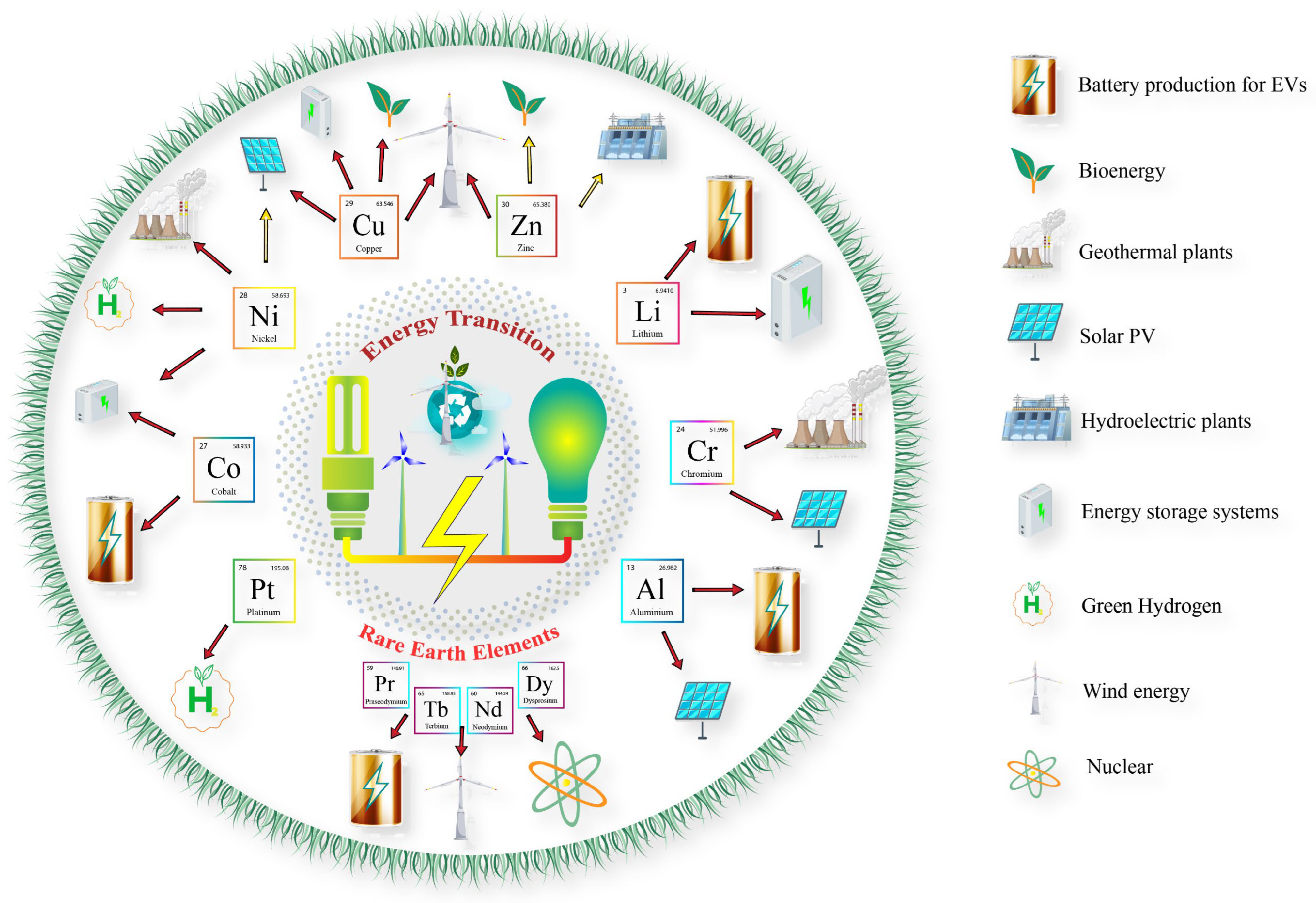
Reducing fossil fuel dependence has become one of the central pillars of global environmental and climate strategies. In this context, energy transition has emerged as a worldwide primary objective, strongly promoted through international climate agreements and national decarbonization policies [1,2]. The sustainable utilization of natural resources such as wind, solar radiation, and hydropower, generally referred to as renewable energy (RE), represents one of the most viable and scalable pathways to achieve this goal. Nevertheless, the large-scale deployment of RE systems and associated clean technologies is intrinsically material-intensive. Their development relies on a broad range of complex minerals and advanced materials that enable efficiency, durability, and high performance [3]. Therefore, to ensure a successful energy transition, the deployment of clean technologies, the strengthening of climate policies, and the strengthening of reliable mineral supply chains capable of meeting the continuously growing demand for strategic materials are required. Within this framework, the demand for mineral resources and the pace of the energy transition reflect a strong and dynamic interdependence [4]. As low-carbon technologies expand, a specific group of raw materials, particularly those referred to as critical minerals, is essential. Lithium (Li), cobalt (Co), and nickel (Ni), for instance, are widely used to manufacture electric vehicles (EVs) and electrochemical energy storage systems, while chromium (Cr) is highly in demand for geothermal energy applications [3]. Among these strategic resources, the group known as Rare Earth Elements (REEs) holds a particularly critical position. REEs are essential for the production of high-performance permanent magnets and advanced components used in wind turbines and other RE technologies [5]. Their unique magnetic and electrochemical properties make them foundational materials for decarbonization pathways. On this matter, Figure 1 illustrates the range of critical minerals supporting the energy transition and highlights their principal technological applications.
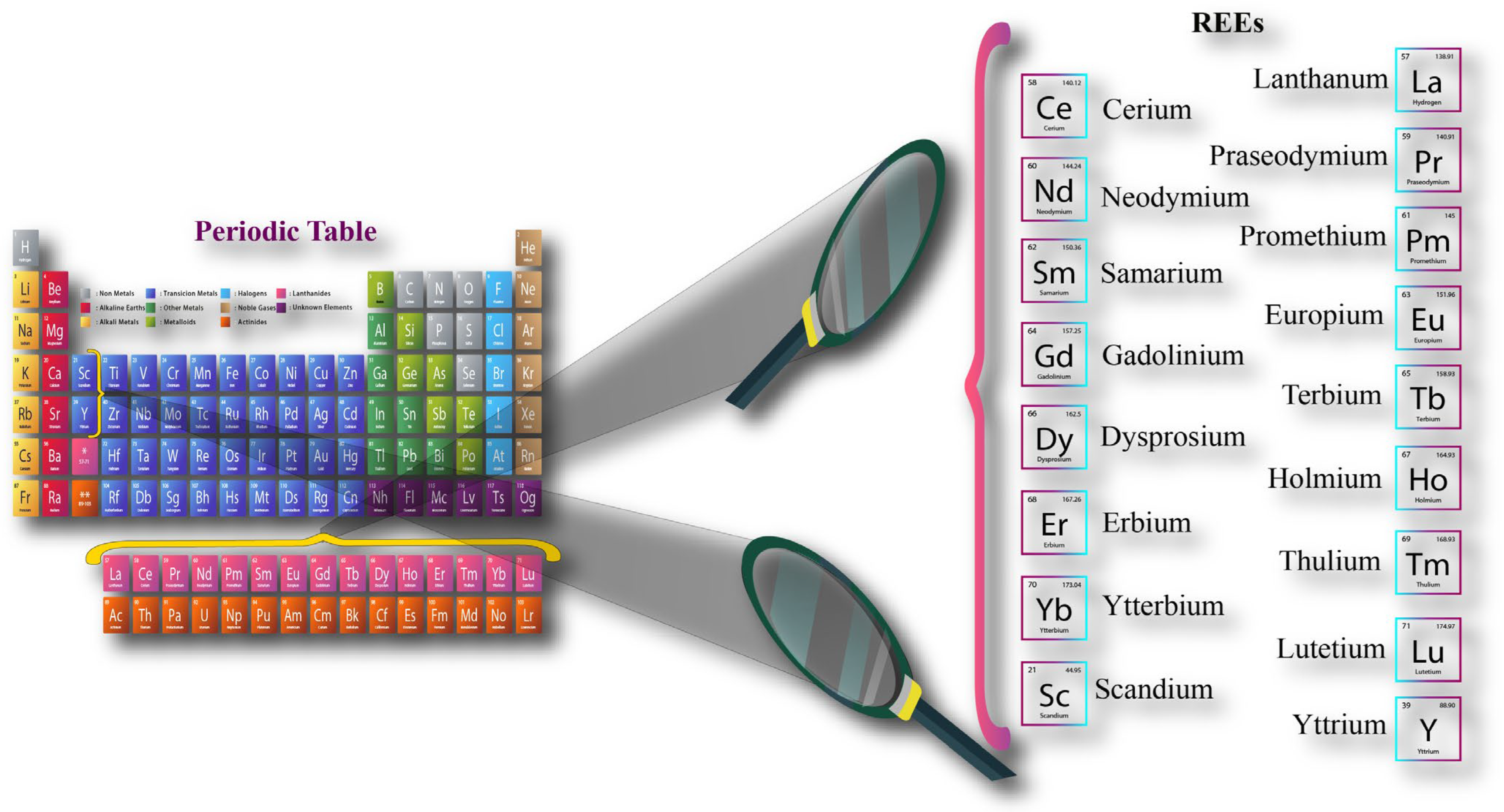
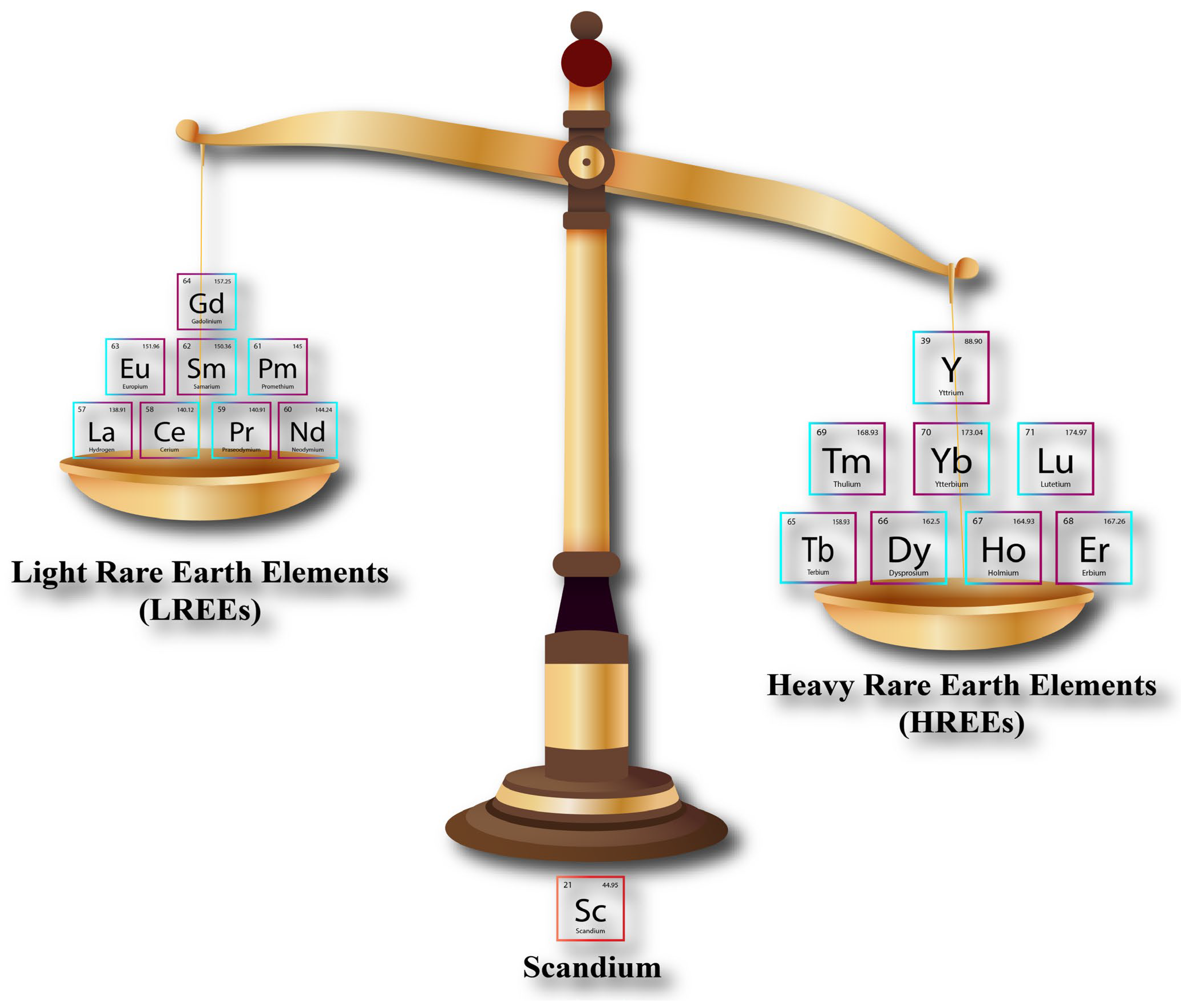
REEs comprise a group of 17 chemical elements that include the 15 lanthanides in the periodic table, along with scandium (Sc) and yttrium (Y), as depicted in Figure 2. Although Sc and Y are classified as transition metals, they also share chemical similarities with the lanthanide group and commonly occur in the same mineral deposits [6]. Currently, REEs are critical components utilized in a wide range of high-technology and industrial applications. In addition to REEs’ use in clean energy devices, they also play a key role in aerospace systems, defense technologies, automotive components, catalytic converters, optical glass, and semiconductor devices [7,8]. Moreover, it is important to mention that the term “rare” does not refer to the scarcity of these metals within the Earth’s crust. In fact, several REEs are more abundant than other commonly known metals such as silver or gold [9]. Rather, this designation alludes to the limited occurrence of economically exploitable concentrations as REEs are rarely found in high-grade deposits and are often dispersed, making their extraction and separation technically complex, cost-intensive, and environmentally challenging [10].
This fragmentation limits the understanding of how resource availability, processing capacity, and environmental constraints interact with supply risks to shape the long-term resilience of clean energy systems. This review distinguishes itself from existing literature as it encompasses the global value chain, material security, autonomy, and trade dependency by providing a more holistic perspective on the sustainable deployment of REEs.
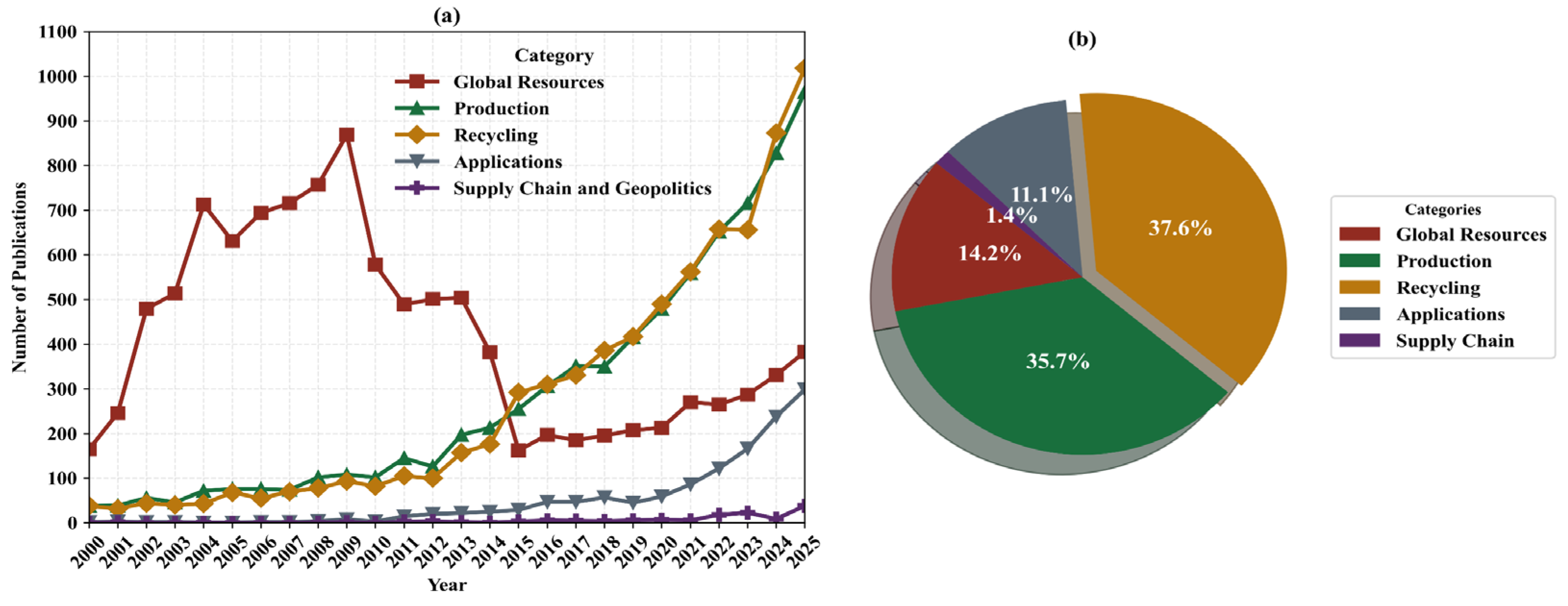
Beyond their industrial versatility, REEs have gained a pivotal role in the context of global decarbonization and clean energy systems [11]. On this subject, as countries accelerate the deployment of low-carbon technologies to meet climate targets, the demand for REEs is projected to grow significantly [12]. This growing interest is reflected in academic literature. Figure 3a, for instance, illustrates the evolution of REE-related research indexed in the Scopus database over the period 2000–2025 [13]. The data were retrieved using a Boolean search string focused on keywords including ‘Rare Earth Elements’, ‘Global Resources’, ‘Production’, ‘Recycling’, ‘Applications’, ‘Supply Chain and Geopolitics’, and ‘Sustainability’. Moreover, the search was restricted to peer-reviewed journal articles and reviews. It is important to note that research has traditionally focused on recycling, global resource availability, and production, covering more than 87% of its total publications; however, there is still a significant gap. Current research fails to provide a comprehensive perspective that simultaneously addresses sustainability, supply-chain risks, and the geopolitical tensions related to REEs in the global energy transition. Figure 3b shows how specifically dedicated research to supply chains and their global implications has accounted for only 1.4% of total publications by 2025. This fragmentation limits the understanding of how resource availability, processing capacity, and environmental constraints interact with supply risk to shape the long-term resilience of clean energy systems. Consequently, this review also distinguishes itself from existing literature by encompassing the global value chain, material security, autonomy, and trade dependency, thereby providing a holistic overview of the sustainable deployment of REEs.
This paper provides a comprehensive analysis of the REE landscape and is structured as follows: Section 2 describes the bibliometric criteria, database selection, and methodology that were employed in this review. Section 3 establishes the chemical, geological, and industrial foundations of REE. Section 4 assesses the environmental and sustainability issues of the REEs production. Section 5 examines the global supply risk and geopolitical concentration. Section 6 explores the role of these elements in energy transition technologies. Section 7 discusses circularity and risk mitigation pathways. Section 8 presents a future outlook by analyzing the nexus between demand projections under Net-Zero scenarios, environmental trade-offs of supply expansion, and the associated risks. Section 9 summarizes this work’s main findings and conclusions.

2. Methodology

This work follows a systematic literature review approach to identify and analyze scientific contributions related to REE, their strategic role in energy transition, and their associated supply chain and sustainability challenges. The review process was conducted according to the principles established in the Preferred Reporting Items for Systematic Reviews and Meta-Analyses (PRISMA) framework [14], which provides a transparent and structured procedure to identify, screen, and select relevant scientific publications. The literature search was performed using several major academic databases, including Web of Science, Scopus, ScienceDirect, IEEE Xplore, and SpringerLink [13,15,16,17,18] as well as selected gray literature sources. In that regard, Table 1 contains the set of search queries that combine all keywords related to REEs that have captured the multidisciplinary nature of the topic from 2015 to 2026. This analysis was restricted to peer-reviewed journal articles published in English to ensure the quality and relevance of the selected sources.
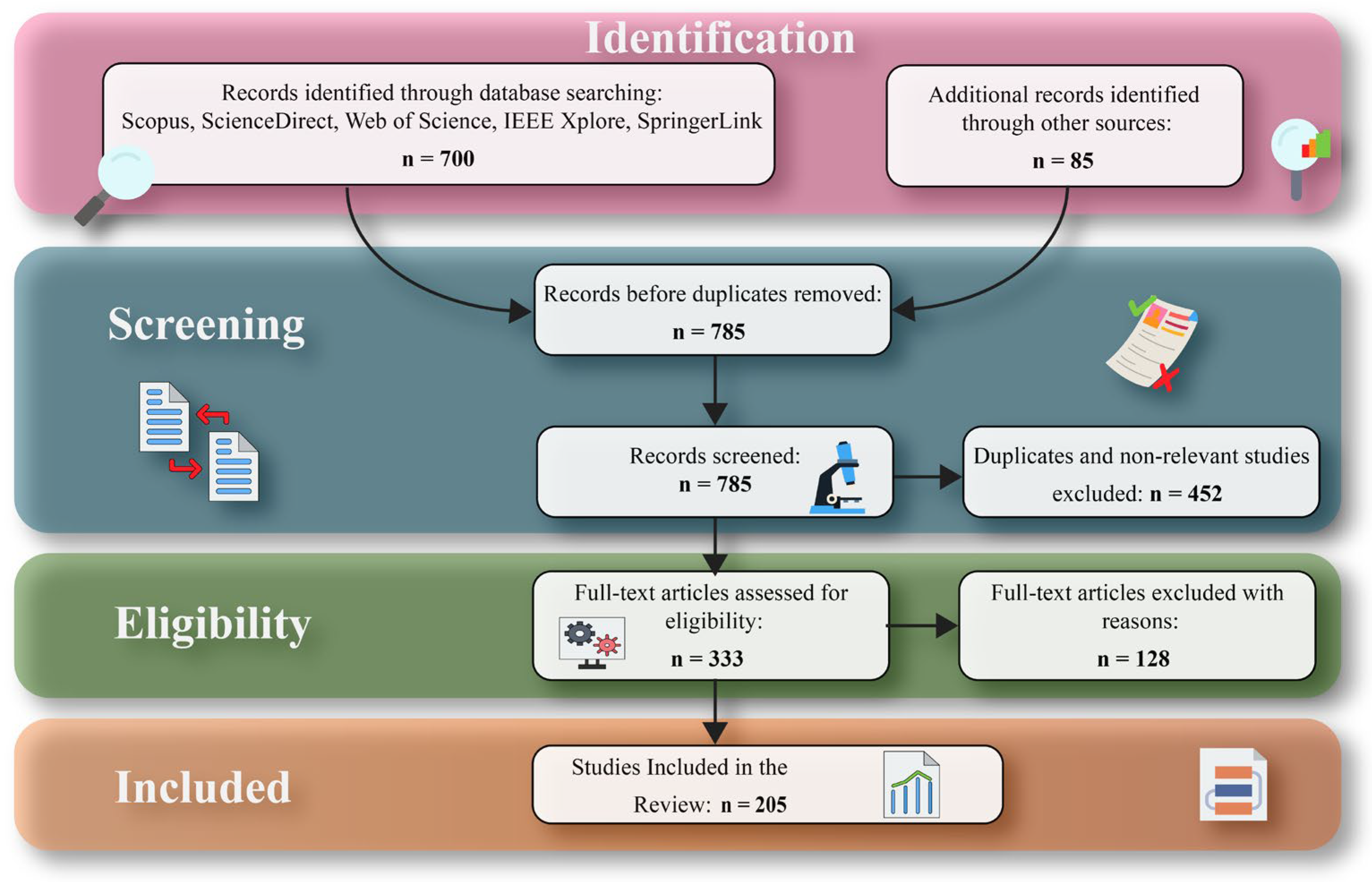
As suggested by the PRISMA approach, all records identified through database searches, totaling 700 entries, along with additional sources amounting to 85 entries, were compiled to reach an initial set of 785 records. As illustrated in Figure 4, these records were submitted to a screening process, where 452 entries were excluded due to duplication and non-relevance, based on the parameters established in Table 1. This stage primarily filtered out studies outside the energy transition context or those lacking technical validation. Subsequently, the remaining 333 full-text articles and reports were assessed for eligibility. During this stage, 128 documents were further excluded for reasons including a lack of quantitative sustainability metrics, a focus strictly on geological extraction, or insufficient methodological detail. Ultimately, 205 publications were included in the review, representing the most relevant contributions to the study of REEs in the energy transition, as shown in the Supplementary Materials. The overall process of identification, screening, eligibility assessment, and the final inclusion of the selected works is illustrated in Figure 4, which presents the PRISMA flow diagram used to structure the literature selection and the number of works included.
Thus, the systematic methodology implemented in this work ensures that a clear and replicable framework is used to identify key scientific contributions of REEs in the energy transition. By synthesizing peer-reviewed literature alongside technical reports, this methodology aligns with both academic and policy-oriented standards for supply chain analysis. Consequently, this approach provides a robust foundation to examine the sustainability constraints, geopolitical risks, and technological challenges associated with these critical materials.

3. Chemical and Geological Foundations of REEs

This section provides a comprehensive overview of the fundamental aspects governing the behavior, occurrence, distribution, and industrial processing of REE. The section begins by examining the chemical classification and functional differentiation of REEs, followed by a discussion of geological occurrence and major RREEdeposit types, with particular emphasis on mineralogical characteristics and global distribution patterns to determine resource availability. The treatment and metallurgical processing routes required to extract and separate REEs from complex ores, emphasizing the challenges associated with their low concentrations and intricate mineral associations, are also addressed. Finally, recent technological advances in REEs processing are presented.

3.1. Chemical Classification and Functional Differentiation

In their elemental form, REEs seem to have a lustrous and silvery-gray metallic appearance that is tarnished from contact with the atmosphere. Most of them are soft, malleable, and ductile, while also exhibiting high reactivity, particularly at elevated temperatures [19]. Their similar electronic configurations explain their natural co-occurrence with non-metals and the technical challenges associated with their separation [20]. REEs share comparable electronic configurations and predominantly occur in the trivalent oxidation state (3+). Nonetheless, certain elements can also exhibit divalent (2+) or tetravalent (4+) states, such as samarium, europium, ytterbium (Sm2+, Eu2+, Yb2+), and cerium, praseodymium, terbium (Ce4+, Pr4+, Tb4+), respectively [21]. In addition, elements from lanthanum (La) to lutetium (Lu) exhibit a phenomenon commonly referred to as the lanthanide contraction, in which the atomic radius progressively decreases with an increasing atomic number [22]. These subtle differences in ionic radius and electronic structure generate variations in their physicochemical properties, including complex behavior, magnetic characteristics, and catalytic performance. Hence, despite their apparent chemical similarity, REEs display a significant functional differentiation that determines their suitability for specific industrial and technological applications.
In that regard, REEs are commonly classified into two groups according to their atomic number, as depicted in Figure 5. REEs can either be classified as light rare earth elements (LREEs) or heavy rare earth elements (HREEs). Even though a third classification of REEs (known as middle rare earth elements (MREEs), for europium (Eu) to dysprosium (Dy) elements) is introduced in the latest reports, only the terms LREEs and HREEs were used in this review, according to the most common definition. It is important to note that, due to its comparable ionic radius and geochemical behavior, yttrium (Y) is often grouped with HREEs [21]. Conversely, scandium (Sc) is typically separated, as its electronic configuration differs from those of LREEs and HREEs [23]. In general terms, LREEs are more abundant in the Earth’s crust, whereas HREEs occur in significantly lower concentrations. In fact, Dushyantha et al. [24] reported average abundances of 137.8 ppm for LREEs and 31.3 ppm for HREEs that correspond to a total REE abundance of 169.1 ppm. This reflects that REEs, as a group, are present in comparable concentrations to those of common elements such as copper. However, the differences in the geological occurrence of HREEs and LREEs directly translate into variations in supply availability and in processing complexity.
HREEs have a wide range of applications, including electronic displays, medical devices, and jet-engine coatings, as well as permanent magnets production, whereas LREEs are increasingly employed in catalysis, portable electronic devices, and RE technologies [25,26]. However, within the group of REEs, a limited subset of elements has gained particular strategic relevance due to their critical role in energy transition technologies. On this matter, neodymium (Nd), praseodymium, dysprosium (Dy), and terbium (Tb) have become essential components in the production of high-performance permanent magnets [27]. Ghorbani et al. [28] state that their unique magnetic properties make them crucial for the large-scale deployment of low-carbon energy technologies. Consequently, understanding the chemical behavior, industrial roles, and mineral hosts of REEs is crucial to assessing supply vulnerabilities and the sustainability challenges associated with the global energy transition.

3.2. Geological Occurrence and Major Deposit Types

3.2.1. Mineralogy of REE-Bearing Phases

It is widely known that REE rarely occur in nature as native metals and that they are typically hosted within a variety of phosphate, carbonate, silicate, and oxide minerals [29]. In regard to this, Dostal [30] identified more than 250 REE-bearing minerals, including Allanite, Apatite, and Eudialyte, among others. Nonetheless, only a limited number of them are considered economically viable for large-scale extraction. Ren et al. [31] reported that these minerals are typically concentrated within specific geological settings, primarily carbonatites, alkaline igneous rocks, and hydrothermal deposits, as well as secondary enrichment environments such as ion-adsorption clays. Among these minerals, bastnäsite, monazite, xenotime, and parisite represent the most important commercial sources of REEs worldwide [32,33]. In that regard, Table 2 contains the most prominent REE-bearing minerals and the common elements contained. Their mineralogical characteristics (the composition of REE and their geological occurrence) largely determine the extraction feasibility, the selection of processing routes, and ultimately the geographic distribution of global reserves.
Beyond these primary minerals, another important source of HREEs is represented by ion-adsorption clay deposits, which are their predominant source [41]. Unlike conventional hard-rock ores, these deposits consist of weathered granitic materials where REEs are loosely adsorbed onto clay minerals. Although the concentration of REEs in these clays is relatively low, they are particularly important as they constitute one of the main global sources of dysprosium and terbium, and their extraction can be comparatively simpler than other sources [42]. At a global scale, the distribution of REE reserves is highly irregular and geographically concentrated, reflecting the influence of specific geological processes and deposit types, which ultimately shape the global availability and strategic supply of these elements.

3.2.2. Global Distribution of REE Deposits

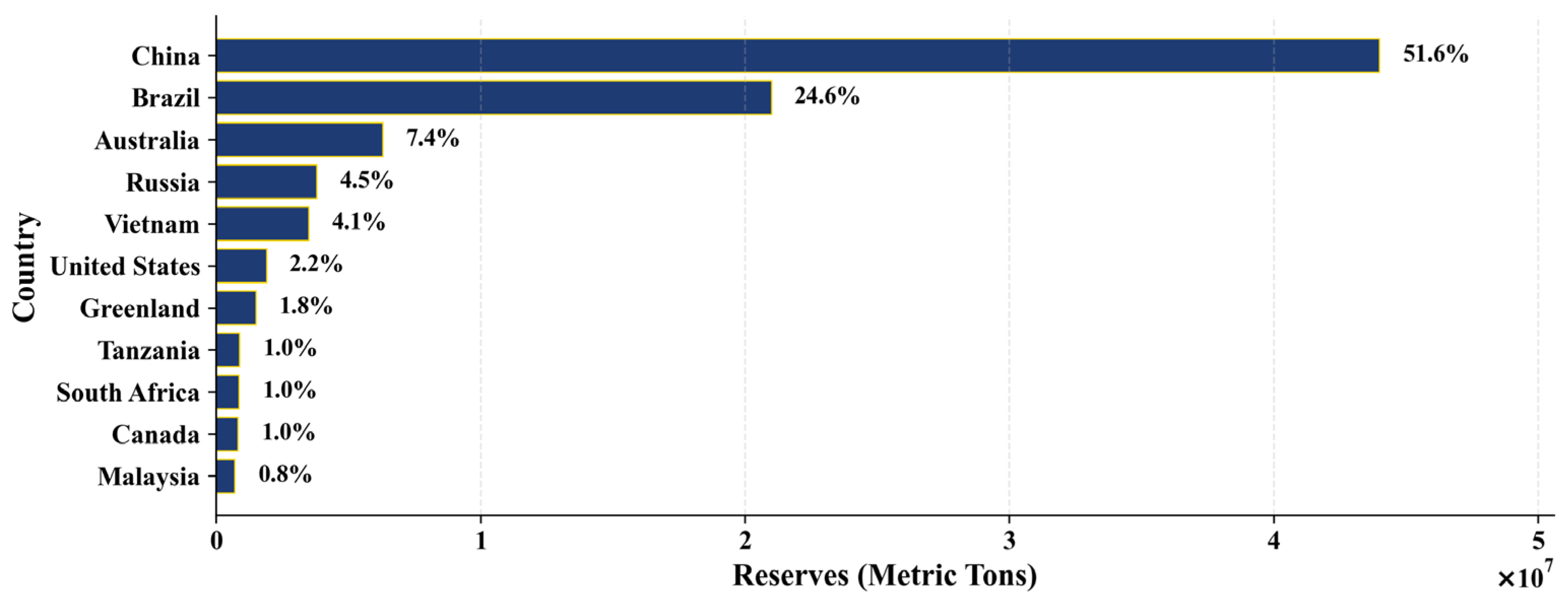
According to USGS assessments [8], global REE reserves, as of 2026, exceed 85,000,000 metric tons. China, Brazil, and Australia hold the most significant shares, accounting for 51.6%, 24.6%, and 7.4% of these reserves, respectively, as illustrated in Figure 6. Within this framework, China possesses the largest identified reserves and has historically dominated both mining and processing activities, particularly in deposits such as Bayan Obo, which remains the world’s largest known REE deposit [43]. However, it is important to contextualize these figures within the rapid evolution of the sector. For instance, Chen et al. [40] reported that China’s reserves share in 2021 was estimated at 35.2% of the total. The evolution between these percentages and the most recent 2026 data reflects the intense global activity in the discovery and reclassification of REE resources, highlighting how continuous exploration efforts are constantly updating the global reserve map.
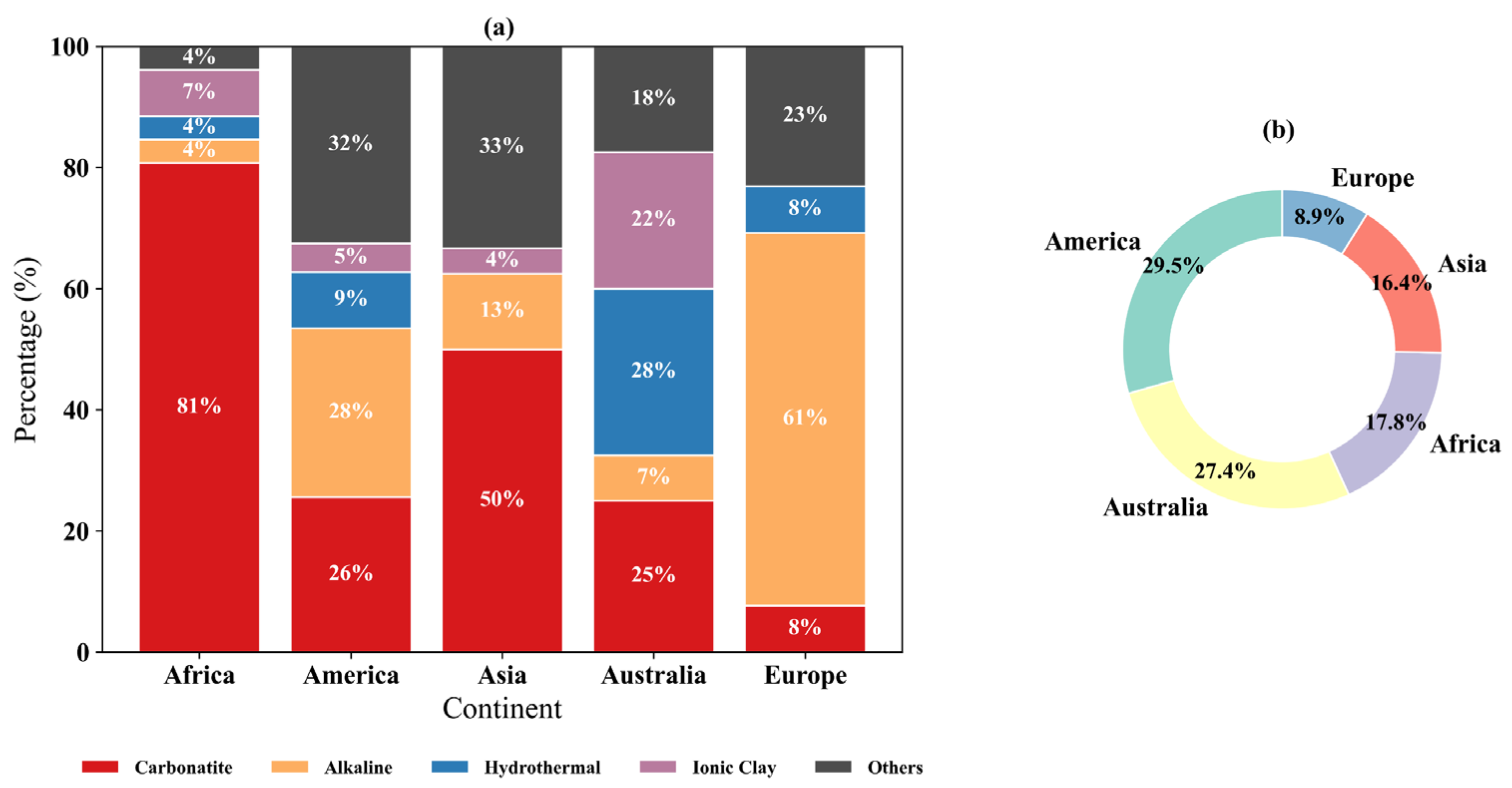
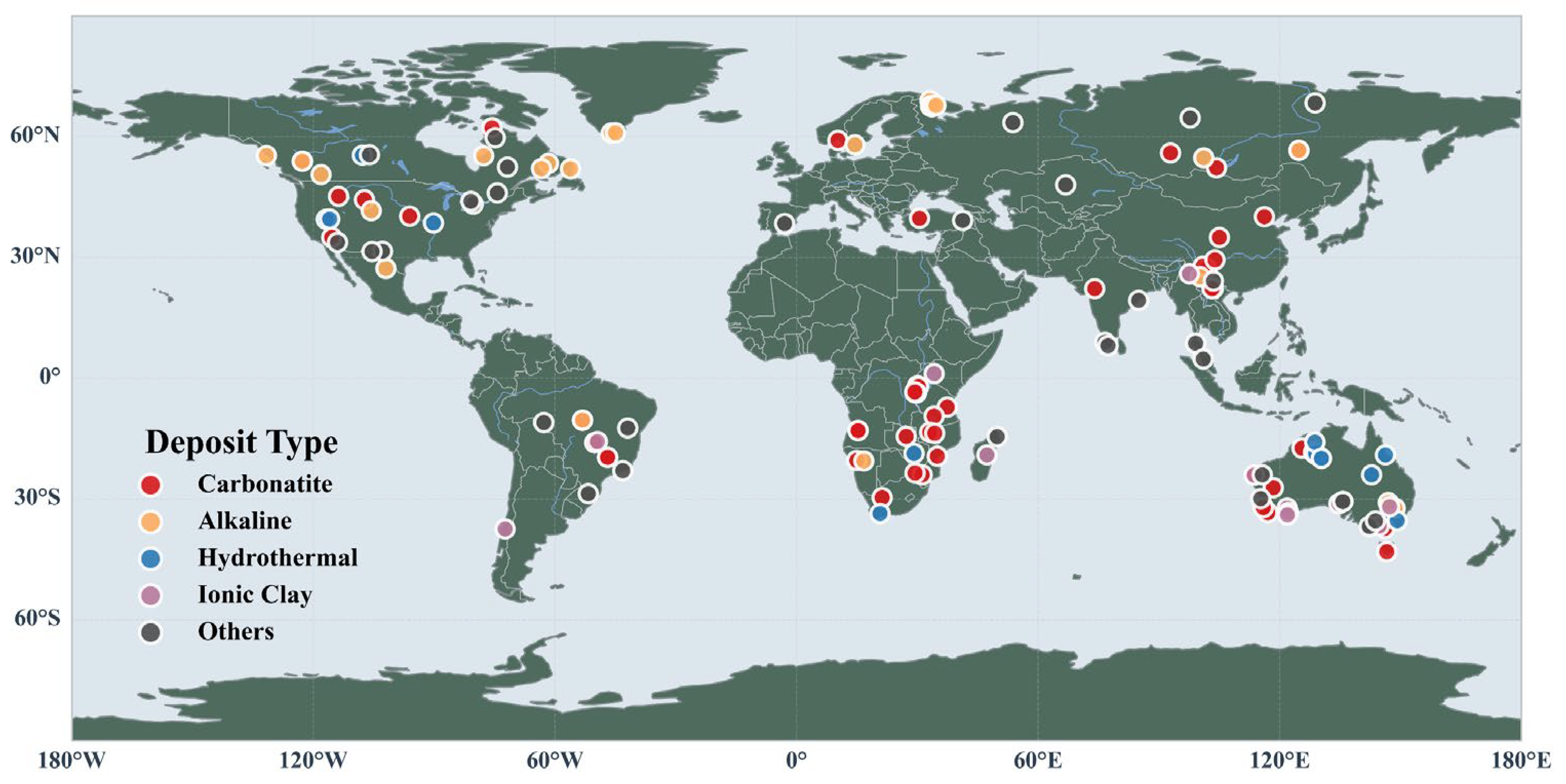
Nonetheless, several other countries, besides China, possess significant but less developed REE resources. Australia has important deposits in Mount Weld, characterized by high-grade carbonatite mineralization, rich in LREEs [44]. The United States also has notable resources in Mountain Pass, California, which is dominated by bastnäsite and parisite [45]. Moreover, countries such as Brazil, Vietnam, and Russia also possess significant reserves. In this respect, Figure 7 illustrates the global distribution of REE mines. It is worth noting that these reserves are widely distributed into four main categories: carbonatite, alkaline rocks, hydrothermal formations, and ionic clay. Additionally, the other category shown in the figure includes Fe-REE deposits, placer deposits, offshore deposits, and oil-bearing sites, as reported by Chen et al. [32].
Overall, the global distribution of REE reserves reflects a complex interaction between geological processes, mineralogical characteristics, and economic feasibility. This situation is largely attributed to the complexity of geological formations and the technical challenges associated with the extraction and processing of these elements. Although several regions worldwide host significant geological resources, as illustrated in Figure 7, only a limited number of deposits are currently in operation, as shown in Table 3. In addition, Table 3 presents the concentration of Rare Earth Oxides (REO) and highlights deposits with elevated HREE concentrations, notably in China, particularly ion-adsorption clay deposits, as well as in Brazil, the United States, Canada, and Australia. Consequently, the concentration of economically viable reserves, together with the technological complexity of REE separation and refining processes, reinforces the strategic importance of these materials. This situation raises growing concerns regarding supply security in the context of the rapidly rising demand driven by the global energy transition. Accordingly, increased investment and stronger collaboration between academia and industry are essential to overcome these technological challenges and promote the development of REE production across multiple worldwide regions.
Figure 8a illustrates the distribution of REE deposit types by continent, highlighting carbonatite deposits as one of the most significant sources. These deposits account for approximately 50% of the total resources in Asia, about 26% in the Americas, and 81% in Africa. This distribution suggests that these regions could potentially emerge as important suppliers of REEs in the future. Likewise, the figure shows that in Europe, approximately 62% of the identified REE resources are associated with alkaline rock deposits, whereas only around 8% are associated with carbonatites. In this context, the geographical diversification of REE sources has drawn significant attention to emerging regions. For instance, in Africa, Ren et al. [31] identified a substantial potential of over 12 million tonnes of REO reserves across 12 nations, noting that exploration investment reached $34.8 million in 2024. However, this expansion requires the development of robust environmental governance frameworks to mitigate the impacts of rapid industrialization. In South Asia, Farjana et al. [50] established a critical baseline for the Karnaphuli River estuary in Bangladesh; while current ecological risks are primarily lithogenic, emerging signatures of cerium, thulium, and lanthanum indicate early cumulative pollution from industrial activities. Similarly, in Latin America, Brazil has intensified its industrial focus, particularly in the Northeast, where the integration of advanced extraction technologies must be balanced with social impact assessments and local environmental regulations [51].
Thus, the development of advanced technological routes for the processing and purification of alkaline-hosted REE could represent a promising alternative supply source, provided that the required investment is available. Figure 8b highlights an important aspect of the global REE landscape. Despite China’s dominant position in terms of total reserve tonnage, the geographical distribution of individual mineralized sites shows a different pattern. Deposits within Asia account for only 16.4% of the globally identified deposits. In contrast, the Americas hold approximately 29.5% of the global deposit count, representing the largest share of identified occurrences, followed by Australia with 27.4%. Therefore, with adequate technological development and investment, regions such as the Americas, Africa, and parts of Asia could reinforce their roles as major REE suppliers. It would contribute significantly to the diversification of supply and to the reduction in geopolitical risks associated with the concentration of resources. These findings also highlight that China’s dominance in the current REE market may lead to the perception that these resources are geographically restricted. In reality, REE deposits are widely distributed across multiple regions. Thus, the current supply concentration does not reflect the true geological availability of these elements, but rather the technological, economic, and industrial conditions that have historically favored the development of production in a limited number of regions.

3.3. Beneficiation and Metallurgical Processing of REEs

REE mineralization typically occurs in complex associations with various minerals such as fluorite, barite, and various ferruginous species. According to Qiu et al. [52], the concentration of REO in deposit ores generally fluctuates between 0.05% and 0.2%, although significant exceptions exist as detailed in Table 3. In that regard, Table 4 summarizes the primary mineral hosts from which specific REEs are derived, along with their global abundance. Notably, promethium (Pm) is omitted from these natural classifications due to its pronounced isotopic instability, preventing its occurrence in the Earth’s crust [53]. Given the low-grade nature and mineralogical complexity of these deposits, direct metallurgical extraction is neither technically nor economically feasible. Consequently, a rigorous pre-concentration or beneficiation stage is required to upgrade the ore prior to its downstream processing [40].
Therefore, the processing routes adopted for REE extraction must be tailored to the specific characteristics of each deposit. In this context, rigorous mineral processing and metallurgical treatments are required to achieve efficient REE recovery. Cheng et al. [40] reported that the concentration of REO in raw minerals is normally low, limiting the direct recovery of REEs from mined ores. Consequently, a preprocessing stage is necessary to leverage the physicochemical properties of REE-bearing minerals, including differences in floatability, magnetic susceptibility, electrical conductivity, and density, among others. The main objective of this initial stage is to obtain a preconcentrated REE-bearing material that can subsequently undergo hydrometallurgical or pyrometallurgical treatment according to the characteristics of the deposit.
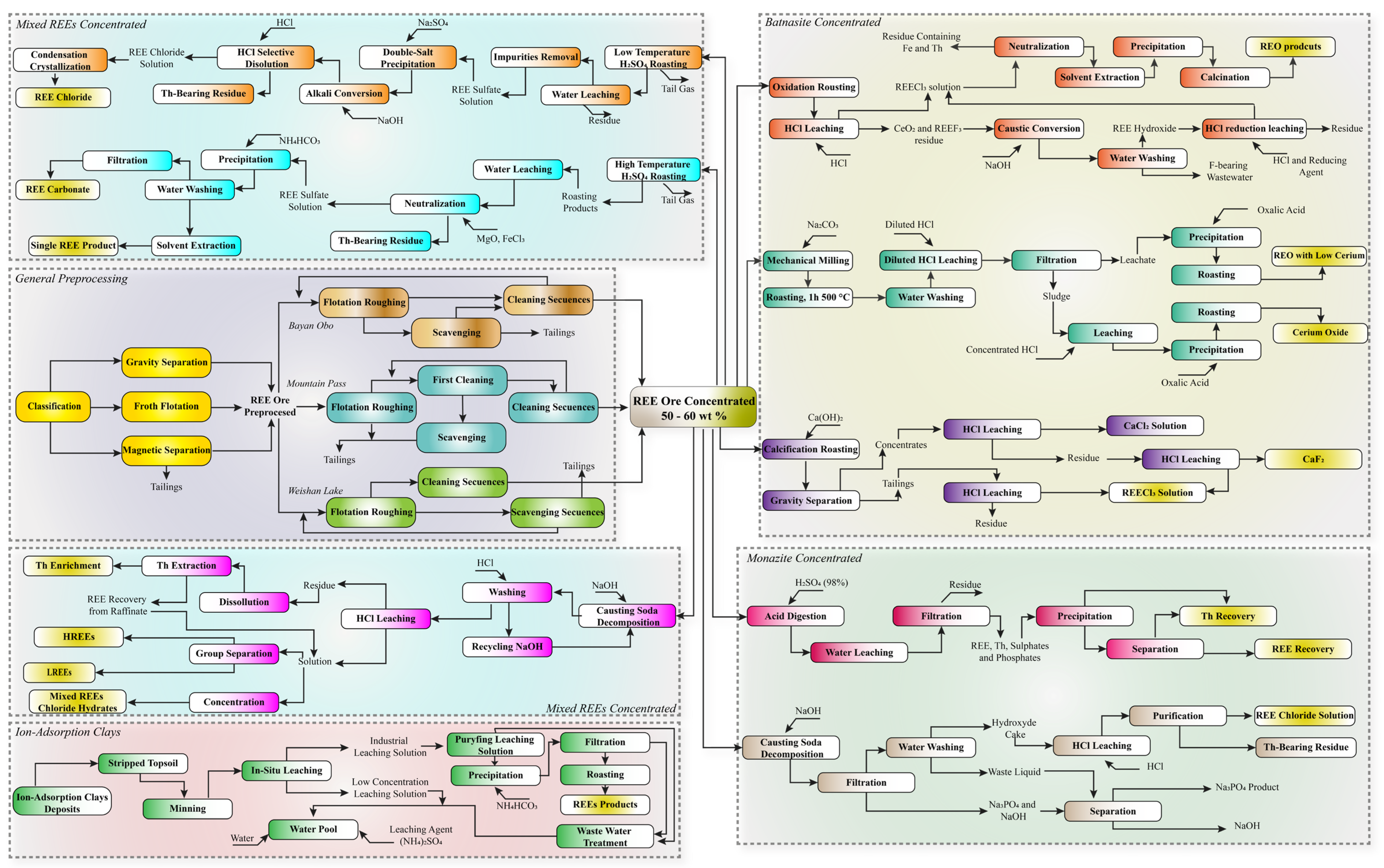
Regarding this, Figure 9 illustrates the general processing pathway employed to obtain pretreated REE material and concentrate REO from major deposits in Mountain Pass, in Bayan Obo, and in Weishan Lake. Although the sequence and specific operating conditions may vary depending on the mineralogical composition of the ore, three fundamental beneficiation stages are commonly involved in REE concentration: flotation, scavenging, and cleaning. These stages enable the progressive enrichment of REE-bearing minerals and the removal of gangue materials, resulting in a concentrate suitable to be metallurgically processed, which typically contains anywhere from 50 to 60 wt.%. Once the REE ore has been concentrated, several downstream processing routes can be applied depending on the dominant mineral phases present. For bastnäsite-bearing ores, processing alternatives include oxidation roasting followed by hydrochloric acid leaching and caustic conversion, two-step HCl leaching, or calcification roasting, as illustrated in Figure 9 [54,55,56]. Monazite concentrates are typically treated through sulfuric acid roasting followed by water leaching, although alkaline digestion routes have also been reported [57,58]. In deposits containing complex mineral assemblages, such as in the Bayan Obo deposit, additional treatment pathways are required, including caustic soda decomposition [59]. Another widely implemented route involves sulfuric acid roasting followed by water leaching at both low and high temperatures. This remains one of the most commonly applied techniques to process REE concentrates from Bayan Obo [54].
Nonetheless, ion-adsorption clay deposits exhibit fundamentally different mineralogical characteristics. Due to the presence of REEs adsorbed onto clay minerals in ion-exchangeable phases, conventional physical separation techniques such as gravity concentration, magnetic separation, and flotation are not effective for their processing [40]. Instead, these deposits are generally exploited through in situ leaching methods. In this process, ammonium sulfate solutions are commonly used as leaching agents, as depicted in Figure 9 [54,60]. The diversity of mineralogical hosts and deposit types requires the development of deposit-specific beneficiation and extraction strategies. Thus, the efficient recovery and assurance of sustainable resource exploitation can only be improved by understanding the mineralogical composition and physicochemical behavior of REE-bearing minerals. However, the limitations associated with conventional processing routes have driven significant research efforts toward the development of more efficient and environmentally sustainable REE processing technologies.
Accordingly, the technical complexity and resource-intensive nature of conventional metallurgical routes significantly influence the environmental footprint of REE production. Processes such as high-temperature treatment, the use of leaching agents, and large-scale separation operations not only affect economic feasibility but also drive energy consumption, greenhouse gas emissions, and waste generation. Therefore, the transition toward more sustainable processing pathways extends beyond improvements in operational efficiency, reflecting the need to comply with increasingly stringent environmental regulations and global sustainability targets. In this context, understanding these technical foundations is essential for interpreting the environmental impacts and regulatory challenges associated with the growing REE supply chain.

3.4. Recent Technological Advances in REE Processing

In response to the technical, economic, and environmental limitations associated with conventional processing routes, significant research efforts have been directed toward the development of technologies in the extraction and separation of REEs. Among these, bioleaching has emerged as a promising, environmentally friendly approach [61]. For instance, He et al. [62] demonstrated the feasibility of REE extraction through microbial metabolic activity, while Bayarsaikhan et al. [63] reported that pre-treatment of ore with a mixed thiobacteria (Tmix) enhanced metal recovery by a factor of 1.40 compared to that of conventional acid leaching. Similarly, Liu et al. [64] researched the use of coal-waste-derived bio-acid as a lixiviant, combined with oxidative roasting and reductive solvent extraction, achieving REEs recovery efficiencies of about 90%.
In parallel, recent works have explored improvements in both leaching and separation technologies. Zhang et al. [65] identified ammonium-based reagents with sufficient efficiency and stability for REO, achieving recovery values up to 90%, while Zhang et al. [66] developed a monopyridine extractant with enhanced selectivity toward HREEs. In addition, emerging separation approaches, including deep eutectic solvents (DESs) and membrane-based technologies, have also been researched by Shakiba et al. [67] and Ben-Elijah et al. [68], respectively. Chromatographic techniques have also been proposed as greener alternatives for REE separation, particularly for the purification of HREEs [69,70]. These advances demonstrate the ongoing development of more selective, efficient, and environmentally sustainable processing strategies, highlighting the continuous research efforts aimed at improving REE production. Such progress is essential given the strategic importance of REEs as critical materials that enable clean energy technologies and support the global energy transition.

4. Environmental and Sustainability Assessments

As the deployment of clean energy technologies continues to expand, the demand for REEs is expected to increase significantly. While these materials play a key role in enabling low-carbon technologies, their extraction and processing can generate considerable environmental impacts. Therefore, evaluating the sustainability of REEs and their supply chains has become an essential research topic. In that regard, this section reviews the environmental implications associated with REE production by analyzing key sustainability indicators, including Life Cycle Assessment (LCA). Particular attention is given to metrics such as water footprint, energy intensity, and resource consumption during the extraction and processing stages. Additionally, potential environmental and safety risks related to REE production are also examined.

4.1. Environmental Footprint of REE Production

The environmental footprint of REE production varies significantly depending on the type of deposit and the processing route employed. Vahidi et al. [71] researched an LCA for the REO production from ion-adsorption clays in China. Their results indicated that ammonium sulfate and oxalic acid are the main contributors to the overall environmental impact associated with REO processing. Additionally, they reported that, compared to REO production from bastnäsite and monazite, ion-adsorption clay production exhibits higher impacts in the eutrophication category but lower impacts regarding acidification. Furthermore, the REE production from monazite represents an important pathway to meet the growing demand. Accordingly, Browning et al. [72] evaluated key environmental indicators, including global warming potential (GWP), energy requirements, and water consumption associated with its production.
Within this framework, Table 5 presents a set of environmental indicators associated with the production of 1 kg of individual REEs as well as the average environmental impacts related to the production of REO. The indicators include GWP, energy, and water use during the extraction and processing stages, providing a quantitative basis to compare different production routes. GWP is expressed in kilograms of carbon dioxide equivalent (kg CO2 eq), whereas energy consumption is reported in megajoules (MJ). Water consumption is expressed in kg of water used per kg of product, accounting for water requirements in processes such as mineral separation, hydrometallurgical treatments, and the purification steps discussed in Section 3. It is important to highlight that HREEs and yttrium tend to exhibit higher environmental burdens due to the increased difficulty of separation and purification processes [73]. The second part of the table also summarizes the average environmental impacts associated with the production of 1 kg of REO. These impacts include some of the most common metrics used in LCA such as GWP, eutrophication potential expressed in kilograms of nitrogen equivalent (kg N eq), acidification potential expressed in kilograms of sulfur dioxide equivalent (kg SO2 eq), ozone depletion potential expressed in kilograms of CFC-11 equivalent (kg CFC-11 eq), and respiratory effects expressed in kilograms of particulate matter smaller than 2.5 micrometers equivalent (kg PM2.5 eq). Together, these indicators provide a comprehensive overview of the environmental performance of REEs production systems, enabling the identification of critical stages and key contributors to environmental impacts.
From an interpretative perspective, the metrics presented in Table 5 reveal critical trade-offs across the REE supply chain. The significantly higher energy and water requirements associated with particular elements, specifically HREEs and yttrium, indicate that their production is inherently more resource-intensive, resulting in a larger environmental footprint. For instance, the water consumption for yttrium is 221.48% and 271.81% higher than that of terbium and praseodymium, respectively. This disparity has major implications for sustainability, as the rising demand for these elements in green technologies could exacerbate environmental degradation. Furthermore, the variability in GWP among individual REEs suggests that climate impacts are not uniform, highlighting the need for differentiated mitigation strategies. Additionally, LCA indicators such as eutrophication, acidification, and respiratory effects underscore that the impacts of REE production extend beyond carbon emissions to affect air quality, aquatic systems, and human health. Collectively, these findings emphasize the necessity of element-specific and process-specific optimization to ensure that REEs’ supply chain expansion aligns with global sustainability objectives.
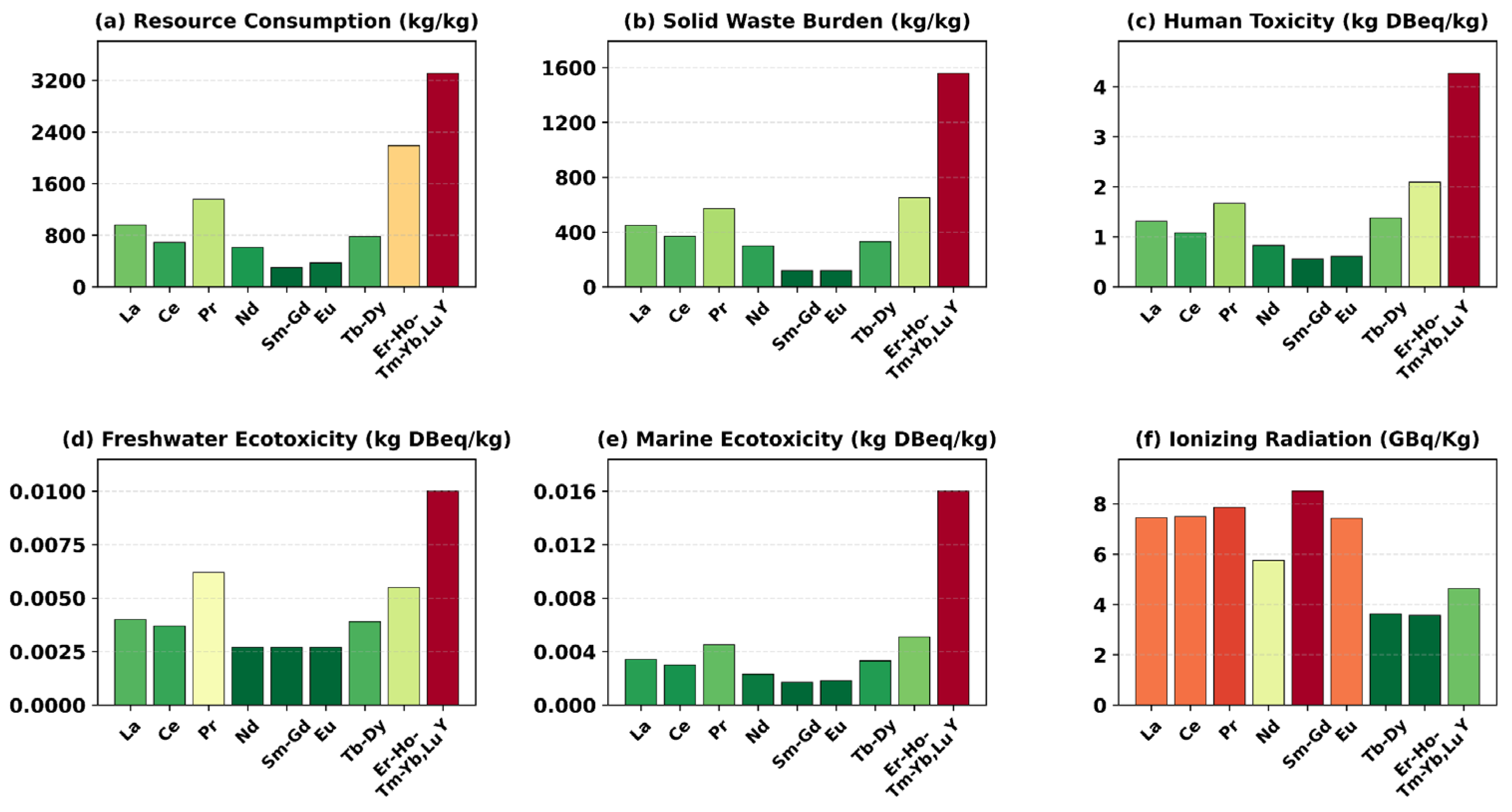
In addition, the environmental profile of individual REE production from monazite reveals a significant disparity across the six impact categories analyzed in Figure 10. A predominant trend is the disproportionate burden associated with HREEs, particularly yttrium and the europium-lutetium group. These elements exhibit the highest values in resource consumption, measured in kg/kg of REEs (Figure 10a) and solid waste burden, as shown in Figure 10b (kg/kg), as well as human toxicity, expressed in kilograms of 1,4-dichlorobenzene equivalent per kilogram of product (kg 1,4-DBeq/kg) as depicted in Figure 10c. Notably, the production of 1 kg of yttrium requires over 3000 kg of primary resources and generates approximately 1500 kg of solid waste, reflecting the low ore grades and the thermodynamic complexities inherent to the extraction of these specific elements [72]. In contrast, LREEs, such as lanthanum and cerium, generally exhibit lower environmental footprints with regard to toxicity and waste generation. Nonetheless, praseodymium is particularly noteworthy because it displays higher levels of freshwater and marine ecotoxicity (both measured in kg 1,4-DBeq/kg) compared to neodymium and cerium (see Figure 10d,e). This behavior suggests that the chemical separation and purification stages associated with praseodymium are relatively more intensive regarding reagent consumption and wastewater generation. Furthermore, LREEs show a significantly and relatively uniform impact regarding ionizing radiation, measured in giga-becquerels per kilogram (GBq/kg), highlighting the influence of naturally occurring radioactive materials (NORM) present in the parent ores, regardless of the specific element that is being targeted, as illustrated in Figure 10f. Collectively, these findings demonstrate that the environmental burden of REEs production is highly heterogeneous, with heavier elements generally associated with substantially higher impacts per unit produced. This variability underscores the importance of adopting element-specific strategies when assessing sustainability and when designing more efficient, environmentally responsible processing routes.
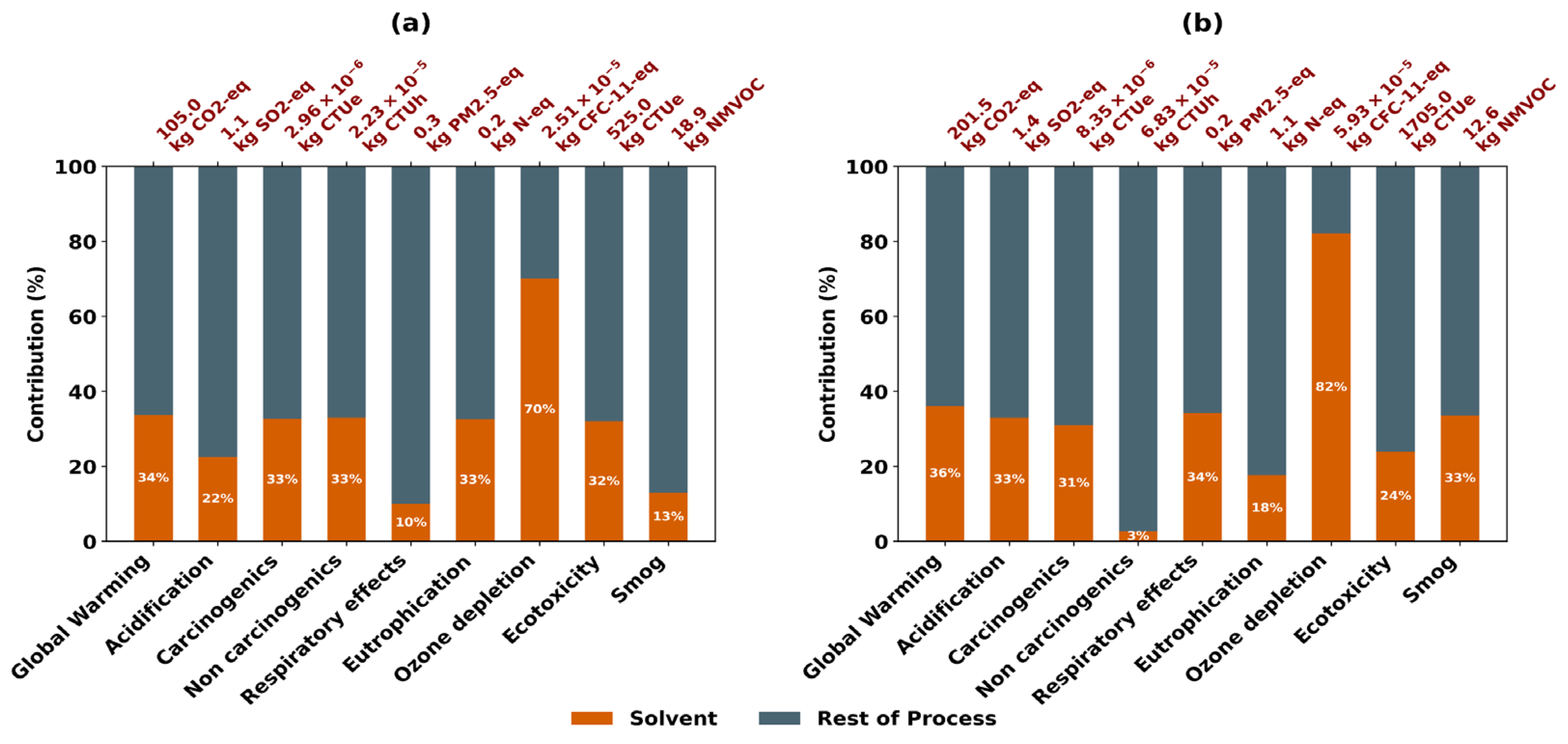
According to Wan et al. [74], the environmental burden of REEs production from ionic-adsorption clays is also primarily driven by the intensive use of chemical reagents. The extensive consumption of mineral acids and the inevitable losses of organic solvents during extraction cycles are the major contributors to high ecotoxicity and resource depletion. In this respect, Vahidi et al. [75] compared the overall LCA for the production of 1 kg of neodymium oxide (Nd2O3) from two main sources: bastnäsite-monazite mixture, such as the one available in Bayan Obo, and ion-adsorption clays. Their work highlights the influence of solvent extraction on the overall environmental impact, as depicted in Figure 11. In turn, Figure 11a illustrates the total impact associated with the production of 1 kg of Nd2O3 from a bastnäsite-monazite mixture. It is worth noting that the use of chemical solvents, including hydrochloric acid, sodium carbonate, ammonium bicarbonate, and sodium hydroxide, accounts for 70% of the ozone depletion impact, while it contributes only 10% to respiratory effects. Conversely, Figure 11b presents the same categories used to produce 1 kg of Nd2O3 from ion-adsorption clays. This analysis reveals that the use of agents such as hydrochloric acid, sodium carbonate, sodium hydroxide, and oxalic acid is responsible for 82% of the ozone depletion impact, contributing to about 3% of non-carcinogenic effects. Overall, these findings underscore how reagent selection in solvent extraction processes dictates the environmental profile of the REE production, highlighting the critical need for the development of more sustainable and efficient processing alternatives.
Several studies have applied LCA to evaluate the environmental impacts associated with the extraction and processing of REE. These analyses consistently indicate that the selected processing route and the intensity of reagent consumption constitute primary determinants of the overall sustainability performance of the REE production systems. Table 6 summarizes symbolic works employing LCA methodologies to quantify the environmental burdens associated with the REE production across different sources, extraction routes, and processing stages. As shown, over the past decade, LCA research on REE production has evolved from site-specific assessments towards more comprehensive, system-level evaluations that incorporate global supply chain perspectives. More recent works increasingly integrate digital tools and circular strategies to enhance environmental assessments. These developments highlight the potential of recycling and biosorption, which can significantly reduce the environmental footprint of the production of REEs. Despite these advances, optimizing chemical consumption in leaching and solvent extraction remains a priority. Current research efforts focused on identifying cleaner reagents by improving separation efficiencies to reduce ecotoxicity could reduce resource depletion and enhance the overall sustainability of REE production systems.
Beyond the chemical and energy intensities quantified in these LCA, the environmental profile of REE production is further complicated by the presence of hazardous byproducts, including the co-occurrence of radioactive elements, such as thorium and uranium, and other toxic heavy metals, thus introducing significant environmental, health, and safety risks. These impacts extend beyond industrial operations, affecting surrounding ecosystems and nearby communities through pathways such as soil contamination, water pollution, and airborne emissions.

4.2. Environmental and Health Risks Associated with REEs Production

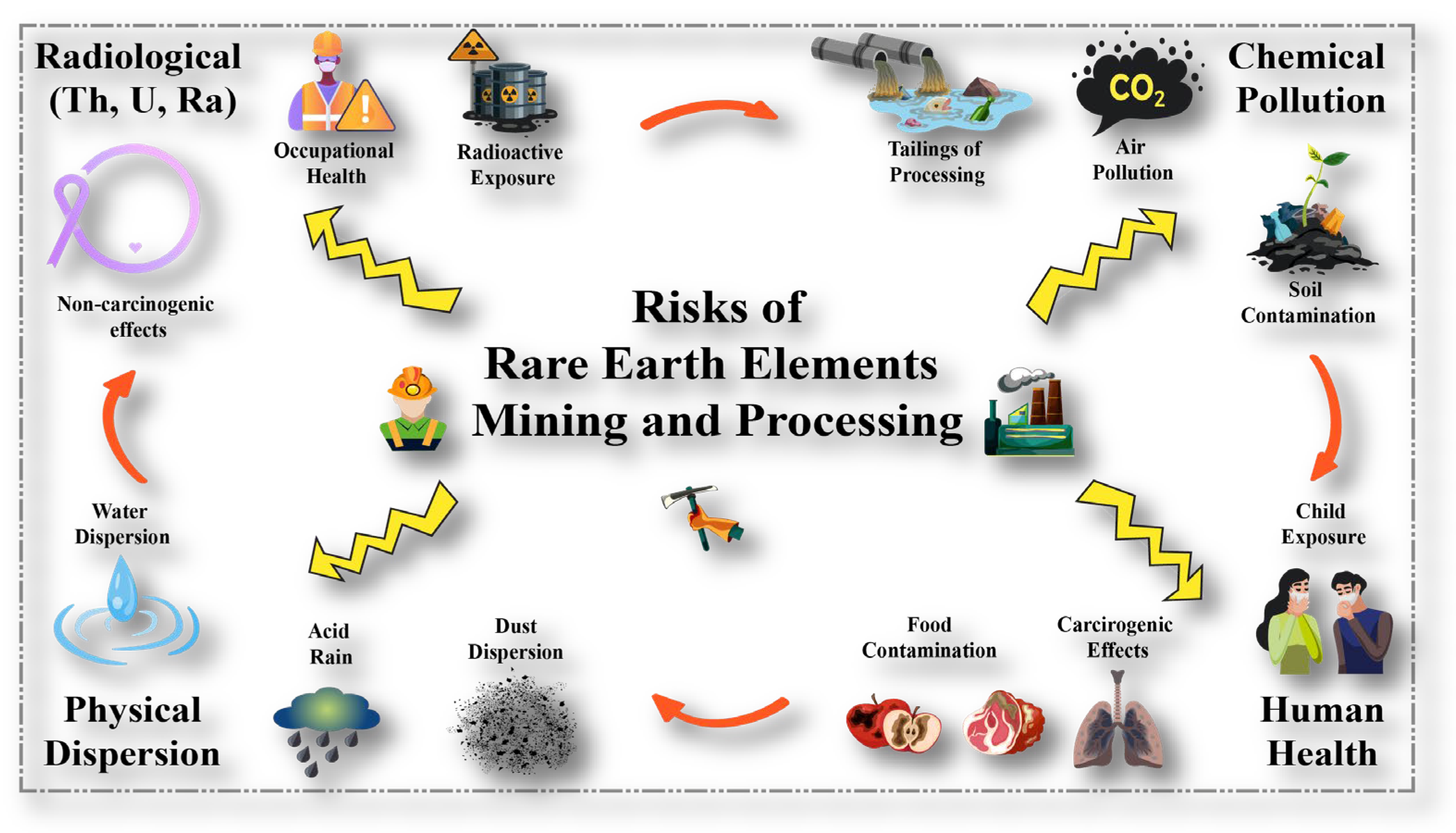
The extraction and processing of REEs are, moreover, complicated by the presence of NORM, specifically thorium (Th) and uranium (U) [87]. In many primary deposits, such as those of monazite and bastnäsite, these elements are geochemically associated with REEs, meaning that mining and chemical leaching inevitably mobilize radioactive isotopes and byproducts, as shown in Figure 9. According to Moraes and Ladeira [88], the management of these radioactive residues represents one of the most significant challenges in the REE industry. These elements, if not properly contained within specialized tailings storage facilities, can leach into groundwater or become airborne as particulate matter, which may lead to long-term radiological exposure for the surrounding population. Beyond the direct physical health risks, such as increased incidences of cancer and respiratory diseases, these impacts can create broader socio-environmental consequences, including land degradation, reduced agricultural productivity due to soil contamination, and, in some cases, food contamination, as depicted in Figure 12, which conceptualizes these interactions as a coupled environmental and health system. Environmental contamination arising from REE extraction and processing involves the release of radioactive elements, airborne particulates, and wastewater that can degrade soil, water, and ecosystem quality. This degradation not only affects agricultural productivity and food safety but also contributes to human health risks, including respiratory diseases and increased cancer incidence. Such dynamics reinforce the cycle of environmental degradation and human exposure in the context of REE production, highlighting the need for integrated management strategies that simultaneously address environmental protection, public health, and resource governance.
In the current industrial landscape, the removal of radioactive elements is typically achieved through conventional hydrometallurgical techniques integrated into the REE extraction process, as depicted in Figure 9. The most common approach involves selective chemical precipitation, where the pH of the leachate is carefully adjusted to precipitate thorium as a hydroxide or phosphate, leaving the REEs in solution [89]. For instance, Schroeder et al. [90] demonstrated the field-effect separation (FES) method within microchannels, proving that magnetic and electrostatic fields can achieve ion separations of 2–3% per cycle by leveraging magnetic susceptibility and pH-dependent effective charges. Other established methods include the use of specific chelating agents and traditional solvent extraction using organic phosphoric acids, such as Di-(2-ethylhexyl) phosphoric acid (D2EHPA) or tri-n-butyl phosphate (TBP), which have been widely employed to separate tetravalent thorium from trivalent lanthanides [91,92]. However, these conventional processes often face limitations regarding reagent consumption, the generation of large volumes of radioactive sludge, and the difficulty of achieving high purity without significant REEs losses.
To overcome these limitations, a growing body of research has reported continuous advances addressing these challenges. For instance, Nuchdang et al. [93] investigated tin and REE deposits on Phuket Island in southern Thailand, identifying a correlation between REEs, uranium, and thorium. Their work reported an average value of 344.85 mg/kg, with values reaching up to 1287.13 mg/kg in specific areas. Additionally, they provided values for radionuclides such as 226Ra (radium), 232Th, and 40K (potassium), with average values of 149.3, 104.7, and 825.2 Bq/kg, respectively, exceeding recommended safety limits. In response to these issues, Yu et al. [94] synthesized an ionic liquid for the selective separation of thorium from REEs, achieving an extraction efficiency of 98.5% and demonstrating its potential to mitigate radioactive contamination. Similarly, Du et al. [95] reported an ionic liquid capable of selectively removing thorium from REEs, achieving an efficiency of 99.86% with minimal REE losses. In addition, Gaidimas et al. [96] proposed a selective crystallization framework using an ethanol-water solvent system capable of recovering 98% of radioactive ions from REE mixtures. Furthermore, emerging approaches, including sulfuric acid leachate combined with cloud point extraction and the use of membranes, have been reported by Basque et al. [97] and Xiong et al. [98], respectively. While these technological advancements demonstrate that radioactive contaminants can be effectively isolated and mitigated, environmental contamination and long-term waste management remain a challenge.
Beyond radiological concerns, the widespread occurrence of heavy metals and the extensive use of processing reagents at mining and refining sites continue to create long-term risks for human health and surrounding ecosystems. Within this context, Yin et al. [99] conducted a macro-level assessment of environmental and human health risks associated with the production of REEs in Canada as they evaluated the potential exposure pathways, including ingestion, inhalation, and dermal contact. Their analysis highlighted a critical lack of toxicological and exposure data required to accurately determine the health implications associated with specific deposits and processing activities. Similarly, Huang et al. [100] researched dietary exposure to REEs through the analysis of 265 rice samples from Taiwan using Monte Carlo simulations. Their results demonstrated that although LREEs dominate with regard to concentration levels, HREEs pose an overall higher health risk due to their greater potential toxicity. The work further identified infants and young children (from newborns to 3-year-olds) as the most vulnerable population group. In addition, cerium, lanthanum, and yttrium were identified as the predominant REEs in the analyzed samples, collectively accounting for approximately 71% of the total REE content.
Despite these emerging contributions, research addressing the toxicological behavior, environmental mobility, and long-term human exposure to REEs remains limited. This gap is particularly relevant given the increasing complexity of REE supply chains and the diversity of environmental contexts in which extraction and processing occur. Consequently, further interdisciplinary works, integrating geochemistry, toxicology, and environmental monitoring, are required to better characterize the risks associated with REE production and to support the development of safer extraction and processing practices. Such efforts are particularly critical in the context of the global energy transition, where the demand for REEs is continuously increasing. This shift underscores the need to move from resource-intensive production models to more integrated and sustainability-oriented social approaches.

5. Global Supply Risk and Geopolitical Concentration

The rapid expansion of clean energy technologies has intensified concerns regarding the security and resilience of REE supply chains. Despite increasing global production, the REE market remains highly concentrated, particularly in refining and processing capacities, where a limited number of actors dominate the value chain. This structural imbalance creates significant geopolitical and supply risks. Therefore, understanding production dynamics, processing concentration, and emerging supply diversification efforts is essential to assess the long-term stability of REE supply in the context of the energy transition.

5.1. Global Production of REEs

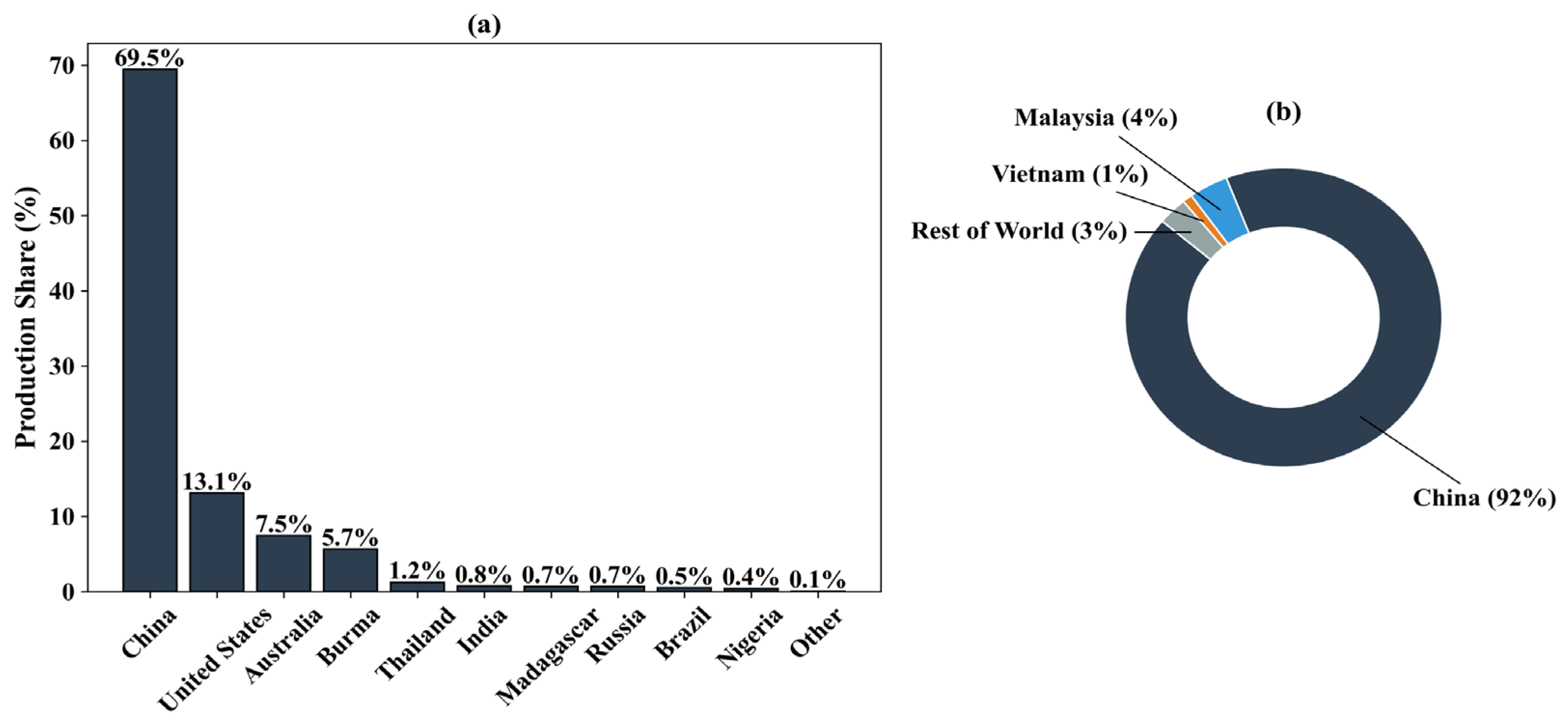
With respect to the energy transition and its associated risks with critical materials supply, diversification represents the most effective strategy to guarantee energy security. However, as reported by the International Energy Agency (IEA) [101], as part of a critical mineral supply, the industry is moving in the opposite direction, as it seems to be particularly focused on improving its refining and processing capacities. The concentration of critical mineral supply within a limited number of leading producers introduces significant uncertainties, and REEs are no exception [12]. By 2025, the total REE mine production accounted for 390,000 metric tons, representing a 2.63% increase from that of the previous year [8]. Notably, the three largest producers are China (270,000 metric tons), the United States (51,000 metric tons), and Australia (29,000 metric tons), corresponding to 69.5%, 13.1%, and 7.5% of global supply, respectively, as depicted in Figure 13a. Additional contributions from Myanmar (Burma), Thailand, India, Madagascar, Russia, and Brazil are also shown, although their shares remain comparatively smaller. Nonetheless, Figure 13b reveals a more critical geopolitical dimension: China maintains a near-monopoly over REEs processing capacity, controlling approximately 92% of the global refined output as of 2024. It is important to note that the distribution of REE production does not necessarily align with the global reserves presented in Figure 6. While Figure 6 reflects reported reserves based on available geological assessments, primarily from the USGS [8], Figure 13 illustrates actual production and processing activities, which are influenced by additional factors, including technological capacity, economic feasibility, regulatory frameworks, and geopolitical considerations. Consequently, some countries appearing as producers in Figure 13, including Myanmar (Burma) and Madagascar, are not represented in Figure 6. This is mainly because their reserves have not been fully quantified, are not publicly reported, or remain classified as resources rather than economically viable reserves according to USGS standards [8]. Therefore, the apparent mismatch between reserves and production should be understood as a data- and classification-limitation rather than an inconsistency, highlighting the uncertainty associated with REE resource reporting and the dynamic nature of global supply chains.
This imbalance highlights a major bottleneck within the REE supply chain, as it exposes the disconnect between geographically diversified mining activities and highly concentrated downstream processing. As a result, a substantial proportion of REE ores extracted worldwide must still be exported to China to be refined into high-purity materials, reinforcing global dependence on Chinese infrastructure and amplifying supply chain vulnerability [102]. This concentration trend has intensified over time. By 2020, China accounted for approximately 85% of global REE production, reflecting a sustained expansion of its dominance across the supply chain. From a geographical perspective, over 92% of global REE-refining capacity remains located within Chinese territory as reported by the IEA [2], consolidating its position not only in extraction but also in downstream processing. For China, the REEs represent one of the most strategically integrated industrial sectors, leaving the rest of the world with a comparatively marginal share in both refining infrastructure and corporate control. In contrast, global consumption patterns reveal a broader distribution of demand. Although China remains the largest consumer, accounting for 58% of total REE consumption, other economies, including Indonesia, South Korea, Japan, the United States, and the European Union, also represent significant demand centers [103].
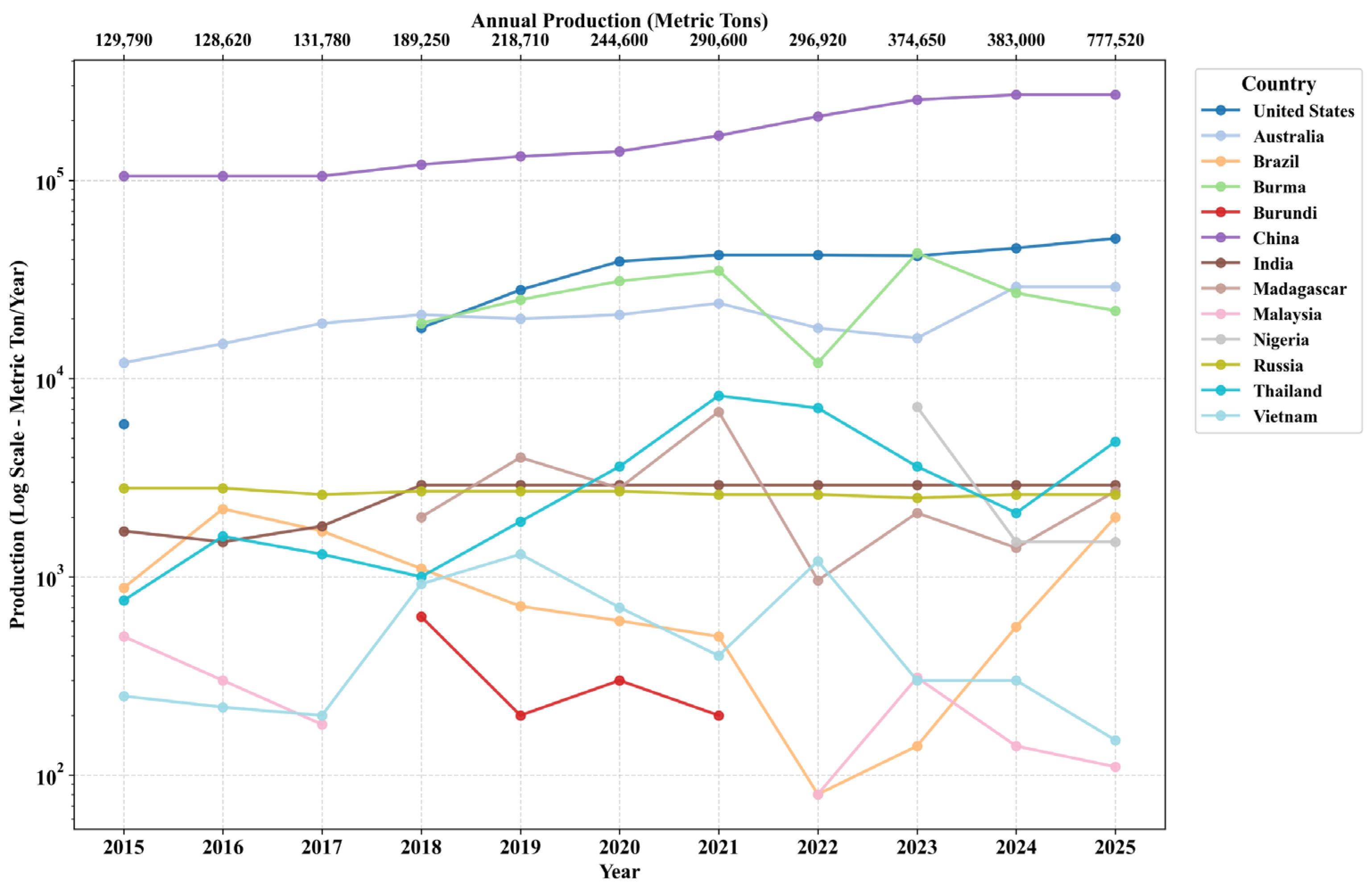
Furthermore, global REE mine production trends, illustrated in Figure 14, reveal a significant expansion over the 2015 to 2025 period. The logarithmic scale employed in the figure allows for a clear visualization of the pronounced disparity between major producers and emerging contributors. Notably, China maintains a dominant lead throughout the decade, with its production surging from roughly 100,000 metric tons in 2015 to nearly 270,000 metric tons by 2025, representing an increase of 170% in this ten-year period. Simultaneously, the United States has exhibited a notable recovery and upward trajectory since 2017, consolidating its position as the second-largest global producer. In contrast, smaller producers such as Myanmar and Vietnam display considerable volatility, with production levels fluctuating across several orders of magnitude, as highlighted by the logarithmic representation. Overall, the data reveal a nearly threefold increase in total global production over ten years, ranging from 129,790 metric tons in 2015 to 388,760 metric tons in 2025, driven primarily by the steady expansion of the Chinese and American mining sectors.
Emerging REE-producing countries are expected to play a critical role in the coming years in mitigating the geopolitical supply risk of these elements [113,114]. In that regard, while India and Madagascar have remained stagnant with flat production lines throughout the decade, they represent underutilized potential in the global landscape (see Figure 14) [115]. Conversely, Australia stands out as a key strategic partner, maintaining a consistent upward trajectory that positions it as the most viable alternative to Chinese supply [116,117]. Similarly, Brazil is gaining increasing relevance, with its production expanding by approximately 300% between 2022 and 2025, supported by significant investments estimated at 465 million USD [8,110,118,119]. However, as reported by Depraiter and Goutte [120], the projection of the REE industry in emerging countries like Thailand and Vietnam remains constrained by production volatility and a strong dependence on foreign investment, which continues to limit their ability to establish stable supply chains. Additionally, significant efforts have been presented by the United States and Canada, both of which possess estimated resources of 3.6 and 14 million tons of REEs, respectively [8]. In 2025, the U.S. Department of War [121] announced an investment of 2 MMUSD in REE-refining technologies, while the U.S. Department of Energy [122] announced funding initiatives totaling 134 MMUSD to strengthen the REE supply chain. In the future, the role of countries with REEs resources in the supply chain will be decisive. By scaling their operations and investing in domestic refining, these nations can mitigate global supply risks and provide the necessary diversification for the high-tech and green energy industries.

5.2. Supply Risk of REEs

Despite recent efforts to diversify global mining activities, the REE supply chain remains structurally fragile, primarily due to the extreme geographical concentration of refining capacity and technological know-how. This structural imbalance has transformed the supply risks from a conventional economic concern into a critical geopolitical issue, increasingly shaped by the strategic control of midstream processing capabilities [123]. This shift is also evidenced by the rapid proliferation of exporting controls that began in 2023, when China imposed exporting restrictions on key critical minerals such as gallium (Ga), germanium (Ge), and antimony (Sb), targeting the United States, although some of these measures were later relaxed [124]. These actions underscore the vulnerability of global supply chains to policy-driven disruptions, particularly in sectors heavily dependent on specialized materials. Table 7 contains a summary of the recent Chinese restrictions related to REEs and associated technologies. The implications of these dynamics extend beyond the REE sector itself, significantly affecting downstream industries such as semiconductors. As a cornerstone of the global technology supply chain, Taiwan Semiconductor Manufacturing Company (TSMC) plays a critical role in supplying advanced chips to major companies, including Apple, NVIDIA, and AMD. Given its dependence on stable access to critical materials, TSMC has begun exploring alternative sourcing strategies, such as partnerships with suppliers in Australia to mitigate potential supply disruptions [125].
All of these geopolitical positions highlight the instability and uncertainty in which the REEs supply chain is involved, as it reflects its importance in the global energy transition. In this respect, any geopolitical shift, policy statement, or strategic positioning by global leaders may compromise the stability and security of the REE supply. Moreover, supply disruptions, whether driven by trade conflicts, regulatory changes, or even extreme climate-related events, can rapidly propagate across highly concentrated processing regions, leading to cascading effects on global production systems. This structural fragility elevates the REE supply risk beyond a conventional economic issue, reframing it as a strategic climate risk. Consequently, the pathway toward Net Zero should not be understood solely as a race to secure sufficient resource volumes, but rather as a systemic challenge to ensure resilient, diversified, and geopolitically robust supply chains. Thus, a more resilient supply chain is required to guarantee and promote a strong collaboration and global stability [128].

6. REE Applications in Energy Transition Technologies

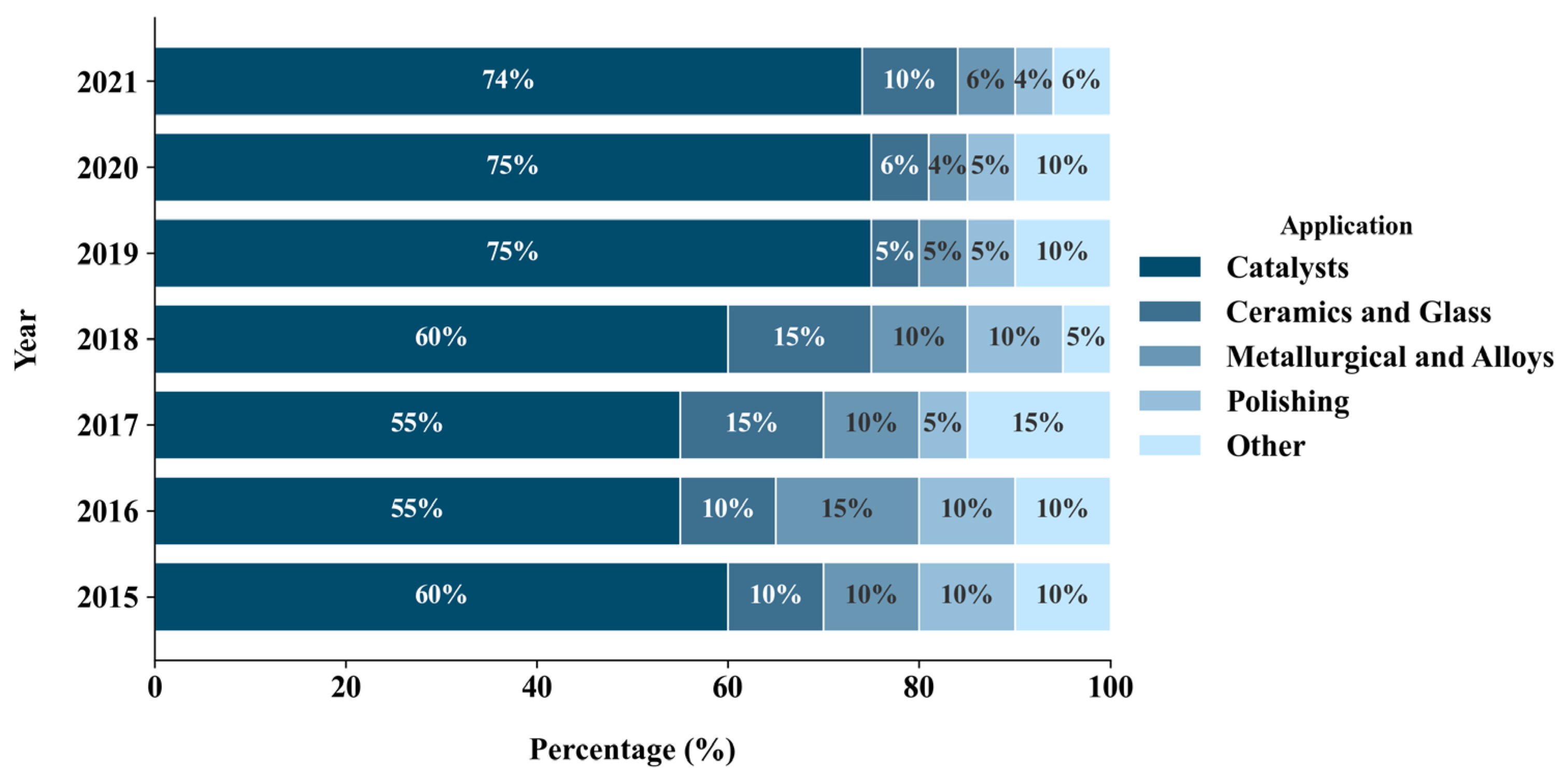
The transition toward low-carbon energy systems is not only an energy challenge but also a material one, in which REEs play a pivotal role. Their unique magnetic, catalytic, and optical properties make them essential for a wide range of technologies that support decarbonization pathways. From a global perspective, the distribution of the REEs demand has undergone a significant structural transformation over the past decade. Historically, catalysts represented the dominant application, which accounted for the largest share of REE consumption. As shown in Figure 15, catalytic applications reached approximately 55 to 74% of their total demand from 2015 to 2021, according to data reported by USGS. During this period, other applications, such as ceramics, glass, metallurgy, and polishing, accounted for comparatively smaller, more stable shares.
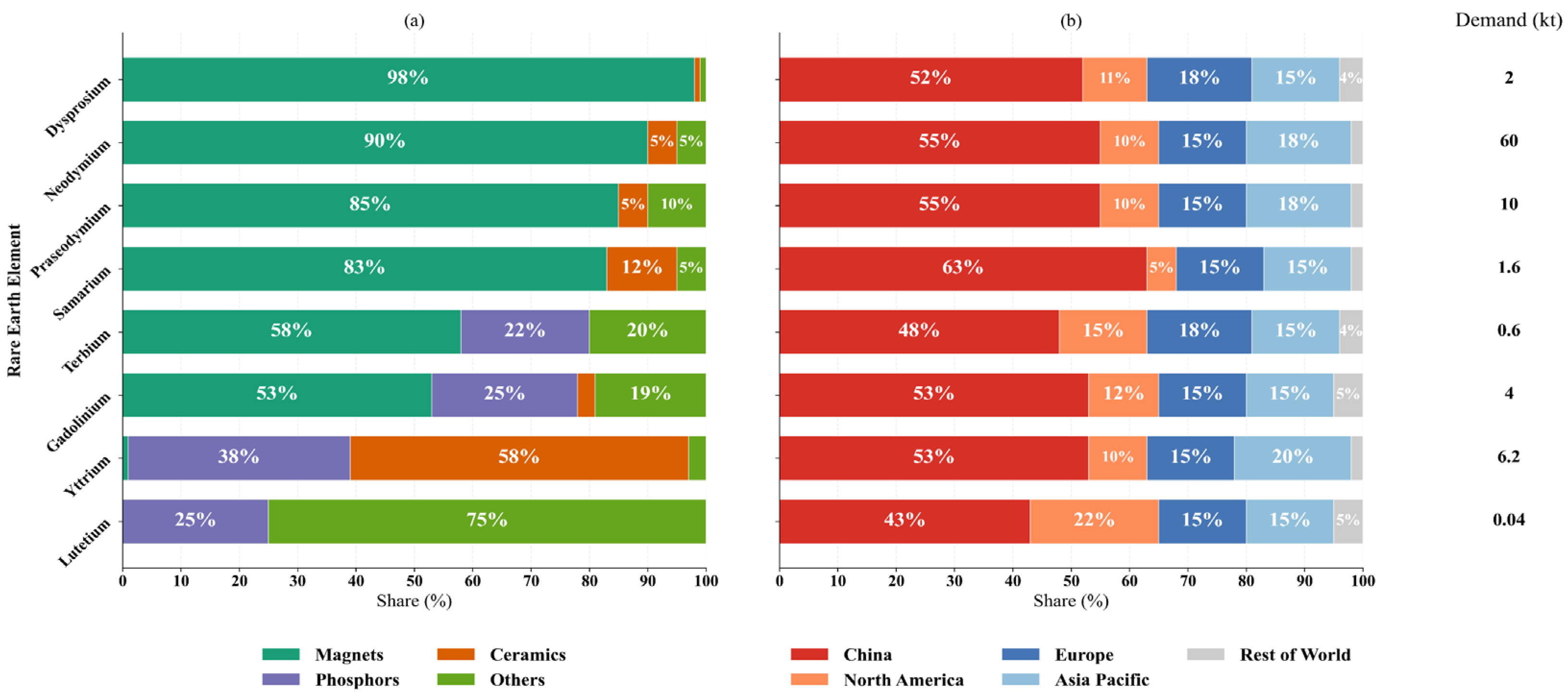
However, this demand structure has undergone a rapid transformation in recent years, primarily driven by the accelerated deployment of clean energy technologies. In particular, permanent magnets have emerged as the fastest-growing application, becoming the leading segment not only in market value but increasingly in volume demand. Within this context, Berg [129] reported that in 2022, approximately 76,400 metric tons of REO were used for permanent magnet production, accounting for 44% of total REE demand. This shift reflects a broader structural transition of the REEs markets from being largely driven by conventional industrial uses to being increasingly shaped by energy transition technologies. At the elemental level, this transformation is even more pronounced. Critical elements such as neodymium, praseodymium, dysprosium, and terbium are predominantly allocated to magnet production, with shares ranging from 85% to 95% of their total consumption, as illustrated in Figure 16. Conversely, elements such as yttrium, gadolinium, and samarium maintain more diversified application profiles, including ceramics, phosphors, and specialized industrial processes [8]. This divergence highlights the increasing strategic importance of magnet-related REEs within the broader supply chain.
Building upon this evolving demand structure, the role of REEs becomes particularly critical in key energy transition sectors. The growing dominance of magnet-related applications is directly associated with the unique properties of REE-based permanent magnets. Among the different types of REE-based permanent magnets, NdFeB and SmCo accounted for one-third of the share of the permanent magnet market in 2025 [131,132]. NdFeB magnets are made up of 31% neodymium, 68% iron, and 1% of boron. In addition, alloying elements such as dysprosium and praseodymium are commonly incorporated to enhance corrosion resistance and improve thermal stability [133]. In contrast, SmCo magnets are made up of about 36% samarium and 64% cobalt in SmCo5, and approximately 25%, 50%, and 25% of samarium, cobalt, and iron, respectively, in Sm2Co17 structures [134,135]. These materials exhibit the highest energy density, coercivity, and thermal stability, making them essential for advanced technological applications as depicted in Table 8. In general terms, NdFeB magnets are preferred for their superior magnetic performance and low cost, whereas SmCo magnets are preferred due to their higher thermal stability under extreme conditions.
From a materials perspective, the distinction between LREEs and HREES becomes critical. LREEs such as neodymium and praseodymium are responsible for the primary magnetic properties, whereas HREEs like dysprosium and terbium are used in smaller quantities to improve performance under high temperatures and improve resistance to demagnetization, as reported by Song et al. [138]. The widespread adoption of these magnet technologies is closely linked to their applications across energy transition systems. REEs-based magnets are the strongest known permanent magnets, thus making them the preferred choice in various energy sectors for their attractive characteristics. In particular, they are extensively used in high-performance systems such as EV motors, wind turbine generators, and other high-efficiency electromechanical devices.
EVs commonly implement Interior Permanent Magnet Synchronous Motors (IPMSM) in the rotor design to achieve the required efficiency and energy density [139]. IPMSMs are the dominant configuration, as they enable higher torque and efficiency compared to the induction-based alternatives, making them the preferred choice of magnets for brands such as Audi and General Motors [140,141]. The number of REEs used will vary depending on the motor design and the vehicle size, but according to Veller et al. [142], the number is around 2.5 kg of NdFeB magnets per vehicle. Nonetheless, as reported by Bailey et al. [143], even when REE-magnets are the most used technology in EVs, the price volatility as well as the uncertainty of their supply make them an unreliable and unsustainable source. As a result, constant efforts have been made to get REEs free motors in EVs with technologies such as propulsion systems, copper windings, synchronous reluctance motor (SynRM), and permanent-magnet-assisted synchronous reluctance motor (PMaSynRM) [144,145,146]. Furthermore, even when brands such as Renault [147] have constructed vehicles without REE-based magnets, high-performance permanent magnet motors will still rely on REEs [148]. While EVs represent a significant share of demand, this reliance on REEs mirrors a similar trend in the wind energy sector, where high-capacity turbines increasingly prioritize these materials to maximize power output.
In that regard, permanent magnets are increasingly employed in wind turbines, especially in offshore installations, due to their superior efficiency and lower maintenance requirements [149]. This has positioned wind energy as an important driver of the REEs’ demand. According to Rabe et al. [150], the permanent magnets employed in wind turbines are constituted of 66% Fe, 28.5% of Nd, 4.4% of Dy, and 1% of B with an average weight of 4 tonnes. Although permanent magnets are employed in both onshore and offshore wind systems, offshore turbines represent the fastest-growing segment and the largest source of demand. By 2018, approximately 77% of the global offshore wind turbines were equipped with REE-based permanent magnets [151]. Furthermore, Imholte et al. [152] estimate that achieving environmental targets in the United States alone could require between 3% and 7% of the global REE supply for wind energy applications. While alternative technologies such as hybrid drivetrains and induction-based generators remain viable for onshore applications, their adoption is limited to offshore environments, where operational conditions demand higher efficiency, compactness, and reliability. In fact, wind turbines without permanent magnets are still available on the market, but they are considered impractical at a large scale [150]. Consequently, the increasing deployment of wind energy systems, particularly in offshore equipment characterized by harsh operating conditions, will likely intensify reliance on REEs, further reinforcing their strategic importance in the global energy transition.
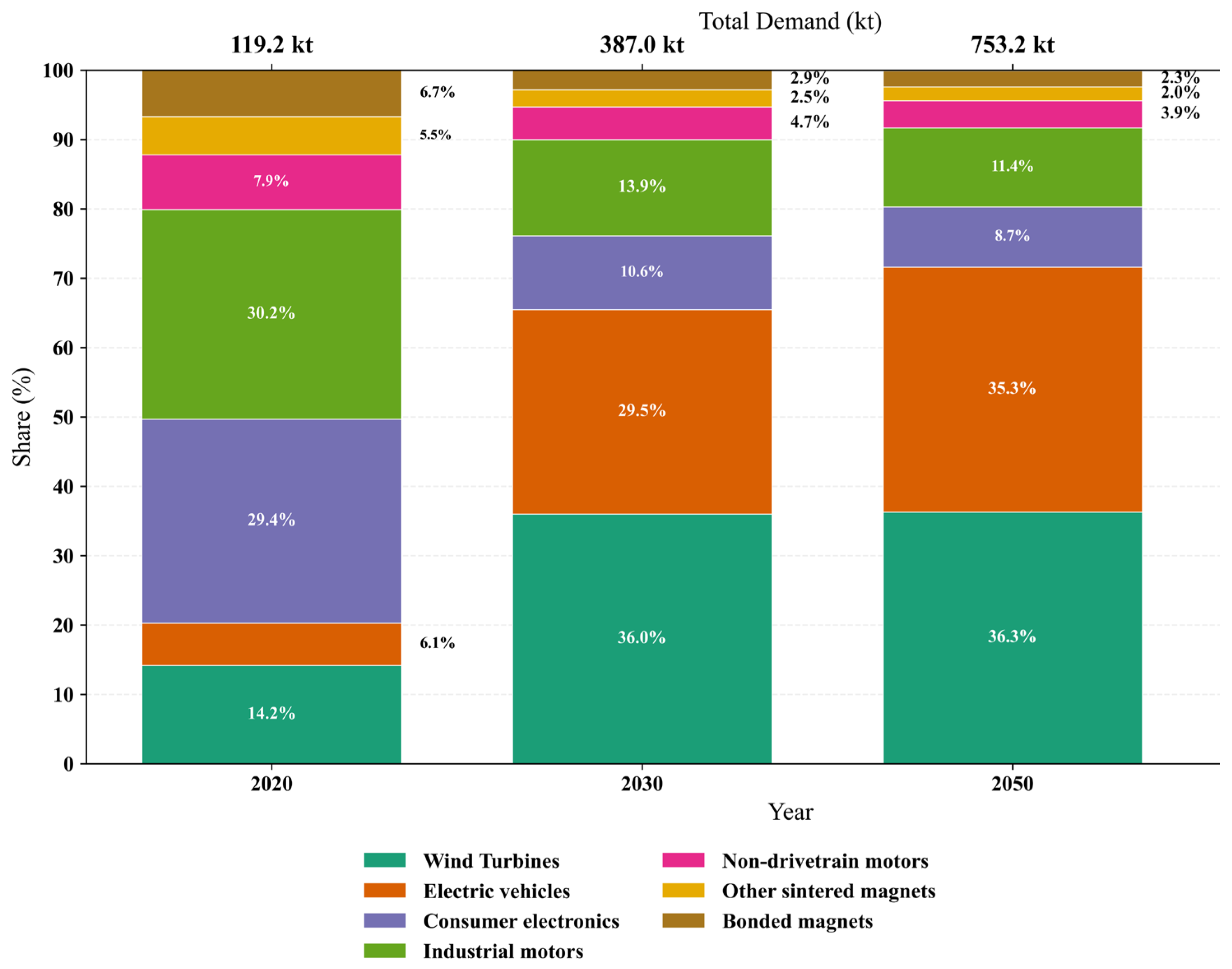
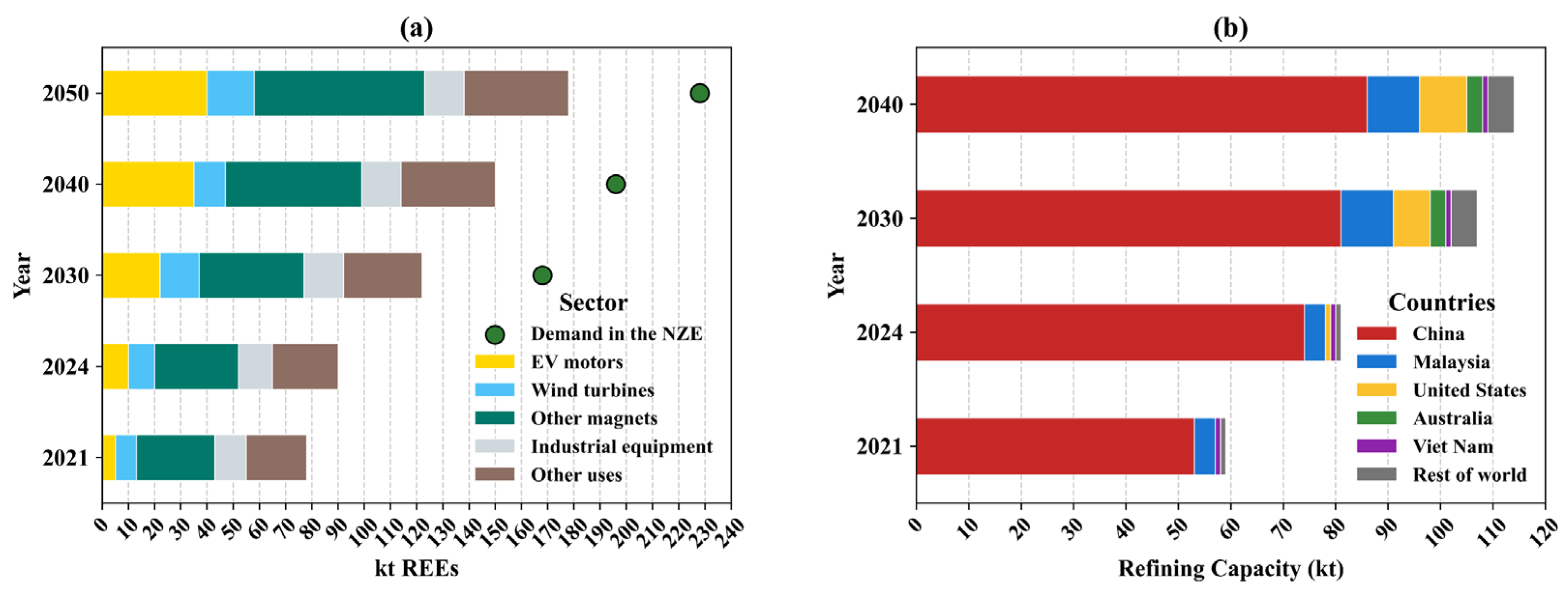
Beyond mobility and wind energy, REEs also play an important and increasingly diversified role in grid infrastructure and battery energy storage systems (BESS), even when they are not directly present in energy systems such as photovoltaic modules. Elements such as yttrium, lanthanum, and cerium are commonly employed in power electronics, including converters for voltage regulation in solar-integrated storage systems, as well as in sensors for monitoring battery temperature in BESS [153]. In addition to these established applications, REEs are gaining relevance in several emerging energy technologies. These include their use in hydrogen-related systems, particularly in catalysis and hydrogen storage materials [154,155], as well as in advanced chemical processes such as fluid catalytic cracking [120,156]. Furthermore, within the framework of green chemistry, REEs are increasingly utilized in environmentally benign catalysts, carbon capture technologies, and sustainable chemical synthesis pathways [157]. Looking ahead, REEs are also expected to play a role in next-generation energy systems, including nuclear fusion programs currently under development in Japan, China, the United States, Germany, and Russia [158]. Although many of these applications remain in the early stages of development, they underscore the expanding and long-term strategic importance of REEs beyond currently commercialized technologies. In line with this, demand projections indicate a substantial increase in the use of REE-based permanent magnets, with expected growth of approximately 225% and 532% by 2030 and 2050, respectively, relative to 2020 levels, as reported by the U.S. Department of Energy [159], as depicted in Figure 17.
Additionally, the production of these permanent magnets, especially NdFeB, has been widely studied with regard to their environmental and social impact [160]. In this respect, Marx et al. [161] reported an LCA for NdFeB production from Bayan Obo, Mountain Pass, and Mount Weld. They evaluated several environmental impacts, including climate change, fossil depletion, freshwater ecotoxicity, and human ecotoxicity, among others. They reported that, from all assessed impacts, the worst performance was registered in Bayan Obo. Conversely, the best performance was obtained in Mountain Pass with their production of NdFeB. This is mainly due to the specific characteristics of each deposit. These differences are primarily attributed to variations in ore composition, processing routes, and energy sources across the respective deposits. Furthermore, according to Wang et al. [162], enhancing REE recovery and integrating clean energy into the process will considerably reduce the environmental impact of NdFeB production. These findings emphasize the importance of not only securing material supply but also optimizing production pathways to ensure that the deployment of REE-based technologies aligns with broader sustainability objectives.

7. Circularity, Substitution, and Risk Mitigation Pathways for REEs

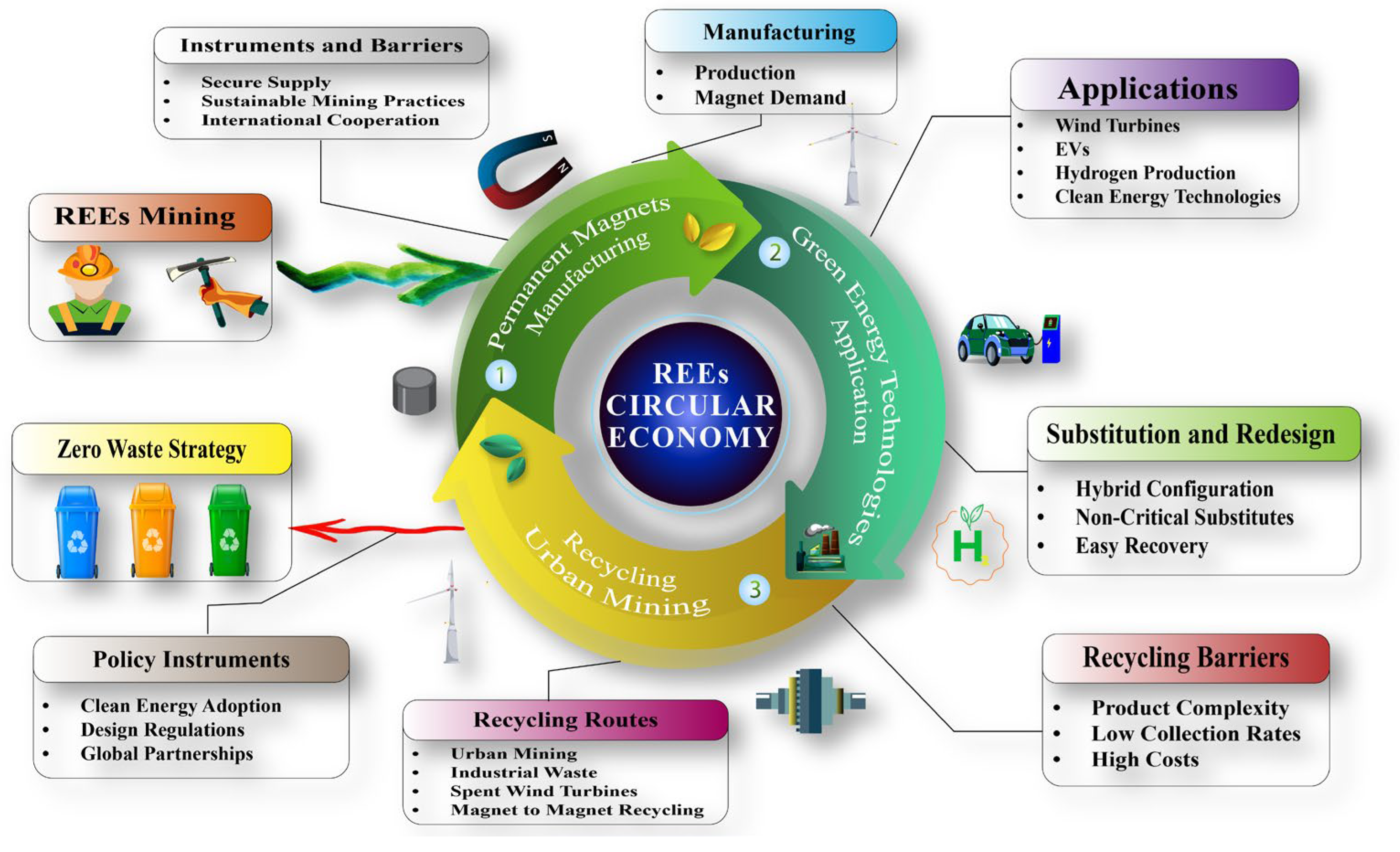
The continuously increasing demand and the volatility of REE supply chains require a multifaceted approach that goes beyond traditional extraction. The REE supply chains prefer to focus instead on circularity for strategic risk mitigation. Thereby, by integrating advanced urban mining techniques, fostering innovation in material substitution, and establishing robust international policy frameworks, it is possible to decouple technological progress from environmental degradation. This section explores how the convergence of circular economy principles and design-for-disassembly strategies can enhance the long-term viability of REE-dependent green technologies.

7.1. Direct Recycling and Urban Mining of REEs

Recycling strategies have gained increasing relevance across industrial, energy, and consumer sectors, driven by their potential to recover valuable materials from end-of-life products and significantly enhance overall sustainability. In that regard, permanent magnets are not excluded from the recycling processes. However, being referred to as “permanent” means that their lifespan is longer than that of common magnets, since they can reach a lifespan of up to 150 years, losing only 2% of their magnetic capacity [163,164]. In contrast, the operational lifespan of the technologies in which they are embedded is considerably shorter. For instance, EVs typically operate for 10 to 15 years, while wind turbines can have a lifespan of up to 35 years under the appropriate maintenance and refurbishment conditions [165,166,167]. In the case of wind turbines, when the systems reach their end-of-life, a permanent magnet will still have 77% of its capacity and over 99% of its efficiency. This is something that the industry should take advantage of. This discrepancy highlights a critical opportunity for resource optimization through direct reuse pathways. The recycling process for permanent magnets varies from the typical recycling process since magnets are taken from their spent devices and allocated into new devices without the need to extract specific elements; this process is referred to as magnet-to-magnet recycling. This approach not only reduces processing complexity and energy consumption but also minimizes material loss, thereby reinforcing the role of urban mining as a key pillar in the development of sustainable and resilient REEs supply chains.
One of the main advantages of directly recycling magnets lies in its potential to significantly reduce reliance on primary raw materials, particularly REEs; thus, a variety of methods have been reported in order to directly recycle these magnets. Jager et al. [168], for instance, analyzed the particular case of Germany. In this case, they determined that by 2030, up to 146 tons of spent magnets will become available for recycling. Similarly, Cherkezova-Zheleva et al. [169] studied an approach for non-oxidized permanent magnets with cost-effective, sustainable, and scalable characteristics, whereas Xu et al. [170] proposed an approach capable of recycling NdFeB magnets repeatedly in a closed-loop system.
Despite these technological advances, regulatory frameworks remain a critical bottleneck. As reported by Zakotnik et al. [171], stronger regulatory policies to force recycling are still needed. Alternatively, when direct reuse is not feasible, conventional recycling techniques can be employed to recover REEs from spent devices. Hydrometallurgical processes, for example, applied to end-of-life wind turbines have demonstrated a recovery efficiency of up to 99% for REO [172]. Moreover, Aldana et al. [173] studied a process based on H2O2 to aid in the recovery of non-cerium REEs from magnet waste. This process had an efficiency rate of 97.9%. Other approaches, including the use of organic acids, oxygen-vacancy engineering, and process optimization through the Taguchi methods, have also been studied to enhance recovery performance [174,175,176]. It is worth noting that processes such as pyrometallurgy and hydrometallurgy should be considered as the last option due to their immense energy requirements, as reported by Burkhardt et al. [177].
The recovery of REEs from spent devices is commonly referred to as urban mining, as valuable raw materials, including REEs, are effectively extracted from urban waste streams. In this sense, Agrawal and Ragauskas [178] determined that the REEs production from coal and coal ash is able to produce 312,000 metric tons of REEs. In 2025, this value represents 80.25% of the total demand; this, according to the data discussed in Section 5. Bringas et al. [179] reported an urban mining approach using inorganic acids such as hydrochloric, sulfuric, and nitric acid, whereas Zhang and Shen [180] studied the implementation of urban biomining of REEs as a prominent alternative. Table 9 summarizes the potential environmental benefits associated with the production of NdFeB magnets from recycled sources, highlighting the role of circular strategies in improving the overall sustainability performance of REE supply chains.
However, several critical barriers continue to hinder the large-scale implementation of permanent magnet recycling. On this matter, Rizos [182] depicts the lack of several stages across the recycling value chains, including the well-established recycling targets. Marsh [183], on the other hand, highlighted the limited infrastructure as the main barrier, and Raspini et al. [184] found that long-term financial profitability is the main barrier. These limitations collectively restrict the scalability and competitiveness of recycling systems when compared to primary extraction routes. Consequently, overcoming these barriers requires coordinated efforts among policymakers, financial institutions, industry stakeholders, and the research community. Strengthening regulatory frameworks, incentivizing investment, and advancing technological innovation will be essential to enable the widespread adoption of REE recycling and to fully realize its potential within a circular and resilient supply chain.

7.2. REEs Substitution, Technology Redesign, or Circularity for Sustainability?

Due to the high volatility of the REEs market, growing sustainability concerns, and increasing geopolitical tensions, the substitution of these elements with more abundant or less critical materials has emerged as a key research direction. Initially, the substitution of critical minerals involved in NdFeB magnets, including neodymium and praseodymium, as previously described, was one of the contemplated alternatives. In view of this, Delette [185] researched the partial substitution of neodymium and praseodymium with cerium and lanthanum, identifying a significant challenge associated with reduced magnetic performance. This limitation is primarily attributed to the Ce4+ valence state, which introduces non-magnetic moments within the material. However, they also reported that a substitution with yttrium or gadolinium could restore magnetic properties. In this regard, Zhang et al. [186] developed a PrFeC magnet with lower cost and improved coercivity compared to NdFeB. Similarly, the use of yttrium, lanthanum, and cerium has also been reported [187], and beyond compositional modifications, entirely new material systems have been proposed. Amato et al. [188] assessed Manganese-Aluminum-Carbon (MnAlC) permanent magnets as a promising alternative, reporting up to a 95% reduction in environmental impact and a three-to-twelve-fold improvement in health and safety indicators during the production stage. Moreover, it has been estimated that such approaches could reduce demand for REE-based magnets by up to 3400 tons, corresponding to approximately 20% of total European consumption [189]. However, despite these promising developments, large-scale substitution remains at an early stage. Even minor reductions in magnetic performance can significantly impact the efficiency of applications such as EVs and wind turbines, often requiring a substantial redesign of their entire systems. Therefore, while substitution offers a potential pathway in order to mitigate supply risks, the performance must be evaluated alongside technological redesign and circularity strategies.
In this regard, the redesign of technologies to facilitate disassembly is essential for efficient REE recovery. Within this framework, stronger regulatory measures are required to incentivize manufacturers to adopt design principles that consider the entire product life cycle, including end-of-life management and recycling. This includes the implementation of policies that promote product design for disassembly, as well as the development of effective e-waste collection and recycling programs [190]. Designing products and technological systems with recyclability in mind is a critical step toward implementing circular economy principles in the permanent magnet industry. In that regard, Keal et al. [191] demonstrated that a minimum change in device design can significantly simplify the material recovery. Therefore, as well as circularity, is gaining position in the modern industry, the REE sector is not an exception.
For instance, Wang et al. [192] demonstrate that, with regard to circularity, the magnet-to-magnet recycling process has the lowest environmental impact, corresponding to 31.5% of the primary manufacturing GWP. Additionally, they report that not all the ways to recycle spent permanent magnets are environmentally beneficial compared to primary production. This highlights the necessity of extensive LCA of the recycling process to ensure global sustainability in REEs terms. On the other hand, circularity could also be assessed at the REE production stage, as demonstrated by Gijon et al. [193], who studied the recovery of REEs from a circularity perspective using phosphogypsum, a fertilizer production residue. Similarly, Palle Paul Mejame et al. [194] studied the circularity of REEs in Australia through the 10 R principles approach, reporting reductions in CO2 emissions and energy consumption of 45% and 44%, respectively. These remarks the critical role that circular economy principles can play across the entire REEs supply chain, addressing key sustainability challenges while promoting resource efficiency. In this regard, Figure 18 shows the integration of circular strategies toward a zero-waste paradigm and its limitations.

7.3. Policy Instruments

The mitigation of REE supply risks extends beyond individual technological solutions, necessitating the construction of international cooperation frameworks that involve circular economy regulations and facilitate cross-border management of technological waste. Given the pronounced geographical concentration of primary reserves and refining capacity, global policy instruments play a critical role in enhancing supply chain resilience. Initiatives such as the European Commission’s Critical Raw Materials Act (CRMA) [195] and the Minerals Security Partnership (MSP) [196] are pivotal in fostering data transparency and ensuring critical material supply. These frameworks should also incentivize joint investment in urban mining infrastructure and support the harmonization of recycling standards and protocols. Such measures are necessary to overcome logistical, technical, and regulatory barriers that currently limit the efficient flow of end-of-life permanent magnets toward specialized recycling and processing facilities. Thus, a coordinated policy approach is fundamental to decouple technological progress from geopolitical volatility.
On this matter, Keilhacker et al. [197] concluded that substitution of REEs in permanent magnets, their recycling, and supply expansion are strategic opportunities with potential for supply risk mitigation. However, based on the literature reviewed in this work, it can be inferred that, given the current maturity levels of substitution and recycling technologies, the most effective short- to medium-term strategy to reduce REEs supply risk is the diversification of supply sources at the market level. In this respect, countries such as Australia, Canada, and the United States exhibit significant potential to play a more prominent role in global REEs supply chains. Efforts in this direction have already been explored in the literature, such as the work presented by Hamed et al. [198], proposing a system dynamics model to diversify the REE supply chain. The findings highlighted the environmental trade-offs that promote sustainable mining but slightly constrain the REE market. Similarly, Oka [199] studied the dependence of the United States on China’s supply. The findings revealed that non-Chinese suppliers cannot fully replace Chinese suppliers in the long term due to capacity limitations and higher costs.
Beyond technological innovation and environmental mitigation, the long-term resilience of the REE supply chain should be intrinsically linked to social sustainability. Within the framework of Social Life Cycle Assessment (S-LCA), the expansion of REE mining, particularly in emerging and resource-rich regions, raises critical concerns related to community impacts, labor conditions, and the protection of indigenous rights [200]. Furthermore, labor-related challenges remain significant, especially in artisanal and small-scale mining contexts, where insufficient occupational safety standards, informal employment structures, and risks of child exposure may be present [201]. These issues represent a critical gap that must be addressed to ensure a sustainable REEs value chain. From a systems perspective, integrating social dimensions into analytical perspectives such as the Demand-Sustainability-Risk (DSR) nexus is essential to ensure that supply chain resilience is not achieved at the expense of vulnerable communities. Achieving a Social License to Operate (SLO) is therefore as vital as technical efficiency. Without such measures, the expansion of REE supply chains risks exacerbating global inequalities by disproportionately shifting social and environmental burdens [200].

8. Future Outlook: Demand-Sustainability-Risk Nexus

As the global energy landscape undergoes a fundamental transformation, securing the REEs supply is a cornerstone of national and economic resilience. If we wish to achieve the Net Zero Emissions (NZE) scenario by 2050 [202], the deployment of clean energy technologies must accelerate at an unprecedented pace. This transition is inherently mineral-intensive, creating a considerable demand for critical minerals, including REEs, specifically neodymium, praseodymium, dysprosium, and terbium. In that regard, Figure 19a illustrates the projected growth in REE demand for clean energy technologies, with increases of approximately 35%, 66%, and 97% by 2030, 2040, and 2050, respectively, relative to the 2024 levels. However, it is important to note that these projections remain below the required levels to fully achieve the NZE pathway. In view of this, meeting NZE targets would require demand increases of approximately 86%, 117%, and 153% for the same respective time horizons. This gap highlights the urgent need for a substantial expansion of clean energy technologies and associated material supply chains. Furthermore, as REEs production increases to meet this growing demand, refining and processing capacities must expand accordingly. Figure 19b depicts the increase in refining capacity around the world, indicating a gradual diversification of the supply chain. By 2040, Malaysia, Australia, and the United States are expected to contribute approximately 9%, 3%, and 8% of global refining capacity, respectively, while China is projected to maintain its dominant position with approximately 75% of total capacity. Although these developments represent progress toward a more diversified and resilient REE supply chain, significant challenges remain.
Additionally, as the REE production increases, a corresponding expansion in permanent magnet manufacturing is required to meet growing technological demand. As of 2024, China accounted for approximately 94% of the global permanent magnet production, followed by Japan with 4% and Vietnam with 1% [127]. This high market concentration in magnet manufacturing, coupled with China’s dominance in REE production and processing, introduces significant structural vulnerabilities into the global supply chain for both REEs and permanent magnets. On this matter, Figure 20a presents the projected production of NdFeB magnets in China up to 2030, indicating a compound annual growth rate (CAGR) of 5.9% from 2025. In parallel, Figure 20b illustrates the participation of emerging producers of NdFeB magnets, with regions such as the United States, Europe, and other parts of Asia (excluding China) exhibiting a higher CAGR of approximately 17.2%, which reflects the efforts of diversification. However, despite this growth in emerging markets, China is still projected to maintain a dominant position, accounting for approximately 84% of total global production by 2030, while the rest of the world collectively contributes only 16%. This persistent concentration of production capacity underscores a continued vulnerability within the REEs and permanent magnet supply chain, posing potential risks to the stability and sustainability of the global energy transition.
Therefore, it is evident that several constraints significantly affect the diversification of REEs supply chains. In this regard, Yao et al. [203] highlighted the material scarcity as an important physical constraint, while Pawar and Ewing [204] reported the government decision as another important issue. Similarly, Chen et al. [205] studied the United States-China trade dynamics in REEs, demonstrating that increasing dependency on a single supplier can exacerbate supply chain vulnerabilities rather than enhance stability. Thus, Figure 21 illustrates the REEs ecosystem as a point where three fundamental dimensions converge. This ecosystem is defined as the Demand-Sustainability-Risk nexus (DSR-nexus) as an integrated analytical perspective. This nexus is characterized by dynamic feedback loops where each dimension exerts a reciprocal influence on the others. REEs are essential for technological advancement and energy systems, particularly in the production of high-performance permanent magnets used in wind turbines and EV motors. Analogously, the sustainability side encompasses the environmental, operational, and ethical challenges associated with REEs production and use. It highlights the need to mitigate the environmental impacts of extraction while promoting recycling, circular-economy strategies, and regulatory frameworks aimed at reducing the carbon and ecological footprint of the industry. Finally, the riskiest side captures the systemic vulnerabilities inherent in the global REEs supply chain. Factors such as geopolitical tensions, market volatility, and supply chain disruptions (often driven by the high geographical concentration of refining and processing capacities) act as destabilizing forces that can significantly impact the global flow of these critical materials. Taken together, the dynamic interplay between rising demand, sustainability imperatives, and inherent supply chain risks defines the trajectory of REEs in the coming decades, positioning this nexus as a central challenge in achieving a resilient and sustainable energy transition.
It could be deduced that the resilience of the REE supply chain does not depend solely on geological abundance or technical innovation, but on the balanced and integrated management of the Demand-Sustainability-Risk nexus. An imbalance in any of these sides, whether through overreliance on geopolitically sensitive suppliers, price volatility that discourages investment, or extraction practices that neglect environmental standards, poses a direct threat to the viability of the global energy transition. Maintaining equilibrium within this nexus is therefore essential to ensure a sustainable and secure REEs supply chain. From this analytical perspective, proactive risk mitigation emerges as a critical enabler, allowing technological demand and environmental responsibility to coexist and evolve in a mutually reinforcing manner over the long term. Accordingly, Research on REEs should be directed toward developing integrated and resilient systems that combine circularity, technological innovation, and supply chain diversification, in order to balance growing demand with environmental sustainability and geopolitical risk mitigation.
In this context, proactive risk mitigation entails the implementation of coordinated strategies aimed at reducing structural vulnerabilities across the DSR nexus of the REE supply chain. Key actions include diversifying primary supply sources to alleviate geopolitical dependencies, accelerating the development of secondary supply through circular economy practices, including recycling and urban mining, and enhancing process efficiency to minimize environmental footprints. Additionally, fostering international cooperation through strategic partnerships and harmonized trade agreements is crucial. Such measures are essential to address the inherent uncertainties regarding REE availability and to mitigate the risk of supply disruptions. By integrating these strategies, the long-term reliability and sustainability of these critical materials can be reinforced, ensuring their viability within the global energy transition.

9. Conclusions and Research Gaps

The rapid expansion of clean energy technologies places REEs at the core of the global energy transition; however, their supply chain remains structurally fragile and highly concentrated. China, at present, continues to dominate the global REEs landscape, particularly in processing, refining, and permanent magnet production capacities with 69.5%, 92%, and 94%, respectively, exerting significant influence over the availability and stability of these critical materials. This concentration creates a pronounced imbalance between geographically localized supply and globally distributed demand, intensifying geopolitical risks and exposing the system to potential disruptions. At the same time, Australia, the United States, Canada, Brazil, and several other regions in Asia are progressively strengthening their presence in the REEs value chain and emerging as producers of their own accord. By 2040, Malaysia, Australia, and the United States are expected to contribute approximately 9%, 3%, and 8% of global refining capacity, respectively, reflecting a gradual but still limited diversification of the global refining landscape. These countries represent a critical opportunity for diversification; however, their current contributions remain insufficient to counterbalance China’s dominance. In this context, enhancing domestic processing capabilities and fostering regional supply chains are essential steps toward reducing dependency and improving global resilience.
From a sustainability perspective, the future of REEs will depend less on the continuous expansion of primary extraction and more on the optimization of resource efficiency, recovery processes, and the environmental performance of existing technologies. Although recycling represents a key pillar of circularity, current methods are still constrained by high energy requirements, intensive chemical usage, large volumes of generated solvent waste, and limited selectivity, thus hindering their scalability and environmental benefits. Consequently, these limitations underscore the urgent need for innovation in recycling technologies, particularly in the development of more efficient, selective, and environmentally benign recovery processes. While substitution, recycling, and technological redesign are essential components of a sustainable REE strategy, they must be complemented by more immediate and decisive actions aimed at supply diversification. Strengthening alternative production hubs, developing independent processing, and refining capacities are all crucial to enhancing the resilience of the global REE market. In addition, integrating REE trade agreements within broader climate cooperation frameworks could create a viable pathway to align resource security with global sustainability objectives.
Moving forward, addressing the challenges of the REE supply chain requires a coordinated and multi-dimensional effort across three key domains. From an academic perspective, research should prioritize the advancement of efficient recycling technologies, the development of alternative materials, and the improvement of LCA methodologies and mathematical models to ensure that sustainability gains are both quantifiable and scalable. From an industrial standpoint, efforts must focus on building resilient supply chains by adopting circular economy principles and implementing cleaner and more efficient processing technologies. Finally, from an international cooperation perspective, robust policy frameworks, strategic alliances, and cross-border agreements are essential to ensure equitable access to critical resources while mitigating geopolitical risks.
Securing a sustainable and resilient supply of REEs is not merely a matter of expanding resource availability, but of reframing the entire system through the DSR-Nexus, as proposed in this review. In that regard, innovation, collaboration, and responsible governance play a central role. Only through a coordinated global effort grounded in the DSR-Nexus framework can the REE system effectively support the ambitious goals of achieving NZE by 2050. By consolidating current knowledge and identifying key technological, industrial, and policy directions within this tri-sectoral nexus, this work contributes to guiding future research and decision-making toward a more resilient and sustainable REE supply chain aligned with the global energy transition.

Supplementary Materials

The following supporting information can be downloaded at: https://www.mdpi.com/article/10.3390/eng7050211/s1. PRISMA-S Checklist. Reference [206] is cited in the Supplementary Materials.

Author Contributions

Conceptualization, V.O.V.-M., L.F.L.-B., C.R.-M., M.M.E.-H. and J.M.P.-O.; methodology, V.O.V.-M., L.F.L.-B., C.R.-M., M.M.E.-H. and J.M.P.-O.; software, V.O.V.-M., L.F.L.-B., C.R.-M., M.M.E.-H. and J.M.P.-O.; validation, V.O.V.-M., L.F.L.-B., C.R.-M., M.M.E.-H. and J.M.P.-O.; formal analysis, V.O.V.-M., L.F.L.-B., C.R.-M., M.M.E.-H. and J.M.P.-O.; investigation, V.O.V.-M., L.F.L.-B., C.R.-M., M.M.E.-H. and J.M.P.-O.; resources, V.O.V.-M., L.F.L.-B., C.R.-M., M.M.E.-H. and J.M.P.-O.; data curation, V.O.V.-M., L.F.L.-B., C.R.-M., M.M.E.-H. and J.M.P.-O.; writing—original draft preparation, V.O.V.-M., L.F.L.-B., C.R.-M., M.M.E.-H. and J.M.P.-O.; writing—review and editing, V.O.V.-M., L.F.L.-B., C.R.-M., M.M.E.-H. and J.M.P.-O.; visualization, V.O.V.-M., L.F.L.-B., C.R.-M., M.M.E.-H. and J.M.P.-O.; supervision, L.F.L.-B., C.R.-M., M.M.E.-H. and J.M.P.-O.; project administration, C.R.-M., M.M.E.-H. and J.M.P.-O.; funding acquisition, L.F.L.-B., C.R.-M., M.M.E.-H. and J.M.P.-O. All authors have read and agreed to the published version of the manuscript.

Funding

This research received no external funding.

Institutional Review Board Statement

Not applicable.

Informed Consent Statement

Not applicable.

Data Availability Statement

Not applicable. No new data were created or analyzed in this study. Data sharing is not applicable to this article.

Acknowledgments

The authors acknowledge the support provided by the Secretaría de Ciencia, Humanidades, Tecnología e Innovación (SECIHTI), Mexico, and CIC-UMSNH.

Conflicts of Interest

The authors declare no conflicts of interest.

Abbreviations

BESSBattery Energy Storage Systems
CAGRCompound Annual Growth Rate
CRMACritical Raw Materials Act
DESsDeep Eutectic Solvents
DSR-NexusDemand-Sustainability-Risk Nexus
EVsElectric Vehicles
GWPGlobal Warming Potential
HREEsHeavy Rare Earth Elements
IPMSMInterior Permanent Magnet Synchronous Motor
LCALife Cycle Assessment
LREEsLight Rare Earth Elements
MREEsMiddle Rare Earth Elements
MSPMinerals Security Partnership
NdFeBNeodymium-Iron-Boron
NORMNaturally Occurring Radioactive Materials
NZENet Zero Emissions
PMaSynRMPermanent Magnet-Assisted Synchronous Reluctance Motor
PRISMAPreferred Reporting Items for Systematic Reviews and Meta-Analyses
RERenewable Energy
REEsRare Earth Elements
REORare Earth Oxides
SmCoSamarium-Cobalt
SynRMSynchronous Reluctance Motor

References

  1. United Nations. Five Ways to Jump-Start the Renewable Energy Transition Now. Available online: https://www.un.org/en/climatechange/raising-ambition/renewable-energy-transition (accessed on 24 February 2026).
  2. IEA. The State of Energy Innovation 2026; IEA: Paris, France, 2026. [Google Scholar]
  3. IEA. The Role of Critical Minerals in Clean Energy Transitions; IEA: Paris, France, 2021. [Google Scholar]
  4. Grace, W. Critical minerals and the energy transition. Energy Strategy Rev. 2026, 63, 102039. [Google Scholar] [CrossRef]
  5. Wang, H.; Lamichhane, T.N.; Paranthaman, M.P. Review of additive manufacturing of permanent magnets for electrical machines: A prospective on wind turbine. Mater. Today Phys. 2022, 24, 100675. [Google Scholar] [CrossRef]
  6. Li, W.; Zhou, M.F.; Wang, N.; Gu, H. Selective extraction of scandium from bauxite residue (red mud) utilizing iron sulfate roasting followed by water leaching. Sep. Purif. Technol. 2025, 359, 130634. [Google Scholar] [CrossRef]
  7. Natural Resources Canada. Rare Earth Elements Facts. 2025. Available online: https://natural-resources.canada.ca/minerals-mining/mining-data-statistics-analysis/minerals-metals-facts/rare-earth-elements-facts (accessed on 24 February 2026).
  8. USGS. Mineral Commodity Summaries 2026; USGS: Reston, VA, USA, 2026.
  9. Chanouri, H.; Mounir, E.M.; Khaless, K.; Benhida, R. The precipitation control of rare earth elements: Significance of hydrometallurgical parameters and assessment of environmental impact. Process Saf. Environ. Prot. 2025, 202, 107666. [Google Scholar] [CrossRef]
  10. Rasool, M.H.; Ridha, S.; Ahmad, M.; Shamsuddun, R.A.B.; Zahoor, M.K.; Khan, A. A mineralogical perspective on rare earth elements (REEs) extraction from drill cuttings: A review. Minerals 2025, 15, 533. [Google Scholar] [CrossRef]
  11. Kursunoglu, N.; Kursunoglu, S. The importance of rare earth elements (REEs) for energy transition. In Proceedings of the 4th International Batman Energy Summit, Batman, Turkey, 1–3 October 2024. [Google Scholar]
  12. Liang, Y.; Kleijn, R.; Van der Voet, E. Increase in demand for critical materials under IEA Net-Zero emission by 2050 scenario. Appl. Energy 2023, 346, 121400. [Google Scholar] [CrossRef]
  13. Scopus Database. Available online: https://www.scopus.com (accessed on 3 March 2026).
  14. Page, M.J.; Moher, D.; Bossuyt, P.M.; Boutron, I.; Hoffmann, T.C.; Mulrow, C.D.; Shamseer, L.; Tetzlaff, J.M.; Akl, E.A.; Brennan, S.E.; et al. PRISMA 2020 explanation and elaboration: Updated guidance and exemplars for reporting systematic reviews. BMJ 2021, 372, n160. [Google Scholar] [CrossRef] [PubMed]
  15. Web of Science. Available online: https://www.webofscience.com (accessed on 4 March 2026).
  16. ScienceDirect. Available online: https://www.sciencedirect.com (accessed on 4 March 2026).
  17. IEEE Xplore. Available online: https://ieeexplore.ieee.org/Xplore/home.jsp (accessed on 4 March 2026).
  18. Springer Nature Link. Available online: https://link.springer.com (accessed on 4 March 2026).
  19. USGS. Rare Earths Statistics and Information. Available online: https://www.usgs.gov/centers/national-minerals-information-center/rare-earths-statistics-and-information (accessed on 9 March 2026).
  20. Thomas, B.S.; Dimitriadis, P.; Kundu, C.; Vuppaladadiyam, S.S.V.; Raman, R.K.S.; Bhattacharya, S. Extraction and separation of rare earth elements from coal and coal fly ash: A review on fundamental understanding and on-going engineering advancements. J. Environ. Chem. Eng. 2024, 12, 112769. [Google Scholar] [CrossRef]
  21. Voncken, J.H.L. Physical and chemical properties of the rare earths. In SpringerBriefs in Earth Sciences; Springer: Cham, Switzerland, 2016; pp. 53–72. [Google Scholar]
  22. Jordan, R.B. The lanthanide contraction: What is abnormal and why? Inorg. Chem. 2025, 64, 2207–2216. [Google Scholar] [CrossRef] [PubMed]
  23. Thoughtco. Light Rare Earth Elements (LREE). Available online: https://www.thoughtco.com/light-rare-earth-elements-lree-606665 (accessed on 9 March 2026).
  24. Dushyantha, N.; Batapola, N.; Ilankoon, I.M.S.K.; Rohitha, S.; Premasiri, R.; Abeysinghe, B.; Ratnayake, N.; Dissanayake, K. The story of rare earth elements (REEs): Occurrences, global distribution, genesis, geology, mineralogy and global production. Ore Geol. Rev. 2020, 122, 103521. [Google Scholar] [CrossRef]
  25. Global Policy Watch. Heavy Rare Earth Elements: Rising Supply Chain Risks and Emerging Policy Responses. Available online: https://www.globalpolicywatch.com/2026/02/heavy-rare-earth-elements-rising-supply-chain-risks-and-emerging-policy-responses (accessed on 9 March 2026).
  26. Omodara, L.; Pitkäaho, S.; Turpeinen, E.M.; Saavalainen, P.; Oravisjärvi, K.; Keiski, R.L. Recycling and substitution of light rare earth elements, cerium, lanthanum, neodymium, and praseodymium from end-of-life applications—A review. J. Clean. Prod. 2019, 236, 117573. [Google Scholar] [CrossRef]
  27. Ilankoon, I.M.S.K.; Dushyantha, N.P.; Mancheri, N.; Edirisinghe, P.M.; Neethling, S.J.; Ratnayake, N.P.; Rohitha, L.; Dissanayake, D.; Premasiri, H.; Abeysinghe, A.; et al. Constraints to rare earth elements supply diversification: Evidence from an industry survey. J. Clean. Prod. 2022, 331, 129932. [Google Scholar] [CrossRef]
  28. Ghorbani, Y.; Ilankoon, I.M.S.K.; Dushyantha, N.; Nwaila, G.T. Rare earth permanent magnets for the green energy transition: Bottlenecks, current developments and cleaner production solutions. Resour. Conserv. Recycl. 2025, 212, 107966. [Google Scholar] [CrossRef]
  29. Balaram, V. Rare earth elements: A review of applications, occurrence, exploration, analysis, recycling, and environmental impact. Geosci. Front. 2019, 10, 1285–1303. [Google Scholar] [CrossRef]
  30. Dostal, J. Rare Earth Element Deposits of Alkaline Igneous Rocks. Resources 2017, 6, 34. [Google Scholar] [CrossRef]
  31. Ren, J.; Gu, A.; Sun, K.; Zhang, H.; Li, J.; Sun, H.; Lu, Y.; Tong, X.; Wu, X.; Zhou, Z. A review of rare earth elements resources in Africa. Minerals 2025, 15, 980. [Google Scholar] [CrossRef]
  32. Chen, P.; Ilton, E.S.; Wang, Z.; Rosso, K.M.; Zhang, X. Global rare earth element resources: A concise review. Appl. Geochem. 2024, 175, 106158. [Google Scholar] [CrossRef]
  33. Wang, Z.Y.; Fan, H.R.; Zhou, L.; Yang, K.F.; She, H.D. Carbonatite-related REE deposits: An overview. Minerals 2020, 10, 965. [Google Scholar] [CrossRef]
  34. Kim, J.; Choi, J.; Lee, S. A review of rare earth elements recovery from bastnaesite ore: From beneficiation to metallurgical processing. J. Sustain. Metall. 2025, 11, 773–798. [Google Scholar] [CrossRef]
  35. Liu, C.; Xu, L.; Deng, J.; Tian, J.; Wang, D.; Xue, K.; Zhang, X.; Wang, Y.; Fang, J.; Liu, J. A review of flotation reagents for bastnäsite-(Ce) rare earth ore. Adv. Colloid Interface Sci. 2023, 321, 103029. [Google Scholar] [CrossRef] [PubMed]
  36. Nguyen, T.T.; Luu, X.D.; Nguyen, T.H. Mineralogical, chemical, and radiometric characterization of monazite concentrates from Lam Dong, Vietnam: Implications for rare earth recovery and radiation safety. J. Radioanal. Nucl. Chem. 2025, 334, 9407–9416. [Google Scholar] [CrossRef]
  37. ScienceDirect. Xenotime—An Overview. Available online: https://www.sciencedirect.com/topics/earth-and-planetary-sciences/xenotime (accessed on 9 March 2026).
  38. Fan, C.; Yu, H.; Gu, X.; Zeng, P.; Chen, Z. Parisite-(Nd), ideally CaNd2(CO3)3F2, a new mineral from Bayan Obo FeNbREE deposit, Inner Mongolia, China. Mineral. Mag. 2025, 89, 370–379. [Google Scholar] [CrossRef]
  39. Barakos, G.; Mischo, H.; Gutzmer, J. A forward look into the US rare-earth industry: How potential mines can connect to the global REE market. Min. Eng. 2018, 70, 30–37. [Google Scholar]
  40. Cheng, S.; Li, W.; Han, Y.; Sun, Y.; Gao, P.; Zhang, X. Recent process developments in beneficiation and metallurgy of rare earths: A review. J. Rare Earths 2024, 42, 629–642. [Google Scholar] [CrossRef]
  41. Banfield, J.F.; Eggleton, R.A. Review of rare earth element (REE) adsorption on and desorption from clay minerals: Application to formation and mining of ion-adsorption REE deposits. Ore Geol. Rev. 2023, 157, 105446. [Google Scholar] [CrossRef]
  42. Gan, L.; Yan, B.; Liu, Y.; Gao, Y.; Yin, C.; Zhu, L.; Tan, S.; Ding, D.; Jiang, H. Geochemical and mineralogical characteristics of ion-adsorption type REE mineralization in the Mosuoying granite, Panxi area, Southwest China. Minerals 2023, 13, 1449. [Google Scholar] [CrossRef]
  43. Fan, H.R.; Yang, K.F.; Hu, F.F.; Liu, S.; Wang, K.Y. The giant Bayan Obo REE-Nb-Fe deposit, China: Controversy and ore genesis. Geosci. Front. 2016, 7, 335–344. [Google Scholar] [CrossRef]
  44. Anenburg, M.; Mavrogenes, J.A. Carbonatitic versus hydrothermal origin for fluorapatite REE-Th deposits: Experimental study of REE transport and crustal “antiskarn” metasomatism. Am. J. Sci. 2018, 318, 335–366. [Google Scholar] [CrossRef]
  45. Watts, K.E.; Andersen, A.K.; Coint, N. Complex carbonate ore mineralogy in the Mountain Pass carbonatite rare earth element deposit, U.S.A. Am. Miner. 2026, 111, 11–28. [Google Scholar] [CrossRef]
  46. Liu, S.L.; Fan, H.R.; Liu, X.; Meng, J.; Butcher, A.R.; Yann, L.; Yang, K.-F.; Li, X.-C. Global rare earth elements projects: New developments and supply chains. Ore Geol. Rev. 2023, 157, 105428. [Google Scholar] [CrossRef]
  47. British Geological Survey. Global Rare Earth Element Mines, Deposits and Occurrences Map. Available online: https://www.bgs.ac.uk/mineralsuk/download/global-rare-earth-element-mines-deposits-and-occurrences-map (accessed on 10 March 2026).
  48. Dostal, J. Deposits of rare earth elements in Canada. FACETS 2025, 10, 0148. [Google Scholar] [CrossRef]
  49. Li, L.Z.; Yang, X. China’s rare earth resources, mineralogy, and beneficiation. In Rare Earths Industry: Technological, Economic, and Environmental Implications; Elsevier: Amsterdam, The Netherlands, 2016; pp. 139–150. [Google Scholar]
  50. Farjana, S.J.; Sarker, B.S.; Hossain, M.K.; Riya, K.K.; Rahman, M.A.; Al Jubaer, A.; Arai, T.; Yu, J.; Ngah, N.; Hossain, M.B. Rare earth elements in a highly industrialized South Asian estuary: Enrichment patterns, geochemical behaviors, contamination status and multi-index risk evaluation. Sci. Total Environ. 2025, 1002, 180628. [Google Scholar] [CrossRef] [PubMed]
  51. Brazilian Rare Earths. Available online: https://brazilianrareearths.com (accessed on 19 April 2026).
  52. Qiu, T.; Yan, H.; Li, J.; Liu, Q.; Ai, G. Response surface method for optimization of leaching of a low-grade ionic rare earth ore. Powder Technol. 2018, 330, 330–338. [Google Scholar] [CrossRef]
  53. ScienceDirect. Promethium—An Overview. Available online: https://www.sciencedirect.com/topics/earth-and-planetary-sciences/promethium (accessed on 11 March 2026).
  54. Cen, P.; Bian, X.; Liu, Z.; Gu, M.; Wu, W.; Li, B. Extraction of rare earths from bastnaesite concentrates: A critical review and perspective for the future. Miner. Eng. 2021, 171, 107081. [Google Scholar] [CrossRef]
  55. Wang, L.; Huang, X.; Yu, Y.; Zhao, L.; Wang, C.; Feng, Z.; Cui, D.; Long, Z. Towards cleaner production of rare earth elements from bastnaesite in China. J. Clean. Prod. 2017, 165, 231–242. [Google Scholar] [CrossRef]
  56. Cen, P.; Bian, X.; Wu, W. Isoconversional kinetic analysis of decomposition of bastnaesite concentrates with calcium hydroxide. J. Rare Earths 2020, 38, 1361–1371. [Google Scholar] [CrossRef]
  57. Kumari, A.; Panda, R.; Jha, M.K.; Kumar, J.R.; Lee, J.Y. Process development to recover rare earth metals from monazite mineral: A review. Miner. Eng. 2015, 79, 102–115. [Google Scholar] [CrossRef]
  58. Demol, J.; Ho, E.; Senanayake, G. Sulfuric acid baking and leaching of rare earth elements, thorium and phosphate from a monazite concentrate: Effect of bake temperature from 200 to 800 °C. Hydrometallurgy 2018, 179, 254–267. [Google Scholar] [CrossRef]
  59. Zhang, Z.; Jia, Q.; Liao, W. Progress in the separation processes for rare earth resources. In Handbook on the Physics and Chemistry of Rare Earths; Elsevier: Amsterdam, The Netherlands, 2015; Volume 48, pp. 287–376. [Google Scholar]
  60. Luo, X.; Zhang, Y.; Zhou, H.; He, K.; Luo, C.; Liu, Z.; Tang, X. Review on the development and utilization of ionic rare earth ore. Minerals 2022, 12, 554. [Google Scholar] [CrossRef]
  61. Zhou, H.; Wang, J.; Yu, X.; Kang, J.; Qiu, G.; Zhao, H.; Shen, L. Effective extraction of rare earth elements from ion-adsorption type rare earth ore by three bioleaching methods. Sep. Purif. Technol. 2024, 330, 125305. [Google Scholar] [CrossRef]
  62. He, N.; Zhang, C.; Meng, X.; Shi, Q.; Shen, L.; Zhao, H. Bioleaching rare earth elements from bastnaesite with isolated functional bacterium: An eco-friendly alternative strategy. Bioresour. Technol. 2025, 432, 132680. [Google Scholar] [CrossRef]
  63. Bayarsaikhan, B.; Amarsanaa, A.; Daramjav, P.; Batchuluun, S.; Damdindorj, L.; He, N.; Zhao, H.; Davaasambuu, S. Enhanced recovery of rare earth elements from carbonatite ore by biological pretreatment. RSC Adv. 2025, 15, 4628–4635. [Google Scholar] [CrossRef]
  64. Liu, W.; Liu, J.; Owusu-Fordjour, E.Y.; Yang, X. Process evaluation for the recovery of rare earth from bastnaesite using ferric sulfate bio acid. Resour. Conserv. Recycl. 2025, 215, 108115. [Google Scholar] [CrossRef]
  65. Zhang, Z.; Zhou, C.; Chen, W.; Long, F.; Chen, Z.; Chi, R. Effects of ammonium salts on rare earth leaching process of weathered crust elution-deposited rare earth ores. Metals 2023, 13, 1112. [Google Scholar] [CrossRef]
  66. Zhang, M.; Zhao, H.; Yang, Z.; Luo, X. Design of monopyridine amine extractant for selective heavy rare earth element extraction. J. Environ. Chem. Eng. 2026, 14, 121221. [Google Scholar] [CrossRef]
  67. Shakiba, G.; Saneie, R.; Abdollahi, H.; Ebrahimi, E.; Rezaei, A.; Mohammadkhani, M. Application of deep eutectic solvents (DESs) as a green lixiviant for extraction of rare earth elements from caustic-treated monazite concentrate. J. Environ. Chem. Eng. 2023, 11, 110777. [Google Scholar] [CrossRef]
  68. Ben-Elijah, A.T.; Lutz-Rechtin, T.M.; Wickramasinghe, S.R.; Wang, X. Membrane separation for rare earth elements (a review). Membranes 2026, 16, 69. [Google Scholar] [CrossRef] [PubMed]
  69. Kifle, D. Development and optimization of high-performance extraction chromatography method for separation of rare earth elements. J. Chromatogr. A 2024, 1730, 465120. [Google Scholar] [CrossRef]
  70. Kifle, D. Efficient extraction chromatography method for the separation of heavy rare earth elements from various sources. J. Chromatogr. A 2025, 1745, 465751. [Google Scholar] [CrossRef]
  71. Vahidi, E.; Navarro, J.; Zhao, F. An initial life cycle assessment of rare earth oxides production from ion-adsorption clays. Resour. Conserv. Recycl. 2016, 113, 1–11. [Google Scholar] [CrossRef]
  72. Browning, C.; Northey, S.; Haque, N.; Bruckard, W.; Cooksey, M. Life cycle assessment of rare earth production from monazite. In REWAS 2016: Towards Materials Resource Sustainability; Springer: Cham, Switzerland, 2016; pp. 83–88. [Google Scholar]
  73. Liu, T.; Chen, J. Extraction and separation of heavy rare earth elements: A review. Sep. Purif. Technol. 2021, 276, 119263. [Google Scholar] [CrossRef]
  74. Wan, C.; Zhou, D.; Xue, B. LCA-based carbon footprint accounting of mixed rare earth oxides production from ionic rare earths. Processes 2022, 10, 1354. [Google Scholar] [CrossRef]
  75. Vahidi, E.; Zhao, F. Environmental life cycle assessment on the separation of rare earth oxides through solvent extraction. J. Environ. Manag. 2017, 203, 255–263. [Google Scholar] [CrossRef]
  76. Zaimes, G.G.; Hubler, B.J.; Wang, S.; Khanna, V. Environmental life cycle perspective on rare earth oxide production. ACS Sustain. Chem. Eng. 2015, 3, 237–244. [Google Scholar] [CrossRef]
  77. Lima, F.M.; Lovon-Canchumani, G.A.; Sampaio, M.; Tarazona-Alvarado, L.M. Life cycle assessment of the production of rare earth oxides from a Brazilian ore. Procedia CIRP 2018, 69, 481–486. [Google Scholar] [CrossRef]
  78. Zapp, P.; Schreiber, A.; Marx, J.; Kuckshinrichs, W. Environmental impacts of rare earth production. MRS Bull. 2022, 47, 267–275. [Google Scholar] [CrossRef]
  79. Fahimi, A.; Zhao, F.; Singh, S.; Vahidi, E. Mapping complexity: Analyzing rare earth production life cycle inventories with network analysis. Resour. Conserv. Recycl. 2024, 211, 107894. [Google Scholar] [CrossRef]
  80. Mugion, R.G.; Elmo, G.C.; Ungaro, V.; Di Pietro, L.; Martucci, O. A systematic literature review of selected aspects of life cycle assessment of rare earth elements: Integration of digital technologies for sustainable production and recycling. Sustainability 2025, 17, 5825. [Google Scholar] [CrossRef]
  81. Wang, Y.; Gao, F.; Sun, B.; Chen, W.; Nie, Z. Life cycle assessment for rare earth production from ion-adsorption deposits: A comparative study of magnesium sulfate and ammonium sulfate leaching techniques. J. Environ. Manag. 2025, 385, 125627. [Google Scholar] [CrossRef] [PubMed]
  82. Han, Y.H.; Cui, X.W.; Zhang, Y.; Zhang, H.; Chen, Z. Environmental impacts of rare earth elements mining and strategies for sustainable management: A comprehensive review. J. Hazard. Mater. 2025, 500, 140400. [Google Scholar] [CrossRef]
  83. Muñoz-Morales, M.; Sanchez-Ramos, D.; Medina-Díaz, H.L.; López-Bellido, F.J.; Alonso-Azcárate, J.; Fernández-Morales, F.J.; Rodríguez, L. Are abandoned mine tailings a valuable resource for recovering rare earth elements? Life cycle assessment and cost analysis. J. Clean. Prod. 2025, 518, 145828. [Google Scholar] [CrossRef]
  84. Wei, H.; Liu, X.; Zhao, S.; Li, Q.; Jiang, W.; Shi, Z.; Wu, Y.; Wang, L. A life cycle assessment and comparative evaluation of global primary rare earth oxide supply chains. Ecol. Indic. 2026, 182, 114575. [Google Scholar] [CrossRef]
  85. Smerigan, A.; Shi, R. Toward sustainable rare earth element production: Key challenges in techno-economic, life cycle, and social impact assessment. ACS Sustain. Chem. Eng. 2026, 14, 2733–2751. [Google Scholar] [CrossRef]
  86. Peiravi, M.; Bhowmik, P.P.; Sabuj, S.T.; Liu, J. Comparative analysis of hydrometallurgy and biosorption techniques for recovering rare earth elements from acid mine drainage at an abandoned coal mine. J. Rare Earths, 2026; in press. [CrossRef]
  87. Jun, B.M.; Kim, H.H.; Rho, H.; Seo, J.; Jeon, J.W.; Nam, S.N.; Park, C.M.; Yoon, Y. Recovery of rare-earth and radioactive elements from contaminated water through precipitation: A review. Chem. Eng. J. 2023, 475, 146222. [Google Scholar] [CrossRef]
  88. de Moraes, M.L.B.; Ladeira, A.C.Q. The role of iron in the rare earth elements and uranium scavenging by Fe-Al precipitates in acid mine drainage. Chemosphere 2021, 277, 130131. [Google Scholar] [CrossRef]
  89. Zhu, Z.; Pranolo, Y.; Cheng, C.Y. Separation of uranium and thorium from rare earths for rare earth production—A review. Miner. Eng. 2015, 77, 185–196. [Google Scholar] [CrossRef]
  90. Schroeder, B.; Free, M.; Sarswat, P.; Sadler, E.; Burke, J.; Evans, Z. Evaluating field-effect separation on rare earth and critical metals. Eng 2024, 5, 2016–2032. [Google Scholar] [CrossRef]
  91. Merroune, A.; Ait Brahim, J.; Achiou, B.; Boulif, R.; Mahdi Mounir, E.; Beniazza, R. Competitive extraction and stripping behaviors of rare earth elements from industrial wet-process phosphoric acid using di-(2-ethyl-hexyl) phosphoric acid solvent: Optimization and thermodynamic studies. J. Mol. Liq. 2022, 367, 120585. [Google Scholar] [CrossRef]
  92. Matveev, P.I.; Petrov, V.G.; Egorova, B.V.; Senik, N.N.; Semenkova, A.S.; Dubovaya, O.V.; Valkov, A.V.; Kalmykov, S.N. Solvent extraction of rare earth elements by tri-n-butyl phosphate and tri-iso-amyl phosphate in the presence of Ca(NO3)2. Hydrometallurgy 2018, 175, 218–223. [Google Scholar] [CrossRef]
  93. Nuchdang, S.; Kingkam, W.; Phalakornkule, C.; Suwanmanee, U.; Rattanaphra, D.; Laowattanabandit, P. Preliminary contamination assessment of rare earth elements (REEs) and radioactivity in soil from Phuket Island, Thailand. J. Environ. Sci. 2026; in press. [CrossRef]
  94. Yu, L.; Gao, Y.; Zhang, H.; Tian, Z.; Li, T.; Zhang, H.; Sun, X. Efficient separation of thorium and rare earth elements with bifunctional ionic liquid [DOC4mim][TTA] based extraction. Sep. Purif. Technol. 2026, 384, 136254. [Google Scholar] [CrossRef]
  95. Du, J.; Zhang, H.; Li, X.; Deng, Q.; Wang, H.; Zhao, Z.; Yang, F. Ionic liquid functionalized resins for highly efficient separation and purification of rare earth elements and thorium. J. Rare Earths 2025, 44, 1244–1253. [Google Scholar] [CrossRef]
  96. Gaidimas, M.A.; Smoljan, C.S.; Ye, Z.M.; Stern, C.L.; Malliakas, C.D.; Kirlikovali, K.O.; Farha, O.K. Thorium metal-organic framework crystallization for efficient recovery from rare earth element mixtures. Chem. Sci. 2025, 16, 3895–3903. [Google Scholar] [CrossRef]
  97. Basque, J.; Lavoie, J.; Reynier, N.; Larivière, D. Quantitative separation of thorium from rare earth elements and uranium in a rare earth element sulfuric acid leachate using cloud point extraction. Microchem. J. 2023, 190, 108724. [Google Scholar] [CrossRef]
  98. Xiong, X.H.; Tao, Y.; Yu, Z.W.; Yang, L.X.; Sun, L.J.; Fan, Y.L.; Luo, F. Selective extraction of thorium from uranium and rare earth elements using sulfonated covalent organic framework and its membrane derivate. Chem. Eng. J. 2020, 384, 123240. [Google Scholar] [CrossRef]
  99. Yin, X.; Martineau, C.; Demers, I.; Basiliko, N.; Fenton, N.J. The potential environmental risks associated with the development of rare earth element production in Canada. Environ. Rev. 2021, 29, 354–377. [Google Scholar] [CrossRef]
  100. Huang, Z.Y.; Syu, C.H.; Chien, L.C.; Hseu, Z.Y. Probabilistic health risk assessment of rare earth elements through rice (Oryza sativa L.) consumption using Monte Carlo simulation. Food Chem. 2025, 496, 146760. [Google Scholar] [CrossRef]
  101. IEA. Global Critical Minerals Outlook 2025; IEA: Paris, France, 2025. [Google Scholar]
  102. University of Michigan. Market Concentration of Rare Earth Elements: China’s Dominance and the Global Response. Available online: https://sites.lsa.umich.edu/mje/2026/01/09/market-concentration-of-rare-earth-elements-chinas-dominance-and-the-global-response (accessed on 16 March 2026).
  103. Alonso, E.; Pineault, D.G.; Gambogi, J.; Nassar, N.T. Mapping first to final uses for rare earth elements, globally and in the United States. J. Ind. Ecol. 2023, 27, 312–322. [Google Scholar] [CrossRef]
  104. USGS. Mineral Commodity Summaries 2017; USGS: Reston, VA, USA, 2017.
  105. USGS. Mineral Commodity Summaries 2018; USGS: Reston, VA, USA, 2018.
  106. USGS. Mineral Commodity Summaries 2019; USGS: Reston, VA, USA, 2019.
  107. USGS. Mineral Commodity Summaries 2020; USGS: Reston, VA, USA, 2020.
  108. USGS. Mineral Commodity Summaries 2021; USGS: Reston, VA, USA, 2021.
  109. USGS. Mineral Commodity Summaries 2022; USGS: Reston, VA, USA, 2022.
  110. USGS. Mineral Commodity Summaries 2023; USGS: Reston, VA, USA, 2023.
  111. USGS. Mineral Commodity Summaries 2024; USGS: Reston, VA, USA, 2024.
  112. USGS. Mineral Commodity Summaries 2025; USGS: Reston, VA, USA, 2025.
  113. Rare Earth Exchanges. Top Rare Earth Producing Countries to Know from 2024. Available online: https://rareearthexchanges.com/top-rare-earth-producing-countries (accessed on 16 March 2026).
  114. Center for Strategic and International Studies (CSIS). Developing Rare Earth Processing Hubs: An Analytical Approach. Available online: https://www.csis.org/analysis/developing-rare-earth-processing-hubs-analytical-approach (accessed on 16 March 2026).
  115. Reuters. India Targets Rare Earth Permanent Magnet Production by Year End, Minister Says. Available online: https://www.reuters.com/world/india/india-targets-rareearth-permanent-magnet-production-by-yearend-minister-says-2026-02-19/ (accessed on 16 March 2026).
  116. Knorsch, M.; Gazley, M.; Ince, M.; Kartal, M.; Trunfull, E.; Lilly, K.; Piechocka, A. An introduction to clay-hosted REE deposits in Australia. Geosci. Front. 2025, 16, 101977. [Google Scholar] [CrossRef]
  117. Rare Earth Exchanges. Rare Earth Mining in Australia: 7 Key Facts You Must Know. Available online: https://rareearthexchanges.com/rare-earth-mining-in-australia/ (accessed on 16 March 2026).
  118. Rare Earth Exchanges. Brazil’s Rare Earth Moment—Between Geology and Geopolitics. Available online: https://rareearthexchanges.com/news/brazils-rare-earth-moment-between-geology-and-geopolitics/ (accessed on 16 March 2026).
  119. NeoFeed. Brazil Aims for R$ 100 Billion in Investments to Enter the Battle for the Strategic Minerals Market. Available online: https://neofeed.com.br/negocios/brasil-mira-r-100-bi-de-investimentos-para-entrar-na-briga-por-mercado-de-minerais-estrategicos/en/ (accessed on 16 March 2026).
  120. Depraiter, L.; Goutte, S. The role and challenges of rare earths in the energy transition. Resour. Policy 2023, 86, 104137. [Google Scholar] [CrossRef]
  121. DOW Enhances U.S. Rare Earth Elements Supply Chain Resilience. Available online: https://www.war.gov/News/Releases/Release/Article/4410568/dow-enhances-us-rare-earth-elements-supply-chain-resilience (accessed on 16 March 2026).
  122. U.S. Department of Energy. Energy Department Announces $134 Million in Funding to Strengthen Rare Earth Element Supply Chains, Advancing American Energy Independence. Available online: https://www.energy.gov/articles/energy-department-announces-134-million-funding-strengthen-rare-earth-element-supply (accessed on 16 March 2026).
  123. Salim, H.; Sahin, O.; Elsawah, S.; Turan, H.; Stewart, R.A. A critical review on tackling complex rare earth supply security problem. Resour. Policy 2022, 77, 102697. [Google Scholar] [CrossRef]
  124. Mining Technology. China Suspends Ban on Gallium, Germanium, Antimony Exports to US. Available online: https://www.mining-technology.com/news/china-suspends-ban-exports-us (accessed on 16 March 2026).
  125. EEWorld. TSMC Executives: Suppliers Currently Have Sufficient Rare Earth Stocks. Available online: https://en.eeworld.com.cn/news/manufacture/eic711970.html (accessed on 16 March 2026).
  126. BBC News. China Tightens Export Rules for Crucial Rare Earths. Available online: https://www.bbc.com/news/articles/ckgzl0nwvd7o (accessed on 16 March 2026).
  127. IEA. With New Export Controls on Critical Minerals, Supply Concentration Risks Become Reality. Available online: https://www.iea.org/commentaries/with-new-export-controls-on-critical-minerals-supply-concentration-risks-become-reality (accessed on 16 March 2026).
  128. U.S. Congress. Rare Earth Elements and U.S. Supply Chains. Available online: https://www.congress.gov/crs-product/IF13171 (accessed on 16 March 2026).
  129. Berg, B. Rare Element Resources—Letter from the President. 2022. Available online: https://www.rareelementresources.com/wp-content/uploads/2025/06/rare-element-resources-ltd-annual-report-fy-end-2023.pdf (accessed on 17 March 2026).
  130. Rare Element Resources. Rare Element Resources Announces EXIM Letter of Interest for Bear Lodge Project Funding. Available online: https://www.rareelementresources.com/rare-element-resources-announces-exim-letter-of-interest-for-bear-lodge-project-funding (accessed on 16 March 2026).
  131. Kaya, M. An overview of NdFeB magnets recycling technologies. Curr. Opin. Green Sustain. Chem. 2024, 46, 100884. [Google Scholar] [CrossRef]
  132. Mordor Intelligence. Permanent Magnet Market Size & Share, Trends Research Report. Available online: https://www.mordorintelligence.com/industry-reports/permanent-magnet-market (accessed on 17 March 2026).
  133. Stanford Magnets. How Neodymium Magnets Are Made. Available online: https://www.stanfordmagnets.com/neodymium-magnets-made.html (accessed on 17 March 2026).
  134. Stanford Magnets. SmCo Magnet’s Composition, Series and Types. Available online: https://www.stanfordmagnets.com/smco-magnets-composition-series-and-types.html (accessed on 17 March 2026).
  135. Mordor Intelligence. Neodymium Magnets (NdFeB). Available online: https://www.eclipsemagnetics.com/products/magnetic-materials-and-assemblies/magnet-materials/neodymium-magnet-material (accessed on 17 March 2026).
  136. Maurer Magnetic. Information About Magnetic Materials: Ferrite Magnets (HF). Available online: https://maurermagnetic.com/wp-content/uploads/2020/04/52_Englisch.pdf (accessed on 17 March 2026).
  137. Magnets China. SmCo vs NdFeB Magnets: Strength, Temperature, and Applications. Available online: https://www.magnetschina.com/blog/smco-vs-ndfeb-magnets-guide (accessed on 17 March 2026).
  138. Song, X.; Sun, Q.; Zhu, M.; Zhang, D.; Xiao, Y.; Fang, Y.; Wang, Q.; Li, W. Strategies for efficient utilization of heavy rare-earth Tb in high-performance Ce magnets with high Ce content. J. Mater. Res. Technol. 2024, 33, 8655–8665. [Google Scholar] [CrossRef]
  139. Huynh, T.A.; Hsieh, M.F. Performance analysis of permanent magnet motors for electric vehicles (EV) traction considering driving cycles. Energies 2018, 11, 1385. [Google Scholar] [CrossRef]
  140. Audi, A.G. Electric Drives. Available online: https://www.audi-mediacenter.com/en/audi-technology-lexicon-7180/electric-drives-16870#permanently-excited-synchronous-motor-psm (accessed on 17 March 2026).
  141. General Motors. Electric Drive Motors. Available online: https://poweredsolutions.gm.com/products/electric-drive-motor (accessed on 17 March 2026).
  142. Veller, S.; Adam, M.; Hempel, M.; Rudlof, M. Improving the recyclability of rare earth magnets in electrical motors by using debonding strategies. Sustain. Mater. Technol. 2025, 45, e01586. [Google Scholar] [CrossRef]
  143. Bailey, G.; Mancheri, N.; Van Acker, K. Sustainability of permanent rare earth magnet motors in HEV industry. J. Sustain. Metall. 2017, 3, 611–626. [Google Scholar] [CrossRef]
  144. Riba, J.R.; López-Torres, C.; Romeral, L.; Garcia, A. Rare-earth-free propulsion motors for electric vehicles: A technology review. Renew. Sustain. Energy Rev. 2016, 57, 367–379. [Google Scholar] [CrossRef]
  145. Rangarajan, S.S.; Shiva, C.K.; Collins, E.R.; Senjyu, T. Electric vehicle motors free of rare-earth elements—An overview. Machines 2025, 13, 702. [Google Scholar] [CrossRef]
  146. Wang, Y.; Bianchi, N.; Qu, R. Comparative study of non-rare-earth and rare-earth PM motors for EV applications. Energies 2022, 15, 2711. [Google Scholar] [CrossRef]
  147. Renault Group. An Electric Motor with No Rare Earths: Cutting-Edge Technology. Available online: https://www.renaultgroup.com/en/magazine/energy-and-motorization/all-about-electric-motors-with-no-rare-earths/ (accessed on 17 March 2026).
  148. Podmiljšak, B.; Saje, B.; Jenuš, P.; Tomše, T.; Kobe, S.; Žužek, K.; Šturm, S. The future of permanent-magnet-based electric motors: How will rare earths affect electrification? Materials 2024, 17, 848. [Google Scholar] [CrossRef]
  149. Prajzendanc, P.; Kreischer, C. A review of new technologies in the design and application of wind turbine generators. Energies 2025, 18, 4082. [Google Scholar] [CrossRef]
  150. Rabe, W.; Kostka, G.; Smith Stegen, K. China’s supply of critical raw materials: Risks for Europe’s solar and wind industries? Energy Policy 2017, 101, 692–699. [Google Scholar] [CrossRef]
  151. Alves Dias, P.; Bobba, S.; Carrara, S.; Plazzotta, B. The Role of Rare Earth Elements in Wind Energy and Electric Mobility; Publications Office of the European Union: Luxembourg, 2020. [Google Scholar]
  152. Imholte, D.D.; Nguyen, R.T.; Vedantam, A.; Brown, M.; Iyer, A.; Smith, B.J.; Collins, J.W.; Anderson, C.G.; O’kElley, B. An assessment of U.S. rare earth availability for supporting U.S. wind energy growth targets. Energy Policy 2018, 113, 294–305. [Google Scholar] [CrossRef]
  153. Solar Energy Industries Association (SEIA). How Important Are Rare Earth Elements (REEs) to the Solar and Storage Industry? Available online: https://seia.org/blog/how-important-are-rare-earth-elements-to-the-solar-and-storage-industry (accessed on 17 March 2026).
  154. Yu, S.; Liu, C.; Chen, Y.; Wang, Y. Application of rare earth elements in hydrogen-electric conversion-related catalysts. J. Rare Earths 2026, 44, 436–449. [Google Scholar] [CrossRef]
  155. Xu, Y.; Yang, X.; Li, Y.; Zhao, Y.; Shu, X.; Zhang, G.; Yang, T.; Liu, Y.; Wu, P.; Ding, Z. Rare-earth metal-based materials for hydrogen storage: Progress, challenges, and future perspectives. Nanomaterials 2024, 14, 1671. [Google Scholar] [CrossRef]
  156. Akah, A. Application of rare earths in fluid catalytic cracking: A review. J. Rare Earths 2017, 35, 941–956. [Google Scholar] [CrossRef]
  157. Sim, G.; Hong, S.; Moon, S.; Noh, S.; Cho, J.; Triwigati, P.T.; Park, A.-H.A.; Park, Y. Simultaneous CO2 utilization and rare earth elements recovery by novel aqueous carbon mineralization of blast furnace slag. J. Environ. Chem. Eng. 2022, 10, 107327. [Google Scholar] [CrossRef]
  158. EPO Materials. Application of Rare Earth Elements in Nuclear Materials. Available online: https://www.epomaterial.com/news/application-of-rare-earth-elements-in-nuclear-materials (accessed on 17 March 2026).
  159. U.S. Department of Energy. Response to Executive Order 14017 “America’s Supply Chains”: Rare Earth Permanent Magnets; U.S. Department of Energy: Washington, DC, USA, 2022.
  160. Holger, S.; Petra, Z.; Josephine, M.; Andrea, S.; Sandra, V.; Jürgen-Friedrich, H. The social footprint of permanent magnet production based on rare earth elements—A social life cycle assessment scenario. Energy Procedia 2017, 142, 984–990. [Google Scholar] [CrossRef]
  161. Marx, J.; Schreiber, A.; Zapp, P.; Walachowicz, F. Comparative life cycle assessment of NdFeB permanent magnet production from different rare earth deposits. ACS Sustain. Chem. Eng. 2018, 6, 5858–5867. [Google Scholar] [CrossRef]
  162. Wang, Y.; Sun, B.; Gao, F.; Chen, W.; Nie, Z. Life cycle assessment of regeneration technology routes for sintered NdFeB magnets. Int. J. Life Cycle Assess. 2022, 27, 1044–1057. [Google Scholar] [CrossRef]
  163. EPI Magnets. Ensuring Durability: The Long-Term Stability of NdFeB Permanent Magnets. Available online: https://www.epi-magnets.com (accessed on 18 March 2026).
  164. HQ Magnets. How Long Is the Service Life of Neodymium Magnets? Available online: https://hq-magnet.com/the-service-life-of-neodymium-magnets (accessed on 18 March 2026).
  165. Etxandi-Santolaya, M.; Canals Casals, L.; Corchero, C. Extending the electric vehicle battery first life: Performance beyond the current end of life threshold. Heliyon 2024, 10, e26066. [Google Scholar] [CrossRef]
  166. Xu, C.; Dai, Q.; Gaines, L.; Hu, M.; Tukker, A.; Steubing, B. Future material demand for automotive lithium-based batteries. Commun. Mater. 2020, 1, 99. [Google Scholar] [CrossRef]
  167. De Laurentis, C.; Windemer, R. When the turbines stop: Unveiling the factors shaping end-of-life decisions of ageing wind infrastructure in Italy. Energy Res. Soc. Sci. 2024, 113, 103536. [Google Scholar] [CrossRef]
  168. Jäger, A.; Miao, Z.C.; Weyand, S. Recovering rare-earth magnets from wind turbines—A potential analysis for Germany. Energies 2025, 18, 2436. [Google Scholar] [CrossRef]
  169. Cherkezova-Zheleva, Z.; Paneva, D.; Fironda, S.A.; Piroeva, I.; Burada, M.; Sabeva, M.; Vasileva, A.; Ivanov, K.; Ranguelov, B.; Piticescu, R.R. Direct reuse of spent Nd-Fe-B permanent magnets. Materials 2025, 18, 2946. [Google Scholar] [CrossRef]
  170. Xu, X.; Sturm, S.; Samardzija, Z.; Vidmar, J.; Scancar, J.; Rozman, K.Z. Direct recycling of Nd-Fe-B magnets based on the recovery of Nd2Fe14B grains by acid-free electrochemical etching. ChemSusChem 2019, 12, 4754–4758. [Google Scholar] [CrossRef] [PubMed]
  171. Zakotnik, M.; Tudor, C.O.; Peiró, L.T.; Afiuny, P.; Skomski, R.; Hatch, G.P. Analysis of energy usage in Nd-Fe-B magnet to magnet recycling. Environ. Technol. Innov. 2016, 5, 117–126. [Google Scholar] [CrossRef]
  172. Kumari, A.; Sinha, M.K.; Pramanik, S.; Sahu, S.K. Recovery of rare earths from spent NdFeB magnets of wind turbine: Leaching and kinetic aspects. Waste Manag. 2018, 75, 486–498. [Google Scholar] [CrossRef]
  173. Aldana, J.L.; Hidalgo, J.; del Rio, C.; Antoñanzas, J. Hydrogen peroxide-based oxidation and pH-controlled precipitation for the recovery of non-cerium rare earth elements from permanent magnet waste. Case Stud. Chem. Environ. Eng. 2026, 13, 101307. [Google Scholar] [CrossRef]
  174. Das, P.; Sheik, A.R.; Sanjay, K.; Devi, N. Optimization of organic acids and organophosphorus extractants for sustainable and selective recovery of rare earth elements from waste permanent magnets of wind turbines. J. Rare Earths, 2026; in press. [CrossRef]
  175. Liu, K.; Xu, Z.; Wang, M.; Zhang, Y.; Zhu, X.; Alessi, D.S.; Maboudian, R.; Tsang, D.C. Accelerated dissolution mechanisms of rare earth elements in waste permanent magnet with oxygen vacancy. J. Environ. Manag. 2026, 397, 128361. [Google Scholar] [CrossRef]
  176. Ni’am, A.C.; Wang, Y.F.; Chen, S.W.; You, S.J. Recovery of rare earth elements from waste permanent magnet (WPMs) via selective leaching using the Taguchi method. J. Taiwan Inst. Chem. Eng. 2019, 97, 137–145. [Google Scholar] [CrossRef]
  177. Burkhardt, C.; van Nielen, S.; Awais, M.; Bartolozzi, F.; Blomgren, J.; Ortiz, P.; Xicotencatl, M.; Degri, M.; Nayebossadri, S.; Walton, A. An overview of hydrogen assisted (direct) recycling of rare earth permanent magnets. J. Magn. Magn. Mater. 2023, 588, 171475. [Google Scholar] [CrossRef]
  178. Agrawal, R.; Ragauskas, A.J. Sustainable recovery of rare earth elements (REEs) from coal and coal ash through urban mining: A nature based solution (NBS) for circular economy. J. Environ. Manag. 2025, 384, 125411. [Google Scholar] [CrossRef] [PubMed]
  179. Bringas, A.; Ibanez, R.; San-Roman, M.-F. Urban mining of REEs from wastewater treatment plant ash: Process optimization of inorganic acid leaching. Resour. Conserv. Recycl. 2026, 228, 108799. [Google Scholar] [CrossRef]
  180. Zhang, S.; Shen, Y. Urban biomining of rare earth elements: Current status and future opportunities. ACS Environ. Au 2025, 6, 46–65. [Google Scholar] [CrossRef]
  181. Jin, H.; Afiuny, P.; McIntyre, T.; Yih, Y.; Sutherland, J.W. Comparative life cycle assessment of NdFeB magnets: Virgin production versus magnet-to-magnet recycling. Procedia CIRP 2016, 48, 45–50. [Google Scholar] [CrossRef]
  182. Rizos, V.; Righetti, E.; Kassab, A. Understanding the barriers to recycling critical raw materials for the energy transition: The case of rare earth permanent magnets. Energy Rep. 2024, 12, 1673–1682. [Google Scholar] [CrossRef]
  183. Marsh, J. Why We Still Cannot Recycle Rare Earth Elements. Available online: https://earth.org/throwing-away-the-future-why-we-still-cannot-recycle-rare-earths/ (accessed on 19 March 2026).
  184. Raspini, J.P.; Bonfante, M.C.; Cúnico, F.R.; Alarcon, O.E.; Campos, L.M.S. Drivers and barriers to a circular economy adoption: A sector perspective on rare earth magnets. J. Mater. Cycles Waste Manag. 2022, 24, 1747–1759. [Google Scholar] [CrossRef]
  185. Delette, G. Nd2Fe14B permanent magnets substituted with non-critical light rare earth elements (Ce, La): A review. J. Magn. Magn. Mater. 2023, 577, 170768. [Google Scholar] [CrossRef]
  186. Zhang, H.; Fu, E.; Wang, X.; Bai, Z.; Yao, H.; Li, Y.; Liu, W.; Wu, Y.; Zhang, X.; Xia, W.; et al. RE2Fe14C: Potential heavy-rare-earth-free permanent magnets toward high temperature applications. Acta Mater. 2026, 303, 121679. [Google Scholar] [CrossRef]
  187. He, J.; Zhou, B.; Liao, X.; Liu, Z. Nanocrystalline alternative rare earth-iron-boron permanent magnets without Nd, Pr, Tb and Dy: A review. J. Mater. Res. Technol. 2024, 28, 2535–2551. [Google Scholar] [CrossRef]
  188. Amato, A.; Becci, A.; Bollero, A.; Cerrillo-Gonzalez, M.d.M.; Cuesta-Lopez, S.; Ener, S.; Dirba, I.; Gutfleisch, O.; Innocenzi, V.; Montes, M.; et al. Life cycle assessment of rare earth elements-free permanent magnet alternatives: Sintered ferrite and Mn-Al-C. ACS Sustain. Chem. Eng. 2023, 11, 13374–13386. [Google Scholar] [CrossRef] [PubMed]
  189. Amato, A.; Becci, A.; Merli, G.; Innocenzi, V.; Vegliò, F.; Villen-Guzman, M.; Cerrillo-Gonzalez, M.d.M.; Birloaga, I.; Beolchini, F. End of life permanent magnet recycling: State of the art and material flow analysis in the framework of potential substitution of RE-based magnets with ferrites. J. Environ. Chem. Eng. 2026, 14, 120928. [Google Scholar] [CrossRef]
  190. Liang, B.; Gu, J.; Zeng, X.; Yuan, W.; Rao, M.; Xiao, B.; Hu, H. A review of the occurrence and recovery of rare earth elements from electronic waste. Molecules 2024, 29, 4624. [Google Scholar] [CrossRef]
  191. Keal, M.E.; Scott, S.; Alsulami, B.N.N.; Kettle, J.; Feeney, A.; Edge, J.S.; Anderson, P.A.; Harper, G.D.J.; Walton, A.; Zante, G.; et al. Design for recycle of devices to ensure efficient recovery of technology critical metals. RSC Sustain. 2025, 3, 2455–2471. [Google Scholar] [CrossRef]
  192. Wang, Q.Q.; Wang, L.; Zhao, S.; Li, F.P.; Chen, W.Q.; Wang, P. A critical life cycle assessment of present and potential rare earth circularity routes from permanent magnets. Resour. Conserv. Recycl. 2025, 215, 108106. [Google Scholar] [CrossRef]
  193. Gijon, D.T.; Gimenes, L.J.; dos Passos Galluzzi Baltazar, M. The circularity of turning wastes into valuable resources: Rare earth elements recovery from phosphogypsum—A short review. Hydrometallurgy 2026, 239, 106609. [Google Scholar] [CrossRef]
  194. Palle Paul Mejame, M.; King, D.; He, Y. Sustainability of rare earth elements consumption in a circular economy perspective. Sustain. Horiz. 2025, 15, 100152. [Google Scholar] [CrossRef]
  195. Critical Raw Materials. Available online: https://single-market-economy.ec.europa.eu/sectors/raw-materials/areas-specific-interest/critical-raw-materials_en (accessed on 19 March 2026).
  196. U.S. Department of State. Minerals Security Partnership. Available online: https://2021-2025.state.gov/minerals-security-partnership (accessed on 19 March 2026).
  197. Keilhacker, M.L.; Minner, S. Supply chain risk management for critical commodities: A system dynamics model for the case of the rare earth elements. Resour. Conserv. Recycl. 2017, 125, 349–362. [Google Scholar] [CrossRef]
  198. Hamed, M.M.; Turan, H.H.; Elsawah, S. Balancing supply diversification and environmental impacts: A system dynamics approach to de-risk rare earths supply chain. Resour. Policy 2024, 92, 105038. [Google Scholar] [CrossRef]
  199. Oka, A. Diversification of rare earth metals supply chain: Can the U.S. rely on non-Chinese sources? J. Gov. Econ. 2025, 19, 100156. [Google Scholar] [CrossRef]
  200. Life Cycle Initiative. Social Life Cycle Assessment (S-LCA). Available online: https://www.lifecycleinitiative.org/starting-life-cycle-thinking/life-cycle-approaches/social-lca (accessed on 19 April 2026).
  201. Hilson, G. Artisanal and Small-Scale Mining and Agriculture: Exploring Their Links in Rural Sub-Saharan Africa; Sustainable Markets Group: London, UK, 2016. [Google Scholar]
  202. IEA. Net Zero Roadmap: A Global Pathway to Keep the 1.5 °C Goal in Reach. Available online: https://www.iea.org/reports/net-zero-roadmap-a-global-pathway-to-keep-the-15-c-goal-in-reach (accessed on 21 March 2026).
  203. Yao, B.; Jeong, H.; Mehrtash, M.; Allan, B.; Ockerman, D.; Dvorkin, Y. Understanding supply chain constraints for the U.S. clean energy transition. npj Clean Energy 2025, 1, 9. [Google Scholar] [CrossRef]
  204. Pawar, G.; Ewing, R.C. Recent advances in the global rare-earth supply chain. MRS Bull. 2022, 47, 244–249. [Google Scholar] [CrossRef]
  205. Chen, W.Q.; Eckelman, M.J.; Sprecher, B.; Chen, W.; Wang, P. Interdependence in rare earth element supply between China and the United States helps stabilize global supply chains. One Earth 2024, 7, 242–252. [Google Scholar] [CrossRef]
  206. Rethlefsen, M.L.; Kirtley, S.; Waffenschmidt, S.; Ayala, A.P.; Moher, D.; Page, M.J.; Koffel, J.B.; PRISMA-S Group. PRISMA-S: An Extension to the PRISMA Statement for Reporting Literature Searches in Systematic Reviews. Syst. Rev. 2021, 10, 39. [Google Scholar] [CrossRef] [PubMed]
Figure 1. Role of critical minerals in the global energy transition technologies.
Eng 07 00211 g001
Figure 2. Classification and localization of REEs within the Periodic Table. Asterisks (*) mark the extraction of lutetium and lawrencium, relocated due to chemical similarities with the lanthanides, Lutetium (*); lawrencium (**).
Eng 07 00211 g002
Figure 3. Bibliometric trends in REE research (2000 to 2025). (a) Historical evolution of publication volume by thematic category; (b) Thematic distribution of global research outputs for the year 2025 (created by the authors with data from [13]).
Eng 07 00211 g003
Figure 4. PRISMA flow diagram of the work selection process for the REE review.
Eng 07 00211 g004
Figure 5. Classification of REEs into LREEs and HREEs groups.
Eng 07 00211 g005
Figure 6. Global distribution of REEs: reserves by country (created by the authors with data from [8]).
Eng 07 00211 g006
Figure 7. Global distribution of known REE deposits (created by the authors based on data from [7,32,46,47,48]).
Eng 07 00211 g007
Figure 8. (a) Composition of REE deposit types by continent; (b) Continental distribution of REEs deposits (created by authors with data from [32,40,49]).
Eng 07 00211 g008
Figure 9. Processing pathways for REE extraction from bastnäsite, monazite, mixed ores, and ion-adsorption clays.
Eng 07 00211 g009
Figure 10. Environmental impact associated with the production of REEs from monazite (created by the authors based on data from [72]).
Eng 07 00211 g010
Figure 11. Contribution of solvent extraction on the overall LCA to produce 1 kg of NdO: (a) from bastnäsite-monazite, (b) from ion-adsorption clays (created by the authors with data from [75]).
Eng 07 00211 g011
Figure 12. Associated risks with the production of REEs.
Eng 07 00211 g012
Figure 13. (a) Mine production of REEs by country in 2025; (b) refined the REEs production by country in 2024 (created by authors based on data from [8,101]).
Eng 07 00211 g013
Figure 14. Global REE mine production trends by country over the period 2015 to 2025 are presented on a logarithmic scale (created by authors based on data from USGS [8,104,105,106,107,108,109,110,111,112]).
Eng 07 00211 g014
Figure 15. Distribution of REE consumption by application over the period 2015 to 2021 (created by authors based on data from [104,105,106,107,108,109]).
Eng 07 00211 g015
Figure 16. REEs demand in 2024. (a) Demand by sector. (b) Demand by region (created by authors with data from [101,130]).
Eng 07 00211 g016
Figure 17. Market evolution and projected demand growth of REE-based permanent magnets through 2050 (created by the authors based on data from [159]).
Eng 07 00211 g017
Figure 18. Circular economy perspective for REEs (created by the authors).
Eng 07 00211 g018
Figure 19. (a) Projected global demand of REEs for clean energy technologies under the NZE scenario; (b) Projected REE refining capacity (created by authors based on data from [101]).
Eng 07 00211 g019
Figure 20. (a) Projection of CAGR of NdFeB magnet production in China over the period 2025 to 2030; (b) Projection of CAGR of NdFeB production in emerging countries over the period 2025 to 2030 (created by author with data from [101]).
Eng 07 00211 g020
Figure 21. Analytical perspective of the DSR-nexus associated with the REE supply chain (created by the authors).
Eng 07 00211 g021
Table 1. Search strategy and eligibility criteria for the present REE’s review.
CategoryDetails
Academic DatabasesWeb of Science, Scopus, ScienceDirect, IEEE Xplore, and SpringerLink.
Other SourcesGray literature (Official reports from IEA, USGS, and European Commission).
Search QueriesRare Earth Elements OR REEs OR Critical Raw Materials OR Rare Earth Ore AND Global Resources OR Supply Chain Energy Transition Renewable Energy OR Supply Risk OR Recycling OR Circular Economy OR Circularity OR Permanent Magnets OR Sustainability Constraints OR Substitution OR Future Perspectives
Period2015–2026
Document TypePeer-reviewed journal articles and technical reports.
Inclusion Criteria
  • Studies focusing on the role of REEs in clean energy technologies (wind, EVs, etc.).
  • Articles analyzing supply chain risks or geopolitical dependencies.
  • Research addressing environmental sustainability and lifecycle constraints.
  • Papers providing future market perspectives, substitution alternatives, or recycling innovations.
Exclusion Criteria
  • Non-relevant content with REEs or supported data.
  • Articles not related to the energy transition context.
  • Non-English publications or gray literature without technical validation.
  • Studies focused purely on geological extraction without economic or sustainability analysis.
Table 2. Primary mineral sources for the extraction of REEs. Note: (*) indicates that no data were reported.
MineralChemical FormulaREEs PresentReference
DominantMinor
Bastnäsite(REE, Y)(CO3)FNd, Pr, La, CeDy, Tb[30,34,35]
Monazite(REE,Th)PO4Nd, Pr, La, CeSm, Gd, Y[29,30,36]
Xenotime(Y, REE)PO4YNd, Pr, La, Ce,[30,37]
ParisiteCa(REE)2 (CO3)3 F2Nd, La, Ce, YDy, Tb[30,38]
Allanite(Y,REE,Ca)2(Al,Fe3+)3(SiO4)3(OH)Nd, Pr, La, Ce*[39,40]
Apatite(Ca,REE)5(PO4)3(F,Cl,OH)LREEs*
EudialyteNa4(Ca,REE)2(Fe2+,Mn2+,Y)ZrSi8O22(OH,Cl)2Ce, La*
Gadolinite(REE,Y)2FeBe2Si2O10La, Ce, Nd, HREEs*
SteenstrupineNa14REE6Mn2Fe2(Zr,Th)(Si6O18)2(PO4)7 3H2OLa, Ce, Nd, HREEs*
SynchysiteCa(REE)(CO3)2FLREEs*
Table 3. Major REE deposits and their strategic characteristics (created by the authors with data from [32,40,49]).
NameMain MineralCountryConcentration of REO (wt. %)Concentration of HREEs (%)
AraxaMonazite, gorceixiteBrazil3.002.33
AshramBastnäsite, monazite, xenotimeCanada1.883.50
Bayan OboBastnäsite, parisite, monaziteChina5.601.13
Chinese ion-adsorption depositsClay mineralsChina0.0251.10
Dong PaoBastnäsite, parisiteVietnam10.000.95
DuboREEs carbonates, eudialyteAustralia0.7423.10
Fen Catalão IMonaziteBrazil5.500.30
MaoniupingBastnäsiteChina2.9511.10
Mountain PassBastnäsiteUSA8.900.49
Mount WeldApatite, monaziteAustralia5.403.97
NguallaBastnäsiteTanzania2.153.02
Round TopYttrofluorite, yttrocerite,
bastnäsite, xenotime
USA0.6074.20
Serra VerdeIonic ClayBrazil0.1223.30
Strange Lake Gadolinite, bastnäsiteCanada0.8937.30
ThorLakeBastnäsiteCanada1.468.70
TomtorMonazite, xenotimeRussia11.999.10
Weishan LakeBastnäsiteChina0.690.15
YangibanaMonaziteAustralia0.976.92
Table 4. REO and their abundance (adapted from [24]).
ElementOxideAbundance (ppm)ElementOxideAbundance (ppm)
ScSc2O314.00GdGd2O34.00
YY2O321.00TbTb2O30.70
LaLa2O331.00DyDy2O33.90
CeCe2O363.00HoHo2O30.83
PrPr2O37.10ErEr2O32.30
NdNd2O327.00TmTm2O30.30
SmSm2O34.70YbYb2O32.20
EuEu2O31.00LuLu2O30.31
Table 5. Environmental impacts associated with the production of REEs and REO (created by the authors with data from [71,72]).
MetricREEs (1 kg)
LaCePrNdSm, GdEuTb, DyHo, Er, Tm, Yb, LuY
GWP
(kgCO2eq)
55.045.080.040.022.021.3040.080.0197.9
Energy
Consumption (MJ)
650.0600.01000.0480.0311.0330.0500.01000.03400.0
Water
Consumption (kg)
8000.07000.011,000.05000.03800.012,500.010,000.013,500.029,900.0
Impact associated with the production of REO (1 kg)
GWP
(kg CO2eq)
Eutrophication
(kg N eq)
Acidification
(kg SO2 eq)
Ozone depletion (kgCD-11eq)Respiratory effects (kgPM2.5eq)
Average28.201.60 0.20 2.80 × 10−60.36
Table 6. Evolution of LCA related to the REE production and processing.
ReferenceYear of
Publication
Contribution
Zaimes et al. [76]2015Evaluation of the high energy requirements for REO production at Bayan Obo underscores the urgent need for recycling infrastructure to mitigate environmental and health risks.
Lima et al. [77]2018LCA assessment of REEs production from a Brazilian ore, which identifies the intensive consumption of chemical reagents and the management of radioactive waste.
Zapp et al. [78]2022Analysis of LCA assessments to identify which environmental impacts can be mitigated through process optimization and which are inherently linked to the specific geological characteristics.
Fahimi et al. [79]2024Network analysis of REE production and magnet recycling, which utilizes facility-level data to identify vulnerable environmental nodes, such as Neodymium Oxide and Nd Metal, to enhance supply chain resilience.
Mugion et al. [80] 2025Systematic evaluation of LCA and digital integration for REEs production to demonstrate how to optimize the value chains, while highlighting the potential for recycling to cut environmental impacts by up to 96%.
Wang et al. [81]2025Comparative LCA of magnesium versus ammonium salt leaching for ion-adsorption deposits, which identifies in situ leaching as the most impactful stage and highlights an 87.55% reduction in terrestrial ecotoxicity using magnesium salts.
Han et al. [82]2025Entire LCA of REEs, highlighting the trade-offs between extraction efficiency and environmental degradation with a holistic framework that integrates cleaner production technologies, remediation strategies, and circular economy principles.
Muñoz-Morales et al. [83]2025LCA and economic assessment of REEs phytoextraction from Spanish mine tailings using Spergularia rubra.
Wei et al. [84]2026Cradle-to-gate LCA of 14 global REO supply chains in 9 countries, which establishes a harmonized dataset to identify reagent management and energy decarbonization as the primary leverage points for sustainability.
Smerigan and Shi [85]2026Assessment of the current state of techno-economic, environmental, and social analyses in REEs production, identifying significant methodological barriers that hinder the development of sustainable, data-driven policy and research goals.
Peiravi et al. [86]2026Comparative analysis of biosorption versus conventional hydrometallurgy for REEs recovery from acid mine drainage, demonstrating that microbial consortia can achieve >99% extraction efficiency while reducing secondary waste.
Table 7. Summary of recent Chinese restrictions related to REEs.
DateCategoryAffectationImpactReference
December, 2023TechnologyREEs and Permanent MagnetsProhibition of Know—How exportation[126]
April, 2025MineralsHREEsExport Controls[127]
October, 2025Minerals and TechnologyREEs and related products.Export Control[127]
December 2025TechnologyREEs and Permanent MagnetsProducts containing Chinese minerals[127]
Table 8. Comparative physicochemical and performance characteristics of REEs-based permanent magnets (created by authors based on data from [136,137]).
TypeSpecific Weight
(g/cm3)
Compression Resistance
(N/m2)
Flexional Resistance (N/m2)Specific Resistance (μΩm)Maximum Working Temperature
(°C)
Thermal Conductivity of Br
(%/°C)
Magnetization Field Strength H
(kA/m)
Energy Density
(MGOe)
NdFeB7.53001401.51800.11200035–55
SmCo8.4300700.63000.04400016–32
Table 9. Comparative environmental impact assessment of recycled versus primary (virgin) NdFeB magnet production (created by authors based on data from [181]).
CategoryGWP (kgCO2eq)Acidification (H+ Moles eq)Carcinogenics (Benzene eq)Non-Carcinogenics (Toluene eq)Respiratory Effects (kg PM2.5 eq)Eutrophication
(kg N eq)
Ozone Depletion (kg CFC-11 eq)Ecotoxicity (kg 2,4-D eq)Smog (kg NOX eq)
Reduction
(%)
54.8844.8549.2845.4352.4263.6460.8851.9168.81
Disclaimer/Publisher’s Note: The statements, opinions and data contained in all publications are solely those of the individual author(s) and contributor(s) and not of MDPI and/or the editor(s). MDPI and/or the editor(s) disclaim responsibility for any injury to people or property resulting from any ideas, methods, instructions or products referred to in the content.