Article

Seismic Vulnerability Assessment of the East Main Hall of Foguang Temple in China Considering Wood Degradation


1
China Construction Seventh Engineering Division Co., Ltd., Zhengzhou 450048, China
2
School of Civil Engineering, Xi’an University of Architecture & Technology, Xi’an 710055, China
3
Key Lab of Structural Engineering and Earthquake Resistance, Ministry of Education (XAUAT), Xi’an 710055, China
*
Author to whom correspondence should be addressed.
Eng 2026, 7(5), 200; https://doi.org/10.3390/eng7050200
Submission received: 21 February 2026 / Revised: 18 April 2026 / Accepted: 24 April 2026 / Published: 27 April 2026
(This article belongs to the Section Chemical, Civil and Environmental Engineering)

Abstract

This study evaluates the seismic performance of the East Main Hall of Foguang Temple in Shanxi, focusing on the impact of wood property degradation on structural stability. A dynamic model of the hall is developed using the discrete element method (DEM) and Wallstat 5.1.3 software, simulating seismic responses under three conditions: intact wood properties, 0.85-fold reduction, and 0.75-fold reduction in wood properties. Peak ground acceleration (PGA) is used as the seismic intensity measure, and the maximum inter-story drift angle of the column frame is selected as the structural response parameter. Incremental dynamic analysis (IDA) is applied to generate seismic vulnerability curves to assess the influence of wood degradation on seismic performance. The results show that the DEM model’s natural frequency (2.40 Hz) is only 2.13% different from the code-estimated value (2.35 Hz), confirming the model’s reliability. As wood degradation increases, the maximum inter-story drift angle grows significantly, with the 0.75-fold reduction model exhibiting larger displacements than the intact and 0.85-fold reduction models. Seismic vulnerability curves indicate that wood degradation accelerates damage progression, with the 0.75-fold reduction model showing an 8.74% higher collapse probability under a PGA of 1 g.

1. Introduction

As a precious historical and cultural heritage of the Chinese nation, ancient Chinese architecture stands out in the history of world architecture with its unique structural system, holding significant historical, cultural, and engineering research value. China is a region with high seismic activity, and many existing ancient timber structures with long histories are vulnerable to severe damage or even collapse during strong earthquakes, presenting significant challenges to their preservation. Therefore, conducting vulnerability analysis and seismic performance studies on case models of ancient timber structures is of great practical importance for identifying structural weaknesses and developing scientifically grounded maintenance and reinforcement plans. These studies can also provide theoretical support and technical references for the effective protection of ancient timber structures.
In recent years, both domestic and international scholars have developed seismic analysis models for ancient timber structures using the finite element method (FEM) or discrete element method (DEM) to evaluate the probability of structural failure under various seismic excitations. Wu [1] established a three-dimensional numerical model of traditional Chinese timber frames using ANSYS software, obtaining the natural frequencies, vibration modes, and damping ratios of the structure, which were validated against field measurements. Based on this model, the seismic time-history response and inter-story drift angles were further analyzed. Xue [2] proposed a seismic damage assessment model based on low-cycle reversed loading tests of the column frame and bracket set layers, as well as shaking table tests of the complete timber structure.
Huan [3] considered the correlation between different failure modes using the Copula function and applied it to the seismic vulnerability assessment of Ming Dynasty timber structures. Results indicated that the overall seismic vulnerability calculated with the Copula function was higher than that of any individual failure mode, with occurrence probabilities falling between the upper and lower bounds of the first-order reliability method, closer to the lower bound. Ali [4] conducted 1/3 and 1/4 scaled shaking table tests on ancient timber structures, recording damage states, acceleration, and displacement responses. The results showed that under high-intensity seismic excitation, the structures experienced local damage but could undergo large lateral displacements without losing overall stability, indicating favorable seismic performance.
Che [5] studied the Yingxian Wooden Pagoda in Shanxi Province, a representative ancient Chinese timber structure. By combining field vibration tests with three-dimensional FEM simulations, Che systematically investigated the structural dynamic characteristics, site conditions, and damage distribution, providing a scientific basis for the protection, rehabilitation, and seismic reinforcement of the pagoda. Nakagawa [6,7] established a discrete element model of timber frames including wall components and simulated the collapse process of traditional Japanese timber houses under dynamic loads, validating the model with wall panels. This approach enabled detailed analysis of the seismic performance of timber frames with enclosure components.
Crayssac [8] examined the contribution of wooden panel walls to the overall stiffness, strength, and energy dissipation capacity of ancient timber structures, demonstrating that enclosure components can effectively reduce drift angles and prevent collapse. Takatani [9,10] developed a spring-rod system using the Extended Discrete Element Method (EDEM), constructing timber frame models with wall components to simulate the dynamic collapse of temples, residential buildings, and other structures.
Zhang [11] performed a unidirectional shaking table test on a single-story, single-span hall-type timber structure with bracket set, while Ren [12,13] investigated the seismic performance of a multi-story pavilion-type timber structure using a 1:4.5 scaled model of Guangyue Tower. Yang [14] established residual mechanical performance models for tenon–mortise and bracket set joints under long-term corrosion in OpenSees, analyzing the influence of joint degradation on structural vulnerability. Cui [15,16] assessed the seismic vulnerability of timber structures under joint damage and reinforcement scenarios using a lumped-mass model that considered column rocking.
Ma [17] studied the effects of material degradation on the seismic performance of Yihe Hall of the Shenyang Imperial Palace using DEM analysis, showing that slight and moderate damage probabilities increased by 9.3% and 0.3%, respectively, while collapse probability increased by 9.7%. Xue [18] established FEM models for the upper timber structure and the overall structure of Chenxiang Pavilion, accounting for the influence of the Sumeru pedestal. Seismic response analysis revealed that the Sumeru pedestal reduced the natural vibration frequency of the overall structure. When the peak ground acceleration (PGA) reached 400 cm/s2, the maximum inter-story drift angle of the overall structure increased by up to 26.62% compared with that of the upper timber structure alone.

2. Simplified Discrete Element Modeling Method for Ancient Timber Structures

2.1. Beam and Column Elements

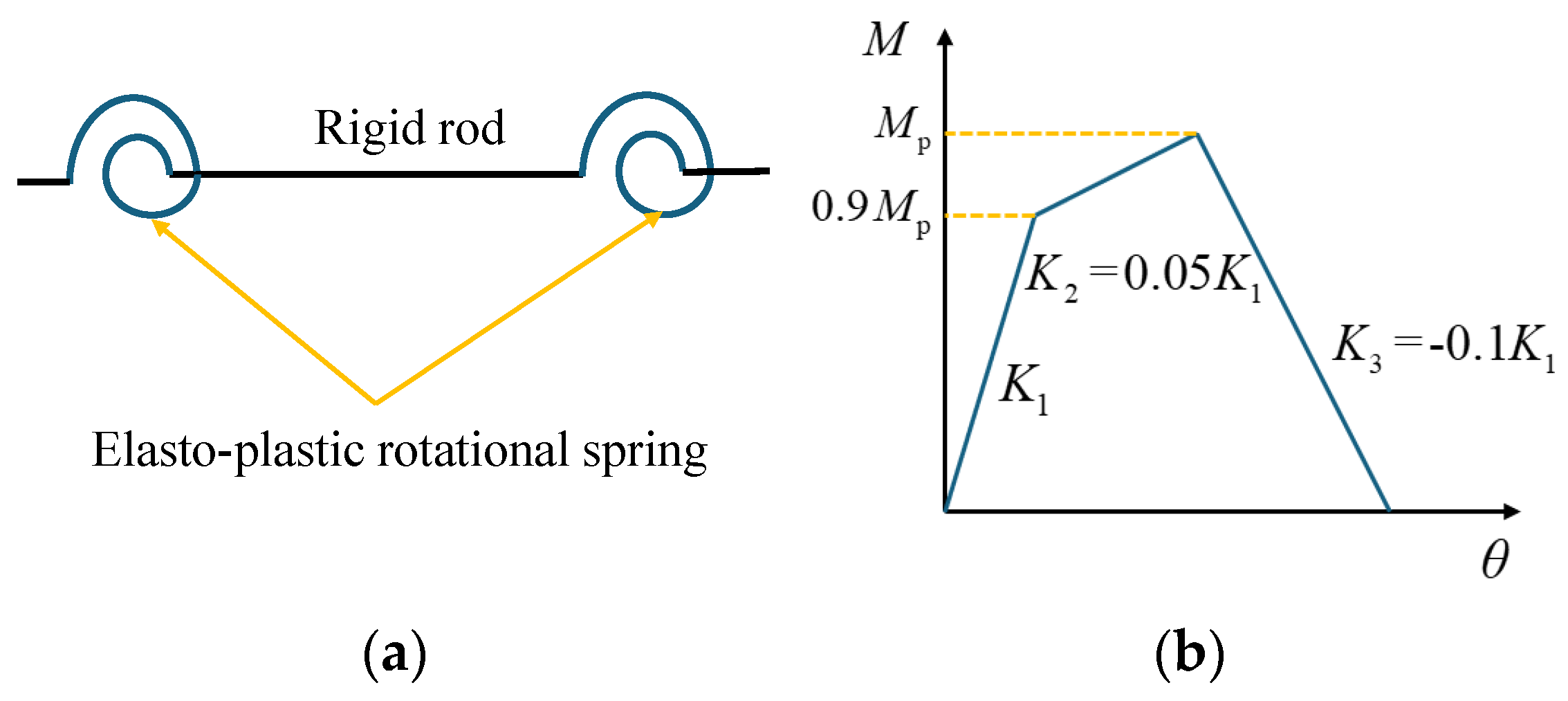
Wooden components, such as beams and columns, are simplified as elastoplastic rotational springs and rigid rods [9,10], as shown in Figure 1a. Based on the geometric dimensions of the components, as well as the elastic modulus and flexural strength of the wood, the initial and ultimate moments of the elastoplastic rotational springs at the beam and column ends are calculated. The restoring force model of the elastoplastic rotational spring is shown in Figure 1b. When the moment in the restoring force model of the elastoplastic rotational spring reduces to zero, the node is transformed into a hinged joint, indicating that the component has failed.

2.2. Mortise–Tenon Joints

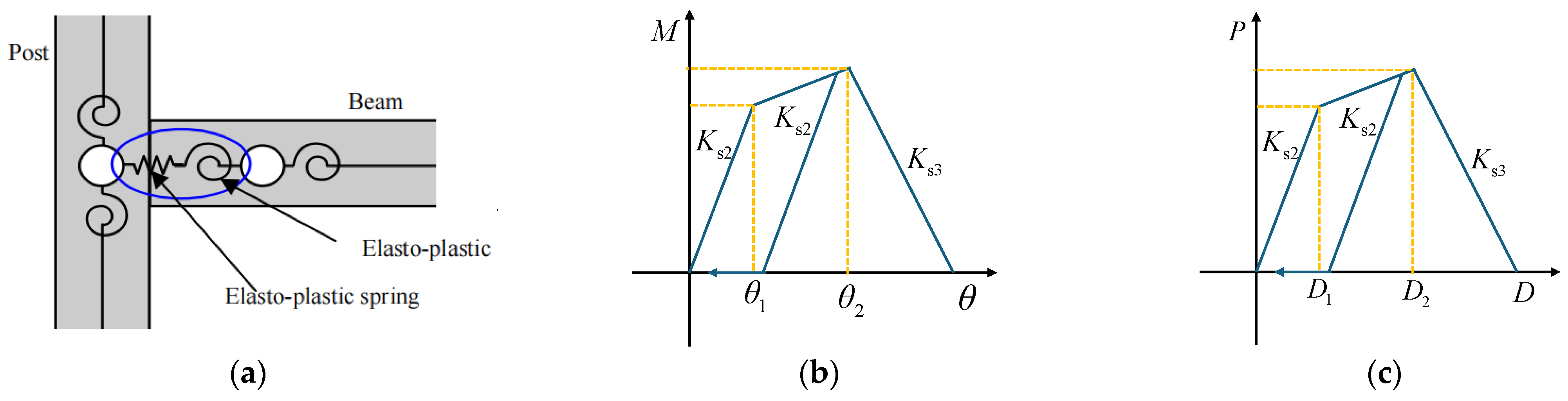
The mortise–tenon connection is simplified as a combination of a rotational spring and a tension-compression spring connected in series. The simplified model of the joint is shown in Figure 2a. The restoring force models of the tension-compression spring and the rotational spring are shown in Figure 2b and Figure 2c, respectively. When either the rotational spring or the tension-compression spring exceeds its ultimate bearing capacity or ultimate moment, the mortise–tenon joint is considered to have fractured and failed.

2.3. Bracket Set Joints

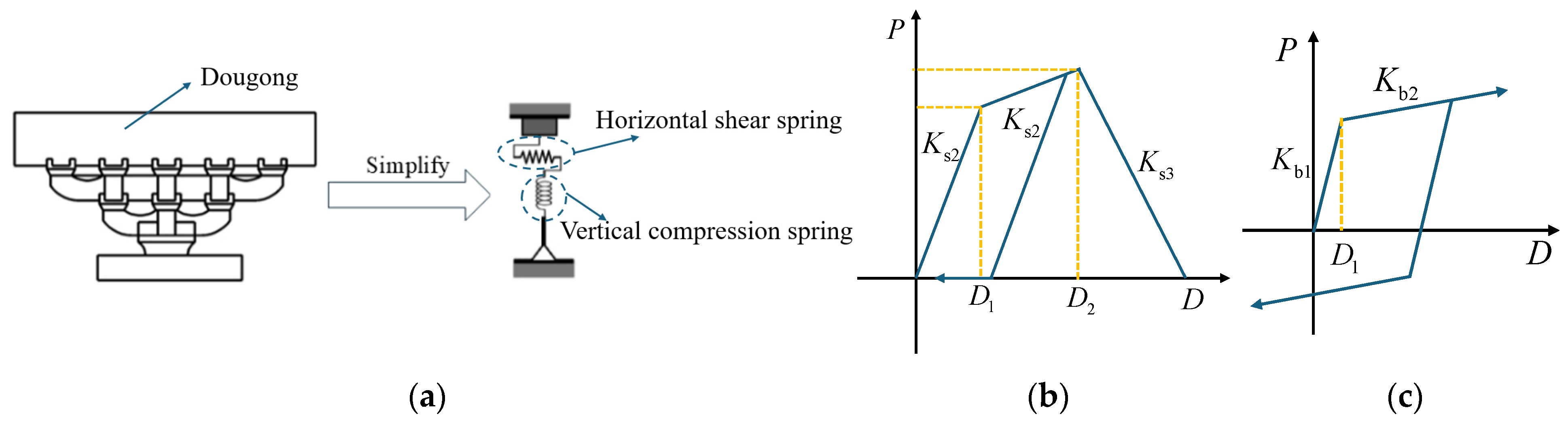
The bracket set primarily bears the self-weight of the upper roof beam-frame system and the horizontal shear force transmitted by the system under horizontal earthquake forces. Thus, it can be simplified as a horizontal shear spring and a vertical tension-compression spring, as shown in Figure 3a. The restoring force models of the tension-compression spring and the shear spring are shown in Figure 3b and Figure 3c, respectively.

2.4. Column Base Connection

In ancient timber structures, wooden columns are typically placed directly on foundation stones, and the structure resists horizontal loads solely through the friction between the columns and the foundation stones. When the horizontal load is less than the maximum static friction force between the column base and the foundation stone, the column undergoes rotational deformation, similar to a hinged joint. However, when the horizontal load exceeds the maximum static friction force, relative slip occurs between the column and the foundation stone. Therefore, the maximum shear force that the base of the structure can withstand is equal to the sliding friction force between the column and the foundation stone. In the modeling process, this behavior is simulated by setting the maximum static friction coefficient and sliding friction coefficient for the connection between the column base and the foundation stone.

2.5. Model Mass Distribution

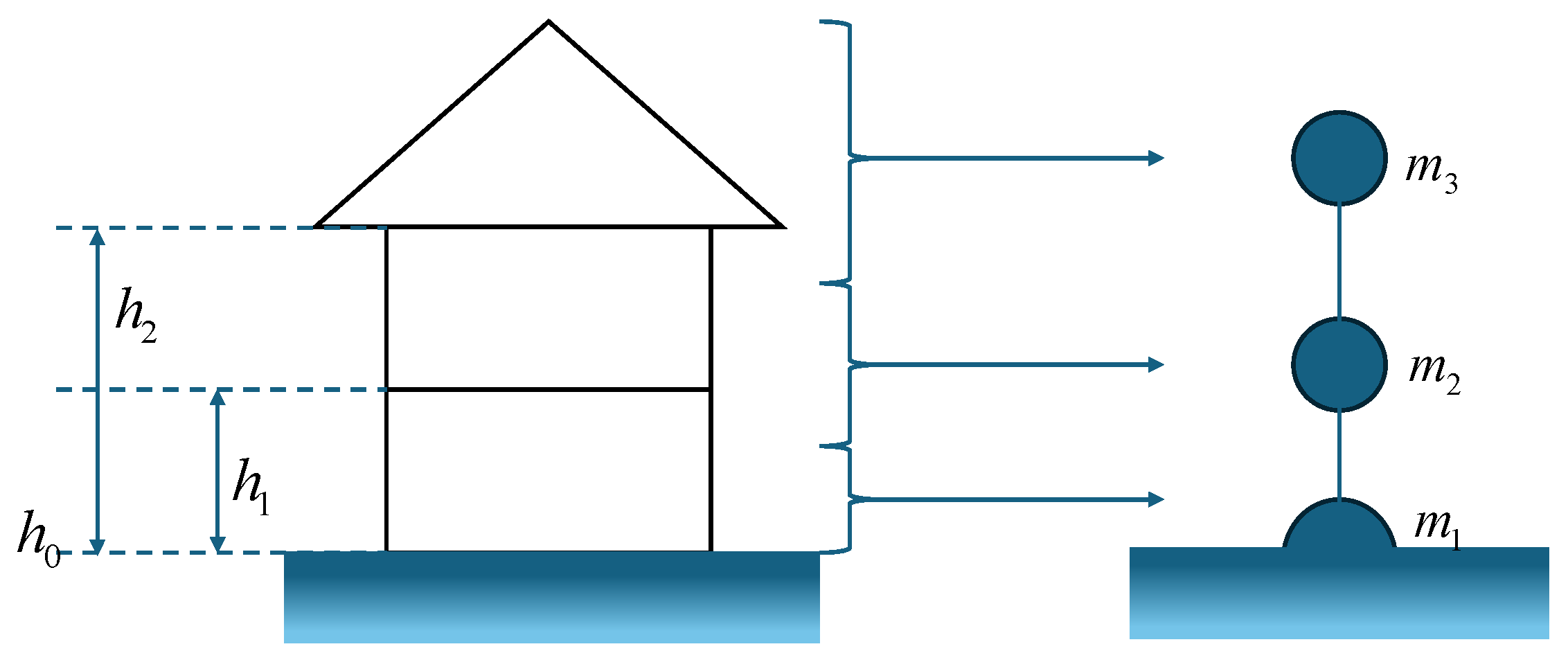
In defining the mass distribution of the model, the mass of each member unit is concentrated at the centroid of each floor and is then evenly distributed to the height of each mass point in the lumped mass model, as shown in Figure 4. Additionally, the self-weight of the roof is not included in the distribution, as it is entirely supported by the beam frame.

3. Establishment of Discrete Element Model for the East Main Hall of Foguang Temple

3.1. Structural Overview

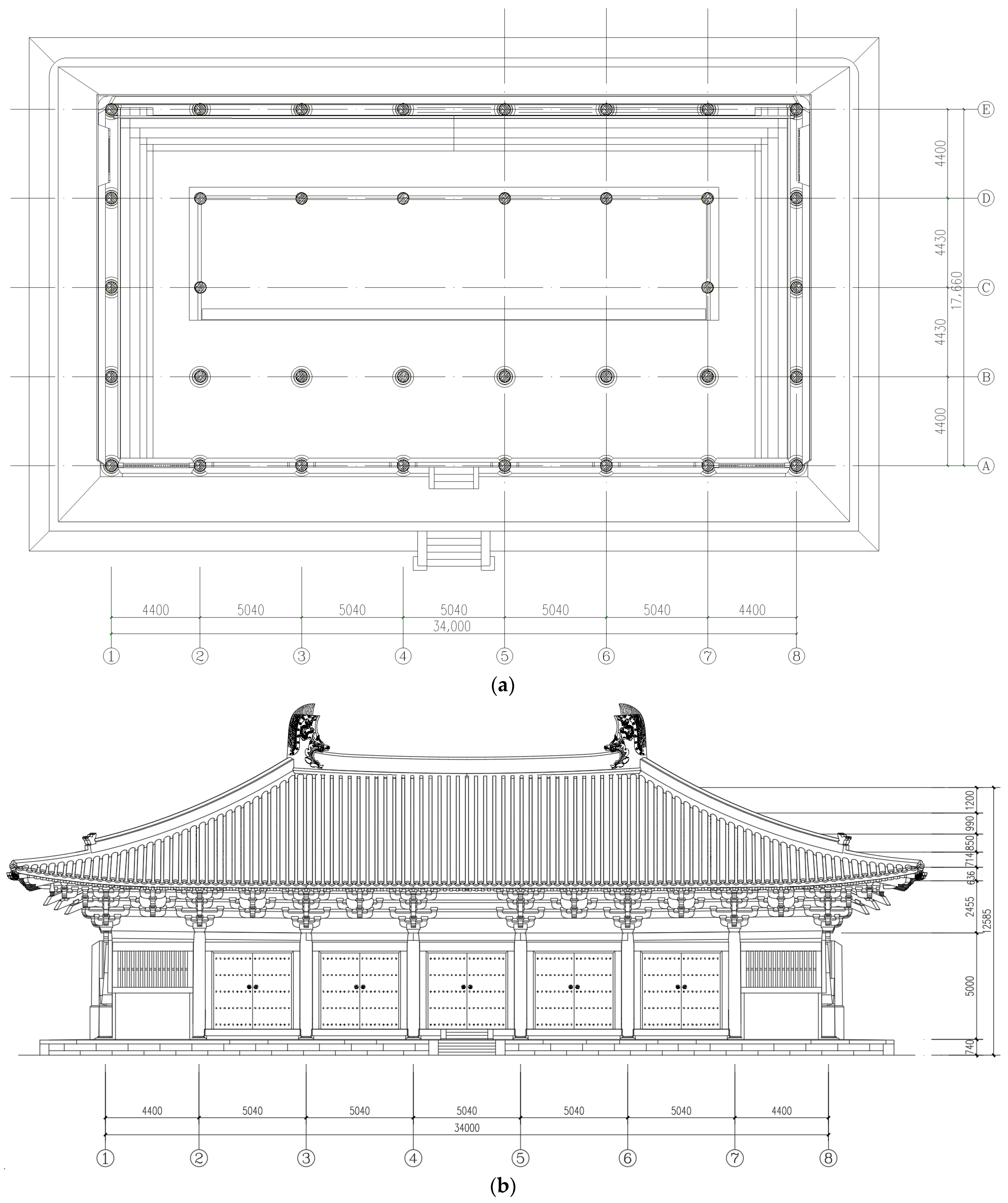
The East Hall of Foguang Temple, located in Wutai County, Xinzhou City, Shanxi Province, is one of the earliest surviving ancient timber structures in China and the only extant palace-style ancient timber structure from the Tang Dynasty in the country. The hall features a seven-bay width and a four-bay depth, with overall dimensions of 34 m in width and 17.6 m in depth. The planar layout of the hall is defined by two concentric rows of columns (an inner row and an outer row), comprising 14 inner-groove columns and 22 outer-groove columns [19,20,21,22,23].
The structural configuration and component dimensions of the model are illustrated in Figure 5.

3.2. Structural Model Parameters

3.2.1. Timber Material Properties

In accordance with the Technical Standard for Maintenance and Strengthening of ancient timber structures [24], and considering the effects of long-term load and wood aging, the mechanical properties of timber were adjusted. The adjustment coefficients for the elastic modulus and strength of the timber are presented in Table 1.
In the Research Report on the Restoration of the East Hall of Foguang Temple [25], the main beam frame of the East Hall is constructed from larch. As Foguang Temple is the only existing Tang-Dynasty hall-style timber building in China, pine wood, a timber material widely adopted in Tang-Dynasty architecture, was thus selected for the study. The material property parameters of pine wood after reduction by the coefficients given in Table 1 are presented in Table 2.

3.2.2. Mortise–Tenon Joint Parameters

The East Hall of Fogong Temple features a hall-style structure. According to Liu Guozhen’s introduction in “A History of Ancient Chinese Architecture [26]”, the mortise and tenon connections between the beams and columns in Tang Dynasty architecture predominantly employed the dovetail joint method, which is one of the significant techniques for wooden structural joints during the Tang Dynasty. Therefore, this paper selects the dovetail joint as the connection form for the beam and column, while the mechanical stiffness characteristics of the dovetail joint are referenced from the formulas in the literature [27], as shown in Equations (1)–(3).
M y = 10 3 b 1 h 3 E R γ 1 b 2 θ y
M u = M y + 10 3 f te b 1 h 3 γ 2 b 2 ( θ u θ y )
γ 1 = 2 γ 2 = 4 ( b 1 + b 2 ) l π D 2
The specific values for the mechanical stiffness characteristics of the dovetail joint are presented in Table 3.

3.2.3. Bracket Set Joint Parameters

The bracket set components of the East Hall of Foguang Temple are numerous and complex. Externally, these bracket sets support the deeply overhanging eaves, while internally, they reduce the bending moment on the beam frame. This load redistribution allows the weight of the roof and beam frame to be transferred to the columns and subsequently to the ground through the bracket sets.
For simplified calculations, the total mass of the roof and beam frame of the East Hall of Foguang Temple was estimated at 93,266 kg, as per the Compilation of Roof Loads for Ancient Buildings [28]. Assuming uniform load distribution, each bracket set at the column head is subjected to a load of 2590 kg.
Based on the stiffness calculation formulas for bracket sets provided in Reference [29] (Equations (4) and (5)), the horizontal shear stiffness of the bracket set was computed as: K1 = 1843 kN/m, K2 = 128.5 kN/m.
K 1 = 0.22 μ N
K 2 = 0.033 n f c A
where
μ is the coefficient of sliding friction between the timber components, taken as 0.35;
N is the vertical load applied to each bracket set (in kN);
n is the number of bracket sets in the bracket layer (36 sets);
fc is the perpendicular-to-grain compressive strength of the timber (3.7 MPa);
A is the calculated compressive area of the mantou mortise (a type of tenon), measured in the radial direction as 29,241 mm2.

3.3. Establishment of the Discrete Element Model for the East Hall of Foguang Temple

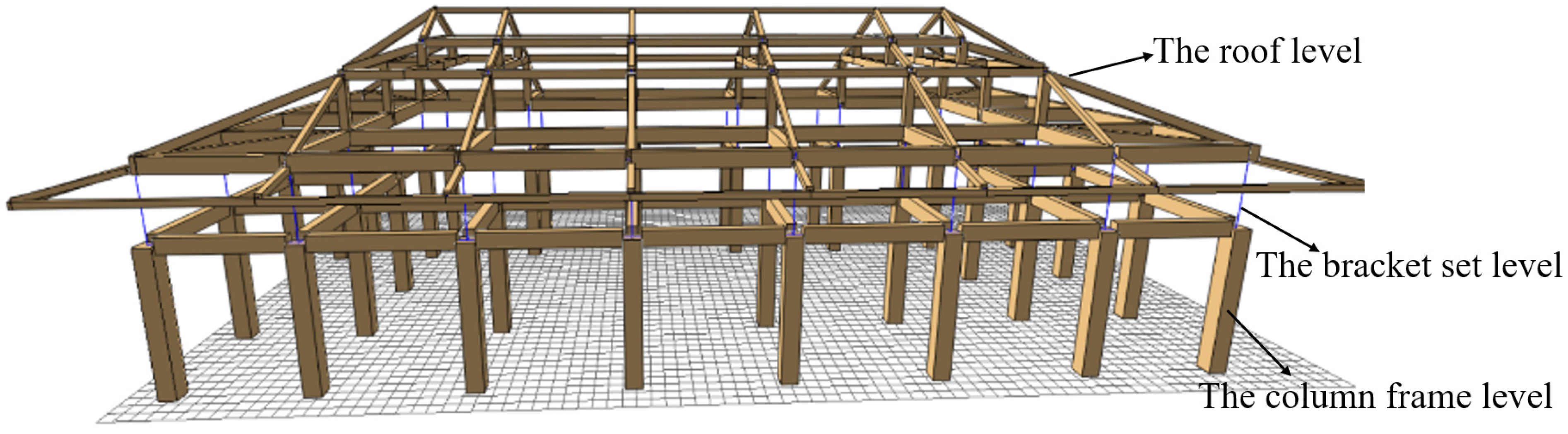
The discrete element model for the East Hall of Foguang Temple was established based on the simplified modeling method and mass distribution principles outlined in Section 2, as well as the spring parameters specified in Section 3.1 and Section 3.2. The model also incorporates the planar and elevation dimensions of the structure, as illustrated in Figure 6.
Based on the above discrete element simplification modeling method and structural model parameters, a discrete element model of the East Hall of Fogong Temple was established using Wallstat software, as shown in Figure 6. In this model, the contact relationship between the columns and the base stones was set as a frictional sliding connection. The static friction coefficient was referenced from the literature [30], which also used pine wood; given the consistency in the material properties of the wood, this paper sets the static friction coefficient to 0.33 as well. The model fully considers the mechanical characteristics and contact relationships of each component and joint.
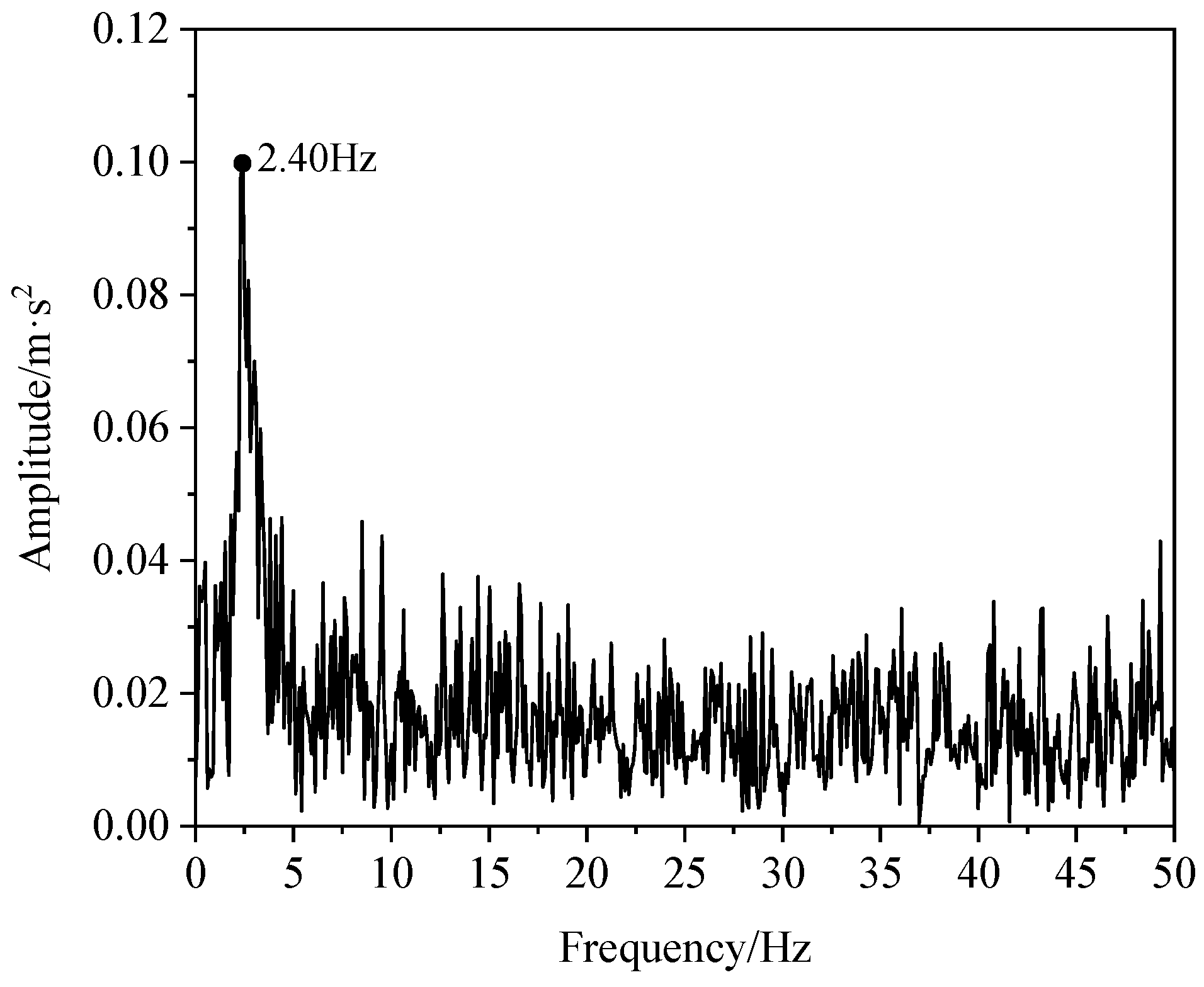
White noise excitation was applied to the model, and the natural frequency was determined to be 2.40 Hz. The frequency–amplitude curve for the structure is shown in Figure 7.
In accordance with the Technical Standard for Maintenance and Strengthening of Historic Timber Buildings [31], the natural period of the East Hall of Foguang Temple can be estimated using the following formula:
T = 0.05 + 0.075 H
where
H is the height of the column from the indoor ground level to the bottom of the main beam or the bracket set.
Given that the height of the outer columns of the East Hall is 5 m, the natural period of the structure is calculated as 0.425 s, which corresponds to a natural frequency of 2.35 Hz. A comparison between the natural frequency of the discrete element model and the frequency calculated using the formula reveals a discrepancy of only 2.13%. This indicates that the model established in this study is sufficiently accurate and can serve as a reliable reference for further analysis.

4. Seismic Vulnerability Analysis of the East Hall of Foguang Temple

4.1. Quantification of Timber Structure Performance Levels

Based on an investigation of the damage to both load-bearing and non-load-bearing components of ancient timber structures following seismic events, and in conjunction with relevant codes for ancient timber structures and the complexities involved in repair and restoration, existing literature classifies the performance levels of timber structures subjected to earthquake loading into five categories: “Basically Intact”, “Slight Damage”, “Moderate Damage”, “Severe Damage”, and “Collapse”. These categories describe the macro-damage characteristics at each performance level [32]. Quantifying the structural macro-damage levels and defining interval indicators play critical roles in predicting earthquake damage and conducting post-event assessments.
Generally, the quantitative indicators for structural performance levels are determined based on structural response parameters or the damage of specific components. Studies in Reference [33] have classified the typical collapse mechanisms of ancient timber structures into four categories: (1) structural collapse due to excessive sliding of the column base, (2) roof collapse caused by excessive sliding of the bracket set layer, (3) inter-story collapse resulting from the loss of bearing capacity in the mortise–tenon joints of the column frame, and (4) overall overturning of the structure. Test results in Reference [11] have demonstrated that the mortise–tenon joints of ancient timber structures exhibit distinct flexible characteristics, with the ultimate failure of structural models primarily attributed to the damage of the column frame layer induced by mortise–tenon joint failure. Numerous seismic damage investigations [34,35] have further confirmed that the typical seismic damage to ancient timber structures in actual earthquakes is mainly manifested as the damage and failure of the mortise–tenon joints.
In this study, the inter-story drift angle of the column frame layer is selected as the engineering demand parameter for evaluating the seismic performance of the structure. The classification criteria for seismic damage levels of ancient timber structures proposed in Reference [32] are adopted as judgment thresholds to assess the structure’s performance states under various conditions. The seismic damage level evaluation criteria using the inter-layer displacement angle as a quantitative measure are summarized in Table 4 and Table 5.

4.2. Selection and Amplitude Modulation of Earthquake Waves

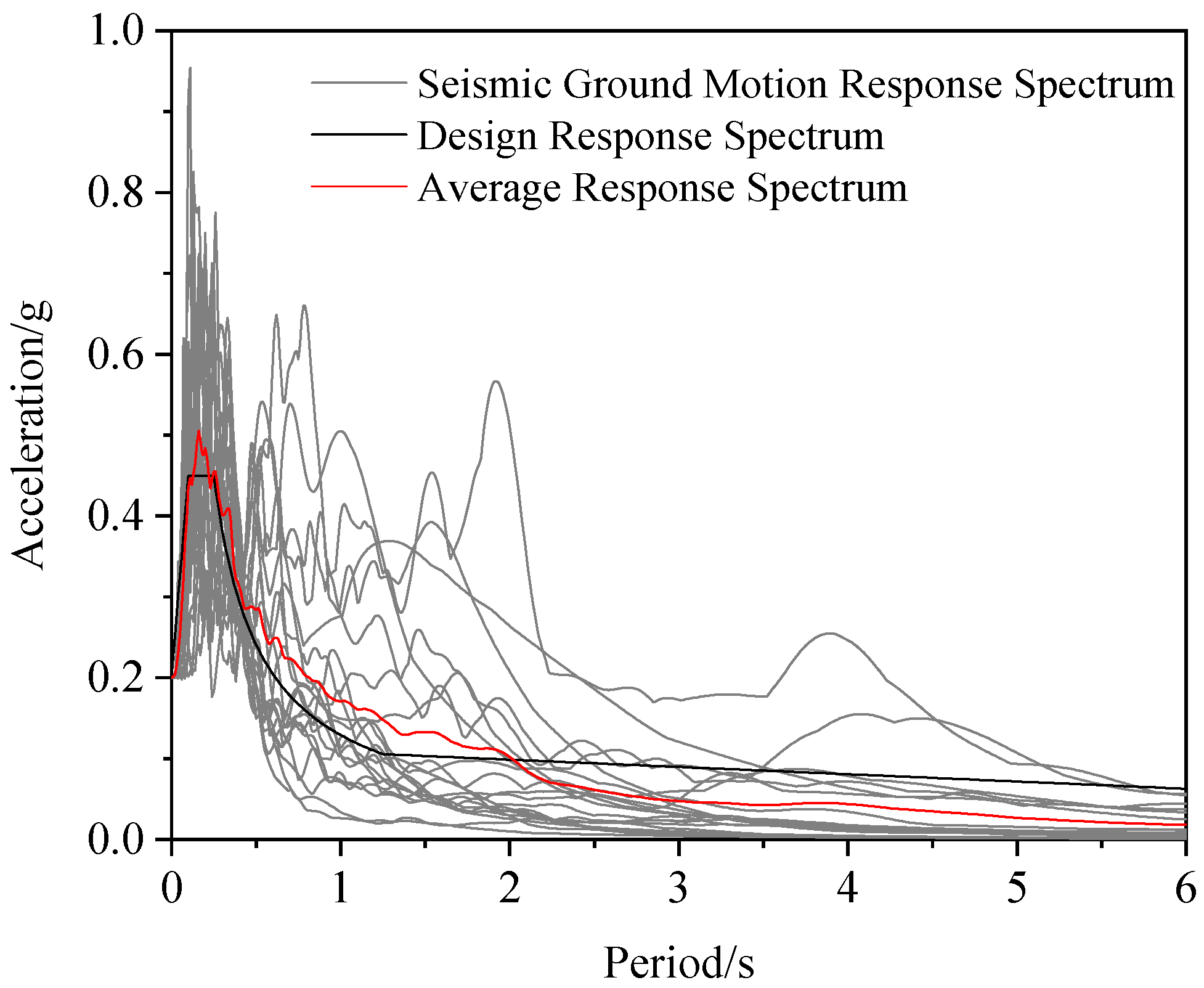
Earthquake ground motions serve as the foundation for nonlinear time-history analysis of structural systems, and the appropriateness of the selected earthquake waves directly affects the accuracy of the analysis results. Therefore, the careful selection of earthquake waves is crucial. According to the Code for Seismic Design of Buildings GB/T 50011-2010 (2024 Edition) [31], the seismic fortification intensity for the location of the East Hall of Foguang Temple is designated as 8 degrees, with a basic design acceleration of 0.2 g. The seismic design group is Group 1, the site classification is Class I, and the structure’s fundamental period is 0.417 s. To improve the reliability of simulation results, this study first plotted the design response spectrum based on the key characteristics of earthquake waves (peak ground acceleration, quantity, spectral characteristics, and duration), the site conditions of the East Hall of Foguang Temple, and relevant seismic design codes. Using this as the target spectrum, 100 natural earthquake records were selected from the Pacific Earthquake Engineering Research Center (PEER) Strong Motion Database. The peak ground acceleration (PGA) of all selected ground motion records is uniformly scaled to 0.2 g. A secondary selection is subsequently conducted based on the first and second natural periods of the structure, ensuring that the deviation between the recorded response spectra and the code-specified target response spectrum at the dominant periods does not exceed 20%. Ultimately, 20 records were further screened that matched the target response spectrum. These 20 earthquake wave records were then used for Incremental Dynamic Analysis (IDA). The details of the selected earthquake waves are presented in Table 6, and the acceleration response spectra of these waves, along with the target response spectrum, are illustrated in Figure 8.
In incremental dynamic analysis, two methods of amplitude modulation are used: equal step size and unequal step size. In this study, the selected 20 earthquake wave records were subjected to equal-step amplitude modulation ranging from 0.1 g to 1.0 g, with a step size of 0.1 g. To account for the effects of minor seismic events, an additional amplitude modulation step of 0.05 g was applied. Each earthquake wave record was modulated 11 times, resulting in a total of 220 distinct earthquake wave records for the analysis.

4.3. Probabilistic Seismic Fragility Analysis

Seismic fragility of a structure is defined as the probability that the response of the structure or its components exceeds a specified performance limit under earthquake loading. The seismic fragility model is characterized by the seismic demand (D) and the seismic capacity (C), as expressed in Equation (7):
p f = p ( D C )
where the structural capacity function (C) and the structural response function (D) are independent and follow a log-normal distribution. Therefore, the failure probability (Pf) of the structure at a particular stage is derived as:
P f = ( C M ) = φ ln ( θ max ) ln ( θ c ) δ C 2 + δ D 2
According to the design code, when the fragility curve is based on Peak Ground Acceleration (PGA) as the intensity measure, a factor of 0.5 is used [15]:
δ C 2 + δ D 2 = 0.5
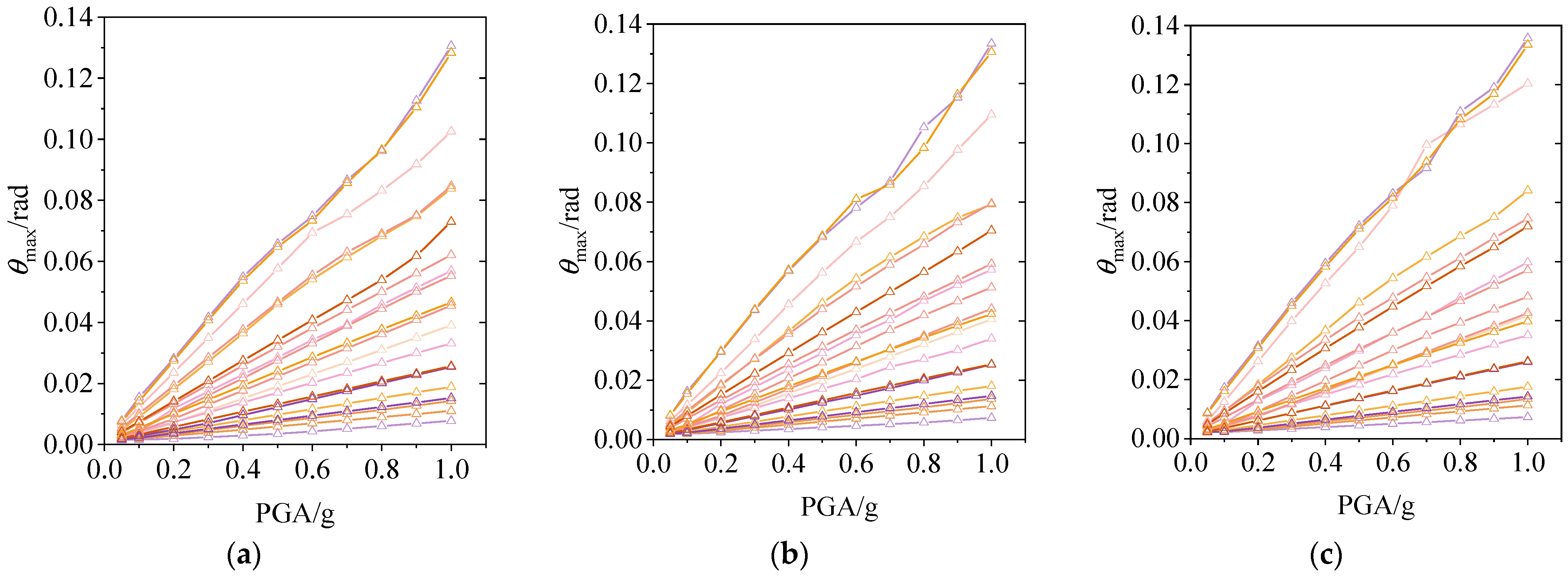
Using a set of 20 selected earthquake records that match the design response spectrum, elastoplastic time-history analysis was performed for the East Hall of Foguang Temple under seismic excitation in the X-direction. Figure 9 illustrates a cluster of Incremental Dynamic Analysis (IDA) curves for the structure, with PGA on the x-axis and inter-story displacement angle on the y-axis.
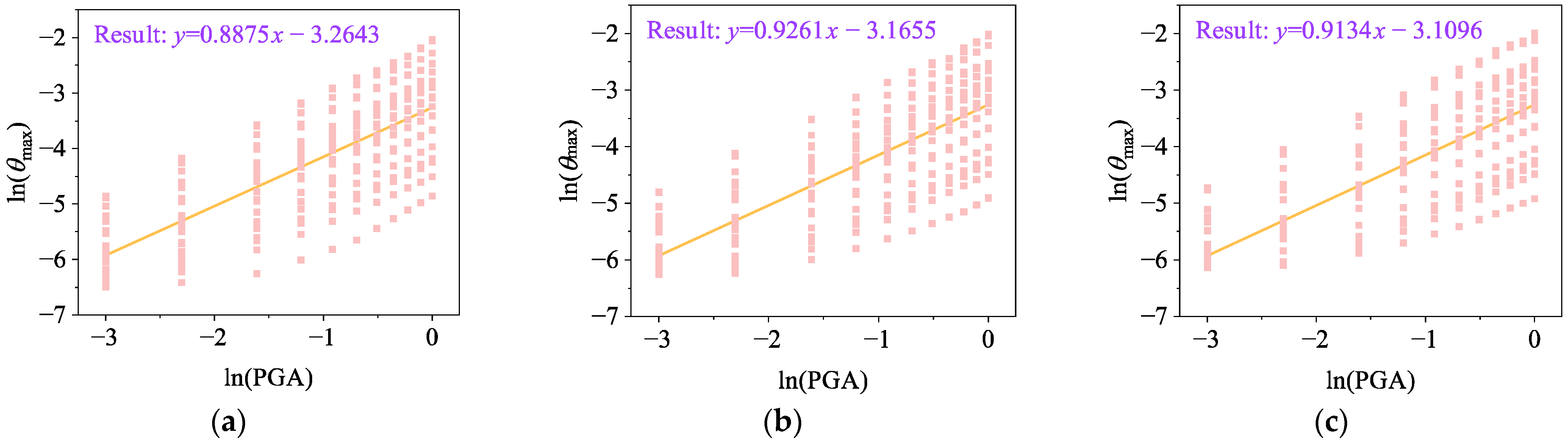
A total of 220 data points, representing the maximum inter-story displacement angle from the incremental dynamic analysis and the corresponding peak acceleration (PGA), were plotted on a logarithmic coordinate system and subjected to linear regression analysis. The regression equation, using the logarithm of the intensity measure (PGA) as the independent variable and the logarithm of the response measure as the dependent variable, is given in Figure 10.
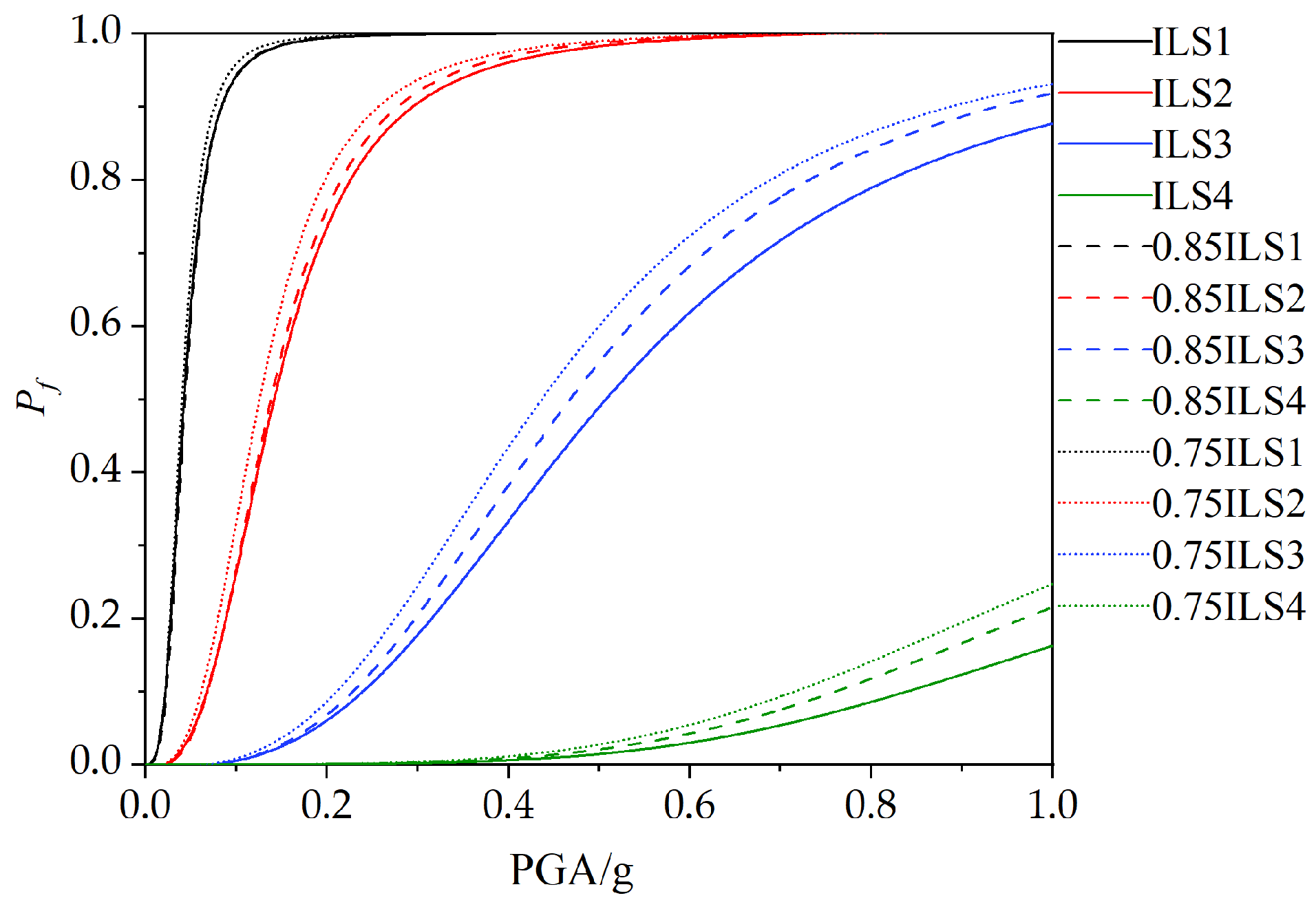
By substituting the fitted logarithmic regression equation into Equation (8), the fragility curve of the structure can be calculated, as shown in Figure 11. Here, ILSi represents each limit state of the calculation model, where i = 1, 2, 3, 4 correspond to the immediate occupancy limit state, life safety limit state, collapse prevention limit state, and near-collapse limit state of the structure, respectively. Table 7 presents the probability of the model exhibiting different damage states under earthquake action.
From the seismic fragility analysis results presented in Figure 11 and Table 7, the following conclusions can be drawn: As PGA increases, the damage state of the structure progresses in a stepwise manner, evolving from the “basically intact” state to the “collapse” state.
Under low-intensity earthquake action (0.1 g), the damage to the structure is dominated by slight and moderate damage, with the probability of severe damage being less than 1% and no risk of collapse. For the intact model, the probabilities of the structure being “basically intact”, “slightly damaged”, and “moderately damaged” are 5.86%, 67.42%, and 26.52%, respectively. After applying 0.85- and 0.75-fold reductions, the probability of being “basically intact” decreases to 5.63% and 3.94%, respectively, while the probability of “slight damage” decreases to 66.99% and 62.74%, and the probability of “moderate damage” increases to 27.16% and 32.95%, respectively. This suggests that degradation of material properties slightly increases the damage under low-intensity earthquakes.
When PGA increases to 0.2 g (medium-intensity earthquake), the probability of “slight damage” decreases significantly, moderate damage becomes the dominant damage state, and the probability of severe damage rises to 5.01–7.81%, with the first indication of collapse risk. The intact model exhibits probabilities of 26.87% for “slight damage”, 67.86% for “moderate damage”, and 5.01% for “severe damage”. For the reduced models, the probability of “slight damage” decreases to 24.54% and 20.06%, while the probabilities of “moderate damage” and “severe damage” increase to 69.43%, 5.82% and 71.99%, 7.81%, respectively, indicating that greater reductions in structural performance result in a more concentrated probability of severe damage under medium-intensity earthquakes.
Under medium–high-intensity earthquake excitation of 0.4 g, the probabilities of “basically intact” and “slightly damaged” decrease significantly, severe damage becomes the predominant damage state, and collapse probabilities increase. The intact model shows probabilities of 62.71% for “moderate damage”, 33.54% for “severe damage”, and 0.45% for “collapse”. For the reduced models, the probability of “severe damage” increases to 38.10% and 43.07%, and the collapse probability increases to 0.65% and 0.94%, respectively. This suggests that under medium–high-intensity earthquakes, larger reductions in structural performance lead to an increased probability of severe damage and collapse.
When PGA reaches 0.6 g (high-intensity earthquake), the proportion of “severe damage” further increases, and collapse probability rises sharply. The intact model exhibits probabilities of 37.41% for “moderate damage”, 59.12% for “severe damage”, and 2.94% for “collapse”. The reduced models show probabilities of 63.75%, 66.84%, and 4.16%, 5.40%, respectively, for “severe damage” and “collapse”. This demonstrates that under high-intensity earthquakes, greater reductions in material properties push the structure closer to a critical state of severe damage and collapse.
Under extreme earthquake conditions (1 g), the probabilities of “slight damage” and “moderate damage” are very low, with collapse risk becoming a critical factor. For the intact model, the probabilities of “severe damage” and “collapse” are 72.49% and 16.27%, respectively. For the reduced models, the probabilities of “severe damage” decrease to 70.50% and 68.60%, while the probabilities of “collapse” increase to 21.60% and 25.01%, respectively. This indicates that under extreme seismic excitation, greater reductions in structural performance lead to a higher risk of collapse.

5. Conclusions

Taking the East Hall of Foguang Temple in China as the subject of study, this research developed a structural dynamic model that accounts for wood property degradation using the discrete element method. By combining Incremental Dynamic Analysis (IDA) with probabilistic seismic demand theory, the study systematically investigated the seismic response and vulnerability characteristics of the structure under three conditions: intact wood, 0.85-fold reduction in wood properties, and 0.75-fold reduction in wood properties. The key findings are as follows:
  • The validity of the discrete element model of the East Hall of Foguang Temple, constructed using Wallstat software, was confirmed. The natural frequency of the model (2.40 Hz) was found to differ by only 2.13% from the value estimated based on code requirements (2.35 Hz), indicating that the model satisfies the engineering accuracy requirements and effectively represents the dynamic properties of the East Hall.
  • Wood property degradation significantly amplifies the structural seismic displacement response. Under the same Peak Ground Acceleration (PGA), the maximum inter-story displacement angle (θmax) of the column frame increases as the degree of degradation deepens. Moreover, the correlation between the structural response parameter (θmax) and the seismic intensity parameter (PGA) becomes more pronounced as the degradation progresses.
  • Wood property degradation increases the level of seismic damage and the risk of collapse. For instance, under a low-intensity earthquake (0.1 g), the probability of moderate damage in the 0.75-fold reduction model is 6.43% higher than in the intact model. Under a 0.4 g earthquake, the probability of moderate damage increases by 9.53%. In the case of a high-intensity earthquake (1 g), the probability of collapse in the degraded model is 8.74% higher than in the intact model, and the structure is more likely to reach a critical state, transitioning directly from severe damage to collapse.

Author Contributions

J.H.: Conceptualization, Data curation, Formal analysis, Investigation, Methodology, Resources, Software, Supervision, Validation, Visualization, Writing—original draft and Writing—review & editing. M.X.: Data curation, Investigation, Methodology, Project administration, Resources, Software, Validation, Visualization and Writing—review & editing. J.L.: Formal analysis, Methodology, Project administration, Software, Validation, Writing—review & editing. X.Z.: Conceptualization, Funding acquisition Data curation, Supervision, Validation and Writing—review & editing. S.H.: Project administration, Visualization and Writing—review & editing. All authors have read and agreed to the published version of the manuscript.

Funding

The research was financially supported by National Natural Science Foundation of China (Grant No. 52278315), Key Research and Development Program of Shaanxi (Grant No. 2024SF-ZDCYL-05-15).

Data Availability Statement

Data available on request from the authors. The data that support the findings of this paper are available from the corresponding author upon reasonable request.

Conflicts of Interest

The authors declare that they have no known competing financial interests or personal relationships that could have appeared to influence the work reported in this paper. And Authors Jiwei Huo and Meng Xiang are employed by China Construction Seventh Engineering Division Co., Ltd. The remaining authors declare that the research was conducted in the absence of any commercial or financial relationships that could be construed as a potential conflict of interest.

References

  1. Wu, C.; Xue, J.; Zhou, S.; Zhang, F. Seismic performance evaluation for a traditional Chinese timber-frame structure. Int. J. Archit. Herit. 2021, 15, 1842–1856. [Google Scholar] [CrossRef]
  2. Xue, J.Y.; Guo, R.; Qi, L.J.; Xu, D. Experimental study on the seismic performance of traditional timber mortise-tenon joints with different looseness under low-cyclic reversed loading. Adv. Struct. Eng. 2019, 22, 1312–1328. [Google Scholar] [CrossRef]
  3. Huan, J.; Ma, D.; Wang, W. Vulnerability analysis of ancient timber architecture by considering the correlation of different failure modes. Math. Probl. Eng. 2018, 2018, 5163472. [Google Scholar] [CrossRef]
  4. Ali, Q.; Ahmad, N.; Ashraf, M.; Rashid, M.; Schacher, T. Shake table tests on single-story Dhajji Dewari traditional buildings. Int. J. Archit. Herit. 2017, 11, 1046–1059. [Google Scholar] [CrossRef]
  5. Che, A.L.; He, Y.; Ge, X.R.; Iwatate, T.; Oda, Y. Study on the dynamic structural characteristics of an ancient timber—Yingxian Wooden Pagoda. In Soil and Rock Behavior and Modeling; American Society of Civil Engineers: Reston, VA, USA; Shanghai, China, 2006; pp. 390–398. [Google Scholar] [CrossRef]
  6. Nakagawa, T.; Ohta, M. Collapsing process simulations of timber structures under dynamic loading. I: Simulations of two story frame models. J. Wood Sci. 2003, 49, 392–397. [Google Scholar] [CrossRef]
  7. Nakagawa, T.; Ohta, M. Collapsing process simulations of timber structures under dynamic loading. II: Simplification and qualification of the calculating method. J. Wood Sci. 2003, 49, 499–504. [Google Scholar] [CrossRef]
  8. Crayssac, E.; Song, X.; Wu, Y.; Li, K. Lateral performance of mortise-tenon jointed traditional timber frames with wood panel infill. Eng. Struct. 2018, 161, 223–230. [Google Scholar] [CrossRef]
  9. Takatani, T. Collapsing analysis of an old two-story wooden house against a strong earthquake ground motion. In Proceedings of the 13th World Conference on Timber Engineering, Quebec City, QC, Canada, 10–14 August 2013. [Google Scholar]
  10. Takatani, T.; Nishikawa, H. On seismic behavior of Japanese-style three-story wooden hotel during a strong earthquake ground motion. In Proceedings of the 2014 World Congress on Advances in Civil, Environmental & Material Research, Busan, Korea, 24–28 August 2014. [Google Scholar] [CrossRef]
  11. Zhang, X.; Xue, J.; Zhao, H.; Sui, Y. Experimental study on Chinese ancient timber-frame building by shaking table test. Struct. Eng. Mech. 2011, 40, 453–469. [Google Scholar] [CrossRef]
  12. Ren, X.C.; Meng, Z.B.; Wu, Y.J.; Xie, Q.-F.; Liu, Y.-J.; Wang, X. Seismic performance of traditional Chinese timber structure: A Case of Guangyue tower. J. Build. Eng. 2025, 100, 111690. [Google Scholar] [CrossRef]
  13. Ren, X.C.; Wu, Y.J.; Xie, Q.F.; Meng, Z.-B.; Liu, X.-G.; Zhang, L.-P.; Zhang, X.-C.; Cao, Y. Shaking table testing of a multi-story Chinese traditional timber structure with seismic damage. J. Build. Eng. 2025, 111, 113170. [Google Scholar] [CrossRef]
  14. Yang, H.; Peng, G.; Wang, J.; Li, W.; Cui, J.; Jia, E. Seismic Response Analysis of Ancient Timber Structures Considering Long-Term Corrosion. Adv. Civ. Eng. 2025, 2025, 4711442. [Google Scholar] [CrossRef]
  15. Cui, L.; Zhang, X.; Hu, W.; Meng, Z.; Chen, J.; Qiu, Z. Seismic performance analysis of ancient palace-style timber structure considering column rocking effect. J. Earthq. Eng. 2024, 28, 3175–3190. [Google Scholar] [CrossRef]
  16. Zhang, X.; Cui, L.; Qi, H.; Wang, H.; Lin, L. Seismic fragility analysis of traditional Chinese timber structures based on a simplified lumped mass model considering joint damage. Structures 2024, 70, 107863. [Google Scholar] [CrossRef]
  17. Ma, H. Seismic Vulnerability Analysis of Ancient Timber-Frame Buildings Based on Discrete Element Model. Master’s Thesis, Xi’an University of Architecture and Technology, Xi’an, China, 2016. (In Chinese) [Google Scholar]
  18. Xue, J.; Yang, Z.; Wu, C.; Liao, H.; Zhang, M. In-situ dynamic testing and seismic response analysis of ancient timber structures considering the influence of Xumizuo pedestal1. J. Southeast Univ. (Nat. Sci. Ed.) 2026, 1–14. (In Chinese) [Google Scholar]
  19. Guo, L. Analysis of Probabilistic Seismic Vulnerability of Historic Timber Structure. Master’s Thesis, Xi’an University of Architecture and Technology, Xi’an, China, 2016. (In Chinese) [Google Scholar] [CrossRef]
  20. Guo, Z. Research on Parametric Modeling of Carpentry Work in Tang Dynasty Based on BIM—Take Wutaishan Foguang Temple East Hall as an Example. Master’s Thesis, Taiyuan University of Technology, Taiyuan, China, 2018. (In Chinese) [Google Scholar]
  21. Wu, H.; Xu, Z. Study on the ancient architectural models making with the example of Foguang Temple Hall. Shan Xi Archit. 2022, 48, 19–21+25. [Google Scholar] [CrossRef]
  22. Xiao, M. Measurement Regulations of the Main Hall of Foguangsi. J. Archit. 2017, 6, 37–42. [Google Scholar] [CrossRef]
  23. Zhu, K. Study of the Space Shape in Wutai Mountain Buddha’s Light Monastery. Master’s Thesis, Taiyuan University of Technology, Taiyuan, China, 2016. [Google Scholar] [CrossRef]
  24. GB/T50165-2020; Technical Standard for Maintenance and Strengthening of Historic Timber Building. China Architecture & Building Press: Beijing, China, 2020. (In Chinese)
  25. Lv, Z. Survey and Research Report on the Architecture of the Main Hall of Foguang Temple; Cultural Relics Press: Beijing, China, 2011. (In Chinese) [Google Scholar]
  26. Liu, G. History of Ancient Chinese Architecture; China Architecture & Building Press: Beijing, China, 1996. (In Chinese) [Google Scholar]
  27. Pan, Y.; Zhang, Q.; Wang, X.Y.; Guo, R. Research on mechanical model of dovetail joint for Chinese ancient timber structures. J. Build. Struct. 2021, 42, 151–159. (In Chinese) [Google Scholar] [CrossRef]
  28. Liu, D. Compilation of roof loads for ancient buildings (Part 1). Tradit. Chin. Archit. Gard. Technol. 2001, 3, 58–64. (In Chinese) [Google Scholar]
  29. Xue, J.; Zhang, F.; Zhao, H.; Ge, H.; Sui, Y.; Xie, Q. Dynamic analysis model of monolayer hall-style ancient timber structure. J. Build. Struct. 2012, 33, 135–142. [Google Scholar] [CrossRef]
  30. Zhang, X.; Han, Y.; Wu, C.; Hu, C.; Bai, F. Discrete element simulation and collapse vulnerability analysis of Chinese ancient timber-frame structure. J. Vib. Eng. 2020, 33, 1150–1161. (In Chinese) [Google Scholar] [CrossRef]
  31. GB 50011-2010; Code for Seismic Design of Buildings. China Architecture Building Press: Beijing, China, 2024. (In Chinese)
  32. Ma, L.; Xue, J.; Zhang, X. Seismic vulnerability analysis of damaged ancient timber structures. J. Vib. Eng. 2023, 36, 1390–1401. (In Chinese) [Google Scholar] [CrossRef]
  33. Zhang, X.C. Dynamic Analysis of Ancient Timber Structures Under Seismic Action. Ph.D. Thesis, Xi’an University of Architecture and Technology, Xi’an, China, 2013. (In Chinese) [Google Scholar]
  34. Pan, Y.; Tang, L.; Wang, H.; Yao, Y. Investigation and analysis of damage to ancient buildings in Lushan Ms 7.0 earthquake. Earthq. Eng. Eng. Dyn. 2014, 34, 140–146. (In Chinese) [Google Scholar] [CrossRef]
  35. Xie, Q.; Xue, J.; Zhao, H. Seismic damage investigation and analysis of ancient buildings in Wenchuan earthquake. J. Build. Struct. 2010, 31, 18–23. (In Chinese) [Google Scholar] [CrossRef]
Figure 1. Beam and column element simplified model: (a) Beam and column element simplified model; (b) Restoring force model of rotational spring.
Eng 07 00200 g001
Figure 2. Modeling of mortise–tenon join t: (a) Modeling of mortise–tenon joint; (b) Restoring force model of rotational spring; (c) Characteristics of axil spring.
Eng 07 00200 g002
Figure 3. Simplified model and restoring force characteristics of bracket set: (a) Simplified model of bracket set; (b) Characteristics of axil; (c) Characteristics of shear spring.
Eng 07 00200 g003
Figure 4. Model mass distribution diagram.
Eng 07 00200 g004
Figure 5. Dimension drawing of the Eastern Hall of Foguang Temple: (a) Plan layout dimensions; (b) Dimensions in the elevation. Unit: mm.
Eng 07 00200 g005
Figure 6. Discrete element analysis model.
Eng 07 00200 g006
Figure 7. Spectrum curve of discrete element model.
Eng 07 00200 g007
Figure 8. Acceleration response spectrum of 20 earthquake waves.
Eng 07 00200 g008
Figure 9. Cluster of IDA curves for the east hall of Foguang Temple under multiple earthquake excitations: (a) Intact model; (b) 0.85-factor reduced model; (c) 0.75-factor reduced model.
Eng 07 00200 g009
Figure 10. Regression curves of PGA and natural logarithm of θmax for models with different damage degrees: (a) Intact model; (b) 0.85-factor reduced model; (c) 0.75-factor reduced model.
Eng 07 00200 g010
Figure 11. Comparison of seismic fragility curves before and after material property reduction in the computational model.
Eng 07 00200 g011
Table 1. Adjustment coefficient for the performance of ancient timber structures under long-term load and wood aging effects.
Years Since ConstructionAdjustment Coefficient
Design Strength for Parallel-to-Grain CompressionElastic Modulus and Design Strength for Perpendicular-to-Grain Bearing
1000.950.90
3000.850.85
5000.750.75
Table 2. Wood material properties parameters.
EL/MPaER/MPaET/MpaμRTμRTμLTGRT/Mpa
10,109.2654.2274.30.03510.29650.0205209.16
Note: E, μ, and G represent the elastic modulus, Poisson’s ratio, and shear modulus of the timber; the subscripts L, R, and T correspond to the parallel-to-grain, radial (perpendicular to grain), and tangential (perpendicular to grain) directions, respectively.
Table 3. Real Constants of dovetail joint stiffness.
D1/radD2/radCharacteristic Stiffness/kN·m·rad
Ks1Ks2
0.060.135.1412.82
Note: Ks1 and Ks2 are the initial stiffness and hardening stiffness of the dovetail joint; D1 and D2 are the yield rotation angle and ultimate rotation angle of the dovetail joint.
Table 4. Inter-layer displacement angle θmax corresponding to each seismic damage level.
Seismic Damage LevelBasically IntactSlight DamageModerate DamageSevere DamageCollapse
θmax≤1/442[1/442, 1/148][1/148, 1/48][1/48, 1/16]≥1/16
Table 5. Maximum Inter-story Drift Angle Corresponding to Each Limit State.
Limit StateFull OperationBasic OperationLife SafetyCollapse
θmax1/4421/1481/481/16
Table 6. Selected 20 natural earthquake ground motion records.
Serial
Number
Earthquake Ground
Motion Name
Recording StationYearAcceleration
Component
Effective
Duration
Vs30/m/sMagnitudeRjb/km
1Northwest Calif-02Ferndale City Hall1941RSN720.015219.316.691.15
2ParkfieldCholame-Shandon Array #121966RSN2837.16408.936.1917.64
3ParkfieldCholame-Shandon Array #81966RSN3118.31256.826.1912.9
4Borrego MtnEl Centro Array #91968RSN3651.47213.446.6345.12
5Borrego MtnLA-Hollywood Stor FF1968RSN3746.305316.466.63222.42
6Lytle CreekCedar Springs Pumphouse1970RSN428.715477.225.3321.33
7Lytle CreekLA-Hollywood Stor FF1970RSN4621.87316.465.3373.46
8Lytle CreekPuddingstone Dam (Abutment)1970RSN4811.955421.445.3329.49
9San FernandoBorrego Springs Fire Sta1971RSN5425.39338.546.61214.32
10San FernandoCastaic-Old Ridge Route1971RSH5719.1945.0286.6119.33
11San FernandoFort Tejon1971RSN649.835394.186.6159.52
12San FernandoGormon-Oso Pump Plant1971RSN658.695308.356.6143.95
13San FernandoLake Hughes #11971RSN7023.6425.346.6122.23
14San FernandoPalmdale Fire Station1971RSN7835.36452.866.6124.16
15San FernandoPasadena-Old Seismo Lab1971RSN8032.51969.076.6121.5
16San FernandoPearblossom Pump1971RSN8122.97529.096.6135.54
17San FernandoSanta Felita Dam (Outlet)1971RSN8826.393896.6124.69
18San FernandoTehachapi Pump1971RSN8911.6669.486.6161.75
19San FernandoWhittier Narrows Dam1971RSN9328.6298.686.6139.45
20Managua_ Nicaragua-01Managua_ ESSO1972RSN9515.84288.776.243.51
Table 7. Probability of damage to each model under earthquake action.
PGA/gReduction
Condition
Damage Probability/%
Basically
Intact
Slight DamageModerate
Damage
Severe
Damage
Collapse
0.115.767.426.50.20
0.855.667.027.20.20
0.753.962.733.00.40
0.210.326.967.95.00
0.850.224.569.45.80.01
0.750.120.172.07.80.02
0.4103.362.733.50.5
0.8502.558.838.10.7
0.7501.854.243.10.9
0.6100.537.459.12.9
0.8500.331.863.84.1
0.7500.227.566.85.4
1.0100.0311.272.516.3
0.85007.970.521.6
0.75006.468.625.0
Disclaimer/Publisher’s Note: The statements, opinions and data contained in all publications are solely those of the individual author(s) and contributor(s) and not of MDPI and/or the editor(s). MDPI and/or the editor(s) disclaim responsibility for any injury to people or property resulting from any ideas, methods, instructions or products referred to in the content.