Article

Experimental Investigation on the Evolution of Mechanical Properties of Accumulation Deposits Under Fluctuating Water Levels


1
Guizhou Water Conservancy Investment (Group) Co., Ltd., Guiyang 550002, China
2
School of Civil Engineering, Hefei University of Technology, Hefei 230009, China
*
Author to whom correspondence should be addressed.
Submission received: 26 December 2025 / Revised: 11 February 2026 / Accepted: 11 February 2026 / Published: 15 February 2026
(This article belongs to the Section Chemical, Civil and Environmental Engineering)

Abstract

Reservoir water-level fluctuations periodically alter the physical and mechanical properties of accumulation deposits in the bank slope zone, potentially triggering geological hazards such as collapses and landslides. This study developed an original laboratory mechanical testing system to systematically investigate the evolution of deformation and shear strength parameters in these accumulation deposits throughout the reservoir operation period. Tests conducted on the accumulation deposits in the Baijiabao bank slope demonstrate that under the coupled effects of anisotropic stress and cyclic wet–dry conditions, the compression modulus, cohesion, and internal friction angle decrease significantly, by 10.6%, 11.4%, and 13.2%, respectively. As the number of wet–dry cycles increases, the rate of reduction in these parameters gradually diminishes. Between the second and fourth cycles, the decreases in compression modulus, cohesion, and internal friction angle were 9.7%, 8.6%, and 6.9%, respectively. Beyond the eighth cycle, the values of these parameters stabilize with minimal further change.

1. Introduction

With the development of the economy in recent years, many giant hydropower projects have been established in the southwest valley area of China. After the completion of these projects, the periodic fluctuation of water levels significantly alters the physical and mechanical properties of the deposits with high clay content in the drawdown area of the reservoir bank slope, and even induces geological disasters such as collapses and landslides. To prevent and control collapses or landslides along these reservoir bank slopes, a critical aspect lies in understanding how the mechanical properties of slope sediments evolve under water-level fluctuations.
Reservoir water levels exhibit significant periodic fluctuations during post-filling operation. This change in the reservoir water level alters the original hydrogeological conditions of the reservoir bank slopes. As a result, the rock and soil mass in the reservoir bank slope’s drawdown zone is exposed to an environment with periodic wet–dry alternation for a long time. This environment causes varying degrees of changes in the composition and structure of the bank slope rock/soil mass [1,2,3,4]. Macroscopically, these changes manifest as a corresponding weakening of the rock and soil mass strength [5,6]. Eventually, this leads to deformation of the reservoir bank slope and may even trigger instability of the reservoir bank slope [7,8].
A primary objective of this research is to assess the overall deformation and failure trends of accumulation deposits in the drawdown zone during reservoir cycling. Most importantly, it is essential to clarify the evolution of key parameters, including those for macro deformation and shear strength, throughout the operational period. The investigation into the macro deformation and shear strength characteristics of reservoir bank slope accumulations currently employs two main approaches: in situ testing and laboratory experiments [9]. In situ testing methods mainly include plate load tests, dynamic and static penetration tests, horizontal push-shear tests, and large direct shear tests [10,11]. Laboratory testing methods mainly include static penetration tests and large triaxial compression tests. These methods are used to obtain the deformation modulus (such as compression modulus) of accumulation bodies, as well as shear strength parameters like cohesion and internal friction angle. For example, Xu et al. [12] conducted large-scale in situ horizontal push-shear tests on a soil–rock mixture at the Longpan right bank of Tiger Leaping Gorge under both natural and saturated conditions, where the consequent changes in cohesion and internal friction angle were measured and analyzed. Following water immersion, the specimen cohesion decreases sharply, with saturated specimens exhibiting highly consistent cohesion values. Conversely, the internal friction angle increases, though this strengthening effect diminishes with increasing rock content. Focusing on the typical soil–rock mixture of the Baiyi’an Landslide in the Three Gorges Reservoir Area, Li et al. [13] conducted 23 large-scale in situ push-shear and compression-shear tests on soil–rock mixtures. They aimed to delineate the material’s shear stress–displacement relationship, shear strength, and failure modes across a range of rock contents, particle sizes, and stress states, thereby obtaining key shear strength parameters. Soil–rock mixtures show distinct stress-yielding and plastic deformation traits, featuring typical stress–strain curves with clear elastic, elasto-plastic, and peak-strength stages. Their inherent strain-softening behavior after peak stress results from highly heterogeneous structures.
A study combining physical model tests and numerical simulations on a pumped storage power station’s bank slope revealed that under conditions of extremely rapid water-level fluctuations, soil moisture content, pore water pressure, and earth pressure respond synchronously with the water level changes, whereas matric suction exhibits a distinct hysteresis [14]. Through experiments and numerical simulations, the stability analysis of cantilever riverbanks indicates that a decrease in the ratio of bank height to nearshore water depth causes the failure mode to transition from “tension-toppling” to “shear” failure [15]. During water-level fluctuations, seepage erosion may result in a sharp reduction in soil shear strength. Water-level fluctuation is the primary factor driving stability changes in the reservoir drawdown zone, as it induces slope deformation and failure by directly altering the seepage and stress fields. Previous numerical modeling using Plaxis has demonstrated that under drained conditions, bank slope stability exhibits a non-monotonic response to reservoir water-level fluctuations, being lowest at a specific water level during the drawdown–fill cycle [16]. Recently, Yan et al. [17] analyzed the perched water distribution in the landslide accumulation deposits of the Lancang River under heavy rainfall conditions using the saturated–unsaturated seepage theory. Ghaffaripour et al. [18] adopted the effective stress principle to account for the coupling between the seepage and deformation models. Further coupling among the phases is captured through a hysteretic soil water retention model that evolves with changes in void ratio. An advanced elastoplastic constitutive model within the context of the bounding surface plasticity theory is employed for predicting the nonlinear behavior of the soil skeleton. Pasha et al. [19] discussed the difficulties and limitations associated with obtaining experimental isochoric water retention curves (IC-WRC).
Current research, as evidenced in the literature, primarily addresses two key aspects concerning bank slope accumulations within reservoir drawdown zones. Firstly, investigations focus on assessing the deformation and shear strength parameters of these accumulations under saturated or natural conditions, as well as under unidirectional, non-periodic water-level fluctuations. Secondly, studies analyze the characteristics of macro deformation and shear strength parameters during reservoir operation. A significant research gap remains, however, as the impact of periodic wet–dry cycles—induced by the cyclic fluctuation of reservoir water levels during operation—on the macro deformation and strength parameters of drawdown zone accumulations has not been adequately considered. Consequently, accurately determining the variation patterns of these parameters under such periodic wet–dry alternation remains challenging.
To reveal the variation laws of deformation and shear strength parameters for accumulation deposits in the drawdown zone of typical bank slopes during reservoir operation, this study takes the accumulations of the Baijiabao bank slope as its research object. Employing an independently developed mechanical test system designed for drawdown zone accumulations under operational conditions, this research comprehensively considers the coupling effects of in situ slope stress states, reservoir water dissolution, and varying numbers of wet–dry cycles. We intend to conduct tests on the deformation and shear strength parameters of these typical accumulations in the Three Gorges Reservoir Area, followed by an in-depth exploration of their evolutionary patterns. The aim is to clarify the evolution characteristics of strength and deformation parameters under water-level fluctuation conditions. The results are expected to provide important theoretical support for the stability analysis of reservoir bank slopes.

2. Sampling and Analysis of Accumulation Deposits

The process of reservoir bank slope deformation, damage, and subsequent unstable sliding is complex, with a diverse array of influencing factors. Macroscopic deformation and failure of deposits on bank slopes are prevalent during reservoir operation. A large number of landslides occur in the bank slope deposits in the Three Gorges Reservoir Area. This study investigates the slope deposits of the Baijiabao accumulation deposits in the Three Gorges Reservoir area, conducting experimental research on the compression modulus and shear strength parameters of bank slope deposits within the water-level fluctuation zone during reservoir operation. The Baijiabao landslide mass is situated in Xiangjiadian Village, Guizhou Town, Zigui County, Hubei Province, China. It lies 2.5 km from the Xiangxi River estuary and 41.2 km from the Three Gorges Dam, positioned on the right bank of the Xiangxi River, a tributary of the Yangtze River.
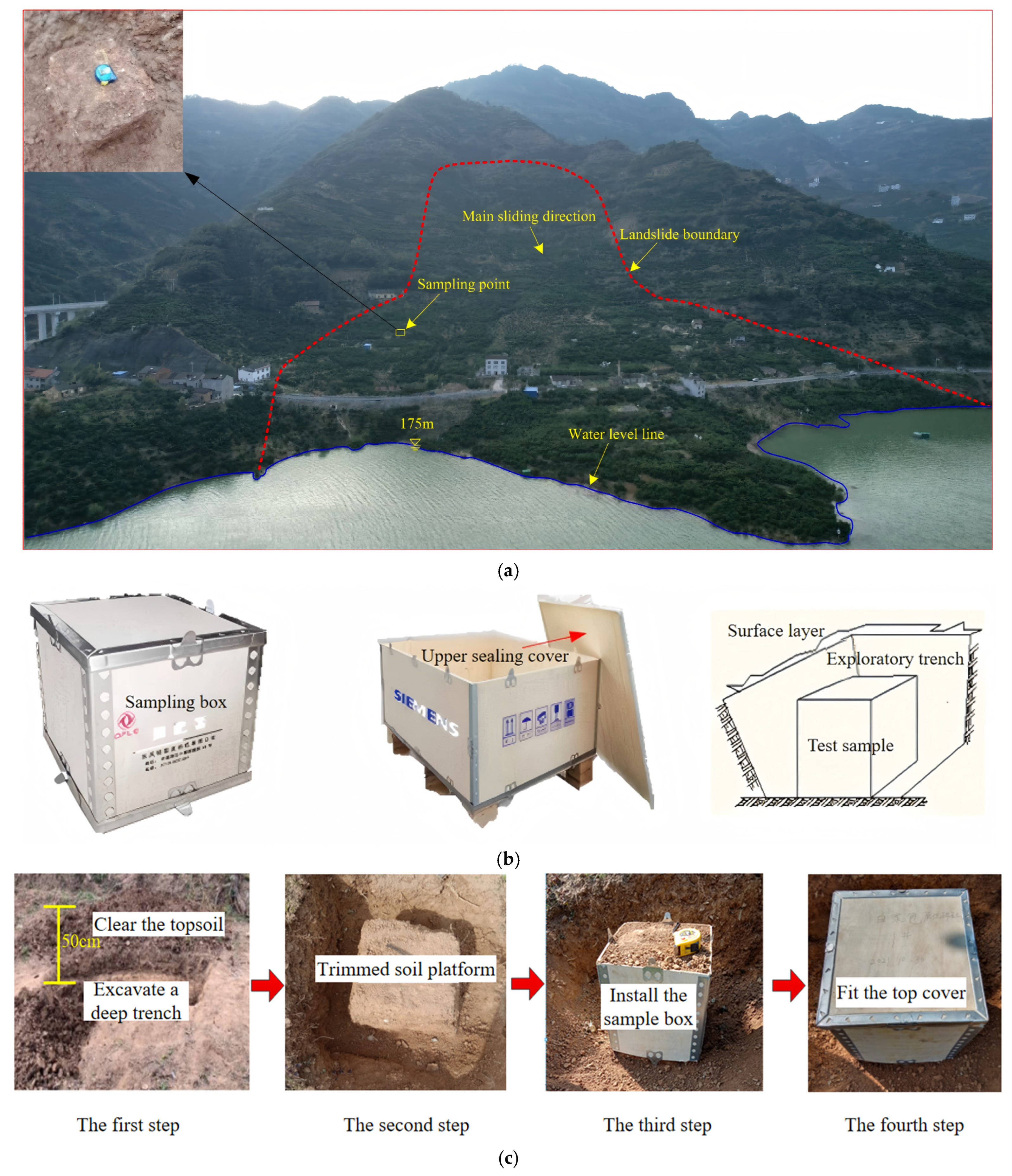
All accumulation deposit samples tested in this study were collected from undisturbed deposits located above the 175 m elevation on the Baijiabao bank slope, possessing sufficient burial depth. These materials, situated above the reservoir’s water-level fluctuation zone, are unaffected by the wet–dry cycles and seepage induced by reservoir operations. To mitigate surface disturbance from rainwater erosion, samples were collected at a depth of 50 cm below the ground surface. The obtained specimens accurately represent the in situ soil’s physical and mechanical properties (sampling procedure detailed in Figure 1).
During the sampling process, the authors used the sampling box shown in Figure 1b. First, the surface soil at the sampling site was cleaned, and then a 50 cm deep trench was excavated. A square soil platform approximately the same size as the sampling box was trimmed in the trench. A total of five samplings were conducted within the Baijiabao bank slope following the above steps, and these samples were used as test samples for subsequent experiments. Providing multiple samples for subsequent tests enables the implementation of multiple groups of comparative experiments, which helps improve the accuracy of the data.
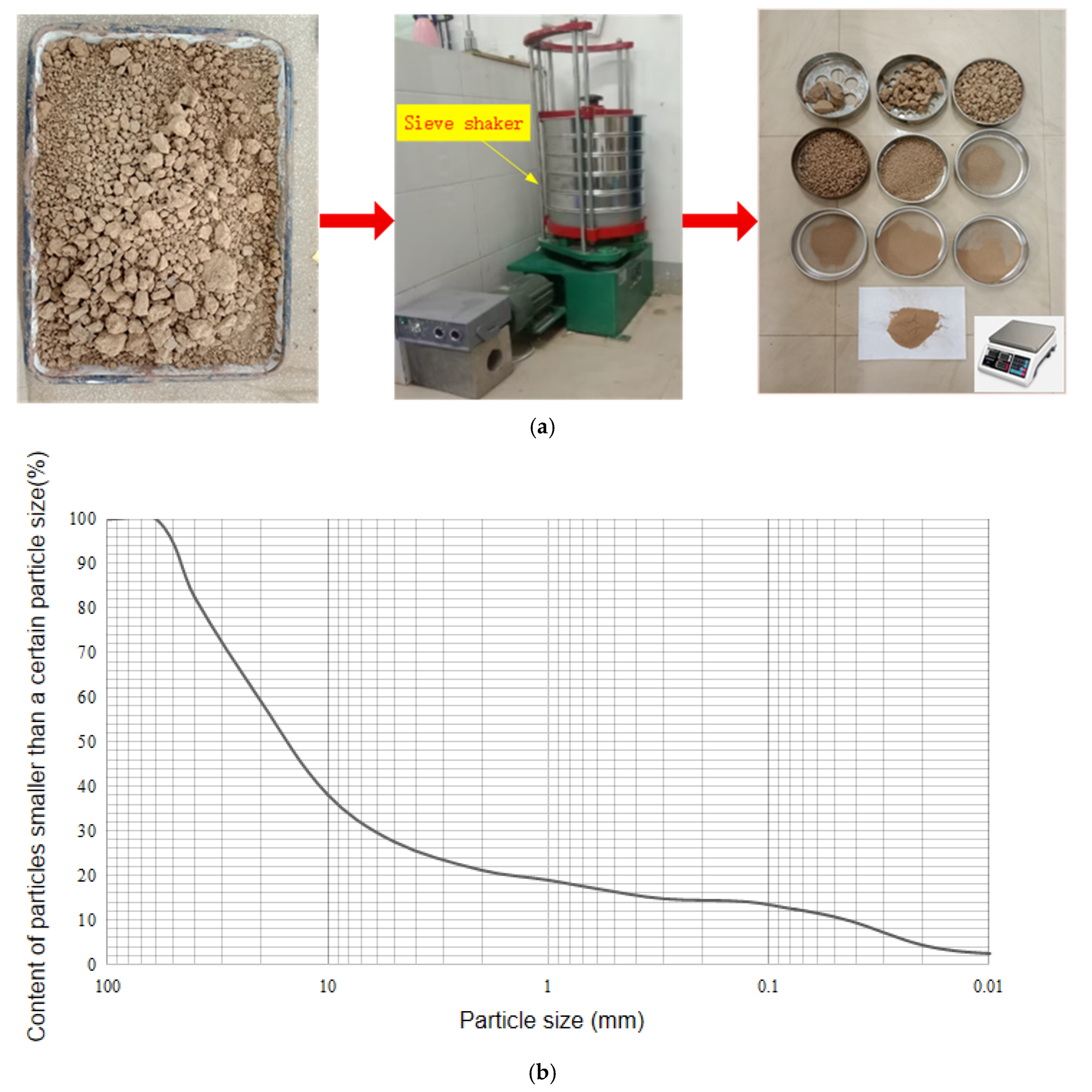
The samples collected from the Baijiabao bank slope were placed into a vibrating screen machine for sieving. The soil mass was classified by particle size to determine the content of each fraction. Additionally, through a particle size analysis test (see Figure 2a), the particle gradation curve of the accumulation deposits in the typical bank slope drawdown zone of the Three Gorges Reservoir Area was obtained (as shown in Figure 1b).
As shown in Figure 2b, particles with diameters of <2 mm, 2–10 mm, 10–20 mm, and 20–40 mm constitute approximately 15–27%, 20–38%, 12–30%, and 11–14.5% of the total mass, respectively. The corresponding uniformity coefficient (Cu) is ≤5, and the curvature coefficient (Cc) is 1.75.

3. Test Method

3.1. Test Instruments

Based on the analysis of the variation characteristics of physical and chemical environmental variables of the water-fluctuation area during the reservoir operation period, this study independently designs a mechanical test system for the accumulation deposits during the reservoir operation period. This system effectively simulates the combined effects of complex environmental stresses—including varying loads, periodic wet–dry cycles, and reservoir water chemistry—acting upon the water-fluctuation area. It thereby enables more accurate determination of deformation parameters and shear strength parameters for the accumulation deposits in bank slope water-fluctuation areas after different numbers of wet–dry cycles. This study aims to accurately determine the deformation and shear strength parameters of accumulated deposits in the riparian drawdown zone of the reservoir, following various numbers of wet–dry cycles during operation. The measurement of matrix suction in soil samples is not included in this research scope.
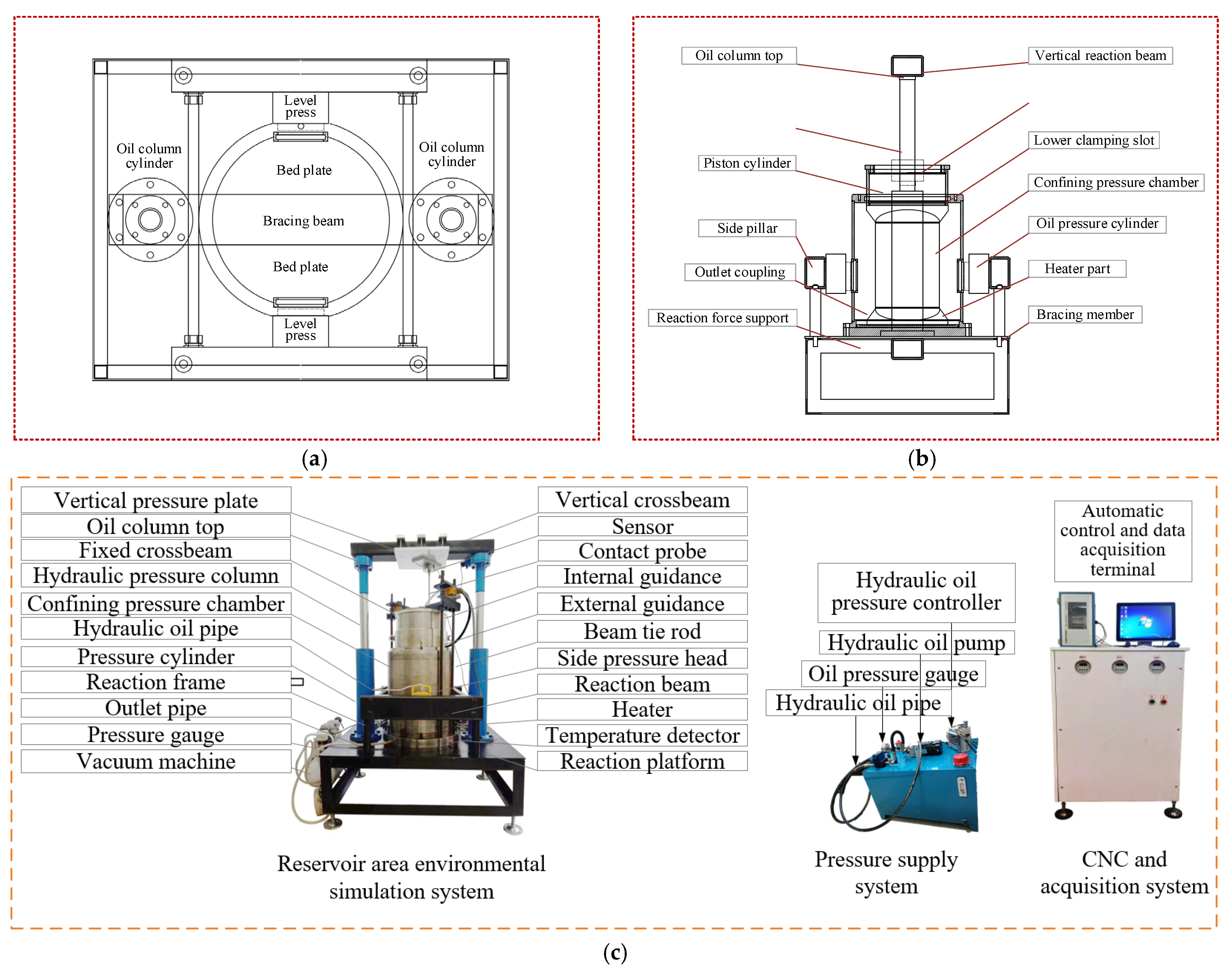
Figure 3 presents the schematic diagram and photograph of the mechanical test system for accumulation deposits in water-fluctuation zones during reservoir operation. The main framework measures 1600 mm × 1400 mm × 2000 mm, while the specimen dimensions are 300 mm × 300 mm × 400 mm. The system can apply a maximum stress of 3 MPa independently in each of the three orthogonal directions.
The pressure application system of the equipment has two modes: upper pressure application and lateral pressure application. For the upper pressure application, pressure is generated by an oil pressure cylinder, transmitted through an oil pressure column to the oil pressure jack fixed on the upper crossbeam, and then applied to the sample below via the upper pressure head. For the lateral pressure application, lateral pressure cylinders directly exert pressure on the front and rear side baffles, which in turn act on the sample.
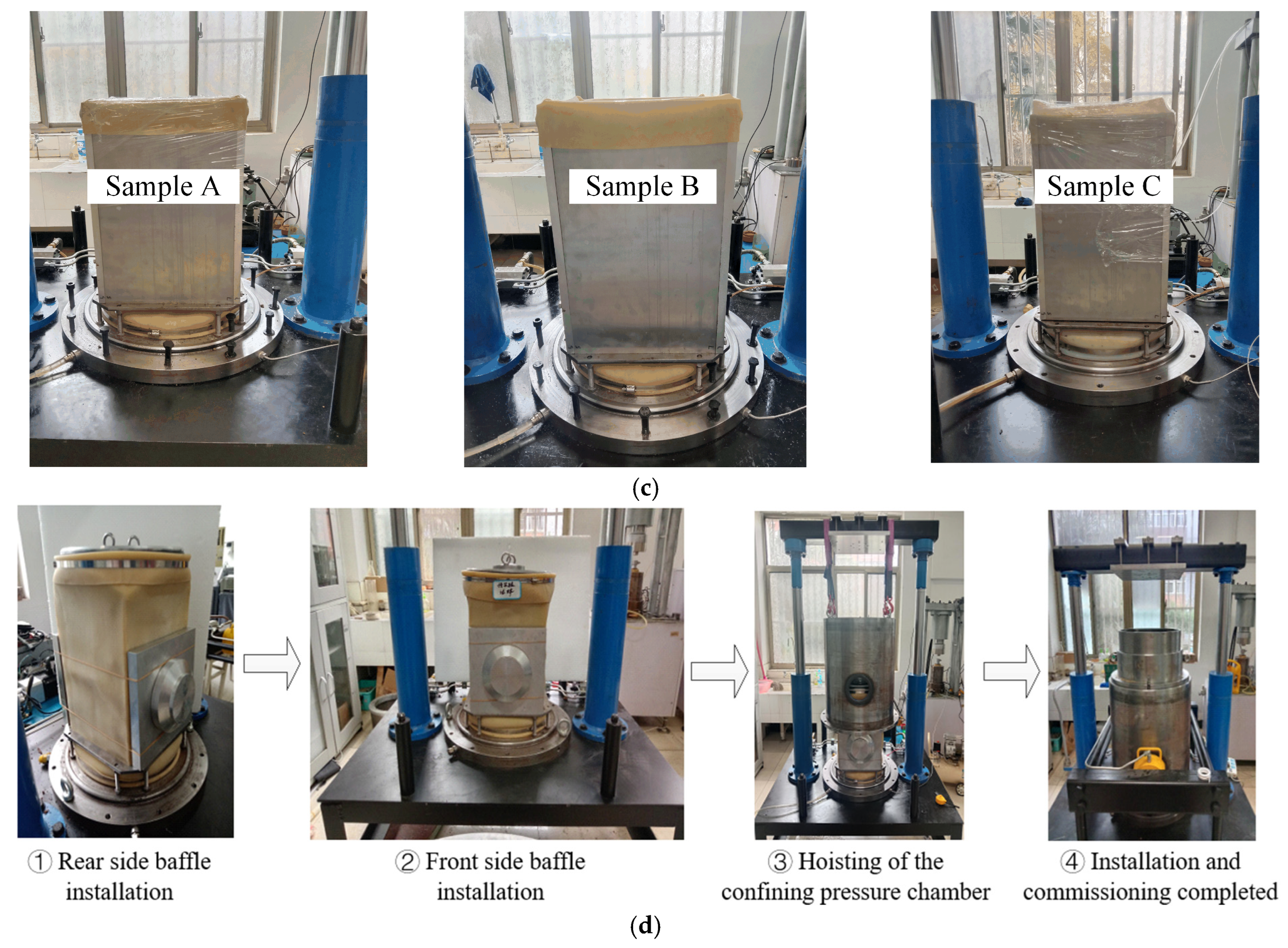
The operation procedure of the equipment is as follows: first, place the standard block sample at the center of the equipment; after installing the front and rear side baffles, hoist and mount the confining pressure chamber and complete debugging, then the pressure application program can be started. During the pressure application process, lateral pressure is provided by the lateral pressure cylinders, and upper pressure is applied through the oil pressure jack. The maximum stress that can be exerted in all three directions is 3 MPa.
This study employs the stress-controlled loading mode. The equipment adopts the collaborative control of a numerical control (NC) system and a data acquisition system: the applied pressure value is set by precisely adjusting the oil pressure. Meanwhile, the NC system is used to monitor the pressure application status in real time, and pressure parameters can be adjusted at any time according to test requirements, ensuring that the pressure application process is accurate and controllable.
After the confining pressure of the equipment stabilizes, the water supply subsystem module will start the head pressure application program. By providing controllable water pressure, this system accurately simulates the actual water pressure conditions corresponding to water-level changes in the reservoir area. It ensures that the hydraulic environment of the sample during the test is highly consistent with the actual engineering conditions, thereby effectively improving the authenticity and reliability of the test results.

3.2. Preliminary Test

(1) Determination of the duration of the wetting stage in the wet–dry alternation process.
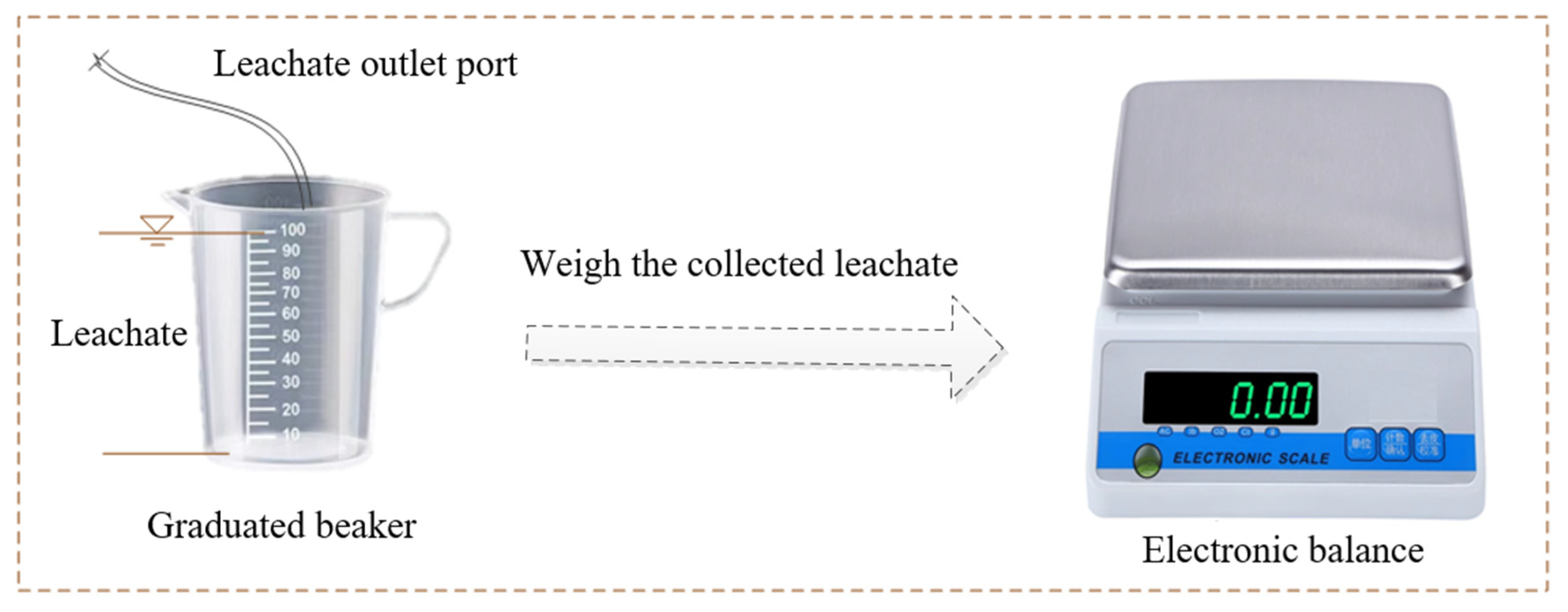
The preliminary test aims to determine the wetting duration for wet–dry cycling tests. The core principle states that during wetting, leachate forms in the test apparatus containing the accumulation specimen. Wetting duration is defined as the time required to reach stabilization, identified when leachate production ceases, indicating that water erosion in the accumulation deposits has essentially stabilized. During the preliminary test, a 1000 mL beaker was first used to collect the leachate at the initial stage. When the seepage velocity of the leachate decreased significantly, a 100 mL beaker with a smaller measuring range was employed to record the volume of the effluent leachate. When the beaker was filled with leachate up to the 100 mL mark, the beaker was weighed and its mass was recorded (see Figure 4). Another beaker was then used to continue collecting the leachate. This process was repeated until the mass of three consecutive 100 mL batches of collected leachate remained unchanged. The total duration of the entire leachate collection process was defined as the wetting time of the experiment. Through this preliminary test, the wetting time for the wet–dry alternation process was determined to be 160 min.
(2) Determination of the drying time in the wet–dry alternation process.
The average temperature in the Three Gorges Reservoir Area from May to September over the past four years, a period when the reservoir water level stays at a low stage, is about 29 °C. Based on preliminary tests, 29 °C was selected for the sample drying stage. To accurately simulate reservoir water-level fluctuations, samples undergoing wet–dry cycles required moisture content readjustment to their initial value after each drying phase.
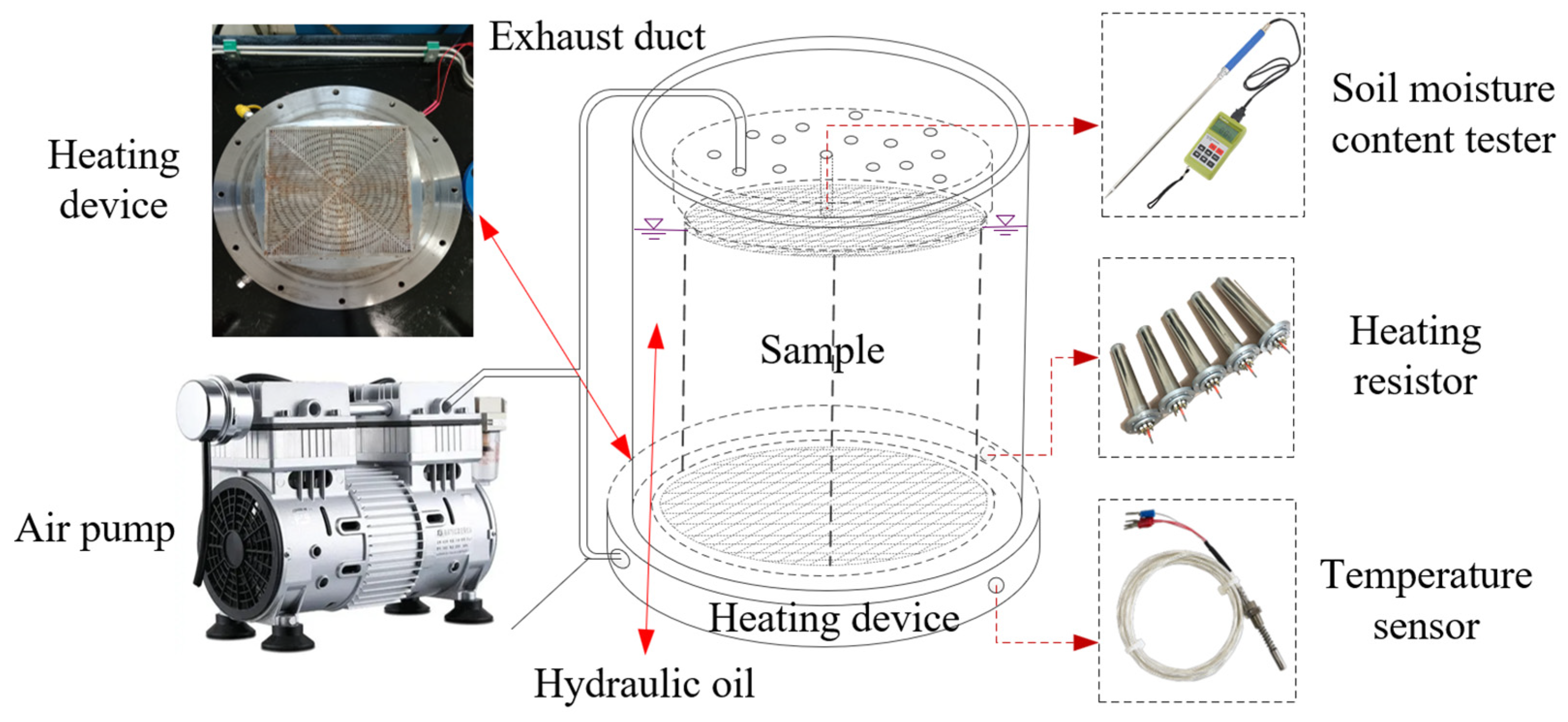
This study designed a wet–dry cycle simulation device to simulate the impacts of environmental factors such as water and wind on the deposits in the reservoir area (Figure 5). During preliminary testing, the integrated heater in the wet–dry cycling module heated the samples. Simultaneously, an air pump connected to the confining pressure chamber’s inlet de-aerated samples at 2.1 m/s airflow velocity. This setting aligns with the measured average wind speed (May–September) at Baijiabao slope’s drawdown zone in the Three Gorges Reservoir area. The soil moisture detector was inserted into the upper pressure head position. Sample drying was considered complete when the moisture content reached 19.8% (equivalent to the dry-condition in situ field moisture at 19.8%, corresponding to 41.6% saturation). The subsequent experimental phase then commenced. Preliminary tests established a 210 min drying duration for the wet–dry cycle process.

3.3. Test Scheme

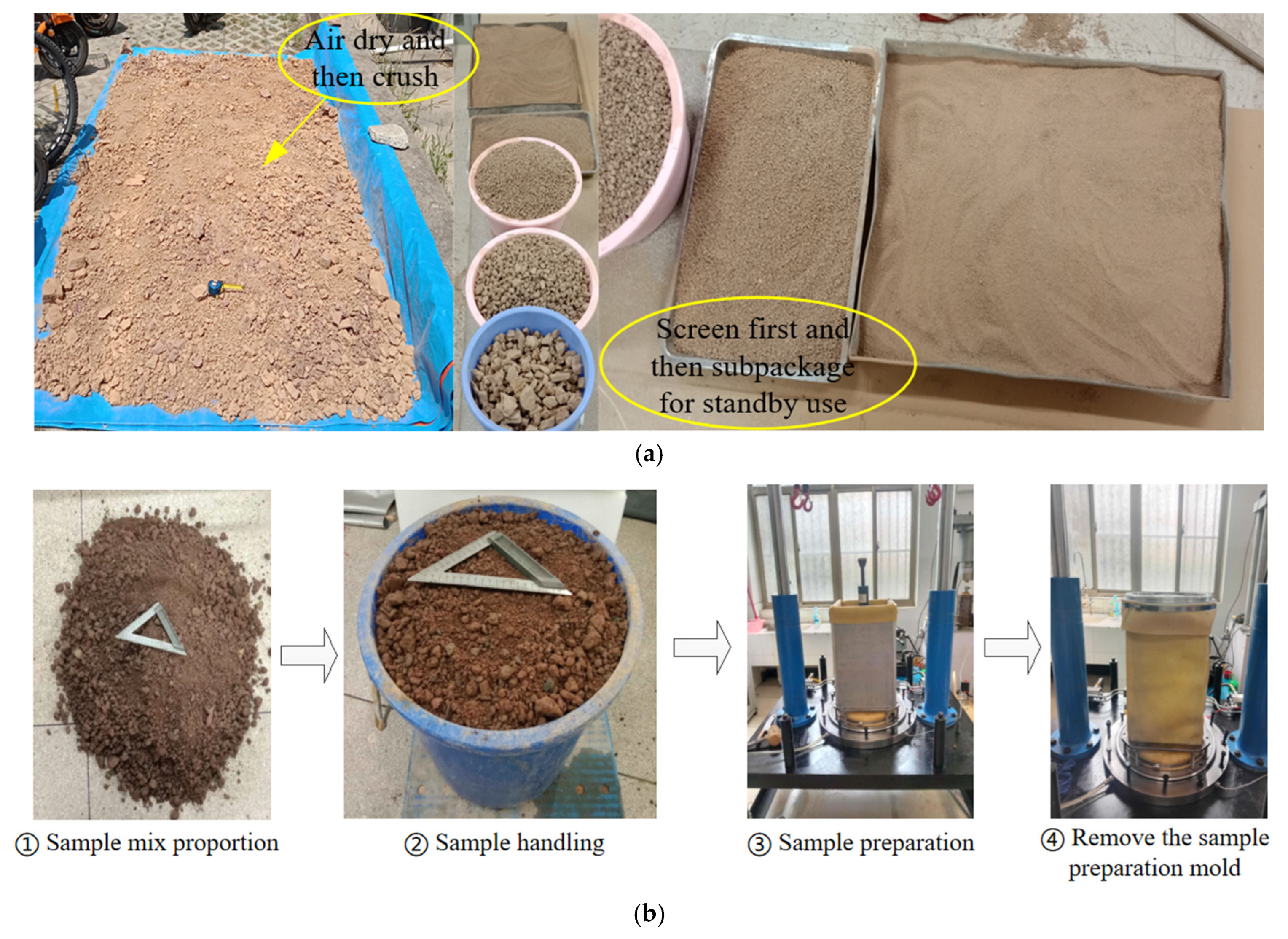
We collected undisturbed soil samples from the site, each measuring 30 × 30 × 40 cm, and measured fundamental physical and mechanical properties such as moisture content, porosity, particle size distribution curve, and density of the undisturbed deposit samples. Particle separation and preparation were carried out based on the measured particle gradation of the samples (see Figure 6a). Simultaneously, we conducted shear tests on the undisturbed deposit samples using a self-developed shear testing machine to obtain strength parameters, including cohesion and internal friction angle.
According to the sample preparation method proposed earlier, the values of skeleton void ratio and fine particle content were obtained, as well as remolded parameters such as a moisture content of 19.8% and a maximum dry density of 1.98 g/cm3. Meanwhile, the total mass of the specimen required for the volume of the test sample was calculated. The masses of particles with different particle sizes were weighed separately, and after uniform mixing, samples with a moisture content of 19.8% were prepared, which were then sealed and left to stand for 10 h. During the wet–dry cycle testing, we proposed a remolding method for undisturbed samples. This approach utilizes disturbed soil to fabricate specimens with the same porosity, density, and strength parameters as the undisturbed samples. The samples were remolded in accordance with the geotechnical test procedures. The soil sample was divided into eight portions, and each portion with equal mass was filled into the mold in layers. When each layer was compacted to a height of 5 cm, the surface was roughened before adding the next layer of soil sample. This process was repeated eight times to complete the sample preparation (see Figure 6b,c) for the sample preparation process).
Prior to initiating the wet–dry cycling test, preliminary tests determined that each wetting stage required 160 min of water head pressure application. Reservoir water, collected from the Three Gorges Reservoir Area and transported to the laboratory, was introduced into the water tank of the water supply subsystem. Laboratory measurements indicate that the reservoir water contains ions including Ca2+, SO42−, Cl, Mg2+, Na+ and K+. The concentrations of these ions vary with reservoir operation cycles, with measured ranges of 37.06–50.40 mg/L, 33.35–49.78 mg/L, 23.81–29.52 mg/L, 9.01–12.84 mg/L, 9.01–14.18 mg/L, and 0.97–1.30 mg/L, respectively. The pH of the reservoir water was generally maintained within the range of 7.47–8.13, indicating weakly alkaline conditions. Concurrently, the specimen underwent consolidation under confining pressure within the triaxial apparatus. Following stabilization of the confining pressure, water head pressure was applied via the water supply subsystem. Timing commenced upon application of the water head pressure.
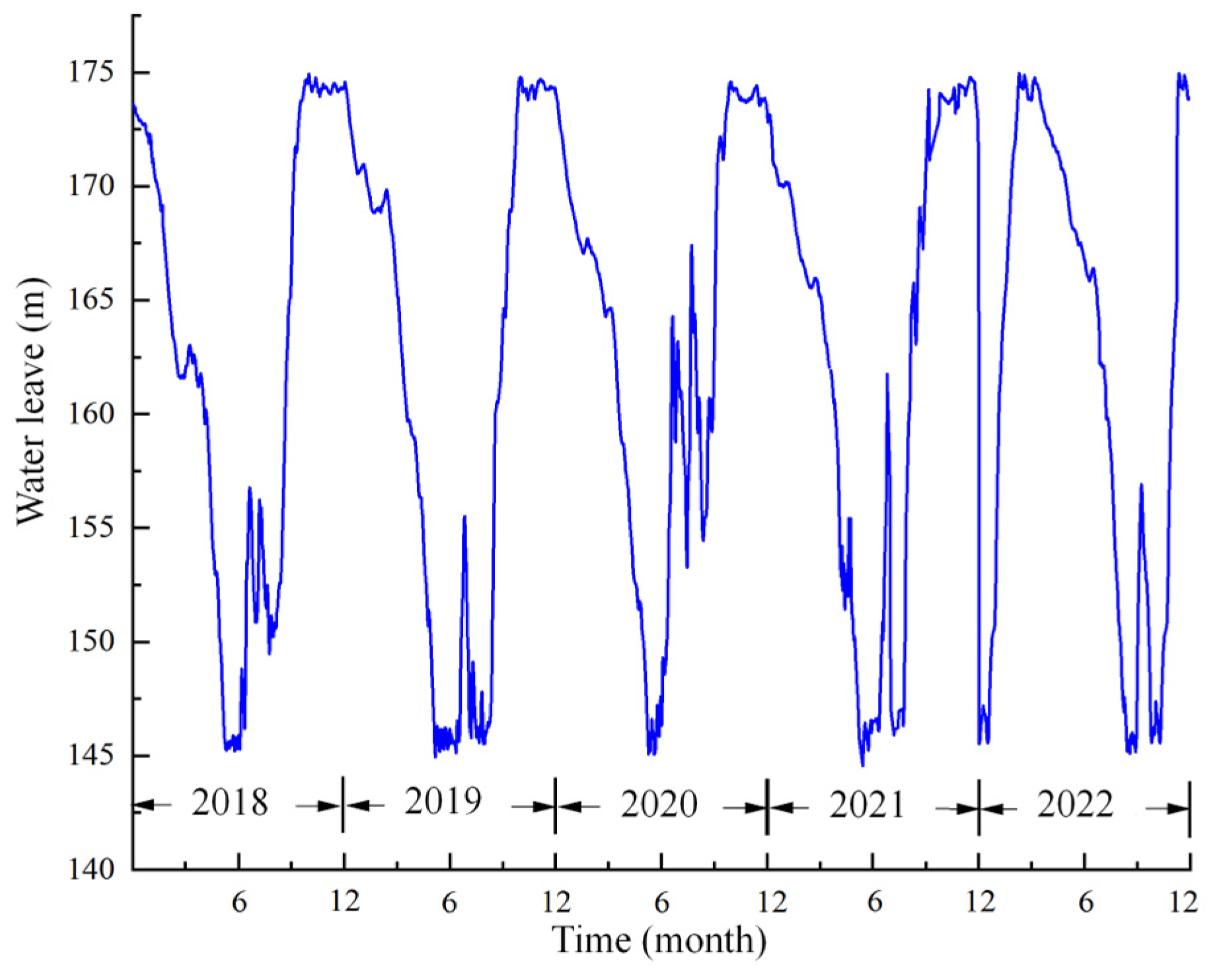
Taking the Three Gorges Reservoir as an example, its periodic operation leads to periodic fluctuations in the reservoir water-level, subjecting the specimens in the hydro-fluctuation belt to an environment of periodic wet–dry alternation. The variations in the reservoir water level over the past five years were obtained from the Yangtze River Hydrological Network of China (see Figure 7). As can be seen from Figure 7, during the operation period from 2018 to 2019, the reservoir water level dropped to 145 m in early June 2018 to release storage capacity for flood control. From June to September 2018, the water level rose from 145 m to 156 m; in the late flood season (September to October), it was gradually impounded to 175 m over approximately one month. During October to December, the reservoir water level remained basically at the high level of 175 m. From December 2018 to March 2019, the Three Gorges Reservoir increased its water discharge rate to supplement water for the downstream reaches, which caused the water level to drop gradually until it reached the flood-control-limited water level of 145 m in early June. With the periodic operation of the Three Gorges Reservoir, its water level has generally followed the same fluctuation pattern observed from June 2018 to June 2019. Notably, during the flood seasons of 2020 and 2022, the reservoir water level rose higher than in other years due to the impact of heavy rainfall. It can be seen from the water level fluctuation chart of the Three Gorges Reservoir area that the water level in the reservoir area basically cycles once a year, so this experiment takes an annual cycle as the precondition for the test. This experiment only considers the influence of water-level fluctuations on the soil mass, and does not take into account the effects of wind speed, temperature and other conditions in the reservoir area.
Three groups of samples (A, B, and C) were each subjected to 16 cycles of periodic wet–dry alternation tests in accordance with the above-mentioned steps. This simulates the operation period of the reservoir from its initial impoundment in 2008 to 2023, which corresponds to a total of 16 cycles of periodic reservoir water-level fluctuations. Following each wet–dry cycle, miniature static cone penetration (CPT) measurements were performed to determine the compression modulus and shear strength parameters of the specimens. Subsequently, the variation characteristics of the compression modulus and shear strength parameters of the specimens with the number of periodic wet–dry alternation cycles were analyzed.
Under the combined action of anisotropic stress and wet–dry alternation, the static cone penetration test of accumulation deposits can be carried out via the miniature static cone penetration subsystem module to obtain the cone tip resistance of the accumulation deposits after a certain number of wet–dry cycles. Based on the cone tip resistance, the cohesion c , internal friction angle φ , and compression modulus E s of the accumulation deposits can be calculated by the following equations [20].
c = 1 N k ( q c 2 γ h 2 h 2 q c 1 γ h 1 h 2 h 2 q c 2 γ h 2 2 h 1 h 2 )
φ = a r c t a n ( q c 1 γ h 1 q c 2 + γ h 2 ) N k ( γ h 1 γ h 2 )
E s = a m q c
where N k is the cone coefficient with a value ranging from 7 to 25, γ is the unit weight of the deposits, h 1 and h 2 are the depths of the cone penetrometer inserted into the accumulation deposits, q c 1 and q c 2 are the cone tip resistances corresponding to depths h 1 and h 2 , q c is the cone tip resistance, and a m is a coefficient, for which the value ranges from 3 to 8 when q c < 0.7 MPa; from 2 to 5 when 0.7 MPa < q c < 2.0 MPa; and from 1 to 2.5 when q c > 2.0 MPa.

4. Test Results and Analysis

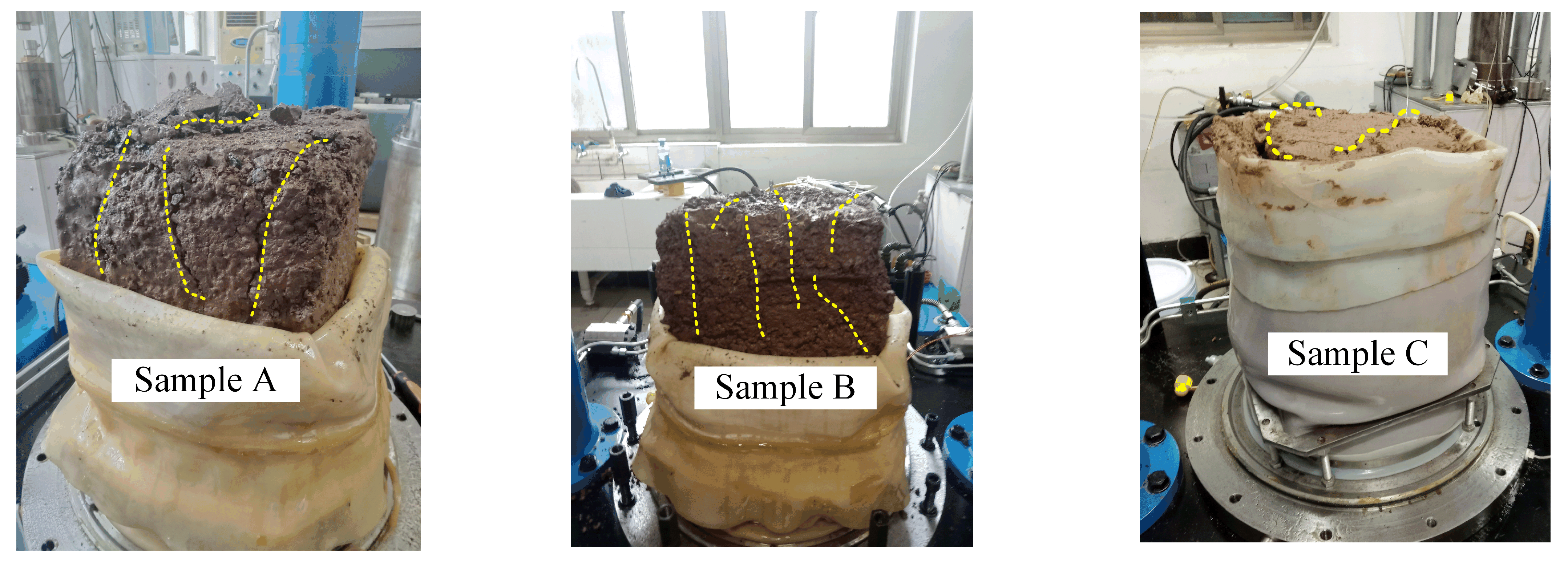
The aforementioned tests characterized the variation in deformation parameters (compression modulus) and shear strength parameters (cohesion, internal friction angle) with increasing wet–dry cycles. Figure 8 depicts the post-test specimens, revealing three distinct sample groups (A, B, and C). All groups exhibited varying degrees of deformation following 16 wet–dry cycles, with each specimen developing multiple cracks ranging in width from 2 mm to 10 mm. This deformation results from the combined effects of bank slope stresses, reservoir water dissolution, and the applied number of wet–dry cycles. Detailed analyses of the specific variation processes for the deformation and shear strength parameters are provided in Section 4.1 and Section 4.2.

4.1. Evolution of Compression Modulus

The compressive modulus mentioned in the research was measured using the static cone penetration test device built into our experimental system, and the compressive modulus of the accumulation deposit specimen was calculated through the relationship between cone tip resistance and compression modulus.
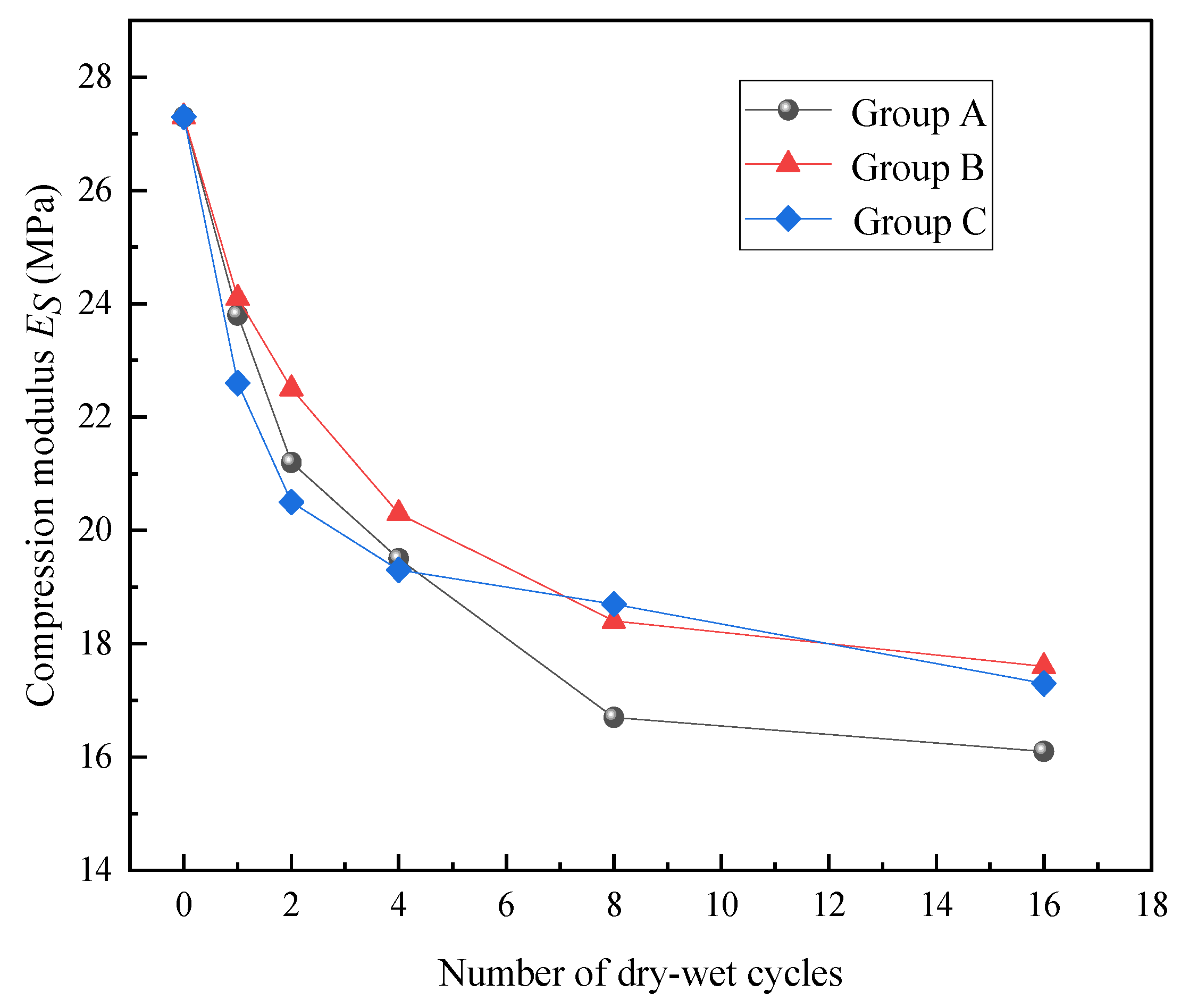
The above tests yielded the variation curve of the deformation parameter (compression modulus) with increasing wet–dry cycles, presented in Figure 9. Figure 8 shows that specimens in all three groups (A, B, C) exhibited deformation following the 16th wet–dry cycle, with each specimen developing cracks. As illustrated in Figure 9, Group C specimens exhibited the most pronounced decrease in compression modulus after the first wet–dry cycle, declining by 17.2% compared to specimens without cycles. Following the fourth cycle, the rate of decrease moderated.
Prior to the tests, we employed numerical modeling to analyze the principal triaxial stresses acting on the accumulated mass at varying sampling elevations along the bank slope, aiming to determine the stresses to be applied during testing. During testing, Group A specimens were subjected to principal stresses of σ1 = 480 kPa, σ2 = 330 kPa, and σ3 = 270 kPa. Group B specimens experienced σ1 = 380 kPa, σ2 = 270 kPa, and σ3 = 230 kPa, while Group C specimens were loaded with σ1 = 300 kPa, σ2 = 200 kPa, and σ3 = 160 kPa. Consequently, Group C specimens were subjected to lower stress magnitudes compared to Groups A and B. Following wet–dry cycles, Group C exhibited a relatively greater increase in vertical strain heterogeneity. Correspondingly, its compression modulus also decreased. Similarly, specimens in Groups A and B demonstrated significant reductions in compression modulus after the first wet–dry cycle, with comparable rates of change. Beyond the eighth cycle, the variation trends for both groups stabilized. Overall, with increasing wet–dry cycles, the amplitude of compression modulus variation progressively diminished across all specimen groups (A, B, C). It can be seen from this that under the combined action of the anisotropic stresses of the bank slope and wet–dry cycles, the compression modulus of the specimens changes significantly. Moreover, the compression modulus shows the largest decrease during the first wet–dry alternation cycle. The standard deviations of compression modulus for groups A, B and C are 4.29, 3.67, and 3.59, respectively. The decreases in the three groups of samples reach 13.1%, 12.0% and 17.2% respectively. Afterward, as the number of periodic wet–dry alternation cycles increases, the decreasing amplitude of the compression modulus gradually reduces and tends to be stable. When the number of wet–dry alternation cycles reaches 16, the decreasing amplitudes of the compression modulus of the three groups of samples are 39.9%, 35.5% and 36.2%, respectively.

4.2. Evolution of Shear Strength Parameters

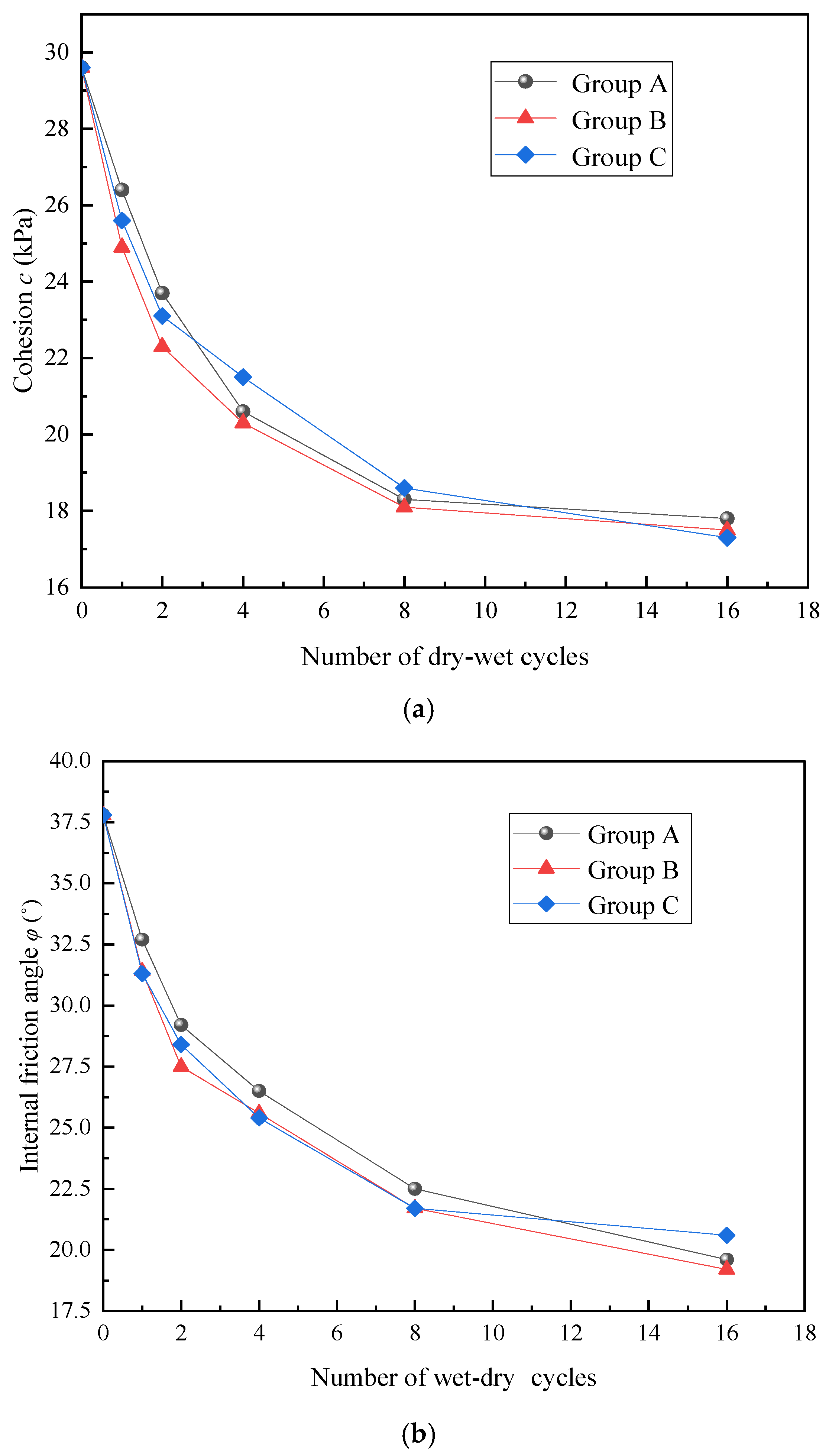
During this test, the shear strength parameters (cohesion c and internal friction angle φ) of the accumulation deposit samples that had undergone wet–dry alternation cycles were measured. The variation law of these parameters with the increase in the number of wet–dry alternation cycles is as follows (see Figure 10a,b).
It can be seen from Figure 10a that the cohesion of the three groups of samples shows a generally consistent overall variation trend after undergoing different numbers of wet–dry cycles. Taking the samples in Group A as an example, compared with the initial state without wet–dry alternation cycles (zero wet–dry cycles), the cohesion of the samples decreases from 29.8 kPa to 26.4 kPa after the first wet–dry cycle, with a decrease rate of 10.81%. After the second wet–dry alternation cycle, the cohesion further decreases to 23.7 kPa, which is a 19.93% decrease compared with the initial state. After the fourth wet–dry cycle, the cohesion drops to 20.6 kPa, a 30.41% decrease compared with the initial state. Following the eighth wet–dry cycle, cohesion decreased to 18.9 kPa (a 38.17% reduction from the initial value), with the downward trend stabilizing thereafter. This value further dropped to 17.8 kPa, representing a total reduction of 39.86% after 16 cycles.
Figure 10b delineates the evolution of the internal friction angle for the three distinct specimen groups (A, B, C) under cyclic wet–dry conditions. A critical observation is the fundamental consistency in the declining trajectory of this parameter across all groups, despite variations in initial stress states. A detailed examination of Group A serves to quantify this trend. After the first wet–dry cycle, the internal friction angle decreased to 32.7°, representing a reduction of 13.49% from its initial value. A further decline to 29.2° was recorded after the second wet–dry cycle, corresponding to a cumulative reduction of 22.75%. After the fourth wet–dry cycle, the internal friction angle decreased to 26.5° (a 29.89% reduction). The decline continued, reaching 22.5° after the eighth wet–dry cycle (40.47% decrease), after which the rate of reduction slowed considerably. The final value of 19.6° was recorded after the 16th wet–dry cycle, representing a total strength loss of 48.14% from the initial state.
The progression reveals a non-linear decay characteristic. The most aggressive reduction occurred within the initial cycles, with the rate of decrease markedly attenuating after the eighth cycle. This transitional behavior signifies a progression from rapid initial strength loss toward a stabilized residual state. This behavior in the internal friction angle is part of a broader, synchronous deterioration of shear strength. When interpreted in conjunction with the cohesion data presented in Figure 10a, a conclusive pattern emerges: both foundational shear strength parameters exhibit concurrent attenuation in response to hydromechanical weathering. The stabilization observed after cycle 8 indicates that the tested material is approaching a terminal condition, with critical implications for long-term slope stability assessments. While the absolute values differ, the essential pattern of rapid initial decline followed by progressive stabilization is corroborated by the data from these groups, reinforcing the robustness of the identified phenomenon.
The results from all test groups indicate that the compression modulus and shear strength parameters degrade significantly during the initial cycles, while the rate of degradation diminishes noticeably in subsequent cycles. Under wet–dry cycles, the performance degradation observed in this study, characterized by a rapid initial degradation followed by a slower rate, is consistent with those reported in the literature [21]. This phenomenon may be attributed to the rapid dissolution of cementing materials within microcracks or pores during initial wet–dry cycles, leading to significant deterioration of compressive modulus and shear strength parameters in the early stage due to structural damage. In later stages, as soluble cementing materials become depleted and water–rock chemical interactions weaken, the degradation of compressive modulus and shear strength parameters slows down.

5. Conclusions

This study investigates the evolution of the mechanical properties of deposits in the water-level fluctuation zone of the Baijiabao slope, Three Gorges Reservoir Area. Tests on deformation parameters (compression modulus ES) and shear strength parameters (cohesion c, internal friction angle φ) were carried out under the combined action of the anisotropic stresses of the bank slope and wet–dry cycles. This research characterized the evolution of deformation and shear strength parameters in the deposits under combined anisotropic stress and wet–dry cycling during cyclic reservoir water-level fluctuations. Three sample groups (A, B, and C) each underwent 16 cycles of cyclic wet–dry testing. The key findings are summarized below:
The research on compression modulus tests shows that under the combined action of the anisotropic stresses of the bank slope and wet–dry cycles, the compression modulus of the deposit samples changes significantly. Moreover, the compressive modulus experienced its most significant decline during the first wet–dry cycle, with reductions of 13.1%, 12.0%, and 17.2% for the three sample groups, respectively. Subsequently, the rate of decrease gradually diminished and stabilized as the number of cycles increased. By the 16th cycle, the total reductions in compressive modulus for the three groups were 39.9%, 35.5%, and 36.2%, respectively. The test results of strength parameters show that the overall trends of the three groups of samples are generally consistent. The initial wet–dry cycle significantly reduced the shear strength parameters in the specimens: cohesion decreased by 10.81%, and the internal friction angle by 13.49%, as evidenced in Group A. A further significant reduction occurred after the second cycle. Compared to the values after the first cycle, cohesion decreased by an additional 9.12%, and the internal friction angle by 9.26%. With subsequent cycles, the declining trends of both parameters gradually stabilized. After 16 wet–dry cycles, the total reductions in cohesion and internal friction angle reached 39.86% and 48.14%, respectively, compared to the initial state.
Based on the experimental results presented in this paper, the mechanical properties of bank slope sediments deteriorate rapidly at first with fluctuating reservoir water-levels. Hence, for newly constructed reservoirs, particular attention must be paid to landslides and collapses triggered by water-level fluctuations during the initial years of operation. It should also be noted that after 16 wet–dry cycles, compression modulus, cohesion, and internal friction angle of reservoir bank slopes may degrade by approximately 35–50%. Such parameter degradation cannot be neglected in slope stability analyses.

Author Contributions

Conceptualization, Z.D. and Z.Z.; methodology, G.L.; validation, Z.L.; investigation, Z.L.; resources, Z.L. and Z.Z.; data curation, Z.D.; writing—original draft preparation, Z.L.; writing—review and editing, G.L. and R.S.; supervision, Z.Z.; project administration, Z.Z.; funding acquisition, Z.L. All authors have read and agreed to the published version of the manuscript.

Funding

This research was funded by the National Natural Science Foundation of China (Nos. 52479096) and the Guizhou Water Conservancy Investment (Group) Co., Ltd. (No. KT202543).

Data Availability Statement

Data are contained within the article and all the data and test programs of this study are available from the corresponding author upon reasonable request.

Conflicts of Interest

The Guizhou Water Conservancy Investment (Group) Co., Ltd. had no role in the design of the study; in the collection, analyses, or interpretation of data; in the writing of the manuscript, or in the decision to publish the results. The authors declare that the research was conducted in the absence of any commercial or financial relationships that could be construed as a potential conflict of interest.

References

  1. Zhang, Z.; Liu, W.; Han, L.; Chen, X.; Cui, Q.; Yao, H.; Wang, Z. Disintegration behavior of strongly weathered purple mudstone in drawdown area of three gorges reservoir, China. Geomorphology 2018, 315, 68–79. [Google Scholar] [CrossRef]
  2. Yao, H.; Zhang, Z.; Li, D. Experimental Study on the Permeability Characteristics of Sandstone in Different Chemical Solutions. KSCE J. Civ. Eng. 2018, 22, 3271–3277. [Google Scholar] [CrossRef]
  3. Zhang, Z.; Jiang, Q.; Zhou, C.; Liu, X. Strength and failure characteristics of Jurassic Red-Bed sandstone under cyclic wetting–drying conditions. Geophys. J. Int. 2014, 198, 1034–1044. [Google Scholar] [CrossRef]
  4. Zhang, Z.H.; Xue, J.J.; Yao, H.Y. Experimental study on the strength difference of two types of sandstones with different composition of minerals under the conditions of dry and wet cycles. Adv. Mater. Res. 2012, 374, 2217–2220. [Google Scholar] [CrossRef]
  5. Huang, B.; Yin, Y.; Liu, G.; Wang, S.; Chen, X.; Huo, Z. Analysis of waves generated by Gongjiafang landslide in Wu Gorge, three Gorges reservoir, on November 23, 2008. Landslides 2012, 9, 395–405. [Google Scholar] [CrossRef]
  6. Du, J.; Yin, K.; Lacasse, S. Displacement prediction in colluvial landslides, Three Gorges Reservoir, China. Landslides 2013, 10, 203–218. [Google Scholar] [CrossRef]
  7. Wang, L.; Huang, J.-j.; Chen, Y.; Wang, S.-m.; Fan, Z.-h.; Guo, F.; Li, X.-w. Evaluation of the treatment effect of rear slope cutting on hydrodynamic pressure landslides: A case study. J. Mt. Sci. 2023, 20, 1968–1983. [Google Scholar] [CrossRef]
  8. Bao, Y.; Li, Y.; Zhang, Y.; Yan, J.; Zhou, X.; Zhang, X. Investigation of the role of crown crack in cohesive soil slope and its effect on slope stability based on the extended finite element method. Nat. Hazards 2022, 110, 295–314. [Google Scholar] [CrossRef]
  9. Shahien, M.M.; Farouk, A. Estimation of deformation modulus of gravelly soils using dynamic cone penetration tests. Ain Shams Eng. J. 2013, 4, 633–640. [Google Scholar] [CrossRef]
  10. Ke, L.; Takahashi, A. Strength reduction of cohesionless soil due to internal erosion induced by one-dimensional upward seepage flow. Soils Found. 2012, 52, 698–711. [Google Scholar] [CrossRef]
  11. Ke, L.; Takahashi, A. Experimental investigations on suffusion characteristics and its mechanical consequences on saturated cohesionless soil. Soils Found. 2014, 54, 713–730. [Google Scholar] [CrossRef]
  12. Xu, W.J.; Hu, R.L.; Zeng, R.Y. Research on horizontal push-shear in-situ test of subwater soil-rock mixture. Geotech. Eng. 2006, 28, 814–818. [Google Scholar] [CrossRef]
  13. Li, X.; Liao, Q.; He, J.; Chen, J. Study on in-situ tests of mechanical characteristics on soil-rock aggregate. Rock Mech. Eng. 2007, 26, 2377–2384. [Google Scholar] [CrossRef]
  14. Wei, S.; Ji, F.; Ding, J.-l.; Guan, M.; Lu, Y.-p. Influence of extremely rapid cyclic reservoir water level fluctuations on bank slope stability: Insights from model testing and numerical simulation of a pumped storage power station slope. Eng. Geol. 2025, 357, 108380. [Google Scholar] [CrossRef]
  15. Zhang, K.; Gong, Z.; Zhao, K.; Wang, K.; Pan, S.; Coco, G. Experimental and numerical modeling of overhanging riverbank stability. J. Geophys. Res. Earth Surf. 2021, 126, e2021JF006109. [Google Scholar] [CrossRef]
  16. Zhou, Q.; Yan, S.; Deng, W.; Fu, X. Analysis of the influence of reservoir water level fluctuation on bank slope stability. J. Highw. Transp. Res. Dev. 2012, 6, 32–40. [Google Scholar] [CrossRef]
  17. Yan, L.; Xu, W.; Chen, G.; Wu, Y.; Chen, H.; Wang, H.; Tian, L. Numerical investigation of deformation mechanism and treatment measures of landslide deposit: A case from Lancang river. Nat. Hazards 2025, 121, 20403–20420. [Google Scholar] [CrossRef]
  18. Ghaffaripour, O.; Esgandani, G.A.; Khoshghalb, A.; Shahbodaghkhan, B. Fully coupled elastoplastic hydro-mechanical analysis of unsaturated porous media using a meshfree method. Int. J. Numer. Anal. Methods Geomech. 2019, 43, 1919–1955. [Google Scholar] [CrossRef]
  19. Pasha, A.; Khoshghalb, A.; Khalili, N.J.C. Geotechnics, Evolution of isochoric water retention curve with void ratio. Comput. Geotech. 2020, 122, 103536. [Google Scholar] [CrossRef]
  20. Xing, H.F.; Xu, C.; Shi, Z.M. Geotechnical In-Situ Testing, 2nd ed.; Tongji University Press: Shanghai, China, 2015; pp. 44–45. [Google Scholar]
  21. Du, J.; Shen, X.; Li, C.; Zhu, W.; Feng, G. Effect of dry-wet cycles on the strength and deformation of the red-bed rockfill material in western Yunnan. Front. Earth Sci. 2023, 11, 1192269. [Google Scholar] [CrossRef]
Figure 1. In situ sampling of accumulation deposits in the drawdown area of the Baijiabao bank slope. (a) Sampling location of accumulation deposits on Baijiabao bank slope; (b) Sampling box; (c) Sampling procedures.
Eng 07 00091 g001
Figure 2. Particle size analysis test of accumulation deposits in the water-fluctuation area of Baijiabao bank slope. (a) Soil particle size analysis test; (b) Gradation curve of accumulation deposits in the water-fluctuation area of Baijiabao bank slope.
Eng 07 00091 g002
Figure 3. Schematic diagram and physical diagram of the mechanical test system of deposits in the water drawdown area during reservoir operation. (a) Top view of the test system; (b) Side view of the test system; (c) Physical photograph of the test system.
Eng 07 00091 g003
Figure 4. Schematic diagram of leachate collection.
Eng 07 00091 g004
Figure 5. Schematic diagram of the wet–dry cycle simulation device.
Eng 07 00091 g005
Figure 6. Specimen preparation and installation of the specimens. (a) The accumulated deposits undergo air-drying and sieving for further use; (b) Sample preparation process; (c) Samples prepared before the wet–dry alternation test; (d) Sample installation process.
Eng 07 00091 g006aEng 07 00091 g006b
Figure 7. Water-level fluctuation in Three Gorges Reservoir.
Eng 07 00091 g007
Figure 8. The samples after 16 wet–dry cycles.
Eng 07 00091 g008
Figure 9. Evolution curves of the compression modulus.
Eng 07 00091 g009
Figure 10. Evolution curves of shear strength parameters. (a) The variation relationship between cohesion and the number of wet–dry cycles. The standard deviations of cohesions for groups A, B and C are 4.69, 4.57, and 4.55, respectively. (b) The variation relationship between the internal friction angle and the number of wet–dry cycles. The standard deviations of internal friction angles for groups A, B and C are 6.67, 6.74, and 6.43, respectively.
Eng 07 00091 g010
Disclaimer/Publisher’s Note: The statements, opinions and data contained in all publications are solely those of the individual author(s) and contributor(s) and not of MDPI and/or the editor(s). MDPI and/or the editor(s) disclaim responsibility for any injury to people or property resulting from any ideas, methods, instructions or products referred to in the content.