
A Hybrid SHACL–Bayesian Framework for Managing Clinical Uncertainty in Postmenopausal Women with Recurrent Urinary Tract Infections
 , ,
, ,  , and
, and
Abstract
1. Introduction
2. Related Work
2.1. Semantic and Probabilistic Models
2.2. Challenges in Managing Recurrent UTIs and the Role of Digital Health
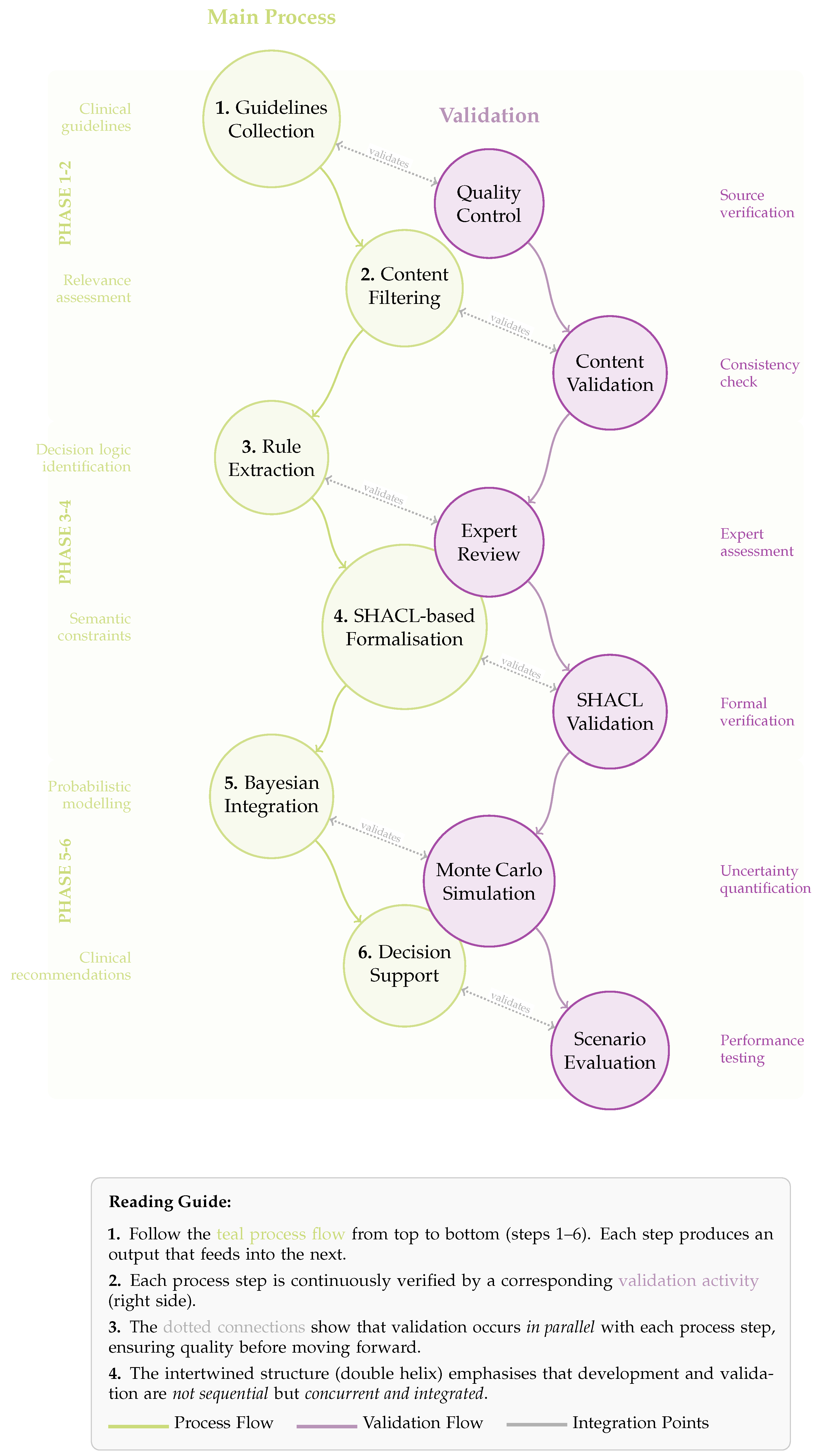
3. Methods
- Step 1: Collection of clinical guidelinesThe first step of the project consists of the systematic collection of the most relevant clinical guidelines on menopause and UTIs in postmenopausal women.The choice to select guidelines rather than laws or health regulations is motivated by their ability to synthesise the best scientific evidence into actionable and up-datable recommendations. These guidelines provide specific indications for diagnosis, pharmacological treatments (including antibiotics, hormonal therapies, and administration methods), prevention, and risk management (such as the development of antimicrobial resistance).The search was conducted using rigorous selection criteria based on a set of targeted keywords: “Menopause”, “Urinary Tract Infections”, “Recurrent Urinary Tract Infections”, “Cystitis”, “GSM”, and “Pyelonephritis”. The analysis revealed that there are no dedicated guidelines specifically addressing the management of urinary tract infections caused by multi-drug-resistant microorganisms in menopausal women. Additionally, there are no comprehensive guidelines for the management of recurrent UTIs in this population that synergistically combine hormonal treatments, antibiotics, and non-hormonal strategies.To ensure completeness and multidisciplinary coverage, guidelines published over the last ten years from various sources were included: international and national scientific societies, government agencies, scientific literature, and documents such as “position statements”, “consensus papers”, and “review articles”. The guidelines were organised according to their main topic (menopause vs. urinary infections) and their source society, facilitating a coherent comparative analysis.The classification was based on four main criteria: the level of completeness and degree of multidisciplinary integration (gynaecology, obstetrics, urology, infectious diseases; the most recent update; methodological quality (e.g., adoption of the GRADE system for evidence evaluation); international recognition as a reference standard.Based on these criteria, we divide the guidelines into five priority levels, as reported in Table 2.Within the selected documents, we identified the key elements for the subsequent analysis—specifically, the main pathogens responsible for urinary tract infections, the types of antibiotic and hormonal treatments (with their respective administration methods), and the risks of developing antimicrobial resistance in cases of inadequate therapy. This stage establishes the structured knowledge base on which the following steps—automated extraction of clinical rules and ontological formalisation—are built.After collecting the clinical guidelines, we conducted an initial quality control phase on the acquired documents. First, we verified the completeness of each document to ensure that all essential sections, attachments, and references were included. We then checked the version history to confirm that the materials were current and consistent with the latest editions released by official sources. Next, we validated the primary sources to ensure that all documents came from recognised institutions such as health authorities, government agencies, or academic organisations. Finally, we removed duplicate entries to eliminate redundancy and prevent it from negatively affecting subsequent analytical stages.
- Step 2: Manual filtering of paragraphs related to menopause and UTIsIn the second step, we manually extracted from the collected documents the paragraphs containing information relevant to menopause and UTIs, with the aim of identifying material directly usable for the definition of clinical rules. The selection process involved analysing the guidelines classified according to the priority levels defined by NICE, EAU, and NAMS, while narrowing the focus exclusively to texts reporting data on pathogens, antibiotic treatments, hormonal therapies, administration methods, and risks of antimicrobial resistance.Once the relevant paragraphs were identified, we annotated and processed the content, highlighting in particular the pathogens most frequently involved in postmenopausal urinary tract infections and accurately reporting the therapeutic recommendations—including the type of antibiotic, hormonal therapy, and mode of administration. Special attention was given to warnings concerning the risk of antimicrobial resistance resulting from inadequate treatments.We then organised the selected data into structured files or tables, linking each paragraph to its source guideline and corresponding priority level. When present, qualitative indicators such as “frequently” or “occasionally” were annotated and encoded to enable their use in subsequent probabilistic analyses.Following the initial filtering of the content, we proceeded to a more specific validation phase aimed at verifying the medical accuracy of the extracted information by comparing it with current scientific evidence and clinical guidelines. We also ensured terminological consistency, confirming that the vocabulary used was uniform and aligned with recognised medical and scientific standards. Finally, we performed a completeness check to guarantee that no relevant elements were omitted during filtering and that all pertinent data were correctly represented and clearly interpretable.
- Step 3: Extraction of clinical rules from GuidelinesWe extracted clinical rules from the selected paragraphs in the guidelines (Table 2). We chose these sources due to their international recognition, recent publication, and methodological quality, which make them a more reliable foundation for developing the framework. We will address guidelines from subsequent levels in future work. We performed the extraction of clinical rules using an LLM, specifically ChatGPT-5, developed by OpenAI [39]. This model represents one of the latest advances in natural language processing, and we selected it for its ability to understand complex texts, maintain clinical context, and generate structured outputs. We guided the LLM using a parametric prompt that directed the classification into a predefined taxonomy of seven types of clinical rules. Table 3 contains this classification, which covers a broad spectrum of content in the guidelines and ensures a standardised structuring of the information. We then organised the rules in a structured format to enable their subsequent formalisation in the SHACL language.To demonstrate how the extraction process operates, we present an example derived from paragraph 1.5.4 of the NICE 2015 guideline, updated in 2024. In this case, the input provided to ChatGPT-5 consists of the original text of the guideline:“1.5.4 Offer vaginal oestrogen to people with genitourinary symptoms associated with menopause (including those using systemic HRT) and review regularly as per the recommendations on reviews in this guideline. [NICE 2024]”The model receives a predefined structured template to ensure a standardised and machine-readable extraction. Specifically, the LLM is instructed to organise the key information. The complete prompt used to guide the LLM is as follows:“You are given clinical guidelines in free-text. Your task is to extract clinical rules in JSON format, following exactly this schema:“RuleType”: “Therapeutic/Diagnostic/Preventive/Follow-up/Other”,“Condition”: “Specify the patient condition or eligibility criteria”,“Action”: “Specify the clinical recommendation or intervention”,“EvidenceLevel”: “Indicate year or evidence level if available”,“Source”: “Specify the guideline source ”Do not add extra fields. Only return valid JSON.”Listing 1 is an example of output generated by the LLM:
Listing 1. Example of JSON output generated by the ChatGPT-5.  Clinical experts in gynaecology, obstetrics, and infectious diseases systematically reviewed the structured outputs generated by the LLM. They assessed the semantic and clinical consistency between the original guideline text and the extracted information, verified terminological fidelity, checked the accuracy of clinical conditions, formulated correct recommendations, and identified and corrected potential inconsistencies or misalignments, ensuring that neither linguistic variations nor substantive discrepancies altered the clinical meaning of the extracted rules.
 - Step 4: SHACL-based FormalisationWe subsequently subject the extracted clinical rules to a semantic formalisation process. In this phase, we aim to translate the rules into a structured, machine-readable format to ensure consistency, traceability, and semantic validation.We achieve this by using SHACL, a W3C standard for defining and validating constraints on RDF data. The adoption of SHACL provides a formal and machine-interpretable representation of clinical knowledge, allowing for structured verification of data coherence across multiple levels. Specifically, SHACL enables the system to automatically check whether the data comply with formal syntax (structural validation), logical relationships (semantic validation), and clinical plausibility (domain-specific validation). This approach guarantees the integrity of the information, prevents inconsistencies, and ensures traceable clinical decision support.To support the formalisation process, we created custom classes (Table 4) and properties (Table 5) as a minimal vocabulary to capture the fundamental concepts from the guideline paragraphs. These elements define the core entities and relationships required to represent the clinical recommendations in a semantically consistent way.We then formalise the clinical recommendations as SHACL shapes—constraint models specifically designed for the clinical domain. Rather than constructing a global clinical ontology, we define a set of targeted shapes that include only the properties and constraints required to verify the applicability of the rules. This modular approach maintains flexibility while ensuring semantic precision.We continue with therapeutic rule no. 1 from the previous example. In Listing 2, we design the SHACL shape to represent the conditions under which the system can automatically verify the applicability of the recommendation.
Listing 2. Example of SHACL shape for therapeutic rule no. 1.  Through this process, the narrative recommendations extracted from clinical guidelines are transformed into verifiable computational units. Each recommendation is applied only when the input data satisfy all structural, semantic, and clinical constraints defined in the SHACL shape, thereby ensuring logical coherence, clinical validity, and fully traceable decision support.Structural validation ensures that the data adhere to RDF syntax and cardinality requirements, guaranteeing the formal integrity of data representation. Semantic validation checks the logical consistency of relationships between entities—for example, ensuring that a patient cannot simultaneously be classified as both pre- and postmenopausal. Clinical validation applies domain-specific medical rules, ensuring that data combinations are clinically and therapeutically meaningful. This means that during data entry or processing, the system automatically detects inconsistencies or gaps at all levels. For instance, it flags an unrecognised menopausal status (structural validation), contradictions in physiological states (semantic validation), or clinical conditions that exclude a specific therapy (clinical validation). Each clinical recommendation is applied only if the data pass all three validation levels, ensuring decision traceability and reducing errors. For example, in the case of therapeutic rule no. 1, the SHACL shape is satisfied when data is entered for a 58-year-old postmenopausal woman with genitourinary symptoms and no history of breast cancer. In this case, the system applies the recommendation. Conversely, the SHACL shape is not satisfied when the data refer to a 62-year-old postmenopausal woman with genitourinary symptoms and a positive history of breast cancer. In this case, the system blocks the application of the rule and flags the clinical conflict, preventing an inappropriate therapeutic decision. During the validation process, the validator generates a report that explicitly highlights the inconsistencies between the patient’s clinical data and the constraints defined in the shape. For example, when the system evaluates the case of a 62-year-old postmenopausal woman with a positive history of breast cancer, the report includes a violation of the sh:HasValueConstraintComponent, indicating that the property ex:historyOfBreastCancer does not meet the expected value false.However, SHACL rules operate in a rigid manner: if a condition is met, the rule returns a binary outcome—either yes or no—with no intermediate states. This approach does not accurately reflect clinical practice, where the effectiveness of an intervention depends on multiple factors and cannot be reduced to a binary decision. To address this limitation, we proceed by integrating the SHACL-based rules with probabilistic models capable of estimating, in a graded way, the likelihood that a given recommendation is truly useful or effective within the specific clinical context of the patient.
 - Step 5: SHACL–Bayesian probabilistic integrationWe integrate the SHACL-validated rules into a Bayesian probabilistic model, which assigns each intervention a graduated probability of success, personalised according to the patient’s characteristics (age, co-morbidities, recurrences, menopausal status). In this way, the system does not merely apply the recommendation to the specific case but also quantifies how advantageous it is compared to the available alternatives. The integration of the two levels–semantic validation with SHACL and Bayesian probabilistic evaluation–provides the basis for defining a realistic clinical decision-making workflow. We structure this workflow into two main phases: patient intake and subsequent therapy administration by the clinician. The first phase represents the entry point to the decision-making system. At this stage, the patient presents symptoms suggestive of a urinary tract infection, which triggers the intervention of a qualified healthcare professional. When the physician develops a well-founded clinical suspicion, they request a urine culture test to identify the presence and nature of the infection. Once the physician obtains the urine culture results and completes the clinical evaluation, they select the most appropriate therapeutic strategy from the set of formalised rules in the system. At this stage, the framework provides critical support by offering updated probabilistic estimates on the applicability and expected efficacy of the different rules, which are calculated by the Bayesian model.
- –
- Probabilistic Modelling of the Decision-Making ProcessWe can model the context described above with a Bayesian approach [40,41]. Let be the Bernoulli random variable associated with clinical rule j:The probability that rule j is applied is modelled through a Beta prior distribution:which can be updated as new clinical data are available.If, for a set of patients n treated according to rule , k positive outcomes are recorded, then the posterior distribution for is given bywhere are the observed data. The updated expected value of the applicability probability becomesSimilarly, the conditional probability of therapeutic success given that rule is applied, , is modelled as .Given observed data consisting of successful outcomes out of applications, the posterior becomesand the updated expected value isThe overall probability of therapeutic success arises from the combination of the applicability and effectiveness of the activated rules. Two approaches can be adopted:
- *
- Conservative Approach: clinical success requires all the activated rules to be effective.
- *
- Optimistic Approach: clinical success occurs if at least one of the activated rules is effective.
The conservative approach highlights complex, multi-step therapeutic protocols in which each phase is essential to achieving the clinical goal. A low overall probability indicates vulnerability: the failure of even a single rule can compromise the entire treatment. In contrast, the optimistic approach measures the resilience of the protocol: even in the presence of partial failures, the system can still generate clinical benefits. This perspective is particularly relevant when therapeutic strategies are redundant or complementary, as the presence of multiple independent options increases the likelihood of achieving a positive overall outcome. In summary, comparing the two approaches allows for simultaneous assessment of the fragility of more restrictive protocols and the robustness of more flexible ones. - –
- The Bayesian Processing AlgorithmTo translate the Bayesian integration phase into computational operations, we developed an algorithm that describes the entire processing flow of validated clinical data. The algorithm, shown in Algorithm 1, receives the patient’s clinical data as input, preliminarily verifies their compliance with semantic constraints through SHACL validation and, upon successful validation, updates the Beta distributions associated with the clinical rules ( e ).
- Step 6: Validation through case studiesTo illustrate the practical application of the proposed framework, we examine two exemplary clinical scenarios. We emphasise that all presented data are purely illustrative and invented for demonstrative purposes, as they do not derive from real patients or actual clinical data. We designed these cases specifically to demonstrate the functioning of the decision support framework and probabilistic simulations. We apply the framework to one scenario with a successful treatment outcome and one with treatment failure. This dual approach allows us to evaluate the system’s ability to generate personalised and transparent recommendations in different clinical situations (see Section 4).


| Algorithm 1: Bayesian update after SHACL validation. |
 |
- 1.
- Guidelines Collection, during which the most relevant and authoritative sources are selected;
- 2.
- Content Filtering, where the relevance of the information is assessed and irrelevant elements are discarded;
- 3.
- Rule Extraction, in which decision logic, protocols, and key clinical criteria are identified from the guidelines;
- 4.
- SHACL-based Formalisation, where semantic and structural constraints are applied to ensure consistency and automated verifiability;
- 5.
- Bayesian Integration, which transforms the rules into probabilistic models, allowing the quantification of uncertainties and probabilities associated with clinical scenarios;
- 6.
- Decision Support, where the integrated rules generate formally verified and actionable clinical recommendations.
4. Results
4.1. Case Study No. 1
- (A)
- RDF DataThe patient’s clinical data are represented in a structured format suitable for modelling clinical information as an RDF graph. In the Listing 3, menopausal status, oestrogen therapy, and the number of UTIs are formalised as triples: subject–predicate–object.
Listing 3. RDF data. 
- (B)
- Extraction of Clinical Rules From GuidelinesWe perform the automatic extraction of clinical rules from clinical guidelines using ChatGPT-5 The reference guidelines are the AUA/CUA/SUFU Guidelines (2025) https://www.auanet.org/guidelines-and-quality/guidelines/recurrent-uti (accessed on 13 December 2025) and NICE Guidelines (2024) https://www.nice.org.uk/guidance/ng123 (accessed on 13 December 2025). Table 6 presents the main categories of clinical rules derived from the AUA/CUA/SUFU (2025) and NICE (2024) guidelines and provides representative examples extracted by the LLM.Based on the original recommendations, the LLM generated computational rules in JSON format, of which Listing 4 shows the first extracted rule. Gynaecologists, infectious disease specialists, and an obstetrician validated the rule, confirming its clinical consistency and alignment with the source guidelines.
Listing 4. Example of R1 generated by ChatGPT-5. 
- (C)
- SHACL-based Formalisation of Clinical RulesWe formalised the rules in SHACL, as shown in the example in Listing 5, which refers to rule R1. For the remaining three rules, see Appendix A.1.
Listing 5. SHACL-based Formalisation of R1.  To apply the recommendations rigorously and safely to the clinical case, we validated the rules on three complementary levels: (a) Structural validation verified that the RDF data were formally correct by checking Turtle syntax, data types, and property cardinality (e.g., menopausal status expressed only once and the number of UTIs episodes as an integer); (b) Semantic validation applied ontological reasoning to ensure the logical consistency of relationships among entities; (c) Clinical validation ensured that the SHACL constraints accurately reflected the eligibility conditions defined by the AUA and NICE recommendations.The validation process produced a positive outcome: the RDF graph proved compliant, free of violations, and fully consistent with the defined constraints. The patient met all the criteria specified by the four recommendations. We confirmed a history of recurrent UTIs with four episodes (exceeding the AUA minimum threshold of two), correctly annotated the postmenopausal status, and found no contraindications to oestrogen therapy. These findings supported the application of both therapeutic and preventive recommendations (see Appendix A.2).The successful validation allows us to proceed to the next phase—Bayesian integration.
 - (D)
- Probabilistic SHACL–Bayesian IntegrationWe designed the probabilistic model to formally represent the uncertainty that characterises clinical decision-making, both regarding the applicability of therapeutic rules and their expected effectiveness in the treatment of recurrent urinary tract infections in postmenopausal patients. In this framework, each clinical rule is characterised by two key probabilistic components: (a) an applicability variable , which quantifies the probability that rule is clinically relevant for a specific case; and (b) an effectiveness variable , which represents the probability that, once applied, rule leads to a positive clinical outcome by reducing the frequency or severity of infections.Both components, and , represent the probabilities of the applicability of the rule and the success of treatment, respectively. Modelling them with Beta distributions is particularly convenient because these distributions are naturally defined in the interval [0, 1] and therefore are directly compatible with probability variables. Furthermore, the Beta distribution allows for conjugate Bayesian updating when combined with Bernoulli-distributed outcomes, which simplifies the calculation of posteriors as new follow-up data become available. Parameters (, ) were initialised by combining (1) scientific evidence from meta-analyses, observational studies, and clinical trials; and (2) a structured expert elicitation process involving a multidisciplinary panel of gynaecologists and infectious disease specialists. Although different prior choices could influence early posterior estimates, the Bayesian updating process ensures that, as more follow-up data are incorporated, the influence of the prior diminishes and the posterior is progressively shaped by observed outcomes.
- (a)
- Parameterisation of ApplicabilityThe applicability of a clinical rule represents the probability that an intervention is effectively prescribed and accepted by the patient, taking into account clinical contraindications, individual preferences, logistical factors, and safety profiles.The expert evaluation highlighted the following aspects:
- —Cranberry: very high applicability due to its excellent safety profile;
- —Vaginal oestrogens: moderate applicability, limited by absolute contraindications and patient concerns;
- —Antibiotic prophylaxis: low applicability because of resistance risk and side effects;
- —D-mannose: high applicability, comparable to cranberry.
In terms of parameterisation, we assigned higher () values to interventions with favourable safety and adherence profiles (e.g., cranberry and D-mannose), while increasing () for treatments with limited applicability due to contraindications or adverse effects (e.g., antibiotic prophylaxis). This parametrisation ensures that the probabilistic model reflects clinically realistic adoption patterns. Table 7 summarises the expert assessment and prior distributions adopted to model the applicability of the clinical rules. - (b)
- Parameterisation of effectivenessWe define clinical success (or positive clinical outcome) as a clinically significant reduction of at least 50% in the frequency of UTIs episodes within one year after treatment initiation, compared with the baseline frequency. The scientific literature provides multiple sources supporting this definition. Below, we summarise key studies that quantify the effectiveness of each therapeutic approach:
- —Cranberry-based products. Williams et al. [42], in a study involving 1555 participants, reported that cranberry-based products reduce the risk of culture-confirmed symptomatic UTIs in women with recurrent infections, with a risk ratio (RR) of 0.74 and a 95% confidence interval (CI) of 0.55–0.99. Among women with recurrent UTIs, the baseline annual incidence is around 60%. Applying this risk ratio reduces the post-treatment incidence to 44.4%. However, only a portion of patients achieve the 50% reduction threshold that defines clinical success.
- —Vaginal oestrogens. Tan-Kim et al. [43], in a cohort of 5600 postmenopausal women, observed a reduction of greater than 50% in UTIs frequency during the year following therapy initiation. Using a conservative estimate, about 55% of patients achieve clinical success.
- —Antibiotic prophylaxis. A meta-analysis of 11 randomised trials [44] showed an 85% reduction in UTIs risk compared with placebo (RR 0.15, 95% CI: 0.08–0.29). Nevertheless, bacterial resistance limits its effectiveness: community resistance to trimethoprim–sulfamethoxazole reaches ≥20% and may rise to 40–45% during prophylaxis, reducing efficacy by an estimated 15–20% [45]. After accounting for this factor, the actual effectiveness is approximately 70%.
- —Low-dose vaginal oestrogens (extended use). Clinicians recommend this therapy for the genitourinary syndrome of menopause, although evidence for UTIs prevention remains limited. A Cochrane review [46] reports a reduction in incidence without providing a precise estimate. The expert panel assesses the clinical success rate at around 40%.
Table 8 summarises the expert assessment and prior distributions adopted to model the effectiveness of the clinical rules under consideration.Based on the prior parameters reported in Table 8, the point probabilities of success are calculated aswhere and represent the expected values of the distributions for the applicability and effectiveness of each rule .By combining these expectations, we estimate the overall probability that each clinical recommendation will be both applicable and effective for the target patient. This probabilistic integration allows for a quantitative comparison of therapeutic strategies, reflecting both clinical feasibility and expected outcomes. - (E)
- Analysis of Therapeutic Scenarios WE:BOLD IS NOT NECESSARYWe estimate the probability of success while explicitly considering the therapeutic scenario in which each intervention is applied.In mono-therapy scenarios, we compute the success probability for each therapeutic rule using the proposed formula. The resulting values, shown in Table 9, represent the expected benefit when a single intervention is selected as the primary treatment.The results show that vaginal oestrogens () achieve the highest probability of success, followed by cranberry (), both characterised by strong applicability and excellent safety profiles. In contrast, antibiotic prophylaxis () yields a substantially lower success rate due to bacterial resistance and adverse effects. Extended-use oestrogens () fall in an intermediate range, indicating potential clinical benefit but less well-defined preventive efficacy against UTIs.In real-world clinical practice, physicians often combine multiple therapeutic strategies to maximise overall effectiveness. We therefore estimate the combined probability of success in such multi-modal settings. Assuming conditional independence, we apply two alternative aggregation criteria: (a) a conservative approach, where success requires all included treatments to be simultaneously effective; and (b) an optimistic approach, where success occurs if at least one treatment proves effective.Applying Equations (2) and (3) to the most clinically relevant combinations yields the results summarised in Table 10.The results reported in Table 10 highlight the marked contrast between the two approaches. Under the conservative approach, the probability of success decreases sharply as the number of treatments increases, since overall efficacy requires that all interventions be simultaneously effective. Conversely, the optimistic approach yields progressively higher success probabilities as more treatments are combined, reflecting the greater robustness of the multi-modal strategy: the inclusion of multiple independent treatments increases the likelihood that at least one will prove effective. From a clinical standpoint, the optimistic approach is often more plausible—particularly in combinations such as cranberry and vaginal oestrogens—where the effectiveness of even a single intervention can result in a clinically meaningful reduction in UTIs recurrence and, consequently, an improvement in the patient’s quality of life.


4.2. Case Study No. 2
- (A)
- RDF DataIn Listing 6, we describe the patient ex:Patient_A as belonging to the class of patients. We specify her postmenopausal status, the absence of prior oestrogen treatments, and the documented initiation of vaginal therapy on 1 February 2025. We record both the number of urinary tract infections occurring before therapy (four episodes) and those appearing afterward (two episodes observed over three months). We also note the absence of a history of breast cancer, a critical factor for assessing contraindications. We link the patient to a separate instance, ex:Culture456representing the most recent urine culture, where we identify Escherichia coli resistant to trimethoprim–sulfamethoxazole and ciprofloxacin.
Listing 6. RDF Turtle representation of clinical data. 
- (B)
- Extraction of Clinical Rules from Guidelines– (cranberry, oestrogen therapy for UTIs prevention, antibiotic prophylaxis, and extended-use oestrogen per NICE) were previously extracted and formalised in Case 1 (see Section 4.1).We modify the rules from case study no. 1 to reflect the situation of a postmenopausal patient who is already receiving vaginal oestrogen therapy and continues to experience recurrent UTIs. The system does not apply the rules automatically; it uses them actively as decision support tools. It evaluates each additional intervention as an “add-on” treatment and updates the success probabilities in real time.
- —The system identifies cranberry supplementation as a beneficial add-on for the patient. It classifies the intervention as applicable in combination with ongoing oestrogen therapy and updates the efficacy estimates accordingly.
- —The system monitors the patient’s clinical response to the current oestrogen therapy. It updates efficacy estimates dynamically based on observed UTIs episodes and patient compliance. It verifies the absence of contraindications, such as hormone-dependent cancers, and confirms that the therapy remains suitable.
- —The system evaluates antibiotic prophylaxis as an additional treatment. It analyses bacterial resistance data from the latest urine culture and previous therapies. It then adjusts the success probabilities based on both therapeutic potential and resistance limitations.
- —The system reviews the patient’s clinical condition to assess the consistency of extended-use oestrogen with the ongoing treatment. When appropriate, it considers this intervention as complementary and updates the overall success probabilities.
- (C)
- SHACL-based Formalisation of Clinical RulesListing 7 shows an example of how rule (as defined in case study no. 1) is adapted to case study no. 2.
Listing 7. SHACL-based Formalisation of R1:  The SHACL validator confirms that all constraints—structural, semantic, and clinical—are satisfied for patient Patient_A. Specifically, the RDF data are structurally correct: all mandatory fields are present, the datatypes match the expected formats (integer, Boolean), and the required cardinalities are respected. The clinical semantics are consistent: the menopausal status falls within the values permitted by the guidelines, and the UTIs history meets the criteria for additional therapies. All clinical conditions for applying the recommendations are fulfilled: vaginal oestrogen therapy has already been initiated with no contraindications, antibiotic prophylaxis is applicable, and the recommendation for cranberry use is also valid. The outcome confirms that the success probabilities calculated by the Bayesian model can be applied to the case study no. 2.
 - (D)
- Probabilistic SHACL–Bayesian IntegrationThe persistence of UTIs at the time of follow-up indicates that the applied therapy has failed. In this context, the posterior distributions of and are updated based on the prior parameters reported in Table 7 and Table 8. In other words, the negative outcome of treatment provides new evidence that directly updates the posterior distributions of the applicability and effectiveness of rule .The updated posteriors for follow the form shown in Equation (1). Since a treatment failure was observed, the parameter increases by one unit. Specifically, we obtain and .For the other rules (, , ), we apply an independent modelling approach in this first iteration. The failure of does not directly affect the applicability () or effectiveness () distributions of the other rules, which remain as previously updated posteriors from the day before the follow-up.
- (E)
- Analysis of Therapeutic ScenariosIn this case study, for demonstration purposes, we assume that only one new patient has been observed (corresponding to the patient at follow-up). From an operational perspective, the Bayesian update can be interpreted as an incremental learning process driven by follow-up observations. Each clinical follow-up corresponds to a Bernoulli trial whose outcome reflects the observed effectiveness of the applied rule. A successful treatment contributes evidence in favour of the rule by increasing the parameter associated with successes, whereas a treatment failure contributes evidence against it by increasing the parameter associated with failures. In the illustrative example of rule , the persistence of recurrent UTIs at follow-up is interpreted as a negative outcome. Consequently, the posterior distributions of both the applicability probability and the conditional success probability are updated by incrementing the parameters corresponding to unsuccessful outcomes. This update mechanism ensures that rules associated with repeated failures are progressively down-weighted, while still preserving uncertainty when limited evidence is available. This formulation allows the decision support system to adapt over time as new patient data are collected, while maintaining the transparency and interpretability of the probabilistic reasoning process for clinical users. In this case study, the posterior distributions are updated based on a single treatment failure. In general, the model updates dynamically as new clinical data become available from multiple patients or over time.By applying Equation (4), we obtain the therapeutic success probabilities shown in Table 11. These estimates represent the probability of clinical success if the patient were treated with only one of the rules at follow-up.For the combined scenarios, by applying the two approaches described in the previous section (Equations (2) and (3)), we obtain the success probabilities reported in Table 12.A comparative analysis between the initial therapy assignment and the post-follow-up scenario highlights the adaptive role of Bayesian updating in clinical decision-making. For mono-therapies (Table 11), the posterior update after observing the failure of vaginal oestrogens () slightly reduces its estimated success probability from 0.509 to 0.485, whereas the probabilities of other rules remain unchanged. This modest adjustment reflects the Bayesian principle of incremental evidence accumulation, down-weighting treatments with observed suboptimal outcomes while preserving uncertainty for less observed options. For combined therapy scenarios (Table 12), a similar pattern emerges. Scenarios including show a slight reduction in overall success probabilities compared to the initial estimates (Table 10), whereas combinations not involving are unaffected. For instance, the optimistic probability for the comprehensive multi-modal approach () decreases from 0.872 to 0.866, and for the scenario from 0.738 to 0.726. These changes, although subtle, demonstrate that the Bayesian framework dynamically adjusts decision priorities according to accumulated clinical evidence. Overall, this comparative remark illustrates that Bayesian updating not only quantifies success probabilities but also directly informs therapy selection and prioritisation. In practice, treatments associated with slight decreases in posterior probabilities may be reconsidered, or monitored more closely, while rules with unchanged or improved posteriors gain relative preference, thus enabling adaptive and transparent clinical decision support.


5. Discussion
6. Conclusions
- Case study no. 1—Initial therapy selection: The system estimates the applicability and effectiveness of possible therapeutic strategies based on the patient’s baseline data and the existing literature, providing the clinician with probabilistic evidence to guide the initial treatment choice;
- Case study no. 2—Optimisation of ongoing treatment: The system acts as an adaptive tool, updating the posterior distributions using new follow-up data and supporting the clinician in deciding whether to maintain or complement the current therapy with additional interventions (add-on).
6.1. Limits
6.2. Future Works
Author Contributions
Funding
Institutional Review Board Statement
Informed Consent Statement
Data Availability Statement
Acknowledgments
Conflicts of Interest
Abbreviations
| ABCDE | Airway, Breathing, Circulation, Disability, Exposure |
| ACOG | American College of Obstetricians and Gynaecologists |
| AGOI | Italian Association of Gynaecologists and Obstetricians |
| AMS | Australasian Menopause Society |
| AUA | American Urological Association |
| BBN | Belief Networks |
| BMS | British Menopause Society |
| ChatGPT-5 | Chat Generative Pre-Trained Transformer-5 |
| CUA | Canadian Urological Association |
| EAU | European Association of Urology |
| EMAS | European Menopause and Andropause Society |
| ES | Endocrine Society |
| FCM | Fuzzy Cognitive Maps |
| GSM | Genitourinary Syndrome of Menopause |
| GRADE | Grading of Recommendations, Assessment, Development and Evaluation |
| HRT | Hormone Replacement Therapy |
| IDSA | Infectious Diseases Society of America |
| IMS | International Menopause Society |
| IoV | Internet of Vehicles |
| ISSWSH | International Society for the Study of Women’s Sexual Health |
| JSON | JavaScript Object Notation |
| LLM | Large Language Model |
| NAMS | North American Menopause Society |
| NICE | National Institute for Health and Care Excellence |
| NLP | Natural Language Processing |
| PLM | Pre-trained Language Model |
| RDF | Resource Description Framework |
| RAG | Retrieval-Augmented Generation |
| RAGPR | Retrieval-Augmented Generation-Based Physician Recommendation |
| SHACL | Shapes Constraint Language |
| SIGN | Scottish Intercollegiate Guidelines Network |
| SIGO | Società Italiana di Ginecologia e Ostetricia |
| SIU | Société Internationale d’Urologie |
| SOGC | Society of Obstetricians and Gynaecologists of Canada |
| SUFU | Society of Urodynamics, Female Pelvic Medicine & Urogenital Reconstruction |
| UTIs | Urinary Tract Infections |
| USPSTF | United States Preventive Services Task Force |
| W3C | World Wide Web Consortium |
Appendix A
Appendix A.1. Shape Graphs (SHACL)
| Listing A1. Extracted and SHACL-based Formalised Rules. |
 |
Appendix A.2. Validation Report

| Validation Level | Shape/Constraint | Status | Evidence |
|---|---|---|---|
| Structural | SemanticShape - hasUTIHistory (datatype xsd:integer) | Valid | “4 has datatype xsd:integer“ |
| Structural | SemanticShape - hasUTIHistory (minCount = 1) | Valid | “Checked minCount(1) for path(hasUTIHistory)” |
| Structural | OestrogenNICEShape - hasMenopausalStatus (minCount = 1) | Valid | “Checked minCount(1) for path(hasMenopausalStatus)” |
| Structural | OestrogenNICEShape - historyOfBreastCancer (datatype xsd:boolean) | Valid | “false has datatype xsd:boolean” |
| Semantic | OestrogenAUAShape - menopausal status in Perimenopause, PostMenopause | Valid | “Checked PostMenopause sh:in (Perimenopause, PostMenopause)” |
| Semantic | OestrogenNICEShape - menopausal status in Perimenopause, PostMenopause | Valid | “Checked PostMenopause sh:in (Perimenopause, PostMenopause)” |
| Semantic | AntibioticShape - hasUTIHistory ≥ 1 | Valid | “4 satisfies minInclusive(1)” |
| Clinical | CranberryShape | Valid | “Cranberry prophylaxis may be offered to women with recurrent UTIs (AUA Rec.13)” |
| Clinical | AntibioticShape | Valid | “Antibiotic prophylaxis may be considered for women with a history of UTIs (AUA Rec.12)” |
| Clinical | OestrogenAUAShape | Valid | “Oestrogen therapy applies to peri- or post-menopausal women (AUA Rec.20)” |
| Clinical | EstrogenNICEShape | Valid | “NICE oestrogen recommendation for genitourinary symptoms associated with menopause (NICE 1.5.4)” |
Appendix B. Model Validation
- Monte Carlo simulation, used to assess the consistency between predicted probabilities and simulated empirical frequencies, thereby evaluating the numerical stability of the model;
- Posterior predictive propagation, applied to quantify the overall uncertainty due to the variability of the Beta distributions governing applicability () and effectiveness ().
| Rule | Predicted (±se) | Simulated (±se) |
|---|---|---|
| Scenario | Conservative | Optimistic | ||
|---|---|---|---|---|
| Predicted (±se) | Simulated (±se) | Predicted (±se) | Simulated (±se) | |
| Rule | Mean | sd | se | CI95% |
|---|---|---|---|---|
| [0.218, 0.724] | ||||
| [0.238, 0.736] | ||||
| [0.085, 0.539] | ||||
| [0.103, 0.595] |
| Scenario | Conservative | Optimistic | ||
|---|---|---|---|---|
| Mean | CI95% | Mean | CI95% | |
| [0.081, 0.428] | [0.511, 0.891] | |||
| [0.041, 0.334] | [0.418, 0.847] | |||
| [0.003, 0.061] | [0.725, 0.957] | |||
References
- Delanerolle, G.; Phiri, P.; Elneil, S.; Talaulikar, V.; Eleje, G.U.; Kareem, R.; Shetty, A.; Saraswath, L.; Kurmi, O.; Benetti-Pinto, C.L.; et al. Menopause: A Glob. Health Wellbeing Issue That Needs Urgent Attention. Lancet Glob. Health 2025, 13, e196–e198. [Google Scholar] [CrossRef]
- Tang, K.; Feng, J.; Lai, H.; Zhao, Z.; Zou, Y.; Lv, Q.; Lai, W.; Qiu, X.; Lai, W. Global Burden and Trends of UTI in Premenopausal and Postmenopausal Women from 1990 to 2021 and Projections to 2044. Int. J. Women’s Health 2025, 17, 1375–1392. [Google Scholar] [CrossRef] [PubMed]
- Phillips, N.A.; Bachmann, G.A. The genitourinary syndrome of menopause. Menopause 2021, 28, 579–588. [Google Scholar] [CrossRef]
- Jung, C.; Brubaker, L. The etiology and management of recurrent urinary tract infections in postmenopausal women. Climacteric 2019, 22, 242–249. [Google Scholar] [CrossRef]
- Priyadarshini, A.; Kalola, P.; Patel, P.; Patadia, H.; Gangawane, A. Prevalence and antibiotic resistance patterns of urinary tract infections in menopausal women. Afr. J. Biomed. Res. 2024, 27, 1927–1933. [Google Scholar] [CrossRef]
- Cornelius, S.A.; Basu, U.; Zimmern, P.E.; De Nisco, N.J. Overcoming challenges in the management of recurrent urinary tract infections. Expert Rev. Anti Infect. Ther. 2024, 22, 1157–1169. [Google Scholar] [CrossRef] [PubMed]
- Murray, K.; Shimabukuro, J.; Khalfay, N.; Chiang, J.N.; Ackerman, A.L. Antibiotic overprescription for “urinary tract infections” is associated with poor diagnostic stewardship and low adherence to guidelines. Neurourol. Urodyn. 2025, 44, 382–389. [Google Scholar] [CrossRef] [PubMed]
- Bradley, M.; Irwin, A.; Hetzel Riggen, M.; Shelton, C.; Macdonald, C. Urinary tract infection symptom management in postmenopausal women: A qualitative exploration. Menopause 2025, 32, 1008–1013. [Google Scholar] [CrossRef]
- Sanyaolu, L.N.; Cooper, E.; Read, B.; Ahmed, H.; Lecky, D.M. Impact of menopausal status and recurrent UTIs on symptoms, severity, and daily life: Findings from an online survey of women reporting a recent UTI. Antibiotics 2023, 12, 1150. [Google Scholar] [CrossRef]
- Gkrozou, F.; Tsonis, O.; Godden, M.; Siafaka, V.; Paschopoulos, M. Mobile health (mHealth) apps focused on menopause: Are they any good? Post Reprod. Health 2019, 25, 191–198. [Google Scholar] [CrossRef]
- Di Marzo Serugendo, G.; Cappelli, M.A.; Falquet, G.; Metral, C.; Wade, A.; Ghadfi, S.; Cutting-Decelle, A.-F.; Caselli, A.; Cutting, G. Streamlining Tax and Administrative Document Management with AI-Powered Intelligent Document Management System. Information 2024, 15, 461. [Google Scholar] [CrossRef]
- Di Marzo Serugendo, G.; Cappelli, M.A.; Glass, P.; Caselli, A. The Semantic Approach to Recognise the Components of the Underground Cadastre; Technical Scientific Report; University of Geneva: Geneva, Switzerland, 2024; Available online: https://archive-ouverte.unige.ch/unige:175632 (accessed on 20 December 2025).
- Di Marzo Serugendo, G.; Caselli, A.; Cappelli, M.A.; Friha, L.; Hugentobler, A.; Cisse, K.; Mulard, P.; Missiri, N.; Martelli, A.; Huynh, B.; et al. A Semantic-Based Approach for Automating Compliance by the Design of Digital Services—A Case Study in the Academic Sector. ITM Web Conf. 2023, 51, 05004. [Google Scholar] [CrossRef]
- Di Marzo Serugendo, G.; Friha, L.; Burgi, P.Y.; Doebeli, J.; Wade, A.; Cappelli, M.A.; Cutting-Decelle, A.-F.; Vonlanthen, M.; Durand, N.; Hugentobler, A. Towards a Digital Service to Help the Elaboration, Implementation and Follow-Up of Study Regulations at the University of Geneva—A Hands-On Experiment. ITM Web Conf. 2022, 41, 03004. [Google Scholar] [CrossRef]
- Cappelli, M.A.; Di Marzo Serugendo, G.; Cutting-Decelle, A.-F.; Strohmeier, M. A Semantic-Based Approach to Analyze the Link Between Security and Safety for Internet of Vehicle (IoV) and Autonomous Vehicles (AVs). In Proceedings of the CARS 2021, 6th International Workshop on Critical Automotive Applications: Robustness & Safety, Virtual, 13 September 2021. [Google Scholar]
- Kober, G.; Robaldo, L.; Paschke, A. Modeling and Executing Clinical Guidelines with SHACL and RuleML: The ABCDE Approach. Stud. Health Technol. Inform. 2022, 293, 59–66. [Google Scholar] [CrossRef]
- Purohit, D.; Chudasama, Y.; Torrente, M.; Vidal, M.-E. VISE: Validated and Invalidated Symbolic Explanations for Knowledge Graph Integrity. In EXPLIMED—First Workshop on Explainable Artificial Intelligence for the Medical Domain, Santiago de Compostela, Spain, 19–20 October 2024; CEUR Workshop Proceedings: Aachen, Germany, 2024; Volume 3831, Available online: https://ceur-ws.org/Vol-3831/paper5.pdf (accessed on 21 December 2025).
- Chudasama, Y.; Huang, H.; Purohit, D.; Vidal, M.-E. Toward Interpretable Hybrid AI: Integrating Knowledge Graphs and Symbolic Reasoning in Medicine. IEEE Access 2025, 13, 39489–39509. [Google Scholar] [CrossRef]
- Vidal, M.-E.; Chudasama, Y.; Huang, H.; Purohit, D.; Torrente, M. Integrating Knowledge Graphs with Symbolic AI: The Path to Interpretable Hybrid AI Systems in Medicine. J. Web Semant. 2025, 84, 100856. [Google Scholar] [CrossRef]
- Rohde, D.; Vidal, M.-E. ConstrainTree: Enhancing Decision Trees with Semantic Constraint Validation. IEEE Access 2025, 13, 123379–123402. [Google Scholar] [CrossRef]
- Declerck, J.; Kılıç, Ö.D.; Emir Erol, E.; Mehryar, S.; Kalra, D.; de Zegher, I.; Celebi, R. Assessing Data Quality in Heterogeneous Health Care Integration: Simulation Study of the AIDAVA Framework. JMIR Med. Inform. 2025, 13, e75275. [Google Scholar] [CrossRef]
- Kierner, S.; Kucharski, J.; Kierner, Z. Taxonomy of Hybrid Architectures involving Rule-Based Reasoning and Machine Learning in Clinical Decision Systems: A Scoping Review. J. Biomed. Inform. 2023, 144, 104428. [Google Scholar] [CrossRef] [PubMed]
- Parmigiani, G. Modeling in Medical Decision Making: A Bayesian Approach; John Wiley & Sons: Chichester, UK, 2002. [Google Scholar]
- Berry, D.A. Theory and Practical Use of Bayesian Methods in Interpreting Clinical Trial Data: A Narrative Review. JAMA 2011, 306, 436–444. [Google Scholar] [CrossRef]
- Papageorgiou, E.I.; Huszka, C.; De Roo, J.; Douali, N.; Jaulent, M.-C.; Colaert, D. Application of probabilistic and fuzzy cognitive approaches in semantic web framework for medical decision support. Comput. Methods Programs Biomed. 2013, 112, 580–598. [Google Scholar] [CrossRef]
- Avula, R. Applications of Bayesian Statistics in Healthcare for Improving Predictive Modeling, Decision-Making, and Adaptive Personalized Medicine. Int. J. Appl. Health Care Anal. 2022, 7, 29–43. Available online: https://norislab.com/index.php/IJAHA/article/view/99 (accessed on 20 December 2025).
- Pezzani, M.D.; Arieti, F.; Rajendran, N.B.; Barana, B.; Cappelli, E.; De Rui, M.E.; Galia, L.; Hassoun-Kheir, N.; Argante, L.; Schmidt, J.; et al. Frequency of bloodstream infections caused by six key antibiotic-resistant pathogens for prioritization of research and discovery of new therapies in Europe: A systematic review. Clin. Microbiol. Infect. 2024, 30, S4–S13. [Google Scholar] [CrossRef]
- Guille, C.; Jahnke, H.; Shah, N.; Henrich, N. Evolving the health care service model for menopause with digital health. Women’s Health Issues 2025, 35, 230–232. [Google Scholar] [CrossRef]
- Arya, L.A.; Agrawal, S.; Ikpeama, N.; Harvie, H.; Hamm, R.F.; Dutcher, L. Implementing a digital platform for recurrent urinary tract infections. Urogynecology 2025, 31, 183–193. [Google Scholar] [CrossRef]
- Cronin, C.; Hungerford, C.; Wilson, R.L. Using Digital Health Technologies to Manage the Psychosocial Symptoms of Menopause in the Workplace: A Narrative Literature Review. Issues Ment. Health Nurs. 2021, 42, 541–548. [Google Scholar] [CrossRef]
- Osborne, A.K.; Sillence, E. Accessing Information on Menopause Transition and the Role of Digital Health Technologies: A Narrative Review. Women Health 2025, 65, 508–521. [Google Scholar] [CrossRef]
- Sillence, E.; Hardy, C.; Kemp, E. “This App Just Gets Me”: Assessing the Quality, Features and User Reviews of Menopause Smartphone Apps. J. Consum. Health Internet 2023, 27, 156–172. [Google Scholar] [CrossRef]
- Xiong, G.; Jin, Q.; Wang, X.; Zhang, M.; Lu, Z.; Zhang, A. Improving Retrieval-Augmented Generation in Medicine with Iterative Follow-Up Questions. Pac. Symp. Biocomput. 2025, 30, 199–214. [Google Scholar] [CrossRef] [PubMed]
- Zheng, Y.; Yan, Y.; Chen, S.; Cai, Y.; Ren, K.; Liu, Y.; Zhuang, J.; Zhao, M. Integrating Retrieval-Augmented Generation for Enhanced Personalized Physician Recommendations in Web-Based Medical Services: Model Development Study. Front. Public Health 2025, 13, 1501408. [Google Scholar] [CrossRef] [PubMed]
- AlSwayied, G.; Guo, H.; Rookes, T.; Frost, R.; Hamilton, F.L. Assessing the Acceptability and Effectiveness of Mobile-Based Physical Activity Interventions for Midlife Women During Menopause: Systematic Review of the Literature. JMIR Mhealth Uhealth 2022, 10, e40271. [Google Scholar] [CrossRef]
- Pereira, A.P.; Janela, D.; Areias, A.C.; Molinos, M.; Tong, X.; Bento, V.; Yanamadala, V.; Atherton, J.; Dias Correia, F.; Costa, F. Innovating Care for Postmenopausal Women Using a Digital Approach for Pelvic Floor Dysfunctions: Prospective Longitudinal Cohort Study. JMIR Mhealth Uhealth 2025, 13, e68242. [Google Scholar] [CrossRef]
- Duffecy, J.; Rehman, A.; Gorman, S.; Huang, Y.L.; Klumpp, H. Evaluating a Mobile Digital Therapeutic for Vasomotor and Behavioral Health Symptoms Among Women in Midlife: Randomized Controlled Trial. JMIR Mhealth Uhealth 2025, 13, e58204. [Google Scholar] [CrossRef]
- Cappelli, M.A.; Di Marzo Serugendo, G. Semantic-Driven Conversational Agent for “SOS Rentree” University Service; Technical Scientific Report; University of Geneva: Geneva, Switzerland, 2025; Available online: https://archive-ouverte.unige.ch/unige:187530 (accessed on 10 December 2025).
- OpenAI. GPT-5: Large Language Model; OpenAI: San Francisco, CA, USA, 2024; Available online: https://openai.com/chatgpt (accessed on 4 November 2024).
- Bolstad, W.M.; Curran, J.M. Introduction to Bayesian Statistics; John Wiley & Sons: Hoboken, NJ, USA, 2016. [Google Scholar]
- Koch, K.-R. Introduction to Bayesian Statistics; Springer: Berlin/Heidelberg, Germany, 2007. [Google Scholar]
- Williams, G.; Hahn, D.; Stephens, J.H.; Craig, J.C.; Hodson, E.M. Cranberries for preventing urinary tract infections. Cochrane Database Syst. Rev. 2023, 4, CD001321. [Google Scholar] [CrossRef]
- Tan-Kim, J.; Shah, N.M.; Do, D.; Menefee, S.A. Efficacy of vaginal estrogen for recurrent urinary tract infection prevention in hypoestrogenic women. Am. J. Obstet. Gynecol. 2023, 229, 143.e1–143.e9. [Google Scholar] [CrossRef] [PubMed]
- Jent, P.; Berger, J.; Kuhn, A.; Trautner, B.W.; Atkinson, A.; Marschall, J. Antibiotics for preventing recurrent urinary tract infection: Systematic review and meta-analysis. Open Forum Infect. Dis. 2022, 9, ofac327. [Google Scholar] [CrossRef] [PubMed]
- Fisher, H.; Oluboyede, Y.; Chadwick, T.; Abdel-Fattah, M.; Brennand, C.; Fader, M.; Harrison, S.; Hilton, P.; Larcombe, J.; Little, P.; et al. Continuous low-dose antibiotic prophylaxis for adults with repeated urinary tract infections (AnTIC): A randomised, open-label trial. Lancet Infect. Dis. 2018, 18, 957–968. [Google Scholar] [CrossRef]
- Lethaby, A.; Ayeleke, R.O.; Roberts, H. Local oestrogen for vaginal atrophy in postmenopausal women. Cochrane Database Syst. Rev. 2016, 8, CD001500. [Google Scholar] [CrossRef] [PubMed]

| Step | Title | Description | Techniques |
|---|---|---|---|
| 1 | Collection of clinical guidelines | Systematic collection of guidelines on menopause and UTIs in postmenopausal women, organised by topic, methodological quality, and international recognition. | Systematic review |
| 2 | Manual filtering of paragraphs related to menopause and UTIs | Selection and annotation of relevant paragraphs on pathogens, treatments, hormonal therapies, and antimicrobial resistance risks from priority guidelines (NICE, EAU, NAMS). | Manual annotation, Table structuring, Semantic coding |
| 3 | Extraction of clinical rules from Guidelines | Derivation of clinical rules from selected texts using a Large Language Model (LLM) guided by parametric prompts, classifying them into predefined categories. | Advanced NLP, ChatGPT-5, Parametric prompting |
| 4 | SHACL-based Formalisation | Translation of rules into computational constraints using SHACL shapes to ensure consistency, traceability, and semantic validation of clinical data. | SHACL, Domain-specific SHACL shapes (constraint-based semantic representation) |
| 5 | SHACL–Bayesian probabilistic integration | Transformation of rules into Bernoulli random variables with applicability probability and conditional success probability . Bayesian inference estimates treatment efficacy considering SHACL constraints and clinical factors (age, co-morbidities, recurrence history, menopausal status). Conflict management between integrated rules. | Bayesian networks, Beta distributions, Probabilistic inference, Integration with SHACL |
| 6 | Validation through case studies | Application of the framework to two simulated scenarios: one with a positive outcome (success) and one with a negative outcome (failure). We evaluate the system’s ability to generate personalised and transparent recommendations | Clinical scenario simulation, Comparative analysis, Probabilistic evaluation of results |
| Level | Guidelines |
|---|---|
| First level | NICE 2024 (National Institute for Health and Care Excellence, UK); EAU 2024 (European Association of Urology); NAMS 2020–2022 (North American Menopause Society); AMS 2024 (Australasian Menopause Society); EMAS 2024 (European Menopause and Andropause Society); AUA-CUA-SUFU 2022 (American Urological Association–Canadian Urological Association–Society of Urodynamics, Female Pelvic Medicine and Urogenital Reconstruction) |
| Second level | BMS 2020 (British Menopause Society); ACOG 2020 (American College of Obstetricians and Gynaecologists); IMS-EMAS 2016 (International Menopause Society–European Menopause and Andropause Society); NAMS-ISSWSH 2018 (North American Menopause Society–International Society for the Study of Women’s Sexual Health) |
| Third level | ES 2015–2016 (Endocrine Society); IMS 2016 (International Menopause Society) |
| Fourth level | IDSA 2019 (Infectious Diseases Society of America); USPSTF 2019 (United States Preventive Services Task Force); UK Health 2025 (UK Health Security Agency); AUA 2018 (American Urological Association) |
| Fifth level | SOGC 2018–2021 (Society of Obstetricians and Gynaecologists of Canada); SIGN 2020 (Scottish Intercollegiate Guidelines Network); SIGO 2024 (Società Italiana Di Ginecologia E Ostetricia); AGOI 2021 (Italian Association of Gynaecologists and Obstetricians); SIU 2015 (Société Internationale d’Urologie); Japan Guidelines (Japanese Society for Menopause and Gynaecology) |
| Rule Type | Description | Example |
|---|---|---|
| Therapeutic | Recommendations on treatments, dosages, administration routes, and therapy duration. | “Use vaginal oestrogens in postmenopausal women with recurrent UTIs.” |
| Diagnostic | Criteria for diagnosis, required tests, and timing. | “Perform urine culture in cases of suspected recurrent UTI.” |
| Preventive | Measures to reduce the risk of recurrence or infection (behavioural or pharmacological). | “Consider non-pharmacological measures (hydration, cranberry) before antibiotic prophylaxis.” |
| Risk/Warnings | Warnings regarding risks (e.g., antimicrobial resistance) or side effects. | “Be aware of the risk of antimicrobial resistance if antibiotic therapy is prolonged.” |
| Clinical Management | Clinical pathways, follow-up procedures, and referral criteria for specialists. | “If symptoms persist (>3 episodes/year) → refer to a urologist.” |
| Exclusion | Conditions under which a treatment or test should not be used. | “Do not prescribe antibiotics for asymptomatic bacteriuria.” |
| Epidemiological | Data on prevalence, target population, or risk factors. | “Cranberry prophylaxis is recommended for women with ≥3 UTI episodes per year.” |
| Class | Description |
|---|---|
| Patient | Central entity of the clinical domain, representing the patient. |
| MenopausalStatus | Menopausal status (Pre, Peri, Post). |
| Symptom | Relevant symptoms (e.g., genitourinary symptoms). |
| UTIHistory | History of urinary tract infections (number and frequency of episodes). |
| RiskFactor | Clinical risk factors (e.g., co-morbidities, age, recurrences). |
| TherapeuticIntervention | Recommended therapeutic intervention (e.g., vaginal oestrogens). |
| OncologicalHistory | Relevant oncological history (e.g., breast carcinoma). |
| Data Property | Domain | Codomain/Description |
|---|---|---|
| hasMenopausalStatus | Patient | MenopausalStatus (Pre, Peri, Post). |
| hasSymptom | Patient | Symptom (e.g., genitourinary symptoms). |
| hasUTIHistory | Patient | UTIHistory (number of reported episodes). |
| hasRiskFactor | Patient | RiskFactor (e.g., age, co-morbidities). |
| hasOncologicalHistory | Patient | OncologicalHistory (Boolean or detailed). |
| recommendedTreatment | Patient | TherapeuticIntervention (e.g., vaginal oestrogens). |
| Rule | Type | LLM Extraction Output |
|---|---|---|
| R1 | Preventive | AUA Statement 13: “Clinicians may offer cranberry prophylaxis for women with UTIs. (Conditional Recommendation; Evidence Level: Grade C)” |
| R2 | Hormonal | AUA Statement 16: “In peri- and post-menopausal women with UTIs, clinicians should recommend vaginal oestrogen therapy to reduce the risk of future UTIs if there is no contraindication to oestrogen therapy. (Moderate Recommendation; Evidence Level: Grade B)” |
| R3 | Antibiotic prophylaxis | AUA Statement 12: “Following discussion of the risks, benefits, and alternatives, clinicians may prescribe antibiotic prophylaxis to decrease the risk of future UTIs in women of all ages previously diagnosed with UTIs. (Conditional Recommendation; Evidence Level: Grade B)” |
| R4 | Hormonal (NICE) | NICE 1.5.4: “Offer vaginal oestrogen to people with genitourinary symptoms associated with menopause (including those using systemic HRT) and review regularly as per the recommendations on reviews in this guideline.” |
| Rule | Type | Expert Evaluation | |
|---|---|---|---|
| Preventive | Excellent safety profile, easy to administer, high patient acceptance | ||
| Therapeutic | Applicable but subject to contraindications and cultural resistance | ||
| Therapeutic | Limited use due to concerns about resistance and side effects | ||
| Therapeutic | Considered acceptable, but off-label and less established approach |
| Rule | Type | Expert Evaluation | |
|---|---|---|---|
| Preventive | Moderate reduction, mainly as an add-on approach | ||
| Therapeutic | Clinically significant efficacy observed in real-world practice | ||
| Therapeutic | Good efficacy in the absence of resistance, but limited long-term use | ||
| Therapeutic | Uncertain efficacy, estimated based on expert experience |
| Rule | Description | |
|---|---|---|
| Cranberry | 0.467 | |
| Vaginal oestrogens | 0.509 | |
| Antibiotic prophylaxis | 0.280 | |
| Extended-use oestrogens | 0.320 |
| Scenario | Description | ||
|---|---|---|---|
| Cranberry + Vaginal oestrogens | 0.238 | 0.738 | |
| Comprehensive multi-modal approach | 0.021 | 0.872 | |
| AUA + NICE oestrogen protocols | 0.163 | 0.666 |
| Rule | Description | |
|---|---|---|
| Cranberry | 0.467 | |
| Vaginal oestrogens | 0.485 | |
| Antibiotic prophylaxis | 0.280 | |
| Extended oestrogen use | 0.320 |
| Scenario | Description | ||
|---|---|---|---|
| Cranberry add-on + ongoing oestrogen therapy | 0.226 | 0.726 | |
| All treatments as add-on | 0.020 | 0.866 | |
| Oestrogen-based AUA + NICE combination | 0.155 | 0.650 |
Disclaimer/Publisher’s Note: The statements, opinions and data contained in all publications are solely those of the individual author(s) and contributor(s) and not of MDPI and/or the editor(s). MDPI and/or the editor(s) disclaim responsibility for any injury to people or property resulting from any ideas, methods, instructions or products referred to in the content. |
© 2026 by the authors. Licensee MDPI, Basel, Switzerland. This article is an open access article distributed under the terms and conditions of the Creative Commons Attribution (CC BY) license.
Share and Cite
Cappelli, M.A.; Cappelli, F.; Cappelli, E.; Pesce, M.; Niccolini, L.; Guida, M.; De Vita, D. A Hybrid SHACL–Bayesian Framework for Managing Clinical Uncertainty in Postmenopausal Women with Recurrent Urinary Tract Infections. Eng 2026, 7, 71. https://doi.org/10.3390/eng7020071
Cappelli MA, Cappelli F, Cappelli E, Pesce M, Niccolini L, Guida M, De Vita D. A Hybrid SHACL–Bayesian Framework for Managing Clinical Uncertainty in Postmenopausal Women with Recurrent Urinary Tract Infections. Eng. 2026; 7(2):71. https://doi.org/10.3390/eng7020071
Chicago/Turabian StyleCappelli, Maria Assunta, Francesco Cappelli, Eva Cappelli, Maria Pesce, Ludovica Niccolini, Maurizio Guida, and Davide De Vita. 2026. "A Hybrid SHACL–Bayesian Framework for Managing Clinical Uncertainty in Postmenopausal Women with Recurrent Urinary Tract Infections" Eng 7, no. 2: 71. https://doi.org/10.3390/eng7020071
APA StyleCappelli, M. A., Cappelli, F., Cappelli, E., Pesce, M., Niccolini, L., Guida, M., & De Vita, D. (2026). A Hybrid SHACL–Bayesian Framework for Managing Clinical Uncertainty in Postmenopausal Women with Recurrent Urinary Tract Infections. Eng, 7(2), 71. https://doi.org/10.3390/eng7020071