


Exploring the Lagged Effect of Rainfall on Urban Rail Transit Passenger Flow: A Case Study of Guangzhou


Abstract
1. Introduction
- The effect of rainfall on passenger flow usually does not manifest immediately; instead, it exhibits a certain degree of lag or advance effect. This time-staggered effect implies that before or after rainfall occurs, passengers’ travel decisions may be adjusted due to weather expectations or actual weather changes. Consequently, changes in passenger flow may not only occur when rainfall starts, but also possibly happen in advance or with a delay. However, existing studies often emphasize real-time associations and pay limited attention to such lead–lag dynamics.
- The analysis of rainfall’s effect on passenger flow needs to take into account the particularity of rainfall scenarios and various factors. These factors include the built environment of stations and the time periods when passenger flow occurs. Therefore, the model should be able to flexibly adapt to different rainfall scenarios and factors to accurately reflect the actual impact of rainfall on passenger flow. Nevertheless, these heterogeneous effects are rarely modeled explicitly within a unified analytical framework.
- Methodological contribution
- 2.
- Empirical and contextual contribution
2. Literature Review
2.1. The Impact of Weather on Transportation
2.2. Methods in URT Passenger Flow Research
2.3. Summary of Literature
3. Methodology
3.1. RT-XGBoost
3.1.1. Fundamental Framework
3.1.2. Rainfall Threshold-Aware Activation Mechanism
- (1)
- r0 = 0 mm/h: Lower bound of no-rain;
- (2)
- r1 = 0.1 mm/h: Threshold between no-rain and light rain;
- (3)
- r2 = 1.6 mm/h: Threshold between light and moderate rain;
- (4)
- r3 = 3.9 mm/h: Threshold between moderate and heavy rain.
3.2. SHAP
4. Study Area and Data
4.1. Study Area
4.2. Study Data
5. Results
5.1. Overall Performance Comparison
5.2. Global Interpretability of the Model
5.3. Synergistic Effects
6. Discussion
7. Conclusions
- (1)
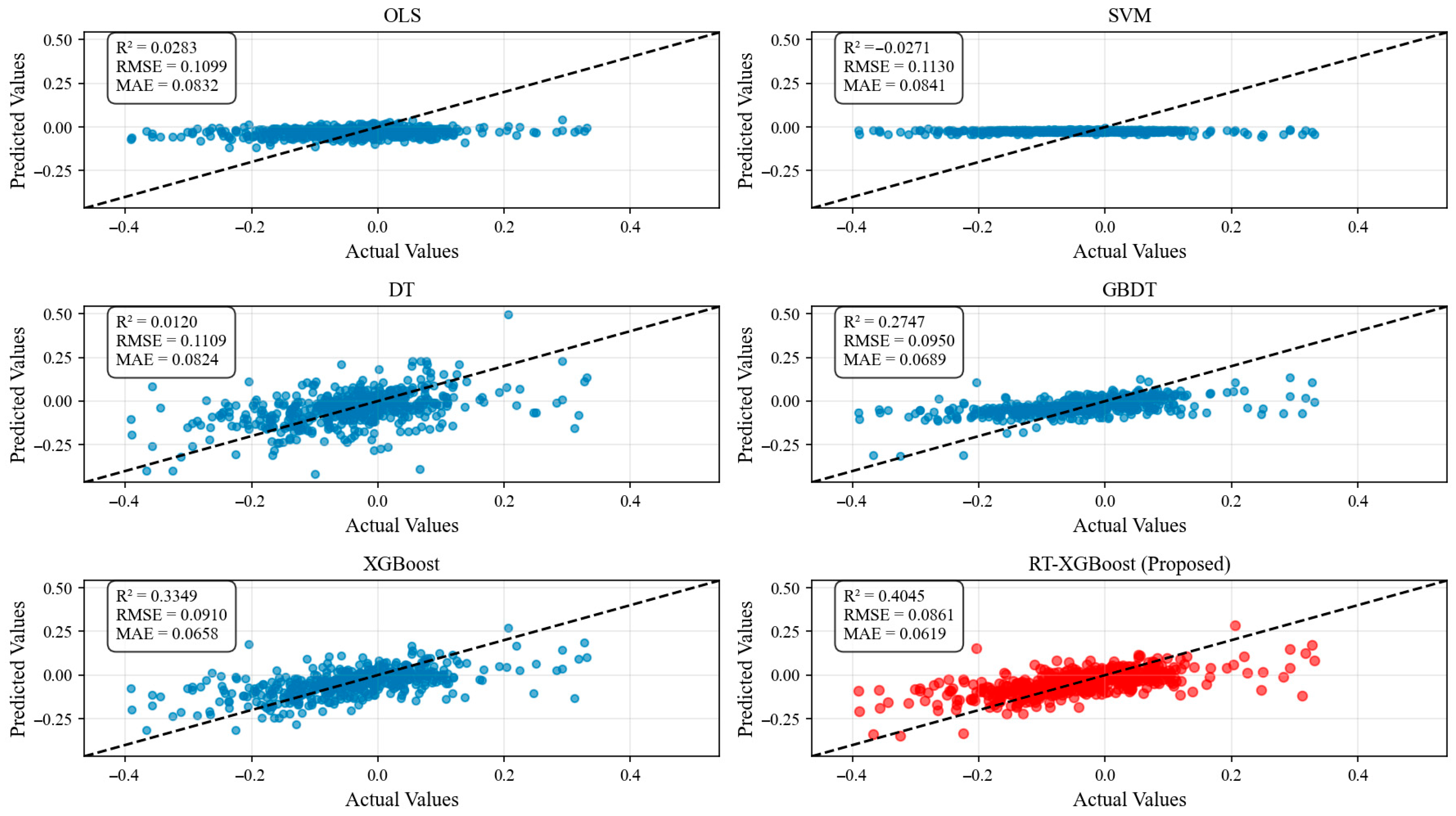
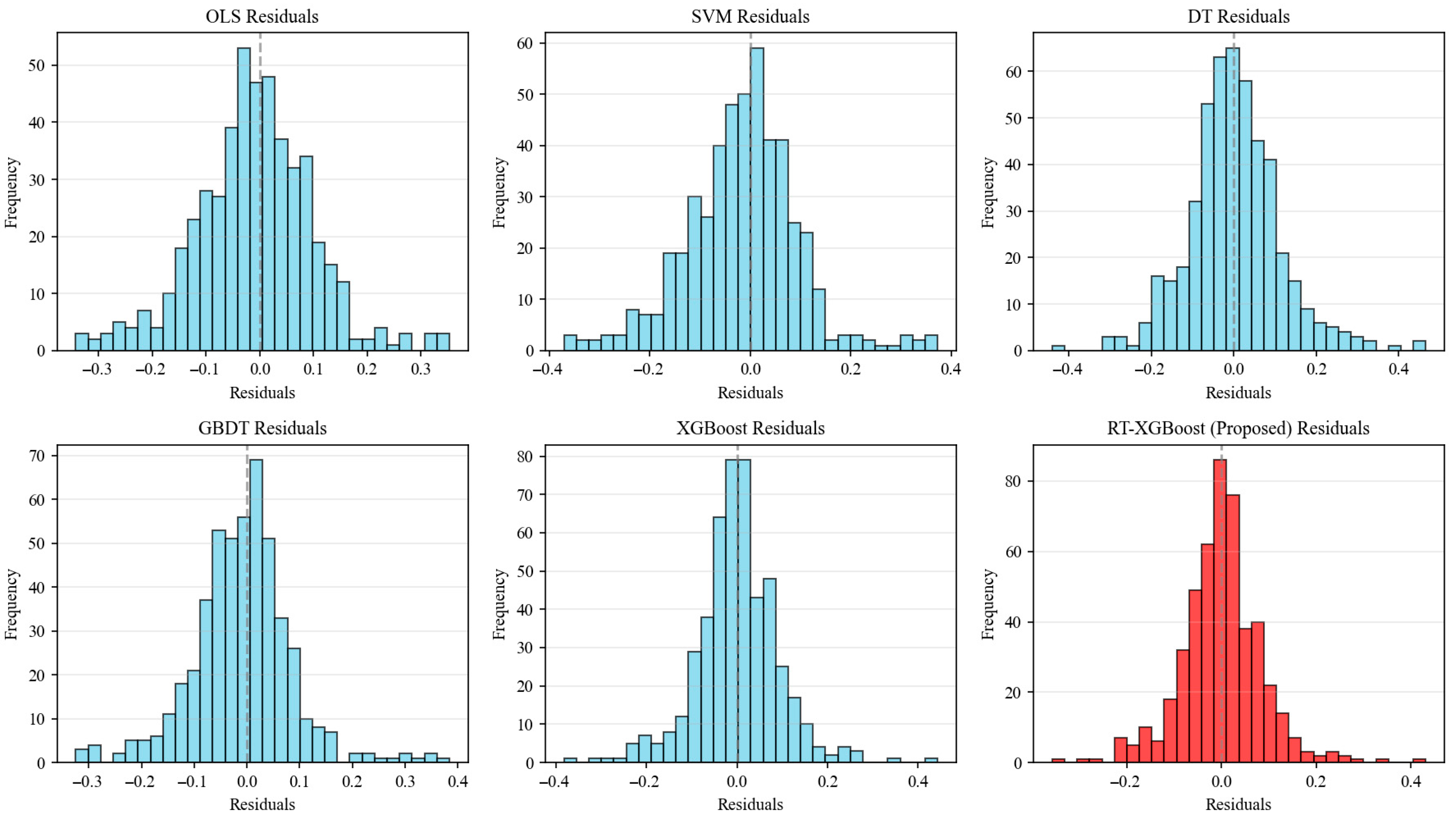
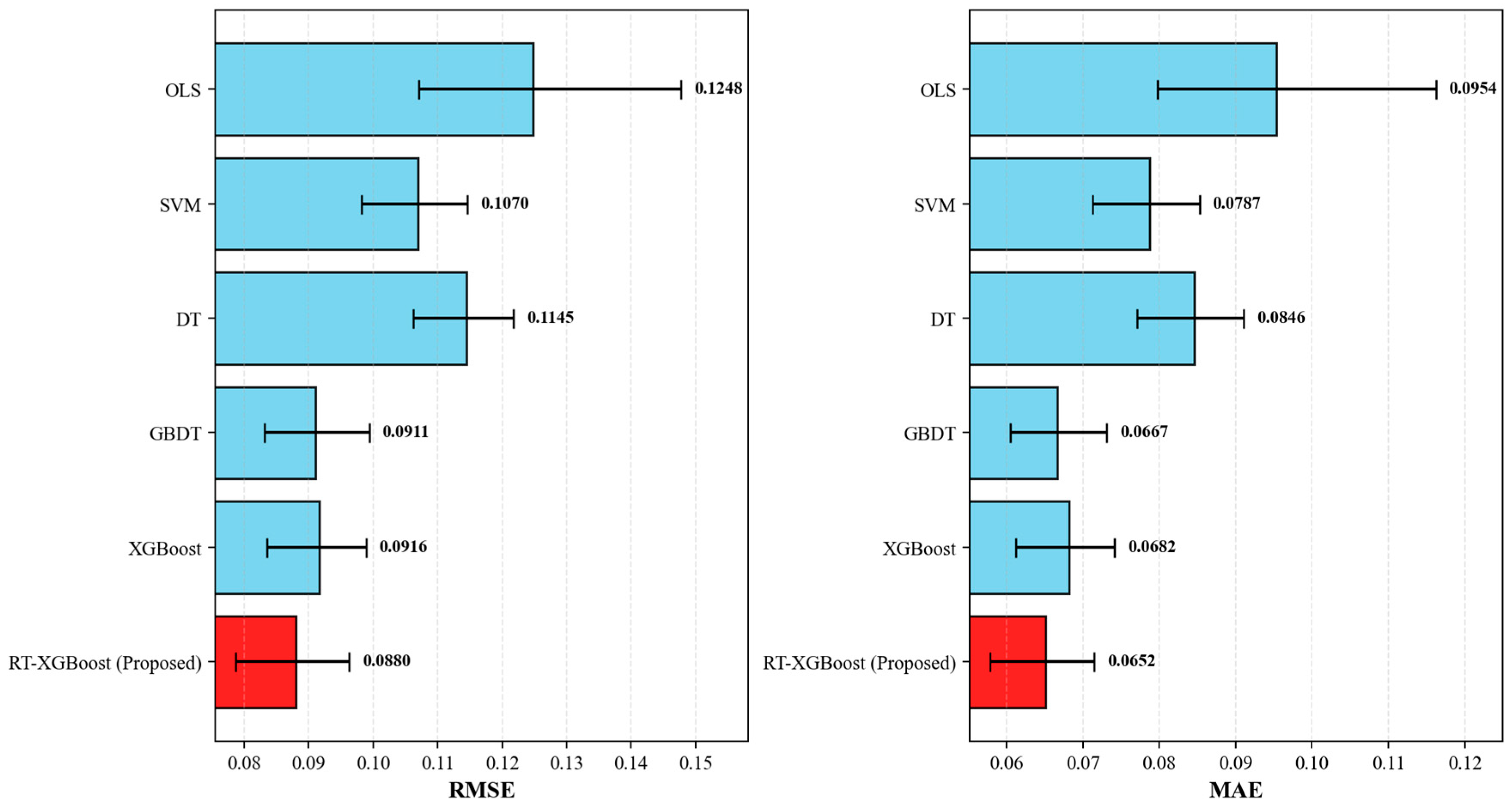
- The RT-XGBoost model demonstrates better performance than the baseline models. Beyond achieving a higher out-of-sample R2 and a lower RMSE and MAE, confidence-interval-based comparative analysis further confirms the robustness of its performance. Wilcoxon signed-rank tests show that its error reductions are statistically significant compared with other models. Together with the residual distribution, these results confirm that RT-XGBoost provides improved accuracy and enhanced robustness in modeling rainfall–passenger flow relationships.
- (2)
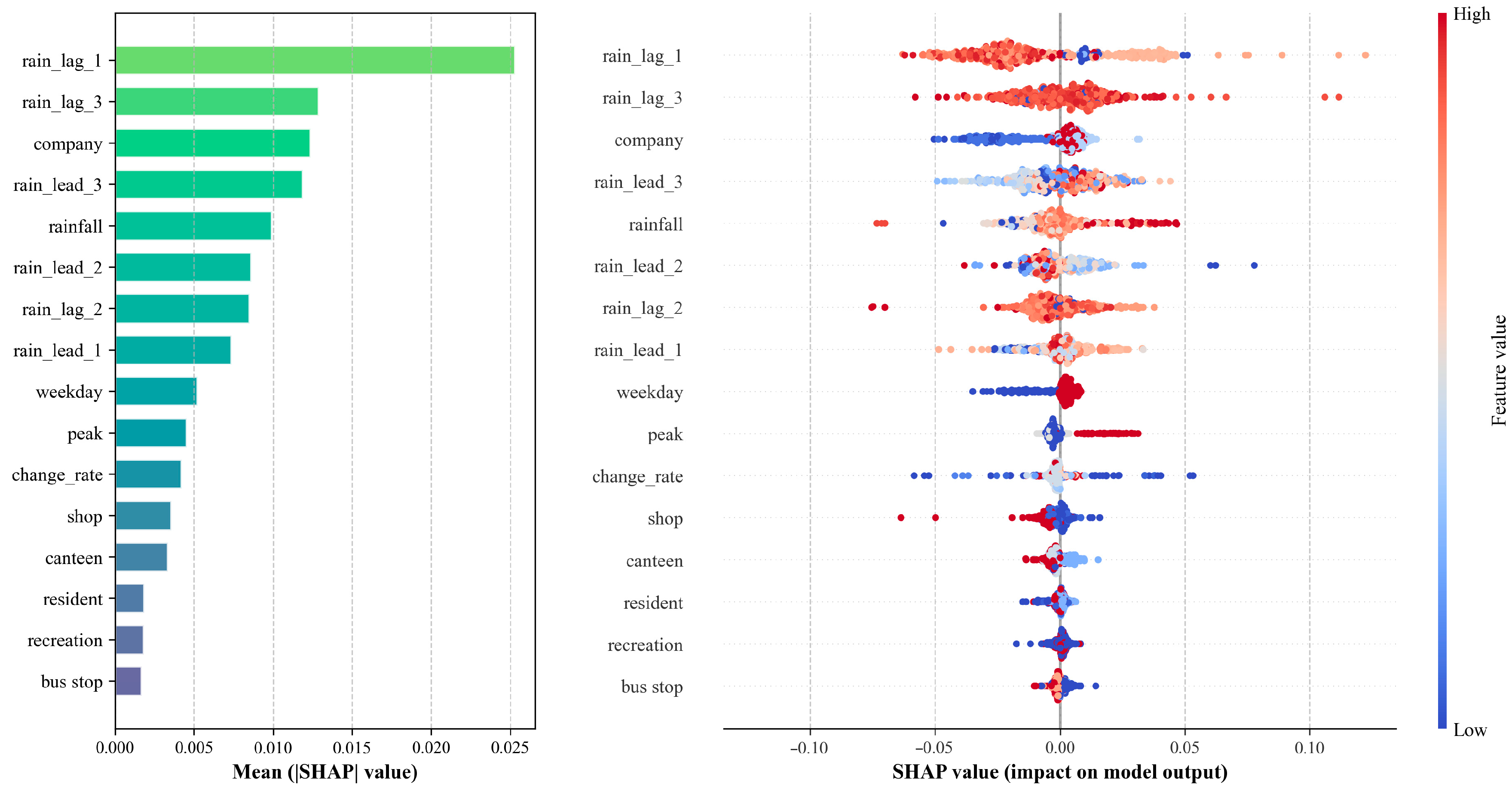
- SHAP-based global interpretability analysis identifies rainfall-related variables as the dominant drivers of short-term variation in URT passenger flow, with lagged rainfall playing an important role. Among all input features, rain_lag_1 and rain_lag_3 rank among the top contributors, exceeding the importance of real-time rainfall, which indicates a clear lagged effect in the model’s response to rainfall. Among non-rainfall features, built-environment characteristics (company density) rank as the third most important contributor overall, followed by temporal variables such as weekdays. Compared with rainfall features, these non-meteorological variables show more concentrated SHAP distributions, suggesting more stable but less variable contributions.
- (3)
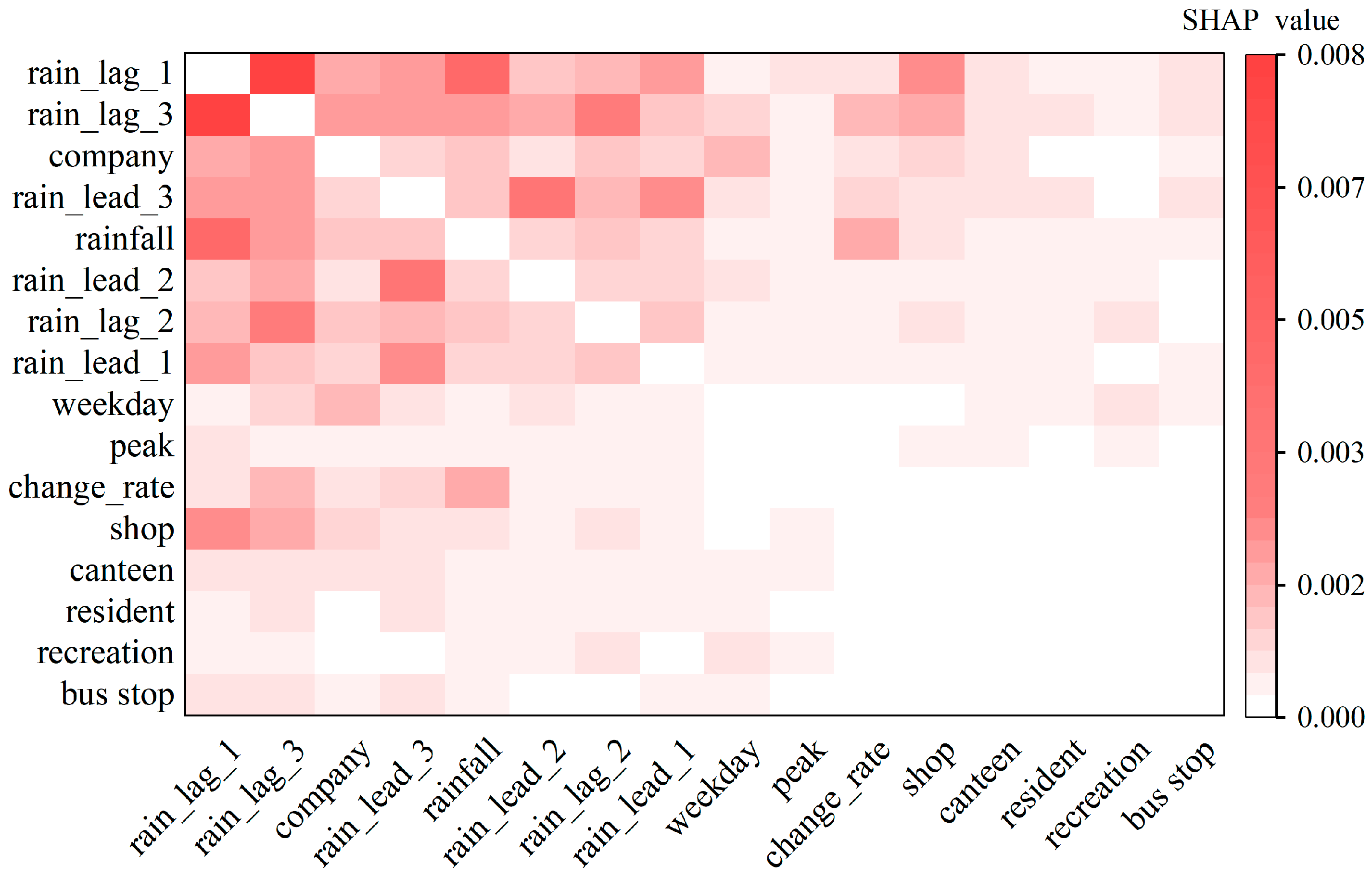
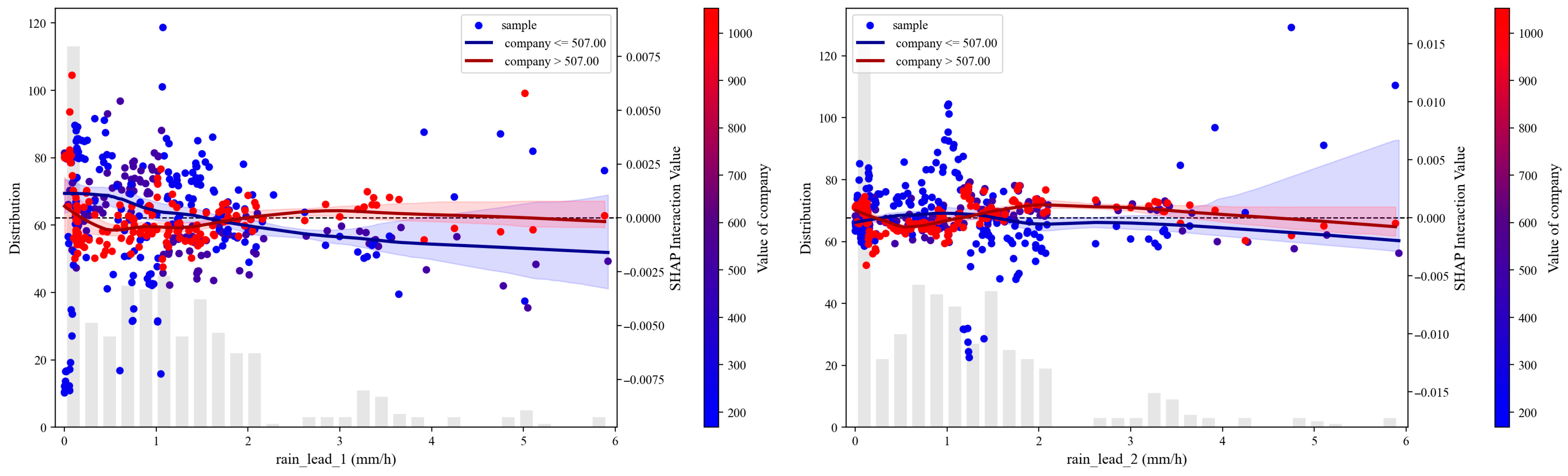
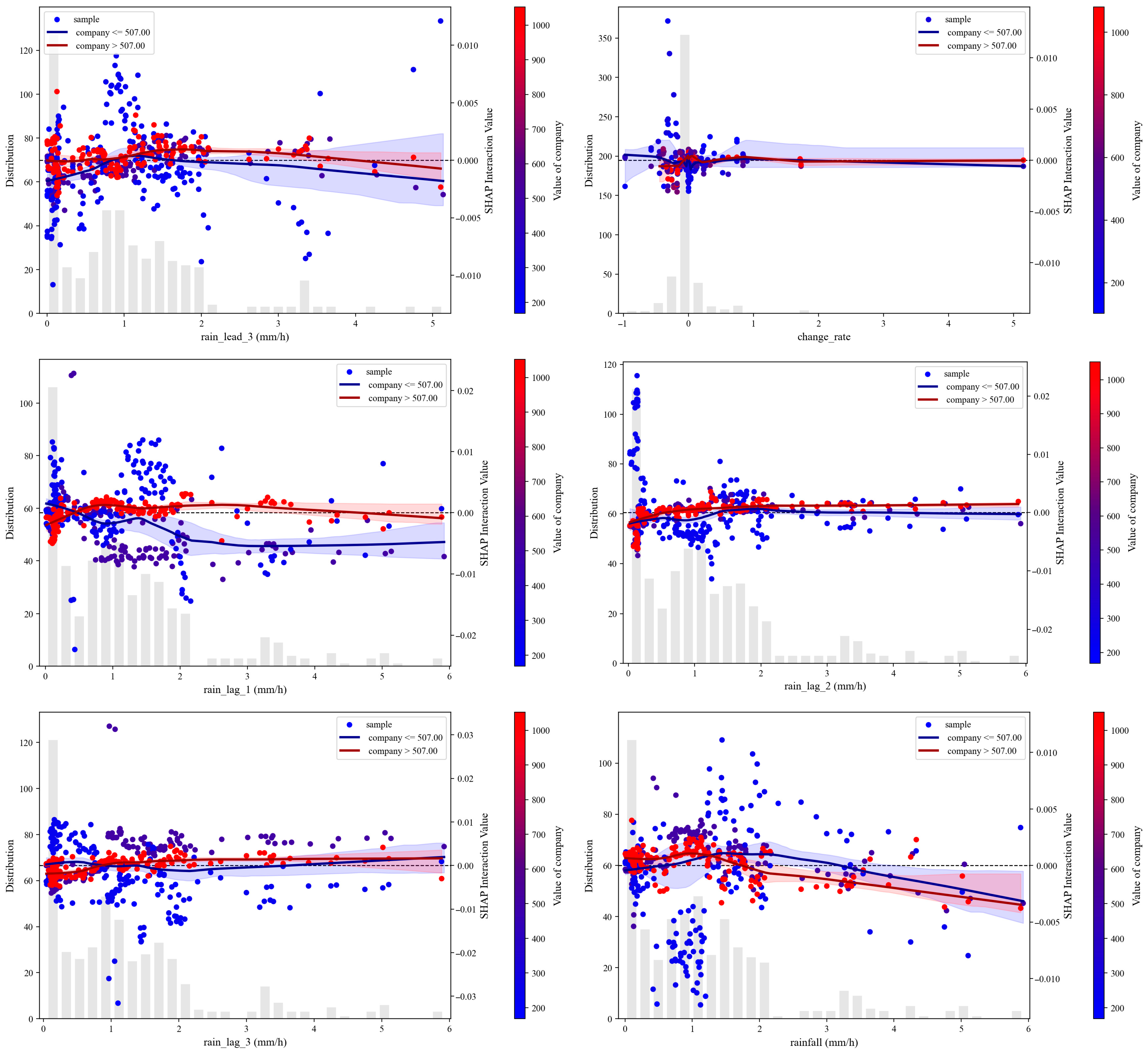
- SHAP interaction analysis reveals that interaction effects are mainly concentrated among rainfall-related variables. Interactions between rainfall and company density are more pronounced than those involving other non-meteorological features. Grouped fitting results further show clear contextual differences: in high enterprise-density areas, interaction effects between rainfall and company remain weak and close to zero across rainfall levels, while in low enterprise-density areas, increasing rainfall, especially lagged rainfall, is associated with a gradual negative shift in interaction SHAP values. By contrast, interactions between rainfall and peak or weekday variables are generally weak, indicating that these factors mainly act through their main effects rather than strong synergistic mechanisms.
Author Contributions
Funding
Data Availability Statement
Conflicts of Interest
References
- Witze, A. Why Extreme Rains Are Gaining Strength as the Climate Warms. Nature 2018, 563, 458–460. [Google Scholar] [CrossRef] [PubMed]
- Papalexiou, S.M.; Montanari, A. Global and Regional Increase of Precipitation Extremes Under Global Warming. Water Resour. Res. 2019, 55, 4901–4914. [Google Scholar] [CrossRef]
- Norris, J.; Chen, G.; Li, C. Dynamic Amplification of Subtropical Extreme Precipitation in a Warming Climate. Geophys. Res. Lett. 2020, 47, e2020GL087200. [Google Scholar] [CrossRef]
- Ma, Z.; Li, C.; Zhang, P.; Zhang, J.; Liu, D.; Xie, M. The Impact of Transportation on Commercial Activities: The Stories of Various Transport Routes in Changchun, China. Cities 2023, 132, 103979. [Google Scholar] [CrossRef]
- Jiao, L.; Zhu, Y.; Huo, X.; Wu, Y.; Zhang, Y. Resilience Assessment of Metro Stations against Rainstorm Disaster Based on Cloud Model: A Case Study in Chongqing, China. Nat. Hazards 2023, 116, 2311–2337. [Google Scholar] [CrossRef]
- Tang, H.; Zheng, J.; Li, M.; Shao, Z.; Li, L. Gauging the Evolution of Operational Risks for Urban Rail Transit Systems under Rainstorm Disasters. Water 2023, 15, 2811. [Google Scholar] [CrossRef]
- Zhou, Y.; Li, Z.; Meng, Y.; Li, Z.; Zhong, M. Analyzing Spatio-Temporal Impacts of Extreme Rainfall Events on Metro Ridership Characteristics. Phys. A Stat. Mech. Its Appl. 2021, 577, 126053. [Google Scholar] [CrossRef]
- Taskar, B.; Andersen, P. Benefit of Speed Reduction for Ships in Different Weather Conditions. Transp. Res. D Transp. Environ. 2020, 85, 102337. [Google Scholar] [CrossRef]
- Pang, Y.; Zhao, X.; Yan, H.; Liu, Y. Data-Driven Trajectory Prediction with Weather Uncertainties: A Bayesian Deep Learning Approach. Transp. Res. Part C Emerg. Technol. 2021, 130, 103326. [Google Scholar] [CrossRef]
- Reiche, C.; Cohen, A.P.; Fernando, C. An Initial Assessment of the Potential Weather Barriers of Urban Air Mobility. IEEE Trans. Intell. Transp. Syst. 2021, 22, 6018–6027. [Google Scholar] [CrossRef]
- Chen, Z.; Wang, Y.; Zhou, L. Predicting Weather-Induced Delays of High-Speed Rail and Aviation in China. Transp. Policy 2021, 101, 1–13. [Google Scholar] [CrossRef]
- Lin, P.; He, Y.; Pei, M.; Yang, R. Data-Driven Spatial-Temporal Analysis of Highway Traffic Volume Considering Weather and Festival Impacts. Travel. Behav. Soc. 2022, 29, 95–112. [Google Scholar] [CrossRef]
- Liu, S.; Jiang, H.; Chen, Z. Quantifying the Impact of Weather on Ride-Hailing Ridership: Evidence from Haikou, China. Travel Behav. Soc. 2021, 24, 257–269. [Google Scholar] [CrossRef]
- Nissen, K.M.; Becker, N.; Dahne, O.; Rabe, M.; Scheffler, J.; Solle, M.; Ulbrich, U. How Does Weather Affect the Use of Public Transport in Berlin? Environ. Res. Lett. 2020, 15, 085001. [Google Scholar] [CrossRef]
- Yazdani, M.; Mojtahedi, M.; Loosemore, M. Enhancing Evacuation Response to Extreme Weather Disasters Using Public Transportation Systems: A Novel Simheuristic Approach. J. Comput. Des. Eng. 2020, 7, 195–210. [Google Scholar] [CrossRef]
- Jain, D.; Singh, S. Adaptation of Trips by Metro Rail Users at Two Stations in Extreme Weather Conditions: Delhi. Urban Clim. 2021, 36, 100766. [Google Scholar] [CrossRef]
- Jiang, S.; Cai, C. The Impacts of Weather Conditions on Metro Ridership: An Empirical Study from Three Mega Cities in China. Travel Behav. Soc. 2023, 31, 166–177. [Google Scholar] [CrossRef]
- Wang, B.; Zhang, F.; Liu, J.; Tan, Z. The Impacts of Extreme Hot Weather on Metro Ridership: A Case Study of Shenzhen, China. J. Transp. Geogr. 2024, 117, 103899. [Google Scholar] [CrossRef]
- Lin, P.; Weng, J.; Brands, D.K.; Qian, H.; Yin, B. Analysing the Relationship between Weather, Built Environment, and Public Transport Ridership. IET Intell. Transp. Syst. 2020, 14, 1946–1954. [Google Scholar] [CrossRef]
- Yang, X.; Yue, X.; Sun, H.; Gao, Z.; Wang, W. Impact of Weather on Freeway Origin-Destination Volume in China. Transp. Res. Part A Policy Pract. 2021, 143, 30–47. [Google Scholar] [CrossRef]
- Tao, S.; Corcoran, J.; Rowe, F.; Hickman, M. To Travel or Not to Travel: ‘Weather’ Is the Question. Modelling the Effect of Local Weather Conditions on Bus Ridership. Transp. Res. Part C Emerg. Technol. 2018, 86, 147–167. [Google Scholar] [CrossRef]
- Xing, F.; Huang, H.; Zhan, Z.Y.; Zhai, X.; Ou, C.; Sze, N.N.; Hon, K.K. Hourly Associations between Weather Factors and Traffic Crashes: Non-Linear and Lag Effects. Anal. Methods Accid. Res. 2019, 24, 100109. [Google Scholar] [CrossRef]
- Chen, E.; Ye, Z.; Wang, C.; Xu, M. Subway Passenger Flow Prediction for Special Events Using Smart Card Data. IEEE Trans. Intell. Transp. Syst. 2020, 21, 1109–1120. [Google Scholar] [CrossRef]
- Shahriari, S.; Ghasri, M.; Sisson, S.A.; Rashidi, T. Ensemble of ARIMA: Combining Parametric and Bootstrapping Technique for Traffic Flow Prediction. Transp. A Transp. Sci. 2020, 16, 1552–1573. [Google Scholar] [CrossRef]
- Kim, T.; Sharda, S.; Zhou, X.; Pendyala, R.M. A Stepwise Interpretable Machine Learning Framework Using Linear Regression (LR) and Long Short-Term Memory (LSTM): City-Wide Demand-Side Prediction of Yellow Taxi and for-Hire Vehicle (FHV) Service. Transp. Res. Part C Emerg. Technol. 2020, 120, 102786. [Google Scholar] [CrossRef]
- Xue, F.; Yao, E.; Huan, N.; Li, B.; Liu, S. Prediction of Urban Rail Transit Ridership under Rainfall Weather Conditions. J. Transp. Eng. A Syst. 2020, 146, 1–12. [Google Scholar] [CrossRef]
- Khajavi, H.; Rastgoo, A. Predicting the Carbon Dioxide Emission Caused by Road Transport Using a Random Forest (RF) Model Combined by Meta-Heuristic Algorithms. Sustain. Cities Soc. 2023, 93, 104503. [Google Scholar] [CrossRef]
- Khalesian, M.; Furno, A.; Leclercq, L. Improving Deep-Learning Methods for Area-Based Traffic Demand Prediction via Hierarchical Reconciliation. Transp. Res. Part C Emerg. Technol. 2024, 159, 104410. [Google Scholar] [CrossRef]
- Kong, L.; Yang, H.; Li, W.; Zhang, Y.; Guan, J.; Zhou, S. Traffexplainer: A Framework Toward GNN-Based Interpretable Traffic Prediction. IEEE Trans. Artif. Intell. 2025, 6, 559–573. [Google Scholar] [CrossRef]
- Song, X.; Jiang, S.; Liu, M.; Sun, X.; Lu, Y.; Jiang, W.; Hao, Q.; Du, W.; Long, Y. A Step Toward Sustainable Cities: Recognizing the Transportation Modes of Urban Residents Based on Mobile Phone Location Data. Sustainability 2025, 17, 10416. [Google Scholar] [CrossRef]
- Duan, C.; Ma, S.; Li, C. Exploring the Impact of Built Environment on Elderly Metro Ridership at Station-to-Station Level. Sustainability 2024, 16, 10302. [Google Scholar] [CrossRef]
- Tang, T.; Jia, M.; Zhang, Y.; Hu, H.; Pei, M.; Chen, Y.; Wang, X. Why Metro Passengers Change Travel Behavior: Individual-Level Insights from Interpretable Machine Learning. Cities 2025, 167, 106352. [Google Scholar] [CrossRef]
- Jiao, J.; An, R.; Du, D.; Zhu, M. Non-Linear and Heterogeneous Relationship between Proximity to High-Speed Rail Stations and Land Value in China: Analysis Using XGBoost-SHAP Modelling. Transp. Res. Part A Policy Pract. 2025, 196, 104486. [Google Scholar] [CrossRef]
- Abdelsattar, D.M.; Owais, M.; Fahmy, M.F.M.; Osman, R.; Nafadi, M.K. Optimizing Pozzolanic Concrete Mixtures Using Machine Learning and Global Sensitivity Analysis Techniques. Int. J. Concr. Struct. Mater. 2025, 19, 77. [Google Scholar] [CrossRef]
- Owais, M. Preprocessing and Postprocessing Analysis for Hot-Mix Asphalt Dynamic Modulus Experimental Data. Constr. Build. Mater. 2024, 450, 138693. [Google Scholar] [CrossRef]
- Chuwang, D.D.; Chen, W.; Zhong, M. Short-Term Urban Rail Transit Passenger Flow Forecasting Based on Fusion Model Methods Using Univariate Time Series. Appl. Soft Comput. 2023, 147, 110740. [Google Scholar] [CrossRef]
- Ma, S.; Shao, X.; Xu, C. Physically-Based Rainfall-Induced Landslide Thresholds for the Tianshui Area of Loess Plateau, China by TRIGRS Model. Catena 2023, 233, 107499. [Google Scholar] [CrossRef]
- Lundberg, S.M.; Allen, P.G.; Lee, S.-I. A Unified Approach to Interpreting Model Predictions. Adv. Neural Inf. Process. Syst. 2017. [Google Scholar] [CrossRef]
- Wang, G.; Wang, S.; Li, W.; Yang, H. What Determines Carbon Emissions of Multimodal Travel? Insights from Interpretable Machine Learning on Mobility Trajectory Data. Sustainability 2025, 17, 6983. [Google Scholar] [CrossRef]
- Li, S.; Lyu, D.; Huang, G.; Zhang, X.; Gao, F.; Chen, Y.; Liu, X. Spatially Varying Impacts of Built Environment Factors on Rail Transit Ridership at Station Level: A Case Study in Guangzhou, China. J. Transp. Geogr. 2020, 82, 102631. [Google Scholar] [CrossRef]
- Gong, Z.; Deng, Z.; Tang, J.; Zhao, H.; Liu, Z.; Zhao, P. Uncovering Human Behavioral Heterogeneity in Urban Mobility under the Impacts of Disruptive Weather Events. Int. J. Geogr. Inf. Sci. 2025, 39, 951–974. [Google Scholar] [CrossRef]
- Yao, Y.; Liang, L.; Zhang, Y.; Wang, Y.; Hu, Z.; Fan, Y.; Guan, Q.; Jiang, R.; Shibasaki, R. Resilience Patterns of Multiscale Human Mobility Under Extreme Rainfall Events Using Massive Individual Trajectory Data. Ann. Am. Assoc. Geogr. 2025, 115, 578–602. [Google Scholar] [CrossRef]
- Lang, Q.; Wan, Z.; Zhang, J.; Zhang, Y.; Zhu, D.; Liu, G. Resilience Assessment and Enhancement Strategies for Urban Transportation Infrastructure to Cope with Extreme Rainfalls. Sustainability 2024, 16, 4780. [Google Scholar] [CrossRef]
- Jang, J.; Sung, M.; Hwang, J. When Less Travel Means More Carbon: How Rainfall-Induced Shifts from Public Transit to Cars Increase Urban Transport Emissions. Sci. Total Environ. 2026, 1013, 181269. [Google Scholar] [CrossRef]
- Tang, J.; Wu, S.; Yang, S.; Shi, Y. Resilience Assessment of Urban Road Transportation in Rainfall. Remote Sens. 2024, 16, 3311. [Google Scholar] [CrossRef]
- Van den Broeck, G.; Lykov, A.; Schleich, M.; Suciu, D. On the Tractability of SHAP Explanations. J. Artif. Intell. Res. 2022, 74, 851–886. [Google Scholar] [CrossRef]
- Marcilio, W.E.; Eler, D.M. From Explanations to Feature Selection: Assessing SHAP Values as Feature Selection Mechanism. In Proceedings of the 2020 33rd SIBGRAPI Conference on Graphics, Patterns and Images (SIBGRAPI), Porto de Galinhas, Brazil, 7–10 November 2020; IEEE: Piscataway, NJ, USA; pp. 340–347. [Google Scholar] [CrossRef]
- Qiao, M.; Haraguchi, M.; Lall, U. Enhancing Urban Resilience to Extreme Weather: The Roles of Human Transition Paths among Multiple Transportation Modes. Int. J. Geogr. Inf. Sci. 2024, 39, 2408–2427. [Google Scholar] [CrossRef]
- Owais, M.; Ahmed, A.S.; Moussa, G.S.; Khalil, A.A. Integrating Underground Line Design with Existing Public Transportation Systems to Increase Transit Network Connectivity: Case Study in Greater Cairo. Expert Syst. Appl. 2021, 167, 114183. [Google Scholar] [CrossRef]

| Author | Research Focus | Study City | Threshold Effect | Lagged Effect | Methodology | Data |
|---|---|---|---|---|---|---|
| Tao et al. [21] | weather–bus ridership impact | Brisbane, Australia | √ | autoregressive integrated moving average model | smart-card data, BOM meteorological observations | |
| Xing et al. [22] | weather–traffic crash impact | Hong Kong, China | √ | distributed lag non-linear model | public transport operation data, weather observations | |
| Nissen et al. [14] | weather–URT flow impact | Berlin, Germany | statistical model | smart-card records, meteorological station data | ||
| Lin et al. [12] | weather threshold on public transport flow | Beijing, China | √ | LightGBM | AFC data, meteorological data, POI data | |
| Yang et al. [20] | weather–freeway volume impact | Shandong Province, China | √ | autoregressive model | highway traffic detector data, meteorological station records | |
| Jain et al. [16] | rainfall–passenger behavior impact | Delhi, India | stated adaptation choice survey | stated-preference survey data | ||
| Zhou et al. [7] | extreme rainfall–URT flow imbalance | Shenzhen, China | ridership resilience curve model | AFC data, meteorological data | ||
| Jiang et al. [17] | rainfall’s inhibitory effect on URT | Beijing, Shanghai, Shenzhen, China | multiple linear regression model | AFC data, meteorological data | ||
| The study | rainfall lagged effect on URT | Guangzhou, China | √ | √ | RT-XGBoost model | AFC data, meteorological data |
| Rainfall Interval (mm/h) | Estimated α | p-Value |
|---|---|---|
| 0.1–1.6 | 0.67 | 0.01 |
| 1.6–3.9 | 0.91 | 0.004 |
| >3.9 | 1.18 | 0.008 |
| Category | Variable | Description | Type | Min | Max | Mean | Std |
|---|---|---|---|---|---|---|---|
| Rainfall variables | Real-time rainfall intensity | Real-time rainfall intensity at time t | Continuous | 0 | 6.3 | 1.28 | 1.24 |
| Lagged rainfall intensity | Rainfall intensity at previous time periods (e.g., t − 1: previous hour) | Continuous | 0.02 | 6.2 | 1.30 | 1.26 | |
| Lead rainfall intensity | Rainfall intensity at future time periods (e.g., t + 1: next hour) | Continuous | 0 | 6.3 | 1.19 | 1.15 | |
| Rainfall change rate | Rate of change between current and previous rainfall intensity | Continuous | −0.98 | 15.37 | 0.12 | 1.27 | |
| Built environment variables | Number of shopping malls | Count of shopping facilities within station area | Integer | 1 | 28 | 8.63 | 8.11 |
| Number of enterprise points | Count of office buildings near station | Integer | 102 | 1080 | 533.75 | 302.14 | |
| Number of dining facilities | Count of restaurants within station vicinity | Integer | 70 | 1335 | 553.94 | 381.29 | |
| Number of residential points | Count of housing units near station | Integer | 15 | 84 | 53.31 | 17.59 | |
| Number of bus stops | Count of transit access points within walking distance | Integer | 10 | 32 | 20.00 | 6.63 | |
| Temporal variables | Weekday/Weekend | 0: Weekend/Holiday; 1: Weekday | One-hot encoding | - | - | - | - |
| Morning Peak/Evening peak/Off-peak | 0: Off-peak; 1: Morning Peak; 2: Evening Peak | One-hot encoding | - | - | - | - |
| Parameter | Explanation | Range | Value |
|---|---|---|---|
| subsample | Proportion of samples used for training each tree | [0.6, 1] | 0.95 |
| n_estimators | Number of decision trees in the ensemble | [50, 1000] | 400 |
| min_child_weight | Minimum sum of sample weights required for a child node | [1, 10] | 3 |
| max_depth | Maximum depth of individual decision trees | [3, 20] | 6 |
| learning_rate | Step size shrinkage for tree updates | [0.01, 0.3] | 0.03 |
| colsample_bytree | Proportion of features used for training each tree | [0.6, 1] | 0.85 |
| Model | Parameters |
|---|---|
| OLS | fit_intercept = True |
| SVM | kernel = RBF, C = 1.0, epsilon = 0.1, gamma = scale |
| DT | max_depth = 6, min_samples_split = 2, min_samples_leaf = 1 |
| GBDT | n_estimators = 400, learning_rate = 0.03, max_depth = 6, subsample = 0.95 |
| XGBoost | n_estimators = 400, learning_rate = 0.03, max_depth = 6, subsample = 0.95, colsample_bytree = 0.85, min_child_weight = 3 |
Disclaimer/Publisher’s Note: The statements, opinions and data contained in all publications are solely those of the individual author(s) and contributor(s) and not of MDPI and/or the editor(s). MDPI and/or the editor(s) disclaim responsibility for any injury to people or property resulting from any ideas, methods, instructions or products referred to in the content. |
© 2026 by the authors. Licensee MDPI, Basel, Switzerland. This article is an open access article distributed under the terms and conditions of the Creative Commons Attribution (CC BY) license.
Share and Cite
Li, B.; Li, S.; Ye, Z.; Liu, S.; Zou, Q.; Wang, X. Exploring the Lagged Effect of Rainfall on Urban Rail Transit Passenger Flow: A Case Study of Guangzhou. Eng 2026, 7, 47. https://doi.org/10.3390/eng7010047
Li B, Li S, Ye Z, Liu S, Zou Q, Wang X. Exploring the Lagged Effect of Rainfall on Urban Rail Transit Passenger Flow: A Case Study of Guangzhou. Eng. 2026; 7(1):47. https://doi.org/10.3390/eng7010047
Chicago/Turabian StyleLi, Binbin, Sirui Li, Zhefan Ye, Shasha Liu, Qingru Zou, and Xinhao Wang. 2026. "Exploring the Lagged Effect of Rainfall on Urban Rail Transit Passenger Flow: A Case Study of Guangzhou" Eng 7, no. 1: 47. https://doi.org/10.3390/eng7010047
APA StyleLi, B., Li, S., Ye, Z., Liu, S., Zou, Q., & Wang, X. (2026). Exploring the Lagged Effect of Rainfall on Urban Rail Transit Passenger Flow: A Case Study of Guangzhou. Eng, 7(1), 47. https://doi.org/10.3390/eng7010047

