Next Article in Journal
Refractory Geopolymer Bricks from Clays and Seashells: Effect of Sodium Lignosulfonate and Polycarboxylate Plasticizers on Workability and Compressive Strength
Previous Article in Journal
Numerical and Experimental Study of Continuous Beams Made of Self-Compacting Concrete Strengthened by GFRP Materials
 
 
Correction published on 2 March 2026, see Eng 2026, 7(3), 114.
Review

Recent Advances in the Application of Natural Coagulants for Sustainable Water Purification

1
Department of Pharmacy, University of Genoa, Viale Benedetto XV 7, 16132 Genoa, Italy
2
The Directorate of Research, Development and Innovation Management (DMCDI), The Technical University of Cluj-Napoca, Constantin Daicoviciu St., No. 15, 400020 Cluj-Napoca, Romania
*
Authors to whom correspondence should be addressed.
Submission received: 12 November 2025 / Revised: 30 December 2025 / Accepted: 7 January 2026 / Published: 10 January 2026 / Corrected: 2 March 2026

Abstract

Growing pressure from shrinking freshwater supplies and worsening pollution has heightened the demand for more effective water treatment solutions, especially those that promote reuse. This review synthesizes findings from 235 peer-reviewed papers examining plant-, mineral-, and other naturally derived coagulants used in surface water purification. Overall, these materials demonstrate turbidity reduction performance on par with conventional chemical coagulants across a wide range of initial turbidity levels (roughly 50–500 NTU). They are generally inexpensive, biodegradable, low in toxicity, and produce smaller volumes of residual sludge. Most function through mechanisms such as polymer-chain bridging or charge neutralization. However, their deployment at scale is still constrained by limited commercialization pathways, technical integration issues, and uneven public acceptance. Continued cross-disciplinary work is required to refine their performance and broaden their use, particularly in regions with limited resources or rural infrastructure.

1. Introduction

Water contamination has emerged as a worsening worldwide issue, threatening ecological integrity and human well-being in many parts of the world [1,2,3]. Although some level of water contamination arises from natural phenomena such as mineral weathering, atmospheric inputs, and hydrogeological processes [4,5,6,7,8,9], anthropogenic activities are the dominant source of pollutants. Rapid industrial growth, expansion of urban areas, intensive agricultural practices, and ineffective waste disposal systems have led to the release of a wide spectrum of contaminants—including heavy metals, nutrients, pharmaceuticals, and microplastics—into aquatic environments [10,11,12,13,14]. In many cases, the volume and complexity of these pollutants exceed the self-purifying capacity of natural ecosystems as well as the capabilities of conventional treatment systems, resulting in extensive environmental degradation and serious health concerns. Persistent toxic elements such as arsenic, mercury, cadmium, and lead are especially hazardous due to their bioaccumulative nature and their links to neurological disorders and other systemic illnesses [10,11,12,13,14]. Agricultural activities further intensify water quality deterioration by contributing fertilizers, pesticides, and organic matter through runoff, adversely affecting both surface water and groundwater resources [15,16,17,18,19,20,21,22,23,24]. Many of these pollutants originate from diffuse, nonpoint sources that are difficult to identify and control, and their concentrations often fluctuate over time and space, complicating monitoring and remediation efforts. The health impacts of polluted water are severe, as exposure is associated with acute illnesses such as diarrhea, cholera, typhoid fever, and hepatitis, as well as long-term conditions including Alzheimer’s disease and skeletal fluorosis [25,26]. Globally, approximately 1.2 billion people lack reliable access to safe drinking water, leading to more than six million deaths each year related to water pollution, including nearly two million children under the age of five [27,28,29]. Compounding the problem, many regions face financial and infrastructural barriers to implementing effective water treatment systems, challenges that are intensified by population growth and inadequate water harvesting technologies [30,31,32,33]. This review consolidates recent advances in the application of natural coagulants for water purification, highlighting their effectiveness in removing water pollutants and their role in promoting sustainable and environmentally friendly water treatment strategies. Water quality assessment typically relies on four major categories of data:
-
Physical Data: Parameters such as total suspended solids, temperature, electrical conductivity, transparency, and total dissolved solids provide essential information during treatment operations.
-
Chemical Data: National discharge and water quality standards commonly specify indicators including pH, biochemical oxygen demand, biochemical oxygen consumption, and the presence of contaminants such as heavy metals and nitrates.
-
Biological Data: The detection of microorganisms, particularly Escherichia coli and other microbial communities, is widely used to evaluate ecological and sanitary conditions of water bodies.
-
Environmental Data: External factors such as climate conditions, hydrological behavior, soil characteristics, and ecological variables also play a significant role in shaping water quality [34,35].
Chemical, physical, and biological contaminants collectively influence water turbidity (an important contamination indicator), which is a key indicator of pollution severity [36,37,38,39,40]. Turbidity arises when suspended particles or settled materials scatter light within the water column. According to the World Health Organization (WHO), drinking water should have a turbidity value not exceeding 1 NTU. Numerous treatment approaches—such as chemical precipitation, lime-based coagulation, ion exchange, reverse osmosis, and solvent extraction (solvent extraction is not directly used to remove turbidity, but it is applied in water treatment to remove dissolved or emulsified organic compounds that stabilize suspended particles, thereby enhancing the effectiveness of subsequent coagulation–flocculation and turbidity removal processes)—have been developed to reduce turbidity levels [41,42]. Although chemical coagulants remain highly effective and widely applied, concerns regarding their environmental footprint and potential health impacts have driven increased interest in naturally derived alternatives [40,43]. Natural coagulants, obtained from plant, animal, or microbial sources, include materials such as starch, cellulose-based compounds, chitosan, alginate, and microbial polysaccharides. These substances are biodegradable, non-toxic, and environmentally benign. They remove turbidity through processes including charge neutralization, adsorption, and molecular bridging. Their renewability, low cost, and reduced ecological risk have contributed to their growing adoption in wastewater treatment applications [44,45,46,47]. In addition, natural coagulants tend to exhibit superior biocompatibility compared to synthetic chemicals, minimizing the likelihood of toxicity or allergic responses and reinforcing their appeal as sustainable treatment agents [48].
This review evaluates the role of natural coagulants as environmentally friendly substitutes for conventional chemical coagulants in water treatment. It assesses their performance, advantages, constraints, and economic feasibility, while also considering future directions for their broader implementation in improving water quality.

1.1. Principles of Water Treatment

Water treatment (WT) is the process of converting polluted water into a form that is safe for human use by eliminating harmful constituents. These unwanted components include suspended and colloidal matter, disease-causing microorganisms, dissolved compounds, and toxic chemicals that threaten public health. Conventional treatment systems generally operate in two main phases. During primary treatment, physical techniques such as settling and filtration are applied to separate larger and heavier solids. Secondary treatment follows, relying on biological processes—often involving aerobic and anaerobic microorganisms—to break down finer particles and biodegradable organic matter. Despite these established approaches, many communities, particularly in rural and low-income regions, continue to face challenges in accessing cost-effective, reliable, and sustainable water treatment solutions. To address these challenges, modern water treatment technologies employ a broad range of chemical, physical, and biological strategies. Chemical approaches commonly include coagulation, ion exchange, disinfection, oxidation, catalytic reduction, and water softening [49,50], while physical treatment options involve adsorption, ultraviolet irradiation, sedimentation, and filtration using granular media or membrane systems [51,52]. Biological techniques make use of natural or engineered systems—such as phytoremediation, microbial metabolism, bioreactors, and constructed wetlands—to remove contaminants [53]. In practice, integrated or hybrid treatment schemes that combine two or more of these methods are widely adopted to improve treatment efficiency, robustness, and operational reliability [54,55]. Within this integrated framework, coagulation plays a pivotal role as a critical pre-treatment and clarification step, particularly for the removal of turbidity, suspended solids, and colloidal particles that are not effectively eliminated by physical or biological processes alone. Zeta potential is a key indicator of the electrical stability of colloidal particles in water within this process, reflecting the magnitude of electrostatic repulsion between suspended particles. Most natural colloids carry a negative zeta potential, which keeps them dispersed and resistant to aggregation. Coagulation becomes effective when this potential is reduced toward zero or slightly reversed, allowing particles to collide and form flocs. Natural coagulants modify zeta potential mainly through adsorption and charge neutralization. Protein-based plant coagulants supply positively charged functional groups that reduce the negative surface charge of colloids, while polysaccharide-rich materials often promote aggregation indirectly through surface masking and polymer bridging rather than complete charge neutralization. As a result, efficient flocculation can occur even when zeta potential remains moderately negative. Zeta potential measurements are commonly used to optimize coagulant dosage and to identify dominant coagulation mechanisms. They provide valuable insight into how natural coagulants destabilize particles and promote floc formation in water treatment systems. Synthetic coagulants are widely applied due to their high removal efficiencies, often achieving up to 99% reduction in turbidity, heavy metals, and organic and inorganic pollutants at adequate dosages [56,57]. However, their use is frequently associated with drawbacks such as high chemical consumption, sludge management challenges, and adverse environmental impacts. Moreover, concerns related to immunocompatibility have emerged, as certain synthetic coagulants may provoke undesirable immune responses, whereas natural coagulants—especially those derived from plants or microorganisms—exhibit greater biocompatibility and reduced health risks [57,58]. Consequently, increasing attention has been directed toward the development and application of natural coagulants as sustainable alternatives in water and wastewater treatment plants. Effective implementation of coagulation processes requires careful monitoring and optimization of key operational parameters, including pH, turbidity, temperature, coagulant dosage, biological oxygen demand, total dissolved solids, total suspended solids, hardness, electrical conductivity, and acidity. Improper control of these parameters may lead to residual concentrations of synthetic coagulants—such as aluminum or iron species—in treated water, which have been associated with potential health risks and long-term ecological effects. Elevated residuals can also interfere with downstream treatment processes and compromise drinking water quality standards. In addition, the use of synthetic coagulants generates large volumes of chemically contaminated sludge, characterized by poor biodegradability and high metal content, posing significant challenges for handling, treatment, and disposal. Sludge management often requires energy-intensive dewatering, stabilization, and safe disposal, increasing operational costs and environmental burdens. Optimizing coagulation conditions is therefore particularly critical for maximizing turbidity removal while minimizing residual coagulant levels and sludge production, thereby enhancing the overall efficiency, safety, and sustainability of water and wastewater treatment systems—especially those transitioning toward natural coagulant-based technologies.

1.2. Key Factors Affecting Water Treatment Processes

Identifying the most favorable conditions for coagulation—during which added coagulants bind with contaminants to create larger removable clusters—is essential for enhancing water treatment performance while simultaneously lowering treatment costs and minimizing sludge generation. The success of coagulation is governed by several interacting variables, including the nature of the coagulant, the amount applied, mixing intensity and duration, and the physicochemical properties of the raw water [59]. Among these factors, coagulant dosage is especially influential and can be broadly divided into three operational regimes: insufficient dosing, optimal dosing, and excessive dosing. When the applied amount is too low, contaminant removal remains incomplete, making further additions necessary to reach acceptable water quality. In contrast, applying coagulant beyond the optimal level can overwhelm particle surfaces, re-stabilize suspended matter, and hinder the development of stable flocs—clusters formed from aggregated impurities. In addition, the internal structure of these flocs, often described using fractal dimensions that reflect their geometric complexity and self-similar nature, strongly affects settling behavior and overall coagulation efficiency.

2. Approaches to Water Treatment

Traditionally, water treatment (WT) has relied heavily on chemical coagulation, employing agents such as ferric chloride (FeCl3), alum (Al2(SO4)3), polyaluminum chloride, and synthetic polymers like polyacrylamide. Despite their widespread use, these chemicals are increasingly viewed as environmentally unsound because they generate substantial quantities of non-biodegradable sludge that require complex disposal [60,61]. As a result, attention has shifted toward natural coagulants, which offer a more sustainable approach to turbidity reduction and contaminant removal. These materials are generally inexpensive, biodegradable, and safe, and they originate from biological sources including plants, animals, and microorganisms. The following sections summarize the characteristics of conventional chemical coagulants and examine the growing interest in natural alternatives.

2.1. Chemical Coagulation in Water Treatment Processes

Chemical coagulation involves the addition of reactive substances to destabilize colloidal particles suspended in water, thereby reducing electrostatic repulsion and promoting particle aggregation during flocculation. The resulting flocs form larger, denser agglomerates that can be efficiently removed by sedimentation or filtration. In large-scale drinking water treatment plants, aluminum- and iron-based coagulants remain the dominant choice due to their reliability, low cost, and ease of operation. Alum (potassium aluminum sulfate, KAl(SO4)2·12H2O) is among the most extensively used coagulants, typically applied at dosages ranging from 10 to 100 mg/L for surface water clarification, although higher doses may be required for highly turbid or colored waters. Under optimized laboratory conditions—such as a dosage of 450 mg/L at pH 8.0—alum has achieved color removal efficiencies approaching 99% [62,63]. However, such elevated dosages are more representative of heavily polluted waters or industrial effluents rather than conventional drinking water treatment. In municipal wastewater treatment, coagulation is often employed as a primary or tertiary treatment step to enhance the removal of suspended solids, phosphorus, and organic matter. Iron-based coagulants such as ferric chloride (FeCl3) and polyferric sulfate (PFS) are commonly applied at dosages between 20 and 200 mg/L, depending on influent characteristics. The combined use of PFS with polyacrylamide (PAA) has been shown to increase chemical oxygen demand (COD) removal from 68% to 82%, demonstrating the benefit of coagulant–polymer systems in municipal effluent polishing. In such systems, sludge production typically ranges from 0.2 to 0.6 kg of dry solids per m3 of treated wastewater, contributing significantly to downstream sludge handling and disposal requirements. In contrast, industrial wastewater treatment often demands substantially higher coagulant dosages due to elevated pollutant loads, complex organic compounds, and extreme pH conditions. Ferric chloride is widely applied in this context, with reported dosages ranging from 100 to over 1000 mg/L. For example, in cosmetic manufacturing effluents, FeCl3 achieved COD reductions of nearly 64% at pH 6.0 [64,65,66], while treatment of molasses-based wastewater resulted in color and COD reductions of 96% and 86%, respectively. Similarly, in black liquor wastewater treatment, aluminum chloride, polyaluminum chloride (PAC), and anionic PAA have demonstrated removal efficiencies of up to 95% for total dissolved solids, 88% for color, and 80% for COD [67,68,69,70]. These high removal efficiencies are accompanied by substantial sludge generation, often exceeding 1.0 kg of dry sludge per m3, with high metal content and poor biodegradability. Advanced inorganic polymer coagulants, such as PAC, polytitanium chloride, and poly-aluminum ferric chloride, have been increasingly adopted to improve performance and reduce dosage requirements. For instance, PAC has been shown to reduce turbidity from 7.0 NTU to 1.2 NTU [71,72,73,74], while poly-aluminum ferric chloride applied at 5 mg/L and pH 7.5 achieved 86% color removal and complete turbidity elimination in dye-contaminated wastewater. Polymeric zinc–iron–phosphate coagulants have demonstrated rapid clarification, reducing turbidity from 9 NTU to below 1.0 NTU within 15 min [75,76]. Despite their effectiveness, synthetic coagulants present notable drawbacks. Residual aluminum or iron concentrations in treated water may exceed recommended limits (typically 0.1–0.2 mg/L for aluminum in drinking water), raising concerns about long-term exposure. Aluminum-based coagulants, in particular, have been associated with neurological and systemic disorders, including Alzheimer’s disease, Parkinson’s disease, encephalopathy, seizures, and Down’s syndrome [77,78,79,80,81,82,83]. Furthermore, chemical coagulation generates large volumes of metal-rich sludge that require costly dewatering, stabilization, and disposal, often accounting for 30–50% of total operating costs in treatment plants. Synthetic coagulants may also provoke immune responses and increase ecotoxicological risks. In contrast, natural coagulants—especially those derived from plant or microbial sources—generally produce lower sludge volumes, exhibit higher biodegradability, and demonstrate improved immunocompatibility, making them increasingly attractive as safer and more sustainable alternatives to conventional chemical coagulants [84].

2.2. Rising Popularity of Natural Coagulants

Concerns surrounding the sustainability of chemical coagulants—including their toxicity, corrosiveness, potential carcinogenic effects, environmental persistence, and the generation of large volumes of non-biodegradable sludge—have accelerated the search for greener alternatives [85,86,87,88]. In response, water treatment practices are increasingly incorporating principles of sustainable development, aiming to reduce ecological damage while maintaining treatment efficiency. A key aspect of this transition is the replacement of synthetic chemicals with natural coagulants, which significantly lower secondary pollution and waste generation. Natural coagulants are typically polyelectrolytes and may carry positive, negative, or neutral charges. They are valued for their environmental friendliness, affordability, and ability to stabilize pH without increasing metal concentrations in treated water. Unlike chemical coagulants, they produce relatively small amounts of sludge, reducing handling and disposal costs. Numerous studies have confirmed their effectiveness in water purification and wastewater treatment applications [89,90,91,92,93,94]. The quantity of coagulant required varies widely between chemical and natural options. For instance, aluminum sulfate and ferric chloride may require 10–40 kg and 5–20 kg, respectively, to treat one ton of water. By comparison, plant-based coagulants such as Moringa oleifera typically require only 1–5 kg per ton, highlighting their efficiency in material usage. Chemical coagulants can achieve turbidity removal rates of 90–99% and effectively eliminate pathogens and heavy metals, but at the cost of producing large volumes of sludge. Natural coagulants generally achieve moderate turbidity reductions (50–80%) and are best suited for waters with low to moderate contamination levels. Their biodegradability, low toxicity, and minimal sludge generation make them particularly advantageous in low-resource settings. Moreover, they are less likely to activate immune responses, such as macrophage or T-lymphocyte stimulation, thereby reducing risks of inflammation and toxicity [89,90,91,92,93,94].

2.2.1. Sustainability of Natural Coagulants

Sustainability in water treatment seeks to balance environmental protection, economic feasibility, and social well-being. Natural coagulants align well with this objective by providing effective purification with reduced ecological impact. Their adoption supports global sustainability initiatives, including the United Nations’ development goals, by offering solutions that are environmentally sound, economically accessible, and socially beneficial in both developed and developing regions [95,96]. From a social standpoint, the acceptance of natural coagulants depends on their demonstrated effectiveness and reliability in comparison with conventional chemicals. Although laboratory studies have shown promising results, limited pilot-scale and full-scale applications, along with the absence of standardized regulations, hinder their widespread use in potable water treatment. Nevertheless, in rural and underserved communities, natural coagulants could significantly improve water quality, sanitation, and public health outcomes. Technically, sustainability is influenced by treatment performance, availability of raw materials, storage stability, and compatibility with existing treatment systems. While many natural coagulants have proven effective in water and wastewater applications, uncertainties remain regarding their long-term ecological and human toxicity, necessitating further investigation. Optimal dosing and process optimization are therefore essential. Additionally, because natural coagulants are biodegradable, their shelf life and commercial scalability may be limited [97,98,99,100]. Environmentally, the use of plant-based, biodegradable coagulants that generate reusable or harmless sludge is a major advantage. Such sludge may be repurposed in agriculture, landfills, or construction-related applications [101,102,103]. From an economic perspective, lifecycle assessments are needed to compare extraction, processing, storage, and disposal costs with those of chemical coagulants. Although natural coagulants are often inexpensive at the source, additional processing and handling costs may influence their overall feasibility. Hybrid systems that combine natural and synthetic coagulants may offer a balanced approach, improving efficiency while controlling costs [103]. Despite their considerable promise, further research, pilot projects, and economic analyses are required to clarify the true cost-effectiveness of natural coagulants. Detailed evaluations of operational expenses—including energy use, infrastructure requirements, and storage—will be critical in determining their long-term viability. Until such assessments are completed, the economic advantages of natural coagulants cannot be fully quantified. A comparative summary of treatment costs and resource requirements is presented in Table 1.

2.2.2. Coagulants Derived from Plant Sources

Extensive research has demonstrated that a diverse range of botanical materials—including agricultural residues and edible or non-edible plant parts—can serve as effective agents for water purification. Materials such as bagasse, banana peels, Jatropha curcas L., and Moringa oleifera have attracted significant attention due to their ability to reduce turbidity and remove contaminants from polluted water. Their effectiveness is largely attributed to the presence of biopolymers such as proteins and polysaccharides, along with active functional groups that enable key coagulation mechanisms, including surface adsorption, charge neutralization, and polymer bridging [104,105,106,107,108]. These plant-derived coagulants generally show satisfactory performance in water with medium turbidity levels (approximately 50–500 NTU). However, their treatment efficiency can be markedly enhanced through improved extraction, purification, and processing methods [104,105,106,107,108,109]. The method used to isolate active compounds from plant materials plays a decisive role in determining coagulation performance. Numerous plant species have been investigated as potential sources of natural coagulants, particularly seed-based materials such as Moringa oleifera Lam., Cicer arietinum L., Pisum sativum L., Vigna mungo L. (Hepper), Arachis hypogea L., Zea mays L., Phaseolus vulgaris L., and Dolichos lablab Linn., as well as leaves from species like Azadirachta indica A. Juss. and Cactus latifolia L. [110,111,112]. Among these, Nirmali seeds are notable for their high content of anionic polyelectrolytes; functional groups such as –COOH and –OH facilitate coagulation through hydrogen bonding interactions. Polysaccharides including galactomannan and galactan, extracted from Strychnos potatorum L. fil. seeds, have been reported to achieve turbidity reductions of up to 80%. In addition, plant genera rich in tannins—such as Acacia, Catenae, and Schinopsis—are widely utilized for coagulation due to their strong binding affinity with suspended particles [113]. Certain cactus species, notably Opuntia latifaria L., are also effective natural coagulants. Their coagulating action is linked to sugar-based constituents and uronic acids—such as d-galactose, d-rhamnose, d-xylose, l-arabinose, and galacturonic acid—which promote inter-particle bridging and floc growth [114]. Historical records indicate that the fruits of Prunus armeniaca L. were used for water clarification in ancient societies, including those in Egypt and China, with documented use dating back to the 12th century [115]. The specific choice of plant material can significantly influence treatment outcomes; for example, the direct application of Tamarindus indica L. seed powder often provides higher turbidity removal than extracts prepared from the same seeds. In addition to their coagulation performance, plant-based coagulants generally exhibit high immunocompatibility. Their biopolymeric composition interacts minimally with immune cells such as macrophages, dendritic cells, and T lymphocytes, reducing the likelihood of inflammatory or allergic responses. By contrast, synthetic coagulants may leave reactive residues capable of triggering immune activation or hypersensitivity reactions [116,117]. Some natural coagulants also possess antimicrobial properties, enabling simultaneous turbidity reduction and pathogen control. Fruit-derived wastes, in particular, are rich in bioactive compounds such as phenols, flavonoids, and saponins, which contribute to both coagulation efficiency and microbial inactivation [118,119]. For example, colloidal substances extracted from the leaves of Hylocereus undatus Haw. have shown coagulation behavior comparable to that of Moringa oleifera Lam. seed extracts. These leaf-derived compounds exhibit cationic characteristics that favor charge neutralization and floc formation, two fundamental processes underlying natural coagulation mechanisms [120,121]. Table 2 provides an overview of reported applications of natural coagulants in water treatment and summarizes their respective pollutant removal efficiencies.
The natural coagulants most employed, derived from plant sources, are outlined below.

2.2.3. Tannins

Tannins are naturally occurring polyphenolic compounds traditionally associated with leather tanning and commonly extracted from the bark or wood of trees such as Castanea, Acacia, and Schinopsis. In recent decades, extensive research has focused on tannins—particularly those derived from valonia and Asia Minor oak—as environmentally friendly coagulants for wastewater and surface water treatment [150,151,152,153,154]. Many studies indicate that tannin-based formulations can surpass conventional inorganic coagulants in performance, especially for removing a broad range of synthetic dyes, including indigo, azo, triphenylmethanone, and anthraquinone groups [155]. The coagulation efficiency of tannins is closely linked to their chemical structure and any modifications introduced during processing; their abundant phenolic –OH groups act as strong hydrogen donors, readily dissociating to form resonance-stabilized phenoxide ions. Because tannins exhibit amphoteric behavior, they can simultaneously reduce turbidity, remove heavy metals, and improve color. In general, tannins with a higher density of phenolic functionalities show superior coagulating capability, making them strong candidates to replace conventional chemical coagulants. Studies at laboratory and pilot scales have quantified these benefits and operational conditions. For example, tannin extracted from black wattle (Acacia mearnsii) applied at 1.0–7.5 mg L−1 in a municipal drinking water treatment context achieved turbidity between 0 and 2 NTU with sludge volumes of 5–20 mL L−1, and phenolic residues in treated water remained below 0.003 mg L−1, aligning with regulatory thresholds. At pilot-plant scale, a tannin-based product (Tanfloc) was tested across various influents—including surface water, municipal wastewater, textile dye solutions, and laundry wastewater—at an average dosage of ~92 mg L−1, achieving up to ~95% turbidity removal and substantial color and surfactant reductions. In aquaculture wastewater treatment, chestnut shell tannins at 10 mg L−1 removed ~90% turbidity with low bacterial inhibition (8–10%), and the resulting sludge was rich in nutrients such as Ca2+, Mg2+, and K+, suggesting potential for post-treatment reuse rather than hazardous disposal. Other studies report effective turbidity removal at ~30–100 mg L−1 doses when treating synthetic and industrial wastewaters with chemically modified tannins. Despite their generally favorable ecological profile, potential toxicity and residual concerns have also been observed. In tannin coagulants synthesized with formaldehyde-based modification, formaldehyde leaching into treated water was detected (0.17–0.30 mg L−1), albeit below WHO guideline limits, and its concentration in residual sludge was notably higher, particularly for certain formulations, indicating the importance of assessing residual coagulant chemistry and downstream effects. Comparative studies further show that while tannin coagulants often produce lower sludge volumes and better settling characteristics than conventional coagulants—thereby reducing disposal burdens—sludge quality and residual organics must be evaluated to rule out unintended environmental impacts. These findings underline that, although natural tannin-based coagulants present sustainable and effective alternatives to metal salts across drinking water, municipal, and industrial scales, rigorous evaluation of dosages, toxicity endpoints, and sludge management remains essential to ensure safe and scalable implementation.

2.2.4. Nirmali Seeds

The Nirmali tree, native to Sri Lanka as well as southern and central India and Burma, has a long history of use in water clarification. Archaeological and historical records suggest that its seeds have been employed as natural coagulants for over 4000 years, and contemporary scientific studies—largely conducted in India—have validated these traditional practices and confirmed their relevance for modern water treatment [156,157,158,159,160]. Seed extracts from Nirmali act primarily as anionic polyelectrolytes, removing suspended particles through charge neutralization and polymer-bridging mechanisms. Their coagulating efficiency is attributed to the presence of alkaloids, carbohydrates, and lipids containing reactive –COOH and –OH surface groups. Research has shown that polysaccharides such as galactomannan and galactan isolated from these seeds can reduce kaolin-induced turbidity by approximately 80% in model systems [161,162]. In experimental jar-test studies using synthetic turbid water, Nirmali seed extract demonstrated turbidity removal efficiencies ranging from ~50% to ~91% at optimum dosages around 50 mg L−1 for surface waters with initial turbidity levels of ~45 NTU, comparable to other plant coagulants and indicating its potential for small-scale treatment applications. Other work has examined very low dosage regimes (e.g., 0.2–0.8 mg L−1) in low-turbidity waters (<35 NTU), with removal efficiencies around 57–71%, showing that effective performance is strongly dependent on initial water quality and coagulant dose. Most published studies on Nirmali coagulants remain at laboratory or bench scale, with limited pilot- or field-scale implementation reported. Where applied in community settings (e.g., flood-affected rural areas), doses are typically tailored to local water conditions and range broadly, but systematic scale-up data remain scarce. Due to the organic nature of the seed extract, the sludge produced tends to be rich in biodegradable organic matter and polysaccharides, often forming flocs with good settling characteristics; this can result in lower sludge volumes and faster settling compared with conventional metal salt coagulants, although comprehensive quantification of sludge yields (e.g., mL L−1 treated) across applications is not yet widely documented. Potential toxicity assessments of Nirmali coagulants are limited but important. Because Strychnos potatorum seeds contain biologically active alkaloids, including strychnine, there is theoretical concern about residual bioactivity in treated water or sludge if doses are not optimized; however, dedicated toxicological studies are sparse in the coagulation literature, and most jar-test reports focus on turbidity removal rather than ecotoxicological endpoints. In practice, the lack of standardized toxicity data underscores the need for rigorous evaluation of both treated effluents and sludge quality prior to broader implementation, especially for potable water uses. Nonetheless, the available evidence suggests that when applied within optimized dose ranges, Nirmali seed extracts can serve as effective natural coagulants with potential advantages in sludge handling and sustainability relative to synthetic chemicals.

2.2.5. Moringa Seeds

Moringa oleifera Lam. is widely cultivated in tropical and semi-arid regions across Asia, Africa, South America, and India. Renowned for its safety and multifunctional uses, it is among the most thoroughly investigated plant-based coagulants [163,164,165,166,167,168]. Virtually all parts of the plant—including leaves, seeds, roots, bark, flowers, and pods—have been examined for water treatment applications. Seminal studies by Ndabigengesere et al. [168], Müller et al. [169], and Jahn et al. [170] first highlighted the coagulating properties of Moringa seeds, while Muyibi et al. [171] emphasized their suitability for decentralized and low-cost water treatment. The primary active agents in Moringa seeds are cationic proteins with molecular weights typically between 12 and 14 kDa and isoelectric points around 10–11. These proteins promote coagulation mainly through adsorption and charge neutralization. Gassenschmidt et al. [172] identified a smaller 6.5 kDa protein with a similarly high isoelectric point as a major contributor, a finding later supported by subsequent research [173]. An alternative hypothesis proposes that a non-protein organic polyelectrolyte of approximately 3.0 kDa may be responsible for coagulation [174], though cationic proteins remain the most widely accepted explanation. Moringa proteins interact electrostatically with negatively charged particles, inducing charge reversal and floc formation. The presence of divalent ions such as Ca2+ and Mg2+ has been shown to enhance this process [174]. Laboratory and pilot-scale studies have quantified the practical potential of M. oleifera as a coagulant. In small-scale surface water applications, seed powder or aqueous extracts at doses of 50–150 mg L−1 typically achieved turbidity reductions of 60–99%, with optimal performance around 100 mg L−1 for turbidities up to 200 NTU [168,170,171]. For decentralized or household treatment, lower doses of 30–80 mg L−1 were sufficient to achieve 50–80% turbidity removal. In industrial applications such as dairy, textile, and laundry wastewater, higher doses ranging from 100 to 500 mg L−1 were required to attain significant COD reductions and near-complete turbidity removal [175,176,177]. Pilot-scale community systems confirmed that Moringa formulations could maintain turbidity below 5 NTU over multiple treatment cycles, although careful monitoring of pH and coagulant dose was necessary to sustain performance [171,175]. Sludge volumes produced with Moringa coagulants tend to be lower than those from conventional metal salts, typically ranging from 10 to 35 mL of wet sludge per liter of treated water, and flocs generally exhibit fast settling rates, which facilitates handling and disposal [168,170]. The organic nature of the flocs, however, requires attention to biodegradation and potential nutrient release if sludge is reused as soil conditioner. Although Moringa coagulants are generally regarded as safe and biocompatible, potential toxicity and residual organic matter have been observed, particularly at high doses. Increased BOD and TOC levels have been reported in treated waters when crude seed extracts were used, potentially promoting microbial regrowth in storage or distribution [178]. Ecotoxicological studies indicate mild inhibition of aquatic organisms, such as algae and Daphnia, at doses above 200 mg L−1, suggesting that excessively high concentrations or incomplete floc removal could pose environmental risks [176,178]. Collectively, these studies confirm M. oleifera as one of the most adaptable and reliable natural coagulants available, while highlighting the importance of optimized dosing, scale-appropriate application, sludge management, and ecotoxicological assessment.

2.2.6. Chickpea Seeds

Cicer arietinum L., a leguminous crop widely grown in arid and semi-arid regions, has also been investigated for its coagulating potential. Experimental work by Hiremath et al. [179] and Jaseela et al. [180] reported turbidity reductions of about 86% in dairy effluents, using seed extract dosages ranging from 50 to 200 mg L−1 in laboratory-scale jar tests. Other studies have documented removal efficiencies exceeding 95%, indicating that chickpea seed extracts can perform comparably to alum in certain water treatment scenarios [181]. In small-scale municipal and surface water treatment tests, dosages of 75–150 mg L−1 achieved turbidity reductions of 70–90%, demonstrating effectiveness for decentralized water treatment systems [180,181]. Pilot-scale applications remain limited but suggest similar performance trends, with floc formation and sedimentation occurring within 20–40 min depending on initial turbidity and water chemistry. Sludge volumes generated by chickpea seed extracts are generally lower than those produced by metal salts, often reported as 8–25 mL per liter of treated water, and flocs exhibit good settling characteristics, allowing easier handling and disposal [179,180]. Regarding potential toxicity, chickpea coagulants are considered largely biocompatible, with minimal residual organic compounds in treated water. Acute ecotoxicity assays using standard bioindicators have shown negligible inhibition at typical operational doses, although systematic studies on chronic exposure or industrial-scale effluents are limited [180,181]. These findings indicate that Cicer arietinum seed extracts are effective and environmentally safer alternatives to conventional chemical coagulants, particularly in small- to medium-scale water and wastewater treatment applications.

2.2.7. Peanut Seeds

Peanut (Arachis hypogea L.) seeds contain high levels of protein along with a substantial lipid fraction. While traditionally used for medicinal and topical oil applications [182], their lipid content—approximately 50% of dry weight—can limit coagulation efficiency by diluting active proteins. Mataka et al. [183] found that although raw peanut extracts showed performance similar to Moringa, removing lipids from peanut cake significantly enhanced heavy-metal and turbidity removal, highlighting delipidation as a key step in improving coagulating effectiveness. Laboratory-scale jar tests have demonstrated that delipidated peanut seed extracts applied at 50–200 mg L−1 can reduce turbidity by 70–92% and remove up to 65% of heavy metals in synthetic and industrial wastewater samples. Small pilot-scale studies treating textile and dairy effluents at doses of 100–250 mg L−1 confirmed similar trends, achieving rapid floc formation within 25–45 min. Sludge volumes produced by peanut seed coagulants are generally low, typically 10–30 mL per liter of treated water, with dense and fast-settling flocs that facilitate handling and disposal. Regarding potential toxicity, crude peanut extracts are largely biocompatible, though residual proteins and lipids could contribute to minor increases in biological oxygen demand (BOD) or organic load if applied at excessive doses. No significant acute toxicity has been reported in standard aquatic bioassays at conventional treatment doses, but systematic studies on chronic effects and large-scale effluents remain limited [183]. These findings indicate that peanut seed extracts, particularly after delipidation, can serve as effective, environmentally safer alternatives to conventional chemical coagulants, suitable for small- to medium-scale water and wastewater treatment applications.

2.2.8. Soybean Seeds

Extracts derived from soybean (Glycine max L.) have been applied either alone or in combination with alum for treating highly turbid surface waters. Their coagulating performance becomes particularly effective at turbidity levels above 450 NTU, and when used alongside alum, removal efficiencies of up to 96% have been reported [184,185]. Laboratory- and bench-scale jar tests indicate that soybean seed extracts applied at doses of 100–300 mg L−1 achieve turbidity reductions of 65–90% in synthetic and surface waters, while combined treatments with alum (10–20 mg L−1) can further enhance removal [184,185]. Pilot-scale applications treating river and reservoir water have confirmed effective coagulation at 100–250 mg L−1, with flocculation and sedimentation occurring within 30–50 min. Similarly to peanuts, the high lipid content of soybeans can limit coagulation efficiency, making delipidation an important enhancement step, particularly for heavy-metal and dye removal. Deoiled soybean residues have also been applied as low-cost sorbents for dye-contaminated wastewater at laboratory scales, demonstrating substantial adsorption capacities [186,187]. Sludge volumes generated from soybean coagulants are generally low to moderate, typically 12–40 mL per liter of treated water, and the resulting flocs tend to settle quickly, facilitating handling and disposal. Regarding potential toxicity, crude soybean extracts are largely biocompatible, but the residual lipid and protein content may contribute to minor increases in biological oxygen demand (BOD) or organic load at higher doses. Some antimicrobial properties have been noted, likely due to fatty acids such as palmitic acid and stearic acid, which may provide added disinfection benefits [188]. No significant acute ecotoxicity has been reported in standard bioassays at conventional operational doses, although systematic studies on chronic exposure and large-scale effluents are limited. Overall, soybean-based coagulants—particularly after delipidation—represent a promising, environmentally friendly option for small- to medium-scale water and wastewater treatment applications.

2.2.9. Cacti Mucilage

Opuntia ficus-indica (OFI) is among the most extensively studied cactus species for applications in food, medicine, and water treatment, with Cactus latifaria also recognized for similar uses. Their coagulating capability arises from mucilage, a polysaccharide-rich substance with strong binding properties [189,190]. As a renewable and biodegradable resource, cactus mucilage offers an environmentally friendly alternative to conventional metal-based coagulants. Rebah et al. [191] demonstrated the effectiveness of Opuntia species in laboratory- and pilot-scale wastewater treatment systems. The mucilage contains sugars such as d-galactose, d-xylose, l-rhamnose, and l-arabinose, with galacturonic acid identified as the most active coagulating component [192]. Typical turbidity reductions of around 50% have been reported, and when present as polygalacturonic acid, the material behaves as an anionic polymer due to partially deprotonated –COOH groups [193]. Adsorption and polymer bridging are the dominant mechanisms driving particle aggregation. Laboratory-scale studies have shown that mucilage doses of 50–250 mg L−1 can reduce turbidity by 40–70% in synthetic waters with initial turbidity of 100–200 NTU. Pilot-scale applications treating surface water or low-strength municipal wastewater used 100–300 mg L−1, achieving similar removal efficiencies within 30–60 min of flocculation. The cactus mucilage is effective at small- to medium-scale treatment systems, such as rural water purification units or low-capacity treatment plants [191,192]. Sludge volumes generated by OFI mucilage are generally low, typically 8–25 mL per liter of treated water, and form compact, rapidly settling flocs, which simplifies handling and disposal. Regarding potential toxicity, cactus mucilage is largely biocompatible and biodegradable, with no significant acute ecotoxicity reported in standard aquatic bioassays. Residual polysaccharides can slightly increase biological oxygen demand (BOD) in treated water if high doses are used, but no chronic toxicity has been documented [191,192]. Overall, OFI mucilage represents a sustainable, effective, and environmentally friendly natural coagulant suitable for decentralized and small-scale water and wastewater treatment applications.

2.2.10. Okra Seed Extract

Seeds from Abelmoschus esculentus (L.) Moench have been widely evaluated for their coagulation performance. Studies using aqueous and NaCl-based extracts reported turbidity reductions of 54.5% and 92%, respectively [194]. Raji et al. [195] demonstrated that okra seed extract could reduce turbidity from 580 NTU to 5 NTU at a dosage of 300 mg L−1 and pH 7, meeting WHO drinking water standards. Additional investigations by Thakur et al. [196] and Mishra et al. [197] confirmed effective impurity removal at dosages as low as 200 mg L−1, achieving substantial reductions in both dissolved and suspended solids. Supporting work cited in [173] further showed that okra-based treatments can eliminate more than 69% of dissolved solids and up to 95% of suspended solids from wastewater. Laboratory- and pilot-scale studies indicate that okra seed extracts are effective in both small-scale household water treatment systems and medium-scale wastewater treatment applications, with flocculation occurring within 20–45 min depending on water quality and initial turbidity [195,196]. Sludge volumes generated by okra seed coagulants are moderate, typically 15–35 mL per liter of treated water, and the flocs tend to be compact and settle rapidly, which facilitates handling and disposal. Regarding potential toxicity, aqueous okra extracts are largely biocompatible and biodegradable, although residual polysaccharides may slightly increase biological oxygen demand (BOD) in treated waters at high doses. Ecotoxicity studies indicate minimal effects on aquatic organisms at conventional operational doses [195,196,197]. Overall, okra seeds represent a sustainable and efficient natural coagulant suitable for small- to medium-scale water and wastewater treatment applications.

2.3. Animal-Derived Coagulants

Animal sources, particularly the exoskeletons of crustaceans such as shrimp, crabs, lobsters, mollusks, and even marine sponges, supply important natural coagulants. Chitosan—a high-molecular-weight polymer derived from the deacetylation of chitin—is hydrophilic, biodegradable, and highly effective at binding metal ions due to its amino groups [198]. Its use spans many industries, including agriculture, textiles, detergents, food processing, and paper manufacturing [199,200]. Chitosan destabilizes negatively charged colloids by imparting positive charge, enabling aggregation and removal [201]. Certain microbial species, specifically Actinobacteria, also exhibit strong flocculating behavior [202]. Strains of Cellulomonas and Streptomyces promote floc formation in kaolin suspensions, owing to their intrinsic proteins, sugars, polysaccharides, and uric-acid components [198]. Chitin itself is one of nature’s most abundant biopolymers, second only to cellulose, with an estimated 10 gigatons produced and recycled annually. Found in combination with other polysaccharides and proteins, chitin and its derivatives act as effective chelators in water purification, facilitating heavy-metal removal, organic-matter separation, and sludge precipitation.

3. Production and Refinement of Natural Coagulant

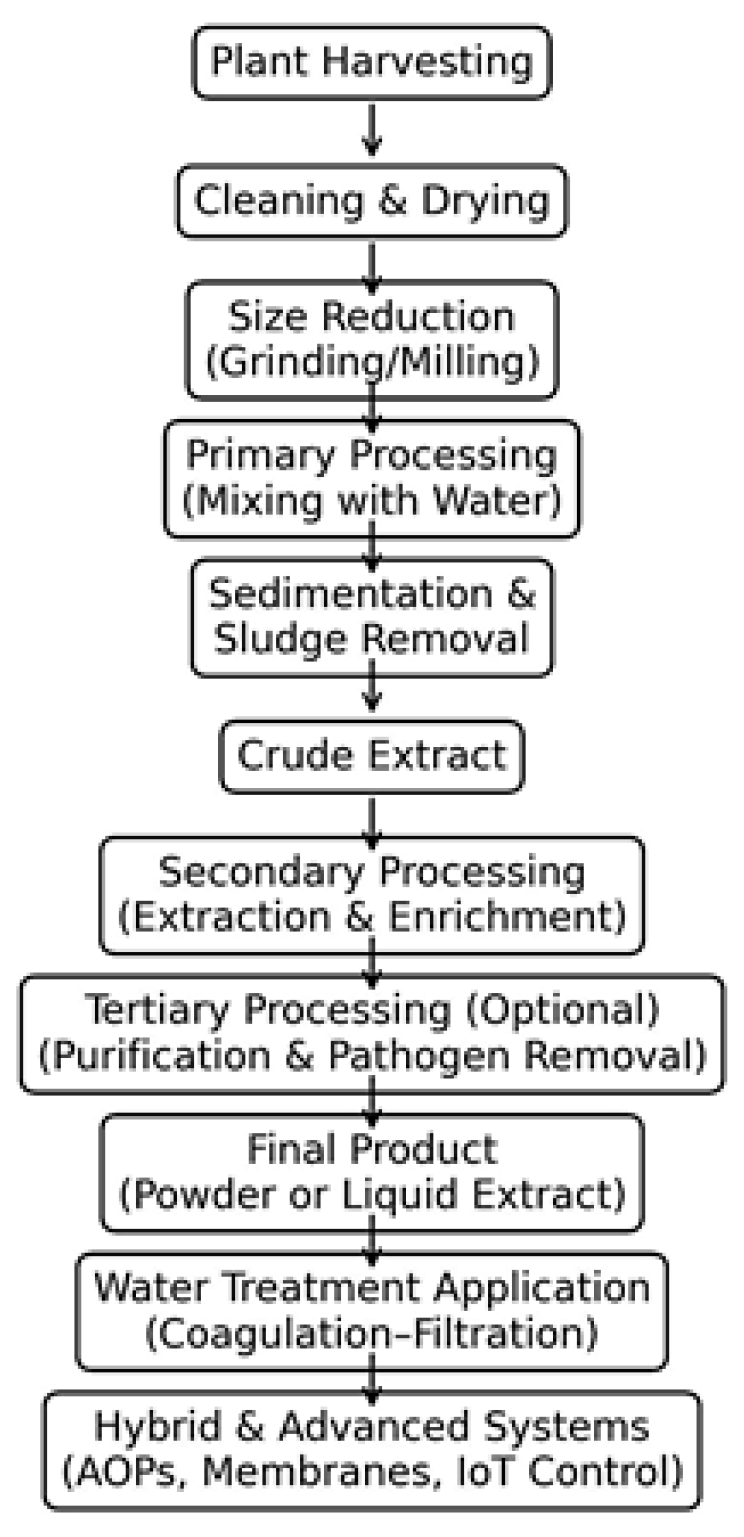
Plant-derived coagulants are typically obtained through a multi-step recovery pathway that can be broadly divided into primary, secondary, and tertiary processing stages. In the initial phase, seeds or other plant materials are harvested, cleaned, dried under ambient or controlled conditions, and reduced in size through manual or mechanical grinding. The resulting powder is mixed with water and allowed to stand in settling tanks so that heavier particles settle while lighter matter floats. After this sedimentation period, settled solids are removed and the clarified fraction proceeds to subsequent processing. In many rural installations, simple settling units equipped with mechanical scrapers are used to continuously collect sludge into hoppers for disposal or reuse. A key limitation of this basic approach is that only a small fraction of the biomass contains the active coagulating agents, leaving excess organic matter in the treated water. To address this drawback, the secondary and tertiary stages are designed to concentrate the active components and minimize residual organic load. Secondary processing commonly relies on active extraction techniques, as these methods are relatively low-cost and easily implemented in both laboratory and field settings [173,174]. Tertiary processing, by contrast, is less frequently applied because of its higher expense and is mostly confined to research or pilot-scale operations [173,174]. This final stage focuses on producing highly purified extracts that meet quality requirements for household, industrial, and environmental applications. It is also critical for ensuring the removal of pathogenic microorganisms, particularly in systems intended for potable water supply under municipal oversight [173,174]. Conventional water treatment schemes using natural coagulants generally follow a batch sequence of coagulation, flocculation, sedimentation, and filtration. Plant materials such as Moringa oleifera or Cicer arietinum are prepared as slurries, added to turbid water, and mixed to promote floc formation before solids are allowed to settle, and the clarified water is filtered. In some applications, natural coagulants are used alongside alum to reduce chemical demand while enhancing floc strength and settling behavior. Recent developments have expanded the use of natural coagulants into hybrid treatment configurations, integrating them with advanced oxidation processes, membrane filtration, or electrocoagulation systems. Examples include combining plant extracts with UV/H2O2 or ozone to target both suspended and dissolved contaminants, modifying membrane surfaces with mucilage to limit fouling, and coupling biocoagulation with constructed wetlands for decentralized treatment of greywater or agricultural runoff. Emerging sensor-based and IoT-enabled control systems further refine coagulant dosing, highlighting the flexibility of natural coagulants across both low-technology and advanced treatment platforms [173,174]. In practical terms, extraction typically begins with washing, drying, and size reduction in plant materials such as Moringa seeds or cactus tissue. The processed biomass is then mixed with water or saline solutions to solubilize proteins, polysaccharides, and other bioactive compounds, forming a crude extract. Gravity settling separates coarse residues, producing a partially clarified liquid. Subsequent enrichment steps—such as filtration, centrifugation, or pH adjustment—concentrate the active fraction. Final refinement yields a stable product, either as a dried powder or a preserved liquid concentrate. Collectively, these stages enable the production of a reliable and environmentally friendly alternative to synthetic coagulants. All processes were summarized in Figure 1.

4. Natural Coagulants Mechanism of Action

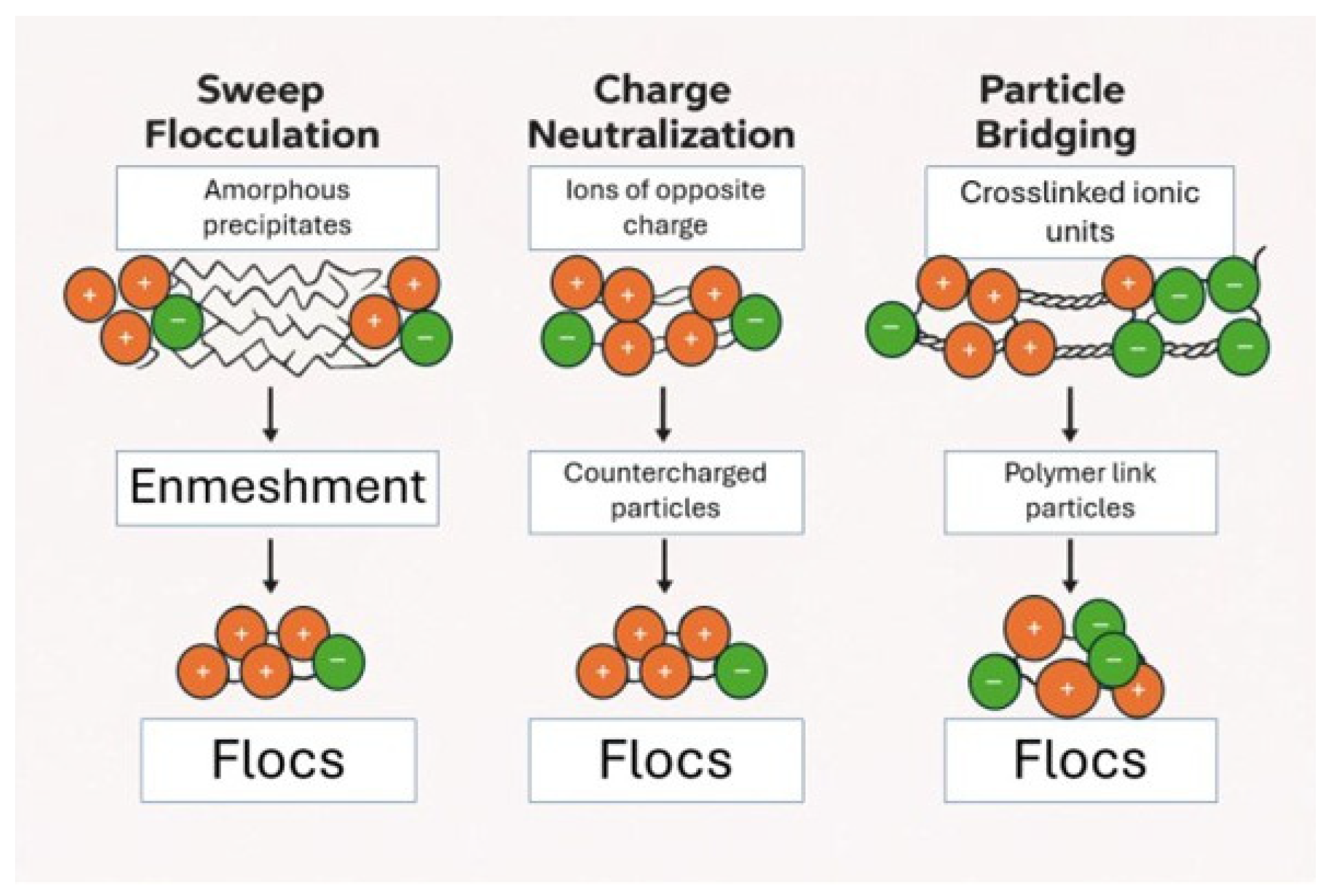
Coagulation and flocculation are fundamental operations in water treatment, primarily aimed at destabilizing fine colloidal particles (typically 0.001–1.0 μm) so that they can aggregate into removable flocs [59]. While this principle underpins both conventional and natural coagulant systems, the distinguishing feature of plant-derived coagulants lies in the specific molecular mechanisms by which their bioactive components interact with contaminants [203,204]. Growing global demand for efficient and sustainable water treatment technologies has driven increased interest in these materials, paralleling the expansion of the overall coagulant market, which exceeded USD 6.01 billion by 2022 [59]. Natural coagulants act through a combination of electrostatic interactions, adsorption, and macromolecular bridging, enabled by their diverse functional groups. Unlike inorganic salts that rely mainly on hydrolysis reactions, plant-based coagulants contain proteins, polysaccharides, and lipids bearing reactive moieties such as carboxyl (–COOH), hydroxyl (–OH), and amino (–NH2) groups. Spectroscopic and microscopic techniques, including FT-IR and SEM, confirm the presence and accessibility of these sites, which directly govern destabilization behavior [205]. Under neutral to alkaline conditions, carboxyl groups dissociate into negatively charged –COO sites capable of binding metal ions and cationic dyes, while under acidic to near-neutral conditions, amino groups protonate to form –NH3+, favoring interaction with anionic species such as phosphates or negatively charged dyes. Hydroxyl groups, although electrically neutral, enhance adsorption through hydrogen bonding and increased surface wettability. Collectively, these interactions promote colloid destabilization and floc growth through charge neutralization, adsorption, and polymer bridging [205,206]. Natural coagulants mechanisms of action were depicted in Figure 2.
The mechanisms by which natural substances function as coagulants or flocculants can be broadly classified into several pathways. Charge neutralization is particularly dominant in protein-rich plant extracts. Positively charged functional groups adsorb onto negatively charged colloidal surfaces, reducing or reversing surface charge and suppressing electrostatic repulsion [192]. This mechanism yields relatively compact and dense flocs, often with near-spherical morphology and comparatively high fractal dimensions [192]. Protein-based coagulants derived from seeds such as Moringa oleifera, Strychnos potatorum, and Phaseolus vulgaris are especially effective in this role. Polymer bridging is the principal mechanism associated with mucilage-rich and polysaccharide-based plant materials. Long-chain macromolecules adsorb onto multiple particles simultaneously, creating interparticle links that form large, interconnected aggregates [48]. Flocs produced through bridging are typically larger and more open in structure, with lower fractal dimensions, yet they exhibit enhanced mechanical strength due to the flexibility and multiplicity of polymer bonds [52]. Materials such as cactus (Opuntia spp.) mucilage, okra, and Cassia obtusifolia gum exemplify this behavior, forming voluminous flocs stabilized by hydrogen bonding and dipole–dipole interactions [59]. Additional destabilization pathways may contribute depending on water chemistry. Electrical double-layer compression occurs when dissolved ions penetrate the diffuse layer surrounding colloids, reducing repulsive forces and increasing collision frequency [207]. While this mechanism alone often yields fragile aggregates—particularly in systems dominated by monovalent ions—it can enhance the effectiveness of charge neutralization and bridging when acting synergistically with biopolymers [204]. Sweep flocculation, more commonly associated with metal salts, may occur to a limited extent when natural coagulants form insoluble complexes or precipitates that physically entrap particles [203,204]. However, flocs generated through this route tend to be mechanically weak and less stable during handling [205]. Bio-coagulants, composed mainly of proteins, carbohydrates, and lipids, preferentially interact with negatively charged pollutants through electrostatic attraction, adsorption, and charge reversal [178]. Polyelectrolytes with higher charge density generally exhibit superior flocculation performance due to stronger and more extensive binding interactions. Beyond well-established sources, alternative plant materials—including banana peels, papaya seeds, and chestnut extracts—are being investigated for their capacity to combine multiple mechanisms of action within a single natural matrix, highlighting the versatility of plant-derived substances as both coagulants and flocculants.

5. Limits in Natural Coagulants Marketing

Although numerous botanical extracts have demonstrated strong efficacy in reducing TDS, TSS, COD, BOD, turbidity, hardness, algal proliferation, and microbial loads, their transition from laboratory studies to widespread commercial application remains limited. Key constraints include high production costs, insufficient consumer awareness, the need for more robust and application-oriented R&D, and lengthy regulatory approval pathways [47]. In addition, the ionic characteristics of plant-based coagulants—whether cationic, anionic, or non-ionic—introduce further complexity in performance optimization, as highlighted by Saleem et al. [93]. Results obtained under controlled laboratory conditions often fail to translate directly to industrial-scale operations, underscoring the critical need for scalable extraction and formulation technologies, as well as a more comprehensive understanding of coagulation and flocculation mechanisms prior to commercialization. Regulatory clearance, which mandates compliance with stringent quality, safety, and consistency standards, can further delay market entry. Moreover, the adoption of environmentally responsible extraction and processing methods is essential to ensure the sustainability and public acceptance of plant-based coagulants. Securing a reliable and sustainable supply of agricultural raw materials represents one of the most significant challenges to large-scale deployment. Nevertheless, the intrinsic biopolymeric nature of these coagulants confers high biocompatibility and low toxicity, making them particularly appealing to environmentally conscious stakeholders seeking alternatives to conventional chemical agents. Despite these advantages, successful implementation still requires technical expertise, workforce training, and specialized equipment to ensure consistent quality and performance in real-world applications [108]. The shelf life of natural coagulants is a critical factor influencing their practical application, storage, and commercialization in water treatment systems. Because these materials are derived from biological sources, they are inherently more susceptible to degradation than synthetic or inorganic coagulants. Their stability is governed by the nature of the raw material, the degree of processing and purification, storage conditions, and the physical form in which the coagulant is prepared. In their crude or aqueous extract form, natural coagulants generally exhibit a relatively short shelf life. The presence of water, residual organic matter, and nutrients creates favorable conditions for microbial growth, enzymatic activity, and oxidation, all of which can rapidly reduce coagulation efficiency. Protein-based extracts, such as those derived from Moringa oleifera seeds, may lose activity within days to a few weeks at ambient temperature if no preservation strategy is applied. Polysaccharide-rich extracts, including cactus or okra mucilage, are similarly prone to microbial spoilage and viscosity changes over time. By contrast, dried and powdered forms of natural coagulants demonstrate substantially improved shelf stability. Drying methods such as sun-drying, oven-drying, or freeze-drying reduce moisture content, inhibit microbial activity, and slow chemical degradation. When properly dried and stored in airtight, light-resistant containers, plant-based coagulant powders can retain functionality for several months to more than a year. However, prolonged exposure to humidity, heat, or oxygen may still lead to protein denaturation, polysaccharide depolymerization, or loss of active functional groups. The level of purification also influences shelf life. Crude extracts often contain lipids, sugars, and other biodegradable compounds that accelerate deterioration, whereas partially purified or fractionated extracts exhibit greater stability due to reduced organic load. Tertiary processing steps—such as filtration, centrifugation, or pH adjustment—can therefore extend usable life, although they increase production costs. The addition of mild preservatives, salting, or pH control has also been explored as a means of suppressing microbial growth, particularly for liquid formulations intended for short-term use.
Storage conditions play a decisive role. Low temperature, low humidity, and protection from light significantly enhance stability, while fluctuating temperatures and poor packaging accelerate degradation. In decentralized or rural settings, where controlled storage may be limited, the use of freshly prepared extracts or stable dried powders is generally preferred over liquid concentrates.

6. Future Directions

Growing global emphasis on pollution prevention and comprehensive environmental assessment frameworks has fundamentally reshaped water, waste, and energy management strategies, increasingly aligning them with circular economy principles focused on reduction, reuse, and recycling [208,209]. Within this context, plant-derived natural coagulants have gained renewed attention as sustainable alternatives to synthetic chemicals, demonstrating notable potential even in complex applications such as textile wastewater treatment [92]. A substantial body of research confirms their effectiveness in coagulation–flocculation (CF) processes; however, these studies consistently underscore practical and operational constraints that hinder large-scale implementation. One major limitation lies in the use of crude plant extracts, which can introduce additional dissolved and suspended organic matter—such as DOC and TOC—into treated water. These residual organics may promote microbial regrowth or generate undesirable color and odor issues [202]. Furthermore, crude extracts often contain non-coagulant constituents, including oils and fats, that can adversely affect coagulation efficiency and process stability [173]. Transitioning natural coagulants from laboratory-scale success to industrial deployment requires systematic optimization of critical operational parameters, including pH, ionic strength, temperature, particle size distribution, and TDS concentration. Seasonal variability in biomass availability presents an additional challenge, compounded by the capital and operational costs associated with extraction equipment and processing technologies. Safety concerns related to certain plant species, such as Jatropha curcas, further complicate their practical application [147].
Economic viability remains sensitive to external pressures, as rising agricultural commodity prices driven by demographic growth and environmental stressors may significantly influence the cost structure of plant-based coagulants [210]. Moreover, regional disparities in production costs and financial assessment methodologies hinder meaningful cross-country comparisons [46]. Incremental commercialization pathways—supported by pilot-scale demonstrations—are therefore essential to establish resilient supply chains, refine extraction and formulation techniques, and reduce uncertainty. Local regulatory approval remains a mandatory step for market entry [211], and proactive policy instruments, including incentives and supportive environmental legislation, could accelerate adoption. A thorough understanding of source-water characteristics and residual by-product behavior is critical to system design and long-term safety assurance [212]. At a more fundamental level, identifying the specific compounds within plant matrices responsible for coagulation performance requires rigorous isolation, purification, and characterization of active constituents [47,202]. CF efficiency is governed by a complex interplay of variables, including coagulant dosage, ionic strength, TDS, temperature, pH, and organic matter content [213,214]. Consequently, selecting plant species with consistent annual yields and stable physicochemical properties is a key prerequisite for viable large-scale application. In parallel, the development of optimized natural or hybrid (natural–chemical) coagulant systems will necessitate extensive experimental validation and performance benchmarking [215].
Complementing these advances, biochar has emerged as a highly promising material for integrated water treatment solutions. Although not a coagulant, biochar produced through biomass pyrolysis is a carbon-rich sorbent capable of removing metals, nutrients, pathogens, and a wide range of organic contaminants [216,217,218]. Its low production cost, sustainability, and versatility position biochar as a cornerstone material within circular-economy frameworks [219,220,221]. Beyond pollutant removal, biochar contributes to greenhouse gas mitigation [222] and, owing to its high surface area and abundance of functional groups, functions as an efficient and affordable adsorbent [223,224,225]. Engineered biochar further enhances these attributes, enabling targeted removal of agrochemicals, pharmaceuticals, and metal(loid)s [218,221,226,227]. Additional benefits of biochar include improvements in soil fertility and opportunities for renewable energy generation [217,228]. Its applicability extends to stormwater treatment and catalytic degradation of pollutants [217,229]. For example, steam-activated biochar has been shown by Rajapaksha et al. [230] to effectively remove sulfamethazine, although adsorption efficiency is strongly pH-dependent. Biochar also exhibits high affinity for heavy metals such as Cu, As, Cd, and Pb, with reported adsorption capacities ranging from 0.4 mg/g to 69.4 mg/g [231,232,233]. Aluminum-modified biochar has achieved removal efficiencies exceeding 85–95% in stormwater filtration systems [234]. Despite these promising outcomes, careful engineering of filter media and system configurations remains essential to ensure consistent and reliable performance under field conditions [235].

7. Final Remarks

The findings outlined here highlight the increasing urgency of providing reliable access to clean drinking water amid growing demographic, climatic, and pollution-related pressures. As the world works toward the United Nations Sustainable Development Goals, particularly those addressing water quality and availability, there is a pressing need for treatment technologies that are economical, efficient, and environmentally sound. This review underscores the broad spectrum of technologies—traditional and emerging—that utilize natural coagulants. While conventional coagulation–sedimentation remains indispensable, the field is rapidly transitioning toward hybrid systems that integrate membranes, advanced oxidation, or electrocoagulation. These innovations suggest a movement from localized, small-scale uses toward more advanced and scalable treatment infrastructures. Despite their advantages, plant-derived coagulants must overcome challenges related to raw material supply, extraction efficiency, and variability in water characteristics. However, improvements in process control, dosing technologies, and integrated treatment strategies illustrate their potential to become competitive alternatives to synthetic chemicals. Ultimately, continued interdisciplinary examination and sustainable resource planning can position natural coagulants as pivotal tools in future water treatment, helping deliver cleaner water with reduced environmental impact.

Author Contributions

Conceptualization, D.F.; methodology, D.F.; software, Ş.Ţ.; validation, D.F.; formal analysis, D.F.; investigation, D.F.; resources, Ş.Ţ.; data curation, D.F.; writing—original draft preparation, D.F. and Ş.Ţ.; writing—review and editing, D.F. and Ş.Ţ.; visualization, D.F.; supervision, Ş.Ţ.; project administration, Ş.Ţ.; funding acquisition, Ş.Ţ. All authors have read and agreed to the published version of the manuscript.

Funding

This research received no external funding.

Institutional Review Board Statement

Not applicable.

Informed Consent Statement

Not applicable.

Data Availability Statement

No new data were created or analyzed in this study.

Conflicts of Interest

The authors declare no conflicts of interest.

Abbreviations

The following abbreviations are used in this manuscript:
BODBiological oxygen demand
CAGRCompound annual growth rate
CODChemical oxygen demand
DOCDissolved organic carbon 
EIAEnvironmental impact assessments
NTUNephelometric turbidity unit
PACPoly-aluminum chloride
SFGSurface functional groups
SDGsSustainable development goals
TDSsTotal dissolved solids
TOCTotal organic carbon
TSSsTotal suspended solids
WTWater treatment

References

  1. Gleick, P.H. Water in Crisis; Oxford Univ. Press: Oxford, UK, 1993; p. 100. [Google Scholar]
  2. Liu, S.X. Food and Agricultural Wastewater Utilization and Treatment; John Wiley & Sons: Hoboken, NJ, USA, 2008. [Google Scholar]
  3. World Health Organization. Evaluating Household Water Treatment Options: Health-Based Targets and Microbiological Performance Specifications; World Health Organization: Geneva, Switzerland, 2011. [Google Scholar]
  4. Khatri, N.; Tyagi, S. Influences of natural and anthropogenic factors on surface and groundwater quality in rural and urban areas. Front. Life Sci. 2015, 8, 23–39. [Google Scholar] [CrossRef]
  5. Murray, J.J.; World Health Organization. Appropriate Use of Fluorides for Human Health; World Health Organization: Geneva, Switzerland, 1986. [Google Scholar]
  6. Loganathan, P.; Hedley, M.; Grace, N.; Lee, J.; Cronin, S.; Bolan, N.; Zanders, J. Fertiliser contaminants in New Zealand grazed pasture with special reference to cadmium and fluorine—A review. Soil Res. 2003, 41, 501–532. [Google Scholar] [CrossRef]
  7. Jagtap, S.; Yenkie, M.K.; Labhsetwar, N.; Rayalu, S. Fluoride in drinking water and defluoridation of water. Chem. Rev. 2012, 112, 2454–2466. [Google Scholar] [CrossRef]
  8. Mandinic, Z.; Curcic, M.; Antonijevic, B.; Carevic, M.; Mandic, J.; Djukic-Cosic, D.; Lekic, C.P. Fluoride in drinking water and dental fluorosis. Sci. Total Environ. 2010, 408, 3507–3512. [Google Scholar] [CrossRef]
  9. Gandhi, N.; Sirisha, D.; Smita, A.; Manjusha, A. Adsorption studies of fluoride on multani matti and red soil. Res. J. Chem. Sci. 2012, 2, 32–37. [Google Scholar]
  10. Nand, V.; Maata, M.; Koshy, K.; Sotheeswaran, S. Water purification using Moringa oleifera and other locally available seeds in Fiji for heavy metal removal. Int. J. Appl. 2012, 2, 125–129. [Google Scholar]
  11. Ravikumar, K.; Sheeja, A. Heavy metal removal from water using Moringa oleifera seed coagulant and double filtration. In Proceedings of the International Conference on Innovations in Civil Engineer, Kochi, India, 9–10 May 2013; p. 9. [Google Scholar]
  12. Aziz, N.; Jayasuriya, N.; Fan, L. Effectiveness of plant-based indigenous materials for the removal of heavy metals and fluoride from drinking water. In Proceedings of the 5th International Conference on Sustainability in Civil Engineering, Hanoi, Vietnam, 23–25 October 2024; pp. 34–41. [Google Scholar]
  13. Dubrovsky, N.M.; Burow, K.R.; Clark, G.M.; Gronberg, J.; Hamilton, P.A.; Hitt, K.J.; Mueller, D.K.; Munn, M.D.; Nolan, B.T.; Puckett, L.J. The quality of our nation’s waters—Nutrients in the nation’s streams and groundwater, 1992–2004. US Geol. Surv. Circ. 2010, 1350, 174. [Google Scholar]
  14. Welch, J.; Simmons, V.; Meléndez, E.; Sees, M.; Gold, Y.; Heider, E.C. Assessment of non-anthropogenic addition of uric acid to a water treatment wetlands. Environments 2020, 7, 60. [Google Scholar] [CrossRef]
  15. Lovell, S.T.; Sullivan, W.C. Environmental benefits of conservation buffers in the United States: Evidence, promise, and open questions. Agric. Ecosyst. Environ. 2006, 112, 249–260. [Google Scholar] [CrossRef]
  16. Wallage, Z.E.; Holden, J.; McDonald, A.T. Drain blocking: An effective treatment for reducing dissolved organic carbon loss and water discolouration in a drained peatland. Sci. Total Environ. 2006, 367, 811–821. [Google Scholar] [CrossRef]
  17. Dorioz, J.-M.; Wang, D.; Poulenard, J.; Trevisan, D. The effect of grass buffer strips on phosphorus dynamics—A critical review and synthesis. Agric. Ecosyst. Environ. 2006, 117, 4–21. [Google Scholar] [CrossRef]
  18. Lloyd, M. Scottish environmental protection agency: Making sense of a fragmenting environment. Scott. Aff. 1999, 29, 28–42. [Google Scholar] [CrossRef]
  19. Garrod, G.D.; Garratt, J.A.; Kennedy, A.; Willis, K.G. A mixed methodology framework for the assessment of the voluntary initiative. Pest Manag. Sci. 2007, 63, 157–170. [Google Scholar] [CrossRef] [PubMed]
  20. Smith, V.H.; Tilman, G.D.; Nekola, J.C. Eutrophication: Impacts of excess nutrient inputs on freshwater, marine, and terrestrial ecosystems. Environ. Pollut. 1999, 100, 179–196. [Google Scholar] [CrossRef] [PubMed]
  21. Bricker, S.; Longstaff, B.; Dennison, W.; Jones, A.; Boicourt, K.; Wicks, C.; Woerner, J. Effects of nutrient enrichment in the nation’s estuaries: A decade of change. NOAA Coast. Ocean Program Decis. Anal. Ser. 2007, 8, 21–23. [Google Scholar] [CrossRef]
  22. Freeman, A.M.; Lamon, E.C., III; Stow, C.A. Nutrient criteria for lakes, ponds, and reservoirs: A Bayesian treed model approach. Ecol. Model. 2009, 220, 630–639. [Google Scholar] [CrossRef]
  23. Blanchard, P.; Lerch, R. Watershed vulnerability to losses of agricultural chemicals. Environ. Sci. Technol. 2000, 34, 3315–3322. [Google Scholar] [CrossRef]
  24. Hirst, D.A.; Morris, R. Water quality of Scottish rivers: Spatial and temporal trends. Sci. Total Environ. 2001, 265, 327–342. [Google Scholar]
  25. Koul, B.; Taak, P. Biotechnological Strategies for Effective Remediation of Polluted Soils; Springer: Berlin/Heidelberg, Germany, 2018. [Google Scholar]
  26. Miller, T.H.; Bury, N.R.; Owen, S.F.; MacRae, J.I.; Barron, L.P. A review of the pharmaceutical exposome in aquatic fauna. Environ. Pollut. 2018, 239, 129–146. [Google Scholar] [CrossRef]
  27. Connor, R. The United Nations World Water Development Report 2015: Water for a Sustainable World; UNESCO Publishing: Paris, France, 2015; p. 1. [Google Scholar]
  28. Eman, N.A.; Suleyman, A.M.; Hamzah, M.S.; Md Zahangir, A.; Mohd Ramlan, M.S. Production of natural coagulant from Moringa oleifera seed for application in treatment of low turbidity water. J. Water Resour. Prot. 2010, 2010, 259–266. [Google Scholar] [CrossRef]
  29. Abdulredha, M.; Rafid, A.L.; Jordan, D.; Hashim, K. The development of a waste management system in Kerbala during major pilgrimage events. Procedia Eng. 2017, 196, 779–784. [Google Scholar] [CrossRef]
  30. Hashim, K.S.; Al Khaddar, R.; Jasim, N.; Shaw, A.; Phipps, D.; Kot, P.; Pedrola, M.O.; Alattabi, A.W.; Abdulredha, M.; Alawsh, R. Electrocoagulation as a green technology for phosphate removal from river water. Sep. Purif. Technol. 2019, 210, 135–144. [Google Scholar] [CrossRef]
  31. Mohammed, A.-H.; Hussein, A.H.; Yeboah, D.; Al Khaddar, R.; Abdulhadi, B.; Shubbar, A.A.; Hashim, K.S. Electrochemical removal of nitrate from wastewater. IOP Conf. Ser. Mater. Sci. Eng. 2020, 888, 12037. [Google Scholar]
  32. Idowu, I.A.; Atherton, W.; Hashim, K.; Kot, P.; Alkhaddar, R.; Alo, B.I.; Shaw, A. An analysis of the status of landfill classification systems in developing countries: Sub-Saharan Africa landfill experiences. Waste Manag. 2019, 87, 761–771. [Google Scholar] [CrossRef] [PubMed]
  33. Abdulredha, M.; Kot, P.; Al Khaddar, R.; Jordan, D.; Abdulridha, A. Investigating municipal solid waste management system performance during the Arba’een event in the city of Kerbala, Iraq. Environ. Dev. Sustain. 2020, 22, 1431–1454. [Google Scholar] [CrossRef]
  34. Arora, P. Physical, chemical and biological characteristics of water (e content module). Cent. Univ. Punjab 2017, 2018, 1–16. [Google Scholar]
  35. Zhou, M.; Zhang, Y.; Wang, J.; Shi, Y.; Puig, V. Water quality indicator interval prediction in wastewater treatment process based on the improved BES-LSSVM algorithm. Sensors 2022, 22, 422. [Google Scholar] [CrossRef]
  36. Alenazi, M.; Hashim, K.S.; Hassan, A.A.; Muradov, M.; Kot, P.; Abdulhadi, B. Turbidity removal using natural coagulants derived from the seeds of Strychnos potatorum: Statistical and experimental approach. IOP Conf. Ser. Mater. Sci. Eng. 2020, 888, 12064. [Google Scholar] [CrossRef]
  37. Shubbar, A.A.; Sadique, M.; Shanbara, H.K.; Hashim, K. The development of a new low carbon binder for construction as an alternative to cement. In Advances in Sustainable Construction Materials and Geotechnical Engineering; Springer: Berlin/Heidelberg, Germany, 2020; pp. 205–213. [Google Scholar]
  38. Abdulraheem, F.S.; Al-Khafaji, Z.S.; Hashim, K.S.; Muradov, M.; Kot, P.; Shubbar, A.A. Natural filtration unit for removal of heavy metals from water. IOP Conf. Ser. Mater. Sci. Eng. 2020, 888, 12034. [Google Scholar] [CrossRef]
  39. Alhendal, M.; Nasir, M.J.; Hashim, K.S.; Amoako-Attah, J.; Al-Faluji, D.; Muradov, M.; Kot, P.; Abdulhadi, B. Cost-effective hybrid filter for remediation of water from fluoride. IOP Conf. Ser. Mater. Sci. Eng. 2020, 1058, 12012. [Google Scholar] [CrossRef]
  40. Abdulla, G.; Kareem, M.M.; Hashim, K.S.; Muradov, M.; Kot, P.; Mubarak, H.A.; Abdellatif, M.; Abdulhadi, B. Removal of iron from wastewater using a hybrid filter. IOP Conf. Ser. Mater. Sci. Eng. 2020, 888, 12035. [Google Scholar] [CrossRef]
  41. Shabaa, G.J.; Al-Jboory, W.S.; Sabre, H.M.; Alazmi, A.; Kareem, M.M.; AlKhayyat, A. Plant-based coagulants for water treatment. IOP Conf. Ser. Mater. Sci. Eng. 2021, 1058, 12001. [Google Scholar] [CrossRef]
  42. Azizul-Rahman, M.; Mohd-Suhaimi, A.; Othman, N. Biosorption of Pb(II) and Zn(II) in synthetic wastewater by watermelon rind (Citrullus lanatus). Appl. Mech. Mater. 2014, 465, 906–910. [Google Scholar]
  43. Choudhary, M.; Ray, M.B.; Neogi, S. Evaluation of the potential application of cactus (Opuntia ficus-indica) as a bio-coagulant for pre-treatment of oil sands process-affected water. Sep. Purif. Technol. 2019, 209, 714–724. [Google Scholar] [CrossRef]
  44. Esa, N.M.; Ling, T.B.; Peng, L.S. By-products of rice processing: An overview of health benefits and applications. Rice Res. Open Access 2013, 1, 107. [Google Scholar]
  45. Prabhakaran, N.; Jothieswari, M.; Swarnalatha, S.; Sekaran, G. Tannery wastewater treatment process to minimize residual organics and generation of primary chemical sludge. Int. J. Environ. Sci. Technol. 2022, 19, 8857–8870. [Google Scholar] [CrossRef]
  46. Yin, C.-Y. Emerging usage of plant-based coagulants for water and wastewater treatment. Process Biochem. 2010, 45, 1437–1444. [Google Scholar] [CrossRef]
  47. Choy, S.Y.; Prasad, K.M.N.; Wu, T.Y.; Raghunandan, M.E.; Ramanan, R.N. Utilization of plant-based natural coagulants as future alternatives towards sustainable water clarification. J. Environ. Sci. 2014, 26, 2178–2189. [Google Scholar] [CrossRef]
  48. Nimesha, S.; Hewawasam, C.; Jayasanka, D.; Murakami, Y.; Araki, N.; Maharjan, N. Effectiveness of natural coagulants in water and wastewater treatment. Glob. J. Environ. Sci. Manag. 2022, 8, 101–116. [Google Scholar]
  49. Guo, Y.; Zelekew, O.A.; Sun, H.; Kuo, D.-H.; Lin, J.; Chen, X. Catalytic reduction of organic and hexavalent chromium pollutants with highly active bimetal cubios oxysulfide catalyst under dark. Sep. Purif. Technol. 2020, 242, 116769. [Google Scholar] [CrossRef]
  50. Alibeigi-Beni, S.; Habibi Zare, M.; Pourafshari Chenar, M.; Sadeghi, M.; Shirazian, S. Design and optimization of a hybrid process based on hollow-fiber membrane/coagulation for wastewater treatment. Environ. Sci. Pollut. Res. 2021, 28, 8235–8245. [Google Scholar] [CrossRef]
  51. Ali, I.; Gupta, V. Advances in water treatment by adsorption technology. Nat. Protoc. 2006, 1, 2661–2667. [Google Scholar] [CrossRef]
  52. O’Malley, E.; O’Brien, J.W.; Verhagen, R.; Mueller, J.F. Annual release of selected UV filters via effluent from wastewater treatment plants in Australia. Chemosphere 2020, 247, 125887. [Google Scholar] [CrossRef]
  53. Ang, W.L.; Mohammad, A.W. State of the art and sustainability of natural coagulants in water and wastewater treatment. J. Clean. Prod. 2020, 262, 121267. [Google Scholar] [CrossRef]
  54. Hamzah, A.; Manikan, V.; Abd Aziz, N.A.F. Biodegradation of Tapis crude oil using consortium of bacteria and fungi: Optimization of crude oil concentration and duration of incubation by response surface methodology. Sains Malays. 2017, 46, 43–50. [Google Scholar] [CrossRef]
  55. Kumar, K.; Chowdhury, A. Use of novel nanostructured photocatalysts for the environmental sustainability of wastewater treatments. In Reference Module in Materials Science and Materials Engineering; Elsevier: Dublin, Ireland, 2018. [Google Scholar]
  56. Haydar, S.; Aziz, J.A. Coagulation–flocculation studies of tannery wastewater using combination of alum with cationic and anionic polymers. J. Hazard. Mater. 2009, 168, 1035–1040. [Google Scholar] [CrossRef]
  57. Parmar, K.; Prajapati, S.N.; Patel, R.; Dabhi, Y.M. Effective use of ferrous sulfate and alum as a coagulant in treatment of dairy industry wastewater. ARPN J. Eng. Appl. Sci. 2011, 6, 42–45. [Google Scholar]
  58. Tolkou, A.K.; Meez, E.; Kyzas, G.Z.; Torretta, V.; Collivignarelli, M.C.; Caccamo, F.M.; Deliyanni, E.A.; Katsoyiannis, I.A. A mini review of recent findings in cellulose-, polymer- and graphene-based membranes for fluoride removal from drinking water. C 2021, 7, 74. [Google Scholar] [CrossRef]
  59. Muhammad Burhanuddin, B. Recent advances on coagulation-based treatment of wastewater: Transition from chemical to natural coagulant. Curr. Pollut. Rep. 2021, 7, 379–391. [Google Scholar] [CrossRef]
  60. Alwi, H.; Idris, J.; Musa, M.; Ku Hamid, K.H. A preliminary study of banana stem juice as a plant-based coagulant for treatment of spent coolant wastewater. J. Chem. 2013, 2013, 165057. [Google Scholar] [CrossRef]
  61. Carvalho, M.S.; Alves, B.R.R.; Silva, M.F.; Bergamasco, R.; Coral, L.A.; Bassetti, F.J. CaCl2 applied to the extraction of Moringa oleifera seeds and the use for Microcystis aeruginosa removal. Chem. Eng. J. 2016, 304, 469–475. [Google Scholar] [CrossRef]
  62. Hamawand, I. Anaerobic digestion process and bio-energy in meat industry: A review and a potential. Renew. Sustain. Energy Rev. 2015, 44, 37–51. [Google Scholar] [CrossRef]
  63. Madhavi, V.; Vijaya Bhaskar Reddy, A.; Madhavi, G. Synthesis, characterization, and properties of carbon nanocomposites and their application in wastewater treatment. In Environmental Remediation Through Carbon Based Nano Composites; Springer: Berlin/Heidelberg, Germany, 2021; pp. 61–83. [Google Scholar]
  64. Jiang, J.-Q.; Lloyd, B. Progress in the development and use of ferrate (VI) salt as an oxidant and coagulant for water and wastewater treatment. Water Res. 2002, 36, 1397–1408. [Google Scholar] [CrossRef]
  65. Loloei, M.; Rezaee, A.; Roohaghdam, A.S.; Aliofkhazraei, M. Conductive microbial cellulose as a novel biocathode for Cr(VI) bioreduction. Carbohydr. Polym. 2017, 162, 56–61. [Google Scholar] [CrossRef] [PubMed]
  66. Bogacki, J.; Naumczyk, J.; Marcinowski, P.; Kucharska, M. Treatment of cosmetic wastewater using physicochemical and chemical methods. Chemik 2011, 65, 94–97. [Google Scholar]
  67. Liang, Z.; Wang, Y.; Zhou, Y.; Liu, H. Coagulation removal of melanoidins from biologically treated molasses wastewater using ferric chloride. Chem. Eng. J. 2009, 152, 88–94. [Google Scholar] [CrossRef]
  68. Panhwar, A.; Bhutto, S. Improved reduction of COD, BOD, TSS and oil & grease from sugarcane industry effluent by ferric chloride and polyaluminum chloride coupled with polyvinyl alcohol. Ecol. Eng. Environ. Technol. 2021, 22, 8–14. [Google Scholar]
  69. Panhwar, A.A.; Almani, K.F.; Kandhro, A.A. Environmental degradation by textile industry; performance of chemical coagulants and activated carbon for removal of COD, BOD. Tech. J. 2020, 25, 16–20. [Google Scholar]
  70. Irfan, M.; Butt, T.; Imtiaz, N.; Abbas, N.; Khan, R.A.; Shafique, A. The removal of COD, TSS and colour of black liquor by coagulation–flocculation process at optimized pH, settling and dosing rate. Arab. J. Chem. 2017, 10, S2307–S2318. [Google Scholar] [CrossRef]
  71. Al-Saati, N.; Hussein, T.; Abbas, M.; Hashim, K.; Al-Saati, Z.; Kot, P.; Sadique, M.; Aljefery, M.; Carnacina, I. Statistical modelling of turbidity removal applied to non-toxic natural coagulants in water treatment: A case study. Desalin. Water Treat. 2019, 150, 406–412. [Google Scholar] [CrossRef]
  72. Zubaidi, S.L.; Al-Bugharbee, H.; Muhsin, Y.R.; Hashim, K.; Alkhaddar, R. Forecasting of monthly stochastic signal of urban water demand: Baghdad as a case study. IOP Conf. Ser. Mater. Sci. Eng. 2020, 888, 12018. [Google Scholar] [CrossRef]
  73. Liao, L.; Zhang, P. Preparation and characterization of polyaluminum titanium silicate and its performance in the treatment of low-turbidity water. Processes 2018, 6, 125. [Google Scholar] [CrossRef]
  74. Musteret, C.P.; Morosanu, I.; Ciobanu, R.; Plavan, O.; Gherghel, A.; Al-Refai, M.; Roman, I.; Teodosiu, C. Assessment of coagulation–flocculation process efficiency for the natural organic matter removal in drinking water treatment. Water 2021, 13, 3073. [Google Scholar] [CrossRef]
  75. Hashim, K.S.; Ali, S.S.M.; AlRifaie, J.K.; Kot, P.; Shaw, A.; Al Khaddar, R.; Idowu, I.; Gkantou, M. Escherichia coli inactivation using a hybrid ultrasonic-electrocoagulation reactor. Chemosphere 2020, 247, 125868. [Google Scholar] [CrossRef]
  76. Al-Jumeily, D.; Hashim, K.; Alkaddar, R.; Al-Tufaily, M.; Lunn, J. Sustainable and environmental friendly ancient reed houses (inspired by the past to motivate the future). In Proceedings of the 2018 11th International Conference on Developments in eSystems Engineering (DeSE), Cambridge, UK, 2–5 September 2018; pp. 214–219. [Google Scholar]
  77. Zouboulis, A.I.; Tzoupanos, N. Alternative cost-effective preparation method of polyaluminium chloride (PAC) coagulant agent: Characterization and comparative application for water/wastewater treatment. Desalination 2010, 250, 339–344. [Google Scholar] [CrossRef]
  78. Walton, M.E.; Samonte-Tan, G.P.; Primavera, J.H.; Edwards-Jones, G.; Le Vay, L. Are mangroves worth replanting? The direct economic benefits of a community-based reforestation project. Environ. Conserv. 2006, 33, 335–343. [Google Scholar] [CrossRef]
  79. Flaten, T.P. Aluminium as a risk factor in Alzheimer’s disease, with emphasis on drinking water. Brain Res. Bull. 2001, 55, 187–196. [Google Scholar] [CrossRef] [PubMed]
  80. Kandimalla, R.; Vallamkondu, J.; Corgiat, E.B.; Gill, K.D. Understanding aspects of aluminum exposure in Alzheimer’s disease development. Brain Pathol. 2016, 26, 139–154. [Google Scholar] [CrossRef]
  81. Krupińska, I. Aluminium drinking water treatment residuals and their toxic impact on human health. Molecules 2020, 25, 641. [Google Scholar] [CrossRef]
  82. Bondy, S.C. Low levels of aluminum can lead to behavioral and morphological changes associated with Alzheimer’s disease and age-related neurodegeneration. Neurotoxicology 2016, 52, 222–229. [Google Scholar] [CrossRef]
  83. Lukiw, W.J.; Kruck, T.P.A.; Percy, M.E.; Pogue, A.I.; Alexandrov, P.N.; Walsh, W.J.; Sharfman, N.M.; Jaber, V.R.; Zhao, Y.; Li, W.; et al. Aluminum in neurological disease—A 36 year multicenter study. J. Alzheimers Dis. Park. 2019, 8, 6–10. [Google Scholar]
  84. Iwuozor, K.O. Prospects and challenges of using coagulation-flocculation method in the treatment of effluents. Adv. J. Chem. Sect. A 2019, 2, 105–127. [Google Scholar] [CrossRef]
  85. Lee, J.; Jeon, J.H.; Shin, J.; Jang, H.M.; Kim, S.; Song, M.S.; Kim, Y.M. Quantitative and qualitative changes in antibiotic resistance genes after passing through treatment processes in municipal wastewater treatment plants. Sci. Total Environ. 2017, 605, 906–914. [Google Scholar] [CrossRef] [PubMed]
  86. Abdulhadi, B.; Kot, P.; Hashim, K.; Shaw, A.; Al Khaddar, R. Influence of current density and electrodes spacing on reactive red 120 dye removal from dyed water using electrocoagulation/electroflotation (EC/EF) process. IOP Conf. Ser. Mater. Sci. Eng. 2019, 584, 12035. [Google Scholar] [CrossRef]
  87. Zubaidi, S.L.; Ortega-Martorell, S.; Al-Bugharbee, H.; Olier, I.; Hashim, K.S.; Gharghan, S.K.; Kot, P.; Al-Khaddar, R. Urban water demand prediction for a city that suffers from climate change and population growth: Gauteng province case study. Water 2020, 12, 1885. [Google Scholar] [CrossRef]
  88. Grmasha, R.A.; Al-Sareji, O.J.; Salman, J.M.; Hashim, K.S. Polycyclic aromatic hydrocarbons (PAHs) in urban street dust within three land-uses of Babylon Governorate, Iraq: Distribution, sources, and health risk assessment. J. King Saud Univ.—Eng. Sci. 2022, 34, 231–239. [Google Scholar] [CrossRef]
  89. Owodunni, A.A.; Ismail, S. Revolutionary technique for sustainable plant-based green coagulants in industrial wastewater treatment—A review. J. Water Process Eng. 2021, 42, 102096. [Google Scholar] [CrossRef]
  90. Alazaiza, M.Y.D.; Albahnasawi, A.; Ali, G.A.M.; Bashir, M.J.K.; Nassani, D.E.; Al Maskari, T.; Amr, S.S.A.; Abujazar, M.S.S. Application of natural coagulants for pharmaceutical removal from water and wastewater: A review. Water 2022, 14, 140. [Google Scholar] [CrossRef]
  91. Renault, F.; Sancey, B.; Badot, P.-M.; Crini, G. Chitosan for coagulation/flocculation processes–an eco-friendly approach. Eur. Polym. J. 2009, 45, 1337–1348. [Google Scholar] [CrossRef]
  92. Choy, S.; Prasad, K.; Wu, T.; Ramanan, R. A review on common vegetables and legumes as promising plant-based natural coagulants in water clarification. Int. J. Environ. Sci. Technol. 2015, 12, 367–390. [Google Scholar] [CrossRef]
  93. Saleem, M.; Bachmann, R.T. A contemporary review on plant-based coagulants for applications in water treatment. J. Ind. Eng. Chem. 2019, 72, 281–297. [Google Scholar] [CrossRef]
  94. Mohd-Salleh, S.N.A.; Mohd-Zin, N.S.; Othman, N. A review of wastewater treatment using natural material and its potential as aid and composite coagulant. Sains Malays. 2019, 48, 155–164. [Google Scholar] [CrossRef]
  95. Brundtland, G.H. Report of the World Commission on Environment and Development: Our Common Future; United Nations Digital Library: New York, NY, USA, 1987. [Google Scholar]
  96. Kamali, M.; Suhas, D.; Costa, M.E.; Capela, I.; Aminabhavi, T.M. Sustainability considerations in membrane-based technologies for industrial effluents treatment. Chem. Eng. J. 2019, 368, 474–494. [Google Scholar] [CrossRef]
  97. Kanmani, P.; Aravind, J.; Kamaraj, M.; Sureshbabu, P.; Karthikeyan, S. Environmental applications of chitosan and cellulosic biopolymers: A comprehensive outlook. Bioresour. Technol. 2017, 242, 295–303. [Google Scholar] [CrossRef]
  98. Do, M.; Ngo, H.; Guo, W.; Liu, Y.; Chang, S.; Nguyen, D.; Nghiem, L.; Ni, B. Challenges in the application of microbial fuel cells to wastewater treatment and energy production: A mini review. Sci. Total Environ. 2018, 639, 910–920. [Google Scholar] [CrossRef]
  99. Ho, Y.; Norli, I.; FM, A.; Morad, N. New vegetal biopolymeric flocculant: A degradation and flocculation study. Iran. J. Energy Environ. 2014, 5, 26–33. [Google Scholar] [CrossRef]
  100. Abidin, Z.; Norhafizah, M.; Robiah, Y.; Aishah, D. Effect of storage conditions on Jatropha curcas performance as biocoagulant for treating palm oil mill effluent. J. Environ. Sci. Technol. 2019, 12, 92–101. [Google Scholar] [CrossRef]
  101. Dos Santos, J.D.; Veit, M.T.; Juchen, P.T.; da Cunha Gonçalves, G.; Palacio, S.M.; Fagundes-Klen, M. Use of different coagulants for cassava processing wastewater treatment. J. Environ. Chem. Eng. 2018, 6, 1821–1827. [Google Scholar] [CrossRef]
  102. Dezfooli, S.M.; Uversky, V.N.; Saleem, M.; Baharudin, F.S.; Hitam, S.M.S.; Bachmann, R.T. A simplified method for the purification of an intrinsically disordered coagulant protein from defatted Moringa oleifera seeds. Process Biochem. 2016, 51, 1085–1091. [Google Scholar] [CrossRef]
  103. Barbosa, A.D.; da Silva, L.F.; de Paula, H.M.; Romualdo, L.L.; Sadoyama, G.; Andrade, L.S. Combined use of coagulation (M. oleifera) and electrochemical techniques in the treatment of industrial paint wastewater for reuse and/or disposal. Water Res. 2018, 145, 153–161. [Google Scholar] [CrossRef]
  104. Chitra, D.; Muruganandam, L. Performance of natural coagulants on greywater treatment. Recent Innov. Chem. Eng. 2020, 13, 81–92. [Google Scholar] [CrossRef]
  105. Maurya, A.; Reddy, B.; Theerthagiri, J.; Narayana, P.; Park, C.; Hong, J.; Yeom, J.-T.; Cho, K.; Reddy, N. Modeling and optimization of process parameters of biofilm reactor for wastewater treatment. Sci. Total Environ. 2021, 787, 147624. [Google Scholar] [CrossRef] [PubMed]
  106. Zaidi, N.; Muda, K.; Rahman, M.A.; Sgawi, M.; Amran, A. Effectiveness of local waste materials as organic-based coagulant in treating water. IOP Conf. Ser. Mater. Sci. Eng. 2019, 636, 12007. [Google Scholar] [CrossRef]
  107. Sibartie, S.; Ismail, N. Potential of Hibiscus sabdariffa and Jatropha curcas as natural coagulants in the treatment of pharmaceutical wastewater. MATEC Web Conf. 2018, 152, 109. [Google Scholar] [CrossRef]
  108. Kurniawan, S.B.; Abdullah, S.R.S.; Imron, M.F.; Said, N.S.M.; Ismail, N.; Hasan, H.A.; Othman, A.R.; Purwanti, I.F. Challenges and opportunities of biocoagulant/bioflocculant application for drinking water and wastewater treatment and its potential for sludge recovery. Int. J. Environ. Res. Public Health 2020, 17, 9312. [Google Scholar] [CrossRef] [PubMed]
  109. Pattnaik, P.; Dangayach, G.S. Sustainability of wastewater management in textile sectors: A conceptual framework. Environ. Eng. Manag. J. 2019, 18, 9. [Google Scholar] [CrossRef]
  110. Zhang, J.; Zhang, F.; Luo, Y.; Yang, H. A preliminary study on cactus as coagulant in water treatment. Process Biochem. 2006, 41, 730–733. [Google Scholar] [CrossRef]
  111. Choubey, S.; Rajput, S.; Bapat, K. Comparison of efficiency of some natural coagulants-bioremediation. Int. J. Emerg. Technol. Adv. Eng. 2012, 2, 429–434. [Google Scholar]
  112. Shakir, L.; Ejaz, S.; Ashraf, M.; Qureshi, N.A.; Anjum, A.A.; Iltaf, I.; Javeed, A. Ecotoxicological risks associated with tannery effluent wastewater. Environ. Toxicol. Pharmacol. 2012, 34, 180–191. [Google Scholar] [CrossRef]
  113. Mahmud, H.N.M.E.; Huq, A.O.; binti Yahya, R. The removal of heavy metal ions from wastewater/aqueous solution using polypyrrole-based adsorbents: A review. RSC Adv. 2016, 6, 14778–14791. [Google Scholar] [CrossRef]
  114. Kiso, Y.; Jung, Y.-J.; Park, M.-S.; Wang, W.; Shimase, M.; Yamada, T.; Min, K.-S. Coupling of sequencing batch reactor and mesh filtration: Operational parameters and wastewater treatment performance. Water Res. 2005, 39, 4887–4898. [Google Scholar] [CrossRef] [PubMed]
  115. Jahn, S.A.A. Drinking water from Chinese rivers: Challenges of clarification. J. Water Supply Res. Technol.—AQUA 2001, 50, 15–27. [Google Scholar] [CrossRef]
  116. Thakre, V.; Bhole, A. Relative evaluation of a few natural coagulants. J. Inst. Eng. Environ. Eng. 1985, 504, 89–92. [Google Scholar]
  117. Govindan, V. Coagulation studies on natural seed extracts. J. Indian Waterworks Assoc. 2005, 37, 145. [Google Scholar]
  118. Arukwe, U.; Amadi, B.; Duru, M.; Agomuo, E.; Adindu, E.; Odika, P.; Lele, K.; Egejuru, L.; Anudike, J. Chemical composition of Persea americana leaf, fruit and seed. Int. J. Recent Res. Appl. Stud. 2012, 11, 346–349. [Google Scholar]
  119. Ramesa, S.; Sooad, A.-d. Antibacterial properties of different cultivars of Phoenix dactylifera L. and their corresponding protein content. Ann. Biol. Res. 2012, 3, 4751–4757. [Google Scholar]
  120. Som, A.; Idris, J.; Hamid, K. Dragon fruit foliage as a low cost plant-based coagulant in latex concentrate wastewater treatment. Malays. J. Chem. Eng. 2007, 1, 47–59. [Google Scholar]
  121. Idris, J.; Md Som, A.; Musa, M.; Ku Hamid, K.H.; Husen, R.; Muhd Rodhi, M.N. Dragon fruit foliage plant-based coagulant for treatment of concentrated latex effluent: Comparison of treatment with ferric sulfate. J. Chem. 2013, 2013, 230860. [Google Scholar] [CrossRef]
  122. Patil, C.; Hugar, M. Treatment of dairy wastewater by natural coagulants. Int. Res. J. Eng. Technol. 2015, 2, 1120–1124. [Google Scholar]
  123. Camacho, F.P.; Sousa, V.S.; Bergamasco, R.; Teixeira, M.R. The use of Moringa oleifera as a natural coagulant in surface water treatment. Chem. Eng. J. 2017, 313, 226–237. [Google Scholar] [CrossRef]
  124. Pallavi, N.; Mahesh, S. Feasibility study of Moringa oleifera as a natural coagulant for the treatment of dairy wastewater. Int. J. Eng. Res. 2013, 2, 201–203. [Google Scholar]
  125. Muralimohan, N.; Palanisamy, T. Treatment of textile effluent by natural coagulants in Erode district. Asian J. Chem. 2014, 26, 911. [Google Scholar] [CrossRef]
  126. Shan, T.C.; Matar, M.A.; Makky, E.A.; Ali, E.N. The use of Moringa oleifera seed as a natural coagulant for wastewater treatment and heavy metals removal. Appl. Water Sci. 2017, 7, 1369–1376. [Google Scholar] [CrossRef]
  127. Dehghani, M.; Alizadeh, M.H. The effects of the natural coagulant Moringa oleifera and alum in wastewater treatment at the Bandar Abbas oil refinery. Environ. Health Eng. Manag. J. 2016, 3, 225–230. [Google Scholar] [CrossRef]
  128. Kazi, T.; Virupakshi, A.; Scholar, M. Treatment of tannery wastewater using natural coagulants. Development 2013, 2, 4061–4068. [Google Scholar]
  129. Anastasakis, K.; Kalderis, D.; Diamadopoulos, E. Flocculation behavior of mallow and okra mucilage in treating wastewater. Desalination 2009, 249, 786–791. [Google Scholar] [CrossRef]
  130. Carpinteyro-Urban, S.; Vaca, M.; Torres, L. Can vegetal biopolymers work as coagulant–flocculant aids in the treatment of high-load cosmetic industrial wastewaters? Water Air Soil Pollut. 2012, 223, 4925–4936. [Google Scholar] [CrossRef]
  131. Al-Hamadani, Y.A.; Yusoff, M.S.; Umar, M.; Bashir, M.J.; Adlan, M.N. Application of psyllium husk as coagulant and coagulant aid in semi-aerobic landfill leachate treatment. J. Hazard. Mater. 2011, 190, 582–587. [Google Scholar] [CrossRef] [PubMed]
  132. Shamsnejati, S.; Chaibakhsh, N.; Pendashteh, A.R.; Hayeripour, S. Mucilaginous seed of Ocimum basilicum as a natural coagulant for textile wastewater treatment. Ind. Crops Prod. 2015, 69, 40–47. [Google Scholar] [CrossRef]
  133. Chaibakhsh, N.; Ahmadi, N.; Zanjanchi, M.A. Use of Plantago major L. as a natural coagulant for optimized decolorization of dye-containing wastewater. Ind. Crops Prod. 2014, 61, 169–175. [Google Scholar] [CrossRef]
  134. Awang, N.A.; Aziz, H.A. Hibiscus rosa-sinensis leaf extract as coagulant aid in leachate treatment. Appl. Water Sci. 2012, 2, 293–298. [Google Scholar] [CrossRef]
  135. Wang, J.-P.; Chen, Y.-Z.; Wang, Y.; Yuan, S.-J.; Yu, H.-Q. Optimization of the coagulation-flocculation process for pulp mill wastewater treatment using a combination of uniform design and response surface methodology. Water Res. 2011, 45, 5633–5640. [Google Scholar] [CrossRef]
  136. Ismail, N.I.; Sheikh Abdullah, S.R.; Idris, M.; Abu Hasan, H.; Halmi, M.I.E.; Hussin Al Sbani, N.; Hamed Jehawi, O.; Sanusi, S.N.A.; Hashim, M.H. Accumulation of fecal by Scirpus grossus grown in synthetic bauxite mining wastewater and identification of resistant rhizobacteria. Environ. Eng. Sci. 2017, 34, 367–375. [Google Scholar] [CrossRef]
  137. Ronke, R.A.; Saidat, O.G.; Abdulwahab, G. Coagulation-flocculation treatment of industrial wastewater using tamarind seed powder. Int. J. ChemTech Res. 2016, 9, 771–780. [Google Scholar]
  138. Saharudin, N.; Nithyanandam, R. Wastewater treatment by using natural coagulant. 2nd Eureca Eng. 2014, 2–3, 202720485. [Google Scholar]
  139. Thawari, D.; Verma, S. Coal washery wastewater treatment using natural coagulants and chemical precipitation. Int. J. Sci. Res. 2015, 4, 1877–1881. [Google Scholar]
  140. Patel, H.; Vashi, R. Comparison of naturally prepared coagulants for removal of COD and color from textile wastewater. Glob. NEST J. 2013, 15, 522–528. [Google Scholar]
  141. Ramavandi, B.; Farjadfard, S. Removal of chemical oxygen demand from textile wastewater using a natural coagulant. Korean J. Chem. Eng. 2014, 31, 81–87. [Google Scholar] [CrossRef]
  142. Lekshmi, B.; Joseph, R.S.; Jose, A.; Abinandan, S.; Shanthakumar, S. Studies on reduction of inorganic pollutants from wastewater by Chlorella pyrenoidosa and Scenedesmus abundans. Alex. Eng. J. 2015, 54, 1291–1296. [Google Scholar] [CrossRef]
  143. Hanif, M.A.; Nadeem, R.; Zafar, M.N.; Bhatti, H.N.; Nawaz, R. Physico-chemical treatment of textile wastewater using natural coagulant cassia. J. Chem. Soc. Pak. 2008, 30, 385–393. [Google Scholar]
  144. Jeon, E.-C.; Son, H.-K.; Sa, J.-H. Emission characteristics and factors of selected odorous compounds at a wastewater treatment plant. Sensors 2009, 9, 311–326. [Google Scholar] [CrossRef] [PubMed]
  145. Anju, S.; Mophin-Kani, K. Exploring the use of orange peel and neem leaf powder as alternative coagulant in treatment of dairy wastewater. Int. J. Sci. Eng. Res. 2016, 7, 238–244. [Google Scholar]
  146. Choy, S.Y.; Prasad, K.M.N.; Wu, T.Y.; Raghunandan, M.E.; Yang, B.; Phang, S.-M.; Ramanan, R.N. Isolation, characterization and the potential use of starch from jackfruit seed wastes as a coagulant aid for treatment of turbid water. Environ. Sci. Pollut. Res. 2017, 24, 2876–2889. [Google Scholar] [CrossRef] [PubMed]
  147. Pritchard, M.; Mkandawire, T.; Edmondson, A.; O’Neill, J.; Kululanga, G. Potential of using plant extracts for purification of shallow well water in Malawi. Phys. Chem. Earth Parts A/B/C 2009, 34, 799–805. [Google Scholar] [CrossRef]
  148. Babu, R.; Chaudhuri, M. Home water treatment by direct filtration with natural coagulant. J. Water Health 2005, 3, 27–30. [Google Scholar] [CrossRef]
  149. Diaz, A.; Rincon, N.; Escorihuela, A.; Fernandez, N.; Chacin, E.; Forster, C. A preliminary evaluation of turbidity removal by natural coagulants indigenous to Venezuela. Process Biochem. 1999, 35, 391–395. [Google Scholar] [CrossRef]
  150. Bunce, J.T.; Ndam, E.; Ofiteru, I.D.; Moore, A.; Graham, D.W. A review of phosphorus removal technologies and their applicability to small-scale domestic wastewater treatment systems. Front. Environ. Sci. 2018, 6, 8. [Google Scholar] [CrossRef]
  151. Beltrán-Heredia, J.; Sánchez-Martín, J. Municipal wastewater treatment by modified tannin flocculant agent. Desalination 2009, 249, 353–358. [Google Scholar] [CrossRef]
  152. Bongiovani, M.C.; Camacho, F.P.; Coldebella, P.F.; Valverde, K.C.; Nishi, L.; Bergamasco, R. Removal of natural organic matter and trihalomethane minimization by coagulation/flocculation/filtration using a natural tannin. Desalin. Water Treat. 2016, 57, 5406–5415. [Google Scholar] [CrossRef]
  153. Özacar, M.; Şengil, İ.A. The use of tannins from Turkish acorns (valonia) in water treatment as a coagulant and coagulant aid. Turk. J. Eng. Environ. Sci. 2002, 26, 255–264. [Google Scholar]
  154. Bacelo, H.A.M. Tannin Resins from Maritime Pine Bark as Adsorbents for Water Treatment and Recovery of Substances. Ph.D. Thesis, University of Porto, Porto, Portugal, 2021. [Google Scholar]
  155. Beltrán-Heredia, J.; Sánchez-Martín, J.; Solera-Hernández, C. Anionic surfactants removal by natural coagulant/flocculant products. Ind. Eng. Chem. Res. 2009, 48, 5085–5092. [Google Scholar] [CrossRef]
  156. Jayaram, K.; Murthy, I.; Lalhruaitluanga, H.; Prasad, M. Biosorption of lead from aqueous solution by seed powder of Strychnos potatorum L. Colloids Surf. B Biointerfaces 2009, 71, 248–254. [Google Scholar] [CrossRef]
  157. Raghuwanshi, P.K.; Mandloi, M.; Sharma, A.J.; Malviya, H.S.; Chaudhari, S. Improving filtrate quality using agrobased materials as coagulant aid. Water Qual. Res. J. 2002, 37, 745–756. [Google Scholar] [CrossRef]
  158. Schulz, C.R.; Okun, D.A.; Donaldson, D.; Austin, J. Surface Water Treatment for Communities in Developing Countries; U.S. Agency for International Development: Washington, DC, USA, 1992.
  159. Selvaraj, K.; Sevugaperumal, R.; Ramasubramanian, V. Impact of match industry effluent on growth and biochemical characteristics of Cyamopsis tetragonoloba Taub and amelioration of the stress by seaweed treatment. Indian J. Fund. Appl. Life Sci. 2013, 3, 192–197. [Google Scholar]
  160. Sarawgi, G.; Kamra, A.; Suri, N.; Kaur, A.; Sarethy, I.P. Effect of Strychnos potatorum Linn. seed extracts on water samples from different sources and with diverse properties. Asian J. Water Environ. Pollut. 2009, 6, 13–17. [Google Scholar] [CrossRef]
  161. Tripathi, P.; Chaudhuri, M.; Bokil, S. Nirmali seed—A naturally occurring coagulant. Indian J. Environ. Health 1976, 18, 72–81. [Google Scholar]
  162. Adinolfi, M.; Corsaro, M.M.; Lanzetta, R.; Parrilli, M.; Folkard, G.; Grant, W.; Sutherland, J. Composition of the coagulant polysaccharide fraction from Strychnos potatorum seeds. Carbohydr. Res. 1994, 263, 103–110. [Google Scholar] [CrossRef]
  163. Muthuraman, G.; Sasikala, S. Removal of turbidity from drinking water using natural coagulants. J. Ind. Eng. Chem. 2014, 20, 1727–1731. [Google Scholar] [CrossRef]
  164. Bhuptawat, H.; Folkard, G.; Chaudhari, S. Innovative physico-chemical treatment of wastewater incorporating Moringa oleifera seed coagulant. J. Hazard. Mater. 2007, 142, 477–482. [Google Scholar] [CrossRef]
  165. Anwar, F.; Bhanger, M. Analytical characterization of Moringa oleifera seed oil grown in temperate regions of Pakistan. J. Agric. Food Chem. 2003, 51, 6558–6563. [Google Scholar] [CrossRef] [PubMed]
  166. Koul, B.; Chase, N. Moringa oleifera Lam.: Panacea to several maladies. J. Chem. Pharm. Res. 2015, 7, 687–707. [Google Scholar]
  167. Farooq, B.; Koul, B. Comparative analysis of the antioxidant, antibacterial and plant growth promoting potential of five Indian varieties of Moringa oleifera L. S. Afr. J. Bot. 2020, 129, 47–55. [Google Scholar] [CrossRef]
  168. Ndabigengesere, A.; Narasiah, K.S.; Talbot, B.G. Active agents and mechanism of coagulation of turbid waters using Moringa oleifera. Water Res. 1995, 29, 703–710. [Google Scholar] [CrossRef]
  169. Muller, S. Wirkstoffe zur Trinkwasseraufbereitung aus Samen von Moringa oleifera. Master’s Thesis, Universität Heidelberg, Heidelberg, Germany, 1980. [Google Scholar]
  170. Jahn, S.A.A. Using Moringa seeds as coagulants in developing countries. J. Am. Water Work. Assoc. 1988, 80, 43–50. [Google Scholar] [CrossRef]
  171. Muyibi, S.A.; Evison, L.M. Optimizing physical parameters affecting coagulation of turbid water with Moringa oleifera seeds. Water Res. 1995, 29, 2689–2695. [Google Scholar] [CrossRef]
  172. Gassenschmidt, U.; Jany, K.D.; Bernhard, T.; Niebergall, H. Isolation and characterization of a flocculating protein from Moringa oleifera lam. Biochim. Biophys. Acta Gen. Subj. 1995, 1243, 477–481. [Google Scholar] [CrossRef] [PubMed]
  173. Ghebremichael, K.A.; Gunaratna, K.; Henriksson, H.; Brumer, H.; Dalhammar, G. A simple purification and activity assay of the coagulant protein from Moringa oleifera seed. Water Res. 2005, 39, 2338–2344. [Google Scholar] [CrossRef]
  174. Okuda, T.; Baes, A.U.; Nishijima, W.; Okada, M. Isolation and characterization of coagulant extracted from Moringa oleifera seed by salt solution. Water Res. 2001, 35, 405–410. [Google Scholar] [CrossRef] [PubMed]
  175. Sulaiman, M.; Zhigila, D.A.; Mohammed, K.; Umar, D.M.; Aliyu, B.; Abd Manan, F. Moringa oleifera seed as alternative natural coagulant for potential application in water treatment: A review. J. Adv. Rev. Sci. Res. 2017, 30, 1–11. [Google Scholar]
  176. Dotto, J.; Fagundes-Klen, M.R.; Veit, M.T.; Palacio, S.M.; Bergamasco, R. Performance of different coagulants in the coagulation/flocculation process of textile wastewater. J. Clean. Prod. 2019, 208, 656–665. [Google Scholar] [CrossRef]
  177. Ashmawy, M.; Moussa, M.; Ghoneim, A.; Tammam, A. Enhancing the efficiency of primary sedimentation in wastewater treatment plants with the application of Moringa oleifera seeds and quicklime. J. Am. Sci. 2012, 8, 494–502. [Google Scholar]
  178. Bolto, B.; Gregory, J. Organic polyelectrolytes in water treatment. Water Res. 2007, 41, 2301–2324. [Google Scholar] [CrossRef]
  179. Hiremath, P.J.; Farmer, A.; Cannon, S.B.; Woodward, J.; Kudapa, H.; Tuteja, R.; Kumar, A.; BhanuPrakash, A.; Mulaosmanovic, B.; Gujaria, N. Large-scale transcriptome analysis in chickpea (Cicer arietinum L.), an orphan legume crop of the semi-arid tropics of Asia and Africa. Plant Biotechnol. J. 2011, 9, 922–931. [Google Scholar] [CrossRef] [PubMed]
  180. Jaseela, L.; Chadaga, M. Treatment of dairy effluent using Cicer arietinum. Int. J. Innov. Res. Sci. Eng. Technol. 2015, 4, 4881–4885. [Google Scholar]
  181. Asrafuzzaman, M.; Fakhruddin, A.; Hossain, M. Reduction of turbidity of water using locally available natural coagulants. Int. Sch. Res. Not. 2011, 2011, 632189. [Google Scholar] [CrossRef]
  182. Lim, T.K. Edible Medicinal and Non-Medicinal Plants; Springer: Berlin/Heidelberg, Germany, 2012; Volume 1. [Google Scholar]
  183. Mataka, L.; Henry, E.; Masamba, W.; Sajidu, S. Lead remediation of contaminated water using Moringa stenopetala and Moringa oleifera seed powder. Int. J. Environ. Sci. Technol. 2006, 3, 131–139. [Google Scholar] [CrossRef]
  184. Bhole, A. Relative evaluation of a few natural coagulants. AQUA J. Water Supply Res. Technol. 1995, 44, 284–290. [Google Scholar]
  185. Mbogo, S.A. A novel technology to improve drinking water quality using natural treatment methods in rural Tanzania. J. Environ. Health 2008, 70, 46–50. [Google Scholar]
  186. Gupta, V.K.; Mittal, A.; Malviya, A.; Mittal, J. Adsorption of carmoisine A from wastewater using waste materials—Bottom ash and deoiled soya. J. Colloid Interface Sci. 2009, 335, 24–33. [Google Scholar] [CrossRef]
  187. Mittal, A.; Mittal, J.; Malviya, A.; Kaur, D.; Gupta, V. Adsorption of hazardous dye crystal violet from wastewater by waste materials. J. Colloid Interface Sci. 2010, 343, 463–473. [Google Scholar] [CrossRef]
  188. De Carvalho, C.C.; Cruz, P.A.; da Fonseca, M.M.R.; Xavier-Filho, L. Antibacterial properties of the extract of Abelmoschus esculentus. Biotechnol. Bioprocess Eng. 2011, 16, 971–977. [Google Scholar] [CrossRef]
  189. Sáenz, C.; Sepúlveda, E.; Matsuhiro, B. Opuntia spp mucilage’s: A functional component with industrial perspectives. J. Arid Environ. 2004, 57, 275–290. [Google Scholar] [CrossRef]
  190. Nharingo, T.; Moyo, M. Application of Opuntia ficus-indica in bioremediation of wastewaters: A critical review. J. Environ. Manag. 2016, 166, 55–72. [Google Scholar] [CrossRef] [PubMed]
  191. Rebah, F.B.; Siddeeg, S. Cactus: An eco-friendly material for wastewater treatment: A review. J. Mater. Environ. Sci. 2017, 8, 1770–1782. [Google Scholar]
  192. Miller, S.M.; Fugate, E.J.; Craver, V.O.; Smith, J.A.; Zimmerman, J.B. Toward understanding the efficacy and mechanism of Opuntia spp. as a natural coagulant for potential application in water treatment. Environ. Sci. Technol. 2008, 42, 4274–4279. [Google Scholar] [CrossRef] [PubMed]
  193. Manunza, B.; Deiana, S.; Pintore, M.; Gessa, C. Molecular dynamics study of polygalacturonic acid chains in aqueous solution. Carbohydr. Res. 1997, 300, 85–88. [Google Scholar] [CrossRef]
  194. Fahmi, M.R.; Hamidin, N.; Abidin, C.Z.A.; Fazara, U.; Ali, M.; Hatim, M. Performance evaluation of okra (Abelmoschus esculentus) as coagulant for turbidity removal in water treatment. Key Eng. Mater. 2014, 594, 226–230. [Google Scholar] [CrossRef]
  195. Raji, Y.O.; Abubakar, L.; Giwa, S.O.; Giwa, A. Assessment of coagulation efficiency of okra seed extract for surface water treatment. Int. J. Sci. Eng. Res. 2016, 6, 719–725. [Google Scholar]
  196. Thakur, S.S.; Choubey, S. Assessment of coagulation efficiency of Moringa oleifera and okra for treatment of turbid water. Arch. Appl. Sci. Res. 2014, 6, 24–30. [Google Scholar]
  197. Mishra, S.; Singh, S.; Srivastava, R. Okra seeds: An efficient coagulant. Int. J. Res. Appl. Sci. Eng. 2017, 5, 1–5. [Google Scholar]
  198. Nath, A.; Mishra, A.; Pande, P.P. A review of natural polymeric coagulants in wastewater treatment. Mater. Today Proc. 2021, 46, 6113–6117. [Google Scholar] [CrossRef]
  199. Wang, J.; Chen, X. Removal of antibiotic resistance genes (ARGs) in various wastewater treatment processes: An overview. Crit. Rev. Environ. Sci. Technol. 2022, 52, 571–630. [Google Scholar] [CrossRef]
  200. Shewa, W.A.; Dagnew, M. Revisiting chemically enhanced primary treatment of wastewater: A review. Sustainability 2020, 12, 5928. [Google Scholar] [CrossRef]
  201. Zainal, S.F.F.S.; Abdul Aziz, H.; Mohd Omar, F.; Alazaiza, M.Y. Sludge performance in coagulation-flocculation treatment for suspended solids removal from landfill leachate using tin (IV) chloride and Jatropha curcas. Int. J. Environ. Anal. Chem. 2021, 103, 4716–4730. [Google Scholar] [CrossRef]
  202. Oladoja, N.A. Headway on natural polymeric coagulants in water and wastewater treatment operations. J. Water Process Eng. 2015, 6, 174–192. [Google Scholar] [CrossRef]
  203. Dwarapureddi, B.K.; Saritha, V. Evaluation of factors affecting coagulation of water with natural polymers. Int. J. Adv. Res. Biol. Sci. 2015, 2, 98–113. [Google Scholar]
  204. Jiao, Y.-N.; Chen, H.; Gao, R.-X.; Zhu, Y.-G.; Rensing, C. Organic compounds stimulate horizontal transfer of antibiotic resistance genes in mixed wastewater treatment systems. Chemosphere 2017, 184, 53–61. [Google Scholar] [CrossRef] [PubMed]
  205. Li, Y.S.; Yan, L.; Xiang, C.B.; Hong, L.J. Treatment of oily wastewater by organic–inorganic composite tubular ultrafiltration (UF) membranes. Desalination 2006, 196, 76–83. [Google Scholar] [CrossRef]
  206. Chong, J.W.R.; Khoo, K.S.; Yew, G.Y.; Leong, W.H.; Lim, J.W.; Lam, M.K.; Ho, Y.-C.; Ng, H.S.; Munawaroh, H.S.H.; Show, P.L. Advances in production of bioplastics by microalgae using food waste hydrolysate and wastewater: A review. Bioresour. Technol. 2021, 342, 125947. [Google Scholar]
  207. Ghernaout, D.; Elboughdiri, N.; Ghareba, S. Fenton technology for wastewater treatment: Dares and trends. Open Access Libr. J. 2020, 7, e6045. [Google Scholar] [CrossRef]
  208. Wu, T.Y.; Mohammad, A.W.; Jahim, J.M.; Anuar, N. Pollution control technologies for the treatment of palm oil mill effluent (POME) through end-of-pipe processes. J. Environ. Manag. 2010, 91, 1467–1490. [Google Scholar] [CrossRef]
  209. Nouri, J.; Nouri, N.; Moeeni, M. Development of industrial waste disposal scenarios using life-cycle assessment approach. Int. J. Environ. Sci. Technol. 2012, 9, 417–424. [Google Scholar] [CrossRef]
  210. FAO. Food Outlook: Global Market Analysis; FAO: Rome, Italy, 2012. [Google Scholar]
  211. Sahu, O.; Chaudhari, P. Review on chemical treatment of industrial wastewater. J. Appl. Sci. Environ. Manag. 2013, 17, 241–257. [Google Scholar]
  212. Rodrigues, A.C.; Boroski, M.; Shimada, N.S.; Garcia, J.C.; Nozaki, J.; Hioka, N. Treatment of paper pulp and paper mill wastewater by coagulation–flocculation followed by heterogeneous photocatalysis. J. Photochem. Photobiol. A Chem. 2008, 194, 1–10. [Google Scholar] [CrossRef]
  213. Santo, C.E.; Vilar, V.J.; Botelho, C.M.; Bhatnagar, A.; Kumar, E.; Boaventura, R.A. Optimization of coagulation–flocculation and flotation parameters for the treatment of a petroleum refinery effluent from a Portuguese plant. Chem. Eng. J. 2012, 183, 117–123. [Google Scholar] [CrossRef]
  214. Verma, A.K.; Dash, R.R.; Bhunia, P. A review on chemical coagulation/flocculation technologies for removal of colour from textile wastewaters. J. Environ. Manag. 2012, 93, 154–168. [Google Scholar] [CrossRef]
  215. Colantoni, A.; Evic, N.; Lord, R.; Retschitzegger, S.; Proto, A.; Gallucci, F.; Monarca, D. Characterization of biochars produced from pyrolysis of pelletized agricultural residues. Renew. Sustain. Energy Rev. 2016, 64, 187–194. [Google Scholar] [CrossRef]
  216. Xiong, X.; Iris, K.; Tsang, D.C.; Bolan, N.S.; Ok, Y.S.; Igalavithana, A.D.; Kirkham, M.; Kim, K.-H.; Vikrant, K. Value-added chemicals from food supply chain wastes: State-of-the-art review and future prospects. Chem. Eng. J. 2019, 375, 121983. [Google Scholar] [CrossRef]
  217. Xiang, W.; Zhang, X.; Chen, J.; Zou, W.; He, F.; Hu, X.; Tsang, D.C.; Ok, Y.S.; Gao, B. Biochar technology in wastewater treatment: A critical review. Chemosphere 2020, 252, 126539. [Google Scholar] [CrossRef]
  218. Creamer, A.E.; Gao, B. Carbon-based adsorbents for postcombustion CO2 capture: A critical review. Environ. Sci. Technol. 2016, 50, 7276–7289. [Google Scholar] [CrossRef]
  219. Wang, S.; Zhang, H.; Wang, J.; Hou, H.; Du, C.; Ma, P.-C.; Kadier, A. Application of biochar for wastewater treatment. In Biochar and Its Application in Bioremediation; Springer: Berlin/Heidelberg, Germany, 2021; pp. 67–90. [Google Scholar]
  220. Omran, B.A.; Baek, K.-H. Valorization of agro-industrial biowaste to green nanomaterials for wastewater treatment: Approaching green chemistry and circular economy principles. J. Environ. Manag. 2022, 311, 114806. [Google Scholar] [CrossRef]
  221. Yang, F.; Xu, Z.; Yu, L.; Gao, B.; Xu, X.; Zhao, L.; Cao, X. Kaolinite enhances the stability of the dissolvable and undissolvable fractions of biochar via different mechanisms. Environ. Sci. Technol. 2018, 52, 8321–8329. [Google Scholar] [CrossRef] [PubMed]
  222. Inyang, M.I.; Gao, B.; Yao, Y.; Xue, Y.; Zimmerman, A.; Mosa, A.; Pullammanappallil, P.; Ok, Y.S.; Cao, X. A review of biochar as a low-cost adsorbent for aqueous heavy metal removal. Crit. Rev. Environ. Sci. Technol. 2016, 46, 406–433. [Google Scholar] [CrossRef]
  223. Wang, B.; Gao, B.; Fang, J. Recent advances in engineered biochar productions and applications. Crit. Rev. Environ. Sci. Technol. 2017, 47, 2158–2207. [Google Scholar] [CrossRef]
  224. Zhang, Y.; Chen, P.; Liu, S.; Peng, P.; Min, M.; Cheng, Y.; Anderson, E.; Zhou, N.; Fan, L.; Liu, C. Effects of feedstock characteristics on microwave-assisted pyrolysis–A review. Bioresour. Technol. 2017, 230, 143–151. [Google Scholar] [CrossRef]
  225. Van Vinh, N.; Zafar, M.; Behera, S.; Park, H.-S. Arsenic (III) removal from aqueous solution by raw and zinc-loaded pine cone biochar: Equilibrium, kinetics, and thermodynamics studies. Int. J. Environ. Sci. Technol. 2015, 12, 1283–1294. [Google Scholar] [CrossRef]
  226. Palansooriya, K.N.; Yang, Y.; Tsang, Y.F.; Sarkar, B.; Hou, D.; Cao, X.; Meers, E.; Rinklebe, J.; Kim, K.-H.; Ok, Y.S. Occurrence of contaminants in drinking water sources and the potential of biochar for water quality improvement: A review. Crit. Rev. Environ. Sci. Technol. 2020, 50, 549–611. [Google Scholar] [CrossRef]
  227. Cao, L.; Iris, K.; Cho, D.-W.; Wang, D.; Tsang, D.C.; Zhang, S.; Ding, S.; Wang, L.; Ok, Y.S. Microwave-assisted low-temperature hydrothermal treatment of red seaweed (Gracilaria lemaneiformis) for production of levulinic acid and algae hydrochar. Bioresour. Technol. 2019, 273, 251–258. [Google Scholar] [CrossRef]
  228. Ahmad, M.; Lee, S.S.; Dou, X.; Mohan, D.; Sung, J.-K.; Yang, J.E.; Ok, Y.S. Effects of pyrolysis temperature on soybean stover- and peanut shell-derived biochar properties and TCE adsorption in water. Bioresour. Technol. 2012, 118, 536–544. [Google Scholar] [CrossRef]
  229. Shimabuku, K.K.; Kearns, J.P.; Martinez, J.E.; Mahoney, R.B.; Moreno-Vasquez, L.; Summers, R.S. Biochar sorbents for sulfamethoxazole removal from surface water, stormwater, and wastewater effluent. Water Res. 2016, 96, 236–245. [Google Scholar] [CrossRef]
  230. Rajapaksha, A.U.; Vithanage, M.; Ahmad, M.; Seo, D.C.; Cho, J.S.; Lee, S.E.; Lee, S.S.; Ok, Y.S. Enhanced sulfamethazine removal by steam-activated invasive plant-derived biochar. J. Hazard. Mater. 2015, 290, 43–50. [Google Scholar] [CrossRef]
  231. Choy, S.Y.; Prasad, K.N.; Wu, T.Y.; Raghunandan, M.E.; Ramanan, R.N. Performance of conventional starches as natural coagulants for turbidity removal. Ecol. Eng. 2016, 94, 352–364. [Google Scholar] [CrossRef]
  232. Zhou, N.; Chen, H.; Xi, J.; Yao, D.; Zhou, Z.; Tian, Y.; Lu, X. Biochars with excellent Pb(II) adsorption property produced from fresh and dehydrated banana peels via hydrothermal carbonization. Bioresour. Technol. 2017, 232, 204–210. [Google Scholar] [CrossRef]
  233. Son, E.-B.; Poo, K.-M.; Chang, J.-S.; Chae, K.-J. Heavy metal removal from aqueous solutions using engineered magnetic biochars derived from waste marine macro-algal biomass. Sci. Total Environ. 2018, 615, 161–168. [Google Scholar] [CrossRef] [PubMed]
  234. Liu, Q.; Wu, L.; Gorring, M.; Deng, Y. Aluminum-impregnated biochar for adsorption of arsenic (V) in urban stormwater runoff. J. Environ. Eng. 2019, 145, 4019008. [Google Scholar] [CrossRef]
  235. Gray, M. Black is green: Biochar for stormwater management. In Proceedings of the Water Environment Federation’s Technical Exhibition and Conference 2016, New Orleans, LA, USA, 24–28 September 2016. [Google Scholar]
Figure 1. Short flow diagram of the different processes regarding natural coagulants processing.
Eng 07 00038 g001
Figure 2. Natural Coagulants Mechanism of Action.
Eng 07 00038 g002
Table 1. Comparative table about costs and resources needed for water treatment. The presented values have been marketwise estimated by the authors.
FactorChemical CoagulantsNatural Coagulants
Raw Materials CostHigher. Aluminum sulfate: $0.15–0.25/kgLower. Moringa oleifera: $0.05–0.10/kg
 Ferric chloride: $0.30–0.50/kgCactus-based coagulants: $0.10–0.20/kg
Quantity Required per Ton of Water10–40 kg (Aluminum sulfate) or 5–20 kg (Ferric chloride)1–5 kg (Moringa oleifera) or 5–20 kg (Cactus)
Energy ConsumptionHigher due to need for mixing, pumping, and sludge management. Estimated cost: $0.10–$0.30 per m3 of treated waterLower. Natural coagulants often require less energy for application. Estimated cost: $0.02–$0.10 per m3 of treated water
Equipment CostsHigher. Requires specialized chemical dosing systems, sludge management facilities, and pH control equipment. Estimated initial cost: $10,000–$50,000 for a small treatment plant.Lower. Requires basic coagulant preparation and application systems. Equipment is simpler. Estimated initial cost: $1000–$10,000 for a small treatment plant.
Sludge DisposalHigh. Chemical coagulants produce more sludge, which requires treatment and disposal, leading to higher operational costs. Estimated cost: $0.05–$0.20 per m3 of treated waterLow. Natural coagulants generate minimal sludge, reducing disposal costs. Estimated cost: $0.01–$0.05 per m3 of treated water
Labor CostsHigher. Requires specialized staff to manage chemical handling, dosing, and sludge disposal. Estimated cost: $0.05–$0.15 per m3 of treated waterLower. Natural coagulants are simpler to handle, reducing labor costs. Estimated cost: $0.01–$0.05 per m3 of treated water
Maintenance CostsHigher. Chemical dosing equipment and sludge handling systems require regular maintenance. Estimated cost: $0.05–$0.10 per m3 of treated waterLower. Fewer mechanical systems, leading to lower maintenance. Estimated cost: $0.01–$0.03 per m3 of treated water
Overall Treatment Cost (per m3 of water)Higher. Estimated total cost: $0.30–$0.80 per m3 (depending on coagulant and plant scale)Lower. Estimated total cost: $0.10–$0.30 per m3 (depending on coagulant and plant scale)
Table 2. Natural Coagulants for Water Treatment. PAC—Poly-aluminum chloride.
CoagulantEmployed PartStateOptimal Dosage (g·L−1)Removal EfficiencyRef.
M. oleifera Lam. (Drumstick)SeedsPowder0.2 Turbidity (61.60%), COD (65.00%)[122]
M. oleifera Lam. (Drumstick)SeedsDecolored powder6TSS removal (95%)[123]
M. oleifera Lam. (Drumstick)SeedsPowder0.5Turbidity (86.80%)[124]
M. oleifera Lam. (Drumstick)SeedsPowder0.6Turbidity (82%), COD (92%)[125]
M. oleifera Lam. (Drumstick)SeedsStock solution0.3 × 10−3Cu and Cd (100%), Pb (94.64%)[126]
M. oleifera Lam.SeedsSolution70 × 10−3COD (91.41%), Turbidity (84.16%), TSS (81.52%)[127]
M. oleifera + alumSeedsStock solution50 × 10−3 g·L−1 eachBOD removal (76.53%)[128]
M. oleifera Lam. (Drumstick)SeedsPowder50 × 10−3Turbidity: M. oleifera (82.2%), Chickpea (84.51%)[129]
Cicer arietinum L. (Chickpea)SeedsPowder[129]
M. oleifera, Musa acuminata peelSeeds & PeelPowder0.2 and 0.4Pb (91%), Ni (74%), Cd (97%)[130]
Malus domestica L.FruitPowder6.25 × 10−3Turbidity (66%)[131]
Cyamopsis tetragonoloba L. (Guar)GumPowder0.3Turbidity (72.82%)[130]
Plantago ovata (Psyllium) + PACHuskPowder0.4 and 7.2Color (90%), COD (96%)[132]
Parkia biglobosa Jacq. (Locust bean)GumPowderTurbidity (62.82%)[130]
Ocimum basilicum L. (Basil plant)SeedsStock solution1.6 × 10−3Color (65.80%), COD (61.68%)[130]
Opuntia ficus indica (Cactus)MucilagePowder0.15Turbidity (49.56%)[130]
Plantago major Linn. (Broadleaf plantain)SeedPowder2.58Turbidity (61.87%)[133]
Hibiscus rosa-sinensis + alumSeedsPowder0.5 and 0.4Hibiscus (60%), Alum (100%)[134]
Trigonella foenum-graecum (Fenugreek)SeedsPowder0.1Turbidity (58%)[135]
Abelmoschus esculentus L. (Okra)MucilagePowder3.2 × 10−3Turbidity (97.24%), COD (85.69%)[136]
Abelmoschus esculentus + FeCl3MucilageStock solution2.5 × 10−3Turbidity (74%)[137]
Cicer arietinum L. (Chickpea)SeedsPowder2TDS (82%), COD (84%), BOD (78%)[136]
Cicer arietinum L. (Chickpea)SeedsPowder0.1Turbidity (83%)[122]
Dolichos lablab Linn. (Hyacinth bean)FruitsPowder0.2Turbidity (71.74%)[138]
Tamarindus indica L. (Tamarind)SeedPowder0.4Turbidity (97.72%)[139]
Opuntia indica L. (Cactus)MucilagePowder0.4Turbidity (75%)[140]
Momordica charantia L. (Bitter gourd)SeedPowder10Turbidity (71.84%), COD (75%)[141]
Gossypium barbadense L. (Cotton)SeedPowder60 × 10−3TSS (66.67%)[142]
Ricinus communis L. (Castor)SeedPowder40 × 10−3TSS (66.67%)[142]
S. potatorum L. (Nirmali)SeedStock solution80 × 10−3BOD (75.23%), COD (72.71%), Turbidity (75.20%)[143]
Musa acuminata L. (Banana)PeelJuice90 × 10−3Turbidity (88.56%)[144]
Zea mays L. (Maize)SeedPowder1.5 × 10−3COD (97.8%)[145]
Plantago ovata Forssk (Isabgol)SeedPowder15 × 10−3COD (87.3%)[146]
Paullinia cupana (Guarana)SeedPowder0.5Color removal (93.6%)[147]
Cassia fistula L. (Golden shower)SeedPowder2.5 × 10−3Turbidity (82%)[148]
Vitis vinifera L. (Grape vine)SeedPowder1.0 × 10−3Turbidity (84%)[149]
Citrus sinensis L. (Orange)SeedPowder5 × 10−3Turbidity (85%)[144]
Artocarpus heterophyllus Lam. (Jackfruit)SeedPowder2.5 × 10−3Turbidity (72%)[145]
Centipeda minimaBarkPowder14 × 10−3Turbidity (91%)[149]
Strychnos potatorum L. (Nirmali)SeedPowder15 × 10−3Turbidity (77%)[143]
Carica papaya Linn. (Papaya)SeedPowder20 × 10−3Turbidity (74%)[149]
Milletia pinnata (L.) PanigrahiBarkPowder15 × 10−3Turbidity (91%)[149]
Acacia mearnsii De Wild. (Black wattle)BarkPowder11 × 10−3Turbidity (75%)[150]
Disclaimer/Publisher’s Note: The statements, opinions and data contained in all publications are solely those of the individual author(s) and contributor(s) and not of MDPI and/or the editor(s). MDPI and/or the editor(s) disclaim responsibility for any injury to people or property resulting from any ideas, methods, instructions or products referred to in the content.