1. Introduction
Marine diesel engines remain the backbone of global shipping but face increasingly stringent IMO Tier III regulations, which mandate simultaneous reductions in emissions while maintaining fuel efficiency [
1,
2,
3]. These objectives are inherently conflicting: improving one often comes at the expense of another. Multi-Objective Optimization (MOO) techniques [
4,
5,
6] are adept at mapping these trade-offs by generating a Pareto front of non-dominated solutions. However, a critical and often undervalued challenge persists: the transition from this set of optimal compromises to a single, implementable operating point. This final selection is not an optimization problem but a decision-making one, which would be formalized through Multi-Criteria Decision-Making (MCDM), which requires the weighting of competing criteria [
7,
8,
9].
Conventional MCDM methods in marine engines typically apply crisp (fixed) weights, implicitly assuming that operators can quantify their preferences precisely [
10,
11,
12,
13]. In practice, however, operators (chief engineers, duty engineers, etc.) tend to express priorities in linguistic and imprecise terms (e.g., “
NOX is more critical than Particulate Matter, but fuel savings cannot be ignored”). This mismatch introduces unaccounted uncertainty, which can reduce the robustness of rankings and lead to inflexible or even misleading recommendations, especially when navigating dynamic operational conditions like Emission Control Areas (ECAs) [
7,
14].
Existing fuzzy MCDM frameworks for marine and industrial systems are predominantly designed for group decision-making at the design or planning stage. Fuzzy Analytic Hierarchy Process (FAHP), fuzzy, TOPSIS and DEMATEL-based schemes require experts to complete pairwise-comparison matrices and consistency checks, so that even for a modest number of criteria the number of judgments grows as
; this is impractical for a single engineer who must update the relative importance of fuel economy and emissions within seconds when operating the engine. Moreover, these methods usually yield static weight sets that are computed offline and are not re-evaluated every time operating priorities change. In parallel, objective weighting approaches such as entropy or CRITIC derive weight solely from the dispersion and correlation structure of the dataset and therefore cannot express operator-defined priorities. This leaves a gap for a simple, transparent weighting module that can map a single operator’s 0–10 importance ratings for
SFC,
NOX and
PM into normalized weights in real time, suitable for selecting among pre-computed Pareto-optimal operating points. While FAHP can handle linguistic comparisons and has been applied in marine contexts like maintenance risk assessment, it can be cognitively demanding and susceptible to inconsistencies due to extensive pairwise comparisons [
15]. In contrast, FAHP is inherently designed to synthesize judgments from multiple experts [
16], and its application to a single operator’s opinion can be unnecessarily complex and prone to inconsistency due to the required pairwise comparisons [
15,
17]. Therefore, our study develops a dedicated, streamlined Mamdani-type Fuzzy Logic Module (FLM) designed explicitly for the single-operator use of selecting operating points on board for two-stroke marine diesel engines.
Building on this foundation, recent research has expanded the scope of FAHP applications in maritime contexts. Wang et al. [
18] developed a hybrid Fuzzy AHP-MOORA approach for green maritime transportation, specifically targeting marine pollution reduction. Their methodology integrated fuzzy AHP for criteria weighting with MOORA for alternative ranking, addressing the multi-objective nature of sustainable shipping decisions. The approach identified CO
2 emissions reduction (25.4%) and energy efficiency (20.1%) as the most critical factors, demonstrating the framework’s capability to handle complex trade-offs between environmental and economic considerations.
The evolution of fuzzy MCDM in marine systems has led to the development of more sophisticated frameworks that address specific maritime challenges. Ceylan et al. [
19] introduced a novel approach through Fuzzy Parameterized Fuzzy Soft Matrices-based Failure Mode and Effects Analysis (FPFS-FMEA) for ship lubricating oil system risk assessment. This methodology represents a significant advancement in fuzzy weighting approaches, incorporating fuzzy soft matrix theory to handle the uncertainty in failure mode prioritization. The FPFS-FMEA framework specifically addresses sensor-based failures in marine systems, providing enhanced predictive maintenance capabilities for ship machinery. In parallel, Aydin et al. [
20] developed an Interval Type-2 Fuzzy MARCOS modeling approach for assessing performance effectiveness of survival craft on cargo ships. This work demonstrates the application of higher-order fuzzy sets in maritime safety applications, where the uncertainty in expert judgment is more pronounced due to the critical nature of safety decisions. The interval type-2 fuzzy framework provides additional flexibility in handling imprecise linguistic assessments while maintaining computational efficiency.
The VIKOR (VIseKriterijumska Optimizacija I Kompromisno Resenje) method has been extensively adapted for marine applications through fuzzy extensions. Recent work has focused on extending VIKOR with various fuzzy set theories to address specific marine engineering challenges. The extended VIKOR method with picture fuzzy numbers has been applied to marine equipment reliability assessment, integrating expert evaluations with entropy-based weights and normalized projection measures. This approach demonstrates how fuzzy VIKOR can effectively handle group decision-making scenarios common in marine engineering, where multiple experts with varying levels of domain knowledge contribute to critical decisions [
21].
Objective methods, such as Entropy and Criteria Ranking by Intercriteria Correlation (CRITIC), eliminate human bias by deriving weights directly from the decision matrix data [
15,
22]. However, these methods can yield divergent optimal solutions that may not align with operational priorities, as demonstrated in a study on marine diesel injection systems where CRITIC heavily prioritized
NOX while Entropy favored
SFC [
7]. Although fuzzy set theory is recognized as a robust framework for handling imprecision, a survey of maritime MCDM shows that many studies still default to fixed weights or ad-hoc numerical conversions of linguistic terms, leaving a critical research gap in systematically ensuring robustness under preference uncertainty [
23].
In contrast to these frameworks, which mainly address group decision-making and complex risk or equipment evaluation problems through hierarchical FAHP hybrids, FAHP–fuzzy TOPSIS chains, fuzzy-CRITIC-based weighting schemes, FPFS-FMEA, IT2F-MARCOS or picture-fuzzy VIKOR, the main contribution of this study is translating a single operator’s imprecise importance ratings for three engine performance criteria (SFC, NOX, PM) into normalized weights for selecting a final operating point from a precomputed Pareto front of a two-stroke marine diesel engine. Instead of introducing another FAHP–TOPSIS-type hybrid, we develop a dedicated Mamdani-type Fuzzy Logic Module (FLM) whose complete (53) rule base is explicitly constructed around four hierarchical principles (competitive mediation, uncontested dominance, symmetry, baseline). This design ensures that the weighting logic itself mediates trade-offs and prevents unrealistic criterion dominance when multiple criteria are rated very high, while remaining lightweight enough for single-operator use via direct [0–10] importance ratings without pairwise comparison matrices. The FLM operates as a reusable front-end that can feed any MCDM algorithm, and in this paper, it is coupled with TriMetric Fusion (TMF) to demonstrate how different operator priorities induce robust, context-aligned rankings over a fixed set of Tier III-compliant operating points.
The present study does not re-formulate or solve the underlying engine optimization problem. Instead, it operates on a previously generated, constrained Pareto front based on our earlier work [
24], where a calibrated two-stroke marine diesel model was optimized under fixed power and speed, mechanical limits (e.g.,
,
) and IMO Tier III emission constraints. In this paper, that Pareto set is treated as given input, and the focus is placed exclusively on the upper-level decision-making layer: operator-defined fuzzy weighting and MCDM-based ranking of these already feasible operating points.
This paper is structured as follows:
Section 2 details the architecture of the fuzzy weighting module and the TMF method.
Section 3 presents the case study and the Pareto front data.
Section 4 discusses the results, and
Section 5 provides the study conclusions.
2. Architecture and Methodology of the Newly Elaborated Fuzzy Logic Module
The core of the proposed methodology is a Mamdani-type Fuzzy Logic Module [
25,
26,
27]. The Fuzzy Logic Module was designed to function as a dedicated module that translates imprecise operator preferences into a set of crisp, normalized weights for MCDM. The primary objective is to bridge the gap between the operator’s judgment and the quantitative data required by MCDM algorithms. The overall workflow, encompassing fuzzification, inference, and defuzzification, is illustrated in
Figure 1.
As introduced in
Figure 1, the system’s process begins with the fuzzification of operator-defined importance ratings. The module has three input variables to capture operator preferences:
SFC importance (
),
NOX importance
,
PM importance (
).
The corresponding output variables produced:
SFC weight (
),
NOX weight
),
PM weight (
).
All variables share a continuous universe of discourse [0,10], representing the full scale of importance from negligible importance to maximum importance. Each input variable is divided into five linguistic terms: Very Low (VL), Low (L), Medium (M), High (H), and Very High (VH). The Triangular Membership Functions (MFs) were selected for their computational efficiency, interpretability, and robustness [
28,
29]. The mathematical definition of a triangular MF for a term with parameters (
a,
b,
c) is [
30]:
where:
μ: The membership grade, a real number in the interval [0,1]. It quantifies the degree of truth or the extent to which the crisp input x belongs to the fuzzy set defined by the linguistic term (e.g., “High”).
x: The crisp input value on the universe of discourse, representing a specific numerical importance rating provided by the operator within the range [0,10].
a: The lower boundary parameter defines the left foot of the triangle where the membership grade begins to increase from zero.
b: The peak parameter, defining the vertex of the triangle where the membership grade reaches its maximum value.
c: The upper boundary parameter, defining the right foot of the triangle where the membership grade returns to zero.
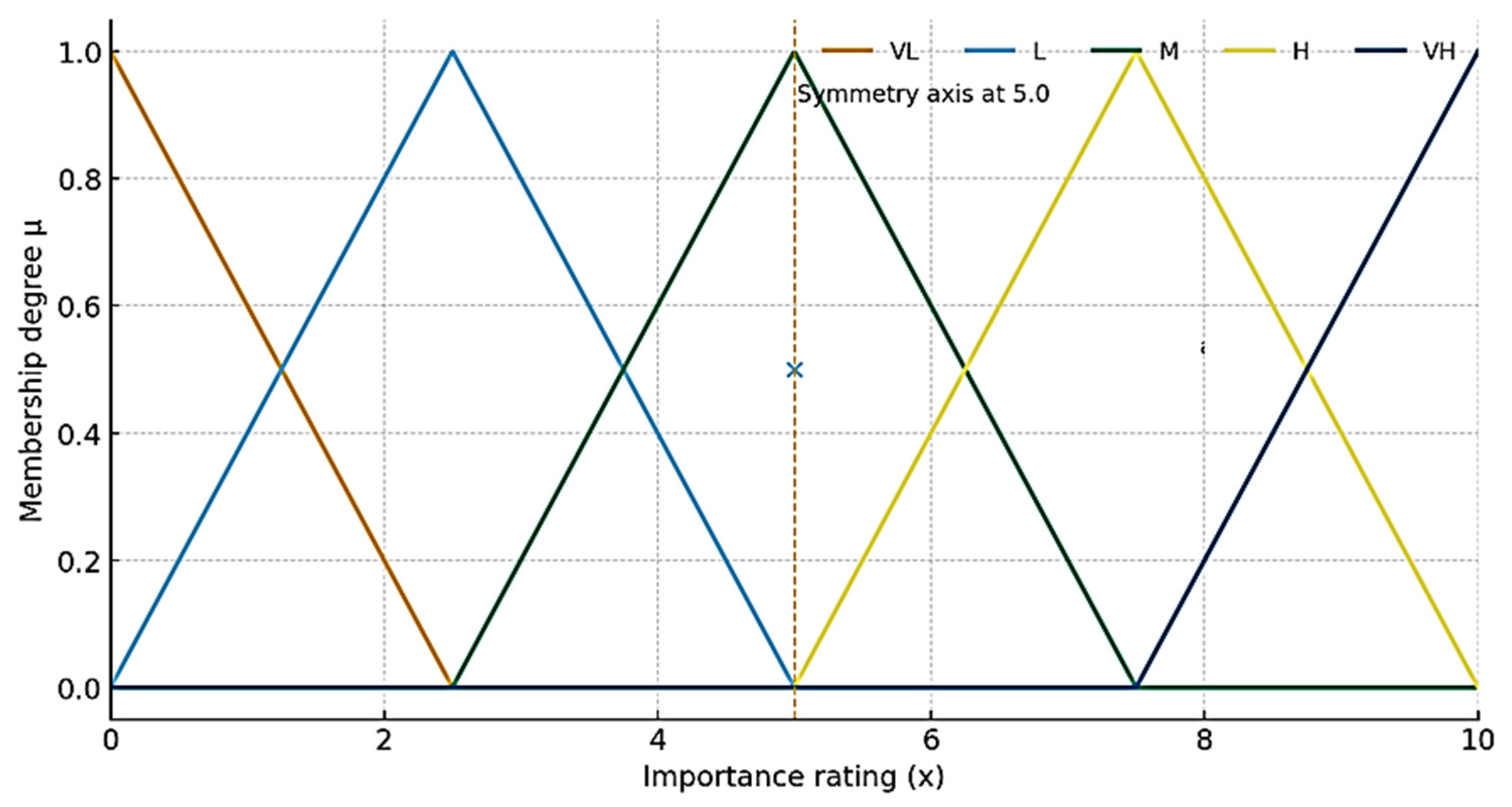
The symmetric and overlapping parameters adopted in this study are summarized in
Table 1 and illustrated in
Figure 2.
The input to the FLM is a direct 0–10 operator rating of criterion importance, where 0 and 10 represent the “not important at all” and “extremely important” extremes, and 5 is the natural neutral midpoint. To cover this universe with five linguistic terms (Very Low, Low, Medium, High, Very High), we adopt a symmetric, equally spaced partition of the [0,10] interval with breakpoints at 0, 2.5, 5, 7.5 and 10. In this construction, the cores of the five triangular membership functions are centered at these points, ensuring that “Medium” is centered at 5, “Low” and “High” are placed at equal distance from the center, and “Very Low” and “Very High” occupy the extremes. This symmetric, 2.5-unit spacing preserves interpretability for the operator, avoids bias toward either end of the scale and yields smoothly overlapping triangular sets that are standard in Mamdani-type fuzzy controllers, while keeping the parametrization simple and transparent.
In this study, the triangular membership functions on the 0–10 importance scale are fixed to a symmetric, equally spaced partition (0–2.5–5–7.5–10) for interpretability, and no further tuning of these parameters is performed. Although the exact MF boundaries are not tuned in this study, the overlapping structure and consistent rule base imply that small shifts of the internal breakpoints would change the derived weights gradually; we therefore expect the identity of the most preferred region of the Pareto surface to remain stable under moderate perturbations of the MF boundaries, even if the detailed ordering of very similar alternatives may vary. Consequently, all fuzzy weights and TMF rankings reported in this paper are conditioned on this specific fuzzy partition, and the effect of alternative membership function parameters is left for future sensitivity analysis.
The core of the FLM is a complete Mamdani rule base (5∙5∙5 = 125 IF-THEN rules) that we generated automatically to ensure coverage of the above triangular functions and to formalize expert knowledge through four hierarchical principles.
The hierarchical principles are the following [
31,
32,
33]:
Competitive Mediation (Trade-off): When two or more conflicting criteria are rated (Very High), their outputs are downgraded to (High), preventing unrealistic dominance in multi-critical scenarios.
Uncontested Dominance: if one criterion is (Very High) and the others are (Medium) or (Lower), the dominant criterion retains its (VH) consequent.
Symmetry: equal input importance ratings must yield equal output weights, ensuring fairness.
Baseline Principle: for all other combinations, outputs mirror the inputs directly.
The principles are applied in a lexicographic (hierarchical) order: first competitive mediation, then uncontested dominance, then symmetry, and finally the baseline rule. For each discrete combination of input linguistic levels (VL, L, M, H, VH) across the three criteria, exactly one rule is generated by checking these principles in that sequence. This guarantees that there is no pair of rules with identical antecedents but different consequents, i.e., no logical contradictions at the rule level. For example, the limiting case (VH, VH, VH) is handled uniquely by the competitive-mediation principle, which downgrades all three outputs to (H, H, H) while remaining consistent with symmetry (all inputs and outputs remain equal). The combination (VH, M, L) is uniquely governed by uncontested dominance, producing (VH, M, L), and (M, M, M) is consistent with both symmetry and the baseline principle, since both prescribe (M, M, M); in the hierarchy this produces a single, non-conflicting rule. By construction, therefore, the 53-rule base has a one-to-one mapping between each linguistic input triplet and its consequent triple, and the limiting cases do not induce contradictory rules.
The rule base follows a complete 53 structure over the three linguistic inputs (SFC importance, NOx importance, PM importance), each described by the terms Very Low (VL), Low (L), Medium (M), High (H) and Very High (VH). Each rule takes the form:
IF SFC importance is A AND NOx importance is B AND PM importance is C
THEN SFC weight is wSFC AND NOx weight is wNOx AND PM weight is wPM.
For example, one concrete rule from the “competitive mediation” region is:
IF SFC importance is Very High AND NOx importance is Medium
AND PM importance is Low
THEN SFC weight is Very High AND NOx weight is Medium AND PM weight is Low.
In this way, all 125 rules are generated by systematically combining the five linguistic levels on each input and assigning consequents that respect the four design principles (competitive mediation, uncontested dominance, symmetry, baseline).
The approach provides comprehensive coverage of input cases while keeping the rule base logically consistent.
In this context, “conflicting criteria” are understood in the standard multi-objective sense: SFC, NOx and PM are all minimized simultaneously on a Pareto front, so an improvement in one dimension typically requires deterioration in at least one of the others. Operationally, the Competitive Mediation principle is therefore triggered whenever two or more important ratings fall into the Very High (VH) linguistic level, regardless of the specific pair, and not on the basis of a numerical conflict index such as correlation or covariance. This threshold-based definition keeps the rule base simple and transparent for operators while remaining consistent with the trade-off structure observed in the Pareto-optimal dataset.
The aggregated fuzzy sets are transformed into crisp outputs via the Centroid of Area (CoA) method [
34,
35,
36]:
where:
: the centroid (defuzzified crisp output) of the aggregated output fuzzy set;
: the output variable of the FLM (here, the pre-normalized weight for a given criterion);
: the aggregated membership function of the output fuzzy set after rule firing and aggregation.
Which results in three preliminary (unnormalized) weights:
,
,
. To ensure comparability across criteria, these are normalized as follows:
where:
,
,
: The pre-normalized (raw) outputs of the FLM after defuzzification (CoA). They are non-negative, on an arbitrary scale, and do not necessarily sum to 1.
wSFC, wNOx, wPM: The normalized weights used by the MCDM method. They are dimensionless proportions in [0,1] that sum to 1 (Σwi = 1). They represent the final, comparable importance shares of the criteria.
The result is a normalized weight ready for integration into MCDM ranking methods such as Proximity Indexed Value (PIV) [
37,
38], Integrated Simple Weighted Sum Product (WISP) [
38,
39], and TriMetric Fusion (TMF) [
24,
39].
MCDM Method Selection: TriMetric Fusion
To evaluate the Pareto front alternatives under the fuzzy-derived weights, we adopt TMF. Our previous algorithm-selection study on two-stroke marine diesel datasets found TMF (along with PIV and WISP) among the most stable and consensus-aligned methods for marine diesel engine applications [
24]. TMF is an advanced MCDM method designed to enhance ranking robustness by synthesizing three distinct, complementary decision metrics into a single consensus index [
39]:
Criteria Aggregated Weighted Index (
CAWI): A linear weighted-sum score that estimates each alternative’s overall utility across all criteria; it rewards consistent overall performance.
where
is the weight of the criterion
and
is the normalized value of the alternative
on criterion
.
Balanced Extreme Criteria Index (
BECI): A non-linear index that penalizes extreme imbalances across criteria, ensuring that strength in one dimension does not mask critical weakness in another; it promotes balanced solutions.
where
is a weighting parameter (default: 0.5), enables flexible control over the influence of best and worst criteria.
Euclidean Distance Metric (
DIS): A geometric measure of proximity to a hypothetical ideal point in the multi-criteria space; a smaller distance indicates a better alternative.
The three metrics are aggregated using a TOPSIS approach [
40]:
where
and
are distances to positive and negative ideal points in the (
CAWI,
BECI,
DIS) metric space.
The fusion of these three perspectives, global utility, balance, and geometric proximity, mitigates the inherent biases of any single metric. This makes TMF highly robust against rank reversals and sensitive to the nuanced trade-offs present in the Pareto front set [
39]. This robustness is crucial when handling the weights produced by the fuzzy module, ensuring that the final ranking is stable and reflective of the operator’s complex priorities.
Figure 3 shows the end-to-end path from operator priorities to a final decision: fuzzy logic produces the weight vector
w, TMF scores and ranks the Pareto candidates, and the top-ranked alternative is selected as the final decision.
TMF handles fuzzy weights smoothly and keeps the final ranking both robust and straightforward across the range of operator importance choices.
From an implementation point of view, the FLM has three input variables (SFC, NOX, PM), each described by five triangular membership functions, which yield a complete Mamdani rule base of
rules. Evaluating one set of operator importance ratings requires: (i) computing the membership degrees of the three inputs, (ii) firing the 125 rules, and (iii) performing centroid defuzzification of a single output. This is a very small number of arithmetic and logical operations and is computationally negligible on any modern shipboard industrial computer. In addition, the FLM is not executed at engine-cycle frequency: it is called only when the operator adjusts the importance ratings or when a new Pareto front is loaded, i.e., on a decision-support time scale of seconds or minutes rather than milliseconds. Although a fully populated Mamdani rule base scale as
with the number of criteria and would become impractical if many additional criteria were introduced, the present design is intentionally restricted to three core engine performance criteria (SFC, NOX, PM), for which 125 rules remain fully tractable. Any future extension to more indicators would not simply extend the rule base to
or
, but would use aggregated bundled criteria, fewer linguistic terms, or sparse/hierarchical rule bases to avoid combinatorial growth.
In this study, TMF is not proposed or evaluated as a new MCDM algorithm; rather, it is adopted as a fixed, previously validated ranking core. A dedicated algorithm-selection study on two-stroke marine diesel engine datasets was already conducted in our earlier work [
40], where TMF, TOPSIS, PIV, WISP and other methods were systematically compared under classical crisp and equal-weight settings using rank correlation and robustness criteria. That analysis identified TMF (along with PIV and WISP) as one of the most stable and consensus-aligned methods for marine diesel applications [
24].
Thee present paper, we therefore treat TMF as a representative, robust MCDM algorithm and focus exclusively on the operator-defined fuzzy weighting module, avoiding a new algorithm-comparison exercise that would conflate the effect of the fuzzy weights with differences between MCDM cores. The FLM is, by design, method-agnostic: the fuzzy-derived weights could be coupled with TMF, TOPSIS, WISP, PIV or other ranking methods without changing the structure of the weighting module itself.
3. Case Study: Applying Fuzzy-Derived Weights in TMF to Select the Final Operating Point
The newly elaborated fuzzy weighting methodology was demonstrated on a virtual S60-type model calibrated on S60MC-C8.8 data. This virtual engine is a low-speed, two-stroke crosshead marine diesel engine, a widely used main engine type in merchant shipping. The engine has six in-line cylinders with a bore of 600 [mm] and a stroke of 2400 mm, and a maximum continuous rating of approximately 19 [MW] (≈25,500 HP) at about 100–105 [r/min], corresponding to a mean effective pressure of ~21 [bar]. The dataset and Pareto front analyzed in this study are identical to those generated in our previous work [
24], where engine performance was simulated using a validated thermodynamic model implemented in (Diesel-RK v4.189).
In [
24], a full Diesel-RK model of the MAN B&W S60-MC-C8-8 engine was calibrated to reproduce the published full-load project-guide data. The fuel-injection profile was constructed from experimentally measured rate-of-injection curves used for combustion-model calibration in large two-stroke engines, ensuring realistic heat-release phasing. Diesel-RK’s multi-zone combustion and emission sub-models (including Moss–Brookes soot nucleation and Razleytsev oxidation) have been benchmarked against MAN B&W test-bed measurements, achieving mean absolute errors below 5% for particulate matter and providing reliable trends for
SFC and
NOX in low-speed marine applications. The simulation data underlying the Pareto front used here can be regarded as physically consistent and adequate for the comparative decision-making analysis performed in this paper.
Diesel-RK is a high-fidelity thermodynamic simulation tool widely used in marine engine research and optimization [
40,
41,
42].
The Pareto front was generated using Non-dominated Sorting Genetic Algorithm II (NSGA-II), and reflects the balance of three conflicting criteria, all of which are minimized:
Specific Fuel Consumption SFC [g/kWh]: lower values represent improved economic efficiency.
Nitrogen Oxides NOX [g/kWh]: lower values ensure compliance with IMO Tier III emission limits.
Particulate Matter PM [mg/kWh]: lower values reduce environmental and health impacts.
The Pareto front used in this study is not generated on an unconstrained functional of
SFC,
NOX and
PM. It originates from our previous optimization framework [
24], where a thermodynamically calibrated model of a MAN B&W S60-MC-C8-8 two-stroke engine was simulated at full-load conditions, delivering 19,003 kW at 105 rpm (
BMEP = 20 bar). Within this framework, six controllable parameters were varied: pre-injection start of injection (
SOI), pre-injection fuel mass fraction, dwell time between pre- and main injections, common-rail fuel pressure, and the timings of Exhaust Valve Opening (
EVO) and Exhaust Valve Closing (
EVC). The ranges of these variables were defined using MAN technical guides, Diesel-RK calibration and combustion-stability considerations. The design space was constrained by regulatory and mechanical limits, namely
SFC ≤ 0.20 kg/kWh,
NOX ≤ 3.4 g/kWh and
PM ≤ 0.15 g/kWh (IMO Tier III for slow-speed engines), combustion duration between 0.35° and 45° CA, peak cylinder pressure
bar, and maximum pressure-rise rate
bar/°CA [
40]. Consequently, every alternative on the Pareto front corresponds to a feasible, full-load operating point at fixed power and speed, and non-operational solutions such as an ‘engine-off’ state are not part of the admissible decision set. In the present work, this constrained Pareto front is treated as fixed input data; the focus is exclusively on how operator-defined fuzzy weights reshape the ranking of these already feasible alternatives within the MCDM framework.
NSGA-II is a widely adopted evolutionary algorithm for multi-objective optimization that efficiently approximates the Pareto front via fast non-dominated sorting, crowding-distance diversity preservation, and elitist selection. These features yield a well-spread, high-quality set of non-dominated solutions with modest parameter sensitivity and good scalability to many alternatives. NSGA-II is particularly suitable for engine studies where objectives are conflicting [
43,
44].
The resulting non-dominated configurations represent realistic trade-offs among efficiency and emissions, forming the decision matrix for this study.
It is important to emphasize that the Pareto front is treated as fixed input data; the focus here is not on the optimization process but on how operator-defined fuzzy weights reshape the ranking of these alternatives (operating points) within the MCDM framework. In this study, an operating point (also referred to as an alternative) denotes a unique, steady-state engine operation configuration and its evaluated outcomes under.
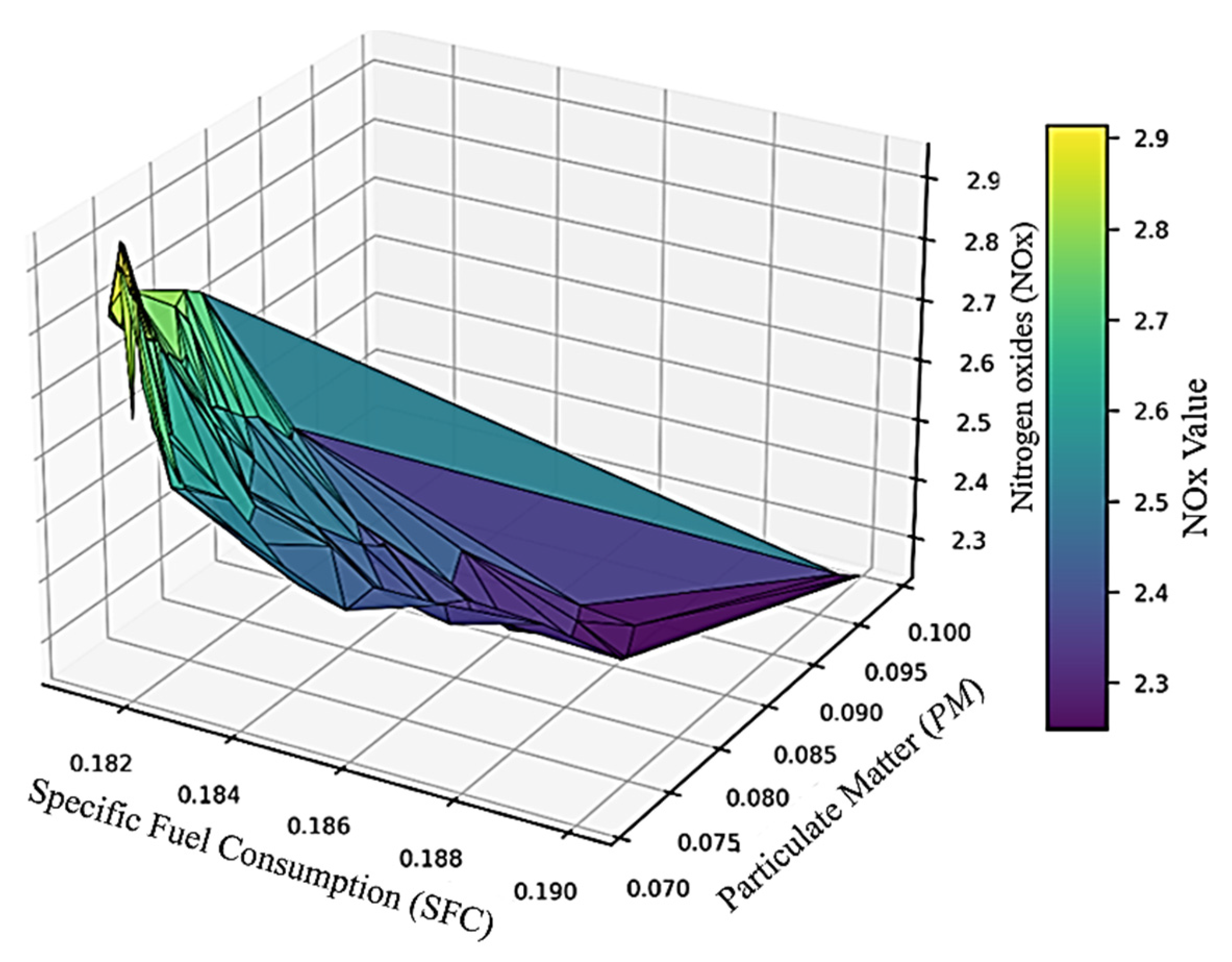
The resulting Pareto front (
Figure 4) exhibits a clear convex shape, highlighting distinct operating points. It demonstrates that increases in
PM consistently accompany increases in
SFC and decreases in
NOX emissions, reflecting the well-established
NOX–PM trade-off in diesel combustion.
The outcome of the optimization process is a set of
m non-dominated engine operating points, denoted as alternatives
Ai (
i = 1, 2, …
m). Their performance values across the three criteria are structured into a decision matrix
D:
The Pareto front was generated by NSGA-II configured with a population size of P = 1000 individuals and G = 200 generations, using simulated-binary crossover (probability 0.9) and polynomial mutation within the six-dimensional decision space. Candidate solutions were evaluated by a neural-network surrogate model and constrained by Tier-III-motivated emission and safety limits (e.g.,
Pmax ≤ 170 bar, dp/dθ ≤ 4 bar/°CA, 35° ≤ D ≤ 45° CA, PM ≤ 0.15 g/kWh,
NO ≤ 3.4 g/kWh,
SE ≤ 3.5). The complete description of NSGA-II parameter tuning and convergence diagnostics for this configuration is provided in [
24] and is not repeated here to keep the present paper focused on the fuzzy weighting and decision-support layer. The NSGA-II optimization converged on a fixed Pareto set comprising
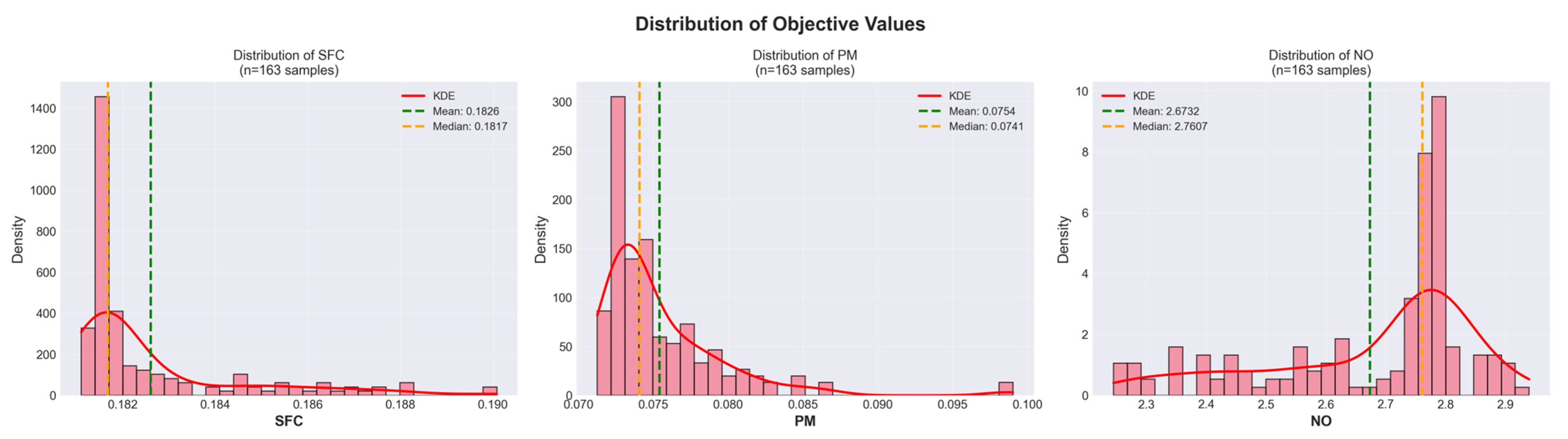
m = 163 non-dominated operating points. This number represents the final population of optimal trade-off solutions identified by the algorithm. A concise statistical summary of the 163 Pareto-optimal alternatives is reported in
Appendix A (
Table A2). Across the set,
SFC has a mean value of 0.1826 with a standard deviation of 0.0019 and a range of [0.1811–0.1901],
PM has a mean of 0.0754 with a standard deviation of 0.0042 and a range of [0.0713–0.0990], while
NOX has a mean of 2.6732 with a standard deviation of 0.1756 and a range of [2.2447–2.9392]. The empirical distributions of
SFC,
PM and
NOX over these 163 Pareto-optimal alternatives are illustrated in
Figure 5.
The performance values of these 163 alternatives for the three criteria are structured into the decision matrix
in Equation (4).
Table 2 lists representative rows of
. (Note: For completeness, the full version of
Table 2 (all
Pareto alternatives) is provided in
Appendix A).
The NSGA-II optimization converged on a fixed Pareto set comprising
m = 163 non-dominated operating points. This number represents the final population of optimal trade-off solutions identified by the algorithm. The performance values of these 163 alternatives for the three criteria are structured into the decision matrix
in Equation (4).
Table 2 lists representative rows of
. (Note: For completeness, the full version of
Table 2 (all
Pareto alternatives) is provided in
Appendix A). The numerical entries in
Table 2 and
Appendix A are calculated based on the calibrated Diesel-RK simulations for each Pareto-optimal operating point.
The normalized fuzzy-derived weight will be applied within the TMF algorithm to the decision matrix of
Table 2, transforming the operator’s imprecise priorities for each criterion into a concrete ranking of engine alternatives.
4. Results and Discussion
4.1. Operator-Priority Scenarios and Fuzzy Weight Generation
To validate the proposed fuzzy weighting module, we evaluated its performance across four representative operational scenarios. These scenarios capture a range of realistic operator priorities, from focused single-objective emphasis to complex multi-criteria trade-offs. For each operator, priorities are provided as importance ratings (for SFC, NOX, and PM) on a 0–10 scale, and converted by the fuzzy module into a valid normalized weight vector
with
, to use by the MCDM ranking procedure.
The four tested scenarios are the following:
Fuel-Economy Priority: Simulate open-sea operation, where fuel cost is paramount. Inputs reflect a high priority for SFC (7.0) with moderate concern for NOX (5.0) and lower priority for PM (3.0).
Strict Environmental Compliance: The ship’s entry into an Emission Control Area (ECA), where emissions limits are critical. Inputs show low priority for SFC (2.5) and very high priorities for both NOX (8.5) and PM (8.0).
Balanced Performance: This represents neutral conditions or a general operational philosophy, with all three criteria given equal importance (5.0, 5.0, 5.0).
High Competition (Trade-off): The challenges the system faces with two simultaneously dominant criteria (SFC and NOX at 9.0) and one neglected criterion, PM (2.0), testing the module’s ability to mediate competing priorities.
It should be noted that, in this paper, these four scenarios are used as conceptual operator archetypes rather than empirically elicited preference distributions; they are intended to span typical extremes in practice (fuel-cost driven operation, strict emission constraints, neutral conditions, intense commercial pressure) and to test the behavior of the fuzzy weighting module under clearly differentiated priority settings. The resulting normalized fuzzy-derived weights for each scenario are presented in
Table 3.
The results in
Table 3 demonstrate the fuzzy module’s effective and logical translation of operator preferences:
In Scenario 1, the high input for SFC is correctly translated into the most significant weight (0.459), ensuring it will be the dominant factor in the final MCDM ranking.
Scenario 2 shows a decisive shift in emphasis towards the emission criteria, which together account for over 84% of the total weight (0.474 + 0.373), effectively aligning the system with ECAs compliance requirements.
As expected, Scenario 3 yields perfectly uniform weights, providing a neutral baseline for comparison.
Most importantly, Scenario 4 clearly illustrates the action of the fuzzy rule base’s trade-off mediation principle. Although both SFC and NOX were given identical, very high input importance (9.0), the system did not assign them disproportionately high weights. Instead, it balanced them at 0.422 each, preventing a single criterion from unrealistically dominating the decision. This demonstrates the module’s ability to generate rational and balanced weights even under conflicting, high-stakes priorities, a significant advantage over simple linear normalization.
These four scenarios represent typical operating contexts of an ocean-going cargo vessel driven by a low-speed main engine and fixed-pitch propeller: long-duration open-sea cruising (Fuel Economy Priority), operation within or near Emission Control Areas (Strict Environmental Compliance), neutral or ‘average’ trading conditions (Balanced Performance), and periods of heightened commercial pressure or schedule constraints (High Competition). In all cases, the underlying propulsion configuration remains the same; only the operator’s prioritization of SFC, NOx and PM changes.
In this study, the optimization data are restricted to a single steady-state operating regime corresponding to the full-load design condition of the main engine on the propeller curve. All Diesel-RK simulations and all non-dominated points used here were obtained at 100% load and a fixed speed of approximately 105 r/min, representative of the vessel’s design service condition. The underlying NSGA-II optimization based on our previous work [
45] varied six controllable parameters within ranges defined by MAN project-guide recommendations, Diesel-RK calibration and combustion-stability considerations. Mechanical and environmental constraints were enforced to filter infeasible operating points. Consequently, every alternative on the Pareto front analyzed in this paper corresponds to a feasible full-load operating point of the selected low-speed marine diesel engine, rather than to multiple distinct load or speed regimes
It is worth noting that in comparison with Entropy and CRITIC for the same Pareto data, almost all importance is on NOX, whereas the FLM correctly reproduces a neutral operator stance (5–5–5) as equal weights.
The results in
Table 4 show that, for the same three criteria and underlying Pareto front, objective methods assign extremely skewed importance, with Entropy and especially CRITIC concentrating almost all weight on
NOx due to its larger variance and strong negative correlation with
SFC and
PM. In contrast, when the operator declares “balanced” importance (5–5–5), the FLM returns equal weights, which are fully transparent and directly interpretable as a neutral stance between
SFC,
NOx and
PM.
4.2. Fuzzy System Behavior and Trade-Off Analysis
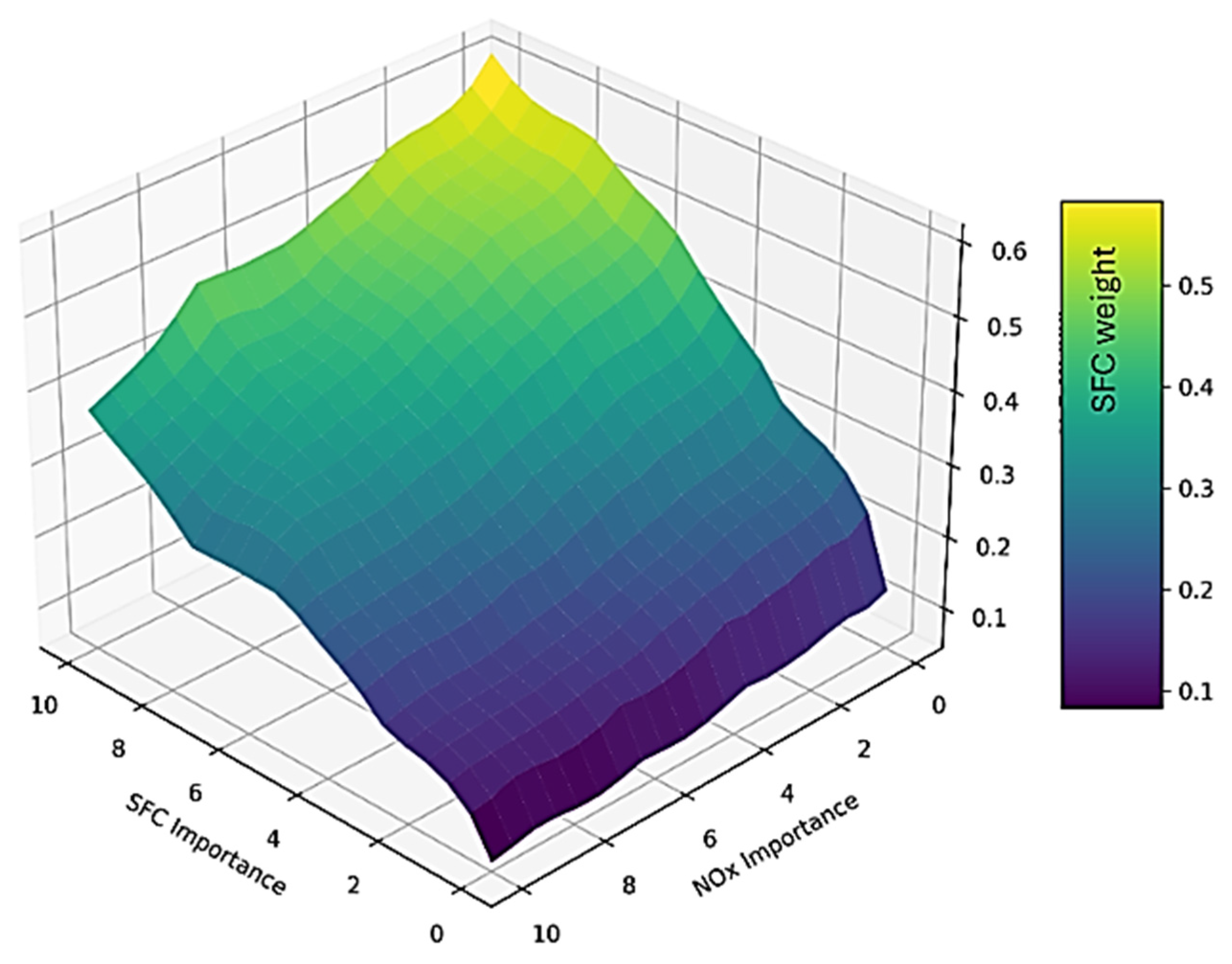
To further validate the logical consistency of the fuzzy rule base and provide intuitive insight into its decision-making process, we analyzed the system’s response surface.
Figure 6 illustrates
SFC weight as a function of both SFC importance and
NOX importance, while PM importance is constant at a neutral value of 5.0.
The response surface highlights three properties of the proposed weighting module, summarized as follows:
The surface demonstrates that SFC weight increases most significantly (reaching approximately 0.55–0.60) when SFC importance is high (8–10) while NOX importance is low (0–3). This region represents scenarios where fuel economy is the priority, and the system correctly reflects the SFC weighting accordingly.
Most importantly, the surface clearly visualizes the “Competitive Mediation” principle encoded in the rule base. When both SFC and NOX importance are simultaneously high, the system actively suppresses their individual weights to prevent either criterion from dominating unrealistically. Instead of reaching extreme values (>0.7), the SFC weight plateaus at approximately 0.35–0.45, ensuring balanced consideration of both competing priorities.
The surface varies gradually without abrupt jumps: small changes in importance ratings lead to only small changes in the resulting weights. This behavior indicates that the rule base and membership functions interact coherently and produce stable, predictable outputs, which is important for operators in the decision-support system.
The fuzzy weighting module translated imprecise operator preferences into mathematically sound weights that reflect both individual criterion importance and the necessary compromises between competing objectives.
4.3. Impact of Fuzzy Weights on MCDM Ranking
The most crucial test of the fuzzy weighting module is its ability to drive the MCDM process to select distinct, context-appropriate operating points from the Pareto front set. Using TMF with the fuzzy-derived weights from
Section 4.1, the engine configurations were ranked for each operational scenario. The top-ranked alternatives and their performance values are presented in
Table 5, which provides a direct, quantitative view of the trade-offs being made.
The results in
Table 5 demonstrate that the fuzzy-derived weights effectively reconfigure the TMF ranking by altering the valuation of the inherent performance trade-offs between alternatives, leading to distinct, priority-driven selections.
- •
Fuel Economy Priority: The high SFC weight (0.460) made Alternative 27’s superior fuel economy the dominant factor. The TMF algorithm prioritized this alternative because its key strength aligned perfectly with the primary operator objective, accepting its higher emissions as a trade-off for significant cost savings.
- •
Strict Environmental Compliance: The high emission weights (+
= 0.847) caused a fundamental shift, making low emissions the critical determinant. Alternative 4 rose to the top as its excellent low-NOX and low-PM performance became the most valuable asset. Conversely, Alternative 27 was penalized because its high emissions became a severe liability under this priority, despite its fuel efficiency.
- •
Balanced Performance: Under equal weights, the TMF algorithm identified Alternative 4 as the most robust compromise TMF identified Alternative 4 as the most robust compromise. While this alternative excels in emissions reduction, its selection under balanced weights suggests TMF prioritizes avoiding severe performance deficits in any criterion, making it the least risky choice despite its fuel economy trade-off.
- •
High Competition (Trade-off): This scenario highlights the fuzzy system’s nuanced mediation. Despite SFC and NOX having equal, high importance, Alternative 4 was selected over Alternative 27. This outcome demonstrates that the cost of 27 high NOx emissions was deemed unacceptable relative to its SFC benefit. The system effectively prevented a single criterion from dominating, with TMF favoring the alternative that, while less fuel-efficient, avoids a critical failure in the equally weighted NOX criterion.
From a technological standpoint, the top-ranked configurations in
Table 5 are realistic full-load operating points of a calibrated MAN B&W S60-MC-C8-8 Diesel-RK model, all constrained by peak pressure, pressure-rise rate, combustion duration and IMO Tier III emission limits; none of them corresponds to an extreme or mechanically unsafe regime. The scenario-dependent selections follow well-known
SFC–NOX–PM trade-offs in low-speed diesel combustion, fuel-economy oriented solutions reduce
SFC at the cost of higher
NOX/PM, whereas strict-compliance solutions accept modest
SFC penalties for lower emissions, so the fuzzy-weight–driven rankings reorganize an already feasible set of operating points according to operator-defined priorities rather than proposing technologically implausible settings.
To quantify the structural divergence in rankings introduced by the four operator-priority scenarios, Spearman’s rank correlation coefficient (
ρ) was computed for all scenario pairs (
Table 6). For the 163 Pareto-optimal alternatives, the resulting coefficients range from
ρ = 0.824 to
ρ = 0.983, indicating strong to very strong monotonic agreement between the scenario-specific TMF rankings.
For each pair of scenarios, the associated p-value was below 0.0001 (two-tailed test), so all correlations are statistically significant at the α = 0.05 level. In other words, the probability of obtaining such high ρ values under the null hypothesis of independent rankings is negligible, and we can conclude that the TMF rankings remain highly consistent across the Fuel Economy, Environmental Compliance, Balanced Performance and High Competition scenarios, despite their intentionally different fuzzy weight vectors.
Spearman’s rank correlation coefficient measures the monotonic relationship between two ranked lists. A value of +1 indicates perfect agreement in ranking, 0 indicates no relationship, and −1 indicates a perfect inverse relationship [
46,
47]. In this context, it quantifies how similarly the MCDM method ranked the 163 Pareto alternatives under different weighting scenarios.
The high correlation values observed can be attributed to the fundamental nature of the input data: a Pareto front set. Since all alternatives are non-dominated, each represents an optimal trade-off. Consequently, significant shifts in criterion weights are required to cause a substantial re-ordering of the top-ranked alternatives. The high correlations between specific scenarios indicate that their respective fuzzy weight sets were not sufficiently distinct to overcome the inherent “good quality” of all solutions on the front. Furthermore, the analysis reveals a clear, strong correlation cluster Scenario 1 (Fuel Economy) with Scenario 3 (Balanced), and Scenario 2 (Strict Compliance) with Scenario 4 (High Competition). This indicates that these paired scenarios share a high similarity, producing near rankings. Most importantly, the weakest correlations (e.g., ρ ≈ 0.82) occur between Scenario 1 (Fuel Economy) and Scenario 4 (High Competition). This demonstrates that the fuzzy weighting module is indeed capable of generating weight sets distinct to drive a fundamental re-ranking, effectively segmenting the Pareto front into different preference-based groups despite the inherent similarity of the non-dominated alternatives.
In addition to the pairwise correlations between scenarios, a sensitivity analysis was performed to assess how robust the TMF rankings are to small perturbations in the fuzzy weights. For each operator-priority scenario, the three criteria were randomly perturbed by ±5% around their baseline values and then renormalized to sum to one. For each scenario, 100 perturbed weight sets were generated; for each perturbed set, the TMF ranking of the 163 Pareto alternatives was recomputed and compared to the baseline ranking.
For each scenario, we recorded (i) the total rank change, defined as the sum of absolute rank differences over all 163 alternatives, and (ii) Spearman’s
between the perturbed and baseline rankings. The mean Spearman correlations were 0.9940 (Fuel Economy Priority), 0.9934 (Environmental Compliance), 0.9878 (Balanced Performance) and 0.9985 (High Competition), with corresponding minimum values of 0.9700, 0.9210, 0.9507 and 0.9800, respectively. Across all scenarios and trials, the overall mean
was 0.9934 and the worst-case
observed was 0.9210, indicating that the TMF rankings are highly robust to ±5% uncertainty in the fuzzy weights.
In terms of rank shifts, the maximum total change observed in a single trial was in the range of 139–152 rank positions across all 163 alternatives, while the average total rank change per perturbation was approximately 95.5 positions. This corresponds to less than one rank position per alternative on average (≈0.6), confirming that individual alternatives move only slightly under small weight perturbations and that the global ordering of Pareto-optimal operating points remains stable.
In addition,
Table 7 shows that, for all four operator-priority scenarios, the TMF rankings produced under FLM weights are strongly correlated with those obtained from Entropy and CRITIC weights, with Spearman’s
ranging from 0.708 to 0.973. This confirms that the overall ordering of Pareto-optimal operating points is robust across weighting philosophies: even when the underlying weights are defined either by operator-driven fuzzy ratings or by purely objective entropy/contrast measures, the resulting rankings remain very similar. The added value of the proposed FLM is therefore not in creating radically different rankings, but in providing a transparent and interpretable interface for encoding operator preferences (via 0–10 importance ratings and an explicit fuzzy rule base), while still delivering rankings that are consistent with established objective weighting schemes.
From an implementation perspective, the FLM and TMF ranking pipeline were implemented in Python 3.13 environment with standard scientific libraries such as NumPy and scikit-fuzzy (a.k.a. skfuzzy).
5. Conclusions
This study introduced a self-contained, operator-defined Fuzzy Weighting Module (FLM) that converts imprecise importance ratings for SFC, NOX, and PM into normalized MCDM weights and integrates them with TriMetric Fusion (TMF) for final selection from a fixed Pareto set. The module’s Mamdani design (with symmetric, overlapping triangular membership functions and a complete 53 rule base) yields smooth responses and explicitly mediates trade-offs to prevent unrealistic dominance. Scenario tests confirmed that the FLM produces transparent, stable weight vectors that align rankings with stated priorities (fuel-economy, strict-compliance, balanced, and high-competition cases). Response-surface analysis demonstrated logical internal reasoning (e.g., competitive mediation when multiple criteria are rated very high). At the same time, Spearman’s rank correlation coefficient showed both strong within-cluster agreement and meaningful cross-cluster divergence, showing that preference shifts induce interpretable re-rankings even among non-dominated alternatives. Together, these results validate the framework as a robust bridge between operator intuition and quantitative decision-making, enabling context-aligned selection.
In the context of conventional low-speed marine diesel engines, the proposed fuzzy weighting and TMF ranking module is intended as a decision-support component that operates on a pre-computed set of feasible operating points, obtained from high-fidelity simulation, experimental data or digital-twin models. It can be integrated either at the design/retrofit stage or as a higher-level advisory layer on board, where existing engine control systems remain unchanged and the fuzzy–MCDM module merely ranks admissible alternatives according to operator-defined priorities and current regulatory or economic conditions. Ultimately, the Pareto front, FLM, and TMF pipeline offers a practical, transparent path to deploy preference-aware decision support for two-stroke marine diesel engines under evolving operational and regulatory demands.
In conclusion, the fuzzy weighting module captures the imprecision of human preference, with the response surface confirming its logical and consistent internal reasoning. Most critically, when integrated with TMF, these weights consistently select the best, context-driven operating point from the Pareto front set. This end-to-end function offers a dynamic and transparent decision-support tool that can readily adapt to evolving operational and regulatory demands in the maritime industry.
From an implementation standpoint, the proposed FLM module is intended as a decision-support layer on top of existing shipboard monitoring and control systems rather than as a direct engine controller. In a realistic deployment, the Pareto-optimal operating points would be generated and updated onshore using high-fidelity engine simulation (and, in later phases, operational data) and then transferred to the vessel as a compact Pareto database. Onboard, a lightweight implementation of the neural surrogate and FLM ranking module can run on an engine control room workstation or integrated performance-monitoring server, continuously receiving key process signals (engine load, speed, fuel consumption, exhaust temperatures and NOX) from the ship’s monitoring unit. The system filters the Pareto set to the current operating condition and allows the engineer to adjust the importance of SFC, NOX and PM. Whenever the operator updates these preferences, or when a major operating change occurs, such as entering or leaving an ECA, the FLM converts the ratings into criterion weights, TMF recomputes the ranking in less than a second, and the interface presents a small set of recommended engine settings (e.g., injection timing/pressure and EGR rate) together with the predicted fuel and emission levels and constraint margins. Because the computational load is modest and the update frequency is tied to human decision-making (seconds to minutes) rather than engine-cycle dynamics, the FLM module can be integrated into current onboard performance-monitoring platforms without compromising engine safety or control authority, while providing a practical, operator-configurable tool for navigating fuel–emissions trade-offs in daily operation.
A key limitation of the present study is that the operator importance ratings for SFC, NOX and PM are scenario-based rather than empirically elicited. The four considered scenarios represent conceptual operator archetypes, not statistically derived preference distributions from engine officers. Future work will therefore extend the framework with structured expert-elicitation studies (e.g., surveys or workshops with watchkeeping and engineers) to validate the fuzzy weighting module and TMF rankings against real operator preferences and to analyze inter-operator variability.
Beyond the absence of empirically elicited operator preferences in this first demonstration, several methodological boundaries of the present work should be noted. First, the current results are associated with a specific fuzzy partition (0–2.5–5–7.5–10) and an expert-designed 53 rule base; we have not yet explored data-driven or optimization-based tuning of membership functions and rules, so investigating alternative fuzzy parametrizations remains an open topic for future work. Second, the use of TriMetric Fusion as the MCDM core reflects our previous algorithm-selection study, where TMF was identified as a stable and consensus-oriented method for this engine Pareto set. We do not claim global superiority for TMF over other MCDM methods such as TOPSIS, WISP or PIV; in this work, TMF is used as a representative, previously validated ranking scheme to demonstrate the coupling between the fuzzy weighting module and a robust MCDM core. Based on our earlier comparison, we expect other well-behaved MCDM methods to favor similar regions of the Pareto surface, even though the exact top-k ordering may differ; quantifying such cross-method agreement under fuzzy weighting is left for future work. The underlying Pareto front itself is taken as fixed input from our earlier NSGA-II–based optimization study; the present contribution is limited to the fuzzy weighting and decision-support layer operating on this pre-computed set of feasible, Tier III-compliant operating points. Third, extending the methodology to multi-load, multi-speed datasets and realistic operating profiles is an important direction for future work.