
Digital Telecommunications in Medicine and Biomedical Engineering: Applications, Challenges, and Future Directions
 , ,
, , 

Abstract
1. Introduction
- Summarize the state of the art in telecommunications-enabled healthcare applications, including telemedicine, remote patient monitoring, wearable devices, big data, and AI-driven systems.
- Critically identify and evaluate the benefits and limitations of these technologies in real-world healthcare settings.
- Highlight future directions for research and development, with particular emphasis on next-generation telecommunications and their role in enabling reliable, scalable, and patient-centered care.
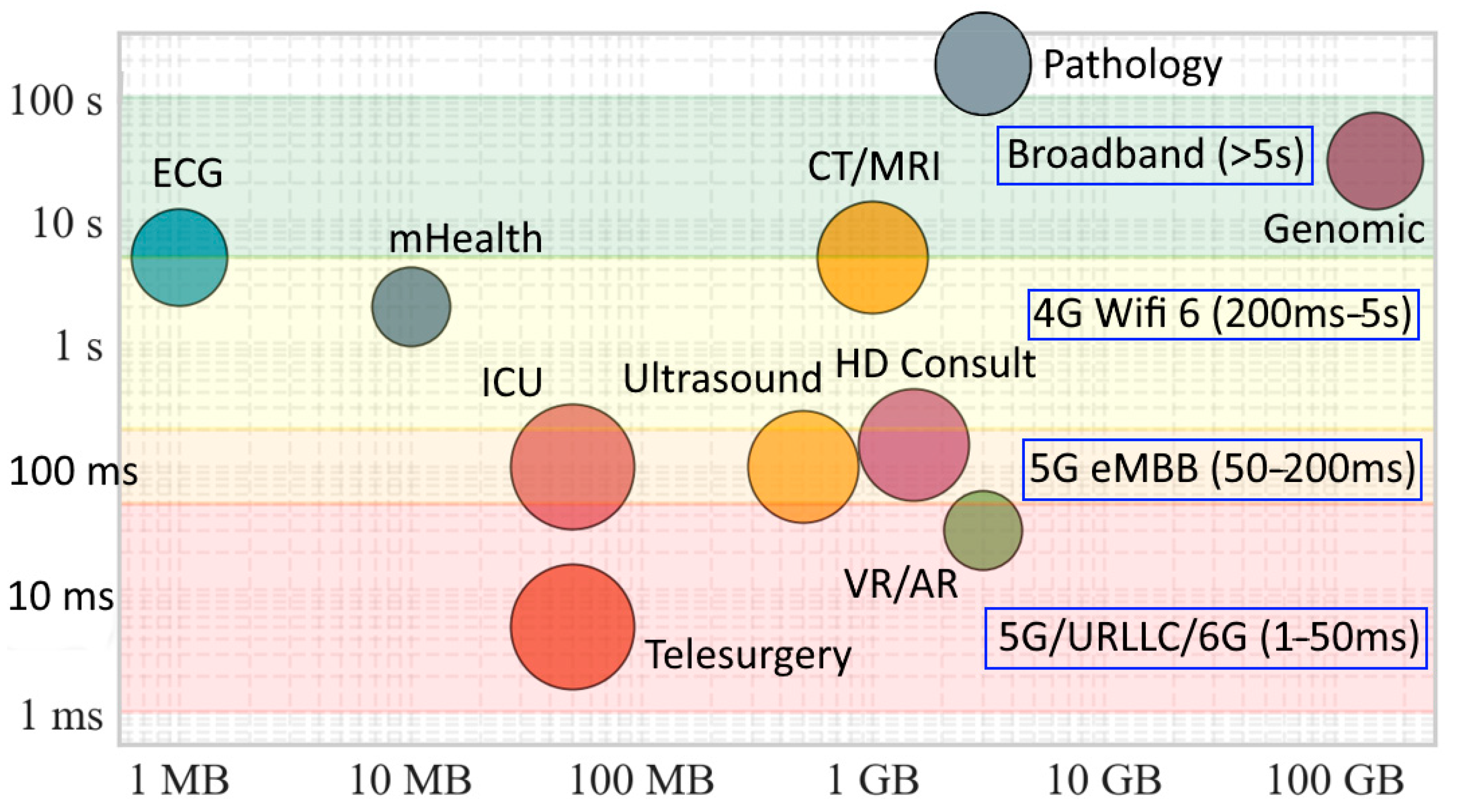
- Real-time interactive systems (telemedicine, telesurgery, and VR/AR);
- Continuous monitoring ecosystems (RPM, wearable IoMT, and edge computing);
- Data-intensive intelligence (AI/ML, genomics, and big data analytics).
2. Review Methodology
2.1. Research Question
2.2. Search Strategy
2.3. Inclusion and Exclusion Criteria
- The role, architecture, or evaluation of telecommunications technologies in healthcare/biomedical contexts.
- Biomedical/clinical applications enabled by digital connectivity (e.g., telemedicine, RPM, AI diagnostics).
- System-level challenges, ethics, security, or emerging paradigms (e.g., federated learning, 6G, digital twins).
2.4. Thematic Synthesis and Review Structure
3. Telemedicine: Evolution, Modes, and Core Technologies
3.1. Evolution of Telemedicine
3.2. Modes of Telemedicine
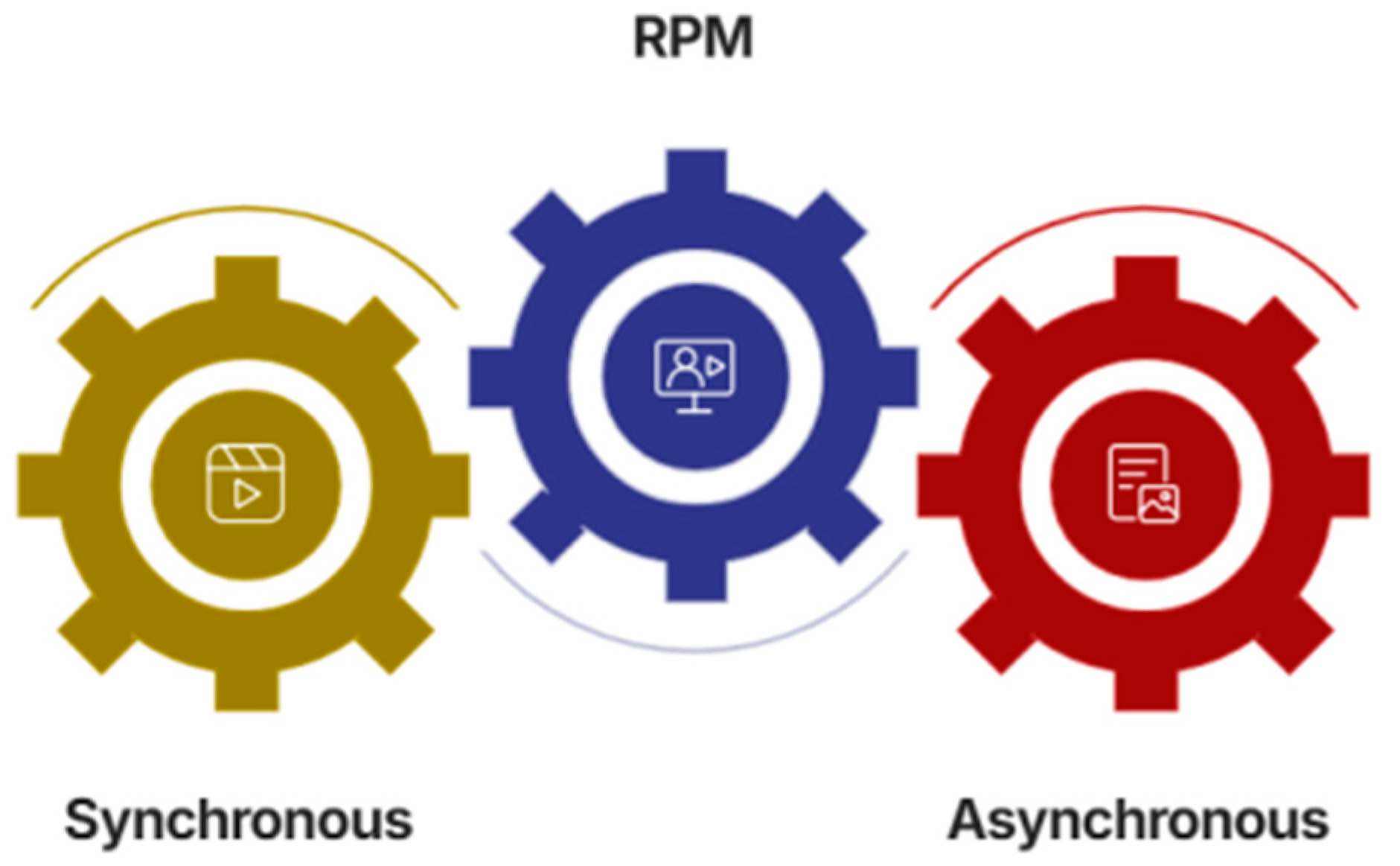
- Synchronous or real-time telemedicine, which allows immediate interaction between patient and clinician through video conferencing or voice calls. It is widely used in tele-psychiatry, tele-emergency, and remote triage.
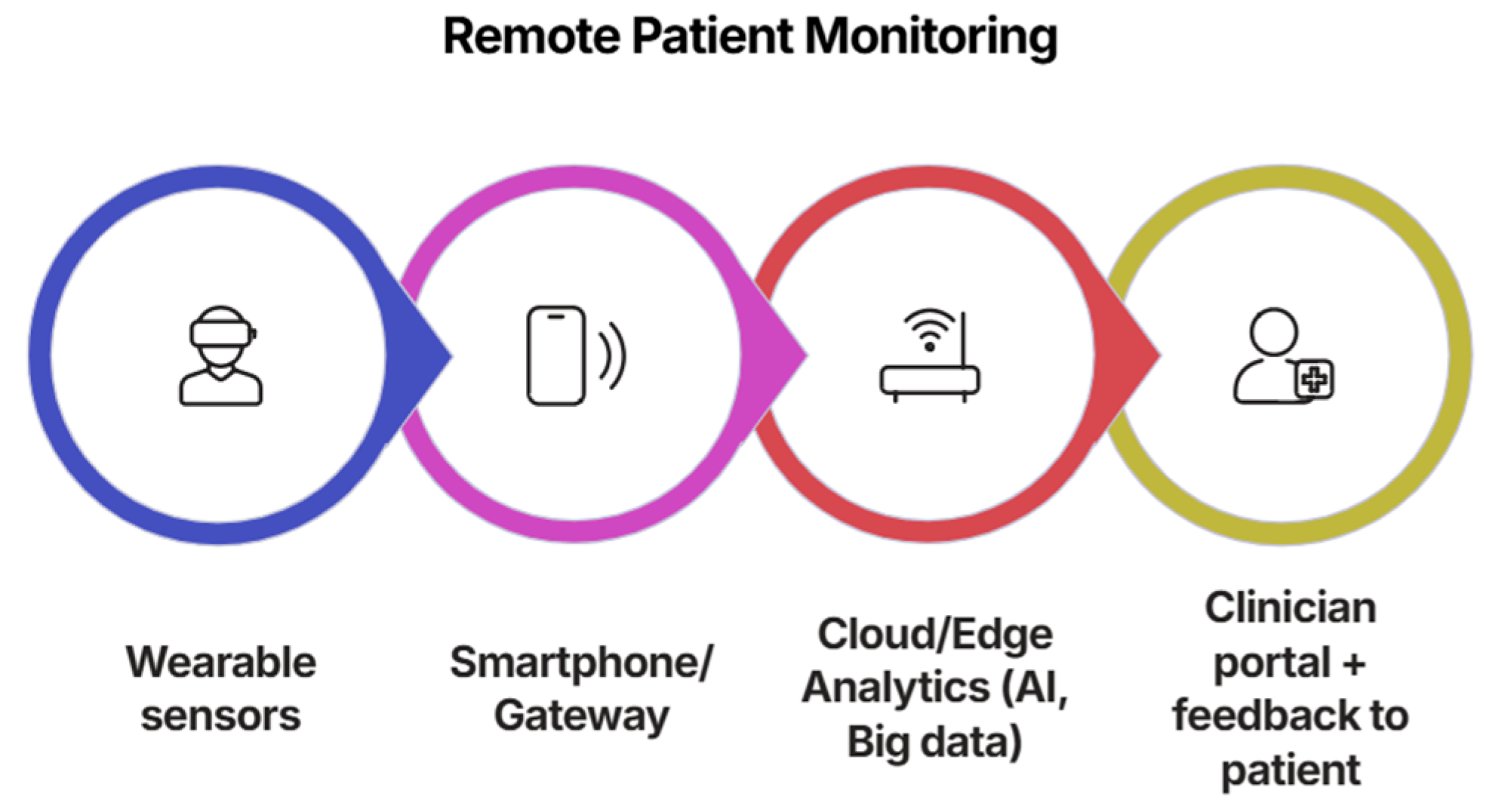
- Remote patient monitoring (RPM) that continuously transmits physiological data from sensors or wearable devices to healthcare providers. This approach is vital for chronic disease management, post-operative care, and elderly monitoring [27].
3.3. Core Telecommunications Technologies
- Edge computing reduces latency by processing data near the patient, allowing faster clinical feedback in critical scenarios [31].
- Cloud infrastructure supports data aggregation, analytics, and secure storage, enabling integration with electronic health records (EHRs).
- Artificial intelligence (AI) tools enhance teleconsultations through automated triage, image interpretation, and voice-based symptom screening.
3.4. Benefits and Current Limitations
3.5. Critical Analysis and Comparative Perspective
3.6. Outlook
4. Remote Patient Monitoring (RPM) and Wearable Biomedical Devices
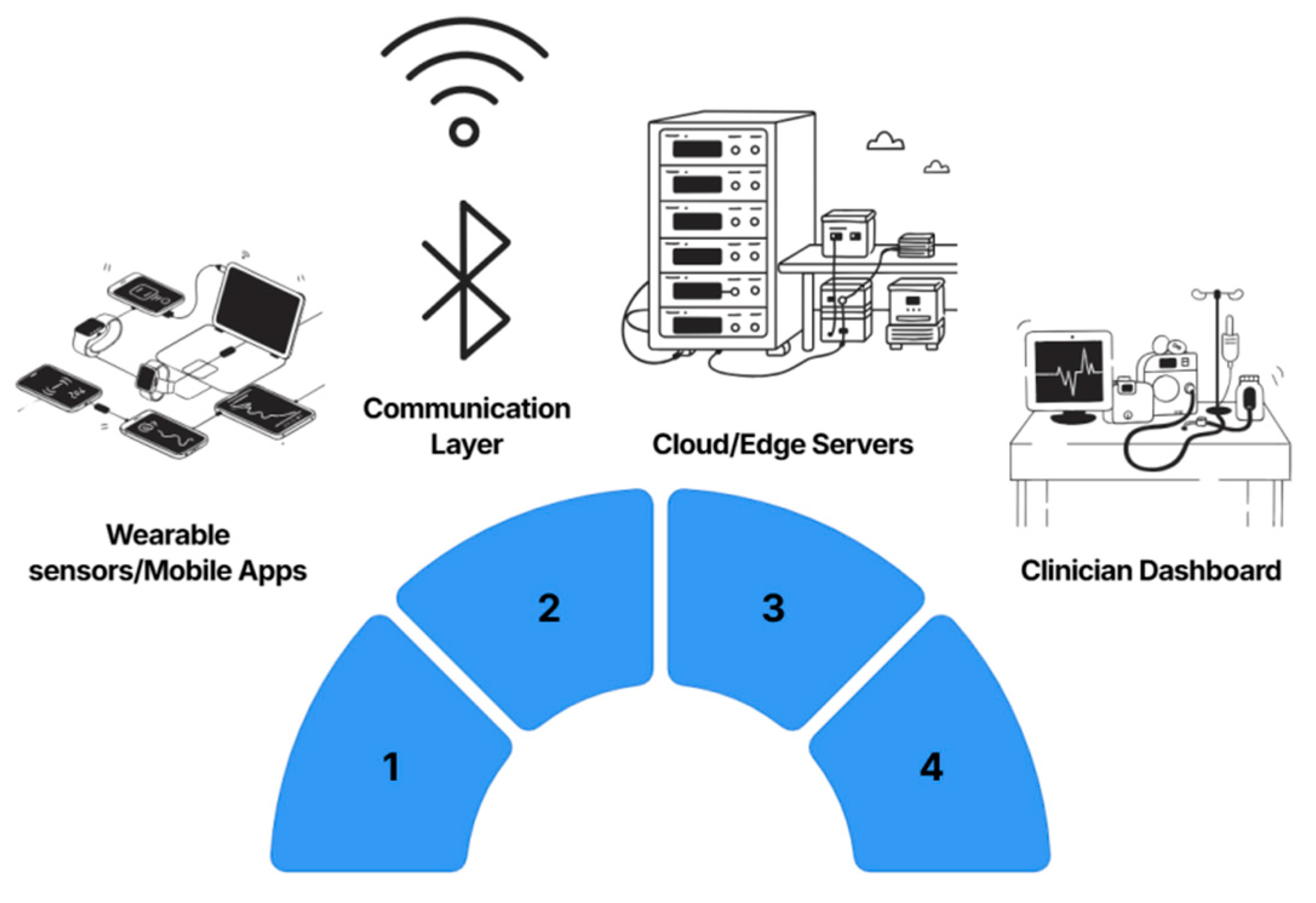
4.1. Principles and System Architecture
4.2. Types of Wearable Biomedical Devices
- Cardiac monitoring patches for continuous ECG recording and arrhythmia detection.
4.3. Communication Networks and Protocols
- Personal area networks (PANs): Bluetooth LE, Zigbee, and ANT+ connect body sensors to a gateway device.
- Local area networks (LANs): Wi-Fi handles higher data volumes such as biosignals or images.
- Wide area networks (WANs): 4G/5G cellular, LPWAN, or satellite links extend connectivity for mobile patients and rural regions.
4.4. Data Analytics and Clinical Decision Support
4.5. Challenges and Limitations
- Power consumption and miniaturization: balancing battery life with sensing accuracy remains a key constraint [56].
- Data security and patient privacy: continuous wireless transmission exposes vulnerabilities that demand robust encryption and access control.
- User adherence: long-term monitoring depends on comfort, ease of use, and unobtrusive design.
- Clinical validation: translating prototype devices into regulatory-approved medical products requires rigorous testing under diverse real-world conditions.
4.6. Outlook
4.7. Critical Analysis and Technology Trade-Offs
5. Telecommunications, Big Data, and Artificial Intelligence in Healthcare
5.1. Data Flow and Integration Architecture
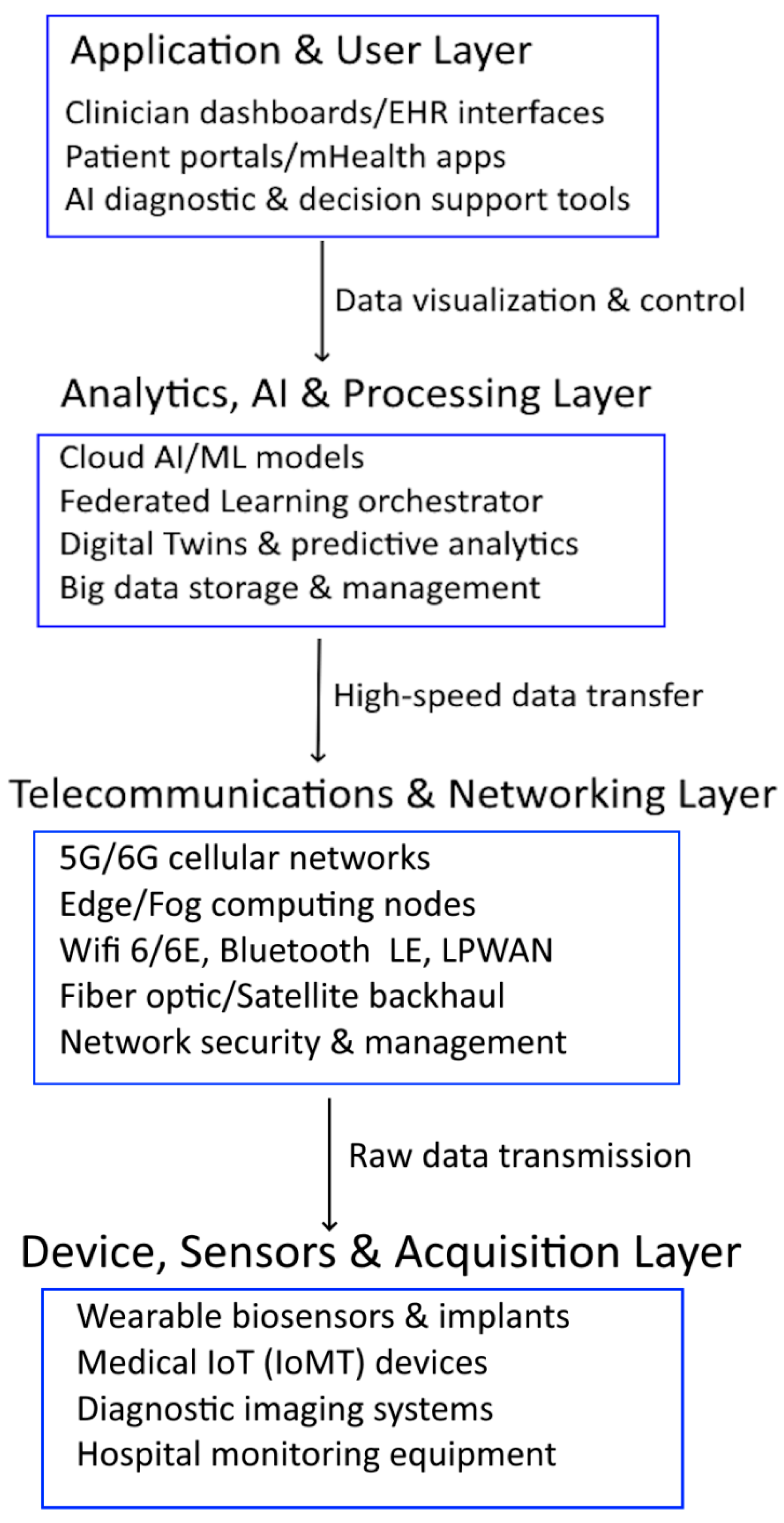
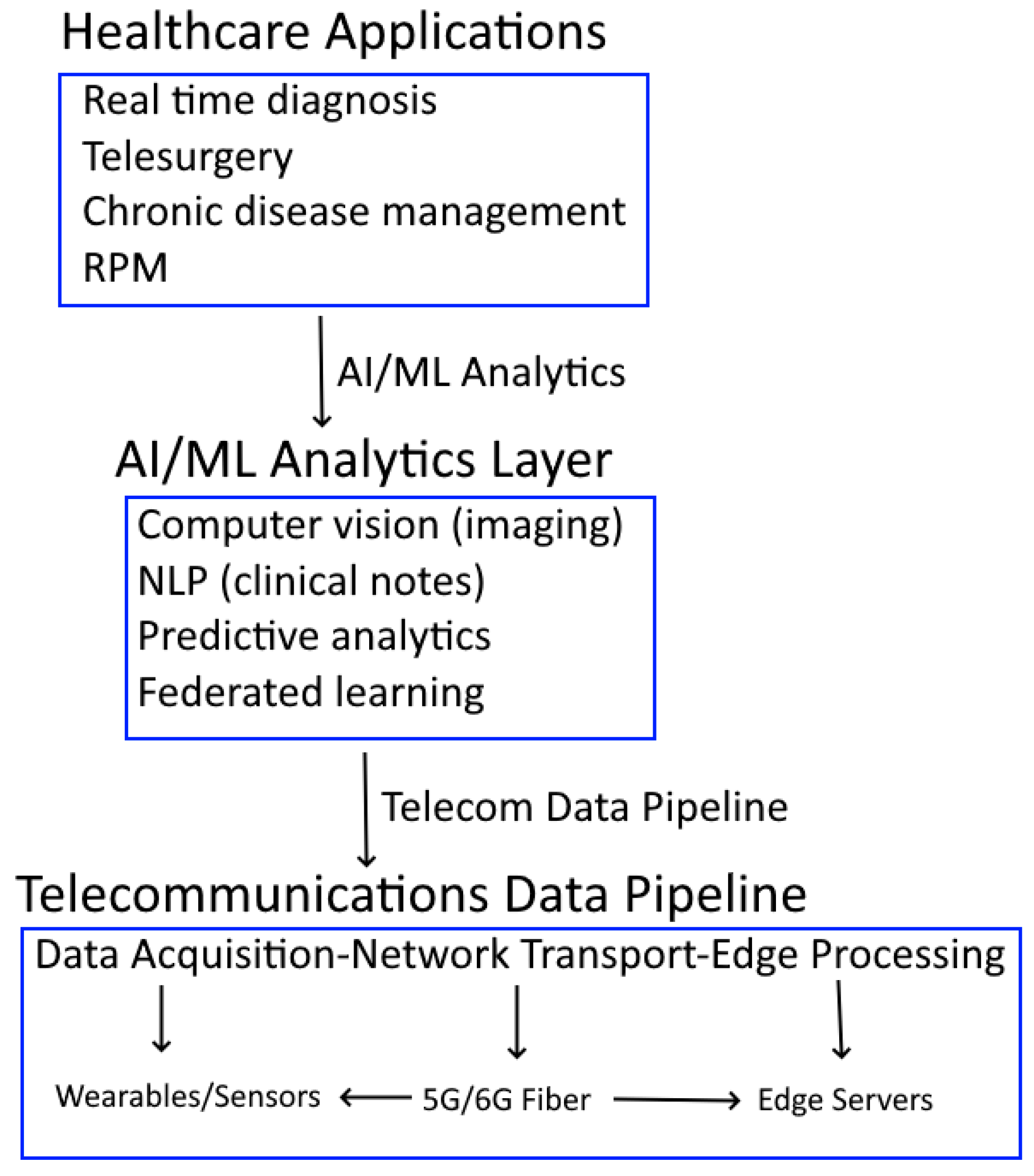
- Data acquisition layer: Sensors, imaging modalities, and clinical databases generate structured and unstructured data.
- Network layer: High-speed Internet, 4G/5G/6G, or optical fiber channels transmit data to local or remote servers [30].
- Cloud & Application Layer: Centralized cloud platforms provide scalable storage, advanced AI/ML analytics, and host end-user applications (e.g., clinician dashboards, patient portals) [61].
5.2. Big Data Characteristics and Healthcare Challenges
- Volume and velocity stress network throughput and storage capacity.
- Variety, from text to time-series signals to images, requires multimodal data fusion.
- Veracity concerns data quality, missing entries, and labeling errors.
- Value denotes actionable insights that improve patient outcomes.
5.3. Artificial Intelligence Applications Enabled by Telecommunications
- Natural-language processing (NLP): Extraction of clinical concepts from unstructured records and teleconsultation transcripts.
- Smart triage and chatbots: Real-time AI assistants powered by cloud-based language models.
5.4. Federated Learning and Privacy-Preserving Analytics
5.5. Technical and Ethical Challenges
- Bandwidth and latency constraints that limit real-time analytics for high-resolution imaging.
- Data standardization and interoperability: different hospitals use inconsistent formats, impeding AI model generalization.
5.6. Outlook
5.7. Critical Analysis: The Telecom–AI Synergy and Its Disconnects
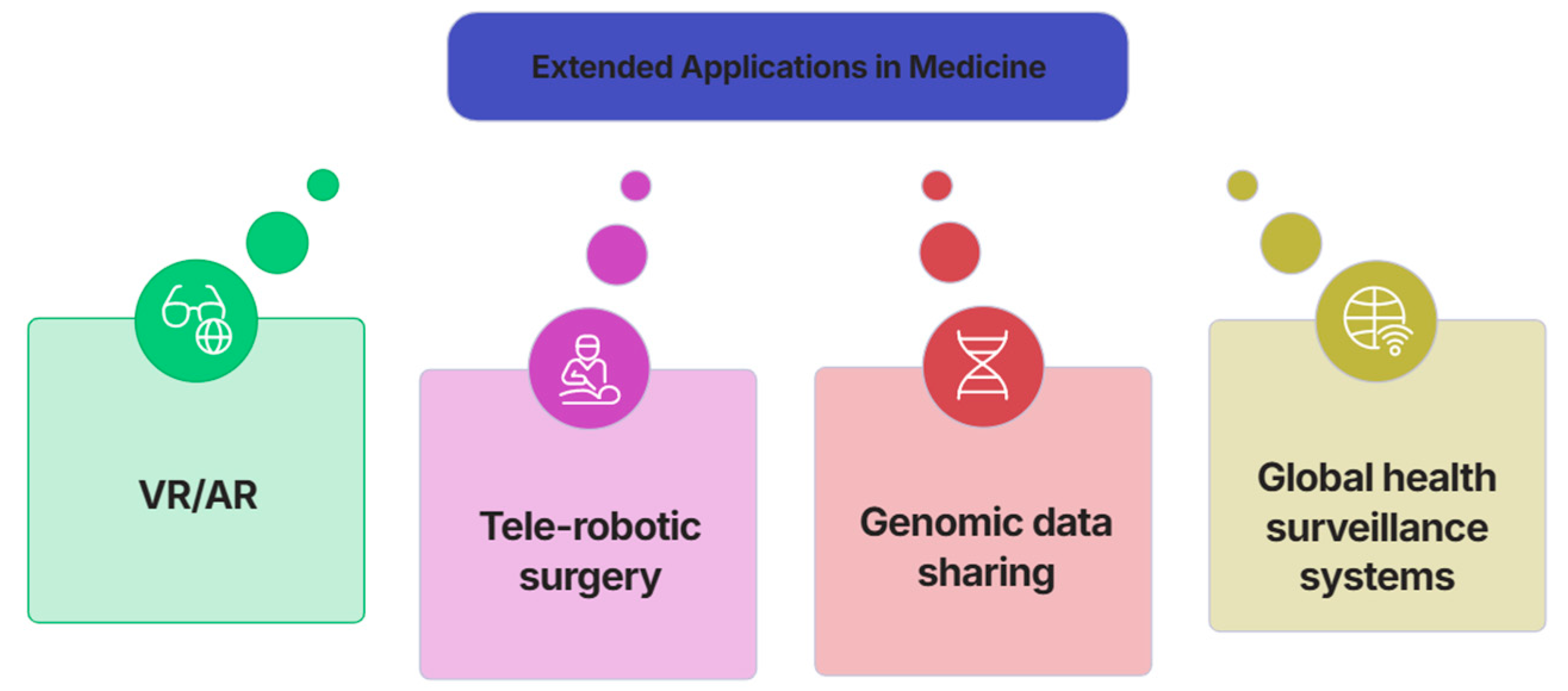
6. Extended Applications of Digital Telecommunications in Healthcare
6.1. Virtual and Augmented Reality in Medicine
- Tele-surgery and remote guidance: expert surgeons can supervise or assist procedures remotely using high-definition video and haptic feedback.
- Rehabilitation: VR-based motor and cognitive therapy systems improve patient engagement and progress tracking [92].
- Mental health therapy: immersive VR environments are used to treat phobias, post-traumatic stress disorder, and anxiety disorders.
6.2. Tele-Robotic and Haptic Systems
- Remote ultrasound or minimally invasive surgery in isolated regions [97].
- Telerobotic rehabilitation devices controlled by physiotherapists.
- Disaster-response medicine and battlefield tele-surgery.
6.3. Genomic Medicine and Data-Sharing Networks
6.3.1. Data Formats, Compression, and Throughput Requirements
- FASTQ: The primary raw output from sequencers, containing nucleotide sequences and quality scores. Files are large (e.g., ~5 GB for 30 × human genome coverage) and often compressed with gzip.
- BAM/CRAM: Aligned sequence data. The CRAM format, employing reference-based compression, achieves ~40–60% smaller file sizes than BAM, directly reducing transmission time and storage costs [98].
- VCF (Variant Call Format): A compact, compressed text file containing identified genetic variants, typically in the MB range.
6.3.2. Transfer Protocols and Network Architectures
- GridFTP: Extends FTP with parallel data streams and partial file transfers, improving throughput on high-latency networks.
- Aspera FASP (Fast And Secure Protocol): Uses a proprietary UDP-based protocol designed to overcome packet loss and fully utilize available bandwidth, enabling speeds hundreds of times faster than FTP over global networks.
- Globus: Provides a managed, reliable file transfer service built on GridFTP, widely used in scientific communities for moving massive datasets, including genomics.
6.3.3. Tele-Genomics and Clinical Integration
6.4. Global Health Surveillance and Public Health Networks
6.5. Outlook
6.6. Critical Analysis: Latency as the Universal Challenge
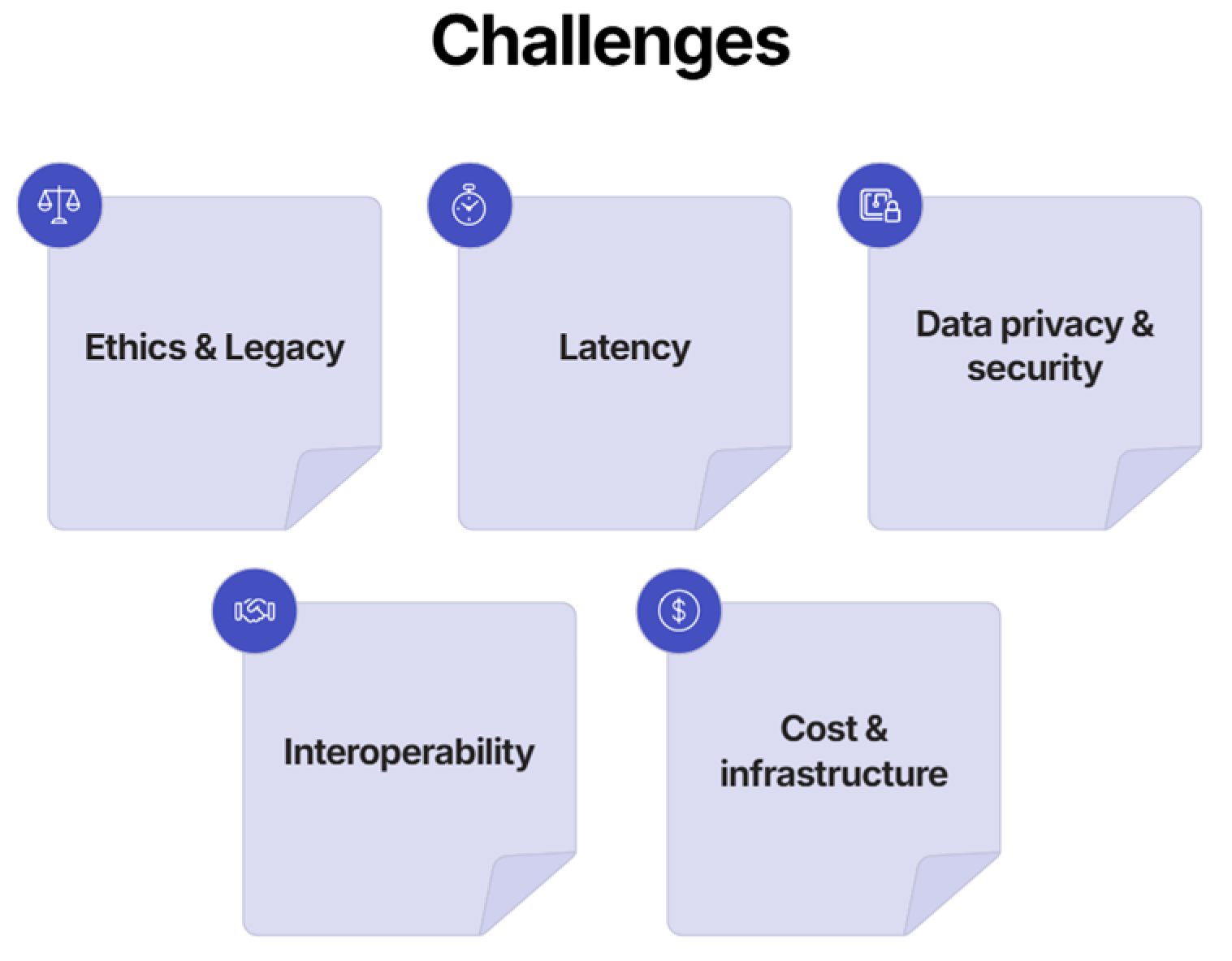
7. Challenges and Limitations of Telecommunications in Healthcare
7.1. Technical Challenges
7.1.1. Network Latency and Reliability
7.1.2. Interoperability and Standardization
7.1.3. Power Consumption and Device Longevity
7.2. Data Security and Privacy
7.3. Ethical and Legal Considerations
7.4. Socio-Economic Barriers
7.5. Environmental and Sustainability Concerns
7.6. Summary of Challenges
7.7. Synthesis of Evidence Gaps
- Lack of Standardized QoS Reporting: Clinical trials and efficacy studies rarely report detailed network performance data (latency, jitter, packet loss, uptime), making it impossible to correlate technical failures with clinical outcomes.
- Real-World vs. Lab Performance Disconnect: The performance of communication protocols (e.g., 5G URLLC, Bluetooth LE mesh) is often reported in ideal lab conditions. Data on their reliability and performance in actual patient homes, hospitals, and public spaces is sparse.
- Longitudinal Data on System Sustainability: There are few long-term studies on the maintenance costs, software update challenges, and environmental impact of large-scale deployments of IoMT and edge computing infrastructures in healthcare.
- Human Factors in High-Tech Loops: While the technical aspects of closed-loop systems (e.g., AI-driven RPM alerts and telesurgery) are heavily researched, the human factors, how clinicians interact with, trust, and oversee these automated, telecom-dependent systems, require much deeper investigation.
7.8. Outlook
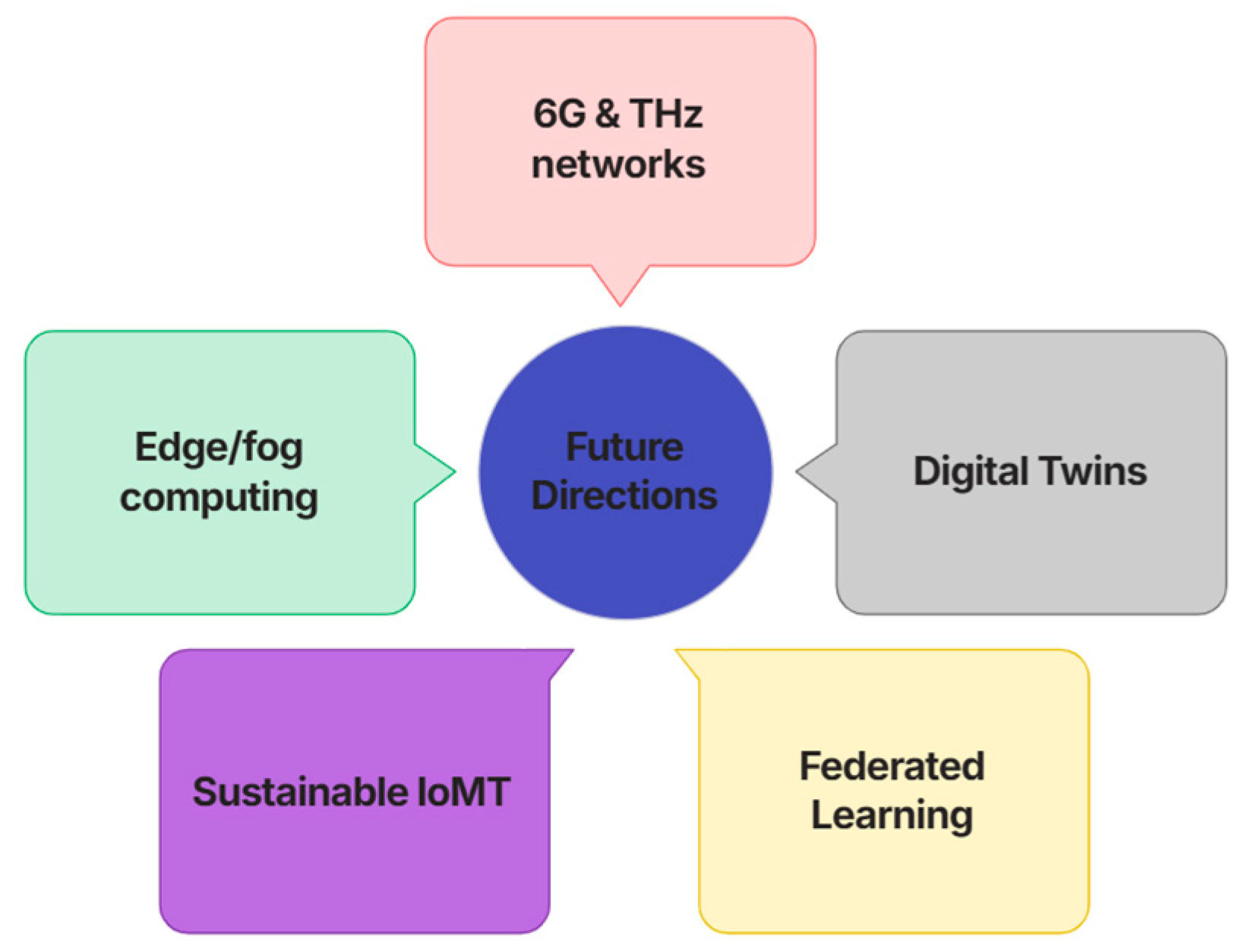
8. Future Directions
8.1. Next-Generation Communication Technologies (5G/6G)
8.2. Edge and Fog Computing for Low-Latency Healthcare
8.3. Federated and Collaborative Learning Ecosystems
8.4. Integration of AI, IoMT, and Digital Twins
- Digital Model: A static digital representation with no automated data flow from the physical object.
- Digital Shadow: A one-way flow of data from the physical object to the digital model, updating its state.
- Digital Twin: A bi-directional, closed-loop system where data flows from the physical object to the digital counterpart, which then uses AI/analytics to inform actions or simulations, whose results are fed back to influence the physical world.
- Continuous, High-Fidelity Data Synchronization: A constant stream of multimodal data (vital signs, imaging, genomics, environmental) from IoMT sensors to the twin.
- Ultra-Low Latency Feedback: For time-critical applications (e.g., closed-loop drug delivery, robotic surgery assistance), the “sense→simulate→act” cycle must occur within stringent time windows.
- Sub-millisecond Latency & Terahertz (THz) Bandwidth: To support the real-time transfer of high-density sensor data and instantaneous feedback.
- Integrated Sensing and Communication (ISAC): 6G infrastructure itself could act as a pervasive sensor, capturing physiological or environmental data without burdening wearable devices.
- AI-Native Network Orchestration: Networks will intelligently allocate resources, prioritize traffic from critical digital twin loops, and manage the massive connectivity of IoMT devices.
- Holographic-Type Communication (HTC): For immersive visualization and interaction with the digital twin, such as for surgical planning or medical education.
8.5. Toward Equitable and Sustainable Digital Health
8.6. Summary
8.7. Outlook
9. Conclusions
Supplementary Materials
Funding
Institutional Review Board Statement
Informed Consent Statement
Data Availability Statement
Conflicts of Interest
References
- Naik, N.; Hameed, B.M.Z.; Sooriyaperakasam, N.; Vinayahalingam, S.; Patil, V.; Smriti, K.; Saxena, J.; Shah, M.; Ibrahim, S.; Singh, A.; et al. Transforming healthcare through a digital revolution: A review of digital healthcare technologies and solutions. Front. Digit. Health 2022, 4, 919985. [Google Scholar] [CrossRef]
- Istepanian, R.; Laxminarayn, S.; Pattichis, C. M-Health: Emerging Mobile Health Systems; Springer: Berlin/Heidelberg, Germany, 2006. [Google Scholar]
- Secinaro, S.; Calandra, D.; Secinaro, A.; Muthurangu, V.; Biancone, P. The role of artificial intelligence in healthcare: A structured literature review. BMC Med. Inform. Decis. Mak. 2021, 21, 125. [Google Scholar] [CrossRef] [PubMed]
- Sharma, M.; Savage, C.; Nair, M.; Larsson, I.; Svedberg, P.; Nygren, J.M. Artificial Intelligence Applications in Health Care Practice: Scoping Review. J. Med. Internet Res. 2022, 24, e40238. [Google Scholar] [CrossRef] [PubMed]
- Esteva, A.; Robicquet, A.; Ramsundar, B.; Kuleshov, V.; DePristo, M.; Chou, K.; Cui, C.; Corrado, G.; Thrun, S.; Dean, J. A guide to deep learning in healthcare. Nat. Med. 2019, 25, 24–29. [Google Scholar] [CrossRef]
- Chen, X.; Xie, H.; Tao, X.; Wang, F.L.; Leng, M.; Lei, B. Artificial intelligence and multimodal data fusion for smart healthcare: Topic modeling and bibliometrics. Artif. Intell. Rev. 2024, 57, 91. [Google Scholar] [CrossRef]
- Alenoghena, C.O.; Ohize, H.O.; Adejo, A.O.; Onumanyi, A.J.; Ohihoin, E.E.; Balarabe, A.I.; Okoh, S.A.; Kolo, E.; Alenoghena, B. Telemedicine: A Survey of Telecommunication Technologies, Developments, and Challenges. J. Sens. Actuator Netw. 2023, 12, 20. [Google Scholar] [CrossRef]
- Nawaz, N.A.; Abid, A.; Rasheed, S.; Mubarik, I.; Shahzadi, A.; Farooq, M.S. Impact of telecommunication network on future of telemedicine in healthcare: A systematic literature review. Int. J. Adv. Appl. Sci. 2022, 9, 122–138. [Google Scholar] [CrossRef]
- Härkönen, H.; Lakoma, S.; Verho, A.; Torkki, P.; Leskelä, R.L.; Pennanen, P.; Laukka, E.; Jansson, M. Impact of digital services on healthcare and social welfare: An umbrella review. Int. J. Nurs. Stud. 2024, 152, 104692. [Google Scholar] [CrossRef] [PubMed]
- Qureshi, H.N.; Manalastas, M.; Ijaz, A.; Imran, A.; Liu, Y.; Al Kalaa, M.O. Communication Requirements in 5G-Enabled Healthcare Applications: Review and Considerations. Healthcare 2022, 10, 293. [Google Scholar] [CrossRef]
- Loncar-Turukalo, T.; Zdravevski, E.; Machado Da Silva, J.; Chouvarda, I.; Trajkovik, V. Literature on Wearable Technology for Connected Health: Scoping Review of Research Trends, Advances, and Barriers. J. Med. Internet Res. 2019, 21, e14017. [Google Scholar] [CrossRef]
- Bhushan, B.; Kumar, A.; Agarwal, A.K.; Kumar, A.; Bhattacharya, P.; Kumar, A. Towards a Secure and Sustainable Internet of Medical Things (IoMT): Requirements, Design Challenges, Security Techniques, and Future Trends. Sustainability 2023, 15, 6177. [Google Scholar] [CrossRef]
- Topol, E.J. High-performance medicine: The convergence of human and artificial intelligence. Nat. Med. 2019, 25, 44–56. [Google Scholar] [CrossRef]
- Iqbal, A.I.; Aamir, A.; Hammad, A.; Hafsa, H.; Basit, A.; Oduoye, M.O.; Anis, M.W.; Ahmed, S.; Younus, M.I.; Jabeen, S. Immersive Technologies in Healthcare: An In-Depth Exploration of Virtual Reality and Augmented Reality in Enhancing Patient Care, Medical Education, and Training Paradigms. J. Prim. Care Community Health 2024, 15, 21501319241293311. [Google Scholar] [CrossRef]
- Morris, B. Robotic surgery: Applications, limitations, and impact on surgical education. Medscape Gen. Med. 2005, 7, 72. [Google Scholar] [PubMed]
- Page, M.J.; McKenzie, J.E.; Bossuyt, P.M.; Boutron, I.; Hoffmann, T.C.; Mulrow, C.D.; Shamseer, L.; Tetzlaff, J.M.; Akl, E.A.; Brennan, S.E.; et al. The PRISMA 2020 statement: An updated guideline for reporting systematic reviews. BMJ 2021, 372, n71. [Google Scholar] [CrossRef] [PubMed]
- Rangasamy, M.; Balasubramaniam, A.; Krishnarajan, D.; Raviteja, A.; Kante, N.; Kumar, N. Role of Telemedicine in Health Care System: A Review. Int. J. Recent Adv. Pharm. Res. 2011, 2, 1–10. [Google Scholar]
- Choudhury, T.; Katal, A.; Um, J.S.; Rana, A.; Al-Akaidi, M. (Eds.) Telemedicine: The Computer Transformation of Healthcare; Springer International Publishing: Cham, Switzerland, 2022; Available online: https://link.springer.com/10.1007/978-3-030-99457-0 (accessed on 10 October 2025).
- Al-Dahery, S.T.; Alsharif, W.M.; Alamri, F.H.; Nawawi, S.A.; Mofti, W.K.; Alhazmi, F.H.; Alshamrani, K.M.; Suliman, A.G.; Qurashi, A.A. The role of teleradiology during COVID-19 outbreak: Saudi radiologists’ perspectives. Saudi Med. J. 2023, 44, 202–210. [Google Scholar] [CrossRef]
- Dhar, E.; Upadhyay, U.; Huang, Y.; Uddin, M.; Manias, G.; Kyriazis, D.; Wajid, U.; AlShawaf, H.; Abdul, S.S. A scoping review to assess the effects of virtual reality in medical education and clinical care. Digit. Health 2023, 9, 20552076231158022. [Google Scholar] [CrossRef]
- Alonso, S.G.; Marques, G.; Barrachina, I.; Garcia-Zapirain, B.; Arambarri, J.; Salvador, J.C.; Díez, I. Telemedicine and e-Health research solutions in literature for combatting COVID-19: A systematic review. Health Technol. 2021, 11, 257–266. [Google Scholar] [CrossRef]
- Keesara, S.; Jonas, A.; Schulman, K. Covid-19 and Health Care’s Digital Revolution. N. Engl. J. Med. 2020, 382, e82. [Google Scholar] [CrossRef]
- Ohannessian, R.; Duong, T.A.; Odone, A. Global Telemedicine Implementation and Integration Within Health Systems to Fight the COVID-19 Pandemic: A Call to Action. JMIR Public Health Surveill. 2020, 6, e18810. [Google Scholar] [CrossRef]
- Monaghesh, E.; Hajizadeh, A. The role of telehealth during COVID-19 outbreak: A systematic review based on current evidence. BMC Public Health 2020, 20, 1193. [Google Scholar] [CrossRef]
- Meyer, J.; Paré, G. Telepathology Impacts and Implementation Challenges: A Scoping Review. Arch. Pathol. Lab. Med. 2015, 139, 1550–1557. [Google Scholar] [CrossRef]
- Ruggiero, C. Teleradiology: A review. J. Telemed. Telecare 1998, 4, 25–35. [Google Scholar] [CrossRef]
- Peyroteo, M.; Ferreira, I.A.; Elvas, L.B.; Ferreira, J.C.; Lapão, L.V. Remote Monitoring Systems for Patients with Chronic Diseases in Primary Health Care: Systematic Review. JMIR Mhealth Uhealth 2021, 9, e28285. [Google Scholar] [CrossRef]
- Boikanyo, K.; Zungeru, A.M.; Sigweni, B.; Yahya, A.; Lebekwe, C. Remote patient monitoring systems: Applications, architecture, and challenges. Sci. Afr. 2023, 20, e01638. [Google Scholar] [CrossRef]
- Xing, L. Reliability in Internet of Things: Current Status and Future Perspectives. IEEE Internet Things J. 2020, 7, 6704–6721. [Google Scholar] [CrossRef]
- Devi, D.H.; Duraisamy, K.; Armghan, A.; Alsharari, M.; Aliqab, K.; Sorathiya, V.; Das, S.; Rashid, N. 5G Technology in Healthcare and Wearable Devices: A Review. Sensors 2023, 23, 2519. [Google Scholar] [CrossRef] [PubMed]
- Rancea, A.; Anghel, I.; Cioara, T. Edge Computing in Healthcare: Innovations, Opportunities, and Challenges. Future Internet 2024, 16, 329. [Google Scholar] [CrossRef]
- Sodhro, A.H.; Awad, A.I.; Beek, J.V.D.; Nikolakopoulos, G. Intelligent authentication of 5G healthcare devices: A survey. Internet Things 2022, 20, 100610. [Google Scholar] [CrossRef]
- Ghadi, Y.Y.; Mazhar, T.; Shahzad, T.; Amir Khan, M.; Abd-Alrazaq, A.; Ahmed, A.; Hamam, H. The role of blockchain to secure internet of medical things. Sci. Rep. 2024, 14, 18422. [Google Scholar] [CrossRef]
- Kruse, C.; Heinemann, K. Facilitators and Barriers to the Adoption of Telemedicine During the First Year of COVID-19: Systematic Review. J. Med. Internet Res. 2022, 24, e31752. [Google Scholar] [CrossRef] [PubMed]
- Hadian, M.; Jelodar, Z.K.; Khanbebin, M.J.; Atafimanesh, P.; Asiabar, A.S.; Dehagani, S.M.H. Challenges of Implementing Telemedicine Technology: A systematized Review. Int. J. Prev. Med. 2024, 15, 8. [Google Scholar] [CrossRef] [PubMed]
- Choxi, H.; VanDerSchaaf, H.; Li, Y.; Morgan, E. Telehealth and the Digital Divide: Identifying Potential Care Gaps in Video Visit Use. J. Med. Syst. 2022, 46, 58. [Google Scholar] [CrossRef]
- Alzghaibi, H. Adoption barriers and facilitators of wearable health devices with AI integration: A patient-centred perspective. Front. Med. 2025, 12, 1557054. [Google Scholar] [CrossRef]
- Torab-Miandoab, A.; Samad-Soltani, T.; Jodati, A.; Rezaei-Hachesu, P. Interoperability of heterogeneous health information systems: A systematic literature review. BMC Med. Inform. Decis. Mak. 2023, 23, 18. [Google Scholar] [CrossRef]
- Patel, S.; Park, H.; Bonato, P.; Chan, L.; Rodgers, M. A review of wearable sensors and systems with application in rehabilitation. J. NeuroEng. Rehabil. 2012, 9, 21. [Google Scholar] [CrossRef] [PubMed]
- Sazonov, E.; Neuman, M.R. (Eds.) Wearable Sensors: Fundamentals, Implementation and Applications; Academic Press: Cambridge, MA, USA, 2014. [Google Scholar]
- Smile, R.; Rao, N. Efficient Low Power Intelligent Health Care Monitoring System using IOT. Int. J. Innov. Technol. Explor. Eng. 2019, 8, 1707–1711. [Google Scholar] [CrossRef]
- Wang, X.; Song, Y. Edge-Assisted IoMT-Based Smart-Home Monitoring System for the Elderly with Chronic Diseases. IEEE Sens. Lett. 2023, 7, 7500204. [Google Scholar] [CrossRef]
- Dornan, L.; Pinyopornpanish, K.; Jiraporncharoen, W.; Hashmi, A.; Dejkriengkraikul, N.; Angkurawaranon, C. Utilisation of Electronic Health Records for Public Health in Asia: A Review of Success Factors and Potential Challenges. BioMed Res. Int. 2019, 2019, 7341841. [Google Scholar] [CrossRef]
- Menachemi, N.; Collum, T.H. Benefits and drawbacks of electronic health record systems. Risk Manag. Health Policy 2011, 4, 47–55. [Google Scholar] [CrossRef]
- Daraghmi, Y.A.; Daraghmi, E.Y.; Daraghma, R.; Fouchal, H.; Ayaida, M. Edge–Fog–Cloud Computing Hierarchy for Improving Performance and Security of NB-IoT-Based Health Monitoring Systems. Sensors 2022, 22, 8646. [Google Scholar] [CrossRef] [PubMed]
- Adeghe, E.P.; Okolo, C.A.; Ojeyinka, O.T. A review of wearable technology in healthcare: Monitoring patient health and enhancing outcomes. Open Access Res. J. Multidiscip. Stud. 2024, 7, 142–148. [Google Scholar] [CrossRef]
- Cheah, K.J.; Abdul Manaf, Z.; Fitri Mat Ludin, A.; Razalli, N.H.; Mohd Mokhtar, N.; Md Ali, S.H. Mobile Apps for Common Noncommunicable Disease Management: Systematic Search in App Stores and Evaluation Using the Mobile App Rating Scale. JMIR Mhealth Uhealth 2024, 12, e49055. [Google Scholar] [CrossRef] [PubMed]
- Jiménez-Muñoz, L.; Gutiérrez-Rojas, L.; Porras-Segovia, A.; Courtet, P.; Baca-García, E. Mobile applications for the management of chronic physical conditions: A systematic review. Intern. Med. J. 2022, 52, 21–29. [Google Scholar] [CrossRef]
- Surantha, N.; Atmaja, P.; David Wicaksono, M. A Review of Wearable Internet-of-Things Device for Healthcare. Procedia Comput. Sci. 2021, 179, 936–943. [Google Scholar] [CrossRef]
- Nan, X.; Wang, X.; Kang, T.; Zhang, J.; Dong, L.; Dong, J.; Xia, P.; Wei, D. Review of Flexible Wearable Sensor Devices for Biomedical Application. Micromachines 2022, 13, 1395. [Google Scholar] [CrossRef]
- Lu, L.; Zhang, J.; Xie, Y.; Gao, F.; Xu, S.; Wu, X.; Ye, Z. Wearable Health Devices in Health Care: Narrative Systematic Review. JMIR Mhealth Uhealth 2020, 8, e18907. [Google Scholar] [CrossRef]
- Lee, J.A.; Choi, M.; Lee, S.A.; Jiang, N. Effective behavioral intervention strategies using mobile health applications for chronic disease management: A systematic review. BMC Med. Inform. Decis. Mak. 2018, 18, 12. [Google Scholar] [CrossRef]
- Adepoju, V.A.; Jamil, S.; Biswas, M.S.; Chowdhury, A.A. Wearable Technology in the Management of Chronic Diseases: A Growing Concern. Chronic Dis. Transl. Med. 2025, 11, 117–121. [Google Scholar] [CrossRef]
- Hosain, M.N.; Kwak, Y.S.; Lee, J.; Choi, H.; Park, J.; Kim, J. IoT-enabled biosensors for real-time monitoring and early detection of chronic diseases. Phys. Act. Nutr. 2024, 28, 060–069. [Google Scholar] [CrossRef]
- Kim, H.; Rigo, B.; Wong, G.; Lee, Y.J.; Yeo, W.H. Advances in Wireless, Batteryless, Implantable Electronics for Real-Time, Continuous Physiological Monitoring. Nano-Micro Lett. 2024, 16, 52. [Google Scholar] [CrossRef]
- Kanoun, O.; Bradai, S.; Khriji, S.; Bouattour, G.; El Houssaini, D.; Ben Ammar, M.; Naifar, S.; Bouhamed, A.; Derbel, F.; Viehweger, C. Energy-Aware System Design for Autonomous Wireless Sensor Nodes: A Comprehensive Review. Sensors 2021, 21, 548. [Google Scholar] [CrossRef] [PubMed]
- Shan, L.; Fang, W.; Yao, W.; Xiong, Y.; Gao, W. Adaptive Mobile Gateway: QoS-Guaranteed Challenges for Wireless Sensor Networks. In Proceedings of the Second International Conference on Mechatronics and Automatic Control; Wang, W., Ed.; Lecture Notes in Electrical Engineering; Springer International Publishing: Cham, Switzerland, 2015; Volume 334, pp. 1189–1195. Available online: https://link.springer.com/10.1007/978-3-319-13707-0_132 (accessed on 10 October 2025).
- Marcolino, M.S.; Oliveira, J.A.Q.; D’Agostino, M.; Ribeiro, A.L.; Alkmim, M.B.M.; Novillo-Ortiz, D. The Impact of mHealth Interventions: Systematic Review of Systematic Reviews. JMIR Mhealth Uhealth 2018, 6, e23. [Google Scholar] [CrossRef] [PubMed]
- Rahman, A.; Debnath, T.; Kundu, D.; Khan, M.d.S.I.; Aishi, A.A.; Sazzad, S.; Sayduzzaman, M.; Band, S.S. Machine learning and deep learning-based approach in smart healthcare: Recent advances, applications, challenges and opportunities. AIMS Public Health 2024, 11, 58–109. [Google Scholar] [CrossRef]
- Wan, T.T.H.; Wan, H.S. Predictive Analytics with a Transdisciplinary Framework in Promoting Patient-Centric Care of Polychronic Conditions: Trends, Challenges, and Solutions. AI 2023, 4, 482–490. [Google Scholar] [CrossRef]
- Petrides, A.K.; Bixho, I.; Goonan, E.M.; Bates, D.W.; Shaykevich, S.; Lipsitz, S.R.; Landman, A.B.; Tanasijevic, M.J.; Melanson, S.E.F. The Benefits and Challenges of an Interfaced Electronic Health Record and Laboratory Information System: Effects on Laboratory Processes. Arch. Pathol. Lab. Med. 2017, 141, 410–417. [Google Scholar] [CrossRef]
- Iroju, O.; Soriyan, A.; Gambo, I.; Olaleke, J. Interoperability in Healthcare: Benefits, Challenges and Resolutions. Int. J. Innov. Appl. Stud. 2013, 3, 2028–9324. [Google Scholar]
- Baloch, L.; Bazai, S.U.; Marjan, S.; Aftab, F.; Aslam, S.; Neo, T.K.; Amphawan, A. A Review of Big Data Trends and Challenges in Healthcare. Int. J. Technol. 2023, 14, 1320. [Google Scholar] [CrossRef]
- Batko, K.; Ślęzak, A. The use of Big Data Analytics in healthcare. J. Big Data 2022, 9, 3. [Google Scholar] [CrossRef]
- Ishwarappa; Anuradha, J. A Brief Introduction on Big Data 5Vs Characteristics and Hadoop Technology. Procedia Comput. Sci. 2015, 48, 319–324. [Google Scholar] [CrossRef]
- Shaheen, M.Y. Applications of Artificial Intelligence (AI) in Healthcare: A Review. 2021. Available online: https://scienceopen.com/hosted-document?doi=10.14293/S2199-1006.1.SOR-.PPVRY8K.v1 (accessed on 30 October 2024).
- Betmouni, S. Diagnostic digital pathology implementation: Learning from the digital health experience. Digit. Health 2021, 7, 20552076211020240. [Google Scholar] [CrossRef]
- Lobo, M.D. Artificial Intelligence in Teleradiology: A Rapid Review of Educational and Professional Contributions. In Advances in Medical Education, Research, and Ethics; Garcia, M.B., Lopez Cabrera, M.V., De Almeida, R.P.P., Eds.; IGI Global: Hershey, PA, USA, 2023; pp. 80–104. Available online: https://services.igi-global.com/resolvedoi/resolve.aspx?doi=10.4018/978-1-6684-7164-7.ch004 (accessed on 10 October 2025).
- McCool, J.; Dobson, R.; Whittaker, R.; Paton, C. Mobile Health (mHealth) in Low- and Middle-Income Countries. Annu. Rev. Public Health 2022, 43, 525–539. [Google Scholar] [CrossRef]
- Andrew, J.; Isravel, D.P.; Sagayam, K.M.; Bhushan, B.; Sei, Y.; Eunice, J. Blockchain for healthcare systems: Architecture, security challenges, trends and future directions. J. Netw. Comput. Appl. 2023, 215, 103633. [Google Scholar] [CrossRef]
- Li, M.; Xu, P.; Hu, J.; Tang, Z.; Yang, G. From challenges and pitfalls to recommendations and opportunities: Implementing federated learning in healthcare. Med. Image Anal. 2025, 101, 103497. [Google Scholar] [CrossRef] [PubMed]
- Prasad, V.K.; Bhattacharya, P.; Maru, D.; Tanwar, S.; Verma, A.; Singh, A.; Tiwari, A.K.; Sharma, R.; Alkhayyat, A.; Țurcanu, F.-E.; et al. Federated Learning for the Internet-of-Medical-Things: A Survey. Mathematics 2022, 11, 151. [Google Scholar] [CrossRef]
- Xu, G.; Qi, C.; Dong, W.; Gong, L.; Liu, S.; Chen, S.; Liu, J.; Zheng, X. A Privacy-Preserving Medical Data Sharing Scheme Based on Blockchain. IEEE J. Biomed. Health Inform. 2023, 27, 698–709. [Google Scholar] [CrossRef]
- Pati, S.; Kumar, S.; Varma, A.; Edwards, B.; Lu, C.; Qu, L.; Wang, J.J.; Lakshminarayanan, A.; Wang, S.-H.; Sheller, M.J.; et al. Privacy preservation for federated learning in health care. Patterns 2024, 5, 100974. [Google Scholar] [CrossRef] [PubMed]
- Amann, J.; Blasimme, A.; Vayena, E.; Frey, D.; Madai, V.I. Explainability for artificial intelligence in healthcare: A multidisciplinary perspective. BMC Med. Inform. Decis. Mak. 2020, 20, 310. [Google Scholar] [CrossRef] [PubMed]
- London, A.J. Artificial Intelligence and Black-Box Medical Decisions: Accuracy versus Explainability. Hastings Cent. Rep. 2019, 49, 15–21. [Google Scholar] [CrossRef]
- Leslie, D. Understanding Artificial Intelligence Ethics and Safety: A Guide for the Responsible Design and Implementation of AI Systems in the Public Sector. Zenodo. June 2019. Available online: https://zenodo.org/record/3240529 (accessed on 10 October 2025).
- Price, W.N.; Gerke, S.; Cohen, I.G. Potential Liability for Physicians Using Artificial Intelligence. JAMA 2019, 322, 1765. [Google Scholar] [CrossRef]
- Gorelik, A.J.; Li, M.; Hahne, J.; Wang, J.; Ren, Y.; Yang, L.; Zhang, X.; Liu, X.; Wang, X.; Bogdan, R.; et al. Ethics of AI in healthcare: A scoping review demonstrating applicability of a foundational framework. Front. Digit. Health 2025, 7, 1662642. [Google Scholar] [CrossRef]
- Kim, H.Y.; Kim, E.Y. Effects of Medical Education Program Using Virtual Reality: A Systematic Review and Meta-Analysis. Int. J. Environ. Res. Public Health 2023, 20, 3895. [Google Scholar] [CrossRef]
- Kyaw, B.M.; Saxena, N.; Posadzki, P.; Vseteckova, J.; Nikolaou, C.K.; George, P.P.; Divakar, U.; Masiello, I.; A Kononowicz, A.; Zary, N.; et al. Virtual Reality for Health Professions Education: Systematic Review and Meta-Analysis by the Digital Health Education Collaboration. J. Med. Internet Res. 2019, 21, e12959. [Google Scholar] [CrossRef] [PubMed]
- Sadek, O.; Baldwin, F.; Gray, R.; Khayyat, N.; Fotis, T. Impact of Virtual and Augmented Reality on Quality of Medical Education During the COVID-19 Pandemic: A Systematic Review. J. Grad. Med. Educ. 2023, 15, 328–338. [Google Scholar] [CrossRef] [PubMed]
- Xu, X.; Mangina, E.; Campbell, A.G. HMD-Based Virtual and Augmented Reality in Medical Education: A Systematic Review. Front. Virtual Real. 2021, 2, 692103. [Google Scholar] [CrossRef]
- Zhao, G.; Fan, M.; Yuan, Y.; Zhao, F.; Huang, H. The comparison of teaching efficiency between virtual reality and traditional education in medical education: A systematic review and meta-analysis. Ann. Transl. Med. 2021, 9, 252. [Google Scholar] [CrossRef] [PubMed]
- Tene, T.; Vique López, D.F.; Valverde Aguirre, P.E.; Orna Puente, L.M.; Vacacela Gomez, C. Virtual reality and augmented reality in medical education: An umbrella review. Front. Digit. Health 2024, 6, 1365345. [Google Scholar] [CrossRef]
- Yin, X.X.; Baghai-Wadji, A.; Zhang, Y. A Biomedical Perspective in Terahertz Nano-Communications—A Review. IEEE Sensors J. 2022, 22, 9215–9227. [Google Scholar] [CrossRef]
- Barcali, E.; Iadanza, E.; Manetti, L.; Francia, P.; Nardi, C.; Bocchi, L. Augmented Reality in Surgery: A Scoping Review. Appl. Sci. 2022, 12, 6890. [Google Scholar] [CrossRef]
- Suresh, D.; Aydin, A.; James, S.; Ahmed, K.; Dasgupta, P. The Role of Augmented Reality in Surgical Training: A Systematic Review. Surg. Innov. 2023, 30, 366–382. [Google Scholar] [CrossRef]
- Williams, M.A.; McVeigh, J.; Handa, A.I.; Lee, R. Augmented reality in surgical training: A systematic review. Postgrad. Med. J. 2020, 96, 537–542. [Google Scholar] [CrossRef] [PubMed]
- Khor, W.S.; Baker, B.; Amin, K.; Chan, A.; Patel, K.; Wong, J. Augmented and virtual reality in surgery—The digital surgical environment: Applications, limitations and legal pitfalls. Ann. Transl. Med. 2016, 4, 454. [Google Scholar] [CrossRef]
- Rajak, S.; Summaq, A.; Kumar, M.P.; Ghosh, A.; Elumalai, K.; Chinnadurai, S. Revolutionizing Healthcare with 6G: A Deep Dive Into Smart, Connected Systems. IEEE Access 2024, 12, 194150–194170. [Google Scholar] [CrossRef]
- Rizzo, A.A.; Buckwalter, J.G.; Neumann, U. Virtual Reality and Cognitive Rehabilitation: A Brief Review of the Future. J. Head Trauma Rehabil. 1997, 12, 1–15. [Google Scholar] [CrossRef]
- Rivero-Moreno, Y.; Echevarria, S.; Vidal-Valderrama, C.; Stefano-Pianetti, L.; Cordova-Guilarte, J.; Navarro-Gonzalez, J.; Acevedo-Rodríguez, J.; Dorado-Avila, G.; Osorio-Romero, L.; Chavez-Campos, C.; et al. Robotic Surgery: A Comprehensive Review of the Literature and Current Trends. Cureus 2023, 15, e42370. [Google Scholar] [CrossRef] [PubMed]
- Li, C.; Zheng, J.; Zhang, X.; Luo, L.; Chu, G.; Zhao, J.; Zhang, Z.; Wang, H.; Qin, F.; Zhou, G.; et al. Telemedicine network latency management system in 5G telesurgery: A feasibility and effectiveness study. Surg. Endosc. 2024, 38, 1592–1599. [Google Scholar] [CrossRef] [PubMed]
- Tavakoli, M.; Patel, R.V. Haptics in Telerobotic Systems for Minimally Invasive Surgery. In Telesurgery; Kumar, S., Marescaux, J., Eds.; Springer: Berlin/Heidelberg, Germany, 2008; pp. 113–124. Available online: http://link.springer.com/10.1007/978-3-540-72999-0_9 (accessed on 10 October 2025).
- Li, Y.; Raison, N.; Ourselin, S.; Mahmoodi, T.; Dasgupta, P.; Granados, A. AI solutions for overcoming delays in telesurgery and telementoring to enhance surgical practice and education. J. Robot. Surg. 2024, 18, 403. [Google Scholar] [CrossRef]
- Motiwala, Z.Y.; Desai, A.; Bisht, R.; Lathkar, S.; Misra, S.; Carbin, D.D. Telesurgery: Current status and strategies for latency reduction. J. Robot. Surg. 2025, 19, 153. [Google Scholar] [CrossRef] [PubMed]
- Langmead, B.; Nellore, A. Cloud computing for genomic data analysis and collaboration. Nat. Rev. Genet. 2018, 19, 208–219. [Google Scholar] [CrossRef]
- Brittain, H.K.; Scott, R.; Thomas, E. The rise of the genome and personalised medicine. Clin. Med. 2017, 17, 545–551. [Google Scholar] [CrossRef]
- Ginsburg, G.S.; Willard, H.F. Genomic and personalized medicine: Foundations and applications. Transl. Res. 2009, 154, 277–287. [Google Scholar] [CrossRef]
- Kuo, G.M.; Ma, J.D.; Lee, K.C.; Bourne, P.E. Telemedicine, Genomics and Personalized Medicine: Synergies and Challenges. Curr. Pharmacogenom. Pers. Med. 2011, 9, 6–13. [Google Scholar] [CrossRef]
- ISO/IEC 23092; Information technology — Genomic information representation. International Organization for Standardization: Geneva, Switzerland, 2024.
- Chiang, K.L.; Huang, C.Y. Precision Medicine and Telemedicine. In Springer Handbook of Automation; Nof, S.Y., Ed.; Springer Handbooks; Springer International Publishing: Cham, Switzerland, 2023; pp. 1249–1263. Available online: https://link.springer.com/10.1007/978-3-030-96729-1_58 (accessed on 30 October 2024).
- Villanueva, A.G.; Cook-Deegan, R.; Robinson, J.O.; McGuire, A.L.; Majumder, M.A. Genomic Data-Sharing Practices. J. Law Med. Ethics 2019, 47, 31–40. [Google Scholar] [CrossRef] [PubMed]
- Kuo, T.T.; Jiang, X.; Tang, H.; Wang, X.; Harmanci, A.; Kim, M.; Post, K.; Bu, D.; Bath, T.; Kim, J.; et al. The evolving privacy and security concerns for genomic data analysis and sharing as observed from the iDASH competition. J. Am. Med. Inform. Assoc. 2022, 29, 2182–2190. [Google Scholar] [CrossRef] [PubMed]
- WHO. Telemedicine: Opportunities and Developments in Member States; World Health Organization: Geneva, Switzerland, 2022. [Google Scholar]
- Wang, D.; Guerra, A.; Wittke, F.; Lang, J.C.; Bakker, K.; Lee, A.W.; Finelli, L.; Chen, Y.-H. Real-Time Monitoring of Infectious Disease Outbreaks with a Combination of Google Trends Search Results and the Moving Epidemic Method: A Respiratory Syncytial Virus Case Study. Trop. Med. Infect. Dis. 2023, 8, 75. [Google Scholar] [CrossRef]
- Brownstein, J.S.; Freifeld, C.C.; Madoff, L.C. Digital Disease Detection—Harnessing the Web for Public Health Surveillance. N. Engl. J. Med. 2009, 360, 2153–2157. [Google Scholar] [CrossRef] [PubMed]
- Gugueoth, V.; Safavat, S.; Shetty, S.; Rawat, D. A review of IoT security and privacy using decentralized blockchain techniques. Comput. Sci. Rev. 2023, 50, 100585. [Google Scholar] [CrossRef]
- Ivanova, J.; Cummins, M.R.; Ong, T.; Soni, H.; Barrera, J.; Wilczewski, H.; Welch, B.; Bunnell, B. Regulation and Compliance in Telemedicine: Viewpoint. J. Med. Internet Res. 2025, 27, e53558. [Google Scholar] [CrossRef]
- Khorov, E.; Kiryanov, A.; Lyakhov, A.; Bianchi, G. A Tutorial on IEEE 802.11ax High Efficiency WLANs. IEEE Commun. Surv. Tutor. 2019, 21, 197–216. [Google Scholar] [CrossRef]
- Chen, M.; Qian, Y.; Chen, J.; Hwang, K.; Mao, S.; Hu, L. Privacy Protection and Intrusion Avoidance for Cloudlet-Based Medical Data Sharing. IEEE Trans. Cloud Comput. 2020, 8, 1274–1283. [Google Scholar] [CrossRef]
- Nkrumah, M. The Impact of 5G Technology on Communication Infrastructure. J. Commun. 2024, 4, 43–55. [Google Scholar] [CrossRef]
- Kodheli, O.; Lagunas, E.; Maturo, N.; Sharma, S.K.; Shankar, B.; Montoya, J.F.M.; Duncan, J.C.M.; Spano, D.; Chatzinotas, S.; Kisseleff, S.; et al. Satellite Communications in the New Space Era: A Survey and Future Challenges. IEEE Commun. Surv. Tutor. 2021, 23, 70–109. [Google Scholar] [CrossRef]
- Keshta, I.; Odeh, A. Security and privacy of electronic health records: Concerns and challenges. Egypt. Inform. J. 2021, 22, 177–183. [Google Scholar] [CrossRef]
- Hordern, V. Data Protection Compliance in the Age of Digital Health. Eur. J. Health Law 2016, 23, 248–264. [Google Scholar] [CrossRef] [PubMed]
- Rosenlund, M.; Kinnunen, U.M.; Saranto, K. The Use of Digital Health Services Among Patients and Citizens Living at Home: Scoping Review. J. Med. Internet Res. 2023, 25, e44711. [Google Scholar] [CrossRef] [PubMed]
- Tarpani, R.R.Z.; Gallego-Schmid, A. Environmental impacts of a digital health and well-being service in elderly living schemes. Clean. Environ. Syst. 2024, 12, 100161. [Google Scholar] [CrossRef]
- Letaief, K.B.; Chen, W.; Shi, Y.; Zhang, J.; Zhang, Y.J.A. The Roadmap to 6G—AI Empowered Wireless Networks. arXiv 2019, arXiv:1904.11686. [Google Scholar] [CrossRef]
- Zawish, M.; Dharejo, F.A.; Khowaja, S.A.; Raza, S.; Davy, S.; Dev, K.; Bellavista, P. AI and 6G Into the Metaverse: Fundamentals, Challenges and Future Research Trends. IEEE Open J. Commun. Soc. 2024, 5, 730–778. [Google Scholar] [CrossRef]
- Song, L.; Hu, X.; Zhang, G.; Spachos, P.; Plataniotis, K.N.; Wu, H. Networking Systems of AI: On the Convergence of Computing and Communications. IEEE Internet Things J. 2022, 9, 20352–20381. [Google Scholar] [CrossRef]
- Kumar, A.; Masud, M.; Alsharif, M.H.; Gaur, N.; Nanthaamornphong, A. Integrating 6G technology in smart hospitals: Challenges and opportunities for enhanced healthcare services. Front. Med. 2025, 12, 1534551. [Google Scholar] [CrossRef] [PubMed]
- Islam, M.Z.; Sagar, A.S.M.S.; Kim, H.S. Enabling Pandemic-Resilient Healthcare: Edge-Computing-Assisted Real-Time Elderly Caring Monitoring System. Appl. Sci. 2024, 14, 8486. [Google Scholar] [CrossRef]
- Pareek, K.; Tiwari, P.K.; Bhatnagar, V. Fog Computing in Healthcare: A Review. IOP Conf. Ser. Mater. Sci. Eng. 2021, 1099, 012025. [Google Scholar] [CrossRef]
- Celesti, A.; De Falco, I.; Sannino, G.; Carnevale, L. Special Issue: Digital Healthcare Leveraging Edge Computing and the Internet of Things. Sensors 2025, 25, 1571. [Google Scholar] [CrossRef]
- Patni, S.; Lee, J. EdgeGuard: Decentralized Medical Resource Orchestration via Blockchain-Secured Federated Learning in IoMT Networks. Future Internet 2024, 17, 2. [Google Scholar] [CrossRef]
- Albogamy, F.R. Federated Learning for IoMT-Enhanced Human Activity Recognition with Hybrid LSTM-GRU Networks. Sensors 2025, 25, 907. [Google Scholar] [CrossRef] [PubMed]
- Ahmed, S.T.; Mahesh, T.R.; Srividhya, E.; Vinoth Kumar, V.; Khan, S.B.; Albuali, A.; Almusharraf, A. Towards blockchain based federated learning in categorizing healthcare monitoring devices on artificial intelligence of medical things investigative framework. BMC Med. Imaging 2024, 24, 105. [Google Scholar] [CrossRef]
- Begum, K.; Mozumder, M.A.I.; Joo, M.I.; Kim, H.C. BFLIDS: Blockchain-Driven Federated Learning for Intrusion Detection in IoMT Networks. Sensors 2024, 24, 4591. [Google Scholar] [CrossRef]
- Telkar, S.S.; Yogi, M.K. A Comprehensive Review of Differential Privacy with Federated Meta-Learning for Privacy-Preserving Medical IoT. ICCK Trans. Wirel. Netw. 2025, 1, 16–31. [Google Scholar] [CrossRef]
- Daulay, A.; Ramli, K.; Harwahyu, R.; Hidayat, T.; Pranggono, B. Novel Federated Graph Contrastive Learning for IoMT Security: Protecting Data Poisoning and Inference Attacks. Mathematics 2025, 13, 2471. [Google Scholar] [CrossRef]
- Bruynseels, K.; Santoni De Sio, F.; Van Den Hoven, J. Digital Twins in Health Care: Ethical Implications of an Emerging Engineering Paradigm. Front. Genet. 2018, 9, 31. [Google Scholar] [CrossRef]
- Katsoulakis, E.; Wang, Q.; Wu, H.; Shahriyari, L.; Fletcher, R.; Liu, J.; Achenie, L.; Liu, H.; Jackson, P.; Xiao, Y.; et al. Digital twins for health: A scoping review. npj Digit. Med. 2024, 7, 77. [Google Scholar] [CrossRef] [PubMed]
- Leimanis, A.; Palkova, K. Ethical Guidelines for Artificial Intelligence in Healthcare from the Sustainable Development Perspective. Eur. J. Sustain. Dev. 2021, 10, 90. [Google Scholar] [CrossRef]





| Focus of Published Reviews | Common Emphasis/Scope | Distinctive Contribution of This Work |
|---|---|---|
| Telemedicine & 5G/6G Networks [7,10] | Network specifications (latency, bandwidth), general telehealth use cases | Integrates network analysis with biomedical device constraints, AI ethics and clinical workflow impact |
| Digital health or IoMT [11,12] | Wearable sensor design, data analytics, specific disease management | Emphasizes the telecommunication layer (architecture, protocol trade-offs) enabling IoMT, including edge/fog computing paradigms |
| AI in healthcare [3,5,13] | Algorithm development, clinical validation, explainability | Positions telecommunications as the critical enabling infrastructure for distributed AI (e.g., federated learning) and real-time AI applications (e.g., telesurgery) |
| VR/AR or robotics in medicine [14,15] | Technical specifications of VR/AR/robotic systems, surgical outcomes | Analyzes them as latency-sensitive, bandwidth-intensive telecommunication applications, detailing network QoS requirements and 6G solutions |
| Type | Mode of Interaction | Examples of Use | Advantages | Limitations |
|---|---|---|---|---|
| Synchronous (real-time) [10,17,18] | Live video/audio sessions | Telepsychiatry, urgent consultations | Immediate feedback, interactive | Requires stable, high-bandwidth connection and scheduling constraints |
| Asynchronous (store-and-forward) [25,26] | Data/images sent for later evaluation | Teledermatology, teleradiology | Lower bandwidth needs, flexible timing | No real-time interaction, risk of misinterpretation |
| Remote patient monitoring (RPM) [27,28,29] | Continuous data from IoT/wearables | ECG patches, glucose monitors, chronic disease mgmt | Early detection and enables continuous care | Data overload, interoperability issues, privacy concerns |
| Device Type | Measured Signals | Clinical Applications | Strengths | Challenges |
|---|---|---|---|---|
| Smartwatch/wristband [46,47,48] | HR, SpO2, activity, sleep | Cardiac monitoring, fitness, sleep disorders | Widely adopted, user-friendly | Limited medical accuracy, battery life |
| Chest patch [39,46] | ECG, respiration | Cardiac arrhythmia detection | Continuous monitoring, clinical accuracy | Adhesion discomfort, data storage |
| Smart clothing [49,50] | Multi-modal: HR, motion, temperature | Rehabilitation, elderly care | Comfortable, enables multi-signal capture | Cost, washability, sensor durability |
| Head-mounted devices [14,51] | EEG, AR/VR integration | Neurology, medical training, remote surgery guidance | Advanced sensing & visualization | High cost, usability barriers |
| Challenge | Impact | Possible Solutions |
|---|---|---|
| Latency in real-time applications | Limits tele-surgery, VR training, haptic feedback | 5G/6G networks, edge computing [10,31,94] |
| Data privacy & security | Breaches reduce trust, risk legal issues | Blockchain, federated learning, strong encryption [32,33,70,109] |
| Interoperability | Fragmented devices & data formats | International standards (HL7, FHIR), open APIs [38,61] |
| Cost & infrastructure gaps | Rural/low-income areas excluded | Subsidized broadband, low-cost IoT devices, public–private partnerships [36,69] |
| Ethical & legal frameworks | Liability and doctor–patient trust issues | Updated regulations, clinical validation of AI tools, transparent consent processes [77,78,110] |
| Technology | Typical Latency | Typical Data Rate | Key Strengths for Healthcare | Key Limitations for Healthcare | Primary Use Case Examples | Maturity for Clinical Use |
|---|---|---|---|---|---|---|
| Wi-Fi 6/6E | 1–10 ms [111] | 1–10 Gbps [111] | High bandwidth, low cost [112] | Interference, limited QoS, security concerns [35,109] | In-hospital LAN, HD video [10] | High |
| Bluetooth LE | 10–100 ms [30] | 1–2 Mbps [30] | Ultra-low power [30,46] | Very short range, interference [30,41] | Wearables → gateway [28,46] ** | High |
| 4G LTE | 30–70 ms [10] | 10–100 Mbps [10] | Wide coverage [30,113] | High latency, variable QoS [10,94] | mHealth apps, basic RPM [27,69] | High |
| 5G eMBB | 10–30 ms [10,113] | 100 Mbps–10 Gbps [10,113] | High bandwidth [30,32] | Coverage limitations [36,69] | HD/4K telemedicine [10,64] | Medium–High |
| 5G URLLC | 1–5 ms [10,94] | 10–100 Mbps [10] | Ultra-low latency, high reliability [10,94,113] | Limited deployment, slicing complexity [10,94] | Telesurgery, haptics [10,91,94] | High |
| LEO Satellite | 20–40 ms [114] | 50–200 Mbps [114] | Global coverage [69,106] | Cost, terminal size, obstruction [69] | Rural/ expedition care [69,106] | Medium |
| Category | Key Issues | Representative Solutions/ Research Directions |
|---|---|---|
| Technical | Latency, reliability, interoperability | Edge computing [31], adaptive QoS, open standards (FHIR, HL7) [38,62] |
| Security & privacy | Data breaches, encryption overhead, compliance | Blockchain [109], federated learning [71,72], zero-trust architectures |
| Ethical & legal | Accountability, bias, consent | Transparent AI, harmonized telemedicine legislation [75,77,110] |
| Socio-economic | Cost, digital literacy, infrastructure | Government incentives, eHealth training, PPP initiatives [36,69,117] |
| Environmental | Power consumption, e-waste | Low-energy communication protocols, eco-design practices [12,56,118] |
| Emerging Technology | Expected Benefit for Healthcare | Key Research Needs |
|---|---|---|
| 6G & Terahertz Networks | Ultra-low latency, holographic telepresence, tactile Internet | Spectrum allocation, energy efficiency, security [86] |
| Edge/Fog Computing | Local analytics, reduced latency, lower bandwidth | Standardized frameworks, fault tolerance [125] |
| Federated Learning | Privacy-preserving AI collaboration | Robust aggregation, auditability, fairness [127] |
| Digital Twins | Personalized simulation and prediction | Real-time synchronization, data fidelity [133] |
| Sustainable IoMT | Continuous monitoring with minimal footprint | Energy harvesting recyclable materials [12] |
| Emerging Technology | Expected Benefit for Healthcare | Key R&D Needs | Major Risk/Barrier |
|---|---|---|---|
| 6G&THz Networks | Holographic telepresence, sub-ms tactile Internet, high-fidelity digital twin feedback [119,122] | Spectrum allocation, THz transceiver efficiency, accurate propagation modeling, integrated sensing and communication (ISAC) [86,119] | Immature standards, severe THz propagation loss, high energy consumption [86,119] |
| AI-Native Edge Computing | Real-time, privacy-preserving diagnostics and inference at the sensor/edge node [31,123] | Standardized edge AI frameworks, hardware-software co-design, optimized federated learning protocols, low-power accelerators [123,125] | Algorithmic bias, regulatory validation, constrained compute leading to inconsistent performance [75,123] |
| Medical Digital Twins | Personalized simulation, predictive therapy optimization, bi-directional clinical decision loops [132,133] | Real-time multimodal data fusion, validated biophysical models, high-fidelity feedback loops, secure connectivity [132,133] | Computational complexity, clinical validation, dynamic-data privacy and cybersecurity [132,133] |
| Blockchain for Health Data | Secure, auditable, patient-controlled data exchange and provenance tracking [70,109] | Scalability (Layer-2), interoperability with HER and FHIR systems, lightweight consensus mechanisms [70,109] | High computational overhead, latency, unclear regulatory frameworks [70,109] |
| Federated Learning (FL) Ecosystems | Collaborative AI without centralizing sensitive data [71,72,127] | Robust aggregation algorithms, fairness assurance, efficient communication compression [71,72,127] | Communication overhead, heterogeneity of data across institutions, poisoning attacks [71,131] |
Disclaimer/Publisher’s Note: The statements, opinions and data contained in all publications are solely those of the individual author(s) and contributor(s) and not of MDPI and/or the editor(s). MDPI and/or the editor(s) disclaim responsibility for any injury to people or property resulting from any ideas, methods, instructions or products referred to in the content. |
© 2026 by the authors. Licensee MDPI, Basel, Switzerland. This article is an open access article distributed under the terms and conditions of the Creative Commons Attribution (CC BY) license.
Share and Cite
Karkanis, N.; Giannakoulas, A.; Zoiros, K.E.; Kaifas, T.N.F.; A. Kyriacou, G.A. Digital Telecommunications in Medicine and Biomedical Engineering: Applications, Challenges, and Future Directions. Eng 2026, 7, 19. https://doi.org/10.3390/eng7010019
Karkanis N, Giannakoulas A, Zoiros KE, Kaifas TNF, A. Kyriacou GA. Digital Telecommunications in Medicine and Biomedical Engineering: Applications, Challenges, and Future Directions. Eng. 2026; 7(1):19. https://doi.org/10.3390/eng7010019
Chicago/Turabian StyleKarkanis, Nikolaos, Andreas Giannakoulas, Kyriakos E. Zoiros, Theodoros N. F. Kaifas, and Georgios A. A. Kyriacou. 2026. "Digital Telecommunications in Medicine and Biomedical Engineering: Applications, Challenges, and Future Directions" Eng 7, no. 1: 19. https://doi.org/10.3390/eng7010019
APA StyleKarkanis, N., Giannakoulas, A., Zoiros, K. E., Kaifas, T. N. F., & A. Kyriacou, G. A. (2026). Digital Telecommunications in Medicine and Biomedical Engineering: Applications, Challenges, and Future Directions. Eng, 7(1), 19. https://doi.org/10.3390/eng7010019