1. Introduction and Background
For almost fifty years, the pace of advancement in computing has been driven by Moore’s observation that transistor density on integrated circuits would increase exponentially [
1,
2,
3]. The initial decades combined this scaling with nearly optimal voltage and power scaling (Dennard scaling), resulting in concurrent improvements in performance, energy efficiency, and cost [
4,
5]. By the middle of the 2010s, the combination of physical and economic problems showed that Moore’s Law and Dennard scaling were both slowing down. Supply-voltage scaling declined, leakage currents and interconnect limitations became more critical, and power density made it harder to reach higher performance levels [
6,
7,
8,
9]. The net result is that Joule heating and related thermal gradients have emerged as primary design constraints in advanced logic and memory systems [
7,
10,
11,
12].
Consequently, system architects have transitioned from extensive monolithic SoCs to heterogeneous integration (HI) employing chiplets, which distribute functionality across multiple dies, integrate diverse process nodes, and utilize package-level interconnects to achieve system-level performance [
13,
14,
15,
16]. Examples include NVIDIA’s Hopper H100 (2.5D CoWoS) [
17], AMD’s MI300 (hybrid 3D) [
18], and Intel’s Ponte Vecchio (Foveros+EMIB) [
19], NVIDIA Blackwell B200 [
20], AMD Instinct MI350X and MI355X [
21], AWS Trainium 2 [
22], Tesla’s Dojo D1 [
23], and the Positron Atlas AI accelerator [
24], which exemplify the trend towards multi-die, high-bandwidth computing architectures where thermal and power management are essential for maintaining performance and reliability. These architectures improve thermal coupling between logic, memory, and I/O, but create very uneven power maps that worsen through-stack heat-removal problems, making them worse than those of older monolithic CPUs [
25,
26,
27]. Practical packages consistently surpass average heat fluxes, 100
with localized hot spots reaching or surpassing
[
16,
26,
28], underscoring the significance of co-design in power delivery, materials, interfaces, and cooling hardware [
29,
30,
31].
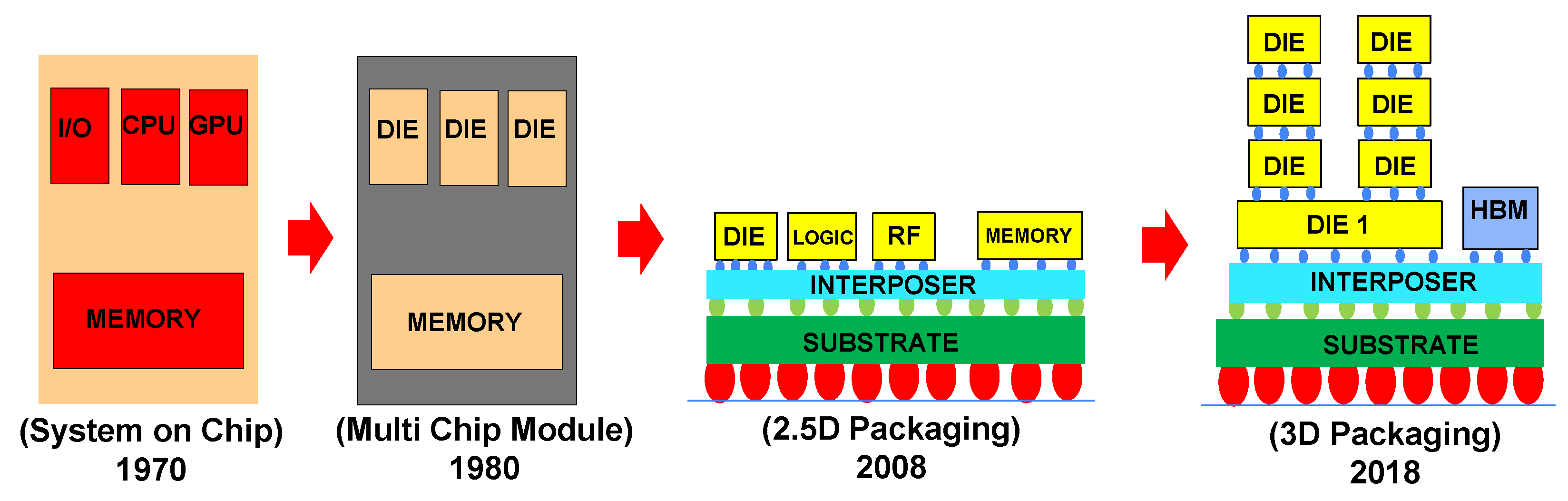
Figure 1 summarizes this evolution in semiconductor packaging, from monolithic SoCs to heterogeneous 2.5D and 3D integration, highlighting the associated increases in thermal resistance pathways and localized heat fluxes.
Historically, early System-on-Chip (SoC) architectures relied on predominantly one-dimensional heat conduction through bulk silicon to a lid or heat sink, allowing classical analytical models of spreading resistance and contact conductance to predict junction temperatures with good accuracy [
32,
33,
34,
35,
36,
37]. As transistor densities increased following Moore’s law, power dissipation became more spatially non-uniform and the assumption of uniform heat flux broke down [
38,
39]. This shift motivated the development of compact thermal models and dynamic RC-network analogs to resolve temperature variations in space and time, laying the foundation for contemporary electro-thermal co-design and early stage thermal-aware placement and routing in modern SoCs [
40,
41,
42,
43].
The development of multi-chip modules (MCMs) introduced lateral multi-die packaging on a common substrate, enabling module reuse and yield improvement at the expense of increased lateral thermal resistance [
44,
45]. Typical epoxy–glass substrates in MCMs exhibit thermal conductivities of 0.3–0.6
, which are two to three orders of magnitude lower than bulk silicon (≈150
) [
46,
47,
48]. As package power increased, these low-
k substrates became the dominant bottleneck for heat spreading, motivating the use of high-
k filler-loaded adhesives, composite underfills, copper redistribution layers, and backside metal spreaders to enhance lateral heat transport and reduce substrate temperature gradients [
45].
The change to 2.5D integration, enabled by passive silicon interposers that connect multiple logic and memory chiplets, substantially altered the thermal flow dynamics [
49]. In these systems, the silicon interposer has a high in-plane thermal conductivity of about 150 W m
−1 K
−1, but the underfills and dielectric layers that accompany it have significantly lower cross-plane thermal conductivity, making thermal transport quite anisotropic. Microbumps and hybrid-bond interfaces increase thermal boundary resistance, leading to uneven heating. The temperature field depends on how power is distributed, the thermal resistance between surfaces, and the design of the vertical conduction channel. Simulations and experiments on high-density 2.5D packages, including CoWoS and EMIB, have shown that interposer hotspot temperatures can reach over 120 °C when overall power levels are above 600–700 W [
16]. These results indicate that material anisotropy, die placement, and cooling architecture are becoming increasingly interlinked.
In conventional 2.5D packages, interposer overheating at total powers above 600–700 W is primarily a consequence of low external heat-transfer coefficients. Air-cooled assemblies exchange heat with the environment via natural or moderately forced convection, yielding effective package-level coefficients of only
–50
for ambient temperatures
–
[
37,
50]. Under these low-
h conditions, the cross-plane thermal resistance of underfills, dielectrics, microbumps, and hybrid-bond interfaces becomes rate-limiting, and both calibrated finite-element models and silicon interposer test vehicles report hotspot temperatures above
at such power levels [
16]. By contrast, fluidic cooling integrated into silicon interposers or 3D stacks operates with controlled inlet temperatures
–
and achieves
–
using embedded microchannels or jet impingement, as validated by infrared thermography, temperature-sensitive diodes, calorimetry, and conjugate CFD/FEA simulations [
51,
52,
53].
Fully 3D stacking further amplifies these issues by constraining vertical heat removal [
54]. Through-silicon vias (TSVs), bonding layers, and dielectric liners introduce significant thermal impedance, while inter-die coupling promotes correlated hotspots and thermo-mechanical stress. As interconnect pitches approach the sub-10 µm regime in technologies such as Intel Foveros and TSMC 3D-SoIC, the effective heat-extraction path lengthens relative to the power density, pushing junction temperatures toward material limits [
55]. To alleviate this, research has advanced toward embedded and co-packaged cooling, where microfluidic or two-phase channels are integrated directly into silicon or interposer substrates to enhance through-plane heat transfer [
56,
57]. These techniques enable local heat fluxes exceeding
while maintaining acceptable thermal gradients.
At the most advanced integration levels, die-to-wafer (D2W) and wafer-to-wafer (W2W) hybrid bonding technologies enable near-monolithic three-dimensional assemblies with exceptional interconnect density and minimal interfacial voiding [
58]. Despite their electrical and mechanical benefits, such bonding schemes restrict access for conventional thermal interface materials and underfills, increasing thermal impedance and complicating heat-removal pathways in vertically stacked structures. Consequently, thermal management must be co-optimized with electrical, mechanical, and reliability considerations from the earliest design stages [
59,
60].
At these power densities, thermal feasibility is governed by both lateral heat spreading in solids and interfacial resistance along the junction-to-ambient path. Heat traverses the die, underfill or interposer, thermal interface materials (TIMs), lids or spreaders, and the final heat sink or cold plate, with the thermal conductivity of each layer and the contact resistance at each interface jointly setting the maximum junction temperature and long-term reliability [
32,
61,
62]. While metals and conventional composites with
–
remain central to these stacks, emerging materials with exceptionally high and often anisotropic conductivity provide new opportunities for directional heat spreading [
30,
63,
64,
65,
66].
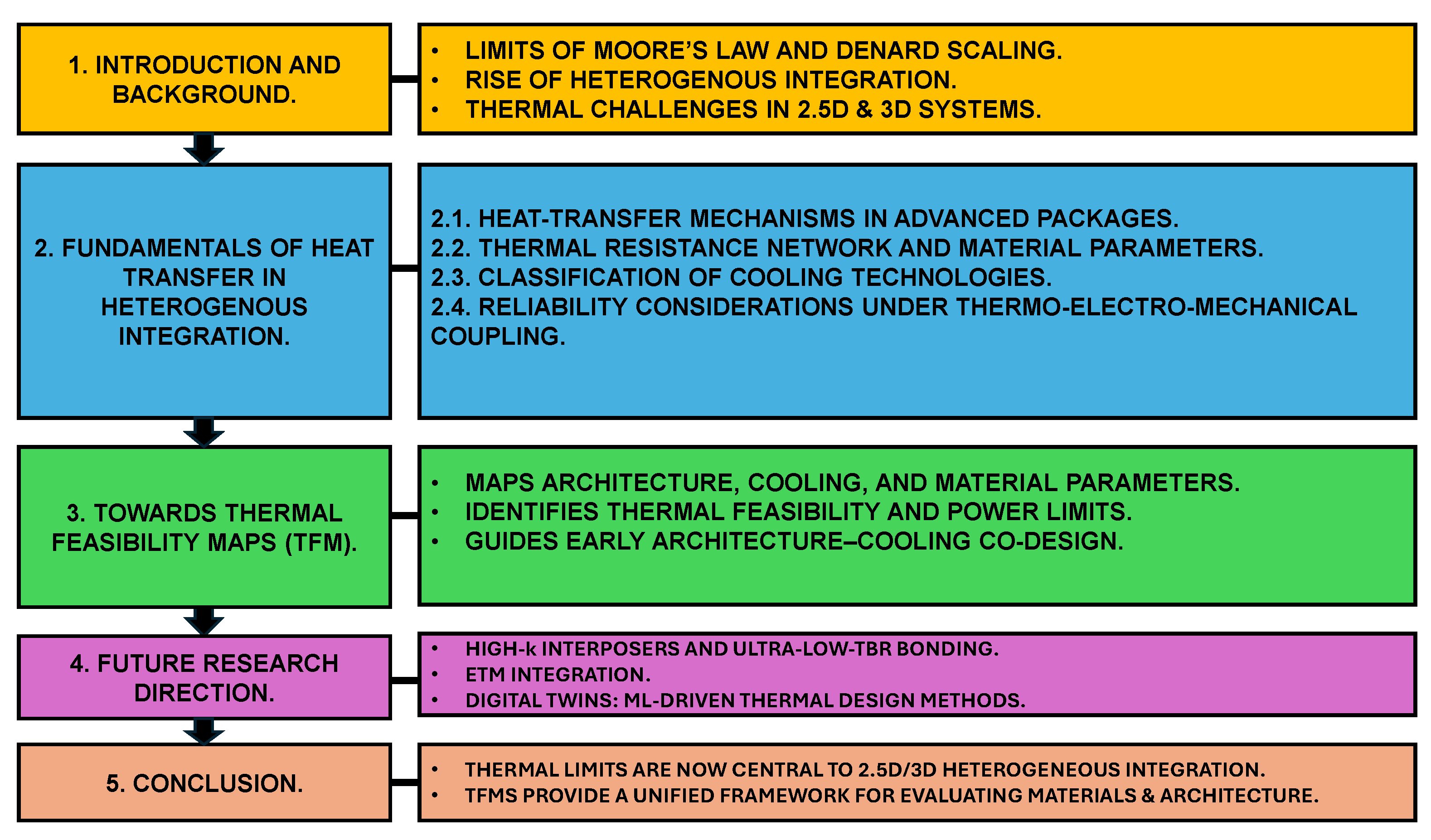
To address this gap, we are exploring Thermal Feasibility Maps (TFMs), a comprehensive framework that integrates analytical models, multi-fidelity and finite-element simulations, and focused experiments to define the operational boundaries that comply with junction-temperature constraints across diverse stacks [
31,
67]. TFMs transform thermal management from a late-stage limitation to an early co-optimization catalyst, influencing decisions regarding chiplet partitioning, bonding and interposer technologies, heat-spreader anisotropy, and cooling architectures for next-generation HI systems [
13,
14,
16,
26]. The overall structure of the paper and the logical progression of this framework are summarized in
Figure 2.
2. Fundamentals of Heat Transfer in Heterogeneous Integration
Over the years, the physics of heat transport has shifted from planar SoCs to vertically stacked 3D assemblies. In the past, heat went through homogeneous silicon. Now, it goes through interfaces and geometry, which indicates the complexity of modern thermal transport in heterogeneous integration.
Thermal management in heterogeneous integration poses a multiscale challenge due to the interplay among heat conduction, interfacial resistance, and convective transport, which collectively determine junction temperatures and system reliability.
Section 2.1 examines essential heat-transfer methods in sophisticated packages.
Section 2.2 elaborates on thermal-resistance models, emphasizing thermal interface materials (TIMs), bonding techniques, interposers, heat distribution, and substrates.
Section 2.3 evaluates air, liquid, and two-phase cooling techniques for high-power chiplet systems.
Section 2.4 ultimately discusses thermo-mechanical stresses and dependability.
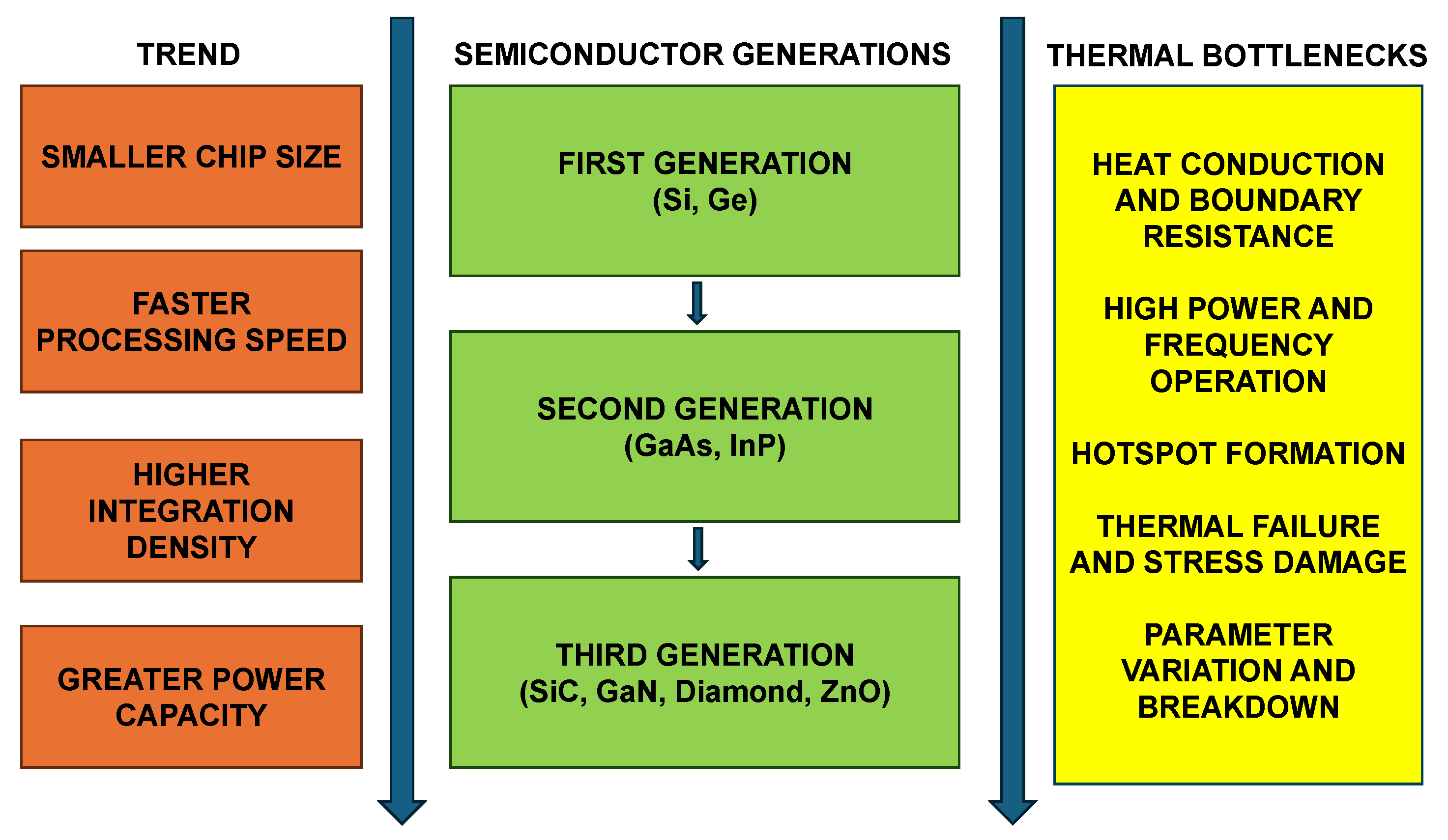
Figure 3 provides a high-level overview of thermal trends across semiconductor generations, illustrating how increasing integration density and switching speeds intensify power density, interfacial resistance, and hotspot formation.
2.1. Heat-Transfer Mechanisms in Advanced Packages
Thermal management in semiconductor packaging follows the same physical principles as macroscale systems, yet nanoscale effects, heterogeneous material interfaces, and extreme power densities magnify its complexity. In modern 2.5D and 3D heterogeneous architectures, heat transfer occurs through a coupled hierarchy of conduction, interfacial resistance, and convection pathways that collectively define the thermal limits of performance and reliability [
69].
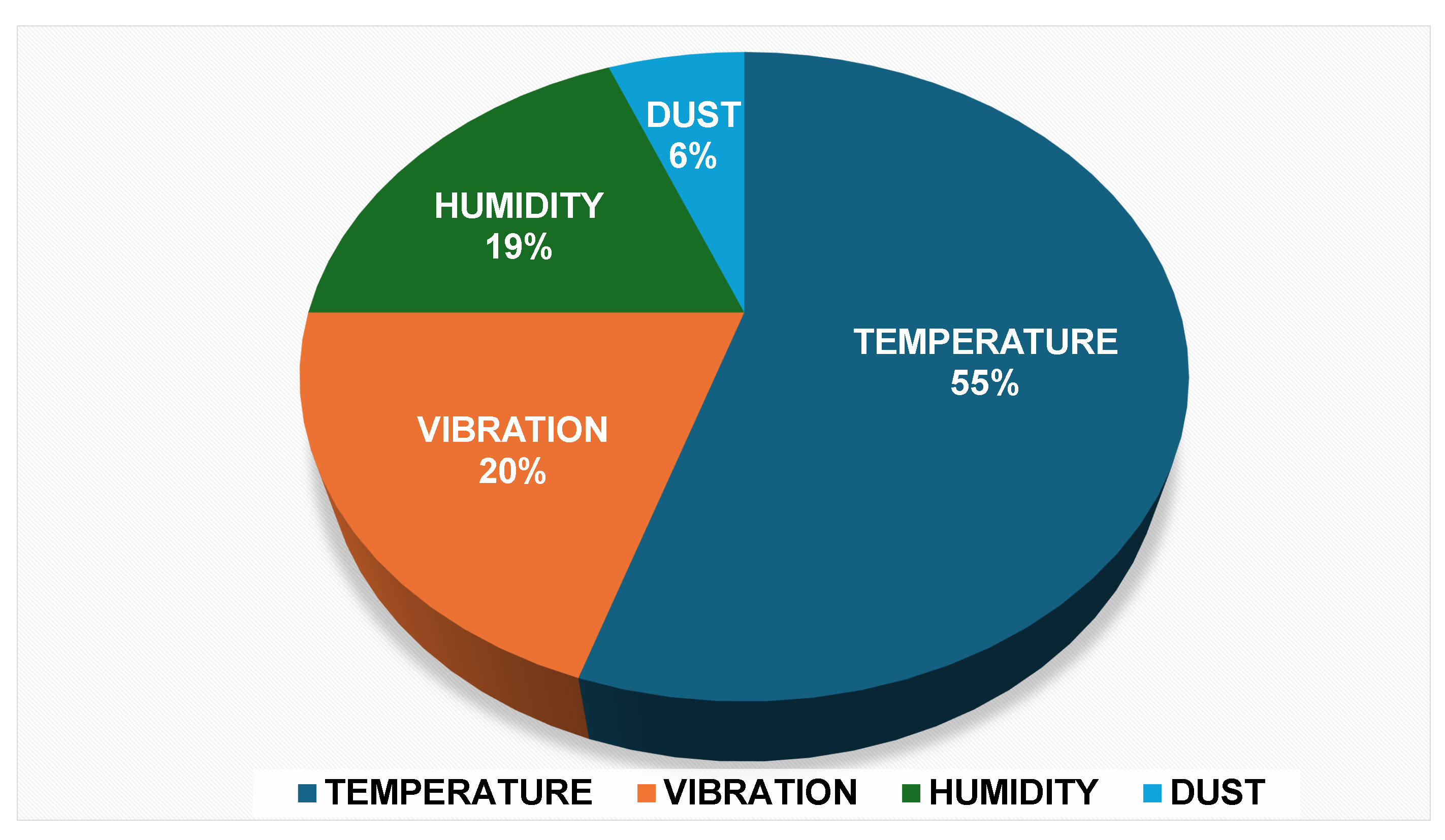
The impact of temperature relative to other environmental stressors on electronic reliability is illustrated in
Figure 4, which summarizes the dominant contributors to failure in electronic equipment.
2.1.1. Mechanism 1: Heat Conduction in Solid Chip and Package Materials
Heat conduction controls how temperature changes within the solid parts of the package, such as the silicon die, interposer, redistribution layers (RDLs), underfills, and the package substrate. Fourier’s law shows how heat flux and temperature gradient are related in a certain area:
where
q is the heat-flux vector (W/m
2),
k is the thermal conductivity (W/m·K), and
is the temperature gradient [
72].
The thermal conductivity of packaging materials spans nearly four orders of magnitude. Single-crystal silicon exhibits
–150
[
47,
73], copper ∼385–401
[
74,
75], and epoxy–glass substrates (FR-4) only 0.3–0.8
[
47]. Glass interposers further limit through-plane conduction (
0.5–1
). By contrast, advanced fillers and composites such as AlN, Cu–Mo laminates, and synthetic diamond (
) enable lateral heat spreading.
This wide anisotropy in conductivity drives preferential heat-flow directions. Heat spreads efficiently through lateral copper traces and RDLs but encounters severe impedance through vertical paths across underfills or substrates. Experimental studies using frequency-domain thermoreflectance have shown that buried metal–dielectric interfaces in advanced microelectronic stacks exhibit strong directional dependence in thermal transport, high in-plane conduction through metallic layers, and markedly lower through-plane conduction dominated by interfacial resistance, underscoring the anisotropic nature of heat flow in layered packaging materials [
76]. In 2.5D chiplet systems, the interposer and substrate act as critical thermal bridges, and their material selection strongly influences both peak junction temperature and thermomechanical stress.
2.1.2. Mechanism 2: Spreading Resistance and Interfacial Heat Transfer
Thermal spreading and interface resistance are the main factors that affect temperature distribution at sizes less than a millimeter. For a circular isothermal source with a radius of
a on a semi-infinite substrate with a thermal conductivity of
k, the spreading resistance is as follows:
as derived by Carslaw and Jaeger [
77,
78] and later generalized by Yovanovich [
33]. The spreading resistance can account for 20–40% of the total junction-to-ambient thermal impedance in chiplet packages.
In addition to spreading, material interfaces contribute thermal boundary resistance (TBR) arising from phonon mismatch and imperfect adhesion. Typical TBR values range from – m2K/W for metal–metal contacts to > m2K/W for dielectric junctions. Experimental studies have shown that fusion-bonded 3D stacks exhibit interfacial resistances up to m2K/W depending on oxide layer thickness and bonding quality.
The combined thermal impedance across an interface is thus expressed as follows:
Mitigating these resistances requires innovations such as Cu–Cu hybrid bonding, nano-filler TIMs, and metal-doped underfills [
79,
80,
81,
82].
2.1.3. Mechanism 3: Convective Heat Transfer and Cooling Boundaries
Once heat conducts through the solid layers, it is removed by convection at the coolant interface. Newton’s law of cooling defines this process [
72]:
where
h is the convective heat transfer coefficient,
the surface temperature, and
the coolant’s bulk temperature.
Typical values from experimental and the reviewed literature are as follows:
Natural or forced air: 5–
[
83];
Single-phase liquid cooling:
–
[
51];
Two-phase microchannel/jet cooling: >
, enabling fluxes well above
[
84].
These values indicate that standard air cooling is not feasible beyond roughly
, as achieving
would need
. In controlled laboratory environments, specific high-flux cooling systems have demonstrated cooling capacities exceeding 300–400 W/cm
2. Modern heterogeneous systems use built-in liquid interposers or microfluidic cold plates to control these densities. However, these solutions require more trade-offs, such as pressure drop, flow control, and mechanical stress [
85].
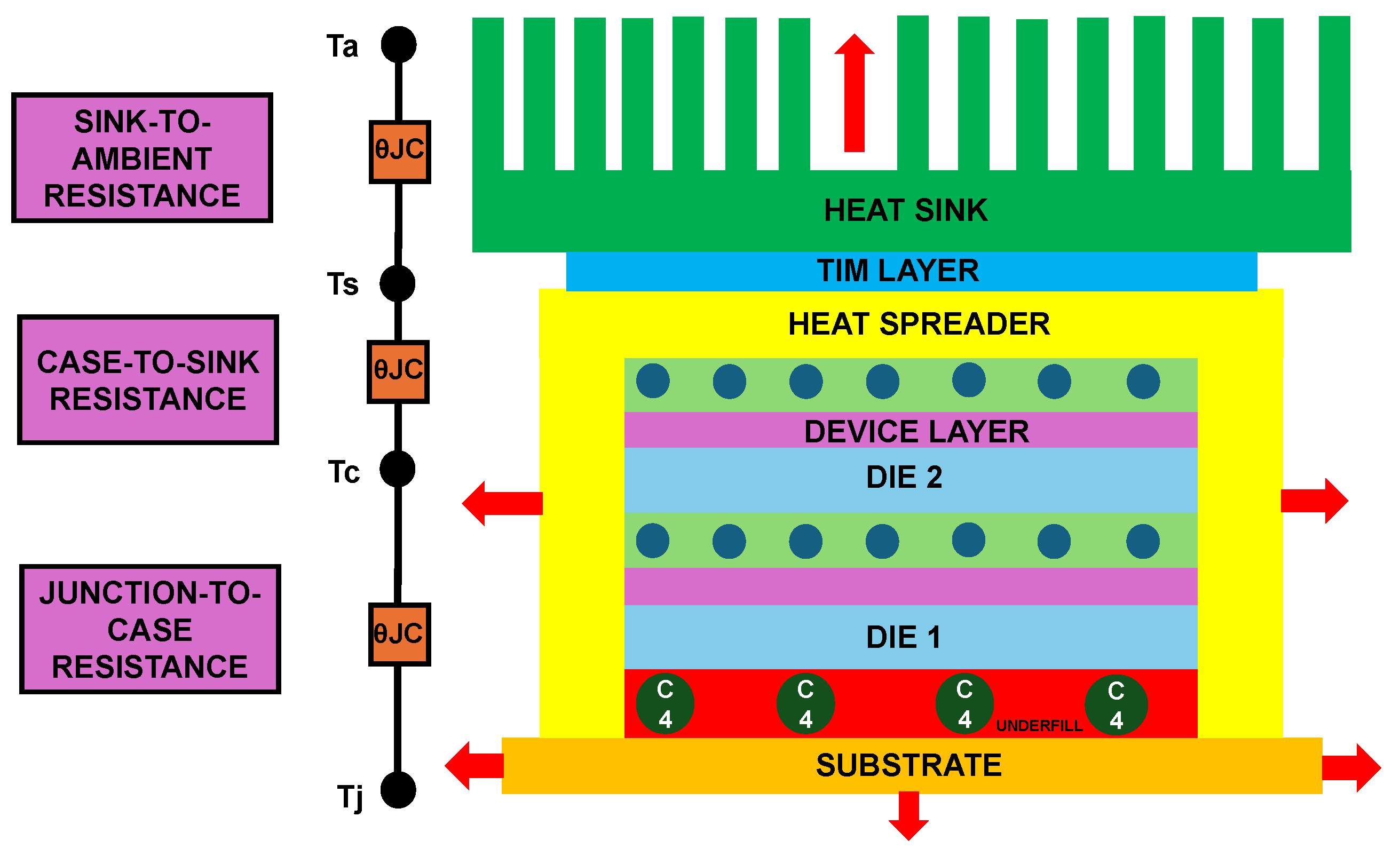
The complete junction-to-ambient heat-flow path, including junction-to-case, case-to-sink, and sink-to-ambient thermal resistances, together with lateral and vertical heat-spreading mechanisms, is schematically illustrated in
Figure 5.
2.1.4. Transient Heat Conduction and Dynamic Thermal Response
Under non-steady workloads, temperature evolves according to the following:
where
Q is the volumetric heat generation,
is the specific heat, and
is the density. In AI accelerators and HPC systems, transient heating is a significant design concern due to rapid load switching, which generates sub-millisecond thermal spikes [
86]. Reduced-order solvers and compact RC models are frequently implemented in predictive transient analysis.
2.1.5. Junction Temperature and Reliability Constraints
The maximum junction temperature (
) significantly affects device longevity by influencing electromigration, time-dependent dielectric breakdown (TDDB), and bias-temperature instability (BTI). Design regulations typically require that
not exceed 125 °C; however, in stacked or high-power dies, localized hotspots may exceed this threshold without meticulous thermal management. Prolonged temperature gradients can generate thermomechanical stress, resulting in solder fatigue, bond-wire detachment, or delamination. This was demonstrated in recent electro-thermal-mechanical co-design studies [
87].
The Coffin–Manson–Arrhenius relationship can be used to describe how long power electronic modules last when they go through thermal cycling:
where
is the number of cycles until failure,
is the change in junction temperature,
is the average junction temperature,
a and
are empirical coefficients,
is the activation energy, and
is the Boltzmann constant. This model shows that both the size and the average rate of temperature change accelerate the processes that cause fatigue-related degradation.
Miner’s rule can be used to figure out how much cumulative lifetime damage happens when stress amplitudes change:
In this equation,
C is the cumulative damage index,
is the number of cycles at stress level
i, and
is the number of cycles till failure at that level. When
, failure is expected. The junction temperature can be approximated using an electrothermal model as follows:
In this context,
represents the case or substrate temperature,
denotes the total device power loss, which includes both conduction and switching losses, and
indicates the thermal resistance between the junction and the case. This expression directly links power-dissipation profiles to thermal stress and lifetime prediction.
2.2. Thermal Resistance Network and Material Parameters
Full finite-element thermal analysis is often computationally demanding, so early stage thermal evaluation typically uses simplified lumped-resistance networks that resemble electrical RC circuits. These models capture the dominant conduction and convection paths while maintaining high computational efficiency.
2.2.1. Thermal Resistance Models
The overall junction-to-ambient resistance can be expressed as
where
represents the junction-to-case resistance through the die and package,
is the case-to-sink (thermal interface) resistance, and
corresponds to the sink-to-ambient resistance, which is mainly governed by convective heat transfer.
This formulation follows the JEDEC JESD51 [
88] thermal characterization standards and provides the foundation for compact thermal models commonly used in early package design and feasibility analysis.
To clarify how the overall junction-to-ambient thermal resistance
evolves when transitioning from 2.5D to 3D integration, we summarize representative values from published data in
Table 1 and
Table 2. For 2D/2.5D FCBGA logic packages, Intel AN358 (Intel Corporation, Santa Clara, CA, USA) reports
°C/W and
°C/W under 400 ft/min airflow [
89], placing typical 2.5D values in the ranges
–
°C/W,
–
°C/W, and
–3 °C/W. However, experimentally characterized 3D DRAM cubes exhibit
°C/W [
90], and hybrid-bonded HBM stacks typically show
–
°C/W [
91], reflecting an approximate one order-of-magnitude increase in junction-to-case resistance compared to advanced 2.5D modules.
This increase is consistent with reported thermal boundary resistances (TBRs) of
–
m
2K/W for metal/semiconductor or oxide interfaces [
92,
93,
94], which accumulate across multiple bonding, underfill, and TSV-related layers in 3D stacks. By contrast, the case-to-sink and sink-to-ambient contributions depend mainly on external cooling hardware and therefore remain in comparable numerical ranges across 2.5D and 3D packages.
Table 2 further provides representative per-area thermal resistances for common TIM and lid stack materials. Greases, gels, and PCMs typically fall in the 0.1–1.0 °C·cm
2/W range [
89,
95], thermal pads exhibit 1–4 °C·cm
2/W, TIM1+Cu lid stacks contribute ∼
cm
2K/W in measured 2.5D test vehicles [
96], metallic TIMs fall in the 0.05–0.20 °C·cm
2/W range, and hybrid-bonded interfaces achieve the lowest impedances due to extremely small TBRs per-interface [
92,
93]. These data form the empirical basis for the
values used in our thermal feasibility analysis.
Table 1.
Representative decomposition of thermal resistance components for 2.5D and 3D packages. Ranges compiled from Intel AN358 [
89], Agnesina et al. [
90], and hybrid-bonded HBM thermal analyses [
91].
Table 1.
Representative decomposition of thermal resistance components for 2.5D and 3D packages. Ranges compiled from Intel AN358 [
89], Agnesina et al. [
90], and hybrid-bonded HBM thermal analyses [
91].
| Package Type | | | | Physical Drivers |
|---|
| 2D/2.5D FCBGA (air-cooled) | 0.1–0.3 | 0.05–0.3 | 1.0–3.0 | Intel AN358 reports °C/W and °C/W at 400 ft/min [89]. Heat path dominated by single-die conduction. |
| 2.5D interposer (lidded) | 0.15–0.4 | 0.05–0.2 | 1.0–3.0 | Silicon interposer adds spreading layers. TIM+lid stack contributes
∼ cm2K/W [96]. |
| 3D hybrid-bonded HBM stack | 1.5–2.0 | 0.05–0.3 | 1.0–3.0 | Multiple Cu–Cu/oxide bonding interfaces with TBRs in – m2K/W range [92,93]. Representative
summarized by Lee et al. [91]. |
| 3D DRAM cube (14-die) | 2.5–3.0 | 0.05–0.3 | 1.0–3.0 | Agnesina et al. report °C/W and °C/W [90]. Stack height, underfill, and TSV density
significantly increase . |
Table 2.
Representative per-area thermal resistance () ranges for TIM and cap stacks.
Table 2.
Representative per-area thermal resistance () ranges for TIM and cap stacks.
| Interface Class | (°C·cm2/W) | Materials | Physical Drivers | Ref. |
|---|
| Greases (TIM2) | 0.10–0.40 | Silicone oil; Al2O3/BN-filled greases | Range corresponds to realistic BLT and pressure. CNT-greases reach lower bound (∼0.18 cm2K/W). | [89,95] |
| Gels/filled adhesives | 0.15–1.00 | Silicone gels; Ag-filled epoxy adhesives | Higher BLT; filler loading strongly influences thermal impedance. | [89] |
| Phase-change materials (PCMs) | 0.30–0.70 | Wax/polymer TPCM films | Melting collapses BLT; pressure sensitive; commonly 0.3–0.7 cm2K/W. | [89] |
| Thermal pads/tapes | 1.0–4.0 | Elastomer pads; PSA-based tapes | Large BLT → highest thermal resistance; unsuitable for high heat flux. | [89] |
| TIM1 + Cu lid stack | | TIM + copper lid | Measured in 2.5D jet-impingement cooling test vehicle; corresponds to 0.05–0.15 °C/W depending on die area. | [96] |
| Metallic TIMs | 0.05–0.20 | InSn; AuSn; sintered Ag | High k (30–80 W/mK) + small BLT (<10 µm) → low impedance. | [92,93] |
| Hybrid-bonded interfaces | – | Cu–Cu bonding; oxide fusion bonding | Derived from TBR – m2K/W; ultra-low impedance when scaled by interface area. | [92,93,94] |
2.2.2. Thermal Interface Materials (TIMs)
The concept of thermal interface materials (TIMs) [
48,
97] emerged in the 1960s alongside the miniaturization of electronic components and the growing need to manage heat dissipation in transistors and integrated circuits. Early studies of interfacial heat transfer by Swartz and Pohl established the foundation of interfacial thermal resistance (ITR), defining it as the temperature discontinuity across an interface per unit heat flux [
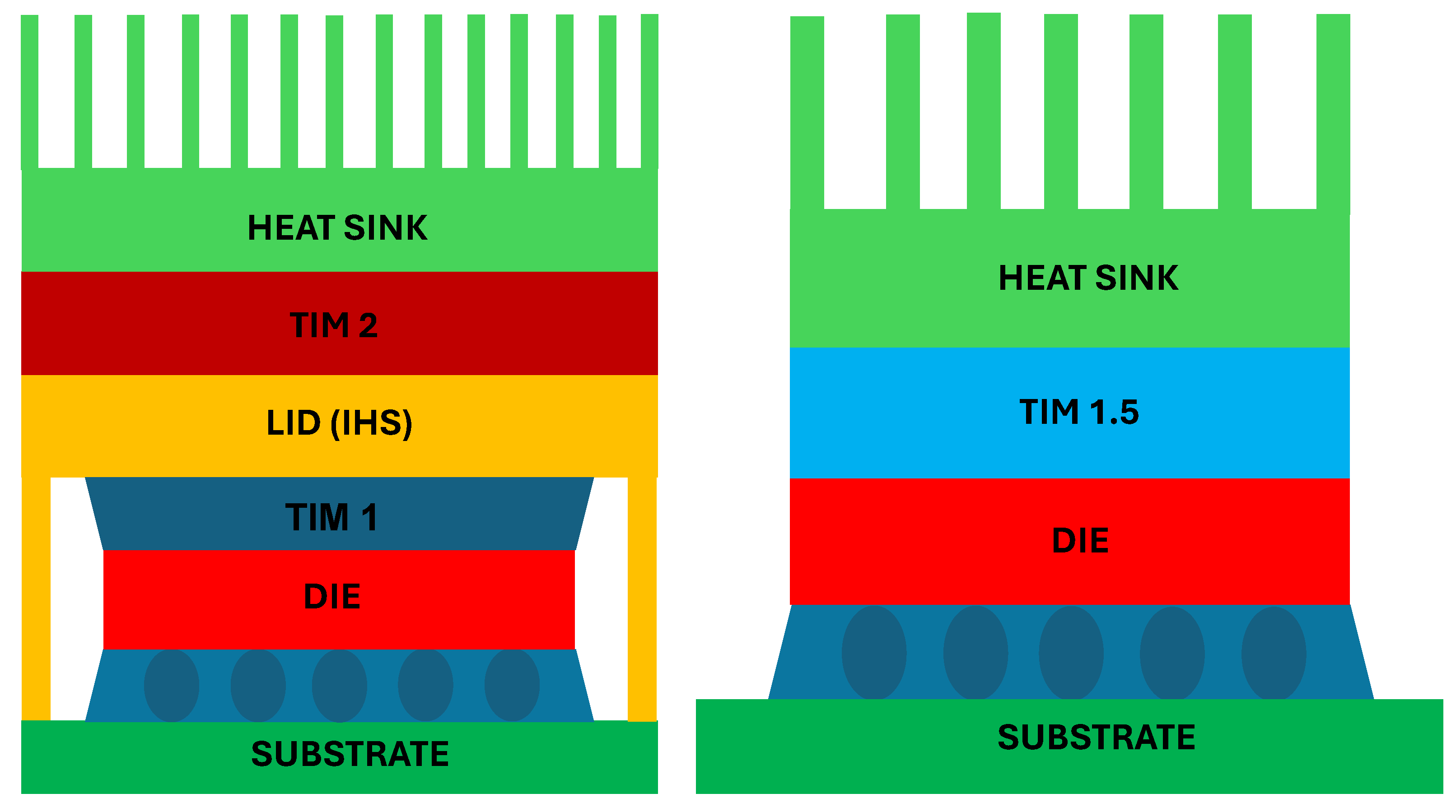
98]. As power densities increased through the 1980s and 1990s, polymer-based greases, phase-change materials, and metallic solders were progressively developed to mitigate the temperature rise between chips and heat spreaders. In modern microelectronics and 3D integration, the interface between semiconductor dies, lids, and heat spreaders remains a fundamental challenge for heat dissipation. TIMs fill the tiny gaps that form because of uneven or rough surfaces. This helps heat flow smoothly between layers and reduces thermal resistance in the device.
Figure 6 shows the TIMs bridging the gaps between these components, enhancing thermal contact and promoting uniform heat spreading.
At the interface scale, the total thermal resistance
comes from both conduction through the TIM as a whole and contact resistance at its boundaries:
where
is the bulk conduction term determined by the bond-line thickness
, thermal conductivity
, and contact area
A; and
represent the thermal contact resistances between the TIM and adjoining surfaces [
48,
98]. The fundamental definition of interfacial resistance is given by
where
is the temperature difference across the interface and
J is the heat flux density. For convenience,
is often expressed in terms of the thermal boundary conductance (TBC)
as
.
Fourier’s law of steady-state conduction relates local temperature gradients to heat flux:
where
k is the intrinsic thermal conductivity of the medium. For effective heat transfer, both the bulk term
and the interfacial term
must be minimized.
Thermal interface materials (TIMs) have changed over time as device power densities have increased and microelectronic packaging has become more integrated [
48,
97,
99].
First Generation: Silicone Greases and Filled Polymers—Commercial TIMs began with silicone-based greases or pastes filled with high-thermal-conductivity ceramics like alumina (Al2O3) and boron nitride (BN), offering –5 W·m−1·K−1 They were inexpensive and reworkable, but pump-out, drying, and bond-line instability during thermal cycling degraded them.
Second Generation: Phase-Change and Metal-Filled Adhesives—Phase-change materials (PCMs) having melting points between 50 and 70 °C softened to adapt to surface irregularities, therefore decreasing interfacial contact resistance
to around 0.1 °C·cm
2/W. Simultaneously, silver-filled epoxies and indium-based metal adhesives enhanced contact stability and mechanical adhesion for high-power devices [
100,
101].
Third Generation: Metallic Solders and Low-Melting Alloys—Metallic TIMs such as indium–tin (InSn) and gold–tin (AuSn) solders deliver high thermal conductivity () and ultra-thin bond lines (BLT ), enabling efficient heat transfer in HPC and memory stacks. Yet, CTE mismatch with silicon often leads to fatigue and delamination during thermal cycling.
Fourth Generation: Nanoengineered Interfaces—Nanoengineered interfaces, including CNT arrays, graphene films, Ag nanoparticle sintering, and Si–Si hybrid bonding [
102,
103,
104], achieve high conductivity (
) and thermal boundary conductance (
), nearing phonon transport limits. Yet, complex fabrication and yield loss remain challenges [
105,
106].
A comparative summary of the four generations of thermal interface materials, including representative materials, thermal performance, reliability considerations, and typical applications, is provided in
Table 3.
Reliability and Emerging Trends
Thermal reliability of TIMs depends on the interaction between bulk thermal conductivity (
), interfacial conductance (
), and mechanical compliance (elastic modulus
E) [
69]. Metallic or sintered films provide high thermal performance but limited flexibility, while polymeric composites offer high compliance at the cost of thermal efficiency [
97]. Under cyclic loading, void growth, delamination, and microcracking progressively increase total thermal resistance
.
Recent advances show progress toward mechanically strong, low-resistance interfaces. Localized liquid-metal layers achieve BLTs below 10 µm and interfacial resistances
mm
2·K·W
−1 [
107]. Similarly, graphene–copper hybrid “sandwich” structures [
102] and boron nitride nanosheet composites [
105] exhibit high
values (>300 MW·m
−2·K
−1) while maintaining stability under thermal cycling. Surface functionalization and self-assembled monolayers (SAMs) simultaneously lower bulk and contact resistance, establishing a zero-gap TIM design for heterogeneous integration [
106].
The long-term reliability of thermal interface materials (TIMs) is governed by thermomechanical stresses, binder volatilization, interfacial crack formation, oxidation, humidity-driven softening, and microstructural rearrangements that collectively increase the effective thermal interface resistance
. To explicitly quantify these mechanisms, we surveyed peer-reviewed experimental studies reporting changes in
or
under controlled accelerated conditions. The resulting dataset (
Table 4) spans polymer-based pastes, metallic and alloy TIMs, silicone pads and putties, and emerging high-
k composite TIMs. Across this literature, thermal pastes aged at
C exhibit severe degradation (∼185–300% increase in
), corresponding to normalized rates exceeding
–
per
h. High-temperature metallic TIMs such as Ag-based greases, Sn–3.5Ag solders, and Sn foils similarly lose their initial thermal benefit over 90 days at
C. In contrast, silicone pads subjected to humidity stress may soften and show reduced
, whereas deep thermal cycling of filled putties produces more than 50% degradation over 765 cycles (∼
per
cycles). Notably, high-
k graphene–epoxy composites show improved thermal performance under cycling, with
k increasing by 15–25% after 500 cycles due to filler-network densification. This quantitative comparison reveals the broad spread of TIM degradation rates and directly highlights the trade-off between initial thermal performance and long-term reliability across TIM chemistries.
2.2.3. Interposers and Heat Spreading
An interposer is an intermediary substrate, such as Si or glass, that redistributes I/O at a fine pitch between chiplets/dies and the package. It also provides short, dense wiring and vertical connections using TSV/TGV structures. It emerged in the 2000s with TSV-enabled 2.5D/3D integration, separating die technology from package limits and enabling heterogeneous integration [
112]. In current systems, the interposer serves as both an electrical redistribution medium and a lateral thermal spreading plane, influencing junction temperatures and spatial gradients between chiplets.
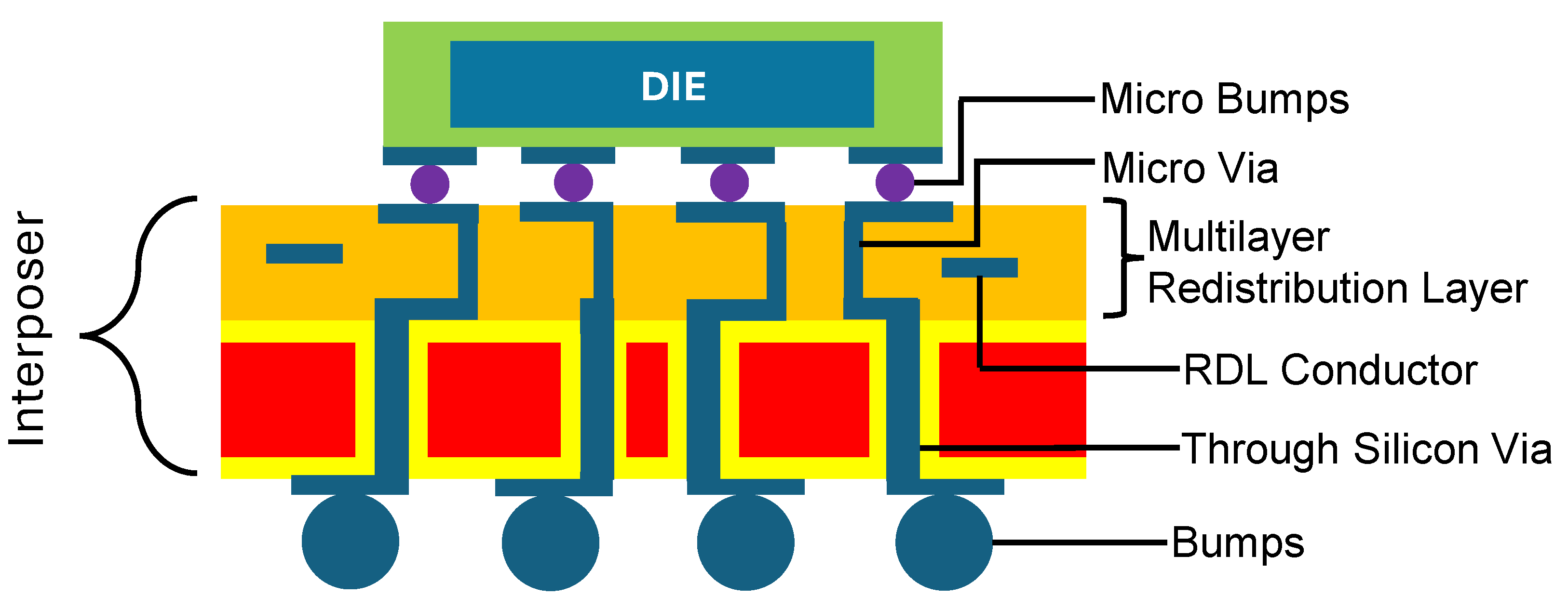
A representative silicon interposer architecture highlighting redistribution layers, micro-bumps, through-silicon vias, and underfill regions is shown in
Figure 7.
Types of Interposers
Three major interposer technologies have evolved:
Silicon Interposers (TSV-Based): It dominates high-performance 2.5D integration (e.g., Xilinx FPGAs (Advanced Micro Devices, Inc., Santa Clara, CA, USA), GPUs with HBM) due to their fine wiring density (<1 µm L/S) and precise via formation [
113,
114]. Their thermal conductivity (
–150 W·m
−1K
−1) enables adequate lateral heat spreading, although their coefficient of thermal expansion (CTE ≈ 2.6 ppm/K) mismatch with organic substrates causes warpage and stress [
115]. TSVs introduce localized stress and anisotropy in heat conduction, which must be managed via via-pitch optimization and underfill design [
116,
117].
Glass Interposers (TGV-Based): Low-cost, low-loss alternative to silicon [
118,
119,
120]. Properties: excellent dimensional stability, smooth surface, scalable large-panel fabrication. Limitation: low thermal conductivity (
W·m
−1K
−1). Effect: 10–15 °C higher junction temperature [
119]. Solution: use Cu planes or thermal vias. Advantages: low dielectric loss, good manufacturability [
121].
Organic and Fan-Out Interposers (TSV-less/“2.1D–2.3D”): Emerging organic bridge and fan-out redistribution layer (RDL) technologies eliminate TSVs altogether [
122,
123]. These interposers use thin polymer dielectrics and Cu redistribution networks on organic cores, offering superior CTE matching with PCB substrates (6–18 ppm/K) and lower cost. However, they suffer from poor through-thickness thermal conductivity and limited fine-pitch routing (∼2–3 µm L/S) [
115]. Organic interposers and bridge solutions (e.g., Intel EMIB [
124]) have proven capable of delivering high I/O bandwidths at lower cost and mechanical stress.
Normalized Lateral Temperature Rise Between Chiplets
Lateral thermal coupling is governed by the in-plane thermal conductivity and heat-spreading resistance of the interposer. The classical spreading-resistance formulation developed by Yovanovich [
33] provides a widely used analytical basis:
where
k is the in-plane conductivity,
t the interposer thickness, and
a geometric factor. The temperature rise between chiplets follows directly:
These expressions have been validated in multi-die thermal studies, including the compact and experimentally calibrated models reported by Poppe et al. [
45]. Using published conductivities,
Table 5 reports normalized
values for representative chiplets on each substrate type.
Thermal-Conductivity Anisotropy
Multilayer packaging materials, particularly polymer-based dielectrics and fan-out build-up structures, often exhibit strong anisotropy between in-plane and cross-plane conduction. Following conventional practice in thermal composite characterization [
125], anisotropy is expressed as follows:
As shown in
Table 5, silicon is nearly isotropic, glass interposers show moderate anisotropy due to TGV/Cu integration, and organic/fan-out materials exhibit the highest anisotropy consistent with their Cu/polymer build-up structure.
CTE Mismatch and Warpage Susceptibility
Thermo-mechanical warpage is strongly influenced by the mismatch between the coefficient of thermal expansion (CTE) of silicon and the interposer material. The standard measure of mismatch is
which follows directly from Timoshenko’s foundational bi-material curvature theory [
126], a cornerstone of packaging mechanics and thermal stress analysis [
127,
128]. Warpage curvature scales proportionally with mismatch, temperature excursion, and layer geometry:
Table 6 summarizes verified CTE values, mismatches, and representative warpage magnitudes reported in reliability studies of glass and organic packaging structures [
129,
130].
By grounding thermal spreading, anisotropy, and thermo-mechanical mismatch in experimentally reported data and established analytical frameworks, this subsection provides a quantitatively normalized comparison across interposer technologies. These additions reinforce and extend the qualitative review by introducing the literature-verified metrics relevant for evaluating silicon, glass, and organic/fan-out interposers.
Table 5.
Experimentally reported thermal properties for three interposer classes.
values are analytical estimates (this work) for two 20 × 20 mm chiplets at 80 W each, using published
k values. Analytical estimates based on spreading-resistance scaling using the literature
k values. Trends are consistent with detailed CFD studies [
131].
Table 5.
Experimentally reported thermal properties for three interposer classes.
values are analytical estimates (this work) for two 20 × 20 mm chiplets at 80 W each, using published
k values. Analytical estimates based on spreading-resistance scaling using the literature
k values. Trends are consistent with detailed CFD studies [
131].
| Material | k (W/mK) | | (K) † | Ref. |
|---|
| Silicon | 130–150 | ≈1 | 10–15 (est.) | [132] |
| Glass (TGV) | 1.1–1.4 (bulk) | 1.5–2.0 | 16–22 (est.) | [119,133,134] |
| Organic/Fan-out | 0.3–0.6 | 2–3 | 24–32 (est.) | [125,135] |
Table 6.
CTE ranges, mismatch with silicon, and representative warpage magnitudes from the literature for advanced packaging structures.
Table 6.
CTE ranges, mismatch with silicon, and representative warpage magnitudes from the literature for advanced packaging structures.
| Material | CTE (ppm/K) | vs. Si | Warpage (m) | Ref. |
|---|
| Silicon | 2.6–3.0 | 0–0.4 | <20 | [132] |
| Glass (low-CTE) | 3.0–10.0 | 0.7–2.4 | 30–70 | [133] |
| Organic/Fan-out | 10–20 | 7.4–17.4 | 50–150 | [129,130,136] |
Comparative Thermal, Reliability, and Thermo-Economic Assessment
Table 7 and
Table 8 summarize the literature-reported thermal conductivities, spreading behavior, and reliability characteristics of major interposer materials, together with their experimentally demonstrated
improvements and associated CAPEX/OPEX trends.
Table 7 consolidates material-level attributes such as thermal conductivity, lateral-spreading effectiveness, CTE-driven warpage tendencies, and documented cycling or storage reliability. These values highlight the wide range of thermal and mechanical behaviors that arise across organic, silicon, glass, ceramic, and emerging high-
k interposers.
Table 8 complements this by connecting measured thermal improvements to packaging and cooling CAPEX categories and to validated energy/OPEX reductions reported for advanced liquid-cooling deployments. Silicon and glass interposers paired with cold-plate cooling typically provide large junction–temperature reductions and 15–20% energy savings, while hybrid direct-liquid-cooling deployments achieve up to 27% reductions in cooling-power demand. Embedded microfluidic interposers deliver the highest reported thermal gains (e.g., 40.1% interposer-temperature reduction) at correspondingly higher CAPEX.
Together, these tables provide a compact quantitative basis for comparing interposers technologies and cooling strategies in terms of thermal performance, reliability, and economic impact.
Interposers function as both high-density electrical redistribution layers and lateral heat-spreading planes in advanced 2.5D and 3D heterogeneous packages. Their thermal behavior directly governs temperature uniformity across chiplets and thus affects both performance and reliability. Conventional silicon interposers (
–150
) offer superior in-plane heat conduction compared to glass or organic substrates (
–1
), yet still exhibit pronounced anisotropy due to metallization stacks and TSV networks that modulate effective in-plane and through-thickness conductivities [
119,
134,
142]. Under non-uniform power maps typical of AI/HPC accelerators, such anisotropy introduces lateral spreading resistance that can drive double-digit inter-die temperature deltas at constant total package power [
113,
119,
134].
Two primary methods for reducing lateral thermal gradients are gaining attention. The first is using interposers and substrates with higher thermal conductivity, such as SiC/AlN ceramics, composite materials, and new ultra-high-
k options. Copper/diamond and metal–diamond composites can provide near-isotropic conduction with
–
when interfacial thermal boundary resistance (TBR) is well controlled [
143,
144,
145,
146,
147]. Polycrystalline and CVD diamond heat spreaders or interposers can exceed
but need good CTE matching and bonding to avoid stress and reliability issues [
143,
144]. Boron arsenide (BAs) is also emerging as a promising cooling substrate, with reported conductivities higher than diamond and initial device results [
148,
149].
The second method uses the interposer as an active thermal layer by adding microfluidic channels for localized cooling with little electrical impact. Silicon interposers with such cooling show substantial reductions in peak temperature and thermal gradients, supporting co-design for both electrical and thermal performance [
112,
140]. Glass interposers made by TGV processes are also improving for optical and mm-wave use. Though their intrinsic conductivity is low, metal planes, thermal vias, and local spreaders can partly recover lateral heat flow [
118,
142,
150,
151]. Choosing an interposer for AI/HPC depends on maximizing (i) conductivity and anisotropy in the plane and through the thickness, (ii) interfacial TBR, (iii) mechanical/CTE match, and (iv) cost and manufacturability. Combining advanced materials (diamond/BAs/composites) with fluidic cooling and thermal-aware design may considerably lower the temperature differences across chiplets and make them more reliable [
119,
134,
140,
143].
Table 9 summarizes representative materials and their properties, illustrating the trade-offs between thermal performance, CTE alignment, and manufacturability. These data underscore that while high-
k materials can substantially suppress lateral thermal gradients, their adoption requires careful co-optimization of thermal, mechanical, and economic constraints to ensure long-term package reliability and scalability.
2.2.4. Bonding
In semiconductor packaging, bonding means the processes that connect dies, packages, and substrates both mechanically and electrically, and now also thermally. It includes wire bonds, solder-based flip-chip connectors, thermocompression, through-silicon vias (TSVs), and direct metal/dielectric hybrid bonding utilized in fine-pitch 2.5D/3D integration and HBM [
127,
128,
152].
Taxonomy of Bonding Types
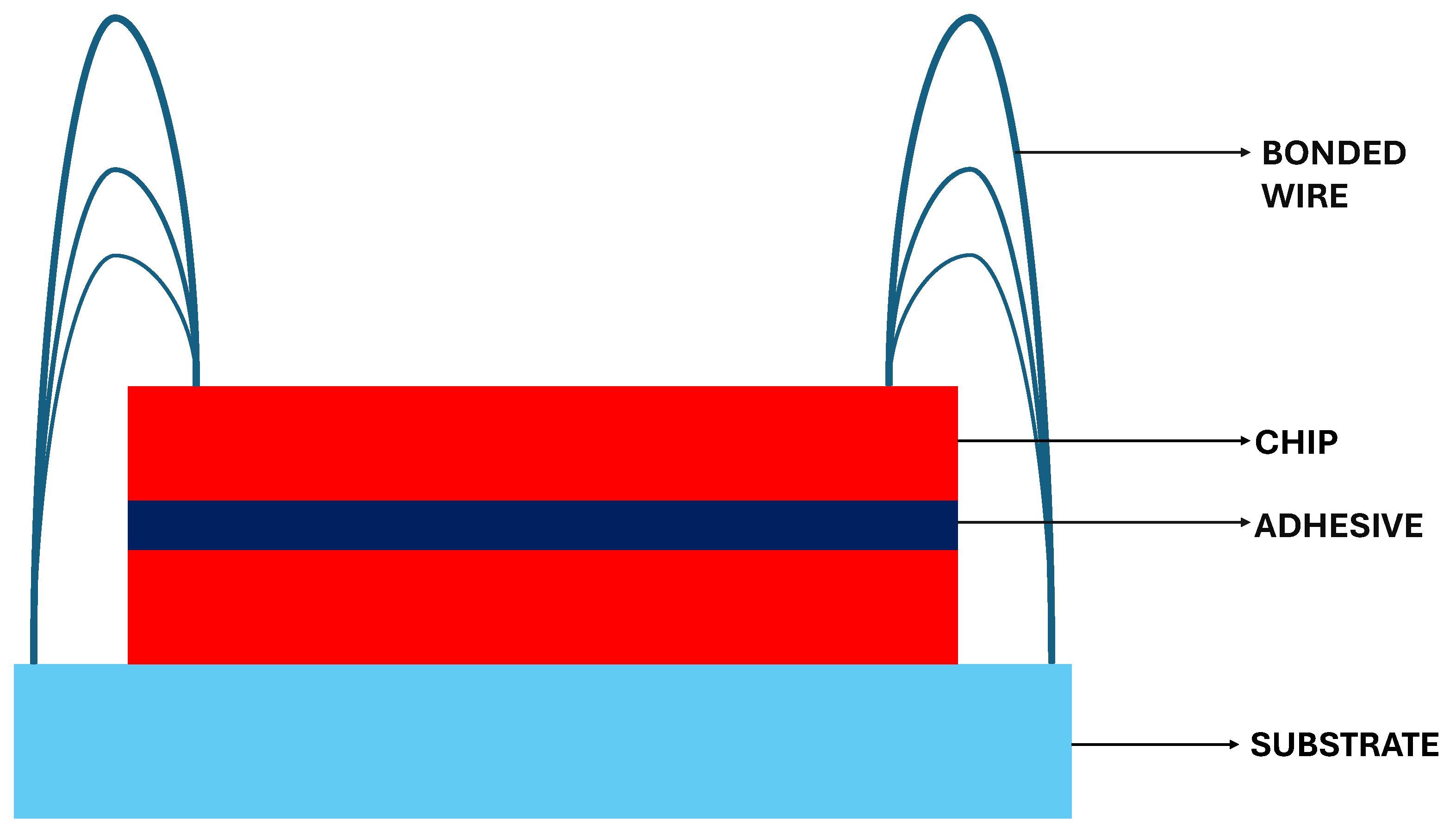
Wire bonding (thermosonic/ultrasonic): Mature, low-cost, and tolerant to topography; limited I/O density and longer interconnects increase parasitics and constrain heat removal [
127,
153]. A schematic illustration of the conventional wire-bonding process is shown in
Figure 8.
Solder bump (C4) and flip-chip reflow: Eutectic or Pb-free microbumps with self-alignment and strong manufacturing base; challenges include pitch scaling below ∼20–30
m, voiding, and thermal–mechanical fatigue of joints [
154,
155,
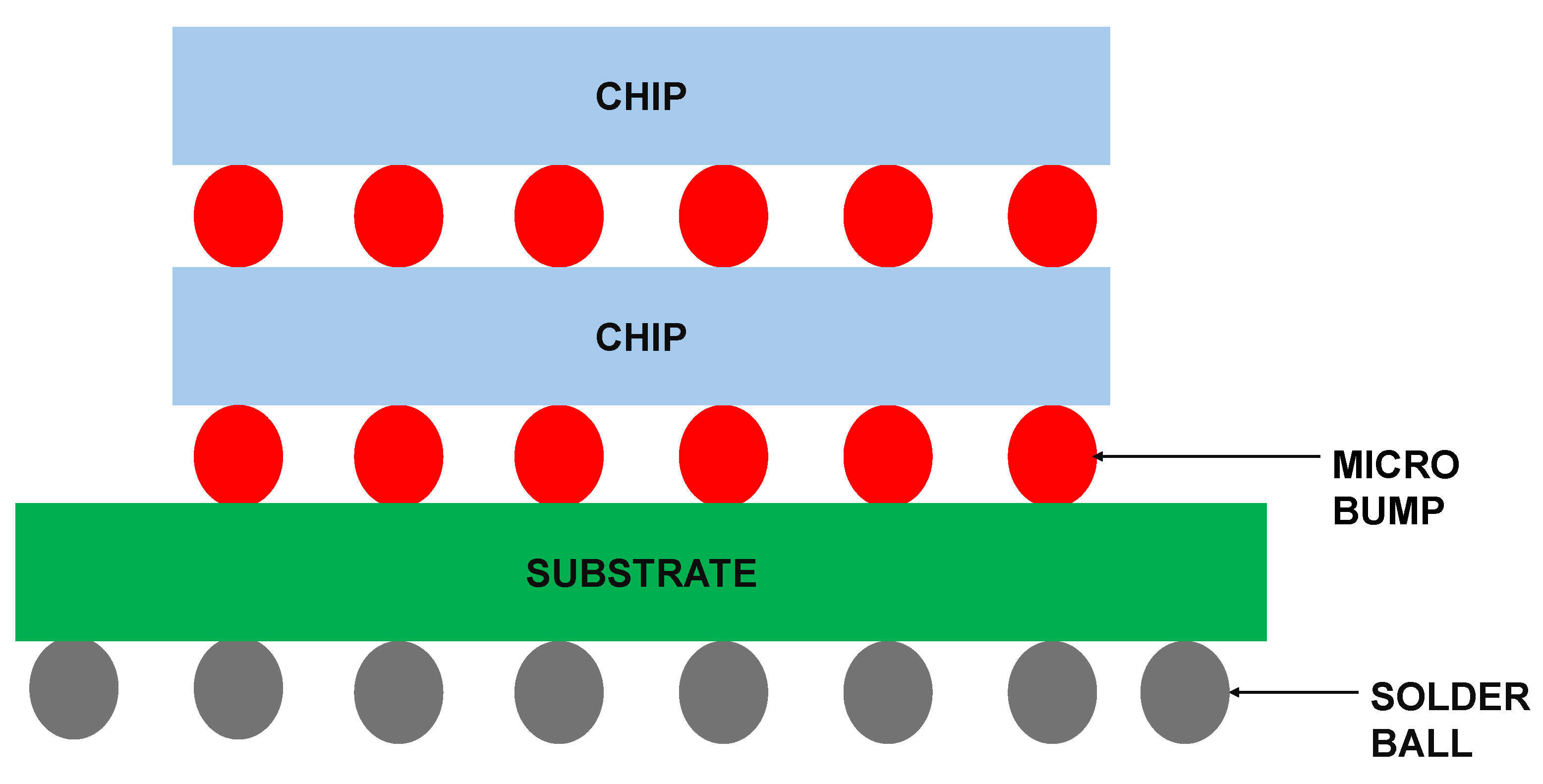
156]. The flip-chip bonding configuration using solder microbumps is schematically illustrated in
Figure 9.
Thermocompression bonding (TCB): Solid-state joining of Cu/SnAg or Cu/Sn systems achieves finer pitch than reflow but narrows the process window and can exacerbate warpage [
157,
158,
159,
160].
Cu–Cu direct (hybrid) bonding (W2W/D2W/D2D): Concurrent dielectric–metal bonding after planarization and activation enables ultra-fine pitch with low electrical and inter-tier thermal resistance, but is sensitive to surface planarity, Cu oxidation/protrusion, particles, and moisture, affecting interfacial reliability [
79,
80,
161,
162,
163,
164,
165,
166,
167].
Au–Au thermo-compression/direct bonding: Oxidation-resilient for heterogeneous stacks and MEMS; higher material cost and creep/interdiffusion considera-tions [
168,
169].
Adhesive/NCF-assisted bonding: Polymer dielectrics co-cured with contacts (“under-fill-in-place”) boost throughput and gap filling; polymer thermal resistance and moisture uptake require careful design [
167,
170,
171,
172,
173,
174,
175].
Evolution and Scaling Trends
Packaging has gone from wire-bonded 2D to flip-chip/WLCSP, then to 2.5D interposers, and now to full 3D-IC with TSVs. Right now, the focus is on hybrid bonding at a pitch of ≤10
m for bandwidth density and thermal routing in HBM/logic stacks. “Bumpless” ideas (BBCube, SoIC, and wafer-on-wafer/chip-on-wafer) shorten interconnects and lower interfacial thermal resistance, but they make it harder to prepare surfaces and keep bonds strong [
176,
177,
178]. Architectural approaches like SMLA (Simultaneous Multi-Layer Access) put stress on thermal envelopes as stack heights rise [
179,
180].
A comparative overview of the major bonding technologies used in advanced and 3D packaging, highlighting their advantages, limitations, and reliability implications, is provided in
Table 10.
Materials and Interfacial Thermal Properties
Interfaces dominate cross-plane heat flow at submicron stand-off. Cu/Cu interfaces generally have higher interfacial conductance than Cu/Si or Cu/oxide; roughness, native oxide, and passivation layers reduce conductance [
182,
183]. Hybrid bonding achieves low inter-tier thermal resistance when Cu pad area fraction is high and dielectric gaps are minimized [
79,
161,
162]. Engineered dielectrics (e.g., MgO ILD) trade isolation and cross-plane heat flow in hybrid-bonded stacks [
184].
Polymers are thermal bottlenecks; composite fillers (h-BN, Al
2O
3, AlN) and aspect-ratio/functionalization tuning improve effective conductivity and can yield anisotropy while maintaining processability [
173,
174,
175]. In HBM mold/underfill systems, Cu-Ni core-shell fillers can raise
k and provide EMI shielding [
185].
At the TSV/BEOL level, protrusion control via (111) nanotwinned Cu and bath chemistry mitigates stress while preserving vertical heat paths [
186,
187,
188,
189].
Recent Developments and Research Frontiers
Pitch scaling and “bumpless” stacking: BBCube/WOW/COW and C2W hybrid bonding target
m pitch with improved thermal paths [
176,
180].
Low-temperature hybrid bonding: Surface activation + low-
T anneals balance throughput and reliability for large die [
164,
165,
166,
190].
Thermal path engineering: Inter-die thermal benchmarking favors hybrid Cu/dielectric over via-last/dielectric bonds; knobs include Cu pad density, dielectric modulus, and interface cleanliness [
79,
161,
162].
Advanced coolers for 3D IC: Through-chip microchannels, annular micro-pin fins, loop heat pipes, and vapor-chamber/liquid-fin sinks are moving on-package/on stack [
191,
192,
193,
194,
195].
System-level management: Temperature-aware caching and scheduling, along with functional partitioning, reduce hotspot coincidence.
Interfacial physics: Renewed focus on Cu/Cu vs. Cu/Si interfacial conductance, oxide/roughness, and hydrogen/defect interactions for long-term stability [
182,
183].
Heterogeneous Integration and Market Developments
Commercial platforms translate bonding advances into productized HI. Intel’s
EMIB embeds a small silicon bridge in an organic substrate to realize fine-pitch 2.5D links [
124]. Foveros enables face-to-face logic stacking and, more recently, direct hybrid-bonded variants [
15,
196]. AMD’s 3D V-Cache stacks a 64 MB SRAM die onto a CPU CCD via hybrid bonding [
197,
198]. TSMC’s SoIC and Samsung’s X-Cube deploy wafer-/die-level hybrid bonding flows for logic and memory stacks [
177,
199]. These architectures illustrate the transition from discrete chiplet assembly toward truly monolithic 3D systems, driven by co-optimization of bandwidth, power, and form factor at production scale.
2.2.5. Substrates, Lids, and Reliability
In advanced 2.5D/3D systems, the substrate provides mechanical support, signal/power distribution, and a thermal return path, while the lid (cap) protects the die stack and spreads heat toward a sink or coolant. Organic BT/ABF laminates are prevalent for cost and dielectric reasons but exhibit low thermal conductivity (
–3 W m
−1 K
−1). In contrast, ceramic/ceramic-composite options (Al
2O
3, AlN, SiC) and metal/composite lids (Cu, Cu-Mo, Cu-diamond) are used when higher heat fluxes and tighter thermomechanical budgets must be met [
115,
127].
Materials, usage, and effective heat spreading: Metal lids (Cu, Cu–Mo) and two-phase spreaders (vapor chambers, micro-channel lids) are widely adopted to homogenize die-level heat flux and reduce peak junction temperatures. Package-level coolers, such as vapor chambers and liquid-fin assemblies, have demonstrated significant reductions in in-plane thermal gradients, with system-level studies showing strong sensitivity to the lid/TIM/interposer stackup. Polymers used as TIMs/underfills are thermal bottlenecks. Still, they can be engineered via high k fillers (BN, Al2O3, AlN) to raise effective conductivity and, in some cases, induce anisotropy beneficial to lateral spreading.
CTE mismatch and stress/warpage: A dominant reliability driver is the coefficient of thermal expansion (CTE) mismatch between dissimilar layers (e.g., Cu ≈ 17 ppm K
−1, Si ≈ 2.6 ppm K
−1). Under a thermal excursion
, the free thermal strain mismatch is
Under bonding constraints, it produces interfacial shear/normal stresses, package warpage, and cyclic fatigue damage. In TSV/BEOL stacks, residual and cycling stresses can aggravate Cu protrusion, BEOL cracking, and delamination. Representative thermo-physical properties of commonly used cap and substrate materials, including thermal conductivity, elastic modulus, coefficient of thermal expansion, and the resulting mismatch strain relative to silicon, are summarized in
Table 11.
Mitigations and design levers: (1) CTE tailoring: Cu–Mo composite lids and SiC/AlN substrates reduce
versus pure Cu or organic laminates. (2) Interface engineering: high-conductivity TIMs and underfills with tuned modulus/CTE lower stress transfer while maintaining heat flow. (3) Hybrid bonding density and thermal path: increased Cu pad fraction and minimized dielectric gaps reduce inter-tier thermal resistance, easing package-level thermal budgets. (4) System cooling: vapor chambers, loop heat pipes, and liquid-fin sinks provide high effective spreading when integrated with lids/interposers. These choices must be co-optimized, as stiffer lids raise constraint forces (stress
) even while improving thermal spreading. To quantify the impact of cap and substrate selection on thermo-mechanical reliability, estimated peak stresses for representative material combinations under identical junction-to-case thermal resistance are compared in
Table 12.
Takeaway: Substrate/lid choices are co-design variables linking thermal targets (junction-to-coolant resistance, hotspot smoothing) to mechanical integrity (warpage, interfacial durability). The detailed modeling of warpage mechanics and thermal–electrical co-optimization is deferred to later sections [
115,
200].
Table 11.
Thermo-physical properties of representative cap and substrate materials, including reference sources. Mismatch strain is computed for K relative to silicon.
Table 11.
Thermo-physical properties of representative cap and substrate materials, including reference sources. Mismatch strain is computed for K relative to silicon.
| Material | k (W/mK) | (ppm/K) | E (GPa) | (×10−3) | Ref. |
|---|
| Silicon (Si) | 148 | 2.5 | 150 | 0.00 | [201,202,203] |
| Copper (Cu) | 397 | 16.7 | 126 | 1.14 | [203] |
| Aluminium (Al) | 155 | 22.8 | 69 | 1.62 | [203] |
| Aluminum Nitride (AlN) | 170 | 4.5 | 300 | 0.16 | [204,205] |
| Silicon Carbide (SiC) | 120–270 | 4.0–4.5 | 400 | 0.12–0.16 | [206] |
| Cu–Mo composite | 200–220 | 7.5–8.2 | 200–210 | 0.40–0.46 | [207] |
| AlSiC (Al–SiC MMC) | 170–200 | 6.5–7.0 | 170–200 | 0.32–0.36 | [208] |
| SiC/Al MMC | 160–240 | 6.0–7.0 | 190–210 | 0.30–0.36 | [209,210,211] |
| Organic BT/ABF | 0.3–3 | 12–18 | 20–25 | 0.76–1.24 | [212,213] |
Table 12.
Estimated peak thermo-mechanical stress at ( K) for equal junction-to-case thermal resistance . Values calibrated using FE-based stress–temperature trends and experimentally measured material properties.
Table 12.
Estimated peak thermo-mechanical stress at ( K) for equal junction-to-case thermal resistance . Values calibrated using FE-based stress–temperature trends and experimentally measured material properties.
| Configuration (Cap/Substrate) | Stress (MPa) | Normalized | Reference |
|---|
| Cu lid/Organic substrate | ∼110 | 1.00 | [211] |
| Cu lid/AlN substrate | 80–90 | 0.70–0.80 | [204,211] |
| Al lid/Organic substrate | ∼85 | 0.77 | [203,211] |
| SiC–Al composite lid/Organic substrate | ∼67 | 0.61 | [210] |
| Cu–Mo lid/Organic substrate | 60–70 | 0.55–0.65 | [207,211] |
| Cu–Mo lid/AlN substrate or
SiC–Al lid/AlN substrate | 45–55 | 0.40–0.50 | [204] |
2.3. Classification of Cooling Technologies
Managing heat in advanced 2.5D and 3D chiplet packages means finding the right balance among high power density, small sizes, and manufacturing constraints. The chosen cooling method affects the junction-to-coolant thermal resistance (
), reliability, and overall package performance. Recent studies highlight embedded liquid-cooling methods such as microchannels, pin fins, and jet impingement, as these approaches reduce spreading resistance and help avoid bottlenecks between stacked dies and interposers [
55,
161,
162,
214].
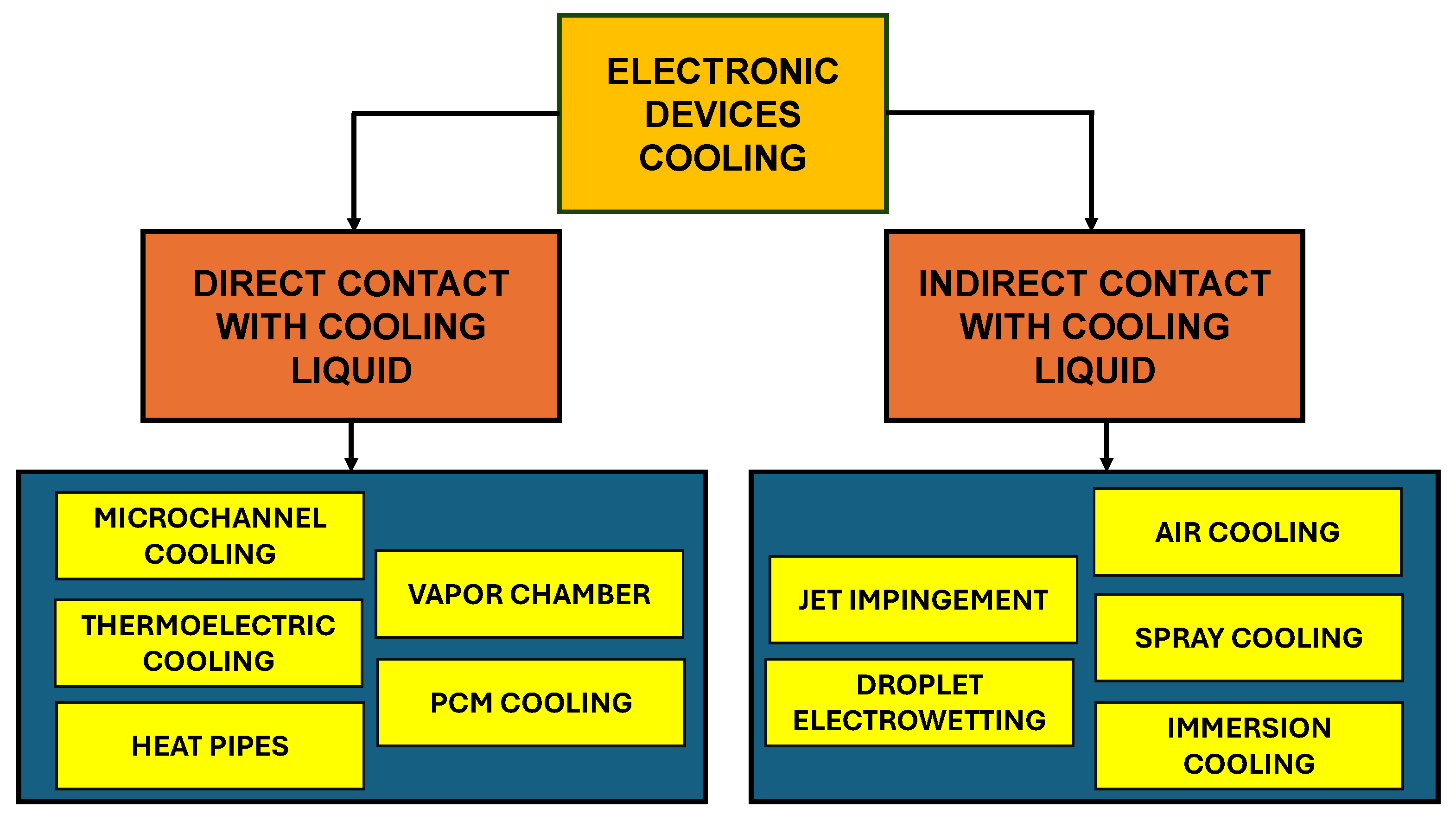
An overview of the major air, liquid, and two-phase cooling approaches used in electronic packages is illustrated in
Figure 10, while a quantitative comparison of these cooling technologies in terms of supported power, thermal resistance, relative cost, and practical constraints is summarized in
Table 13.
2.3.1. Air Cooling and Finned Heat Sinks
Air cooling remains the most prevalent thermal management approach for cost-sensitive or moderate-power electronic systems due to its simplicity and low cost. However, its performance is constrained by relatively low convective heat transfer coefficients, typically in the range of
–
under forced convection, depending on fin geometry and air velocity [
215,
216]. For a plate-fin heat sink, the overall base-to-air thermal resistance can be approximated as follows:
where
denotes the fin efficiency, accounting for the temperature gradient along the fin height. This expression assumes uniform heat transfer and neglects spreading resistance effects in the base, which become significant for dense fin arrays or nonuniform heating [
72,
217].
Design Considerations
Optimization of air-cooled heat sinks involves careful balancing of fin height, thickness, spacing, and flow velocity to minimize
while controlling pressure drop and acoustic noise. Parametric and CFD-based studies have demonstrated that modest variations in fin spacing and thickness can yield measurable improvements in overall heat transfer performance [
217,
218]. Enhanced fin geometries, such as filleted or tapered profiles, further reduce flow separation and improve fin efficiency, though at the cost of manufacturability complexity [
218]. Hybrid designs incorporating copper foam or internal turbulence promoters (e.g., twisted inserts) have been explored to enhance effective surface area and turbulence intensity [
219], achieving heat transfer coefficients up to 20–30% higher than those of conventional straight fins.
Advantages and Limitations
Air cooling is simple, affordable, and mechanically reliable. Still, its low heat transfer, uneven temperature distribution, and reliance on airflow and fan design limit its use in high-power systems like AI or HPC processors. Because of these challenges, air cooling is now often used as a starting point or combined with liquid or two-phase cooling in newer platforms.
2.3.2. Heat Pipes and Vapor Chambers
Fundamentals and Transport Limits
Passive, two-phase heat transport using capillary-driven devices known as heat pipes started in the early 1960s. Not long after, these systems were adopted for thermal control in spacecraft [
221,
222,
223,
224]. A vapor chamber, or VC, is a flat type of heat pipe. It is mainly used to spread heat laterally rather than to move it in a single direction [
225,
226]. A VC consists of a sealed, evacuated enclosure containing a porous wick saturated with a working fluid. Heat applied to the evaporator surface causes liquid to evaporate; the generated vapor expands through the central core toward the condenser, where it releases latent heat and condenses. The condensate is returned to the evaporator by capillary pumping in the wick, closing a passive, steady-state cycle [
223,
226].
To maintain system operation, the capillary pressure generated by the wick must exceed all pressure losses in the liquid and vapor phases, as well as gravity-induced losses:
where
is the liquid–vapor surface tension,
the contact angle, and
the effective pore radius of the wick [
222,
223]. The liquid pressure drop in the porous wick follows Darcy’s law for laminar flow through porous media,
with
the liquid viscosity,
K the permeability,
the flow length, and
the wick flow area [
224].
For the vapor core, assuming laminar, incompressible, plane-Poiseuille flow between parallel plates (an accepted first-order model for thin, vast chambers) gives a relation
; for constant mass flow,
[
226]. Hence, reducing the vapor-core height in ultra-thin VCs markedly increases viscous pressure losses and lowers the capillary transport limit. Under these approximations, the gravitational effects
may be negligible in horizontal or microgravity configurations, but are included here for completeness.
The overall thermal resistance can be expressed as a series sum of component resistances,
consistent with standard heat-pipe and vapor-chamber resistance-network models [
223]. The corresponding effective (or apparent) thermal conductivity,
Reported experimental values for heat pipes and vapor chambers typically range from several hundred to several thousand
, and may approach or modestly exceed that of copper under optimal conditions, generally by less than one order of magnitude [
224,
225,
226].
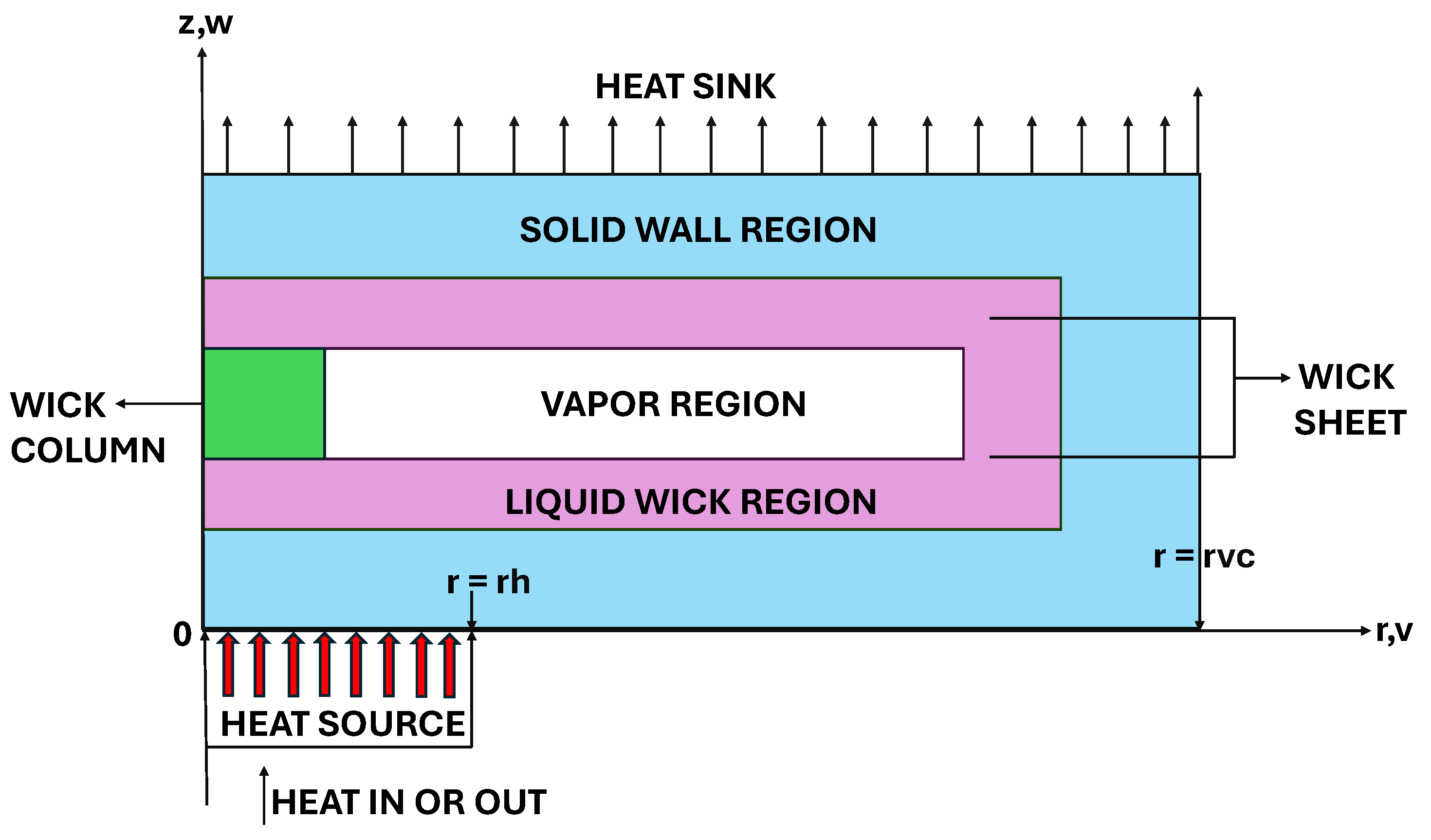
A cross-sectional schematic of the vapor-chamber structure and the associated two-phase heat-spreading pathways is shown in
Figure 11.
Historical Foundations and Early Modeling
Early analytical and experimental work established the theoretical framework for two-phase capillary transport. Katzoff [
221] documented one of the first quantitative models of vapor-flow pressure drop and sonic limits in aerospace heat pipes, while subsequent NASA programs detailed practical designs and reliability criteria for long-duration operation in microgravity [
222,
223].
Prasher [
228] advanced the field by formulating a unified conduction-analogy model that quantitatively links the thermal performance of heat pipes and vapor chambers within a single mathematical framework. His model treats the vapor core as an equivalent thermal conductor characterized by an effective thermal conductivity,
, defined from the steady-state energy balance as
where
Q is the total heat transport rate,
A is the effective cross-sectional area, and
L is the transport length between the evaporator and condenser sections. By correlating
to the vapor mass flow rate
and latent heat of vaporization
,
The model captures the latent heat-driven phase-change transport through a conduction-equivalent framework that can be directly implemented in finite-element or finite-volume solvers. This simplification enables rapid design-sensitivity and parametric analyses for electronic cooling configurations without the need for full two-phase flow simulations. Validation against experimental data demonstrated that the predicted effective thermal resistance agreed within approximately 10–15% of measured values for heat fluxes up to 100 W/cm
2, confirming the robustness of the conduction-based approximation for both cylindrical heat pipes and planar vapor chambers.
In one of the numerical investigations of vapor-chamber behavior, Koito et al. [
227] developed an axisymmetric two-phase model to describe coupled thermal–fluid transport within a flat, disk-type vapor chamber. Their formulation incorporated vapor, liquid-wick, and solid-wall regions, with the continuity, momentum, and energy equations for each phase solved using the SIMPLE algorithm. This work represented an early effort to resolve the internal distributions of velocity, pressure, and temperature in vapor chambers through direct numerical simulation. The authors demonstrated that, under typical operating conditions (
,
), vapor pressure variations were minimal (
), and circulation of the working fluid was sustained primarily by capillary forces within the sintered copper wick (porosity
) and a central wick column of radius
. Comparison with experimental temperature measurements showed good agreement, validating the model and establishing a foundational framework for subsequent thermal–fluid modeling of vapor-chamber heat spreaders.
Design Evolution and Experimental Studies
Wong et al. [
229] proposed a novel vapor chamber (VC) design in which a parallel-grooved top plate replaced the conventional wick-covered top condenser wall with inter-groove openings. The peaks of the groove walls were in direct thermal contact with the sintered wick layer on the bottom plate, so that the grooves simultaneously served as vapor channels, condensation surfaces, and mechanical stiffeners, eliminating the need for internal support studs. This configuration enhanced condensate return and reduced the liquid-flow resistance
, resulting in a total vapor chamber thermal resistance
ranging from approximately
to
for heat inputs Q = 80–460 W, corresponding to heat fluxes up to about
. The improvement stemmed primarily from reduced liquid-flow resistance and improved heat transport coupling between the evaporator and condenser, rather than from a quantified reduction in vapor-flow resistance.
Tang et al. [
230] proposed a multi-artery vapor chamber architecture that integrates sintered copper-powder rings surrounding solid copper columns to serve as arterial liquid channels. These porous rings establish direct hydraulic linkage between the condenser and evaporator wicks, thereby minimizing the effective liquid return path
and reducing the total capillary pressure loss,
This configuration enhances the maximum capillary supply limit
, ensuring continuous liquid replenishment at the evaporator surface. Experimental results demonstrated a substantial increase in the critical heat flux, with no capillary or boiling limit observed up to
, validating the efficacy of the multi-artery design.
Peng et al. (2013) [
231] developed an aluminum flat-plate heat pipe integrating perforated fins brazed within a vapor chamber (VC) to enhance internal vapor–liquid interaction and convective surface area. The study analyzed the effects of working fluid, filling ratio, and vacuum degree on the steady-state temperature distribution and thermal resistance, demonstrating improved heat transport under optimized conditions. Although the configuration exhibited reduced thermal resistance (
), the authors did not explicitly quantify fin efficiency (
) or the thermal spreading factor; the improvements were inferred from the measured temperature uniformity across the condenser surface.
Tsai et al. [
232] conducted an experimental investigation on vapor-chamber (VC) heat spreaders to analyze their thermal performance and validate design evolution through empirical measurements. They formulated the total thermal resistance of the vapor chamber,
, as the sum of one-dimensional (through-thickness) conduction and in-plane spreading components, expressed as
This decomposition was supported by experimental results that showed strong agreement with theoretical heat-spreading models. Furthermore, their findings revealed that the spreading resistance
is the dominant contributor to the overall thermal resistance, providing insight for subsequent design optimization of vapor-chamber heat spreaders in practical applications.
Characterization and Scaling Challenges
Weibel and Garimella [
226] provided a comprehensive review of transport processes within vapor chambers, showing that the coupled effects of capillarity, viscous pressure losses, and interfacial heat and mass transfer govern performance. As vapor chambers are miniaturized to sub-millimeter thicknesses, the viscous pressure drop in the confined vapor core increases markedly, while the available capillary pumping pressure within the wick decreases. Their analysis further indicates that liquid-vapor interfacial resistances arising from phase-change kinetics at the evaporator and condenser surfaces become a significant contributor to the overall thermal resistance in ultra-thin configurations. They recommend integrated, multi-scale modeling approaches that couple vapor flow, liquid return, and interfacial heat transfer processes to predict dry-out and temperature non-uniformities accurately.
Bulut et al. [
225] conducted a detailed survey of more than fifty experimental and numerical investigations of vapor chambers for electronics cooling. Their review shows that reported equivalent or “effective” thermal conductivities span roughly
–
W m
−1 K
−1, depending on wick morphology, permeability, working fluid, and geometric configuration. They attribute this wide range primarily to variations in wick microstructure and vapor-core geometry, as well as to differences in measurement procedures. The review emphasizes that minimizing vapor pressure drop, optimizing wick permeability, and reducing interfacial resistance are key strategies to maintain uniform temperature distributions and enhance heat-transport capacity in compact, high-heat-flux vapor chambers.
Hybrid and Integrated Systems
Hybrid thermal management architectures integrating vapor chambers (VCs), heat pipes (HPs), and phase change materials (PCMs) have been explored to exploit both latent heat storage and high in-plane conductivity.
Ghanbarpour et al. [
233] numerically analyzed distinct PCM-filled and VC-based heat sinks under natural and forced convection. Their results showed that PCMs effectively damp transient temperature excursions during melting, while VCs maintain a lower steady-state thermal resistance
, achieving a ∼
lower
than PCM-only designs.
Muneeshwaran et al. [
234] experimentally demonstrated a VC base with embedded cylindrical HPs and parallelogram fins, reducing
by up to 61% relative to a flat plate and enhancing base-to-fin temperature uniformity through two-dimensional vapor spreading and axial HP conduction.
Wang et al. [
235] developed an integrated VC–HP module incorporating sintered copper-powder wicks and radial vapor–liquid coupling channels. The device sustained capillary-driven liquid return under anti-gravity conditions, maintaining
, though orientation dependence remained due to gravity-assisted return in upright operation.
Collectively, these studies delineate complementary integration mechanisms rather than a single PCM–VC hybrid with orientation-independent behavior.
Representative transport metrics and limiting mechanisms reported for conventional vapor chambers and flat heat pipes are summarized in
Table 14.
A corresponding set of performance metrics and transport limitations for ultrathin vapor chambers and ultra-thin flat heat pipes is provided in
Table 15.
Ultra-Thin Vapor Chambers (UTVCs): Transport Limits and Comparison with Conventional VCs
Chen et al. [
240] introduced a coplanar UTVC architecture with total thickness
, wherein vapor channels and liquid-return paths are placed on the same lateral plane. This geometry minimizes the effective vapor-flow length
, substantially reducing
despite the very small vapor-core height. The device achieves an effective thermal conductivity exceeding
, corresponding to an area-normalized thermal conductance
, and a minimum through-thickness thermal resistance of
. These values place Chen et al.’s UTVC an order of magnitude above the
range typically observed in millimeter-scale copper VCs (
–
), as summarized in
Table 14.
Shi et al. [
239] fabricated an ultra-thin flat heat pipe (UFHP) incorporating a ∼
vapor core within an overall stack thickness of
. The
steam chamber is formed using copper foils, a fine wire-mesh wick, and internal posts to prevent mechanical collapse. Under optimized filling and horizontal operation, the device maintained excellent isothermality, with surface temperature non-uniformity
at multi-watt heat inputs. Numerical analyses of the same architecture indicate that reducing the vapor-core height to
sharply increases the viscous vapor pressure drop, consistent with the Weibel–Garimella scaling
. Reducing
H from
(typical of conventional VCs) to
increases
by a factor of ∼125 for the same mass flux, causing axial vapor-temperature gradients and approaching the capillary limit at elevated heat flux. This behavior is reflected in the limiting-mechanism classification in
Table 15.
MEMS-compatible UTVC designs continue to mature. Filippou et al. [
242] and Tang et al. [
236] review thin-film wick architectures, porous microstructures, and hermetic bonding schemes enabling sub-millimeter vapor chambers. Additively manufactured (AM) geometries also expand UTVC design space: Gu et al. [
241] demonstrated aluminum VCs with gyroid-lattice wicks, achieving significant reductions in overall thermal resistance relative to conventionally machined references.
Quantitative Comparison with Conventional Vapor Chambers
Table 14 and
Table 15 summarize representative transport limits in conventional (
–
) and ultra-thin (
–
) vapor chambers. Conventional VCs from Wong et al. [
229], Tang et al. [
230,
236], and Tsai et al. [
232] exhibit
–
and typically remain capillary-limited with substantial margin; vapor-flow pressure drop is negligible because
. Moreover, orientation sensitivity is weak: Varol et al. [
237] and Zhao et al. [
238] observe little variation in
over
–
tilt.
In contrast, UTVCs provide 10–20× higher area-normalized thermal conductance () than conventional VCs of identical footprint, primarily due to their 3–10× smaller thickness. However, the reduced vapor-core height (–) introduces significant penalties that must be mitigated through (i) shortened vapor-flow paths, (ii) high-capillarity composite wicks, and (iii) minimized interfacial resistances. The coplanar architecture by Chen et al. demonstrates that when these constraints are jointly optimized, UTVCs can achieve comparable to the best millimeter-scale VCs while maintaining a sub-0.3 mm profile. Thus, UTVCs excel in applications requiring extremely small vertical form factors and high in-plane spreading, provided the geometry suppresses vapor-pressure-induced limitations that would otherwise dominate at ultrathin scales.
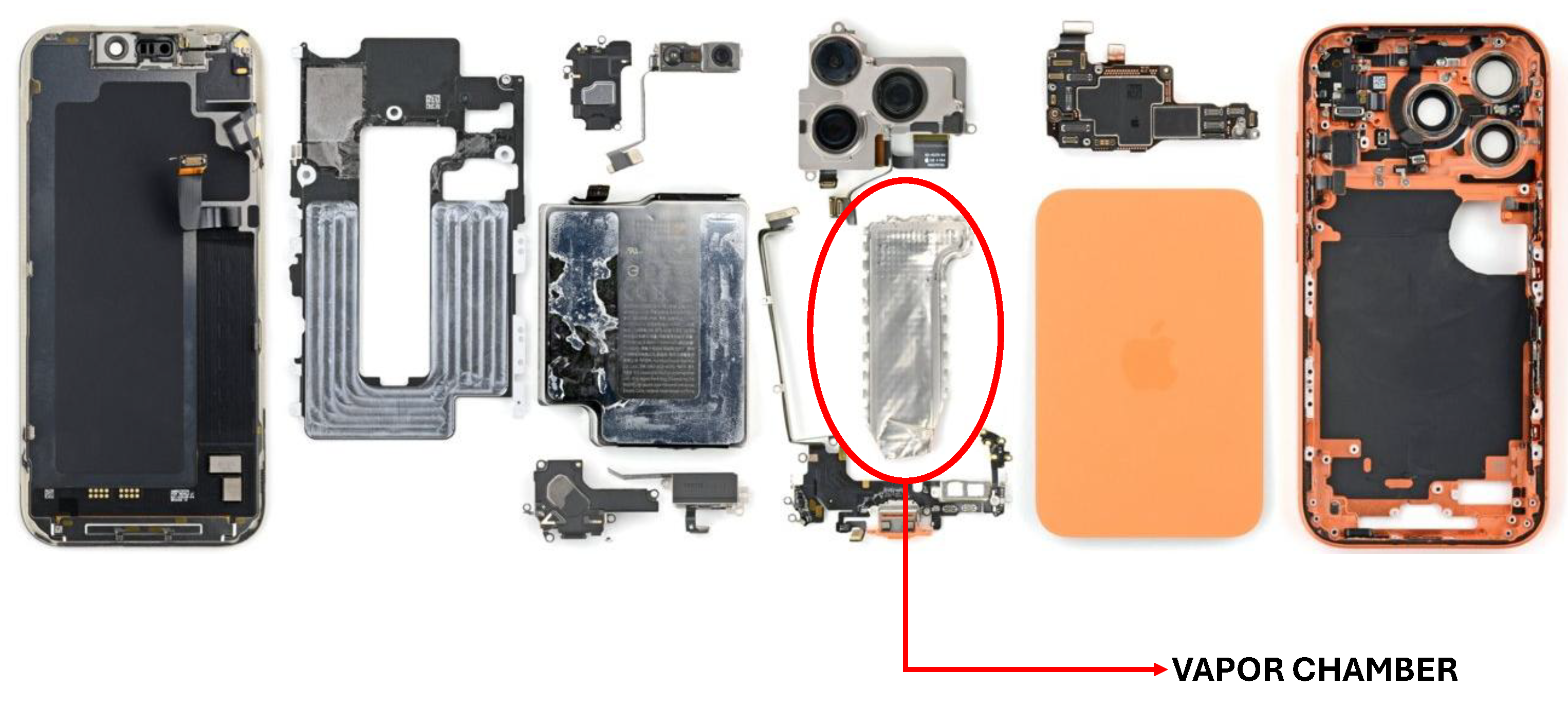
Industrial Translation: iPhone 17 Pro Vapor Chamber
The 2025 iPhone 17 Pro (Apple, Inc., Cupertino, CA, USA) introduces an ultrathin, laserwelded vapor chamber integrated directly into the aluminium frame. Public teardown analyses indicate that a sealed two-phase cavity containing deionised water is bonded to the forged-aluminium unibody, enabling in-plane heat spreading from the A19 Pro SoC via a flattened vapor chamber structure [
243]. Because Apple has not released device-level thermal resistance, maximum heat-load capability, or hot-spot temperature data, this example is used strictly as qualitative industrial evidence rather than quantitative validation.
A representative teardown image illustrating the integration of a smartphone-class vapor chamber is shown in
Figure 12.
Quantitative metrics (
Table 16) for ultra-thin vapor chambers (UTVCs) with smartphone-class footprints are available from peer-reviewed sources. Zhang et al. [
245] report a
mm thick UTVC (82 mm × 58 mm) using a composite coppermesh and spiralwoven wick, achieving an effective thermal conductivity of
W m
−1 K
−1 and a maximum power of 26 W. Chen et al. [
240] demonstrate that optimized UTVCs can reach thermal resistances as low as
K W
−1 and effective conductivities exceeding
W m
−1 K
−1 for heat loads up to 90 W. Similarly, Cao et al. [
246] report a composite-wick UTVC of approximately 1 mm thickness achieving a thermal resistance of
K W
−1 at 90 W.
Accordingly, the iPhone 17 Pro is excluded from all quantitative comparison charts in this review. All quantitative analyses herein rely solely on experimentally validated, peer-reviewed data.
Quantitative performance metrics for representative ultra-thin vapor chambers with smartphone-class form factors, including thickness, footprint, wick structure, and thermal figures of merit, are summarized in
Table 16.
Over six decades of development, vapor chambers have evolved from spacecraft heat pipes [
221] into ultra-thin, additively manufactured, and hybrid PCM-integrated devices. Continued advancements focus on reducing vapor-flow resistance, enhancing wick capillarity, and preserving mechanical stability at minimal thicknesses. Emerging designs featuring bioinspired and coplanar wicks, PCM–VC hybrids, and direct structural integration highlight the maturity and adaptability of vapor-chamber technology for high-heat-flux thermal management applications.
2.3.3. Single-Phase Liquid Cold Plates (LCPs)
Single-phase liquid cold plates (LCPs) are compact heat exchangers that move coolant through internal channels, such as straight, manifolded, pin-fin, or jet/impingement-assisted designs, closely connected to high-heat-flux components. They are used in data centers and advanced semiconductor packaging because they transfer heat more effectively than air and fit well in servers and racks. In data centers, water or water–glycol mixtures are most common for their thermal properties, but it is important to consider corrosion, scale, and material compatibility when choosing and treating these fluids [
247].
The idea of near-junction, single-phase microchannel cooling began with the work of Tuckerman and Pease [
51]. Their etched-silicon microchannel heat sink (width
m, depth
m) achieved steady heat fluxes approaching
with water at a pressure drop of roughly
, demonstrating that microscale forced convection could maintain sub-100 °C junctions even under extreme local power densities. This work established the microchannel and cold-plate paradigm that underpins contemporary LCPs, influencing decades of design evolution summarized in later reviews and experimental validations [
247,
248].
Governing Energy and Momentum Balances
For steady single-phase operation, the energy balance and inlet-referenced thermal resistance are
Local convection and pressure loss follow
and are embedded in reduced-order or block-element models for rapid co-optimization of layout and geometry [
249].
Hydraulic–Thermal Co-Optimization
Reduced-order design optimizers model the plate as a coarse grid of elemental blocks (straight, elbow, tee) with friction-factor and heat-transfer correlations, enabling multi-objective searches (minimize
and
) under nonuniform heat maps. Experiments on an optimized aluminum water-cooled plate report
at practical velocities, with orders-of-magnitude lower design time than full topology optimization [
249].
Materials and Coolant Selection
Copper and aluminum remain the primary cold-plate materials; silicon and LTCC variants are used when electrical isolation or co-fabrication dominate, at the expense of conductivity. Water’s high
k and
make it the most effective working fluid for LCPs, but corrosion and scaling must be mitigated (e.g., plating, inhibitors, cleanliness). Fluorinated liquids offer stability but with environmental/cost penalties; hydrocarbon refrigerants demand additional safety engineering. These trade-offs, and comparative property data, are synthesized in Wu et al. [
247].
Advanced Packaging and Heterogeneous MCMs
MCM/HI packages present strongly nonuniform heat maps (chiplets up to ∼
on emulators). Experiments with pin-fin cold plates on a four-heater (1.2 cm × 1.2 cm each) MCM emulator quantify the thermohydraulic response vs. flow rate and power distribution; validated 3D models match heater temperatures and
, demonstrating the value of geometry/flow-field co-design to suppress
under realistic nonuniform loading [
250].
(i) Use Equation (
23) (LMTD-consistent) for plate comparisons once coolant
is non-negligible; avoid legacy
beyond
[
248]. (ii) Co-optimize layout and cross-section with reduced-order models, verifying finalists by CFD/experiment [
249]. (iii) Select inlet/outlet topology to balance maldistribution and service constraints; diagonal/centered parallel arrangements are often advantageous [
247]. (iv) Match material/coolant to facility water chemistry, fouling risk, and environmental targets [
247]. (v) For MCMs, allocate flow nonuniformly (manifolds, zoning, pin-fin regions) toward hotspots and validate against spatial power maps [
250].
A conceptual comparison between conventional liquid cold-plate cooling and embedded microchannel cooling, highlighting the elimination of an additional thermal interface (TIM2) and the resulting reduction in spreading and convective resistances, is illustrated in
Figure 13.
2.3.4. Embedded Microchannel Liquid Cooling
Embedded Microchannel Liquid Cooling (EMLC) refers to the incorporation of micro-scale fluidic channels into the silicon substrate, interposer, or packaging of an electronic device, thereby facilitating coolant flow in proximity to active junctions. By integrating the cooling structure rather than affixing an external cold plate, EMLC reduces thermal interface resistance (e.g., TIM, IHS, solder) and significantly shortens the heat-conduction pathway between the device and the coolant.
EMLC is becoming a strong option for managing heat in new 2.5D and 3D chiplet systems, where power levels are often too high for standard air or cold-plate cooling. Tests show that embedded manifold microchannels, just 50
m wide, can handle heat fluxes up to 1200 W/cm
2 while maintaining steady surface temperatures [
251]. Similarly, Fu et al. [
252] fabricated near-junction microchannels integrated with micropillar arrays, achieving comparable heat-flux levels with minimal temperature gradients. Lian et al. [
253] further demonstrated a 2.5D GaN/HEMT interposer architecture featuring 30 µm-pitch embedded microchannels that deliver direct device cooling through the substrate. These studies collectively confirm that embedded microchannel cooling operates effectively in the tens-of-micrometers hydraulic-diameter regime (
), providing heat-transfer coefficients up to the
range, substantially exceeding values typical of millimeter-scale cold-plate cooling, as documented in comparative analyses by van Erp et al. and Fathi et al. [
53,
254].
Such near-junction liquid cooling not only enhances thermal performance but also supports co-optimization among package design, power delivery, and thermal management, an essential direction for thermally feasible 3D chiplet integration.
Thermal–Fluid Fundamentals
The enhanced heat-transfer performance of microchannels arises from high surface-area density and boundary-layer compression. The local convective coefficient is defined as
where
is the Nusselt number and
k the thermal conductivity of the coolant. For fully developed laminar flow with constant wall heat flux,
for circular and
for rectangular ducts [
255]. The hydraulic pressure drop is given by
where
for laminar flow,
, and
L is channel length. These relations capture the fundamental thermal–hydraulic trade-off inherent in microchannel design [
256].
Manifold and Flow Distribution Design
When the flow is uneven in parallel channels, hot spots can form. Using optimized manifold shapes, such as double-H or tree-like branches, helps balance the flow and reduce pressure losses. Yang et al. showed that a compact double-H manifold design leads to more even temperature profiles across large chips. Both experiments and simulations have found that statistically optimized manifolds can lower peak temperatures by up to 15% compared to standard headers [
57,
254].
Packaging-Level Integration
Integrating microchannels into interposers or power-delivery substrates aligns naturally with 2.5D and 3D chiplet architectures. Tang et al. [
257] implemented liquid cooling for 3D-stacked through-silicon via (TSV) modules, while van Erp et al. [
53] co-fabricated microfluidic channels in silicon, achieving local heat fluxes exceeding
. This co-design approach allows the architecture and cooling strategy to be developed concurrently, enabling effective flow zoning in high-power regions.
Reliability and Manufacturing Considerations
EMLC sets strict standards for component manufacturing accuracy, bonding quality, and sealing durability. To maintain structural stability, manufacturers need to use high-aspect-ratio etching on silicon or copper and ensure precise wafer-level bonding. Accelerated life testing, such as thermal cycling, vibration, and corrosion tests, is crucial because any coolant leaks inside the package can cause serious failures [
256,
258]. Fathi et al. [
254] point out that controlling surface roughness and the shape of pore fins has a significant impact on both how fluid flows through the system and the reliability of the structure.
Industrial Motivation: The MLCP Initiative
The growing thermal demands of generative AI have driven GPU-system power to unprecedented levels. For instance, NVIDIA’s NVL576 ‘Kyber’ rack, part of the ‘Rubin Ultra’ line, is expected to use up to about ~600 kW per rack [
260,
261]. At these power levels, air-cooling is no longer practical, and even standard cold plates struggle to evenly cool multi-kilowatt modules. To solve this, NVIDIA is said to be working on Microchannel Liquid Cold Plate (MLCP) technology. In this design, the cooling plate is closely integrated with the chip cover or packaging, and tiny flow channels are placed right above the compute die. This setup brings coolant closer to the heat source, reducing the number of thermal interfaces [
262,
263]. Although there is little publicly available data on performance, supplier reports indicate that MLCPs could cost three to five times as much as regular water-cooling plates [
264]. These developments highlight the importance of embedded microchannel cooling for future high-density GPU systems.
2.3.5. Jet Impingement Cooling
Jet impingement cooling (JIC) is a convective heat transfer technique in which one or more high-velocity fluid jets are directed perpendicularly or obliquely onto a heated surface to disrupt the thermal and hydrodynamic boundary layers locally. This process produces very high local and area-averaged heat transfer coefficients, often exceeding , making it highly suitable for high-power semiconductor packaging applications. JIC configurations are generally categorized as free, submerged, or confined jets, depending on the interaction of the impinging flow with the surrounding medium and the target surface.
The fundamental mechanisms governing jet impingement include stagnation-region convection, wall-jet radial flow, and secondary recirculation, each influenced by parameters such as Reynolds number, nozzle diameter, jet-to-target spacing (
), and flow confinement. Glynn et al. [
265] conducted a detailed experimental study on submerged and confined air and water jets, employing nozzle diameters ranging from
to
, Reynolds numbers between
and
, and jet-to-target spacing ratios of
to 4. Their results showed that reducing both the nozzle diameter and the jet-to-surface distance leads to a marked increase in the stagnation point and overall heat-transfer coefficients. At smaller spacing ratios (
–2), secondary peaks were observed in the local Nusselt-number distribution, which were attributed to the onset of turbulence and boundary-layer thinning within the wall-jet region.
Recent advancements in JIC have focused on improving spatial uniformity and adapting the technique for electronic and power device cooling. Plant et al. [
266] reviewed the evolution of JIC configurations, including single, multiple, and synthetic jet systems, and highlighted the use of nanofluids and swirling jets to augment convective performance. Chaudhari et al. [
267] compared synthetic and continuous jet cooling experimentally, reporting similar heat transfer performance while avoiding net mass injection. Klinkhamer et al. [
268] achieved heat transfer coefficients approaching
in dielectric liquid jet systems and discussed associated thermal–hydraulic design trade-offs. Berg et al. [
269] developed a 27-nozzle dielectric jet module for semiconductor power device cooling, achieving junction temperatures below
with strong agreement between computational and experimental results. Kim et al. [
270] optimized a multi-jet configuration for electric vehicle inverter packages using ANN–NSGA-II, demonstrating improved temperature uniformity and reduced pumping losses through micropost-integrated jet surfaces.
Jet impingement cooling offers a high-performance, compact, and scalable solution for thermal management in advanced semiconductor packaging. This technique accommodates higher heat flux compared to traditional channel or cold-plate cooling methods.
2.3.6. Two-Phase Cooling
Two-phase cooling uses both liquid and vapor phases of a fluid to remove heat. When the liquid absorbs enough energy, it starts to boil and turns into vapor. This boiling process requires a large amount of energy, called the latent heat of vaporization. Because of this, two-phase systems can carry away much more heat without a significant rise in temperature. Since most of the heat is removed through boiling, the fluid does not need to move very fast, which means the pumping power can be lower. In systems like microchannel flow boiling and jet impingement, researchers have achieved heat fluxes close to
and heat transfer coefficients greater than
[
271]. This is several times better than what single-phase cooling can do. However, there is a limit to how much heat can be removed. When too much vapor forms and there is not enough liquid to keep the surface wet, the surface can dry out and overheat. This limit is called the critical heat flux (CHF). Zuber’s model gives an estimate for CHF:
where
is the latent heat of vaporization,
and
are the vapor and liquid densities,
is the surface tension, and
g is gravity. To prevent dryout and increase the CHF, engineers often use methods such as jet impingement, subcooled liquid injection, or specialized surface designs that bring fresh liquid to the hot areas [
272].
System-level implementations demonstrate the feasibility of pumped two-phase cooling for high-power electronics.
Ohadi et al. [
273] reported that microchannel evaporators achieved thermal resistance reductions of up to an order of magnitude with pumping power significantly below that of vapor-compression systems.
Marcinichen et al. [
274] achieved over 60% energy savings in data-center applications using hybrid two-phase loops with dielectric refrigerants. Continued advances in channel topology, surface texturing, and flow stability control are essential for improving the reliability and scalability of two-phase cooling in next-generation electronic systems.
2.4. Reliability Considerations Under Thermo-Electro-Mechanical Coupling
Thermal fields induce many degradation mechanisms: electromigration (EM) in interconnects and micro-bumps, stress-induced delamination at interfaces, solder fatigue due to thermal cycling, and die/package warpage. Reliability modeling, therefore, integrates temperature, current density, and mechanical fields.
2.4.1. Thermoelasticity, Thermal Strain, and Warpage
In the context of linear thermoelasticity, the infinitesimal strain tensor can be expressed as follows [
275,
276,
277]:
In this case, is the coefficient of thermal expansion (CTE), is the difference in temperature from the stress-free reference state, and is the second-order identity tensor.
The constitutive relation for an isotropic, linear thermoelastic material is expressed as follows [
278,
279]:
where
is the fourth-order elasticity (stiffness) tensor that connects stress and elastic strain, this formulation is the basis for the thermoelastic stress analysis used to forecast warping and in multilayer packaging.
In multi-layered assemblies, such fan-out wafer-level or panel-level packages, a thermal mismatch between materials that are not the same (like die, redistribution layer, and epoxy molding compound) causes internal tensions and out-of-plane deformation, which is called warpage [
280,
281,
282,
283,
284]. The curvature
k measures this global deformation and is affected by the CTE mismatch, elastic moduli, and thickness ratio of the layers that make it up.
Stoney’s Thin-Film Approximation
Stoney’s classical formula provides an approximate relationship between the wafer curvature and the stress in the thin film (
f) induced by a thermal excursion when a thin film (
f) is placed on a much thicker substrate (
s) [
126,
285]:
where
,
, and
are the Young’s moduli, Poisson ratios, and thicknesses of the layers in question. This relationship represents the fundamental physics of curvature resulting from differential thermal expansion, applicable when
and both layers exhibit elastic behavior.
Timoshenko’s Bilayer Model
Stoney’s limit is incorrect when the two layers are about the same thickness. The generalized Timoshenko bi-material curvature expression [
126] enhances the analysis by integrating the mechanical and geometric mismatch parameters:
where
is the mismatch strain, and
is a nondimensional curvature function approaching the Stoney limit for
.
Implications for Fan-Out Packaging
During the mold curing, debonding, and reflow steps of fan-out wafer-level packaging (FOWLP) procedures, curvature changes dynamically [
286,
287,
288,
289]. To accurately forecast warpage, it is necessary to integrate thermoelasticity with viscoelastic relaxation and chemical shrinkage models of epoxy molding compounds [
290,
291,
292]. Analytical solutions (e.g., Stoney or Timoshenko) are still important for design optimization and parametric sensitivity analysis. Finite-element models that include temperature- and cure-dependent moduli, on the other hand, give very accurate warpage simulations [
283,
284].
2.4.2. TSV-Induced Stress and Keep-Out Zones
Through-silicon vias (TSVs) are essential for creating vertical connections in three-dimensional (3D) integrated circuits. However, they can introduce significant thermal-mechanical stress because copper and silicon expand and contract at different rates. As the copper core cools after bonding or annealing, it contracts more than the surrounding silicon. This difference gives rise to what is known as an eigenstrain:
This process leads to axisymmetric radial and hoop stress components,
and
, which decrease with distance from the via [
293,
294]. Finite-element analyses show that the maximum tensile stress,
, can reach several hundred megapascals within a few micrometers of the TSV wall, depending on the via radius, dielectric liner stiffness, and thermal load conditions [
294,
295].
Excessive tensile stress can slow carrier movement in nearby transistors, change device threshold voltages, and even cause microcracks in the silicon matrix [
293]. To help prevent these issues, foundry guidelines usually call for a mechanical keep-out zone (KOZ) around each TSV, where active devices are not placed. The KOZ size is set based on results
from thermal-mechanical simulations, which measure the maximum stress and link it to transistor degradation [
294,
296].
Recent research has expanded TSV stress modeling to include both heterogeneous and photonic interposers. Yang et al. showed that TSV-induced stress in silicon-on-insulator photonics interposers can shift the resonance wavelength of silicon ring resonators by about 0.1 nm when the TSV-to-waveguide spacing ratio
, supporting the idea of stress-limited KOZs for mixed electronic and photonic integration [
296]. In addition, electrical design frameworks that focus on placement now use stress-aware layout optimization to determine optimal TSV positions and KOZ allocations, helping balance timing, performance, and area trade-offs in 2.5D and 3D chiplet systems [
297].
2.4.3. Electromigration (EM) and the Blech Threshold in Thermally Constrained 2.5D/3D Stacks
Definition and Physical Origin
Electromigration (EM) happens when metal atoms move because electrons and the atomic lattice exchange momentum at high current density. The flow of electrons pushes atoms along the direction of current, creating a net force given by . This process leads to voids at the cathode and buildups at the anode. Over time, this movement can break interconnects or cause shorts between lines, making EM a key factor in the degradation of fine-pitch metallization.
Stress-induced backflow opposes the atomic motion driven by the electron wind in narrow interconnects. Atomic transport stops when the stress gradient is strong enough to balance the electromagnetic force. The Blech threshold [
298], named after I. A. Blech, describes a condition where interconnects can avoid EM-induced failure if the product of current density and line length stays below a certain value. Today, reliability-focused design standards are based on this same idea [
299].
In advanced 2.5D and 3D chiplet assemblies, current moves through fine-pitch redistribution layers, through-silicon vias, and micro-bumps. Here, Joule heating raises local temperatures. Combined with mechanical forces, this speeds up electromigration. These effects set strict limits on electromigration lifetime and ‘immortality’ thresholds. These thresholds, in turn, determine the limits for power delivery and I/O routing design.
The fundamental mechanism of electromigration-driven atomic transport and void formation in metal interconnects is schematically illustrated in
Figure 14.
Arrhenius Lifetime Scaling (Black)
In a specific metallization system, the mean time to failure (MTTF) is determined by Black’s empirical law for a set failure criterion:
where
J is the current density,
(process- and path-dependent),
the activation energy, and
A a process-specific prefactor [
301]. Equation (
34) explicitly shows how thermal rise shortens lifetime exponentially, implying that thermal management is intrinsically an EM mitigation knob. For a target lifetime
, Equation (
34) yields a temperature-dependent current-density ceiling:
Back-Stress Arrest and the Blech Product
In confined lines, the movement of atoms caused by electromigration is counteracted by a stress gradient that forms when boundaries block atomic flow. By integrating the one-dimensional force balance between the electron wind and the resulting stress, we arrive at the Blech criterion:
where
L is the segment length,
a critical (allowable) stress,
the atomic volume,
the effective charge, and
the resistivity [
298]. Segments satisfying Equation (
36) are effectively immortal to EM drift. In 2.5D/3D PDNs, Equation (
36) becomes a geometric co-design rule: for a given
J and
T (and thus
), choose RDL run-lengths, via breaks, and
-bump pitch such that each high-current segment remains below its
threshold [
299]. Because
increases with temperature, thermal rise tightens the Blech bound, further coupling thermal design to EM robustness.
Coupled Electro–Thermo–Mechanical Evolution (Korhonen)
The Korhonen-type stress evolution equation provides a more thorough one-dimensional explanation of how back-stress forms in confined interconnects:
with biaxial modulus
B, diffusivity
D, and heat of transport
[
302]. The first term forms the back-stress response, the second the EM driving force, and the third captures thermomigration, showing that temperature gradients
bias mass transport even at fixed
J. In vertical interconnect structures (TSVs and
-bumps) where current crowding and thermal bottlenecks coincide, EM and thermomigration act cooperatively; thermal management must therefore control both the absolute temperature
T (for Equation (
34)) and its gradient
(for Equation (
37)).
Equations (
34)–(
37) define complementary design boundaries: (i) a lifetime ceiling on
from Equation (
35); (ii) a geometric (immortality) bound on
from Equation (
36); and (iii) a gradient-aware stability condition from Equation (
37). For 2.5D/3D chiplet PDNs, these collectively define thermal–electrical feasibility maps over the architectural floorplan and cooling stack, ensuring that current densities, segment geometries, and temperature fields jointly satisfy EM reliability requirements [
299].
2.4.4. Solder/-Bump Thermal Cycling Fatigue
In 2.5D and 3D integrated systems, solder and micro-bump (
-bump) interconnects are exposed to repeated temperature changes because the chip, interposer, and package substrate expand at different rates. Over time, these differences cause plastic shear strain to build up, which can eventually lead to cracks forming and growing in the solder joints [
303,
304]. The Coffin–Manson ratio is a common method for estimating how long a material will last under these temperature cycles:
where
is the fatigue ductility coefficient and
is the number of cycles to crack initiation [
305,
306]. The inelastic strain amplitude
can be obtained from finite element (FE) simulations or approximated as
, where
is the CTE mismatch,
is the temperature swing, and
is the distance from the neutral point in a warping package.
Fatigue Crack Propagation Models
After crack initiation, fatigue crack growth can be modeled as a function of the inelastic strain energy density
using the Darveaux relation [
307]:
where
C,
m,
K, and
are empirical constants, and
represents the number of cycles to crack initiation. These models have been widely used for JEDEC temperature-cycling qualification and provide a physics-based link between package geometry, materials, and thermomechanical reliability.
Typical crack initiation sites and propagation paths observed in solder and micro-bump interconnects under thermomechanical cycling are illustrated in
Figure 15.
Table 17 compiles major reliability risks in semiconductor packaging, detailing the underlying damage mechanisms, applicable qualification stress tests, and authoritative studies documenting these failure modes.
Experimental and Modeling Advances
Recent studies have improved our understanding of how solder fatigue develops when both thermal and mechanical factors are present. In 2024, Li et al. [
304] provided a thorough review of the main thermal fatigue mechanisms in micro-solder joints, focusing on intermetallic compound (IMC) growth, cyclic recrystallization, and void coalescence. They found that fatigue cracks usually start at the IMC/coarsened-Sn interface and move along both intergranular and transgranular paths. Lu et al. [
325] showed that void formation reduces thermal conduction, which speeds up thermomechanical damage in flip-chip solder bumps. Suppiah et al. (2017) [
326] looked at how reflow profile factors such as peak temperature, time above the liquidus, soak time, cooling rate, and flux application affect the microstructure and durability of solder joints in flip-chip assemblies. They reported that these thermal factors strongly influence IMC formation, while warpage is mainly due to differences in thermal expansion and stresses during reflow.
Abtew and Selvaduray [
303] reviewed the transition from leaded to lead-free solder systems and identified SnAgCu (SAC) alloys as the most robust replacement for 60Sn–40Pb based on improved creep resistance. Basaran et al. [
327] developed a continuum damage mechanics framework to capture nonlinear viscoplasticity in solder joints subjected to cyclic thermomechanical loading. Kang et al. [
328] and Lee et al. [
329] found that lead-free solders demonstrate delayed crack initiation but accelerated crack propagation following intermetallic compound (IMC) thickening, highlighting the significance of interfacial stability.
In advanced 2.5D and 3D chiplet systems, fatigue reliability is further constrained by vertical thermal gradients and nonuniform warpage across stacked dies. High local temperature excursions increase
, accelerating crack propagation and compromising long-term reliability. Recent advances in data-driven modeling have enhanced finite element-based life prediction frameworks: Jong et al. [
330] proposed a physics-informed long short-term memory (PI-LSTM) approach that integrates finite element outputs with experimental data to predict solder joint fatigue life more accurately, while Akhtar et al. [
331] developed an AI-driven 3D point cloud framework using finite element analysis (FEA) data to forecast joint lifetimes in complex chiplet architectures. These methods enable rapid reliability screening and parametric sensitivity evaluation early in the design phase. Design measures such as compliant underfills, thinner and higher-conductivity lids, and reduced
operation remain effective in lowering
and extending solder joint life. Integrating such predictive models with thermal feasibility maps supports architecture cooling co-design strategies that maintain both mechanical and thermal integrity in future heterogeneous chiplet packages.
Taken together, the sections on heat-transfer mechanisms, thermal resistance networks, interface materials, interposers, and reliability show that thermal feasibility in 2.5D and 3D chiplet systems is set by coupled parameters rather than any single material or cooler. Building on these quantified ranges for resistances, conductivities, and reliability limits, the next section introduces Thermal Feasibility Maps (TFMs) as a framework to organize this parameter space and delineate operating envelopes for heterogeneous chiplet architectures.
4. Future Research Directions
4.1. Integration of Electro-Thermo-Mechanical (ETM) Co-Design in Thermal Management of Advanced Semiconductor Packaging
As semiconductor packaging evolves, managing higher power densities and mechanical stresses in complex 2.5D and 3D systems will require integrated electro-thermo-mechanical (ETM) co-design methods. By 2035, advanced 3D chiplet and HBM-stacked designs are expected to reach localized power densities of 300–
in hotspot areas, with total package power surpassing 10 to 15 kW in high-performance computing modules. At these levels, optimizing only thermal or electrical aspects will not be enough, so a fully integrated ETM co-design approach will be essential [
341,
342,
343].
The first challenge is the lack of standardized multiphysics model representations. Creating unified chiplet and package models that include temperature-dependent electrical properties, heat transfer rates, and stress-strain measurements will support consistent ETM analysis across EDA, foundry, and assembly environments [
297,
344].
Secondly, another important area is the development of AI-based co-optimization frameworks that simultaneously improve electrical power delivery, thermal management, and mechanical design. These data-driven methods will use reinforcement learning to predict how different domains interact, allowing for earlier multiphysics analysis in the design process [
341].
Third, new embedded cooling methods, such as microfluidic and two-phase systems, need to work closely with ETM design. This ensures both electrical and mechanical compatibility and helps achieve thermal resistance below
[
52].
Fourth, as co-packaged optics (CPO) become more common, it is important to optimize optical, thermal, and mechanical factors together. This approach keeps optical alignment stable, reduces wavelength drift caused by temperature changes, and helps maintain a steady bit-error rate even as conditions change [
345,
346].
Recent advances in research extend electro-thermal management (ETM) co-design toward adaptive and sustainable paradigms. The integration of morphable or tunable packaging materials with temperature-dependent coefficients of thermal expansion (CTE) enables active stress compensation. Furthermore, carbon- and energy-aware ETM optimization quantifies trade-offs among cooling efficiency, embodied carbon, and lifetime reliability. The use of quantum and neuromorphic solvers for coupled ETM simulations is projected to accelerate convergence times by several orders of magnitude relative to traditional finite-element methods.
Ten-Year Roadmap: In the near term, from 2025 to 2027, the main goals are to define ETM data-exchange schemas, develop compact reduced-order models, and match simulation results with silicon test vehicles [
342,
343]. Between 2028 and 2030, the focus will shift to standardizing ETM model formats and integrating runtime telemetry. This will involve embedding temperature, strain, and voltage sensors within die-to-die fabrics like UCIe and BoW, which will support closed-loop thermal control and in situ model calibration [
347]. Starting in 2031, ETM co-design is expected to become self-adaptive, using digital twin ecosystems that update multiphysics models with field telemetry and AI-based learning. Cooling structures will be designed as reusable IP modules, optimized alongside PDN and interconnect architectures, to handle localized heat flux densities above
. ETM optimization frameworks will also include sustainability metrics, helping teams make co-design choices that balance electrical performance, thermal efficiency, mechanical reliability, and environmental impact.
4.2. Emerging Materials and Structures for Interface and Cooling
As 2.5D, 3D, and chiplet-based packaging become more common, new materials are needed for thermal interfaces and cooling to handle higher heat and more complex interconnects.
Thermal Interface Materials:
Polymer–ceramic TIMs are commonly used because they are easy to apply, but their thermal conductivity is limited. To address this, high-
k fillers like AlN and h-BN are added [
342]. Researchers are also developing two-dimensional materials such as graphene and hexagonal boron nitride to improve in-plane conductivity. Current work focuses on better alignment, improved filler-matrix interface, and reduced interfacial thermal resistance [
348]. Liquid metal TIMs made from Ga-In alloys are gaining interest again for their flexibility and high thermal conductance (over 30 to 40 W/m·K), especially when combined with soft polymer matrices to help prevent corrosion and migration [
349].
Die-Attach Materials:
Sintered silver is a proven choice for high-power logic and GaN/SiC dies because of its high thermal conductivity and stability during thermal cycling. Researchers have shown that Ag nanopastes can form dense joints at temperatures (below 200 °C). Transient liquid-phase (TLP) bonding systems, including Cu-Sn or Ag-In alloys, are also becoming reliable reflow-free solid-metal options with high remelt thresholds [
350].
Heat spreaders and interposers are seeing new materials, such as chemical-vapor-deposited diamond and boron arsenide (BAs), gain attention for their high thermal conductivity. BAs, which have a bulk thermal conductivity exceeding 1000 W/m·K, also show lower thermal boundary resistance than diamond when bonded to GaN. These materials may soon replace traditional options like AlN, copper, and pyrolytic graphite sheets in applications with very high power density, such as HBM and chiplet die tops.
Cooling Fluids and Two-Phase Systems:
As PFAS-based dielectric fluids are being phased out, there is growing interest in PFAS-free options for immersion and two-phase cooling. Researchers are working to improve hydrocarbon-based and biocompatible dielectrics by focusing on their boiling points, latent heat, and compatibility with various materials. Pumped two-phase cold plate systems that use non-fluorinated refrigerants like R-1233zd(E) are showing good results, with the potential to remove more than 500 W/cm2 at the chip level.
Embedded Cooling Structures:
Microchannel, pin-fin, and jet-impingement designs are now being tested inside silicon interposers or advanced substrates to address localized hotspots. Thanks to silicon micromachining and wafer-level bonding, these methods bring coolant within 100–200 m of heat sources, which helps remove thermal bottlenecks. Still, ensuring reliability during pressure changes and maintaining electrochemical stability are ongoing challenges.
Together, these material innovations are likely to be used with co-design methods that model electrical, thermal, and mechanical behaviors in advanced packaging. Material property databases that include temperature-dependent k, CTE, modulus, and interface resistance will be essential for accurate multiphysics simulation and ETM signoff.
4.3. Future Research Directions in Digital Twins for Thermal Management
In the future, digital twins for advanced semiconductor packaging will likely become multiscale, multiphysics, and data-calibrated systems. They will bring together chip power, interposer conduction, microfluidic cooling, and thermo-mechanical warpage. These digital twins will be checked regularly using embedded sensors and production data, creating a strong digital link from design to deployment [
343,
351].
One important area is creating AI-powered thermal models that remain stable over long periods and accelerate decision-making in chiplet layout and thermal planning. Recent approaches, such as physics-informed neural networks and neural operators, have demonstrated high accuracy and scale well [
352,
353,
354].
Machine-learning models that connect bill-of-materials and process parameters to both overall and junction-level thermal resistance can help speed up reliability and qualification cycles. Future studies should focus on measuring uncertainty and adapting these models to different package types
As power densities continue to rise in 3D-stacked and heterogeneous systems, digital twins need to be developed alongside advanced cooling technologies and should track how interfaces degrade over time. Collaborative efforts like the SRC and NIST ‘Smart Twins’ program are working to create common data formats and validation methods, helping the field make steady and reliable progress [
355].
5. Conclusions
Thermal management is the main challenge in scaling heterogeneous 2.5D and 3D chiplet packages to meet the high power densities required by modern high-performance computing and AI accelerators. Previous research has improved individual aspects such as thermal interfaces, interposer materials, and cooling solutions, but these advances often overlook how these elements interact across different scales. This review explores Thermal Feasibility Maps (TFMs) as a means of integrating these factors. TFMs connect sensitivities across scales to practical cooling methods and help define a clear design space for early thermal evaluation.
There are three main factors that consistently stand out. At the interface scale, bond-line thickness in the 1–20 µm range can change effective thermal resistance by factors of 5–10, quickly depleting the available thermal margin, even with liquid cooling. At the mesoscale, interposer conductivity varies from 1–3 W·m−1K−1 for organic substrates to 150–200 W·m−1K−1 for silicon or diamond-based materials. This directly affects how heat spreads and how evenly temperatures are distributed. At the macroscale, reported cooling approaches range from air-cooled heat sinks to single-phase and embedded two-phase systems, with convective coefficients h spanning from 102 to above 104 W·m−2K−1.
Reliability introduces additional design challenges, such as package warping, interface failures, and restrictions on two-phase stability. To ensure thermal feasibility, it is important to optimize materials, package shape, and cooling methods together rather than relying on a single performance measure. TFMs are most useful because they turn single-value metrics into detailed maps that show the trade-offs between TIM properties, interposer choices, cooling types, and reliability limits.
Future research should include TFMs in multiphysics digital twins and surrogate modeling environments to allow predictive, real-time thermal evaluation for 2.5D and 3D architectures. This approach will help combine architecture and cooling design, supporting reliable kilowatt-class chiplet systems.