
Mapping the Sustainability-Resilience Nexus: A Scientometric Analysis of Global Supply Chain Risk Management


Abstract
1. Introduction
2. Materials and Methods
2.1. Literature Collection
2.2. Scientometric Analysis
2.3. Temporal Trend Analysis
3. Results
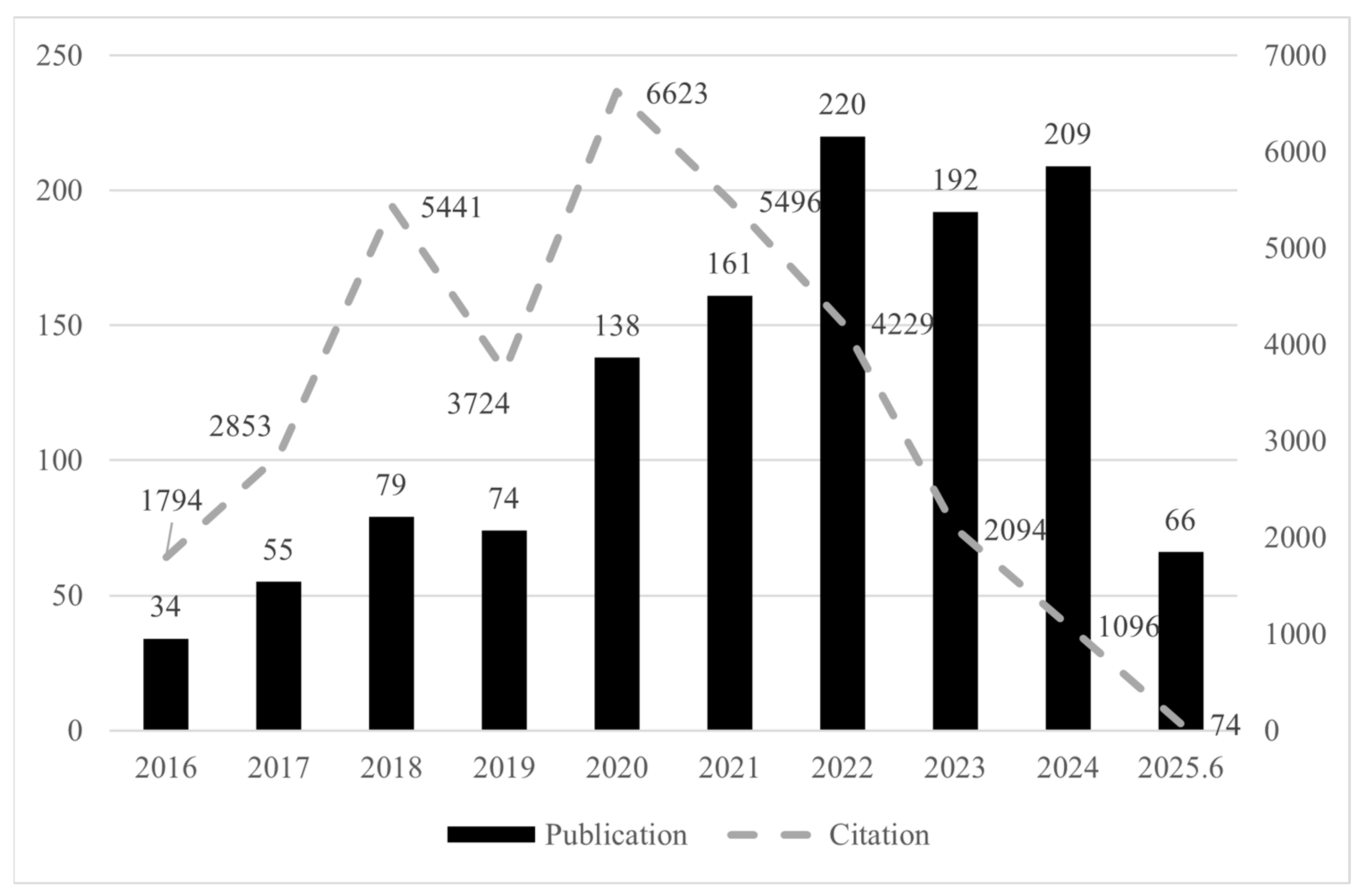
3.1. Descriptive Analysis
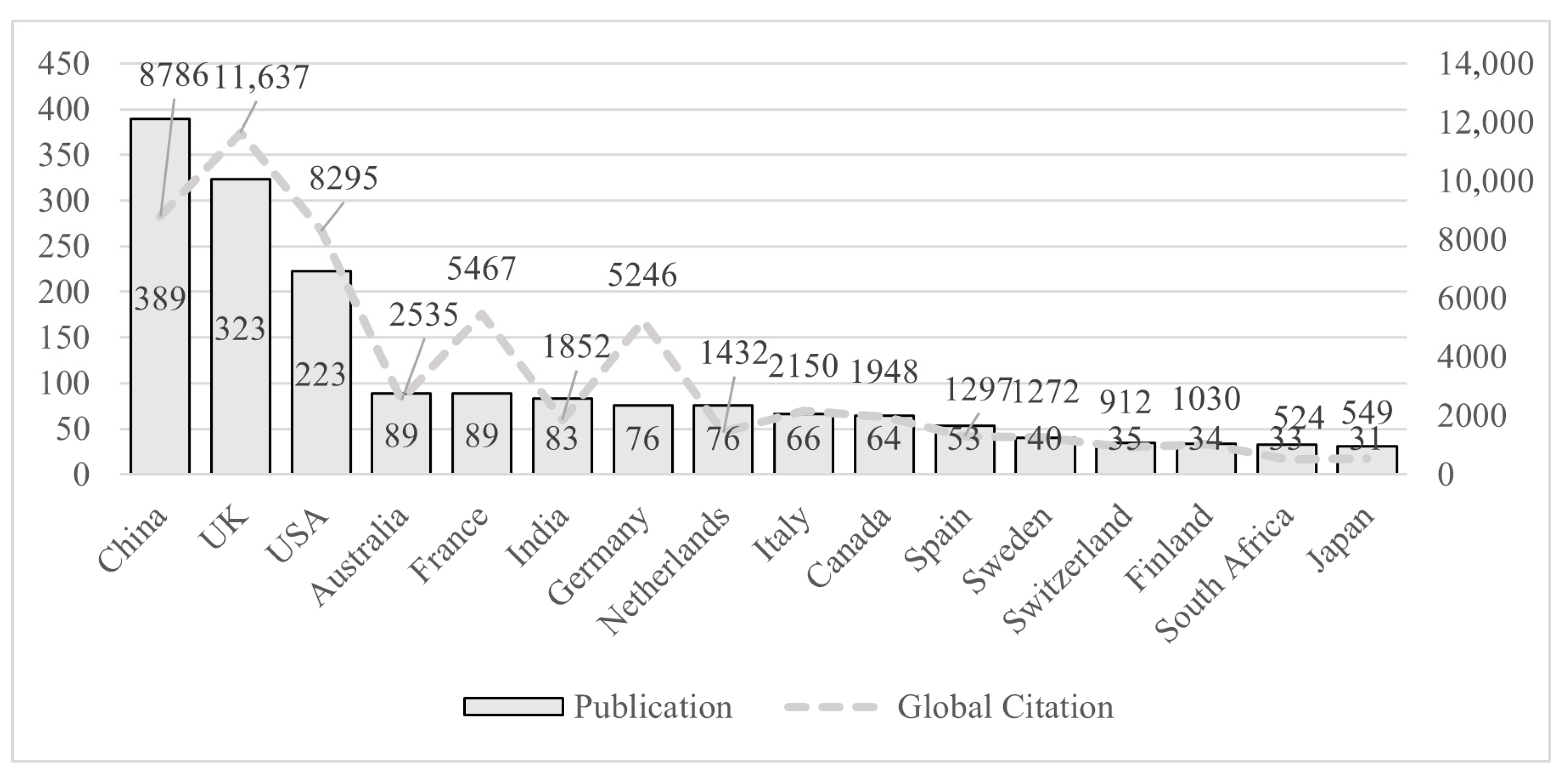
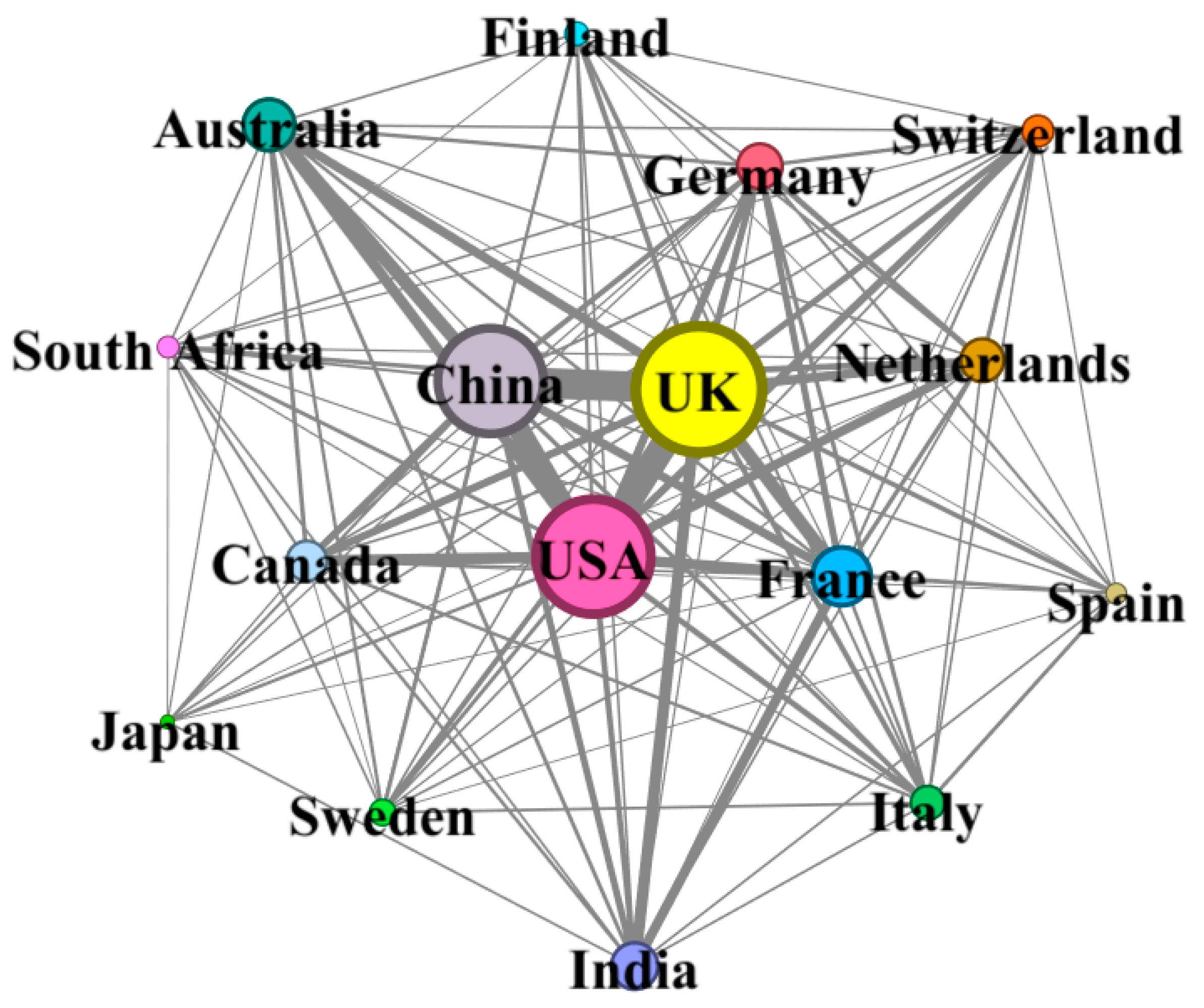
3.2. Regional Cooperation Analysis
3.3. Influential Contributors Identification
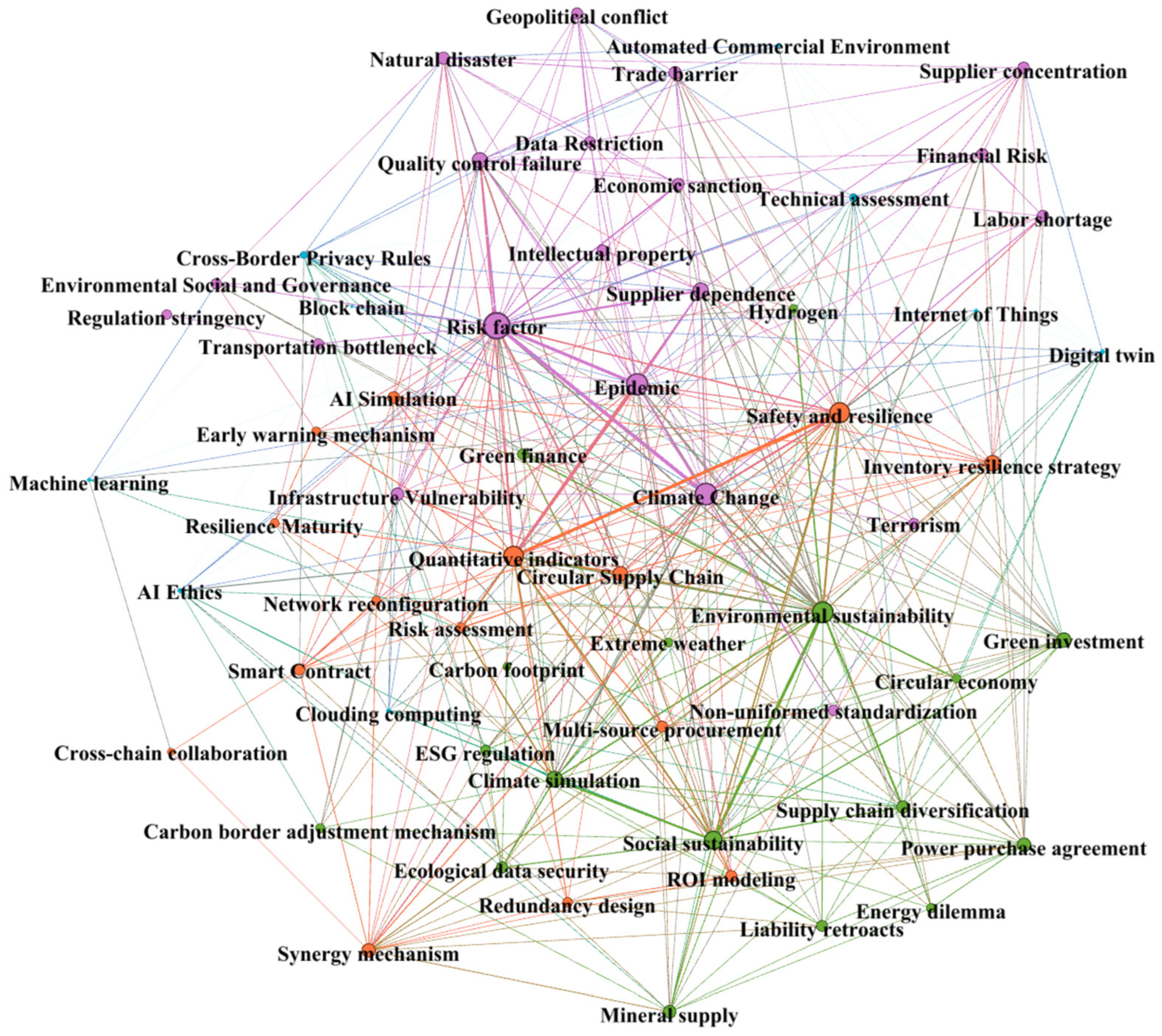
3.4. Clustering Analysis of Keywords Cooccurrence
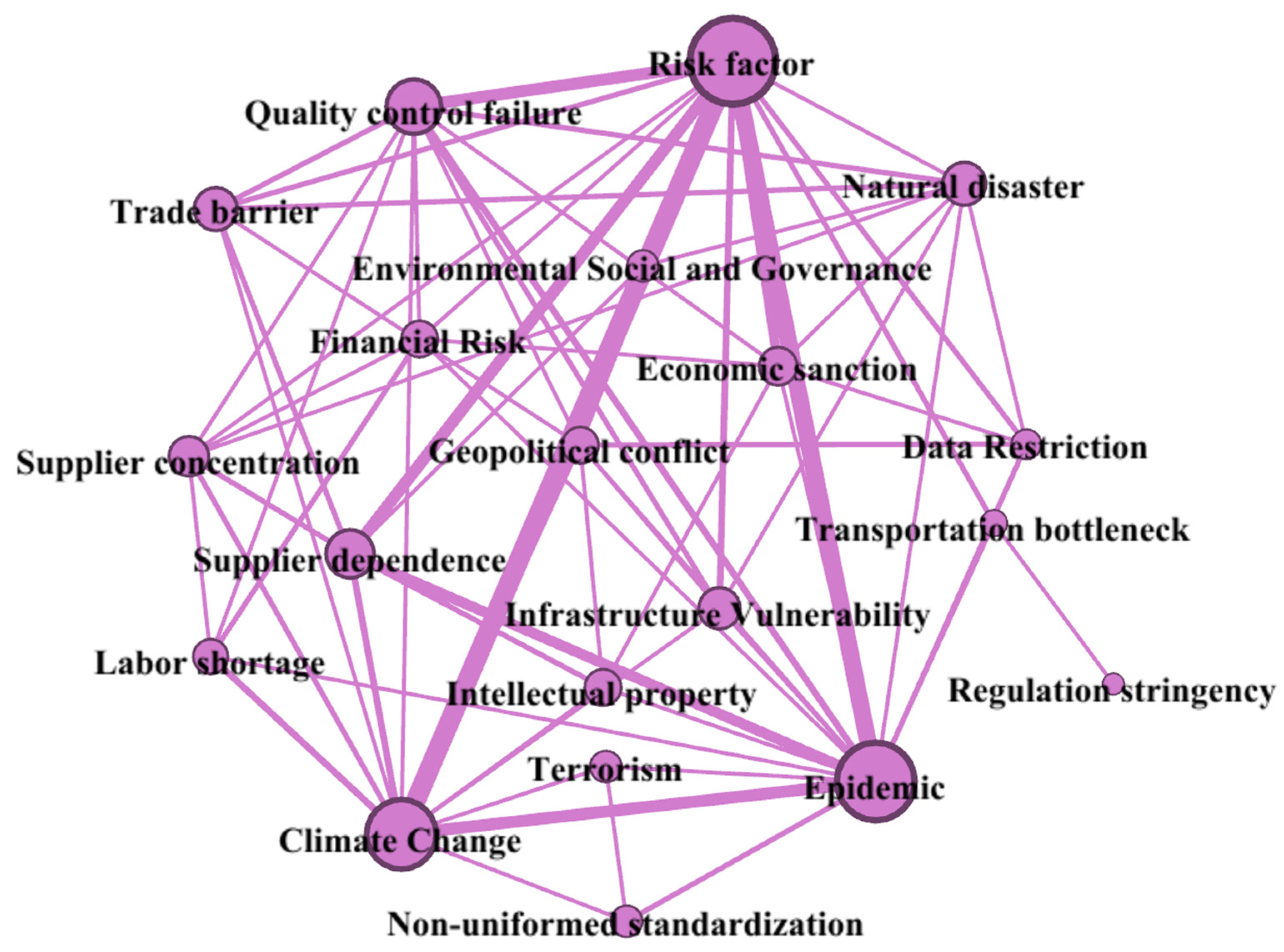
3.4.1. Recognition of Risk Factors

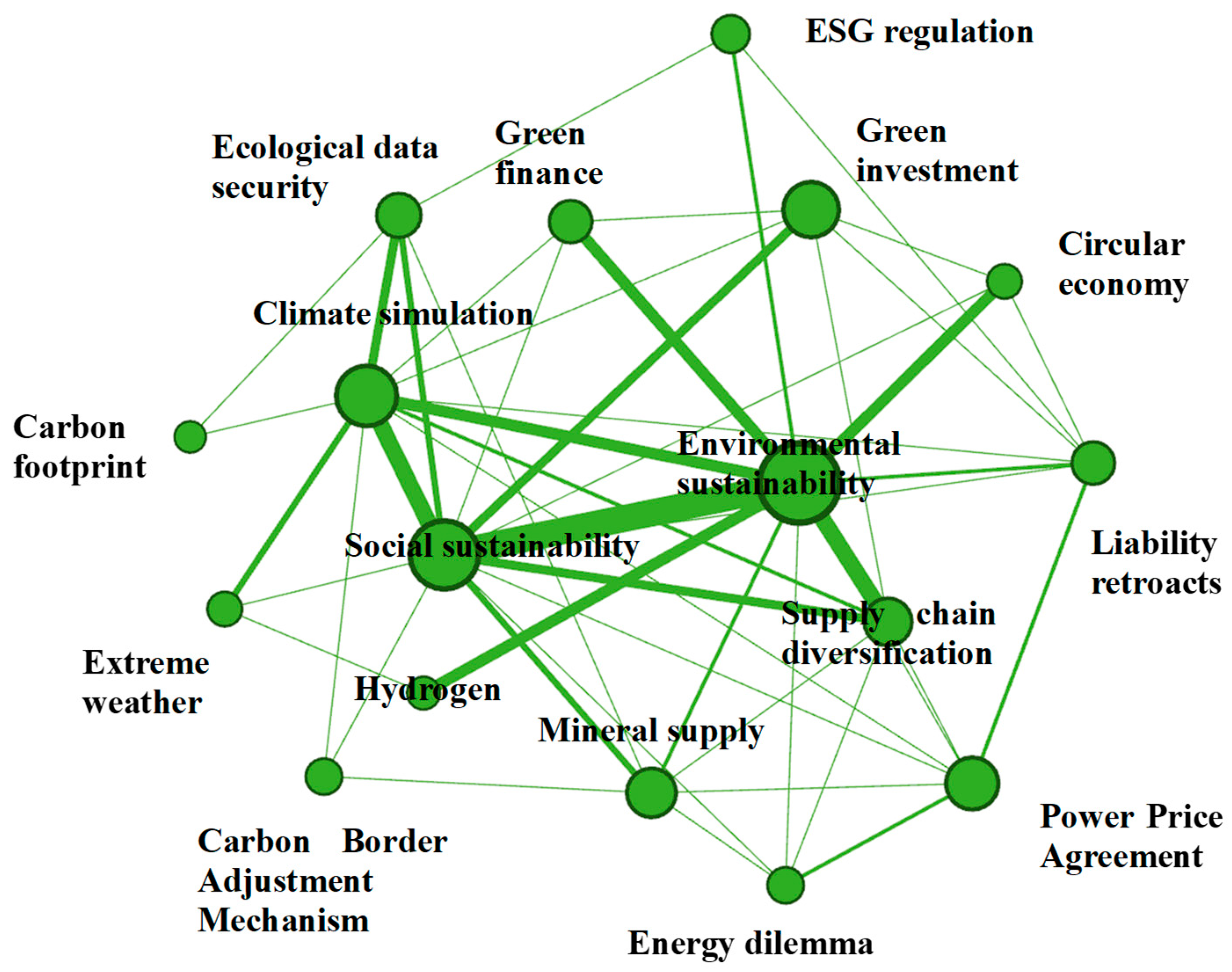
3.4.2. Environmental and Social Sustainability

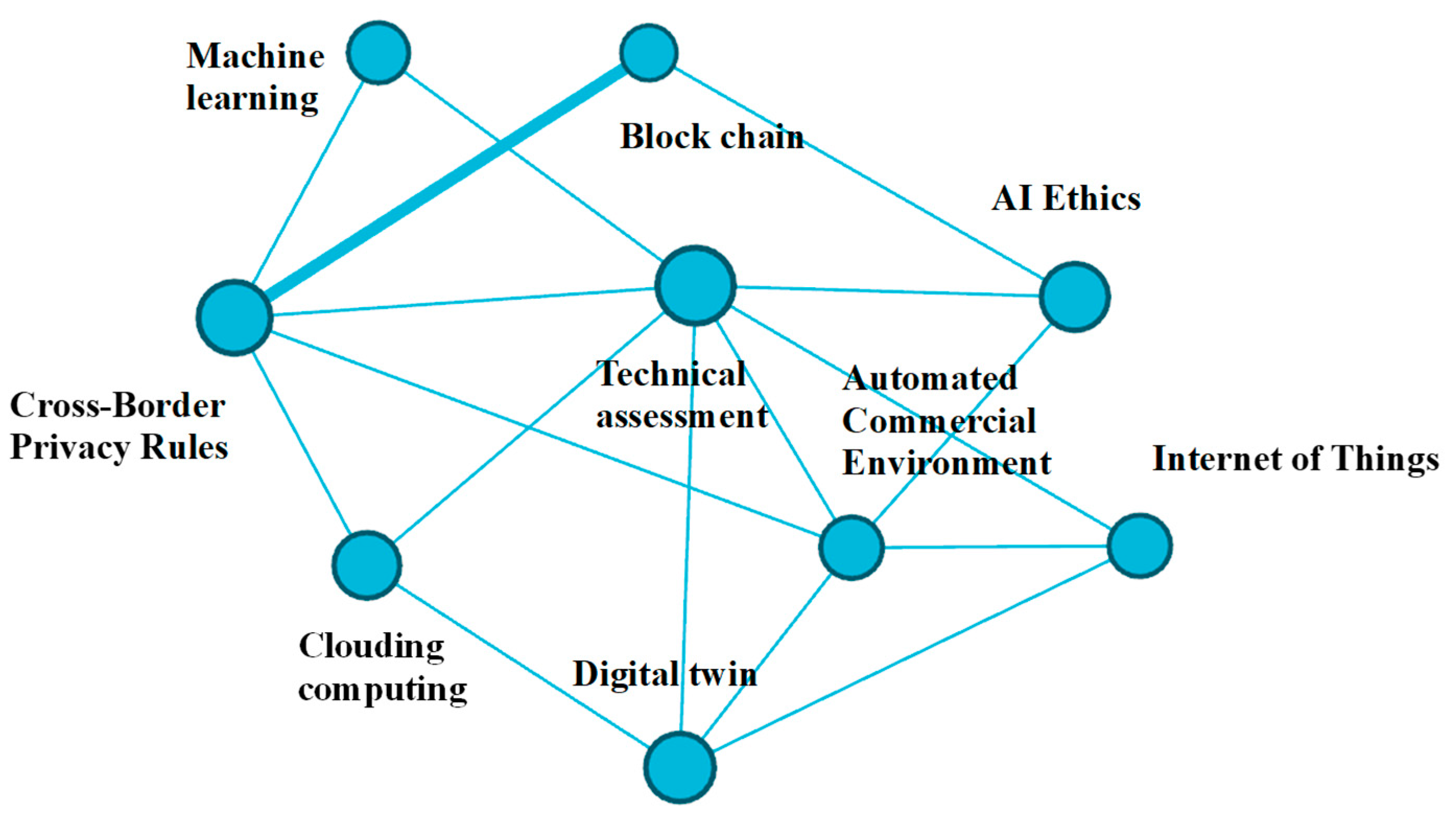
3.4.3. Challenges Derived from Technological Boom

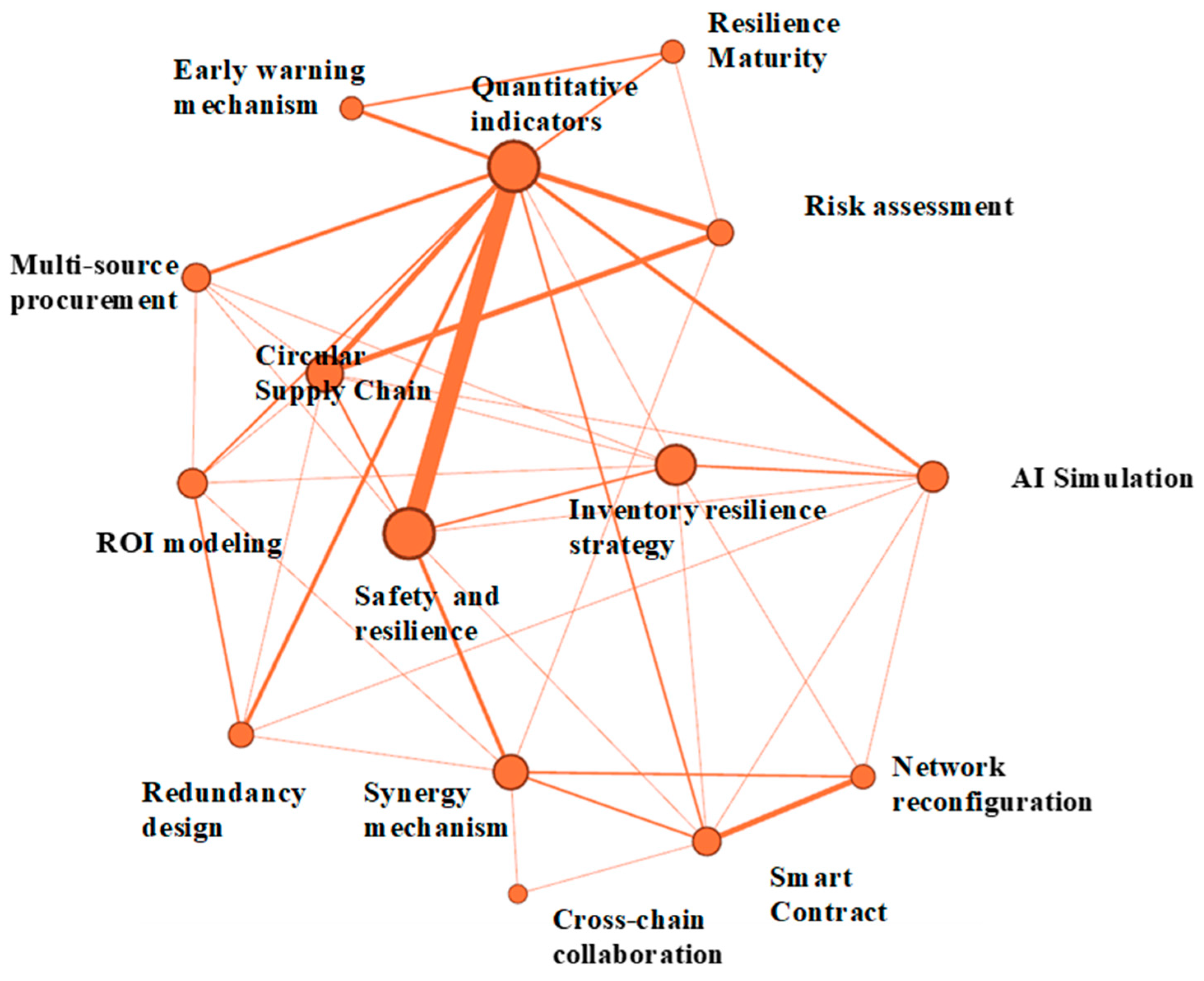
3.4.4. Innovative Methods of Risk Management
3.5. Temporal Trend Analysis
4. Discussion on Further Research Trends
4.1. Interpreting the Evolution of the Field Through a Theoretical Lens
4.2. Further Opportunities
4.2.1. Synergies and Trade-Offs in Digital Transformation for Sustainable-Resilient Supply Chains
4.2.2. Integrating ESG Strategies with Supply Chain Risk Management for Enhanced Resilience
4.2.3. Managing Paradoxes in Sustainable-Resilient Supply Chain Under Unconventional Risk
- (1)
- Developing hybrid simulation models that optimize redundancy allocation dynamically across multitier networks while maintaining circular economy principles during global epidemic situations. A key challenge here will be the scarcity of reliable, real-time data from all network tiers during a crisis, making robust model validation against such unprecedented events exceptionally difficult.
- (2)
- Constructing self-adjusting inventory algorithms using IoT data and predictive analytics that balance buffer stock requirements with waste reduction objectives under supply chain disruptions. Methodologically, this requires overcoming issues of integrating heterogeneous and often noisy IoT data streams, as well as ensuring the resulting predictive models are not brittle and can generalize to novel, unforeseen disruption types.
- (3)
- Developing integrated resilience-sustainability metrics that quantify the long-term value of maintaining environmental commitments during crises, even when short-term efficiency may be compromised. The primary obstacle for this direction is the inherent difficulty in quantifying intangible long-term benefits (e.g., brand reputation, stakeholder trust) and establishing clear causal links between sustainability actions and long-term performance.
4.2.4. Policy and Regulatory Frameworks for Navigating Sustainability-Resilience Complexity in Global Trade
5. Conclusions
5.1. Theoretical and Practical Implications
5.2. Limitations and Future Research
Author Contributions
Funding
Institutional Review Board Statement
Informed Consent Statement
Data Availability Statement
Conflicts of Interest
Abbreviations
| ACE | Automated Commercial Environment |
| CBAM | Carbon Border Adjustment Mechanism |
| ESG | Environmental, Social and Governance |
| CBPR | Cross-Border Privacy Rules |
Appendix A
References
- Muhammad Yusuf, A.; Soediantono, D. Supply Chain Management and Recommendations for Implementation in the Defense Industry: A Literature Review. Int. J. Soc. Manag. Stud. 2022, 3, 63–77. [Google Scholar]
- Kwak, D.-W.; Sanchez-Rodrigues, V.; Mason, R.; Pettit, S.; Beresford, A. Risk Interaction Identification in International Supply Chain Logistics: Developing a Holistic Model. Int. J. Oper. Prod. Manag. 2018, 38, 372–389. [Google Scholar] [CrossRef]
- Grossman, G.M.; Helpman, E.; Lhuillier, H. Supply Chain Resilience: Should Policy Promote Diversification or Reshoring? J. Polit. Econ. 2021, 131, 12. [Google Scholar]
- Orlando, B.; Tortora, D.; Pezzi, A.; Bitbol-Saba, N. The Disruption of the International Supply Chain: Firm Resilience and Knowledge Preparedness to Tackle the COVID-19 Outbreak. J. Int. Manag. 2020, 28, 100876. [Google Scholar] [CrossRef]
- Puzzello, L.; Raschky, P. Global supply chains and natural disasters: Implications for international trade. In Asia and Global Production Networks; Edward Elgar Publishing: Cheltenham, UK, 2014; pp. 112–147. [Google Scholar]
- Chopra, S.; Sodhi, M. Reducing the risk of supply chain disruptions. MIT Sloan Manag. Rev. 2014, 55, 73–80. [Google Scholar]
- Melnyk, S.A.; Schoenherr, T.; Speier-Pero, C.; Peters, C.; Chang, J.F.; Friday, D. New challenges in supply chain management: Cybersecurity across the supply chain. Int. J. Prod. Res. 2022, 60, 162–183. [Google Scholar] [CrossRef]
- Kwak, D.W.; Seo, Y.J.; Mason, R. Investigating the relationship between supply chain innovation, risk management capabilities and competitive advantage in global supply chains. Int. J. Oper. Prod. Manag. 2018, 38, 2–21. [Google Scholar] [CrossRef]
- Um, J.; Han, N. Understanding the relationships between global supply chain risk and supply chain resilience: The role of mitigating strategies. Supply Chain Manag. Int. J. 2021, 26, 240–255. [Google Scholar] [CrossRef]
- Baldwin, R.; Freeman, R. Risks and global supply chains: What we know and what we need to know. Annu. Rev. Econ. 2022, 14, 153–180. [Google Scholar] [CrossRef]
- Pournader, M.; Kach, A.; Talluri, S. A review of the existing and emerging topics in the supply chain risk management literature. Decis. Sci. 2020, 51, 867–919. [Google Scholar] [CrossRef] [PubMed]
- Koberg, E.; Longoni, A. A systematic review of sustainable supply chain management in global supply chains. J. Clean. Prod. 2019, 207, 1084–1098. [Google Scholar] [CrossRef]
- Gereffi, G.; Lee, J. Why the world suddenly cares about global supply chains. J. Supply Chain Manag. 2012, 48, 24–32. [Google Scholar] [CrossRef]
- Gurtu, A.; Johny, J. Supply chain risk management: Literature review. Risks 2021, 9, 16. [Google Scholar] [CrossRef]
- Fan, Y.; Stevenson, M. A review of supply chain risk management: Definition, theory, and research agenda. Int. J. Phys. Distrib. Logist. Manag. 2018, 48, 205–230. [Google Scholar] [CrossRef]
- Kano, L.; Tsang, E.W.K.; Yeung, H.W. Global value chains: A review of the multi-disciplinary literature. J. Int. Bus. Stud. 2020, 51, 577–622. [Google Scholar] [CrossRef]
- McLaren, C.D.; Bruner, M.W. Citation network analysis. Int. Rev. Sport Exerc. Psychol. 2022, 15, 179–198. [Google Scholar] [CrossRef]
- Wilding, R.; Wagner, B.; Colicchia, C.; Strozzi, F. Supply chain risk management: A new methodology for a systematic literature review. Supply Chain Manag. 2012, 17, 403–418. [Google Scholar] [CrossRef]
- Butler, L.; Visser, M.S. Extending citation analysis to non-source items. Scientometrics 2006, 66, 327–343. [Google Scholar] [CrossRef]
- Waltman, L.; Van Eck, N.J.; Noyons, E.C.M. A unified approach to mapping and clustering of bibliometric networks. J. Informetr. 2010, 4, 629–635. [Google Scholar] [CrossRef]
- Bastian, M.; Heymann, S.; Jacomy, M. Gephi: An open source software for exploring and manipulating networks. In Proceedings of the International AAAI Conference on Web and Social Media, San Jose, CA, USA; 2009; Volume 3, pp. 361–362. [Google Scholar]
- Chen, C. CiteSpace II: Detecting and visualizing emerging trends and transient patterns in scientific literature. J. Am. Soc. Inf. Sci. Technol. 2006, 57, 359–377. [Google Scholar] [CrossRef]
- Esen, M.; Bellibas, M.S.; Gumus, S. The evolution of leadership research in higher education for two decades (1995–2014): A bibliometric and content analysis. Int. J. Leadersh. Educ. 2020, 23, 259–273. [Google Scholar] [CrossRef]
- Jia, S.; Bava Harji, M. Themes, knowledge evolution, and emerging trends in task-based teaching and learning: A scientometric analysis in CiteSpace. Educ. Inf. Technol. 2023, 28, 9783–9802. [Google Scholar] [CrossRef]
- Prell, C. Social Network Analysis: History, Theory and Methodology; Sage: Thousand Oaks, CA, USA, 2012. [Google Scholar]
- Thürer, M.; Tomašević, I.; Stevenson, M.; Qu, T.; Huisingh, D. A systematic review of China’s belt and road initiative: Implications for global supply chain management. Int. J. Prod. Res. 2020, 58, 2436–2453. [Google Scholar] [CrossRef]
- Arruda, H.; Silva, E.R.; Lessa, M.; Proença, D.; Bartholo, R. VOSviewer and bibliometrix. J. Med. Libr. Assoc. 2022, 110, 392. [Google Scholar] [CrossRef]
- Jagtap, S.; Trollman, H.; Trollman, F.; Garcia-Garcia, G.; Parra-López, C.; Duong, L.; Martindale, W.; Munekata, P.E.S.; Lorenzo, J.M.; Hdaifeh, A.; et al. Surviving the storm: Navigating the quadruple whammy impact on Europe’s food supply chain. Int. J. Food Sci. Technol. 2024, 59, 3652–3666. [Google Scholar] [CrossRef]
- Meier, M.; Pinto, E. Covid-19 supply chain disruptions. Covid Econ. 2020, 48, 139–170. [Google Scholar] [CrossRef]
- Ivanov, D.; Dolgui, A.; Sokolov, B.; Werner, F.; Ivanova, M. Intellectualization of control: Cyber-physical supply chain risk analytics. IFAC PapersOnLine 2019, 52, 355–360. [Google Scholar] [CrossRef]
- Ivanov, D.; Sethi, S.; Dolgui, A.; Sokolov, B. A survey on control theory applications to operational systems, supply chain management, and Industry 4.0. Annu. Rev. Control 2018, 46, 134–147. [Google Scholar] [CrossRef]
- Anani, A.; Adewuyi, S.O.; Gonzales, C.G. Sustainable copper supply chains: Evaluating ESG risks through the lens of regulatory compliance and risk assessment strategies. Extr. Ind. Soc. 2025, 23, 101662. [Google Scholar] [CrossRef]
- Ghosh, P.; Jha, A.; Sharma, R.R.K. Managing carbon footprint for a sustainable supply chain: A systematic literature review. Mod. Supply Chain Res. Appl. 2020, 2, 123–141. [Google Scholar] [CrossRef]
- Kim, S.; Park, J.; Chung, W.; Bang, S.; Lee, D. Techno-economic analysis for design and management of international green hydrogen supply chain under uncertainty: An integrated temporal planning approach. Energy Convers. Manag. 2024, 301, 118010. [Google Scholar] [CrossRef]
- Tarigan, Z.J.H.; Siagian, H.; Jie, F. Impact of enhanced Enterprise Resource Planning (ERP) on firm performance through green supply chain management. Sustainability 2021, 13, 4358. [Google Scholar] [CrossRef]
- Roy, S.; Paul, A.; Paul, A.; Majumder, K. Ranking barriers of supply chain management by MCDM method during disaster management: A case study of India. Int. J. Syst. Dyn. Appl. 2021, 10, 1–16. [Google Scholar] [CrossRef]
- Stefanovic, N.; Radenkovic, M.; Bogdanovic, Z.; Lalic, B.; Despotovic-Zrakic, M. Adaptive Cloud-Based Big Data Analytics Model for Sustainable Supply Chain Management. Sustainability 2025, 17, 354. [Google Scholar] [CrossRef]
- Kumar, P.; Singh, R.K. Application of Industry 4.0 technologies for effective coordination in humanitarian supply chains: A strategic approach. Ann. Oper. Res. 2022, 319, 379–411. [Google Scholar] [CrossRef]
- Onder, M.P.; Pederson, J.T. International data exchange solutions for transport logistics. In ITS for Freight Logistics; The Institution of Engineering and Technology: London, UK, 2022. [Google Scholar] [CrossRef]
- Shapiro, B. Multimodal freight transportation security in the United States. In Multimodal Transport Security: Frameworks, Policy Applications for Freight and Passenger Transport; Edward Elgar Publishing: Cheltenham, UK, 2016; p. 83. [Google Scholar]
- Chang, Y.; Iakovou, E.; Shi, W. Blockchain in global supply chains and cross border trade: A critical synthesis of the state-of-the-art, challenges and opportunities. Int. J. Prod. Res. 2020, 58, 2082–2099. [Google Scholar] [CrossRef]
- Helbig, C.; Gemechu, E.D.; Pillain, B.; Young, S.B.; Thorenz, A.; Tuma, A. Extending the geopolitical supply risk indicator: Application of life cycle sustainability assessment to the petrochemical supply chain of polyacrylonitrile-based carbon fibers. J. Clean. Prod. 2016, 137, 1170–1178. [Google Scholar] [CrossRef]
- Baryannis, G.; Validi, S.; Dani, S.; Antoniou, G. Supply chain risk management and artificial intelligence: State of the art and future research directions. Int. J. Prod. Res. 2019, 57, 2179–2202. [Google Scholar] [CrossRef]
- Nagy, J.; Foltin, P. Increase supply chain resilience by applying early warning signals within big-data analysis. Ekon. Vjesn. Contemp. Business Entrep. Econ. Issues 2022, 35, 467–481. [Google Scholar] [CrossRef]
- Ju, C.; Trinh, T.K. A Machine Learning Approach to Supply Chain Vulnerability Early Warning System: Evidence from US Semiconductor Industry. J. Adv. Comput. Syst. 2023, 3, 21–35. [Google Scholar] [CrossRef]
- Guercini, S.; Perna, A.; Runfola, A.; Guercini, G. A network perspective on supply chain management in the structural reshaping of globalization. J. Bus. Ind. Mark. 2025, 40, 834–840. [Google Scholar] [CrossRef]
- Han, S.; Xiaoxue, W.; Xiaohui, Y.; Yongzhang, Z. Assessment of key metals supply risk in China’s strategic emerging industries. Resour. Sci. 2024, 46, 2124–2136. [Google Scholar] [CrossRef]
- Lokanan, M.E.; Maddhesia, V. Supply chain fraud prediction with machine learning and artificial intelligence. Int. J. Prod. Res. 2025, 63, 286–313. [Google Scholar] [CrossRef]
- Khan, R.S.; Sirazy, M.R.M.; Das, R.; Sheikh, A.A. An ai and ml-enabled framework for proactive risk mitigation and resilience optimization in global supply chains during national emergencies. Sage Sci. Rev. Appl. Mach. Learn. 2022, 5, 127–144. [Google Scholar]
- Mittal, U.; Panchal, D. AI-based evaluation system for supply chain vulnerabilities and resilience amidst external shocks: An empirical approach. Rep. Mech. Eng. 2023, 4, 276–289. [Google Scholar] [CrossRef]
- De Nooy, W.; Mrvar, A.; Batagelj, V. Exploratory Social Network Analysis with Pajek; Cambridge University Press: Cambridge, UK, 2005. [Google Scholar]
- Agostini, L.; Galati, F.; Gastaldi, L. The digitalization of the innovation process: Challenges and opportunities from a management perspective. Eur. J. Innov. Manag. 2020, 23, 1–12. [Google Scholar] [CrossRef]
- Rachinger, M.; Rauter, R.; Müller, C.; Vorraber, W.; Schirgi, E. Digitalization and its influence on business model innovation. J. Manuf. Technol. Manag. 2019, 30, 1143–1160. [Google Scholar] [CrossRef]
- Gaivoronskaya, Y.V.; Mamychev, A.Y.; Petrova, D.A.; Yakushev, A.N. Typology of Risks and Threats Caused by Digitalization. Rev. Tur. Estud. Práticas 2020, 5, 1–12. [Google Scholar]
- Fruhwirth, M.; Pammer-Schindler, V.; Thalmann, S. Knowledge Leaks in Data-Driven Business Models? Exploring Different Types of Knowledge Risks and Protection Measures. Schmalenbach J. Bus. Res. 2024, 76, 357–396. [Google Scholar] [CrossRef]
- Sunmola, F.; Baryannis, G.; Tan, A.; Co, K.; Papadakis, E. Holistic Framework for Blockchain-Based Halal Compliance in Supply Chains Enabled by Artificial Intelligence. Systems 2025, 13, 21. [Google Scholar] [CrossRef]
- Lingam, Y.K. The role of Artificial Intelligence (AI) in making accurate stock decisions in E-commerce industry. Int. J. Adv. Res. Ideas Innov. Technol. 2018, 4, 2281–2286. [Google Scholar]
- Adobor, H.; McMullen, R.S. Supply chain resilience: A dynamic and multidimensional approach. Int. J. Logist. Manag. 2018, 29, 1451–1471. [Google Scholar] [CrossRef]
- Lee, H.L.; Rammohan, S.V. Improving social and environmental performance in global supply chains. In Sustainable Supply Chains: A Research-Based Textbook on Operations and Strategy; Springer International Publishing: Cham, Switzerland, 2016; pp. 439–464. [Google Scholar]
- Gazzola, P.; Sepashvili, E.; Pezzetti, R. How sustainable enterprises can drive the sustainable development. Eur. Sci. J. 2018, 26–36. [Google Scholar] [CrossRef]
- Dauvergne, P.; Lister, J. Big brand sustainability: Governance prospects and environmental limits. Glob. Environ. Change 2012, 22, 36–45. [Google Scholar] [CrossRef]
- Ali, R.F.; Jahankhani, H.; Ali, K.; Hassan, B. Blockchain-Based Security Factors on Sustainable Supply Chain Management in UK Manufacturing Firms: A Hybrid SEM-ANN Approach. Systems 2024, 12, 208. [Google Scholar] [CrossRef]
- Gouda, S.K.; Saranga, H. Sustainable supply chains for supply chain sustainability: Impact of sustainability efforts on supply chain risk. Int. J. Prod. Res. 2018, 56, 5820–5835. [Google Scholar] [CrossRef]
- Farooque, M.; Zhang, A.; Thürer, M.; Qu, T.; Huisingh, D. Circular supply chain management: A definition and structured literature review. J. Clean. Prod. 2019, 228, 882–900. [Google Scholar] [CrossRef]
- Veenstra, A.W. International trade, global supply chains and compliance. In Operations, Logistics and Supply Chain Management; Springer International Publishing: Cham, Switzerland, 2018; pp. 131–161. [Google Scholar]
- Kim, S.; Kim, C. Enhancing Logistics Performance through Increased Trust and Collaboration in Supply Chain Risk Management: A Focus on the Distribution Network of Manufacturing Companies. Systems 2024, 12, 141. [Google Scholar] [CrossRef]
- Chu, C.Y.; Park, K.; Kremer, G.E. A global supply chain risk management framework: An application of text-mining to identify region-specific supply chain risks. Adv. Eng. Inform. 2020, 45, 101053. [Google Scholar] [CrossRef]
- Varzandeh, J.; Farahbod, K.; Jake Zhu, J. Global Logistics and Supply Chain Risk Management. J. Bus. Behav. Sci. 2016, 28, 124–130. [Google Scholar]
- Ghadge, A.; Jena, S.K.; Kamble, S.; Misra, D.; Tiwari, M.K. Impact of financial risk on supply chains: A manufacturer-supplier relational perspective. Int. J. Prod. Res. 2021, 59, 7090–7105. [Google Scholar] [CrossRef]
- Ivanov, D.; Das, A. Coronavirus (COVID-19/SARS-CoV-2) and supply chain resilience: A research note. Int. J. Integr. Supply Manag. 2020, 13, 90–102. [Google Scholar] [CrossRef]
- Manners-Bell, J. Supply Chain Risk Management: Understanding Emerging Threats to Global Supply Chains; Kogan Page Publishers: London, UK, 2017. [Google Scholar]
- Oh, J.; Choi, Y.; In, J. A conceptual framework for designing blockchain technology enabled supply chains. Int. J. Logist. Res. Appl. 2023, 26, 1315–1333. [Google Scholar] [CrossRef]
- Zahoor, N.; Wu, J.; Khan, H.; Kleyn, D.; Rana, S. De-globalization, international trade protectionism, and the reconfigurations of global value chains. Manag. Int. Rev. 2023, 63, 823–859. [Google Scholar] [CrossRef]
- Kazancoglu, Y.; Lafci, C.; Berberoglu, Y.; Demir, B.; Kaya, S.K. The effects of globalization on supply chain resilience: Outsourcing techniques as interventionism, protectionism, and regionalization strategies. Oper. Manag. Res. 2024, 17, 505–522. [Google Scholar] [CrossRef]
- Hao, X. Import competition and pressure in the international crude oil trade: A network analysis. Resour. Policy 2023, 82, 103468. [Google Scholar] [CrossRef]
- Dong, L.; Kouvelis, P. Impact of tariffs on global supply chain network configuration: Models, predictions, and future research. Manuf. Serv. Oper. Manag. 2020, 22, 25–35. [Google Scholar] [CrossRef]
- Garfield, E. Is citation analysis a legitimate evaluation tool? Scientometrics 1979, 1, 359–375. [Google Scholar] [CrossRef]
- Pilkington, A.; Meredith, J. The evolution of the intellectual structure of operations management—1980–2006: A citation/co-citation analysis. J. Oper. Manag. 2009, 27, 185–202. [Google Scholar] [CrossRef]



| Institutes | Documents | TGCS |
|---|---|---|
| The Hong Kong Polytechnic University | 53 | 2832 |
| University of Cambridge | 31 | 2070 |
| University of Southern Denmark | 24 | 1091 |
| University of Sussex | 24 | 1026 |
| Polytechnic University of Milan | 22 | 897 |
| Tsinghua University | 21 | 793 |
| University of Groningen | 21 | 792 |
| Cranfield University | 20 | 786 |
| Nanyang Technological University | 19 | 775 |
| Cardiff University | 18 | 772 |
| Journals | Documents | TGCS |
|---|---|---|
| Sustainability | 88 | 4785 |
| International Journal of Production Research | 84 | 4689 |
| International Journal of Production Economics | 71 | 3388 |
| International Journal of Operations & Production Management | 61 | 3144 |
| Supply Chain Management-An International Journal | 50 | 2367 |
| Energies | 45 | 2111 |
| Applied Sciences | 38 | 1328 |
| Energy And Buildings | 36 | 1090 |
| Omega-International Journal of Management Science | 29 | 921 |
| International Journal of Disaster Risk Reduction | 23 | 844 |
| Keywords | Weight | Start Year | End Year | Burstiness (from 2016 to 2025) |
|---|---|---|---|---|
| Risk factor | 5 | 2016 | 2020 | ▃▃▃▃▃▂▂▂▂▂ |
| Quality control failure | 4 | 2017 | 2020 | ▂▃▃▃▃▂▂▂▂▂ |
| Nature disaster | 3 | 2017 | 2019 | ▂▃▃▃▂▂▂▂▂▂ |
| Climate change | 3 | 2017 | 2019 | ▂▃▃▃▂▂▂▂▂▂ |
| Financial risks | 2 | 2018 | 2019 | ▂▂▃▃▂▂▂▂▂▂ |
| Labor shortage | 2 | 2018 | 2019 | ▂▂▃▃▂▂▂▂▂▂ |
| Data restriction | 3 | 2019 | 2021 | ▂▂▂▃▃▃▂▂▂▂ |
| Cyber security | 3 | 2019 | 2021 | ▂▂▂▃▃▃▂▂▂▂ |
| Epidemic | 5 | 2020 | 2024 | ▂▂▂▂▃▃▃▃▃▂ |
| Geopolitical conflicts | 1 | 2025 | 2025 | ▂▂▂▂▂▂▂▂▂▃ |
| Keywords | Weight | Start Year | End Year | Burstiness (from 2016 to 2025) |
|---|---|---|---|---|
| Environmental sustainability | 3 | 2016 | 2018 | ▃▃▃▂▂▂▂▂▂▂ |
| Social sustainability | 3 | 2017 | 2019 | ▂▃▃▃▂▂▂▂▂▂ |
| Green finance | 2 | 2018 | 2019 | ▂▂▃▃▂▂▂▂▂▂ |
| Green investment | 2 | 2018 | 2019 | ▂▂▃▃▂▂▂▂▂▂ |
| Circular economy | 2 | 2019 | 2020 | ▂▂▂▃▃▂▂▂▂▂ |
| Ecological data security | 2 | 2019 | 2020 | ▂▂▂▃▃▂▂▂▂▂ |
| Energy dilemma | 3 | 2020 | 2022 | ▂▂▂▂▃▃▃▂▂▂ |
| Hydrogen | 2 | 2021 | 2022 | ▂▂▂▂▂▃▃▂▂▂ |
| Carbon foot print | 2 | 2023 | 2024 | ▂▂▂▂▂▂▂▃▃▂ |
| ESG regulation | 1 | 2025 | 2025 | ▂▂▂▂▂▂▂▂▂▃ |
| Keywords | Weight | Start Year | End Year | Burstiness (from 2016 to 2025) |
|---|---|---|---|---|
| Technical assessment | 2 | 2016 | 2017 | ▃▃▂▂▂▂▂▂▂▂ |
| AI ethics | 2 | 2017 | 2018 | ▂▃▃▂▂▂▂▂▂▂ |
| Machine learning | 2 | 2018 | 2019 | ▂▂▃▃▂▂▂▂▂▂ |
| Clouding computing | 2 | 2019 | 2020 | ▂▂▂▃▃▂▂▂▂▂ |
| Internet of things | 2 | 2020 | 2021 | ▂▂▂▂▃▃▂▂▂▂ |
| Blockchain | 2 | 2021 | 2022 | ▂▂▂▂▂▃▃▂▂▂ |
| Digital twin | 2 | 2022 | 2023 | ▂▂▂▂▂▂▃▃▂▂ |
| Cross-border privacy rules | 2 | 2023 | 2024 | ▂▂▂▂▂▂▂▃▃▂ |
| Automated commercial environment | 1 | 2025 | 2025 | ▂▂▂▂▂▂▂▂▂▃ |
| Keywords | Weight | Start Year | End Year | Burstiness (from 2016 to 2025) |
|---|---|---|---|---|
| Safety and resilience | 4 | 2016 | 2019 | ▃▃▃▃▂▂▂▂▂▂ |
| Risk assessment | 2 | 2017 | 2018 | ▂▃▃▂▂▂▂▂▂▂ |
| Quantitative indicators | 3 | 2017 | 2019 | ▂▃▃▃▂▂▂▂▂▂ |
| Early warning system | 2 | 2019 | 2020 | ▂▂▂▃▃▂▂▂▂▂ |
| Inventory resilience strategy | 3 | 2019 | 2021 | ▂▂▂▃▃▃▂▂▂▂ |
| Redundancy design | 3 | 2019 | 2021 | ▂▂▂▃▃▃▂▂▂▂ |
| Network reconfiguration | 3 | 2019 | 2021 | ▂▂▂▃▃▃▂▂▂▂ |
| Multisource procurement | 3 | 2021 | 2023 | ▂▂▂▂▂▃▃▃▂▂ |
| Cross-chain collaboration | 3 | 2022 | 2024 | ▂▂▂▂▂▂▃▃▃▂ |
| Smart contract | 1 | 2025 | 2025 | ▂▂▂▂▂▂▂▂▂▃ |
Disclaimer/Publisher’s Note: The statements, opinions and data contained in all publications are solely those of the individual author(s) and contributor(s) and not of MDPI and/or the editor(s). MDPI and/or the editor(s) disclaim responsibility for any injury to people or property resulting from any ideas, methods, instructions or products referred to in the content. |
© 2025 by the authors. Licensee MDPI, Basel, Switzerland. This article is an open access article distributed under the terms and conditions of the Creative Commons Attribution (CC BY) license (https://creativecommons.org/licenses/by/4.0/).
Share and Cite
Meng, X.; Wong, K.-P.; Zhang, C.; Qin, T. Mapping the Sustainability-Resilience Nexus: A Scientometric Analysis of Global Supply Chain Risk Management. Eng 2025, 6, 357. https://doi.org/10.3390/eng6120357
Meng X, Wong K-P, Zhang C, Qin T. Mapping the Sustainability-Resilience Nexus: A Scientometric Analysis of Global Supply Chain Risk Management. Eng. 2025; 6(12):357. https://doi.org/10.3390/eng6120357
Chicago/Turabian StyleMeng, Xiangcheng, Ka-Po Wong, Chao Zhang, and Tingxin Qin. 2025. "Mapping the Sustainability-Resilience Nexus: A Scientometric Analysis of Global Supply Chain Risk Management" Eng 6, no. 12: 357. https://doi.org/10.3390/eng6120357
APA StyleMeng, X., Wong, K.-P., Zhang, C., & Qin, T. (2025). Mapping the Sustainability-Resilience Nexus: A Scientometric Analysis of Global Supply Chain Risk Management. Eng, 6(12), 357. https://doi.org/10.3390/eng6120357