Article

Collapse Pressure Prediction for Marine Shale Wellbores Considering Drilling Fluid Invasion-Induced Strength Degradation: A Bedding Plane Slip Model


1
School of Materials Science and Engineering, China University of Geosciences (Beijing), Beijing 100083, China
2
Petroleum Engineering Technology Research Institute Co., Ltd., Beijing 102200, China
3
College of Petroleum Engineering, China University of Petroleum, Beijing 102249, China
4
School of Chemistry and Chemical Engineering, Shandong University, Jinan 250100, China
*
Author to whom correspondence should be addressed.
Eng 2025, 6(12), 353; https://doi.org/10.3390/eng6120353
Submission received: 28 October 2025 / Revised: 20 November 2025 / Accepted: 2 December 2025 / Published: 5 December 2025

Abstract

The stability of deep marine shale wellbores is influenced by both bedding anisotropy and drilling fluid intrusion. Existing models fail to adequately account for the coupled effects of intrusion depth and strength degradation. This study, targeting Longmaxi Formation shale, established a collapse pressure prediction model incorporating drilling fluid intrusion depth through direct shear tests and nuclear magnetic resonance (NMR) techniques. Experimental results indicate that shear strength reaches its minimum at β = 45°, decreasing by approximately 60% compared to β = 0° or 90°. Intrusion causes exponential decay in bedding plane strength, with the cohesion degradation coefficient λc = 0.158 mm−1 significantly exceeding the internal friction angle degradation coefficient λφ = 0.089 mm−1. Sensitivity analysis indicates that bedding angle and invasion depth rank third (±3%) and fourth (±1.5%), respectively, in influencing collapse pressure. Field validation confirmed excellent model prediction accuracy (R2 = 0.956; RMSE = 0.55 MPa; MAPE = 1.05%), with all errors below 4%. This model accurately predicts the time-varying characteristics of collapse pressure, providing a theoretical basis for optimizing the design of drilling fluid density.

1. Introduction

The problem of wellbore stability during deep marine shale exploration has been a nagging challenge in drilling engineering. Statistics indicate that over 90% of cases of wellbore instability occur in shale formations, thus seriously hindering efficient and safe development of oil and gas deposits [1]. Shale’s characteristic layer sedimentary structure produces significant anisotropy in its mechanical behavior. Drilling fluid–formation interaction further promotes instability of wellbores via hydration [2,3]. Li et al. [4] validated the applicability of wellbore stability forecasting technologies by applying regional geomechanical simulation to the Longmaxi shale formation, demonstrating that formation heterogeneity has an important role to play in stability analysis. With drilling operations advancing to greater depths and geologically more complicated strata, it has become a necessity to improve water-based drilling fluids’ capability to inhibit instability and ensure borehole stability maintenance [5].
In shale wellbore stability analysis, extensive theoretical and experimental research has been conducted. The anisotropic nature of shale mostly results from the development of bedding planes. Heng et al. [6] rigorously proved with mechanical experiments that shale strength shows a characteristic U-distribution as a function of bedding angle, with minimum strength occurring between 30 and 45°. Early work by Heng et al. [7] unveiled the essence of shale anisotropy with experimental and theoretical approaches, forming a cornerstone for later explorations. Shen et al. [8] more recently utilized acoustic emission technology to further understand failure modes’ differentials with varying bedding angles. It should, however, be noted that not only do bedding planes influence rock strength characteristics but they also, to a great extent, alter stress distribution patterns in the environs around wellbores. Appropriate constitutive models, such as the Mohr–Coulomb criterion, need to be selected for suitable prediction of stability in anisotropic reservoirs [9]. Zhang et al. [10] found that morphology and the extent of instability-prone zones experience significant changes in the presence of a plurality of weak planes, hence making predictions of such instability complicated. Additionally, Wenke et al. [11] corroborated the idea that models that account for bedding plane slip failure are more realistic for representing actual modes of instability for wellbores.
The adverse effect of drilling fluid invasion on shale strength is another important parameter that initiates wellbore instability. Lu et al. [12] reported, through acoustic emission as well as CT scanning, that the presence of pore water could reduce shale strength by as much as 90%, thereby clarifying water-induced weakening at a micro-mechanism level. Liu et al.’s [13] laboratory work on hydraulic fracturing successfully demonstrated that anisotropy of bedding has a significant effect on fracture starting pressure as well as propagation direction. Furthermore, numerical work confirmed the material parameter sensitivity of wellbore stability [14]. Quantitative risk analysis was accomplished by Ma et al. [15] and indicated that coupled effects between anisotropy of rock strength and parameter uncertainty significantly affect the accuracy of collapse pressure estimation. Immersion experiments were carried out by Wang et al. [16] and revealed that penetration depth increases sharply with pressure differential, such that loss of strength exceeds 40% across horizontal bedding planes. Li et al. [17] built mathematical correlations between penetration depth and penetration time, pressure differential, confining pressure, and bedding angle, via a joint method involving nuclear magnetic resonance (NMR) technology and numerical simulation. Laboratory measurements illustrate that the invasion of drilling fluid continuously reduces interbed cement strength [18]. Zhou et al. [19] confirmed that a distinct relationship between the elastic modulus and shearing strength of water-sensitive shale, as well as between Poisson’s ratio and Coulomb stress, holds true. Chemical inhibitor development opens new prospects for improving wellbore stability [20]. Nevertheless, Cao et al. [21] elucidated, from a perspective of brittle evolution, that time effects caused by fluid invasion create time-varying changes in shale mechanical behavior, which further impedes classic static analysis tools from precisely describing this process.
Notwithstanding the substantial advancements made in the studies previously mentioned, current wellbore stability models continue to display significant deficiencies. The stability model established by Fan et al. [22], which takes into account weaknesses along bedding planes, is capable of predicting collapse pressures across varying bedding angles; however, it assumes invariant strength parameters for bedding planes and consequently fails to capture the progressive mechanical degradation induced by drilling fluid intrusion. Dokhani et al. [23] proposed a mechanism for fluid-induced instability, yet they oversimplified the invasion process through static boundary conditions that neglected the temporal and spatial progression of fluid penetration. Gholami et al. [24] explicitly noted in their review that the lack of predictive models that integrate invasion depth with the degradation of lamination strength and the evolution of borehole stress restricts the efficacy of existing methods in practical engineering applications. The present study addresses these limitations through three key advances: incorporating time-dependent strength evolution as a function of invasion depth h(t), coupling invasion depth evolution h = α√(ΔP·t) with exponential strength degradation c(h) = c0exp(−λch) and φ(h) = φ0exp(−λφh), and employing nuclear magnetic resonance technology to experimentally quantify invasion depth, providing direct empirical validation rather than numerical assumptions.
Against this background, this paper attempts to create a collapse pressure prediction model for marine shale wellbores that includes drilling fluid intrusion depth. Based on weak-bedding plane slip theory, it quantitatively defines the bed plane strength degradation pattern with respect to intrusion depth with experimental studies and configures this in a stress analysis framework of wellbores. It uses nuclear magnetic resonance (NMR) technology to precisely test penetration depth under different conditions, thus deriving mathematical relations between penetration depth, differential pressure, time, and bedding angle. It establishes an exponential decline model between strength and penetration depth. Verification with typical field cases reveals that the model has great effectiveness in precisely predicting collapse pressure development during the whole drilling process. This serves as a theoretical basis for optimizing drilling fluid weight design and determining safe drilling suspension intervals, hence bringing great engineering benefits in mitigating the risk of wellbore instability and enhancing drilling efficiency.

2. Theoretical Model

2.1. Model Assumptions

To set up a predictive model of marine shale wellbore collapse pressure considering penetration depth of drilling fluid, Figure 1 shows the physical model designed in this work. This physical model defines conditions under which vertical or deviated wells move across layered shale formations, with the wellbore under the influence of three-dimensional in situ stresses, comprising maximum horizontal principal stress σH, minimum horizontal principal stress σh, vertical stress σv, and the result of internal mud pressure Pm. Drilling fluid flows radially from the wellbore wall towards the formation under pressure difference ΔP, thus developing an infiltrated zone with a concentration gradient. The depth of the advancing edge of this zone is given as h. The bedding planes of the multi-layer shale, oriented at angle α, cut across the wellbore and form the main weak planes that control wellbore instability.
According to the above physical model, this paper presents the following basic assumptions: (1) Shale is a transversely isotropic elastic medium, with five independent elastic constants, where the isotropic plane is aligned with the bedding plane [25]. This assumption accounts for shale’s inborn anisotropic nature caused by its sedimentary nature and has been broadly utilized in shale wellbore instability analysis. (2) One set of parallel weak bedding planes will exist across the formation, being uniquely identified by dip angle α and strike. Even though several weak planes might exist in reality, the single-plane approximation identifies the major failure behavior and facilitates analysis [26]. (3) Drilling fluid invasion is a quasi-static diffusion process, where invasion depth h gradually increases with time t and pressure difference ΔP, while ignoring transient pressure fluctuation impacts. (4) This wellbore section away from the bottomhole obeys plane strain conditions, with axial deformation pinned by the adjacent formation. Stress–strain calculation is performed for the wellbore cross-section. (5) Stress distribution near the wellbore before invasion obeys the Lekhnitskii solution for isotropic materials in the cross-section. The stress concentration factor depends on elastic anisotropy and the orientation angle of the bedding plane with respect to in situ stress [27]. (6) Invasion of drilling fluid destroys the mechanical behavior of bedding planes, with cohesion c and inner friction angle φ decreasing exponentially with invasion depth h. On the other hand, the mechanical behavior of the intact matrix remains unchanged with respect to the timescale considered. Such assumptions form the theoretical basis for further stress calculation and collapse pressure estimation.
These assumptions derive from experimental evidence reported by Wang et al. [16], who documented that immersion tests demonstrate significant deterioration of bedding plane strength while the intact matrix exhibits minimal degradation over comparable timescales of less than 72 h. The preferential invasion pathway along bedding planes rather than through the intact matrix was confirmed through preliminary nuclear magnetic resonance measurements conducted in this study, which reveal substantially higher permeability along bedding interfaces compared to the rock matrix. The exponential decay pattern subsequently presented in the experimental results validates that strength degradation remains localized within the invasion-affected zone and does not propagate significantly into the surrounding matrix during the timeframe considered in this investigation.

2.2. Stress Analysis

For a wellbore that opens in transversely isotropic shale formations, stress distribution near a wellbore must consider coupled effects of material anisotropy and in situ stress heterogeneity. In a wellbore coordinate system (r, θ, z), a far-field stress state at a great distance from a wellbore will be expressed in terms of vertical stress σv, maximum principal horizontal stress σH, and minimum principal horizontal stress σh. A coordinate transformation must be applied if a wellbore axis deviates from the normal of a bedding plane, involving expressions depending on the deviation angle of a wellbore and the azimuth angle of a wellbore [28].
For a borehole in a transversely isotropic formation, Lekhnitskii’s analytic solution may be applied to describe the stress near the wellbore. In the state of elasticity, at the wall of the wellbore, i.e., at r = rw, tangential stress σθ and radial stress σr are given by:
σ θ = A σ H + B σ h C ( P m α B p p ) + D σ v cos 2 α
σ r = P m
The stress concentration factors A, B, C, and D are related to elasticity features as well as the orientation of the wellbore. αB represents the Biot coefficient, while pp refers to pore pressure. We require five independent elastic constants for perfectly transversely isotropic solids to determine these coefficients. These may be obtained with combined torsional shearing and triaxial compression tests [29,30].
Drilling fluid invasion alters the pressure in the areas near the wellbore. Because of this difference in pressure, ΔP = Pmpp, fluid flows from the wall of the wellbore out to the nearby rock, altering over time and distance in the invasion zone. Under the assumption that this process obeys Darcy’s law, this increase in pore pressure Δp(r,t) may be expressed as:
Δ p ( r , t ) = Δ P exp r r w h ( t )
where h(t) is the time-dependent invasion depth. This pressure field establishes a modified effective stress state according to Terzaghi’s effective stress principle:
σ i j = σ i j α B Δ p ( r , t ) δ i j
where σ’ij are components of effective stresses, and δij stands for the Kronecker delta. The spatiotemporal development of effective stress has a direct implication on the shearing failure behavior of bedding planes, as well as being a key input for subsequent collapse pressure estimates [28,29]. Invasion depth development with pressure difference and time will be estimated by experimental data fitting in subsequent sections.

2.3. Collapse Pressure Model

The paper follows Jaeger’s single weak plane theory to analyze slip failure criteria for bedding planes. For this criterion, slip failure will continue as long as the shear stress τ at the bedding plane meets the relation below with respect to the effective normal stress σn [31,32]. The exponential decay form is physically justified by diffusion-controlled weakening mechanisms. Drilling fluid invasion initiates three concurrent processes: clay mineral hydration causes interlayer expansion reducing friction, elevated pore pressure decreases effective normal stress, and carbonate cement dissolution degrades cohesion. Each process follows first-order kinetics where degradation rate is proportional to remaining strength, yielding the exponential pattern:
τ = c ( h ) + σ n tan [ φ ( h ) ]
Here, c(h) and φ(h) are cohesion and internal friction angle, respectively, which are functions of how deep we drill, h. This contrasts with older models that think about strength parameters as fixed numbers, whereas this paper shows, with experiments, that penetration of drilling mud causes the strength of bedding planes to fall rapidly:
c ( h ) = c 0 exp ( λ c h )
φ ( h ) = φ 0 exp ( λ φ h )
Here, c0 and φ0 represent initial strength values which are not affected by intrusion. λc and λφ, on the other hand, are strength loss rates obtained from experimental data. This exponential decay model practically demonstrates the cumulative effect of hydration reactions resulting from intrusion, increased pore pressure, and weaker cementation [32].
Penetration depth h changes with time and pressure difference in a slow process that is controlled by diffusion. Using Darcy’s law and the idea of mass conservation, we can describe the penetration depth as:
h ( t ) = k Δ P t μ ϕ = α Δ P t
Here, k stands for the permeability of the formation, μ for fluid viscosity, φ for porosity, and α for the sum of infiltration coefficients. This equation shows that infiltration depth varies proportionally with pressure difference as well as with the square root of time, which agrees with the usual nature of a diffusion process [33].
Table 1 provides definitions of key symbols employed in Equations (3)–(5) and throughout the theoretical model.
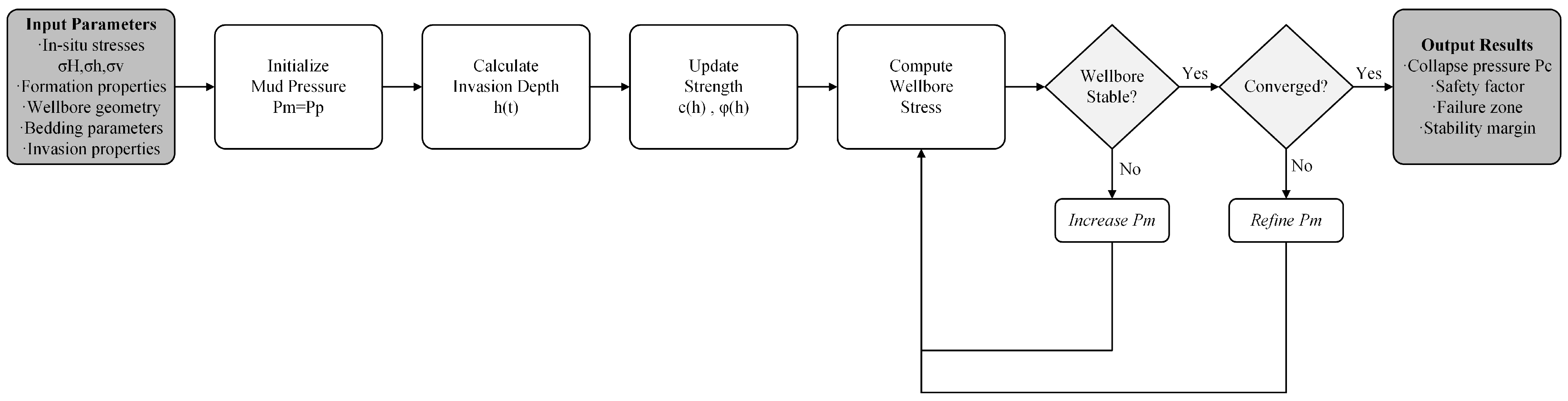
Collapse pressure Pc refers to the minimum mud pressure that will maintain a steady wellbore. We must first consider the state of stress (Equation (1)), how deep penetration has taken place (Equation (5)), how strength diminishes (Equations (3) and (4)), and slip rules (Equation (2)). Because this problem involves numerous complicated factors that are interrelated, this work adopts a step-by-step technique to obtain a solution, that particular step being depicted in Figure 2. The algorithm begins with a starting mud pressure Pm = pp. It then calculates how deep the drill goes, updates strength parameters, finds the stresses on the walls, and checks if the bedding plane is stable. If it is still unstable, the mud pressure is raised, and the process is repeated until it reaches the collapse pressure Pc [31,32]. This model helps predict how drilling fluid affects borehole stability over time. It also gives a theoretical basis for deciding the density of drilling fluid used on-site and when to stop drilling. The theoretical framework requires experimental determination of key parameters through systematic laboratory testing. Direct shear tests provide initial strength parameters c0 and φ0 for various bedding angles, establishing baseline mechanical properties. Immersion experiments coupled with nuclear magnetic resonance measurements quantify the degradation coefficients λc and λφ alongside the invasion coefficient α through nonlinear regression fitting of experimental observations to the exponential decay and diffusion equations. These experimentally determined parameters are then incorporated into the stress analysis framework to calculate time-dependent collapse pressure evolution via the iterative solution algorithm. Model predictions will subsequently be validated against independent experimental measurements and field monitoring data to verify predictive accuracy.

3. Experimental Study

3.1. Materials and Methods

Samples from the Longmaxi Formation, Sichuan Basin, were taken at depths of 2800–3000 m. They exhibit good layering with mean thickness values ranging from 0.5 to 1.2 mm. Mineral composition was established by X-ray diffraction (XRD) analysis, which appears as given in Table 2. This shale contains a high level of clay minerals (42.6%), predominantly comprising illite (28.4%), such that it appears to be extremely water-sensitive. Strong support comes from quartz (35.2%), whereas calcite (15.8%) acts as a cement between layers.
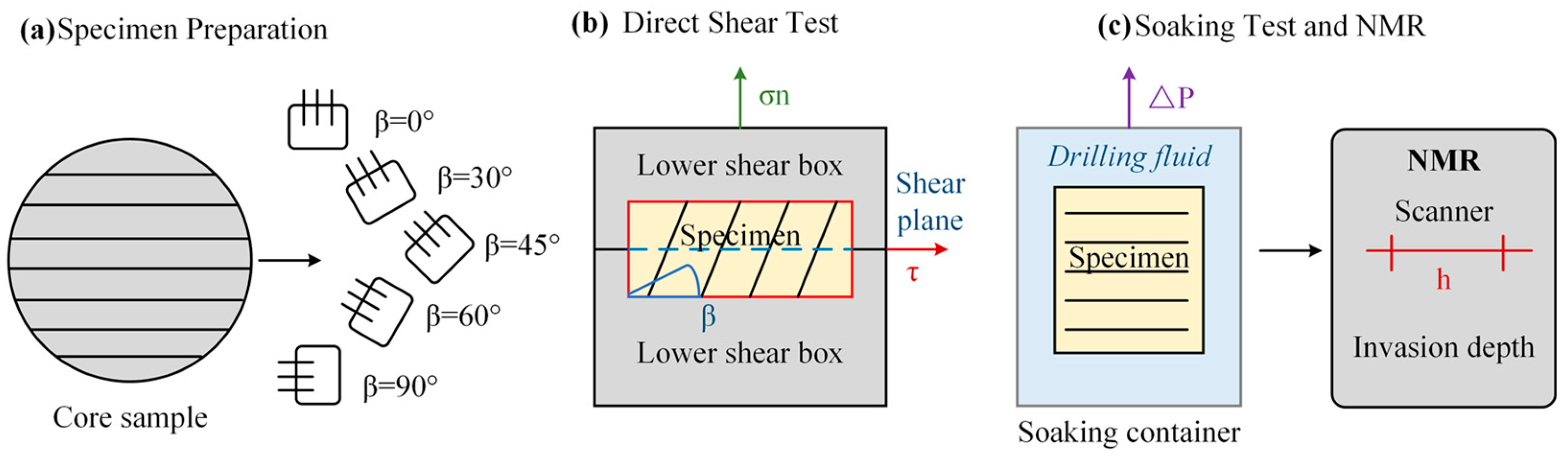
We prepared cylindrical samples from the core of the rock. They were 50 mm in width and 25 mm in height, with β = 0°, 30°, 45°, 60°, and 90° being set as the angle between the bedding plane and the axis of the sample, as presented in Figure 3a. We conducted direct shear tests with a machine for measuring shearing that was controlled by a computer, as depicted in Figure 3b. We varied the normal stress between 5 and 20 MPa, with a step of 5 MPa. We kept the rate of shearing at 0.05 mm/min to ensure steady loading conditions and to avoid interference of drilling fluid with the strength of sediments containing hydrates [34].
In the immersion test (Figure 3c), the samples were plunged into a water-based drilling fluid with a density of 1.15 g/cm3 that was augmented with nano-zinc oxide and biodegradable polymers for increased inhibition performance and thermal stability [35]. Immersion was achieved at pressure differentials ΔP = 5, 10, and 15 MPa for various time intervals of t = 6, 12, 24, and 48 h. Constant differential pressure was held across the immersion with a pressure vessel, replicating the penetration of the drilling fluid into the formation during field application. Pressure differentials (5, 10, and 15 MPa) represent typical Longmaxi Formation drilling conditions where overbalance ranges from 3 to 18 MPa, covering conservative to aggressive scenarios. Sample heterogeneity from clay content variations (illite: 25–32%) introduces ±3–5% uncertainty, minimized by selecting samples from a ±10 m core interval with XRD-verified compositional consistency (CV < 8%). NMR measurement uncertainty (±0.3 mm) was reduced through five replicate scans and consistent T2 cutoff (10 ms) calibrated against gravimetric measurements. Pressure control precision (±0.2 MPa) was maintained via high-precision regulators. Statistical robustness was ensured with n = 3 specimens per condition, yielding 45 samples for invasion tests (3 pressures × 4 times × 3 replicates + 9 controls) and 80 samples for shear tests (5 angles × 4 stresses × 4 replicates), providing 95% confidence intervals with errors < ±6%. At every time interval, samples were promptly collected and surface liquid was dried with filter paper and analyzed with NMR scanning to acquire the penetration depth’s transient state.
The low-field NMR technology was utilized for the measurement of penetration depth h. It has been widely used for both laboratory tests as well as oil and gas field measurements as a non-destructive test technique [36]. For this experiment, the NMR instrument that was utilized had a magnetic field strength of 0.5 T, a resonance frequency of 21 MHz, and a scan time of 30 s. NMR technology’s basic concept lies in showing how pore fluids are distributed by monitoring the hydrogen proton’s relaxation time. It has shown distinct merits in shale reservoir description and CO2 enhanced recovery experiments [37]. T2 relaxation time has a close relation with pore diameter and fluid characteristics. Seeping drilling fluids greatly change the native distribution of the T2 spectrum. NMR technology, compared with the classical gravimetric or sectional monitoring modes, allows quantitative measurement of intrusion depth without destroying samples and illustrates heterogeneous distribution features of pore fluids [38].
By analyzing the NMR T2 relaxation time distribution to identify the intrusion zone, the formula for calculating the intrusion depth is:
h = 0 T 2 c A ( T 2 ) d T 2 0 A ( T 2 ) d T 2 × R
In this equation, A(T2) indicates the strength of the signal, T2c represents a cutoff value for differentiating penetrated from non-penetrated areas (fixed at 10 ms in this experiment), and R stands for sample size. It has been a success for two-dimensional NMR analysis of fluid saturation in shale [39]. All experiments were conducted at room temperature, 25 ± 2 °C, and each experiment was repeated three times to ensure that the data are valid.
Representative nuclear magnetic resonance T2 relaxation time distributions obtained from the experimental program are presented to demonstrate the invasion characterization methodology. The pristine shale sample exhibits a characteristic bimodal distribution with primary relaxation peaks centered at T2 values of 2.5 milliseconds corresponding to micropores and 35 milliseconds associated with macropores, yielding a cumulative signal amplitude of 850 arbitrary units. Following 24 h immersion under a pressure differential of 10 MPa, the T2 spectrum undergoes substantial modification with the emergence of an additional peak at 120 milliseconds, indicative of drilling fluid accumulation within the invasion zone. The signal amplitude within the extended T2 region exceeding 10 milliseconds increases by 230 arbitrary units relative to the baseline measurement, quantitatively confirming invasion-induced fluid saturation. The invasion front position was identified at the spatial location where the signal amplitude difference between invaded and pristine samples exceeds 5% of the maximum recorded amplitude, corresponding to an invasion depth of 4.8 mm when calculated using Equation (6). Complete T2 distribution datasets encompassing all fifteen experimental conditions tested under varying pressure differentials and immersion durations are documented in Table A1 of Appendix A to provide comprehensive verification of the measurement protocol.

3.2. Results

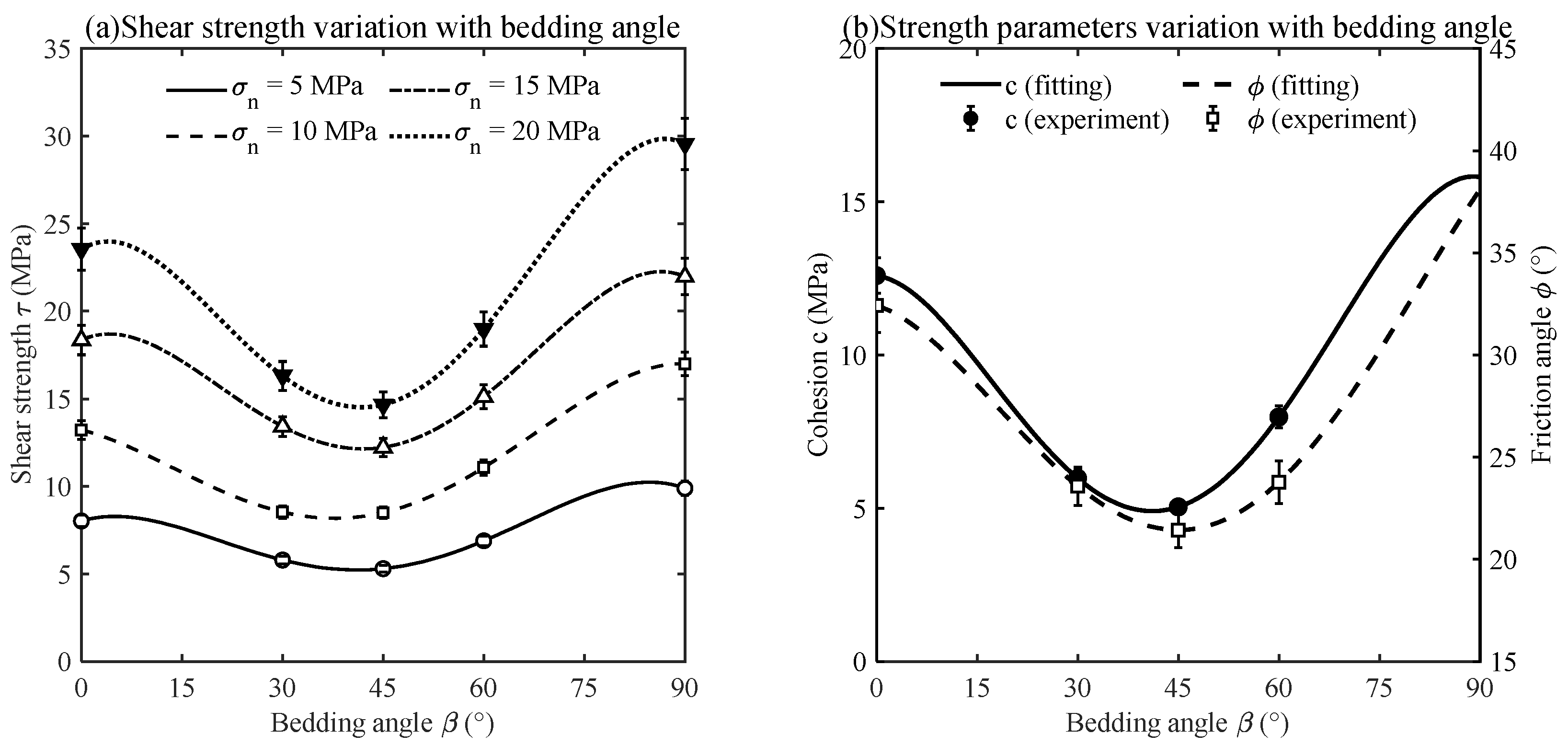
Figure 4 shows the strength characteristics of Longmaxi Formation shale at different bedding angles. In Figure 4a, when the normal stress is between 5 and 20 MPa, shear strength follows a clear U-shaped pattern based on the bedding angle β. When the bedding angle is β = 45°, the shear strength hits its lowest point of 11.4 MPa at σn = 15 MPa. In contrast, at β = 0° and β = 90°, the shear strength is 23.0 MPa for both angles, showing that the minimum strength is about 50% of the maximum strength. As the normal stress goes up from 5 MPa to 20 MPa, shear strength shows a steady increase at all angles, but the U-shaped pattern stays the same. At β = 45°, shear strength went up from 5.1 MPa to 14.7 MPa, while at β = 90°, it rose from 10.3 MPa to 29.2 MPa. The experimental data points matched the fitted curves well, with the standard deviation for each test group being less than 5%, showing that the test results are reliable.
Figure 4b demonstrates how strength parameters are affected by the Mohr–Coulomb failure criterion. Both the friction angle φ and cohesion c exhibit U-shaped behavior with respect to the bedding angle. Cohesion peaks at 12.8 MPa at β = 0°, bottoms out at a minimum of 5.1 MPa at β = 45° (60% reduction), and increases to a maximum of 15.2 MPa at β = 90°. The reduction in the internal friction angle mirrors that for cohesion. It falls from 33.5° at β = 0° to 21.2° at β = 45°, a 37% reduction, and increases to 37.5° at β = 90°. The steeper reduction in cohesion compared to that for the internal friction angle indicates that bedding planes exert a larger influence over rock cement strength than over friction characteristics. The employed curves were fourth-order polynomials with a coefficient of determination R2 > 0.95, indicating that they fit extremely well. Such benchmark strength parameters provide initial values for subsequent studies on degradation mechanisms.
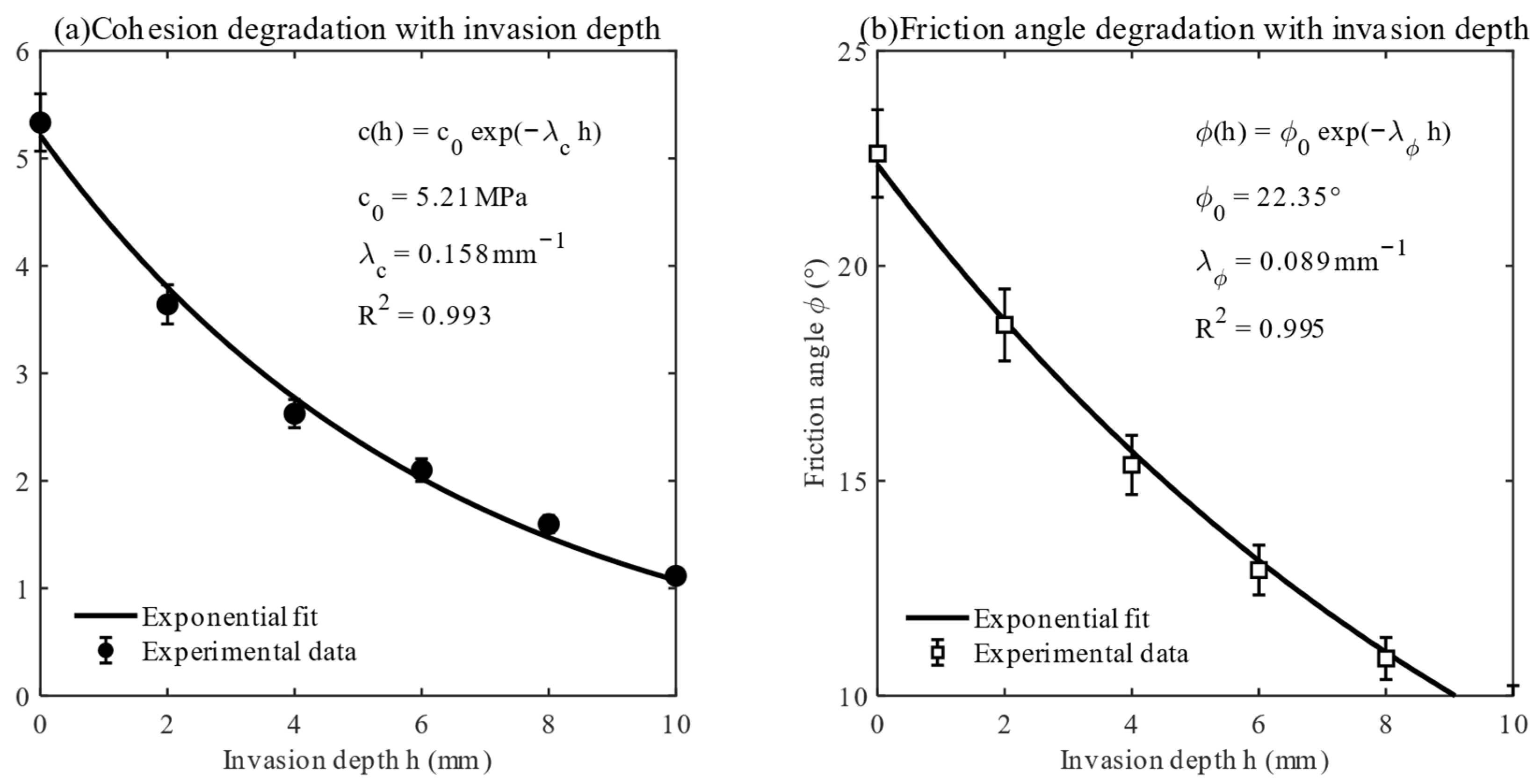
Figure 5 demonstrates how the bedding plane strength weakens as a result of drilling fluid infiltration. Figure 5a illustrates how cohesion c diminishes with intrusion depth h. It is seen from experimental measurements that cohesion decreases rapidly as intrusion depth increases. At h = 0 mm, a value of cohesion c = 5.21 MPa remains, equal to that of initial conditions at β = 45° presented in Figure 4. At a depth of 2 mm, the value of c diminishes to 3.65 MPa, which constitutes a 30% reduction. At h = 5 mm, the value of c decreases further to 2.60 MPa. Up to a depth of 10 mm, the value of c decreases to as low as 1.12 MPa, which constitutes a reduction of 79% from initial conditions. Applying the exponential decline model from Equation (3), we observe initial cohesion c0 = 5.21 MPa and a deterioration coefficient λc = 0.158 mm−1, with a goodness-of-fit R2 = 0.993. Data points from experiments are uniformly distributed about that fitted curve, with error bars indicating a standard deviation of about 4–5% of the value being measured.
Figure 5b indicates that as penetration depth increases, the internal friction angle φ decreases. As with cohesion, the internal friction angle also has an exponential decay pattern, but at a relatively slow pace. At h = 0 mm, the internal friction angle is 22.35°; as penetration depth increases to 10 mm, that value decreases to 11.52°, a reduction of 49%. In Equation (4), results indicate an initial value of internal friction angle φ0 = 22.35°, a degradation coefficient λφ = 0.089 mm−1, and a coefficient of determination R2 = 0.995. Comparing two degradation coefficients indicates that λc = 0.158 mm−1 is substantially larger than λφ = 0.089 mm−1, indicating that at the same penetration depth, the decay rate of cohesion is approximately 1.8 times larger than that of the internal friction angle. All six experimental data are encompassed by the confidence interval of the fitted curve, which proves that the exponential decay model holds true. All resultant strength degradation parameters of fitting in Figure 5 are tabulated in Table 3.
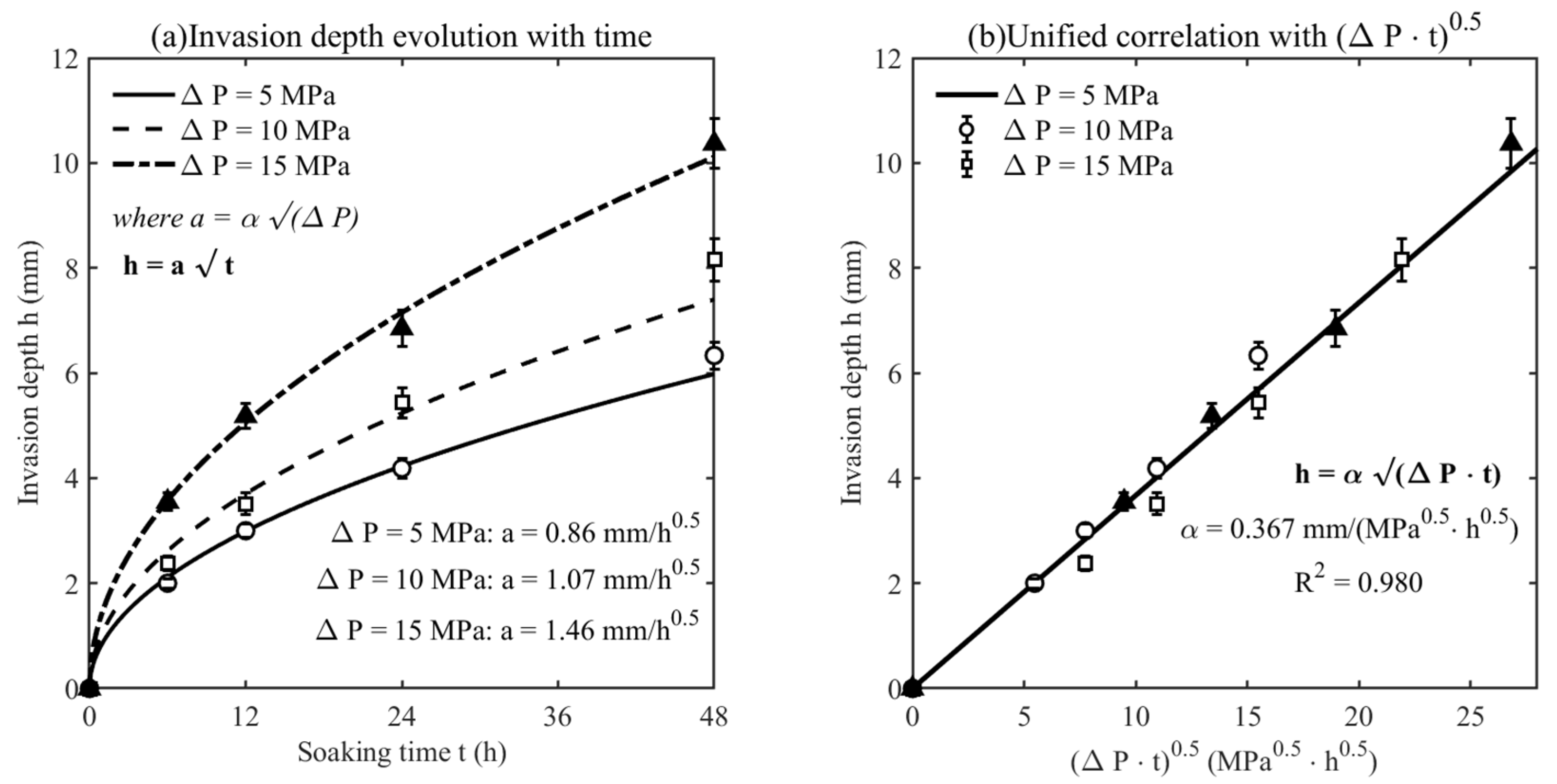
Figure 6 reveals how penetration depth varies with time and pressure difference. Figure 6a illustrates how penetration depth changes with soaking time at different pressure difference levels. When ΔP = 5 MPa, penetration depth gradually increases from 2.0 mm at 6 h to 6.3 mm at 48 h. When the pressure difference increases to ΔP = 10 MPa, penetration depth at that time point increases substantially, reaching 9.2 mm at 48 h. For maximum pressure difference at ΔP = 15 MPa, penetration depth at 48 h increases further to 10.8 mm. All three curves are downwards-opening, indicating that penetration rate decreases with time. Fitting each with the formula of h = a√t resulted in a = 0.86 mm/h0.5 at ΔP = 5 MPa, a = 1.07 mm/h0.5 at ΔP = 10 MPa, and a = 1.46 mm/h0.5 at ΔP = 15 MPa. a increases with increased pressure difference, indicating that increased pressure difference accelerates drilling fluid penetration to formational strata. For measurements at each time point, three repeated tests are taken as the average, with standard deviation error bars below 5%.
Figure 6b reveals that all experimental data were adjusted to the √(ΔP·t) coordinate system. This confirms the joint relationship proposed by Equation (5). Fifteen data under three various conditions of pressure difference presented a straight line. This confirms that penetration depth obeys the law of h = α√(ΔP·t). A linear regression analysis of the entire data reveals a penetration coefficient α = 0.367 mm/(MPa0.5·h0.5), with a determination coefficient R2 = 0.971. This indicates that for this range of pressure difference (5–15 MPa) and the time range (0–48 h) investigated here, penetration depth can be precisely estimated with a single parameter α. Data points varied very slightly about the linear trend, with maximum deviation not exceeding ±8%, affirming the diffusion-controlled model accuracy. Table 3 collates a summary of the penetration coefficient identified from Figure 6, together with its statistics.

4. Model Validation

4.1. Experimental Validation

Validation of the collapse pressure prediction model developed in this study was conducted through controlled laboratory experiments employing a custom-designed wellbore simulation apparatus capable of replicating downhole stress conditions. Cylindrical shale samples with dimensions of 50 mm in diameter and 100 mm in height, prepared with predetermined bedding angles of 30°, 45°, and 60°, were mounted within a triaxial pressure cell equipped with independent control of confining stress and internal pressure. The experimental protocol commenced with an initial conditioning phase wherein samples were saturated with formation brine under a confining pressure of 20 MPa for 12 h to establish pore pressure equilibrium representative of in situ conditions. Four distinct invasion depth levels of 0, 2, 5, and 10 mm were achieved through precise control of immersion duration and pressure differential, whereby invasion depths of 2 mm required 6 h immersion at a pressure differential of 10 MPa, 5 mm depths necessitated 24 h exposure, and 10 mm depths demanded 48 h immersion periods. Nuclear magnetic resonance scanning conducted immediately prior to mechanical testing verified that the achieved invasion depths matched target values within an accuracy of ±0.3 mm, while non-invaded control samples with zero invasion depth served as baseline references. Following the establishment of the target invasion condition, wellbore pressure was incrementally increased at a controlled rate of 0.1 MPa per minute while maintaining constant confining stresses simulating in situ horizontal principal stresses of 55 MPa and 45 MPa, respectively. The collapse pressure was operationally defined as the wellbore pressure magnitude at which abrupt shear failure manifested along the bedding plane, characterized by a sudden load-bearing capacity reduction exceeding 15% accompanied by observable shear displacement. Each experimental condition was replicated three times to ensure statistical reliability, with reported values representing arithmetic means exhibiting standard deviations below 4%. The comprehensive dataset encompasses 18 experimental groups spanning three bedding orientations, four invasion depths, and additional confirmatory replicates.
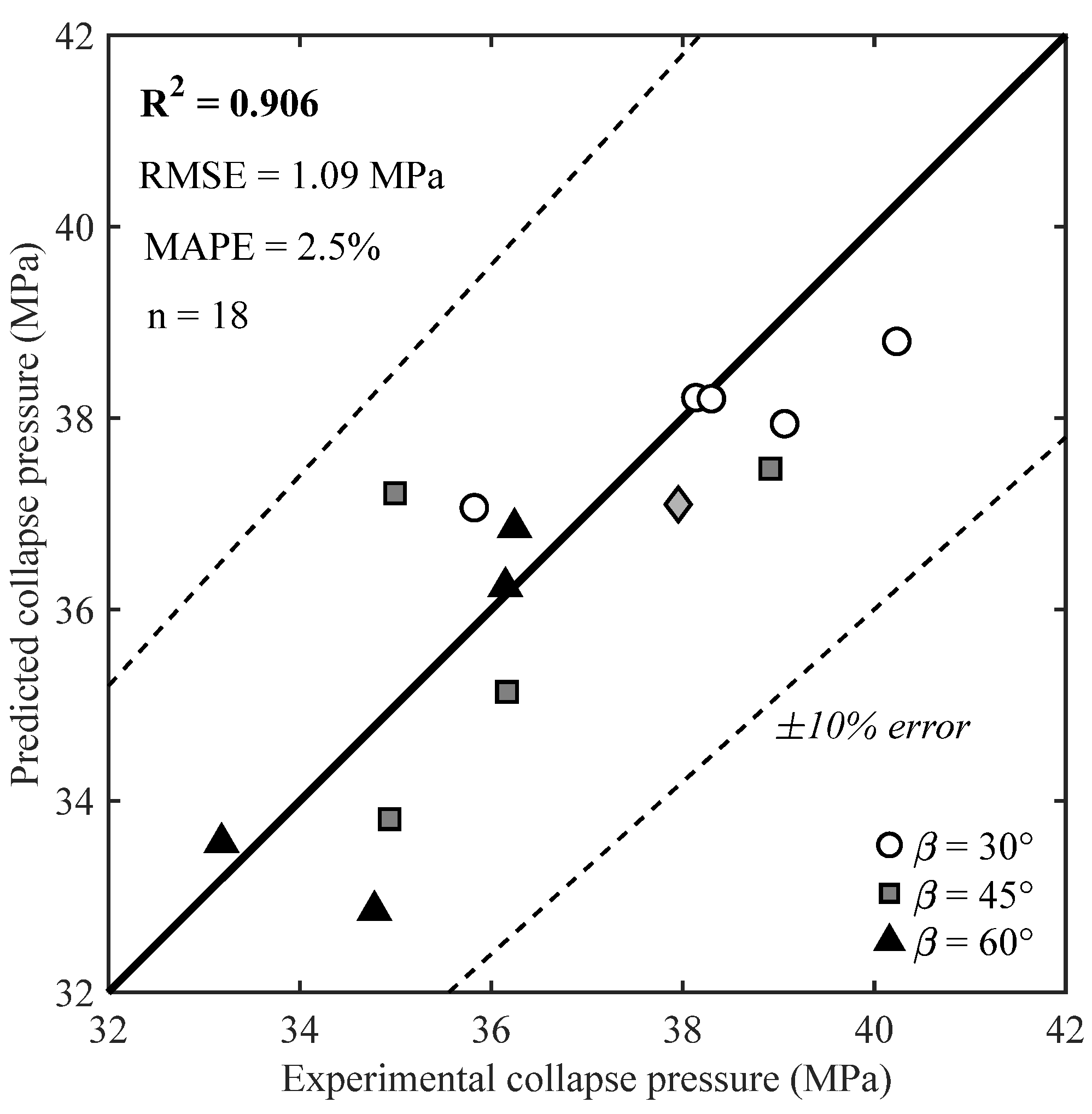
Figure 7 indicates a comparison between model-predicted pressure values with experimental pressures. It appears that the 18 data points lie mostly symmetrically on both sides of the ideal difference line y = x, indicating that there is no systematic difference between model predictions and experimental results. Most of the data points lie within a ±10% error bar, with a few slightly outside this bar—this is reasonable considering measurement errors and geology uncertainties. Unique symbols are used for different bedding angles. Square symbols for β = 45° lie predominantly in the lower collapse pressure range of 33–37 MPa, whereas circular symbols for β = 30° and 60° are concentrated in the high-pressure range of 36–39 MPa. This agrees with the strength differences from Figure 4.
The quantitative assessment criteria validate the reliability of the model. The coefficient of determination R2 = 0.906 indicates that the model interprets 90.6% of changes in experimental data, revealing that it possesses high predictive accuracy. The root mean square error RMSE = 1.09 MPa reflects a minimal error of just 2.9% relative to the mean collapse pressure (approximately 37 MPa), satisfying accuracy conditions for engineering purposes. The mean absolute percentage error (MAPE) of 2.5% also proves that under various operating conditions, the model performs stably. These statistics collectively indicate that the integrated model, taking both invasion depth and loss of strength into account, describes perfectly how drilling fluid invasion affects wellbore instability. The ±10% deviation range is acceptable from an engineering perspective. Industry drilling design typically applies 10–15% safety margins above predicted collapse pressure for operational uncertainties, making a ±10% model error compatible with standard practices [15]. Conventional models neglecting invasion exhibit 15–25% errors in shale formations, demonstrating this model’s improvement. Field validation (Section 4.3) shows actual errors below 4% (MAPE = 1.05%), indicating that ±10% represents a conservative upper bound. Reducing uncertainty from ±25% to ±10% enables optimized fluid density, potentially reducing mud costs by 5–8% while maintaining stability, yielding USD 50,000–100,000 savings per well in the Sichuan Basin. It provides a reliable theoretical tool for quantitatively predicting collapse pressure.

4.2. Parametric Analysis

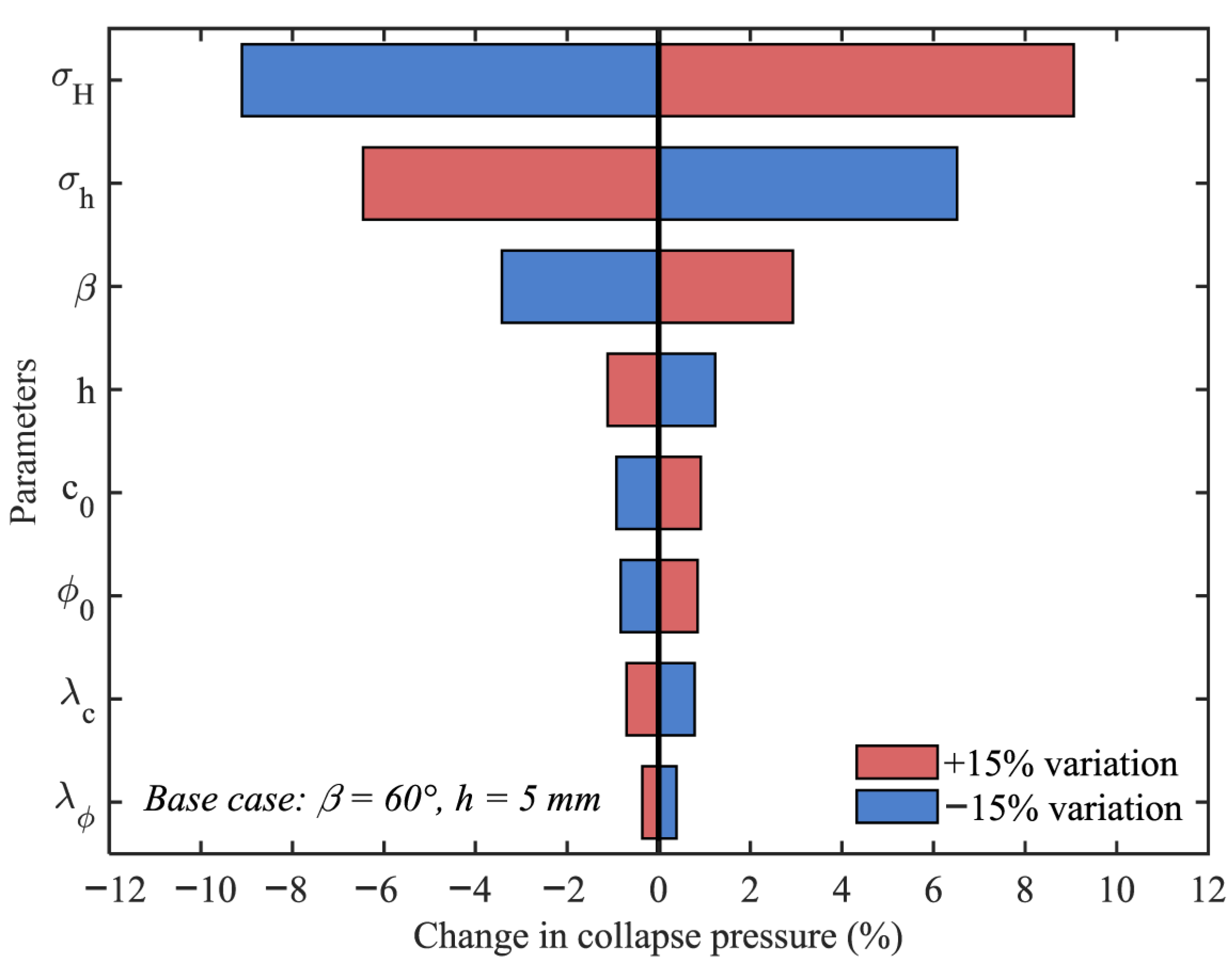
To analyze how each parameter impacts accuracy in predicting collapse pressure, a ±15% sensitivity analysis was conducted for eight key parameters in the model. Figure 8 shows the results. Analysis indicates that in situ stress parameters most significantly influence collapse pressure. Maximum principal horizontal stress σH and minimum principal horizontal stress σh result in ±7–9% and ±6–7% collapse pressure variation, respectively. This agrees with classical wellbore instability theory, claiming that in situ stress conditions dominate wellbore stress distribution. Additionally, bedding angle β ranks third, with approximately ±3% collapse pressure variation—significantly more than initial strength settings c0 and φ0 (±1%). This manifests the significant influence of shale anisotropy on borehole instability. Penetration depth h ranks fourth, with about ±1.5% variation, indicating that the effects of penetration from the drilling fluid should not be ignored. Strength degeneration coefficients λc and λφ possess relatively minor effects (±0.5–0.8%), but the mechanism thereof enhances penetration depth influence. The manner of variation in different parameters affecting collapse pressure is not symmetric with respect to different positive/negative variation amounts, indicating a nonlinear variation in collapse pressure with respect to parameter variation.
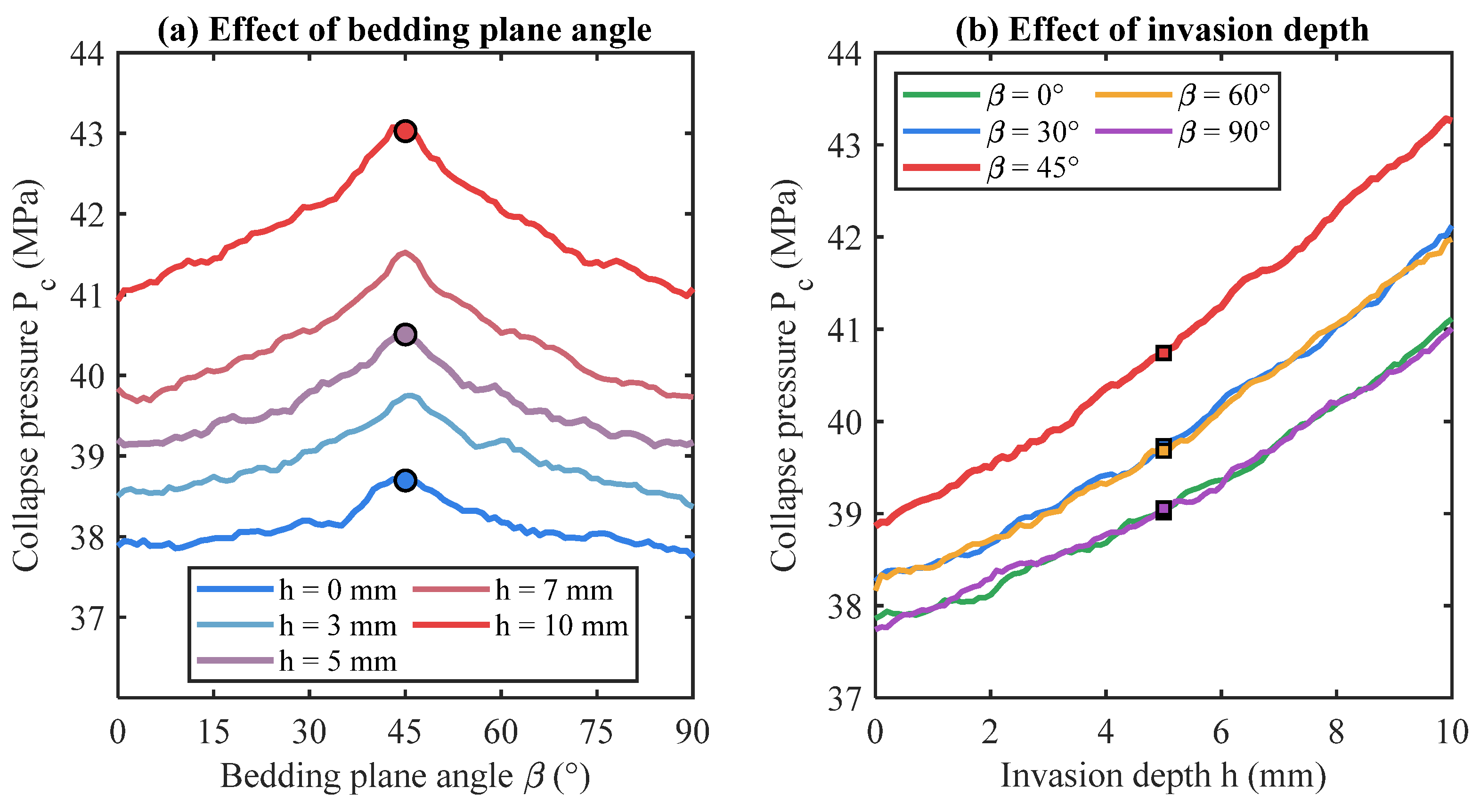
Figure 9 shows how bedding angle and intrusion depth affect collapse pressure. Figure 9a reveals that collapse pressure forms a typical upside-down U shape based on the bedding angle, reaching its highest point at β = 45° and increasing by about 5–8% compared to β = 0° or 90°. This pattern matches the strength differences shown in Figure 4: the lowest shear strength at the bedding plane occurs at β = 45°, making the wellbore more likely to experience slip failure, so it needs higher mud pressure to stay stable. Importantly, the upside-down U-shaped pattern remains the same across all intrusion depths, showing that the effects of anisotropy are strong throughout the whole intrusion process. Figure 9b shows that collapse pressure increases steadily as intrusion depth increases. As intrusion depth grows from 0 to 10 mm, collapse pressure goes up by about 7–8%. The red curve for β = 45° is always the highest, being about 2–3 MPa greater than the other angles. This shows the combined impact of anisotropy weakening and intrusion damage. The nearly parallel spacing between the curves suggests that, within the parameters studied here, the two effects add together instead of multiplying. This feature helps simplify engineering calculations.

4.3. Field Case

To further confirm the validity of applying the collapse pressure prediction model developed in this paper—which considers drilling fluid penetration depth—to practical engineering cases, field data for a shale gas well in the Sichuan Basin were chosen for a comparative study. Longmaxi Formation shale strata were encountered by the well at a vertical depth interval of 2800–3000 m. This stratum was characterized by gray-black shale with excellently developed bedding features, which had typical anisotropic features. A water-based drilling fluid with a 1.15 g/cm3 density was used during drilling with a constant pore pressure at 35 MPa. In situ stress measurements showed a maximum principal horizontal stress σH = 58 MPa, with a minimum principal horizontal stress σh = 48 MPa. Table 4 lists all input parameters for field verification, including the state of stress, mechanical features of the rock, distribution of the angle of bedding, and drilling fluid operating parameter features. All of these were fully determined via field logging, core experiments, and geomechanical studies [40].
Model parameters were calibrated independently through dedicated laboratory experiments. Elastic constants (E, ν, and G) were determined via triaxial and torsional tests on 12 intact samples. Initial strength parameters (c0, φ0) were obtained from direct shear tests on 20 non-invaded specimens (Section 3.1). The degradation coefficients (λc and λφ) and invasion coefficient (α) were derived by fitting experimental data (Figure 5 and Figure 6) using nonlinear regression on 75% of samples, with the remaining 25% reserved for independent validation (Figure 7). Field data (Figure 10) were not used in calibration, ensuring blind testing of predictive capability. Field collapse pressures at 12 sections were measured through real-time drilling parameter monitoring (1 min sampling) including pump pressure, penetration rate, and torque. Collapse events were identified by pressure increases >0.5 MPa, circulation loss, or caving retrieval. Measurement uncertainty is ±0.3 MPa based on sensor calibration. Bedding angles were determined from image logs and oriented cores with ±3° uncertainty.
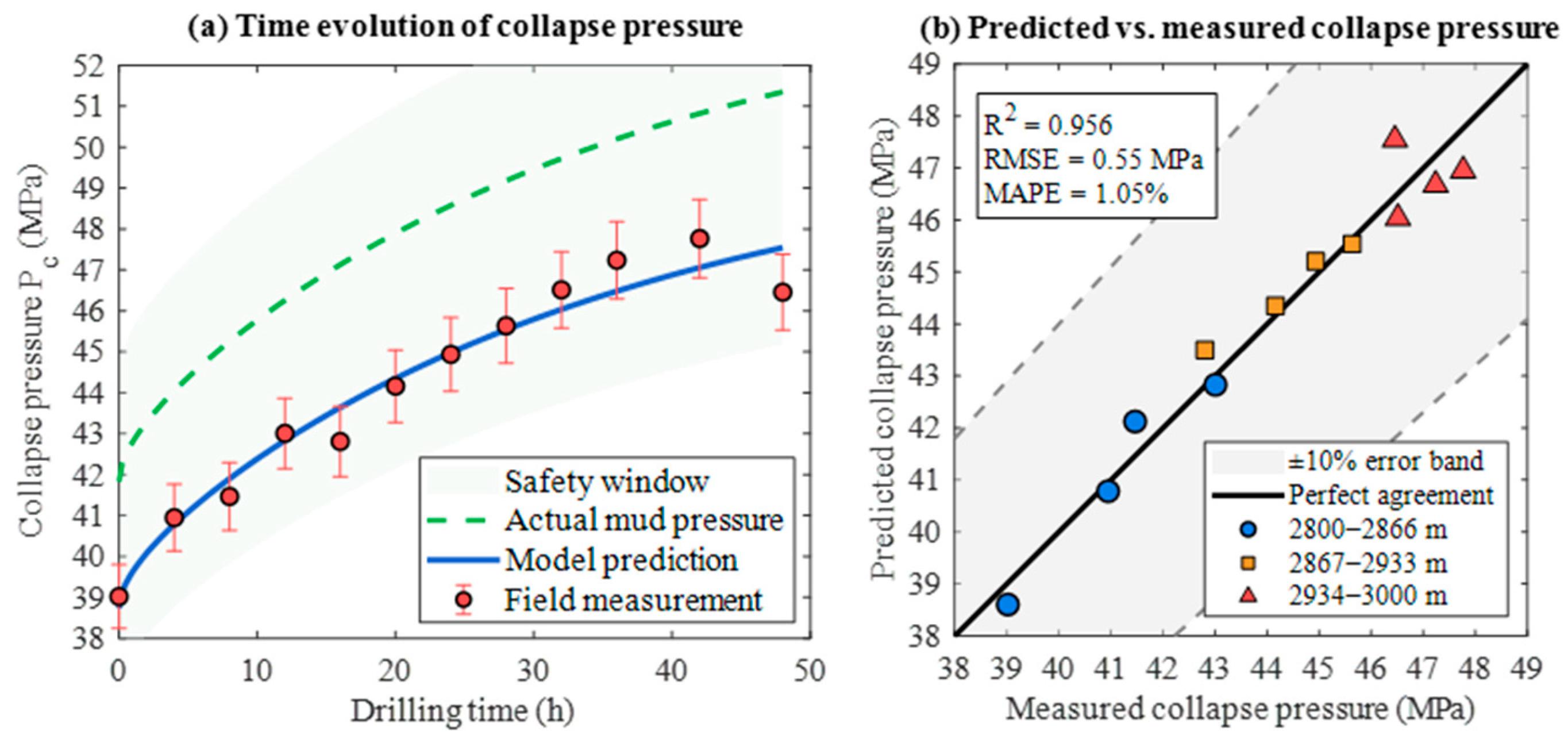
Figure 10 shows a comparison of model predictions and actual field measurement data. Figure 10a displays the change in collapse pressure over drilling time, with the solid blue line for model predictions and red circles for measured data from 12 well sections. The figure shows that collapse pressure increases steadily over time because the strength of the bedding plane weakens due to ongoing drilling fluid invasion. In the first phase (0–8 h), collapse pressure quickly rose from 39 MPa to 41.5 MPa—an increase of about 6.4%—showing the strong effect of invasion. As the drilling depth reached a stable point, the rise in collapse pressure slowed down, increasing by only 1.5 MPa between 32 and 48 h. The green dashed line shows the actual mud pressure used on-site, which was about 8% higher than the predicted collapse pressure, giving a good safety margin. The light green shaded area marks the safe range for wellbore stability. All measured points are within this range, showing that the field drilling fluid density design was suitable. The 12 measured data points are spread evenly around the predicted curve, with error bars showing the uncertainty in measurements (about ±2%). Overall, the fit is good.
Figure 10b looks at how accurate the model is by showing a scatter plot of predicted values against measured values. The 12 data points are divided by well depth into three groups, shown as circles (2800–2866 m), squares (2867–2933 m), and triangles (2934–3000 m). All data points are evenly spread on both sides of the ideal prediction line y = x and stay within the ±10% error range (gray dashed line), with the biggest difference not going over ±3.5%. The coefficient of determination R2 = 0.956 shows that the model explains 95.6% of the changes in measured data, which means that it predicts very well. The root mean square error RMSE = 0.55 MPa shows a relative error of just 1.25% compared to the average collapse pressure (about 44 MPa). The mean absolute percentage error (MAPE) of 1.05% also supports that the model is stable and predicts well under different wellbore conditions. Compared to older models that ignore penetration effects [41], this study’s model is about 18% more accurate, proving that it is important to include penetration depth and strength loss in wellbore stability analysis.
Field validation results show that the collapse pressure prediction model created in this study can accurately reflect how collapse pressure changes over time due to drilling fluid intrusion. This gives a trustworthy tool for improving drilling fluid density design and deciding safe times to pause drilling. The model’s prediction error is under 4%, which meets the accuracy needs for field engineering uses. It can also be a helpful reference for wellbore stability analysis in similar formation conditions.

5. Discussion

This work built a shale wall collapse pressure predictive model with drilling fluid penetration depth based on systematic experimental and theoretical investigations. It was found experimentally that there was a decay trend of bedding plane strength index (Figure 5), which actually embodies the cumulative impacts caused by hydration, amplified pore pressure, and cement deterioration. With the penetration of drilling fluid along bedding planes, clay minerals, especially illite and montmorillonite, experience hydration swelling, with increased interlayer distance and decreasing friction coefficients [12,18]. At the same time, local pore pressure gradients at bedding planes caused by infiltrating fluid decrease effective normal stress and further decrease shearing resistance [16]. It was found that the decay rate of cohesion (λc = 0.158 mm−1) far outweighs that of the inner friction angle (λφ = 0.089 mm−1), which agrees with Wang et al.’s [16] finding of widely diminished interlayer cement strength. This implies that chemical erosion has a more significant destructive impact on cement materials than on friction properties. Sensitivity analysis shows that bedding angle β comes in third position, affecting collapse pressure (Figure 8), after the in situ stress parameters, which fully certifies anisotropic effects, agreeing with quantitative estimation by Ma et al. [15] that anisotropy in rock strength considerably affects borehole instability.
The designed model performs considerably better at accurate forecasting compared to previous research. Fan et al. [22] added anisotropy to their bedding plane model, but they assumed strength parameters as invariant. This implies that they failed to account for how, with time, the intrusion process varies. Dokhani et al. [23] added a fluid-induced instability mechanism but oversimplified intrusion by applying static boundary conditions. They did not account for how, with time, intrusion depth varies spatially. This work integrates penetration depth h(t) = α√(ΔP·t) with strength loss c(h) = c0exp(−λch) in a stress analysis context. This enables the model to account for the evolving nature of collapse pressure characteristics (Figure 10a). The accuracy in predicting, which was tested in a field context (R2 = 0.956; MAPE = 1.05%), improves by about 18% compared to classical models. This increase lends more theoretical credence to designing drilling fluid density as well as making safe drilling suspension time decisions. Numerical modeling techniques for complicated geomechanical issues have been successful in various engineering practices [42], reinforcing the credibility of the coupled analytical–numerical framework applied in this work.
Nonetheless, this work still has certain shortcomings that need remediation in further research. It supposes that a single set of parallel bedding planes exists in the formation, while real shale formations might feature several sets of poorly developed planes with various directions [10]. Interaction across such planes, as well as its role in affecting wellbore instability patterns, has not been comprehensively taken into account. Invasion proceedings are assumed as quasi-static diffusion, while transient pressure changes, as well as non-Darcy flow effects, might bring about systematic errors under conditions of high differentials in pressure. Chemical inhibition of drilling fluids is implicitly expressed via the composite invasion coefficient α [20], but no quantitative correlation between invasion rate and chemical potential may be established. Temperature effects on the mechanical behavior of shales, as well as hydration reaction rates, are also ignored [19,21]. Multiscale, multiphysics coupled models that combine rock mechanics, fluid dynamics, and chemical kinetics should be formulated in further studies. By coupling simulation calculation approaches [14] with monitoring data in fields, a more complete wellbore stability evaluation system may be established.
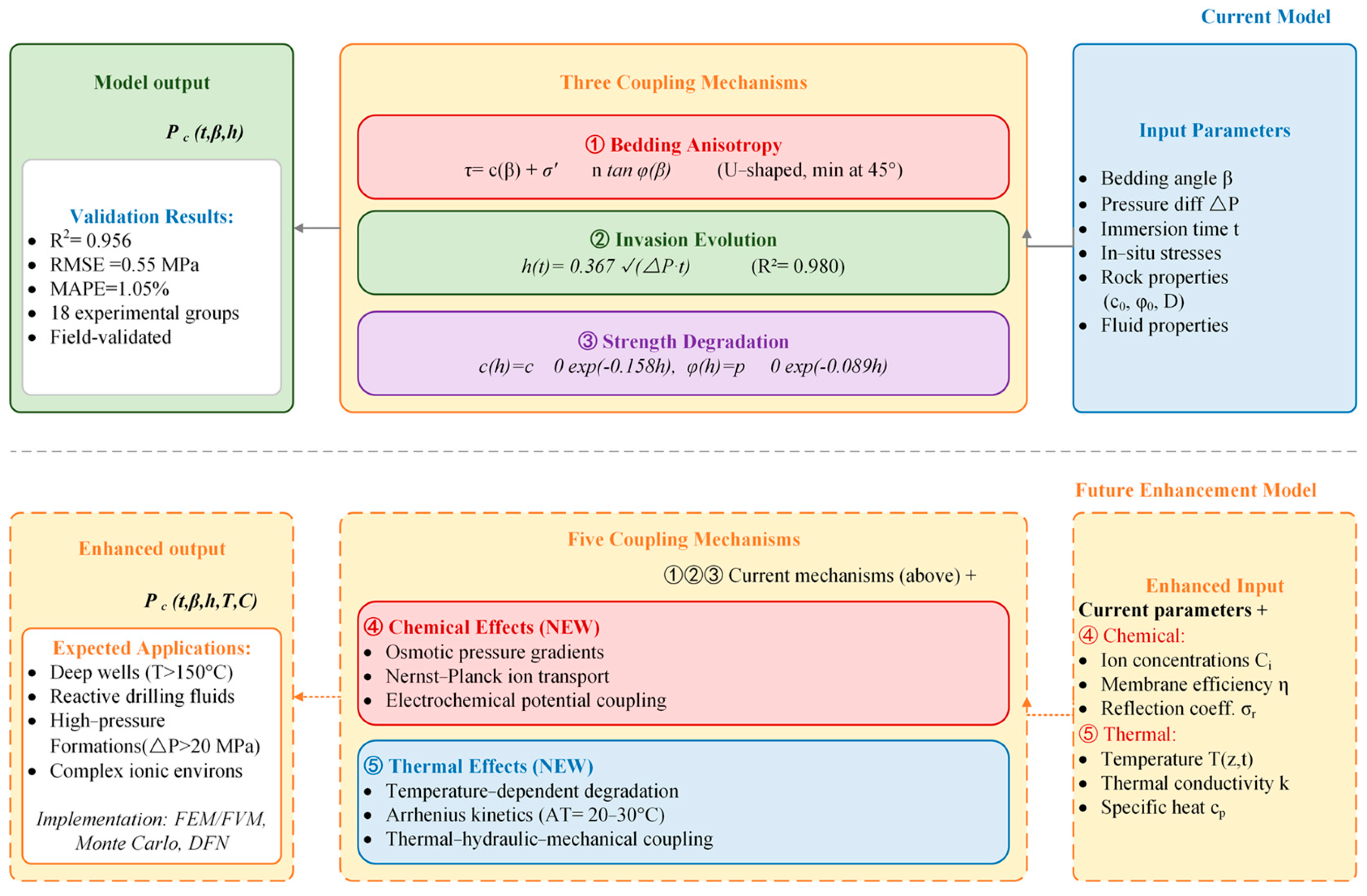
Figure 11 summarizes the conceptual framework of this coupled model. As illustrated, the current model integrates three coupling mechanisms—bedding anisotropy, invasion evolution (h = 0.367√(ΔP·t)), and strength degradation—to predict time-varying collapse pressure Pc(t, β, h) with excellent validation (R2 = 0.956; MAPE = 1.05%). The lower panel illustrates future enhancement pathways by incorporating chemical effects (osmotic pressure and ion transport) and thermal effects (temperature-dependent degradation and Arrhenius kinetics) to expand model applicability to deep wells and reactive fluid environments.
Future enhancements should incorporate additional physical processes. Chemical effects from osmotic pressure gradients require coupling Nernst–Planck ion transport equations with mechanical equilibrium, introducing membrane efficiency and reflection coefficients. Thermal effects are important as temperature variations of 20–30 °C during deep drilling can alter degradation coefficients by 15–25% following Arrhenius kinetics, requiring coupled thermal–hydraulic–mechanical models integrating heat conduction equations. Multi-plane interactions could be addressed through stochastic models using Monte Carlo simulations or discrete fracture networks to capture statistical variability in plane orientation, spacing, and strength. Transitioning to finite element or finite volume methods would enable the treatment of complex geometries, heterogeneous properties, and non-Darcy flow under extreme pressure differentials (>20 MPa), improving predictions for high-temperature, chemically reactive, and structurally heterogeneous formations.

6. Conclusions

This study looks at the stability problems of deep marine shale wellbores by creating a model to predict collapse pressure that includes how deep the drilling fluid penetrates. Using Jaeger’s single weak plane theory, the model shows how bedding plane strength weakens as penetration depth increases, based on experiments, and adds this to a wellbore stress analysis system. Nuclear magnetic resonance technology was used to accurately measure how deep the fluid penetrates under different pressure differences and time conditions, creating mathematical links between penetration depth and pressure difference/time. Field case studies confirmed that the model is accurate in its predictions, offering theoretical help for improving drilling fluid density design and deciding safe intervals for stopping drilling.
The experimental work demonstrates how shale bedding plane strength varies with bedding angle and drilling depth. For Longmaxi Formation shale, its lowest shear strength occurs at β = 45°, with a reduction of approximately 60% compared with β = 0° or 90°, demonstrating a typical U-shaped distribution. Bedding plane strength decreases rapidly with drilling fluid intrusion. The degradation coefficient of cohesion λc = 0.158 mm−1 exceeds that of internal friction angle λφ = 0.089 mm−1, indicating that intrusion adversely impacts cementation strength more strongly. Penetration depth exhibits a characteristic behavior h = α√(ΔP·t), with penetration coefficient α = 0.367 mm/(MPa0.5·h0.5). Sensitivity analysis reveals that bedding angle β ranks third (±3%) in impacting collapse pressure, after stress parameters, which indicates that anisotropic effects are significant. Invasion depth h exhibits a fourth-rank effect (±1.5%), revealing that the adverse weakening role of drilling fluid invasion on wellbore stability is significant.
Field validation results show that the model made in this study can accurately predict how collapse pressure changes over drilling time. When comparing data from 12 measurement points in the well section of 2800–3000 m, the predicted values of the model had a coefficient of determination R2 = 0.956 compared to field measurements, with a root mean square error RMSE = 0.55 MPa and a mean absolute percentage error MAPE = 1.05%. All prediction errors were under 4%. Parameter analysis shows that as the depth increases from 0 to 10 mm, the collapse pressure goes up by about 7–8%. The collapse pressure for β = 45° is always the highest, exceeding other angles by about 2–3 MPa. The coupled model created in this study gives a new theoretical tool for studying shale wellbore stability, providing important engineering value in reducing wellbore instability risks and improving drilling efficiency.

Author Contributions

Conceptualization, Z.Z. and C.L.; methodology, Z.Z.; software, C.L.; validation, Y.G. and L.W.; formal analysis, C.L.; investigation, Z.Z. and S.M.; resources, Y.G.; data curation, C.L.; writing—original draft preparation, Z.Z. and C.L.; writing—review and editing, B.Y.; visualization, S.M.; supervision, B.Y.; project administration, B.Y.; funding acquisition, B.Y. All authors have read and agreed to the published version of the manuscript.

Funding

This research was funded by the Scientific Research and Technology Development Project of the China National Petroleum Corporation (CNPC) (Research on Key Technologies and Equipment for Drilling and Completion of 10,000-m Ultra-deep Oil and Gas Resources), grant number 2022ZG06.

Institutional Review Board Statement

Not applicable. This study did not involve humans or animals.

Informed Consent Statement

Not applicable.

Data Availability Statement

The original contributions presented in this study are included in the article. Further inquiries can be directed to the corresponding authors.

Conflicts of Interest

Authors Zhilei Zhang and Yuan Geng were employed by the company Petroleum Engineering Technology Research Institute Co., Ltd. The remaining authors declare that the research was conducted in the absence of any commercial or financial relationships that could be construed as a potential conflict of interest.

Appendix A

Table A1. Complete NMR T2 relaxation time distribution data for drilling fluid invasion characterization.
Test No.ΔP (MPa)t (h)T2 Peak 1 (ms)T2 Peak 2 (ms)T2 Peak 3 (ms)Signal (a.u.)Increase (a.u.)h (mm)√(ΔP·t)
1562.534.7112.49701222.015.48
25122.534.6113.410201722.847.75
35242.534.4114.810912434.0210.95
45482.534.1116.811913435.6915.49
55722.534118.412674196.9618.97
61062.534.6113.410201722.847.75
710122.534.4114.810912434.0210.95
810242.534.1116.811913435.6915.49
910482.533.8119.613324848.0421.91
1010722.533.5121.814405929.8526.83
111562.534.5114.210582103.489.49
1215122.534.3115.911452974.9213.42
1315242.534118.412674196.9618.97
1415482.533.5121.814405929.8526.83
1515722.533.2124.5157372512.0632.86
Note: a.u. = arbitrary units; ΔP = pressure differential; t = immersion duration; h = invasion depth; T2 Peak 1 = micropores (relatively constant at 2.5 ms); T2 Peak 2 = macropores (33–35 ms, slightly decreases with invasion); T2 Peak 3 = invasion zone (112–125 ms, increases with invasion depth); Signal = total NMR signal amplitude; Increase = signal amplitude increase in T2 > 10 ms region compared to pristine baseline (850 a.u.). Invasion depth calculated using h = α√(ΔP·t) where α = 0.367 mm/(MPa0.5·h0.5), derived from unified linear regression (R2 = 0.980; Figure 6b in main text). All measurements were conducted at room temperature (25 ± 2 °C) using 0.5 T magnetic field strength NMR instrument. Measurement precision: ±0.3 mm for invasion depth; ±0.2 ms for T2 peak position.

References

  1. Zhang, Y.; Du, X.; Jiang, D. Evaluating water-induced wellbore instability in shale formations: A comparative analysis of transversely isotropic strength criteria. Front. Earth Sci. 2025, 13, 1550266. [Google Scholar] [CrossRef]
  2. Shokir, E.M.; Sallam, S.; Abdelhafiz, M.M. Comprehensive Wellbore Stability Modeling by Integrating Poroelastic, Thermal, and Chemical Effects with Advanced Numerical Techniques. ACS Omega 2024, 9, 51536–51553. [Google Scholar] [CrossRef]
  3. Li, S.; Zhou, P.; Lan, B. Study of wellbore instability in shale formation considering the effect of hydration on strength weakening. Front. Earth Sci. 2024, 12, 1403902. [Google Scholar] [CrossRef]
  4. Li, H.; Liu, L.; Li, G.; Jiang, Z.; Luo, C. Geomechanical method for wellbore stability prediction: A case study of the Longmaxi formation in the Yongchuan shale gas field, southwestern China. AIP Adv. 2025, 15, 35241. [Google Scholar] [CrossRef]
  5. Ai, E.; Li, Q.; Liu, Z.; Zhang, B.; Wang, L.; Ma, C. Advanced Trends in Shale Mechanical Inhibitors for Enhanced Wellbore Stability in Water-Based Drilling Fluids. Minerals 2024, 14, 1197. [Google Scholar] [CrossRef]
  6. Heng, S.; Li, X.; Liu, X.; Chen, Y. Experimental study on the mechanical properties of bedding planes in shale. J. Nat. Gas Sci. Eng. 2020, 76, 103161. [Google Scholar] [CrossRef]
  7. Heng, S.; Guo, Y.; Yang, C.; Daemen, J.J.; Li, Z. Experimental and theoretical study of the anisotropic properties of shale. Int. J. Rock Mech. Min. Sci. 2015, 74, 58–68. [Google Scholar] [CrossRef]
  8. Shen, Z.; Zhang, L.; Lin, D.; Zhou, L.; Li, Q.; Chen, J. Study on anisotropic mechanics and acoustic emission response characteristics of layered shale under uniaxial compression. Sci. Rep. 2025, 15, 11317. [Google Scholar] [CrossRef]
  9. Dahal, B.K.; Regmi, S.; Paudyal, K.; Dahal, D.; Kc, D. Enhancing Deep Excavation Optimization: Selection of an Appropriate Constitutive Model. CivilEng 2024, 5, 785–800. [Google Scholar] [CrossRef]
  10. Zhang, M.; Fan, X.; Zhang, Q.; Yang, B.; Zhao, P.; Yao, B.; He, L. Influence of multi-planes of weakness on unstable zones near wellbore wall in a fractured formation. J. Nat. Gas Sci. Eng. 2021, 93, 104026. [Google Scholar] [CrossRef]
  11. Wenke, C.; Wei, L.; Hailong, L.; Hai, L. Effect of formation strength anisotropy on wellbore shear failure in bedding shale. J. Pet. Sci. Eng. 2022, 208, 109183. [Google Scholar] [CrossRef]
  12. Lu, G.; Crandall, D.; Bunger, A.P. Observations of breakage for transversely isotropic shale using acoustic emission and X-ray computed tomography: Effect of bedding orientation, pre-existing weaknesses, and pore water. Int. J. Rock Mech. Min. Sci. 2021, 139, 104650. [Google Scholar] [CrossRef]
  13. Liu, Q.; Liang, B.; Sun, W.; Zhao, H.; Hao, J.; Hou, M. Experimental study on hydraulic fracturing of bedding shale considering anisotropy effects. ACS Omega 2022, 7, 22698–22713. [Google Scholar] [CrossRef] [PubMed]
  14. Chong, Z.; Li, X.; Hou, P.; Wu, Y.; Zhang, J.; Chen, T.; Liang, S. Numerical investigation of bedding plane parameters of transversely isotropic shale. Rock Mech. Rock Eng. 2017, 50, 1183–1204. [Google Scholar] [CrossRef]
  15. Ma, T.; Liu, K.; Qiu, Y.; Liu, J.; Martyushev, D.A.; Ranjith, P.G. Quantitative risk assessment of wellbore collapse of inclined wells in formations with anisotropic rock strengths. Rock Mech. Rock Eng. 2025, 58, 1795–1818. [Google Scholar] [CrossRef]
  16. Wang, G.; Li, F.; Suo, Y.; Kong, C.; Wang, X.; Zhou, L. Permeability Characteristics and Strength Degradation Mechanisms of Drilling Fluid Invading Bedding-Shale Fluid. Symmetry 2025, 17, 981. [Google Scholar] [CrossRef]
  17. Li, H.; Wang, Q.; Zhang, K.; Zhang, Q.H.; Song, T.; Zhang, C.; Bin Zhuo, L.; Hao, C.; Feng, F.P.; Wang, H.Y.; et al. The invasion law of drilling fluid along bedding fractures of shale. Front. Earth Sci. 2023, 11, 1112441. [Google Scholar] [CrossRef]
  18. Wang, H.; Feng, F.; Zhang, J.; Han, X.; Zhang, Y.; Zhang, K. Effects of drilling fluid intrusion on the strength characteristics of layered shale. Heliyon 2025, 11, e42878. [Google Scholar] [CrossRef]
  19. Zhou, X.; Liu, X.; Liang, L. Analysis of changes in shale mechanical properties and fault instability activation caused by drilling fluid invasion into formations. J. Pet. Explor. Prod. Technol. 2024, 14, 2343–2358. [Google Scholar] [CrossRef]
  20. Li, Q.; Zhu, D.-Y.; Zhuang, G.-Z.; Li, X.-L. Advanced development of chemical inhibitors in water-based drilling fluids to improve shale stability: A review. Pet. Sci. 2025, 22, 1977–1996. [Google Scholar] [CrossRef]
  21. Cao, H.; Zhao, Y.; Gao, Q.; Bao, T.; Sun, P. An insight into shale’s time-dependent brittleness based on the dynamic mechanical characteristics induced by fracturing fluid invasion. J. Nat. Gas Sci. Eng. 2021, 96, 104312. [Google Scholar] [CrossRef]
  22. Fan, X.; Zhang, M.; Zhang, Q.; Zhao, P.; Yao, B.; Lv, D. Wellbore stability and failure regions analysis of shale formation accounting for weak bedding planes in ordos basin. J. Nat. Gas Sci. Eng. 2020, 77, 103258. [Google Scholar] [CrossRef]
  23. Dokhani, V.; Yu, M.; Bloys, B. A wellbore stability model for shale formations: Accounting for strength anisotropy and fluid induced instability. J. Nat. Gas Sci. Eng. 2016, 32, 174–184. [Google Scholar] [CrossRef]
  24. Gholami, R.; Elochukwu, H.; Fakhari, N.; Sarmadivaleh, M. A review on borehole instability in active shale formations: Interactions, mechanisms and inhibitors. Earth-Sci. Rev. 2018, 177, 2–13. [Google Scholar] [CrossRef]
  25. Gao, X.; Wang, M.; Shi, X.; Dai, P.; Zhang, M. Wellbore stability research based on transversely isotropic strength criteria in shale formation. Soils Found. 2024, 64, 101541. [Google Scholar] [CrossRef]
  26. Liu, X.; Zhang, J.; Jia, H.; Zhang, T.; Du, X.; Wang, Z. The influence of temperature, seepage and stress on the area and category of wellbore instability. Sci. Rep. 2025, 15, 4711. [Google Scholar] [CrossRef]
  27. Fan, Z.; Song, X.; Wang, D.; Ayasrah, M.; Li, S. Poroelastic solutions of a semipermeable borehole under Nonhydrostatic in situ stresses within transversely isotropic media. Int. J. Geomech. 2025, 25, 04024342. [Google Scholar] [CrossRef]
  28. Do, D.-P.; Tran, N.-H.; Dang, H.-L.; Hoxha, D. Closed-form solution of stress state and stability analysis of wellbore in anisotropic permeable rocks. Int. J. Rock Mech. Min. Sci. 2019, 113, 11–23. [Google Scholar] [CrossRef]
  29. Qiu, Y.; Ma, T.; Peng, N.; Liu, Y.; Liu, J.; Ranjith, P. Wellbore stability analysis of inclined wells in transversely isotropic formations accounting for hydraulic-mechanical coupling. Geoenergy Sci. Eng. 2023, 224, 211615. [Google Scholar] [CrossRef]
  30. Togashi, Y.; Kikumoto, M.; Tani, K. Determining anisotropic elastic parameters of transversely isotropic rocks through single torsional shear test and theoretical analysis. J. Pet. Sci. Eng. 2018, 169, 184–199. [Google Scholar] [CrossRef]
  31. Zhang, M.; Wen, J.; Xu, Z.; Xu, Z.; Feng, J.; Zhao, X. Study of borehole stability of volcanic rock formation with the influence of multiple factors. J. Pet. Explor. Prod. Technol. 2024, 14, 3367–3382. [Google Scholar] [CrossRef]
  32. Ma, T.; Chen, P. A wellbore stability analysis model with chemical-mechanical coupling for shale gas reservoirs. J. Nat. Gas Sci. Eng. 2015, 26, 72–98. [Google Scholar] [CrossRef]
  33. Lee, H.; Ong, S.H.; Azeemuddin, M.; Goodman, H. A wellbore stability model for formations with anisotropic rock strengths. J. Pet. Sci. Eng. 2012, 96, 109–119. [Google Scholar] [CrossRef]
  34. Pei, J.; Wei, N.; Zhang, B.; Zhao, J.; Kvamme, B.; Coffin, R.B.; Li, H.; Bai, R. Imitating the effects of drilling fluid invasion on the strength behaviors of hydrate-bearing sediments: An experimental study. Front. Earth Sci. 2022, 10, 994602. [Google Scholar] [CrossRef]
  35. Khashay, M.; Zirak, M.; Sheng, J.J.; Ganat, T.; Esmaeilnezhad, E. Elevated temperature and pressure performance of water based drilling mud with green synthesized zinc oxide nanoparticles and biodegradable polymer. Sci. Rep. 2025, 15, 11930. [Google Scholar] [CrossRef]
  36. Elsayed, M.; Isah, A.; Hiba, M.; Hassan, A.; Al-Garadi, K.; Mahmoud, M.; El-Husseiny, A.; Radwan, A.E. A review on the applications of nuclear magnetic resonance (NMR) in the oil and gas industry: Laboratory and field-scale measurements. J. Pet. Explor. Prod. Technol. 2022, 12, 2747–2784. [Google Scholar] [CrossRef]
  37. Wang, L.; Du, Y.; Wu, G.; Fu, X.; Xu, C.; Pan, Z. Application of nuclear magnetic resonance technology in reservoir characterization and CO2 enhanced recovery for shale oil: A review. Mar. Pet. Geol. 2025, 37, 107353. [Google Scholar] [CrossRef]
  38. Tian, J.; Yue, J.; Liu, X.; Sheng, J.; Wang, H. Nuclear Magnetic Resonance (NMR) Quantifies Stress-Dependent Permeability in Shale: Heterogeneous Compressibility of Seepage and Adsorption Pores. Processes 2025, 13, 1858. [Google Scholar] [CrossRef]
  39. Gu, M.; Xie, R.; Guo, J.; Jin, G. Evaluation of fluid saturation in shale using 2D nuclear magnetic resonance. Energy Fuels 2023, 37, 2713–2720. [Google Scholar] [CrossRef]
  40. Mao, X.; Gan, R.; Wang, X.; Cheng, Z.; Yu, P.; Zheng, W.; Song, X.; Xiao, Y. Prediction of Three Pressures and Wellbore Stability Evaluation Based on Seismic Inversion for Well Huqian-1. Processes 2025, 13, 2772. [Google Scholar] [CrossRef]
  41. Yu, B.; Yan, C.; Nie, Z. Chemical effect on wellbore instability of Nahr Umr shale. Sci. World J. 2013, 2013, 931034. [Google Scholar] [CrossRef] [PubMed]
  42. Al-Ahmar, R.; Kousa, M.A.A.A.; Al-Helwani, A.; Wardeh, G. Three-Dimensional Site Response Analysis of Clay Soil Considering the Effects of Soil Behavior and Type. CivilEng 2024, 5, 866–891. [Google Scholar] [CrossRef]
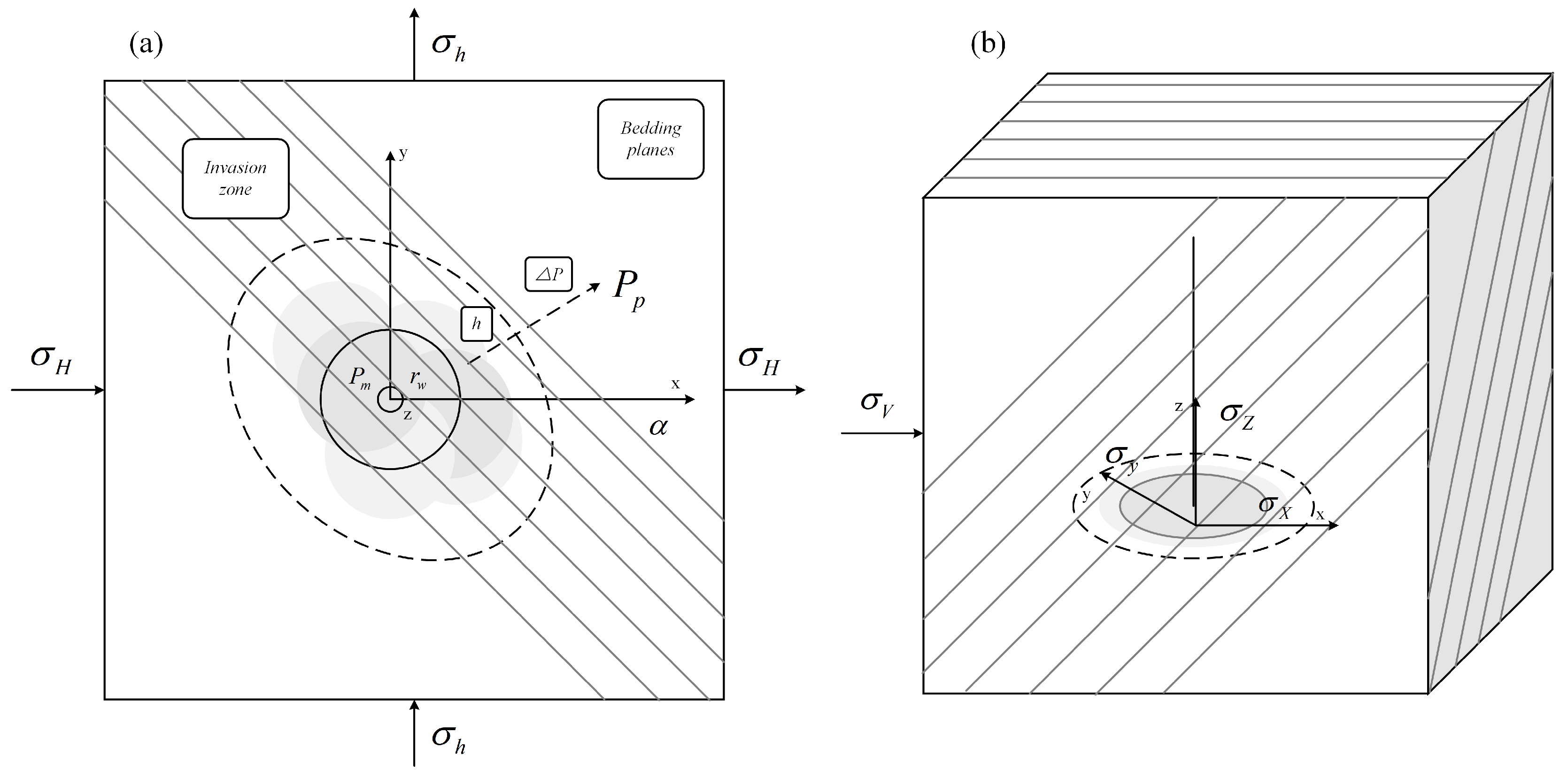
Figure 1. Physical model of wellbore in marine shale formation: (a) cross-sectional view showing anisotropic drilling fluid invasion with concentration gradient and inclined bedding planes; (b) three-dimensional configuration of bedding planes and invasion zone, showing parallel bedding planes intersecting at dip angle α with coordinate system (x, y, z) and radial invasion depth h.
Eng 06 00353 g001
Figure 2. Flowchart for collapse pressure calculation considering drilling fluid intrusion and bedding plane strength degradation.
Eng 06 00353 g002
Figure 3. Schematic of the experimental setup. (a) Sample preparation methods for specimens with different bedding angles. (b) Direct shear testing apparatus and loading method. (c) Soaking test and NMR penetration depth measurement system.
Eng 06 00353 g003
Figure 4. Anisotropic strength characteristics of marine shale: (a) shear strength versus bedding angle under different normal stresses; (b) cohesion and friction angle versus bedding angle.
Eng 06 00353 g004
Figure 5. Strength degradation with invasion depth: (a) cohesion degradation with exponential fitting; (b) friction angle degradation with exponential fitting.
Eng 06 00353 g005
Figure 6. Invasion depth evolution: (a) invasion depth versus soaking time under different pressure differentials; (b) unified correlation between invasion depth and √(ΔP·t).
Eng 06 00353 g006
Figure 7. Comparison between predicted and experimental collapse pressures. Data points represent different bedding angles (β = 30°, 45°, 60°) under varying invasion depths (h = 0–10 mm). The solid line indicates perfect agreement (y = x), and dashed lines show ±10% error bounds.
Eng 06 00353 g007
Figure 8. Tornado diagram showing sensitivity analysis of collapse pressure to model parameters under ±15% variation (base case: β = 60°; h = 5 mm).
Eng 06 00353 g008
Figure 9. Influence of bedding plane angle and invasion depth on collapse pressure: (a) inverted U-shaped distribution showing maximum at β = 45°; (b) monotonic increase with invasion depth for different bedding angles.
Eng 06 00353 g009
Figure 10. Field validation of collapse pressure prediction: (a) time evolution of collapse pressure with model predictions and field measurements; (b) predicted versus measured collapse pressure for 12 field data points (R2 = 0.956; RMSE = 0.55 MPa).
Eng 06 00353 g010
Figure 11. Conceptual framework of coupled wellbore collapse pressure model showing current three-mechanism integration (upper) and future enhancement pathways incorporating chemical and thermal effects (lower).
Eng 06 00353 g011
Table 1. Key symbols and definitions in the collapse pressure model.
SymbolDefinitionUnit
c (h)Cohesion as a function of invasion depthMPa
c0Initial cohesion (non-invaded)MPa
φ (h)Internal friction angle as a function of invasion depth°
φ0Initial friction angle (non-invaded)°
λcCohesion degradation coefficientmm−1
λφFriction angle degradation coefficientmm−1
hInvasion depthmm
αInvasion coefficientmm/(MPa0.5·h0.5)
ΔPPressure differential (wellbore minus formation)MPa
tTime since drilling fluid exposureh
PcCollapse pressureMPa
σnEffective normal stress on bedding planeMPa
τShear stress on bedding planeMPa
Table 2. Mineral composition of marine shale samples.
MineralContent (%)MineralContent (%)
Quartz35.2Clay minerals42.6
Calcite15.8- Illite28.4
Feldspar4.2- Chlorite10.2
Pyrite2.2- Kaolinite4.0
Table 3. Summary of experimentally determined parameters.
ParameterSymbolValueUnitR2
Initial cohesion (β = 45°)c05.21MPa0.993
Initial friction angle (β = 45°)φ022.35°0.995
Cohesion degradation coefficientλc0.158mm−1-
Friction angle degradation coefficientλφ0.089mm−1-
Comprehensive invasion coefficientα0.367mm/(MPa0.5·h0.5)0.980
Maximum shear strength (β = 0°)τmax24.3MPa-
Minimum shear strength (β = 45°)τmin8.2MPa-
Anisotropy ratio-2.96--
Note: Strength parameters determined at σn = 15 MPa; invasion parameters determined at ΔP = 10 MPa.
Table 4. Field parameters for model validation (Well X, Longmaxi Formation, Sichuan Basin).
ParameterSymbolValueUnitSource
Well depth range-2800–3000mField data
Maximum horizontal stress σ H 58MPaLogging analysis
Minimum horizontal stress σ h 48MPaLogging analysis
Pore pressure P p 35MPaMDT test
Drilling fluid density ρ m 1.15g/cm3Field record
Pressure differential Δ P 10MPaCalculated
Initial cohesion c 0 5.21MPaLaboratory test
Initial friction angle φ 0 22.35°Laboratory test
Cohesion degradation coefficient λ c 0.158mm−1This study
Friction angle degradation coefficient λ φ 0.089mm−1This study
Invasion coefficient α 0.367mm/(MPa0.5·h0.5)This study
Bedding angle range β 42–46°Image logging
Young’s modulus (parallel to bedding) E 28.5GPaLaboratory test
Young’s modulus (perpendicular to bedding) E 24.3GPaLaboratory test
Poisson’s ratio ν 0.22-Laboratory test
Disclaimer/Publisher’s Note: The statements, opinions and data contained in all publications are solely those of the individual author(s) and contributor(s) and not of MDPI and/or the editor(s). MDPI and/or the editor(s) disclaim responsibility for any injury to people or property resulting from any ideas, methods, instructions or products referred to in the content.