Article

Engineering Auditory Cues for Gait Modulation: Effects of Continuous and Discrete Sound Features


by
Toh Yen Pang
1,*,
Frank Feltham
2 and
Chi-Tsun Cheng
3
1
Biomedical Engineering Department, School of Engineering, STEM College, RMIT University, Melbourne, VIC 3000, Australia
2
Industrial Design, School of Design, College of Design and Social Context, RMIT University, Melbourne, VIC 3000, Australia
3
Mechanical, Manufacturing and Mechatronic Engineering Department, School of Engineering, STEM College, RMIT University, Melbourne, VIC 3000, Australia
*
Author to whom correspondence should be addressed.
Eng 2025, 6(12), 349; https://doi.org/10.3390/eng6120349
Submission received: 27 October 2025 / Revised: 26 November 2025 / Accepted: 1 December 2025 / Published: 3 December 2025
(This article belongs to the Special Issue Interdisciplinary Insights in Engineering Research)

Abstract

Auditory cueing has become an increasingly practical tool in gait rehabilitation; however, the specific sound features that modulate gait performance remain unclear. This study investigated how tempo and auditory continuity, two fundamental acoustic features, influence spatiotemporal gait parameters in healthy adults. Thirty-five participants walked under six auditory conditions combining discrete, continuous, and hybrid feedback at slow (60 BPM) and fast (120 BPM) tempi, with gait metrics captured via a pressure-sensor walkway and subjective responses gathered through questionnaires. Compared with the silent baseline, auditory cueing significantly affected cadence [F(1.88, 63.75) = 8.95, p < 0.001, ηp2 = 0.21]; velocity [F(1.69, 57.49) = 10.15, p < 0.001, ηp2 = 0.23]; and stride length [F(1.74, 59.26) = 6.87, p = 0.003, ηp2 = 0.17]. Slower tempi reduced gait parameters, while the combined continuous and discrete conditions produced the greatest modulation. Participants reported that they had attempted to synchronize their steps with the auditory cues, which may have led to small adjustments in their natural walking speed and stride patterns, especially during the slower tempo. This suggests that rhythmic structure and sound continuity affect both perceptual and motor processes. Overall, sound continuity exerted a stronger influence on gait than tempo alone. These findings advance understanding of sensorimotor synchronization and highlight the potential of designing tailored auditory feedback systems to enhance movement awareness and inform clinical gait-rehabilitation strategies.

1. Introduction

Gait is a fundamental human behavior. Its disruption, whether due to aging, stroke, or neurological disorders, can significantly impair independence and quality of life. Restoring rhythmic and stable walking patterns remains a challenge in neurorehabilitation. In recent years, auditory feedback, particularly rhythmic auditory stimulation and sonification, has emerged as a promising, non-invasive tool for enhancing motor coordination and gait control [1,2,3,4,5,6,7,8,9,10]. By transforming temporal and kinematic information into sound, auditory feedback engages the sensorimotor system in ways that visual or tactile cues cannot, offering promising pathways for restoring movement and motor timing [1,9,11,12,13].
Auditory feedback, including music and metronome beats [14,15,16], has been employed to address gait disorders and used in training to enhance gait rehabilitation, particularly among patients suffering from various neurological conditions such as stroke [3,17,18], Parkinson’s Disease (PD) [19,20,21], and multiple sclerosis [16]. The ability to synchronize movements with external auditory stimuli, known as sensorimotor synchronization (SMS), is important to understanding how rhythmic cueing influences gait behaviors [22,23]. Previous research indicates that the continuity of auditory rhythms changes the timing accuracy and the coupling strength between the auditory and motor systems during SMS. Using discrete cueing, such as metronome beats, synchronization is dependent on reactive, event-based mechanisms. These mechanisms typically involve error correction executed at the occurrence of each beat [22,23]. In contrast, continuous cues, such as oscillating or amplitude-modulated sounds, engage emergent synchronization processes. In this mode, the movement phase develops smoothly alongside the sound stream, resulting in a smoother and more stable coordination pattern [24]. Understanding these differences in SMS and their impact on temporal cognition can be applied in practical settings for gait rehabilitation [25,26].
In a rehabilitation context, auditory feedback can be broadly categorized as the following:
  • Rhythmic auditory stimulation [18,27,28,29], where such an approach emphasizes the synchronization of movement with external auditory rhythms, facilitating motor coordination in PD and post-stroke patients;
  • Music-supported therapy [14,30,31,32], which leverages musical cues corresponding to movements;
  • Movement sonification [9,13,20], a technique that most often uses data from physical movement to computationally control and shape sound or musical cues in real time.
Integrating musical elements into rehabilitation has aided motor recovery and cognitive function [19,29,33]. While it is engaging, its effectiveness may vary based on personal musical preferences and cognitive load [19,26,34]. When comparing music (continuous) and metronomic beats (discrete) in walking, research indicated that music had a greater impact on increasing the velocity and stride length of healthy older adults [14]. While music often improves movement coordination, its benefits stem from multiple interacting components, such as melody, harmony, emotional arousal, and familiarity, not just its continuous rhythmic flow [34,35]. This demonstrates that there may be other auditory components present in music, such as auditory continuity [36], which can improve walking performance compared to beats alone. It is important to isolate the role of continuous temporal information in promoting stable sensorimotor synchronization, without the additional emotional or cognitive influences of music [37,38,39]. When considering the phases of the gait cycle, it is argued that in order to match musical or metronome beats to the heel strike, continuous auditory feedback [36,40] is required to support the progress of the swing phase in the leg; however, these authors do not describe how the sonification or auditory feedback should be designed to support this theory. Despite extensive research on music- and metronome-based cueing, the precise auditory features that most effectively support gait entrainment remain unclear.
The existing literature also examines tempo or auditory continuity separately. Very few studies directly compare discrete cues, continuous cues, and combined forms within the same controlled experiment, even though continuity may affect gait differently from rhythmic events. The interaction between sound type (discrete, continuous, or combined) and tempo (slow or fast) has not been explored, and the extent to which participants adjust their gait in response to different auditory stimuli remains unclear. These gaps are significant, as auditory feedback systems are becoming more common in wearable technologies and clinical gait-training tools, where a clear understanding of sound design features is required.

1.1. Discrete Rhythmic vs. Continuous Cues

Discrete cues, such as a metronome or music beats, are commonly used in rhythmic auditory stimulation [24,41,42]. They are characterized by distinct auditory pulses or sounds separated by silence, typically presented at a fixed, rhythmic interval [22]. They also function as discrete events that mark the completion of the time interval or specific points within the movement cycle, such as the heel strike [9,40]. As such discrete auditory feedback is used to cue and time walking gait [41]. When used to enforce a gait pattern externally, these are also referred to as open-loop auditory cues [1].
In contrast, continuous cues provide sound that changes along some auditory parameter (e.g., pitch or intensity) continuously throughout the duration of each interval, looping back to the initial parameter at the end of the duration [40]. Continuous cues are also defined as auditory feedback, which responds dynamically to continuous streams of data [9,41,43]. The technique of converting movement parameters (e.g., real-time joint angles or foot motion) into continuous auditory signals is often referred to as movement sonification [30,43]. When auditory feedback cues are generated in real-time in correspondence with patient self-motion, they are referred to as closed-loop auditory feedback [1].
Discrete rhythmic cues engage explicit, stepwise timing control [44], while continuous rhythmic cues harness smooth, emergent dynamics for sustained coupling. Theoretical models of sensorimotor synchronization distinguish between event-based timing, which relies on explicit correction at discrete points (e.g., a metronome beat), and emergent timing, which relies on continuous coupling with a dynamic signal [44]. Repp and Steinman [45] demonstrated that event-based and emergent timing processes can coexist and function simultaneously. We hypothesize that the hybrid condition enhances the informational dimensionality of the feedback. As noted by Rodger et al. [36], discrete cues act as temporal anchors that specify clear event boundaries, whereas continuous cues provide dynamic information regarding movement amplitude and velocity throughout the motion’s trajectory. Understanding this difference is essential for explaining how auditory continuity influences rhythmic movement and for optimizing cue design for gait rehabilitation.

1.2. Tempi

Tempo is another key variable in gait entrainment. Tempi around 60 beats per minute (BPM) (1 Hz) and 120 BPM (2 Hz) are widely used because they correspond to key natural temporal reference points. Music or rhythmic stimuli around 60 BPM tend to induce relaxation and calmness. This tempo aligns roughly with the resting human heart rate and promotes synchronization of the brain’s alpha waves, which are associated with reduced stress and a relaxed mental state [46,47], making it relevant for calm or slow-motion studies [48]. A tempo of 120 BPM reflects a comfortable spontaneous motor tempo matching walking cadence and optimal synchronization frequency in many sensorimotor tasks [49,50,51].
The growing body of research has emphasized adaptive auditory cueing systems, which integrate feedback-driven tempo modulation, where the auditory stimulus continuously adjusts based on the user’s cadence, stride, or phase of movement [10,28,52,53,54]. Instead of enforcing a fixed rhythm, these systems promote bi-directional synchronization, allowing for the auditory signal and the user to adapt mutually in real time [10,28,52,53,54]. For clinical contexts, adaptive auditory cueing addresses intersubject variability, the tendency for individuals to respond differently to fixed rhythmic stimuli, by offering more personalized interventions. It also reduces cognitive load, as users no longer need to forcibly match externally imposed beats but instead move within a continuously supportive feedback loop [55].
Despite extensive research, the specific auditory features that most effectively support gait entrainment remain unclear, particularly the influence of continuity and tempo on gait dynamics. Therefore, the aim of this study was to examine how different auditory cue features, such as continuity (discrete vs. continuous vs. combined) and tempo (slow = 60 BPM, fast = 120 BPM), influence spatiotemporal gait parameters (cadence, velocity, and stride length) and subjective movement perception in healthy adults. Specifically, this study sought to
  • Identify whether sound continuity enhances or disrupts natural gait synchronization.
  • Examine whether walking pace naturally aligns with faster auditory rhythms and whether slower rhythms induce measurable gait slowing.
  • Explore whether combining discrete and continuous cues produces any effects on gait.
This approach could help us to determine whether specific sound characteristics could facilitate or disrupt natural gait patterns, thereby informing the design of clinically relevant auditory feedback systems for gait rehabilitation.

2. Materials and Methods

The experimental research was conducted in the biomechanics laboratory of the Science, Technology, Engineering, and Mathematics College at RMIT University. It used a controlled experiment methodology to compare and evaluate differences in spatiotemporal gait parameters under varying auditory conditions.

2.1. Experimental Design

This study examined how tempo and auditory continuity influence gait parameters. Two tempi—60 BPM and 120 BPM—were deliberately selected to capture contrasting timing modes.
Walking cadence is typically expressed as the number of steps per minute, and each musical beat often corresponds to one step. Healthy adults show spontaneous walking frequencies between 110 and 125 steps/min (≈110–125 BPM), equivalent to speeds of 1.2–1.4 m/s [56]. Hence, 120 BPM (2 Hz) approximates the natural walking rhythm of healthy adults and is frequently used in rhythmic auditory stimulation and gait rehabilitation studies [57]. Clinical studies show that people in the acute or subacute post-stroke stage typically walk at 0.3–0.8 m/s, depending on the level of impairment [58]. Thus, a rhythmic cue at 60 BPM may approximately match the cadence of more severely impaired post-stroke patients (as 1 Hz ≈ 0.5–0.6 m/s).

2.2. Participants

Thirty-five young adults (age mean (M) = 22.9 years, standard deviation (SD) = 6.1; 21 male and 14 female) participated in the study. They were provided with a participant information sheet describing the purpose of the study and its associated potential risks, which the institution’s Human Research Ethic Review Committee approved. Participants provided their written consent and self-reportedly had no known injuries, recent surgeries, or musculoskeletal or neurological disorders that could impact their gait.

2.3. Auditory Cue Design

Three types of auditory cues were created: (1) discrete auditory feedback (DAF), characterized by a bell tone; (2) continuous auditory feedback (CAF), comprising two digital sawtooth oscillators; and (3) a combination of DAF and CAF (DAF + CAF). This design contrasted temporally punctuated (“event-based”) signals with dynamically varying (“emergent”) continuous sounds, reflecting distinct timing mechanisms in human movement coordination [36,40,42]. The auditory signals were presented at two tempi: ‘slow’, calibrated at 60 BPM, indicating one beat per second, and ‘fast’, at 120 BPM, signifying two beats per second. Detailed information on digital sound synthesis techniques, such as amplitude, the tonal brightness, and loudness has been described previously [9].
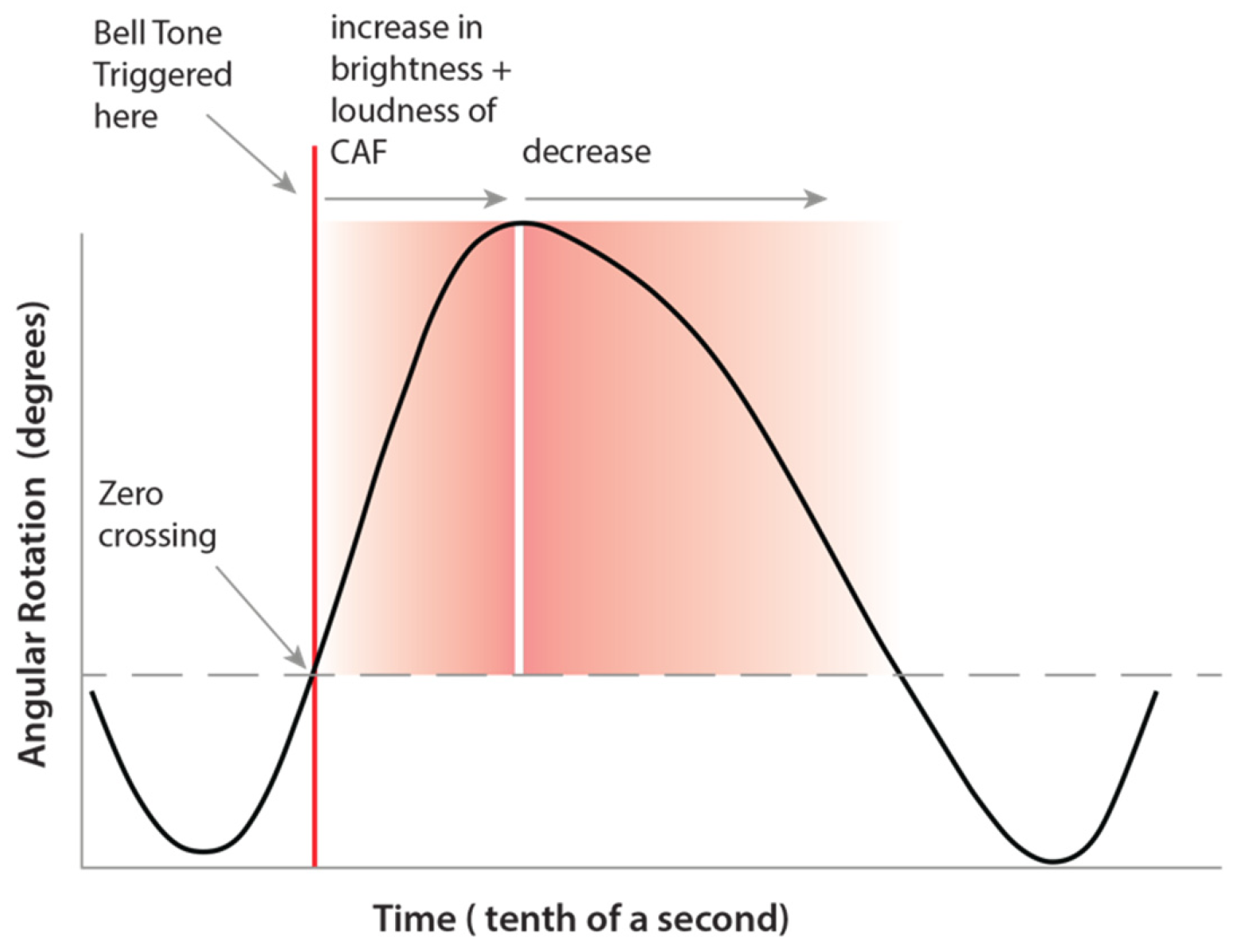
The DAF consisted of a bell tone that was triggered using an algorithm that detects a positive trend in the hip rotation data. The bell was generated using frequency-modulated (FM) synthesis. Due to the sinusoidal rise and fall of the hip, every positive rotation that follows the negative fall is the beginning of the next step cycle. The red line in Figure 1 shows the point at which the bell tone was triggered, we tested this and were satisfied that it represented the hip rotation to be interpreted by the participants as they listened to the audio recordings whilst walking.
The CAF used a simple method of ‘envelope following’ with continuous angular rotational data (Figure 1) to drive a band-pass filter that adjusts the tonal brightness and loudness of two harmonically tuned oscillators to provide this continuous auditory feedback. Envelope following is a technique used in digital sound synthesis to average the amplitude of an audio signal to create a time series ramp based on this averaged data.
As the rotation data consists of rises and falls in sinusoidal patterns, this created a pleasing shift in tone due to the harmonic tuning of the oscillators and the gradual shifting that was based on the rhythms of actual walking. The auditory recordings are provided in the Supplementary Materials.

2.4. Gait Data Acquisition

Gait was recorded using a 16-level ProtoKinetics Zeno™ pressure sensor walkway, Havertown, PA, USA, (active area = 7.3 m × 1.2 m, sampling rate 120 Hz). Recorded data were processed using the ProtoKinetics Movement Analysis Software (version 5.07).
Each trial consisted of three passes (forward + return), yielding approximately 45–50 steps per condition per participant. The first and last two steps of each pass were excluded to eliminate acceleration and deceleration effects [59]. Turns at each end were not included in the analysis.

2.5. Procedure

Participants were advised to wear comfortable clothing and remove their footwear before walking on the walkway. They then wore wireless headphones, which allowed them to listen to the auditory cues and walked barefoot in the following conditions:
  • Silent baseline (self-paced);
  • Auditory-cue trials (DAF, CAF, and DAF + CAF) at 60 BPM and 120 BPM, presented in random order.
Before each trial, participants were instructed to “walk naturally as you would normally do” but to “attend to the sounds” during cued conditions. No explicit instruction to synchronize was given to avoid biasing entrainment behavior. If participants asked for clarification, the research team member reiterated that they should walk comfortably and allow the sound to “accompany” their movement.
After completing all six cued conditions and the baseline, the participants completed a brief questionnaire to capture their perceptions of their gait in relation to each auditory cue. The sample questions were as follows:
  • Which individual sounds had the most impact on your general movement during the experiment?
  • Which tempo of the sounds played had the greatest influence on your general movement and speed?
  • Which sound type, discrete (bell tone) or continuous (sawtooth tone), had a more substantial effect on your general movement?

2.6. Data Processing and Statistical Analysis

The data were analyzed statistically using SPSS software version 29.0 (IBM® Corp. Armonk, NY, USA). Gait spatiotemporal parameters (cadence, velocity, and stride length) were presented as mean (M) and standard deviation (SD).
Descriptive statistics and the Shapiro–Wilk test was conducted to verify whether the spatiotemporal parameters followed a normal distribution. The analysis of variance for assessing homogeneity was conducted using Levene’s test [9,60,61].
When a significant interaction was found, all dependent variables were analyzed using repeated-measure analyses of variance (ANOVAs), for 3 (cue types: DAF, CAF, and DAF + CAF) × 2 (tempo: 60 vs. 120 BPM) within-subject designs, to determine the effect of each auditory cue on the gait parameters. When the sphericity assumption (calculated with Mauchly’s test) was violated, data were adjusted with the Greenhouse–Geisser correction. Post hoc pairwise comparisons with the Bonferroni correction identified significant interactions.
In the context of this study, the desired statistical power is required with an assumed 5% margin of error at a 95% level of confidence interval with a threshold alpha level of 0.05. The effect size was calculated using Cohen’s d, and the values are quantified as follows: 0.2 small, 0.5 medium, and 0.8 large for statistical effects [62,63].

2.7. Qualitative Data Analysis

Two independent researchers conducted thematic analysis of the open-ended questionnaire responses following Braun and Clarke’s [64] six-step approach. This process involved (1) familiarizing with the data through reading and re-reading participants’ responses, (2) generating initial codes to label relevant quotes, (3) collating codes into potential themes, (4) reviewing and refining these themes for coherence, (5) defining and naming each theme to capture its essence, and (6) producing a narrative linking the themes to the research questions.
The dataset was small (35 participants) and responses were brief; therefore, manual coding was used and specialist software such as NVivo was not required. Overarching themes were identified through participant comments. Discrepancies were resolved through discussion until consensus was reached, ensuring inter-rater credibility. The following three themes were deduced: appealing rhythm, confusing, and disorientating (Table 1). No additional themes emerged during coding, as the remaining data aligned with these categories.

2.8. Normalization

The normalized change scores were used for assessing the impact of interventions or conditions. Normalization mitigates the influence of inherent individual differences. The formula for calculating normalized change scores is given as the following [51]:
N o r m a l i s e d   c h a n g e   s c o r e = c u e d   g a i t   v a r i a b l e b a s e l i n e   g a i t   v a r i a b l e b a s e l i n e   g a i t   v a r i a b l e ,

3. Results

3.1. Effect of Auditory Cues on Gait

Table 2 presents the mean (M) ± standard deviation (SD) of cadence, velocity, and stride length for all four auditory cue conditions: discrete (DAF), continuous (CAF), combined (DAF + CAF) and the silent baseline (no sound).
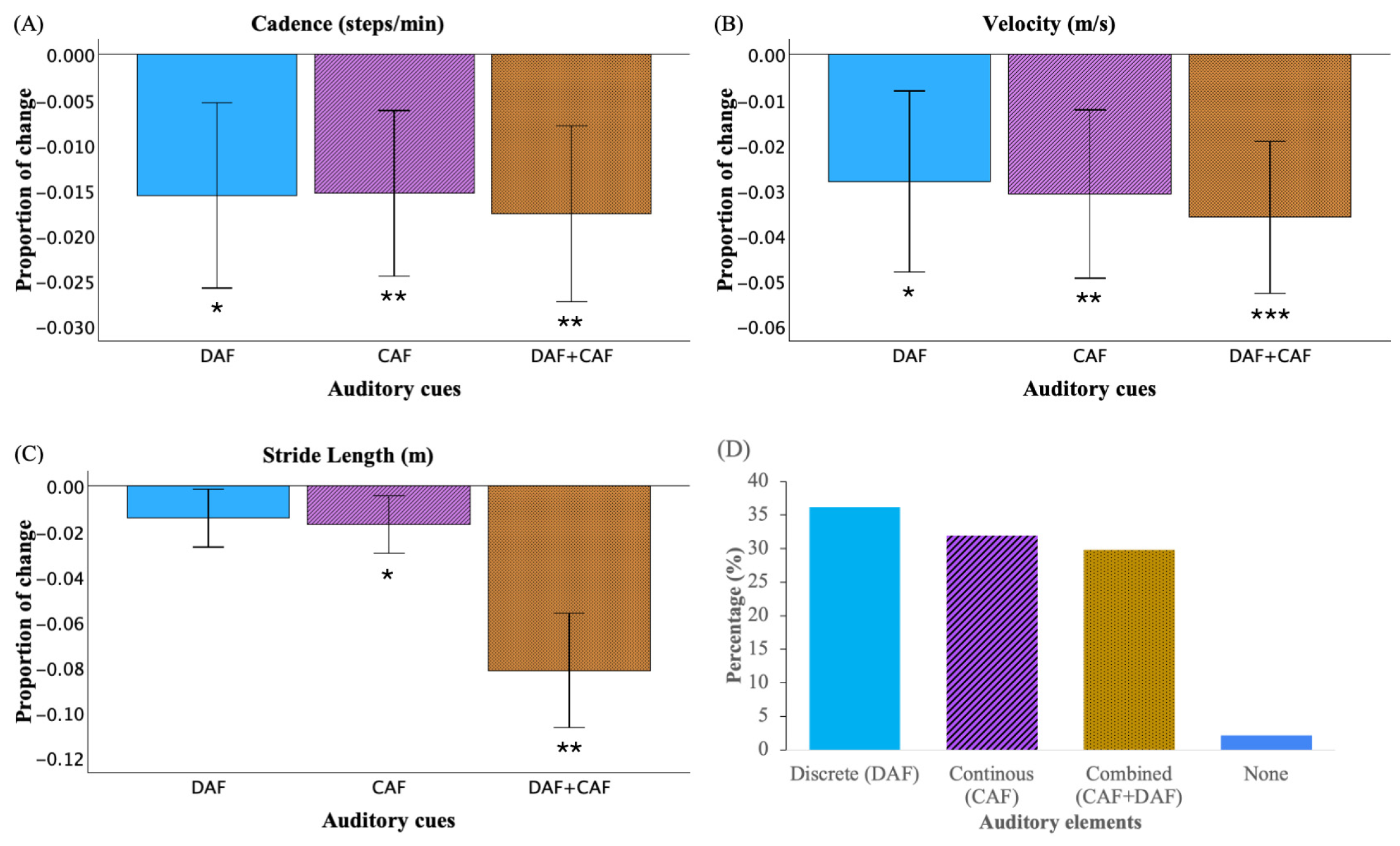
A two-factor repeated-measures ANOVA (cue type × tempo) showed significant main effects of auditory cue type on all gait parameters (Figure 2). Compared with the silent baseline, gait cadence decreased in all sound conditions [F(3.91, 132.83) = 3.00, p = 0.02, ηp2 = 0.08]. Post hoc comparisons (Bonferroni-adjusted) indicated that cadence was significantly lower in the discrete–slow (M = −0.197, SD = 0.028, p = 0.01) and combined–fast (M = −0.197, SD = 0.035, p = 0.04) conditions relative to baseline. Average walking velocity also decreased under auditory cueing [F(1.69, 57.49) = 10.15, p < 0.001, ηp2 = 0.23], as did stride length [F(1.74, 59.26) = 6.87, p = 0.003, ηp2 = 0.17]. These results indicate that participants tended to walk more slowly and take shorter strides when attempting to synchronize with the auditory cues.
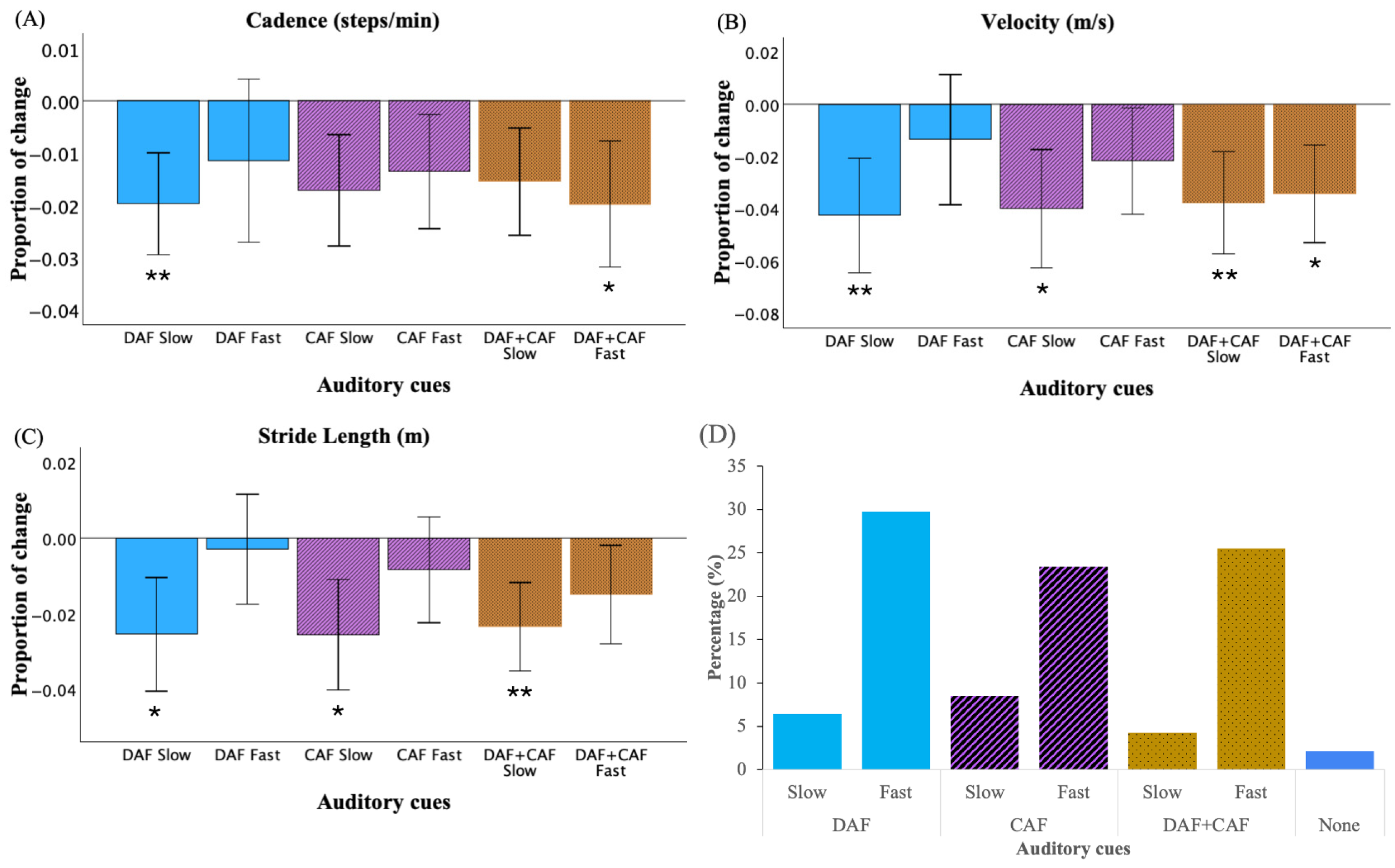
The normalized change scores (change from each participant’s silent baseline) confirm this directional decrease. Across the conditions, gait measures generally decreased when auditory cues were introduced compared with the silent baseline. Cadence declined under DAF slow but increased slightly in DAF fast (Figure 2A). Average velocity decreased in DAF slow and CAF slow, yet showed a small rise in DAF fast (Figure 2B). Stride length decreased most during the DAF slow and CAF slow conditions (Figure 2C).
The questionnaire data (Figure 2D) suggested that participants perceived the discrete fast (30%) as the most influential sound on their general movement, predominantly due to its ‘appealing rhythm’. Participants reported choosing this sound because of its alignment with their natural walking rhythm and pace. Participants also indicated that slow-tone CAF and its combination with DAF was associated with negative experiences, being described as ‘confusing’ and ‘disorientating’. Rather than a design flaw, we interpret this as constructively diagnostic: continuous/emergent timing at down-tempo places greater demands on sensorimotor alignment, which likely requires strategies (e.g., gradually modulating tempo to facilitate rhythms). In contrast, fast DAF (120 BPM) often aligned with participants’ self-selected cadence, supporting its clinical utility for rhythmic entrainment where the goal is to stabilize or slightly up-pace gait without disrupting natural timing.

3.2. Auditory Feature Comparisons

Paired-samples t tests (Table 3) comparing each sound type with the silent baseline showed statistically significant decreases in cadence and velocity for the combined (DAF + CAF) condition (p < 0.001). Effect sizes were moderate (Cohen’s d ≈ 0.5–0.7) for cadence, velocity, and stride length.
The normalized change scores revealed significant effects for the auditory features on gait variables: cadence [F(1.88, 63.75) = 8.95, p < 0.001, ηp2 = 0.21]; velocity [F(1.69, 57.49) = 10.15, p < 0.001, ηp2 = 0.23]; and stride length [F(1.74, 59.26) = 6.87, p = 0.003, ηp2 = 0.17]. These results suggest that the auditory features statistically impacted gait parameters across the conditions tested (Figure 3).
Participants’ qualitative comments (Figure 3D) support these findings: 35% reported that the discrete bell tone helped them maintain a consistent rhythm, whereas 30% identified the combined sound as most helpful for step synchronization, highlighting the bell’s rhythmic properties as a key factor in facilitating coordinated movement.

3.3. Influence of Sound Tempo

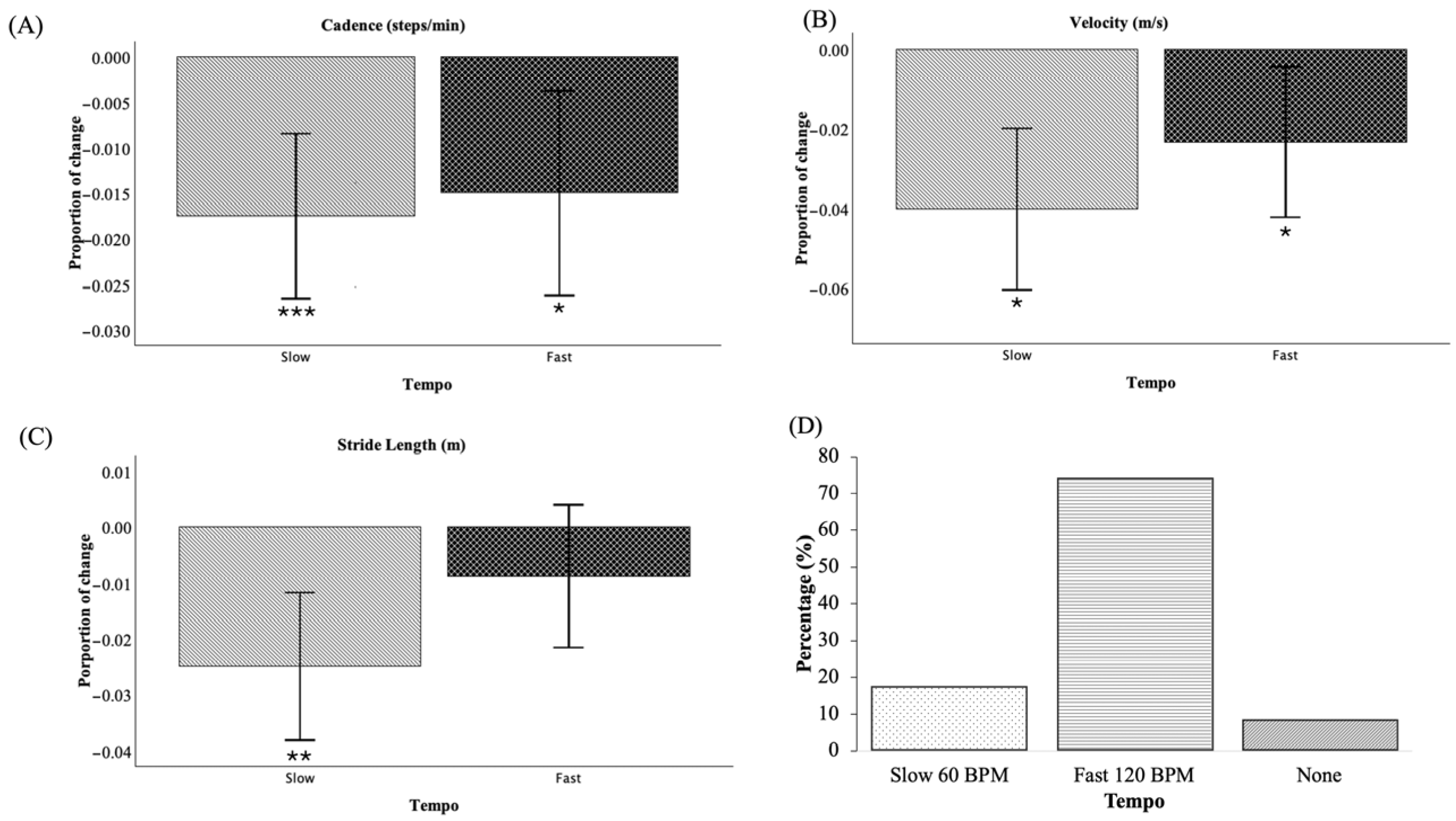
A separate repeated-measures ANOVA examining the tempo factor (slow = 60 BPM, fast = 120 BPM) revealed significant main effects of tempo on cadence [F(2, 34) = 7.80, p < 0.001, ηp2 = 0.19]; velocity [F(2, 34) = 9.76, p < 0.001, ηp2 = 0.22]; and stride length [F(2, 34) = 8.55, p < 0.001, ηp2 = 0.20]. Compared with baseline, walking with slow cues (60 BPM) produced significant decreases in all three spatiotemporal gait parameters (Table 4). Cadence decreased under every 60 BPM cue type (DAF slow, CAF slow, and DAF + CAF slow) (p < 0.001, d ≈ 0.60). Velocity (average walking speed) showed a consistent reduction relative to baseline for all slow-tempo conditions (all p < 0.05, medium d values). Stride length likewise shortened at 60 BPM (p < 0.001, d ≈ 0.6).
Velocity showed a small, non-significant increase at 120 BPM for DAF and CAF conditions (Figure 4C). Subjective reports (Figure 4D) align with these quantitative findings: 74% of participants stated that fast sounds encouraged them to maintain their natural pace or walk slightly faster, while 17% reported that slow cues made them slow down deliberately to synchronize with the beat. Some participants (9%) ignored the sounds or felt no difference. The slow 60 BPM may intentionally challenge timing mechanisms useful for early stage cueing therapy; 120 BPM aligns with natural rhythm and may serve as a natural walking frequency.

4. Discussion

This study sought to determine whether (1) sound continuity enhances or disrupts natural gait synchronization, (2) walking pace naturally aligns with faster auditory rhythms while slower rhythms induce measurable gait slowing, and (3) combining discrete and continuous cues produce enhancement or disruptive effects.
By analyzing the quantitative gait data (Table 2, Table 3 and Table 4) with subjective perception ratings (Figure 2D, Figure 3D, and Figure 4D), the findings demonstrate that auditory continuity significantly alters gait synchronization; slower auditory rhythms (60 BPM) induce a measurable reduction in cadence, stride length, and velocity, and combining discrete and continuous cues amplifies these effects. The results suggest that the quality and structure of auditory information, not merely its tempo, play a role in modulating motor coordination. This advances the understanding of auditory–motor coupling mechanisms and provides a new direction for developing adaptive auditory feedback systems in gait rehabilitation.

4.1. Effect of Rhythmic and Continuity Features

The data revealed that both continuous (CAF) and combined (CAF + DAF) cues disrupted participants’ natural walking rhythm, producing slight but consistent reductions in cadence and stride length compared with the baseline (Figure 2; Table 3). Questionnaire responses confirmed that participants consciously attempted to align their steps with the sound, indicating that auditory continuity did not facilitate effortless synchronization but instead introduced an attentional effort.
This behavioral adjustment is consistent with the evidence that continuous feedback activates emergent timing mechanisms, which require constant perceptual attention [13,22], contrasting with discrete, internal timing structures. These emergent mechanisms are primarily reliant on dynamic movement coordination, rather than a clock-like internal rhythm [31]. The findings therefore suggest that continuous auditory feedback can unconsciously regulate motor timing, potentially improving movement awareness. However, this external modulation may cause an interruption to the natural rhythm of movement in healthy individuals.

4.2. Influence of Tempo

Tempo exerted a clear influence on gait (Table 4; Figure 4). The slow-tempo (60 BPM) cues significantly reduced cadence, velocity, and stride length, whereas the fast-tempo (120 BPM) cues produced minimal deviation from the baseline. Participants reported that the 60 BPM rhythm felt “too slow,” walking at approximately twice the beat rate, to maintain comfort. This highlights a perceptual and behavioral response to slower tempos, consistent with the existing literature writing that slower tempi generally reduce gait parameters [19,51]. When auditory tempi fall below the natural walking frequency (≈110–125 steps/min), people adapt by doubling the beat or disengaging from synchronization.
These results imply that auditory rhythms slower than an individual’s preferred cadence may decelerate gait intentionally, a principle valuable for rehabilitation contexts aiming to improve stability or control. Conversely, faster tempi, which align with natural cadence, may maintain momentum and confidence, consistent with previous observations in rhythmic auditory stimulation [14,19,29]. In rehabilitation, a slower beat can deliberately slow gait for stability training, whereas faster tempi can encourage step initiation, temporal expectation, and anticipation [25,49].

4.3. Interaction Between Discrete and Continuous Cues

The combined CAF + DAF condition showed a slightly larger adjustment in gait parameters from the participants than other auditory cues (Table 3, Figure 3), despite participants perceiving discrete cues as more rhythmically distinct. This can be interpreted through established models of sensorimotor synchronization [44]. Continuous auditory elements may influence stride regulation through ongoing auditory–motor coupling, even when participants do not consciously attend to the sound. Discrete cues provide clear temporal markers that support explicit step alignment, whereas continuous cues supply a steady auditory context that relates more to emergent timing processes. Presenting both forms together may, therefore, engage complementary timing mechanisms without producing large behavioral changes. These combined features may increase sensorimotor awareness to an extent [9,13], as participants intentionally adjust the continuous flow of their limb motion to match with specific temporal or discrete markers. While this offers a possible explanation for why the hybrid cue produced slightly larger changes than either cue alone, the magnitude of these differences remained small.
Therefore, further research, including neurophysiological investigations, would help to clarify how discrete and continuous cues are processed, as they appear to contribute different forms of temporal and movement-related information. Such work would guide the development of auditory cue designs that achieve an appropriate balance between rhythmic structure and continuous movement information, supporting applications in gait rehabilitation and wearable feedback systems.

4.4. Limitations and Implications

The controlled laboratory investigation was limited to young, healthy adults and headphone-delivered stimuli, which may limit the generalizability of the findings to other populations, such as older adults, individuals with gait impairments, or those undergoing rehabilitation. Future studies should explore these auditory designs in diverse populations, including older adults and individuals with neurological conditions, and test adaptive cueing systems that adjust tempo and continuity in real time to match users’ intrinsic rhythms. Additionally, incorporating kinematic and neurophysiological measurements (e.g., electromyography) could reveal how continuous versus discrete cues engage neural motor networks and attention pathways.
Despite these limitations, the findings contribute to understanding how auditory cue features affect motor coordination. The differential impact of continuity and tempo underscores the need to tailor auditory feedback to individual rhythmic preferences and natural gait frequencies. For gait rehabilitation, this suggests that rather than enforcing strict beat synchronization, more continuous or adaptive feedback may foster smoother, self-paced movement retraining.
The findings provide evidence that auditory continuity and tempo jointly determine gait synchronization dynamics. For biomedical engineering applications, these results emphasize that effective gait-feedback devices should not rely solely on rhythmic beats but integrate continuous, perceptually coherent auditory feedback that adapts to the user’s movement patterns.

5. Conclusions

This study establishes that the continuity of auditory cues significantly influences the spatiotemporal parameters of human gait, exerting a stronger and more consistent effect on cadence, velocity, and stride length than tempo alone. The key finding is that combining continuous and discrete auditory features (CAF + DAF) modulates gait greater than using either cue type in isolation, indicating a complex interaction between auditory structure and sensorimotor synchronization. These results demonstrate that auditory feedback can influence movement and lead to small adjustments in natural gait patterns.
The findings contribute to the understanding of auditory–motor coupling by showing that auditory continuity plays a role in shaping how individuals regulate their steps during cued walking. These insights are relevant for the design of future rehabilitation systems, where continuous auditory mapping may support movement awareness and motor learning in neurorehabilitation settings.
Future research should extend this work to clinical populations, such as individuals recovering from stroke or Parkinson’s Disease, to examine real-time adaptive cueing and translate these laboratory findings into therapeutic benefits.

Supplementary Materials

The following supporting information can be downloaded at: https://doi.org/10.5281/zenodo.17455116.

Author Contributions

Conceptualization, T.Y.P. and C.-T.C.; methodology, T.Y.P., F.F. and C.-T.C.; software, C.-T.C.; validation, T.Y.P. and C.-T.C.; formal analysis, T.Y.P. and C.-T.C.; investigation, T.Y.P.; resources, F.F.; data curation, T.Y.P. and F.F.; writing—original draft preparation, T.Y.P.; writing—review and editing, F.F. and C.-T.C.; visualization, T.Y.P. and F.F.; project administration, T.Y.P.; All authors have read and agreed to the published version of the manuscript.

Funding

This research received no external funding.

Institutional Review Board Statement

The research protocol was approved by the College Human Ethics Advisory Network of RMIT University (Approved ID 2021-24130-13846 and date of approval 12 March 2021).

Informed Consent Statement

Informed consent was obtained from all subjects involved in the study.

Data Availability Statement

The datasets analyzed for the current study are not publicly available under the University Research Ethics Protocol on informed consent for research with human participants.

Acknowledgments

We would like to thank our participants who volunteered their time to take part in the study. We also like to thank the technical staff of the biomechanics laboratory at RMIT University for providing access to the equipment to conduct the experiment. During the preparation of this manuscript, the author(s) used ChatGPT-5 for the purpose of checking English expressions and grammatical accuracy. The authors have reviewed and edited the output and take full responsibility for the content of this publication.

Conflicts of Interest

The authors declare no conflicts of interest.

References

  1. Baram, Y.; Aharon-Peretz, J.; Badarny, S.; Susel, Z.; Schlesinger, I. Closed-loop auditory feedback for the improvement of gait in patients with Parkinson’s disease. J. Neurol. Sci. 2016, 363, 104–106. [Google Scholar] [CrossRef]
  2. Baram, Y.; Lenger, R. Gait Improvement in Patients with Cerebral Palsy by Visual and Auditory Feedback. Neuromodulation Technol. Neural Interface 2012, 15, 48–52. [Google Scholar] [CrossRef] [PubMed]
  3. Cha, Y.-J.; Kim, J.-D.; Choi, Y.-R.; Kim, N.-H.; Son, S.-M. Effects of gait training with auditory feedback on walking and balancing ability in adults after hemiplegic stroke: A preliminary, randomized, controlled study. Int. J. Rehabil. Res. 2018, 41, 239–243. [Google Scholar] [CrossRef] [PubMed]
  4. Cornwell, T.; Woodward, J.; Wu, M.M.; Jackson, B.; Souza, P.; Siegel, J.; Dhar, S.; Gordon, K.E. Walking With Ears: Altered Auditory Feedback Impacts Gait Step Length in Older Adults. Front. Sports Act. Living 2020, 2, 38. [Google Scholar] [CrossRef] [PubMed]
  5. Hasegawa, N.; Takeda, K.; Sakuma, M.; Mani, H.; Maejima, H.; Asaka, T. Learning effects of dynamic postural control by auditory biofeedback versus visual biofeedback training. Gait Posture 2017, 58, 188–193. [Google Scholar] [CrossRef]
  6. Ki, K.-I.; Kim, M.-S.; Moon, Y.; Choi, J.-D. Effects of auditory feedback during gait training on hemiplegic patients’ weight bearing and dynamic balance ability. J. Phys. Ther. Sci. 2015, 27, 1267–1269. [Google Scholar] [CrossRef]
  7. Mashael Abd El-Salam Mohamed, N.; Amira Mohamed, E.; Nanees Essam Mohamed, S. Influence of rhythmic auditory feedback on gait in hemiparetic children. J. Med. Sci. 2020, 40, 1–7. [Google Scholar] [CrossRef]
  8. Maulucci, R.A.; Eckhouse, R.H. A real-time auditory feedback system for retraining gait. In Proceedings of the 2011 Annual International Conference of the IEEE Engineering in Medicine and Biology Society, Boston, MA, USA, 30 August–3 September 2011; pp. 5199–5202. [Google Scholar]
  9. Pang, T.Y.; Feltham, F. Effect of continuous auditory feedback (CAF) on human movements and motion awareness. Med. Eng. Phys. 2022, 109, 103902. [Google Scholar] [CrossRef]
  10. Wu, T.L.Y.; Murphy, A.; Chen, C.; Kulić, D. Adaptive cueing strategy for gait modification: A case study using auditory cues. Front. Neurorobotics 2023, 17, 1127033. [Google Scholar] [CrossRef]
  11. Boyer, É.O.; Bevilacqua, F.; Susini, P.; Hanneton, S. Investigating three types of continuous auditory feedback in visuo-manual tracking. Exp. Brain Res. 2017, 235, 691–701. [Google Scholar] [CrossRef]
  12. Rosati, G.; Oscari, F.; Spagnol, S.; Avanzini, F.; Masiero, S. Effect of task-related continuous auditory feedback during learning of tracking motion exercises. J. Neuroeng. Rehabil. 2012, 9, 79. [Google Scholar] [CrossRef]
  13. Schaffert, N.; Janzen, T.B.; Mattes, K.; Thaut, M.H. A Review on the Relationship Between Sound and Movement in Sports and Rehabilitation. Front. Psychol. 2019, 10, 244. [Google Scholar] [CrossRef]
  14. Wittwer, J.E.; Webster, K.E.; Hill, K. Music and metronome cues produce different effects on gait spatiotemporal measures but not gait variability in healthy older adults. Gait Posture 2013, 37, 219–222. [Google Scholar] [CrossRef]
  15. Cathy, C.; Marta, M.N.B. Sound, Music and Movement in Parkinson’s Disease; Frontiers Media SA: Lausanne, Switzerland, 2017. [Google Scholar]
  16. Moumdjian, L.; Moens, B.; Maes, P.-J.; Van Geel, F.; Ilsbroukx, S.; Borgers, S.; Leman, M.; Feys, P. Continuous 12 min walking to music, metronomes and in silence: Auditory-motor coupling and its effects on perceived fatigue, motivation and gait in persons with multiple sclerosis. Mult. Scler. Relat. Disord. 2019, 35, 92–99. [Google Scholar] [CrossRef] [PubMed]
  17. Song, G.-B.; Ryu, H.J. Effects of gait training with rhythmic auditory stimulation on gait ability in stroke patients. J. Phys. Ther. Sci. 2016, 28, 1403–1406. [Google Scholar] [CrossRef]
  18. Hamzeh, J.; Baradhi, M.C.; Al Neyadi, S.; Ballout, M.; Ayoubi, F. The effect of rhythmic auditory stimulation variation on gait parameters in chronic stroke patients: A pilot study. Gait Posture 2021, 90, 84–85. [Google Scholar] [CrossRef]
  19. Tueth, L.E.; Haussler, A.M.; Lohse, K.R.; Rawson, K.S.; Earhart, G.M.; Harrison, E.C. Effect of musical cues on gait in individuals with Parkinson disease with comorbid dementia. Gait Posture 2024, 107, 275–280. [Google Scholar] [CrossRef] [PubMed]
  20. Murgia, M.; Pili, R.; Corona, F.; Sors, F.; Agostini, T.A.; Bernardis, P.; Casula, C.; Cossu, G.; Guicciardi, M.; Pau, M. The use of footstep sounds as rhythmic auditory stimulation for gait rehabilitation in Parkinson’s disease: A randomized controlled trial. Front. Neurol. 2018, 9, 348. [Google Scholar] [CrossRef]
  21. Lheureux, A.; Warlop, T.; Cambier, C.; Chemin, B.; Stoquart, G.; Detrembleur, C.; Lejeune, T. Influence of Autocorrelated Rhythmic Auditory Stimulations on Parkinson’s Disease Gait Variability: Comparison With Other Auditory Rhythm Variabilities and Perspectives. Front. Physiol. 2020, 11, 601721. [Google Scholar] [CrossRef]
  22. Braun Janzen, T.; Schaffert, N.; Schlüter, S.; Ploigt, R.; Thaut, M.H. The effect of perceptual-motor continuity compatibility on the temporal control of continuous and discontinuous self-paced rhythmic movements. Hum. Mov. Sci. 2021, 76, 102761. [Google Scholar] [CrossRef]
  23. Darabi, N.; Svensson, U.P. Dynamic Systems Approach in Sensorimotor Synchronization: Adaptation to Tempo Step-Change. Front. Physiol. 2021, 12, 667859. [Google Scholar] [CrossRef]
  24. Varlet, M.; Marin, L.; Issartel, J.; Schmidt, R.C.; Bardy, B.G. Continuity of Visual and Auditory Rhythms Influences Sensorimotor Coordination. PLoS ONE 2012, 7, e44082. [Google Scholar] [CrossRef]
  25. Delval, A.; Moreau, C.; Bleuse, S.; Tard, C.; Ryckewaert, G.; Devos, D.; Defebvre, L. Auditory cueing of gait initiation in Parkinson’s disease patients with freezing of gait. Clin. Neurophysiol. 2014, 125, 1675–1681. [Google Scholar] [CrossRef] [PubMed]
  26. Braun Janzen, T.; Koshimori, Y.; Richard, N.M.; Thaut, M.H. Rhythm and Music-Based Interventions in Motor Rehabilitation: Current Evidence and Future Perspectives. Front. Hum. Neurosci. 2022, 15, 789467. [Google Scholar] [CrossRef]
  27. Hebb, C.; Raynor, G.; Perez, D.L.; Nappi-Kaehler, J.; Polich, G. The use of rhythmic auditory stimulation for functional gait disorder: A case report. NeuroRehabilitation 2022, 50, 219–229. [Google Scholar] [CrossRef] [PubMed]
  28. Zhao, Y.; Xu, H.; Fu, J. Integrating rhythmic auditory stimulation in intelligent rehabilitation technologies for enhanced post-stroke recovery. Front. Bioeng. Biotechnol. 2025, 13, 1649011. [Google Scholar] [CrossRef]
  29. Scataglini, S.; Van Dyck, Z.; Declercq, V.; Van Cleemput, G.; Struyf, N.; Truijen, S. Effect of Music Based Therapy Rhythmic Auditory Stimulation (RAS) Using Wearable Device in Rehabilitation of Neurological Patients: A Systematic Review. Sensors 2023, 23, 5933. [Google Scholar] [CrossRef]
  30. Sihvonen, A.J.; Särkämö, T.; Leo, V.; Tervaniemi, M.; Altenmüller, E.; Soinila, S. Music-based interventions in neurological rehabilitation. Lancet Neurol. 2017, 16, 648–660. [Google Scholar] [CrossRef] [PubMed]
  31. Maes, P.-J.; Buhmann, J.; Leman, M. 3Mo: A Model for Music-Based Biofeedback. Front. Neurosci. 2016, 10, 548. [Google Scholar] [CrossRef]
  32. Ready, E.A.; Holmes, J.D.; Grahn, J.A. Gait in younger and older adults during rhythmic auditory stimulation is influenced by groove, familiarity, beat perception, and synchronization demands. Hum. Mov. Sci. 2022, 84, 102972. [Google Scholar] [CrossRef]
  33. Park, K.S.; Hass, C.J.; Janelle, C.M. Familiarity with music influences stride amplitude and variability during rhythmically-cued walking in individuals with Parkinson’s disease. Gait Posture 2021, 87, 101–109. [Google Scholar] [CrossRef] [PubMed]
  34. Roberts, B.S.; Ready, E.A.; Grahn, J.A. Musical enjoyment does not enhance walking speed in healthy adults during music-based auditory cueing. Gait Posture 2021, 89, 132–138. [Google Scholar] [CrossRef] [PubMed]
  35. Ashoori, A.; Eagleman, D.M.; Jankovic, J. Effects of auditory rhythm and music on gait disturbances in Parkinson’s disease. Front. Neurol. 2015, 6, 234. [Google Scholar] [CrossRef] [PubMed]
  36. Rodger, M.W.M.; Craig, C.M. Beyond the Metronome: Auditory Events and Music May Afford More than Just Interval Durations as Gait Cues in Parkinson’s Disease. Front. Neurosci. 2016, 10, 272. [Google Scholar] [CrossRef]
  37. Huys, R.; Studenka, B.E.; Rheaume, N.L.; Zelaznik, H.N.; Jirsa, V.K. Distinct timing mechanisms produce discrete and continuous movements. PLoS Comput. Biol. 2008, 4, e1000061. [Google Scholar] [CrossRef]
  38. Schaefer, R.S. Auditory rhythmic cueing in movement rehabilitation: Findings and possible mechanisms. Philos. Trans. R. Soc. Lond. B Biol. Sci. 2014, 369, 20130402. [Google Scholar] [CrossRef]
  39. Braun Janzen, T.; Thompson, W.F.; Ammirante, P.; Ranvaud, R. Timing skills and expertise: Discrete and continuous timed movements among musicians and athletes. Front. Psychol. 2014, 5, 1482. [Google Scholar] [CrossRef]
  40. Rodger, M.W.M.; Craig, C.M. Moving with Beats and Loops: The Structure of Auditory Events and Sensorimotor Timing. In Sound, Music, and Motion, Proceedings of the 10th International Symposium, CMMR 2013, Marseille, France, 15–18 October 2013; Springer: Cham, Switzerland, 2014; pp. 204–217. [Google Scholar]
  41. Feltham, F.; Connelly, T.; Cheng, C.-T.; Pang, T.Y. A Wearable Sonification System to Improve Movement Awareness: A Feasibility Study. Appl. Sci. 2024, 14, 816. [Google Scholar] [CrossRef]
  42. Ghai, S.; Ghai, I.; Effenberg, A.O. Effect of Rhythmic Auditory Cueing on Aging Gait: A Systematic Review and Meta-Analysis. Aging Dis. 2018, 9, 901–923. [Google Scholar] [CrossRef]
  43. Boyer, E.O.; Portron, A.; Bevilacqua, F.; Lorenceau, J. Continuous auditory feedback of eye movements: An exploratory study toward improving oculomotor control. Front. Neurosci. 2017, 11, 197. [Google Scholar] [CrossRef]
  44. Delignières, D.; Torre, K. Event-Based and Emergent Timing: Dichotomy or Continuum? A Reply to Repp and Steinman (2010). J. Mot. Behav. 2011, 43, 311–318. [Google Scholar] [CrossRef]
  45. Repp, B.H.; Steinman, S.R. Simultaneous Event-Based and Emergent Timing: Synchronization, Continuation, and Phase Correction. J. Mot. Behav. 2010, 42, 111–126. [Google Scholar] [CrossRef] [PubMed]
  46. Yang, Z.; Su, Q.; Xie, J.; Su, H.; Huang, T.; Han, C.; Zhang, S.; Zhang, K.; Xu, G. Music tempo modulates emotional states as revealed through EEG insights. Sci. Rep. 2025, 15, 8276. [Google Scholar] [CrossRef]
  47. Sreepetch, S.; Ramyarangsi, P.; Mukda, S.; Siripornpanich, V.; Ajjimaporn, A. Recovery effects of slow-tempo preferred music on brain activity, physiological and psychological responses following high-intensity interval exercise in healthy male adults. Acta Psychol. 2025, 259, 105456. [Google Scholar] [CrossRef]
  48. Jeong, J.; Nam, S.M.; Seo, H. Impact of sensory modality and tempo in motor timing. Front. Psychol. 2024, 15, 1419135. [Google Scholar] [CrossRef]
  49. Rivera-Tello, S.; Romo-Vázquez, R.; González-Garrido, A.A.; Ramos-Loyo, J. Musical tempo affects EEG spectral dynamics during subsequent time estimation. Biol. Psychol. 2023, 178, 108517. [Google Scholar] [CrossRef] [PubMed]
  50. Arbinaga, F.; Romero-Pérez, N.; Torres-Rosado, L.; Fernández-Ozcorta, E.J.; Mendoza-Sierra, M.I. Influence of Music on Closed Motor Skills: A Controlled Study with Novice Female Dart-Throwers. Int. J. Environ. Res. Public Health 2020, 17, 4146. [Google Scholar] [CrossRef]
  51. Ready, E.A.; McGarry, L.M.; Rinchon, C.; Holmes, J.D.; Grahn, J.A. Beat perception ability and instructions to synchronize influence gait when walking to music-based auditory cues. Gait Posture 2019, 68, 555–561. [Google Scholar] [CrossRef] [PubMed]
  52. Li, X.; Wang, S.; Wang, K.; Wang, W.; Tuo, H.; Long, Y.; Tan, X.; Sun, W. Personalized auditory cues improve gait in patients with early Parkinson’s disease. Front. Neurol. 2025, 16, 1561880. [Google Scholar] [CrossRef]
  53. Cochen De Cock, V.; Dotov, D.; Damm, L.; Lacombe, S.; Ihalainen, P.; Picot, M.C.; Galtier, F.; Lebrun, C.; Giordano, A.; Driss, V.; et al. BeatWalk: Personalized Music-Based Gait Rehabilitation in Parkinson’s Disease. Front. Psychol. 2021, 12, 655121. [Google Scholar] [CrossRef]
  54. Zagala, A.; Foster, N.E.V.; van Vugt, F.T.; Dal Maso, F.; Dalla Bella, S. The Ramp protocol: Uncovering individual differences in walking to an auditory beat using TeensyStep. Sci. Rep. 2024, 14, 23779. [Google Scholar] [CrossRef]
  55. Wu, T.L.Y.; Murphy, A.; Chen, C.; Kulić, D. Adaptive auditory assistance for stride length cadence modification in older adults and people with Parkinson’s. Front. Physiol. 2024, 15, 1284236. [Google Scholar] [CrossRef]
  56. Franěk, M.; van Noorden, L.; Režný, L. Tempo and walking speed with music in the urban context. Front. Psychol. 2014, 5, 1361. [Google Scholar] [CrossRef]
  57. Nascimento, L.R.; Boening, A.; Rocha, R.J.S.; do Carmo, W.A.; Ada, L. Walking training with auditory cueing improves walking speed more than walking training alone in ambulatory people with Parkinson’s disease: A systematic review. J. Physiother. 2024, 70, 208–215. [Google Scholar] [CrossRef]
  58. Tasseel-Ponche, S.; Delafontaine, A.; Godefroy, O.; Yelnik, A.P.; Doutrellot, P.-L.; Duchossoy, C.; Hyra, M.; Sader, T.; Diouf, M. Walking speed at the acute and subacute stroke stage: A descriptive meta-analysis. Front. Neurol. 2022, 13, 989622. [Google Scholar] [CrossRef]
  59. Jorgensen, A.; McManigal, M.; Post, A.; Werner, D.; Wichman, C.; Tao, M.; Wellsandt, E. Reliability of an Instrumented Pressure Walkway for Measuring Walking and Running Characteristics in Young, Athletic Individuals. Int. J. Sports Phys. Ther. 2024, 19, 429–439. [Google Scholar] [CrossRef]
  60. Kang, C.J.; Chun, M.H.; Lee, J.; Lee, J.Y. Effects of robot (SUBAR)-assisted gait training in patients with chronic stroke: Randomized controlled trial. Medicine 2021, 100, e27974. [Google Scholar] [CrossRef] [PubMed]
  61. Winiarski, S.; Pietraszewska, J.; Pietraszewski, B. Three-Dimensional Human Gait Pattern: Reference Data for Young, Active Women Walking with Low, Preferred, and High Speeds. BioMed Res. Int. 2019, 2019, 9232430. [Google Scholar] [CrossRef] [PubMed]
  62. Cohen, J. Statistical Power Analysis for the Behavioral Sciences; Academic Press: Cambridge, MA, USA, 2013. [Google Scholar]
  63. Lakens, D. Calculating and reporting effect sizes to facilitate cumulative science: A practical primer for t-tests and ANOVAs. Front. Psychol. 2013, 4, 863. [Google Scholar] [CrossRef]
  64. Braun, V.; Clarke, V. Using thematic analysis in psychology. Qual. Res. Psychol. 2006, 3, 77–101. [Google Scholar] [CrossRef]
Figure 1. Sonification approach: black line indicates the rotation of the hip in a walk step cycle. Any rise in the data created a rise in the tonal brightness and loudness of the harmonically tuned tone.
Eng 06 00349 g001
Figure 2. Normalized change scores. The scores represent the proportional change from baseline values for each variable (A) cadence, (B) velocity, and (C) stride length for all auditory cue conditions; (D) percentage of participants indicating that a specific auditory feature had the greatest influence on their movement. * p < 0.05, ** p < 0.01, vertical bars indicate the 95% CI.
Eng 06 00349 g002
Figure 3. Normalized change scores. The scores represent the proportional change from baseline values for each variable (A) cadence, (B) velocity, and (C) stride length for the effect of auditory features (DAF, CAF, and combined DAF + CAF); (D) percentage of participants indicating that a specific auditory feature had the greatest influence on their movement. * p < 0.05, ** p < 0.01, *** p < 0.001, vertical bars indicate the 95% CI.
Eng 06 00349 g003
Figure 4. Normalized change scores. The scores represent the proportional change from baseline values for each variable (A) cadence, (B) velocity, and (C) stride length from the effect of tempo; (D) percentage of participants indicating that a specific tempo had the greatest influence on their movement. * p < 0.05, ** p < 0.01, *** p < 0.001, vertical bars indicate the 95% CI.
Eng 06 00349 g004
Table 1. Summary of qualitative themes derived from participant comments, showing the relationship between each auditory condition, the corresponding theme, and an example of participant statement.
Auditory ConditionsReported Experience ThemeExample of Participant Excerpts
SlowDAFConfusingIt is too slow and it makes it harder to walk to the speed of it.
CAFConfusingThe saw felt odd, as it had little to no rhythm; your footsteps could not align with the sound.
DAF + CAFDisorientating[…] the sound felt disoriented and impeded my walking rhythm.
FastDAFAppealing rhythmMatches best with walking speed and building consistent stride.
CAFAppealing rhythmIt was the easiest sound to match my walking to, felt the most natural to walk with.
DAF + CAFDisorientatingDisliked the bell and saw combined sounds—found them distracting and unnatural.
Table 2. Means and standard deviations of gait spatiotemporal parameters in all auditory conditions.
VariablesBaselineSlowFast
DAFCAFDAF + CAFDAFCAFDAF + CAF
Cadence (steps/min)114.2 ± 6.3112.0 ± 7.7112.3 ± 7.2112.5 ± 7.4112.9 ± 8.1112.7 ± 7.4112.0 ± 7.4
Velocity (m/s)1.37 ± 0.151.31 ± 0.171.31 ± 0.161.31 ± 0.161.35 ± 0.161.34 ± 0.161.32 ± 0.16
Stride length (m)1.43 ± 0.151.40 ± 0.141.40 ± 0.141.40 ± 0.141.43 ± 0.131.42 ± 0.141.41 ± 0.14
Table 3. Difference in the mean and 95% confidence interval (CI) of gait variables between the baseline and various auditory features.
Gait VariablesPaired SamplesMean Difference (SD)95% CI of the DifferencetEffect Size (Cohen’s d)p-Value
LowerUpper
Cadence (steps/min)Baseline-DAF1.76 (3.36)0.602.913.090.520.004
 Baseline-CAF1.74 (3.00)0.712.783.430.580.002
 Baseline-DAF + CAF1.99 (3.20)0.893.093.690.62<0.001
Velocity (m/s)Baseline-DAF0.040 (0.081)0.0120.0682.930.500.006
 Baseline-CAF0.044 (0.076)0.0180.0703.430.580.002
 Baseline-DAF + CAF0.050 (0.068)0.0260.0734.330.73<0.001
Stride length (m)Baseline-DAF0.022 (0.056)0.0030.0412.370.400.023
 Baseline-CAF0.026 (0.055)0.0070.0452.840.480.008
 Baseline-DAF + CAF0.029 (0.048)0.0120.0453.570.600.001
Table 4. Difference in the mean and 95% confidence interval (CI) of gait variables between the baseline and various tempo conditions.
Gait VariablesPaired SamplesMean Difference (SD)95% CI of the DifferencetEffect Size (Cohen’s d)p-Value
LowerUpper
Cadence (steps/min)Baseline-Slow1.96 (2.95)0.952.983.930.66<0.001
 Baseline-Fast1.70 (3.70)0.432.972.720.460.01
Velocity (m/s)Baseline-Slow0.056 (0.082)0.0280.0844.020.68<0.001
 Baseline-Fast0.034 (0.076)0.0070.0602.610.440.013
Stride length (m)Baseline-Slow0.037 (0.058)0.0170.0573.790.64<0.001
 Baseline-Fast0.014 (0.054)−0.0040.0331.570.260.126
Disclaimer/Publisher’s Note: The statements, opinions and data contained in all publications are solely those of the individual author(s) and contributor(s) and not of MDPI and/or the editor(s). MDPI and/or the editor(s) disclaim responsibility for any injury to people or property resulting from any ideas, methods, instructions or products referred to in the content.