You are currently viewing a new version of our website. To view the old version click .
Eng
  • Review
  • Open Access

1 December 2025

Biochar as Additive and Modifier in Bitumen and Asphalt Mixtures

and
School of Engineering, Edith Cowan University, Joondalup, WA 6027, Australia
*
Authors to whom correspondence should be addressed.
Eng2025, 6(12), 341;https://doi.org/10.3390/eng6120341 
(registering DOI)
This article belongs to the Section Chemical, Civil and Environmental Engineering

Abstract

Incorporating biochar into pavement materials is a novel and environmentally sustainable approach that aligns with global sustainability goals and advances greener pavement technologies. Studies have shown that biochar significantly enhances the strength, durability, and stability of pavements, while also contributing to sustainability by lowering the carbon footprint associated with traditional construction materials. Additionally, the incorporation of biochar contributes to the sustainability of asphalt engineering by reducing reliance on petroleum-based products and promoting the valorization of biomass. The primary objective of this review is to critically evaluate and synthesize existing research on the use of biochar in bitumen and asphalt mixtures, identifying key performance trends, influencing factors, and optimum modification conditions. Despite these benefits, several drawbacks and challenges remain. These include variability in biochar properties, determining the optimal dosage for different applications, and the lack of standardized testing methods. This review investigates a wide range of studies and experimental investigations that evaluate the sources and production methods of biochar, as well as its effects on bitumen binders and asphalt mixtures. Furthermore, the paper highlights the environmental consideration of biochar modification, including carbon sequestration and Life cycle assessment. Substantial findings and their engineering implications are presented, along with recommendations for future research aimed at advancing the broader adoption of biochar in sustainable pavement engineering, in alignment with the principles of the circular economy.

1. Introduction

Bitumen plays a vital role in road construction, serving as the primary binder and waterproof component because of its dark, viscous, and thermoplastic properties. Its ability to adhere to mineral aggregates and provide a moisture-resistant seal plays a critical role in the structural integrity and durability of flexible pavements. Bitumen creates a strong, cohesive matrix that holds the aggregate particles together, ensuring resistance to deformation and wear under varying environmental and mechanical stresses. The long-standing use of bitumen in pavement applications is attributed mainly to its cost-effectiveness, availability, and favorable performance under service conditions. Bitumen performance is governed by a complex interplay of its rheological, chemical, and physical properties, which influences its behavior under different traffic loading conditions and temperature fluctuations []. However, increasing traffic loads, extreme weather events, and growing environmental conditions over time cause changes in the chemical composition and internal structure of the asphalt pavements.
The durability of the bituminous binder is a key factor in determining the long-term performance of bituminous pavements. Durability refers to a material’s ability to withstand environmental aging, oxidation, and moisture-related damage. The resistance to fatigue is also critical, as pavements are constantly subjected to repeated traffic loading that can eventually cause cracking []. A high-performing bitumen system must be capable to absorb energy to avoid fatigue cracking. The temperature sensitivity of bitumen impacts its ability to resist rutting and cracking under hot weather and cold climate conditions, respectively. As the bitumen is highly temperature-sensitive, it is crucial to investigate modification strategies to enhance the performance for cross-climate and loading conditions []. Given these challenges, it is of utmost importance to explore various modification techniques to enhance the mechanical and environmental resilience of bitumen, as conventional bitumen fails to meet current pavement performance requirements.
The construction industry worldwide has increasingly prioritized sustainability and the adoption of environmentally responsible practices. The transportation sector also accomplished its aims towards sustainability, evaluating how pavement and other structures affect the environment, society, and economy at all stages, including selecting materials, design, construction, and maintenance []. The idea of recycling waste has created a significant area for research, and researchers from various organizations have explored different types of waste materials and green technologies in bitumen modification to ensure sustainability in the pavement construction sector. Environmental conservation and sustainable development efforts have prioritized addressing the global waste management crisis and significant environmental challenges, due to a rapid increase in waste generation across the world. Conversely, a considerable volume of waste ends up being incinerated or disposed of in landfills, which significantly impacts environmental sustainability and human well-being []. Incorporating suitable waste in bitumen modification in an appropriate way offers a sustainable way to address the global waste management problem []. Recent research has increasingly focused on improving the performance and environmental profile of bitumen through the incorporation of various additives, particularly waste-derived materials such as biochar, a carbon-rich byproduct from the pyrolysis of biomass []. This approach not only addresses the pressing need for sustainable construction practices but also valorizes agricultural and industrial waste streams, aligning with the principles of the circular economy.
The use of biochar as an additive and modifier in bitumen offers a sustainable strategy for enhancing pavement performance under various environmental conditions. Biochar is a high-carbon material produced through the pyrolysis of organic biomass, including agricultural residues, forestry waste, and other biodegradable resources. Usage in construction enables both waste management sustainability and circular economy practices, as waste materials are converted into usable materials. Biochar added to bitumen serves as a reinforcement agent to adjust both the physical characteristics and rheological behavior of the binder material. This dual function, as both a performance-enhancing agent and an environmentally friendly additive, makes biochar a highly appealing material for research and development in pavement engineering []. Previous studies have verified the potential success of incorporating biochar into bituminous binders. The studies conducted by varying the key parameters, including biochar production technology, pyrolysis temperature, applied pressure, heating rate, and feedstock type, consistently show that incorporating biochar enhances the stiffness values, improves thermal stability features, and enhances resistance to permanent deformation []. These improvements particularly valuable for regions with severe climate-challenged and traffic-intensive, where conventional bitumen tends to degrade prematurely. A widespread recommendation for biochar-based road construction requires an in-depth study of its complete influence on bitumen properties [].

2. Methodology

The main objective of this review is to conduct a comprehensive review of the use of biochar on bitumen binders and asphalt mixtures. This review was carried out using a structured literature search and screening approach to identify, evaluate, and synthesize relevant studies using biochar as an additive and modifier in bitumen and bitumen mixtures. The literature search was conducted using several databases accessible through Edith Cowan University (ECU) library, including Scopus, Web of Science, ScienceDirect, SpringerLink, and Google Scholar. The search focused on recent journal articles, conference papers, and analytical reports published between 2014 and 2025 to ensure they represent the most recent and development stages of biochar utilization in pavement engineering. A combination of keywords including “Biochar”, “Bitumen”, “Asphalt Mixture”, “Modifier”, “Additive”, “Pyrolysis”,” Feedstock”, “Aging”, Environmental”, “Carbon sequestration” were used to search. The articles were manually screened to ensure authenticity and confirm their relevance to the topic, including the production of biochar, asphalt, and asphalt mixture modification and performance, as well as to avoid duplication and non-peer-reviewed studies. The summarizing tables were developed using the extracted data from the screened studies above and categorized according to the focus of the papers, biochar feedstock, and production methods (Table 1), Microstructural Features of Different Types of Biochar (Table 2), performance evaluation of biochar with bitumen binder (Table 3), and effects in asphalt mixture (Table 4). These tables are presented and discussed in later sections of the paper. This approach ensured the accuracy and correctness of the data provided in the review and tables.
In the paper, Section 1 presents a brief literature review of the topic under review, Section 2 describes methods of review, Section 3 discusses the production and properties of biochar, and Section 4 deliberates the application of biochar in bitumen and asphalt mixtures. Section 5 and Section 6 describe the environmental considerations and challenges of biochar utilization, respectively. The reviewed details are concluded in Section 7.

3. Production and Properties of Biochar

3.1. Biochar Feedstock

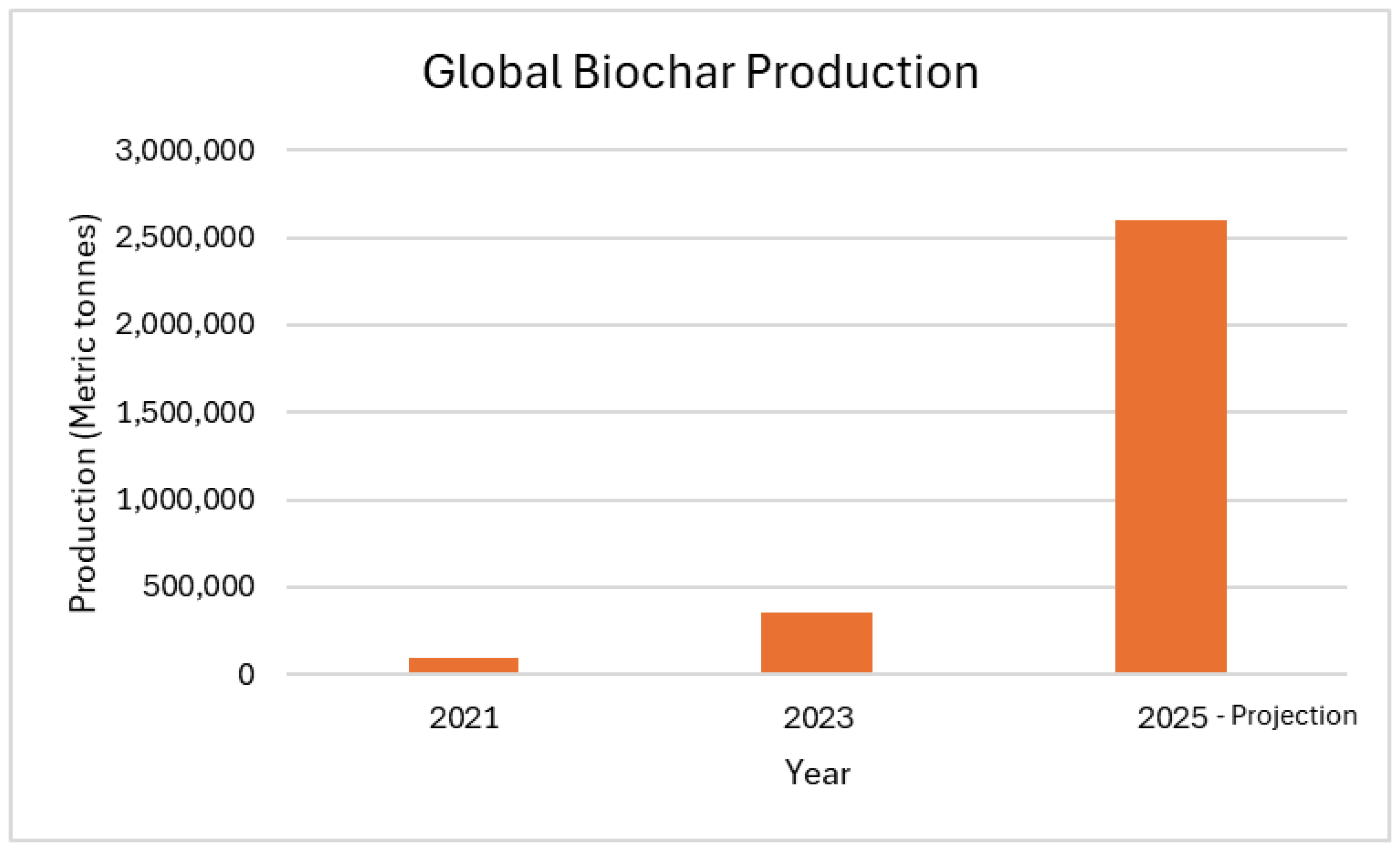
The properties of biochar primarily depend on the type of biomass used as feedstock and the technologies used in biochar production. The types of biomasses used for producing biochar are highly diverse, including agricultural byproducts, forestry waste, animal manure, and urban solid waste. According to the previous research, agricultural and forestry byproducts are the most common and conventional sources of biochar, e.g., the residues of corn, wheat, rice, barley, sorghum, soybean, rapeseed, olive, oil palm, sunflower, cherry, coconut, cassava, sugarcane, and coffee [,]. Currently, biochar is mostly used in agriculture (soil amendment, crop enhancement, livestock feed) and soil and water remediation. In the construction industry, most research focuses on replacing cement in a mortar or in concrete, while there are few studies related to bitumen modification []. The International Biochar Initiative and The US Biochar Initiative [], highlighted the rapid growth of the biochar market from 2021 to 2023. According to the report, global biochar production reached nearly 352,304 Metric tons in 2023, representing 91% annual growth compared to 2021. Further, the report projects production could rise to approximately 2.6 million tons by 2025. The agriculture-crops industry uses 70% of the global biochar, while the concrete industry uses only 5% for the purpose of cement and bitumen modification. Figure 1 illustrates global biochar production, with projections for 2025.
Figure 1. Global Biochar Production [].
According to [], the most common feedstock for biochar production is agricultural waste, including crop residues such as rice straw, wheat straw, and corn stover. The most common disposal methods for these residues, which are left behind after harvesting or open burning, can contribute to air pollution, greenhouse gas emissions, and groundwater contamination []. Hence, converting the residues into a usable mode is not only a solution for the issues arising, but also a resourceful product with multiple applications. For instance, nearly 90% of countries worldwide produce rice, and approximately 500 million tons of rice are produced per year. Furthermore, there is a challenging situation with the decomposition of rice husk due to its high content of silica. Additionally, the quantity of rice straw produced after harvesting is approximately 800–1000 million per year []. Zhou et al. [] conducted research on the performance evaluation of bitumen modified with biochar produced from rice straw and revealed that the biochar has a fibrous and porous structure with a complex surface texture, which enhances extensive physicochemical interactions with bitumen. However, the higher pyrolysis temperature and increased nitrogen flow convert a greater proportion of rice straw into gases and liquids, and the final bioproduction is smaller in quantity. Fruit and food processing waste are another significant type of waste that include fruit peels, nut shells, and coffee grounds, which have caught the attention of researchers for biochar production []. For instance, Yegane et al. [] investigate the performance of bitumen modified using biochar obtained from cherry wastes using the slow pyrolysis method, motivated by the fact that cherry production, the sour cherry and sweet cherry, increased by 2.7% and 4.6%, reaching approximately 217,000 tons per year and 721,000 tons/year, respectively. The researchers revealed that the obtained biochar has a porous and rough texture that enhances the interconnection between bitumen and biochar, and the experimental results show that the viscosity of modified bitumen significantly increases at high temperature and improves the rutting resistance after short-term aging. Another research related to food processing waste has been conducted by Kumar et al. [] to evaluate the performance of biochar modified by Mesua ferrea seed cover as a sustainable asphalt modifier. The seed cover is a waste during the process of oil extraction. Further, the seed cover can also be used to produce biooil by pyrolysis, and biochar is a byproduct of this process.
The researchers demonstrated that the addition of biochar leads to improved resistance to permanent deformation, rutting, and aging. Furthermore, coconut shell and coconut husk are other types of waste that have a non-disposable method. In most cases, coconut shells are either dumped or burned, which causes significant waste of green energy and environmental pollution. In 2019, the world’s top coconut-producing countries reported 96.16 billion nuts during the 2020–2021 period []. Hence, a sustainable method for coconut waste management is crucial. Previous research has confirmed that biochar produced from coconut shells and husks contains favorable characteristics, demonstrating valuable potential for various industrial and environmental applications []. Other agricultural waste, including Brazil-nut “hedgehog” biomass [], sugarcane bagasse, tomato waste, and groundnut shells [], switchgrass [], late-harvest grass [], and factory tea waste fibers [], has also been used to produce biochar.
Another major biochar feedstock type is forestry waste, including waste timber, and woody bamboos. Currently, the major utilization for wood waste is either as fuel or compost for the soil. However, besides those uses, a considerable amount of wood waste is disposed of through uncontrolled incineration, which could lead to major environmental problems []. Hence, identifying more sustainable options for this waste is vital, such as producing biochar, a kind of organic product rich in carbon that can be used for soil improvement and other industrial uses. Ref [] conducted research exploring the use of biochar produced from wood waste to improve the viscoelastic properties, rutting resistance, and fatigue resistance of bitumen. The biochar obtained from wood waste has a rough surface and more pores with a large specific area, which can make a strong bond with bitumen and improve the rutting resistance and elastic property. The biochar contains various minerals such as N, P, S, Ca, Fe, and Al. Mousavi et al. [] investigate the ability of biochar to absorb volatile organic compound (VOC), which is identified as a significant contributor to air pollution. The research has been obtained using acacia wood, which contains a high amount of Fe, Ca, and Al, and research indicated that the biochar derived from acacia wood is a promising modifier that is able to reduce VOC emissions from asphalt surfaces and improve the service life of flexible pavements. The growing emphasis on sustainable construction and circular economy principles has made biochar derived from agricultural and forestry waste an attractive material for enhancing the quality of bitumen binders. Its unique chemical composition and physical characteristics show strong potential for improving asphalt performance and promoting sustainability in pavement construction [].
In the field of agriculture, livestock manure is considered a valuable fertilizer based on the nutrients it contains. Furthermore, for the cattle and livestock industry, disposing of manure is a challenge due to the release of high-risk pathogens and air pollution. Related research has shown that animal manure is contributing to a significant increase in the percentage of methane (CH4) and nitrous oxide (N2O) globally. The advancement of technology focused on converting manure into a high-performance product and producing biochar is a practical solution to current challenges. Earlier research findings indicate that cow dung-based biochar has good porosity and an ideal surface area [,]. Similarly, urban waste disposal also contributes to the increase in landfill burden and greenhouse gas emissions. The approach of covering urban waste with biochar offers significant environmental benefits and produces a product of higher value. Ref [] conducted a study using biochar derived from household waste, including animal cud and paper scraps, and found that the biochar tends to enhance soil fertility, influencing its chemical properties. In the rapid pace of urbanization, untreated sewage sludge is one of the urban solid wastes that causes severe environmental health problems. Converting sewage sludge into biochar is an excellent solution for urban waste disposal, offering multiple uses, including soil amendment and an additive for construction materials. Studies show that biochar based on sewer sludge contributes to enhancing the temperature ability, aging resistance, and rutting resistance of asphalt mixtures. Also, it significantly improves the bitumen adhesion, water resistance, and durability of asphalt pavements []. Table 1 illustrates some of the different feedstocks and pyrolysis methods and temperatures that researchers employed in producing biochar.
Table 1. Biochar Feedstocks and Production Conditions Reported in the Literature.
Feedstock TypePyrolysis Method/TemperatureReference
Agricultural byproducts & forestry wasteRice strawFast pyrolysis, Tempertaure-400–600 °C[]
Crop straw biocharMuffle furnace −450 °C for 2 h[]
Cherry waste and Sour cherry waste Slow pyrolysis, 500 °C at a rate of 10 °C/min[]
Mesua ferrea seed cover waste450 °C, heating rate-40 °C/min[]
Brazil-nut hedgehog 600 °C (1 h)[]
Straw stalk (Commercial biochar DS-510F)Continuous augur pyrolysis at 450 °C under N2 atmosphere[]
Switchgrass Tube furnace method (400 °C or 500 °C)[]
Late-harvest grass (from periodically flooded polder areas, Germany)Partial oxidation, stalk based.[]
Coconut shellSlow pyrolysis (tube furnace, at 300–800 °C)[]
Factory tea waste fibersIndustrial reactors at 500–550 °C under oxygen-free conditions []
Acacia wood and silver grassFast pyrolysis at 500 °C[]
Animal manure and urban solid wasteCow dung (CD)Carbonization at 500 °C under N2, []
Chicken manure (CM)Slow pyrolysis at 550–600 °C for 24 h (dry pyrolysis, atmospheric pressure)[]
Slaughterhouse cud waste + paper waste (composite biochar)Slow pyrolysis; heating at 24 °C/min, max 167 °C (low-temperature pyrolysis)[]
Municipal sewage sludge Tube furnace pyrolysis[]

3.2. Biochar Production Methods and Conditions

Biochar emerges as an ecologically relevant, porous carbon material resulting from thermochemical conversion of biomass. The most common thermochemical conversion process is pyrolysis, which involves temperatures between 300 °C and 700 °C without or with a limited presence of oxygen []. Gasification process and hydrothermal carbonization (HTC) are other thermochemical technologies used in industry. There are various pyrolysis methods that vary in their operating conditions, including pyrolysis temperature, duration, heating rate, etc. Furthermore, there are different types of reactors used for pyrolysis, including fluidized bed, pyroformed reactors, fixed bed, tubular and holoclean rotary kiln [].
Slow, intermediate, fast, and flash are different pyrolysis methods used to produce biochar. Slow pyrolysis involves slow heating rates typically around 10–20 °C/min for a long duration, approximately 1 h, until the temperature reaches the final temperature between 300 and 400 °C. The biochar produced by slow pyrolysis is commonly used for soil improvement and carbon sequestration applications. In contrast to the slow pyrolysis, fast pyrolysis involves a heating rate typically greater than 10 °C/s for shortest duration for a final temperature between 400 and 800 °C. The biooil production is more successful with the fast pyrolysis method, and resultant biochar can be used in various applications [,,]. Gasification is another type of technology that requires a medium like steam, oxygen, air, or gas to react and convert biomass into syngas and biochar. The hydrothermal carbonization method is particularly used to convert biomass into hydrochar, under temperatures between 180 and 350 °C and 2–10 MPa pressure conditions, involving the presence of water [].
According to Tan et al. [], the high fixed carbon content biochar has more stability, leading to a longer shelf life. They found that the biochar obtained using slow pyrolysis has a fixed carbon content of 30% to 98.1%, and the fixed carbon content of the biochar obtained using fast pyrolysis is nearly 44.07%. Moreover, Zhou et al. [] conducted research to evaluate the effectiveness of pyrolysis parameters in biochar and biooil in the application of bitumen modification. The obtained results show that the purity of inorganic oxide in biochar increases with the temperature and N2 velocity during the process, also affecting the yield of carbon in biochar. The type of thermochemical conversion process and the type of feedstock with different characteristics have a notable influence on the physiochemical and structural properties of the biochar and might lead to various potential applications in different fields.

3.3. Physical, Chemical, and Structural Properties

The physical, chemical, and structural properties are the key parameters of the biochar in determining its impact and application. Table 2 illustrates the surface characterizations of different types of biochar obtained using Scanning Electron Microscopy (SEM). The analysis of each of the studies revealed that biochar consists of a fibrous, porous, rough surface with complex texture with high carbon content. Each type of biochar has its own unique features that depend on the feedstock, process, and conditions. During the biochar production process, the surface area and porosity of biochar change due to the decomposition of organic matter and the formation of micropores []. The physical properties of biochar, including surface area, porosity (macro and micro), hydrophobicity, bulk density, and particle density, are among the most important properties of biochar. The surface area and porosity became more vital factors in biochar as they are the key factors for determining their ability to absorb, retain water, nutrients, and contaminants. The surface area of the biochar is typically measured using the Brunauer–Emmett–Teller (BET) method, and the pore volume of the biochar is determined using nitrogen sorption. The pores in the biochar are categorized into three groups according to their internal dimension, named micropores, mesopores, and macropores. There is a clear correlation between the surface area and pore volume of the biochar []. The surface properties of the biochar change over time, and it is important to consider and understand the long-term stability when applying.
Previous studies have demonstrated that biochar exhibits significant variability in porosity and specific surface area, depending on the type of feedstock used and the production method employed. The study of Adeniyi et al. [] illustrated that biochar derived from elephant grass through gasification under 300 °C exhibited a highly porous and high specific surface area of 475.1 m2/g. Similarly, Chen et al. [] produced chicken manure biochar with a surface area of 678.46 m2/g and a pore volume of 0.18 cm3/g by performing slow and pyrolysis at temperatures between 550 and 600 °C, which confirms the influence of temperature for pore development. Furthermore, the study of Chen et al. [] achieved exceptionally high surface area and total pore volume by producing biochar through chemical activation of cow dung. The carbonization resulted in surface areas of up to 4081.1 m2/g and pore volumes of 3.0118 cm3/g. In contrast, the experimental study of Zhou et al. [] was conducted, producing biochar using rice straw under a laboratory-scale fluidized bed fast pyrolysis system at temperatures of 400 and 600 °C and obtaining a lower specific surface area, ranging from 4.568 to 8.863 m2/g, reflecting the limited microporosity of agricultural residues. The data of previous studies demonstrate that biochar porosity and surface area vary dramatically within a wide range, which are influenced by the feedstock type, pyrolysis temperature, and activation method.
Biochar is composed of four fundamental elements, including fixed carbon, volatile matter, ash content, and moisture content, with a low amount of nitrogen, sulfur, and other elements. The content of the carbon remaining after the volatile components are driven off is referred to as the fixed carbon []. Fixed carbon content of biochar impacts structural rigidity and long-term stability, which allows its use in high-temperature applications, including bitumen reinforcement []. The reactive properties of volatile matter depend on the ash content, which comprises minerals that potentially influence the behavior of bituminous materials. If biochar has high ash content, the carbon sequestration is potentially low, and it may contain potentially toxic elements, such as metals []. The reduction in moisture content requires controlled drying methods, which stabilize the physical attributes. A thorough understanding of these components is vital before incorporating biochar in bituminous binder systems []. The pH of the biochar is another significant property that should be considered when selecting the application of biochar. Typically, the pH value of the biochar varies between 4.6 and 9.3 [].
Table 2. Microstructural features of different types of biochar reported in the literature.
Feedstock TypeMicrostructural FeaturesReference
Rice strawFibrous, porous, hollow tubes, rough surface, and complex texture[]
Crop straw biocharOctahedron-like particles, some fibrous[]
Cherry waste and Sour cherry waste CW-Rough, microporous; particles 30–60 µm. SCW-Rough, microporous; particles 20–40 µm[]
Mesua ferrea seed cover wasteHighly Irregular, porous, rough texture []
Brazil-nut hedgehog Amorphous, uneven/rough compact surface with clusters and small fractures[]
Straw stalk (Commercial biochar DS-510F)Porous, fibrous, irregular/rough surface with high interfacial area[]
Switchgrass Irregular, fibrous, porous structure; more complex surface with high surface area.[]
Late-harvest grass (from periodically flooded polder areas, Germany)Well-developed pore network[]
Coconut shellPorous carbon structure[]
Waste wood biochar Porous, tubular/flake, rough []
Woody biomass by Prosopis Juliflora Porous structure with high carbon content[]
Cow dung (CD)Porous, fragmented, rough[]
Chicken manure (CM)Porous structure with high carbon content[]
Slaughterhouse cud waste + paper waste (composite biochar)Cud biochar- porous, alkaline, higher organic carbon and nitrogen retention. Paper biochar- less porous, lower nutrient retention[]
Municipal sewage sludge Sludge biochar—distinct crystalline phases, rough, porous particles.
Wood biochar—more amorphous, broad scattering peaks, less crystalline but with porous morphology
[]

4. Application of Biochar as an Additive and Bitumen Modifier

Numerous studies have explored the use of biochar in cementitious systems and asphalt components. The growing demand for biochar in construction material arises because of its favorable physical and chemical properties, including its high porosity, large surface area, and thermal resistance []. Biochar meets the essential criteria that make it applicable for performance-based applications, as well as for environmental and construction sustainability, serving as both an additive and a modifier. While the application of biochar in cement-based materials is well-established, its incorporation with bitumen and asphalt mixtures represents an active field of ongoing research. Bitumen refers to the bituminous binder itself, and the asphalt mixture represents the mixture consisting of aggregates, filler, and asphalt.
Modifiers and additives are used to enhance the performance of asphalt concrete []. The distinction between additives and modifiers relies on the nature and extent of interaction between the materials and the bitumen binder. An additive is typically added directly to the bitumen binder or mixture to enhance specific properties, such as adhesion, workability, and resistance to aging. The effect of the additive is mainly physical without altering the bitumen’s chemical structure. According to Porto et al. [], the term bitumen additive is used when materials are used in relatively small quantities as a filler to enhance the specific physical characteristics of bitumen without any chemical reaction. In contrast, a bitumen modifier is any material that interacts physically or chemically with the binder, which can alter the chemical structure of bitumen and change the rheological properties of bitumen []. A bitumen modifier is typically mixed with the binder first to produce modified bitumen.

4.1. Mechanisms of Bitumen Modification Using Biochar

Biochar’s ability to enhance bitumen performance is primarily attributed to three fundamental factors that integrate its surface characteristics with particle size and dispersion behavior within the binder system. Bitumen forms different bonds with biochar depending on its surface functional groups, which may either promote or block interaction between bitumen molecules. The size of biochar particles directly affects both the dispersion uniformity and the properties of the composite material. The mechanical performance and rheological behavior of the biochar blend remain stable when it shows proper distribution and a small particle size at different temperatures and loading levels []. Zhou et al. [,] investigated the crystallization kinetics of biochar-modified bitumen binder and found that biochar acts as the nucleating agent to enhance the crystallization, and the bitumen molecules have less space to move, hence decreasing the possibility of molecular movement.
The key physical characteristic of biochar is its expansive surface area structure, which enhances contact with bitumen material and promotes better dispersion within the bitumen. The open network framework structure of biochar creates stronger bonding within the binder and enhances interaction with components of bitumen, therefore strengthening aging and rutting resistance []. Due to its porous nature, biochar can absorb excess oil or rejuvenators, which contributes to maintaining binder balance and improving long-term durability. Biochar maintains its structural stability at elevated temperatures, which are typically controlled in hot mix asphalt (HMA) production, making it particularly suitable for asphalt production processes. Biochar exhibits adsorption behavior that enables it to capture hazardous volatiles or modifiers, thereby enhancing environmental performance in both the production and application processes. Biochar possesses desirable properties that allow it to function as a reinforcing agent, either as a binder modifier or as a functional asphalt filler-type additive [].
Recent studies have shown that the bonding between biochar and bitumen is closely linked to the surface characteristics of biochar. Zhang et al. [] found that the rough and porous surface of biochar increases the contact area with asphalt, leading to stronger adhesion and better resistance to rutting and aging. They also observed that smaller biochar particles, particularly those below 75 µm, blend more uniformly and create a denser biochar–bitumen network, improving deformation resistance and overall binder stability. Similarly, Zhang et al. [] highlighted that the porous structure and high surface activity of waste-wood-derived biochar facilitate its even dispersion in asphalt, resulting in a well-bonded structure that enhances viscoelastic properties and fatigue performance. More recently, Li et al. [] used atomic force microscopy and surface free energy analysis to show that biochar enhances the adhesive work of asphalt, balances micro- and macro-scale bonding, and improves resistance to moisture damage. Their findings showed that adding biochar increased the number of bee-like structures on the asphalt surface while making each of them smaller. This change helped create a more even distribution of adhesion across the surface by reducing the difference between bee-like and smooth regions, resulting in stronger and more uniform bonding throughout the asphalt bond. Together, these findings suggest that the porous texture, surface roughness, and chemical functionality of biochar play a crucial role in enhancing adhesion and cohesion in biochar-modified asphalt binders.
Biochar is primarily composed of carbon (C), hydrogen (H), nitrogen (N), and oxygen (O), along with trace minerals such as potassium, calcium, and magnesium. Its high carbon content contributes to its structural strength and enhances resistance to heat-induced degradation []. The surface of biochar contains functional groups rich in hydrogen and oxygen, which influence its chemical interactions with bitumen components. Additionally, the presence of trace elements enhances the binder’s catalytic and stabilizing properties within the system. Assessing the specific elemental composition of biochar is essential for understanding its interaction with bitumen and for predicting the chemical reactions and long-term structural stability of the composite material []. Biochar produced at a high temperature contains a higher fixed carbon content, which enhances its thermal stability and mechanical strength. Reducing the particle size of biochar enhances its dispersion within the bitumen matrix, while pH adjustment helps minimize undesirable chemical interactions with acidic or basic components. Optimizing these parameters together enables the production of biochar that performs more effectively as a reinforcing material in bituminous binders [].
Biochar can be used at the bitumen binder level and asphalt mixture level through two distinct approaches, called wet and dry processes, respectively. In the wet process, biochar is mixed directly with the bitumen binder, and biochar acts as a modifier or an additive. In the dry process, biochar is added directly to the asphalt mixture as an additive at the mixture stage.

4.2. Effects of Biochar on Bitumen Binder

Numerous researchers have developed new bitumen modification techniques, as conventional binders often fail to satisfy modern pavement performance requirements. Biochar waste is considered a promising modification method because it is carbon-rich waste obtained through the biomass pyrolysis process []. Incorporating biochar into bitumen enhances sustainability by recycling waste materials while simultaneously reducing fatigue and rutting distress in pavements []. This section delves into the effects of biochar on various properties of biochar-modified bitumen (BMB), including physical, rheological, aging, and durability characteristics.

4.2.1. Conventional Properties

The performance of bitumen in pavement construction largely depends on its composition, temperature sensitivity, and ability to withstand repeated traffic loading without deformation or cracking []. A combination of these qualities shapes bitumen behavior at different loading stages and during temperature variations and traffic effects. The assessment of bitumen performance depends heavily on four critical parameters, which include penetration value, softening point, ductility, and viscosity measurements. The penetration test is used to evaluate the hardness of the binder, while the softening point test measures its response to temperature variations. The stretching abilities without fracturing define ductility, and resistance to fluid flow is characterized by viscosity. Studies have shown that biochar increases the bitumen properties, indicating enhanced thermal stability and resistance to deformation.
Celauro et al. [] conducted a study using pyrolysis of birch and beech wood to examine the photo-oxidation resistance of biochar-modified bitumen. Biochar was incorporated into 50–70 penetration grade concrete at 2%, 4%, and 10% of biochar concentrations, and performance was evaluated before and after short-term aging and UV aging. The results show that the penetration values decreased with biochar content, indicating an increase in the rigidity of bitumen. Similarly, the softening values increased, respectively, suggesting an improvement in high-temperature stability. The trend remained after short-term aging and UV aging conditions, exhibiting a reduction in penetration value and an improvement in softening point values. The results demonstrate the ability of biochar to strengthen the bitumen and enhance thermal resistance. Correspondingly, Yegane et al. [] investigated the effect of biochar produced by cherry and sour cherry wastes on 50–70 penetration grade bitumen, and the results clearly show the decrease in the penetration values and increase in the softening point values. According to results, at the highest dosage of cherry waste, 17%, the penetration values reduced by 35% and the softening point increased by 7 °C compared to the conventional bitumen. Furthermore, the penetration index (PI) value increased from −3.23 to −2.45, which is closer to the value of sol-type and highly temperature-susceptible binders. The PI value is an important indicator that classifies the rheological behavior of the bitumen, and the PI < −2 indicates more temperature susceptibility []. Similarly, an investigation has been performed using commercially available straw stalk biochar, which has a surface area of 580 m2/g and carbon content 76% on 70 penetration grade bitumen. The results indicate a 36.5% penetration reduction and an increase in softening point, proving that biochar has the high-temperature properties of the bitumen. The SEM images of the modified sample demonstrate that biochar has fibrous morphology with high pore structure, resulting in a large specific surface area. Biochar interacts highly with the bitumen matrix, forming a skeleton structure and stiffening zone, which provides a better performance grade to the bitumen [].
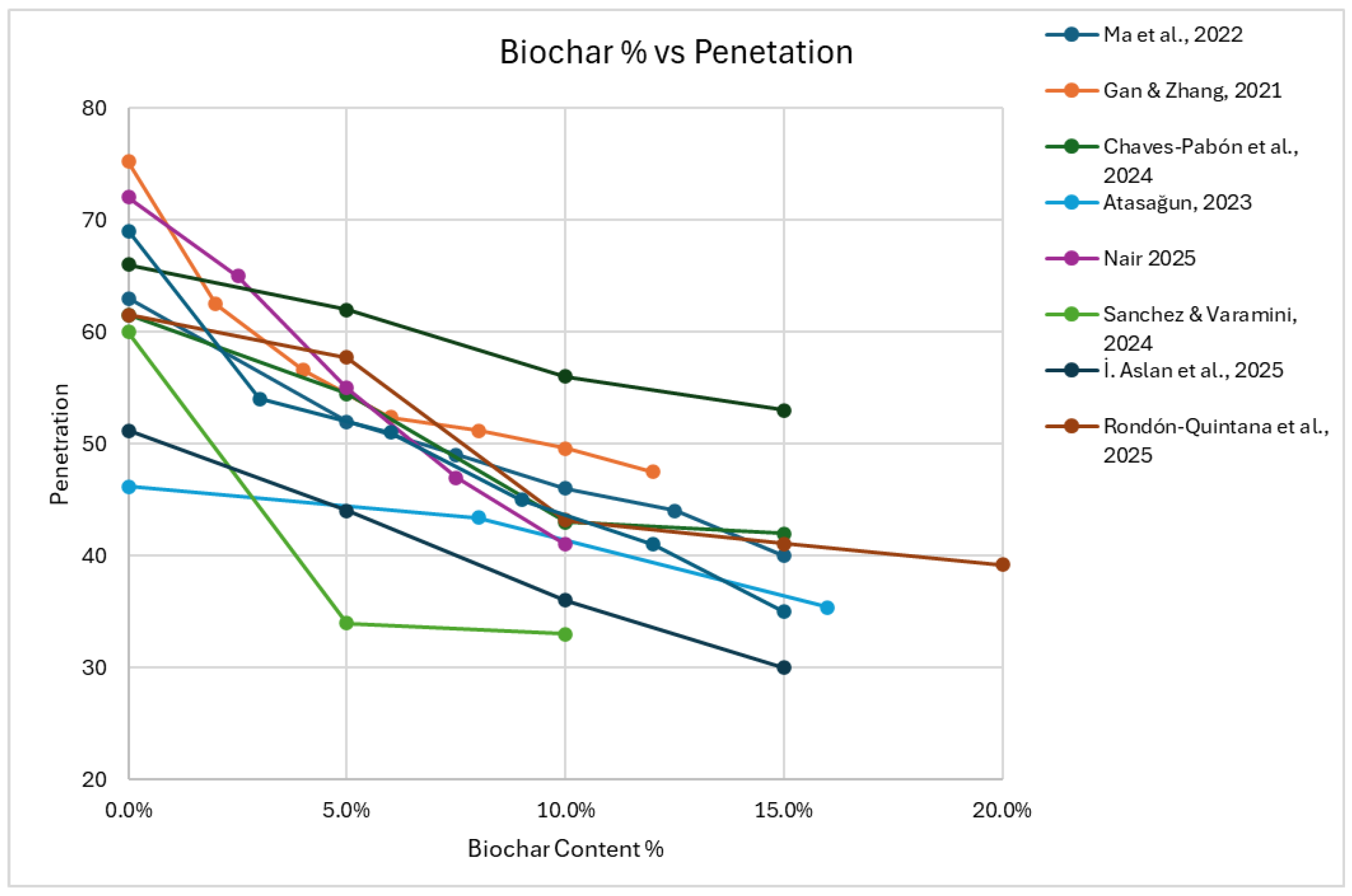
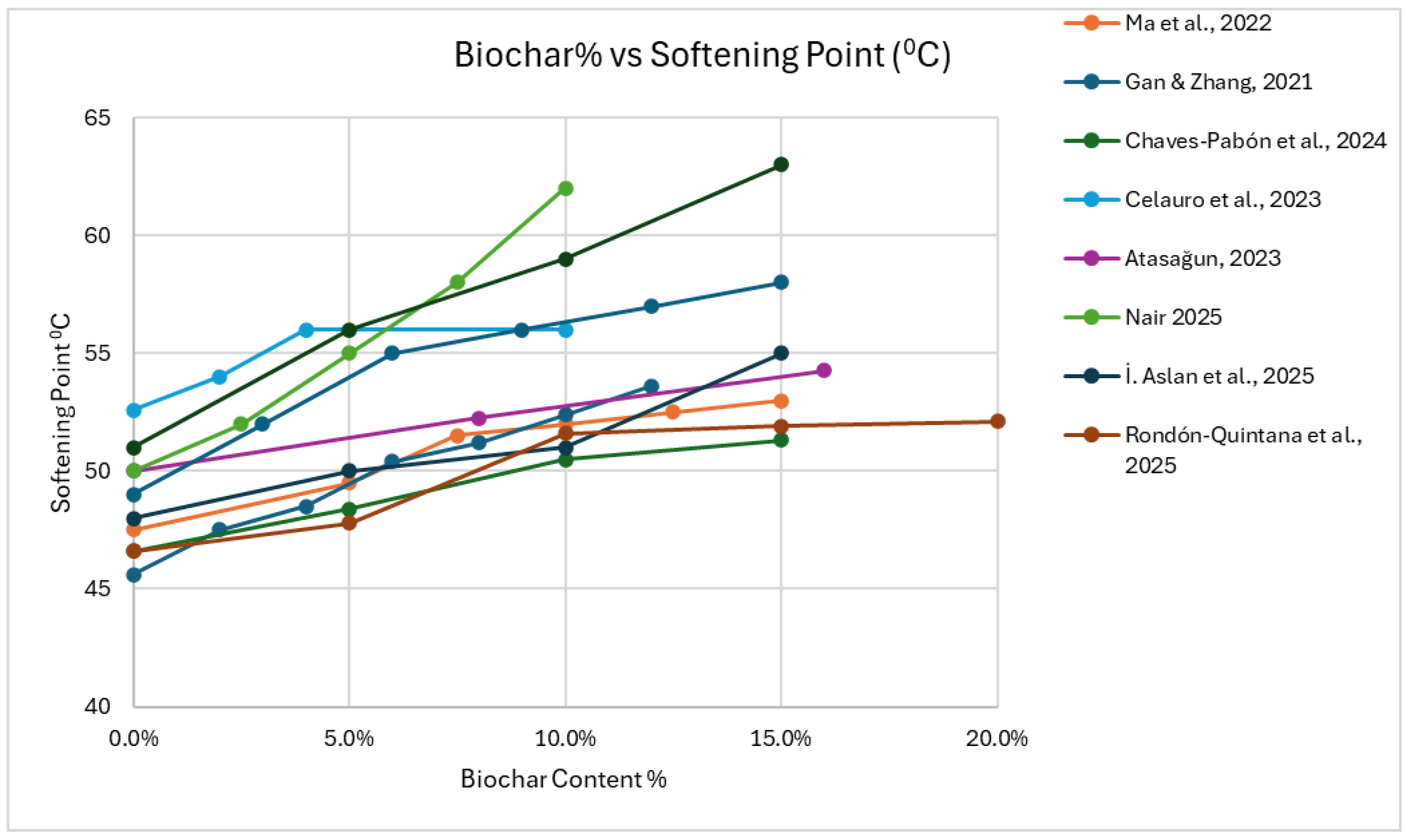
According to the literature, the chemical nature of the biochar, which is composed of C, H, N, and O, has the best compatibility with the bitumen matrix. The surface of the biochar contains some functional oxygen groups, such as carboxyl and hydroxyl, which enhance its protective capacity []. Hence, biochar interacts with bitumen due to its physical and chemical properties and stiffens the binder through skeletal structures and strong molecular bonding. The biochar fills the voids and reduces the molecular mobility and reduces the penetration value. The lower penetration value indicates the hardness of the binder and reduces rutting under heavy traffic and extreme weather conditions. Additionally, the built skeletal structure and molecular bonding reduced temperature sensitivity and delayed the transition of the binder from a semi-solid to a semi-liquid state, thereby raising the softening point that can withstand higher temperature conditions []. Similarly, several prior studies have obtained similar performance results for biochar-modified bitumen, regardless of the feedstock source, which enhances the softening point value and reduces the penetration value, recommending biochar-modified bitumen for use under hot climates and high-traffic conditions. Figure 2 and Figure 3 demonstrate the data collected from previous studies for penetration values and softening point vs. biochar percentage, demonstrating the consistent performance of biochar modification and proving the strong suitability for bitumen modification.
Figure 2. Variation in penetration performance of bitumen with increasing biochar content (summarized from previous studies) [,,,,,,,].
Figure 3. Variation in softening point of bitumen with increasing biochar content (summarized from previous studies [,,,,,,,].

4.2.2. Rheological Properties

In the literature, various biochar types obtained from different feedstocks have been used for bitumen modification under different conditions, revealing that biochar is a promising sustainable modifier of pavement performance. Biochar-modified bitumen has shown improved rheological properties, including viscosity, Elastic Modulus (Stiffness), Creep and Recovery, Stress Relaxation, Phase Angle (δ), and Complex Shear Modulus (G*). Ref [] conducted research on the rheological properties of biochar-modified bitumen, including the torsional viscosity (RV) test, the Dynamic Shear Rheometer (DSR) test, and the Bending Beam Rheometer (BBR) test. The RV test indicates that the viscosity of modified bitumen increased compared to the conventional binder. In addition, increasing percentage is becoming higher with the biochar content. The addition of biochar fills the voids and reduces the free movement of the particles, which increases stiffness and increases the elastic components. As a result of this, the viscosity of the bitumen binder increased. Furthermore, they evaluate the performance based on particle size, and the smaller particles of biochar exhibit greater viscosity. The quantity of particles in smaller-sized biochar is higher, and it leads to a higher surface area. Also, the biochar has a porous structure and combines the surface area and rough surface, leading to stronger adhesion with the binder, which reduces the fluidity while increasing the viscosity.
Rheological tests, such as Dynamic Shear Rheometer (DSR) and Bending Beam Rheometer (BBR) analyses, are essential for evaluating the performance of bitumen under various temperature and loading conditions. The G* indicates the complex modules of the binder, which means total stiffness, and on the other hand, resistance to deformation. Similarly, the phase angle (δ0) described the balance between viscous and elastic deformation. Rutting resistance is evaluated using the rutting parameter G*/sin δ, which provides higher rutting resistance with higher complex modules and lower phase angle []. Chen et al. [] investigated the influence of biochar produced by corn straw on bitumen binder and highlighted the performance enhancement of the modified binder. Generally, as temperature increases, G*/sin δ gradually decreases for all asphalt samples. Adding biochar also follows the same trend; however, the rutting factor shows higher values compared to the neat bitumen. Further, among the tested samples, the maximum content of 3% of biochar exhibits the best performance. The researchers undertook the fatigue factor analysis and the critical fatigue temperatures related to the biochar adding percentages of 0%, 1%, 2%, and 3% indicated as 17.8 °C, 21.3 °C, 21.4 °C, and 21.7 °C, respectively, illustrating the performance improvement related to the improvement in biochar addition. The rheological properties of biochar-modified bitumen are influenced by several factors, including feedstock type, pyrolysis temperature, biochar particle size, and the amount added. In order to evaluate those factors on rheological behavior, Martinez-Toledo et al. [] have undertaken a comprehensive assessment using Oat hulls biochar with the pyrolysis temperatures 300 °C and 500 °C, two types of particle size < 20 μm and <75 μm, and 2.5%, 5%, and 7.5% biochar contents. Accordingly, the pyrolysis temperature has a major influence on rutting and rotational viscosity parameter, and the biochar pyrolyzed at 300 °C showed strong performance proportional to the biochar content. The biochar with smaller particle size promoted better chemical interaction at 300 °C, and particle size < 75 μm shows improved performance at high pyrolysis temperature. Increasing the biochar content consistently raised the rutting, viscosity, and crack resistance. The study highlighted the synergistic effect of low pyrolysis temperature, finer particle size, and optimized biochar content for improved performance in terms of rutting resistance, workability, and aging resistance. Hence, it is evident that biochar-modified bitumen has shown improved rheological properties, including increased complex modulus and reduced phase angles, which correlate with enhanced resistance to rutting and fatigue cracking
Moreover, evaluating biochar’s impact on low-temperature performance is also significant. The BBR test (Bending Beam Rheometer) is conducted to evaluate the performance of the bitumen in cold temperatures. The creep compliance curve and creep stiffness curve are the basic curves used to evaluate the results, which indicate that the higher the creep compliance curve, the higher the flexibility at low temperature, which provides higher cracking resistance. Zhang et al. [] evaluated the low temperature cracking resistance of biochar-modified bitumen using the BBR test under −18 °C. The stiffness of biochar-modified bitumen is higher than that of conventional bitumen, and the higher content of biochar increases the stiffness proportionally. The study revealed that although all samples met the stiffness requirement (<300 MPa) of the Superpave specification, the m-value of higher biochar content does not satisfy the recommendation of greater than 0.3. Increasing the biochar content made the binder too stiff and brittle at low temperatures. Also, studies have shown that the small-sized biochar particles have better low-temperature rutting resistance due to the uniform distribution of small particles and better interaction. Xie et al. [] also revealed through their study that the biochar modifier made the binder stiffer and more brittle, which reduced the thermal cracking resistance. The previous literature provides variable effects of biochar modified at low temperature. Hence, the biochar can be recommended for the low-temperature regions; however, only up to a specific control content of the biochar.
Storage stability is another critical factor that existing research has focused on. Storage stability in bitumen can be defined as maintaining the homogeneity and consistency during the storage of the bitumen without segregation. During bitumen storage, the particles of bitumen cause sedimentation due to gravitational effects, and the precipitation of internal water can be identified as one of the main reasons for bitumen segregation. Meanwhile, storage temperature and time are the primary factors influencing stability []. When considering modified bitumen, storage ability is a vital factor that depends on the compatibility between the bitumen and the modifier. The modifier needs to remain uniform and it is a key factor for long-term performance. The storage ability can be evaluated using the delayed segregation test []. According to ASTM D7173 [], the delayed segregation test was conducted by measuring the softening point values of the top and bottom parts of the modified bitumen before and after 48 h of storage at 163 °C. Zhang et al. [] performed an experimental study on the storage ability of three types of biochar modifiers, including cottonseed, camelia seed shells, and coffee grounds, and revealed that the results of the delayed segregation test of the softening point difference in all three varieties of modified bitumen are lower than ±1 °C. Typically, for better compatibility, the differences between softening values need to be below 2.5 °C, which means the biochar-modified bitumen fulfills the requirement. Similarly, in the experiment carried out by Martinez-Toledo et al. [], the binder modified with biochar from oat hulls shows a satisfactory compatibility condition, which is lower than 2.5 °C. The study explained two reasons for the results, including the low density of the biochar particles, which is due to their porous structure, and the strong chemical interaction between biochar and bitumen.
Table 3 illustrates the summary of outcomes of the rheological factor evaluation of previous studies using biochar as a modifier. Accordingly, biochar modification enhances the performance of rheological factors of the bitumen, including viscosity, rutting resistance, stiffness, and fatigue performance at high and intermediate temperatures. However, the particle size, biochar content, and type of biomass influence the performance in various ways and careful evaluation is critical, as the performance enhancement is happening only up to a certain degree, for example, the higher dosage of biochar may increase the stiffness and reduce the flexibility. The majority of biochar types tend to decrease the low-temperature performance, indicating higher stiffness values and lower m values, but a few studies suggested that, based on optimization of the biochar content and particle size, the low-temperature performance can be increased to some extent.
Table 3. Summary of Rheological Properties with Biochar Modification.
ReferenceBiochar FeedstockRheological Factor EvaluatedMeasurement Method (Test and Conditions)Major Outcomes
[]Industrial hemp stalk biocharStiffness of bitumen binder at low temperaturesBending Beam Rheometer (BBR) test (−6 and −12 °C temperatures)
  • Biochar increased creep stiffness, making the binder more brittle.
  • 5% of biochar met S (stiffness) but narrowly missed at −12 °C.
Rotational viscosityRotational viscometer (RV) test
  • The increase in biochar content has resulted in increased viscosity values
Fatigue parameter DSR (PAV-aged) at 25–31 °C
  • At 25 °C G*·sinδ increased (lower fatigue resistance)
  • At 28–31 °C, some biochar types showed decreased G*·sinδ (fatigue resistance improved).
  • Bitumen modified with 5–10% biochar obtained through slow cooling exhibits higher fatigue resistance
Permanent deformation (rutting resistance) MSCR–JnrdiffMultiple Stress Creep Recovery (MSCR)
  • Modified sample exhibits more elastic behavior
  • Lowest Jnr·(high rutting resistance)observed 14% for binder 300R5
[]Household wasteHigh-temperature PG/G*/sinδ (rutting resistance)DSR (Dynamic Shear Rheometer)
  • The highest rutting resistance increment,59% at 70 °C, was obtained by using 16% of char.
  • PG increased from PG64 to PG 70
Rotational Viscosity Rotational Viscosity (RV) Test
  • Char-modified binders did not exceed 3000 cp, suitable for workability,
  • Highest viscosity obtained at 16% of additives
Storage stability Tube segregation: Δ softening (top-bottom), Δ penetration
  • Char-modified binder exhibited small segregation indices; 8% is recommended.
[]Corn straw biocharLow-temperature performanceBending Beam Rheometer (BBR) test (−12, −18 and −24 °C temperatures)
  • Biochar decreased m values and increased s values, a negative effect on low-temperature performance
  • At −24 °C, none of the samples met limits.
Rutting factor (|G*|/sin δ) and G*·sinδ critical fatigue temperatureDSR (Dynamic Shear Rheometer)
  • Three percent of biochar exhibits the best high-temperature performance.
  • Biochar enhances fatigue resistance at medium temperatures.
[]Crop straw biocharDuctility (15 °C)Conventional ductility at 15 °C
  • Ductility decreased with increasing biochar content.
Rotational viscosity/construction temperaturesRotational Viscosity (RV) Test
  • Six percent of biochar is recommended.
  • Recommended mixing (161–166 °C) and compaction (152–156 °C) temperatures were determined.
[]Mesua ferrea seed cover biochar Fatigue parameter, Rutting resistance DSR and MSCR test
  • Improved rutting resistance at high service temperature
  • Failure temperature for fatigue parameter increased with 20% biochar.
  • Biochar decreased the aging susceptibility
High critical temperature (PG)DSR; PG grading
  • With the increase in biochar, the performance grade increases from PG 70 to PG 76.
Rotational viscosity (135 °C)Brookfield viscosity at 135 °C
  • Viscosity increased with biochar content.
[]Straw stalkLow-temperature propertiesBending Beam Rheometer (BBR) test (−12 °C))
  • Result indicates that biochar reduces the low-temperature anti-cracking of the binder.
High critical temperature DSR
  • Critical temperature increased with biochar content. The increase in biochar content from 5% to 15%, the critical temperature rose by 3.91%.
  • Shows better rutting resistance
[]Oat hulls biocharLow-temperature PerformanceBending Beam Rheometer (BBR) test (−6/−12 °C, PAV)
  • At −6 °C, no significant differences; at −12 °C, some higher S and m at higher biochar contents, but still acceptable.
Rutting resistanceDSR; G*/sin(δ)
  • Biochar positively affects the rutting resistance of bitumen binders
Fatigue parameterDSR; G*·sin δ
  • Adding 2.5% biochar improved fatigue resistance, while 5–7.5% of biochar has an unfavorable effect on fatigue resistance
Storage abilityStorage stability test
  • Biochar-modified samples show good storage stability, the difference between upper and lower points is less than 2.5 °C
[]Prosopis juliflora (woody biomass) biocharDuctilityDuctility test
  • Declined steadily with biochar; 10% biochar caused a 42% reduction
Storage StabilityStorage stability test (Difference in softening point)
  • The difference is below 3 °C, which can be acceptable, but only up to 10% of biochar.
Rotational ViscosityRotational viscosity
  • Increased with biochar; 10% biochar raised mixing temperature by 7% and compaction temperature by 8% compared to base binder
Failure Temperature/Rutting Factor (G*/sin δ)Binder grading test
  • Failure temperature increased; G*/sinδ increased, showing better resistance to rutting.
[]Cherry waste (CW) and sour cherry (SCW)Rutting parameterDSR
  • Both biochar materials increased the Complex modulus G* with the addition of percentage, enhancing the rutting resistance.
Fatigue parametersLAS or DSR fatigue analysis
  • SCW modification enhances fatigue performance and provides better resistance to stress variation
Elastic recovery, Creep recoveryMSCR
  • Elastic recovery slightly decreased overall in the study, by around 1.15 and 1.06 times for CW and SCW, respectively.
Penetration Index (PI)Calculated from penetration and softening point
  • PI increased from −3.23 to −2.45 with biochar, suggesting sol to sol–gel behavior
Rotational viscosityBrookfield rotational viscosity at 135 °C and 165 °C
  • Viscosity increased by 2.40 (CW) and 2.59 (SCW) vs. the base binder.
[]Waste wood–based biocharLow-temperature propertiesBBR—S and m at −18 °C (PAV-aged)
  • Low-temperature properties decreased with the increase in biochar content
  • Biochar with sizes less than 75 μm and about 4% content shows better low-temperature crack resistance
Rutting resistance High critical temperatureDSR; high critical temperature per Superpave
  • Biochar size less than 75 and 4% content increases the rutting and anti-aging property.
[]Cotton seed (CO), camellia seed shell (CA), coffee ground (CG) biocharLow-temperature propertiesBBR—S and m (−12/−18/−24 °C)
  • At −12 °C, all the modified bitumen samples passed the results; at −18 °C, only coffee ground biochar shows failed S = 360 MPa; but at −24 °C, none of the modified bitumen samples met the standard.
Storage stabilityConventional storage stability tube test
  • Biochar-modified bitumen showed better storage stability than SBS and rubber modified at the same content.
  • Six percent biochar content recommended.

4.2.3. Aging Resistance

Aging of bitumen leads to increased stiffness and brittleness, adversely affecting pavement performance. The aging of bitumen occurs due to the chemical transformation it undergoes because of variations in its physical characteristics. There are two different aging processes: short-term aging, which occurs during mixing, hauling, paving, and compacting, and long-term aging, which affects the bitumen during the entire service life of the bitumen []. Recently, many studies have focused on evaluating the biochar-modified anti-aging effect. Celauro et al. [] demonstrated that biochar-modified bitumen exhibited reduced carbonyl and hydroxyl group formation upon UV irradiation, indicating enhanced resistance to photo-oxidative aging. Additionally, biochar’s role in reducing the aging index and viscosity ratio further underscores its effectiveness in enhancing the durability of bitumen binders. Studies have shown that biochar incorporation leads to lower aging indices and viscosity ratios, suggesting improved resistance to both short-term and long-term aging processes. Recent research by Zhou et al. [] further confirmed that biochar improves the aging resistance of asphalt by stabilizing its chemical structure under different aging conditions. The study showed that biochar reduces the formation of oxidation-related groups such as carbonyl and sulfoxide during both UV and pressure aging, while promoting the presence of stable alkyl groups that slow down oxidative degradation. Moreover, biochar was found to adsorb light components like saturates and aromatics, reducing their loss during aging and maintaining binder balance. Similarly, the study by Rajib et al. [] focused on evaluating the effect of biochar made using algae and swine manure on bitumen aging. The rheological aging index, activation aging index, and chemical aging index were calculated after exposing the sample to UV radiation. The results show improvements of 45%, 61%, and 36% in rheology, activation, and chemical aging indexes, respectively, suggesting an improvement in anti-aging properties.
When comparing the mass loss of the biochar-modified bitumen and base bitumen after the aging process, the mass change indicates the aging process. The mass loss is caused by volatization of light components, and the mass gain is caused by oxidation. Dong et al. [] highlighted that biochar-modified bitumen exhibits anti-aging performance. However, biochar improves the aging resistance mainly by slowing oxidation rather than reducing evaporation. Zhou et al. [] investigated the chemical changes and phase separation of biochar-modified bitumen under different aging conditions, including short-term aging, ultraviolet aging, pressure aging vessel, and low-temperature aging. The study revealed that biochar plays a significant role in improving the high-temperature performance of bitumen, and by producing aromatic and aliphatic components, it improves the oxidation resistance and enhances the resistance to PAV aging. Furthermore, a study has been conducted by Celauro and Teresi [], comparing the UV aging resistance of biochar and SBS modified bitumen, and revealed that biochar-modified bitumen demonstrates a positive anti-aging effect, although it is lower than the performance of SBS modification. For certain applications, biochar can be considered a cost-effective modifier.

4.3. Effects of Biochar on Asphalt Mixture

An asphalt mixture consists of two main components, the bitumen binder and aggregates. The properties and proportions of these components primarily influence the performance of the mixture. Involving additives like biochar improves the asphalt mixture’s performance, including resistance to rutting, moisture, and cracking, as well as its mechanical properties (stability, flow, and Marshall quotient) under varying temperatures and heavy traffic conditions.

4.3.1. Rutting and High-Temperature Resistance

The previous studies consistently acquired the improvement in the high-temperature performance of biochar modification. The study by Owolabi [] investigated the effect of biochar in an asphalt mixture with the Dynamic modulus test, which is an important performance test that measures the stiffness of the mixture under different conditions, the flow number test, which measures the rutting resistance, and the crack-related performance tests which measure the fracture energy (FE) and flexibility index (FI). The tests were carried out under short-term and long-term aging conditions, and samples were tested under different temperature conditions and loading frequencies. The results show that adding biochar enhances the workability of the mixture by reducing the compaction effort. Furthermore, the biochar with slow pyrolysis improves the rutting and fatigue cracking resistance of the mixture, while the biochar with fast pyrolysis performed poorly. In addition, the study suggests that biochar makes the mixture hold less fractured energy, but more flexible after moisture conditions []. The four-point bending tests and Huet–Sayegh rheological modeling were undertaken to evaluate the performance of biochar produced from Brazil-nut husk in asphalt mixture and the modified samples indicated the greater stability at higher temperature compared to the control mix []. The Marshal test results of the study of Chaves-Pabón et al. [] show higher stability(S) and stability/flow (S/f) ratio for biochar-modified HMA, which can be considered an indicator for showing higher rutting resistance and resistance to higher temperatures, recommending its use in areas where elevated temperature and climate prevail. Zhao et al. [] evaluated the performance of the biochar-modified asphalt mixture, and results showed that the addition of additives increases the complex shear modulus (G*). Additionally, results showed that the resilient modulus (MR), when enhanced, can serve as an indirect indicator of rutting resistance. The asphalt pavement analyzer (APA) results indicated that the rut depth of the mixture significantly reduced by up to 10% of biochar. Similarly, the review by Yaro et al. [] outlined that incorporation of biochar significantly enhances the rutting and high-temperature performance of asphalt binders and mixtures due to its porous structure, large surface area, and high carbon content. Biochar particles, typically finer than 75 µm, were found to increase binder stiffness and complex modulus, thereby reducing permanent deformation at elevated temperatures. The studies demonstrated that biochar effectively enhanced the binder’s viscosity and softening point, leading to improved rutting resistance. The reinforcing and adsorption properties of biochar promote a stiffer and more stable mastic network, which restricts flow under load and improves resistance to deformation at high temperatures, making it a promising sustainable additive.

4.3.2. Cracking and Fatigue Resistance

Cracking is one of the main issues in HMA pavement. Researchers have employed different solutions to mitigate the cracking and fatigue of the payment, and the biochar addition demonstrates a positive influence on cracking and fatigue resistance. The physical characteristics of biochar, including amorphous geometry and its rough and porous surface, contribute to strengthening the bitumen microstructure and increasing the cohesion of HMA. The fatigue test conducted by Chaves-Pabón et al. [] to evaluate the performance of pine wood shaving biochar in HMA demonstrated an increased number of cycles to failure compared to the control mixture, showing higher fatigue resistance. Furthermore, the Semi-circular Bending (SCB) test, which is based on fractured mechanical principles of the material, was undertaken by Saadeh et al. [] with swine manure biochar. The results were evaluated using Jc (critical strain energy release rate), and a higher Jc suggests stronger resistance to cracking. The results showed that mixtures with swine manure biochar retained higher strain energy after aging than controlled mixtures, indicating improved crack resistance. However, according to the study of Aslan et al. [], the results of the ITS showed 6.4% lower average tensile strength of biochar-modified asphalt mixture than the unmodified mixture. The tensile strength directly shows the ability to resist tensile stress, and the biochar-modified mixture shows low-temperature cracking resistance compared to the control. Correspondingly, the asphalt mixture containing cold-bonded biochar-rich lightweight aggregates also showed low mechanical strength compared to the control mixture and exhibited decreasing cracking and rutting resistance, linearly, with the modified aggregate. The marginal addition of biochar enhances the cracking and rutting resistance []. Therefore, identifying the optimal biochar content leads to benefits in achieving sustainability goals.

4.3.3. Moisture Susceptibility and Workability

Moisture damage is another cause of asphalt deterioration, and previous studies revealed that biochar improves water resistance. In a biochar-modified asphalt mixture, the adhesion between binder and aggregate is higher, and it reduces the moisture susceptibility in the asphalt mixture. In the study of Chaves-Pabón et al. [], the Tensile Strength ratio (TSR) was obtained to determine the resistance to water damage, and the results exhibit the higher resistance to moisture damage. Furthermore, modified Lottman tests on mixtures with fine biochar produced by microwave pyrolysis showed that at 8% biochar, TSR values improved compared to unmodified mixes, and compaction effort was significantly reduced, highlighting the improvement in workability []. Increasing the binder content improves the VFA (voids filled with asphalt binder) and decreases the air space. It was noted that adding 3% and 4% biochar (rice straw) content increases the VFA noticeably and enhances durability and moisture resistance. Furthermore, adding biochar 0–3.5% showed significant improvement in the water resistance in the asphalt mixture, which enhances the ability to withstand damage after water interference [].
Further, it has been reported that biochar improves the aging resistance of the asphalt mix, providing a sustainable solution for one of the significant challenges currently faced by the pavement industry. The study by Saadeh et al. [] confirms that a mixture containing biochar (swine manure) improves the fracture energy of the mixture after aging, as well as a beneficial effect on cracking resistance post-aging.
Biochar has been reported to improve resistance to aging effects. SCB tests confirmed that mixtures containing swine manure biochar retained higher fracture energy after aging compared to control mixtures []. Hence, previous studies revealed that biochar consistently enhances the rutting resistance, cracking resistance, fatigue, high temperature resistance, moisture durability, and aging resistance of asphalt mixture. Table 4 summarizes previous research on the modification of asphalt mixtures with biochar. However, some of the literature highlights that a higher proportion of biochar content leads to a reduction in the performance of the asphalt mixture, hence determining that the optimum content is crucial.
Table 4. Summary of previous research on the modification of asphalt mixtures with biochar.
ReferenceBiochar Feedstock TypeTests ConductedResults
[]Factory tea wasteIndirect tensile strength (ITS), modified Lottman, load creep test
  • The biochar-modified mixture shows low-temperature cracking resistance compared to the control.
  • Biochar-modified mixture shows high water damage resistance, increased viscosity, hardness and rutting resistance.
[]Biochar from swine manure conversion Semi-circular Bend (SCB) test
  • Biochar addition improved fracture energy after aging, indicating a beneficial effect on cracking resistance post-aging.
[] Rice strawThe modified Lottman test, indirect tensile strength ratio test (ITSR), binder fundamental properties tests, Marshall parameters, water resistance, RSM modeling, and leaching assessment
  • Optimal binder 4.56% and biochar-based geopolymer composite (BGC) 2.71%.
  • BGC improved moisture resistance, water damage resistance, stiffness, and temperature sensitivity; no harmful chemicals leached out.
[]Brazil-nut hedgehog biomassFour-point bending, Huet–Sayegh rheological modeling
  • Dynamic modulus decreases with temperature and increases with frequency
  • Biochar produced a greater high-temperature stability of the asphalt mixture.
[]Pine wood shavings Conventional tests, SEM, Marshall, indirect tensile strength/TSR, Cantabro, resilient modulus, permanent deformation (rutting), and fatigue resistance
  • BC-PWS tended to enhance monotonic load, rutting, fatigue, moisture damage, and raveling without increasing asphalt content or mixing/compaction temperatures.
[]Biochar from landscape conservation and gardening of wood waste. Marshall test, semi-circular bending (SCB) test, Uniaxial cyclic compression test, indirect tensile strength test
  • Cracking and rutting resistance decreased almost in parallel with increasing biochar.
  • Direct biochar addition had a similar adverse influence.
  • Net-zero emissions were estimated at around 5.5% or nearly 3% biochar by mass of mixture.
[] Coconut shell, rice straw, nutshellStatic leachate test of biochar, pavement infiltration tests, and Water quality test
  • Biochar contains N and P; coconut shell showed the most obvious nutrient leaching.
  • When biochar is used as filler in a porous asphalt mixture, leaching decreases, but the purification effect.
  • As 3–5 mm rice straw filter layer, TSS removal reached 100% but increased N/P leaching.
[]Slow pyrolysis of white birch, fast pyrolysis of poplar bark.Dynamic modulus (short/long-term aged), flow number (rutting), fracture energy, and flexibility index (before/after moisture conditioning)
  • Biochar improved workability and cracking resistance; limited effect on rutting resistance and aging susceptibility.
  • Shows flexibility after moisture conditions.
[]Fine biochar passing 75 µmModified Lottman moisture susceptibility; compaction/workability observations
  • Theoretical maximum specific gravity decreased with more biochar.
  • Improved workability during compaction.
  • Tensile Strength Ratio (TSR) improved with biochar.

5. Environmental Considerations

Beyond mechanical properties, biochar-modified bitumen offers environmental benefits. The incorporation of biochar, especially from waste biomass, contributes to the sustainability of asphalt production by reducing reliance on petroleum-based products and promoting the recycling of agricultural residues. Furthermore, biochar’s porous structure can absorb pollutants, potentially reducing the environmental impact of road runoff. Integrating unaged bitumen binders with biochar waste materials offers two key advantages: enhanced performance and improved environmental sustainability. The reuse of biomass waste enables the substitution of virgin raw materials while also decreasing greenhouse gas emissions from construction activities. Biochar plays a role in capturing carbon from the atmosphere, thereby offsetting greenhouse gas emissions associated with infrastructure-based production. Biochar shows promise to transition into commonplace use for creating high-performance, environmentally friendly asphalt pavements through continued research and development [].
Studies have highlighted biochar’s capacity to adsorb volatile organic compounds (VOCs) and heavy metals, enhancing the environmental performance of asphalt pavements. VOC is not only an environmental hazard but also a severe threat to the health and safety of humans. The studies revealed that biochar can adsorb the C15H30, C16H32, C19H40, and C21H44, which are compounds of VOC, and biochar can reduce a significant amount of VOC emission, depending on the biochar type [].

5.1. Waste Valorization and Carbon Sequestration

Waste valorization is at the very heart of the biochar proposition. Biochar in bitumen represents a sustainable approach in the circular economy, converting residues into biochar and utilizing it as a modifier or additive for asphalt mixture. The previous studies are evidence that the approach not only enhances the mechanical and rheological performance of flexible pavement but also mitigates environmental impacts by mitigating waste and sequestering carbon. Grossegger et al. [], exploring the carbon sequestration potential of asphalt base course mixtures incorporating novel cold-bonded, biochar-rich, lightweight aggregates, estimate net-zero greenhouse gas emissions when using 5.5 ± 0.4% biochar lightweight aggregates (by aggregate mass) or 3.0 ± 0.2% directly added biochar (from landscape wood pyrolysis), in effect, turning asphalt into a carbon sink []. However, they also report almost linear decreases in cracking and rutting resistance with increasing additions, indicating that sequestration benefits may come at the expense of mechanical performance, confining applications to lower-demand layers unless design modifications compensate for these losses. Synthesizing these strands, Zhou [] concludes that biochar combines carbon management with infrastructure delivery but advocates standardized characterization to ensure predictable performance and bankable carbon outcomes. The study of Kumar et al. [] confirms that biochar contains a high amount of stable carbon due to its fixed carbon composition and aromatic structure, which resists decomposition and oxidation. These characteristics enable biochar to store carbon for an extended period, making it an effective tool for reducing atmospheric CO2 levels. The thermogravimetric analysis (TGA) results in the study show that biochar remains thermally stable at elevated temperatures, demonstrating its ability to retain carbon even under harsh environmental conditions. The slow degradation of biochar means that once it is incorporated into soil or asphalt materials, a large portion of its carbon can remain locked for decades or even centuries. This stability not only contributes to carbon sequestration but also helps offset emissions produced during conventional pavement production and construction processes.
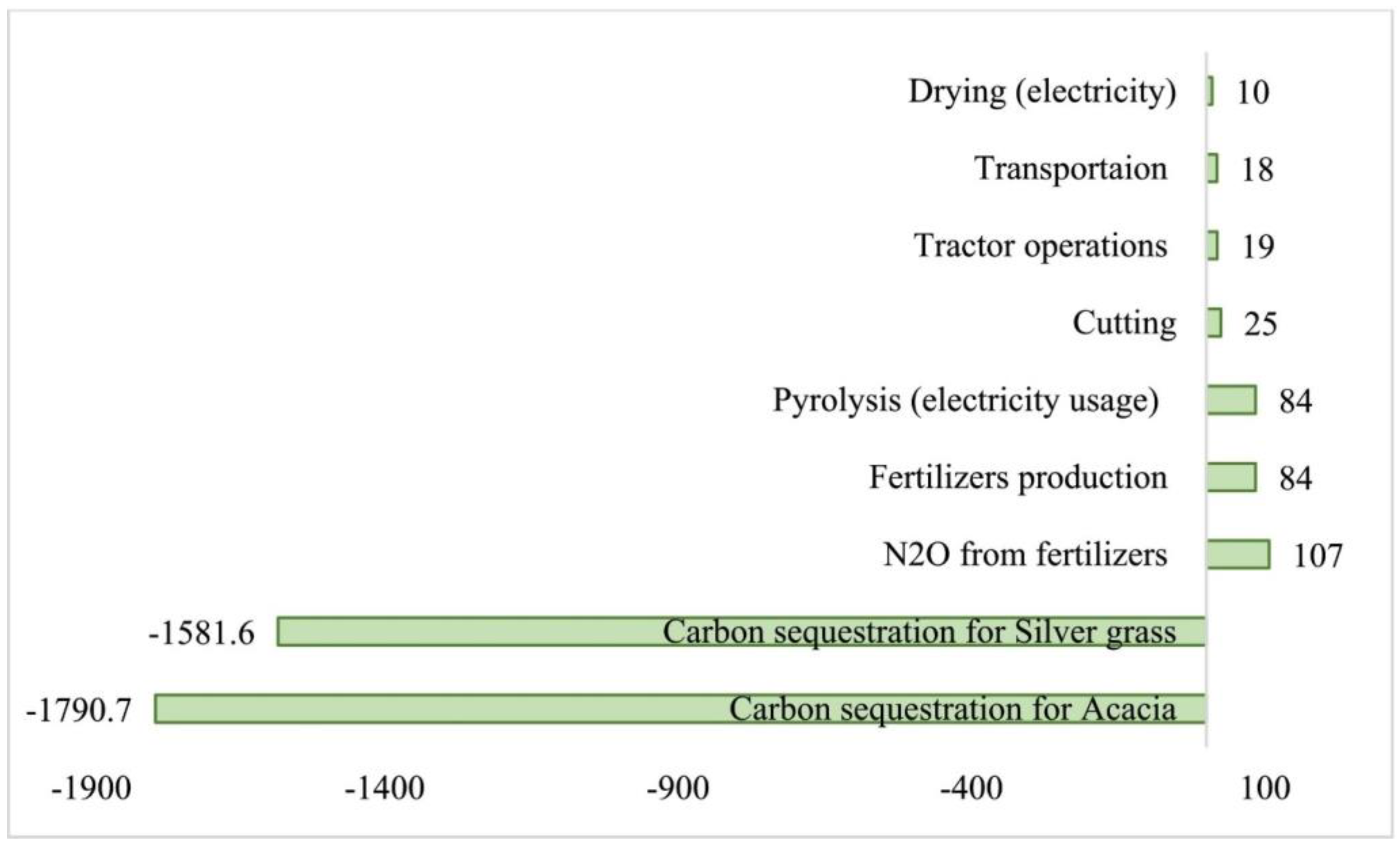
The carbon of biochar comes from the carbon that the plant initially absorbed during photosynthesis. During the biochar process, there is a CO2 emission. To find the net CO2 benefit, the total CO2 emission should be subtracted from the CO2 absorbed by the plant []. Figure 4 shows the carbon footprint analysis of processes throughout the life cycles of acacia biochar and silver grass biochar. As per the figure, the carbon emission for the process of producing biochar, including drying, transportation, pyrolysis, and other factors, is approximately 350 kg CO2/ton. The negative value represents the carbon sequestration, fixed carbon content of the silver grass and Acasia biochar, which is −1581.6 kg CO2/ton and −1790.7 kg CO2/ton. The negative value represents the quantity of CO2 absorbed by the plant in its lifetime and locked in biochar.
Figure 4. Carbon footprint analysis of processes throughout the life cycles of acacia biochar and silver grass biochar []. Reprinted with permission from Elsevier, License Number 6111700276948.

5.2. Life Cycle Assessment (LCA) Findings

Life cycle assessment evidence justifies environmental benefits and identifies sensitive hotspots. Samieadel et al. [] compared a 10% bio-binder (made from swine manure hydrothermal liquefaction) with neat bitumen on a cradle-to-gate basis. They found a 7.8% improvement in the Global Warming Potential Index (GWPI) for the bio-modified binder, more than 50% reduction in mixing/compaction energy to maintain workability, and significant reductions in CO2 and CH4 emissions: manure diversion from lagoon storage to bio-binder production reduced GWPI for the comparison scenario by more than 80%. In addition, Zhou [] and Zhou et al. [] investigated Greenhouse Gases (GHGs) reduced with biochar/bio-oil loadings, energy, and emissions controlled by material preparation (especially pyrolysis). Biochar can suppress volatile organic compound (VOC) emissions, while feedstocks (waste wood vs. pig manure) control all compounds. Furthermore, when calculating the energy demand and environmental emissions of the biochar-modified bitumen asphalt (BMBA) plant during transportation, it was established that biochar-modified asphalt uses less energy and generates less pollution than petroleum-based asphalt and emulsified asphalt. The energy consumption of biochar-modified asphalt is only 25% that of conventional asphalt, signifying the use of BMBA in asphalt pavement []. Finally, LCA needs to be considered in combination with performance-emission co-optimization: Grossegger et al. [] demonstrate net-zero feasibility except for at mechanical penalties at the needed additions, highlighting that boundary conditions (layer function, dosage, and biochar form) crucially define real-life-cycle sustainability.

6. Challenges and Future Perspectives

Across the literature, biochar provides a route to pavement from waste, but with non-trivial performance and cost trade-offs. According to a synthesis by [], biochar integration can reduce emissions (including VOCs for metal-rich feedstock) and support carbon-neutral goals, but also highlights heterogeneity by feedstock, pyrolysis, and the lack of standardization that make economic deployment and comparability of results complex. Often, biochar stiffens binders and improves rutting resistance at high temperatures, but the improvement in rutting resistance at low temperatures or fatigue is not consistent. Zhao et al. [] observed large rutting benefits with minimal fatigue change with finer particles (<75 μm) at lower treatment temperatures, having implications for mixture design costs and risks. A review of the literature Wani and Garg [], Environment, Development and Sustainability, also describes laboratory-scale strength improvement and viscosity changes, but points out the lack of full-scale testing and benefits dependent upon particle size and temperature history, both with implications for procurement and processing costs []. On the other hand, as highlighted by Zhou’s [] review, environmental benefits are promising, but economic viability depends on the local supply chains of feedstock, processing routes, and performance guarantees [].
Future studies should focus on optimizing biochar production and application strategies for bitumen reinforcement, including refining production methods, improving testing procedures, and conducting large-scale field trials to validate laboratory findings. The lack of long-term performance monitoring still makes it difficult to achieve a comprehensive understanding of the durability and reliability of biochar-modified asphalt under real-world traffic and environmental conditions. Future work should also emphasize practical, field-based investigations to confirm both the environmental and economic sustainability of biochar use in pavement construction. Moreover, current studies often apply different testing conditions, temperatures, and sample preparation methods, which makes it challenging to compare results across the literature. Developing standardized testing protocols would help ensure consistency, improve comparability, and support the wider adoption of biochar-modified asphalt in flexible pavement applications [].
To address the drawbacks, such as low-temperature performance, future studies should focus on hybrid modification strategies, including the combination of biochar with polymers and determining the optimal addition content, which can achieve both high- and low-temperature resistance. Further, when economically considered, Singhal [] stated that findings of the previous literature reveal that large-scale, cost-neutral, and economically sustainable biochar production can be achieved, with profit when the excess electricity and power generated are supplied to nearby stations; hence, it is recommended that policymakers and industry stakeholders focus on the large-scale biochar production system. However, other practical factors should also be considered, including feedstock availability, processing technology, product quality, and integration of infrastructure. There is a limited number of studies addressing the cost analysis of biochar in bitumen modification. It is recommended to focus on a detailed cost analysis, including the cost for biochar production, transportation, modification plant operation [,], energy balance and recovery, etc.
It is also recommended to conduct long-term life cycle assessments to evaluate the net reduction in greenhouse gas emissions, assess the potential release of contaminants, and examine the leaching behavior of metal-rich biochar types, thereby confirming the overall contribution of biochar-modified pavements toward carbon-neutral and sustainable infrastructure goals.

7. Conclusions

Based on the reviewed literature, the most common feedstocks for biochar production are agricultural and forestry byproducts, which are the primary sources of biochar. The global production and valorization of biochar also show rapid growth. The review provided a comprehensive overview of the utilization of biochar in the pavement industry, highlighting the performance potential, sustainability benefits, main strengths, and drawbacks.
The performance of biochar-modified binders primarily depends on their high fixed carbon content, surface area, and porous microstructure, which together promote strong interactions with bitumen. These characteristics enhance the performance of softening point, viscosity, and resistance to rutting, aging, and fatigue. Furthermore, particle size and surface chemistry play a crucial role in controlling dispersion and bonding. Although it is not possible to establish a common optimum content and conditions, most studies have found that fine powders (≤75 µm) have optimal biochar content ranges between 2.5% and 10% by weight, which balances stiffness, flexibility, and workability, varying according to the feedstock type and pyrolysis method. Low-temperature performance requires a high concentration of biochar content; however, increasing the biochar content makes the binder too stiff and brittle. Nevertheless, it can only be recommended for low-temperature regions up to a controlled content.
In asphalt mixtures, biochar generally improves high-temperature stability, rutting and fatigue resistance, and moisture sensitivity. Modified or activated biochar can mitigate stiffness issues. However, its low-temperature response varies depending on the feedstock and processing method.
Furthermore, studies have highlighted biochar’s capacity to adsorb volatile organic compounds (VOCs) and heavy metals, thereby contributing to long-term carbon sequestration and enhancing the environmental performance of asphalt pavements
Overall, by optimizing particle size, production temperature, and dosage, biochar can be tailored to meet specific performance requirements. It represents not only a green additive but also an engineerable material, connecting sustainable resource management with durable pavement design, which provides a clear pathway toward low-carbon, circular, and resilient asphalt infrastructure.

Author Contributions

Conceptualization, C.D. and N.S.M.; methodology, C.D. and N.S.M.; validation, C.D. and N.S.M.; investigation, C.D. and N.S.M.; resources, C.D. and N.S.M.; data curation, C.D. and N.S.M.; writing—original draft preparation, C.D. and N.S.M.; writing—review and editing, C.D. and N.S.M.; visualization, C.D. and N.S.M.; supervision, N.S.M.; funding acquisition, N.S.M. All authors have read and agreed to the published version of the manuscript.

Funding

This research received no external funding.

Institutional Review Board Statement

Not applicable.

Data Availability Statement

The data used for the study are included in the manuscript.

Acknowledgments

Guidance and support received from the School of Engineering at Edith Cowan University are highly acknowledged.

Conflicts of Interest

The authors declare no conflicts of interest.

References

  1. Ma, F.; Dai, J.; Fu, Z.; Li, C.; Wen, Y.; Jia, M.; Wang, Y.; Shi, K. Biochar for asphalt modification: A case of high-temperature properties improvement. Sci. Total Environ. 2022, 804, 150194. [Google Scholar] [CrossRef]
  2. Zhang, R.; Dai, Q.; You, Z.; Wang, H.; Peng, C. Rheological Performance of Bio-Char Modified Asphalt with Different Particle Sizes. Appl. Sci. 2018, 8, 1665. [Google Scholar] [CrossRef]
  3. Wani, I.; Garg, A. Critical review on use of biochar as a modifier in asphaltic binders for pavement construction. Environ. Dev. Sustain. 2024, 1–22. [Google Scholar] [CrossRef]
  4. Tiza, T.M.; Mogbo, O.; Singh, S.K.; Shaik, N.; Shettar, M.P. Bituminous pavement sustainability improvement strategies. Energy Nexus 2022, 6, 100065. [Google Scholar] [CrossRef]
  5. Celauro, C.; Teresi, R.; Dintcheva, N.T. Evaluation of Anti-Aging Effect in Biochar-Modified Bitumen. Sustainability 2023, 15, 10583. [Google Scholar] [CrossRef]
  6. Rahman, M.T.; Mohajerani, A.; Giustozzi, F. Recycling of Waste Materials for Asphalt Concrete and Bitumen: A Review. Materials 2020, 13, 1495. [Google Scholar] [CrossRef] [PubMed]
  7. Walters, R.; Begum, S.A.; Fini, E.H.; Abu-Lebdeh, T.M. Investigating Bio-Char as Flow Modifier and Water Treatment Agent for Sustainable Pavement Design. Am. J. Eng. Appl. Sci. 2015, 8, 138–146. [Google Scholar] [CrossRef]
  8. Saadeh, S.; Al-Zubi, Y.; Katawal, P.; Zaatarah, B.; Fini, E. Biochar effects on the performance of conventional and rubberized HMA. Road Mater. Pavement Des. 2023, 24, 156–172. [Google Scholar] [CrossRef]
  9. Kumar, A.; Choudhary, R.; Narzari, R.; Kataki, R.; Shukla, S.K.; Chailleux, E. Evaluation of bio-asphalt binders modified with biochar: A pyrolysis by-product of Mesua ferrea seed cover waste. Cogent Eng. 2018, 5, 1548534. [Google Scholar] [CrossRef]
  10. Bindar, Y.; Budhi, Y.W.; Hernowo, P.; Wahyu, S.; Saquib, S.; Setiadi, T. Sustainable technologies for biochar production. In Current Developments in Biotechnology and Bioengineering; Elsevier: Amsterdam, The Netherlands, 2023; pp. 1–40. [Google Scholar]
  11. Li, H.; Wang, L.; Zhang, Y.; Yang, J.; Tsang, D.C.W.; Mechtcherine, V. Biochar for sustainable construction industry. In Current Developments in Biotechnology and Bioengineering; Elsevier: Amsterdam, The Netherlands, 2023; pp. 63–95. [Google Scholar]
  12. Rondón-Quintana, H.A.; Reyes-Lizcano, F.A.; Chaves-Pabón, S.B.; Bastidas-Martínez, J.G.; Zafra-Mejía, C.A. Use of Biochar in Asphalts: Review. Sustainability 2022, 14, 4745. [Google Scholar] [CrossRef]
  13. The International Biochar Initiative and The US Biochar Initiative. Global Biochar Market Report 2023. 2024. Available online: https://biochar-international.org/ (accessed on 27 August 2025).
  14. Zhou, L. A Review of Biomass-Derived Biochar and Its Potential in Asphalt Pavement Engineering. Mater. Sci.-Pol. 2024, 42, 81–99. [Google Scholar] [CrossRef]
  15. Zhou, J.; Dong, Z.; Yu, Y.; Sun, Z.; Zhou, T.; Chen, Z. Utilization of biochar derived from rice straw in petroleum bitumen: Agricultural waste recycling and pavement sustainability. J. Clean. Prod. 2025, 490, 144808. [Google Scholar] [CrossRef]
  16. Yegane, M.; Katanalp, B.Y.; Ahmedzade, P. Effects of using biochar materials obtained from cherry and sour cherry wastes on bitumen modification. Constr. Build. Mater. 2025, 489, 140609. [Google Scholar] [CrossRef]
  17. Narmadha, N.; Karunakaran, K.R. Growth Performance of Coconut Production in Global Scenario: A Quin-decadal Analysis. J. Exp. Agric. Int. 2022, 44, 7–15. [Google Scholar] [CrossRef]
  18. Ajien, A.; Idris, J.; Md Sofwan, N.; Husen, R.; Seli, H. Coconut shell and husk biochar: A review of production and activation technology, economic, financial aspect and application. Waste Manag. Res. 2023, 41, 37–51. [Google Scholar] [CrossRef] [PubMed]
  19. Torres, A.P.; de Araújo, R.O.; de Souza Falcão, N.P.; de Castro, C.E.N.; da Frota, C.A. Asphalt mixtures modified by amazonian biochar. Int. J. Adv. Eng. Technol. 2024, 17, 120–132. [Google Scholar]
  20. Zhao, S.; Huang, B.; Ye, X.P.; Shu, X.; Jia, X. Utilizing bio-char as a bio-modifier for asphalt cement: A sustainable application of bio-fuel by-product. Fuel 2014, 133, 52–62. [Google Scholar] [CrossRef]
  21. Heinrich, T.; Park, H.; Orozco, R.; Ding, Z.; Álvarez-López, V.; Mosquera-Losada, M.R.; Steinbeis, L.; Hoffmann, T. Biochar production from late-harvest grass—Challenges and potential for farm-scale implementation. Sustain. Prod. Consum. 2023, 37, 256–267. [Google Scholar] [CrossRef]
  22. Aslan, M.; Kutuk-Sert, T.; İskender, E.; Aksoy, A.; İskender, C. Investigation of Biochar Additive as a Performance Enhancer in Asphalt Coatings. In Proceedings of the 4th International Conference on Advanced Engineering Technologies, Bayburt, Turkey, 28–30 September 2022. [Google Scholar]
  23. Zhang, R.; Wang, H.; Ji, J.; Wang, H. Viscoelastic Properties, Rutting Resistance, and Fatigue Resistance of Waste Wood-Based Biochar-Modified Asphalt. Coatings 2022, 12, 89. [Google Scholar] [CrossRef]
  24. Mousavi, M.; Park, K.-B.; Kim, J.-S.; Fini, E.H. Metal-rich biochar as an asphalt modifier to improve sustainability and reduce VOC emissions. Sustain. Mater. Technol. 2024, 40, e00903. [Google Scholar] [CrossRef]
  25. Nair, R.K.; Bandyopadhyay, A.; Sunitha, V. Rheological and Mechanical Behaviour of Biochar-Modified Bitumen Under High-Temperature Conditions. Int. J. Pavement Res. Technol. 2025, 1–17. [Google Scholar] [CrossRef]
  26. Chen, X.; Yu, G.; Chen, Y.; Tang, S.; Su, Y. Cow Dung-Based Biochar Materials Prepared via Mixed Base and Its Application in the Removal of Organic Pollutants. Int. J. Mol. Sci. 2022, 23, 94. [Google Scholar] [CrossRef]
  27. Chen, H.; Awasthi, S.K.; Liu, T.; Duan, Y.; Ren, X.; Zhang, Z.; Pandey, A.; Awasthi, M.K. Effects of microbial culture and chicken manure biochar on compost maturity and greenhouse gas emissions during chicken manure composting. J. Hazard. Mater. 2020, 389, 121908. [Google Scholar] [CrossRef]
  28. Nega, T.; Yeshanew, E.S.; Nallamothu, R.B.; Aswossie, E. Enhancing soil fertility through Biochar using slaughter-house waste as a feedstock. Sci. Rep. 2025, 15, 11109. [Google Scholar] [CrossRef]
  29. Li, Q.; Xu, L.; Chen, X.; Li, W.; Li, Y.; Wang, H.; Liu, K. Study on the Adhesion Performance of Biochar-Modified Asphalt Based on Surface Free Energy and Atomic Force Microscopy. Coatings 2024, 14, 1390. [Google Scholar] [CrossRef]
  30. Gan, X.; Zhang, W. Application of biochar from crop straw in asphalt modification. PLoS ONE 2021, 16, e0247390. [Google Scholar] [CrossRef]
  31. Tan, H.; Lee, C.T.; Ong, P.Y.; Wong, K.Y.; Bong, C.P.C.; Li, C.; Gao, Y. A Review on the Comparison Between Slow Pyrolysis and Fast Pyrolysis on The Quality of Lignocellulosic and Lignin-Based Biochar. IOP Conf. Ser. Mater. Sci. Eng. 2021, 1051, 012075. [Google Scholar] [CrossRef]
  32. Zhou, X.; Moghaddam, T.B.; Chen, M.; Wu, S.; Zhang, Y.; Zhang, X.; Adhikari, S.; Zhang, X. Effects of pyrolysis parameters on physicochemical properties of biochar and bio-oil and application in asphalt. Sci. Total Environ. 2021, 780, 146448. [Google Scholar] [CrossRef]
  33. Tomczyk, A.; Sokołowska, Z.; Boguta, P. Biochar physicochemical properties: Pyrolysis temperature and feedstock kind effects. Rev. Environ. Sci. Bio/Technol. 2020, 19, 191–215. [Google Scholar] [CrossRef]
  34. Weber, K.; Quicker, P. Properties of biochar. Fuel 2018, 217, 240–261. [Google Scholar] [CrossRef]
  35. Adeniyi, A.G.; Ighalo, J.O.; Onifade, D.V. Production of biochar from elephant grass (Pernisetum purpureum) using an updraft biomass gasifier with retort heating. Biofuels 2019, 12, 1283–1290. [Google Scholar] [CrossRef]
  36. Dong, W.; Ma, F.; Li, C.; Fu, Z.; Huang, Y.; Liu, J. Evaluation of Anti-Aging Performance of Biochar Modified Asphalt Binder. Coatings 2020, 10, 1037. [Google Scholar] [CrossRef]
  37. Maniraj, J.; Ramesh, M.; Kumar, S.G.; Sahayaraj, A.F. Introduction of Biochar: Sources, Composition, and Recent Updates. In Biochar and Its Composites; Materials Horizons: From Nature to Nanomaterials; Springer Nature: Singapore, 2023; pp. 1–17. [Google Scholar]
  38. Owolabi, O.O. The Effect of Biochar in Asphalt Mixture; The University of New Brunswick: Fredericton, NB, Canada, 2019. [Google Scholar]
  39. Daly, W.H. Relationship Between Chemical Makeup of Binders and Engineering Performance; The National Academies of Sciences, Engineering, and Medicine: Washington, DC, USA, 2017. [Google Scholar]
  40. Honarmand, M.; Tanzadeh, J.; Beiranvand, M. Bitumen and Its Modifier for Use in Pavement Engineering. In Sustainable Construction and Building Materials; Hemeda, S., Ed.; IntechOpen: London, UK, 2019. [Google Scholar]
  41. Yaro, N.S.A.; Sutanto, M.H.; Habib, N.Z.; Usman, A.; Kaura, J.M.; Murana, A.A.; Birniwa, A.H.; Jagaba, A.H. A Comprehensive Review of Biochar Utilization for Low-Carbon Flexible Asphalt Pavements. Sustainability 2023, 15, 6729. [Google Scholar] [CrossRef]
  42. Kua, H.W. Biochar as building and road materials. In Biochar for Environmental Management; Routledge: London, UK, 2024; pp. 719–733. [Google Scholar]
  43. Loise, V.; Calandra, P.; Policicchio, A.; Madeo, L.; Oliviero Rossi, C.; Porto, M.; Abe, A.; Agostino, R.G.; Caputo, P. The efficiency of bio-char as bitumen modifier. Heliyon 2024, 10, e23192. [Google Scholar] [CrossRef]
  44. Chaves-Pabón, S.B.; Rondón-Quintana, H.A.; Bastidas-Martínez, J.G. Mechanical Performance Assessment of a Hot-Mix Asphalt Modified with Biochar Obtained from Pine Wood Shavings. Coatings 2024, 14, 1212. [Google Scholar] [CrossRef]
  45. Atasağun, N. High-Temperature Rheological Properties and Storage Stability of Bitumen Modified with the Char Produced from Co-Pyrolysis of Different Wastes. Sustainability 2023, 15, 8119. [Google Scholar] [CrossRef]
  46. Aslan, I.; Tasdemir, F.; Tasdemir, Y. Utilization of biochar derived from industrial hemp stalks with various cooling methods for asphalt binder modification. PLoS ONE 2025, 20, e0325943. [Google Scholar] [CrossRef] [PubMed]
  47. Sanchez, X.; Varamini, S. Effect of Biochar Type in the Performance of Biochar-Modified Binder. Rev. Ing. Construcción 2024, 39, 1–9. [Google Scholar] [CrossRef]
  48. Rondón-Quintana, H.A.; Romero-Patiño, N.E.; Bastidas-Martínez, J.G. Performance Properties of a Hot-Mix Asphalt Modified with Oil Palm Kernel Shell–Based Biochar for Road Pavements. J. Transp. Eng. Part B Pavements 2025, 151, 05024003. [Google Scholar] [CrossRef]
  49. Chen, X.; Cheng, P.; Li, Y.; Wang, H.; Zheng, C.; Ma, R.; Nian, T.; Wang, M. Application of corn straw biochar in pavement asphalt: Suppression of hazardous fume emissions and maintenance of rheological properties. Constr. Build. Mater. 2025, 481, 141635. [Google Scholar] [CrossRef]
  50. Martinez-Toledo, C.; Valdes-Vidal, G.; Calabi-Floody, A.; Gonzalez, M.E.; Reyes-Ortiz, O. Evaluation of Rheological Properties of Asphalt Binder Modified with Biochar from Oat Hulls. Materials 2024, 17, 4312. [Google Scholar] [CrossRef]
  51. Xie, J.; Zhou, Y.; Huang, H.; Jiang, Y.; Liu, L. Effect of biochar-clay mineral composites on rubber modified asphalt: Performance optimization and high-temperature emission suppression. Constr. Build. Mater. 2025, 492, 142942. [Google Scholar] [CrossRef]
  52. Liu, B.; Hou, W. Influence of storage conditions on the stability of asphalt emulsion. Pet. Sci. Technol. 2017, 35, 1217–1223. [Google Scholar] [CrossRef]
  53. Zhang, X.; Zhou, Y.; Xue, Y. Biochars from Cotton Seed, Camelia Seed Shell, and Coffee Ground in Modification of Asphalt: Fundamental Properties, Rheological Performance, and Inhibition of VOC Emissions. Materials 2025, 18, 1504. [Google Scholar] [CrossRef]
  54. ASTM D7173-20; Standard Practice for Determining the Separation Tendency of Polymer from Polymer-Modified Asphalt. ASTM International: West Conshohocken, PA, USA, 2024.
  55. Prosperi, E.; Bocci, E. A Review on Bitumen Aging and Rejuvenation Chemistry: Processes, Materials and Analyses. Sustainability 2021, 13, 6523. [Google Scholar] [CrossRef]
  56. Zhou, X.; Zhao, G.; Wu, S.; Tighe, S.; Pickel, D.; Chen, M.; Adhikari, S.; Gao, Y. Effects of biochar on the chemical changes and phase separation of bio-asphalt under different aging conditions. J. Clean. Prod. 2020, 263, 121532. [Google Scholar] [CrossRef]
  57. Rajib, A.; Saadeh, S.; Katawal, P.; Mobasher, B.; Fini, E.H. Enhancing Biomass Value Chain by Utilizing Biochar as A Free Radical Scavenger to Delay Ultraviolet Aging of Bituminous Composites Used in Outdoor Construction. Resour. Conserv. Recycl. 2021, 168, 105302. [Google Scholar] [CrossRef]
  58. Zhou, X.; Moghaddam, T.B.; Chen, M.; Wu, S.; Adhikari, S. Biochar removes volatile organic compounds generated from asphalt. Sci. Total Environ. 2020, 745, 141096. [Google Scholar] [CrossRef] [PubMed]
  59. Celauro, C.; Teresi, R. UV Aging Resistance of Modified Bitumen: Comparison of SBS and Biochar. In Proceedings of the Proceedings of the 10th International Conference on Maintenance and Rehabilitation of Pavements, Guimarães, Portugal, 24–26 July 2024; pp. 13–21. [Google Scholar]
  60. Zhao, S.; Huang, B.; Shu, X.; Ye, P. Laboratory Investigation of Biochar-Modified Asphalt Mixture. Transp. Res. Rec. J. Transp. Res. Board 2014, 2445, 56–63. [Google Scholar] [CrossRef]
  61. Grossegger, D.; Wyrzykowski, M.; Toropovs, N.; Lura, P. Exploring the carbon sequestration of an asphalt base course mixture containing novel cold-bonded biochar-rich lightweight aggregates. Mater. Struct. 2025, 58, 1–17. [Google Scholar] [CrossRef]
  62. Sanchez, X.; Somers, T.; Dhasmana, H.; Owolabi, O. Effect of biochar on the basic characteristics of asphalt mixtures. In Advances in Materials and Pavement Performance Prediction II; CRC Press: Boca Raton, FL, USA, 2020; pp. 343–346. [Google Scholar]
  63. Yaro, N.S.A.; Sutanto, M.H.; Habib, N.Z.; Usman, A.; Tanjung, L.E.; Aliyu, I.; Jagaba, A.H. Optimizing biochar-based geopolymer composites for enhanced water resistance in asphalt mixes: An experimental, microstructural, and multi-objective analysis. J. Eng. Appl. Sci. 2023, 70, 151. [Google Scholar] [CrossRef]
  64. Saadeh, S.; Alzubi, Y.; Zaatarah, B.; Fini, E.H.; Katawal, P. Performance Testing of Hot Mix Asphalt Containing Biochar. In Proceedings of the RILEM International Symposium on Bituminous Materials RILEM Bookseries, Proceedings of the ISBM 2020, Lyon, France, 14–16 December 2020; Springer: Cham, Switzerland, 2022; pp. 1465–1471. [Google Scholar]
  65. Liu, J.; Li, H.; Harvey, J.; Zhang, H.; Tian, Y. Application of Biochar on the runoff purification performance of porous asphalt pavement. Transp. Saf. Environ. 2021, 3, tdab026. [Google Scholar] [CrossRef]
  66. Kumar, K.K.; Omal, N.M.; Sharma, V.K.; Kandy, S.B.; Ağbulut, Ü. CO2 storage behavior of rice husk biochar–bitumen mixture at different pressures and temperatures: A detailed experimental investigation. J. Therm. Anal. Calorim. 2025, 150, 4599–4616. [Google Scholar] [CrossRef]
  67. Samieadel, A.; Schimmel, K.; Fini, E.H. Comparative life cycle assessment (LCA) of bio-modified binder and conventional asphalt binder. Clean. Technol. Environ. Policy 2018, 20, 191–200. [Google Scholar] [CrossRef]
  68. Singhal, S. Biochar as a cost-effective and eco-friendly substitute for binder in concrete: A review. Eur. J. Environ. Civ. Eng. 2023, 27, 984–1009. [Google Scholar] [CrossRef]
  69. Mashaan, N.S.; Dassanayake, C. Rutting and Aging Properties of Recycled Polymer-Modified Pavement Materials. Recycling 2025, 10, 60. [Google Scholar] [CrossRef]
  70. Iqbal, A.; Mashaan, N.S.; Paraskeva, T. Mining Waste in Asphalt Pavements: A Critical Review of Waste Rock and Tailings Applications. J. Compos. Sci. 2025, 9, 402. [Google Scholar] [CrossRef]
Disclaimer/Publisher’s Note: The statements, opinions and data contained in all publications are solely those of the individual author(s) and contributor(s) and not of MDPI and/or the editor(s). MDPI and/or the editor(s) disclaim responsibility for any injury to people or property resulting from any ideas, methods, instructions or products referred to in the content.

Article Metrics

Citations

Article Access Statistics

Article metric data becomes available approximately 24 hours after publication online.