Article

Revision Hip Arthroscopy Patients Face Higher Risk of THA at Long-Term Follow-Up vs. Primary: A Matched Cohort Analysis


by
Emily Berzolla
,
Bradley Lezak
,
Claire Thompson
,
Vishal Sundaram
,
Ariana Lott
and
Thomas Youm
*
NYU Langone Health, New York, NY 10016, USA
*
Author to whom correspondence should be addressed.
Surgeries 2026, 7(1), 22; https://doi.org/10.3390/surgeries7010022
Submission received: 3 September 2025 / Revised: 1 February 2026 / Accepted: 4 February 2026 / Published: 10 February 2026
(This article belongs to the Special Issue Advances in Total Hip and Knee Arthroplasty)

Abstract

Background/Objectives: While hip arthroscopy outcomes for femoroacetabular impingement syndrome (FAIS) are well-documented, there is limited research comparing revision hip arthroscopy for FAIS to primary procedures. This study aimed to compare clinical outcome scores, revision hip arthroscopy, and conversion to total hip arthroplasty (THA) between patients undergoing revision hip arthroscopy for residual FAIS and those undergoing primary hip arthroscopy. Methods: This retrospective study matched 47 patients who underwent revision hip arthroscopy 1:2 by age, sex, body mass index, and smoking status to 94 patients who underwent primary surgery. Patient-reported outcomes (PROs) were assessed using the modified Harris Hip Score (mHHS) and Non-Arthritic Hip Score (NAHS) preoperatively and at 1-year follow-up. Long-term follow-up was performed to determine repeat surgical interventions at a minimum 5-year follow-up. Differences in postoperative outcomes were assessed using Mann–Whitney U tests and rate of subsequent surgery were compared using chi-squared analyses. Results: Both cohorts showed significant improvement in PROs at 1 year (p < 0.001). However, the revision cohort had lower preoperative scores (mHHS, p < 0.001; NAHS, p = 0.003) and lower postoperative scores (mHHS, p = 0.037; NAHS, p = 0.032) compared to the primary cohort. Despite these differences, the magnitude of improvement was similar between groups for the mHHS and NAHS (p > 0.05). Long-term follow-up revealed a significantly higher conversion rate to THA in the revision cohort compared to the primary group (p < 0.001). Conclusions: Patients undergoing revision hip arthroscopy start with lower baseline function but achieve similar improvements to those undergoing primary surgery. However, revision patients had a significantly higher rate of conversion to THA.

1. Introduction

Hip arthroscopy has transformed femoroacetabular impingement syndrome (FAIS) treatment, offering a minimally invasive approach to address structural abnormalities of the hip that contribute to pain, range of motion limitation, and eventual joint degeneration [1]. Hip arthroscopy as surgical management for FAIS quickly gained popularity due to reduced complication rates and faster recovery times compared to alternative methods [2,3,4], leading to a 2.5-fold increase in hip arthroscopy procedures performed over recent years [5,6]. Despite these improvements, some patients experience persistent or recurrent symptoms following primary hip arthroscopy, requiring subsequent procedures to address residual pathologic anatomy or uncorrected abnormalities [1,7,8]. Although revision rates remain low, a systematic review of over six thousand patients found a reoperation rate of 6.3% at sixteen months [9]. As the number of primary hip arthroscopy procedures continues to increase, inevitably, there will be increased occurrences of revision hip arthroscopies.
While the outcomes of primary hip arthroscopy are well established [10], research on revision hip arthroscopy remains limited. Existing studies primarily report short- to intermediate-term improvements in pain and function [11,12]; however, few studies directly compare revision procedures to matched primary cohorts, leaving critical questions about relative outcomes, recovery trajectories, and predictors of success unanswered [11,13]. However, prior literature has not systematically evaluated how residual deformities or prior surgical interventions impact postoperative outcomes in revision patients.
Therefore, the novelty of this study lies in its direct comparison of revision hip arthroscopy to a carefully matched primary hip arthroscopy cohort, providing insight into both absolute and relative outcomes, subsequent intervention rates, and predictors of successful recovery. This approach addresses an important knowledge gap in FAIS management and offers guidance for clinical decision-making regarding revision surgery.
The purpose of this study was to compare the clinical outcomes of patients undergoing revision hip arthroscopy for residual FAIS with a matched primary cohort. It was hypothesized that revision surgery would result in significant postoperative improvements; however, primary surgery would continue to have better overall postoperative outcomes.

2. Materials and Methods

2.1. Study Design and Patient Population

A retrospective matched cohort study was conducted using a prospectively gathered database of patients who underwent hip arthroscopy for FAIS at an urban academic medical center by a single sports medicine fellowship-trained orthopedic surgeon (T.Y.) from July 2010–January 2020. Institutional review board approval was obtained (i20-01686) prior to conducting the study, and all patients provided informed consent to participate.

2.2. Cohort Selection, Matching, and Surgical Indications

Patients were eligible for inclusion if they underwent hip arthroscopy for FAIS with or without labral tears, were ≥18 years old at the time of surgery, had a minimum of 5 years of follow-up, and had preoperative radiographs. FAIS was defined by the presence of clinical symptoms, positive impingement tests, and any of the following radiographic findings: an alpha angle ≥ 60° (cam morphology), a lateral center-edge angle (LCEA) ≥ 40° (pincer morphology), or acetabular focal proximal retroversion identified by a positive cross-over sign. Chondral delamination, when present, was confirmed on magnetic resonance arthrography (MRA) or magnetic resonance imaging (MRI). Prior to surgical intervention, patients must have experienced symptoms for at least 3 months and not responded to conservative management of anti-inflammatory medications as tolerated, activity modification, and a minimum of 6 weeks of physical therapy. Patients were excluded if they had radiographic evidence of hip dysplasia, defined as an LCEA < 20°. Patients were also excluded for radiographic osteoarthritis, defined as Tönnis grade ≥ 2 and/or a minimum hip joint space width < 2 mm. Additional exclusion criteria included a history of rheumatologic disease, prior slipped capital femoral epiphysis, or incomplete baseline or postoperative patient-reported outcome measures.
Revision patients were matched in a 1:2 ratio to a primary hip arthroscopy control cohort using a nearest-neighbor matching approach based on age, sex, body mass index (BMI), and smoking status, variables selected a priori due to their known association with hip arthroscopy outcomes. Matching was performed without replacement. Variables not included in the matching process were subsequently compared between groups to evaluate for confounding.

2.3. Surgical Technique and Post-Operative Protocol

All primary hip arthroscopic procedures were performed under general anesthesia, supplemented with either a regional block or an intraoperative injection of local anesthetic. The intraarticular space was accessed through mid-anterior and anterolateral portals and an interportal capsulotomy was performed. Initial diagnostic arthroscopy was performed to assess intra-articular pathology. When present, synovitis and chondral delamination were treated with debridement, while chondroplasty was used to stabilize cartilage lesions classified as Outerbridge grade I to III. Labral tears were repaired with suture anchors when feasible, while irreparable or superficial tears were managed with debridement. Cam and pincer lesions were managed with dynamic intraoperative fluoroscopy-assisted acetabuloplasty or femoral neck osteochondroplasty. Standard capsular repair was performed before completing the procedure, and portals were closed in standard fashion.
For revision hip arthroscopy procedures, anesthesia, traction, and interportal capsulotomy with mid-anterior and anterolateral portals were performed in the same fashion as a primary hip arthroscopy. If the labrum was irreparable, calficied, or ossified, labral debridement or labral reconstruction with allograft was performed. If the labrum was salvageable, labral repair was performed. Labral reconstruction was performed using a pull-through technique with fascia lata allograft. Distal anterolateral and posterior portals were added for the reconstruction. Chondroplasty, acetabuloplasty, capsular repair were done as described above.
Postoperatively, all patients in both the primary and revision cohorts followed an identical standardized rehabilitation protocol. Patients were fitted with a hip brace to restrict excessive external rotation and extension. For the first 3 weeks, patients were limited to flatfoot weight-bearing with two crutches. Standard postoperative medical management included antibiotic prophylaxis, low-dose aspirin for venous thromboembolism prevention, and celecoxib for pain control and heterotopic ossification prophylaxis.
Formal physical therapy was initiated one week postoperatively and performed 2–3 times per week using a standardized, phase-based rehabilitation program focused on progressive range of motion, core and hip strengthening, and gradual return to functional activities. Advancement through rehabilitation phases was criteria-based rather than time-based. Full, unrestricted return to sport or activity was permitted between four and six months postoperatively based on clinical recovery.

2.4. Data Collection

Data on demographics including age, sex, BMI, and smoking status were collected via chart review. Operative notes were analyzed to document intraoperative findings and procedures performed. Pre- and post-operative radiographic measurements were obtained using bilateral standing anteroposterior (AP) hip radiographs and 45° Dunn view. Alpha angles were measured in both views, and Tonnis and LCEAs were measured using the standing AP view.
Patient-reported outcomes were measured by the Non-Arthritic Hip Score (NAHS) and modified Harris Hip Score (mHHS). Patients completed these two evaluations preoperatively and at 1 year postoperatively. Additional postoperative outcomes including reoperation rates were assessed via patient phone calls and chart review for up to 12-years post hip arthroscopy.

2.5. Statistical Analysis

Statistical analysis was performed using SPSS (Version 29.0, IBM Corp, Armonk, NY, USA). An a priori power analysis was conducted to determine the sample size needed to detect the minimum clinically important difference (MCID) between groups, defined as an 8.2-point improvement in the mHHS at a 1-year follow-up [14,15]. Assuming a standard deviation of 15 and an alpha level of 0.05, the analysis indicated that a minimum of 42 revision subjects matched to 84 controls would be required to achieve 80% power. Descriptive statistics, including means and standard deviations (SD), were determined for all continuous variables, including age, BMI, and radiographic measurements. The MCID was calculated internally using the distribution-based method, defined as 0.5 times the standard deviation of the change in scores. The patient-acceptable symptom state (PASS) for the mHHS and the NAHS was defined as 84.8 and 81.9, respectively, based on previously published thresholds in the literature [16,17]. Normality was assessed using the Shapiro–Wilk test and visual inspection of histograms and Q–Q plots. All normally distributed variables were assessed with appropriate parametric tests including independent samples t-tests for assessing baseline characteristics between revision and primary cohorts and paired t-tests for comparing baseline to follow-up PROs. Variables that were not normally distributed were analyzed using appropriate non-parametric tests, specifically the Mann–Whitney U test for between-group comparisons. Linear regression analyses were used to assess demographic and radiographic predictors of outcome scores. Differences between groups for categorical variables were assessed using chi-squared tests. Kaplan–Meier survival analyses were performed to assess survival to revision or total hip arthroplasty (THA) for each group.

3. Results

3.1. Baseline Patient Characteristics

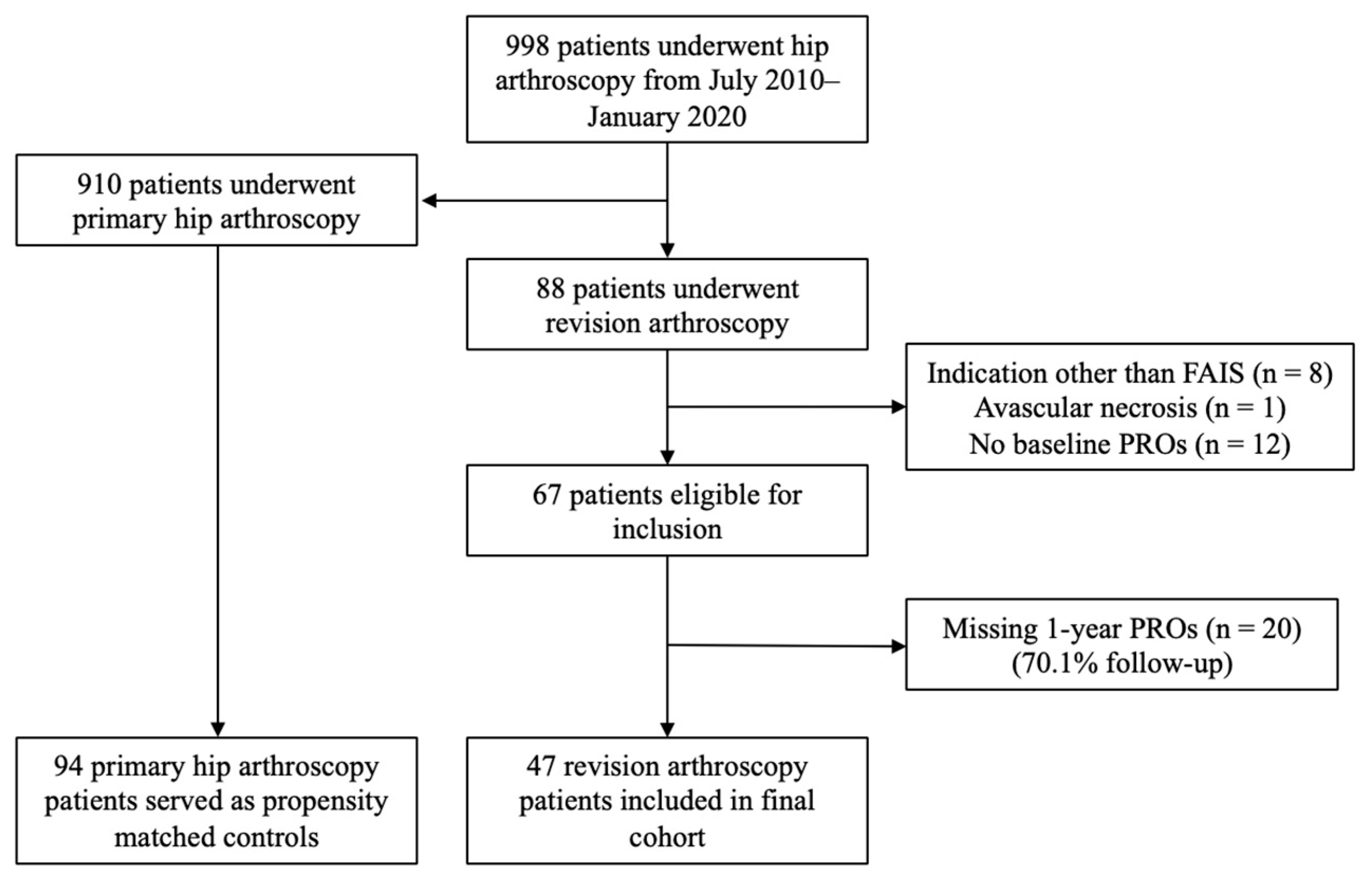
Out of the 67 patients meeting inclusion criteria for the study, 47 patients had ≥1-year follow-up data available (70.1% follow-up) and were matched to 94 controls based on age, sex, BMI, and smoking status (Figure 1). The average time from index surgery to revision was 26.2 months (range 5.3–92.1). Two of the revision patients had one previous revision hip arthroscopy and one had two prior revision hip arthroscopies.
The overall cohort had a mean age of 39.96 ± 13.41 years, BMI of 27.30 ± 4.69 kg/m2, and was majority female (61.7%), with a mean follow-up of 1.33 ± 0.21 years for patient-reported outcome scores and mean follow up for repeat procedures of 9.67 ± 2.55 years. Following propensity matching, there was no significant difference between the primary and revision cohorts with respect to age, sex, BMI, or smoking status. Additionally, there were no significant differences between cohorts with respect to preoperative radiographic parameters or Outerbridge classification of chondral lesions (Table 1).

3.2. Operative Procedures

The revision cohort had a significantly higher rate of reconstruction compared to the primary cohort (14.9% vs. 0%, p < 0.001). There was no difference in any other operative procedures between groups, including labral debridement, femoral neck osteoplasty, and acetabuloplasty (Table 2).

3.3. Outcome Score Analysis

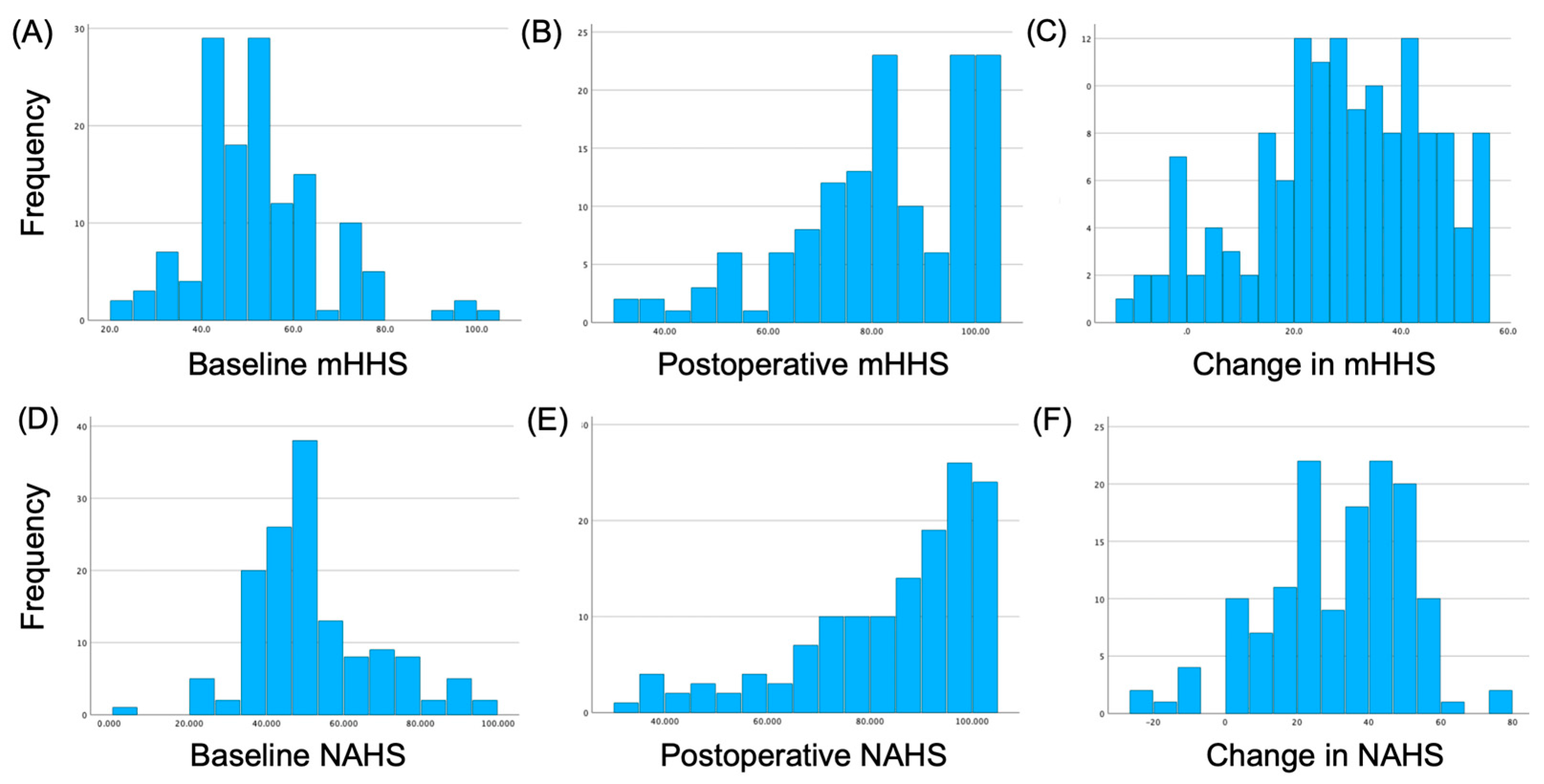
Both the primary and revision cohorts showed significant improvement from baseline at 1-year follow-up (p < 0.001). Visual inspection of histograms and Shapiro–Wilk testing demonstrated non-normal distributions for baseline, postoperative, and change scores for both mHHS and NAHS in the primary and revision cohorts (Figure 2). The revision cohort had a significantly lower mean baseline mHHS compared to the primary cohort (47.39 ± 11.57 vs. 55.26 ± 14.48, p < 0.001), and a lower postoperative mHHS (76.81 ± 18.41 vs. 83.23 ± 16.40, p = 0.037). Similarly, the revision cohort had a lower average baseline NAHS compared to the primary cohort (47.36 ± 15.66 vs. 54.43 ± 15.99, p = 0.003) and a lower mean postoperative NAHS (78.40 ± 19.89 vs. 85.97 ± 15.31, p = 0.032). There was no significant difference in change from baseline to postoperative scores between cohorts for the mHHS or NAHS (Table 3).
A linear regression assessing demographic and radiographic predictors of outcome scores was performed. Increasing age was inversely correlated with postoperative mHHS (β = −0.247, p = 0.006) and NAHS (β = −0.187, p = 0.042). BMI, sex, and smoking status were not significantly correlated with outcome scores. Preoperative radiographic measures including alpha angle on AP view, alpha angle on 45° Dunn, LCEA, and Tonnis angle were not significantly correlated with outcomes (p > 0.05). Finally, intraoperative characteristics including labral debridement versus repair, and Outerbridge grade were not significant predictors of outcome scores (p > 0.05).
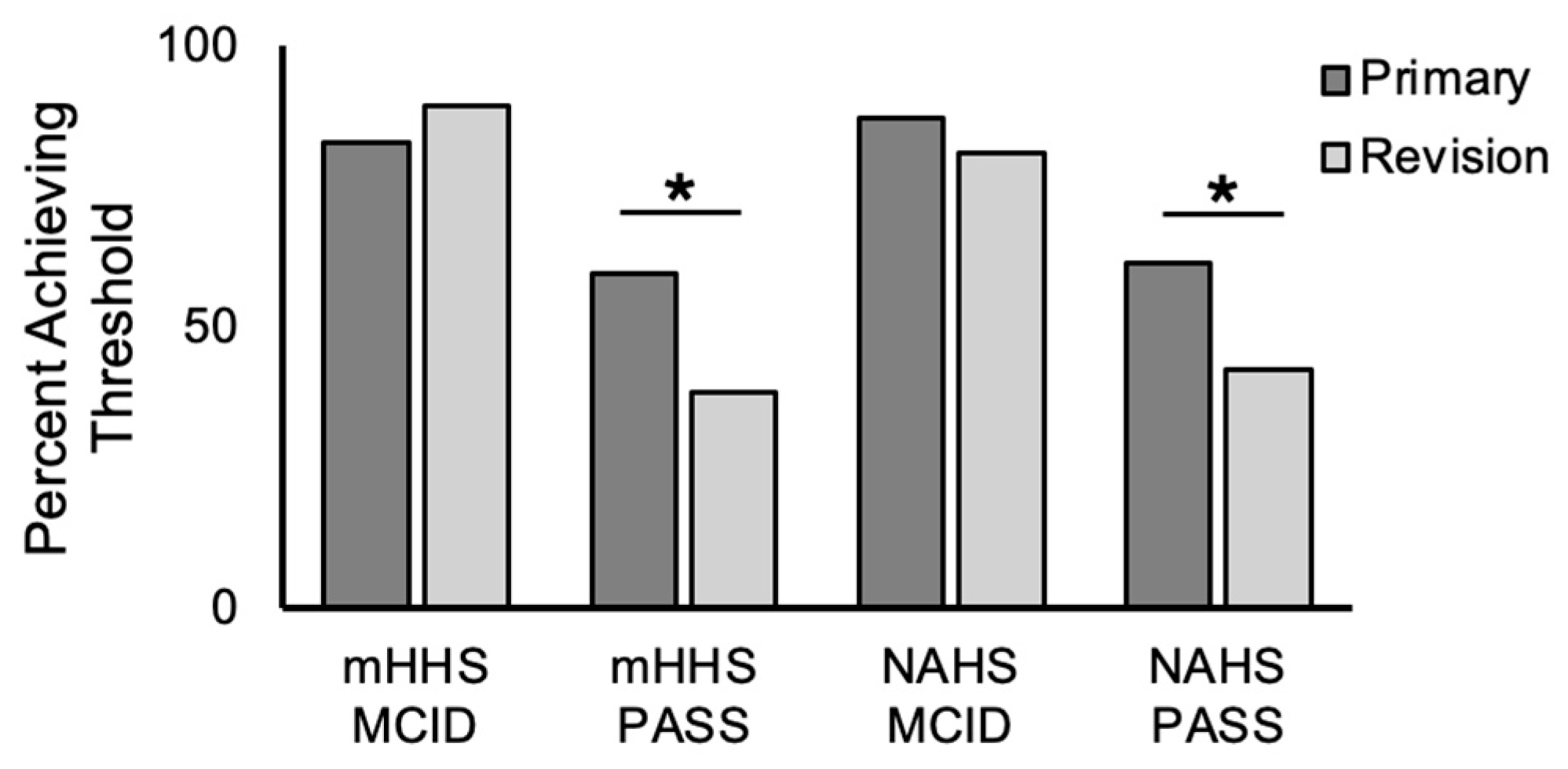
The calculated MCID within the study cohort was 8.25 for the mHHS and 9.67 for the NAHS. Within the primary cohort, 82.98% of patients achieved mHHS and within the revision cohort, 89.36% achieved this threshold, which was not significantly different (p = 0.316). Similarly, the rate of achievement of NAHS MCID between the primary and revision cohorts was not significantly different (87.1% vs. 80.9%, respectively, p = 0.328). However, a significantly higher proportion of patients in the primary cohort achieved the 1-year PASS for the mHHS and the NAHS (mHHS: 59.6% vs. 38.3% p = 0.017; NAHS: 61.3% vs. 42.6% p = 0.035) (Figure 3).

3.4. Hip Survival to Repeat Surgery

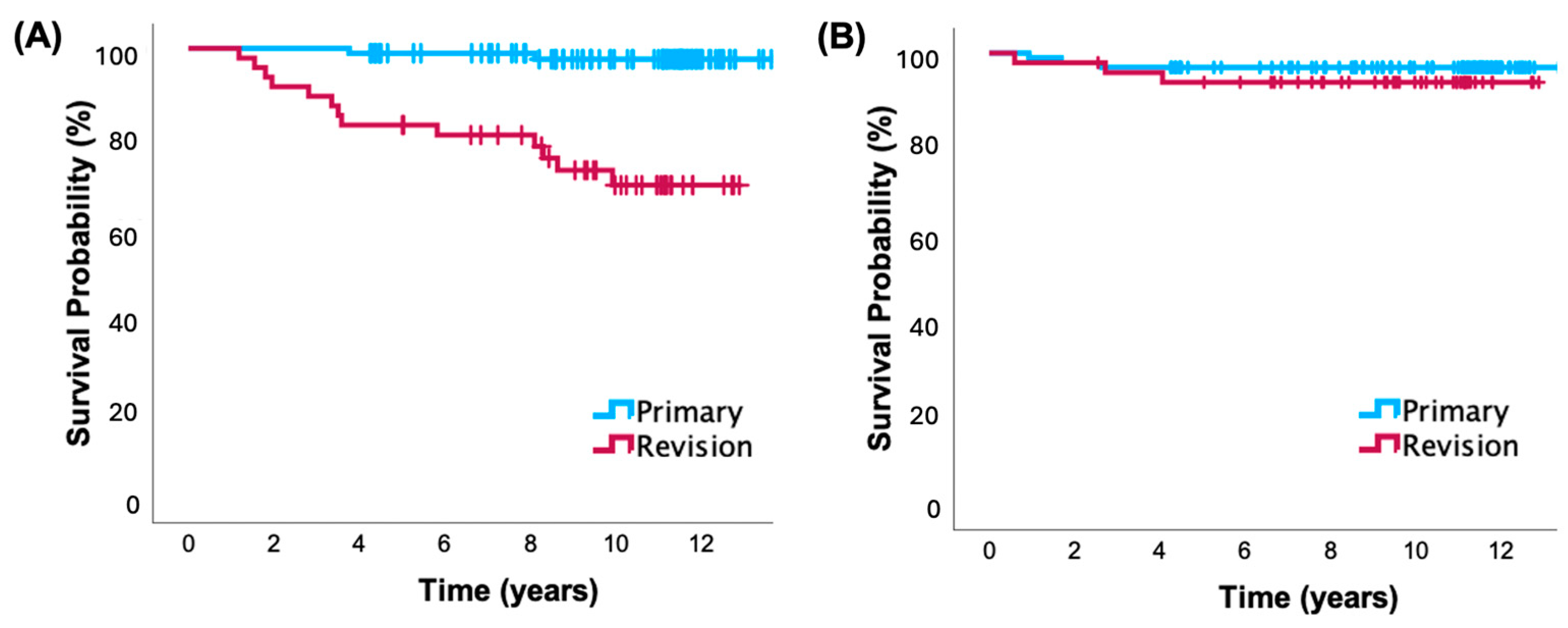
The percentage of patients who converted to THA was significantly higher in the revision cohort compared to the primary cohort (27.7% vs. 2.1%, p < 0.001). Among those who converted, the mean time to THA was 4.66 ± 3.10 years in the revision cohort and 5.94 ± 3.08 years in the primary cohort. However, when considering the entire cohort, including patients who did not undergo THA, the mean predicted time to THA using Kaplan–Meier analysis was significantly shorter in the revision cohort compared to the primary cohort (10.32 years [95% CI, 9.19–11.45] vs. 14.25 years [95% CI, 13.98–14.53]; p < 0.001) (Figure 4A).
There was no significant difference in the percentage of patients who underwent repeat ipsilateral hip arthroscopy between the revision and primary cohorts (3.2% vs. 6.4%, p = 0.376). Similarly, the mean survival time to repeat hip arthroscopy, based on Kaplan–Meier estimates, was comparable between the revision and primary cohorts (11.99 years [95% CI, 11.26–12.72] vs. 14.05 years [95% CI, 13.60–14.50], p = 0.377) (Figure 4B).

4. Discussion

The key finding of this study was that while patients who underwent revision hip arthroscopy experienced significant improvement in all patient-reported outcome measures from baseline to follow-up, their overall outcomes remained inferior to those of the primary cohort. Despite achieving a similar magnitude of improvement, the revision cohort started with lower baseline scores and ended with significantly lower final outcome scores. Additionally, the revision cohort had a markedly higher rate of conversion to THA compared to the primary cohort.
Nho et al. previously addressed this topic in a 2015 systematic review analyzing five studies encompassing 348 revision hip arthroscopies [4]. All five studies included in their review reported on the mHHS and demonstrated significant post-operative improvements in patient outcomes following revision hip arthroscopy. Later that same year, Sardana et al. expanded upon this work with another systematic review, which included six studies and a total of 448 hips [18]. Their analysis corroborated the findings of Nho et al., noting significant improvements in mHHS scores from baseline to one-year follow-up. However, it is crucial to recognize the limitations of these systematic reviews. All included studies were either prospective case series or retrospective chart reviews, meaning they exclusively analyzed outcomes of revision hip arthroscopy without direct comparison to primary hip arthroscopy outcomes, repeat revision procedures, or rates of conversion THA. The absence of control groups or longitudinal comparative analysis leaves gaps in understanding the long-term success of revision procedures and the factors influencing progression to further surgical intervention.
In contrast to these earlier systematic reviews, subsequent studies incorporated matched control cohorts, allowing for direct comparison between primary and revision hip arthroscopy outcomes. Philippon et al. published the largest revision hip arthroscopy cohort to date in 2016, utilizing a 2:1 matched primary hip arthroscopy cohort for comparison [11]. Their study demonstrated significant improvements in patient-reported outcome scores in both primary and revision cohorts. However, despite these improvements, the revision group consistently exhibited lower absolute outcome scores compared to patients undergoing primary hip arthroscopy. Nho et al. corroborated these findings at a longer final follow-up, noting that patients undergoing revision hip arthroscopy had worse outcomes when compared to similar patients undergoing primary surgery [3]. These findings align with those of the present study, which demonstrated significant improvements in the revision cohort, although lower absolute outcome scores compared to those undergoing primary hip arthroscopy.
A key finding in the present study that differs from prior literature is the significantly higher rate of conversion to THA observed in the revision cohort. Both Philippon et al. and Nho et al. reported no significant difference in survivorship to THA or reoperation between patients undergoing revision versus primary hip arthroscopy [11,19]. In contrast, the present study identified a markedly higher rate of conversion to THA in the revision cohort, with 27.7% of revision patients requiring THA compared to only 2.1% in the primary cohort, a statistically significant finding (p < 0.05). Given that the follow-up period of the present study was more than double that reported by Philippon et al., these findings suggest that degenerative changes in the hip joint following revision surgery may manifest more prominently over time, ultimately contributing to the increased rate of conversion to THA observed in the revision cohort. These findings underscore the importance of patient selection and surgical planning in the revision setting.

Limitations

This study has several limitations inherent to its retrospective matched cohort design. First, the retrospective nature of the study introduces potential selection bias and limits the ability to control for unmeasured confounding variables that may have influenced patient outcomes. While efforts were made to match cohorts based on key demographic and clinical characteristics, inherent differences between primary and revision hip arthroscopy patients may still exist, potentially impacting the observed results. Notably, the revision cohort had a significantly higher rate of labral reconstruction, which could impact outcomes. Additionally, this study represents the experience of a single high-volume hip arthroscopy surgeon, which may limit the generalizability of the findings to broader surgical populations. Finally, while the senior author has longitudinally followed his patients from the beginning of his hip arthroscopy practice with the mHHS, this scoring system has been shown to have a ceiling effect in the FAIS population [20], which may limit the ability to detect differences in scores between groups. Furthermore, loss to follow-up may introduce survivorship bias, as patients with poorer outcomes may be less likely to remain in longitudinal follow-up.

5. Conclusions

Patients undergoing revision hip arthroscopy for residual FAIS presented with significantly lower baseline function compared to those undergoing primary surgery. Despite this, revision patients experienced clinically meaningful postoperative improvements comparable in magnitude to primary hip arthroscopy patients. However, revision patients demonstrated a significantly higher rate of conversion to total hip arthroplasty.

Author Contributions

Conceptualization, E.B. and B.L.; methodology, E.B. and A.L.; software, V.S.; validation, E.B., C.T. and V.S.; formal analysis, E.B.; investigation, E.B. and C.T.; resources, T.Y.; data curation, C.T. and B.L.; writing—original draft preparation, E.B. and B.L.; writing—review and editing, A.L., V.S. and T.Y.; visualization, B.L.; supervision, T.Y. and A.L.; project administration, A.L.; funding acquisition, T.Y. All authors have read and agreed to the published version of the manuscript.

Funding

This research received no external funding.

Institutional Review Board Statement

The study was conducted in accordance with the Declaration of Helsinki, and approved by the Institutional Review Board of NYU Langone (study protocol i20-01686 approved 22 August 2022).

Informed Consent Statement

Informed consent was obtained from all subjects involved in the study.

Data Availability Statement

The data presented in this study are available on request from the corresponding author, Emily Berzolla (emily.berzolla@nyulangone.org).

Conflicts of Interest

Thomas Youm, MD receives intellectual property royalties, is a paid consultant, and a paid presenter or speaker for Arthrex Inc. No other conflicts of interests exist for any other authors.

Abbreviations

The following abbreviations are used in this manuscript:
BMIBody Mass Index
PROsPatient Reported Outcomes
FAISFemoroacetabular Impingement Syndrome
mHHSModified Harris Hip Score
NAHSNon-Arthritic Hip Score
MCIDMinimum Clinically Important Difference
PASSPatient Acceptable Symptom State
THATotal Hip Arthroplasty

References

  1. Heyworth, B.E.; Shindle, M.K.; Voos, J.E.; Rudzki, J.R.; Kelly, B.T. Radiologic and intraoperative findings in revision hip arthroscopy. Arthroscopy 2007, 23, 1295. [Google Scholar] [CrossRef] [PubMed]
  2. Khanduja, V.; Villar, R.N. The arthroscopic management of femoroacetabular impingement. Knee Surg. Sports Traumatol. Arthrosc. 2007, 15, 1035–1040. [Google Scholar] [CrossRef] [PubMed]
  3. Nho, S.J.; Magennis, E.M.; Singh, C.K.; Kelly, B.T. Outcomes after the arthroscopic treatment of femoroacetabular impingement in a mixed group of high-level athletes. Am. J. Sports Med. 2011, 39, 14–19. [Google Scholar] [CrossRef] [PubMed]
  4. Philippon, M.J.; Stubbs, A.J.; Schenker, M.L.; Maxwell, R.B.; Ganz, R.; Leunig, M. Arthroscopic management of femoroacetabular impingement: Osteoplasty technique and literature review. Am. J. Sports Med. 2007, 35, 1571–1580. [Google Scholar] [CrossRef] [PubMed]
  5. Shankar, D.S.; Wingo, T.; Akpinar, B.; Rynecki, N.D.; Youm, T. Patient-Reported Outcomes and Survivorship Are Not Different for Primary Hip Arthroscopy Patients of Age 50 Years and Older Compared With a 20- to 35-Year-Old Matched Cohort at Minimum 5-Year Follow-Up. Arthrosc. J. Arthrosc. Relat. Surg. 2023, 39, 1651–1659. [Google Scholar] [CrossRef] [PubMed]
  6. Sing, D.C.; Feeley, B.T.; Tay, B.; Vail, T.P.; Zhang, A.L. Age-Related Trends in Hip Arthroscopy: A Large Cross-Sectional Analysis. Arthrosc. J. Arthrosc. Relat. Surg. 2015, 31, 2307–2313.e2. [Google Scholar] [CrossRef] [PubMed]
  7. Philippon, M.J.; Schenker, M.L.; Briggs, K.K.; Kuppersmith, D.A.; Maxwell, R.B.; Stubbs, A.J. Revision hip arthroscopy. Am. J. Sports Med. 2007, 35, 1918–1921. [Google Scholar] [CrossRef] [PubMed]
  8. Buzin, S.; Shankar, D.; Vasavada, K.; Youm, T. Hip Arthroscopy for Femoroacetabular Impingement-Associated Labral Tears: Current Status and Future Prospects. Orthop. Res. Rev. 2022, 14, 121–132. [Google Scholar] [CrossRef] [PubMed]
  9. Harris, J.D.; McCormick, F.M.; Abrams, G.D.; Gupta, A.K.; Ellis, T.J.; Bach, B.R.; Bush-Joseph, C.A.; Nho, S.J. Complications and reoperations during and after hip arthroscopy: A systematic review of 92 studies and more than 6,000 patients. Arthrosc. J. Arthrosc. Relat. Surg. 2013, 29, 589–595. [Google Scholar] [CrossRef] [PubMed]
  10. Minkara, A.A.; Westermann, R.W.; Rosneck, J.; Lynch, T.S. Systematic Review and Meta-analysis of Outcomes After Hip Arthroscopy in Femoroacetabular Impingement. Am. J. Sports Med. 2019, 47, 488–500. [Google Scholar] [CrossRef] [PubMed]
  11. Newman, J.T.; Briggs, K.K.; McNamara, S.C.; Philippon, M.J. Revision Hip Arthroscopy: A Matched-Cohort Study Comparing Revision to Primary Arthroscopy Patients. Am. J. Sports Med. 2016, 44, 2499–2504. [Google Scholar] [CrossRef] [PubMed]
  12. Sardana, V.; Philippon, M.J.; de Sa, D.; Bedi, A.; Ye, L.; Simunovic, N.; Ayeni, O.R. Revision Hip Arthroscopy Indications and Outcomes: A Systematic Review. Arthrosc. J. Arthrosc. Relat. Surg. 2015, 31, 2047–2055. [Google Scholar] [CrossRef] [PubMed]
  13. Larson, C.M.; Giveans, M.R.; Samuelson, K.M.; Stone, R.M.; Bedi, A. Arthroscopic Hip Revision Surgery for Residual Femoroacetabular Impingement (FAI): Surgical Outcomes Compared With a Matched Cohort After Primary Arthroscopic FAI Correction. Am. J. Sports Med. 2014, 42, 1785–1790. [Google Scholar] [CrossRef] [PubMed]
  14. Chahla, J.; Beck, E.C.; Nwachukwu, B.U.; Alter, T.; Harris, J.D.; Nho, S.J. Is There an Association Between Preoperative Expectations and Patient-Reported Outcome After Hip Arthroscopy for Femoroacetabular Impingement Syndrome? Arthrosc. J. Arthrosc. Relat. Surg. 2019, 35, 3250–3258.e1. [Google Scholar] [CrossRef] [PubMed]
  15. Nwachukwu, B.U.; Fields, K.; Chang, B.; Nawabi, D.H.; Kelly, B.T.; Ranawat, A.S. Preoperative Outcome Scores Are Predictive of Achieving the Minimal Clinically Important Difference After Arthroscopic Treatment of Femoroacetabular Impingement. Am. J. Sports Med. 2017, 45, 612–619. [Google Scholar] [CrossRef] [PubMed]
  16. Rosinsky, P.J.; Kyin, C.; Maldonado, D.R.; Shapira, J.; Meghpara, M.B.; Ankem, H.K.; Lall, A.C.; Domb, B.G. Determining Clinically Meaningful Thresholds for the Nonarthritic Hip Score in Patients Undergoing Arthroscopy for Femoroacetabular Impingement Syndrome. Arthrosc. J. Arthrosc. Relat. Surg. 2021, 37, 3113–3121. [Google Scholar] [CrossRef] [PubMed]
  17. Nwachukwu, B.U.; Beck, E.C.; Kunze, K.N.; Chahla, J.; Rasio, J.; Nho, S.J. Defining the Clinically Meaningful Outcomes for Arthroscopic Treatment of Femoroacetabular Impingement Syndrome at Minimum 5-Year Follow-up. Am. J. Sports Med. 2020, 48, 901–907. [Google Scholar] [CrossRef] [PubMed]
  18. Cvetanovich, G.L.; Harris, J.D.; Erickson, B.J.; Bach, B.R., Jr.; Bush-Joseph, C.A.; Nho, S.J. Revision Hip Arthroscopy: A Systematic Review of Diagnoses, Operative Findings, and Outcomes. Arthrosc. J. Arthrosc. Relat. Surg. 2015, 31, 1382–1390. [Google Scholar] [CrossRef] [PubMed]
  19. Chapman, R.; Horner, N.; Ziauddin, L.; Hevesi, M.; Nho, S.J. Patients Undergoing Revision Hip Arthroscopy Demonstrate Comparable Survivability and Improvement but Worse Postoperative Outcomes Compared to Patients Undergoing Primary Hip Arthroscopy: A Propensity Matched Study at Five-Year Follow-Up. Arthrosc. J. Arthrosc. Relat. Surg. 2024, 40, 802–809. [Google Scholar] [CrossRef] [PubMed]
  20. Hartwell, M.J.; Soriano, K.K.; Nguyen, T.Q.; Monroe, E.J.; Wong, S.E.; Zhang, A.L. Patient-Reported Outcome Surveys for Femoroacetabular Impingement Syndrome Demonstrate Strong Correlations, High Minimum Clinically Important Difference Agreement and Large Ceiling Effects. Arthrosc. J. Arthrosc. Relat. Surg. 2022, 38, 2829–2836. [Google Scholar] [CrossRef] [PubMed]
Figure 1. Patient flow diagram demonstrating study inclusion.
Surgeries 07 00022 g001
Figure 2. Histograms demonstrating the distribution of patient-reported outcome scores. (A) Baseline modified Harris Hip Score (mHHS), (B) postoperative mHHS, (C) change in mHHS from baseline to postoperative follow-up, (D) baseline Non-Arthritic Hip Score (NAHS), (E) postoperative NAHS, and (F) change in NAHS from baseline to postoperative follow-up.
Surgeries 07 00022 g002
Figure 3. Percent of patients in primary and revision cohorts achieving minimal clinically significant difference (MCID) and patient acceptable state (PASS) thresholds for the modified Harris Hip Score (mHHS) and Non-arthritic Hip Score (NAHS), * p < 0.05.
Surgeries 07 00022 g003
Figure 4. (A) Kaplan–Meier survival curve demonstrating time from hip arthroscopy to total hip arthroplasty for the primary and revision hip cohorts. Tick marks indicate censored patients lost to follow up. (B) Kaplan–Meier survival curve demonstrating time from hip arthroscopy to subsequent revision hip arthroscopy for the primary and revision hip cohorts.
Surgeries 07 00022 g004
Table 1. Comparison of Demographic and Radiographic Findings Between Primary and Revision Hip Arthroscopic Surgery Cohorts.
Primary Cohort
(N = 94)
Revision Cohort
(N = 47)
p Value
Age (years)41.67 ± 13.6239.05 ± 13.470.281
Sex (female)60 (63.8)27 (57.4)0.462
BMI (kg/m2)27.52 ± 4.6627.07 ± 4.610.586
Non-Smoker63 (67.0)31 (66.0)0.498
Alpha Angle (AP)59.44 ± 19.5765.11 ± 12.260.096
Alpha Angle (45° Dunn)61.41 ± 14.6359.97 ± 14.140.598
LCEA34.22 ± 6.6834.56 ± 7.090.795
Tonnis Angle4.43 ± 5.344.09 ± 5.530.735
Outerbridge grade 0.593
  05 (5.3)4 (8.5)
  1–278 (83.0)36 (76.6)
  3–411 (11.7)7 (14.9)
BMI, body mass index; AP, anteroposterior; LCEA, lateral center-edge angle.
Table 2. Comparison of Operative Procedures Between Primary and Revision Hip Arthroscopic Surgery Cohorts.
Primary Cohort
(N = 94)
Revision Cohort
(N = 47)
p Value
Labral Repair85 (90.4)38 (80.9)0.108
Labral Reconstruction0 (0)9 (14.9)<0.001
Labral Debridement9 (9.6)2 (4.3)0.267
Femoral Neck Osteoplasty83 (88.3)45 (95.7)0.150
Acetabuloplasty91 (96.8)46 (97.9)0.720
Table 3. Comparison of Outcome Scores Between Primary and Revision Hip Arthroscopic Surgery Cohorts.
Primary Cohort
(N = 94)
Revision Cohort
(N = 47)
p Value
mHHS
  Baseline55.26 ± 14.4847.39 ± 11.57<0.001
  Postoperative83.23 ± 16.40 *76.81 ± 18.41 *0.037
  Change27.97 ± 16.5629.42 ± 16.490.825
NAHS
  Baseline54.43 ± 15.9947.36 ± 15.660.003
  Postoperative85.97 ± 15.31 *78.40 ± 19.89 *0.032
  Change31.53 ± 18.6731.04 ± 21.320.888
* Statistically significant within-group difference compared with baseline (p < 0.001). mHHS, modified Harris Hip Score; NAHS, Non-Arthritic Hip Score.
Disclaimer/Publisher’s Note: The statements, opinions and data contained in all publications are solely those of the individual author(s) and contributor(s) and not of MDPI and/or the editor(s). MDPI and/or the editor(s) disclaim responsibility for any injury to people or property resulting from any ideas, methods, instructions or products referred to in the content.