


Abstract
Background: The primary concern of hip surgeons is restoring the physiological biomechanics of the hip joint through arthroplasty, thereby enabling patients with osteoarthritis to engage better in daily activities. The modularity of the femoral stem-neck head allows surgeons to better restore the hip’s native biomechanics. However, concerns have been raised regarding the potential postoperative complications. This study aims to evaluate patients’ satisfaction and functional outcomes following primary Total Hip Arthroplasty (THA) with modular stem-neck, with a mean follow-up duration of eight years. Methods: We retrospectively reviewed 208 patients who underwent primary THA with modular stem-neck between February 2012 and July 2019. The follow-up period extended from November 2024 to April 2025. Patients who died from unrelated causes were excluded. Patients’ satisfaction was assessed using the SF-36 questionnaire, while functional outcomes were evaluated using the Harris Hip Score (HHS). Intraoperative and postoperative complications were meticulously documented. Results: The average follow-up duration was 95.6 months, with a range from 67.7 to 159.7 months. The mean SF-36 score was 91.2 out of 100, indicating high patient satisfaction. The mean HHS was 90 out of 100, reflecting excellent functional outcomes. Notably, some patients achieved the maximum score of 100 in both SF-36 and HHS assessments, while the lowest recorded scores were 54 and 50, respectively. The mean age of patients at the time of surgery was 67.1 years. One case of periprosthetic fracture was reported; however, no complications related to modular necks, such as trunnionosis or implant failure, were observed. Conclusions: The present study demonstrates that modular neck primary THA could achieve excellent functional and radiological outcomes, high patient satisfaction, and outstanding long-term survivorship, provided that implant selection and surgical technique follow biomechanical principles.
1. Introduction
The primary concern of hip surgeons is restoring the physiological biomechanics of the hip joint through arthroplasty, thereby enabling patients with osteoarthritis to engage better in daily activities. The modularity of the femoral stem-neck head allows surgeons to better restore the hip’s native biomechanics. Different parameters, including femoral stem version, lower limb length, neck-shaft angle and femoral offset, can be improved and restored [1,2,3]. No statistically significant difference, concerning correction of leg length discrepancy and restoration of hip geometry, exists between monoblock and modular total hip arthroplasties [2,4,5]. In contrast to monoblock stems, ameliorated hip stability and a wider range of motion could be ensured by the various intraoperative options in stem–neck versions [6,7]. These two aforementioned advantages of modularity predominate, especially in elderly patients with hip–spine syndrome and comorbidities from the spine, as well as lower spine stiffness. Both modular stem-neck and monoblock stems have satisfactory clinical and radiological outcomes in revision of total hip arthroplasty cases [6]. Total hip arthroplasty (THA) is a surgical procedure aiming at alleviating hip pain, enhancing hip mobility and improving patients’ quality of life, but it is not an entirely failure-free procedure [8].
Taking into consideration the recent bibliography, there is not a validated tool for assessing patient satisfaction. Existing tools don’t meet content validity standards insofar as patients are not involved in their development or testing. In our study, patient satisfaction was evaluated with the numerical rating scale (NRS), even if it is not validated for use in assessing the outcome of hip arthroplasty [9,10]. Patients’ postoperative quality of life was evaluated with the SF-36 questionnaire, while the functional outcome was evaluated with the Harris Hip Score (HHS). HHS is separated into three sections and describes the pain, function, range of motion, and deformity of a procedure. The first section is completed by the patient, while the last two sections are administered by a researcher [11,12]. SF-36 is a questionnaire that evaluates a patient’s quality of life through 36 questions. Questions relate to from mental and physical health problems and the relevant limitations in daily activities [13,14].
This study aims to evaluate patients’ quality of life, satisfaction, and functional outcomes following primary THA with modular neck stems, with a mean follow-up duration of eight years. Moreover, it aims to identify potential risk factors that increase complications in modular THA. All intraoperative and postoperative complications were recorded and the clinical outcome and patients’ quality of life associated with this type of arthroplasty were assessed.
2. Materials and Methods
In our orthopedic department, 348 patients (400 hips) underwent modular neck primary total hip arthroplasty between February 2012 and July 2019. In our case series, all patients were diagnosed with primary hip osteoarthritis and operated with modular stem-neck THA. No revision cases of a previous THA were included. In all cases, the surgery was performed by the same surgeon using a posterior approach in the lateral position. Through the posterior approach, acetabular cup and femoral stem were prepared. Before each operation, templating was performed and used as reference point for stem size, offset, and version of the neck component.
The final stem size and neck offset were selected by evaluating leg length and hip stability intraoperatively. There were several options regarding the neck and the femoral head. The titanium alloy neck had two length options (short and long), three options for neck-shaft angle (80 varus, normal and 80 valgus), and three options for femoral-neck version (80 anteverted, no version, and 80 retroverted). The femoral head had two available material choices (ceramic and metal) and three length choices (−3.5 mm, 0 mm, +3.5 mm).
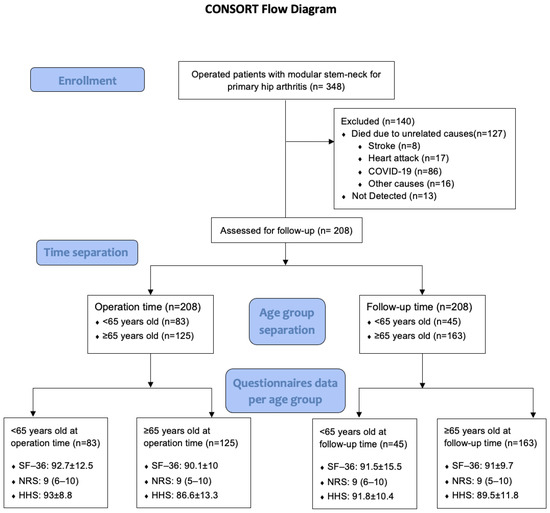
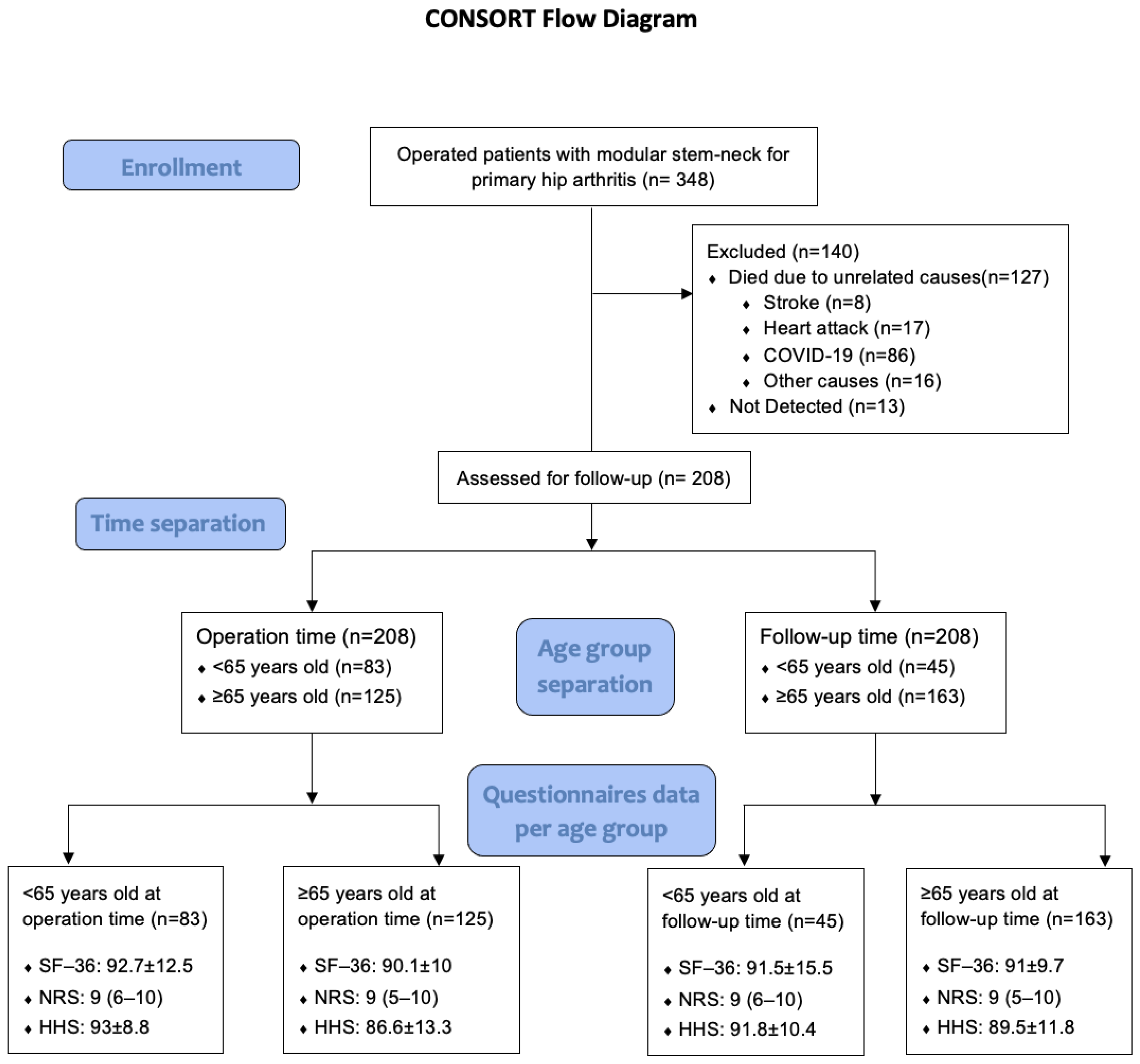
At the time of follow-up, which was held between November 2024 and April 2025, 140 patients could not be followed-up. The vast majority of these patients (127 patients out of 140), died due to unrelated causes, such as stroke, heart attack, or COVID-19, while 13 patients were lost to follow-up as they did not answer to our requests. The average follow-up duration in the study was 95.6 months, with a range from 67.7 to 159.7 months. Finally, 240 hips (208 patients, 68 males, and 140 females) were followed-up and included in this study. The mean age of patients at the time of surgery was 67.1 years old. The youngest patient was 40 years old, while on the other hand, the oldest was 87 years old. Similar variation was observed at the mean age of patients at follow-up time, i.e., 75.3 years old with a range from 50 to 96 years old. These data are presented at Table 1.
Table 1.
Demographic data for patients with modular neck THA. Values are presented as mean ± standard deviation, number only, mean (range).
All of our cases were operated with the PROFEMUR E (MicroPort Orthopedics, formerly Wright Medical Technology Inc., Arlington, TN, USA), which was a titanium alloy, surface-roughened stem. The selected neck length was short in 146 cases, while the long neck was selected in 39.16% of cases. Even if the modular stem-neck THA provides several options in terms of head–shaft relation, 32.5% of the arthroplasties used the same short, normal neck-shaft angle, the anteverted neck. It is likely that this same position could have been achieved with a non-modular neck. The selected articular surfaces were metal on polyethylene in 103 cases (42.91% of total cases) and ceramic on polyethylene in 137 cases (57.08% of total cases). There are data, presented at Table 2, that include the characteristics of all the components of THA.
Table 2.
Characteristics of all the components of THA. Values are presented as number (percentage).
During follow-up, medical history taking and physical examination were conducted to note any symptoms referable to the hip. The three questionnaires completed by patients and researchers were the NRS, SF-36, and HHS. The data of those questionaries were collected and analyzed. For radiological evaluation, we used an anteroposterior and a lateral radiograph. The acetabular cup parameters (inclination, anteversion, and osteolysis), stem parameters (subsidence and osteolysis) and leg length were evaluated through those radiographs [15,16]. In cases of any clinical suspicion of stem junctional problems during the follow-up period, further imaging techniques such as computed tomography (CT) scan, magnetic resonance imaging (MRI), and laboratory tests such as erythrocyte sedimentation rate (ESR), C-reactive protein (CRP), and white blood cell count (WBC), cobalt and chromium ion levels were also determined. If revision surgery was performed during the follow-up period, the cause of revision surgery was investigated. Patients who died due to unrelated causes were excluded. Evaluation of intraoperative and postoperative complications was documented. Scientific conference approval from the university hospital and patient consent were obtained for this retrospective study.
3. Results
The mean SF-36 score was 91.2 out of 100, indicating high patient quality of life. Similar results were observed regarding patient satisfaction according to NRS. The mean NRS was 9 out of 10. The mean HHS was 90 out of 100, reflecting excellent functional outcomes. Notably, some patients achieved the maximum score of 100 in both SF-36 and HHS assessments, while the lowest recorded scores were 54 and 50, respectively. There was a separation of the patients according their age at the time of operation and the time of follow-up. This age was set to be 65 years old, as this age is considered the age of elderly people, according to the United Nations. Based on this separation, four groups of patients were created and analyzed for their quality of life (SF-36), satisfaction (NRS), and functional outcome (HHS). The first group included patients younger than 65 years old at operation time, while the second group included patients older than or equal to 65 years of age at operation time. The third and fourth group was created based on patients’ age at follow-up time (younger and older than or equal to 65 years old at follow-up time). There are data, presented in Table 3, concerning patients’ quality of life, satisfaction, and their THA functional outcome in each of these four groups.
Table 3.
Quality of life, satisfaction, and functional outcome data for patients with modular neck THA. Values are presented as mean ± standard deviation, mean (range).
None of the patients presented with procedure-related complications within 13 years of follow-up. No deaths, during, right after or due to the operation, were recorded. Complications, such as swelling, fullness and soft tissue mass at the surgical site were not recorded. No cases of periprosthetic infection or revision for loosening or malposition of the acetabular implant were observed. The clinical examination and radiological evaluation at the follow-up time revealed a limp length discrepancy less than 1 cm in 95% of the cases, while a discrepancy of medium scale (0.5–1 cm) was observed in 31.3% of our cases. Dislocation-free and revision-free survival was 100% at a maximum follow-up of 159 months. One case of stem revision due to limp discrepancy of 2.3 mm was reported one month postoperatively. A case of periprosthetic fracture was reported; however, no complications related to modular necks, such as trunnionosis (corrosion at the modular head–neck taper interface) or implant failure, and neck fracture were observed. It is essential to clarify that the absence of clinically detected complications doesn’t exclude subclinical corrosion or adverse local tissue reactions (ALTR). In our study, we didn’t perform any further imaging technique as there were no symptomatic patients. Our results are based on symptomatic assessment, without routine MARS-MRI examinations or systematic monitoring of metal ion levels. The lack of systematic imaging and laboratory screening constitute limitations of our study, which is defined as an observational study. The whole process and the results of our study are presented in the Consort Flow Figure 1.
Figure 1.
Questionnaires data, SF-36 (Quality of life), NRS (Satisfaction) and HHS (Functional outcome), refers to operated patients with modular stem-neck THA for primary hip arthritis. Values are presented as number only, mean ± standard deviation, mean (range).
4. Discussion
The principal findings of this study demonstrate that modular neck primary total hip arthroplasty could achieve excellent long-term clinical and functional outcomes, with a high level of patient satisfaction and no major complications related to the modular junction over a mean follow-up of nearly eight years. These results suggest that modular stem-neck designs, when appropriately indicated and carefully performed, may continue to offer advantages in restoring hip biomechanics and optimizing postoperative function, despite the historical concerns regarding mechanical failures and corrosion.
From a biomechanical standpoint, the modularity of the femoral component provides intraoperative flexibility that allows the surgeon to restore native hip anatomy more precisely. Adjustments in femoral version, neck-shaft angle, offset, and limb length can correct deformities and optimize soft tissue tension, thus improving hip stability and range of motion. This is particularly valuable in patients with complex proximal femoral morphology, such as those with developmental dysplasia, post-traumatic deformity, or altered anatomy secondary to spine pathology. In the present cohort, accurate limb length restoration was achieved in 95% of cases, and the high HHS (mean 90) reflects successful restoration of both stability and function. These findings are consistent with previous reports that modular neck systems may allow superior geometric reconstruction compared to monoblock stems, particularly in anatomically demanding cases.
Nevertheless, the clinical superiority of modular necks remains controversial. Several authors, including López et al. [4] and Yi et al. [2], found no statistically significant differences between modular and monoblock stems in terms of radiographic restoration of hip geometry or limb length discrepancy. However, the intraoperative versatility of modular designs provides surgeons with an additional degree of freedom that may reduce the risk of impingement and improve the arc of motion, as suggested by Matsushita et al. [7]. In our study, the absence of dislocation and the excellent long-term survivorship further support the notion that careful biomechanical reconstruction using modular components can lead to stable and durable outcomes.
The withdrawal of modular neck systems from the commercial market reflects legitimate safety concerns due to the increased reported complications. The documented complications of modular THA include corrosion at the modular taper interface, metal ion release, increased metal ion levels in serum, local tissue toxicity, adverse local tissue reaction, osteolysis, neck fractures and pseudotumor formation [1,8,17,18,19,20,21,22,23,24,25]. The long-term survivorship observed in this cohort is particularly noteworthy. No cases of revision for mechanical failure, corrosion-related complications, or aseptic loosening were recorded, and only a single periprosthetic fracture occurred. These findings contrast with several earlier reports in which modular junction failures, including trunnionosis, fretting corrosion, and catastrophic neck fracture, were identified as major limitations of these implants [17,18,19,20,21,22,23,24]. The absence of such complications in our series may be attributed to several factors: (a) exclusive use of titanium–titanium modular junctions, which exhibit superior corrosion resistance compared to mixed-metal (Co–Cr/Ti) pairings; (b) careful intraoperative technique, avoiding excessive torsional stresses at the stem-neck taper; and (c) selection of appropriate patients, excluding those with high body mass index or high physical demands. It is also possible that the relatively moderate activity level of the studied population, with a mean age of 67.1 years at implantation, contributed to the excellent mechanical performance of the construct.
Corrosion at the modular interface remains a key concern in modular neck designs. Trunnionosis—defined as mechanical wear and electrochemical corrosion at the modular taper interface—can lead to metal ion release, local tissue toxicity, osteolysis, and pseudotumor formation [17,18,19,20,21,22]. The pathophysiology involves micromotion and fretting between dissimilar metals, particularly when cobalt–chromium necks are paired with titanium stems. The generated ions (notably cobalt) may provoke an adverse local tissue reaction (ALTR) or a systemic inflammatory response [19,21,24]. Several studies have demonstrated that serum cobalt levels correlate with the severity of corrosion and pseudotumor formation [26,27]. Importantly, the absence of clinical symptoms does not exclude the presence of corrosion and ALTR, highlighting the need for vigilance and long-term monitoring even in asymptomatic patients [21].
In our cohort, no evidence of trunnionosis, corrosion, or pseudotumor formation was observed clinically or radiographically. The observational results of our study were based on symptomatic assessment, which is a limitation in our study. Systematic imaging with MARS-MRI and laboratory monitoring of metal ion levels were not performed, because none of the patients developed symptoms suggestive of ALTR or mechanical dysfunction. This supports the hypothesis that the titanium–titanium taper pairing of the PROFEMUR® E system offers favorable corrosion resistance and excellent long-term stability. These results align with the mid-term findings of Han et al. [16] and Scott et al. [15], both of whom reported no mechanical failures in titanium–titanium modular constructs at up to 15 years of follow-up.
The absence of dislocation in our series also merits attention. Modularity allows individualized adjustment of anteversion and offset, optimization of joint stability and reduction of impingement risk. Elderly patients with hip–spine syndrome particularly benefit from this flexibility, as limited spinal mobility can alter functional cup orientation and increase dislocation risk. In such patients, the ability to fine-tune femoral version intraoperatively may be decisive in achieving a stable construct. This finding reinforces the role of modularity as a valuable tool in complex primary arthroplasty, despite its decreased popularity in routine use. Surgeons might consider modular neck stems in THA, when a complex reconstruction is required [17,23], such as developmental dysplasia of the hip (DDH), skeletal dysplasia, sequelae of septic arthritis, and for revision purposes [1,4,23,25].
Nevertheless, the potential risks of modular neck THA cannot be disregarded. Mechanical failures of the neck component, dissociation at the stem-neck junction, and corrosion-related complications have been documented in several series [1,8,23,25]. These failures are multifactorial, influenced by patient-related factors (obesity, high activity level, young age), implant characteristics (large head diameter, long neck offset, mixed-metal coupling), and surgical technique (improper assembly or malalignment) [18,27,28]. Contraindications are obese patients (BMI > 30), young active male patients or patients with a high functional demand [1,4,18]. In these contraindicated cases, the potential use of modular stem-neck total hip arthroplasty should aim for shorter lever arms to prevent neck failure [29]. High BMI in cases of THA revision is associated with increased component failure and infection [6]. Consequently, strict patient selection and meticulous surgical handling of modular components are essential. In this regard, the present study supports the view that modularity should be reserved for cases requiring complex reconstruction, while routine use in standard primary THA may offer limited additional benefit and expose patients to unnecessary risk.
The clinical scores observed—mean SF-36 of 91.2 out of 100, mean NRS satisfaction of 9/10, and mean HHS of 90 out of 100—indicate an excellent long-term patient-reported outcome profile. These scores compare favorably with large series of monoblock THA, in which typical HHS values range between 85 and 92 at comparable follow-ups [11,12,15]. It is important to highlight that many patients in this study were elderly at the time of final evaluation (mean 75.3 years) and continued to report high quality of life and satisfaction, despite age-related comorbidities. These findings reinforce the long-term durability and functionality of modular neck THA in appropriately selected populations. Surgeons can’t determine the life expectancy of Total Hip Replacement. There are unidentified factors, in addition to postoperative activity level, surgical technique, and patient’s diagnosis that affect the survivorship of an implant. For this reason, the only way to investigate the possibility of a THA revision is the regular follow-up of patients with clinical examination and radiological evaluation [30].
This study, however, is not limitation-free. As a retrospective single-surgeon series, the absence of a control group with monoblock stems restricts direct comparative conclusions. Additionally, the 140 patients, who were not followed-up (35%), introduces potential selection bias, as it is uncertain whether these patients might have experienced inferior outcomes or complications. There is a potential underestimation of complications associated with modular necks due to this significant proportion of unevaluated cases of modular THAs. The vast majority of the unevaluated patients died due to COVID-19. Thus, the consideration of those patients as asymptomatic would be incorrect. Our results are based on symptomatic assessment, without routine MARS-MRI, CT examinations or systematic monitoring of metal ion levels. The lack of systematic imaging and laboratory screening constitute limitations of our study, which is defined as an observational study. The absence of clinically detected complications doesn’t exclude subclinical corrosion or ALTR. Further retrospective studies, including systematic imaging (MARS-MRI or CT) and laboratory screening, would reveal the actual incidence of subclinical complications. Patient satisfaction was evaluated with the NRS, which lacks validity for assessing the outcome of hip arthroplasty. Subgroup analysis comparing neck length or version configurations, which is particularly relevant for modular neck systems, were not presented due to their complexity. The modular stem-neck THA provides several intraoperative options of head–shaft relation, but in our study almost one out of three arthroplasties used the same relation. Probably this same position could have been achieved with a non-modular neck. The absence of these subgroups analysis constitutes a limitation of our study. Finally, the high mean age and relatively low physical activity of the cohort may limit generalizability to younger or more active populations, where mechanical stresses at the modular junction are higher.
Despite these limitations, this long-term follow-up provides important clinical evidence supporting the safe and durable use of modular neck stems when applied judiciously. The absence of modular junction complications over more than a decade suggests that the risk of mechanical failure may have been overestimated when titanium–titanium pairings are used and proper surgical technique is employed. Given the ability of modularity to restore native hip biomechanics and accommodate anatomical variability, reconsideration of its use in selected complex cases may be warranted.
5. Conclusions
In conclusion, the present study demonstrates that modular neck primary THA could achieve excellent functional and radiological outcomes, high patient satisfaction, and outstanding long-term survivorship, provided that implant selection and surgical technique follow biomechanical principles. The prudent and limited use of modularity—avoiding extreme neck geometries, ensuring correct assembly, and selecting appropriate patients—appears to mitigate the risk of corrosion and mechanical failure. It is essential to clarify that the absence of clinically detected complications doesn’t exclude subclinical corrosion or ALTR. The lack of routine MARS-MRI examinations and systematic monitoring of metal ion levels restrict the safety conclusions. While the withdrawal of modular neck systems from the commercial market reflects legitimate safety concerns, this study suggests that further retrospective studies, including systematic imaging (MARS-MRI or CT) and laboratory screening, would reveal the actual incidence of subclinical corrosion and ALTR. This observational study presents promising long-term clinical results that could be considered in future observational protocols.
Author Contributions
P.K.: conceptualization, methodology, writing—original draft preparation; P.P.: investigation, data curation, formal analysis, writing—original draft preparation; E.S.: investigation, writing—review and editing; I.S.: data curation, review and editing; A.K.: visualization, review and editing; E.S.V.: formal analysis, review and editing; J.V.: methodology, review and editing; S.G.P.: conceptualization, supervision. All authors have read and agreed to the published version of the manuscript.
Funding
This research received no external funding.
Institutional Review Board Statement
The study was conducted in accordance with the Declaration of Helsinki, and approved by the Scientific Conference of the university hospital. The approval code of this study was 3867 and the approval date was the 13 February 2025.
Informed Consent Statement
Informed consent was obtained from all subjects involved in the study.
Data Availability Statement
Data available upon request from the authors.
Conflicts of Interest
The authors declare no conflicts of interest.
Abbreviations
The following abbreviations are used in this manuscript:
| THA | Total Hip Arthroplasty |
| HHS | Harris Hip Score |
| SF-36 | 36-Item Short Form Survey |
| NRS | Numerical Rating Scale |
| CT | Computed Tomography |
| MRI | Magnetic Resonance Imaging |
| MARS-MRI | Metal Artifact Reduction Sequence-Magnetic Resonance Imaging |
| WBC | White Blood Cell |
| ESR | Erythrocyte Sedimentation Rate |
| CRP | C-Reactive Protein |
| ALTR | Adverse Local Tissue Reaction |
| DDH | Developmental Dysplasia of the Hip |
| BMI | Body Mass Index |
References
- Solarino, G.; Vicenti, G.; Carrozzo, M.; Ottaviani, G.; Moretti, B.; Zagra, L. Modular Neck Stems in Total Hip Arthroplasty: Current Concepts. EFORT Open Rev. 2021, 6, 751–758. [Google Scholar] [CrossRef] [Scilit]
- Yi, J.; Han, K.Y.; Nam, Y.J.; Kim, K.W. Result of Modular Necks in Primary Total Hip Arthroplasty with a Average Follow-up of Four Years. Hip Pelvis 2016, 28, 142–147. [Google Scholar] [CrossRef] [Scilit]
- Huang, Z.-Y.; Wang, S.-C.; Zhang, H.-J.; Shao, L.; Di, Z.-L.; Tao, K. Pseudotumor and Delayed Recurrent Dislocation after Total Hip Arthroplasty with a Modular Femoral Neck: A Case Report. Medicine 2022, 101, e29056. [Google Scholar] [CrossRef] [Scilit]
- López, R.E.; Pelayo De Tomás, J.M.; Morales Suárez Varela, M.; Rodrigo Pérez, J.L. Comparación de la corrección de la discrepancia de longitud de miembros tras el empleo de un vástago con cuello modular y su homólogo monobloque en la artroplastia total de cadera primaria. Rev. Esp. Cir. Ortop. Traumatol. 2022, 66, 445–453. [Google Scholar] [CrossRef] [Scilit] [PubMed]
- García-Juárez, J.D.; Bravo-Bernabé, P.A.; García-Hernández, A.; Jiménez-Cabuto, C.I.; García-Rosas, M.S. Incidence and effect of leg length discrepancy after total hip arthroplasty. Acta Ortop. Mex. 2013, 27, 43–46. [Google Scholar]
- Morlock, M.; Wu, Y.; Grimberg, A.; Günther, K.-P.; Perka, C. Re-Revision Risk of Modular and Monobloc Revision Stems after Revision Hip Arthroplasty. Bone Jt. Open 2025, 6, 1–6. [Google Scholar] [CrossRef] [Scilit]
- Matsushita, A.; Nakashima, Y.; Fujii, M.; Sato, T.; Iwamoto, Y. Modular Necks Improve the Range of Hip Motion in Cases with Excessively Anteverted or Retroverted Femurs in THA. Clin. Orthop. 2010, 468, 3342–3347. [Google Scholar] [CrossRef] [Scilit]
- Zajc, J.; Fokter, S.K. Dual-Modular Stems for Primary Total Hip Arthroplasty. Encyclopedia 2022, 2, 893–911. [Google Scholar] [CrossRef] [Scilit]
- Clement, N.D.; Kader, D.F.; Haddad, F.S. The Assessment of Patient Satisfaction after Hip and Knee Arthroplasty Is Not Satisfactory: Is It Time for a Standardized Measure? Bone Jt. J. 2025, 107-B, 769–771. [Google Scholar] [CrossRef] [Scilit]
- van Berckel, M.M.G.; Bosma, N.H.; Hageman, M.G.J.S.; Ring, D.; Vranceanu, A.-M. The Correlation Between a Numerical Rating Scale of Patient Satisfaction With Current Management of an Upper Extremity Disorder and a General Measure of Satisfaction With the Medical Visit. Hand 2017, 12, 202–206. [Google Scholar] [CrossRef] [Scilit] [PubMed]
- Ramadanov, N.; Voss, M.; Hable, R.; Hakam, H.T.; Prill, R.; Salzmann, M.; Dimitrov, D.; Becker, R. Postoperative Harris Hip Score Versus Harris Hip Score Difference in Hip Replacement: What to Report? Orthop. Surg. 2025, 17, 3–21. [Google Scholar] [CrossRef] [Scilit]
- Wamper, K.E.; Sierevelt, I.N.; Poolman, R.W.; Bhandari, M.; Haverkamp, D. The Harris Hip Score: Do Ceiling Effects Limit Its Usefulness in Orthopedics?: A Systematic Review. Acta Orthop. 2010, 81, 703–707. [Google Scholar] [CrossRef] [Scilit] [PubMed]
- Ware, J.E.; Sherbourne, C.D. The MOS 36-Item Short-Form Health Survey (SF-36). I. Conceptual Framework and Item Selection. Med. Care 1992, 30, 473–483. [Google Scholar] [CrossRef] [Scilit]
- Lins, L.; Carvalho, F.M. SF-36 Total Score as a Single Measure of Health-Related Quality of Life: Scoping Review. SAGE Open Med. 2016, 4, 2050312116671725. [Google Scholar] [CrossRef] [Scilit] [PubMed]
- Scott, D.F.; Eppich, K.; Mehić, E.; Gray, C.; Smith, C.L.; Johnston, M. 15-Year Survivorship of a Unique Dual-Modular Femoral Stem in Primary Hip Arthroplasty. BMC Musculoskelet. Disord. 2024, 25, 312. [Google Scholar] [CrossRef] [Scilit]
- Han, K.Y.; Jang, J.; Kim, K.-H. Mid-Term Results of Titanium–Titanium Modular Neck Femoral Stem in Primary Total Hip Arthroplasty. BMC Musculoskelet. Disord. 2024, 25, 259. [Google Scholar] [CrossRef] [Scilit] [PubMed]
- Mertl, P.; Dehl, M. Femoral Stem Modularity. Orthop. Traumatol. Surg. Res. 2020, 106, S35–S42. [Google Scholar] [CrossRef] [Scilit]
- Hamid, M.B.A.; Younis, Z.; Islam, M.S.-U.; Hamed, A.; Kashani, A.; Mannan, M.; Prabhu, R.M.; Shrivastava, N.; Raza, A.; Rashid, N. Trunnionosis After Total Hip Arthroplasty: A Review of the Etiology, Diagnosis, and Management. Cureus 2025, 17, e78037. [Google Scholar] [CrossRef] [Scilit]
- Silverton, C.D.; Jacobs, J.J.; Devitt, J.W.; Cooper, H.J. Midterm Results of a Femoral Stem With a Modular Neck Design: Clinical Outcomes and Metal Ion Analysis. J. Arthroplast. 2014, 29, 1768–1773. [Google Scholar] [CrossRef] [Scilit]
- Shah, R.; Talmo, C.; Nandi, S. Titanium Neck-Titanium Stem Taper Corrosion in a Modular Neck Stem. Arthroplast. Today 2019, 5, 145–147. [Google Scholar] [CrossRef] [Scilit]
- Kwon, Y.-M.; Khormaee, S.; Liow, M.H.L.; Tsai, T.-Y.; Freiberg, A.A.; Rubash, H.E. Asymptomatic Pseudotumors in Patients with Taper Corrosion of a Dual-Taper Modular Femoral Stem: MARS-MRI and Metal Ion Study. J. Bone Jt. Surg. 2016, 98, 1735–1740. [Google Scholar] [CrossRef] [Scilit]
- Collet, T.; Atanasiu, J.-P.; De Cussac, J.-B.; Oufroukhi, K.; Bothorel, H.; Saffarini, M.; Badatcheff, F. Midterm Outcomes of Titanium Modular Femoral Necks in Total Hip Arthroplasty. Ann. Transl. Med. 2017, 5, 395. [Google Scholar] [CrossRef] [Scilit]
- Park, C.-W.; Lim, S.-J.; Park, Y.-S. Modular Stems: Advantages and Current Role in Primary Total Hip Arthroplasty. Hip Pelvis 2018, 30, 147–155. [Google Scholar] [CrossRef] [Scilit]
- Gill, I.P.S.; Webb, J.; Sloan, K.; Beaver, R.J. Corrosion at the Neck-Stem Junction as a Cause of Metal Ion Release and Pseudotumour Formation. J. Bone Jt. Surg. Br. 2012, 94-B, 895–900. [Google Scholar] [CrossRef] [Scilit]
- Sakai, T.; Ohzono, K.; Nishii, T.; Miki, H.; Takao, M.; Sugano, N. A Modular Femoral Neck and Head System Works Well in Cementless Total Hip Replacement for Patients with Developmental Dysplasia of the Hip. J. Bone Jt. Surg. Br. 2010, 92-B, 770–776. [Google Scholar] [CrossRef] [Scilit]
- Kwon, Y.-M.; Tsai, T.-Y.; Leone, W.A.; Liow, M.H.L. Sensitivity and Specificity of Metal Ion Levels in Predicting “Pseudotumors” Due to Taper Corrosion in Patients With Dual Taper Modular Total Hip Arthroplasty. J. Arthroplast. 2017, 32, 996–1000. [Google Scholar] [CrossRef] [Scilit]
- Codirenzi, A.M.; Lanting, B.A.; Teeter, M.G. What Patient and Implant Factors Affect Trunnionosis Severity? An Implant Retrieval Analysis of 664 Femoral Stems. J. Arthroplast. 2023, 38, 376–382. [Google Scholar] [CrossRef] [Scilit]
- Vierra, B.M.; Blumenthal, S.R.; Amanatullah, D.F. Modularity in Total Hip Arthroplasty: Benefits, Risks, Mechanisms, Diagnosis, and Management. Orthopedics 2017, 40, 355–366. [Google Scholar] [CrossRef] [Scilit] [PubMed]
- Castagnini, F.; Bordini, B.; Cosentino, M.; Di Liddo, M.; Tella, G.; Masetti, C.; Traina, F. Age and Sex Influence the Use of Modular Femoral Components in Total Hip Arthroplasty Performed for Primary Osteoarthritis. J. Clin. Med. 2023, 12, 984. [Google Scholar] [CrossRef] [Scilit] [PubMed]
- Lampropoulou-Adamidou, K.; Karachalios, T.; Megas, P.; Petsatodis, G.; Vlamis, J.; Hartofilakidis, G. Can a Surgeon Predict the Longevity of a Total Hip Replacement? HIP Int. 2020, 30, 523–529. [Google Scholar] [CrossRef] [Scilit] [PubMed]

Disclaimer/Publisher’s Note: The statements, opinions and data contained in all publications are solely those of the individual author(s) and contributor(s) and not of MDPI and/or the editor(s). MDPI and/or the editor(s) disclaim responsibility for any injury to people or property resulting from any ideas, methods, instructions or products referred to in the content. |
© 2026 by the authors. Licensee MDPI, Basel, Switzerland. This article is an open access article distributed under the terms and conditions of the Creative Commons Attribution (CC BY) license.