Article

How Weight Loss After Bariatric Surgery Affects Sarcopenia Parameters and Diagnosis

1
Unidade Local Saúde Alentejo Central, Hospital Espírito Santo de Évora, EPE, 7000-811 Evora, Portugal
2
CRI.COM, Centro Responsabilidade Integrada de Cirurgia da Obesidade e Metabólica, 7000-811 Evora, Portugal
3
CHRC, Comprehensive Health Research Centre, Universidade de Évora, 7004-516 Evora, Portugal
4
Departamento de Desporto e Saúde, Escola de Saúde e Desenvolvimento Humano, Universidade de Évora, 7004-516 Evora, Portugal
5
CBIOS, Universidade Lusófona’s Research Center for Biosciences & Health Technologie, 1749-024 Lisboa, Portugal
6
Universidade Europeia, 1749-024 Lisboa, Portugal
7
CIDESD, Research Center in Sports Sciences, Health and Human Development, Universidade Europeia, 1500-210 Lisboa, Portugal
*
Author to whom correspondence should be addressed.
Surgeries 2025, 6(2), 31; https://doi.org/10.3390/surgeries6020031

Submission received: 7 March 2025 / Revised: 30 March 2025 / Accepted: 1 April 2025 / Published: 7 April 2025

Abstract

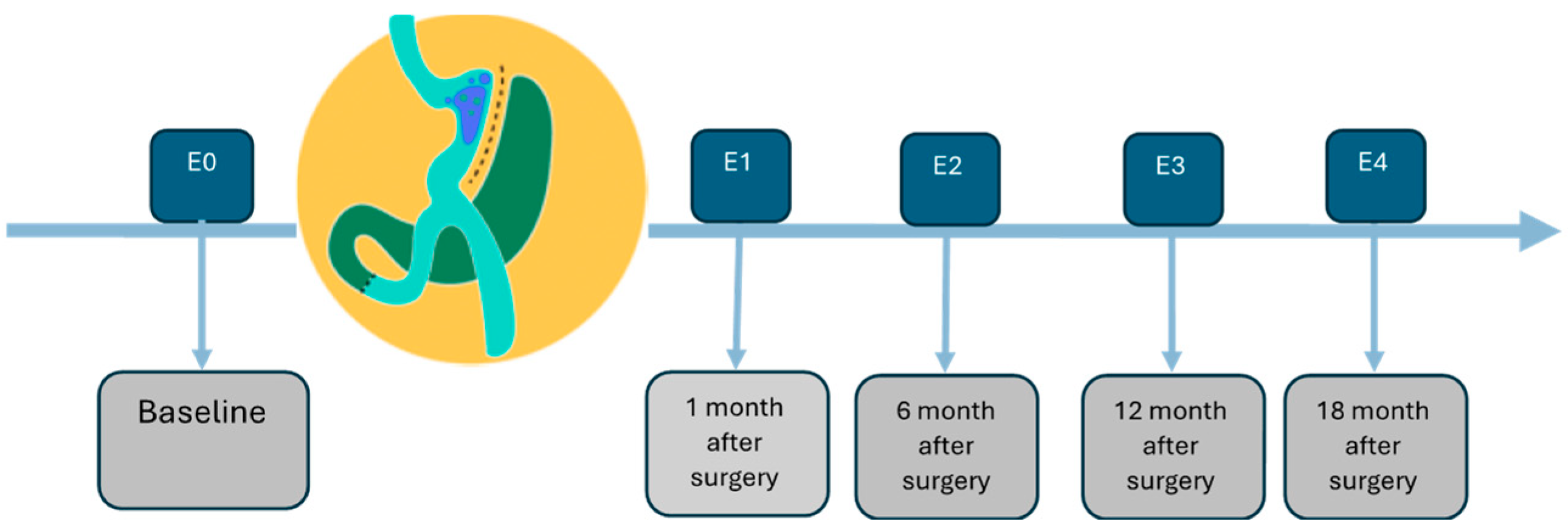
Introduction: Obesity affects over 650 million individuals worldwide and poses a significant public health challenge. Bariatric surgery is the most effective treatment for severe obesity, resulting in substantial weight loss and improvements in obesity-related conditions. However, the weight loss achieved through bariatric surgery is often associated with a notable decline in skeletal muscle. This association suggests an elevated risk of sarcopenia among patients following surgery. The purpose of this study was to assess the effects of obesity and bariatric surgery on indicators and diagnoses related to sarcopenia before and after surgery. Methods: A total of 17 bariatric surgery patients participated in this prospective study. The parameters for diagnosing sarcopenia were established for each participant, based on the EWGSOP2 and EASO/ESPEN consensuses. All evaluations were conducted at five time points throughout this study: before surgery and at 1, 6, 12, and 18 months post-surgery. Results: In this study, 88.2% of the subjects were female, with an average BMI of 42.9 kg/m2 and a mean weight of 105.9 kg. After surgery, the average weight consistently decreased, with all differences from baseline being statistically significant (p < 0.001). Utilizing the SARC-F questionnaire for screening, the risk of sarcopenia increased post-surgery, then decreased at 12 months, ultimately reaching zero at 18 months. Muscle strength significantly decreased (p = 0.002) during the one-month post-surgery assessment, with slight variations thereafter, none of which were statistically significant. Muscle mass was normal prior to surgery but showed a significant decline post-surgery (p < 0.001). When applying the ESPEN/EASO consensus cut-off criteria for sarcopenic obesity, 35.3% of patients met the criteria preoperatively. After surgery, this figure rose to 70.6% in the first month but then decreased to 41.2% at 6 months. Conclusions: The findings reveal a distinct detrimental impact of bariatric surgery on muscle strength and mass, which are crucial indicators of sarcopenia. Additionally, this impact appears to arise very early after surgery, suggesting that the optimal timeframe for efforts to mitigate this effect may be during the prehabilitation period followed by the post-surgery timeframe.
Keywords: bariatric surgery; fat-free mass; sarcopenia; sarcopenic obesity; skeletal muscle mass; muscle mass bariatric surgery; fat-free mass; sarcopenia; sarcopenic obesity; skeletal muscle mass; muscle mass