


Abstract
This study examines how corporate social responsibility (CSR) influences sustainable finance outcomes (SFO) in the Ethiopian Insurance industry through environmental, social, and governance (ESG) practices and institutional challenges (IC). Using covariance-based structural equation modelling (CB-SEM) with data collected from a primary survey, the results show that CSR has both a direct and an indirect positive effect on SFO through ESG. However, the adoption of ESG practices also tends to increase institutional challenges, which in turn negatively influences SFO. This interaction produces a competitive partial mediation effect. The serial mediation path CSR–ESG–IC–SFO is found to be negative, suggesting that enabling and constraining forces operate simultaneously. From a theoretical point of view, the study combines stakeholder, legitimacy, and institutional theories to explain this competitive mediation within a less-studied Sub-Saharan African (SSA) frontier market. On the practical side, the findings highlight the importance of establishing ESG disclosure standards, investing in capacity building, and strengthening governance systems to reduce institutional frictions and make CSR a stronger driver of sustainable finance.
1. Introduction
The global financial system is moving from a traditional focus on a profit maximization toward practices that emphasize sustainability [1]. This change can be seen in the evolution from philanthropic corporate social responsibility to environmental, social, and governance frameworks. While CSR usually involves voluntary activities such as donations and charity programs [2], ESG introduces standardized indicators that are integrated into corporate governance and risk management systems to promote accountability [2]. This transformation is particularly important in developing countries, where adopting such frameworks is necessary to attract foreign investment and to manage systemic financial risks [3].
In general, CSR and ESG criteria serve connected purposes within sustainable finance. CSR represents the ethical and moral commitments of a company, while ESG translates these commitments into measurable and verifiable indicators [4]. Many empirical studies have shown that ESG integration is positively related to better financial performance and higher governance quality. However, there are still major challenges, such as the problem of greenwashing and the absence of consistent reporting standards in many developing nations [4].
The insurance industry plays a vital role in advancing this sustainability transition. Because insurance involves long-term obligations and exposure to environmental and social risks, it is especially sensitive to sustainability issues [5]. Insurers are gradually shifting from voluntary CSR activities to compliance based ESG practices. Yet, this process remains relatively slow in several regions, including Africa and the Middle East, mainly due to weak regulation, limited technical skills, and insufficient reporting systems. Within this context, the growth of ESG efforts in Saudi Arabia has been mainly influenced by improvements in governance structures, while environmental and social aspects are catching up [6].
A critical distinction exists, however, in how CSR and ESG translate into sustainable finance outcomes (SFO) across different institutional settings. In developed economies, robust legal frameworks, effective regulatory oversight, advanced technical infrastructures, and deep capital markets allow CSR and ESG to translate efficiently into sustainable finance outcomes (SFO) within minimal institutional friction [7,8]. In contrast, this pathway in developing and frontier markets—particularly Sub-Saharan Africa (SSA)—is neither seamless nor linear, hindered by institutional voids, regulatory fragmentation, capacity constraints, and inconsistent implementation trends [9].
While some nations, such as Ghana, show comparative progress in ESG adoption [10], the broader region faces enduring obstacles that fundamentally alter the CSR–ESG–SFO relationship. In these contexts, ESG implementation can actually expose and exacerbate pre-existing institutional weaknesses, creating a competitive mediation dynamic rarely seen in mature markets. Despite these complexities, Ethiopia’s financial industry remains inadequately examines, representing a significant gap in the understanding of ESG acceptance within African markets [11].
In Ethiopia, corporate social responsibility remains fragmented and mostly limited to philanthropic activities. Evidence from previous research suggests that CSR initiatives in Ethiopian financial institutions are irregular, and factors such as audit committee size, independence, and competence tend to improve disclosure practices [12]. Nevertheless, Ethiopian insurance firms face considerable institutional barriers, such as legal uncertainty and a lack of technical knowledge, which make ESG implementation difficult [13,14]. These challenges are similar to what has been reported in other African countries, where weak governance structures often prevent effective sustainability integration [15]. This institutional environment makes Ethiopia a critical and revealing case for examining the complex mediation pathways between CSR and SFO.
Although there has been theoretical progress, there are still few empirical studies testing serial mediation models that connect CSR orientation to sustainable finance outcomes through ESG integration and institutional challenges, especially in the African insurance industry [16,17]. Moreover, evidence from developed economies—where institutional environments are relatively stable—cannot adequately explain the competitive and often paradoxical interactions observed in institutionally fragile settings, where ESG adoption may simultaneously enable and constrain sustainability outcomes.
Building on this limitation, although prior studies have examined mediation frameworks linking green finance to sustainable finance outcomes—often with CSR or ESG-related constructs acting as intervening variables—this evidence is largely drawn from developed or institutionally stable contexts. To date, no empirical study has tested such mediation mechanisms within Ethiopia’s insurance sector or explicitly incorporated institutional challenges as a constraining channel. This gap underscored the need for context-specific empirical research in Ethiopia, where CSR practices remain limited, ESG adoption slow, and institutional constraints are pronounced.
To address this research gap, this study aims to investigate how CSR orientation affects sustainable finance outcomes among Ethiopian insurance companies, paying attention to the mediating roles of ESG integration and institutional challenges. More specifically, it seeks to: (1) determine whether CSR orientation affects ESG integration and sustainable finance outcomes, (2) assess whether institutional challenges mediate the CSR–SFO relationship, and (3) examine whether the serial pathway CSR–ESG–IC–SFO can explain variations in sustainable finance outcomes. Therefore, the study focuses on the following questions: (1) Does CSR orientation have a positive impact on ESG integration in Ethiopian insurers? (2) Do institutional challenges mediate the lick between CSR and sustainable finance outcomes? (3) Does the CSR–ESG–IC–SFO sequence explain differences in sustainable finance outcomes across Ethiopian insurers? Theoretically, this study contributes by combining stakeholder, legitimacy, and institutional theories to explain both enabling and constraining mechanisms. By contrasting the straightforward, enabling pathways prevalent in developed economies with the complex, competitive mediation present in Ethiopia, this research highlights the urgency of channel-specific investigations in frontier markets. Practically, it provides useful recommendations for policymakers and insurance firms that operate within Ethiopia’s institutional gaps.
The rest of this paper is organized as follows. Section 2 reviews the related literature and empirical studies on CSR, ESG, institutional challenges, and sustainable finance outcomes, and develops the research hypotheses. Section 3 presents the research methodology, including sampling procedures, data collection, measurement instruments, and the structural equation modelling (SEM) technique. Section 4 reports and discusses the empirical results, highlighting their theoretical and practical implications for sustainable finance in emerging markets. Finally, Section 5 concludes the paper by summarizing the findings, acknowledging limitations, and suggesting areas for future research.
2. Reviewed Literature and Theoretical Framework
2.1. Theoretical Underpinnings: An Integrated Approach
The transition from philanthropic Corporate Social Responsibility (CSR) to structured Environmental, Social, and Governance (SEG) frameworks represents a fundamental shift towards accountable and measurable sustainability practices [2,3]. To conceptualize this transition and its outcomes in developing economies, this study integrated three complementary theoretical perspectives: Stakeholder Theory, Legitimacy Theory, and Institutional Theory.
Stakeholder Theory [18] and Legitimacy Theory [19] provide a foundational logic for why firms engage in CSR and adopt ESG practices. Stakeholder Theory posits that firms manage relationships with diverse groups to ensure long-term viability, while Legitimacy Theory suggests firms adopt socially acceptable practices to maintain their “license operate.” Together, they explain the enabling forces and motivations for sustainability integration. In contrast, Institutional Theory illuminates the contextual constraints on this process. It highlights how coercive (regulatory), mimetic (imitative), and normative (professional) pressures from the institutional environment can enable, shape, or hinder the effective implementation of such practices. Crucially, in settings with institutional voids, the act of adopting complex frameworks like ESG can itself expose and amplify existing weaknesses. The following literature review synthesizes empirical findings through this integrated lens, where Stakeholder and Legitimacy theories inform the drivers of CSR and ESG adoption, and Institutional Theory explains the friction and mediation that occur in imperfect implementation contexts.
In this study, Stakeholder, Legitimacy, and Institutional theories interact dynamically to explain the competitive mediation observed in Ethiopia’s insurance sector. Stakeholder and Legitimacy theories drive CSR and ESG adoption through normative and reputational pressures, while Institutional Theory explains the countervailing effect where ESG implementation exposes and intensifies existing institutional voids, such as regulatory gaps and capacity constraints. This interaction creates a tension between enabling and constraining forces: although CR and ESG aim to build legitimacy and meet stakeholder expectations, institutional weaknesses can limit their translation into tangible sustainable finance outcomes. The model therefore captures a sequential and opposing dynamic in which legitimacy-seeking through ESG adoption may inadvertently increase institutional friction, moderating overall sustainability performance.
2.2. Core Constructs in the Insurance Sector in Emerging Economies
2.2.1. CSR Orientation in Insurance Sector
In African financial institutions, CSR is predominantly philanthropic or compliance-driven, focusing on community donations, employee welfare, and regulatory conformity rather than being strategically embedded into business models. This contrasts sharply with practices in developed economies, where CSR is more closely aligned with corporate governance, long-term competitiveness, and strategic value creation.
The Ethiopian case reflects these broader regional patterns. CSR is undeveloped and fragmented, with professionals noting diverse emphases. Whilst some highlights community-based humanitarian initiatives [20] emphasize employee welfare and compliance. This discrepancy illustrates the absence of a well-defined corporate social responsibility plan and reflects ongoing debates in the literature over whether strategic imperatives or legitimacy-seeking behaviour are the main drivers of CSR in developing nations [2,21]. This aligns with a Legitimacy theory perspective, where CSR addresses immediate community expectations. However, a Stakeholder Theory view suggests that evolving towards strategic ESG requires responding to broader investor and regulatory pressures.
CSR has shown to be quite beneficial in Ethiopia despite these limitations. For instance, whereas [22] linked CSR practices with greater organizational resilience [23] contend that CSR activities promote sustainable community development. Likewise, CSR fosters business–community relations in Ethiopia’s banking sector, provided empirical evidence on CSR’s financial impact in the Ethiopian financial sector. In their investigation of the connections between corporate governance, organizational performance, and corporate social responsibility in Ethiopia [24] provided empirical evidence in favour of the global–local narrative of CSR’s transition to ESG practices. Their results demonstrate that the transition from CSR to ESG often happens gradually and that these connections have previously been studied in the Ethiopian context. These findings suggest that CSR may provide significant social and commercial benefits, even in its fragmented form.
Globally, CSR is becoming more and more recognized as an ESG predecessor, offering the institutional and cultural underpinnings necessary to establish organized sustainability frameworks [2]. This process often takes place in developing countries in a step-by-step fashion, with companies initially implementing CSR to establish credibility and then switching to ESG to meet investor and regulatory expectations [25]. Within this framework, and consistent with Stakeholder and Legitimacy theories, Ethiopian insurers illustrate the pattern, with CSR functioning as the normative underpinning for adopting ESG principles into governance and risk management systems [26].
Based on the above discussion, which aligns with Stakeholder and Legitimacy theories, the following hypothesis 1 is proposed. Testing this is vital to understand if grassroots CSR efforts in Ethiopia can be systematically scaled into investor-relevant ESG frameworks.
H1:
CSR orientation positively influences ESG integration in Ethiopian insurance companies.
2.2.2. ESG Integration in Insurance Sector
The adoption of ESG frameworks signifies a fundamental revolution in approaches to sustainability. Globally, insurers implement ESG practices not just to comply with regulatory requirements but also to better risk management, boost investor trust, and enhance long-term competitiveness [6,27].
Data from empirical studies consistently correlates ESG adoption with enhanced firm-level outcomes including financial performance, climate risk reduction, and stakeholder trust [1]. However, the strength of these associations varies among institutional settings, with higher benefits reported in markets with effective governance and regulatory enforcement. Collective efforts like the UN Principles for Sustainable Insurance and the Nairobi Declaration indicate expanding sector commitments [28].
In developing countries, ESG adoption is typically restricted by institutional gaps such as lack technical competence, fragmented regulatory frameworks, and poor enforcement mechanisms [29,30]. These systemic hurdles undermine the translation of ESG commitments into quantifiable performance improvements. Still, increased investor demand for ESG compliance creates external pressure for adoption [31]. Crucially, from an Institutional Theory perspective, the process of ESG integration itself can work as a spotlight, uncovering and amplifying these pre-existing institutional flaws. The formal requirements of ESG (e.g., data collection, detailed reporting, new risk models) create a direct pressure on firms functioning in environments with limited technical knowledge, ambiguous legislation, and poor market maturity. Therefore, although ESG is sought for its advantages, its acceptance is expected to concurrently enhance the sense of institutional problems.
In Ethiopia, ESG integration is underdeveloped. Regulatory agencies like the AABE are generating momentum via disclosure obligations [32,33]. Evidence from other financial sectors underlines similar benefits: in Ethiopian banks, for instance, sustainability measures incorporated within performance frameworks have been demonstrated to enhance financial results [14]. However, the incorporation of ESG also highlights continuing limits. Capacity and governance shortages remain important impediments in developing countries, inhibiting the systemic adoption of sustainable measures [2,34]. Moreover, although ESG frameworks are supposed to promote governance and accountability, their implementation frequently reveals underlying institutional vulnerabilities, including legal uncertainty, enforcement shortfalls, and shortages of technical skills [29,35]. These results show that ESG adoption, rather than resolving institutional difficulties, usually puts them into clearer foreground.
Thus, while ESG adoption is sought for its benefits, it may simultaneously heighten institutional pressures. From an Institutional Theory perspective, the formal adoption of complex, externally derived ESG frameworks acts as a coercive pressure that interacts with local institutional voids. We posit that this implementation process does not resolve but rather highlights existing deficiencies. This leads to the second hypothesis. This hypothesis challenges the assumption that ESG is a mere technical solution, highlighting its role in revealing systemic governance and capacity gaps.
H2:
ESG integration is positively associated with institutional challenges in Ethiopian insurance companies.
2.2.3. Institutional Challenges
Institutional constraints comprise important impediments that mediate the translation of CSR and ESG practices into sustainable financial outcomes frequently reducing the effect of otherwise well-intentioned efforts. Such issues include inadequate legal frameworks, limited technical competence, poor insurance coverage, and the unavailability of standardized ESG data [13,15]. Both the incentives and the capacity to implement ESG are limited in Ethiopia, where insurance coverage is still one of the lowest in Sub-Saharan Africa [32,36].
Regulatory fragmentation significantly complicates these operations. Ethiopia’s intentions to embrace ESG disclosure requirements by 2029 stand in contrast to its weak governance infrastructure, causing uncertainty and compliance issues for insurers [33]. When defining the ESG–performance nexus, comparative analysis emphasizes the moderating effect of institutional quality. For example, refs. [35,37] show that insufficient institutional infrastructures reduce the benefits of ESG adoption in MENAT insurance markets, while [29] identifies similar barriers in Eastern Europe.
These processes may be evaluated from the lens of institutional theory, which describes them as normative pressures (international ESG standards), mimetic pressures (business imitation), and coercive pressures (mandated disclosure rules) [2]. However, rather than leading to real ESG integration, these pressures frequently result in symbolic compliance or even greenwashing in institutionally unstable conditions like Ethiopia [38]. In this regard [39] showed that international pressures can lead to superficial compliance rather than real institutional change in Ethiopia. Crucially, however, institutional failures may also lead to opportunity for originality. Businesses may obtain financial benefits and reputational legitimacy over their peers if they actively implement ESG practices in spite of institutional limits [25]. Combined together, these data demonstrate that institutional obstacles both affect and hamper Ethiopia’s CSR–ESG–SFO process.
Consistent with Institutional Theory, the quality of the institutional environment is a key determinant of organizational effectiveness. We hypothesize that pronounced institutional challenges directly undermine a firm’s ability to translate any activity, including sustainability efforts, into tangible performance outcomes. Confirming this path underscores the importance of macro-level regulatory and infrastructural reforms alongside firm-level ESG initiatives. Consequently, the following hypothesis is formulated:
H3:
Institutional challenges negatively influence sustainable finance outcomes in Ethiopian insurance companies.
2.2.4. Sustainable Finance Outcomes (SFO)
Ref. [31] defines sustainable finance outcomes (SFO) as the visible effects of adopting CSR and ESG concepts into core business strategy. These outcomes include not just financial profitability but also resistance to systemic risks (social and environmental hazards), long-term stability, greater stakeholder confidence, and contributions to societal progress.
Given the industry’s dual responsibilities of risk management and capital mobilization for growth, SFOs are particularly important for insurers. Global research regularly indicates that ESG adoption boosts insurers’ financial performance, minimizes exposure to systemic risks, and creates long-term resilience [6,27]. Comparative studies further demonstrate that firms with effective ESG procedures provide stronger risk-adjusted profits and bigger social benefits by permitting inclusive growth and climate resilience [1].
Empirical evidence indicates that CSR initiatives already yield sustainability outcomes in Ethiopia [23] show that CSR contributes to community development, while [22] find that CSR strengthens organizational sustainability. Ref. [16] highlights how CSR in financial institutions improves community relations and indirectly enhances resilience. However, these CSR-driven outcomes are often localized and philanthropic. To achieve systemic impact, firms must institutionalize sustainability through ESG adoption. Comparative African evidence reinforces this. Ref. [14] finds that Ethiopian financial institutions linking sustainability to balanced scorecard frameworks improve financial outcomes. Refs. [2,34] show that ESG adoption enhances resilience but is contingent on institutional quality. Thus, while CSR establishes localized legitimacy and social capital, ESG integration is necessary to achieve broader and measurable sustainable finance outcomes.
Aligning with Stakeholder and Legitimacy theories, the structured integration of ESG is expected to enhance risk management, reputational capital, and long-term resilience. Thus, we hypothesize a direct positive effect on sustainable finance outcomes. Accordingly, the fourth hypothesis is proposed. This tests the core value proposition of ESG for Ethiopian insurers, justifying the resource investment required for its adoption.
H4:
ESG integration positively influences sustainable finance outcomes in Ethiopian insurance companies.
2.2.5. CSR Orientation and Direct Sustainable Finance Outcomes
While ESG frameworks offer a structured approach to sustainability, CSR alone has also been linked to positive outcomes. Globally, CSR initiatives contribute to long-term competitiveness, reputational enhancement, and stakeholder trust [25]. In Ethiopia, CSR has demonstrated tangible community and organizational benefits [22,23]. Ref. [16] notes that CSR strengthens business–community relations, indirectly improving financial resilience. These findings underscore that CSR orientation contributes directly to SFOs, even in the absence of formal ESG adoption.
Stakeholder and Legitimacy theories also suggest that even informal CSR can yield legitimacy and relational benefits. Therefore, we hypothesize a direct positive link between CSR orientation and SFO, independent of formal ESG pathways. Hence, this led to the fifth hypothesis. This tests the core value proposition for ESG for Ethiopian insurers, justifying the resource investment required for its adoption.
H5:
CSR orientation positively influences sustainable finance outcomes in Ethiopian insurance companies.
2.2.6. Serial Mediation Pathway
The study’s main contribution lies in theorizing ta serial mediation pathway linking SFO, institutional challenges, ESG, and CSR, integrating the three theoretical perspectives. Previous research suggests that by establishing normative and cultural expectations, CSR serves as the foundation for ESG [2]. ESG integration then builds on this base, not only enhancing performance but also disclosing institutional weaknesses, such as regulatory and technical deficiencies [29,35]. These institutional challenges, in turn, play a major influence in selecting whether ESG adoption translates into quantifiable benefits [40,41].
A dynamic process is shown by this serial mediation: CSR generates sustainability commitments (stakeholder and legitimacy demand), ESG formalizes and operationalizes them, and institutional barriers (due to institutional theory) ultimately affect their effectiveness. In Ethiopia, where institutional capacity is ineffective, this tendency is particularly recognized. By empirically exploring this process, the research advances understanding of how CSR translates into sustainable finance in emerging market circumstances.
Integrating all three theoretical perspectives, the serial mediation pathway represents the full model of competitive mediation. It captures the enabling sequence (CSR ⟶ ESG ⟶ SFO) driven by Stakeholder/Legitimacy theories, which is concurrently attenuated by the constraining sequence (ESG ⟶ IC ⟶ SFO) explained by Institutional Theory. This leads to the final hypothesis (H6) regarding the serial mediation pathway. Testing this holistic pathway is central to understanding the net effect of CSR in frontier markets and explains why sustainability outcomes may be weaker than expected despite genuine corporate effort.
H6:
ESG integration and institutional challenges serially mediate the relationship between CSR orientation and sustainable finance outcomes.
2.3. Synthesis of Literature and Research Gap
2.3.1. Synthesis of Divergent Viewpoints
In the review, four key findings are emphasized. First, CSR in Ethiopia exists but remains fragmented. Current practices emphasize compliance and philanthropy while leaving environmental and community dimensions underdeveloped [16,20]. This challenge is not unique to Ethiopia; several other African countries are also grappling with similar challenges [42]. Despite these limitations, CSR has nonetheless contributed positively to community development and organizational resilience [22,23]. Second, ESG integration is increasingly emerging—both globally and regionally—as the dominant framework. Within the insurance industry specifically, ESG adoption strengthens risk management, enhances financial performance, and fosters stakeholder trust [6]. Ethiopia’s regulators are moving toward ESG disclosure requirements, but systemic adoption remains limited [32,33].
Third, institutional challenges are central to the sustainability transition. Weak governance, limited technical expertise, and low insurance penetration hinder adoption [13,36]. At the same time, institutional pressures from international investors and normative frameworks compel firms to adopt ESG despite these barriers [30]. Fourth, sustainable finance outcomes depend heavily on ESG depth and institutional quality. CSR provides localized and legitimacy-driven impacts, but ESG institutionalization is necessary for systemic resilience and long-term value creation [2,14]. A synthesis of the theme, convergent and divergent findings, and identified gaps is presented in Table 1 below.
Table 1.
Synthesis of Literature on CSR, ESG, Institutional Challenges, and Sustainable Finance Outcomes.
2.3.2. Research Gap
Although CSR, ESG, and institutional challenges have been extensively studied in emerging markets, no research has empirically tested the serial mediation pathway (CSR → ESG → Institutional Challenges → SFO) within Ethiopia’s insurance sector. This gap is critical because it bridges philanthropic orientations with performance-driven sustainability frameworks, offering both theoretical and practical insights. The study is further significant due to its sectoral importance, institutional voids, and transition dynamics. Insurers are crucial financial intermediaries in Ethiopia, both vulnerable and capable of mitigating systemic risks. Ethiopia’s fragmented regulatory environment and low market maturity create unique barriers to ESG adoption [33,36].
By empirically examining this serial mediation model, the proposed study contributes to three streams of literature. CSR and ESG research: by bridging philanthropic and performance-driven sustainability frameworks; Institutional theory: by testing how systemic voids mediate sustainability outcomes, and Sustainable finance: by situating insurers as catalysts for Ethiopia’s development agenda.
2.3.3. Conceptual Synthesis and Hypothetical Model
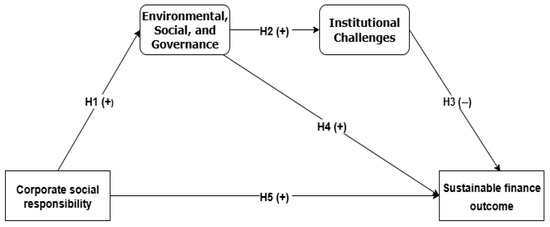
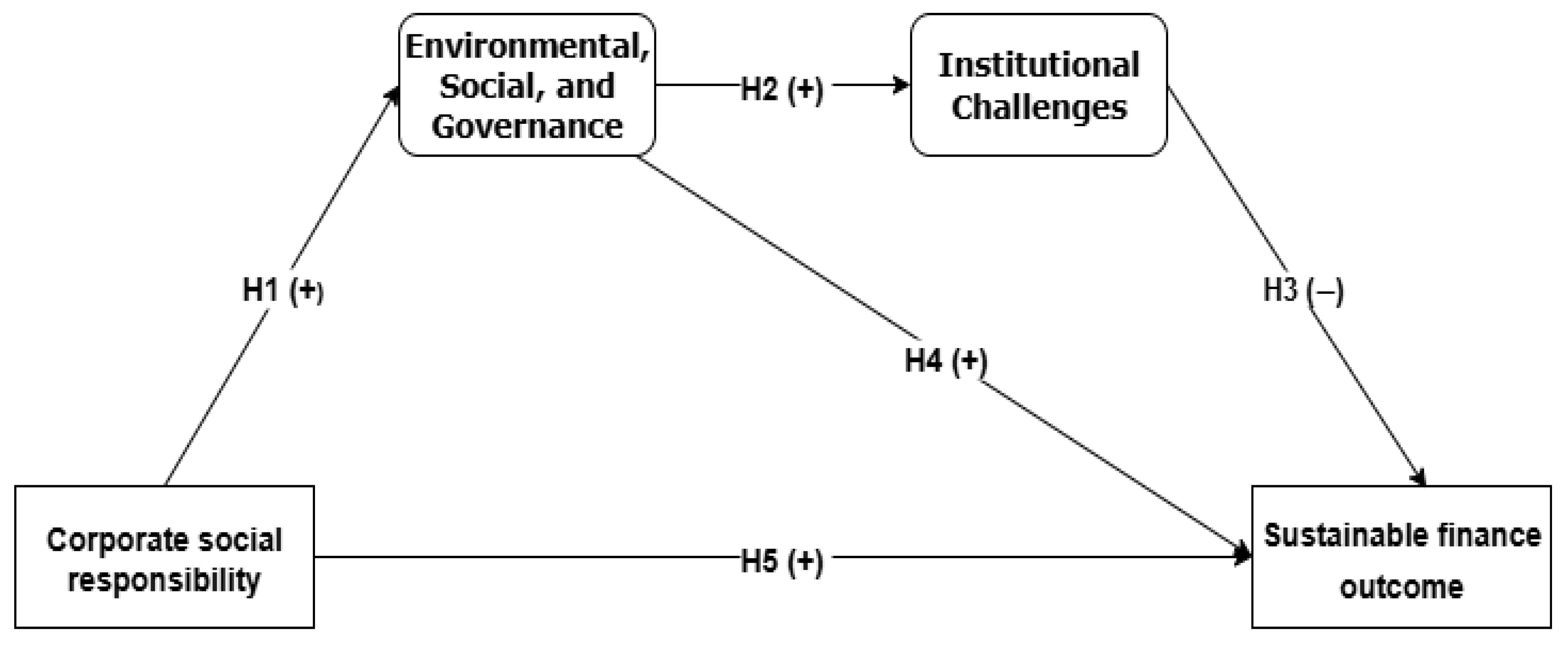
The literature confirms that CSR provides the normative basis for ESG adoption, which in turn enhances sustainable finance outcomes but also exposes firms to institutional challenges. ESG integration is still in its infancy but is gaining popularity, but institutional constraints are still serious, and CSR is still fragmented but developing in Ethiopia’s insurance industry. To systematically integrate these insights, a serial mediation model is proposed, capturing hypothesized pathways (H1–H6). The suggested serial mediation model captures these processes and solves a major research need by systematically integrating CSR, ESG, institutional issues, and sustainable finance outcomes. This paradigm depicts Ethiopian insurers not simply as passive users of global norms, but also as potential catalysts for national and regional sustainable finance, provided they handle institutional barriers efficiently. Figure 1 therefore depicts the conceptual framework of the study.
Figure 1.
Conceptual framework of the study.
3. Methodology
This research adopted a quantitative, cross-sectional survey technique. The design was appropriate because the goal was to empirically investigate the structural relationships between Corporate Social Responsibility orientation (CSR), Environmental, Social, and Governance integration (ESG), Institutional Challenges (IC), and Sustainable Finance Outcomes (SFO) in the Ethiopian insurance industry. A structured survey was developed to gather managers’ and senior officers’ impressions using 5-point Likert-scale metrics. The data was examined using covariance-based structural equation modeling (CB-SEM) in AMOS (version 24) to test the hypothesized causal connections [43,44]. CB-SEM was chosen over variance-based SEM (PLS-SEM) owing to the major purpose of the inquiry being the validation and confirmation of a known theoretical model, rather than participating in prediction analysis or the exploratory construction of theories. Moreover, the dataset met the necessary presumptions for the use of CB-SEM, including a sufficiently large sample size and minimal violations of multivariate normality, making it the appropriate technique for accurate parameter estimation and model fit assessment [43].
3.1. Sampling Technique and Sample Size
The study population encompasses all insurance firms presently functioning in Ethiopia. According to the National Bank of Ethiopia, a total of 18 licensed insurers is engaged in the market [32]. Given this relatively modest population size, utilizing a census strategy (total population sampling) is both practicable and methodologically suitable. This approach guarantees comprehensive coverage of the Ethiopian insurance business, boosting representativeness and external validity. By incorporating all 18 insurers, the analysis minimizes sampling bias and provides meaningful cross-case comparison between state-owned and private enterprises.
To provide detailed characteristics of this population and the macro-environment from which it is drawn, we note the sector exhibits a distinct structure that may influence firm-level experience. Based on FY 2023/24 Gross Written Premium (GRP), the sector is segmented into a dominant state-owned insurer, six large private insurers, eight mid-tier firms, and four smaller, growing companies. This concentration and tiered structure—where firms possess vastly different resource bases, market power, and branch networks—constitutes a key macro-environmental factor. It suggests that institutional challenges (e.g., costs of ESG implementation, access to technical expertise) are likely experienced asymmetrically across firms. While a census approach was employed captures all entities, this inherent variation in company size and ownership means that the perceived intensity of institutional hindrances and the capacity to engage in CSR/ESG may differ systematically across market tiers, a point we consider in the interpretation of our findings.
For the purpose of quantitative data collection (e.g., survey of managers, executives, and senior officers), a purposive sampling strategy was applied within each company to capture respondents with direct involvement in CSR, ESG, and sustainable finance decision-making. More specifically, we sought persons in top management positions (e.g., CEO, Chief Underwriting Officer, Chief Risk Officer, Head of Sustainability/CSR) who hold the strategic supervision and expertise necessary to appropriately evaluate their company’s approach and practices. This aligns with the study’s focus on organizational-level practices, ensuring data is obtained from informants with relevant expertise. While purposeful sampling is acceptable for this study environment, the possibility for key informant bias is recognized as a limitation; anonymity was ensured to combat social desirability bias in response.
The population of interest includes senior managers across all 18 regulated insurance businesses in Ethiopia, which is limited and precisely defined. For a cautious estimate of the minimal sample size, Cochran’s formula [45] for an infinite population was used, using a 95% confidence level, ±5% margin of error, and a conservative response distribution (p = 0.5):
While this offers a baseline for general survey representativeness, the study’s use of Confirmatory Factor Analysis (CFA) and Structural Equation Modeling (SEM) necessitates extra considerations to guarantee appropriate statistical power and robust parameter estimation. Following [46] guidelines, a sample of 200–300 is considered “good,” 300–500 “very good,” and >500 “excellent” for SEM [47]. Similarly, ref. [44] recommends 10–15 respondents per observed variable.
In this research, there are 24 observed items over four constructs. Following a conservative ratio of 15 participants per item, a 24-item scale would need a minimum sample size of 360 respondents [48]. To achieve acceptable statistical power and reduce the impacts of any non-replies, the target sample size was established at 400 valid responses, proportionally dispersed among the 18 insurers based on firm size and the availability of management personnel. Of the 400 questionnaires administered, 342 were returned and considered appropriate for analysis, producing a strong response rate of 86%. This sample size not only exceeds the minimum thresholds recommended for structural equation modeling [43,44] but also supports the robustness of the proposed serial mediation model (CSR → ESG → IC → SFO) tested using covariance-based structural equation modeling (CB-SEM) in AMOS.
3.2. Questionnaire Development
The survey instrument captured four constructs: CSR orientation, ESG integration, IC, and SFO. Drawing on existing measures and contextual insights, items were adapted from prior studies to ensure validity and relevance. CSR items were informed by [16,20,49]; ESG items by [1,6,27]; IC items by [13,29,37]; and SFO items by [50]. Ethiopian-specific research substantially enhanced contextual fit from [16,22,23,33] and the instrument went through a multi-step validation approach to ensure its validity and reliability.
The initial questionnaire was reviewed by academic experts and industry practitioners to check content validity, clarity, and contextual relevance. A refined questionnaire was pilot tested with 25 senior managers from five insurance firms, revealing strong internal consistency. All questions were assessed on a five-point Likert scale ranging from 1 (Strongly Disagree) to 5 (Strongly Agree). The final items are presented in Table 2. Prior to hypothesis testing, we used Confirmatory Factor Analysis (CFA) to validate the measurement model, assessing construct reliability (using Cronbach’s alpha and Composite Reliability) and validity (convergent validity via Average Variance Extracted and discriminant validity via the Fornell–Larcker criterion). The full structural model was then tested using Covariance-Based Structural Equation Modeling (CB-SEM) to simultaneously analyse all hypothesized pathways and the direct, indirect, and total effects of the variables.
Table 2.
Market Structure and Sample Characteristics of the Ethiopian Insurance Sector (FY 2023/24).
3.3. Data Analysis Techniques
Data were analysed in three stages. Pre-analysis checks: Screening for missing values, normality, and outliers using SPSS version 27 [51]; measurement model assessment: Reliability (Cronbach’s α, composite reliability), convergent validity (Average Variance Extracted), and discriminant validity (Fornell–Larcker criterion, HTMT) (43); and structural model testing (CB-SEM in AMOS): Fit indices (χ2/df, CFI, TLI, RMSEA, SRMR) and hypothesis testing through standardized path coefficients. Indirect effects were examined using bootstrapping [52,53]. To investigate the potential for common method bias (CMB), Harman’s single-factor test [54] was employed. The unrotated factor solution indicated that the first component accounted for 38.2% of the variance, which is below the established criterion of 50% [54]. This means no single factor dominates the variation, and common method variance is unlikely to pose a substantial danger to the findings. Harman’s test remains a commonly utilized diagnostic in management and finance studies as asserted by [55].
4. Results
4.1. Measurement Model Evaluation
Before assessing the hypothesized structural connections, the reliability and validity of the four latent variables; CSR, ESG, IC, and SFO were tested to establish psychometric adequacy.
4.1.1. Reliability and Convergent Validity Assessment
Internal consistency was extensively tested by applying Cronbach’s alpha in conjunction with composite reliability (CR) metrics, permitting a comprehensive investigation of the dependability of the constructs in issue. It is noticeable that all constructions demonstrated outstanding dependability, with the values for both Cronbach’s alpha and CR varying substantially from 0.973 to 0.986, which is much higher than the typical benchmark of 0.70 as indicated by [43]. This large level of dependability indicates that the scale items connected to each construct displayed a high degree of internal consistency, in so doing creating a firm basis for any following studies that may be conducted.
Convergent validity was firmly established, as indicated by the fact that all standardized factor loadings larger than the needed threshold of 0.90, and each was statistically significant at a p-value of less than 0.001, suggesting the robustness of our results. In addition, the average variance extracted (AVE) values for the constructs of CSR, ESG, IC, and SFO ranged dramatically from 0.877 to 0.897, thereby surpassing the minimum permissible limit of 0.50. These resilient findings suggest that the constructs efficiently captured a large amount of variance with regard to measurement error, which in turn lends a high degree of confidence that each construct was appropriately represented by its accompanying observable indicators. The results of the construct measurement model assessment are presented in Table 3.
Table 3.
First-Order Construct Measurement Model Assessment.
4.1.2. Discriminant Validity Assessment
Discriminant validity was comprehensively evaluated through the application of multiple criteria to ensure the distinctiveness of the constructs [56]. First, in accordance with the Fornell–Larcker criterion, it was determined that the square root of the average variance extracted (AVE) for each construct exceeded its correlations with all other constructs, indicating a clear level of distinctiveness among the constructs of CSR, ESG, IC, and SFO. Second, the heterotrait–monotrait (HTMT) ratios were significantly below the conservative criterion of 0.85 established by [57], with the highest HTMT ratio seen between CSR and ESG being 0.549. Finally, it was confirmed that the average variance extracted (AVE) for each construct exceeded its maximum shared variance (MSV), so affirming the existence of discriminant validity. These data together give strong evidence that the constructs in consideration are empirically distinct. Thus, Table 4 presents the reliability, convergent validity, and discriminant validity assessment. Furthermore, Table 5 compares the Average Variance Extracted and Maximum Shared Variance.
Table 4.
Reliability, Validity, and discriminant validity.
Table 5.
Average Variance Extracted and Maximum Shared Variance comparison.
4.1.3. Confirmatory Factor Analysis and Measurement Model Fit
The measurement model was fully examined using confirmatory factor analysis (CFA), a statistical method aimed at confirming the suggested relationships between observed variables and their underlying latent constructs. The research results suggested that the model had an exceptional fit to the data, as evidenced by the provided statistical indices: χ2/df = 1.451, CFI = 0.992, TLI = 0.991, IFI = 0.992, NFI = 0.974, and RMSEA = 0.036, followed by a highly favourable PCLOSE value of 0.998. All of these indices surpassed the specified requirements laid forth in the major studies of [58] so suggesting that the recommended measurement model properly represents the complicated structure of the observed data.
The sample’s suitability for conducting CFA was further supported by the essential N values determined by [59], i.e., N = 271 at p < 0.05, and the model’s robustness and generalizability across different contexts were further reinforced by the Expected Cross-Validation Index (ECVI = 1.50), which was significantly lower than that of the saturated model. Overall, these large findings give great substantiation for the reliability and validity of the measuring model, giving a solid platform for the future exploration of structural linkages.
Having successfully proved the appropriateness of the measurement model by detailed analysis, we proceeded to systematically analyse the structural model with the stated purpose of evaluating the postulated causal linkages that were thought to exist among the many constructs involved.
4.2. Structural Model and Hypotheses Testing
4.2.1. Structural Model Fit
The evaluation of the structural model was conducted through the application of a variety of fit indices, all of which provided evidence that ranged from satisfactory to excellent in terms of model fit, emphasising the validity of the model. Notably, the chi-square statistic emerged as significant, denoted as χ2(246) = 356.96, with a p-value of less than 0.001, a finding that aligns with the typical results observed in structural equation modeling (SEM) conducted with large sample sizes; however, the ratio of chi-square to degrees of freedom, calculated as χ2/df = 1.45, was found to be substantially below the traditionally recommended threshold of 3.0, which is indicative of a good model fit as articulated by [53]
The incremental fit indices validated this conclusion, revealing values of CFI = 0.951, TLI = 0.940, and SRMR = 0.052, all within acceptable ranges. In addition, the RMSEA value, recorded at 0.041, with a 90% confidence interval ranging from [0.030, 0.040], further indicated excellent model fit. Together, these various fit indices serve to confirm that the proposed structural model is a robust representation of the observed variables.
Moreover, the explanatory power exhibited by the model was particularly noteworthy. as it was able to account for a substantial 30% of the variance in ESG performance, 15% of the variance associated with institutional challenges, and 20% of the variance related to outcomes in sustainable finance in emerging markets. This suggest that CSR, ESG, and institutional dynamics jointly explain a meaningful proportion of the outcomes under study.
Given the satisfactory model fit and explanatory power, the hypothesized direct and indirect effects were tested.
4.2.2. Direct Effects and Hypothesis Testing
Direct path analysis produced several significant results. CSR exhibited a robust positive correlation with ESG performance (β = 0.548, p < 0.001), thus validating hypothesis H1, and demonstrated a significant negative correlation with IC (β = −0.269, p < 0.001), thus supporting hypothesis H5. These findings imply that CSR initiatives directly enhance the integration of ESG considerations while concurrently mitigating institutional challenges.
Contrary to expectations, ESG was found to have a positive association with institutional challenges (β = 0.463, p < 0.001), thereby affirming hypothesis H2 but suggesting that an increased adoption of ESG principles may initially exacerbate regulatory and operational difficulties within the Ethiopian insurance sector. Consistent with the proposed hypotheses, ESG positively forecasted sustainable finance outcomes (β = 0.340, p < 0.001; supporting H4), whereas institutional challenges exerted a significant negative influence (β = −0.255, p < 0.001; supporting H3). Furthermore, CSR demonstrated a direct positive impact on sustainable finance outcomes (β = 0.135, p = 0.029), thereby supporting hypothesis H6.
In a nutshell, these results show that CSR plays a central role in driving sustainable finance directly through ESG and institutional channels, though ESG adoption also introduces institutional pressures that complicate this process.
4.2.3. Mediation Analysis
The mediation effects were assessed using a bias-corrected bootstrap analysis comprising 2000 resamples [60]. The findings indicated a competitive partial mediation pattern. Corporate Social Responsibility was found to exert an influence on sustainable finance outcomes through various indirect channels: a positive indirect effect via ESG criteria alone (SIE = 0.178, 95% CI [0.117, 0.252]); a positive indirect effect through diminished IC exclusively (SIE = 0.065, 95% CI [0.035, 0.132]); a negative serial indirect effect through the sequence ESG → IC → SFO (SIE = −0.061, 95% CI [−0.116, −0.038]).
Notwithstanding the suppressive effect of the serial pathway, the overall indirect effect of CSR persisted as positive (TIE = 0.181, 95% CI [0.113, 0.248]), as did the total effect (TE = 0.310, 95% CI [0.212, 0.410]). Robustness assessments employing 5000 bootstrap resamples validated these findings. The results of hypothesis tests are summarized in Table 6.
Table 6.
Hypothesis Testing Results.
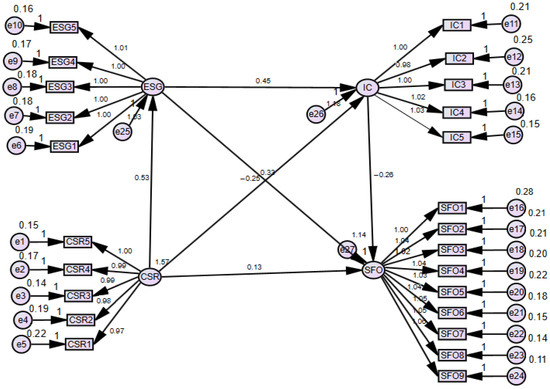
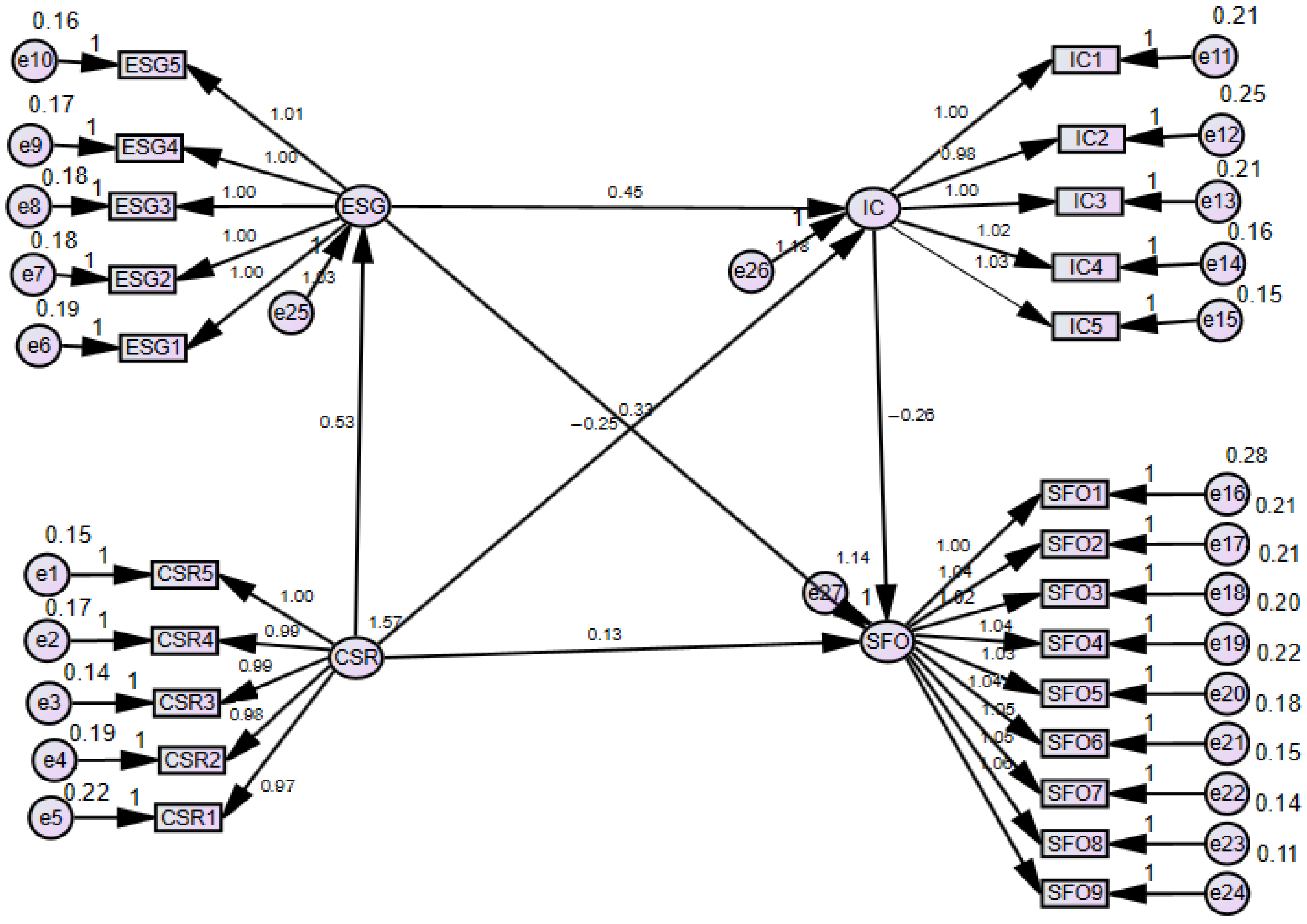
Figure 2 presents the structural equation modeling (SEM) diagram illustrating the standardized relationships among the study’s variables.
Figure 2.
Structural Equation Model.
These mediation results highlight a paradox. While CSR promotes sustainable finance both directly and indirectly, the integration of ESG also elevates institutional pressures that partially undermine its benefits. This competitive mediation effect illustrates the nuanced and context-dependent role of ESG in emerging markets, where institutional weaknesses may offset the gains from sustainability-oriented practices.
In sum, the results suggest that CSR is a core driver of ESG adoption and sustainable financial outcomes. ESG, in turn, operates as both a facilitator and a constraint—improving financial sustainability directly but also increasing institutional challenges that suppress outcomes. This dual role underscores the complicated mechanics of incorporating sustainability into the financial system in emerging nations. These findings provide empirical evidence for both the promise and paradox of CSR–ESG linkages in Ethiopia’s insurance sector, setting the stage for a deeper theoretical and policy-oriented discussion in the following section.
5. Discussion, Conclusions and Recommendations
5.1. Discussion
This paper analyses the intricate interconnections of Corporate Social Responsibility (CSR), Environmental, Social, and Governance (ESG) integration, institutional challenges, and sustainable finance results in Ethiopia’s insurance industry. This discussion analyses the principal results, contextualizes them within existing literature, and clarifies their theoretical implications.
5.1.1. CSR as an Antecedent to ESG Integration
The investigation verifies a substantial and affirmative direct impact of CSR on ESG integration (β = 0.548, p < 0.001). This data strongly supports H1, demonstrating that a solid CSR perspective is a fundamental prerequisite to the official adoption of ESG frameworks among Ethiopian insurers.
This outcome is consistent with an expanding corpus of global evidence. It resonates with research on other African financial institutions where CSR has been found to build the normative and ethical framework for later sustainable policies [13,16]. More particularly, it supports the conceptual arguments of [2], who suggest that CSR embeds the philanthropic and stakeholder-oriented ideals that subsequently mature into formal governance and sustainability frameworks. Transitioning from the global to the local context, this finding stands in interesting contrast to the historically fragmented CSR orientation documented in Ethiopia [20], suggesting that firms which proactively develop coherent CSR strategies are distinctly better positioned to transition to more comprehensive ESG paradigms.
This finding offers significant empirical validity for Stakeholder Theory [18], revealing that enterprises participating in CSR to fulfil varied stakeholder expectations feel forced to institutionalize their commitments via formal ESG procedures. Simultaneously, it strengthens Legitimacy Theory [19], as insurers embrace ESG not only as altruism but as a strategic instrument to gain wider social and regulatory legitimacy. Therefore, CSR serves as a major positive driver of ESG integration in developing financial markets.
5.1.2. The Mitigating Effect of CSR on Institutional Challenges
A critical result of this research is the considerable negative direct influence of CSR orientation on perceived institutional problems (β = −0.269, p < 0.001). This suggests that insurers with stronger CSR commitments report less challenges related to governance, regulations, and infrastructure when adopting sustainable initiatives.
This outcome is consistent with modern research showing that CSR builds intangible assets, such as reputational capital, stakeholder goodwill, and greater managerial competence, that enable enterprises to traverse and overcome institutional gaps [23,25]. Furthermore, this result expands and refines prior academic work. It challenges the perspective presented by [15], who stated that CSR in weak institutional environments is generally restricted to superficial philanthropy. Instead, our data demonstrate that CSR can actively mitigate governance and regulatory frictions, emphasizing its adaptive and substantive function even in situations of institutional instability.
Theoretically, this research provides a nuanced layer to Stakeholder Theory by proposing that CSR’s extensive involvement with community and employee welfare generates relational capital that minimizes opposition and smooths the way for bigger efforts. It also provides a significant extension to Institutional Theory [2]; while institutional voids typically constrain firm behaviour, proactive CSR can buffer these pressures by creating internal legitimacy and adaptive capacity, effectively acting as a substitute for missing formal institutions.
5.1.3. The Paradoxical Effect of ESG on Institutional Challenges
Contrary to original expectations, ESG integration was found to considerably raise perceived institutional challenges (β = 0.463, p < 0.001). This paradoxical conclusion supports H2 by demonstrating that the adoption of complex ESG practices heightens awareness of existing governance and regulatory deficiencies rather than resolving them. This finding stands in sharp contrast to research such as [29], which indicated that ESG frameworks enhance governance competence in Eastern European countries. However, our conclusion is not without significance; it aligns with a critical viewpoint on ESG adoption in emerging economies. It strongly resonates with arguments by [15,30], who say that ESG implementation frequently reveals technological, data, and regulatory weaknesses by imposing rigorous reporting requirements and complex risk models.
In Ethiopia, where ESG reporting infrastructure and technical competence remain weak [33,36]. ESG integration functions less as a quick remedy and more as a stress test, revealing institutional deficiencies with greater clarity. From the perspective of Institutional Theory, this finding underscores the notable significance of coercive and mimetic isomorphism. Global ESG norms drive enterprises to embrace activities for which they are not institutionally ready. This adoption, motivated by legitimacy-seeking, does not instantly lead to better results but instead exacerbates the appearance of institutional failings, hence producing considerable compliance obligations and opposition. Thus, ESG adoption might heighten institutional obstacles in unstable economies.
5.1.4. The Dual Pathways to Sustainable Finance Outcomes
The findings show that there are two ways to determine sustainable finance outcomes (SFO). ESG integration positively predicts SFO (β = 0.340, p < 0.001), whereas institutional challenges impose a substantial negative effect on SFO (β = −0.255, p < 0.001). This dichotomy underlines the conditional and controversial nature of obtaining sustainability benefits in developing countries.
The beneficial impact of ESG on SFO coincides with a huge body of global research suggesting that ESG strengthens financial resilience, improves risk management, and raises investor confidence [1,6,27]. This global trend remains true in the African setting, as indicated by [14], who showed that ESG increases performance when incorporated into strategy frameworks like the balanced scorecard. Conversely, the negative effects of institutional challenges reflect results from research in comparable areas, such as the MENAT region, where refs. [35,37] indicated that inadequate governance and regulatory institutions impair the potential advantages of ESG adoption. For Ethiopia, this reflects the actual reality of low insurance penetration, fragmented rules, and considerable capacity deficiencies [13,36].
The presence of these conflicting effects reveals the complementing explanatory power of diverse theoretical frameworks. Stakeholder and Legitimacy theories explain the positive value generation of ESG by tying it to better reputation and public approval. Meanwhile, Institutional Theory describes how systemic voids undermine this potential by establishing obstacles that hinder implementation and efficiency. Together, H3 and H4 indicate that sustainable finance outcomes are not only a product of business effort (ESG adoption) but are also strongly dependant on the quality of the surrounding institutional environment.
5.1.5. The Competitive Mediation of CSR on SFO
The mediation analysis demonstrates a competitive partial mediation pattern, illustrating the various pathways via CSR promotes sustainable finance outcomes. CSR exhibited good indirect impacts on SFO via ESG (β = 0.178, p < 0.01) and via decreased institutional challenges (β = 0.065, p < 0.01). However, the serial path CSR → ESG → IC → SFO was significantly negative (β = −0.061, p < 0.01). The net total indirect effect remained positive (β = 0.181), indicating CSR’s overall favourable function.
The result of this study indicates that CSR promotes sustainable financial outcomes via multiple, although competing, pathways. It expands past meta-analyses, such as [61], which demonstrated consistently favourable ESG–performance connections in developed markets. Furthermore, it illustrates that in unstable institutional frameworks, the advantages of ESG can be partly countered by the institutional frictions it uncovers, causing an adverse impact that must be addressed.
Theoretically, this competitive mediation validates the simultaneous functioning of facilitating mechanisms (as stated by Stakeholder and Legitimacy theories) and limiting mechanisms (as indicated by Institutional Theory). It reveals that the CSR-to-ESG transition in developing nations is not a linear, positive process but an unstable interface wherein global standards conflict with local institutional realities. Ethiopia’s insurance industry therefore offers as a striking illustration of both the promise and paradox of CSR–ESG links, where value creation is feasible but is continually exposed to being undermined by institutional inadequacies.
5.2. Conclusions and Recommendations
Based on the empirical results, this paper offers tailored recommendations for policymakers and insurers. The observed competitive mediation effect calls for a dual approach that promotes enabling CSR and ESG mechanisms while reducing restricting institutional constraints to make sure they operate as genuine drivers of sustainable finance. For policymakers, short-term goals include standardizing ESG disclosure templates and building capacity via training to incorporate ESG into supervision frameworks, reinforced by awareness campaigns to boost stakeholder understanding. Long-term initiatives comprise institutionalizing incentives for ESG compliance, investing in digital regulatory platforms, and enhancing inter-institutional cooperation in order to reduce regulatory fragmentation.
For insurers, immediate actions should focus on internal governance reforms, including establishing board-level ESG committees, appointing dedicated managers, and adopting context-appropriate reporting standards, supported by partnerships with development agencies for technical and financial assistance. Long-term plans entail incorporating ESG into core underwriting and product design, transforming CSR into formal programs linked with global and national sustainability objectives, and investing in personnel development to assure institutional preparedness.
Collectively, these solutions address the central paradox that institutional inadequacies magnify implementation obstacles despite CSR’s core role in fostering ESG adoption and sustainable finance. A coordinated effort, where governments minimize legislative and capacity gaps and insurers professionalize ESGs, is required to transform CSR and ESG from symbolic compliance to transformational accelerators for sustainable finance in Ethiopia’s insurance industry.
5.3. Limitations and Direction for Future Research
Notwithstanding its contributions, this study has limitations that also delineate fruitful avenues for further inquiry. Acknowledging these boundaries underscores the novelty of our findings while enhancing the study’s expandability.
5.3.1. Contextual Innovativeness and Generalizability
The core contribution of this paper—empirically demonstrating a competitive mediation dynamic where ESG adoption simultaneously enables and constraints sustainable finance in an institutional void—is inherently context-bound. This model contrasts sharply with the predominantly linear, enabling CSR–ESG–performance pathways documented in stable institutional settings [1,61]. While this focus on Ethiopia’s frontier market provides the necessary conditions to reveal this paradoxical interplay, it limits immediate generalizability. Our findings are most directly applicable to other Sub-Saharan African markets characterized by similar institutional voids, concentrated industrial structures, and nascent ESG adoption. Generalization to more mature emerging economies or developed markets requires caution, as the constraining institutional channel (ESG ⟶ IC ⟶ SFO) may be less pronounced.
5.3.2. Methodological Constraints and Causal Inference
The cross-sectional survey design, while suitable for testing complex structural relationships, preludes definitive causal claims. Although theory-guided, the posited sequence (CSR ⟶ ESG ⟶ IC ⟶ SFO) requires longitudinal validation. Furthermore, our reliance on perceptual data from senior managers, though strategically relevant, may introduce key informant and common method biases despite our statistical checks.
5.3.3. Future Research Directions
The limitations above indicate distinct avenues for further investigation. First, to strengthen external validity, the proposed conceptual model should be verified by cross-context replications in distinct developing economies (e.g., Kenya, Ghana, Indonesia) to differentiate universal impacts from context-specific variations. Second, longitudinal studies are necessary to capture the dynamic growth of institutional challenges and the maturity of ESG integration processes over time, hence strengthening causal claims.
Future studies might also benefit from using more objective measures of institutional quality and a larger variety of characteristics to triangulate results. Investigating the significance of particular governance systems (e.g., board composition, ownership structure), the adoption of fintech solutions for ESG reporting, and the moderating influence of macro-level issues would provide important depth. Finally, extending this line of study beyond insurance to other financial sub-sectors, such as banking, microfinance, and capital markets, would further consolidate the theoretical framework and boost its generalizability.
By addressing the limitations through the proposed research directions, scholars can build upon this study’s foundational competitive mediation framework established here. This will not only validate and refine the model but also progress toward a more contingent and actionable theory of sustainability integration in institutionally complex environments.
Author Contributions
E.G.T.: Writing—Review and Editing, Writing—Original draft, Methodology, Software, Formal analysis, Data curation, Conceptualization, Funding acquisition. M.F.F.: Resources, Validation, supervision. Z.B.: Validation, Supervision. Z.L.: Supervision, validation, Project administration. All authors have read and agreed to the published version of the manuscript.
Funding
This manuscript received no external funding.
Institutional Review Board Statement
The study was conducted in accordance with the Declaration of Helsinki and approved by the Interim Committee of the Hungarian University of Agriculture and Life Sciences, Doctoral School of Economic and Regional Sciences (protocol code 10/2025, 1 August 2025).
Informed Consent Statement
Informed consent was obtained from all subjects involved in the study.
Data Availability Statement
The data can be accessible from the corresponding author up on reasonable request at getedosa20@gmail.com.
Conflicts of Interest
The authors declare no conflicts of interest.
References
- Gillan, S.L.; Koch, A.; Starks, L.T. Firms and social responsibility: A review of ESG and CSR research in corporate finance. J. Corp. Financ. 2021, 66, 101889. [Google Scholar] [CrossRef] [Scilit]
- Kandpal, V.; Jaswal, A.; Gonzalez, E.D.R.S.; Agarwal, N. Corporate Social Responsibility (C.S.R.) and E.S.G. Reporting: Redefining Business in the Twenty-First Century. In Sustainable Energy Transition; Springer: Cham, Switzerland, 2024; pp. 239–272. [Google Scholar]
- Agyemang, A.O.; Yusheng, K.; Ayamba, E.C.; Twum, A.K.; Chengpeng, Z.; Shaibu, A. Impact of board characteristics on environmental disclosures for listed mining companies in China. Environ. Sci. Pollut. Res. 2020, 27, 21188–21201. [Google Scholar] [CrossRef] [Scilit] [PubMed]
- Hassan, A.A.; Mokhtar, N.; Husin, M.S.H.; Hassan, F. Sustainable Finance and the Financial Sector: A Conceptual Exploration of ESG’s Role of Creative Art. Int. J. Res. Innov. Soc. Sci. 2024, 8, 1240–1257. [Google Scholar] [CrossRef] [Scilit]
- Das, M. Strategic CSR in the Financial Sector: A Systematic Review of Sustainability Practices and Performance. Bus. Manag. 2025; preprint. [CrossRef] [Scilit]
- Marti, A.; Bastida-Vialcanet, R.; Marimon, F. A systematic literature review: ESG criteria implementation in the insurance industry. Intang. Cap. 2024, 20, 193–214. [Google Scholar] [CrossRef] [Scilit]
- Stoicescu, V.; Sima, A.G. Sustainable Finance as the Catalyst for ESG-Driven Organizational Design. In International Conference on Business Excellence; Springer Nature: Cham, Switzerland, 2024; pp. 457–480. [Google Scholar]
- Gaviyau, W.; Sibindi, A.B. Regulatory Frameworks and Policy Developments for Sustainable Finance and Insurance. In Sustainable Finance and Insurance in Africa; Advances in African Economic, Social and Political Development (AAESPD); Springer Nature: Cham, Switzerland, 2025; pp. 155–181. [Google Scholar]
- Sulemana, I.; Cheng, L.; Agyemang, A.O.; Osei, A.; Nagriwum, T.M. Stakeholders and sustainability disclosure: Evidence from an emerging market. Sustain. Futures 2025, 9, 100445. [Google Scholar] [CrossRef] [Scilit]
- Bukari, A.; Agyemang, A.O.; Bawuah, B. Assessing the moderating role of ESG performance on corporate governance and firm value in developing countries. Cogent Bus. Manag. 2024, 11, 2333941. [Google Scholar] [CrossRef] [Scilit]
- Oduro, S.; Haylemariam, L.G. Market orientation, CSR and financial and marketing performance in manufacturing firms in Ghana and Ethiopia. Sustain. Account. Manag. Policy J. 2019, 10, 398–426. [Google Scholar] [CrossRef] [Scilit]
- Ali, A.; Wodajo, S.; Teshoma, T. The link between corporate governance and earnings management of insurance companies in Ethiopia. Sci. Temper 2025, 16, 4551–4569. [Google Scholar] [CrossRef] [Scilit]
- Amaeshi, K.; Adegbite, E.; Rajwani, T. Corporate Social Responsibility in Challenging and Non-enabling Institutional Contexts: Do Institutional Voids matter? J. Bus. Ethics 2016, 134, 135–153. [Google Scholar] [CrossRef] [Scilit]
- Ayele, N.F.; Singh, M. Intergating sustainability with performance: Effect of social and environmental dimensions of the balanced scorecard on the performance of financial institutions in Ethiopia, moderated by management commitment. Bus. Strategy Dev. 2024, 7, e414. [Google Scholar] [CrossRef] [Scilit]
- Ahen, F.; Amankwah-Amoah, J. Institutional voids and the philanthropization of CSR practices: Insights from developing economies. Sustainability 2018, 10, 2400. [Google Scholar] [CrossRef] [Scilit]
- Aliye, A. Corporate Social Responsibility and Business-Community Relations in Africa: The Case of Ethiopia. J. Adv. Res. Econ. Adm. Sci. 2020, 1, 77–90. [Google Scholar] [CrossRef] [Scilit]
- Jose, J.; Joseph, M.; Jayakumar, K. Impact of Green Finance on Sustainable Development with Reference to Corporate Social Responsibility. Available online: www.ijfmr.com (accessed on 25 August 2025).
- Edward, R.; Freeman, R.E.; Harrison, J.S.; Wicks, A.C.; Parmar, B.L.; De Colle, S. Stakeholder theory: The State of the Art; Cambridge University Press: Cambridge, UK, 2010. [Google Scholar]
- Suchman, M.C. Managing Legitimacy: Strategic and Institutional Approaches. Acad. Manag. Rev. 1995, 20, 571. [Google Scholar] [CrossRef] [Scilit]
- Kusakci, S.; Bushera, I. Corporate social responsibility pyramid in Ethiopia: A mixed study on approaches and practices. Int. J. Bus. Ecosyst. Strategy. 2023, 5, 37–48. [Google Scholar] [CrossRef] [Scilit]
- Sharma, A. Key drivers endorsing CSR: A transition from economic to holistic approach. Asian J. Bus. Ethics 2016, 5, 165–184. [Google Scholar] [CrossRef] [Scilit]
- Gamachu, Z.W.; Kurse, Y.M. Impact of Corporate Social Responsibility (CSR) on Organizational Sustainability in Ethiopia. Int. J. Soc. Sci. Manag. Econ. Res. 2024, 2, 35–53. [Google Scholar] [CrossRef] [Scilit]
- Abebe Mamo, Y.; Mesele Sisay, A.; Dessalegn WoldeSilassie, B.; Worku Angaw, K. Corporate social responsibilities contribution for sustainable community development: Evidence from industries in Southern Ethiopia. Cogent Econ. Financ. 2024, 12, 2373540. [Google Scholar] [CrossRef] [Scilit]
- Ying, M.; Tikuye, G.A.; Shan, H. Impacts of firm performance on corporate social responsibility practices: The mediation role of corporate governance in ethiopia corporate business. Sustainability 2021, 13, 9717. [Google Scholar] [CrossRef] [Scilit]
- Boubakri, N.; El Ghoul, S.; Guedhami, O.; Wang, H. Corporate social responsibility in emerging market economies: Determinants, consequences, and future research directions. Emerg. Mark. Rev. 2021, 46, 100758. [Google Scholar] [CrossRef] [Scilit]
- Rezaee, Z.; Homayoun, S.; Poursoleyman, E.; Rezaee, N.J. Comparative analysis of environmental, social, and governance disclosures. Glob. Financ. J. 2023, 55, 100804. [Google Scholar] [CrossRef] [Scilit]
- Shalender, K.; Singla, B.; Sharma, S. Adoption of ESG by the Insurance Industry Conceptual Framework and Future Recommendations; Sood, K., Grima, S., Young, P., Ozen, E., Balusamy, B., Eds.; Wiley Online Library: Hoboken, NJ, USA, 2023. [Google Scholar]
- FSD Africa. Nairobi Declaration on Sustainable Insurance2; FSD Africa: Nairobi, Kenya, 2022. [Google Scholar]
- Dimitrov, S. Integration of environmental, social and governance principles in pension funds and insurance companies activities. VUZF Rev. 2020, 5, 31–39. [Google Scholar] [CrossRef] [Scilit]
- Marangwanda, A. Advancing ESG in African Insurance markets: Barriers, Policy Alignment, and Future Trajectories. Int. J. Adv. Bus. Stud. 2025, 4, 12–32. [Google Scholar] [CrossRef] [Scilit]
- van Duuren, E.; Plantinga, A.; Scholtens, B. ESG Integration and the Investment Management Process: Fundamental Investing Reinvented. J. Bus. Ethics 2016, 138, 525–533. [Google Scholar] [CrossRef] [Scilit]
- NBE. List of Ethiopian Insurance Companies; NBE: Addis Ababa, Ethiopia, 2025. [Google Scholar]
- Yimer, G.A. Sustainable Finance in Africa: A Comparative Overview. Mizan Law Rev. 2024, 18, 123–160. [Google Scholar] [CrossRef] [Scilit]
- Mhlanga, D.; Dzingirai, M. Sustainable Finance and Business in Sub-Saharan Africa, 1st ed.; Springer: Cham, Switzerland, 2024; Volume VII. [Google Scholar]
- Attia, E.F.; Almoneef, A. Impact of ESG on Firm Performance in the MENAT Region: Does Audit Quality Matter? Sustainability 2025, 17, 6151. [Google Scholar] [CrossRef] [Scilit]
- UNDP. Addressing the Need for a Paradigm Shift in the Insurance Industry in Ethiopia; UNDP: New York, NY, USA, 2024. [Google Scholar]
- Tobar, R. Nonlinear Nexus Between ESG Scores and Corporate Performance of Insurance Companies in the MENAT Region: Moderating the Effect of Institutional Quality. Risks 2025, 13, 68. [Google Scholar] [CrossRef] [Scilit]
- Chen, Z.; Xie, G. ESG disclosure and financial performance: Moderating role of ESG investors. Int. Rev. Financ. Anal. 2022, 83, 102291. [Google Scholar] [CrossRef] [Scilit]
- Teka, R.S. Analysis on the Application of Responsible Investment Schemes and Incentives Based Approaches to Foreign Investors: The Case of Industrial Parks in Ethiopia. Master Thesis, University of Essex, Colchester, UK, 2019. [Google Scholar]
- Ziolo, M.; Sergi, B.S. Financing Sustainable Development: Key Challenges and Prospects. In Palgrave Studies in Impact Finance (SIF); La Torre, M., Ed.; Palgrave Macmillan: Cham, Switzerland, 2019. [Google Scholar]
- Donghui, Z.; Yusoff, W.S.; Salleh, M.F.M.; Lin, N.S.; Jamil, A.H.; Rani, M.J.A.; Shaari, M.S. The impact of ESG and the institutional environment on investment efficiency in China through the mediators of agency costs and financial constraints. Soc. Sci. Humanit. Open 2025, 11, 101323. [Google Scholar] [CrossRef] [Scilit]
- Ndasauka, Y. The Blindspot of Environmental Issues in Corporate Social Responsibility in Africa. In Corporate Social Responsibility—A Global Perspective; Sarfraz, M., Iqbal, K., Eds.; IntechOpen: London, UK, 2024. [Google Scholar]
- Hair, J.F.; Risher, J.J.; Sarstedt, M.; Ringle, C.M. When to Use and How to Report the Results of PLS-SEM; Emerald Group Publishing Ltd.: Bingley, UK, 2019. [Google Scholar] [CrossRef] [Scilit]
- Kline, R.B. Response to Leslie Hayduk’s review of principles and practice of structural equation modeling, 4th edition. Can. Stud. Popul. 2018, 45, 188–195. [Google Scholar] [CrossRef] [Scilit]
- Cochran, W.G. Sampling Techniques; Wiley: Hoboken, NJ, USA, 1977. [Google Scholar]
- Comrey, A.L.; Lee, H.B. A First Course in Factor Analysis, 2nd ed.; Psychology Press: East Sussex, UK, 2013. [Google Scholar]
- Maccallum, R.C.; Browne, M.W.; Sugawara, H.M. Power Analysis and Determination of Sample Size for Covariance Structure Modeling. Psychol. Methods 1996, 1, 130. [Google Scholar] [CrossRef]
- Clark, L.A.; Watson, D. Constructing validity—Basic issues in objective scale development. Psychol. Assess. 1995, 7, 309–319. [Google Scholar] [CrossRef]
- Visser, W. Corporate Social Responsibility in Developing Countries. 2008. Available online: www.worldbank.org (accessed on 25 August 2025).
- Eccles, R.G.; Serafeim, G. The performance frontier: Innovating for a sustainable strategy. Harv. Bus. Rev. 2013, 91, 50–60. [Google Scholar]
- Tabachnick, B.G.; Fidell, L.S.; Ullman, J.B. Using Multivariate Statistics; Pearson: Boston, MA, USA, 2019. [Google Scholar]
- Hair, J.F.; Black, W.C.; Babin, B.J.; Anderson, R.E. Multivariate Data Analysis Eighth Edition. 2019. Available online: www.cengage.com/highered (accessed on 25 August 2025).
- Byrne, B.M. Structural Equation Modeling with Mplus Basic Concepts, Applications, and Programming, 1st ed.; Routledge: New York, NY, USA, 2013. [Google Scholar]
- Podsakoff, P.M.; MacKenzie, S.B.; Lee, J.Y.; Podsakoff, N.P. Common Method Biases in Behavioral Research: A Critical Review of the Literature and Recommended Remedies; American Psychological Association Inc.: Washington, DC, USA, 2003. [Google Scholar] [CrossRef] [Scilit]
- Richardson, H.A. A Tale of Three Perspectives: Examining Post Hoc Statistical Techniques for Detection and Correction of Common Method Variance. Organ. Res. Methods 2009, 12, 762–800. [Google Scholar] [CrossRef] [Scilit]
- Gaskin, J.; James, M.; Lim, J. Master Validity Tool, AMOS Plugin. Available online: https://statwiki.gaskination.com/index.php/Plugins (accessed on 12 August 2025).
- Henseler, J.; Ringle, C.M.; Sarstedt, M. A new criterion for assessing discriminant validity in variance-based structural equation modeling. J. Acad. Mark. Sci. 2015, 43, 115–135. [Google Scholar] [CrossRef] [Scilit]
- Hu, L.T.; Bentler, P.M. Cutoff criteria for fit indexes in covariance structure analysis: Conventional criteria versus new alternatives. Struct. Equ. Model. 1999, 6, 1–55. [Google Scholar] [CrossRef] [Scilit]
- Hoelter, J.W. The analysis of covariance structures: Goodness-of-fit indices. Sociol. Methods Res. 1983, 11, 325–344. [Google Scholar] [CrossRef] [Scilit]
- Tibbe, T.D.; Montoya, A.K. Correcting the bias correction for the bootstrap confidence interval in mediation analysis. Front. Psychol. 2022, 13, 810258. [Google Scholar] [CrossRef] [Scilit] [PubMed]
- Friede, G.; Busch, T.; Bassen, A. ESG and financial performance: Aggregated evidence from more than 2000 empirical studies. J. Sustain. Financ. Invest. 2015, 5, 210–233. [Google Scholar] [CrossRef] [Scilit]

Disclaimer/Publisher’s Note: The statements, opinions and data contained in all publications are solely those of the individual author(s) and contributor(s) and not of MDPI and/or the editor(s). MDPI and/or the editor(s) disclaim responsibility for any injury to people or property resulting from any ideas, methods, instructions or products referred to in the content. |
© 2026 by the authors. Licensee MDPI, Basel, Switzerland. This article is an open access article distributed under the terms and conditions of the Creative Commons Attribution (CC BY) license.