1. Introduction
As prosocial and pro-environmental orientations align with the economic criteria of organizational performance and effectiveness, and ESG principles become widely accepted in the corporate world, there is a growing demand for ESG managers who are able and willing to manage ESG-focused business activities and projects [
1]. Business schools need to develop ESG talent and contribute to corporate demand for employees who can translate generic, theoretical sustainability commitments into tangible projects [
2]. Still, there is only a small number of studies analyzing the factors that contribute to choosing “green”, i.e., ESG-focused careers. Such studies are even less common in Southeast Europe (SEE). However, regional interest in ESG talent is on the rise, as evidenced by the implementation of regional projects, assessments of ESG competence gaps, and the development of ESG-focused project management educational frameworks and curricula [
3].
We aim to contribute to the literature by explaining career intentions and identifying relevant factors that motivate students to focus on sustainability in their career choices. Extant literature on the intention to choose socially responsible employment, even by sacrificing a part of the potentially higher salary, has been examined by Haski-Leventhal et al. [
4], who argue that socially responsible business education is a socialization process, leading first to attitudes, and, ultimately, shaping students’ behavioral intentions. We are not aware of any comparable study in the extant literature on ESG-focused career intentions.
Our study design is also compatible with the environmental social science literature, which traditionally links pro-environmental attitudes to behavioral intentions and demonstrates empirical associations between attitudes and the willingness to incur costs for environmental protection and engage in pro-environmental behavior [
5,
6]. The existing literature also indicates that environmental concern is influenced by both individual factors, such as education and gender, and the macro context, including levels of economic development and institutional trust [
6].
Regarding career choices, the existing findings suggest that students with already high levels of pro-environmental attitudes will be more open to pursuing “green”, i.e., ESG-focused careers, even if this entails lower earnings. The existing literature also establishes that experiential approaches, such as service-learning and community engagement through volunteering, improve both prosocial and pro-environmental outcomes in business education [
7,
8]. The experiential methods of academic teaching and learning have other tangible advantages. While transforming students’ theoretical knowledge and general concerns into practical experiences, they also develop hands-on skills and enhance employability opportunities for business graduates [
9,
10]. In addition, volunteering signals commitment and motivation for mission-driven work and stakeholder engagement, which are highly valued by ESG-focused employers [
11,
12].
Since many activities in ESG-focused careers involve projects and require graduates to manage them in a socially and environmentally friendly manner, attitudes and specific sustainable project management capabilities become core competencies of future ESG-focused managers [
13,
14]. In practice, employers are expected to look for managers who demonstrate both motivation and relevant attitudes aligned with ESG principles, as well as possess ESG-focused managerial competencies. Therefore, business schools may wish to develop the relevant ESG management knowledge and skills, along with the values and attitudes that stem from firsthand experience.
Nevertheless, there is limited empirical evidence on the factors influencing business students’ green career choices, especially in peripheral regions such as Southeast Europe (SEE). The existing literature focuses on the readiness to pay for environmental costs, on directing one’s own behavior toward pro-environmental choices [
6], and on the effectiveness of educational interventions in improving environmental knowledge and attitudes [
2]. There is a lack of studies analyzing career orientation as an outcome of business education, using experiential learning and volunteering background(s) as key predictors. Since there are many regional variations in labour markets and higher education practices in business and economics, SEE experiences, characterized by a mix of post-transition economic and political patterns, can offer valuable regional insights.
2. Theoretical Background
2.1. ESG Careers and Sustainable Economies
A review of the existing literature reveals that the modern labour market increasingly values a combination of professional and socially responsible competencies. Kamerāde and Ellis Paine [
10] point out that volunteering does not guarantee direct employment; instead, it develops key employability skills, such as collaboration, responsibility, and organizational action, which are becoming fundamental in a sustainable economy.
According to the ILO report [
1], transitioning to a sustainable economy can have a significantly positive impact on employment. It is estimated that measures in the energy sector, aimed at limiting global warming to 2 °C, could create around 18 million new jobs worldwide. At the same time, the ILO warns that by 2030, increasing global temperatures and heat stress could result in the loss of around 2% of total working hours, or approximately 72 million jobs, particularly in agriculture and other physically demanding sectors. A sustainable economy is therefore a key path to protecting the environment and opening up new employment opportunities.
While the ILO report [
1] shows the potential of employment in the green transition and the risk of losses without action, Armenia et al. [
13] propose a conceptual framework of sustainable project management through five fundamental dimensions—corporate policies and practices, resource management, life cycle orientation, stakeholder involvement, and organizational learning. These dimensions can be translated into competencies that the modern labor market seeks and that new generations need to develop to respond to the challenges posed by the green transition.
The generic ESG competences are highly sought after, although they are often found at the middle- and top-management levels, especially in public relations and fundraising [
15]. Responding to the need for such general trends and to increased criticism of their profit-maximization orientation [
16], business schools often integrate social responsibility and environmental sustainability programs into their curricula, or even develop general ESG-oriented business degrees. Such educational interventions consistently increase students’ interest in ESG careers and their preference for employment with ESG companies, even if a portion of potential income must be sacrificed [
17]. Still, many business schools may be engaged in ESG-related curricular reforms without a more profound commitment, while their students often use ESG courses for virtue signaling [
18]. Therefore, it could be suggested that business schools should focus on field-specific knowledge, skills, and competencies rather than adding limited ESG-related content or courses.
The importance of developing field-specific ESG competencies is clearly demonstrated in the context of applying ESG principles to project management (PM), where a body of relevant theoretical knowledge for ESG-focused PM has already been established [
13,
14]. There is a rising demand for ESG-focused and sustainability-related managerial roles [
19].
ESG-focused theoretical and professional developments are heavily promoted and supported by international professional associations. This is also demonstrated in the PM field, as the International Project Management Association (IPMA) has been promoting the development of individual and organizational competencies in project management for six decades. As a non-profit organization with members in more than 70 countries worldwide, IPMA stands out for encouraging volunteering and involving young people through the Young Crew program, designed for students and young professionals who develop their project and leadership skills through volunteering.
From 2024, IPMA focuses heavily on competencies related to sustainable development. Sustainable Project Management: ICB4 Reference Guide [
20] expands the existing ICB4 standard by integrating sustainability principles into all project management competency domains. Sustainability is not viewed as a separate activity, but rather as an integral part of project management, encompassing strategic and social responsibility, effective resource management, stakeholder involvement, and ethical decision-making. The guide emphasizes the importance of balancing economic, social, and environmental objectives with traditional project constraints of time, cost, and quality, thereby promoting long-term value creation, innovation, organizational learning, and reflection throughout the entire project life cycle.
The IPMA Guide on Sustainable Project Management [
21] builds on the previous guide, expanding it with specific tools, methods, and indicators for operationalizing sustainability in project management. In this way, IPMA further aligns project management practices with the global Sustainable Development Goals (SDGs) and strengthens the role of project managers as key actors in the transition towards a sustainable economy.
2.2. Research Gap and Conceptual Model
The reviewed literature suggests that students’ attitudes and experiences, especially volunteering, could influence their ESG career orientation. In addition, business school curricula and academic teaching methods that emphasize experiential learning might be key factors at the business-school level that influence ESG career decisions. There are almost no studies on the ESG career choices of economics and business students in the SEE region. However, prior research from our project affirms the need for sustainability interventions and digital skills development in regional business schools [
22,
23]. With the current limitations in adopting ESG-related corporate reporting in the region [
24], there are also documented limited developments in regional green finance [
25], as well as generally low levels of ESG performance in regional economies [
26].
On the other hand, global challenges require that regional business schools develop practical educational approaches and interventions that support their students’ ESG competencies and deepen their understanding of student characteristics, thereby increasing their potential interest in ESG-focused educational content, in line with intentions to pursue socially and environmentally responsible careers.
In this context, our study addresses the knowledge gap regarding the role of students’ personal and professional backgrounds in predicting their career intentions and educational needs. This research question has proved essential in the extant research [
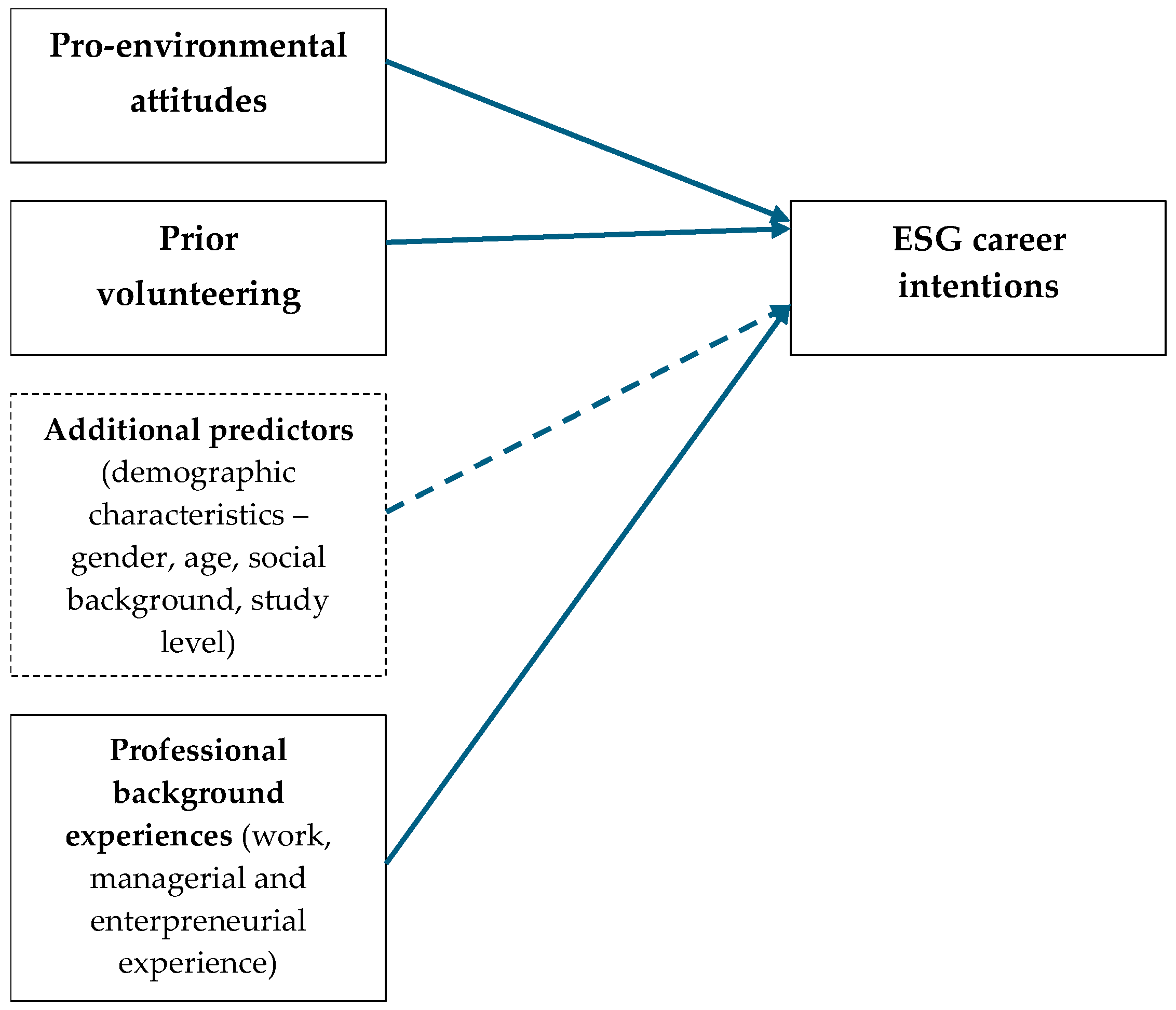
27] and should also be answered in the regional context. Our previous discussion of the research questions led to the selection of predictors (students’ pro-environmental attitudes, demographic characteristics, and professional background experiences), which are presented in the conceptual model shown in
Figure 1.
Based on the extant theory and the conceptual model proposed in
Figure 1, we finally pose three research questions (RQs) in this paper:
RQ1: Are pro-environmental attitudes a significant predictor of ESG-focused career intentions for students of economics and business in the SEE region?
RQ2: Is there empirical evidence that prior volunteering experience can be associated with the ESG-focused career intentions?
RQ3: Which of the economics and business students’ personal and professional background experience factors (including prior entrepreneurial, managerial, and work experiences) matter in predicting the interest in an ESG-focused career intention?
3. Materials and Methods
3.1. Sample and Data Collection
This paper has been developed as part of a comprehensive research project analyzing the impact of pro-environmental attitudes and behaviors among economics and business students on educational and public policies, corporate practices, and broader social impacts [
22,
23]. Previously reported results [
22,
23] have been expanded with an additional round of data collection, yielding a sample of 441 economics and business students. Open research data is available in
Supplementary File S1. The distribution across participating countries and business schools is shown in
Table 1.
Data collection took place in two waves, conducted (respectively) in 2024 and 2025, using invitations placed on the internal Learning Management System (LMS) course Websites, linking to an online survey. We used the Qualtrics XM survey platform, with tracking options turned off. All responses were anonymous, and participants could opt out of providing demographic information. Before accessing the survey, participants were required to agree to the data collection terms and to provide voluntary consent to participate in the research project.
3.2. Demographics and Professional Background Experience
The resulting sample is not representative of student populations across SEE business schools, as the majority of participants (76.2%) were female. This is a well-known limitation of social science surveys in the SEE region, where female participants are often more willing to participate in lengthy or complex surveys [
8].
The average age of our participants was 24, with 249 individuals (57.8%) studying at the Bachelor (1st cycle) level, 140 (32.5%) at the Master (2nd cycle), and 42 (9.7%) at the PhD level, which is aligned with the average structure of the student body, enrolled in the participating business schools. Concerning the self-reported social class, 46 participants (10.7%) described themselves as belonging to the higher class, 367 (85.2%) to the middle class, and 18 participants (4.2%) to the lower class.
We also examined the average background profile of our respondents, including their professional and volunteering experiences. After eliminating missing responses, our sample demonstrates a high level of work-related involvement: 77.6% of participants have relevant work experience, and 46.7% have engaged in prior volunteering. Provided that the majority of participants were in their early twenties, low levels of prior managerial (15.4%) and entrepreneurial experience (11.6%) reflect their life stage and early career stages.
3.3. Operationalization of Research Constructs and Measures
Beyond demographic data, we collected students’ attitudes and behavioral career intentions, operationalized as follows:
ESG-focused career intentions were captured by a single item, following Haski-Leventhal et al. [
4]. ESG career intention was measured with a single item asking students to indicate the likelihood of pursuing a career focused on environmental, social, and governance (ESG) issues (i.e., their behavioral intent to pursue an ESG-focused career). The measurement scale was adopted from Tobler et al. [
28], based on the categorization of behaviour into four discrete stages: precontemplation (1), contemplation (2), preparation (3), and action (4), with higher scores indicating greater behavioral intent.
Although a multi-item scale would generally be preferable, our approach is justified by the extant research [
4] and by the need to limit the survey length. Although a more comprehensive approach, such as that used by Yao [
17], would be preferable, single-item measures are practical and widely used when the construct is clear to respondents and practical constraints limit the respondent burden [
29].
Such an operationalization is also methodologically acceptable when the research design is focused on establishing an association rather than identifying causal relationships or developing/validating psychometric scales. Still, we acknowledge the usage of a single item as the dependent variable in the study.
Pro-environmental attitudes were measured using the popular New Environmental Paradigm (NEP) scale, in its revised 15-item version [
5].
Previous research has demonstrated the potential influence of Information and Communication Technology (ICT) skills on students’ pro-environmental attitudes [
22], operating through engagement with pro-environmental content online and the promotion of environmentalism in digital communication channels. Therefore, we also measured ICT skills development using the generic ICT maturity approach formulated by Nolan et al. [
30]. The measurement scale consists of five maturity levels: awareness of ICTs’ availability (1), willingness to use ICTs (2), adoption of ICTs (3), integration of ICTs into daily routines (4), and optimization of ICTs to enhance the quality of life (5).
The resulting sample is non-random, and the primary survey data are gender-biased, both due to the gendered effects of participation in social science surveys [
31] and gendered aspects of sustainability [
32], which do not allow for generalizations at national population levels. Other limitations of this study will be discussed in detail in the last section of the paper.
4. Results
We used the general linear model (GLM) in IBM SPSS 25 to analyze the associations among regional students’ ESG-focused career orientation (normalized using z-scores) and the predictors described in the previous section. Country fixed effects were excluded from the final model due to high collinearity and minimal impact on the parameter estimates.
Before conducting the GLM analysis, we checked whether the conventional statistical assumptions for regression models were met. We visually inspected the scatterplot of standardized residuals and standardized predicted values to examine the linearity and homoscedasticity assumptions. In addition, we visually inspected the normality of the Q-Q plot of standardized residuals. We found only minor deviations from the expected centrality, likely due to the ordinal dependent variable expressed by a single item. We checked for collinearity using variance inflation factors (VIFs), which ranged from 1.06 to 1.35, within the acceptable range. To detect outliers, we used Cook’s distances, with values ranging from 0.000 to 0.033 (M = 0.003), all of which lie below the cut-off value of 1.0. Therefore, we concluded that no serious violations of statistical assumptions are present and that GLM can be used in further statistical analysis.
The overall GLM model, presented in
Table 2, is statistically significant (F(10, 405) = 1.91,
p = 0.043). However, the model explained only a small proportion of the variance in ESG career intentions (R
2 = 0.045, adjusted R
2 = 0.021). Two predictors were significant: pro-environmental attitudes, measured by the NEP Scale, were positively associated with the ESG career orientation (B = 0.120, SE = 0.052,
p = 0.021, partial η
2 = 0.013). Volunteering experience also proved to be a significant predictor: students with prior volunteering experience had a significantly higher ESG career intent than non-volunteers (B = −0.226, SE = 0.102,
p = 0.026, partial η
2 = 0.012). The effect sizes for both pro-environmental attitudes (partial η
2 = 0.013) and volunteering (partial η
2 = 0.012) were small, consistent with prior research [
33]. Therefore, future research still needs to uncover the additional drivers of ESG career intentions in the SEE region.
Table 3 shows parameter estimates. Among those, the study level showed a marginally positive association with the ESG career orientation (B = 0.089, p = 0.090), suggesting that students at higher study levels better understand ESG priorities and are more motivated to pursue ESG-focused corporate positions. No other predictors were statistically significant, including gender (
p = 0.283), age (
p = 0.377), social class (
p = 0.501), ICT skills (
p = 0.312), work (
p = 0.734), entrepreneurial (
p = 0.990), or managerial experience (
p = 0.736). It is interesting that the professional background, as indicated by three binary indicators, did not show any association with ESG career intentions, which might have been expected.
The volunteering experience proved to be a significant predictor of the ESG career choices. Therefore, we decided to analyze the differences between volunteers and non-volunteers further, while adjusting for other variables (covariates). Results are shown in
Table 4, where the values of estimated marginal means (EMMs) are presented. Volunteers had a score of 0.165 (SE = 0.108), i.e., their ESG career score was 0.165 standard deviations above the average. In contrast, non-volunteers had a score of −0.062 (SE = 0.116), indicating their ESG career score was 0.062 standard deviations below the average.
5. Discussion
The objective of this paper is to determine the factors for ESG career intentions in Southeast Europe. We have set three research questions (RQs) concerning the influence of students’ pro-environmental attitudes (RQ1), volunteering (RQ2), and professional background (RQ3) on their intended career orientation.
Concerning RQ1, a positive association between pro-environmental attitudes and ESG career intentions is straightforward and well aligned with the extant literature on the links between pro-environmental attitudes and behavioral intentions [
5,
6]. Following the logic of social cognitive theory [
33], career intentions are also aligned with personal values [
27]. Therefore, it can be suggested that pro-environmental attitudes and values serve as a baseline for students’ intention to seek positions with responsible employers, regardless of the level of labor-market sophistication. Our specific contribution concerns initial research on the factors driving ESG career intentions in peripheral European economies, where labor markets are only beginning to recognize the need for ESG professionalization.
In relation to RQ2, our results on the association between volunteering in civic organizations and ESG career choices can be explained by the dual role of volunteering practices and the professional orientation. On the one hand, volunteering and service learning improve a range of students’ skills and competencies [
7] and expose them to real-world experiences and ESG challenges [
9], thereby contributing to their employability. On the other hand, volunteering and participation in service learning support the development of transferable skills (teamwork, project management, stakeholder engagement) required for corporate ESG roles [
10], consistent with the view of Responsible Management Education (RME) as a socialization process [
4], shaping students’ attitudes and values. Therefore, future research might explore the potential mediating or moderating role of a volunteering and service-learning background in the relationship between students’ attitudes and values and their career preferences.
Considering RQ3, most of the selected demographic characteristics and professional background indicators do not predict students’ ESG career intentions. There is only a marginal association between ESG career choices and enrollment in higher study cycles, which could be further analyzed, as it seems that longer, more detailed exposure to ESG-related teaching content may align with career preferences. Following the results of existing research on the influence of Responsible Management Education (RME) teaching content on business students’ prosocial behavior [
34], we suggest that a similar effect may be at work, concerning pro-environmental academic teaching and learning.
The lack of association between professional background indicators and career intentions is somewhat surprising. Nevertheless, the extant literature suggests that formal business education has a limited impact on students’ values [
18]. In contrast, student bodies in business schools have varied interpretations and expectations regarding sustainability and sustainable development [
27].
While the mentioned limitations could also signal limited generalization opportunities, it should be noted that a lack of association between professional background and career intentions could also have been caused by a too-simplistic methodological approach that used binary (yes/no) indicators of prior professional experience.
Future research should address this dilemma by employing a more sophisticated approach to measuring students’ professional backgrounds. It should also address the potential theoretical argument that attitudes and values, and their shaping through volunteering initiatives, matter more for ESG career intentions than early work experience, managerial, and entrepreneurship practices. Resolution of this dilemma would be valuable for regional business schools and their administrators in further determining the value of service-learning and community involvement initiatives in achieving higher levels of social and environmental responsibility.
In conclusion, our results confirm that the classical attitude–behavior relationship patterns [
5,
6] also apply to research on career intentions. Nevertheless, those intentions are shaped by faculty and peers and can be interpreted as a long-term socialization process [
4]. Our results suggest that volunteering experiences and experiential learning seem to matter more for ESG careers than early involvement in the world of work and entrepreneurship, even in regions with low maturity of ESG regulations and practices [
24,
25,
26].
Still, we need to point out that the low explanatory power of our model leaves future research to identify other factors relevant to students’ intentions to choose ESG careers. Guidelines for future research are further discussed in the next section of this paper.
6. Conclusions
As noted, this study is preliminary and has multiple limitations that need to be acknowledged. Since the sample is based on non-systematic sampling and voluntary student participation, it is not representative of the national business school populations. The generalizability of our results is further limited by the gender structure, in which female participants are over-represented.
A limitation, represented by the single-item dependent variable, should be addressed by future research. However, it has already been assessed as relatively appropriate for a preliminary, cross-sectional study.
It should also be noted that a cross-sectional research design enables us to draw conclusions about associations among research constructs, rather than identifying causal relationships. A more complex and sophisticated research design, involving longitudinal data collection, should be implemented in future research on regional ESG career intentions.
In addition, as part of future research, the professional background experience variables should be operationalized more comprehensively and adapted to the maturing socio-economic regional context of ESG orientation and employment, along with volunteering experience, as not all forms of voluntary engagement may be equally important for career orientation. Other future research tasks include using longitudinal or quasi-experimental designs to establish causal relationships among the predictors covered in this study. In addition, new potential predictors of ESG career orientation should be identified through qualitative research, focusing on employer needs and priorities, as well as the different hiring criteria for ESG roles.
Our results have multiple practical implications for business school administrators and education policy professionals. Business schools and their administrators need to acknowledge the value of both pre-existing values for ESG career choices, as well as the importance of experiential learning, which involves service learning and volunteering in ESG-focused roles within the corporate sector, civic, and community organizations. The advantage of experiential learning methods lies in developing applicable and transferable skills [
2,
9], as well as in (re)shaping students’ values and motivating them to consider the personal and organizational motivations for mission-driven careers. Such an influence has been documented by Peterlin and Garbin Praničević [
35], who show that service-learning experiences can transform students’ outlooks on the future.
To fill the specific ESG project manager (PM) roles, it might be beneficial to expose the regional students of economics and business to the pro-environmental teaching content and PM service learning opportunities in the Bachelor’s (1st) cycle, to foster the general pro-environmental attitudes and signal the importance of ESG principles in further career choices. Simultaneously, students should obtain fundamental project management competencies in the first cycle, while advanced sustainability PM competencies could be covered in the Master’s (2nd) cycle curricula. However, business schools should also reach out to their corporate partners and foster the development of ESG-related managerial mindsets, which shape both the market demand for ESG competencies and signal the value of ESG principles and practices to economics and business students [
36].
The ESG career readiness and preferences could also be tracked as learning outcomes of business school programs, included in evaluations and national accreditations, and supported by higher education public policies. Additionally, public policy may consider the cautious inclusion of ESG criteria in higher education funding initiatives. Nevertheless, such attempts should avoid generalizations and usage of generic, ‘one-size-fits-all’ performance indicators and rewards, to avoid mission drifts and different attempts to ‘game the system’ [
37].
If business schools wish to address the dual pressures stemming from the imperatives to develop ESG-related motivation and competence, while addressing the challenges of technology and artificial intelligence, they need to (re)frame themselves as lifelong learning platforms [
38]. While continuing to provide traditional Bologna-styled educational cycles, such an orientation enables traditional business schools and other academic organizations to engage with the corporate and civic sectors in co-designing new curricula, addressing contemporary challenges, and supporting market- and socially relevant student career choices.
Author Contributions
Conceptualization, N.A. and D.I.V.; methodology, N.A.; software, N.A.; validation, D.P.; formal analysis, N.A. and D.I.V.; investigation, D.I.V. and D.P.; resources, D.P.; data curation, N.A.; writing—original draft preparation, N.A., D.I.V., and D.P.; writing—review and editing, D.I.V. and D.P. All authors have read and agreed to the published version of the manuscript.
Funding
This research received no external funding.
Institutional Review Board Statement
The study was conducted in accordance with the Declaration of Helsinki and approved by the Ethics Committee of the Faculty of Economics, Business and Tourism, University of Split, Croatia (Classification No. 004-01/24-01/03, Document No. 2181-196-02-05-24-06, 30 October 2024).
Informed Consent Statement
Informed consent was obtained from all subjects involved in this study.
Data Availability Statement
The original contributions presented in this study are included in the
supplementary material. Further inquiries can be directed to the corresponding authors.
Conflicts of Interest
The author Darija Ivandić Vidović was employed by the company Triglav Insurance plc. The remaining authors declare that the research was conducted in the absence of any commercial or financial relationships that could be construed as a potential conflict of interest.
Abbreviations
The following abbreviations are used in this manuscript:
| IPMA | International Project Management Association |
References
- International Labour Organization (ILO). World Employment and Social Outlook 2018: Greening with Jobs; International Labour Office: Geneva, Switzerland, 2018; Available online: https://www.ilo.org/publications/world-employment-and-social-outlook-2018-greening-jobs (accessed on 1 November 2025).
- Lozano, R.; Merrill, M.Y.; Sammalisto, K.; Ceulemans, K.; Lozano, F.J. Connecting competences and pedagogical approaches for sustainable development in higher education: A literature review and framework proposal. Sustainability 2017, 9, 1889. [Google Scholar] [CrossRef]
- Introduction to ESG4PMChange. Available online: https://esg4pmchange.com/about-the-project/ (accessed on 25 November 2025).
- Haski-Leventhal, D.; Pournader, M.; Leigh, J.S.A. Responsible Management Education as Socialization: Business Students’ Values, Attitudes and Intentions. J. Bus. Ethics 2022, 176, 17–35. [Google Scholar] [CrossRef]
- Dunlap, R.E.; Van Liere, K.D.; Mertig, A.G.; Jones, R.E. Measuring endorsement of the New Ecological Paradigm: A revised NEP scale. J. Soc. Issues 2000, 56, 425–442. [Google Scholar] [CrossRef]
- Franzen, A.; Vogl, D. Two decades of measuring environmental attitudes: A comparative analysis of 33 countries. Glob. Environ. Change 2013, 23, 1001–1008. [Google Scholar] [CrossRef]
- Yorio, P.L.; Ye, F. A Meta-Analysis on the Effects of Service-Learning on the Social, Personal, and Cognitive Outcomes of Learning. Acad. Manag. Learn. Educ. 2012, 11, 9–27. [Google Scholar] [CrossRef]
- Alfirević, N.; Petković, S.; Zlatković Radaković, M. Contribution of Service-Learning and Supporting Factors to the Environmental Sustainability Commitment of Higher Education Institutions. Rev. Soc. Polit. 2022, 29, 87–104. [Google Scholar] [CrossRef]
- Bringle, R.G.; Hatcher, J.A. Implementing service-learning in higher education. J. High. Educ. 1996, 67, 221–239. [Google Scholar] [CrossRef]
- Kamerāde, D.; Ellis Paine, A. Volunteering and Employability: Implications for Policy and Practice. Volunt. Sect. Rev. 2014, 5, 259–273. [Google Scholar] [CrossRef]
- World Economic Forum. The Future of Jobs Report 2023; World Economic Forum: Geneva, Switzerland, 2023; Available online: https://www.weforum.org/publications/the-future-of-jobs-report-2023/ (accessed on 3 November 2025).
- Corrs Chambers Westgarth. ESG and the Successful Delivery of Major Projects: Key Considerations for Project Proponents. 2023. Available online: https://www.corrs.com.au/insights/esg-and-the-successful-delivery-of-major-projects-key-considerations-for-project-proponents (accessed on 3 November 2025).
- Armenia, S.; Dangelico, R.M.; Nonino, F.; Pompei, A. Sustainable Project Management: A Conceptualization-Oriented Review and a Framework Proposal for Future Studies. Sustainability 2019, 11, 2664. [Google Scholar] [CrossRef]
- Silvius, A.J.G.; Schipper, R.P.J. Sustainability in project management: A literature review and impact analysis. Soc. Bus. 2014, 4, 63–96. [Google Scholar] [CrossRef]
- Barbosa, M.W.; de Oliveira, V.M. The corporate social responsibility professional: A content analysis of job advertisements. J. Clean. Prod. 2020, 279, 123665. [Google Scholar] [CrossRef]
- McPhail, K.; Kafouros, M.; McKiernan, P.; Cornelius, N. Reimagining business and management as a force for good. Br. J. Manag. 2024, 35, 1099–1112. [Google Scholar] [CrossRef]
- Yao, T. ESG Education and Job Choice (Working Paper, HEC Paris). 2022. Available online: https://tianhao-yao-finance.github.io/files/JMP_Tianhao_YAO.pdf (accessed on 24 November 2025).
- Vítečková, K.; Houdek, P. The Rise of Business Education, the ESG Revolution, and the Limited Impact on Students’ Values. Interchange 2025, 56, 143–157. [Google Scholar] [CrossRef]
- Chang, J.C.; Lu, H.Q. Competency and Training Needs for Net-Zero Sustainability Management Personnel. Sustainability 2025, 17, 3244. [Google Scholar] [CrossRef]
- International Project Management Association (IPMA). Sustainable Project Management: ICB4 Reference Guide; Version 1.0; Van Haren Publishing: Hertogenbosch, The Netherlands, 2024. [Google Scholar]
- Bossi, S.; Lovrenčić Butković, L.; Pürckhauer, P.; Silvius, G. IPMA Guide on Sustainable Project Management; International Project Management Association (IPMA); Van Haren Publishing: Hertogenbosch, The Netherlands, 2025. [Google Scholar]
- Alfirević, N.; Potočan, V.; Nedelko, Z. Roles of Personal Values and Information Technology Usage in Forming the University Students’ View of Environmental Sustainability: A Preliminary Regional Study of Economics and Business Students. Sustainability 2024, 16, 9830. [Google Scholar] [CrossRef]
- Alfirević, N.; Rendulić, D.; Mlaker Kač, S. Behavioral Expectations of Business School Students Concerning Extreme Climate Events: Regional Insights and Implications for Southeast Europe. World 2025, 6, 33. [Google Scholar] [CrossRef]
- Ljutić, I.; Veledar, B.; Gadžo, A.; Knežević, M. European Sustainability Reporting Standards: Lack of Progress, Alignment, and Harmonization in Western Balkans. Econ. Anal. 2024, 57, 36–48. [Google Scholar] [CrossRef]
- Suljić, V.; Biber, N. Assessment of Sustainable Finance in Western Balkans: Prospects for Sustainable Finance Taxonomy (Report). 2024. Available online: https://www.rcc.int/download/docs/Sustainble%20Finance%20and%20Taxonomy%20in%20WB.pdf/b50848aa3ff9948b5a050a10edb114a4.pdf (accessed on 24 November 2025).
- Lukić, R. Analysis of ESG Performance Indicators of Western Balkan Countries. Marsonia Čas. Društvena Humanist. Istraž. 2024, 3, 21–41. Available online: https://hrcak.srce.hr/320932 (accessed on 24 November 2025).
- Grunwald, G.; Kara, A.; Spillan, J.E. Segmenting and engaging business students for sustainable development: Insights into expectation management from a cross-country study. Sustain. Futures 2025, 9, 100537. [Google Scholar] [CrossRef]
- Tobler, C.; Visschers, V.H.M.; Siegrist, M. Eating green: Consumers’ willingness to adopt ecological food consumption behaviors. Appetite 2011, 57, 674–682. [Google Scholar] [CrossRef]
- Fisher, G.G.; Matthews, R.A.; Gibbons, A.M. Developing and Investigating the Use of Single-Item Measures in Organizational Research. J. Occup. Health Psychol. 2015, 20, 227–239. [Google Scholar] [CrossRef]
- Nolan, R.L. Managing the computer resource: A stage hypothesis. Commun. ACM 1973, 16, 399–405. [Google Scholar] [CrossRef]
- Smith, W.G. Does Gender Influence Online Survey Participation?: A Record-Linkage Analysis of University Faculty Online Survey Response Behavior. ERIC Document Reproduction Service No. ED501717. June 2008. Available online: https://files.eric.ed.gov/fulltext/ED501717.pdf (accessed on 24 November 2025).
- Zelezny, L.C.; Chua, P.; Aldrich, C. Elaborating on Gender Differences in Environmentalism. J. Soc. Issues 2000, 56, 443–457. [Google Scholar] [CrossRef]
- Lent, R.W.; Brown, S.D.; Hackett, G. Social cognitive career theory. In Career Choice and Development, 4th ed.; Brown, D., Brooks, L., Eds.; Jossey-Bass/Wiley: San Francisco, CA, USA, 2002; pp. 255–311. [Google Scholar]
- Alfirević, N.; Arslanagić-Kalajdžić, M.; Lep, Ž. The role of higher education and civic involvement in converting young adults’ social responsibility to prosocial behavior. Sci. Rep. 2023, 13, 2559. [Google Scholar] [CrossRef] [PubMed]
- Peterlin, J.; Garbin Praničević, D. Perceived trends in viewing the future by Croatian and Slovenian business students: Implications for managerial education. Management 2019, 24, 103–120. [Google Scholar] [CrossRef]
- Mashne, L.; Baracskai, Z. Senior management mindsets for corporate social responsibility. Management 2024, 29, 1–17. [Google Scholar] [CrossRef]
- Matveeva, A. Performance-based funding in higher education: A meta-narrative review and renewed research agenda proposal. High. Educ. Policy 2025, 31, 21–44. [Google Scholar] [CrossRef]
- Žiljak, T.; Ristord, P.; Alfirević, N.; Pavičić, J. (Eds.) Lifelong Learning for Green Skills and Sustainable Development: Southern European Perspectives; Palgrave Macmillan (Springer Nature): Cham, Switzerland, 2024. [Google Scholar] [CrossRef]
| Disclaimer/Publisher’s Note: The statements, opinions and data contained in all publications are solely those of the individual author(s) and contributor(s) and not of MDPI and/or the editor(s). MDPI and/or the editor(s) disclaim responsibility for any injury to people or property resulting from any ideas, methods, instructions or products referred to in the content. |
© 2025 by the authors. Licensee MDPI, Basel, Switzerland. This article is an open access article distributed under the terms and conditions of the Creative Commons Attribution (CC BY) license (https://creativecommons.org/licenses/by/4.0/).