Article

More Than a Stay: Examining the Dual Pathways Between Perceived Employee ESG Behavior and Consumer Meaningfulness in the Hotel Industry

by
Yohanes Tesemie Gishen
* and
Ping Yin
School of Economics and Management, Beijing Jiaotong University, Beijing 100044, China
*
Author to whom correspondence should be addressed.
World 2026, 7(1), 15; https://doi.org/10.3390/world7010015
Submission received: 10 December 2025 / Revised: 2 January 2026 / Accepted: 11 January 2026 / Published: 19 January 2026

Abstract

This study examines the relationship between perceived employee environmental, social, and governance (ESG) behavior and consumer meaningfulness by exploring the mediating role of moral elevation and perceived authenticity, as well as the moderating role of consumers’ skepticism. The study draws upon the integration of self-determination theory and social cognitive theory. Prior research has often neglected the outcomes of interaction between employee behaviors and consumer perceptions. Th study used a sequential explanatory research design to understand the observable perceived ESG behaviors of the employees and the psychological outcomes of the consumers. The study involved 390 consumers from five-star hotels in Addis Ababa, Ethiopia. The data was gathered through a survey and analyzed using a structural equation model via the Smart-PLS tool. The interview data were collected from 16 frontline employees of five-star hotels and analyzed through thematic analysis. The quantitative results confirmed perceived employee ESG behavior is positively and significantly associated with consumers’ sense of meaningfulness, moral elevation, and perceived authenticity. Additionally, moral elevation and perceived authenticity significantly mediate the link between perceived employee ESG behavior and consumer sense of meaningfulness. Furthermore, consumer ESG skepticism negatively moderates the link between employee ESG behavior and both moral elevation and perceived authenticity. The qualitative study indicated that internal motivation of the company predicts employee behaviors, promoting voluntary actions to build consumers’ meaningfulness. The study advances theories and suggests implications for policymakers and managers regarding ESG behaviors among employees and the way consumers perceive them.

1. Introductions

In emerging economies, the hotel sector is one of the key drivers of economic growth and customer sense of meaningfulness; it functions at a critical point, with the growing focus on sustainable practices and protection [1]. As the awareness of sustainability grows, individuals demand greater organizational commitment and increasingly utilize firms that demonstrate a genuine commitment to environmentally friendly practices [2]. These initiatives satisfy interests in sustainable actions from different stakeholders such as investors, employees, and consumers. The hospitality industry exemplifies this trend, as hotels adopt environmentally sustainable strategies to protect the natural environment [3], including water and energy conservation, and the reduction in emissions and waste [4]. Therefore, the basic integration of ESG practices raises consumers’ sense of purpose by aligning with their individual values, which drives meaningfulness and repurchase intentions [4].
Frontline hotel employees serve as the primary interface through which a hotel’s ESG values are communicated to the consumer [5]. When guests observe employees engaging in unrestricted, extra-role ESG behaviors, they perceive these actions as a credible signal of corporate sincerity rather than simple symbolic compliance [6,7]. In this study, perceived employee ESG behavior is conceptualized as an integrated, multidimensional construct that draws from different research streams. The environmental dimension adopts the “extra-role” and “discretionary” essence of OCBE [8]. The social and governance dimensions align with the behavioral appearances of CSR, specifically social altruism and ethical integrity [9,10]. While the previous literature has treated these as separate phenomena, this study maintains that in a service setting, they function in parallel to form a singular, holistic signal of the hotel’s ESG commitment. Research has been undertaken on employee behaviors that may influence CSR, including volunteering [11] and, pro-environmental behavior [12]. The link between staff ESG behaviors and consumers’ sense of meaningfulness has been neglected, despite independent studies into corporate performance’s effect on frontline staff [13] and the fostering of consumer behavior [13]. However, the study primarily investigates how perceived employee ESG behavior translates hotel sustainability practices into a sense of meaningfulness for the guest.
This study focuses on the mediation of moral elevation and perceived authenticity between staff ESG behaviors and guests’ sense of meaningfulness. All of these have a significant role in self-determination [14] and social cognitive theories [15]. Moral elevation means the warm and uplifting sensation individuals encounter upon seeing the kind, altruistic, and caring actions of others [16]. Parallel to moral elevations, perceived authenticity serves a strong mediator between perceived employee ESG behaviors and guests’ sense of meaningfulness. Perceived authenticity, which is mainly characterized by the attribute of seeming real, sincere, and truthful, is essential for consumers’ preferences [17]. Furthermore, authenticity is merely a term working to rationalize travel and consumer preferences, as customers have their own specific objectives and aspirations to fulfill their vision [18]. Therefore, truth, history, customs, locations, communities, and culture are intertwined with authenticity [19].
The study further explores guests’ skepticism as a moderating variable between staff ESG behavior and both moral elevations and perceived authenticity. Skepticism represents a sense of uncertainty regarding the sustainability assertions associated with green products, rather than a profound mistrust among consumers [20]. Additionally, evidence indicates a universal societal apprehension that companies consistently disseminate false or incomplete information aimed at misleading consumers to enhance their brand image, leading to a negative consumer perception of sustainable products and services [20]. While staff ESG behavior is positively associated with moral elevation and perceived authenticity, these associations depend on the level of consumer skepticism. Specifically, consumer skepticism acts as a moderator that undermines the positive link between staff ESG behavior and these psychological outcomes. Consumer skepticism is grounded in social cognitive theory [15], which examines the personal aspects of visitors that influence their interpretation of how employee ESG behavior predicts their morals and authenticity.
This study seeks to address considerable gaps in the existing research regarding the relationship between perceived employee ESG behavior and consumers’ meaningfulness. The selection of five-star hotels in Ethiopia is strategically motivated. As a diplomatic center and a rapidly emerging economy, Ethiopia represents a unique intersection where global sustainability mandates meet local service delivery. In this context, five-star hotels serve as institutional innovators of ESG, providing a high-stakes environment where guests’ expectations for ethical excellence are at their peak. Because these hotels represent the peak of professional standards in the region, the guests’ offer an ideal place to observe how unrestricted staff actions, rather than just organizational policy, inspire guest perceptions. Despite the importance of this context, the literature remains limited in the following three key areas. Firstly, previous research has concentrated on the manufacturing and finance sectors, neglecting the service sectors [21]. Secondly, previous research did not encompass the comprehensive psychological experiences of the consumers, nor did it include the suggested mediators of moral elevation and perceived authenticity, or the moderating influence of consumers. Skepticism is not jointly exclusive; rather, it is likely to be interconnected. Thirdly, most past research concentrates on either the firm’s perspective or the employee’s perspective, frequently neglecting consumer perceptions.
This study makes numerous contributions to the literature on employee behavior-driven outcomes in the service industry. First, it does not simply establish a direct path between perceived employee ESG behaviors and consumer meaningfulness; instead, it translates the psychological mechanisms of moral elevation and perceived authenticity through which these behaviors predict a consumer’s sense of meaningfulness. This tactic establishes that frontline employee behaviors concurrently activate both a cognitive evaluation (perceived authenticity) and an effective response (moral elevation), with each contributing independently to the consumer’s sense of meaningfulness. Second, while existing frameworks are effective for studying ESG in the manufacturing industry, they have less emphasis on theorizing and examining its results within the service environment of the hotel industry. Third, consumer skepticism is a moderating variable; this creates critical conditions for the ESG–consumer meaningfulness link. It offers important details about when and why the employee’s ESG behaviors fail to appear due to customer doubt. This helps practitioners understand it as a clear warning about the requirement of sincere commitment to overwhelm customer skepticism. The present study, by examining different empirical research in the hospitality context, significantly applies the generalizability of self-determination theory and social cognitive theory to a critical service setting.
Finally, we organized the study’s content by reviewing self-determination and social cognitive theories to provide theoretical background for the research model. Then, we proposed eight hypotheses to demonstrate the relationships between various variables, including perceived employee ESG behavior, moral elevation, perceived authenticity, consumer skepticism, and consumer sense of meaningfulness. The conceptual model, research methods, and design are included in the study. Lastly, discussions and contributions are presented.

2. Literature Review and Theoretical Framework

The literature review examines basic theories and a conceptual model that identifies the relationship between perceived employee ESG behavior and consumers’ sense of meaningfulness through moral elevation and perceived authenticity.

2.1. Self-Determination Theory

Self-determination theory (SDT) is a framework for understanding human motivations and personality that utilizes conventional empirical techniques and an organismic meta theory, emphasizing the significance of intrinsic human resources for personality development and behavioral self-regulation [14]. According to Manninen, Deng [22], SDT-based interventions have concentrated on particular instructional components, such as giving positive feedback, which is used in the most targeted and focused interventions. A series of studies have investigated the explicit support provided by social agents for all three needs, emphasizing a wide array of techniques, including the provision of constructive and informational feedback (competence), the demonstration of interest in individuals (relatedness), and the facilitation of autonomy support [23]. According to Deci and Ryan [24], when a hotel’s employee establishes a sincere ESG commitment, it nurtures a sense of shared values. This position satisfies the guest’s intrinsic needs, such as the need for relatedness. In this context, perceived employee ESG behavior serves as an external signal that gratifies these internal demands, moving the guest from a transactional stay to a transformative experience characterized by a heightened sense of meaningfulness. When a hotel’s sustainable practices align with customers’ preferences, it enhances moral worth and the perceived authenticity of the brands, thereby fostering a feeling of purpose for the guests during their stay.
When employees acknowledge the ESG practices of their hotel, deemed a basic psychological requirement, they are more likely to exhibit excellent work behavior [24], as guests’ motivations greatly inspire guests’ main experiences at the hotel. In this context, perceived employee ESG behavior serves as an internal motivator that, when implemented correctly, can fulfill customers’ psychological demands, such as a sense of meaningfulness.

2.2. Social Cognitive Theory

Social cognitive theory (SCT), founded by Bandura [15], suggests that an individual’s beliefs and actions are shaped by several psychological factors, including interaction, behavior, and the environment. According to Shephard, Pookulangara [25], SCT explains how an individual’s conduct is shaped by three determinants: cognitive reasoning or personal interaction, external actions or behaviors, and social context or environment. In SCT, individuals (consumers) learn through observational modeling, attitudes, and emotional responses. By observing others’ actions and perceiving the effects of those activities, guests form their own beliefs about the hotel’s ethical standing. This theory is highly congruent with the hotel’s ESG practices, as it accounts for the ongoing processes of the cognitive and affective interactions of the guests [15].
Regarding the moderating role of consumers’ skepticism on the relationship between perceived employee ESG behavior and both moral elevations and perceived authenticity, social cognitive theory can be applied to focus on the link between the demonstrated behavior and the guest’s response, which is often not automatic. Under the assumptions of social cognitive theory [15], the consumers with high ESG skepticism engage in the negative cognitive appraisal of observable behavior. In this context, SCT explains how the role of consumer skepticism is a “perceptual problem” if the cognitive evaluation identifies a “hidden motive” such as greenwashing, and the link between employee’s behavior and guest response is disrupted. This suggests that consumer’s skepticism orders the search for hidden motives over the observation of honest ESG commitments, effectively filtering out the positive signals intended by the employee’s actions.

3. Hypothesis Development and Research Model

3.1. Perceived Employee ESG Behavior and Consumer Outcomes

Green practices in hospitality management are characterized as environmentally sustainable and value-enhancing business strategies that minimize food waste, conserve energy, and utilize sustainable materials and resources [26,27]. Studies show that when workers voluntarily promote local products and services, this genuinely benefits the hotels’ ESG initiatives, making them more tangible and trustworthy to consumers [27]. Previous studies have established a robust path between corporate social responsibility and consumer well-being. For instance, Su and Swanson [28] state that perceived CSR positively influences consumer social well-being, which in turn fosters repurchase intentions and positive word-of-mouth. Additionally, once employees participate in genuine CSR behaviors, they empower consumers to sense that they are part of a positive influence by converting their experiences from transactional to transformational [29]. These services can be designed and delivered to enhance consumer well-being [30]. Thus, research into meaningful stay in the hospitality industry has focused on eudaimonic well-being, which includes purpose, and self-realization that transfers beyond pleasure [31]. Proactive ESG practices provide favorable signals to the market about the company’s dedication to sustainable development, thereby attracting recognition from investors and various stakeholders, which mitigates corporate funding limitations [32]. Moreover, robust ESG performance fosters a resilient internal control environment that enhances the success rate of transformations by mitigating operational, informational, and compliance risks in daily business processes, as well as transformation risks faced during the sustainable development process [33].
Few studies have looked into the moral values of customers and the ESG behavior of employees in the hospitality sector. ESG policies have an impact on the ethical climate of the industry, which in turn affects employee-generated electronic word-of-mouth [34]. When the hotel guests observe the staff voluntarily participating in pro-ESG behavior, such as waste management practices and wise use of energy, this indicates a credible commitment to sustainability that exceeds mere marketing [35]. Therefore, moral elevation is a beneficial emotional condition that begins when observing the virtuous actions of others, technically defined as “an emotional response to perceived moral excellence” [36]. Moreover, the staff’s voluntary actions can make guests who are observing them feel their motivations and moral elevations, further extending the guests’ experiences of moral elevations.
As a different study has examined, perceived authenticity denotes the degree to which a tourist regards a product, service, or experience as genuine, culturally representative, and indicative of local customs [37]. Authenticity also inspires identity improvement and personal growth by offering guests new and meaningful experiences that enable them to interact with new cultural information [38]. Campbell and Wiernik [39] defined employee green behavior as a composite performance area encompassing a substantial array of employee actions that either promote or hinder the organization’s overarching goal of enhancing environmental sustainability.
H1. 
Perceived employee ESG behavior is positively associated with consumers’ sense of meaningfulness.
H2. 
Perceived employee ESG behavior is positively associated with moral elevation.
H3. 
Perceived employee ESG behavior is positively associated with perceived authenticity.

3.2. Moral Elevations and Consumers’ Sense of Meaningfulness

Moral elevation is the emotional reaction elicited by observing the good behavior of others [40]. Acts of generosity, kindness, love, loyalty, or self-sacrifice are potent catalysts for elevation [36]. Elevation fosters a propensity for pragmatic behavior and personal improvement, as well as a need for social affiliation. According to Xie, Bagozzi [41], socially responsible activities that prioritize autonomy have the potential to elicit moral elevation, which can strengthen advocacy through word-of-mouth, boost resistance to unfavorable information, and increase financial commitment to the company. Additionally, this emotional reaction encourages customers to support company-endorsed social causes and to volunteer [42].
According to consumer psychology research, moral elevations can increase brand trust and positive word-of-mouth (WOM) more effectively than typical satisfaction drivers because they foster a deep emotional and moral bond between the service provider and the customer [42]. As narrated by [43], consumer observation on the ethical treatment of others and their descriptions of their gratitude indicate a critical assessment of their own experiences and intentions to choose a hotel. The hotel industry may create an honorable environment where ethical activities inspire consumers, therefore improving their feeling of meaningfulness.
H4. 
Moral elevation is positively associated with consumers’ sense of meaningfulness.

3.3. Perceived Authenticity and Consumers’ Sense of Meaningfulness

Authenticity is essential to the process by which people create their opinions about a product [44]. According to [38], consumers derive a sense of meaningfulness from authenticity, which transforms a mere overnight stay into a personally significant experience. Prior research suggests that authenticity was found to influence museum visitors’ post-visit behavior [45], whereas consumers’ purchase intentions regarding traditional eateries were affected by their perceived authenticity associated with local validation and chain ownership [46]. One of the key factors influencing competitive advantages in post-consumption behavior is the consumer’s sense of meaningfulness, which is derived from authenticity. Moreover, the observed behavior of these activities encompasses a willingness to pay and positive word-of-mouth, since guests see significant value in an authentic event [47]. In addition, Bruhn, Schoenmüller [48] declare that this elevated degree of satisfactions affects loyalty and generates favorable feedback, since consumers are inherently driven to share innovative ideas within their connections.
H5. 
Perceived authenticity is positively associated with consumers’ sense of meaningfulness.

3.4. Mediating Role of Moral Elevation and Perceived Authenticity

Existing studies suggest that moral elevation enhances affiliations and altruistic initiatives related to the personal and industrial responsibility for honorable acts [49]. Thus, the link from observable employee behavior to consumer outcomes is not direct, but is mediated by the experience of moral elevations and connections between the staff and the consumers. Furthermore, [50] confirm that observing moral attractiveness causes the separate emotional responses of moral elevations considered by desire for personal moral development. Moreover, moral elevations play a mediating role on the path between perceived employee ESG behavior and consumers perceptions of meaningfulness, thereby fostering significant value for the business. As shown by [51], the impact of moral elevation on consumers goes beyond mere contentment; guests are transformed into voluntary promoters who engage in positive word-of-mouse and are willing to pay a price premium. The hotel industry has established a strong association between values-driven actions and benefit, with corporate social responsibility and ESG practices enhancing brand preference and customer trustworthiness [52]. Therefore, hotels encourage satisfied customers by fostering authentic employee ESG behavior, activating moral elevation and fostering a sense of meaningfulness [53].
According to [54], when employees naturally endorse voluntary activities, they provide a form of proof that is deemed more reliable than top-down marketing communications. Employees are less constrained by corporate scripting, and their activities thus provide insight into the organization’s true atmosphere [55]. The observable behavior of the employee and the meaningful experiences of the consumers are not directly authentic; they are fundamentally mediated by the consumers’ perception of authenticity. This psychological path serves as the crucial informative section through which ESG behaviors are assessed [56]. Perceived authenticity is evaluated on the dimensions of credibility, integrity, and symbolism, where guests assess whether the practices are consistent with the brand’s value [57]. Therefore, to have a positive influence, the employees should act positively and be perceived by the consumer as graceful from an authentic, internal commitment to the advocated ESG activities [58]. The consumer’s sense of meaningfulness exceeds a standard assessment of service quality, and sensing that the hotel stay fulfills a higher purpose can nurture significant emotional and psychological connections. These integrations turn a hotel stay from a mere transaction into a meaningful participation in environmental, social, and governance actions, thus improving the guests’ overall experience [59]. Lastly, in alignment with our study, perceived authenticity changes the observable perceived employee ESG behavior into a deep sense of purpose, and is crucial for differentiating the hotel brand by offering guests a meaningful experience.
H6. 
Perceived employee ESG behavior is positively and indirectly associated with consumers’ sense of meaningfulness through moral elevation.
H7. 
Perceived employee ESG behavior is positively and indirectly associated with consumers’ sense of meaningfulness through perceived authenticity.

3.5. Moderating Role of Consumer Skepticism

Moral elevation acts as a positive emotional response to perceived acts of moral beauty, characterized by senses of warmth, excitement, and a wish to become a better person [16]. The concept of other praising emotions, whereby the moral actions of others impact consumers, is integrated with this idea [50]. Skepticism refers to a consumer’s distrust in the authenticity and rightfulness of a company’s ESG-related behaviors [60]. Consumers with low skepticism are likely to view an employee’s ESG practices or local community-based action as genuine and internally inspired by experiences of moral elevation. In contrast, consumers with high ESG skepticism tend to perceive the same actions as extrinsic initiatives, such as corporate mandates or an untruthful attempt to appear socially responsible [61]. Moreover, [62] confirms that skepticism is critically weakened when the consumer is on the path from observing employee ESG behavior to feeling moral elevation; the initial action is reduced and fails to be perceived as an authentic moral benefit.
Additionally, the correlation between perceived employee ESG behavior and consumer authenticity in the recent marketing study basically posits that frontline employees act as ambassadors [63]. In the sustainable context of ESG, a hotel employee participates in particular, observable behavior, such as a visible recycling protocol and voluntary community activities; these actions serve as critical signals that bridge the gap between ESG claims and the guest’s experience [10]. Previously, [64] suggested an important framework that indicates that a consumers’ skepticism acts as a central point that filters and critically judges the employee’s behavior rather than directly accepting it. A consumer with low skepticism is likely to engage in a benefit of doubt processing style, accepting the employee’s behavior as a genuine value; this link helps with perceived authenticity. The opposite is also true [58].
H8a. 
Consumers’ skepticism moderates the relationship between perceived employee ESG behavior and consumers’ moral elevation, such that the positive effect of perceived employee ESG behavior on moral elevation is weakened when consumers’ skepticism is high and strengthened when consumers’ skepticism is low.
H8b. 
Consumers’ skepticism moderates the relationship between perceived employee ESG behavior and consumers’ perceived authenticity, such that the positive effect of perceived employee ESG behavior on perceived authenticity is weakened when consumers’ skepticism is high and strengthened when consumers’ skepticism is low.

3.6. Conceptual Model

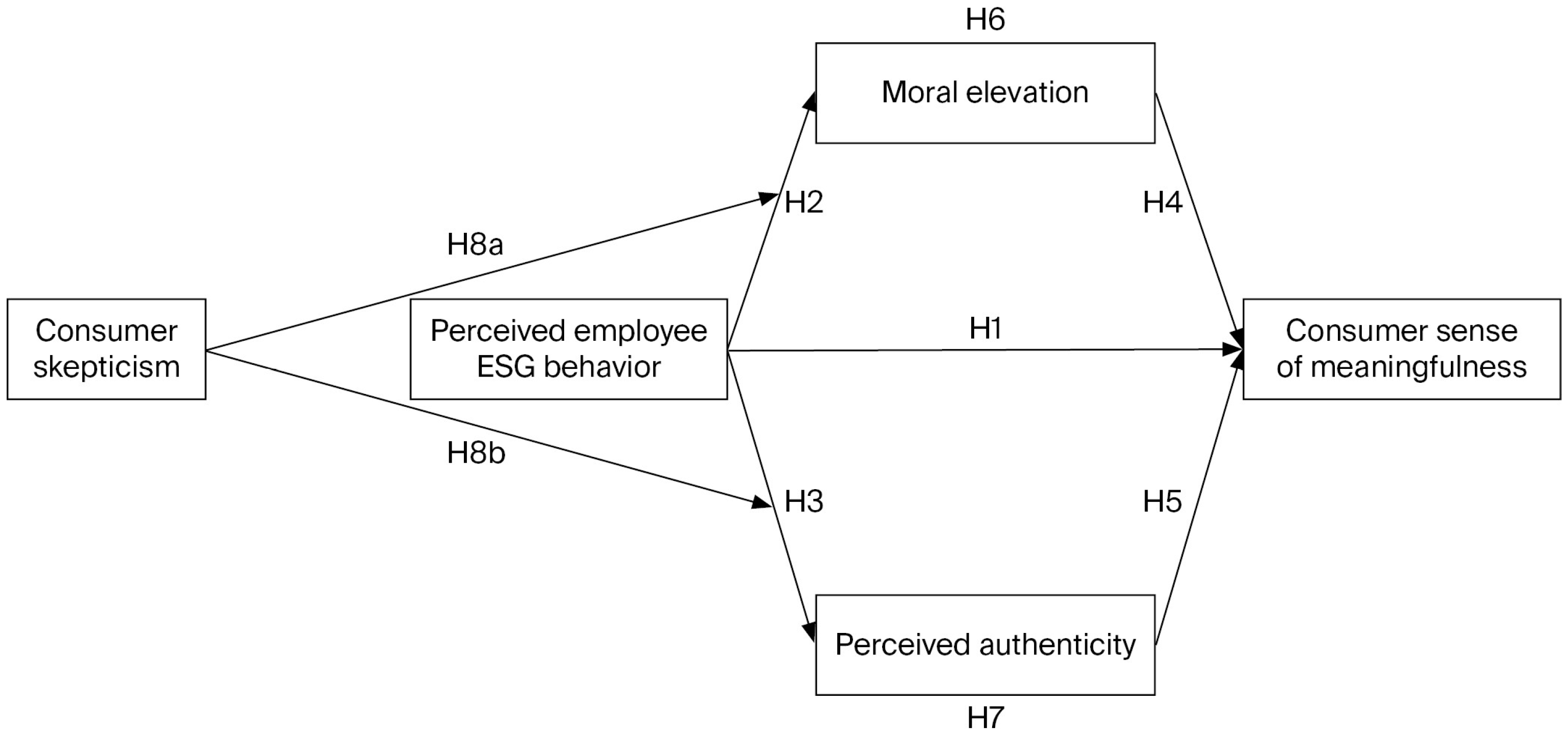
Based on the integration of SCT and SDT, we propose a model on the association between perceived employee ESG behavior and consumer meaningfulness through the parallel mediation of moral elevation and perceived authenticity, with consumer skepticism acting as a moderator. The conceptual framework for this study is illustrated in Figure 1.

4. Methods

4.1. Design and Data Collection

This study used a two-phase sequential explanatory mixed method, in which a qualitative investigation follows a quantitative study [65]. There are two different respondent groups for this study: hotel employees and consumers. Study 1 suggests and evaluates the hypothesized associations between perceived employee PESG behavior and consumers’ psychological perceptions, and Study 2 goes into deep insights about how the observable PESG behaviors of employees relate to the consumers’ sense of meaningfulness through authenticity and skepticism.
For the quantitative study, data was gathered from guests at five-star hotels in Addis Ababa, Ethiopia. The choice of a single-country focus on Ethiopia is both purposive and theoretically motivated. Ethiopia serves as a critical case for hospitality research in East Africa; as the headquarters of the African Union, Addis Ababa possesses a highly internationalized five-star hotel sector that must balance global ESG standards with local socio-economic realities. Before recruiting the respondents, we went to the hotels to explain the purpose and nature of the study and to obtain approval from the managers. After receiving approvals from the hotel manager, the data collection team suitably asked respondents by explaining the purpose of the study and inviting voluntary participation. Informed consent was obtained from all respondents prior to participation, with explicit assurances that their responses would remain strictly confidential and anonymous, and used solely for academic research purposes.
All the data was collected through face-to-face interactions with consumers staying at the sampled five-star hotels. This approach was helpful in achieving a high completion rate and allowed the research team to clarify any nuances of the translated questionnaire. The data collection phase covered one month, from 20 July 2025, to August 2025. To make sure the questions were clear and intelligible, a pilot study was conducted before the final data was collected from a sample of 30 consumers in the hotel. No problems were mentioned by any of the responders. In order to remove difficulties associated with the internet, the questionnaire was distributed in hard copy. We approached 460 respondents, of whom 435 volunteered to fill out the questionnaire. Out of 435 participants, 45 questionnaires were rejected for different reasons. We analyzed 390 valid responses, with a response rate of 89.8%.
The sample size for this study was 390, which was determined by the nature of the target population and statistical power requirements. The total population of the hotel guests is indeterminate. The Cochran [66] formula was applied with a 95% confidence level (Z = 1.96), a 5% margin of error (e = 0.05), and maximum variability (p = 0.5); the minimum required sample size is 385. Our study’s valid responses exceed this threshold. A purposive sampling technique was employed to recruit participants. This approach was chosen to ensure that the sample consisted exclusively of “rich” cases specifically, including guests currently staying in five-star hotels who have direct exposure to employee behaviors.

4.2. Study 1

4.2.1. Measurements

Perceived employee ESG behavior was measured from the perspectives of hotel consumers rather than employee self-reports. Hotel consumers measured the level to which they evaluated employees engaging in unrestricted ESG practices during their hotel stay. It focuses on the perceived signals of the actual activities and the guest’s cognitive and affective responses. The measurement items for Study 1 are adapted from previous proven academic studies to ensure validity and reliability. All items, except demographic variables, were measured using well-established scales.
Perceived Employees’ ESG behavior variable: We measured perceived employees’ ESG behavior with eight items adapted from [8,67,68,69]. A sample item is “The employees actively encouraged consumers to participate in conservation activities.”
Moral elevation variable: We measured moral elevation with seven items adapted from the moral elevation scale. A sample item is “I felt motivated to live in a more virtuous way.”
Perceived authenticity variable: We measured perceived authenticity with four items adapted from [56]. A sample item is “The hotel’s standards were consistently mirrored in the employee’s behavior.”
Consumer skepticism variable: We measured consumer skepticism with six items adapted from [70]. A sample item is “I doubt the sincerity of the hotel’s ESG claims.”
Consumer meaningfulness variable: We measured the consumer sense of meaningfulness variable with four items adapted from [71]. A sample item is “My stay at this hotel helped me feel connected to a high purpose.” The complete questionnaire is provided in the Appendix A.
All 29 items were used to measure five variables that were included in this study, and all items were revised in order to connect with the study research questions. A 5-point Likert scale was then used, with 1 representing “strongly disagree” and 5 representing “strongly agree”.
As this study was conducted in an Ethiopian context, the items aware translated to the widely spoken language, Amharic, through a back-translation protocol. First, the items were translated into Amharic and then back-translated into English by independent bilingual experts to reconcile discrepancies and preserve technical accuracy.

4.2.2. Data Analysis

We utilized SPSS version 29 to analyze the demographic data and Smart PLS version 4.1.1 to examine the intricate hypothesis pathways. There are many reasons why the Partial Least Square-Structural Equation Model was chosen instead of Covariance-Based SEM (CB-SEM). This study seeks to investigate the predictive capacity of perceived employee ESG behavior on consumer perceptions of meaningfulness. This novel notion necessitates a prediction-oriented methodology [72]. Secondly, the model’s complexity, which includes both mediating and moderating factors, is better suited to the high statistical power of PLS-SEM.
Initially, we screened the data for missing values and outliers. We then assessed the measurement model to verify validity and reliability and outer loading, and used Cronbach alpha to ensure that the measurement scales for employees’ PESG behavior, moral elevation, perceived authenticity, consumer skepticism, and sense of meaningfulness genuinely measure what they are intended to measure and are internally consistent [72]. After properly evaluating the measurement model, the structural model is assessed to test the direct paths and the mediating effects and the moderating effects of consumers’ skepticism. A bootstrapping procedure with 5000 samples was employed. This inclusive systematic approach confirms the complex quantitative relationships are fully explored and rigorously tested.
To minimize the problem of CMB, we adopted procedural remedies as recommended by [73]. First, participant anonymity was guaranteed, to reduce social desirability bias. Second, the survey items were psychologically separated by placing the dependent variables after the independent and mediating variables. Finally, a statistical Full Collinearity Assessment was conducted; all Variance Inflation Factors (VIFs) were below the five thresholds, indicating that the model is free from CMB problem [74]. Moreover, to assess the potential for CMB, given that data for all variables were collected from a single source, Harman’s single-factor test was conducted. Following the procedure suggested by [73], all 24 items were entered into an unrotated principal component analysis. The results indicated that the first component explained 42.83% of the variance, which is less than cut-off of 50%. Therefore, the results suggest that CMB is not a significant issue in this study.

5. Results of Study 1

5.1. Demographic Data Analysis

The respondents’ demographic statistics indicate that the majority of respondents are male (61.8%) and are predominantly aged 30–39 (46.7%). The majority of respondents (41.3%) had a bachelor’s degree, and most consumers have monthly income ranging from $USD 1001 to $USD 2000 (56.7%). Refer to Table 1.

5.2. Measurement Model Assessment

To assess the measurement models, Smart PLS was used. Both discriminant validity and convergent validity were used. Convergent validity, which was validated by factor loadings, composite reliability, Cronbach alpha, and average variance extracted (AVE), were evaluated to make sure that the indicators of a construct were highly correlated and accurately measure the same underlying concept [72]. As mentioned in Table 2, all items had confirmed factor loadings over the 0.70 cut-off and internal consistency with CA and CRV above 0.70, while convergent validity was established by Average Variance Extracted (AVE) scores surpassing 0.50. Collinearity assessments using the Variance Inflation Factor (VIF) indicated values below 5.0 for exogenous constructs, hence proving the absence of multicollinearity concerns.
We utilized both the HTMT and Fornell–Larcker criterion to assess discriminant validity, which examines whether ideas or measurements that are meant to be unrelated are, in fact, separate from one another [72]. To verify the applicability of the developed discriminant validity, we verified the HTMT and Fornell–Larcker criterion as shown in Table 3 and Table 4. According to [72] the HTMT and Fornell–Larcher criterion scores for each construct remained below 0.90, indicating discriminant validity. The structural model’s predictive power was evaluated using the explained variance (R2) and Q2 values [72]. The independent variables were analyzed to ascertain the total variance (R2) for the structural model. Table 5 shows that the structural model fits for consumers sense of meaningfulness (R2 = 0.504), moral elevation (R2 = 0.511), and perceived authenticity (R2 = 0.575). The model assessed the constructions with a reasonable level of proficiency if the R2 value is greater than 0.20 [75]. Additionally, an explanatory power of R2 over 50% is highly significant in social science research, while other factors such as service quality and physical environment undoubtedly contribute to the guest experience [76]. Therefore, the current study’s structural model has good fit. Additionally, we assessed the SRMR calculated and saturated models; the results of the t-test were higher than the 95% CI cut-off 1.96, and the SRMR was below 0.08, and the NFI, which compares the x2 value of the research model to a null baseline model, was 0.891. This value is close to the 0.90 threshold, indicating statistically acceptability, as shown in Table 5. Q2 aids in determining predictive significance. All Q2 numbers are expected to be positive [72]. The findings for perceived authenticity (Q2 = 0.564), moral elevation (Q2 = 0.492), and sense of meaningfulness (Q2 = 0.471) are shown in Table 5. The result clarifies that the model met the criterion of Q2 and large effect sizes (f2), validating its use for theoretical and hypothesis-testing applications.

5.3. Assessment of Structural Model

A bootstrapping approach including 5000 resamples was employed to evaluate all hypotheses, encompassing both direct and indirect effects. This method was selected for its reliability in computing confidence intervals and assessing significance levels, especially in mediation and moderation research.

5.3.1. Direct Effects

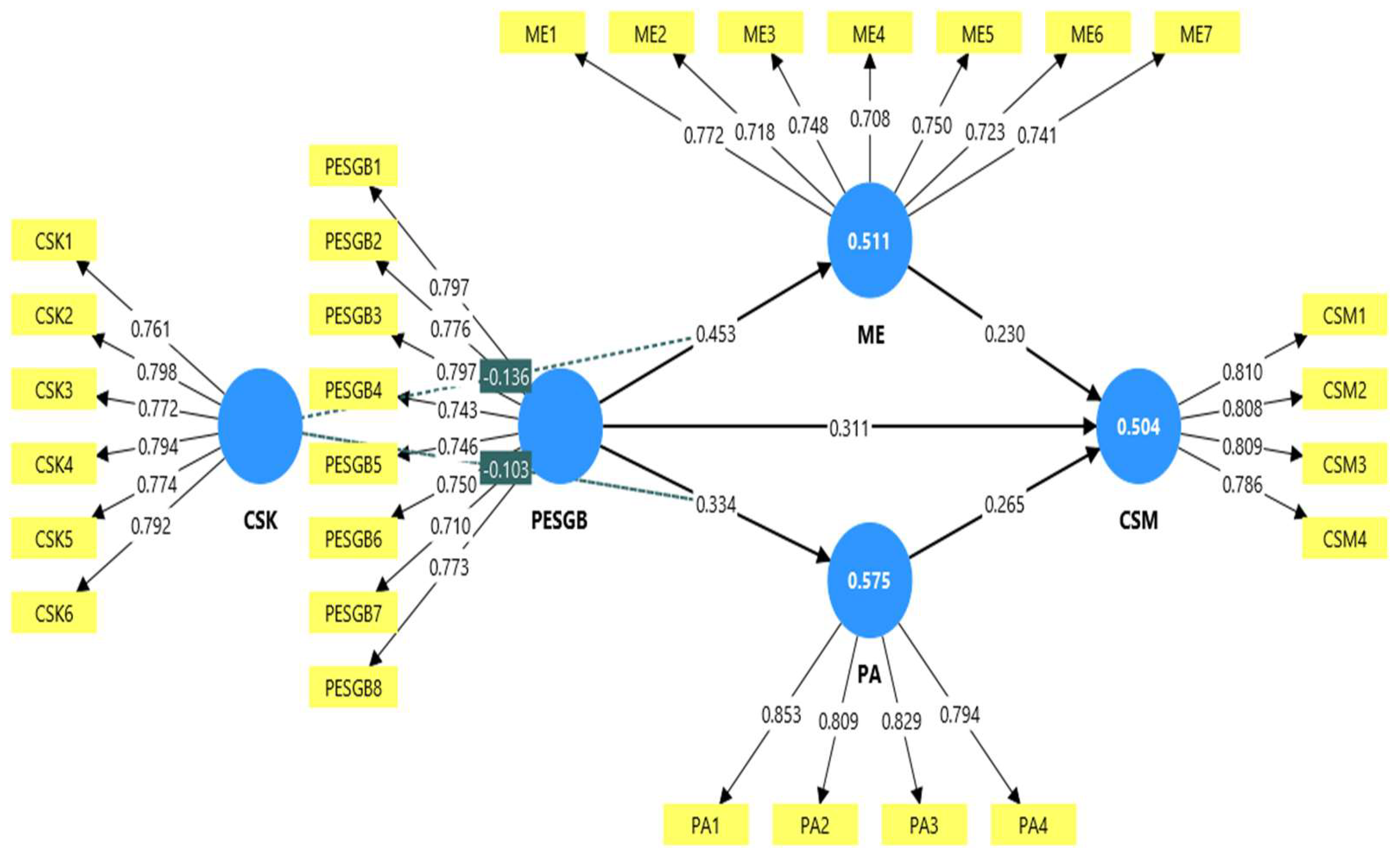
As shown in Table 6, employees’ PESGB had a positive effect on the CSM (β = 0.311, p = 0.000), meaning that H1 is supported. Additionally, employees’ PESGB had a positive effect on ME (β = 0.453, p = 0.000), meaning that H2 is supported. Perceived employees’ ESGB had a positive effect on the consumers’ PA (β = 0.334, p = 0.001), meaning that H3 is supported. ME had a positive effect on the CSM (β = 0.230, p = 0.000), meaning that H4 is supported. PA had a positive effect on the CSM (β = 0.265, p = 0.000), so that H5 is supported. These standardized path coefficients and the overall explanatory power of the model are illustrated in Figure 2.

5.3.2. Mediation Effect

As shown in Table 7, we examined the indirect effects of perceived employees’ ESGB on meaningfulness. The indirect effect of employees’ PESGB on meaningfulness through moral elevation and perceived authenticity were significant at (β = 0.104, p = 0.001) and (β = 0.089, p = 0.000), respectively. Therefore, the results support H6 and H7.

5.3.3. Moderation Effect

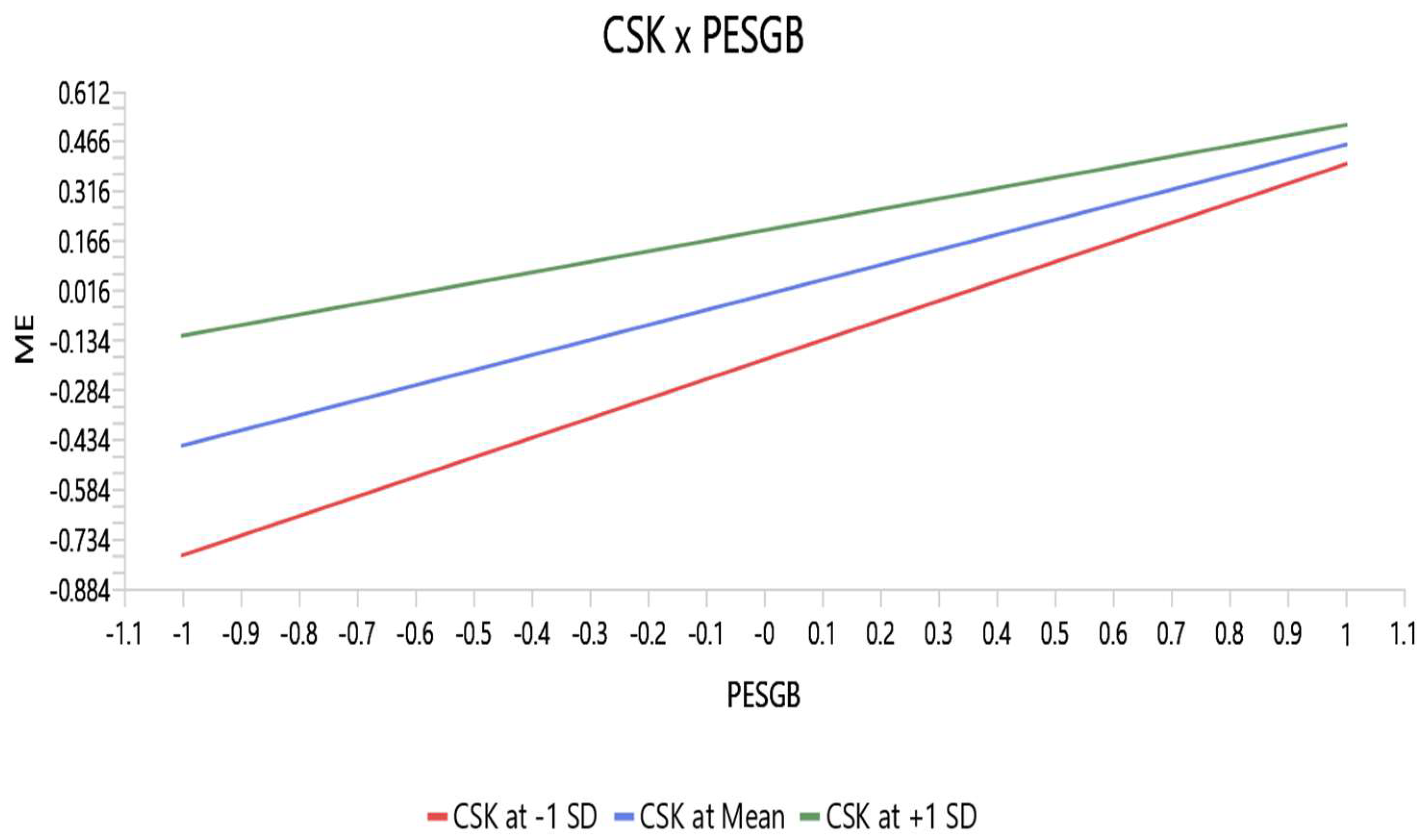
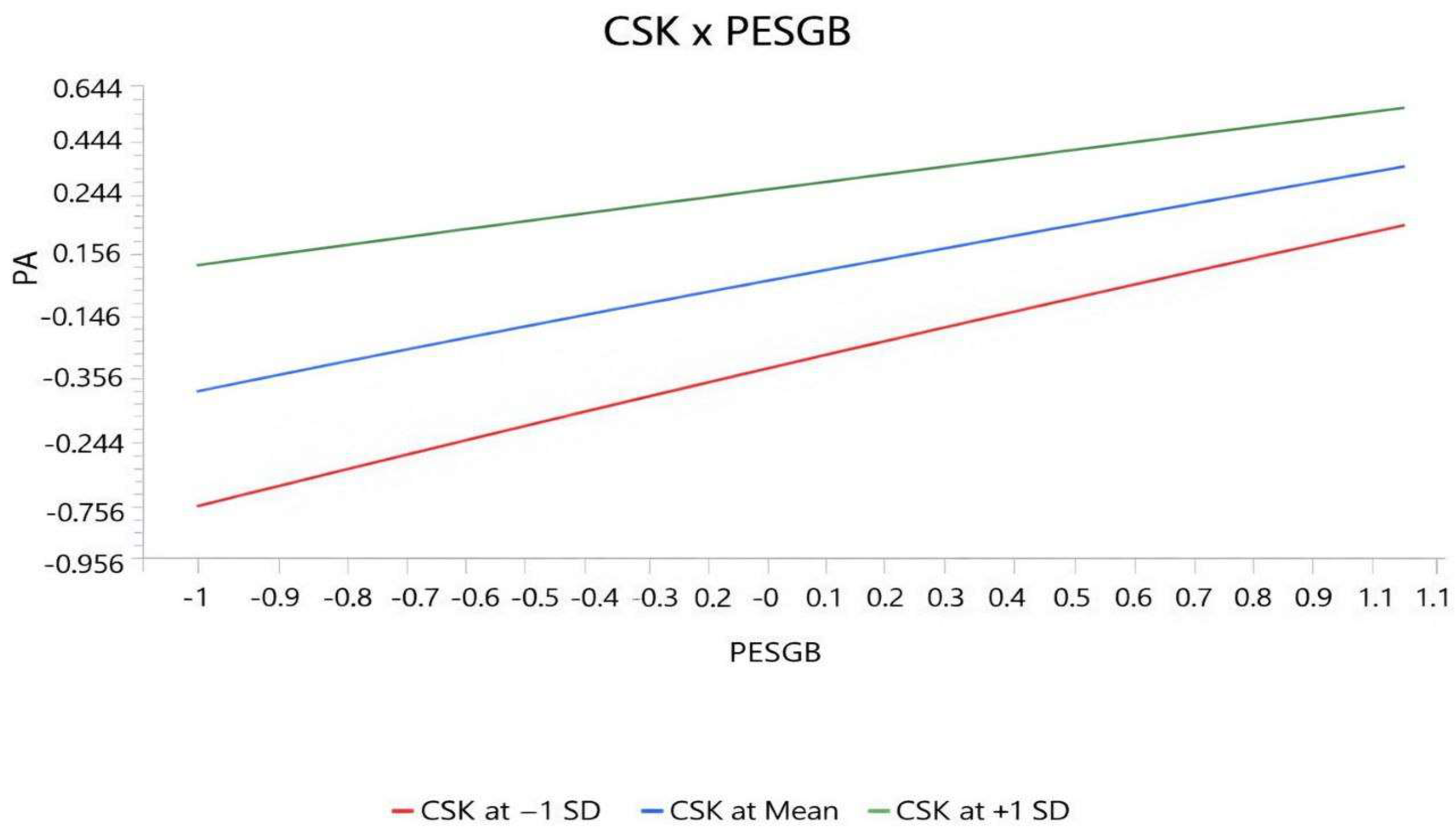
As shown in Table 8, we examined the effect of moderation within the model. The formulated hypothesis (H8a) indicates that consumer skepticism negatively moderates the path between employee PESGB and moral elevations. The results confirm that consumer skepticism has negatively and significantly moderated these relationships with an effect of (β = −0.136, p = 0.000), thus supporting H8a. Additionally, hypothesis (H8b) indicates that consumer skepticism negatively moderates the path between PESGB and perceived authenticity. The results confirm that consumer skepticism has negatively and significantly moderated these relationships, with an effect of (β = −0.103, p = 0.000), thus supporting H8b. Overall, the results indicate that consumer skepticism strongly weakens the link between employee PESGB and both moral elevation and perceived authenticity, as showed in the interaction plot in Figure 3 and Figure 4.

5.4. Study 2

5.4.1. Data Collections

The data for Study 2 were collected through semi-structured interviews to gain an in-depth understanding of the frontline employees’ views. As mentioned by [77], semi-structured interviews help to gain deep, contextual insights from employees with direct participation in activities. A convenience sampling technique was applied to recruit a diverse group of employees and managers. This method is useful because the selected interviewees have 5 years of experience, and the direct consumer interaction role provides deep insights that align with sustainable actions. The participants were interviewed in a private room in the hotel to ensure comfort. The interview was conducted with semi-structured questionnaires that aimed to understand their views regarding ESG practices and authentic services and their perceptions of organizational support. The interviews lasted between 30 and 60 min. To ensure data quality, the interviewer took field notes to capture contextual observations, and the interviews were audio recorded and then transcribed verbatim. Table 9 displays the participants’ demographic profile in detail.

5.4.2. Qualitative Data Analysis

We used thematic analysis techniques to analyze the interview data. To become acquainted with the data, we read the transcripts multiple times. Then, a preliminary set of codes was created and grouped into significant themes and patterns. After a thorough analysis of these topics, the final themes were established. Finally, the spirit of each theme was properly defined and termed to create a detailed narrative of the employees’ understandings, providing rich, qualitative insights into the enablers and barriers of perceived authenticity in service delivery.

5.4.3. Results of Study 2

The findings of the current study concentrated on semi-structured interviews with the hotel’s frontline employees. Themes and codes were established to systematically organize the data. The themes are the employee’s motivational foundations, the organizational environment, managing consumer interactions, and the concept of perceived authenticity. Subsequent to the primary themes, the codes explicitly quote the participants’ responses and elucidate the observations following a thematic analysis that associates the findings with the quantitative results. Table 10 displays the themes, and related codes with their concepts and supporting quotes.
The Employee’s Motivational Foundations
This study’s primary objectives were to examine the relationship between perceived employee ESG behavior and guests’ meaningful stays and how it interacts with their innate sense of personal values, which primarily encourages the employee to take voluntary actions beyond their official responsibilities. P15 mentioned, “I implement the ESG activities from my own belief, not just because I am pushed by the policy.” This implies that the hotel’s policies and guidelines do not restrict employees’ freedom to engage in sustainable initiatives. Similarly, P10 reflects, “I have done the ESG activities based on my personal value and the rules of the hotel. I have a commitment to implement the ethical activities; this is my personal value and is also supported by the hotel rules and regulations.” This shows a strong interaction between two stakeholders: employees and hotel owners. This drives the consumers’ senses of meaningfulness. This result is supported by self-determination theory [78], when the external initiatives are voluntarily collaborated with the employee’s own value, it promotes internal motivations. This then translates into a sense of meaningfulness and well-being. Participant 7 mentioned that “I organized a voluntary participation team to clean the environment. I invited the consumers to participate actively in the waste management practice”. Employees accept the organizational values and are internally motivated for sustainable actions; they demonstrate voluntary prosocial behaviors [79,80].
The Employee Working Environment
The perceived employee ESG behavior has a significant positive impact on consumers’ senses of meaningfulness, as shown in Study 1. The outcomes of the interviews have provided more insight into how the organization’s commitment promotes employees’ intrinsic motivations, which contributes to the genuine authenticity of consumer experiences. This was mentioned by P6. “The hotel offers appropriate training, time, and tools for ESG actions, but occasionally I need to identify innovative solutions to fully meet expectations.” This finding identified a significant gap between the hotel principles and practical actions. A person’s confidence in their capacity to complete tasks successfully may be weakened by insufficient organizational support [81]. Employees must use their own creative ideas to close the gap, as this may represent a sense of perceived organizational insincerity and encourage underlying skepticism about the company’s commitment [82]. This type of skeptical customer is serious, as they doubt the reliability with which ESG actions are carried out, making their actions seem like agreement rather than authentic care.
Employee–Consumer Interaction
The interview’s outcome helps us better understand employee–customer interactions. The qualitative results show that the staff members make a sincere effort to comprehend the customers’ interests and resolve problems pertaining to their concerns. P3 reflected “I actively listen to understand their interests, provide clear suggestions, and confirm their doubts; it is important to create strong relationships. This principle helps eliminate greenwashing risks.” This method, which is based on [83], operationalizes the trust recovery idea of dealing directly with credibility deficits through transparent interaction. According to [84], restoring confidence and signaling integrity require a strategy that links adaptive validation with concrete evidence. Frontline employees endorsed trustworthiness through proactive actions. P13 mentioned, “One of the customers disposed of the used batteries in the trash box. I prohibited them, recommended our hazardous waste management program, and took the items to the collection box downstairs, which is out of my duties.” The interviewee’s attitude helps to recognize signals for addressing consumer skepticism. The finding aligns with the prior study of [83] and explains the validity of the concept of restored unwritten change, which addresses credibility scarcity. Moreover, transforming skepticism into an authentic relationship through honest communication and valuable actions is an effective strategy to connect hotel principles with consumer attitudes.
Perceived Authenticity
The construct of perceived authenticity analyzes the crucial component that distinguishes a written corporate interaction from an authentic experience, focusing more on the specific indications of employees’ trust conveyed honestly. The respondents recommended justification for this concept by clearly distinguishing between performative compliance and warm engagement. Concurrently, typical interactive cues of sincerity create a relationship based on shared values. P3 and P5 state, “Sincerity and consistency when actions match words. Guests feel it’s genuine when staff show care naturally, not as a scripted policy, and when small acts reflect true respect for people and the planet.” A guest perceives authenticity when behaviors align with commitments and are distinctly linked to outcomes. As discussed by [85], such observations are consistent on emotional labor, which holds that authentic consumer perceptions depend on real emotional expression rather than surface acting. Moreover, P2’s perspective that “authenticity is accomplished when a consumer senses the staff cares about their trust, captures the very spirit of perceived authenticity as a result of intrinsic motivation.” takes authenticity as a result of the employee’s internal motivation. The actions of stopping the written script connect with the concept of organizational citizenship behavior (OCB), because voluntary initiatives link the authentic commitment of employees [8]. Additionally, SDT explains that authenticity fulfills the basic psychological need for relatedness [78]. By turning a typical customer service interaction into a profound, unforgettable one, these behavioral clues effectively convey the underlying motivation that customers use to assess sincerity.

6. Discussions

This study examined the relationship between employees’ ESG behavior and consumers’ sense of meaningfulness through the parallel mediating role of moral elevation and perceived authenticity and the moderating role of consumer skepticism, using a sequential quantitative–qualitative research method. The employees’ ESG behavior is a significant antecedent of consumer moral elevation and perceived authenticity, along with the consumers’ senses of meaningfulness in the hotel industry. The crucial effect proposes that when the hotels’ frontline employees participate in ESG practices, they prove ethical business practices and voluntary participation in community activities; this directly predicts consumers’ meaningfulness. The findings confirm that employee ESG behaviors strongly enhance the hotel’s commitment to sustainable values for consumers.
This study transforms perceived employees’ ESG behavior into a consumer sense of meaningfulness through a critical psychological mediation of moral elevation and perceived authenticity, exposing a multi-faceted internal process. These findings were aligned with the study of [16]; observing employees’ sustainable ESG actions reminds consumers of moral elevations and a positive emotional response to witnessing features, which increases their affective relation to the hotel brand.
The moderating role of consumers’ skepticism is a significant point of distinction in our study. The findings suggest that, for consumers with high levels of ESG skepticism, the ability of employee ESG behavior to activate the sense of moral elevation and to be perceived as authentic is weakened. The result aligns with prior studies on consumers with high skepticism, which tend to perceive the same actions as extrinsic initiatives, such as corporate mandates or an untruthful attempt to appear socially responsible [61]. Skeptical consumers use employee behavior as serious investigations; however, their skepticism builds a higher edge for motivations. Observable ESG behaviors, their essential doubts, possible anger, and the fast emotional and honesty-based responses serve as a screen that reduces the power of these critical mediating psychological mechanisms. The frontline employees’ genuine sustainable actions are crucial to overcoming the barriers of a skeptical market. Due to overwhelmingly high consumer skepticism, hotels must work beyond scripted ESG signals. This result suggests that unscripted, extra-role behaviors act as a “costly signal” of sincerity. Because these actions are not mandated by the hotel, they create cognitive dissonance in skeptical guests, forcing them to recognize the employee’s genuine intent.
The qualitative findings confirm that authenticity is profoundly rooted in the Ethiopian cultural value of credible hospitality. The quantitative data also showed a relationship between perceived employee ESG behavior and consumer sense of meaningfulness. They describe why, in the Ethiopian culture, actions aligning with words is of high moral value. As P13 mentioned, when they worked beyond their duties to manage hazardous trash, it was perceived as an act of individual integrity, which resounded with the Ethiopian guests’ expectations of authentic attention. This is distinct from Western surface acting, with the result supposing that Ethiopian hotel employees utilize their internal motivation to bridge the gap between the hotel industry and the guests’ need for authentic values. Therefore, the hotel employee’s internal motivations promote the consumer’s experiences of perceived authenticity, whether provided by training or ethical connections. Similarly, the hotel employee manages the consumer’s attitude through effective signals to convert their uncertainties to trust.
Finally, the quantitative findings are highly integrated with the qualitative data. The frontline employees’ perspectives of their initiatives are encouraged by personal values, revealing the effect of employee ESG behavior on perceived authenticity. One of the respondents (P15) highlighted that “ethical behavior feels natural when it links with personal belief.” This recommends that the external behavior measured in the survey is effective precisely because it is perceived as authentic. The integrated findings propose that nurturing a guest’s sense of an authentic and meaningful stay through ESG practices needs a dual focus: cultivating an honestly motivated workforce skill of unrestricted ethical actions and preparing them with the communication skills to proactively solve and dismantle consumer doubt in their interactions.

6.1. Theoretical Implications

This study has several theoretical implications for the literature that are related to hospitality and tourism research, service marketing, social psychology, consumer psychology, and consumer behavior.
First, previous studies were based on the relationship between corporate ESG strategy and organizational performance. Beyond this, the present study defines a detailed micro-level mechanism centered on the hotel employee. Consumers’ observation of frontline employees’ behaviors significantly improves their emotional participation and willingness to support sustainability actions [86]. Our model shows that the “black box” between corporate strategy and consumer reaction is settled by the concrete, observable actions of frontline employees. Significantly, we refine this mechanism by distinguishing between in-role compliance and extra-role performance. We argue that meaningfulness derived by consumers is a eudaimonic response activated when they perceive employees moving beyond standard operating procedures. This builds bridges between the macro-level perspectives of strategic management with the micro-level intentions of consumer psychology. Specifically, we advance a two-stage theoretical process in which SCT acts as the “perceptual filter” and SDT acts as the motivational engine. Under social cognitive theory, guests act as social observers who internalize the hotel’s values through the actions of frontline staff. However, our results suggest that this observation is only the first step; the transition to meaningfulness occurs through the lens of self-determination theory, where the guest’s psychological need for relatedness is satisfied by their perceived association with the service provider.
Second, the present study contributes a novel theoretical model by creating the parallel mediating roles of moral elevation and perceived authenticity. Previous studies often focused on guests’ perceptions of CSR as a particular construct; our results show theoretically different concurrent psychological paths. Moral elevation [16] emphasizes that employees’ ESG behaviors are assessed as cognitive and potent triggers of emotional and moral responses. Additionally, perceived authenticity is a critical mediator; the research connects theories from hotel branding and their communications by transforming the hotel’s ESG commitment into a reliable experience for consumers.
Third, consumers’ ESG skepticism moderates the relationship between employee ESG behavior and both moral elevations and perceived authenticity, improving the theoretical understandings of the environments. Prior research on consumer skepticism has identified skepticism as a critical barrier to CSR effectiveness, but our study uniquely demonstrates how consumer ESG skepticism moderate’s employee ESG behavior and both consumer moral elevations and perceived authenticity; thus, our study fills a critical gap. The present study also advances social cognitive theory [15] by identifying that consumer ESG skepticism acts as a moderator that filters the critical process of observational learning. From an SCT perspective, skepticism acts as a cognitive fence to the attention phases of observations. If the guest’s cognitive evaluation identifies a hidden motive, the observational process is terminated. Conversely, when extra-role behaviors are observed, they satisfy the SDT requirement for authenticity, allowing the guest to internalize the hotel’s ESG values as part of their own self-concept. We propose that skepticism creates an integrity deficit that can only be overcome when employee behaviors are perceived as extra-role. Thus, we theorize that the observational process is conditional; consumers only internalize the hotel’s ESG values when they observe “unscripted” behaviors that contrast with standard corporate compliance, thereby filling a critical gap in how skepticism interacts with employee-led ESG initiatives.

6.2. Practical Implications

The results of this study provide clear guidance for hotel managers to understand ESG strategy as a critical competitive advantage. Managers who inspire their investment must shift from solely promoting ESG claims to enabling and empowering frontline employees to act as authentic ambassadors.
First, managers should focus on differential written and discretionary ESG activities. Although SOPs ensure consistency, our findings suggest that consumer meaningfulness is activated by employee voluntary behaviors. Therefore, hotels should implement ESG Autonomy Spaces, giving employees the professional discretion to solve environmental or social issues they observe in real-time without seeking prior managerial approval. For example, although it is not included in the security guard’s formal job description, their involvement in removing a guest’s waste allows the guest to perceive a sense of natural care in the employee; this, in turn activates moral elevation.
Second, beyond the usual training, managers should implement social modeling, which is a main pillar of SCT. The managers’ participation in local community support activities and the frontline employee observations of this voluntary action help them internalize these values through observational learning. This genuine behavior is then established spontaneously during guest interactions, which is more effective for trust recovery than corporate business. To foster this voluntary behavior, hotels should adopt internal ESG storytelling. By applying SCT within the staff environment, managers create a social norm where ESG acts are achieved because they are culturally valued and modeled by the team, rather than being mandated by a manual. This converts employees from passive workers into authentic ambassadors, which is vital for activating moral elevation and perceived authenticity in hotel consumers.
Third, the hotel management should provide facilities for initiatives to remove friction from voluntary acts. As explained by P6 in study 2, hotel employees often want to act but lack the resources. Hotel managers should provide ESG manuals, such as community participation directions and sustainability educational materials in the hotel staff offices. This encourages voluntary participation activities; the cost of effort is also low, making voluntary participation more sustainable.
It also enables management teams to communicate their services aimed at addressing unnecessary behaviors, causing the critical impact of consumers’ cognitive and affective mechanisms on the path between employee and consumer interactions. The present study confirms that consumer ESG skepticism moderates the link between employee behavior and consumers’ moral elevation and perceived authenticity; it helps if consumers have genuine experiences. For hotels facing high consumer skepticism or a low ESG reputation, corporate-level communication often fails. In these contexts, our model suggests that frontline employees act as the primary trust-recovery mechanism. According to social cognitive theory, when a skeptical guest observes an employee performing an unscripted, extra-role ESG act, this creates cognitive dissonance that forces the guest to re-evaluate their skepticism. This process can assist hospitality service providers in effectively and efficiently defining their target market and advancing marketing tactics to improve interactions between employees and consumers.

6.3. Limitations and Further Research

Our study has several limitations that give directions for future research. The data were gathered from a specific area of Ethiopia, which limits the generalizability of the results to different cultures where priorities regarding ESG practices may vary. The internationalized nature of five-star hotels in Addis Ababa may not represent smaller hotels or domestic hospitality segments. Furthermore, the perceived authenticity and meaningfulness variables are culturally dependent; the link between perceived employee ESG behavior and consumer sense of meaningfulness requires further cultural validation to establish its global applicability. Future research should conduct cross-national comparative studies between emerging and developed markets to determine if the relationship between perceived employee ESG behavior and guest meaningfulness varies between different cultural orientations. The study integrated social cognitive theory (SCT) and self-determination theory (SDT) to explain the transition from observation to internal motivation and focused on the survey and interview data; therefore, the possibility of common method bias and the cross-sectional design prevent absolute conclusions about causal effects. Future research should address these limitations by conducting longitudinal or experimental designs to build stronger causal relations. Furthermore, when integrating interview insights to explain the cultural distinctions of “integrity” in Ethiopia, our sample was limited to frontline employees. Future research could benefit from a more formal qualitative-comparative analysis by interviewing high-level hotel executives to understand the organizational barriers to nurturing the “unscripted” ESG behaviors that our study found to be so energetic for consumer perceived authenticity. Moreover, examining the antecedents that shape perceived employee ESG behavior, such as specific sustainable practices of the management team and leadership styles, would be significant. Overall, future studies that incorporate other performance metrics variables, such as actual purchase data and online reviews, to crosscheck the results from self-reported consumer perceptions and also explore other moderators like types of consumers (generation Z) and the pillars of ESG, would also provide a different understanding.

7. Conclusions

This study examined the relationship between perceived employee ESG behavior and consumer sense of meaningfulness in five-star hotels in Ethiopia. This study integrates social cognitive theory and self-determination theory. The findings confirmed that when the hotel frontline employees participate in ESG activities, it activates the cognitive emotions and affective emotions of the consumers, specifically moral elevations and perceived authenticity. Moral elevation, along with perceived authenticity, serves as a bridge that changes the industry initiatives into a sense of meaningfulness for the guests. The findings also highlight the significant role of consumer skepticism as a boundary condition. It is a complex psychological process mediated by moral elevation and perceived authenticity, and is moderated by the consumer’s level of skepticism.
This study has three main contributions to the hotel industry. First, the study reveals that in high contract service environments like Ethiopian luxury hotels, the employees’ individual integrity can break dawn consumer skepticism. Second, the employees illuminate the micro mechanisms of ESG, and displaying extra voluntary behavior beyond the SOPs is more important for activating moral elevation than simple compliance with hotel policy. Third, the qualitative insights showed that the ESG signals that consumers perceive stem from frontline employees’ internal motivation and personal values rather than hotel sector mandates.
This study is a key resource for practitioners who want to turn what they perceive about their employees’ ESG behavior into a great guest experience. The findings show that hotel management needs to move away from compliance-focused ESG culture and toward one that encourages employees to be independent and speak out about what is right by giving them the training they need and the ability to make judgments. Therefore, this gives frontline employees the power to be ESG ambassador, thus allowing guests to trust them more. This confirms that when ESG initiatives are facilitated by the authentic actions of frontline employees, they transcend superficial corporate policy and become a primary actor for a significant experience, driving psychological value and building trust within the luxury hospitality sector.


Author Contributions

Y.T.G.: Investigation, data collection, software, analysis, original draft writing. P.Y.: Investigation, methodology, conceptual model, supervision and motivations, original draft writing, review and editing. All authors have read and agreed to the published version of the manuscript.

Funding

This research received no external funding.

Institutional Review Board Statement

Approval for this study was obtained from the School of Economics and Management at Beijing Jiaotong University, under Reference Number AEC20250701.

Informed Consent Statement

Informed consent was obtained from all subjects involved in the study.

Data Availability Statement

The data presented in this study are available from the corresponding author on request.

Conflicts of Interest

The authors declare no conflicts of interest.

Appendix A. Survey Items

PESGB variable items:
  • I noticed staff members kindly inviting me to join in the hotel’s conservation efforts, making it feel like a shared goal.
  • I observed the frontline employees taking personal initiative to save energy, even when not directly supervised.
  • The employees demonstrated a kind, sincere effort to reduce trash that appeared to go beyond their basic job requirements.
  • I observed staff making quiet, discretionary efforts to conserve water during their daily service routines.
  • I observed the frontline staff members warmly walking in to help their colleagues with environmental or service tasks.
  • Frontline employees appeared genuinely proud to share how the hotel supports the local community.
  • The employee showed a genuine commitment to being honest and transparent with me, reflecting a high level of personal integrity.
  • It felt like the staff were personally invested in doing things ““the right way,” “even when it required extra effort.
Moral elevation
  • Observing the staff’s ethical actions made me feel uplifted.
  • I felt impressed by the goodness of the staff.
  • I felt a warm feeling in my chest.
  • I felt admiration or respect for the staff’s behavior.
  • I felt motivated to live in a nobler or more virtuous way.
  • I wanted to thank or reward the person who did the good deed.
  • I felt inspired by the ethical conduct I observed.
Perceived authenticity
  • The staff’s ethical actions seemed genuine and sincere.
  • The hotel’s values were consistently reflected in the staff’s behavior.
  • The staff acted in a true and natural way, not following a script.
  • I felt the staff truly believed in the sustainability practices they performed.
Consumer sense of meaningfulness
  • My stay at this hotel helped me feel connected to a larger purpose.
  • This experience helped me understand my life’s meaning.
  • My time at the hotel contributed positively to my life purpose.
  • I felt that this experience added significant value to my life.
Consumer skepticism
  • I am uncertain about the genuineness of the hotel’s ESG privileges.
  • The hotel seems to be doing ESG only to improve its image.
  • The hotel presents itself as more responsible than it actually is.
  • I have the impression that the hotel’s ESG commitment is an empty promise.
  • The staff’s ethical behavior seemed mandatory or forced, rather than genuine.
  • I suspect the hotel is primarily motivated by profit rather than genuine societal concern.

References

  1. Legrand, W.; Chen, J.S.; Laeis, G.C. Sustainability in the Hospitality Industry: Principles of Sustainable Operations; Routledge: London, UK, 2022. [Google Scholar]
  2. Musgrave, J. Moving towards responsible events management. Worldw. Hosp. Tour. Themes 2011, 3, 258–274. [Google Scholar] [CrossRef]
  3. Gürlek, M.; Koseoglu, M.A. Green innovation research in the field of hospitality and tourism: The construct, antecedents, consequences, and future outlook. Serv. Ind. J. 2021, 41, 734–766. [Google Scholar] [CrossRef]
  4. Han, H.; Hsu, L.-T.J.; Lee, J.-S.; Sheu, C. Are lodging customers ready to go green? An examination of attitudes, demographics, and eco-friendly intentions. Int. J. Hosp. Manag. 2011, 30, 345–355. [Google Scholar] [CrossRef]
  5. Vlachos, P.A.; Panagopoulos, N.G.; Rapp, A.A. Employee judgments of and behaviors toward corporate social responsibility: A multi-study investigation of direct, cascading, and moderating effects. J. Organ. Behav. 2014, 35, 990–1017. [Google Scholar] [CrossRef]
  6. Donia, M.B.L.; Sirsly, C.-A.T.; Ronen, S. Employee attributions of corporate social responsibility as substantive or symbolic: Validation of a measure. Appl. Psychol. 2017, 66, 103–142. [Google Scholar] [CrossRef]
  7. McShane, L.; Cunningham, P. To thine own self be true? Employees’ judgments of the authenticity of their organization’s corporate social responsibility program. J. Bus. Ethics 2012, 108, 81–100. [Google Scholar] [CrossRef]
  8. Boiral, O.; Paillé, P. Organizational citizenship behaviour for the environment: Measurement and validation. J. Bus. Ethics 2012, 109, 431–445. [Google Scholar] [CrossRef]
  9. Glavas, A. Corporate social responsibility and employee engagement: Enabling employees to employ more of their whole selves at work. Front. Psychol. 2016, 7, 796. [Google Scholar] [CrossRef] [PubMed]
  10. Rupp, D.E.; Shao, R.; Skarlicki, D.P.; Paddock, E.L.; Kim, T.; Nadisic, T. Corporate social responsibility and employee engagement: The moderating role of CSR-specific relative autonomy and individualism. J. Organ. Behav. 2018, 39, 559–579. [Google Scholar] [CrossRef]
  11. Rodell, J.B.; Breitsohl, H.; Schröder, M.; Keating, D.J. Employee volunteering: A review and framework for future research. J. Manag. 2016, 42, 55–84. [Google Scholar] [CrossRef]
  12. Afsar, B.; Umrani, W.A. Corporate social responsibility and pro-environmental behavior at workplace: The role of moral reflectiveness, coworker advocacy, and environmental commitment. Corp. Soc. Responsib. Environ. Manag. 2020, 27, 109–125. [Google Scholar] [CrossRef]
  13. Greening, D.W.; Turban, D.B. Corporate social performance as a competitive advantage in attracting a quality workforce. Bus. Soc. 2000, 39, 254–280. [Google Scholar] [CrossRef]
  14. Ryan, R.M.; Frederick, C. On energy, personality, and health: Subjective vitality as a dynamic reflection of well-being. J. Pers. 1997, 65, 529–565. [Google Scholar] [CrossRef]
  15. Bandura, A. Social Foundations of Thought and Action; Prentice Hall: Englewood Cliffs, NJ, USA, 1986; p. 2. [Google Scholar]
  16. Haidt, J. The moral emotions. Handb. Affect. Sci. 2003, 11, 852–870. [Google Scholar]
  17. Audrezet, A.; de Kerviler, G.; Moulard, J.G. Authenticity under threat: When social media influencers need to go beyond self-presentation. J. Bus. Res. 2020, 117, 557–569. [Google Scholar] [CrossRef]
  18. Robinson, R.C. From Theory to Practice: The National Theatre of Scotland, 1999–2009. Doctoral Dissertation, University of Glasgow, Glasgow, UK, 2009. [Google Scholar]
  19. Asplet, M.; Cooper, M. Cultural designs in New Zealand souvenir clothing: The question of authenticity. Tour. Manag. 2000, 21, 307–312. [Google Scholar] [CrossRef]
  20. Farooq, Y.; Wicaksono, H. Advancing on the analysis of causes and consequences of green skepticism. J. Clean. Prod. 2021, 320, 128927. [Google Scholar] [CrossRef]
  21. Eccles, R.G.; Lee, L.-E.; Stroehle, J.C. The social origins of ESG: An analysis of Innovest and KLD. Organ. Environ. 2020, 33, 575–596. [Google Scholar] [CrossRef]
  22. Manninen, M.; Deng, Y.; Hwang, Y.; Waller, S.; Yli-Piipari, S. Psychological need-supportive instruction improves novel skill performance, intrinsic motivation, and enjoyment: A cluster-randomised study. Int. J. Sport Exerc. Psychol. 2022, 20, 122–146. [Google Scholar] [CrossRef]
  23. Stroet, K.; Opdenakker, M.-C.; Minnaert, A. Fostering early adolescents’ motivation: A longitudinal study into the effectiveness of social constructivist, traditional and combined schools for prevocational education. Educ. Psychol. 2016, 36, 1–25. [Google Scholar] [CrossRef]
  24. Deci, E.L.; Ryan, R.M. Self-determination theory: A macrotheory of human motivation, development, and health. Can. Psychol. /Psychol. Can. 2008, 49, 182. [Google Scholar] [CrossRef]
  25. Shephard, A.; Pookulangara, S.; Kinley, T.R.; Josiam, B.M. Media influence, fashion, and shopping: A gender perspective. J. Fash. Mark. Manag. 2016, 20, 4–18. [Google Scholar] [CrossRef]
  26. Kim, S.H.; Lee, K.; Fairhurst, A. The review of” green” research in hospitality, 2000–2014. Int. J. Contemp. Hosp. Manag. 2017, 29, 226–247. [Google Scholar] [CrossRef]
  27. Myung, E.; McClaren, A.; Li, L. Environmentally related research in scholarly hospitality journals: Current status and future opportunities. Int. J. Hosp. Manag. 2012, 31, 1264–1275. [Google Scholar] [CrossRef]
  28. Su, L.; Swanson, S.R. Perceived corporate social responsibility’s impact on the well-being and supportive green behaviors of hotel employees: The mediating role of the employee-corporate relationship. Tour. Manag. 2019, 72, 437–450. [Google Scholar] [CrossRef]
  29. Du, S.; Bhattacharya, C.B.; Sen, S. Corporate social responsibility and competitive advantage: Overcoming the trust barrier. Manag. Sci. 2011, 57, 1528–1545. [Google Scholar] [CrossRef]
  30. Anderson, L.; Ostrom, A.L. Transformative Service Research: Advancing Our Knowledge About Service and Well-Being; SAGE Publications: Los Angeles, CA, USA, 2015; pp. 243–249. [Google Scholar]
  31. Filep, S.; Laing, J. Trends and directions in tourism and positive psychology. J. Travel Res. 2019, 58, 343–354. [Google Scholar] [CrossRef]
  32. Ashwin Kumar, N.C.; Smith, C.; Badis, L.; Wang, N.; Ambrosy, P.; Tavares, R. ESG factors and risk-adjusted performance: A new quantitative model. J. Sustain. Finance Investig. 2016, 6, 292–300. [Google Scholar] [CrossRef]
  33. Adnan, M.; Rashid, M.; Khan, S.N.; Baig, F.J. Impact of service quality on business sustainability: A mediation-moderation prospective. Pak. J. Humanit. Soc. Sci. 2023, 11, 2663–2671. [Google Scholar] [CrossRef]
  34. Farooq, M.; Farooq, O.; Jasimuddin, S.M. Employees response to corporate social responsibility: Exploring the role of employees’ collectivist orientation. Eur. Manag. J. 2014, 32, 916–927. [Google Scholar] [CrossRef]
  35. Ramus, C.A.; Montiel, I. When are corporate environmental policies a form of greenwashing? Bus. Soc. 2005, 44, 377–414. [Google Scholar] [CrossRef]
  36. Haidt, J. Elevation and the Positive Psychology of Morality; American Psychological Association: Washington, DC, USA, 2003. [Google Scholar]
  37. Cinelli, M.D.; LeBoeuf, R.A. Keeping it real: How perceived brand authenticity affects product perceptions. J. Consum. Psychol. 2020, 30, 40–59. [Google Scholar] [CrossRef]
  38. Kolar, T.; Zabkar, V. A consumer-based model of authenticity: An oxymoron or the foundation of cultural heritage marketing? Tour. Manag. 2010, 31, 652–664. [Google Scholar] [CrossRef]
  39. Campbell, J.P.; Wiernik, B.M. The modeling and assessment of work performance. Annu. Rev. Organ. Psychol. Organ. Behav. 2015, 2, 47–74. [Google Scholar] [CrossRef]
  40. Diessner, R.; Iyer, R.; Smith, M.M.; Haidt, J. Who engages with moral beauty? J. Moral Educ. 2013, 42, 139–163. [Google Scholar] [CrossRef]
  41. Xie, C.; Bagozzi, R.P.; Grønhaug, K. The impact of corporate social responsibility on consumer brand advocacy: The role of moral emotions, attitudes, and individual differences. J. Bus. Res. 2019, 95, 514–530. [Google Scholar] [CrossRef]
  42. Romani, S.; Grappi, S. How companies’ good deeds encourage consumers to adopt pro-social behavior. Eur. J. Mark. 2014, 48, 943–963. [Google Scholar] [CrossRef]
  43. Cropanzano, R.; Mitchell, M.S. Social exchange theory: An interdisciplinary review. J. Manag. 2005, 31, 874–900. [Google Scholar] [CrossRef]
  44. Kreuzbauer, R.; Keller, J. The authenticity of cultural products: A psychological perspective. Curr. Dir. Psychol. Sci. 2017, 26, 417–421. [Google Scholar] [CrossRef]
  45. Stepchenkova, S.; Belyaeva, V. The effect of authenticity orientation on existential authenticity and postvisitation intended behavior. J. Travel Res. 2021, 60, 401–416. [Google Scholar] [CrossRef]
  46. Lu, A.C.C.; Gursoy, D.; Lu, C.Y. Authenticity perceptions, brand equity and brand choice intention: The case of ethnic restaurants. Int. J. Hosp. Manag. 2015, 50, 36–45. [Google Scholar] [CrossRef]
  47. Oh, H.; Prado, P.H.M.; Korelo, J.C.; Frizzo, F. The effect of brand authenticity on consumer–brand relationships. J. Prod. Brand Manag. 2019, 28, 231–241. [Google Scholar] [CrossRef]
  48. Bruhn, M.; Schoenmüller, V.; Schäfer, D.; Heinrich, D. Brand authenticity: Towards a deeper understanding of its conceptualization and measurement. Adv. Consum. Res. 2012, 40, 567–576. [Google Scholar]
  49. Aquino, K.; McFerran, B.; Laven, M. Moral identity and the experience of moral elevation in response to acts of uncommon goodness. J. Personal. Soc. Psychol. 2011, 100, 703. [Google Scholar] [CrossRef]
  50. Algoe, S.B.; Haidt, J. Witnessing excellence in action: The ‘other-praising’ emotions of elevation, gratitude, and admiration. J. Posit. Psychol. 2009, 4, 105–127. [Google Scholar] [CrossRef] [PubMed]
  51. Gong, T.; Yi, Y. A review of customer citizenship behaviors in the service context. Serv. Ind. J. 2021, 41, 169–199. [Google Scholar] [CrossRef]
  52. Kang, J.-W.; Namkung, Y. The role of personalization on continuance intention in food service mobile apps: A privacy calculus perspective. Int. J. Contemp. Hosp. Manag. 2019, 31, 734–752. [Google Scholar] [CrossRef]
  53. Rupp, D.E.; Shao, R.; Thornton, M.A.; Skarlicki, D.P. Applicants’ and employees’ reactions to corporate social responsibility: The moderating effects of first-party justice perceptions and moral identity. Pers. Psychol. 2013, 66, 895–933. [Google Scholar] [CrossRef]
  54. Groth, M.; Wu, Y.; Nguyen, H.; Johnson, A. The moment of truth: A review, synthesis, and research agenda for the customer service experience. Annu. Rev. Organ. Psychol. Organ. Behav. 2019, 6, 89–113. [Google Scholar] [CrossRef]
  55. Wang, W.; Korschun, D. Spillover of social responsibility associations in a brand portfolio. J. Prod. Brand Manag. 2015, 24, 596–609. [Google Scholar] [CrossRef]
  56. Morhart, F.; Malär, L.; Guèvremont, A.; Girardin, F.; Grohmann, B. Brand authenticity: An integrative framework and measurement scale. J. Consum. Psychol. 2015, 25, 200–218. [Google Scholar] [CrossRef]
  57. Napoli, J.; Dickinson, S.J.; Beverland, M.B.; Farrelly, F. Measuring consumer-based brand authenticity. J. Bus. Res. 2014, 67, 1090–1098. [Google Scholar] [CrossRef]
  58. Alhouti, S.; Johnson, C.M.; Holloway, B.B. Corporate social responsibility authenticity: Investigating its antecedents and outcomes. J. Bus. Res. 2016, 69, 1242–1249. [Google Scholar] [CrossRef]
  59. Vargo, S.L.; Lusch, R.F. Institutions and axioms: An extension and update of service-dominant logic. J. Acad. Mark. Sci. 2016, 44, 5–23. [Google Scholar] [CrossRef]
  60. Seele, P.; Gatti, L. Greenwashing revisited: In search of a typology and accusation-based definition incorporating legitimacy strategies. Bus. Strategy Environ. 2017, 26, 239–252. [Google Scholar] [CrossRef]
  61. Walker, K.; Wan, F. The harm of symbolic actions and green-washing: Corporate actions and communications on environmental performance and their financial implications. J. Bus. Ethics 2012, 109, 227–242. [Google Scholar] [CrossRef]
  62. Foreh, M.R.; Grier, S. When is honesty the best policy? The effect of stated company intent on consumer skepticism. J. Consum. Psychol. 2003, 13, 349–356. [Google Scholar] [CrossRef]
  63. Punjaisri, K.; Wilson, A. Internal branding process: Key mechanisms, outcomes and moderating factors. Eur. J. Mark. 2011, 45, 1521–1537. [Google Scholar] [CrossRef]
  64. Leonidou, C.N.; Skarmeas, D. Gray shades of green: Causes and consequences of green skepticism. J. Bus. Ethics 2017, 144, 401–415. [Google Scholar] [CrossRef]
  65. Plano Clark, V.L. Mixed methods research. J. Posit. Psychol. 2017, 12, 305–306. [Google Scholar] [CrossRef]
  66. Cochran, W.G. Sampling Techniques; John Wiley & Sons: Hoboken, NJ, USA, 1977. [Google Scholar]
  67. Turker, D. Measuring corporate social responsibility: A scale development study. J. Bus. Ethics 2009, 85, 411–427. [Google Scholar] [CrossRef]
  68. Kaptein, M. Developing and testing a measure for the ethical culture of organizations: The corporate ethical virtues model. J. Organ. Behav. Int. J. Ind. Occup. Organ. Psychol. Behav. 2008, 29, 923–947. [Google Scholar] [CrossRef]
  69. Hur, W.; Moon, T.; Kim, H. When and how does customer engagement in CSR initiatives lead to greater CSR participation? The role of CSR credibility and customer–company identification. Corp. Soc. Responsib. Environ. Manag. 2020, 27, 1878–1891. [Google Scholar] [CrossRef]
  70. Skarmeas, D.; Leonidou, C.N. When consumers doubt, watch out! The role of CSR skepticism. J. Bus. Res. 2013, 66, 1831–1838. [Google Scholar] [CrossRef]
  71. Kleine, S.S.; Kleine, R.E., III; Allen, C.T. How is a possession “me” or “not me”? Characterizing types and an antecedent of material possession attachment. J. Consum. Res. 1995, 22, 327–343. [Google Scholar] [CrossRef]
  72. Hair, J.F.; Risher, J.J.; Sarstedt, M.; Ringle, C.M. When to use and how to report the results of PLS-SEM. Eur. Bus. Rev. 2019, 31, 2–24. [Google Scholar] [CrossRef]
  73. Podsakoff, P.M.; MacKenzie, S.B.; Lee, J.-Y.; Podsakoff, N.P. Common method biases in behavioral research: A critical review of the literature and recommended remedies. J. Appl. Psychol. 2003, 88, 879. [Google Scholar] [CrossRef]
  74. Kock, N. Common method bias in PLS-SEM: A full collinearity assessment approach. Int. J. e-Collab. 2015, 11, 1–10. [Google Scholar] [CrossRef]
  75. Hair, J.F., Jr.; Hult, G.T.; Ringle, C.M.; Sarstedt, M.; Danks, N.P.; Ray, S. Evaluation of formative measurement models. In Partial Least Squares Structural Equation Modeling (PLS-SEM) Using R: A Workbook; Springer International Publishing: Cham, Switzerland, 2021; pp. 91–113. [Google Scholar]
  76. Henseler, J.; Ringle, C.M.; Sinkovics, R.R. The use of partial least squares path modeling in international marketing. In New Challenges to International Marketing; Emerald Group Publishing Limited: Bingley, UK, 2009; pp. 277–319. [Google Scholar]
  77. Campbell, S.; Greenwood, M.; Prior, S.; Shearer, T.; Walkem, K.; Young, S.; Bywaters, D.; Walker, K. Purposive sampling: Complex or simple? Research case examples. J. Res. Nurs. 2020, 25, 652–661. [Google Scholar] [CrossRef]
  78. Ryan, R.M.; Deci, E.L. Intrinsic and extrinsic motivations: Classic definitions and new directions. Contemp. Educ. Psychol. 2000, 25, 54–67. [Google Scholar] [CrossRef]
  79. Ramus, C.A.; Steger, U. The roles of supervisory support behaviors and environmental policy in employee “ecoinitiatives” at leading-edge European companies. Acad. Manag. J. 2000, 43, 605–626. [Google Scholar] [CrossRef]
  80. Bidee, J.; Vantilborgh, T.; Pepermans, R.; Huybrechts, G.; Willems, J.; Jegers, M.; Hofmans, J. Autonomous motivation stimulates volunteers’ work effort: A self-determination theory approach to volunteerism. Volunt. Int. J. Volunt. Nonprofit Organ. 2013, 24, 32–47. [Google Scholar] [CrossRef]
  81. Spreitzer, G.; Sutcliffe, K.; Dutton, J.; Sonenshein, S.; Grant, A.M. A socially embedded model of thriving at work. Organ. Sci. 2005, 16, 537–549. [Google Scholar] [CrossRef]
  82. Ahrne, G.; Brunsson, N. The travel of organization. In Global Themes and Local Variations in Organization and Management; Routledge: London, UK, 2013; pp. 39–51. [Google Scholar]
  83. Gillespie, N.; Dietz, G. Trust repair after an organization-level failure. Acad. Manag. Rev. 2009, 34, 127–145. [Google Scholar] [CrossRef]
  84. Xie, Y.; Peng, S. How to repair customer trust after negative publicity: The roles of competence, integrity, benevolence, and forgiveness. Psychol. Mark. 2009, 26, 572–589. [Google Scholar] [CrossRef]
  85. Grandey, A.A.; Fisk, G.M.; Steiner, D.D. Must “service with a smile” be stressful? The moderating role of personal control for American and French employees. J. Appl. Psychol. 2005, 90, 893. [Google Scholar] [CrossRef] [PubMed]
  86. Wang, J.; Wang, S.; Wang, Y.; Li, J.; Zhao, D. Extending the theory of planned behavior to understand consumers’ intentions to visit green hotels in the Chinese context. Int. J. Contemp. Hosp. Manag. 2018, 30, 2810–2825. [Google Scholar] [CrossRef]
Figure 1. Conceptual model and hypothetical relationships.
World 07 00015 g001
Figure 2. Structural model.
World 07 00015 g002
Figure 3. Moderation of consumer skepticism between PESGB and moral elevation.
World 07 00015 g003
Figure 4. Moderation of consumer skepticism between PESGB and perceived authenticity.
World 07 00015 g004
Table 1. Demographic data of the respondents.
VariablesCategoryN = 390%
Age18–296817.4
30–3918246.7
40–4911128.5
50 and above297.4
SexMale24161.8
Female14939.2
EducationHigh school and below317.9
Diploma12431.8
Bachelor’s Degree16141.3
Masters’ degree5213.3
PhD and above225.6
IncomeUSD 1000 and below7017.9
USD 1001–200022156.7
USD 2001 and above9925.4
Table 2. Validity and reliability of items.
VariablesItemsFLCACRAVEVIF
Perceived Employees ESG behaviorPESGB10.7970.8970.8970.5812.092
PESGB 20.776 1.992
PESGB 30.797 2.124
PESGB 40.743 1.805
PESGB 50.746 1.869
PESGB 60.75 1.832
PESGB 70.71 1.663
PESGB 80.773 1.936
Moral ElevationME10.7720.860.8630.5441.829
ME20.718 1.670
ME30.748 1.729
ME40.708 1.614
ME50.75 1.695
ME60.723 1.627
ME70.741 1.749
Perceived Authenticity PA10.8530.8390.8430.6752.002
PA20.809 1.768
PA30.829 1.901
PA40.794 1.694
Consumer Skepticism CSK10.7610.8730.8730.6111.777
CSK 20.798 1.962
CSK 30.772 1.820
CSK 40.794 2.010
CSK 50.774 1.844
CSK 60.792 1.965
Consumer Sense of MeaningfulnessCSM10.810.8170.8180.6451.766
CSM20.808 1.758
CSM30.809 1.670
CSM40.786 1.578
Note: FL = factor loading, CA = Cronbach’s alpha, CR = composite reliability, AVE = average variance extracted.
Table 3. Discriminant validity (HTMT).
Construct1234
1. PESGB
2. ME0.754
3. PA0.7440.781
4. CSK0.6300.6130.782
5. CSM0.7410.7260.7450.764
Note: n = 390, ESGB = Employees ESG behavior, ME = moral elevation, PA = perceived Authenticity, CSK = consumer skepticism, CSM = consumer sense of meaningfulness.
Table 4. Discriminant validity: Fornell–Larcker criterion.
Construct12345
1. PESGB0.762
2. ME0.6650.738
3. PA0.6460.6640.821
4. CSK0.5600.5360.6720.782
5. CSM0.6360.6140.6200.6460.803
Note: n = 390, ESGB = Employees ESG behavior, ME = moral elevation, PA = perceived Authenticity, CSK = consumer skepticism, CSM = consumer sense of meaningfulness.
Table 5. Structural model fit (Q-square predict and R-square).
ConstructsR-SquareR-Square AdjustedQ-Square
ME0.5110.5070.492
PA0.5750.5720.564
CSM0.5040.5000.471
SRMR saturated model fit     0.050
SRMR Estimated model fit       0.063
NFI saturated model fit         0.891
NFI estimated model fit         0.891
Table 6. Structural model (direct effects).
HypothesisPathsCoefficientt-ValueCIf2p ValueResult
H1PESGB -> CSM0.311 ***4.669[0.409, 0.600]0.0940.000Accepted
H2PESGB -> ME0.453 ***9.384[0.356, 0.548]0.2520.000Accepted
H3PESGB -> PA0.334 ***5.933[0.228, 0.444]0.1570.001Accepted
H4ME -> CSM0.230 ***3.835[0.116, 0.349]0.0500.000Accepted
H5PA -> CSM0.265 **4.662[0.152, 0.375]0.0690.003Accepted
Note: n: 390; * p < 0.05, ** p < 0.01 and *** p < 0.001.
Table 7. Mediation effects.
HypothesisPathsCoefficientt-ValueCIp ValueResult
H6PESGB -> ME -> CSM0.104 ***3.447[0.050, 0.168]0.001Accepted
H7PESGB -> PA -> CSM0.089 ***3.632[0.047, 0.141]0.000Accepted
Note: n: 390; * p < 0.05, ** p < 0.01 and *** p < 0.001.
Table 8. Moderation effects.
HypothesisPathsCoefficientt-ValueCIp ValueResult
H8aCSK × PESGB -> ME−0.136 ***3.892[−0.202, 0.065]0.000Accepted
H8bCSK × PESGB -> PA−0.103 ***3.626[−0.157, 0.046]0.000Accepted
Note: n: 390; * p < 0.05, ** p < 0.01, and *** p < 0.001.
Table 9. Demographic data of the interviewees.
ParticipantsAgeSexPositionYears of Experiences
P128FDirector of Sustainability7
P227FFront Office Manager5
P333MGeneral Manager 10
P427FMarketing manager8
P530MPurchaser 6
P630MPurchaser9
P734MFood & Beverage Servers12
P831FFood & Beverage Servers8
P933MFood & Beverage Servers5
P1038FRoom attendant9
P1135FRoom attendant 8
P1234MSafety security10
P1333MSafety security7
P1433FSpa therapist 12
P1532MSpa therapist10
P1639FDirector of HRM6
Table 10. Themes, subthemes, and quotes.
ThemeSubthemesDescriptionsQuotesParticipant
Theme 1: The employee’s motivationSources of motivation and
the nature of optional action
Important drivers behind ESG actions, distinctive between internal passion and external directive.I implement the ESG activities from my own belief, not just because I am pushed by the policy.P15
I organized a voluntary participation team to clean the environment. I invited the consumers to participate actively in the waste management practice.P7
I have done the ESG activities based on my personal value and the rules of the hotel. I have a commitment to implement the ethical activities; this is my personal value and is also supported by the hotel rules and regulations.P10
Theme 2:
The employee working environment
Capacity building, operational enablement, ethical integrityIndicates if the hotels either empower or hinder staff regarding the knowledge and ethical integrity that empower authentic sustainable actions.The hotel offers appropriate training, time, and tools for ESG actions, but occasionally I need to identify innovative solutions to fully meet expectations.P6
Theme 3: The employee–consumer interactionEncountering and diagnosing skepticism and strategies for authenticityThe actual behaviors and communications used to change criticism into perceived authenticity.I actively listen to understand their interests, provide clear suggestions, and confirm their doubts; it is important to create strong relationships. This principle helps eliminate greenwashing risks.P6
One of the customers disposed of the used batteries in the trash box. I prohibited them, recommended our hazardous waste management program, and took the items to the collection box downstairs, which is out of my duties.P13
Theme 4: The Construct of Perceived AuthenticityBehavioral cues of sincerity and relational cues of sincerityThe key components that make ethical communication feel genuinely sincere to a guest, moving beyond scripted service.Authenticity is accomplished when a consumer senses the staff cares about their trust, captures the very spirit of perceived authenticity as a result of intrinsic motivation.P2
Sincerity comes from consistent, transparent actions aligned with stated values, not performative talk. A guest senses genuineness when actions match promises and are clearly traceable to impact.P5
Authenticity and constancy when words and actions are in agreement. When employees express concern organically rather than according to a predetermined policy and when modest gestures demonstrate real regard for both people and the environment, guests perceive it as authentic.P3
Disclaimer/Publisher’s Note: The statements, opinions and data contained in all publications are solely those of the individual author(s) and contributor(s) and not of MDPI and/or the editor(s). MDPI and/or the editor(s) disclaim responsibility for any injury to people or property resulting from any ideas, methods, instructions or products referred to in the content.