
Application of Large Language Models for Detecting Semantic Ambiguity in Industrial Instructions: Impact on Human–Machine Interaction and User Experience in Process Automation Systems of a Metallurgical Plant


 , , , , and
Abstract
1. Introduction
- Focus on latent ambiguity: The method is specifically designed to identify situations where the text of an instruction or operator command has several semantically valid but mutually exclusive interpretations within the given context;
- Logit-free architecture: Unlike methods that analyze the probability distribution of the next token (logits), our approach works with the LLM as a “black box” via an API. This makes it applicable to the most modern proprietary models (e.g., GPT-4, Llama, as well as closed corporate models);
- Binary semantic analysis: We focus on analyzing binary text blocks and term homonymy in specific technological chains, which allows us to identify collisions that are not visible during superficial checks.
2. Literature Review
2.1. Knowledge Management and Process Automation in Industry
2.2. The Problem of Ambiguity in Technical Texts and Its Impact on Automation
- Lexical homonymy: One word has multiple meanings (e.g., “key”—a tool or a solution to a problem);
- Syntactic ambiguity: One phrase can be structured differently (e.g., “inspection of the workshop by the foreman”);
- Pragmatic ambiguity: Unclear authorial intent.
2.3. Application of LLMs in Industrial Automation and Knowledge Processing
2.4. User Experience and Human–Machine Interaction in Industrial Automation
3. Method of Semantic Latent Choice Detection
3.1. Overall Architecture
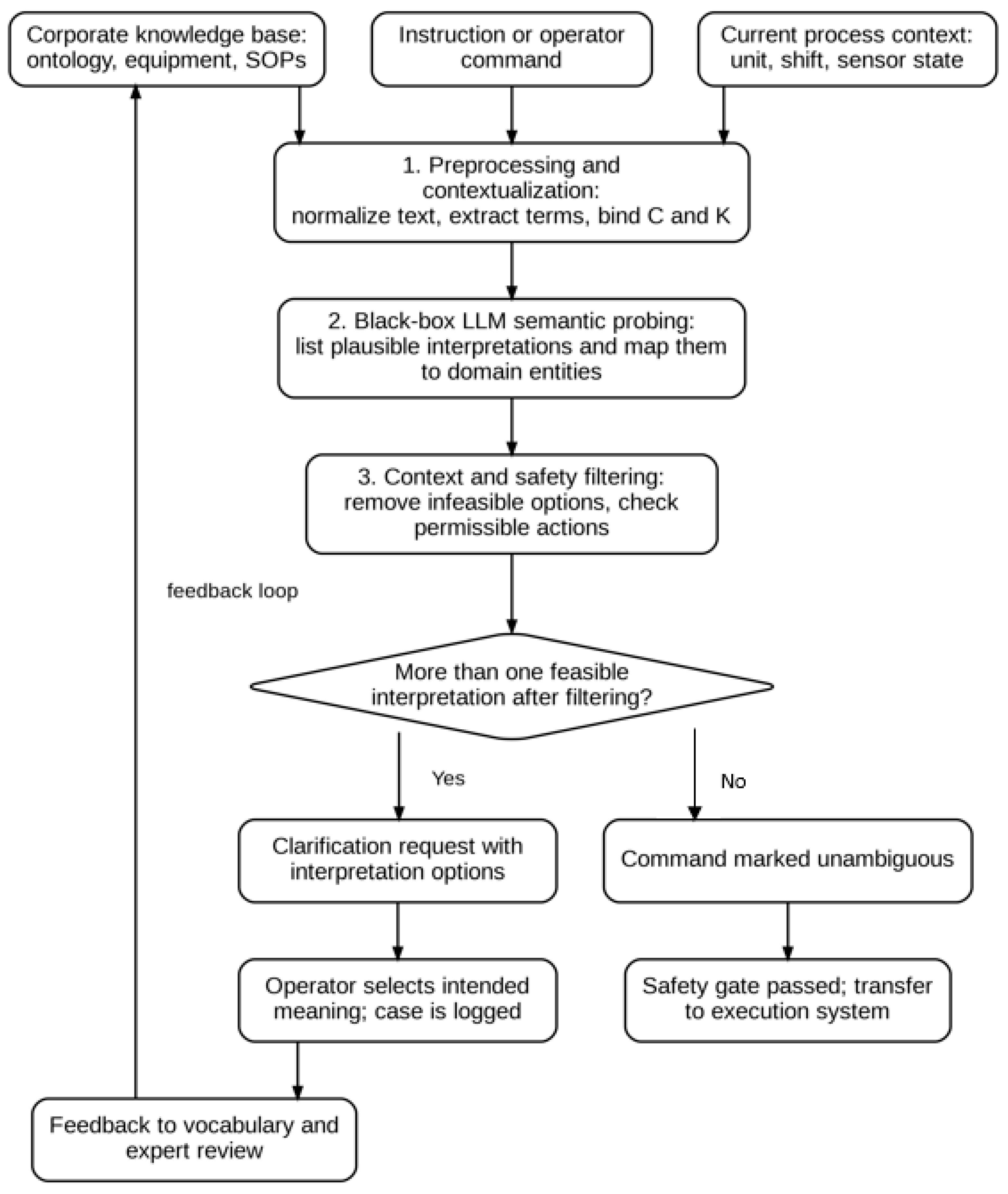
- Preprocessing and Contextualization Module: Receives as input the text of an instruction or operator command, as well as the current process context (e.g., unit identifier, shift task, real-time sensor data from SCADA). The context can be represented either as structured numerical data or as a textual description enriched from the enterprise knowledge base;
- Semantic Analysis Module (LLM): Uses an external language model (via API) to perform a series of targeted queries aimed at identifying all plausible interpretations of the input text within the given process context;
- Decision and Clarification Module: Based on the LLM’s responses, determines whether semantic ambiguity exists and, if so, generates a structured clarification request for the operator. This module also logs detected ambiguity cases for system improvement and safety reporting.

3.2. Formal Definitions of Semantic Ambiguity in the Automation Context
3.3. Context-Aware Relevance Filtering
3.4. The Concept of “Latent Choice”
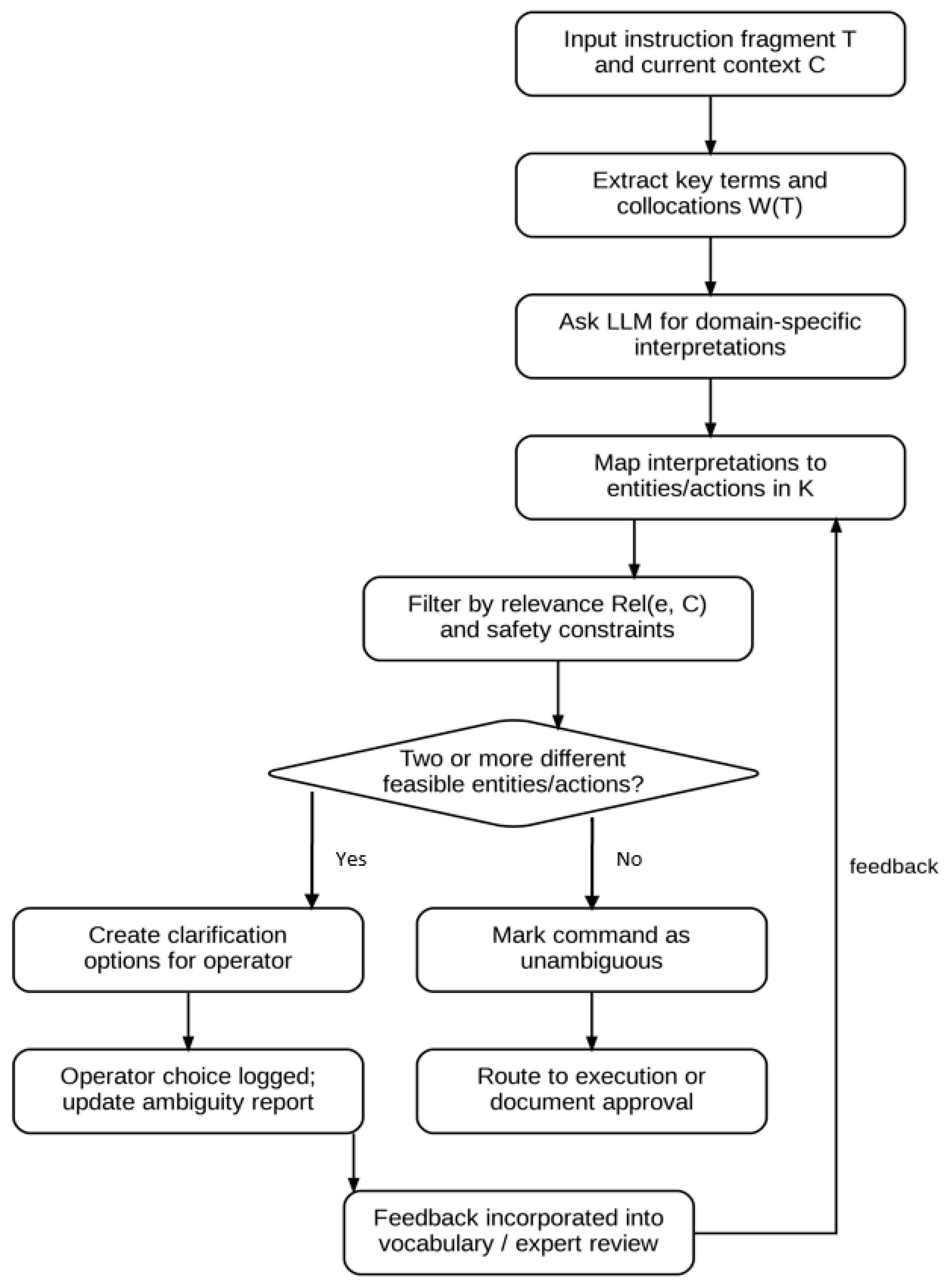
- Step 1: Extract key terms (nouns, verbs, and their collocations) from the input text.
- Step 2: For each extracted term, formulate a query to the LLM: “List all possible meanings and interpretations of the term [X] in the context of metallurgical production (blast furnace shop, steelmaking shop, etc.).
- Step 3: Map the returned list of interpretations to concrete domain objects from the corporate knowledge base (ontologies, equipment directories, material reference data, operational procedures).
- Step 4: If a single lexical unit maps to two or more distinct objects from different categories (or with different attribute sets), flag the text as containing a potential latent choice.
3.5. Prompt-Based Semantic Probing
3.6. Binary Text Blocks and Mutually Exclusive Alternatives
3.7. Integration with Knowledge Management and Process Control Systems
4. Experimental Evaluation in a Real-World Metallurgical Process Automation Environment
4.1. Description of the Production Site and Experimental Setup
4.2. Experimental Stages
4.3. Detailed Results
4.4. Typology of Detected Ambiguities and System Responses
5. Discussion
5.1. Interpretation of Results
5.2. Comparison with Alternative Approaches
5.3. Study Limitations
5.4. Practical Significance and Implications for Automation Practice
6. Conclusions and Future Directions
Author Contributions
Funding
Data Availability Statement
Conflicts of Interest
Abbreviations
| API | Application Programming Interface |
| ASU TP | Automated Process Control System (Avtomatizirovannaya Sistema Upravleniya Tekhnologicheskim Protsessom) |
| CCM | Continuous Casting Machine |
| HMI | Human–Machine Interface |
| IIoT | Industrial Internet of Things |
| KMS | Knowledge Management Systems |
| LLM | Large Language Model(s) |
| MNS | Machine-Building Plant (Metallurgicheskiy Zavod-context-specific) |
| SCADA | Supervisory Control and Data Acquisition |
| SOP | Standard Operating Procedure(s) |
| UX | User Experience |
References
- Nonaka, I.; Takeuchi, H. The Knowledge Creating Company; Oxford University Press: New York, NY, USA, 1995. [Google Scholar]
- Davenport, T.H.; Prusak, L. Working Knowledge: How Organizations Manage What They Know; Harvard Business School Press: Boston, MA, USA, 1998. [Google Scholar]
- Reason, J. Human Error; Cambridge University Press: Cambridge, UK, 1990. [Google Scholar]
- Vaswani, A.; Shazeer, N.; Parmar, N.; Uszkoreit, J.; Jones, L.; Gomez, A.N.; Kaiser, Ł.; Polosukhin, I. Attention is All You Need. In Advances in Neural Information Processing Systems 30 (NIPS 2017); Curran Associates, Inc.: Red Hook, NY, USA, 2017; pp. 5998–6008. [Google Scholar]
- Bommasani, R.; Hudson, D.A.; Adeli, E.; Altman, R.; Arora, S.; von Arx, S.; Bernstein, M.S.; Bohg, J.; Bosselut, A.; Brunskill, E. On the Opportunities and Risks of Foundation Models. arXiv 2021, arXiv:2108.07258. [Google Scholar]
- Wiig, K.M. Knowledge Management: An Introduction and Perspective. J. Knowl. Manag. 1997, 1, 6–14. [Google Scholar] [CrossRef]
- Hale, A.; Borys, D. Working to rule, or working safely? Part 1: A state of the art review. Saf. Sci. 2013, 55, 207–221. [Google Scholar] [CrossRef]
- Embrey, D. Preventing human error in process safety. Chem. Eng. Prog. 2000, 96, 37–44. [Google Scholar]
- Kuhn, T. A Survey and Classification of Controlled Natural Languages. Comput. Linguist. 2014, 40, 121–170. [Google Scholar] [CrossRef]
- Carlini, N.; Tramer, F.; Wallace, E.; Jagielski, M.; Herbert-Voss, A.; Lee, K.; Roberts, A.; Brown, T.; Song, D.; Erlingsson, U.; et al. Extracting Knowledge from Industrial Documents using Large Language Models. IEEE Trans. Ind. Inform. 2023, 19, 5123–5132. [Google Scholar] [CrossRef]
- Ershov, V.A.; Kondratiev, V.V.; Karlina, A.I.; Kolosov, A.D.; Sysoev, I.A. Selection of control system parameters for production of nanostructures concentrates. J. Phys. Conf. Ser. 2018, 1118. [Google Scholar] [CrossRef]
- Kondratiev, V.V.; Nebogin, S.A.; Sysoev, I.A.; Gorovoy, V.O.; Karlina, A.I. Description of the test stand for developing of technological operation of nano-dispersed dust preliminary coagulation. Int. J. Appl. Eng. Res. 2017, 12, 12809–12813. [Google Scholar]
- Kuhn, L.; Gal, Y.; Farquhar, S. Semantic Uncertainty: Linguistic Invariances for Uncertainty Estimation in Natural Language Generation. In Proceedings of the 11th International Conference on Learning Representations (ICLR 2023), Kigali, Rwanda, 1–5 May 2023. [Google Scholar]
- Neumann, W.P.; Winkelhaus, S.; Grosse, E.H.; Glock, C.H. Industry 4.0 and the human factor—A systems framework and analysis methodology for successful development. Int. J. Prod. Econ. 2021, 233, 107992. [Google Scholar] [CrossRef]
- Hancock, P.A.; Billings, D.R.; Schaefer, K.E.; Chen, J.Y.C.; de Visser, E.J.; Parasuraman, R. A meta-analysis of factors affecting trust in human-robot interaction. Hum. Factors 2011, 53, 517–527. [Google Scholar] [CrossRef] [PubMed]
- Xia, Y.; Jazdi, N.; Zhang, J.; Shah, C.; Weyrich, M. Control Industrial Automation System with Large Language Models. arXiv 2024, arXiv:2409.18009. [Google Scholar]
- Xia, Y.; Jazdi, N.; Weyrich, M. Applying Large Language Models for Intelligent Industrial Automation. atp Mag. 2024, 66, 62–71. [Google Scholar] [CrossRef]
- Bashir, S.; Ferrari, A.; Khan, A.; Strandberg, P.E.; Haider, Z.; Saadatmand, M.; Bohlin, M. Requirements Ambiguity Detection and Explanation with LLMs: An Industrial Study. In Proceedings of the IEEE International Conference on Software Maintenance and Evolution (ICSME), Auckland, New Zealand, 7–12 September 2025; pp. 620–631. [Google Scholar] [CrossRef]
- Chen, J.; He, J.; Chen, F.; Lv, Z.; Tang, J.; Li, W.; Liu, Z.; Yang, H.H.; Han, G. Towards General Industrial Intelligence: A Survey of Continual Large Models in Industrial IoT. arXiv 2024, arXiv:2409.01207. [Google Scholar]
- Ouerghemmi, C.; Ertz, M. Integrating Large Language Models into Digital Manufacturing: A Systematic Review and Research Agenda. Computers 2025, 14, 318. [Google Scholar] [CrossRef]
- Alhoshan, W.; Zhao, L.; Ferrari, A.; Letsholo, K.J. Enhancing Software Requirements Quality: Ambiguity Detection and Resolution Using Large Language Models. In Computational Science and Computational Intelligence; Springer: Berlin/Heidelberg, Germany, 2025; pp. 340–355. [Google Scholar] [CrossRef]


| Input Fragment | Preprocessing/Contextualization Output | LLM Semantic Analysis Output | Decision Module Output |
|---|---|---|---|
| “Supply gas to the tuyeres.” | Key terms: supply, gas, tuyeres. Context: steelmaking unit; two gas subsystems active. | Interpretation 1: oxygen to converter tuyeres. Interpretation 2: argon to ladle stirring tuyeres. | Two feasible entities/actions remain after filtering; ambiguity flag = 1. |
| “Check the level in the ladle.” | Key terms: level, ladle. Context: steel ladle and tundish are active in shift assignment. | Interpretation 1: steel ladle level. Interpretation 2: hot-metal ladle level. Interpretation 3: tundish level. | Context removes inactive hot-metal ladle, but two feasible objects remain. |
| Indicator | Experimental Group (with Assistant) | Control Group (Without Assistant) | Change |
|---|---|---|---|
| Number of misinterpretation-related errors (2 weeks) | 2 | 9 | ↓ 77% |
| Average command execution time, sec | 45 (including clarification dialogs) | 38 | ↑ 18% |
| Clarification requests to dispatcher (avg per shift) | 1.2 | 4.7 | ↓ 74% |
| Interface satisfaction (average rating 1–5) | 4.6 | 3.8 | ↑ 0.8 |
| Type of Ambiguity | Example | Detected Interpretations | System Response |
|---|---|---|---|
| Lexical homonymy | “Supply gas to the tuyeres.” | (1) Oxygen to converter tuyeres; (2) Argon to ladle stirring tuyeres | Prompt asking for gas type and tuyere identification |
| Entity ambiguity | “Check the level in the ladle.” | (1) Steel ladle; (2) Hot metal ladle; (3) Tundish | Selection dialog based on active shift assignment |
| Action ambiguity | “Increase argon flow.” | (1) Ladle stirring; (2) Stream protection; (3) Tundish mixing | Cross-check with SCADA to identify active processes; if multiple active → warning |
| Binary construct | “If temperature > 1600 °C, reduce power or increase coolant.” | (1) Reduce power; (2) Increase coolant | Request to specify which action is intended |
| Approach | Strengths | Limitations | Focus |
|---|---|---|---|
| Traditional expert review | High quality for obvious ambiguities | Limited coverage; fatigue; missed latent ambiguities | Any |
| Rule-based (regex, ontologies) | Fast, deterministic | High setup effort; poor generalization to novel phrasing | Industrial instructions |
| Logit-based LLM ambiguity detection [13] | Leverages model’s internal uncertainty estimates | Requires white-box access; impossible for closed APIs | Any text |
| Proposed logit-free method | Works with any API; no internal access needed; prompt-based | Depends on LLM output quality | Industrial instructions |
| RAG-based vocabulary retrieval | Retrieves relevant terms and documents from a domain vocabulary or knowledge base | Does not by itself determine whether alternatives are mutually exclusive or require operator clarification | Industrial instructions and knowledge-base search |
Disclaimer/Publisher’s Note: The statements, opinions and data contained in all publications are solely those of the individual author(s) and contributor(s) and not of MDPI and/or the editor(s). MDPI and/or the editor(s) disclaim responsibility for any injury to people or property resulting from any ideas, methods, instructions or products referred to in the content. |
© 2026 by the authors. Licensee MDPI, Basel, Switzerland. This article is an open access article distributed under the terms and conditions of the Creative Commons Attribution (CC BY) license.
Share and Cite
Vedeneev, V.A.; Kondratiev, V.V.; Suslov, K.V.; Kononenko, R.V.; Govorkov, A.S.; Gladkikh, V.A.; Karlina, Y.I.; Karlina, A.I. Application of Large Language Models for Detecting Semantic Ambiguity in Industrial Instructions: Impact on Human–Machine Interaction and User Experience in Process Automation Systems of a Metallurgical Plant. Automation 2026, 7, 104. https://doi.org/10.3390/automation7040104
Vedeneev VA, Kondratiev VV, Suslov KV, Kononenko RV, Govorkov AS, Gladkikh VA, Karlina YI, Karlina AI. Application of Large Language Models for Detecting Semantic Ambiguity in Industrial Instructions: Impact on Human–Machine Interaction and User Experience in Process Automation Systems of a Metallurgical Plant. Automation. 2026; 7(4):104. https://doi.org/10.3390/automation7040104
Chicago/Turabian StyleVedeneev, Viktor A., Viktor V. Kondratiev, Konstantin V. Suslov, Roman V. Kononenko, Aleksey S. Govorkov, Vitaliy A. Gladkikh, Yulia I. Karlina, and Antonina I. Karlina. 2026. "Application of Large Language Models for Detecting Semantic Ambiguity in Industrial Instructions: Impact on Human–Machine Interaction and User Experience in Process Automation Systems of a Metallurgical Plant" Automation 7, no. 4: 104. https://doi.org/10.3390/automation7040104
APA StyleVedeneev, V. A., Kondratiev, V. V., Suslov, K. V., Kononenko, R. V., Govorkov, A. S., Gladkikh, V. A., Karlina, Y. I., & Karlina, A. I. (2026). Application of Large Language Models for Detecting Semantic Ambiguity in Industrial Instructions: Impact on Human–Machine Interaction and User Experience in Process Automation Systems of a Metallurgical Plant. Automation, 7(4), 104. https://doi.org/10.3390/automation7040104