
Phase Preserving Balanced Truncation for Order Reduction of Positive Real Systems


Abstract
1. Introduction
2. Preliminaries
2.1. Balanced Truncation (BT)
2.2. Conic Positive Real Balanced Truncation (CPRBT)
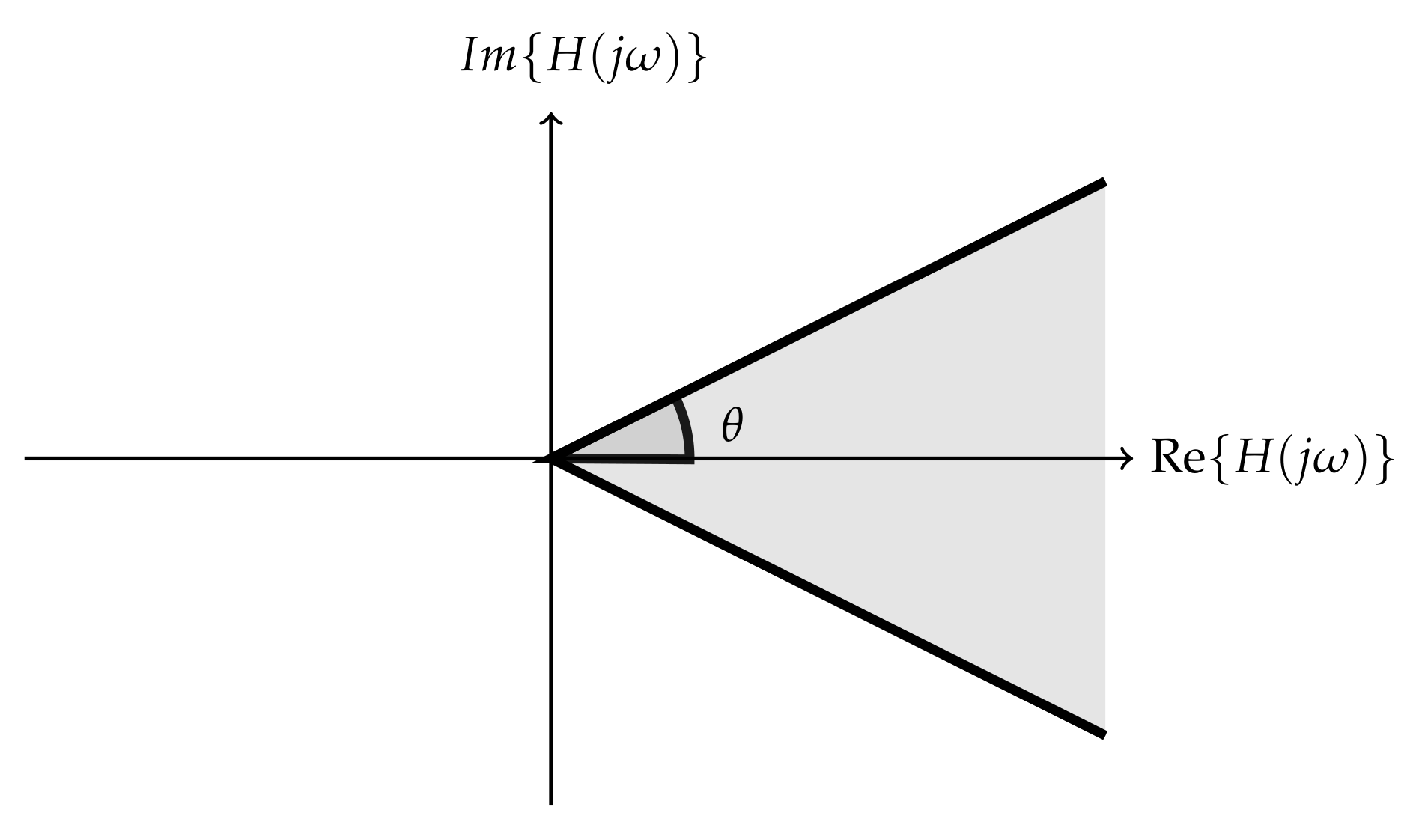
3. Phase Preserving Balanced Truncation
| Algorithm 1: Phase preserving balanced truncation |
|
4. Illustrative Examples
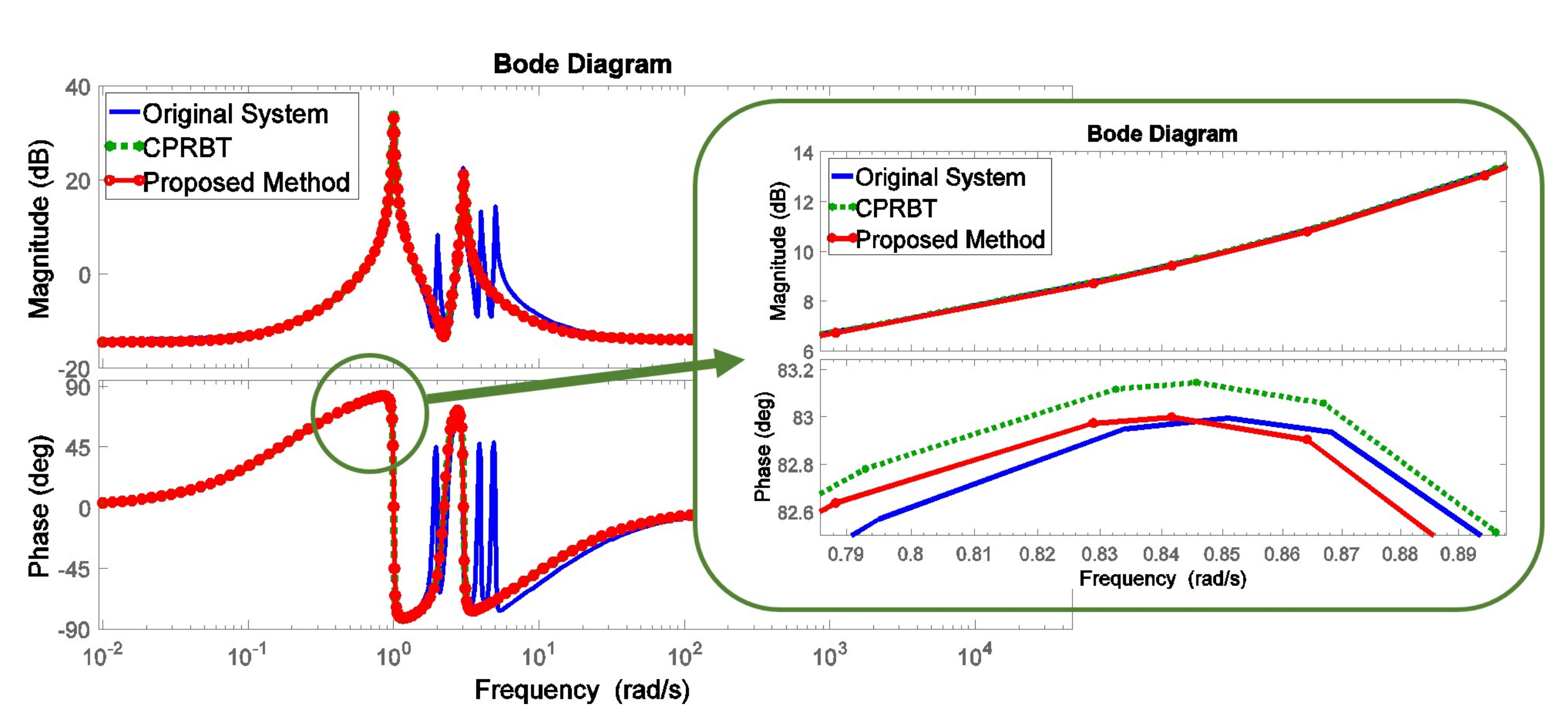
4.1. Example 1
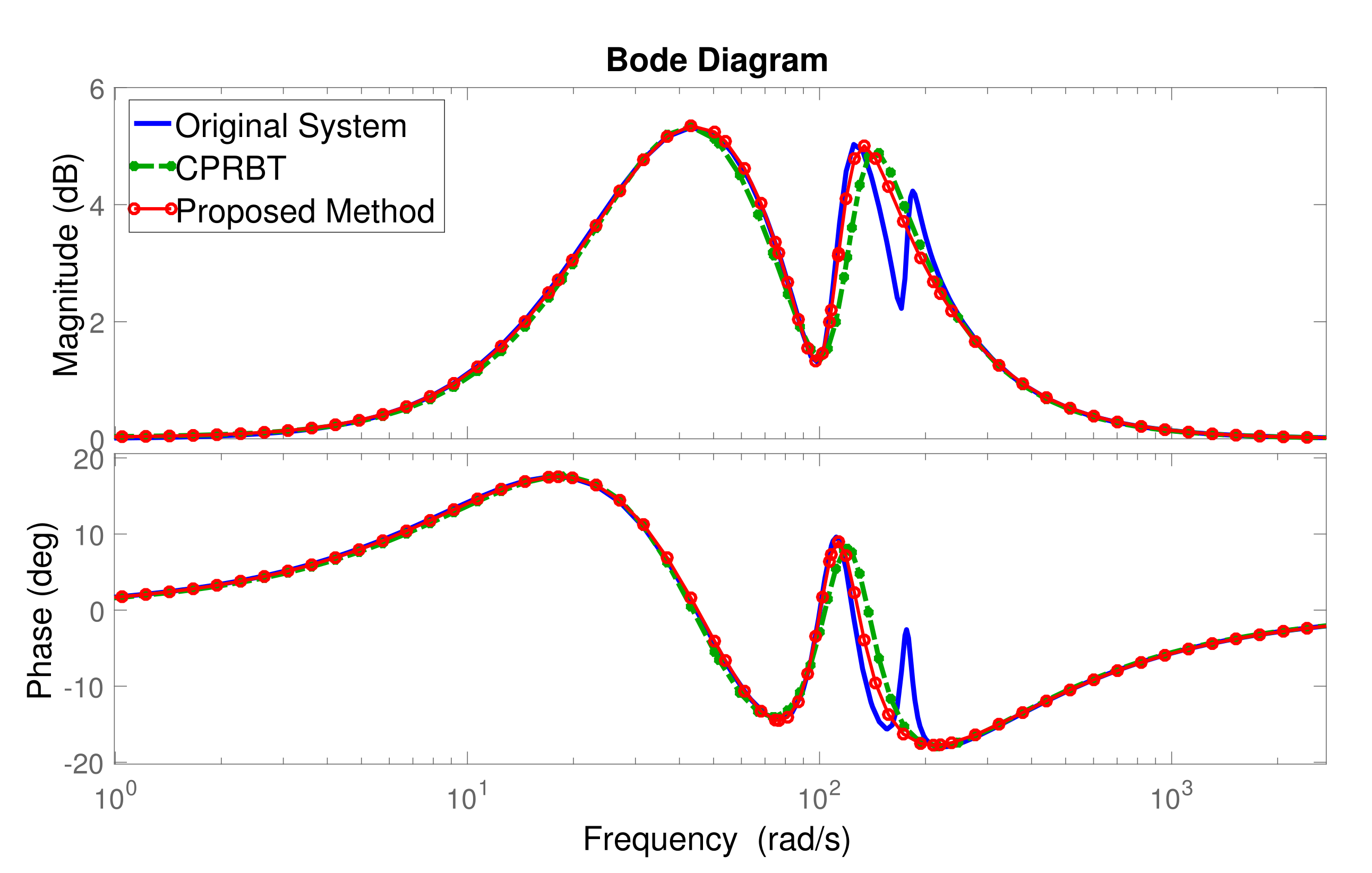
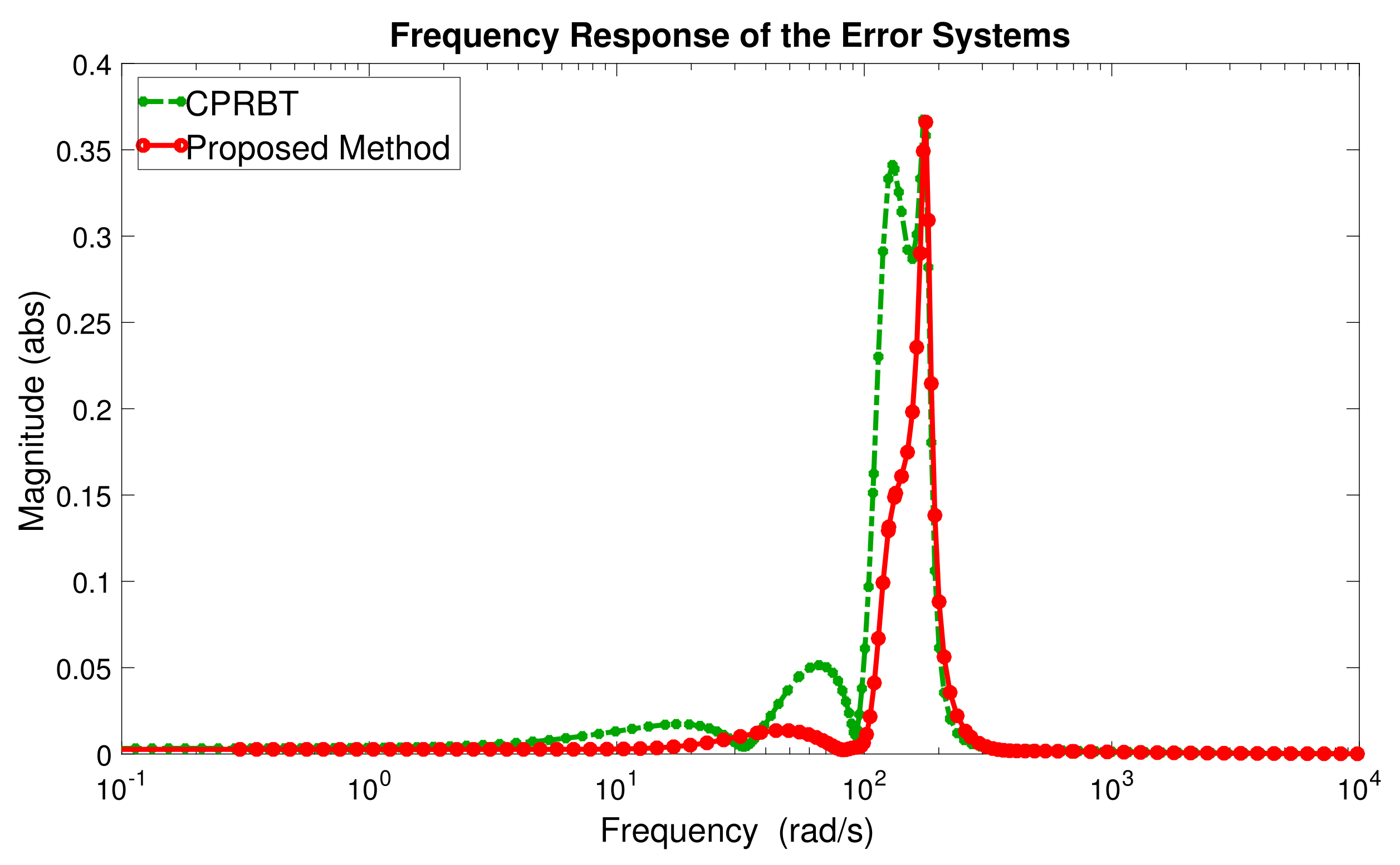
4.2. Example 2
5. Conclusions
Author Contributions
Funding
Institutional Review Board Statement
Informed Consent Statement
Data Availability Statement
Conflicts of Interest
References
- Moore, B. Principal component analysis in linear systems: Controllability, observability, and model reduction. IEEE Trans. Autom. Control 1981, 26, 17–32. [Google Scholar] [CrossRef] [Scilit]
- Sirovich, L. Turbulence and the dynamics of coherent structures. I. Coherent structures. Q. Appl. Math. 1987, 45, 561–571. [Google Scholar] [CrossRef] [Scilit]
- Glover, K. All optimal Hankel-norm approximations of linear multivariable systems and their L∞ error bounds. Int. J. Control 1984, 39, 1115–1193. [Google Scholar] [CrossRef] [Scilit]
- Kavranoǧlu, D.; Bettayeb, M. Characterization of the solution to the optimal H∞ model reduction problem. Syst. Control Lett. 1993, 20, 99–107. [Google Scholar] [CrossRef] [Scilit]
- Feldmann, P.; Freund, R.W. Efficient linear circuit analysis by padé approximation via the Lanczos process. IEEE Trans. Comput. Aided Des. Integr. Circuits Syst. 1995, 14, 639–649. [Google Scholar] [CrossRef]
- Pillage, L.T.; Rohrer, R.A. Asymptotic waveform evaluation for timing analysis. IEEE Trans. Comput. Aided Des. Integr. Circuits Syst. 1990, 9, 352–366. [Google Scholar] [CrossRef] [Scilit]
- Chiprout, E.; Nakhla, M.S. Asymptotic Waveform Evaluation and Moment Matching for Interconnect Analysis; Kluwer: Norwell, MT, USA, 1994. [Google Scholar]
- Odabasioglu, A.; Celik, M.; Pileggi, L.T. PRIMA: Passive reduced-order interconnect macromodeling algorithm. IEEE Trans. Comput. Aided Des. Integr. Circuits Syst. 1998, 17, 645–654. [Google Scholar] [CrossRef] [Scilit]
- Enns, D.F. Model reduction with balanced realizations: An error bound and a frequency weighted generalization. In Proceedings of the 23rd IEEE Conference on Decision and Control, Las Vegas Hilton, LV, USA, 12–14 December 1984; pp. 127–132. [Google Scholar]
- Gawronski, W.; Juang, J.-N. Model reduction in limited time and frequency intervals. Int. J. Syst. Sci. 1990, 21, 349–376. [Google Scholar] [CrossRef] [Scilit]
- Wang, G.; Sreeram, V.; Liu, W. A new frequency-weighted balanced truncation method and an error bound. IEEE Trans. Autom. Control 1999, 44, 1734–1737. [Google Scholar] [CrossRef] [Scilit]
- Kumar, D.; Sreeram, V. Factorization-based frequency-weighted optimal Hankel-norm model reduction. Asian J. Control 2020, 22, 2106–2118. [Google Scholar] [CrossRef] [Scilit]
- Toor, H.I.; Imran, M.; Ghafoor, A.; Kumar, D.; Sreeram, V.; Rauf, A. Frequency limited model reduction techniques for discrete-time systems. IEEE Trans. Circuits Syst. II Express Briefs 2019, 67, 345–349. [Google Scholar] [CrossRef]
- Haider, S.; Ghafoor, A.; Imran, M.; Malik, F.M. Time-limited Gramians-based model order reduction for second-order form systems. Trans. Inst. Meas. Control 2019, 41, 2310–2318. [Google Scholar] [CrossRef] [Scilit]
- Liang, W.; Chen, H.-B.; He, G.; Chen, J. Model order reduction based on dynamic relative gain array for mimo systems. IEEE Trans. Circuits Syst. II Express Briefs 2020, 67, 2507–2511. [Google Scholar] [CrossRef] [Scilit]
- Alsmadi, O.; Al-Smadi, A.; Gharaibeh, E. Firefly artificial intelligence technique for model order reduction with substructure preservation. Trans. Inst. Meas. Control 2019, 10, 2875–2885. [Google Scholar] [CrossRef] [Scilit]
- Lu, K.; Jin, Y.; Huang, P.; Zhang, F.; Zhang, H.; Fu, C.; Chen, Y. The applications of POD method in dual rotor-bearing systems with coupling misalignment. Mech. Syst. Signal Process. 2021, 150, 107236. [Google Scholar] [CrossRef] [Scilit]
- Bui-Thanh, T.; Willcox, K.; Ghattas, O. Model reduction for large-scale systems with high-dimensional parametric input space. SIAM J. Sci. Comput. 2008, 30, 3270–3288. [Google Scholar] [CrossRef] [Scilit]
- Opdenacker, P.C.; Jonckheere, E.A. A contraction mapping preserving balanced reduction scheme and its infinity norm error bounds. IEEE Trans. Circuits Syst. 1988, 35, 184–189. [Google Scholar] [CrossRef]
- Tu, K.; Du, X.; Fan, P. Negative imaginary balancing for mode reduction of LTI negative-imaginary systems. In Proceedings of the 26th Chinese Control and Decision Conference, Changsha, China, 31 May–2 June 2014; pp. 4234–4239. [Google Scholar]
- Phillips, J.R.; Daniel, L.; Silveira, L.M. Guaranteed passive balancing transformations for model order reduction. IEEE Trans. Comput. Aided Des. Integr. Circuits Syst. 2003, 22, 1027–1041. [Google Scholar] [CrossRef] [Scilit]
- Salehi, Z.; Karimaghaee, P.; Khooban, M.-H. Mixed positive-bounded balanced truncation. IEEE Trans. Circuits Syst. Ii: Express Briefs 2021, 68, 2488–2492. [Google Scholar] [CrossRef] [Scilit]
- Salehi, Z.; Karimaghaee, P.; Khooban, M.-H. A new passivity preserving model order reduction method: Conic positive real balanced truncation method. IEEE Trans. Syst. Man Cybern. Syst. 2021. [Google Scholar] [CrossRef] [Scilit]
- Huang, C.H.; Ioannou, P.A.; Maroulas, J.; Safonov, M.G. Design of strictly positive real systems using constant output feedback. IEEE Trans. Autom. Control 1999, 44, 569–573. [Google Scholar] [CrossRef] [Scilit]
- Liu, M.; Lam, J.; Zhu, B.; Kwok, K.W. On positive realness, negative imaginariness, and H∞ control of state-space symmetric systems. Automatica 2019, 101, 190–196. [Google Scholar] [CrossRef] [Scilit]
- Misgeld, B.J.; Hewing, L.; Liu, L.; Leonhardt, S. Closed-loop positive real optimal control of variable stiffness actuators. Control Eng. Pract. 2019, 82, 142–150. [Google Scholar] [CrossRef] [Scilit]
- Brogliato, B.; Lozano, R.; Maschke, B.; Egeland, O. Positive Real Systems. In Dissipative Systems Analysis and Control; Springer: Cham, Switzerland, 2020. [Google Scholar]
- Salehi, Z.; Karimaghaee, P.; Khooban, M.-H. Model order reduction of positive real systems based on mixed gramian balanced truncation with error bounds. Circuits Syst. Signal Process. 2021, 40, 5309–5327. [Google Scholar] [CrossRef] [Scilit]
- Cheng, X.; Scherpen, J.M.; Besselink, B. Balanced truncation of networked linear passive systems. Automatica 2019, 104, 17–25. [Google Scholar] [CrossRef] [Scilit]
- Zulfiqar, U.; Imran, M.; Ghafoor, A.; Liaqat, M. Time/frequency-limited positive-real truncated balanced realizations. IMA J. Math. Control Inf. 2020, 37, 64–81. [Google Scholar] [CrossRef] [Scilit]
- Pernebo, L.; Silverman, L. Model reduction via balanced state space representations. IEEE Trans. Autom. Control 1982, 27, 382–387. [Google Scholar] [CrossRef] [Scilit]
- Anderson, B.D.; Vongpanitlerd, S. Network Analysis and Synthesis: A Modern Systems Theory Approach; Dover: New York, NY, USA, 2013. [Google Scholar]


Publisher’s Note: MDPI stays neutral with regard to jurisdictional claims in published maps and institutional affiliations. |
© 2022 by the authors. Licensee MDPI, Basel, Switzerland. This article is an open access article distributed under the terms and conditions of the Creative Commons Attribution (CC BY) license (https://creativecommons.org/licenses/by/4.0/).
Share and Cite
Salehi, Z.; Karimaghaee, P.; Salehi, S.; Khooban, M.-H. Phase Preserving Balanced Truncation for Order Reduction of Positive Real Systems. Automation 2022, 3, 84-94. https://doi.org/10.3390/automation3010004
Salehi Z, Karimaghaee P, Salehi S, Khooban M-H. Phase Preserving Balanced Truncation for Order Reduction of Positive Real Systems. Automation. 2022; 3(1):84-94. https://doi.org/10.3390/automation3010004
Chicago/Turabian StyleSalehi, Zeinab, Paknoosh Karimaghaee, Shabnam Salehi, and Mohammad-Hassan Khooban. 2022. "Phase Preserving Balanced Truncation for Order Reduction of Positive Real Systems" Automation 3, no. 1: 84-94. https://doi.org/10.3390/automation3010004
APA StyleSalehi, Z., Karimaghaee, P., Salehi, S., & Khooban, M.-H. (2022). Phase Preserving Balanced Truncation for Order Reduction of Positive Real Systems. Automation, 3(1), 84-94. https://doi.org/10.3390/automation3010004