
Article

Revised Formal Total Synthesis of Dehydro-δ-Viniferin and Anigopreissin A
by
Alessandro Santarsiere
1,*,
Marianna Volgare
2 and
Lucia Chiummiento
2,*
1
Department of Basic and Applied Sciences, University of Basilicata, Via dell’Ateneo Lucano 10, 85100 Potenza, Italy
2
Department of Health Sciences, University of Basilicata, Via dell’Ateneo Lucano, 10, 85100 Potenza, Italy
*
Authors to whom correspondence should be addressed.
Organics 2026, 7(2), 17; https://doi.org/10.3390/org7020017
Submission received: 4 February 2026 / Revised: 11 March 2026 / Accepted: 30 March 2026 / Published: 16 April 2026

Abstract

This work presents a revised total synthesis of two pharmacologically relevant benzofurans using newly developed environmentally friendly methodologies. In particular, we focused on establishing improved synthetic routes to stilbene dimers under milder and more sustainable reaction conditions. During our investigations, we optimized an efficient Sonogashira coupling carried out in water, which, followed by a Suzuki-like reaction conducted in dimethyl carbonate (DMC) in the absence of any transition metals, served as the key step for the synthesis of the benzofuran core.

1. Introduction

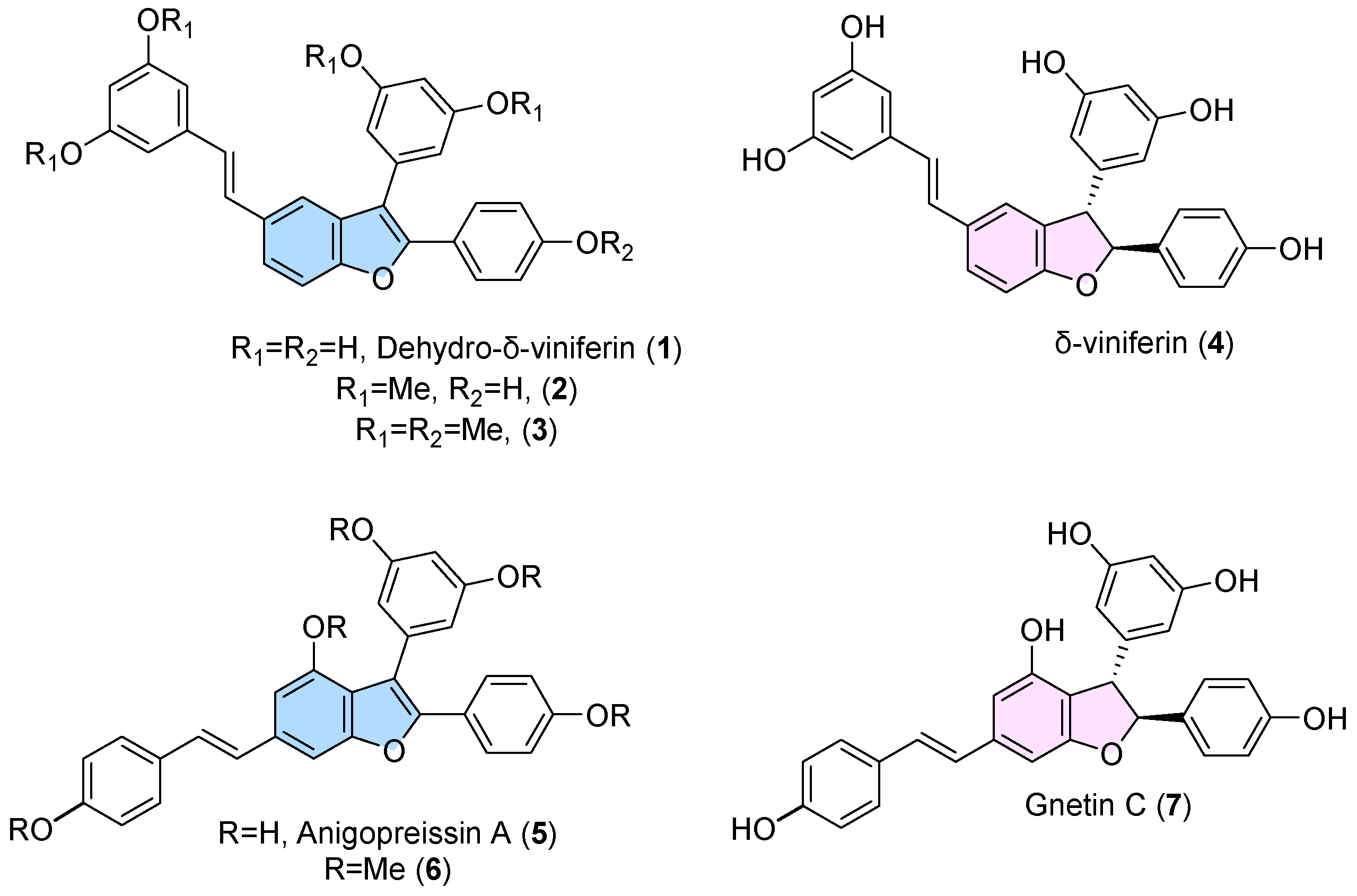
Stilbene dimers, which are widely found in both natural and synthetic compounds, have attracted considerable research interest due to their broad spectrum of pharmacological activities, including antibacterial, antifungal, anti-inflammatory, antioxidant, antiviral, and antineoplastic effects [1,2,3,4]. Among these, dehydro-δ-viniferin (Figure 1, compound 1) a natural benzofuran derivative of trans-δ-viniferin (4), exhibits lower antimicrobial activity than the parent compound [5,6]. Its partially methylated forms (2) display similar or slightly reduced activity [6], whereas the biological properties of its fully permethylated analogue (3) remain unknown; anigopreissin A (5), a resveratrol dimer naturally found in Anigozanthos preissii, Musa Cavendish, and Macropidia fuliginosa [7], shows moderate antimicrobial effects against S. aureus and S. pyogenes [8]. In addition, permethylated anigopreissin A (6), the fully protected analogue of anigopreissin A, exhibits notable cytotoxic activity across a broad range of human tumour cell lines [9,10].
Building on our previous work, which focused on the biomimetic synthesis of natural compounds featuring a dihydrobenzofuran core [11,12], such as ε-viniferin, the present work focuses on the use of milder and more eco-friendly reaction conditions to prepare benzofuran systems, such as both permethylated dehydro-δ-viniferin and anigopreissin A (stilbene dimers 3 and 6 in Figure 1). Our work began with the synthesis of permethylated dehydro-δ-viniferin (3). During our investigations, the key Sonogashira coupling was performed in water and optimized conditions were subsequently applied to the synthesis of permethylated anigopreissin A, previously prepared by our group [13]. Moreover, a recently developed transition-metal (TM) free Suzuki-like reaction [14] was employed for the C-3 functionalization of the benzofuran core; this methodology, up to now, never applied to benzofuran systems, involves the use of the green solvent dimethyl carbonate, and proceeds in the absence of any transition-metal catalyst. The reaction mechanism is not yet known, although a radical pathway was ruled out.

2. Materials and Methods

2.1. General Procedures

All reagents were purchased by TCI (Tokyo, Japan), Sigma-Aldrich (St. Louis, MA, USA) or AlfaAesar (Haverhill, MA, USA) companies and were used without further purification unless otherwise stated. All reactions were carried out in oven-dried glassware unless otherwise noted. Flash column chromatography was performed using silica gel (60–200 mesh). 1H NMR spectra were recorded at room temperature on Varian 400 spectrometer with CDCl3 as the solvent unless otherwise stated. Chemical shifts (δ) are reported in parts per million and referenced internally to the residual solvent signal of CDCl3 at δ 7.26. Data for 1H NMR are reported as follows: chemical shift, multiplicity (s = singlet, d = doublet, t = triplet, q = quartet, m = multiplet), coupling constants (J, in Hz), and integration.

2.1.1. General Procedures of Sonogashira Coupling in Water

A flame-dried round-bottom flask was charged with a magnetic stirring bar and was purged three times with argon. The septum was briefly opened, and the reaction flask was charged with aryl iodide (1.0 equiv.) and purged again with argon, a separate flash containing water was purged with argon for 15 min and 8 mL/mmol of water from the second flask was transferred to the first flask containing aryl iodide, then SDS (0.07 equiv.), K2CO3 (1.5 equiv.) and alkyne (1.2 equiv.) were added, the reaction mixture was stirred for 15 min at 50 °C before adding PdCl2(PPh3)2 (0.035 equiv.) and CuI (0.07 equiv.), the reaction mixture was heated to 90 °C under argon for 6.5 h. After cooling, the mixture was diluted with AcOEt and washed with a saturated aqueous solution of NH4Cl and brine. The organic layer was dried over anhydrous Na2SO4, filtered, and concentrated under reduced pressure. The crude was purified by column chromatography (petroleum ether: AcOEt, 8:2) to afford the desired product.

2.1.2. General Procedure for the “Standard” Sonogashira Coupling

To a stirred solution of aryl-iodide (1.0 equiv.) in Et3N (0.3 M), PdCl2(PPh3)2 (0.1 equiv.), CuI (0.1 equiv.) and alkyne (3.0 equiv.) were added. The reaction mixture was warmed to 50 °C and stirred until the starting iodide disappeared. AcOEt was added to the mixture, which was washed with a saturated aqueous solution of NH4Cl, dried over Na2SO4, and concentrated under reduced pressure. The crude was purified by column chromatography (petroleum ether: AcOEt, 8:2) to afford the desired product.

2.1.3. General Procedures for the Transition-Metal-Free Suzuki-like Coupling [14]

A mixture of aryl iodide (1.0 equiv), phenylboronic acid (2.0 equiv), and K2CO3 (4.0 equiv) in DMC (0.07 M) was heated in a 4 mL vial at 125 °C for 18 h. The solvent was removed under reduced pressure and the residue was purified by silica gel column chromatography using hexane: Et2O (6:4) as an eluent to give the coupling product.

2.1.4. General Procedure for the Pd-Catalyzed Suzuki Coupling

To a solution of aryl iodide (1.0 equiv.) in DMF: H2O (4:1), aryl boronic acid (1.4 equiv.), NaHCO3 (1.6 mmol) and PdCl2(PPh3)2 (0.1 equiv.) were added. The solution was heated at 80 °C for 16 h. After cooling, the mixture was diluted with AcOEt and washed with a saturated aqueous solution of NH4Cl, brine, and water. The organic layers were dried over Na2SO4, filtered, and concentrated under reduced pressure. The crude was purified by column chromatography (Hexane: AcOEt, 8:2) to afford the desired product.

3. Results

3.1. Synthesis of Permethylated Dehydro-δ-Viniferin (3)

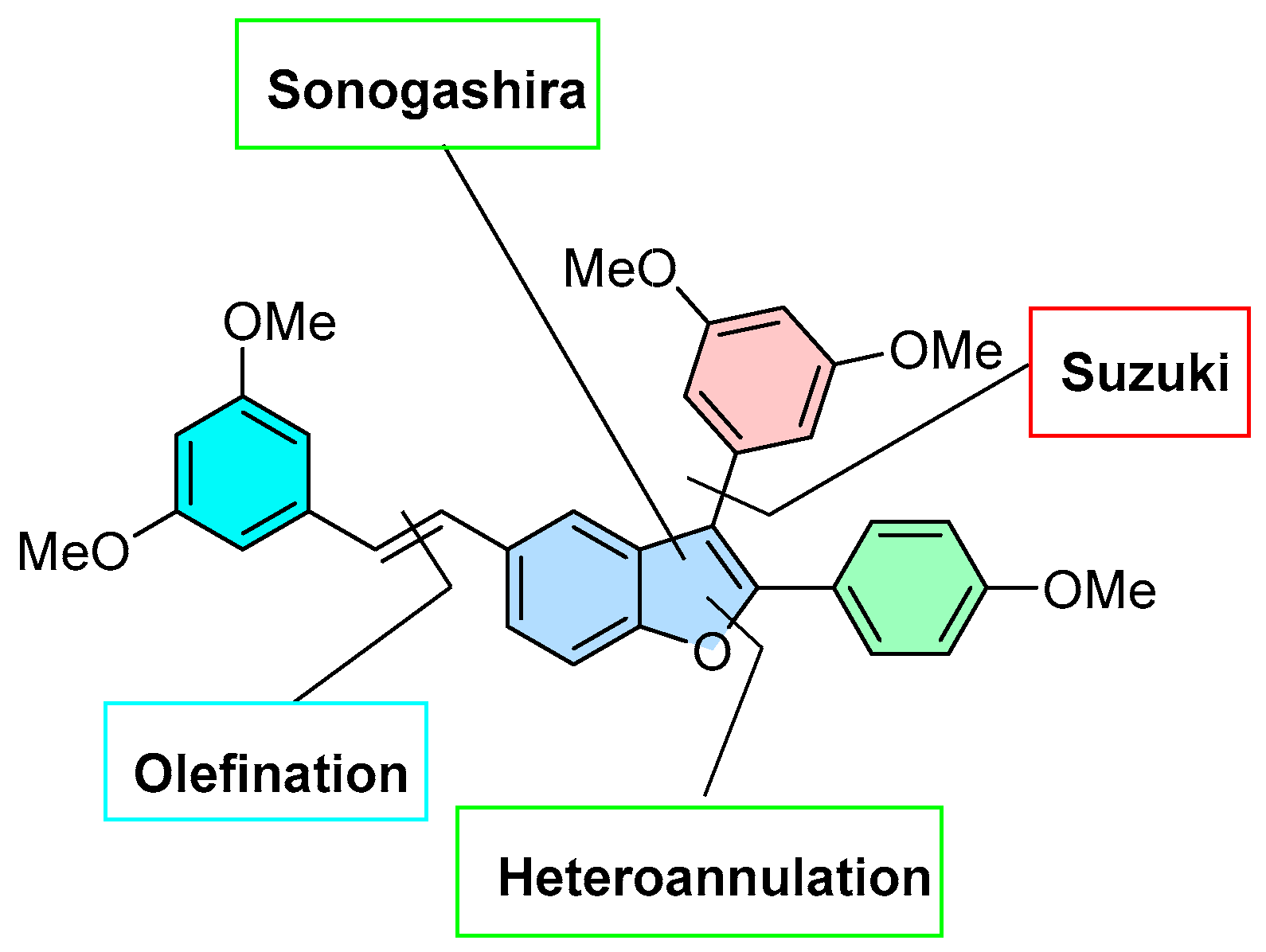
Permethylated dehydro-δ-viniferin (3) was synthesized according to the proposed retrosynthetic analysis shown in Scheme 1. The benzofuran core can be obtained through a one-pot Sonogashira coupling-heteroannulation reactions [15,16,17,18,19,20,21,22,23,24]; the substituent at C-3 can be introduced via a Suzuki coupling, and the stilbene moiety can be installed by olefination. Therefore, several attempts were carried out to obtain the benzofuran core in a single Sonogashira/heteroannulation reaction while simultaneously using environmentally sustainable reaction conditions.
To this end, compared with the initial conditions (entry 1, Table 1), efforts were made towards non-toxic reaction solvent.
The starting reaction conditions (entry 1), previously employed for the synthesis of anigopreissin A analogues [13] afforded the desired product in 83% yield using anhydrous triethylamine as the solvent and three equivalents of the alkyne. An optimization of the reaction conditions was carried out on both substrate 9 (R=Me, Table 1) and substrate 9′ (R=H, Table 1) in order to perform the reaction under more eco-friendly conditions.
Copper-free Sonogashira coupling conditions under aerobic aqueous conditions [25] were therefore applied (entry 8); unexpectedly, these conditions did not afford the desired product. Several Sonogashira coupling attempts in deep eutectic solvents (DESs) [26] were carried out (entries 10–12), but without satisfactory results. Finally, performing the reaction in water in the presence of catalytic amounts of a surfactant [27], SDS (0.07 equiv), using a slight excess of alkyne (1.2 equiv) allowed the desired product to be obtained in 92% yield. The same reaction conditions, when applied to substrate 9′, led to the expected product in 96% yield. Moreover, the reaction time was significantly shortened, decreasing from 18 h (entry 1) to 6.5 h under aqueous conditions (entries 7,14).
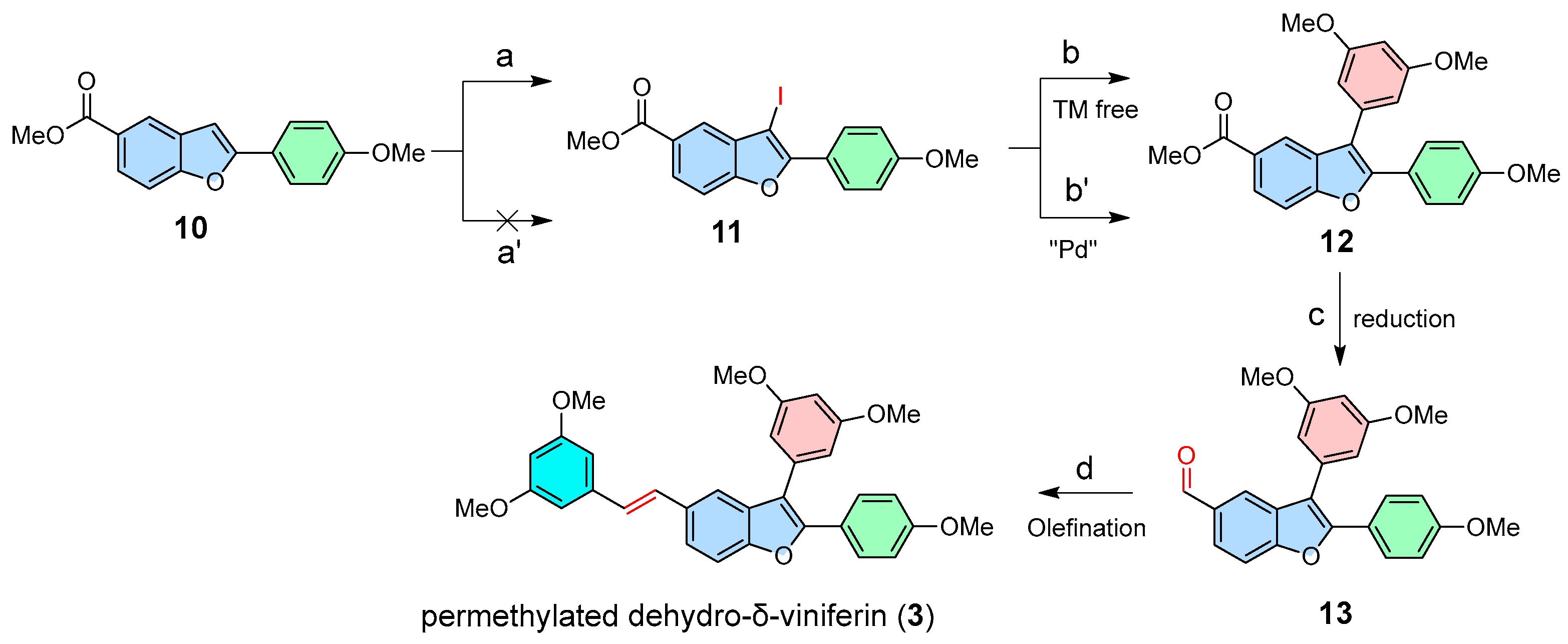
Compound 10, obtained as described above, was subjected to an iodination reaction using NIS/TFA to afford the halogenated compound 11 (a, Scheme 2). The latter was then submitted to a transition-metal-free Suzuki reaction [14], yielding the desired compound 12 in yields comparable to those obtained using a conventional palladium-catalyzed Suzuki coupling (see Supplementary Materials). Subsequent reduction and olefination in MeTHF led to the target compound 6, so that it was synthesized in only 6 steps with an overall yield of 31%.

3.2. Synthesis of Permethylated Anigopreissin A (6)

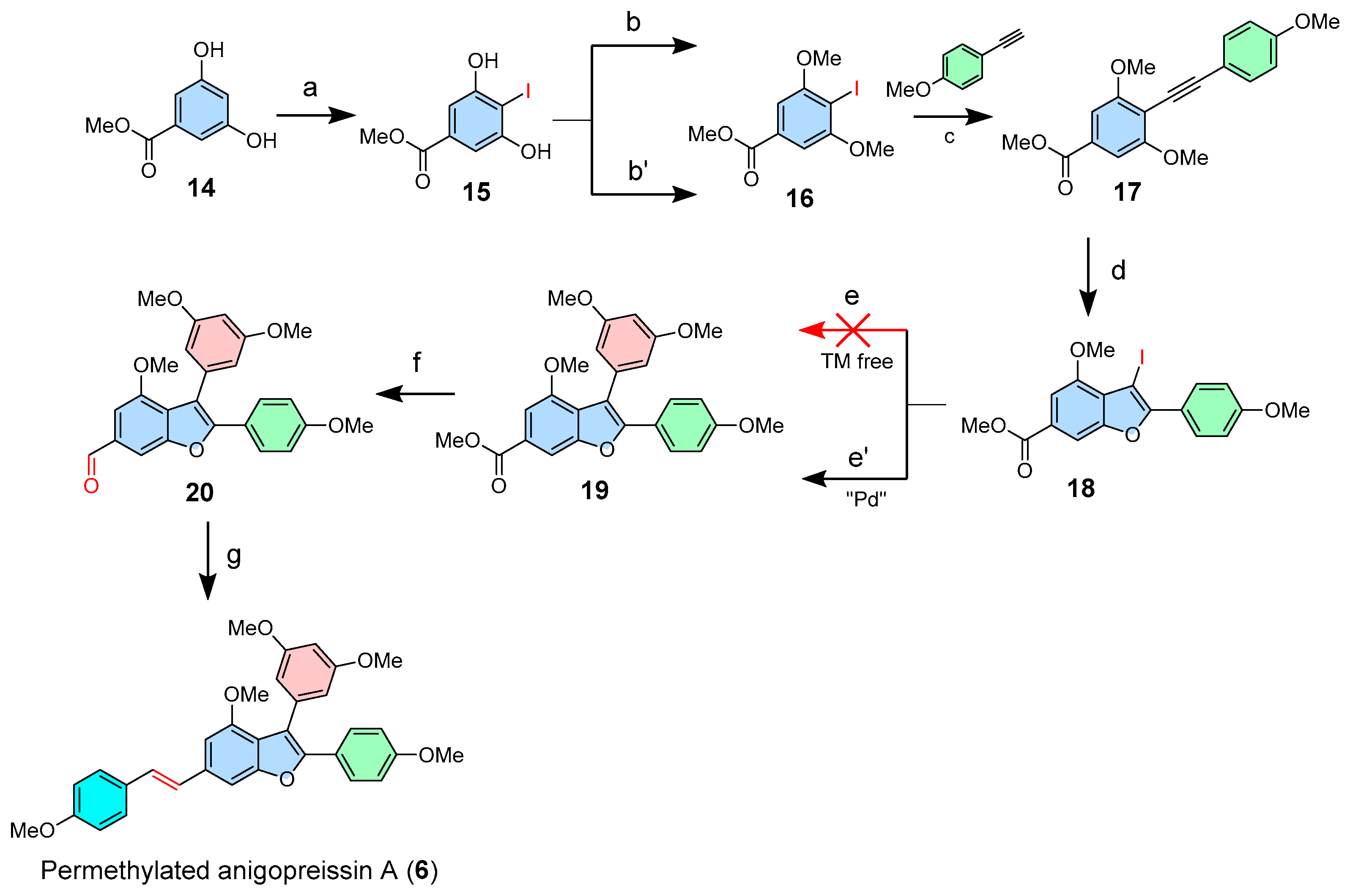
The synthetic methodology developed for the preparation of permethylated dehydro-δ-viniferin (3) was applied to the synthesis of permethylated anigopreissin A (Scheme 3), a compound that exhibits notable cytotoxic activity across a broad range of human tumour cell lines [9,10].
The first iodination step starting from commercially available compound 14 was carried out in water using NCS and NaI [28,29]. Several Sonogashira coupling attempts were performed on compound 15 in water under the previously optimized conditions; however, none of these reactions afforded satisfactory yields. In contrast, the Sonogashira coupling performed on the methylated compound 16 provided the desired product with a yield of 78%, whereas the same reaction carried out under classical conditions (Section 2.1.3) afforded the product a 54% yield. Subsequent iodocyclization, carried out in DMC, a green solvent that, to the best of our knowledge [9,10], has never been reported for this type of transformation [30,31,32,33], led directly to the formation of the iodinated benzofuran 18. Unexpectedly, the Pd-free Suzuki-like coupling did not proceed on this substrate (e, Scheme 2), the lack of reactivity may be attributed to the presence of substituents at the C-2 and C-4 positions, which make the C-3 position particularly hindered similar to an o,o-disubstituted system and therefore less reactive toward this type of transformation. To the best of our knowledge, these conditions have never been applied to benzofuran systems, nor to o,o-disubstituted substrates [14]; however, the classical palladium-catalyzed Suzuki reaction (f, Scheme 2) afforded the product in good yields. Finally, reduction to aldehyde 20 followed by olefination/isomerization led to the formation of the desired compound 2 with an overall yield of 32% in nine steps.

4. Conclusions

In conclusion, we optimized an efficient Sonogashira coupling performed in water, which was subsequently applied to the synthesis of permethylated dehydro-δ-viniferin (3) and permethylated anigopreissin A (6). Moreover, a recently developed transition-metal-free Suzuki-like reaction was efficiently employed for the C-3 functionalization of the benzofuran core for the synthesis of compound 3. Finally, permethylated anigopreissin A was synthesized employing an iodination and Sonogashira reaction in water, and an iodocyclization performed in DMC. Overall, permethylated dehydro-δ-viniferin (3) was synthesized in six steps with a yield of 31% and permethylated anigopreissin A (6) in nine steps with a yield of 32%.

Supplementary Materials

The following supporting information can be downloaded at: https://www.mdpi.com/article/10.3390/org7020017/s1, experimental procedures, analytical data for all compounds and NMR spectra. Figure S1. 1H NMR (400 MHz, CDCl3) of 10 (method A); Figure S2. 13C NMR (100 MHz, CDCl3) of 10 (method A); Figure S3. 1H NMR (400 MHz, CDCl3) of 10 (method B); Figure S4. 1H NMR (400 MHz, CDCl3) of 10’; Figure S5. 1H NMR (400 MHz, CDCl3) of 11; Figure S6. 13C NMR (100 MHz, CDCl3) of 11; Figure S7. 1H NMR (400 MHz, CDCl3) of 12; Figure S8. 1H NMR (400 MHz, CDCl3) of 13; Figure S9. 13C NMR (100 MHz, CDCl3) of 13; Figure S10. 1H NMR (400 MHz, CDCl3) of 3; Figure S11. 13C NMR (100 MHz, CDCl3) of 3; Figure S12. 1H NMR (400 MHz, CD3OD) of 15; Figure S13. 13C NMR (100 MHz, CD3OD) of 15; Figure S14. 1H NMR (400 MHz, CDCl3) of 16; Figure S15. 1H NMR (400 MHz, CDCl3) of 17; Figure S16. 1H NMR (400 MHz, CDCl3) of 18; Figure S17. 13C NMR (100 MHz, CDCl3) of 18; Figure S18. 1H NMR (400 MHz, CDCl3) of 19; Figure S19. 1H NMR (400 MHz, CDCl3) of 20; Figure S20. 1H NMR (400 MHz, CDCl3) of 6; Figure S21. 13C NMR (100 MHz, CDCl3) of 6 [13,34,35,36,37].

Author Contributions

Conceptualization, A.S. and L.C.; methodology, A.S. and L.C.; validation, A.S. and L.C.; formal analysis, A.S.; investigation, A.S. and M.V.; resources, L.C.; data curation, A.S. and L.C.; writing—original draft preparation, A.S.; writing—review and editing, A.S. and L.C.; visualization, L.C.; supervision, L.C.; project administration, L.C.; funding acquisition, L.C. All authors have read and agreed to the published version of the manuscript.

Funding

This research received no external funding.

Data Availability Statement

The original contributions presented in this study are included in the article/Supplementary Materials. Further inquiries can be directed to the corresponding authors.

Acknowledgments

This research was supported by the MUR MUR-M4C2 1.1 “PRIN PNRR 2022” funded by the European Union- Next GenerationEU (Grant agreement n. P2022Y3AA8).

Conflicts of Interest

The authors declare no conflicts of interest. The funders had no role in the design of the study, in the collection, analyses, or interpretation of data, in the writing of the manuscript, or in the decision to publish the results.

References

  1. Keylor, M.H.; Matsuura, B.S.; Stephenson, C.R.J. Chemistry and Biology of Resveratrol-Derived Natural Products. Chem. Rev. 2015, 115, 8976–9027. [Google Scholar] [CrossRef] [Scilit] [PubMed]
  2. Khanam, H. Bioactive benzofuran derivatives: A review. Eur. J. Med. Chem. 2015, 97, 483–504. [Google Scholar] [CrossRef] [Scilit]
  3. Naik, R.; Harmalkar, D.S.; Xu, X.; Jang, K.; Lee, K. Bioactive benzofuran derivatives: Moracins A-Z in medicinal chemistry. Eur. J. Med. Chem. 2015, 90, 379–393. [Google Scholar] [CrossRef] [Scilit]
  4. Zhou, L.; Cai, X.; Wang, Y.; Yang, J.; Wang, Y.; Deng, J.; Ye, D.; Zhang, L.; Liu, Y.; Ma, S. Chemistry and Biology of Natural Stilbenes: An Update. Nat. Prod. Rep. 2025, 42, 359–405. [Google Scholar] [CrossRef] [Scilit] [PubMed]
  5. Mattio, L.M.; Dallavalle, S.; Musso, L.; Filardi, R.; Franzetti, L.; Pellegrino, L.; D’Incecco, P.; Mora, D.; Pinto, A.; Arioli, S. Antimicrobial Activity of Resveratrol-Derived Monomers and Dimers against Foodborne Pathogens. Sci. Rep. 2019, 9, 19525. [Google Scholar] [CrossRef] [Scilit] [PubMed]
  6. Huber, R.; Marcourt, L.; Héritier, M.; Luscher, A.; Guebey, L.; Schnee, S.; Michellod, E.; Guerrier, S.; Wolfender, J.-L.; Scapozza, L.; et al. Generation of Potent Antibacterial Compounds through Enzymatic and Chemical Modifications of the trans-δ-Viniferin Scaffold. Sci. Rep. 2023, 13, 15986. [Google Scholar] [CrossRef] [Scilit] [PubMed]
  7. Hölscher, D.; Schneider, B. A Resveratrol Dimer from Anigozanthos preissii and Musa cavendish. Phytochemistry 1996, 43, 471–473. [Google Scholar] [CrossRef] [Scilit]
  8. Brkljača, R.; White, J.M.; Urban, S. Phytochemical Investigation of the Constituents Derived from the Australian Plant Macropidia fuliginosa. J. Nat. Prod. 2015, 78, 1600–1608. [Google Scholar] [CrossRef] [Scilit]
  9. Convertini, P.; Tramutola, F.; Iacobazzi, V.; Lupattelli, P.; Chiummiento, L.; Infantino, V. Permethylated Anigopreissin A Inhibits HumanHepatomaCell Proliferation by Mitochondria-Induced Apoptosis. Chem.-Biol. Interact. 2015, 237, 1–8. [Google Scholar] [CrossRef] [Scilit]
  10. Caivano, I.; Santarsiere, A.; Amati, M.; Convertini, P.; Funicello, M.; Lupattelli, P.; Chiummiento, L.; Santarsiero, A. Unveiling the Relationship between Structure and Anticancer Properties of Permethylated Anigopreissin A: A Study with Thirteen Analogues. Organics 2024, 5, 237–251. [Google Scholar] [CrossRef] [Scilit]
  11. Galgano, P.; Santarsiere, A.; Funicello, M.; Lupattelli, P.; Ciriello, R.; Chiummiento, L. N-Iodosuccinimide in Oxidative Dimerization of Methyl Cinnamates. ChemistrySelect 2024, 9, e202403776. [Google Scholar]
  12. D’Orsi, R.; Morrongiello, F.; Laurita, T.; Funicello, M.; Lupattelli, P.; Chiummiento, L. Regio- and Diastereo-Selective Biomimetic Synthesis of (±)-ε-Viniferin by NIS and Resveratrol. ChemistrySelect 2021, 6, 6863–6866. [Google Scholar] [CrossRef] [Scilit]
  13. Chiummiento, L.; Funicello, M.; Lopardo, M.T.; Lupattelli, P.; Choppin, S.; Colobert, F. Concise Total Synthesis of Permethylated Anigopreissin A, a New Benzofuryl Resveratrol Dimer. Eur. J. Org. Chem. 2012, 2012, 188–192. [Google Scholar]
  14. Inamoto, K.; Hasegawa, C.; Hiroya, K.; Kondo, Y.; Osako, T.; Uozumi, Y.; Doi, T. Use of Dimethyl Carbonate as a Solvent Greatly Enhances the Biaryl Coupling of Aryl Iodides and Organoboron Reagents without Adding Any Transition-Metal Catalysts. Chem. Commun. 2012, 48, 2912–2914. [Google Scholar] [CrossRef] [Scilit]
  15. Bosiak, M.J. A Convenient Synthesis of 2-Arylbenzo[b]furans from Aryl Halides and 2-Halophenols by Catalytic One-Pot Cascade Method. ACS Catal. 2016, 6, 2429–2434. [Google Scholar] [CrossRef] [Scilit]
  16. Yang, J.; Shen, G.; Chen, D. Iron-Catalyzed Synthesis of 2-Arylbenzo[b]furans. Synth. Commun. 2013, 43, 837–847. [Google Scholar] [CrossRef] [Scilit]
  17. Wang, J.-R.; Manabe, K. Hydroxyterphenylphosphine–Palladium Catalyst for Benzo[b]furan Synthesis from 2-Chlorophenols: Bifunctional Ligand Strategy for Cross-Coupling of Chloroarenes. J. Org. Chem. 2010, 75, 5340–5342. [Google Scholar] [CrossRef] [Scilit] [PubMed]
  18. Saha, D.; Dey, R.; Ranu, B.C. A Simple and Efficient One-Pot Synthesis of Substituted Benzo[b]furans by Sonogashira Coupling–5-endo-dig Cyclization Catalyzed by Palladium Nanoparticles in Water Under Ligand- and Copper-Free Aerobic Conditions. Eur. J. Org. Chem. 2010, 2010, 6067–6071. [Google Scholar] [CrossRef] [Scilit]
  19. Lin, C.-H.; Wang, Y.-J.; Lee, C.-F. Efficient Copper-Catalyzed Cross-Coupling Reaction of Alkynes with Aryl Iodides. Eur. J. Org. Chem. 2010, 42, 4368–4371. [Google Scholar] [CrossRef] [Scilit]
  20. Zhou, R.; Wang, W.; Jiang, Z.-J.; Wang, K.; Zheng, X.-L.; Fu, H.-Y.; Chen, H.; Li, R.-X. One-pot synthesis of 2-substituted benzo[b]furans via Pd–tetraphosphine catalyzed coupling of 2-halophenols with alkynes. Chem. Commun. 2014, 50, 6023–6026. [Google Scholar] [CrossRef] [Scilit]
  21. Henry, M.C.; Sutherland, A. Synthesis of Benzo[b]furans by Intramolecular C–O Bond Formation Using Iron and Copper Catalysis. Org. Lett. 2020, 22, 2766–2770. [Google Scholar] [CrossRef] [Scilit]
  22. Sangon, S.; Supanchaiyamat, N.; Sherwood, J.; Macquarrie, D.J.; Noppawan, P.; Hunt, A.J. Application of Hindered Ether Solvents for Palladium-Catalyzed Suzuki–Miyaura, Sonogashira, and Cascade Sonogashira Cross-Coupling Reactions. Org. Biomol. Chem. 2023, 21, 2603–2609. [Google Scholar] [CrossRef] [Scilit]
  23. Upadhyay, R.; Patel, S.P.; Tailor, A.J.; Patel, A.B. CuI-Promoted Domino Sonogashira Coupling and Alkyne Hydroamination of Benzofuran-Fused Benzimidazoles: Synthesis and Antimicrobial Insights. Bioorg. Chem. 2025, 166, 109088. [Google Scholar] [CrossRef] [Scilit]
  24. Thomas, A.M.; Asha, S.; Menon, R.; Anilkumar, G. One-Pot Synthesis of Benzofurans via Cu-Catalyzed Tandem Sonogashira Coupling–Cyclization Reactions. ChemistrySelect 2019, 4, 5544–5547. [Google Scholar] [CrossRef] [Scilit]
  25. Liang, B.; Dai, M.; Chen, J.; Yang, Z. Copper-Free Sonogashira Coupling Reaction with PdCl2 in Water under Aerobic Conditions. J. Org. Chem. 2005, 70, 391–393. [Google Scholar] [CrossRef] [Scilit] [PubMed]
  26. Messa, F.; Dilauro, G.; Perna, F.M.; Vitale, P.; Capriati, V.; Salomone, A. Sustainable Ligand-Free Heterogeneous Palladium-Catalyzed Sonogashira Cross-Coupling Reaction in Deep Eutectic Solvents. ChemCatChem 2020, 12, 1979–1984. [Google Scholar] [CrossRef] [Scilit]
  27. Ghiglietti, E.; Incarbone, E.A.; Mattiello, S.; Beverina, L. Efficient Copper-Free Sonogashira Coupling in Water and under Ambient Atmosphere. Eur. J. Org. Chem. 2024, 27, e202400223. [Google Scholar] [CrossRef] [Scilit]
  28. Santarsiere, A.; Galgano, P.; Funicello, M.; Lupattelli, P.; Chiummiento, L. NCS-Mediated Ipso-Halogenation of Arylboronic Acids in Water Using Sodium Halides. ACS Omega 2025, 10, 27856–27860. [Google Scholar] [CrossRef] [Scilit]
  29. Mahajan, T.; Kumar, L.; Dwivedi, K.; Agarwal, D.D. Efficient and Facile Chlorination of Industrially Important Aromatic Compounds Using NaCl/p-TsOH/NCS in Aqueous Media. Ind. Eng. Chem. Res. 2012, 51, 3881–3886. [Google Scholar] [CrossRef] [Scilit]
  30. Bokoskie, T.; Cunningham, C.; Kornman, C.; Kesharwani, T.; Pattabiraman, M. Iodocyclization in Aqueous Media and Supramolecular Reaction Control Using Water-Soluble Hosts. ACS Omega 2019, 4, 17830–17836. [Google Scholar] [CrossRef] [Scilit]
  31. Han, J.-S.; Chen, S.-Q.; Zhong, P.; Zhang, X.-H. One-Pot Synthesis of 2,3-Diarylbenzofurans via Sequential Iodocyclization and Pd-Catalyzed Suzuki Coupling Reactions of 2-Alkynylanisoles with Boronic Acids in Water. Synth. Commun. 2014, 44, 3148–3155. [Google Scholar] [CrossRef] [Scilit]
  32. Chiummiento, L.; D’Orsi, R.; Funicello, M.; Lupattelli, P. Last Decade of Unconventional Methodologies for the Synthesis of Substituted Benzofurans. Molecules 2020, 25, 2327. [Google Scholar] [CrossRef] [Scilit]
  33. Santarsiere, A.; Loriso, M.; Ambrosio, F.; Chiummiento, L. Exploring Dimethyl Carbonate as a Green and Efficient Solvent for Highly Regioselective Iodination of Arylboronic Acids. ACS Omega 2026. just accepted. [Google Scholar] [CrossRef] [Scilit]
  34. Wang, M.; Liu, X.; Zhou, L.; Zhu, J.; Sun, X. Fluorination of 2-Substituted Benzo[b]furans with Selectfluor. Org. Biomol. Chem. 2015, 13, 3190–3193. [Google Scholar] [CrossRef] [Scilit] [PubMed]
  35. Teng, B.-H.; Zhu, Q.-B.; Fan, Y.-Y.; Yao, C.-S. Total Synthesis of the Active Resveratrol Dimer Dehydro-δ-viniferin. J. Asian Nat. Prod. Res. 2020, 22, 947–955. [Google Scholar] [CrossRef] [Scilit] [PubMed]
  36. Cao, W.; Chen, P.; Tang, Y. Total Synthesis of Isohericenone J via a Stille Coupling Reaction. J. Nat. Prod. 2020, 83, 1701–1705. [Google Scholar] [CrossRef] [Scilit]
  37. Sun, X.; Zhao, X.-J.; Wu, B. Metal-Free Hypervalent-Iodine-Promoted C3 Difluorination and C2 Oxidation of N-Substituted Indoles. Asian J. Org. Chem. 2017, 6, 690–693. [Google Scholar] [CrossRef] [Scilit]
Figure 1. Stilbene dimer.
Organics 07 00017 g001
Scheme 1. Synthesis of permethylated dehydro-δ-viniferin.
Organics 07 00017 sch001
Scheme 2. Total synthesis of permethylated dehydro-δ-viniferin (3); Reagents and conditions: (a) NIS, TFA, ACN, 0 °C to r.t., 20 h, 89%; (a’) NaI, NCS, TFA, H2O, 80 °C, 2 h, 0%; (b) 3,5-dimethoxyphenyl boronic acid, K2CO3, DMC, 125 °C, 16 h, 78%; (b’) PdCl2(PPh3)2, NaHCO3 DMF:H2O, 1:1, 80 °C, 16 h, 82%; (c) (i) DIBAL, DCM, 0 °C, 3 h; (ii) DMP, DCM, 0 °C, 2 h, 88%. (d) diethyl (3,5-dimethoxybenzyl)phosphonate, t-BuOK, MeTHF, 56%.
Organics 07 00017 sch002
Scheme 3. Total synthesis of permethylated anigopreissin A (6) Reagents and conditions: (a) NaI, NCS, pTSA, H2O, 80 °C, 2 h, 99%; (b) MeI, K2CO3, DMF, r.t., 17 h, 99%, (b’) (CH3O)3PO, K2CO3, 250 °C, 1 h, 51% (c) PdCl2(PPh3)2, CuI, SDS, K2CO3, H2O, 80 °C, 4 h, 78% (d) I2, DMC, r.t., 15 h, 91%; (e) 3,5-dimethoxyphenyl boronic acid, K2CO3, DMC, 125 °C, 16 h, 0%; (e’) 3,5-dimethoxyphenylboronic acid, NaHCO3, PdCl2(PPh3)2, DMF/H2O, 80 °C, 16 h, 84%; (f) (i) DIBAL, DCM, 0 °C, 3 h; (ii) DMP, DCM, 0 °C, 2 h, 85%; (g) (p-methoxybenzyl)triphenylphosphonium bromide, LiOH•H2O, LiBr, i-PrOH, reflux, 3 h, then I2, heptane/DCM (7:3), r.t., 24 h, 64%.
Organics 07 00017 sch003
Table 1. Optimization of Sonogashira/Heteroanulation reaction.
Organics 07 00017 i001
EntrySubstrate
(equiv.)
SolventConditionsT (°C)Time
(h)
10 or 10′ (Yield)
1 9 (3.0 eq.)Et3NPdCl2(PPh3)2 (10% mol),
CuI (10% mol)
50 °C18 h10 (83%)
29′ (2.0 eq.)*DES:H2O, 1:1PdCl2(PPh3)2(10% mol)
CuI (10% mol)
100 °C24 h10′ (56%)
39′ (2.0 eq.)*DESPdCl2(PPh3)2(10% mol),
CuI (10% mol), Et3N (3.0 eq.)
100 °C24 h10′ (40%)
49′ (2.0 eq.)H2OPdCl2(PPh3)2(10% mol),
CuI (10% mol), Et3N (3.0 eq.)
100 °C24 h10′ (71%)
59′ (1.5 eq.)H2OXPhos(20% mol.),
Pd(OAc)2 (10% mol)
CuI (10% mol), Et3N (3.0 eq.)
80 °C18 h10′ (0%)
69′ (1.5 eq.)H2OPdCl2(PPh3)2 (10% mol),
CuI (10% mol), Et3N (3.0 eq.)
100 °C15 h10′ (40%)
79′ (1.2 eq.)H2OPdCl2(PPh3)2 (3.5% mol),
CuI (7% mol),
SDS (7% mol) K2CO3(1.5 eq)
90 °C6.5 h10′ (96%)
89 (2.0 eq.)H2OPdCl2 (1% mol),
Pyrrolidine(5.0 eq)
50 °C24 h10 (0%)
99 (2.0 eq.)H2O:DMSO, 1:1PdCl2(PPh3)2 (4% mol),
CuI (20% mol), K2CO3(3.0 eq)
140 °C24 h10 (0%)
109 (2.0 eq.)*DESPdCl2(PPh3)2 (10% mol),
CuI (10% mol), Et3N (3.0 eq)
100 °C24 h10 (0%)
119 (2.0 eq.)*DESPd/C (10 wt. %),
Et3N (3.0 eq)
100 °C20 h10 (28%)
129 (2.0 eq.)DES:H2O, 1:1PdCl2(PPh3)2 (10%mol)
CuI (10% mol), Et3N (3.0 eq)
100 °C72 h10 (80%)
139 (2.0 eq.)H2OPdCl2(PPh3)2 (10% mol),
CuI (10% mol), Et3N (3.0 eq)
100 °C22 h10 (70%)
149 (1.2 eq.)H2OPdCl2(PPh3)2 (3% mol)
CuI (7% mol),
SDS (7% mol) K2CO3(1.5 eq)
90 °C6.5 h10 (92%)
*DES: ChCl:gly/1:2.
Disclaimer/Publisher’s Note: The statements, opinions and data contained in all publications are solely those of the individual author(s) and contributor(s) and not of MDPI and/or the editor(s). MDPI and/or the editor(s) disclaim responsibility for any injury to people or property resulting from any ideas, methods, instructions or products referred to in the content.