
Article

ARQ-Enhanced Short-Packet NOMA Communications with STAR-RIS
School of Physics and Electronic Engineering, Nanyang Normal University, Nanyang 473061, China
*
Author to whom correspondence should be addressed.
Telecom 2026, 7(2), 25; https://doi.org/10.3390/telecom7020025
Submission received: 11 January 2026 / Revised: 6 February 2026 / Accepted: 14 February 2026 / Published: 2 March 2026

Abstract

To address the rigorous requirements of ultra-reliable low-latency communication (URLLC) in beyond 5G/6G networks, we propose an innovative architecture combining automatic repeat request (ARQ) protocol with a simultaneously transmitting and reflecting reconfigurable intelligent surface (STAR-RIS) to enhance short-packet non-orthogonal multiple access (NOMA) communications. Specifically, retransmission mechanism provided by ARQ is utilized to mitigate packet errors stemming from practical system imperfections, i.e., imperfect channel state information (ipCSI), imperfect successive interference cancellation (ipSIC), and hardware impairments. Using the analytical foundation provided by finite blocklength (FBL) theory, expressions for two key performance metrics, i.e., the average block error rate (BLER) and effective throughput, are derived for two NOMA users. Simulation results validate the analytical derivations and demonstrate that the ARQ scheme provides significant reliability gains for each user and achieves synergistic gain with STAR-RIS technology. In addition, the effective throughput exhibits a peak at an optimal blocklength, balancing the reliability gain from a longer blocklength against the spectral efficiency loss from a lower coding rate. This optimal blocklength decreases with more STAR-RIS elements, as improved channel conditions reduce the need for long blocklengths.

1. Introduction

The proliferation of Internet of Things (IoT) devices, alongside advances in industrial automation, autonomous systems, and tactile internet technologies, is catalyzing the evolution toward advanced wireless networks, notably the beyond fifth generation (B5G) and sixth generation (6G) paradigms. This evolution is fundamentally motivated by stringent requirements for ultra-reliability, minimal latency, massive-scale connectivity, and superior spectral efficiency [1,2]. Ultra-reliable low-latency communication (URLLC) is now regarded as a key enabling technology to meet these stringent requirements, particularly for mission-critical services where packet error rates as low as 10 5 to 10 9 and latencies below 1 ms are mandated [3,4]. Unlike conventional wireless systems that rely on Shannon’s capacity theorem under the assumption of infinite blocklength (IBL), URLLC often involves the transmission of short packets with finite blocklength (FBL), where a non-negligible decoding error probability persists even if the transmission rate remains lower than the channel capacity [5,6]. This fundamental shift from the IBL to the FBL regime necessitates not only a reevaluation of traditional performance metrics but also the creation and implementation of novel transmission schemes to ensure reliable short-packet communications.
Recently, non-orthogonal multiple access (NOMA) is positioned as an attractive multiple access methodology, chiefly because of its enhanced efficiency in utilizing spectral resources and its capability to accommodate massive connectivity [7,8]. Utilizing power-domain multiplexing and successive interference cancellation (SIC) to facilitate resource sharing among multiple users within the same spectral and temporal dimensions, NOMA achieves markedly higher network throughput and accommodates more concurrent transmissions than do orthogonal multiple access (OMA) approaches [9,10,11]. Specifically, in downlink NOMA implementations, fairness is pursued by assigning higher transmit power to receivers experiencing weaker channel gains, typically far users. Conversely, those with stronger channels (near users) execute SIC, first decoding and eliminating the signals intended for far users prior to retrieving their own information [12,13]. However, the practical implementation of SIC is often constrained by non-ideal factors such as residual interference from imperfect synchronization and signal distortion due to quantization errors, which prevent near users from perfectly cancelling far users’ signals, a phenomenon referred to as imperfect SIC (ipSIC) [14,15]. This imperfection can severely degrade the decoding performance of near users, particularly in short-packet scenarios where the margin for error is extremely limited.
Reconfigurable intelligent surface (RIS) is receiving growing interest as a paradigm-shifting technology capable of intelligently shaping wireless propagation channels, with the goals of extending coverage, boosting energy efficiency, and improving signal quality [6,10,16]. This technology employs a planar array of passive elements that individually reconfigure the phase and amplitude of incident electromagnetic waves to steer signals toward intended receivers. Advancing beyond conventional RIS, the simultaneously transmitting and reflecting RIS (STAR-RIS) empowers each element to both reflect and refract signals simultaneously. This capability facilitates omni-directional ( 360 ) coverage and offers superior adaptability in coordinating users distributed on both sides of the surface [17,18]. Operational protocols for STAR-RIS, including energy splitting (ES), mode switching (MS), and time switching (TS), provide diverse options for balancing implementation complexity with system performance. By integrating STAR-RIS with NOMA architectures, it is possible to enhance channel gains, mitigate inter-user interference, and improve the overall system performance, particularly in scenarios where direct links are blocked or severely attenuated [19]. Specifically, the work in [19] introduced a STAR-RIS operating protocol that employs mode switching combined with element partitioning. Subsequently, ref. [20] presented a joint optimization framework for user blocklengths, transmit power, and STAR-RIS beamforming to minimize total power consumption under per-user reliability constraints. Furthermore, ref. [21] proposed a dynamic user grouping method designed to maximize the spectral efficiency of such systems. Analytical expressions for the block error rate (BLER) and goodput of a STAR-RIS-assisted NOMA downlink system were derived in [22]. In the FBL regime, ref. [23] designed a semi-NOMA scheme for STAR-RIS-aided symbiotic networks.
It is important to recognize that the validity of the aforementioned studies on STAR-RIS-assisted NOMA networks is predicated on the critical assumption of perfect channel state information (CSI). However, the inherent pilot-data resource competition, combined with the inability to average out noise, makes channel estimation error a central and unavoidable challenge in the design of short-packet communication systems. Research has quantified the benefits of deploying STAR-RIS in NOMA systems under imperfect CSI (ipCSI). Ref. [24] demonstrated that such deployment yields superior spectral efficiency compared to systems using conventional RIS. Then, ref. [25] analyzed the system’s reliability by investigating the average BLER in a short-packet NOMA setup, taking into account the combined impact of both ipSIC and ipCSI. On the other hand, in practical transceivers, components such as power amplifiers, oscillators, analog-to-digital converters, and mixers introduce non-ideal effects like I/Q imbalance, phase noise, amplifier nonlinearity, and quantization errors. These impairments degrade signal quality by causing distortion, introducing additional noise, and creating residual interference that cannot be completely eliminated through digital signal processing [26,27,28]. It was found in [29] that RIS integration in a short-packet NOMA system mitigates hardware impairments while improving diversity order. An analysis of the joint effect of ipSIC and hardware impairments on the average BLER and achievable throughput was examined in [30] for a RIS-assisted short-packet NOMA network. Within the context of short-packet communications under ipSIC and hardware impairments, the work in [31] demonstrated the superior performance of active STAR-RIS-assisted NOMA over its passive counterpart.
To mitigate the adverse effects of ipSIC, ipCSI, and hardware impairments constraints, automatic repeat request (ARQ) protocol provides a well-established solution for improving transmission reliability through retransmissions [32,33,34]. In ARQ, receivers acknowledge successful packet decoding by sending an acknowledgment (ACK), while a negative acknowledgment (NACK) triggers a retransmission from the transmitter. Although ARQ inevitably introduces additional latency and reduces spectral efficiency due to repeated transmissions, it can significantly lower the packet error rate, especially when the number of retransmissions is limited to control delay [35,36]. For URLLC applications with strict delay budgets, a single retransmission (i.e., one ARQ round) is often sufficient to achieve substantial reliability gains without excessive latency overhead [37]. Recent studies have demonstrated that ARQ protocol significantly improves short-packet communications efficiency, not only in NOMA networks [37,38] but also in networks where NOMA is integrated with RIS [39]. However, the integration of ARQ into NOMA systems employing STAR-RIS for short-packet communications, considering the joint impact of ipSIC, ipCSI, and hardware impairments, remains an open research problem with significant practical implications.
To address these existing gaps in the literature, we introduce a new transmission approach that integrates ARQ protocols into STAR-RIS-assisted NOMA systems designed for short-packet communications. The proposed scheme seeks to enhance communication reliability under practical and non-ideal operational constraints, including hardware impairments, ipSIC, and ipCSI. The main contributions of this work are summarized as follows:
  • We propose the use of a STAR-RIS to enable a downlink short-packet NOMA network, in which a base station (BS) communicates with a near user positioned in the reflection region and a far user located in the refraction region of the STAR-RIS. To improve transmission reliability under practical imperfections, an ARQ protocol with one retransmission opportunity is employed. This mechanism is designed to mitigate packet errors arising from ipSIC, ipCSI, and hardware impairments.
  • We present newly derived closed-form expressions that characterize both the average BLER and the effective throughput achieved by the near and far users. The analysis covers various transmission scenarios based on the success/failure states of the first transmission and the corresponding resource allocation strategies in the retransmission phase. The conventional non-ARQ scheme is evaluated as a baseline to quantify the improvements in reliability and spectral efficiency offered by the proposed scheme.
  • Comprehensive Monte Carlo simulations are performed to verify the accuracy of the derived analytical expressions and demonstrate that the ARQ scheme provides substantial reliability gains for both NOMA users, and its combination with STAR-RIS technology yields synergistic benefits. Moreover, the optimal blocklength required for achieving maximum effective throughput decreases with more STAR-RIS elements, as the resultant channel improvement reduces the need for long blocklength transmissions.
The remainder of this paper is organized as follows. Section 2 details the system configuration, including channel modeling, the operational principles of the STAR-RIS, and the newly introduced ARQ-based transmission framework. A comprehensive performance evaluation is conducted in Section 3, where analytical expressions for the average BLER and effective throughput are derived for each user. Numerical simulations and corresponding analyses are presented in Section 4, illustrating the benefits of the proposed method and examining the influence of key system parameters. Concluding remarks and potential directions for subsequent research are provided in Section 5.

2. System Model

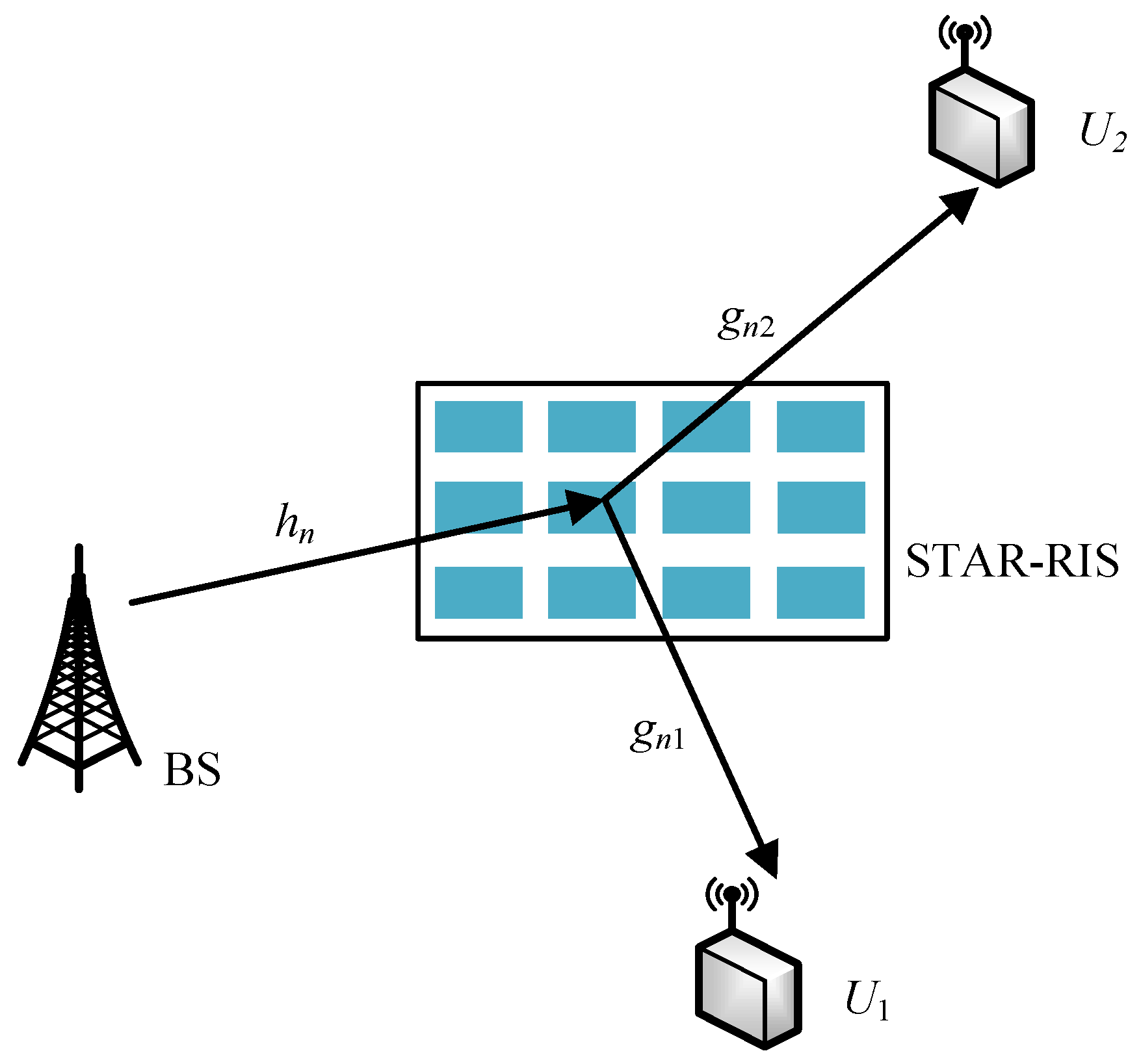
Figure 1 depicts a downlink NOMA network enhanced by a STAR-RIS. The system includes a BS, a STAR-RIS equipped with N passive elements, and two NOMA users (a near user U 1 and a far user U 2 ) located on either side of the STAR-RIS. When utilizing short packets, the constrained blocklength not only inevitably leads to decoding errors but also complicates SIC. ARQ can enhance transmission reliability in such scenarios. Upon an unsuccessful decoding attempt by either U 1 or U 2 , a NACK is fed back to the BS to request a retransmission; an ACK is returned upon successful decoding. The transmission process terminates under two conditions: when both users have successfully sent ACKs, or when the maximum permissible number of retransmission attempts has been exhausted. To limit potential delays, a single retransmission opportunity is allowed [37]. For simplicity, the original transmission attempt is referred to as the first phase, while the subsequent retransmission is denoted as the second phase.
Due to surrounding blockages, it is assumed that no direct link exists from the BS to either user U i , where i 1 , 2 [19,25]. This serves to quantify the fundamental gains of the STAR-RIS and is well-justified in typical 6G coverage-hole scenarios (e.g., dense urban canyons). It establishes a performance lower bound for the worst-case users that the STAR-RIS is designed to assist. All nodes are also assumed to be equipped with a single antenna. For the n-th element on the STAR-RIS, the wireless channel from the BS to the STAR-RIS during the l-th transmission phase is represented by h n l , while the channel from the STAR-RIS to user U i is denoted as g n i l , with l 1 , 2 and n 1 , 2 , , N . These channels follow a Rayleigh distribution, characterized as CN ( 0 , 1 ) . Given that the BS is typically stationary, the CSI for the link spanning from the BS to the STAR-RIS can be obtained with reasonable accuracy using standard estimation methods. However, acquiring perfect CSI for the STAR-RIS to U i links is challenging due to feedback delay [40]. Consequently, the estimated channel can be formulated as
g n i l = ρ g ^ n i l + 1 ρ 2 g ˜ n i l ,
where g n i l denotes the ideal channel, while g ^ n i l corresponds to the estimated channel, and g ˜ n i l being the estimation error, is uncorrelated with g ^ n i l . Here, 0 < ρ 1 is the correlation coefficient between the ideal channel g n i l and its estimated counterpart g ^ n i l , serving as a measure of estimation accuracy.

2.1. The First Phase

The BS in the first phase uses superposition coding to send signal x = α 1 P x 1 + α 2 P x 2 to U 1 and U 2 , where P is the transmit power of the BS, x 1 and x 2 are the unit-power signals for U 1 and U 2 respectively, α 1 and α 2 are their corresponding power allocation coefficients satisfying α 1 + α 2 = 1 and α 2 > α 1 . The STAR-RIS elements function according to the ES protocol, which partitions the incident energy into two streams to simultaneously reflect and refract the incoming signal. The received signal at U i can be expressed as
y i 1 = n = 1 N β n i d s r τ d r i τ ρ h n 1 g ^ n i 1 e j θ n i + n = 1 N 1 ρ 2 β n i d s r τ d r i τ h n 1 g ˜ n i 1 e j θ n i x + μ s + μ i + n i ,
where μ s CN 0 , k t 2 P and μ i CN 0 , k r 2 P d s r τ d r i τ i = 1 N h n 1 g n i 1 e j θ n i 2 denote the distortions caused by hardware impairments at the BS and U i , respectively, with k t and k r representing the impairments level at transmitter and receiver, respectively. Besides, the link distances from the BS to the STAR-RIS and from the STAR-RIS to user U i are denoted by d s r and d r i , respectively, with τ representing the path loss exponent. Furthermore, the n-th element on the STAR-RIS introduces an energy partitioning coefficient 0 β n i 1 , which dictates the proportion of signal energy allocated to either reflection or refraction. These coefficients satisfy β n 1 + β n 2 = 1 . A corresponding phase shift θ n i [ 0 , 2 π ) is also applied by each element. Without loss of generality, we assume that β n i = β i [25,41]. n i CN ( 0 , σ 2 ) is the additive white Gaussian noise (AWGN).
To maximize the received power at U i , the STAR-RIS adjusts θ n i by seting θ n i = arg h n arg g n i [41]. Then, according to (2), the received signal-to-interference-plus-noise ratio (SINR) at U 1 for detecting x 2 is given by
γ 1 , 2 1 = α 2 λ β 1 ρ 2 X 1 1 λ β 1 ρ 2 α 1 + k t r X 1 1 + λ β 1 1 + k t r 1 ρ 2 Y 1 1 + d s r τ d r 1 τ ,
where X 1 1 = n = 1 N h n 1 g ^ n 1 1 2 , Y 1 1 = n = 1 N h n 1 e j θ n 1 2 , k t r = k t 2 + k r 2 , and λ = P σ 2 is the transmit signal-to-noise ratio (SNR). Following [42], the instantaneous BLER when U 1 decodes x 2 can be formulated as
ε 1 , 2 1 Ψ γ 1 , 2 1 , b 2 , L ,
where Ψ γ 1 , 2 1 , b 2 , L = Δ Q ln 2 log 2 1 + γ 1 , 2 1 b 2 b 2 L L V γ 1 , 2 1 V γ 1 , 2 1 L L , V γ = 1 1 + γ 2 , Q x = 1 2 π x e t 2 2 d t , b 2 represents the number of bits in signal x 2 , and L is the blocklength. Once U 1 has successfully decoded the message x 2 , it executes SIC to subtract this signal component from its aggregate received signal, thereby facilitating the subsequent detection of its intended message x 1 . Accordingly, the SINR at U 1 for detecting x 1 is given by
γ 1 , 1 1 = α 1 λ β 1 ρ 2 X 1 1 λ β 1 ρ 2 ψ α 2 + k t r X 1 1 + λ β 1 1 + k t r 1 ρ 2 Y 1 1 + d s r τ d r 1 τ ,
where ψ is the ipSIC factor, ψ = 0 is the case of perfect SIC (pSIC), and 0 < ψ 1 refers to ipSIC. Thus, the instantaneous BLER at U 1 is expressed as
ε U 1 1 = ε 1 , 2 1 + 1 ε 1 , 2 1 ε 1 , 1 1 ε 1 , 2 1 + ε 1 , 1 1 ,
where ε 1 , 1 1 Ψ γ 1 , 1 1 , b 1 , L , b 1 represents the number of bits in signal x 1 , and the approximation is motivated by the very low target BLER in short-packet communication systems [37].
During the detection process at U 2 , the signal component designated for U 1 is regarded as interference. Thus, the received SINR at U 2 for detecting x 2 is given by
γ 2 , 2 1 = α 2 λ β 2 ρ 2 X 2 1 λ β 2 ρ 2 α 1 + k t r X 2 1 + λ β 2 1 + k t r 1 ρ 2 Y 2 1 + d s r τ d r 2 τ ,
where X 2 1 = n = 1 N h n 1 g ^ n 2 1 2 , and Y 2 1 = n = 1 N h n 1 e j θ n 2 2 . Thus, the instantaneous BLER at U 2 is expressed as
ε U 2 1 Ψ γ 2 , 2 1 , b 2 , L .

2.2. The Second Phase

The first transmission attempt does not ensure flawless reception at the user terminals. If a packet decoding error occurs, a NACK is returned to solicit a second transmission; conversely, an ACK is transmitted to terminate the process. Based on the receivers’ status, four possible cases are outlined in Table 1. Notably, to enhance transmission reliability, when either user successfully recovers its intended message during the first transmission phase, the entirety of the communication resources are then dedicated to the remaining user.
In both Case 1 and Case 3, U 1 experiences a packet decoding error, which triggers a request for a retransmission. Specifically for Case 1, the signal received by U 1 during the second phase is expressed as
y 1 2 , 1 = n = 1 N β n 1 d s r τ d r 1 τ ρ h n 2 g ^ n 1 2 e j θ n 1 + n = 1 N 1 ρ 2 β n 1 d s r τ d r 1 τ h n 2 g ˜ n 1 2 e j θ n 1 x + μ s + μ 1 + n 1 .
Following the same procedure as in the initial transmission phase, U 1 should first decode the message intended for U 2 with SINR given by
γ 1 , 2 2 , 1 = α 2 λ β 1 ρ 2 X 1 2 λ β 1 ρ 2 α 1 + k t r X 1 2 + λ β 1 1 + k t r 1 ρ 2 Y 1 2 + d s r τ d r 1 τ ,
where X 1 2 = n = 1 N h n 2 g ^ n 1 2 2 , and Y 1 2 = n = 1 N h n 2 e j θ n 1 2 . Therefore, the corresponding instantaneous BLER can be expressed as
ε 1 , 2 2 , 1 Ψ γ 1 , 2 2 , 1 , b 2 , L .
After successfully decoding U 2 ’s message, U 1 subtracts this signal from the combined received signal. Thus, U 1 decode the signal x 1 with SINR given by
γ 1 , 1 2 , 1 = α 1 λ β 1 ρ 2 X 1 2 λ β 1 ρ 2 ψ α 2 + k t r X 1 2 + λ β 1 1 + k t r 1 ρ 2 Y 1 2 + d s r τ d r 1 τ ,
and the corresponding instantaneous BLER is formulated as
ε 1 , 1 2 , 1 Ψ γ 1 , 1 2 , 1 , b 1 , L .
For case 3, the STAR-RIS operates in full reflection mode, i.e., β n 1 = 1 and β n 2 = 0 . The received signal at U 1 is expressed as
y 1 2 , 3 = n = 1 N 1 d s r τ d r 1 τ ρ h n 2 g ^ n 1 2 e j θ n 1 + n = 1 N 1 ρ 2 d s r τ d r 1 τ h n 2 g ˜ n 1 2 e j θ n 1 P x 1 + μ s + μ 1 + n 1 .
In this case, the decoding SINR for x 1 at U 1 is given by
γ 1 , 1 2 , 3 = λ ρ 2 X 1 2 λ ρ 2 k t r X 1 2 + λ 1 + k t r 1 ρ 2 Y 1 2 + d s r τ d r 1 τ ,
and the corresponding instantaneous BLER is expressed as
ε 1 , 1 2 , 3 Ψ γ 1 , 1 2 , 3 , b 1 , L .
According to case 1 and case 3, the instantaneous BLER for U 1 in the second phase is given by
ε U 1 2 ε U 2 1 ε 1 , 2 2 , 1 + ε 1 , 1 2 , 1 + 1 ε U 2 1 ε 1 , 1 2 , 3 .
In case 1 and case 2, U 2 initiates for retransmission. For case 1, the received signal at U 2 is expressed as
y 2 2 , 1 = n = 1 N β n 2 d s r τ d r 2 τ ρ h n 2 g ^ n 2 2 e j θ n 2 + n = 1 N 1 ρ 2 β n 2 d s r τ d r 2 τ h n 2 g ˜ n 2 2 e j θ n 2 x + μ s + μ 2 + n 2 .
When decoding its own message, U 2 treats the signal intended for U 1 as interference. Therefore, the decoding SINR for x 2 at U 2 is given by
γ 2 , 2 2 , 1 = α 2 λ β 2 ρ 2 X 2 2 λ β 2 ρ 2 α 1 + k t r X 2 2 + λ β 2 1 + k t r 1 ρ 2 Y 2 2 + d s r τ d r 2 τ ,
where X 2 2 = n = 1 N h n 2 g ^ n 2 2 2 , and Y 2 2 = n = 1 N h n 2 e j θ n 2 2 . Thus, the instantaneous BLER is expressed as
ε 2 , 2 2 , 1 Ψ γ 2 , 2 2 , 1 , b 2 , L .
In the scenario described by case 2, the STAR-RIS is configured to operate solely in the refraction mode, which is achieved by setting β n 1 = 0 and β n 2 = 1 . The received signal at U 2 is given by
y 2 2 , 2 = n = 1 N 1 d s r τ d r 2 τ ρ h n 2 g ^ n 2 2 e j θ n 2 + n = 1 N 1 ρ 2 d s r τ d r 2 τ h n 2 g ˜ n 2 2 e j θ n 2 P x 2 + μ s + μ 2 + n 2 .
In this case, the decoding SINR for x 2 at U 2 is given by
γ 2 , 2 2 , 2 = λ ρ 2 X 2 2 λ ρ 2 k t r X 2 2 + λ 1 + k t r 1 ρ 2 Y 2 2 + d s r τ d r 2 τ ,
and the corresponding instantaneous BLER is expressed as
ε 2 , 2 2 , 2 Ψ γ 2 , 2 2 , 2 , b 2 , L .
Based on the operational conditions defined in case 1 and case 2, the instantaneous BLER for U 2 in the second phase is given by
ε U 2 2 ε U 1 1 ε 2 , 2 2 , 1 + 1 ε U 1 1 ε 2 , 2 2 , 2 .

3. Performance Analysis

In this section, we provide a thorough performance evaluation of the proposed network in terms of reliability and spectral efficiency. We begin by examining the statistical properties of the received SINRs. Following this, analytical formulas in closed-form are derived for the average BLER and the effective throughput pertaining to both the near and the far users.

3.1. Preliminaries

Following the methodology outlined in [43], the cumulative distribution function (CDF) for the random variable X i j can be closely approximated using a Gamma distribution, expressed as
F X i j ( x ) = γ ( k , v x ) Γ ( k ) ,
where k = N π 2 16 π 2 , and v = 4 π 16 π 2 , the gamma function Γ · and the incomplete gamma function γ · , · follow the definitions provided in [44]. Furthermore, the random variable Y i j follows an exponential distribution, and its corresponding probability density function (PDF) is directly provided as [40]
f Y i j ( y ) = 1 N e y N .
Based on the analysis in Section 2, we can express all SINR expressions, i.e., γ 1 , 2 1 , γ 1 , 1 1 , γ 2 , 2 1 , γ 1 , 2 2 , 1 , γ 1 , 1 2 , 1 , γ 1 , 1 2 , 3 , γ 2 , 2 2 , 1 , and γ 2 , 2 2 , 2 , in the following unified form
γ = Θ X i j Φ X i j + Ψ Y i j + Ω ,
where the coefficients Θ , Φ , Ψ , and Ω are given in Table 2.
Then, the CDF of γ can be obtained as
F γ z = Pr Θ X i j Φ X i j + Ψ Y i j + Ω < z .
When z Θ Φ , we have F γ z = 1 . When z < Θ Φ , the CDF of γ can be derived as
F γ z = 0 0 Ψ y z + Ω z Θ Φ z f X i j x f Y i j y d x d y = 0 γ k , v Ψ y z + Ω z Θ Φ z Γ ( k ) N e y N d y a m = 1 M ω m Γ ( k ) γ k , v Ψ N z x m + Ω z Θ Φ z ,
where step a is to apply the Gauss-Laguerre quadrature [25], x m is the m real roots of J M x = e x M ! d M d x M x M e x , ω m = x m M + 1 2 J M + 1 x m 2 , and M is the Laguerre tradeoff factor.
Combining these two cases yields the CDF of γ , given by
F γ z = m = 1 M ω m Γ ( k ) γ k , v Ψ N z x m + Ω z Θ Φ z , z < Θ Φ , 1 , otherwise .

3.2. Average BLER of U 1

If U 1 be unable to decode its designated messages accurately, it will initiate a request for one retransmission. When U 1 still be unable to recover the messages after retransmission, a packet error will inevitably occur. Thus, the average BLER at U 1 is given by
ε ¯ U 1 = E ε U 1 1 ε U 1 2 .
Substituting (6) and (17) into (31), the average BLER at U 1 can be further expressed as
ε ¯ U 1 = E ε U 2 1 ε 1 , 2 2 , 1 + ε 1 , 1 2 , 1 + 1 ε U 2 1 ε 1 , 1 2 , 3 ε 1 , 2 1 + ε 1 , 1 1 .
Under the assumption that channels are independent between transmission slots, we can rewrite (32) as
ε ¯ U 1 = E ε U 2 1 E ε 1 , 2 2 , 1 + E ε 1 , 1 2 , 1 + 1 E ε U 2 1 E ε 1 , 1 2 , 3 E ε 1 , 2 1 + E ε 1 , 1 1 .
Prior to the derivation for ε ¯ U 1 , we derive the closed-form expressions for E ε 1 , 2 1 and E ε 1 , 1 1 in the following two Lemmas.
Lemma 1. 
The closed-form expression for E ε 1 , 2 1 is given by
E ε 1 , 2 1 = H A 2 α 2 α 1 + k t r + H α 2 α 1 + k t r B 2 t = 1 T π 2 T 1 ς t 2 F γ 1 , 2 1 ν 2 + H α 2 α 1 + k t r A 2 H α 2 α 1 + k t r B 2 1 2 α 2 α 1 + k t r h 2 × g 2 L + t = 1 T g 2 π L 2 T α 2 α 1 + k t r A 2 1 ς t 2 F γ 1 , 2 1 ν 1 ,
where h 2 = 2 b 2 L 1 , g 2 = 2 π 2 2 b 2 L 1 1 2 , A 2 = h 2 1 2 g 2 L , B 2 = h 2 + 1 2 g 2 L , ν 1 = ς t 2 α 2 α 1 + k t r A 2 + 1 2 α 2 α 1 + k t r + A 2 , ν 2 = ς t B 2 A 2 2 + B 2 + A 2 2 , ς t = cos 2 t 1 2 T π , H x = 1 , x 0 0 , x < 0 , and T governs the trade-off between computational complexity and accuracy.
Proof. 
See Appendix A. □
Lemma 2. 
The closed-form expression for E ε 1 , 1 1 is given by
E ε 1 , 1 1 = H A 1 α 1 ψ α 2 + k t r + H α 1 ψ α 2 + k t r B 1 t = 1 T π 2 T 1 ς t 2 F γ 1 , 1 1 ν 4 + H α 1 ψ α 2 + k t r A 1 H α 1 ψ α 2 + k t r B 1 1 2 α 1 ψ α 2 + k t r h 1 × g 1 L + t = 1 T g 1 π L 2 T α 1 ψ α 2 + k t r A 1 1 ς t 2 F γ 1 , 1 1 ν 3 ,
where h 1 = 2 b 1 L 1 , g 1 = 2 π 2 2 b 1 L 1 1 2 , A 1 = h 1 1 2 g 1 L , B 1 = h 1 + 1 2 g 1 L , ν 3 = ς t 2 α 1 ψ α 2 + k t r A 1 + 1 2 α 1 ψ α 2 + k t r + A 1 , and ν 4 = ς t B 1 A 1 2 + B 1 + A 1 2 .
Proof. 
The above result can readily be obtained by applying an analytical approach analogous to that detailed in Appendix A. □
A comparison of Equations (3) and (10) reveals that E ε 1 , 2 2 , 1 and E ε 1 , 2 1 share an identical form, leading to the deduction that E ε 1 , 2 2 , 1 = E ε 1 , 2 1 . Similarly, Equations (5) and (12) are equivalent, implying E ε 1 , 1 2 , 1 = E ε 1 , 1 1 . Moreover, Equation (15) exhibits a structure analogous to (5). Consequently, the closed-form expression for E ε 1 , 1 2 , 3 follows from (35) by substituting α 1 = 1 , β 1 = 1 , ψ = 0 , and F γ 1 , 1 1 x with F γ 1 , 1 2 , 3 x . The closed-form expression for E ε 1 , 1 2 , 3 is given by
E ε 1 , 1 2 , 3 = H A 1 1 k t r + H 1 k t r B 1 t = 1 T π 2 T 1 ς t 2 F γ 1 , 1 2 , 3 ν 4 + H 1 k t r A 1 H 1 k t r B 1 1 2 1 k t r h 1 × g 1 L + t = 1 T g 1 π L 2 T 1 k t r A 1 1 ς t 2 F γ 1 , 1 2 , 3 ν 3 .
By inspecting Equations (3) and (7), a structural similarity is observed between the expression for E ε U 2 1 and that of E ε 1 , 2 1 . Consequently, the closed-form result for E ε U 2 1 can be derived by replacing F γ 1 , 2 1 x with F γ 2 , 2 1 x in Equation (34). The closed-form expression for E ε U 2 1 is given by
E ε U 2 1 = H A 2 α 2 α 1 + k t r + H α 2 α 1 + k t r B 2 t = 1 T π 2 T 1 ς t 2 F γ 2 , 2 1 ν 2 + H α 2 α 1 + k t r A 2 H α 2 α 1 + k t r B 2 1 2 α 2 α 1 + k t r h 2 × g 2 L + t = 1 T g 2 π L 2 T α 2 α 1 + k t r A 2 1 ς t 2 F γ 2 , 2 1 ν 1 .
Substituting E ε 1 , 2 1 , E ε 1 , 1 1 , E ε 1 , 2 2 , 1 , E ε 1 , 1 2 , 1 , E ε 1 , 2 2 , 3 , and E ε U 2 1 into (33), the closed-form expression for the average BLER of U 1 is obtained.
In traditional STAR-RIS assisted NOMA networks that do not employ ARQ, the average BLER of U 1 is given by
ε ¯ U 1 N o n A R Q = E ε 1 , 2 1 + E ε 1 , 1 1 .
A comparison of Equations (38) and (33) shows that ε ¯ U 1 N o n A R Q > ε ¯ U 1 , indicating that the reliability of data transmission is improved through the use of ARQ.

3.3. Average BLER of U 2

U 2 will also solicit a second transmission attempt when it fail to recover its intended data in the initial phase. A packet is considered in error if correct decoding is not achieved by the conclusion of the second transmission opportunity. The average BLER of U 2 is given by
ε ¯ U 2 = E ε U 2 1 ε U 2 2 .
Substituting (8) and (24) into (39), the average BLER at U 2 can be further expressed as
ε ¯ U 2 = E ε U 2 1 ε U 1 1 ε 2 , 2 2 , 1 + 1 ε U 1 1 ε 2 , 2 2 , 2 .
Owing to the statistical independence between the two transmission slots, (40) can be further expressed as
ε ¯ U 2 = E ε U 2 1 E ε 2 , 2 2 , 1 E ε 1 , 2 1 + E ε 1 , 1 1 + E ε U 2 1 E ε 2 , 2 2 , 2 1 E ε 1 , 2 1 E ε 1 , 1 1 .
It can also be seen that E ε 2 , 2 2 , 1 is identical to E ε U 2 1 , implying E ε 2 , 2 2 , 1 = E ε U 2 1 . Furthermore, from Equations (22) and (15), the expression for E ε 2 , 2 2 , 2 is analogous to that of E ε 1 , 1 2 , 3 . Replacing g 1 with g 2 , h 1 with h 2 , A 1 with A 2 , B 1 with B 2 , and F γ 1 , 1 2 , 3 x with F γ 2 , 2 2 , 2 x in (36) yields the closed-form expression for E ε 2 , 2 2 , 2 , given by
E ε 2 , 2 2 , 2 = H A 2 1 k t r + H 1 k t r B 2 t = 1 T π 2 T 1 ς t 2 F γ 2 , 2 2 , 2 ν 2 + H 1 k t r A 2 H 1 k t r B 2 1 2 1 k t r h 2 × g 2 L + t = 1 T g 2 π L 2 T 1 k t r A 2 1 ς t 2 F γ 2 , 2 2 , 2 ν 1 .
Substituting E ε U 2 1 , E ε 1 , 2 1 , E ε 1 , 1 1 , and E ε 2 , 2 2 , 2 into (41), the closed-form expression for the average BLER of U 2 is obtained.
In traditional STAR-RIS assisted NOMA networks that do not employ ARQ, the average BLER of U 2 is given by
ε ¯ U 2 N o n A R Q = E ε U 2 1 .
Comparing Equations (43) and (41) further confirms that ARQ improves transmission reliability.

3.4. Effective Throughput of U 1

The analysis above demonstrates that ARQ enhances transmission reliability. However, retransmitting the same message reduces spectral efficiency. To evaluate this trade-off, the effective throughput is adopted as the metric, defined as
η U 1 = b 1 L 1 E ε U 1 1 1 E ε U 2 1 + b 1 2 L E ε U 2 1 1 E ε U 1 1 + b 1 2 L E ε U 1 1 1 E ε U 1 2 .
Utilizing (6), (8), and (17), (44) can be further expressed as
η U 1 = b 1 L 1 E ε 1 , 2 1 E ε 1 , 1 1 1 E ε U 2 1 + b 1 2 L E ε U 2 1 1 E ε 1 , 2 1 E ε 1 , 1 1 + b 1 2 L E ε 1 , 2 1 + E ε 1 , 1 1 1 E ε U 2 1 E ε 1 , 2 2 , 1 + E ε 1 , 1 2 , 1 1 E ε U 2 1 E ε 1 , 1 2 , 3 .
For conventional STAR-RIS-assisted NOMA networks operating without any retransmission mechanism, the effective throughput is given by
η U 1 N o n A R Q = b 1 L 1 E ε 1 , 2 1 E ε 1 , 1 1 .
Substituting E ε 1 , 2 1 , E ε 1 , 1 1 , E ε U 2 1 , E ε 1 , 2 2 , 1 , E ε 1 , 1 2 , 1 , and E ε 1 , 1 2 , 3 into (45) and (46), the closed-form expressions for η U 1 and η U 1 N o n A R Q are obtained.

3.5. Effective Throughput of U 2

Similarly, the effective throughput of U 2 is derived as
η U 2 = b 2 L 1 E ε U 1 1 1 E ε U 2 1 + b 2 2 L E ε U 1 1 1 E ε U 2 1 + b 2 2 L E ε U 2 1 1 E ε U 2 2 .
Utilizing (6), (8), and (24), (47) can be further expressed as
η U 2 = b 2 L 1 E ε 1 , 2 1 E ε 1 , 1 1 1 E ε U 2 1 + b 2 2 L E ε 1 , 2 1 + E ε 1 , 1 1 1 E ε U 2 1 + b 2 2 L E ε U 2 1 1 E ε 1 , 2 1 + E ε 1 , 1 1 E ε 2 , 2 2 , 1 1 E ε 1 , 2 1 E ε 1 , 1 1 E ε 2 , 2 2 , 2 .
For conventional STAR-RIS-assisted NOMA networks operating without any retransmission mechanism, the effective throughput of U 2 is given by
η U 2 N o n A R Q = b 2 L 1 E ε U 2 1 .
The closed-form expressions for η U 2 and η U 2 N o n A R Q are derived by inserting the analytical results for E ε 1 , 2 1 , E ε 1 , 1 1 , E ε U 2 1 , E ε 2 , 2 2 , 1 , and E ε 2 , 2 2 , 2 into Equations (48) and (49), respectively.

4. Numerical Results

This section presents simulation outcomes to validate the analytical derivations and to explore how primary system variables influence reliability and spectral efficiency. The parameter configurations used for these simulations, unless otherwise stated, are detailed in Table 3. The simulated BLER values are obtained using a semi-analytical Monte Carlo method with 10 5 independent channel realizations. For each realization, we evaluate the conditional BLER analytically based on the instantaneous SINR, then average these probabilities. Unlike direct error counting, this approach does not require observing actual decoding failures, enabling accurate estimation of ultra-low BLERs with manageable computational complexity.
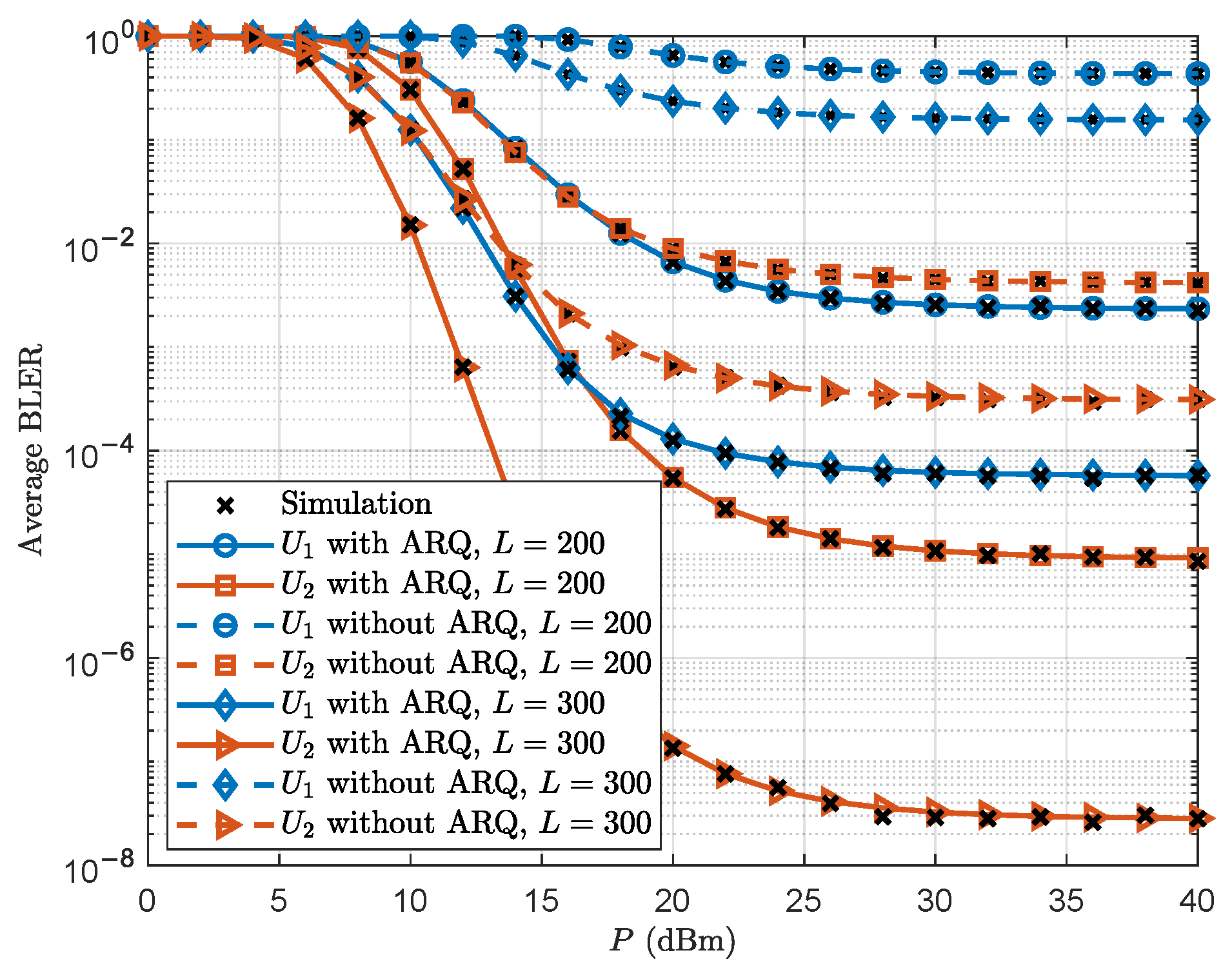
Figure 2 presents the average BLER versus the transmit power P for different L, comparing the proposed ARQ-assisted scheme with the conventional non-ARQ scheme. First, the close match between simulation data and theoretical curves serves as strong evidence for the accuracy of the derived analytical expressions. Second, the average BLER for both near and far users declines significantly with increasing transmit power P under both ARQ and non-ARQ schemes when P is relatively low. Beyond a certain point, however, the average BLER approaches a floor, indicating that further increases in power yield diminishing returns in performance improvement. Most notably, the proposed ARQ-assisted scheme consistently demonstrates significantly improved reliability compared to the benchmark non-ARQ strategy.
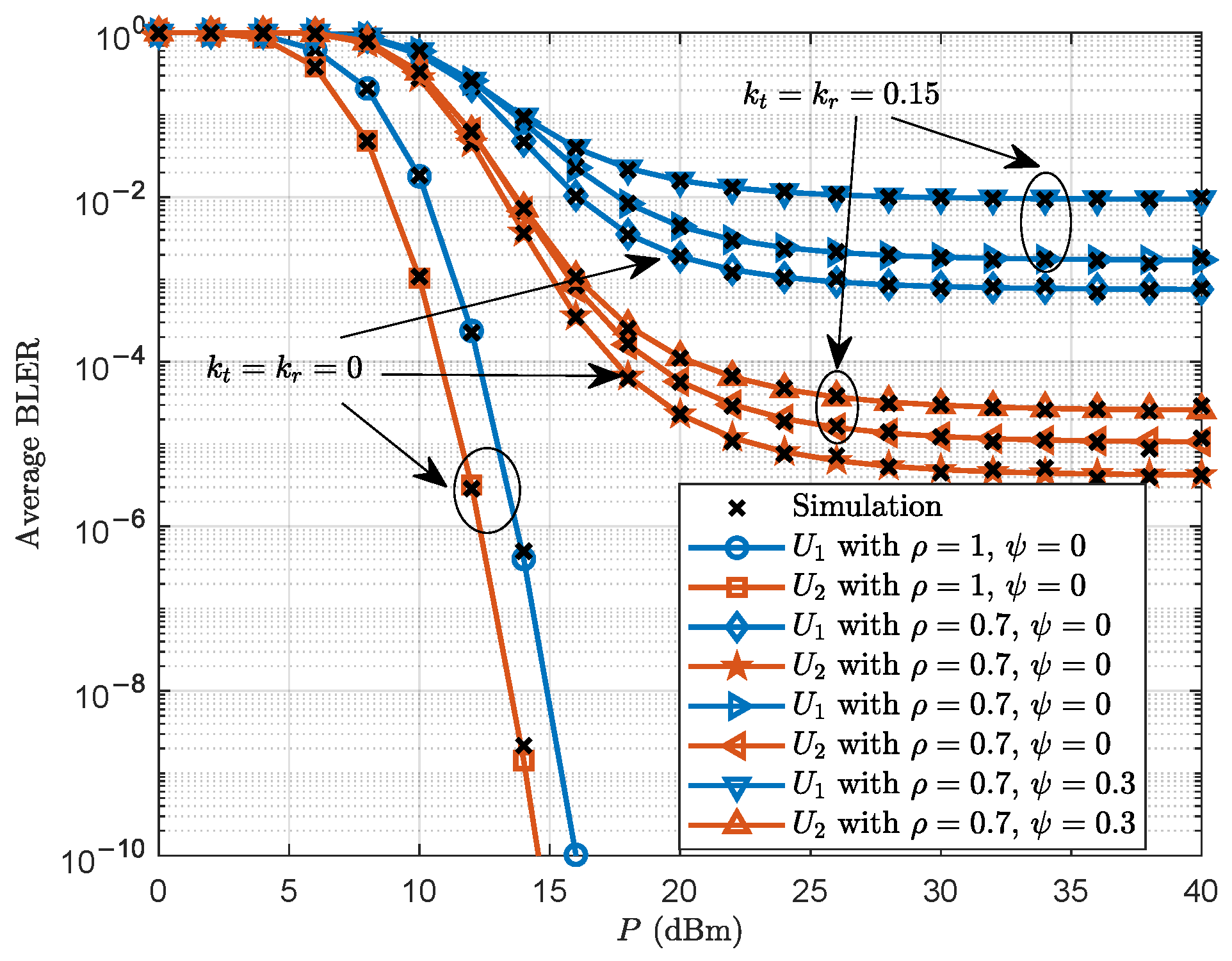
Figure 3 shows the average BLER versus the transmit power P under the proposed ARQ-assisted scheme, considering various non-ideal factors. When ρ = 1 , ψ = 0 , and k t = k r = 0 , it indicates that there are no channel estimation errors, no residual interference cancellation signals, and no hardware impairments. In this case, the average BLER is minimized and no error floor is observed at high transmit powers. Consequently, the emergence of such an error floor under practical conditions is directly attributable to these non-ideal factors, indicating that merely increasing transmit power cannot overcome the performance ceiling they impose. These ideal conditions establish a crucial theoretical performance baseline for the system, serving as a benchmark against which practical implementations can assess the extent of performance degradation. In the presence of non-idealities, such as imperfect interference cancellation, channel estimation errors, and hardware impairments, the average BLER increases relative to this ideal reference.
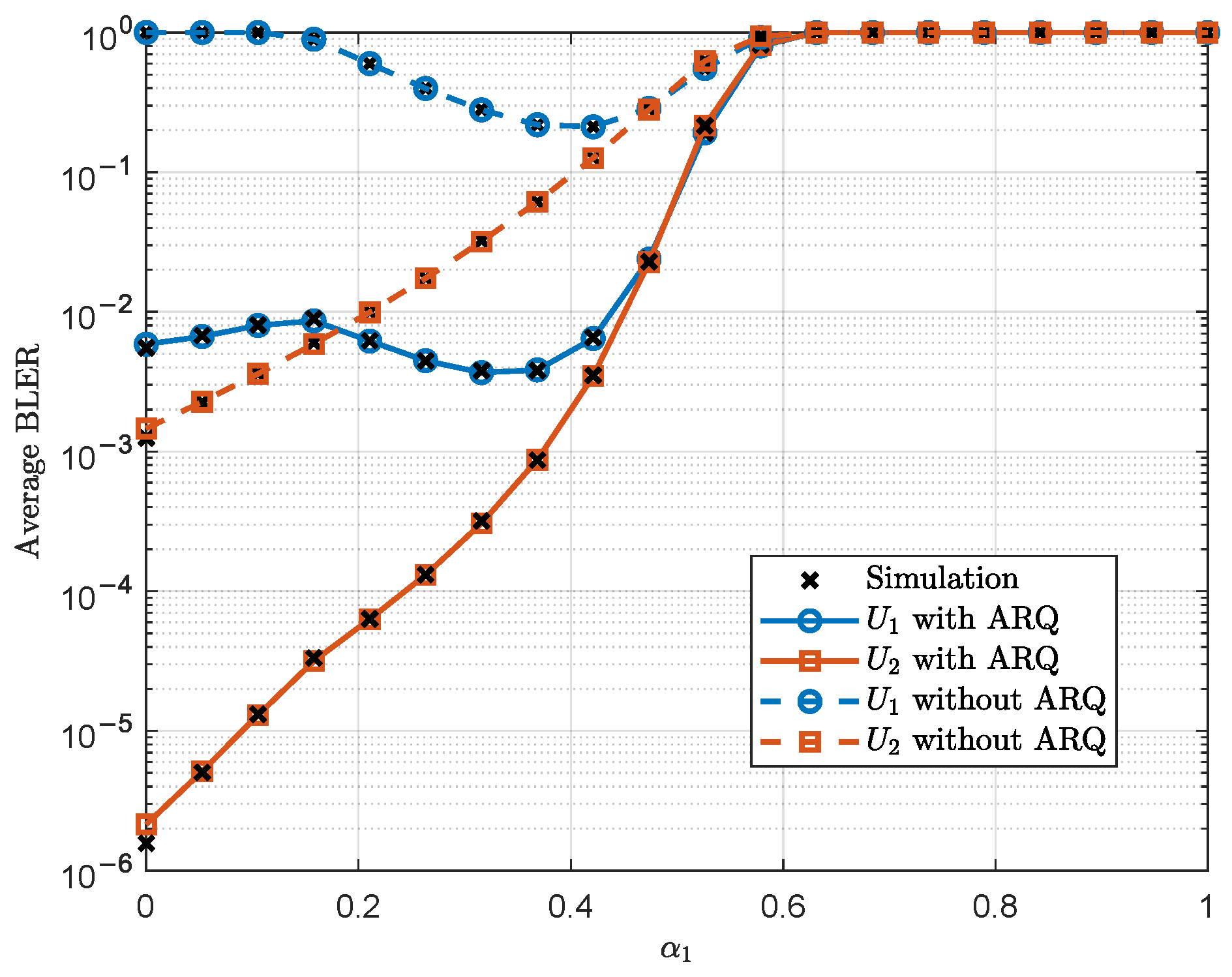
Figure 4 illustrates the average BLER versus the power allocation factor α 1 for both ARQ-assisted and non-ARQ schemes. For the far user, the average BLER increases with α 1 under both schemes. This trend occurs because a higher α 1 reduces the power allocated to the far user, lowering its received SINR and consequently raising the BLER. While this effect is observed in both schemes, the average BLER is consistently higher in the non-ARQ scheme, demonstrating the robustness of the proposed ARQ-assisted mechanism against unfavorable power allocation for the far user. For the near user under the non-ARQ scheme, the average BLER first decreases as a larger α 1 enhances its own signal power, but subsequently increases when α 1 grows too large, as the far user’s diminished power degrades SIC. Under the ARQ scheme, however, the near user’s average BLER follows a more complex trajectory: it initially rises, then falls, and rises again. At very small α 1 , a slight increase shifts retransmissions from OMA to NOMA mode, temporarily elevating the BLER. Further increases in α 1 then improve U 1 ’s own decoding sufficiently to reduce BLER. Finally, when α 1 becomes excessively large, imperfections such as ipSIC dominate, causing BLER to rise once more.
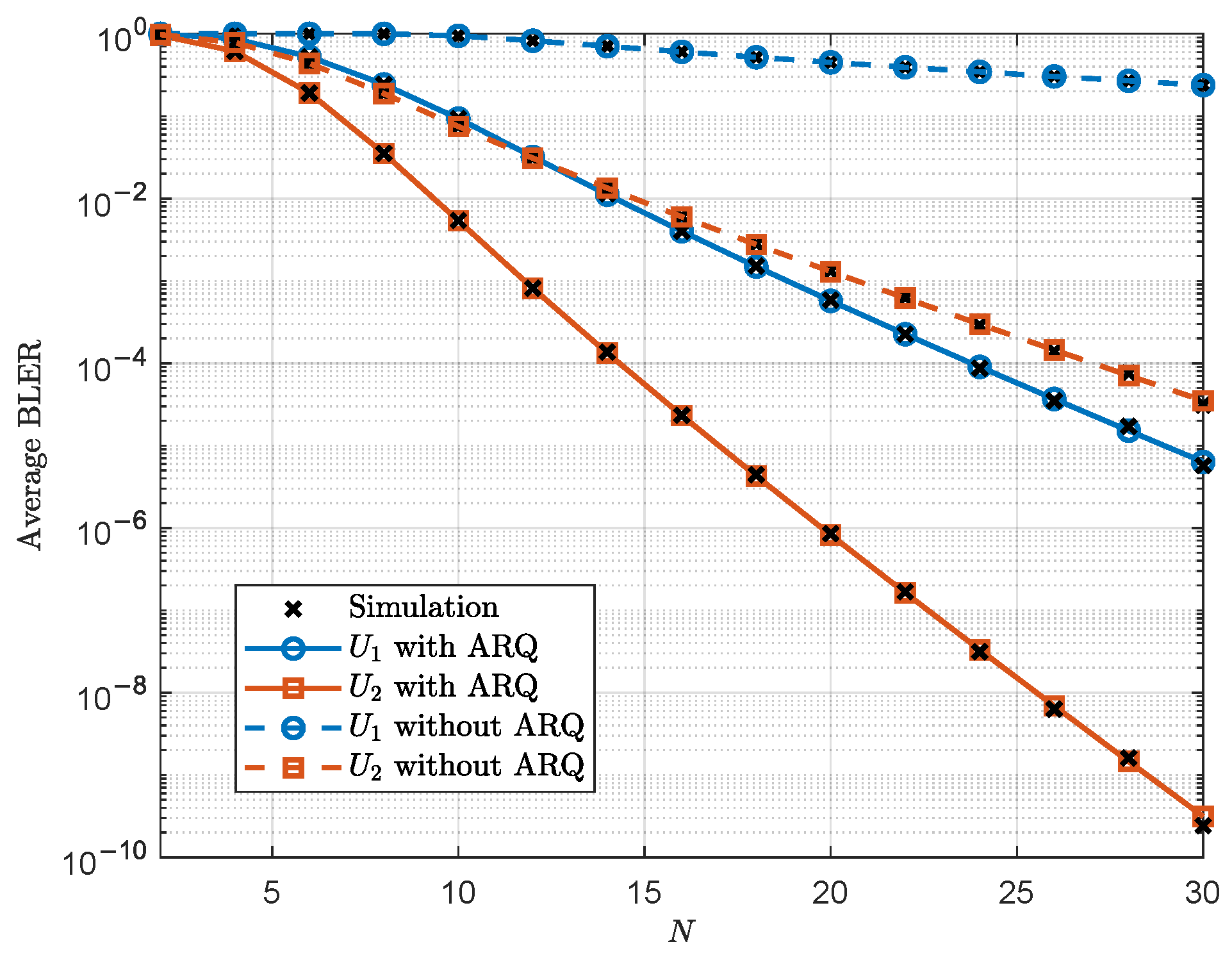
Figure 5 plots the average BLER versus the number of STAR-RIS elements N for both ARQ-assisted and non-ARQ schemes. The results show that the average BLER for both users decreases as N increases under both schemes. This improvement occurs because a larger N significantly enhances the SINR for each user, thereby improving overall system reliability. Furthermore, due to the diversity gain provided by ARQ, the ARQ-assisted scheme exhibits a steeper decline in BLER as N increases. This indicates a synergistic effect between ARQ and STAR-RIS in enhancing reliability. ARQ effectively amplifies the array gain benefits of the STAR-RIS, especially when the number of elements is limited. Consequently, ARQ serves as a complementary and cost-effective mechanism for achieving ultra-high reliability in STAR-RIS-aided systems.
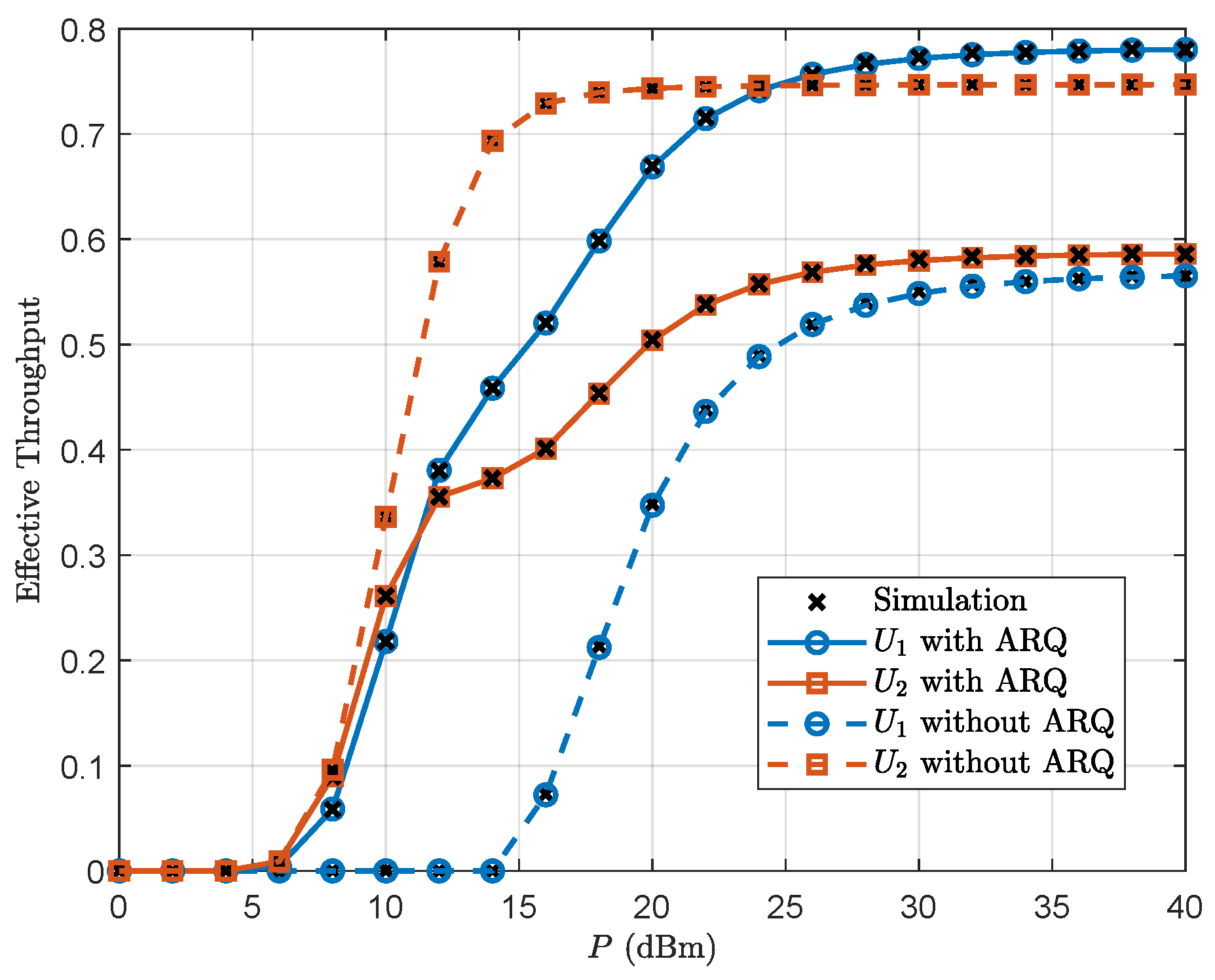
Figure 6 depicts the effective throughput versus the transmit power P, comparing ARQ-assisted and non-ARQ schemes. The effective throughput generally increases with P, indicating that higher transmit power enhances spectral efficiency. However, due to the fixed information bit and blocklength requirements, further increasing P yields diminishing returns and cannot improve throughput indefinitely. In the low-power region, the far user achieves a greater effective throughput than the near user, because the power allocation scheme inherent to NOMA assigns a lower portion of the total power to the near user, thereby constraining its performance. Conversely, in the high-power region, the near user benefits from its superior channel conditions and attains higher throughput than the far user. Finally, the ARQ-assisted scheme provides a more pronounced throughput gain for the near user. This is attributable to the near user’s higher first-attempt BLER, which stems from its more complex SIC process. In contrast, the far user, which decodes its signal directly without SIC, experiences a lower initial BLER and thus benefits less from retransmissions. ARQ effectively mitigates the near user’s inherent reliability limitation by allowing packet retransmission, thereby converting its higher error probability into a substantial gain in effective throughput.
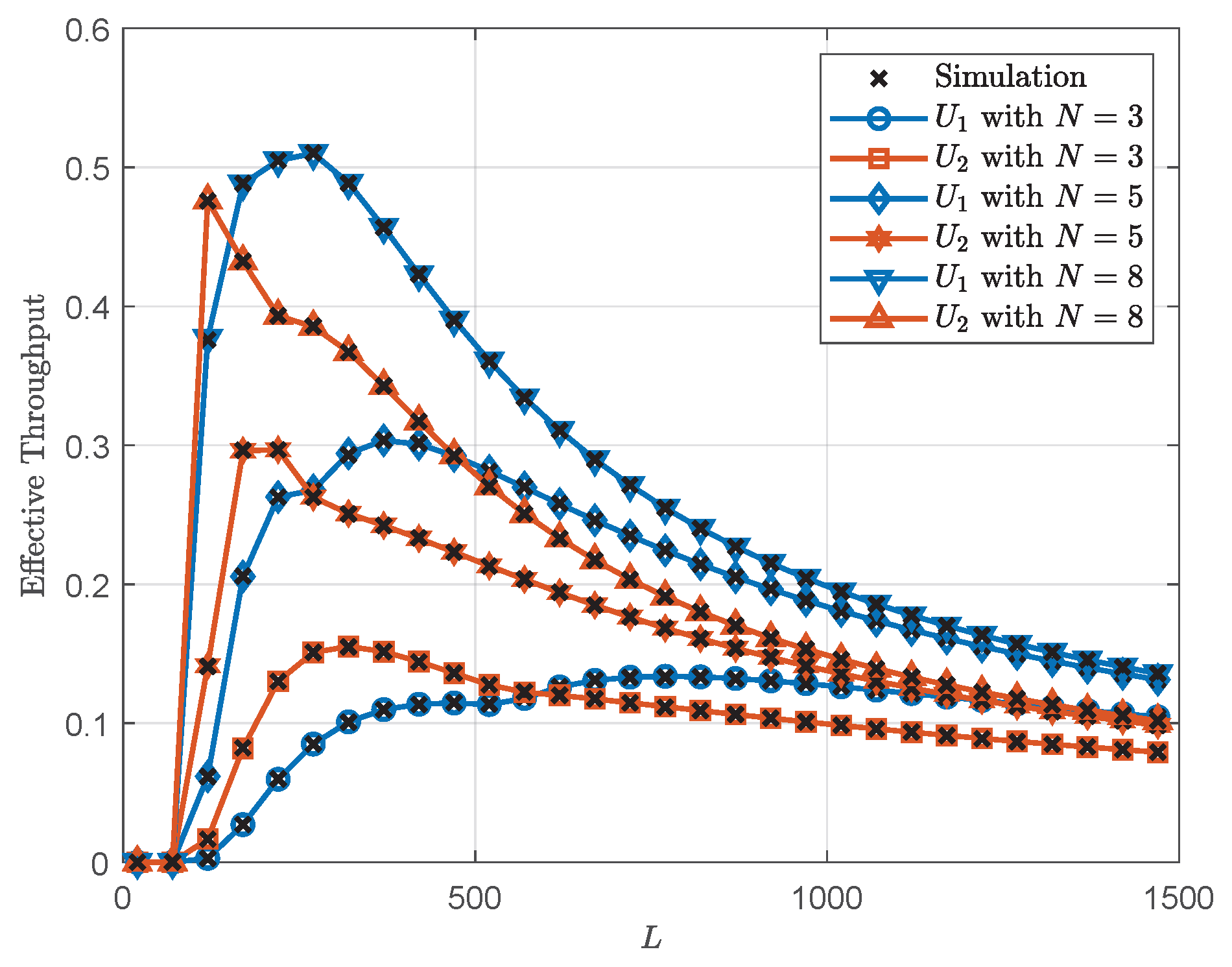
Figure 7 illustrates the effective throughput versus the blocklength L under the proposed ARQ-assisted scheme with ρ = 0.8 . The effective throughput for both users initially increases with L, reaches a peak, and then declines. This behavior results from a trade-off between spectral efficiency and reliability. As shown in Figure 2, a longer blocklength enhances transmission reliability, which initially improves throughput. However, given a predetermined number of information bits, increasing L reduces the coding rate, thereby lowering spectral efficiency. Beyond the optimal blocklength, the penalty from the reduced rate outweighs the benefit from improved reliability, leading to a net decrease in effective throughput. Moreover, the optimal blocklength decreases as the number of elements on the STAR-RIS increases. This occurs because a larger STAR-RIS array enhances the maximal achievable rate by improving the channel conditions. This improvement reduces the need for long blocklengths to ensure a given level of reliability, allowing the system to operate efficiently with shorter blocklengths and thereby achieve higher spectral efficiency.

5. Conclusions

In this study, we integrated the ARQ protocol to improve the reliability of short-packet communications within a NOMA system supported by a STAR-RIS. This configuration enables two NOMA users, located on opposite sides of the STAR-RIS, to share the same non-orthogonal resources. We further developed closed-form analytical expressions characterizing both the average BLER and the effective throughput for each user, taking into account hardware impairments along with ipSIC and ipCSI. Analytical results indicated that the ARQ scheme yields significant reliability gains and exhibits synergistic performance with the STAR-RIS. Furthermore, the effective throughput reaches a peak at an optimal blocklength, balancing the reliability improvement of a longer blocklength against the spectral efficiency loss from a lower coding rate. This optimal blocklength decreases as the quantity of elements on the STAR-RIS increases, as improved channel conditions reduce the need for long blocklengths. The current framework was studied under the assumption of a static link configuration and a fixed ARQ strategy, which may lead to suboptimal reliability. Future work will focus on designing adaptive transmission schemes that intelligently coordinate the STAR-RIS configuration with physical-layer parameters (e.g., blocklength and power allocation) to leverage the full potential of ARQ under imperfect channel knowledge.
From a system-level perspective, the proposed STAR-RIS-assisted ARQ-NOMA framework also exhibits favorable scalability. At the node level, increasing the number of STAR-RIS elements enhances system reliability without significantly raising processing complexity. In terms of signaling, the adopted ARQ mechanism introduces negligible control overhead, consisting only of ACK/NACK feedback. Furthermore, this framework aligns well with key 6G paradigms: STAR-RIS acts as a coverage-enabling technology, NOMA supports massive connectivity, and the adopted ARQ mechanism provides a foundation that can be naturally upgraded to hybrid ARQ (HARQ) and further integrated with adaptive modulation and coding (AMC) for enhanced cross-layer synergy.

Author Contributions

Formal analysis, Z.W., J.L., S.Z. and D.C.; writing—original draft preparation, Z.W., J.L., S.Z. and D.C.; writing—review and editing, Z.W., J.L., S.Z. and D.C.; supervision, S.Z. and D.C. All authors have read and agreed to the published version of the manuscript.

Funding

This work was supported in part by the Natural Science Foundation of Henan under Grant 252300421813, in part by the Young Backbone Teachers of Nanyang Normal University under Grant 2023-QNGG-7, and in part by the Scientific Research Foundation of Nanyang Normal University under Grant 2025STP001.

Data Availability Statement

The data that support the findings of this study are available from the corresponding author upon reasonable request.

Conflicts of Interest

The authors declare no conflicts of interest.

Appendix A

According to (4), E ε 1 , 2 1 can be derived as
E ε 1 , 2 1 = 0 ϑ γ 1 , 2 1 f γ 1 , 2 1 x d x ,
where ϑ γ 1 , 2 1 = 1 , γ 1 , 2 1 A 2 , 1 2 g 2 L γ 1 , 2 1 h 2 , A 2 < γ 1 , 2 1 < B 2 , 0 , γ 1 , 2 1 B 2 , represents an approximation of the instantaneous BLER and f γ 1 , 2 1 x represents the PDF of γ 1 , 2 1 . From (30), the determination of the closed-form expression for E ε 1 , 2 1 requires the consideration of three specific cases.
Case 1: When α 2 α 1 + k t r A 2 , we have E ε 1 , 2 1 = 1 .
Case 2: When A 2 < α 2 α 1 + k t r < B 2 , E ε 1 , 2 1 can be expressed as
E ε 1 , 2 1 = 0 A 2 f γ 1 , 2 1 x d x + A 2 α 2 α 1 + k t r 1 2 g 2 L x h 2 f γ 1 , 2 1 x d x = b 1 2 g 2 L α 2 α 1 + k t r h 2 + g 2 L A 2 α 2 α 1 + k t r F γ 1 , 2 1 x d x c 1 2 g 2 L α 2 α 1 + k t r h 2 + t = 1 T g 2 π L 2 T α 2 α 1 + k t r A 2 1 ς t 2 F γ 1 , 2 1 ν 1 ,
where step b results from the application of partial integration, and step c is evaluated using the Gaussian-Chebyshev quadrature method.
Case 3: When B 2 < α 2 α 1 + k t r , the analytical methodology analogous to that used in Case 2 can be applied, allowing E ε 1 , 2 1 to be formulated as
E ε 1 , 2 1 = g 2 L A 2 B 2 F γ 1 , 2 1 x d x t = 1 T π 2 T 1 ς t 2 F γ 1 , 2 1 ν 2 .
Integrating the results from the three previously discussed scenarios provides the final closed-form expression for E ε 1 , 2 1 , which is given by Equation (34).

References

  1. Adhikari, M.; Hazra, A. 6G-Enabled Ultra-Reliable Low-Latency Communication in Edge Networks. IEEE Commun. Stand. Mag. 2022, 6, 67–74. [Google Scholar] [CrossRef]
  2. Wang, C.X.; You, X.; Gao, X.; Zhu, X.; Li, Z.; Zhang, C.; Wang, H.; Huang, Y.; Chen, Y.; Haas, H.; et al. On the Road to 6G: Visions, Requirements, Key Technologies, and Testbeds. IEEE Commun. Surv. Tutor. 2023, 25, 905–974. [Google Scholar] [CrossRef]
  3. Ma, R.; Yang, W.; Guan, X.; Lu, X.; Song, Y.; Chen, D. Covert mmWave Communications with Finite Blocklength Against Spatially Random Wardens. IEEE Internet Things J. 2024, 11, 3402–3416. [Google Scholar] [CrossRef]
  4. Yue, C.; Miloslavskaya, V.; Shirvanimoghaddam, M.; Vucetic, B.; Li, Y. Efficient Decoders for Short Block Length Codes in 6G URLLC. IEEE Commun. Mag. 2023, 61, 84–90. [Google Scholar] [CrossRef]
  5. Xia, C.; Xiang, Z.; Meng, J.; Liu, H.; Pan, G. Reliable Transmission of Short Packets in Cognitive Radio Inspired NOMA Network. IEEE Syst. J. 2023, 17, 6148–6158. [Google Scholar] [CrossRef]
  6. Zhang, Y.; Guan, X.; Ding, G.; Yang, W.; Yu, B.; Zhang, R.; Wu, W.; Cai, Y. Optimizing Age of Information for IRS-Assisted NOMA-Based Short Packet Communication Systems. IEEE Trans. Cogn. Commun. Netw. 2026, 12, 43–55. [Google Scholar] [CrossRef]
  7. Li, X.; Wang, Q.; Zeng, M.; Liu, Y.; Dang, S.; Tsiftsis, T.A.; Dobre, O.A. Physical-Layer Authentication for Ambient Backscatter-Aided NOMA Symbiotic Systems. IEEE Trans. Commun. 2023, 71, 2288–2303. [Google Scholar]
  8. Xiang, Z.; Yang, W.; Cai, Y.; Ding, Z.; Song, Y.; Zou, Y. NOMA-Assisted Secure Short-Packet Communications in IoT. IEEE Wirel. Commun. 2020, 27, 8–15. [Google Scholar] [CrossRef]
  9. Xia, C.; Xiang, Z.; Meng, J.; Liu, H.; Pan, G. NOMA-Assisted Cognitive Short-Packet Communication with Node Mobility and Imperfect Channel Estimation. IEEE Trans. Veh. Technol. 2023, 72, 12276–12287. [Google Scholar]
  10. Lou, Y.; Zou, Y.; Wang, H.; Zhai, L.; Li, Y. Joint Phase Shifts and Blocklength Resources Optimization in RIS-Assisted NOMA Short-Packet Systems. IEEE Trans. Veh. Technol. 2024, 73, 12132–12136. [Google Scholar]
  11. Liu, Y.; Zhang, S.; Mu, X.; Ding, Z.; Schober, R.; Al-Dhahir, N.; Hossain, E.; Shen, X. Evolution of NOMA Toward Next Generation Multiple Access (NGMA) for 6G. IEEE J. Sel. Areas Commun. 2022, 40, 1037–1071. [Google Scholar] [CrossRef]
  12. Cheng, Y.; Li, K.H.; Liu, Y.; Teh, K.C.; Poor, H.V. Downlink and Uplink Intelligent Reflecting Surface Aided Networks: NOMA and OMA. IEEE Trans. Wirel. Commun. 2021, 20, 3988–4000. [Google Scholar] [CrossRef]
  13. Fu, M.; Zhou, Y.; Shi, Y.; Letaief, K.B. Reconfigurable Intelligent Surface Empowered Downlink Non-Orthogonal Multiple Access. IEEE Trans. Commun. 2021, 69, 3802–3817. [Google Scholar] [CrossRef]
  14. Gao, X.; Li, X.; Han, C.; Zeng, M.; Liu, H.; Mumtaz, S.; Nallanathan, A. Rate-Splitting Multiple Access-Based Cognitive Radio Network with ipSIC and CEEs. IEEE Trans. Veh. Technol. 2024, 73, 1430–1434. [Google Scholar] [CrossRef]
  15. Li, Q.; Li, H.; Hao, S.; Li, L.; Dai, X. Impact of RHIs and ipSIC on Active RIS-NOMA Systems with Low-Precision ADCs. IEEE Commun. Lett. 2025, 29, 2376–2380. [Google Scholar]
  16. Li, X.; Liu, M.; Dang, S.; Luong, N.C.; Yuen, C.; Nallanathan, A.; Niyato, D. Covert Communications with Enhanced Physical Layer Security in RIS-Assisted Cooperative Networks. IEEE Trans. Wirel. Commun. 2025, 24, 5605–5619. [Google Scholar] [CrossRef]
  17. Mu, X.; Liu, Y.; Guo, L.; Lin, J.; Schober, R. Simultaneously Transmitting and Reflecting (STAR) RIS Aided Wireless Communications. IEEE Trans. Wirel. Commun. 2022, 21, 3083–3098. [Google Scholar] [CrossRef]
  18. Li, X.; Zhao, J.; Chen, G.; Hao, W.; Da Costa, D.B.; Nallanathan, A.; Shin, H.; Yuen, C. STAR-RIS-Assisted Covert Wireless Communications with Randomly Distributed Blockages. IEEE Trans. Wirel. Commun. 2025, 24, 4690–4705. [Google Scholar] [CrossRef]
  19. Vu, T.; Nguyen, T.; Pham, Q.; da Costa, D.B.; Kim, S. STAR-RIS-Enabled Short-Packet NOMA Systems. IEEE Trans. Veh. Technol. 2023, 72, 13764–13769. [Google Scholar] [CrossRef]
  20. Le, T.H.T.; Dien, N.V.; Nguyen, L.V.; Nguyen, T.-H.; Lee, O.-J. Transmission Power Optimization for Hybrid NOMA-URLLC System with STAR-RIS Assistance. IEEE Access 2025, 13, 50216–50225. [Google Scholar] [CrossRef]
  21. Perdana, R.H.Y.; Nguyen, T.-V.; Pramitarini, Y.; Nguyen, D.H.N.; An, B. Enhancing Spectral Efficiency of Short-Packet Communications in STAR-RIS-Assisted SWIPT MIMO-NOMA Systems with Deep Learning. IEEE Trans. Wirel. Commun. 2025, 24, 842–859. [Google Scholar] [CrossRef]
  22. Karim, F.; Singh, S.K.; Singh, K.; Prakriya, S.; Flanagan, M.F. On the Performance of STAR-RIS-Aided NOMA at Finite Blocklength. IEEE Wirel. Commun. Lett. 2023, 12, 868–872. [Google Scholar] [CrossRef]
  23. Vu, T.; Nguyen, K.; da Costa, D.B.; Shin, H.; Kim, S. Aerial STAR-RIS-Based Symbiotic Systems with Semi-NOMA Transmission: Performance Analysis and Optimization. IEEE Internet Things J. 2025, 12, 38043–38058. [Google Scholar] [CrossRef]
  24. Katwe, M.V.; Deshpande, R.; Singh, K.; Pan, C.; Ghare, P.H.; Duong, T.Q. Spectrally-Efficient Beamforming Design for STAR-RIS-Aided URLLC NOMA Systems. IEEE Trans. Commun. 2024, 72, 4414–4431. [Google Scholar] [CrossRef]
  25. Kumar, S.; Kumbhani, B.; Darshi, S. Performance Analysis of STAR-RIS Aided Short-Packet NOMA Network Under Imperfect SIC and CSI. IEEE Syst. J. 2025, 19, 600–611. [Google Scholar] [CrossRef]
  26. Li, X.; Li, J.; Liu, Y.; Ding, Z.; Nallanathan, A. Residual Transceiver Hardware Impairments on Cooperative NOMA Networks. IEEE Trans. Wirel. Commun. 2020, 19, 680–695. [Google Scholar]
  27. Li, Q.; El-Hajjar, M.; Sun, Y.; Hemadeh, I.; Shojaeifard, A.; Liu, Y.; Hanzo, L. Achievable Rate Analysis of the STAR-RIS-Aided NOMA Uplink in the Face of Imperfect CSI and Hardware Impairments. IEEE Trans. Commun. 2023, 71, 6100–6114. [Google Scholar]
  28. Li, X.; Zhao, M.; Zeng, M.; Mumtaz, S.; Menon, V.G.; Ding, Z.; Dobre, O.A. Hardware Impaired Ambient Backscatter NOMA Systems: Reliability and Security. IEEE Trans. Commun. 2021, 69, 2723–2736. [Google Scholar] [CrossRef]
  29. Xia, C.; Xiang, Z.; Su, B.; Liu, H.; Meng, J.; Pan, G. RIS-NOMA-Assisted Short-Packet Communication with Hardware Impairments. IEEE Internet Things J. 2024, 11, 2990–3002. [Google Scholar] [CrossRef]
  30. Ren, Y.; Wang, J.; Zhang, X.; Lv, T.; Lin, S.; Lu, G. RIS-Assisted Short-Packet NOMA Systems with Discrete Phase Shifts and Hardware Impairments. IEEE Internet Things J. 2025, 12, 50213–50231. [Google Scholar] [CrossRef]
  31. Kumar, S.; Kumbhani, B. Performance Analysis of Active STAR-RIS-Assisted NOMA with Hardware Impairments at Finite Blocklength. Digit. Signal Process. 2025, 105206. [Google Scholar] [CrossRef]
  32. Xiang, Z.; Yang, W.; Cai, Y.; Ding, Z.; Song, Y. Secure Transmission Design in HARQ Assisted Cognitive NOMA Networks. IEEE Trans. Inf. Forensics Secur. 2020, 15, 2528–2541. [Google Scholar] [CrossRef]
  33. Sarkar, D.; Yadav, S.S.; Pal, V.; Yogita; Kumar, N. Intelligent Reflecting Surface Aided NOMA-HARQ Based IoT Framework for Future Wireless Networks. IEEE Trans. Veh. Technol. 2023, 72, 6268–6280. [Google Scholar] [CrossRef]
  34. Liu, Y.; Clerckx, B.; Popovski, P. Performance Analysis of Uplink Rate-Splitting Multiple Access with Hybrid ARQ. IEEE Trans. Wirel. Commun. 2024, 23, 14201–14214. [Google Scholar] [CrossRef]
  35. Gao, J.; Fan, P.; Li, L. Optimized Polarizing Matrix Extension Based HARQ Scheme for Short Packet Transmission. IEEE Commun. Lett. 2020, 24, 951–955. [Google Scholar] [CrossRef]
  36. Shi, Z.; Chen, Y.; Wang, H.; Fu, Y.; Yang, G.; Lei, H.; Ma, S. BLER Analysis of HARQ-IR-Aided Short Packet Communications Over Correlated Fading Channels. In Proceedings of the 2024 IEEE Wireless Communications and Networking Conference (WCNC), Dubai, United Arab Emirates, 21–24 April 2024. [Google Scholar]
  37. Cao, F.; Song, Y.; Yang, Y. ARQ Assisted Short-Packet Communications for NOMA Networks Over Nakagami-m Fading Channels. IEEE Access 2020, 8, 158263–158272. [Google Scholar] [CrossRef]
  38. Ebrahimi, M.M.; Khamforoosh, K.; Amini, M.; Sheikhahmadi, A.; Khamfroush, H. Adaptive-Persistent Nonorthogonal Random Access Scheme for URLL Massive IoT Networks. IEEE Syst. J. 2023, 17, 1660–1671. [Google Scholar] [CrossRef]
  39. Asemian, G.; Amini, M.; Kantarci, B. Active RIS-NOMA Uplink in URLLC, Jamming Mitigation via Surrogate and Deep Learning. IEEE Open J. Commun. Soc. 2025, 6, 690–707. [Google Scholar] [CrossRef]
  40. Yang, P.; Yang, L.; Wang, S. Performance Analysis for RIS-Aided Wireless Systems with Imperfect CSI. IEEE Wirel. Commun. Lett. 2022, 11, 588–592. [Google Scholar] [CrossRef]
  41. Zhang, Y.; Yang, L.; Li, X.; Guo, K.; Liu, H.; Bian, Y. STAR-RIS-Assisted IoV NOMA Networks with Hardware Impairments and Imperfect CSI. IEEE Trans. Intell. Transp. Syst. 2024, 25, 13501–13510. [Google Scholar] [CrossRef]
  42. Polyanskiy, Y.; Poor, H.V.; Verdu, S. Channel Coding Rate in the Finite Blocklength Regime. IEEE Trans. Inf. Theory 2010, 56, 2307–2359. [Google Scholar] [CrossRef]
  43. Boulogeorgos, A.; Alexiou, A. Performance Analysis of Reconfigurable Intelligent Surface-Assisted Wireless Systems and Comparison with Relaying. IEEE Access 2020, 8, 94463–94483. [Google Scholar] [CrossRef]
  44. Gradshteyn, I.S.; Ryzhik, I.M. Table of Integrals, Series, and Products, 7th ed.; Academic: New York, NY, USA, 2007. [Google Scholar]
Figure 1. System model.
Telecom 07 00025 g001
Figure 2. Average BLER versus the transmit power P for different L.
Telecom 07 00025 g002
Figure 3. Average BLER versus the transmit power P for different non-ideal factors.
Telecom 07 00025 g003
Figure 4. Average BLER versus the power allocation factor α 1 .
Telecom 07 00025 g004
Figure 5. Average BLER versus the number of STAR-RIS elements N.
Telecom 07 00025 g005
Figure 6. Effective throughput versus the transmit power P.
Telecom 07 00025 g006
Figure 7. Effective throughput versus the blocklength L.
Telecom 07 00025 g007
Table 1. Table of retransmission cases.
Cases U 1 U 2 Retransmitted SignalsSTAR-RIS Working Modes
1NACKNACK α 1 P x 1 + α 2 P x 2 ES
2ACKNACK P x 2 Full refraction mode
3NACKACK P x 1 Full reflection mode
4ACKACKNullNull
Table 2. Coefficients of SINR Expressions.
Corresponding SINR Θ Φ Ψ Ω
1 γ 1 , 2 1 α 2 λ β 1 ρ 2 λ β 1 ρ 2 α 1 + k t r λ β 1 1 + k t r 1 ρ 2 d s r τ d r 1 τ
2 γ 1 , 1 1 α 1 λ β 1 ρ 2 λ β 1 ρ 2 ψ α 2 + k t r λ β 1 ( 1 + k t r ) ( 1 ρ 2 ) d s r τ d r 1 τ
3 γ 2 , 2 1 α 2 λ β 2 ρ 2 λ β 2 ρ 2 ( α 1 + k t r ) λ β 2 ( 1 + k t r ) ( 1 ρ 2 ) d s r τ d r 2 τ
4 γ 1 , 2 2 , 1 α 2 λ β 1 ρ 2 λ β 1 ρ 2 α 1 + k t r λ β 1 ( 1 + k t r ) ( 1 ρ 2 ) d s r τ d r 1 τ
5 γ 1 , 1 2 , 1 α 1 λ β 1 ρ 2 λ β 1 ρ 2 ψ α 2 + k t r λ β 1 ( 1 + k t r ) ( 1 ρ 2 ) d s r τ d r 1 τ
6 γ 1 , 1 2 , 3 λ ρ 2 λ ρ 2 k t r λ 1 + k t r 1 ρ 2 d s r τ d r 1 τ
7 γ 2 , 2 2 , 1 α 2 λ β 2 ρ 2 λ β 2 ρ 2 α 1 + k t r λ β 2 1 + k t r 1 ρ 2 d s r τ d r 2 τ
8 γ 2 , 2 2 , 2 λ ρ 2 λ ρ 2 k t r λ 1 + k t r 1 ρ 2 d s r τ d r 2 τ
Table 3. LIST OF SIMULATION PARAMETERS.
ParameterValue
Blocklength L = 200
Noise power σ 2 = 121  dBm
Transmit power P = 20  dBm
Number of STAR-RIS elements N = 15
Channel correlation coefficient ρ = 0.7
IpSIC factor ψ = 0.1
Complexity accuracy tradeoff parameter M = 300 , T = 50
Level of hardware impairments k t = k r = 0.1
Distance between nodes d s r = 0.5  km, d r 1 = 0.4  km, d r 2 = 0.5  km
Path loss coefficient τ = 2.7
Number of information bits b 1 = 200 , b 2 = 150
Power allocation factors α 1 = 0.2 , α 1 = 0.8
Reflection and refraction coefficients β 1 = 0.5 , β 2 = 0.5
Disclaimer/Publisher’s Note: The statements, opinions and data contained in all publications are solely those of the individual author(s) and contributor(s) and not of MDPI and/or the editor(s). MDPI and/or the editor(s) disclaim responsibility for any injury to people or property resulting from any ideas, methods, instructions or products referred to in the content.