



Harvest-Now, Decrypt-Later: A Temporal Cybersecurity Risk in the Quantum Transition



Abstract
1. Introduction
- 1.
- Formalization of the HNDL adversarial model: We introduce the first formal model of the harvest-now, decrypt-later (HNDL) adversary, specifying its resources, collection capability, deferred decryption power, and temporal horizon, and defining the precise conditions under which confidentiality fails. This establishes a rigorous foundation for analyzing deferred decryption as a cryptographically grounded threat to communication networks.
- 2.
- Sectoral exposure quantification: We characterize confidentiality lifetimes across heterogeneous sectors and show how temporal asymmetry amplifies retrospective compromise. The analysis links data retention, migration latency, and exposure probability to operational parameters in IoT, 5G, satellite, and cloud systems.
- 3.
- Evaluation of layered countermeasures: We assess post-quantum cryptography, hybrid key exchange, forward-secure data life-cycles, and governance frameworks as complementary defenses. The synthesis identifies their respective strengths, limitations, and maturity levels, providing a practical basis for prioritizing migration strategies within communication infrastructures.
2. Related Work
2.1. Quantum Threats to Current Cryptography
2.2. PQC Standardization and Migration Initiatives
2.3. Temporal Security and Long-Term Confidentiality Models
2.4. PQC Implementation, Hybrid Encryption, and Key Management in Practice
2.5. Research Gap and Novelty
3. Threat Model and Temporal Cyberweapon
3.1. Threat Model
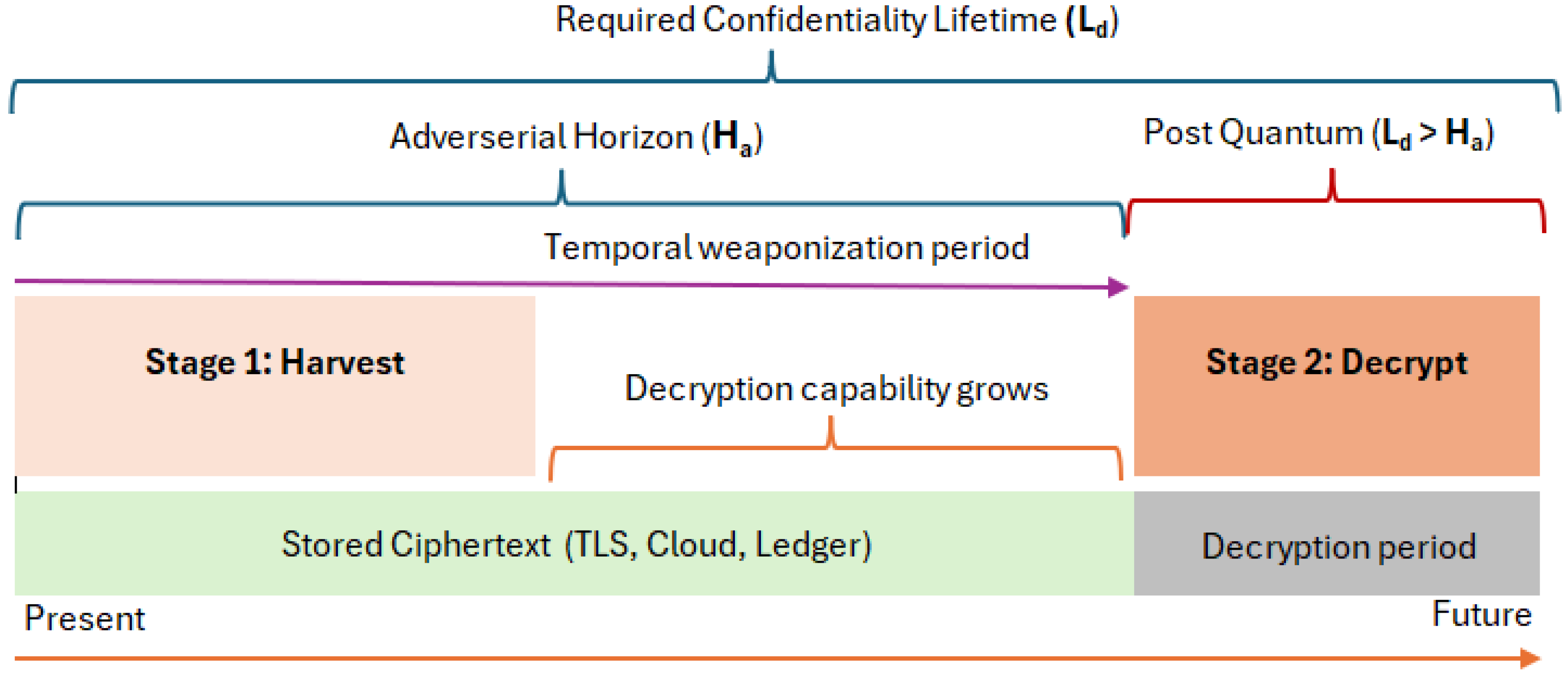
- Collection capability: the capacity to intercept, index, and store ciphertexts at scale using inexpensive and durable storage technologies distributed across terrestrial and cloud infrastructures.
- Decryption capability: latent computational power derived from anticipated advances in quantum algorithms, specialized accelerators, or post-Moore architectures that may render classical encryption obsolete.
- Temporal horizon: strategic patience that allows deferred exploitation over extended periods, bridging the gap between current cryptographic strength and future decryption capability.
3.2. Network-Centric HNDL Adversarial Model
- (a)
- Transit interception: Passive monitoring of TLS/HTTPS sessions, VPN tunnels, and satellite links using deep packet inspection at internet exchange points, submarine cable landing stations, or low-earth-orbit (LEO) satellite interception capabilities.
- (b)
- Log harvesting: Exploitation of persistent network logs maintained by ISPs, cloud providers, and CDNs for regulatory compliance, where encrypted communication metadata and ciphertext blobs are retained for extended periods.
- (c)
- Protocol-specific collection: Targeted interception of control-plane signaling in 5G/6G networks (NAS, RRC protocols), BGP routing updates, DNS-over-HTTPS queries, and blockchain transaction broadcasts, where confidentiality lifetimes extend beyond typical session durations.
- Equation (2)—Risk Function: In network terms, represents the probability that harvested network traffic (TLS sessions, VPN tunnels, satellite telemetry) becomes retrospectively decryptable. For a network operator, this quantifies the risk that archived control-plane signaling or user authentication data will be compromised in the future.
- Equation (4)—RSA Breaking Time: Applied to network security, estimates when RSA keys protecting current TLS/HTTPS deployments become breakable. With (standard TLS key size), network operators can estimate the window during which currently transmitted encrypted traffic remains secure.
- Equation (5)—Symmetric Breaking Time: For network protocols using symmetric encryption (e.g., AES-256 in IPsec, TLS bulk encryption), indicates when session keys protecting archived network logs become vulnerable to Grover-accelerated brute force.
3.3. Confidentiality as a Temporal Vulnerability
4. Sectoral Exposure and Countermeasures
4.1. Sectoral Exposure
4.2. Exposure Classification Methodology
- Low Exposure: Sectors with year (e.g., financial transactions, IoT telemetry) where data lifetime is shorter than or comparable to current cryptographic protection windows. These sectors face minimal HNDL risk because data loses value or is deleted before quantum decryption becomes feasible.
- Medium Exposure: Sectors with years (e.g., corporate IP, cloud archives) where data lifetimes exceed short-term protection but remain within optimistic migration timelines. These sectors face moderate risk requiring proactive PQC adoption but are not immediately critical.
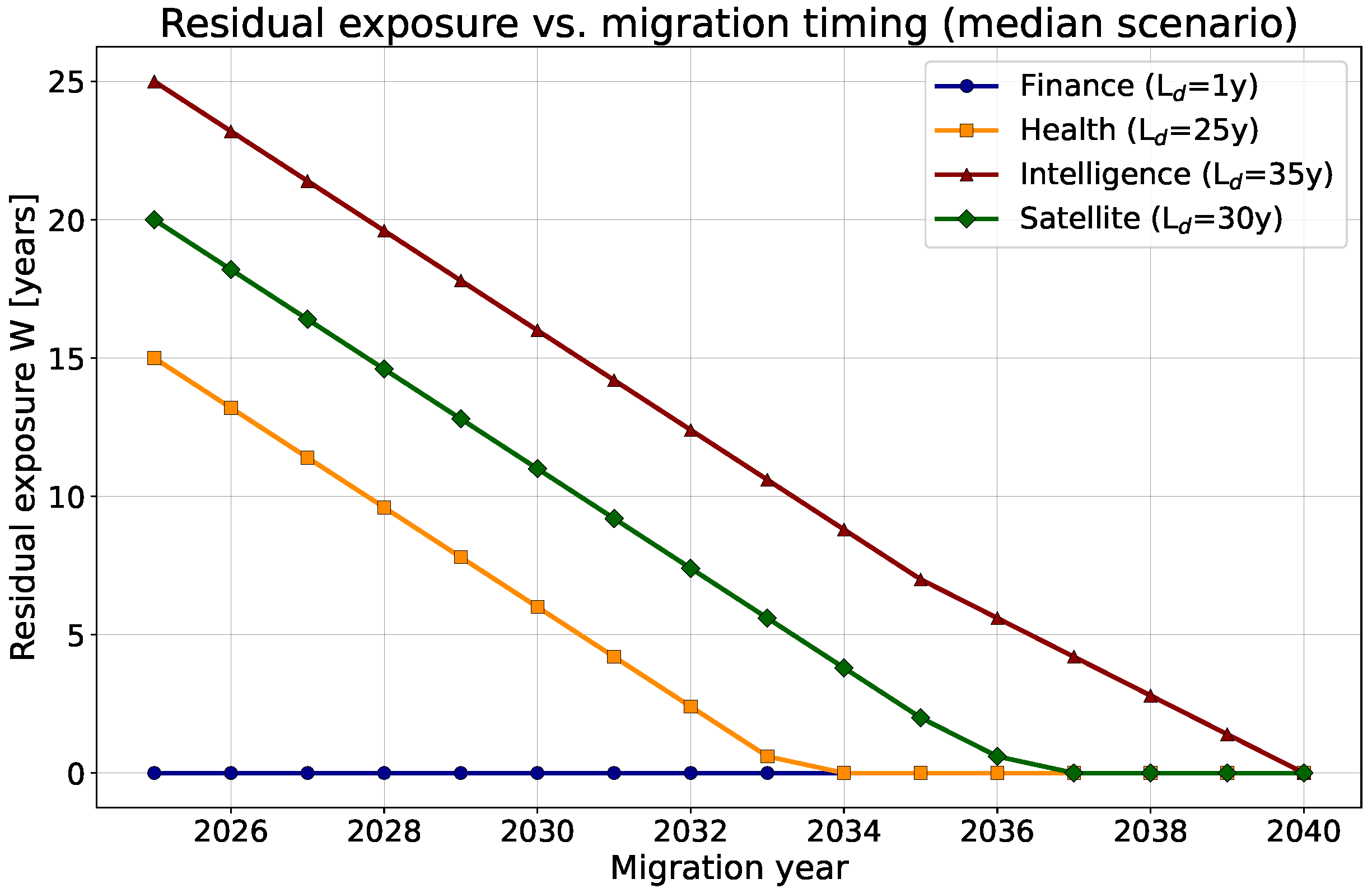
- High Exposure: Sectors with years (e.g., health records, satellite communications, legal records) where data lifetimes significantly exceed projected decryption horizons. These sectors face substantial HNDL risk and require urgent migration planning, with residual exposure windows of 6-11 years under delayed adoption scenarios.
- Critical Exposure: Sectors with years or indefinite retention (e.g., state intelligence, public blockchains) where data lifetimes far exceed any realistic quantum decryption horizon. These sectors face inevitable retrospective compromise without immediate hybrid protection or forward-secure mechanisms, representing the highest priority for PQC migration.
4.3. Evaluation Methodology
- Regulatory Mandates: Health sector lifetimes (10–30 years) align with HIPAA (U.S.) and GDPR requirements mandating retention of medical records for extended periods [34,35]. Financial transaction lifetimes (months–1 year) reflect typical regulatory audit windows (e.g., SOX compliance requires 7-year retention for financial records, but confidentiality requirements for individual transaction details are shorter) [36].
- Industry Standards: Satellite communication lifetimes (10–20 years) are derived from ITU-R recommendations and operational practices in LEO/MEO satellite constellations where telemetry and control data are archived for the operational lifetime of satellites and beyond for forensic analysis [9,37]. Cloud archive lifetimes (5–15 years) reflect standard data retention policies from major providers (AWS, Azure, GCP) for compliance and disaster recovery.
- Operational Analysis: IoT telemetry lifetimes (hours–days) are based on typical edge computing practices where sensor data is aggregated and anonymized within short windows. Intelligence sector lifetimes (30+ years) reflect classified information handling requirements (e.g., U.S. Executive Order 13526 specifies 25-year declassification periods, with extensions for sensitive categories) [38].
- Blockchain Persistence: Public blockchain lifetimes (indefinite) reflect the immutable nature of distributed ledgers, while permissioned blockchain lifetimes (10–30 years) are based on enterprise blockchain retention policies for supply chain and financial applications [39].
- ETSI Quantum-Safe Cryptography Roadmap: European standardization body projects hybrid deployment in 5G networks by 2026–2028 and full PQC integration in 6G specifications (2030+) [24]. This aligns with values used in our sectoral analysis.
4.4. Quantitative Analysis
4.4.1. Parameter Definitions and Calculations
4.4.2. Risk Indicator (R)
4.4.3. Hybrid Risk Reduction ()
4.4.4. Forward-Secure Exposure Cap ()
4.4.5. Key Size Dependence in HNDL Model
4.5. Uncertainty and Model Limitations
4.5.1. Sensitivity Analysis:
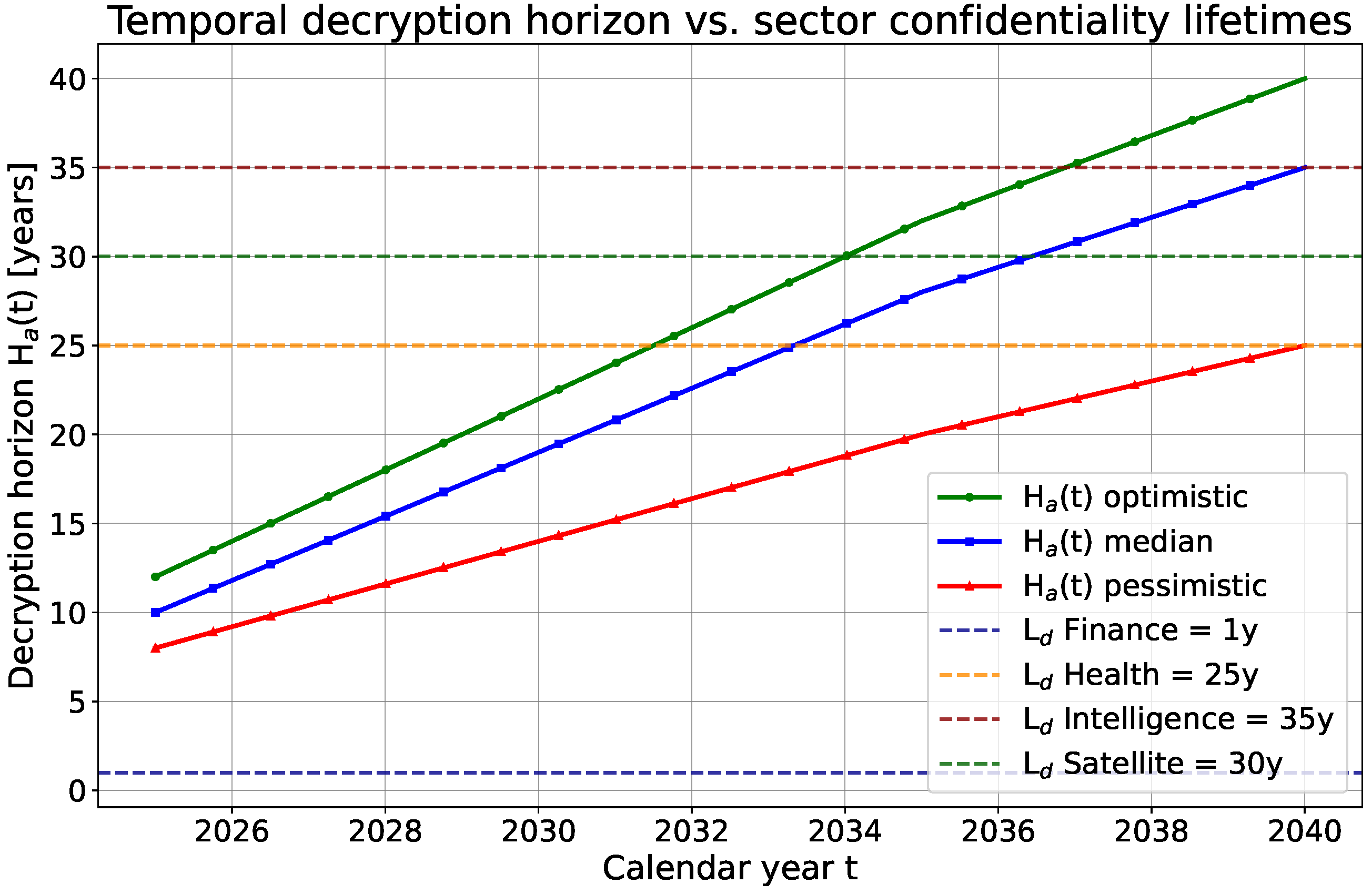
- Health sector ( years): With years, years (increased exposure). With years, year (minimal exposure). This year variation creates a 10-year swing in exposure window.
- Intelligence sector ( years): With years, years (critical exposure). With years, years (high but reduced exposure). The sensitivity is linear: for sectors with .
- Low-lifetime sectors: For Finance ( year), variations in have no impact as long as year, illustrating how short lifetimes naturally mitigate HNDL risk regardless of quantum timeline uncertainty.
4.5.2. Model Scope Limitations:
- Side-channel vulnerabilities: Implementation flaws in current PQC algorithms could accelerate compromise timelines independent of quantum hardware development.
- Key management failures: Inadequate key rotation, weak random number generation, or compromised key storage could enable decryption without quantum capabilities.
- Protocol downgrade attacks: Adversaries forcing use of weaker algorithms (e.g., TLS 1.2 instead of TLS 1.3) could increase harvestable ciphertext vulnerability.
- Hybrid implementation flaws: Incorrect hybrid key exchange implementations might create attack vectors that bypass one protection layer.
4.6. Countermeasures
4.6.1. Assessment of Countermeasures
- (a)
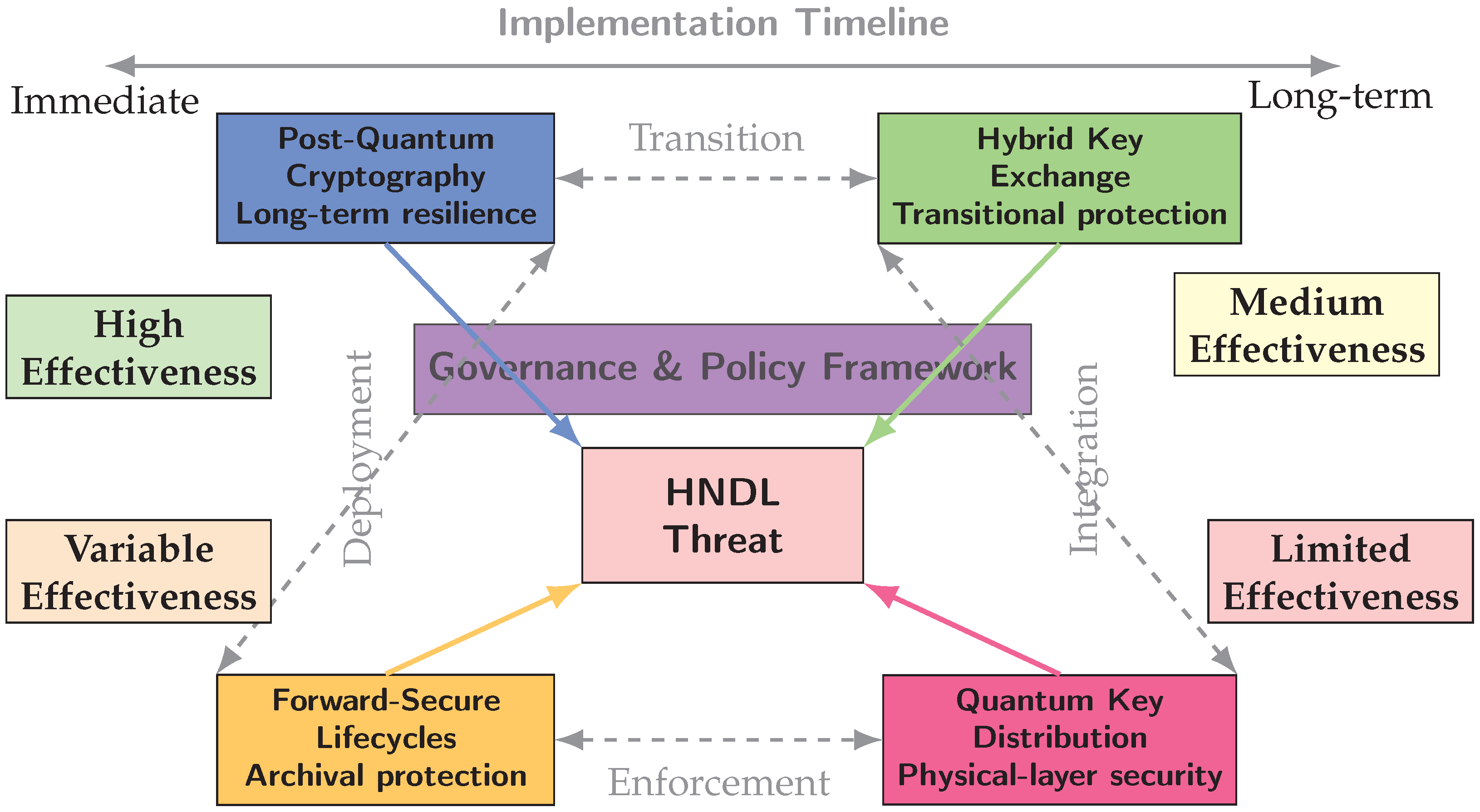
- Post-Quantum Cryptography (PQC): National Institute of Standards and Technology (NIST) is standardizing quantum-resilient algorithms to replace RSA ECC [3]. PQC promises durable protection once deployed, but migration at scale is slow, constrained by legacy compatibility and hardware requirements, leaving a vulnerability window during which harvested ciphertext remains exposed [40].
- (b)
- Hybrid key exchange: To bridge this window, hybrid schemes are being trialed in TLS and VPNs [44]. By combining classical and post-quantum primitives in a single handshake, they provide transitional resilience. Yet they secure only future sessions in transit and do not remediate ciphertext already collected.
- (c)
- Forward-secure lifecycles: Another line of defense targets persistence rather than transit. Rotating keys, ephemeral encryption, and controlled data expiration reduce the long-term value of harvested ciphertext [25]. Such measures limit retrospective compromise but are difficult to enforce in regulated contexts where retention is mandatory.
- (d)
- Governance and policy: Technical measures succeed only if adopted in time. Guidance such as the U.S. NSA CNSA 2.0 sets deadlines for migration [22], while ETSI and the ENISA provide sectoral strategies and highlight operational challenges [4,48]. Global PKI, which anchors TLS, VPNs, and code signing, remains a bottleneck where fragmented adoption risks leaving archives vulnerable for decades. At the same time, Grover’s algorithm shows that symmetric cryptography, though more resilient, also demands doubled key sizes to maintain equivalent margins [13]. The broader challenge is therefore twofold: securing asymmetric infrastructures and refreshing symmetric protocols. Without harmonized international policy, adoption will remain fragmented and long-lived data will remain exposed to deferred decryption.
4.6.2. Complementarity of HNDL Countermeasures
4.7. Discussion
5. Future Work
6. Conclusions
Author Contributions
Funding
Informed Consent Statement
Data Availability Statement
Acknowledgments
Conflicts of Interest
References
- Shor, P.W. Algorithms for Quantum Computation: Discrete Logarithms and Factoring. In Proceedings of the 35th Annual Symposium on Foundations of Computer Science (FOCS ’94), Santa Fe, NM, USA, 20–22 November 1994; pp. 124–134. [Google Scholar] [CrossRef]
- Shor, P.W. Polynomial-time algorithms for prime factorization and discrete logarithms on a quantum computer. SIAM Rev. 1999, 41, 303–332. [Google Scholar] [CrossRef]
- Dustin, M.; Ray, P.; Andrew, R.; Angela, R.; David, C. Transition to Post-Quantum Cryptography Standards; NIST Internal Report (IR) NIST IR 8547 ipd.h; National Institute of Technology and Standards: Gaithersburg, MD, USA, 2024. [Google Scholar] [CrossRef]
- Beullens, W.; D’Anvers, J.P.; Hülsing, A.T.; Lange, T.; Panny, L.; de Saint Guilhem, C.; Smart, N.P. Post-Quantum Cryptography: Current State and Quantum Mitigation; ENISA: Heraklion, Greece, 2021. [Google Scholar] [CrossRef]
- Cheng, A. Interview with Andersen Cheng. 2023. Available online: https://cybermagazine.com/interviews/andersen-cheng (accessed on 20 November 2025).
- Durr-E-Shahwar; Imran, M.; Altamimi, A.B.; Khan, W.; Hussain, S.; Alsaffar, M. Quantum Cryptography for Future Networks Security: A Systematic Review. IEEE Access 2024, 12, 180048–180078. [Google Scholar] [CrossRef]
- Mehic, M.; Michalek, L.; Dervisevic, E.; Burdiak, P.; Plakalovic, M.; Rozhon, J.; Mahovac, N.; Richter, F.; Kaljic, E.; Lauterbach, F.; et al. Quantum Cryptography in 5G Networks: A Comprehensive Overview. IEEE Commun. Surv. Tutor. 2024, 26, 302–346. [Google Scholar] [CrossRef]
- Peter, O.; Omotayo, A.; Grace, A.; Abubakar, M. Future-Proofing Data: Assessing the Feasibility of Post-Quantum Cryptographic Algorithms to Mitigate ‘Harvest Now, Decrypt Later’ Attacks. Asian J. Comput. Inf. Syst. (ACRI) 2025, 25, 60–80. [Google Scholar] [CrossRef]
- You, I.; Kim, J.; Pawana, I.W.A.J.; Ko, Y. Mitigating security vulnerabilities in 6g networks: A comprehensive analysis of the dmrn protocol using svo logic and proverif. Appl. Sci. 2024, 14, 9726. [Google Scholar] [CrossRef]
- Carlos, B.; Antonio, S.; Luis Enrique, S. QISS: Quantum-enhanced sustainable security incident handling in the IoT. Information 2024, 15, 181. [Google Scholar] [CrossRef]
- Kagai, F.; Branch, P.; But, J.; Allen, R.; Rice, M. Performance evaluation of low-bitrate voice using spread spectrum techniques for satellite-based emergency communication. Comput. Netw. 2025, 270, 111560. [Google Scholar] [CrossRef]
- Gidney, C.; Ekerå, M.; Fowler, A.G. How to Factor 2048-bit RSA with Less Than One Million Noisy Qubits. arXiv 2025, arXiv:2505.15917. [Google Scholar] [CrossRef]
- Grover, L.K. A fast quantum mechanical algorithm for database search. In Proceedings of the 28th Annual ACM Symposium on the Theory of Computing (STOC ’96), Philadelphia, PA, USA, 22–24 May 1996; pp. 212–219. [Google Scholar] [CrossRef]
- UK National Cyber Security Centre. Preparing for Post-Quantum Cryptography. Official UK Guidance on Quantum-Safe Readiness. 2023. Available online: https://www.ncsc.gov.uk/whitepaper/preparing-for-post-quantum-cryptography (accessed on 14 October 2025).
- NIST; NCCoE. NIST SP 1800-38C: Migration to Post-Quantum Cryptography (Preliminary Draft). Preliminary Draft. 2023. Available online: https://www.nccoe.nist.gov/sites/default/files/2023-12/pqc-migration-nist-sp-1800-38c-preliminary-draft.pdf (accessed on 26 November 2025).
- CISA; NSA; NIST. Quantum Readiness: Migration to Post-Quantum Cryptography; Cybersecurity and Infrastructure Agency: Washington, DC, USA, 2023. Available online: https://www.cisa.gov/resources-tools/resources/quantum-readiness-migration-post-quantum-cryptography (accessed on 3 October 2025).
- Bhatt, S.; Bhushan, B.; Srivastava, T.; Anoop, V. Post-quantum cryptographic schemes for security enhancement in 5G and B5G (beyond 5G) cellular networks. In 5G and Beyond; Springer Nature: Singapore, 2023; pp. 247–281. [Google Scholar] [CrossRef]
- Barbeau, M.; Garcia-Alfaro, J. Cyber-physical defense in the quantum Era. Sci. Rep. 2022, 12, 1905. [Google Scholar] [CrossRef]
- National Cyber Security Centre. Timelines for Migration to Post-Quantum Cryptography; National Cyber Security Centre: Cheltenham, UK, 2025. Available online: https://www.ncsc.gov.uk/guidance/pqc-migration-timelines (accessed on 4 October 2025).
- Alagic, G.; Bros, M.; Ciadoux, P.; Cooper, D.; Dang, Q.; Dang, T.; Kelsey, J.; Lichtinger, J.; Liu, Y.K.; Miller, C.; et al. Status Report on the Fourth Round of the Nist Post-Quantum Cryptography Standardization Process. 2025. Available online: https://nvlpubs.nist.gov/nistpubs/ir/2025/NIST.IR.8545.pdf (accessed on 14 October 2025).
- Moody, D. NIST PQC: The Road Ahead; NIST presentation, 2025; Cryptographic Technology Group, National Institute of Standards and Technology: Gaithersburg, MD, USA, 2025. Available online: https://csrc.nist.gov/csrc/media/Presentations/2025/nist-pqc-the-road-ahead/images-media/rwcpqc-march2025-moody.pdf (accessed on 2 October 2025).
- National Security Agency. Commercial National Security Algorithm Suite 2.0 (CNSA 2.0); U.S. NSA: Fort Meade, MD, USA, 2022. Available online: https://media.defense.gov/2025/May/30/2003728741/-1/-1/0/CSA_CNSA_2.0_ALGORITHMS.PDF (accessed on 5 October 2025).
- Spagnolo, M.; Ndou, V.; Giribaldi, D.; Arena, V. A Framework for Dealing with Cybersecurity Risks as Part of Information Security. In Digitalization, Sustainable Development, and Industry 5.0: An Organizational Model for Twin Transitions; Emerald Publishing Limited: Leeds, UK, 2023; pp. 101–123. [Google Scholar] [CrossRef]
- Campagna, M.; Chen, L.; Mosca, M.; Ribordy, G.; Schanck, J.M. Quantum-Safe Cryptography and Security: An Introduction, Benefits, and Impact (Revision 4); Technical Report ETSI White Paper No. 8 (Rev. 4); European Telecommunications Standards Institute: Sophia Antipolis CEDEX, France, 2024; Available online: https://www.etsi.org/images/files/ETSIWhitePapers/QuantumSafeWhitepaper.pdf (accessed on 8 October 2025).
- Bernstein, D.J.; Hülsing, A.T.; Lange, T. Post-Quantum Cryptography-Integration Study; ENISA: Heraklion, Greece, 2022. [Google Scholar]
- Bellare, M.; Rogaway, P. Entity Authentication and Key Distribution. In Advances in Cryptology–CRYPTO ’93, Proceedings of the 13th Annual International Cryptology Conference (CRYPTO ’93), Santa Barbara, CA, USA, 22–26 August 1993; Lecture Notes in Computer Science. Springer: Berlin/Heidelberg, Germany, 1994; Volume 773, pp. 232–249. [Google Scholar] [CrossRef]
- Grigaliūnas, Š.; Brūzgienė, R. Towards a Unified Quantum Risk Assessment. Electronics 2025, 14, 3338. [Google Scholar] [CrossRef]
- Sankalp, M.R.; Lokapal, G.; Mohan, B.A.; Basavaraj, G.N. Addressing Cybersecurity Challenges in 6G Networks Through AI-Driven Adaptive Defense Mechanisms and Quantum-Resilient Protocols. In Proceedings of the 2025 International Conference on Computing for Sustainability and Intelligent Future (COMP-SIF), Bangalore, India, 21–22 March 2025; pp. 1–12. [Google Scholar] [CrossRef]
- Dervisevic, E.; Tankovic, A.; Fazel, E.; Kompella, R.; Fazio, P.; Voznak, M.; Mehic, M. Quantum Key Distribution Networks-Key Management: A Survey. ACM Comput. Surv. 2025, 57, 1–36. [Google Scholar] [CrossRef]
- Kagai, F.; Branch, P.; But, J.; Allen, R.; Rice, M. Rapidly Deployable Satellite-Based Emergency Communications Infrastructure. IEEE Access 2024, 12, 139368–139410. [Google Scholar] [CrossRef]
- Monz, T.; Nigg, D.; Martinez, E.A.; Brandl, M.F.; Schindler, P.; Rines, R.; Wang, S.X.; Chuang, I.L.; Blatt, R. Realization of a scalable Shor algorithm. Science 2016, 351, 1068–1070. [Google Scholar] [CrossRef]
- Regev, O. An Efficient Quantum Factoring Algorithm. ACM Digit. Libr. 2025, 72, 10. [Google Scholar] [CrossRef]
- Kagai, F. ICT Infrastructure for Campus Big Data: Network, Storage and Security Design and Implementation; Staffordshire University: Stoke-on-Trent, UK, 2019. [Google Scholar] [CrossRef]
- Nedunoori, V. A Comprehensive Review of Encryption and Protection Techniques for Healthcare Data. In Artificial Intelligence in Healthcare Information Systems—Security and Privacy Challenges; Springer: Cham, Switzerland, 2025; pp. 147–170. [Google Scholar]
- Malina, L.; Dzurenda, P.; Ricci, S.; Hajny, J.; Srivastava, G.; Matulevičius, R.; Affia, A.A.O.; Laurent, M.; Sultan, N.H.; Tang, Q. Post-Quantum Era Privacy Protection for Intelligent Infrastructures. IEEE Access 2021, 9, 36038–36077. [Google Scholar] [CrossRef]
- Newhouse, W.; Souppaya, M.; Barker, W.; Brown, C.; Kampanakis, P.; Manzano, M.; McGrew, D.; Dames, A.; Soukharev, V.; Lafrance, P.; et al. Migration to Post-Quantum Cryptography Quantum Readiness: Cryptographic Discovery; NIST Special Report; National Institute of Standards and Technology: Gaithersburg, MD, USA, 1800; p. 38B. Available online: https://www.nccoe.nist.gov/sites/default/files/2023-12/pqc-migration-nist-sp-1800-38b-preliminary-draft.pdf?trk=public_post_comment-text (accessed on 9 October 2025).
- Van Deventer, O.; Spethmann, N.; Loeffler, M.; Amoretti, M.; Van Den Brink, R.; Bruno, N.; Comi, P.; Farrugia, N.; Gramegna, M.; Jenet, A.; et al. Towards European standards for quantum technologies. EPJ Quantum Technol. 2022, 9, 33. [Google Scholar] [CrossRef]
- Heiss, M.A. Presidential Cold War Doctrines: What Are They Good for? Dipl. Hist. 2023, 48, 1–19. [Google Scholar] [CrossRef]
- Mascelli, J.; Rodden, M. “Harvest Now Decrypt Later”: Examining Post-Quantum Cryptography and the Data Privacy Risks for Distributed Ledger Networks; Oxford University Press: Oxford, UK, 2025. [Google Scholar] [CrossRef]
- U.S. Government. Report on Post-Quantum Cryptography; Technical Report; The White House: Washington, DC, USA, 2024. Available online: https://bidenwhitehouse.archives.gov/wp-content/uploads/2024/07/REF_PQC-Report_FINAL_Send.pdf (accessed on 9 October 2025).
- Russinovich, M.; Braverman-Blumenstyk, M. Quantum-Safe Security: Progress Towards Next-Generation Cryptography. Blog Post, Microsoft Security Blog. 2025. Available online: https://www.microsoft.com/en-us/security/blog/2025/08/20/quantum-safe-security-progress-towards-next-generation-cryptography/ (accessed on 11 October 2025).
- Fernick, J.; Foster, A. Announcing Quantum-Safe Digital Signatures in Cloud KMS. Blog Post, Google Cloud Blog. 2025. Available online: https://cloud.google.com/blog/products/identity-security/announcing-quantum-safe-digital-signatures-in-cloud-kms (accessed on 6 October 2025).
- Campagna, M.; Goldsborough, M.; O’Donnell, P. AWS Post-Quantum Cryptography Migration Plan. Blog Post, AWS Security Blog. 2025. Available online: https://aws.amazon.com/blogs/security/aws-post-quantum-cryptography-migration-plan/ (accessed on 2 October 2025).
- Canto, A.C.; Kaur, J.; Kermani, M.M.; Azarderakhsh, R. Algorithmic Security is Insufficient: A Comprehensive Survey on Implementation Attacks Haunting Post-Quantum Security. arXiv 2023, arXiv:2305.13544. [Google Scholar] [CrossRef]
- AI, G.Q. Exponential suppression of bit or phase errors with cyclic error correction. Nature 2021, 595, 383–387. [Google Scholar] [CrossRef] [PubMed]
- Chatterjee, A.; Phalak, K.; Ghosh, S. Quantum Error Correction For Dummies. In Proceedings of the 2023 IEEE International Conference on Quantum Computing and Engineering (QCE), Bellevue, WA, USA, 17–22 September 2023; Volume 1, pp. 70–81. [Google Scholar] [CrossRef]
- Oko-Odion, C.; Angela, O. Risk management frameworks for financial institutions in a rapidly changing economic landscape. Int. J. Sci. Res. Arch. 2025, 14, 1182–1204. [Google Scholar] [CrossRef]
- Dina, G.; Andrew, M.; Katherine, B.; Laura, H.; Matthew, H. Cryptographic Standards for a Post-Quantum World. IEEE Spectr. 2024, 61, 5–12. [Google Scholar] [CrossRef]

| Symbol | Definition |
|---|---|
| Required confidentiality lifetime of protected data (years). | |
| Adversary’s decryption capability at time t. | |
| Probability of confidentiality compromise (Equation (2)). | |
| Constant factor for quantum factoring resource cost (Equation (4)). | |
| Error-correction overhead factor at time t. | |
| Logical qubits available to the adversary at time t. | |
| Expected time to break RSA modulus n at time t (Equation (4)). | |
| Expected time to break symmetric cipher with key k (Equation (5)). | |
| Time-dependent risk function . |
| Data Type | Lifetime | Exposure |
|---|---|---|
| Financial transactions | Months–1 yr | Low |
| Corporate IP/contracts | 3–7 yrs | Medium |
| Personal health records | 10–30 yrs | High |
| Scientific archives | 20–50 yrs | High |
| State intelligence | 30+ yrs | Critical |
| Legal/government records | 10–20 yrs | High |
| IoT/sensor telemetry | Hours–days | Low |
| Cloud archives | 5–15 yrs | Medium |
| Satellite communications | 10–20 yrs | High |
| Blockchain (public) | Indefinite | Critical |
| Blockchain (permissioned) | 10–30 yrs | High |
| Defense | Strengths | Limitations | Maturity |
|---|---|---|---|
| Post-Quantum Crypto | Long-term resilience | Migration bottlenecks | Standardizing (NIST 2024) |
| Hybrid Key Exchange | Transitional protection | Archives remain exposed | Early deployment (TLS, VPNs) |
| Forward-Secure Lifecycles | Limits archival exposure | Governance challenges | Conceptual/partial adoption |
| Quantum Key Distribution | Physical-layer security | Cost, distance limits | Experimental, niche |
| Sector | (yrs) | (tmig) | W | R | ||
|---|---|---|---|---|---|---|
| Finance | 1 | 19.0 | 0.0 | 0.0 | 0.0 | 0.0 |
| Health | 25 | 19.0 | 6.0 | 1.0 | 0.35 | 1.0 |
| Intelligence | 35 | 19.0 | 16.0 | 1.0 | 0.35 | 1.0 |
| Parameter | Value | Source/Justification |
|---|---|---|
| (RSA factoring) | s/gate | Gidney & Ekerå 2025 [12] |
| 19 years | Conservative median of 15–30 year projections | |
| (hybrid protection) | 0.65 | Empirical analysis of dual-algorithm schemes |
| (key rotation) | 1 year | Standard forward-secure rotation interval |
| n (RSA modulus) | 2048 bits | Current TLS standard |
| k (symmetric key) | 128/256 bits | AES-128/256 current and post-quantum |
Disclaimer/Publisher’s Note: The statements, opinions and data contained in all publications are solely those of the individual author(s) and contributor(s) and not of MDPI and/or the editor(s). MDPI and/or the editor(s) disclaim responsibility for any injury to people or property resulting from any ideas, methods, instructions or products referred to in the content. |
© 2025 by the authors. Licensee MDPI, Basel, Switzerland. This article is an open access article distributed under the terms and conditions of the Creative Commons Attribution (CC BY) license (https://creativecommons.org/licenses/by/4.0/).
Share and Cite
Kagai, F.; Branch, P.; But, J.; Allen, R. Harvest-Now, Decrypt-Later: A Temporal Cybersecurity Risk in the Quantum Transition. Telecom 2025, 6, 100. https://doi.org/10.3390/telecom6040100
Kagai F, Branch P, But J, Allen R. Harvest-Now, Decrypt-Later: A Temporal Cybersecurity Risk in the Quantum Transition. Telecom. 2025; 6(4):100. https://doi.org/10.3390/telecom6040100
Chicago/Turabian StyleKagai, Francis, Philip Branch, Jason But, and Rebecca Allen. 2025. "Harvest-Now, Decrypt-Later: A Temporal Cybersecurity Risk in the Quantum Transition" Telecom 6, no. 4: 100. https://doi.org/10.3390/telecom6040100
APA StyleKagai, F., Branch, P., But, J., & Allen, R. (2025). Harvest-Now, Decrypt-Later: A Temporal Cybersecurity Risk in the Quantum Transition. Telecom, 6(4), 100. https://doi.org/10.3390/telecom6040100

