


Abstract
This work investigates the performance improvement of a four-probe ballistic rectifier on bilayer graphene (BLG) through the formation of an energy gap under a perpendicular electric field. For this purpose, exfoliated BLG was deposited on oxidized n+-Si and structured into an asymmetric cross junction with 90 nm wide channels. The junction consists of a straight voltage stem (contacts U, L) and slanted current injectors (contacts 1, 2). The differential conductance of the stem, gUL, as a function of back-gate bias, VBG, reveals clear indications of energy gap formation and lateral depletion zones at the edges of the channel. The DC characteristic of the ballistic rectifier, VUL(I12), shows an increase in the output voltage VUL with increasing VBG. We attribute this to reduced diffuse scattering at the rough edges when the lateral depletion zones form smooth barriers.
1. Introduction
Four-terminal ballistic rectifiers represent a novel class of nanoelectronic devices that enable the full-wave rectification of small signals owing to zero cut-in voltage. This is achieved by exploiting a sufficiently long ballistic motion of charge carriers and controlling their trajectory by means of a structural asymmetry. There are two fundamentally different approaches to achieving this. The first is the scattering-type rectifier, which is based on an orthogonal cross junction with an asymmetric scatterer at its center [1]. When a charge carrier beam is injected via one of the quantum point contacts into the current path, it is reflected specularly by the scatterer. Since in both current directions the carriers are deflected towards the same voltage lead, full-wave rectification of the input signal results. Due to the space required for the scattering element, a charge carrier film with a large mean free path is necessary. While rectifiers on semiconductor heterostructures only achieve the required mean free path at low temperatures, graphene, with its high mobility, offers sufficiently long paths for ballistic rectifying even at room temperature [2,3,4]. Recently, the rectification of signals in the THz range was demonstrated using this technique [5,6].
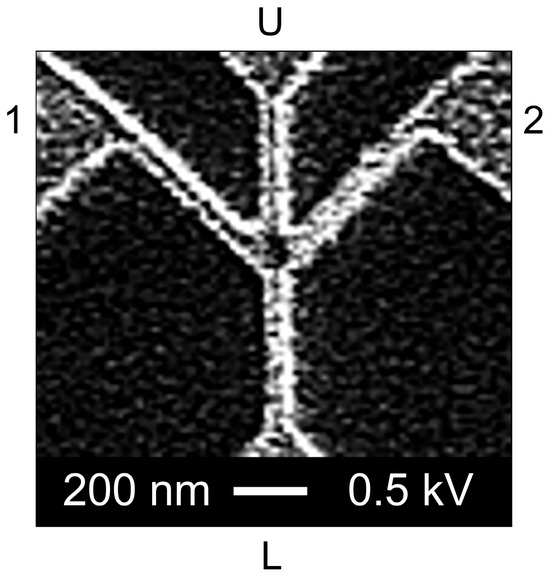
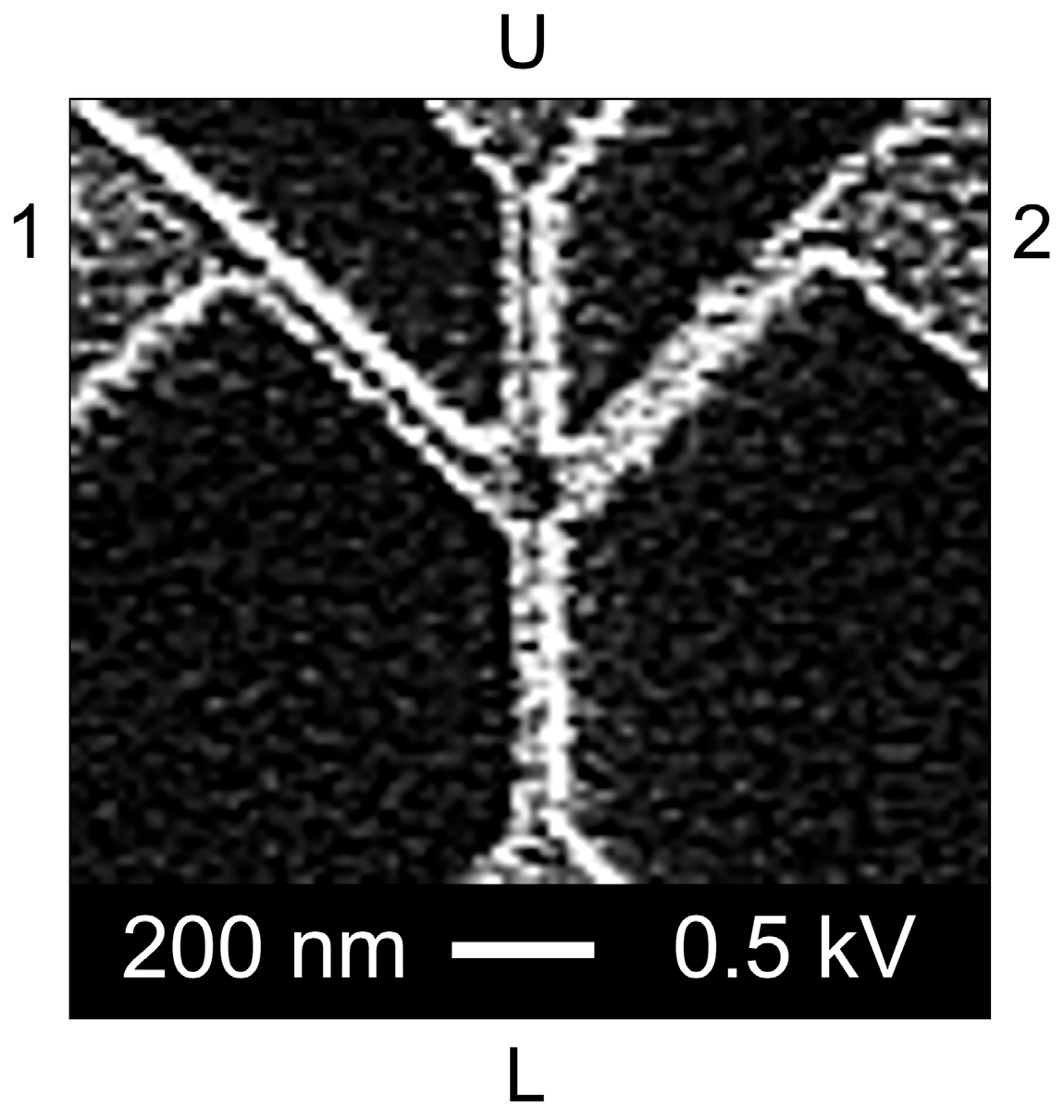
The second approach is the injection-type rectifier, which is based upon an asymmetric cross junction consisting of a straight voltage stem with upper (U) and lower (L) contacts and opposing current injector leads (1, 2) that converge into the stem at an angle of less than 90 degrees (see Figure 1). Samples were fabricated on GaAs/AlGaAs [7,8] or Si/SiGe [9,10,11,12] heterostructures. Due to a short ballistic carrier length, especially in Si/SiGe, the width of the stem and injector channel must be as small as possible without compromising the channel conductivity (normally conductive). This is approximately 200 nm without gain from a biased gate electrode [11]. One advantage of this concept is the small size of the cross junction and the associated lower requirements for the ballistic path length. This allows the use of materials with low mobility, i.e., short ballistic length. Comprehensive investigations of ballistic rectifiers on Si/SiGe at T = 4.2 K showed a quadratic dependence of the ballistically generated output voltage on the input current [9,12]. Depending on the geometry and the gate voltage, the ballistic component was superimposed with a hot electron thermopower, which could be separated from the ballistic component [9,11,12]. A specific advantage of the injection-type device is the possibility of cascading multiple stages to increase the output signal amplitude [13,14]. Furthermore, a stage spacing smaller than the ballistic length leads to synergistic gain of the output signal due to the parabolic transfer characteristic [14].
Figure 1.
Scanning electron micrograph (SEM) of the device center showing the asymmetric cross junction of 90 nm wide channels. Contacts 1 and 2 are the input current terminals, U (upper) and L (lower) denote the contacts of the stem that provides the output voltage.
Before selecting a suitable material for operating the ballistic rectifier at room temperature, the main factors limiting the ballistic length should be addressed. The most important limitation arises from the interaction of charge carriers with phonons. In GaAs, strong coupling of the carrier motion to LO phonons with an energy of 36 meV limits the ballistic transport in a two-dimensional electron gas [15], and in Si, TA phonons with 20 meV destroyed the carrier momentum [16]. This aligns with our observation that the injection rectifiers based on GaAs and Si only work up to a temperature of about 150 K [8]. In cross junctions with channel widths below 100 nm on the nitride semiconductor InAlN, at room temperature, a negative bend resistance was observed as a signature of ballistic transport, which was attributed to the high phonon energy of 92 meV [17]. Compared to classical semiconductors, graphene is a particularly interesting material due to its high charge carrier mobility at room temperature [3,4,5,6]. Based on a fabrication technique that avoided scattering by charged impurities or microscopic ripples, devices were prepared with monolayer and bilayer graphene, which revealed an extremely low electron–phonon scattering rate [18]. Accordingly, encapsulated graphene with mobility µ > 100,000 cm2/Vs at room temperature was used to fabricate cross junctions with 1 µm wide channels. These junctions exhibited negative bend resistance at temperatures up to T = 250 K [19].
The second limiting factor is the diffuse scattering of charge carriers at the edge of the current-carrying channels. In classical semiconductors such as Si, GaAs or nitrides, the finite energy gap causes a lateral depletion zone at the edge of a conducting channel, which favors specular edge scattering. For the ballistic rectifier, the problem of a small ballistic length in a material like Si could therefore be solved by reducing the device dimensions. In contrast, the edge of the zero-gap semiconductor graphene is rough and therefore a diffuse scatterer, which significantly reduces the ballistic length. In a high-mobility graphene film, large dimensions can reduce the influence of the edge on the charge carrier ballistics [19]. This advantage can hardly be exploited with a material that has low mobility. Experiments on orthogonal cross junctions on low-mobility graphene revealed at T = 4.2 K a negative bend resistance only on 50 nm wide channels, but not for wider or narrower ones [20].
Bilayer graphene (BLG) offers an interesting solution. Under the influence of a perpendicular electric field, a band gap opens [21,22], creating a lateral depletion zone at the edges, which leads to specular repulsion of the charge carriers. Thus, BLG behaves like a classical semiconductor, but the effective mass of the charge carriers is very small and the ballistic length is correspondingly large. Therefore, BLG offers the potential for operating injection-type ballistic rectifiers at room temperature, even if the material has low mobility.
2. Materials and Methods
The devices were fabricated on BLG flakes, which were exfoliated from highly oriented pyrolytic graphite and deposited on 300 nm thick SiO2 grown thermally on an Sb-doped n+-Si wafer (ρ ≈ 0.01 Ωcm). The substrate serves as a back gate for adjusting the charge carrier type and density. The BLG flakes were selected and identified using optical microscopy [23] and Raman spectroscopy [24]. Device fabrication began with the positioning of the ohmic contacts using a laser pattern generator (DWL 66FS Heidelberg Instruments Mikrotechnik GmbH, Heidelberg, Germany) for photoresist exposure, followed by the deposition of Ti (10 nm) and Au (130 nm), and the lift-off process. The nanostructure was finally defined by 15 kV electron-beam lithography (LEO DSM982 GEMINI, Carl Zeiss AG, Oberkochen, Germany) in PMMA resist (PMMA 679-04K (950 K), Allresist GmbH, Strausberg, Germany), followed by oxygen plasma etching and cleaning in acetone. Figure 1 shows an SEM image (LEO DSM982 GEMINI, Carl Zeiss AG, Oberkochen, Germany) of the central region of the device with an injection angle of 45°. This angle represents a trade-off between higher rectification efficiency at smaller angles [12] and poorer definition of the transition between the injector and stem channels due to the proximity effect in electron-beam lithography. In addition to the nanoscale devices, Hall-bar samples with 1 µm wide channels were prepared to characterize the material.
3. Results
All electrical measurements were performed at room temperature. The Hall-bar devices revealed a mobility of µ = 1300 cm2/Vs, which underlines the need for nanoscale implementation of the ballistic rectifier. The present charge carrier density proved to be p-type with a hole density of p ≈ 7 × 1012 cm−2, which we attribute to residual contamination from the PMMA resist layer.
The Hall-bar data can be used to estimate the mean free path of the holes by the semi-classical expression lp = (h/2e)µ(p/π)1/2, where h is the Planck constant, e the elementary charge, and p the surface hole density [19]. The result lp = 50 nm is smaller than the width of the structural stem width of 90 nm. However, the mean free path is not suitable for a sanity check of ballistic transport, as it only applies to transport processes near equilibrium, e.g., for the bend resistance in orthogonal cross junctions [19,20]. Ballistic transport, as used in this work, takes place under non-equilibrium conditions. In an experiment with a reflection-type rectifier structure on monolayer graphene, non-equilibrium transport effects were interpreted as ballistic, even though the channel widths were more than twice the mean free path [2]. For the device structure used here, it is also important that the effective width of the voltage stem be smaller than the structural width of 90 nm once lateral depletion zones develop. Therefore, the transport in the injection-type device can be considered ballistic or at least quasi-ballistic, with a fraction of the charge carriers contributing to the rectifier signal with sufficiently large ballistic trajectories.
The ballistic rectifier was investigated by measuring the channel conductance and transfer characteristics under control by the back-gate voltage VBG. Under VBG > 0, the leakage current gradually increased and reached a value of 150 pA at VBG = 100 V. In contrast, negative back-gate voltages led to a sharp increase in leakage current. Therefore, measurements were only performed with positive back-gate voltages.
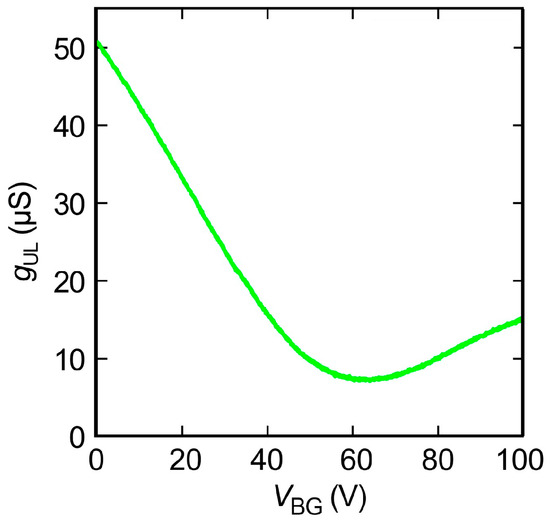
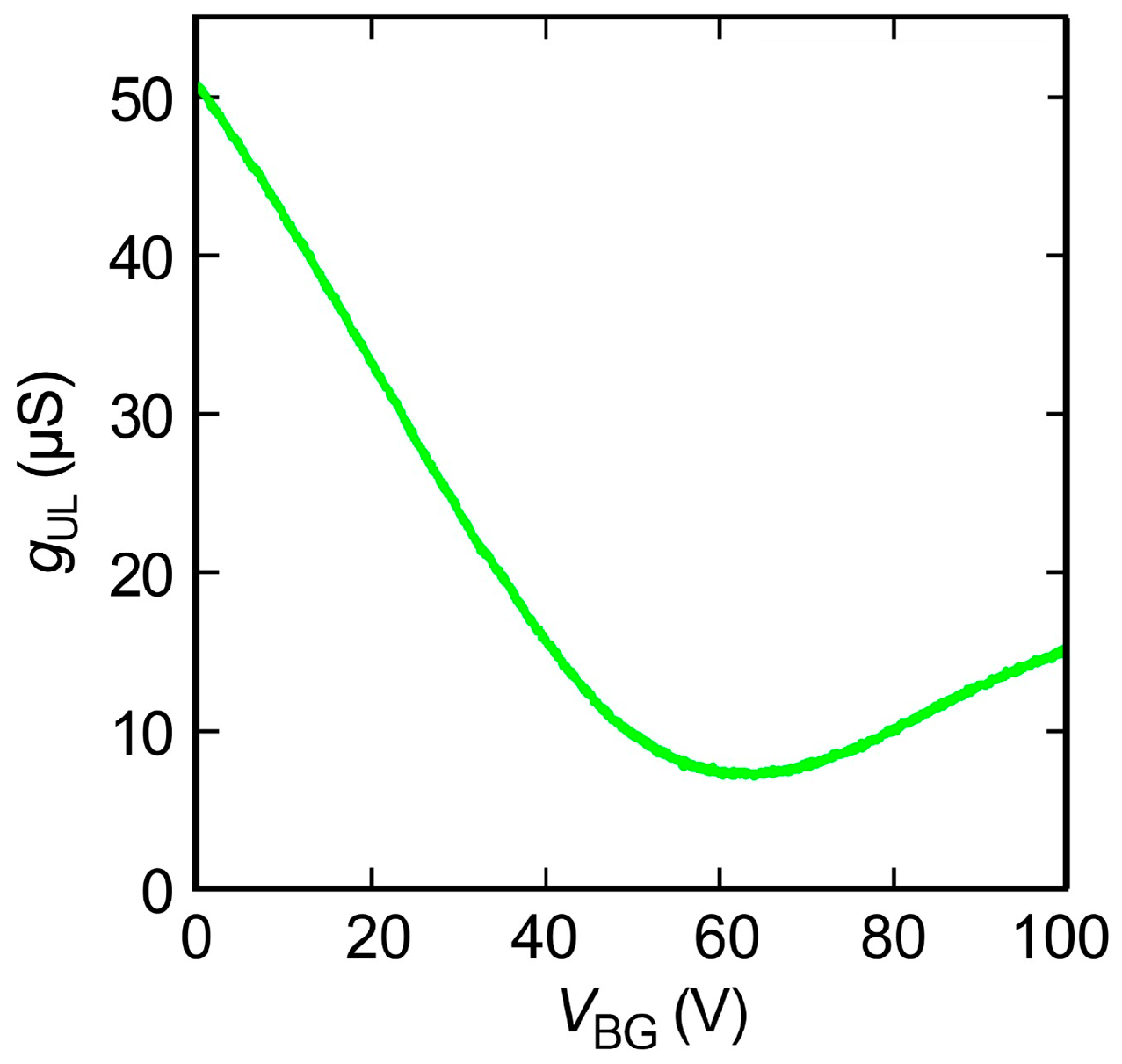
Figure 2 illustrates the influence of the back-gate voltage VBG on the differential conductance of the stem channel. As reported on BLG [18], the conductance curve is V-shaped with its minimum at the neutrality point (NP) at VBG,NP ≈ 63 V. The position of the NP corresponds to a p-type doping of 4.5 × 1012 cm−2, similar to the Hall-bar device. The minimum conductance of about gUL,NP ≈ 7.3 µS ≈ 0.18 e2/h is significantly lower than the theoretical value of 4 e2/h for the zero-gap state of BLG [22]. This suggests that a band gap is already present at VBG,NP. Furthermore, it cannot be ruled out that lateral p-n junctions form at the interfaces between the large-area contacts U or L and the narrow stem channel, contributing to the overall resistance. For wide channels on BLG, the conductance curve is known to be approximately symmetrical around the NP [18]. The curve shown here exhibits a distinct asymmetry, which is attributable to the small channel width. At low VBG, the entire channel width contributes to the hole conductance. As VBG increases, a finite band gap develops, leading to lateral depletion zones at the channel edges. In particular, the electron channel narrows laterally at VBG > VBG,NP, thereby reducing the number of transport modes and thus the conductance.
Figure 2.
Differential conductance gUL of the stem channel as a function of back-gate voltage VBG at T = 300 K.
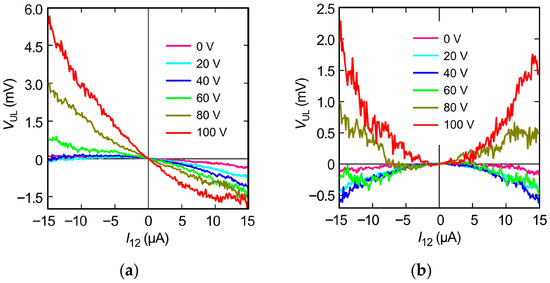
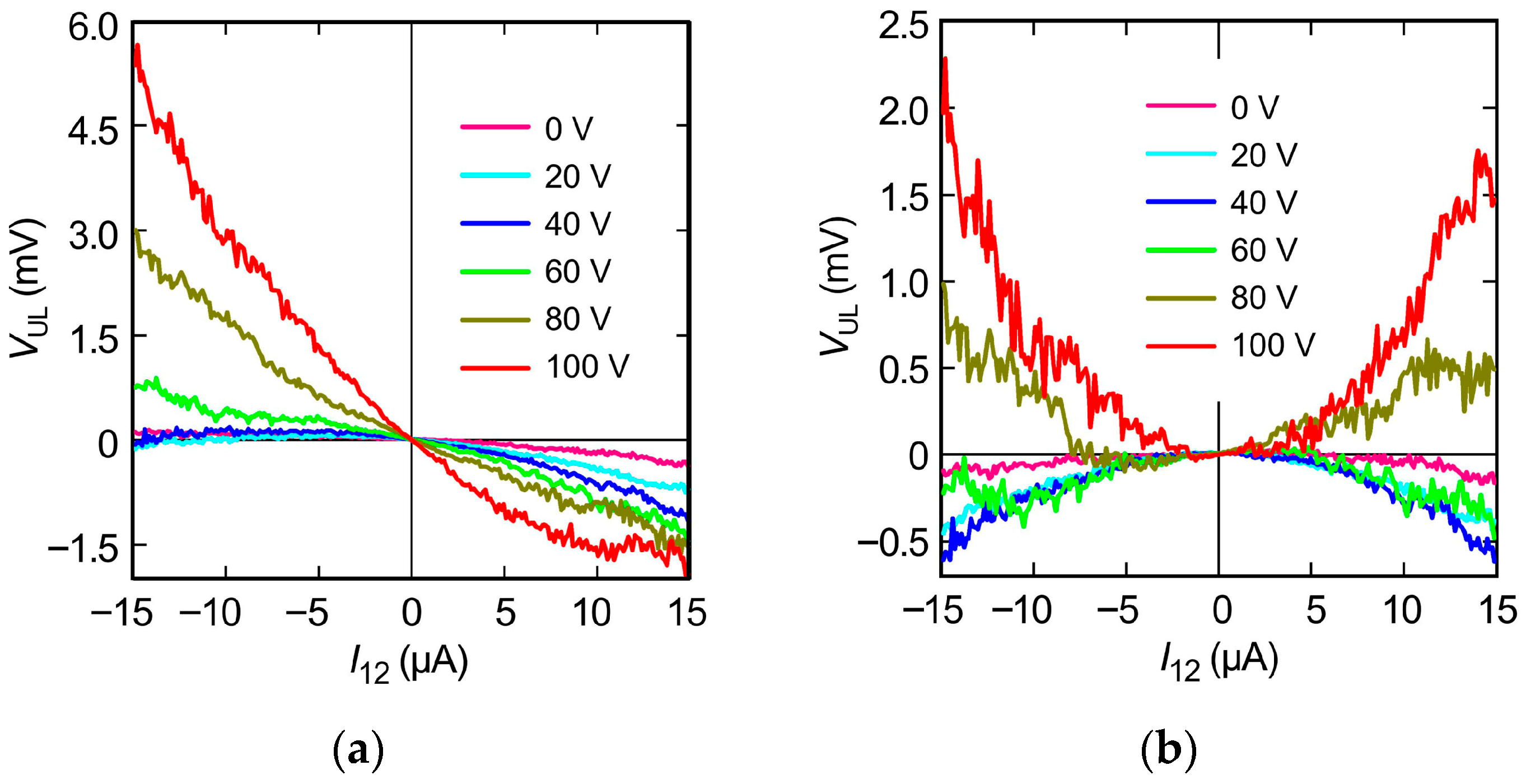
The four-probe characteristics of the output voltage VUL as a function of injected current I12, measured at various VBG values, is shown in Figure 3. The raw data in Figure 3a are superimposed with a linear background caused by a misalignment of the injectors relative to each other at their entry point into the stem. This causes an ohmic voltage drop across the short part of the stem channel between the entry points. The pure ballistic part of the output signal was obtained by subtracting the ohmic linear component. This component, VUL,linear(I12), was determined from the data points using a least squares calculation, VUL,linear(I12) = 0.5[VUL(I12) − VUL(−I12)], and subtracted from the raw data. As shown in Figure 3b, a series of parabola results, the curvature of which indicates the type of the charge carriers. Therefore, VUL is negative for holes (VBG < VBG,NP) and positive for electrons (VBG > VBG,NP). It should also be noted that, as a result of the small device dimensions, room-temperature operation of the injection-type rectifier on BLG is achieved even at VBG = 0.
Figure 3.
Output voltage VUL as a function of the rectifier’s input current I12 at T = 300 K. (a) Raw data of the characteristic curve with VBG as a parameter (see figure). (b) Symmetrical part of the rectifier characteristic curve from (a) after subtraction of the linear background signal.
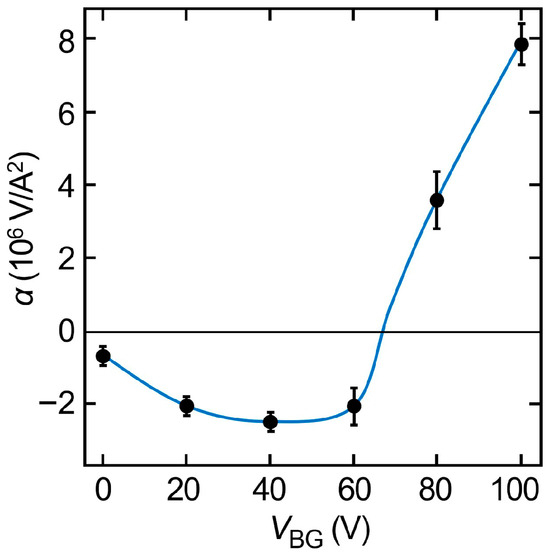
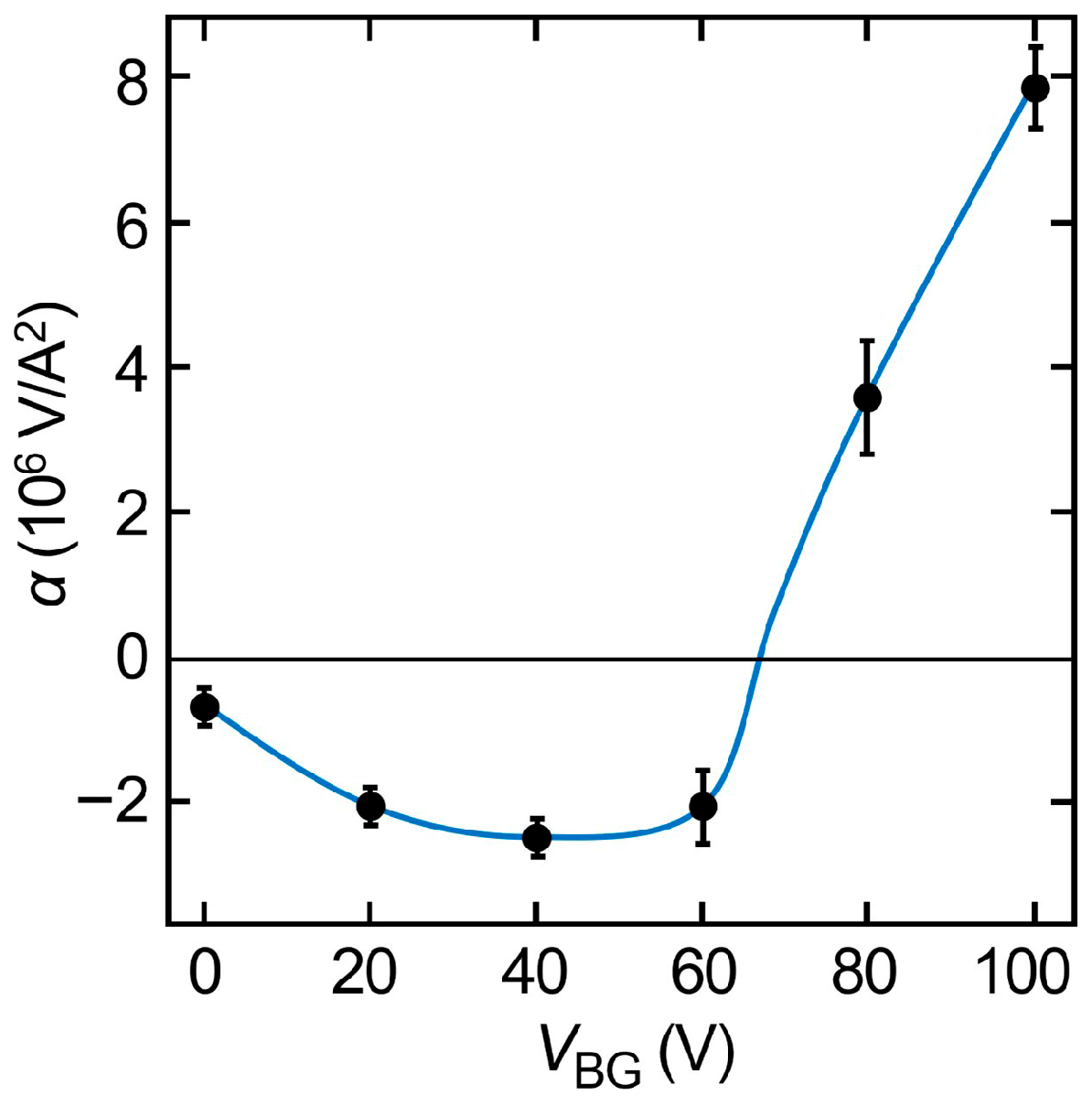
The classification of the transfer curves in Figure 3b as a ballistic effect corresponds to the results of previous work on Si/SiGe injection rectifiers [12] with a parabolic law of the form VUL = αI122. Therefore, the curvature α of the transfer curves is quantified by parabolic fits and plotted in Figure 4 as a function of the voltage VBG. Although there is no theory for the shown dependence of α on VBG, both the sign and the increase in curvature show the positive effect of a higher VBG on ballistic rectification by holes and electrons.
Figure 4.
Curvature coefficient α of parabolic fits with VUL = αI122 to the curves shown in Figure 3b as a function of back-gate voltage VBG at T = 300 K. The solid line is a guide for the eyes. The error bars result from the noise in the curves. Negative α values represent rectification by ballistic holes, positive values by electrons.
4. Discussion
Two mechanisms determine the effectiveness of the rectification. Fundamentally, the transition from hole to electron conduction occurs at the NP, where no output signal is generated. Therefore, a large difference |VBG − VBG,NP| is advantageous for achieving large output signals. A second effect arises from the formation of the lateral depletion zone at the channel edge, which reduces diffuse scattering at the edges. This effect becomes more significant with increasing VBG. For this reason, hole-carrier rectification is more effective at VBG = 60 V, near the NP, than at VBG = 0, while electron-carrier rectification is the most effective one at VBG = 100 V. A comparison with a reflection-type rectifier device on monolayer graphene, also mounted on an oxidized Si substrate as the back-gate electrode [2], provides valuable insights. The back-gate voltage was varied over a wide range to adjust both electron and hole conduction. While a sign reversal was observed when the conduction type was changed, unlike in the experiment presented here, no change in rectifier efficiency was observed. This means that there was no change in the reflectance of the scatterer with the change in the back-gate voltage, as would be expected with an improvement in specular reflection.
Using the transfer resistance RT = |VUL/I12| as the quality criterion, RT ≈ 110 Ω is obtained at I12 = 15 µA. This value is approximately in agreement with values determined for rectifiers on GaAs/AlGaAs [7,8] or Si/SiGe [9,10,11,12] heterostructures at low temperatures. Obviously, the transmission characteristics are significantly noisier than those of Si/SiGe-based devices. In addition to the fact that the thermal noise is higher at room temperature than at low temperatures, the noise increases from the linear regime at low currents to the nonlinear regime at high currents. It should be noted that both the linear component of the rectifier characteristic and the high noise signal were observed in a ballistic reflection-type rectifier device which, as in this work, was mounted on oxidized Si as a backside gate [2]. In this work, the high noise level was attributed to interface scattering at the SiO2 surface. One possible measure to reduce the noise level is to use hexagonal boron nitride as the substrate [3].
5. Conclusions
We have demonstrated that a nanoscale ballistic injection-type rectifier on low-mobility BLGs operates at room temperature. Furthermore, diffuse edge scattering was significantly reduced by creating a band gap in the BLG using a perpendicular electric field. At a nonzero band gap, lateral depletion zones form at the edges of the narrow channels. These depletion zones represent smooth barriers that favor specular reflection of the charge carriers. As a result, the ballistic length of the charge carriers in the nanochannels increases. This not only improves the performance of a single-stage ballistic rectifier but should also enhance the synergistic gain in multi-stage ballistic rectifiers [14].
Author Contributions
Conceptualization, U.K.; methodology, I.P. and U.K.; validation, I.P. and U.K.; formal analysis, I.P. and U.K.; investigation, I.P.; resources, U.K.; data curation, I.P.; writing—original draft preparation, U.K.; writing—review and editing, U.K.; visualization, I.P.; supervision, U.K.; project administration, U.K. All authors have read and agreed to the published version of the manuscript.
Funding
This research received no external funding.
Data Availability Statement
The original contributions presented in this study are included in the article. Further inquiries can be directed to the corresponding author.
Acknowledgments
We thank D. Schmidt, Physical Chemistry II, Ruhr-University Bochum, for technical support with the Raman measurements.
Conflicts of Interest
The authors declare no conflicts of interest.
Abbreviations
The following abbreviations are used in this manuscript:
| BLG | Bilayer graphene |
| SEM | Scanning electron microscope |
| PMMA | Poly(methyl methacrylate) |
| NP | Neutrality point |
| DC | Direct current |
References
- Song, A.M.; Lorke, A.; Kriele, A.; Kotthaus, J.P.; Wegscheider, W.; Bichler, M. Nonlinear Electron Transport in an Asymmetric Microjunction: A Ballistic Rectifier. Phys. Rev. Lett. 1998, 80, 3831–3834. [Google Scholar] [CrossRef] [Scilit]
- Singh, A.K.; Auton, G.; Hill, E.; Song, A. Graphene based ballistic rectifiers. Carbon 2015, 84, 124–129. [Google Scholar] [CrossRef] [Scilit]
- Auton, G.; Zhang, J.; Kumar, R.K.; Wang, H.; Zhang, X.; Wang, Q.; Hill, E.; Song, A. Graphene ballistic nano-rectifier with very high responsivity. Nat. Commun. 2016, 7, 11670. [Google Scholar] [CrossRef] [Scilit]
- Auton, G.; Kumar, R.K.; Hill, E.; Song, A. Graphene Triangular Ballistic Rectifier: Fabrication and Characterisation. J. Electron. Mater. 2017, 46, 3942–3948. [Google Scholar] [CrossRef] [Scilit]
- Auton, G.; But, D.B.; Zhang, J.; Hill, E.; Coquillat, D.; Consejo, C.; Nouvel, P.; Knap, W.; Varani, L.; Teppe, F.; et al. Terahertz Detection and Imaging Using Graphene Ballistic Rectifiers. Nano Lett. 2017, 17, 7015–7020. [Google Scholar] [CrossRef] [Scilit]
- Brownless, J.; Zhang, J.; Song, A. Graphene ballistic rectifiers: Theory and geometry dependence. Carbon 2020, 168, 201–208. [Google Scholar] [CrossRef] [Scilit]
- Knop, M.; Wieser, U.; Kunze, U.; Reuter, D.; Wieck, A.D. Ballistic rectification in an asymmetric mesoscopic cross junction. Appl. Phys. Lett. 2006, 88, 082110. [Google Scholar] [CrossRef] [Scilit]
- Wieser, U.; Knop, M.; Richter, M.; Kunze, U.; Reuter, D.; Wieck, A.D. Ballistic transport and rectification in mesoscopic GaAs/AlGaAs cross junctions. Phase Transit. 2006, 79, 755–764. [Google Scholar] [CrossRef] [Scilit]
- Salloch, D.; Wieser, U.; Kunze, U.; Hackbarth, T. Thermopower-enhanced efficiency of Si/SiGe ballistic rectifiers. Appl. Phys. Lett. 2009, 94, 203503. [Google Scholar] [CrossRef] [Scilit]
- Salloch, D.; Wieser, U.; Kunze, U.; Hackbarth, T. Efficient injection-type ballistic rectification in Si/SiGe cross junctions. Phys. E 2010, 42, 2618–2621. [Google Scholar] [CrossRef] [Scilit]
- Salloch, D.; Wieser, U.; Kunze, U.; Hackbarth, T. Influence of channel width on the performance of an injection-type ballistic rectifier: Carrier injection versus hot-electron thermopower. Microelectron. Eng. 2011, 88, 2386–2389. [Google Scholar] [CrossRef] [Scilit]
- von Pock, J.F.; Salloch, D.; Wieser, U.; Hackbarth, T.; Kunze, U. Identification and separation of rectifier mechanisms in Si/SiGe ballistic cross junctions. J. Appl. Phys. 2017, 121, 014304. [Google Scholar] [CrossRef] [Scilit]
- Wieser, U.; Knop, M.; Koop, P.; Kunze, U.; Reuter, D.; Wieck, A.D. Enhanced Rectification Efficiency in Cascaded Ballistic GaAs/AlGaAs Rectifiers. Am. Inst. Phys. Conf. Proc. 2007, 893, 719–720. [Google Scholar]
- von Pock, J.; Wieser, U.; Kunze, U. Input-Current Addition in Closely Positioned Dual-Stage Ballistic Rectifiers. Phys. Rev. Appl. 2017, 7, 044023. [Google Scholar] [CrossRef] [Scilit]
- Sivan, U.; Heiblum, M.; Umbach, C.P. Hot Ballistic Transport and Phonon Emission in a Two-Dimensional Electron Gas. Phys. Rev. Lett. 1989, 63, 992–995. [Google Scholar] [CrossRef] [Scilit]
- Wieser, U.; Poenariu, S.A.; Kunze, U.; Hackbarth, T. Phonon-induced breakdown of negative bend resistance in an asymmetric Si/SiGe cross junction. Appl. Phys. Lett. 2005, 8, 252114. [Google Scholar] [CrossRef] [Scilit]
- Matioli, E.; Palacios, T. Room-Temperature Ballistic Transport in III-Nitride Heterostructures. Nano Lett. 2015, 15, 1070–1075. [Google Scholar] [CrossRef] [Scilit]
- Morozov, S.V.; Novoselov, K.S.; Katsnelson, M.I.; Schedin, F.; Elias, D.C.; Jaszczak, J.A.; Geim, A. Giant Intrinsic Carrier Mobilities in Graphene and Its Bilayer. Phys. Rev. Lett. 2008, 100, 016602. [Google Scholar] [CrossRef] [Scilit] [PubMed]
- Mayorov, A.S.; Gorbachev, R.V.; Morozov, S.V.; Britnell, L.; Jalil, R.; Ponomarenko, L.A.; Blake, P.; Novoselov, K.S.; Watanabe, K.; Taniguchi, T.; et al. Micrometer-Scale Ballistic Transport in Encapsulated Graphene at Room Temperature. Nano Lett. 2011, 11, 2396–2399. [Google Scholar] [CrossRef] [Scilit] [PubMed]
- Bock, C.; Weingart, S.; Karaissaridis, E.; Kunze, U.; Speck, F.; Seyller, T. Influence of structural properties on ballistic transport in nanoscale epitaxial graphene cross junctions. Nanotechnology 2012, 23, 395203. [Google Scholar] [CrossRef] [Scilit]
- McCann, E. Asymmetry gap in the electronic band structure of bilayer graphene. Phys. Rev. B 2006, 74, 161403. [Google Scholar] [CrossRef] [Scilit]
- Oostinga, J.B.; Heersche, H.B.; Lu, X.; Morpurgo, A.F.; Vandersypen, L.M.K. Gate-induced insulating state in bilayer graphene devices. Nature 2008, 7, 151–157. [Google Scholar] [CrossRef] [Scilit]
- Blake, P.; Hill, E.W.; Castro Neto, A.H.; Novoselov, K.S.; Jiang, D.; Yang, R.; Booth, T.J.; Geim, A.K. Making graphene visible. Appl. Phys. Lett. 2007, 91, 063124. [Google Scholar] [CrossRef] [Scilit]
- Ferrari, A.C.; Meyer, J.C.; Scardaci, V.; Casiraghi, C.; Lazzeri, M.; Mauri, F.; Piscanec, S.; Jiang, D.; Novoselov, K.S.; Roth, S.; et al. Raman Spectrum of Graphene and Graphene Layers. Phys. Rev. Lett. 2006, 97, 187401. [Google Scholar] [CrossRef] [Scilit] [PubMed]
Disclaimer/Publisher’s Note: The statements, opinions and data contained in all publications are solely those of the individual author(s) and contributor(s) and not of MDPI and/or the editor(s). MDPI and/or the editor(s) disclaim responsibility for any injury to people or property resulting from any ideas, methods, instructions or products referred to in the content. |
© 2026 by the authors. Licensee MDPI, Basel, Switzerland. This article is an open access article distributed under the terms and conditions of the Creative Commons Attribution (CC BY) license.