Article

Impact of Antisite Disorder on the Resistivity of Strontium Ferromolybdate Ceramics


1
Institute of Solid-State Electronics, TU Dresden, 01062 Dresden, Germany
2
Laboratory of Physics of Magnetic Materials, SSPA “Scientific-Practical Materials Research Centre of NAS of Belarus”, 220072 Minsk, Belarus
*
Author to whom correspondence should be addressed.
Electron. Mater. 2026, 7(1), 5; https://doi.org/10.3390/electronicmat7010005
Submission received: 14 December 2025 / Revised: 10 February 2026 / Accepted: 24 February 2026 / Published: 3 March 2026

Abstract

In this work, we consider the influence of antisite disorder, e.g., Fe ions on Mo sites, FeMo, and vice versa, MoFe, on the resistivity of strontium ferromolybdate ceramics fabricated by the solid-state reaction method. Strontium ferromolybdate ceramics fabricated via solid-state reactions exhibit a low-temperature minimum resistivity owing to the interplay between the bulk metallic resistivity of the grains, which increases with temperature and becomes dominant at higher temperatures, and an intergrain tunneling mechanism of charge carrier conduction, which leads to a decrease in conductivity with decreasing temperature in the low-temperature region. The parameters of the bulk metallic resistivity and fluctuation-induced intergrain tunneling were determined by fitting the experimental data to these resistivity models. The impact of antisite disorder on the resistivity parameters was considered. It turns out that antisite disorder affects the effective barrier height of intergrain tunneling and the effective values of the barrier width and the barrier area. Disorder increases the effective barrier height for intergrain tunneling, increases its barrier width, and decreases the effective barrier area of nanosized barriers. The results are discussed using experimental data available in the literature.

1. Introduction

Strontium ferromolybdate double perovskite (Sr2FeMoO6−δ, SFMO) is a promising candidate for magnetic electrode materials for room-temperature spintronic applications because it exhibits a half-metallic character, for example, a theoretically 100% spin polarization, a high Curie temperature (note that ferrimagnets should be operated in their ordered magnetic state below the Curie point), and remarkable low-field magnetoresistance (LFMR) [1]. Nevertheless, SFMO has not yet been widely applied in spintronics. This is attributed to the low reproducibility of its magnetic properties, which partially originates from its strong dependence on the ordering degree of Fe and Mo ions in both the B′ and B″ sublattices of the double perovskite A2B′B″O6.
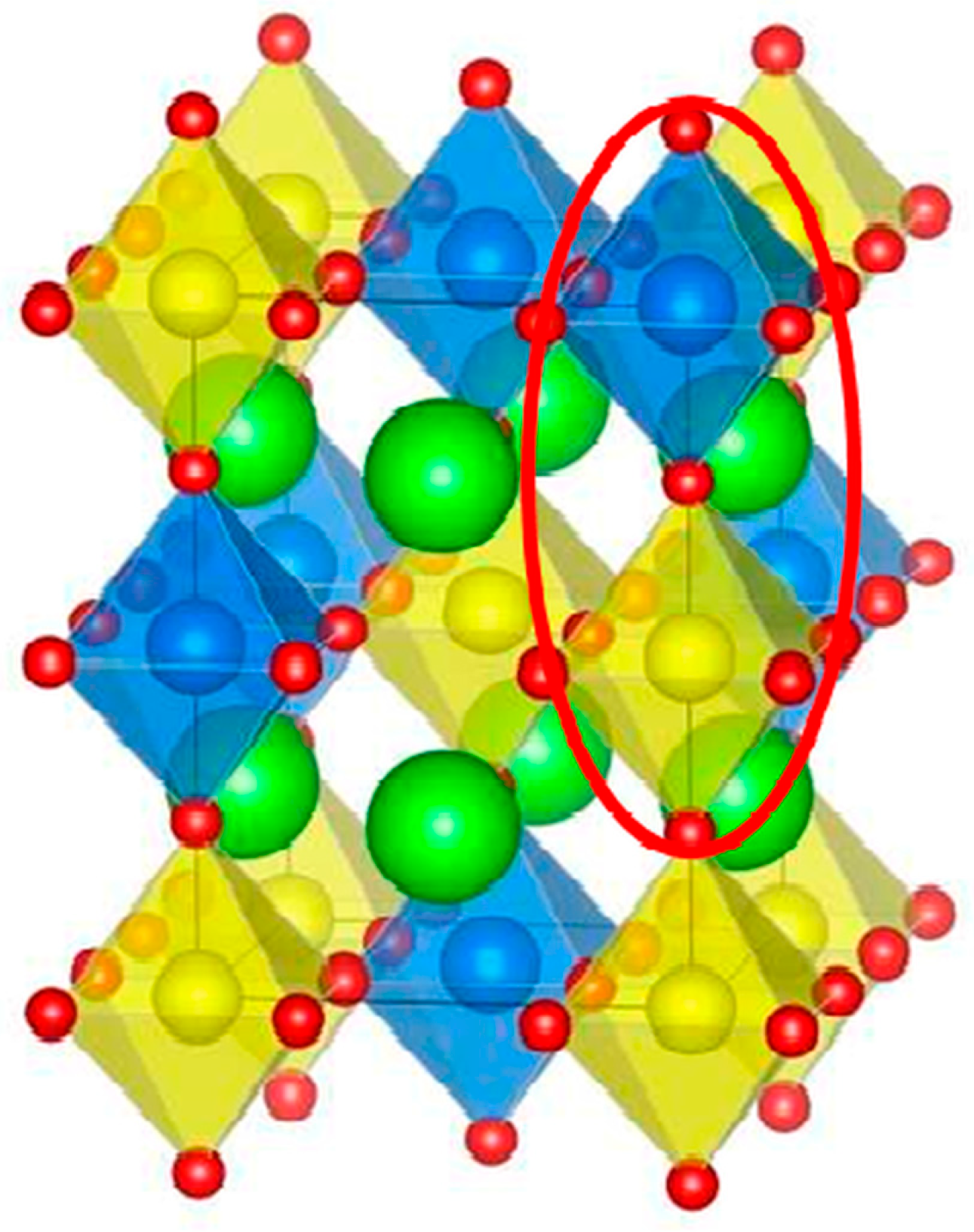
In SFMO, the dominant point defects are Fe and Mo antisite defects, for example, Fe ions on Mo sites—FeMo, and Mo ions on Fe sites—MoFe. This leads to antisite disorder (ASD) [1], which occurs when a B′-site ion occupies the wrong sublattice B″, and vice versa. Consequently, ASD in stoichiometric SFMO is characterized by the formation of FeMo and MoFe defect pairs, creating Fe-Fe and Mo-Mo nearest neighbors (Figure 1).
In stoichiometric SFMO, the fraction of ions B′ (or B″) on the incorrect sublattice is related to the order parameter P [3]:
P = ( 1 2 A S D ) .
Here, the value of ASD varies from 0 (corresponding to a complete order) to 0.5 (describing a completely random Fe-Mo site occupancy). Experimentally, the order parameter P is determined using the site occupation derived from the Rietveld analysis [4]:
P = 2 g F e 1 ,
where gFe denotes the occupancy of Fe ions at their correct sites.
Antisite disorder affects both the magnetic and electronic properties of a material. Whereas the Fe-Mo-Fe neighbors in the regular SFMO lattice couple ferrimagnetically, the Fe-Fe neighbors at the antisites are antiferromagnetic [5]. This lowers the expected saturation magnetization according to [6]
M s = M s ( A S D = 0 ) b A S D = M s ( A S D = 0 ) b ( 0.5 P M / 2 ) .
The value of the saturation magnetization Ms is given in Bohr magnetrons per formula unit, Ms(ASD = 0) = 4 µB/f.u. for a theoretical value of b = 8 while empirical values of b range between 6.56 and 10 [1], and PM is the order parameter determined by the magnetic field dependences of magnetization.
Moderate levels of ASD could be the cause of sufficient increase in the LFMR effect. Here, the application of an external magnetic field leads to a suppression of spin disorder in the magnetically frustrated areas around the antisite defects [7]. This is also in agreement with the findings in [8], where an increase in the magnetoresistance (MR) was observed when ASD was increased from 0.02 to 0.09. As pointed out by Sarma et al. [9], a further increase in the Fe/Mo disorder level would lead to the loss of spin polarization. This, in turn, means that all the contributions to the MR associated with the half-metallic character vanish as the ASD levels increase, in agreement with the results in [7]. In this way, a narrow concentration of ASD (ASD ≈ 0.1) reveals where the LFMR shows a maximum.
For massive ASD levels, the ferromagnetic state of the ordered material can even transform into a spin-glass-like response [5,10].
The conjunction of locally ordered regions forms magnetic nanodomains [8,11]. Therefore, antisite disorder gives rise to neighboring Fe-O-Fe regions and, thus, to the formation of antiphase boundaries (APBs) [8,12]. APBs are growth defects that occur at the interface between two coherently oriented crystallites, where the stacking sequence of FeO6 and MoO6 octahedra initiates from opposite cation sites. In general, APBs are characterized by a crystallographic shear vector R that describes the relative displacement of the two parts of the crystal on either side of the interface. In our case, the value of this lattice shift is equal to half a lattice parameter. In SFMO, the APBs coincide perfectly with the nanodomain boundaries [11]. APBs locally interrupt the ferromagnetic coupling between Fe and Mo ions and the indirect Fe-O-Mo-O-Fe exchange interaction occurring in defect-free structures, leading to new magnetic exchange interactions that are not present in defect-free materials [1]. The presence of APBs in the YBa2Cu3O7 sample favors oxygen in-diffusion and, therefore, ionic conductivity [13].
ASD usually increases the resistivity of SFMO [1,14,15,16]. This originates from (i) the strong dependence of the mixed Fe2+/Fe3+ fluctuating mixed valence state on cationic disorder [17,18], (ii) the larger extent of magnetic scattering processes at antisites disturbing the periodicity of the lattice potential [15], and (iii) the possibility of trapping and recombination of charge carriers by like-neighbor bonds at APBs [19].
In polycrystalline highly ordered SFMO ceramics (ASD = 0.10…0.13) prepared at high temperatures, which comprise a minor impurity phase of Fe, the increase in resistivity was attributed to decreasing grain size, leading to more grain boundaries [20]. Samples of SFMO thin films deposited by pulsed laser deposition, consisting of spurious insulating SrMoO4 [15], showed an increase in the residual resistivity.
SFMO thin films with varying ASD deposited by pulsed laser deposition using different background gases [14] exhibit semiconducting behavior, the temperature dependence of which was fitted to the Mott variable-range hopping model [21]:
ρ = ρ 0 exp T M T 1 / 4 ,
where ρ0 is the pre-exponential factor and TM is the characteristic Mott temperature. The same resistivity behavior was observed in SFMO ceramics at temperatures near room temperature (280–300 K) [22]. Here, a larger TM value implies a higher disorder and/or large tilting of the B′O6 or B″O6 octahedra. Note that the parameter TM can also be considered an effective energy barrier between the localized states [23]. Mott variable-range hopping was also obtained in polycrystalline Sr2FeMo1−xVxO6 (x = 0–0.5) ceramics [18]. In this case, the temperature dependence of the resistivity of the undoped SFMO (x = 0) sample shows metallic behavior. The origin of the metallic resistivity of SFMO is the above-mentioned mixed valence Fe2+/Fe3+ state, resulting in a +2.5 fluctuation mixed valence [17]. This mixed valence state is influenced by any substitution of the cations. The substitution of Mo by V introduces paramagnetic ions (except V5+) [24], making variable-range hopping plausible.
Similar to the SFMO ceramics synthesized by the solid-state reaction method in our previous study [25], the samples in this work exhibited a temperature of minimum resistivity. This minimum is caused by the interplay of an intergrain tunneling mechanism of charge carrier conduction, which leads to an increase in resistivity with decreasing temperature in the low-temperature region, and a bulk metallic resistivity of the grains, which increases with temperature and becomes dominant at higher temperatures. The intergrain tunneling is attributed to fluctuation-induced tunneling (FIT) [26] with a resistivity given by
ρ ( T ) = ρ F I T exp T 1 T 0 + T .
where the temperatures T1 and T0 and the resistivity ρFIT are model fitting parameters. This model was developed to analyze the resistivity mechanism in a system composed of metallic particles separated by thin dielectric layers (a few nanometers thick). In particular, it aims to describe the mechanisms of electrical transport between carbon particles embedded within a polyvinyl chloride matrix. Polycrystalline SFMO ceramics can also be considered as a system in which conducting SFMO grains are spatially separated by dielectric grain boundaries that act as potential barriers for electrons [27,28,29,30]. In the FIT model, tunneling occurs between large metallic grains across insulating barriers with width w and area A. FIT is specified by two temperatures: temperature T1 and a normalized temperature, T0. T1 characterizes the electrostatic energy of the parabolic potential barrier as follows:
k T 1 = A w ε o E 0 2 2 .
Here, k is the Boltzmann constant, and ε0 is the vacuum permittivity.
The characteristic electric field strength E0 is determined by the barrier height V0 as follows:
E 0 = 4 V 0 e w ,
where e is the electron charge. The normalized temperature T0 relates T1 to the tunneling constant as follows:
T 0 = T 1 π χ w 2 1 ,
with the reciprocal localization length of the wave function
χ = 2 m e * V 0 ħ ,
where m*e is the effective electron mass, which in our case is m*e = 2.5 me with me being the electron mass [31]. At elevated temperatures (above the resistivity minimum), the temperature dependencies of the specific electrical resistance ρ of SFMO (cf. samples SFMO-73, SFMO-85 and SFMO 92) are characterized by a positive slope, which suggests metallic behavior. Below 500 K, single-crystalline half-metallic SFMO exhibits a resistivity, ρ(T), that increases with temperature:
ρ ( T ) = ρ 0 + R 2 T 2 ,
where ρ0 = 1.8 × 10⁻⁶ Ωm is the residual metallic resistivity and R2 = 2.5 × 10⁻¹⁰ ΩmK−2 [32,33]. Similar values, ρ0 = 3.28 × 10⁻⁶ Ωm and R2 = 3.116 × 10⁻¹⁰ ΩmK−2, were given in [34].
The metallic resistivity of SFMO originates from the Fe-O-Mo double exchange, where electrons hop between Fe and Mo via oxygen [35]. However, the presence of Fe-O-Fe bonds causes antiferromagnetic superexchange interactions because Fe spins are oppositely aligned. This hinders itinerant electron hopping because conduction “dead ends” are formed in the Fe–O–Mo conduction network [36]. Experimentally, the conductivity (the inverse of resistivity) σ varies from 16 S·cm−1 for Sr2Fe1.4Mo0.6O6−δ to 75 S·cm−1 for Sr2Fe1.6Mo0.4O6−δ [37]. In addition, the conductivity of Sr2Fe1.5Mo0.5O6−δ is much lower than that of SFMO under similar conditions [38]. At first glance, this creates a contradiction: the material exhibits high conductivity despite the presence of bonds that should suppress it. This contradiction is resolved within the framework of the short-range order and antiphase boundary models. Experimental XAFS data show that even with significant long-range disorder, a high degree of local ordering of the Fe–O–Mo bonds is retained [12]. Consequently, the conductivity is determined precisely by the short-range order, and the Fe–O–Fe bonds are concentrated at the domain boundaries and play the role of local defects. In contrast, the energetic advantage of the Fe–O–Mo double exchange over the Fe–O–Fe superexchange ensures the dominance of the conducting channel, which allows the material to retain its metallic character and high spin polarization.
Merging Equations (5) and (10) enables a consistent description of the SFMO resistivity across the experimental temperature range of 5–300 K. Consequently, the total resistivity is given by [25]
ρ ( T ) = ρ 0 + R m T m + ρ F I T exp T 1 T 0 + T .
In contrast to single-crystalline materials, ceramics exhibit a microstructure consisting of interfaces, pores, grains, and grain boundaries. Consequently, the impact of antisite defects on the physical properties depends on the localization of the defect. While there are a number of studies on single crystals, such as SnSe [39], transparent semiconducting oxides [40], and alkaline-earth-metal hexaborides [41], as well as a first-principles study of double perovskite Pb2FeOsO6 [42], research on ceramics is still scarce.
In this study, we examined the influence of ASD on the resistivity of SFMO ceramics fabricated using the solid-state reaction method. We demonstrate that in granular SFMO ceramics, ASD affects the effective barrier height of intergrain tunneling and the effective values of barrier width and barrier area.

2. Materials and Methods

SFMO was synthesized using a conventional solid-state reaction method involving three successive annealing stages. The initial mixture was prepared from SrCO3, Fe2O3, and MoO3 powders taken in a stoichiometric ratio of 2:0.5:1. The precursors were thoroughly mixed and ground in a ball mill PM 100 (Retsch GmbH, Haan, Germany) to ensure uniform mixing. The first annealing was performed in air at T = 1173 K for 20 h. The resulting powder was subsequently reground and additionally mixed in ethyl alcohol for 2 h to improve homogeneity. The second annealing step was performed in an argon atmosphere at T = 1373 K for 20 h. The obtained SFMO powder was then compacted into cylindrical pellets (10 mm in diameter, 5–6 mm in thickness) under a uniaxial pressure of 250 MPa at room temperature. Finally, the pellets were sintered in a reducing atmosphere (10% H2/Ar) at T = 1373 K for different durations (10, 14, 19, 27 and 40 h). In the final step, SFMO with varying ASD values was obtained, given that ASD depends on both annealing time and temperature under reducing conditions [43,44].
The phase composition of solid-state synthesis products as well as of the SFMO samples was determined using XRD phase analysis on a DRON-3 apparatus (PA “Lvivselmash”, Lviv, USSR) in CuKα radiation. Rietveld refinement was performed using PowderCell v.2.3 software [45] with the ICSD-PDF2 database (Release 2000).
The magnetic and electrical transport properties of the samples were studied in the temperature range of 5 K to 300 K using a constant magnetic field in a universal Cryogen-Free High-Magnetic Field Measurement System Vibrating Sample Magnetometer CFM-14T-H3-IVTI-25 (Cryogenic Ltd., London, UK).

3. Results and Discussion

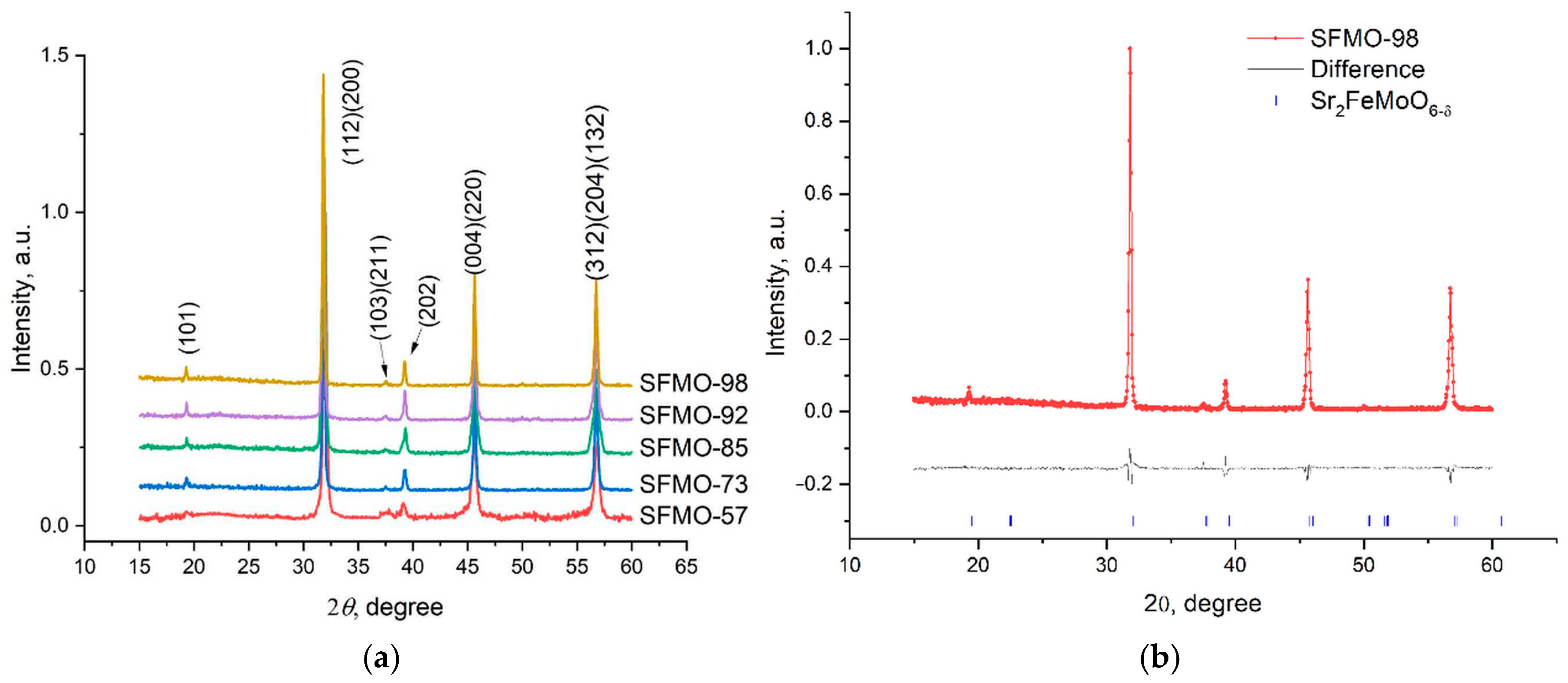
The XRD patterns of the samples considered in this work are depicted in Figure 2. All SFMO samples are single-phase. The presence of (101) and (103) reflexes indicates the appearance of superstructural ordering of Fe and Mo ions in the SFMO unit cell. For readers’ convenience, sample names in this work include the value of the order parameter P.
Another type of defect in SFMO that affects the electron transport properties, magnetization, and magnetoresistance is the oxygen vacancy [46]. The oxygen vacancy content in SFMO is characterized by the oxygen nonstoichiometry parameter δ. This parameter can be evaluated using thermogravimetric analysis, iodometric titration, and neutron diffraction. In addition, δ can be estimated using XRD, although this approach is associated with large uncertainty. Following the data reported in [47], high-temperature annealing of SFMO in a reducing atmosphere stabilizes the parameter δ reaching a constant value after approximately 10 h of thermal treatment. In the present study, all SFMO samples were annealed in a reducing atmosphere for 10–40 h, ensuring that δ attained the same equilibrium value for all samples. This implies that oxygen nonstoichiometry has an identical impact on the electron transport properties of the investigated samples. Thus, in the following analysis, the contribution of δ is not considered further, and attention is focused on the role of ASD in determining the transport behavior. On the other hand, the sintering temperature in this work is well below the temperature required for sufficient grain growth in perovskite SrTiO3 ceramics [48]. Consequently, SEM images did not give evidence for changes in ceramic microstructure during sintering.
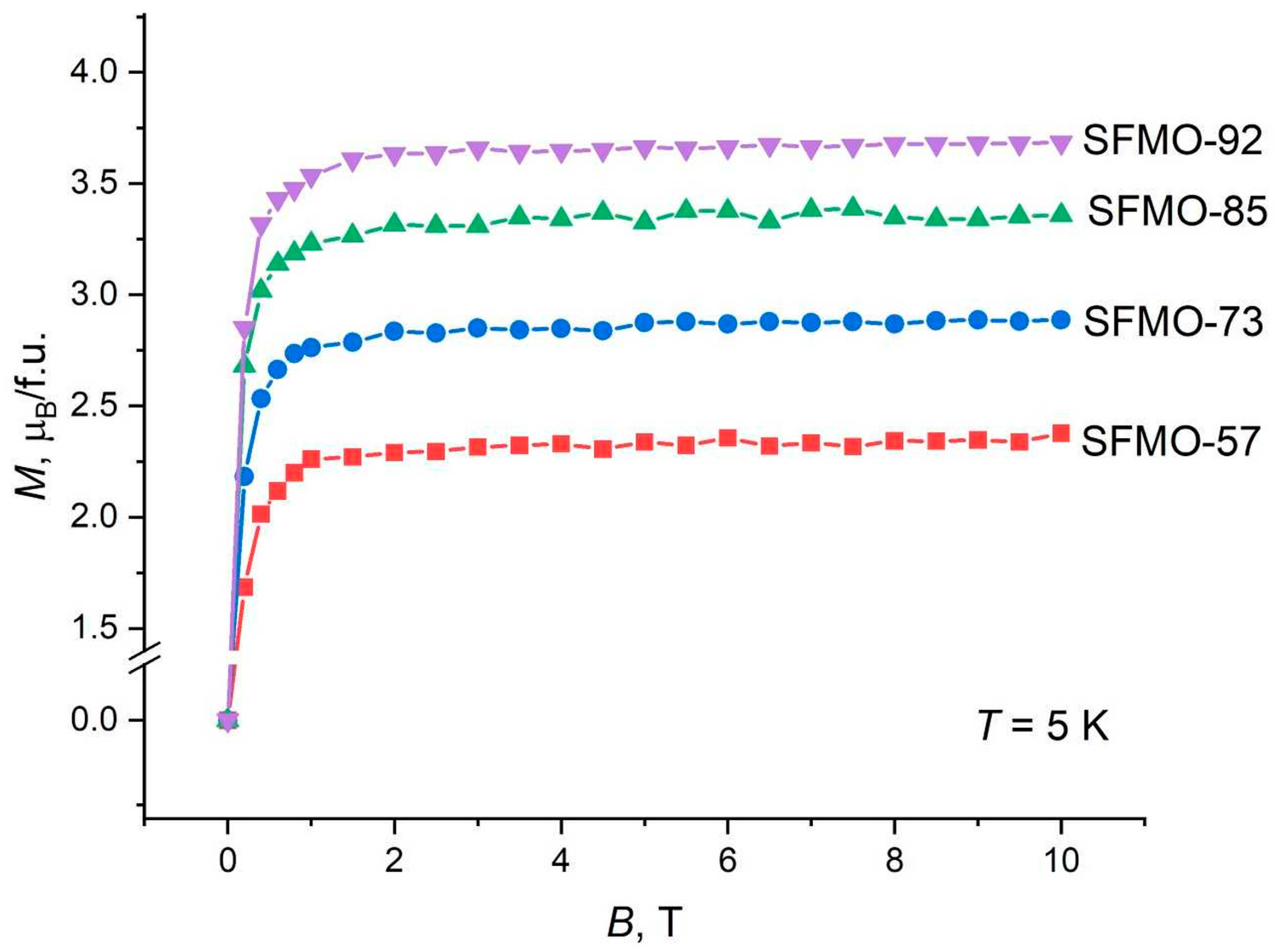
Figure 3 illustrates the magnetic field dependence of the magnetization of the samples on the order parameter P at T = 5 K.
Table 1 compiles the order parameter P, antisite disorder, and the corresponding site occupation factors of the B′ and B″ sublattices, gFe and gMo, defined from the Rietveld refinement, the order parameter P calculated according to Equation (2), and ASD resulting from Equation (1) and the order parameter PM derived from the ASD of Equation (3). With regard to differences in b values, the uncertainty of the PM value amounts to ±15% for Ms = 2.33 µB, decreasing to ±2% for Ms = 3.67 µB/f.u..
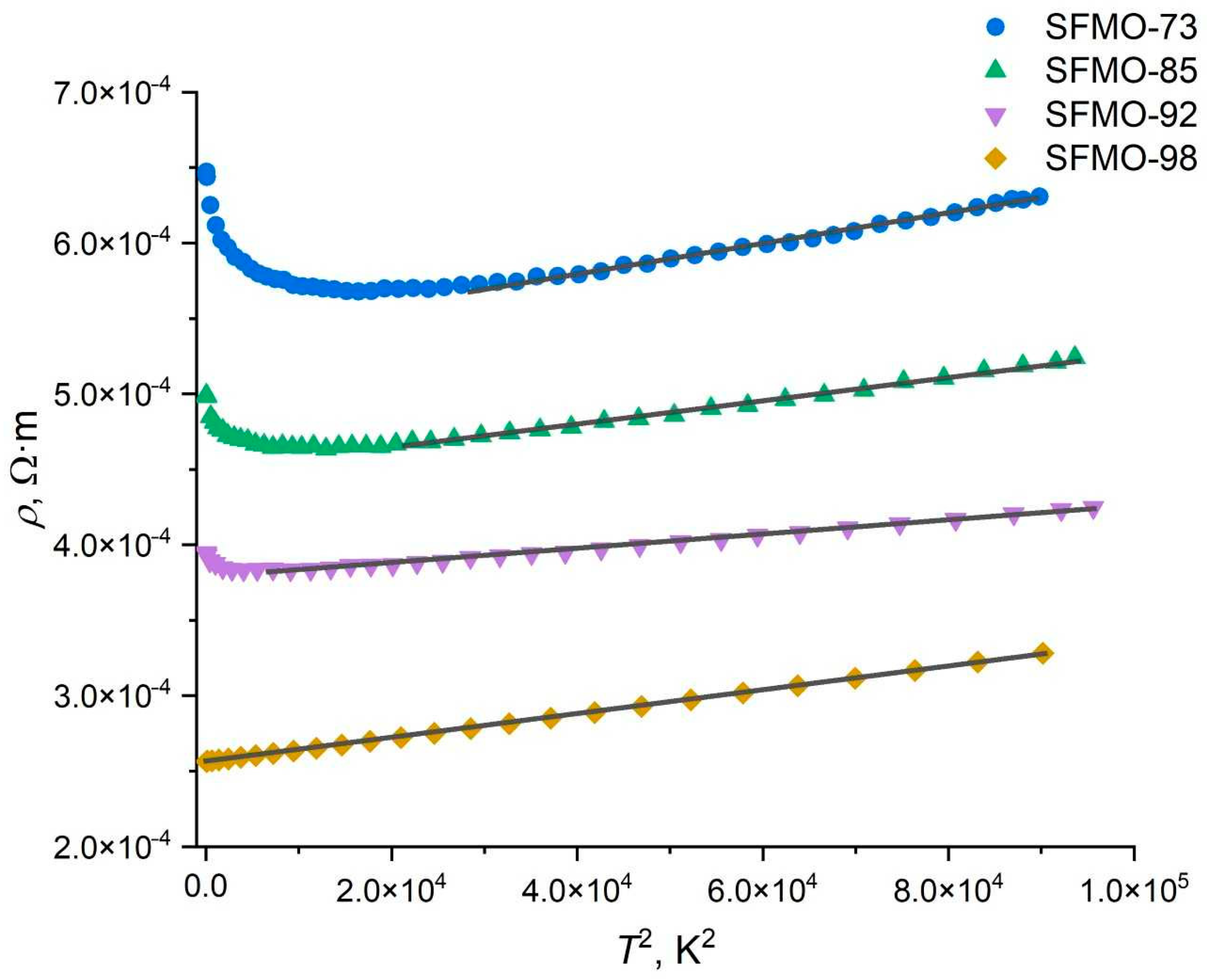
To determine the charge carrier scattering mechanisms in the high-temperature range, graphs of the ρ(T) ~ ρ0 + RmTm type were drawn for the temperature dependence of the SFMO resistivity. The best power-law approximation was a value of m = 2, obtained in a limited temperature range, as illustrated in Figure 4.
The fitted value m ≈ 2 probably corresponds to electron–electron scattering (characteristic of transition metal oxide systems, which include SFMO) or alternatively to electron scattering by phonons [49] or by magnons [50,51,52]. Electron–electron scattering due to Coulomb interactions between free charge carriers makes a very weak contribution to the resistivity of SFMO because of the low effective charge carrier density at the Fermi level, equal to 1.1 electron/f.u. at T = 20 K [34] and 1.3 electron/f.u. at T = 300 K [53]. In addition, the contribution of electron scattering leads to a positive magnetoresistance [54], which is observed, for instance, in metallic alloys, whereas SFMO has a negative MR. Another mechanism that explains the quadratic dependence ρ ~ T2 is the scattering of conduction electrons by phonons, that is, quanta of vibrational motion of atoms or ions in the crystal lattice [55]. Under the influence of an external electric field, electrons move through the crystal lattice and collide with phonons, exchanging energy and momentum, which alters their trajectories. As the temperature increases, the amplitude of the thermal vibrations of atoms increases, thereby increasing the frequency of such collisions. Consequently, the electron–phonon interaction limits electron mobility, thereby increasing the electrical resistance of the material [56]. At low temperatures, this scattering mechanism is weakened, allowing electrons to move with less energy loss; therefore, as the temperature decreases, the resistivity decreases, as shown in the Figure 4.
The observed decrease in the Rm factor (cf. Table 2) with an increasing degree of superstructural ordering of Fe/Mo indicates a weakening of the contribution of electron-magnon scattering to the high-temperature part of the SFMO [57,58]. In double perovskite SFMO, ideal superstructural ordering (Fe/Mo) creates a periodic lattice potential. This ensures high carrier mobility in subbands with a specific spin orientation (half-metallic state). Spin waves (magnons) have a clearly defined spectrum. Electron-magnon scattering in such a system is relatively weak, since it is difficult for conduction electrons with a given spin polarization to interact with collective excitations in a strictly ordered spin system. Antisite defects locally disrupt the periodicity of the crystalline and magnetic order. This leads to a local distortion of the electric potential because the Fe3+ and Mo5+/6+ ions have different charges and electron configurations. This creates a region of non-uniform scattering potential for conduction electrons. Fe3+–O–Fe3+ or Mo–O–Mo defects also appear, which locally alter the type and strength of magnetic interaction, creating magnetic inhomogeneities (violation of spin collinearity, weakening of exchange interaction). Electron-magnon scattering is enhanced in an inhomogeneous medium. Antisite defects act as centers at which conduction electrons interact more effectively with the spin system: an electron passing a magnetic defect can induce a localized spin excitation or change its spin orientation. Low-energy magnons in a disordered system have a higher density of states and can more easily exchange energy with electrons. Thus, the more antisite defects (the lower the degree of ordering P), the stronger the overall scattering of conduction electrons. At a high degree of ordering, the periodic potential maintains regularity, which suppresses electron-magnon scattering and minimizes its contribution to electrical resistance. On the contrary, at low ordering, many antisite defects arise, causing local disturbances in the electronic and magnetic order and forming inhomogeneities. As a result, electron-magnon scattering becomes an effective channel for electron scattering, and its contribution to resistance increases significantly. In this way, antisite defects serve as centers that enhance the interaction between electron and spin degrees of freedom, which is experimentally manifested as an increase in the coefficient Rm in the temperature dependence of the resistivity.
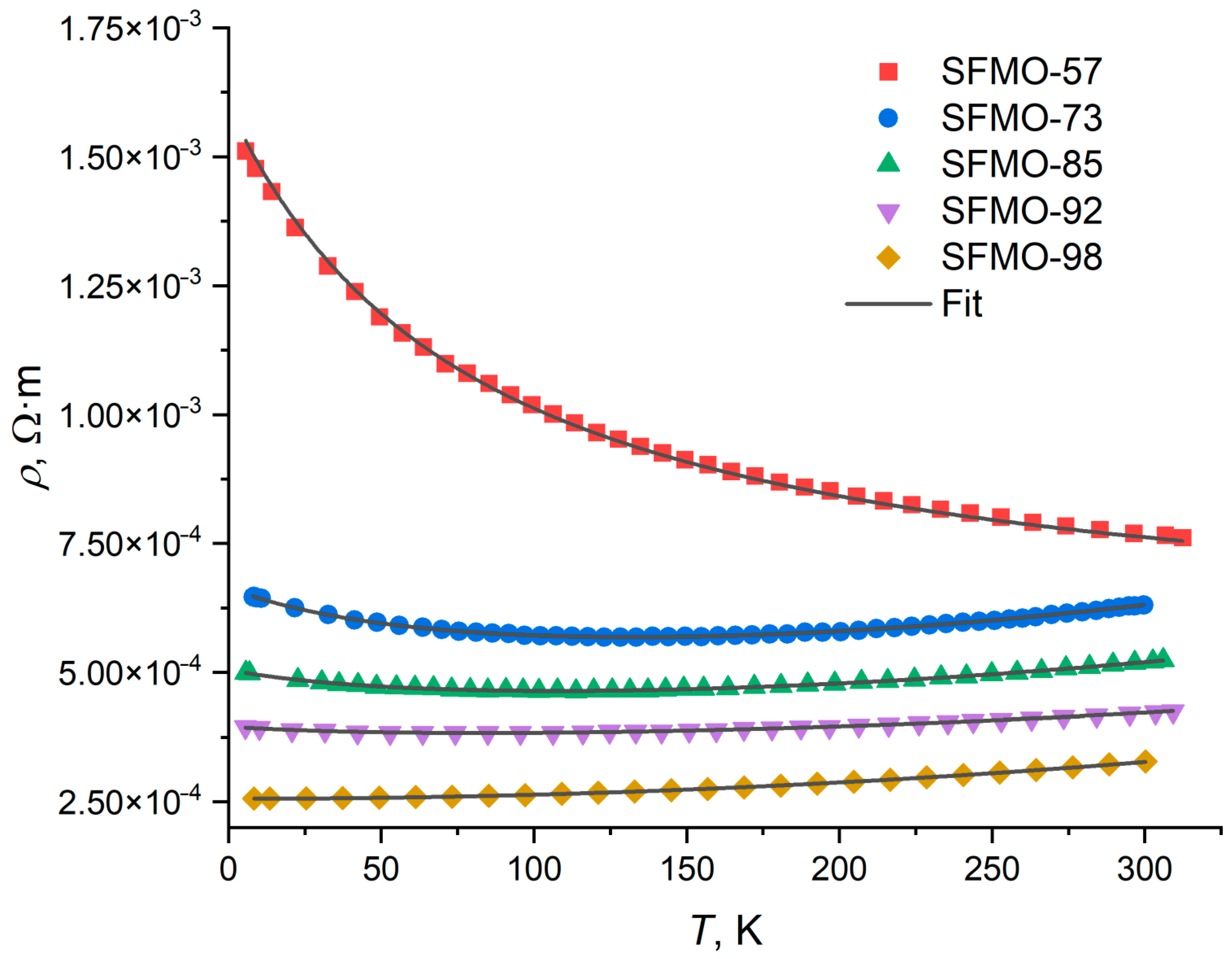
Figure 5 illustrates the resistivity data of the already considered polycrystalline SFMO ceramic samples fabricated by the solid-state reaction technique. With regard to the large number of fitting parameters, first the high temperature part of ρ(T) was fitted to Equation (10). Then, using these results as starting parameters, the parameters of the FIT model were obtained by a fit over the entire temperature range using Equation (11), shown in Figure 5 by solid lines.
Table 2 gathers the fitting parameters for the model described by Equations (5) and (11) and the special case ρ(T) = ρ0 + RmT2 for sample SFMO-98. Figure 4 and Table 2 reveal that the minimum resistivity sufficiently depends on the order parameter P. Note that in the considered temperature range, the moderately disordered sample SFMO-57 is well described solely by the FIT model, Equation (5).
The residual resistivity values obtained for polycrystalline SFMO ceramics exceed those of single-crystal SFMO by approximately two orders of magnitude [52], indicating that grain boundary scattering is the primary mechanism controlling charge carrier transport in the polycrystalline system. In this work, we consider intergrain charge carrier transport by fluctuation-induced tunneling. Following Equation (5), the thermal activation energy of charge transport in the high-temperature region, T >> T0, is given by
E a = k T 1 .
The value of Ea can be considered an effective value of the tunneling barrier height eV0. It allows us to calculate parameters of the FIT model as follows:
w = ħ π T 0 2 T 1 m e * k , A = k T 1 e 2 w 8 ε 0 V 0 2 = e 2 w 8 ε 0 E a .
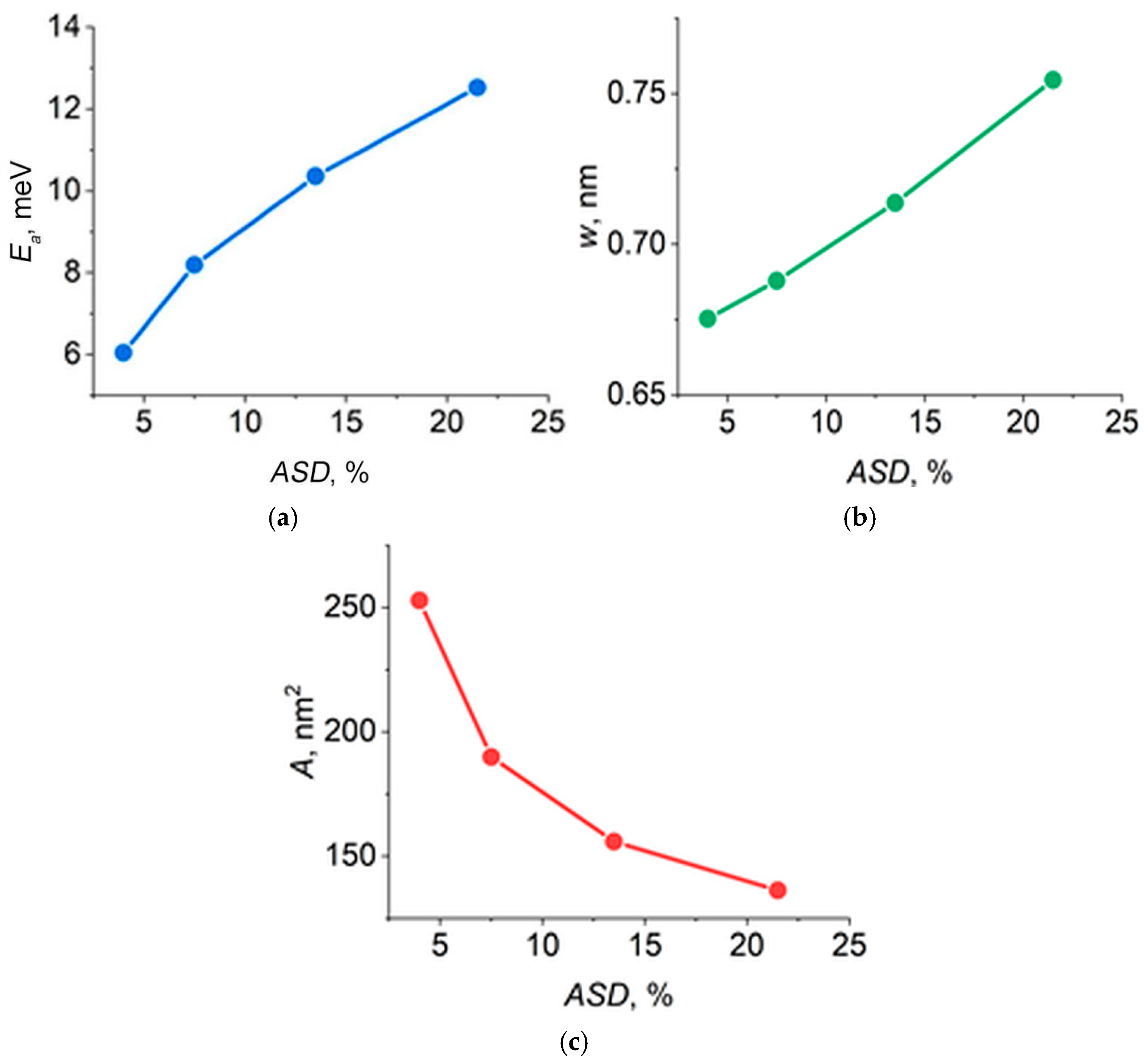
Figure 6 shows the dependence of the effective tunneling barrier height Ea, Equation (12), the barrier width w and barrier area A (calculated by means of Equation (13)) on the ASD values.
In granular ceramics, grain boundaries are the main source of conductivity loss compared to single crystals, i.e., they are the resistive bottleneck. Typically, a disordered grain boundary in ceramics increases resistivity because it introduces structural irregularities, defect states, and potential barriers that trap electrons and, thereby, hinder charge carrier transport. Structural irregularities, localized trap states and trapped charges at the boundary increase the potential barrier that must be overcome by charge carriers. Disorder at grain boundaries increases this potential barrier for intergrain tunneling even more. Thus, we expect an increase in EA with ASD, which corresponds in our case to an increase in T1. The increase in EA entails a decrease in the effective area of the nanosized barriers (cf. Equation (13)).

4. Conclusions

In this work, we considered the influence of antisite disorder, e.g., Fe ions on Mo sites, FeMo, and vice versa, MoFe, on the resistivity of strontium ferromolybdate ceramics fabricated by the solid-state reaction method.
We demonstrate that antisite disorder affects the parameters of the nanosized intergrain tunneling barriers, leading to fluctuation-induced tunneling at low temperatures. Both the effective barrier height of intergrain tunneling and the effective barrier width increase with increasing disorder, while the effective barrier area decreases in accordance with its dependence on effective barrier height.

Author Contributions

Conceptualization, G.S.; methodology, G.S. and E.A.; software, E.A.; validation, E.A., N.K. and M.Y.; formal analysis, E.A. and M.Y.; investigation, G.S., E.A. and M.Y.; resources, N.K. and G.G.; data curation, E.A.; writing—original draft preparation, G.S.; writing—review and editing, E.A., N.K. and G.G.; visualization, E.A.; supervision, N.K. and G.G.; project administration, G.S., N.K. and G.G.; funding acquisition, G.S., N.K. and G.G. All authors have read and agreed to the published version of the manuscript.

Funding

This work was funded by the EU project H2020-MSCA-RISE-2017-778308-SPINMULTIFILM.

Data Availability Statement

The original contributions presented in the study are included in the article. Further inquiries can be directed to the corresponding author.

Conflicts of Interest

The authors declare no conflicts of interest.

References

  1. Suchaneck, G.; Kalanda, N.; Artsiukh, E.; Gerlach, G. Challenges in Sr2FeMoO6−δ thin film deposition. Phys. Status Solidi B 2020, 257, 1900312. [Google Scholar] [CrossRef]
  2. Momma, K.; Izumi, F. VESTA 3 for three-dimensional visualization of crystal, volumetric and morphology data. J. Appl. Cryst. 2011, 44, 1272–1276. [Google Scholar] [CrossRef]
  3. Moritomo, Y.; Shimamoto, N.; Xu, S.; Machida, A.; Nishibori, E.; Takata, M.; Sakata, M.; Nakamura, A. Effects of B-site disorder in Sr2FeMoO6 with double perovskite structure. Jpn. J. Appl. Phys. 2001, 40, L672–L674. [Google Scholar] [CrossRef]
  4. Huang, Y.H.; Karppinen, M.; Yamauchi, H.; Goodenough, J.B. Systematic studies on effects of cationic ordering on structural and magnetic properties in Sr2FeMoO6. Phys. Rev. B Condens. Matter Mater. Phys. 2006, 73, 104408. [Google Scholar] [CrossRef]
  5. Sánchez, D.; Alonso, J.A.; García-Hernández, M.; Martínez-Lope, M.J.; Martínez, J.L. Origin of neutron magnetic scattering in antisite-disordered Sr2FeMoO6 double perovskites. Phys. Rev. B Condens. Matter Mater. Phys. 2002, 65, 104426. [Google Scholar] [CrossRef]
  6. Ogale, A.S.; Ogale, S.B.; Ramesh, R.; Venkatesan, T. Octahedral cation site disorder effects on magnetization in double-perovskite: Monte Carlo simulation study. Appl. Phys. Lett. 1999, 75, 537–539. [Google Scholar] [CrossRef]
  7. García-Hernández, M.; Martínez, J.L.; Martínez-Lope, M.J.; Casais, M.T.; Alonso, J.A. Finding universal correlations between cationic disorder and low field magnetoresistance in FeMo Double Perovskite Series. Phys. Rev. Lett. 2001, 86, 2443–2446. [Google Scholar] [CrossRef]
  8. Navarro, J.; Balcells, L.; Sandiumenge, F.; Bibes, M.; Roig, A.; Martínez, B.; Fontcuberta, J. Antisite defects and magnetoresistance in Sr2FeMoO6 double perovskite. J. Phys. Condens. Matter 2001, 13, 8481–8488. [Google Scholar] [CrossRef]
  9. Saha-Dasgupta, T.; Sarma, D.D. Ab initio study of disorder effects on the electronic and magnetic structure of Sr2FeMoO6. Phys. Rev. B Condens. Matter Mater. Phys. 2001, 64, 064408. [Google Scholar] [CrossRef]
  10. Sánchez, D.; Alonso, J.A.; García-Hernández, M.; Martínez-Lope, M.J.; Casais, M.T.; Martínez, J.L. Microscopic nature of the electron doping effects in the double perovskite Sr2−xLaxFeMoO6 (0 ≤ x ≤ 1) series. J. Mater. Chem. 2003, 13, 1771–1777. [Google Scholar] [CrossRef]
  11. Asaka, T.; Yu, X.Z.; Tomioka, Y.; Kaneko, Y.; Nagai, T.; Kimoto, K.; Ishizuka, K.; Tokura, Y.; Matsui, Y. Strong pinning effect and magnetic nanodomain formation by coupling between magnetic and crystallographic domains in the ordered double perovskite Ba2FeMoO6. Phys. Rev. B Condens. Matter Mater. Phys. 2007, 75, 184440. [Google Scholar] [CrossRef]
  12. Meneghini, C.; Ray, S.; Liscio, F.; Bardelli, F.; Mobilio, S.; Sarma, D.D. Nature of ‘‘disorder’’ in the ordered double perovskite Sr2FeMoO6. Phys. Rev. Lett. 2009, 103, 046403. [Google Scholar] [CrossRef]
  13. Rijnders, G.; Currá, S.; Huijben, M.; Blank, D.A.H.; Rogalla, H. Influence of substrate–film interface engineering on the superconducting properties of YBa2Cu3O7−d. Appl. Phys. Lett. 2004, 84, 1150–1152. [Google Scholar] [CrossRef]
  14. Yadav, E.; Navale, K.S.; Prajapati, G.L.; Mavani, K.R. Process-gas-influenced anti-site disorder and its effects on magnetic and electronic properties of half-metallic Sr2FeMoO6 thin films. Magnetochemistry 2023, 9, 167. [Google Scholar] [CrossRef]
  15. Sánchez, D.; García-Hernández, M.; Auth, N.; Jakob, G. Structural, magnetic, and transport properties of high-quality epitaxial Sr2FeMoO6 thin films prepared by pulsed laser deposition. J. Appl. Phys. 2004, 96, 2736–2742. [Google Scholar] [CrossRef]
  16. Sing, V.N. The Impact of Antisite Disorder on Magnetism and Transport in the Double Perovskites. Ph.D. Thesis, Department of Physical Sciences, Homi Bhabha National Institute, Allahabad, India, 2012. [Google Scholar]
  17. Linden, J.; Yamamoto, T.; Karppinen, M.; Yamauchi, H.; Pictari, T. Evidence for valence fluctuation of Fe in Sr2FeMoO6−w double perovskite. Appl. Phys. Lett. 2000, 76, 2925–2927. [Google Scholar] [CrossRef]
  18. Chattopadhyay, B.; Poddar, A.; Das, S.; Majumder, C.; Ranganathan, R. Studies of electrical transport properties of Sr2Fe(Mo, V)O6 compound. J. Alloys Compd. 2004, 366, 28–33. [Google Scholar] [CrossRef]
  19. Holt, D.B. Antiphase boundaries in semiconducting compounds. J. Phys. Chem. Solids 1996, 30, 1297–1308. [Google Scholar] [CrossRef]
  20. Feng, X.; Liu, G.; Huang, Q.; Rao, G. Influence of annealing treatment on structural and magnetic properties of double perovskite Sr2FeMoO6. Trans. Nonferr. Met. Soc. China 2006, 16, 122–126. [Google Scholar] [CrossRef]
  21. Mott, N.F.; Davis, E.A. Electronic Processes in Non-Crystalline Materials, 2nd ed.; Oxford Clarendon Press: Oxford, UK, 1979. [Google Scholar]
  22. Suchaneck, G.; Kalanda, N.; Artiukh, E.; Yarmolich, M.; Sobolev, N.A. Tunneling conduction mechanisms in strontium ferromolybdate ceramics with strontium molybdate dielectric intergrain barriers. J. Alloys Compd. 2021, 860, 158526. [Google Scholar] [CrossRef]
  23. Zhai, Y.; Qiao, J.; Huo, G.; Han, S. Synthesis, magnetic and electrical transport properties of magnetoresistance material Sr2FeMoO6 by microwave sintering. J. Magn. Magn. Mater. 2012, 324, 2006–2010. [Google Scholar] [CrossRef]
  24. Maryanowska, A.; Pietrzak, J.; Zarek, W. Magnetic properties of Sr2FeVO6−δ single crystals. J. Magn. Magn. Mater. 1995, 140–144, 1581–1582. [Google Scholar] [CrossRef]
  25. Suchaneck, G.; Artiukh, E.; Gerlach, G. The Origin of the low-temperature minimum of electrical resistivity in strontium ferromolybdate ceramics. Ceramics 2024, 7, 491–503. [Google Scholar] [CrossRef]
  26. Sheng, P.; Sichel, E.K.; Gittleman, J.I. Fluctuation-induced tunneling conduction in carbon-polyvinylchloride composites. Phys. Rev. Lett. 1978, 40, 1197–2000. [Google Scholar] [CrossRef]
  27. Serrate, D.; Teresa, J.M.D.; Algarabel, P.A.; Ibarra, M.R.; Galibert, J. Intergrain magnetoresistance up to 50 T in the half-metallic (Ba0.8Sr0.2)2FeMoO6 double perovskite: Spin-glass behavior of the grain boundary. Phys. Rev. B Condens. Matter Mater. Phys. 2005, 71, 104409. [Google Scholar] [CrossRef]
  28. Kobayashi, K.-I.; Kimura, T.; Sawada, H.; Terakura, K.; Tokura, Y. Room-temperature magnetoresistance in an oxide material with an ordered double-perovskite structure. Nature 1998, 395, 677–680. [Google Scholar] [CrossRef]
  29. Ray, S.; Middey, S.; Jana, S.; Banerjee, A.; Sanyal, P.; Rawat, R.; Gregoratti, L.; Sarma, D.D. Origin of the unconventional magnetoresistance in Sr2FeMoO6. Europhys. Lett. 2011, 94, 47007. [Google Scholar] [CrossRef]
  30. Kim, T.H.; Uehara, M.; Cheong, S.-W.; Lee, S. Large room-temperature intergrain magnetoresistance in double perovskite SrFe1−x(Mo or Re)xO3. Appl. Phys. Lett. 1999, 74, 1737–1739. [Google Scholar] [CrossRef]
  31. Saitoh, T.; Nakatake, M.; Nakajima, H.; Morimoto, O.; Kakizaki, A.; Xu, S.; Moritomo, Y.; Hamada, N.; Aiura, Y. Unusual electron-doping effects in Sr2−xLaxFeMoO6 observed by photoemission spectroscopy. Phys. Rev. B Condens. Matter Mater. Phys. 2005, 72, 045107. [Google Scholar] [CrossRef]
  32. Tomioka, Y.; Okuda, T.; Okimoto, Y.; Kumai, R.; Kobayashi, K.; Tokura, Y. Magnetic and electronic properties of a single crystal of ordered double perovskite. Phys. Rev. B Condens. Matter Mater. Phys. 2000, 61, 422–427. [Google Scholar] [CrossRef]
  33. Yanagihara, H.; Salamon, M.B.; Lyanda-Geller, Y.; Xu, S.; Moritomo, Y. Magnetotransport in double perovskite Sr2FeMoO6: Role of magnetic and nonmagnetic disorder. Phys. Rev. B Condens. Matter Mater. Phys. 2001, 64, 214407. [Google Scholar] [CrossRef]
  34. Jakob, G.; Westerburg, W.; Martin, F.; Reisinger, D.; Auth, N. Magnetotransport properties of thin films of magnetic perovskites. In Advances in Solid State Physics; Kramer, B., Ed.; Springer: Berlin/Heidelberg, Germany, 2001; Volume 41, pp. 589–600. [Google Scholar]
  35. Carvajal, E.; Navarro, O.; Allub, R.; Avignon, M.; Alascio, B. Electronic properties of double perovskite compounds. Phys. Status Solidi B 2005, 242, 1942–1945. [Google Scholar] [CrossRef]
  36. Allub, R.; Navarro, O.; Avignon, M.; Alascio, B. Effect of disorder on the electronic structure of the double perovskite Sr2FeMoO6. Phys. B Condens. Matter 2002, 320, 13–17. [Google Scholar] [CrossRef]
  37. Li, H.; Zhao, Y.; Wang, Y.; Li, Y. Sr2Fe2−xMoxO6−δ perovskite as an anode in a solid oxide fuel cell: Effect of the substitution ratio. Catal. Today 2016, 259, 417–422. [Google Scholar] [CrossRef]
  38. Zhang, L.; Zhou, Q.; He, Q.; He, T. Double-perovskites A2FeMoO6−δ (A = Ca, Sr, Ba) as anodes for solid oxide fuel cells. J. Power Sources 2010, 195, 6356–6366. [Google Scholar] [CrossRef]
  39. Tang, Y.; Wang, J.; Li, D.; Deng, S.; Chen, Z.; Sun, L.; Liu, W.; Shen, L.; Deng, S. High electrical transport properties performance enhanced by anti-site defects in single crystalline SnSe. J. Alloys Compd. 2018, 748, 80–86. [Google Scholar] [CrossRef]
  40. Galazka, Z.; Irmscher, K.; Pietsch, M.; Ganschow, S.; Schulz, D.; Klimm, D.; Hanke, I.M.; Schroeder, T.; Bickermann, M. Experimental Hall electron mobility of bulk single crystals of transparent semiconducting oxides. J. Mater. Res. 2021, 36, 4746–4755. [Google Scholar] [CrossRef]
  41. Stankiewicz, J.; Rosa, F.S.P.; Schlottmann, P.; Fisk, Z. Electrical transport properties of single-crystal CaB6, SrB6, and BaB6. Phys. Rev. B Condens. Matter Mater. Phys. 2016, 94, 125141. [Google Scholar] [CrossRef]
  42. Ge, Z.; Tian, Y.; Sun, A.; Zhu, Z.; Song, W.; Li, H. The impact of B-site antisite defects on the magnetic and electronic properties in double perovskite Pb2FeOsO6. Ceram. Int. 2021, 47, 992–1001. [Google Scholar] [CrossRef]
  43. Balcells, L.; Navarro, J.; Bibes, M.; Roig, A.; Martınez, B.; Fontcuberta, J. Cationic ordering control of magnetization in Sr2FeMoO6 double perovskite. Appl. Phys. Lett. 2001, 78, 781–783. [Google Scholar] [CrossRef]
  44. Woodward, P.; Hoffmann, R.-D.; Sleight, A.W. Order-disorder in A2M3+M5+O6 perovskites. J. Mater. Res. 1994, 9, 2118–2127. [Google Scholar] [CrossRef]
  45. Kraus, W.; Nolze, G. Powder Cell—A program for the representation and manipulation of crystal structures and calculation of the resulting X-ray powder patterns. J. Appl. Crystallogr. 1996, 29, 301–303. [Google Scholar] [CrossRef]
  46. Muñoz-García, A.B.; Pavone, M.; Carter, E.A. Effect of Antisite Defects on the Formation of Oxygen Vacancies in Sr2FeMoO6: Implications for Ion and Electron Transport. Chem. Mater. 2011, 23, 4525–4536. [Google Scholar] [CrossRef]
  47. Kalanda, N.; Karpinsky, D.; Bobrikov, I.; Yarmolich, M.; Kuts, V.; Huang, L.; Hwang, C.; Kim, D.-H. Interrelation among superstructural ordering, oxygen nonstoichiometry and lattice strain of double perovskite Sr2FeMoO6−δ materials. J. Mater. Sci. 2021, 56, 11698–11710. [Google Scholar] [CrossRef]
  48. Bäurer, M.; Störmer, H.; Gerthsen, D.; Hoffmann, M.J. Linking Grain Boundaries and Grain Growth in Ceramics. Adv. Eng. Mater. 2010, 12, 1230–1234. [Google Scholar] [CrossRef]
  49. Mott, N.F. The electrical conductivity of transition metals. Proc. R. Soc. Lond. A 1936, 153, 699–717. [Google Scholar] [CrossRef]
  50. Westerburg, W.; Martin, F.; van Bentum, P.J.M.; Perenboom, J.A.A.J.; Jakob, G. Charge-carrier density collapse in La0.67Ca0.33MnO3 and La0.67Sr0.33MnO3 epitaxial thin films. Eur. Phys. J. B Condens. Matter 2000, 14, 509–513. [Google Scholar] [CrossRef]
  51. Sher, F.; Venimadhav, A.; Blamire, M.G.; Dabrowski, B.; Kolesnik, S.; Attfield, J.P. Structural, magnetic and transport properties of Sr2Fe1−xMgxMoO6 double perovskites. Solid State Sci. 2005, 7, 912–919. [Google Scholar] [CrossRef]
  52. Moritomo, Y.; Xu, S.; Machida, A.; Akimoto, T.; Nishibori, E.; Takata, M.; Sakata, M.; Ohoyama, K. Crystal and Magnetic Structure of Conducting Double Perovskite Sr2FeMoO6. J. Phys. Soc. Jpn. 2000, 69, 1723–1726. [Google Scholar] [CrossRef]
  53. Westerburg, W. Spinpolarisierter Transport in Epitaktischen Manganoxid-und Doppelperowskitschichten. Ph.D. Thesis, Department of Physics, Johannes Gutenberg-University Mainz, Mainz, Germany, 2000. [Google Scholar] [CrossRef]
  54. Mandal, I.; Lucas, A. Sign of viscous magnetoresistance in electron fluids. Phys. Rev. B Condens. Matter Mater. Phys. 2020, 101, 521. [Google Scholar] [CrossRef]
  55. Goodings, D.A. Electrical Resistivity of Ferromagnetic Metals at Low Temperatures. Phys. Rev. 1963, 132, 542–558. [Google Scholar] [CrossRef]
  56. Lee, P.A.; Ramakrishnan, T.V. Disordered electronic systems. Rev. Mod. Phys. 1985, 57, 287–337. [Google Scholar] [CrossRef]
  57. Jasiewicz, K.; Tobola, J.; Wiendlocha, B. Local distortions of the crystal structure and their influence on the electronic structure and superconductivity of the high-entropy alloy (TaNb)0.67(HfZrTi)0.33. Phys. Rev. B Condens. Matter Mater. Phys. 2023, 108, 1569. [Google Scholar] [CrossRef]
  58. Huang, W.; Qian, W.; El-Sayed, M.A.; Ding, Y.; Wang, Z.L. Effect of the lattice crystallinity on the electron−phonon relaxation rates in gold nanoparticles. J. Phys. Chem. C 2007, 111, 10751–10757. [Google Scholar] [CrossRef]
Figure 1. Antisite FeMo and MoFe defect pair in the SFMO lattice. Sr ions are marked in green, Fe ions in yellow, Mo ions in blue, and O ions in red. An antisite defect pair is marked by a red ellipse. The image was created using VESTA 3.4.7 software [2].
Electronicmat 07 00005 g001
Figure 2. XRD pattern of samples (a) SFMO-57, SFMO-73, SFMO-85, SFMO-92 fabricated using sintering times of 10, 14, 19, and 27 h in 10% H2/Ar and (b) the nearly ordered sample SFMO-98 sintered for 40 h in 10% H2/Ar. The red line in Figure 2b illustrates an example of Rietveld refinements, while the gray line illustrates the uncertainty.
Electronicmat 07 00005 g002
Figure 3. Magnetic field dependence of the magnetization of samples SFMO-57, SFMO-73, SFMO-85, and SFMO-92.
Electronicmat 07 00005 g003
Figure 4. Resistivity of samples SFMO-73, SFMO-85, SFMO-92 and SFMO-98 fabricated using the solid-state method as a function of T2. The black solid lines show ρ ~ T2.
Electronicmat 07 00005 g004
Figure 5. Fit of resistivity data of polycrystalline SFMO ceramics fabricated by the solid-state reaction technique in this work to Equation (11). Sample SFMO-57 data were fitted to Equation (5), sample SFMO-98 data were fitted to equation ρ(T) = ρ0 + RmT2.
Electronicmat 07 00005 g005
Figure 6. Effective values of the activation energy Ea (a), barrier width w (b), and barrier area A (c) depending on the value of ASD.
Electronicmat 07 00005 g006
Table 1. Site occupation factors g defined from the Rietveld refinement, the order parameter P calculated according to Equation (2), and ASD resulting from Equation (1) and the order parameter PM derived from the ASD of Equation (3) for b = 8. The saturated magnetization values of the SFMO samples were determined using data from Figure 2.
SamplegFegMoP, %ASDMs, MB/f.u.PM, %
SFMO-570.7850.785570.2152.3358.25
SFMO-730.8650.865730.1352.8972.25
SFMO-850.9250.925850.0753.3684
SFMO-920.9600.960920.0403.6791.75
Table 2. Fitting resistivity model parameters for samples in this work.
Sampleρ0, Ω·mRm, Ω·m·K−2ρFIT, mΩT1, KT0, K
SFMO-57--5.46 × 10−4145.34135.28
SFMO-733.46 × 10−31.31 × 10−91.26 × 10−4120.19130.05
SFMO-853.39 × 10−49.65 × 10−107.50 × 10−495.08120.01
SFMO-923.32 × 10−48.72 × 10−103.26 × 10−470.11104.97
SFMO-982.56 × 10−47.93 × 10−10---
Disclaimer/Publisher’s Note: The statements, opinions and data contained in all publications are solely those of the individual author(s) and contributor(s) and not of MDPI and/or the editor(s). MDPI and/or the editor(s) disclaim responsibility for any injury to people or property resulting from any ideas, methods, instructions or products referred to in the content.