


Abstract
Heavily doped metal oxide thin films combining high visible transmittance and low electrical resistance are used in a multitude of optoelectronic devices, where their performance is highly dependent on the structural defects and density of electronic states associated with doping. This study explores the structural, optical, and electronic properties of Sn-doped indium oxide (In2O3:Sn) and Al-doped zinc oxide (ZnO:Al) thin films, which were prepared by sputtering on unheated glass substrates and subsequently annealed in N2 at different temperatures between 250 °C and 450 °C. These samples reach free electron densities above 1020 cm−3 due to the presence of extrinsic donors (mainly substitutional defects of SnIn and AlZn) and also intrinsic donors (oxygen vacancies), which change with the annealing temperature due to oxygen desorption and/or cation migration processes. The volume of the crystal lattice expands (up to a maximum of 1.1%) and the band gap widens (up to a maximum of 17.9%) with respect to the undoped material, increasing with electron density. Additional absorption is due to band tail, at an energy ~10% below the undoped band gap, which varies slightly with the carrier concentration. The same general behavior is observed for both materials, with particularities in terms of crystal lattice and electronic states, which can be tuned by the heating temperature.
1. Introduction
Transparent conducting oxide (TCO) thin films are capable of combining high optical transmittance in the visible region and high electrical conductivity [1], making them optimal electrodes in various optoelectronic devices such as flat-panel displays [2], electrochromic windows [3], photovoltaic cells [4], and gas sensors [5]. Among the most commonly used TCOs are In2O3 and ZnO [1], which tend to present oxygen vacancies (VO) as intrinsic donor defects, giving them n-type conductivity. The formation of oxygen vacancies can be enhanced by post-deposition heating in oxygen-poor environments [6]. Furthermore, it is common to add some extrinsic donor defects by doping with other cations (such as Sn-doped In2O3 and Al-doped ZnO [7]), to achieve higher concentrations of charge carriers and thus improve electrical conductivity. For large-scale applications, zinc oxide is of great interest because zinc is non-toxic, abundant and less expensive than indium, and is also suitable for space applications [8].
Under ideal conditions, In2O3 adopts the body-centered cubic bixbyite crystal structure with lattice parameter a = 10.117 Å [9]. The bixbyite structure is derived from a 2 × 2 × 2 fluorite superstructure that is missing a quarter of the anions, resulting in two non-equivalent cation sites and providing interstitial sites [10]. Indeed, interstitial oxygen (Oi) is often the reason for both lattice expansion and decreased carrier concentration in In2O3 thin films [11], while the inclusion of the Sn dopant allows the formation of neutral defect clusters consisting of two substitutional Sn ions (SnIn) bonded to one interstitial oxygen [10]. Doping levels of around Sn/In = 10 at.% are typically used to optimize electrical conductivity [12,13], and both the lattice parameter and carrier concentration tend to increase with Sn doping [13,14]. On the other hand, pure ZnO crystallizes in the hexagonal wurtzite structure with lattice parameters a = b = 3.2498 Å, and c = 5.2066 Å [15]. The optimum Al doping is around 4 at.%, which is in agreement with the estimated percentage of Al that can be occupied at Zn substitutional sites (AlZn) [16], while higher doping levels result in electrically inactive defects [17,18]. Some increase in the lattice parameters is observed with the AlZn and Oi species, taking into account that the charge carrier concentration increases with the first substitutional defects [18], but decreases with the incorporation of interstitial oxygen [19,20].
In heavily doped In2O3:Sn and ZnO:Al, a large number of impurities and intrinsic defects are inserted into the host lattice, which are responsible for the lattice distortion and also introduce distinct n-type doping levels that merge with the conduction band forming what is called the band tail. The description of these levels falls within the more general theory of disordered systems [21], where a simple exponential tail absorption occurs for short-range correlations that decay rapidly (as in amorphous silicon [22]), or for a dilute concentration of charged defects [23]. However, in the case of heavily doped semiconductors with screened Coulomb impurities, the band-tail density of states depends on a combination of different physical parameters, such as the free carrier concentration and the effective mass of the carriers [24,25]. Apart from band tail effects, the optical activation energy from the valence band to the conduction band changes when the Fermi level enters the conduction band due to the increase in donor electrons [6], and simultaneously the interacting Fermi gas (constituted by the conduction electrons and donor electrons) causes a shift in the conduction band towards the valence band [25].
This paper analyzes the crystalline and electronic characteristics of In2O3:Sn and ZnO:Al films obtained by sputtering at room temperature and subsequent annealing in N2 at different temperatures. In this way, different carrier concentrations are achieved due to oxygen desorption and/or cation migration processes that occur as a function of the heating temperature. The distortion of the crystalline structure (lattice volume) and the electronic structure (band gap and band tail) of both materials are studied for the first time in a comparative manner as a function of the carrier concentration, with the aim of understanding the evolution of their properties and establishing guidelines that allow their adjustment by appropriate annealing.
2. Materials and Methods
Metal oxide thin films were prepared on unheated soda lime glass substrates by using sputtering targets of In2O3/SnO2 (90/10 wt.%) and ZnO/Al2O3 (98/2 wt.%) (SenVac GmbH, Friedberg, Germany). Such composition was selected according to the optimum extrinsic doping for each material, which is Sn/In = 10 at.% for In2O3:Sn [13] and Al/Zn = 4 at.% for ZnO:Al [17], although the free electron density depends also on the intrinsic doping related to oxygen vacancies and cation interstitials [26]. The sputtering pressure was set to 4 × 10⁻¹ Pa and the applied power to 2 W/cm2, adjusting the deposition time to obtain 0.3 μm film thickness, which has been verified by profilometric measurements with a Dektak 3030 system (Veeco Instruments GmbH, Mannheim, Germany). Post-deposition annealing was performed introducing In2O3:Sn and ZnO:Al samples simultaneously into a tubular furnace (ATV Technologie GmbH, Munich, Germany) at ambient pressure with an N2 flow rate of 2.5 L/min, using a constant heating and cooling rate of 10 °C/min. A maximum temperature between 250 and 450 °C was maintained for 20 min, which allow for oxygen desorption and/or cation migration processes depending on the heating temperature.
The chemical composition of the films was in accordance with the respective sputtering target (±1 at.%), as determined by an EDS system (Oxford Instruments, High Wycombe, UK). The crystalline structure was analyzed by X-ray diffraction (XRD) with an X’Pert instrument (PANalytical, Malvern, UK), using the nickel-filtered Kα1 emission line of copper (λ = 1.5405 Å) in Bragg–Brentano (θ–2θ) configuration, by comparing the recorded diffraction peaks to the standard powder diffraction files (PDF). The free carrier concentration, mobility, and electrical resistivity of the different samples were determined with an HMS3000 Hall Measurement System (ECOPIA, Gyeonggi-do, Republic of Korea) using the Van der Pauw method, with a current of 1.0 mA and a magnetic field of 0.5 T. Optical transmittance and reflectance measurements were performed with unpolarized light at normal incidence in the wavelength range λ = 250–1500 nm, using a double beam spectrophotometer Lambda 9 (PerkinElmer Inc., Waltham, MA, USA) that contains an integrating sphere and taking the air as reference.
3. Results and Discussion
3.1. Lattice Distortion and Charge Carrier Concentration
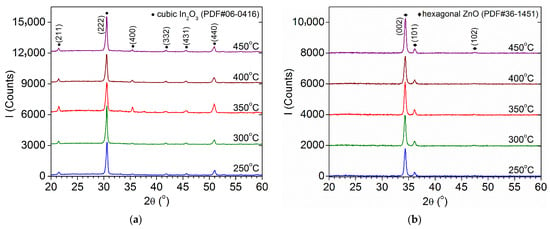
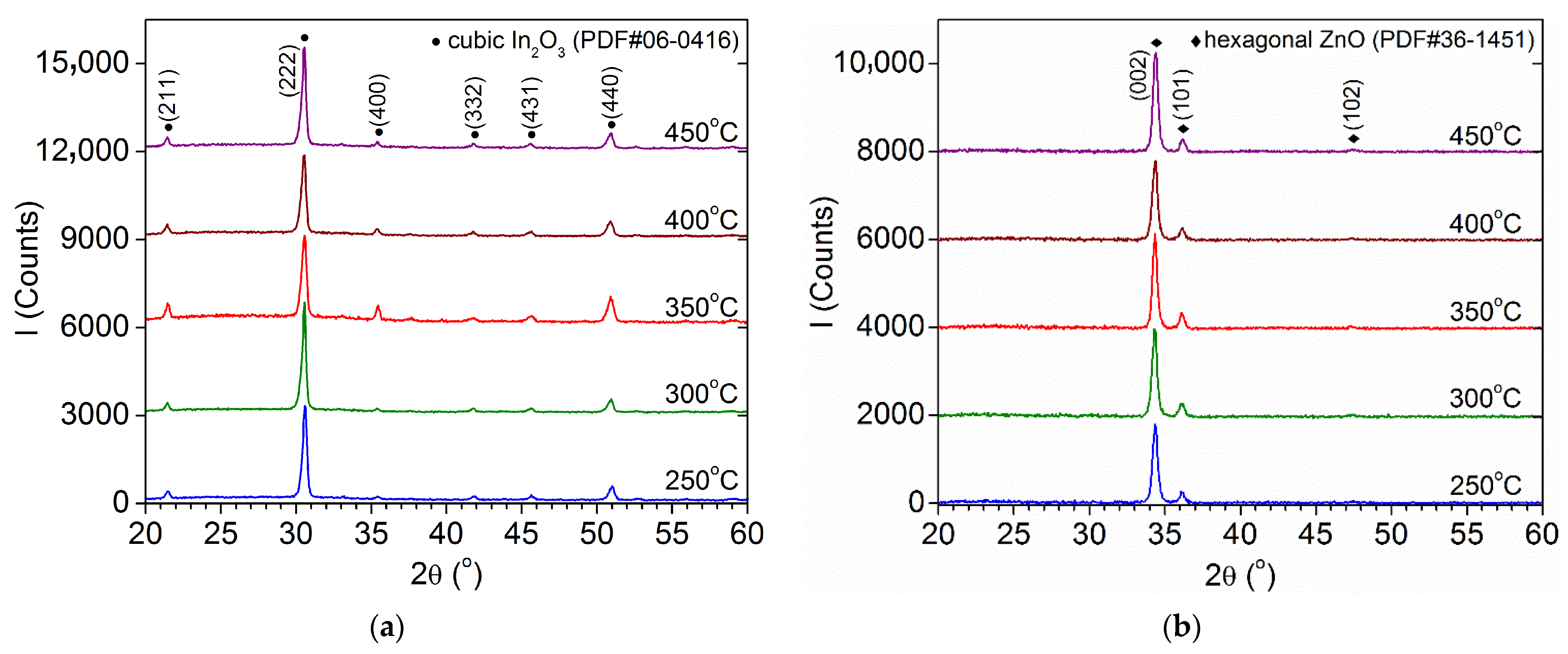
The X-ray diffractograms in Figure 1 show that all films, heated at different temperatures, have a crystalline structure according to the cubic bixbyite In2O3 (PDF#06-0416) or the hexagonal wurtzite ZnO (PDF#36-1451). For each sample, the mean crystallite size (D) has been calculated by the Scherrer formula [27]:
where λ is the X-ray wavelength and β is the full width at half maximum of the main diffraction peak, located at angle θ. Furthermore, the lattice parameters (a, b, c) and the unit cell volume (V) have been obtained from the measured interplanar spacings, d(hkl) = λ/(2sinθ), using the following equations for the cubic structure (with a = b = c):
and these others for the hexagonal structure (with a = b ≠ c):
Figure 1.
XRD patterns corresponding to the sputtered films: (a) In2O3:Sn and (b) ZnO:Al, after heating at different temperatures in flowing N2 atmosphere.
The structural characteristics of the different samples are summarized in Table 1, along with their respective electrical properties. The mean crystallite size is observed to be similar for the In2O3:Sn and ZnO:Al films, increasing in both materials within the range D = 26–30 nm with heating temperature. The unit cell volume and carrier concentration also tend to increase with annealing temperature, exhibiting a behavior that is analyzed in more detail below. The maximum carrier concentration reached is N = 8.5 × 1020 cm−3 for In2O3:Sn heated at 400 °C and N = 4.2 × 1020 cm−3 for ZnO:Al at 300 °C, being higher in the first case because the compound allows for a higher percentage of doping as used. In both materials, the maximum carrier concentration corresponds to the largest lattice volume, regardless of crystallite size or carrier mobility, according to the data in Table 1.
Table 1.
Mean crystallite size (D), unit cell volume (V), charge carrier concentration (N), carrier mobility (μ), and electrical resistivity (ρ) of the samples heated at different temperatures.
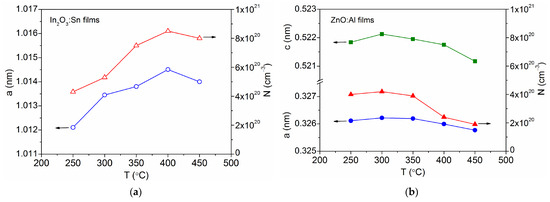
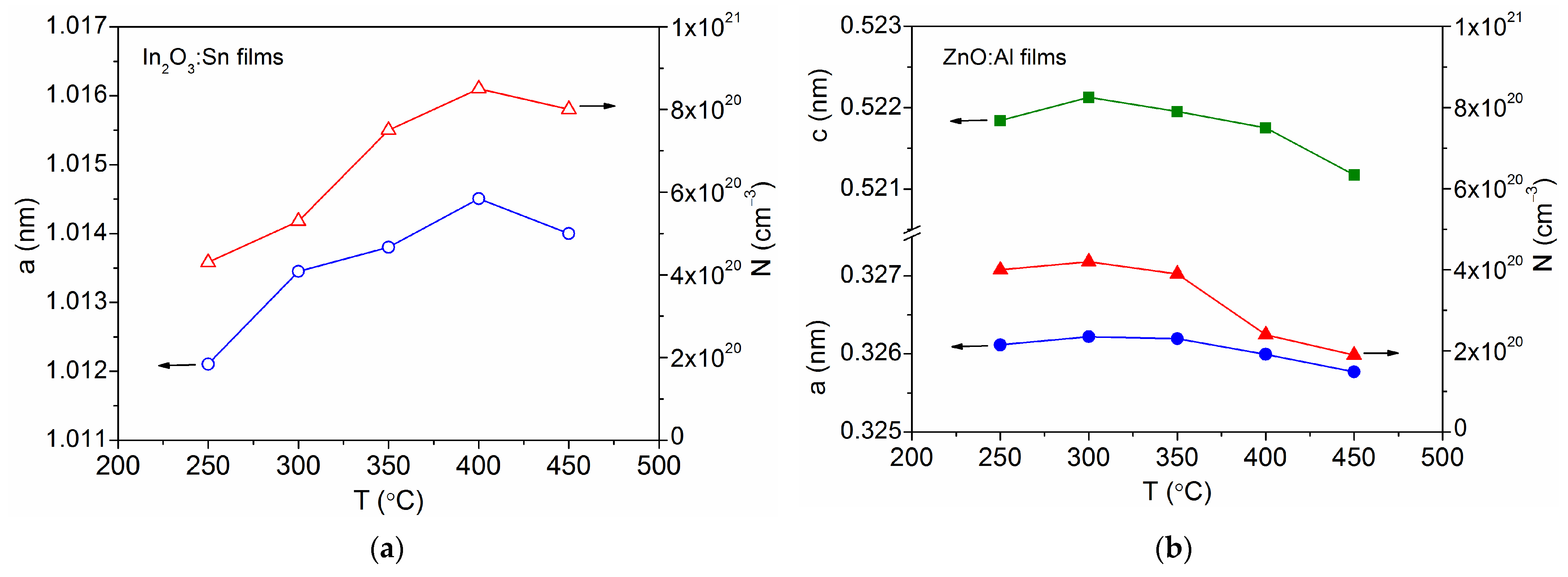
The lattice parameters and cell volumes obtained for the different heated layers have been compared with the respective standard values for In2O3 [10] (a0 = 10.118 Å, V0 = 1035.82 Å3) and ZnO [28] (a0 = 3.2498 Å, c0 = 5.2066 Å, V0 = 47.62 Å3). Consequently, it is observed that all the In2O3:Sn and ZnO:Al films exhibit tensile strain, that is lattice parameters above the standard values for the respective undoped material. This is related to the presence of structural defects that can also increase the carrier concentration, as shown in Figure 2. Lattice expansion has been reported for other In2O3:Sn samples, with a ~10.130 Å for typical nanocrystallites with ~8–10 at.% Sn [14,29]. In the case of ZnO:Al films, tensile strain along the a-axis is related to the incorporation of Al in both substitutional and interstitial positions, being a ~3.260 Å for ~4 at.% Al doping [30], while tensile strain along the c-axis is usually attributed to the incorporation of interstitial oxygen during the deposition process [19,31]. The activation of charge donors (mainly SnIn or AlZn) explains the increase in the carrier concentration and lattice parameters seen in Figure 2, which is proportional to the heating temperature up to a maximum value after which a decay occurs due to the segregation of cations towards positions where they cease to be electrically active [32,33].
Figure 2.
Evolution of the lattice parameters (a, c) and charge carrier concentration (N) as a function of the heating temperature for the different films: (a) In2O3:Sn and (b) ZnO:Al.
Several studies on In2O3:Sn support the formation of neutral clusters (2SnIn-Oi) during synthesis [9,10], and removal of oxygen interstitials by heating successfully activates the tin donors [34]. The increase in the lattice parameter is attributed to incomplete charge compensation by Oi defects, such that as positively charged tin defects increase or negatively charged Oi defects decrease, the repulsion among these species increases [9]. This leads to the expansion of the unit cell up to a = 10.134 Å (V = 1040.74 Å3) for reduced In2O3:Sn [29]. The experimental data summarized in Table 1 indicate that a similar value is obtained for the Sn-doped film heated at T = 300 °C (with V = 1040.90 Å3), and the further increase in lattice volume and charge carrier concentration is attributed to a progressive migration of cations toward interstitial positions at T ≥ 350 °C, until they are deactivated by segregation toward grain boundaries when T ≥ 450 °C [32]. On the other hand, the inclusion of Al as a substitutional dopant in ZnO goes along with the formation of oxygen interstitials [35], while some Al is also located at interstitial positions [35,36]. Upon annealing at T≥ 250 °C, both the lattice volume and carrier concentration increase because Al migrates from interstitial to substitutional positions, creating Zn interstitials that increase the repulsion with neighboring atoms and expand the unit cell [37]. The change in behavior observed with increasing temperature is attributed to the annihilation of donor defects (AlZn and Zni) by segregation of cations at T ≥ 400 °C [33,38].
In order to compare the structural characteristics of the different In2O3:Sn and ZnO:Al films, the relative lattice distortion was calculated for each sample as follows:
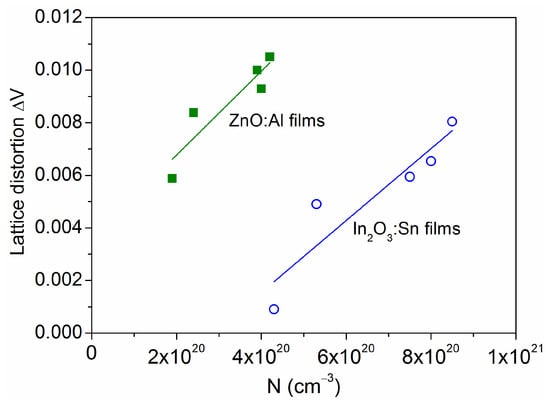
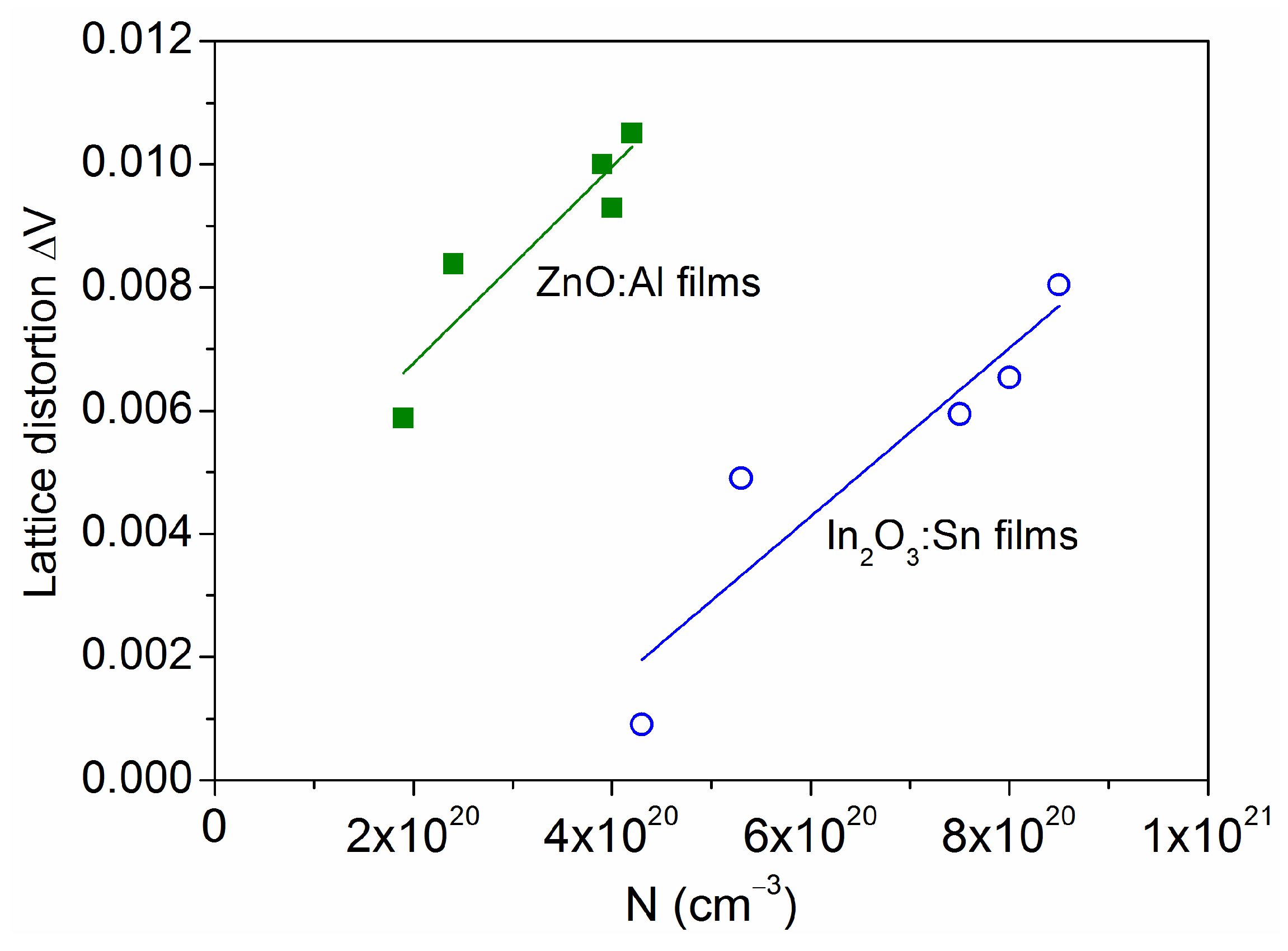
where V0 is the standard unit cell volume for the corresponding undoped compound (In2O3 and ZnO). The obtained values are represented in Figure 3 as a function of the carrier concentration of each layer. A direct relationship is observed for both materials, , although for a same carrier concentration the lattice distortion is much higher in the case of the ZnO:Al films. Thus, it is observed that for N ~ 4.3 × 1020 cm−3 the distortion is ∆V = 9.0 × 10⁻⁴ in the In2O3:Sn layer but ∆V = 10.5 × 10⁻³ in the ZnO:Al film. To better understand this difference, it is important to note that the cubic unit cell of In2O3 consists of 80 atoms [39]: 32 indium atoms with six-fold coordination (surrounded by O atoms) and 48 oxygen atoms with four-fold coordination (surrounded by In atoms) [40]. On the other hand, the hexagonal unit cell of ZnO contains four zinc atoms and four oxygen atoms, where each atom (Zn or O) is tetrahedrally coordinated with four other atoms (O or Zn) [41]. Therefore, the inclusion of an interstitial defect (additional atom) is expected to produce a more pronounced distortion in the lattice that has a lower number of atoms per unit cell. An increase in lattice volume with increasing carrier concentration has also been observed in analogous layers of heavily doped metal oxides (with N = 1020–1021 cm−3) [42,43].
Figure 3.
Relationship between lattice distortion (ΔV) and charge carrier concentration (N) for In2O3:Sn and ZnO:Al films.
3.2. Band Gap, Band Tail and Charge Carrier Concentration
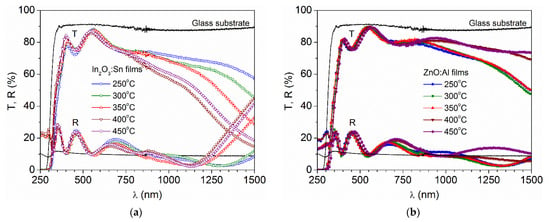
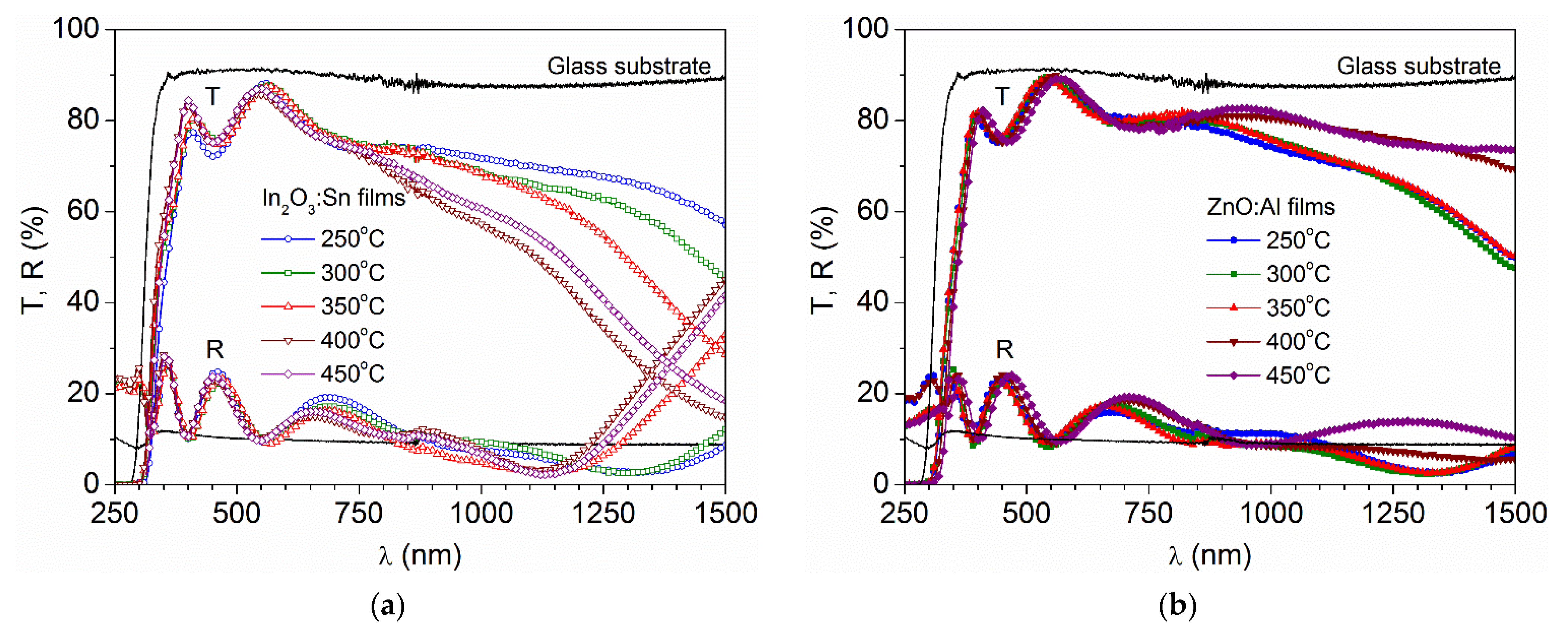
The optical transmittance and reflectance spectra corresponding to the different samples are represented in Figure 4, including those of the bare glass substrate for comparison. From each transmittance spectrum, average values were obtained in the ultraviolet (λ = 300–400 nm), visible (λ = 400–800 nm) and near-infrared (λ = 800–1500 nm) ranges, which are summarized in Table 2. These data reveal a high visible transmittance regardless of the heating temperature, being slightly higher for the ZnO:Al films (TVis = 82 ± 1%) than for the In2O3:Sn layers (TVis = 79 ± 1%), taking into account that these measurements include the glass substrate (with TVis = 90%). It is interesting to note that maximum transparency and good electrical conductivity are already achieved at 250 °C, which allows for good performance when applied in heat-sensitive electronic devices, while for more stable devices the temperature can be increased to improve electrical conductivity without harming transparency. In the near-infrared region, a lower transmittance is observed that depends on the heating temperature, giving a minimum of TNIR = 43% for In2O3:Sn at T = 400 °C and TNIR = 68% for ZnO:Al at T = 300 °C, which coincides with the highest charge carrier concentration for each material. This behavior is due to plasmonic absorption by free carriers, with the absorptance maximum shifting toward shorter wavelengths as the carrier density increases [44]. The ultraviolet transmittance is also affected by the carrier concentration, increasing to a maximum of TUV = 53% for In2O3:Sn at T = 400 °C and TUV = 47% for ZnO:Al at T = 300 °C, which is related to the increase in the optical gap energy in heavily doped semiconductors [45].
Figure 4.
Transmittance and reflectance spectra as a function of light wavelength for the sputtered films: (a) In2O3:Sn and (b) ZnO:Al, after heating at different temperatures in flowing N2 atmosphere.
Table 2.
Average transmittance in the ultraviolet (TUV), visible (TVis) and near-infrared (TNIR) ranges, along with the band gap energy (Eg) and band tail energy (Et), for the samples heated at different temperatures.
For each sample, the band gap energy has been obtained from the optical absorption coefficient (α), calculated from the film thickness (t) and the measured transmittance (T) and reflectance (R) spectra, as follows [46]:
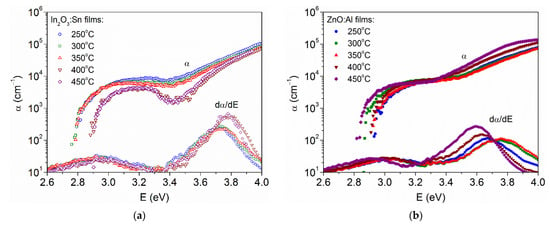
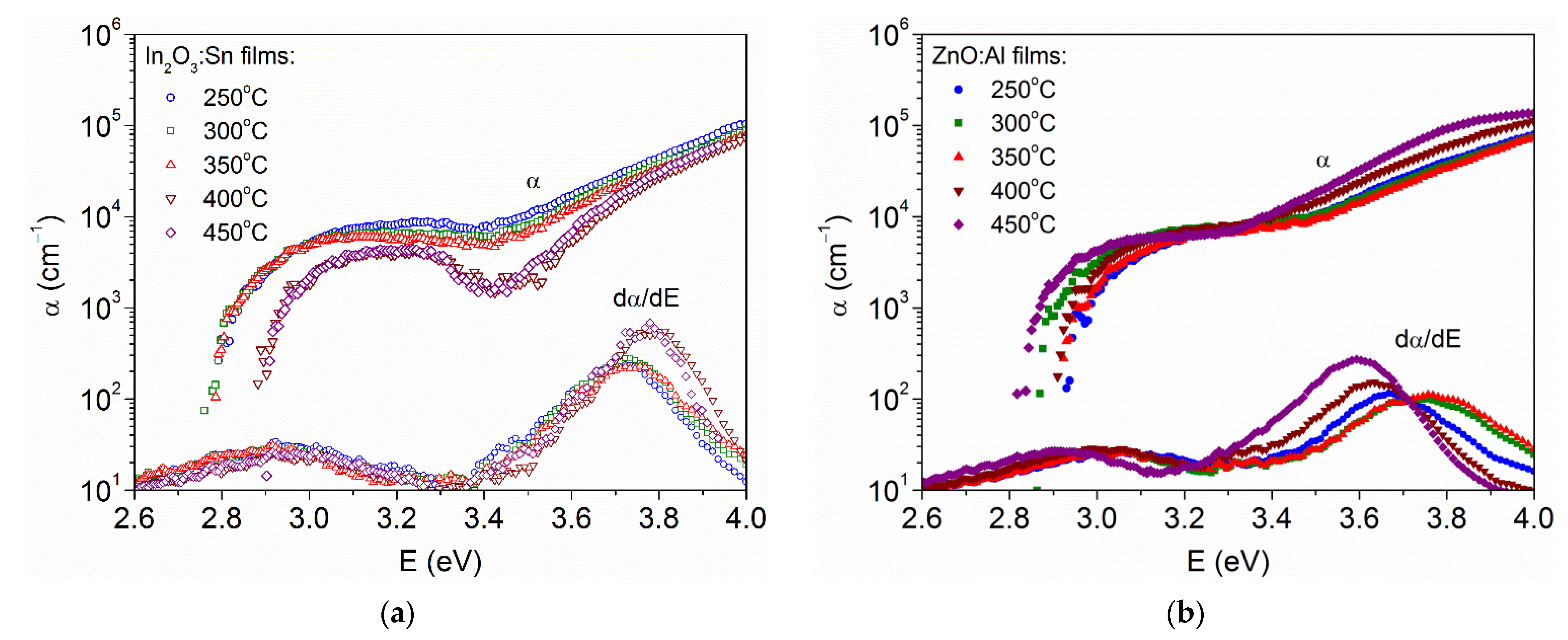
Figure 5 shows the values obtained for the absorption coefficient as a function of light energy (E = hc/λ), such that the band gap energy (Eg) is given by the inflection point of the α versus E plot, i.e., the maximum point of dα/dE [47]. This method is especially suitable for degenerate semiconductors, where the extrapolation procedure would underestimate the band gap [48]. The differential function is calculated at each point by taking the average of the slopes between the point and its two closest neighbors. The absorption below Eg is due to tail states that are typical of heavily doped semiconductors [49]. In this region (E < Eg) the differential curve dα/dE in Figure 5 evidences a lower maximum at the so-called band tail energy (Et), which is clearly distinguishable in all cases. Table 2 includes the results of Eg and Et obtained for the different samples, being in the same order as those reported for analogous In2O3:Sn and ZnO:Al thin films [50]. Furthermore, taking into account the data in Table 1, it is observed that for each material the values of Eg and Et tend to increase as the carrier concentration increases, which will be analyzed considering the evolution of the Fermi level and other interactions that occur at high electron densities.
Figure 5.
Optical absorption coefficients as a function of photon energy and the corresponding differential function (dα/dE) for the sputtered films: (a) In2O3:Sn and (b) ZnO:Al, after heating at different temperatures.
It is worth noting that, although the optical gap energy generally corresponds to the transition from the maximum of the valence band (BV) to the minimum of the conduction band (CB), the electronic states available for the transition can change in the case of heavily doped semiconductors. This happens when the Fermi level moves into the conduction band, increasing its height above the CB minimum with increasing carrier concentration, resulting in the so-called Burstein–Moss broadening (ΔEBM) [51,52]. Such broadening is counteracted by the decrease in electron energies at the CB due to many-body interactions or band gap renormalization effect (ΔEBGR) [53,54], which can be estimated using a weakly interacting electron gas model [45,55]. Therefore, the overall change in the optical gap (Eg) with respect to the undoped material (Eg0) is expressed as [48]:
with
where is the reduced Planck’s constant ( = 6.582 × 10⁻¹⁶ eVs), N is the free electron concentration, εr is the relative permittivity (taking εr = 8 for these oxides [44]), ε0 is the vacuum permittivity (ε0 = 5.526 × 10⁷ e2(eV m)−1) and is the conductivity effective mass. The latter depends on the electron concentration due to non-parabolicity effects when the optical transition occurs in a state located far from the CB minimum [56]:
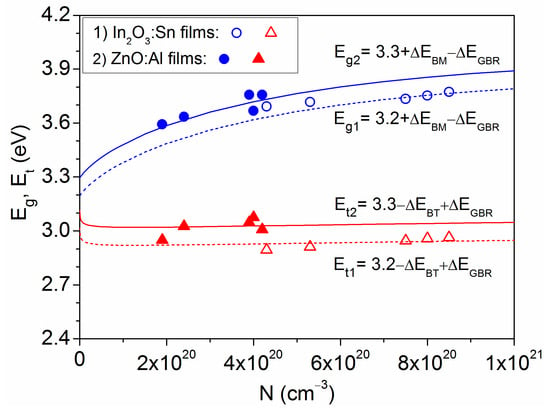
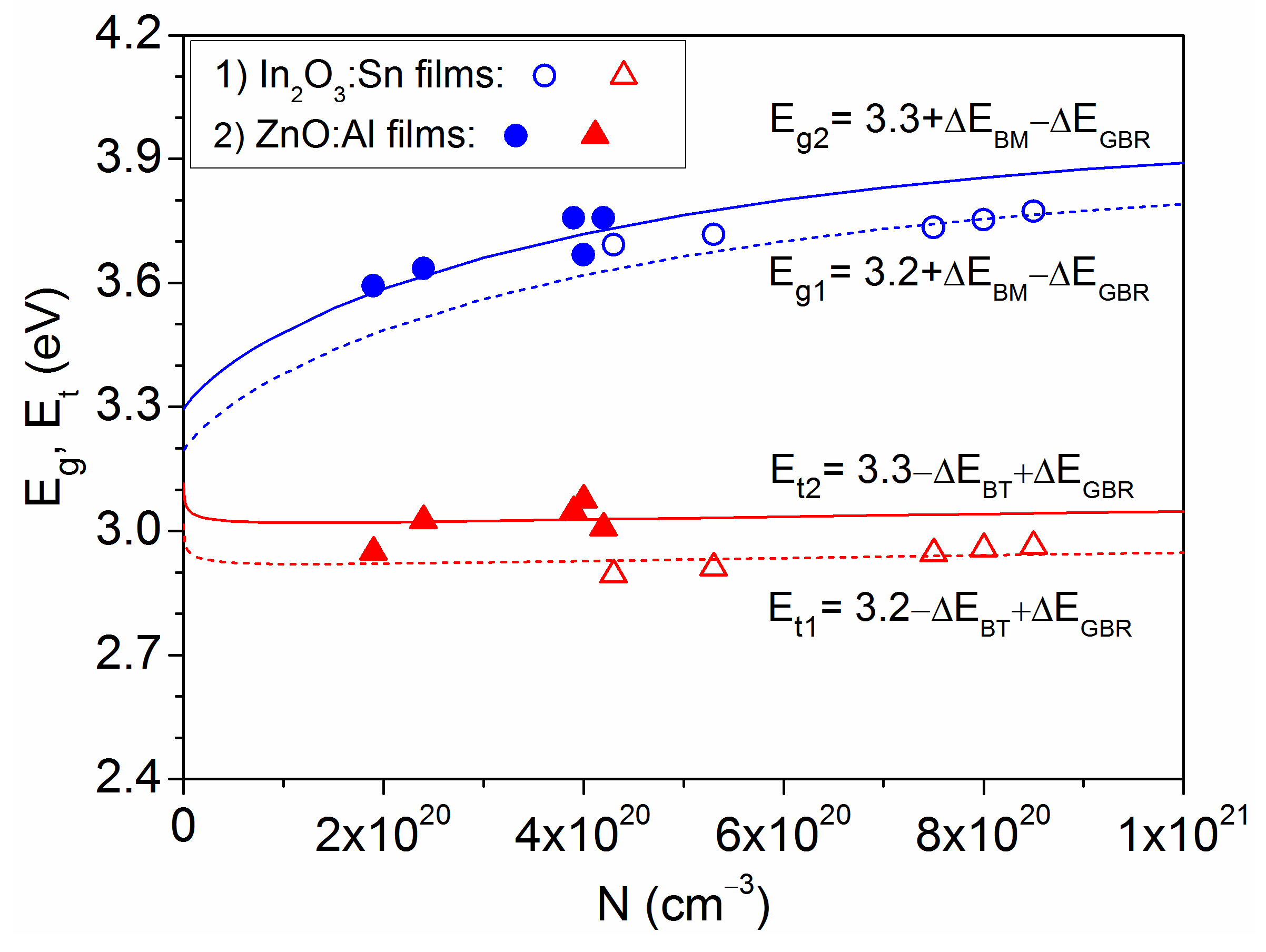
being the effective mass at the CB bottom = 0.3 me (with me = 5.110 × 10⁵ eV/c2, the electron rest mass) and the non-parabolicity parameter Pnp = 0.3 eV−1 for these heavily doped metal oxides [57]. The plot of Eg data as a function of carrier concentration in Figure 6 shows a good fit to the above equations, considering a value of Eg,0 that agrees with that reported for undoped samples of In2O3 (Eg0 = 3.2 eV) [58] and ZnO (Eg0 = 3.3 eV) [59].
Figure 6.
Relationship between band gap energy (Eg), band tail energy (Et) and charge carrier concentration (N) for In2O3:Sn and ZnO:Al films.
Figure 6 also shows the evolution of the band tail energy, which tends to increase slightly with the charge carrier concentration. In heavily doped semiconductors, the band tail appears when a critical carrier concentration is reached (N ≥ Nc) and extends to energies below the CB minimum by a distance (ΔEBT) that increases with increasing carrier density [24,49]. This effect is also counteracted by the band gap renormalization, which is mainly due to the decrease in CB driven by mutual electrostatic interaction between free electrons [54]. Thus, the overall change in the band tail energy (Et) can be expressed as
with
where a and b are fitting parameters that, according to the data in Figure 6, reach values of a = 0.3 eV and b = 0.1 for both the In2O3:Sn and ZnO:Al samples. The critical value Nc used for the fittings is obtained from the high-density limit established for doped semiconductors, when the average distance between impurities is much smaller than the effective Bohr radius () [60]:
Equations that result in = 1.4 nm and Nc = 6.4 × 1018 cm−3 for these materials, in accordance with other works [60,61]. It is observed that the distance between Et and Eg0 remains practically constant, (Eg0 − Et) ~0.3 eV, for the N range of these samples. However, the distance between Et and Eg increases with the carrier concentration, due to the Burstein–Moss effect acting on the value of Eg, with a maximum of (Eg − Et) ~0.8 eV for N ~8 × 1020 cm−3. An analogous energy distance between the band tail and Eg has been reported for other heavily doped semiconductor thin films [6,62], which has also been found to increase with carrier concentration [63,64].
4. Conclusions
In2O3:Sn and ZnO:Al thin films prepared by sputtering at room temperature and annealed in nitrogen between 250 °C and 450 °C show a crystalline structure according to that of cubic bixbyite In2O3 or hexagonal wurtzite ZnO, respectively, with some tensile strain and mean crystallite size within the range D = 26–30 nm. The activation of charge donors explains the increase in carrier concentration and lattice parameters upon annealing, reaching a maximum value at 300–400 °C, after which the cations segregate to positions where they cease to be electrically active. A direct relationship is observed between the distortion of lattice volume and the carrier concentration (∆V ∝ N), although for the same carrier density the distortion ∆V is higher in the case of ZnO:Al films, due to the lower number of atoms per unit cell in ZnO compared to In2O3.
All films show high visible transmittance (80 ± 2%, including the glass substrate), independently of the heating temperature, and UV transmittance that increases with carrier concentration. This is due to the increasing band gap energy (Eg) relative to that of the undoped material (Eg0), in good agreement with the Burstein–Moss (BM) shift and band gap renormalization (BGR) effect: , with Eg0 = 3.2 eV for In2O3 and Eg0 = 3.3 eV for ZnO. Additional optical absorption below Eg is due to band tail states, located at a distance that remains practically constant with respect to Eg0 in the studied range: (Eg0 − Et) ~0.3 eV. In summary, the observed behaviors are explained while establishing the possibilities of tuning the structural, optical, and electrical properties of In2O3:Sn and ZnO:Al thin films grown at room temperature by post-annealing.
Funding
This research received no external funding.
Data Availability Statement
The original contributions presented in this study are included in the article. Further inquiries can be directed to the corresponding author.
Conflicts of Interest
The author declares no conflicts of interest.
References
- Sharme, R.K.; Quijada, M.; Terrones, M.; Rana, M.M. Thin conducting films: Preparation methods, optical and electrical properties, and emerging trends, challenges, and opportunities. Materials 2024, 17, 4559. [Google Scholar] [CrossRef] [Scilit]
- Marinova, V.; Petrov, S.; Petrova, D.; Napoleonov, B.; Chau, N.H.M.; Lan, Y.P.; Strijkova, V.; Hsu, K.Y.; Dimitrov, D.; Lin, S.H. Effect of transparent conductive layers on the functionality of liquid crystal devices: Comparison of AZO, FTO and ITO. Opt. Mater. X 2024, 22, 100330. [Google Scholar] [CrossRef] [Scilit]
- Yu, H.; Chen, L.; Wang, J.; Bao, C.; Liu, Y.; Li, Y.; Mo, Y.; Hu, Y.; Jain, N.; He, X.; et al. Energy-generating smart windows based on reversible metal electrodeposition. Mater. Horiz. 2026, 13, 2052–2059. [Google Scholar] [CrossRef] [Scilit]
- Li, L.; Du, D.; Ma, S.; Huang, H.; Li, Z.; Shen, W. Revealing the effect of transparent conducting oxides on fill factor in silicon heterojunction solar cells. Sol. Energy Mater. Sol. Cells 2026, 295, 113991. [Google Scholar] [CrossRef] [Scilit]
- Almaev, A.V.; Kopyev, V.V.; Novikov, V.A.; Chikiryaka, A.V.; Yakovlev, N.N.; Usseinov, A.B.; Karipbayev, Z.T.; Akilbekov, A.T.; Koishybayeva, Z.K.; Popov, A.I. ITO thin films for low-resistance gas sensors. Materials 2023, 16, 342. [Google Scholar] [CrossRef] [Scilit]
- Vilca-Huayhua, C.A.; Mishra, S.; Martinez, M.A.R.; Guerra, J.A.; Villegas-Lelovsky, L.; Aragón, F.F.H.; Coaquira, J.A.H. Tailoring structural, electrical, and optical properties of ITO thin films via vacuum-pressure annealing: An experimental and theoretical study. J. Alloys Compd. 2025, 1017, 178909. [Google Scholar] [CrossRef] [Scilit]
- Patel, J.; Sharme, R.K.; Quijada, M.A.; Rana, M.M. A review of transparent conducting films (TCFs): Prospective ITO and AZO deposition methods and applications. Nanomaterials 2024, 14, 2013. [Google Scholar] [CrossRef] [Scilit]
- Ungeheuer, K.; Rybak, J.; Bocirnea, A.E.; Pikulski, D.A.; Galca, A.C.; Marszalek, K.W. Influence of proton irradiation on thin films of AZO and ITO transparent conductive oxides—Simulation of space environment. Appl. Sci. 2025, 15, 754. [Google Scholar] [CrossRef] [Scilit]
- González, G.B. Investigating the defect structures in transparent conducting oxides using x-ray and neutron scattering techniques. Materials 2012, 5, 818–850. [Google Scholar] [CrossRef] [Scilit] [PubMed]
- Hou, Q.; Buckeridge, J.; Lazauskas, T.; Mora-Fonz, D.; Sokol, A.A.; Woodley, S.M.; Catlow, C.R.A. Defect formation in In2O3 and SnO2: A new atomistic approach based on accurate lattice energies. J. Mater. Chem. C 2018, 6, 12386–12395. [Google Scholar] [CrossRef] [Scilit]
- Mergel, D.; Qiao, Z. Correlation of lattice distortion with optical and electrical properties of In2O3:Sn films. J. Appl. Phys. 2004, 95, 5608–5615. [Google Scholar] [CrossRef] [Scilit]
- Bourlange, A.; Payne, D.J.; Palgrave, R.G.; Zhang, H.; Foord, J.S.; Egdell, R.G.; Jacobs, R.M.J.; Veal, T.D.; King, P.D.C.; McConville, C.F. The influence of Sn doping on the growth of In2O3 on Y-stabilized ZrO2 (100) by oxygen plasma assisted molecular beam epitaxy. J. Appl. Phys. 2009, 106, 3–6. [Google Scholar] [CrossRef] [Scilit]
- Gabbani, A.; Della Latta, E.; Mohan, A.; Scarperi, A.; Li, X.; Ruggeri, M.; Martini, F.; Biccari, F.; Kociak, M.; Geppi, M.; et al. Direct determination of carrier parameters in indium tin oxide nanocrystals. ACS Nano 2024, 18, 15139–15153. [Google Scholar] [CrossRef] [Scilit]
- Popović, J.; Gržeta, B.; Tkalčec, E.; Tonejc, A.; Bijelić, M.; Goebbert, C. Effect of tin level on particle size and strain in nanocrystalline tin-doped indium oxide (ITO). Mater. Sci. Eng. B 2011, 176, 93–98. [Google Scholar] [CrossRef] [Scilit]
- Arif, M.; Shkir, M.; Alfaify, S.; Ganesh, V.; Sanger, A.; Algarni, H.; Vilarinho, P.M.; Singh, A. A structural, morphological, linear, and nonlinear optical spectroscopic studies of nanostructured Al-doped ZnO thin films: An effect of Al concentrations. J. Mater. Res. 2019, 34, 1309–1317. [Google Scholar] [CrossRef] [Scilit]
- Bazzani, M.; Neroni, A.; Calzolari, A.; Catellani, A. Optoelectronic properties of Al:ZnO: Critical dosage for an optimal transparent conductive oxide. Appl. Phys. Lett. 2011, 98, 121907. [Google Scholar] [CrossRef] [Scilit]
- Lu, J.G.; Ye, Z.Z.; Zeng, Y.J.; Zhu, L.P.; Wang, L.; Yuan, J.; Zhao, B.H.; Liang, Q.L. Structural, optical, and electrical properties of (Zn,Al)O films over a wide range of compositions. J. Appl. Phys. 2006, 100, 73714. [Google Scholar] [CrossRef] [Scilit]
- Challali, F.; Touam, T.; Bockelée, V.; Chauveau, T.; Chelouche, A.; Stephant, N.; Hamon, J.; Besland, M.P. Comprehensive characterization of Al-doped ZnO thin films deposited in confocal radio frequency magnetron co-sputtering. Thin Solid Film. 2023, 780, 139947. [Google Scholar] [CrossRef] [Scilit]
- Appani, S.K.; Singh, D.; Nandi, R.; Sutar, D.S.; Major, S.S. Influence of oxygen partial pressure on the strain behaviour of reactively co-sputtered Ga doped ZnO thin films. Thin Solid Film. 2023, 764, 139624. [Google Scholar] [CrossRef] [Scilit]
- Chen, J.J.; Gao, Y.; Zeng, F.; Li, D.M.; Pan, F. Effect of sputtering oxygen partial pressures on structure and physical properties of high resistivity ZnO films. Appl. Surf. Sci. 2004, 223, 318–329. [Google Scholar] [CrossRef] [Scilit]
- John, S.; Chou, M.Y.; Cohen, M.H.; Soukoulis, C.M. Density of states for an electron in a correlated Gaussian random potential: Theory of the Urbach tail. Phys. Rev. B 1988, 37, 6963–6976. [Google Scholar] [CrossRef] [Scilit]
- Luo, Y.; Flewitt, A.J. Understanding localized states in the band tails of amorphous semiconductors exemplified by a-Si:H from the perspective of excess delocalized charges. Phys. Rev. B 2024, 109, 104203. [Google Scholar] [CrossRef] [Scilit]
- Lewis, L.J.; Movaghar, B. On the effect of charged centers in crystalline and amorphous semiconductors. Solid State Commun. 1990, 75, 885–889. [Google Scholar] [CrossRef] [Scilit]
- Halperin, B.I.; Lax, M. Impurity-band tails in the high-density limit. I. Minimum counting methods. Phys. Rev. 1966, 148, 722–740. [Google Scholar] [CrossRef] [Scilit]
- Van Mieghem, P. Theory of band tails in heavily doped semiconductors. Rev. Mod. Phys. 1992, 64, 755–793. [Google Scholar] [CrossRef] [Scilit]
- Lany, S.; Zunger, A. Dopability, intrinsic conductivity, and nonstoichiometry of transparent conducting oxides. Phys. Rev. Lett. 2007, 98, 2–5. [Google Scholar] [CrossRef] [Scilit]
- Vorokh, A.S. Scherrer formula: Estimation of error in determining small nanoparticle size. Nanosyst. Phys. Chem. Math. 2018, 9, 364–369. [Google Scholar] [CrossRef] [Scilit]
- Abrahams, S.C.; Bernstein, J.L. Remeasurement of the structure of hexagonal ZnO. Acta Crystallogr. Sect. B Struct. Crystallogr. Cryst. Chem. 1969, 25, 1233–1236. [Google Scholar] [CrossRef] [Scilit]
- González, G.B.; Mason, T.O.; Quintana, J.P.; Warschkow, O.; Ellis, D.E.; Hwang, J.H.; Hodges, J.P.; Jorgensen, J.D. Defect structure studies of bulk and nano-indium-tin oxide. J. Appl. Phys. 2004, 96, 3912–3920. [Google Scholar] [CrossRef] [Scilit]
- Brehm, J.U.; Winterer, M.; Hahn, H. Synthesis and local structure of doped nanocrystalline zinc oxides. J. Appl. Phys. 2006, 100, 064311. [Google Scholar] [CrossRef] [Scilit]
- Rolo, A.G.; de Campos, J.A.; Viseu, T.; de Lacerda-Arôso, T.; Cerqueira, M.F. The annealing effect on structural and optical properties of ZnO thin films produced by r.f. sputtering. Superlattices Microstruct. 2007, 42, 265–269. [Google Scholar] [CrossRef] [Scilit]
- Frischbier, M.V.; Wardenga, H.F.; Weidner, M.; Bierwagen, O.; Jia, J.; Shigesato, Y.; Klein, A. Influence of dopant species and concentration on grain boundary scattering in degenerately doped In2O3 thin films. Thin Solid Film. 2016, 614, 62–68. [Google Scholar] [CrossRef] [Scilit]
- Bikowski, A.; Rengachari, M.; Nie, M.; Wanderka, N.; Stender, P.; Schmitz, G.; Ellmer, K. Research Update: Inhomogeneous aluminium dopant distribution in magnetron sputtered ZnO:Al thin films and its influence on their electrical properties. APL Mater. 2015, 3, 064311. [Google Scholar] [CrossRef] [Scilit]
- Deyu, G.K.; Hunka, J.; Roussel, H.; Brötz, J.; Bellet, D.; Klein, A. Electrical properties of low-temperature processed Sn-doped In2O3 thin films: The role of microstructure and oxygen content and the potential of defect modulation doping. Materials 2019, 12, 2232. [Google Scholar] [CrossRef] [Scilit] [PubMed]
- Gabás, M.; Torelli, P.; Barrett, N.T.; Sacchi, M.; Ramos Barrado, J.R. Electronic structure of Al- and Ga-doped ZnO films studied by hard X-ray photoelectron spectroscopy. APL Mater. 2014, 2, 012112. [Google Scholar] [CrossRef] [Scilit]
- Conti, C.R.; McBride, J.R.; Strouse, G.F. Examining the effect of dopant ionic radius on plasmonic M:ZnO nanocrystals (M = Al3+, Ga3+, In3+). J. Phys. Chem. C 2021, 125, 7772–7779. [Google Scholar] [CrossRef] [Scilit]
- Momot, A.; Amini, M.N.; Reekmans, G.; Lamoen, D.; Partoens, B.; Slocombe, D.R.; Elen, K.; Adriaensens, P.; Hardy, A.; Van Bael, M.K. A novel explanation for the increased conductivity in annealed Al-doped ZnO: An insight into migration of aluminum and displacement of zinc. Phys. Chem. Chem. Phys. 2017, 19, 27866–27877. [Google Scholar] [CrossRef] [Scilit]
- Zeng, H.; Ning, X.; Li, X. An insight into defect relaxation in metastable ZnO reflected by a unique luminescence and Raman evolutions. Phys. Chem. Chem. Phys. 2015, 17, 19637–19642. [Google Scholar] [CrossRef] [Scilit]
- Hagleitner, D.R.; Menhart, M.; Jacobson, P.; Blomberg, S.; Schulte, K.; Lundgren, E.; Kubicek, M.; Fleig, J.; Kubel, F.; Puls, C.; et al. Bulk and surface characterization of In2O3 (001) single crystals. Phys. Rev. B 2012, 85, 115441. [Google Scholar] [CrossRef] [Scilit]
- Reunchan, P.; Zhou, X.; Limpijumnong, S.; Janotti, A.; Van de Walle, C.G. Vacancy defects in indium oxide: An ab-initio study. Curr. Appl. Phys. 2011, 11, S296–S300. [Google Scholar] [CrossRef] [Scilit]
- Kaddes, M.; Omri, K.; Kouaydi, N.; Zemzemi, M. Structural, electrical and optical properties of ZnO nanoparticle: Combined experimental and theoretical study. Appl. Phys. A 2018, 124, 518. [Google Scholar] [CrossRef] [Scilit]
- Kato, K.; Omoto, H.; Tomioka, T.; Takamatsu, A. Changes in electrical and structural properties of indium oxide thin films through post-deposition annealing. Thin Solid Film. 2011, 520, 110–116. [Google Scholar] [CrossRef] [Scilit]
- Charpentier, C.; Prod’Homme, P.; Roca i Cabarrocas, P. Microstructural, optical and electrical properties of annealed ZnO:Al thin films. Thin Solid Film. 2013, 531, 424–429. [Google Scholar] [CrossRef] [Scilit]
- Guillén, C.; Herrero, J. Comparing the plasmonic characteristics of sputtered ZnO:Al and In2O3:Sn thin films as a function of the heating temperature and atmosphere. Thin Solid Film. 2016, 605, 136–142. [Google Scholar] [CrossRef] [Scilit]
- Kim, C.E.; Moon, P.; Kim, S.; Myoung, J.M.; Jang, H.W.; Bang, J.; Yun, I. Effect of carrier concentration on optical bandgap shift in ZnO:Ga thin films. Thin Solid Film. 2010, 518, 6304–6307. [Google Scholar] [CrossRef] [Scilit]
- Kushnir, O.S. Effect of multiple reflections of light on the optical characteristics of crystals. J. Opt. A Pure Appl. Opt. 2003, 5, 478–488. [Google Scholar] [CrossRef] [Scilit]
- Guillén, C. Determination of the band gap energy of SnO2 and ZnO thin films with different crystalline qualities and doping levels. Electron. Mater. 2025, 6, 3. [Google Scholar] [CrossRef] [Scilit]
- Kim, W.M.; Kim, J.S.; Jeong, J.H.; Park, J.K.; Baik, Y.J.; Seong, T.Y. Analysis of optical band-gap shift in impurity doped ZnO thin films by using nonparabolic conduction band parameters. Thin Solid Film. 2013, 531, 430–435. [Google Scholar] [CrossRef] [Scilit]
- Serre, J.; Ghazali, A. From band tailing to impurity-band formation and discussion of localization in doped semiconductors: A multiple-scattering approach. Phys. Rev. B 1983, 28, 4704–4715. [Google Scholar] [CrossRef] [Scilit]
- Lu, Y.; Wang, S.; Yang, M.; Xu, X.; Li, Q. Comparative study of AZO and ITO thin film sputtered at different temperatures and their application in Cu2ZnSnS4 solar cells. J. Mater. Sci. Mater. Electron. 2018, 29, 17525–17532. [Google Scholar] [CrossRef] [Scilit]
- Ivchenko, V. Theory of Burstein-Moss effect in semiconductors with anisotropic energy bands. Phys. Scr. 2024, 99, 035952. [Google Scholar] [CrossRef] [Scilit]
- Saw, K.G.; Aznan, N.M.; Yam, F.K.; Ng, S.S.; Pung, S.Y. New insights on the Burstein-Moss shift and band gap narrowing in indium-doped zinc oxide thin films. PLoS ONE 2015, 10, e0141180. [Google Scholar] [CrossRef] [Scilit]
- Sans, J.A.; Sánchez-Royo, J.F.; Segura, A.; Tobias, G.; Canadell, E. Chemical effects on the optical band-gap of heavily doped ZnO: MIII (M=Al,Ga,In): An investigation by means of photoelectron spectroscopy, optical measurements under pressure, and band structure calculations. Phys. Rev. B-Condens. Matter Mater. Phys. 2009, 79, 195105. [Google Scholar] [CrossRef] [Scilit]
- Zhang, J.; Willis, J.; Yang, Z.; Sheng, Z.; Wang, L.-S.; Lee, T.-L.; Chen, L.; Scanlon, D.O.; Zhang, K.H.L. Direct determination of band-gap renormalization in degenerately doped ultrawide band gap β-Ga2O3 semiconductor. Phys. Rev. B 2022, 106, 205305. [Google Scholar] [CrossRef] [Scilit]
- Shaker, A.; Zekry, A. A new and simple model for plasma and doping induced band gap narrowing. J. Electron Devices 2010, 8, 293–299. [Google Scholar]
- Kim, J.S.; Jeong, J.H.; Park, J.K.; Baik, Y.J.; Kim, I.H.; Seong, T.Y.; Kim, W.M. Optical analysis of doped ZnO thin films using nonparabolic conduction-band parameters. J. Appl. Phys. 2012, 111, 123507. [Google Scholar] [CrossRef] [Scilit]
- Kim, W.M.; Kim, I.H.; Ko, J.H.; Cheong, B.; Lee, T.S.; Lee, K.S.; Kim, D.; Seong, T.-Y. Density-of-state effective mass and non-parabolicity parameter of impurity doped ZnO thin films. J. Phys. D Appl. Phys. 2008, 41, 195409. [Google Scholar] [CrossRef] [Scilit]
- Impemba, S.; Provinciali, G.; Filippi, J.; Salvatici, C.; Berretti, E.; Caporali, S.; Banchelli, M.; Caporali, M. Engineering the heterojunction between TiO2 and In2O3 for improving the solar-driven hydrogen production. Int. J. Hydrogen Energy 2024, 63, 896–904. [Google Scholar] [CrossRef] [Scilit]
- Liu, Y.; Li, Y.; Zeng, H. ZnO-based transparent conductive thin films: Doping, performance, and processing. J. Nanomater. 2013, 2013, 196521. [Google Scholar] [CrossRef] [Scilit]
- Zhang, K.H.L.; Payne, D.J.; Palgrave, R.G.; Lazarov, V.K.; Chen, W.; Wee, A.T.S.; McConville, C.F.; King, P.D.C.; Veal, T.D.; Panaccione, G.; et al. Surface structure and electronic properties of In2O3 (111) single-crystal thin films grown on Y-stabilized ZrO2 (111). Chem. Mater. 2009, 21, 4353–4355. [Google Scholar] [CrossRef] [Scilit]
- Fonoberov, V.A.; Balandin, A.A. Radiative lifetime of excitons in ZnO nanocrystals: The dead-layer effect. Phys. Rev. B 2004, 70, 195410. [Google Scholar] [CrossRef] [Scilit]
- Vishunumurthy, G.; Bhaskar, A. A comprehensive study on the impact of aluminum doping on x-ray diffraction peak profile analysis, structural, morphological, and optical properties of ZnO nanoparticles synthesized by sol–gel auto-combustion. J. Electron. Mater. 2025, 54, 2146–2166. [Google Scholar] [CrossRef] [Scilit]
- Schönau, S.; Ruske, F.; Neubert, S.; Rech, B. Analysis of Urbach-like absorption tails in thermally treated ZnO:Al thin films. Appl. Phys. Lett. 2013, 103, 192108. [Google Scholar] [CrossRef] [Scilit]
- Dejam, L.; Kulesza, S.; Sabbaghzadeh, J.; Ghaderi, A.; Solaymani, S.; Țălu, Ș.; Bramowicz, M.; Amouamouha, M.; Shayegan, A.H.S.; Sari, A.H. ZnO, Cu-doped ZnO, Al-doped ZnO and Cu-Al doped ZnO thin films: Advanced micro-morphology, crystalline structures and optical properties. Results Phys. 2023, 44, 106209. [Google Scholar] [CrossRef] [Scilit]

Disclaimer/Publisher’s Note: The statements, opinions and data contained in all publications are solely those of the individual author(s) and contributor(s) and not of MDPI and/or the editor(s). MDPI and/or the editor(s) disclaim responsibility for any injury to people or property resulting from any ideas, methods, instructions or products referred to in the content. |
© 2026 by the author. Licensee MDPI, Basel, Switzerland. This article is an open access article distributed under the terms and conditions of the Creative Commons Attribution (CC BY) license.