Review

The Global Burden of Obstructive Sleep Apnea on Fertility: Pathophysiology, Clinical Evidence, and Therapeutic Perspectives


1
Department of Otorhinolaryngology & Head and Neck Surgery, Fatebenefratelli Hospital, ASST Fatebenefratelli Sacco, 20100 Milan, Italy
2
Department of Biomedical, University of Milan, Surgical and Dental Sciences, 20100 Milan, Italy
3
ASP Ragusa-Hospital Giovanni Paolo II, 97010 Ragusa, Italy
4
Department of Medicine and Surgery, University of Enna Kore, 94100 Enna, Italy
5
Division of Laryngology and Broncho-Esophagology, Department of Otolaryngology-Head Neck Surgery, EpiCURA Hospital, UMONS Research Institute for Health Sciences and Technology, University of Mons (UMons), 7000 Mons, Belgium
*
Author to whom correspondence should be addressed.
Reprod. Med. 2026, 7(1), 4; https://doi.org/10.3390/reprodmed7010004
Submission received: 14 November 2025 / Revised: 23 December 2025 / Accepted: 7 January 2026 / Published: 12 January 2026

Abstract

Obstructive sleep apnea (OSA) is a highly prevalent disorder with far-reaching systemic consequences. While its cardiometabolic and neurocognitive impacts are well established, growing evidence highlights OSA as a contributor to infertility in both men and women. The pathophysiological mechanisms include intermittent hypoxia, oxidative stress, systemic inflammation, and endocrine disruption, all of which can impair spermatogenesis, reduce semen quality, alter gonadal hormone secretion, and compromise ovarian function. Clinical studies consistently demonstrate associations between OSA and impaired semen parameters, reduced testosterone, and erectile dysfunction in men. In women, OSA is frequently observed in those with polycystic ovary syndrome, is associated with ovulatory dysfunction, and negatively affects in vitro fertilization outcomes, pregnancy rates, and miscarriage risk. Despite these findings, infertility is not systematically included in global burden estimates of OSA, leading to the underestimation of its true health and socioeconomic impact. Therapeutic strategies such as weight loss, continuous positive airway pressure, and integrative approaches show promise, though robust evidence from randomized trials is still lacking. Integrating sleep health into reproductive medicine may provide a cost-effective and equitable pathway to improve fertility outcomes worldwide.

1. Introduction

Obstructive sleep apnea (OSA) has become a pandemic over the last decade, a compound chronic disease estimated to affect nearly one billion adults globally and one that remains widely underdiagnosed and undertreated in both high-income countries and low- and middle-income countries [1]. The traditional toll of OSA—cardiovascular diseases, hypertension, stroke, metabolic perturbation (including type 2 diabetes), accidents, and neurocognitive dysfunction—is supported by documented evidence, but an equally significant and not so much appreciated dimension is the impact on reproductive health and fertility. The worldwide prevalence of OSA (moderate-to-severe disease) is estimated in large meta-analyses at 9% to 38% in men and 6% to 19% in women depending on definitions, age, and BMI strata, with a rapid increase in prevalence with higher age and body mass [2,3]. In addition, in pregnancy cohorts, OSA prevalence rates are approximately 15% (95% CI: 12–18%) in mid-to-late gestation, showing that sleep-disordered breathing has a non-trivial penetrance even during childbearing years [4]. However, the involvement of OSA is underappreciated around fertility and reproductive medicine, even though mechanistic and epidemiological data are now pointing to an association between OSA and abnormal gametogenesis and hormonal fragmentation, as well inflammatory cytokines, which will be a notable topic within this spectrum. Experimental studies in animal models observed that simulated OSA intermittent hypoxia was sufficient to impair testicular antioxidant capacity and sperm output, therefore supporting a biologic plausibility for male fertility changes secondary to chronic sleep apnoea stress [5]. In human populations, a large, nested case–control study in Taiwan found that men diagnosed with OSA had 1.24 times the adjusted odds of infertility than controls, and interestingly this risk increased to 1.80 among those who were untreated, with a clear dose–exposure gradient by duration of OSA exposure [6]. In a more recent observational cohort, the severity of OSA (based on the apnea–hypopnea index) was independently inversely associated with sperm concentration, total motility, and progressive motility after confounders adjustments, pointing to a dose–response relationship between disease severity and semen quality [7]. On the female side, population-level data are rarer but becoming more compellingly suggestive: in a 14-year national database study, women with a history of OSA had approximately 2.1-fold odds of infertility vs. those without OSA; 1.38% incidence in infertile women and 0.63% prevalence in age-matched fertile controls [8]. In a current systematic review of the relationship between sleep disturbances and female infertility that included 19 studies, it has been underscored that women with impaired fertility (particularly when they are combined with polycystic ovary syndrome) showed a demonstration of OSA over-representation; moreover, abnormalities in sleep architecture, chronotype, or extreme durations of sleep will correlate positively to lower oocyte yield and inferior embryo quality, and reduced percentages were achieved by fertilization [9]. In assisted reproduction centres, a prospective cohort in PCOS patients with IVF reported 30% OSA prevalence, which was independently associated with lower clinical pregnancy and live birth rates during first embryo transfers [10]. Likewise, a separate observational analysis in PCOS IVF patients also reported that the presence of OSA adversely affected live birth outcomes following embryo transfer, indicating that this burden might even affect the outcome of fertility treatments [11]. Taken together, the illustrative context overall is that non-negligible fraction of infertility could be contributed to undiagnosed or untreated OSA, particularly in populations with obesity, metabolic syndrome, and PCOS. And from the perspective of public health, this has implications for the overall global reproductive burden of OSA: with both OSA and infertility being common (approximately 48.5 million couples worldwide were affected by infertility in 2010), these respective disease entities may be on a latent path towards reducing population-level fecundity [12]. Furthermore, disparities in access to sleep diagnostics and continuous positive airway pressure (CPAP) treatment as well as awareness by location of residence suggest that the fertility-attributable burden of OSA is also likely quite different for different socioeconomic strata. Based on this discussed evidence and somewhat relevant biologic mechanisms, it is important to reconsider OSA not only as a cardio-metabolic disorder but also as a reproductive risk factor. In subsequent sections, we will comprehensively review the pathophysiology that connects OSA with reproductive dysfunction, appraise existing clinical evidence on fertility in men and women, and consider treatment and public health strategies to quantify and minimize the reproductive impact of sleep-disordered breathing.

2. Materials and Methods

This narrative review was conducted in accordance with the SANRA (Scale for the Assessment of Narrative Review Articles) guidelines, which provide a structured framework to enhance transparency, methodological rigour, and reproducibility in narrative reviews [13]. The SANRA tool emphasizes six key domains: explanation of the importance of the subject, statement of concrete aims or formulation of research questions, description of the literature search, referencing, scientific reasoning, and appropriate presentation of data.

2.1. Literature Search Strategy

A comprehensive literature search was undertaken across the PubMed, Scopus, and Web of Science databases. The search covered publications from January 2000 to September 2025. Keywords and MeSH terms included “obstructive sleep apnea”, “fertility”, “male infertility”, “female infertility”, “reproductive outcomes”, “sleep disorders and reproduction”, “oxidative stress”, and “PCOS and sleep apnea”. Boolean operators (AND/OR) were applied to combine terms. References of retrieved articles were also manually screened to identify additional relevant studies.

2.2. Inclusion and Exclusion Criteria

We included original clinical studies (cohort, case–control, cross-sectional), randomized controlled trials, systematic reviews, meta-analyses, and relevant mechanistic or translational research that addressed associations between obstructive sleep apnea (OSA) and fertility or reproductive outcomes. Exclusion criteria were articles not in English, conference abstracts without full text, case reports, narrative commentaries without original data, and studies lacking explicit reproductive outcomes, studies conducted exclusively in pediatric populations, animal-only studies, duplicate publications across databases, and studies with overlapping cohorts where the most comprehensive or recent dataset was retained.

2.3. Data Extraction and Synthesis

Relevant data were extracted independently by two authors, focusing on study design, sample size, diagnostic criteria for OSA, reproductive endpoints (e.g., semen quality, hormonal profiles, IVF outcomes, pregnancy outcomes), and main findings. Given the heterogeneity of study designs and outcomes, no formal meta-analysis was performed; instead, findings were synthesized narratively, highlighting areas of consistency, discrepancy, and gaps in knowledge.

2.4. Methodological Rigour

Following SANRA, special attention was paid to ensuring balanced coverage of the literature, avoiding selective citation, and maintaining scientific reasoning across sections. References were verified for accuracy, and findings are presented in a structured manner, linking epidemiologic data, mechanistic insights, and therapeutic implications.

3. Results

3.1. Pathophysiological Mechanisms Linking OSA and Fertility

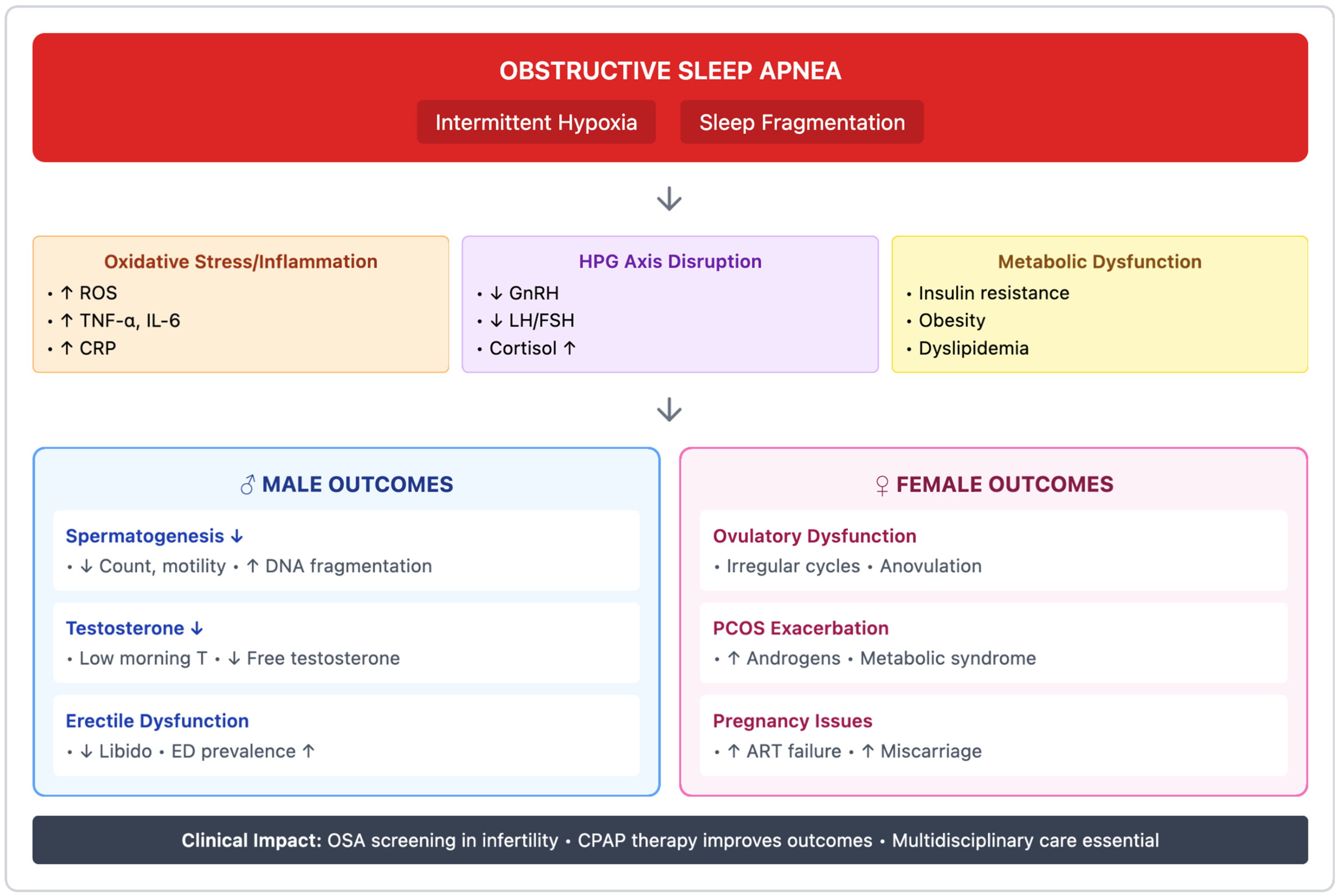
With the increasing evidence base, the clinical impact of OSA on fertility becomes evident with both quantitative and qualitative deficits in gametogenesis and reproductive outcomes through impaired semen parameters, altered hormonal milieu, IVF success, pregnancy scores, and even miscarriage rates. On the male side, a study of 175 men attending for fertility workup demonstrated an independent negative association between increasing apnea–hypopnea index (AHI) and progressive motility, total motility, and sperm vitality after adjusting for age and BMI; in addition, asthenospermia was more common as OSA severity increased. In addition to these, Wang et al. reported that OSA is an independent risk factor for sperm motility and vitality in reproductive-aged men [14]. Zhang et al. confirmed that OSA was associated with decreased sperm concentration, total motility, and progressive motility, as well as lower testosterone levels, indicating a dose–response relationship between the severity of OSA and male reproductive dysfunction [7] (Figure 1).
These human observations correspond with the OSA decrease in testicular antioxidants and spermatogenic output in mice, and the researchers attributed this to oxidative stress and mitochondrial dysfunction [15]. In addition, recent big population cohorts still support an epidemiologic signal: the Taiwan nested case–control demonstrated that untreated OSA increased male infertility risk (OR ≈ 1.80) in comparison with controls, underlying cumulative exposure impact [6]. On the feminine side, emerging clinical observations associate OSA and sleep-disordered breathing with suboptimal fertility. Ibrahim et al. examined 258 women with infertility and found that a previous diagnosis of clinical OSA was independently related to miscarriage (adjusted OR ∼6.17), which therefore suggests that, in addition to its contribution via anovulation, OSA may contribute to gestational loss [16]. During IVF stimulation, women with frequent snoring—a common proxy for OSA—had higher rates of available oocytes (number made available to be used in insemination) and a nearly threefold risk of biochemical pregnancy loss (adjusted odds ratio [OR] = 2.95) compared with non-snorers [17]. More directly, Zhang et al. (2024) performed a study in women with PCOS undergoing IVF and found that those with OSA had the higher gonadotropin doses, lower peak estradiol levels, fewer oocyte retrieval instances, and lower biochemical and clinical pregnancy rates compared to their counterparts without OSA; in addition, OSA was independently associated with reduced clinical pregnancy after multivariate adjustment [11]. Generalizing this to a wider population, Li et al. (2025) conducted a prospective observational study of 360 PCOS patients, found there was 30% OSA prevalence, and showed that OSA is an independent predictor of decreased clinical pregnancy and live birth rates in first embryo transfer cycles; they even controlled for metabolic confounders [10]. Meanwhile, Li et al.’s systematic review on sleep disturbances and female infertility (2024) included 19 studies, which consistently demonstrated associations between OSA (or sleep fragmentation) with decreased oocyte yield, poorer embryo quality, lower fertilization rates, and lower implantation probabilities [9]. In addition to gamete and IVF level effects, the impact of OSA can potentially develop during pregnancy. Walter et al. (2022) examined individuals undergoing IVF and observed that those diagnosed with sleep-disordered breathing had a poorer pregnancy outcome, reporting decreased live birth rates as well as increased risk of miscarriage [18], and such a negative influence of OSA is likely to exist throughout the antepartum phase. Additionally, as pregnancy advances, spontaneous maternal hypoxia from OSA may result in transient fetal hypoxia with preliminary synchronized polysomnography and cardiotocography demonstrating temporal relationships between maternal hypoxic episodes and fetal heart rate decelerations or accelerations indicative of stress responses [19]. Altogether, these pieces of evidence sketch a portrait in which OSA is part of the story behind fertility decline through different but overlapping interplays—sperm dysfunction, altered reproductive hormones, quantitative ulteriorly and abnormal embryo/implantation process—and contribute to elevating the risk of miscarriage [15] and completing the somehow-invisible imagery of the global infertility burden. Because OSA is common in both men and women, and given the degree of fertility impairment evident with moderate-to-severe disease, even mild effect sizes correlate with a meaningful public health burden. Untreated OSA could contribute to a proportion of cases of subfertility or failure to conceive following IVF, particularly when accumulated across populations and within high-risk groups such as obese men or those affected by metabolic syndrome (or PCOS) in women. This burden is likely to be exacerbated in regions with poor awareness, minimal sleep diagnostic facilities, and limited access to treatments, with a greater impact on resource-poor settings. Given these growing clinical, mechanistic, and epidemiologic data, it is imperative to incorporate fertility end-points into OSA burden calculations and contemplate SDB screening in reproductive clinics as part of a comprehensive reproductive health measure.

3.2. Clinical Evidence in Males’ Fertility

Thousands of males exerting themselves critically in fluid production daily contributes to an increased risk for underlying renal burden, and therefore many professionals try to establish the influence of exogenous factors such as high obesity or high alcohol consumption/cigarette smoking, but little change is seen within populations even though levels are increased, thus suggesting that these two may produce a cumulative effect (either working alone or together in causing maternal–fetal carcinogenesis due to paternal genetics).

3.2.1. OSA and Semen Quality

A very recent such study is that by Zehao Wang et al. (2023) [14], who examined 175 men for sleep evaluation and semen analysis. Patients were divided into subgroups based on the apnea–hypopnea index (AHI; none, mild, moderate, and severe). Progressive motility (p = 0.002), total motility (p = 0.010), and vitality (p = 0.039) differed significantly across the severity categories. AHI is still an independent predictor of low motility and viability. In a recent work by Zhang et al. using 108 OSA men and 84 controls, those with OSA had lower sperm concentration, total progressive motility, greater non-progressive motility, and lower testosterone. Stratified analyses showed a step-by-step deterioration of semen quality with OSA severity. In multivariate models, AHI was an independent predictor for a decrease in sperm concentration (β = −0.393), total motility (β = −0.640), and progressive motility (β = −0.623); p < 0.001 for all, respectively [7]. These findings showed not only an association but also a dose–response relationship between OSA severity and semen quality. Of course, there are limitations: most studies are cross-sectional, sample sizes tend to be moderate, and not all analyses adjust for lifestyle factors such as smoking or alcohol use, and comorbidities such as diabetes [15].

3.2.2. Testosterone, Gonadotropins, and Sexuality

One of the other key areas regarding OSA is its effect on hypothalamic–pituitary–gonadal (HPG) function. Multiple studies have reported that men with OSA have lower serum testosterone than control subjects, and the severity of OSA (as measured by AHI or minimum oxygen saturation) is inversely related to androgen levels [15]. In the review Obstructive Sleep Apnea and Testosterone Deficiency, there was a consistent negative correlation between OSA severity and testosterone that persisted to a significant degree, even when controlled for obesity [20]. Pathophysiologically, IH and SF lead to disruption of the pulsatile release of GnRH (gonadotropin-releasing hormone), attenuated LH (luteinizing hormone) surges, and decreased testicular steroidogenesis [16]. Clinical trials also indicate that testosterone levels and sexual function in OSA may be improved by treating with CPAP; however, results are heterogeneous and contradictory [17]. Secondary hypogonadism resulting from OSA would therefore be a reasonable mechanism for disrupted spermatogenesis, as androgens are critical for Sertoli cell function and sperm maturation.

3.2.3. OSA, Erectile Dysfunction and Reproductive Results

The relation between OSA and ED is no longer controversial. In a recent review—anatomic, hemodynamic, and enzymatic—addressing the mechanistic pathways that connect OSA to ED has been discussed: these include intermittent hypoxia (IH), endothelial dysfunction, autonomic dysregulation, systemic inflammation, and hormone imbalance [20,21,22], as we know emerging evidence strongly recommended an increasing risk of developing erectile problems in OSA patients compared with those without (no-OSA men) [23]. In a clinical trial, Kyrkou et al. (2022) evaluated the relationship between ED and semen parameters, such that ED in OSA patients may cause a decrease in coital frequency, thus indirectly leading to infertility even though spermatogenesis is also independently affected [24]. This association is further corroborated by large epidemiologic evidence. Jhuang et al. investigated a Taiwan population-based cohort of 4607 infertile men and 18,428 controls, demonstrating OSA to be an independent risk factor for infertility (aOR: 1.24; 95% CI: 1.10–1.64; p = 0.003) [6]. It is noteworthy that the risk increased to ~1.80 in treatment-untreated patients, highlighting the importance of disease duration and treatment. Similarly, Lin et al., using a nationwide database, found that men with OSA who were treated surgically had a 2.7-fold higher risk of infertility compared to the general population. Among women stratified by age, the adjusted ORs for 20–35 and 35–50 years were 3.19 and 2.57, demonstrating a strong association across reproductive ages [25]. Taken together, these studies are consistent with the conclusion that OSA has negative effects on male fertility at several levels: through direct damage to semen quality, reduced androgen production, and sexual dysfunction resulting in fewer reproductive chances. However, what is needed are longitudinal and interventional studies with treatment arms (CPAP, surgery, weight loss) to establish causality and put numbers on how much we can regain in fertility potential by treating OSA effectively.

3.3. Clinical Evidence in Female Fertility

3.3.1. OSA, Polycystic Ovary Syndrome (PCOS) and Ovulatory Dysfunction

In women, the association between OSA and reproductive health has most frequently been explored in terms of polycystic ovary syndrome (PCOS), a condition characterized by anovulation, hyperandrogenism, and metabolic derangements. OSA prevalence in PCOS women is significantly higher than non-PCOS controls, regardless of obesity [26]. Tasali et al. showed that 43.9% of women with PCOS had sleep-disordered breathing versus 5% in control group, and this was a biased high risk [27]. OSA in PCOS enhances insulin resistance, systemic inflammation and hormonal disturbances which contribute to further disruption of ovulation [28]. Furthermore, OSA affects changes in LH pulsatility and follicular development which are essential mechanisms for reproductive success [29]. Taken together, these results indicate that OSA combined with PCOS exacerbate the female’s risk of infertility, posing a dichotomous burden of hormonal and respiratory pathology.

3.3.2. OSA and ART Results

OSA has also been involved in altered ART success rates beyond natural fertility. A study by Zhang et al. (2024) also studied the women with PCOS treated with IVF and reported that those patients who had OSA received higher doses of gonadotropin, fewer than retrieved oocytes, and a lower peak level of estradiol compared to those women affected without OSA, finally culminating in decreased rate of biochemical as well as clinical pregnancy [11]. Similarly, in a study by Li et al. (2025) [10], a prospective cohort consisted of 360 PCOS women during their first embryo transfer. OSA was present in 30% of the group and independently associated with lower rates of clinical pregnancy and live birth, after accounting for age, BMI, and metabolic comorbidities [10]. These findings highlight that OSA impacts both spontaneous conception and the per-cycle success of ART, which is a steadily increasing route for many women with impaired fertility. Moreover, observational studies have observed an association between habitual snoring (as a surrogate marker for undiagnosed OSA) and negative outcomes following IVF. Namely, women who snored frequently presented with a significantly reduced number of oocytes retrieved and nearly three times higher relative odds for biochemical pregnancy loss compared with non-snorers [17]. This evidence indicates that OSA may be an unacknowledged threat to fertility treatments, which should be screened in routine practice for sleep quality in fertility centres.

3.3.3. Pregnancy Outcomes and Complications

The impact of OSA is not limited to conception but also extends to pregnancy outcomes and complications. In a study by Ibrahim et al. (2023), the history of previous OSA diagnosis significantly increased miscarriage prevalence in infertile women with an adjusted odd’s ratio of nearly 6.17, not influenced by BMI or age [16]. This finding was supported by Walter et al. (2022), who found among infertile patients that those with SDB had worse pregnancy outcomes, including higher rates of miscarriage and lower live birth following IVF [18]. OSA during pregnancy is also related to gestational hypertension, preeclampsia, and gestational diabetes that indirectly interfere with fertility, either through difficulty in conception or an increased risk of miscarriage [30]. A meta-analysis also found OSA in pregnancy tripled the likelihood of preeclampsia and was more than double for gestational diabetes [31]. These conditions result in adverse perinatal outcomes, reduced live birth rates, and increased maternal–fetal morbidity, which enhance the already considerable burden on women of reproductive age with OSA. Even new physiological researchers have shown that there are interactions between the fetus and the mother during OSA episodes. Wang et al. (2025) have reported simultaneous polysomnographic and cardiotocograph records of mothers-to-be, the findings being that maternal apneic hypoxemia is temporally associated with fetal heart-rate decelerations and accelerations, indicative of fetal hypoxia and stress responses [19]. These findings demonstrate that untreated maternal OSA may exert hypoxic stress on the fetus and further support an association between sleep-disordered breathing and negative reproductive sequelae.
Overall, the data reviewed suggest a similar relationship between OSA and reduced fertility in both men and women, but significant methodological limitations must be considered. Many of these studies are observational, with differences in participant characteristics and sleep measurements, in the definition of OSA (clinical diagnosis, polysomnography, home sleep testing, or surrogate measures such as snoring), and in reproductive outcomes. Residual confounding, including from obesity, insulin resistance, metabolic syndrome, smoking, and age—with multivariable adjustment—continues to be a major issue. Although dose–response associations between the severity of OSA and reproductive dysfunction enhance biological plausibility, causality cannot be unequivocally established without well-powered interventional studies. As such, OSA may be more appropriately considered as a modifiable risk factor for subfertility rather than an established cause of subfertility. This distinction has direct consequences in clinical counselling, research definition, and public health burden estimation.

3.4. Therapeutic Perspectives

Management of OSA in fertility patients is therefore doubly important, because treating OSA can not only lead to better overall health but also reverse reproductive dysfunction.
Interventions include lifestyle changes and positive airway pressure (PAP) therapy, next to surgical and integrative sleep medicine and reproductive endocrinology interventions. The evidence is preliminary, but there is an increasing body of literature supporting the potential benefits of treatment of OSA in male and female fertility.

3.4.1. Interventions with Direct or Indirect Clinical Evidence Relevant to Fertility

Obesity is a commonly identified risk factor for OSA and infertility, suggesting that weight control is a fundamental intervention. Weight loss by diet, exercise, and behavioural therapy lowers AHI and may improve reproductive outcomes concurrently [32]. Indeed, prospective trials have found that modest weight reduction (5–10% of initial body weight) enhances menstrual regularity, ovulatory rates, and likelihood of conception in overweight women [33]. Lifestyle changes and reduction in central adiposity enhance the levels of testosterone, semen quality, and sexual function in men [34]. Bariatric surgery, which is restricted to morbidly obese patients, has been associated with a significant decrease in the severity of OSA and changes in sexual hormone profiles and fertility [35]. It implies that management of obesity in OSA patients is an overlapping treatment approach to both sleep and reproductive health.
More recently, pharmacological interventions aimed at obesity have grown the arsenal of potential treatments for obesity-related sleep apnea. Tirzepatide, a dual glucose-dependent insulinotropic polypeptide (GIP) and glucagon-like peptide-1 (GLP-1) receptor agonist, has been FDA-approved to treat obesity. Weight loss trials with tirzepatide have shown significant and durable weight reductions, as well as improved cardiometabolic risk factors. Recent indirect evidence indicates that this amount of weight loss may be associated with clinically significant reductions in the apnea–hypopnea index (AHI) and OSA severity among obese subjects. While tirzepatide is not a specific treatment for OSA, its metabolic effects make it an appealing adjunctive approach in the treatment of obesity-related OSA, especially in patients not well suited for or intolerant to positive airway pressure therapy. More specific studies are needed to determine its place in fertility- and reproductive-aged OSA populations.

3.4.2. Interventions Supported Mainly by Mechanistic or Cardiometabolic Evidence

CPAP is still the criterion standard for moderate-to-severe OSA. CPAP acts as a de facto means of eliminating UA collapse, improving nocturnal PaO2 and essentially restoring SL. It is being studied more and more for its involvement in reproductive health. In OSA men, CPAP use has been shown to normalize morning testosterone secretion and erectile function, supporting the hypothesis that relief from hypoxia and sleep fragmentation (by treatment of the cause) restores HPG axis balance [36]. One longitudinal study reported that three months of CPAP treatment significantly elevated serum testosterone and improved libido and sexual satisfaction in men with OSA [37]. Our knowledge of semen quality in the context of PAP is limited, but animal work has shown that intermittent hypoxia-induced spermatogenic arrest is reversible and that restoration with reoxygenation occurs following reversal from intermittent hypoxia [38], suggesting a potential positive impact of PAP on male fertility. CPAP treatment increases insulin sensitivity in women, lowers circulating androgens, and helps reestablish a more regular menstrual cycle in those affected by PCOS [39]. Facco et al. showed that CPAP in pregnant women with OSA attenuated blood pressure surges and improved oxygenation, which have the potential to introduce preeclampsia risk reduction as well as improvement in maternal–fetal outcomes [40]. Although large randomized controlled trials targeting OSA itself on IVF outcomes are lacking, initial anecdotal emerging data suggest increased hormonal changes and endometrial receptivity following effective treatment of OSA [10].
However, these improvements are mostly based on mechanistic or metabolic evidence, and fertility-centred clinical trials do not exist. They are indirect fertility-promoting therapies rather than specific treatments of infertility.

3.4.3. Emerging Therapies with Limited or No Fertility-Specific Evidence (MADs, Adjunctive Devices

Mandibular advancement devices (MADs) are a well-accepted, non-invasive option for OSA patients with mild-to-moderate disease or who have failed CPAP. They act by advancing the mandible, which leads to an increase in the upper airway patency and a decrease in sleep-related pharyngeal collapsibility. MAD therapy can reduce the AHI, increase oxygen saturation and ameliorate daytime sleepiness, with adherence often being better than that for CPAP in selected populations.
The possible role of MADs is of particular interest in the context of reproductive health in young (TM) reproductive-age patients with OSA, since treatment acceptability and long-term therapy adherence are critical questions. MADs could indirectly improve metabolic homeostasis, insulin sensitivity, and hormonal regulation due to the attenuation of intermittent hypoxia and sleep fragmentation—pathways highly associated with male and female fecundity. While direct data regarding the effect of MAD therapy on fertility and its outcomes (semen parameters, ovulatory function, or assisted reproductive technology outcomes) are not available at present, the known cardiometabolic effects derived from these devices suggest a theoretical basis for lowering OSA-related reproductive compromise.
The non-invasive nature and generally good adherence profile of MADs as a potential adjunct or alternative to CPAP in certain infertile OSA patients is debated. Further prospective studies on reproductive outcomes of MAD therapy are necessary to clarify its place in the context of fertility-centred, interdisciplinary interventions.
However, currently, no clinical evidence is available to support the effect of MAD therapy on fertility parameters. Reproductive implications of MADs, therefore, continue to be inferred from physiological changes, with no clinically proven benefit.

3.4.4. Experimental/Investigational Therapeutic Approaches

There is a paucity of pharmacologic therapy available for OSA, though various medications—including carbonic anhydrase inhibitors and some sedatives—are being studied. These strategies have not yet been investigated in the field of fertility and do not have clinical relevance at this time [41,42]. Data linking the treatment of OSA by surgery to fertility are limited, but available evidence is suggestive. Lin et al. found that infertile men who underwent OSA-related airway surgery had modified infertility risk compared to non-surgical OSA cohorts, which suggests that the treatment method may affect reproduction outcomes [25]. In women, there are case reports of better pregnancy outcomes after OSA surgery, but prospective studies are scant. However, as with cases of low CPAP compliance in multidisciplinary reproductive care, surgical intervention may be appropriate. Pharmacologic and surgical treatments for OSA currently lack fertility-specific outcome data, and their benefits for reproductive endpoints remain speculative. Randomized controlled studies are required to clarify their potential role.

3.4.5. Integrative Andrology in Reproductive Medicine

Against the open background of bi-directional relationships between OSA, metabolic dysfunction, and reproductive health, integrative management is increasingly emphasized. Integration of sleep diagnostics and fertility investigations may assist with earlier identification in such couples [43]. Lifestyle programmes that address both members of a couple affected by infertility and OSA might increase adherence and optimize joint outcomes [44,45,46,47,48] (Table 1).
Multidisciplinary clinics, including sleep specialists, endocrinologists, and reproductive medicine have been suggested as a model for integrated care [45]. Studies on the role of chronotherapy, melatonin supplementation, and antioxidant therapy have also emerged to mitigate OSA-induced oxidative stress in gametogenesis, but clinical data are still preliminary [46].

3.5. Global Burden and Public Health Contexts

3.5.1. Prevalence and Socioeconomic Burden of OSA-Induced Infertility

Given that CPM is based on a subset of the OSA treatments with fertility-relevant clinical evidence, broader public health implications should be interpreted cautiously, especially for interventions without established reproductive outcomes.
OSA has been calculated to have a global prevalence of almost 1 billion individuals, with around 425 million experiencing moderate-to-severe OSA [1]. The worldwide burden of this epidemic goes beyond non-disease cardiometabolic morbidity to infertility, a spectrum which is increasingly perceived as an area of clinical as well as socioeconomic impact. Infertility per se is a public health problem affecting approximately 48.5 million couples worldwide, as reported by WHO [47]. When these two common diseases overlap, the total burden is high. Although there is increasing evidence that OSA detrimentally impacts reproductive outcomes, female infertility has not been systematically included in global burden of disease (GBD) assessments for OSA [48].
This discrepancy is highlighted by population-based studies using infertile subsets. In a large U.S.-based cohort study, Eisenberg et al. found that women with infertility have shorter sleep duration, poorer sleep quality, and are more likely to have an irregular sleep schedule, irrespective of traditional cardiometabolic risk factors [49]. While obstructive sleep apnea was not systematically diagnosed in the study, the high prevalence of sleep-disordered breathing implies significant overlap due to the existence of a major association between sleep pathology and infertility, which is not accounted for in current global burden estimates for OSA. These findings imply there is possibly a significant underestimation of the effect of sleep disorders, in particular OSA, on reproduction in current epidemiologic and health economic models.
Beyond biological and reproductive endpoints, infertility and sleep-related disorders exert a substantial psychosocial burden that is increasingly recognized as part of the broader health impact of obstructive sleep apnea (OSA). In a large prospective analysis derived from two randomized controlled trial cohorts, Santoro et al. demonstrated that women with polycystic ovary syndrome (PCOS) report significantly lower fertility-related quality of life (FertiQOL) scores compared with women with unexplained infertility, with impairments largely driven by higher body mass index, hyperandrogenic features, and socioeconomic factors [50]. Notably, women consistently reported worse fertility-related quality of life than their male partners, underscoring the multidimensional burden of infertility beyond conception outcomes. Although sleep disorders were not directly assessed in this trial, the high prevalence of obesity, metabolic dysfunction, and hormonal disturbances in PCOS suggests a substantial overlap with conditions predisposing to OSA. This overlap is corroborated by more recent sleep-focused studies: in a cross-sectional cohort of infertile women with PCOS undergoing home sleep apnea testing, Yang et al. reported a 40% prevalence of OSA, which was independently associated with adverse reproductive endocrine profiles (including lower anti-Müllerian hormone levels), insulin resistance, dyslipidemia, systemic inflammation, and elevated androgen levels [51]. Together, these findings indicate that OSA may represent an additional, largely unmeasured contributor to both the biological and quality-of-life burden of infertility—particularly in PCOS populations—and further support the notion that infertility-related consequences of sleep-disordered breathing are insufficiently captured in current disease burden models.
This neglect underestimates the real impact of untreated OSA on patients, partners and healthcare systems. The economic consequences are substantial. Untreated OSA raises healthcare costs by 2–3 times in high-income countries from associated comorbidities [52]. In addition to direct medical costs, OSA is associated with a decrement in workplace productivity and subsequently exposed to absenteeism, and an unhealthy risk of accidents; thus, OSA incurs even greater societal cost loads [53]. The load is multiplied when infertility is the overlay. Art is a resource-intensive procedure and may be associated with reduced success rates in OSA patients, thus resulting in increased costs per live birth [25]. The untreated OSA is likely to widen disparities in reproductive outcomes, particularly in low- and middle-income countries where ART use is limited.

3.5.2. Regional Inequality and Diagnosis/Treatment Accessibility

OSA-induced infertility is not distributed evenly throughout the world. Asian general population-based surveys have identified a high prevalence of OSA in reproductive-age adults, especially among males with central obesity and females with polycystic ovary syndrome (PCOS) [54]. However, diagnostic penetration remains incredibly low; in China and India, under 10% of those suspected of OSA are ever diagnosed [55]. In SSA, lack of sleep laboratories and awareness means that OSA is rarely diagnosed or managed despite increasing obesity [56]. Such diagnostic lacunae have immense consequences for fertility. In the absence of a diagnosis of OSA, infertile couples may face expensive ART cycles with limited likelihood of success, further challenging already strained resources [17]. Disparities remain even in the highest income categories; women and minorities are less likely to be screened for OSA during fertility evaluations, representing gender bias and a lack of knowledge in reproductive medicine [57]. Fertility care programmes unincorporating sleep diagnostics ensure that the gap in reproductive health remains.

3.5.3. Health Policy and Cost-Effectiveness Implications

To address the worldwide burden of OSA-induced infertility, policy measures need to be implemented. Economic modelling has shown that CPAP treatment of OSA is cost-effective in preventing cardiovascular and metabolic sequelae [58]. Extending these two models to fertility implications would imply that earlier detection and treatment of OSA in infertile couples could reduce the rates of ART failure and the risks of miscarriage, and increase live birth rates, ultimately leading to reducing costs of healthcare per successful pregnancy [18]. Health technology assessments are now increasingly demanding fertility-related endpoints to be included in OSA intervention trials and the development of such an evidence base would improve the economic case for treatment [41]. In addition, public health campaigns focused on sleep health might benefit overall well-being and reproductive success. This work was supported by the Centre for Research in Infertility and ATR, Marymount University in Arlington, VA. However, ample scientific evidence supports a role for sleep medicine as an integrated health focus in reproductive health programmes such as those based in countries with significant infertility burdens [43]. Another crucial consideration is equity. Infertility therapy is frequently not available in low- and middle-income nations, and the obstacles created by OSA are magnified when untreated. Increased accessibility to inexpensive diagnostics (portable sleep monitors, reproductive population validated questionnaires) and cross-subsidization of CPAP in fertility clinics will likely abridge inequalities, however [59].

3.6. Future Directions

3.6.1. Biomarkers and Personalized Medicine

The intersection of precision medicine with OSA-related infertility management is a new thrust area. The discovery of robust putative biomarkers associating SA, OS, and systemic inflammation with RF may allow for early diagnosis and stratified management. Systemic markers such as interleukin-6 (IL-6), tumour necrosis factor-alpha (TNF-alpha), and C-reactive protein have been associated with OSA severity and impaired ovarian reserve or sperm motility, but their clinical application is not yet validated [60]. In men, reduced motility among OSA patients has been linked with seminal oxidative stress biomarkers, malondialdehyde, and reactive oxygen species levels in particular—raising the possibility that semen assays could offer a fertility-specific prism on OSA pathophysiology [61]. Among women, AMH and FSH progression may be potential biomarkers for the dual burden of OSA and PCOS [62]. Validation of such biomarkers in heterogeneous patient populations, incorporation into predictive models, and investigation to direct therapy should be the focus of future study.
A general limitation in all therapeutic areas is the lack of randomized or longitudinal intervention studies evaluating fertility-specific endpoints, including time-to-pregnancy, ART outcome, oocyte/sperm quality, implantation, or live birth. Most of the evidence derives from cross-sectional data or metabolic surrogates. Causality can only be proved by well-designed trials comparing CPAP, MADs, surgery, and metabolic therapies with validated reproductive outcomes.

3.6.2. Progress in Sleep Diagnostics and Fertility Monitoring

The gold standard of diagnosis for OSA is face-to-face in-laboratory polysomnography, but its high cost and lack of availability limit wide application, specifically in low-resource settings [63]. Advancements in home screening devices and wearable technology could enable widespread access to OSA diagnostics, even in fertility centres that have low utilization of screening. AI-derived algorithms analyzing oximetry, airflow, and sleep architecture data have the potential to facilitate a fast and cost-effective screening [64]. These tools, if integrated with apps monitoring fertility, could result in combined platforms that can monitor ovulation and menstrual cycle, semen quality, and sleep health all at the same time. Such advances could enable real-time sleep quality/circadian rhythms and reproductive endpoints correlations and provide new insights into the mechanism [43].

3.6.3. Multidisciplinary, Global and National Research Needs

Well-controlled future studies applying an interdisciplinary approach between sleep medicine, endocrinology, and reproductive biology are warranted. Large longitudinal cohort studies are required to quantify the influence of OSA treatment on time-to-pregnancy, ART results, and live birth rates. To date, most data on physical activity are cross-sectional in nature, restricting causal inference [65]. Randomized controlled trials evaluating CPAP, mandibular advancement devices, and surgery in infertile populations would offer conclusive evidence of therapeutic benefit [66]. Concurrently, mechanisms applied to animal models of IH may need to be further explored to understand pathways linking OSA and REDO2 gametogenesis, fertilization, and embryogenesis [67]. At an international level, there is a significant gap in that low- and middle-income countries are underrepresented in extant research. Differences in obesity rates, sleep health awareness, and access to infertility treatment between regions mandate the need for regional heterogeneous cohorts. Pooling analyses across studies and harmonizing methodologies would inform global health policy [50]. Additionally, inclusion of reproductive outcomes in global burden of disease (GBD) studies could highlight the burden of fertility associated with OSA [68].

3.6.4. Policy-Informed Models and Prevention Programmes

Outside of clinical trials, modelling will be important to inform the cost-effectiveness of OSA screening in fertility clinics. The consideration of infertility-related DALYs in cost–benefit analyses may influence healthcare policy to more routine early OSA detection and intervention [69]. Preventive measures should also focus on the modifiable risk factors OSA has in common with infertility, which include obesity, sedentary lifestyle, or poor sleep hygiene. Sleep health as a reproductive health determinant could be incorporated in maternal and paternal wellness programmes through public health campaigns [70].
Novel adjunctive approaches directed towards circadian rhythm disruption and sleep quality may also have relevance in the management of OSA and its reproductive consequences. Chronotherapy based on the realignment of circadian timing through behavioural manipulations, which include sleep–wake scheduling and exposure to light, has been demonstrated to favourably impact sleep architecture, decrease circadian misalignment, and influence metabolic and endocrine pathways involved in fertility [71]. Circadian disruption has also been shown to be independently associated with reproductive hormone secretion and ovulatory dysfunction as well as reduced fecundity. Melatonin supplementation has also aroused interest because of its double action as a circadian regulator and powerful antioxidant [72]. Clinical and experimental evidence highlight that melatonin may enhance sleep efficiency, decrease IH-induced oxidative stress, and exert protective effects on gonadal function. In the field of reproductive medicine, melatonin is beneficial in oocyte quality enhancement, improvement of mitochondrial function, and significant reduction in oxidative damage in male and female gametes. While there are no direct interventional trials of melatonin or chronotherapy specifically in OSA-related infertility, their effects on sleep regulation and circadian alignment, as well as oxidative stress, argue for a potential adjuvant role [73]. Further prospective study is necessary to assess whether circadian-based therapy combined with standard OSA therapies could also lead to a better reduction in reproductive function and therefore fertility-related endpoints.
These aim to reduce oxidative stress and circadian disruption, key processes in both mechanisms of OSA and infertility; either way, firm clinical data currently are sparse [46]. In the next 10 years, it is anticipated that integrative therapies, adding standard OSA therapy to metabolic and reproductive interventions, will become more prevalent and thereby support an integrated approach.

4. Conclusions

OSA is now being classified not just as a cardiometabolic disease but as one that has been identified to play a far larger role in infertility than was initially appreciated. Information from both male and female cohorts suggests that repeated exposure to IH, OS, HR dysregulation, and sleep fragmentation disrupts gametogenesis, modulates endocrine signalling, and impairs the outcome of infertility treatment. Like in men, OSA is uniformly correlated to semen parameter impairment, decreased testosterone, and high incidence of erectile dysfunction. In women, it aggravates ovulatory dysfunction and has negative effects both on polycystic ovary syndrome and in IVF mode of pregnancy, as well as on IVF and gestation outcomes, such as miscarriage rate or hypertensive disorders. At the community level, the concurrence of OSA and infertility indicates a heavy load, although it is kept secret. Infertility is not included in global burden estimates of OSA, with the result that its true effect on health systems and society is underestimated despite the high overall prevalence of both conditions. This disparity is especially troubling in resource-limited regions and areas with low access to diagnosis and limited availability of assisted reproductive techniques, where undiagnosed OSA risks silently decreasing reproductive success and widening inequalities. Certainly, interventions, from lifestyle changes to weight loss and CPAP treatment (and in some situations surgery), may not only benefit comorbidities of OSA but also fertility. Yet, robust interventional trials are still limited, and the improvement in fertility from treatment of OSA has yet to be quantified in a prospective, randomized manner.
Therefore, treatment recommendations should be considered in the context of evidence strength: lifestyle modification and PAP therapy have high-quality data supporting their use, whereas other therapies are investigational for fertility.

Author Contributions

Conceptualization, A.M. (Antonino Maniaci) and M.L. (Mario Lentini); methodology, M.L. (Matteo Lazzeroni); validation, P.C., J.R.L. and B.P.; formal analysis, B.C.; investigation, M.L. (Mario Lentini) and A.M. (Antonella Maruca); resources, P.S.; data curation, G.S. and S.M.; writing—original draft preparation, M.L. (Matteo Lazzeroni) and A.M. (Antonino Maniaci); writing—review and editing, A.M. (Antonino Maniaci), M.L. (Matteo Lazzeroni) and J.R.L.; visualization, B.P.; supervision, P.S. and A.M. (Antonino Maniaci); project administration, A.M. (Antonino Maniaci). All authors have read and agreed to the published version of the manuscript.

Funding

This research received no external funding.

Institutional Review Board Statement

Not applicable.

Informed Consent Statement

Not applicable.

Data Availability Statement

No new data were created or analyzed in this study. Data sharing is not applicable to this article.

Conflicts of Interest

The authors declare no conflicts of interest.

Abbreviations

The following abbreviations are used in this manuscript:
AHIApnea–Hypopnea Index
AMHAnti-Müllerian Hormone
AIArtificial Intelligence
APCArticle Processing Charge
ARTAssisted Reproductive Technology
BMIBody Mass Index
CPAPContinuous Positive Airway Pressure
DALY DDisability-Adjusted Life Year
EDErectile Dysfunction
FSHFollicle-Stimulating Hormone
GnRHGonadotropin-Releasing Hormone
HPGHypothalamic–Pituitary–Gonadal (axis)
ICSIIntracytoplasmic Sperm Injection
IVFIn Vitro Fertilization
LHLuteinizing Hormone
MMAMaxillomandibular Advancement
OSAObstructive Sleep Apnea
PCOSPolycystic Ovary Syndrome
PAPPositive Airway Pressure
ROSReactive Oxygen Species
SANRAScale for the Assessment of Narrative Review Articles
UPPPUvulopalatopharyngoplasty
WHOWorld Health Organization

References

  1. Benjafield, A.V.; Ayas, N.T.; Eastwood, P.R.; Heinzer, R.; Ip, M.S.M.; Morrell, M.J.; Nunez, C.M.; Patel, S.R.; Penzel, T.; Pépin, J.-L.; et al. Estimation of the global prevalence and burden of obstructive sleep apnoea: A literature-based analysis. Lancet Respir. Med. 2019, 7, 687–698. [Google Scholar] [CrossRef] [PubMed]
  2. Ghavami, T.; Kazeminia, M.; Ahmadi, N.; Rajati, F. Global prevalence of obstructive sleep apnea in the elderly and related factors: A systematic review and meta-analysis study. J. Perianesth. Nurs. 2023, 38, 865–875. [Google Scholar] [CrossRef] [PubMed]
  3. Dantas, A.B.d.A.; Gonçalves, F.M.; Martins, A.A.; Alves, G.Â.; Stechman-Neto, J.; Corrêa, C.d.C.; Santos, R.S.; Nascimento, W.V.; de Araujo, C.M.; Taveira, K.V.M. Worldwide prevalence and associated risk factors of obstructive sleep apnea: A meta-analysis and meta-regression. Sleep Breath. 2023, 27, 2083–2109. [Google Scholar] [CrossRef] [PubMed]
  4. Liu, L.; Su, G.; Wang, S.; Zhu, B. The prevalence of obstructive sleep apnea and its association with pregnancy-related health outcomes: A systematic review and meta-analysis. Sleep Breath. 2019, 23, 399–412. [Google Scholar] [CrossRef]
  5. Torres, M.; Laguna-Barraza, R.; Dalmases, M.; Calle, A.; Pericuesta, E.; Montserrat, J.M.; Navajas, D.; Gutierrez-Adan, A.; Farré, R. Male fertility is reduced by chronic intermittent hypoxia mimicking sleep apnea in mice. Sleep 2014, 37, 1757–1765. [Google Scholar] [CrossRef]
  6. Jhuang, Y.-H.; Chung, C.-H.; Wang, I.-D.; Peng, C.-K.; Meng, E.; Chien, W.-C.; Chang, P.-Y. Association of obstructive sleep apnea with the risk of male infertility in Taiwan. JAMA Netw. Open 2021, 4, e2031846. [Google Scholar] [CrossRef]
  7. Zhang, W.; Wu, X.; Zhang, Y.; Gao, H.; Liu, G.; Geng, H.; Zou, C.; Zhang, X. Association between obstructive sleep apnea and male reproductive function: A cross-sectional study with stratified analysis. Front. Endocrinol. 2025, 16, 1636484. [Google Scholar] [CrossRef]
  8. Lim, Z.W.; Wang, I.-D.; Wang, P.; Chung, C.-H.; Huang, S.-S.; Huang, C.-C.; Tsai, P.-Y.; Wu, G.-J.; Wu, K.-H.; Chien, W.-C. Obstructive sleep apnea increases risk of female infertility: A 14-year nationwide population-based study. PLoS ONE 2021, 16, e0260842. [Google Scholar] [CrossRef]
  9. Li, J.; Huang, Y.; Xu, S.; Wang, Y. Sleep disturbances and female infertility: A systematic review. BMC Women′s Health 2024, 24, 643. [Google Scholar] [CrossRef]
  10. Li, N.; Yang, R.; Zhao, Y.; Wang, Y.; Tang, Q.; Li, J.; Huang, Y.; Huang, Y.; Zhang, L.; Wang, Y.; et al. Obstructive sleep apnea as a predictive indicator for in vitro fertilization and embryo transfer outcomes in patients with polycystic ovary syndrome: A prospective cohort study. Sleep Breath. 2025, 29, 237. [Google Scholar] [CrossRef]
  11. Zhang, Q.; Wang, Z.; Ding, J.; Yan, S.; Hao, Y.; Chen, H.; Yang, J.; Hu, K. Effect of obstructive sleep apnea on in vitro fertilization outcomes in women with polycystic ovary syndrome. J. Clin. Sleep Med. 2024, 20, 31–38. [Google Scholar] [CrossRef] [PubMed]
  12. Vander Borght, M.; Wyns, C. Fertility and infertility: Definition and epidemiology. Clin. Biochem. 2018, 62, 2–10. [Google Scholar] [CrossRef] [PubMed]
  13. Baethge, C.; Goldbeck-Wood, S.; Mertens, S. SANRA—A scale for the quality assessment of narrative review articles. Res. Integr. Peer Rev. 2019, 4, 5. [Google Scholar] [CrossRef] [PubMed]
  14. Wang, Z.; Zhang, Q.; Ding, J.; Yan, S.; Jin, W.; Luo, L.; Zha, S.; Liu, Q.; Zhang, Z.; Chen, H.; et al. Effect of obstructive sleep apnea on semen quality. Sleep Breath. 2023, 27, 2341–2349. [Google Scholar] [CrossRef]
  15. Saxena, D.K. Effect of hypoxia by intermittent altitude exposure on semen characteristics and testicular morphology of male rhesus monkeys. Int. J. Biometeorol. 1995, 38, 137–140. [Google Scholar] [CrossRef]
  16. Ibrahim, S.; Mehra, R.; Tantibhedhyangkul, J.; Bena, J.; Flyckt, R.L. Sleep and obstructive sleep apnea in women with infertility. Sleep Breath. 2023, 27, 1733–1742. [Google Scholar] [CrossRef]
  17. Wang, H.; Liang, Y.; Dong, X.; Fu, M.; Wang, Y.; Wang, Y.; Han, H.; Wang, M.; Zuo, Y.; Zhang, S.; et al. Association between snoring and in vitro fertilization outcomes among infertile women. Sleep Med. 2025, 128, 74–81. [Google Scholar] [CrossRef]
  18. Walter, J.R.; Lee, J.Y.; Snoll, B.; Bin Park, J.; Kim, D.H.; Xu, S.; Barnhart, K. Pregnancy outcomes in infertility patients diagnosed with sleep disordered breathing with wireless wearable sensors. Sleep Med. 2022, 100, 511–517. [Google Scholar] [CrossRef]
  19. Wang, J. Simultaneous polysomnography and cardiotocography reveal temporal correlation between maternal obstructive sleep apnea and fetal hypoxia. arXiv 2025. [Google Scholar] [CrossRef]
  20. Kim, S.D.; Cho, K.S. Obstructive sleep apnea and testosterone deficiency. World J. Mens Health 2019, 37, 12–18. [Google Scholar] [CrossRef]
  21. Cavalhas-Almeida, C.; Cristo, M.I.; Cavadas, C.; Ramalho-Santos, J.; Alvaro, A.R.; Amaral, S. Sleep and male (In)fertility: A comprehensive overview. Sleep Med. Rev. 2025, 81, 102080. [Google Scholar] [CrossRef]
  22. Gu, Y.; Wu, C.; Qin, F.; Yuan, J. Erectile dysfunction and obstructive sleep apnea: A review. Front. Psychiatry 2022, 13, 766639. [Google Scholar] [CrossRef] [PubMed]
  23. Kellesarian, S.V.; Malignaggi, V.R.; Feng, C.; Javed, F. Association between obstructive sleep apnea and erectile dysfunction: A systematic review and meta-analysis. Int. J. Impot. Res. 2018, 30, 129–140. [Google Scholar] [CrossRef] [PubMed]
  24. Kyrkou, K.; Alevrakis, E.; Baou, K.; Alchanatis, M.; Poulopoulou, C.; Kanopoulos, C.; Vagiakis, E.; Dikeos, D. Impaired human sexual and erectile function affecting semen quality in obstructive sleep apnea: A pilot study. J. Pers. Med. 2022, 12, 957. [Google Scholar] [CrossRef] [PubMed]
  25. Lin, P.-Y.; Ting, H.; Lu, Y.-T.; Huang, J.-Y.; Lee, T.-H.; Lee, M.-S.; Wei, J.C.-C. Risk of infertility in males with obstructive sleep apnea: A nationwide, population-based, nested case-control study. J. Pers. Med. 2022, 12, 965. [Google Scholar] [CrossRef]
  26. Vgontzas, A.N.; Bixler, E.O.; Chrousos, G.P. Sleep apnea is a manifestation of the metabolic syndrome. Sleep Med. Rev. 2005, 9, 211–224. [Google Scholar] [CrossRef]
  27. Tasali, E.; Van Cauter, E.; Hoffman, L.; Ehrmann, D.A. Impact of obstructive sleep apnea on insulin resistance and glucose tolerance in women with polycystic ovary syndrome. J. Clin. Endocrinol. Metab. 2008, 93, 3878–3884. [Google Scholar] [CrossRef]
  28. Hachul, H.; Polesel, D.N.; Tock, L.; Carneiro, G.; Pereira, A.Z.; Zanella, M.T.; Tufik, S.; Togeiro, S.M. Sleep disorders in polycystic ovary syndrome: Influence of obesity and hyperandrogenism. Rev. Assoc. Med. Bras. (1992) 2019, 65, 375–383. [Google Scholar] [CrossRef]
  29. Luboshitzky, R.; Aviv, A.; Hefetz, A.; Herer, P.; Shen-Orr, Z.; Lavie, L.; Lavie, P. Decreased pituitary–gonadal secretion in men with obstructive sleep apnea. J. Clin. Endocrinol. Metab. 2002, 87, 3394–3398. [Google Scholar] [CrossRef]
  30. Facco, F.L.; Ouyang, D.W.; Zee, P.C.; Strohl, A.E.; Gonzalez, A.B.; Lim, C.; Grobman, W.A. Implications of sleep-disordered breathing in pregnancy. Am. J. Obstet. Gynecol. 2014, 210, 559.e1–559.e6. [Google Scholar] [CrossRef]
  31. Li, L.; Zhao, K.; Hua, J.; Li, S. Association between sleep-disordered breathing during pregnancy and maternal and fetal outcomes: An updated systematic review and meta-analysis. Front. Neurol. 2018, 9, 91. [Google Scholar] [CrossRef]
  32. Foster, G.D.; Borradaile, K.E.; Sanders, M.H.; Millman, R.; Zammit, G.; Newman, A.B.; Wadden, T.A.; Kelley, D.; Wing, R.R.; Pi-Sunyer, F.X.; et al. A randomized study on the effect of weight loss on obstructive sleep apnea among obese patients with type 2 diabetes: The Sleep AHEAD study. Arch. Intern. Med. 2009, 169, 1619–1626. [Google Scholar] [CrossRef] [PubMed]
  33. Moran, L.J.; Ko, H.; Misso, M.; Marsh, K.; Noakes, M.; Talbot, M.; Frearson, M.; Thondan, M.; Stepto, N.; Teede, H.J. Dietary composition in the treatment of polycystic ovary syndrome: A systematic review to inform evidence-based guidelines. J. Acad. Nutr. Diet. 2013, 113, 520–545. [Google Scholar] [CrossRef] [PubMed]
  34. Khoo, J.; Tian, H.-H.; Tan, B.; Chew, K.; Ng, C.-S.; Leong, D.; Teo, R.C.-C.; Chen, R.Y.-T. Comparing effects of low- and high-volume moderate-intensity exercise on sexual function and testosterone in obese men. J. Sex Med. 2013, 10, 1823–1832. [Google Scholar] [CrossRef] [PubMed]
  35. Di Vincenzo, A.; Busetto, L.; Vettor, R.; Rossato, M. Obesity, male reproductive function and bariatric surgery. Front. Endocrinol. 2018, 9, 769. [Google Scholar] [CrossRef]
  36. Zhang, X.B.; Lin, Q.C.; Zeng, H.Q.; Jiang, X.T.; Chen, B.; Chen, X. Erectile dysfunction and sexual hormone levels in men with obstructive sleep apnea: Efficacy of continuous positive airway pressure. Arch. Sex. Behav. 2016, 45, 235–240. [Google Scholar]
  37. Cignarelli, A.; Castellana, M.; Castellana, G.; Perrini, S.; Brescia, F.; Natalicchio, A.; Garruti, G.; Laviola, L.; Resta, O.; Giorgino, F. Effects of CPAP on testosterone levels in patients with obstructive sleep apnea: A meta-analysis study. Front. Endocrinol. 2019, 10, 551. [Google Scholar] [CrossRef]
  38. Wang, J.; Gong, X.; Meng, F.; Deng, S.; Dai, H.; Bao, B.; Feng, J.; Li, H.; Wang, B. Biological network model of effect of chronic intermittent hypoxia on spermatogenesis in rats. Med. Sci. Monit. 2020, 26, e925579. [Google Scholar] [CrossRef]
  39. Tasali, E.; Chapotot, F.; Leproult, R.; Whitmore, H.; Ehrmann, D.A. Treatment of obstructive sleep apnea improves cardiometabolic function in young obese women with polycystic ovary syndrome. J. Clin. Endocrinol. Metab. 2011, 96, 365–374. [Google Scholar] [CrossRef]
  40. Facco, F.L.; Chan, M.; Patel, S.R. Common sleep disorders in pregnancy. Obstet. Gynecol. 2022, 140, 321–339. [Google Scholar] [CrossRef]
  41. Taranto-Montemurro, L.; Messineo, L.; Wellman, A. Targeting endotypic traits with medications for the pharmacological treatment of obstructive sleep apnea: A review of the current literature. J. Clin. Med. 2019, 8, 1846. [Google Scholar] [CrossRef] [PubMed]
  42. Gottlieb, D.J.; Punjabi, N.M. Diagnosis and management of obstructive sleep apnea: A review. JAMA 2020, 323, 1389–1400. [Google Scholar] [CrossRef] [PubMed]
  43. de Zambotti, M.; Goldstein, C.; Cook, J.; Menghini, L.; Altini, M.; Cheng, P.; Robillard, R. State of the science and recommendations for using wearable technology in sleep and circadian research. Sleep 2024, 47, zsac123. [Google Scholar] [CrossRef] [PubMed]
  44. Mumford, S.L.; Johnstone, E.; Kim, K.; Ahmad, M.; Salmon, S.; Summers, K.; Chaney, K.; Ryan, G.; Hotaling, J.M.; Purdue-Smithe, A.C.; et al. A prospective cohort study to evaluate the impact of diet, exercise, and lifestyle on fertility: Design and baseline characteristics. Am. J. Epidemiol. 2020, 189, 1254–1265. [Google Scholar] [CrossRef]
  45. Andersen, M.L.; Tufik, S. Sleep disorders and sexual function in women. Maturitas 2025, 199, 108625. [Google Scholar] [CrossRef]
  46. Boppana, T.K.; Mittal, S.; Madan, K.; Tiwari, P.; Mohan, A.; Hadda, V. Antioxidant therapies for obstructive sleep apnea: A systematic review and meta-analysis. Sleep Breath. 2024, 28, 1513–1522. [Google Scholar] [CrossRef]
  47. Mascarenhas, M.N.; Flaxman, S.R.; Boerma, T.; Vanderpoel, S.; Stevens, G.A. National, regional, and global trends in infertility prevalence since 1990: A systematic analysis of 277 health surveys. PLoS Med. 2012, 9, e1001356. [Google Scholar] [CrossRef]
  48. Iannella, G.; Pace, A.; Bellizzi, M.G.; Magliulo, G.; Greco, A.; De Virgilio, A.; Croce, E.; Gioacchini, F.M.; Re, M.; Costantino, A.; et al. The global burden of obstructive sleep apnea. Diagnostics 2025, 15, 1726. [Google Scholar] [CrossRef]
  49. Eisenberg, E.; Legro, R.S.; Diamond, M.P.; Huang, H.; O’Brien, L.M.; Smith, Y.R.; Coutifaris, C.; Hansen, K.R.; Santoro, N.; Zhang, H. Sleep habits of women with infertility. J. Clin. Endocrinol. Metab. 2021, 106, e4414–e4426. [Google Scholar] [CrossRef]
  50. Santoro, N.; Eisenberg, E.; Trussell, J.C.; Craig, L.B.; Gracia, C.; Huang, H.; Alvero, R.; Casson, P.; Christman, G.; Coutifaris, C.; et al. Reproductive Medicine Network Investigators. Fertility-related quality of life from two randomized controlled trial cohorts with infertility: Unexplained infertility and polycystic ovary syndrome. Hum. Reprod. 2016, 31, 2268–2279. [Google Scholar] [CrossRef]
  51. Yang, R.; Gao, C.; Yan, Y.; Huang, Y.; Wang, J.; Zhang, C.; Ma, X.; Li, N.; Du, X.; Zhang, L.; et al. Analysis of the proportion and clinical characteristics of obstructive sleep apnea in women with polycystic ovary syndrome. Sleep Breath. 2022, 26, 497–503. [Google Scholar] [CrossRef]
  52. Watson, N.F.; Rosen, I.M.; Chervin, R.D.; Board of Directors of the American Academy of Sleep Medicine. The past is prologue: The future of sleep medicine. J. Clin. Sleep Med. 2017, 13, 127–135. [Google Scholar] [CrossRef]
  53. Zappalà, P.; Lentini, M.; Ronsivalle, S.; Lavalle, S.; La Via, L.; Maniaci, A. The global socioeconomic burden of obstructive sleep apnea: A comprehensive review. Healthcare 2025, 13, 2320. [Google Scholar] [CrossRef] [PubMed]
  54. Lam, D.C.; Lui, M.M.; Lam, J.C.; Ong, L.H.; Lam, K.S.; Ip, M.S. Prevalence and recognition of obstructive sleep apnea in Chinese patients with type 2 diabetes mellitus. Chest 2010, 138, 1101–1107. [Google Scholar] [CrossRef] [PubMed]
  55. Genta, P.R.; Lorenzi-Filho, G. Sleep apnoea in Asians and Caucasians: Comparing apples and oranges. Eur. Respir. J. 2011, 37, 1537–1539. [Google Scholar] [CrossRef] [PubMed]
  56. Ozoh, O.B.; Okubadejo, N.U.; Akinkugbe, A.O.; Ojo, O.O.; Asoegwu, C.N.; Amadi, C.; Odeniyi, I.; Mbakwem, A.C. Prospective assessment of the risk of obstructive sleep apnea in patients attending a tertiary health facility in Sub-Saharan Africa. Pan Afr. Med. J. 2014, 17, 302. [Google Scholar] [CrossRef]
  57. Ye, L.; Pien, G.W.; Weaver, T.E. Gender differences in the clinical manifestation of obstructive sleep apnea. Sleep Med. 2009, 10, 1075–1084. [Google Scholar] [CrossRef]
  58. Pietzsch, J.B.; Garner, A.; Cipriano, L.E.; Linehan, J.H. An integrated health-economic analysis of diagnostic and therapeutic strategies in the treatment of moderate-to-severe obstructive sleep apnea. Sleep 2011, 34, 695–709. [Google Scholar]
  59. Khor, Y.H.; Khung, S.-W.; Ruehland, W.R.; Jiao, Y.; Lew, J.; Munsif, M.; Ng, Y.; Ridgers, A.; Schulte, M.; Seow, D.; et al. Portable evaluation of obstructive sleep apnea in adults: A systematic review. Sleep Med. Rev. 2023, 68, 101743. [Google Scholar] [CrossRef]
  60. Dong, N.; Yue, H. Advances in immunology of obstructive sleep apnea: Mechanistic insights, clinical impact, and therapeutic perspectives. Front. Immunol. 2025, 16, 1654450. [Google Scholar] [CrossRef]
  61. Li, S.; Liu, W.; Chen, X.; Chen, Z.; Shi, J.; Hua, J. From hypoxia to oxidative stress: Antioxidants’ role to reduce male reproductive damage. Reprod. Sci. 2025, 32, 261–277. [Google Scholar] [CrossRef]
  62. Jafar, N.K.A.; Fan, M.; Moran, L.J.; Mansfield, D.R.; Bennett, C.J. Sex hormones, sex hormone-binding globulin and sleep problems in females with polycystic ovary syndrome: A systematic review and meta-analysis. Clin. Endocrinol. 2025, 102, 708–720. [Google Scholar] [CrossRef] [PubMed]
  63. San, K.H.; Malhotra, R.K. A review of the evidence for use of the home sleep apnea test or portable monitoring in the evaluation of central sleep apnea. Curr. Pulmonol. Rep. 2021, 10, 129–134. [Google Scholar] [CrossRef]
  64. Bazoukis, G.; Bollepalli, S.C.; Chung, C.T.; Li, X.; Tse, G.; Bartley, B.L.; Batool-Anwar, S.; Quan, S.F.; Armoundas, A.A. Application of artificial intelligence in the diagnosis of sleep apnea. J. Clin. Sleep Med. 2023, 19, 1337–1363. [Google Scholar] [CrossRef] [PubMed]
  65. Qin, X.; Fang, S.; Cai, Y. Sleep disorders and risk of infertility: A meta-analysis of observational studies. PLoS ONE 2023, 18, e0293559. [Google Scholar] [CrossRef]
  66. Tantrakul, V.; Ingsathit, A.; Liamsombut, S.; Rattanasiri, S.; Kittivoravitkul, P.; Imsom-Somboon, N.; Lertpongpiroon, S.; Jantarasaengaram, S.; Somchit, W.; Suwansathit, W.; et al. Treatment of obstructive sleep apnea in high-risk pregnancy: A multicenter randomized controlled trial. Respir. Res. 2023, 24, 171. [Google Scholar] [CrossRef]
  67. Farré, R.; Montserrat, J.M.; Gozal, D.; Almendros, I.; Navajas, D. Intermittent hypoxia severity in animal models of sleep apnea. Front. Physiol. 2018, 9, 1556. [Google Scholar] [CrossRef]
  68. Cheng, X.; Ma, J.; Wang, W.; Cai, X.; Li, B.; Chen, L.; Yao, B. Global, regional, and national burden and trend of infertility and its subtypes from 1990 to 2021, with projections to 2035. J. Assist. Reprod. Genet. 2025, 42, 3409–3428. [Google Scholar] [CrossRef]
  69. Pendharkar, S.R.; Kaambwa, B.; Kapur, V.K. The cost-effectiveness of sleep apnea management: A critical evaluation of the impact of therapy on health care costs. Chest 2024, 166, 612–621. [Google Scholar] [CrossRef]
  70. Mindell, J.A.; Sedmak, R.; Boyle, J.T.; Butler, R.; Williamson, A.A. Sleep well!: A pilot study of an education campaign to improve sleep of socioeconomically disadvantaged children. J. Clin. Sleep Med. 2016, 12, 1593–1599. [Google Scholar] [CrossRef]
  71. Reiter, R.J.; Tamura, H.; Tan, D.X.; Xu, X.Y. Melatonin and the circadian system: Contributions to successful female reproduction. Fertil. Steril. 2014, 102, 321–328. [Google Scholar] [CrossRef]
  72. Tesarik, J.; Tesarik, R.M. Melatonin in the treatment of female infertility: Update on biological and clinical findings. Biomedicines 2025, 13, 2434. [Google Scholar] [CrossRef]
  73. Espino, J.; Macedo, M.; Lozano, G.; Ortiz, Á.; Rodríguez, C.; Rodríguez, A.B.; Bejarano, I. Impact of melatonin supplementation in women with unexplained infertility undergoing fertility treatment. Antioxidants 2019, 8, 338. [Google Scholar] [CrossRef]
Figure 1. Proposed pathophysiological pathways linking obstructive sleep apnea to impaired fertility.
Reprodmed 07 00004 g001
Table 1. Key clinical and epidemiological studies linking obstructive sleep apnea (OSA) to fertility outcomes.
Author (Year)Study DesignPopulationOSA AssessmentFertility Outcome(s)Main FindingsKey Limitations
Lin et al. (2022)[25]Population-based retrospective cohortWomen of reproductive ageICD-coded OSA diagnosisFemale infertilityOSA associated with increased risk of infertility over 14-year follow-upResidual confounding (BMI, lifestyle); administrative data
Eisenberg et al. (2021)[49]Cross-sectional cohortWomen with infertilitySelf-reported sleep habits (no formal OSA diagnosis)Sleep quality; infertility statusHigh prevalence of poor sleep quality and short sleep duration among infertile womenNo objective OSA assessment; cross-sectional design
Santoro et al. (2016)[50]RCT-derived prospective cohortWomen with PCOS or unexplained infertility and partnersNot assessedFertility-related quality of life (FertiQOL)Women with PCOS reported significantly lower QOL; BMI and metabolic factors major contributorsSleep disorders not directly measured
Yang et al. (2022)[51]Cross-sectional clinical studyInfertile women with PCOSHome sleep apnea testing (HSAT)Endocrine and metabolic fertility markersOSA prevalence 40%; OSA associated with insulin resistance, hyperandrogenism, lower AMHSingle-centre; no longitudinal fertility outcomes
Jhuang et al. (2021)[6]Nationwide nested case–controlAdult menICD-coded OSA diagnosisMale infertilityOSA associated with increased infertility risk; dose–response with exposure durationNo polysomnography; unmeasured lifestyle factors
Torres et al. (2014)[5]Experimental animal modelMale rodentsChronic intermittent hypoxiaSperm motility and fertilityIntermittent hypoxia reduced fertility and sperm qualityLimited translational applicability to humans
Li et al. (2025)[10]Observational cohortWomen with PCOS undergoing IVFPolysomnography/sleep questionnairesIVF outcomes (pregnancy, live birth)OSA associated with reduced clinical pregnancy and live birth ratesLimited sample size; observational design
Disclaimer/Publisher’s Note: The statements, opinions and data contained in all publications are solely those of the individual author(s) and contributor(s) and not of MDPI and/or the editor(s). MDPI and/or the editor(s) disclaim responsibility for any injury to people or property resulting from any ideas, methods, instructions or products referred to in the content.