1. Introduction
Over the past decade, oocyte cryopreservation has seen remarkable advancements, becoming a focal point for many women exploring fertility preservation options. The growing trend of delayed childbearing has ignited extensive discussions among reproductive health experts. It is well-documented that from the age of 35, both the quantity and quality of oocytes diminish, a phenomenon referred to as ovarian and oocyte aging [
1,
2]. Oocyte cryopreservation, or oocyte cryostorage, presents a potential solution to this issue by pausing and later resuming biological processes, thereby preserving cellular activity for future use [
3].
Two distinct cryopreservation techniques are currently employed, vitrification and slow freezing, both of which aim to protect oocytes during cryogenic storage. Vitrification, which involves rapid cooling with cryoprotectants to prevent ice crystal formation, is preferred due to its higher success and survival rates [
3,
4]. Research highlights that a woman’s age and the number of retrieved oocytes are critical factors influencing the likelihood of a successful future pregnancy. Studies suggest that the optimal age to initiate this method is 35 years [
5,
6].
Oocyte cryopreservation is particularly beneficial for oncology patients, as it is an established practice for preserving fertility before undergoing treatments that threaten reproductive function [
2,
3,
7,
8]. Additionally, women with severe endometriosis or other reproductive disorders may also benefit from this intervention [
9]. More recently, non-medical oocyte cryopreservation has gained popularity. The terms “Social Egg Freezing” (SEF), “Elective Egg Freezing” (EEF), and “Elective Oocyte Cryopreservation” (EOC) encompass the reproductive options available to women seeking fertility preservation for reasons unrelated to immediate medical conditions [
3,
10,
11]. Recent literature suggests a growing trend among women to use this method to postpone pregnancy, extending their reproductive potential to a later stage in life [
2,
12,
13]. Oocyte cryopreservation is particularly praised for granting women autonomy in determining the timing of their biological motherhood [
4,
6,
9,
10,
12,
14].
Recent research indicates that the lack of a suitable partner is the primary reason why women delay motherhood and opt for oocyte cryopreservation [
5,
11,
12,
13,
15,
16,
17,
18,
19,
20]. Other influencing factors include career advancement, educational commitments, and financial security [
10,
12,
13,
17,
21,
22,
23]. The psychological burden of balancing family planning with a demanding lifestyle leads to considerable stress, and oocyte cryopreservation offers a strategy to synchronize biological timelines with personal and professional aspirations [
24].
Additionally, it has been observed that women who choose oocyte cryopreservation typically have higher education levels and maintain a flexible approach to personal life [
5,
7,
15,
25]. These women tend to be Caucasian, in their thirties, and possess significantly high incomes [
26]. Many of them seek to relieve the pressure of finding a partner while prioritizing career development [
5,
20].
As the acceptance of this reproductive technology expands, it is essential to examine the social dynamics and attitudes surrounding this practice. While numerous studies have investigated women’s perceptions and motivations regarding this fertility preservation method [
23,
27,
28], a notable gap remains concerning the perspectives of younger women, who represent the next generation of mothers.
The main aim of this study is to identify young women who are aware of oocyte cryopreservation and are interested in potentially using this method in the future. Additionally, this research seeks to develop a predictive model of their social profile, uncovering the complex factors that influence their decision-making, perceptions, and societal roles. The significance of this study lies in its potential contribution to the broader body of knowledge on reproductive technologies and women’s reproductive autonomy. Through this research, we aim to inform healthcare professionals, including midwives, about the best practices and preconception counseling strategies for young women considering oocyte cryopreservation.
3. Results
Data collection lasted four months, and a total of 390 participants (N = 390) completed the survey, surpassing the target sample size.
3.1. Demographic and Lifestyle Characteristics of the Study Population
The participants’ average age was 22.57 years (SD = 1.41 years). A significant portion, 7 out of 10, were non-smokers, while 15.6% smoked between 1 and 5 cigarettes daily. The remaining participants smoked either 10–20 cigarettes or more than 20 cigarettes each day. Concerning alcohol consumption, more than half drank 1–2 times per week, two out of 10 abstained, and a few drank more frequently.
Most participants shared living spaces with roommates, followed by those residing in student dormitories. Fewer individuals lived alone, with a partner, or with parents; the remainder had other living arrangements.
The majority possessed university degrees, while others had completed high school or vocational training. A small percentage, 4.6%, held postgraduate degrees. More than half of the participants managed both studies and work, whereas one in three were solely students. Among those employed, one-third worked 6–8 h daily, while the rest worked either 4–6 h or more than 8 h.
Table 1 provides a summary of the population’s demographic and lifestyle characteristics.
3.2. Gynecological and Reproductive Health Characteristics of the Study Population
Most participants reported menstrual cycles shorter than 25 days, while 21.5% experienced cycles exceeding 32 days. Only a small percentage reported regular cycles of 28–30 days. It is important to note that these menstrual cycle characteristics were self-reported and not clinically verified.
Less than half of the participants reported a family history of menstrual disorders or reproductive organ pathology/malignancy. A total of 27.4% of participants had been diagnosed with ovarian cysts or polycystic ovaries, whereas the majority had not received such a diagnosis. Only 5.4% of participants had undergone surgical procedures related to the reproductive system, which included both major surgeries and minor gynecological interventions.
Over half of the participants indicated they were in a stable relationship, while 38.3% identified as single. A smaller group reported being in casual or open relationships, married, or having other relationship statuses. Condoms were the most frequently used contraceptive method, with seven out of ten participants reporting their use. Other methods included birth control pills, diaphragm use, and the withdrawal method.
Interestingly, 14.1% of participants reported not using any contraceptive method, while a small minority mentioned using other methods. The majority of participants reported having between 0 and 5 sexual partners. A smaller group indicated having between 5 and 10 partners, while 6.9% had more than 10 sexual partners.
Table 2 summarizes the gynecological and reproductive health characteristics of the study population.
3.3. Perceptions and Influences on Reproductive Decisions
A significant portion of participants indicated that their jobs had a considerable impact on their desire to have children, with 36.9% reporting a very strong influence and 19.7% noting a moderate effect. Conversely, 13.6% experienced only a slight influence, while one-third stated that their jobs did not influence their reproductive decisions at all. When asked more generally about the effect of work and career on the desire to have children and start a family, nearly half of the participants believed that work did not affect these decisions. More than one-third perceived a slight effect, while only 6.2% felt it had a very strong impact.
The majority of participants considered the ideal age range for pregnancy to be 25–30 years, followed by 30–35 years. A smaller group believed that pregnancy should ideally occur after 35 or between 18 and 24 years. Additionally, one in ten participants mentioned that pregnancy could happen at any age, and a small minority opted not to answer.
Most of the participants expressed a clear intention to have children in the future. In contrast, a quarter were uncertain, responding with “maybe,” while 4.6% explicitly stated they were not interested in having children. A small portion of the sample either remained undecided or chose not to disclose their preference. When asked whether they viewed pregnancy as a life goal for women, one in three strongly agreed, while 23.6% believed it was moderately important. However, another third felt it was only slightly important, and 8.7% considered pregnancy not a life goal for women.
Participants were also asked about family and social encouragement to have children. The most common response was a slight degree of encouragement from their environment, followed by those who experienced strong pressure. Moderate encouragement was also frequently reported, while the absence of any encouragement was the least common sentiment.
The majority of participants reported that an individual’s financial situation does not influence their decision to start a family. Only 9.7% believed that financial stability had a slight influence, while a mere 0.5% thought it had a moderate or strong impact on reproductive decisions. More than half of the participants experienced high levels of anxiety regarding the appropriate time to have a child. Additionally, one-fourth reported moderate anxiety, while 22.6% stated they felt only slight anxiety about this decision.
Table 3 summarizes the perceptions and influences on reproductive decisions.
3.4. Awareness and Perceptions of Oocyte Cryopreservation (Egg Freezing)
Most participants reported being aware of oocyte cryopreservation, though a small proportion were unfamiliar with the procedure. When asked about the purpose of egg cryopreservation, the majority acknowledged it could be performed for both medical and non-medical reasons. A smaller group believed it was solely for medical purposes, while 0.8% thought it was only for non-medical reasons. Additionally, 13.8% were uncertain or chose not to respond.
Regarding the ideal age for egg freezing without a medical indication, responses varied: the most commonly selected age range was 25–30 years, followed by 18–24 years; 12.1% chose 30–35 years; a small proportion believed it should be done after 35 years; and a few participants felt it could be performed at any age, while others were uncertain or preferred not to answer.
Concerning the role of a partner in a woman’s decision to undergo egg freezing, the majority believed a partner had a moderate influence. Others felt a partner’s influence was significant, slight, or nonexistent. If faced with fertility issues, more than half of the participants stated they would definitely consider assisted reproductive techniques such as in vitro fertilization (IVF), intracytoplasmic sperm injection (ICSI), or egg freezing. A substantial proportion responded with “maybe,” while 7.9% stated they would not consider these options. Additionally, a small number were unsure or preferred not to answer.
Despite high awareness of the procedure, some participants stated they would not undergo egg freezing without a medical indication, whereas four out of ten indicated they would consider the procedure for non-medical reasons.
Participants who would undergo egg freezing were classified in group A, and those who would not in group B.
Table 4 summarizes the data on awareness and perceptions of oocyte cryopreservation (Egg Freezing).
3.5. Comparison Between Groups A and B Regarding Demographic and Lifestyle Characteristics
Age was significantly associated with willingness, as those who were in group A were slightly younger on average (22.41 ± 0.097 years) compared to those unwilling (22.8 ± 0.102 years, p = 0.009). Smoking status also exhibited a significant relationship (p = 0.017), with non-smokers comprising a larger proportion of those in group A compared to those in group B. Among smokers, those who consumed 5–10 cigarettes per day were more likely to be in group B than in group A, whereas individuals smoking more than 20 cigarettes per day were proportionally more common in group A than in group B.
Alcohol consumption did not significantly differ between groups, with the majority in both categories reporting consumption of alcohol one to two times per week. The proportion of abstainers was slightly higher in group A than in group B.
The willingness to freeze eggs was significantly associated with one’s permanent place of residence (p = 0.026). Individuals living with roommates were more frequently found in group B, whereas those residing in student dormitories were more often part of group A than group B. Participants who lived alone were slightly underrepresented in group A compared to group B, while those living with a partner showed a greater tendency to be in group B rather than group A.
Educational level was strongly associated with willingness (p = 0.001). In group A, there were no individuals with just a high school diploma, whereas in group B, more than a third only had this level of education. Most members of group A held a university degree, compared to 51.7% in group B. Additionally, those with postgraduate degrees were more frequently found in group A than in group B.
Primary occupation was also significantly related to willingness (p = 0.020). Participants who were exclusively students were more likely to be in group B compared to those in group A. Those who both studied and worked were more evenly distributed between groups. Individuals who were employed full-time were slightly less likely to be in group A than in group B, while unemployment was more prevalent among group B than group A.
Work engagement was further analyzed through daily working hours, showing a significant association with willingness to freeze eggs (p = 0.038). Individuals who did not work at all were more frequently in group B compared to group A. Participants who worked full-time (6–8 h or more than 8 h per day) were more likely to be in group A than in group B.
The comparison between groups A and B regarding demographic and lifestyle characteristics is displayed in
Table 5.
3.6. Comparison Between Groups A and B Regarding Gynecological and Reproductive Health Characteristics of the Study Population
Menstrual cycle regularity was significantly associated with willingness to undergo egg freezing (p = 0.020). Among those in group A, 63.3% reported cycles occurring less than every 25 days, compared to 75.4% in group B. Conversely, cycles lasting more than 32 days were more prevalent in group A than in group B. These findings suggest that individuals with longer or irregular cycles may be more inclined to consider fertility preservation.
A significant association was also found between family history of menstrual disorders or reproductive organ pathology and willingness to undergo egg freezing (p = 0.001). A greater proportion of individuals in group B reported a family history of these conditions compared to group A. Additionally, 39.9% of those in group A had no family history of such conditions, compared to only 19.4% in group B.
The prevalence of ovarian cysts or polycystic ovary syndrome (PCOS) was significantly higher in group A than in group B (p = 0.001). In group A, more than one-third of participants were diagnosed with ovarian cysts, compared to 20.3% in group B. Conversely, those without ovarian cysts were more likely to belong to group B than group A.
A significant difference was also observed regarding prior surgical procedures related to the reproductive system (p = 0.005). Nearly all individuals in group B had not undergone such a procedure compared to group A. Conversely, 9.5% of individuals in group A had undergone reproductive-related surgery, compared to only 2.6% in group B.
A significant difference was also noted regarding family history of menstrual disorders or reproductive organ pathology/malignancy (p = 0.001). More participants in group A reported a family history compared to group B. In contrast, a greater proportion of participants in group B reported no family history compared to group A.
Relationship status was not significantly associated with willingness to undergo egg freezing (p = 0.053), though some differences were noted. In group A, a slightly higher percentage of individuals were in stable relationships compared to group B. The number of single individuals was nearly equal between the two groups. However, casual or open relationships were somewhat more common in group B than in group A.
The choice of contraception method was significantly associated with willingness to undergo egg freezing (p = 0.001). In both groups, condoms were the most commonly used method, with a higher prevalence in group A than in group B. The use of birth control pills was markedly greater in group A compared to group B. The withdrawal method was employed slightly more often in group A than in group B. Additionally, a significantly larger portion of individuals in group B reported not using any form of contraception compared to those in group A.
The number of sexual partners did not significantly differ between the groups (p = 0.573). In both groups, most participants reported having between 0 and 5 partners. However, a slightly higher percentage of individuals in group A had 5 to 10 partners compared to group B, while a marginally larger proportion of those in group B reported having more than 10 partners.
The comparison between groups A and B regarding gynecological and reproductive health characteristics of the study population is displayed in
Table 6.
3.7. Comparison Between Groups A and B Regarding Perceptions and Influences on Reproductive Decisions
The extent to which employment influences the desire to have children did not differ significantly between the two groups (p = 0.823). In both groups, the largest proportion of participants reported that their job influenced their desire to have children “very much” or “not at all”. Similarly, no significant differences were observed regarding the belief that career affects the desire to have children (p = 0.564), with nearly half of both groups indicating that career considerations do not influence family planning.
Regarding the perceived ideal age for pregnancy, the majority of both groups believed that the optimal age range was 25–30 years or 30–35 years, with minimal variation between groups.
Significant differences were observed in participants’ desire to have children in the future (p = 0.001). A greater proportion of participants in Group A expressed a desire for children compared to those in Group B. Notably, while the intention to not have children was absent in Group A, it was reported by a small segment of Group B. Additionally, uncertainty regarding future parenthood was more prevalent among Group B respondents than those in Group A
Perceptions of pregnancy as a life goal for women also varied significantly between groups (p = 0.026). In group B, a greater proportion strongly agreed that pregnancy is a life goal compared to group A. Meanwhile, more participants in group A perceived pregnancy as only moderately important or slightly important.
Family and social influences on childbearing also showed significant variation (p = 0.036). Participants in group B reported receiving strong encouragement from their environment to have children more frequently than those in group A. Conversely, individuals in group A were more inclined to report only a slight influence from their surroundings.
Perceptions of financial stability and its role in family planning did not differ significantly between groups (p = 0.627). The overwhelming majority in both groups believed that financial circumstances did not influence decisions to start a family.
Finally, significant differences emerged regarding anxiety about the timing of childbearing (p = 0.001). Intense anxiety was significantly more prevalent in Group B compared to Group A. Conversely, participants in Group A were more likely to report lower levels of anxiety, with both moderate and slight anxiety being more frequently observed in this group than in Group B.
The comparison between groups A and B regarding perceptions and influences on reproductive decisions is displayed in
Table 7.
3.8. Comparison Between Groups A and B Regarding Awareness and Perceptions of Oocyte Cryopreservation
Awareness of oocyte cryopreservation was significantly higher among individuals in group A (p = 0.001). Nearly all individuals in group A reported having heard about egg freezing compared to group B. Conversely, a large proportion of individuals in group B reported having no prior knowledge of the procedure, compared to only 1.9% in group A.
Perceptions regarding the indications for egg freezing also varied significantly between groups (p = 0.001). A higher proportion of individuals in group A recognized that egg freezing can be performed for both medical and non-medical reasons compared to group B. In contrast, uncertainty regarding the indications for egg freezing was more prevalent in group B, with 19.4% responding “I don’t know/I prefer not to answer,” compared to 5.7% in group A. Awareness of egg freezing solely for medical reasons was slightly higher in group B than in group A, while awareness of egg freezing for non-medical reasons was low in both groups.
Opinions regarding the ideal age to begin egg freezing for non-medical reasons also differed significantly between groups (p = 0.001). Individuals in group A were more likely to select the 25–30-year age range compared to those in group B. A slightly higher proportion of individuals in group A also selected 30–35 years as the ideal age compared to group B. In contrast, uncertainty regarding the ideal age was more prevalent in group B, where 24.1% responded “I don’t know/I prefer not to answer,” compared to only 7.6% in group A. There were no substantial differences in the selection of younger (18–24 years) or older (>35 years) age ranges between the two groups.
The perceived influence of a partner on a woman’s decision to undergo egg freezing was also significantly different between the two groups (p = 0.027). A greater proportion of individuals in group A reported that a partner influences this decision “very much” compared to those in group B. Additionally, those in group A were slightly more likely to report a moderate level of influence from a partner. In contrast, individuals in group B were more likely to perceive no partner influence at all.
The comparison between groups A and B regarding awareness and perceptions of oocyte cryopreservation is displayed in
Table 8.
3.9. Multivariate Logistic Regression Analysis Examining the Association Between Various Demographic, Social, and Reproductive Factors and the Willingness to Undergo Elective Egg Freezing
A statistically significant correlation was found between the place of residence and the willingness to undergo oocyte cryopreservation (p = 0.016). Specifically, individuals residing in student dormitories were significantly more likely to consider egg freezing (OR = 1.64, p = 0.017). On the other hand, living with a partner showed a downward trend in EOC interest, but this did not reach statistical significance.
A higher level of education was strongly associated with an increased likelihood of considering egg freezing. Women with a university degree (p = 0.001) were significantly more likely to express willingness to undergo egg freezing. Similarly, those with a postgraduate degree exhibited significantly higher odds of considering oocyte cryopreservation.
Women who had undergone reproductive system-related surgery had a significantly higher likelihood of considering egg freezing (p = 0.004). This finding may suggest that past surgical interventions negatively influence women’s perception of fertility preservation. Participants with moderate anxiety regarding the timing of childbearing were significantly less likely to consider egg freezing compared to those with a high level of anxiety.
Women expressing a desire for future children had the highest likelihood of considering egg freezing (p = 0.026).
Participants who believed that 30–35 years was the ideal age for egg freezing had significantly higher odds of considering the procedure (p = 0.033, OR = 4.21, 95% CI: 1.12–15.75).
The multivariate logistic regression analysis is displayed in
Table 9.
3.10. Predictive Profile of Women Considering Elective Oocyte Cryopreservation
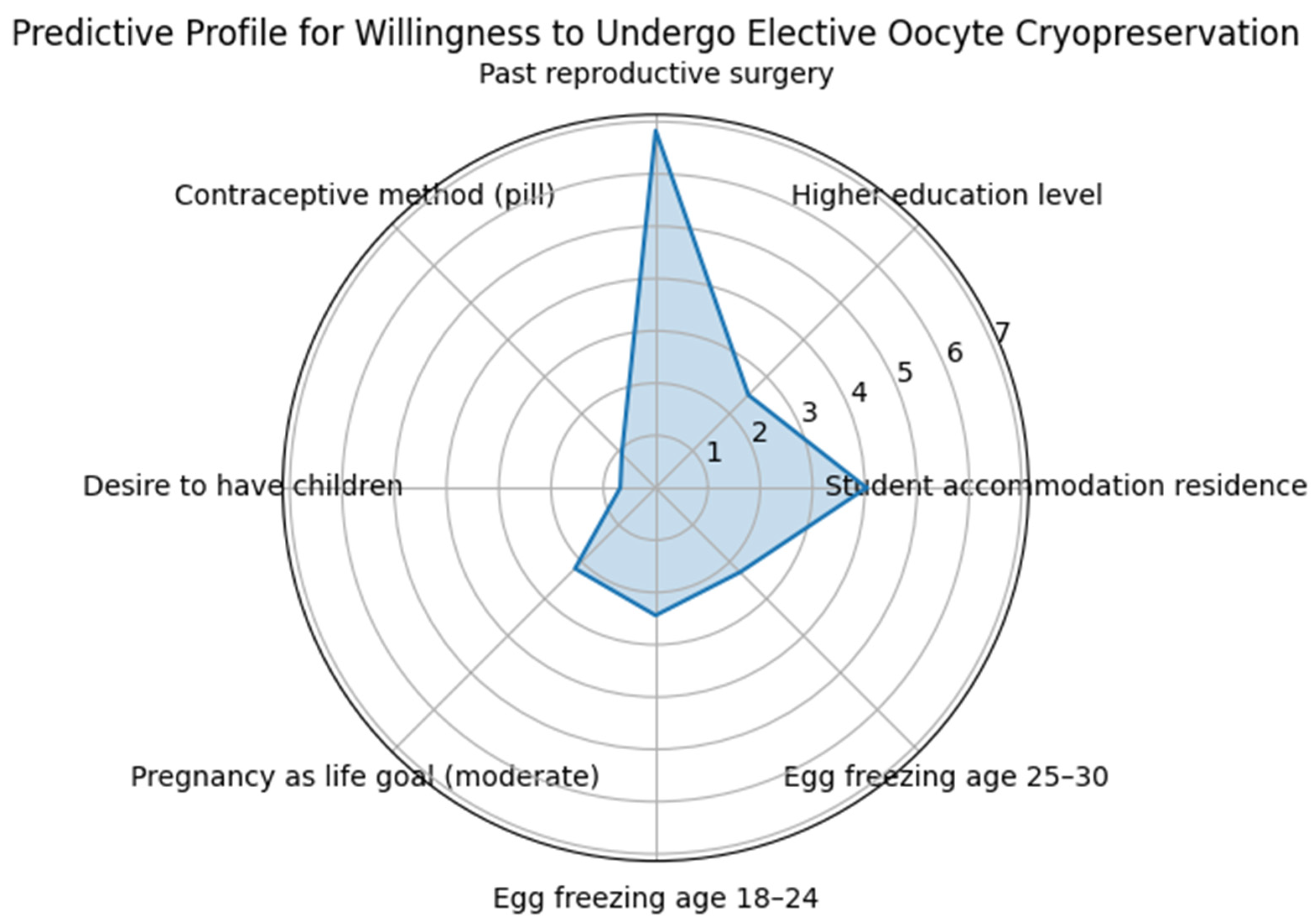
A radar plot was constructed (
Figure 1) to visually summarize the relative contribution of variables associated with willingness to undergo elective oocyte cryopreservation. The plot illustrates a multidimensional predictive profile derived from statistically significant factors identified in the regression analysis.
The strongest predictors were prior reproductive surgery and residence in student accommodation, suggesting that women with prior reproductive health concerns or greater residential independence may demonstrate increased fertility planning awareness. Moderate contributions were observed for educational attainment and perceptions regarding optimal egg freezing age. In contrast, contraceptive pill use and immediate desire for future childbearing showed comparatively weaker predictive influence.
This multidimensional representation provides an intuitive overview of how demographic, reproductive, and psychosocial characteristics collectively shape fertility preservation decision-making.
4. Discussion
The increased awareness and positive perception of EOC highlighted in our study represent a significant paradigm shift in reproductive medicine. Early studies in the late 2000s primarily focused on improving cryopreservation outcomes by comparing slow-freezing methods with vitrification, demonstrating improved oocyte survival and fertilization rates [
29]. Subsequent research confirmed that vitrified oocytes could achieve clinical outcomes comparable to those of fresh oocytes, thereby facilitating broader clinical adoption [
30]. More recent literature situates vitrification within a broader social context, emphasizing its role in enabling women to exercise greater autonomy over reproductive timing and fertility planning [
31].
This study underscores the key factors shaping young women’s views on non-medical oocyte cryopreservation. While awareness of the procedure was high among participants (93.1%), only 40.5% were willing to undergo elective egg freezing. Women with higher educational levels, especially those holding university or postgraduate degrees, were significantly more inclined to consider egg freezing, as were those living in student dormitories or independently. Individuals with a history of ovarian cysts, polycystic ovary syndrome (PCOS), or who have undergone gynecological procedures, even minor ones, show a marked tendency to engage in fertility preservation. This pattern underscores the significant impact that reproductive health concerns have on their decision-making processes regarding fertility options.
Reproductive anxiety and aspirations for future motherhood significantly influenced attitudes toward oocyte cryopreservation. Participants who were open to the procedure were notably more concerned about fertility decline and viewed the ages of 30–35 as ideal for egg freezing. Personal gynecological history, particularly ovarian involvement, serves as a primary motivator, likely due to direct medical counseling. Additionally, observing peers struggle with age-related infertility may catalyze the decision to adopt cryopreservation as a preventive measure. In contrast, financial worries and societal expectations were major deterrents for those hesitant to consider egg freezing. These findings highlight the importance of targeted fertility education and policy interventions, such as financial support or insurance coverage, to facilitate informed decision-making regarding reproductive options.
The findings indicated a high level of awareness, with 93% of participants familiar with the concept of oocyte cryopreservation. This awareness can likely be attributed to the participants’ high level of education and their access to information through online platforms, including social media, as well as from healthcare professionals. A similar trend was observed in a 2016 study comparing the attitudes of Danish and British women [
32], where 89% of participants were aware of oocyte cryopreservation. Additionally, 40.5% of participants expressed interest in egg freezing, suggesting a significant proportion of women are open to using oocyte cryopreservation as a fertility preservation method. Recent research underscores a growing interest in fertility preservation strategies among young women [
33,
34].
Higher educational attainment and prior reproductive surgery were associated with greater willingness to undergo elective oocyte cryopreservation. The radar plot offers a conceptual visualization of the predictive profile of women considering elective oocyte cryopreservation. Rather than representing absolute risk, the figure highlights relative influence across multiple domains. Such visualization supports clinical counseling by illustrating how reproductive history, social independence, and fertility timing perceptions interact in shaping reproductive planning behaviors. The history of surgical procedures and a higher educational level have emerged as significant predictive factors, indicating that women with advanced education and those who have undergone reproductive-related surgeries are more inclined to consider egg freezing. This finding aligns with existing literature that highlights the influence of education on reproductive decision-making. Studies show that individuals with higher educational attainment are more likely to pursue fertility preservation strategies [
11,
15,
26,
33,
34,
35]. Highly educated women tend to align their reproductive choices with their professional goals and life plans [
36,
37]. The correlation between education and fertility preservation choices may be attributed to increased awareness and access to information about reproductive technologies among educated women [
38].
Moreover, women with higher education levels often prioritize career advancement, potentially leading to delayed childbearing and a greater interest in fertility preservation options. Furthermore, the link between higher education and EOC intent may suggest that these women belong to social environments—comprising informed peers and supportive family structures—that normalize and encourage proactive reproductive planning. This trend underscores the need for comprehensive reproductive health education and counseling across all educational backgrounds to ensure equitable access to fertility preservation services.
The influence of socioeconomic factors on fertility preservation decisions adds another layer of complexity to this issue, as higher education often correlates with increased financial resources and improved access to healthcare. Many participants viewed the high cost of the procedure as a significant barrier. Financial constraints, coupled with the absence of state subsidies for non-medical EOC in Greece, continue to pose substantial challenges that may hinder these young women from achieving their intentions. This situation highlights the urgent need to reevaluate national health policies.
Cultural and religious beliefs also play a significant role in shaping attitudes towards assisted reproductive technologies, potentially influencing the likelihood of pursuing fertility preservation options [
39]. As the field of reproductive medicine continues to advance, it is crucial to address these disparities and develop strategies to make fertility preservation more accessible and culturally sensitive for women from diverse backgrounds [
40].
Additional research is crucial to fully understand how previous surgical procedures affect decisions about fertility preservation. This connection may stem from increased awareness of fertility risks following surgery or from personal experiences with fertility-related challenges. Also, the emergence of the desire for parenthood as a significant factor highlights the enduring importance of motherhood as a life goal for young women, shaped by social expectations, personal ambitions, and professional considerations. The impact of living in student dormitories underscores the influence of economic and social status on fertility-related decisions [
7,
39]. Women residing in student accommodations may view oocyte cryopreservation as a strategic investment in their future autonomy, enabling them to prioritize their studies and professional careers without compromising their reproductive options. Simultaneously, these women are more likely to demonstrate independence, as they live outside the security network of a family environment [
36].
Future research directions should focus on the long-term emotional and psychological impacts of EOC. Beyond investigating initial willingness, it is crucial to implement longitudinal tracking designs to observe the transition from ‘intent’ to ‘clinical action’ as women face actual fertility pressures. By incorporating objective medical data and diversifying the participant pool, future studies can refine the predictive models established here. Such evidence will provide a robust reference for government policies and healthcare professionals, such as midwives, to develop targeted and effective preconception counseling strategies. Additionally, views on the suitable age for egg freezing highlight a forward-thinking approach to fertility preservation among this group, coupled with a heightened awareness of reproductive options. This underscores a growing recognition of the significance of planning for fertility preservation at the most advantageous point in life.
Limitations and Future Research Directions
While this study offers valuable insights, it is not without limitations. Firstly, its cross-sectional design captures intentions at a single moment, hindering the ability to establish definitive causal relationships between variables. Longitudinal studies are clearly needed to observe how these reproductive intentions change over different life stages and, crucially, to track the actual utilization rates of frozen oocytes and post-operative satisfaction or regret.
Secondly, the sample primarily comprised young women of Greek origin, which may restrict the generalizability of the findings to other cultural or socioeconomic groups. Future research should aim to expand the sample size to include a wider range of nationalities and ethnicities, thereby gaining a more comprehensive understanding of global attitudes toward selective egg freezing.
Lastly, the self-reported nature of reproductive health variables may introduce reporting bias or subjective interpretation errors. Validating such self-reported medical histories with objective clinical records in future studies would greatly enhance data accuracy and methodological rigor.




 ,
,