
Article

Metabolically Healthy Obesity Versus Metabolic Obesity on Long-Term Major Adverse Cardiovascular Events and Mortality in Women with Suspected Ischemic Heart Disease


1
Women’s Heart Center, The Christ Hospital Heart and Vascular Institute, Cincinnati, OH 45219, USA
2
Department of Internal Medicine, University of Cincinnati, Cincinnati, OH 45219, USA
3
Barbra Streisand Women’s Heart Center, Smidt Heart Institute, Cedars-Sinai Medical Center, Los Angeles, CA 90048, USA
4
Department of Medicine, Mount Sinai, New York, NY 10019, USA
5
Department of Medicine, University of Alabama, Birmingham, AL 35203, USA
6
Department of Medicine, University of Pittsburgh, Pittsburgh, PA 15213, USA
7
Division of Cardiovascular Medicine, Department of Medicine, University of Florida, Gainesville, FL 32611, USA
*
Author to whom correspondence should be addressed.
Hearts 2026, 7(2), 18; https://doi.org/10.3390/hearts7020018 (registering DOI)
Submission received: 20 March 2026 / Revised: 1 June 2026 / Accepted: 9 June 2026 / Published: 12 June 2026

Abstract

Background: Obesity and metabolic syndrome (MS) often co-exist; however, these conditions can exist independently as metabolically healthy obesity (MHO) and as metabolic obesity (MO). Methods: We investigated the association between metabolic status and body weight and risk of obstructive angiographic coronary artery disease (CAD), long-term major adverse cardiovascular events (MACEs), and all-cause mortality in women with signs/symptoms of ischemic heart disease (IHD) enrolled in the original cohort of the Women’s Ischemia Syndrome Evaluation (WISE) study (1997–2001) followed for mortality for a median of 8.6 years (range: 0–11.3 years). Normal weight (NW) was defined as a body mass index (BMI) < 25 kg/m2, overweight (OW) was defined as a BMI of 25–29 kg/m2, obesity (O) was defined as ≥30 kg/m2. MS was defined according to the NCEP ATP III Harmonized definition, metabolically healthy (MHO) was defined as obesity in the absence of MS, and MO was defined as MS in NW individuals. Results: 503 women were evaluated including 20.7% MH-NW, 14.7% MH-OW, 8.5% MHO, 6.2% MO, 21.9% MS-OW, 28.0% MS-O. Compared to MH-NW (reference), MHO was associated with a lower risk of MACEs (aHR 0.50; 95% CI 0.29, 0.85, p = 0.011) and mortality (aHR 0.50; 95% CI 0.27, 0.95, p = 0.035). MO was associated with higher odds of obstructive CAD (aOR 2.10; 95% CI 1.33, 3.33, p = 0.002) and a higher risk of MACEs (aHR 1.67, 95% CI 1.07, 2.59, p = 0.023). Conclusions: In women with suspected IHD, compared with MH-NW, MHO was associated with a lower risk of MACEs and mortality, whereas MO had higher odds of obstructive CAD and a greater MACE risk. These findings challenge simplistic BMI-based risk paradigms and emphasize the benefits of using metabolic status assessment over weight alone.

1. Introduction

The prevalence of obesity in the United States has risen steadily and is projected to reach 48.9% of the population by 2030 [1,2,3,4]. Parallel increases have occurred in related conditions such as metabolic syndrome (MS) [5]. MS is defined by a cluster of metabolic abnormalities including hyperglycemia, hypertension, hypertriglyceridemia, low high-density lipoprotein (HDL) cholesterol and increased waist circumference. Although MS and obesity often co-exist, they can occur independently [6]. Metabolically healthy obesity (MHO) refers to obese individuals without MS and is reported for up to 32% of obese individuals [7]. Metabolic obesity weight (MO) describes individuals with MS and normal body weight.
Both obesity and MS are established, independent predictors of cardiovascular disease (CVD) and mortality [8,9,10,11,12,13,14,15]. Evidence on long-term outcomes shows that compared with metabolically healthy normal-weight (MH-NW) individuals, MHO is associated with a higher risk of major adverse cardiovascular events (MACEs) and mortality, but the risk is greatest in MO individuals [16,17]. Other studies suggest that isolated obesity in MH individuals (MHO) may not increase MACE or mortality risk [18,19], particularly in women, as demonstrated in sex-stratified analyses [16,20,21].
We leveraged the Women’s Ischemia Syndrome Evaluation (WISE) study to examine the associations between metabolic status and body weight measured by body mass index (BMI) with respect to the risk of obstructive angiographic coronary artery disease (CAD), long-term MACEs, and all-cause mortality in women presenting with signs and symptoms of ischemic heart disease (IHD).

2. Methods

2.1. Study Population

The study population consisted of women enrolled in the multicenter National Heart, Lung, and Blood Institute (NHLBI) Women’s Ischemia Syndrome Evaluation (WISE) study (1997–2001). As previously described, women with signs/symptoms of IHD who were clinically referred for invasive coronary angiography were enrolled at four sites (University of Alabama at Birmingham, Birmingham, AL; University of Florida, Gainesville, FL; University of Pittsburgh, Pittsburgh, PA; and Allegheny General Hospital, Pittsburgh, PA, USA) [22]. Each woman provided informed consent approved by the institutional review board.
At the time of enrollment, each woman had undergone a baseline evaluation that included collection of demographic information, CAD risk factors, medical and reproductive history; and a physical examination with blood pressure and anthropometric measurements including body mass index (BMI), fasting blood samples, and angiography assessment of coronary arteries, as previously described [22].

2.2. Classification of Metabolic Status and Body Weight

The NCEP ATP III Harmonized definition was used to classify study participants as having MS based on the presence of ≥3 of the following factors: (1) waist circumference > 88 cm, (2) fasting triglyceride levels ≥ 150 mg/dL (measured by enzymatic assay at the WISE core lipid laboratory), (3) HDL cholesterol (HDL-C) < 50 mg/dL, (4) hypertension (systolic blood pressure ≥ 130 mm Hg, diastolic blood pressure ≥ 85 mm Hg or use of antihypertensive medication), and (5) fasting glucose ≥ 100 mg/Dl [23,24,25]. Metabolically healthy (MH) was defined as the absence of ≥3 MS components. BMI was calculated as body weight in kilograms divided by height in meters squared (kg/m2). Normal weight was defined as BMI < 25 kg/m2, overweight was defined as BMI 25 to 29 kg/m2, obesity was defined as BMI ≥ 30 kg/m2, and underweight was defined as BMI ≤ 18.5 kg/m2 [26]. MHO was defined as obesity in the absence of MS, and MO was defined as MS in NW individuals.

2.3. Angiographic Assessment of Coronary Artery Disease

Each participant underwent invasive coronary angiography completed upon enrollment in the study. WISE angiographic core laboratory (Rhode Island Hospital, Providence, RI) investigators blinded to all other subject data performed quantitative analysis of coronary angiograms [22]. Obstructive CAD was defined as the presence of ≥1 stenoses ≥ 50% in diameter, minimal CAD was defined as maximum stenosis diameter of 20–49%, and no CAD was defined as <20% stenosis in all coronary arteries. The WISE CAD severity score was calculated based on angiographic severity of stenoses, presence of partial or complete collateral flow, and location of stenoses with values ranging from 5.0 to 88.5 [27].

2.4. Follow-Up and Cardiovascular Events

Follow-ups for cardiovascular events were conducted via annual telephone interviews by experienced site staff and/or over mail. The primary outcomes of interest were all-cause mortality and MACE, defined as a composite of nonfatal myocardial infarction, stroke, or congestive heart failure and all-cause mortality adjudicated by review of medical records. The National Death Index (NDI) was used to verify death through 10-year follow-up.

2.5. Statistical Analysis

The analytical sample included 503 (53.3%) of the 944 women enrolled who had complete data for MS, body weight, and follow-up events and did not have treated diabetes mellitus (N = 199). The cohort was divided into 6 groups by metabolic status and body weight—MH-NW (reference-control), MH-OW, MHO, MO, MS-OW and MS-O—based on the definitions outlined.
Differences in baseline demographics and clinical characteristics by metabolic status and body weight were assessed by chi-square tests for categorical variables and ANOVA or Kruskal–Wallis tests for continuous variables. Logistic regression was used to obtain adjusted odds ratios of having obstructive angiographic CAD in relation to metabolic status and body weight, with MH-NW as the reference group. Covariates in the adjusted model included age, race, smoking status, and history of heart failure.
Kaplan–Meier (KM) methods estimated cumulative incidence of MACE and all-cause mortality, and log-rank tests compared KM curves. Participants who had not experienced events were censored at 10 years or the last date of follow-up before 10 years. Cox proportional hazards regression estimated unadjusted and adjusted hazard ratios (HRs) for 10-year relative risk of MACEs and all-cause mortality in relation to metabolic status and weight groups (MH-OW, MHO, MO, MS-OW and MS-O), with MH-NW as the reference group. Stepwise selection was used as an exploratory variable selection approach to identify a parsimonious set of independent predictors from a large pool of candidate variables for inclusion in the multivariable models. All variables in Table 1 were considered except those with >5% missing data. Furthermore, among highly correlated variables, the one with the lowest univariable p-value was selected. Predictors with p < 0.10 were included in the multivariable model. As a result of the stepwise selection described, CAD severity score, history of congestive heart failure, and smoking status were included in both models. In addition, age was added to the mortality model. Race, Duke Activity Status Index (DASI)-derived metabolic equivalents (METs), and postmenopausal status were added to the MACE model. The proportional hazards assumption was assessed using the Kolmogorov–Smirnov supremum-type test.
We did not form a separate analysis group for “underweight” subjects, because only 13 subjects (2.6% of study cohort) met this definition. Statistical analyses were performed using SAS software (SAS, version 9.4, Carey, NC, USA) and R statistical software (version 4.2.2; R Foundation, Vienna, Austria) with two-sided tests and a significance level of 0.05.

3. Results

3.1. Baseline Characteristics Stratified by Metabolic Status and Body Weight

Among the 503 women included in the analysis, the distribution was 20.7% MH-NW, 14.7% MH-OW, 8.5% MHO, 6.2% MO, 21.9% MS-OW, and 28.0% MS-O. Women with MH-NW had the lowest rates of being ever-smokers, the highest rates of being in a postmenopausal state, the lowest waist circumference, the highest mean DASI, the lowest insulin levels, and the lowest inflammatory marker levels (hs-CRP and IL-6) compared to the other groups (Table 1). MH-OW women had the lowest rates of hypertension, dyslipidemia, and being postmenopausal and the lowest levels of triglycerides and fasting blood glucose compared with the other groups. Women with MHO were the youngest on average and had the lowest CAD severity scores and highest HDL-C levels compared to other groups. MO women were the oldest on average, had the highest rates of dyslipidemia and being smokers, had the lowest systolic and diastolic blood pressure, and had the highest fasting blood glucose and IL-6 levels compared to the other groups. Women with MS-O and MS-OW had the highest rates of hypertension, the lowest DASI, and the highest systolic blood pressure, triglyceride, and insulin levels compared to the other groups.

3.2. Angiographic CAD Stratified by Metabolic Status and Body Weight

Angiographically, 163 (32.5%) had obstructive CAD. MHO women had the lowest prevalence of obstructive CAD, whereas MO women had the highest prevalence of obstructive CAD, compared to the other groups (Table 2). Compared to the MH-NW group (reference), MO women had 2.1-fold higher odds of having obstructive CAD, and women with MS-OW had 2.38-fold higher odds in adjusted models.

3.3. Cardiovascular Events and All-Cause Mortality Stratified by Metabolic Status and Body Weight

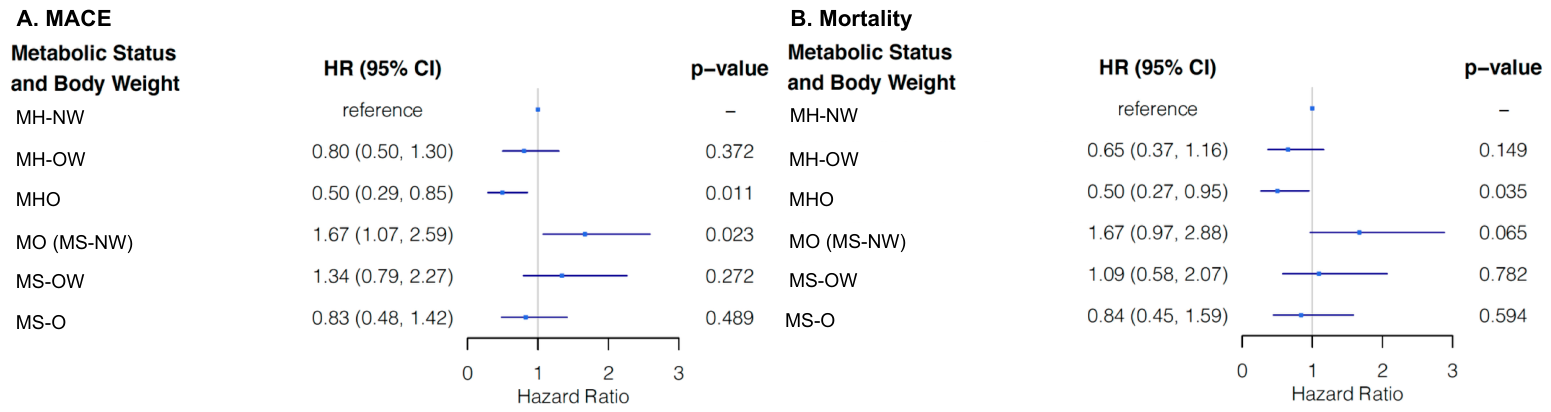
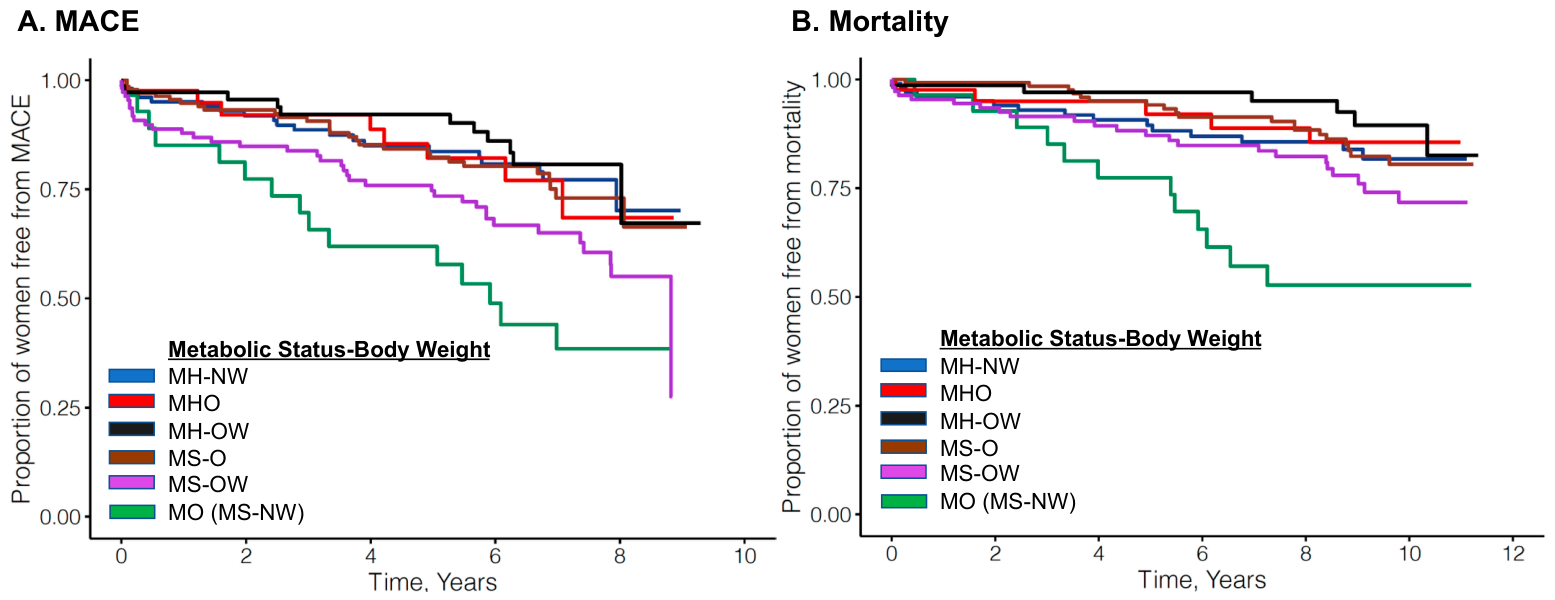
Overall, in the cohort, 119 (23.7%) patients had a MACE during a median follow-up time of 5.9 years (range: 0 to 9.3 years); and 80 (16.0%) died during a median follow-up of 8.6 years (range: 0 to 11.3 years). Kaplan–Meier analysis showed a significant difference in MACEs and all-cause mortality between the groups according to metabolic status and body weight (Figure 1). Women with MO had the lowest MACE-free survival and overall survival (Figure 1). Compared to MH-NW (reference), MHO was associated with a lower risk of MACEs (HR 0.50; 95% CI 0.29–0.85) and all-cause mortality (HR 0.50; 95% CI 0.27–0.95) in adjusted models (Figure 2). MO women were at an increased risk of MACEs (HR 1.67; 95% CI 1.07–2.59), relative to the reference MH-NW group. Table S1 shows the HRs of the variables included in the multivariable Cox regression model for the 10-year relative risks for MACEs and all-cause mortality in relation to body weight and metabolic health. The results were unchanged when “underweight” subjects were excluded from the normal-weight group.

4. Discussion

Among women with suspected IHD, MHO was associated with a lower risk of MACEs and all-cause mortality, whereas MO women had higher odds of obstructive CAD and a higher risk of experiencing an MACE compared with the reference group (MH-NW).
The prevalence of MHO in our study was 8.5%, which is consistent with previous reports [28,29]. Obesity accelerates atherosclerosis through inflammation, insulin resistance, adverse lipid profiles and endothelial dysfunction and is strongly linked to a higher risk of CAD and IHD [15,30,31,32]. However, the “obesity paradox,” consisting of a lower risk of MACEs and mortality in obese patients with established CAD, has been described in multiple cohorts [33,34,35]. Our findings are consistent with a prior study of patients with acute coronary syndrome showing a lower risk of MACEs in women with MHO compared to MH-NW women [20]. The higher prevalence of hormone replacement therapy in the MHO group may have contributed to these findings, which warrants further investigation [36]. We also observed a lower risk of MACEs and all-cause mortality in MH-OW women. Overall, our results suggest that overweight and obesity in the absence of cardiometabolic abnormalities may represent a lower-risk overweight and obese phenotype that could partly explain the “obesity paradox” and warrants future investigation.
The markedly higher risk of CAD and MACEs associated with MS is well established [14,37]. Growing evidence indicates that the excess risk associated with MS persists even in individuals with a normal weight determined by BMI assessment, i.e., the MO phenotype [16,17,38]. For example, in the Women’s Health Study, women free of CVD but with MO had a 2-fold-higher risk of experiencing CV events at 10 years. Our results extend these observations to women with suspected IHD [38]. Our findings are further supported by two meta-analyses showing a 2-fold-higher risk of CV events in MO women [16,17]. Independent of BMI, the insulin resistance, atherogenic dyslipidemia, hypertension, visceral adiposity, and the proinflammatory/prothrombotic milieu that characterizes MS promotes endothelial dysfunction, aortic stiffness, and subclinical atherosclerosis and CAD. In our cohort, women with MO had the lowest systolic and diastolic blood pressure but the highest fasting blood glucose, suggesting insulin resistance may be an important driver of the higher risk of CAD and MACEs we observed in this group. This hypothesis is consistent with prior studies linking insulin resistance (higher fasting insulin) to a greater risk of CAD and IHD [39]. We also found that menopausal status predicted MACEs in our cohort; therefore, the predominance of postmenopausal women in the MO group may have contributed to our results supported by the increased incidence of CAD and IHD associated with menopause [36]. In contrast to other studies [16,17], we observed that MACE and mortality risks in MS-OW and MS obese women were similar to those for MH-NW women. These findings are not fully understood and warrant validation in other cohorts of women with IHD, as overweight and obesity with co-morbid MS have been associated with atherosclerotic plaque progression. Our findings suggest that diagnosis of MO which requires cardiometabolic assessment beyond BMI-measured body weight, including waist circumference, fasting glucose/insulin, lipids, and blood pressure, should be obtained and guide aggressive preventive strategies.
BMI-based body weight alone has limitations, as it does not capture body composition, body fat distribution, nutritional status, cardiorespiratory fitness, or other determinants of long-term cardiovascular outcomes [40]. Abdominal obesity, reflecting excess visceral adiposity, is more strongly associated with metabolic abnormalities and MS than isolated BMI-defined obesity and has been linked to increased cardiovascular risk in MHO individuals [41,42,43,44]. We therefore hypothesize that the differences in body composition among MHO women in our study may have contributed to their more favorable outcomes [42]. Cardiorespiratory fitness, which improves cardiovascular outcomes irrespective of BMI, may also have played a role in the lower risk observed in MHO women [45,46,47,48]. MO individuals in our cohort had the highest fasting glucose and IL-6 and the second-highest hs-CRP levels, supporting a state of insulin resistance and heightened inflammation. Insulin resistance, reflected by elevated fasting glucose levels, promotes metabolic dysregulation, increases in reactive oxygen species, endothelial dysfunction, myocardial injury and inflammatory activation [49,50,51]. We hypothesize that insulin resistance and inflammation contributed to the higher odds of obstructive CAD and risk of MACEs in the MO women. Collectively, our findings underscore the complex interplay between obesity, MS, and cardiovascular risk and highlight the need for further investigation [52].
Limitations: This study uses longitudinal data from a well-characterized cohort of women with signs and symptoms of IHD undergoing coronary angiography. Several limitations merit consideration. First, we relied on BMI as a measure of body weight and did not have measures of visceral fat or more detailed body composition. Second, body weight and metabolic status were assessed only at baseline; changes over time were not captured and may have influenced long-term MACEs and mortality. Third, differences in angiographic findings and medical therapy could have affected our results. Fourth, we used stepwise variable selection to construct multivariable models. While this approach can simplify modeling, it may increase the risk of overfitting and the exclusion of weak but clinically relevant confounders. Thus, although we identified independent associations within our cohort, residual confounding remains possible, and our models require validation in independent populations. Fifth, this is an observational study and cannot establish causality. Finally, our population was limited to women presenting with signs and symptoms of IHD; therefore, these findings may not be generalizable to asymptomatic or lower-risk women. In light of these limitations, our findings should be considered hypothesis-generating and require confirmation in other cohorts.

5. Conclusions

In women with suspected IHD, compared with MH-NW, MHO was associated with a lower risk of MACEs and mortality, whereas MO was associated with a higher risk of MACEs. These findings challenge simplistic BMI-based risk paradigms and emphasize the importance of metabolic health assessment over weight alone. Further research is needed to better understand sex-specific differences in the relationship between body weight and metabolic health as well as the mechanisms that drive outcomes in MHO and MO.

Supplementary Materials

The following supporting information can be downloaded at https://www.mdpi.com/article/10.3390/hearts7020018/s1. Table S1: Multivariable Cox proportional regression model for relative risks of MACE and all-cause mortality in relation to body weight and metabolic status.

Author Contributions

Conceptualization, O.Q. and C.N.B.M.; methodology, O.Q. and C.N.B.M.; formal analysis, M.L.; investigation, L.J.S., V.B., S.E.R., C.J.P. and C.N.B.M.; data curation L.J.S., V.B., S.E.R., C.J.P. and C.N.B.M.; writing—original draft preparation, O.Q. and M.P.; writing—review and editing, O.Q., M.P., J.W., N.S., L.J.S., M.L., V.B., S.E.R., C.J.P. and C.N.B.M.; supervision, C.N.B.M.; funding acquisition, C.J.P. and C.N.B.M. All authors have read and agreed to the published version of the manuscript.

Funding

This research is funded by contracts from the National Heart, Lung, and Blood Institutes nos. N01-HV-068161, N01-HV-068162, N01-HV-068163, and N01-HV-068164; grants U01 HL064829, U01 HL649141, U01 HL649241, K23 HL105787, K23 HL125941, K23 HL127262, K23 HL151867, T32 HL069751, R01 HL090957, R03 AG032631, R01 HL146158, R01 HL146158-04S1, R01 HL124649, R01 HL153500, and U54 AG065141; General Clinical Research Center grant MO1-RR00425 from the National Center for Research Resources; the National Center for Advancing Translational Sciences Grant UL1TR000124; and Department of Defense grant PR161603PR150224P1 (CDMRP-DoD). Additional grants came from the Gustavus and Louis Pfeiffer Research Foundation, Danville, NJ; The Women’s Guild of Cedars-Sinai Medical Center, Los Angeles, CA; The Ladies Hospital Aid Society of Western Pennsylvania, Pittsburgh, PA, and QMED, Inc., Laurence Harbor, NJ; the Edythe L. Broad and the Constance Austin Women’s Heart Research Fellowships, Cedars-Sinai Medical Center, Los Angeles, CA; the Barbra Streisand Women’s Cardiovascular Research and Education Program, Cedars-Sinai Medical Center, Los Angeles, CA; The Society for Women’s Health Research, Washington, D.C.; the Linda Joy Pollin Women’s Heart Health Program; the Erika Glazer Women’s Heart Health Project; and the Adelson Family Foundation, Cedars-Sinai Medical Center, Los Angeles, CA. This work is solely the responsibility of the authors and does not necessarily represent the official views of the National Heart, Lung, and Blood Institute; the National Institutes of Health; or the U.S. Department of Health and Human Services.

Institutional Review Board Statement

The study was conducted in accordance with the Declaration of Helsinki and approved by the Institutional Review Board at Cedar Sinai Medical Center (2398 on 13 June 2001).

Informed Consent Statement

Informed consent was obtained from all subjects involved in the study.

Data Availability Statement

The WISE dataset is sponsored by the National Heart, Lung, and Blood Institute (NHLBI) and managed through their central repositor.

Conflicts of Interest

The authors declare no conflicts of interest.

Abbreviations

CVDcardiovascular disease
IHDischemic heart disease
MACEmajor adverse cardiovascular events
MH-NWMetabolically healthy and normal weight
MH-OWMetabolically healthy and overweight
MHOMetabolically healthy obesity
MOmetabolic obesity
MSmetabolic syndrome
MS-OWmetabolic syndrome and overweight
MS-Ometabolic syndrome and obesity

References

  1. Palmer, M.K.; Toth, P.P. Trends in Lipids, Obesity, Metabolic Syndrome, and Diabetes Mellitus in the United States: An NHANES Analysis (2003–2004 to 2013–2014). Obesity 2019, 27, 309–314. [Google Scholar] [CrossRef]
  2. Tsao, C.W.; Aday, A.W.; Almarzooq, Z.I.; Anderson, C.A.M.; Arora, P.; Avery, C.L.; Baker-Smith, C.M.; Beaton, A.Z.; Boehme, A.K.; Buxton, A.E.; et al. Heart Disease and Stroke Statistics-2023 Update: A Report From the American Heart Association. Circulation 2023, 147, e93–e621. [Google Scholar] [CrossRef]
  3. Hales, C.M.; Fryar, C.D.; Carroll, M.D.; Freedman, D.S.; Ogden, C.L. Trends in Obesity and Severe Obesity Prevalence in US Youth and Adults by Sex and Age, 2007–2008 to 2015–2016. JAMA 2018, 319, 1723–1725. [Google Scholar] [CrossRef]
  4. Ward, Z.J.; Bleich, S.N.; Cradock, A.L.; Barrett, J.L.; Giles, C.M.; Flax, C.; Long, M.W.; Gortmaker, S.L. Projected U.S. State-Level Prevalence of Adult Obesity and Severe Obesity. N. Engl. J. Med. 2019, 381, 2440–2450. [Google Scholar] [CrossRef]
  5. Aguilar, M.; Bhuket, T.; Torres, S.; Liu, B.; Wong, R.J. Prevalence of the metabolic syndrome in the United States, 2003–2012. JAMA 2015, 313, 1973–1974. [Google Scholar] [CrossRef]
  6. Neeland, I.J.; Poirier, P.; Despres, J.P. Cardiovascular and Metabolic Heterogeneity of Obesity: Clinical Challenges and Implications for Management. Circulation 2018, 137, 1391–1406. [Google Scholar] [CrossRef]
  7. Wildman, R.P.; Muntner, P.; Reynolds, K.; McGinn, A.P.; Rajpathak, S.; Wylie-Rosett, J.; Sowers, M.R. The obese without cardiometabolic risk factor clustering and the normal weight with cardiometabolic risk factor clustering: Prevalence and correlates of 2 phenotypes among the US population (NHANES 1999–2004). Arch. Intern. Med. 2008, 168, 1617–1624. [Google Scholar] [CrossRef] [PubMed]
  8. Kip, K.E.; Marroquin, O.C.; Kelley, D.E.; Johnson, B.D.; Kelsey, S.F.; Shaw, L.J.; Rogers, W.J.; Reis, S.E. Clinical importance of obesity versus the metabolic syndrome in cardiovascular risk in women: A report from the Women’s Ischemia Syndrome Evaluation (WISE) study. Circulation 2004, 109, 706–713. [Google Scholar] [CrossRef] [PubMed]
  9. Lakka, H.M.; Laaksonen, D.E.; Lakka, T.A.; Niskanen, L.K.; Kumpusalo, E.; Tuomilehto, J.; Salonen, J.T. The metabolic syndrome and total and cardiovascular disease mortality in middle-aged men. JAMA 2002, 288, 2709–2716. [Google Scholar] [CrossRef] [PubMed]
  10. Khan, S.S.; Ning, H.; Wilkins, J.T.; Allen, N.; Carnethon, M.; Berry, J.D.; Sweis, R.N.; Lloyd-Jones, D.M. Association of Body Mass Index With Lifetime Risk of Cardiovascular Disease and Compression of Morbidity. JAMA Cardiol. 2018, 3, 280–287. [Google Scholar] [CrossRef]
  11. Park, S.; Lee, S.; Kim, Y.; Lee, Y.; Kang, M.W.; Han, K.; Han, S.S.; Lee, H.; Lee, J.P.; Joo, K.W.; et al. Altered Risk for Cardiovascular Events With Changes in the Metabolic Syndrome Status: A Nationwide Population-Based Study of Approximately 10 Million Persons. Ann. Intern. Med. 2019, 171, 875–884. [Google Scholar] [CrossRef]
  12. Whitlock, G.; Lewington, S.; Sherliker, P.; Clarke, R.; Emberson, J.; Halsey, J.; Qizilbash, N.; Collins, R.; Peto, R. Prospective Studies Collaboration. Body-mass index and cause-specific mortality in 900,000 adults: Collaborative analyses of 57 prospective studies. Lancet 2009, 373, 1083–1096. [Google Scholar] [CrossRef]
  13. Dekker, J.M.; Girman, C.; Rhodes, T.; Nijpels, G.; Stehouwer, C.D.; Bouter, L.M.; Heine, R.J. Metabolic syndrome and 10-year cardiovascular disease risk in the Hoorn Study. Circulation 2005, 112, 666–673. [Google Scholar] [CrossRef]
  14. Mottillo, S.; Filion, K.B.; Genest, J.; Joseph, L.; Pilote, L.; Poirier, P.; Rinfret, S.; Schiffrin, E.L.; Eisenberg, M.J. The metabolic syndrome and cardiovascular risk a systematic review and meta-analysis. J. Am. Coll. Cardiol. 2010, 56, 1113–1132. [Google Scholar] [CrossRef]
  15. Powell-Wiley, T.M.; Poirier, P.; Burke, L.E.; Despres, J.P.; Gordon-Larsen, P.; Lavie, C.J.; Lear, S.A.; Ndumele, C.E.; Neeland, I.J.; Sanders, P.; et al. Obesity and Cardiovascular Disease: A Scientific Statement From the American Heart Association. Circulation 2021, 143, e984–e1010. [Google Scholar] [CrossRef] [PubMed]
  16. Eckel, N.; Meidtner, K.; Kalle-Uhlmann, T.; Stefan, N.; Schulze, M.B. Metabolically healthy obesity and cardiovascular events: A systematic review and meta-analysis. Eur. J. Prev. Cardiol. 2016, 23, 956–966. [Google Scholar] [CrossRef] [PubMed]
  17. Fan, J.; Song, Y.; Chen, Y.; Hui, R.; Zhang, W. Combined effect of obesity and cardio-metabolic abnormality on the risk of cardiovascular disease: A meta-analysis of prospective cohort studies. Int. J. Cardiol. 2013, 168, 4761–4768. [Google Scholar] [CrossRef]
  18. Zheng, R.; Zhou, D.; Zhu, Y. The long-term prognosis of cardiovascular disease and all-cause mortality for metabolically healthy obesity: A systematic review and meta-analysis. J. Epidemiol. Community Health 2016, 70, 1024–1031. [Google Scholar] [CrossRef]
  19. Mongraw-Chaffin, M.; Foster, M.C.; Anderson, C.A.M.; Burke, G.L.; Haq, N.; Kalyani, R.R.; Ouyang, P.; Sibley, C.T.; Tracy, R.; Woodward, M.; et al. Metabolically Healthy Obesity, Transition to Metabolic Syndrome, and Cardiovascular Risk. J. Am. Coll. Cardiol. 2018, 71, 1857–1865. [Google Scholar] [CrossRef]
  20. Imbalzano, E.; Russo, G.T.; Giandalia, A.; Sciacqua, A.; Orlando, L.; Russo, V.; Perticone, M.; Cicero, A.F.G.; Versace, A.G.; Di Micco, P.; et al. Sex-Specific Impact of Different Obesity/Metabolic Phenotypes on Long-Term Cardiovascular Outcomes in Acute Coronary Syndrome Patients. Biomedicines 2022, 10, 424. [Google Scholar] [CrossRef] [PubMed]
  21. Yeh, T.L.; Chen, H.H.; Tsai, S.Y.; Lin, C.Y.; Liu, S.J.; Chien, K.L. The Relationship between Metabolically Healthy Obesity and the Risk of Cardiovascular Disease: A Systematic Review and Meta-Analysis. J. Clin. Med. 2019, 8, 1228. [Google Scholar] [CrossRef]
  22. Merz, C.N.; Kelsey, S.F.; Pepine, C.J.; Reichek, N.; Reis, S.E.; Rogers, W.J.; Sharaf, B.L.; Sopko, G. The Women’s Ischemia Syndrome Evaluation (WISE) study: Protocol design, methodology and feasibility report. J. Am. Coll. Cardiol. 1999, 33, 1453–1461. [Google Scholar] [CrossRef]
  23. Alberti, K.G.; Eckel, R.H.; Grundy, S.M.; Zimmet, P.Z.; Cleeman, J.I.; Donato, K.A.; Fruchart, J.C.; James, W.P.; Loria, C.M.; Smith, S.C., Jr.; et al. Harmonizing the metabolic syndrome: A joint interim statement of the International Diabetes Federation Task Force on Epidemiology and Prevention; National Heart, Lung, and Blood Institute; American Heart Association; World Heart Federation; International Atherosclerosis Society; and International Association for the Study of Obesity. Circulation 2009, 120, 1640–1645. [Google Scholar] [CrossRef]
  24. Expert Panel on Detection, Evaluation, and Treatment of High Blood Cholesterol in Adults. Executive Summary of The Third Report of The National Cholesterol Education Program (NCEP) Expert Panel on Detection, Evaluation, and Treatment of High Blood Cholesterol In Adults (Adult Treatment Panel III). JAMA 2001, 285, 2486–2497. [CrossRef]
  25. Grundy, S.M.; Cleeman, J.I.; Daniels, S.R.; Donato, K.A.; Eckel, R.H.; Franklin, B.A.; Gordon, D.J.; Krauss, R.M.; Savage, P.J.; Smith, S.C., Jr.; et al. Diagnosis and management of the metabolic syndrome: An American Heart Association/National Heart, Lung, and Blood Institute Scientific Statement. Circulation 2005, 112, 2735–2752. [Google Scholar] [CrossRef] [PubMed]
  26. Expert Panel on the Identification, Evaluation, and Treatment of Overweight in Adults. Clinical guidelines on the identification, evaluation, and treatment of overweight and obesity in adults: Executive summary. Expert Panel on the Identification, Evaluation, and Treatment of Overweight in Adults. Am. J. Clin. Nutr. 1998, 68, 899–917. [CrossRef]
  27. Sharaf, B.L.; Pepine, C.J.; Kerensky, R.A.; Reis, S.E.; Reichek, N.; Rogers, W.J.; Sopko, G.; Kelsey, S.F.; Holubkov, R.; Olson, M.; et al. Detailed angiographic analysis of women with suspected ischemic chest pain (pilot phase data from the NHLBI-sponsored Women’s Ischemia Syndrome Evaluation [WISE] Study Angiographic Core Laboratory). Am. J. Cardiol. 2001, 87, 937–941. [Google Scholar] [CrossRef] [PubMed]
  28. Wang, J.S.; Xia, P.F.; Ma, M.N.; Li, Y.; Geng, T.T.; Zhang, Y.B.; Tu, Z.Z.; Jiang, L.; Zhou, L.R.; Zhang, B.F.; et al. Trends in the Prevalence of Metabolically Healthy Obesity Among US Adults, 1999–2018. JAMA Netw. Open 2023, 6, e232145. [Google Scholar] [CrossRef]
  29. Lopez-Garcia, E.; Guallar-Castillon, P.; Leon-Munoz, L.; Rodriguez-Artalejo, F. Prevalence and determinants of metabolically healthy obesity in Spain. Atherosclerosis 2013, 231, 152–157. [Google Scholar] [CrossRef]
  30. Bogers, R.P.; Bemelmans, W.J.; Hoogenveen, R.T.; Boshuizen, H.C.; Woodward, M.; Knekt, P.; van Dam, R.M.; Hu, F.B.; Visscher, T.L.; Menotti, A.; et al. Association of overweight with increased risk of coronary heart disease partly independent of blood pressure and cholesterol levels: A meta-analysis of 21 cohort studies including more than 300,000 persons. Arch. Intern. Med. 2007, 167, 1720–1728. [Google Scholar] [CrossRef]
  31. McGill, H.C., Jr.; McMahan, C.A.; Herderick, E.E.; Zieske, A.W.; Malcom, G.T.; Tracy, R.E.; Strong, J.P. Pathobiological Determinants of Atherosclerosis in Youth (PDAY) Research Group. Obesity accelerates the progression of coronary atherosclerosis in young men. Circulation 2002, 105, 2712–2718. [Google Scholar] [CrossRef]
  32. Yusuf, S.; Hawken, S.; Ounpuu, S.; Dans, T.; Avezum, A.; Lanas, F.; McQueen, M.; Budaj, A.; Pais, P.; Varigos, J.; et al. Effect of potentially modifiable risk factors associated with myocardial infarction in 52 countries (the INTERHEART study): Case-control study. Lancet 2004, 364, 937–952. [Google Scholar] [CrossRef]
  33. Romero-Corral, A.; Montori, V.M.; Somers, V.K.; Korinek, J.; Thomas, R.J.; Allison, T.G.; Mookadam, F.; Lopez-Jimenez, F. Association of bodyweight with total mortality and with cardiovascular events in coronary artery disease: A systematic review of cohort studies. Lancet 2006, 368, 666–678. [Google Scholar] [CrossRef] [PubMed]
  34. Uretsky, S.; Messerli, F.H.; Bangalore, S.; Champion, A.; Cooper-Dehoff, R.M.; Zhou, Q.; Pepine, C.J. Obesity paradox in patients with hypertension and coronary artery disease. Am. J. Med. 2007, 120, 863–870. [Google Scholar] [CrossRef] [PubMed]
  35. Hastie, C.E.; Padmanabhan, S.; Slack, R.; Pell, A.C.; Oldroyd, K.G.; Flapan, A.D.; Jennings, K.P.; Irving, J.; Eteiba, H.; Dominiczak, A.F.; et al. Obesity paradox in a cohort of 4880 consecutive patients undergoing percutaneous coronary intervention. Eur. Heart J. 2010, 31, 222–226. [Google Scholar] [CrossRef] [PubMed]
  36. El Khoudary, S.R.; Aggarwal, B.; Beckie, T.M.; Hodis, H.N.; Johnson, A.E.; Langer, R.D.; Limacher, M.C.; Manson, J.E.; Stefanick, M.L.; Allison, M.A.; et al. Menopause Transition and Cardiovascular Disease Risk: Implications for Timing of Early Prevention: A Scientific Statement From the American Heart Association. Circulation 2020, 142, e506–e532. [Google Scholar] [CrossRef]
  37. Gami, A.S.; Witt, B.J.; Howard, D.E.; Erwin, P.J.; Gami, L.A.; Somers, V.K.; Montori, V.M. Metabolic syndrome and risk of incident cardiovascular events and death: A systematic review and meta-analysis of longitudinal studies. J. Am. Coll. Cardiol. 2007, 49, 403–414. [Google Scholar] [CrossRef]
  38. Song, Y.; Manson, J.E.; Meigs, J.B.; Ridker, P.M.; Buring, J.E.; Liu, S. Comparison of usefulness of body mass index versus metabolic risk factors in predicting 10-year risk of cardiovascular events in women. Am. J. Cardiol. 2007, 100, 1654–1658. [Google Scholar] [CrossRef]
  39. Reaven, G. Insulin resistance and coronary heart disease in nondiabetic individuals. Arterioscler. Thromb. Vasc. Biol. 2012, 32, 1754–1759. [Google Scholar] [CrossRef] [PubMed]
  40. Heymsfield, S.B.; Cefalu, W.T. Does body mass index adequately convey a patient’s mortality risk? JAMA 2013, 309, 87–88. [Google Scholar] [CrossRef]
  41. Jensen, M.D. Role of body fat distribution and the metabolic complications of obesity. J. Clin. Endocrinol. Metab. 2008, 93, S57–S63. [Google Scholar] [CrossRef] [PubMed]
  42. Itoh, H.; Kaneko, H.; Kiriyama, H.; Kamon, T.; Fujiu, K.; Morita, K.; Michihata, N.; Jo, T.; Takeda, N.; Morita, H.; et al. Metabolically Healthy Obesity and the Risk of Cardiovascular Disease in the General Population—Analysis of a Nationwide Epidemiological Database. Circ. J. 2021, 85, 914–920. [Google Scholar] [CrossRef]
  43. Fox, C.S.; Massaro, J.M.; Hoffmann, U.; Pou, K.M.; Maurovich-Horvat, P.; Liu, C.Y.; Vasan, R.S.; Murabito, J.M.; Meigs, J.B.; Cupples, L.A.; et al. Abdominal visceral and subcutaneous adipose tissue compartments: Association with metabolic risk factors in the Framingham Heart Study. Circulation 2007, 116, 39–48. [Google Scholar] [CrossRef]
  44. Liu, J.; Fox, C.S.; Hickson, D.A.; May, W.D.; Hairston, K.G.; Carr, J.J.; Taylor, H.A. Impact of abdominal visceral and subcutaneous adipose tissue on cardiometabolic risk factors: The Jackson Heart Study. J. Clin. Endocrinol. Metab. 2010, 95, 5419–5426. [Google Scholar] [CrossRef]
  45. Ortega, F.B.; Lee, D.C.; Katzmarzyk, P.T.; Ruiz, J.R.; Sui, X.; Church, T.S.; Blair, S.N. The intriguing metabolically healthy but obese phenotype: Cardiovascular prognosis and role of fitness. Eur. Heart J. 2013, 34, 389–397. [Google Scholar] [CrossRef] [PubMed]
  46. Roberson, L.L.; Aneni, E.C.; Maziak, W.; Agatston, A.; Feldman, T.; Rouseff, M.; Tran, T.; Blaha, M.J.; Santos, R.D.; Sposito, A.; et al. Beyond BMI: The “Metabolically healthy obese” phenotype & its association with clinical/subclinical cardiovascular disease and all-cause mortality—A systematic review. BMC Public Health 2014, 14, 14. [Google Scholar] [CrossRef]
  47. Kennedy, A.B.; Lavie, C.J.; Blair, S.N. Fitness or Fatness: Which Is More Important? JAMA 2018, 319, 231–232. [Google Scholar] [CrossRef]
  48. Wessel, T.R.; Arant, C.B.; Olson, M.B.; Johnson, B.D.; Reis, S.E.; Sharaf, B.L.; Shaw, L.J.; Handberg, E.; Sopko, G.; Kelsey, S.F.; et al. Relationship of physical fitness vs body mass index with coronary artery disease and cardiovascular events in women. JAMA 2004, 292, 1179–1187. [Google Scholar] [CrossRef]
  49. Szczepaniak, L.S.; Victor, R.G.; Orci, L.; Unger, R.H. Forgotten but not gone: The rediscovery of fatty heart, the most common unrecognized disease in America. Circ. Res. 2007, 101, 759–767. [Google Scholar] [CrossRef]
  50. Peterson, L.R. Obesity and insulin resistance: Effects on cardiac structure, function, and substrate metabolism. Curr. Hypertens. Rep. 2006, 8, 451–456. [Google Scholar] [CrossRef] [PubMed]
  51. Paneni, F.; Costantino, S.; Cosentino, F. Insulin resistance, diabetes, and cardiovascular risk. Curr. Atheroscler. Rep. 2014, 16, 419. [Google Scholar] [CrossRef] [PubMed]
  52. Khan, S.S.; Matsushita, K.; Sang, Y.; Ballew, S.H.; Grams, M.E.; Surapaneni, A.; Blaha, M.J.; Carson, A.P.; Chang, A.R.; Ciemins, E.; et al. Development and Validation of the American Heart Association’s PREVENT Equations. Circulation 2024, 149, 430–449. [Google Scholar] [CrossRef] [PubMed]
Figure 1. Major adverse cardiovascular event (MACE)-free survival (A) and survival (B) during long-term follow-up stratified by metabolic status and body weight. MH-NW, metabolically healthy and normal weight; MH-OW, metabolically healthy and overweight; MHO, metabolically healthy obesity (obesity without metabolic syndrome); MO, metabolic obesity defined as metabolic syndrome and normal weight (MS-NW); MS-OW, metabolic syndrome and overweight; MS-O, metabolic syndrome and obesity.
Hearts 07 00018 g001
Figure 2. Adjusted risk of major adverse cardiovascular events (A) and all-cause mortality (B) stratified by metabolic status and body weight. MH-NW, metabolically healthy and normal weight; MH-OW, metabolically healthy and overweight; MHO, metabolically healthy obesity (obesity without metabolic syndrome); MO, metabolic obesity defined as metabolic syndrome and normal weight (MS-NW); MS-OW, metabolic syndrome and overweight; MS-O, metabolic syndrome and obesity. Reference: group MH-NW. MACE model adjusted for race, coronary artery disease (CAD) severity score, history of heart failure, smoking status, Duke Activity Status Index (DASI)-derived metabolic equivalents (METs), and postmenopausal status. Mortality model adjusted for age, CAD severity score, history of heart failure, and smoking status.
Hearts 07 00018 g002
Table 1. Baseline characteristics stratified by metabolic status and body-weight groups.
Characteristics upon Study EntryMH-NW
(N = 104)
MH-OW
(N = 74)
MHO
(N = 43)
MO
(MS-NW)
(N = 31)
MS-OW
(N = 110)
MS-O
(N = 141)
p-Value
for Trend
Age, mean (SD), yrs60.1 (12.3)55.7 (10.4)54.5 (9.2)61.9 (13.8)59.4 (11.6)56.8 (11.5)0.005
Nonwhite race, No. (%)8 (7.7%)10 (13.5%)14 (32.6%)4 (12.9%)19 (17.3%)27 (19.1%)0.008
History of hypertension, No. (%)40 (38.5%)21 (28.4%)20 (46.5%)14 (45.2%)70 (64.2%)89 (63.6%)<0.001
History of dyslipidemia, No. (%)49 (48.0%)24 (33.3%)19 (46.3%)18 (58.1%)57 (57.6%)69 (53.1%)0.036
Smoker, No. (%)21 (20.2%)14 (18.9%)5 (11.6%)14 (45.2%)34 (31.2%)23 (16.3%)0.001
Postmenopausal, No. (%)86 (82.7%)47 (63.5%)29 (67.4%)24 (77.4%)88 (80.0%)102 (72.3%)0.038
History of HRT, No. (%)64 (62.1%)36 (48.6%)26 (60.5%)17 (54.8%)63 (58.3%)63 (45.0%)0.084
CAD severity score, mean (SD)11.7 (10.7)11.4 (12.4)11.0 (14.1)16.8 (14.8)16.1 (15.0)13.4 (14.3)<0.001
DASI, mean (SD)24.6 (15.4)22.9 (14.1)22.8 (15.1)20.7 (16.1)20.6 (15.7)18.2 (13.3)0.017
WC, mean (SD), cm73.8 (8.9)85.9 (10.4)96.1 (11.8)84.3 (10.5)94.1 (8.5)107.9 (16.5)<0.001
Waist–hip ratio, mean (SD)0.8 (0.1)0.8 (0.1)0.8 (0.1)0.9 (0.1)0.9 (0.1)0.9 (0.1)<0.001
Waist–height ratio, mean (SD)0.5 (0.1)0.5 (0.1)0.6 (0.1)0.5 (0.1)0.6 (0.1)0.7 (0.1)<0.001
SBP, mean (SD), mmHg128.8 (23.7)129.0 (18.3)137.7 (20.7)128.1 (24.5)139.2 (19.3)139.4 (20.3)<0.001
DBP, mean (SD), mmHg73.1 (11.6)77.0 (11.8)79.0 (11.1)72.7 (14.7)77.6 (11.7)79.3 (12.5)0.002
Lipids, mean (SD), mgdL
Total cholesterol209.3 (49.1)200.8 (38.1)206.0 (31.8)220.9 (56.9)219.0 (54.7)216.0 (46.2)0.139
HDL-C62.5 (16.3)58.1 (15.0)62.8 (12.8)44.2 (12.9)46.2 (12.9)46.5 (11.1)<0.001
LDL-C120.3 (42.7)122.6 (34.4)119.0 (32.2)141.7 (50.7)128.1 (43.4)132.3 (47.7)0.125
Triglycerides132.6 (87.0)107.1 (39.5)118.9 (60.8)185.1 (92.4)212.2 (146.2)206.7 (136.4)<0.001
FBG, mean (SD), mg/dL86.8 (23.6)84.3 (22.8)91.0 (11.8)116.5 (43.7)104.2 (28.4)115.3 (40.4)<0.001
Insulin, mean (SD), μU/mL4.7 (3.9)4.9 (7.7)5.7 (5.4)6.2 (6.0)8.5 (10.2)12.2 (11.4)<0.001
Inflammatory markers
hs-CRP, mean (SD), mg/dL0.5 (0.7)0.7 (1.4)0.7 (0.6)1.1 (1.9)1.4 (2.9)0.9 (1.1)<0.001
Interleukin-6, mean (SD), pg/dL2.9 (2.7)4.5 (3.8)3.5 (3.2)7.8 (8.5)5.3 (5.9)4.5 (3.2)<0.001
CAD, coronary artery disease; DASI, Duke Activity Status Index; DBP, diastolic blood pressure; FBG, fasting blood glucose; HDL-C, high density lipoprotein cholesterol; HRT, hormone replacement therapy; hs-CRP, high sensitivity C-reactive protein LDL-C, low-density lipoprotein cholesterol; SBP, systolic blood pressure; WC, waist circumference; MH-NW, metabolically healthy and normal weight; MH-OW, metabolically healthy and overweight; MHO, metabolically healthy obesity (obesity without metabolic syndrome); MO, metabolic obesity defined as metabolic syndrome and normal weight (MS-NW); MS-OW, metabolic syndrome and overweight; MS-O, metabolic syndrome and obesity.
Table 2. Prevalence of obstructive coronary artery disease and likelihood by metabolic status and body-weight status.
VariablesnPrevalenceUnadjustedAdjustedp-Value
of CADOR (95% CI)OR † (95% CI)
Metabolic and BMI Groups
MH-NW 10426.9%ReferenceReference-
MH-OW7328.8%0.95 (0.57, 1.58)1.13 (0.66, 1.94)0.6
MHO4211.9%0.49 (0.28, 0.86)0.62 (0.34, 1.12)0.1
MO (MS-NW)3148.4%2.41 (1.55, 3.76)2.10 (1.33, 3.33)0.002
MS-OW11044.5%2.30 (1.33, 3.98)2.38 (1.34, 4.24)0.003
MS-O14131.9%1.19 (0.70, 2.02)1.31 (0.75, 2.29)0.3
MH-NW, metabolically healthy and normal weight; MH-OW, metabolically healthy and overweight; MHO, metabolically healthy obesity (obesity without metabolic syndrome); MO, metabolic obesity defined as metabolic syndrome and normal weight (MS-NW); MS-OW, metabolic syndrome and overweight; MS-O, metabolic syndrome and obesity. † Indicates models adjusted for age, race, smoking status, and history of heart failure.
Disclaimer/Publisher’s Note: The statements, opinions and data contained in all publications are solely those of the individual author(s) and contributor(s) and not of MDPI and/or the editor(s). MDPI and/or the editor(s) disclaim responsibility for any injury to people or property resulting from any ideas, methods, instructions or products referred to in the content.