Article

Outcomes and Tolerability of Office-Based Endoscopic Polypectomy for Chronic Rhinosinusitis with Nasal Polyps: A Prospective Study


by
Henrik Andersson
1,
Peter Ebrelius
1,
Per von Hofsten
1,
Linus Schiöler
2,3 and
Gunnhildur Gudnadottir
4,5,6,*
1
Department of Otorhinolaryngology, Halland Hospital Halmstad, 301 85 Halmstad, Sweden
2
Department of Occupational and Environmental Medicine, Sahlgrenska University Hospital, 405 30 Gothenburg, Sweden
3
Institute of Medicine, University of Gothenburg, 405 30 Gothenburg, Sweden
4
Department of Otorhinolaryngology, Institute of Clinical Sciences, Sahlgrenska Academy, University of Gothenburg, 405 30 Gothenburg, Sweden
5
Department of Otorhinolaryngology, Sahlgrenska University Hospital, 405 30 Gothenburg, Sweden
6
Department of Otorhinolaryngology, Landspitali University Hospital, 101 Reykjavík, Iceland
*
Author to whom correspondence should be addressed.
Sinusitis 2026, 10(1), 12; https://doi.org/10.3390/sinusitis10010012
Submission received: 1 March 2026 / Revised: 14 April 2026 / Accepted: 27 May 2026 / Published: 31 May 2026

Abstract

Chronic rhinosinusitis with nasal polyps (CRSwNP) is characterized by bilateral and multifocal polyps and has been shown to decrease health-related quality of life (HRQOL). Standard treatment includes steroids and endoscopic sinus surgery. Office-based endoscopic polypectomy has become increasingly popular in recent years. This study aimed to evaluate the outcomes and tolerability of office-based endoscopic polypectomy using a microdebrider under local anesthesia. This prospective observational study enrolled 19 patients with CRSwNP, according to the EPOS2020 criteria. All patients underwent office-based endoscopic polypectomy. Efficacy of treatment was assessed using the SNOT-22 questionnaire three and six months postoperatively. The perioperative experiences of patients and surgeons were evaluated using questionnaires. The mean SNOT-22 score decreased from 59.7 (SD 21.8) to a mean of 37.1 (SD 26.6 p < 0.001) after three months, and was maintained at 6 months, with a mean of 35.2 (SD 17.6 p < 0.001). The majority reported good comfort levels and did not prefer performing the procedure in an operating room under general anesthesia. The results show that office-based endoscopic polypectomy under local anesthesia is an effective method for relieving symptoms (SNOT-22) and is well-tolerated. The effect was maintained after six months.

1. Introduction

Endoscopic sinus surgery (ESS) is an established treatment for chronic sinusitis, aiming to remove polyps and inflamed mucosa to enlarge the natural ostia of the paranasal sinuses [1]. ESS is typically reserved for cases where pharmacological therapy fails. Microdebrider instruments are commonly used, offering safety and precision [2,3].
Although ESS effectively relieves symptoms and improves quality of life, the recurrence rate of nasal polyps remains substantial, negatively impacting long-term outcomes [4,5,6,7]. Postoperative discomfort and pain are frequent, often limiting daily activities in the immediate postoperative period [8,9].
ESS is traditionally performed under general anesthesia (GA) in the operating room [10]. Outpatient polypectomy under local anesthesia (LA) was previously common but declined with the rise in ESS. Recently, office-based endoscopic rhinologic surgery under LA has gained popularity [11]. This approach offers several advantages in well-selected patients, especially for those preferring LA or at risk from GA [12,13,14,15].
Previous studies have demonstrated that office-based polypectomy under LA can yield similar symptom reduction to ESS under GA, with favorable outcomes in terms of comfort, pain, and complication rates although it should be noted that a direct comparison of these methods may be problematic and should be interpreted with care [14,15,16,17]. Additionally, outpatient polypectomy may be more cost-effective for selected patients [18].
Despite these promising findings, further research is needed to evaluate the outcomes and tolerability of office-based endoscopic polypectomy under LA. The present study aims to address this gap.

2. Materials and Methods

This prospective observational cohort study enrolled 19 patients at the Ear, Nose, and Throat department of Hallands Sjukhus Halmstad, Sweden, between March 2021 and December 2022. All patients were diagnosed with chronic rhinosinusitis with nasal polyps (CRSwNP) according to EPOS2020 criteria [19] and were 18 years or older. Inclusion required bilateral nasal polyps with a minimum polyp score of two points per side following Lilholdt et al. [20,21]. Exclusion criteria included cognitive impairment, insufficient proficiency in Swedish, or systemic steroid treatment in the previous month. Included patients were already scheduled for treatment and were asked to participate in the study in connection with treatment planning. Written informed consent was obtained from all participants. The study size was determined by the number of eligible patients recruited during the study period.
All patients underwent office-based endoscopic polypectomy under local anesthesia. The nasal cavities were topically anesthetized using lidocaine–naphazoline pads (34 mg/mL + 0.17 mg/mL) applied 10 min before the procedure. If necessary, anesthesia was repeated or adjusted to control bleeding. The patients were placed in a chair in a supine position and inclined at an angle of 30°. Surgery was performed using a straight-shot M5 microdebrider (5000 rpm) and a 4.0 mm Tricut Blade (Medtronic, Minneapolis, MN, USA), with visualization via a 0° 4 mm nasoendoscope (Olympus, Tokyo, Japan). All accessible polypoid tissue within the nasal cavity and middle meatus was removed. The surgery was performed according to standard practice at the facility; intraoperative image navigation was not available for use. Postoperatively, nasal packing with oxytetracycline hydrochloride and hydrocortisone (TERRA-CORTRIL, Pfizer Inc., New York, NY, USA) was applied, which patients were instructed to remove two hours after leaving the hospital. Patients were observed for 20 min after surgery. They were instructed to continue therapy with nasal steroids and saline irrigation.
The primary outcome was change in Sino-Nasal Outcome Test (SNOT-22) score, assessed at baseline, three months and six months postoperatively [22]. Secondary outcomes included changes in nasal polyp score, patient experience (pain, willingness to repeat, preference for GA), procedure duration, and changes in SNOT-22 subscale scores (nasal, sleep, ear/facial pain, function, and emotion).
Follow-up visits were conducted at three months, including nasal endoscopy and polyp score assessment. At six months, SNOT-22 questionnaires were mailed to all patients.
The study was reported in accordance with the STROBE checklist for observational studies (see Supplementary File S1).

Statistical Analysis

Data were analyzed using SAS version 9.4M7 (SAS Institute, Cary, NC, USA). The Wilcoxon signed-rank test assessed changes in SNOT-22 scores. Confidence intervals for mean differences were calculated using Student’s t-distribution, although the distributional assumptions may be somewhat questionable. The sign test evaluated changes in nasal polyp scores. Statistical significance was set at p < 0.05.

3. Results

3.1. Patient Characteristics

Nineteen patients (16 men, three women; mean age 58.2 years, SD 21.0, range 88–23) were included in the study (Table 1). Of these, ten patients (53%) had previously undergone sinus surgery. Four patients withdrew from the study: one for unknown reasons, who had previously undergone ESS under GA, and another because an external physician initiated systemic steroid treatment for obstructive lung disease before the follow-up visit; this patient had no prior history of ESS under GA. Two patients underwent sinus surgery with general anesthesia before their six-month follow-up; however, they were included in the three-month follow-up. They were on the surgical waiting list before their inclusion in this study and did not want to postpone surgery when it was offered. One of them had previously undergone ESS under GA, while the other had not. Two participants missed their three-month follow-up visit but were included in the six-month follow-up.

3.2. Symptom Outcomes

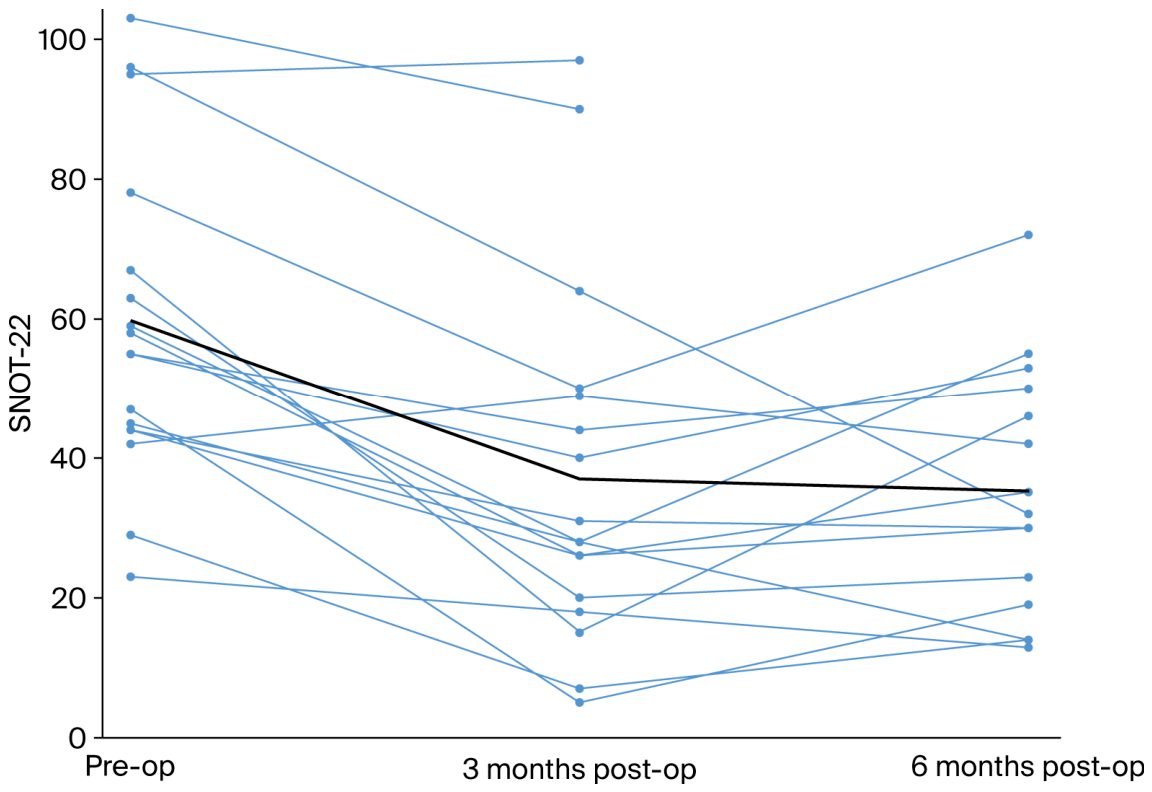
The median and mean preoperative SNOT-22 scores were 58.0 and 59.7 (range 23–103) respectively. At three months, the median score decreased to 28.0 (SD 16.4), mean 37.1 (SD 26.6, p = 0.0003). At six months, the median was 32.0 (SD 17.1), mean 35.2 (SD 17.6, p = 0.0001) (Figure 1). The mean difference was 21.9 (95% CI 12.8–30.9, p = 0.0005) at three months and 18.5 (95% CI 9.0–28.0, p = 0.005) at six months. Patients with prior ESS had a reduction in scores from 56 preoperatively to 33 at 6 months, compared to a reduction from 64 to 38 points in those with no prior surgery over the same period. Given the small subgroup sizes, no statistical comparisons were performed. The five domains were assessed with a subscale analysis showing substantial improvement in the nasal domain (Table 2). All but one of the questionnaires were completed in full, with a single participant leaving out one question. The missing item was supplemented with the average of the remaining items in that domain [23].

3.3. Polyp Score

The mean total polyp score decreased from 5.2 preoperatively to 2.4 at three months (p < 0.0001). Two patients did not attend follow-up appointments at three months and were examined six months postoperatively.

3.4. Patient Experience

During the procedure, 74% of patients experienced little to no pain, and 79% said they would be willing to repeat the procedure. When asked if they would have preferred the procedure to be done in an operating room with general anesthesia, 84% favored the office-based procedure with local anesthesia. There were no observed differences between patients who had previously undergone ESS and those who had not in this regard.

3.5. Complications

No complications were reported. Bleeding was estimated at less than 25 mL in 58% of cases; no cases exceeded 75 mL. All procedures were performed on an outpatient basis.

4. Discussion

This prospective study demonstrates that office-based endoscopic polypectomy under LA provides clinically meaningful and sustained symptom improvement in selected patients with CRSwNP, as shown by significant reductions in SNOT-22 scores maintained at six months. By including patients with prior ESS and providing detailed SNOT-22 subdomain analysis, the findings add real-world evidence on both efficacy and symptom-specific benefits of this minimally invasive approach. High patient tolerability, preference for LA, and absence of complications further support its feasibility in routine outpatient practice. Collectively, these results clarify the role of office-based polypectomy as a safe, repeatable adjunct or bridging treatment rather than a replacement for ESS under GA.
Many earlier studies on office-based polypectomy are retrospective, cross-sectional, or include heterogeneous outcome measures. In contrast, this study uses a prospective design with predefined follow-up at both 3 and 6 months, employing the validated SNOT-22 questionnaire as the primary endpoint.
While the previous literature often reports total SNOT-22 scores, this study provides a domain-level analysis (nasal, sleep, ear/facial pain, function, and emotion) following office-based polypectomy.
The total SNOT-22 score showed a reduction of 21.9 points at three months and 18.5 points at six months postoperatively. These findings are consistent with previous studies, which have shown comparable outcomes between polypectomy under LA and ESS under GA, including similar reductions in SNOT-22 scores and high patient satisfaction [7,12,14,17]. Such results should, however, be interpreted with care as the comparison of these two procedures is difficult as they are applied to different patient groups and in different situations. A polypectomy under LA will never replace the need for more extensive surgery that needs to be done under GA but should rather be seen as a complement.
The results regarding patient satisfaction and SNOT-22 were similar regardless of whether patients had undergone previous ESS under GA or not, but due to the limited sample size, we cannot draw any firm conclusions from this. A more robust comparison of these two patient groups in larger future studies might give interesting insights regarding when polypectomies under LA are most appropriate, perhaps as a maintenance procedure after a first, more extensive ESS.
The study reports no complications, low estimated blood loss, and no need for inpatient care. Patient satisfaction was high, as 79% stated that a willingness to repeat the procedure. Gan et al. found that 97% of patients rated their comfort as ‘fair’ to ‘excellent’ after office-based polypectomy. They also reported no significant bleeding during or after the treatment which is in alignment with our results [17]. While safety has been reported previously, this study adds evidence from a Swedish public hospital setting, and support for feasibility outside highly specialized tertiary referral centers.
After undergoing polypectomy under LA, patients can resume daily activities early, which offers a significant advantage over ESS under GA. The recovery time after polypectomy under LA is 1.5–3.5 days according to previous studies [12,13,24]. There is also less nausea, vomiting, and nosebleeds than after ESS under GA [24].
However, more studies are needed to evaluate long-term outcomes. The risk for recurrence is high at 16–60% [4,6,12] with the rate of revision surgery after ESS at 20% [7]. It is logical to assume that the effect after the less extensive surgery done under LA does not last as long. For patients with severe CRSwNP, more extensive surgery is needed and polypectomy under LA may then be used to provide symptom relief in extended waiting periods, possibly postponing the need for further surgery under GA. Debulking nasal polyps provides immediate relief from nasal obstruction and may also facilitate more effective delivery of intranasal corticosteroids. However, rather than positioning office-based polypectomy as a replacement for ESS, this study frames it as a possible bridge therapy for patients awaiting ESS or a repeatable debulking strategy to improve symptoms and enhance topical steroid delivery. It is also a valuable option for patients with contraindications to GA.
This study has several limitations that should be considered when interpreting the results. First, the sample size was relatively small, which may limit the generalizability of the findings. The absence of a control group prevents direct comparison with other treatment modalities, such as endoscopic sinus surgery under GA. Additionally, the follow-up period was limited to six months, which may not capture long-term outcomes or recurrence rates. There was also a high dropout rate, including patients who underwent subsequent surgery under GA, which could introduce bias. Furthermore, eligibility for office-based polypectomy under LA depended on patient tolerance for rhinoscopy, potentially resulting in selection bias toward individuals more likely to tolerate and prefer this procedure.
Future research should aim to address these limitations by including larger, randomized controlled trials with longer follow-up periods. Comparative studies evaluating office-based polypectomy under LA versus traditional endoscopic sinus surgery under GA would provide more robust evidence regarding efficacy, safety, and patient satisfaction. An additional area of interest in a larger trial is performing subgroup analysis to distinguish between primary and revision cases. Additionally, investigations into patient selection criteria, cost-effectiveness, and long-term outcomes—including recurrence rates and quality of life—are warranted to further clarify the role of office-based polypectomy in the management of chronic rhinosinusitis with nasal polyps.

5. Conclusions

Office-based endoscopic polypectomy under LA is an effective and well-tolerated treatment for selected patients with CRSwNP. The procedure is associated with sustained symptom relief, minimal complications and high patient satisfaction. It may serve as a repeatable and accessible alternative for patients awaiting ESS under GA or those with contraindications to GA.

Supplementary Materials

The following supporting information can be downloaded at: https://www.mdpi.com/article/10.3390/sinusitis10010012/s1, File S1: STROBE Checklist.

Author Contributions

Conceptualization, H.A., P.v.H. and G.G.; methodology, H.A., P.v.H. and G.G.; formal analysis, H.A., G.G. and L.S.; investigation, H.A., P.v.H. and P.E.; data curation, H.A., G.G. and L.S.; writing—original draft preparation, H.A. and G.G.; writing—review and editing, H.A., P.v.H., P.E., L.S. and G.G.; supervision, G.G.; project administration, H.A.; funding acquisition, H.A. and P.v.H. All authors have read and agreed to the published version of the manuscript.

Funding

This research received no external funding and was conducted as part of ordinary departmental clinical and academic activities.

Institutional Review Board Statement

The study was conducted in accordance with the Declaration of Helsinki, and approved by the Swedish National Ethical Review Authority (Dnr 2020-06152) 7 December 2020. The approval covers prospective observational enrollment, intervention and follow-up of patients as described in this study.

Informed Consent Statement

Participants provided written informed consent to participate in the study, including the intervention and follow-up data collection. The consent process included agreement for the use of clinical data and patient-related outcomes for research and publication purposes. No identifiable patient information is included in this article.

Data Availability Statement

The data that support the findings of this study are available on request from the author, H.A. The data are not publicly available due to privacy concerns regarding the research participants.

Conflicts of Interest

The authors declare no conflicts of interest.

Abbreviations

The following abbreviations are used in this manuscript:
CRSwNPChronic rhinosinusitis with nasal polyps
HRQoLHealth-Related Quality of Life
ESSEndoscopic Sinus Surgery
GAGeneral Anesthesia
LALocal Anesthesia

References

  1. Sahlstrand-Johnson, P.; Hopkins, C.; Ohlsson, B.; Ahlner-Elmqvist, M. The effect of endoscopic sinus surgery on quality of life and absenteeism in patients with chronic rhinosinusitis—A multi-centre study. Rhinology 2017, 55, 251–261. [Google Scholar] [CrossRef]
  2. Tirelli, G.; Gatto, A.; Spinato, G.; Tofanelli, M. Surgical Treatment of Nasal Polyposis: A Comparison between Cutting Forceps and Microdebrider. Am. J. Rhinol. Allergy 2013, 27, e202–e206. [Google Scholar] [CrossRef]
  3. Abdoul Jaleel, A.A.W.; Abo El Magd, E.A.; El Tahan, A.E.R.A.; Henry, E.N. The subjective and objective outcomes of endoscopic sinus surgery for nasal polyposis using microdebrider versus conventional instruments: A randomized controlled trial. Egypt. J. Otolaryngol. 2023, 39, 147. [Google Scholar] [CrossRef]
  4. Wynn, R.; Har-El, G. Recurrence rates after endoscopic sinus surgery for massive sinus polyposis. Laryngoscope 2004, 114, 811–813. [Google Scholar] [CrossRef]
  5. Deal, R.T.; Kountakis, S.E. Significance of nasal polyps in chronic rhinosinusitis: Symptoms and surgical outcomes. Laryngoscope 2004, 114, 1932–1935. [Google Scholar] [CrossRef]
  6. Veloso-Teles, R.; Cerejeira, R. Endoscopic sinus surgery for chronic rhinosinusitis with nasal polyps: Clinical outcome and predictive factors of recurrence. Am. J. Rhinol. Allergy 2017, 31, 56–62. [Google Scholar] [CrossRef]
  7. Hopkins, C.; Slack, R.; Lund, V.; Brown, P.; Copley, L.; Browne, J. Long-term outcomes from the English national comparative audit of surgery for nasal polyposis and chronic rhinosinusitis. Laryngoscope 2009, 119, 2459–2465. [Google Scholar] [CrossRef]
  8. Finkensieper, M.; Poller, K.; Wittekindt, C.; Meissner, W.; Guntinas-Lichius, O. Postoperative pain assessment after functional endoscopic sinus surgery (FESS) for chronic pansinusitis. Eur. Arch. Oto-Rhino-Laryngol. 2013, 270, 157–166. [Google Scholar] [CrossRef] [PubMed]
  9. Kemppainen, T.P.; Tuomilehto, H.; Kokki, H.; Seppä, J.; Nuutinen, J. Pain Treatment and Recovery After Endoscopic Sinus Surgery. Laryngoscope 2007, 117, 1434–1438. [Google Scholar] [CrossRef]
  10. Hackman, T.G.; Ferguson, B.J. Powered instrumentation and tissue effects in the nose and paranasal sinuses. Curr. Opin. Otolaryngol. Head Neck Surg. 2005, 13, 22–26. [Google Scholar] [CrossRef] [PubMed]
  11. Lee, J.T.; DelGaudio, J.; Orlandi, R.R. Practice Patterns in Office-Based Rhinology: Survey of the American Rhinologic Society. Am. J. Rhinol. Allergy 2019, 33, 26–35. [Google Scholar] [CrossRef] [PubMed]
  12. Viera-Artiles, J.; Corriols-Noval, P.; López-Simón, E.; González-Aguado, R.; Lobo, D.; Megía, R. In-office endoscopic nasal polypectomy: Prospective analysis of patient tolerability and efficacy. Eur. Arch. Oto-Rhino-Laryngol. 2020, 277, 3341–3348. [Google Scholar] [CrossRef] [PubMed]
  13. Coates, M.L.; Mayer, A.; Carrie, S. Developing an innovative office-based UK rhinology service—Experience and outcomes in 22 patients undergoing office-based local anaesthetic nasal polypectomy. Clin. Otolaryngol. 2020, 45, 268–273. [Google Scholar] [CrossRef]
  14. Kilty, S.J.; Lasso, A.; Mfuna-Endam, L.; Desrosiers, M.Y. Case-control study of endoscopic polypectomy in clinic (EPIC) versus endoscopic sinus surgery for chronic rhinosinusitis with polyps. Rhinology 2018, 56, 155–157. [Google Scholar] [CrossRef]
  15. Casale, M.; Costantino, A.; Sabatino, L.; Luchena, A.; Moffa, A.; Cassano, M.; Rinaldi, V.; Baptista, P.M. Minimally invasive surgery under local anaesthesia for chronic rhinosinusitis with nasal polyps: Our experience in older adults. J. Laryngol. Otol. 2020, 134, 145–149. [Google Scholar] [CrossRef]
  16. Zeid, N.G.; Zaid, E.A.; Kamel, A.; Batawi, A.M.E.; Hassan, M.A.A.; Azooz, K. Endoscopic endonasal surgery for sinonasal polyposis: A comparative study between general versus local anesthesia regarding compliance of surgery and patients’ acceptance. Egypt. J. Otolaryngol. 2019, 35, 241–245. [Google Scholar] [CrossRef]
  17. Gan, E.C.; Habib, A.R.R.; Hathorn, I.; Javer, A.R. The efficacy and safety of an office-based polypectomy with a vacuum-powered microdebrider. Int. Forum Allergy Rhinol. 2013, 3, 890–895. [Google Scholar] [CrossRef]
  18. Kumar, S.; Thavorn, K.; van Katwyk, S.; Lasso, A.; Kilty, S.J. Cost-effectiveness of Endoscopic Polypectomy in Clinic compared to Endoscopic Sinus Surgery: A modelling study. Clin. Otolaryngol. 2020, 45, 477–485. [Google Scholar] [CrossRef]
  19. Fokkens, W.J.; Lund, V.J.; Hopkins, C.; Hellings, P.W.; Kern, R.; Reitsma, S.; Toppila-Salmi, S.; Bernal-Sprekelsen, M.; Mullol, J.; Alobid, I.; et al. European Position Paper on Rhinosinusitis and Nasal Polyps 2020. Rhinology 2020, 58, 1–464. [Google Scholar] [CrossRef]
  20. Johansson, L.; Akerlund, A.; Holmberg, K.; Melén, I.; Stierna, P.; Bende, M. Evaluation of methods for endoscopic staging of nasal polyposis. Acta Otolaryngol. Stock. 2000, 120, 72–76. [Google Scholar] [CrossRef]
  21. Lildholdt, T.; Rundcrantz, H.; Lindqvist, N. Efficacy of topical corticosteroid powder for nasal polyps: A double-blind, placebo-controlled study of budesonide. Clin. Otolaryngol. Allied Sci. 1995, 20, 26–30. [Google Scholar] [CrossRef] [PubMed]
  22. Khan, A.H.; Reaney, M.; Guillemin, I.; Nelson, L.; Qin, S.; Kamat, S.; Mannent, L.; Amin, N.; Whalley, D.; Hopkins, C. Development of Sinonasal Outcome Test (SNOT-22) Domains in Chronic Rhinosinusitis With Nasal Polyps. Laryngoscope 2022, 132, 933–941. [Google Scholar] [CrossRef] [PubMed]
  23. Fayers, P.M.; Machin, D. Quality of Life: The Assessment, Analysis and Interpretation of Patient-Reported Outcomes, 2nd ed.; John Wiley: Chichester, UK, 2007. [Google Scholar]
  24. Fedok, F.G.; Ferraro, R.E.; Kingsley, C.P.; Fornadley, J.A. Operative times, postanesthesia recovery times, and complications during sinonasal surgery using general anesthesia and local anesthesia with sedation. Otolaryngol. Neck Surg. 2000, 122, 560–566. [Google Scholar] [CrossRef] [PubMed]
Figure 1. Improvement in SNOT-22 score 3 and 6 months after surgery. Each blue line represents a patient, while the black line represents the mean value.
Sinusitis 10 00012 g001
Table 1. Baseline and clinical characteristics of subjects.
Characteristicn(%)MedianMin–MaxMean (SD)
Age1963.023–8858.2 (21.0)
BMI1827.023–3827.6 (4.0)
Sex
 Male16 (84)---
 Female3 (16)---
Basal Total Polyp Score195.03–65.2 (1.1)
Baseline SNOT-22 Score195823–10359.7 (21.8)
Previous ESS
 Yes10 (53)---
 No9 (47)---
Table 2. Results.
Table 2. Results.
Pre-Op (n = 19)3 Months Post-Op (n = 15)6 Months Post Op (n = 15)
Mean (SD)Min–MaxMean (SD)Mean Diff.Min–Maxp ValueMean (SD)Mean Diff.Min–Maxp Value
Total59.7 (21.8)23–10337.1 (26.6)21.95–970.000335.2 (17.6)18.513–720.0001
Subdomain
 Nasal25.6 (6.2)15–3715.5 (9.3)10.32–350.000116.2 (7.2)8.03–31<0.0001
 Ear/Facial6.1 (5.8)0–183.0 (5.5)2.20–170.0042.7 (2.6)1.30–90.14
 Sleep13.2 (5.9)0–208.5 (7.3)4.70–200.028.7 (6.2)3.50–180.02
 Function7.5 (4.5)0–155.2 (4.9)2.30–140.073.9 (3.6)2.70–90.01
 Emotion7.5 (3.8)2–144.9 (4.9)2.30–130.053.7 (2.6)3.00–80.005
Change in SNOT-22 total score and subdomains 3 and 6 months after surgery compared to preoperative values. p-values calculated by Wilcoxon signed rank test.
Disclaimer/Publisher’s Note: The statements, opinions and data contained in all publications are solely those of the individual author(s) and contributor(s) and not of MDPI and/or the editor(s). MDPI and/or the editor(s) disclaim responsibility for any injury to people or property resulting from any ideas, methods, instructions or products referred to in the content.