Review

Three-Dimensional Behaviors of Protein Molecules and Bacteria near Model Organic Surfaces in Real Crowding Conditions


by
Tomohiro Hayashi
1,*,
Glenn Villena Latag
1 and
Evan Angelo Quimada Mondarte
2,*
1
Department of Material Science and Engineering, School of Materials and Chemical Technology, Institute of Science Tokyo, 4259 Nagatsuta-Cho Midori-Ku, Yokohama 226-8502, Kanagawa, Japan
2
Physical Sciences Division, Pacific Northwest National Laboratory, Richland, WA 99352, USA
*
Authors to whom correspondence should be addressed.
Appl. Nano 2026, 7(1), 4; https://doi.org/10.3390/applnano7010004
Submission received: 28 November 2025 / Revised: 22 January 2026 / Accepted: 26 January 2026 / Published: 29 January 2026
(This article belongs to the Collection Review Papers for Applied Nano Science and Technology)

Abstract

The interface between synthetic materials and biological systems is a critical determinant of performance in medical devices and biosensors. This review examines the evolution of biointerface science through the lens of self-assembled monolayers (SAMs) of thiols on gold, a model system that offers atomic-level control over surface chemistry. We trace the field from the foundational structural characterization to the establishment of empirical design rules for bio-inertness. While early theoretical models attributed protein resistance to steric repulsion forces in polymer brushes, contemporary understanding has shifted toward the “water barrier” hypothesis, which posits that tightly bound interfacial water prevents direct biomolecular contact. We highlight recent studies that extend these concepts into “realistic” crowded biological environments. Their work reveals that fouling surfaces in crowded media generate a “viscous interphase layer” (VIL) that extends tens of nanometers into solution, whereas zwitterionic surfaces maintain a robust hydration shell that prevents this accumulation. Furthermore, this hydration barrier is shown to fundamentally alter bacterial mechanics, forcing microorganisms into a reversible, tethered “hovering” state at a significant biological interaction distance (>100 nm) from the surface, effectively precluding biofilm nucleation. These insights underscore that the future of antifouling material design lies in the precise engineering of interfacial hydration structures.

1. Introduction

1.1. Biointerfaces and Self-Assembled Monolayers

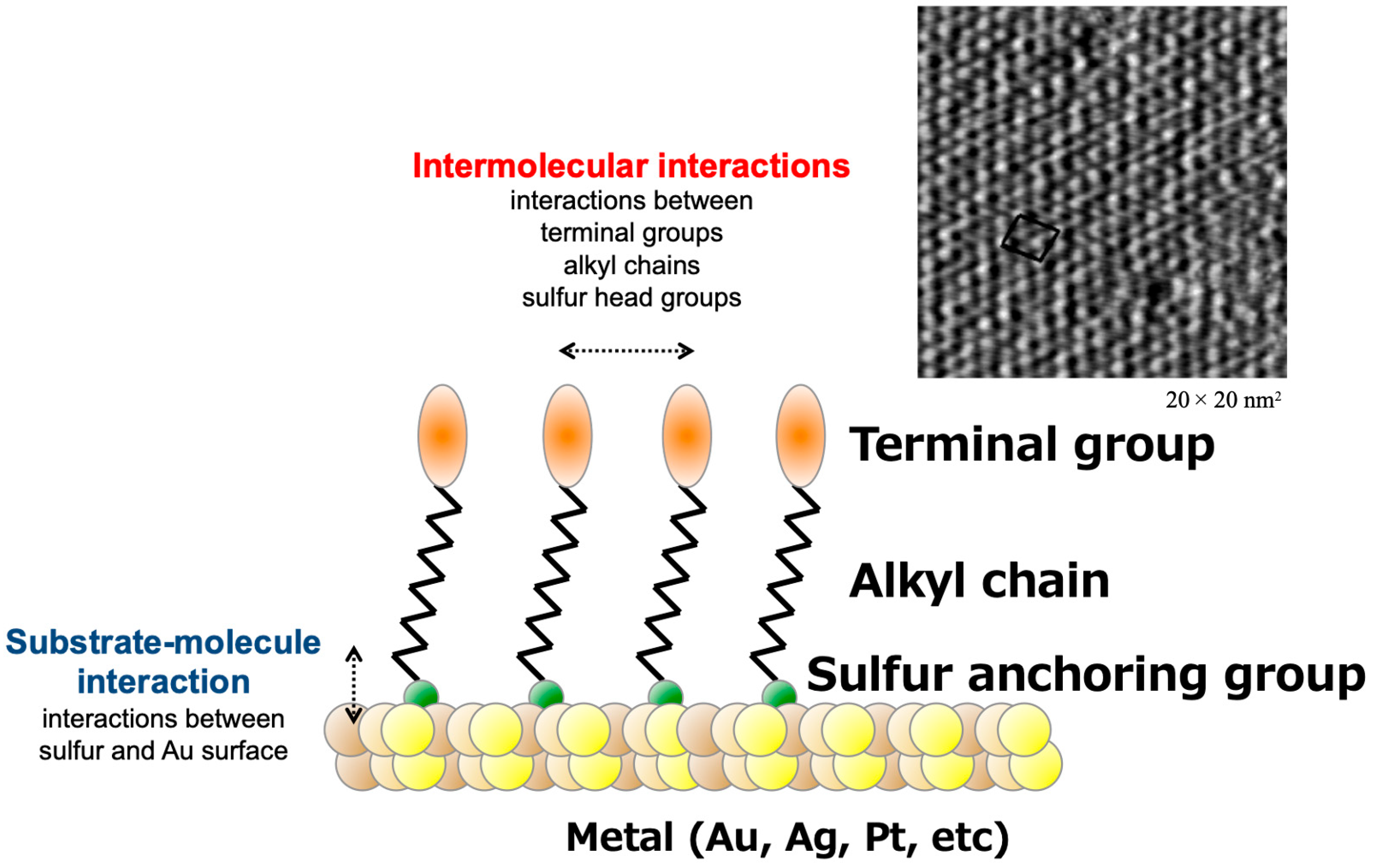
The interface between synthetic materials and biological systems represents one of the most dynamic and critical front lines in modern science, where the performance of medical devices and sensors is often determined by the initial thermodynamic and kinetic events occurring at the material surface. To deconstruct this complexity, biointerface science has relied heavily on self-assembled monolayers (SAMs) of thiols on gold as a model system, prized for their capability to provide an atomically defined, chemically uniform platform for experiments (Figure 1) [1,2,3,4,5]. The history of this field is anchored by the seminal 1983 discovery by Ralph Nuzzo and David Allara, who demonstrated that dialkyl disulfides and alkanethiols spontaneously organize onto gold substrates to form highly ordered, crystalline-like monolayers driven by the strong sulfur-gold covalent bond [6,7,8,9]. This platform was subsequently transformed from a physical chemistry tool into a cornerstone of bioengineering by Professor George Whitesides and his group, who systematically categorized the relationship between surface chemistry and biological response [10,11,12,13]. Whitesides established the empirical “Whitesides’ Rules” for designing bio-inert surfaces, which dictate that to effectively resist protein adsorption, a surface functional group must generally be hydrophilic, electrically neutral, and capable of accepting hydrogen bonds without donating them [14].

1.2. Anti-Biofouling SAMs and the Underlying Mechanism

Building on these structural foundations, the scientific community sought to elucidate the fundamental physical mechanisms that enable certain surfaces to resist protein fouling, a prerequisite for preventing the foreign body response. In the early 1990s, the dominant theoretical framework was established by Jeon et al., who proposed that the protein resistance of surface-grafted polymers like polyethylene oxide (PEO) was driven primarily by steric repulsion [15]. According to this “steric repulsion model,” when a protein approaches a surface grafted with flexible polymer chains, it compresses the chains, resulting in a reduction in conformational entropy and an osmotic penalty that generates a repulsive restoring force to push the protein away. However, this entropic model struggled to account for the exceptional bio-inertness observed in SAMs formed from very short oligo(ethylene glycol) (OEG) chains, which lack the requisite flexibility and length to generate significant steric forces [16]. Consequently, the prevailing paradigm has shifted toward the “water barrier” hypothesis, which posits that the inertness of OEG and zwitterionic SAMs stems from their ability to organize interfacial water into a tightly bound, structured hydration shell [17,18,19,20,21,22,23,24,25,26]. This physical water barrier acts as a shield, preventing proteins from displacing the solvent and making direct contact with the underlying substrate, effectively rendering the surface invisible to the biological environment. It should be noted that macroscopic wettability of SAMs does not correlate with their anti-biofouling properties [17], indicating that the local behavior of the interfacial water significantly affecting the interfacial interaction cannot be predicted by water contact angles.

1.3. Protein Adsorption and Bacterial Adhesion in Realistic Systems

Most of the above basic research works have been carried out in model environments where the solute components were simple and the concentrations were low (0.1 to 1 mg/mL). However, realistic biological environments consist of multi-components of various biomolecules and their concentrations are very high (several tens to several hundreds mg/mL). In such crowding conditions, other effects including excluded volume effect [27] and depletion attraction [28,29] will affect the accumulation of biomolecules in the vicinity of the surfaces. Also in the cases of bacterial adhesion, depletion attraction is a major factor to drive the adhesion [30,31]. Compared with the experiments in the model environments, the number of works in crowding condition is rather small. In the case of protein adsorption in crowding condition, it is difficult to distinguish the accumulated layer and bulk region. Thus far, neutron reflectivity measurements were carried out to elucidate the density profile of protein molecules near the surface [32,33]. In both cases, protein films with a thickness of several nanometers were confirmed.
Conventionally, research on bacterial adhesion has predominantly relied on “endpoint measurements,” which involve observing washed, stained, and dried samples after a fixed culture period. However, this static approach fails to capture the dynamic processes in which bacteria approach an interface, experience physicochemical interactions, and subsequently “decide” whether to attach or detach. Recent studies have begun to reveal that adhesion is not merely a physical phenomenon of “collision and binding,” but rather a complex process involving sophisticated biological responses, wherein bacteria sense their environment, switch motility modes, and alter gene expression, indicating the necessity of “in situ” and “real-time” observation techniques. Thus far, total internal reflection aqueous fluorescence microscopy has been used to monitor the processes of approaching, adhering, and detaching in real time [34,35]. As for a non-labeling method, confocal reflectance interference contrast microscopy has been employed to monitor the fluctuation in the distance between bacteria and surfaces [36,37]. Holographic video microscopy has enabled the three-dimensional tracking of bacterial movements [38,39,40]. In terms of the interaction of bacteria with material surfaces, single-cell force spectroscopy was employed to monitor the bacterial adhesion force [41]. Although these techniques are strong for monitoring the interfacial bacterial behavior in real time, the limitation in the material used for the substrate is not inevitable because of the required optical configuration.

1.4. Scope of This Review

In this review, we introduce our recent works on the analyses of molecules’ and bacteria’s behavior in realistic environments. Recent advances utilizing SAMs in molecularly crowded environments have redefined our understanding of biointerfacial mechanisms. Mondarte et al. discovered that fouling surfaces generate a thick “Viscous Interphase Layer” (VIL) that masks surface identity, whereas zwitterionic SAMs maintain a hydration barrier that completely prevents VIL formation [42]. Latag et al. demonstrated that this barrier precludes the protein conditioning film required for bacterial colonization, forcing microorganisms into a reversible, tethered “hovering” state at a distance of over a hundred nanometers from the surface [43]. These findings confirm that controlling interfacial water structure is critical for shifting bacterial interactions from irreversible adhesion to a manageable, non-fouling state.

2. Protein Accumulation in the Vicinity of SAMs in Molecularly Crowded Environments

Theoretical frameworks governing protein adsorption often suggest a continuous and extensive accumulation of biomolecules at the solid–liquid interface, driven by a complex interplay of long-range electrostatic interactions and hydrophobic effects. Recent modeling efforts, employing advanced thermodynamic simulations, have predicted the formation of robust, multi-layered protein architectures extending significantly into the bulk phase [44,45,46,47]. These models imply that under optimized conditions such as specific pH levels and ionic strengths the thermodynamic drive for protein-protein association should result in a high-density accumulation that far exceeds the dimensions of a simple molecular assembly.
However, experimental validation using neutron reflectivity (NR) has provided a more constrained perspective on these interfacial structures [48,49,50]. Despite the theoretical expectation of indefinite or extensive accumulation, the NR data and subsequent scattering length density (SLD) profiles in this study revealed a distinct structural saturation, resolving only up to three discrete layers of protein molecules. This discrepancy underscores a significant limitation in current analytical and characterization techniques. While NR offers unparalleled depth resolution for buried organic interfaces, the inherent lateral averaging and the difficulty in resolving highly hydrated, diffuse layers may prevent the detection of further accumulation. This gap suggests that either current theoretical models overestimate the stability of long-range protein–protein interactions or that existing experimental methodologies lack the sensitivity required to visualize the full complexity of the interfacial environment.
We tackled this issue using the combination of atomic force microscopy (AFM) and quartz crystal microbalance with dissipation monitoring (QCM-D). In this work, using SAMs as model systems, it is possible to explore the two extreme outcomes of material-fluid interactions: the formation of a complex, multi-layered protein corona on a fouling surface, and its prevention on a bio-inert surface [51,52]. Mondarte et al. characterized these scenarios using a combination of surface force measurements and QCM-D [42].
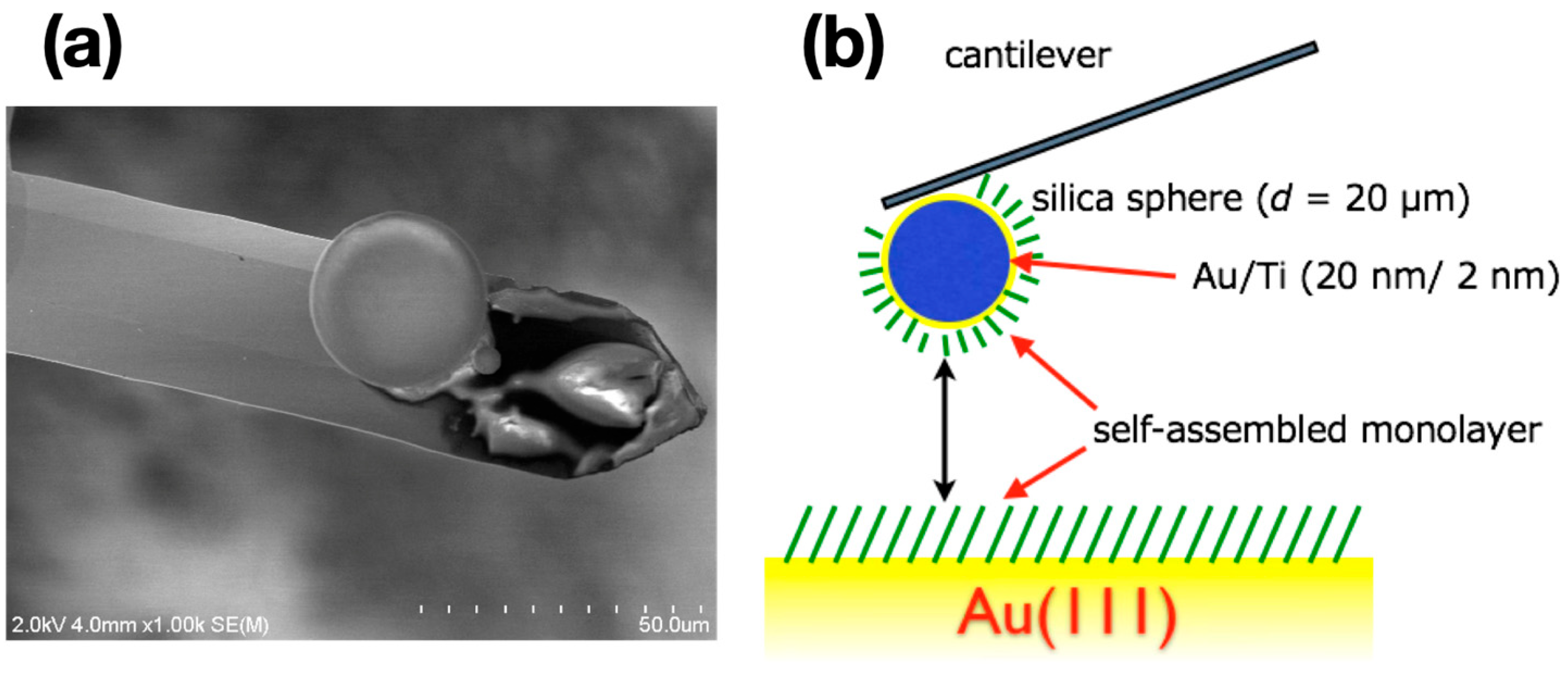
To deconstruct the complex interfacial behaviors of proteins in crowded environments, a dual-platform approach combining surface force measurements and QCM-D was employed. Surface force measurements were conducted using and AFM equipped with a colloidal probe and a liquid cell (Figure 2a). To accurately probe the mechanical properties of the protein layers, colloidal probes were fabricated by attaching borosilicate glass microspheres (diameter ~20 µm) to tipless cantilevers. Both the colloidal probes and the flat gold substrates were functionalized with identical SAMs, either hydrophobic octanethiol (C8) or zwitterionic sulfobetaine (SB) (the chemical structures shown in Table 1), to create symmetric interaction geometries (Figure 2b).
The experiments were designed to mimic varying degrees of biological complexity and crowding. Measurements were performed in phosphate-buffered saline (PBS) as a control and in “crowded” solutions containing bovine serum albumin (BSA) at a high concentration (80 mg/mL) or fetal bovine serum (FBS) diluted to 50% with PBS. A critical feature of the experimental protocol was the use of two distinct approaching speeds for the AFM force measurements: a quasi-static speed of 4 nm/s and a dynamic speed of 800 nm/s. This variation allowed for the decoupling of static structural forces (such as the compression of adsorbed layers) from dynamic hydrodynamic forces, enabling the detection of viscous gradients extending from the surface. Complementary QCM-D measurements were simultaneously conducted to monitor the adsorbed mass (Δf) and energy dissipation (ΔD). Here, ΔDf represents the stiffness (viscoelasticity)of the protein layers under flow conditions [53,54].
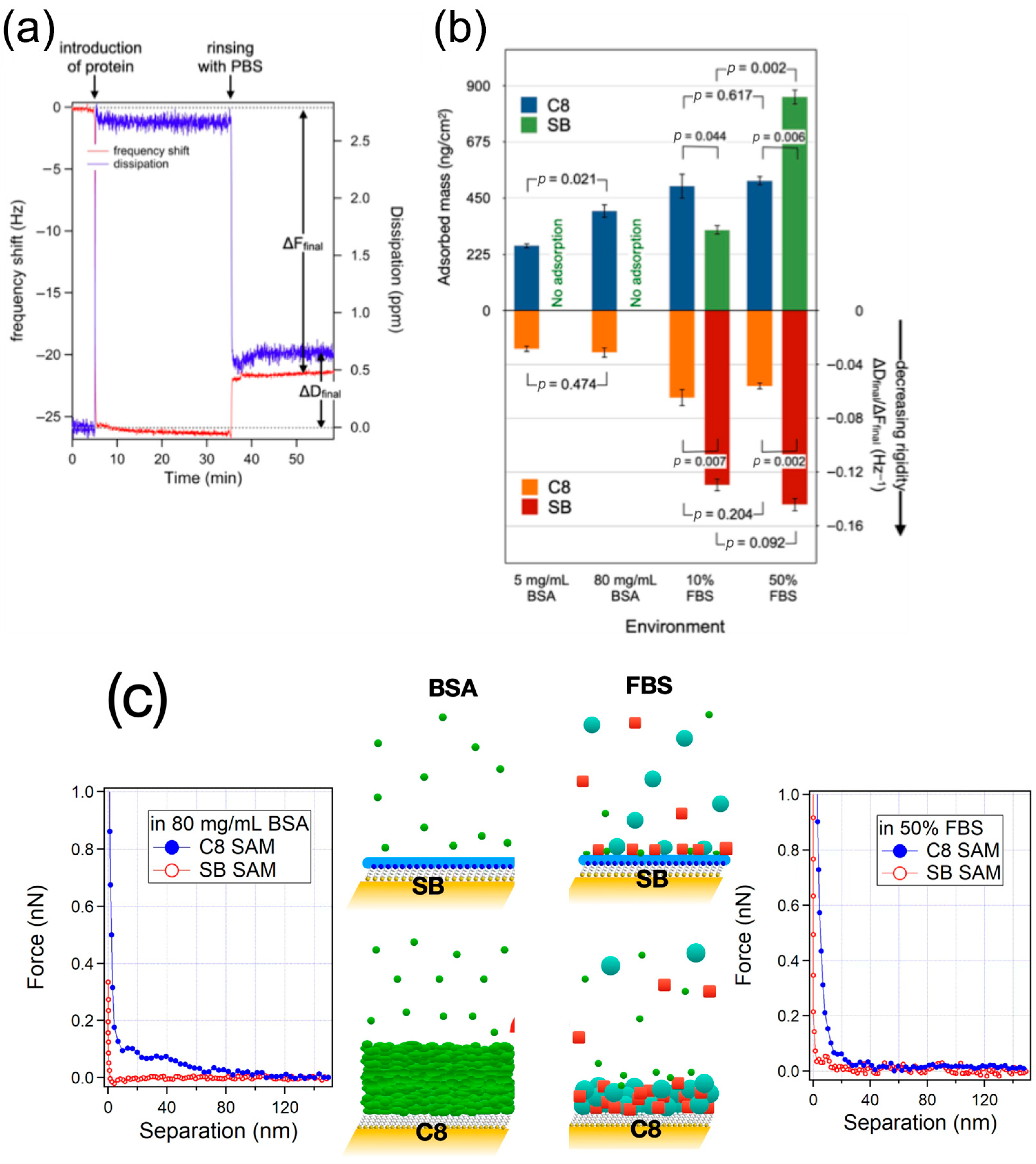
QCM-D analysis (Figure 3a) revealed significant protein adsorption on the C8 SAM (Table 1), with the resulting adlayer being highly rigid, which aligns with protein denaturation (Figure 3b). In contrast, for the SB SAM, while QCM-D detected a considerable adsorbed mass from FBS, the adlayer was much less rigid. This suggests that on the SB SAM, proteins adsorb loosely while maintaining their native, highly hydrated (and thus heavier) structure, unlike the denatured, dehydrated, and more compact layer formed on the C8 SAM (Figure 3b). This difference clearly demonstrates how the SB SAM preserves its intrinsic chemical identity by preventing protein corona formation, whereas the C8 SAM becomes entirely masked.
Surface force measurements clarified the structural and mechanical properties of the protein layers (Figure 3c). On a hydrophobic, fouling C8 SAM immersed in a crowded solution of bovine serum albumin (BSA), a multi-layered structure was observed. The primary layer, in direct contact with the SAM, consisted of a physically adsorbed film of denatured BSA molecules with an estimated thickness of 6.8 nm and an elastic modulus of 25.5 kPa. Beyond this initial adlayer, a second, much thicker structure was detected: a “viscous interphase layer” (VIL) extending approximately 65–70 nm into the solution, which was found to be roughly five times more viscous than the bulk BSA solution. The ability to decouple the solid-like adsorbed layer from the liquid-like viscous layer, achieved by performing AFM measurements at different approaching speeds, provides a sophisticated and physically accurate picture of the protein corona as a dynamic, multi-component phase that completely masks the original surface.
The composition of the biological fluid further influences this process. When the C8 SAM was exposed to fetal bovine serum (FBS), a more complex mixture of multiple proteins, the Vroman effect—the sequential replacement of initially adsorbed proteins with higher-affinity ones—resulted in a thicker (9.7 nm) but less rigid adsorbed layer, and no VIL was observed. In contrast, the bio-inert zwitterionic SB SAM showed complete resistance to forming such structures. Surface force measurements in both crowded BSA and FBS solutions revealed interaction profiles that were nearly identical to those in simple buffer (Figure 3c). This provides direct evidence that the interfacial water barrier is strong enough to prevent stable protein adsorption even under high-concentration, competitive conditions. This behavior provides a valuable experimental model for the “stealth” surfaces sought in nanomedicine, which are designed to evade the protein corona, reduce non-specific interactions, and enable targeted delivery.

3. Behavior of Microorganisms in the Vicinity of SAMs

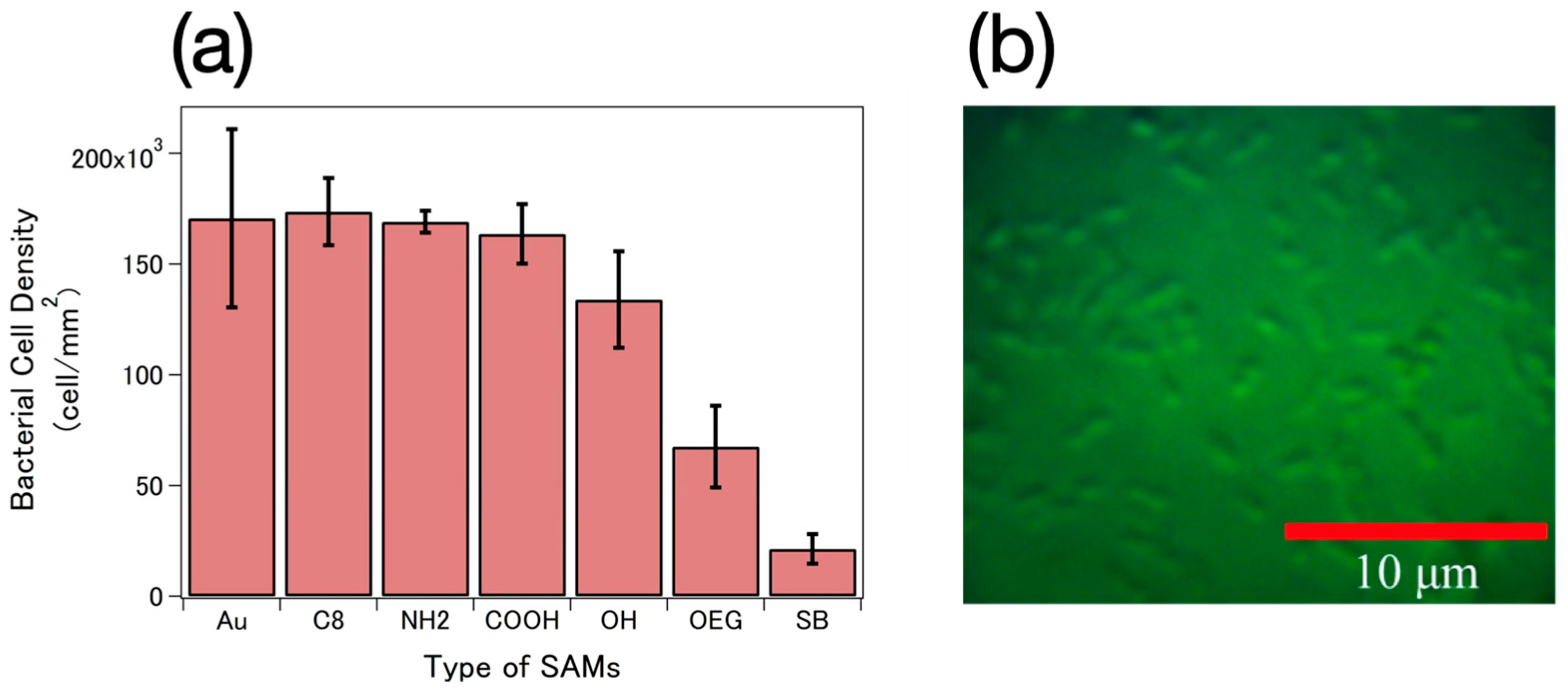
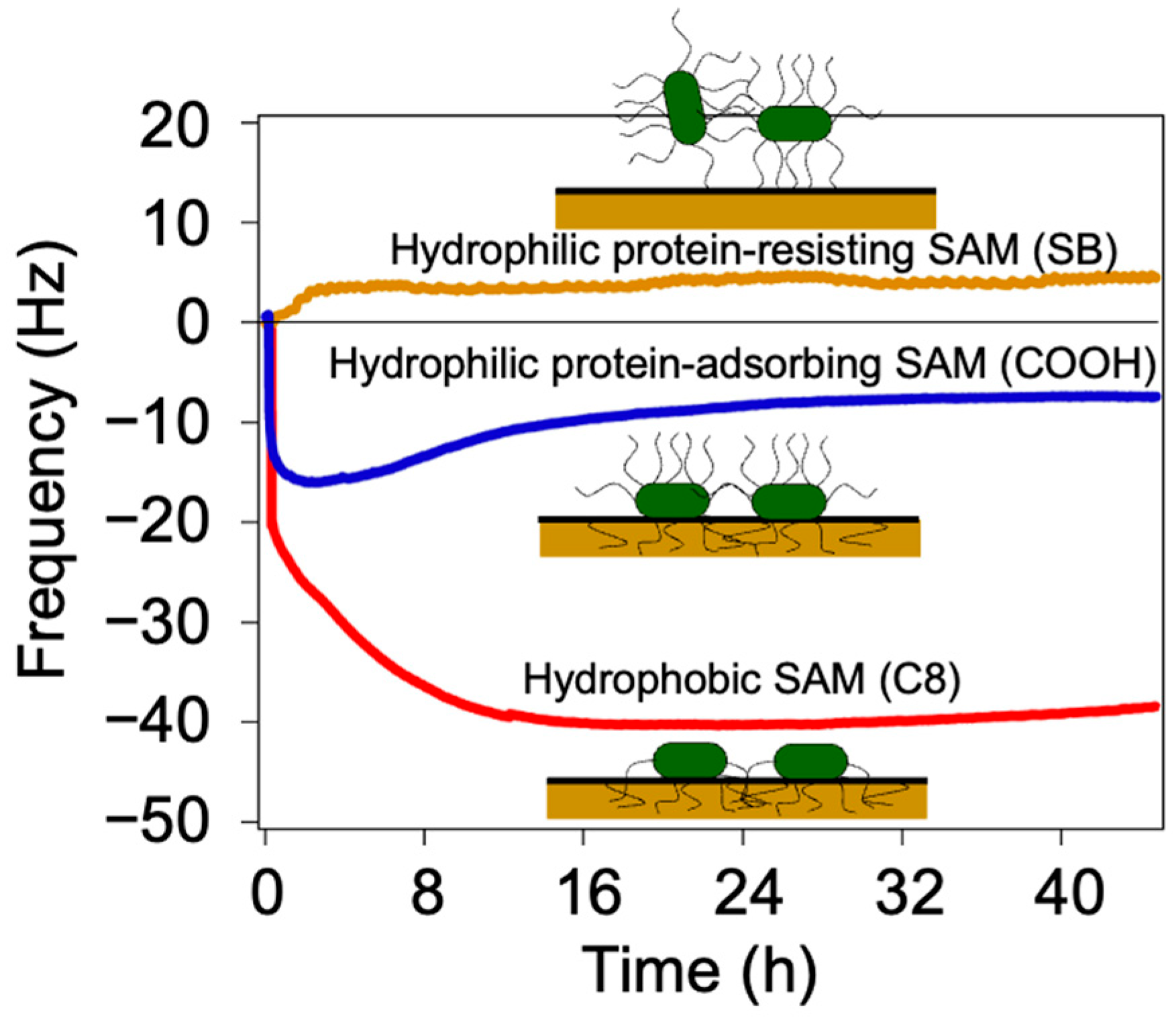
The divergent behaviors of fouling and anti-fouling surfaces with respect to protein adsorption lead to fundamentally different mechanisms of microbial adhesion. Three-dimensional bacterial adhesion by using three-dimensional tracking [55,56,57], digital holographic microscopy [58,59,60], defocusing particle tracking [61,62], multifocal microscopy [63,64,65], etc. These works revealed the detailed trajectories of bacteria near the surface and elucidated their force-sensing and response mechanisms. However, these works cannot unveil the bacteria-surface interactions at nanoscales, in particular the correlation between the behavior at nanoscales and surface chemistry. A study by Latag et al. using QCM-D elucidated these distinct strategies for E. coli interacting with model SAM surfaces (Table 1) with a nanoscale view [43]. On fouling surfaces, including hydrophobic C8 SAMs and hydrophilic but protein-adsorbing amine- and carboxyl-terminated SAMs, bacteria adhere strongly and in large numbers (Figure 4a). This process is characterized by large, negative shifts in the QCM-D sensor’s resonant frequency, indicative of significant mass loading. Furthermore, the low ratio of energy dissipation to frequency shift indicates the formation of a dense, rigid adlayer, the initial stage of irreversible biofilm formation. This firm adhesion occurs on the pre-formed protein conditioning film that masks the underlying SAM.
The real-time adhesion kinetics and viscoelastic properties of the bacterial interface were investigated using a QCM-D monitoring system. Gold-coated quartz sensors (fundamental frequency 5 MHz) were functionalized with a library of SAMs displaying diverse physicochemical properties, including hydrophobic (C8), hydrophilic protein-adsorbing (NH2, COOH, OH), and hydrophilic protein-resisting (OEG, SB) functionalities (Table 1). Escherichia coli was selected as the model organism; cells were cultivated, harvested, and suspended in PBS to a concentration of approximately 1 × 10⁶ cells/mL for the adhesion assays. The QCM-D experiments were conducted in a flow-cell module (Analyzer, Biolin, Inc., Gothenburg, Sweden) to mimic dynamic biological environments and minimize gravitational settling.
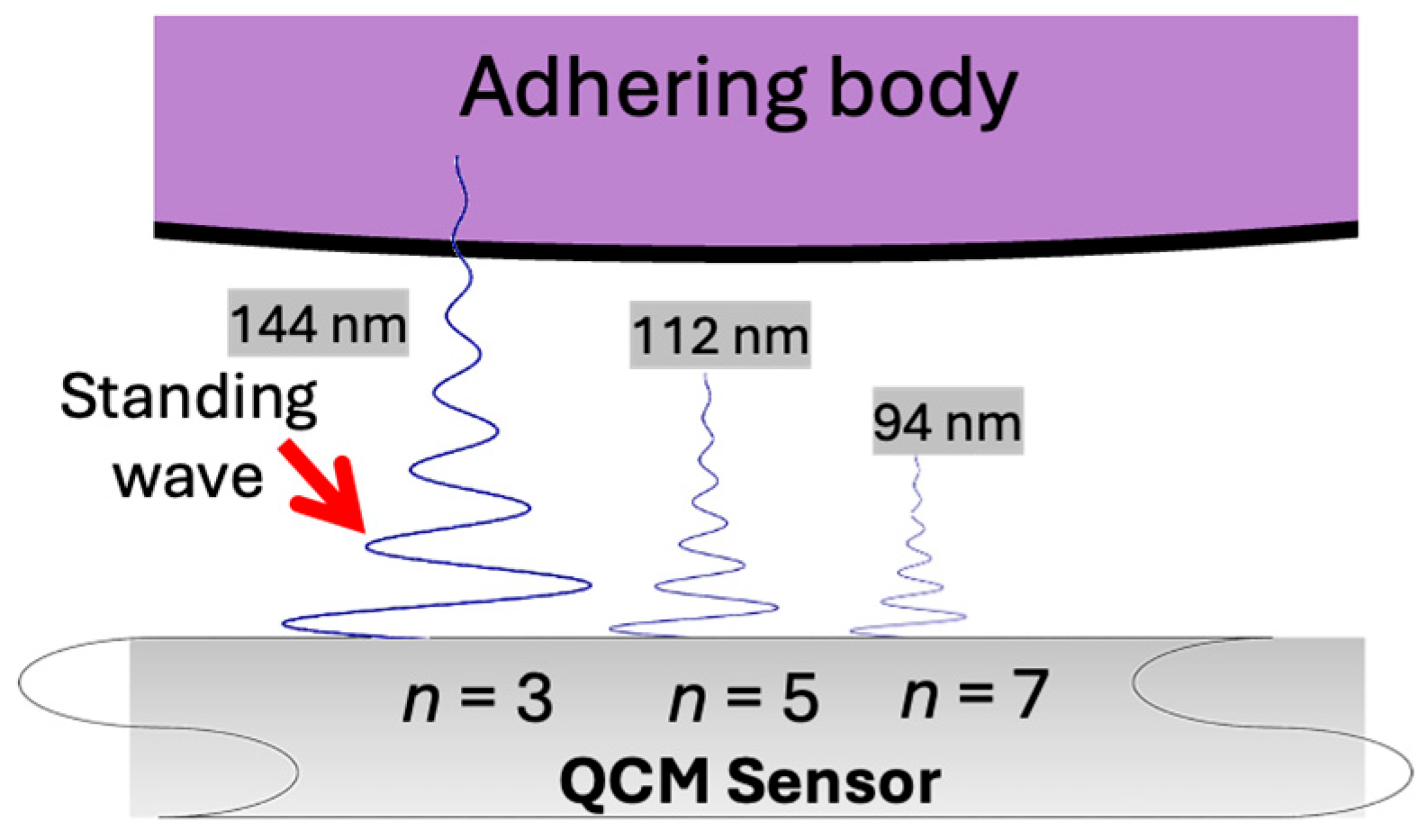
The bacterial suspension was injected at a constant flow rate of 50 µL/s, and the system continuously monitored the shifts in resonant frequency (Δf) and energy dissipation (ΔD). Crucially, data were recorded across multiple overtones (n = 3, 5, 7, 9, 11, and 13). Since the penetration depth of the acoustic shear wave decreases with increasing overtone number (probing distances from ~250 nm down to ~70 nm), this multi-overtone analysis provided a “depth-profiling” capability, allowing for the estimation of the separation distance between the bacterial cell body and the sensor surface (Figure 5). Parallel optical microscopy measurements were performed to quantify the surface density of adhered bacteria and corroborate the acoustic mass data.
The adhesion scenario on protein-resistant OEG and SB SAMs is entirely different. QCM-D measurements in this case showed unusual positive frequency shifts, especially at higher overtones of the sensor’s oscillation. This counterintuitive finding, where adding mass causes the sensor to oscillate faster, is explained by the “coupled-resonator model.” [66]. This model suggests that the bacterial cell body does not directly contact the SAM surface. Instead, it is kept at a considerable distance by the repulsive water barrier, tethered only by its thin, flexible appendages. These appendages act as elastic springs, and their movement couples with the sensor’s oscillation, generating a restoring force that boosts the overall resonant frequency (Figure 6).
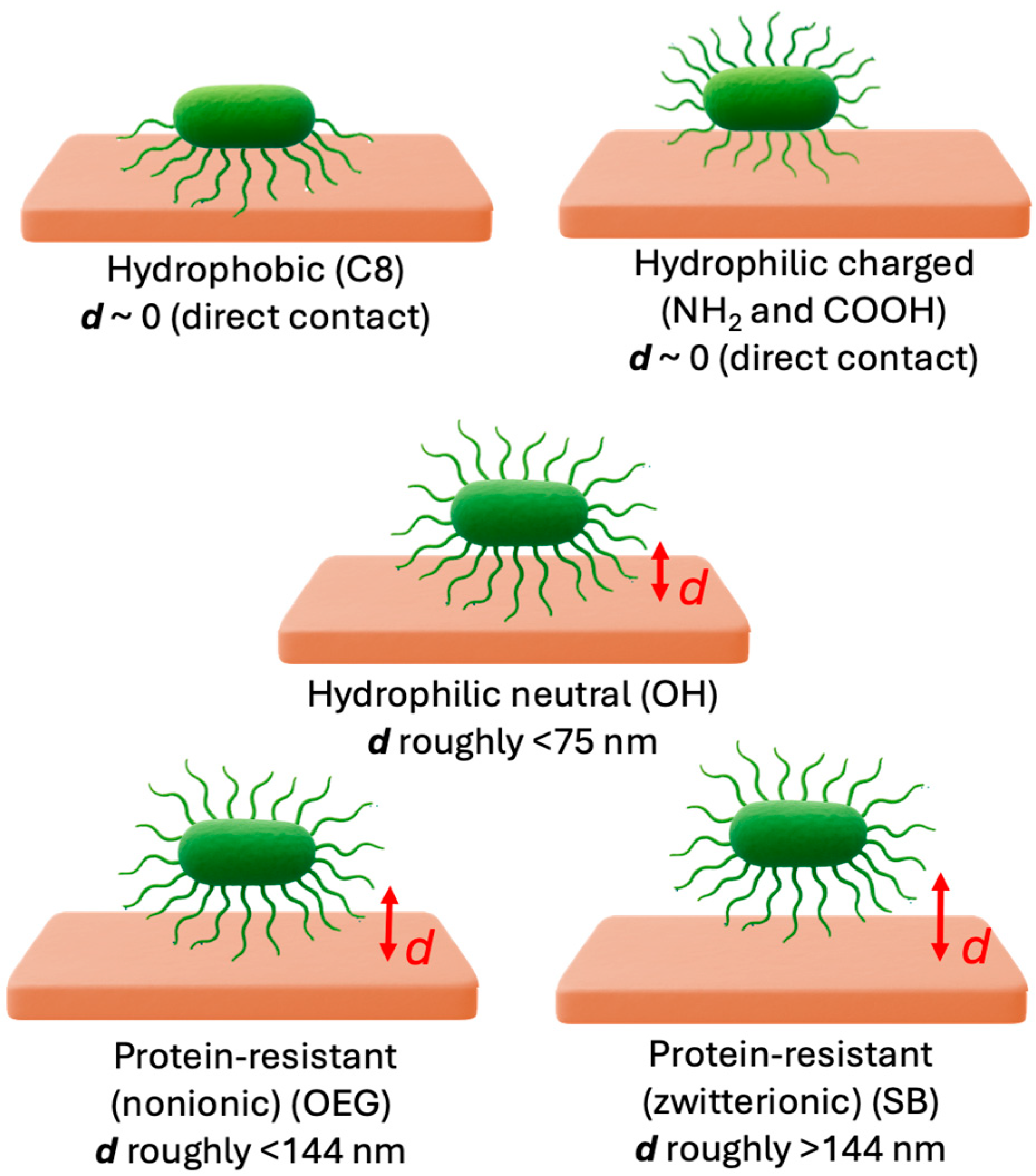
This phenomenon shows that the water barrier creates a new, much larger “biological interaction distance.” The nanoscale water barrier, with an effective range of less than 10 nm, effectively prevents the micron-scale bacterial body from contacting the surface. By examining the QCM-D response across multiple overtones, each with a different acoustic penetration depth, it is possible to estimate this bacteria-surface separation. The distance was estimated to be less than 75 nm for OH SAMs, less than 144 nm for OEG SAMs, and, most notably, greater than 144 nm for the highly effective SB SAMs (Figure 7). This indicates that the water barrier establishes a standoff distance for microorganisms that is an order of magnitude greater than the barrier itself. Bacterial adhesion is fundamentally shifted from two-dimensional surface colonization to three-dimensional, weakly tethered interactions across a large aqueous gap.
The connection between the two parts of this discussion becomes clear: the weakly tethered adhesion observed for microbes on anti-fouling surfaces is a direct result of the absence of a protein corona. On fouling surfaces, a protein layer forms, providing a good substrate for strong bacterial attachment. On anti-fouling surfaces, the water barrier blocks this initial protein adsorption. When faced with this repulsive barrier, the bacterium, unable to displace the structured water with its cell body, uses its only available strategy: probing the surface with high-aspect-ratio appendages that can pierce the barrier and form weak anchor points. Therefore, preventing protein corona formation is necessary to shift from irreversible biofilm formation to a reversible, long-distance tethered state.

4. Summary

The evidence reviewed here shows that the interfacial water associated with anti-biofouling SAMs has strong, cascading effects on biological interactions at multiple levels. This water barrier is the main reason for bio-inertness on a variety of well-ordered surfaces. Its effectiveness can be measured as a long-range repulsive force. In complex biological fluids, whether this barrier is present or not determines if a material becomes covered by a thick, viscous protein corona or keeps its original chemical identity. This controls the basic process of microbial adhesion, causing a significant shift from irreversible, surface-bound biofilm formation to a reversible, weakly tethered state at a distance over 100 nm. Therefore, analyzing the interfacial water is essential for designing the next generation of biomaterials. In fact, our recent experimental and theoretical analyses have connected the hydrogen bonding states of interfacial water and their functions [25,26,27,28]. By creating surfaces that can precisely control their interfacial water structure, it may be possible to develop “stealth” nanomedicines that can move through crowded biological fluids and reach their targets without being affected by a protein corona, and to create advanced medical implants that actively prevent microbial colonization by maintaining a persistent aqueous barrier.
For practical applications, polymer coatings (drop or dip casting) or polymer brush films are more popular for their chemical and mechanical stability [67]. In these systems, volume exclusion (steric or entropic repulsion) also affects the density distribution of the protein molecules in the interfacial region [68]. However, even in such cases, the protein-polymer interaction, which is critical in the formation of the primary layer of the protein film, is governed by the hydration structure of the polymers [20,22,26].
The investigation of hydration structures of films, biomolecules, and cells is challenging, as various interfaces (e.g., biomolecule-cell, biomolecule-biomolecule, biomolecule-material, and cell-material) exist under crowding conditions. A possible method is conventional spectroscopy combined with multivariate analysis, which can selectively extract the information of the interfacial region from a spectral set obtained with different conditions, such as concentrations [25,69,70,71].
At last, it should also be mentioned that next-generation anti-biofouling material often based on the combination of surface chemistry and nano-micro structures (e.g., shark skin, nanopillar structures, etc.) [72]. In the future, we need to characterize the interfaces involving such systems.

Author Contributions

T.H., G.V.L. and E.A.Q.M. wrote this review. All authors have read and agreed to the published version of the manuscript.

Funding

This work was supported by MEXT/JSPS KAKENHI Grant Numbers (JP23H04059 and JP22H04530). It was performed under the Research Program for CORE lab of “Five-star Alliance” in “Network Joint Research Center for Materials and Devices”. This work was also supported by the Japan–Taiwan Exchange Association. This work was supported by the Innovative Science and Technology Initiative for Security (ISTIS), Acquisition, Technology & Logistics Agency (ATLA) (JPJ013268), Japan.

Data Availability Statement

The data was shown in the original paper.

Acknowledgments

We acknowledge Kazue Taki for her help in arranging this project.

Conflicts of Interest

The authors declare no conflicts of interest.

References

  1. Ulman, A. Formation and Structure of Self-Assembled Monolayers. Chem. Rev. 1996, 96, 1533–1554. [Google Scholar] [CrossRef]
  2. Schreiber, F. Structure and Growth of Self-Assembling Monolayers. Prog. Surf. Sci. 2000, 65, 151–257. [Google Scholar] [CrossRef]
  3. Love, J.C.; Estroff, L.A.; Kriebel, J.K.; Nuzzo, R.G.; Whitesides, G.M. Self-Assembled Monolayers of Thiolates on Metals as a Form of Nanotechnology. Chem. Rev. 2005, 105, 1103–1169. [Google Scholar] [CrossRef]
  4. Vericat, C.; Vela, M.E.; Benitez, G.; Carro, P.; Salvarezza, R.C. Self-Assembled Monolayers of Thiols and Dithiols on Gold: New Challenges for a Well-Known System. Chem. Soc. Rev. 2010, 39, 1805–1834. [Google Scholar] [CrossRef]
  5. Gooding, J.J.; Mearns, F.; Yang, W.; Liu, J. Self-assembled Monolayers into the 21st Century: Recent Advances and Applications. Electroanalysis 2003, 15, 81–96. [Google Scholar] [CrossRef]
  6. Nuzzo, R.G.; Allara, D.L. Adsorption of Bifunctional Organic Disulfides on Gold Surfaces. J. Am. Chem. Soc. 1983, 105, 4481–4483. [Google Scholar] [CrossRef]
  7. Allara, D.L.; Nuzzo, R.G. Spontaneously Organized Molecular Assemblies. 1. Formation, Dynamics, and Physical Properties of n-Alkanoic Acids Adsorbed from Solution on an Oxidized Aluminum Surface. Langmuir 1985, 1, 45–52. [Google Scholar] [CrossRef]
  8. Allara, D.L.; Nuzzo, R.G. Spontaneously Organized Molecular Assemblies. 2. Quantitative Infrared Spectroscopic Determination of Equilibrium Structures of Solution-Adsorbed n-Alkanoic Acids on an Oxidized Aluminum Surface. Langmuir 1985, 1, 52–66. [Google Scholar] [CrossRef]
  9. Nuzzo, R.G.; Fusco, F.A.; Allara, D.L. Spontaneously Organized Molecular Assemblies. 3. Preparation and Properties of Solution Adsorbed Monolayers of Organic Disulfides on Gold Surfaces. J. Am. Chem. Soc. 1987, 109, 2358–2368. [Google Scholar] [CrossRef]
  10. Hayashi, T. Prof. George Whitesides’ Contributions to Self-Assembled Monolayers (SAMs): Advancing Biointerface Science and Beyond. Chemistry 2025, 7, 9. [Google Scholar] [CrossRef]
  11. Ostuni, E.; Chapman, R.G.; Holmlin, R.E.; Takayama, S.; Whitesides, G.M. A Survey of Structure−Property Relationships of Surfaces That Resist the Adsorption of Protein. Langmuir 2001, 17, 5605–5620. [Google Scholar] [CrossRef]
  12. Pale-Grosdemange, C.; Simon, E.S.; Prime, K.L.; Whitesides, G.M. Formation of Self-Assembled Monolayers by Chemisorption of Derivatives of Oligo(Ethylene Glycol) of Structure HS(CH2)11(OCH2CH2)MOH on Gold. J. Am. Chem. Soc. 1991, 113, 12–20. [Google Scholar] [CrossRef]
  13. Prime, K.L.; Whitesides, G.M. Adsorption of Proteins onto Surfaces Containing End-Attached Oligo(Ethylene Oxide): A Model System Using Self-Assembled Monolayers. J. Am. Chem. Soc. 1993, 115, 10714–10721. [Google Scholar] [CrossRef]
  14. Chapman, R.G.; Ostuni, E.; Takayama, S.; Holmlin, R.E.; Yan, L.; Whitesides, G.M. Surveying for Surfaces That Resist the Adsorption of Proteins. J. Am. Chem. Soc. 2000, 122, 8303–8304. [Google Scholar] [CrossRef]
  15. Jeon, S.I.; Lee, J.H.; Andrade, J.D.; De Gennes, P.G. Protein—Surface Interactions in the Presence of Polyethylene Oxide. J. Colloid Interface Sci. 1991, 142, 149–158. [Google Scholar] [CrossRef]
  16. Hayashi, T.; Hara, M. Nonfouling Self-Assembled Monolayers: Mechanisms Underlying Protein and Cell Resistance. Curr. Phys. Chem. 2011, 1, 90–98. [Google Scholar] [CrossRef]
  17. Hayashi, T.; Tanaka, Y.; Koide, Y.; Tanaka, M.; Hara, M. Mechanism Underlying Bioinertness of Self-Assembled Monolayers of Oligo(Ethyleneglycol)-Terminated Alkanethiols on Gold: Protein Adsorption, Platelet Adhesion, and Surface Forces. Phys. Chem. Chem. Phys. 2012, 14, 10196–10206. [Google Scholar] [CrossRef]
  18. Araki, Y.; Sekine, T.; Chang, R.; Hayashi, T.; Onishi, H. Molecular-Scale Structures of the Surface and Hydration Shell of Bioinert Mixed-Charged Self-Assembled Monolayers Investigated by Frequency Modulation Atomic Force Microscopy. RSC Adv. 2018, 8, 24660–24664. [Google Scholar] [CrossRef] [PubMed]
  19. Chang, R.; Asatyas, S.; Lkhamsuren, G.; Hirohara, M.; Mondarte, E.A.Q.; Suthiwanich, K.; Sekine, T.; Hayashi, T. Water near Bioinert Self-Assembled Monolayers. Polym. J. 2018, 50, 563–571. [Google Scholar] [CrossRef]
  20. Tanaka, M.; Morita, S.; Hayashi, T. Role of Interfacial Water in Determining the Interactions of Proteins and Cells with Hydrated Materials. Colloids Surf. B Biointerfaces 2021, 198, 111449. [Google Scholar] [CrossRef]
  21. Sekine, T.; Asatyas, S.; Sato, C.; Morita, S.; Tanaka, M.; Hayashi, T. Surface Force and Vibrational Spectroscopic Analyses of Interfacial Water Molecules in the Vicinity of Methoxy-Tri(Ethylene Glycol)-Terminated Monolayers: Mechanisms Underlying the Effect of Lateral Packing Density on Bioinertness. J. Biomater. Sci. Polym. Ed. 2017, 28, 1231–1243. [Google Scholar] [CrossRef]
  22. Tanaka, M.; Hayashi, T.; Morita, S. The Roles of Water Molecules at the Biointerface of Medical Polymers. Polym. J. 2013, 45, 701–710. [Google Scholar] [CrossRef]
  23. Huang, H.; Zhang, C.; Crisci, R.; Lu, T.; Hung, H.-C.; Sajib, M.S.J.; Sarker, P.; Ma, J.; Wei, T.; Jiang, S.; et al. Strong Surface Hydration and Salt Resistant Mechanism of a New Nonfouling Zwitterionic Polymer Based on Protein Stabilizer TMAO. J. Am. Chem. Soc. 2021, 143, 16786–16795. [Google Scholar] [CrossRef]
  24. Leng, C.; Huang, H.; Zhang, K.; Hung, H.-C.; Xu, Y.; Li, Y.; Jiang, S.; Chen, Z. Effect of Surface Hydration on Antifouling Properties of Mixed Charged Polymers. Langmuir 2018, 34, 6538–6545. [Google Scholar] [CrossRef] [PubMed]
  25. Maeda, S.; Chikami, S.; Song, S.; Balois-Oguchi, M.V.; Katase, A.; Latag, G.V.; Tanaka, T.; Hayashi, T. Gap-Controlled Infrared Absorption Spectroscopy: A Unique Interface-Sensitive Spectroscopy Based on the Combination of Linear Spectroscopy and Multivariate Curve Resolution. Anal. Chem. 2025, 97, 20156–20163. [Google Scholar] [CrossRef]
  26. Tanaka, M.; Morita, S.; Hayashi, T. Interfacial Water States and the Biocompatibility of Biomaterials: The Role of Intermediate Water. Polym. J. 2026, 1–14. [Google Scholar] [CrossRef]
  27. Batra, J.; Xu, K.; Qin, S.; Zhou, H.-X. Effect of Macromolecular Crowding on Protein Binding Stability: Modest Stabilization and Significant Biological Consequences. Biophys. J. 2009, 97, 906–911. [Google Scholar] [CrossRef] [PubMed]
  28. Marenduzzo, D.; Finan, K.; Cook, P.R. The Depletion Attraction: An Underappreciated Force Driving Cellular Organization. J. Cell Biol. 2006, 175, 681–686. [Google Scholar] [CrossRef]
  29. Zhang, H.; Kong, D.; Zhang, W.; Liu, H. Depletion Attraction in Colloidal and Bacterial Systems. Front. Mater. 2023, 10, 1206819. [Google Scholar] [CrossRef]
  30. Niu, W.A.; Rivera, S.L.; Siegrist, M.S.; Santore, M.M. Depletion Forces Drive Reversible Capture of Live Bacteria on Non-Adhesive Surfaces. Soft Matter 2021, 17, 8185–8194. [Google Scholar] [CrossRef]
  31. Niu, W.A.; Smith, M.N.; Santore, M.M. Depletion Attractions Drive Bacterial Capture on Both Non-Fouling and Adhesive Surfaces, Enhancing Cell Orientation. Soft Matter 2022, 18, 9205–9215. [Google Scholar] [CrossRef]
  32. Liebmann-Vinson, A.; Lander, L.M.; Foster, M.D.; Brittain, W.J.; Vogler, E.A.; Majkrzak, C.F.; Satija, S. A Neutron Reflectometry Study of Human Serum Albumin Adsorption in Situ. Langmuir 1996, 12, 2256–2262. [Google Scholar] [CrossRef]
  33. Zhao, X.; Pan, F.; Lu, J.R. Interfacial Assembly of Proteins and Peptides: Recent Examples Studied by Neutron Reflection. J. R. Soc. Interface 2009, 6, S659–S670. [Google Scholar] [CrossRef]
  34. Vigeant, M.A.-S.; Ford, R.M.; Wagner, M.; Tamm, L.K. Reversible and Irreversible Adhesion of Motile Escherichia Coli Cells Analyzed by Total Internal Reflection Aqueous Fluorescence Microscopy. Appl. Environ. Microbiol. 2002, 68, 2794–2801. [Google Scholar] [CrossRef]
  35. Stock, K.; Sailer, R.; Strauss, W.S.L.; Lyttek, M.; Steiner, R.; Schneckenburger, H. Variable-Angle Total Internal Reflection Fluorescence Microscopy (VA-TIRFM): Realization and Application of a Compact Illumination Device. J. Microsc. 2003, 211, 19–29. [Google Scholar] [CrossRef] [PubMed]
  36. He, T.; Shi, Z.L.; Fang, N.; Neoh, K.G.; Kang, E.T.; Chan, V. The Effect of Adhesive Ligands on Bacterial and Fibroblast Adhesions to Surfaces. Biomaterials 2009, 30, 317–326. [Google Scholar] [CrossRef]
  37. Tréguier, J.; Bugnicourt, L.; Gay, G.; Diallo, M.; Islam, S.T.; Toro, A.; David, L.; Théodoly, O.; Sudre, G.; Mignot, T. Chitosan Films for Microfluidic Studies of Single Bacteria and Perspectives for Antibiotic Susceptibility Testing. mBio 2019, 10, 10-1128. [Google Scholar] [CrossRef]
  38. Cheong, F.C.; Sun, B.; Dreyfus, R.; Amato-Grill, J.; Xiao, K.; Dixon, L.; Grier, D.G. Flow Visualization and Flow Cytometry with Holographic Video Microscopy. Opt. Express 2009, 17, 13071–13079. [Google Scholar] [CrossRef] [PubMed]
  39. Bedrossian, M.; El-Kholy, M.; Neamati, D.; Nadeau, J. A Machine Learning Algorithm for Identifying and Tracking Bacteria in Three Dimensions Using Digital Holographic Microscopy. AIMS Biophys. 2018, 5, 36–49. [Google Scholar] [CrossRef]
  40. Peng, Q.; Zhou, X.; Wang, Z.; Xie, Q.; Ma, C.; Zhang, G.; Gong, X. Three-Dimensional Bacterial Motions near a Surface Investigated by Digital Holographic Microscopy: Effect of Surface Stiffness. Langmuir 2019, 35, 12257–12263. [Google Scholar] [CrossRef]
  41. Razatos, A.; Ong, Y.L.; Sharma, M.M.; Georgiou, G. Molecular Determinants of Bacterial Adhesion Monitored by Atomic Force Microscopy. Proc. Natl. Acad. Sci. USA 1998, 95, 11059–11064. [Google Scholar] [CrossRef]
  42. Mondarte, E.A.Q.; Zamarripa, E.M.M.; Chang, R.; Wang, F.; Song, S.; Tahara, H.; Hayashi, T. Interphase Protein Layers Formed on Self-Assembled Monolayers in Crowded Biological Environments: Analysis by Surface Force and Quartz Crystal Microbalance Measurements. Langmuir 2022, 38, 1324–1333. [Google Scholar] [CrossRef]
  43. Latag, G.V.; Nakamura, T.; Palai, D.; Mondarte, E.A.Q.; Hayashi, T. Investigation of Three-Dimensional Bacterial Adhesion Manner on Model Organic Surfaces Using Quartz Crystal Microbalance with Energy Dissipation Monitoring. ACS Appl. Bio Mater. 2023, 6, 1185–1194. [Google Scholar] [CrossRef]
  44. Vogler, E.A. Protein Adsorption in Three Dimensions. Biomaterials 2012, 33, 1201–1237. [Google Scholar] [CrossRef]
  45. Talbot, J.; Tarjus, G.; Van Tassel, P.R.; Viot, P. From Car Parking to Protein Adsorption: An Overview of Sequential Adsorption Processes. Colloids Surf. A Physicochem. Eng. Asp. 2000, 165, 287–324. [Google Scholar] [CrossRef]
  46. Senger, B.; Schaaf, P.; Voegel, J.C.; Wojtaszczyk, P.; Reiss, H. Fluctuation of the Number of Particles Deposited on a Flat Surface by a Random Sequential Adsorption Mechanism. Proc. Natl. Acad. Sci. USA 1994, 91, 10029–10033. [Google Scholar] [CrossRef]
  47. Mitchison, T.J. Beyond Langmuir: Surface-Bound Macromolecule Condensates. Mol. Biol. Cell 2020, 31, 2502–2508. [Google Scholar] [CrossRef]
  48. Wood, M.H.; Browning, K.L.; Barker, R.D.; Clarke, S.M. Using Neutron Reflectometry to Discern the Structure of Fibrinogen Adsorption at the Stainless Steel/Aqueous Interface. J. Phys. Chem. B 2016, 120, 5405–5416. [Google Scholar] [CrossRef] [PubMed]
  49. Welbourn, R.J.L.; Clarke, S.M. New Insights into the Solid–Liquid Interface Exploiting Neutron Reflectivity. Curr. Opin. Colloid Interface Sci. 2019, 42, 87–98. [Google Scholar] [CrossRef]
  50. Gerelli, Y. Applications of Neutron Reflectometry in Biology. EPJ Web Conf. 2020, 236, 04002. [Google Scholar] [CrossRef]
  51. Lestelius, M.; Liedberg, B.; Tengvall, P. In Vitro Plasma Protein Adsorption on ω-Functionalized Alkanethiolate Self-Assembled Monolayers. Langmuir 1997, 13, 5900–5908. [Google Scholar] [CrossRef]
  52. Hirohara, M.; Maekawa, T.; Mondarte, E.A.Q.; Nyu, T.; Mizushita, Y.; Hayashi, T. Proteomic Analysis of Biomaterial Surfaces after Contacting with Body Fluids by MALDI-ToF Mass Spectroscopy. Coatings 2019, 10, 12. [Google Scholar] [CrossRef]
  53. Song, S.; Latag, G.V.; Mondarte, E.A.Q.; Chang, R.; Hayashi, T. Experimental Characterization of Water Condensation Processes on Self-Assembled Monolayers Using a Quartz Crystal Microbalance with Energy Dissipation Monitoring. Micro 2022, 2, 513–523. [Google Scholar] [CrossRef]
  54. Peng, Z.; Latag, G.V.; Tahara, H.; Yagi, T.; Hayashi, T. Unraveling the Time Course of Interaction between DNA Nanopores and Lipid Bilayers Using QCM-D: Role of Cholesterol Anchors and Bilayer Supporting Substrates. Nanoscale 2025, 17, 11668–11678. [Google Scholar] [CrossRef]
  55. Berg, H.C.; Turner, L. Chemotaxis of Bacteria in Glass Capillary Arrays. Escherichia Coli, Motility, Microchannel Plate, and Light Scattering. Biophys. J. 1990, 58, 919–930. [Google Scholar] [CrossRef]
  56. Frymier, P.D.; Ford, R.M.; Berg, H.C.; Cummings, P.T. Three-Dimensional Tracking of Motile Bacteria near a Solid Planar Surface. Proc. Natl. Acad. Sci. USA 1995, 92, 6195–6199. [Google Scholar] [CrossRef]
  57. Vigeant, M.A.; Ford, R.M. Interactions between Motile Escherichia Coli and Glass in Media with Various Ionic Strengths, as Observed with a Three-Dimensional-Tracking Microscope. Appl. Environ. Microbiol. 1997, 63, 3474–3479. [Google Scholar] [CrossRef]
  58. Molaei, M.; Barry, M.; Stocker, R.; Sheng, J. Failed Escape: Solid Surfaces Prevent Tumbling of Escherichia Coli. Phys. Rev. Lett. 2014, 113, 068103. [Google Scholar] [CrossRef]
  59. Bianchi, S.; Saglimbeni, F.; Di Leonardo, R. Holographic Imaging Reveals the Mechanism of Wall Entrapment in Swimming Bacteria. Phys. Rev. X 2017, 7, 011010. [Google Scholar] [CrossRef]
  60. Wang, A.; Garmann, R.F.; Manoharan, V.N.; Tracking, E. Coli Runs and Tumbles with Scattering Solutions and Digital Holographic Microscopy. Opt. Express 2016, 24, 23719–23725. [Google Scholar] [CrossRef]
  61. Taute, K.M.; Gude, S.; Tans, S.J.; Shimizu, T.S. High-Throughput 3D Tracking of Bacteria on a Standard Phase Contrast Microscope. Nat. Commun. 2015, 6, 8776. [Google Scholar] [CrossRef]
  62. Barnkob, R.; Rossi, M. General Defocusing Particle Tracking: Fundamentals and Uncertainty Assessment. Exp. Fluids 2020, 61, 110. [Google Scholar] [CrossRef]
  63. Abrahamsson, S.; Chen, J.; Hajj, B.; Stallinga, S.; Katsov, A.Y.; Wisniewski, J.; Mizuguchi, G.; Soule, P.; Mueller, F.; Dugast Darzacq, C.; et al. Fast Multicolor 3D Imaging Using Aberration-Corrected Multifocus Microscopy. Nat. Methods 2013, 10, 60–63. [Google Scholar] [CrossRef]
  64. He, K.; Wang, Z.; Huang, X.; Wang, X.; Yoo, S.; Ruiz, P. Cossairt Computational Multifocal Microscopy. Biomed. Opt. Express 2018, 9, 6477–6496. [Google Scholar] [CrossRef]
  65. Walker, B.J.; Wheeler, R.J. High-Speed Multifocal Plane Fluorescence Microscopy for Three-Dimensional Visualisation of Beating Flagella. J. Cell Sci. 2019, 132, jcs231795. [Google Scholar] [CrossRef]
  66. Tarnapolsky, A.; Freger, V. Modeling QCM-D Response to Deposition and Attachment of Microparticles and Living Cells. Anal. Chem. 2018, 90, 13960–13968. [Google Scholar] [CrossRef]
  67. Palai, D.; Tahara, H.; Chikami, S.; Latag, G.V.; Maeda, S.; Komura, C.; Kurioka, H.; Hayashi, T. Prediction of Serum Adsorption onto Polymer Brush Films by Machine Learning. ACS Biomater. Sci. Eng. 2022, 8, 3765–3772. [Google Scholar] [CrossRef]
  68. Schneck, E.; Schollier, A.; Halperin, A.; Moulin, M.; Haertlein, M.; Sferrazza, M.; Fragneto, G. Neutron Reflectometry Elucidates Density Profiles of Deuterated Proteins Adsorbed onto Surfaces Displaying Poly(Ethylene Glycol) Brushes: Evidence for Primary Adsorption. Langmuir 2013, 29, 14178–14187. [Google Scholar] [CrossRef]
  69. Maeda, S.; Chikami, S.; Latag, G.V.; Song, S.; Iwakiri, N.; Hayashi, T. Analysis of Vicinal Water in Soft Contact Lenses Using a Combination of Infrared Absorption Spectroscopy and Multivariate Curve Resolution. Molecules 2022, 27, 2130. [Google Scholar] [CrossRef]
  70. Chikami, S.; Maeda, S.; Latag, G.V.; Kaizu, R.; Tanji, N.; Ezure, M.; Nagase, S.; Hayashi, T. Analysis of the Hydration Water on the Surface of Human Hair Using a Combination of Infrared Absorption Vibrational Spectroscopy and Multivariate Curve Resolution. Surf. Interface Anal. 2024, 56, 580–586. [Google Scholar] [CrossRef]
  71. Harimoto, H.; Chikami, S.; Maeda, S.; Latag, G.V.; Ang, A.W.Y.; Hayashi, T. Analysis of Hydration States of Thermo-Responsive Poly(N-Isopropylacrylamide) by the Combination of Infrared Absorption Spectroscopy and Multivariate Curve Resolution. Chem. Lett. 2025, 54, upaf028. [Google Scholar] [CrossRef]
  72. Doyle, C.; Ahmed, M. Antifouling Coatings Inspired by Biological Templates. Macromol. Rapid Commun. 2025, 46, e2400932. [Google Scholar] [CrossRef] [PubMed]
Figure 1. Illustration of a self-assembled monolayer (SAM) of thiols on gold and scanning tunneling microscope image (20 × 20 nm2) of the SAM of n-butyl thiol on Au(111).
Applnano 07 00004 g001
Figure 2. (a) scanning electron microscope image of a colloidal AFM probe. A silica colloid with a diameter of 20 µm is attached to an AFM cantilever. (b) schematic illustration of surface force measurements using a colloidal probe. SAMs are formed both on the probe and substrate.
Applnano 07 00004 g002
Figure 3. (a) Typical QCM-D signals of frequency and dissipation shift with the illustrated meaning of ΔDfinal and ΔFfinal. (b) Remaining adsorbed masses from the BSA and FBS environments with their corresponding values of the employed “rigidity” parameter. Error bars denote the standard deviation (n = 3). (c) Surface force-distance curves observed between the SAMs in BSA solution (left) and FBS. Schematic illustrations of the interfacial region are also displayed. (Figures are modified [43]).
Applnano 07 00004 g003
Figure 4. (a) Bar graph showing bacterial cell density (cells/mm2) on different SAMs. Error bars denote standard deviation (n = 6), (b) Microscope image of bacteria attached on hydrophobic C8 SAMs. Scale bar denotes 10 μm. (Figures are modified [50]).
Applnano 07 00004 g004
Figure 5. Schematic illustration of the propagation distances of the surface standing acoustic wave generated by the QCM sensor at the interface. The dependence of the decay length of the waves on the overtones’ order enables the evaluation of the distance between the bacteria and sensor surface.
Applnano 07 00004 g005
Figure 6. Typical evolution of frequency shifts (third overtone) in bacterial adhesion for SB (yellow ocher), COOH (blue), and C8 (red) SAMs. Adhesion manner depending on the SAMs are also indicated. (Figures are modified [51]).
Applnano 07 00004 g006
Figure 7. Schematic illustrations of bacterial adhesion manners on different SAMs.
Applnano 07 00004 g007
Table 1. Chemical structures of thiol molecules used to fabricate SAMs in this review.
AbbreviationChemical Structure of Thiol Molecules
C8HS-(CH2)7-CH3
NH2HS-(CH2)11-NH2
COOHHS-(CH2)11-COOH
OHHS-(CH2)11-OH
OEGHS-(CH2)11-(O-CH2-CH2)3-OH
SBHS-(CH2)11-N+(CH3)3-(CH2)3-SO3-
Disclaimer/Publisher’s Note: The statements, opinions and data contained in all publications are solely those of the individual author(s) and contributor(s) and not of MDPI and/or the editor(s). MDPI and/or the editor(s) disclaim responsibility for any injury to people or property resulting from any ideas, methods, instructions or products referred to in the content.