Article

Initial Stage Flocculation of Positively Charged Colloidal Particles in the Presence of Ultrafine Bubbles


by
Marita Wulandari
1,2,
Santanu Saha
3,* and
Yasuhisa Adachi
3
1
Graduate School of Science and Technology, University of Tsukuba, 1-1-1 Tennodai, Tsukuba 305-8572, Ibaraki, Japan
2
Department of Environmental Engineering, Institut Teknologi Kalimantan, Balikpapan 76217, Indonesia
3
Institute of Life and Environmental Sciences, University of Tsukuba, 1-1-1 Tennodai, Tsukuba 305-8572, Ibaraki, Japan
*
Author to whom correspondence should be addressed.
Appl. Nano 2025, 6(4), 27; https://doi.org/10.3390/applnano6040027
Submission received: 14 October 2025 / Revised: 23 November 2025 / Accepted: 25 November 2025 / Published: 26 November 2025

Abstract

Ultrafine bubbles (UFBs) have been proposed as interfacial agents that modulate colloidal interactions, yet their role in early-stage flocculation remains insufficiently quantified. Using amidine latex (AL) as a cationic model colloid under controlled end-over-end mixing, we combined flocculation kinetics with electrokinetic and interfacial measurements to elucidate the mechanism by which UFBs promote aggregation. Electrophoretic measurements show adsorption-driven charge regulation by bubbles; increasing the UFB-to-AL ratio progressively neutralizes the surface and at sufficient dose reverses its charge. The neutrality point occurs at a characteristic ratio that is only weakly sensitive to background sodium chloride (NaCl). Interfacial measurements reveal a thicker hydrodynamic layer at higher ionic strength, consistent with closer packing of adsorbed UFBs under double layer compression, and micrographs of particle dimers confirm a larger inter-particle separation that directly visualizes this layer. Aggregation accelerates at 10 mM sodium chloride but remains slow at 0.1 mM, indicating that electrolyte screening is required for efficient adsorption and bridging; pH modulated the process secondarily. Together, the results support a coherent picture in which UFB adsorption creates patchy, charge-compensated surfaces and a soft hydrodynamic layer that enlarges the effective collision cross-section, thereby enhancing early-stage flocculation.

1. Introduction

The rapidly growing interest in ultrafine bubbles (UFBs), defined by ISO 20480-1:2017 as gas bubbles with diameters smaller than 1 µm, is commonly discussed alongside surface nanobubbles attached to solid interfaces and bulk nanobubbles dispersed in liquids [1,2]. Unlike colloid particles, UFBs exhibit distinctive physicochemical properties, such as exceptionally high specific surface area, low terminal velocity, remarkable stability, efficient gas transfer capabilities, and the potential to generate oxygen radicals in aqueous media [3,4,5]. Owing to their negligible buoyancy, UFBs can remain suspended in water for weeks, during which they modulate viscosity and surface tension. UFBs have been reported to elevate dissolved oxygen and exhibit antibacterial activity, which is often attributed to the generation of reactive oxygen species (ROS) such as hydroxyl radicals (OH ) at the gas–water interface, leading to oxidative stress in microbial cells [6,7,8,9,10,11,12,13,14]. Collectively, these attributes underpin both demonstrated and emerging applications across water and wastewater treatment, flotation processes, eutrophication management, phytoremediation, aquaculture, and interface cleaning [5,15,16,17,18]. Recent reviews have highlighted novel roles for UFBs in biomedical fields, e.g., drug delivery, biofilm disruption and energy processes, e.g., electrochemical reactions, emphasizing that a comprehensive understanding of UFB–particle interactions is critical for expanding their utility [2,5].
A notable characteristic of UFBs is their negatively charged surface, generally attributed to the enrichment of hydroxide ions (OH ) at the gas–water interface [19,20,21,22]. This surface charge strongly influences their interactions with particles, solutes, and other bubbles, often persisting across a broad range of pH and electrolyte conditions [19,21,23]. Numerous studies have shown that UFBs can significantly enhance the separation of fine solids, dissolved ions, oils, and organic contaminants through flotation or coagulation techniques [16,24]. In the context of particle aggregation, Schubert suggested that UFBs promote bridging between hydrophobic surfaces [25], while Liu and coworkers observed stronger agglomeration of coal particles with increasing hydrophobicity [26]. Capillary bridging by nanoscale bubbles has been directly reported, with the interaction switching from attractive to repulsive depending on interfacial conditions [27,28]. Furthermore, there is evidence of synergy with polymer flocculants, such as cationic polyacrylamide, which enlarges flocs and improves clarification in kaolin systems [16,29]. UFBs also interact with particles and interfaces in ways that modify electrokinetic properties and promote aggregation, including bubble-mediated nanoparticle interactions and charge modulation [30].
Numerous studies have reported the effectiveness of UFBs in various applications, including industrial processes, water and wastewater treatment, and as reacting agents in chemical processes [31]. However, the mechanisms underlying their remarkable effectiveness remain unclear, prompting this investigation into the flocculation induced by UFBs. A key insight driving this analysis is the significance of colloidal and interfacial aspects of UFBs, particularly their negative charge and their ability to enhance collision frequency by depositing onto substrates. These characteristics likely activate numerous chemical and biochemical reactions, making them crucial for effective flocculation. For example, UFBs have been shown to enhance reaction rates in processes such as oxidation and degradation of pollutants, demonstrating their potential as efficient catalyzing agents in various chemical systems. Existing reports have demonstrated charge inversion and reentrant condensation in cationic systems under gas supersaturation [32]; however, controlled assessments under defined turbulence and ionic environments that resolve electrokinetic changes and aggregation pathways are scarce. While the DLVO framework provides a baseline for electrostatic and van der Waals interactions, it is often insufficient to describe aggregation mediated by UFBs. In systems involving UFBs, non-DLVO forces, such as hydrophobic interactions and gas-mediated capillary bridging, are known to play a decisive role. This study therefore focuses on experimentally quantifying these combined effects, with a particular emphasis on the UFB-specific mechanisms that operate alongside or beyond classic DLVO theory.
Direct force measurements between hydrophobized solids revealed an extra attraction that persists even when a continuous gas phase is excluded, which cannot be explained by DLVO alone [33]. Complementary AFM imaging showed that hydrophobized surfaces are decorated by stable surface nanobubbles, providing a physical pathway for capillary bridging over a finite range [34].
In a series of systematic investigations, our research group established end-over-end rotation as a standardized turbulent mixing platform for quantifying collision frequency and rapid coagulation, encompassing a wide range of phenomena from kinetic frameworks to breakup behavior under turbulent conditions [35,36]. Within this framework, we mapped the polymer-driven flocculation mechanisms through polyelectrolyte adsorption and bridging on monodisperse polystyrene latex, elucidating how factors such as molecular weight, charge density, ionic strength, and post-adsorption relaxation influence both mobility and early-stage aggregation [37,38,39]. We subsequently extended this approach to particulate flocculants and demonstrated that adsorption layers formed from sustainable clays, polyelectrolyte complexes, and microgels expand the effective collision radius and accelerate early-stage flocculation within the same turbulent mixing environment [40,41,42]. These findings contribute to a fundamental principle; the deposition of a soft or particulate interfacial layer that extends into the flow effectively increases the geometric collision cross-section and fosters bridging interactions, thereby enhancing aggregation.
Guided by this principle, rather than investigating UFBs as direct flocculants, we assess their potential role as bridging and activation agents by depositing them onto cationic colloids to modulate their surface charge, which in turn enhances collision efficiency under standardized turbulence. Amidine latex serves as a well-defined cationic model, and we systematically vary pH, NaCl concentration, and UFB concentration while maintaining consistent mixing conditions. We focused on pH 6 and pH 9, where UFBs remain stably anionic due to hydroxide adsorption at the gas–water interface [19,43,44], while amidine latex particles possess a positive charge below their isoelectric point (pH 10) [45,46]. This setup ensures distinct conditions for charge compensation and patch flocculation. Flocculation kinetics are quantified using a Coulter counter, while electrophoretic mobility tracks interfacial charge modulation and potential inversion. Additionally, Brownian motion analysis provides insights into the hydrodynamic layer thickness. This integrated design facilitates direct examinations of UFB-mediated charge modulation and bridging in a cationic colloid. We observe that UFBs solutions can significantly modify the electrophoretic properties of positively charged amidine latex, including charge inversion under specific conditions, with aggregation reaching its peak within a narrow pH range near the isoelectric point, where electrostatic repulsion is minimized. To our knowledge, few studies have comprehensively mapped the combined effects of pH, ionic strength, and UFBs concentration on both electrokinetic and kinetic properties of a well-defined cationic colloid under controlled turbulence. The present dataset addresses this research gap and provides a quantitative foundation for interpreting how charged UFBs interact with charged particles in flocculation-relevant environments and is schematized in Figure 1.

2. Experiment

2.1. Materials

Positively charged amidine-functionalized polystyrene latex (AL) particles, sourced from Thermo Fisher Scientific Inc. (Waltham, MA, USA), were utilized as model colloids, exhibiting an average diameter of 1.0 ± 0.044 µm. According to the manufacturer’s specifications, these particles possess a surface charge density of 15.6 µcm 2 and a specific surface area of 5.7 × 10 4 cm 2 g 1 . For all experimental trials, the AL suspension was prepared at a constant particle concentration of 5 × 10 7 cm 3 . Prior to experimentation, the suspensions were sonicated at 100 kHz for 30 min to ensure uniform dispersion and to minimize the formation of aggregates. The hydrodynamic diameter of the AL particles was verified using dynamic light scattering (DLS) with the Zetasizer Nano-ZS. The measurement confirmed a monomodal distribution with a mean diameter of 1.03 ± 0.044 µm after sonication (see Supplementary Materials, Figure S5), which is consistent with the manufacturer’s specified primary particle size of 0.98 ± 0.031 µm (TEM) and indicates a monodisperse, well-dispersed suspension. Furthermore, the particle morphology and size were confirmed by scanning electron microscopy (SEM), as shown in Figure S4 of the Supplementary Materials.
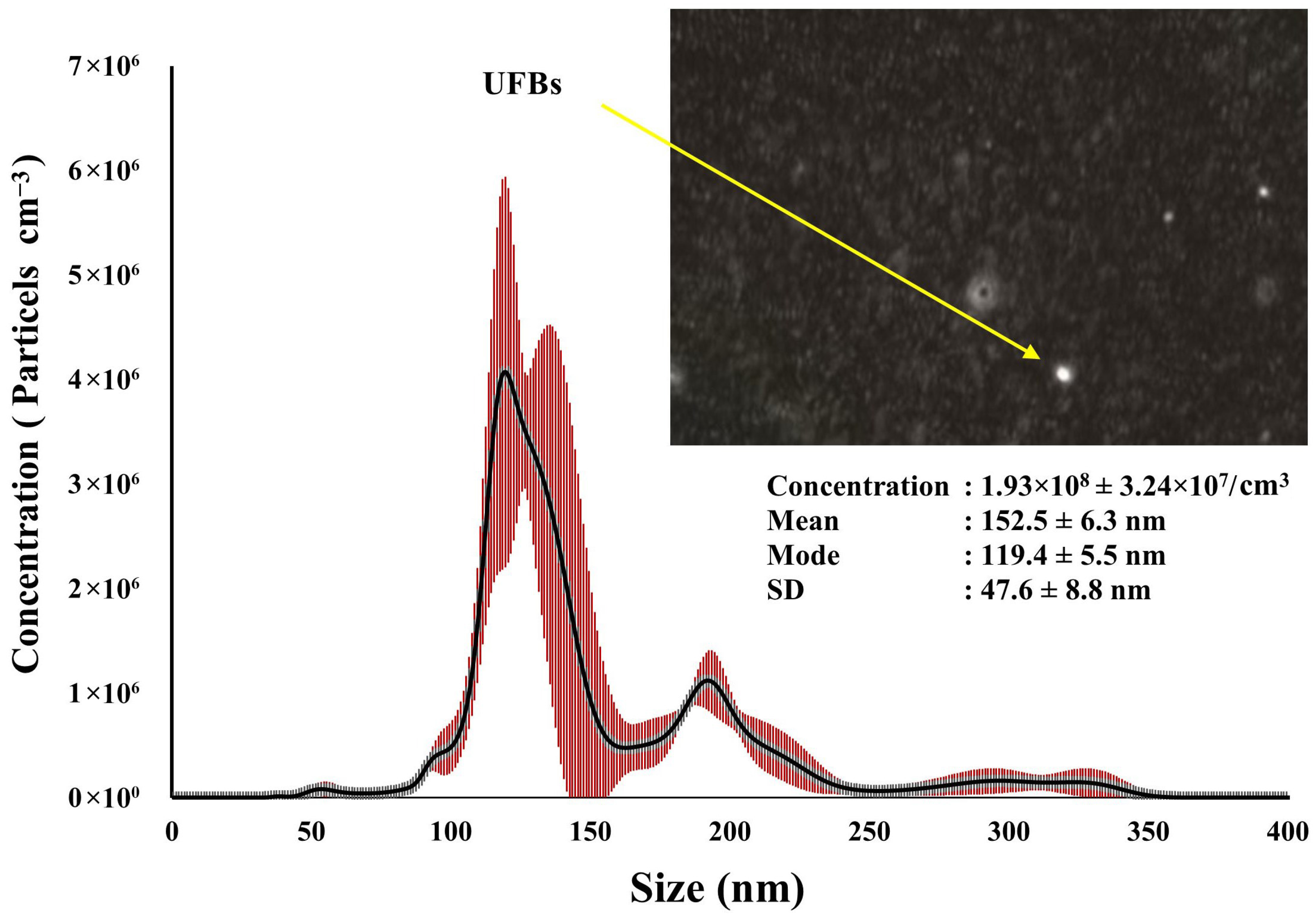
Ultrafine bubbles (UFBs) were generated using a UFB generator (HACK FB11, LIVINGENER-GIES & Co., Shizuoka, Japan) with air filtered through a 0.22 µm membrane (Advantech, Toyo Roshi Kaisha Ltd., Tokyo, Japan) as the gas source based on the pressurized dissolution method, where air is dissolved into water under pressure and then released at atmospheric pressure to form a dense suspension of UFBs. The detailed methodology for UFB generation has been reported elsewhere [47]. No additional chemicals or surfactants were used in the generation process. The produced UFBs were subsequently transferred into a glass screw jar, after which their size and concentration distributions were assessed using a NanoSight instrument (NanoSight-LM10, Malvern, UK), as illustrated in Figure 2. Sample imaging and data analysis were conducted with the NTA measurement software (version 3.2, Development Build 3.2.16). As UFBs undergo random motion and frequently collide within the suspension, the resulting size distribution profile often exhibited multiple distinct peaks, as illustrated in Figure 2. NTA was selected over Dynamic Light Scattering (DLS) for this specific analysis because it provides superior resolution for polydisperse systems and directly measures concentration on a particle-by-particle basis, which is crucial for accurately quantifying the number of bubble–particle collisions [48]. While DLS (via the Zetasizer) is highly effective for measuring the average hydrodynamic diameter of monodisperse colloids like the AL, it can underestimate the presence of larger species in a polydisperse mixture and does not yield a direct particle count. According to the NTA data, the UFBs predominantly exhibited sizes in the range of 100 to 300 nm, with a measured concentration of 1.93 ± 0.32 × 10 8 cm 3 . The UFB suspension demonstrated a pH of 6.9 ± 0.3 and an electrical conductivity of 8.11 µS cm 1 . The pH was measured using a glass electrode pH meter (DKK-TOA Corporation, Tokyo, Japan), and the conductivity was determined using a conductivity meter (DKK-TOA Corporation, Tokyo, Japan). For all experiments, the UFB concentration was maintained at 1 × 10 8 particles cm 3 .
The stability of the UFBs over the experimental timeframe is supported by extensive literature reporting their longevity in suspension, from several days to weeks, due to their negligible buoyancy and electrostatic stabilization [3,4,49]. This is further corroborated in our system by the persistent hydrodynamic layer thickness observed over time, which aligns with the duration of our flocculation kinetics measurements. The polydisperse nature of our UFB suspension, evidenced by the multi-peak size distribution in Figure 2, is characteristic of such systems, as reported in the literature [49,50]. This heterogeneity implies that different-sized UFBs contribute distinctively to the flocculation process; smaller UFBs likely dominate surface coverage and charge modulation due to their higher number density, while larger UFBs may be more effective in creating substantial hydrodynamic layers and longer-range bridging interactions.
The generated UFBs possessed a negative surface charge, characterized by an average zeta potential of −15.3 ± 2.25 mV at pH 6.9, consistent with values previously reported by Ushikubo et al. [51]. This negative charge was consistently observed across the ionic strengths used in this study, as confirmed by EPM measurements (Figure A1, Appendix A.1).
The ionic strength in the experiments was controlled by preparing NaCl solutions at concentrations of 0.1 mM and 10 mM. These ionic strengths correspond to estimated electrical double layer (EDL) thicknesses of approximately 30 nm and 3 nm, respectively, enabling an investigation of particle interactions under varying EDL conditions. This allows for a clear comparison between conditions where long-range electrostatic forces dominate (NaCl 0.1 mM) and where they are significantly screened (NaCl 10 mM) [35,39]. Prior to use, the NaCl solutions were filtered through an Advantech membrane filter (0.22 µm pore size; Toyo Roshi Kaisha Ltd., Tokyo, Japan) to remove impurities.
The pH of the background solutions was adjusted using hydrochloric acid (HCl) and sodium hydroxide (NaOH) (JIS special grade, Wako Pure Chemical Corporation Ltd., Osaka, Japan) and was monitored using a pH meter (LAQUAtwin, ASONE Corporation, Osaka, Japan). The portable LAQUAtwin meter was used for all experimental pH adjustments and monitoring during flocculation trials, while the initial characterization of the UFB stock suspension was performed with a benchtop glass electrode meter (DKK-TOA Corporation). Both instruments were calibrated daily using standard pH buffers to ensure measurement consistency. All experiments were conducted under temperature-controlled conditions at 20 °C to ensure reproducibility. The reported values for pH and ionic strength refer to the final, measured values of the mixed suspension after all components were combined, prior to flocculation and electrokinetic measurements.

2.2. Electrophoretic Mobility Measurement

The electrophoretic mobility (EPM) of the particles was determined using a Zetasizer Nano-ZS (Malvern Instruments, Worcestershire, UK). Measurements were performed in a disposable folded capillary cell designed for electrokinetic analyses. The instrument employs laser Doppler velocimetry (LDV) combined with dynamic light scattering (DLS) to quantify particle motion under an applied electric field of 11.3 V cm 1 . For each sample, three independent measurements were conducted, and each measurement consisted of 12 sub-runs to ensure statistical reliability and reproducibility.

2.3. Rate of Flocculation Measurement

The rate of flocculation was evaluated under two distinct conditions: salt-induced rapid coagulation and UFB-induced aggregation. In the salt-induced experiments, AL suspensions were mixed with an equal volume of 2.0 M NaCl solution using an end-over-end rotation device, as described previously [35,38]. Results of the salt-induced flocculation experiments are provided in Figure A2 (Appendix A.2). For the UFB-induced flocculation experiments, the AL suspension (of concentration 1 × 10 8 cm−3) was combined with the UFB suspension and, where required, NaCl solution in a forked flask, and mixed at a controlled frequency of 1 Hz. Flocculation dynamics were quantified by monitoring aggregate formation over time using a Coulter counter (Multisizer 4e; Beckman Coulter Inc., Brea, CA, USA). To achieve further aggregation prior to measurement, samples were gently aspirated, diluted with distilled water, and 0.5 mL of the diluted suspension was subsequently introduced into an isotonic electrolyte to obtain a particle concentration suitable for analysis. The initial flocculation rate was determined from the slope of ln ( N ( t ) / N ( 0 ) ) versus time. A linear fit is appropriate for quantifying the initial rate under our dilute conditions and short time scales, where the aggregation is dominated by the formation of doublets and can be treated as a pseudo-first-order process with respect to the primary particle concentration [35,36].

2.4. Hydrodynamic Layer Thickness Measurement

The hydrodynamic layer thickness of UFBs adsorbed onto colloidal particles was determined by comparing the diffusion coefficients of bare AL particles with those of AL particles bearing adsorbed UFBs. Brownian motion of individual particles was monitored using an optical microscope (BX50, Olympus, Tokyo, Japan) equipped with a CCD video camera (WV-BL200, Matsushita Co., Ltd., Yamanashi, Japan). The translational diffusion coefficient was obtained from the mean-square displacement of particle trajectories and evaluated using the Einstein relation [38]. The detailed experimental protocol has been described previously [52].
Microscopy and image analysis of dimer geometries:
Videos of 1 µm AL particles were recorded at constant illumination and magnification to capture pairs in close proximity and dimers containing an interposed object consistent with UFBs. Video files were exported to image sequences and processed in ImageJ (version 1.54j) (NIH, Bethesda, MD, USA) to improve contrast. Interparticle distance was quantified as the center-to-center separation for AL pairs and, for dimers with putative UFBs, as the maximum center-to-center separation observed over the sequence. As a control, standard AL dimers without an interposed object were measured to confirm the expected separation of two contacting particles. All measurements were performed in the open source software Nano Measurer 1.2 (Fudan University, Shanghai, China) with the image scale calibrated from the known particle diameter 1 µm. Particle centers were identified manually, and multiple dimers across several frames and fields of view were analyzed.

3. Results and Discussion

3.1. Electrophoretic Mobility

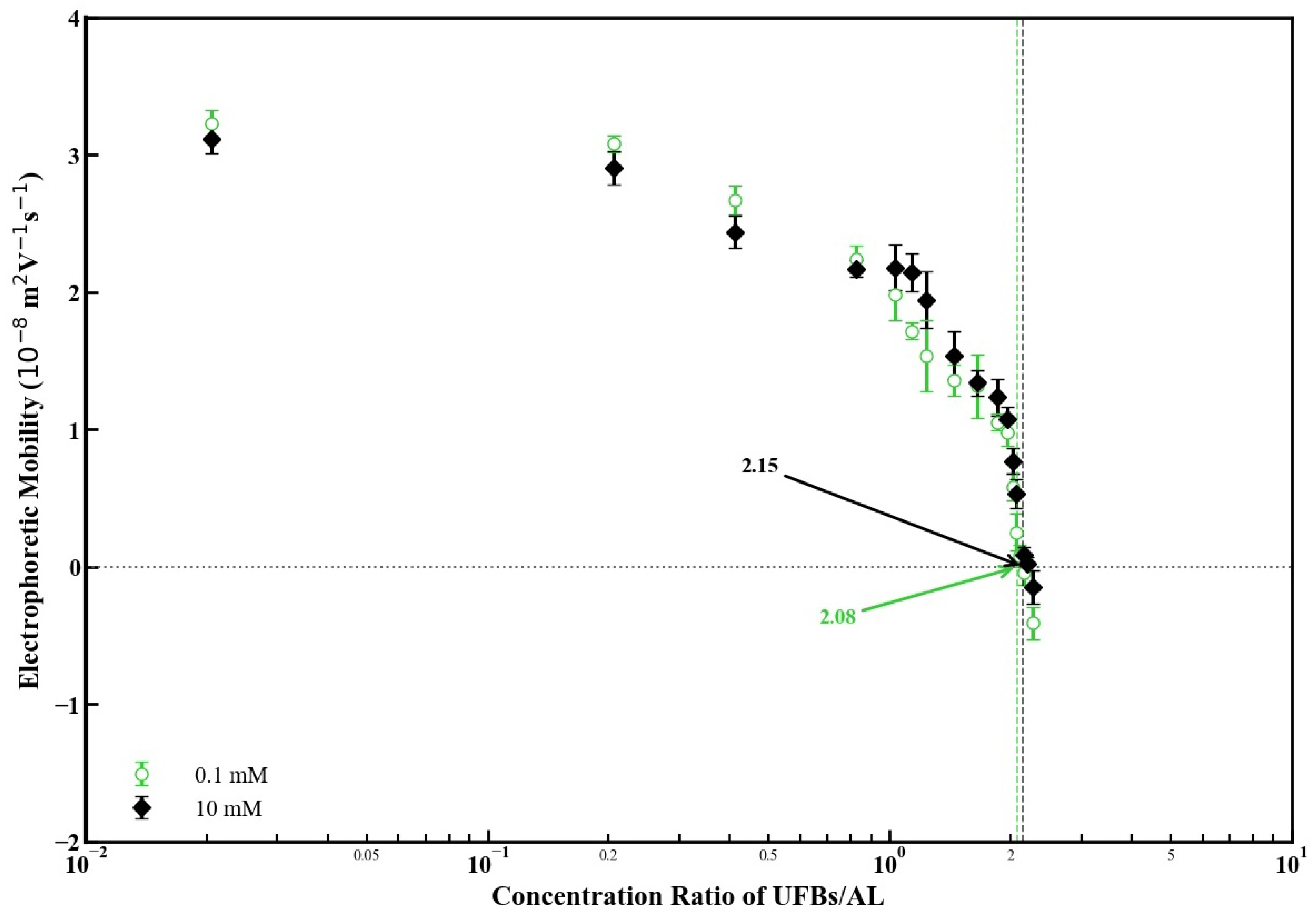
Figure 3 presents the electrophoretic mobility of amidine latex (AL) particles as a function of the concentration ratio of ultrafine bubbles (UFBs) to AL at two NaCl concentrations (0.1 mM and 10 mM). The pH of the suspensions was maintained at 6.0 ± 0.3, and the AL concentration was fixed at 5 × 10 7 particles cm 3 . With increasing UFB concentration, the mobility decreased monotonically, approaching an isoelectric condition at a ratio near unity, and then became negative at higher UFB loadings. These trends are consistent with the anionic character of UFBs and with Figure A1 (Appendix A.1), where increasing salt concentration drives the UFB mobility toward zero. This behavior aligns with Montazeri et al. [53], who reported that an increase in ionic strength reduces the magnitude of the zeta potential by compressing the electrical double layer and thereby decreasing the Debye length. This behavior reflects progressive neutralization of the AL surface charge by negatively charged UFBs, followed by overcompensation that leads to charge reversal. Notably, the position of the charge neutralization point showed little dependence on NaCl concentration, indicating that the UFB-induced modification of AL surfaces is robust against changes in ionic strength within the studied range. This response corresponds to the attainment of the charge neutralization point (CNP) at a characteristic UFB/AL ratio, where attractive inter-particle interactions are maximized. The precise UFB/AL ratio at the CNP was approximately 2.08 for 0.1 mM NaCl and 2.15 for 10 mM NaCl, as interpolated from Figure 3. Based on this finding, the UFB concentration in subsequent flocculation experiments was selected close to the CNP value, 1 × 10 8 particles cm 3 , while the AL concentration was maintained fixed at 5 × 10 7 particles cm 3 to ensure effective charge compensation and promote aggregation. This corresponds to a UFB/AL ratio of 2.0, which is near the CNP and was chosen to ensure a condition of significant charge neutralization while remaining within a practical and consistent dosage framework for the flocculation kinetics study. The progressive neutralization and eventual reversal of the AL surface charge provide direct electrokinetic evidence for the adsorption of negatively charged UFBs onto the cationic particles. This conclusion is further supported by the formation of a measurable hydrodynamic layer around the particles and the visual evidence of increased inter-particle separation in dimer micrographs (discussed in subsequent sections). Together, these data confirm that UFBs adsorb to the AL surface, forming a stable interfacial layer that modulates both electrostatic and steric interactions.
Such surface modification is expected to enhance hetero-interactions between UFBs and AL particles, thereby facilitating aggregation.

3.2. Hydrodynamic Layer Thickness

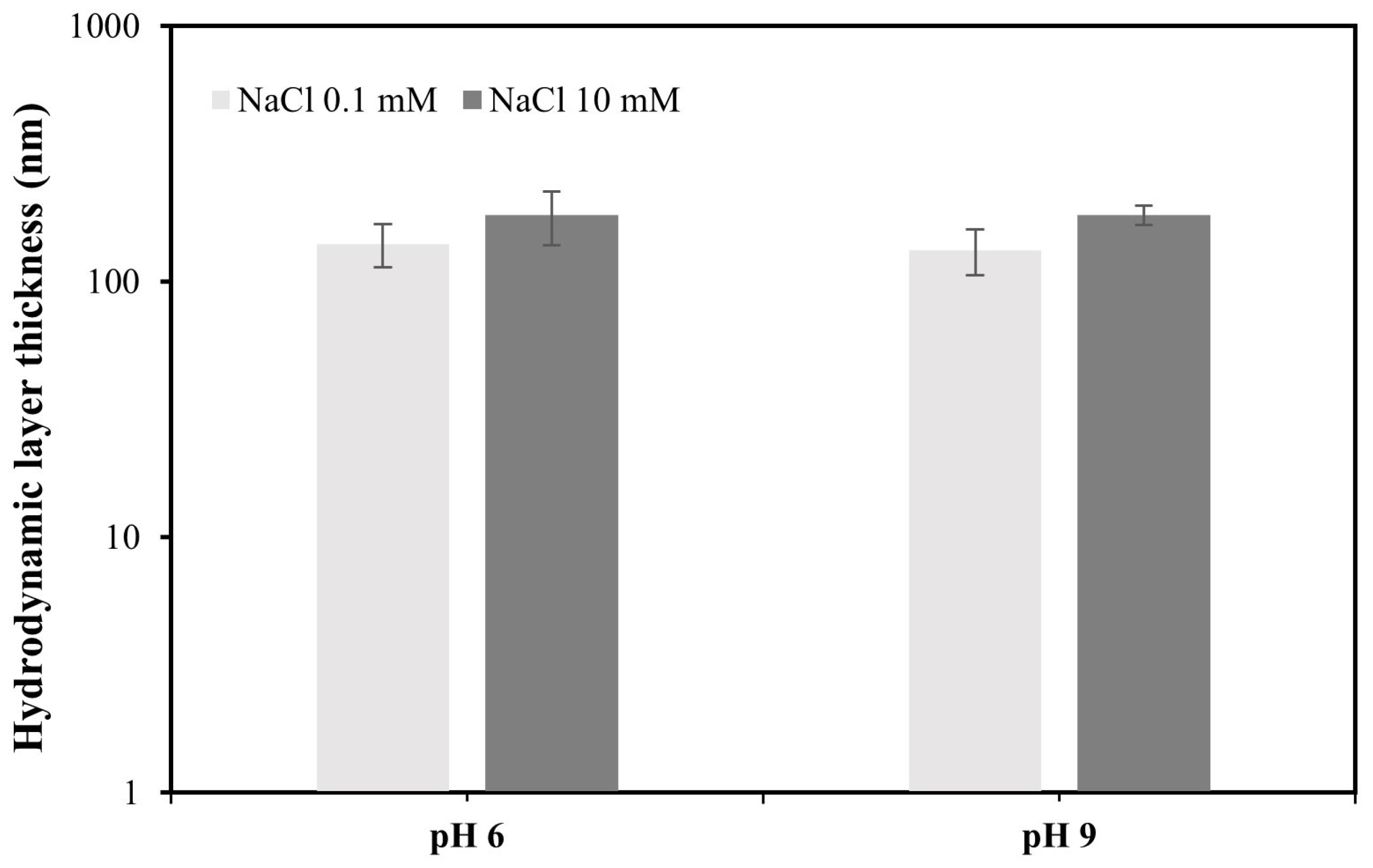
The temporal evolution of the hydrodynamic layer thickness of amidine latex (AL) particles after the addition of UFBs at two NaCl concentrations (0.1 mM and 10 mM) and pH values of 6 and 9 is shown in Figure 4. The thickness was calculated by comparing the diffusion coefficients of bare and UFB-coated AL particles. At pH 6, hydrodynamic layer thickness was approximately 141 nm at 0.1 mM NaCl and increased to 182 nm at 10 mM NaCl. A similar trend was observed at pH 9, with hydrodynamic layer thickness values of 133 nm at 0.1 mM and 182 nm at 10 mM NaCl. The increase in hydrodynamic layer thickness at higher ionic strength (10 mM NaCl where EDL thickness 3 nm) can be attributed to electrostatic screening, which weakens the mutual repulsion among adsorbed negatively charged UFBs and allows closer packing on the cationic AL surface. This screening facilitates a higher surface coverage and denser packing of UFBs, which enhances the apparent interfacial layer thickness. In systems involving rigid, monodisperse particle depositions, the hydrodynamic layer thickness is typically constant and defined by the diameter of the deposited particle, showing little dependence on ionic strength [42]. The observed increase here suggests that UFBs, unlike solid latex particles, may exhibit unique interfacial properties such as softness, deformability, or polydispersity that cause the consolidated layer to present a thicker hydrodynamic barrier when densely packed. The measured hydrodynamic layer thickness of 141–182 nm is consistent with the formation of a monolayer of AL particles on the UFB surfaces. A geometric estimation of the packing fraction, assuming a hexagonal close-packed monolayer of AL particles (1 µm) on UFBs (100–300 nm), supports this. Due to the significant curvature of the UFBs relative to the AL particle size, the packing fraction is substantially reduced compared to planar arrangements. Calculations yield a maximum surface coverage of approximately 90.7% in a planar configuration, but actual coverage on curved UFB surfaces is limited by geometric constraints. This strongly supports a model of patchy adsorption, where discrete UFB domains facilitate charge neutralization and bridging. The differences in thickness between 0.1 mM and 10 mM NaCl are consistent and exceed the measurement uncertainty, as indicated by the error bars in Figure 4. This agrees with the findings of Zhang et al. [54] who showed that nanobubble size and surface potential are highly sensitive to solution chemistry, particularly pH and ionic composition. Their study demonstrated that the zeta potential of nanobubbles becomes more negative at higher pH due to enhanced OH adsorption at the gas–liquid interface, while bubble size decreases with increasing pH, reflecting stabilization by stronger electrostatic repulsion [23,49,55]. The pH dependence of the EPM of AL-UFB suspensions at 0.1 mM NaCl is explained in Figure A3 (Appendix A.3). In the context of the present results, the relatively small effect of pH (6 vs. 9) on hydrodynamic layer thickness at low ionic strength (0.1 mM NaCl) can be understood by considering that AL particles remain strongly cationic across this range, ensuring continued electrostatic attraction with UFBs. However, once the ionic strength is increased, EDL compression dominates over pH effects, leading to nearly identical hydrodynamic layer thickness at pH 6 and 9. Therefore, the thicker hydrodynamic layers observed at elevated NaCl concentration likely arise from a combination of electrostatic screening and enhanced UFB stability under high ionic conditions, as previously linked to reduced UFB size and stronger interfacial interactions in cavitation-generated UFBs.
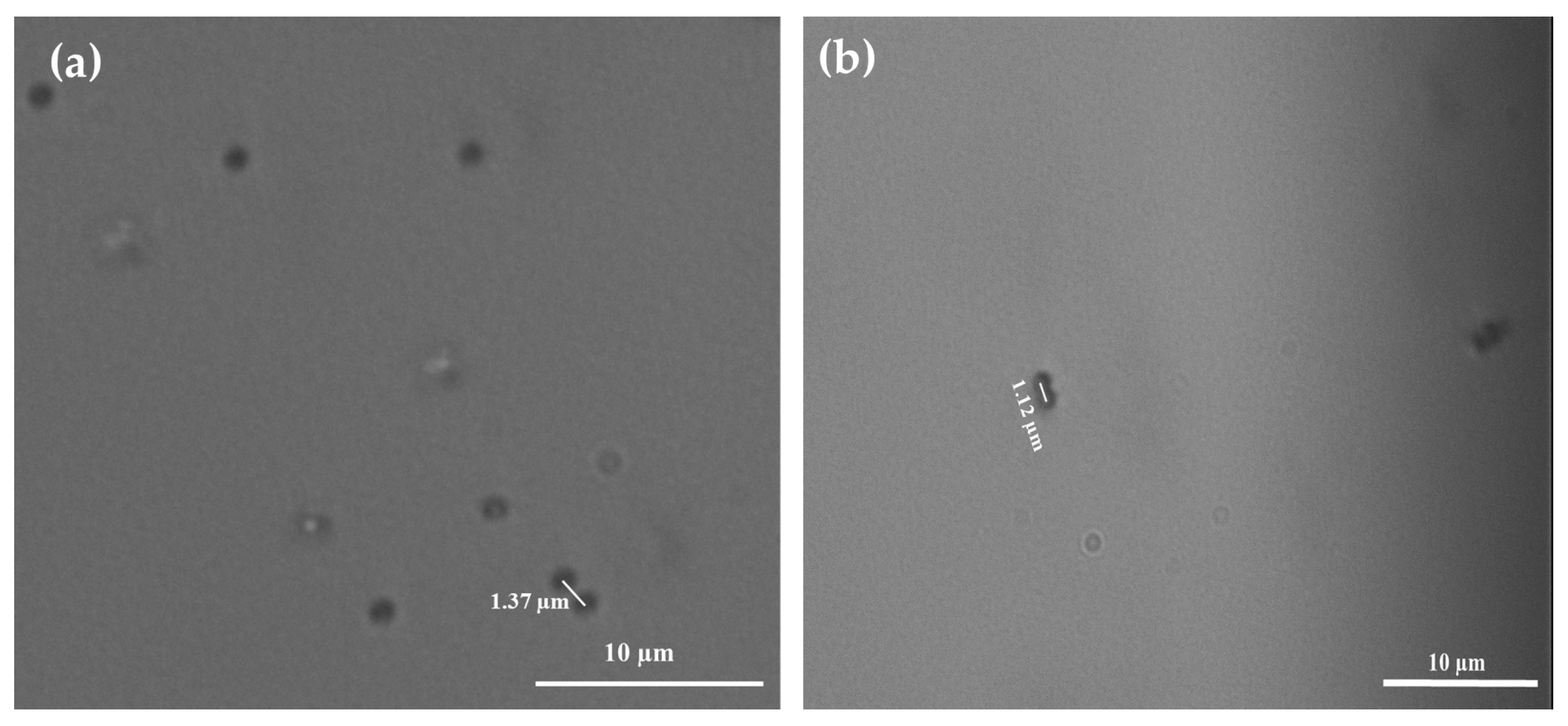
To further substantiate the presence of an interfacial layer, optical micrographs of amidine latex (AL) particles were analyzed to quantify the separation distance between particle dimers in the presence and absence of UFBs (Figure 5). Analysis of 10 dimer pairs in suspensions containing UFBs showed a mean center-to-center distance of 1.37 ± 0.04 µm, whereas analysis of 10 dimer pairs in control samples without UFBs showed a mean separation of 1.112 ± 0.02 µm. The representative images in Figure 5 depict dimers with separations close to these mean values. The observed increase of approximately 0.25 µm provides strong evidence for the formation of a hydrodynamic or interfacial layer between AL particles. (All individual distance measurements are provided in the Supplementary Material, Table S1 and representative micrographs processed for analysis are shown in Figures S1 and S2). This layer is most plausibly attributed to UFBs adsorbed at the particle surface, effectively enlarging the apparent spacing between colloidal dimers. Similar increases in interfacial spacing have been previously reported for UFB adsorption at solid–liquid interfaces, where UFBs were shown to contribute to longer-range interactions between colloids [56,57].
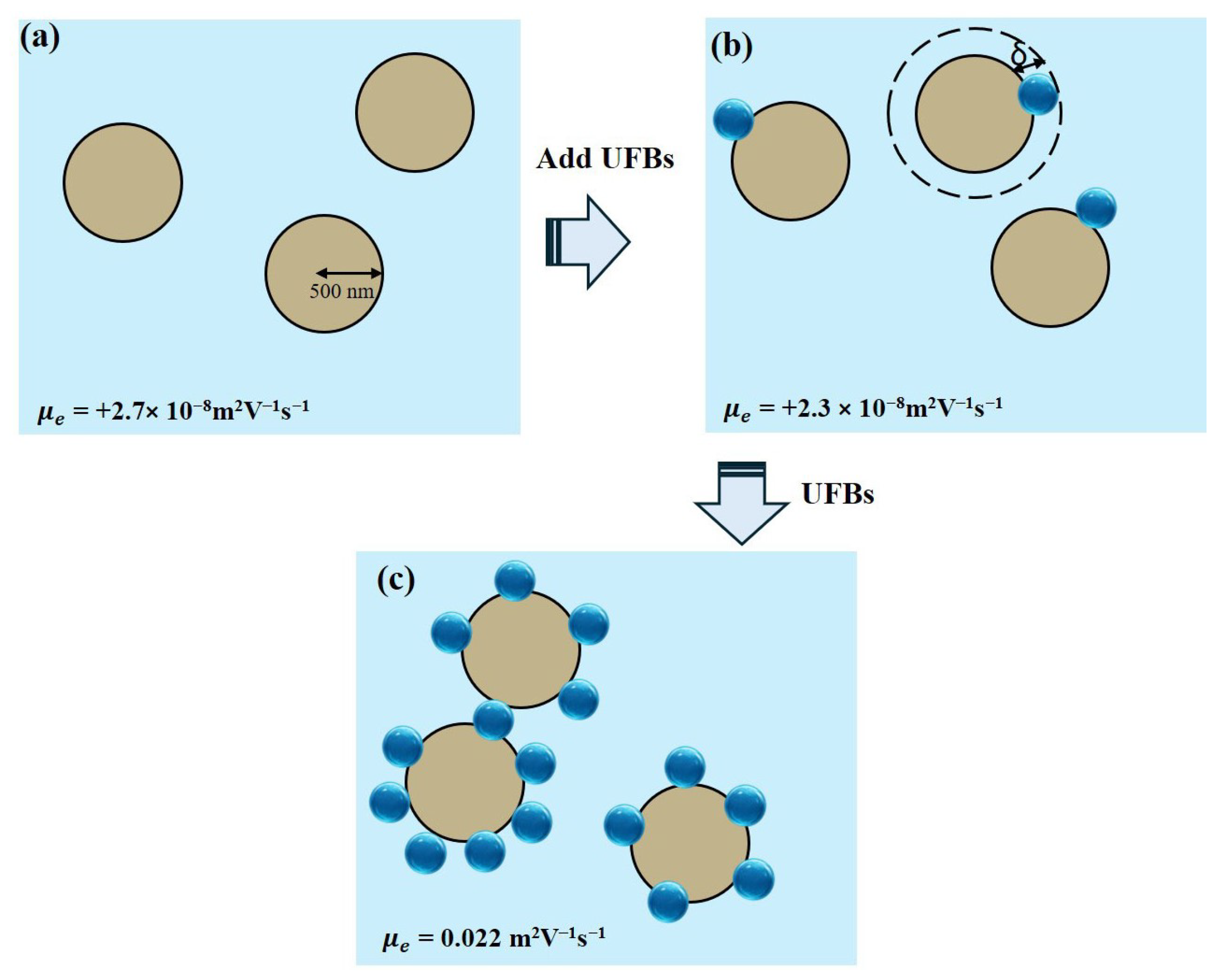
The proposed mechanism for UFB–particle interactions is illustrated in Figure 6. In the absence of UFBs, AL particles exhibit a stable positive charge due to their amidine functional groups, maintaining electrostatic repulsion that prevents close contact (Figure 6a). Upon introduction of negatively charged UFBs, adsorption onto the AL surface occurs, progressively reducing the net positive charge (Figure 6b). This results in partial charge neutralization and a decrease in the electrostatic repulsion between particles. As the system approaches the CNP (Figure 6c), electrostatic repulsion is minimized and short-range attractive forces promote aggregation. Further UFB adsorption eventually overcompensates the surface charge, leading to charge reversal and the formation of negatively charged aggregates (Figure 6c). These observations align with the findings of Zhang [30], who demonstrated preferential adsorption of nanobubbles onto amidine-functionalized polystyrene surfaces, resulting in modified electrostatic states and altered aggregation behavior. Taken together, the micrographs and mechanistic framework provide direct visual and conceptual evidence that UFBs play an active role in modulating colloidal interactions through interfacial adsorption, charge regulation, and the creation of a hydrodynamic separation layer.

3.3. Rate of Flocculation

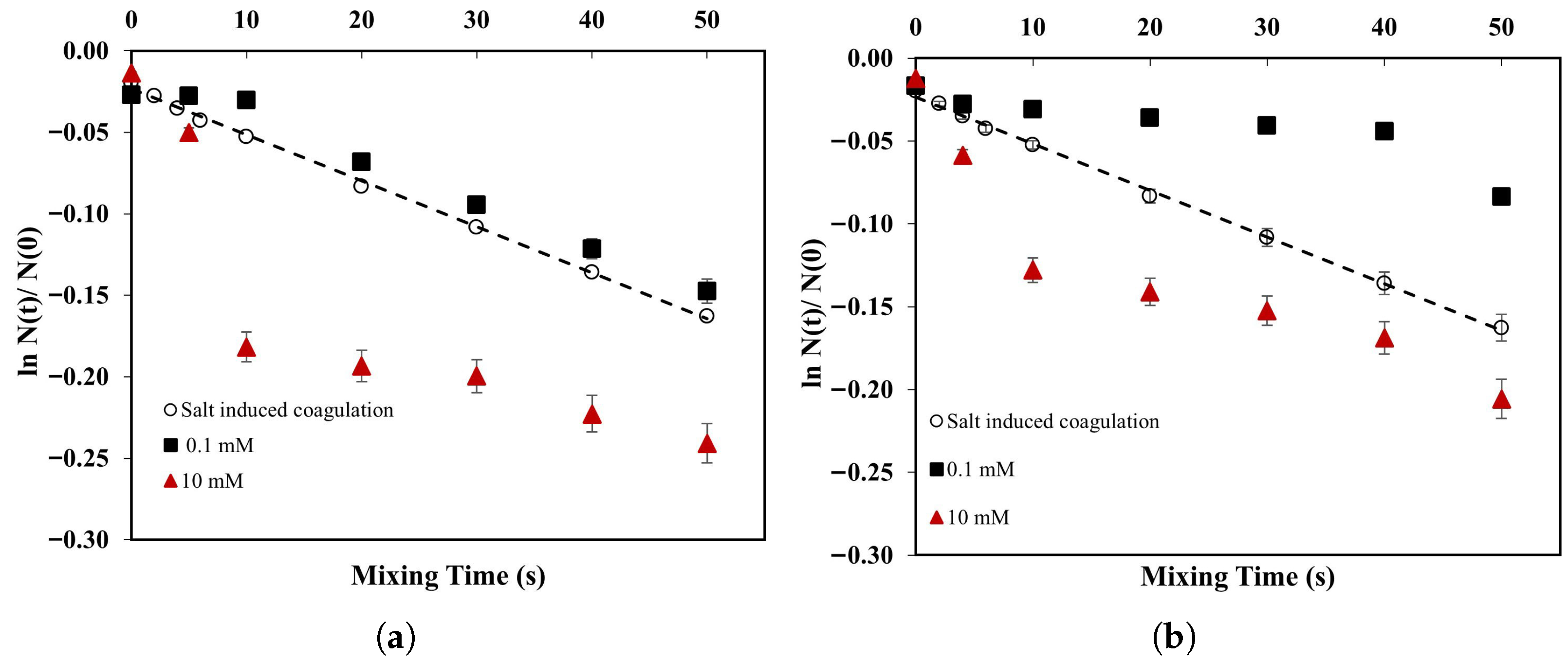
The flocculation behavior of AL suspensions induced by UFBs under varying NaCl concentrations and pH conditions was investigated by monitoring the temporal evolution of aggregate formation. The initial aggregation dynamics were quantified from the time variation of the temporal variation of the normalized cluster number, expressed as ln N ( t ) N ( 0 ) , where N ( t ) denotes the number of aggregates per unit volume at time t and N ( 0 ) is the initial value. Figure 7a,b present the results obtained at pH 6.0 ± 0.3 and 9.0 ± 0.3, respectively, under NaCl concentrations of 0.1 and 10 mM to probe distinct electrostatic regimes. The influence of pH on the flocculation kinetics is systematic and can be rationalized by the protonation-dependent surface charges of the system components. The experiments were conducted at pH 6.0 and 9.0 to probe distinct electrostatic regimes. At pH 6.0, the amidine groups of the AL particles are strongly protonated, maintaining a high positive charge density that ensures a strong electrostatic driving force for the adsorption of anionic UFBs. In contrast, at pH 9.0, the AL particles approach their IEP (10), leading to a significantly reduced positive charge density. For comparison, the dashed line denotes rapid coagulation kinetics induced by 1 M NaCl, representative of diffusion-limited aggregation (Figure A2, Appendix A.2). At low NaCl concentration (0.1 mM), the decrease in N ( t ) / N ( 0 ) proceeded slowly at both pH values, reflecting limited aggregation of the AL suspension. This can be attributed to the persistence of thick electrostatic double layers around AL particles, which sustain long-range repulsive forces and hinder UFB-mediated bridging [27,46]. Under these conditions, the attractive interactions generated by UFB adsorption are insufficient to overcome the repulsive energy barrier, resulting in a reduced aggregation rate. In contrast, at 10 mM NaCl the aggregation rate increased markedly. The enhanced kinetics can be explained by compression of the electrical double layer, which reduces electrostatic repulsion and allows UFBs to approach and adsorb more effectively onto AL surfaces. Adsorption creates localized charge inhomogeneities that act as “patches” of opposite polarity, thereby promoting patch flocculation [58]. At a UFB/AL ratio near the CNP, this effect is amplified; charge neutralization and localized adsorption sites combine to maximize aggregation rates [59]. Importantly, the acceleration observed at 10 mM NaCl cannot be attributed to salt effects alone but indicates a synergistic contribution from UFB adsorption and interfacial charge regulation. In addition to electrostatic charge compensation and patch bridging, adsorbed UFBs generate a soft, hydrodynamic layer that enlarges the effective collision radius. While this layer is likely penetrable (violating a strict hard-sphere assumption), it facilitates initial contact and increases the probability of particles entering the range where short-range attractive forces (e.g., capillary bridging, hydrophobic interactions) can act to form a stable dimer. This mechanism is analogous to flocculation induced by other soft interfacial materials, such as microgels and polyelectrolyte complexes, where a protruding layer increases the collision efficiency without requiring a rigid, impenetrable shell [39,41]. Prior work measured attractive forces between hydrophobic surfaces that remained significant even when an intervening gas phase was removed, indicating a residual hydrophobic force [33]. AFM studies also revealed persistent surface nanobubbles on hydrophobic substrates, consistent with capillary bridges that act over tens to hundreds of nanometers [34]. In our system, UFB deposition likely creates patchy, locally more hydrophobic surface domains; when two AL particles approach, interposed UFBs can form transient bridges that supplement electrostatic charge neutralization and increase the effective capture radius. This view aligns with reports of nanobubble-mediated capillary attractions and with charge inversion and reentrant condensation phenomena in AL systems under gas supersaturation. The role of pH further modulated the aggregation dynamics.
To quantify the UFB-induced enhancement, we calculated the enhancement factor ( β ) for UFB-induced AL aggregation under standardized end-over-end mixing (Figure 7 and Table 1). At 0.1 mM NaCl, β is sub-unity at pH 6.0 and 9.0 (0.81 and 0.44, respectively), indicating that under weak screening the anionic UFB interface partially stabilizes the suspension relative to the 1 M salt rapid coagulation reference. At 10 mM NaCl, β increases above unity for both pH conditions, reaching 2.15 at pH 6.0 and 1.60 at pH 9.0. This rise with ionic strength is consistent with reduced electrostatic barriers that allow UFBs to act as effective submicron bridges and to increase collision efficiency. The pH dependence follows the expected charge pairing between anionic UFBs and cationic AL. At the lower pH, amidine groups are more protonated and the UFB surface potential is closer to neutrality, which together promote attachment and a larger effective collision radius. The stronger enhancement at pH 6 compared with pH 9 therefore points to a regime where bubble-mediated bridging outweighs residual electrostatic repulsion. When benchmarked against conventional flocculants studied in the same mixing framework, the observed β values are modest. For instance, microgel adsorption and oppositely charged particle systems yielded higher β values of 3.88 and 2.8, respectively [41,42]. This difference in efficacy can be attributed to fundamental mechanistic distinctions. Microgels and branched polymers form extensive, protruding hydrodynamic layers that drastically increase the collision radius, and polymers can form strong, multi-point bridges between particles [41,60]. Branched polymers gave lower β near isoelectric conditions but very large β above isoelectric dosage, where classical polymer bridging dominates, reaching about 15 at 0.1 mM and 7 at 10 mM NaCl [60]. Together these comparisons indicate that β is controlled by flocculant type and size, ionic strength and pH, and the dynamics of the adsorbed layer during the initial stage of aggregation. In contrast, the UFBs in this study (100–300 nm) form a comparatively thinner and softer interfacial layer. While this layer effectively neutralizes charge and facilitates bridging, the individual UFB bridges are likely less robust and provide a smaller geometric cross-section for collision than a flexible polymer chain or a large, deformable microgel. Therefore, UFBs act as milder flocculation agents. A broader comparison of UFBs-induced effects with other bubble–particle interaction studies reported in the literature is provided in Appendix A.4 (Table A1). Their potential application likely lies not in outperforming high-efficiency polymers, but in scenarios utilizing their unique properties, such as being chemical-free, providing gas supplementation, or inducing radical-based reactions.
This study focused on the initial flocculation kinetics, which govern the formation of UFB–particle aggregates. The long-term stability of these aggregates and the fate of the incorporated UFBs present intriguing questions for future research. The dissolution of UFBs confined within an aggregate may be kinetically hindered, potentially stabilizing the aggregate structure. Furthermore, the presence of UFBs is not solely structural. Given their reported role in enhancing reaction rates, such as in the oxidation of pollutants [7], the initial formation of UFBs–particle aggregates could actively promote the catalytic transformation of contaminants within the flocs. Investigating this coupled process of aggregation and reaction represents a critical and compelling next step for assessing the full potential of UFB-mediated processes in water treatment.

4. Conclusions

This study provides a novel, quantitative analysis of the initial-stage flocculation of cationic colloids induced by anionic ultrafine bubbles (UFBs) under well-controlled turbulent mixing. While the ability of bubbles to interact with particles is known, the systematic and simultaneous tracking of electrokinetic properties, hydrodynamic layer thickness, and aggregation kinetics as performed here delivers new insights. We quantitatively establish that UFBs adsorb onto cationic amidine latex (AL) particles, progressively neutralizing and ultimately inverting their charge, with a characteristic UFB/AL ratio for the charge neutralizing point that is robust against changes in ionic strength. Furthermore, we demonstrate that the resulting flocculation is not fastest at the lowest ionic strength, but is maximized under a moderate ionic strength (10 mM NaCl), where double-layer compression enables efficient UFB adsorption and bridging. This represents a significant extension of our group’s previous work, revealing a unique operational window for UFB-mediated aggregation.
Hydrodynamic analysis showed that the effective interfacial layer thickened at elevated electrolyte concentration, consistent with enhanced UFB adsorption, and direct microscopic imaging of particle dimers visually confirmed the presence of this layer. The flocculation kinetics underscored that reduced electrostatic barriers at 10 mM NaCl facilitate adsorption and patch-mediated bridging, while extended double layers at 0.1 mM limited the process. The influence of pH was secondary but systematic, with enhanced aggregation at pH 6 relative to pH 9 likely due to pH-dependent variations in UFB properties that increase the effective collision cross-section. Collectively, our findings provide a cohesive framework illustrating how UFBs adsorb onto positively charged AL particles, progressively neutralizing and ultimately inverting the surface charge while generating a soft interfacial layer. This work not only advances the fundamental understanding of gas–colloid interactions but also highlights the potential of UFBs as low-chemical flocculation aids in water and environmental applications. The coherent picture established with this model system provides a necessary foundation for future research.
A critical next step is to extend this framework to more complex and realistic scenarios, such as natural waters involving multivalent electrolytes and heterogeneous natural colloids, to rigorously evaluate the practical scope of UFB-mediated flocculation. Complementing this with a detailed theoretical quantification of the interaction energies will provide deeper mechanistic insight.

Supplementary Materials

The following supporting information can be downloaded at https://www.mdpi.com/article/10.3390/applnano6040027/s1, Figure S1: Microscopic images of AL dimers in the absence of UFBs (control) at pH 6.0 ± 0.3 and NaCl of 0.1 mM; Figure S2: Microscopic images of AL dimers in the presence of UFBs at pH 6.0 ± 0.3 and NaCl of 0.1 mM; Figure S3: Additional representative NTA measurement results for air UFBs generated in H2O. All measurements were conducted 20 min after bubble generation. The red bars show standard error; Figure S4: Scanning electron microscopy (SEM) images of the AL particles at (a) 5000× and (b) 10,000× magnification, confirming their spherical morphology and primary particle size consistent with the manufacturer’s specification; Figure S5: DLS intensity distribution of AL showing a monomodal peak near 1.0 μ m. No secondary modes were observed, confirming the absence of measurable aggregates; Table S1: Individual center-to-center distance measurements for AL dimers in the presence and absence of UFBs; Table S2: DLS Peak-1 diameters of amidine latex particles showing a dominant monomodal sample with a mean size of 1.03 ± 0.04 μ m; Table S3. Manufacturer’s specifications for the Amidine Latex particles (ThermoFisher Scientific, Lot #2965681, Product #A37322) as provided in the Certificate of Analysis.

Author Contributions

Conceptualization, M.W., S.S.; methodology, M.W., Y.A., S.S.; validation, M.W., S.S.; formal analysis, M.W., S.S.; investigation, M.W., S.S.; data curation, M.W.; writing—original draft preparation, M.W., S.S.; writing—review and editing, S.S., Y.A.; supervision, Y.A.; funding acquisition, Y.A. All authors have read and agreed to the published version of the manuscript.

Funding

This research was financially supported by the Japan Society for the Promotion of Science (JSPS) KAKENHI (Grant number: 22H00387, 24H00767, 24K17982).

Data Availability Statement

The raw data supporting the conclusions of this article will be made available by the authors on request.

Acknowledgments

The authors gratefully acknowledge the kind support of Zhongfang Lei and Tian Yuan, whose guidance and provision of laboratory facilities enabled the successful generation of ultrafine bubbles. M.W. acknowledges financial support from the MEXT Scholarship for study at the University of Tsukuba, Japan.

Conflicts of Interest

The authors declare no conflicts of interest.

Abbreviations

The following abbreviations are used in this manuscript:
ALAmidine latex
CNPCharge neutralization point
DLSDynamic Light Scattering
DLVODerjaguin–Landau–Verwey–Overbeek theory
EPMElectrophoretic mobility
EDLEelctric double layer
IEPIsoelectric point
NaClSodium chloride
NBsNanobubbles
NTANanoparticle tracking analysis
UFBsUltrafine bubbles

Appendix A. Charging Behavior of Ultrafine Bubbles (UFBs)

Appendix A.1. Ionic Strength Dependency

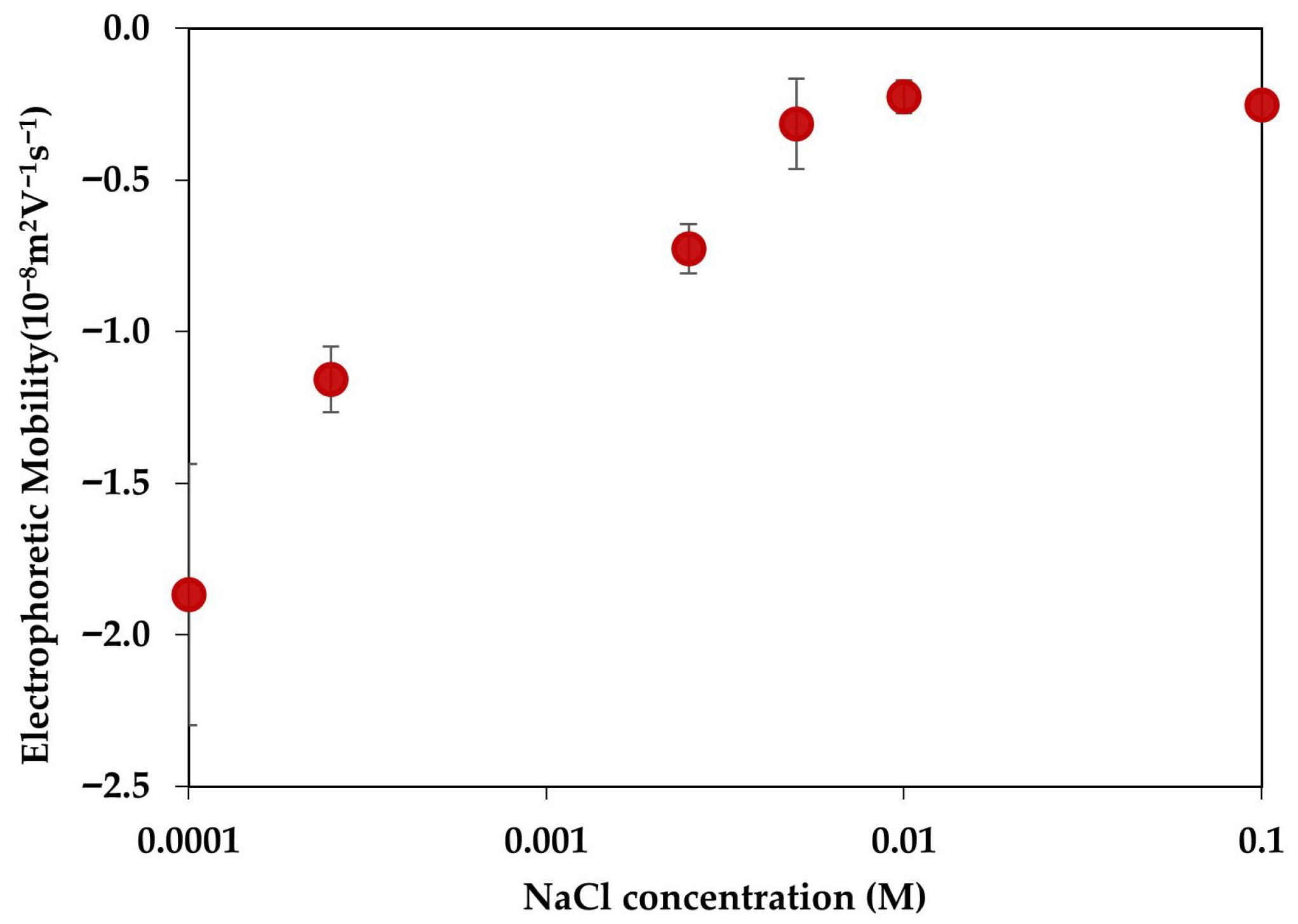
Ultrafine bubbles (UFBs) in deionized water typically exhibit a net negative charge arising from the preferential adsorption of hydroxide ions (OH ) at the gas–liquid interface [49,55]. This behavior was reproduced in our measurements, as shown in Figure A1, where the electrophoretic mobility (EPM) of UFBs is plotted as a function of NaCl concentration at a fixed pH of 6.0 ± 0.3. At very low ionic strength, the UFBs exhibited a pronounced negative mobility, reflecting the dominance of hydroxyl adsorption. With increasing NaCl concentration, the magnitude of the negative mobility progressively decreased due to compression of the electrical double layer and screening of interfacial charges. This trend is consistent with classical electric double layer theory; a shorter Debye length reduces the effective range of electrostatic interactions, thereby lowering the apparent zeta potential and electrophoretic response. Such ionic strength-dependent charging has been widely reported for gas–liquid interfaces [22].
Figure A1. Electrophoretic mobility of UFBs as a function of NaCl concentration. Error bars represent the standard deviation of three measurements. The pH was maintained at 6.0 ± 0.3.
Applnano 06 00027 g0a1

Appendix A.2. Salt-Induced Rapid Coagulation
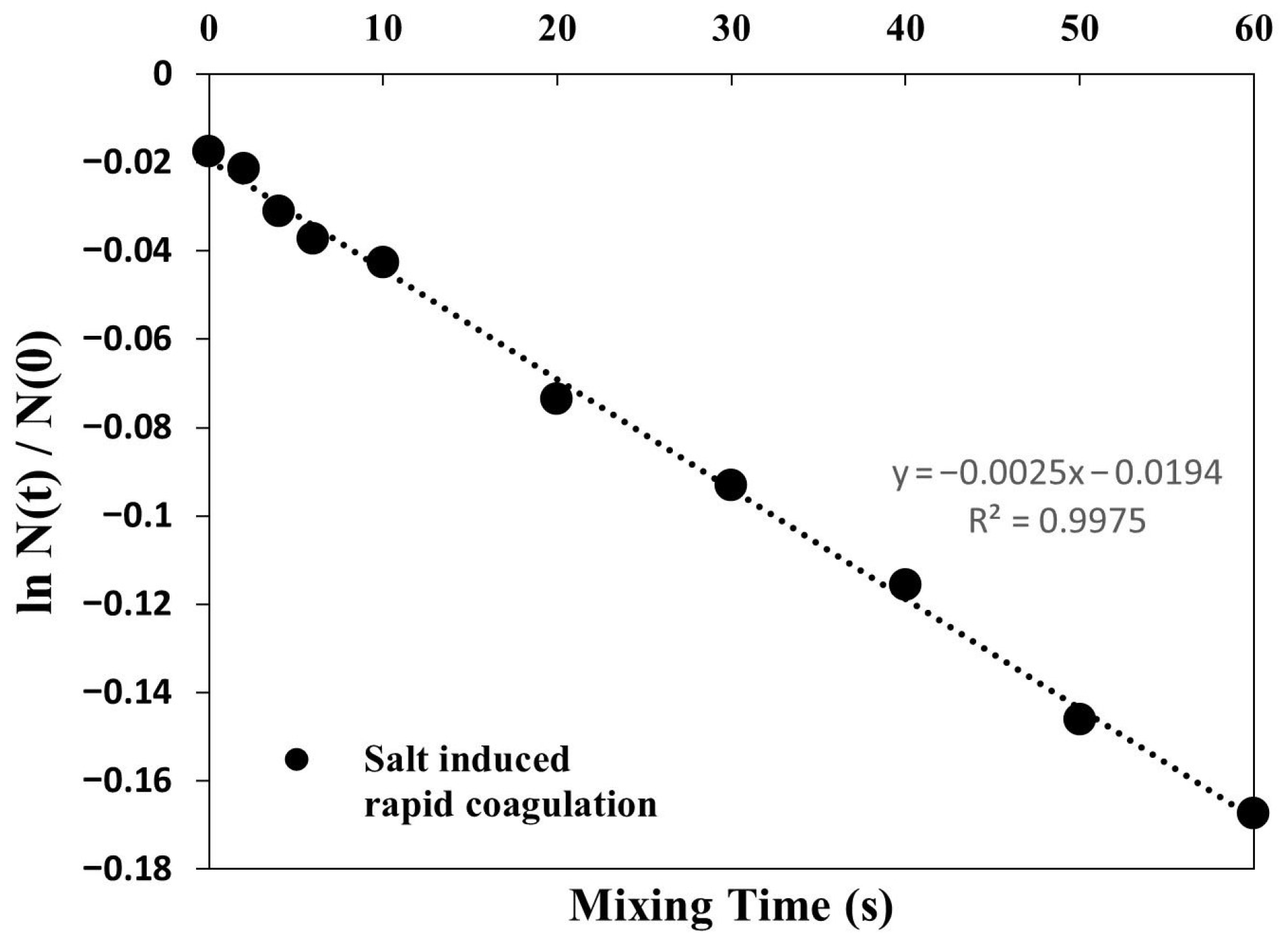
Figure A2 shows the results of the 1 M NaCl rapid coagulation tests under standardized end over end mixing. The particle number decayed, yielding a linear relation of ln N ( t ) N ( 0 ) with mixing time t. This linearity confirms the reliability of the method and the expected first-order behavior in the rapid coagulation limit, consistent with prior reports from the Adachi group [35,36]. For subsequent analyses, the absolute slope of the ln N ( t ) N ( 0 ) vs. t plot is taken as the apparent coagulation rate constant under the 1M reference condition, and we use this to evaluate the enhancement factor for UFB-induced flocculation of AL relative to the salt-induced rapid coagulation reference.
Figure A2. Variation in the total number of clusters per unit volume, N(t) with the number of mixing time (t) for salt-induced coagulation. The number of AL particle concentration is 5 × 10 7 cm 3
Applnano 06 00027 g0a2

Appendix A.3. pH Dependency

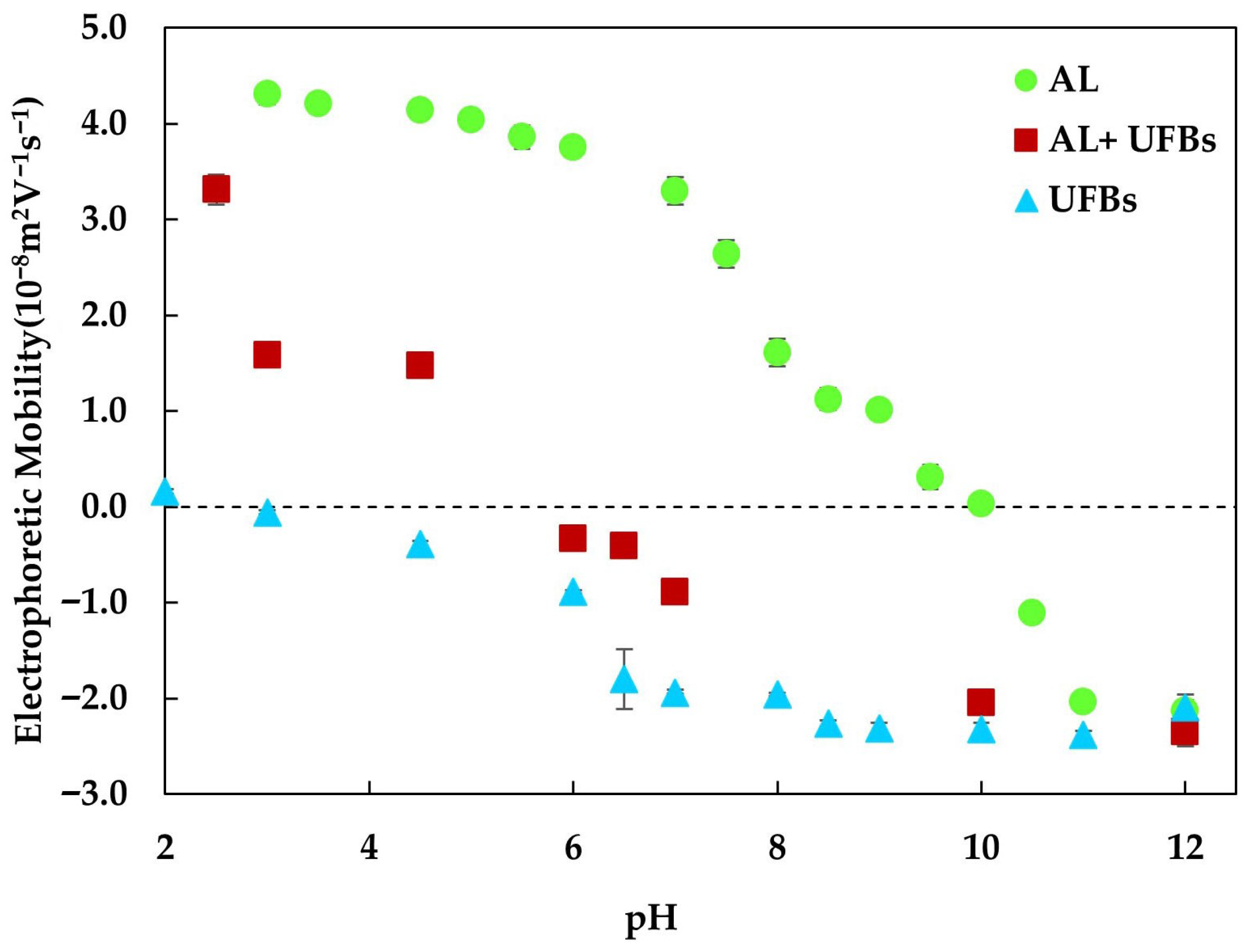
Figure A3 presents the electrophoretic mobility of UFBs, amidine latex (AL) particles, and UFB–AL mixtures across the pH range 2–12 at a background NaCl concentration of 0.1 mM. Compared to AL suspensions alone, the addition of UFBs consistently reduced the measured mobility, shifting values toward less positive or even negative levels. This reduction is attributed to the partial adsorption of anionic UFBs onto the cationic amidine surface, leading to charge masking and, in some cases, compensation. The effect was strongest below the isoelectric point (pH ∼10), where AL particles are most strongly cationic. Because the bulk pH of the suspensions remained stable, these reductions cannot be explained by protonation equilibria, but instead indicate direct electrostatic UFB–AL interactions.
Figure A3. Electrophoretic mobility of UFBs (solid green triangle), AL particles (solid green circle), and UFBs–AL mixtures (solid red square) as a function of pH at a background NaCl concentration of 0.1 mM. Error bars represent the standard deviation of three measurements.
Applnano 06 00027 g0a3
The surface charge of UFBs is known to be highly pH-sensitive [31]. In our measurements, UFBs remained negatively charged over most of the range, becoming increasingly negative at alkaline pH, but reversed to slightly positive mobility at pH 2. This crossover reflects the competition between H + and OH ions at the interface; under acidic conditions protons dominate, while at higher pH hydroxide adsorption imparts strong negative charge. Such behavior has been confirmed in prior studies of air–water interfaces [19,27,43]. Mechanistically, this pH response has been linked to hydration energy differences between protons and hydroxide ions, and to the preferred orientation of interfacial water dipoles, with oxygen atoms facing the gas phase and hydrogen atoms oriented toward bulk water [3,20]. The pH dependence of AL charge is governed by protonation of amidine groups. At acidic to neutral conditions, protonated AL yields positive mobility, which decreases with increasing pH and vanishes at the isoelectric point near pH 10. Beyond this point, negative mobilities arise from hydroxide adsorption onto the particle surface [46]. The overlap of these trends explains why UFB addition leads to the most pronounced modulation of AL mobility below the IEP.

Appendix A.4. Comparison with Previous Studies

A comparison of the key mechanisms and findings from the present study with other relevant literature on bubble–particle interactions is provided in Table A1. This comparison highlights the consistency of our core observations (e.g., charge neutralization) with prior work and, more importantly, underscores the novel contributions of this study in providing a quantitative, multi-faceted analysis of the initial-stage flocculation process under controlled turbulent mixing.
Table A1. Comparison of key findings on nanobubble and ultrafine bubble-mediated interactions with colloidal particles.
System StudiedMechanism/Key FindingsRelation to the Present Study
Gold Nanoparticles and Bulk Nanobubbles [30] 
  • NBs nucleate on nanoparticles, forming stable bubble–particle agglomerates.
  • DLS confirms increased aggregate size.
Consistent with our observation that UFBs adsorb to particles, forming complexes that alter colloidal stability and size.
Amidine Latex Nanoparticles and Bulk Nanobubbles [32]
  • Controls charge via nanoparticle-to-nanobubble ratio.
  • Induces charge neutralization and reversal (isoelectric point).
Directly consistent with our electrokinetic results, confirming UFB adsorption leads to charge compensation and inversion.
Kaolin with Cationic Polyacrylamide (CPAM) and Bulk Nanobubbles (NBs) [16] 
  • NBs enhance settling rate and floc size.
  • NBs decrease the absolute zeta potential of particles.
Supports the role of NBs in enhancing aggregation and modifying electrokinetic properties, similar to our observed UFB-assisted mechanisms.
Amidine Latex and Ultrafine Bubbles (UFBs)
  • Quantifies adsorption-driven charge regulation and hydrodynamic layer thickness.
  • Elucidates flocculation kinetics under controlled turbulence.
  • Identifies optimal ionic strength (10 mM NaCl) for UFB-mediated bridging.
This study provides a cohesive, quantitative framework of the initial-stage flocculation process, linking electrokinetics, interfacial layer properties, and aggregation kinetics.

References

  1. ISO 20480-1:2017; Fine Bubble Technology—General Principles for Usage and Measurement of Fine Bubbles—Part 1: Terminology. ISO: Geneva, Switzerland, 2017. Available online: https://www.iso.org/obp/ui/#iso:std:iso:20480:-1:ed-1:v1:en (accessed on 19 August 2025).
  2. Tan, B.H.; An, H.; Ohl, C.D. Stability of surface and bulk nanobubbles. Curr. Opin. Colloid Interface Sci. 2021, 53, 101428. [Google Scholar] [CrossRef]
  3. Meegoda, J.N.; Aluthgun Hewage, S.; Batagoda, J.H. Stability of Nanobubbles. Environ. Eng. Sci. 2018, 35, 1216–1227. [Google Scholar] [CrossRef]
  4. Manning, G.S. On the Thermodynamic Stability of Bubbles, Immiscible Droplets, and Cavities. Phys. Chem. Chem. Phys. 2020, 22, 17523–17531. [Google Scholar] [CrossRef] [PubMed]
  5. Miyamoto, S.; Hirakawa, T.; Noguchi, Y.; Urushiyama, D.; Miyata, K.; Baba, T.; Yotsumoto, F.; Yasunaga, S.; Nakabayashi, K.; Hata, K. Physical Properties of Ultrafine Bubbles Generated Using a Generator System. In Vivo 2023, 37, 2555–2563. [Google Scholar] [CrossRef] [PubMed]
  6. Ebina, K.; Shi, K.; Hirao, M.; Hashimoto, J.; Kawato, Y.; Kaneshiro, S.; Morimoto, T.; Koizumi, K.; Yoshikawa, H. Oxygen and air nanobubble water solution promote the growth of plants, fishes, and mice. PLoS ONE 2013, 8, e65339. [Google Scholar] [CrossRef] [PubMed]
  7. Liu, Y.; Wang, S.; Shi, L.; Lu, W.; Li, P. Enhanced degradation of atrazine by microbubble ozonation. Environ. Sci. Water Res. Technol. 2020, 6, 1681–1687. [Google Scholar] [CrossRef]
  8. Tang, Y.; Zhang, M.; Zhang, J.; Lyu, T.; Cooper, M.; Pan, G. Reducing arsenic toxicity using the interfacial oxygen nanobubble technology for sediment remediation. Water Res. 2021, 205, 117657. [Google Scholar] [CrossRef]
  9. Wang, S.; Zhou, L.; Gao, Y. Can bulk nanobubbles be stabilized by electrostatic interaction? Phys. Chem. Chem. Phys. 2021, 23, 16501–16505. [Google Scholar] [CrossRef]
  10. Agarwal, A.; Ng, W.J.; Liu, Y. Principle and Applications of Microbubble and Nanobubble Technology for Water Treatment. Chemosphere 2011, 84, 1175–1180. [Google Scholar] [CrossRef]
  11. Li, H.; Hu, L.; Song, D.; Lin, F. Characteristics of Micro-Nano Bubbles and Potential Application in Groundwater Bioremediation. Water Environ. Res. 2015, 86, 844–851. [Google Scholar] [CrossRef]
  12. Lindner, J.R. Microbubbles in Medical Imaging: Current Applications and Future Directions. Nat. Rev. Drug Discov. 2004, 3, 527–532. [Google Scholar] [CrossRef] [PubMed]
  13. Matsuki, N.; Ichiba, S.; Ishikawa, T.; Nagano, O.; Takeda, M.; Ujike, Y.; Yamaguchi, T. Blood Oxygenation Using Microbubble Suspensions. Eur. Biophys. J. 2012, 41, 571–578. [Google Scholar] [CrossRef] [PubMed]
  14. Sun, Y.; Xie, G.; Peng, Y.; Xia, W.; Sha, J. Stability Theories of Nanobubbles at Solid-Liquid Interface: A Review. Colloids Surfaces A Physicochem. Eng. Asp. 2016, 495, 176–186. [Google Scholar] [CrossRef]
  15. Zhou, S.; Wang, X.; Bu, X.; Wang, M.; An, B.; Shao, H.; Ni, C.; Peng, Y.; Xie, G. A novel flotation technique combining carrier flotation and cavitation bubbles to enhance separation efficiency of ultra-fine particles. Ultrason. Sonochem. 2020, 64, 105005. [Google Scholar] [CrossRef]
  16. Li, Y.; Ma, G.; Bilal, M.; Sha, J.; Bu, X. Effect of Bulk Nanobubbles on the Flocculation and Filtration Characteristics of Kaolin Using Cationic Polyacrylamide. Minerals 2024, 14, 405. [Google Scholar] [CrossRef]
  17. Xu, R.; Wang, Y.; Li, Z. Exploration of Particle Technology in Fine Bubble Characterization. Particuology 2019, 46, 109–115. [Google Scholar] [CrossRef]
  18. Temesgen, T.; Bui, T.T.; Han, M.; Kim, T.I.; Park, H. Micro and Nanobubble Technologies as a New Horizon for Water-Treatment Techniques: A Review. Adv. Colloid Interface Sci. 2017, 246, 40–51. [Google Scholar] [CrossRef]
  19. Takahashi, M. ζ Potential of Microbubbles in Aqueous Solutions: Electrical Properties of the Gas–Water Interface. J. Phys. Chem. B 2005, 109, 21858–21864. [Google Scholar] [CrossRef]
  20. Li, C.; Somasundaran, P. Reversal of bubble charge in multivalent inorganic salt solutions—Effect of magnesium. J. Colloid Interface Sci. 1991, 146, 215–218. [Google Scholar] [CrossRef]
  21. Prakash, R.; Lee, J.; Moon, Y.; Pradhan, D.; Kim, S.H.; Lee, H.Y.; Lee, J. An Experimental Investigation of Cavitation Bulk Nanobubbles Characteristics: Effects of pH and Surface-active Agents. arXiv 2023. [Google Scholar] [CrossRef]
  22. Kelsall, G.H.; Tang, S.; Yurdakul, S.; Smith, A.L. Electrophoretic behaviour of bubbles in aqueous electrolytes. J. Chem. Soc. Faraday Trans. 1996, 92, 3887–3893. [Google Scholar] [CrossRef]
  23. Ma, X.; Li, M.; Pfeiffer, P.; Eisener, J.; Ohl, C.D.; Sun, C. Ion adsorption stabilizes bulk nanobubbles. J. Colloid Interface Sci. 2022, 606, 1380–1394. [Google Scholar] [CrossRef]
  24. Quintero-González, C.A.; Martínez, J.; Calva-Yáñez, J.C.; Oropeza-Guzmán, M.T. Physicochemical wastewater treatment improvement by hydrodynamic cavitation nanobubbles. J. Water Process Eng. 2025, 69, 106581. [Google Scholar] [CrossRef]
  25. Schubert, H. Nanobubbles, hydrophobic effect, heterocoagulation and hydrodynamics in flotation. Int. J. Miner. Process. 2005, 78, 11–21. [Google Scholar] [CrossRef]
  26. Liu, L.; Hu, S.; Wu, C.; Liu, K.; Weng, L.; Zhou, W. Aggregates characterizations of the ultra-fine coal particles induced by nanobubbles. Fuel 2021, 297, 120765. [Google Scholar] [CrossRef]
  27. Hampton, M.A.; Nguyen, A.V. Nanobubbles and the nanobubble bridging capillary force. Adv. Colloid Interface Sci. 2010, 154, 30–55. [Google Scholar] [CrossRef] [PubMed]
  28. Hampton, M.A.; Nguyen, A.V. Systematically altering the hydrophobic nanobubble bridging capillary force from attractive to repulsive. J. Colloid Interface Sci. 2009, 333, 800–806. [Google Scholar] [CrossRef]
  29. Sha, J.; Yuan, S.; Chen, X.; Chen, W.; Wang, J.; Alheshibri, M.; Bu, X. Effect of bulk nanobubbles on flocculation of kaolin in the presence of cationic polyacrylamide. Physicochem. Probl. Miner. Process. 2024, 60, 186729. [Google Scholar] [CrossRef]
  30. Zhang, M.; Seddon, J.R.T. Nanobubble–Nanoparticle Interactions in Bulk Solutions. Langmuir 2016, 32, 11280–11286. [Google Scholar] [CrossRef]
  31. Parmar, R.; Majumder, S.K. Microbubble generation and microbubble-aided transport process intensification—A state-of-the-art report. Chem. Eng. Process. Process Intensif. 2013, 64, 79–97. [Google Scholar] [CrossRef]
  32. Zhang, M.; Seddon, J.R.T.; Lemay, S.G. Nanoparticle–nanobubble interactions: Charge inversion and re-entrant condensation of amidine latex nanoparticles driven by bulk nanobubbles. J. Colloid Interface Sci. 2019, 538, 605–610. [Google Scholar] [CrossRef]
  33. Ishida, N.; Sakamoto, M.; Miyahara, M.; Higashitani, K. Attraction between Hydrophobic Surfaces with and without Gas Phase. Langmuir 2000, 16, 5681–5687. [Google Scholar] [CrossRef]
  34. Ishida, N.; Inoue, T.; Miyahara, M.; Higashitani, K. Nano Bubbles on a Hydrophobic Surface in Water Observed by Tapping-Mode Atomic Force Microscopy. Langmuir 2000, 16, 6377–6380. [Google Scholar] [CrossRef]
  35. Adachi, Y.; Stuart, M.A.C.; Fokkink, R. Kinetics of Turbulent Coagulation Studied by Means of End-over-End Rotation. J. Colloid Interface Sci. 1994, 165, 310–317. [Google Scholar] [CrossRef]
  36. Kobayashi, M.; Adachi, Y. Kinetics of coagulation of model colloidal particles in a turbulent flow. Trans. Jpn. Soc. Irrig. Drain. Reclam. Eng. 1997, 1997, 691–695. [Google Scholar] [CrossRef]
  37. Adachi, Y.; Wada, T. Initial stage dynamics of bridging flocculation of polystyrene latex spheres with polyethylene oxide. J. Colloid Interface Sci. 2000, 229, 148–154. [Google Scholar] [CrossRef]
  38. Adachi, Y.; Kusaka, Y.; Kobayashi, A. Transient behavior of adsorbing/adsorbed polyelectrolytes on the surface of colloidal particles studied by means of trajectory analysis of Brownian motion. Colloids Surfaces A Physicochem. Eng. Asp. 2011, 376, 9–13. [Google Scholar] [CrossRef]
  39. Feng, L.; Stuart, M.C.; Adachi, Y. Dynamics of polyelectrolyte adsorption and colloidal flocculation upon mixing studied using mono-dispersed polystyrene latex particles. Adv. Colloid Interface Sci. 2015, 226, 101–114. [Google Scholar] [CrossRef]
  40. Sultana, M.; Wulandari, M.; Adachi, Y. Remarkable potential of Na-montmorillonite as a sustainable and eco-friendly material for flocculant studied in the standardized mixing flow. Bioresour. Technol. Rep. 2023, 23, 101567. [Google Scholar] [CrossRef]
  41. Ilyasov, L.O.; Ogawa, K.; Panova, I.G.; Yaroslavov, A.A.; Adachi, Y. Initial-stage dynamics of flocculation of cationic colloidal particles induced by negatively charged polyelectrolytes, polyelectrolyte complexes, and microgels studied using standardized colloid mixing. Langmuir 2020, 36, 8375–8383. [Google Scholar] [CrossRef]
  42. Wulandari, M.; Saha, S.; Sugimoto, T.; Yamashita, Y.; Adachi, Y. Initial stage aggregation of colloidal particles induced by the deposition of oppositely charged particles using standardized colloid mixing. J. Mol. Liq. 2025, 425, 127271. [Google Scholar] [CrossRef]
  43. Creux, P.; Lachaise, J.; Graciaa, A.; Beattie, J.K.; Djerdjev, A.M. Strong Specific Hydroxide Ion Binding at the Pristine Oil/Water and Air/Water Interfaces. J. Phys. Chem. B 2009, 113, 14146–14150. [Google Scholar] [CrossRef] [PubMed]
  44. Leroy, P.; Jougnot, D.; Revil, A.; Lassin, A.; Azaroual, M. A double layer model of the gas bubble/water interface. J. Colloid Interface Sci. 2012, 388, 243–256. [Google Scholar] [CrossRef] [PubMed]
  45. Zaucha, M.; Adamczyk, Z.; Barbasz, J. Zeta potential of particle bilayers on mica: A streaming potential study. J. Colloid Interface Sci. 2011, 360, 195–203. [Google Scholar] [CrossRef] [PubMed]
  46. Montes Ruiz-Cabello, F.J.; Trefalt, G.; Oncsik, T.; Szilagyi, I.; Maroni, P.; Borkovec, M. Interaction Forces and Aggregation Rates of Colloidal Latex Particles in the Presence of Monovalent Counterions. J. Phys. Chem. B 2015, 119, 8184–8193. [Google Scholar] [CrossRef]
  47. Wang, D.; Yang, X.; Tian, C.; Lei, Z.; Kobayashi, N.; Kobayashi, M.; Adachi, Y.; Shimizu, K.; Zhang, Z. Characteristics of ultra-fine bubble water and its trials on enhanced methane production from waste activated sludge. Bioresour. Technol. 2019, 273, 63–69. [Google Scholar] [CrossRef]
  48. Filipe, V.; Hawe, A.; Jiskoot, W. Critical Evaluation of Nanoparticle Tracking Analysis (NTA) by NanoSight for the Measurement of Nanoparticles and Protein Aggregates. Pharm. Res. 2010, 27, 796–810. [Google Scholar] [CrossRef]
  49. Nirmalkar, N.; Pacek, A.W.; Barigou, M. On the Existence and Stability of Bulk Nanobubbles. Langmuir 2018, 34, 10964–10973. [Google Scholar] [CrossRef]
  50. Millare, J.C.; Basilia, B.A. Nanobubbles from Ethanol-Water Mixtures: Generation and Solute Effects via Solvent Replacement Method. ChemistrySelect 2018, 3, 9268–9275. [Google Scholar] [CrossRef]
  51. Ushikubo, F.Y.; Furukawa, T.; Nakagawa, R.; Enari, M.; Makino, Y.; Kawagoe, Y.; Shiina, T.; Oshita, S. Evidence of the existence and the stability of nano-bubbles in water. Colloids Surfaces A Physicochem. Eng. Asp. 2010, 361, 31–37. [Google Scholar] [CrossRef]
  52. Kusaka, Y.; Adachi, Y. Determination of hydrodynamic diameter of small flocs by means of direct movie analysis of Brownian motion. Colloids Surfaces Physicochem. Eng. Asp. 2007, 306, 166–170. [Google Scholar] [CrossRef]
  53. Montazeri, S.M.; Kalogerakis, N.; Kolliopoulos, G. Effect of chemical species and temperature on the stability of air nanobubbles. Sci. Rep. 2023, 13, 16716. [Google Scholar] [CrossRef] [PubMed]
  54. Zhang, X.; Wang, Q.; Wu, Z.; Tao, D. An experimental study on size distribution and zeta potential of bulk cavitation nanobubbles. Int. J. Miner. Metall. Mater. 2020, 27, 152–161. [Google Scholar] [CrossRef]
  55. Yasui, K.; Tuziuti, T.; Kanematsu, W. Mysteries of bulk nanobubbles (ultrafine bubbles); stability and radical formation. Ultrason. Sonochemistry 2018, 48, 259–266. [Google Scholar] [CrossRef]
  56. Brenner, M.P.; Lohse, D. Dynamic Equilibrium Mechanism for Surface Nanobubble Stabilization. Phys. Rev. Lett. 2008, 101, 214505. [Google Scholar] [CrossRef]
  57. Nazari, S.; Hassanzadeh, A.; He, Y.; Khoshdast, H.; Kowalczuk, P.B. Recent Developments in Generation, Detection and Application of Nanobubbles in Flotation. Minerals 2022, 12, 462. [Google Scholar] [CrossRef]
  58. Gregory, J. Rates of flocculation of latex particles by cationic polymers. J. Colloid Interface Sci. 1973, 42, 448–456. [Google Scholar] [CrossRef]
  59. Alsharif, N.B.; Murath, S.; Katana, B.; Szilagyi, I. Composite materials based on heteroaggregated particles: Fundamentals and applications. Adv. Colloid Interface Sci. 2021, 294, 102456. [Google Scholar] [CrossRef]
  60. Lim, V.H.; Brata, M.V.; Adachi, Y. Effects of Polymer Branching Structure on the Hydrodynamic Adsorbed Layer Thickness Formed on Colloidal Particles. J. Chem. Eng. Jpn. 2022, 55, 148–153. [Google Scholar] [CrossRef]
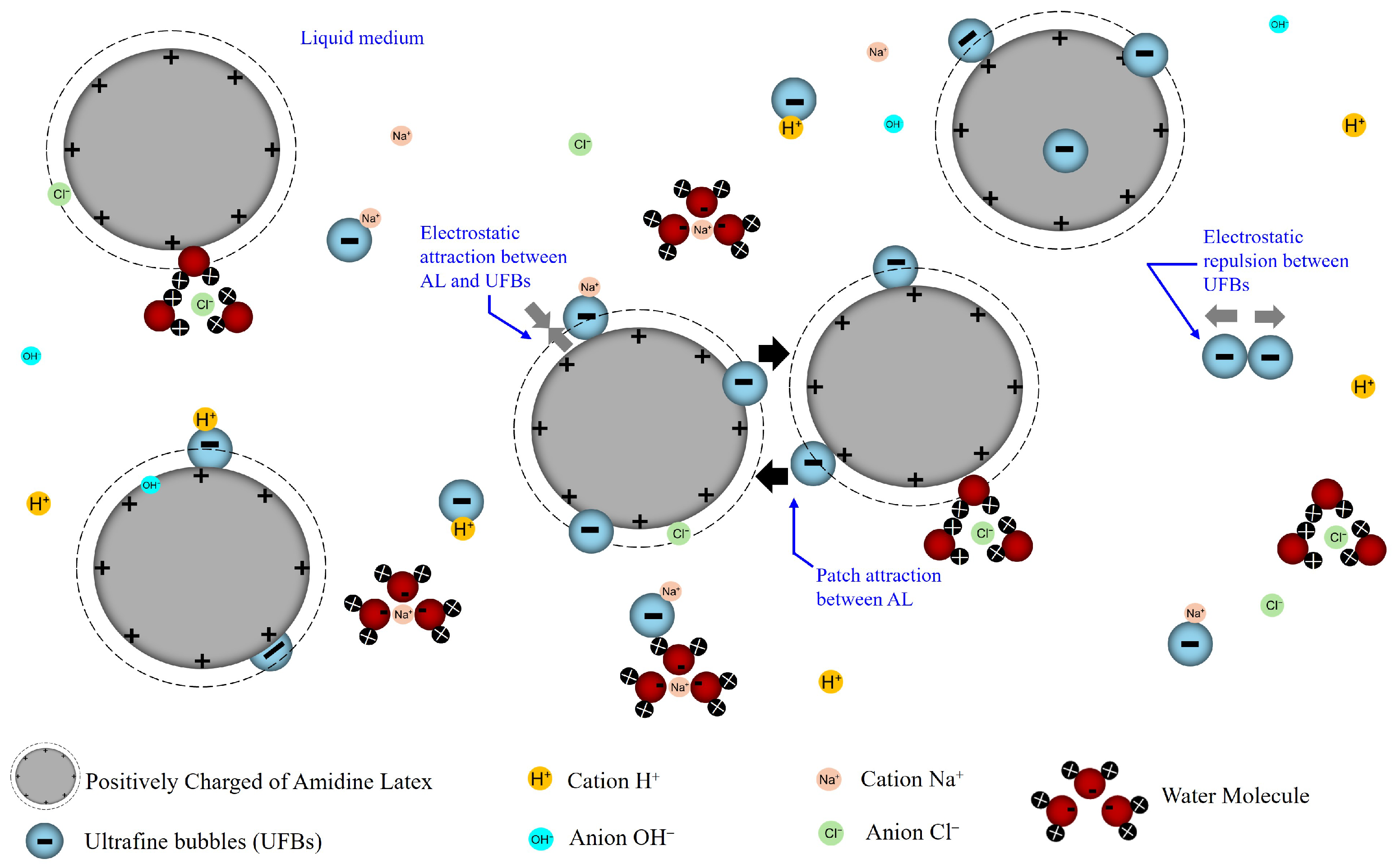
Figure 1. Schematic illustration of this study of colloidal and UFB interactions under standardized mixing. System components include positively charged AL particles, negatively charged UFBs, dissolved ions Na + and Cl controlling ionic strength (Debye length κ 1 ), interfacial H + /OH associated with pH, and water as the continuous medium. Electrostatic attraction promotes the adsorption of UFB onto AL surfaces, while UFB–UFB electrostatic repulsion governs their lateral arrangement and becomes increasingly screened at higher NaCl concentrations. The progressive accumulation of UFBs at the AL interface leads to the development of localized charge patches and the formation of an interfacial hydrodynamic layer that may subsequently influence aggregate formation and evolution.
Applnano 06 00027 g001
Figure 2. Typical size distributions of air UFBs generated in H2O measured by NanoSight using the NTA method 10 min after generation. The inset image corresponds to a snapshot of UFBs extracted from the corresponding NTA video. The red bars show standard error. Additional samples are provided in Figure S3 of the Supplementary Materials.
Applnano 06 00027 g002
Figure 3. Electrophoretic mobility of AL particle as a function of the UFB/AL concentration ratio (logarithmic scale) studied at two NaCl concentrations (0.1 and 10 mM). The pH was maintained at 6.0 ± 0.3. Error bars denote the standard deviation of three independent measurements. The dashed vertical lines indicate the interpolated concentration ratios at the charge neutralization point (CNP) for each salt condition.
Applnano 06 00027 g003
Figure 4. The temporal evolution of the hydrodynamic layer thickness of AL particle with adsorbed UFBs as a function of pH and NaCl concentration.
Applnano 06 00027 g004
Figure 5. Representative microscopic images of AL dimers at pH 6.0 ± 0.3 and 0.1 mM NaCl: (a) AL in the presence of UFBs, showing an increased center-to-center separation; (b) AL in the absence of UFBs (control).
Applnano 06 00027 g005
Figure 6. Proposed mechanism for the interaction between UFBs and positively charged AL particles: (a) stable AL suspension, (b) progressive adsorption of UFBs leading to surface charge neutralization and reduced electrostatic repulsion, and (c) further adsorption resulting in charge reversal and negatively charged aggregates.
Applnano 06 00027 g006
Figure 7. Temporal variation of AL flocculation induced by UFBs at two pH values: (a) 6.0 ± 0.3 and (b) 9.0 ± 0.3, under NaCl concentrations of 0.1 mM and 10 mM. The dashed line represents the salt-induced rapid coagulation using 1 M NaCl.
Applnano 06 00027 g007
Table 1. Enhancement factor ( β ) for UFBs-induced flocculation under different conditions.
pH Sample0.1 mM10 mM
6.0 ± 0.30.812.15
9.0 ± 0.30.441.60
Disclaimer/Publisher’s Note: The statements, opinions and data contained in all publications are solely those of the individual author(s) and contributor(s) and not of MDPI and/or the editor(s). MDPI and/or the editor(s) disclaim responsibility for any injury to people or property resulting from any ideas, methods, instructions or products referred to in the content.