Article

Development of Chitosan-Based Nanocomposite Films Functionalized with Ag/TiO2 Catalysts for Antimicrobial and Packaging Applications


by
Luiz Eduardo Nochi Castro
1,*,
William Gustavo Sganzerla
2,
Carina Mendonça Müller
3,
Lázaro José Gasparrini
3,
Helton José Alves
3,
Dirlei Diedrich Kieling
4,
Cassia Reika Takabayashi
4 and
Leda Maria Saragiotto Colpini
3,4
1
School of Food Engineering (FEA), University of Campinas (UNICAMP), Campinas 13083-862, SP, Brazil
2
Department of Environmental Technologies (IVAGRO), Faculty of Marine and Environmental Sciences (CASEM), University of Cádiz (UCA), Pol. Río San Pedro s/n, 11510 Puerto Real, Spain
3
Postgraduation Program in Environmental Engineering and Technology, Federal University of Parana (UFPR), Setor Palotina 85950-000, PR, Brazil
4
Federal University of Parana (UFPR), Campus Avançado de Jandaia do Sul, Jandaia do Sul 86900-000, PR, Brazil
*
Author to whom correspondence should be addressed.
Appl. Nano 2025, 6(4), 28; https://doi.org/10.3390/applnano6040028

Submission received: 30 October 2025 / Revised: 22 November 2025 / Accepted: 28 November 2025 / Published: 29 November 2025

Abstract

The growing demand for environmentally friendly materials has driven extensive research into biopolymer-based nanocomposites with enhanced functional performance. Chitosan, a naturally derived polysaccharide, offers excellent film-forming ability, biodegradability, and antimicrobial potential, making it a promising matrix for sustainable packaging and coating applications. In this study, a distinctive solvent-casting strategy was employed to fabricate chitosan-based nanocomposite films functionalized with dual-action silver/titania (Ag/TiO2) nanoparticles, combining both photocatalytic and metallic antimicrobial mechanisms—an approach that provides broader functionality than conventional single-component fillers. The biodegradable films were systematically characterized for their structural, mechanical, optical, and barrier properties, as well as their antimicrobial performance. The integration of Ag/TiO2 imparted unique synergistic effects, modifying film morphology and color, slightly reducing tensile strength, and enhancing hydrophobicity and structural compactness. The obtained water vapor permeability values (0.013–0.102 g·mm·m−2·h−1·kPa−1) classified the materials as moderate barriers, comparable to or better than many existing chitosan-based systems without nanofiller reinforcement. Notably, films containing 10 wt% Ag/TiO2 achieved a 40.4% reduction in Escherichia coli viability and an 8.2% inhibition of Staphylococcus aureus, demonstrating concentration-dependent antimicrobial activity superior to that of neat chitosan films. Overall, the unique combination of a biodegradable chitosan matrix with multifunctional Ag/TiO2 nanofillers offers clear advantages over traditional biopolymer films, highlighting their potential as advanced materials for active food packaging and antimicrobial surface coatings.

1. Introduction

The global demand for sustainable and renewable materials has intensified in recent years, driven by environmental concerns, resource scarcity, and the urgent need for eco-friendly solutions in food and biomedical applications [1,2]. Conventional packaging and antimicrobial systems often rely on petroleum-derived polymers and synthetic additives, which raise concerns regarding waste accumulation, toxicity, and long-term environmental impact [3,4]. As a result, increasing attention has been directed toward biopolymers derived from underutilized natural resources that can be valorized within a circular economy framework [5].
Among these biopolymers, chitosan has emerged as one of the promising candidates [6]. Chitosan is a polysaccharide obtained from the deacetylation of chitin, which is abundantly available as waste from shrimp and other shellfish industries [7]. It exhibits notable properties such as biodegradability, biocompatibility, film-forming ability, and inherent antimicrobial activity [8]. These features make chitosan a versatile material for developing functional films in applications ranging from food preservation to biomedical devices [6]. Furthermore, its derivation from marine bio-waste supports resource-efficient management and contributes to reducing environmental burdens [9].
The use of chitosan derived from shrimp shells, with a high degree of deacetylation, results in a powdered biopolymer with a higher density of free amine groups in its structure. The greater availability of these amine sites gives the biopolymer a greater capacity to perform electrostatic interactions and coordination (chelation) with ions and with the nanoparticles formed, promoting adequate dispersion and greater colloidal stability, in addition to reducing aggregation processes. These factors contribute directly to obtaining more uniform and structurally homogeneous films [10].
Given the limited discussion of the results, primarily consisting of reporting and partial interpretation, the overall value of the work would benefit significantly from an expanded introduction. Specifically, a concise review of composite polymers incorporating Ag/TiO2, along with analogous systems involving other metals or metal oxides, would provide valuable context and strengthen the foundation of the study. In recent years, several studies have explored hybrid nanocomposite films by incorporating metallic nanoparticles or metal oxides—such as Ag, ZnO, CuO, and TiO2, into biopolymer matrices to enhance antimicrobial, photocatalytic, or mechanical performance [11,12,13,14]. Ag/TiO2-based composites, in particular, have been of interest due to the synergistic combination of Ag’s strong antimicrobial activity with TiO2’s photocatalytic and stabilizing properties, yielding materials with improved microbial inhibition, oxidative capacity, UV-protection, and durability [15,16,17]. Similar enhancements have been reported in systems where TiO2 supports other metals or oxides, demonstrating improved dispersion, reduced nanoparticle agglomeration, and modified surface chemistry that influence the optical and mechanical behavior of polymer films [18,19,20]. These findings underscore the relevance of exploring multifunctional chitosan composites incorporating metal–metal oxide systems and provide a scientific basis for designing advanced hybrid films with targeted physicochemical and biological properties.
Despite these advantages, most studies on chitosan-based films have focused on simple formulations or blends with common plasticizers, leaving room for innovation in multifunctionality and enhanced bioactivity [11]. In particular, while silver nanoparticles (AgNPs) and TiO2 have been widely studied independently as antimicrobial or photocatalytic agents, their combined use in the form of Ag2O supported on TiO2 within a chitosan matrix remains underexplored [12,13,14,15,16]. This hybrid approach is expected to improve the dispersion and stability of Ag species, enhance antimicrobial effectiveness, and optimize the structural and optical properties of the films [17]. Such a strategy represents a novel pathway to create multifunctional and sustainable films with synergistic performance [18].
A further justification for this work lies in the valorization of marine bio-resources, especially shrimp shell waste, which is produced in large quantities and often discarded as low-value by-products [19]. Transforming this waste into advanced functional materials aligns with global priorities for circular economy and resource efficiency, offering a dual benefit: reducing environmental waste while generating sustainable alternatives to petroleum-based plastics [20]. Thus, the present study goes beyond conventional antimicrobial film development by coupling waste valorization, nanostructured functionalization, and sustainability-driven innovation.
The practical importance of this research is evident in both food safety and biomedical fields. Foodborne pathogens such as Escherichia coli and Staphylococcus aureus remain major causes of spoilage and health risks [21]. Active films capable of inhibiting microbial growth can extend food shelf life, reduce the need for synthetic preservatives, and ensure safer consumption [22]. In biomedical contexts, chitosan-based antimicrobial films can be applied in wound dressings, coatings, and other medical devices where infection control is critical [23]. By tailoring the balance between mechanical strength, barrier function, and bioactivity, the proposed films could serve as prototypes for a wide range of eco-friendly applications [24].
This study illustrates how renewable bio-resources can be integrated with advanced inorganic additives to develop functional materials with enhanced structural and antimicrobial performance. The novelty lies in the formulation of chitosan films doped with silver oxides supported on TiO2, along with the comprehensive evaluation of their structural, optical, mechanical, and antimicrobial properties. The findings provide valuable insights into the structure–property relationships of doped chitosan films and highlight their potential as promising candidates for future sustainable and circular economy–oriented applications.

2. Materials and Methods

2.1. Materials

All reagents and solvents used in this study were of analytical grade. Milli-Q Plus water, with a resistivity of approximately 18 MΩcm, was used for all syntheses.
The preparation method and support material play a crucial role in determining the performance of the synthesized materials. In this study, Ag-based mixed oxides supported on TiO2 were synthesized via the classical impregnation method using an excess of solvent, following the procedure of Castro et al. (2025) [25].
For the development of films, chitosan (molecular weight: 85 GD; average molar mass: 120 kDa) in powder form, derived from shrimp shells was used. The resulting films were characterized by their visual, structural, morphological, physical, optical, barrier, and mechanical properties. Antimicrobial activity was evaluated against Escherichia coli (ATCC 25922) and Staphylococcus aureus (ATCC 25923).

2.2. Synthesis of Mixed Oxides

Titanium dioxide (TiO2, Exodo Científica, Sumaré, SP, Brazil) was used as the support material. It was first dried in an oven at 120 °C for 21 h.
Mixed oxides were prepared at Ag loadings of 2% (0.9638 g) and 10% (5.2477 g), relative to the TiO2 mass. For synthesis, 30 g of dried TiO2 was dispersed in water to form a thin paste. The silver precursor (AgNO3, Sigma-Aldrich, St. Louis, MO, USA), previously dissolved in water, was then added to the mixture. The suspension was maintained under constant rotation (120 rpm) for 17 h at room temperature in a rotary evaporator. Excess solvent was removed by vacuum evaporation at approximately 80 °C. The resulting material was dried at 120 °C for 21 h, followed by calcination at 400 °C for 5 h (heating ramp of 10 °C min−1). Two Ag/TiO2 mixed oxides were obtained for comparison: Ag2%/TiO2 and Ag10%/TiO2.

2.3. Preparation of Films

Chitosan films were prepared via the casting method, based on Bhowmik et al. (2024) [26] and Xavier et al. (2021) [27], with modifications.
The control film (F1) was prepared by dissolving 1.5 g of chitosan in 150 mL of a 0.5% (w v−1) acetic acid solution and stirring overnight. Then, 10 g of glycerol was added as a plasticizer, and the mixture was magnetically stirred at 40 °C for 24 h, followed by 15 min of ultrasonication. Next, 20 g of the film-forming solution was poured into 9 cm diameter Petri dishes and dried in a circulating oven at 30 °C for 48 h, and store in the desiccator until use.
To obtain composite films, 5% (m = 0.075 g) of TiO2, Ag2%/TiO2, or Ag10%/TiO2 catalysts were each added separately to the control formulation (F1), yielding films F2, F3, and F4, respectively, based on Dai et al. (2022) [28], Constantin et al. (2022) [29], Feng et al. (2024) [30], and Ding et al. (2024) [31], with modifications.

2.4. Characterization of Films

2.4.1. Visual and Tactile Aspects

Following Rachtanapun et al. (2021) [32], the films were evaluated for continuity (absence of cracks or fractures after drying), homogeneity (absence of visible insoluble particles, opacity, or color variations), and handling (flexibility and resistance to breakage during manipulation).

2.4.2. Structure Properties

Infrared spectroscopy (FT-IR) was used for this analysis. Infrared spectra were obtained using KBr pellets of the materials in the 4000–500 cm−1 region on a PerkinElmer—Frontier™ FT-IR Spectrophotometer (Waltham, MA, USA).

2.4.3. Morphological Properties

The morphology of the samples was analyzed using TESCAN—VEGA 3 Scanning Electron Microscope (SEM) (Brno, Czech Republic). Samples were mounted on aluminum stubs with double-sided carbon tape, dried, and sputter-coated with a thin gold layer. Micrographs were captured at various magnifications in secondary electron (SE) mode. X-ray energy dispersive spectroscopy (EDS) analysis was also performed on the mixed oxides using an Oxford Instruments—PentaFET Precision EDS Detector (Abingdon, UK).

2.4.4. Physical Properties

The physical properties of the films, including thickness (Ɛ), basis weight (G), density (ρ), and solubility, were evaluated to assess their structural integrity and stability. The thickness was determined by taking the average of ten random measurements using a digital caliper (MTX, model 316119, Mytishchi, Russia). The basis weight was calculated by dividing the film mass by its corresponding surface area, while the density was determined according to the method described by Barik et al. (2024) [33].
For the solubility test, the films were cut into 2 × 2 cm samples and weighed (m0), then dried at 105 °C for 24 h to obtain the dry mass (m1). The dried samples were subsequently immersed in 50 mL of distilled water and agitated on a vertical shaker at 100 rpm for 24 h at 25 °C. After this period, the films were removed, oven-dried again at 105 °C for 24 h and weighed (m2). The percentage of water solubility was calculated using Equation (1).
Solubility =   m 1 m 2 m 1   × 100
where m1 is the dry weight (g) and m2 is the weight after solubilization (g), as described by Sganzerla et al. (2020) [34].

2.4.5. Optical Properties

Film transmittance at UV (250 nm) and visible (600 nm) wavelengths was measured using a UV-Vis spectrophotometer (Drawell, model EEQ9011I UV-B, Chongqing, China). Each measurement was performed in triplicate. Opacity was calculated according to Equation (2).
Opacity =   A 600 ( nm ) Thickness   ( mm )
Color parameters were determined using a colorimeter (CM-600d, Konica Minolta, Tokyo, Japan), yielding CIELab coordinates: L* (lightness), a* (red-green), and b* (yellow-blue). Chroma (C*) and hue angle (H°) were calculated according to Equations (3) and (4), respectively.
C * = a * 2 +   b * 2
H ° = tan 1 b * a *
The total color difference (ΔEab) between modified and control films was calculated using Equation (5).
E ab = L * 2 + a * 2 + b * 2
where ΔL*, Δa*, and Δb* represent the differences between the control and sample films.

2.4.6. Mechanical Properties

Mechanical properties were evaluated using a TA Texturometer (TX2-Plus, Stable Micro System, Godalming, UK) equipped with a 50 kgf static load cell, in accordance with ASTM Standard D882-12 [35]. Ten strips of each film, measuring 75 × 25 mm, were tested to determine the tensile strength (σ), elongation at break (ε), and Young’s modulus (ξ), which were calculated using Equations (6)–(8), respectively.
σ = F m a x A 0
ε = l l 0 l 0   ×   100
ξ = σ ε  
where Fmax is the maximum applied force, A0 is the initial cross-sectional area, l is the length at break, and l0 is the initial length.

2.4.7. Water Vapor Permeability (WVP)

Water vapor permeability was measured gravimetrically following ASTM E96-65 (1995) [36], using Equation (9).
WVP = PVA   ×   e A   ×   P   ×   ( UR 1   UR 2 )  
where PVA is the mass gain during incubation (g), e is film thickness (mm), A is the exposed area (m2), P is the vapor saturation pressure at 25 °C, UR1 is the relative humidity inside the desiccator, and UR2 is the relative humidity inside the CaCl2 capsule.

2.4.8. Antimicrobial Activity of the Films

All materials and equipment used in the antimicrobial tests were previously sterilized in an autoclave at 121 °C for 15 min, and all procedures were performed under aseptic conditions as described by BAM (2025) [37].
The antimicrobial activity of the films (F1–F4) was assessed using the surface-washing method adapted from [37]. For each bacterial strain, Escherichia coli (ATCC 25922) and Staphylococcus aureus (ATCC 25923), a bacterial suspension was prepared in Brain Heart Infusion (BHI) broth and used as the inoculum. A 10 µL aliquot of the inoculum was carefully deposited onto the surface of each film sample (1 cm2) and allowed to rest for 240 min at room temperature (25 °C). After incubation, the films were washed with 10 mL of 0.1% peptone water under vortex agitation for 30 s to recover the remaining viable cells. Serial dilutions were then prepared in 9 mL of 0.1% peptone water up to a dilution factor of 10−6, and aliquots of each dilution were plated to determine bacterial counts.
The enumeration of E. coli was performed on MacConkey sorbitol agar after incubation at 37 °C for 24 h, following the methodology of Ribeiro Junior (2024) [38], while S. aureus was quantified on Baird-Parker agar supplemented with egg yolk tellurite emulsion and incubated at 37 °C for 48 h, as described by Margalho et al. (2024) [39]. The antimicrobial efficacy of the films was expressed as the logarithmic reduction in viable cells, reported as the decimal logarithm of colony-forming units per surface area (log10 CFU/cm2).

2.5. Statistical Analysis

All experimental data were analyzed using one-way analysis of variance (ANOVA). Differences between means were evaluated by Tukey’s test at a 95% confidence level (p < 0.05) using Statistica® software (version 10.0, StatSoft Inc., Tulsa, OK, USA).

3. Results and Discussion

3.1. Films Characteristics

3.1.1. Visual and Tactile Aspects

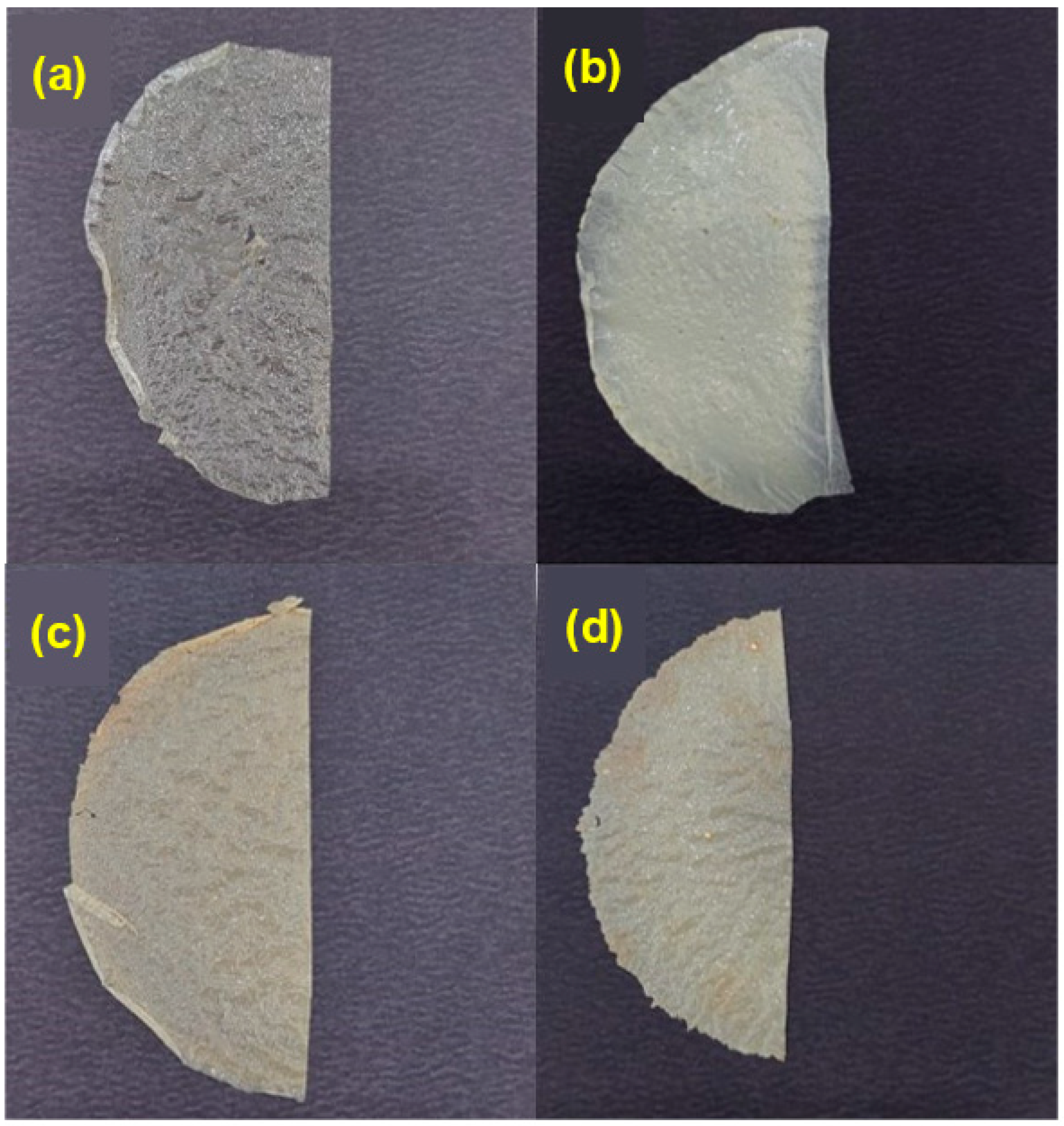
A visual and tactile evaluation of the films incorporated with chitosan was performed using images, based on the parameters of continuity, homogeneity, and handling, as shown in Table 1.
All films exhibited excellent results for continuity and handling, according to visual analysis. Regarding homogeneity, film F1 showed excellent results, F2 and F4 were rated as good, and F3 was considered poor. This deficiency in F3 is likely due to the presence of insoluble particles in the film matrix.
Chitosan films containing silver (F3 and F4) displayed gray, grainy spots with an opaque appearance, unlike F1 and F2, which were slightly translucent.
Rachtanapun et al. (2021) [32] developed chitosan-based films incorporated with turmeric extract that were homogeneous and free of insoluble particles. Similarly, Bueno et al. (2021) [40], analyzing films composed of chitosan, zein, and polyvinyl alcohol, found that higher chitosan and zein content resulted in increased surface roughness, globule accumulation, and heterogeneity.
Comparable findings were reported by Tessaro et al. (2021) [41] in “Pitanga” leaf gelatin/chitosan films produced using the casting technique. Garcia et al. (2025) [42], analyzing gelatin-based films with acerola pulp, also reported excellent or good handling properties. Among all formulations, F1 presented the best results for all parameters evaluated. Figure 1 shows the developed films.

3.1.2. Structural Properties

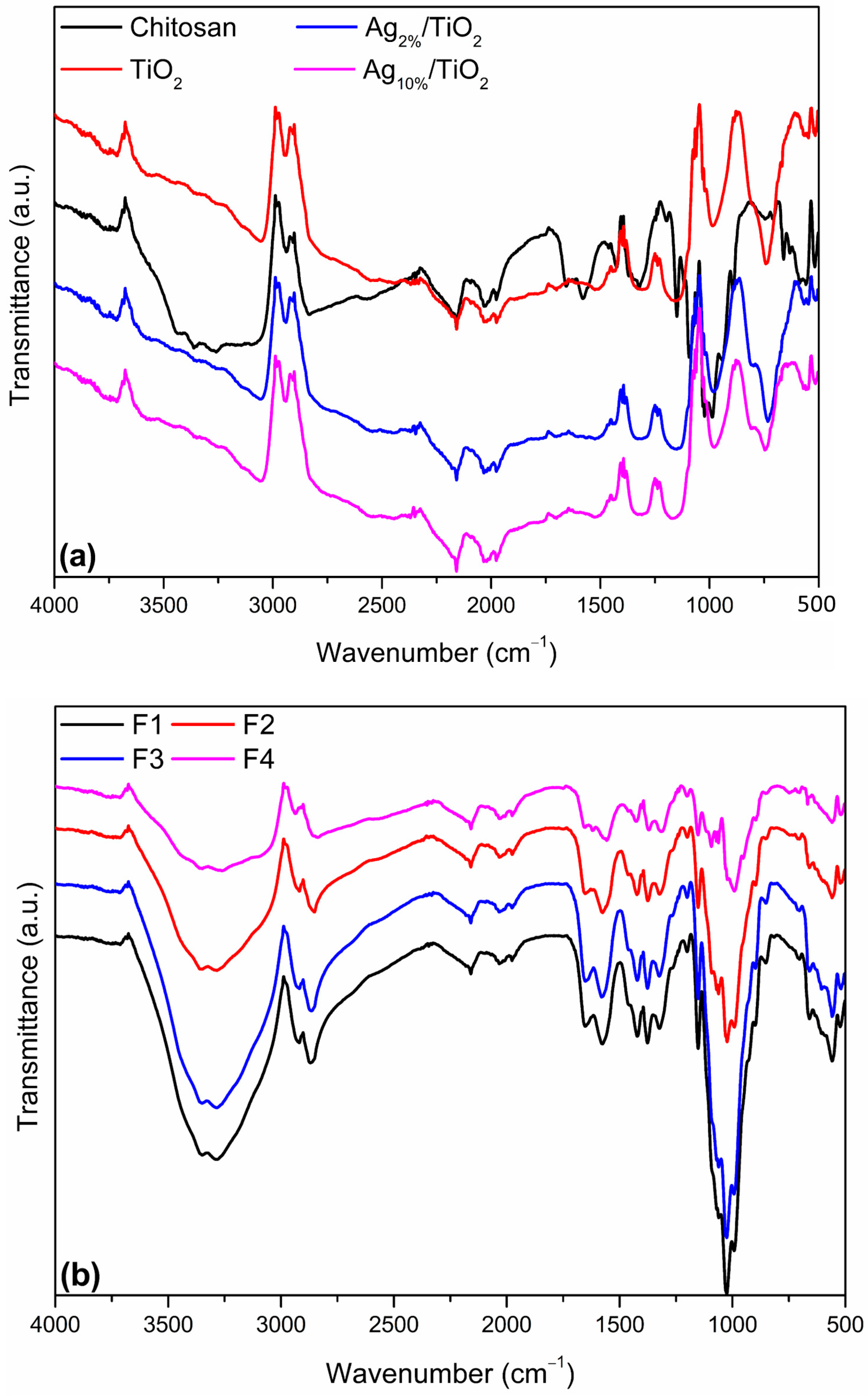
Figure 2 shows the FT-IR spectra of (a) chitosan, TiO2, and Ag-modified titania, and (b) the corresponding films. In spectrum (Figure 2a), the FT-IR profile of pure chitosan exhibits its characteristic absorption bands. The broad band centered around 3400 cm−1 corresponds to the overlapping stretching vibrations of O–H and N–H groups, typical of the chitosan backbone [43,44]. The bands near 2920–2870 cm−1 are attributed to C–H stretching vibrations of –CH2 and –CH3 groups. The peaks in the region of 1650–1590 cm−1 are associated with amide I (C=O stretching) and amide II (N–H bending) vibrations, while the bands around 1070 and 1020 cm−1 correspond to C–O–C and C–O stretching vibrations of the glucosamine ring [27]. For TiO2, the characteristic band at 570 cm−1 is assigned to Ti–O–Ti stretching vibrations [45,46]. A small shoulder around 1638 cm−1 is related to adsorbed water and Ti–OH vibrations [47,48], while the broad band near 3000 cm−1 corresponds to O–H stretching [47]. The absorption band at 1383 cm−1 is indicative of the anatase phase of titania [49]. When Ag is incorporated into titania, the spectra retain the main TiO2 features, but a noticeable modification in band intensity and broadening occurs in the O–H and Ti–O–Ti regions, suggesting interactions between Ag nanoparticles and the oxide surface. However, no distinct new band associated with an Ag–O or Ag–Ti bond is detected, in agreement with previous reports that Ag incorporation primarily affects electronic rather than vibrational modes.
In spectrum (Figure 2b), corresponding to the composite films, new absorption features appear, reflecting the integration of chitosan with the oxide materials. The broad band between 3570 and 3220 cm−1 is attributed to overlapping O–H and N–H stretching vibrations [27,50,51], while the peaks at 2980–2840 cm−1 correspond to C–H stretching modes. The region between 1520 and 1750 cm−1 shows contributions from both amide I (C=O) and amide II (N–H) bands of chitosan, indicating its successful incorporation into the composite matrix. Additionally, the bands at 1072 and 1022 cm−1, corresponding to C–O–C and C–O stretching vibrations of chitosan, are clearly visible in the films, confirming the presence of chitosan functional groups in the hybrid materials.

3.1.3. Morphological Properties

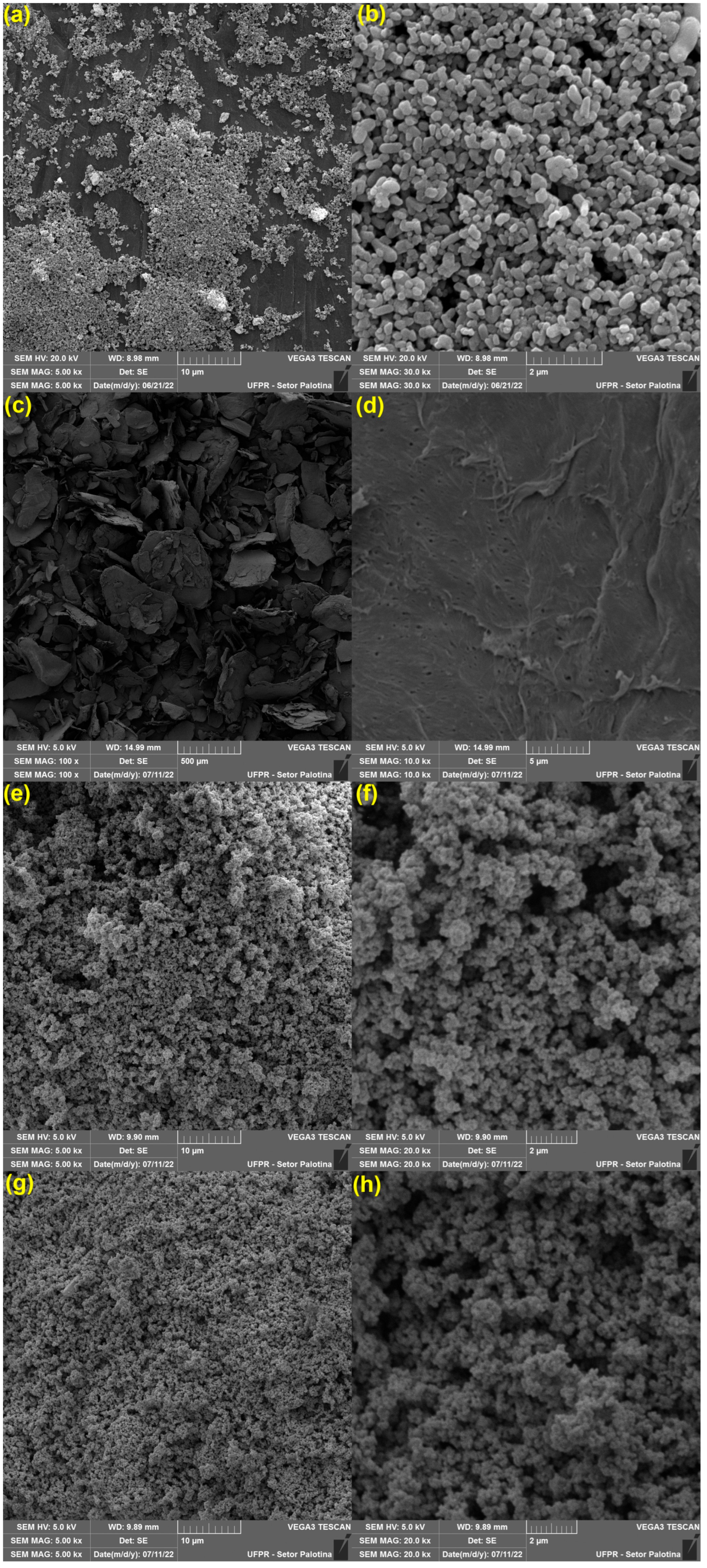
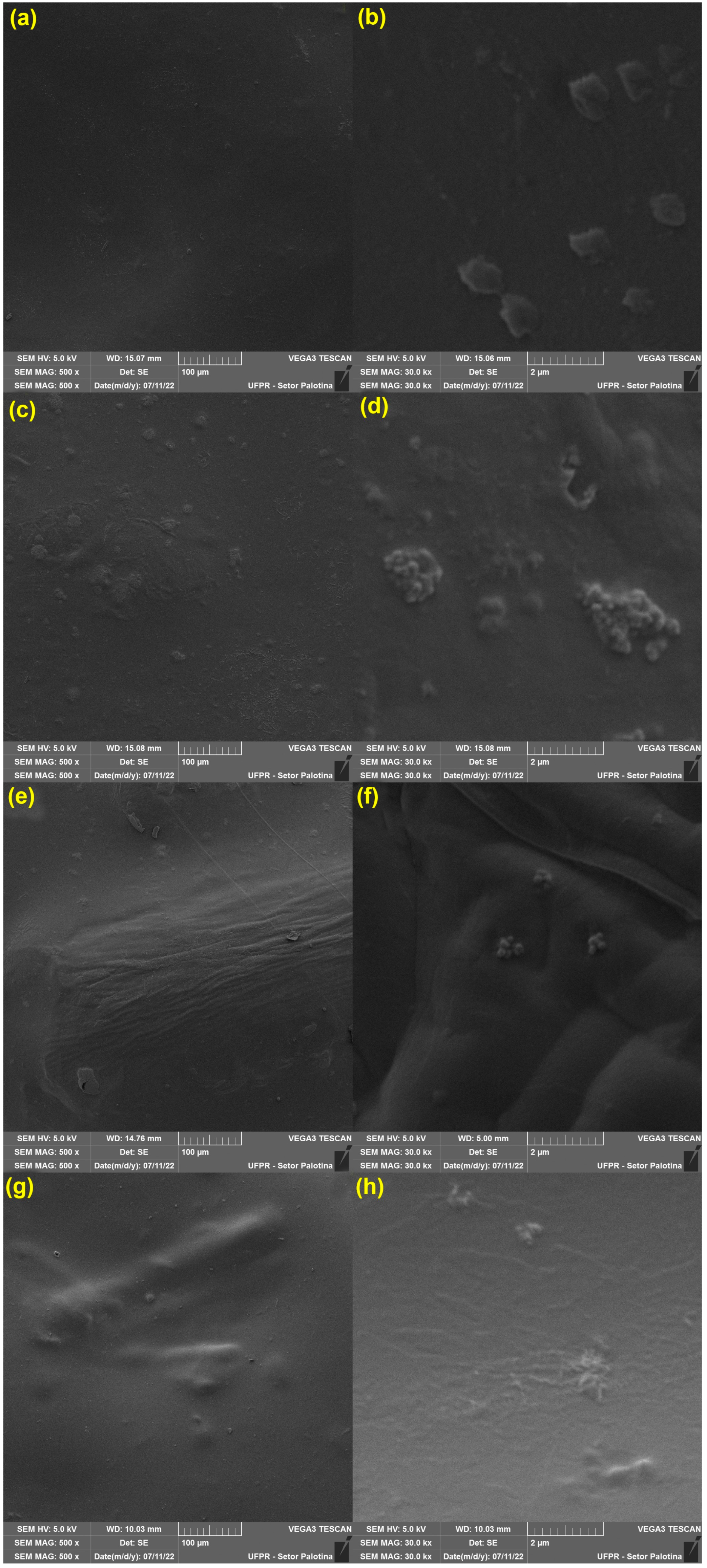
The morphological characteristics of the oxides and films were examined using scanning electron microscopy (SEM), as shown in Figure 3 and Figure 4, respectively.
In Figure 3, the micrograph of TiO2 (Figure 3b) reveals a homogeneous distribution of rounded particles across the surface, indicative of uniform particle formation. Upon incorporating silver into the oxide matrix, specifically at 2% and 10% Ag loading (micrographs Figure 3f and Figure 3h, respectively), the morphology undergoes a clear transformation. The surface becomes less uniform and develops a spongy, agglomerated structure, suggesting that silver nanoparticles influence the nucleation and growth behavior of TiO2 particles. Such morphological changes are consistent with the increased surface roughness and porosity commonly associated with Ag–TiO2 composites. The chitosan micrographs (Figure 3c,d) display a porous and rough surface, characteristic of the biopolymer’s semi-crystalline nature and typical of films produced via solvent casting. This morphology aligns with the observations of Tang et al. (2023) [51], who reported similar textural features in pure chitosan and chitosan-based composites.
In Figure 4, the SEM images of the films further illustrate the effect of composition on surface morphology. Films F1 and F2 exhibit a smooth, continuous, and homogeneous surface, in agreement with the findings of Indriyati et al. (2021) [52], who observed enhanced uniformity in chitosan-containing films due to its excellent film-forming capability. In contrast, the Ag-modified films (F3 and F4) display surface wrinkles and small, uniform cracks, revealing the presence of larger agglomerated particles corresponding to the Ag–TiO2 domains. These morphological irregularities likely arise from the interaction between the polymer matrix and the oxide particles during the drying process, leading to localized stress and particle aggregation. A comparable microstructural pattern was also reported by Meydanju et al. (2022) [50] in similar Ag–TiO2–chitosan systems.
EDS mapping (Table 2), as a semi-quantitative analysis, is fundamental for the composition of materials. The discrepancy observed for the Ag10%/TiO2 material may be related to several factors, such as the efficiency of metal incorporation during the synthesis process and the heterogeneous distribution of silver on the material’s surface. Studies show that the uneven distribution of metals in heterogeneous systems can occur due to limitations in deposition methods and control of nanoparticle morphology during synthesis. In addition, the interaction between the metal and the support also directly influences incorporation efficiency, which may explain the observed variation [53].

3.1.4. Physical Properties

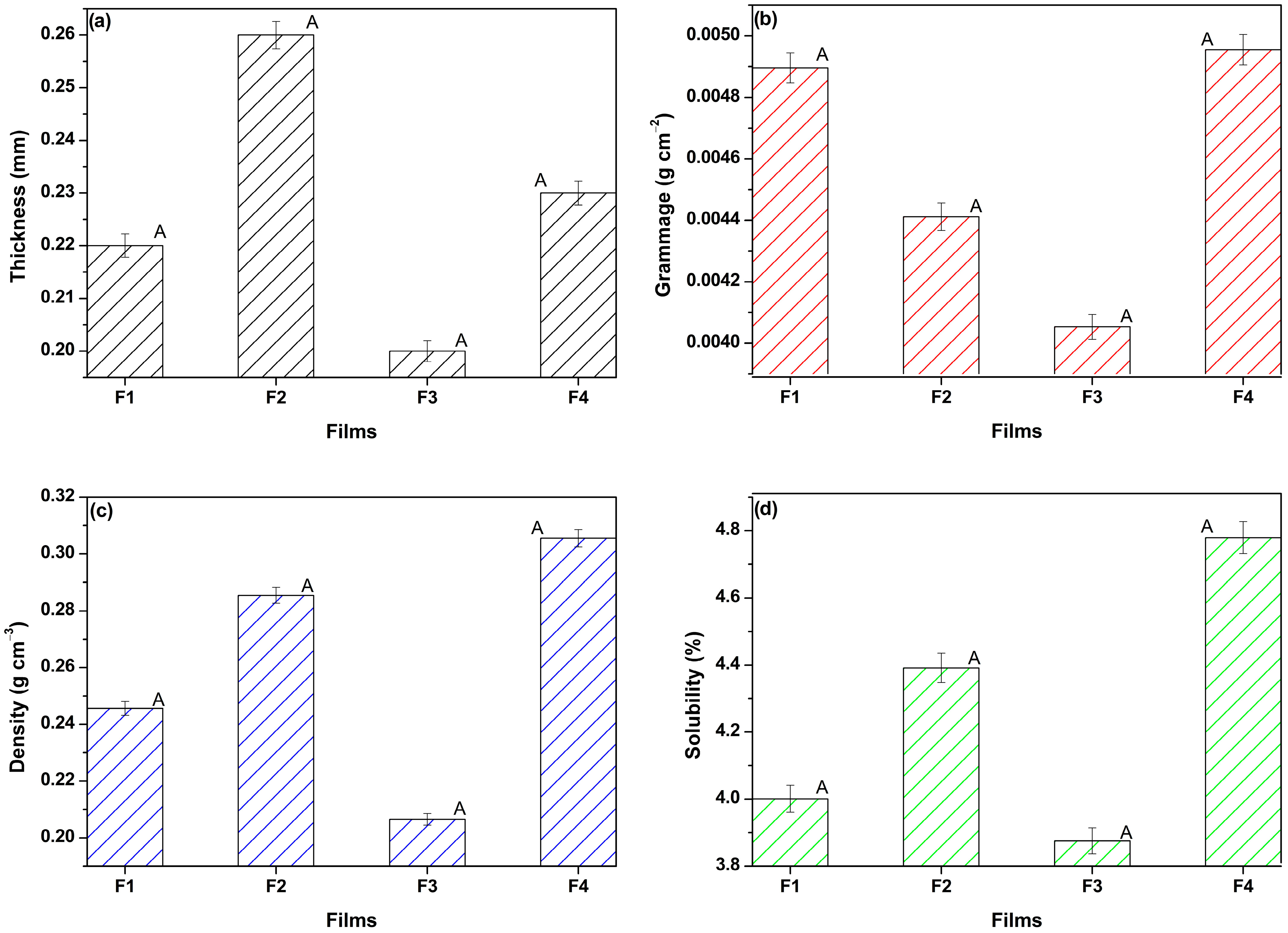
The physical properties of the films were evaluated in terms of thickness (mm), grammage (g cm−2), density (g cm−3), and solubility (%), as presented in Figure 5.
According to Zhang et al. (2024) [54], film thickness is a complex property in casting processes due to challenges in controlling both the mass ratio and the detachment of the film from the casting surface. Measuring this property is essential for ensuring uniformity, reproducibility, and consistent mechanical and barrier performance of the films. In the present study, the films showed no statistically significant differences (p ≤ 0.05) in any of the physical parameters analyzed in Figure 5, suggesting that the fabrication process was well-controlled.
Figure 5a shows the average thickness values, which fall within the range associated with good mechanical behavior. This observation is supported by the handling test results (Table 1), in which none of the films broke during manipulation. The inclusion of glycerol as a plasticizer significantly improved flexibility, preventing brittleness. Among the samples, film F2 exhibited the greatest thickness; however, upon the addition of silver, a notable increase was observed between films F3 and F4, consistent with the findings of Meydanju et al. (2022) [50].
The parameters of grammage and density (Figure 5b,c) are interrelated and directly associated with the mechanical strength of films [55]. In this context, film F4 exhibited higher values for these parameters, suggesting improved compactness and potentially greater mechanical resistance. Generally, a higher basis weight corresponds to increased structural integrity and durability. Film solubility is another critical parameter, reflecting the intermolecular interactions among film components and their balance between hydrophilic and hydrophobic characteristics [55,56].
Solubility (Figure 5d) is influenced by the degree of deacetylation of chitosan, since higher deacetylation results in more free amino groups and consequently greater water solubility [57,58]. After 24 h of immersion in water, all films retained their structural integrity, indicating that the chitosan network remained stable and cohesive. The overall solubility of these chitosan-based films was lower than that of most protein-based biofilms reported in the literature, such as sardine myofibrillar protein films [59], rice protein concentrate films [60], whey protein isolate films [61], soy protein isolate films [62], and wheat gluten films [63]. Among the samples, film F4 exhibited the highest solubility, likely due to the combined effect of silver and titania on the polymer network, which may have increased the availability of hydrophilic sites. Variations in film solubility are highly relevant to practical applications. Films with higher solubility are suitable for use as edible coatings, ingredient carriers, encapsulation matrices, or dissolvable food additives, while less soluble films are advantageous for protective or long-lasting packaging applications [22].

3.1.5. Optical Properties

Table 3 presents the results for transmittance and opacity of the films, which are inversely related—films with higher transmittance exhibit lower opacity.
Physical and optical properties are closely interconnected: thicker films generally show greater opacity, while thinner films tend to be more transparent [64]. The transparency of a film is a key factor in determining its potential applications, particularly for packaging where visual appearance and product visibility are critical [24].
According to Fiallos-Nunez (2024) [65], film opacity is influenced by the concentration of polysaccharides, plasticizers (such as glycerol), and their molecular interactions, as well as by the dilution effect of the plasticizer within the polymer matrix. Similarly, Barik et al. (2024) [65] reported that chitosan concentration is the primary factor governing opacity: higher chitosan levels promote the formation of a denser, more opaque polymer network, while increased glycerol concentration enhances the free volume within the matrix, thereby reducing opacity and increasing light transmission.
Color is another important physical attribute, as it reflects the characteristics of the raw materials and additives used in film formulation [66]. ANOVA revealed significant differences (p ≤ 0.05) among treatments for all color parameters (L*, a*, and b*), as confirmed by Tukey’s test (Table 3). Visual inspection and opacity measurements showed that films containing silver (F3 and F4) were noticeably darker and more opaque, consistent with the metallic nature of silver and its light-scattering effects. Similar observations were reported by Francisco et al. (2024) [24].
The L* parameter, which represents brightness on a scale from 0 (black) to 100 (white), ranged between 83.50 and 96.85, corresponding to a 13.8% variation and indicating films with intermediate brightness. The overall decrease in brightness may be attributed to the high concentration of solutes in the film-forming solution (5 g), which increases matrix density and light scattering.
For the a* coordinate, which ranges from green (−60) to red (+60), films F3 and F4 showed values from 1.96 to 4.54, indicating a shift toward the red spectrum, with significant differences (p ≤ 0.05) confirmed by Tukey’s test. In contrast, films F1 and F2 presented slightly negative values (−0.55 to −0.57), corresponding to a subtle greenish hue, with no significant differences between them.
Regarding the b* parameter, which quantifies the color shift from blue (−60) to yellow (+60), values ranged from 6.01 to 23.38, representing a 74.3% difference among formulations. All values were positive, indicating a predominance of yellow tones. The highest b* values were recorded for the silver-containing films, likely influenced by the intrinsic yellowish coloration of Ag–TiO2 particles dispersed within the chitosan matrix.
These color shifts are further supported by the chroma (C*) and hue angle (H°) values, which provide additional insight into the intensity and direction of the perceived color. Films F3 and F4 exhibited markedly higher chroma (14.01–23.82), indicating more saturated and vivid coloration, whereas F1 and F2 maintained low C* values (6.03–11.52), consistent with their pale appearance. The lower H° values observed for the Ag-containing films also confirm the shift toward a more pronounced yellow–reddish hue, in agreement with the increase in both a* and b* coordinates.
The global color difference (ΔEab) reinforces these findings: while F2 exhibited only a slight deviation compared with the control film, F3 and F4 showed substantially higher ΔEab values (10.55–22.08), indicating changes that are easily perceptible to the human eye. These differences are expected in formulations incorporating metallic or metal-oxide additives, as previously described in polymeric systems doped with silver-based nanoparticles.
Transparency-related parameters also aligned with the visual appearance of the films. The transmittance at 600 nm decreased notably for F2, F3, and F4, demonstrating that the inclusion of inorganic particles increased light absorption or scattering within the matrix. This effect is quantitatively reflected in the opacity values, which ranged from 5.93 Abs·mm−1 for F1 to 28.14 Abs·mm−1 for F4. These results confirm that silver-containing films, particularly F3 and F4, were significantly more opaque than the control, consistent with their darker appearance and the enhanced optical density imparted by the dopants.
Together, these optical parameters clearly demonstrate the influence of Ag–TiO2 incorporation on both color and transparency, confirming that the additives not only modified the films’ visual properties but also contributed to increased scattering and absorption phenomena within the chitosan matrix.

3.1.6. Mechanical Properties

Table 4 presents the results for tensile strength, Young’s modulus, and elongation at break of the films. Overall, the incorporation of TiO2 and Ag led to a significant decrease (p < 0.05) in both tensile strength and Young’s modulus compared to film F1 (100% chitosan). Among all samples, film F3 exhibited the lowest values for these parameters, indicating that the introduction of the inorganic phase negatively affected the cohesive integrity of the polymer matrix.
Film F4, which contained the highest silver concentration, showed the lowest elongation at break, differing significantly (p < 0.05) from the other formulations. This behavior can be attributed to the anti-plasticizing effect of the Ag-TiO2 system, which restricts the mobility of polymer chains by reducing the available free volume within the chitosan network, consequently diminishing film flexibility [50].
According to Almeida et al. (2022) [67], films with lower flexibility typically exhibit higher Young’s modulus values, reflecting increased rigidity and resistance to deformation. In the present study, film F1 (pure chitosan) displayed a significantly higher (p < 0.05) Young’s modulus compared to the composite films, confirming its greater stiffness and lower capacity for elongation. The reduction in mechanical strength and elasticity observed in the composite films may also result from heterogeneous dispersion or agglomeration of TiO2 and Ag particles within the polymer matrix, which can create microstructural discontinuities that act as stress concentration sites, weakening the film’s mechanical cohesion.

3.1.7. Water Vapor Permeability of the Films

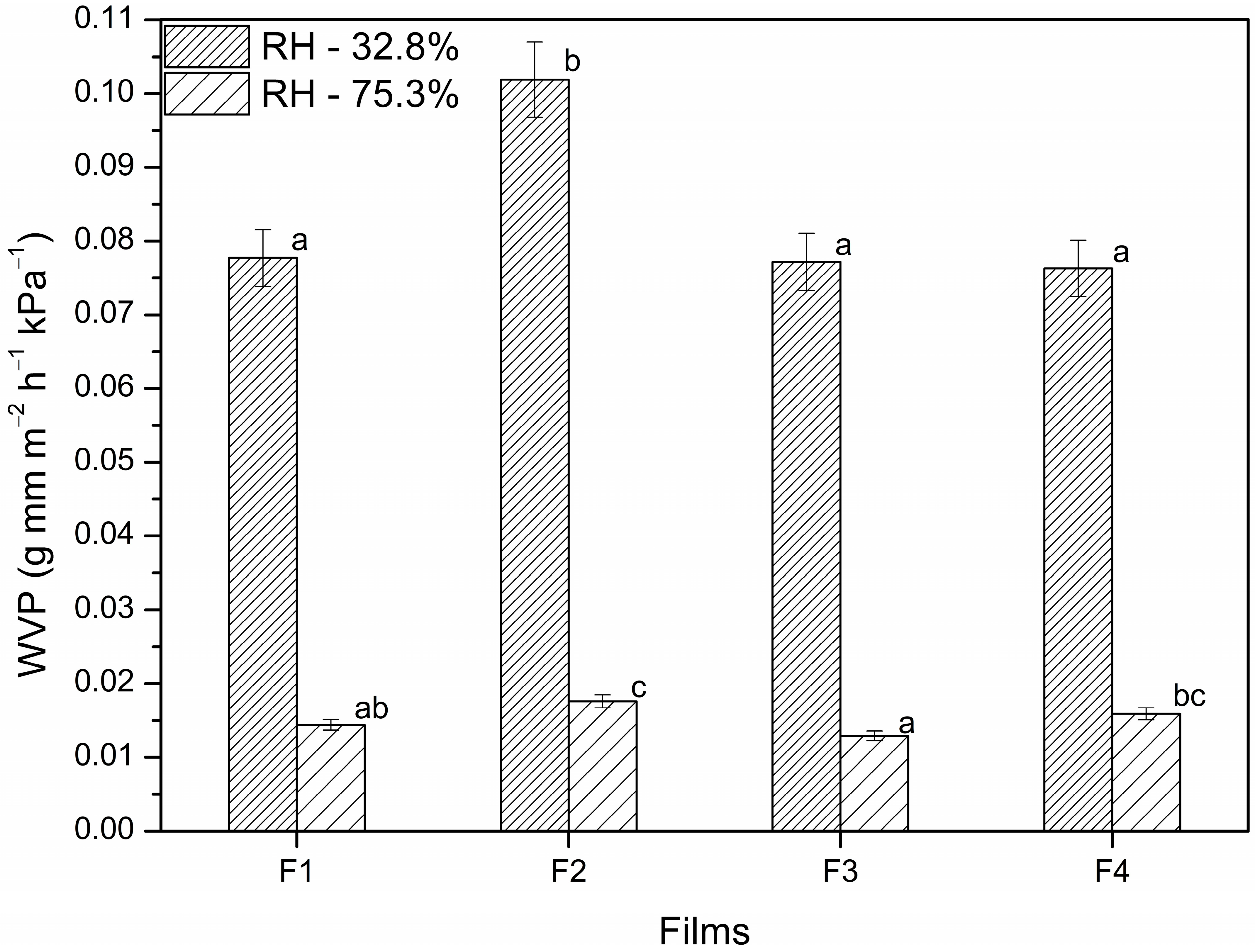
The water vapor permeability of the films was evaluated based on the permeability rate, film thickness, and exposed surface area, as shown in Figure 6. Water vapor permeability can be classified as weak barrier (0.4–4.2 g mm m−2 h−1 kPa−1), moderate barrier (0.004–0.4 g mm m−2 h−1 kPa−1), or good barrier (0.0004–0.004 g mm m−2 h−1 kPa−1) [68]. In the present study, at 33% relative humidity (MgCl2), the films exhibited WVP values ranging from 0.076 to 0.102 g mm m−2 h−1 kPa−1, classifying them as moderate barriers to water vapor. Statistical analysis indicated a significant difference (p ≤ 0.05) among the films, particularly with respect to film F2, which demonstrated a distinct permeability behavior influenced by chitosan incorporation.
At 75% relative humidity (NaCl), the WVP values varied between 0.013 and 0.018 g mm m−2 h−1 kPa−1, again corresponding to a moderate barrier classification. Significant differences (p ≤ 0.05) were observed among all formulations. Film F3 exhibited the lowest permeability, suggesting enhanced barrier properties, while film F2 showed the highest permeability, indicating a greater tendency for water vapor transmission through its structure. The observed variations can be attributed to the composition and microstructural characteristics of the films, particularly the presence and dispersion of the inorganic phases.
The hydrophilic–hydrophobic balance of a film plays a crucial role in determining its barrier behavior. As shown in Figure 6, the incorporation of silver nanoparticles into the chitosan–TiO2 polymer matrix significantly reduced the permeability of the films, a desirable result for packaging applications. This reduction can be explained by the formation of more tortuous diffusion pathways, which hinder the movement of water molecules through the polymer network and thus enhance the barrier effect. Furthermore, WVP generally decreases as particle size becomes smaller, since nanoscale fillers increase the complexity of the diffusion path. However, this beneficial effect may be partially offset by particle agglomeration, which can create discontinuities that facilitate water vapor transmission.
To contextualize the performance of the developed films, it is important to compare them to conventional polymers used in the food industry. Materials such as polypropylene (PP) typically have water vapor permeability values ranging from 4.7 × 10⁻⁵ to 6.4 × 10⁻⁴ g·(m·day·Pa)−1 at 25 °C and 65% relative humidity. These values reflect the materials’ hydrophobic and highly crystalline nature [69,70]. According to manufacturers’ technical data, polyethylene terephthalate (PET) films with a thickness of 25 µm have an approximate permeation of 18 g·m−2·day−1. Technical reports also indicate significant structural differences between PP and PET that affect their barrier properties [71,72,73]. Considering these, the values obtained for the moderate-barrier chitosan/TiO2/Ag films are within a range compatible with commercially used polymeric materials, especially when methodological differences, thickness, and test conditions are taken into account. This comparison shows that the produced material has competitive potential as active packaging with adequate barrier properties.
These findings align with previous reports by Cazon et al. (2022) [74], Bhattarai and Janaswamy (2024) [75], and Meydanju et al. (2022) [50], who demonstrated that the incorporation of nanoparticles, plasticizers, and other additives affects the solubility and water vapor permeability of biodegradable films. The results of the present study therefore confirm that the inclusion of silver within the chitosan–TiO2 matrix enhances the barrier performance of the films by reducing water vapor transmission, contributing to their potential use in active and protective food packaging applications. Similar studies corroborate the use of chitosan films for use in food packaging [33,76,77,78].

3.1.8. Antimicrobial Activity of the Films

The antimicrobial activity results (Table 5) revealed distinct responses depending on the film composition and the microorganism tested. Films F1 and F2 (without silver) did not exhibit a bactericidal effect against Escherichia coli but may have shown a bacteriostatic effect, as bacterial counts did not increase significantly after 240 min. In contrast, films F3 and F4 (containing silver) demonstrated bactericidal activity against E. coli, with F4 (the film with the highest silver content) inactivating approximately 40.4% of the bacterial population after 240 min of contact. Against Staphylococcus aureus, only F4 showed measurable bactericidal activity, achieving 8.2% bacterial inactivation within the same period. In comparison, films F1 and F2 showed no inhibition and even a slight increase in bacterial growth after 240 min.
These findings confirm that silver is a key component responsible for the antimicrobial activity of the films, and that increasing the silver concentration enhances their bactericidal effect. Moreover, the antimicrobial efficacy varies according to the type of microorganism, being considerably higher against Gram-negative (E. coli) than Gram-positive (S. aureus) bacteria. This pattern aligns with recent studies, for example, Chicea et al. (2024) [79] reported stronger antibacterial activity of silver-containing nanocomposites against E. coli than S. aureus, while Ramachandran et al. (2023) [80] also observed reduced efficacy of silver-based materials against Gram-positive strains.
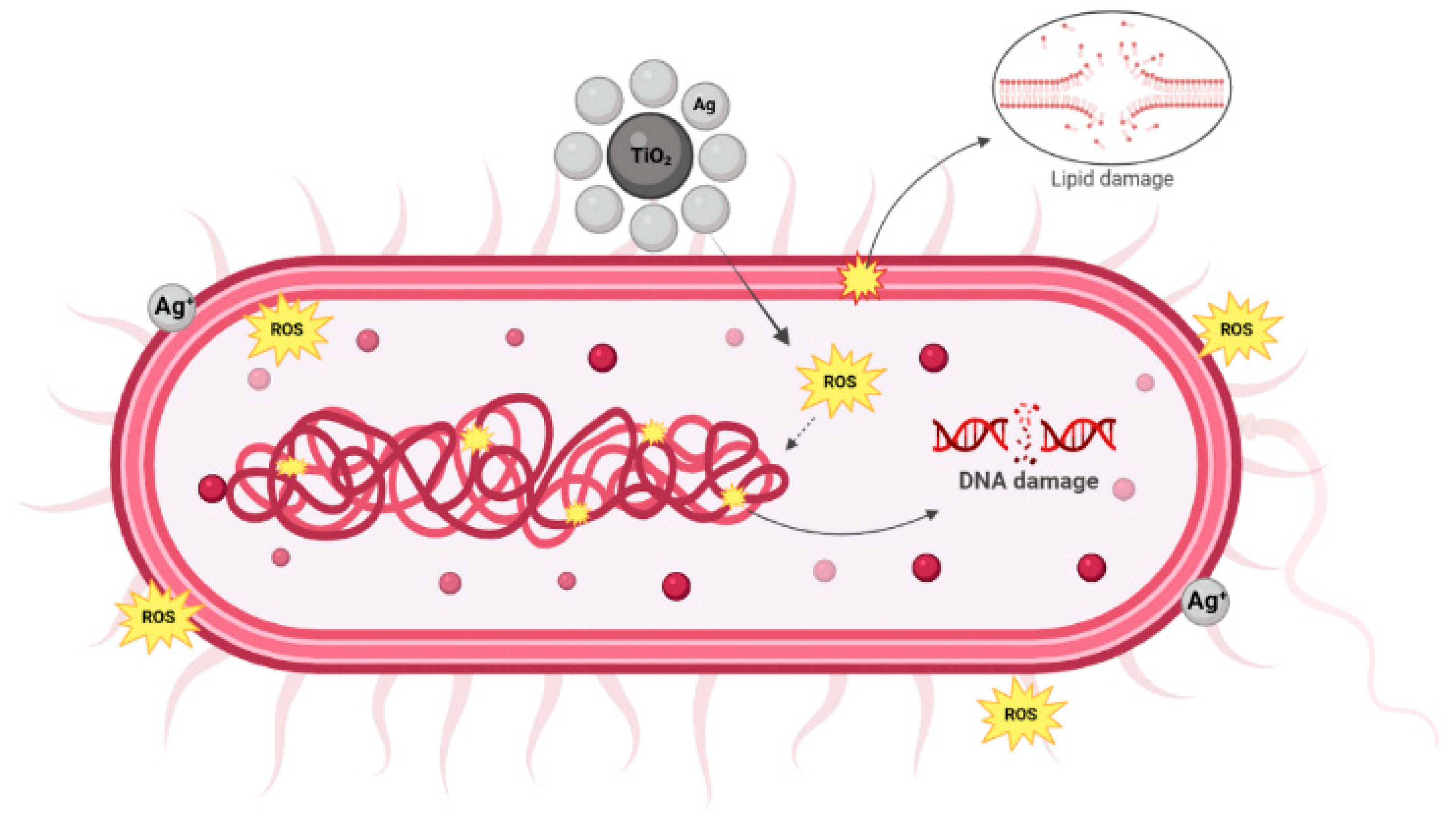
Although the mechanism of silver’s antibacterial action is not yet fully elucidated, several well-supported hypotheses exist. Silver nanoparticles are believed to disrupt the bacterial cell membrane, increasing its permeability and leading to the leakage of intracellular contents. Once internalized, they may bind to essential enzymes and proteins, interfering with DNA replication and other metabolic processes. In addition, the release of Ag+ ions can promote the generation of reactive oxygen species (ROS), which cause oxidative stress, damaging lipids, proteins, and nucleic acids. These mechanisms are supported by recent studies such as Atanda et al. (2024) [81], who demonstrated potent antibacterial effects against E. coli and Staphylococcus saprophyticus linked to silver release and ROS-mediated damage, and Chegini et al. (2024) [82], who reported enhanced ROS-driven antimicrobial activity against S. aureus, including resistant strains. However, silver nanoparticles have limitations: at low concentrations, they tend to aggregate easily, compromising their stability; at high concentrations, they increase cytotoxicity and hinder their recovery after reactions [83,84]. Figure 7 illustrates the antimicrobial mechanism involved in films with silver nanoparticles.
Overall, the present results are consistent with the current literature, confirming that the incorporation of silver nanoparticles into chitosan-based films markedly enhances their antimicrobial performance, particularly against Gram-negative bacteria. The observed increase in bacterial inactivation with higher silver concentrations demonstrates the strong dose-dependent nature of this effect. However, the comparatively lower activity against Gram-positive bacteria represents an inherent limitation that should be considered when designing biodegradable films for broad-spectrum antimicrobial applications.

3.2. Limitations, Challenges, and Future Perspectives

Although the developed chitosan–Ag/TiO2 nanocomposite films exhibited multifunctional characteristics, several limitations of the present study should be acknowledged to contextualize the findings and guide future research efforts. One important aspect concerns the potential migration of silver species from the films into food matrices. As this study did not assess specific or overall migration, the extent to which Ag+ ions or nanoparticulate silver may transfer into food remains unknown. This represents a relevant safety consideration, especially in light of international regulations such as EU 10/2011, which establishes a specific migration limit of 0.05 mg kg−1 for silver in food-contact materials [85]. Migration behavior can be influenced by nanoparticle size, film composition, storage temperature, and food properties; therefore, future work should include migration tests using standardized food simulants and controlled time–temperature conditions, as well as kinetic analyses of silver release under practical storage environments [86]. Recent studies evaluating nanocomposite-based active packaging highlight the necessity of such assessments to ensure regulatory compliance and food safety [43,79,80].
Another limitation is related to the dispersion of Ag–TiO2 fillers within the chitosan matrix. SEM imaging indicated partial agglomeration, particularly at higher silver loadings, which may influence mechanical behavior, barrier uniformity, and reproducibility during scale-up. Such heterogeneity is common in polymer–nanoparticle systems and suggests the need for improved dispersion strategies, including surface modification, in situ nanoparticle synthesis, or high-energy mixing techniques [84]. Additionally, the antimicrobial evaluation relied on surface inoculation with pure cultures, which provides controlled conditions but does not account for the complexity of real food matrices, where proteins, lipids, and natural microflora may affect antimicrobial responses [47]. The films were also not assessed under dynamic environmental conditions, such as varying humidity or mechanical stress, which could affect water vapor transmission, structural stability, and silver release.
The absence of real food-packaging application tests represents another important limitation. Although the antimicrobial and barrier properties suggest potential for active packaging, the recent literature indicates that in situ application studies are essential for validating performance on actual food systems. Investigations using fresh meats, fruit, dairy products, or minimally processed foods allow assessment of microbial behavior, physicochemical changes, and sensory attributes during storage [28,30,31]. Integrating similar trials would strengthen the practical relevance of the films and clarify their shelf-life extension potential [14].
A further issue relates to the claim of biodegradability, which is inherent to chitosan-based materials but was not experimentally evaluated in this study. Biodegradation depends on multiple environmental factors, including microbial activity, humidity, pH, and soil composition, and may be influenced by the incorporation of inorganic fillers such as silver and titania. Although chitosan is widely recognized as a biodegradable polysaccharide [11,33,87], the presence of metallic nanoparticles can alter degradation pathways or persistence in soil. While several studies have demonstrated that chitosan films degrade under composting or soil burial conditions within weeks to months, particularly when formulated with plasticizers or natural extracts, comparable degradation performance cannot be assumed for the present Ag/TiO2-containing films. Future experiments should therefore include biodegradation assays, such as soil burial tests, composting trials, or CO2 evolution methods, to quantify degradation rate, mass loss, and structural changes over time. Additionally, ecotoxicological assessments would help determine potential environmental impacts associated with nanoparticle release during the degradation process.
Finally, broader considerations related to scale-up, environmental impact, and potential applications beyond food packaging should also be addressed. Although solvent casting offers good control at laboratory scale, industrial implementation may require adaptation to continuous processes such as extrusion or roll-coating. Life-cycle assessments and environmental fate analyses would provide insights into the sustainability of integrating metallic nanoparticles into biodegradable matrices, especially in the context of circular economy principles. Future directions may include optimizing filler dispersion, developing multilayer structures to improve moisture barrier properties, evaluating hybrid antimicrobial systems to reduce silver reliance, and expanding applications to fields such as surface coatings, self-cleaning materials, and biomedical devices.
By addressing these aspects—migration analysis, real-food testing, biodegradability evaluation, environmental assessment, and material optimization—future studies can provide a more comprehensive understanding of the performance, safety, and sustainability of chitosan–Ag/TiO2 nanocomposite films.

4. Conclusions

This study demonstrated the successful development of chitosan-based nanocomposite films functionalized with Ag/TiO2 nanoparticles through a sustainable and straightforward fabrication approach. According to visual analysis, all films showed excellent results for continuity and handling. Structural (FTIR) and morphological (SEM) analyses confirmed the effective incorporation of Ag/TiO2, leading to increased surface roughness and altered optical characteristics. FT-IR showed characteristic regions attributed to oxygen and titanium bonding in the oxides, and characteristic chitosan bonding was observed in the films. However, with the incorporation of silver, no Ag-TiO2 bonding band was observed; in SEM, films F1 and F2 appeared homogeneous and with a continuous surface, whereas when silver was added, it was noted that in films F3 and F4, wrinkles began to appear on the surface, i.e., small uniform cracks, allowing clear visualization of larger particles formed by the agglomeration of Ag-TiO2. The addition of silver reduced tensile strength from 17.83 to 10.51 MPa but preserved flexibility suitable for packaging applications. Water vapor permeability values (0.013–0.102 g·mm·m−2·h−1·kPa−1) classified the films as moderate barriers.
Antimicrobial tests revealed significant bactericidal effects, particularly in the 10 wt% Ag/TiO2 formulation, which achieved a 40.4% reduction in Escherichia coli and an 8.2% reduction in Staphylococcus aureus, indicating concentration-dependent activity. Incorporating Ag/TiO2 into the chitosan matrix enhanced the functional and protective performance of the films while maintaining biodegradability.
Overall, these findings highlight the potential of chitosan–Ag/TiO2 nanocomposite films as multifunctional, eco-friendly materials for active food packaging and antimicrobial coatings. Future research should focus on optimizing nanoparticle dispersion, scaling up fabrication, and assessing long-term biodegradation to facilitate their broader application in sustainable material technologies, such as studying the antimicrobial characteristics with the addition of chitosan, silver, and titania in various construction materials and packaging; conducting a study on the production process of these self-cleaning materials, such as ceramic coatings, paints, glass, grout, among others; expand the scale of application of mixed oxides in these products and making construction materials more sustainable, improving people’s quality of life.

Author Contributions

Conceptualization: L.E.N.C., W.G.S., C.M.M.; Methodology: L.E.N.C., W.G.S., C.M.M., L.J.G., H.J.A., D.D.K., C.R.T., and L.M.S.C.; Investigation: L.E.N.C., W.G.S., C.M.M., D.D.K. and C.R.T.; Validation: L.E.N.C., W.G.S., H.J.A. and L.M.S.C.; Writing—original draft preparation: L.E.N.C., W.G.S., C.M.M., L.J.G., H.J.A., D.D.K. and C.R.T.; Writing—review and editing: W.G.S., L.J.G., H.J.A. and L.M.S.C.; Funding acquisition: L.M.S.C.; Resources: L.M.S.C.; Supervision: L.M.S.C. All authors have read and agreed to the published version of the manuscript.

Funding

This research received no external funding.

Data Availability Statement

The raw data supporting the conclusions of this article will be made available by the authors on request.

Acknowledgments

This study received support from Brazilian funding agencies, including CNPq, and CAPES.

Conflicts of Interest

The authors declare no conflicts of interest.

References

  1. Wang, J.; Euring, M.; Ostendorf, K.; Zhang, K. Biobased Materials for Food Packaging. J. Bioresour. Bioprod. 2022, 7, 1–13. [Google Scholar] [CrossRef]
  2. Zhang, Y.; Poon, K.; Masonsong, G.S.P.; Ramaswamy, Y.; Singh, G. Sustainable Nanomaterials for Biomedical Applications. Pharmaceutics 2023, 15, 922. [Google Scholar] [CrossRef]
  3. Versino, F.; Ortega, F.; Monroy, Y.; Rivero, S.; López, O.V.; García, M.A. Sustainable and Bio-Based Food Packaging: A Review on Past and Current Design Innovations. Foods 2023, 12, 1057. [Google Scholar] [CrossRef] [PubMed]
  4. Shi, X.; Cui, L.; Xu, C.; Wu, S. Next-Generation Bioplastics for Food Packaging: Sustainable Materials and Applications. Materials 2025, 18, 2919. [Google Scholar] [CrossRef] [PubMed]
  5. Stark, N.M.; Matuana, L.M. Trends in Sustainable Biobased Packaging Materials: A Mini Review. Mater. Today Sustain. 2021, 15, 100084. [Google Scholar] [CrossRef]
  6. Khubiev, O.M.; Egorov, A.R.; Kirichuk, A.A.; Khrustalev, V.N.; Tskhovrebov, A.G.; Kritchenkov, A.S. Chitosan-Based Antibacterial Films for Biomedical and Food Applications. Int. J. Mol. Sci. 2023, 24, 10738. [Google Scholar] [CrossRef]
  7. Riahi, Z.; Rhim, J.-W.; Bagheri, R.; Pircheraghi, G.; Lotfali, E. Carboxymethyl Cellulose-Based Functional Film Integrated with Chitosan-Based Carbon Quantum Dots for Active Food Packaging Applications. Prog. Org. Coat. 2022, 166, 106794. [Google Scholar] [CrossRef]
  8. Chonanant, C.; Chancharoen, P.; Kiatkulanusorn, S.; Luangpon, N.; Klarod, K.; Surakul, P.; Thamwiriyasati, N.; Singsanan, S.; Ngernyuang, N. Biocomposite Scaffolds Based on Chitosan Extraction from Shrimp Shell Waste for Cartilage Tissue Engineering Application. ACS Omega 2024, 9, 39419–39429. [Google Scholar] [CrossRef]
  9. Castro, L.E.N.; Barroso, T.L.C.T.; Ferreira, V.C.; Sganzerla, W.G.; Burgon, V.H.; Queiroz, M.; Ribeiro, L.F.; Forster-Carneiro, T. Application of Functional Compounds from Agro-Industrial Residues of Brazilian’s Tropical Fruits Extracted by Sustainable Methods in Alginate-Chitosan Microparticles. Bioact. Carbohydr. Diet. Fibre 2024, 32, 100441. [Google Scholar] [CrossRef]
  10. Jbeli, A.; Hamden, Z.; Bouattour, S.; Ferraria, A.M.; Conceição, D.S.; Ferreira, L.F.V.; Chehimi, M.M.; do Rego, A.M.B.; Rei Vilar, M.; Boufi, S. Chitosan-Ag-TiO2 Films: An Effective Photocatalyst under Visible Light. Carbohydr. Polym. 2018, 199, 31–40. [Google Scholar] [CrossRef]
  11. da Silva Ponciano, C.; Gonzaga, F.C.; de Oliveira, C.P. Smart Packaging Based on Chitosan Acting as Indicators of Changes in Food: A Technological Prospecting Review. Int. J. Biol. Macromol. 2025, 319, 145722. [Google Scholar] [CrossRef]
  12. Zagloul, H.; Dhahri, M.; Bashal, A.H.; Khaleil, M.M.; Habeeb, T.H.; Khalil, K.D. Multifunctional Ag2O/Chitosan Nanocomposites Synthesized via Sol-Gel with Enhanced Antimicrobial, and Antioxidant Properties: A Novel Food Packaging Material. Int. J. Biol. Macromol. 2024, 264, 129990. [Google Scholar] [CrossRef]
  13. Peng, Y.; Zhou, H.; Wu, Y.; Ma, Z.; Zhang, R.; Tu, H.; Jiang, L. A New Strategy to Construct Cellulose-Chitosan Films Supporting Ag/Ag2O/ZnO Heterostructures for High Photocatalytic and Antibacterial Performance. J. Colloid Interface Sci. 2022, 609, 188–199. [Google Scholar] [CrossRef]
  14. Unnikrishnan, G.; Muthuswamy, S.; Kolanthai, E.; Megha, M.; Thomas, J.; Haris, M.; Gopinath, G.; Varghese, R.; Ayyasamy, S. Synthesis and Analysis of Multifunctional Graphene Oxide/Ag2O-PVA/Chitosan Hybrid Polymeric Composite for Wound Healing Applications. Int. J. Biol. Macromol. 2024, 277, 134301. [Google Scholar] [CrossRef]
  15. Peng, Y.; Zhou, H.; Ma, Z.; Tian, L.; Zhang, R.; Tu, H.; Jiang, L. In Situ Synthesis of Ag/Ag2O–Cellulose/Chitosan Nanocomposites via Adjusting KOH Concentration for Improved Photocatalytic and Antibacterial Applications. Int. J. Biol. Macromol. 2023, 225, 185–197. [Google Scholar] [CrossRef]
  16. Ding, X.; Zhao, Y.; Chen, X.; Huang, Y.; Lin, Z.; Wang, J.; Chen, G.; Liu, G.; Xu, X.; Jiao, B.; et al. Chitosan/Kudzu-Based Packaging Films Synergistically Reinforced by Paeonol@ZIF-8 and Ag2CO3/Ag2O Nano-Heterojunctions for Raspberry Preservation. Food Packag. Shelf Life 2025, 51, 101584. [Google Scholar] [CrossRef]
  17. Ragab, H.M.; Diab, N.S.; AlElaimi, M.; Alghamdi, A.M.; Farea, M.O.; Farea, A. Fabrication and Characterization of Silver Nanoparticle-Doped Chitosan/Carboxymethyl Cellulose Nanocomposites for Optoelectronic and Biological Applications. ACS Omega 2024, 9, 22112–22122. [Google Scholar] [CrossRef] [PubMed]
  18. Alven, S.; Aderibigbe, B.A. Chitosan-Based Scaffolds Incorporated with Silver Nanoparticles for the Treatment of Infected Wounds. Pharmaceutics 2024, 16, 327. [Google Scholar] [CrossRef] [PubMed]
  19. Gao, M.; Tang, H.; Zhu, H. Advances in Extraction, Utilization, and Development of Chitin/Chitosan and Its Derivatives from Shrimp Shell Waste. Compr. Rev. Food Sci. Food Saf. 2024, 23, e70008. [Google Scholar] [CrossRef]
  20. Yamsomphong, K.; Xu, H.; Yang, P.; Yotpanya, N.; Yokoi, T.; Takahashi, F. Transforming Waste into Wealth in Sustainable Shrimp Aquaculture: Effective Phosphate Removal and Recovery Using Shrimp Shell-Derived Adsorbents. Sep. Purif. Technol. 2025, 357, 129982. [Google Scholar] [CrossRef]
  21. Gao, R.; Liu, X.; Xiong, Z.; Wang, G.; Ai, L. Research Progress on Detection of Foodborne Pathogens: The More Rapid and Accurate Answer to Food Safety. Food Res. Int. 2024, 193, 114767. [Google Scholar] [CrossRef]
  22. Sganzerla, W.G.; Castro, L.E.N.; da Rosa, C.G.; Almeida, A.d.R.; Maciel-Silva, F.W.; Kempe, P.R.G.; de Oliveira, A.L.R.; Forster-Carneiro, T.; Bertoldi, F.C.; Barreto, P.L.M.; et al. Production of Nanocomposite Films Functionalized with Silver Nanoparticles Bioreduced with Rosemary (Rosmarinus officinalis L.) Essential Oil. J. Agric. Food Res. 2023, 11, 100479. [Google Scholar] [CrossRef]
  23. Jiang, S.; Guo, T.; Liu, J.; Liu, T.; Gong, W. Biodegradable Antimicrobial Films Prepared in a Continuous Way by Melt Extrusion Using Plant Extracts as Effective Components. Food Chem. 2025, 464, 141643. [Google Scholar] [CrossRef]
  24. Francisco, A.P.; Sganzerla, W.G.; Nochi Castro, L.E.; Cruz Tabosa Barroso, T.L.; da Silva, A.P.G.; da Rosa, C.G.; Nunes, M.R.; Forster-Carneiro, T.; Rostagno, M.A. Pressurized Liquid Extraction of Bioactive Compounds from Grape Peel and Application in PH-Sensing Carboxymethyl Cellulose Films: A Promising Material to Monitor the Freshness of Pork and Milk. Food Res. Int. 2024, 179, 114017. [Google Scholar] [CrossRef]
  25. Castro, L.E.N.; Matheus, L.R.; Lenzi, G.G.; Arantes, M.K.; Almeida, L.N.B.; Brackmann, R.; Colpini, L.M.S. Assessment of the Effect of Zn Co-Doping on Fe/TiO2 Supports in the Preparation of Catalysts by Wet Impregnation for Photodegradation Reactions of Food Coloring Effluents. Colorants 2025, 4, 17. [Google Scholar] [CrossRef]
  26. Bhowmik, S.; Agyei, D.; Ali, A. Smart Chitosan Films as Intelligent Food Packaging: An Approach to Monitoring Food Freshness and Biomarkers. Food Packag. Shelf Life 2024, 46, 101370. [Google Scholar] [CrossRef]
  27. Xavier, L.O.; Sganzerla, W.G.; Rosa, G.B.; da Rosa, C.G.; Agostinetto, L.; Veeck, A.P.d.L.; Bretanha, L.C.; Micke, G.A.; Dalla Costa, M.; Bertoldi, F.C.; et al. Chitosan Packaging Functionalized with Cinnamodendron Dinisii Essential Oil Loaded Zein: A Proposal for Meat Conservation. Int. J. Biol. Macromol. 2021, 169, 183–193. [Google Scholar] [CrossRef] [PubMed]
  28. Dai, X.; Li, S.; Li, S.; Ke, K.; Pang, J.; Wu, C.; Yan, Z. High Antibacterial Activity of Chitosan Films with Covalent Organic Frameworks Immobilized Silver Nanoparticles. Int. J. Biol. Macromol. 2022, 202, 407–417. [Google Scholar] [CrossRef] [PubMed]
  29. Constantin, M.; Lupei, M.; Bucatariu, S.-M.; Pelin, I.M.; Doroftei, F.; Ichim, D.L.; Daraba, O.M.; Fundueanu, G. PVA/Chitosan Thin Films Containing Silver Nanoparticles and Ibuprofen for the Treatment of Periodontal Disease. Polymer 2022, 15, 4. [Google Scholar] [CrossRef]
  30. Feng, Q.; Fan, B.; He, Y.-C.; Ma, C. Antibacterial, Antioxidant and Fruit Packaging Ability of Biochar-Based Silver Nanoparticles-Polyvinyl Alcohol-Chitosan Composite Film. Int. J. Biol. Macromol. 2024, 256, 128297. [Google Scholar] [CrossRef]
  31. Ding, K.; Xie, Y.; Xu, H.; Xu, S.; Ge, S.; Li, H.; Chang, X.; Chen, J.; Wang, R.; Shan, Y.; et al. Visible Light-Responsive TiO2-Based Hybrid Nanofiller Reinforced Multifunctional Chitosan Film for Effective Fruit Preservation. Food Chem. 2024, 460, 140539. [Google Scholar] [CrossRef]
  32. Rachtanapun, P.; Klunklin, W.; Jantrawut, P.; Jantanasakulwong, K.; Phimolsiripol, Y.; Seesuriyachan, P.; Leksawasdi, N.; Chaiyaso, T.; Ruksiriwanich, W.; Phongthai, S.; et al. Characterization of Chitosan Film Incorporated with Curcumin Extract. Polymer 2021, 13, 963. [Google Scholar] [CrossRef]
  33. Barik, M.; BhagyaRaj, G.V.S.; Dash, K.K.; Shams, R. A Thorough Evaluation of Chitosan-Based Packaging Film and Coating for Food Product Shelf-Life Extension. J. Agric. Food Res. 2024, 16, 101164. [Google Scholar] [CrossRef]
  34. Sganzerla, W.G.; Rosa, G.B.; Ferreira, A.L.A.; da Rosa, C.G.; Beling, P.C.; Xavier, L.O.; Hansen, C.M.; Ferrareze, J.P.; Nunes, M.R.; Barreto, P.L.M.; et al. Bioactive Food Packaging Based on Starch, Citric Pectin and Functionalized with Acca Sellowiana Waste by-Product: Characterization and Application in the Postharvest Conservation of Apple. Int. J. Biol. Macromol. 2020, 147, 295–303. [Google Scholar] [CrossRef] [PubMed]
  35. ASTM D882-95; Standard Test Method for Tensile Properties of Thin Plastic Sheeting. ASTM International: West Conshohocken, PA, USA, 1995.
  36. ASTM G32-10; Standard Test Method for Cavitation Erosion Using Vibratory Apparatus. Annual Book of ASTM Standards. ASTM International: West Conshohocken, PA, USA, 2010.
  37. U.S. Food and Drug Administration. Bacteriological Analytical Manual (BAM); FDA: Silver Spring, MD, USA, 2025.
  38. Ribeiro Júnior, J.C.; Rodrigues, E.M.; Dias, B.P.; da Silva, E.P.R.; Alexandrino, B.; Lobo, C.M.O.; Tamanini, R.; Alfieri, A.A. Toxigenic Characterization, Spoilage Potential, and Antimicrobial Susceptibility of Coagulase-Positive Staphylococcus Species Isolated from Minas Frescal Cheese. J. Dairy. Sci. 2024, 107, 1386–1396. [Google Scholar] [CrossRef] [PubMed]
  39. Margalho, L.P.; Graça, J.S.; Kamimura, B.A.; Lee, S.H.I.; Canales, H.D.S.; Chincha, A.I.A.; Caturla, M.Y.R.; Brexó, R.P.; Crucello, A.; Alvarenga, V.O.; et al. Enterotoxigenic Staphylococcus Aureus in Brazilian Artisanal Cheeses: Occurrence, Counts, Phenotypic and Genotypic Profiles. Food Microbiol. 2024, 121, 104531. [Google Scholar] [CrossRef]
  40. Bueno, J.N.N.; Corradini, E.; de Souza, P.R.; Marques, V.d.S.; Radovanovic, E.; Muniz, E.C. Films Based on Mixtures of Zein, Chitosan, and PVA: Development with Perspectives for Food Packaging Application. Polym. Test. 2021, 101, 107279. [Google Scholar] [CrossRef]
  41. Tessaro, L.; Lourenço, R.V.; Martelli-Tosi, M.; do Amaral Sobral, P.J. Gelatin/Chitosan Based Films Loaded with Nanocellulose from Soybean Straw and Activated with “Pitanga” (Eugenia Uniflora L.) Leaf Hydroethanolic Extract in W/O/W Emulsion. Int. J. Biol. Macromol. 2021, 186, 328–340. [Google Scholar] [CrossRef]
  42. Garcia, V.A.d.S.; Rodrigues, G.d.M.; Monteiro, V.M.; Carvalho, R.A.d.; da Silva, C.; Yoshida, C.M.P.; Martelli, S.M.; Velasco, J.I.; Matta Fakhouri, F. A Gelatin-Based Film with Acerola Pulp: Production, Characterization, and Application in the Stability of Meat Products. Polymers 2025, 17, 1882. [Google Scholar] [CrossRef]
  43. Guo, Y.; Qiao, D.; Zhao, S.; Zhang, B.; Xie, F. Advanced Functional Chitosan-Based Nanocomposite Materials for Performance-Demanding Applications. Prog. Polym. Sci. 2024, 157, 101872. [Google Scholar] [CrossRef]
  44. Singh, R.; Gupta, M.; Mukherjee, S.K. Effect of Ag Layer Thickness on Optical and Electrical Properties of Ion-Beam-Sputtered TiO2/Ag/TiO2 Multilayer Thin Film. J. Mater. Sci. Mater. Electron. 2022, 33, 6942–6953. [Google Scholar] [CrossRef]
  45. Abid, M.; Ben Haj Amara, A.; Bechelany, M. Halloysite-TiO2 Nanocomposites for Water Treatment: A Review. Nanomaterials 2023, 13, 1578. [Google Scholar] [CrossRef]
  46. Mahy, J.G.; Lejeune, L.; Haynes, T.; Lambert, S.D.; Marcilli, R.H.M.; Fustin, C.-A.; Hermans, S. Eco-Friendly Colloidal Aqueous Sol-Gel Process for TiO2 Synthesis: The Peptization Method to Obtain Crystalline and Photoactive Materials at Low Temperature. Catalysts 2021, 11, 768. [Google Scholar] [CrossRef]
  47. Zarzzeka, C.; Goldoni, J.; de Paula de Oliveira, J.d.R.; Lenzi, G.G.; Bagatini, M.D.; Colpini, L.M.S. Photocatalytic Action of Ag/TiO2 Nanoparticles to Emerging Pollutants Degradation: A Comprehensive Review. Sustain. Chem. Environ. 2024, 8, 100177. [Google Scholar] [CrossRef]
  48. Saisruthi, V.; Kumar, J.A.; Rosana, N.T.M.; Joseph, K.L.V.; Rubavathy, S.J. Bio-Fabricated TiO2 Nanoparticles: A Comprehensive Insight Into Its Antimicrobial, Anticancer, and Environmental Applications. Environ. Qual. Manag. 2024, 34, e22359. [Google Scholar] [CrossRef]
  49. Ding, L.; Wang, Y.; Qian, L.; Qi, P.; Xie, M.; Long, H. Flue Gas DeNOxing Spent V2O5-WO3/TiO2 Catalyst: A Review of Deactivation Mechanisms and Current Disposal Status. Fuel 2023, 338, 127268. [Google Scholar] [CrossRef]
  50. Meydanju, N.; Pirsa, S.; Farzi, J. Biodegradable Film Based on Lemon Peel Powder Containing Xanthan Gum and TiO2–Ag Nanoparticles: Investigation of Physicochemical and Antibacterial Properties. Polym. Test. 2022, 106, 107445. [Google Scholar] [CrossRef]
  51. Tang, W.; Wang, J.; Hou, H.; Li, Y.; Wang, J.; Fu, J.; Lu, L.; Gao, D.; Liu, Z.; Zhao, F.; et al. Review: Application of Chitosan and Its Derivatives in Medical Materials. Int. J. Biol. Macromol. 2023, 240, 124398. [Google Scholar] [CrossRef]
  52. Indriyati; Dara, F.; Primadona, I.; Srikandace, Y.; Karina, M. Development of Bacterial Cellulose/Chitosan Films: Structural, Physicochemical and Antimicrobial Properties. J. Polym. Res. 2021, 28, 70. [Google Scholar] [CrossRef]
  53. Feng, H.; Zhang, Y.; Liu, J.; Liu, D. Towards Heterogeneous Catalysis: A Review on Recent Advances of Depositing Nanocatalysts in Continuous–Flow Microreactors. Molecules 2022, 27, 8052. [Google Scholar] [CrossRef] [PubMed]
  54. Zhang, R.; Liu, R.; Han, J.; Ren, L.; Jiang, L. Protein-Based Packaging Films in Food: Developments, Applications, and Challenges. Gels 2024, 10, 418. [Google Scholar] [CrossRef]
  55. Otero-Herrera, A.; Pérez-Cervera, C.; Andrade-Pizarro, R. Recent Advances of Films and Coatings Based on Cassava, Yam, and Sweet Potato Starches. Int. J. Biol. Macromol. 2025, 319, 145339. [Google Scholar] [CrossRef]
  56. Li, C.; Yang, Y.; Zhang, R.; Wang, J.; Zhong, S.; Cui, X. Chitosan-Gelatin Composite Hydrogel Antibacterial Film for Food Packaging. Int. J. Biol. Macromol. 2025, 285, 138330. [Google Scholar] [CrossRef]
  57. Chan-Matú, D.I.; Toledo-López, V.M.; Vargas, M. de L.V. y; Rincón-Arriaga, S.; Rodríguez-Félix, A.; Madera-Santana, T.J. Preparation and Characterization of Chitosan-Based Bioactive Films Incorporating Moringa Oleifera Leaves Extract. J. Food Meas. Charact. 2021, 15, 4813–4824. [Google Scholar] [CrossRef]
  58. Wang, Y.; Feng, Y.; Wang, X.; Ji, C.; Xiao, Z.; Luo, Y. Ultrasonication-Based Preparation of Raw Chitin Nanofiber and Evaluation of Its Reinforcement Effect on Chitosan Film for Functionalization with Curcumin. Food Hydrocoll. 2024, 155, 110193. [Google Scholar] [CrossRef]
  59. Azaza, Y.B.; Hamdi, M.; Charmette, C.; Jridi, M.; Li, S.; Nasri, M.; Nasri, R. Development and Characterization of Active Packaging Films Based on Chitosan and Sardinella Protein Isolate: Effects on the Quality and the Shelf Life of Shrimps. Food Packag. Shelf Life 2022, 31, 100796. [Google Scholar] [CrossRef]
  60. Luo, G.; Li, J.; Qin, X.; Wang, Q.; Zhong, J. Improved Moisture Barrier and Mechanical Properties of Rice Protein/Sodium Alginate Films for Banana and Oil Preservation: Effect of the Type and Addition Form of Fatty Acid. Food Chem. 2024, 460, 140764. [Google Scholar] [CrossRef]
  61. Zheng, F.; Yang, Q.; Yuan, C.; Guo, L.; Li, Z.; Zhang, J.; Nishinari, K.; Zhao, M.; Cui, B. Characterizations of Corn Starch Edible Films Reinforced with Whey Protein Isolate Fibrils. Food Hydrocoll. 2024, 147, 109412. [Google Scholar] [CrossRef]
  62. Cheng, H.; McClements, D.J.; Xu, H.; Zhang, Z.; Zhang, R.; Zhao, J.; Zhou, H.; Wang, W.; Jin, Z.; Chen, L. Development, Characterization, and Biological Activity of Composite Films: Eugenol-Zein Nanoparticles in Pea Starch/Soy Protein Isolate Films. Int. J. Biol. Macromol. 2025, 293, 139342. [Google Scholar] [CrossRef] [PubMed]
  63. Hu, F.; Song, Y.-Z.; Thakur, K.; Zhang, J.-G.; Khan, M.R.; Ma, Y.-L.; Wei, Z.-J. Blueberry Anthocyanin Based Active Intelligent Wheat Gluten Protein Films: Preparation, Characterization, and Applications for Shrimp Freshness Monitoring. Food Chem. 2024, 453, 139676. [Google Scholar] [CrossRef] [PubMed]
  64. Rong, L.; Ji, X.; Shen, M.; Chen, X.; Qi, X.; Li, Y.; Xie, J. Characterization of Gallic Acid-Chinese Yam Starch Biodegradable Film Incorporated with Chitosan for Potential Use in Pork Preservation. Food Res. Int. 2023, 164, 112331. [Google Scholar] [CrossRef]
  65. Fiallos-Núñez, J.; Cardero, Y.; Cabrera-Barjas, G.; García-Herrera, C.M.; Inostroza, M.; Estevez, M.; España-Sánchez, B.L.; Valenzuela, L.M. Eco-Friendly Design of Chitosan-Based Films with Biodegradable Properties as an Alternative to Low-Density Polyethylene Packaging. Polymers 2024, 16, 2471. [Google Scholar] [CrossRef]
  66. Cvek, M.; Paul, U.C.; Zia, J.; Mancini, G.; Sedlarik, V.; Athanassiou, A. Biodegradable Films of PLA/PPC and Curcumin as Packaging Materials and Smart Indicators of Food Spoilage. ACS Appl. Mater. Interfaces 2022, 14, 14654–14667. [Google Scholar] [CrossRef]
  67. Almeida, A.d.R.; Brisola Maciel, M.V.d.O.; Machado, M.H.; Sganzerla, W.G.; Teixeira, G.L.; da Rosa, C.G.; Block, J.M.; Nunes, M.R.; Barreto, P.L.M. Production of Chitosan and Poly (Vinyl Alcohol) Films Functionalized with Hop Extract (Humulus lupulu L. var. Cascade) for Food Packaging Application. Food Packag. Shelf Life 2022, 32, 100833. [Google Scholar] [CrossRef]
  68. Kim, H.-A. Water Repellency/Proof/Vapor Permeability Characteristics of Coated and Laminated Breathable Fabrics for Outdoor Clothing. Coatings 2021, 12, 12. [Google Scholar] [CrossRef]
  69. CMC Klebetechnik. GmbH Water Vapor Permeability of Various Plastic Films; CMC Klebetechnik: Frankenthal, Germany, 2021. [Google Scholar]
  70. Omodara, M.A.; Montross, M.D.; McNeill, S.G. Water Vapor Permeability of Bag Materials Used during Bagged Corn Storage. Agric. Eng. Int. CIGR J. 2021, 23, 329–340. [Google Scholar]
  71. Siracusa, V. Food Packaging Permeability Behaviour: A Report. Int. J. Polym. Sci. 2012, 2012, 1–11. [Google Scholar] [CrossRef]
  72. Keller, P.; Kouzes, R. Water Vapor Permeation in Plastics; Pacific Northwest National Laboratory: Richland, WA, USA, 2017. [Google Scholar]
  73. McCurdy, C.; Dixion, D.; Archer, E.; Dooher, T.; Edwards, I. A Comparison of the Sealing, Forming and Moisture Vapour Transmission Properties of Polylactic Acid (PLA), Polyethene (PE) and Polyethylene Terephthalate (PET) Coated Boards for Packaging Applications. J. Packag. Technol. Res. 2022, 6, 91–100. [Google Scholar] [CrossRef]
  74. Cazón, P.; Morales-Sanchez, E.; Velazquez, G.; Vázquez, M. Measurement of the Water Vapor Permeability of Chitosan Films: A Laboratory Experiment on Food Packaging Materials. J. Chem. Educ. 2022, 99, 2403–2408. [Google Scholar] [CrossRef]
  75. Bhattarai, S.; Janaswamy, S. Biodegradable Films from the Lignocellulosic Residue of Switchgrass. Resour. Conserv. Recycl. 2024, 201, 107322. [Google Scholar] [CrossRef]
  76. Khan, A.; Riahi, Z.; Kim, J.T.; Rhim, J.-W. Chitosan-Based Active Packaging Film Incorporated with TiO2/N Co-Doped Carbon Dots to Extend the Shelf Life of Bread. Colloids Surf. A Physicochem. Eng. Asp. 2025, 727, 138179. [Google Scholar] [CrossRef]
  77. Lieu, L.P.; Pham, T.T.; Pham, T.G.A.; Nguyen, D.Q.; Le, T.T.T. Photocatalytic Chitosan Films Loaded with Ag-Modified C-TiO2 Nanohybrids for Ethylene Scavenging and Prolonging the Shelf Life of Bananas under Visible Light. Int. J. Biol. Macromol. 2025, 330, 148031. [Google Scholar] [CrossRef]
  78. Sathiyaseelan, A.; Lu, Y.; Ryu, S.; Zhang, L.; Wang, M.-H. Synthesis of Cytocompatible Gum Arabic–Encapsulated Silver Nitroprusside Nanocomposites for Inhibition of Bacterial Pathogens and Food Safety Applications. Environ. Res. 2024, 263, 120246. [Google Scholar] [CrossRef] [PubMed]
  79. Chicea, D.; Nicolae-Maranciuc, A.; Chicea, L.-M. Silver Nanoparticles-Chitosan Nanocomposites: A Comparative Study Regarding Different Chemical Syntheses Procedures and Their Antibacterial Effect. Materials 2024, 17, 1113. [Google Scholar] [CrossRef] [PubMed]
  80. Ramachandran, G.; Alharbi, N.S.; Chackaravarthy, G.; Kanisha Chelliah, C.; Rajivgandhi, G.; Maruthupandy, M.; Quero, F.; Natesan, M.; Li, W.-J. Chitosan/Silver Nanocomposites Enhanced the Biofilm Eradication in Biofilm Forming Gram Positive S. Aureus. J. King Saud. Univ. Sci. 2023, 35, 102597. [Google Scholar] [CrossRef]
  81. Atanda, S.A.; Shaibu, R.O.; Agunbiade, F.O. Eco-Friendly Synthesis and Antibacterial Potential of Chitosan Crosslinked-EDTA Silver Nanocomposite (CCESN). J. Mater. Sci. Mater. Eng. 2024, 19, 22. [Google Scholar] [CrossRef]
  82. Chegini, Z.; Shariati, A.; Alikhani, M.Y.; Safaiee, M.; Rajaeih, S.; Arabestani, M.; Azizi, M. Antibacterial and Antibiofilm Activity of Silver Nanoparticles Stabilized with C-Phycocyanin against Drug-Resistant Pseudomonas Aeruginosa and Staphylococcus Aureus. Front. Bioeng. Biotechnol. 2024, 12, 1455385. [Google Scholar] [CrossRef]
  83. Patil, M.; Deshmukh, P.; Dhodamani, G.; More, V.; Delekar, D. Different Strategies for Modification of Titanium Dioxide as Heterogeneous Cata Lyst in Chemical Transformations. Curr. Org. Chem. 2017, 21, 821–833. [Google Scholar] [CrossRef]
  84. Zarzzeka, C.; Goldoni, J.; Marafon, F.; da Silva, G.B.; Manica, D.; Bittencourt, P.R.S.; Bagatini, M.D.; Colpini, L.M.S. Ag/TiO2 Photocatalysts: A Promising Tool in Combating Bacterial Resistance. Biocatal. Agric. Biotechnol. 2025, 69, 103751. [Google Scholar] [CrossRef]
  85. Silano, V.; Barat Baviera, J.M.; Bolognesi, C.; Chesson, A.; Cocconcelli, P.S.; Crebelli, R.; Gott, D.M.; Grob, K.; Lambré, C.; Lampi, E.; et al. Review and Priority Setting for Substances That Are Listed without a Specific Migration Limit in Table 1 of Annex 1 of Regulation 10/2011 on Plastic Materials and Articles Intended to Come into Contact with Food. EFSA J. 2020, 18. [Google Scholar] [CrossRef]
  86. Artiaga, G.; Ramos, K.; Ramos, L.; Cámara, C.; Gómez-Gómez, M. Migration and Characterisation of Nanosilver from Food Containers by AF4-ICP-MS. Food Chem. 2015, 166, 76–85. [Google Scholar] [CrossRef] [PubMed]
  87. Crema, N.M.; Castro, L.E.N.d.; Alves, H.J.; Ribeiro, L.F. Impact of Incorporating Chitosan into Starch Films: Analysis of Physicochemical Properties and Degradability in Soil. Food Chem. Adv. 2025, 8, 101059. [Google Scholar] [CrossRef]
Figure 1. Visual appearance of the chitosan-Ag/TiO2 films: (a) F1; (b) F2; (c) F3; and (d) F4.
Applnano 06 00028 g001
Figure 2. FT-IR spectra: (a) Catalysts and raw materials; (b) Films.
Applnano 06 00028 g002
Figure 3. Scanning electron micrographs of the catalysts: (a) TiO2 at 5000× magnification; (b) TiO2 at 30,000×; (c) chitosan at 100×; (d) chitosan at 10,000×; (e) Ag2%/TiO2 at 5000×; (f) Ag2%/TiO2 at 20,000×; (g) Ag10%/TiO2 at 5000×; and (h) Ag10%/TiO2 at 30,000× magnification.
Applnano 06 00028 g003
Figure 4. Scanning electron micrographs of the films: (a) F1 at 500× magnification; (b) F1 at 30,000×; (c) F2 at 500×; (d) F2 at 30,000×; (e) F3 at 500×; (f) F3 at 30,000×; (g) F4 at 500×; and (h) F4 at 30,000× magnification.
Applnano 06 00028 g004
Figure 5. Physical properties of chitosan-based films: (a) thickness; (b) grammage; (c) density; and (d) solubility. Results are expressed as the mean of five replicates ± standard deviation. Different capital letters indicate statistically significant differences (p ≤ 0.05) according to ANOVA followed by Tukey’s test.
Applnano 06 00028 g005
Figure 6. Water vapor permeability of chitosan-based films. Different lowercase letters in the columns indicate significant differences between films at 32.8% relative humidity. Different lowercase letters in the columns indicate significant differences between films at 75.3% relative humidity according to the Tukey test (p ≤ 0.05).
Applnano 06 00028 g006
Figure 7. Diagram of the mechanism of action of films with silver nanoparticles and representations of Gram-negative and Gram-positive bacterial membranes.
Applnano 06 00028 g007
Table 1. Evaluation of the visual and tactile aspects of chitosan-Ag/TiO2 films.
Film 1Parameters 2
ContinuityHomogeneityHandling
F1●●●●●●●●●
F2●●●●●●●●
F3●●●●●●
F4●●●●●●●●
1 F1—control (without catalyst); F2—chitosan-TiO2; F3—chitosan-Ag2%/TiO2; F4—chitosan-Ag10%/TiO2. 2 Score: ●●● excellent; ●● good; ● poor.
Table 2. X-ray dispersive energy of mixed oxides (Ag/TiO2).
Ag (Weight %)Catalyst
1.40 ± 0.11Ag2%/TiO2
9.80 ± 0.18Ag10%/TiO2
Table 3. Evaluation of the optical aspects of chitosan-Ag/TiO2 films.
Parameters 1L*a*b*C*ΔEabT250nm
(%)
T600nm
(%)
Opacity
(Abs mm−1)
F196.14 ±
0.60 A
−0.55 ±
0.04 A
6.01 ±
0.16 A
6.03 ±
0.16 A
1.48 ±
0.01 C
-0.24 ±
0.01 B
76.70 ±
0.03 B
5.93 ±
0.31 A
F296.85 ±
0.10 A
−0.57 ±
0.01 A
11.51 ±
0.22 B
11.52 ±
0.22 B
1.52 ±
0.01 D
5.65 ±
0.05 A
0.16 ±
0.02A
30.50 ±
0.07 A
14.25 ±
2.28 B
F383.50 ±
0.14 B
4.54 ±
0.04 C
23.38 ±
0.24 D
23.82 ±
0.25 D
1.38 ±
0.01 A
22.08 ±
1.58 C
0.15 ±
0.01 A
21.40 ±
0.01 A
18.00 ±
3.13 B
F489.58 ±
0.38 C
1.96 ±
0.19 B
13.88 ±
0.57C
14.01 ±
0.60C
1.43 ±
0.07 B
10.55 ±
0.99 B
0.18 ±
0.03 A
17.80 ±
0.05 A
28.14 ±
4.00 C
1 Different capital letters in each column represent a statistically significant difference (p ≤ 0.05) [ANOVA and Tukey’s test].
Table 4. Evaluation of the mechanical aspects of chitosan-Ag/TiO2 films.
Films 1Tensile Strength (MPa)Young’s Modulus (MPa)Elongation at Break (%)
F117.83 ± 3.55 A34.21 ± 0.45 A90.23 ± 2.06 A
F212.73 ± 2.48 B30.82 ± 1.89 B93.56 ± 3.14 A
F310.51 ± 2.72 B27.18 ± 2.36 B94.07 ± 1.18 A
F413.59 ± 1.64 B31.26 ± 1.65 B56.29 ± 3.94 B
1 Different capital letters in each column represent a statistically significant difference (p ≤ 0.05) [ANOVA and Tukey’s test].
Table 5. Concentration of E. coli and S. aureus inoculated and remained in the films after 240 min of contact.
Films 1E. coli
(log10 UFC cm−2)
S. aureus
(log10 UFC cm−2)
Inoculum6.25 ± 0.15 A5.06 ± 0.08 B
F16.58 ± 0.06 A5.65 ± 0.04 A
F26.70 ± 0.04 B5.85 ± 0.03 A
F34.29 ± 0.19 B5.33 ± 0.08 B
F43.73 ± 0.10 C4.64 ± 0.12 C
1 Different capital letters in each column represent a statistically significant difference (p ≤ 0.05) [ANOVA and Tukey’s test].
Disclaimer/Publisher’s Note: The statements, opinions and data contained in all publications are solely those of the individual author(s) and contributor(s) and not of MDPI and/or the editor(s). MDPI and/or the editor(s) disclaim responsibility for any injury to people or property resulting from any ideas, methods, instructions or products referred to in the content.