
Mitigating Galvanic Corrosion of Molybdenum Diffusion Barriers in Chemical Mechanical Planarization of Copper Interconnects: A Case Study Using Imidazole in a Citrate Slurry of Neutral pH


Abstract
1. Introduction
2. Materials and Methods
2.1. Metal Samples and Polishing Slurries for CMP
2.2. Measurements of Material Removal Rates and Tribo-Electrochemical Variables
2.3. Data Processing Procedures
3. Results and Discussion
3.1. Considerations for Slurry Selection and Measurement of Slurry Resistances
3.2. CMP-Enabling Surface Reactions for Cu and Mo Using Citric Acid at Neutral pH Without Corrosion Inhibitors
3.3. Considerations for Regulating Galvanic Corrosion of Mo in Cu-Mo CMP
3.4. Utility of Imidazole for Regulating Galvanic Corrosion of Mo in Cu-Mo CMP
3.5. Mechanisms of Imidazole-Suppressed General Corrosion and Galvanic Corrosion
3.6. Effects of Imidazole on Material Removal and CMP Selectivity

3.7. Considerations for Adjusting Selectivity of Material Removal
3.8. Quantification of Galvanic Corrosion Results Using Intermittent OCP Transients
3.9. Relative Roles of Surface Chemistry and Tribology in Material Removal
4. Conclusions
Supplementary Materials
Author Contributions
Funding
Institutional Review Board Statement
Informed Consent Statement
Data Availability Statement
Conflicts of Interest
Nomenclature
| IE | Inhibition efficiency |
| BTA | Benzotriazole |
| IEP | Isoelectric point |
| CA | Citric acid |
| CMP | Chemical mechanical planarization |
| CR | Corrosion rate |
| CW | Corrosion-induced wear |
| ER | Etch rate |
| HIm | Imidazole |
| LSV | Linear sweep voltammetry |
| MRR | Material removal rate |
| OCP | Open-circuit potential |
| PDP | Potentiodynamic polarization |
| PZC | Potential of zero charge |
| RPM | Revolutions per minute |
| S | Selectivity |
| SCE | Saturated calomel electrode |
| SPC | Sodium percarbonate |
| TCR | Tribo-corrosion rate |
| WC | Wear-induced corrosion |
| Af | Area fraction of Cu |
| Ecorr | Corrosion potential |
| Eg | Galvanic potential |
| EOC | Open-circuit potential value |
| F | Faraday constant |
| Hs | Mechanical hardness of the chemically modified surface layer |
| I | Current at CMP sample surface |
| i | Current density at CMP sample surface |
| Ia | Cathodic current at CMP sample surface |
| ia | Anodic current density at CMP sample surface |
| Ic | Cathodic current at CMP sample surface |
| ic | Cathodic current density at CMP sample surface |
| Icorr | Corrosion current |
| icorr | Corrosion current density |
| ig | Galvanic current density |
| Ig | Galvanic current |
| kp | Preston coefficient |
| kw | Wear coefficient |
| M | Molecular weight of the metal used for CMP |
| n | Number of electrons transferred in a faradaic reaction |
| Rc | Removal rate of CMP material due to chemical wear |
| Rcw | Removal rate of CMP material due to corrosion-induced wear |
| rf(P) | Rate of insoluble surface film formation |
| Rs | Solution resistance |
| Rw | Removal rate of CMP material due to mechanical wear |
| Rwc | Removal rate due to wear-induced corrosion |
| Sa | Effective surface area of anode in a galvanic couple |
| Sc | Effective surface area of cathode in a galvanic couple |
| αa | Anodic transfer coefficient |
| αc | Cathodic transfer coefficient |
| βa | Anodic Tafel factor |
| βc | Cathodic Tafel factor |
| θa | Fractional surface coverage of anodic sites |
| θc | Fractional surface coverage of cathodic sites |
References
- Erofeev, I.; Hartanto, A.W.; Saidov, K.; Aabdin, Z.; Pacco, A.; Philipsen, H.; Tjiu, W.W.; Hui, H.K.; Holsteyns, F.; Mirsaidov, U. Solving the Annealing of Mo Interconnects for Next-Gen Integrated Circuits. Adv. Electron. Mater. 2024, 10, 2400035. [Google Scholar] [CrossRef]
- Lo, C.-L.; Zhang, K.; Smith, R.S.; Singhb, K.V.; Shah, K.; Robinson, J.A.; Chen, Z. Large-area, single-layer molybdenum disulfide synthesized at BEOL compatible temperature as Cu diffusion barrier. IEEE Electron Device Lett. 2018, 39, 873–876. [Google Scholar] [CrossRef]
- Gall, D. The search for the most conductive metal for narrow interconnect lines. J. Appl. Phys. 2020, 127, 050901. [Google Scholar] [CrossRef]
- Oh, T.; Chakarov, I.; Feijoo, G.; Pap, A.; Kim, K.; Faken, D.; Simmermacher, M.; Wen, S.; Vincent, B.; Ervin, J. Pathfinding for Molybdenum Hybrid Metallization. In Proceedings of the 2025 IEEE International Interconnect Technology Conference (IITC); IEEE: New York, NY, USA, 2025; pp. 1–3. [Google Scholar]
- van der Veen, M.H.; Delabie, A.; Heylen, N.; Varela Pedreira, O.; Jourdan, N.; Park, S.; Struyf, H.; Tokei, Z. Metallizations for Advanced Interconnects and Challenges for Future Nodes. In Proceedings of the Electrochemical Society Meeting Abstracts 242; The Electrochemical Society: New York, NY, USA, 2022; p. 809. [Google Scholar]
- Wu, P.; Wang, Q.; Li, W.; Ji, J.; Zhang, K.; Ma, Z.; Wang, S.; Wang, C. The study on corrosion inhibition effect of 3-amino-1, 2, 4-triazole and benzotriazole on molybdenum for barrier layer slurry. Colloids Surf. A Physicochem. Eng. Asp. 2022, 655, 130151. [Google Scholar] [CrossRef]
- Peethala, C.B.; Kelly, J.J.; Canaperi, D.F.; Krishnan, M.; Nogami, T. Wet Chemical Processes for BEOL Technology. In Springer Handbook of Semiconductor Devices; Springer: Berlin/Heidelberg, Germany, 2022; pp. 219–257. [Google Scholar]
- Je, H.; Kang, S.; Kim, S. Challenges and Innovations in Chemical Mechanical Polishing in the More-than-Moore Era. Int. J. Precis. Eng. Manuf.-Green Technol. 2026, 1–40. [Google Scholar] [CrossRef]
- Qu, X.-P.; Yang, G.; He, P.; Feng, H. Chemical mechanical polishing of Mo using H2O2 as oxidizer in colloidal silica based slurries. ECS J. Solid State Sci. Technol. 2017, 6, P470. [Google Scholar] [CrossRef]
- He, P.; Shao, S.; Qu, X.-P. Chemical Mechanical Polishing of Molybdenum in Potassium Iodate-Based Acidic Slurries. ECS J. Solid State Sci. Technol. 2018, 7, P299. [Google Scholar] [CrossRef]
- Yang, G.; He, P.; Qu, X.-P. Inhibition effect of glycine on molybdenum corrosion during CMP in alkaline H2O2 based abrasive free slurry. Appl. Surf. Sci. 2018, 427, 148–155. [Google Scholar] [CrossRef]
- Ryu, H.-Y.; Teugels, L.; Devriendt, K.; Struyf, H.; Kim, T.-G.; Park, J.-G. Effects of H2O2 and pH on the Chemical Mechanical Planarization of Molybdenum. ECS J. Solid State Sci. Technol. 2021, 10, 094001. [Google Scholar] [CrossRef]
- Choi, S.-H.; Lee, D.U.; Kreider, M.E.; Nielander, A.C.; Stevens, M.B.; Park, D.; Hong, I.; Park, K.-H.; Bae, K.; Kim, H.; et al. Stabilization of molybdenum in CMP: Operando insights into distinct inhibitor adsorption pathways. J. Electroanal. Chem. 2025, 996, 119377. [Google Scholar] [CrossRef]
- White, D.; Das, A.; Kim, Y.; Lee, C.-I.; Luo, R.; Farmand, M.; White, M. Understanding molybdenum films-challenges for molybdenum post CMP cleaning formulations. In Proceedings of the Proceedings of the International Conference on Polarization/CMP Technology (ICPT), Portland, OR, USA, 27–30 September 2022; IEEE: New York, NY, USA, 2022; pp. 27–29. [Google Scholar]
- Gamagedara, K.; Roy, D. Mechanisms of chemically promoted material removal examined for molybdenum and copper CMP in weakly alkaline citrate-based slurries. Materials 2024, 17, 4905. [Google Scholar] [CrossRef]
- Beverskog, B.; Puigdomenech, I. Revised Pourbaix diagrams for copper at 25 to 300 C. J. Electrochem. Soc. 1997, 144, 3476. [Google Scholar] [CrossRef]
- Warren, I.; Mounsey, D. Factors influencing the selective leaching of molybdenum with sodium hypochlorite from copper/molybdenum sulphide minerals. Hydrometallurgy 1983, 10, 343–357. [Google Scholar] [CrossRef]
- Kondo, S.; Ichige, Y.; Otsuka, Y. Electrochemical study on metal corrosion in chemical mechanical planarization process. Jpn. J. Appl. Phys. 2017, 56, 07KA01. [Google Scholar] [CrossRef]
- Jung, E.S.; Choi, T.M.; Lee, H.R.; Yoo, J.; Pyo, S.G. Quantitative Raman analysis of solution and degradation monitoring in H2O2-based CMP slurry. J. Ind. Eng. Chem. 2025, in press. [Google Scholar] [CrossRef]
- Rivas, F.; Gimeno, O.; Borralho, T.; Carbajo, M. UV-C radiation based methods for aqueous metoprolol elimination. J. Hazard. Mater. 2010, 179, 357–362. [Google Scholar] [CrossRef]
- McKillop, A.; Sanderson, W.R. Sodium perborate and sodium percarbonate: Cheap, safe and versatile oxidising agents for organic synthesis. Tetrahedron 1995, 51, 6145–6166. [Google Scholar] [CrossRef]
- Mähler, J.; Persson, I. A Study of the Hydration of the Alkali Metal Ions in Aqueous Solution. Inorg. Chem. 2011, 51, 425–438. [Google Scholar] [CrossRef] [PubMed]
- Andersen, T.; JO’M, B. Forces involved in the “specific” adsorption of ions on metals from aqueous solution. Electrochim. Acta 1964, 9, 347–371. [Google Scholar] [CrossRef]
- Johnson, C.; Wei, S.; Roy, D. An Alkaline Slurry Design for Co-Cu CMP Systems Evaluated in the Tribo-Electrochemical Approach. ECS J. Solid State Sci. Technol. 2018, 7, P38–P49. [Google Scholar] [CrossRef]
- Gamagedara, K.; Roy, D. Experimental Strategies for Studying Tribo-Electrochemical Aspects of Chemical–Mechanical Planarization. Lubricants 2024, 12, 63. [Google Scholar] [CrossRef]
- Turk, M.; Walters, M.; Roy, D. Tribo-electrochemical investigation of a slurry composition to reduce dissolution and galvanic corrosion during chemical mechanical planarization of Cu-Ru interconnects. Mater. Chem. Phys. 2017, 201, 271–288. [Google Scholar] [CrossRef]
- Schumacher-Härtwig, H. Characterization of pad–wafer contact area and distance in chemical-mechanical polishing. ECS J. Solid State Sci. Technol. 2023, 12, 074002. [Google Scholar] [CrossRef]
- Jiao, Y.; Sampurno, Y.A.; Zhuang, Y.; Wei, X.; Meled, A.; Philipossian, A. Tribological, thermal, and kinetic characterization of 300-mm copper chemical mechanical planarization process. Jpn. J. Appl. Phys. 2011, 50, 05EC02. [Google Scholar] [CrossRef]
- Huy, L.N.Q.; Lin, C.-Y.; Chen, C.-C.A. Development of modeling to investigate polyurethane pad hardness in chemical mechanical planarization/polishing (CMP) process. Jpn. J. Appl. Phys. 2022, 61, SJ1002. [Google Scholar] [CrossRef]
- McGrath, J.; Davis, C. Polishing pad surface characterisation in chemical mechanical planarisation. J. Mater. Process. Technol. 2004, 153–154, 666–673. [Google Scholar] [CrossRef]
- Wei, S.; Roy, D. Galvanodynamic probing of tribologically assisted material removal under chemical control: A cobalt/copper case study for application in chemical mechanical planarization. Tribol. Int. 2023, 179, 108185. [Google Scholar] [CrossRef]
- Kelly, R.G.; Scully, J.R.; Shoesmith, D.; Buchheit, R.G. Electrochemical Techniques in Corrosion Science and Engineering; Marcell Dekker: New York, NY, USA, 2003. [Google Scholar]
- Lai, J.-Y.; Saka, N.; Chun, J.-H. Evolution of copper-oxide damascene structures in chemical mechanical polishing: II. Copper dishing and oxide erosion. J. Electrochem. Soc. 2001, 149, G41. [Google Scholar] [CrossRef]
- Terzieva, V.L.; Sijmus, B.M.; Meuris, M.A.; Puppe, L.; Passing, G. New slurry formulation for Copper-CMP process in a damascene integration scheme. MRS Online Proc. Libr. 2002, 732, I3.4. [Google Scholar] [CrossRef]
- Gottfried, K.; Schubert, I.; Schulz, S.; Gessner, T. Cu/barrier CMP on porous low-k based interconnect schemes. Microelectron. Eng. 2006, 83, 2218–2224. [Google Scholar] [CrossRef]
- Jeon, J.; Kim, H.; Yu, D.; Jeon, J.; Kwak, K.; Kim, H.; Heo, I.; Lee, H.; Kim, Y.; Cho, J.; et al. Control of Ta/Cu selectivity in barrier chemical mechanical planarization via surface-charge-modified silica abrasives. Appl. Surf. Sci. 2025, 718, 164934. [Google Scholar] [CrossRef]
- Hazarika, J.; Patil, C.S.; Rajaraman, P.V. Formulation of slurry for chemical mechanical polishing of Cu substrates. Mater. Today Proc. 2021, 39, 1781–1785. [Google Scholar] [CrossRef]
- Spiro, C.L.; Wu, K.C.; Yeh, M.; Dysard, J.; Nam, C.W.; Sun, F. Integrated Product and Process for Copper and Barrier CMP. ECS Trans. 2010, 27, 569. [Google Scholar] [CrossRef]
- Zhang, B.; Liu, Y.; Wang, C. BTA free alkaline slurries developed for copper and barrier CMP. ECS J. Solid State Sci. Technol. 2015, 4, P5112. [Google Scholar] [CrossRef]
- Zhang, B.; Liu, Y. Slurry Development for Copper/Barrier CMP. In Proceedings of the ICPT 2012-International Conference on Planarization/CMP Technology; VDE Verlag GmbH: Berlin, Germany, 2012; pp. 1–6. [Google Scholar]
- Turk, M.C.; Shi, X.; Gonyer, D.A.J.; Roy, D. Chemical and Mechanical Aspects of a Co-Cu Planarization Scheme Based on an Alkaline Slurry Formulation. ECS J. Solid State Sci. Technol. 2016, 5, P88–P99. [Google Scholar] [CrossRef]
- Zhang, N.; Königsberger, E.; Duan, S.; Lin, K.; Yi, H.; Zeng, D.; Zhao, Z.; Hefter, G. Nature of monomeric molybdenum (VI) cations in acid solutions using theoretical calculations and Raman spectroscopy. J. Phys. Chem. B 2019, 123, 3304–3311. [Google Scholar] [CrossRef] [PubMed]
- Yao, Y.; Yang, C.; Tan, E. Impact of Slurry for Dishing Reduction During CU CMP. In Proceedings of the 2023 China Semiconductor Technology International Conference (CSTIC); IEEE: New York, NY, USA, 2023; pp. 1–2. [Google Scholar]
- De Castro, I.A.; Datta, R.S.; Ou, J.Z.; Castellanos-Gomez, A.; Sriram, S.; Daeneke, T.; Kalantar-zadeh, K. Molybdenum oxides–from fundamentals to functionality. Adv. Mater. 2017, 29, 1701619. [Google Scholar] [CrossRef]
- Li, J.; Liu, Y.; Pan, Y.; Lu, X. Chemical roles on Cu-slurry interface during copper chemical mechanical planarization. Appl. Surf. Sci. 2014, 293, 287–292. [Google Scholar] [CrossRef]
- Spalek, O.; Balej, J.; Paseka, I. Kinetics of the decomposition of hydrogen peroxide in alkaline solutions. J. Chem. Soc. Faraday Trans. 1 Phys. Chem. Condens. Phases 1982, 78, 2349–2359. [Google Scholar] [CrossRef]
- Mishra, A.; Aslam, J.; Verma, C.; Quraishi, M.; Ebenso, E.E. Imidazoles as highly effective heterocyclic corrosion inhibitors for metals and alloys in aqueous electrolytes: A review. J. Taiwan Inst. Chem. Eng. 2020, 114, 341–358. [Google Scholar] [CrossRef]
- Katke, S. Imidazole: Chemistry, Synthesis, Properties, Industrial Applications and Biological and Medicinal Applications. Environ. Sci. Indian J. 2022, 19, 257–267. [Google Scholar]
- Yan, T.; Zhang, S.; Feng, L.; Qiang, Y.; Lu, L.; Fu, D.; Wen, Y.; Chen, J.; Li, W.; Tan, B. Investigation of imidazole derivatives as corrosion inhibitors of copper in sulfuric acid: Combination of experimental and theoretical researches. J. Taiwan Inst. Chem. Eng. 2020, 106, 118–129. [Google Scholar] [CrossRef]
- Lee, W.-J. Inhibiting effects of imidazole on copper corrosion in 1 M HNO3 solution. Mater. Sci. Eng. A 2003, 348, 217–226. [Google Scholar] [CrossRef]
- Rizo, R.; Feliu, J.M.; Herrero, E. New insights into the hydrogen peroxide reduction reaction and its comparison with the oxygen reduction reaction in alkaline media on well-defined platinum surfaces. J. Catal. 2021, 398, 123–132. [Google Scholar] [CrossRef]
- Cai, X.; Tanner, E.E.; Lin, C.; Ngamchuea, K.; Foord, J.S.; Compton, R.G. The mechanism of electrochemical reduction of hydrogen peroxide on silver nanoparticles. Phys. Chem. Chem. Phys. 2018, 20, 1608–1614. [Google Scholar] [CrossRef]
- Vo, T.G.; Gao, J.; Liu, Y. Recent development and future frontiers of oxygen reduction reaction in neutral media and seawater. Adv. Funct. Mater. 2024, 34, 2314282. [Google Scholar] [CrossRef]
- Badawy, W.; Al-Kharafi, F. Corrosion and passivation behaviors of molybdenum in aqueous solutions of different pH. Electrochim. Acta 1998, 44, 693–702. [Google Scholar] [CrossRef]
- Hamada, Y.Z.; Bayakly, N.; George, D.; Greer, T. Speciation of molybdenum (VI)-citric acid complexes in aqueous solutions. Synth. React. Inorg. Met.-Org. Nano-Met. Chem. 2008, 38, 664–668. [Google Scholar] [CrossRef]
- Patri, U.B.; Aksu, S.; Babu, S.V. Role of the Functional Groups of Complexing Agents in Copper Slurries. J. Electrochem. Soc. 2006, 153, G650–G659. [Google Scholar] [CrossRef]
- Milazzo, G.; Caroli, S. Tables of Standard Electrode Potentials; John Wiley: New York, NY, USA, 1978. [Google Scholar]
- Lizama-Tzec, F.; Canché-Canul, L.; Oskam, G. Electrodeposition of copper into trenches from a citrate plating bath. Electrochim. Acta 2011, 56, 9391–9396. [Google Scholar] [CrossRef]
- Lee, B. Regulating Molybdenum Dissolution through Controlled Oxide Phase Formation in CMP with Catalytic Oxidation. In Proceedings of the Electrochemical Society Meeting Abstracts Prime 2024; The Electrochemical Society: New York, NY, USA, 2024; p. 4975. [Google Scholar]
- Ma, T.; Tan, B.; Xu, Y.; Yin, D.; Liu, G.; Zeng, N.; Song, G.; Kao, Z.; Liu, Y. Corrosion control of copper wiring by barrier CMP slurry containing azole inhibitor: Combination of simulation and experiment. Colloids Surf. A Physicochem. Eng. Asp. 2020, 599, 124872. [Google Scholar] [CrossRef]
- Zhou, J.; Niu, X.; Yang, C.; Huo, Z.; Lu, Y.; Wang, Z.; Cui, Y.; Wang, R. Surface action mechanism and planarization effect of sarcosine as an auxiliary complexing agent in copper film chemical mechanical polishing. Appl. Surf. Sci. 2020, 529, 147109. [Google Scholar] [CrossRef]
- Yang, G.; Wang, H.; Wang, N.; Sun, R.; Wong, C.-P. Integrated electrochemical analysis of polyvinyl pyrrolidone (PVP) as the inhibitor for copper chemical mechanical planarization (Cu-CMP). J. Alloys Compd. 2019, 770, 175–182. [Google Scholar] [CrossRef]
- He, Y.; Zhu, Y.; Wang, J.; Huang, S.; Liu, Y.; Gao, B. Research Progress on Galvanic Corrosion Mechanisms and Suppression Strategies in Cu Interconnect CMP Processes for IC. Electrochim. Acta 2026, 557, 148458. [Google Scholar] [CrossRef]
- Mansfeld, F. Area relationship in galvanic corrosion. Corrosion 1971, 27, 436–442. [Google Scholar] [CrossRef]
- Gamagedara, K.U.; Roy, D. Tribo-Electrochemical Considerations for Assessing Galvanic Corrosion Characteristics of Metals in Chemical Mechanical Planarization. Electrochem 2025, 6, 15. [Google Scholar] [CrossRef]
- Noh, K.; Saka, N.; Chun, J.-H. A Mechanical Model for Erosion in Copper Chemical-Mechanical Polishing. DSpace@MIT. 2003. Available online: https://dspace.mit.edu/handle/1721.1/3746 (accessed on 1 January 2024).
- Motasim, M.; Agacayak, T.; Eker, Y.R.; Aydogan, S.; Abbaker, A. Reaction kinetics of molybdenum dissolution by hydrogen peroxide in acidic and alkaline solutions using tartaric acid and sodium hydroxide: A semi-empirical model with rotating disc method. Can. J. Chem. Eng. 2025, 103, 2555–2571. [Google Scholar] [CrossRef]
- Gray, D.; Cahill, A. Theoretical Analysis of Mixed Potentials. J. Electrochem. Soc. 1969, 116, 443–447. [Google Scholar] [CrossRef]
- Shi, X.; Rock, S.; Turk, M.; Roy, D. Minimizing the effects of galvanic corrosion during chemical mechanical planarization of aluminum in moderately acidic slurry solutions. Mater. Chem. Phys. 2012, 136, 1027–1037. [Google Scholar] [CrossRef]
- Kokalj, A.; Peljhan, S.; Finsgar, M.; Milosev, I. What determines the inhibition effectiveness of ATA, BTAH, and BTAOH corrosion inhibitors on copper? J. Am. Chem. Soc. 2010, 132, 16657–16668. [Google Scholar] [CrossRef] [PubMed]
- Antonijevic, M.; Petrovic, M. Copper corrosion inhibitors. A review. Int. J. Electrochem. Sci. 2008, 3, 1–28. [Google Scholar] [CrossRef]
- Fateh, A.; Aliofkhazraei, M.; Rezvanian, A. Review of corrosive environments for copper and its corrosion inhibitors. Arab. J. Chem. 2020, 13, 481–544. [Google Scholar] [CrossRef]
- Ryu, S.; Moinpour, M.; Rawat, A.; Kim, P.J.; Podlaha, E.J.; Seo, J. Molecular interactions of amino acids for corrosion control in molybdenum CMP through bridging experimental insights and DFT simulations. Appl. Surf. Sci. 2025, 698, 163046. [Google Scholar] [CrossRef]
- Zhou, J.; He, C.; Dong, C.; Li, X.; Wu, Z.; Hu, B.; Li, J.; Liu, Z.; Ma, Q.; Song, S.; et al. Application of amino acids as auxiliary reagents in chemical mechanical polishing: An in-depth review. Surf. Sci. Technol. 2025, 3, 13. [Google Scholar] [CrossRef]
- Zhang, J.; Wang, N.; Yin, J.; Liang, Q.; An, T.; Li, H. Green and high-efficiency CMP Slurry for Cu planarization. In Proceedings of the 2023 24th International Conference on Electronic Packaging Technology (ICEPT); ICEPT: Xi’an, China, 2023; pp. 1–7. [Google Scholar]
- Tamilmani, S.; Huang, W.; Raghavan, S. Galvanic Corrosion Between Copper and Tantalum under CMP Conditions. J. Electrochem. Soc. 2006, 153, F53–F59. [Google Scholar] [CrossRef]
- Pan, S.-J.; Chen, J.-C.; Tsai, W.-T. Effect of oxidizer on the galvanic behavior of Cu. J. Electrochem. Soc. 2006, 153, B193–B198. [Google Scholar] [CrossRef]
- Wan, C.; Liu, J.; Duan, X.; Sun, T. Synergistic Control on Co/Cu Galvanic Corrosion and Its Application for Co Barrier Chemical Mechanical Planarization in Alkaline Slurry. J. Electrochem. Soc. 2024, 171, 011501. [Google Scholar] [CrossRef]
- Hazarika, J.; Gupta, A.; Rajaraman, P.V. Controlling Galvanic Corrosion with Oxalic Acid and Imidazole for Chemical Mechanical Planarization of Cobalt-Copper Interface. ECS J. Solid State Sci. Technol. 2022, 11, 054007. [Google Scholar] [CrossRef]
- He, P.; Wu, B.; Shao, S.; Teng, T.; Wang, P.; Qu, X.-P. Characterization of 1, 2, 4-triazole as corrosion inhibitor for chemical mechanical polishing of cobalt in H2O2 based acid slurry. ECS J. Solid State Sci. Technol. 2019, 8, P3075. [Google Scholar] [CrossRef]
- Lee, K.; Sun, S.; Lee, G.; Yoon, G.; Kim, D.; Hwang, J.; Jeong, H.; Song, T.; Paik, U. Galvanic corrosion inhibition from aspect of bonding orbital theory in Cu/Ru barrier CMP. Sci. Rep. 2021, 11, 21214. [Google Scholar] [CrossRef]
- Gabe, D.; Shirkhanzadeh, M. Polarity reversal of the Al-Fe galvanic couple. Br. Corros. J. 1980, 15, 216–221. [Google Scholar] [CrossRef]
- Von Fraunhofer, J.; Lubinski, A. Polarity reversal in the zinc-mild steel couple. Corros. Sci. 1974, 14, 225–232. [Google Scholar] [CrossRef]
- Oldfield, J.W. Electrochemical Theory of Galvanic Corrosion; ASTM International: West Conshohocken, PA, USA, 1988. [Google Scholar]
- Ernur, D.; Terzieva, V.; Schuhmacher, J.; Sutcliffe, V.; Whelan, C.; Maex, K. Corrosion and inhibition of WNxCy barrier during chemical mechanical planarization. J. Electrochem. Soc. 2005, 152, B512. [Google Scholar] [CrossRef]
- Chen, J.; Zhang, L.; Cao, Y.; Wu, C.; Cen, H.; Chen, Z. Synergistic tribo-electrochemical effects on galvanic corrosion behavior and mechanisms of Cu/Co coupling in chemical mechanical polishing. J. Taiwan Inst. Chem. Eng. 2026, 182, 106592. [Google Scholar] [CrossRef]
- Sulyma, C.M.; Roy, D. Electrochemical characterization of surface complexes formed on Cu and Ta in succinic acid based solutions used for chemical mechanical planarization. Appl. Surf. Sci. 2010, 256, 2583–2595. [Google Scholar] [CrossRef]
- Duval, J.; Lyklema, J.; Kleijn, J.M.; van Leeuwen, H.P. Amphifunctionally electrified interfaces: Coupling of electronic and ionic surface-charging processes. Langmuir 2001, 17, 7573–7581. [Google Scholar] [CrossRef]
- Nakamura, K.; Ohno, M.; Umemoto, K.; Hinoue, T. Potential of zero charge of a molybdenum electrode by laser ablation voltammetry. Chem. Lett. 2000, 29, 1050–1051. [Google Scholar] [CrossRef]
- Łukomska, A.; Sobkowski, J. Potential of zero charge of monocrystalline copper electrodes in perchlorate solutions. J. Electroanal. Chem. 2004, 567, 95–102. [Google Scholar] [CrossRef]
- Kosmulski, M. pH-dependent surface charging and points of zero charge II. Update. J. Colloid Interface Sci. 2004, 275, 214–224. [Google Scholar] [CrossRef] [PubMed]
- Gassa, L.; Luna, A.; Sánchez, R.; Zerbino, J. Cuprous oxide layers grown on copper: Effect of CO adsorption. Port. Electrochim. Acta 2004, 22, 81–91. [Google Scholar] [CrossRef]
- Ji, J.; Aleisa, R.M.; Duan, H.; Zhang, J.; Yin, Y.; Xing, M. Metallic active sites on MoO2 (110) surface to catalyze advanced oxidation processes for efficient pollutant removal. Iscience 2020, 23, 100861. [Google Scholar] [CrossRef] [PubMed]
- Segawa, K.; Soeya, T.; Wachs, I.E. Surface structures of supported molybdenum oxide catalysts under ambient conditions. J. Catal. 1992, 136, 539–553. [Google Scholar] [CrossRef]
- Cannon, P. The solubility of molybdenum trioxide in various mineral acids. J. Inorg. Nucl. Chem. 1959, 11, 124–127. [Google Scholar] [CrossRef]
- Dlouhy, M.; Kokalj, A. How adsorbed H, O, OH, and Cl affect plain adsorption of imidazole on copper. Corros. Sci. 2022, 205, 110443. [Google Scholar] [CrossRef]
- Guo, X.; Zhang, X.; Ma, L.; Li, Y.; Le, J.; Fu, Z.; Lu, L.; Zhang, D. Understanding the adsorption of imidazole corrosion inhibitor at the copper/water interface by ab initio molecular dynamics. Corros. Sci. 2024, 236, 112237. [Google Scholar] [CrossRef]
- Chan, H.Y.H.; Weaver, M.J. A Vibrational Structural Analysis of Benzotriazole Adsorption and Phase Film Formation on Copper Using Surface-Enhanced Raman Spectroscopy. Langmuir 1999, 15, 3348–3355. [Google Scholar] [CrossRef]
- Gallant, D.; Pézolet, M.; Simard, S. Inhibition of cobalt active dissolution by benzotriazole in slightly alkaline bicarbonate aqueous media. Electrochim. Acta 2007, 52, 4927–4941. [Google Scholar] [CrossRef]
- AbdElRhiem, E.; Khan, R.; Ataya, S.; Abdelaziz, S.M. The hybrid protection method for copper alloy against electrochemical attack using benzotriazole and Sb2O3 nanoparticles synergy. Sci. Rep. 2025, 15, 43380. [Google Scholar] [CrossRef]
- Djordjevic, C.; Gundersen, J.L.; Jacobs, B.A.; Sinn, E. Synthesis and properties of molybdenum (VI) peroxo compounds with imidazole and the X-ray structure of (C3H5N2)2[O{MoO(O2)2H2O}2], a novel imidazolium peroxo complex containing a μ-oxo bridged dimer. Polyhedron 1989, 8, 541–543. [Google Scholar] [CrossRef]
- Wei, S.; Johnson, C.; Roy, D. Probing the Mechanisms of Metal CMP Using Tribo-Electroanalytical Measurements: Results for a Copper/Malonate System. ECS J. Solid State Sci. Technol. 2021, 10, 034001. [Google Scholar] [CrossRef]
- Tan, B.; Guo, L.; Niu, X.; Yin, D.; Ma, T.; Zhang, S.; Wang, C. Corrosion inhibitors for Cu chemical mechanical planarization (CMP). In Eco-Friendly Corrosion Inhibitors; Elsevier: Amsterdam, The Netherlands, 2022; pp. 155–170. [Google Scholar]
- Chang, P.; Huang, Z.; Chen, Y.; Ling, H.; Wu, Y.; Li, M.; Shacham-Diamand, Y.; Hang, T. Rational utilization of the size and electronic effect of inhibitors enabling high polishing rate with minimum corrosion in copper chemical mechanical polishing. Appl. Surf. Sci. 2024, 674, 160919. [Google Scholar] [CrossRef]
- Gašparac, R.; Martin, C.; Stupnišek-Lisac, E. In situ studies of imidazole and its derivatives as copper corrosion inhibitors. I. Activation energies and thermodynamics of adsorption. J. Electrochem. Soc. 2000, 147, 548. [Google Scholar] [CrossRef]
- Nguyen, V.; VanKranenburg, H.; Woerlee, P. Dependency of dishing on polish time and slurry chemistry in Cu CMP. Microelectron. Eng. 2000, 50, 403–410. [Google Scholar] [CrossRef]
- Hara, T.; Kurosu, T.; Doy, T. Chemical mechanical planarization of copper and barrier layers by manganese (IV) oxide slurry. Electrochem. Solid-State Lett. 2001, 4, G109. [Google Scholar] [CrossRef]
- Wang, C.; Liu, Y.; Tian, J.; Gao, B.; Niu, X. A study on the comparison of CMP performance between a novel alkaline slurry and a commercial slurry for barrier removal. Microelectron. Eng. 2012, 98, 29–33. [Google Scholar] [CrossRef]
- Tanwar, K.; Canaperi, D.; Lofaro, M.; Tseng, W.-t.; Patlolla, R.; Penny, C.; Waskiewicz, C. BEOL Cu CMP process evaluation for advanced technology nodes. J. Electrochem. Soc. 2013, 160, D3247. [Google Scholar] [CrossRef]
- Luan, X.; Liu, Y.; Zhang, B.; Wang, S.; Niu, X.; Wang, C.; Wang, J. Investigation of the barrier slurry with better defect performance and facilitating post-CMP cleaning. Microelectron. Eng. 2017, 170, 21–28. [Google Scholar] [CrossRef]
- Akbar, W.; Ertunç, Ö. Model-based optimization of CMP process parameters for uniform material removal selectivity in Cu/barrier planarization. ECS J. Solid State Sci. Technol. 2022, 11, 024003. [Google Scholar] [CrossRef]
- Noh, K.; Lai, J.-Y.; Saka, N.; Chun, J.-H. Mechanics, Mechanisms, and Modeling of the Chemical Mechanical Polishing Process. DSpace@MIT. 2002. Available online: https://dspace.mit.edu/handle/1721.1/8860 (accessed on 7 February 2025).
- Elbel, N.; Neureither, B.; Ebersberger, B.; Lahnor, P. Tungsten chemical mechanical polishing. J. Electrochem. Soc. 1998, 145, 1659. [Google Scholar] [CrossRef]
- Mansfeld, F.; Kenkel, J. Galvanic corrosion of Al alloys—III. The effect of area ratio. Corros. Sci. 1975, 15, 239–250. [Google Scholar] [CrossRef]
- Fangteng, S.; Charles, E.A. A theoretical approach to galvanic corrosion, allowing for cathode dissolution. Corros. Sci. 1988, 28, 649–655. [Google Scholar] [CrossRef]
- Ko, B.; Yoo, H.; Park, J.; Paik, U. Effects of pattern density on CMP removal rate and uniformity. J. Korean Phys. Soc. 2001, 39, 318. [Google Scholar]
- Zhang, L.; Lu, X. Effects of process parameters and pattern densities on the performance of two-step chemical mechanical polishing for cobalt interconnects. Mater. Sci. Semicond. Process. 2025, 188, 109222. [Google Scholar] [CrossRef]
- Wu, L.; Yan, C. Effects of Polishing Parameters on the Evolution of Wafer Patterns during Cu CMP. ECS Trans. 2014, 60, 659. [Google Scholar] [CrossRef]
- Steigerwald, J.M.; Murarka, S.P.; Gutmann, R.J. Chemical Mechanical Planarization of Microelectronic Materials; Wiley-VCH: Weinheim, Germany, 2004. [Google Scholar]
- Kolb, D.M. Reconstruction phenomena at metal-electrolyte interfaces. Prog. Surf. Sci. 1996, 51, 109–173. [Google Scholar] [CrossRef]
- Kim, H.J.; Ahn, S.-G.; Qin, L.; Koli, D.; Govindarajulu, V.; Moon, Y. Effects of pad temperature on the chemical mechanical polishing of tungsten. ECS J. Solid State Sci. Technol. 2014, 3, P310. [Google Scholar] [CrossRef]
- Li, J.; Liu, Y.; Lu, X.; Luo, J.; Dai, Y. Material Removal Mechanism of Copper CMP from a Chemical–Mechanical Synergy Perspective. Tribol. Lett. 2013, 49, 11–19. [Google Scholar] [CrossRef]
- Nolan, L.M.; Cadien, K.C. Chemically enhanced synergistic wear: A copper chemical mechanical polishing case study. Wear 2013, 307, 155–163. [Google Scholar] [CrossRef]
- Choi, S.; Doyle, F.M.; Dornfeld, D.A. Material Removal Mechanism during Copper Chemical Mechanical Planarization Based on Nano-Scale Material Behavior. ECS J. Solid State Sci. Technol. 2017, 6, P235–P242. [Google Scholar] [CrossRef]
- Stein, D.J.; Hetherington, D.; Guilinger, T.; Cecchi, J.L. In Situ Electrochemical Investigation of Tungsten Electrochemical Behavior during Chemical Mechanical Polishing. J. Electrochem. Soc. 1998, 145, 3190–3196. [Google Scholar] [CrossRef]
- Jiang, L.; He, Y.; Li, J.; Luo, J. Passivation Kinetics of 1, 2, 4-Triazole in Copper Chemical Mechanical Polishing. ECS J. Solid State Sci. Technol. 2016, 5, P272–P279. [Google Scholar] [CrossRef]
- Madsen, B.W. Measurement of erosion-corrosion synergism with a slurry wear test apparatus. Wear 1988, 123, 127–142. [Google Scholar] [CrossRef]
- Javaheri, V.; Porter, D.; Kuokkala, V.-T. Slurry erosion of steel–Review of tests, mechanisms and materials. Wear 2018, 408, 248–273. [Google Scholar] [CrossRef]
- Meinhardt, C.P.; Scheid, A.; dos Santos, J.F.; Bergmann, L.A.; Favaro, M.B.; Kwietniewski, C.E.F. Hydrogen embrittlement under cathodic protection of friction stir welded UNS S32760 super duplex stainless steel. Mater. Sci. Eng. A 2017, 706, 48–56. [Google Scholar] [CrossRef]
- Protopopoff, E.; Marcus, P. Potential–pH diagrams for hydroxyl and hydrogen adsorbed on a copper surface. Electrochim. Acta 2005, 51, 408–417. [Google Scholar] [CrossRef]
- Feng, Y.; Teo, W.-K.; Siow, K.-S.; Tan, K.-L.; Hsieh, A.-K. The corrosion behaviour of copper in neutral tap water. Part I: Corrosion mechanisms. Corros. Sci. 1996, 38, 369–385. [Google Scholar] [CrossRef]
- Ernst, F. Metal-oxide interfaces. Mater. Sci. Eng. R Rep. 1995, 14, 97–156. [Google Scholar] [CrossRef]
- Esposito, V.; Castelli, I.E. Metastability at Defective Metal Oxide Interfaces and Nanoconfined Structures. Adv. Mater. Interfaces 2020, 7, 1902090. [Google Scholar] [CrossRef]
- Jie, Z.; Zhang, Z.; Susmel, L.; Zhang, L.; Lu, W. Corrosion fatigue mechanisms and evaluation methods of high-strength steel wires: A state-of-the-art review. Fatigue Fract. Eng. Mater. Struct. 2024, 47, 2287–2318. [Google Scholar] [CrossRef]
- Li, H.; VanHaneham, M.; Quanci, J. Slurry Development for Cu/Ultra Low k CMP. MRS Online Proc. Libr. 2003, 767, F5.3. [Google Scholar] [CrossRef]
- Zhou, J.; Wang, J.; Niu, X.; Zhang, K.; Wang, Z.; Cui, Y.; Wang, R. Chemical interactions and mechanisms of different pH regulators on copper and cobalt removal rate of copper film CMP for GLSI. ECS J. Solid State Sci. Technol. 2019, 8, P99–P105. [Google Scholar] [CrossRef]
- Gates, S.; Rao, S.P.; Anandan, V.; Krishnan, M.; Cohen, S.; Ostrovski, Y.; Klymko, N.; Chace, M.; Canaperi, D. Effects of chemical mechanical polishing on a porous SiCOH dielectric. Microelectron. Eng. 2012, 91, 82–88. [Google Scholar] [CrossRef]
- Tsai, T.-H.; Yen, S.-C. Localized corrosion effects and modifications of acidic and alkaline slurries on copper chemical mechanical polishing. Appl. Surf. Sci. 2003, 210, 190–205. [Google Scholar] [CrossRef]
- Johnson, C.; Liu, J.; White, M.L.; Roy, D. Tribo-Electrochemistry of Post-CMP Cleaning: Results for Co and Cu Wafer Films Brushed in Different Solutions. ECS J. Solid State Sci. Technol. 2021, 10, 054005. [Google Scholar] [CrossRef]


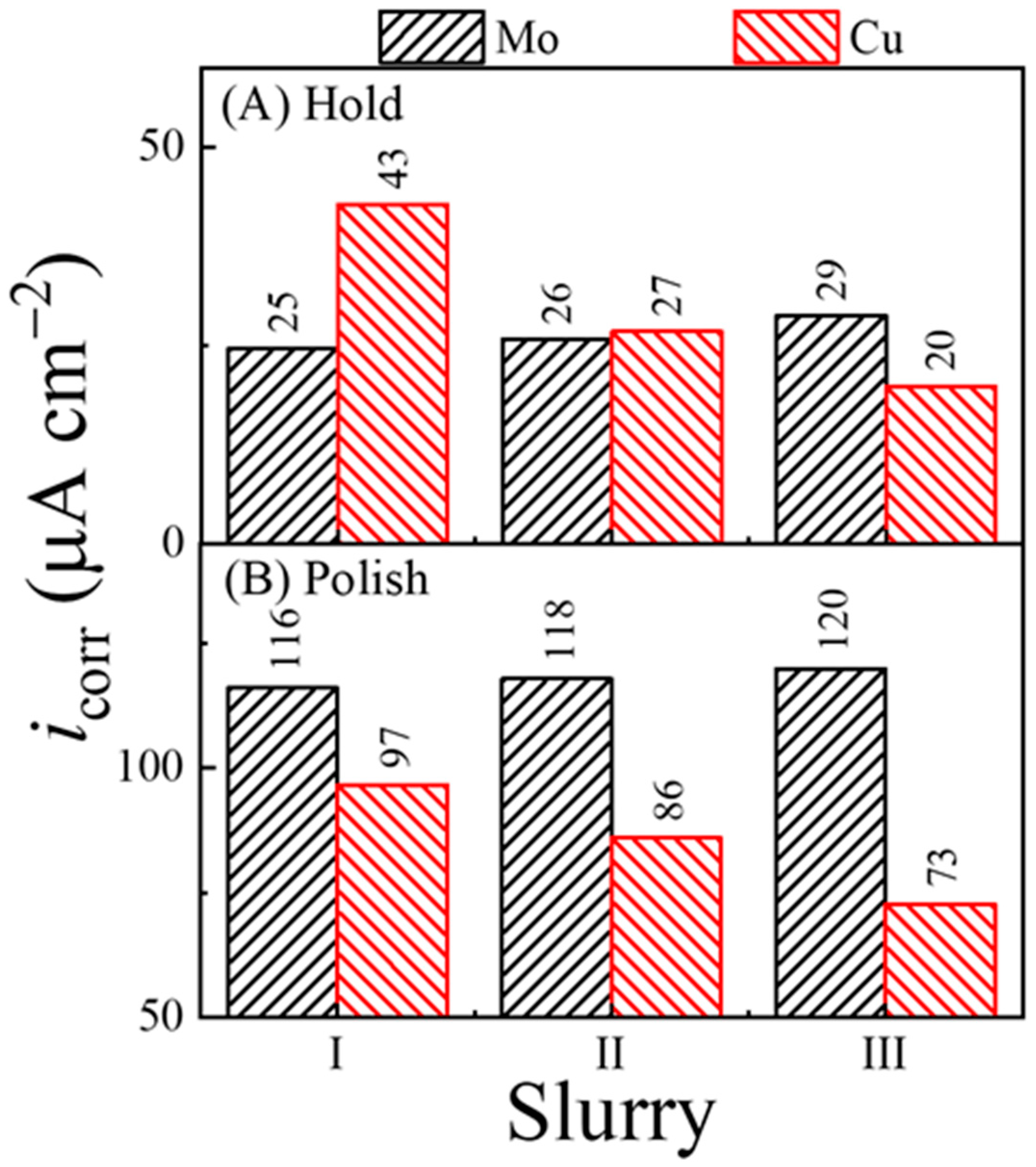

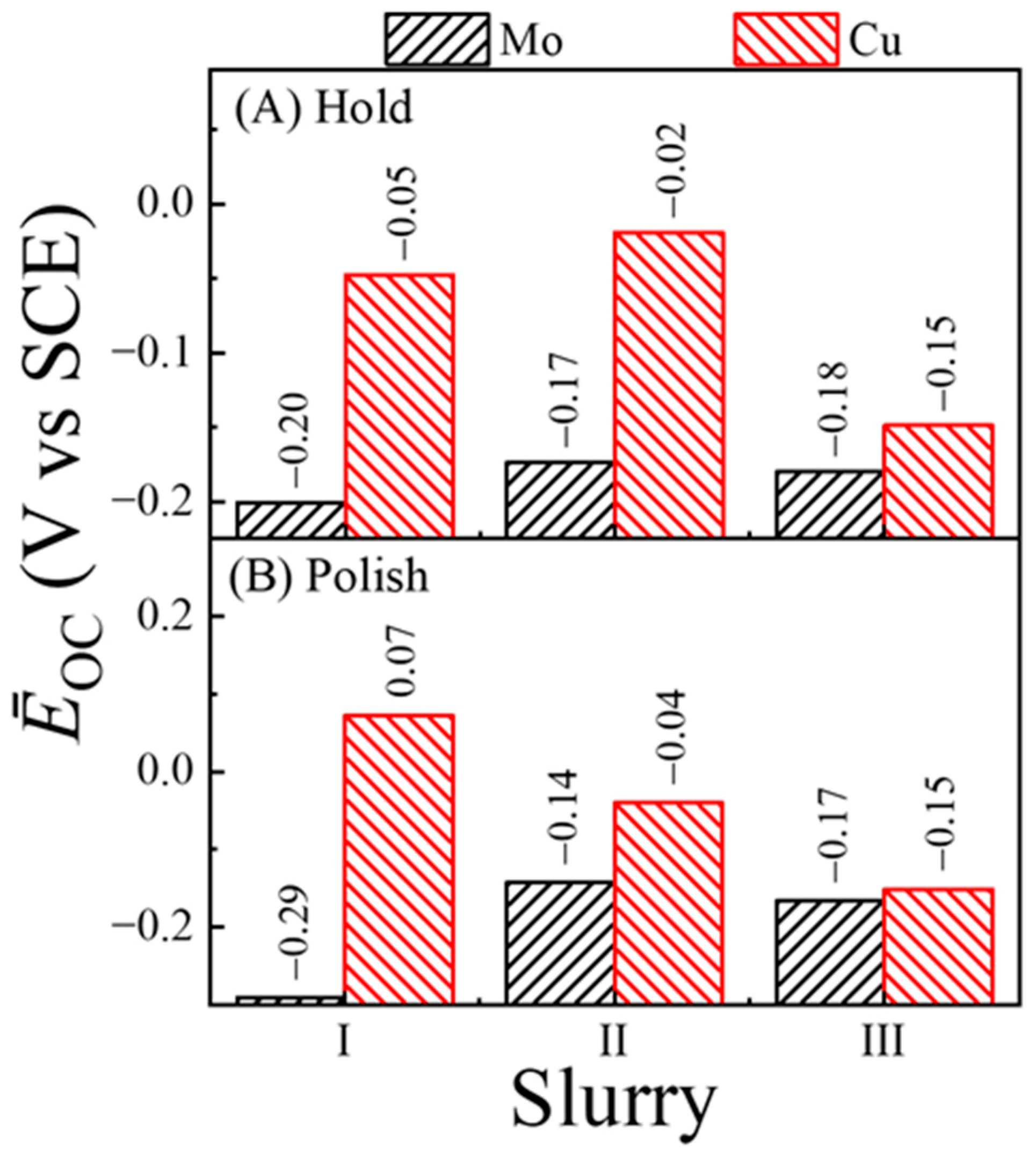
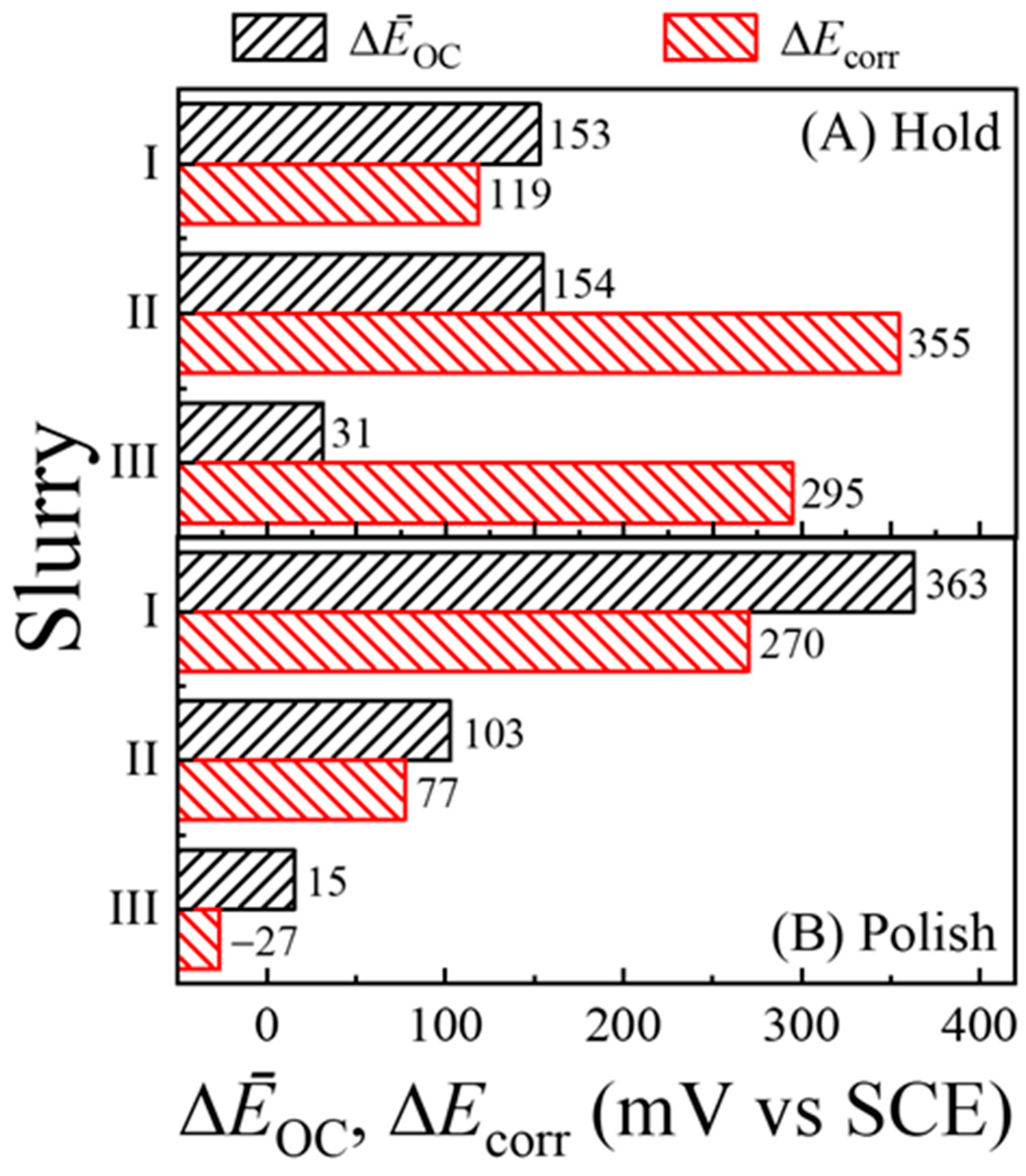


| Slurry | Composition | Rs (Ω cm2) (Mo, Cu) |
|---|---|---|
| I | 0.1 M KNO3 + 20 mM SPC + 0.1 M CA + 3 wt% SiO2 (Ref) | 26.0, 19.0 |
| II | Ref + 10 mM HIm | 32.4, 24.8 |
| III | Ref + 20 mM HIm | 63.7, 42.3 |
Disclaimer/Publisher’s Note: The statements, opinions and data contained in all publications are solely those of the individual author(s) and contributor(s) and not of MDPI and/or the editor(s). MDPI and/or the editor(s) disclaim responsibility for any injury to people or property resulting from any ideas, methods, instructions or products referred to in the content. |
© 2026 by the authors. Licensee MDPI, Basel, Switzerland. This article is an open access article distributed under the terms and conditions of the Creative Commons Attribution (CC BY) license.
Share and Cite
Gamagedara, K.U.; Roy, D. Mitigating Galvanic Corrosion of Molybdenum Diffusion Barriers in Chemical Mechanical Planarization of Copper Interconnects: A Case Study Using Imidazole in a Citrate Slurry of Neutral pH. Electrochem 2026, 7, 6. https://doi.org/10.3390/electrochem7010006
Gamagedara KU, Roy D. Mitigating Galvanic Corrosion of Molybdenum Diffusion Barriers in Chemical Mechanical Planarization of Copper Interconnects: A Case Study Using Imidazole in a Citrate Slurry of Neutral pH. Electrochem. 2026; 7(1):6. https://doi.org/10.3390/electrochem7010006
Chicago/Turabian StyleGamagedara, Kassapa U., and Dipankar Roy. 2026. "Mitigating Galvanic Corrosion of Molybdenum Diffusion Barriers in Chemical Mechanical Planarization of Copper Interconnects: A Case Study Using Imidazole in a Citrate Slurry of Neutral pH" Electrochem 7, no. 1: 6. https://doi.org/10.3390/electrochem7010006
APA StyleGamagedara, K. U., & Roy, D. (2026). Mitigating Galvanic Corrosion of Molybdenum Diffusion Barriers in Chemical Mechanical Planarization of Copper Interconnects: A Case Study Using Imidazole in a Citrate Slurry of Neutral pH. Electrochem, 7(1), 6. https://doi.org/10.3390/electrochem7010006