Article

Reaction Diffusion Modelling of 3D Pillar Electrodes in Single-Catalyst CO2 Reduction Cascades

by
Pablo Fernandez
1,
Marisé García-Batlle
1,2,
Bo Shang
3,
Hailiang Wang
3,
Gregory N. Parsons
4,
James F. Cahoon
2 and
Rene Lopez
2,*
1
Department of Chemistry, University of North Carolina at Chapel Hill, Chapel Hill, NC 27599, USA
2
Department of Physics and Astronomy, University of North Carolina at Chapel Hill, Chapel Hill, NC 27599, USA
3
Department of Chemistry, Yale University, New Haven, CT 06516, USA
4
Department of Chemical and Biomolecular Engineering, North Carolina State University, Raleigh, NC 27695, USA
*
Author to whom correspondence should be addressed.
Electrochem 2026, 7(1), 5; https://doi.org/10.3390/electrochem7010005
Submission received: 19 December 2025 / Revised: 4 February 2026 / Accepted: 26 February 2026 / Published: 28 February 2026
(This article belongs to the Topic Electrocatalytic Advances for Sustainable Energy)

Abstract

Effective electrochemical CO2 reduction to liquid fuels requires that the local catalytic environment facilitates the desired reactivity, yet a microscopic understanding of this environment is difficult to achieve from experiment alone. In this work, a 3D reaction-diffusion model was developed to explore the effects of electrode surface area and local geometry on the performance of a heterogeneous catalyst that performs a two-step CO2 reduction cascade reaction to CO and then CH3OH under aqueous conditions. Kinetic parameters for the model were inspired by experimental results using a cobalt phthalocyanine (CoPc) catalyst. Three-dimensional architectures composed of arrays of square pillars with varying dimensions and either smooth or periodically modulated surfaces were tested, revealing the extent to which geometry modulates the performance of the cascade reactions. Although structural variations modulate local concentration gradients, we find that electrochemically active surface area predominantly governs the overall cascade reaction. Moreover, the results suggest that supersaturation of CO, with concentrations up to ten-fold higher than the equilibrium solubility limit, might be critical for more efficient conversion to CH3OH. For any given geometry, the spatially averaged ratio of [CO] to [CO2] is dictated by the electrochemically active surface area and determines the yield of CH3OH. For a fixed surface area, geometries that spatially confine the electrolyte yield moderate local [CO] to [CO2] ratios within small volumes. In contrast, less confining geometries result in a broader distribution of local ratios spread over larger volumes, with both configurations yielding the same spatially averaged [CO] to [CO2] ratio. These insights provide valuable design principles—highlighting the critical importance of surface area and possibly CO supersaturation—for engineering advanced electrode architectures that leverage intermediate trapping and CO supersaturation to enhance overall performance in tandem CO2 reduction systems.

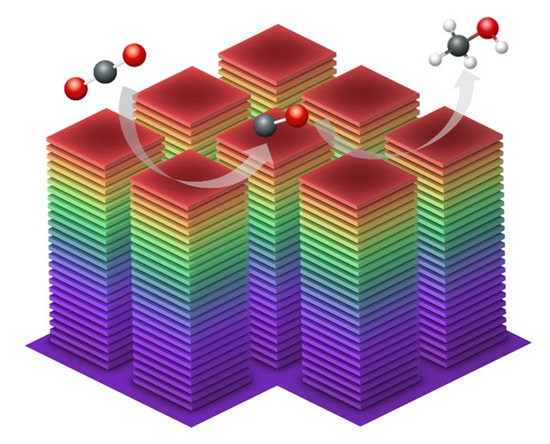
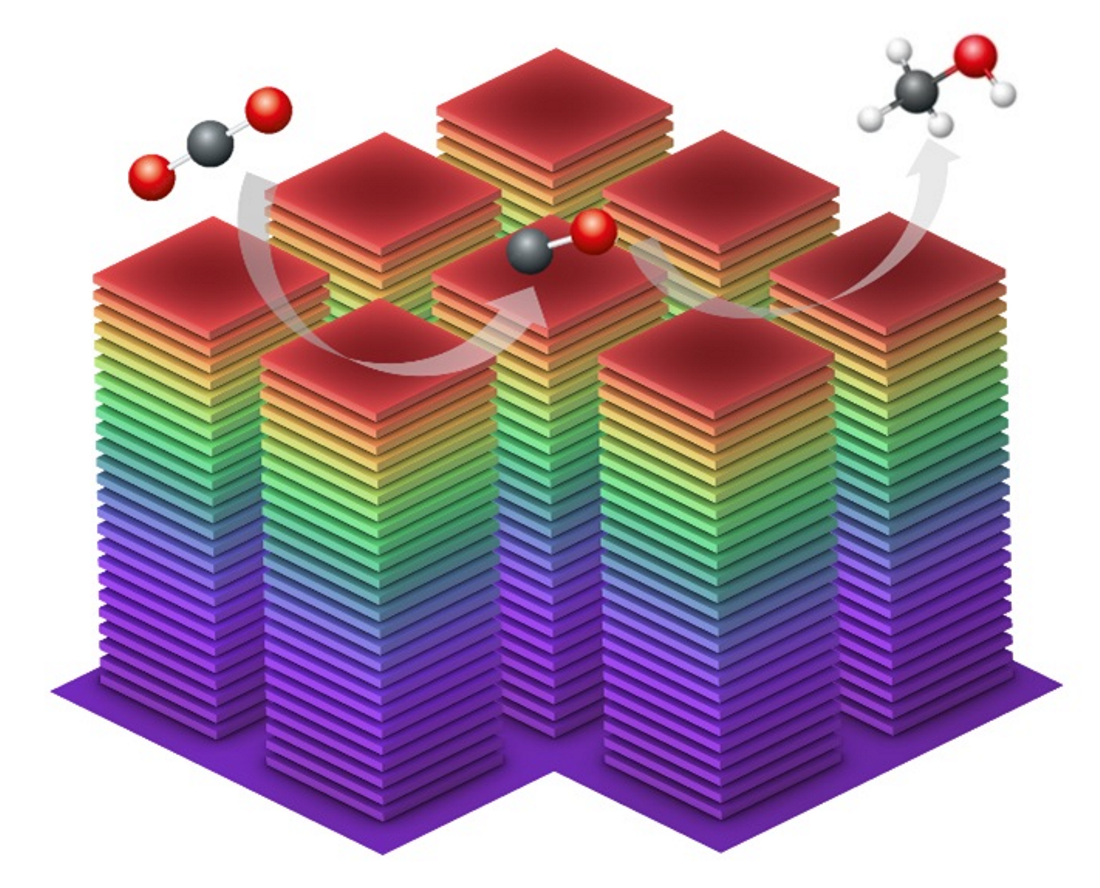
Graphical Abstract

1. Introduction

The electrocatalytic conversion of CO2 to higher-value products holds great promise for carbon recycling and energy storage [1]. In recent years, sequential heterogeneous cascade catalysis has been explored to find an efficient path to CO2 reduction (CO2R) into value-added liquid products such as CH3OH [2,3,4,5]. This approach has previously been tested with metal catalysts where intermediate species are produced by one catalyst and undergo further conversion on a second, different catalyst [6,7,8,9]. The main drawback of these metal-catalyst cascades is their low selectivity, yielding various side products such as ethanol. This is not only an inefficiency but creates product separation issues, hindering its practical viability [10,11,12]. In contrast to metal-based catalysts, molecular catalysts possess modifiable active sites to tune the electrochemical reactivity toward desired CO2 reduction products [13,14,15,16]. One of the most attractive and selective electrocatalysts for the formation of CH3OH from CO2 is cobalt phthalocyanine (CoPc) [17,18,19].
Previous reports have shown the immobilization of CoPc catalyst on carbon nanotubes (CNTs) to be a promising architecture for performing a cascade reaction involving CO2-to-CO and CO-to-CH3OH, where CO is the key intermediate [2,5]. Examining the literature, we find that the mechanism of the electroreduction of CO2 to CH3OH by CoPc remains ambiguous and dependent on reaction conditions [20]. Some authors claim that the conductive aromatic ring provides strong electronic coupling (π-π stacking) that minimizes the potential drop between the electrode and molecular catalysts, thereby enhancing the formation of the product. Ye and co-workers highlighted possible strain effects on the carbon support as the key element for >30% Faradaic efficiency (FE) of CH3OH production with a gas diffusion electrode [21].
One of the most critical points under investigation is how the confinement of intermediates may enhance the catalytic activity of the overall process. Since CO is a labile species, with a very low solubility in water, it must be produced with a high enough local concentration to be further reduced to CH3OH [20,22]. Indeed, the transport and concentration of the CO intermediate is known to be a crucial parameter for the successful completion of the cascade reaction [23,24,25]. In this context, tailoring compartments and the catalyst surface 3D geometry could modify the local environment to improve the generation of CH3OH. Recently, Shang and co-workers demonstrated that the use of 3D micropillar structures coated with CoPc was more productive than their planar counterparts [5]. They hypothesized that a CO-rich environment promoted sequential steps for the electroreduction process; thus, investigating the local concentrations of CO is critical [2,26,27,28]. Investigating how 3D structures may affect the trade-offs [29], design principles in the spatial organization of catalytic sites and operational parameters of the electrode overall cascade performance is critical for developing this CO2-to-CH3OH system toward practical applications.
While 2D structures offer a degree of spatial confinement, their geometries are essentially limited to lamellar structures. In contrast, 3D architectures offer a higher degree of local confinement and are thus better suited to achieving larger concentration gradients to potentially improve the overall cascade reaction. Furthermore, the potential for surface area enhancement is much greater when considering 3D structures in comparison to 2D structures. To gain insight into the performance of the CO2R cascade and the potential enhancements of 3D microstructures, in this paper, a reaction-diffusion tandem cascade model involving CO2-to-CO and CO-to-CH3OH reactions, both catalyzed by the same catalyst, has been developed. Unfortunately, as reliable kinetic parameters for the multistep cascade on the CoPc system are not yet available in the literature, this constrains our ability to parameterize the model in a totally physically realistic manner. Nevertheless, our approach is grounded in relevant experimental observations; similarly to the modelling work done by Ager et al. [19], we have treated the CoPc catalyst as a boundary condition. Therefore, kinetic rate parameters from CoPc for the overall cascade process were extracted by fitting our model equations to prior experimental literature [28]. We hypothesized that modifying the geometry and surface area would modulate (i) partial current densities and selectivity; (ii) local species concentrations, including CO supersaturation and alkalinity; and (iii) utility of reactants in the cascade sequence. The model results show in a quantitative way that for these pillar structures, the catalyst surface area, not the geometry, primarily governs overall reaction kinetics and selectivity. Under the simulated conditions, local CO supersaturation improves intermediate availability and provides a pathway for maintaining high CH3OH formation. Modifying the relative rates of the cascade reaction also illustrates the tradeoff between the buildup of CO for cascade catalysis and the reduced availability of CO2 in confined architectures. Our findings demonstrate the non-trivial effects of 3D electrode architectures on the performance of a single-catalyst cascade reaction in an aqueous bicarbonate environment, offering valuable design principles for optimizing tandem CO2 reduction architecture.

2. Computational Methods

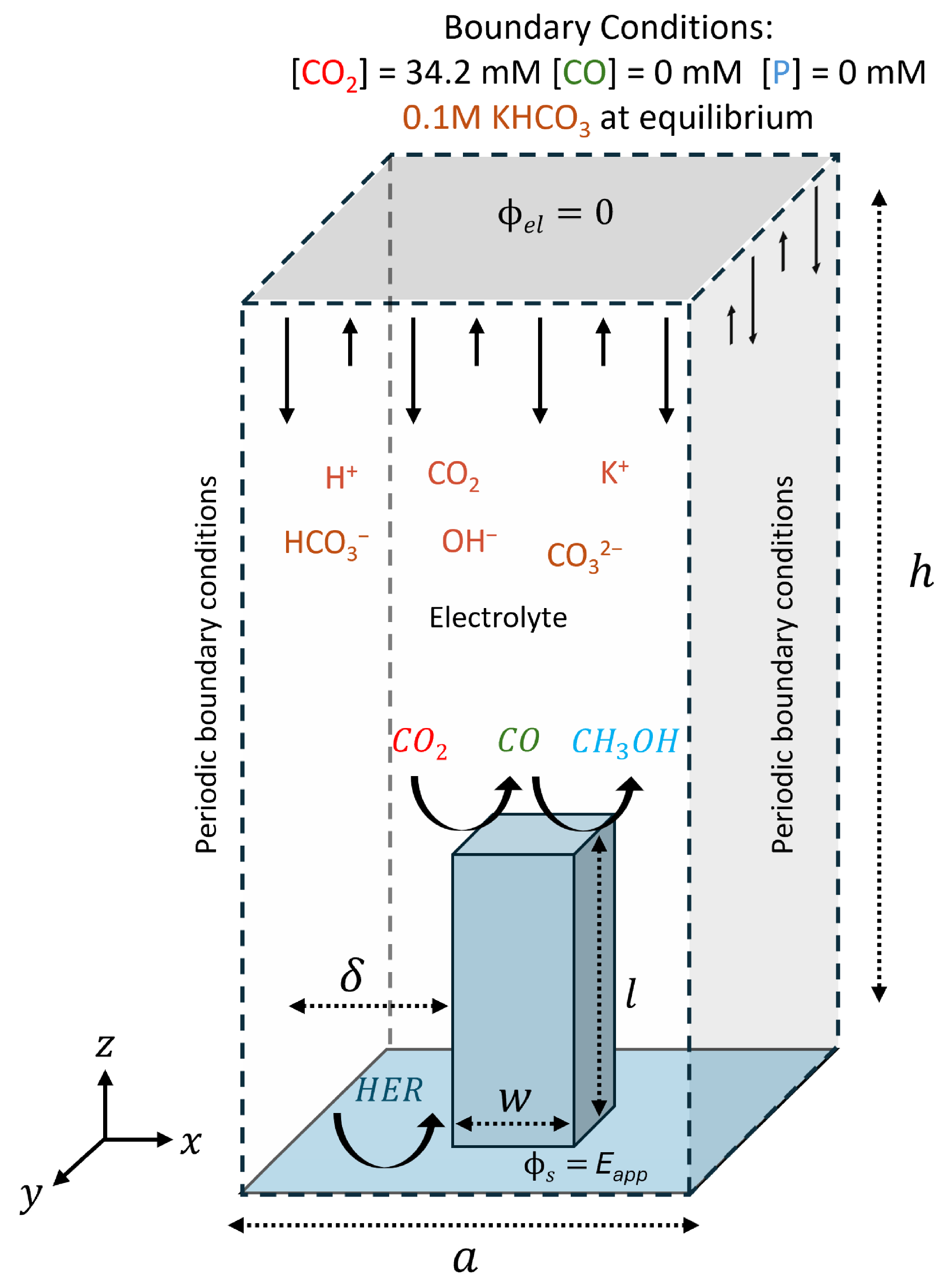
The model was set up as a 3D box where the boundary layer thickness was located at a fixed distance above the basal plane electrode, and effective periodic boundary conditions were defined at opposing lateral planes (Figure 1). The model includes mass transfer through diffusion and migration, but does consider the effects of fluid flow. The catalyst layer was modeled as an infinitely thin film uniformly distributed across the electrode surface. CoPc has been described before as a boundary condition at the surface by Ager et al. [19] with the aim of examining the role of the CO intermediate in CO2R to CH3OH on CoPc-multiwalled carbon nanotube catalysts. The simulation considered electrochemical reactions through a single catalyst performing the cathodic CO2R and subsequent CO reduction (COR) cascade reaction, as well as the parasitic hydrogen evolution reaction (HER), buffer reactions of KHCO3, and water equilibrium.
The geometrical parameters modeled in Figure 1 are the electrolyte height h , the pitch between pillar centers a (equaling the periodicity of the simulation), the pillar width w , and the pillar height l . As discussed in more detail below, as l increases, the total surface area of the electrode and the total amount of catalyst in the system also increase. The parameter l = 0 µm is included in the simulation series to represent a planar architecture (catalyst on a flat surface). The governing equations are solved using COMSOL Multiphysics version 6.1. Computational effort was reduced by recognizing that the lateral periodicity intrinsically imposes a no-flux condition normal to the lateral planes; thus, defining a no-flux condition enforces the periodic boundary conditions without having to explicitly consider the orientation of source and destination planes. To further reduce model complexity, the modeling domain takes advantage of the structural symmetry by considering one quarter of a micropillar structure and enforcing symmetry conditions on the bisecting xz and yz planes.
Similar to the model developed by Ehlinger et al. [30], and to achieve more accurate selectivity predictions, we fit Tafel kinetics parameters to H-cell data to account for the role of bicarbonate in increasing alkalinity and show water as the primary proton donor with increasing potential. The kinetic parameters resulting from the fit for each reaction are found in Table S1. Then we developed a 3D model for the cascade system, which accounts for mass transport limitations. We used the model to comprehensively explore the reactant utilization and the role of CO supersaturation. The Tafel expressions used experimental data for a CO2R cascade system from Shang et al. [28], who used a carbon fiber paper (CFP) working electrode, a graphite rod counter-electrode, and a 0.1 M KHCO3 electrolyte in a H-cell separated by an anion exchange membrane. It is important to note that while CFP is inherently porous and hydrophobic—factors that influence local CO2 transport and active-site accessibility—it was modeled as a planar electrode for the purpose of acquiring sensible values for the cathodic Tafel expressions and by no means a direct comparison to the experimental system.
Moreover, Tafel kinetics alone do not fully encompass the role that competitive adsorption between CO2 and CO may have on the cascade reaction. Considering the hydrophobic surface coating on the CFP and the performance of the fit (Figure S1), we believe this approximation might not be correct in general but should be satisfactory for studying the first-order effects of mass transport. At higher applied potentials, phenomena such as electrowetting may begin to break down the planar electrode assumption. To avoid such a possibility, an applied potential of −1.1 V vs. SHE was chosen for all presented results. At this potential, the fitted kinetic parameters align reasonably well with the selected experimental dataset. Additionally, allowing for CO supersaturation is consistent with the aqueous-species assumption. Finally, it has been reported that at more negative potentials, the effects of site competition between CO2 and CO become increasingly significant in the cascade system [17].

2.1. Electrolyte Boundary Layer Domain

An aqueous electrolyte composition of 0.1 M KHCO3 was modeled, including the quasi-equilibrium conversions between CO2, bicarbonate (HCO3), and carbonate (CO32−). A mass-transfer boundary layer thickness of h = 130 µm above the basal plane of the electrode was chosen to approximate typical experimental values for similar planar systems. At the bulk electrolyte upper boundary, the concentrations of the buffer solution species (CO2, K+, HCO3, CO32−, H+, OH) were assumed to be constant at their equilibrium values listed in Table S1, and the potential was set to 0 V. The concentration of CO2 at the upper boundary was set to the saturation concentration for water at ambient conditions, C C O 2 0 =   34.2 mM. In the experimental approach by Shang et al. in Figure S1, CO2 was continuously bubbled into the saturated electrolyte during the electrolysis at a flow rate of 10 sccm. This guarantees a steady supply of CO2 at a fixed distance away, which, in principle, enforces the concentration boundary condition [28]. The temperature was assumed to be constant at 298.15 K, and the cathode potential was taken as an input parameter for all simulations. H2O was assumed as the proton source for the hydrogen evolution reaction (HER), as the concentration of H+ in a neutral pH 7 electrolyte is at least eight orders of magnitude smaller than that of H2O. The values of the kinetic and geometric parameters for the cathodic reactions are presented in Table S1 and S2, respectively, and additional information on the parameter fitting can be found in Supplemental Note S1. In Figure S1, the CO2R rate includes the CO that subsequently reacts to form CH3OH and the CO that leaves unreacted. The COR rate refers specifically to the current from CO conversion to CH3OH. Figure S1 also compares the results of simulations and experimental measurements by Shang et al. [28]. This framework enables a direct comparison between calculated and measured values for each stage of the cascade. Divergences between simulated and experimental results can stem from multiple sources. (1) One key limitation is the scarcity of reliable kinetic data for the multistep cascade on our specific catalyst system. The absence of such parameters in the literature restricts our ability to construct a more physically rigorous model. (2) The simplified one-dimensional fitting approach may not accurately represent the spatial heterogeneity of current-density distribution across the electrode surface. (3) We also hypothesize that the formation and accumulation of CO bubbles could further account for part of the deviation observed between modeling and experiment.
The following buffer reactions were defined in the electrolyte domain:
C O 2 + H 2 O H + + H C O 3
H C O 3 H + + C O 3 2
C O 2 + O H H C O 3
H C O 3 + O H H 2 O + C O 3 2
H 2 O H + + O H
The source term for the buffer species i , associated with the homogeneous quasi-equilibrium reactions, was defined as follows:
R i = v i k i f i = r e a c t c i v i k i r i = p r o d c i v i
where v i is the stoichiometric coefficient, k i f and k i r are the forward and reverse rate constants, respectively, and c i is the concentration of species i .
The species mass flux Ni was determined using the Nernst–Planck equations describing mass transport through diffusion and migration:
                                    N i = D i c i z i μ i e F c i ϕ e l
where D i is the diffusion coefficient, c i is the species concentration, z i is the species charge, F is the Faraday’s constant, and ϕ e l is the electrolyte potential. The effective mobility μ i e and diffusion coefficient D i can be correlated using the Nernst−Einstein relation μ i e = D i R T , where R and T are gas constant (8.314 J/mol∙K) and temperature, respectively. The solution-phase current density was determined by the net flux of all charged species and defined as:
j l = F i z i N i        
In addition, electroneutrality was enforced throughout the electrolyte domain such that i z i c i   = 0 . The solubility of CO is very low at about 1 mM in water, and sufficiently exceeding this solubility limit would typically lead to bubble formation, which can cause convective flow and impede mass transport to the catalyst surface. However, in this work, we do not explicitly include discrete bubble nucleation, and the generated CO is always in the liquid phase. Although the model does not directly incorporate gas-phase CO pathways and only dissolved-phase CO transport is modeled, we cannot fully rule out the role of CO gas. This allows the investigation of CO supersaturation effects that are of intrinsic interest and likely to be present in experiments. For example, with HER, experimental evidence shows that hydrogen supersaturation can reach levels two orders of magnitude higher than the typical thermodynamic limit [8]. Therefore, it is reasonable to consider that a similar phenomenon could occur for CO. Further discussion is provided in Section 3.3.
To preserve the species mass flux continuity, the electrolyte domain is ultimately defined by the following equation:
c i t + · N i = R i

2.2. Electrode Surface Reactions

Three cathodic reactions were considered at the electrode surface.
C O 2 + H 2 O + 2 e C O + 2 O H
C O + 4 H 2 O + 4 e C H 3 O H + 4 O H
2 H 2 O + 2 e H 2 + 2 O H
These reactions encapsulate the observed product distribution of a single-catalyst cascade reaction such as CoPc. Each reaction was modeled as a single electrochemical step, an approximation that overlooks many microscopic mechanistic details but is commonly used in continuum modeling where the net reaction is of interest. Since the bicarbonate buffer has a pH of 6.8 at equilibrium and the cathodic reactions are expected to considerably increase the alkalinity, water is considered the predominant source of protons for each reaction, as the concentration of H + is at least eight orders of magnitude smaller than that of H 2 O at neutral pH.
Furthermore, previous studies have shown that HCO3 can play a significant role in the catalysis of CO2 to CO as a proton donor under certain operating conditions. Because a relatively low negative potential is used in conjunction with a 0.1 M buffer concentration, it is expected that the contribution of HCO3 on the CO2R is minimal and water is indeed the primary proton donor [31].
The partial current density for a cathodic reaction h was calculated using a modified Tafel kinetics relation of the form:
  j h , E C S A = j 0 , h , E C S A   C i s C i b γ i e x p α c , h n F R T η h
where j 0 , h is the exchange-current density normalized to the electrochemically active surface area, C i s is the concentration of species i at the surface, γ i is the reaction order for species i , C i b is a reference concentration taken to be the bulk concentration, α c , h is the cathodic transfer coefficient, and η h designates the overpotential for the reaction. A first-order dependence on CO2 and CO was assumed for the CO2R and COR, respectively, as reported in the literature for similar systems [32,33]. Notably, the Tafel kinetic expression does not explicitly account for competitive site inhibition, which would decrease the overall rate of electrode reactions. In order to evaluate the impact of not including this phenomenon, an alternative formulation with an artificial parameter was used in only a few selected structures as a proxy sensitivity for site competition, and details can be found in the Supporting Information.
To consider the effects of local concentrations on kinetics, the Nernst equation is used, and the overpotential is expressed as follows:
η h = ϕ s ϕ e l U h 0 2.303 R T F p H
where ϕ s is the applied potential, ϕ e l is the electrolyte potential, and U h 0 is the standard reduction potential of reaction h . More information on the calculation of U h 0 for each reaction can be found in Supplemental Note S2.
The current density of the electrode can be expressed as the sum of the partial current densities determined through the Tafel equations and related to the specific electrochemical reaction at the surface:
j T , p r o j = 1 a 2 S ( j C O 2 R , E C S A + j H E R , E C S A + j C O R , E C S A )   d S
where j T corresponds to the total current density, which is normalized to the projected area, and S is the area of the electroactive surface. The surface integral average is taken with respect to S and normalized to a 2 . All measured currents reported in Section 3 are normalized to the projected area.
The selectivity of a reaction toward a specific product can be expressed as Faradaic efficiency (FE). This efficiency describes the effectiveness with which charge is transferred in a system and converted to the desired product. For a given reaction, the FE can be calculated through the partial current density as follows:
F E i = j i j T × 100
Previous literature suggests that the confinement of the CO intermediate species improves the utilization towards forming CH3OH [2]. However, since the current density is normalized by the projected area, it is difficult to determine if changes are derived simply from increases in surface area or from confinement effects. Thus, to better represent the effects of electrode geometry, we define a utilization fraction to measure how much of a reactant species participates in the cascade reaction. The general equation used to calculate the utilization of CO2 towards CO2R or CO towards COR is as follows:
ε i = S j i n F d S S j i n F d S + V R i d V + A J i , o u t d A
where S is the total surface area of the electrode, V is the volume of the electrolyte, and A is the area of the boundary layer. In this expression, j i n F designates the flux of species i consumed at the cathode, R i is the total rate of homogeneous consumption (e.g., buffer reactions) of species i , and J i , o u t is the flux of species i out of the boundary layer. These terms are either positive or negative, depending on whether species i is generated or consumed. The expression can be modified to calculate the utilization of reactant species towards buffer reactions or flux out of the system.
At the electrode surface boundaries, the normal species flux that results from electrochemical reactions is defined as J i = h v i j h , E C S A n i F , where v i is the stoichiometric coefficient of species i in the reaction and n is the number of participating electrons.
The governing equations in the Tertiary Current Distribution module are solved using the MUMPS general solver in COMSOL Multiphysics version 6.1 with a relative tolerance of 0.0001. A non-uniform mesh is used in the 3D domain with refinement at the electrode surface and boundary layer planes. By default, electrode surface meshing was allowed a maximum element size of 0.8 µm; however, pillar geometries with widths that approached the unit cell size required smaller element sizes to reach convergence, and the number of mesh nodes was not uniform across different geometries. A mesh independence study was conducted for a pillar of a = 5 µm, l = 30 µm, w = 1.5 µm with a range of maximum element sizes on the electrode surface of 0.2–10 µm. Very little difference in j C O R was observed in the range of maximum mesh element sizes, with a percentage difference of 0.03% between the maximum and minimum values of j C O R .

3. Results and Discussion

3.1. Effects of Pillar Dimensions and Surface Area

The electrode geometrical properties were controlled by adjusting the dimensions of the square pillars in width and height. This results in an effective surface area that is larger than the projected one by a surface area enhancement factor (SAEF). The SAEF is calculated by dividing the total surface area of the electrode, comprised of the top, sides, and surrounding bottom of the pillar structure, by the projected surface area ( a 2 ), all within the unit cell:
S A E F = S A e l e c S A p r o j = a 2 + 4 l w a 2 = 1 + 4 l w / a 2
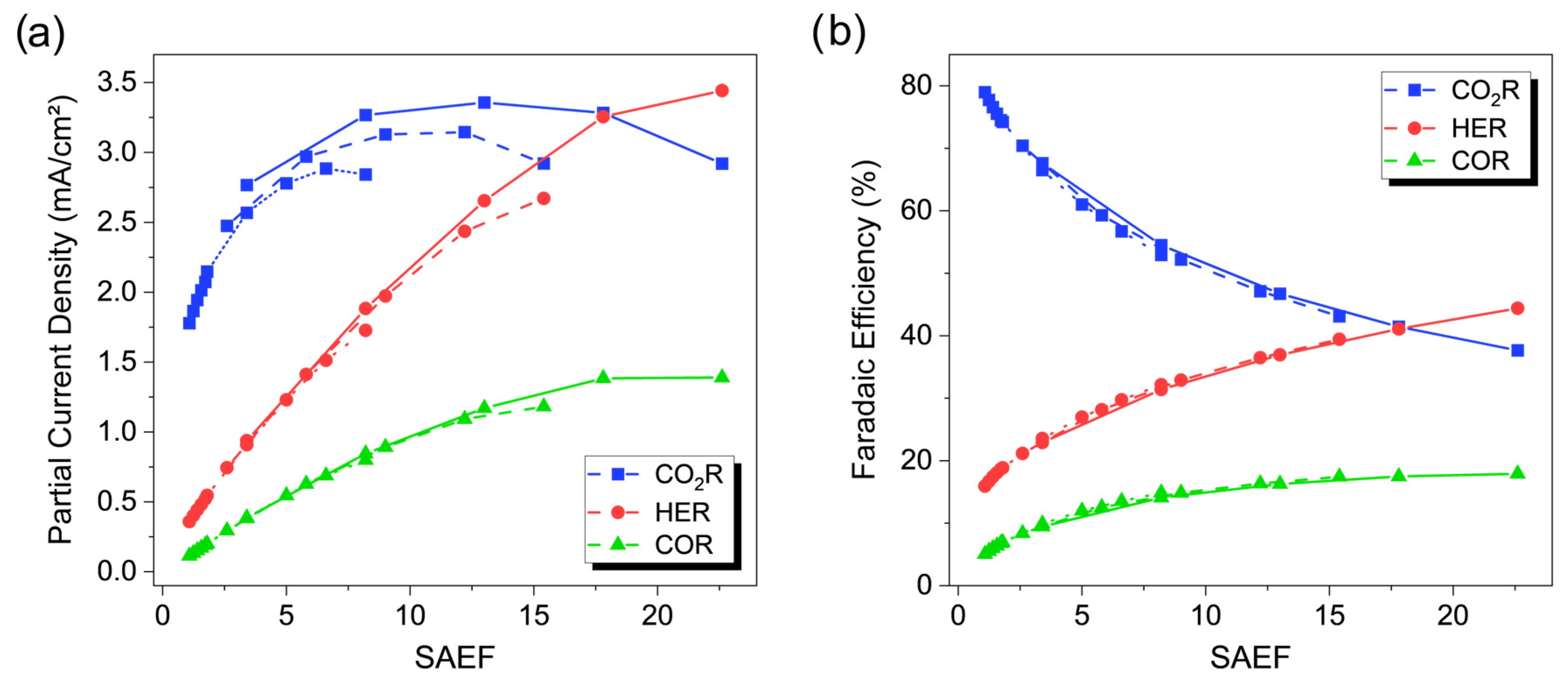
To compare the effects of pillar periodicity, pitches of a = 5 µm and 10 µm were investigated. It should be noted that the limitation in exploring higher SAEF structures at a given pillar height l is the proximity of pillars to one another; in other words, the SAEF is limited to 1 + 4l/a as the pillar width w approaches the pitch length a (limit wa in Equation (10)). Due to these geometrical relationships, structures with shorter a enable higher SAEF to be reached for a given l, suggesting they might also produce higher current densities. A prevalent issue for many planar electrode systems performing aqueous CO2R is the availability of CO2 because the solubility in water is low. Moreover, electrode geometry alters CO2 availability through changes in the local environment, which affects the bicarbonate equilibrium reactions. Figure 2 shows the current densities and FE’s for each electrochemical reaction as a function of the SAEF, and each point in the curve corresponds to a different combination of l and w. The relationship between current densities and SAEF is linear for small increases (SAEF < 5) but becomes non-linear at modest increases (SAEF > 7).
In particular, for a fixed l and a, j C O 2 R first increases with increasing SAEF (corresponding to increasing w), reaches a maximum, plateaus, and then starts to decrease (Figure 2a). Interestingly, for different l, the maximum in j C O 2 R occurs for similar values of δ ~750 nm, which reflects the lateral distance between pillars and thus the degree of geometric confinement. This result implies that j C O 2 R tends to be limited by mass transport within a geometrically confined structure, corresponding to pillars spaced close to one another. Similar behavior was observed for a pitch of 10 µm and can be found in Figure S2.
This behavior is not observed for j H E R since there is no concentration dependence on the defined reaction, and water is modeled implicitly; instead, the relationship between j H E R and SAEF is mostly linear. Unsurprisingly, j C O R also increases with increasing SAEF; however, a plateau is observed at SAEF values > 10. This plateau does not strongly depend on the confinement parameter δ in the same way j C O 2 R does for a given pillar height, but instead depends more directly on the SAEF. Further explanation for this observation is provided in Section 3.5.
Interestingly, the FE’s of the cathodic reactions each follow a monotonic relation regardless of l (Figure 2b), suggesting a strong dependence of reaction selectivity on SAEF. The decrease in FECO2R can be expected due to the local pH shifting the buffer equilibrium from CO2 to bicarbonate. OH generated at the reaction planes shifts the local carbonate equilibrium, lowering free CO2(aq). As the spacing between OH producing planes decreases, diffusion layers overlap, the local pH rises, and CO2(aq) is converted to HCO3/CO32−, reducing CO2 availability for the first cascade step. This drives the system into a CO2 mass transport-limited regime in which the replenishment flux cannot keep pace with consumption. On the other hand, the FECOR improves with SAEF but plateaus around 18%, indicating a somewhat surprising ceiling for improving the selectivity of the cascade reaction with increasing SAEF.
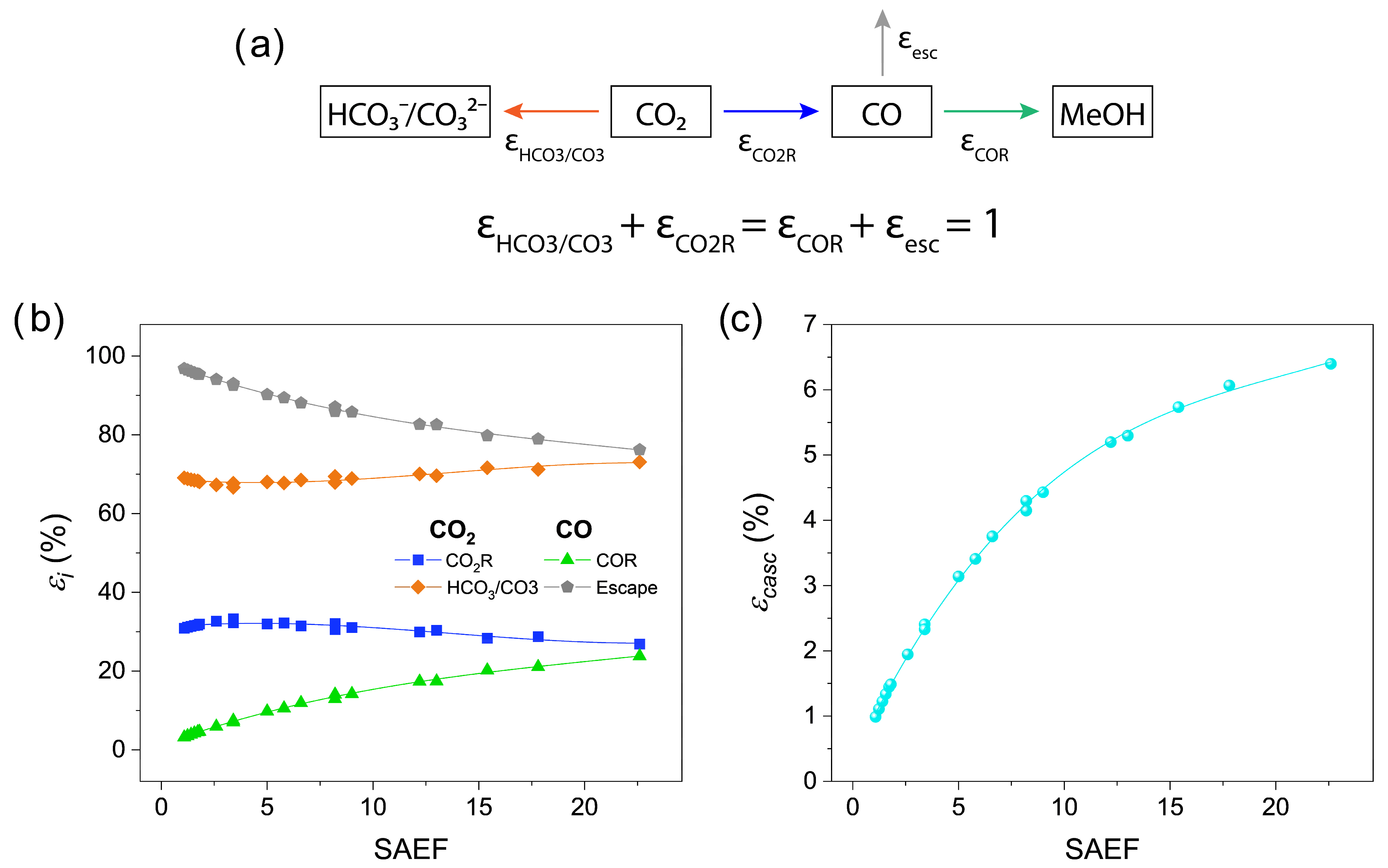
To better understand the observed limitations with increased SAEF, we can calculate the utilization factor, ε , for each of the reactant species participating in the cascade (Figure 3a). The utilization factor, a metric adapted from Dooley et al. [34], is expressed as a percentage and ultimately serves to quantify the fraction of reactant species that participate in the cascade reaction. For instance, the available CO2 can either be consumed at the electrode as a part of the CO2R ( ε C O 2 R ) or participate in the bicarbonate equilibrium reactions ( ε H C O 3 / C O 3 ) . Similarly, CO can either be consumed at the electrode ( ε C O R ) or escape the system at the boundary layer ( ε e s c ) .
With a 0.1 M KHCO3 electrolyte, at low SAEFs, we observe a modest utility of CO2 towards CO2R of about 30%, since the majority of CO2 participates in buffer reactions brought on by local alkalinity (Figure 3b). At higher SAEFs, we observe a decrease in ε C O 2 R as local alkalinity increases with confined geometry, which is reflected by the corresponding increase in ε H C O 3 / C O 3 . In contrast, ε C O R continues to improve with SAEF, as the geometry increases local CO concentration and reduces the amount of CO that leaves without reacting. To measure the utility of CO2 that ultimately participates in the cascade reaction, we simply multiply ε C O 2 R by ε C O R to calculate ε c a s c (Figure 3c). Despite the decrease in ε C O 2 R from local alkalinity, the increase in ε C O R results in an overall increase in ε c a s c at higher SAEF’s. However, this effect on ε c a s c seems to stabilize around 6–7%, suggesting a regime in which the confining geometry reaches a sufficiently high alkalinity to suppress ε C O 2 R enough to impede the cascade reaction. The average local pH as a function of SAEF can be found in Figure S3. It is generally observed that increasing the SAEF will increase the alkalinity of the volume near the pillar electrode. For structures of similar SAEFs, the geometries with a higher pillar height will generally have higher alkalinity.
Additional simulations were performed for selected structures of identical SAEF to evaluate boundary layer sensitivity and show whether the key conclusion of ECSA dominated global performance remains (Figure S4). Across the tested range of boundary layer thicknesses, global performance remained largely unaffected. The minimal variation between geometries of identical surface area suggests that total surface area is indeed the primary driver of cascade performance.

3.2. Effects of Pillar Dimensions on Local Environments

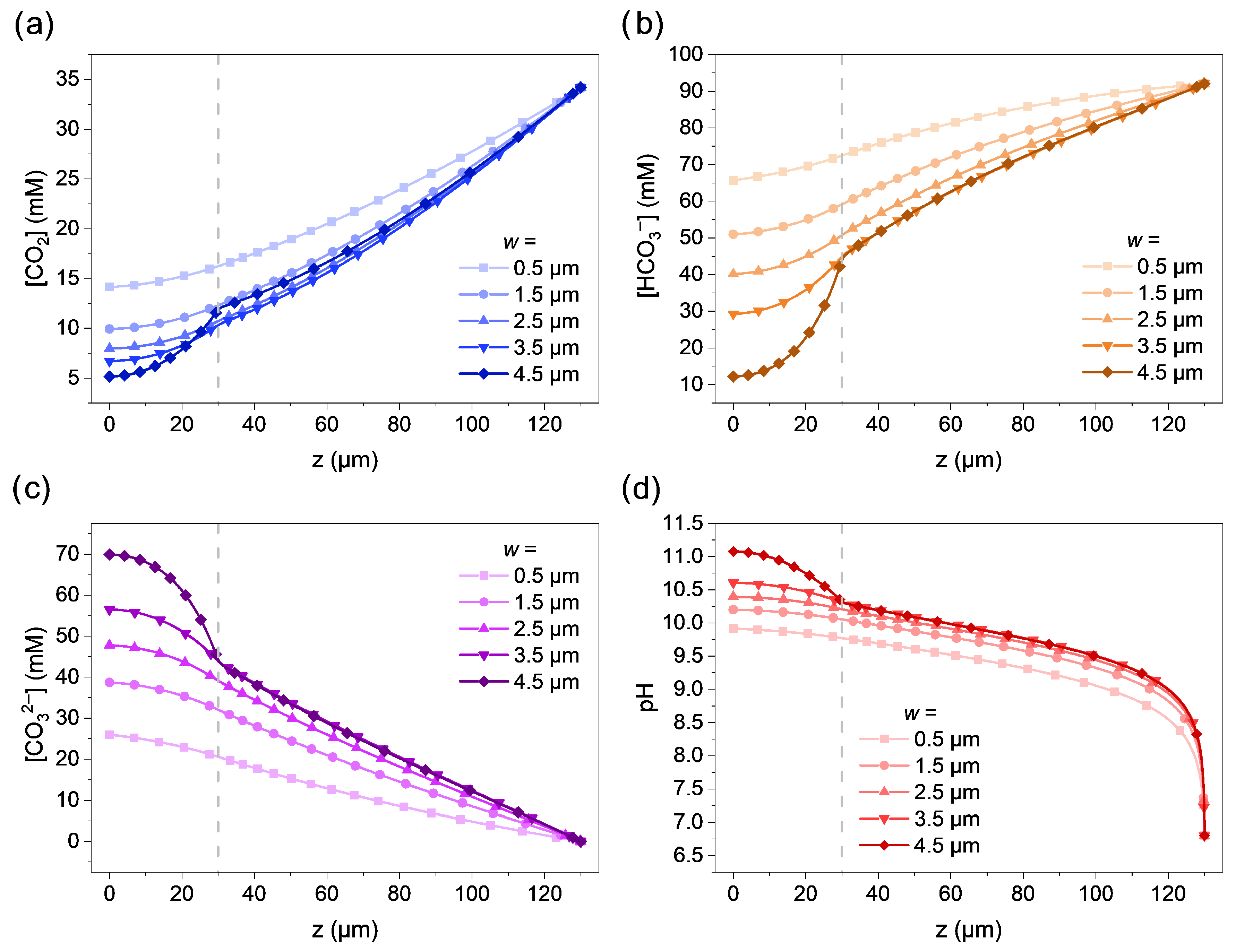
To consider the effects of pillar geometry and proximity on the concentration of CO2R cascade species, the distribution of species concentration was plotted for different pillar width w at a constant pillar height l and voltage bias (Figure 4).
The concentration profiles were taken as the z-axis cut line in the center between pillars starting from the bottom basal cathode and extending to the upper boundary layer. The increment in pillar width from 0.5 to 4.5 µm at a fixed pillar height results in an increasingly confined geometry where the space between pillars decreases. As w increases, the availability of CO2 near the bottom surface decreases (Figure 4a). Similarly, the concentration profile for HCO3 shows a steep decrease within the pillar geometry for more confined structures (Figure 4b). Conversely, the profile of CO32− shows a sudden increase within more confined geometries (Figure 4c). The concentration profiles of the bicarbonate species are ultimately determined by the local alkalinity, which shows a surface pH ranging from 10 to 11 by increasing w (Figure 4d). The local alkalinity brought on from the cathodic reactions results in limited CO2 availability, as previously mentioned [35]. The local increase in CO32− and decrease in HCO3 is explained by the decrease in local CO2 concentration, as well as the local alkalinity approaching the pKa of bicarbonate to carbonate (pKa = 10.32). Interestingly, while our model operates in a regime where continuum descriptions are valid, characteristic feature sizes of the micropillar arrays are in the order of microns. Future extensions to nanoscale architecture will likely require more discrete or site-specific treatments of proton transport.
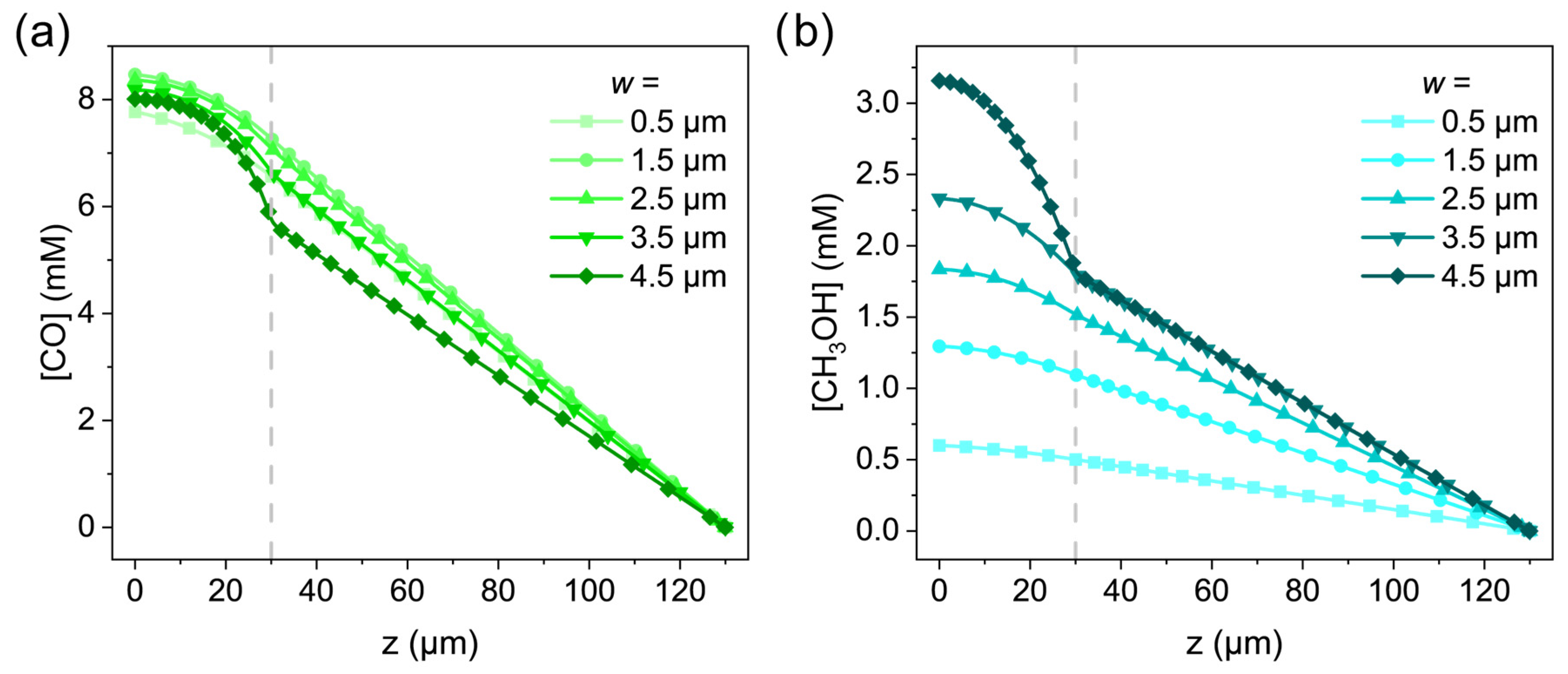
Concentration profiles for CO and CH3OH can be seen in Figure 5. The local concentration of CO does not change significantly with more confined geometries; this is because of the trade-off between the proximity of the pillars generating and consuming CO, as well as the confined geometry limiting CO2 availability. In contrast, the local concentration of CH3OH increases with confined geometry due to the proximity of the pillars. It is important to note that this higher local concentration between the pillars with increased w does not directly indicate improved CH3OH production. Instead, the net flux of produced CH3OH out of the system is proportional to the slope of the concentration profile at the boundary layer. Thus, we can see from Figure 5b that increasing w improves the net outflux of CH3OH until a value of 3.5 µm, where further increase results in marginal improvement. This same trend is also present for j C O R in Figure 2a (solid line) and   ε c a s c in Figure 5b for the same pillar height. As expected, the longer pitch structures show a very similar trend in concentration profiles for CO and CH3OH (Figure S5). The species concentration profiles indicate that structural features significantly affect intermediate trapping, the emergence of CO supersaturation, and local alkalinity, all of which are critical for driving the second step of the tandem CO2 reduction to CH3OH.
To further understand the role of intermediate transport in tandem CO2 reduction, we next probe the impact of CO supersaturation in a selected electrode geometry in Section 3.3. The subsequent Section 3.4 illustrates the effects of COR rate on the local alkalinity that ultimately impacts CO2R.

3.3. Degree of Supersaturation and Bubble Mass-Transfer Effects

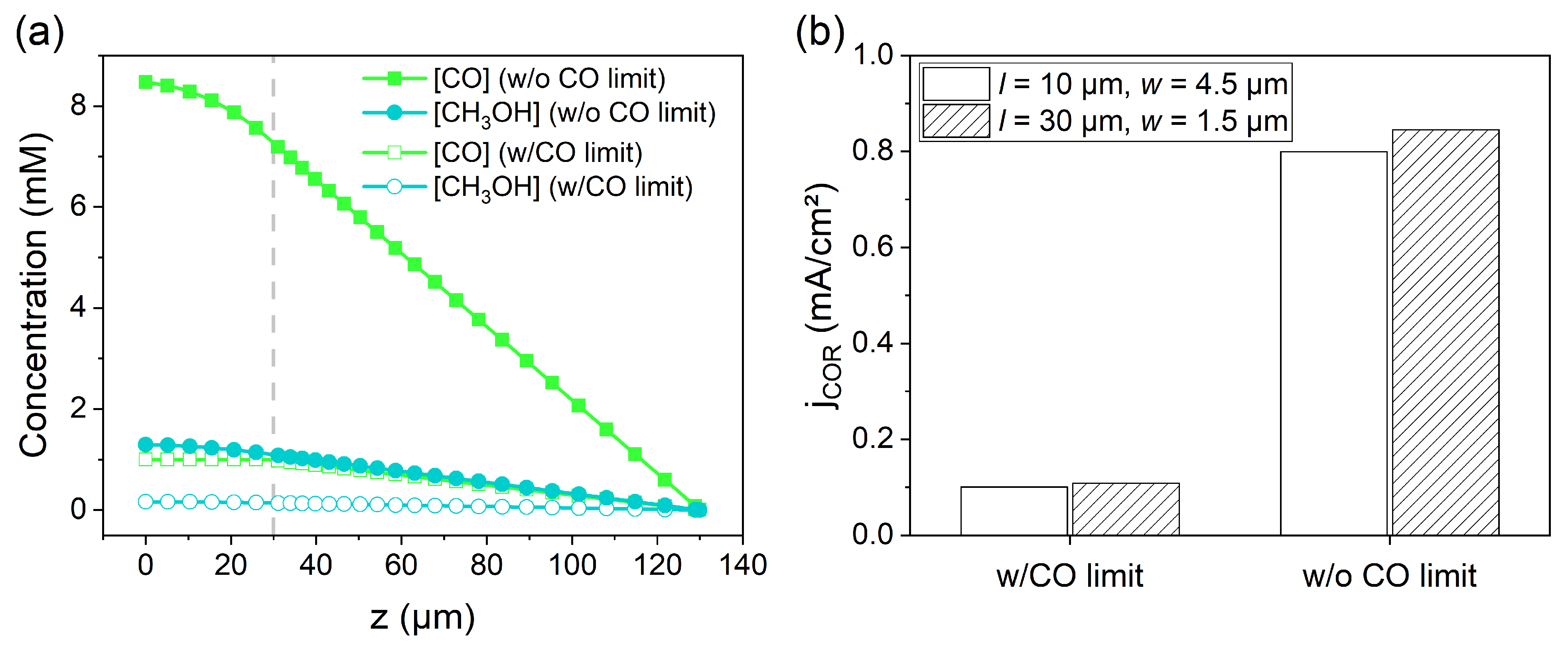
Despite the fact that the model is restricted to dissolved-phase CO and any transient CO bubbles are expected to detach from the surface and be swept away, we cannot fully rule out the role of CO gas in creating a three-phase boundary in operando to potentially exhibit higher rates of CH3OH formation. Gaseous CO could, in principle, form a triple-phase boundary that accelerates COR in the reaction [36]. However, our model is deliberately restricted to the dissolved-phase CO because, under the H-cell conditions employed in this study, the authors did not observe sustained bubble coverage at the electrode surface. As shown in Figure 5, the local CO concentration exceeds the aqueous solubility limit of 1 mM by nearly an order of magnitude. This degree of supersaturation does not necessarily generate bubbles, as high supersaturation has been shown to occur in systems producing hydrogen. However, to investigate the potential impact of bubble formation, particularly its influence on mass transport, an additional homogeneous mass transfer reaction was defined in the electrolyte domain to act as a sink term for CO proportional to the solubility limit. This approach requires a mass transfer coefficient that defines the rate of CO degassing, which was chosen to be arbitrarily large to sufficiently enforce the saturation limit (Figure 6).
Imposing the CO saturation condition limits the local CO concentration to a maximum of 1 mM and consequently reduces the generation of CH3OH (Figure 6a). We observe an ~8-fold decrease in j C O R when the condition is enforced in comparison to when it is not. By using pillar structures with different geometries but identical SAEF, it is evident that there is little difference in j C O R between the structures, further suggesting that the SAEF is determinant in cascade performance (Figure 6b). Furthermore, when evaluating the CO limitation for the planar case of SAEF = 1, we observe a j C O R of 0.1586 mA/cm2, suggesting that pillar structure remains advantageous despite the saturation limit.
This limitation introduces a cascade bottleneck in the form of reduced local CO concentration, hindering the formation of CH3OH. A more complete treatment—like the one described by Kempler et al. [36], outlining the physical processes occurring during the life cycle of a bubble, including nucleation kinetics, interfacial mass transfer, and potential triple-phase pathways, will be pursued in future work. However, results indicate that without CO supersaturation, CH3OH production could be significantly lower for both pillared and flat electrodes.

3.4. Effects of COR Rate on Utilization

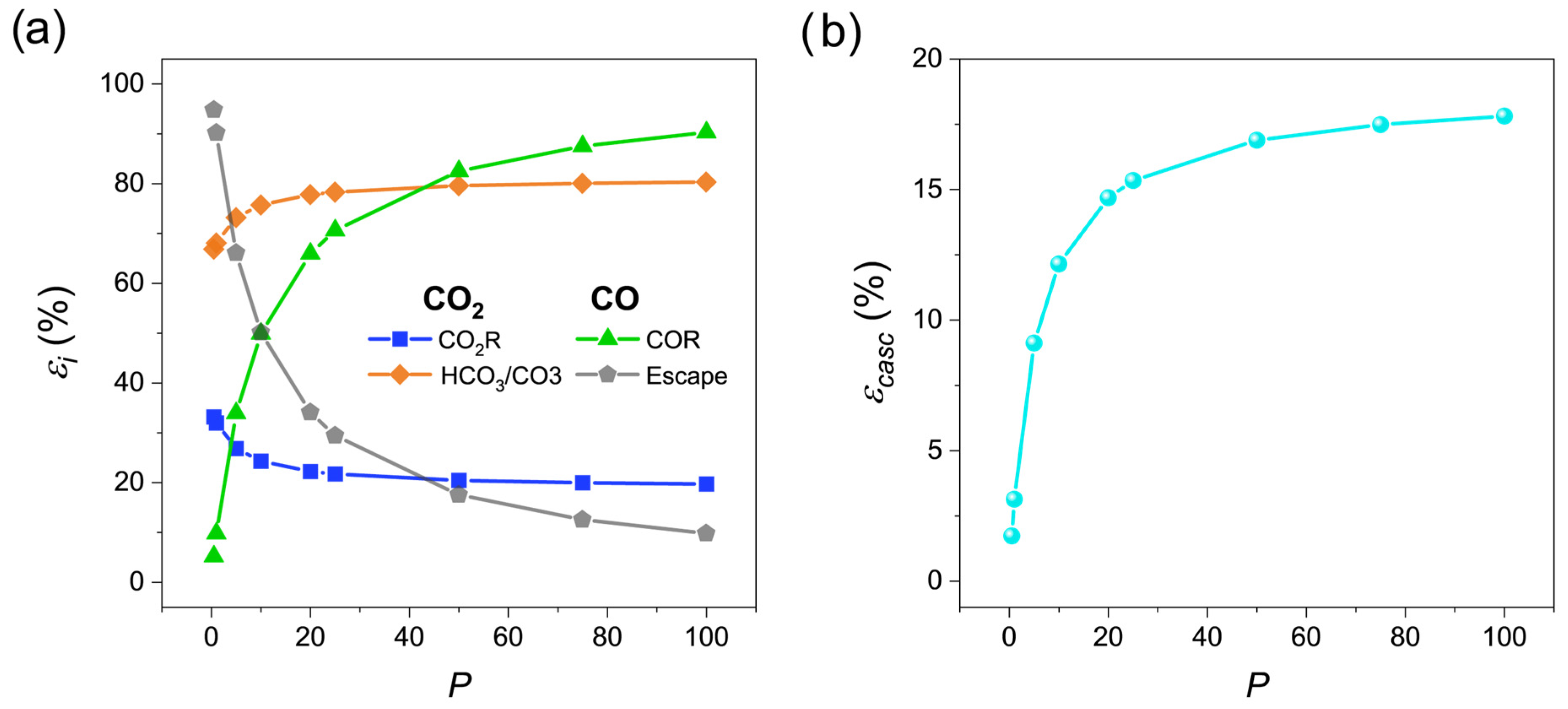
To further understand the limitations of single-catalyst cascade systems, the relative rates of the cascade reaction were varied. The CO2R rate constants were fixed to the experimentally fit values, while the rate of COR was modulated by multiplying j 0 , C O R by a scaling factor P . Although this is not experimentally realistic for CoPc, it permits a more thorough understanding of the role of reaction rates on the efficiency of the cascade reaction. The values for P ranged from 0 to 100, where 100 corresponds to an exchange current density two orders of magnitude larger than the planar fit for COR. For simplicity, the geometry was kept constant with l = 10 µm, w = 2.5 µm, and a = 5 µm. Figure 7 illustrates the effects of increasing the COR rate on the utilization of the different reactant species and the overall cascade reaction.
The first interesting effect to note, as shown in Figure 7a, ε C O 2 R reduces by roughly 10% with increasing P , despite this factor only applying to COR and not CO2R. This is a result of COR contributing to the local alkalinity and reducing the available CO2. As expected, ε C O R approaches 90–100% at sufficiently large values of P , reflecting a diffusion-limited case for COR where any CO produced is almost immediately consumed to form CH3OH. As a result, ε c a s c reaches a plateau (Figure 7b) at a P factor of ~75, where the utilization becomes limited by ε C O 2 R . The effect of the COR rate increase was contrasted to the planar geometry case to compare the effects of geometric pillars (Figure S6). For a given value of P , the planar and pillar structures performed similarly for ε C O 2 R , but the pillar structures improved ε C O R , and by extension ε c a s c , due to the improved mass transport of CO. Thus, the structured electrode enhances the efficiency for CO production and the overall cascade reaction compared to the planar electrode case at all P rates.
Additional simulations were performed to evaluate the performance of a select few structures, of identical SAEF, with an alternative formulation that serves as a proxy for site-competitive kinetics (Figure S7). We observed that the overall performance was dampened with the alternative formulation, but once again, the structures of identical SAEF still performed similarly, suggesting that SAEF is the primary factor in determining cascade performance over geometry under the tested conditions. The remaining simulations in the paper did not incorporate this modification or the one enforcing a saturation limit.

3.5. Effects of Extreme Local Confinement on Utilization

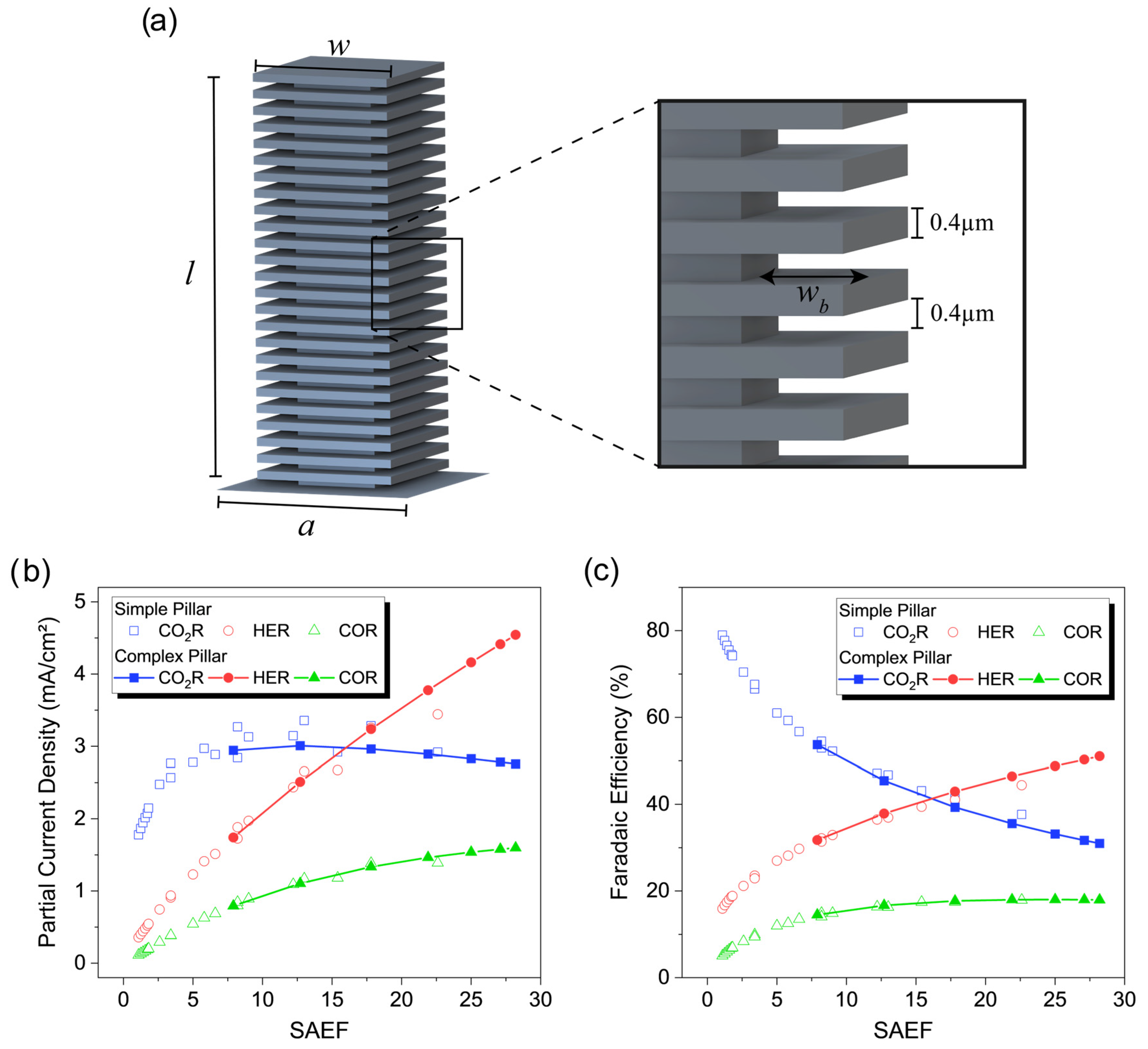
As highlighted in previous sections, local generation of the CO intermediate is thought to be a key factor in the formation of CH3OH [23]. To probe the limitations of this principle and the effect on utilization, complex high surface area structures were considered and based on the fabricated structures from Aryal et al. [37]. These geometries were chosen as candidate structures that increase surface area beyond the maximum SAEF of square pillars while maximizing spatial confinement to trap CO and form CH3OH. The total height of the complex structure was arbitrarily fixed at l = 10   μ m and w = 3.5   μ m for a periodicity of a = 5   μ m . The complex pillar was segmented into equal parts of height 0.4   μ m , and the SAEF was modulated by receding every other segment a distance w b from the pillar surface to create a vertically stacked shelf-like structure (Figure 8a). Extending the distance w b increases the SAEF in the complex structure and was expected to improve the degree of CO trapping to produce CH3OH.
Surprisingly, we observe that the partial current densities of the complex pillar do not deviate significantly from the performance of the simple pillars as a function of SAEF, implying a minimal contribution of geometry for a given SAEF (Figure 8b) with the chosen structures and kinetic parameters. The largest difference is observed for j C O 2 R , which has a slightly lower current density compared to the square pillar case. Similarly, the selectivity of the cathodic reactions for the complex pillar follows a nearly identical relation with SAEF as the simple pillars (Figure 8c).
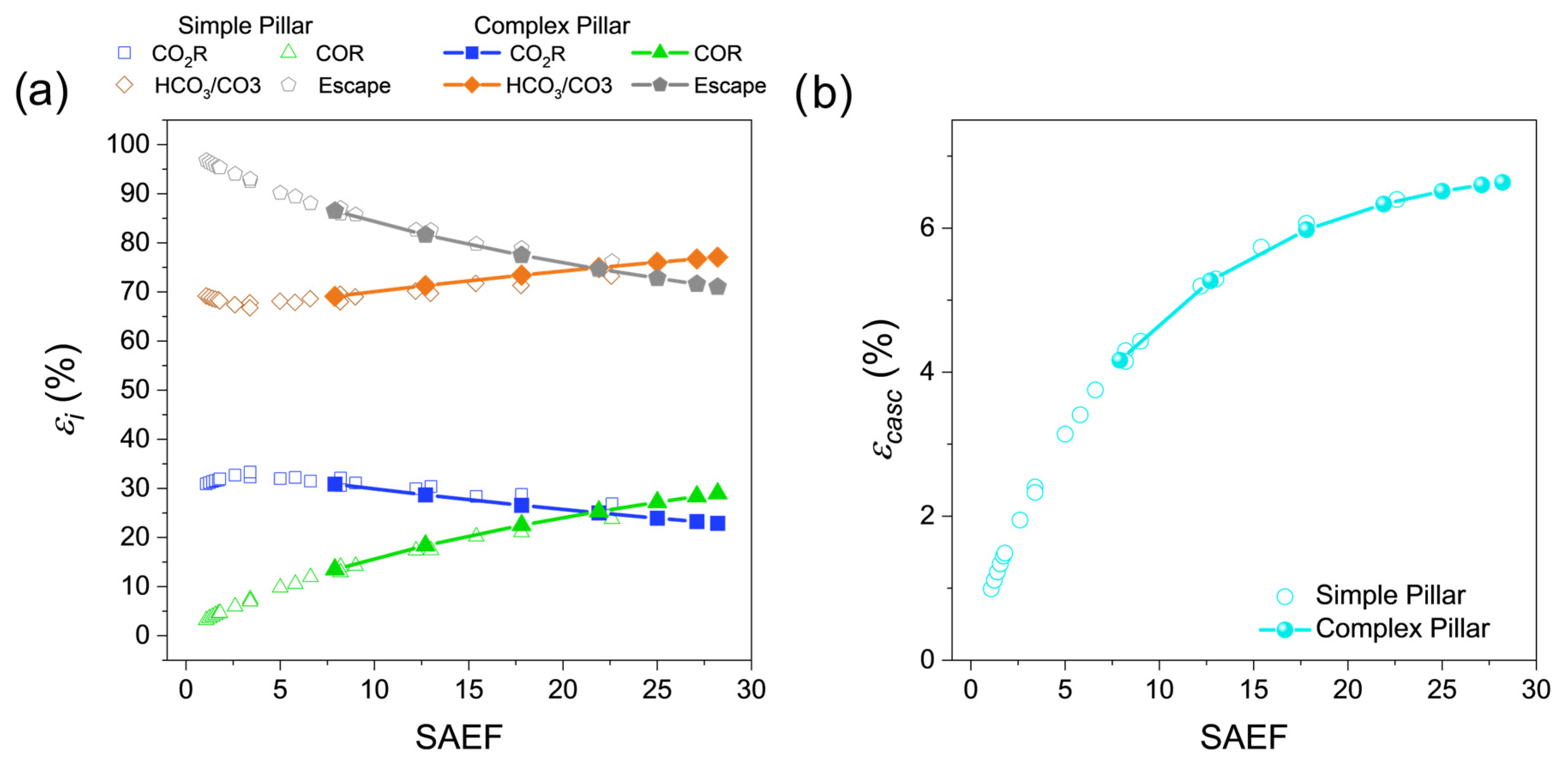
Nonetheless, a higher SAEF can be achieved with a lower volume of material due to increased surface area coming from the distance w b . The complex pillar structure can be further evaluated by considering the utilization of reactants (Figure 9a). Once again, the complex structure performance follows that of the square pillars. Intuitively, we would expect the value ε o u t to decrease for the complex structure relative to the square pillars due to geometrical confinement, but there is little noticeable difference from the previous trend.
The equivalent performance in utilization for structures of the same SAEF further suggests that the effect of locally confining geometry is minimal with the chosen kinetic parameters and length scales. Accordingly, the performance of ε c a s c continues to its final plateau at roughly 7% (Figure 9b). To understand why the complex pillars perform similarly to the square pillar geometry at a given SAEF, we can compare the j C O 2 R for each geometry at an SAEF of 17.8. The complex pillar achieves a j C O 2 R ranging from approximately 0.15–0.21 mA/cm2 throughout the structure (Figure S8a). However, at the same SAEF and w , the simple pillar must extend to a height of 30 µm, where the j C O 2 R ranges from 0.14 to 0.32 mA/cm2 (Figure S8b).
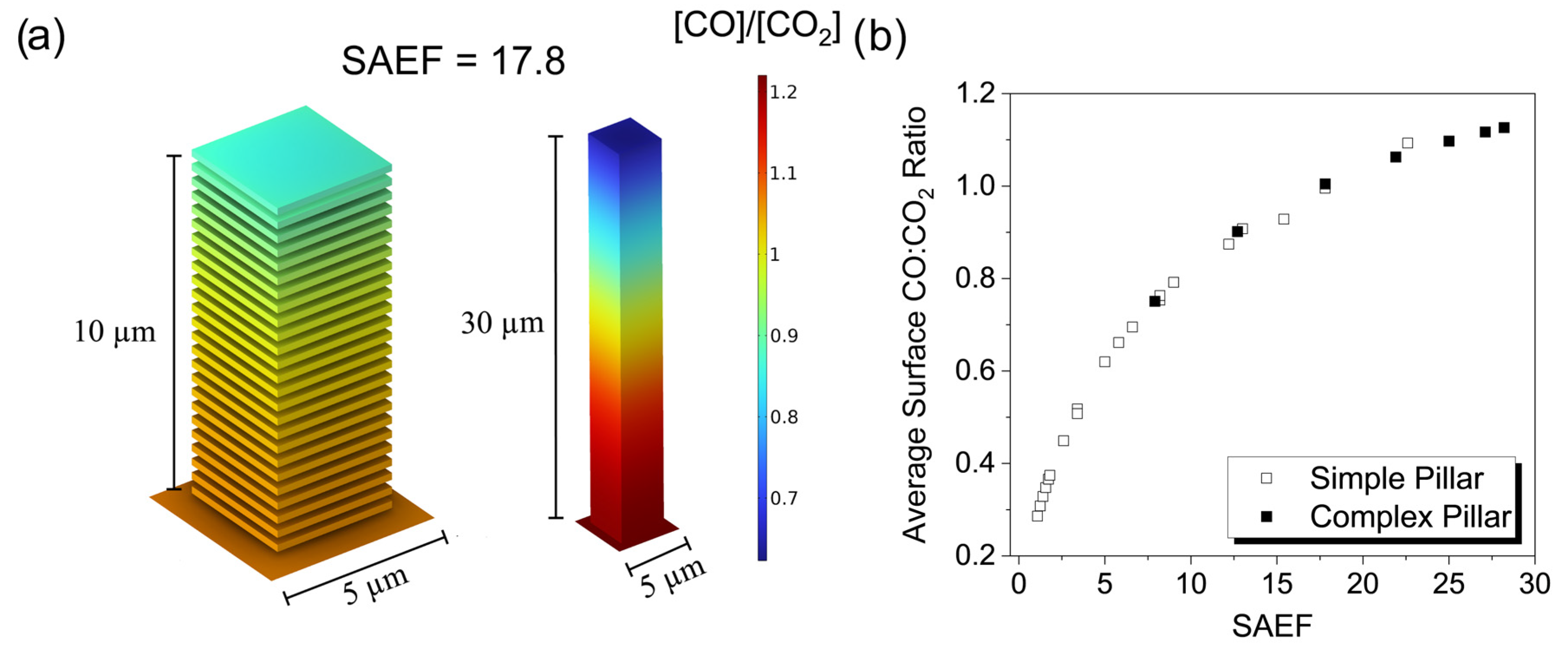
Additionally, to explore the underlying principle causing surface area to be the primary determinant of CH3OH production, the integrated spatially averaged surface [CO]/[CO2] ratio was estimated. Figure 10 shows that for a fixed SAEF, both the complex and simple pillar geometries produce nearly the same spatially average ratio. This reinforces the idea that geometry mainly affects the local distribution of species, but not the overall cascade performance. For a given surface area, geometries that tightly confine the electrolyte produce moderate local [CO]/[CO2] ratios within those small volumes. In contrast, less confining geometries result in a broader distribution of local ratios—both higher and lower than those in confined regions—spreading over larger volumes. Nevertheless, both configurations yield close to the same spatially averaged [CO]/[CO2] ratio.
Despite the high degree of local geometric confinement in the complex pillar, the additional height in the simple pillar amplifies the mass transport limitations for CO2 near the basal plane of the electrode in a compensatory way that achieves a similar performance for j C O 2 R and ε C O 2 R after performing a surface integration. Similar reasoning can be used to explain the similar performances in j C O R and ε C O R at the same SAEF: the geometric confinement of the complex pillar improves the mass transport of CO, resulting in a lower ε e s c ; however, at the same SAEF, the additional height of the simple pillar also reduces the amount of CO that escapes unreacted to ultimately achieve a similar ε e s c . Thus, the complex pillar structure might be most applicable for cases where the electrode material needs to be conserved and used as efficiently as possible (less volume); however, it has limited advantages when material conservation is less of a concern, as the performance gains may be minimal.

4. Conclusions

In this study, we developed a 3D reaction–diffusion model to examine how structural features, surface area, and reaction rates influence mass transport and overall cascade performance in a single-catalyst CO2-to-CH3OH system. While variations in electrode architecture do modulate local concentration and intermediate confinement, our results indicate that the electrochemically active surface area seems to be the primary factor governing the overall cascade kinetics and product distribution under the simulated conditions.
Complex pillar structures provide stronger local confinement but follow similar trends to simple pillars at matched surface area enhancement factors (SAEFs). This occurs because different architectures that share the same SAEF generate comparable spatially averaged surface [CO]/[CO2] ratios, despite differences in local gradients. Thus, although geometry influences local environments, global performance is largely determined by the total catalyst area and the resulting integrated reaction–transport balance.
Our simulations also highlight the importance of CO supersaturation, which emerges naturally under confined conditions and serves as a key driver of the second cascade step. However, the extent of supersaturation predicted here should be viewed as an upper bound, as the present model does not explicitly include competitive adsorption, site blocking, or transient bubble formation—effects known to shape molecular CO2 reduction systems. A Langmuir-type adsorption framework for CO and CO2 was not included in the present simulations; this mechanism requires coverage-dependent rate expressions and reliable parameterization that is not yet available for the CO2-to-CH3OH single cascade system. We therefore treat the surface as kinetically active and unoccupied, with the understanding that this assumption yields an upper bound on activity. Basic approaches to saturation limit and site competition were tested on a few structures to gain some insight into the impact of these phenomena. As expected, product generation is damped, but surface area remains the main predictor of performance, with 3D structure outperforming the flat reference. The results from these additional models support the conclusion that the main model results represent an upper bound. Future extensions of the model will incorporate rigorous competitive adsorption once reliable mechanistic parameters become available. Likewise, because microkinetic adsorption/desorption steps are not explicitly resolved, the trends reported here represent first-order insights rather than definitive mechanistic limits.
Finally, improvements in COR rate illustrate the coupled nature of the cascade: accelerating the CO-to-CH3OH step increases local alkalinity, which in turn reduces CO2 availability and ultimately constrains the maximum achievable utilization. These results collectively provide design principles for engineering tandem CO2 reduction electrodes, emphasizing that (i) surface-area enhancement is the most effective strategy for increasing productivity, (ii) structural features contribute indirectly by modulating species distribution and confinement, and (iii) local CO confinement via supersaturation is essential for enabling efficient CH3OH formation. Future work incorporating explicit surface site competition, bubble dynamics, and semiconductor photoelectrode physics will further refine the predictive capacity of the model and extend its applicability to integrated photoelectrochemical systems.

Supplementary Materials

The following supporting information can be downloaded at: https://www.mdpi.com/article/10.3390/electrochem7010005/s1, Detailed information about reaction kinetics parameters, geometrical parameters, and complementary simulation results. Figure S1: Tafel expression fitting of planar electrode configuration compared with experimental data from [27]; Figure S2: Normalized steady-state current densities and FE as a function of the surface area enhancement factor for a periodicity of a = 10   μ m at constant bias ( E a p p = 1.1   V ); Figure S3: Average pH near the pillar geometry as a function of the SAEF; Figure S4: Partial current density for COR as a function of boundary layer thickness for structures of SAEF = 8.2 at E a p p = 1.1   V and a = 5   μ m ; Figure S5: Concentration profile of cascade reaction species within the electrolyte for a periodicity of a = 10   μ m at E a p p = 1.1   V with l = 3 0 µm (dashed line); Figure S6: Utilization of reactant species as a function of the COR rate factor for a periodicity of a = 5   μ m with a planar configuration at E a p p = 1.1   V ; Figure S7: Partial current density for COR with and without the modified kinetic expression for two structures of SAEF= 8.2 and periodicity of a = 5   μ m ( E a p p = 1.1   V ); Figure S8: Spatial-dependent partial current density of CO2R at SAEF = 17.8 for a complex and simple pillar geometry at constant bias ( E a p p = 1.1   V ); Table S1: Summary of reaction kinetics parameters used in COMSOL Multiphysics; Table S2. Summary of geometric parameterization for square pillar architecture; Note S1: Fitting Tafel Kinetic Expression to Experimental Data; Note S2: Calculation of U 0 for each cathodic reaction; Note S3: Approach for Considering Site Competition in Reaction Kinetics. References [6,15,38,39].

Author Contributions

Conceptualization, P.F., M.G.-B., B.S., H.W. and R.L.; validation, B.S. and H.W. formal analysis, P.F., M.G.-B., J.F.C., G.N.P. and R.L.; writing—original draft preparation, P.F. and M.G.-B.; writing—review and editing, P.F., M.G.-B., R.L., J.F.C. and G.N.P.; supervision, J.F.C. and R.L.; project administration, R.L.; funding acquisition, J.F.C., G.N.P., H.W. and R.L. All authors have read and agreed to the published version of the manuscript.

Funding

This work was solely supported as part of the Center for Hybrid Approaches in Solar Energy to Liquid Fuels (CHASE), an Energy Innovation Hub funded by the U.S. Department of Energy, Office of Science, Office of Basic Energy Sciences under Award Number DE-SC0021173.

Institutional Review Board Statement

Not applicable.

Informed Consent Statement

Not applicable.

Data Availability Statement

The original contributions presented in this study are included in the article/Supplementary Materials. Further inquiries can be directed to the corresponding author.

Conflicts of Interest

The authors declare no conflicts of interest.

References

  1. Clark, E.L.; Resasco, J.; Landers, A.; Lin, J.; Chung, L.-T.; Walton, A.; Hahn, C.; Jaramillo, T.F.; Bell, A.T. Standards and Protocols for Data Acquisition and Reporting for Studies of the Electrochemical Reduction of Carbon Dioxide. ACS Catal. 2018, 8, 6560–6570. [Google Scholar] [CrossRef]
  2. Cheon, S.; Li, J.; Wang, H. In Situ Generated CO Enables High-Current CO2 Reduction to Methanol in a Molecular Catalyst Layer. J. Am. Chem. Soc. 2024, 146, 16348–16354. [Google Scholar] [CrossRef]
  3. Wu, Y.; Jiang, Z.; Lu, X.; Liang, Y.; Wang, H. Domino electroreduction of CO2 to methanol on a molecular catalyst. Nature 2019, 575, 639–642. [Google Scholar] [CrossRef]
  4. Kroutil, W.; Rueping, M. Introduction to ACS catalysis virtual special issue on cascade catalysis. ACS Catal. 2014, 4, 2086–2087. [Google Scholar] [CrossRef]
  5. Shang, B.; Zhao, F.; Suo, S.; Gao, Y.; Sheehan, C.; Jeon, S.; Li, J.; Rooney, C.L.; Leitner, O.; Xiao, L.; et al. Tailoring Interfaces for Enhanced Methanol Production from Photoelectrochemical CO2 Reduction. J. Am. Chem. Soc. 2024, 146, 2267–2274. [Google Scholar] [CrossRef]
  6. Suter, S.; Haussener, S. Optimizing mesostructured silver catalysts for selective carbon dioxide conversion into fuels. Energy Environ. Sci. 2019, 12, 1668–1678. [Google Scholar] [CrossRef]
  7. Heßelmann, M.; Bräsel, B.C.; Keller, R.G.; Wessling, M. Simulation-based guidance for improving CO2 reduction on silver gas diffusion electrodes. Electrochem. Sci. Adv. 2023, 3, 2100160. [Google Scholar] [CrossRef]
  8. Gurudayal, G.; Perone, D.; Malani, S.; Lum, Y.; Haussener, S.; Ager, J.W. Sequential Cascade Electrocatalytic Conversion of Carbon Dioxide to C-C Coupled Products. ACS Appl. Energy Mater. 2019, 2, 4551–4559. [Google Scholar] [CrossRef]
  9. Lum, Y.; Ager, J.W. Sequential catalysis controls selectivity in electrochemical CO2 reduction on Cu. Energy Environ. Sci. 2018, 11, 2935–2944. [Google Scholar] [CrossRef]
  10. Andrei, R.D.; Popa, M.I.; Fajula, F.; Cammarano, C.; Al Khudhair, A.; Bouchmella, K.; Mutin, P.H.; Hulea, V. Ethylene to Propylene by One-Pot Catalytic Cascade Reactions. ACS Catal. 2015, 5, 2774–2777. [Google Scholar] [CrossRef]
  11. Hulea, V. Direct transformation of butenes or ethylene into propylene by cascade catalytic reactions. Catal. Sci. Technol. 2019, 9, 4466–4477. [Google Scholar] [CrossRef]
  12. Beucher, R.; Andrei, R.D.; Cammarano, C.; Galarneau, A.; Fajula, F.; Hulea, V. Selective Production of Propylene and 1-Butene from Ethylene by Catalytic Cascade Reactions. ACS Catal. 2018, 8, 3636–3640. [Google Scholar] [CrossRef]
  13. Singh, M.R.; Clark, E.L.; Bell, A.T. Effects of electrolyte, catalyst, and membrane composition and operating conditions on the performance of solar-driven electrochemical reduction of carbon dioxide. Phys. Chem. Chem. Phys. 2015, 17, 18924–18936. [Google Scholar] [CrossRef] [PubMed]
  14. Yang, W.; Sun, L.; Bao, J.; Mo, Z.; Du, M.; Li, J.; Zhang, J. Two-Phase Flow Model to Define the Mass Transport in a Bicarbonate Electrolyzer for a CO2 Reduction Reaction. Ind. Eng. Chem. Res. 2023, 62, 16469–16480. [Google Scholar] [CrossRef]
  15. Agliuzza, M.; Pirri, C.F.; Sacco, A. A comprehensive modeling for the CO2 electroreduction to CO. J. Phys. Energy 2024, 6, 015004. [Google Scholar] [CrossRef]
  16. Zhang, Z.; Lu, Q.; Sun, J.; Li, G.; Wu, W.; Xu, Z.; Xu, L.; Wang, Y. Unravelling the carbonate issue through the regulation of mass transport and charge transfer in mild acid. Chem. Sci. 2024, 15, 2786–2791. [Google Scholar] [CrossRef]
  17. Rooney, C.L.; Lyons, M.; Wu, Y.; Hu, G.; Wang, M.; Choi, C.; Gao, Y.; Chang, C.; Brudvig, G.W.; Feng, Z.; et al. Active Sites of Cobalt Phthalocyanine in Electrocatalytic CO2 Reduction to Methanol. Angew. Chem. Int. Ed. 2024, 63, e202310623. [Google Scholar] [CrossRef]
  18. Zhu, Q.; Rooney, C.L.; Shema, H.; Zeng, C.; Panetier, J.A.; Gross, E.; Wang, H.; Baker, L.R. The solvation environment of molecularly dispersed cobalt phthalocyanine determines methanol selectivity during electrocatalytic CO2 reduction. Nat. Catal. 2024, 7, 987–999. [Google Scholar] [CrossRef]
  19. Chan, T.; Kong, C.J.; King, A.J.; Babbe, F.; Prabhakar, R.R.; Kubiak, C.P.; Ager, J.W. Role of Mass Transport in Electrochemical CO2 Reduction to Methanol Using Immobilized Cobalt Phthalocyanine. ACS Appl. Energy Mater. 2024, 7, 3091–3098. [Google Scholar] [CrossRef]
  20. Zhu, M.; Ye, R.; Jin, K.; Lazouski, N.; Manthiram, K. Elucidating the Reactivity and Mechanism of CO2 Electroreduction at Highly Dispersed Cobalt Phthalocyanine. ACS Energy Lett. 2018, 3, 1381–1386. [Google Scholar] [CrossRef]
  21. Su, J.; Musgrave, C.B.; Song, Y.; Huang, L.; Liu, Y.; Li, G.; Xin, Y.; Xiong, P.; Li, M.M.-J.; Wu, H.; et al. Strain enhances the activity of molecular electrocatalysts via carbon nanotube supports. Nat. Catal. 2023, 6, 818–828. [Google Scholar] [CrossRef]
  22. Kim, Y.; Yun, G.; Kim, M.; Jamal, A.; Gereige, I.; Ager, J.W.; Jung, W.; Jung, H. Effect of Feature Shape and Dimension of a Confinement Geometry on Selectivity of Electrocatalytic CO2 Reduction. Angew. Chem. Int. Ed. 2024, 63, e202316264. [Google Scholar] [CrossRef]
  23. García-Batlle, M.; Fernandez, P.; Sheehan, C.J.; He, S.; Mallouk, T.E.; Parsons, G.N.; Cahoon, J.F.; Lopez, R. Spatially Patterned Architectures to Modulate CO2 Reduction Cascade Catalysis Kinetics. ACS Catal. 2025, 15, 5894–5905. [Google Scholar] [CrossRef]
  24. Houle, F.A.; Yano, J.; Ager, J.W. Hurry Up and Wait: Managing the Inherent Mismatches in Time Scales in Natural and Artificial Photosynthetic Systems. ACS Catal. 2023, 13, 7139–7158. [Google Scholar] [CrossRef]
  25. Houle, F.A. Adaptive response by an electrolyte: Resilience to electron losses in a dye-sensitized porous photoanode. Chem. Sci. 2021, 12, 6117–6128. [Google Scholar] [CrossRef]
  26. Yu, S.; Yamauchi, H.; Wang, S.; Aggarwal, A.; Kim, J.; Gordiz, K.; Huang, B.; Xu, H.; Zheng, D.J.; Wang, X.; et al. CO2-to-methanol electroconversion on a molecular cobalt catalyst facilitated by acidic cations. Nat. Catal. 2024, 7, 1000–1009. [Google Scholar] [CrossRef]
  27. Thevenon, A.; Rosas-Hernández, A.; Fontani Herreros, A.M.; Agapie, T.; Peters, J.C. Dramatic HER Suppression on Ag Electrodes via Molecular Films for Highly Selective CO2 to CO Reduction. ACS Catal. 2021, 11, 4530–4537. [Google Scholar] [CrossRef]
  28. Shang, B.; Rooney, C.L.; Gallagher, D.J.; Wang, B.T.; Krayev, A.; Shema, H.; Leitner, O.; Harmon, N.J.; Xiao, L.; Sheehan, C.; et al. Aqueous Photoelectrochemical CO2 Reduction to CO and Methanol over a Silicon Photocathode Functionalized with a Cobalt Phthalocyanine Molecular Catalyst. Angew. Chem. Int. Ed. 2023, 62, e202215213. [Google Scholar] [CrossRef] [PubMed]
  29. Hinzpeter, F.; Tostevin, F.; Buchner, A.; Gerland, U. Trade-offs and design principles in the spatial organization of catalytic particles. Nat. Phys. 2022, 18, 203–211. [Google Scholar] [CrossRef]
  30. Ehlinger, V.M.; Lee, D.U.; Lin, T.Y.; Duoss, E.B.; Baker, S.E.; Jaramillo, T.F.; Hahn, C. Modeling Planar Electrodes and Zero-Gap Membrane Electrode Assemblies for CO2 Electrolysis. ChemElectroChem 2024, 11, e202300566. [Google Scholar] [CrossRef]
  31. Zeng, J.S.; Corbin, N.; Williams, K.; Manthiram, K. Kinetic Analysis on the Role of Bicarbonate in Carbon Dioxide Electroreduction at Immobilized Cobalt Phthalocyanine. ACS Catal. 2020, 10, 4326–4336. [Google Scholar] [CrossRef]
  32. Li, J.; Shang, B.; Gao, Y.; Cheon, S.; Rooney, C.L.; Wang, H. Mechanism-guided realization of selective carbon monoxide electroreduction to methanol. Nat. Synth. 2023, 2, 1194–1201. [Google Scholar] [CrossRef]
  33. Zhu, L.; Wang, Y.X.; Chen, L.J.; Li, J.; Zhou, S.; Yang, Q.Q.; Wang, X.Z.; Tung, C.H.; Wu, L.Z. Single Molecular Dispersion of Crown Ether-Decorated Cobalt Phthalocyanine on Carbon Nanotubes for Robust CO2 Reduction through Host-Guest Interactions. Angew. Chem. Int. Ed. 2025, 64, e202418156. [Google Scholar]
  34. Dunne, H.; Liu, W.; Ghaani, M.R.; McKelvey, K.; Dooley, S. Sensitivity Analysis of One-Dimensional Multiphysics Simulation of CO2 Electrolysis Cell. J. Phys. Chem. C 2024, 128, 11131–11144. [Google Scholar] [CrossRef]
  35. Böhme, A.; Bui, J.C.; Fenwick, A.Q.; Bhide, R.; Feltenberger, C.N.; Welch, A.J.; King, A.J.; Bell, A.T.; Weber, A.Z.; Ardo, S.; et al. Direct observation of the local microenvironment in inhomogeneous CO2 reduction gas diffusion electrodes via versatile pOH imaging. Energy Environ. Sci. 2023, 16, 1783–1795. [Google Scholar] [CrossRef]
  36. Kempler, P.A.; Coridan, R.H.; Luo, L. Gas Evolution in Water Electrolysis. Chem. Rev. 2024, 124, 10964–11007. [Google Scholar] [CrossRef]
  37. Aryal, M.; Ko, D.-H.; Tumbleston, J.R.; Gadisa, A.; Samulski, E.T.; Lopez, R. Large area nanofabrication of butterfly wing’s three dimensional ultrastructures. J. Vac. Sci. Technol. B 2012, 30, 061802. [Google Scholar] [CrossRef]
  38. Corpus, K.R.M.; Bui, J.C.; Limaye, A.M.; Pant, L.M.; Manthiram, K.; Weber, A.Z.; Bell, A.T. Coupling covariance matrix adaptation with continuum modeling for determination of kinetic parameters associated with electrochemical CO2 reduction. Joule 2023, 7, 1289–1307. [Google Scholar] [CrossRef]
  39. Bui, J.C.; Lees, E.W.; Pant, L.M.; Zenyuk, I.V.; Bell, A.T.; Weber, A.Z. Continuum Modeling of Porous Electrodes for Electrochemical Synthesis. Chem. Rev. 2022, 122, 11022–11084. [Google Scholar] [CrossRef]
Figure 1. Schematic representation of the unit cell configuration. ϕ s represents the voltage applied to the electrode surface and ϕ e l the electrolyte potential. The unit cell has length a in the x-axis and y-axis, and height h in the z-axis, and it includes a cathodic electrode consisting of both the bottom surface and a pillar with a width w and height l . δ is defined as a w 2 and corresponds to the half-gap distance between adjacent pillars.
Electrochem 07 00005 g001
Figure 2. Normalized steady-state current densities and FE as a function of the Surface Area Enhancement Factor (SAEF) for a periodicity of a = 5   μ m (at E a p p = 1.1   V ). (a) Partial current densities and (b) FEs of the cathodic reactions: CO2R (blue), HER (red), and COR (green). Subsets of geometries with the same pillar height l are connected with lines, where l = 1   μ m (dashed dotted line), 10   μ m (dotted-line), 20   μ m (dashed line), and 30   μ m (solid line). Note that for a given line, an increased SAEF corresponds to a smaller δ .
Electrochem 07 00005 g002
Figure 3. Utilization of reactant species as a function of the Surface Area Enhancement Factor (SAEF) for a periodicity of a = 5   μ m at constant bias ( E a p p = 1.1   V ). (a) Simplified diagram of the contributions in utilization, ε (%), for each species. (b) Utilization of CO2 and CO as a function of SAEF for a periodicity of 5 µm. (c) Utilization of CO2 towards the total cascade reaction to CH3OH, defined as ε C O 2 R × ε C O R .
Electrochem 07 00005 g003
Figure 4. Concentration profiles of species within the electrolyte for a periodicity of a = 5   μ m at E a p p = 1.1   V with l = 30 µm (dashed line) and different pillar width w (a) CO2 (b) HCO3 (c) CO32− and (d) pH. Concentration profiles are defined with a z-axis cut-line exactly between adjacent pillars, extending from the bottom of the pillar (z = 0) to the boundary layer (z = 130 μm). The gray dashed line denotes the top of the pillar.
Electrochem 07 00005 g004
Figure 5. Concentration profile of cascade reaction species within the electrolyte for a periodicity of a = 5   μ m at E a p p = 1.1   V with   l = 30 µm (dashed line) and different pillar width w (a) CO (b) CH3OH. Concentration profiles are defined with a z-axis cut-line exactly between adjacent pillars, extending from the bottom of the pillar (z = 0) to the boundary layer (z = 130 μm). Dashed gray line denotes the position of the top of the pillar.
Electrochem 07 00005 g005
Figure 6. Concentration profiles and partial current density for COR with and without CO mass transfer saturation limit for SAEF = 8.2 structures at E a p p = 1.1   V . (a) CO and CH3OH concentration profiles for the l = 30 µm, w = 4.5 µm geometry. A z-axis cut-line exactly between adjacent pillars, extending from the bottom of the pillar (z = 0) to the boundary layer (z = 130 μm). Dashed gray line denotes the position of the top of the pillar. (b) j C O R for two geometric pillar structures of equivalent SAEF for the cases with and without the CO mass transfer limit consideration.
Electrochem 07 00005 g006
Figure 7. Utilization of reactant species as a function of the COR rate factor, P , for a periodicity of a = 5   μ m , l = 10 μ m , w = 2.5   μ m at constant E a p p = 1.1   V . (a) Utilization of CO2 and CO as a function of COR rate factor. (b) Utilization of CO2 towards the total cascade reaction to CH3OH, defined as ε C O 2 R × ε C O R .
Electrochem 07 00005 g007
Figure 8. Normalized steady-state current densities and FE for a complex pillar as a function of the Surface Area Enhancement Factor (SAEF) for a periodicity of a = 5   μ m at constant bias ( E a p p = 1.1   V ). (a) Diagram of geometric parameters used for the complex pillar. (b) Partial current densities of cathodic reactions. (c) FE of cathodic reactions. Previous datapoints for the simple pillar case are shown with open symbols.
Electrochem 07 00005 g008
Figure 9. Utilization of reactant species as a function of the Surface Area Enhancement Factor (SAEF) for a complex pillar with periodicity of a = 5   μ m at E a p p = 1.1   V . (a) Utilization of CO2 and CO as a function of SAEF for a periodicity of 5 µm. (b) Utilization of CO2 towards the total cascade reaction to CH ε C O 2 R × ε C O R OH , defined as ε C O 2 R × ε C O R .
Electrochem 07 00005 g009
Figure 10. Spatially averaged [ C O ] / [ C O 2 ] ratio at Surface Area Enhancement Factor (SAEF = 17.8) for a complex and simple pillar geometry at constant bias ( E a p p = 1.1   V ). (a) Surface [ C O ] / [ C O 2 ] ratio for a complex ( a = 5 µm, l = 10 µm, w = 3.5 µm, w b = 1 µm) and a simple ( a = 5 µm, l = 30 µm, w = 3.5 µm) pillar geometry. (b) Comparison of the integrated average surface [ C O ] / [ C O 2 ]   ratio as a function of SAEF for both the simple and complex pillar geometries.
Electrochem 07 00005 g010
Disclaimer/Publisher’s Note: The statements, opinions and data contained in all publications are solely those of the individual author(s) and contributor(s) and not of MDPI and/or the editor(s). MDPI and/or the editor(s) disclaim responsibility for any injury to people or property resulting from any ideas, methods, instructions or products referred to in the content.