


Abstract
Despite their excellent torsional and bending strength, the economical production of hypotrochoidal profiles (H-profiles) remains an obstacle to their use. Due to the tool clearance angle, the commercially available twin-spindle turning process has limited ability to manufacture many of the profiles standardized according to DIN 3689 (Deutsches Institut für Normung). On the other hand, the manufacturing of cycloidal as a non-involute special geometry using generating processes (hobbing or continuous generating grinding) depends critically on the accuracy of the tool geometry—whether a hobbing cutter or a grinding worm. Conventional tool design methods—based on approximations, involute-derived profiles, or iterative trial-and-error corrections—face fundamental limitations: unpredictable cutting force variations, elevated surface roughness, and limited process capability. However, if the exact tool geometry has been determined analytically, the same machine achieves significantly better performance. In this work, the exact tool geometry conjugated to the H-profile for profile manufacturing is determined based on the gearing law. This provides modular H-profile manufacturing without deviations. Consequently, a design concept that enables the implementation of all existing rolling processes—including gear hobbing, gear shaping, gear planning, and other variants such as gear grinding—is presented. For profile shaping of hollow contours, the transfer ratio is considered and a curve conjugated to the profile contour is determined for the tool. A CAD-based simulation shows very good consistency with the analytically determined tool geometry.
1. Introduction
Although hypotrochoidal profiles offer much higher torsional and bending strength (see, e.g., [1,2,3]), manufacturing such profiles is challenging and imposes high demands regarding flexibility, precision, and cost-effectiveness. While conventional non-circular turning processes reach their limits in the production of such profiles, especially those with strongly concave flank geometries, a newly developed reference profile for the tool in the rolling process expands the range of possibilities for profile production.
The process, which is protected by a patent [4], enables the flexible production of different hypotrochoidal H-profiles with a single tool. At the same time, it is possible to specifically shift the profile during the manufacturing process, thus overcoming the geometric limitations of conventional non-circular turning processes and providing new perspectives for the economical production of H-profiles.
2. State of the Art and Problem Definition
Hypotrochoidal profile shaft–hub connections are high-quality connections that offer higher load-bearing capacities compared to other common form-fit connections. Part 1 of the standard DIN 3689 [5] specifies the geometry and series sizes for H-profiles, while Part 2 of the standard deals with the calculation and design of hypotrochoidal profiles. This paper contributes to Part 3 of the above-mentioned standard (manufacturing and tolerancing), which is currently still in progress.
2.1. Geometry of H-Contours
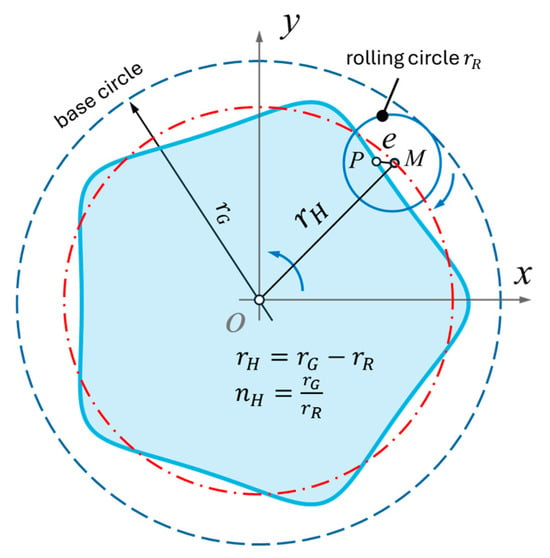
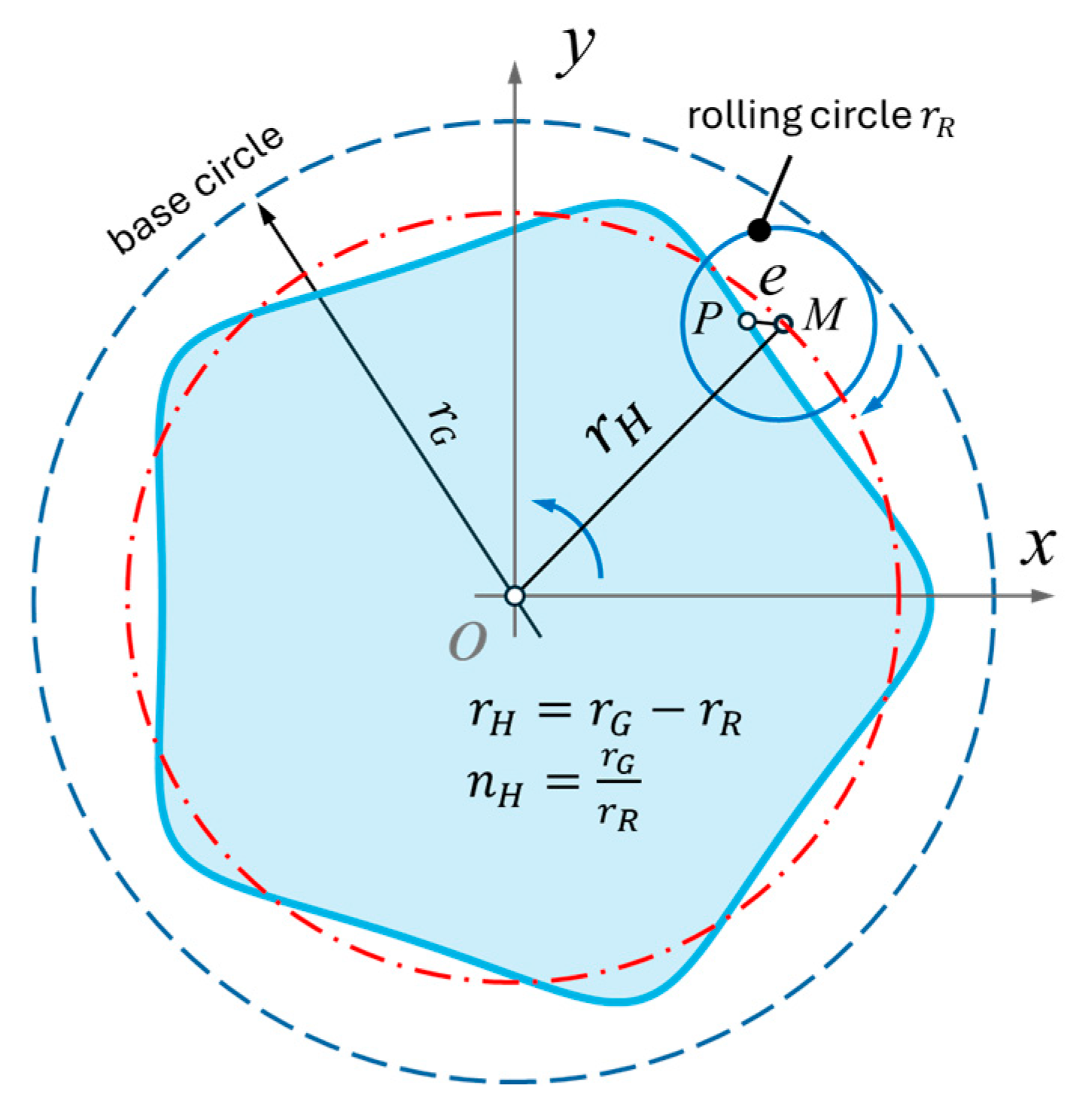
A hypotrochoidal profile (H-profile) is created via the slip-free rolling of a roll circle on the inside of a base circle (see, e.g., [6]), where the profile contour is described by a generating point P lying on the roll circle (see Figure 1). The ratio between the radii of the two circles , which reflects the number of profile sides , should remain an integer. The mean or nominal radius of the profile is also calculated from the difference between the two radii, as . Figure 1 shows the generation principle of H-profiles, using an example with sides. The point is the so-called generation point.
Figure 1.
Creation of an H-profile, exemplified with sides.
The kinematics of the rolling circle (see Figure 1) result in the following generally applicable parameter representation for H-profiles:
where is the nominal radius of the profile, is the profile’s eccentricity, is the number of sides, and t is the parameter angle. The profile’s eccentricity needs to be less than to avoid contour self-intersection. All data in DIN 3689 [2] was defined or developed based on these equations.
2.2. Manufacture of H-Profiles
H-profiles are traditionally manufactured using non-circular turning processes, including the twin-spindle process [7] and the so-called oscillating turning process [8]. In such a process, the profile contour is created by a rotating or radially oscillating turning tool while the workpiece also rotates.
2.3. Geometric Limitations of the Turning Process
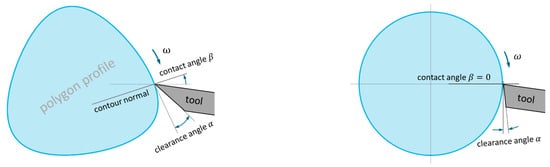
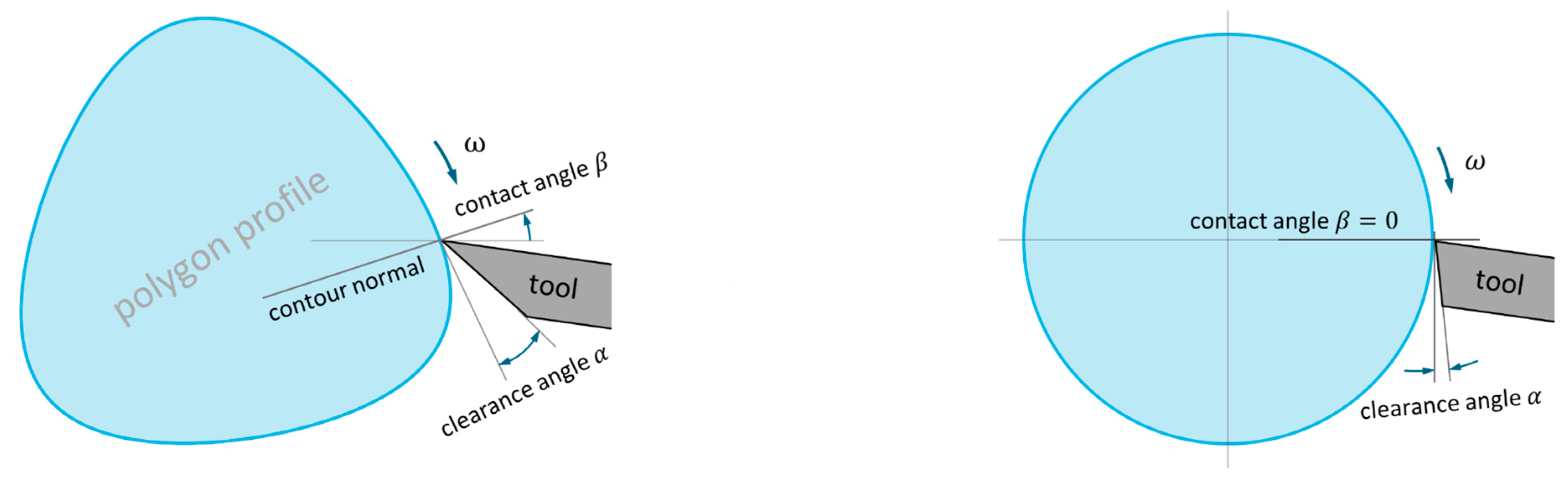
The main limitation of conventional turning processes lies in the difficulty of creating concave profile flanks, as the limited clearance angle of the turning tool prevents the production of sufficiently concave flank shapes. The clearance angle should be 3–6° greater than the contact angle , such that the cutter does not collide with the previously machined area:
However, an excessive clearance angle can cause vibrations and corresponding instability of the tool. Figure 2 shows the clearance angle α of the tool in relation to the contact angle β. For trouble-free production, the following should apply.
Figure 2.
Clearance angle and its relationship with the contact angle .
An excessive clearance angle can lead to significant limitations:
- The geometric design of H-profiles is limited, meaning that many H-profiles can no longer be manufactured;
- Restricted freedom in the selection and design of H-profiles;
- More complex and expensive manufacturing processes are often unavoidable.
According to [9], a practical feasibility limit of has been determined for the traditionally used out-of-round turning process (see left side of Figure 2).
For H-profiles—especially those with concave flanks—contact angles up to 50° and even higher (i.e., clearance angles ) may occur, depending on the profile’s eccentricity. These H-profiles can therefore no longer be manufactured using the turning processes mentioned above.
Thus, a feasible, economical manufacturing process is essential. Based on the commercially available rolling process used for gear cutting technology, tool profiles for H-profiles were derived mathematically. The central question here is how to mathematically describe the tool profile for the milling cutter. In practice, this is often determined point-by-point and incrementally by regressing the tool geometry based on the contour to be manufactured. The disadvantages of this method include the inaccuracy of the manufacturing process and restrictions regarding the modular use of the tool.
3. Rolling Process
In rolling processes such as gear hobbing, gear shaping, and gear planning, as well as other variants including gear grinding, the tool and the workpiece are considered as “gears” in mesh, whereby the corresponding kinematics of the general gearing law (Camus’ condition) are fulfilled [10]. This means that two gears can only work together with a constant transmission ratio if the common normal to the profile flanks at the point of contact passes through the rolling point.
The gearing law requires uniform transmission of motion when the two-wheel contours roll on each other. Pairing of the workpiece and tool can be considered as a wheel–bar or wheel–counterwheel configuration, depending on the situation. To generate hypotrochoidal profiles, conjugate geometries must therefore be determined for the tool.
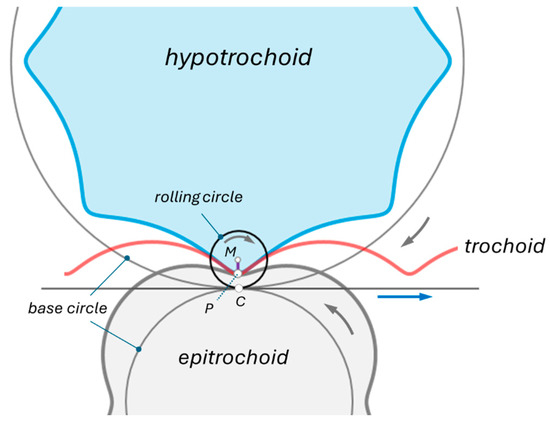
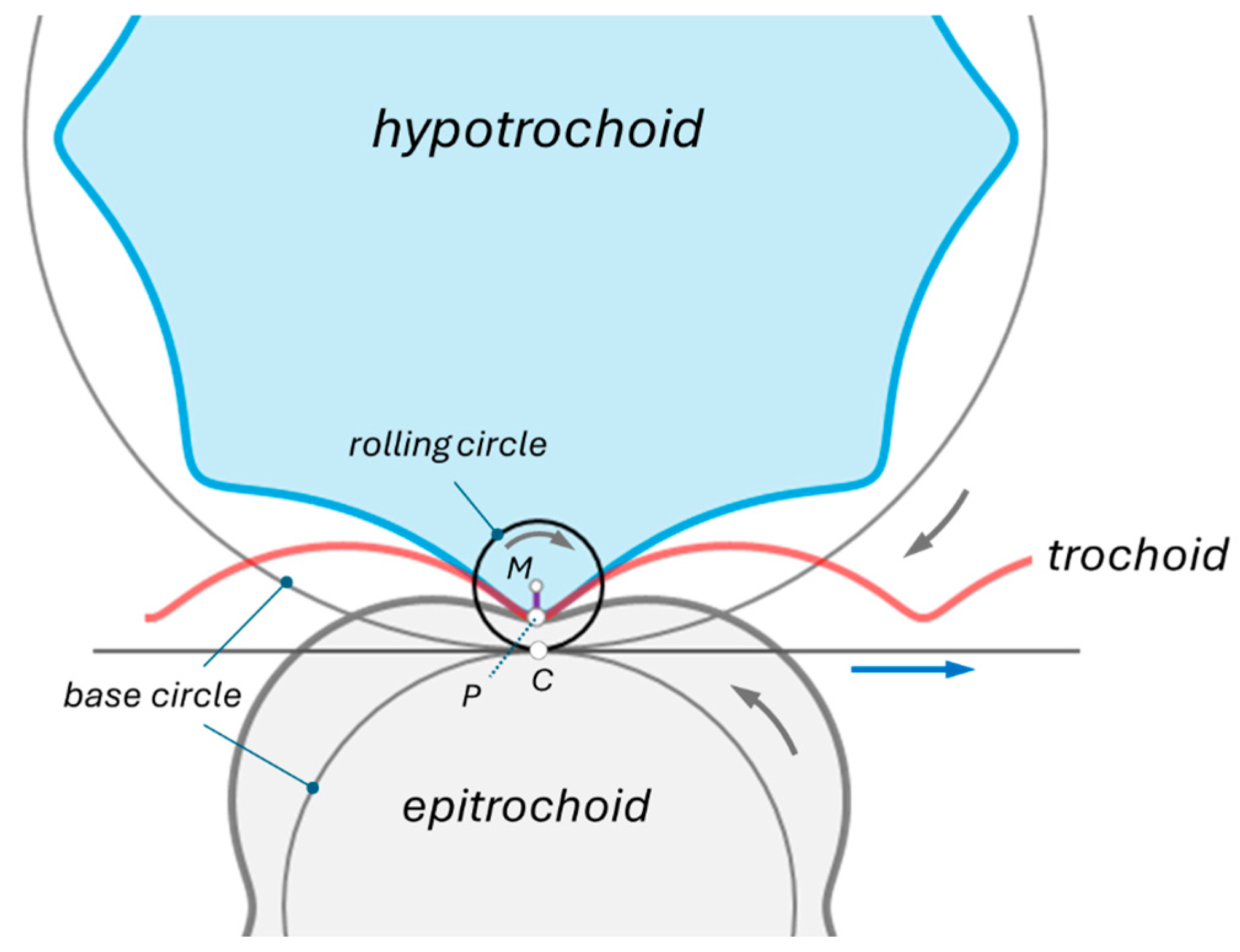
There are various methods in the technical literature for determining/constructing the mating flank when the contour of the first wheel is defined, such as the envelope theory according to [11], the kinematic method (relative motion) [12], or the purely constructive method according to [13]. The explicit method can be described as the basis of the present state of the art for non-involute gears. In this method, the specified curve is first parameterized and a differential equation for the components of the velocity for the desired mating curve is determined [14]; in the general case, this equation can only be solved numerically. This naturally leads to numerical errors, which can greatly influence the accuracy of the counter-curve, especially in modular manufacturing applications. In contrast, in this work, an exact derivation of the conjugate curve for hypotrochoidal contours is developed based on [15]. This method is based on Camus’ principle and is suitable for generating rolling curves with little effort. Two rolling curves—an epitrochoid and a hypotrochoid—are conjugated according to Camus’ condition if and only if they are generated by the same rolling circle; therefore, joint generation by the same rolling circle is not only sufficient but also necessary for conjugation. This approach can be supplemented with a third rolling curve—namely, a line trochoid—as shown in Figure 3. In this case, the generating point P does not lie on the circumference of the rolling circle but, instead, at a smaller distance from the center point. The ratio between the respective base circle and the rolling circles determines the number of sides of the respective curves, and must remain an integer from a technical point of view.
Figure 3.
Generation of conjugate curves using a rolling circle.
Based on Equation (1) for the hypotrochoid and the kinematics of the movements, the parametric equations can be determined analogously for the epitrochoidal and trochoidal curves. The following applies to the epitrochoid:
where is the nominal radius of the epitrochoid , is the eccentricity, and represents the number of sides of the epitrochoid, analogous to Equation (1). The ratio can be regarded as a kind of translation. Similarly, the following parameter representation applies to the generated trochoid after conversion:
Here, applies. It can be seen from Equation (4) that the trochoid is independent of the number of sides and ; however, the general size of the cycle depends on the ratio of the hypotrochoids. After rearranging and transforming Equation (4), the equivalent representation can be obtained as follows:
The curves are generated by rolling the rolling circle at different speeds, i.e., when is run over the range , the complete hypotrochoid (with sides) is generated, while only one side (unit) is drawn for the trochoid. The transmission ratio in the existing kinematics is therefore .
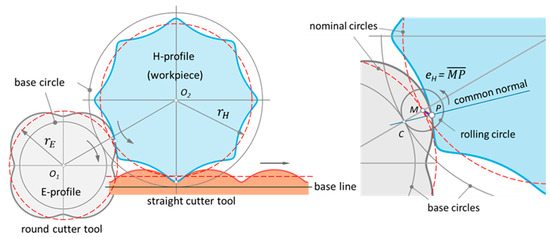
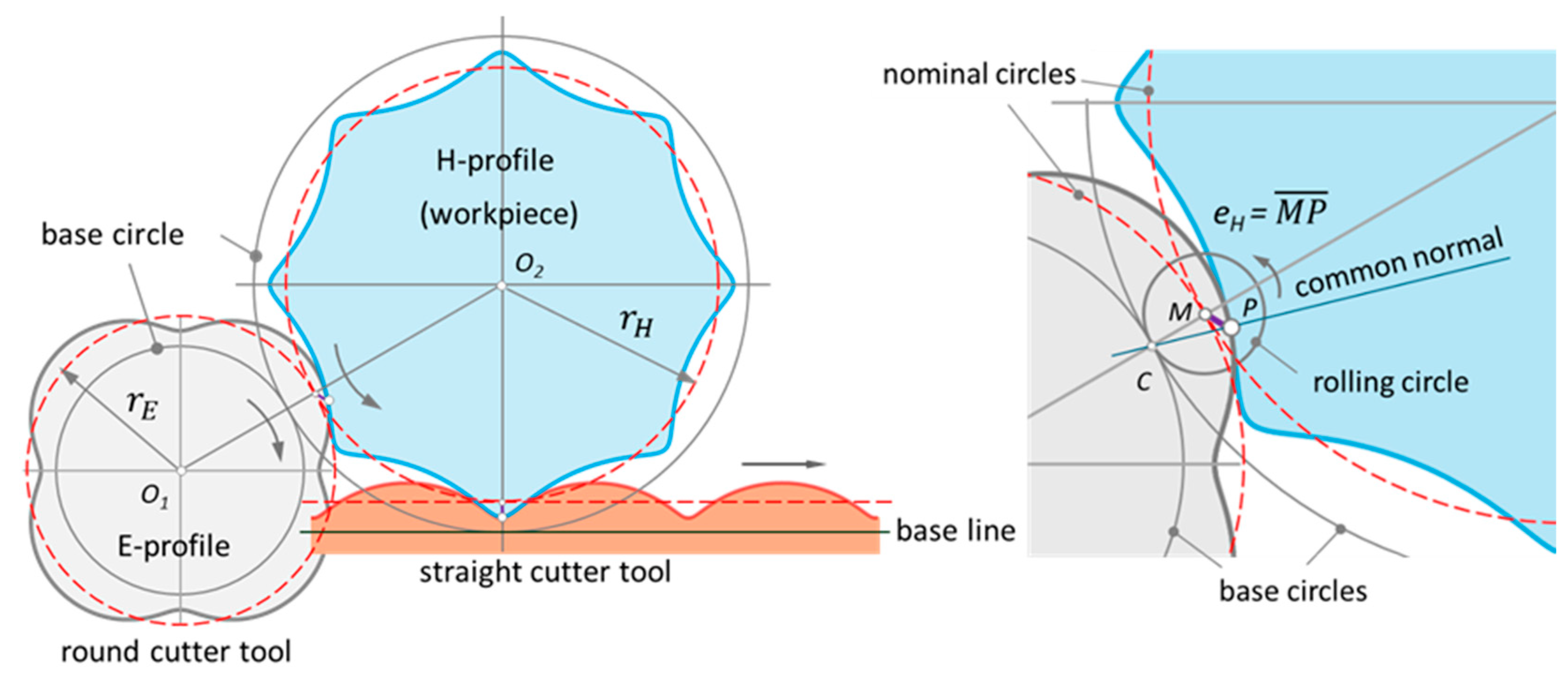
The three conjugate curves are depicted in Figure 4. The epitrochoid and trochoid are represented as tool geometries for production of the hypotrochoidal contour.
Figure 4.
Reference profile and counter profile as tool geometry.
4. Determining the Tool Geometry
If the parameters , , and for a hypotrochoid are known as the geometry of the workpiece (e.g., from Part 1 of DIN 3689), the geometry of an epitrochoidal cutting wheel can be determined as follows:
Since the nominal radius is kept the same here, the eccentricity must be adjusted with a geometric similarity factor such that the tooth contact law is still satisfied. This factor can be determined from the relationship:
which results in the following for :
Based on the parameter Equation (1) and the gearing law, the following relationship for a conjugate rod profile was derived in advance of patent [4]. Substituting with and with n into Equation (5) yields the following for a reference profile:
The curve length for one profile side is also considered here.
Considering the transmission ratio or between the hypotrochoid and trochoid, the following relationship with the geometric similarity factor can be obtained based on the gearing law for :
This means that the tool geometry has been fully determined according to Equation (9).
Overcoming Geometric Limitations
The decisive advantage of the rolling process lies in the virtually unlimited freedom in terms of the tool’s clearance angle. While the tool works in a fixed position relative to the workpiece in the turning process, thereby limiting the clearance angle, the new process allows for significantly greater design freedom; even strongly concave flanks (for higher form fit) can be produced without any problems. Due to the rolling motion, the tool can reach and machine the areas that would be inaccessible with conventional turning due to the limited clearance angle.
This opens new possibilities:
- Production of strongly concave tooth flanks without geometric restrictions;
- Realization of complex special gear teeth;
- Greater freedom in gear tooth design;
- Optimization of profile geometry without manufacturing compromises;
- Small side numbers are possible without undercut;
- Profile displacement (plus or minus) can be implemented to adapt to the installation space.
The applicability of the process covers all currently established rolling machining processes, including gear hobbing, gear shaping, and gear shaving, as well as other variants such as gear grinding, gear skiving, and gear rasping. These processes are all based on the principle of kinematic rolling motion between the tool and the workpiece (i.e., the so-called gearing law, which is satisfied by Equation (3) for the cutting wheel and by Equation (5) for the rack cutter as well as the hobbing cutter. If a machine tool for machining standardized gear teeth is available, the H-profiles can be manufactured without a fundamentally new machine concept. The only adjustment required is the procurement of a reference tool according to Equation (9), thus avoiding additional investment costs.
5. CAD-Based Simulation
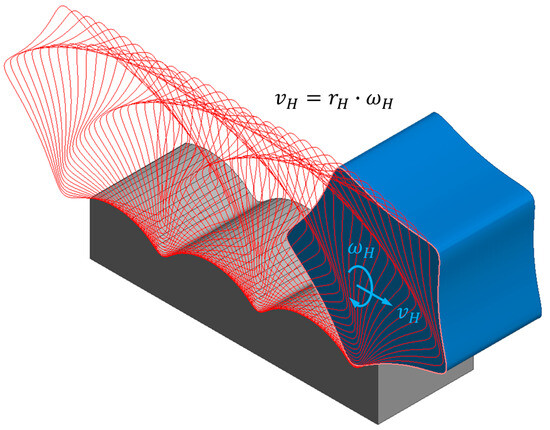
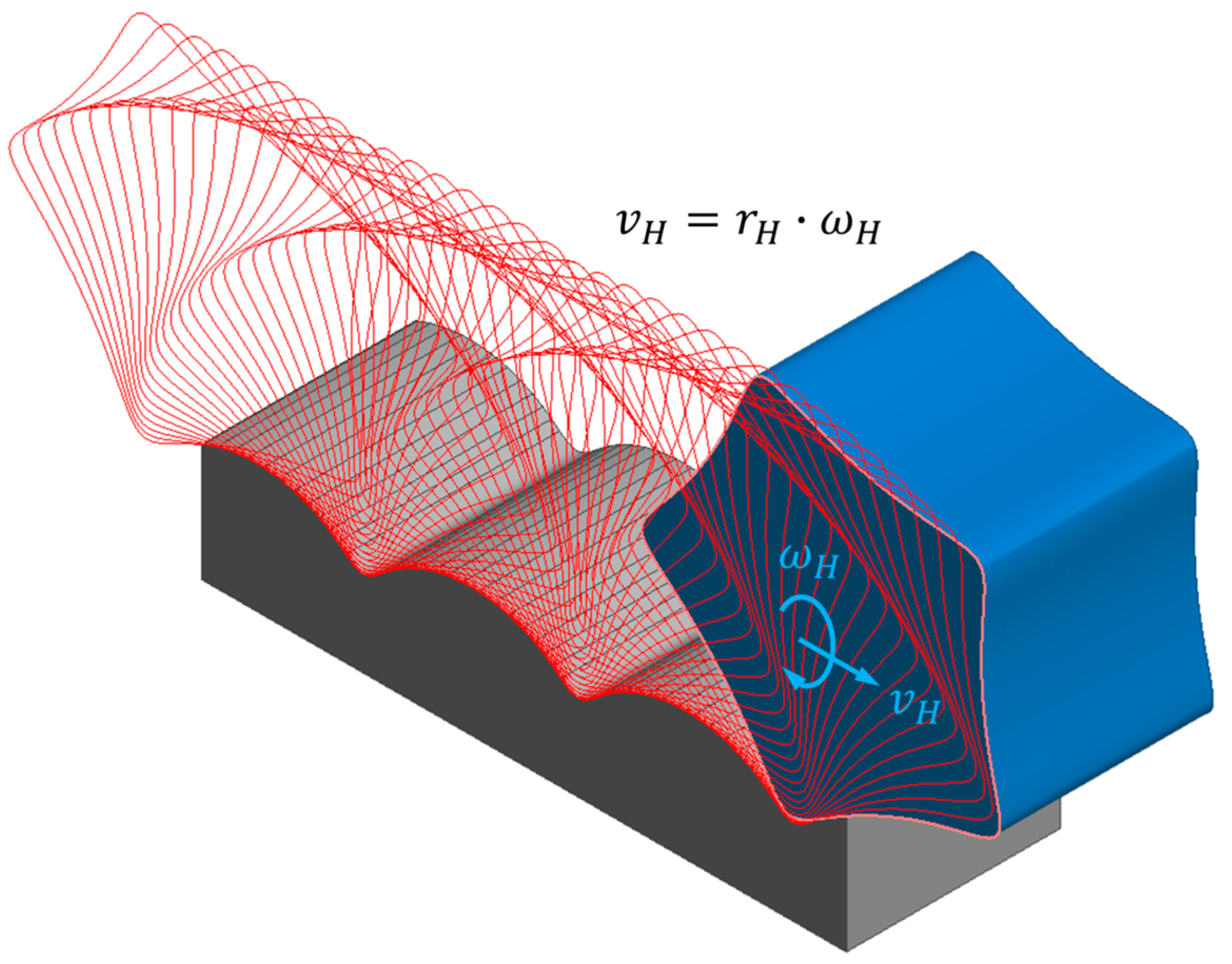
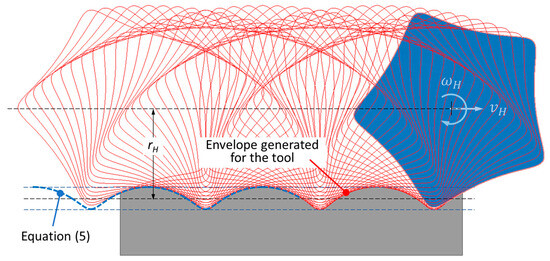
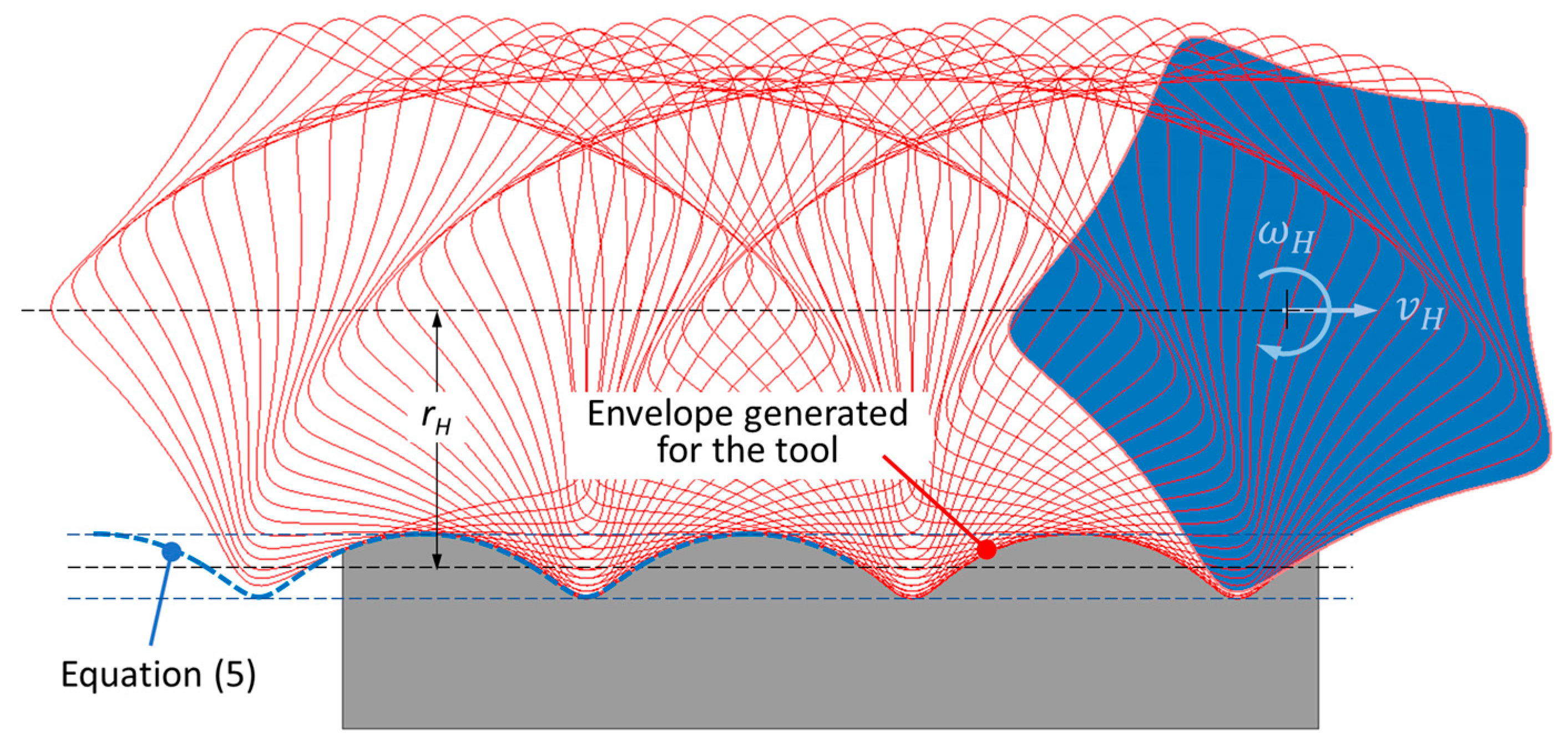
To validate the theoretical envelope curve analytically derived for the rack profile, a CAD-based kinematic simulation was developed using Autodesk Inventor (San Francisco, CA, USA, Version 2024) [16]. The simulation replicates the physical cutting process in which a specialized H-profile acts as the cutting tool to generate the envelope curve of the rack. Figure 5 illustrates the simulation setup, showing the H-profile in its role as the cutting tool and the stepwise kinematic motion applied during the envelope generation process.
Figure 5.
CAD-based kinematic simulation in Autodesk Inventor. The gear wheel performs 48 discrete steps of rotation and translation relative to the fixed rack ( 20 mm, mm and 5).
In the simulation setup, the rack is held fixed while the gear wheel undergoes a combined motion consisting of stepwise rotation and a corresponding translational displacement. The translational increment per rotational step is determined by the transmission ratio between the wheel and the rack, ensuring kinematic consistency with the real machining process. This approach accurately models the conjugate motion that governs the geometry of the generated profile.
The simulation is parametrized by three fundamental quantities: the pitch radius of the H-profile, the eccentricity and the number of the profiled units on the rack . In the present study, the simulation was carried out for 20 mm, 2.5 mm and 5. A total of 48 discrete simulation steps were selected, providing a balance between a sufficiently accurate approximation of the envelope curve and a clear, readable graphical representation. By systematically varying these parameters, the simulation generates the corresponding rack profiles for a range of geometric configurations, thereby demonstrating the generality of the approach.
Once the rack profile has been obtained through this procedure, the roles of tool and workpiece are interchangeable: the generated rack profile can subsequently serve as a precision cutting tool for the manufacturing of new gear wheels, closing the generative cycle between rack and wheel geometry. Importantly, the derived rack profile is not limited to reproducing the original wheel geometry—it can be employed as a universal tool for the modular manufacturing of gear wheels with varying tooth numbers, as detailed in Section 6.
The rack profiles generated by the CAD-based simulation show excellent quantitative agreement with the theoretical envelope curves derived analytically, as demonstrated in Figure 6, which provides a direct visual comparison between the simulated and theoretically predicted profiles according to Equation (5). This close correspondence confirms that the simulation correctly captures the underlying kinematics and validates the theoretical framework. The consistency between simulation and theory demonstrates that the proposed method is both mathematically rigorous and practically applicable for the design and manufacture of conjugate gear-rack systems.
Figure 6.
Overlay of the CAD-simulation-generated rack profile and the theoretically derived envelope curve, showing excellent agreement between both results.
6. Modular Tool Concept
A special feature of the patented process is the ability to produce gears with different numbers of teeth using a single tool. This is made possible by the rolling principle, in which the kinematics of the rolling motion are adapted to the respective number of teeth while the tool itself remains unchanged.
This results in the following advantages with respect to conventional gear cutting technology:
- Significant reduction in tool costs;
- Minimization of setup time when changing between different numbers of profile side number;
- High flexibility in production;
- Particularly economical for small series and variant production;
- Ideal for prototype production;
- The module can be defined analogously to conventional gears as the ratio of the nominal diameter () to the number of profile sides :
This allows Equation (9) to be rewritten as follows:
The tool eccentricity can always be determined first, for any number of sides n and desired eccentricity e, using Equation (10). The tool contour determined from Equation (9) can then be used to produce further profiles with any number of sides.
Advantages of Exact Tools in Modular Manufacturing of Non-Involute Profiles
Mathematically exact tool geometry offers a well-founded, multi-dimensional advantage over approximated tool contours—that is, the conventional industry practice of deriving the hob contour through empirical adaptation and iterative approximation of the target tooth profile rather than through a closed-form mathematical description—in the modular manufacturing of non-involute special gears. This iterative, approximation-based design paradigm has historically been the standard methodology for hobbing tool development for non-involute special gears, where the absence of a standardized generating principle necessitates profile-specific tool adaptation. Since the tool contour directly determines the generated tooth geometry, its precise analytical definition is the single most influential factor governing component quality and process consistency.
In terms of form accuracy, exact tool geometry reduces profile deviations from ±20–50 (approximated) to indicatively below 5–10 [17], which is particularly critical for non-involute profiles where no standardized reference geometries exist to detect and compensate systematic errors [18]. The accuracy of the hobbing tool, and more precisely the cutting-edge profile, exerts a decisive influence on the accuracy of the gear machined with it—a universal relationship that applies to all profile types [18].
Regarding process stability, analytically defined and documented tool geometry renders the process behavior geometry-driven rather than machine-dependent, thereby significantly improving reproducibility when transferring process modules between machines or production sites [18]. In industrial practice, the trial-and-error method has been employed to enhance the precision of non-standard hobbing tools—a time-consuming process that does not always yield the desired outcome [18], confirming that approximated geometries impose a structural ramp-up penalty that exact tool geometry substantially mitigates [17,19].
With respect to digital integration, exact tool geometry is a prerequisite for simulation, digital twins, and CAD/CAM-supported (Computer-Aided Design/Computer-Aided Engineering) NC (Numerical Control) programming [19]. The mathematical modeling of the gear and the machined profile is closely linked to CNC (Computerized Numerical Control) machining technologies, and a robust correlation between design and manufacturing systems is of central importance for non-involute gear production [19], enabling standardized and transferable process modules without manual adjustment.
Concerning wear behavior, alterations to the tool profile led to measurable changes in tool life and the nature of wear phenomena occurring, attributable to the associated changes in process loads [20]. Simulation-based optimization of hob tooth profiles has demonstrated that a newly derived tool geometry can reduce spindle torque and yield a significant reduction in tool wear [21]. Exact geometry furthermore supports uniform coating application across the full tool profile: in conventionally prepared tools, coating thickness decreases significantly from the tip toward the root, which provides an explanation for atypical and accelerated wear behavior in those regions [22]. Consequently, unbalanced or non-uniform tool wear—which typically leads to geometrical deviations in the machined gear profile [23]—is significantly reduced, extending both tool life and resharpening intervals in a reproducible manner [20,21].
It should be explicitly acknowledged that several of these advantages, while well-grounded in established process engineering principles and supported by simulation-based analyses [21,23], have not yet been comprehensively validated through dedicated experimental studies specifically for non-involute special gears in modular production environments. The quantitative claims in particular rely substantially on simulation results and indicative estimates derived from the general hobbing literature and should therefore be interpreted with appropriate caution until confirmed by application-specific experimental investigation [19,20,21,22,23]. In this regard, targeted experimental trials are currently being planned specifically for the cycloidal gear profiles under consideration, with the explicit objective of empirically validating the simulation-based findings and quantitative estimates presented in this assessment.
In summary, it can be stated that exact tool geometry transforms a geometry-critical, empirically driven process into a predictable, standardizable, and digitally integrable manufacturing module—precisely the properties demanded by modular production of non-involute special profile.
Equation (12) allows for the exact determination of reference tools for modular profile manufacturing. For the modular manufacturing of non-involute special gears, a mathematically exact tool offers substantial advantages over conventional hobbing tools. Since the tool contour directly governs the generated profile geometry, a precise analytical description yields superior form fidelity, enhanced serial reproducibility, and reduced process variation.
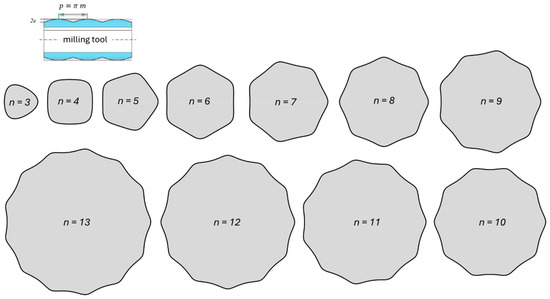
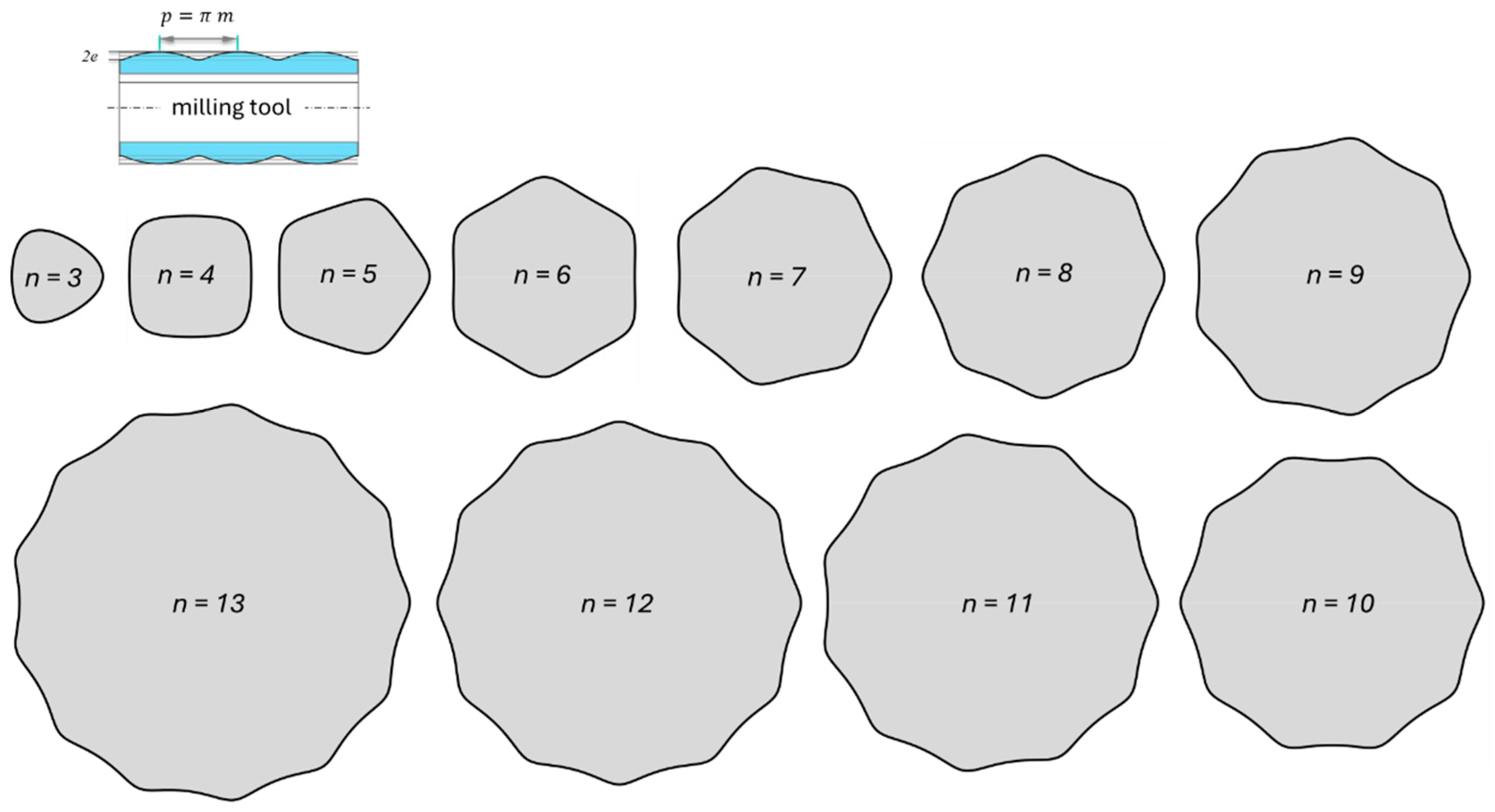
The machine control system adjusts the rolling kinematics to the desired number of sides n, such that the operator only needs to enter the profile parameters without having to change tools. Figure 7 shows various H-profiles that can be produced with the same tool, where the tool eccentricity (in Equation (5)) refers to a reference profile with . A geometric simulation showed that a minimum acceptable number of sides is advisable to avoid contour intersection. However, for the first planned experiment to continue the work presented in this paper, n = 5 was chosen as a precaution.
Figure 7.
Modular tool concept—one tool allows for the production of different H-profiles.
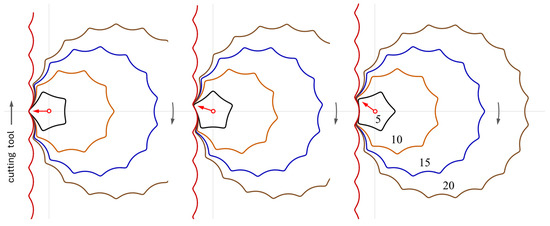
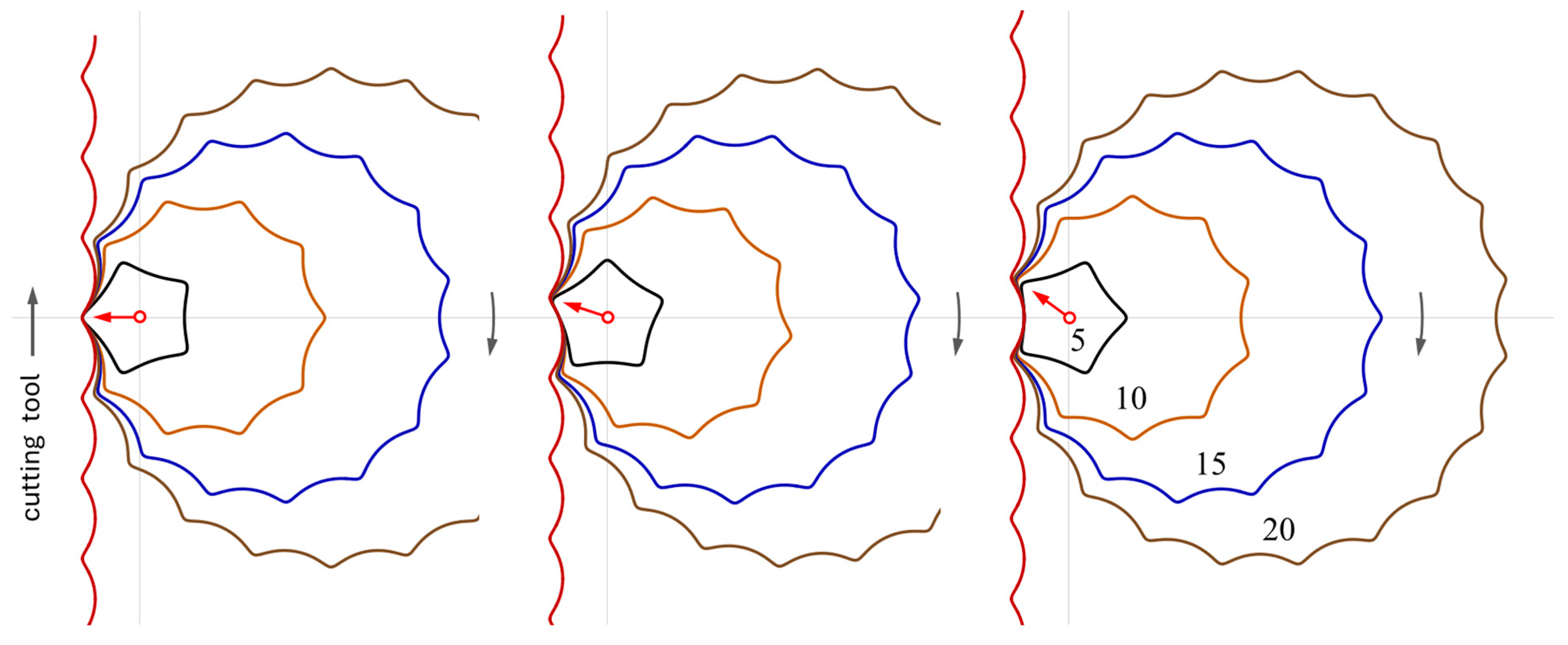
Figure 8 illustrates the kinematic interrelation between the tool and the workpiece in three cutting positions during the modular generation of H-profiles with varying numbers of sides using a single tool. Furthermore, the five-sided profile can be utilized as the tool contour for producing the internal profiles of other workpieces with a higher number of sides.
Figure 8.
Cutting positions during the modular generation of H-profiles.
7. Tool for Hollow Contours
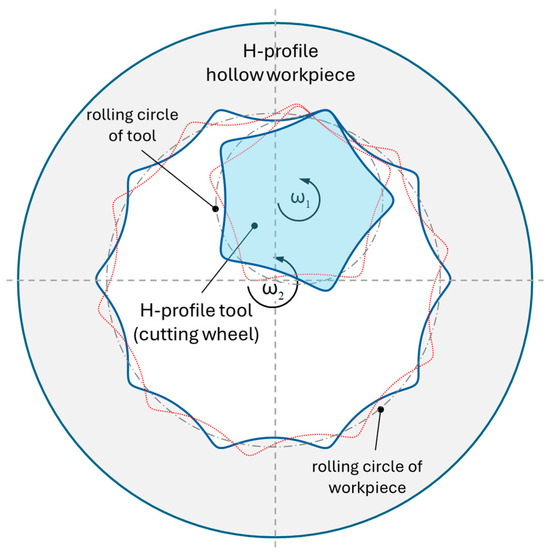
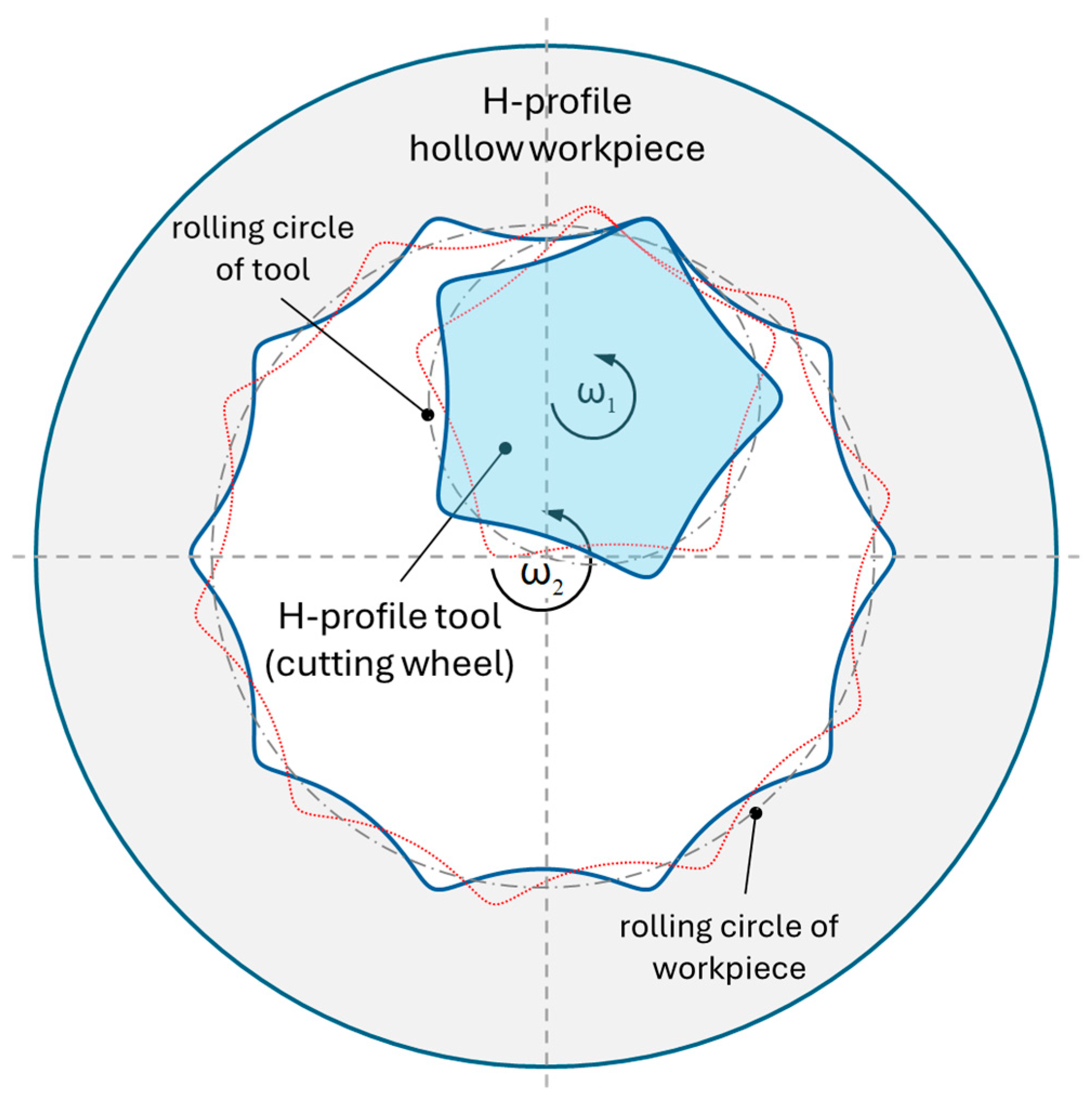
The same procedure can be used to determine the tool geometry for the production of hypotrochoidal internal contours (e.g., for hubs). The gear hobbing process is used here, and the cutter wheel also has an H-contour that engages with the workpiece from the inside; however, the number of sides is lower than the hollow contour to be produced. Here, the gearing law must also be adhered to. Figure 9 shows an example of the production of a hypotrochoidal internal contour with n = 10 sides using a hypotrochoidal cutting wheel with five cutting sides.
Figure 9.
Creation of outer and inner H-profiles using a rolling process [4].
In this process, the profile is created via a continuous rolling motion between the tool and the workpiece, similar to gear hobbing, but with kinematics adapted to the H-profile contour. As mentioned above, the tool and workpiece have a different number of sides; this means that there is a transmission ratio other than one when the contours roll against each other. The two contours have different but interdependent eccentricities in connection with the gearing set. If the tool is considered as wheel 1 and the workpiece as wheel 2, the transmission ratio can be calculated as follows:
where ω denotes the angular velocity. The two contours must have the same modulus; that is:
To determine the tool eccentricity, the eccentricity for the reference profile with respect to and of the workpiece is first determined using Equation (10). Based on this, the eccentricity of the tool contour can be calculated using Equation (14), as follows:
This completely defines the tool geometry. In this way, the modular production of other hollow contours with the same modulus is possible.
Example:
For an inner contour with , , and , the geometry of a tool with five sides () is to be determined. The transmission ratio here is , and so . Equation (15) gives:
Equation (1) yields the following for the tool contour:
This example is illustrated in Figure 9, where the tool has five sides and the workpiece has ten. The figure also shows that the pitch circle of the workpiece is twice the diameter of that of the tool, corresponding to a gear ratio of .
8. Conclusions
In this work, the tool geometry for the generation of hypotrochoidal profiles was derived analytically and exactly. The derived geometry enables the application of all established gear cutting processes based on the generating principle, including hobbing, gear shaping, gear grinding, and gear planning, for the manufacturing of hypotrochoidal profiles in the form of rack profiles as well as external and internal contours.
The validity of the analytically derived envelope curve was further confirmed through a CAD-based kinematic simulation conducted in Autodesk Inventor. By modeling the gear wheel as a cutting tool undergoing stepwise rotation and translation relative to the fixed rack, the simulation consistently reproduced the theoretical rack profiles across all examined parameter configurations. The close correspondence between simulated and theoretical results demonstrates the accuracy and reliability of the method, independently of the specific choice of geometric parameters.
The exact tool geometry offers significant advantages within modular manufacturing concepts. A single rack profile serves as a universal cutting tool for the generation of gear wheels with arbitrary tooth numbers, thereby reducing the required tool inventory, increasing manufacturing flexibility, and lowering both tooling costs and setup times. This modularity makes the proposed approach particularly attractive for flexible and cost-efficient production environments.
Furthermore, the extension of the method to epitrochoidal profiles is straightforward and follows directly from the same theoretical framework, underlining the generality and broad applicability of the proposed approach.
Future work should include experimental validation through practical machining trials, to confirm the theoretically and numerically demonstrated advantages under real manufacturing conditions and to assess the performance of the proposed tool geometry in industrial applications.
Funding
This research received no external funding.
Institutional Review Board Statement
Not applicable.
Informed Consent Statement
Not applicable.
Data Availability Statement
The data presented in this study are available on request from the corresponding author.
Acknowledgments
This work is dedicated to Herbert Gropp from Technical University Chemnitz on the occasion of his 85th birthday last December. The author wishes him good health and many more lucky years.
Conflicts of Interest
The author declares no conflict of interest.
Abbreviations
The following abbreviations are used in this manuscript:
| Formula symbols: | |
| (mm) | Nominal profile diameter |
| Profile eccentricity general | |
| Profile eccentricity of the hypotrochoid | |
| Profile eccentricity of the epitrochoid | |
| Profile eccentricity of the trochoid | |
| x-coordinate of the hypotrochoid | |
| x-coordinate of the epitrochoid | |
| x-coordinate of the trochoid | |
| y-coordinate of the hypotrochoid | |
| y-coordinate of the epitrochoid | |
| y-coordinate of the trochoid | |
| Module of profile | |
| General profile periodicity (number of sides) | |
| Periodicity (number of sides) of hypotrochoid | |
| Periodicity (number of sides) of epitrochoid | |
| Transmission ratio | |
| General nominal or mean radius | |
| Nominal or mean radius | |
| Nominal or mean radius | |
| Nominal or mean radius | |
| Nominal or mean radius | |
| Profile parameter angle | |
| Cartesian coordinates | |
| Greek formula symbols: | |
| Free angle | |
| Contact angle | |
| Angular velocity | |
References
- Ziaei, M. Torsionsspannungen in Prismatischen, Unrunden Profilwellen mit Trochoidischen Konturen. Forsch. Ingenieurwesen 2021, 85, 985–995. [Google Scholar] [CrossRef] [Scilit]
- Ziaei, M. Bending Stresses and Deformations in Prismatic Profiled Shafts with Noncircular Contours Based on Higher Hybrid Trochoids. Appl. Mech. 2022, 3, 1063–1079. [Google Scholar] [CrossRef] [Scilit]
- Lee, K. Mechanical Analysis of Fibers with a Hypotrochoidal Cross Section by Means of Conformal Mapping Function. Fibers Polym. 2010, 11, 638–641. [Google Scholar] [CrossRef] [Scilit]
- Zwickau, W. Verfahren zur Herstellung von Trochoidischen Innen- und Außenkonturen von Polygonprofilen, Westsächsische Hochschule Zwickau. Patent DE 10 2019 000 654 B4, 13 November 2025. [Google Scholar]
- DIN 3689-1:2021-11; Welle-Nabe-Verbindung—Hypotrochoidische H-Profile—Teil 1: Geometrie und Maße. DIN Deutsches Institut für Normung: Berlin, Germany, 2021.
- Wunderlich, W. Ebene Kinematik; Bibliographisches Institut Mannheim: Stuttgard, Germany, 1968. [Google Scholar]
- Maximov, J.T.; Hristov, H. Machining of hypocycloidal surfaces by adding rotations around parallel axes, part I: Kinematics of the method and rational field of application. Trak. Univ. J. Sci. 2005, 6, 13–18. [Google Scholar]
- Jörg, R. Unrund-Drehen formschlüssiger Welle-Nabe-Verbindungen. In Proceedings of the 8. VDI-Fachtagung Welle-Nabe-Verbindungen 2018, Dimensionierung–Fertigung–Anwendung, VDI-Berichte 2337, Stuttgart, Germany, 26–27 November 2018. [Google Scholar]
- Westsächsische Hochschule Zwickau. Entwicklung Eines Analytischen Berechnungskonzeptes für Formschlüssige Welle-Nabe-Verbindungen mit Hypotrochoidischen Verbindungen, Abschlussbericht zum DFG-Vorhaben DFG ZI 1161/2 (Westsächsische Hochschule Zwickau). 2020. Available online: https://gepris.dfg.de/gepris/projekt/236042475 (accessed on 21 April 2026).
- Klocke, F.; Brecher, C. Zahnrad- und Getriebetechnik: Grundlagen, Auslegeverfahren, Fertigungsverfahren, Anwendung, 2nd ed.; Hanser: Munich, Germany, 2023. [Google Scholar]
- Litvin, F.L. Gear Geometry and Applied Theory; Cambridge University Press: Cambridge, UK, 2004. [Google Scholar]
- Litvin, F.L. Theory of Gearing; NASA Reference Publication 1212; National Aeronautics and Space Administration (NASA): Washington, DC, USA, 1989.
- Roth, K. Zahnradtechnik. Band I: Stirnradverzahnungen—Geometrische Grundlagen; Springer: Berlin/Heidelberg, Germany; New York, NY, USA, 1989. [Google Scholar]
- Bär, G. Explicit Calculation Methods for Conjugate Profiles. J. Geom. Graph. 2003, 7, 141–151. [Google Scholar]
- Zwikker, C. The Advanced Geometry of Plane Curves and Their Applications; Dover Books on Advanced Mathematics; Dover: Mineola, NY, USA, 1963. [Google Scholar]
- Autodesk, version 2024; Autodesk Inventor Professional; [Computer Software]. Autodesk: San Rafael, CA, USA, 2024. Available online: https://www.autodesk.com/ (accessed on 21 April 2026).
- Hussein, A.W.; He, C.J.; Lin, C.; Zhang, Y.M.; Li, G.X.; Bie, W.B.; Zhao, B.; Chen, F.; Zhao, C.Y.; Zhang, Y.E. Tooth surface hobbing analysis for unconventional gears with ultrasonic-assisted motion. Stroj. Vestn.-J. Mech. Eng. 2022, 62, 417–425. [Google Scholar]
- Piotrowski, A.; Tyliszczak, A. Profile Optimisation of a Solid Modular Hob in the Machining of Gears Made of Classic and Unusual, Innovative Materials. Materials 2024, 17, 2049. [Google Scholar] [CrossRef] [Scilit] [PubMed]
- Humpa, C. CAD-Methodik zur Produktivitätssteigerung in der Fräsfertigung. Ph.D. Dissertation, TU Dortmund, Dortmund, Germany, 2021. [Google Scholar]
- Skordaris, G.; Bouzakis, K.; Kotsanis, T.; Charalampous, P.; Bouzakis, E.; Breidenstein, B.; Bergmann, B.; Denkena, B. Influence of the tool profile on the wear behaviour in gear hobbing. CIRP J. Manuf. Sci. Technol. 2017, 18, 145–151. [Google Scholar] [CrossRef] [Scilit]
- Dong, X.; Liao, C.; Shin, Y.; Zhang, H. Machinability improvement of gear hobbing via process simulation and tool wear predictions. Int. J. Adv. Manuf. Technol. 2016, 86, 2771–2779. [Google Scholar] [CrossRef] [Scilit]
- Kühn, F.; Hendricks, S.; Troß, N.; Brimmers, J.; Bergs, T. Experimental analysis on the influence of the tool micro geometry on the wear behavior in gear hobbing. Int. J. Adv. Manuf. Technol. 2023, 126, 1279–1292. [Google Scholar] [CrossRef] [Scilit]
- Klocke, F.; Gorgels, C.; Weber, G.-T.; Schalaster, R. Prognosis of the local tool wear in gear finish hobbing. Prod. Eng. 2011, 5, 651–657. [Google Scholar] [CrossRef] [Scilit]
Disclaimer/Publisher’s Note: The statements, opinions and data contained in all publications are solely those of the individual author(s) and contributor(s) and not of MDPI and/or the editor(s). MDPI and/or the editor(s) disclaim responsibility for any injury to people or property resulting from any ideas, methods, instructions or products referred to in the content. |
© 2026 by the author. Licensee MDPI, Basel, Switzerland. This article is an open access article distributed under the terms and conditions of the Creative Commons Attribution (CC BY) license.