Article

Calibration and Experimental Determination of Parameters for the Discrete Element Model of Shells


College of Mechanical Engineering, Jiangsu Ocean University, Lianyungang 222005, China
*
Author to whom correspondence should be addressed.
Appl. Mech. 2026, 7(1), 6; https://doi.org/10.3390/applmech7010006
Submission received: 18 November 2025 / Revised: 24 December 2025 / Accepted: 2 January 2026 / Published: 14 January 2026

Abstract

This study conducts systematic experimental and numerical investigations to address the parameter calibration issue in the discrete element model of seashells, aiming to establish a high-fidelity numerical model that accurately characterizes their macroscopic mechanical behavior, thereby providing a basis for optimizing parameters of seashell crushing equipment. Firstly, intrinsic parameters of seashells were determined through physical experiments: density of 2.2 kg/m3, Poisson’s ratio of 0.26, shear modulus of 1.57 × 10⁸ Pa, and elastic modulus of 6.5 × 10¹⁰ Pa. Subsequently, contact parameters between seashells and between seashells and 304 stainless steel, including static friction coefficient, rolling friction coefficient, and coefficient of restitution, were obtained via the inclined plane method and impact tests. The reliability of these contact parameters was validated by the angle of repose test, with a relative error of 5.1% between simulation and measured results. Based on this, using ultimate load as the response indicator, the PlackettBurman experimental design was employed to identify normal stiffness per unit area and tangential stiffness per unit area as the primary influencing parameters. The Bonding model parameters were then precisely calibrated through the steepest ascent test and design, resulting in an optimal parameter set. The error between simulation results and physical experiments was only 3.8%, demonstrating the high reliability and accuracy of the established model and parameter calibration methodology.

1. Introduction

The global shellfish aquaculture industry has developed rapidly in recent years and has become an important part of the aquaculture industry. According to statistics from the Food and Agriculture Organization of the United Nations (FAO), China, as the world’s largest shellfish aquaculture country, accounts for more than 80% of the global total output. In 2020, the output exceeded 16 million tons, with main species including oysters, clams, scallops, etc. [1]. Among them, freshwater mussels have become an important economic shellfish species in the waters of Lianyungang in recent years [2]. Freshwater mussels can be densely farmed, with a yield of 3–4 tons per 667 square meters. After removing the mussel columns and edges, a large amount of discarded mussel shells will be produced, accounting for about 80% of the total output. The discarded mussel shells are stinky and pungent, seriously affecting the environment [3]. At the same time, mussel shells are thin and light, making them very suitable as a substrate for the cultivation of nori filaments. The traditional method of cultivating nori filaments on mussel shells requires manual selection of shells, laying them flat at the bottom of the culture pond, and regular cleaning and water replacement. The cultivation period lasts for half a year, consuming a lot of human and material resources [4]. To improve the efficiency of nori aquaculture and solve the problem of mussel shell waste disposal, a cultivation plan will be studied that involves crushing mussel shells and pressing them into uniform-sized substrate blocks, combined with mechanical cleaning and water replacement equipment [5]. The crushed shells can also be used in multiple fields such as feed additives, building coatings, and cosmetics [6].
Due to the high hardness and brittleness of shells, traditional crushing methods are difficult to efficiently and uniformly crush shell materials into fine particles [7,8]. To improve the problems of low crushing efficiency, uneven product particle size, and dust pollution, it is necessary to explore the crushing mechanism of shells and optimize the structure of crushing equipment. The calibration of discrete element parameters for shells is the preliminary basis for the study of crushing equipment [9]. Therefore, the research on the calibration of discrete element parameters for the crushing of freshwater mussel shells is of great significance.
In recent years, the application of computer simulation and optimization design in agricultural engineering has become increasingly widespread. Among them, the discrete element method (DEM) has received significant attention due to its excellent modeling capabilities for materials and dynamic processes [10]. In discrete element modeling, various particle contact models have been proposed and applied to materials of different properties, such as the HertzMindlin (HM) model, the HertzMindlin with Bonding (HMB) model, the JohnsonKendallRobert (JKR) model, and various viscoelasticplastic models (EEPA) [11]. The HM model, as the basic model, is often used to simulate the mechanical behavior of agricultural products such as grains and seeds, but it has shortcomings when dealing with particle systems with bonding structures and prone to fragmentation [12]. Therefore, the HMB model has been developed to describe the bonding and fracture processes between particles and has been successfully applied to the parameter calibration and fragmentation simulation of biological materials such as corn husk [13], tea stem [14], bone [15], lotus root [16], and beef [17]. The JKR model is used because it can effectively represent the surface adhesion effect and is applied to the simulation of high-humidity materials such as cow dung [18], fertilizer [19], pharmaceutical particles [20], and flour [21]. For materials with obvious viscoelastic-plastic characteristics such as fungal residue [22] and peat [23], the EEPA and other viscoelastic-plastic models show good applicability. Although there have been many achievements in the parameter calibration of discrete element parameters for agricultural materials, relevant research on shell materials is still relatively lacking. As a brittle and tightly bonded material, the physical properties of shells differ significantly from common agricultural materials, so a specialized modeling method needs to be developed. Based on the analysis of existing literature, the HMB model can effectively describe the mechanical response and failure process of such brittle bonded materials. Previous studies have used the HMB model to conduct discrete element modeling of bones and completed parameter calibration through the failure process of bonding keys, and this modeling and calibration method can provide a reference for the simulation of shell bending failure. Based on this, this paper selects the HMB model to establish a discrete element model of shells to make up for the lack of research in this field.
This paper takes the freshwater mussel as the research object and conducts the simulation modeling and parameter calibration work based on the discrete element method. Firstly, through the drainage method, uniaxial compression test, inclined plane method and collision test, the intrinsic parameters and contact parameters of the freshwater mussel were obtained [24,25,26,27]; subsequently, the Bonding model of the mussel shell was established by using the EDEM2020 simulation software, and combined with the actual bending failure test, the PB test, the steepest slope climbing test and the response surface method, the key parameters such as the unit normal and tangential stiffness, critical normal and tangential stress, and bonding radius were calibrated [28,29,30,31]. By comparing the ultimate load obtained from the simulation and the physical test, the relative error was calculated to verify the accuracy of the calibrated Bonding parameters [32,33]. The establishment of this discrete element model of the freshwater mussel can provide a theoretical basis for the study of the shell fragmentation mechanism and the optimization of related crushing equipment [34].
Recent studies (2023–2025) have further advanced DEM-based fracture modeling for brittle, bonded, and heterogeneous composites, which provides a clearer context for the present work. On the biomineral and shell-inspired side, DEM has increasingly been used to describe the mechanical response and damage evolution of mineralized composites and shell-like structures, where hierarchical interfaces and bonded microstructures dominate fracture and fragmentation. In particular, shell-related DEM efforts have begun to move beyond oversimplified Hertz–Mindlin contact settings toward bonding-enabled formulations and experimentally driven calibration workflows, enabling more realistic reproduction of fracture patterns under service-like disturbances and providing actionable guidance for equipment design and damage mitigation in shell handling and processing systems [35,36,37,38,39,40,41,42].
In parallel, bonded/contact model development within DEM has also progressed rapidly in recent years. Beyond conventional single-bond assumptions, new formulations explicitly incorporate multiple bonding points, damage/softening evolution, and improved treatment of particle-size effects, thereby enhancing the ability of DEM to capture brittle to quasi-brittle failure modes under different loading paths. Moreover, recent bonded-particle models have been extended from sphere-based elements to irregular/polyhedral particles and have incorporated fracture-mode-dependent bond breaking laws and bond stiffness degradation, which improves the physical interpretability of bond failure and the robustness of fracture prediction. Nevertheless, for brittle multilayer shell-like biomineral materials, a persistent gap remains: fracture-oriented DEM parameter calibration is still often treated as an empirical tuning process, and validated parameter sets under controlled bending-dominated fracture are scarce. Addressing this gap is essential for improving the predictive capability of DEM in shell fragmentation and for reducing trial-and-error in the design and optimization of shell crushing equipment. Based on the above considerations, the overall objective of this study is to establish a high-fidelity discrete element model for freshwater mussel shells that can accurately reproduce their macroscopic mechanical response and failure behavior under bending loads. To achieve this goal, systematic physical experiments were first conducted to determine the intrinsic mechanical properties and contact parameters of the shells. Subsequently, a bonded-particle discrete element model was developed using the HertzMindlin with Bonding approach, and a multi-stage parameter calibration strategy combining PlackettBurman screening, steepest ascent testing, and Box-Behnken response surface optimization was employed. The scientific contribution of this work lies in providing a reproducible and quantitatively validated calibration framework for brittle shell-like biological materials within the DEM context, addressing the lack of reliable parameter sets and calibration methodologies reported in previous studies. From a practical perspective, the calibrated model and identified key bonding parameters offer a reliable numerical basis for analyzing shell fragmentation mechanisms and optimizing the structural parameters of shell crushing equipment, thereby supporting efficient utilization and processing of shell waste.
Although the discrete element method has been widely applied to agricultural and biological materials, its application to brittle shell materials with complex bonded microstructures remains limited, particularly in terms of fracture-oriented parameter calibration. Existing studies often focus on bulk flow behavior or rely on empirical parameter assignment, which limits the predictive capability of DEM simulations when fracture and fragmentation are involved. The novelty of the present study lies not in proposing a new DEM contact model, but in establishing a fracture-oriented and experimentally validated parameter calibration strategy specifically tailored for shell-like brittle materials. By integrating mechanical testing, bonded-particle modeling, and multi-stage statistical optimization, this work demonstrates how calibrated DEM parameters can be systematically linked to measurable fracture responses, rather than treated as purely numerical fitting variables.

2. Materials and Methods

2.1. Intrinsic Parameters of Shells

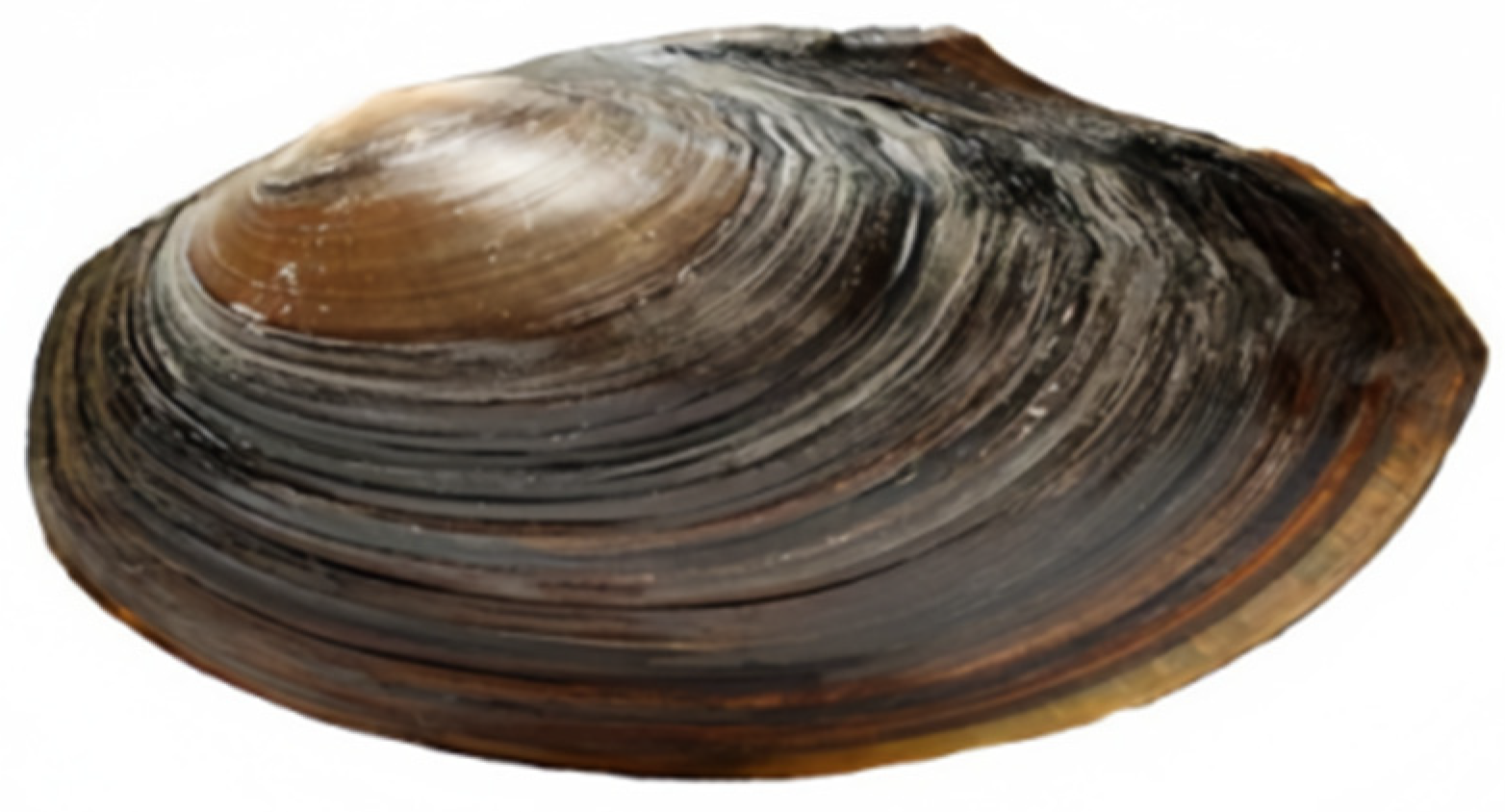
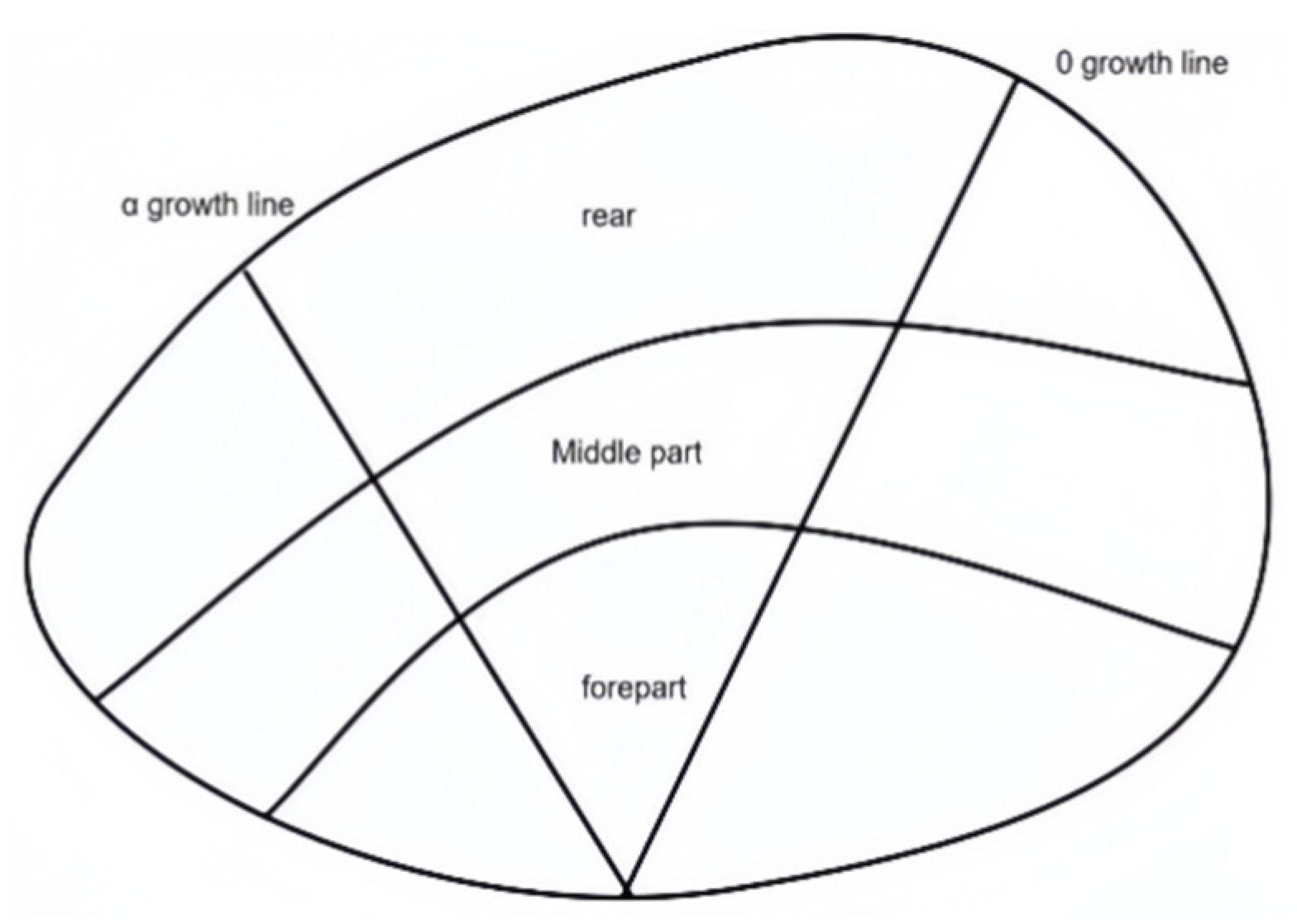
The materials used in this experiment were the shells of 3-year-old adult freshwater mussels from Lianyungang. The sampling method was random sampling. As shown in Figure 1, it was taken from the waters of Lianyungang. The test samples were measured using an electronic digital height gauge. The lengths of the mussel shells ranged from 132 to 149, the widths from 98 to 110, the heights from 19 to 22, and the thicknesses from 2.5 to 3.5. The volume of the mussel shells was measured using the drainage method, and their weights were measured using an electronic balance. The density of the mussel shells was determined using the drainage method and found to be 2.2 g/cm3, which corresponds to 2200 kg/m3 in SI units. The mussel shell waste was washed with clean water, the internal meat and external attachments were removed, the shells were polished with 2000-mesh sandpaper, and the fine impurities on the shells were removed by ultrasonic cleaning. They were then placed in a cool and ventilated place for natural drying. The inner shell was placed flat on the experimental table, and it was divided into three sections along the growth lines. The part near the starting point of growth was called the front part, the part near the edge was called the rear part, and the middle part was called the middle part. The line connecting the growth starting point to the farthest point on the shell edge was defined as the 0 growth line. Rotating α° forward along the 0 growth line obtained the α growth line. Mechanical cutting was performed in the area shown in Figure 2, and the middle area was selected for sample preparation. The sample was a 60 mm-long, 6 mm-wide, and 3 mm-thick rectangular thin sheet [43].
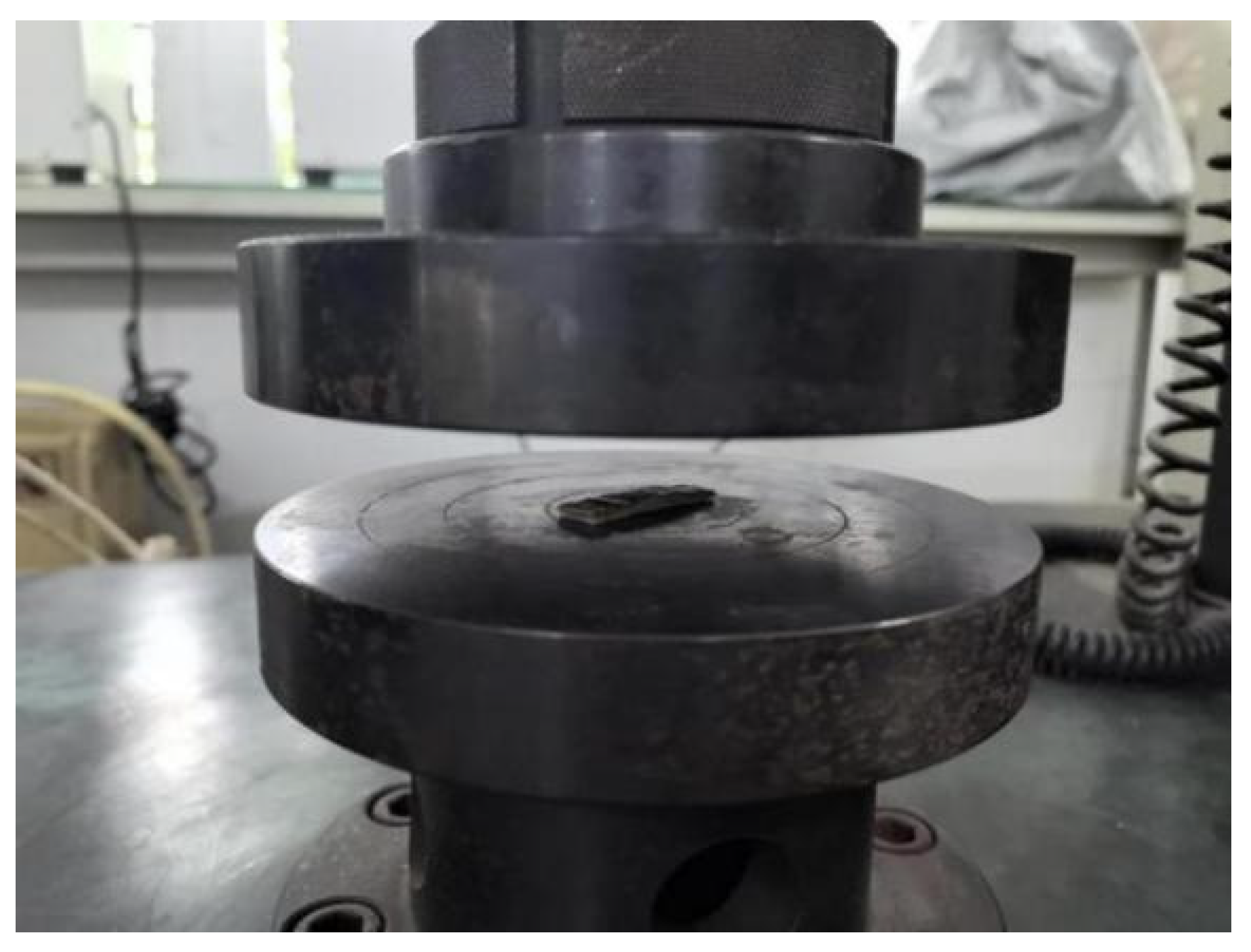
The uniaxial compression test was conducted using an electronic high-temperature universal testing machine as shown in Figure 3. The experiment adopted the displacement control mode. The testing software MaterialTest 4.2 was turned on for online operation, and the test plan was set as the test method for organic irregular materials. The clam shell samples were placed on the tray in the order of the labels to ensure that no sliding along the tray would occur during the compression process, thereby avoiding measurement errors. A rigid flat punch was used. As the punch moved downward, a natural contact was formed between the punch and the clam shell, triggering the compression phenomenon. During the test, when the compressive force of the sample reached the preset limit value, the test could be stopped, and the testing machine would be disconnected.
This design is aimed at ensuring reliable data is obtained during the experiment and effectively controlling the progress of the experiment. Five repeated measurements were conducted on the size changes at the same marking position, and the average value was taken as the lateral compression deformation of the sample; at the same time, by measuring the height sample multiple times and taking the average value, the axial deformation of the sample was obtained. According to Formulas (1)–(3), the Poisson’s ratio, shear modulus, and elastic modulus were determined to be 0.26, 1.57 × 10⁸ Pa, and 6.5 × 10¹⁰ Pa [44,45].
Elastic modulus formula:
E = σ ε = ( F / A ) ( Δ L / L )
In the formula, E represents the elastic modulus; F is the pressure; N; is the compression amount, in mm; the value of F/ is the slope of the straight line in the initial section of the compression curve; L is the height of the sample, in mm; A is the contact area between the sample and the indenter, in mm2.
Shear modulus formula:
G = E 2 ( 1 + V )
In the formula, G represents the shear modulus; E represents the elastic modulus (Young’s modulus); ν represents the Poisson’s ratio.
Poisson’s ratio formula:
V = ξ t ξ a
In the formula, ξt represents the transverse strain; ξa represents the axial strain.

2.2. Contact Parameters

2.2.1. Coefficient of Static Friction

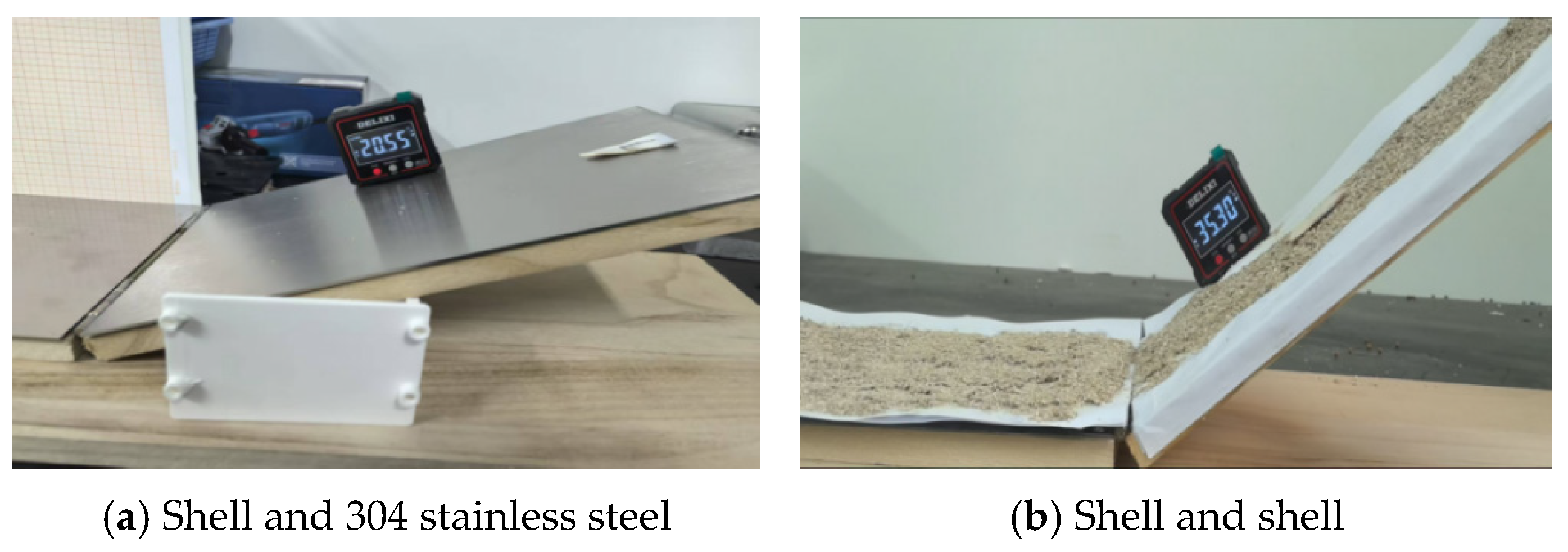
The sample shells were placed separately on the shell powder bonding plate and the 304 stainless steel plate. The measured surface was fixed on a flat plate that could precisely adjust the inclination angle as shown in Figure 4. Slowly lift one end of the plate, gradually increasing the angle θ between the plate and the horizontal plane. At this time, the gravitational force (mg) acting on the shell can be decomposed into two components: the component along the inclined plane (F), which is the driving force that causes object A to have a tendency to slide down. The component perpendicular to the inclined plane, which is equal to the normal force N, as per Formula (4). As the angle θ increases, the sliding driving force F increases, and the maximum static friction force, as per Formula (5), also changes accordingly. Critical state: When the angle θ increases to a certain value θs, the sliding driving force just exceeds the maximum static friction force, and object A begins to slide. By simplifying the above equation (with the mass m and gravitational acceleration g being cancelled out), the calculation formula for the static friction coefficient (6) can be obtained.
N = mg cosθ
μsN = μs mg cosθ
μs = tanθs
Therefore, it is sufficient to precisely measure the critical angle θs at which the object begins to slide. The tangent value of this angle is the coefficient of static friction. Perform ten valid measurements in succession to obtain the range of the coefficient of static friction.

2.2.2. Rolling Friction Coefficient

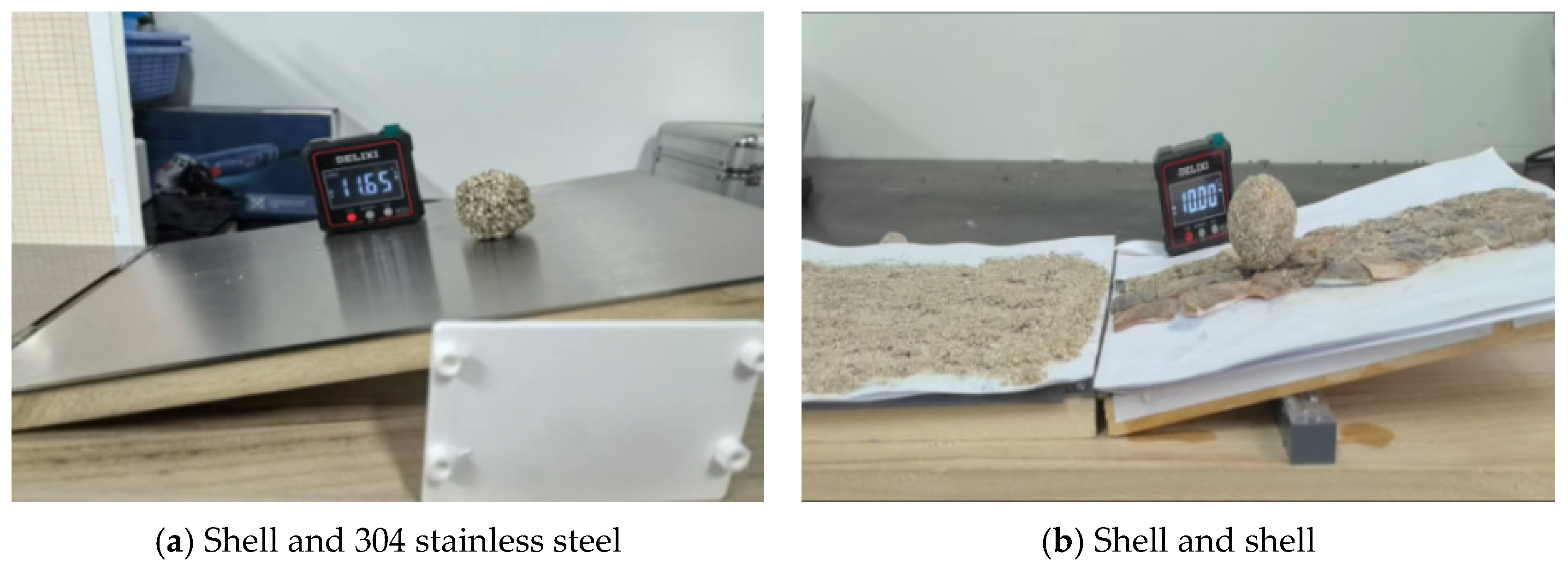
After cleaning the shells, break them into pieces and grind them into uniform fine powder. Mix the shell powder with transparent epoxy resin in a certain proportion and pour it into a spherical mold to solidify and form. Place the solidified small balls on the shell powder bonding plate and the 304 stainless steel plate respectively as shown in Figure 5. Slowly lift one end of the plate, increasing the inclination angle θ. When the small ball is in the critical rolling state, its force analysis is similar to static friction but the rolling friction coefficient is usually defined as the ratio of the resistance moment (M) to the normal force (N), that is, formula (7). Gravity generates a torque that causes it to roll downward, that is, formula (8), where R is the equivalent rolling radius of the small ball. The rolling friction resistance torque M hinders its rolling. Critical state: When the inclination angle reaches θr, the sliding torque is exactly equal to the maximum rolling friction resistance torque. Formula (9), substitute the normal force N, and simplify to obtain the calculation formula for the rolling friction coefficient (10).
μr = M/N
M = mg sinθ × R
mg sinθr × R = M = μr × N
N = mg cosθr
mg sinθr × R = μr × mg cosθr
μr = R × tanθr
Measure ten times in succession to obtain an effective measurement result, and then determine the range of the rolling friction coefficient. The seashell-seashell rolling friction coefficient was measured using a bonded seashell powder plate. The plate was prepared by mixing finely ground seashell powder (particle size approximately 1 mm) with a commercial two-component epoxy resin. The mass ratio of seashell powder to epoxy resin was approximately 7:3, which ensured sufficient mechanical integrity while maintaining surface roughness dominated by exposed shell particles. After thorough mixing, the slurry was poured into a flat mold and cured at room temperature (25 ± 2 °C) for 24 h, followed by an additional 24 h of post-curing to ensure full polymerization. After curing, the surface was lightly polished to remove excess resin film and expose shell particles, thereby approximating the surface texture of shell–shell contact. Although the epoxy resin acts as a binder, its contribution to the surface friction behavior is limited, as the rolling contact is primarily governed by the protruding shell particles. This preparation method has been widely adopted in DEM-related friction calibration studies to ensure repeatability while preserving representative surface characteristics.

2.2.3. Collision Recovery Coefficient

The restitution coefficient is defined as the ratio of the relative separation speed of two objects after collision to their relative approach speed before collision. In this experiment, a small ball collides with a fixed base plate whose mass is much larger than that of the ball, so the velocity base plate can be regarded as zero. The sample is released from rest at a height H, and its pre-impact velocity u1 is determined according to the law of conservation of energy, as given by Formula (11). After collision, the sample rebounds with velocity v1 and reaches a maximum rebound height h. Again, based on energy conservation, v1 is expressed by Formula (12). Substituting u1 and v1 into the simplified restitution coefficient formula yields Formula (13). Therefore, the experiment only requires accurate measurement of the drop height H and the rebound height h.
u1 = √(2gH)
v1 = √(2gh)
e = √(h/H)
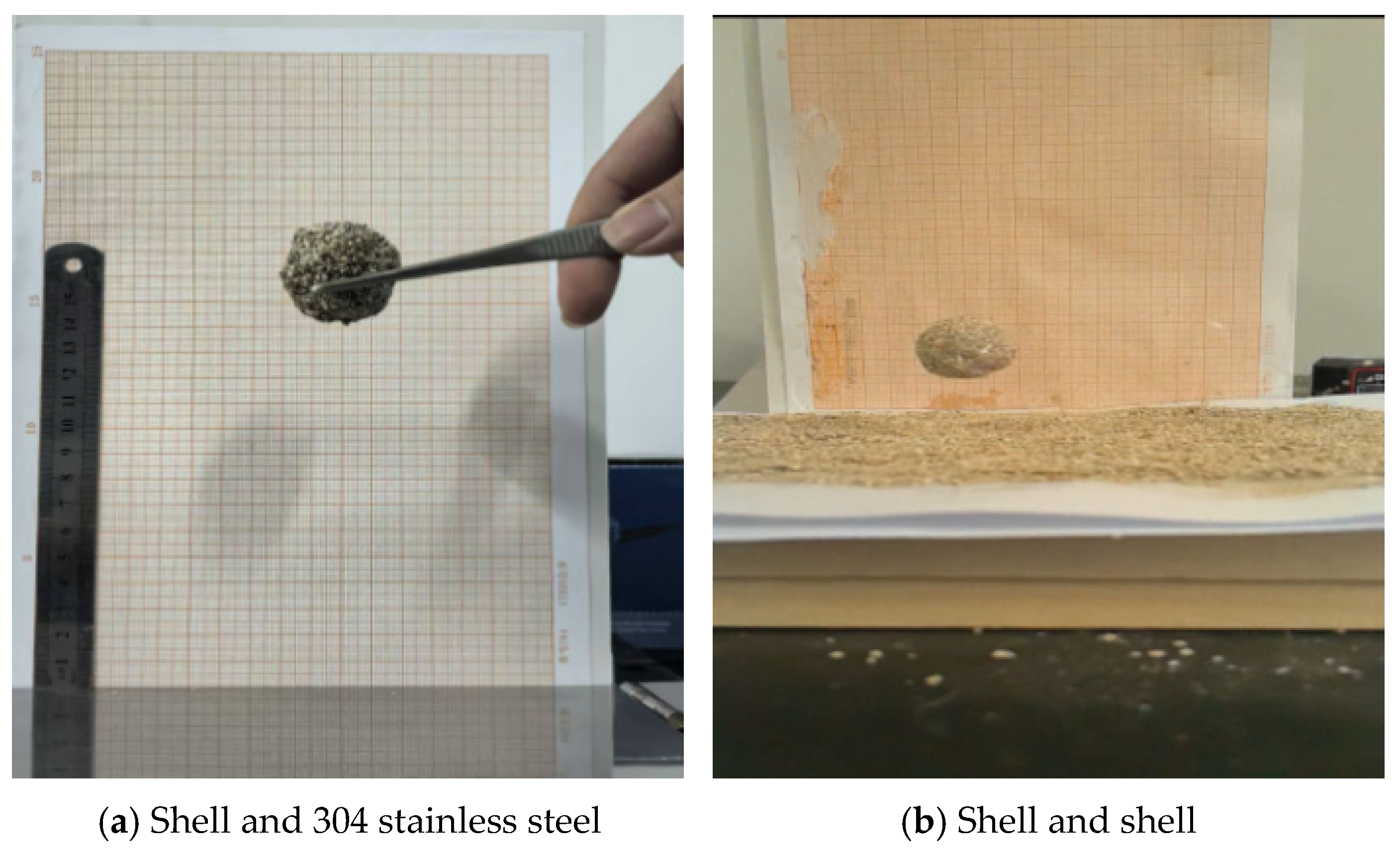
During the test, the shell sample is released from rest from a predetermined height H, ensuring zero initial velocity and no initial rotation. The base plate, which can be either a shell sheet or a 304 stainless steel sheet (with a mass much greater than that of the sample), is rigidly fixed so that its post-impact velocity remains nearly zero. A high-precision and clearly legible height scale is fixed beside the setup. A high-speed camera is used to record the collision and rebound process, and H and h are determined accurately through video frame analysis. After each test, the small ball is retrieved, and the procedure is repeated 10 times to reduce random errors. The experimental setup is shown in Figure 6.

2.2.4. Angle of Restraint Test

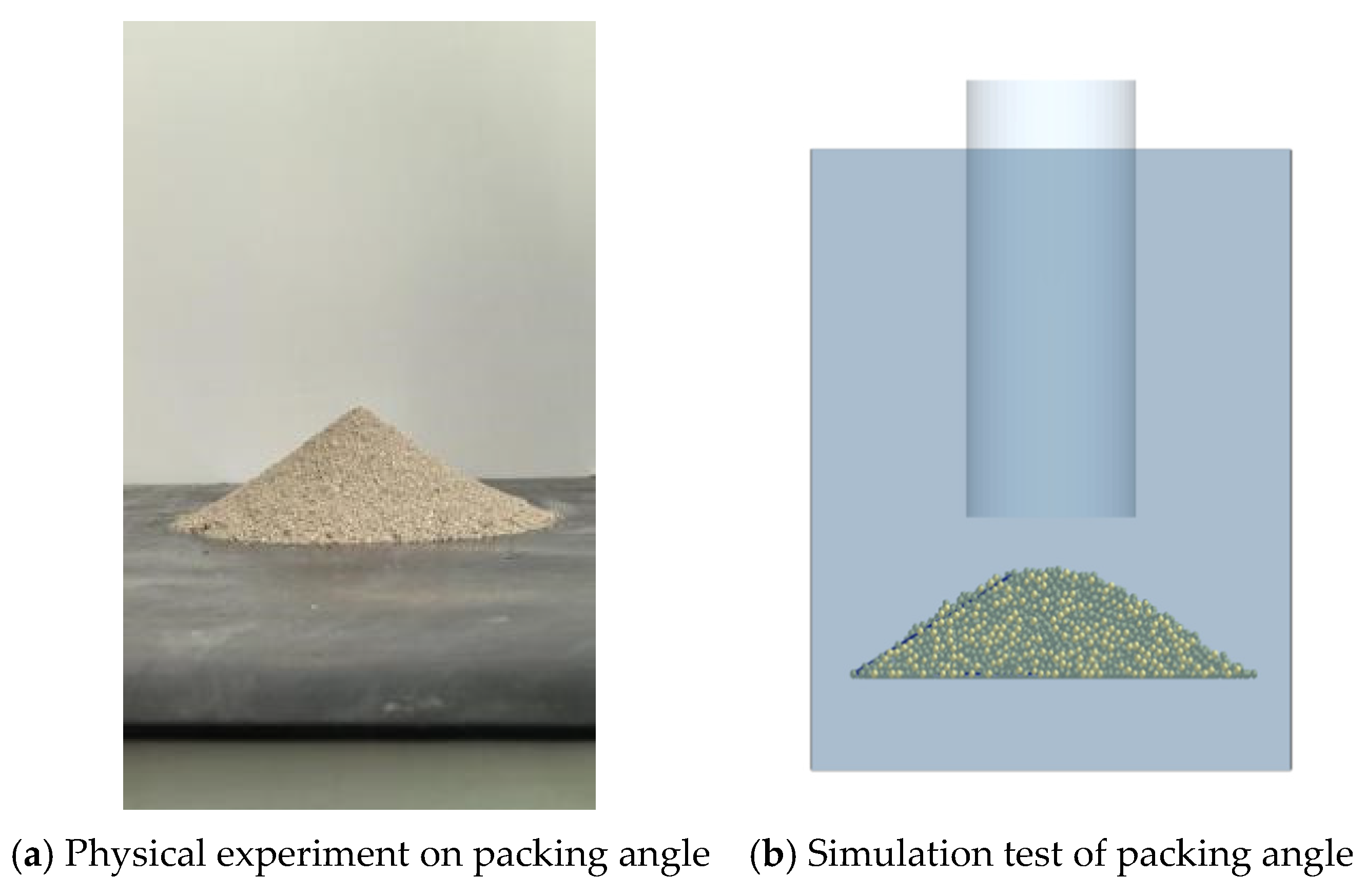
The angle of repose test was conducted to verify the reliability of the calibrated contact parameters between shells and between shells and 304 stainless steel. as shown in Figure 7. Based on the experimental results obtained in Section 2.2.1, Section 2.2.2 and Section 2.2.3, the static friction coefficient, rolling friction coefficient, and coefficient of restitution for shell–shell contact were determined as 0.944, 0.129, and 0.242, respectively. Correspondingly, the static friction coefficient, rolling friction coefficient, and coefficient of restitution for shell304 stainless steel contact were 0.349, 0.081, and 0.367, respectively. Due to the irregular geometry of intact mussel shells, which may introduce large variability in repose angle measurements, shell powder with a uniform particle diameter of 1 mm was used for both physical experiments and DEM simulations. A cylindrical container with an inner diameter of 100 mm was selected. After vertically lifting the container, the granular pile was allowed to stabilize, and the angle of repose was measured. Each test was repeated ten times, and the average value was calculated. The experimentally measured angle of repose was 27.15°, while the corresponding DEM simulation result was 25.76°, resulting in a relative error of 5.1%. This agreement indicates that the calibrated contact parameters are reliable and suitable for subsequent DEM simulations [46].

2.3. Three-Point Bending Failure Test and Bonding Model Parameters

2.3.1. Three-Point Bending Test

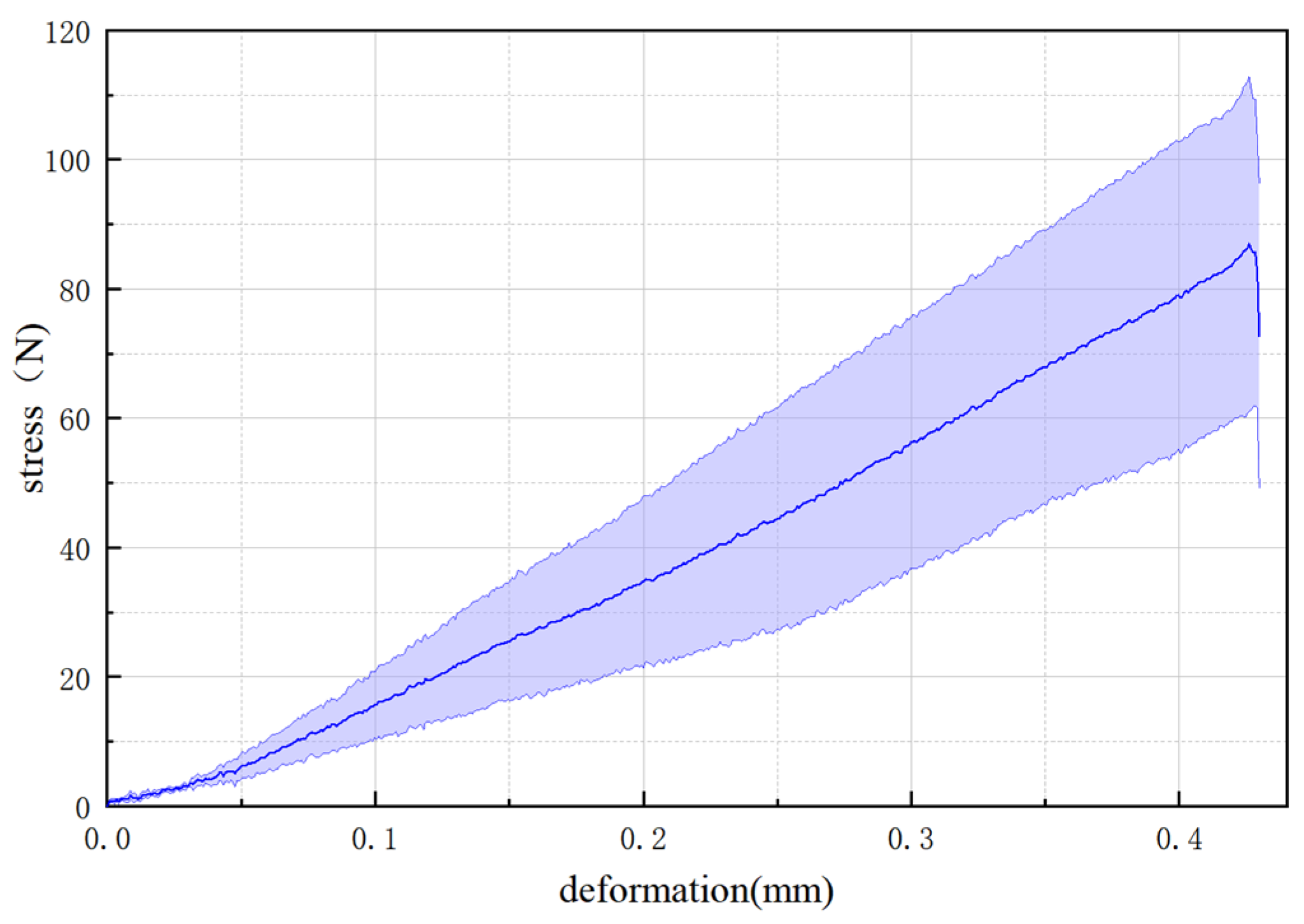
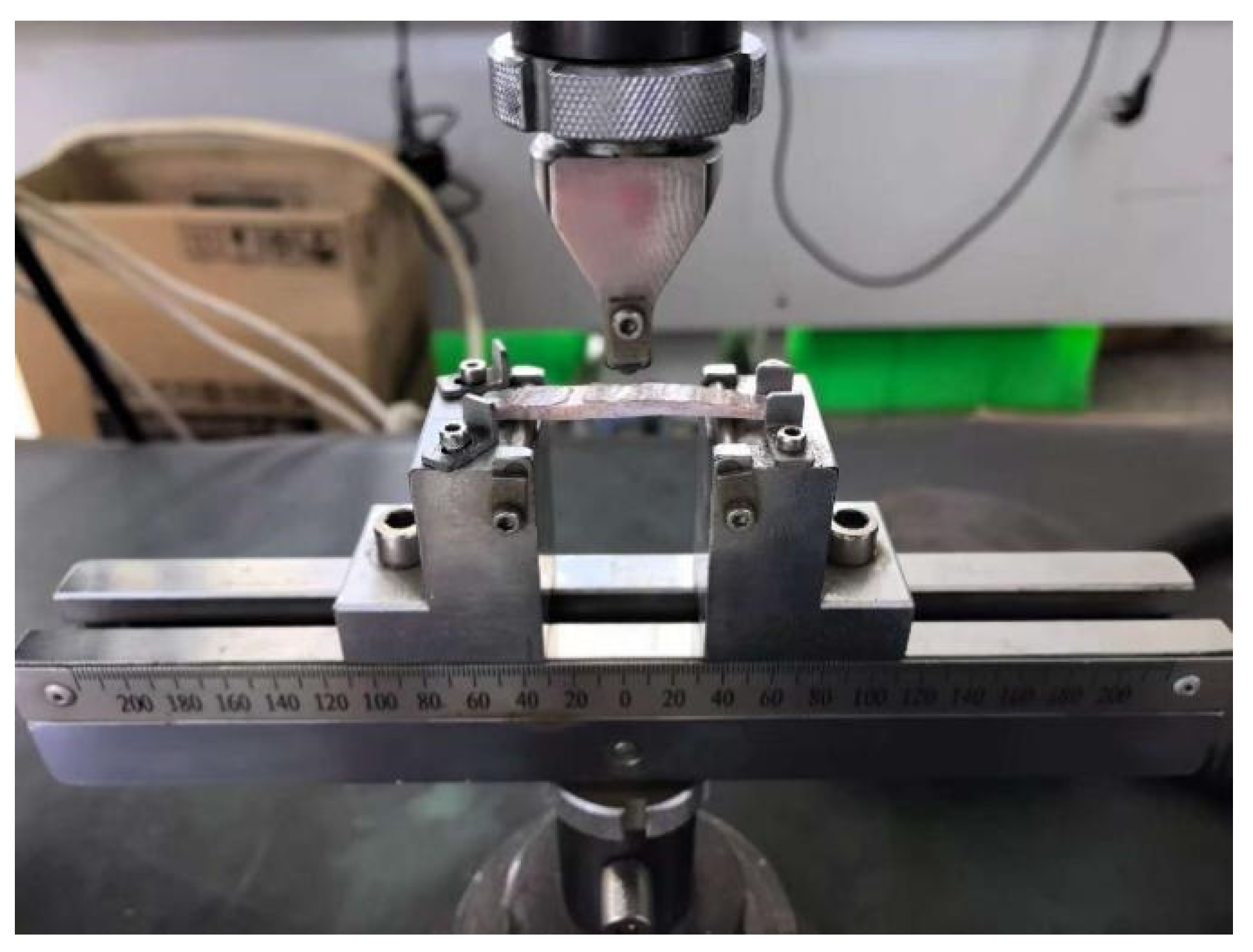
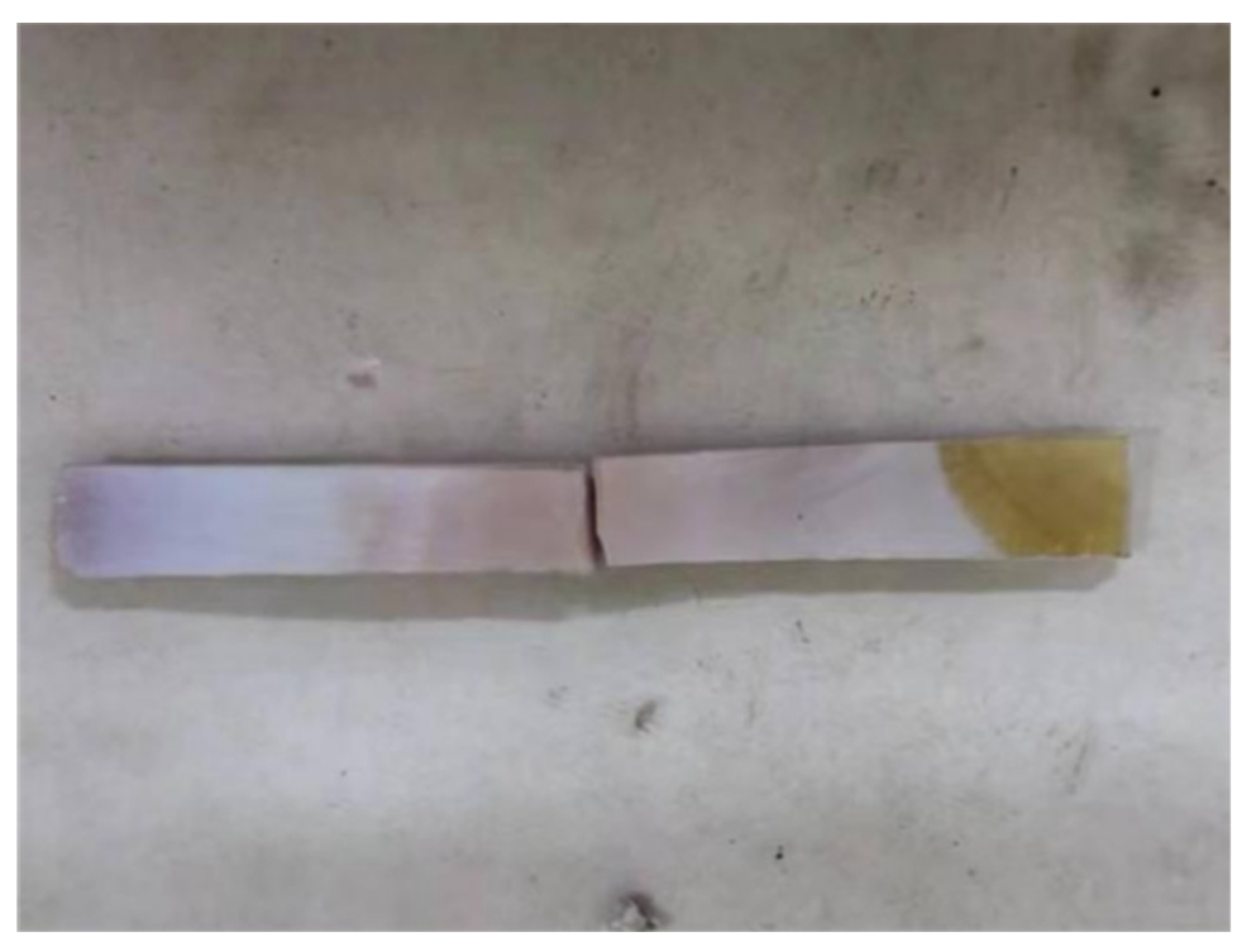
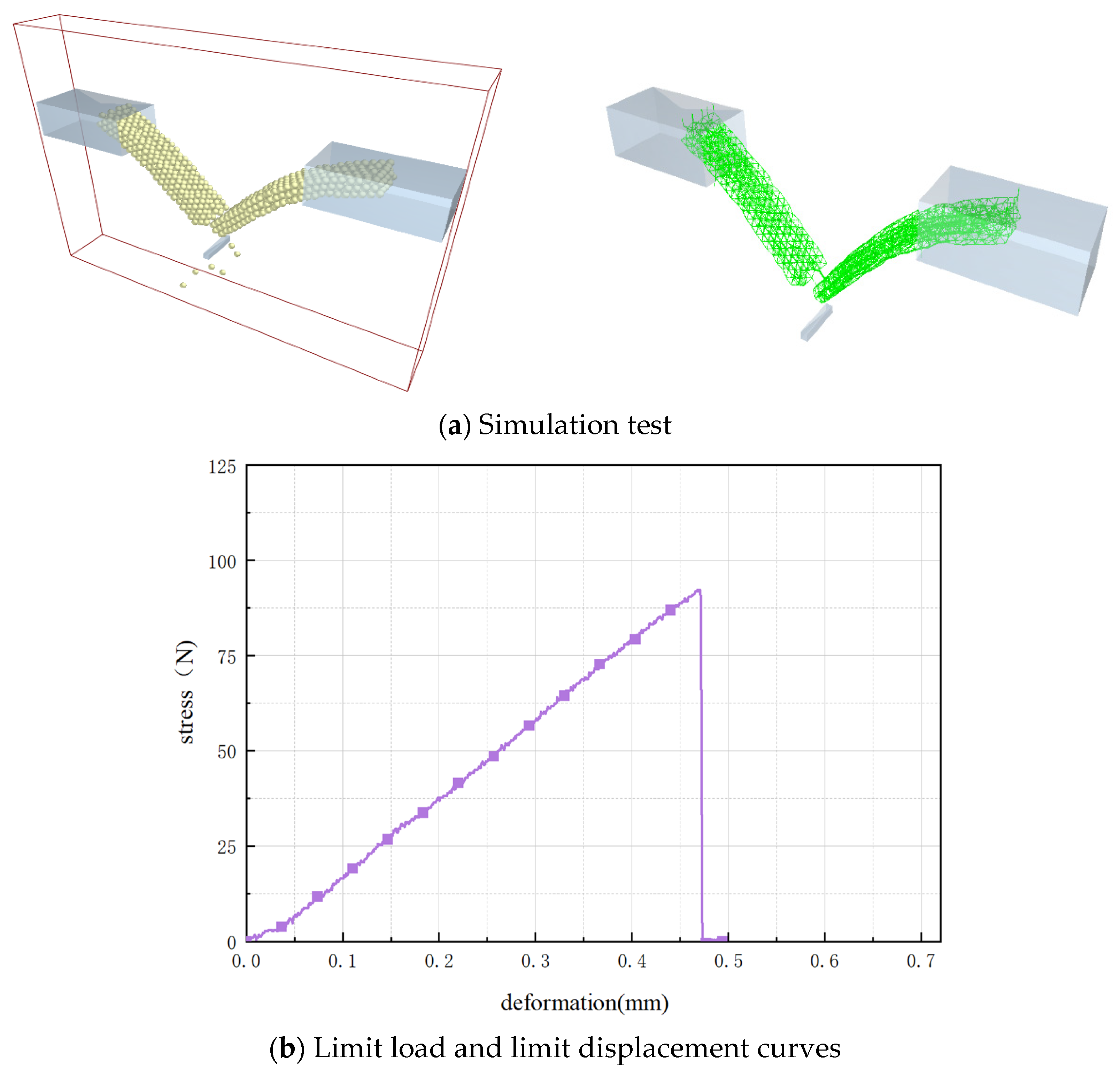
The maximum load and displacement of the shell sample measured through the three-point bending test were used as the target values for the calibration test of the Bonding parameters in the simulation. Firstly, the alignment of the fixture was checked. Then, the span was adjusted according to the scale on the base, with the span being 20 times the thickness of the sample. During the bending test, the sample was placed on the two supports of the fixed machine of the testing machine, the fixture was adjusted to ensure that the sample did not move during the loading process, and the pressure head was positioned in the middle position, as shown in Figure 8. In this experiment, the pressing head was pushed towards the unsupported center until the sample broke. The test plan was edited to become a test method for the bending performance of sheet materials. During the experiment, when the force sensor detected a sudden drop in force, the pressing head returned and the test was terminated accordingly. Five sets of test data of the cut samples were randomly selected. The displacement and load showed a linear relationship. When the load reached 100 N, the variable was approximately 0.45 mm, and the sample broke. The curve dropped sharply at this point. The sample broke at the center, splitting into two parts. The crack was approximately a straight line, as shown in Figure 9. Thirty more tests were repeated and their average values were calculated [47], as shown in Figure 10. In total, thirty specimens were tested under identical three-point bending conditions. The curves exhibited good repeatability among different specimens, with fracture consistently occurring at the mid-span of the samples. The average ultimate load was 100 N, with a standard deviation of ±4.1 N, while the corresponding ultimate displacement exhibited a standard deviation of ±0.02 mm. The relatively small dispersion reflects the brittle and deterministic nature of shell fracture under quasi-static bending conditions and supports the reliability of the averaged response used for subsequent DEM parameter calibration.

2.3.2. Establishment of a Three-Point Bending Test Simulation Model

In the discrete element software EDEM2020, the BondingV2 model is adopted to simulate the mechanical response and failure process of shell-like biological materials under three-point bending load. The main parameters of the Bond key are normal stiffness, tangential stiffness, critical normal stress, critical tangential stress, and bonding radius, and these parameters need to be based on the intrinsic parameters and contact parameters measured in advance [47,48,49].
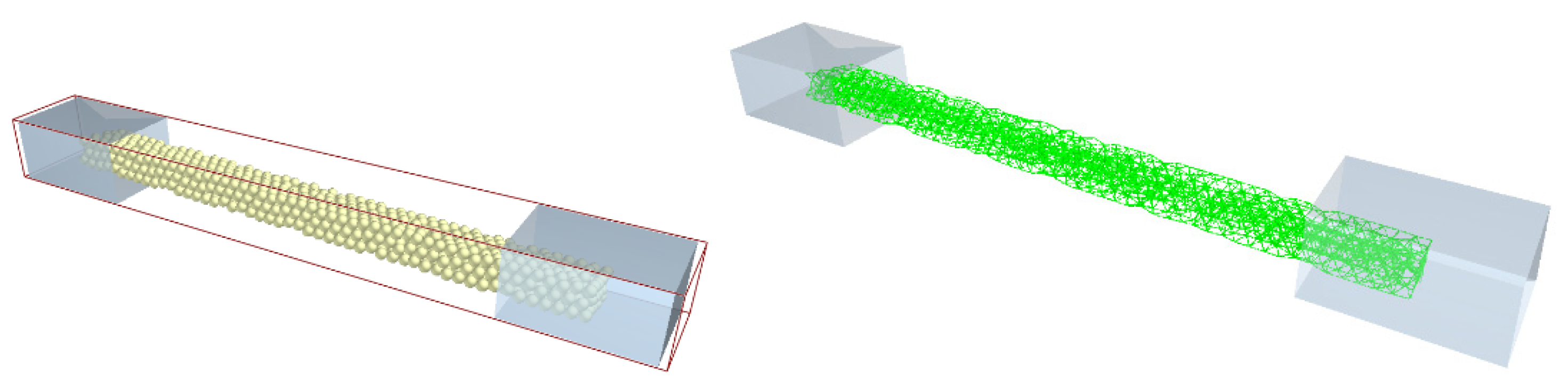
Based on the real structure of the shell sample, a geometric model of the same size and shape is simulated. Considering the time required for subsequent simulations, the particles are set as spherical particles with a diameter of 1 mm, totaling 1080 particles. After exporting the coordinates of the generated particles, a flexible body is created, and the contact radius is set to 0.6 mm, with a time step of 1.9195 × 10⁻⁶ to generate the Bond keys. A three-point bending simulation model consistent with the physical experiment size is established in EDEM, as shown in Figure 11. The upper punch and the two lower supports are set as rigid bodies. According to the average ultimate load in the actual experiment, the punch is set to −80 N along the Z-axis. Based on the fracture situation of the shell experiment, the parameters of the Bond keys are continuously adjusted for reverse calibration.
Through a series of parameter pre-simulation experiments, the bonding stiffness and strength parameters are systematically adjusted to make the force-displacement curve, peak load, and failure mode obtained from the virtual simulation match the physical experiment results. The initial parameter range of the Bond keys is obtained, as shown in Table 1, and is used as the factor levels of the PlackettBurman test.
In the bonded-particle DEM framework, the bonding radius represents the effective interaction zone over which cohesive forces and bending moments are transmitted between adjacent particles. Physically, this parameter does not correspond to a single geometric feature, but rather reflects the combined effect of microstructural characteristics of the shell material, including mineral platelet interlocking, organic matrix distribution, and the effective load-transfer width between bonded units. For seashells, which are biomineral composites composed of stiff calcium carbonate layers bonded by a thin organic matrix, the bonding radius can be interpreted as a mesoscale representation of the effective cohesive region that governs crack initiation and propagation under bending loads. Considering the particle discretization adopted in this study (spherical particles with a diameter of 1 mm), the bonding radius was therefore selected within a range comparable to the particle size, i.e., 0.5–1.5 mm, to ensure mechanical consistency between bond geometry and particle resolution. This range was not arbitrarily fixed but determined through preliminary simulations, in which excessively small bonding radii resulted in unrealistically brittle responses, while overly large bonding radii led to overestimated stiffness and delayed fracture. Consequently, the selected bonding radius range represents a physically meaningful and numerically stable compromise suitable for capturing the bending-dominated fracture behavior of mussel shells.
In the present study, the mussel shell was discretized into 1080 spherical particles with a uniform diameter of 1 mm to balance computational efficiency and numerical stability. This geometric simplification inevitably neglects certain microstructural features of real shells, such as the layered nacre architecture, thickness gradients, and material anisotropy along growth directions. Nevertheless, the primary objective of this modeling approach is to reproduce the global bending-dominated fracture response, including the ultimate load level and macroscopic failure mode, rather than to explicitly resolve micro-scale crack initiation within individual nacre layers. Under quasi-static three-point bending conditions, the fracture behavior of brittle shells is largely governed by overall stiffness distribution and bond failure across the section, which can be reasonably captured using a bonded-particle representation. Previous DEM studies on biological stems, bones, and shell-like materials have demonstrated that spherical bonded-particle assemblies can reliably reproduce global responses and dominant fracture locations, even when fine microstructural details are simplified. In this context, the present discretization strategy is considered appropriate for parameter calibration and equipment-oriented simulations. It should be noted that incorporating layered particles, non-spherical elements, or thickness-dependent bonding properties may further improve local fracture realism and will be explored in future work, particularly for detailed crack path analysis and high-resolution fracture modeling.

2.3.3. PlackettBurman Experiment

The initial selection range of the Bonding parameters was determined based on the physical meaning of each parameter and the measured mechanical properties of the mussel shell, rather than being purely data-driven. Specifically, the unit normal stiffness and unit tangential stiffness were estimated according to the elastic modulus and shear modulus obtained from the uniaxial compression tests, in combination with the particle size and bonding area defined in the bonded-particle representation. Their initial ranges were set to ensure that the equivalent macroscopic stiffness of the bonded particle assembly was consistent with the experimentally measured elastic response of the shell material. The critical normal stress and critical tangential stress were selected based on the brittle fracture characteristics observed in the three-point bending experiments, where sudden load drops and limited plastic deformation were recorded. The initial ranges of these stress parameters were therefore chosen to allow bond breakage to occur near the experimentally observed ultimate load level. The bonding radius was defined relative to the particle diameter to represent the effective contact area of interlamellar bonding within the shell microstructure. Considering the thickness of the shell samples and the chosen particle size (1 mm), the bonding radius range was restricted to values that ensure sufficient inter-particle connectivity while avoiding unrealistically rigid behavior. Based on these physically motivated considerations, the selected parameter ranges provide a reasonable balance between mechanical realism and numerical stability, serving as the basis for subsequent statistical screening and optimization.
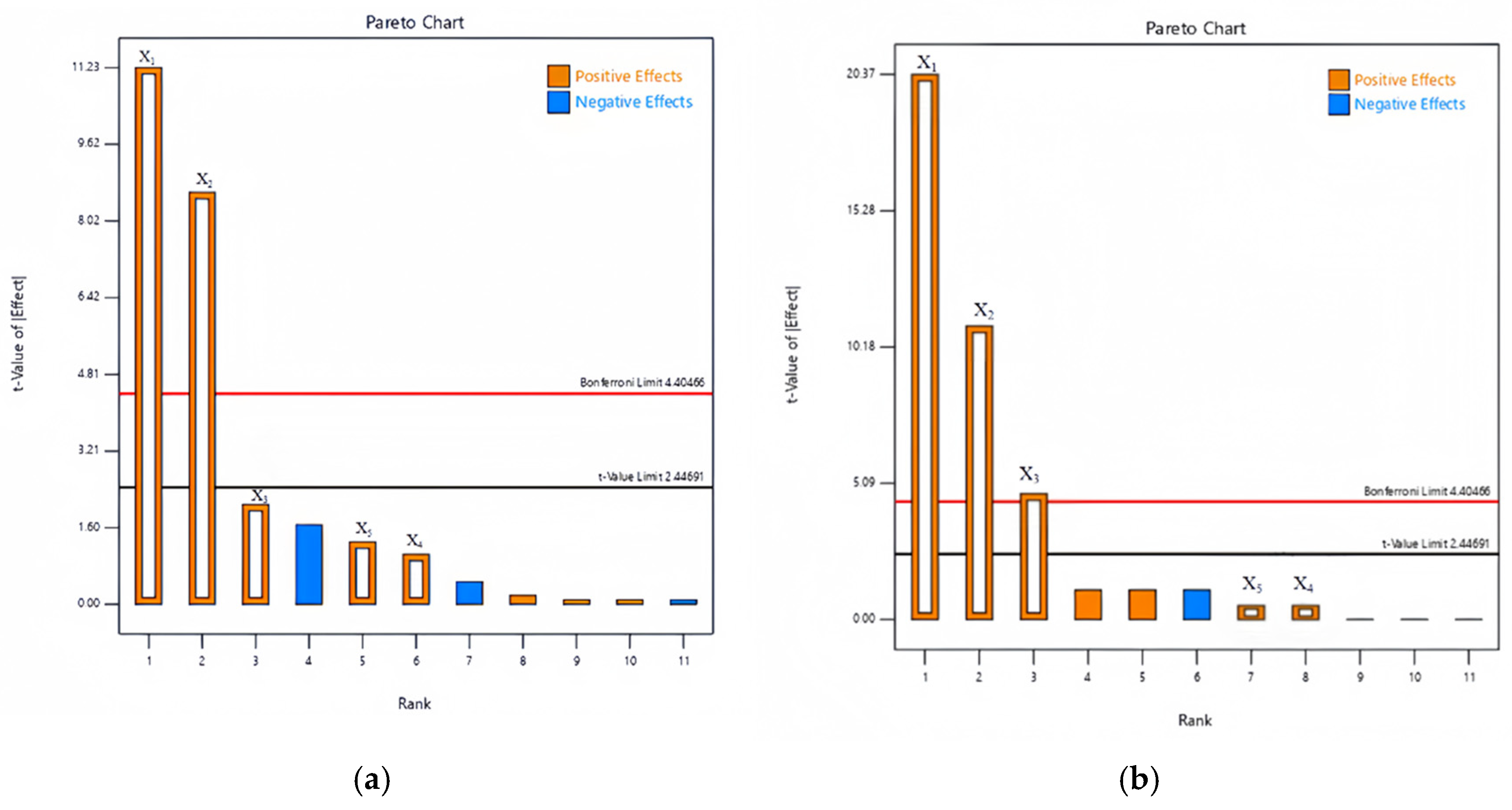
To efficiently screen out the key factors that have significant statistical influence on the interface ultimate load from numerous potential influencing parameters, this study adopted the Plackett–Burman experimental design method [50]. The PB design is an efficient two-level screening design that can evaluate the main effects of factors with the least number of experiments, making it highly suitable for identifying important factors in the initial stage. Five Bond parameters were selected as the factors to be studied in this research, namely: normal stiffness per unit area, shear stiffness per unit area, critical normal stress, critical shear stress, and bond radius. Each factor was set at high and low levels in the experiment, and the level values were determined based on previous theoretical research, material properties, and pre-experiment results. The experimental matrix was generated using the statistical software Design-Expert13, and the experimental plan is presented in the table. The experimental results are shown in Table 2 and Table 3 and Figure 12. It can be seen that the normal stiffness and shear stiffness have extremely significant effects on the ultimate load, with p values all less than 0.0001, and the effect values on the target are positive. The normal stiffness, shear stiffness, and critical normal stress all have extremely significant effects on the ultimate displacement, with p values all less than 0.001, and the effect values on the target are positive.
It should be noted that the Plackett–Burman (P-B) design is a screening method primarily intended to identify the main effects of multiple factors with a limited number of experiments, under the assumption that factor interactions are negligible at this stage. This assumption represents an inherent limitation of the P-B approach. In the present study, the P-B design was deliberately employed only as an initial screening tool to reduce the dimensionality of the parameter space and to identify the most influential bonding parameters affecting the ultimate load and displacement. To mitigate the potential influence of neglected interaction effects, the screened significant factors were subsequently subjected to a steepest ascent test and a response surface design, in which second-order interaction and quadratic effects were explicitly considered and statistically evaluated. Therefore, while interaction effects are not resolved within the P-B stage itself, they are systematically addressed and quantified in the subsequent response surface optimization, ensuring the robustness of the final calibrated parameter set.

2.3.4. Hill-Climbing Test

With the ultimate load and ultimate displacement as the optimization targets, a climbing test was conducted for the unit normal stiffness, unit tangential stiffness, and critical normal stress, as shown in Table 4. During the test, based on the significant analysis results from the previous stage, other factors were fixed at specific levels, and the above three stiffness parameters were adjusted stepwise in a progressive manner. For each change in parameter level, a set of response data for the ultimate load and ultimate displacement was recorded, and the response trend was used to gradually approach the optimal region. This process, through systematic direction adjustment and stepwise search, effectively revealed the individual and coupled action mechanisms of the three stiffness parameters on the ultimate load and ultimate displacement, providing experimental basis and direction guidance for subsequent response surface optimization.

2.3.5. Response Surface Experiment

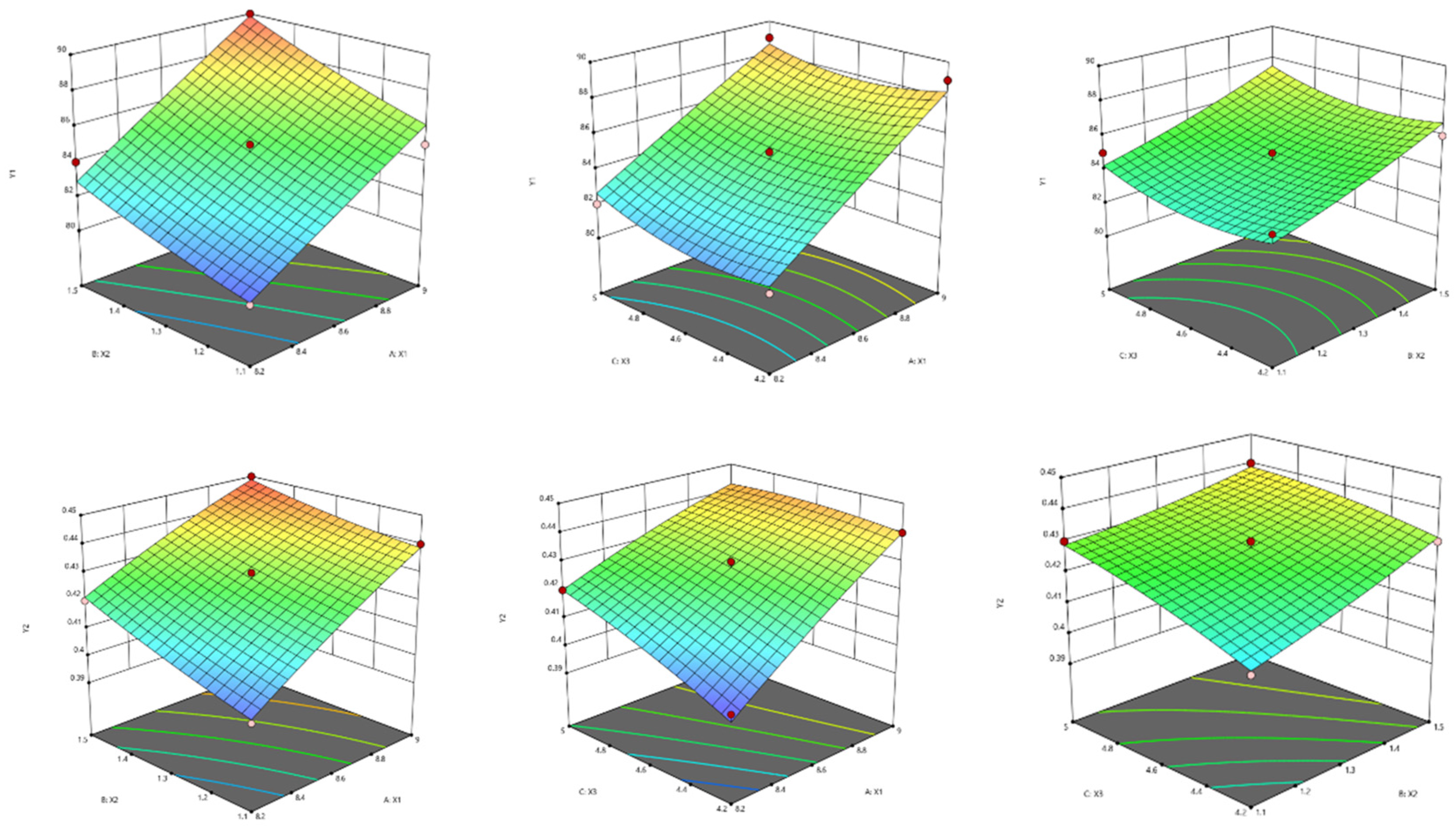
The objective of the experiment is to find a set of values for the unit area normal stiffness, unit area tangential stiffness, and critical normal stress that will make the simulation results of the shell sample’s bending failure most consistent with the actual physical test results. Based on the results of the climbing test, the fourth to sixth groups were selected as the BBD test range. BBD is suitable for experimental designs with 2 to 5 dependent variables and can efficiently construct a second-order response surface model with a small number of experiments, making it very suitable for this scenario. The response surface experiment was conducted using the Design-Expert13 software. For each parameter combination of the BBD design, a bending failure simulation was run and the response values of the ultimate load and ultimate displacement were recorded, as shown in Table 5. Based on the simulation results, a second-order mathematical model was established between the unit area normal stiffness, unit area tangential stiffness, critical normal stress and the response values, Formula (14), and the optimal parameter combination was sought. The test plan and results, as well as the variance analysis results, are shown in Table 5.
Fmax = 84.6 + 3.25X1 + 1.62X2 + 0.375X3 + 0.25X1X2 − 0.25X1X3 − 0.05X12 + 0.2X22 + 0.7X32
Smax = 0.428 + 0.0162X1 + 0.0075X2 + 0.0062X3 − 0.0025X1X2 − 0.005X1X3 − 0.0025X2X3 − 0.0015X12 + 0.001X22 − 0.0015X32
From Table 6, it can be seen that the model determination coefficient R2 is 0.9444 and 0.9667, indicating good fit; the model is significant and the non-fit term is not significant, suggesting high model accuracy. X1 and X2 have extremely significant effects on the ultimate load (p < 0.01), and X1, X2, and X3 have extremely significant effects on the ultimate displacement (p < 0.01). The interaction and squared terms of X1, X2, and X3 have no significant effect on the ultimate load (p > 0.05), while the interaction term of X1 and X3 has a significant effect on the ultimate displacement (p < 0.05), and the interaction and squared terms of the other X1, X2, and X3 have no significant effect on the ultimate displacement (p > 0.05). The response surface diagrams of the ultimate load and ultimate displacement obtained from the regression equation are shown in Figure 13.

2.3.6. Verification Test

The optimization solution was obtained using the Design-Expert software, resulting in X1, X2, X3, X4, and X5 being 8.26 × 10¹⁰, 1.116 × 10¹⁰, 4.438 × 10⁷, 4 × 10⁷, and 0.5 respectively. The optimal parameters obtained were then substituted into the EDEM simulation model, and the bending test was re-run, as shown in Figure 14. The degree of consistency between the deformation-load curve of this simulation, the crack analysis, and the physical test was compared. The relative error compared to the actual test was 3.8%, which is basically consistent with the average value of the actual test, indicating that the modeling and calibration parameters of the shell sample are accurate and reliable [34]. In addition to the comparison of ultimate load, the consistency of deformation evolution and failure characteristics between the simulation and the physical experiment was also examined. The simulated curve exhibits a linear elastic response followed by a sudden load drop, which is consistent with the brittle fracture behavior observed experimentally. The displacement at fracture initiation in the simulation closely matches the experimentally measured displacement range, indicating that the global stiffness response is well reproduced. Quantitatively, the simulated fracture initiation displacement was 0.45 mm, compared to the experimental average of 0.46 mm, with a deviation of approximately 2.2%, providing a simple yet concrete metric for the accuracy of the simulated deformation progression. Moreover, the simulated bond breakage initiates at the mid-span region and propagates rapidly across the cross-section, resulting in a dominant central crack, which agrees with the experimentally observed fracture location and crack morphology. This indicates that the BondingV2 model captures the primary fracture mode under quasi-static bending. From an energy perspective, the numerical model shows limited plastic deformation and abrupt release of stored elastic energy at failure, which is consistent with the brittle and low-energy-dissipation nature of mussel shell fracture. Although a full quantitative comparison of crack paths and energy dissipation was not conducted, the agreement in deformation evolution, fracture location, and failure mode supports the validity of the calibrated model for bending-dominated fracture simulations.
The bonding parameters calibrated in this study are obtained based on shell particles discretized at a characteristic particle size of approximately 1 mm and validated under quasi-static three-point bending conditions. Therefore, their applicability is most reliable for DEM simulations in which the characteristic particle size and deformation mode are comparable to those considered in the calibration stage. In practical shell crushing and processing scenarios, however, the material system may involve either larger shell fragments (coarse-scale breakage) or much smaller particles approaching powder-scale sizes. When the particle size deviates significantly from the calibration scale, the direct transferability of the calibrated bonding parameters cannot be assumed without further consideration. This is because bond stiffness, bond strength, and effective contact area are inherently coupled with particle size and discretization density in bonded-particle DEM formulations. For simulations involving larger shell fragments, the present parameters may still provide reasonable predictions if the particle discretization strategy preserves a similar bond density and geometric representation of the shell structure. In contrast, for fine-scale fragmentation or powder-level simulations, re-calibration or appropriate scaling of bonding stiffness and strength parameters may be required to maintain consistent macroscopic mechanical responses. Accordingly, the calibrated parameter set presented in this study should be regarded as scale-specific rather than universally scale-invariant. Future work will focus on developing scaling relationships and multi-scale calibration strategies to extend the applicability of the bonded DEM model across different particle size regimes encountered in shell crushing processes.
Although the Plackett–Burman, steepest ascent, and designs adopted in this study represent a conventional parameter calibration strategy, this hierarchical approach was intentionally selected to balance computational efficiency and statistical robustness in DEM parameter identification. The response surface analysis indicates that interaction effects among the selected bonding parameters on the ultimate load are statistically insignificant within the investigated parameter ranges. This result can be attributed to the relatively narrow and physically constrained parameter intervals defined based on experimental measurements and pre-simulation screening, which effectively limit strong nonlinear coupling between parameters. It should be noted that interaction effects may become more pronounced if broader parameter ranges or alternative loading conditions are considered. However, within the physically realistic bounds relevant to quasi-static bending-dominated shell fracture, the observed dominance of main effects supports the validity of the adopted calibration strategy.
Model simplification is an inherent compromise in DEM-based fracture simulations. In this study, the mussel shell was discretized into spherical particles with a uniform diameter of 1 mm and modeled using the BondingV2 approach. This simplification neglects the intrinsic layered architecture and anisotropic microstructure of natural seashells, including the alternation of mineral platelets and organic matrix. While such microstructural features may influence local crack initiation and propagation paths, the present modeling strategy aims to reproduce the macroscopic bending response and global fracture behavior rather than micro-scale damage mechanisms. The good agreement between experimental and simulated ultimate load and displacement indicates that the adopted simplification is adequate for capturing bending-dominated fracture under quasi-static conditions. Nevertheless, it should be acknowledged that the simplified particle representation may limit the model’s ability to predict anisotropy-driven fracture patterns. Future work may incorporate non-spherical particles or layered bonding strategies to further improve the physical realism of shell fracture modeling.

3. Conclusions

This study established a calibrated discrete element model for freshwater mussel shells with the aim of accurately reproducing their macroscopic mechanical response and fracture behavior, thereby providing a reliable numerical basis for the optimization of seashell crushing equipment.
First, the intrinsic mechanical properties of mussel shells were experimentally determined. Using drainage and uniaxial compression tests, the shell density, Poisson’s ratio, shear modulus, and elastic modulus were obtained as 2.2 g/cm3 (2200 kg/m3), 0.26, 1.57 × 10⁸ Pa, and 6.5 × 10¹⁰ Pa, respectively. In addition, the contact parameters between shell–shell and shell304 stainless steel interfaces, including static friction coefficient, rolling friction coefficient, and coefficient of restitution, were measured using inclined plane and collision tests. The reliability of these contact parameters was verified by the angle of repose test, in which the relative error between experimental and simulation results was 5.1%, indicating good consistency.
Second, taking the ultimate load obtained from three-point bending experiments as the calibration target, a fracture-oriented parameter calibration strategy for the BondingV2 model was developed. Through Plackett–Burman screening, unit normal stiffness and unit tangential stiffness were identified as the dominant parameters influencing bending failure. The effective parameter range was further refined using the steepest ascent method, and precise calibration was achieved via response surface optimization. The optimal bonding parameter set of unit area normal stiffness of 8.26 × 10¹⁰ N/m3, unit area tangential stiffness of 1.116 × 10¹⁰ N/m3, critical normal stress of 4.438 × 10⁷ Pa, critical tangential stress of 4.0 × 10⁷ Pa, and bonding radius of 0.5 mm enabled the DEM model to reproduce the experimental bending response with a relative error of only 3.8%.
From an engineering perspective, the calibrated DEM model and parameter set can be directly applied to numerical simulations of seashell crushing processes, enabling quantitative analysis of shell fragmentation behavior, force transmission, and energy dissipation under equipment-induced loading. This provides practical guidance for optimizing key structural and operational parameters of crushing equipment, such as tool geometry, loading mode, and operating speed, thereby reducing reliance on trial-and-error experiments.
Finally, it should be noted that the present model is primarily validated under quasi-static bending conditions and at a specific particle discretization scale. Future research will focus on extending the calibrated parameter framework to dynamic crushing and impact scenarios, investigating scale effects associated with larger shell fragments and finer powder particles, and incorporating shell microstructural features and anisotropy to further enhance fracture prediction accuracy. These efforts will contribute to the development of more robust and generalizable DEM-based tools for shell processing equipment design and optimization.
Despite the good agreement between numerical simulations and experimental results, several limitations of the proposed DEM model should be acknowledged. First, the parameter calibration and validation in this study are based on quasi-static three-point bending conditions. The calibrated bonding parameters are therefore most reliable for low loading-rate scenarios where inertial effects and rate-dependent material behavior are negligible. For dynamic or high-speed impact fracture scenarios, such as those encountered in high-energy crushing or impact milling processes, additional factors including strain-rate sensitivity, damping effects, and contact time dependency may play a more significant role. The direct application of the present parameter set to such conditions may require further verification or recalibration using dynamic loading experiments. In addition, the shell was discretized using spherical particles of uniform size, which represents a necessary simplification to balance computational efficiency and model resolution. Although this approach successfully reproduces the global bending failure behavior, local microstructural features of shells, such as layered architecture and anisotropy, are not explicitly resolved in the current model. Future work may incorporate non-spherical particles or multi-scale modeling strategies to further improve fracture prediction accuracy.
In summary, this study provides both scientific and practical contributions. Scientifically, it establishes a validated DEM parameter calibration methodology for brittle shell materials, demonstrating that the HertzMindlin with Bonding model can effectively capture the bending failure behavior of freshwater mussel shells with high accuracy. Practically, the calibrated parameter set and modeling approach can be directly applied to the numerical analysis and optimization of shell crushing and processing equipment, reducing reliance on extensive trial-and-error experiments. Overall, the proposed experimental-numerical framework bridges the gap between laboratory-scale mechanical testing and engineering-scale DEM simulations, offering a transferable reference for the modeling of other brittle biological materials with bonded microstructures.

Author Contributions

Conceptualization, T.W. and X.D.; methodology, T.W.; software, T.W.; validation, T.W. and S.C.; formal analysis, T.W.; investigation, T.W.; resources, Q.S.; data curation, T.W.; writing—original draft preparation, T.W.; writing—review and editing, T.W. and X.D.; visualization, T.W.; supervision, Y.J.; project administration, H.D.; funding acquisition, T.W. All authors have read and agreed to the published version of the manuscript.

Funding

This study was supported by the Youth Fund of Natural Science Foundation of Jiangsu Province (BK20241058) and the Project of Graduate Student Scientific Research and Practical Innovation Program of Jiangsu Ocean University (KYCX2024-41).

Data Availability Statement

The data presented in this study are available on request from the corresponding author due to privacy.

Conflicts of Interest

The authors declare no conflicts of interest.

References

  1. Qian, J.; Deng, F.; Shumway, S.E.; Hu, M.; Wang, Y. The thick-shell mussel Mytilus coruscus: Ecology, physiology, and aquaculture. Aquaculture 2024, 580, 740350. [Google Scholar] [CrossRef]
  2. Wang, F.; Wall, G. Mudflat development in Jiangsu Province, China: Practices and experiences. Ocean Coast. Manag. 2010, 53, 691–699. [Google Scholar] [CrossRef]
  3. Chuang, H.-C.; Wang, S.-Y.; Cheng, A.-C. Research on and application of low-temperature calcination on waste Taiwanese hard clam shell during Taiwanese hard clam aquaculture. Aquaculture 2024, 590, 741048. [Google Scholar] [CrossRef]
  4. Fan, X.; Wang, G.; Li, D.; Xu, P.; Shen, S. Study on early-stage development of conchospore in Porphyra yezoensis Ueda. Aquaculture 2008, 278, 143–149. [Google Scholar] [CrossRef]
  5. Fakayode, O.A. Size-based physical properties of hard-shell clam (Mercenaria mercenaria) shell relevant to the design of mechanical processing equipment. Aquac. Eng. 2020, 89, 102056. [Google Scholar] [CrossRef]
  6. Derkach, S.; Kravets, P.; Kuchina, Y.; Glukharev, A.; Tyukina, O.; Bordiyan, V.; Alloyarova, Y.; Priymak, P.; Malavenda, S.; Zueva, O.; et al. Mineral-free biomaterials from mussel (Mytilus edulis L.) shells: Their isolation and physicochemical properties. Food Biosci. 2023, 56, 103188. [Google Scholar] [CrossRef]
  7. Iwase, K.; Harunari, Y.; Teramoto, M.; Mori, K. Crystal structure, microstructure, and mechanical properties of heat-treated oyster shells. J. Mech. Behav. Biomed. Mater. 2023, 147, 106107. [Google Scholar] [CrossRef]
  8. Lv, J.; Jiang, Y.; Zhang, D. Structural and Mechanical Characterization of Atrina Pectinata and Freshwater Mussel Shells. J. Bionic Eng. 2015, 12, 276–284. [Google Scholar] [CrossRef]
  9. Osa, J.; Mondragon, G.; Ortega, N.; Marzo, F.; Peña-Rodriguez, C. On the friability of mussel shells as abrasive. J. Clean. Prod. 2022, 375, 134020. [Google Scholar] [CrossRef]
  10. Shi, L.; Yang, M. Analysis of Research Hotspots in Agricultural Engineering in China Based on Scientometrics. Trans. Chin. Soc. Agric. Eng. 2016, 32, 430–438. [Google Scholar]
  11. Zeng, Z.; Ma, X.; Cao, X.; Li, Z.; Wang, X. Application Status and Prospects of the Discrete Element Method in Agricultural Engineering Research. Trans. Chin. Soc. Agric. Mach. 2021, 52, 1–20. [Google Scholar]
  12. Maraveas, C.; Tsigkas, N.; Bartzanas, T. Agricultural processes simulation using discrete element method: A review. Comput. Electron. Agric. 2025, 237, 110733. [Google Scholar] [CrossRef]
  13. Han, D.; Tang, C.; Liu, B.; Li, W.; Wang, Y.; Xu, L. Hierarchical model acquisition and parameter calibration of the corncob based on the discrete element method. Adv. Powder Technol. 2025, 36, 104932. [Google Scholar] [CrossRef]
  14. Du, Z.; Li, D.; Li, X.; Jin, X.; Wu, Y.; Yu, F. Parameter Calibration and Experiment of Discrete Element Model for Tea Stem. Trans. Chin. Soc. Agric. Mach. 2025, 56, 311–320. [Google Scholar]
  15. Wei, J.; Fu, J.; Wang, S.; Liu, H. Parameter Calibration for Discrete Element Model of Rib Bending Failure in Cold-Storage Boer Goats. Trans. Chin. Soc. Agric. Eng. 2024, 40, 285–294. [Google Scholar]
  16. Jiao, J.; Zhang, G.; Du, J.; Liu, H.; Zha, X.; Xing, H. Discrete Element Simulation Analysis of Bending Failure of Main Stem of Lotus Root. J. Huazhong Agric. Univ. 2021, 40, 217–225. [Google Scholar] [CrossRef]
  17. Wang, X.; Wang, H.; Han, Y.; Jiao, N.; Cai, Y.; Jin, J.; Xu, L.; Liu, A. Construction of a beef chewing and crushing model based on the discrete element method. Trans. Chin. Soc. Agric. Eng. 2016, 32, 228–234. [Google Scholar]
  18. Ma, Y.; Qi, Y.; Wang, H.; Teng, D.; Chen, J.; Liu, D. Parameter Calibration and Experimental Verification of Discrete Element Simulation for Corn Straw-Natural Manure Mixture. Trans. Chin. Soc. Agric. Mach. 2024, 55, 441–450+504. [Google Scholar]
  19. Chen, G.; Wang, Q.; Li, H.; He, J.; Lu, C.; Sheng, S.; Zhang, X. Rapid acquisition method of discrete element parameters of granular manure and validation. Powder Technol. 2024, 431, 119071. [Google Scholar] [CrossRef]
  20. Wang, Z.-Q.; Wu, F.; Zhong, Z.-J.; Luo, X.-R.; Wan, X.-H.; Liao, J.-L.; Tao, Q.; Wu, Z.-F. Determination of Physical Parameters of Jianwei Xiaozhi Granules and Calibration of Discrete Element Simulation Parameters. Chin. J. Chin. Med. 2024, 49, 6558–6564. [Google Scholar] [CrossRef]
  21. Chen, S.; Jiang, L.; Lin, X.; Tang, X.; Liu, X.; Zhang, L. Experimental Study on Calibration of Contact Parameters of Flour Particles Based on the Discrete Element Method. Trans. Chin. Soc. Agric. Eng. 2024, 40, 69–76. [Google Scholar]
  22. Li, Z.; Yue, Q.; Zhang, D.H.; Li, Z.Q.; Yu, Y.; Li, J.N. Simulation physical parameter calibration of mushroom substrate particles based on the discrete element method. Chin. J. Agric. Mach. Chem. 2024, 45, 170–176. [Google Scholar] [CrossRef]
  23. Wang, B.; He, Z.; Ding, X.; Hao, W.; Yang, Z.; Cui, Y. Parameter Calibration of Peat Discrete Element Model Based on Uniaxial Closed Compression Test. Trans. Chin. Soc. Agric. Mach. 2024, 55, 87–97. [Google Scholar]
  24. Schramm, M.; Tekeste, M.Z.; Plouffe, C.; Harby, D. Estimating bond damping and bond Young’s modulus for a flexible wheat straw discrete element method model. Biosyst. Eng. 2019, 186, 349–355. [Google Scholar] [CrossRef]
  25. Sadrmanesh, V.; Chen, Y. Simulation of tensile behavior of plant fibers using the Discrete Element Method (DEM). Compos. Part A Appl. Sci. Manuf. 2018, 114, 196–203. [Google Scholar] [CrossRef]
  26. Zhang, S.; Zhang, R.; Cao, Q.; Zhang, Y.; Fu, J.; Wen, X.; Yuan, H. A calibration method for contact parameters of agricultural particle mixtures inspired by the Brazil nut effect (BNE): The case of tiger nut tuber-stem-soil mixture. Comput. Electron. Agric. 2023, 212, 108112. [Google Scholar] [CrossRef]
  27. Du, C.; Han, D.; Song, Z.; Chen, Y.; Chen, X.; Wang, X. Calibration of contact parameters for complex shaped fruits based on discrete element method: The case of pod pepper (Capsicum annuum). Biosyst. Eng. 2023, 226, 43–54. [Google Scholar] [CrossRef]
  28. Fang, M.; Yu, Z.; Zhang, W.; Cao, J.; Liu, W. Friction coefficient calibration of corn stalk particle mixtures using Plackett-Burman design and response surface methodology. Powder Technol. 2022, 396, 731–742. [Google Scholar] [CrossRef]
  29. Wang, S.; Yu, Z.; Aorigele; Zhang, W. Study on the modeling method of sunflower seed particles based on the discrete element method. Comput. Electron. Agric. 2022, 198, 107012. [Google Scholar] [CrossRef]
  30. Shi, Y.; Jiang, Y.; Wang, X.; Thuy, N.T.D.; Yu, H. A mechanical model of single wheat straw with failure characteristics based on discrete element method. Biosyst. Eng. 2023, 230, 1–15. [Google Scholar] [CrossRef]
  31. Zhao, W.; Chen, M.; Xie, J.; Cao, S.; Wu, A.; Wang, Z. Discrete element modeling and physical experiment research on the biomechanical properties of cotton stalk. Comput. Electron. Agric. 2023, 204, 107502. [Google Scholar] [CrossRef]
  32. Schramm, M.; Tekeste, M.Z. Wheat straw direct shear simulation using discrete element method of fibrous bonded model. Biosyst. Eng. 2022, 213, 1–12. [Google Scholar] [CrossRef]
  33. Leblicq, T.; Smeets, B.; Ramon, H.; Saeys, W. A discrete element approach for modelling the compression of crop stems. Comput. Electron. Agric. 2016, 123, 80–88. [Google Scholar] [CrossRef]
  34. Chen, F.; Yuan, H.; Liu, Z.; Zhou, L.; Cao, C.; Zhong, G.; Zhang, D.; Zhao, Y. DEM simulation of an impact crusher using the fast-cutting breakage model. Powder Technol. 2025, 450, 120442. [Google Scholar] [CrossRef]
  35. Zhang, Z.-T.; Wang, Y.-H.; Zhang, J.-Q.; Liu, Z.; Gao, W.-H. A new gradation equation for coarse-grained subgrade fillers and its applicability based on the fractal theory. Geomech. Geophys. Geo-Energy Geo-Resour. 2025, 11, 20. [Google Scholar] [CrossRef]
  36. Zhang, Z.-T.; Zhou, G.-M. Investigating the compaction and the mechanical behaviors of coal gangue as subgrade filler and constructing highway subgrade in practice. Sci. Rep. 2024, 14, 26272. [Google Scholar] [CrossRef] [PubMed]
  37. Zhang, Z.-T.; Gao, W.-H. Effect of different test methods on the disintegration behaviour of soft rock and the evolution model of disintegration breakage under cyclic wetting and drying. Eng. Geol. 2020, 279, 105888. [Google Scholar] [CrossRef]
  38. Zhang, Z.-T.; Gao, W.-H.; Wang, X.; Zhang, J.-Q.; Tang, X.-Y. Degradation-induced evolution of particle roundness and its effect on the shear behaviour of railway ballast. Transp. Geotech. 2020, 24, 100388. [Google Scholar] [CrossRef]
  39. Li, X.; Kuang, J.; Jiang, S.; Ji, S. Bonded particle model for dilated polyhedron considering fracture modes and its application to lateral resistance of ballast bed in cold regions. Powder Technol. 2024, 439, 119673. [Google Scholar] [CrossRef]
  40. Zheng, J.; Ciantia, M.O. An Efficient Damage-Plasticity DEM Contact Model for Highly Porous Rocks. Rock Mech. Rock Eng. 2025, 58, 5733–5754. [Google Scholar] [CrossRef] [PubMed]
  41. Xu, B.; Yang, Y.; Li, H.; Chen, G.; Chang, Y.; Guo, F.; Wu, H.; Zhao, J.; Liu, Z.; Zhang, G.; et al. Mechanical Characterization and Dual-Layer Discrete Element Modeling of Mactra veneriformis. Fishes 2025, 10, 429. [Google Scholar] [CrossRef]
  42. Rotter, S.; Woitzik, C.; Düster, A. Bonded particle models for discrete element simulation of porous granules. Proc. Appl. Math. Mech. 2023, 22, e202200164. [Google Scholar] [CrossRef]
  43. Saavedra, L.M.; Bastías, M.; Mendoza, P.; Lagos, N.A.; García-Herrera, C.; Ponce, V.; Alvarez, F.; Llanos-Rivera, A. Environmental correlates of oyster farming in an upwelling system: Implication upon growth, biomass production, shell strength and organic composition. Mar. Environ. Res. 2024, 198, 106489. [Google Scholar] [CrossRef]
  44. Zhang, C.; Hu, J.; Xu, Q.; Guan, J.; Liu, H. Mechanical properties and energy evolution mechanism of wheat grain under uniaxial compression. J. Stored Prod. Res. 2024, 108, 102392. [Google Scholar] [CrossRef]
  45. Güler, C.; Sarikaya, A.; Sertkaya, A.A.; Canli, E. Almond shell particle containing particleboard mechanical and physical properties. Constr. Build. Mater. 2024, 431, 136565. [Google Scholar] [CrossRef]
  46. Kanakabandi, C.; Goswami, T. Determination of properties of black pepper to use in discrete element modeling. J. Food Eng. 2019, 246, 111–118. [Google Scholar] [CrossRef]
  47. Xuan, S.; Zhan, C.; Liu, Z. A multi-bonding and damage model for spherical discrete element method. Eng. Anal. Bound. Elem. 2025, 179, 106387. [Google Scholar] [CrossRef]
  48. Ottesen, M.A.; Larson, R.A.; Stubbs, C.J.; Cook, D.D. A parameterised model of maize stem cross-sectional morphology. Biosyst. Eng. 2022, 218, 110–123. [Google Scholar] [CrossRef]
  49. Guo, Y.; Wassgren, C.; Hancock, B.; Ketterhagen, W.; Curtis, J. Validation and time step determination of discrete element modeling of flexible fibers. Powder Technol. 2013, 249, 386–395. [Google Scholar] [CrossRef]
  50. Sun, W.; Sun, Y.; Wang, Y.; He, H. Calibration and experimental verification of discrete element parameters for modelling feed pelleting. Biosyst. Eng. 2024, 237, 182–195. [Google Scholar] [CrossRef]
Figure 1. Mussel shell.
Applmech 07 00006 g001
Figure 2. Diagram of shell cutting.
Applmech 07 00006 g002
Figure 3. Uniaxial compression test.
Applmech 07 00006 g003
Figure 4. Static friction lift test.
Applmech 07 00006 g004
Figure 5. Rolling friction lift test.
Applmech 07 00006 g005
Figure 6. Shell ball drop test.
Applmech 07 00006 g006
Figure 7. Static accumulation angle test.
Applmech 07 00006 g007
Figure 8. Three-point bending test.
Applmech 07 00006 g008
Figure 9. The bending fracture condition of the sample.
Applmech 07 00006 g009
Figure 10. Average value.
Applmech 07 00006 g010
Figure 11. Bending test simulation diagram.
Applmech 07 00006 g011
Figure 12. Pareto charts of standardized effects obtained from the Plackett–Burman screening design. The horizontal reference lines represent the t-value significance limit and the Bonferroni limit, respectively. Positive and negative bars indicate the direction of factor effects. (a) Effects of bonding parameters on the ultimate crushing load (Fmax); (b) Effects of bonding parameters on the ultimate crushing displacement (Smax).
Applmech 07 00006 g012
Figure 13. Response surfaces of the interaction effects among factors for the ultimate load and ultimate displacement.
Applmech 07 00006 g013
Figure 14. Optimal combination simulation verification.
Applmech 07 00006 g014
Table 1. PlackettBurman Experimental Factor Levels.
LevelFactors
X1/(N·m−3)X2/(N·m−3)X3/PaX4/PaX5/mm
Low7 × 10105 × 1093 × 1073 × 1070.95
High9 × 10101.5 × 10105 × 1075 × 1071.05
Table 2. Results of PlackettBurman experiment.
Serial NumberX1/(N·m−3)X2/(N·m−3)X3/PaX4/PaX5/mmFmax/NSmax/mm
19 × 10101.5 × 10103 × 1073 × 1070.95870.44
27 × 10105 × 1095 × 1073 × 1071.05640.36
37 × 10105 × 1093 × 1075 × 1070.95630.34
49 × 10101.5 × 10105 × 1073 × 1070.95900.45
57 × 10105 × 1093 × 1073 × 1070.95620.34
67 × 10101.5 × 10103 × 1075 × 1071.05780.39
79 × 10101.5 × 10103 × 1075 × 1071.05880.45
89 × 10105 × 1095 × 1075 × 1071.05820.42
99 × 10105 × 1093 × 1073 × 1071.05810.40
109 × 10105 × 1095 × 1075 × 1070.95820.42
117 × 10101.5 × 10105 × 1073 × 1071.05790.39
127 × 10101.5 × 10105 × 1075 × 1070.95780.39
Table 3. Significance analysis of PlackettBurman experiment results.
Source of
Variance
Fmax
Sum of SquaresDegree of FreedomMean SquareFp
Model1014.335202.8741.500.0001 **
X1616.331616.33126.07<0.0001 **
X23631363.0074.250.0001 **
X321.33121.334.360.0817
X45.3315.331.090.3365
X58.3318.331.700.2395
Residual29.3364.89
Total sum1043.6711
Source of
Variance
Smax
Sum of SquaresDegree of FreedomMean SquareFp
Model0.017050.0034111.55<0.0001 **
X10.012710.0127414.82<0.0001 **
X20.003710.0037120.27<0.0001 **
X30.000710.000722.090.0033 **
X48.333 × 10−618.333 × 10−60.27270.6202
X58.33 × 10−618.333 × 10−60.27270.6202
Residual0.000260.00000
Total sum0.017211
** indicates extremely significant difference (p ≤ 0.01).
Table 4. Slope climbing test plan and results.
Serial NumberX1(N·m−3)X2(N·m−3)X3(Pa)Fmax (N)Dmax (mm)Relative
Error
17 × 10105 × 1093 × 107640.3623.4%
27.4 × 10107 × 1093.4 × 107690.3617.4%
37.8 × 10109 × 1093.8 × 107740.3711.4%
48.2 × 10101.1 × 10104.2 × 107800.44.2%
58.6 × 10101.3 × 10104.6 × 107850.431.8%
69 × 10101.5 × 10105 × 107900.457.8%
Table 5. BBD test plan and results.
Serial NumberX1 (N·m−3)X2 (N·m−3)X3(Pa)Fmax/NSmax/mm
19 × 10101.5 × 10104.6 × 107900.45
28.6 × 10101.3 × 10104.6 × 107840.43
39 × 10101.1 × 10104.6 × 107850.44
48.6 × 10101.3 × 10104.6 × 107840.42
59 × 10101.3 × 10105 × 107890.44
68.2 × 10101.5 × 10104.6 × 107840.42
78.6 × 10101.5 × 10105 × 107870.44
88.2 × 10101.3 × 10104.2 × 107810.40
98.6 × 10101.3 × 10104.6 × 107850.43
108.6 × 10101.1 × 10105 × 107850.43
118.6 × 10101.3 × 10104.6 × 107850.43
128.6 × 10101.5 × 10104.2 × 107860.43
138.2 × 10101.3 × 10105 × 107820.42
148.6 × 10101.3 × 10104.6 × 107850.43
159 × 10101.3 × 10104.2 × 107890.44
168.6 × 10101.1 × 10104.2 × 107840.41
178.2 × 10101.1 × 10104.6 × 107800.40
Table 6. Analysis of Variance.
Source of
Variance
Fmax
Sum of SquaresDegree of FreedomMean SquareFp
Model109.55912.1713.210.0013 **
X184.50184.5091.71<0.0001 **
X221.12121.1222.930.0020 **
X31.1211.121.120.3057
X1X20.250010.25000.27130.6185
X1X30.250010.25000.27130.6185
X2X30.000010.00000.00001.0000
X120.010510.01050.01140.9179
X220.168410.16840.18280.6818
X322.0612.062.240.1782
Residual6.4570.9214
Misfitting item5.2531.755.830.0607
Total sum116.0016
R2 = 0.9444; R2Adj = 0.8729
Source of
Variance
Smax
Sum of SquaresDegree of FreedomMean SquareFp
Model0.003090.000322.580.0002 **
X10.002110.0021140.83<0.0001 **
X20.000410.000430.000.0009 **
X30.000310.000320.830.0026 **
X1X20.000010.00001.670.2377
X1X30.000110.00016.670.0364 *
X2X30.000010.00001.670.2377
X129.474 × 10−619.474 × 10−60.63160.4529
X224.211 × 10−614.211 × 10−60.28070.6126
X329.474 × 10−619.474 × 10−60.63160.4529
Residual0.000170.0000
Misfitting item0.000038.333 × 10−60.41670.7510
Total sum0.003216
R2 = 0.9667; R2Adj = 0.9239
** indicates extremely significant difference (p ≤ 0.01), * indicates significant difference (0.01 < p ≤ 0.05), the same as below.
Disclaimer/Publisher’s Note: The statements, opinions and data contained in all publications are solely those of the individual author(s) and contributor(s) and not of MDPI and/or the editor(s). MDPI and/or the editor(s) disclaim responsibility for any injury to people or property resulting from any ideas, methods, instructions or products referred to in the content.