Aero-Structural Analysis of a Wind Turbine Blade Lay-Up as a Preliminary Design Alternative

 ,
,  , and
, and
Abstract
1. Introduction
2. Materials and Methods
2.1. Aerodynamic CFD Simulations
2.1.1. Computational Domain
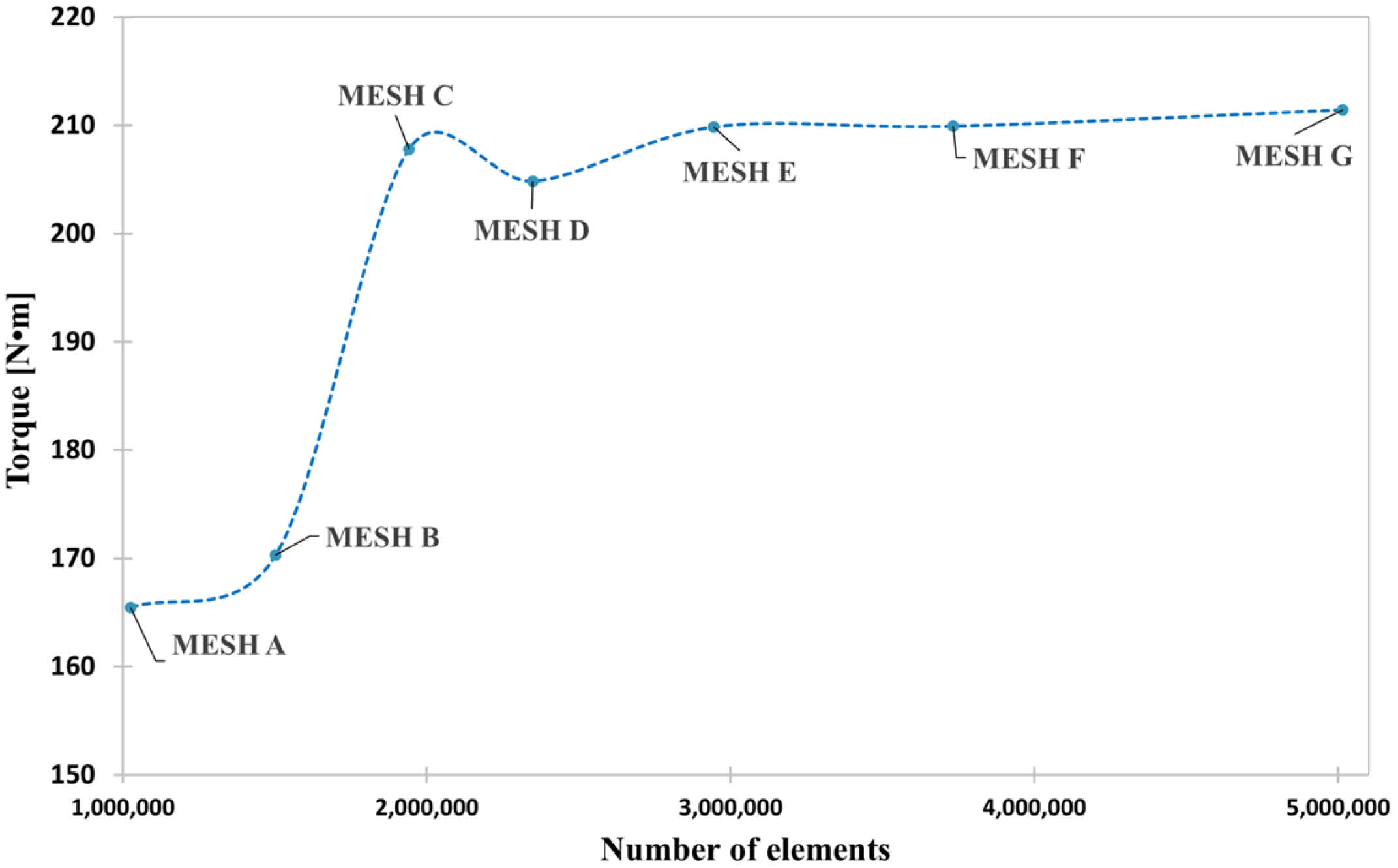
2.1.2. Mesh Independence Study
2.1.3. CFD Solver Configuration
2.1.4. Post-Proccesing
2.2. Structural FEA Simulation
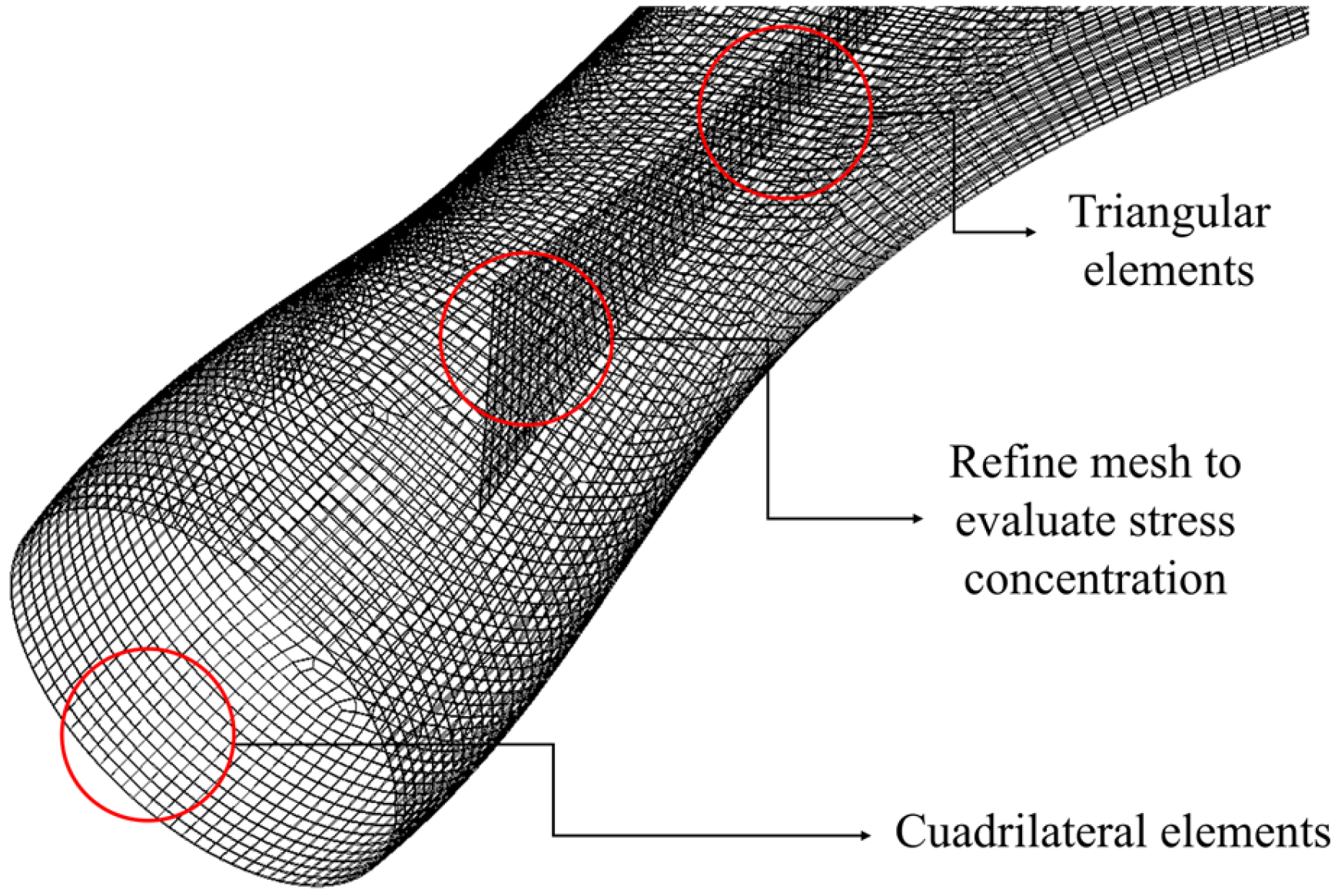
2.2.1. Mesh Generation
2.2.2. Composite Materials Modeling
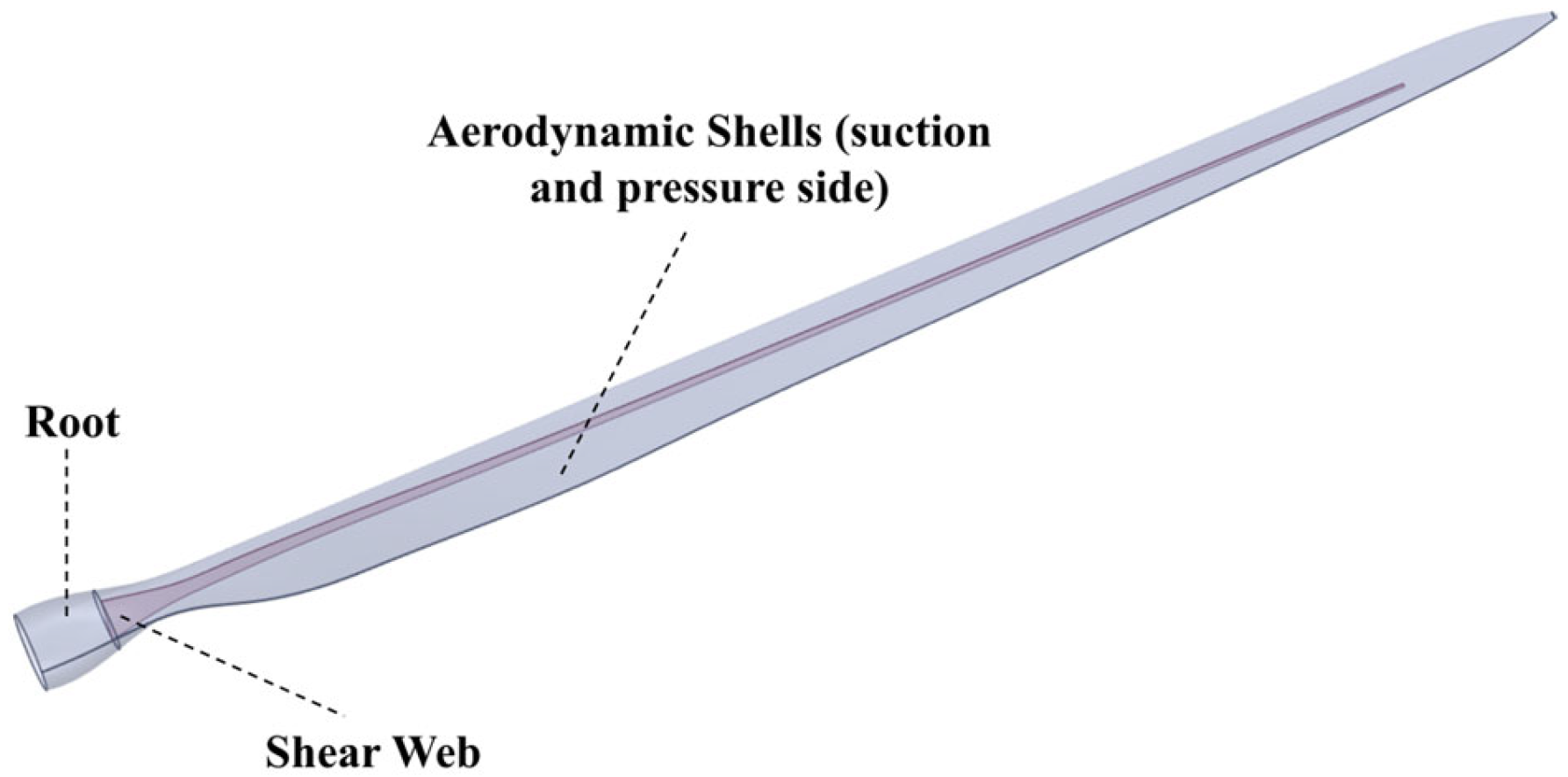
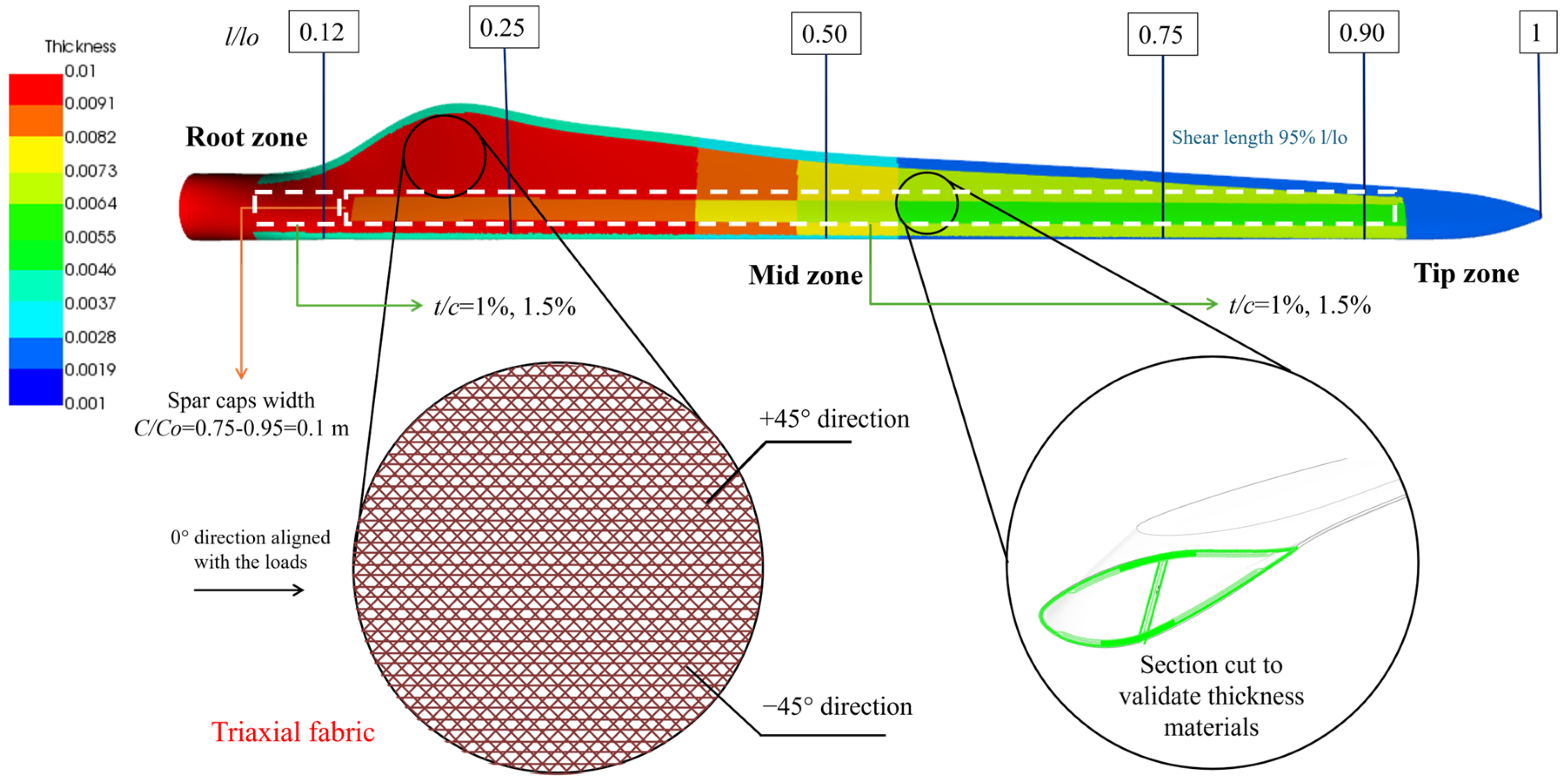
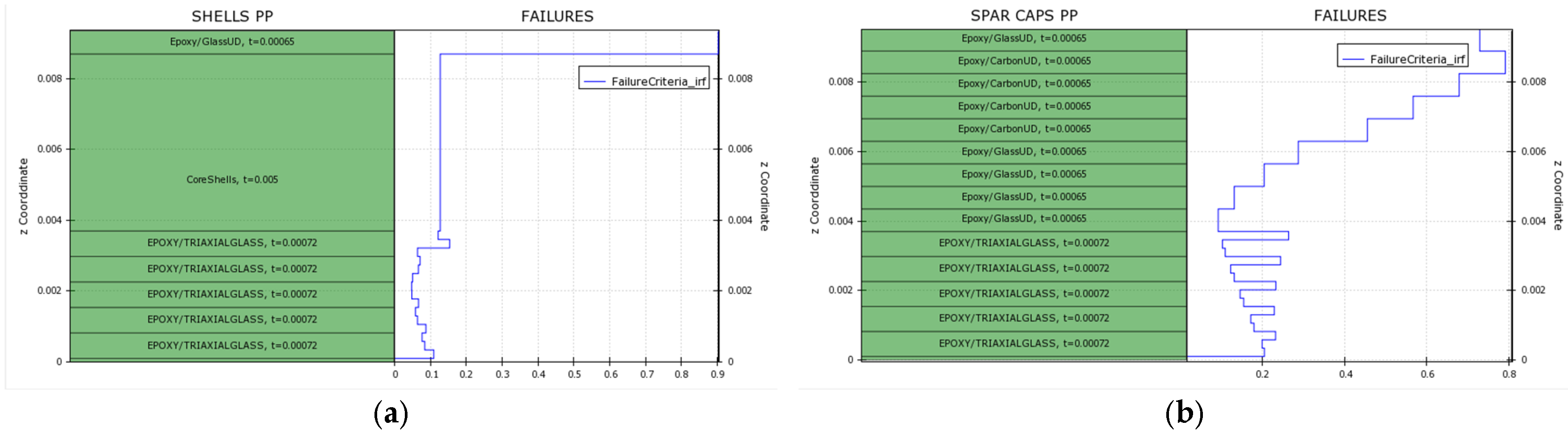
- Aerodynamic shells: These structural elements are intended to resist torsional and shear forces while preserving the aerodynamic shape of the blade [20]. They are typically manufactured using a triaxial glass fiber-reinforced epoxy matrix composite with fiber orientations of −45°, 0°, and 45 °. In the present research, a five-layer configuration with variable lengths was adopted based on recommendations reported by Medrano (2022) [6].
- Spar caps: Typically manufactured from unidirectional fibers, spar caps are designed to withstand flapwise and edgewise bending loads induced by aerodynamic forces and weight [20]. The width of the spar caps was defined using the ratio c/co = 0.75–0.90 [24], assuming a maximum blade chord of 0.72 m. Therefore, the absolute width was estimated to be approximately 0.1 m. The structural composition of this element incorporated unidirectional layers of glass and carbon fiber-reinforced epoxy matrix composites. On the other hand, the thickness was selected as t/c = 1.5% based on relationships reported by Medrano (2022) [6].
- Shear web: The shear web constitutes the primary structural element of the blade and provides shear stress resistance due to fiberglass reinforcements [6]. The shear web length was defined as a function of the ratio l/lo =0.05–0.95. The structural configuration incorporated bidirectional glass fibers oriented at ±45° and embedded in an epoxy matrix. The thickness of the SANFoam core was set to be 1% of the maximum chord length [5].
2.2.3. Boundary Conditions
2.2.4. Fluid–Structure Interaction
3. Results and Discussion
3.1. Aerodynamic Analysis
3.2. Stress, Deformation, and Failure Criteria Analysis
4. Conclusions
- For rated conditions, the theoretical power output was 6591 W. While the power increases in both extreme load cases, results were excluded from the power factor estimation, as they represent critical conditions outside the turbine operating range.
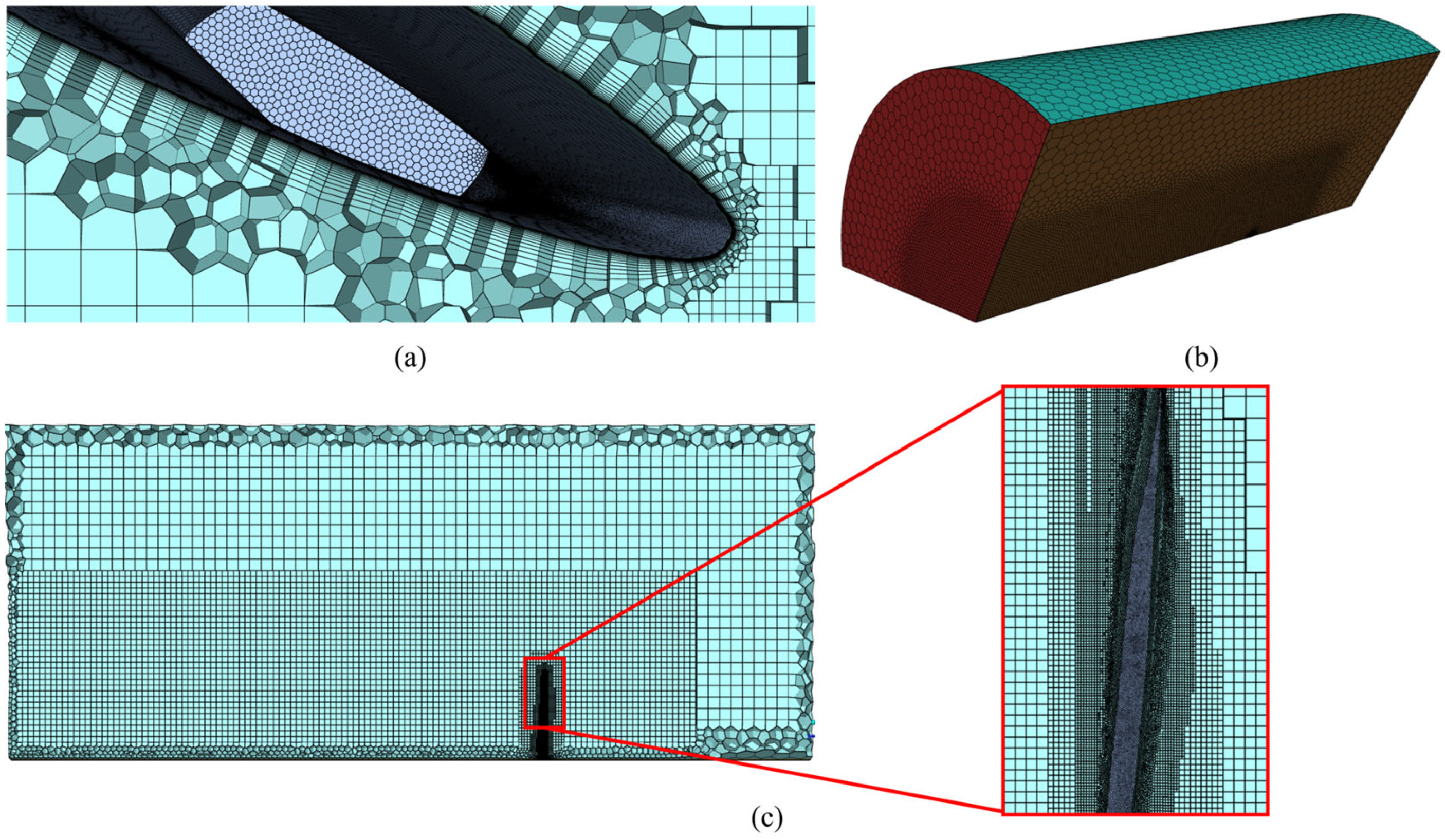
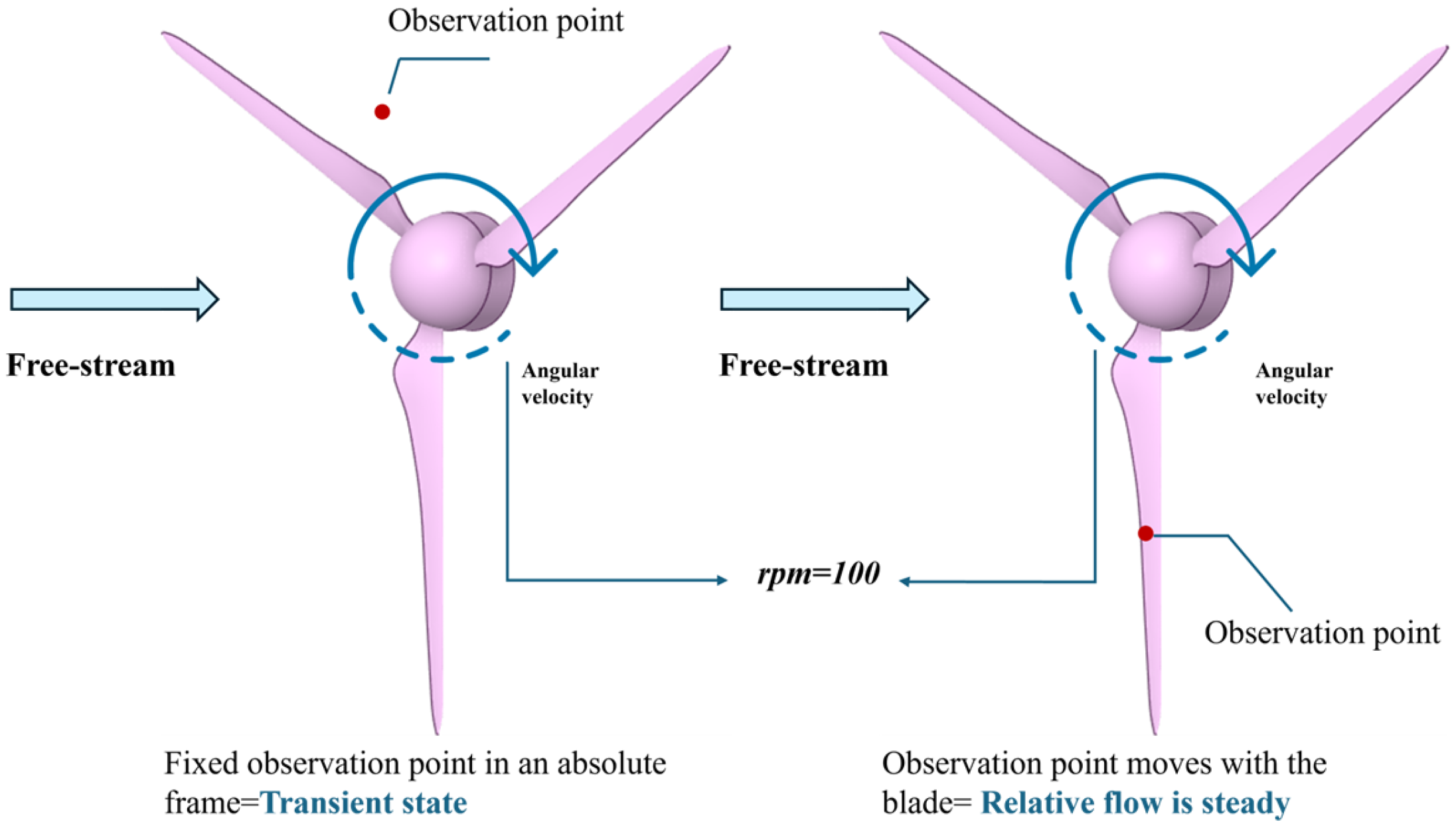
- Regarding the CFD analysis, the adoption of poly-hexcore mesh topology combined with a moving reference frame formulation yielded substantial reductions in computational cost and time. For the finite element analysis, the ability to assess failure criteria for each layer facilitated a comprehensive layer-by-layer evaluation of the composite material response and the total lay-up configuration.
- Using blade tip deformation as the performance metric, configuration DP-15 exhibited the most favorable weight-to-performance ratio, with a total mass of 58.62 kg and maximum deformations ranging from 0.498 m to 0.656 m across all load cases and operational scenarios.
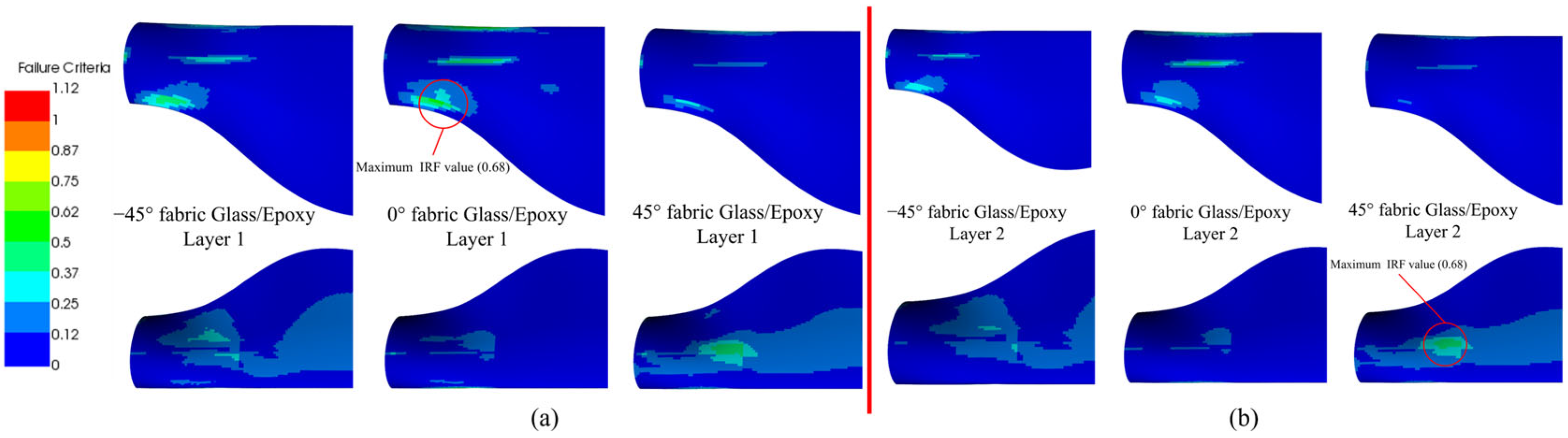
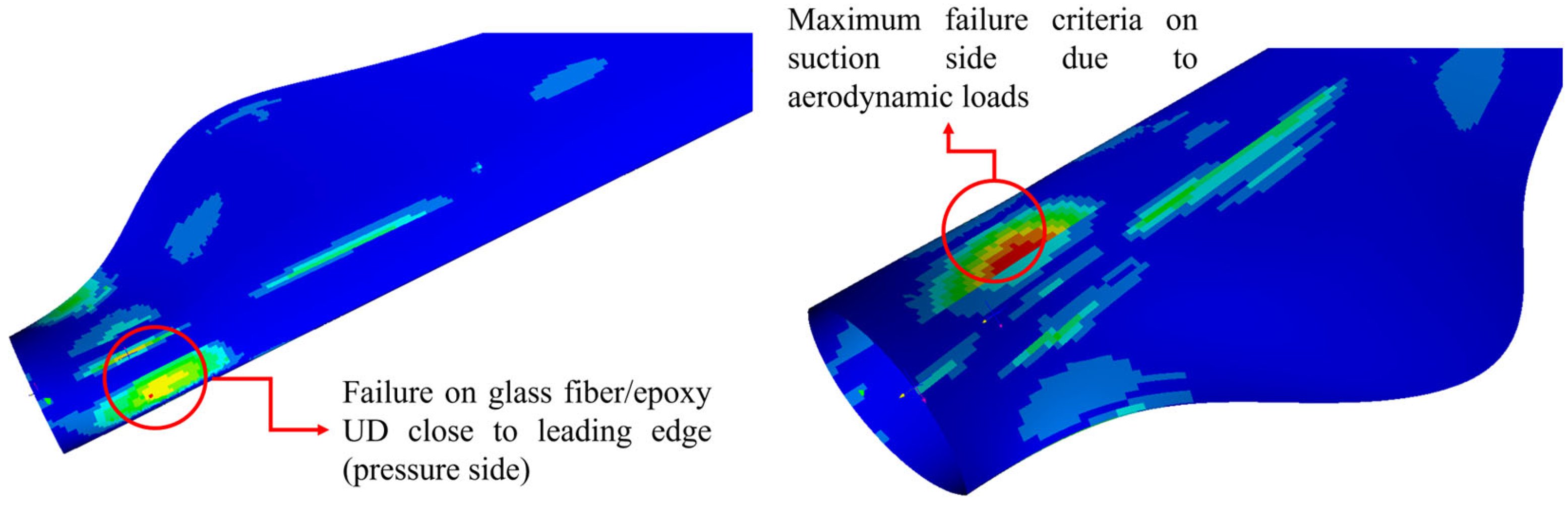
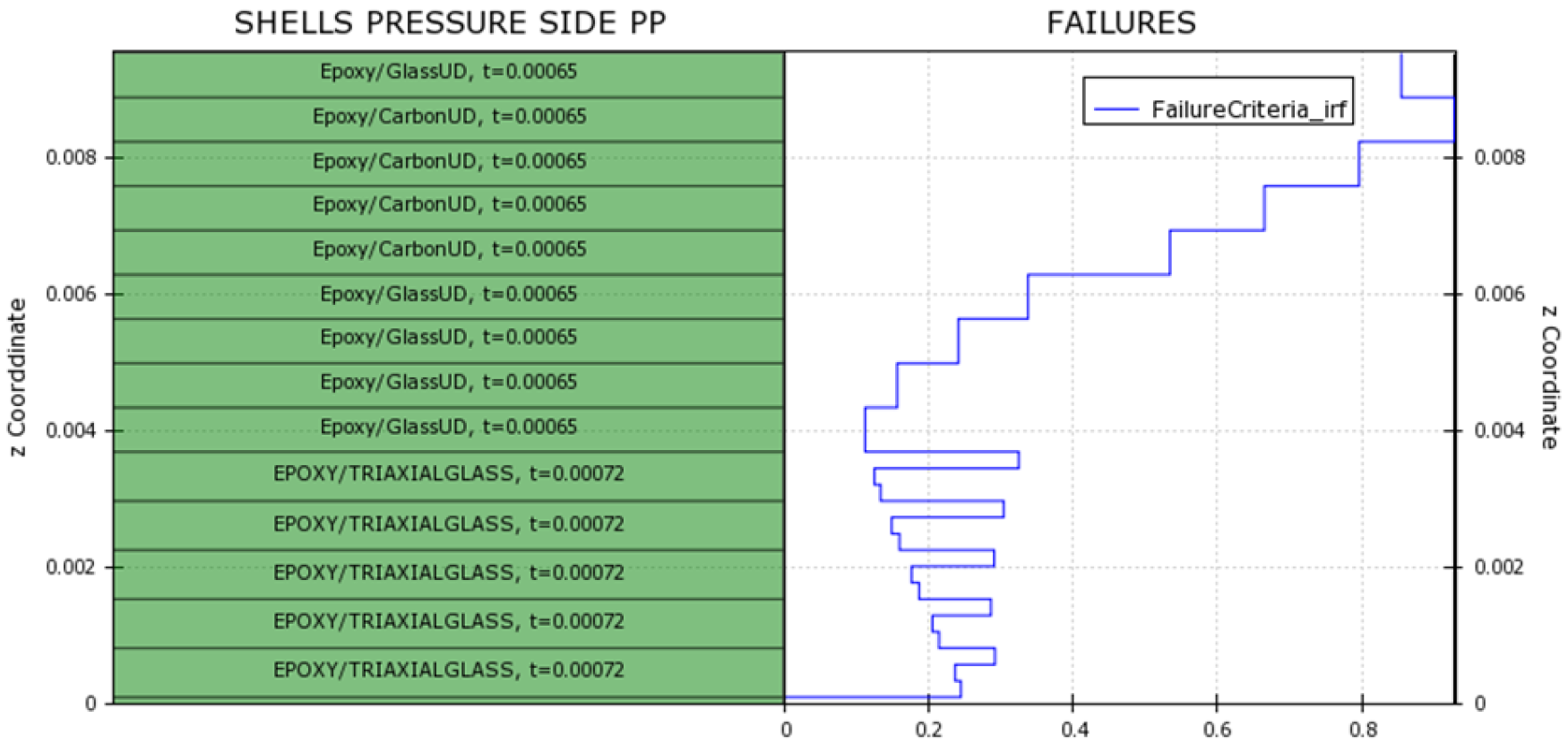
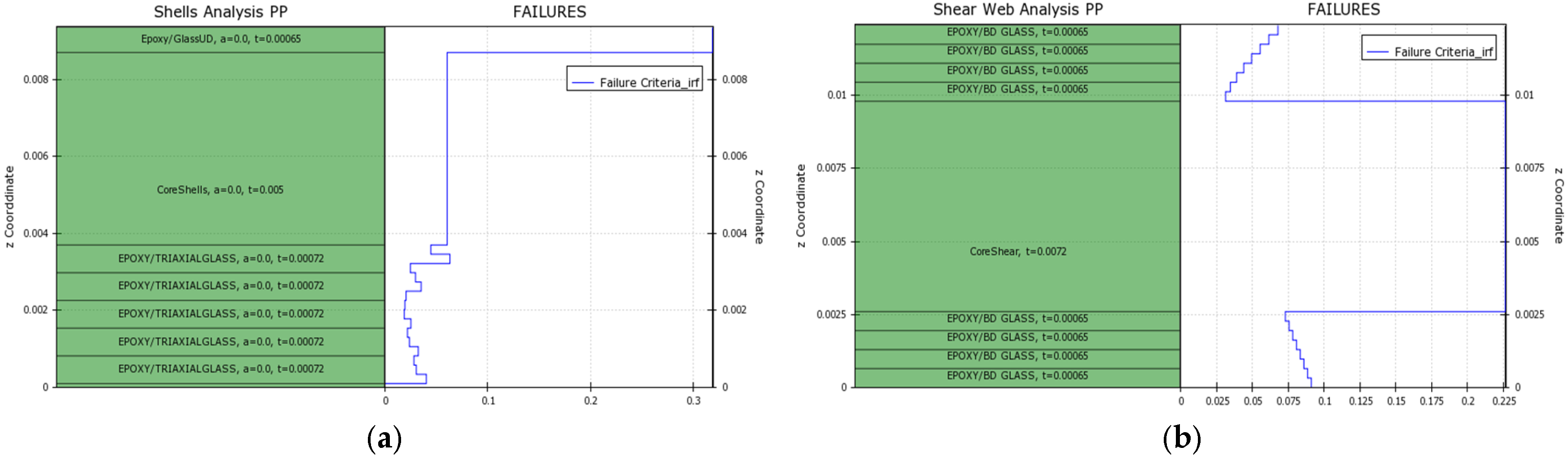
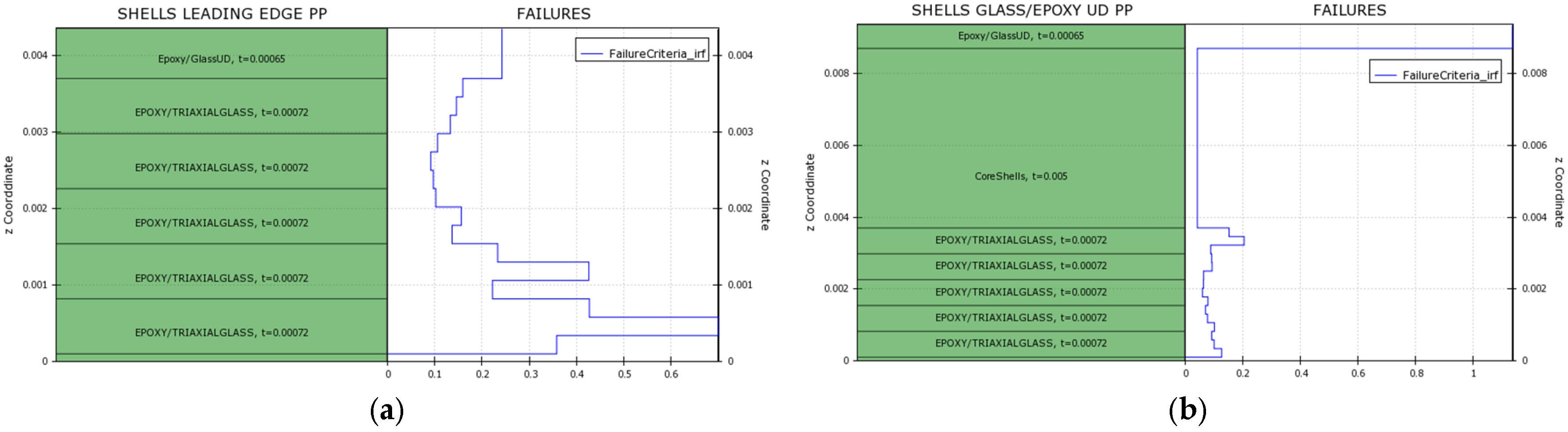
- For the first load case (rated conditions), a global inverse reserve (IRF) of 0.66 was estimated. Maximum values for individual layers reached 0.26 in the first triaxial glass fiber/epoxy layer oriented at 0° and 0.36 in the unidirectional glass fiber/epoxy layer incorporated in the sandwich structure. These results indicate that the proposed reinforcement satisfies the load requirements and provides a suitable basis for blade manufacturing and subsequent experimental validation through structural testing.
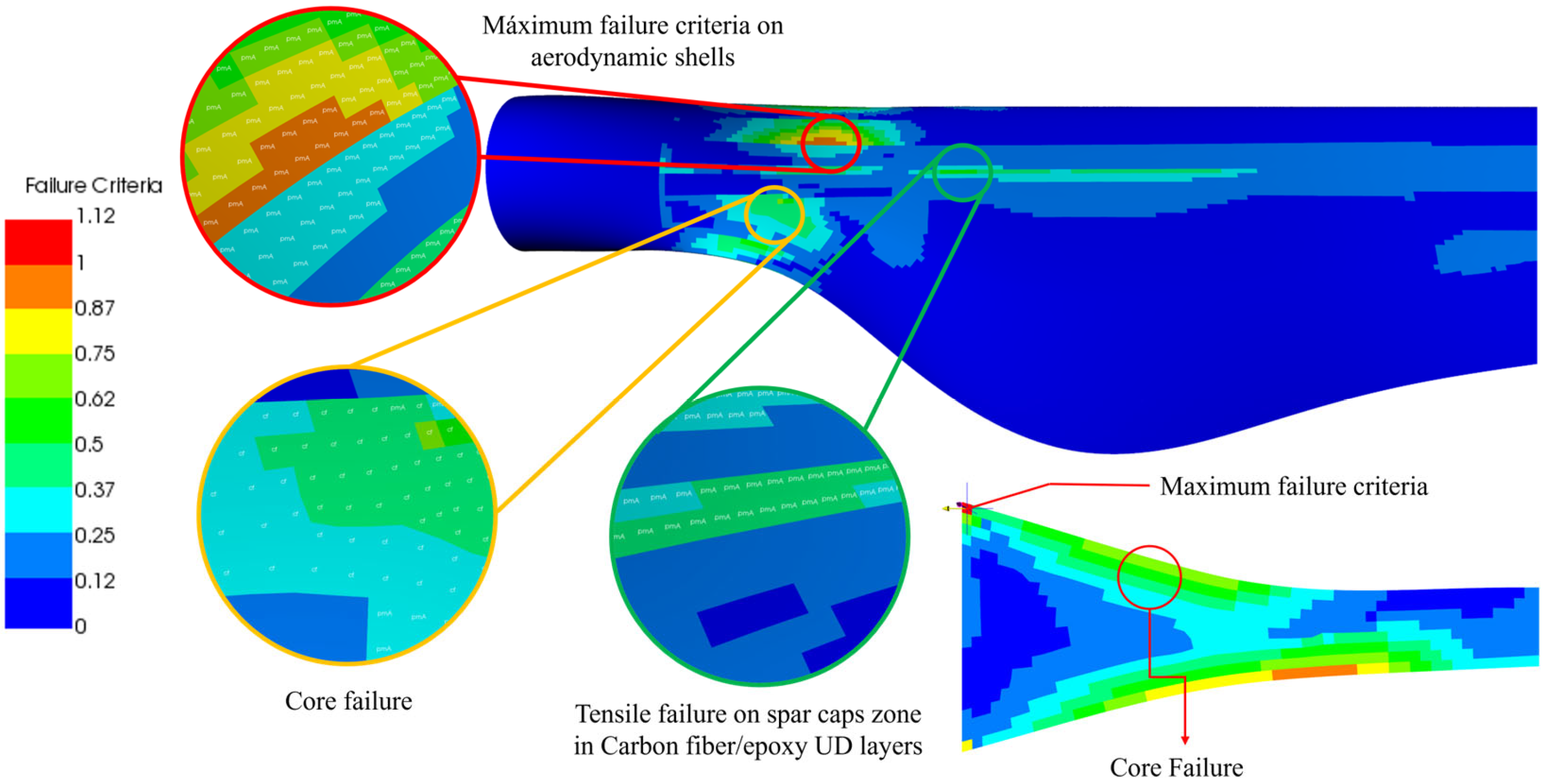
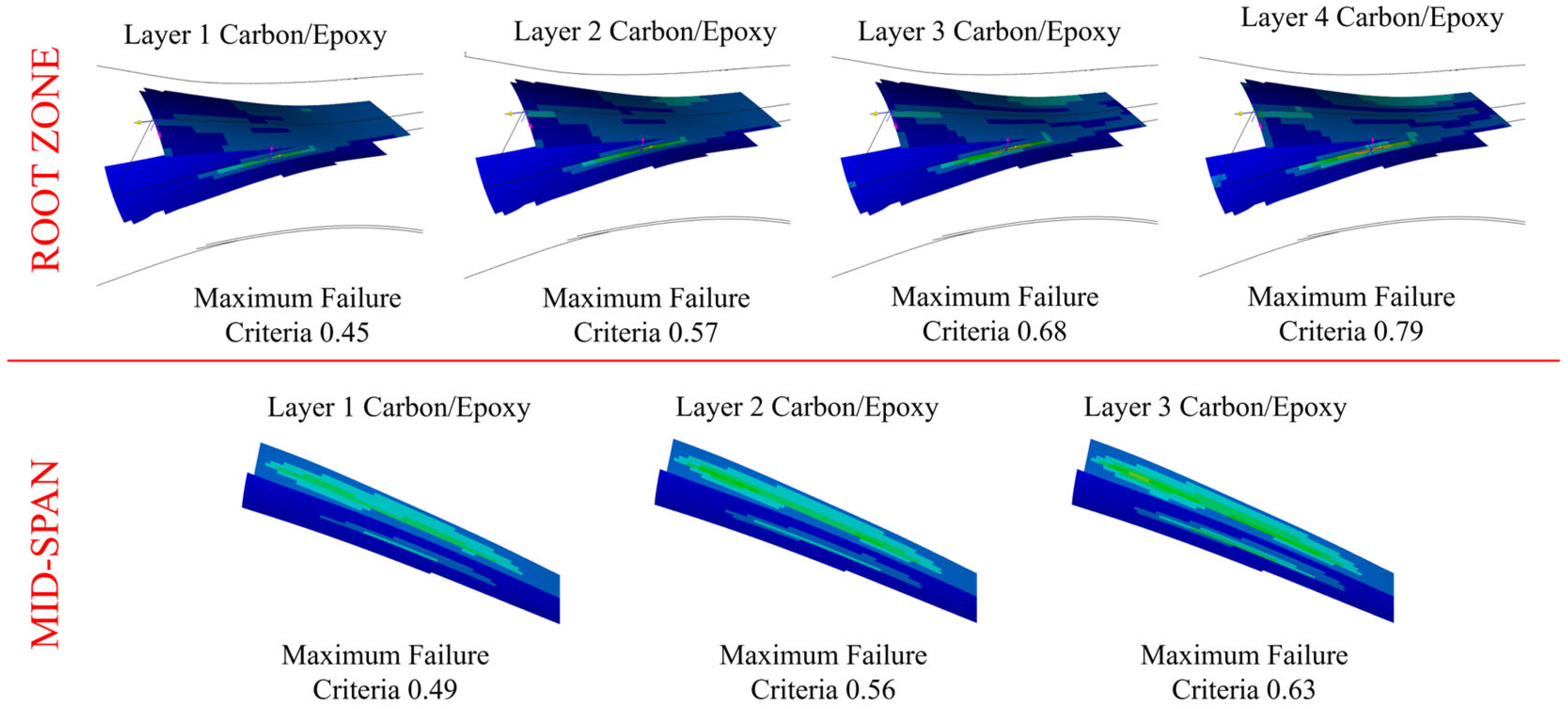
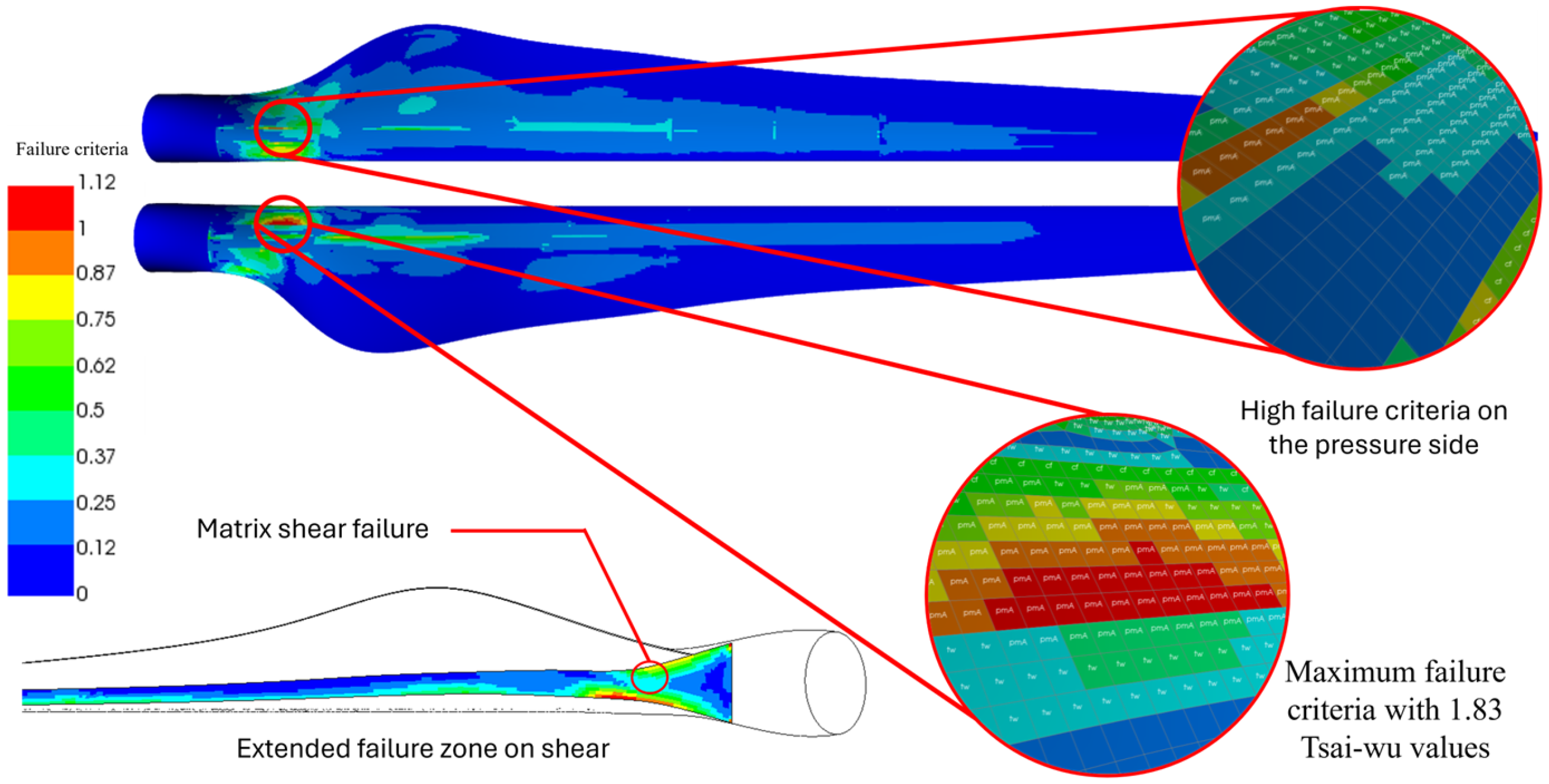
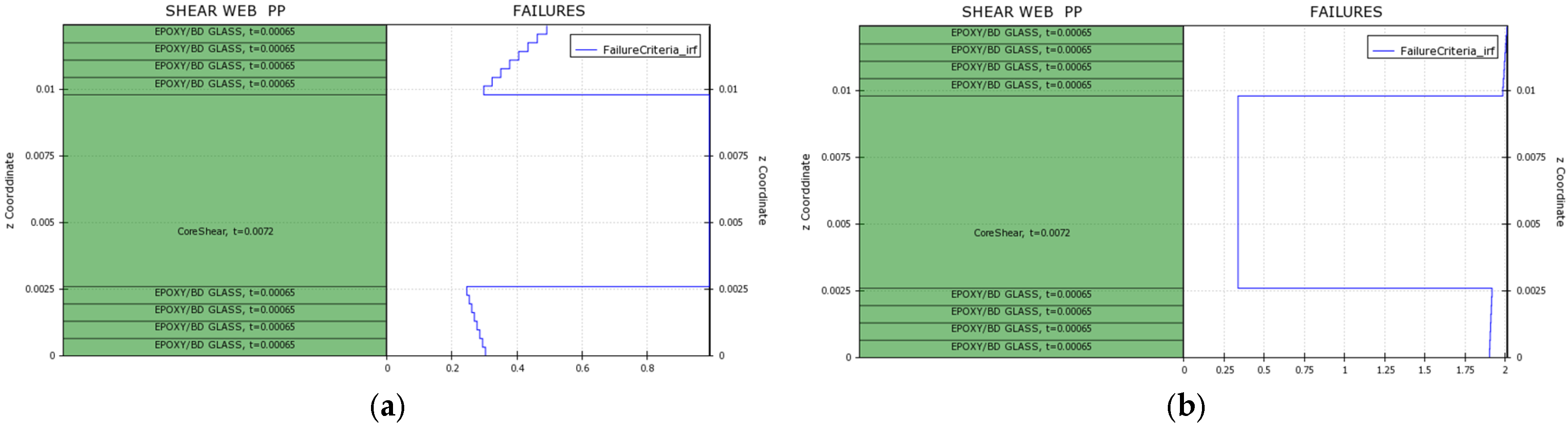
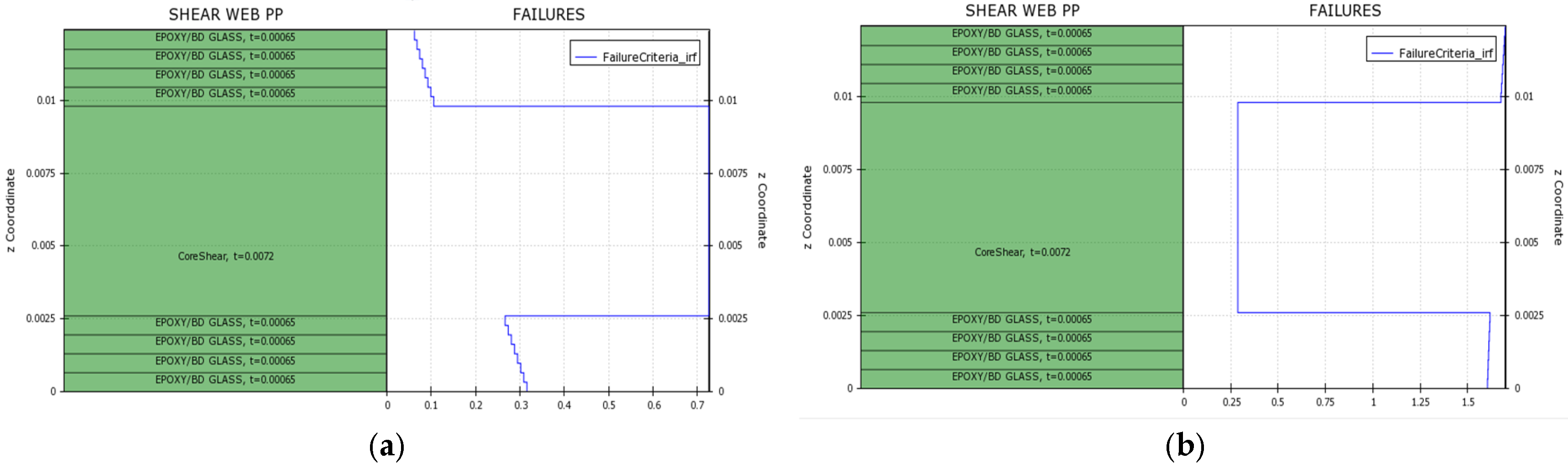
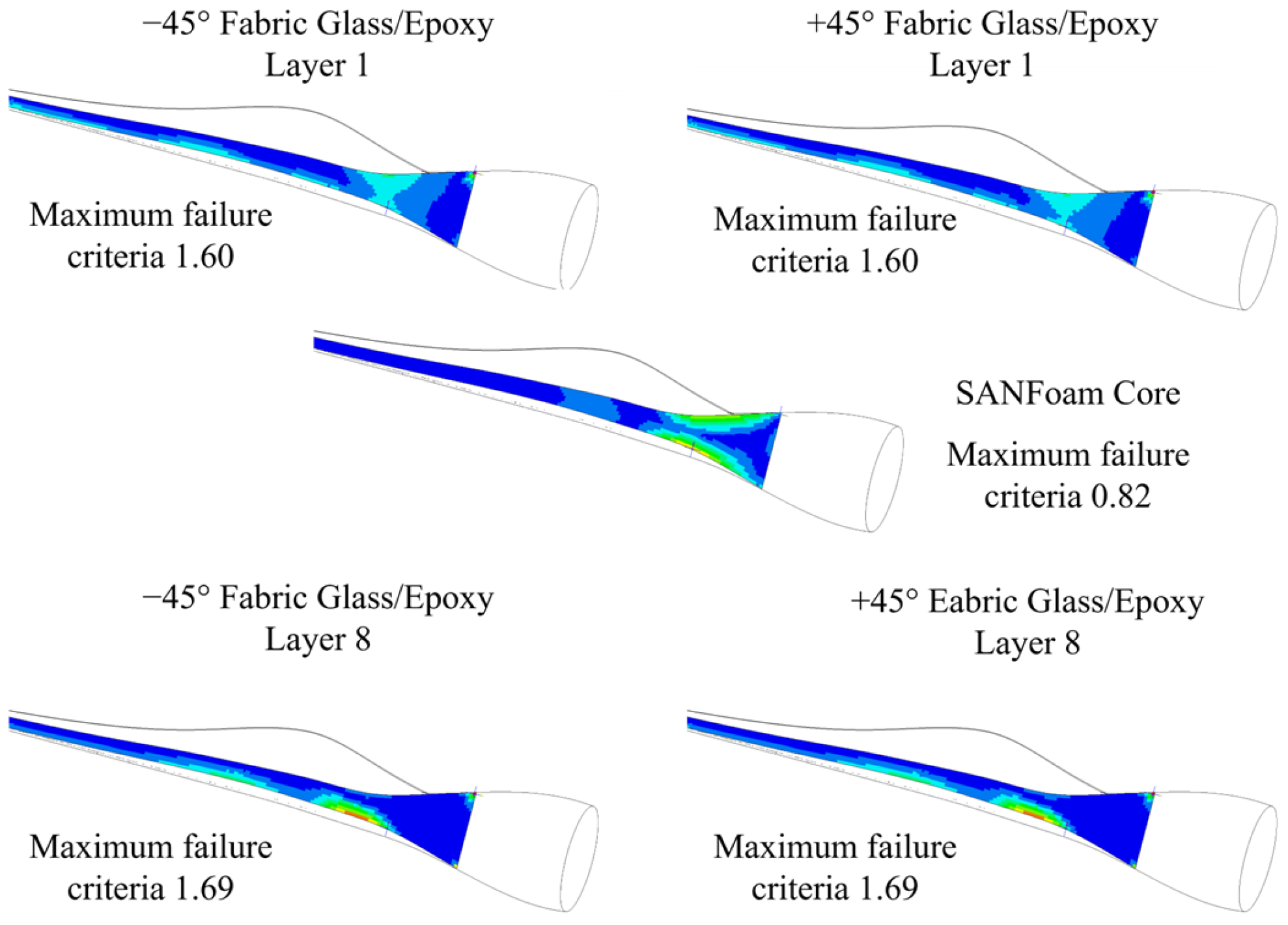
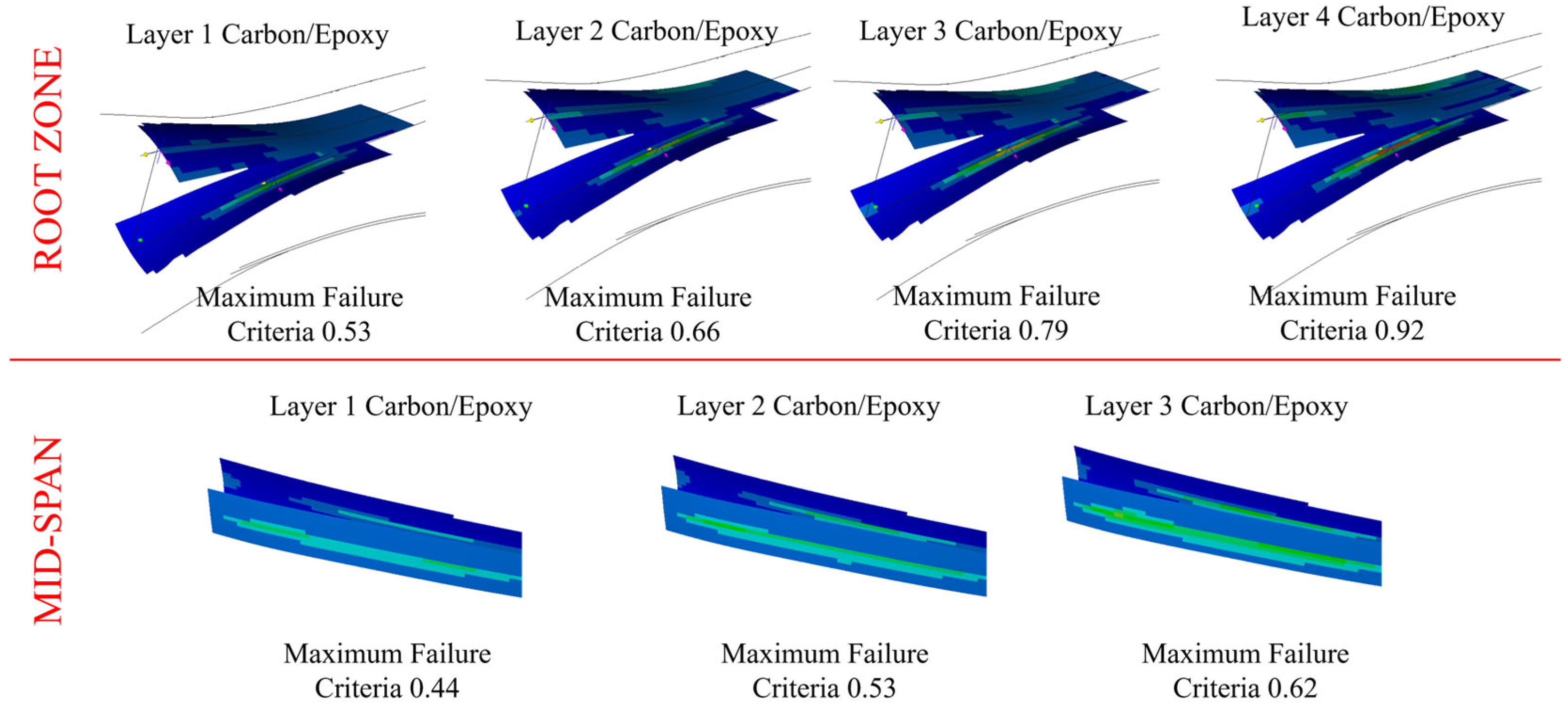
- For the second load case, the global IRF of 1.63 indicates structural failure in certain layers, particularly in the carbon fiber layers of the spar caps at the mid-span area (IRF = 0.8) and the shear web core (IRF = 0.82).
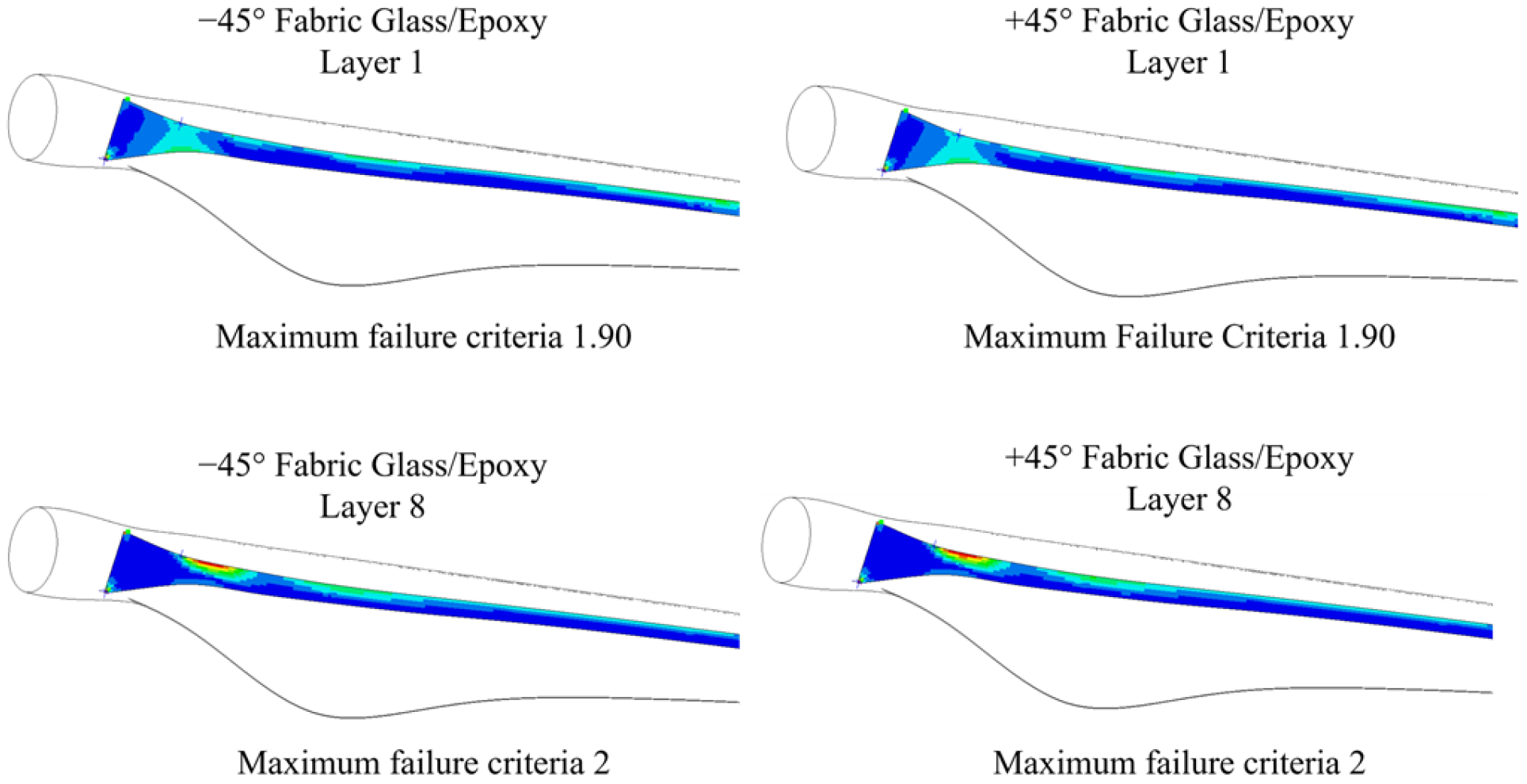
- For the third load case, critical IRF values approaching 2.0 were observed in both the shear web core and the bidirectional reinforcements, indicating that the structural integrity is compromised under these specific conditions.
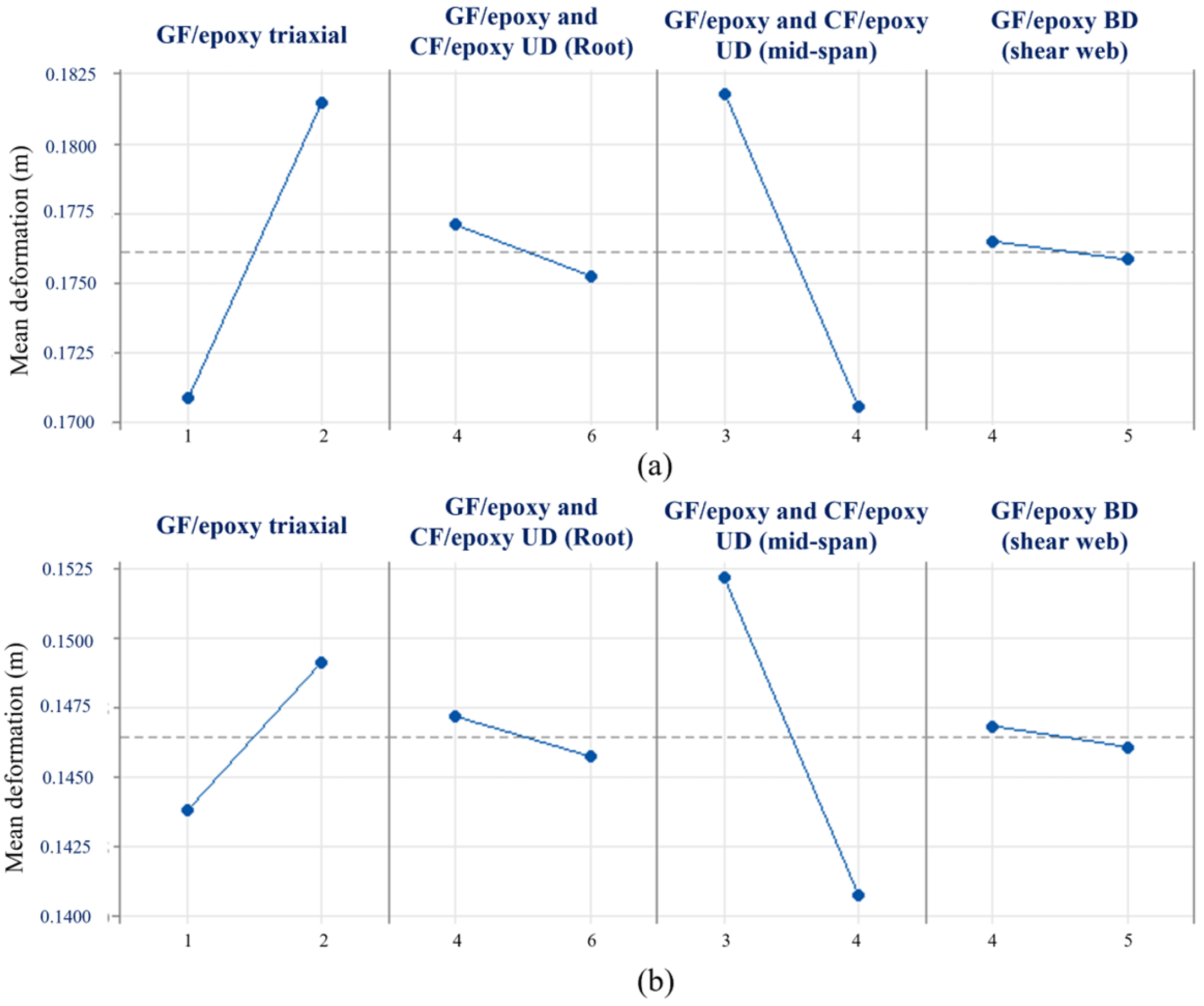
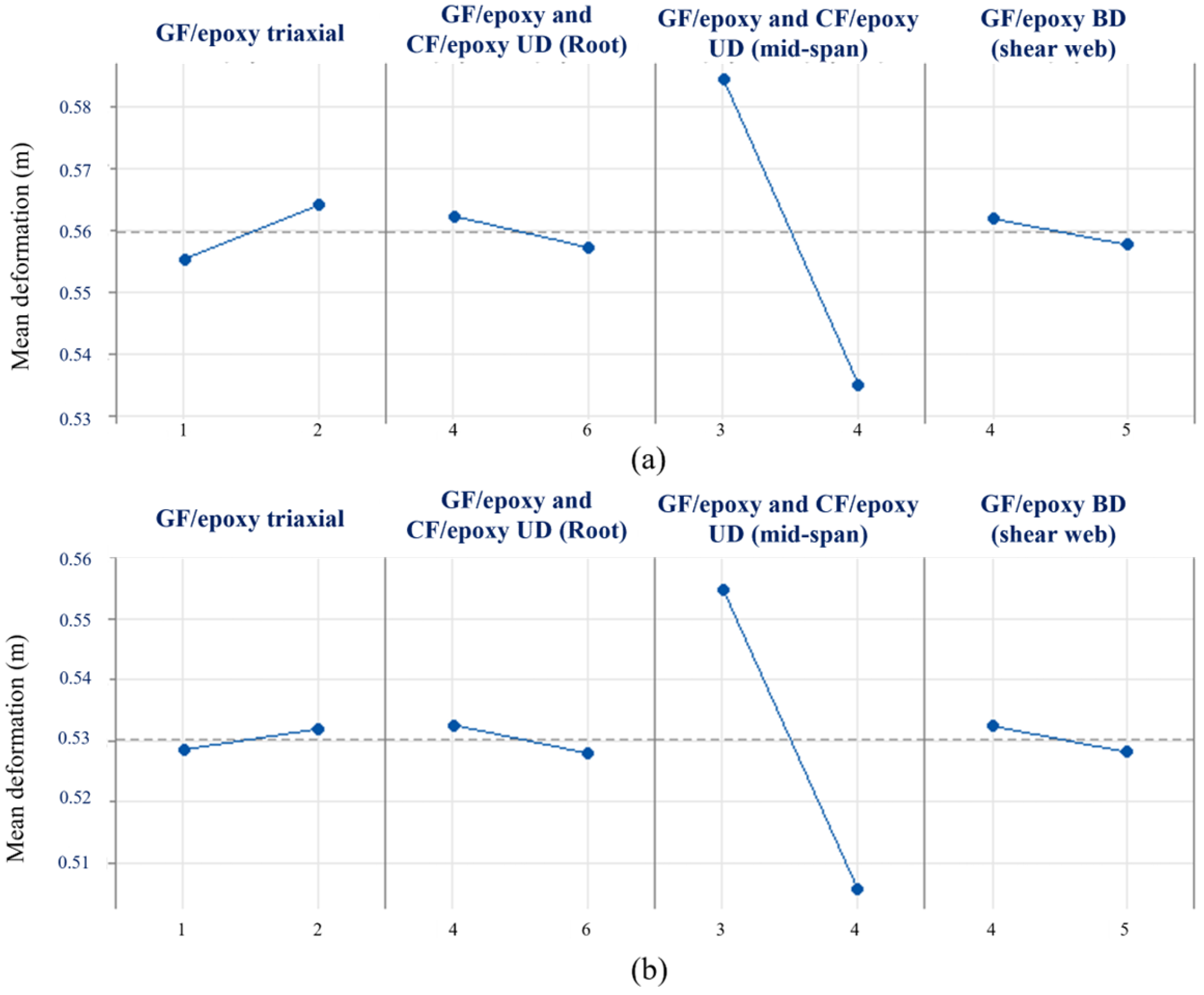
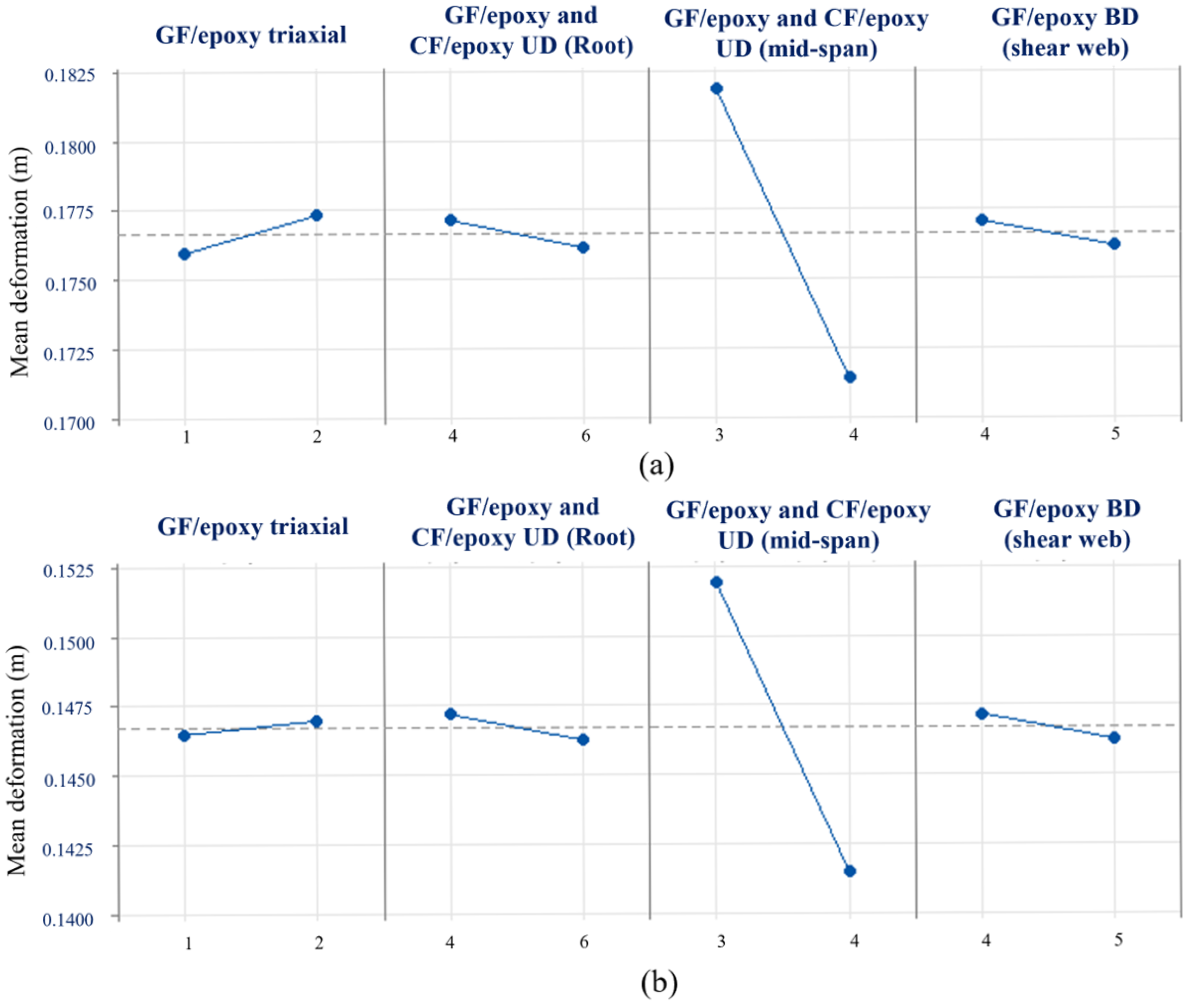
- The main effects analysis for the first load case indicated that the number of triaxial weave layers implemented in the aerodynamic shells was the most relevant variable. Hence, using a single layer is enough to reduce deformation and weight. For load cases 2 and 3, the main effects were observed in the reinforcements at the mid-span spar caps, where four material layers were employed, thus producing the most significant effect.
- The initial lay-up configuration established through the FSI-CFD-FEM analysis scheme exhibits a 33.29% weight reduction compared to the configuration reported by Medrano (2022) [6]. Therefore, the proposed method represents a viable alternative for preliminary design and structural evaluation of blades, offering multi-parametric results, qualitative visualizations, and quantitative comparisons that exceed the capabilities of conventional approaches.
Author Contributions
Funding
Informed Consent Statement
Data Availability Statement
Acknowledgments
Conflicts of Interest
Abbreviations
| FSI | Fluid–Structure Interaction |
| CFD | Computational Fluid Dynamics |
| FEA | Finite Element Analysis |
| BEMT | Blade Element Momentum Theory |
Appendix A
Appendix A.1

| Scenario A | Scenario B | |||
|---|---|---|---|---|
| Design Point | Total Deformation (m) | Equivalent Stress (Pa) | Total Deformation | Equivalent Stress (Pa) |
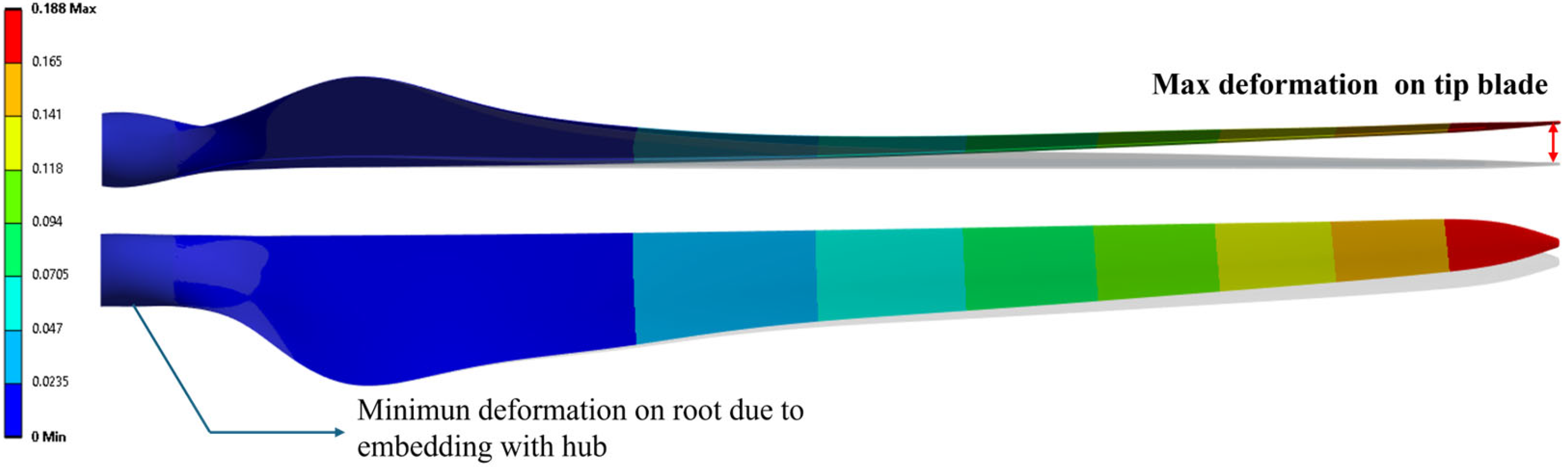
| DP-1 | 0.188 | 35.48 × 10⁶ | 0.156 | 26.80 × 10⁶ |
| DP-2 | 0.178 | 34.78 × 10⁶ | 0.151 | 26.97 × 10⁶ |
| DP-3 | 0.177 | 31.29 × 10⁶ | 0.150 | 24.34 × 10⁶ |
| DP-4 | 0.187 | 31.95 × 10⁶ | 0.155 | 24.77 × 10⁶ |
| DP-5 | 0.176 | 33.12 × 10⁶ | 0.149 | 25.73 × 10⁶ |
| DP-6 | 0.186 | 34.56 × 10⁶ | 0.154 | 26.00 × 10⁶ |
| DP-7 | 0.176 | 29.21 × 10⁶ | 0.149 | 24.34 × 10⁶ |
| DP-8 | 0.186 | 30.65 × 10⁶ | 0.153 | 24.78 × 10⁶ |
| DP-9 | 0.166 | 36.37 × 10⁶ | 0.139 | 27.86 × 10⁶ |
| DP-10 | 0.177 | 36.99 × 10⁶ | 0.145 | 27.86 × 10⁶ |
| DP-11 | 0.166 | 32.70 × 10⁶ | 0.138 | 25.04 × 10⁶ |
| DP-12 | 0.177 | 33.27 × 10⁶ | 0.144 | 24.74 × 10⁶ |
| DP-13 | 0.164 | 34.66 × 10⁶ | 0.137 | 26.61 × 10⁶ |
| DP-14 | 0.175 | 36.03 × 10⁶ | 0.143 | 26.84 × 10⁶ |
| DP-15 | 0.164 | 30.56 × 10⁶ | 0.137 | 23.49 × 10⁶ |
| DP-16 | 0.175 | 31.94 × 10⁶ | 0.143 | 23.88 × 10⁶ |
Appendix A.2
| Scenario A | Scenario B | |||
|---|---|---|---|---|
| Design Point | Total Deformation (m) | Equivalent Stress (Pa) | Total Deformation | Equivalent Stress (Pa) |
| DP-1 | 0.592 | 91.41 × 10⁶ | 0.559 | 82.62 × 10⁶ |
| DP-2 | 0.586 | 95.78 × 10⁶ | 0.559 | 87.97 × 10⁶ |
| DP-3 | 0.582 | 85.64 × 10⁶ | 0.555 | 78.60 × 10⁶ |
| DP-4 | 0.587 | 82.18 × 10⁶ | 0.555 | 74.23 × 10⁶ |
| DP-5 | 0.581 | 91.31 × 10⁶ | 0.554 | 83.93 × 10⁶ |
| DP-6 | 0.587 | 89.46 × 10⁶ | 0.555 | 80.90 × 10⁶ |
| DP-7 | 0.577 | 79.94 × 10⁶ | 0.550 | 73.44 × 10⁶ |
| DP-8 | 0.583 | 78.78 × 10⁶ | 0.551 | 71.21 × 10⁶ |
| DP-9 | 0.534 | 97.43 × 10⁶ | 0.507 | 88.92 × 10⁶ |
| DP-10 | 0.545 | 92.94 × 10⁶ | 0.513 | 83.51 × 10⁶ |
| DP-11 | 0.530 | 87.10 × 10⁶ | 0.503 | 79.45 × 10⁶ |
| DP-12 | 0.541 | 83.55 × 10⁶ | 0.509 | 75.02 × 10⁶ |
| DP-13 | 0.529 | 92.94 × 10⁶ | 0.502 | 84.89 × 10⁶ |
| DP-14 | 0.540 | 91.02 × 10⁶ | 0.508 | 81.83 × 10⁶ |
| DP-15 | 0.524 | 81.38 × 10⁶ | 0.498 | 74.30 × 10⁶ |
| DP-16 | 0.536 | 80.16 × 10⁶ | 0.504 | 72.04 × 10⁶ |
Appendix A.3
| Scenario A | Scenario B | |||
|---|---|---|---|---|
| Design Point | Total Deformation (m) | Equivalent Stress (Pa) | Total Deformation | Equivalent Stress (Pa) |
| DP-1 | 0.739 | 108.39 × 10⁶ | 0.707 | 99.60 × 10⁶ |
| DP-2 | 0.735 | 114.25 × 10⁶ | 0.708 | 106.44 × 10⁶ |
| DP-3 | 0.729 | 102.09 × 10⁶ | 0.702 | 95.05 × 10⁶ |
| DP-4 | 0.733 | 97.38 × 10⁶ | 0.701 | 89.43 × 10⁶ |
| DP-5 | 0.729 | 108.90 × 10⁶ | 0.702 | 101.52 × 10⁶ |
| DP-6 | 0.733 | 106.07 × 10⁶ | 0.701 | 97.51 × 10⁶ |
| DP-7 | 0.723 | 95.27 × 10⁶ | 0.696 | 88.77 × 10⁶ |
| DP-8 | 0.728 | 93.33 × 10⁶ | 0.696 | 85.77 × 10⁶ |
| DP-9 | 0.668 | 115.91 × 10⁶ | 0.641 | 107.41 × 10⁶ |
| DP-10 | 0.680 | 109.93 × 10⁶ | 0.648 | 100.50 × 10⁶ |
| DP-11 | 0.663 | 103.56 × 10⁶ | 0.636 | 95.91 × 10⁶ |
| DP-12 | 0.675 | 98.76 × 10⁶ | 0.642 | 90.24 × 10⁶ |
| DP-13 | 0.662 | 110.56 × 10⁶ | 0.635 | 102.51 × 10⁶ |
| DP-14 | 0.674 | 107.65 × 10⁶ | 0.642 | 98.46 × 10⁶ |
| DP-15 | 0.656 | 96.73 × 10⁶ | 0.629 | 89.93 × 10⁶ |
| DP-16 | 0.669 | 94.74 × 10⁶ | 0.637 | 86.62 × 10⁶ |
Appendix B
Appendix B.1
| Failure Criteria | Nomenclature |
|---|---|
| Tsai-Wu | tw |
| Puck | Pf (Fiber failure) pmA (matrix tension failure) pmB (matrix compression failure) pmC (matrix shear failure) pd (delamination) |
| Sandwich Failure Core | cf (core failure) |
References
- Roul, R.; Kumar, A. Fluid-Structure Interaction of Wind Turbine Blade Using Four Different Materials: Numerical Investigation. Symmetry 2020, 12, 1467. [Google Scholar] [CrossRef]
- Lanting, Z. Research on Structural Lay-Up Optimum Design of Composite Wind Turbine Blade. Energy Procedia 2012, 14, 637–642. [Google Scholar] [CrossRef]
- Tacca, E. Analisis de materiales compuestos para alabes de turbinas eolicas mediante optimizacion discreta y elementos finitos inversos (IFEM). In Proceedings of the XX Encuentro de Jovenes Investigadores de la Universidad Nacional del Litoral, Santa Fe, Argentina, 18–19 October 2016. [Google Scholar]
- Morini, A.A.; Ribeiro, M.J.; Hotza, D. Carbon footprint and embodied energy of a wind turbine blade-a case study. Int. J. Life Cycle Assess 2021, 26, 1177–1187. [Google Scholar] [CrossRef]
- Wang, L.; Quant, R.; Kolios, A. Fluid structure interaction modelling of horizontal-axis wind turbine blades based on CFD and FEA. J. Wind Eng. Ind. Aerodyn. 2016, 158, 11–25. [Google Scholar] [CrossRef]
- Medrano, I.A. Analisis Aerolastico de Detalle para el Rediseño Estructural del Laminado con Materiales Compuestos de Un aspa para un Aerogenerador de 30 kW. Bachelor’s Thesis, Autonomous University of State of Mexico, Toluca, Mexico, 2022. [Google Scholar]
- Özyildiz, M.; Coker, D. Static analysis of a composite wind turbine blade using finite element model. In Proceedings of the VII International Conference on Computational Methods in Marine Engineering, Nantes, France, 15–17 June 2017. [Google Scholar]
- Lipian, M.; Czapski, P.; Obidowski, D. Fluid-Structure Interaction Numerical Analysis of a Small Urban Wind Turbine Blade. Energies 2020, 13, 1832. [Google Scholar] [CrossRef]
- Khedr, A.; Castellani, F. Critical issues in the moving reference frame CFD simulation of small horizontal axis wind turbines. Energy Convers. Manag. X 2024, 22, 100551. [Google Scholar] [CrossRef]
- Deng, Z.; Xiao, Q.; Huang, Y.; Yang, L.; Liu, Y. A general FSI framework for an effective stress analysis on composite wind turbine blades. Ocean Eng. 2023, 291, 116412. [Google Scholar] [CrossRef]
- Jacobo, V.; Ayala, A.; Castro, L.; Gonzalez, L.; Marquez, U.; Ramirez, E.; Ruiz, O. La Ingenieria Mecanica Impulsando el Desarrollo Nacional y la Innovacion; Sociedad Mexicana de Ingenieria Mecanica A.C.: Ciudad de Mexico, Mexico, 2020. [Google Scholar]
- Gaheen, O.A.; Aziz, M.A.; Hamza, M.; Kashkoush, H.; Khalifa, M.A. Fluid and Structure Analysis of Wind Turbine Blade with Winglet. J. Adv. Res. Fluid Mech. Therm. Sci. 2021, 90, 80–101. [Google Scholar] [CrossRef]
- Zore, K.; Sasanapuri, B.; Parkhi, G.; Varghese, A. ANSYS mosaic poly-hexcore mesh for high-lift aircraft configuration. In Proceedings of the 21th Annual CFD Symposium, Bangalore, India, 8–9 August 2019. [Google Scholar]
- Anderson, J.D., Jr. Fundamentals of Aerodynamics, 6th ed.; McGraw-Hill Education: New York, NY, USA, 2017. [Google Scholar]
- Siddiqui, M.S.; Khalid, M.H.; Badar, A.W.; Saeed, M.; Asim, T. Parametric Analysis Using CFD to Study the Impacto of Geometric and Numerical Modeling on the Performance of a Small Scale Horizontal Axis Wind Turbine. Energies 2022, 15, 505. [Google Scholar] [CrossRef]
- ANSYS. Ansys Fluent Theory Guide. In Release 2021 R2; ANSYS Inc.: Canonsburg, PA, USA, 2021. [Google Scholar]
- Versteeg, H.K.; Malalasekera, W. An Introduction to Computational Fluid Dynamics, 2nd ed.; Pearson Education Limited: London, UK, 2007; pp. 9–38. [Google Scholar]
- IEC 16400-1; International Electrotechnical Commission Wind Energy Generation System Part 1 IEC 16400-1. European Committee for Electrotechnical Standardization: Brussels, Belgium, 2026.
- IEC 16400-2; International Electrotechnical Commission Wind Energy Generation System Part 2 IEC 16400-2. European Committee for Electrotechnical Standardization: Brussels, Belgium, 2026.
- Alam, K.; Ullah, H.; Iqbal, M.; Husain, A.; Rasul, A.; Iqbal, M. Structural Integrity of offshore wind turbine blade under extreme gust and normal operating conditions. Results Eng. 2025, 25, 104572. [Google Scholar] [CrossRef]
- ANSYS. Ansys ACP User’s Guide. In Release 2025 R1; ANSYS Inc.: Canonsburg, PA, USA, 2025. [Google Scholar]
- Tarfaoui, M.; Khadimallah, H.; Imad, A.; Pradillon, J. Design and finite element modal analysis of 48m composite wind turbine blade. Appl. Mech. Mater. 2012, 146, 170–184. [Google Scholar] [CrossRef]
- Vasjaliya, N.G.; Gangadharan, S.N. Aero-Structural Design Optimization of Composite Wind Turbine Blade. In Proceedings of the 10th World Congress on Structural and Multidisciplinary Optimization, Orlando, FL, USA, 19–24 May 2013. [Google Scholar]
- Barnes, R.H.; Morozov, E.V. Structural optimization of composite wind turbine blade structures with variations of internal geometry configuration. Compos. Struct. 2016, 152, 158–167. [Google Scholar] [CrossRef]
- Zhang, Z.; Qiao, Y.; Wang, S. Damage analysis of wind turbine blade with different stacking parameters. J. Phys. Conf. Ser. 2022, 2276, 012001. [Google Scholar] [CrossRef]
- ANSYS. Ansys Mechanical User’s Guide. In Release 15.0; ANSYS Inc.: Canonsburg, PA, USA, 2013. [Google Scholar]
- Raj, E.F.I.; Appadurai, M.; Ram, V.; Gnaniah, A.M.; Salkuti, S.R. Natural-Fibre-Reinforced Composite-Based Micro-Size Wind Turbines: Numerical Analysis and Feasibility Study. J. Compos. Sci. 2023, 7, 197. [Google Scholar] [CrossRef]
- Ozyildiz, M.; Muyan, C.; Coker, D. Stength Analysis of a Composite Turbine Blade Using Puck Failure Criteria. J. Phys. Conf. Ser. 2018, 1037, 042027. [Google Scholar] [CrossRef]















| Parameter | Value |
|---|---|
| Blade length | 6 m |
| Root diameter | 0.3 m |
| Number of blades | 3 |
| Design speed | 10.5 m/s |
| Angle of attack | 8° |
| Tip speed ratio | 5.93 |
| Parameter | Dimension |
|---|---|
| R1 | 3.75 L (22.5 m) |
| R2 | 1.88 L (11.25 m) |
| L1 | 3 L (18 m) |
| L2 | 6 L (36 m) |
| L3 | 1.5 L (9 m) |
| Parameter | Dimension |
|---|---|
| Density | 1.18 kg/m3 |
| Dynamic viscosity | 1.84 × 10⁻⁵ kg/ms |
| Kinematic viscosity | 1.56 × 10⁻⁵ m2/s |
| Reynolds number | Re = (ρUL/μ) = 2.02 × 10⁵ |
| Turbulent Regime | |
| Dimensionless number y+ | y+ = Uτy/v = 0.1775 mm |
| Parameter | Mesh A | Mesh B | Mesh C | Mesh D | Mesh E | Mesh F | Mesh G |
|---|---|---|---|---|---|---|---|
| Minimum sizing curvature | 5 | 3.5 | 2.5 | 2 | 1.5 | 1 | 1 |
| Element size (surface) | 15 | 15 | 10 | 10 | 8 | 8 | 5 |
| Body of influence sizing | 350 | 350 | 350 | 350 | 350 | 350 | 350 |
| Average orthogonal quality | 0.85 | 0.87 | 0.86 | 0.86 | 0.87 | 0.88 | 0.90 |
| Elements count | 1,025,479 | 1,502,772 | 1,941,626 | 2,349,082 | 2,945,483 | 3,732,414 | 5,014,599 |
| Torque (Nm) | 165.44 | 170.27 | 207.80 | 204.83 | 209.85 | 209.91 | 211.42 |
| Drag coefficient | 0.625 | 0.620 | 0.698 | 0.691 | 0.702 | 0.701 | 0.702 |
| Lift coefficient | 2.51 | 2.36 | 2.51 | 2.48 | 2.49 | 2.49 | 2.49 |
| Case | Operating Conditions | Load |
|---|---|---|
| 1 | v = 10.5 m/s, 100 rpm | NLC (Normal load case) |
| 2 | v = 21 m/s. 100 rpm | ELC (Extreme load case) with rpm control |
| 3 | v = 21 m/s. 120 rpm | ELC (Extreme load case) without rpm control |
| Zone | Boundary Condition |
|---|---|
| Inlet/Inlet top | Velocity inlet V = 10.5 m/s * Turbulence intensity = 5% * Turbulent viscosity ratio = 10 |
| Outlet | Pressure outlet * Manometric pressure = 0 Pa |
| Periodic boundaries Wall blade | Periodicity to 120° Non-slip wall Stationary wall |
| Parameter | Value |
|---|---|
| Area | 2.12 m2 |
| Density | 1.18 kg/m3 |
| Characteristic length | 0.3 m |
| Velocity | 10.5 m/s |
| Viscosity | 1.84 × 10⁻⁵ kg/ms |
| Reference zone | Fluid domain |
| Parameter | Definition |
|---|---|
| Simulation state | Steady |
| Solver | Pressure-based |
| Velocity formulation | Absolute |
| Turbulence model | k − ω (SST) |
| Solution method | Coupled |
| Spatial discretization | Second order |
| Initialization | Standard from inlet |
| Number of iterations | 2000 |
| Element Size (mm) | Curvature Size Minimum (mm) | Minimum Element Quality | Average Element Quality | Maximum Element Quality | Number of Elements |
|---|---|---|---|---|---|
| 10 | 0.1 | 0.096 | 0.837 | 1 | 134,980 |
| Material Type | Property | Glass Fiber/Epoxy | Carbon Fiber/Epoxy |
|---|---|---|---|
| Orthotropic | Density (kg/m3) | 2000 | 1540 |
| Young’s Modulus x direction (Pa) | 4.5 × 10¹⁰ | 2.09 × 10¹¹ | |
| Young’s Modulus y direction (Pa) | 1 × 10¹⁰ | 9.45 × 10⁹ | |
| Young’s Modulus z direction (Pa) | 1 × 10¹⁰ | 9.45 × 10⁹ | |
| Poisson’s Ratio XY | 0.3 | 0.27 | |
| Poisson’s Ratio YZ | 0.4 | 0.4 | |
| Poisson’s Ratio XZ | 0.3 | 0.27 | |
| Shear Modulus XY (Pa) | 5 × 10⁹ | 5.5 × 10⁹ | |
| Shear Modulus YZ (Pa) | 3.84 × 10⁹ | 3.9 × 10⁹ | |
| Shear Modulus XZ (Pa) | 5 × 10⁹ | 5.5 × 10⁹ | |
| Material Type | Property | SANFoam | Gelcoat |
| isotropic | Density (kg/m3) | 81 | 1230 |
| Young’s Modulus (Pa) | 6 × 10⁷ | 3.44 × 10⁹ | |
| Poisson Ratio | 0.3 | 0.3 | |
| Shear Modulus (Pa) | 2.3 × 10⁷ | 1.32 × 10⁹ | |
| Bulk Modulus (Pa) | 5 × 10⁷ | 2.86 × 10⁹ |
| Composite Material | Structural Element | Fiber Direction | Length (l/lo) | Thickness by Layer |
|---|---|---|---|---|
| Triaxial glass fiber/epoxy | Aerodynamic shells | (−45°/0°/+45°) | −5 layers (l/lo = 37%, 45%, 52.5%, 100%) | 0.72 mm |
| Triaxial glass fiber/epoxy | Root | (−45°/0°/+45°) | −l/lo = 0–5% | 0.72 mm |
| BD glass fiber/epoxy | Shear web | (−45°/+45°) | Shear web length | 0.65 mm |
| UD glass fiber/epoxy | Spar caps Aerodynamic shells | (0°) | Width = 0.75–0.95 c/co Length (l/lo = 0.95) | t/c = 1.5% 0.75 by layer |
| UD carbon fiber/epoxy | Spar caps | (0°) | Width = 0.75–0.95 c/co Length (l/lo = 0.95) | t/c = 1.5% 0.75 by layer |
| Gelcoat | Aerodynamic shells | (0°) | l/lo = 100% | 0.1 |
| SANFoam core | Shear web Aerodynamic shells | (0°) | l/lo = 90% | 1% c 0–15% c 50–85%c |
| Composite Material | Weight (kg) |
|---|---|
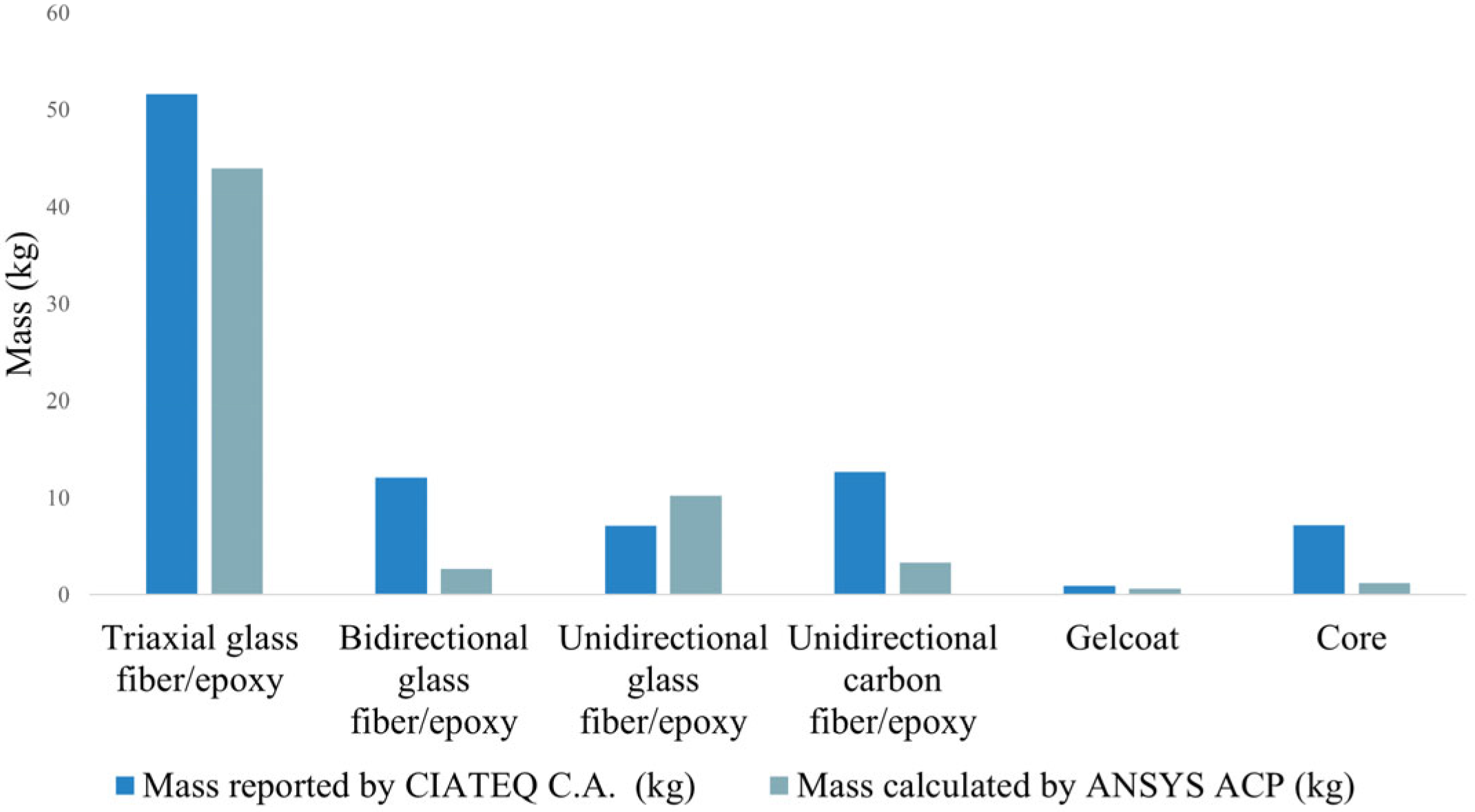
| Triaxial glass/epoxy | 43.92 |
| Bidirectional glass/epoxy | 2.65 |
| Unidirectional glass/epoxy | 10.24 |
| Unidirectional carbon/epoxy | 3.29 |
| SANFoam Core | 1.19 |
| Gelcoat | 0.6 |
| Total weight | 61.91 |
| Load Case | CD | Drag (N) | CL | Lift (N) | Torque (Nm) | Power (W) | Pressure Coefficient |
|---|---|---|---|---|---|---|---|
| 1 | 0.70 | 96.86 | 2.49 | 343.88 | 209.85 | 2197.10 | 1.60 |
| 2 | 0.69 | 384.02 | 2.70 | 1489.33 | 808.22 | 8462.02 | 0.97 |
| 3 | 0.80 | 439.68 | 3.12 | 1721.50 | 1015.98 | 10,637.35 | 1.20 |
| Design Point | Triaxial GF/Epoxy | UD GF and CF/Epoxy (Root) | UD GF and CF/Epoxy (Mid-Span) | BD GF/Epoxy (Shear Web) | Weight (kg) |
|---|---|---|---|---|---|
| Number of Layers | |||||
| DP-1 | 2 | 4 | 3 | 4 | 61.91 |
| DP-2 | 1 | 4 | 3 | 4 | 55.28 |
| DP-3 | 1 | 4 | 3 | 5 | 55.94 |
| DP-4 | 2 | 4 | 3 | 5 | 62.57 |
| DP-5 | 1 | 6 | 3 | 4 | 55.73 |
| DP-6 | 2 | 6 | 3 | 4 | 62.37 |
| DP-7 | 1 | 6 | 3 | 5 | 56.40 |
| DP-8 | 2 | 6 | 3 | 5 | 63.03 |
| DP-9 | 1 | 4 | 4 | 4 | 57.50 |
| DP-10 | 2 | 4 | 4 | 4 | 64.13 |
| DP-11 | 1 | 4 | 4 | 5 | 58.16 |
| DP-12 | 2 | 4 | 4 | 5 | 64.80 |
| DP-13 | 1 | 6 | 4 | 4 | 57.95 |
| DP-14 | 2 | 6 | 4 | 4 | 64.59 |
| DP-15 | 1 | 6 | 4 | 5 | 58.62 |
| DP-16 | 2 | 6 | 4 | 5 | 65.25 |
Disclaimer/Publisher’s Note: The statements, opinions and data contained in all publications are solely those of the individual author(s) and contributor(s) and not of MDPI and/or the editor(s). MDPI and/or the editor(s) disclaim responsibility for any injury to people or property resulting from any ideas, methods, instructions or products referred to in the content. |
© 2026 by the authors. Licensee MDPI, Basel, Switzerland. This article is an open access article distributed under the terms and conditions of the Creative Commons Attribution (CC BY) license.
Share and Cite
Alcantara-Rojas, E.; López-Rebollar, B.M.; Félix-Félix, J.R.; Mohedano-Castillo, M.F.; Ortiz, C.R.F.; Cano-Perea, G. Aero-Structural Analysis of a Wind Turbine Blade Lay-Up as a Preliminary Design Alternative. Appl. Mech. 2026, 7, 24. https://doi.org/10.3390/applmech7010024
Alcantara-Rojas E, López-Rebollar BM, Félix-Félix JR, Mohedano-Castillo MF, Ortiz CRF, Cano-Perea G. Aero-Structural Analysis of a Wind Turbine Blade Lay-Up as a Preliminary Design Alternative. Applied Mechanics. 2026; 7(1):24. https://doi.org/10.3390/applmech7010024
Chicago/Turabian StyleAlcantara-Rojas, Eduardo, Boris Miguel López-Rebollar, Jesús Ramiro Félix-Félix, Martha Fernanda Mohedano-Castillo, Carlos Roberto Fonseca Ortiz, and Gerardo Cano-Perea. 2026. "Aero-Structural Analysis of a Wind Turbine Blade Lay-Up as a Preliminary Design Alternative" Applied Mechanics 7, no. 1: 24. https://doi.org/10.3390/applmech7010024
APA StyleAlcantara-Rojas, E., López-Rebollar, B. M., Félix-Félix, J. R., Mohedano-Castillo, M. F., Ortiz, C. R. F., & Cano-Perea, G. (2026). Aero-Structural Analysis of a Wind Turbine Blade Lay-Up as a Preliminary Design Alternative. Applied Mechanics, 7(1), 24. https://doi.org/10.3390/applmech7010024