Investigation of Microstructure and Mechanical Behavior of Nanomodified Cement-Based Materials

 , ,
, ,  and
and 
Abstract
1. Introduction
2. Materials and Methods
2.1. Materials and Specimens
2.2. Testing Methods
2.2.1. Microstructural Analysis
2.2.2. Mechanical Testing
3. Results and Discussion
3.1. Flexural and Compressive Strength
3.2. Microstructural Characterization
4. Conclusions
- The incorporation of both CNTs and GNPs led to a significant enhancement in the flexural, compressive, and fracture performance of concrete compared with the reference mixture.
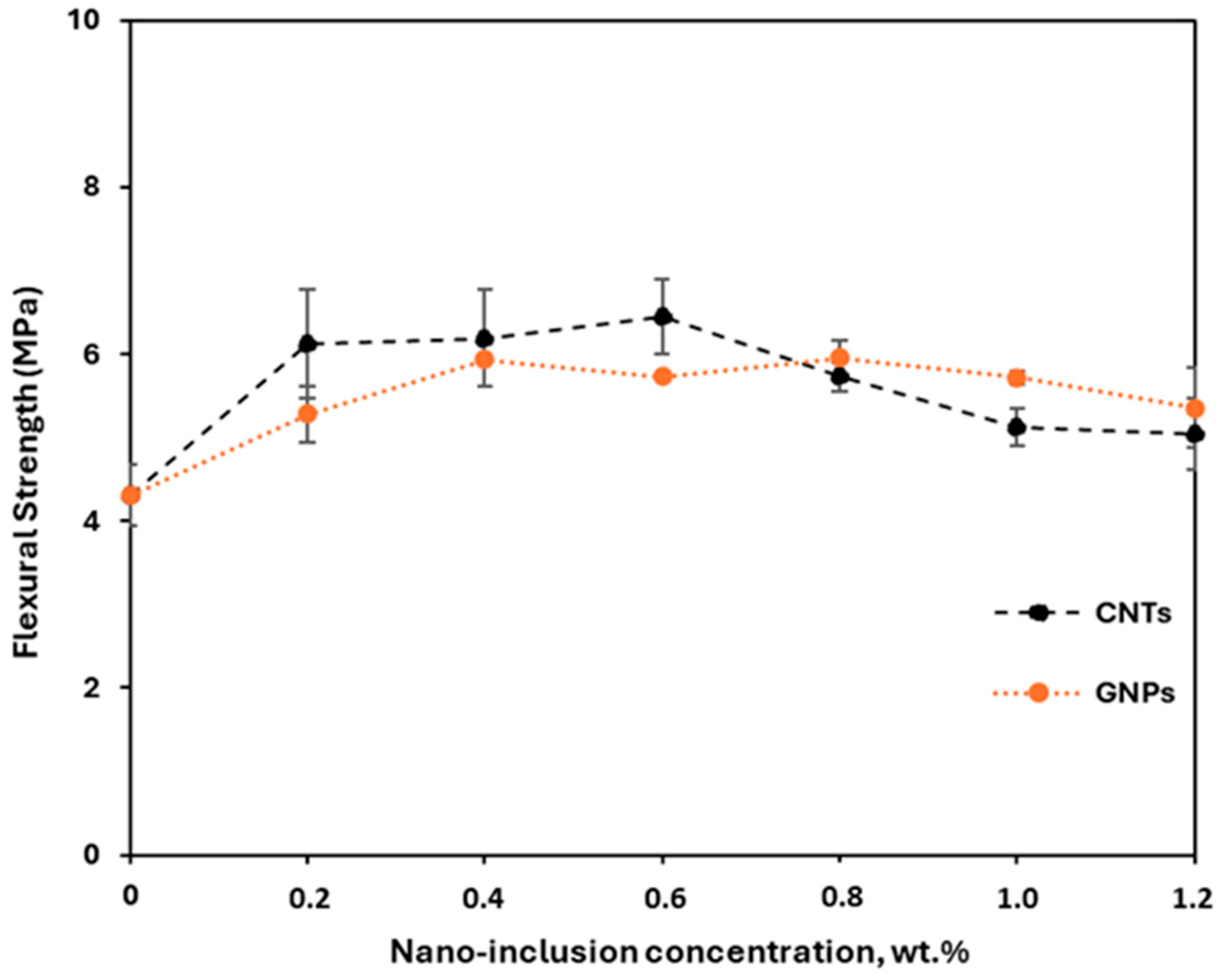
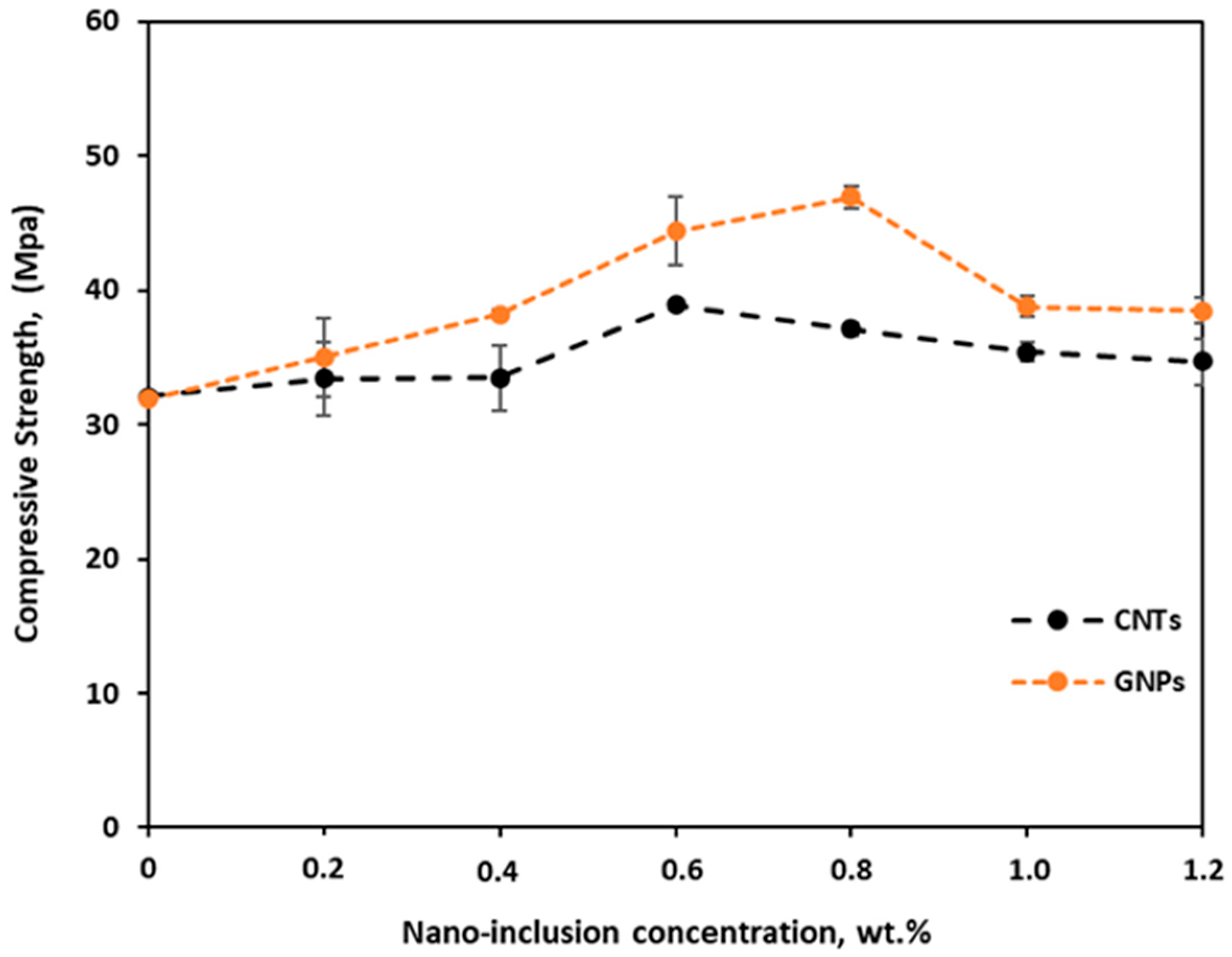
- Optimum enhancement was achieved at 0.6 wt.% CNTs and 0.8 wt.% GNPs, where flexural strength increased by approximately 49% and 38% (it should again be noted that similar performance can be observed at 0.4wt.% for GNPs), respectively, while compressive strength increased by 22% and 47%.
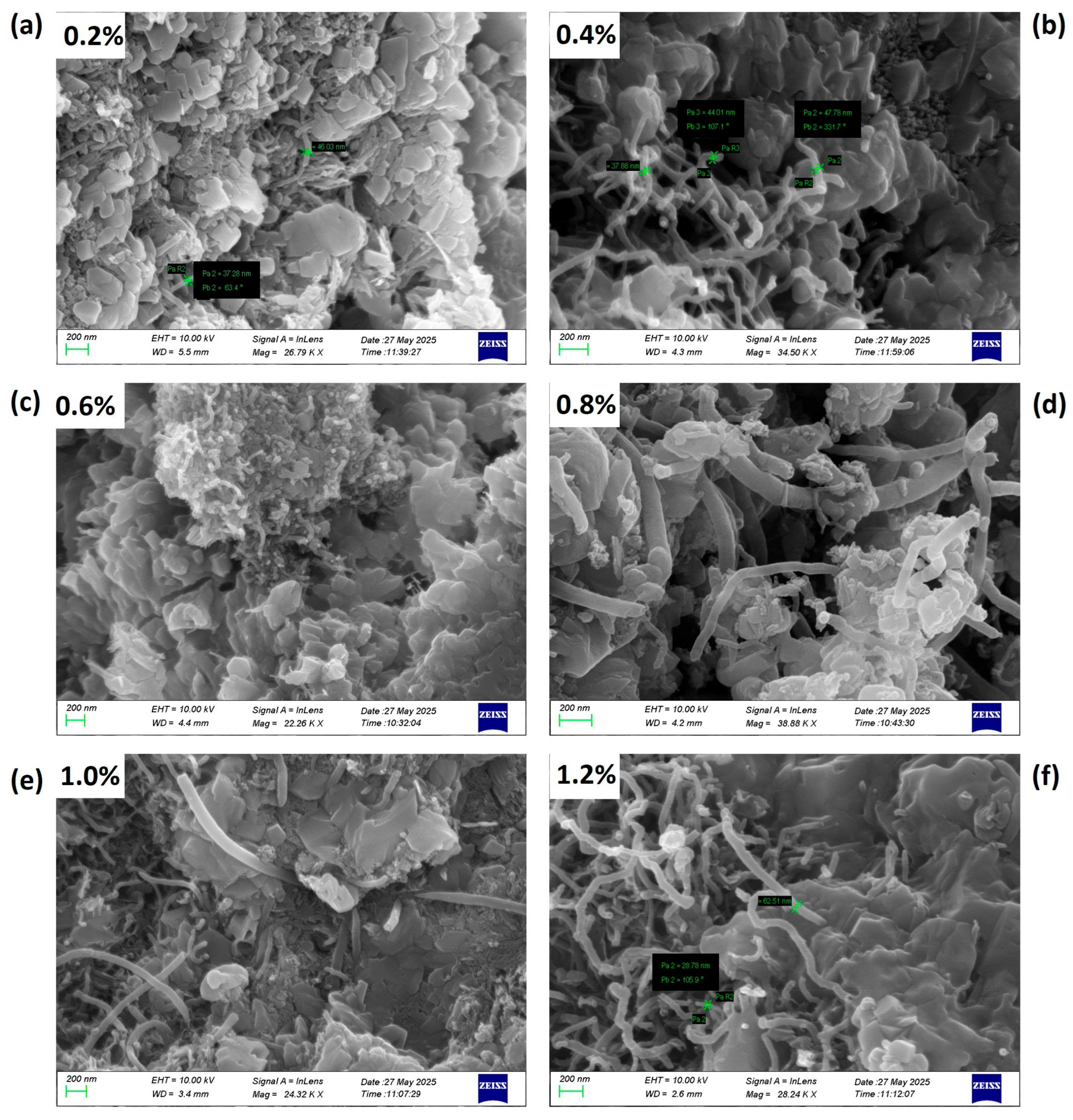
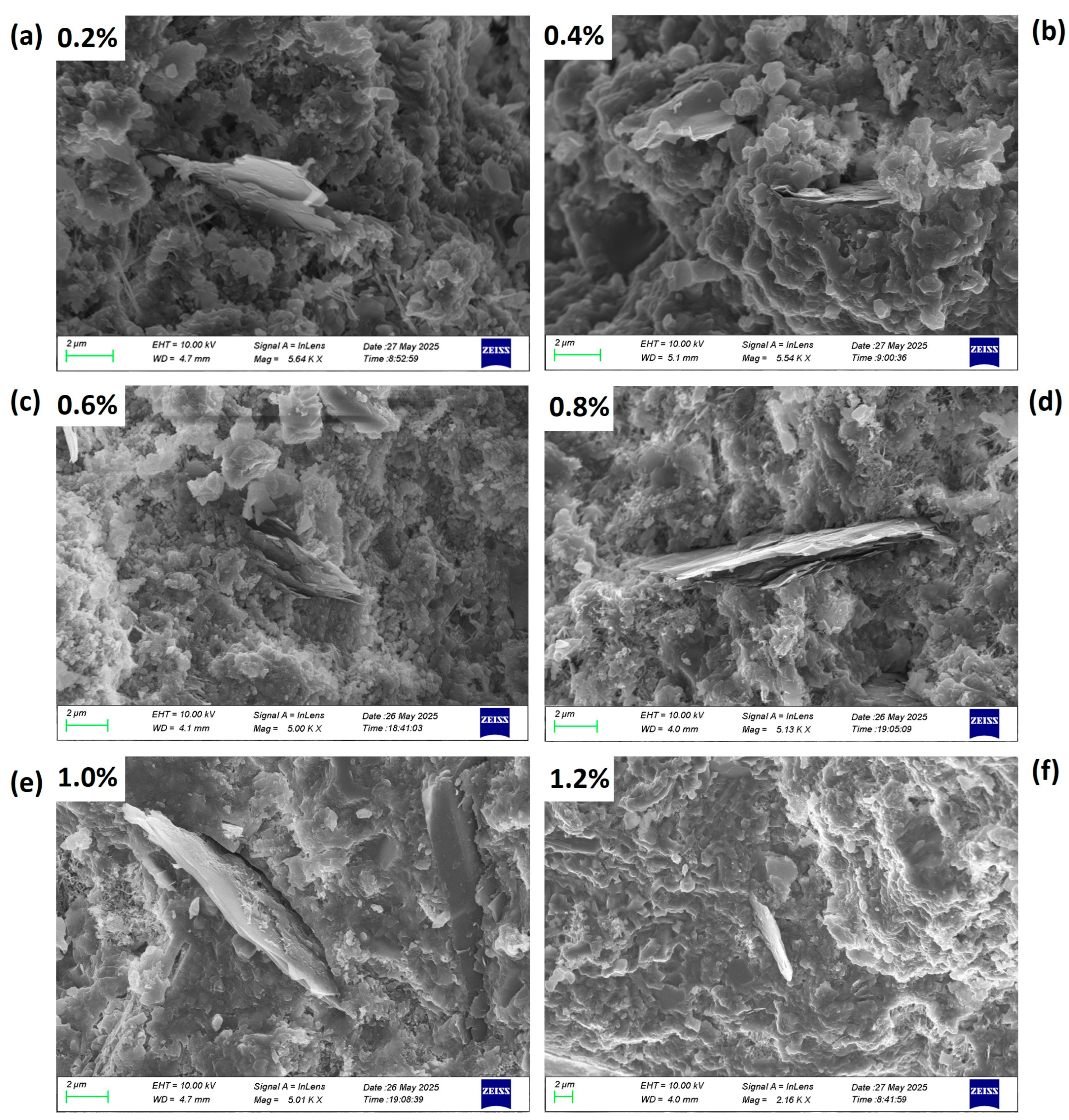
- SEM analysis revealed that at low and intermediate nanomaterial concentrations, both CNTs and GNPs were well dispersed within the cementitious matrix, promoting matrix densification, pore structure refinement, and stronger interfacial bonding with hydration products.
- Beyond the optimum nano-inclusion dosage, the formation of agglomerates and poorly hydrated zones became evident, leading to increased porosity and a degradation of mechanical performance.
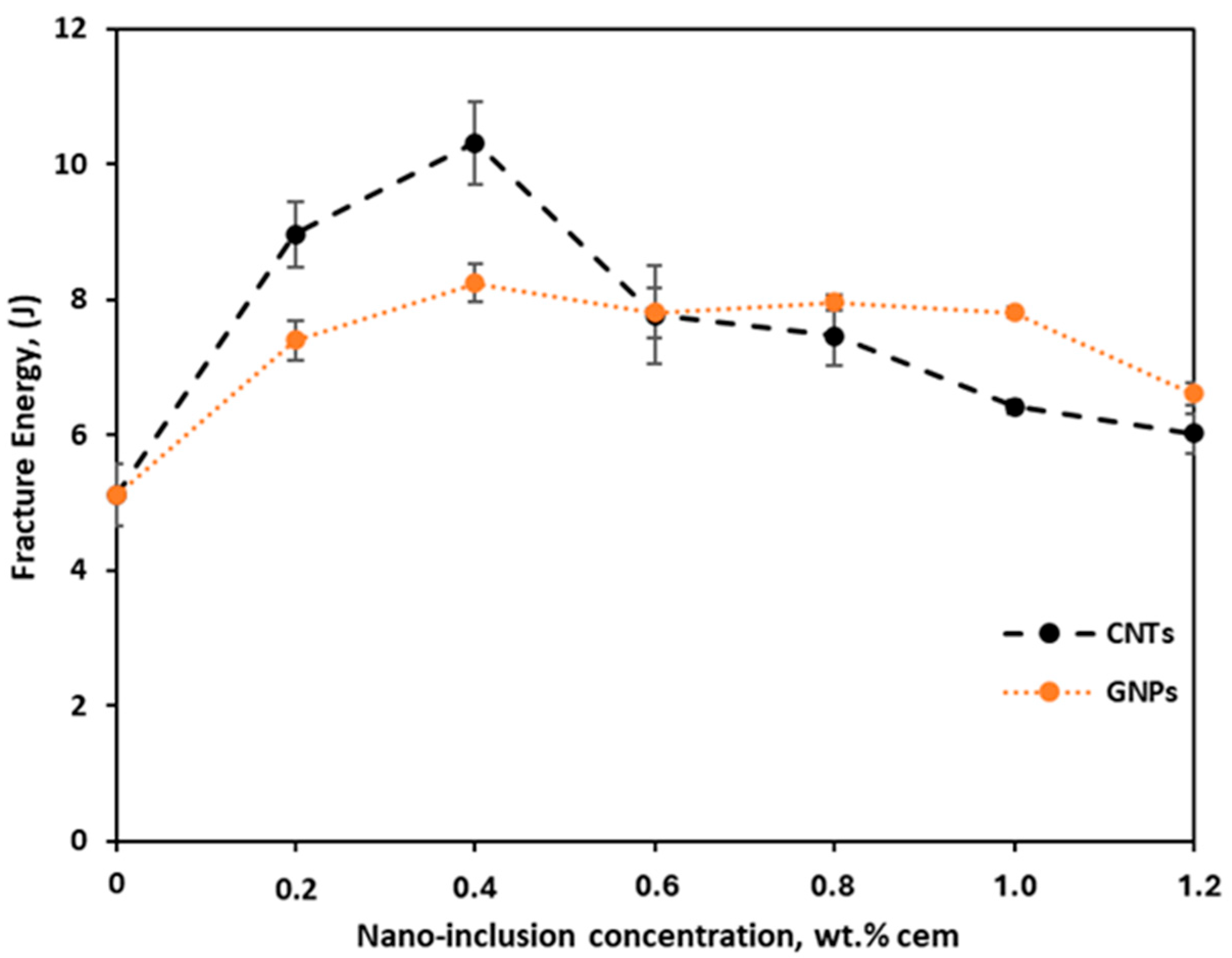
- Between the two nanomaterials, CNTs achieved the highest flexural and fracture performance, while GNPs exhibited superior compressive strength. This difference arises from their distinct reinforcing mechanisms: CNTs, due to their one-dimensional tubular morphology and high aspect ratio, promote effective crack-bridging and stress transfer, enhancing tensile and flexural behavior, whereas GNPs, with their two-dimensional platelet structure and larger surface area, improve particle packing and matrix densification, resulting in higher compressive performance. Overall, both nanomaterials contribute to strengthening through complementary mechanisms within the cementitious matrix.
Author Contributions
Funding
Institutional Review Board Statement
Informed Consent Statement
Data Availability Statement
Conflicts of Interest
References
- Sanchez, F.; Sobolev, K. Nanotechnology in concrete—A review. Constr. Build. Mater. 2010, 24, 2060–2071. [Google Scholar] [CrossRef]
- Shamsaei, E.; de Souza, F.B.; Yao, X.; Benhelal, E.; Akbari, A.; Duan, W. Graphene-based nanosheets for stronger and more durable concrete: A review. Constr. Build. Mater. 2018, 183, 642–660. [Google Scholar] [CrossRef]
- Chuah, S.; Pan, Z.; Sanjayan, J.G.; Wang, C.M.; Duan, W.H. Nano reinforced cement and concrete composites and new perspective from graphene oxide. Constr. Build. Mater. 2014, 73, 113–124. [Google Scholar] [CrossRef]
- Sldozian, R.J.; Burakov, A.E.; Aljaboobi, D.Z.M.; Hamad, A.J.; Tkachev, A.G. The effect of multi-walled carbon nanotubes on mechanical properties and water adsorption of lightweight foamed concrete. Res. Eng. Struct. Mater. 2024, 10, 1139–1154. [Google Scholar] [CrossRef]
- Hu, Z.Y.; Wan, Y.; Duan, Y.J.; Shi, Y.H.; Gu, C.P.; Ma, R.; Dong, J.J.; Cui, D. A review of the impact of graphene oxide on cement composites. Nanomaterials 2025, 15, 216. [Google Scholar] [CrossRef] [PubMed]
- Lim, K.M.; Lee, J.H. Electrical conductivity and compressive strength of cement paste with multiwalled carbon nanotubes and graphene nanoplatelets. Appl. Sci. 2022, 12, 1160. [Google Scholar] [CrossRef]
- Qureshi, T.S.; Panesar, D.K. Nano reinforced cement paste composite with functionalized graphene and pristine graphene nanoplatelets. Compos. Part B Eng. 2020, 197, 108063. [Google Scholar] [CrossRef]
- Coppola, L.; Buoso, A.; Corazza, F. Electrical properties of carbon nanotubes cement composites for monitoring stress conditions in concrete structures. Appl. Mech. Mater. 2011, 82, 118–123. [Google Scholar] [CrossRef]
- Farmaki, S.G.; Dalla, P.T.; Exarchos, D.A.; Dassios, K.G.; Matikas, T.E. Thermal and Electrical Properties of Cement-Based Materials Reinforced with Nano-Inclusions. Nanomanufacturing 2025, 5, 13. [Google Scholar] [CrossRef]
- Makar, J.M.; Beaudoin, J.J. Carbon nanotubes and their application in the construction industry. In Proceedings of the 1st International Symposium on Nanotechnology in Construction, Scotland, UK, 23–25 June 2003; National Research Council Canada: Ottawa, ON, Canada, 2003; p. 341. [Google Scholar]
- Siddique, R.; Mehta, A. Effect of carbon nanotubes on properties of cement mortars. Constr. Build. Mater. 2014, 50, 116–129. [Google Scholar] [CrossRef]
- Guo, E.; Zhang, W.; Lai, J.; Hu, H.; Xue, F.; Su, X. Enhancement of Cement-Based Materials: Mechanisms, Impacts, and Applications of Carbon Nanotubes in Microstructural Modification. Buildings 2025, 15, 1234. [Google Scholar] [CrossRef]
- Wille, K.; Loh, K.J. Nanoengineering ultra-high-performance concrete with multiwalled carbon nanotubes. Transp. Res. Rec. 2010, 2142, 119–126. [Google Scholar] [CrossRef]
- Silvestro, L.; Gleize, P.J.P. Effect of carbon nanotubes on compressive, flexural and tensile strengths of Portland cement-based materials: A systematic literature review. Constr. Build. Mater. 2020, 264, 120237. [Google Scholar] [CrossRef]
- Sedaghat, A.; Ram, M.K.; Zayed, A.; Kamal, R.; Shanahan, N. Investigation of physical properties of graphene-cement composite for structural applications. Open J. Compos. Mater. 2014, 4, 12–21. [Google Scholar] [CrossRef]
- Ahmed, A.A.; Shakouri, M.; Abraham, O.F. Assessing the Impact of Graphene Nanoplatelets Aggregates on the Performance Characteristics of Cement-Based Materials. Sustainability 2025, 17, 2349. [Google Scholar] [CrossRef]
- Jaramillo, L.J.; Kalfat, R. Evaluation of Mechanical Properties and Water Resistance Performance of Concrete Modified with Graphene Nanoplatelets (GNP). Int. J. Concr. Struct. Mater. 2025, 19, 39. [Google Scholar] [CrossRef]
- Hilding, J.; Grulke, E.A.; George Zhang, Z.; Lockwood, F. Dispersion of carbon nanotubes in liquids. J. Dispers. Sci. Technol. 2003, 24, 1–41. [Google Scholar] [CrossRef]
- Alafogianni, P.; Dassios, K.; Farmaki, S.; Antiohos, S.; Matikas, T.; Barkoula, N.-M. On the efficiency of UV–vis spectroscopy in assessing the dispersion quality in sonicated aqueous suspensions of carbon nanotubes. Colloids Surf. A Physicochem. Eng. Asp. 2016, 495, 118–124. [Google Scholar] [CrossRef]
- Gao, X.; Fang, W.; Li, W.; Wang, P.; Khan, K.; Tang, Y.; Wang, T. Effects of multidimensional carbon-based nanomaterials on the low-carbon and high-performance cementitious composites: A critical review. Materials 2024, 17, 2196. [Google Scholar] [CrossRef]
- Jayakumari, B.Y.; Swaminathan, E.N.; Partheeban, P. A review on characteristics studies on carbon nanotubes-based cement concrete. Constr. Build. Mater. 2023, 367, 130344. [Google Scholar] [CrossRef]
- Dalla, P.T.; Tragazikis, I.K.; Trakakis, G.; Galiotis, C.; Dassios, K.G.; Matikas, T.E. Multifunctional Cement Mortars Enhanced with Graphene Nanoplatelets and Carbon Nanotubes. Sensors 2021, 21, 933. [Google Scholar] [CrossRef]
- Li, Q.; Lee, J.C.; Moon, W.C.; Ng, J.L.; Yusof, Z.M.; Hong, X.; He, Q.; Li, B. Mechanical and microstructural improvements of high-strength lightweight concrete with carbon nanotubes and shale-based aggregates. Discov. Appl. Sci. 2025, 7, 671. [Google Scholar] [CrossRef]
- Deng, S.; Fan, J.; Yi, B.; Ye, J.; Li, G. Effect of industrial multi-walled carbon nanotubes on the mechanical properties and microstructure of ultra-high performance concrete. Cem. Concr. Compos. 2025, 156, 105850. [Google Scholar] [CrossRef]
- Dassios, K.G.; Alafogianni, P.; Antiohos, S.K.; Leptokaridis, C.; Barkoula, N.-M.; Matikas, T.E. Optimization of Sonication Parameters for Homogeneous Surfactant-Assisted Dispersion of Multiwalled Carbon Nanotubes in Aqueous Solutions. J. Phys. Chem. C 2015, 119, 7506–7516. [Google Scholar] [CrossRef]
- BS EN 206:2013+A2:2021; Concrete—Specification, Performance, Production and Conformity. BSI Standards Limited: London, UK, 2021.
- ASTM C143/C143M-20; Standard Test Method for Slump of Hydraulic-Cement Concrete. ASTM International: West Conshohocken, PA, USA, 2020.
- ASTM C231/C231M-17a; Standard Test Method for Air Content of Freshly Mixed Concrete by the Pressure Method. ASTM International: West Conshohocken, PA, USA, 2017.
- ASTM Standard C 1609/C 1609M-05; Standard Test Method for Flexural Performance of Fiber-Reinforced Concrete (Using Beam With Third-Point Loading) (2006). ASTM International: West Conshohocken, PA, USA, 2005.
- ASTM Standard C 78-02; Standard Test Method for Flexural Strength of Concrete (Using Simple Beam with Third-Point Loading) (2002). ASTM International: West Conshohocken, PA, USA, 2002.
- CEN. EN 12390-3:2019; Testing Hardened Concrete—Part 3: Compressive Strength of Test Specimens. European Committee for Standardization: Brussels, Belgium, 2019.
- CEN. EN 12390-4:2019; Testing Hardened Concrete—Part 4: Strength Determination by Compressive Testing Machine Calibration and Verification. European Committee for Standardization: Brussels, Belgium, 2019.
- Zhou, Y.; Wang, Y.; Gao, T.; Ling, Y.; Jiang, N.; Tawfek, A.M.; Yuan, H. Optimization of graphene nanoplatelets dispersion and its performance in cement mortars. Materials 2022, 15, 7308. [Google Scholar] [CrossRef]
- Rocha, V.V.; Ludvig, P.; Trindade, A.C.C.; de Andrade Silva, F. The influence of carbon nanotubes on the fracture energy, flexural and tensile behavior of cement based composites. Constr. Build. Mater. 2019, 209, 1–8. [Google Scholar] [CrossRef]





| Concentration wt.% Cem | ΔFlexural Strength (%) vs. Control | ΔCompressive Strength (%) vs. Control | ||
|---|---|---|---|---|
| CNTs | GNPs | CNTs | GNPs | |
| 0.2 | +41.41 | +22.82 | +4.19 | +9.76 |
| 0.4 | +43.99 | +38.10 | +4.40 | +19.82 |
| 0.6 | +49.93 | +33.36 | +21.26 | +39.21 |
| 0.8 | +33.21 | +38.42 | +15.71 | +47.13 |
| 1.0 | +19.15 | +33.06 | +10.28 | +21.52 |
| 1.2 | +17.35 | +24.44 | +8.09 | +20.65 |
| Concentration wt.% Cem | ΔFracture Energy (%) vs. Control | |
|---|---|---|
| CNTs | GNPs | |
| 0.2 | +75.46 | +44.97 |
| 0.4 | +101.87 | +61.40 |
| 0.6 | +52.17 | +52.88 |
| 0.8 | +46.13 | +55.80 |
| 1.0 | +25.65 | +52.93 |
| 1.2 | +17.96 | +29.37 |
Disclaimer/Publisher’s Note: The statements, opinions and data contained in all publications are solely those of the individual author(s) and contributor(s) and not of MDPI and/or the editor(s). MDPI and/or the editor(s) disclaim responsibility for any injury to people or property resulting from any ideas, methods, instructions or products referred to in the content. |
© 2026 by the authors. Licensee MDPI, Basel, Switzerland. This article is an open access article distributed under the terms and conditions of the Creative Commons Attribution (CC BY) license.
Share and Cite
Farmaki, S.G.; Exarchos, D.A.; Dracopoulos, V.; Gkotzamanis, A.; Dassios, K.G.; Matikas, T.E. Investigation of Microstructure and Mechanical Behavior of Nanomodified Cement-Based Materials. Appl. Mech. 2026, 7, 13. https://doi.org/10.3390/applmech7010013
Farmaki SG, Exarchos DA, Dracopoulos V, Gkotzamanis A, Dassios KG, Matikas TE. Investigation of Microstructure and Mechanical Behavior of Nanomodified Cement-Based Materials. Applied Mechanics. 2026; 7(1):13. https://doi.org/10.3390/applmech7010013
Chicago/Turabian StyleFarmaki, Spyridoula G., Dimitrios A. Exarchos, Vasileios Dracopoulos, Anastasios Gkotzamanis, Konstantinos G. Dassios, and Theodore E. Matikas. 2026. "Investigation of Microstructure and Mechanical Behavior of Nanomodified Cement-Based Materials" Applied Mechanics 7, no. 1: 13. https://doi.org/10.3390/applmech7010013
APA StyleFarmaki, S. G., Exarchos, D. A., Dracopoulos, V., Gkotzamanis, A., Dassios, K. G., & Matikas, T. E. (2026). Investigation of Microstructure and Mechanical Behavior of Nanomodified Cement-Based Materials. Applied Mechanics, 7(1), 13. https://doi.org/10.3390/applmech7010013