1. Introduction
The integration of Artificial Intelligence (AI) into higher education is increasingly reshaping educational leadership, institutional governance, teaching practices, and decision-making processes. AI-driven technologies such as adaptive learning systems, intelligent tutoring platforms, generative AI tools, and learning analytics are creating new opportunities to personalise learning, optimise administrative efficiency, and support data-informed institutional planning [
1,
2]. At the same time, these developments are transforming the responsibilities of educational leaders, who are now required not only to support technological adoption but also to navigate complex ethical, organisational, and governance challenges associated with AI-enabled educational environments.
As AI becomes progressively embedded within higher education systems, effective leadership increasingly depends on the ability to critically evaluate AI technologies, understand their institutional implications, and guide responsible implementation. In this context, AI literacy extends beyond technical familiarity to include strategic awareness, ethical sensitivity, and the capacity to exercise informed judgement in human–AI collaborative environments [
3]. Educational leaders are therefore expected to balance innovation with accountability, ensuring that AI adoption supports institutional priorities while maintaining transparency, fairness, academic integrity, and meaningful human oversight.
Despite growing interest in AI within educational research, limited attention has been given to the relationship between AI literacy and educational leadership in higher education contexts. Existing studies have extensively examined AI-supported pedagogy, learning analytics, and technology-enhanced learning environments [
4,
5], yet comparatively little research has explored how leadership preparedness in terms of AI understanding influences institutional readiness, governance, and strategic decision-making. This gap has become increasingly significant with the rapid expansion of large language models and generative AI systems, which are reshaping assessment practices, research processes, content creation, and knowledge production while simultaneously raising concerns relating to academic integrity, bias, transparency, and responsible AI use [
6].
The regulatory and policy landscape surrounding AI in education is also evolving rapidly. The European Union AI Act (2024) classifies AI systems used in educational assessment and admissions as “high-risk”, subjecting them to enhanced transparency, accountability, and human oversight requirements [
7]. Similarly, the UNESCO AI Competency Framework for Teachers (2024) and the OECD AI Principles emphasise ethical governance, responsible AI adoption, and the development of AI-related competencies across educational systems [
8,
9]. Together, these developments position AI literacy not simply as a desirable professional attribute, but increasingly as a strategic institutional capability linked to governance, compliance, trustworthy AI adoption, and organisational resilience [
10].
In response to these challenges, this study investigates the role of AI literacy in educational leadership within higher education. Using an exploratory mixed-methods design combining surveys and semi-structured interviews with 52 academic leaders across UK higher education institutions, the study examines current levels of AI literacy, institutional readiness for AI adoption, and the ways in which AI literacy is perceived to support leadership practice, decision-making, and governance. The empirical findings indicate that participants perceived AI literacy as extending beyond technical competence to encompass strategic, ethical, and organisational capabilities, while also reporting variation in leadership preparedness and perceived institutional readiness across higher education contexts. Building on these findings, the paper presents the AI Literacy Leadership Framework (AILLF), an empirically informed and theoretically grounded conceptual framework that conceptualises AI literacy as a multidimensional leadership capability underpinning four interconnected domains: innovation, decision-making, ethical governance, and policy development. The framework is informed by transformative, adaptive, distributed, and ethical leadership theories, situated within the emerging international AI governance landscape, and accompanied by proposed implementation guidance comprising a capability progression model and a role-differentiated leadership competency guide.
The study is guided by the following research questions:
What is the current state of AI literacy among educational leaders in higher education?
How is AI literacy perceived to support leadership decision-making, policy development, and institutional innovation?
What barriers and enabling factors shape the development of AI literacy among educational leaders?
How can higher education institutions support the development of AI-literate leadership and institutional AI capability?
The remainder of this paper is organised as follows.
Section 2 reviews the literature on AI in higher education, AI literacy, educational leadership, and AI governance frameworks.
Section 3 presents the mixed-methods research design, participant profile, and data collection and analysis procedures.
Section 4 reports the empirical findings relating to AI literacy, institutional readiness, governance, and leadership practices within higher education contexts.
Section 5 introduces the AI Literacy Leadership Framework (AILLF) and discusses its conceptual structure and comparative positioning.
Section 6 presents the proposed implementation mechanisms associated with the framework, including the capability progression model, competency structure, and recommendations for implementation within higher education contexts.
Section 7 discusses the implications of the empirical findings and the proposed framework in relation to AI governance, leadership capability, and AI implementation in higher education. Finally,
Section 8 concludes the paper and outlines directions for future research.
2. Literature Review
This section critically examines the evolving relationship between Artificial Intelligence (AI), educational leadership, and institutional governance within higher education. It first explores the opportunities and challenges associated with AI integration in higher education environments, before examining the growing importance of AI literacy as a strategic leadership capability. The review then considers international AI governance and policy frameworks alongside leadership and AI capability models that inform the development of the proposed AI Literacy Leadership Framework (AILLF). Collectively, the review focuses on studies that directly inform the leadership-level conceptualisation of AI literacy adopted in this paper, particularly literature addressing institutional capability, governance responsibility, strategic decision-making, and responsible human–AI collaboration in higher education.
2.1. AI Integration in Higher Education
Artificial Intelligence (AI) technologies are increasingly reshaping higher education through applications that support teaching, learning, administration, and institutional decision-making. Adaptive learning systems, intelligent tutoring systems (ITS), learning analytics platforms, and generative AI tools have expanded the capacity of educational institutions to personalise learning experiences, automate routine processes, and support data-informed educational practices [
1,
11,
12,
13]. These developments have positioned AI as both a technological and institutional force capable of influencing how universities deliver education, evaluate performance, and manage organisational processes.
Among the most prominent applications are adaptive learning systems and ITS, which aim to tailor educational content and feedback to individual learners’ needs. Research has shown that such systems can improve engagement and learning outcomes by adjusting instructional pace and content dynamically [
14,
15]. ITS have, in some contexts, demonstrated effectiveness comparable to one-to-one tutoring [
16]. However, the effectiveness of these technologies remains uneven across educational contexts and disciplines. Their implementation is influenced by socio-economic inequalities, varying levels of digital literacy, and differences in institutional infrastructure [
17]. Moreover, AI-driven instructional systems continue to face limitations in addressing the emotional, contextual, and interpersonal dimensions of learning that human educators provide [
18].
AI integration has also expanded the role of educational analytics within higher education institutions. Learning analytics systems can identify patterns in student engagement and performance, enabling earlier interventions and more targeted institutional support [
19]. At the same time, the increasing reliance on educational data raises concerns relating to privacy, surveillance, informed consent, and data governance. The collection, processing, and use of student data therefore require robust ethical and institutional oversight mechanisms capable of balancing innovation with the protection of individual rights [
20].
The emergence of generative AI technologies has further intensified debates surrounding academic integrity, assessment validity, and knowledge production in higher education. Tools such as ChatGPT have introduced new possibilities for content generation, research support, and curriculum development, while simultaneously challenging traditional approaches to plagiarism detection and student assessment [
6]. Recent studies have highlighted concerns that AI-generated submissions may obscure learners’ actual understanding and reduce opportunities for critical thinking and independent knowledge construction [
21,
22,
23]. These concerns are amplified in contexts where institutional policies and ethical usage guidelines remain underdeveloped [
24].
Beyond pedagogical applications, AI increasingly appears to influence broader institutional structures and administrative practices. Universities are adopting AI-supported systems to streamline operations, enhance strategic planning, support research activities, and improve organisational efficiency [
12,
25]. However, concerns persist regarding over-automation, the erosion of human judgement, and the risk that data-centric approaches may overlook the social and human dimensions of education [
26,
27]. The uneven distribution of technological resources further risks deepening educational inequalities between institutions and learner populations [
28]. In addition, algorithmic bias within AI systems may reinforce existing social inequalities if governance and oversight mechanisms are insufficiently developed [
29].
Taken together, the literature suggests that AI integration in higher education presents both significant opportunities and substantial institutional challenges. While AI technologies can support personalised learning, operational efficiency, and data-informed institutional practices, their successful adoption depends on more than technological implementation alone. It requires organisational readiness, ethical governance, institutional support structures, and leadership capable of critically evaluating the role of AI within educational environments. These conditions position AI literacy as an increasingly important capability for educational leadership, providing the foundation for informed decision-making and responsible institutional engagement with AI-enabled transformation.
2.2. AI Literacy and Educational Leadership
As Artificial Intelligence (AI) becomes increasingly embedded within higher education environments, the development of AI literacy among educational leaders has emerged as a critical institutional concern. AI literacy extends beyond basic technical familiarity and encompasses the ability to understand AI capabilities and limitations, critically evaluate AI-driven systems, recognise ethical implications, and make informed strategic decisions regarding AI adoption and governance [
30,
31]. In leadership contexts, AI literacy therefore represents not only a technological competency but also a strategic and organisational capability linked to institutional transformation and responsible innovation.
Educational leaders are increasingly expected to engage with AI technologies in ways that influence policy development, organisational strategy, curriculum design, resource allocation, and institutional governance. To do so effectively, leaders require an understanding of core AI concepts such as machine learning, natural language processing, and data analytics, alongside the ability to evaluate the pedagogical and organisational implications of these technologies [
32,
33]. Recent studies further suggest that leadership preparedness for AI integration depends not solely on technical knowledge, but also on the capacity to navigate uncertainty, support organisational change, and balance innovation with ethical accountability [
34].
Ethical awareness has become a particularly important dimension of AI literacy within educational leadership. Existing research highlights growing concerns relating to algorithmic bias, data privacy, surveillance, transparency, and the digital divide [
35]. In response, scholars have argued for institution-wide ethical frameworks capable of supporting responsible AI adoption through collaboration between educators, students, policymakers, and technology developers [
36]. Educational leaders therefore face increasing pressure to establish governance structures that ensure AI systems operate transparently, fairly, and in alignment with institutional values and educational objectives [
37].
Despite widespread institutional interest in AI, many educational leaders continue to report limited confidence in evaluating or governing AI technologies effectively [
38,
39,
40]. Existing professional development initiatives often remain fragmented or overly technical, providing insufficient support for the strategic, ethical, and organisational dimensions of AI integration [
41,
42,
43]. At the same time, institutional barriers including limited funding, lack of time, infrastructure constraints, and organisational resistance continue to hinder the development of AI literacy across leadership contexts [
32,
44,
45].
Research further suggests that AI literacy is associated with leadership effectiveness in technology-rich educational environments. Leaders with stronger AI literacy are generally better positioned to assess the value of AI tools, interpret educational data, support responsible implementation, and promote innovation while addressing concerns relating to ethics, privacy, and organisational change [
6,
30,
40,
46,
47]. However, establishing direct causal relationships between AI literacy and leadership outcomes remains methodologically challenging due to the influence of institutional culture, governance structures, resource availability, and disciplinary context [
27,
48,
49].
The literature also highlights important methodological limitations within existing research. Much of the current scholarship relies on qualitative or context-specific case studies, limiting broader generalisability [
50,
51]. Quantitative approaches, meanwhile, often struggle to capture the complexity of leadership practice and organisational dynamics associated with AI adoption [
52]. Furthermore, the absence of widely accepted AI literacy assessment frameworks continues to complicate comparative analysis and longitudinal evaluation [
51,
53].
Overall, the literature suggests that AI literacy is increasingly central to effective educational leadership within AI-enabled higher education environments. At the same time, significant challenges remain regarding leadership preparedness, institutional support, governance capability, and the development of coherent AI literacy frameworks capable of supporting responsible and sustainable AI integration. These unresolved challenges reinforce the need for leadership-oriented approaches that conceptualise AI literacy not only as an individual technical competency, but also as a multidimensional institutional capability connected to governance, strategy, and human–AI collaboration.
2.3. International AI Governance and Policy Frameworks
The governance of Artificial Intelligence (AI) in education is increasingly shaped by international policy and regulatory frameworks that emphasise ethical, human-centred, and accountable approaches to AI adoption. As AI systems become progressively integrated into educational decision-making, assessment, and institutional management, questions relating to transparency, fairness, accountability, and human oversight have moved to the centre of policy discussions surrounding AI-enabled educational environments.
The UNESCO Beijing Consensus on Artificial Intelligence and Education [
2] highlights principles of inclusion, equity, human agency, and the responsible use of educational data, emphasising the need to ensure that AI supports rather than undermines educational and social objectives. Similarly, the OECD AI Principles [
9] promote trustworthy AI through transparency, explainability, robustness, accountability, and respect for human-centred values. Together, these frameworks position ethical governance and meaningful human oversight as central requirements for responsible AI adoption.
At the regulatory level, the European Union AI Act [
7] operationalises many of these principles through a risk-based governance framework. Educational AI systems used in areas such as admissions, assessment, and learner evaluation are classified as “high-risk”, requiring enhanced transparency, accountability, documentation, and human oversight mechanisms. These regulatory developments significantly increase the governance responsibilities of higher education institutions and reinforce the importance of AI literacy among educational leaders responsible for AI-related institutional decision-making.
Alongside regulatory initiatives, competency-oriented frameworks have also emerged to support AI capability development within education systems. The UNESCO AI Competency Framework for Teachers [
8] extends beyond technical proficiency to include ethical awareness, critical engagement, and responsible AI use, while the UK National AI Strategy (2021) emphasises the role of universities in developing national AI capability and institutional readiness. Beyond formal policy frameworks, scholars have argued that education itself should be viewed as a foundational component of AI governance rather than merely a domain of AI application [
54]. This perspective highlights the strategic role of educational institutions in shaping future approaches to responsible AI adoption and governance.
Across these frameworks, several recurring themes emerge: the importance of ethical oversight, the need for transparency and accountability in AI supported decisions, the preservation of human agency within AI-enabled systems, and the recognition that AI capability development is a systemic institutional challenge rather than solely an individual technical concern. These themes provide an important governance foundation for the proposed AI Literacy Leadership Framework (AILLF), reinforcing the need to conceptualise AI literacy as a strategic leadership capability connected to institutional governance, organisational readiness, and responsible human–AI collaboration.
2.4. Leadership, Governance, and AI Capability Frameworks
The relationship between leadership and technology-driven organisational change can be understood through several complementary theoretical perspectives that collectively inform the development of the AI Literacy Leadership Framework (AILLF). As higher education institutions increasingly integrate AI technologies into teaching, administration, governance, and strategic planning, educational leadership is becoming progressively intertwined with questions of institutional capability, organisational adaptation, and responsible AI governance.
Transformative leadership emphasises the role of leaders in shaping institutional vision, inspiring organisational change, and fostering innovation within complex environments [
55,
56]. Within AI-enabled higher education contexts, AI literacy supports leaders in articulating credible strategic visions for AI integration while balancing technological innovation with educational values and institutional priorities. AI-literate leaders are therefore better positioned to guide organisational transformation and promote cultures capable of adapting to technological change.
Adaptive leadership provides an additional perspective by distinguishing between technical problems and adaptive challenges that require collective learning, institutional reflection, and organisational change [
57]. AI integration within higher education represents a predominantly adaptive challenge, since the introduction of AI technologies affects not only technical infrastructure but also governance processes, pedagogical practices, institutional culture, and professional roles. In this context, AI literacy enables leaders to navigate uncertainty, critically evaluate emerging technologies, and support informed decision-making within rapidly evolving educational environments.
Distributed leadership further highlights the collaborative nature of AI adoption within higher education institutions. Leadership responsibilities relating to AI implementation frequently involve academic staff, administrators, IT specialists, policymakers, students, and external stakeholders [
58]. As a result, AI capability cannot be understood solely as an individual leadership competency, but increasingly as an institution-wide organisational capability requiring coordination, communication, and shared governance structures.
Ethical leadership perspectives reinforce the importance of fairness, accountability, transparency, and responsible decision-making in AI-enabled environments [
59]. The growing use of AI in areas such as assessment, student analytics, admissions, and institutional planning raises concerns relating to bias, surveillance, explainability, and the preservation of meaningful human oversight. Educational leaders are therefore required not only to understand AI technologies, but also to ensure that institutional AI adoption aligns with ethical principles, regulatory expectations, and broader educational responsibilities.
Beyond educational leadership theory, research from other sectors has increasingly conceptualised AI capability as an organisational construct extending beyond technical expertise alone. In the corporate sector, AI readiness frameworks emphasise the interaction between individual competencies, organisational culture, governance processes, and technological infrastructure [
60]. Public sector approaches similarly highlight the importance of balancing efficiency, transparency, accountability, and public trust within AI-supported decision-making environments [
61]. In healthcare, AI competency frameworks stress the importance of understanding not only AI capabilities but also the limitations and risks associated with algorithmic decision-making, encouraging forms of “informed scepticism” towards AI systems [
33].
Taken together, the reviewed literature demonstrates that the most relevant gap for the present study concerns AI literacy at the level of institutional leadership, where technical understanding must be connected to governance responsibility, strategic decision-making, ethical oversight, and organisational capability development. However, it also reveals several conceptual and practical gaps concerning the strategic role of AI literacy in institutional leadership, governance, and organisational capability development.
Table 1 summarises the principal findings of the reviewed literature, the remaining challenges, and the manner in which the present study addresses these research gaps.
3. Methodology
This section outlines the methodological approach adopted to investigate AI literacy and educational leadership within higher education contexts. It describes the research design, participant sampling, data collection procedures, analytical approach, and considerations relating to research trustworthiness and ethical practice.
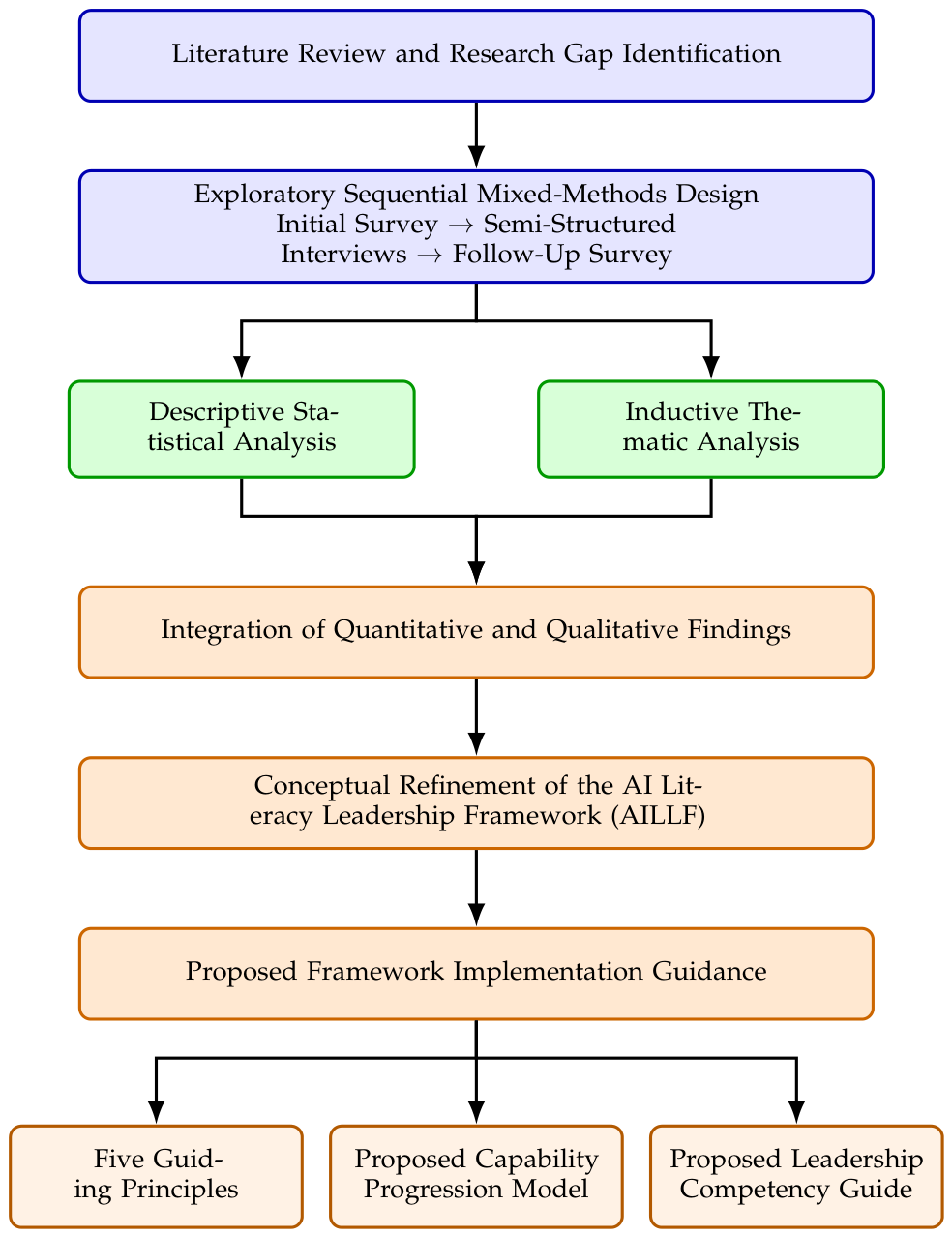
Figure 1 summarises the methodological workflow adopted in this study. The process followed a multiphase sequential exploratory mixed-methods design comprising an initial survey with 20 participants, semi-structured interviews, and a follow-up survey conducted with a further 32 participants using the same survey instrument. The interview findings informed the interpretation of the survey data and the subsequent development and proposed implementation of the AI Literacy Leadership Framework (AILLF), while the quantitative and qualitative evidence was integrated to support framework development.
3.1. Research Design
This study adopted an exploratory sequential mixed-methods design for framework development [
62]. The study combined quantitative and qualitative evidence through an iterative design in which each phase informed the subsequent stage of data collection, analysis, and framework refinement, ultimately supporting the development of the AI Literacy Leadership Framework (AILLF). The use of mixed methods enabled the integration of quantitative and qualitative perspectives, supporting both the identification of broader institutional patterns and the exploration of contextual leadership experiences relating to AI adoption, governance, and strategic decision-making [
63,
64].
The initial survey was used to identify preliminary patterns relating to AI literacy, leadership practices, institutional readiness, and governance. These findings informed the development of the semi-structured interview protocol by identifying topics requiring deeper exploration. The qualitative findings were subsequently used to provide contextual depth and refine the interpretation of the survey findings, while also informing the subsequent refinement of the AILLF. The follow-up survey employed the same instrument as the initial survey, with identical item wording and response options.
The study was designed as an exploratory framework-development investigation rather than a population-level assessment of AI literacy across the higher education sector. Accordingly, the methodological emphasis was placed on capturing diverse leadership perspectives, identifying recurring organisational challenges, and examining how educational leaders conceptualise and engage with AI-enabled institutional transformation. The mixed-methods approach was therefore considered appropriate for investigating an emerging and multidimensional phenomenon where both institutional trends and contextual leadership experiences are important for theory and framework development. Integration of the quantitative and qualitative evidence occurred during the interpretation phase through iterative comparison of descriptive survey patterns and thematic analysis findings. Areas of convergence and complementarity were used to refine the framework dimensions, guiding principles, capability progression model, and role-differentiated competency structure, thereby ensuring that the proposed AILLF was informed by both quantitative trends and qualitative insights.
Given the exploratory objective of the study and the relatively small subgroup sizes across leadership categories and academic disciplines, the quantitative component focused on descriptive statistical analysis rather than inferential hypothesis testing. This approach was considered more appropriate for identifying institutional patterns and informing framework development than for establishing population-level statistical relationships.
Similarly, inductive thematic analysis was selected for the qualitative component because it enabled recurring leadership experiences, governance challenges, and institutional perspectives to be identified without imposing a predefined coding framework. The combined analytical approach was therefore aligned with the exploratory purpose of the study; descriptive analysis was used to identify broader patterns in the survey data, while thematic analysis provided contextual depth for interpreting these patterns and informing framework development.
3.2. Participants and Sampling
The study involved 52 academic leaders from UK higher education institutions, including Executive Deans, Associate Deans, Heads of School, Associate Heads, and Course Leaders. Participants were eligible if they held a formal educational leadership role within a UK higher education institution and were directly involved in institutional decision-making processes. Three participants representing operational, middle, and senior leadership roles were subsequently selected for semi-structured interviews. The qualitative component was designed to provide contextual depth by exploring participants’ reported leadership experiences, governance challenges, and perceptions of organisational factors relating to AI integration across different leadership roles.
The empirical component was exploratory and intended to inform framework development rather than support statistical generalisation. Accordingly, the sample was selected to capture variation across leadership levels and disciplinary contexts rather than achieve population representativeness and should not be interpreted as representative of the wider UK higher education sector. The interviews were similarly intended to provide explanatory depth by identifying contextual mechanisms and leadership perspectives underlying the broader survey findings rather than to achieve thematic saturation.
In addition, the unit of analysis was the individual educational leader rather than the higher education institution. Although participants represented multiple UK higher education institutions, the study was not designed to compare institutions or evaluate institution-level AI capability. As institutional identifiers were not collected, the number and types of institutions represented, the distribution of participants across institutions, and whether multiple participants were affiliated with the same institution could not be determined. Consequently, organisational characteristics such as institutional readiness, governance, and culture are interpreted as participants’ perceptions of their institutional contexts rather than objectively verified institutional attributes.
Table 2 summarises the demographic and professional profile of the participants.
The participant profile included a range of leadership responsibilities, disciplinary backgrounds, and levels of professional experience across UK higher education institutions. Middle leadership roles constituted the largest participant group, providing perspectives on both operational and strategic aspects of AI integration. Participants represented both technically oriented and non-technical disciplinary contexts, enabling exploration of reported AI literacy and leadership experiences across a variety of higher education settings. The variation in participants’ self-reported AI literacy levels was consistent with the exploratory aims of the study by capturing differing levels of familiarity, confidence, and engagement with AI technologies.
3.3. Data Collection Procedures
Data collection was conducted in three sequential phases. An initial exploratory survey involving 20 participants was used to identify preliminary patterns relating to AI literacy, leadership practices, governance, and perceived institutional readiness for AI adoption. This phase informed the development of the semi-structured interview protocol by identifying topics requiring deeper contextual exploration, including leadership decision-making, AI governance, institutional support, ethical concerns, and perceived barriers to AI adoption.
The second phase involved three semi-structured interviews conducted with participants representing operational, middle, and senior leadership roles. The interviews explored leadership experiences, perceptions of institutional culture, governance challenges, ethical concerns, and strategic approaches relating to AI integration in higher education contexts. The interview findings informed the interpretation of the survey results and the subsequent conceptual development of the proposed framework, rather than modifications to the survey instrument.
The final phase involved a follow-up survey with a further 32 participants using the same survey instrument, including identical item wording and response options. This ensured measurement equivalence across both survey phases and enabled responses to be combined for descriptive analysis across the full sample (). The sequential process supported iterative refinement of the AILLF through the integration of quantitative and qualitative evidence during the interpretation stage. Areas of convergence and complementarity between the descriptive survey findings and thematic analysis informed the refinement of the framework dimensions, guiding principles, capability progression model, and role-differentiated competency matrix, ensuring that the proposed AI Literacy Leadership Framework (AILLF) was grounded in both quantitative trends and qualitative insights.
3.3.1. Survey Instrument
The survey instrument consisted of 22 structured and open-ended items examining AI literacy, leadership practices, perceptions of institutional governance, professional development, and AI adoption within higher education environments. The instrument combined Likert-scale items, multiple-choice questions, and free-text responses to capture quantitative trends and qualitative perspectives relating to AI engagement, leadership experiences, institutional readiness, organisational support, barriers to AI adoption, and AI integration.
Moreover, the questionnaire comprised four sections addressing: (i) participant demographic and professional characteristics; (ii) self-reported AI literacy, including technical understanding, strategic awareness, ethical considerations, and practical use of AI technologies; (iii) participants’ perceptions of AI adoption, governance, leadership decision-making, and institutional readiness; and (iv) perceived organisational support, professional development needs, and barriers to AI implementation. Most attitudinal items were measured using five-point Likert scales ranging from Strongly Disagree to Strongly Agree, while selected items employed multiple-choice or open-ended responses to provide additional contextual insight.
Given the exploratory nature of the study and the absence of an established instrument specifically designed to assess AI literacy as a strategic leadership capability in higher education, the questionnaire was developed by the authors based on the literature reviewed in
Section 2. The survey examined complementary technical, strategic, ethical, and applied aspects of AI literacy through multiple items and was intended to support the exploratory objectives of the study rather than function as a validated psychometric instrument. Accordingly, the questionnaire captured participants’ self-reported perceptions and experiences rather than objectively measuring AI competence or institutional capability. Responses relating to institutional readiness, governance, organisational culture, and organisational support therefore reflect participants’ perceptions of their institutional contexts rather than verified organisational characteristics or comparative assessments of higher education institutions.
3.3.2. Interview Protocol
A semi-structured interview protocol comprising 15 open-ended questions was developed to provide contextual depth on themes emerging from the survey phase. Each interview lasted approximately 90 min and explored six thematic areas: participants’ backgrounds and experiences with AI in education; conceptualisations of AI literacy within leadership contexts; the integration of AI into leadership practice and institutional decision-making; ethical and organisational challenges relating to AI adoption; participants’ perceptions of AI’s impact on their institutional contexts and approaches to evaluating outcomes; and professional development strategies for advancing AI literacy within higher education institutions.
The semi-structured format allowed flexibility in follow-up questioning, enabling participants to elaborate on issues most relevant to their leadership contexts while maintaining sufficient consistency across interviews to support thematic comparison. The interviews were intended to provide illustrative contextual insights that complemented the survey findings rather than achieve qualitative saturation or support broad generalisations across higher education leadership contexts.
All interviews were audio-recorded with participants’ consent and transcribed verbatim for analysis. The transcripts were analysed using an inductive thematic analysis to identify themes relating to leadership experiences, governance challenges, and institutional perspectives on AI adoption. The interview findings were subsequently considered alongside the survey results during the interpretation phase to provide contextual insight and inform the refinement of the AILLF. Accordingly, the qualitative findings should be interpreted as exploratory and illustrative, providing contextual depth rather than supporting broad qualitative generalisations.
4. Findings and Analysis
This section presents the empirical findings emerging from the sequential survey and interview phases and examines how these findings informed the development of the proposed AI Literacy Leadership Framework (AILLF). Quantitative survey data were analysed descriptively to identify patterns in participants’ self-reported AI literacy, leadership practices, and perceptions of institutional readiness and organisational support for AI adoption. Qualitative interview data were analysed thematically to provide contextual depth and examine participants’ reported leadership experiences, governance challenges, and perceptions of organisational factors influencing AI integration within higher education contexts, consistent with established approaches to mixed-methods educational research [
65]. The findings from both phases were subsequently synthesised to identify convergent themes relating to leadership capability, governance, institutional culture, and human–AI collaboration within higher education environments.
4.1. Survey Findings and Institutional Trends
The survey findings provide an overview of how participants understood and experienced AI literacy within higher education leadership contexts. Responses highlighted patterns relating to participants’ self-reported AI literacy, leadership practices, perceptions of institutional readiness, governance, professional development, and organisational support for AI integration.
Table 3 presents a summary of the principal survey indicators.
The survey results indicate that participants widely recognised AI literacy as strategically important, with 86.5% () identifying AI literacy as a key leadership capability and 76.9% () reporting regular engagement with AI-related tools and content. Similarly, 73.1% () reported that AI literacy appeared to inform their leadership decision-making, suggesting that participants perceived a relationship between AI-related competencies and leadership responsibilities, including institutional planning and governance.
Participants also reported a range of organisational and governance challenges relating to AI adoption. Concerns regarding AI ethics and governance were identified by 80.8% () of participants, while 55.8% () perceived institutional support for AI adoption as insufficient. In addition, 82.7% () identified professional development as a critical requirement, indicating a perceived need for greater structured training, organisational support, and capability development within their institutional contexts. Similarly, 78.8% () identified institutional culture as an important factor influencing AI integration and adoption within their respective institutions.
Thematic Analysis of Participants’ Perceptions
Six interrelated themes emerged from the survey data, capturing how participants perceived AI literacy to shape leadership practice and how they perceived institutional conditions to enable or constrain its development.
Table 4 summarises each theme, the corresponding empirical finding, and the resulting institutional implications. The discussion that follows considers these themes collectively rather than as isolated analytical categories, reflecting their interconnected nature within AI-enabled higher education environments.
The thematic analysis indicates that participants perceived AI literacy as important for leadership engagement in AI governance, strategic decision-making, and innovation practices. Participants described AI literacy as supporting involvement in AI policy discussions and institutional planning, while middle-level leaders frequently reported responsibility for operational AI implementation without equivalent involvement in strategic decision-making. Participants also identified a range of organisational barriers to AI adoption, with lack of time (86.5%), limited access to training (50%), and insufficient institutional support (47.1%) being the most frequently reported constraints.
Participants perceived institutional culture as influencing AI adoption and AI literacy development. Although many participants described their institutions as broadly supportive of innovation, more than 75% evaluated current AI initiatives as only moderately effective or neutral, indicating perceived limitations in programme design and implementation. Descriptive patterns also suggested variation in AI engagement across disciplinary contexts. Strong demand for formal AI training (82.7%), peer-learning opportunities (76.9%), and collaboration with industry partners (55.8%) further suggests that participants viewed AI literacy development as requiring sustained institutional investment and structured capability-building mechanisms.
Overall, the findings indicate that participants perceived AI literacy not only as an individual competency but also as contributing to broader organisational and leadership capability through its relationship with governance, institutional culture, and human–AI collaborative decision-making. These findings reflect participants’ perceptions of their institutional contexts rather than direct assessments of institution-level AI capability.
4.2. Interview Findings and Leadership Perspectives
The semi-structured interviews complemented the survey findings by providing contextual insight into participants’ leadership experiences, perceptions of institutional culture, governance challenges, and AI implementation practices within higher education. Five themes were identified from the interviews and are summarised in
Table 5. Rather than replicating the survey findings, the interviews provide additional insight into how participants experienced and negotiated AI literacy, institutional readiness, and governance challenges across different leadership contexts.
The interview findings complemented the survey results by providing contextual insight into participants’ descriptions of tensions between institutional ambition, organisational readiness, and governance capability. The interviewees described strong interest in AI adoption alongside concerns regarding institutional inertia, governance uncertainty, and uneven organisational preparedness. One interviewee stated that “we need to embrace these technologies, not to be against them”, while others characterised universities as “static and behind the wave of technological advancements”, suggesting that participants perceived institutional structures as often struggling to adapt to rapidly evolving AI technologies already widely used by students and staff. The interviews further suggested that participants perceived barriers to AI integration as extending beyond technical issues to include organisational and cultural factors involving leadership agility, institutional responsiveness, and governance capacity.
The interviews also illustrated that participants perceived AI literacy as extending beyond technical competence to include ethical awareness, strategic judgement, and responsible institutional leadership. The interviewees highlighted concerns relating to academic integrity, ethical AI use, and the risks associated with poorly governed AI adoption. One interviewee noted that “AI literacy is not just about understanding the technology itself but also recognising its limitations and ethical implications”, while another observed that “there’s a fine line between being innovative and being reckless”. The interviewees also described practical AI applications in curriculum design, assessment development, and institutional planning, including the use of generative AI tools to support programme design and educational workflows. At the same time, concerns were raised regarding overreliance on AI-generated content and the potential erosion of contextual and experiential judgement within educational practice. Overall, the interviews provided contextual support for participants’ conceptualisation of AI literacy as a multidimensional leadership capability supporting governance, strategic decision-making, and responsible human–AI collaboration within higher education environments.
Taken together, these findings describe participants’ reported perceptions and experiences of AI literacy, leadership practice, and institutional readiness within the study sample. While they identify common themes across the survey and interview data, they should not be interpreted as establishing causal relationships or universally applicable organisational characteristics. Rather, they provide the empirical basis for the conceptual development of the proposed AI Literacy Leadership Framework (AILLF).
In relation to the research questions, the findings provide a structured response to the problem identified in the Introduction. Regarding RQ1, the results indicate variation in participants’ self-reported AI literacy, despite broad recognition of its strategic importance. Regarding RQ2, participants perceived AI literacy as supporting leadership decision-making, policy engagement, institutional innovation, and the critical evaluation of AI-supported practices. Regarding RQ3, the principal barriers included limited time, insufficient training and institutional support, governance concerns, and organisational resistance, while professional development, collaborative culture, and sustained institutional support emerged as key enabling factors. Regarding RQ4, the findings indicate a need for coordinated institutional approaches combining leadership development, role-sensitive capability building, governance structures, and continuous professional learning. Collectively, these findings provide empirical insight into how educational leaders perceive AI literacy as supporting leadership practice and institutional capability within higher education. These perceptions informed the conceptual development of the AILLF but should not be interpreted as direct evidence of institution-level AI capability.
5. The AI Literacy Leadership Framework (AILLF)
Building on the empirical findings presented in
Section 4 and the literature reviewed in
Section 2, this section presents the AI Literacy Leadership Framework (AILLF). An earlier conference paper introduced the initial conceptual architecture of the framework [
66]. The present journal article substantially extends that work by presenting the complete mixed-methods study, refining the framework through the empirical findings, expanding its capability dimensions, introducing inter-domain governance dynamics, and developing proposed implementation mechanisms, including the capability progression model, competency matrix, and implementation guidance tailored to higher education contexts. Accordingly, the empirical findings informed the refinement and operationalisation of the original conceptual framework rather than its initial conceptual development.
Although the empirical findings were derived from individual educational leaders’ reported experiences and perceptions rather than institution-level assessments, they informed the conceptual refinement of the AILLF. The framework therefore conceptualises AI literacy as a multidimensional leadership capability that contributes to broader institutional AI capability by supporting leadership, governance, and AI-supported decision-making within higher education. Institutional AI capability is proposed as a theoretical construct informed by the integration of empirical insights and established theory rather than as an empirically validated organisational characteristic. Consequently, future research employing institution-level designs and multiple organisational informants is needed to validate the institutional capability dimensions proposed by the framework.
The AILLF was iteratively refined through the integration of participants’ reported survey responses, illustrative interview themes, leadership theory, and international AI governance frameworks. Particular emphasis was placed on organisational readiness, ethical oversight, institutional culture, and AI-supported decision-making, together with established perspectives on educational leadership and AI governance.
The leadership theories reviewed in
Section 2 inform complementary aspects of the AILLF. Adaptive leadership provides the foundation for leadership capability development under conditions of technological uncertainty and continuous change. Distributed leadership informs collaborative governance and cross-functional implementation of AI initiatives. Ethical leadership underpins accountability, transparency, and responsible AI governance, while transformational leadership supports strategic vision, organisational change, and institution-wide capability development. Together, these theoretical perspectives provide the conceptual foundation for the framework’s capability dimensions, leadership domains, and proposed implementation guidance.
The framework development process combined deductive and interpretive elements. Core AI literacy dimensions relating to technical, strategic, ethical, and applied capability were informed by the literature and reflected in the survey instrument. Structural elements, including the institutional culture layer, inter-domain relationships, the capability progression model, and the role-differentiated competency guide, represent interpretive design decisions informed by the integration of the empirical findings with leadership theory and AI governance frameworks rather than direct empirical findings.
The AILLF should therefore be understood as an empirically informed conceptual framework rather than a direct empirical representation of institution-level AI capability. It represents an interpretive synthesis that integrates participants’ reported perceptions and experiences with established theoretical perspectives to provide a structured approach to AI literacy as a strategic leadership capability within higher education.
The AILLF distinguishes between AI literacy dimensions and leadership domains, which represent complementary but distinct constructs. The four AI literacy dimensions describe the individual capabilities educational leaders require to engage effectively with AI, whereas the four leadership domains describe the institutional functions through which these capabilities are applied. For example, Ethical Sensitivity concerns an individual’s ability to recognise and evaluate ethical issues associated with AI, whereas Ethical Governance relates to the institutional policies, oversight mechanisms, and governance structures that enable responsible AI use. Similarly, Strategic Awareness refers to understanding the strategic implications of AI, while Policy Development concerns translating that understanding into institutional policies and governance. Applied Competence focuses on the practical application of AI in leadership practice, whereas Innovation describes the organisational implementation and scaling of AI-enabled initiatives.
Table 6 summarises the evidence underpinning the development of the AILLF by mapping each framework component to the corresponding empirical findings, theoretical foundations, and AI governance frameworks that informed its conceptual refinement.
5.1. Framework Architecture and Design Principles
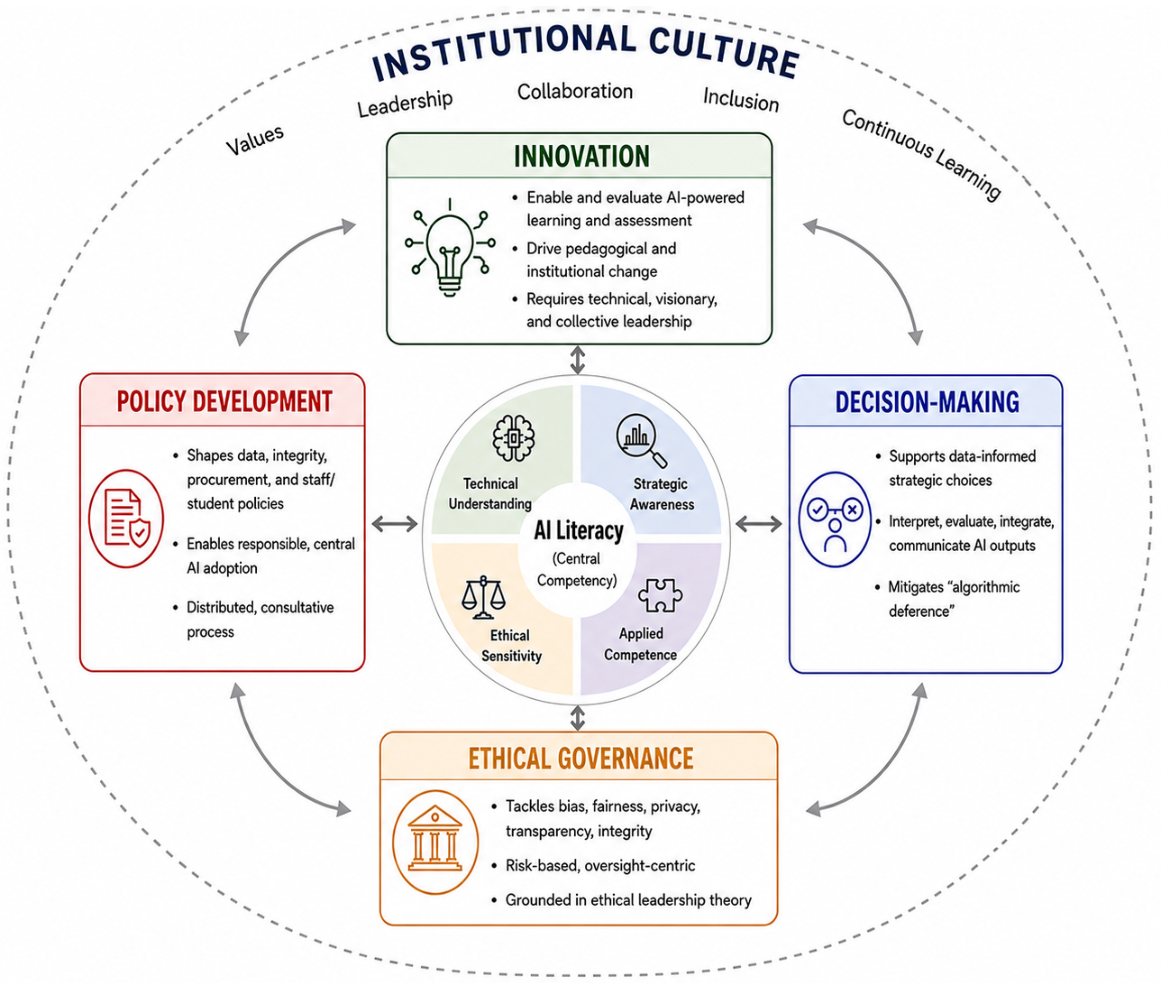
Figure 2 presents the overall architecture of the AILLF. The framework is organised around a central AI literacy capability model comprising four interrelated dimensions: Technical Understanding, Strategic Awareness, Ethical Sensitivity, and Applied Competence. These dimensions collectively support four interconnected leadership domains: Innovation, Decision-Making, Ethical Governance, and Policy Development. Bidirectional links between AI literacy and the four domains represent proposed reciprocal relationships in capability development, while the cyclical connections between domains conceptualise potential processes of institutional co-evolution across governance, operational, and strategic processes.
A key structural component of the framework is the outer institutional culture layer, which represents the broader organisational environment within which AI adoption and capability development occur. The empirical findings indicated that participants perceived institutional culture as an important factor influencing AI integration, particularly through leadership support, collaborative practices, inclusion, organisational values, and continuous learning mechanisms. Accordingly, the framework conceptualises AI literacy not as an isolated individual competency, but as a leadership capability that contributes to broader institutional AI capability within supportive organisational and governance contexts.
The framework was developed according to five guiding principles derived through the integration of the empirical findings presented in
Section 4 with the literature on AI literacy, educational leadership, institutional AI governance, and organisational capability reviewed in
Section 2. Collectively, these principles synthesise the recurring themes identified through the thematic analysis while remaining theoretically grounded in established perspectives on educational leadership, AI literacy, and responsible AI adoption:
Empirical grounding: Framework dimensions and relationships were informed by patterns identified across the survey findings and illustrative interview themes, together with relevant leadership theory and AI governance frameworks. The empirical findings, particularly those relating to institutional readiness, leadership capability, governance, and organisational support for AI adoption, contributed to the refinement and conceptual development of these framework elements.
Systemic integration: AI literacy is modelled as part of a broader institutional capability ecosystem involving governance, leadership, organisational culture, and operational practice. It is also consistent with previous studies that conceptualise AI capability as an organisational rather than purely technical construct [
60,
61].
Operational orientation: The framework focuses on practical leadership capabilities relating to AI-supported institutional decision-making, governance, and implementation. This principle was informed by participants’ repeated emphasis on translating AI literacy into institutional policies, governance practices, and everyday leadership decision-making.
Context sensitivity: Capability requirements vary across leadership roles, institutional structures, and disciplinary environments. This principle emerged from both the survey findings and the interviews, which highlighted differences in AI literacy requirements across leadership roles, disciplinary contexts, and institutional environments.
Developmental progression: AI literacy is treated as a continuously evolving institutional capability rather than a static technical skill. This principle reflects participants’ perception that AI literacy develops progressively through organisational experience, continuous professional learning, and institutional support mechanisms, rather than representing a fixed technical competency.
5.2. AI Literacy as a Multidimensional Capability
At the centre of the framework is AI literacy, conceptualised as a multidimensional capability supporting institutional AI adoption, governance, and leadership practice [
39,
67]. The framework defines AI literacy through four interrelated dimensions that collectively support AI-enabled decision-making and organisational readiness.
Technical Understanding: Foundational understanding of AI concepts, including machine learning, generative AI, natural language processing, data analytics, and algorithmic limitations. This dimension enables leaders to evaluate the capabilities, constraints, and operational implications of AI systems within educational settings.
Strategic Awareness: The ability to assess the institutional implications of AI adoption, including organisational transformation, competitive positioning, curriculum adaptation, resource allocation, and long-term governance considerations.
Ethical Sensitivity: Awareness of ethical risks associated with AI systems, including algorithmic bias, privacy, explainability, accountability, surveillance, and academic integrity. This dimension was informed by participants’ repeated emphasis on ethical governance, which emerged as a recurring area of concern throughout the survey and interview findings.
Applied Competence: The operational ability to translate AI understanding into institutional practice, including procurement decisions, implementation planning, policy formation, oversight mechanisms, and evaluation of AI-supported processes.
The empirical findings indicate that these dimensions do not operate independently. Instead, effective institutional AI capability depends on their combined interaction. For example, technical understanding without ethical sensitivity may lead to poorly governed implementation, while strategic awareness without applied competence may limit operational adoption. The framework therefore positions AI literacy as a composite leadership capability rather than a purely technical form of knowledge.
5.3. Leadership Capability Domains
The Leadership Capability Domains represent the key areas in which AI literacy supports effective leadership within higher education institutions. Based on the findings of this study, the framework identifies four interrelated domains: innovation, decision-making, ethical governance, and policy development. Together, these domains demonstrate how AI literacy contributes to responsible institutional leadership and AI integration.
5.3.1. Innovation
Within the framework, innovation refers to the institutional capacity to identify, evaluate, and scale AI-supported educational and organisational practices. Survey findings demonstrated that participants reporting higher perceived AI literacy reported greater confidence in evaluating AI-enabled innovation opportunities and supporting pedagogical transformation initiatives. Interview findings similarly highlighted strong institutional interest in generative AI applications despite concerns regarding organisational readiness and governance maturity.
The framework conceptualises innovation as extending beyond technological experimentation to include curriculum redesign, AI-supported assessment, intelligent tutoring systems, adaptive learning environments, research support, and institutional workflow optimisation. AI literacy supports innovation capability by enabling leaders to distinguish between strategically valuable implementations and superficial or poorly governed adoption. The findings further indicate that sustainable innovation depends on complementary organisational conditions including staff development, infrastructure readiness, ethical oversight, and collaborative institutional culture.
5.3.2. Decision-Making
The decision-making domain focuses on AI-supported strategic and operational judgement within higher education institutions. The empirical findings indicated that participants viewed AI literacy as supporting the integration of AI-assisted insights into institutional planning, governance, and resource allocation processes.
The framework identifies four operational competencies supporting AI-informed decision-making: interpretation competence, critical evaluation competence, integration competence, and communication competence. Together, these capabilities enable leaders to interpret algorithmic outputs, identify potential biases and limitations, combine AI-generated insights with contextual and qualitative information, and communicate AI-informed decisions transparently across institutional stakeholders.
A recurring finding across both the survey and interview phases was concern regarding uncritical reliance on AI-generated outputs. The framework therefore explicitly addresses the risk of “algorithmic deference”, where institutional decision-making becomes overly dependent on AI recommendations without sufficient human evaluation and contextual judgement. In this sense, AI literacy functions as a governance safeguard supporting responsible human–AI collaborative decision-making rather than automated substitution of professional expertise.
5.3.3. Ethical Governance
The ethical governance domain addresses the institutional mechanisms required to ensure responsible, transparent, and accountable AI adoption. Both the survey and interview findings identified ethical governance as a major institutional concern, particularly regarding fairness, transparency, privacy, academic integrity, and human oversight.
Within the framework, ethical governance includes several interconnected operational areas: detection and mitigation of algorithmic bias; governance of educational data collection and processing; explainability of AI-supported institutional decisions; oversight of generative AI use within assessment and academic practice; and preservation of meaningful human agency in high-stakes educational processes. The findings additionally suggested that participants’ experiences of AI engagement varied across disciplinary contexts. However, the present study was not designed to establish systematic differences in AI engagement between disciplinary groups.
The framework therefore positions ethical governance as an active institutional process rather than a static compliance requirement. Effective governance depends on continuous monitoring, leadership accountability, policy adaptation, and institution-wide AI literacy capable of supporting informed oversight of AI supported processes.
5.3.4. Policy Development
The policy development domain focuses on the institutional structures and regulatory mechanisms required to operationalise responsible AI adoption within higher education environments. The empirical findings indicated that participants reporting higher perceived AI literacy also described greater involvement in AI policy formation and strategic governance activities.
Within the framework, policy development encompasses governance mechanisms relating to data management, academic integrity, procurement standards, transparency requirements, staff development, student-facing AI practices, and institutional oversight procedures. Rather than treating AI governance as a standalone policy issue, the framework conceptualises policy development as a continuous adaptive process responding to evolving institutional needs, regulatory requirements, and technological change.
The findings further suggest that participants perceived distributed institutional participation involving academic staff, administrators, technical specialists, students, and leadership teams as important for effective policy development.
5.4. Inter-Domain Dynamics and Institutional Co-Evolution
Although the framework presents four distinct leadership domains for analytical clarity, the AILLF conceptually proposes that these domains operate as an interacting institutional capability system. This proposition is informed by the empirical findings together with leadership theory and AI governance perspectives. Innovation initiatives generate governance and policy requirements; governance structures constrain and shape AI implementation practices; decision-making processes influence policy adaptation; and institutional policies directly affect organisational readiness for AI-supported innovation.
The bidirectional relationships illustrated in
Figure 2 represent proposed inter-domain interactions and processes of institutional co-evolution rather than empirically established dynamic relationships. The AILLF conceptually proposes that, as institutions develop experience with AI-supported processes, changes in leadership capability and organisational AI literacy may interact across the four domains. AI literacy development is therefore conceptualised as a potentially recursive institutional process involving relationships between governance, operational practice, organisational culture, and strategic leadership. Given the cross-sectional design of the present study, these proposed dynamics require validation through future longitudinal and institution-level research.
The empirical findings further suggest that participants perceived institutional culture as playing an important role in shaping these interactions. Participants described collaborative leadership, continuous learning, and organisational openness as creating supportive conditions for translating individual AI literacy into broader organisational practices. Conversely, participants perceived fragmented governance structures, limited professional development, and organisational resistance as barriers to operationalising AI-supported innovation despite growing awareness of AI’s strategic importance.
Taken together, the AILLF conceptualises AI literacy as a multidimensional institutional capability supporting AI-enabled leadership, governance, and human–AI collaborative decision-making within higher education. By integrating operational competencies, governance dynamics, organisational culture, and institutional co-evolution mechanisms, the framework provides a structured foundation for analysing and supporting responsible AI adoption across higher education environments.
5.5. Comparative Positioning of the AILLF
To contextualise the contribution of the AILLF, the framework was compared with representative AI literacy, digital competence, and AI capability frameworks spanning educational, public sector, and organisational contexts. The comparison dimensions were selected deductively based on themes commonly addressed in the literature, including leadership orientation, governance, implementation guidance, empirical foundation, and institutional applicability. Each framework was examined with respect to the extent to which these dimensions were explicitly addressed in its original publication. Accordingly, the comparison does not represent a systematic evaluation, ranking, or claim of superiority, but rather a qualitative conceptual positioning intended to illustrate the scope and emphasis of the AILLF relative to selected frameworks.
Table 7 summarises this comparison.
Table 7 provides a conceptual comparison of the AILLF with representative AI literacy, digital competence, leadership, governance, and organisational capability frameworks. The classifications reflect the extent to which each framework explicitly addresses the selected comparison dimensions in its original publication, where a checkmark indicates explicit coverage, a partial indicator denotes limited or indirect coverage, and the absence of a symbol indicates that the dimension is not a primary focus. The comparison is intended to contextualise the contribution of the AILLF rather than provide a formal evaluation or ranking of the selected frameworks. As the AILLF is a proposed conceptual leadership framework, its practical value requires future empirical validation through institutional implementation studies.
Existing frameworks generally address AI literacy either as a technical competency, a pedagogical capability, or a broader organisational readiness construct. However, comparatively limited attention has been given to the intersection between AI literacy, institutional leadership, governance, and strategic decision-making within higher education environments. As shown in
Table 7, the AILLF extends prior approaches by integrating leadership capability, governance, ethical oversight, and operational implementation within a unified institutional framework.
Ref. [
39] proposed a set of AI literacy competencies oriented primarily towards general public understanding of AI technologies, without addressing organisational leadership or institutional governance dimensions. Similarly, ref. [
67] introduced a four-dimensional AI literacy framework for K–16 education focused mainly on learner and educator competencies rather than leadership capability and institutional strategy. The DigCompEdu framework [
69] addresses broader digital competence development but predates the rapid expansion of generative AI technologies and does not explicitly incorporate AI governance or institutional leadership dimensions. The UNESCO AI Competency Framework for Teachers [
8] provides important guidance for educator competency development, although its primary emphasis remains classroom-level practice rather than organisational AI governance and institutional transformation.
Other frameworks have addressed related dimensions of AI governance and organisational capability. Ref. [
52] proposed an AI policy education framework centred primarily on instructional policy considerations, while ref. [
60] conceptualised AI capability from a corporate organisational perspective without addressing the governance and leadership dynamics specific to higher education institutions.
The comparative analysis indicates that the AILLF extends existing AI literacy and capability frameworks in several ways. First, it positions AI literacy explicitly as a leadership and governance capability within higher education contexts rather than solely as a pedagogical or technical competency. Second, the framework integrates strategic, ethical, operational, and organisational dimensions into a unified institutional capability model. Third, the inclusion of the capability progression model and role-differentiated competency matrix provides an operational layer that is largely absent from existing AI literacy frameworks. Finally, the framework combines empirical findings, leadership theory, governance considerations, and cross-sector AI capability perspectives within a higher education context, supporting both conceptual analysis and practical institutional implementation.
6. Framework Implementation Guidance
The empirical findings revealed variation in participants’ self-reported AI literacy, perceptions of institutional readiness, and reported access to structured support mechanisms across higher education contexts. Building on these findings, this section presents proposed implementation guidance for the AILLF through three complementary components: a proposed AI leadership capability progression model, a role-differentiated leadership competency guide, and a set of institutional recommendations intended to support strategic AI capability development within higher education institutions. These components are conceptual implementation mechanisms designed to support institutional reflection and future empirical validation rather than validated organisational assessment instruments.
6.1. Institutional AI Capability Progression
Table 8 presents a proposed AI leadership capability progression model informed by public sector AI readiness frameworks [
61] and organisational AI capability models [
60]. The model adapts the developmental logic of organisational AI capability formation to higher education leadership contexts, providing a conceptual implementation guide for institutional AI capability development across governance, leadership, operational integration, and organisational culture. The proposed progression is intended to illustrate how institutional AI capability may evolve and should not be interpreted as a validated organisational maturity model or assessment instrument.
The proposed progression model conceptualises institutional AI capability as an evolving developmental process rather than a binary distinction between AI adoption and non-adoption. The stages illustrate increasing coordination between leadership capability, governance structures, organisational culture, and operational implementation. They are intended as indicative descriptions of institutional capability and should not be interpreted as a prescriptive or strictly linear sequence. Institutions may demonstrate characteristics associated with multiple stages simultaneously across different organisational dimensions.
The model should be regarded as a proposed conceptual tool intended to support institutional reflection and future empirical validation rather than as a validated maturity assessment instrument. In practice, progression could be informed by evidence such as the existence of formal AI strategies, governance structures, leadership development programmes, institution-wide professional development initiatives, documented AI policies, and systematic evaluation of AI-supported practices.
6.2. Role-Differentiated AI Leadership Competencies
Table 9 presents a proposed role-differentiated AI leadership competency guide informed by the empirical findings, leadership theory, and AI governance literature. The matrix illustrates the relative emphasis of operational and strategic AI leadership responsibilities across representative institutional roles and is intended to support implementation of the AILLF rather than serve as a validated competency assessment instrument.
The competency matrix operationalises the framework by linking AI literacy requirements to leadership responsibilities and governance scope within higher education. The framework proposes that operational leadership roles place greater emphasis on implementation-oriented competencies relating to educational practice and local deployment, while senior leadership roles require stronger strategic and governance capabilities. Middle leadership roles are conceptualised as bridging operational implementation and institutional coordination. This role differentiation was informed by participants’ reported leadership responsibilities and perceptions of AI implementation across different leadership contexts identified through the survey and interview findings.
The competency matrix is intended as a proposed conceptual guide for leadership development rather than a validated assessment instrument. Institutions adopting the framework could evaluate competency development through multiple sources of evidence, including participation in professional development activities, documented leadership responsibilities relating to AI governance, contributions to institutional AI strategy and policy development, reflective self-assessment, and peer or organisational review.
6.3. Institutional Implementation Recommendations
Building on the AILLF and its proposed implementation guidance, the following recommendations present a conceptual approach to supporting the development of AI literacy as a strategic institutional capability within higher education.
Establish AI literacy as a formal leadership competency. Incorporate AI literacy explicitly within leadership role descriptions, appointment criteria, and professional development frameworks across operational, middle, and senior leadership levels.
Develop cross-functional AI governance structures. Integrate academic, technical, administrative, and ethical expertise into institutional AI governance and implementation processes.
Conduct periodic institutional AI readiness assessments. Use structured maturity models and governance audits to evaluate institutional capability, identify implementation gaps, and monitor organisational progression over time.
Design role-differentiated AI development pathways. Provide staged professional development opportunities aligned with operational, managerial, and strategic leadership responsibilities.
Develop adaptive AI governance frameworks. Align institutional governance mechanisms with evolving regulatory frameworks including the EU AI Act, OECD AI Principles, and UNESCO AI competency guidance.
Support cross-sector and inter-institutional collaboration. Share governance practices, implementation strategies, and training resources across institutions and external stakeholders to accelerate institutional capability development.
Address disciplinary contexts in AI literacy development. Provide context-specific resources and professional development that reflect differing disciplinary needs, applications, and educational contexts.
Embed ethical oversight within institutional AI deployment. Establish structured evaluation mechanisms for assessing fairness, accountability, transparency, and human oversight in AI-supported educational processes.
Collectively, these proposed implementation components conceptualise AI literacy as a continuously evolving organisational capability requiring coordinated leadership development, institutional governance, and sustained organisational investment. Rather than approaching AI literacy solely as technical training, the AILLF emphasises institution-wide capability development intended to support responsible AI adoption, governance maturity, and strategic institutional adaptation within higher education.
7. Discussion
The findings of this study, together with the AILLF, highlight the increasingly strategic role that participants attributed to AI literacy within higher education leadership. Self-reported AI literacy varied across leadership levels and disciplinary environments, while participants also described differences in the institutional contexts within which they worked. These perceptions reinforce previous observations that AI capability development within higher education remains fragmented and is often concentrated within technically oriented disciplines [
30,
31]. Participants viewed AI literacy as encompassing strategic, ethical, and operational capabilities that support leadership, governance, and organisational decision-making, consistent with previous research emphasising that effective leadership in AI-enabled environments depends on the ability to critically evaluate, govern, and strategically integrate AI rather than simply adopt new technologies [
33,
37,
38,
70,
71].
The findings further suggest that participants viewed AI literacy as a continuously evolving leadership capability requiring ongoing adaptation to changing organisational and technological contexts. Rapid developments in generative AI, learning analytics, and AI-supported decision-making systems mean that competency requirements are unlikely to remain stable over time. Accordingly, the AILLF conceptualises AI literacy through broader capability dimensions rather than fixed technical skills, emphasising adaptive learning, governance awareness, and organisational responsiveness as central leadership competencies [
57]. At the same time, participants reported that their institutions experienced difficulties in translating growing awareness of AI’s strategic importance into coordinated governance structures, sustainable professional development mechanisms, and institution-wide implementation practices. These perceptions are consistent with wider challenges relating to organisational readiness, technology adoption, and leadership for change identified in the literature [
32,
48,
58].
These findings address the research gap identified in the Introduction by providing empirical insight into how educational leaders perceive AI literacy in relation to leadership preparedness, governance, institutional readiness, and strategic decision-making. Participants described interconnected needs spanning strategic awareness, ethical judgement, applied competence, organisational support, and governance capability, reinforcing the multidimensional nature of AI literacy. These findings informed the conceptual refinement of the AILLF, including its role-differentiated competency guide and capability progression model, which should be understood as empirically informed conceptual components rather than validated institutional assessment tools.
The findings also raise important critical and ethical considerations regarding AI adoption within higher education. In positioning AI literacy as a strategic leadership capability, the framework risks reinforcing techno-solutionist assumptions that increased AI adoption necessarily produces institutional improvement [
5]. The empirical findings, however, suggest that participants associated responsible leadership not only with technical engagement with AI systems, but also with the capacity to critically evaluate their limitations, risks, and unintended consequences. Concerns relating to algorithmic bias, academic integrity, transparency, and overreliance on AI-generated outputs were consistently identified across both the survey and interview phases. The framework therefore positions ethical judgement, human oversight, and critical evaluation as integral components of AI-literate leadership and as foundational elements of the broader institutional capability that the framework conceptually proposes [
59,
72].
The analysis further suggests that responsible AI leadership should not be interpreted as an obligation to maximise AI adoption across all institutional activities. Rather, an important aspect of AI literacy is the ability to critically evaluate whether AI represents an appropriate solution for a particular educational or organisational context. In situations where educational values, contextual understanding, professional expertise, or ethical considerations are paramount, preserving human judgement may be preferable to AI-supported approaches. From this perspective, AI-literate leadership involves not only enabling responsible AI adoption but also recognising when limiting, delaying, or declining AI implementation constitutes the most appropriate organisational decision.
Structural inequalities across the higher education sector were also reflected in participants’ accounts of AI capability development and implementation. Participants described variation in access to training opportunities, technological infrastructure, governance expertise, and institutional investment, suggesting that differences in institutional resources may influence opportunities for AI capability development across higher education contexts [
28,
73]. Without coordinated sector-level support, AI literacy may therefore become an additional source of institutional stratification within higher education. Although the AILLF was developed primarily within the UK higher education context, its alignment with international AI governance frameworks including the EU AI Act, the OECD AI Principles, and the UNESCO AI Competency Framework supports broader conceptual applicability across different educational systems and governance environments. Nevertheless, contextual adaptation remains necessary given variation in regulatory structures, organisational cultures, and institutional leadership models.
The study also has practical implications for higher education institutions. Participants’ experiences suggest that developing AI literacy requires coordinated governance, role-sensitive professional development, and sustained institutional investment rather than isolated technical training initiatives. Building on these findings, the proposed capability progression model and leadership competency guide provide implementation guidance to support institutional reflection on leadership development, governance practices, and organisational readiness. More broadly, successful AI integration depends not only on technological implementation but also on collaborative governance, organisational culture, and responsible human oversight.
Several limitations should be acknowledged. As a mixed-methods study involving 52 educational leaders from UK higher education institutions, the findings may not be fully generalisable to other national or institutional contexts. Furthermore, the unit of analysis was the individual educational leader rather than the higher education institution. Consequently, institutional readiness, governance, organisational culture, and AI capability were examined through participants’ perceptions rather than direct institution-level assessment, and the findings should not be interpreted as demonstrating organisational capability or enabling comparisons between institutions. The relatively high proportion of participants from Engineering and Technology may also have introduced disciplinary selection bias, potentially influencing reported levels of AI engagement and perceptions of AI literacy. Future research should employ institution-level designs involving multiple informants and organisational indicators to validate the institutional capability dimensions proposed in the AILLF. The proposed capability progression model and leadership competency guide are conceptually and empirically informed but have not yet undergone large-scale institutional validation. In addition, reliance on self-reported measures of AI literacy may not fully reflect actual competency levels, while the rapidly evolving nature of AI technologies and governance frameworks means that leadership requirements and institutional approaches to AI are likely to continue evolving over time.
8. Conclusions and Future Work
This study examined the role of AI literacy in educational leadership through an empirical investigation involving 52 academic leaders across UK higher education institutions and the development of the AI Literacy Leadership Framework (AILLF). The findings suggest that AI literacy within higher education leadership extends beyond technical understanding to encompass strategic awareness, ethical judgement, governance capability, and applied competence. In response to the capability gaps and leadership challenges identified by participants, the study presents the AILLF as an empirically informed conceptual framework that connects AI literacy with four interrelated leadership domains: innovation, decision-making, ethical governance, and policy development. The framework is accompanied by proposed implementation guidance comprising a capability progression model and a role-differentiated leadership competency guide.
The empirical findings indicated variation in participants’ self-reported AI literacy across the study sample, with descriptive differences observed across leadership roles and disciplinary contexts. Participants’ experiences further suggested that effective AI literacy depends not only on individual leadership capability but also on organisational culture, governance practices, institutional support, and sustained professional development. Collaborative leadership, effective governance, and continuous learning were perceived as enabling the strategic and responsible integration of AI, whereas fragmented governance arrangements, limited institutional support, and restricted professional development were frequently described as barriers to wider organisational adoption.
The study further highlights the importance of approaching AI literacy as a long-term organisational capability rather than a short-term technical training requirement. The proposed implementation guidance offers a conceptual approach to supporting leadership development, strengthening governance practices, and embedding responsible AI use within institutional decision-making. More broadly, the findings suggest that successful AI integration depends not only on technological implementation but also on meaningful human oversight, critical evaluation, and ethical accountability.
Several directions for future research emerge from this study. Expanding the research across larger and more internationally diverse samples would strengthen the generalisability of the findings and enable comparative analyses across different higher education systems, governance structures, and institutional contexts. Longitudinal research examining how AI literacy develops over time would provide valuable insight into leadership capability development, organisational adaptation, and the evolving role of AI within higher education. In addition, larger and more balanced datasets would facilitate the application of inferential statistical methods to examine relationships between leadership characteristics, institutional contexts, and AI literacy dimensions, thereby providing stronger empirical evidence to support and refine the proposed framework.
Future research should also focus on the systematic validation of the AILLF and its proposed implementation guidance. Expert review involving higher education leaders, AI governance specialists, and educational technology researchers could assess the clarity, relevance, and content validity of the framework’s dimensions, capability stages, and role-differentiated leadership competency guide. Institutional pilot studies across diverse higher education settings could then examine the practical applicability and usability of the capability progression model and leadership competency guide. Larger-scale and longitudinal studies should subsequently evaluate whether the proposed capability progression model can distinguish different levels of institutional AI capability and capture organisational development over time. Finally, future research should develop and psychometrically validate measurement instruments derived from the framework to support consistent assessment of its technical, strategic, ethical, and applied dimensions.
In addition, as the questionnaire was developed specifically for the exploratory objectives of this study, it does not represent a previously validated psychometric instrument. Its reliability and validity should therefore be evaluated across larger and more diverse higher education populations. Future research should also complement self-reported measures with objective or performance-based assessments to examine the relationship between perceived AI literacy and demonstrated competence across the framework’s capability dimensions and finally, as AI continues to reshape higher education, the ability of institutional leaders to engage critically, strategically, and ethically with AI technologies will become increasingly important for institutional resilience, effective governance, and responsible innovation. Developing AI literacy as a strategic leadership capability therefore represents not only a response to technological change but also an important step towards strengthening institutional capacity for responsible, adaptive, and sustainable AI adoption within higher education.