



Artificial Intelligence and Youth: Cognitive, Educational, and Behavioral Impacts

Abstract
1. Introduction
1.1. The Global Diffusion of AI
1.2. Youth in AI Diffusion
1.3. Opportunities and Challenges for Youth
1.4. Key Questions and Aim
2. Design and Organization of the Narrative Study
2.1. Methodology of the Narrative Review
2.2. Themes and Structure
- Cognitive, educational and academic impacts
- Professional Consequences
- Psychological and Behavioral Dimensions
- AI Literacy, Trust, and 21st-Century Skills
- Strategies for Responsible AI Integration
3. Cognitive, Educational and Academic Impacts
4. Professional Consequences of AI Use
5. Psychological and Behavioral Dimensions
- Generative AI chatbots can foster psychological dependence, particularly when perceived as companions or mentors [76].
- Frequent engagement with AI may reduce self-regulatory capacities, impacting mental well-being [76].
- Professional contexts, such as healthcare or educational assessment, can influence susceptibility to habitual AI reliance, linking occupational habits to psychological patterns [76].
6. AI Literacy, Trust, and 21st-Century Skills
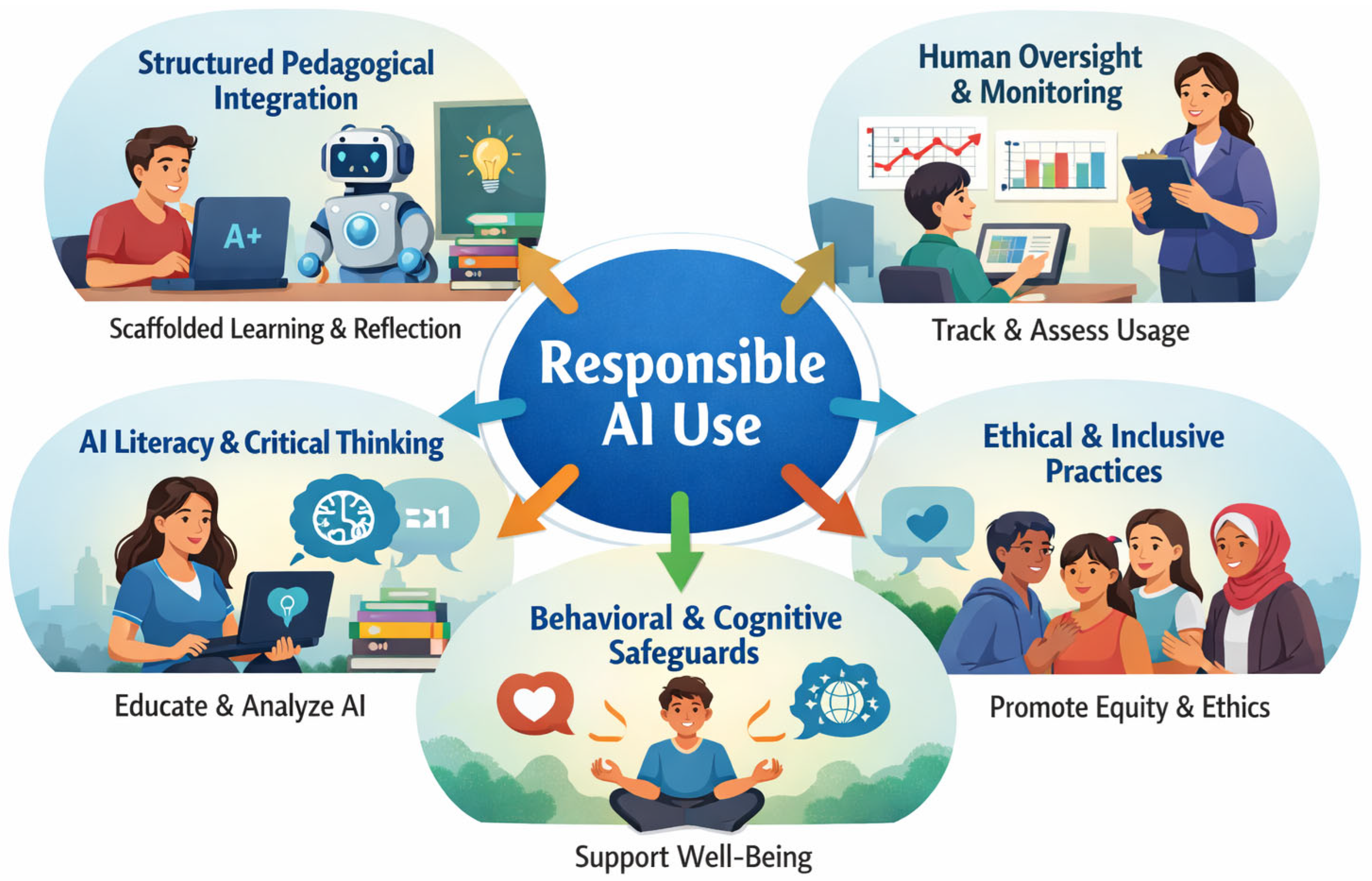
7. Strategies for Responsible AI Integration
- Scaffolded use: AI should be employed purposefully, with clear expectations for when and how it supports tasks, promoting balanced engagement and preventing over-reliance.
- Human oversight: Central to all AI-assisted activities, oversight ensures that AI complements rather than replaces critical decision-making, preserving accountability and ethical responsibility.
- Reflective practices: Users should justify AI-assisted decisions and compare AI-generated outputs with human-generated alternatives, fostering critical evaluation and metacognitive awareness.
- Assignment of responsibility: Clear delineation of roles prevents diffusion of accountability, ensuring users remain engaged and ethically responsible.
8. Discussion
- The Added Value of the Narrative Review
- Cognitive, Behavioral, and Educational Impacts of AI and GenAI Use
- Artificial Intelligence Policy and Governance
- Monitoring AI Engagement and Emerging Tools for Assessment
- Critical Considerations and Knowledge Gaps in AI and GenAI Use
- Emerging Recommendations for Responsible AI Use
- Limitations of the Study
8.1. The Added Value of the Narrative Review
8.2. Cognitive, Behavioral, and Educational Impacts of AI and GenAI Use: Opportunities and Gaps/Challenges
8.3. Artificial Intelligence Policy and Governance: Global Perspectives
8.4. Monitoring AI Engagement and Emerging Tools for Assessment
8.5. Critical Considerations and Knowledge Gaps in AI and GenAI Use
8.5.1. Intersectional Disparities and Digital Divides
- Infrastructure Divide
- Digital and AI Literacy Divide
- Intersectionality and Combined Effects
8.5.2. Differentiating AI Dependency from General Technology Dependency
- Variability Across Tool Types and Contexts
- Psychometric Assessment of AI-Specific Dependency
- Behavioral and Cognitive Implications
- Future Directions
- Expand validation of AI-focused scales across diverse educational contexts and cultures.
- Investigate longitudinal impacts of AI engagement on learning outcomes and mental well-being.
8.5.3. The AI Literacy–Dependency Paradox
- Metacognitive practices that encourage reflection on the why and how of AI outputs.
- Critical evaluation skills to distinguish reliable from spurious content.
- Pedagogical designs that use AI to support independent reasoning rather than bypass it [114].
8.5.4. Adapting Global Policies to Local Contexts
- Curricular adaptation to integrate AI literacy and critical evaluation skills into subject-specific learning activities.
- Teacher professional development to translate policy principles into practice.
- Institutional governance mechanisms, such as responsible AI guidelines, assessment integrity policies, and monitoring systems.
- Cultural and linguistic localization to reflect the needs of diverse learner populations.
8.6. Emerging Recommendations for Responsible AI Use
- Human Oversight and Monitoring—Students’ AI engagement should be systematically observed. Psychometric instruments such as the Conversational AI Dependence Scale (CAIDS) and the Problematic ChatGPT Use Scale (PCGUS) allow early identification of maladaptive patterns, including compulsive engagement, mood modification, and cognitive offloading ([103,104,105]).
8.7. Limitations of the Study
9. Conclusions
10. Future Directions
Supplementary Materials
Author Contributions
Funding
Institutional Review Board Statement
Informed Consent Statement
Data Availability Statement
Acknowledgments
Conflicts of Interest
References
- Global AI Adoption in 2025—A Widening Digital Divide. Available online: https://www.microsoft.com/en-us/corporate-responsibility/topics/AI-Economy-Institute/reports/Global-AI-Adoption-2025/ (accessed on 3 February 2026).
- Borgonovi, F.; Bastagli, F.; Ochojska, M.; Piumatti, G. AI Adoption in the Education System: International Insights and Policy Considerations for Italy; OECD Artificial Intelligence Papers, No. 52; OECD Publishing: Paris, France; Fondazione Agnelli: Turin, Italy, 2025. [Google Scholar] [CrossRef] [Scilit]
- OECD Inequalities in AI Diffusion. Format Research. Available online: https://formatresearch.com/en/2025/06/25/disuguaglianze-nella-diffusione-dellia-ocse/ (accessed on 3 February 2026).
- Ali, H.; Mustafa, A.U.; Aysan, A.F. Global adoption of generative AI: What matters most? J. Econ. Technol. 2025, 3, 166–176. [Google Scholar] [CrossRef] [Scilit]
- Rieder, E. The Generational Divide in AI Adoption: How Age Shapes the Integration and Use of Intelligent Tools? Trends Comput. Sci. Inf. Technol. 2025, 10, 035–042. [Google Scholar] [CrossRef] [Scilit]
- Klarin, J.; Hoff, E.; Larsson, A.; Daukantaitė, D. Adolescents’ use and perceived usefulness of generative AI for schoolwork: Exploring their relationships with executive functioning and academic achievement. Front. Artif. Intell. 2024, 7, 1415782. [Google Scholar] [CrossRef] [Scilit] [PubMed] [PubMed Central]
- Maheux, A.J.; Akre-Bhide, S.; Boeldt, D.; Flannery, J.E.; Richardson, Z.; Burnell, K.; Telzer, E.H.; Kollins, S.H. Generative Artificial Intelligence Applications Use Among US Youth. JAMA Netw. Open. 2026, 9, e2556631. [Google Scholar] [CrossRef] [Scilit]
- Caffaratti, L.B.; Longobardi, C.; Badenes-Ribera, L.; Marengo, D. AI adoption among adolescents in education: Extending the UTAUT2 with psychological and contextual factors. Front. Artif. Intell. 2025, 8, 1614993. [Google Scholar] [CrossRef] [Scilit] [PubMed] [PubMed Central]
- Common Sense Media; Hopelab; The Center for Digital Thriving at Harvard Graduate School of Education. Teen and Young Adult Perspectives on Generative AI: Patterns of Use, Excitements, and Concerns; Common Sense Media: San Francisco, CA, USA, 2024; Available online: https://www.commonsensemedia.org/sites/default/files/research/report/teen-and-young-adult-perspectives-on-generative-ai.pdf (accessed on 3 February 2026).
- Green, A.; Tench, B.; Weinstein, E. How Young People Feel About Generative AI. Common Sense Media, 2024. Available online: https://www.commonsensemedia.org/kids-action/articles/how-young-people-feel-about-generative-ai (accessed on 3 February 2026).
- Schaaff, C.; Bains, M.; Davis, S.; Amalraj, T.; Frank, A.; Waselewski, M.; Chang, T.; Wong, A. Youth Perspectives on Generative AI and Its Use in Health Care. J. Med. Internet Res. 2025, 27, e72197. [Google Scholar] [CrossRef] [Scilit]
- Wu, D.; Zhang, J. Generative artificial intelligence in secondary education: Applications and effects on students’ innovation skills and digital literacy. PLoS ONE 2025, 20, e0323349. [Google Scholar] [CrossRef] [Scilit] [PubMed] [PubMed Central]
- Cen, X.; Shakibaei, G. Enhancing creative writing through AI-powered co-creation with cognitive and emotional outcomes. Sci. Rep. 2026, 16, 4407. [Google Scholar] [CrossRef] [Scilit] [PubMed]
- Francis, N.J.; Jones, S.; Smith, D.P. Generative AI in Higher Education: Balancing Innovation and Integrity. Br. J. Biomed. Sci. 2025, 81, 14048. [Google Scholar] [CrossRef] [Scilit] [PubMed] [PubMed Central]
- Leahy, K.; Ozer, E.; Cummins, E.P. AI-ENGAGE: A Multicentre Intervention to Support Teaching and Learning Engagement with Generative Artificial Intelligence Tools. Educ. Sci. 2025, 15, 807. [Google Scholar] [CrossRef] [Scilit]
- Khoso, A.K.; Honggang, W.; Younas, M.; Salam El-Dakhs, D.A. The Dual Forces of AI: How Generative AI and Perceived AI Dependency Influence Fear of Missing Out (FoMO) and EFL Students’ Vocabulary Acquisition. J. Vis. Exp. 2025, 226, e69637. [Google Scholar] [CrossRef] [Scilit] [PubMed]
- Jia, W.; Pan, L.; Neary, S. Effect of GenAI Dependency on University Students’ Academic Achievement: The Mediating Role of Self-Efficacy and Moderating Role of Perceived Teacher Caring. Behav. Sci. 2025, 15, 1348. [Google Scholar] [CrossRef] [Scilit] [PubMed] [PubMed Central]
- Alhur, A.A.; Khlaif, Z.N.; Hamamra, B.; Hussein, E. Paradox of AI in Higher Education: Qualitative Inquiry into AI Dependency Among Educators in Palestine. JMIR Med. Educ. 2025, 11, e74947. [Google Scholar] [CrossRef] [Scilit] [PubMed] [PubMed Central]
- Guo, Y.; Liu, X. School education prevents AI dependency to promote mental health among college students. J. Affect. Disord. 2026, 392, 120185. [Google Scholar] [CrossRef] [Scilit] [PubMed]
- Heinrichs, H.; Kies, A.; Nagel, S.K.; Kiessling, F. Physicians’ Attitudes Toward Artificial Intelligence in Medicine: Mixed Methods Survey and Interview Study. J. Med. Internet Res. 2025, 27, e74187. [Google Scholar] [CrossRef] [Scilit] [PubMed] [PubMed Central]
- Zhang, D.; Wijaya, T.T.; Wang, Y.; Su, M.; Li, X.; Damayanti, N.W. Exploring the relationship between AI literacy, AI trust, AI dependency, and 21st century skills in preservice mathematics teachers. Sci. Rep. 2025, 15, 14281. [Google Scholar] [CrossRef] [Scilit] [PubMed] [PubMed Central]
- Kooli, C.; Kooli, Y.; Kooli, E. Generative artificial intelligence addiction syndrome: A new behavioral disorder? Asian J. Psychiatr. 2025, 107, 104476. [Google Scholar] [CrossRef] [Scilit] [PubMed]
- Benjamin, J.; Masters, K.; Agrawal, A.; MacNeill, H.; Mehta, N. Twelve tips on applying AI tools in HPE scholarship using Boyer’s model. Med. Teach. 2025, 47, 949–954. [Google Scholar] [CrossRef] [Scilit] [PubMed]
- Wijaya, T.T.; Yu, Q.; Cao, Y.; He, Y.; Leung, F.K.S. Latent Profile Analysis of AI Literacy and Trust in Mathematics Teachers and Their Relations with AI Dependency and 21st-Century Skills. Behav. Sci. 2024, 14, 1008. [Google Scholar] [CrossRef] [Scilit] [PubMed] [PubMed Central]
- Zhong, W.; Luo, J.; Lyu, Y. How Do Personal Attributes Shape AI Dependency in Chinese Higher Education Context? Insights from Needs Frustration Perspective. PLoS ONE 2024, 19, e0313314. [Google Scholar] [CrossRef] [Scilit] [PubMed] [PubMed Central]
- Mehta, S.; Mehta, N. Embracing the illusion of explanatory depth: A strategic framework for using iterative prompting for integrating large language models in healthcare education. Med. Teach. 2025, 47, 208–211. [Google Scholar] [CrossRef] [Scilit] [PubMed]
- Chen, Y.H. Exploring the influence of generative artificial intelligence anxiety on problematic ChatGPT use: The fear of missing out and personality traits. Univ. Access Inf. Soc. 2025, 24, 2477–2490. [Google Scholar] [CrossRef] [Scilit]
- Lap, T.Q.; Vy, P.N.T.; Uyen, N.C.B.; Tuan, L.C. “Fear of missing out!”: Veteran EFL teachers’ perceptions of using AI-powered tools in English language teaching. Int. J. Inf. Educ. Technol. 2025, 15, 1161–1171. [Google Scholar] [CrossRef] [Scilit]
- Khamis, N.Y.H.; Yusof, N. Artificial intelligence revolutionising writing assessments. Int. J. Lang. Educ. Appl. Linguist. 2024, 14, 1–6. [Google Scholar] [CrossRef] [Scilit]
- Yang, X.; Song, B.; Chen, L.; Ho, S.S.; Sun, J. Technological optimism surpasses fear of missing out: A multigroup analysis of presumed media influence on generative AI technology adoption. Comput. Hum. Human. Behav. 2025, 162, 108466. [Google Scholar] [CrossRef] [Scilit]
- Abd Ellatif Elsayed, H. Fear of missing out and its impact: Exploring relationships with social media use, psychological well-being, and academic performance among university students. Front. Psychol. 2025, 16, 1582572. [Google Scholar] [CrossRef] [Scilit]
- Li, H. I cannot miss it for the world: The relationship between fear of missing out (FoMO) and acceptance of ChatGPT. Basic Appl. Soc. Psych. 2024, 46, 285–294. [Google Scholar] [CrossRef] [Scilit]
- Khoso, A.K.; Honggang, W.; Darazi, M.A. Empowering creativity and engagement: The impact of generative artificial intelligence usage on Chinese EFL students’ language learning experience. Comput. Hum. Behav. Rep. 2025, 18, 100627. [Google Scholar] [CrossRef] [Scilit]
- Murphy, R.S.; Wotley, D.; Minn, D. Integrating ChatGPT into the EFL classroom: Benefits and challenges. Bull. Cent. Fundam. Educ. 2023, 40, 97–166. [Google Scholar]
- Ahmed, M.A. ChatGPT and the EFL classroom: Supplement or substitute in Saudi Arabia’s eastern region. Inf. Sci. Lett. 2023, 12, 2727–2734. [Google Scholar]
- Long, H.S. Exploring the use of ChatGPT as a tool for written corrective feedback in an EFL classroom. J. Asia TEFL 2024, 21, 397–412. [Google Scholar] [CrossRef] [Scilit]
- Mali, Y.C.G. Exploring the use of ChatGPT in EFL/ESL writing classrooms: A systematic review. J. Lang. Educ. 2025, 11, 137–156. [Google Scholar] [CrossRef] [Scilit]
- Putri, K.Y.; Naf’ihima, F.A.R. Pre-service teachers’ perceptions of generative AI: Dependency, effect, and ethics. Educ. Linguist. Knowl. J. 2025, 7, 1–21. [Google Scholar] [CrossRef] [Scilit]
- Wang, Y. Emotional dependence path of artificial intelligence chatbot based on structural equation modeling. Procedia Comput. Sci. 2024, 247, 1089–1094. [Google Scholar] [CrossRef] [Scilit]
- Arce, C.M.; Gavilanes, J.C.; Arce, E.M.; Haro, E.M.; Bonilla-Jurado, D. Artificial Intelligence in Higher Education: Predictive Analysis of Attitudes and Dependency Among Ecuadorian University Students. Sustainability 2025, 17, 7741. [Google Scholar] [CrossRef] [Scilit]
- Morales-García, W.C.; Sairitupa-Sanchez, L.Z.; Morales-García, S.B.; Morales-García, M. Development and validation of a scale for dependence on artificial intelligence in university students. Front. Educ. 2024, 9, 1323898. [Google Scholar] [CrossRef] [Scilit]
- Chen, C.; Shen, Y.; Xiao, F.; Ni, J.; Zhu, Y. The effect of smartphone dependence on learning burnout among undergraduates: Mediating effect of academic adaptability. Front. Psychiatry 2023, 14, 1155544. [Google Scholar] [CrossRef] [Scilit]
- Santi, E.; Kholipa, R.; Putri, M.G. Reading interest strength and vocabulary acquisition of EFL learners: A meta-analysis. J. Lang. Linguist. Stud. 2021, 17, 1225–1242. [Google Scholar] [CrossRef] [Scilit]
- Chang, A.C.; Renandya, W.A. The effect of narrow reading on L2 learners’ vocabulary acquisition. RELC J. 2021, 52, 493–508. [Google Scholar] [CrossRef] [Scilit]
- Shane-Simpson, C.; Bakken, T. Students’ fear of missing out predicts in-class social media use. Teach. Psychol. 2024, 51, 141–150. [Google Scholar] [CrossRef] [Scilit]
- Ye, X.; Li, Y.; Liu, Y.; Zheng, Q.; Lin, Z.; Zeng, Y.; Lin, Z.; Zhu, T.; Chen, X.; Chen, L.; et al. Effect of fear of missing out on learning burnout in medical students: A moderated mediation. Front. Psychiatry 2023, 14, 1289906. [Google Scholar] [CrossRef] [Scilit]
- Singhal, K.; Azizi, S.; Tu, T.; Mahdavi, S.S.; Wei, J.; Chung, H.W.; Scales, N.; Tanwani, A.; Cole-Lewis, H.; Pfohl, S.; et al. Large language models encode clinical knowledge. Nat. New Biol. 2023, 620, 172–180. [Google Scholar] [CrossRef] [Scilit] [PubMed]
- Ansari, A.N.; Ahmad, S.; Bhutta, S.M. Mapping the global evidence around the use of ChatGPT in higher education: A systematic scoping review. Educ. Inf. Technol. 2024, 29, 11281–11321. [Google Scholar] [CrossRef] [Scilit]
- Zhai, C.; Wibowo, S.; Li, L.D. The effects of over-reliance on AI dialogue systems on students’ cognitive abilities: A systematic review. Smart Learn. Environ. 2024, 11, 28. [Google Scholar] [CrossRef] [Scilit]
- Hess, B.J.; Cupido, N.; Ross, S.; Kvern, B. Becoming adaptive experts in an era of rapid advances in generative artificial intelligence. Med. Teach. 2024, 46, 300–303. [Google Scholar] [CrossRef] [Scilit]
- Creely, E.; Blannin, J. Creative partnerships with generative AI: Possibilities for education and beyond. Think. Ski. Creat. 2025, 56, 101727. [Google Scholar] [CrossRef] [Scilit]
- AlAli, R.; Wardat, Y. Enhancing classroom learning: ChatGPT’s integration and educational challenges. Intl. J. Rel. 2024, 5, 971–985. [Google Scholar] [CrossRef] [Scilit]
- Al-Zahrani, A.M.; Alasmari, T.M. Exploring the impact of artificial intelligence on higher education: The dynamics of ethical, social, and educational implications. Humanit. Soc. Sci. Commun. 2024, 11, 912. [Google Scholar] [CrossRef] [Scilit]
- Aravantinos, S.; Lavidas, K.; Komis, V.; Karalis, T.; Papadakis, S. Artificial Intelligence in K-12 Education: A Systematic Review of Teachers’ Professional Development Needs for AI Integration. Computers 2026, 15, 49. [Google Scholar] [CrossRef] [Scilit]
- Zawacki-Richter, O.; Marín, V.I.; Bond, M.; Gouverneur, F. Systematic review of research on artificial intelligence applications in higher education—Where are the educators? Int. J. Educ. Technol. High. Educ. 2019, 16, 39. [Google Scholar] [CrossRef] [Scilit]
- Jia, J.; Chen, L.; Zhang, L.; Xiao, M.; Wu, C. A study on the factors that influence consumers’ continuance intention to use artificial intelligence chatbots in a pharmaceutical e-commerce context. Electron. Libr. 2025, 43, 303–321. [Google Scholar] [CrossRef] [Scilit]
- Yu, K.H.; Healey, E.; Leong, T.Y.; Kohane, I.S.; Manrai, A.K. Medical artificial intelligence and human values. N. Engl. J. Med. 2024, 390, 1895–1904. [Google Scholar] [CrossRef] [Scilit] [PubMed]
- Chen, C.; Ding, S.; Wang, J. Digital health for aging populations. Nat. Med. 2023, 29, 1623–1630. [Google Scholar] [CrossRef] [Scilit]
- Zapata, T.; Azzopardi, M.N.; Falkenbach, M.; Wismar, M. From great attrition to great attraction: Countering the great resignation of health and care workers. Eurohealth 2023, 29, 6–10. Available online: https://iris.who.int/handle/10665/372887 (accessed on 1 January 2026).
- Siala, H.; Wang, Y. SHIFTing artificial intelligence to be responsible in healthcare: A systematic review. Soc. Sci. Med. 2022, 296, 114782. [Google Scholar] [CrossRef] [Scilit] [PubMed]
- Dargan, S.; Kumar, M.; Ayyagari, M.R.; Kumar, G. A survey of deep learning and its applications: A new paradigm to machine learning. Arch. Comput. Methods Eng. 2019, 27, 1071–1092. [Google Scholar] [CrossRef] [Scilit]
- Cao, K.; Xia, Y.; Yao, J.; Han, X.; Lambert, L.; Zhang, T.; Tang, W.; Jin, G.; Jiang, H.; Fang, X.; et al. Large-scale pancreatic cancer detection via non-contrast CT and deep learning. Nat. Med. 2023, 29, 3033–3043. [Google Scholar] [CrossRef] [Scilit] [PubMed]
- Magnuska, Z.A.; Roy, R.; Palmowski, M.; Kohlen, M.; Winkler, B.S.; Pfeil, T.; Boor, P.; Schulz, V.; Krauss, K.; Stickeler, E.; et al. Combining radiomics and autoencoders to distinguish benign and malignant breast tumors on US images. Radiology 2024, 312, e232554. [Google Scholar] [CrossRef] [Scilit]
- Gerdes, H.; Casado, P.; Dokal, A.; Hijazi, M.; Akhtar, N.; Osuntola, R.; Rajeeve, V.; Fitzgibbon, J.; Travers, J.; Britton, D.; et al. Drug ranking using machine learning systematically predicts the efficacy of anti-cancer drugs. Nat. Commun. 2021, 12, 1850. [Google Scholar] [CrossRef] [Scilit]
- Sartor, G.; Lagioia, F. The Impact of the General Data Protection Regulation (GDPR) on Artificial Intelligence. European Parliamentary Research Service, 2020. Available online: https://www.europarl.europa.eu/thinktank/en/document/EPRS_STU(2020)641530 (accessed on 1 January 2026).
- Regulation (EU) 2024/1689 of the European Parliament and of the Council of 13 June 2024 Laying Down Harmonised Rules on Artificial Intelligence and Amending Regulations (EC) No 300/2008, (EU) No 167/2013, (EU) No 168/2013, (EU) 2018/858, (EU) 2018/1139 and (EU) 2019/2144 and Directives 2014/90/EU, (EU) 2016/797 and (EU) 2020/1828 (Artificial Intelligence Act). European Union, 2024. Available online: https://eur-lex.europa.eu/eli/reg/2024/1689/oj/eng (accessed on 1 January 2026).
- Abbas, M.; Jam, F.A.; Khan, T.I. Is it harmful or helpful? Examining the causes and consequences of generative AI usage among university students. Int. J. Educ. Technol. High. Educ. 2024, 21, 10. [Google Scholar] [CrossRef] [Scilit]
- American Psychiatric Association. DSM-5: Diagnostic and Statistical Manual of Mental Disorders; American Psychiatric Association: Washington, DC, USA, 2013. [Google Scholar]
- Balhara, Y.P.S. When the law decides the psychiatric diagnosis: A unique scenario in context of addictive behaviors. Asian J. Psychiatr. 2024, 101, 104238. [Google Scholar] [CrossRef] [Scilit]
- Baron, J.V. A double-edged sword: Examining the link between students’ dependence on artificial intelligence (AI) and their psychosocial maturity. TWIST 2024, 19, 339–344. [Google Scholar]
- Choi, J.S.; King, D.L.; Jung, Y.C. Neurobiological perspectives in behavioral addiction. Front. Psychiatry 2019, 10, 3. [Google Scholar] [CrossRef] [Scilit]
- Grant, J.E.; Potenza, M.N.; Weinstein, A.; Gorelick, D.A. Introduction to behavioral addictions. Am. J. Drug Alcohol. Abus. 2010, 36, 233–241. [Google Scholar] [CrossRef] [Scilit]
- Griffiths, M.D.; Kuss, D.J.; Demetrovics, Z. Social networking addiction: An overview of preliminary findings. In Behavioral Addictions; Elsevier: Amsterdam, The Netherlands, 2014; pp. 119–141. [Google Scholar]
- Heinz, A.; Gutwinski, S.; Bahr, N.S.; Spanagel, R.; Di Chiara, G. Does compulsion explain addiction? Addict. Biol. 2024, 29, e13379. [Google Scholar] [CrossRef] [Scilit]
- Kbaiah, A.T.; Nashwan, A.J. Beyond the image: Artificial intelligence’s role in refining and transforming radiology nursing. Avicenna 2024, 1, 3. [Google Scholar] [CrossRef] [Scilit]
- Kim, J.S.; Kim, M.; Baek, T.H. Enhancing User Experience with a Generative AI Chatbot. Int. J. Hum. Comput. Interact. 2024, 4, 651–663. [Google Scholar] [CrossRef] [Scilit]
- Dwivedi, Y.K.; Kshetri, N.; Hughes, L.; Slade, E.L.; Jeyaraj, A.; Kar, A.K.; Baabdullah, A.M.; Koohang, A.; Raghavan, V.; Ahuja, M.; et al. So what if ChatGPT wrote it? Multidisciplinary perspectives on opportunities, challenges and implications of generative conversational AI for research, practice and policy. Int. J. Inf. Manag. 2023, 71, 102642. [Google Scholar] [CrossRef] [Scilit]
- Ilieva, G.; Yankova, T.; Klisarova-Belcheva, S. Effects of generative chatbots in higher education. Information 2023, 14, 492. [Google Scholar] [CrossRef] [Scilit]
- Labadze, L.; Grigolia, M.; Machaidze, L. Role of AI chatbots in education: A systematic literature review. Int. J. Educ. Technol. High. Educ. 2023, 20, 17. [Google Scholar] [CrossRef] [Scilit]
- Ng, D.T.K.; Leung, J.K.L.; Su, J.; Ng, R.C.W.; Chu, S.K.W. Teachers’ AI digital competencies and twenty-first century skills in the post-pandemic world. Educ. Technol. Res. Dev. 2023, 71, 137–161. [Google Scholar] [CrossRef] [Scilit]
- Deshen, M.; Harari, R.; Aharony, N. Teachers’ artificial intelligence (AI) literacy: An exploratory study. Smart Learn. Environ. 2026, 13, 7. [Google Scholar] [CrossRef] [Scilit]
- Walter, Y. Embracing the future of artificial intelligence in the classroom: AI literacy, prompt engineering, and critical thinking. Int. J. Educ. Technol. High. Educ. 2024, 21, 48. [Google Scholar] [CrossRef] [Scilit]
- Ruiz-Rojas, L.I.; Salvador-Ullauri, L.; Acosta-Vargas, P. Collaborative working and critical thinking through generative AI adoption in higher education. Sustainability 2024, 16, 5367. [Google Scholar] [CrossRef] [Scilit]
- Akpan, I.J.; Kobara, Y.M.; Owolabi, J.; Akpan, A.A.; Offodile, O.F. Conversational and generative artificial intelligence and human–chatbot interaction in education and research. Int. Trans. Oper. Res. 2025, 32, 1251–1281. [Google Scholar] [CrossRef] [Scilit]
- Kamalov, F.; Santandreu Calonge, D.; Gurrib, I. New era of artificial intelligence in education: Towards a sustainable multifaceted revolution. Sustainability 2023, 15, 12451. [Google Scholar] [CrossRef] [Scilit]
- Ravšelj, D.; Keržič, D.; Tomaževič, N.; Umek, L.; Brezovar, N.; Iahad, N.A.; Abdulla, A.A.; Akopyan, A.; Segura, M.W.A.; AlHumaid, J.; et al. Higher education students’ perceptions of ChatGPT: A global study of early reactions. PLoS ONE 2025, 20, e0315011. [Google Scholar] [CrossRef] [Scilit]
- Barbayannis, G.; Bandari, M.; Zheng, X.; Baquerizo, H.; Pecor, K.W.; Ming, X. Academic stress and mental well-being in college students: Correlations, affected groups, and COVID-19. Front. Psychol. 2022, 13, 886344. [Google Scholar] [CrossRef] [Scilit]
- Casu, M.; Triscari, S.; Battiato, S.; Guarnera, L.; Caponnetto, P. AI chatbots for mental health: A scoping review of effectiveness, feasibility, and applications. Appl. Sci. 2024, 14, 5889. [Google Scholar] [CrossRef] [Scilit]
- Chan, C.K.Y. AI as the therapist: Student insights on the challenges of using generative AI for school mental health frameworks. Behav. Sci. 2025, 15, 287. [Google Scholar] [CrossRef] [Scilit]
- Deng, Y.; Cherian, J.; Khan, N.U.N.; Kumari, K.; Sial, M.S.; Comite, U.; Gavurova, B.; Popp, J. Family and academic stress and their impact on students’ depression level and academic performance. Front. Psychiatry 2022, 13, 869337. [Google Scholar] [CrossRef] [Scilit]
- Erdemir, N.; Atik, S. Validity and reliability analysis of the artificial intelligence–digital life balance scale. Psychiatry Q. 2025. Epub ahead of print. [Google Scholar] [CrossRef] [Scilit]
- He, Y.; Yang, L.; Zhu, X.; Wu, B.; Zhang, S.; Qian, C.; Tian, T. Mental health chatbot for young adults with depressive symptoms during the COVID-19 pandemic: A randomized controlled trial. J. Med. Internet Res. 2022, 24, e40719. [Google Scholar] [CrossRef] [Scilit]
- Kang, W.; Steffens, F.; Pineda, S.; Widuch, K.; Malvaso, A. Personality traits and dimensions of mental health. Sci. Rep. 2023, 13, 7091. [Google Scholar] [CrossRef] [Scilit]
- Kayiş, A.R.; Satici, S.A.; Yilmaz, M.F.; Şimşek, D.; Ceyhan, E.; Bakioğlu, F. Big five personality traits and internet addiction: A meta-analytic review. Comput. Hum. Behav. 2016, 63, 35–40. [Google Scholar] [CrossRef] [Scilit]
- Madrid-Valero, J.J.; Matthews, T.; Barclay, N.L.; Odgers, C.L.; Moffitt, T.E.; Caspi, A.; Arseneault, L.; Gregory, A.M. Problematic technology use and sleep quality in young adulthood: Evidence from a twin study. Sleep 2023, 46, zsad038. [Google Scholar] [CrossRef] [Scilit] [PubMed]
- Zhang, X.; Li, Z.; Zhang, M.; Yin, M.; Yang, Z.; Gao, D.; Li, H. Exploring artificial intelligence chatbot usage behaviors and their association with mental health outcomes in Chinese university students. J. Affect. Disord. 2025, 380, 394–400. [Google Scholar] [CrossRef] [Scilit] [PubMed]
- Sukhera, J. Narrative reviews: Flexible, rigorous and practical. J. Grad. Med. Educ. 2022, 14, 414–417. [Google Scholar] [CrossRef] [Scilit]
- Overcash, J.A. Narrative research: A review of methodology and relevance to clinical practice. Crit. Rev. Oncol. Hematol. 2003, 48, 179–184. [Google Scholar] [CrossRef] [Scilit] [PubMed]
- Silva, A.R.; Padilha, M.I.; Petry, S.; Silva, V.S.E.; Woo, K.; Galica, J.; Wilson, R.; Luctkar-Flude, M. Reviews of Literature in Nursing Research: Methodological Considerations and Defining Characteristics. Adv. Nurs. Sci. 2022, 45, 197–208. [Google Scholar] [CrossRef] [Scilit]
- UNESCO. Guidance for Generative AI in Education and Research; UNESCO: Paris, France, 2023. [Google Scholar] [CrossRef] [Scilit]
- UNESCO. Recommendation on the Ethics of Artificial Intelligence; UNESCO: Paris, France, 2021. [Google Scholar]
- European Commission. Ethical Guidelines on the Use of Artificial Intelligence (AI) and Data in Teaching and Learning for Educators; Directorate General for Education, Youth, Sport and Culture, European Commission: Brussels, Belgium, 2022. [Google Scholar] [CrossRef]
- Chen, Y.; Wang, M.; Yuan, S.; Zhao, Y. Development and validation of the Conversational AI Dependence Scale (CAIDS) for Chinese college students: Psychometric evidence and four-factor structure. Front. Psychol. 2025, 16, 1700281. [Google Scholar] [CrossRef] [Scilit]
- El-Sayed, A.A.I.; Alsenany, S.; Asal, M.G.R.; Alasqah, I. Development and validation of an Artificial Intelligence Addiction Scale for Researchers: Methodological design and psychometric properties. J. Nurs. Manag. 2025, 2025, 8458533. [Google Scholar] [CrossRef] [Scilit] [PubMed]
- Maral, S.; Naycı, N.; Bilmez, H.; Erdemir, E.İ.; Satici, S.A. Problematic ChatGPT Use Scale (PCGUS): Psychometric evaluation and associations with psychological distress and self-control. Int. J. Ment. Health Addict. 2025, 23, 112–127. [Google Scholar] [CrossRef] [Scilit]
- Kwon, M.; Kim, D.J.; Cho, H.; Yang, S. The smartphone addiction scale: Development and validation of a short version for adolescents. PLoS ONE 2013, 8, e83558. [Google Scholar] [CrossRef] [Scilit] [PubMed]
- Hamamura, T.; Kobayashi, N.; Oka, T.; Kawashima, I.; Sakai, Y.; Tanaka, S.C.; Honjo, M. Validity, reliability, and correlates of the Smartphone Addiction Scale–Short Version (SAS-SV) among Japanese adults. BMC Psychol. 2023, 11, 78. [Google Scholar] [CrossRef] [Scilit]
- Cheung, T.; Lee, R.L.T.; Tse, A.C.Y.; Do, C.W.; So, B.C.L.; Szeto, G.P.Y.; Lee, P.H. Psychometric Properties and Demographic Correlates of the Smartphone Addiction Scale-Short Version Among Chinese Children and Adolescents in Hong Kong. Cyberpsychol. Behav. Soc. Netw. 2019, 22, 714–723. [Google Scholar] [CrossRef] [Scilit] [PubMed]
- Van Deursen, A.J.; Van Dijk, J.A. The first-level digital divide shifts from inequalities in physical access to inequalities in material access. New Media Soc. 2019, 21, 354–375. [Google Scholar] [CrossRef] [Scilit] [PubMed]
- Reddick, C.G.; Enriquez, R.; Harris, R.J.; Sharma, B. Determinants of broadband access and affordability: An analysis of a community survey on the digital divide. Cities 2020, 106, 102904. [Google Scholar] [CrossRef] [Scilit]
- Signé, L. Fixing the Global Digital Divide and Digital Access Gap. Brookings Institution, 2023. Available online: https://www.brookings.edu/articles/fixing-the-global-digital-divide-and-digital-access-gap/ (accessed on 1 January 2026).
- van de Werfhorst, H.G.; Kessenich, E.; Geven, S. The digital divide in online education: Inequality in digital readiness of students and schools. Comput. Educ. Open. 2022, 3, 100100. [Google Scholar] [CrossRef] [Scilit] [PubMed] [PubMed Central]
- Pierce, G.L.; Cleary, P.F. The persistent educational digital divide and its impact on societal inequality. PLoS ONE 2024, 19, e0286795. [Google Scholar] [CrossRef] [Scilit] [PubMed] [PubMed Central]
- Sousa, A.E.; Cardoso, P. Use of Generative AI by Higher Education Students. Electronics 2025, 14, 1258. [Google Scholar] [CrossRef] [Scilit]
- Yunus, A.; Gay, P.R.; Lee, O.T. From co-design to metacognitive laziness: Evaluating generative AI in vocational education. arXiv 2025. [Google Scholar] [CrossRef] [Scilit]
- Benedek, M.; Sziklai, B.R. Impact of AI tools on learning outcomes: Decreasing knowledge and over-reliance. arXiv 2025. [Google Scholar] [CrossRef] [Scilit]
- Al-Abdullatif, A.M. Modeling teachers’ acceptance of generative artificial intelligence use in higher education: The role of AI literacy, intelligent TPACK, and perceived trust. Educ. Sci. 2024, 14, 1209. [Google Scholar] [CrossRef] [Scilit]
- Qian, Y. Pedagogical applications of generative AI in higher education: A systematic review of the field. TechTrends 2025, 69, 1105–1120. [Google Scholar] [CrossRef] [Scilit]
- Qi, K.; Yunhong, G.; Changping, K. Bridging AI literacy and UTAUT constructs: Structural equation modeling of AI adoption among Chinese university students. Humanit. Soc. Social. Sci. Commun. 2025, 12, 1452. [Google Scholar] [CrossRef] [Scilit]
- Williamson, B.; Eynon, R. Historical threads, missing links, and future directions in AI in education. Learn. Media Technol. 2020, 45, 223–235. [Google Scholar] [CrossRef] [Scilit]
- Holmes, W.; Bialik, M.; Fadel, C. Artificial Intelligence in Education: Promises and Implications for Teaching and Learning; Center for Curriculum Redesign: Boston, MA, USA, 2019. [Google Scholar]
- Floridi, L.; Cowls, J.; Beltrametti, M.; Chatila, R.; Chazerand, P.; Dignum, V.; Luetge, C.; Madelin, R.; Pagallo, U.; Rossi, F.; et al. AI4People—An ethical framework for a good AI society: Opportunities, risks, principles, and recommendations. Minds Mach. 2018, 28, 689–707. [Google Scholar] [CrossRef] [Scilit]
- Selwyn, N. Education and Technology: Key Issues and Debates, 3rd ed.; Bloomsbury Academic: London, UK, 2022. [Google Scholar]




| Criteria | Inclusion | Exclusion |
|---|---|---|
| Population | Youth in educational, social, recreational, or informal learning contexts; educators or healthcare professionals if transferable insights | Adults outside the target demographic; purely professional/industrial contexts |
| AI Context | AI engagement in learning, social, recreational, or professional contexts with behavioral relevance | Purely technical, industrial, or professional AI use without behavioral or developmental relevance |
| Study Type | Quantitative (surveys, experiments, longitudinal), qualitative (interviews, focus groups), narrative reviews, systematic reviews, theoretical frameworks, policy/professional analyses * | Non-peer-reviewed studies |
| Language | English | Non-English |
| Publication Date | No restrictions | – |
| Outcomes | Cognitive, emotional, behavioral, social, or professional impacts of AI engagement | Studies not addressing AI engagement or outcomes relevant to youth |
| Criteria | Inclusion | Exclusion |
| Domain | Opportunities | Challenges and Gaps | Key References |
|---|---|---|---|
| Cognitive, Educational, and Academic | Personalized learning; immediate feedback; support for content creation and language learning; efficiency in routine academic tasks | Cognitive offloading; inflated self-efficacy; reduced deep learning, reading comprehension, and vocabulary acquisition; FoMO-driven usage | [16,17,18,19] |
| Professional and Pedagogical | Enhanced productivity; support for lesson planning and clinical decision-making; access to up-to-date knowledge | Erosion of critical thinking and professional autonomy; automation bias; ethical risks; reduced peer collaboration | [18,20,21] |
| Psychological and Behavioral | Emotional support; reduced cognitive load; perceived companionship in some contexts | Compulsive use patterns; addiction-like behaviors; illusion of explanatory depth; emotional distress when AI is unavailable | [22,26] |
| AI Literacy, Trust, and 21st-Century Skills | Improved technical competence; facilitation of problem-solving and creativity; support for life-long learning | Dependency paradox: increased literacy may foster greater trust and reliance, potentially reducing critical oversight and contributing to skill atrophy | [21,23,24] |
| Governance and Responsible Integration | Structured AI use; hybrid human–AI decision-making; pedagogical and ethical frameworks | Lack of standardized guidelines; limited long-term evidence; uneven institutional policies | [17,26,66] |
| Initiative/Framework | Objective | Target Population | Relevance to Responsible AI Use | Reference |
|---|---|---|---|---|
| UNESCO Guidance for Generative AI in Education and Research | Promote equitable access, ethical literacy, and critical thinking; integrate AI while fostering independent engagement | Students, educators, researchers | Supports scaffolded AI use, encourages reflection, prevents cognitive dependency | [100] |
| Recommendation on the Ethics of Artificial Intelligence (UNESCO) | Provide normative principles for ethical AI deployment; protect rights, inclusivity, and learner well-being | Policymakers, educational institutions, learners | Ensures ethical and inclusive AI deployment; guides policy and curricular integration | [101] |
| European Commission Ethical Guidelines for AI in Education | Guide educators in responsible AI and data use; emphasize transparency and structured integration | Educators, school administrators, students | Promotes structured pedagogical integration, reflective practices, and safeguards educational quality | [102] |
Disclaimer/Publisher’s Note: The statements, opinions and data contained in all publications are solely those of the individual author(s) and contributor(s) and not of MDPI and/or the editor(s). MDPI and/or the editor(s) disclaim responsibility for any injury to people or property resulting from any ideas, methods, instructions or products referred to in the content. |
© 2026 by the authors. Licensee MDPI, Basel, Switzerland. This article is an open access article distributed under the terms and conditions of the Creative Commons Attribution (CC BY) license.
Share and Cite
Giansanti, D.; Cosenza, C. Artificial Intelligence and Youth: Cognitive, Educational, and Behavioral Impacts. AI 2026, 7, 121. https://doi.org/10.3390/ai7040121
Giansanti D, Cosenza C. Artificial Intelligence and Youth: Cognitive, Educational, and Behavioral Impacts. AI. 2026; 7(4):121. https://doi.org/10.3390/ai7040121
Chicago/Turabian StyleGiansanti, Daniele, and Claudia Cosenza. 2026. "Artificial Intelligence and Youth: Cognitive, Educational, and Behavioral Impacts" AI 7, no. 4: 121. https://doi.org/10.3390/ai7040121
APA StyleGiansanti, D., & Cosenza, C. (2026). Artificial Intelligence and Youth: Cognitive, Educational, and Behavioral Impacts. AI, 7(4), 121. https://doi.org/10.3390/ai7040121



