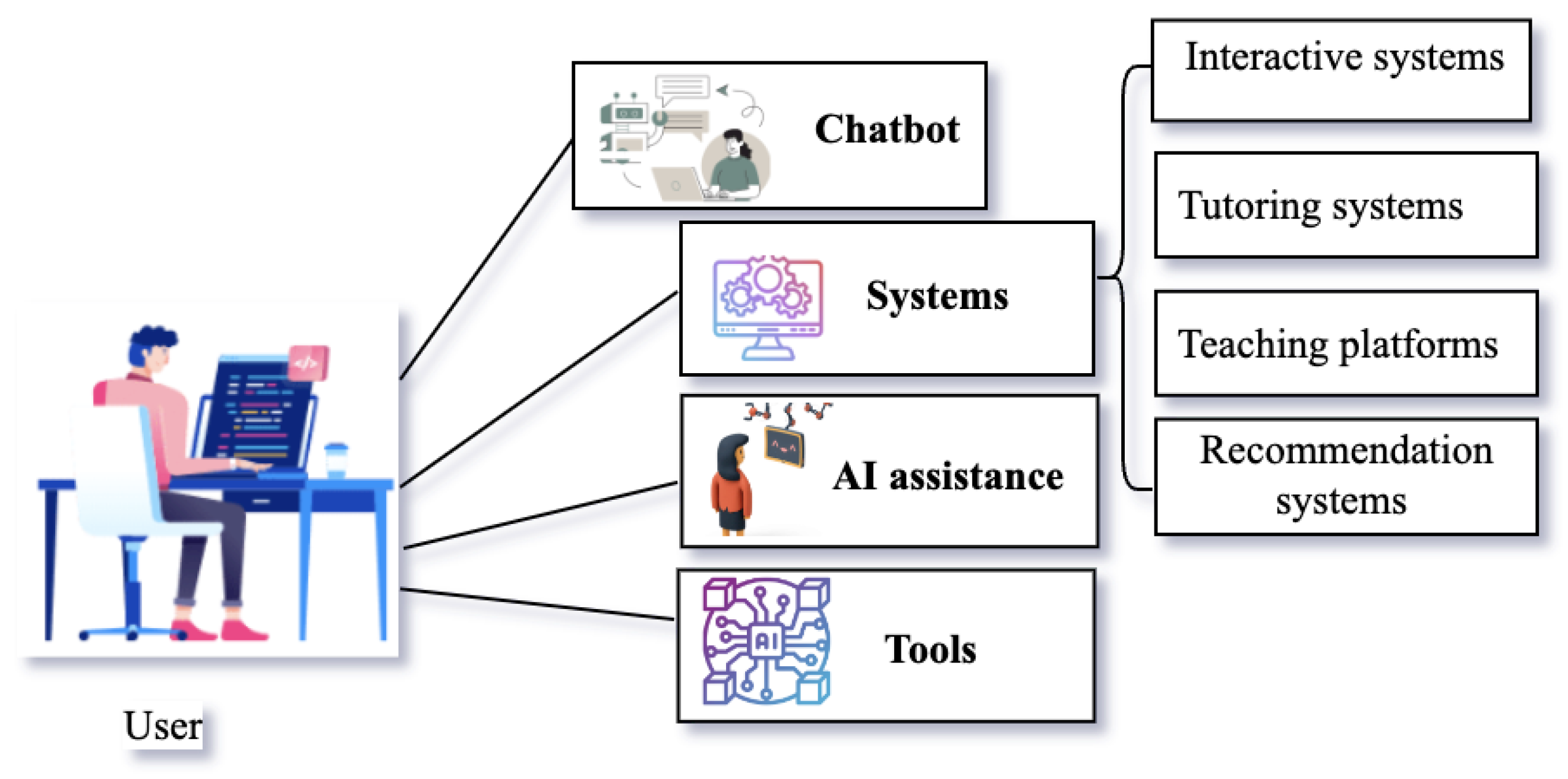


Explicit and Implicit Learning Mechanisms in AI Educational Assistants: A Systematic Review


Abstract
1. Introduction
- A taxonomy of explicit and implicit learning mechanisms in AI educational assistants;
- Systematic mapping between learning mechanisms, implementation approaches, and AI techniques;
- A synthesis of evaluation practices and research gaps to inform the design and assessment of AI-enhanced educational systems.
2. Methodology
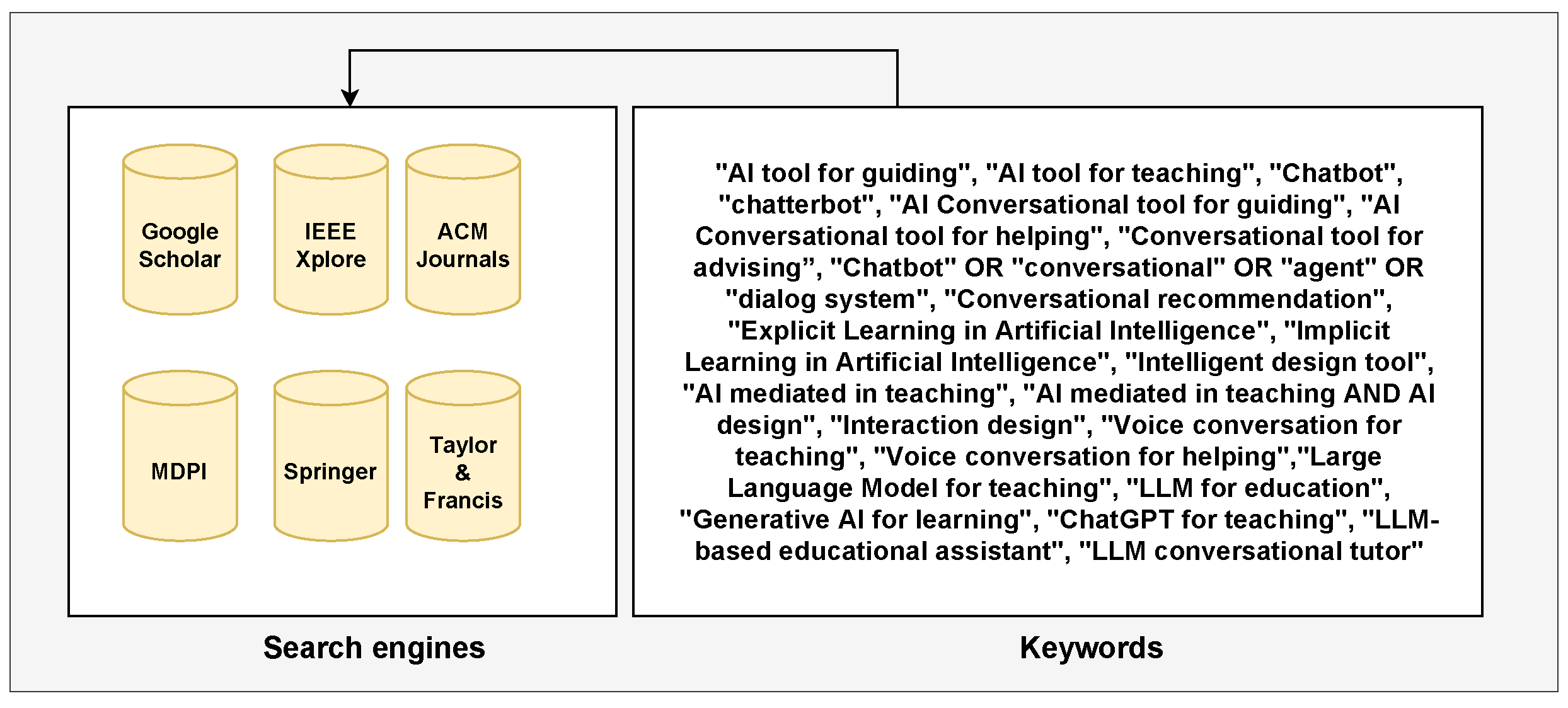
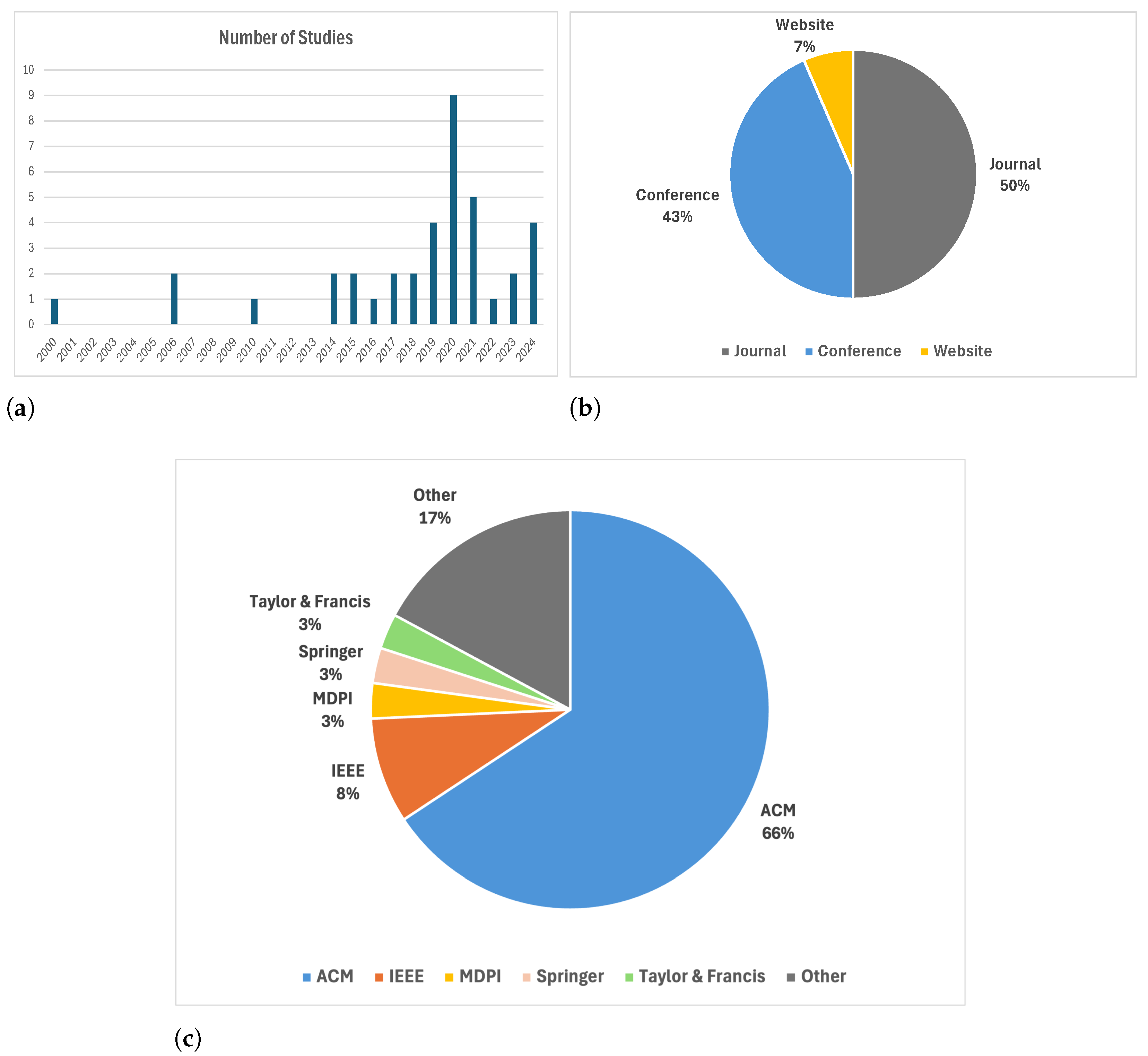
2.1. Search Strategy and Information Sources
2.2. Inclusion and Exclusion Criteria
2.3. Data Extraction
2.4. The Aim of the Systematic Literature Review
- RQ1: What interaction mechanisms in AI educational assistants support explicit and implicit learning? This research question discusses different learning mechanisms that end users acquire through explicit or implicit AI techniques. Learning can occur explicitly, where users are aware, or implicitly, without the users realising it. The details are explained in Section 4.
- RQ2: How have AI assistant techniques been implemented in the literature? (i) How is knowledge stored and continuously updated? (ii) Who are the stakeholders interacting with the system? (iii) What algorithms and techniques are used? (iv) How do they evaluate? (v) What types of output are generated?This research question addresses the methods developers use to implement AI techniques, including how they store and update knowledge, how users interact with these techniques, the algorithms and methods employed, the system evaluation process, and finally the types of output generated. Section 5 and Section 6 include more details.
3. A Motivating Example
4. Explicit and Implicit Learning in AI Techniques
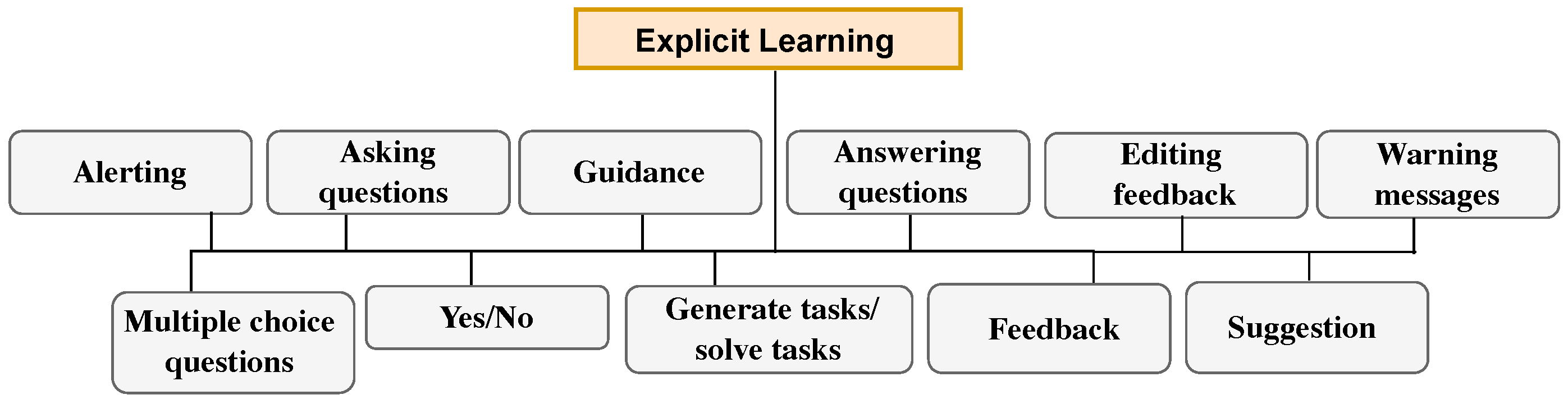
4.1. Explicit Learning
4.1.1. Asking Questions
4.1.2. Yes or No Questions
4.1.3. Multiple Choice Questions
4.1.4. Answering Questions
4.1.5. Guidance
4.1.6. Warning Message
4.1.7. Generate Tasks or Solve Tasks
4.1.8. Suggestions
4.1.9. Alerting
4.1.10. Feedback
4.1.11. Editing Feedback
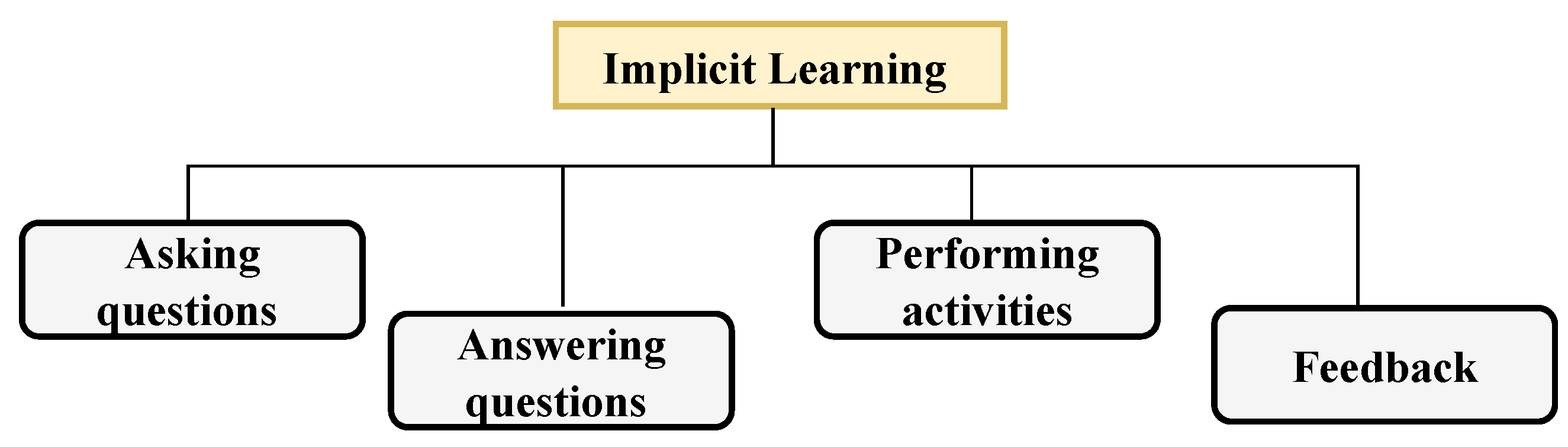
4.2. Implicit Learning
4.2.1. Asking and Answering Questions
4.2.2. Performing Activities
4.2.3. Feedback
5. Implementation Approaches
5.1. Conversational AI
Rule-Based and AI Chatbots
5.2. AI Systems
5.2.1. An Interactive System
5.2.2. Tutoring System
5.2.3. Teaching Platform
5.2.4. Recommendation System
5.3. AI Assistance
5.4. AI Tools
6. AI Techniques for Implementing Intelligent Behaviours
6.1. Understanding the Storage Knowledge and Updating
6.2. Algorithms and Implementation
6.2.1. Conversational AI
6.2.2. Systems
6.2.3. Tools
6.2.4. AI Assistants
6.3. Evaluation
6.4. Types of User Interactions
6.4.1. Interaction Based on Writing
6.4.2. Interaction Based on Visualisation
6.4.3. Interaction Based on Voice
6.4.4. Interaction Based on Action
6.5. Generative AI and Large Language Models in Educational Assistants
7. Research Challenges and Directions
7.1. Conversational Adaptivity and Interaction Limitations
7.2. Knowledge Representation and Architectural Constraints
7.3. Integrating Heterogeneous AI Approaches
7.4. The Need for Robust Evaluation Frameworks
7.5. Limitations
8. Conclusions
Supplementary Materials
Author Contributions
Funding
Institutional Review Board Statement
Informed Consent Statement
Data Availability Statement
Acknowledgments
Conflicts of Interest
Appendix A

| Ref. | Eval. Types | Data Collection Methods | Participants | Metrics/Measures | |
|---|---|---|---|---|---|
| Exp | Theo | ||||
| Pham et al. [26] | ✓ | - | 14,000 people | User–chatbot interaction and usability. | |
| Kim et al. [28] | ✓ | Sessions with participants and interviews | 10 users | Time, debugging issues, and users’ confidence | |
| Shekhar et al. [21] | - | - | - | - | - |
| Elragal et al. [22] | ✓ | Workshop demonstration and qualitative feedback | learners, instructors, and academic admins | Perceived feasibility, usability observations, and collecting qualitative feedback | |
| Allen et al. [27] | ✓ | Questionnaires (surveys) | 5 academic stakeholders + 5 M.Sc. holders | usability, confidence, extensibility, and relevance | |
| Fossati et al. [42] | ✓ | Tests for learning assessments, surveys, and student action records | between 214 and 219 students | Learning, satisfaction, and problem-solving behaviour | |
| Hobert [41] | ✓ | Demonstrations, self assessments, programming tasks, questionnaires, and written feedback | 40 students | Usability, effectiveness, efficiency, and acceptance among its intended users | |
| Michaud et al. [43] | - | - | - | - | - |
| Zhao et al. [32] | ✓ | - | - | Reading ability | |
| Anderson et al. [24] | ✓ | Complete a task: building a circuit using an Arduino with specific time points | 12 participants | Usability, time, and efficiency of the system | |
| Aldeman et al. [33] | - | - | - | The accuracy of the model generated, the comprehensive ability of the extracted knowledge, and the learning time | |
| Zhao et al. [49] | - | - | - | 15 learners | The improvement in learners’ interviewing skills after using the application |
| Chen et al. [57] | ✓ | Questionnaires and semi-structured interviews | 16 professional designers, 50 consumers, and 4 expert reviewers | Emotional expression, aesthetic quality, and novelty of designs, user ratings (match, transparency, and ease of use), NASA-TLX subscales (mental demand, effort, and frustration) | |
| Sun et al. [25] | ✓ | - | 20–120 | Learning activity participation, Interaction level, resource utilisation quality of interaction, efficiency, and student performance | |
| García et al. [54] | ✓ | Questionnaires (pre-test and post-test), including Likert questions and open questions | 14 students | Pre-test and post-test scores, and improvements in AI knowledge | |
| Drew et al. [30] | - | - | Interviews and observations | 7 participants | Learning gain (pre-/post-tests), problems solved, feedback, satisfaction survey (Likert + qualitative comments) |
| Lin et al. [53] | - | - | Pilot Study and user study | 14 children | The effective engagement of Zhorai and the children’s understanding |
| Yuan et al. [31] | ✓ | A combination of pre-tests, post-tests, anonymous questionnaires, and surveys | 15 students | The usability and effectiveness of tools in various computer network and information security courses | |
| Estevez et al. [51] | ✓ | Questionnaires and open questions | 37 students | Understanding AI | |
| Carney et al. [52] | - | - | - | - | - |
| Atilola et al. [44] | ✓ | Assessment and focus groups | 70–100 regular students, 30–40honors students | The effectiveness of Mechanix | |
| Peternier et al. [34] | - | - | - | - | - |
| Imtiaz et al. [29] | ✓ | Likert-scale questionnaire | 45 students | Interactivity, design, playfulness, ease of use, usefulness, and intention to use | |
| Dias et al. [35] | - | - | - | - | - |
| Peng et al. [58] | ✓ | Structured observation of design tasks, think-aloud protocol, semi-structured interviews, likert-scale questionnaires | 12 professional designers | Effectiveness of multimodal inputs in capturing creative intentions, understanding the mapping between inputs and AI outputs, sense of control and transparency over the creative process, satisfaction and usability of the system | |
| Buchanan and Laviola Jr [47] | ✓ | Pre-test quizzes, surveys, and course exams | 190 students (from an initial 267) | Pre-test and quiz scores, Likert scale surveys, and comments | |
| Koch et al. [37] | ✓ | Standardised measurements and semi-structured interviews | 16 professional designers | The effectiveness and impact of an AI tool on creative design | |
| Villegas-Ch et al. [23] | ✓ | Assessing children’s progress in learning numbers | Group of six children | The progress and performance of children in learning numbers | |
| Konecki et al. [20] | ✓ | Questionnaire | 68 students | Students’ programming motivation, intelligent assistant’s impact on time investment, assistant’s information retrieval efficiency, perceived usefulness of assistant, preference for the method, and improved programming understanding | |
| Koch et al. [38] | ✓ | Observation, interviews, questionnaire screening, and audio recording | 9 designers | - | |
| Rodríguez-García et al. [55] | ✓ | Multiple-choice questions and pen questions | 494 children | knowledge improvement, perception of learning ML, and changes in the perception of AI. | |
| Sermuga Pandian et al. [46] | ✓ | ASQ questionnaire, semi-structured interviews, think-aloud protocol, and task recording | 10 designers | ASQ scores (Q1–Q3) | |
| Winkler et al. [50] | ✓ | Assessing task outcomes, ensuring collaboration quality, and analysing video recordings | 63 participants | Assess whether the AI tutor can improve task outcomes and collaboration quality compared to human tutors in collaborative problem-solving settings | |
References
- Sequeira, A.H. Introduction to Concepts of Teaching and Learning. Available at SSRN 2150166. 2012. Available online: https://www.researchgate.net/publication/272620585_Introduction_to_Concepts_of_Teaching_and_Learning (accessed on 15 April 2026).
- Chen, L.; Chen, P.; Lin, Z. Artificial Intelligence in Education: A Review. IEEE Access 2020, 8, 75264–75278. [Google Scholar] [CrossRef] [Scilit]
- Seo, K.; Tang, J.; Roll, I.; Fels, S.; Yoon, D. The impact of artificial intelligence on learner–instructor interaction in online learning. Int. J. Educ. Technol. High. Educ. 2021, 18, 54. [Google Scholar] [CrossRef] [Scilit] [PubMed]
- Wang, D.; Huang, X. Transforming education through artificial intelligence and immersive technologies: Enhancing learning experiences. Interact. Learn. Environ. 2025, 33, 4546–4565. [Google Scholar] [CrossRef] [Scilit]
- Chen, Y.; Jensen, S.; Albert, L.J.; Gupta, S.; Lee, T. Artificial intelligence (AI) student assistants in the classroom: Designing chatbots to support student success. Inf. Syst. Front. 2023, 25, 161–182. [Google Scholar] [CrossRef] [Scilit]
- Suh, S.; Ravelo, J.; Strogalev, N. Impact of Artificial Intelligence on Student’s Education. J. Comput. Sci. Coll. 2025, 40, 80–90. [Google Scholar]
- Page, M.J.; McKenzie, J.E.; Bossuyt, P.M.; Boutron, I.; Hoffmann, T.C.; Mulrow, C.D.; Shamseer, L.; Tetzlaff, J.M.; Akl, E.A.; Brennan, S.E.; et al. The PRISMA 2020 statement: An updated guideline for reporting systematic reviews. BMJ 2021, 372, n71. [Google Scholar] [CrossRef] [Scilit]
- Kitchenham, B.; Brereton, P. A systematic review of systematic review process research in software engineering. Inf. Softw. Technol. 2013, 55, 2049–2075. [Google Scholar] [CrossRef] [Scilit]
- Wohlin, C. Guidelines for snowballing in systematic literature studies and a replication in software engineering. In Proceedings of the 18th international conference on evaluation and assessment in software engineering, London, UK, 13–14 May 2014; pp. 1–10. [Google Scholar]
- Okoli, C.; Schabram, K. A Guide to Conducting a Systematic Literature Review of Information Systems Research. 2010. Available online: https://ssrn.com/abstract=1954824 (accessed on 15 April 2026).
- Alhirabi, N.; Rana, O.; Perera, C. Security and privacy requirements for the internet of things: A survey. Acm Trans. Internet Things 2021, 2, 1–37. [Google Scholar] [CrossRef] [Scilit]
- Microsoft. Microsoft Threat Modeling Tool. 2020. Available online: https://learn.microsoft.com/en-us/azure/security/develop/threat-modeling-tool (accessed on 15 April 2026).
- OWASP. OWASP Threat Dragon. 2020. Available online: https://owasp.org/www-project-threat-dragon/ (accessed on 3 October 2023).
- Benton, M. The Knowledge Illusion: Why We Never Think Alone. Softw. Qual. Prof. 2017, 19, 45. [Google Scholar]
- Kohda, Y. Can humans learn from AI? A fundamental question in knowledge science in the AI era. In Proceedings of the Advances in the Human Side of Service Engineering: Proceedings of the AHFE 2020 Virtual Conference on The Human Side of Service Engineering, USA, 16–20 July 2020; Springer: Cham, Switzerland, 2020; pp. 244–250. [Google Scholar]
- Ziegler, E.; Edelsbrunner, P.A.; Stern, E. The relative merits of explicit and implicit learning of contrasted algebra principles. Educ. Psychol. Rev. 2018, 30, 531–558. [Google Scholar] [CrossRef] [Scilit]
- Ellis, R. 1. Implicit and explicit learning, knowledge and instruction. In Implicit and Explicit Knowledge in Second Language Learning, Testing and Teaching; Multilingual Matters: Bristol, UK, 2009; pp. 3–26. [Google Scholar]
- Schuchard, J.; Thompson, C.K. Implicit and explicit learning in individuals with agrammatic aphasia. J. Psycholinguist. Res. 2014, 43, 209–224. [Google Scholar] [CrossRef] [Scilit]
- Crowder, J.A.; Carbone, J.; Friess, S. Implicit Learning in Artificial Intelligence. In Artificial Psychology; Springer: Cham, Switzerland, 2020; pp. 139–147. [Google Scholar]
- Konecki, M.; Kadoić, N.; Piltaver, R. Intelligent Assistant for Helping Students to Learn Programming. In Proceedings of the 2015 38th International Convention on Information and Communication Technology, Electronics and Microelectronics (MIPRO); IEEE: Piscataway, NJ, USA, 2015; pp. 924–928. [Google Scholar]
- Shekhar, G.; D’Souza, R.; Fernandes, K. AI-Driven Contextual Virtual Teaching Assistant Using RASA; Association for Computing Machinery, Inc.: New York, NY, USA, 2020; p. 346. [Google Scholar] [CrossRef] [Scilit]
- Elragal, A.; Awad, A.I.; Andersson, I.; Nilsson, J. A Conversational AI Bot for Efficient Learning: A Prototypical Design. IEEE Access 2024, 12, 154877–154887. [Google Scholar] [CrossRef] [Scilit]
- Villegas-Ch, W.; Jaramillo-Alcázar, A.; Mera-Navarrete, A. Assistance System for the Teaching of Natural Numbers to Preschool Children with the Use of Artificial Intelligence Algorithms. Future Internet 2022, 14, 266. [Google Scholar] [CrossRef] [Scilit]
- Anderson, F.; Grossman, T.; Fitzmaurice, G. Trigger-action-circuits: Leveraging generative design to enable novices to design and build circuitry. In Proceedings of the 30th Annual ACM Symposium on User Interface Software and Technology, Québec City, QC, Canada, 22–25 October 2017; pp. 331–342. [Google Scholar]
- Sun, Z.; Anbarasan, M.; Praveen Kumar, D. Design of online intelligent English teaching platform based on artificial intelligence techniques. Comput. Intell. 2021, 37, 1166–1180. [Google Scholar] [CrossRef] [Scilit]
- Pham, X.L.; Pham, T.; Nguyen, Q.M.; Nguyen, T.H.; Cao, T.T.H. Chatbot as an intelligent personal assistant for mobile language learning. In Proceedings of the 2018 2nd International Conference on Education and E-Learning, Bali, Indonesia, 5–7 November 2018; pp. 16–21. [Google Scholar]
- Allen, M.; Naeem, U.; Gill, S.S. Q-Module-Bot: A Generative AI-Based Question and Answer Bot for Module Teaching Support. IEEE Trans. Educ. 2024, 67, 793–802. [Google Scholar] [CrossRef] [Scilit]
- Kim, S.G.; Yoon, S.M.; Yang, M.; Choi, J.; Akay, H.; Burnell, E. HeyTeddy: Conversational test-driven development for physical computing. Proc. ACM Interact. Mob. Wearable Ubiquitous Technol. 2019, 3, 139. [Google Scholar] [CrossRef] [Scilit]
- Imtiaz, M.A.; Luxton-Reilly, A.; Plimmer, B. ThinkInk-An Intelligent Sketch Tool for Learning Data Structures. In Proceedings of the Extended Abstracts of the 2018 CHI Conference on Human Factors in Computing Systems, Montreal, QC, Canada, 21–26 April 2018; pp. 1–6. [Google Scholar]
- Drew, D.; Newcomb, J.L.; McGrath, W.; Maksimovic, F.; Mellis, D.; Hartmann, B. The toastboard: Ubiquitous instrumentation and automated checking of breadboarded circuits. In Proceedings of the 29th Annual Symposium on User Interface Software and Technology, Tokyo, Japan, 16–19 October 2016; pp. 677–686. [Google Scholar]
- Yuan, X.; Vega, P.; Qadah, Y.; Archer, R.; Yu, H.; Xu, J. Visualization tools for teaching computer security. ACM Trans. Comput. Educ. (Toce) 2010, 9, 1–28. [Google Scholar] [CrossRef] [Scilit]
- Zhao, J.; Wang, H.; Wang, X.; Gou, J. The Research and Implementation of Intelligent Reading Assistant System Framework Based on Knowledge Graph. In Proceedings of the 2021 The 3rd World Symposium on Software Engineering, Xiamen, China, 24–26 September 2021; pp. 45–51. [Google Scholar]
- Aldeman, N.L.S.; de Sá Urtiga Aita, K.M.; Machado, V.P.; da Mata Sousa, L.C.D.; Coelho, A.G.B.; da Silva, A.S.; da Silva Mendes, A.P.; de Oliveira Neres, F.J.; do Monte, S.J.H. Smartpathk: A platform for teaching glomerulopathies using machine learning. BMC Med. Educ. 2021, 21, 1–8. [Google Scholar] [CrossRef] [Scilit]
- Peternier, A.; Thalmann, D.; Vexo, F. Mental vision: A computer graphics teaching platform. In Proceedings of the International Conference on Technologies for E-Learning and Digital Entertainment; Springer: Berlin/Heidelberg, Germany, 2006; pp. 223–232. [Google Scholar]
- Dias, P.; Madeira, J.; Santos, B.S. Using VTK as a Tool for Teaching and Applying Computer Graphics. In Proceedings of the Eurographics (Education Papers), Vienna, Austria, 4–8 September 2006; pp. 61–67. [Google Scholar]
- Harteveld, C.; Manning, N.; Abu-Arja, F.; Menasce, R.; Thurston, D.; Smith, G.; Sutherland, S.C. Design of playful authoring tools for social and behavioral science. In Proceedings of the 22nd International Conference on Intelligent User Interfaces Companion; Association for Computing Machinery: New York, NY, USA, 2017; pp. 157–160. [Google Scholar]
- Koch, J.; Lucero, A.; Hegemann, L.; Oulasvirta, A. May AI? Design ideation with cooperative contextual bandits. In Proceedings of the 2019 CHI Conference on Human Factors in Computing Systems, Glasgow, UK, 4–9 May 2019; pp. 1–12. [Google Scholar]
- Koch, J.; Taffin, N.; Beaudouin-Lafon, M.; Laine, M.; Lucero, A.; Mackay, W.E. ImageSense: An intelligent collaborative ideation tool to support diverse human-computer partnerships. Proc. ACM Hum. Comput. Interact. 2020, 4, 1–27. [Google Scholar] [CrossRef] [Scilit]
- Boud, D.; Molloy, E. Feedback in Higher and Professional Education: Understanding It and Doing It Well; Routledge: Oxfordshire, UK, 2013; p. 2013. [Google Scholar]
- Oviatt, S.; Arthur, A.; Cohen, J. Quiet interfaces that help students think. In Proceedings of the 19th Annual ACM Symposium on User Interface Software and Technology, Montreux, Switzerland, 15–18 October 2006; pp. 191–200. [Google Scholar]
- Hobert, S. Say Hello to ‘Coding Tutor’! Design and Evaluation of a Chatbot-based Learning System Supporting Students to Learn to Program. In Proceedings of the 40th International Conference on Information Systems (ICIS 2019), Munich, Germany, 15–18 December 2019; Association for Information Systems: Atlanta, GA, USA, 2019; pp. 1–17. [Google Scholar]
- Fossati, D.; Di Eugenio, B.; Ohlsson, S.; Brown, C.; Chen, L. Data driven automatic feedback generation in the iList intelligent tutoring system. Technol. Instr. Cogn. Learn. 2015, 10, 5–26. [Google Scholar]
- Michaud, L.N.; McCoy, K.F.; Pennington, C.A. An intelligent tutoring system for deaf learners of written English. In Proceedings of the fourth international ACM conference on Assistive technologies, Arlington, VA, USA, 13–15 November 2000; pp. 92–100. [Google Scholar]
- Atilola, O.; Valentine, S.; Kim, H.H.; Turner, D.; McTigue, E.; Hammond, T.; Linsey, J. Mechanix: A natural sketch interface tool for teaching truss analysis and free-body diagrams. AI EDAM 2014, 28, 169–192. [Google Scholar] [CrossRef] [Scilit]
- Obeid, C.; Lahoud, I.; El Khoury, H.; Champin, P.A. Ontology-based recommender system in higher education. In Proceedings of the Companion Proceedings of the The Web Conference 2018, Lyon, France, 23–27 April 2018; pp. 1031–1034. [Google Scholar]
- Sermuga Pandian, V.P.; Suleri, S.; Beecks, C.; Jarke, M. MetaMorph: AI Assistance to Transform Lo-Fi Sketches to Higher Fidelities. In Proceedings of the 32nd Australian Conference on Human-Computer Interaction, Sydney, NSW, Australia, 2–4 December 2020; pp. 403–412. [Google Scholar]
- Buchanan, S.; Laviola Jr, J.J. Cstutor: A sketch-based tool for visualizing data structures. Acm Trans. Comput. Educ. (TOCE) 2014, 14, 1–28. [Google Scholar]
- Reber, A.S. Implicit learning of artificial grammars. J. Verbal Learn. Verbal Behav. 1967, 6, 855–863. [Google Scholar] [CrossRef] [Scilit]
- Zhao, J.; Bhatt, S.; Thille, C.; Zimmaro, D.; Gattani, N.; Walker, J. Introducing Alexa for E-learning. In Proceedings of the Seventh ACM Conference on Learning @Scale, Virtual, 12–14 August 2020; pp. 427–428. [Google Scholar]
- Winkler, R.; Söllner, M.; Neuweiler, M.L.; Conti Rossini, F.; Leimeister, J.M. Alexa, can you help us solve this problem? How conversations with smart personal assistant tutors increase task group outcomes. In Proceedings of the Extended Abstracts of the 2019 CHI Conference on Human Factors in Computing Systems, Glasgow, UK, 4–9 May 2019; pp. 1–6. [Google Scholar]
- Estevez, J.; Garate, G.; Graña, M. Gentle introduction to artificial intelligence for high-school students using scratch. IEEE Access 2019, 7, 179027–179036. [Google Scholar] [CrossRef] [Scilit]
- Carney, M.; Webster, B.; Alvarado, I.; Phillips, K.; Howell, N.; Griffith, J.; Jongejan, J.; Pitaru, A.; Chen, A. Teachable machine: Approachable Web-based tool for exploring machine learning classification. In Proceedings of the Extended Abstracts of the 2020 CHI Conference on Human Factors in Computing Systems, Honolulu, HI, USA, 25–30 April 2020; pp. 1–8. [Google Scholar]
- Lin, P.; Van Brummelen, J.; Lukin, G.; Williams, R.; Breazeal, C. Zhorai: Designing a conversational agent for children to explore machine learning concepts. In Proceedings of the AAAI Conference on Artificial Intelligence, New York, NY, USA, 7–12 February 2020; Volume 34, pp. 13381–13388. [Google Scholar]
- García, J.D.R.; Moreno-León, J.; Román-González, M.; Robles, G. LearningML: A tool to foster computational thinking skills through practical artificial intelligence projects. Rev. De Educ. A Distancia (RED) 2020, 20, 1–37. [Google Scholar]
- Rodríguez-García, J.D.; Moreno-León, J.; Román-González, M.; Robles, G. Evaluation of an online intervention to teach artificial intelligence with learningml to 10-16-year-old students. In Proceedings of the 52nd ACM Technical Symposium on Computer Science Education, Virtual, 13–20 March 2021; pp. 177–183. [Google Scholar]
- Dizon, G. Using intelligent personal assistants for second language learning: A case study of Alexa. Tesol J. 2017, 8, 811–830. [Google Scholar] [CrossRef] [Scilit]
- Chen, L.; Jing, Q.; Tsang, Y.; Wang, Q.; Liu, R.; Xia, D.; Zhou, Y.; Sun, L. AutoSpark: Supporting Automobile Appearance Design Ideation with Kansei Engineering and Generative AI. In Proceedings of the 37th Annual ACM Symposium on User Interface Software and Technology, Pittsburgh, PA, USA, 13–16 October 2024. UIST ’24. [Google Scholar] [CrossRef] [Scilit]
- Peng, X.; Koch, J.; Mackay, W.E. DesignPrompt: Using Multimodal Interaction for Design Exploration with Generative AI. In Proceedings of the 2024 ACM Designing Interactive Systems Conference, Copenhagen, Denmark, 1–5 July 2024; DIS ’24. pp. 804–818. [Google Scholar] [CrossRef] [Scilit]
- Gao, J.; Peng, B.; Li, C.; Li, J.; Shayandeh, S.; Liden, L.; Shum, H.Y. Robust Conversational AI with Grounded Text Generation. arXiv 2020, arXiv:2009.03457. [Google Scholar] [CrossRef] [Scilit]
- Ong, R.; Raof, R.; Sudin, S.; Choong, K. A Review of Chatbot development for Dynamic Web-based Knowledge Management System (KMS) in Small Scale Agriculture. In Proceedings of the Journal of Physics: Conference Series; IOP Publishing: Bristol, UK, 2021; Volume 1755, p. 012051. [Google Scholar]
- Boonstra, L. Introduction to Conversational AI. In The Definitive Guide to Conversational AI with Dialogflow and Google Cloud; Springer: Berlin/Heidelberg, Germany, 2021; pp. 1–27. [Google Scholar]
- Wellnhammer, N.; Dolata, M.; Steigler, S.; Schwabe, G. Studying with the help of digital tutors: Design aspects of conversational agents that influence the learning process. In Proceedings of the 53rd Hawaii International Conference on System Sciences, Maui, HI, USA, 7–10 January 2020; pp. 146–156. [Google Scholar]
- Kim, H.; Lim, Y.K. Teaching-learning interaction: A new concept for interaction design to support reflective user agency in intelligent systems. In Proceedings of the Designing Interactive Systems Conference 2021, Virtual, 28 June–2 July 2021; pp. 1544–1553. [Google Scholar]
- Reilly, E.D. Interactive system. In Encyclopedia of Computer Science; Springer: Berlin/Heidelberg, Germany, 2003; pp. 907–908. [Google Scholar]
- Major, N.; Ainsworth, S.; Wood, D. REDEEM: Exploiting symbiosis between psychology and authoring environments. Int. J. Artif. Intell. Educ. 1997, 8, 317–340. [Google Scholar]
- Mitrovic, A. Modeling domains and students with constraint-based modeling. In Advances in Intelligent Tutoring Systems; Springer: Berlin/Heidelberg, Germany, 2010; pp. 63–80. [Google Scholar]
- Herbert, B.; Billinghurst, M.; Weerasinghe, A.; Ens, B.; Wigley, G. A generalized, rapid authoring tool for intelligent tutoring systems. In Proceedings of the 30th Australian Conference on Computer-Human Interaction, Melbourne, Australia, 4–7 December 2018; pp. 368–373. [Google Scholar]
- del Vado Vírseda, R.; Fernández, P.; Muñoz, S.; Murillo, A. An Intelligent Tutoring System for Interactive Learning of Data Structures. In Proceedings of the Computational Science–ICCS 2009: 9th International Conference Baton Rouge, LA, USA, 25–27 May 2009; pp. 53–62. [Google Scholar]
- Khine, M.S. AI in teaching and learning and intelligent tutoring systems. In Artificial Intelligence in Education: A Machine-Generated Literature Overview; Springer: Berlin/Heidelberg, Germany, 2024; pp. 467–570. [Google Scholar]
- Aamir, M.; Bhusry, M. Recommendation system: State of the art approach. Int. J. Comput. Appl. 2015, 120. [Google Scholar] [CrossRef] [Scilit]
- Stolterman, E.; Pierce, J. Design tools in practice: Studying the designer-tool relationship in interaction design. In Proceedings of the Designing Interactive Systems Conference, Tyne, UK, 11–15 June 2012; pp. 25–28. [Google Scholar]
- Diefenbach, D.; Lopez, V.; Singh, K.; Maret, P. Core techniques of question answering systems over knowledge bases: A survey. Knowl. Inf. Syst. 2018, 55, 529–569. [Google Scholar] [CrossRef] [Scilit]
- Lan, Y.; He, G.; Jiang, J.; Jiang, J.; Zhao, W.X.; Wen, J.R. Complex knowledge base question answering: A survey. IEEE Trans. Knowl. Data Eng. 2022, 35, 11196–11215. [Google Scholar] [CrossRef] [Scilit]
- Hill, R.K. What an algorithm is. Philos. Technol. 2016, 29, 35–59. [Google Scholar] [CrossRef] [Scilit]
- Burkett, I. An introduction to co-design. Sydney Knode 2012, 12, 12. [Google Scholar]
- Terzopoulos, G.; Satratzemi, M. Voice assistants and artificial intelligence in education. In Proceedings of the 9th Balkan Conference on Informatics, Sofia, Bulgaria, 26–28 September 2019; pp. 1–6. [Google Scholar]
- Seo, H.; Hwang, T.; Jung, J.; Kang, H.; Namgoong, H.; Lee, Y.; Jung, S. Large language models as evaluators in education: Verification of feedback consistency and accuracy. Appl. Sci. 2025, 15, 671. [Google Scholar] [CrossRef] [Scilit]
- Izacard, G.; Lewis, P.; Lomeli, M.; Hosseini, L.; Petroni, F.; Schick, T.; Dwivedi-Yu, J.; Joulin, A.; Riedel, S.; Grave, E. Few-shot learning with retrieval augmented language models. arXiv 2022, arXiv:2208.03299. [Google Scholar] [CrossRef] [Scilit]

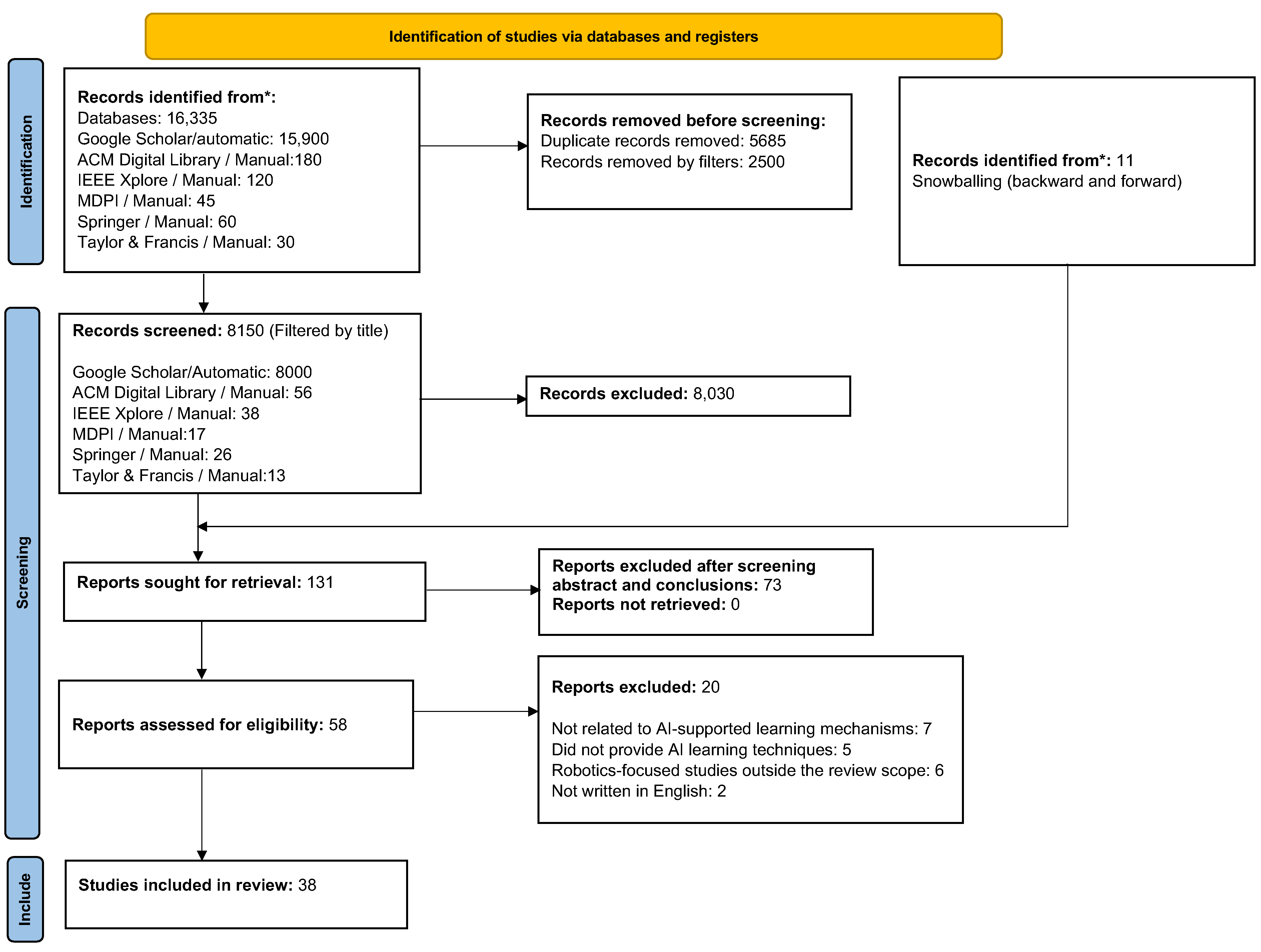


| Ref. | Year | Learning Type | Domain | Brief Description of Learning Types | |
|---|---|---|---|---|---|
| Explicit | Implicit | ||||
| Konecki et al. [20] | 2015 | ✓ | Programming | Asking questions/answering questions | |
| Shekhar et al. [21] | 2020 | ✓ | Education | Allowing students to ask questions/Guiding students by providing answers/alerting about deadlines | |
| Hobert [41] | 2019 | ✓ | Education | Providing feedback/providing suggestions to students | |
| Villegas-Ch et al. [23] | 2022 | ✓ | Education | Answering yes/no questions | |
| Atilola et al. [44] | 2014 | ✓ | Education | Providing feedback to engineering students | |
| Michaud et al. [43] | 2000 | ✓ | Education | Providing feedback to users/allowing users to edit the feedback | |
| Sun et al. [25], Allen et al. [27] | 2021, 2024 | ✓ | Education | Asking questions/answering Questions | |
| Yuan et al. [31] | 2010 | ✓ | Education | Controlling the animation process | |
| Peternier et al. [34], Dias et al. [35] | 2006 | ✓ | Education | Modifying parameters/developing tasks | |
| Aldeman et al. [33] | 2021 | ✓ | Education | Performing activities | |
| Pham et al. [26] | 2018 | ✓ | Education | Answering questions/suggesting hints | |
| Imtiaz et al. [29] | 2018 | ✓ | Education | Providing feedback/performing activities/issuing warning messages | |
| Buchanan and Laviola Jr [47], Fossati et al. [42] | 2014, 2015 | ✓ | Education | Providing feedback | |
| Elragal et al. [22] | 2024 | ✓ | Education | Asking questions/providing feedback | |
| Anderson et al. [24] | 2017 | ✓ | Cognitive | Answering questions | |
| Drew et al. [30] | 2016 | ✓ | Cognitive | Performing tasks | |
| Zhao et al. [32] | 2021 | ✓ | Cognitive | Generating tasks/solving tasks | |
| Kim et al. [28] | 2020 | ✓ | Cognitive | Advising users/providing feedback/alerting users | |
| Zhao et al. [49], Winkler et al. [50] | 2020, 2019 | ✓ | Skills | Asking questions/answering questions | |
| Harteveld et al. [36] | 2017 | ✓ | Skills | Performing activities | |
| Carney et al. [52], Lin et al. [53] | 2020 | ✓ | AI | Performing activities | |
| Rodríguez-García et al. [55] | 2021 | ✓ | AI | Performing activities | |
| Estevez et al. [51], García et al. [54] | 2019, 2020 | ✓ | AI | Performing activities | |
| Koch et al. [37], Koch et al. [38] | 2019, 2020 | ✓ | AI | Providing suggestions | |
| Chen et al. [57], Peng et al. [58] | 2024 | ✓ | AI and design | Providing feedback | |
| Sermuga Pandian et al. [46] | 2020 | ✓ | Computer Science | Providing feedback | |
| Rule-Based Chatbots | AI Chatbots |
|---|---|
| Predefined rules | Learn from information gathered |
| Reliable | Less reliable |
| Less flexible | More flexible |
| Used in simple scenarios | Used in more complex scenarios |
| Names of System/Tool | Publication Year | Knowledge Store | Knowledge Update | Entering Input | Algorithm/Method | Interaction Types |
|---|---|---|---|---|---|---|
| (1) | (2) | (3) | (4) | (5) | (6) | (7) |
| MetaMorph [46] | 2020 | DS | — | D | DNNs | V |
| ImageSense [38] | 2020 | DB | — | D | NLA, MMCQ | W,V |
| May AI [37] | 2019 | DB | D | U | CCB | V |
| iList [42] | 2015 | — | D | U | ML | W,V |
| Assistance System [23] | 2022 | DB | D | CH | IR | V |
| ICICLE [43] | 2000 | KB | D | U | NLP | W |
| Coding Tutor [41] | 2019 | DB | D | NP | — | W |
| Alexa for E-learning [49] | 2020 | — | — | U | LAM, NLA | S |
| An Intelligent Reading Assistant System [32] | 2021 | DB | — | L | RA | W |
| Intelligent English Teaching Platform [25] | 2021 | NB | — | I,L | DTA, NN | W |
| The Toastboard [30] | 2016 | — | — | U | — | A |
| Teachable Machine [52] | 2020 | — | — | U | ML | V |
| Zhorai [53] | 2020 | — | — | CH | — | W,V |
| A Scratch-based AI tutorial [51] | 2019 | — | — | L | CL, NN | V |
| Smartpathk [33] | 2021 | — | D | I,L | SML, J48 | W,V |
| Chatbot [26] | 2018 | — | — | L | — | W |
| An Intelligent Assistant [20] | 2015 | — | — | L | — | W |
| Visualisation Tools [31] | 2010 | — | — | L | — | W,V |
| VTK [35] | 2006 | — | — | L | — | W,V |
| Playful Authoring Tools [36] | 2017 | — | — | U | — | W,V,S |
| Mental Vision [34] | 2006 | — | — | L | — | W,V |
| Mechanix [44] | 2014 | — | — | L | GBA, RTruss | W,V |
| Trigger-action-circuits [24] | 2017 | DB | — | U | BFS, Rec, DRA | A |
| CVTA [21] | 2020 | — | — | L | ML | W |
| HeyTeddy [28] | 2019 | — | D | NP | — | W,S,A |
| ThinkInk [29] | 2018 | — | — | U | RATA | W,V |
| CSTutor [47] | 2014 | — | — | L | Gesture recognition | W,V |
| Smart Personal Assistant (SPA) [50] | 2019 | — | — | U | NLP | S |
| AutoSpark [57] | 2024 | NB | S | D | KE, LLM, PatchInv, CLIP | W,A,V |
| LearningML [54] | 2020 | DS | D | L | ANN, supervised learning | W,S |
| COFFEE [22] | 2024 | DB | D | L | NLP and ChatGPT | W,A,V |
| DesignPrompt [58] | 2024 | — | — | U | OpenAI | W,A,V |
| Q-Module-Bot [27] | 2024 | KB | D | L | Web-scraping and GPT-3.5 | W,A |
| Taxonomy | Description | |
|---|---|---|
| 3 | Knowledge store | Database (DB), Knowledge Base (KB), Dataset (DS), Text Files (TF), Folder (FO) |
| 4 | Knowledge update | Static (S), Dynamic (D) |
| 5 | Entering input | Patients (P), Users (U), Learners (L), Novice Programmers (NP), Elderly People (EP), Instructors (I), Children (CH), Designer (D), Pregnant Women (PW) |
| 6 | Algorithms or methods | Decision Tree Algorithm (DTA), Machine Learning (ML), Generate Guidelines and Monitor Health (GG and MH), Natural Language Algorithm (NLA), Recommendation Algorithm (RA), Deep Neural Networks (DNNs), Modified Median Cut Quantisation (MMCQ), Cooperative Contextual Bandits (CCB), Image Recognition (IR), Breadth First Search (BFS), Dependency Resolution Algorithm (DRA), Supervised Machine Learning (SML), Neural Network (NN), Graph-Building Algorithm (GBA), Recognition and Translation Algorithm (RATA), Clustering (CL), Recognising Truss (RTruss), Recursive (Rec), Lambda (LAM), Kansei Engineering (KE), Large Language Model (LLM), PatchInv (Patch-inversion), Contrastive Language–Image Pretraining (CLIP), Chat Generative Pretrained Transformer (ChatGPT), Open Artificial Intelligence (OpenAI) |
| 7 | Types of interaction | Written (W), Spoken (S), Action (A), Visualisation (V) |
| Chatbot | System | Tools | AI Assistance | |
|---|---|---|---|---|
| Qualitative | Elragal et al. [22] | Konecki et al. [20], Winkler et al. [50], Villegas-Ch et al. [23], Koch et al. [38] | ||
| Quantitative | Allen et al. [27] | |||
| Mixed | Pham et al. [26], Kim et al. [28] | Hobert [41], Anderson et al. [24], Chen et al. [57], Sun et al. [25], Fossati et al. [42], García et al. [54] | Drew et al. [30], Yuan et al. [31], Estevez et al. [51], Atilola et al. [44], Imtiaz et al. [29], Peng et al. [58], Buchanan and Laviola Jr [47] | Sermuga Pandian et al. [46], Koch et al. [37], Rodríguez-García et al. [55] |
| Interaction Types | Number of Papers |
|---|---|
| Written | 45% |
| Spoken | 9% |
| Action | 12% |
| Visualisation | 34% |
Disclaimer/Publisher’s Note: The statements, opinions and data contained in all publications are solely those of the individual author(s) and contributor(s) and not of MDPI and/or the editor(s). MDPI and/or the editor(s) disclaim responsibility for any injury to people or property resulting from any ideas, methods, instructions or products referred to in the content. |
© 2026 by the authors. Licensee MDPI, Basel, Switzerland. This article is an open access article distributed under the terms and conditions of the Creative Commons Attribution (CC BY) license.
Share and Cite
Alqarni, F.; Alhirabi, N.; Rana, O.; Perera, C. Explicit and Implicit Learning Mechanisms in AI Educational Assistants: A Systematic Review. AI 2026, 7, 160. https://doi.org/10.3390/ai7050160
Alqarni F, Alhirabi N, Rana O, Perera C. Explicit and Implicit Learning Mechanisms in AI Educational Assistants: A Systematic Review. AI. 2026; 7(5):160. https://doi.org/10.3390/ai7050160
Chicago/Turabian StyleAlqarni, Fatmah, Nada Alhirabi, Omer Rana, and Charith Perera. 2026. "Explicit and Implicit Learning Mechanisms in AI Educational Assistants: A Systematic Review" AI 7, no. 5: 160. https://doi.org/10.3390/ai7050160
APA StyleAlqarni, F., Alhirabi, N., Rana, O., & Perera, C. (2026). Explicit and Implicit Learning Mechanisms in AI Educational Assistants: A Systematic Review. AI, 7(5), 160. https://doi.org/10.3390/ai7050160