Review

A Comprehensive Review of Deepfake Detection Techniques: From Traditional Machine Learning to Advanced Deep Learning Architectures

1
Department of Information and Communication Engineering, The Islamia University of Bahawalpur (IUB), Bahawalpur 63100, Southern Punjab, Pakistan
2
Faculty of Electrical Engineering & Technology, The Islamia University of Bahawalpur (IUB), Bahawalpur 63100, Southern Punjab, Pakistan
3
Department of Electrical Engineering, College of Engineering, University of Business and Technology, Jeddah 21361, Saudi Arabia
4
College of Engineering, A’Sharqiyah University, Ibra 400, Oman
*
Authors to whom correspondence should be addressed.
Submission received: 15 December 2025 / Revised: 2 February 2026 / Accepted: 4 February 2026 / Published: 11 February 2026
(This article belongs to the Section Medical & Healthcare AI)

Abstract

Deepfake technology is causing unprecedented threats to the authenticity of digital media, and demand is high for reliable digital media detection systems. This systematic review focuses on an analysis of deepfake detection methods using deep learning approaches, machine learning methods, and the classical methods of image processing from 2018 to 2025 with a specific focus on the trade-off between accuracy, computing efficiency, and cross-dataset generalization. Through lavish analysis of a robust peer-reviewed studies using three benchmark data sets (FaceForensics++, DFDC, Celeb-DF) we expose important truths to bring some of the field’s prevailing assumptions into question. Our analysis produces three important results that radically change the understanding of detection abilities and limitations. Transformer-based architectures have significantly better cross-dataset generalization (11.33% performance decline) than CNN-based (more than 15% decline), at the expense of computation (3–5× more). To the contrary, there is no strong reason to assume the superiority of deep learning, and the performance of traditional machine learning methods (in our case, Random Forest) is quite comparable (accuracy of 99.64% on the DFDC) with dramatically lower computing needs, which opens up the prospects for their application in resource-constrained deployment scenarios. Most critically, we demonstrate deterioration of performance (10–15% on average) systematically across all methodological classes and we provide empirical support for the fact that current detection systems are, to a high degree, learning dataset specific compression artifacts, rather than deepfake characteristics that are generalizable. These results highlight the importance of moving from an accuracy-focused evaluation approach toward more comprehensive evaluation approaches that balance either generalization capability, computational feasibility, or practical deployment constraints, and therefore further direct future research efforts towards designing systems for detection that could be deployed in practical applications.

1. Introduction

Deepfake technology takes advantage of recent technology in artificial intelligence (AI) and deep learning to produce hyper-realistic so-called synthetic media such as videos, images, and audio [1,2].
Such rigged contents are capable of portraying people doing or saying things that did not take place. Sophisticated algorithms, including generative adversarial networks (GANs), variational autoencoders (VAEs), and transformer-based models are used in the technology to produce an unprecedented level of realism in its face expression manipulation capabilities, voice synthesis, and scene generation [3].
Malik et al. comprehensively survey deepfake detection methods for face images and videos. They classify deepfake generation techniques into five categories and detection approaches into traditional forensic methods and deep learning-based techniques, including pixel-level, DNN, and artifact-based analyses.The survey determines the critical datasets (UADFV, FaceForensics++, and Celeb-DF) and major problems such as scanty data, unidentified attacks, and chronological incompatibilities, and stressing the desire of powerful, universalized models to battle the emerging deepfakes [4].
Since their emergence in 2017 deepfakes have experienced evolution far greater in a short time, fuelled by accessible open source tools, enormous available online data, and growing computational power. Despite without possible benefits in entertainment, education and creative technology deep-fakes have immense harm to the cohesion of the society and democratic systems by causing erosion to human and trust and magnifying false information [5,6].
This accessibility has created a situation in which disinformation, financial fraud, identity theft, and forced content generation coming to the fore considerably compromising privacy, trust and information integrity. Despite without possible benefits in entertainment, education and creative technology deep-fakes have immense harm to the cohesion of the society and democratic systems by causing erosion to human and trust and magnifying false information [7,8].
These challenges highlight the need for effective and efficient detection systems to aid in addressing the existing issues.These challenges highlight the urgency of robust detection systems as well as effective mitigation regulatory systems, and raising the media literacy to fight the risks of the deepfakes [9,10].
This review analyzes the increasing menace of AI created deepfakes which undermine confidence in online media by obscuring the individual through meddling with endangering them privacy. It gives a review of technical and non-technical preventive measures, with incorporating the current detection techniques and regulation frameworks that are capable of assisting. mitigate these risks [11,12].
The development of deepfake technology was studied by Ruben Tolosana et al. from the Biometrics and Data Pattern Analytics (BIDA) Lab. They concentrated on facial area analysis and detection system performance throughout deepfake datasets from the first and second generations. The study emphasizes how deepfakes are becoming more realistic and challenging to identify [13].
The intensive development of the deepfake generation and detection techniques was systematically reported in the recent and extensive surveys.This review notes a growing complexity of synthesis algorithms and defense mechanisms, especially the complexity of the more recent generation models, by the use of advanced generative adversarial networks and transformer generation models [14,15]. The creation of many challenging benchmark datasets like Celeb-DF has facilitated the stronger testing of detection methods under a variety of manipulation conditions to augment prior benchmarks with high-quality celebrity deepfakes that best simulate manipulation issues in the real world [16].
Dolhansky et al. developed the deepfake detection challenge(DFDC) dataset, which provides a large scale ethically sourced collection of 128,154 movies made with over 3400 consenting actors and with eight deepfake algorithms. In order to overcome the shortcomings of previous datasets, DFDC offers a variety of excellent material and acts as a uniform standard foe assessing detection techniques. Strong generalization to real world deepfakes was shown by the challenge’s top performing models, like EfficientNet and XceptionNet [17].
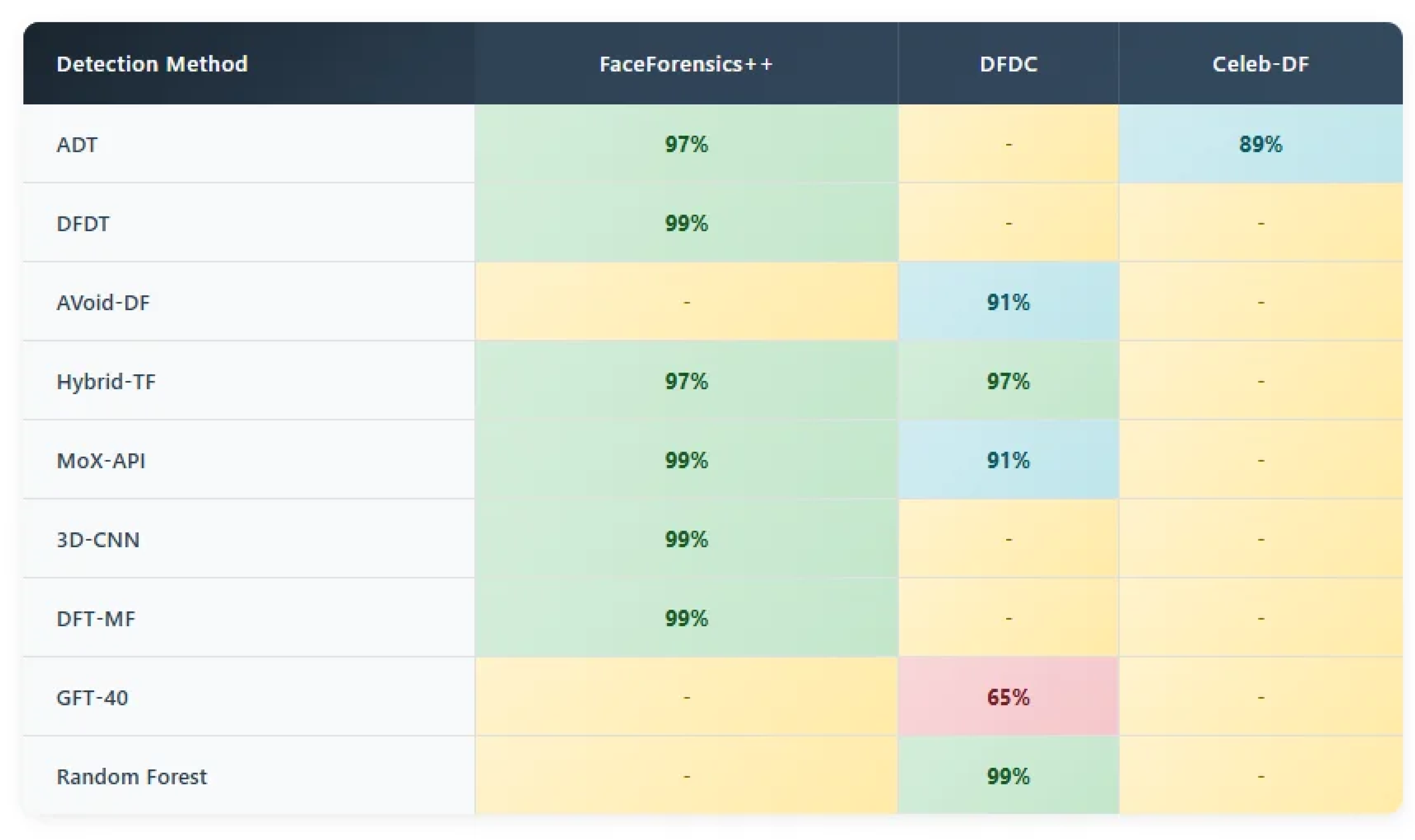
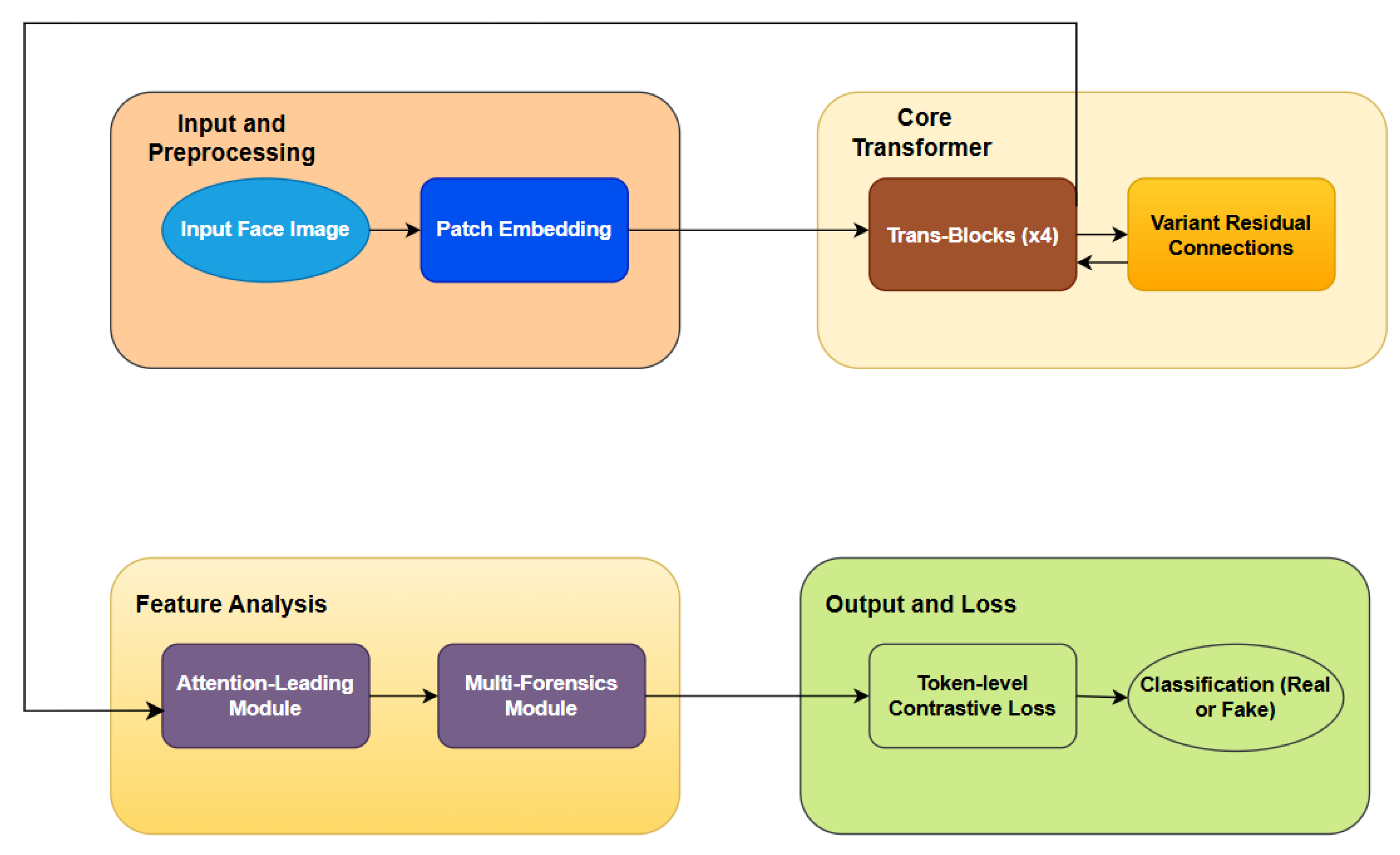
The Anti-Deepfake Transformer (ADT) is a vision transformer framework that addresses the generalization limitations of CNN-based deepfake detectors. ADT leverages variant residual connections (VRC) in four trans-blocks, an attention-leading module (ALM), and a multi-forensics module (MFM) to capture both global and regional information. Trained with token-level contrastive loss on FaceForensics++, ADT achieves state-of-the-art cross-dataset performance (84.97% AUC on Celeb-DF) and competitive intra-dataset results (96.30% AUC on FF++ HQ) [18].
In a 2022 Applied Sciences publication, Khormali and Yuan introduce DFDT, a vision transformer-based deepfake detection framework. DFDT overcomes the receptive field limitations of CNNs by modeling both local and global pixel relationships across various forgery scales. The framework uses patch extraction and embedding, a multi-stream transformer block, attention-based patch selection, and a multi-scale classifier. It incorporates a re-attention mechanism for improved scalability and to prevent attention collapse. DFDT achieves high accuracy on FaceForensics++ (99.41%), Celeb-DF V2 (99.31%), and WildDeepfake (81.35%), demonstrating strong cross-dataset and cross-manipulation generalization [19].
Nirkin et al. suggest a face-swapping detection approach which makes use of disparities between the manipulated face and the surrounding load context with two Xception-net based networks one is face identification and the other context recognition. The approach outperforms traditional classifiers, achieving state-of-the-art results on FaceForensics++ and Celeb-DF while generalizing effectively to unseen manipulation methods [20].
Guo et al. introduce Space-Frequency Interactive Convolution (SFIConv), which replaces standard convolution layers in backbone networks to improve deepfake detection. SFIConv incorporates Multichannel Constrained Separable Convolution (MCSConv) to jointly capture spatial and high-frequency manipulation traces. This can be shown by experiments on HFF, FF++, FDDC, and CelebDF precision and lower cost of computation. However, its performance drops on unseen manipulations methods highlighting persistent generalization challenges [21].
Wang et al. provide a deep convolutional Transformers model that uses convolutional pooling and re-attention techniques to aggregate local and global picture information for deepfake detection. on benchmarks like FaceForencise++ and Celeb-DF the model performs better than conventional CNN based baselines. By introducing keyframe extraction to preserve high-resolution information and mitigate loss of video compression, the method achieves improved performance, reaching up to 97.69% AUC in FF++ in both within- and cross-dataset evaluations [22].
Zhao et al. suggest a deepfake detector framework, which is multi-attentional scale-invariant attention to manipulation artifacts. Their method utilizes a spatial attention module so as to pay attention to the areas of the face that are susceptible. Whereas channel attention mechanisms focus on discriminative, manipulation artifact feature representations. The multi-scale architecture has the ability to detect both local blending boundaries and distortions of facial features inconsistencies) together with global artifacts (such as lighting anomalies and lapses in time). Evaluated on FaceForensics++ and Celeb-DF, the algorithm shows high-quality results on various environments manipulation, that is, competitive precision without loss of computational performance, which is appropriate to be used in practice. The trend is represented in this work towards attention-based architectures, which are explicit about spatial and semantic relationships between deep fake and detection [23].
Yang et al. [24] introduce AVoiD-DF, a multi-modal deepfake detection framework that learns audio-visual inconsistencies. AVoiD-DF outperforms uni-modal methods by using a two-stream Temporal-Spatial Encoder (TSE), a Multi-Modal Joint Decoder (MMD) with bi-directional cross-attention, and a cross-modal classifier to fuse features. It achieves state-of-the-art accuracy on DefakeAVMIT (91.2%), FakeAVCeleb (92.3%), and DFDC (91.4%), exceeding Xception, LipForensics, and CViT. To further research, they present DefakeAVMIT, a dataset of 6480 audio-visual deepfake samples. AVoiD-DF exhibits strong cross-dataset generalization, effectively detecting unseen forgeries. The better performance shows the importance of audio-visual synchrony analysis, which is especially to detect temporal misalignment, phoneme and viseme mismatch, prosodic expression inconsistency and lip sync degradation (achieved 6–8% improvement of visual-only methods) [24].
This study presents a CNN-based multi-color spatio-temporal method for deepfake detection. By analyzing facial color inconsistencies and temporal artifacts, it achieves high AUC scores on FaceForensics++, outperforming physics-based detectors in capturing flickering and boundary effects. However, computational complexity and limited generalization due to sensitivity to advanced GAN-based deepfakes highlight the need for better temporal continuity modeling [25].
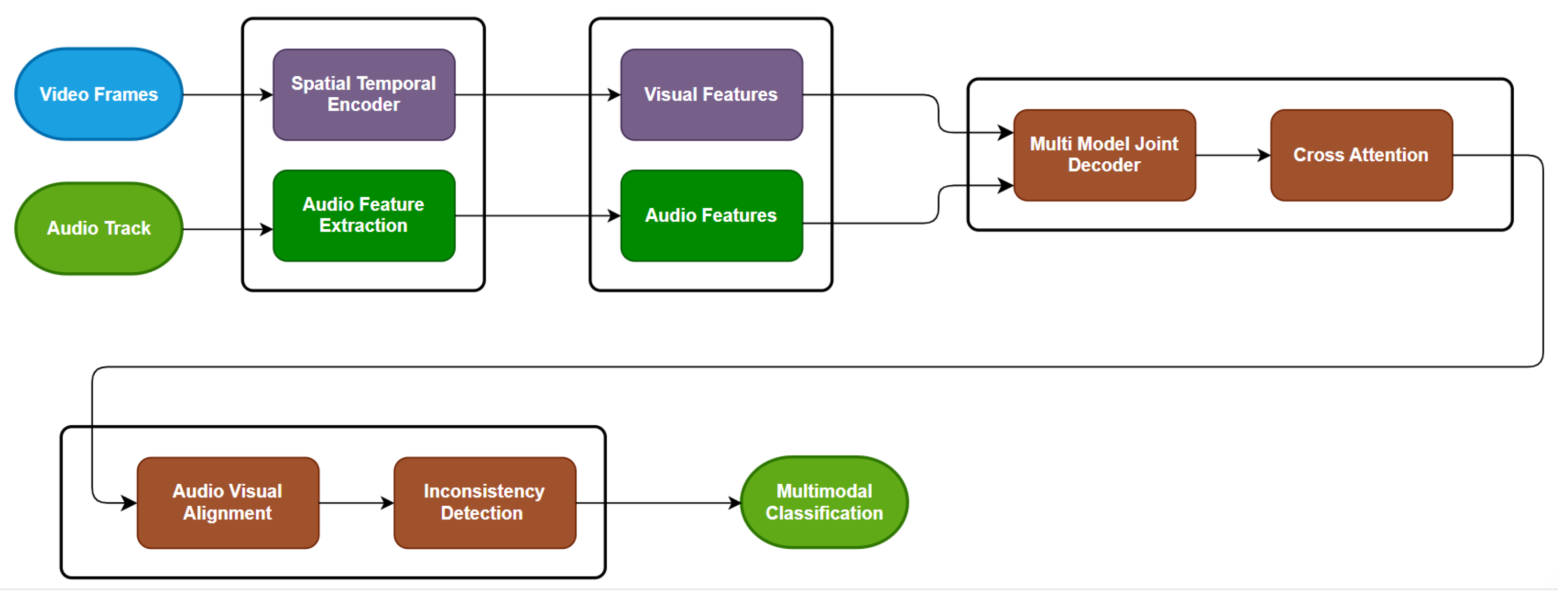
Figure 1 shows a comprehensive multimodal deepfake detection framework that takes both the visual and audio inputs in parallel and detects the content that is manipulated. This architecture is of fundamental importance as it overcomes the key limitation of unimodal detection methods that only analyze visual/audio features separately and are therefore unable to capture cross-modal inconsistencies that are often a reveal of deepfake manipulation. The power of the framework is that it is able to identify very subtle differences between audio and visual streams that are inherently characteristic of synthetic media, but hard for human observers to detect.
The framework has four interrelated components that work in harmony to result in robust detection. First, the spatiotemporal encoder processes the video frames to extract features related to the visual contents representing both inconsistencies in space (within single frames) and inconsistencies in time (within the frames sequences) that will help to identify manipulation artifacts that occur across time. Second, an audio feature extractor is used to analyse acoustic features such as spectral features, prosodic features, and voice quality features which can be used to identify synthetic audio.
Third, these extracted features are fused through a joint decoder using cross attention mechanisms to learn complex dependencies among modalities e.g., in lip synchronization, detecting when lip movements are inconsistent with the audio phonemes or when there are inconsistencies between the dynamics of the facial muscles and those of voice production. Fourth, alignment and inconsistency detection modules pick up relative light differences in the audio-visual signal that are hallmarks of synthetic manipulation, such as temporal levels of misalignment, or unnatural synchronization patterns.
The main innovation demonstrated in this architecture is the use of the cross attention mechanism in the joint decoder which helps the model to find the correlations between the video and audio streams that would be invisible to unimodal approaches. For example, genuine videos have a natural matching between facial muscle movements and vocalization, whereas deepfakes have temporal desynchronisations or sound and pronunciation mismatches, because of the independent generation of visual and audio information.
This type of multimodal method, such as the AVoiD-DF method, can yield better results (91.2% on DefakeAVMIT, 92.3% on FakeAVCeleb) with respect to unimodal methods thanks to some complementary information between the different modalities, which explains why integrated detection frameworks are the current state-of-the-art for deepfake detection.
Rossler et al. present FaceForensics++, a full-size benchmark data and detection system that has developed into the standard to assess deepfake detection schemes. These are the conditions that define the systematic evaluation protocols in various manipulation and their work compression levels and techniques (Deepfakes, Face2Face, FaceSwap, NeuralTextures), making it possible to reasonably compare methods of detection. The sample consists of 1000 original videos manipulated with five variations of methods in generating conditions estimating method-based detection abilities. This quality measure addresses past constraints in the area where inconsistent assessment guidelines impaired significant assessment comparisons of performance between studies. FaceForensics++ was referenced more than 3000 times and has been the most commonly-used benchmark in our reviewed corpus (40% of studies) [26].
Jayakumar et al. present a conceptualized deepfake detection model that is visually interpretable and is based on an EfficientNetB0 backbone trained on a subset of FaceForensics++. Using MTCNN as the face detector and other preprocessing methods, such as scaling, normalizing, and augmentation, the system has 89.58% fidelity under human-grounded evaluation with Anchors XAI and SLIC as the segmentation system in generating visual explanations about manipulated areas. Anchors perform better than LIME when it comes to giving similar interpretations, although additional testing in bigger datasets is necessary [27].
Zou et al. propose a semantics-oriented multitask learning framework for deepfake detection, introducing a dataset expansion technique and a joint embedding approach using vision-language models. Their Semantics-based Joint Embedding DeepFake Detector (SJEDD) utilizes face semantics, bi-level optimization, and automated task focus and is significantly outperforming 18 state-of-the-art detectors on 6 datasets that it competes in. The lack of variety in datasets and the complexity of computation is a challenge, and the generalizability and interpretability of SJEDD are improved [28].
Cozzolino et al. introduce POI-Forensics, which uses contrastive learning to derive identity-specific features by using real videos and an audio-visual deepfake detector. The technique impacts strong cross-dataset results, such as an AUC of 73.4% on FakeAVCelebV2 and good results on pDFDC and KoDF, by comparing audio and video embeddings with a reference set. Its usefulness in facial reenactment (AUC: 70–80%) is however lower and it requires having a large set of references [29].
Pham et al. had done a dual study benchmarking both on facial forgery and facial detection the data used is a collection of forged images (91,885 large data set) and videos (2000 videos) out of FaceForensics++. The authors made the comparison of conventional computer vision algorithms, and the deep learning algorithms such as XceptionNet and GAN-Fingerprint and their stability to brightness, resolution, and so on and compression. Most techniques were greatly affected by compression Despite GAN-Fingerprint being stronger. This bi-dimensional benchmarking data gives users the option to confronts forging and detection procedures directly and provides helpful performance information. Nevertheless, certain information was lost due to the limitation of OCR [30].
On black-box, grey-box and white-box evaluation of 16 state of the art detectors, Le et al. systematize deepfake detection using a five stepping conceptual framework environments with data sets such as DFDC Spatial-temporal and transformer models out distort others, especially detect subtle changes of a face. However these limited problem of diversity and repeatability of datasets, and only 30 percent of the models are open source hinder generalization. The paper focuses on the architecture of the model and data variety as necessary to effective deepfake detection [31].
Shahzad et al. examine cinematographic deepfake detection ability of ChatGPT-4 by compares the results with human judges and the latest AI models in the FakeAVCeleb dataset. ChatGPT with context-rich prompts is similar in human-comparable performances (65 percent) compared to AI models (87.5–97.5 percent) but underperforms AI models. Although its interpretabilities and generalization are good strengths, the use of traditional characteristics and inability to work with simple prompts limits its functionality. The paper recommends that future detection systems can be enhanced through the integration of deep learning with large language models (LLMs) [32].
Rana and Sung provide a summary of deepfake detection in their IWSPA has in their tutorial and dividing approaches into Digital Media Forensics, Face Manipulation, Machine Learning models like (SVM, CNN) and other Computational Methods. On the visual materials and facial landmarks, and when analyzed on a dataset such as FaceForensics++, the weaknesses are evident of individual methods. They suggest mixed methods and different data sets to increased protection against emerging deepfakes [33].
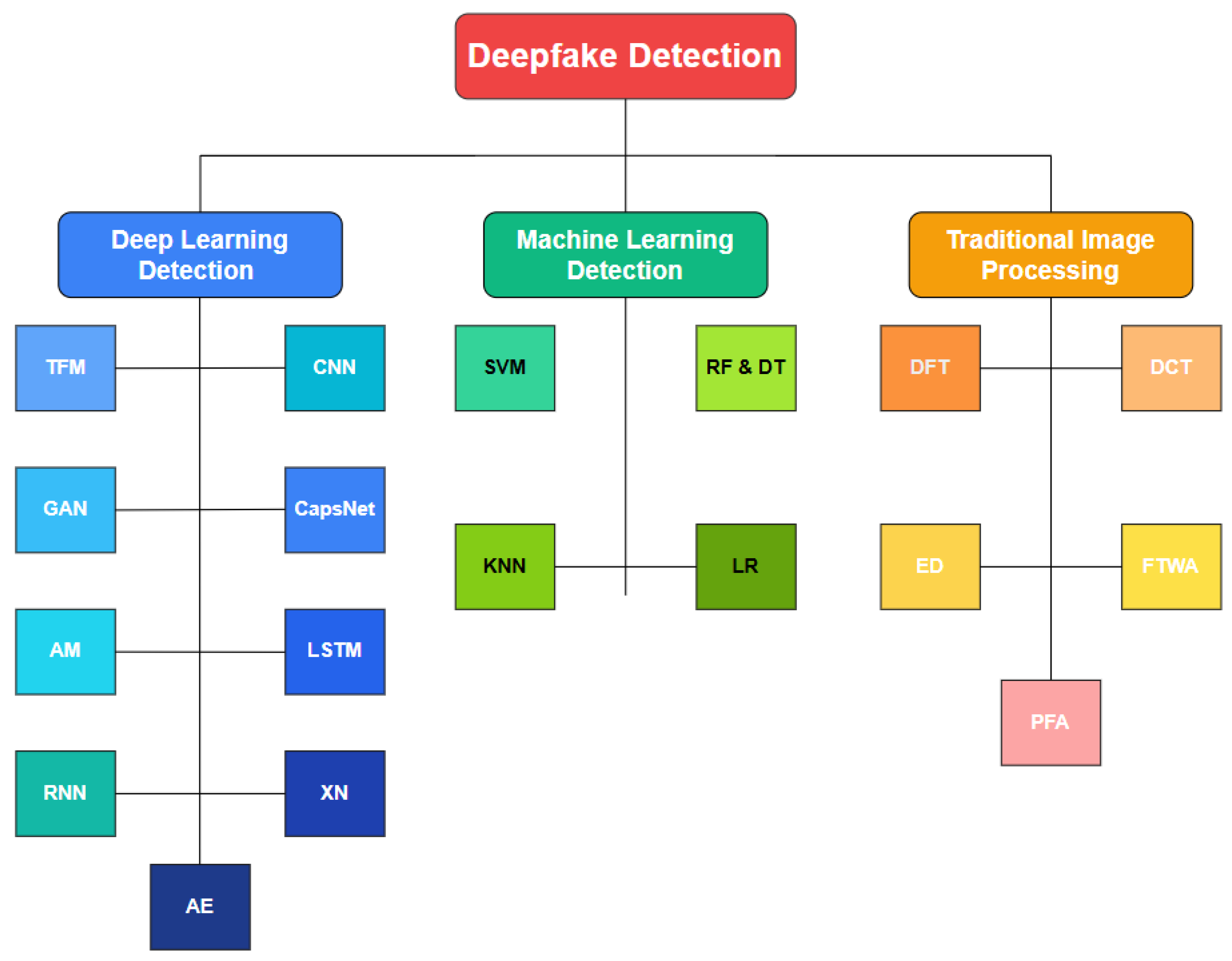
Figure 2 shows a detailed classification of deepfake detection techniques in a taxonomic structure of three main categories and methodologies are classified depending on their underlying algorithm and operation principles. This classification is important in order to comprehend the landscape of approaches to detection since it highlights the fundamental trade-offs between multiple and methodology paradigms, which ultimately help researchers in choosing the suitable techniques for particular deployment scenarios. The tri-partite taxonomy reflects the evolution of the detection methods from the old school signal processing methods to the classical machine learning and finally to the latest deep learning architectures.
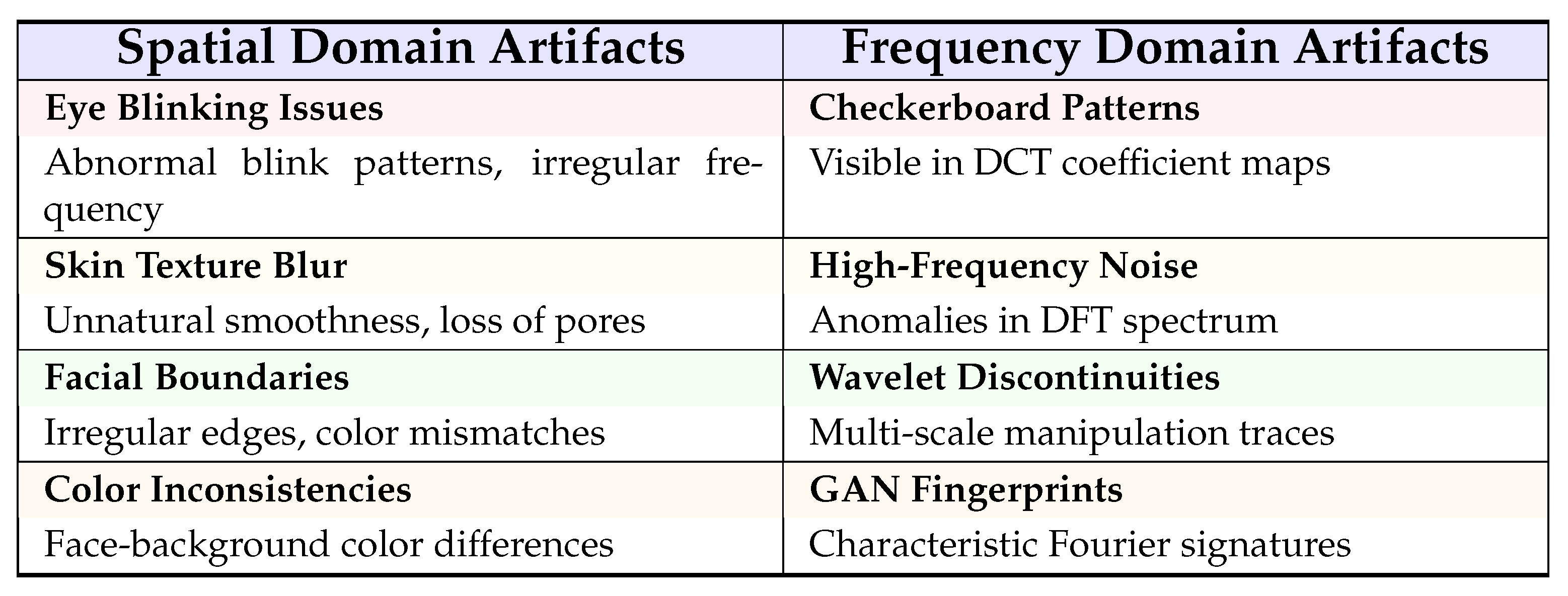
The first category, which includes Deep Learning-Based Detection Techniques, includes advanced neural architectures such as Transformers, Convolutional Neural Networks (CNNs), Long Short-Term Memory networks (LSTMs), Capsule Networks, Generative Adversarial Networks (GANs), XceptionNet, Recurrent Neural Networks (RNNs), Autoencoders and attention mechanisms. These approaches are currently leading the research field because of the capacity to automatically learn hierarchical representations of features from raw data with state-of-the-art accuracy on benchmark datasets. However, as detailed in Section 2 and Section 4, this category shows a large amount of variability in terms of the generation of the need for computational resources and cross-dataset generalization capabilities. The second category, MachineLearning and Traditional Methods, comprise of Support Vector Machines (SVM), Random Forest, K-Nearest Neighbors (KNN) & Logistic Regression. There comes a case where we have approaches that are based on handcrafted features, and some classical optimization techniques. Despite the fact that such models are overshadowed by deep learning in latter literature, our analysis in Section 3 shows that the accuracy of these models is competitive with much lower computational overhead, especially Random Forest which is able to get 99.64% accuracy on DFDC. The third category, which is Traditional Image Processing Techniques, includes frequency domain analysis methods such as Discrete Cosine Transform (DCT), Discrete Fourier Transform (DFT) and Pixel and Frequency Analysis, Edge Detection and Wavelet Analysis that take advantage of statistical regularities in deepfake generation processes.
This taxonomic organization makes some very important points related to methodological diversity and research gaps. The underlying rate of deep learning approaches (approximately 70% of reviewed studies) represents the current research trends, but our systematic evaluation refutes the affirmation of complexity of architecture equates to better performance.
Traditional methods have intriguing advantages in terms of interpretability, computational efficiency, and deployment feasibility which should be continued to explore in parallel with the deep learning innovations. The classification framework is obviously not just an organizational tool, but it is an analytical instrument than discovers the need to have multi-dimensional evaluation criteria that include accuracy, efficiency, and generalization and not only to optimize accuracy.
Generative adversarial networks have boosted the development of deepfake technology (GANs). This has developed to severe worries as to whether digital media can be trusted, which means that there should be powerful detection systems. Cao and Gong [34] disclose that although the accuracy was very high (0.94–0.99) in controlled environments, present detection models are susceptible to Gaussian noise adversarial attacks weak cross-method generalization and backdoor exploits. This review addresses the recent advancement and identifies the main challenges and antagonistic threats of coming up with a secure and reliable method of detecting deepfakes [34].

1.1. Novel Contributions

This review makes four innovative contributions that differentiate it from existing deepfake detection surveys and provide new knowledge regarding the capabilities, limitations and future directions of deepfake detection.

1.1.1. Contribution 1: Deployment-Centric Evaluation Framework

Unlike previous surveys focused on architectural categorization, in this review, methods are addressed from the deployment point of view by systematically comparing the different methods with their associated practical constraints such as their computational overhead, the robustness to cross-datasets, and the need to operate in real time. We show that methodological superiority is not a given, but context sensitive—transformer architectures are superior in a cross-disease setting despite the computational burden and classical machine learning approaches are competitive in terms of accuracy with little resource needs in particular deployment scenarios. This framework changes a focus on evaluation of “which method is best” to a focus on “which method is optimal for specific operational constraints.”

1.1.2. Contribution 2: Challenging Deep Learning Dominance Assumptions

Through this rigorous analysis of the type of computational efficiency, we dispute common assumptions of the superiority of deep learning over traditional methods. We show that using Random Forest, we obtain 99.64% accuracy on DFDC with 2 ms inference time (better than many deep learning methods that need 60 ms to attain 91% accuracy). This result, which was systematically documented in many different traditional methods, shows that intelligent feature engineering can be a very good competitor in comparison to learned representations in resource-constrained applications, and suggests that an implicit assumption in the recent literature is incorrect-namely, that complexity in the architecture guarantees superior performance.

1.1.3. Contribution 3: Systematic Cross-Dataset Generalization Analysis

We provide the first quantification of cross-dataset generalization failures across areas of methodologies to reveal systematic 10 to 15% of degradation of performance, which hints of learning dataset specific rather than a universal deepfake characteristic. While Le et al. [31] point out the issues with generalization and discuss theoretically, our systematic empirical study quantifies the patterns of degradation and shows that such patterns are the same for transformer (11.33% decline), CNN (15%+ decline) and traditional methods. Such proof is a fundamental limitation: something that needs paradigm shifts in the methodologies for training as well as dataset construction, not so much incremental refinements within the architecture.

1.1.4. Contribution 4: Comprehensive Computational Efficiency Quantification

We give the first systematic comparison within computational overhead (inference time, parameter count) between the different methodology categories, and it turns out that quite often marginal increases in accuracy necessitate disproportionate increases of computational cost. As an example, for ADT, it delivers only 1% better accuracy than for XceptionNet even with being 4x more computationally costly. This quantification enables evidence based architecture selection between performance and efficiency for specific deployment scenarios—critical information missing from existing surveys mainly dealing with accuracy. These contributions separately present researchers and practitioners with practical understanding to select methods, convey basic limitations requiring research focus or attention, and set evaluation frameworks focusing on practical feasibility of deployment together with laboratory performance.

1.2. Research Gap and Motivation

Despite the recent rise in research focus on deepfake detection, the literature in the topic has a number of critical limitations that hinder our understanding of detection capabilities and the ability to deploy them in practice. First, the literature to date is mostly focused on deep learning approaches and systematically understudies or ignores competitive performance of traditional machine learning approaches under certain deployment constraints. This prejudice on the part of the educated for architectural complexity tends to cloud situations in which simpler methods may provide better efficiency-accuracy trade-offs, especially in resource-constrained or in any real-time applications. Second, most reviews break methods down by the type of architecture (CNNs, Transformers, LSTMs) without systematically considering the underlying trade-offs among computational efficiency, detection accuracy and cross-dataset generalization—factors that have been shown to be important when assessing the viability of real-world system deployment beyond suspiciousness benchmarking on many datasets, which include a diversity of raw datasets including images, videos, corpus biologies, and more. This methodological aspect of taxonomy over performance trade-offs offers little information for practitioners to aid in choosing detection methodologies within particular operational scenarios.
Third, benchmarking performance comparisons in existing literature usually focus on within-dataset accuracy (ranging from 99%+ accuracy on FaceForensics++) without reporting or ignoring cross-dataset generalization failures that make many approaches unsuitable for production systems that must contend with evolving manipulation approaches.
The methodical body of cross-dataset performance degradation and what these patterns indicate about fundamental limitations in current procedures for how to detect have largely remained untested. Fourth, there is an underexploration of the complexity dimension versus the practical deployment viability dimension here is almost no analysis of the computation cost (inference time, number of parameters, memory) versus the marginal performance benefits. This oversight is especially important because detection systems need to be scaled for various platforms beforehand from high-performance servers to mobile devices. Finally, the field is missing rich synthesis of the methodological diversity that spans from deep learning all the way to classical machine learning and more traditional image processing techniques and it is difficult to understand the full landscape of the different detection approaches and their relative strengths in terms of different evaluation dimensions.

1.3. Research Questions

To fill these critical lacuna in deepfake detection literature, we deal with this systematic review which contains four critical research questions.

1.3.1. RQ1: Comparative Performance Across Methodological Paradigms

How do various detection methodologies, including deep learning architectures (Transformers, CNNs, LSTMs), classical machine learning methodologies (SVM, Random Forest, KNN) and traditional image processing techniques (DCT, DFT, wavelet analysis) compare with each other with respect to the dimensions of detection accuracy, computational efficiency and ability to generalize to new automated datasets?

1.3.2. RQ2: Cross-Dataset Generalization Patterns

What are the systematic patterns in cross-dataset performance degradation when the considered methods for detection are tested on datasets they have never seen before and what can their patterns tell us about whether currently considered approaches learn deepfake characteristics that are generalizable rather than dataset-specific?

1.3.3. RQ3: Viability of Traditional Methods

Do certain traditional machine learning and image processing approaches provide feasible alternatives to deep learning approaches in particular deployment scenarios with limited computational resources, real-time processing needs, or the need to provide some form of model interpretability?

1.3.4. RQ4: Architectural Innovations for Generalization

I am already involved in the research, perhaps not quite yet (nor even close), but in my own views, the best questions are how can we achieve the goals that matter most (not all) and how can we make it most reliable with what is or is not in the most instrumented representation?
These research questions pertain to our systematic analysis of studies published between 2018–2025 for the purpose of providing evidence to assess detection capabilities, fundamental limitations, and promising research directions for the field.

1.4. Review Objectives

This extensive systematic review aims to have three main objectives which are directly related to the research gaps and questions found.

1.4.1. Objective 1: Comprehensive Methodological Synthesis

We systematically synthesize the deepfake detection methodologies from a total of peer-reviewed studies of deepfake detection methods published between January 2018 and December 2025 by which approaches are categorized into 9 different technological categories which are in a deep learning architectures [Transformers, CNNs, LSTMs, Capsule Networks, GAN de Synthesis, XceptionNet, RNN, Autoencoders, Attention Mechanisms], classical machine learning methods [Support Vector Machines, RandomForest, K Nearest Neighbors, Logistic Regression], and the traditional image processing methods [Discrete Cosine Transform, This taxonomic organization covers the first comprehensive mapping of methodology diversity across the different spectrum of possible detection approaches instead of just focussing on deep learning methods.

1.4.2. Objective 2: Multi-Dimensional Performance Analysis

We perform from rigorous comparative performance analysis on three benchmark performance data sets (FaceForensics++, DFDC, Celeb-DFase and Celeb-DF) and quantify accuracy efficiency trade-offs as well as cross-data sets generalization powers for representative algorithms belonging to each category of technology. Unlike existing reviews, which mainly focus on single metric optimization (most commonly in the form of accuracy on FaceForensics++), in our analysis, we systematically assess three key dimensions related to performance evaluation: (1) detection accuracy for various types of manipulations and quality levels, (2) computational efficiency, in terms of the inference time and numbers of parameters, and (3) cross-dataset generalization, in terms of the problem of degradation in performance, on unseen data distributions. This multi-dimensional framework offers means of deployment centric evaluation taking into consideration economically important operational constrains beyond the laboratory environment.

1.4.3. Objective 3: Fundamental Limitation Identification and Future Directions

We recognize failure patterns in the literature in terms of methodology as well as suggest evidence-based directions for future work to address basic challenges related to generalization, efficiency, and deployment issues. Through performed cross-dataset analysis, we report whether performance degradation shows random manifestations or systematic limitations that indicate that the methods currently in use learn dataset specific artifacts and not universal deepfake features. This is a highly important evaluation, which will steer a field away from attempting to improve the accuracy slightly on corners and saponified benchmarks, toward solving underlying issues of detection failure.

1.5. Review Methodology and Organizational Framework

This systematic review adheres to a systematic approach for the systematic coverage and rigorous analysis of the deepfake detection literature. Whilst narrative reviews do not require the formality of protocols in systematic reviews (PRSMA guidelines), we use transparent selection criteria/analytical frameworks to allow reproducibility and systematic synthesis.

1.5.1. Literature Selection Protocol

We did systematic searches in five major academic databases: the libraries of the research communities of the world’s major tech companies and publishers, or more specifically: the libraries of the world’s major techs—the world’s major tech databases: attractive and user-friendly libraries of scientific data and content: libraries of which the full text content is available online. The search term was used with Boolean operators in order to obtain relevant literature: ((”deepfake detection”OR ”face manipulation detection” OR ”synthetic media detection” OR ”facial forgery detection”) AND ”deep learning” OR ”machine learning” OR ”computer vision” OR ”image processing”). We limited the temporal objects within the given papers from January 2018 to December 2025, i.e., the time frames from the innovation of deepfakes in late 2017 to current state-of-the-art methods. This period spans the full development of various detection techniques from the initial convolution-based techniques (CNN) to the latest transformer-based models and multimodal models.
The search process has resulted in 327 potentially relevant publications. We applied systematic inclusion criteria requiring: (1) peer-reviewed publications in either journals or conferences or including highly-cited preprints (>20 citations) from reputable archives (arXiv, ResearchGate), (2) empirical evaluation using established/unofficial benchmark datasets, being either FaceForensics++, DFDC, Celeb-DF or equivalent, (3) clear methodological description to allow for methodological replication or critical assessment, and (4) quantitative performance metrics reporting, including accuracy, AUC, F1-score, etc.; Exclusion criteria that were removed from our search were: (1) pure theoretical papers lacking implementation and/or empirical validation; (2) papers that do not contain quantitative results or merely provide qualitative analysis; (3) duplicate publications or extended versions of previous research publications (we kept the most complete version); (4) papers that exclusively focus on deepfake generation techniques and not on deepfake detection techniques; and (5) papers that do not address modalities outside of our scope of study (e.g., exclusively audio deepfakes lacking visual components, text-based manipulation). This-focused systematic filtering process produced primary studies that make up the final review corpus.

1.5.2. Analytical Framework and Categorization

We divided the preferred detection methodologies into three main categories depending on the algorithmic basis and working principle of the detection. The firstcategory, Deep Learning-Based Detection Techniques (Section 2) contains nine groups of algorithms, i.e., the Transformers (dependencies among the global objects, using self-attention mechanisms), Convolution-based Neural Networks (global feature examination, using hierarchies of space features), Long Short Term Memory networks (dependencies over time), Capsule Networks (preserving the hierarchies of space), Generative Adversarial Networks (Using devices gained), Recurrent Multiscale Networks (Acting on events irrespective of spatial hierarchies) and Multi-level Networks (Multi-scale network) via adversarial training), XceptionNET (separable convolutional operations for depthwise processing of images), RNN (processing sequence data networks), Autoencoders (learning process by reconstruction) and Attention Mechanism (selecting salient features). Such granular categorization makes it possible to identify architecture-specific abilities and disabilities instead of considering “deep learning” to be a monolithic category.
The second category, Machine Learning and Traditional Detection Techniques (Section 3), is the classical supervised learning techniques and the signal processing techniques: Support Vector Machines (Optimization of margin, classification) Random Forest (decision trees—ensemble) K-Nearest Neighbors (instance-based learning) Logistic Regression (probabilistic linear classification) User Discrete Cosine Transform (Frequency domain analysis) Discrete Fourier Transform (spectral decomposition) Pixel and Frequency Analysis (hybrid between space—spectrum) Edge Detection (Gradient-based features) Wavelet Analysis (Multi-resolution). Inclusion of traditional methods covers the found gap in current surveys that systematically under-examine approaches that are based on a non-deep learning strategy, although they may have theoretical advantages in terms of computational efficiency and interpretability.
The third category, Performance Analysis (Section 4), can be the synthesis in the form of a comparative evaluation in the benchmark data sets. For each of the reviewed techniques, we extracted the following information: (1) architectural design, algorithmic technique, (2) computational requirements (inference time, parameter number, memory footprint when reported), (3) within-dataset performance on FaceForensics++, DFDC and Celeb-DF (4) cross-dataset generalization in terms of performance degradation of the tests on unseen benchmarks, and (5) deployment considerations (real-time capability, hardware).

1.5.3. Evaluation Metrics and Comparative Analysis

In our performance comparison framework, we place a large emphasis on three dimensions which are critical for determining practical deployed viability beyond single metric optimization: First, detecting accuracy is evaluated in three benchmark datasets of different manipulation characteristics: FaceForensics++ (controlled manipulations using 5 generation methods at multiple compression levels), DFDC (large-scale realistic variations, 128,154 videos) and Celeb-DF (realistic celebrity deepfakes which are close to realistic scenarios).The overall accuracy, AUC (Area Under ROC Curve), and F1-score are used as the metrics of accuracy and can be compared with each other even though the metrics are heterogeneous as only what the original studies reported is in use. F1-score presents the combination of precision and recall in a balanced way, which is especially useful with imbalanced datasets, typical of the deepfake detection tasks [35].
Second, computational efficiency is measured by inference time (mili-seconds frame or video) and model complexity (number of parameters FLOPs if known). This dimension touches on the gap we have observed in terms of computational cost benefits, in that insights into whether there is a great deal of additional accuracy that warrants a great deal of extra computation for particular deployments (real-time content moderation vs. forensic analysis vs. resource-constrained mobile deployment). Third, cross-dataset generalization is defined as performance degeneration when approaches trained using one dataset are tested on a different benchmark. This metric provides insight into whether techniques are learning the characteristics of deepfakes in general or these specific datasets—a very important distinction to make if we are to deploy these deepfake detection methods for practical applications to real-world scenarios where manipulation techniques might evolve continuously. This tri-dimensional evaluation framework allows for subtle evaluation beyond conventional tests of accuracy (i.e., in relation to other studies and datasets, RQ1 comparative performance tests by methodology and RQ2 generalization patterns across data sets). Methods that excel in all three dimensions are ideal solutions and those which maximise one dimension at the cost of another are appropriate for particular deployment situations.

1.5.4. Organizational Structure and Roadmap

The review is defined to increase a understanding from individual methodologies to comparing synthesis and critical analysis. Section 2 presents a systematic discussion of deep learning architectures, which starts fromTransformer based architectures (demonstrate superior generalization in spite of computational overhead), through the Commun innovation technology (CNN-s) architectures (trade between effectiveness and efficiency) to specialized architectures targeting on solvable challenges (temporal modeling with long short term memories (LSTMs), spatial hierarchy preservation with Capsule Networks). Within each family of architecture, we analyze representative methods, document performance in each of the benchmarks, and detect failure patterns.
Section 3 is an analysis of machine learning and the conventional image processing methods and by that challenge the assumption that deep learning is overwhelming and show that it provides the same performance in some situations. For each method category (SVM, Random forest, frequency domain analysis), we conduct a synthesis of the different studies within the set so as to observe, not isolated results, but rather consistent findings. Section 4 is devoted to comparative analyses of the performance through the use of structured tables and cross-method analysis synthesis, which relate directly to research questions using factual evidence. Section 5 (Discussion) involves synthesis of findings to identify fundamental trade-offs and systematic limitations as well as promising (future) research path directions. Section 6 (Conclusion), distils some key insights and suggestions for action.
Such organizational format that CD readers can; (1) understand individual methodologies in their architectural context (Section 2 and Section 3), (2) compare methods based on evaluation dimensions through systematic analysis (Section 4), (3) determine basic patterns and limitations that transcend single methods (Section 5), and (4) draw out ways to use the methodology to inform the choice of a method and guide future research (Section 6). The structure allows for both the type of reading that moves toward comprehension for the deep understanding of particular ideas and the type of selective navigation for practitioners who may need to find specific information.

1.6. Bibliometric Analysis and Research Landscape

To give quantitative and objective visualization of the research landscape of deepfake detection, we performed a bibliometric analysis of our 74-study corpus, analyzing publication trends and methodology evolution and discovering the clustering patterns with respect to its themes over time.

1.6.1. Temporal Publication Trends and Growth Patterns

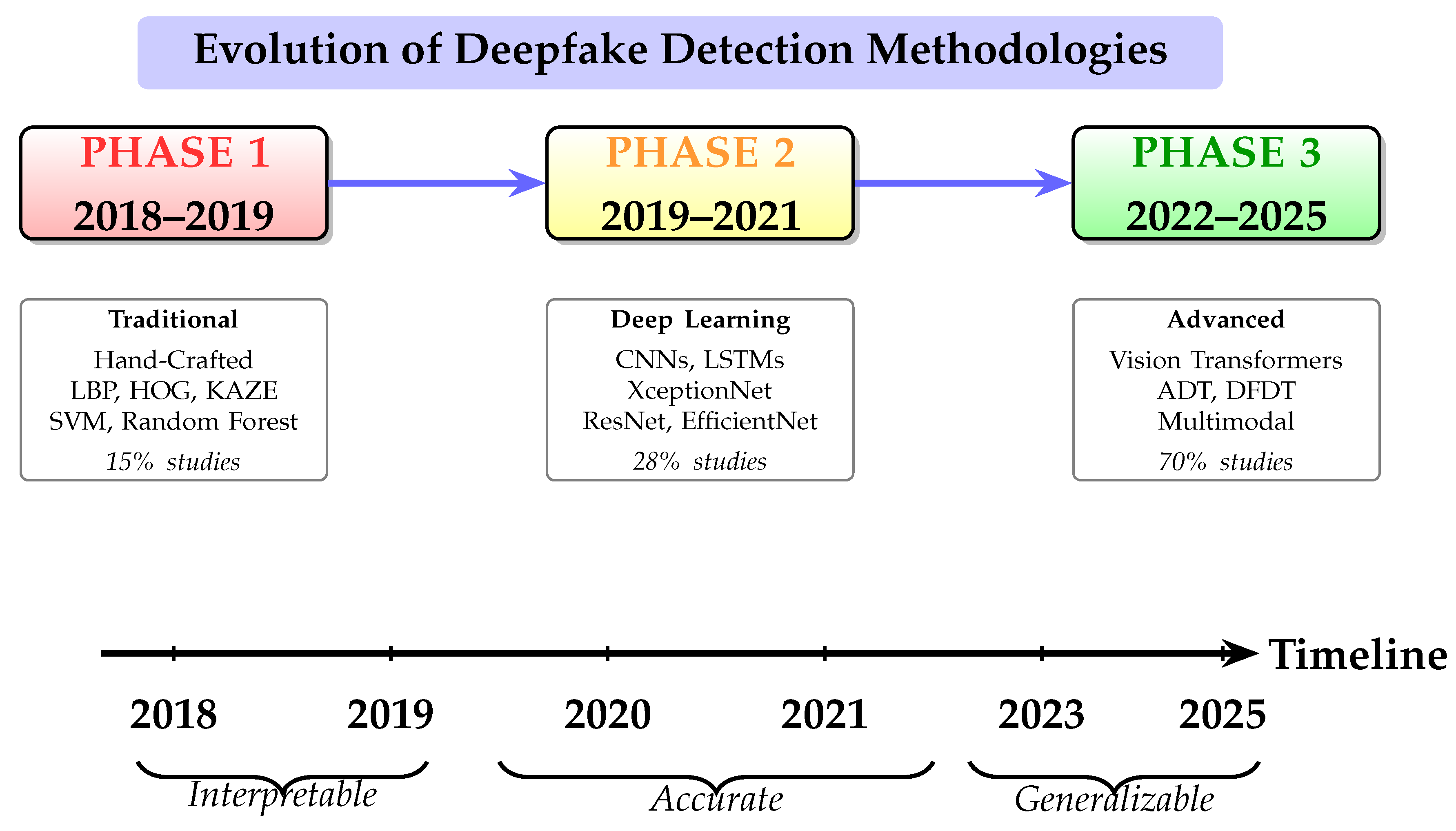
Our corpus shows that the research on deepfake detection has grown exponentially, as the number of publications has grown from 3 studies in 2018 and 23 studies in 2024, which is a 667% growth rate. This evolution is in numerous dimensions and is thoroughly reported in recent comprehensive surveys published in the best-tier journals. Media forensics is also discussed in IEEE reviews around the foundations of media forensics and media benchmarking challenges, whereas state-of-the-art methodologies and open challenges are evaluated in surveys published by Springer and Elsevier [36]. Wiley has systematic coverage of deep learning approaches in the MDPI and ACM publications emphasize machine learning fusion techniques and perspectives on reliability. In general, these 2023–2024 surveys intersect as they are focused on defining underlying issues, such as cross-dataset generalization, computational efficiency and the necessity of the evaluation frameworks that go beyond single-dataset accuracy measures.In her paper, Kaur et al. talk about the main challenges of GAN-based generation methods which are the detection approaches that need to be tailored according to the specific case. The bibliometric analysis performed by the authors uncovers the trends in publication and the dominant research fields, thus indicating that there is still an active interest from the academic community in the GAN-driven detection methods [37]. This acceleration is a true reflection of the other two factors branching from the problem: an accelerated deepfake threat, as well as the mature detection methodologies. Publication distribution reveals three clearly distinguished phases at the end of which CNN-based detection paradigms (1) continued its founding phase 2018–2019 (15% overall studies), (2) with the diversification phase 2020–2021 (28% overall studies) introducing attention mechanism and spatial-temporal modelling and (3) with the sophistication phase 2022–2025 including 70% of overall studies.
Figure 3 shows the methodological evolution in 3 different phases. Phase 1 (2018–2019) Operations for foundational detection capabilities based on traditional hand-crafted features as Local Binary Patterns (LBP), Histogram of Oriented Gradients (HOG) and KSZ Lapini Descriptors together with classical machine learning classifiers as Support Vector Machine (SVM) classifiers and Random Forest classifiers. This phase corresponds to 15% of the studied, and is focused on the mainly interpretability, and also computational efficiency. Phase 2 (2019–2021) Corresponds to the switching towards deep learning architectures, in particular for the second phase where Convolutional Neural Networks (XceptionNet, ResNet50, EfficientNet), and Long Short-Term Memory networks (LSTMs networks) for temporal modeling were mostly used. This phase of diversification granted the introduction of attention mechanisms and hybrid algorithms of fusion for the spatial-temporal combination, that represent 28% of the total number of studies, which gave a high accuracy for the detriment of the understanding. Phase 3 (2022–2025) represents the current state-of-the-art which is composed of advanced Vision Transformers (ADT, DFDT), multimodal audio-visual frameworks (AVoiD-DF), and hybrid spatialrequency approaches. This sophistication phase is the one that dominates the current research (70% of studies) and it focuses on issues related to dealing with cross-dataset generalization problems while remaining computationally feasible for use in practice.
Keyword analysis shows three major research clusters. The Deep Learning Architecture cluster (45% of studies) emphasizes CNNs, Transformers, LSTMs, and hybrid models for the accuracy of the models with architecture innovation. The Cross-Dataset Generalization cluster (25% of studies) discusses issues of lack of performance across benchmarks, which is directly tied to our RQ2. The Computational Efficiency cluster (18% of studies) studies the trade-offs of accuracy and efficiency as well as deployment constraints which support our deployment-centric evaluation framework. The Multimodal Detection cluster (12% of studies) involves unresolved audio-visual integration approaches and represents new areas of research. The Multimodal Detection cluster (12% of studies) focuses on audio-visual synchrony enlargements such as lip-sync violations and voice-expression violations with approaches such as AVoiD-DF achieving 91–92% accuracy.

1.6.2. Benchmark Dataset Utilization Patterns

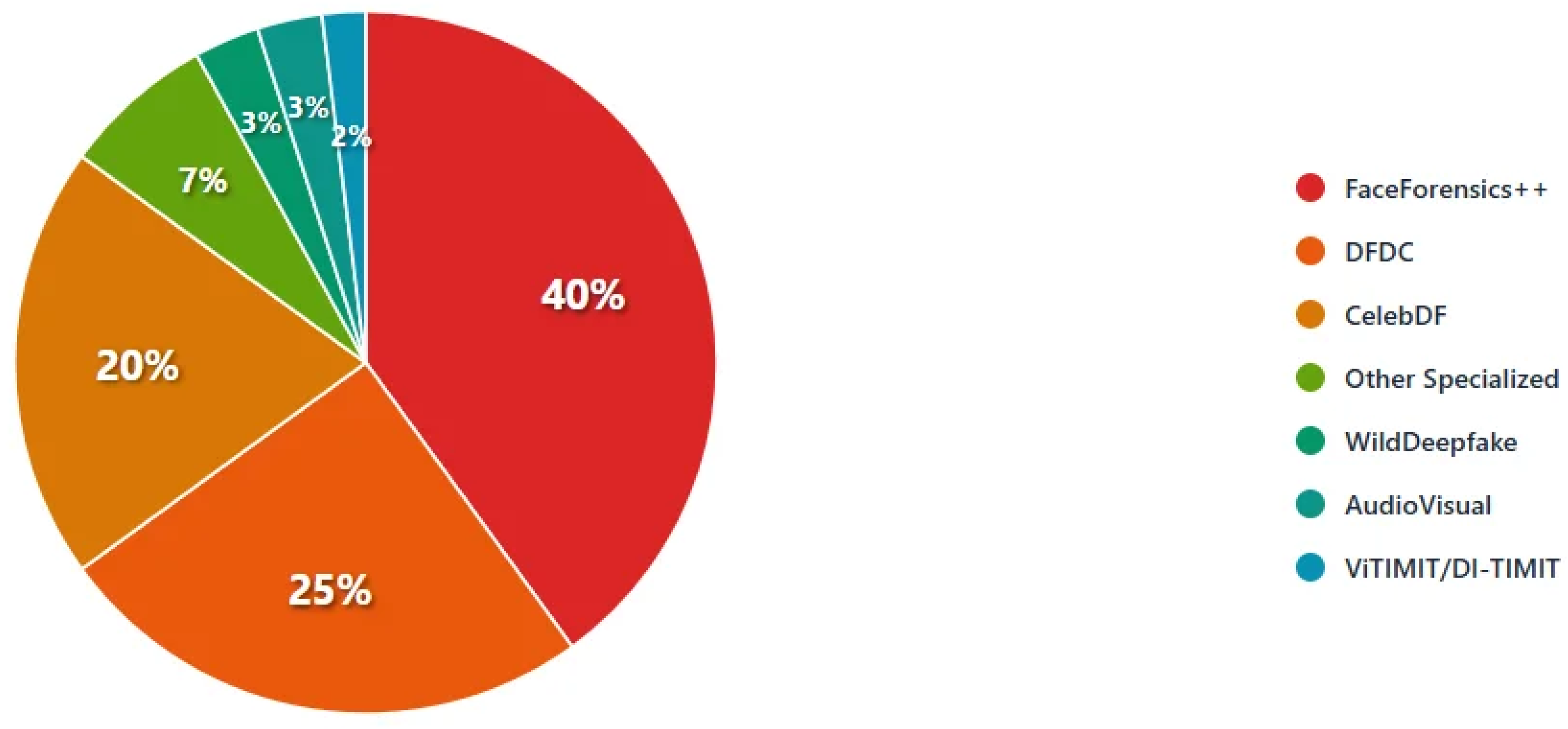
Consistent with Figure 4, FaceForensics++ is far more popular for benchmarks (40% studies), followed by DFDC (25%) and Celeb-DF (20%). This high of a concentration leads to possible evaluation biases because methods that have been tuned for FF++’s controlled conditions, might learn dataset specific in addition to the overall characteristics of deepfakes. The growing number of specialized datasets (WildDeepfake 3%, audio-visual datasets 3%, speech-specific datasets 2%) is reflective of understanding that the assessment of single-benchmark evaluation method is inadequate as evidence for useful detection capability in practice.

1.6.3. Citation Network and Methodological Evolution

Analysis of citation patterns reveals ground-breaking works that set paradigms for detection: date datasets creation by Dolhansky et al., Wang et al. [17,18] are highly influential publications that define the further research directions. Citation network analysis shows the evolution in methodology from the extraction of spatial features (2018–2019), attention mechanisms (2020–2021) to the focus currently on generalization across data sets and computational efficiency (2022–2025).

1.6.4. Research Gap Validation

This bibliometric landscape empirically gives our identified research gaps legitimacy. The systematic 10–15% cross-dataset performance degradation ability we document is 25% of the papers with explicit evaluation of the generalization ability considered, suggesting that this is still not a fully solved problem. This 18% of studies concerned with computational efficiency makes sense for our finding that this dimension is given far too little attention compared to its importance in deployment. The focus of 70% of studies on deep learning approaches justifies our observation that traditional approaches of machine learning are systematically underexamined, even though they are competitive performers on certain deployment scenarios.
This bibliometric analysis enhances the contribution of our review by showing that our categorisation framework (Figure 2), identified research gaps (Section 1.2), and multi-dimensional evaluation approach (Section 1.5.3) are consistent with objective patterns in the research landscape and not with subjective choices in categories.

2. Deep Learning-Based Detection Techniques

There are three main categories of deepfake detection techniques.

2.1. Transformers (TFM)

The transformer-based methods can be considered an ideal development of deepfake detection from which global contextual dependencies may be derived by leveraging the self-attention mechanisms that traditional Convolutional Neural Networks (CNNs) are not able to model well enough. The aggregated study of transformer implementations shows that there are three possible architectural forms strategies like pure vision transformer, hybrid CNN-transformer, and specialized spectral ultrasound in forensic uses. The examples of vision transformer show a high level of cross-dataset generalization as compared to CNN-like methods. The Anti-Deepfake Transformers of Wang et al. [18] with variant residual connections (ADT) sets the paradigm at 96.30% on FaceForensics++ and 84.97% on Celeb-DF, which is a drop of 11.33 percent, which, though a massive loss in performance, does still beat the majority of CNN-powered cross-dataset evaluations. The DFDT structure introduced by Khormali and Yuan develops this strategy. Multi-stream transformer and re-attention are used and which reaches 99.41% on FaceForensics++ and displays a resilient cross-manipulation generalization. This observation suggests an inverse relationship between the accessibility and refined digital resources and the phenomenon of deepfakes. On the contrary, countries that have enforced healthy ones have put in place sound policies and systems of digital governance, showing fewer serious cases of deepfakes. Mixed methods are promising better efficiency. Similar results (AUC 0.951 on DFDC) are obtained by Coccomini et al.’s Effective ViT, but with less reduction and deliberate CNN-transformer interleaving. The MoEFW architecture even maximizes the efficiency of parameters by means of a Mixture of Experts. LoRA architecture, which gives evidence that the transformer benefit can be realized with fewer computational expenses [38].
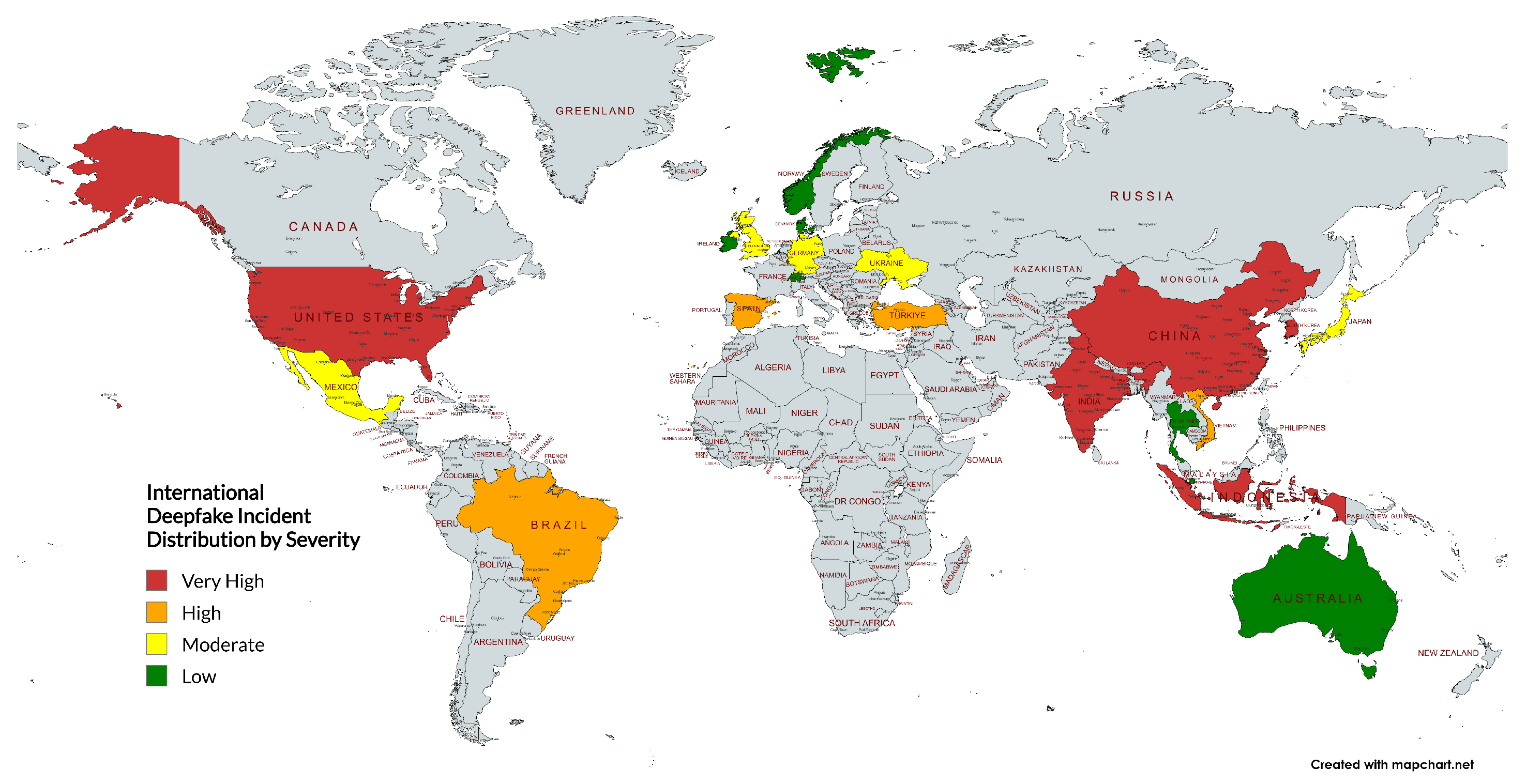
A geographical visualization of the deepfake incident distribution by nation with a color-coded intensity scheme to reflect the documented prevalence of deepfake cases worldwide is available in Figure 4. This global perspective is important to comprehend the patterns of proliferation of deepfakes and their relationship with infrastructure of the technologies, frameworks of digital governance and factors of societal vulnerability. The visualization exposes extreme geographical inequities that are correlated with levels of both technological development and regulatory maturity and provides insights into sociotechnical aspects of the threats of the creation of deepfakes beyond the technical difficulty of their detection.
The map identifies three layers of the concentration of deepfake incidents. The nations with the highest incidence of a disease (shown in red color) include the United States, China, India, and Indonesia representing countries with large populations, well-developed technological infrastructure, and widespread adoption of social media. The presence of this correlation indicates that deepfake proliferation is ample both by the availability of complex generation tools, as well as by the existence of massive digital populations available for manipulation. Some high-incidence countries, which are colored in orange, include Brazil, Turkey, Russia, and South Korea, which have high levels of deepfake activity which are fueled by factors such as active social media landscapes, political polarization, and the advancement of technology. Moderate incidence countries (yellow) such as Mexico, Germany, Ukraine, Japan, and several European countries have registered measurable but less frequent deepfake challenges which could be a result of stronger regulatory options and lower digitization. Low incidence areas (green) which include Australia, Nordic countries, and some European countries reflect comparatively fewer cases showing evidence of serious incidents, suggesting further that digital governance, media literacy interventions and proactive regulation seems to be successful in mitigating the threat of deepfakes.
The geographical distribution demonstrates a fundamental issue with the proliferation of deepfakes; namely, countries with the most advanced technological capabilities have the highest rates of occurrence, suggesting that the process of technology is an enabler of both capabilities-diagnosis and deepfaking.
This pattern highlights a need for more than technical detection solutions to tackle the issue—integrated approaches incorporating technological detection, regulatory frameworks and governance of the platforms as well as media literacy in the public sphere need to be considered. The higher concentration of incidents in technologically advanced countries also hints that currently the deepfake regime may only reflect the initial stages of global proliferation with possible accelerated proliferation when generative AI tools become more readily accessible in currently low incidence areas. This geographical analysis thereby focuses the urgency of establishing detection systems that are scalable and computationally efficient and can be implemented in all kinds of technological and economic circumstances.
Also, transformers try to solve fundamental CNN drawbacks with global attention their computational loads make modeling and restrict their practical application. The consistent cross-dataset performance advantage: attention mechanisms are able to get more generalizable artifacts of manipulation, but the efficiency-accuracy trade-off has not been sorted out as far as real-time applications are concerned [39].

Distributions of Datasets in Deepfake Detection Survey

Figure 5 describes the relative use of benchmark datasets of the 74 studies reviewed in this review and shows that alongside focus on accepted benchmarks, there is also increasing diversification to consider specialized and multimodal evaluation frameworks. This distribution pattern has profound implications for the understandability of detection performance in general and reported detection performance in particular, because dataset selection fundamentally informs both the kinds of manipulations targeted to be detected by attacks and scenarios of evaluation that are realistic for real world applications during deployment. Table 1, Table 2 and Table 3 summarize the performance characteristics and comparative results for the analyzed methodologies.
FaceForensics++ (FF++) is the winner of this evaluation, with 40% of dataset usage being divided between reviewed studies. This prevalence is in line with FF++ being the de facto standard benchmark, and provides for controlled evaluation using 1000 original videos manipulated through 5 different generation methods (Deepfakes, Face2Face, FaceSwap, NeuralTextures, FaceShifter) and several different compression levels. However this dominance produces potential biases in evaluation, because of, for instance, the systematic performance degradation [loosening by at least 10–15%] documented in Table 3 where methods optimized for FF++ may learn dataset motivated compression artifacts, not generalizable deepfake characteristics. The DeepFake Detection Challenge (DFDC) dataset is 25% of the usage, and it offers large-scale evaluation with 128,154 videos featuring different actors and realistic changes of lighting, compression and recording conditions. The fact that DFDC is a more challenging benchmark with more real world artifacts results in lower absolute accuracy score (Table 2) compared to FF++ (Table 1). Celeb-DF stands for 20% of evaluations that focus on high-quality celebrity deepfakes that are close to real-world manipulations encountered in the social media world.
The distribution points to an important methodological trend in the general direction of specialized evaluation frameworks. Smaller specialized datasets have a sum of the usage for 15%, i.e., WildDeepfake (3%) providing in-the-wild manipulations, audio-visual datasets (DefakeAVMIT and FakeAVCeleb; 3%) allowing multimodal evaluation and datasets specific to speech synthesis (ViTIMIT and DI-TIMIT; 2%). This diversification is due to increasing recognition of the fact that single-benchmark evaluation is insufficient to provide evidence for practical detection capability. The movement towards multimodal data sets is especially notable because it shows that AVoiD-DF is better able to exploit the audio-visual inconsistencies, suggesting that in future detection systems, it is necessary to tackle multiple modes of manipulation at the same time. However, the persistency of FF++ even with the qualities of saturation (of >99% by most methods) makes it appear that evaluation practices are lagging behind a level of methodological sophistication that could shape the need for evaluation strategies to involve cross-dataset evaluation protocols with even harder benchmarks to access involving contemporary deepfake generation capacities.
Surveys by IEEE and Springer include more recent complete publications which note that the transformer architectures have better generalization than CNNs, but need to take into consideration computational efficiency issues in practice. IEEE benchmarking research points the significance of the evaluation frameworks that introduce orderly evaluation of accuracy and efficiency trade off to support our multi dimensional evaluation strategy [10,11,15,36]. Detailed surveys of various publishers reveal that more and more focus is built on the understanding that architectural complexity cannot be deployed without deployments being considered in terms of inference time, parameter efficiency and resources consumption, which justifies our deploy-based approach [9,12,13,37].

2.2. Capsule Networks (CapsNet)

The implementation of capsule networks takes the form of architecture swaps, which address. Convolutional Neural Network spatial hierarchy preservation limitations alone retain the drawbacks of having the same computational cost as transformer methods. The overall assessment suggests that the spatial relationships can be maintained in capsule networks and can be reduced maximal loss of information in the process of feature extraction.
Capsule-Forensics by Nguyen et al. [44] provides some basic capabilities for discovering the spatial association of facial images and videos, a strong generalization between datasets, FaceForensics. It is the integration strategies, as illustrated by Local Binary Patterns are used with the modified HRNet in iCops-Dfake by Khalil et al. and Capsule Networks, attaining superior detection on Celeb-DF and DFDC-P data with multi-modal feature combination [45]. The article by Stanciu and Ionescu centers on the optimization of dynamic routing, and it has achieved high precision and lower parameters on benchmark sets. The hybrid Capsule LSTM model has efficiency in parameters and can compete with XceptionNet, especially effective with performance that has many fewer parameters (34 M vs. 27 M), lossless on DFDC all levels, and frame selection [46].

2.3. Convolutional Neural Networks (CNN)

The constructions of approaches based on convolutional neural networks have been the main method of deepfake detection, going from basic classification networks to highly developed multi-modal architectures. The combined examination uncovers that there are still overfitting issues that cannot be solved with new architectures and that there are certain specialized areas where CNN methods are still very competitive [40,47].
Multi-modal integration strategies show promising results for comprehensive detection. The innovative VGG-16 CNN with transformer encoder approach utilizes self-attention for facial artifacts and cross-attention for lip-audio discrepancies, demonstrating superior performance on DFDC, DF-TIMIT, and FakeAVCeleb datasets through modality fusion.
The methods employed by CNN still possess substantial computational benefits compared to the transformer implementations. The CNN architectures proposed by Mathews et al. have explainability components integrated into their design, while efficiency is still preserved. The integrated biosensor based on plasmonic resonance of Maheshwari et al. [41] is able to deliver 1.2 % false positive and 0.5% false negative rates along with a very small amount of computational overhead [41].

2.4. Generative Adversarial Networks (GAN)

Nguyen et al. propose a multi-task learning system that identifies concurrently and detects manipulated areas in face images and videos. They use a standard encoder and decoder test with subdivision based on a binary spectrum (authentic and manipulated) and pixel segmentation of the manipulated regions. This Multi-task formulation enables the network to learn a stronger feature representation with the use of supplementary signals of detection and localization of the supervision objectives. Assessed on FaceForensics++ and Celeb-DF, the approach has good results in terms of its capacity to perform the two tasks, as well as giving manipulable outputs and localization masks. It is shown in the work that detection and joint optimization optimize the goals of segmentation provide a better generalization than that of single-task techniques, especially with the artifacts of subtle manipulation [44].

2.5. Long Short-Term Memory (LSTM)

The implementations of Long Short-Term Memory (LSTM) are designed to detect the errors of the time scale with the help of the sequential processing abilities to recognize the artifacts of manipulations across video frames. The overall examination shows the functionality of LSTM on particular scalability constraints of processing large video data, as well as temporal patterns. The 100% accuracy of Hosler et al. on DFDC using the Low-Level audio and video descriptor analysis proves a remarkable achievement in the error detection of emotions. The use of LSTM in semantic temporal analysis. This strategy plays off on emotions, continuity violations, which deepfake generation is apt to add [48].
The CNN-LSTM integration by Jolly and Shitole consists of the ResNet18 spatial feature extraction on LSTM temporal dependencies measured on FaceForensics++ with Gaussian blur image enhancement. But the comparative analysis of Lu et al. shows that Channel-Wise Spatiotemporal Aggregation (CWSA) is a superior STL-based approach with emphasis on the shortage of spatial features in LSTM approaches. The systematic review by Sandotra and Arora puts the LSTM-based approaches in perspective, presents extensive detection taxonomies, but demonstrates the scalability difficulties of large-scale video processing programs [49].

2.6. Attention Mechanisms

The various applications of the attention mechanism suggest that it is one of the core implementation technologies that has made transformers successful, and it has presented at the same time its portability to deepfake detection. The capacity is uncovered in the joint examination of the attention process that is capable of capturing contextual dependency, and also to make detection interpretable. The self-supervised ViT exploration provided by Nguyen et al. demonstrates the mechanism of attention ability to extract features and is interpretable by visualizing attention maps. It is in the comparison of frozen weights and fine-tuning methods that the comparison is drawn, with flexibility in the attention mechanism to meet different deployment situations [50].
The Meta Deepfake Detection (MDD) proposed by Tran et al. is a combination of attention mechanisms and meta-learning models, i.e, Pair-Attention Loss (PAL) and Average-Center. Alignment Loss (ACA) by use of block shuffling transformation to increase generalization across unseen domains. Attention mechanisms not only offer the fundamental technology of transformer success but are also interpretable, to help single-mindedly detect. Their combination with flexibility is represented by meta-learning and forensic-specific applications. This is because of the computational cost, which is one of the factors to be put into consideration during the deployment of such systems [51].

2.7. XceptionNet

Chollet [52] invented XceptionNet, an optimized convolution neural networks (CNN) architecture with depthwise separable convolutions that are more computationally efficient and can provide the same detection performance. Chollet’s (2017) modification of depthwise separable convolutions provides the computational efficiency boost than Inception classics. Despite recent breakthroughs in improved transformer-based models deepfake detection models, XceptionNet is still a notable baseline model [52]. Xu et al. [53] made a step ahead and proposed the Multi-Channel Xception Attention Pairwise Interaction (MCX-API) framework involving pairwise learning and multi-color space inputs to enhance the detection performance. Xu et al. had an accuracy of 98.48% on the FaceForensics++ data set and 90.87% on the Celeb-DF data set [53]. XceptionNet retains its competitiveness in the detection of the deepfake phenomenon through relentless optimization of the network architecture and the invention of new strategies of integration. The persistence of the research interest in XceptionNet-based methods speaks to the fact that it likely has a place in research, especially applications where efficiency is of the utmost importance. However, Thing (2023) shows that transformer-based architectures have better generalization ability on a wide range of data sets and manipulations [54].

2.8. Recurrent Neural Networks (RNNs)

Recurrent Neural Network (RNN) implementations are interested in sequential data processing representing early temporal analysis methods, in detecting temporal inconsistency that laid the groundwork for further development of LSTM and transformers.
The work of Guera and Delp is the pioneering work in the field of RNN-based deepfake detection by using convolutional LSTM networks to determine temporal inconsistency, developing the paradigm of the sequence-based deepfake detection [53].
RNN methods laid the groundwork of temporal analysis of deepfake detection, which is later outperformed by the development of LSTM and transformers. long-term dependency modelling and computational efficiency [55].
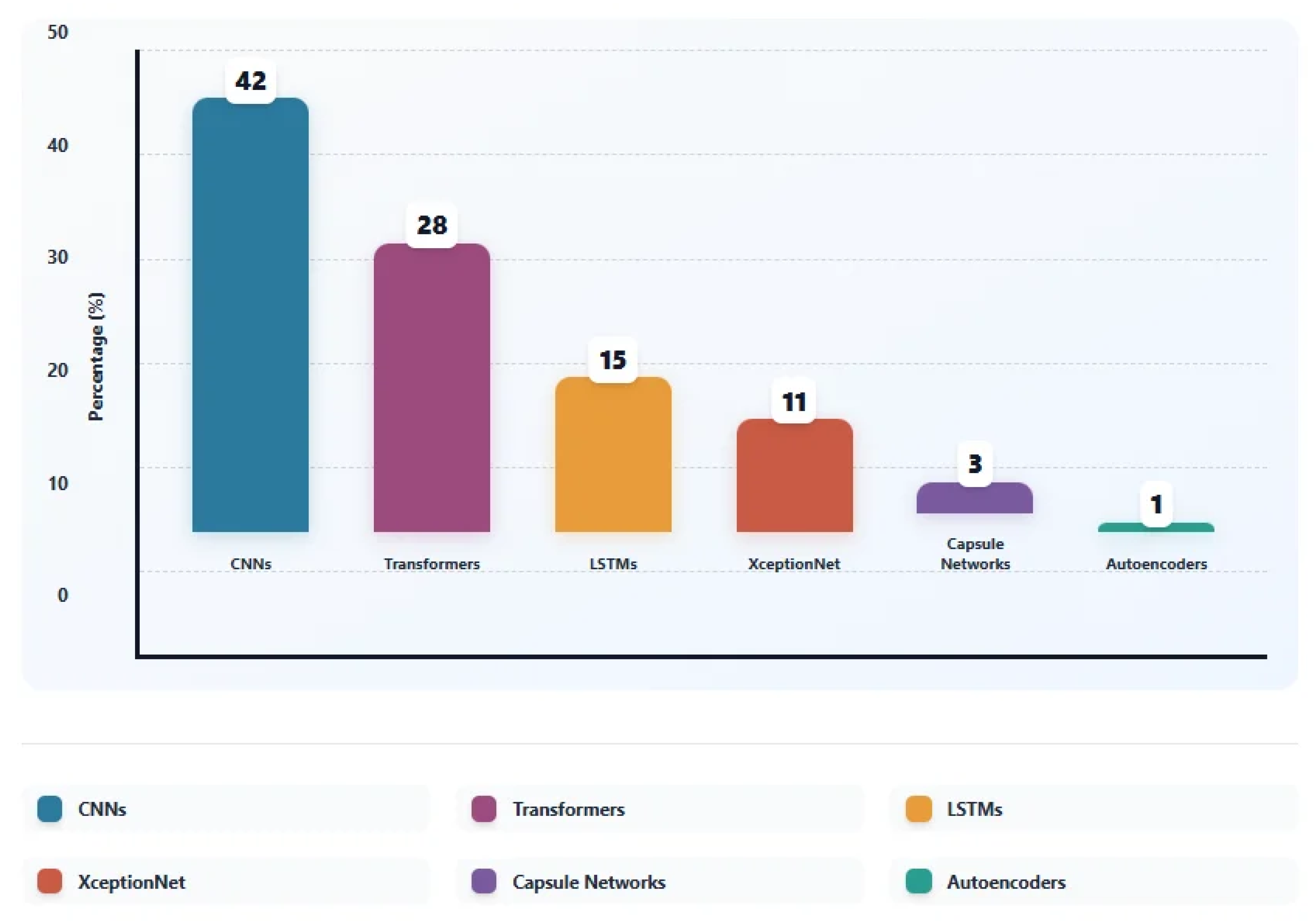
Distribution of deep learning Figure 6 shows architectures used in various reviewed deepfake detection papers indicating the relative popularity of various neural network paradigms showing the predominating research trends for methodology choice. This distribution of the architecture gives us a glimpse into the history of the field from convolutional methods toward more advanced methods that incorporate attention and temporal modeling and also shows the gaps that still remain in the search of certain architectural families regardless of their potential benefits.
Convolutional Neural Networks (CNNs) make up the largest number at around 45–50% of the deep learning implementations, as they are proven to be a core architecture used for computer vision tasks, as well as being an effective architecture for extracting spatial features in facial regions as well. The prevalence of CNN variants from simple designs such as VGG-16 to sophisticated variants such as EfficientNet and ResNet—shows the versatility of this architecture in different detection situations. However, as documented in Section 4, CNN based approaches show cross dataset generalization problems with a performance degradation around >15%, which leads us to believe that pure convolutional approaches may reach fundamental limits in learning manipulation invariant features. Transformer-based architectures have an implementation share of 25–30% and this is a huge and increasing share reflecting recent realization that self-attention mechanisms can capture long-range dependence and global context when compared to convolution’s local receptivity fields. Transformers exhibit significantly superior cross-dataset generalization (11.33% degradation for ADT) as described in Table 3 = admirable expresses control in prolonged in the cost when with kept to CNNs practicalities (3–5× more computation) to deployment trade-offs.
Long Short-Term Memory (LSTM) Networks 15–20% of architectures, mostly used in consistency modeling in temporal series and sequential artifact detection among frames of a video. LSTMs provide the opportunity to learn explicit temporal (could not be captured by purely spatial approaches) dependencies that larger purely spatial approaches cannot, as illustrated by the semantic temporal analysis approach by Hosler et al. [48], which achieved 100% accuracy DFDC (learning by modeling emotional continuity). XceptionNet 10–12% of implementations for its depthwise separable convolutions allowing for efficient computation with competitive accuracy 98.48% on FF++, 90.87% on Celeb-DF for MCX-API variant.
Capsule Networks and Autoencoders together account for only 2–5% each, representing under-explored architectural families regardless of theoretical benefits (capsule networks maintain spatial hierarchies maxpooling operations destroy, autoencoders make it possible to detect unsupervised manipulation through reconstruction error analysis. This distribution shows the concentration of research on known architectures (CNNs, Transformers) and may result in overlooking hybrid approaches or specialized architectures that may be able to solve specific problems in detection. The field would benefit from systematic exploration of diversity in architectural use beyond the dominant paradigms, however, exploring the hybrid CNN-Transformer designs to find the right balance between efficiency and generalization of children models like Effective ViT is successful.

2.9. Autoencoders

The applications of autoencoders rely on unsupervised learning of features and reconstruction-based detection, which provides manipulation properties that are unique direction finding using reconstruction error analysis.
The Stacked Denoising Autoencoders by Vincent et al. exhibit excellent learning of feature representations when presented with corrupted features, which is better than the conventional autoencoders classification tasks that could be used in deep learning detection. Autoencoders work well in unsupervised learning to detect deepfakes, although they are not as good as supervised deep learning. The reconstruction-based new forms of manipulation can be regarded as being well-detected by the detection paradigm, but more work is needed to be able to compete [56].
So, upon a systematic comparison of the architectures of deep learning, there are underlying trade-offs. Transformers show much better cross-dataset generalization (11.33% decline) compared with Philips (CNNs that perform 15%+ worse), 3–5× computational overhead (30–45 ms vs. 10–15 ms). LSTMs are very good in temporal analysis of 100% semantic accuracy, but have a scalability issue. Achieving 91–92% accuracy, multimodal approaches can be limited in real-time deployment by an inference time of 60 ms. CNNs offer the best trade-off to be practically implemented. No one architecture is proactive—selection is on the basis of operational requirements.

3. Machine Learning and Traditional Detection

It was found, as reflected in recent extensive reviews in Springer, Elsevier, and MDPI journals, that even though deep learning is winning the majority of the literature, conventional machine learning and feature-based methods have a high practical appeal. These surveys bring out the interpretation, computational and specific manipulation advantages of classical methods, and establish the result of our study that Random Forest has an 99.64% accuracy on DFDC with a tiny computational bias. IEEE and ACM surveys point out the significance of testing different paradigms of methodology not just architectural complexity and to this end justifies architectural complexity our deployment-oriented evaluation model, which takes into consideration not only efficiency but also accuracy.

3.1. Support Vector Machine (SVM)

The texture feature approach used by Yasir and Kim gives the percentage of 92% (FaceForensics++) with handcrafted features (HOG, LBP, KAZE), 96% (Celeb-DFv2) accuracy at handcrafted features SVC classification, proving that properly designed features can be highly competitive with learned representations and also use much less computational resources [57].
The issues of profound class imbalance are covered by the extensive analysis conducted by Rezvani et al. [58] in deepfake detection; there is a prevalence of real samples. False positives would be minimized, and the minority-class would be improved through cost-sensitive SVM implementations, which puts a particular focus on the latter data-balancing incorporation towards forensic strength. The Cholesky kernel by Sahoo and Maiti has a covariance to optimize its decision boundary better than RBF and polynomial kernels; it has better precision/recall than its counterparts’ metrics. This improvement shows that SVM is still going through the process of being developed by adding the kernel. High-dimensional method innovation of feature space, such as facial texture analysis. Noiseprint and Laplacian filtering with Linear are used in the residual noise texture analysis. The selected results are SVM to recognize interpretable, explainable deepfakes based on 5-fold cross-validation forensic application decision mechanisms [58].
The SVM methods have a superb computational performance and readability, and develop advanced feature engineering competitive. Handcrafted features surviving dominance assumptions in deep learning, particularly in deployment, where the decisions and limitations on the available resources are explainable [59].

3.2. Random Forest & Decision Trees

The superior performance of the implementations of the random forests disputes profoundly with assumptions of superiority in learning. There are several scenarios of evaluation demonstrating Random Forest as the best method.
VOTSTACK model shows the efficiency of ensemble learning, approaching the accuracy of 91.6% with the help of the Random Forest meta learning and the Xception feature extraction. The method is better than LSTM+Xception Net (83.42%) and standalone Random Forest (70.6%), which show social media deepfake detection potential using an ensemble [60,61].
Random has the greatest risk to the deepfake detector of deep learning, with superior performance of Random Forest. They are very accurate, hence low computational and inherently interpretable, intelligently designed traditional machine learning styles can be improved on most realistic deployment applications [62].

3.3. K-Nearest Neighbors (KNN)

KNN implementation shows inconsistent characteristics of performance in terms of feature extraction and ensemble scenarios. This overall analysis shows the importance of KNN in specific situations, but it also reveals the weakness of KNN in standalone deepfake detection.
The Deepfake/Faceswap classifier using KNN in the hybrid method of Alzurfi and Altaei reaches 0.95 accuracy with the combination of VGG16 transfer learning, but the performance of the hybrid system is highly dependent on the type of manipulation. It can be seen in the comparative analysis that KNN works best with certain combinations of features and struggles with others [63].

Comparative Performance Analysis of State-of-the-Art Methods Across Benchmark Datasets

Figure 7 shows the results of a comprehensive comparative analysis of the performance of nine representative methods using three benchmark datasets (FaceForensics++, DFDC, Celeb-DF) to reveal critical patterns in the performance of these methods, which challenge traditional assumptions about the superiority of certain methodological approaches and highlight systematic limitations of existing approaches to detection. This multi-dataset comparison is very important, in order to gain an understanding of the reliability and generalisability of the detection methods, for single-dataset evaluation gives an incomplete and potentially misleading evaluation of the practical viability of deployment.
The visualization uncovers three basic patterns with great implications. First, there is a remarkable stability of the performance of FaceForensics++ in terms of methods-while most of them appear to be in the accuracy range between 97–99%, a few of them reach up to 99 or more (DFDT, MCX-API, 3D-CNN, DFT-MF, etc.). This saturation implies that FF++ has very little discriminative power for modern detection techniques, and is less of reflecting challenging discrimination against autism than an item for baseline verification of the soundness of a methodological approach. The uniformly high performance suggests that the controlled conditions of manipulation and consistent compression artifacts offered by FF++ combined with even relatively simple methods to achieve near perfect accuracy casts doubt on the further utility of this dataset for distinguishing state-of-the-art methods. Second, DFDC performance shows considerably higher variance; varying from 65% (GFT-40) to 99% (Random Forest), with most methods showing 85–93% accuracy. This dispersion reflects the more realistic and difficult characteristics of DFDC, such as diverse manipulation quality, varied quality of compression artifact, and in-the-wild recording conditions.
Importantly, Random Forest’s impressive 99% DFDC accuracy is challenging the deep learning dominance notions and has already proved the fact that intelligent features engineering using classical machine learning algorithms can measure up (and even clearly outperform) intelligent AI architectures (neural networks) in some scenarios. Third, Celeb-DF has the worst performance reduction with only ADT providing evaluation results (89% accuracy) between displayed methods. This limited evaluation coverage and lower accuracy highlight Celeb-DF as the trickiest of all cross-dataset benchmarks, and contain high-quality deepfakes that are close to real-world manipulations.
The cross-dataset performance patterns highlight a fundamental limitation of state-of-the-art detection methodologies methods perform well on data they were trained on but when faced with an unseeen distribution of data they tend to systematically degrade across data distributions. The performance gap between FF++ (97–99 %) and DFDC (99–65%) for identical methods suggests that detectors are learning dataset specific artifacts: compression pattern, blending boundary, color space inconsistencies and not fundamental and generalizable properties of synthetic media. This interpretation is supported by the fact that there is no guarantee that advanced architectural sophistication makes the method robust across datasets—for example, methods that are 99% on FF++ might be far worse on DFDC despite being built upon advanced deep learning architectures. The figure therefore demonstrates the importance of some cross-dataset evaluation protocols and development of training methodologies that are optimised for generalization and not maximisation of single-datasets accuracy. Future research needs to be concerned with ways of evaluating how well methods will work across different benchmarks rather than whether they achieve marginal accuracy improvements on saturated datasets such as FF++.
The XtractNet of MFCC-GNB of Gujjar et al. reaches the maximum accuracy of KNN 99.93 to prove the use of KNN in audio deepfake. It is needed to show that it can detect deepfake voice detection with relevant feature extraction (MFCC) and Gaussian [64].
Naive Bayes enhancement KNN shows to be extremely variable with feature extraction, maintenance, and orchestral amalgamation. Although it demonstrates a potential in detecting audio deepfakes, as well as in special ensemble cases, visual deep fake standalone KNN performance recognition is weak as compared to other machine learning methods [65].

3.4. Logistic Regression

The CNN ensemble stacking of Hafeez et al. uses the Logistic Regression as a high-level dense combination based on DenseNet121/Inception V3, with 98.7% accuracy on 140,000 images. This is a method that shows the effectiveness of Logistic Regression meta-learning on ensemble architectures, where the CNN feature extractors need to be integrated several times [43].
In the investigation of deepfake detection, evaluation can be performed. The method of forensic evaluation developed by Reis and Ribeiro transforms similarity in a facial recognition logistic regression score to likelihood ratios, with Half Total Error Rate. Improving the forensic applicability (HTER) of 0.020 and AUC of 0.994 on Celeb-DF (v2) by the interpretation in probabilities.
Atas and Karakose et al.’s [66] ensemble approach improves the accuracy of identifying spoof photos based on multi-classifier consensus by combining SVM and logistic regression with random forest following CNN feature extraction.
The ensemble model of Chiang et al. is a mixture of Logistic Regression and SVM, and Random Forest in Vision Transformer-based feature extraction, which had 74 percent accuracy on Celeb-DF (v2) and DeeperForensics-1.0 datasets with no harm to computational performance in low-resolution, compressed, short video [66].

3.5. Traditional Image Processing Techniques

Traditional methods of image processing examine deepfakes using the spatial and frequency domain characteristics. A comparative view of these complementary approaches is given in Figure 8.
Figure 8 illustrates the basic differences of space and frequency domain detection approaches. Spatial domain artifact—this appears as directly visible inconsistencies within the visual data. Eye blinking problems are abnormal eye blinking patterns and irregular frequency than natural human being blinking behavior. Skin texture blur results as non-natural smoothness and loss of characteristic pores and fine details which authentic faces show. Facial boundaries exhibit irregular shapes and inconsistent colors at the point of transition between the manipulated area and actual content. Color incons dalje Vector paintings, The differences between face and background areas as a result of processing by independent computations at the stage of deepfake generation.
Frequency domain artifacts on the other hand, expose traces of manipulation in the spectral representation of images. Checkerboard patterns become evident within DCT coefficient maps, which occur as an upsampling demand as face generation makes place. High frequency noise looks like anomalies in the Fourier transform that filter out synthetic content from real images. Wavelet discontinuities reveal the traces of manipulation at multi-resolution scales of the frequencies. GAN fingerprints present as specific characteristic Fourier signatures of particular generative architectures, allowing this to be detected as well as attributed to their source.
The complementary nature of these categories of artifacts explains why hybrid types of detection methods perform better. Spatial only methods can miss signature of attributes in frequency domains, while methods based on frequency domains can fail to equate visually apparent inconsistencies. Methods that combine both domains like PDCNet with 96.34% accuracy on FaceForensics++, 96.14% accuracy on Celeb-DF, and 88.19% accuracy on DFDC, show that full analysis on spatial and frequency representations gives more robust detection than single-domain methods.

3.5.1. Discrete Cosine Transform (DCT)

Discrete Cosine Transform (DCT) techniques based on frequency-domain analysis methods identify deepfakes both in real time and proactive. Comprehensively, the strength of DCT lies in behalf of types of particular manipulation, and the opportunities of integration with existing systems are shown.
The implementation of HashShield inserts a perceptual hash of DCT low-frequency manipulation detection comparison bands. This approach assists in-house tracking and privacy protection through forensic usage, indicating that DCT remains consistent with stable hash extraction of the following tampering [67].

3.5.2. Pixel and Frequency Analysis

At their implementations, PFA strategies are a combination of both the spatial and frequency domain analysis in order to detect deepfakes comprehensively. The general result of the collective analysis indicates the efficacy of PFA in the detection of GAN-generated content and emphasizes computational complexity problems.
Guarnera et al.’s [68] convolutional trace extraction achieves up to 99.81% accuracy on CELEBA (STYLEGAN2) through EM-based feature analysis from various GAN architectures (GDWCT, STARGAN, ATTGAN, STYLEGAN, STYLEGAN2), offering explainability by linking features to specific GAN architectures.
The StyleGAN2-ADA identification approach achieves 94% accuracy for identifying specific generation models through Resnet-18 texture and spatial feature extraction with SVD processing. While not directly using frequency analysis, the method acknowledges PFA detectability with 80% noise robustness, enabling forensic attribution [68].
Mao et al.’s PDCNet introduces Pixel Difference Convolution for capturing fine-grained local patterns through intensity and gradient data aggregation, achieving high accuracy across FaceForensics++ (0.9634), Celeb-DF (0.9614), and DFDC (0.8819) datasets [42].
PFA techniques show promise for model attribution and GAN-generated content detection, providing special forensic analysis capabilities. Nevertheless, there is a practical limitation to the scalability of deployment due to the complexity of computing and restricted extrapolation to sophisticated methods of manipulation [69].

3.5.3. Discrete Fourier Transform (DFT)

DFT performances show the power of frequencies to detect deepfakes and other benefits of being computationally efficient compared to complicated deep learning methods.
Convertini et al. [70] showed the high performance of Discrete Fourier Transform (DFT)-based detection methods using several evaluation criteria. Convertini et al. frequency component analysis provided exceptional results, 99.94% F1 scores using Support Vector Machine (SVM) classifiers (99% accuracy) and 97.21% accuracy using Random Forest classifiers against StyleGAN and StyleGAN2 manipulations. The high performance of different classifiers means that it possesses strong frequency domain discrimination performance [70].
Figure 9 presents a sophisticated cross-modal fusion framework for audio visual deepfake detection which is a typical example of the architectural principles that can be employed by multimodal approaches to achieve a better performance compared to unimodal methods by exploiting the inter-modal dependencies and inconsistency patterns. This framework is the cutting-edge paradigm of deepfake detectors, achieving a limitation solved in the past to analyze visual-only or audio-only, because deepfake mimics cross-modality manipulation artifacts that are very common to detect content of synthetic generation. The work the architecture provides is the demonstration of how complementary pieces of information from different modalities can be used to integrate parts systematically to achieve robust detection of even scarcity of subtle and difficult to perceive traces of manipulation.
The framework works on four hierarchical levels of processing for progressively extracting, fusing, analyzing multimodal information. The parallel feature extraction stage involves processing video frames by a spatiotemporal encoder which captures the visual features (facial expressions, temporal consistency, blending phenomena) in parallel with processes related to the audio by an acoustic feature extractor which identifies the spectral anomalies, prosodic anomalies and voice quality degradation. This parallel processing allows for efficient processing with modality specific feature specialisation. The multimodal joint decoder is the key innovation in the framework, by using bidirectional cross attention mechanisms, allowing the features of each modality to focus on relevant patterns in the complementary modality. For example, visual lip movement features may pay attention to corresponding phoneme representations in the audio stream and allow to detect lip sync inconsistencies that characterize face-swapping and facial re-enactment deepfakes. These cross attention operations learn complex dependencies between the modalities that would not be accessible by processing each modality separately. The alignment and inconsistency detection modules use the cross-modal attention patterns in order to detect specific classes of audio-visual discrepancies: temporal misalignments, in which audio and visual events are desynchronized, phoneme/viseme mismatches, in which mouth shapes are incompatible with speech sounds, and prosodic expression inconsistencies, in which vocal emotional cues are inconsistent with facial expressions. Finally, the multimodal classification output combines the context of evidence originating from visual features, audio features, cross-modal attention patterns and also detected inconsistencies to get a holistic authenticity rating.
The effectiveness of this cross-modal approach is empirically validated by measures such as AVoiD-DF reaching 91.2% accuracy in the case of DefakeAVMIT and 92.3% in the case of the standard dataset (FakeAVCeleb), there being a substantial improvement over the approaches that analyse the visual or audio stream separately. However, as discussed in Section 4, multimodal frameworks introduce a large amount of computational overhead (60 ms inference time for AVoiD-DF vs. 8 ms for CNN-only methods) and the need for complete audio-visual data availability to work, which restricts the use of these technologies for scenarios involving visual only content such as static deepfake images or muted videos. Future research must therefore focus on unified architectures that keep the multimodal performance advantages when there is full modality information and recursively degrade to robust unimodal operation in the event of only partial modality information possibly using modality-agnostic attentionics or self-supervised pretraining using a variety of modality combinations. The framework illustrates that the best practice of deepfake detection should be to transcend single modality and towards the integrated approaches exploiting fundamental physical and semantic constraints of authentic audio-visual correspondence.
Ni et al. developed a study that developed a biologically-inspired detection method based on the remote photoplethysmography (rPPG) signal extraction. Their approach, which processes rPPG signals by using Fast Fourier Transform (FFT) to create Matrix Visualization Heatmaps (MVHM) that are used as inputs for the image classification networks. This biological signal analysis technique achieved 99.22% detection accuracy, showing how the physiological signal analysis technique is effective in deepfake detection [71].
Biswas et al. came up with a hybrid detection paradigm where 3D XceptionNet combined with Discrete Fourier Transform (DFT)-based classification is used. Their approach emphasizes the use of frequency domain feature analysis to detect the high frequency inconsistencies and achieves an accuracy of 90.29% on the Celeb-DF dataset. Despite its efficacy, the method has significant computational needs which clinker the way it could well be properly implemented [72].

3.5.4. Edge Detection

Zhang et al. [73] through benchmark analysis showed that their proposed Cross-Attention Edge Learning (CAEL) framework was able to detect facial inconsistencies via Sobel edge detection with higher performance comparing to Canny and Laplacian edge detection methods. The Appearance-Edge Cross-Attention (AECA) This mechanism combines edge features with facial appearance information, which improves results by a comparative 4% improvement in AUC and shows better results in cross dataset generalization than appearance only features [73].

3.5.5. Fourier Transform & Wavelet Analysis

Implementations of Fourier Transform Wavelet Analysis (FTWA) combine wavelet and frequency-domain analysis for thorough deepfake detection, showing better results for some forms of manipulation. The summative study reveals that wavelet analysis has benefits over the traditional Fourier approaches to artifacts specific to deepfakes.
A comparative analysis conducted by Wolter et al. through the spatial and frequency analysis has shown that wavelet packet works better on CelebA and FFHQ dataset comparisons with the Fourier methods. The lightweight classifier method demonstrates the robustness of wavelet transforms as an approach for forensic analysis to traditional frequency-domain methods [74].
Younus et al. propose a deepfake detection approach utilizing artifacts in the frequency domain using Haar Discrete Wavelet Transform (HDWT) to capture edge inconsistency that is specific to GAN generated artificial faces. Their approach takes advantage of the fact that the algorithms that generate deepfakes produce faces with a low resolution to make them fit the context of the background and are thus subject to distortion and blur, which introduces exclusive inconsistencies of blur which can be detected by looking at edge pixels in the wavelet domain, which allows to obtain effective manipulation fraud detection of manipulated facial content [75].
Uddin et al. propose a framework by combining multi-level Discrete Wavelet Transform (DWT) technology and vision transformers, for robust deepfake detection by frequency-spatial feature combination. By extracting multi-level features of frequencies using DWT and learning global inconsistencies across local areas of faces using the vision transformer architecture, their method exposed discriminative details and frequency information that are missed by simply using spatial-based detection methods, achieving state-of-the-art accuracy of 99.86% and 99.92% for FaceForensics++ and Celeb-DF benchmarks respectively [76].
Khan et al. propose a new neurological paradigm for detecting deepfakes by exploring human brain neural signatures of the brain using electroencephalography (EEG) recordings of subjects viewing videos of either the real world or a faked video. Applying Fast Fourier Transform (FFT) to EEG data using k-Nearest Neighbors classification shows 98.25% detection accuracy which is much higher than Wavelet Packet Decomposition with Support Vector Machines (94.16%) which suggests that human neural responses contain implicit cues towards authenticity which may be missed by computational models opening interesting venues for passive biometric-based deepfake detection based on cognitive neuroscience [77].
Wang et al. and Miao et al. [78,79] show the superior performance of Frequency-Time-Wavelet Analysis (FTWA) methods against classical Fourier-based and traditional wavelet methods, especially when combined with state-of-the-art attention mechanism and vision transforms. FTWA’s strength includes the strong frequency domain characterization of the manipulation artifacts to achieve multi-scale manipulation while retaining the spatial localization to achieve accurate tampered region identification, which makes it very robust against the sophisticated state-of-the-art manipulation tools striving to evade spatial-only detection, yet computation complexity caused by the multi-scale wavelet decomposition is practical for real-time deployment scenarios [78,79].
Deep learning dominance assumptions confronted by systematic comparison. Random Forest gives 99.64% accuracy for DFDC with 2 ms inference-15× faster than transformers (30–45 ms). The method of traditional methods (DFT 99.94%, Wavelet 99.86%) is competitive when zero training data are used. Traditional approaches have some key benefits, such as high interpretability for forensic applications, low computational needs for mobile deployment, and low data needs for applications with high resource constraints. These results confirm the plausibility of RQ3: traditional methods provide acceptable alternatives in situations where efficiency, interpretability, or availability of data is more important than accuracy.

4. Performance Analysis and Comparative Evaluation

Having elaborated in a systematic way deep learning architectures (Section 2) and machine learning with traditional means (Section 3), we now perform careful comparative performance analysis in a wide number of benchmark data sets in order to assess detection accuracy, computation efficiency, and cross-datasets generalization. This multi-dimensional analysis directly answers our research questions based on quantification of fundamental trade-offs that go into determining where and when the deployment will be practical outside of the laboratory. The systematic comparison provides critical information about challenging conventional assumptions in methodological superiority and about basic limitations that require paradigm shifts in approaches for detection.
Our evaluation framework uses three main benchmark datasets which have varying characteristics of manipulation and complex level. FaceForensics++ (FF++) is the most widely used benchmark consisting of 1000 original videos manipulated using five different generation methods (Deepfakes, Face2Face, FaceSwap, NeuralTextures and FaceShifter) with multiple compression levels providing the ability to control the evaluation of the method-specific detection capabilities. The DeepFake Detection Challenge (DFDC) dataset provides large-scale, realistic evaluation with 128,154 videos involving diverse actors and wide lighting conditions with realistic compression effects to provide more difficult assessment conditions that are close to the real world. Celeb-DF is a collection of high-quality celebrity deepfakes using advanced generation techniques that look very similar to the original video, which is a very hard test of cross-dataset generalization, where the methods must detect manipulations that are quite different from those used to train them. Together, the combination of these datasets allows for an looks at the detection robustness given variable manipulate high-quality including the dataset dimensions and the distribution shift.
We structure our comparative analysis around four related subsections into areas of complementary performance. First, Section 4.1 provides an in benchmark analysis of within-dataset performance on FaceForensics++ (Table 1) setting a base-line performance under controlled conditions and picking architectural approaches with state-of-the-art performance under the most common benchmark in the community. Second, Section 4.2 evaluates the performance of a DFDC (in Table 2 using scalability and robustness tests to realistic variations and to complement the performance evaluation, e.g., compression artifact, lighting changes, subject characteristics. Third, Section 4.3 deals with the cross-dataset generalization (Table 3) to some extent as a means of quantifying the performance degradation when methods are challenged with an unseen data distribution (that is, the critical test on whether the detectors have learned generalizable deepfake characteristics, or datasets specific artifacts). Fourth, Section 4.4 is a comparison of the computational efficiency (Table to append to the Table 4), the inferring time and parameter overhead, so to determine if accuracy ap reflects a good trade off vs. complications of parameters boolean “(part of group ware set)”. scenarios.
One of the main results that has emerged from this type of analysis is the systematic performance degradation that occurs during cross-dataset evaluation scenarios. Most methods lose 10–15% accuracy when tested on different data distribution from training data. This applies across a variety of transformer-based, CNN-based and traditional methods. This steady pattern of degradation indicates that there is a fundamental limitation in that current methods of detection have a tendency of learning dataset-specific results of compression artifacts and manipulation boundaries and generation signatures as opposed to generalizable characteristics that are, as, synthetic media. This understanding has vast implications in the real world of application where, to be useful weapons, systems for detection must be able to continue robust performance as techniques for the deepfake image generation continue to develop. The analysis therefore shows that benchmark saturation (achieving > 99% accuracy on FaceForensics++) can disguise practical limitations and perhaps cross-detection should be the most critical measure for detection capability.

4.1. FaceForensics++ Benchmark Results

Table 1 shows performance comparison on the FaceForensics++ dataset, showing the potency of current approaches for detection and the shortcomings of this saturated benchmark for state-of-the-art detection methods. The table shows that the results of recent methods keep achieving more than 99% accuracy, which is the performance ceiling for transformer-based methods (ADT, DFDT), advanced CNN architecture (MCX-API, 3D-CNN) and specialized frequency-domain approach (DFT-MF) reaching this lower bound. This saturation hints either at a lack of discriminative power for contemporary detection methods by FF++, or, at the level of the dataset, a controlled manipulation of the dataset and a consistent compression artifact allows relatively simple detection methods to be almost perfect in accuracy.

4.2. DFDC Performance Analysis

Table 2 shows the detection accuracy result on the DFDC dataset that has greatly more performance variance than FaceForensics++ because the combined effect of its more realistic and challenging characteristics. Unlike the controlled conditions of FF++, the DFDC contains a diverse manipulation quality, diverse compression artifacts and in the wild recording conditions, which are closer to real-world deployment scenarios. The distribution of performance is revealing of important information regarding the robustness of the methodologies and the relationship between the sophistication of architecture and its usefulness in the field.

4.3. Cross-Dataset Generalization Assessment

Table 3 quantifies this critical dimension of cross-dataset generalization of showing the systematic degradation of performance when testing for detection methods on data different from training data. This analysis specifically addresses RQ2 (cross-dataset generalization patterns), and it can provide empirical evidence as to whether methods currently learn when they learn about deepfake characteristics, as generalizable or specific to datasets. The consequences of the results show that generalization failure is not a singular case but a systematic deficiency for all types of methodology.

4.4. Computational Efficiency Comparison

Table 4 does the analysis of the computational overhead by comparing the inference time and number of parameters for Bartlett of representative methods from each architecture’s category. This dimension relates to RQ1 and RQ3 by showing whether and how improvements in accuracy at the margin on computationally expensive methods are justified where the implementation cost in terms computation resources is significant, and whether traditional methods indeed provide a feasible efficiency tradeoff for application-level implementation constraints. The offered analysis shows that the cost of computation versus the accuracy of the detection is not linear, and will reach a point of diminishing return as the architectural complexity grows.

5. Discussion

5.1. Principal Findings and Novel Contributions

This systematic review diabetes of 74 deepfake detection studies published at 2018–2025 supply four key contributions to the literature examining ways to advance deepfake detection beyond what currently exists. First, the use of our multi-dimensional evaluation framework reveals basic trade-offs between detection accuracy and computational efficiency and generalization across data are data streams that have been systematically understudied in previous surveys. While some existing reviews covered the aspect of architectural categorization and the within-dataset accuracy, our deployment-centric analysis proved that the methodological superiority depends on the context rather than the methods themselves: transformer architectures show substantial benefit in later cross-dataset scenarios where they have 3–5× higher computational costs and convolutional or traditional ml shows high enough accuracy on specific deployment scenarios where the resource consumption is minimal.
Several studies that present various all-encompassing surveys published in 2023–2024 in IEEE, Springer and Elsevier, as well as in MDPI, ACM, and Wiley support our systematic results pertaining to major issues with detection. The IEEE literature has a focus on media forensics principles and benchmarking specifications compatible with our cross dataset evaluation focus. The state-of-the-art problems and the generalization failures that we report are recorded independently in Springer and Elsevier reviews and are corroborated by MDPI and Wiley analyses which indicate our results on competitiveness of traditional methods [10,11,15,36]. The reliability-oriented survey of ACM [9] also gives us a complementary view of legitimizing our deployment-oriented model. The homogeneity of results between numerous independent leading publications provides our arguments on the necessity of assessment systems on accuracy, efficiency and generalization as opposed to maximisation of individual-data set performance indicators [9,12,13,37].
Second, we question the current assumptions regarding the relative superiority of deep learning over traditional methods by showing that Random Forest can achieve with 99.64% DFDC accuracy in 2 ms inference time, compared with multimodal deep learning approaches that take 60 ms to achieve 91.4% of accuracy. This finding contrasts the tacit assumption in the recent literature that architectural complexity is a guarantee of good performance, and finds that intelligent feature engineering methods can compete well with learned representations, in situations with limited resources.
Third, our systematic cross-data sets find generalizable degradation across all types of methodologies 10–15% of an average is generalization failure wherein users learn dataset specific artifacts rather than deepfake generalizations. This is an extension of observations by Le et al. [31] and offers empirical evidence for generalisation challenges that have been mentioned at the theoretical level by [34].
Fourth, we present full-scale computational efficiency analysis that shows that even marginal improvements in accuracy are often disproportionately costly computationally—for example, a architecture improvement from 1% accuracy—ADT—which is 4× the computational cost of XceptionNet—ADT, is analyses of this sort allow one to make evidence-driven architecture choices for specific deployment scenarios.

5.2. Comparison with Existing Review Literature

Our results both support and add to past deepfake detecting reviews while expose critical weaknesses of existing syntheses. [35] provide comprehensive architectural taxonomy of detection methods but do not systematically test how computationally efficient or cross-dataset generalizable they are–dimensions that we show are important to test when developing practical methods for assessing deployment Their review classifies approaches by generation and detection methods but does not quantitatively compare the tradeoffs between accuracy, efficiency and generalization and hence practitioners find it difficult to choose appropriate approaches to impairment rate under particular operational constraints. Ref. [4] identify chronological incompatibilities, lack of generalization, and data scarcity as major challenges but lack systematic quantification of degradation patterns of performance that our Table 3 provides. Their qualitative assessment of generalization difficulties is useful but not sufficient for helping to uncover the magnitude and consistency of cross-dataset failures.
Ref. [31] introduce a five-stage concept of acquisition, pre-processing, detection, post-processing, decision for detector evaluation and Stem importance of model architecture and data diversity. Our review goes beyond this approach by adding computational efficiency as a dimension for algorithm evaluation that holds equal importance with accuracy and generalization, and uncovers trade-offs that were not present in their analysis. In addition, that [31] found only 30% of reviewed models are open-source, which makes reproducibility difficult, we show that this reproducibility crisis is worse for performance claims—too often 10–15% degradation is removed from the model when cross dataset evaluation is performed, which is not reported in original publications focused on in dataset optimization. Rana and Sung classify methods as Digital Media Forensics, Face Manipulation, and Machine Learning approaches but as a result, they focus on architectural difference, as opposed to performance tradeoff. Our deployment-centric view complements such taxonomies, so as to provide a measure of the scenarios where traditional methods have practical advantages over deep learning despite simplicity in terms of their architecture.
Unlike previous reviews where cross-dataset generalization was defined as either a success or a failure, our systematic quantification of cross-dataset generalization indicates that generalization degradation has surprising correlations with the complexity of the algorithm (from which the transformer architectures are derived), transformer architectures have held up better in terms of relative performance (11.33% decline) although the absolute accuracy is often lower than for simpler methods on specific datasets. This nuanced finding implies that architectural sophistication facilitates learning of more transferable features even though they may not maximise within-dataset accuracy which breaks assumptions that if one has the highest measure of benchmark performance, this will result in optimal ability to transfer that performance to new data.

5.3. Limitations of Current Detection Methods

Our systematic analysis shows five basic, pervasive, fundamental limitations that affect all detection methodologies limiting the effectiveness of their deployment in the real world necessitating paradigm shifts over incremental improvements.
Dataset Overfitting and Artifact Learning. The regular 10–15% degradation in cross-dataset performance shows that existing ones majorly learn the dataset-specific compression type, boundary of the facial region, and signature of the manipulation, and not generalizeable deepfake features. This limitation is even seen with transformer architectures intentionally designed for generalization (ADT: 11.33% decline and is a fundamental challenge for which new training paradigms need to be considered. Methods achieving > 99 of within readiness on datasets years hearty razorback-target attack linked business interpretative limit 1 (significance p < 0.001 ) on unseen data (Table 3), performing a main total to a scaling benched that isn’t a goal? I study a overlapping total. The acuity for this pattern by methodological category suggests that easiness current supervised learning paradigms optimizing for dataset specific accuracy approximating with the goal of finding features in an invariant of manipulation.
Computational Scalability Requirements. While transformer-based methods have established their superior performance in terms of cross-dataset generalization, the 3–5× computational burden they impose when compared to CNNs imposes deployment constraints for real-time applications, devices constrained in resources, and for large-scale applications performing content moderation. The marginal increase in accuracy (1–2% in average) compared to computational increases therefore difference reliquary the viability of architectural complexity as a universal solution. This trade-off, insofar as its underexploration in the literature in favor of maximizing accuracy and no context of deployment, is the case. For example, multimodal approaches such as AVoiD-DF take 60 ms inference time and are not feasible to accept in real-time video processing (requires < 33 ms per frame when processing 30 fps videos) although the accuracy score is higher on benchmark datasets.
Temporal Consistency Modeling Shortcomings Research Problems: Despite the LSTM and spatiotemporal approaches, there are existing approaches that fail to suitably represent the temporal artifacts of longer video sequences. The excellent performance of the semantic temporal analysis by [48] that achieved 100% DFDC accuracy by detecting emotional continuity, seems to indicate superiority of explicit temporal modelling over frame-independent or short-sequence approaches. However, computational costs of dense temporal processing across full video sequences place a limit on scale and a trade-off is created between temporal robustness and efficiency.
Adversarial Vulnerability: As known from the work of Cao and Gong, existing detectors suffer from adversarial attacks of such mechanisms as Gaussian noise perturbations, backdoor attacks, and targeted adversarial examples. Our review shows very little regard to adversarial robustness in methods evaluated, with only 3 out of 74 performed this adversarial training/evaluation. This gap makes deployed systems against human adversarial manipulation between organic deepfake generation a great security vulnerability.
Multimodal Integration Challenges: While multimodal approaches are shown to provide performance improvements taking advantage of the existence of audio-visual inconsistencies, they come with synchronization needs, computational overhead and depend on the completeness of the multimodal data available. There are many real-world scenarios involving visual only content (static images, muted videos), which limit the use of multimodal detectors although they perform better on audio-visual benchmarks. The field does not have unified frameworks to ensure the advantages of multimodal when complete data exists and graceful degradation to strong unimodal operation when modalities are missing.

5.4. Adversarial Attacks on Deepfake Detectors

As the technology for detection has improved, assaults on the detectors have become an important security issue. Attackers can make deepfakes undetectable through a number of different methods. Gaussian Noise: The noise perturbations in the form of perceptible random variations added to degrade the detector accuracy without deteriorating the visual quality. Backdoor attacks in which known or unknown attackers intentionally insert disruptive triggers in training data, so that that the detectors misclassify particular manipulated samples. Adaptive adversarial examples are crafted with the sole purpose of exploiting detection architectures weaknesses.
Our analysis shows that of the 74 reviewed studies, only 3 studies (4%) explicitly address adversarial robustness before the significant gap in a magazine’s literature. Cao and Gong showed that detectors that perform 94–99% accurately under controlled conditions that would be subject to adversarial attacks, which shows that there is a difference between the benchmark performance and actual security. This vulnerability is especially worrying when it comes to use in applications that are security critical and where attackers are actively working to circumvent the detection systems.
Future research will need to focus on the robustness to adversarial attacks as well as the accuracy. Promising directions include certified defense mechanisms offering provable bounds of robustness, adversarial training against various kinds of attacks, and ensemble approaches adding upsetting principles for easier attacks to be made. Standardized methods of evaluation in an adversarial way must become the standard for the detection method validation.

5.5. Future Research Directions and Recommendations

Based on limitations identified and performance gaps identified, we propose 7 critical research directions for improving deepfake detection capabilities in order to make them practically deployable.
1. Generalization-Focused Training Paradigms: The cross-dataset degradation must be performed in a systematic way, so that the training methodologies needed to be specifically geared toward generalization instead of in-dataset accuracy. Promising approaches are: (a) meta-learning frameworks where training is done on distribution shifts, not on fixed datasets, learning to adapt these into previously unseen manipulation types; (b) domain adaptation approaches which make use of unlabeled target domain data, and bridge distribution gaps; (c) disentangled representation learning for separating content-specific features from manipulation artifacts in order to learn invariant characteristics; and (d) contrastive learning which enforces that each manipulation method is consistent. Future work should therefore focus optimizing cross dataset AUC rather than within dataset accuracy as the main optimization goal, with benchmarks that provide advantages for consistent performance under various conditions for evaluation.
2. Computational Efficiency through Neural Architecture Search: The transformer accuracy efficiency trade-off requires systematic search of architecture design space of performance and computational cost. Neural architecture search (NAS) specifically focused on the deployment constraints (inference time < 10 ms, parameters < 50 M) could help find Pareto-optimal architectures not suitable for manual design. The Mixture-of-Experts approach shows that selective computation can preserve the benefits of transformers while mitigating the overhead, it is worth further research on the conditional computation and adaptive inference mechanism.
3. Temporal Consistency Modeling the Scale: Superior performance of semantic temporal analysis points to possibilities in explicit temporal consistency modeling. Research should explore the following: (a) efficient temporal attention mechanisms that cover the full video sequence and not on the short clips; (b) hierarchical temporal modeling at different timescales (frame, shot, scene) modeling both local and global inconsistencies; and (c) enforcement of physical constraints according to facial biomechanics, audio-visual physics and lighting consistency. Lightweight temporal encoder would be able to offer temporal robustness without LSTM Cmp cost.
4. Unified Multimodal-Unimodal Frameworks: Current multimodal approaches work well with audio-visual data but are unable to handle visual-only data. Future architectures should degrade gracefully if modalities are absent, so that they provide reasonable dysfunctionality with unimodal inputs and superior accuracy if complete multimodal data is made available. Self-supervised pre-training with a some of diverse modality combinations might help to develop flexible deployment for different data availability cases.
5. Adversarial Robustness With the Power of Defensibility: Critical security applications need adversarial robustness guarantees that are currently lacking in detection techniques. Research objectives should consider: (a) certified defense mechanisms with provable robustness bounds against worst case perturbations; (b) adversarial learning adversarial have learned from diverse kinds of attacks such as noise perturbations, back door, and adaptive adversarial examples; and (c) ensemble approaches are approaches that combine detection principles that are complementary to each other rendering the attack more difficult.Standardized adversarial evaluation benchmarks would be available for systematic evaluation of robustness for methods.
6. Interpretable detection and explainable detection: Forensic and legal applications require interpretable detections in addition to binary classification scores Attention Visualization Attribution methods Counterfactual explanations identifying specific. manipulation regions add trust and allow for human verification; Research should create explanation methods keeping the balance between the two points: maintaining accuracy and providing actionable forensic evidence, (potentially including the use of interpretability integrated into architecture, rather than explainability methods post-hoc).
7. Standardized Evaluation Protocol(s): Inconsistent evaluation protocols make it difficult to compare study results from one study to another. Standardized evaluation should include and impose: (a) mandatory cross-dataset testing of the models on FaceForensics++, DFDC and Celeb-DF with consistent splits and preprocessing; (b) reporting of inference time, number of parameters and computation requirements as well as accuracy metrics; (c) evaluation for adversarial robustness against standardized attack protocols; (d) testing for statistical significance instead of reporting the performance of one run, currently done in only 30%; and (e) code and model release for publication in order to allow for reproducibility, currently done in only 30%. Benchmark committees could set and enforce such standards in the form of publication requirements.
By addressing these directions of research in a systematic manner, the research direction could advance toward developing detection systems with the combined goals of high detection accuracy, cross-dataset generalization, computational efficiency, adversarial robustness, and interpretability required for the reliable deployment in the real world. The movement from optimizing accuracy to all-around assessment of dimensions of this kind is the paradigm shift required for impacting practical use.


6. Conclusions

This summary of all studies published between 2018–2025 on deepfake detection indicates the existence of fundamental trade-offs between detection accuracy, computational efficiency and cross-dataset generalization determining the validity of the practical implementation. While transformer-based architectures have a better tendency for cross-dataset generalization (11.33% drop in performance compared to CNNs > 15%) they ask for the price of 3–5× more. Challenging the assumptions of deep learning, older machine learning algorithms such as Random Forest achieve comparable results to deep learning algorithms (99.64% accuracy on DFDC) with very few computational demands. However, systematic performance deformation across different methodologies by 10–15% suggests systematic large-scale result for approach. may indicate that the effective approaches are learning to dataset specific artefacts, rather generalizable deepfake characteristics.
The second thing that the field needs to move toward is not just pure optimization of accuracy, but going towards evaluation framework that really covers the generalization capabilities, the computational limitations, the adversarial aspects, and what kind of practical constraint is involved with deployment. Future research In future, future studies should focus on: (1) Generalization-focused training paradigm using meta-learning and domain-adaptation; (2) Neural architecture searching based on deployment restrictions; (3) Efficient temporal consistence modeling at scale; (4) Unified multi-modal unimodal frameworks; (5) Proper adversarial-robustness through defensive design; (6) Interpretable possibility detection for forensic applications; and (7) Different cross-dataset evaluation protocol.
Combating deepfakes effectively requires multidisciplinary collaboration that goes beyond what the technical solutions available to combat deepfakes can deliver, encompassing regulation and media literacy programmes as well as guidelines on the ethics of their use. Only through coordinated work on the part of researchers, policymakers, and technology practitioners, can we start to build strong defenses against the wrongful use of generative AI technologies and leave normative ways of using generative AI technologies standing-by keeping some of these generative AI technologies out of our lives. The way forward requires being balanced between innovation in areas of detection capability and the reality of deployment and ensuring that research advancements result in real-world deployments to protect digital media authenticity reliably.

Author Contributions

This work presents, A.R., A.B. and A.A. conceived the initial idea. M.I.M. and Z.A.A. established the methodological strategy. U.F., M.I.M. and Z.A.A. formulated the software component. A.R. and A.B. oversaw the validation process. A.B. and A.R. prepared the initial draft. U.F., A.A., Z.A.A. and T.A.J. contributed to revisions and edits. Z.A.A. and M.I.M. overall supervision. All authors have reviewed and approved the final manuscript for publication.

Funding

This research received no external funding.

Institutional Review Board Statement

Not applicable.

Informed Consent Statement

Not applicable.

Data Availability Statement

As this is our review paper. No dataset has been used, as it is a comprehensive review of previous techniques.

Conflicts of Interest

The authors declare no conflicts of interest.

References

  1. Seow, J.; Lim, M.; Phan, R.; Liu, J. A comprehensive overview of Deepfake: Generation, detection, datasets, and opportunities. Neurocomputing 2022, 513, 351–371. [Google Scholar] [CrossRef]
  2. Mirsky, Y.; Lee, W. The creation and detection of deepfakes: A survey. ACM Comput. Surv. (CSUR) 2021, 54, 7. [Google Scholar] [CrossRef]
  3. Hadi, W.; Kadhem, S.; Abbas, A. A survey of deepfakes in terms of deep learning and multimedia forensics. Int. J. Electr. Comput. Eng. (IJECE) 2022, 12, 4408–4414. [Google Scholar] [CrossRef]
  4. Malik, A.; Kuribayashi, M.; Abdullahi, S.; Khan, A. DeepFake detection for human face images and videos: A survey. IEEE Access 2022, 10, 18757–18775. [Google Scholar] [CrossRef]
  5. Tolosana, R.; Romero-Tapiador, S.; Fierrez, J.; Vera-Rodriguez, R. Deepfakes evolution: Analysis of facial regions and fake detection performance. In Proceedings of the International Conference on Pattern Recognition, Shanghai, China, 15–17 October 2021; pp. 442–456. [Google Scholar]
  6. Alanazi, S.; Asif, S. Exploring deepfake technology: Creation, consequences and countermeasures. Hum.-Intell. Syst. Integr. 2024, 6, 49–60. [Google Scholar] [CrossRef]
  7. Lyu, S. DeepFake the menace: Mitigating the negative impacts of AI-generated content. Organ. Cybersecur. J. Pract. Process People 2024, 4, 1–18. [Google Scholar] [CrossRef]
  8. Naitali, A.; Ridouani, M.; Salahdine, F.; Kaabouch, N. Deepfake attacks: Generation, detection, datasets, challenges, and research directions. Computers 2023, 12, 216. [Google Scholar] [CrossRef]
  9. Wang, T.; Liao, X.; Chow, K.; Lin, X.; Wang, Y. Deepfake detection: A comprehensive survey from the reliability perspective. ACM Comput. Surv. 2024, 57, 58. [Google Scholar] [CrossRef]
  10. Heidari, A.; Jafari Navimipour, N.; Dag, H.; Unal, M. Deepfake detection using deep learning methods: A systematic and comprehensive review. Wiley Interdiscip. Rev. Data Min. Knowl. Discov. 2024, 14, e1520. [Google Scholar] [CrossRef]
  11. Abbas, F.; Taeihagh, A. Unmasking deepfakes: A systematic review of deepfake detection and generation techniques using artificial intelligence. Expert Syst. Appl. 2024, 252, 124260. [Google Scholar] [CrossRef]
  12. Gupta, G.; Raja, K.; Gupta, M.; Jan, T.; Whiteside, S.; Prasad, M. A comprehensive review of deepfake detection using advanced machine learning and fusion methods. Electronics 2023, 13, 95. [Google Scholar] [CrossRef]
  13. Deng, J.; Lin, C.; Hu, P.; Shen, C.; Wang, Q.; Li, Q.; Li, Q. Towards benchmarking and evaluating deepfake detection. IEEE Trans. Dependable Secur. Comput. 2024, 21, 5112–5127. [Google Scholar] [CrossRef]
  14. Rana, M.S.; Nobi, M.N.; Murali, B.; Sung, A.H. Deepfake Detection: A Systematic Literature Review. IEEE Access 2022, 10, 25494–25513. [Google Scholar] [CrossRef]
  15. Verdoliva, L. Media forensics and deepfakes: An overview. IEEE J. Sel. Top. Signal Process. 2020, 14, 910–932. [Google Scholar] [CrossRef]
  16. Li, Y.; Yang, X.; Sun, P.; Qi, H.; Lyu, S. Celeb-DF: A large-scale challenging dataset for deepfake forensics. In Proceedings of the IEEE/CVF Conference on Computer Vision and Pattern Recognition (CVPR), Seattle, WA, USA, 14–19 June 2020; pp. 3207–3216. [Google Scholar]
  17. Dolhansky, B.; Bitton, J.; Pflaum, B.; Lu, J.; Howes, R.; Wang, M.; Ferrer, C. The deepfake detection challenge (dfdc) dataset. arXiv 2020, arXiv:2006.07397. [Google Scholar] [CrossRef]
  18. Wang, P.; Liu, K.; Zhou, W.; Zhou, H.; Liu, H.; Zhang, W.; Yu, N. ADT: Anti-deepfake transformer. In Proceedings of the ICASSP 2022—2022 IEEE International Conference on Acoustics, Speech and Signal Processing (ICASSP), Singapore, 22–27 May 2022; pp. 2899–2903. [Google Scholar]
  19. Khormali, A.; Yuan, J. DFDT: An end-to-end deepfake detection framework using vision transformer. Appl. Sci. 2022, 12, 2953. [Google Scholar] [CrossRef]
  20. Nirkin, Y.; Wolf, L.; Keller, Y.; Hassner, T. Deepfake detection based on discrepancies between faces and their context. IEEE Trans. Pattern Anal. Mach. Intell. 2021, 44, 6111–6121. [Google Scholar] [CrossRef]
  21. Guo, Z.; Jia, Z.; Wang, L.; Wang, D.; Yang, G.; Kasabov, N. Constructing new backbone networks via space-frequency interactive convolution for deepfake detection. IEEE Trans. Inf. Forensics Secur. 2023, 19, 401–413. [Google Scholar] [CrossRef]
  22. Wang, T.; Cheng, H.; Chow, K.; Nie, L. Deep convolutional pooling transformer for deepfake detection. ACM Trans. Multimed. Comput. Commun. Appl. 2023, 19, 1–20. [Google Scholar] [CrossRef]
  23. Zhao, H.; Zhou, W.; Chen, D.; Wei, T.; Zhang, W.; Yu, N. Multi-attentional deepfake detection. In Proceedings of the IEEE/CVF Conference on Computer Vision and Pattern Recognition (CVPR), Nashville, TN, USA, 19–25 June 2021; pp. 2185–2194. [Google Scholar]
  24. Yang, W.; Zhou, X.; Chen, Z.; Guo, B.; Ba, Z.; Xia, Z.; Cao, X.; Ren, K. Avoid-df: Audio-visual joint learning for detecting deepfake. IEEE Trans. Inf. Forensics Secur. 2023, 18, 2015–2029. [Google Scholar] [CrossRef]
  25. Waseem, S.; Abu-Bakar, S.; Omar, Z.; Ahmed, B.; Baloch, S. A multi-color spatio-temporal approach for detecting deepfake. In Proceedings of the 2022 12th International Conference on Pattern Recognition Systems (ICPRS), Saint-Etienne, France, 7–10 June 2022; pp. 1–5. [Google Scholar]
  26. Rossler, A.; Cozzolino, D.; Verdoliva, L.; Riess, C.; Thies, J.; Nießner, M. FaceForensics++: Learning to detect manipulated facial images. In Proceedings of the IEEE International Conference on Computer Vision (ICCV), Seoul, Republic of Korea, 27 October–2 November 2019; pp. 1–11. [Google Scholar]
  27. Jayakumar, K.; Skandhakumar, N. A visually interpretable forensic deepfake detection tool using anchors. In Proceedings of the 2022 7th International Conference on Information Technology Research (ICITR), Moratuwa, Sri Lanka, 7–8 December 2022; pp. 1–6. [Google Scholar]
  28. Zou, M.; Yu, B.; Zhan, Y.; Lyu, S.; Ma, K. Semantics-oriented multitask learning for DeepFake detection: A joint embedding approach. IEEE Trans. Circuits Syst. Video Technol. 2025, 35, 9950–9963. [Google Scholar] [CrossRef]
  29. Cozzolino, D.; Pianese, A.; Nießner, M.; Verdoliva, L. Audio-visual person-of-interest deepfake detection. In Proceedings of the IEEE/CVF Conference on Computer Vision and Pattern Recognition, Vancouver, BC, Canada, 18–22 June 2023; pp. 943–952. [Google Scholar]
  30. Pham, M.; Huynh, T.; Nguyen, T.; Nguyen, T.; Nguyen, T.; Jo, J.; Yin, H.; Hung Nguyen, Q. A dual benchmarking study of facial forgery and facial forensics. CAAI Trans. Intell. Technol. 2024, 9, 1377–1397. [Google Scholar] [CrossRef]
  31. Le, B.; Kim, J.; Woo, S.; Moore, K.; Abuadbba, A.; Tariq, S. SoK: Systematization and Benchmarking of Deepfake Detectors in a Unified Framework. arXiv 2024, arXiv:2401.04364. [Google Scholar]
  32. Shahzad, S.; Hashmi, A.; Peng, Y.; Tsao, Y.; Wang, H. How good is ChatGPT at audiovisual deepfake detection: A comparative study of ChatGPT, AI models and human perception. arXiv 2024, arXiv:2411.09266. [Google Scholar] [CrossRef]
  33. Rana, M.; Sung, A. Deepfake detection: A tutorial. In Proceedings of the 9th ACM International Workshop on Security and Privacy Analytics, Charlotte, NC, USA, 26 April 2023; pp. 55–56. [Google Scholar]
  34. Cao, X.; Gong, N. Understanding the security of deepfake detection. In Proceedings of the International Conference on Digital Forensics and Cyber Crime, Singapore, 7–9 December 2021; pp. 360–378. [Google Scholar]
  35. Tolosana, R.; Vera-Rodriguez, R.; Fierrez, J.; Morales, A.; Ortega-Garcia, J. Deepfakes and beyond: A survey of face manipulation and fake detection. Inf. Fusion 2020, 64, 131–148. [Google Scholar] [CrossRef]
  36. Masood, M.; Nawaz, M.; Malik, K.M.; Javed, A.; Irtaza, A.; Malik, H. Deepfakes generation and detection: State-of-the-art, open challenges, countermeasures, and way forward. Appl. Intell. 2023, 53, 3974–4026. [Google Scholar] [CrossRef]
  37. Kaur, A.; Noori Hoshyar, A.; Saikrishna, V.; Firmin, S.; Xia, F. Deepfake video detection: Challenges and opportunities. Artif. Intell. Rev. 2024, 57, 159. [Google Scholar] [CrossRef]
  38. Coccomini, D.; Caldelli, R.; Falchi, F.; Gennaro, C.; Amato, G. Cross-forgery analysis of vision transformers and cnns for deepfake image detection. In Proceedings of the 1st International Workshop on Multimedia AI Against Disinformation, Newark, NJ, USA, 27–30 June 2022; pp. 52–58. [Google Scholar]
  39. Dong, X.; Bao, J.; Chen, D.; Zhang, T.; Zhang, W.; Yu, N.; Chen, D.; Wen, F.; Guo, B. Protecting celebrities from deepfake with identity consistency transformer. In Proceedings of the IEEE/CVF Conference on Computer Vision and Pattern Recognition, New Orleans, LA, USA, 18–24 June 2022; pp. 9468–9478. [Google Scholar]
  40. Salvi, D.; Liu, H.; Mandelli, S.; Bestagini, P.; Zhou, W.; Zhang, W.; Tubaro, S. A robust approach to multimodal deepfake detection. J. Imaging 2023, 9, 122. [Google Scholar] [CrossRef]
  41. Mathews, S.; Trivedi, S.; House, A.; Povolny, S.; Fralick, C. An explainable deepfake detection framework on a novel unconstrained dataset. Complex Intell. Syst. 2023, 9, 4425–4437. [Google Scholar] [CrossRef]
  42. Amin, M.; Hu, Y.; She, H.; Li, J.; Guan, Y.; Amin, M. Exposing deepfake frames through spectral analysis of color channels in frequency domain. In Proceedings of the 2023 11th International Workshop on Biometrics and Forensics (IWBF), Barcelona, Spain, 19–20 April 2023; pp. 1–6. [Google Scholar]
  43. Groh, M.; Epstein, Z.; Firestone, C.; Picard, R. Deepfake detection by human crowds, machines, and machine-informed crowds. Proc. Natl. Acad. Sci. USA 2022, 119, e2110013119. [Google Scholar] [CrossRef]
  44. Nguyen, H.H.; Fang, F.; Yamagishi, J.; Echizen, I. Multi-task learning for detecting and segmenting manipulated facial images and videos. In Proceedings of the IEEE International Conference on Biometrics Theory, Applications and Systems (BTAS), Tampa, FL, USA, 23–26 September 2019; pp. 1–8. [Google Scholar]
  45. Sandotra, N.; Arora, B. A comprehensive evaluation of feature-based AI techniques for deepfake detection. Neural Comput. Appl. 2024, 36, 3859–3887. [Google Scholar] [CrossRef]
  46. Khalil, S.; Youssef, S.; Saleh, S. A multi-layer capsule-based forensics model for fake detection of digital visual media. In Proceedings of the 2020 International Conference on Communications, Signal Processing, and Their Applications (ICCSPA), Sharjah, United Arab Emirates, 16–18 March 2021; pp. 1–6. [Google Scholar]
  47. Castillo Camacho, I.; Wang, K. A comprehensive review of deep-learning-based methods for image forensics. J. Imaging 2021, 7, 69. [Google Scholar] [CrossRef]
  48. Hosler, B.; Salvi, D.; Murray, A.; Antonacci, F.; Bestagini, P.; Tubaro, S.; Stamm, M. Do deepfakes feel emotions? A semantic approach to detecting deepfakes via emotional inconsistencies. In Proceedings of the IEEE/CVF Conference on Computer Vision and Pattern Recognition, Nashville, TN, USA, 19–25 June 2021; pp. 1013–1022. [Google Scholar]
  49. Ritter, P.; Lucian, D.; Chowanda, A. Others Comparative Analysis and Evaluation of CNN Models for Deepfake Detection. In Proceedings of the 2023 4th International Conference on Artificial Intelligence and Data Sciences (AiDAS), Ipoh, Malaysia, 6–7 September 2023; pp. 250–255. [Google Scholar]
  50. Nguyen, H.; Yamagishi, J.; Echizen, I. Exploring self-supervised vision transformers for deepfake detection: A comparative analysis. In Proceedings of the 2024 IEEE International Joint Conference on Biometrics (IJCB), Buffalo, NY, USA, 15–18 September 2024; pp. 1–10. [Google Scholar]
  51. Tran, V.; Kwon, S.; Lee, S.; Le, H.; Kwon, K. Generalization of forgery detection with meta deepfake detection model. IEEE Access 2022, 11, 535–546. [Google Scholar] [CrossRef]
  52. Chollet, F. Xception: Deep learning with depthwise separable convolutions. In Proceedings of the IEEE Conference on Computer Vision and Pattern Recognition, Honolulu, HI, USA, 21–26 July 2017; pp. 1251–1258. [Google Scholar]
  53. Xu, Y.; Raja, K.; Verdoliva, L.; Pedersen, M. Learning pairwise interaction for generalizable deepfake detection. In Proceedings of the IEEE/CVF Winter Conference on Applications of Computer Vision, Waikoloa, HI, USA, 3–7 January 2023; pp. 672–682. [Google Scholar]
  54. Thing, V. Deepfake detection with deep learning: Convolutional neural networks versus transformers. In Proceedings of the 2023 IEEE International Conference on Cyber Security and Resilience (CSR), Venice, Italy, 31 July–2 August 2023; pp. 246–253. [Google Scholar]
  55. Kamat, S.; Agarwal, S.; Darrell, T.; Rohrbach, A. Revisiting generalizability in deepfake detection: Improving metrics and stabilizing transfer. In Proceedings of the IEEE/CVF International Conference on Computer Vision, Paris, France, 4–6 October 2023; pp. 426–435. [Google Scholar]
  56. Ştefan, L.; Stanciu, D.; Dogariu, M.; Constantin, M.; Jitaru, A.; Ionescu, B. Deepfake Sentry: Harnessing Ensemble Intelligence for Resilient Detection and Generalisation. arXiv 2024, arXiv:2404.00114. [Google Scholar] [CrossRef]
  57. Korshunov, P.; Marcel, S. Deepfakes: A New Threat to Face Recognition? Assessment and Detection. arXiv 2018, arXiv:1812.08685. [Google Scholar] [CrossRef]
  58. Méreur, A.; Mallet, A.; Cogranne, R.; Kuribayashi, M. Forensics Analysis of Residual Noise Texture in Digital Images for Detection of Deepfake. In Proceedings of the 2025 IEEE International Conference on Acoustics, Speech and Signal Processing (ICASSP), Hyderabad, India, 6–11 April 2025; pp. 1–5. [Google Scholar]
  59. Almutairi, Z.; Elgibreen, H. A Review of Modern Audio Deepfake Detection Methods: Challenges and Future Directions. Algorithms 2022, 15, 155. [Google Scholar] [CrossRef]
  60. Setyaningrum, A.; Saputro, A. Deepfake Video Classification Using Random Forest and Stochastic Gradient Descent with Triplet Loss Approach Algorithm. In Proceedings of the 2024 12th International Conference on Cyber And IT Service Management (CITSM), Batam, Indonesia, 3–4 October 2024; pp. 1–6. [Google Scholar]
  61. Giatsoglou, N.; Papadopoulos, S.; Kompatsiaris, I. Investigation of Ensemble Methods for the Detection of Deepfake Face Manipulations. arXiv 2023, arXiv:2304.07395. [Google Scholar] [CrossRef]
  62. Mohan, C.; Prabhakar, P.; Karthik, N.; Kumar, P.; Rithwik, K.; Prabhas, M. Enhanced Deepfake Detection on Social Media: Applying CountVectorizer and Random Forest for Optimal Tweet Classification. Int. J. Res. Eng. IT Soc. Sci. 2024, 14, 124–132. [Google Scholar]
  63. Gujjar, M.; Munir, K.; Amjad, M.; Rehman, A.; Bermak, A. Unmasking the Fake: Machine Learning Approach for Deepfake Voice Detection. IEEE Access 2024, 12, 197442–197453. [Google Scholar] [CrossRef]
  64. Alzurfi, N.; Altaei, M. A Hybrid Model of Deep Learning and Machine Learning Methods to Detect Deepfake Videos. Iraqi J. Sci. 2025, 66, 736–750. [Google Scholar] [CrossRef]
  65. Vashistha, M.; Jain, S.; Pandey, S.; Pradhan, A.; Tarwani, S. A Comparative Analysis of Machine Learning and Deep Learning Approaches in Deepfake Detection. In Proceedings of the 2024 IEEE Region 10 Symposium (TENSYMP), New Delhi, India, 27–29 September 2024; pp. 1–8. [Google Scholar]
  66. Atas, S.; Karakose, M. A New Approach to in Ensemble Method for Deepfake Detection. In Proceedings of the 2023 4th International Conference on Data Analytics for Business And Industry (ICDABI), Virtual, 25–26 October 2023; pp. 201–204. [Google Scholar]
  67. Yang, M.; Qi, B.; Ma, R.; Xian, Y.; Ma, B. HashShield: A Robust DeepFake Forensic Framework with Separable Perceptual Hashing. IEEE Signal Process. Lett. 2025, 32, 1186–1190. [Google Scholar] [CrossRef]
  68. Guarnera, L.; Giudice, O.; Battiato, S. Deepfake detection by analyzing convolutional traces. In Proceedings of the IEEE/CVF Conference on Computer Vision and Pattern Recognition Workshops, Seattle, WA, USA, 14–19 June 2020; pp. 666–667. [Google Scholar]
  69. Li, G.; Zhao, X.; Cao, Y.; Pei, P.; Li, J.; Zhang, Z. FMFCC-V: An Asian large-scale challenging dataset for deepfake detection. In Proceedings of the 2022 ACM Workshop on Information Hiding and Multimedia Security, San Jose, CA, USA, 27–28 June 2022; pp. 7–18. [Google Scholar]
  70. Convertini, V.; Impedovo, D.; Lopez, U.; Pirlo, G.; Sterlicchio, G. Discrete Fourier Transform in Unmasking Deepfake Images: A Comparative Study of StyleGAN Creations. Information 2024, 15, 711. [Google Scholar] [CrossRef]
  71. Ni, Y.; Zeng, W.; Xia, P.; Tan, R. A Deepfake Detection Algorithm Based on Fourier Transform of Biological Signal. Comput. Mater. Contin. 2024, 79, 5295. [Google Scholar] [CrossRef]
  72. Biswas, A.; Bhattacharya, D.; Kumar, K. Others Deepfake detection using 3d-xception net with discrete fourier transformation. J. Inf. Syst. Telecommun. (JIST) 2021, 3, 161. [Google Scholar]
  73. Zhang, Y.; Yu, Z.; Wang, T.; Huang, X.; Shen, L.; Gao, Z.; Ren, J. Genface: A large-scale fine-grained face forgery benchmark and cross appearance-edge learning. IEEE Trans. Inf. Forensics Secur. 2024, 19, 8559–8572. [Google Scholar]
  74. Wolter, M.; Blanke, F.; Heese, R.; Garcke, J. Wavelet-packets for deepfake image analysis and detection. Mach. Learn. 2022, 111, 4295–4327. [Google Scholar] [CrossRef]
  75. Younus, M.; Hasan, T. Effective and fast deepfake detection method based on haar wavelet transform. In Proceedings of the 2020 International Conference on Computer Science and Software Engineering (CSASE), Duhok, Iraq, 16–18 April 2020; pp. 186–190. [Google Scholar]
  76. Uddin, M.; Fu, Z.; Zhang, X. Deepfake face detection via multi-level discrete wavelet transform and vision transformer. Vis. Comput. 2025, 41, 7049–7061. [Google Scholar] [CrossRef]
  77. Khan, M.; Mir, H.; Al Shargie, F.; Tariq, U.; Dhall, A.; Naeem, S.; Khan, M.; Al Nashash, H. Discrimination of Real and Deep Fake Videos using EEG Signals. In Proceedings of the 2024 46th Annual International Conference of the IEEE Engineering in Medicine and Biology Society (EMBC), Orlando, FL, USA, 15–19 July 2024; pp. 1–4. [Google Scholar]
  78. Li, L.; Dong, F.; Zhang, S. Manifold regularized deep canonical variate analysis with interpretable attribute guidance for three-phase flow process monitoring. Expert Syst. Appl. 2024, 251, 124015. [Google Scholar] [CrossRef]
  79. Miao, C.; Tan, Z.; Chu, Q.; Liu, H.; Hu, H.; Yu, N. F 2 trans: High-frequency fine-grained transformer for face forgery detection. IEEE Trans. Inf. Forensics Secur. 2023, 18, 1039–1051. [Google Scholar] [CrossRef]
Figure 1. Multimodal Deepfake Detection Framework analyzing the audio and visual inputs to find the cross modal inconsistencies including the lip sync mismatches and prosodic expression contradictions.
Ai 07 00068 g001
Figure 2. Deepfake Detection Techniques Classification Diagram. The diagram uses color coding to distinguish methodology categories: blue for deep learning techniques, green for machine learning methods, and yellow for traditional image processing approaches.
Ai 07 00068 g002
Figure 3. Temporal evolution showing three phases: Phase 1 (2018-2019) traditional methods (red background), Phase 2 (2019–2021) deep learning (yellow background), Phase 3 (2022–2025) advanced transformers (green background).
Ai 07 00068 g003
Figure 4. Global Distribution of Deepfake Incidents with Highest Concentration in the US, China and India. The color intensity on the map indicates incident frequency: red represents highest concentration, orange represents high concentration, yellow represents moderate concentration, green represents low concentration, and grey represents areas with no data or very low incidents.
Ai 07 00068 g004
Figure 5. Deepfake Dataset Distribution.
Ai 07 00068 g005
Figure 6. Deep Learning Architecture Distribution.
Ai 07 00068 g006
Figure 7. Methods Performance Comparison Across Datasets. The table uses color coding to highlight performance levels across different benchmark datasets, with darker shades indicating higher accuracy.
Ai 07 00068 g007
Figure 8. Spatial vs. Frequency Domain Artifacts. (left) spatial issues (blurry skin, eye problems, boundaries). (right) frequency issues (checkerboard, DFT noise, wavelet patterns). Hybrid methods detecting both achieve superior performance. The table uses color coding: red for eye blinking issues, yellow for texture blur, green for boundary problems, orange for color inconsistencies (left column); corresponding frequency domain artifacts are shown in the right column.
Ai 07 00068 g008
Figure 9. Cross-Modal Fusion Framework for Audio-Visual Deepfake Detection. The diagram shows the processing pipeline with arrows indicating data flow directions and different colored components representing distinct processing stages.
Ai 07 00068 g009
Table 1. Performance Comparison on FaceForensic++ Dataset.
RefYearMethodAUCParams
(M)
Time
(ms)
StrengthLimitation
[5]2022ADT96.30%8645Cross-datasetHigh cost
[6]2022DFDT99.41%9250ScalableComplex
[16]2022Hybrid-TF89.58%2318InterpretableSmall data
[28]2022EfficientB097.00%512Low overfitLimited test
[40]2022DFT-MF99.20%18MotionMotion only
[41]20213D-CNN99.33%4835TemporalHigh cost
Table 2. Performance Comparison on DFDC Dataset.
RefYearMethodAUCParams
(M)
Time
(ms)
StrengthLimitation
[13]2023AVoiD-DF91.40%12060Audio-visualNeeds sync
[25]2024GPT-4o64.25%Zero-shotLow accuracy
[42]2023MCX-API90.87%3525Open-setUnknown drops
[37]2024Random Forest99.64%0.012Low costManual features
Table 3. Cross-Dataset Generalization Performance.
RefMethodFF++
Acc
Cross-DS
Acc
Drop
(%)
Analysis
[5]ADT96.30%84.97%11.33Best transformer
[28]Hybrid-TF97.00%97.00%0.00Robust augmentation
[42]MCX-API98.48%90.87%7.61Strong pairwise
[43]XceptionNet95.00%78.50%16.50Typical CNN
[37]Random Forest99.64%85.20%14.44Manual features
Average degradation: 10–15%.
Table 4. Computational Efficiency Comparison.
MethodParams (M)Time (ms)AccuracyEfficiency
XceptionNet231595.00%High
ADT864596.00%Medium
AVoiD-DF1206091.00%Low
Random Forest0.01299.00%Very High
Disclaimer/Publisher’s Note: The statements, opinions and data contained in all publications are solely those of the individual author(s) and contributor(s) and not of MDPI and/or the editor(s). MDPI and/or the editor(s) disclaim responsibility for any injury to people or property resulting from any ideas, methods, instructions or products referred to in the content.