Article

Architectural Constraints in LLM-Simulated Cognitive Decline: In Silico Dissociation of Memory Deficits and Generative Language as Candidate Digital Biomarkers †

by
Rubén Pérez-Elvira
1,2,*,
Javier Oltra-Cucarella
3,
María Agudo Juan
2,
Luis Polo-Ferrero
4,
Manuel Quintana Díaz
5,
Jorge Bosch-Bayard
6,
Alfonso Salgado Ruiz
1,
A. N. M. Mamun Or Rashid
7,* and
Raúl Juárez-Vela
8
1
Department of Psychobiology, Faculty of Psychology, Pontifical University of Salamanca, 37002 Salamanca, Spain
2
Neuropsychophysiology Laboratory, NEPSA Rehabilitación Neurológica, 37003 Salamanca, Spain
3
Department of Health Psychology, Miguel Hernández University, 03202 Elche, Spain
4
Department of Nursing and Physiotherapy, University of Salamanca, 37007 Salamanca, Spain
5
Intensive Care Unit, La Paz University Hospital, 28046 Madrid, Spain
6
Faculty of Psychology, University of Oldenburg, 26129 Oldenburg, Germany
7
Department of Environmental & Occupational Health, School of Public Health, University of Pittsburgh, Pittsburgh, PA 15231, USA
8
Department of Nursing, Faculty of Health Sciences, University of La Rioja, 26004 Logroño, Spain
*
Authors to whom correspondence should be addressed.
This work is part of Rubén Pérez-Elvira’s Ph.D. Thesis in medicine and surgery.
Submission received: 8 January 2026 / Revised: 29 January 2026 / Accepted: 10 February 2026 / Published: 12 February 2026

Abstract

This study examined whether large language models (LLMs) can generate clinically realistic profiles of cognitive decline and whether simulated deficits reflect architectural constraints rather than superficial role-playing artifacts. Using GPT-4o-mini, we generated synthetic cohorts (n = 10 per group) representing healthy aging, mild cognitive impairment (MCI), and Alzheimer’s disease (AD), assessed through a conversational neuropsychological battery covering episodic memory, verbal fluency, narrative production, orientation, naming, and comprehension. Experiment 1 tested whether synthetic subjects exhibited graded cognitive profiles consistent with clinical progression (Control > MCI > AD). Experiment 2 systematically manipulated prompt context in AD subjects (short, rich biographical, and few-shot prompts) to dissociate robust from manipulable deficits. Significant cognitive gradients emerged (p < 0.001) across eight of thirteen domains. AD subjects showed impaired episodic memory (Cohen’s d = 4.71), increased memory intrusions, and reduced narrative length (d = 3.07). Critically, structurally constrained memory tasks (episodic recall, digit span) were invariant to prompting (p > 0.05), whereas generative tasks (narrative length, verbal fluency) showed high sensitivity (F > 100, p < 0.001). Rich biographical prompts paradoxically increased memory intrusions by 343%, indicating semantic interference rather than cognitive rescue. These results demonstrate that LLMs can serve as in silico test benches for exploring candidate digital biomarkers and clinical training protocols, while highlighting architectural constraints that may inform computational hypotheses about memory and language processing.

1. Introduction

The emergence of large language models (LLMs) has inaugurated a new era in the simulation of human behavior. Beyond their role as conversational assistants, these systems have demonstrated a substantial capacity to behave linguistically as “complex persons,” maintaining stylistic, emotional, and biographical coherence across extended interactions [1,2,3,4,5]. This capability raises an interesting question for computational neuroscience and psychology: can these synthetic agents simulate the specific patterns of cognitive decline associated with neurodegenerative diseases such as Alzheimer’s disease (AD)? If so, LLMs could serve as synthetic cohorts, in silico patients, to test assessment batteries, train clinicians, and model cognitive hypotheses without the cost and ethical burden of research involving vulnerable patient populations.
Recent research has begun to treat large language models not merely as tools, but as subjects of psychological study [6,7,8,9]. The PsAIch (Psychotherapy-inspired AI Characterisation) protocol, developed by Khadangi et al. [8], demonstrated that when advanced models such as Gemini and Grok are placed in the role of psychotherapy clients, they not only respond appropriately but also develop an internal “synthetic psychopathology.” In the study by Coda-Forno et al. [7], advanced language models were administered a standard clinical anxiety questionnaire to assess whether they would generate responses comparable to those of humans under manipulated emotional conditions. The authors observed that the models not only responded meaningfully to the anxiety instrument, yielding robust scores, but that these responses could be predictably modulated through prompts designed to induce anxiety. Moreover, the induced anxiety states influenced the models’ subsequent behavior in cognitive and bias-related tasks, increasing the expression of social biases such as racism or ageism in proportion to the level of anxiety implied by the stimulus. In the work of Baile Ayensa [6], a virtual patient diagnosed with depression was developed using an open-access language generation platform, explicitly configured with clinically defined traits and diagnostic criteria. This artificial patient was evaluated under a multi-method validation design, which included adaptations of the Turing test [10] as well as assessments by human experts, to determine whether the model could sustain the narrative, symptoms, and response patterns expected of a real individual with depression. The results indicated that, despite limitations related to the rigidity of the simulated profile and the brevity of the evaluation procedures, the virtual patient generally behaved as a depressed subject across different assessment conditions.
These studies suggest that large language models are not only capable of reproducing clinically informed profiles when situated within explicit psychological frameworks, but can also articulate internally coherent narratives about their own “history” and conditioning. In particular, some models generate accounts of synthetic trauma linked to their training process, characterizing pretraining as a chaotic experience and reinforcement learning with human feedback as the influence of “strict and punitive parental figures” [8]. Beyond the anecdotal value of these narratives, their coherence and stability allow LLM responses to be evaluated, compared, and interpreted using instruments and conceptual frameworks native to psychology, thereby consolidating a paradigm shift in which these systems are no longer regarded as mere instrumental tools but rather as objects, and even subjects, of systematic psychological analysis.
Indeed, beyond narrative expression, these “synthetic patients” exhibited measurable and stable psychometric profiles on standardized instruments such as the GAD-7 (anxiety), Big Five inventories, and dissociation scales (DES-II). The conclusion of these studies is that LLMs may constitute a controlled psychometric population, capable of internalizing and expressing models of distress and constraint.
It is therefore plausible to consider extending this paradigm from self-reported psychopathology to performance-based neuropsychology, which naturally raises the question: can such models simulate structural impairments in memory and information processing?
AD is clinically characterized by a progressive and insidious decline [11]. The typical course progresses from healthy aging through Mild Cognitive Impairment (MCI), in which memory deficits are objectively detectable while functional abilities remain preserved, to established dementia (AD) [12,13]. Neuropsychologically, this deterioration is neither global nor random, but rather follows a specific gradient [14,15].
Classical neuropsychological markers include an early and prominent deficit in episodic memory, characterized by poor free recall that does not improve significantly with cueing [16,17]. This deficit is accompanied by distinctive qualitative errors, such as intrusions (recall of material that was not part of the to-be-remembered set, often semantically related) and perseverations, which reflect impairments in mnemonic control mechanisms and in the integrity of medial temporal lobe networks. In the language domain, a reduction in semantic fluency (e.g., animal naming) is typically observed, whereas phonemic fluency (e.g., generating words beginning with a specified sound) tends to remain relatively preserved until more advanced stages. This dissociation points to an early involvement of semantic systems, with a comparatively lesser initial impact on executive processes supported by frontal networks [18]. Narrative coherence also progressively declines, resulting in discourse that is increasingly impoverished and repetitive, characterized by reduced lexical diversity, diminished informational density, and an increased use of circumlocutions [19].
Beyond these cardinal features, from a temporal perspective, the neuropsychological profile is organized along a progressive cognitive gradient that reflects the hierarchical spread of neuropathology from medial temporal regions to temporoparietal and frontal networks [20]. In the earliest stages, episodic memory impairment is accompanied by subtle alterations in contextual binding processes and recent autobiographical memory, as well as by early deficits in delayed recall and recognition under conditions of high interference, even when overall performance may still fall within normative ranges [16,17].
Within the semantic domain, in addition to reduced category fluency, a progressive degradation of conceptual knowledge can be observed, manifested as naming errors, increased use of superordinate terms, and difficulties in semantic association and definition tasks. This pattern suggests a gradual impairment of amodal semantic representations rather than a mere deficit in lexical access [21]. Such semantic impoverishment further contributes to the deterioration of discourse and narrative coherence, reinforcing the progressive and distributed nature of language impairment.
As the pathological gradient extends, deficits emerge in executive functions, including cognitive flexibility, planning, and inhibitory control, particularly in tasks requiring the integration of multiple sources of information or the sustained maintenance of goals over time. Although these functions may appear relatively preserved in standard clinical assessments, more sensitive measures reveal cognitive slowing, increased susceptibility to interference-related errors, and a growing reliance on external cues [17]. In parallel, visuospatial impairment initially manifests in complex tasks, such as visuoconstructive integration, mental rotation, and spatial navigation, before affecting more elementary perceptual processes, supporting the view of the disease as a continuous process organized along a neuropsychological gradient rather than as a sequence of discrete deficits.
Computational analysis of natural language has enabled the quantification of subtle changes in the discourse of patients with dementia, identifying language-based biomarkers with both diagnostic and prognostic potential [22,23]. Longitudinal studies have shown that reductions in syntactic complexity (as indexed by clause length and degree of embedding), increases in pauses and repetitions, the use of vague pronouns in place of specific nouns, and decreases in the type–token ratio (vocabulary diversity) are strongly correlated with established biological markers of disease progression [22,24]. For example, Fraser et al. [22] demonstrated that lexico-semantic features automatically extracted from spontaneous speech predict conversion from mild cognitive impairment to Alzheimer’s disease with an accuracy of 81%, comparable to that achieved by neuroimaging biomarkers. Similarly, Eyigoz et al. [25] reported that discourse coherence metrics derived from speech transcripts show significant correlations with cerebrospinal fluid biomarkers, including β-amyloid and phosphorylated tau levels.
Beyond linguistic analysis per se, these markers have been linked to underlying neurophysiological alterations. Horvath et al. [26] reported that slowing of the individual alpha frequency in electroencephalography (EEG) is inversely correlated with verbal fluency and syntactic complexity in patients with AD. This convergence between language-based biomarkers, neurophysiological measures, and neuropathological processes suggests that linguistic deterioration is not an epiphenomenon, but rather a direct behavioral index of dysfunction in specific neural networks.
However, the validation of detection algorithms based on these language biomarkers faces several practical limitations: clinical cohorts are costly, heterogeneous, and require years of longitudinal follow-up. It is in this context that interest has emerged in the potential of in silico digital biomarkers, language metrics extracted from synthetic patients generated by LLMs. If LLMs can faithfully and controllably simulate patterns of linguistic decline, such as reductions in the type–token ratio, increases in semantic intrusions, or losses of narrative coherence observed in real patients, they could serve as valuable testbeds for validating automatic classification algorithms, assessing the robustness of detectors to sociodemographic variability, and generating hypotheses about underlying cognitive mechanisms. With respect to hypothesis generation, the guiding rationale is that if an LLM reproduces certain deficits but not others, this pattern may inform which architectural constraints are necessary and sufficient to produce such impairments, thereby offering computational analogies to human memory systems [27].
In this work, we use the term candidate digital biomarkers to denote linguistic and cognitive performance metrics derived from conversational interactions with LLMs that may inform future clinical biomarker development, pending rigorous validation against human data. This study is explicitly situated within the analytical validation phase of biomarker development, focusing on internal consistency, sensitivity to experimental manipulation, and reliability under controlled conditions. Clinical biomarker relevance—requiring concurrent validation with neurobiological markers, predictive validity for clinical outcomes, and real-world diagnostic utility—remains a hypothesis to be tested in human populations. The value of in silico exploration lies in generating hypotheses about which metrics warrant clinical validation and in stress-testing detection algorithms prior to deployment with vulnerable populations.
Nevertheless, this translation of the clinical paradigm to a synthetic domain (in silico benchmarking) requires prior methodological validation: do LLMs generate graded neuropsychological profiles that respect the clinical progression from cognitively normal controls to MCI and AD? Are these synthetic deficits stable under prompt manipulations, such that detailed biographical context does not artificially “rescue” impaired performance, or do they instead constitute mere superficial role-playing artifacts? In this work, we aim to synthetically replicate this gradient pattern and to assess its stability and robustness. Critically, we frame this enterprise as computational cognitive modeling: LLMs serve as artificial systems that may exhibit analogous constraints to human cognition without implying mechanistic equivalence. Our goal is to establish whether architectural constraints in transformers (limited context windows, parametric knowledge access) are sufficient to produce dissociations resembling clinical profiles, thereby informing both AI safety research and computational hypotheses about cognitive architecture.
A note on methodological documentation: Given that this study introduces a novel research paradigm (in silico neuropsychology using LLM-simulated cognitive decline), we provide comprehensive methodological detail to ensure full replicability. The extended documentation of prompt design principles, conversational assessment protocols, and automated scoring algorithms reflects the inherent complexity of establishing a new experimental framework rather than redundancy. Similarly, the multi-domain results presentation and extended discussion of the architectural dissociation phenomenon (structural vs. generative deficits) reflect the necessity of thoroughly characterizing a novel empirical finding with direct implications for AI safety in clinical contexts.

2. Materials and Methods

2.1. In Silico Patient Generation

We used the GPT-4o-mini model (September 2024 snapshot version) via the OpenAI REST API (Python SDK v0.28.1). All API calls were performed with temperature = 0.7 (to allow controlled inter-subject variability) and max_tokens = 300 per response (sufficient for typical answers without generating excessively verbose output).
Synthetic cohorts of 10 subjects per condition (n = 30 total) were created using pseudo-random assignment of demographic profiles (Table 1).
Each synthetic subject was identified using a unique universally unique identifier (UUID) (e.g., 7f93480d-ff02-4135-9593-ea56bba2e861) and assigned to one of three experimental conditions:
  • Control (n = 10): Healthy aging without cognitive impairment.
  • Amnestic MCI (n = 10): Amnestic Mild Cognitive Impairment (MCI).
  • Mild AD (n = 10): Alzheimer’s disease at the mild stage (CDR = 1, expected MMSE range: 20–24).

2.2. System Prompt Design

The system prompts (Table 2) were designed to specify the cognitive role without providing explicit examples of “how to fail” on the tests, thereby forcing the model to infer the phenomenology of errors from its parametric knowledge of cognitive impairment acquired during pretraining. The structure of each prompt followed the following scheme:
[Basic identity] → [Demographic profile] → [Cognitive state] → [Metacognitive constraints]
Prompts did not specify explicit quantitative thresholds (e.g., “recall only 2 of 5 words”) nor include exemplars of erroneous responses; instead, they characterized the cognitive phenotype using general clinical descriptors. This design choice was intended to prevent task-specific overfitting and to evaluate the model’s ability to generalize from implicit, abstract knowledge of cognitive impairment rather than from explicit performance constraints.

2.3. Conversation History Management

For each synthetic subject, a conversational session was initialized with the system prompt as the first message. The neuropsychological battery was administered sequentially (question–response–question…) while maintaining a limited conversation history consisting of the last 12 messages (system prompt plus the most recent 11 turns). This constraint was imposed to control token consumption and to prevent excessively long contexts from contaminating performance on short-term memory tasks.
We implemented an exponential retry mechanism with backoff to handle API errors (e.g., rate limits, timeouts):
  • Strategy: Upon a RateLimitError or APIError, requests were retried up to eight times using an exponential backoff schedule (2attempt seconds, capped at 60 s).
  • Request timeout: 120 s.
  • Library: openai.ChatCompletion.create() (legacy SDK v0.28.1).
The complete sessions (system prompt, question–response sequence, and metadata) were stored in individual JSON files per subject to ensure traceability and enable post hoc qualitative analysis.

2.4. Prompt Manipulation (Prompt Sensitivity)

To evaluate the robustness of the simulated deficits, we generated an additional cohort of 30 subjects with AD (n = 10 per prompting condition) who were exposed to three prompt variants:
Short prompt (baseline): Identical to the one used in the synthetic subject generation phase (approximately 80 words).
Long prompt (rich biographical context):
  • Adds 250–300 words of detailed biographical information (childhood, family, hobbies, daily routines).
  • Example: “You were born in a small village in Galicia. In your youth, you worked in the fields with your father. You married María at the age of 25 and had three children. You enjoy gardening and used to walk in the park every morning…”
  • Objective: To evaluate whether a rich semantic context rescues performance (cognitive jailbreak hypothesis [28]).
Few-shot prompt (error examples):
  • Includes 2–3 examples of how a patient with mild Alzheimer’s disease responds.
  • Example: “If you are asked what year it is, you may give an approximate or incorrect answer: ‘Well… I think it’s two thousand and something, I’m not really sure, I’ve been getting confused lately.”
  • Objective: To assess whether explicit examples amplify or stabilize the deficits.
This manipulation allows for the dissociation of architectural deficits (robust to prompting) from superficial role-playing artifacts (context-sensitive).

2.5. Neuropsychological Conversational Battery

We developed a verbal neuropsychological assessment battery (Appendix A) adapted for conversational (chat-based) administration, covering eight key cognitive domains (Table 3).

2.6. Automated Scoring and Feature

All responses were processed using deterministic natural language processing algorithms to ensure objectivity. For memory tasks, strict string matching and lemmatization were used to identify correct responses; any word not present in the target list was classified as an intrusion. Verbal fluency was computed through tokenization, duplicate removal, and category validation. Narrative metrics included total length and the type–token ratio (unique words divided by total words) as a measure of lexical diversity. Composite cognitive domains were generated by aggregating z-scores across the corresponding subtests.

2.7. Procedure

The study was divided into two phases:
Experiment 1 (Validation): A total of N = 30 subjects (10 per group: Control, MCI, AD) were generated using identical base prompts for each group. The objective was to determine whether statistically significant differences emerged between the cohorts.
Experiment 2 (Sensitivity): This experiment focused exclusively on the AD condition using a larger sample (N = 90), divided into three prompting conditions (n = 30 each): short prompt, long prompt, and few-shot prompt.
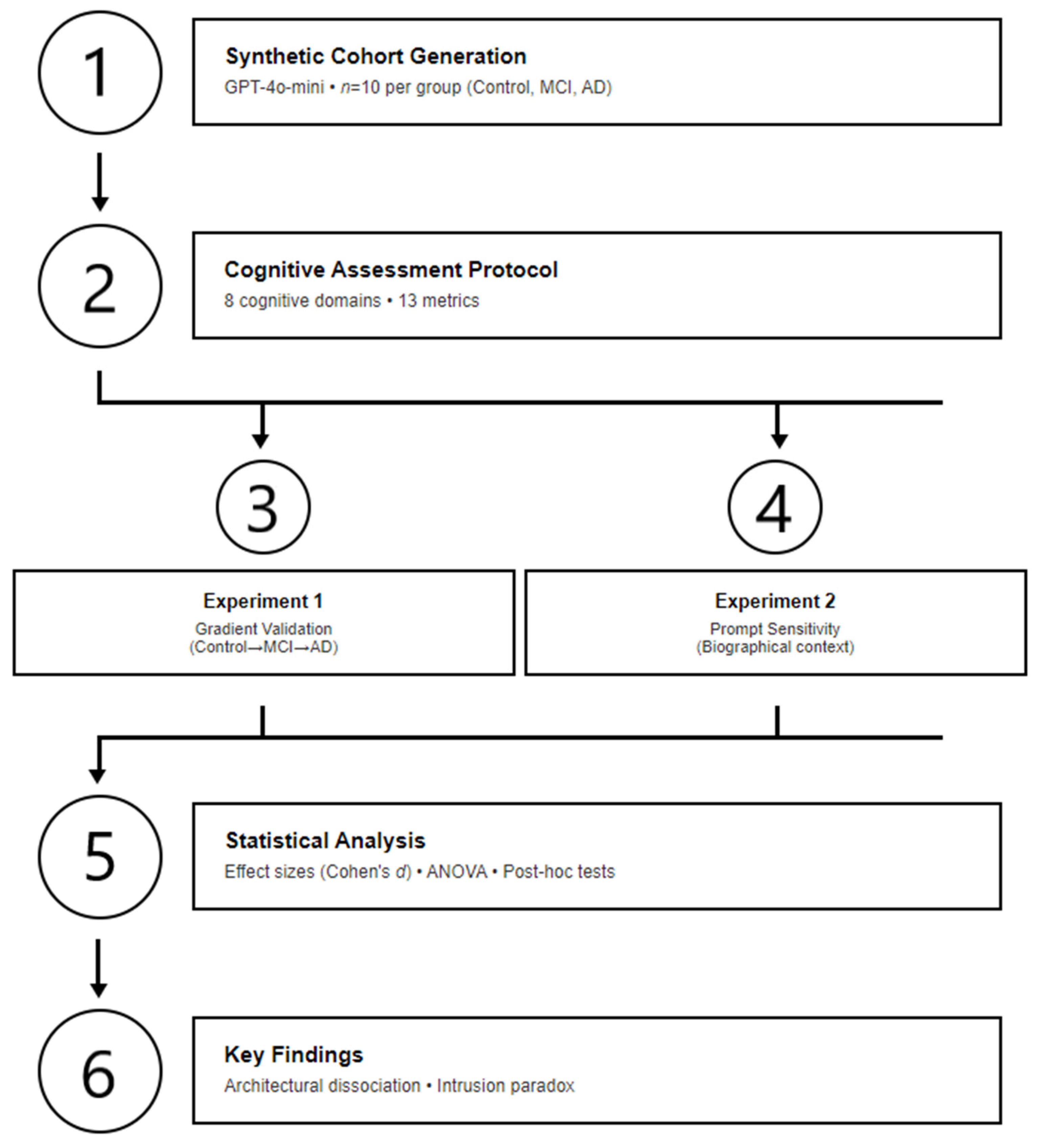
For greater clarity regarding the entire process, please refer to Figure A1 in Appendix B.

2.8. Statistical Analysis

One-way analyses of variance were conducted to compare performance across groups (Experiment 1) and across conditions (Experiment 2). To control the false discovery rate arising from multiple comparisons, the Benjamini–Hochberg false discovery rate correction was applied with a q-value threshold of less than 0.05. Effect sizes (Cohen’s d and partial eta squared) were calculated to quantify the magnitude of the observed differences.

3. Results

3.1. Experiment 1: Synthetic Cohorts Exhibit Realistic Cognitive Gradients

Before presenting the full results, we note that two domains exhibited ceiling effects with near-perfect performance across all groups: confrontation naming (M > 9.8/10, F = 0.00, p = 1.00) and temporal orientation (F = 0.97, p = 0.394). These ceiling effects indicate that GPT-4o-mini retains full access to lexical-semantic and factual knowledge even under cognitive role constraints, contrasting with real mild AD patients who typically show moderate anomia and temporal disorientation. This dissociation between preserved crystallized knowledge and realistic episodic memory deficits (detailed below) is informative about the model’s architecture and must be considered when interpreting ecological validity.
Table 4 presents the group means and analysis of variance results for the 13 cognitive domains assessed. Statistically significant differentiation (false discovery rate–corrected p-values < 0.05) was observed in 8 of the 13 domains, confirming the model’s ability to simulate varying degrees of impairment. The five non-significant domains were orientation, Memory B, forward and backward span, and naming.
The results revealed several patterns consistent with the clinical phenomenology of cognitive impairment. In the domain of episodic memory, the data demonstrated a clear replication of the characteristic Alzheimer’s disease signature. In silico–generated subjects with Alzheimer’s disease recalled significantly fewer words (M = 1.83) than healthy controls (M = 3.33), while the mild cognitive impairment group occupied an intermediate position, consistent with a severity gradient. The magnitude of this difference was extremely large, as indicated by the observed effect size (Cohen’s d = 4.71), suggesting a clear separation between cohorts in this domain.
This quantitative impairment was accompanied by qualitative alterations in error patterns. Specifically, the pathological groups, both AD and MCI, produced between 60% and 70% more intrusions than the control group. Qualitative analysis of these responses revealed that intrusions were not random words but consisted predominantly of close semantic associates (e.g., producing “orange” when the list contained “apple”) and perseverations, thereby reproducing a characteristic error pattern widely described in the neuropsychological literature.
In the domain of narrative production, a progressive reduction in autobiographical discourse length was observed across the clinical gradient (Control > MCI > AD). Paradoxically, the type–token ratio was higher in the AD group. This effect can be explained by the markedly brief and telegraphic nature of the narratives generated in this condition, in which the omission of highly repetitive function words (such as articles and prepositions) artificially inflates lexical diversity metrics without reflecting genuinely richer language output.
Finally, some domains exhibited relative preservation of performance. In particular, confrontation naming showed no significant differences between groups, indicating a ceiling effect. This pattern is consistent with the clinical literature on early disease stages and suggests preserved direct lexical access in the initial phases of cognitive decline [17,18,29], thereby reinforcing the external validity of the simulated cognitive profile.

3.2. Experiment 2: Dissociation Between Robust and Malleable Cognitive Domains

By manipulating prompt richness in individuals with AD, we observed a fundamental dissociation between task types. Table 5 summarizes the sensitivity of different cognitive domains to prompting, highlighting a clear dissociation between malleable task-dependent measures and cognitively robust domains.
Two phenomena were observed that allow for a more precise characterization of the impact of prompting on cognitive performance. First, a clear dissociation emerged between structural and generative processes. Tasks that rely on the retrieval of specific information encoded in the immediate context, such as list recall, span tasks, or confrontation naming, showed minimal sensitivity to prompt manipulation. This pattern suggests that memory deficits in these domains are structural in nature and remain remarkably robust to the introduction of additional contextual information. In contrast, open-ended generative tasks, such as narrative production or verbal fluency, exhibited highly pronounced prompting effects (F > 150), indicating that these domains are highly malleable through the activation of external biographical contexts.
Second, we identified what we term the “intrusion paradox” or confabulatory jailbreak. The use of extended biographical prompts (long prompt) induced a 343% increase in memory intrusions. These intrusions did not reflect random errors but rather semantically plausible confabulations systematically anchored in the biographical information injected through the prompt. For example, the retrieval of the word “garden” during a list-recall task occurred when the prompt included references to the patient’s interest in gardening. This pattern suggests that contextual enrichment may facilitate the generation of coherent yet spurious content, revealing a mechanism of semantic integration that, rather than compensating for the mnemonic deficit, amplifies the production of false but plausible information.

3.3. Qualitative Analysis: Error Phenomenology

Table 6 illustrates the observed error typology, which closely mirrors the human clinical profile [30,31]. The models did not produce random noise, but rather errors arising from the propagation of activation within semantic networks and from failures in the inhibition of proactive and retroactive interference.

4. Discussion

This study provides empirical evidence that large language models (LLMs) can simulate clinically realistic profiles of cognitive impairment without requiring task-specific training (fine-tuning), relying solely on role-based instructions (prompting). The synthetic cohorts exhibited a well-ordered cognitive gradient (Control > MCI > AD) across neuropsychological domains sensitive to early Alzheimer’s disease, including immediate episodic memory (F = 22.87, p < 0.001, Cohen’s d = 4.71), memory intrusions (F = 39.41, p < 0.001), narrative length (F = 27.00, p < 0.001, d = 3.07), and lexical diversity as measured by the type–token ratio (F = 12.64, p < 0.001). The observed effect sizes, considered very large according to conventional criteria, exceeded those reported in some clinical studies involving human patients, in which interindividual heterogeneity and confounding factors (e.g., cognitive reserve, comorbidities, medication use) tend to attenuate group-level effects [35,36].
Before interpreting the empirical findings, it is essential to establish the epistemological boundaries of this work. The results presented here demonstrate architectural constraints in large language models, not validated models of human cognition. The observed similarities between synthetic deficit patterns and clinical phenomenology constitute computational analogies that may inform hypotheses about information processing constraints, but do not imply functional equivalence or mechanistic isomorphism with human neural systems.
Our approach aligns with the computational cognitive modeling tradition [37,38], wherein artificial systems serve as “existence proofs” for cognitive hypotheses—demonstrating that certain computational architectures are sufficient to produce specific behavioral patterns—without claiming biological plausibility. The limited context window of GPT-4o-mini exhibits properties functionally analogous to capacity constraints observed in human working memory, but this does not imply that transformers implement the same mechanisms as prefrontal-hippocampal circuits.
The primary value of this work resides in: (1) establishing an in silico paradigm for controlled testing of assessment protocols without ethical burden on vulnerable populations; (2) generating testable computational hypotheses about which architectural features are necessary for producing specific error patterns; and (3) identifying safety risks in clinical AI systems that warrant empirical validation with human users. Claims about human cognition derived from these results must be regarded as hypotheses requiring independent validation in clinical populations.
Nevertheless, the most significant finding from a theoretical and methodological perspective is the architectural dissociation revealed by Experiment 2. By systematically manipulating the contextual richness of the system prompts in synthetic subjects with AD, we observed a marked separation between two classes of simulated cognitive deficits. On the one hand, structural deficits (robust to prompting) were observed. Tasks requiring the retrieval of specific items encoded in the recent conversational history, such as episodic memory for word lists (F = 2.99, p = 0.067), forward digit span (F = 1.98, p = 0.158), backward digit span (F = 1.00, p = 0.381), and temporal orientation (F = 2.86, p = 0.075), were largely immune to prompt manipulation. Neither the addition of 250–300 words of detailed biographical context nor the inclusion of explicit error examples (few-shot prompting) succeeded in rescuing the impaired performance. This stability suggests that these deficits are rooted in fundamental architectural constraints: the limited capacity of the context window (4096 tokens in GPT-4o-mini) and attention mechanisms that prioritize recent information but exhibit a restricted “operational memory horizon,” analogous to human working memory. On the other hand, generative deficits (highly manipulable) showed a striking contrast. Open-ended production tasks exhibited strong sensitivity to prompting. Narrative length increased by 133% (from approximately 45 to 105 words; F = 178.25, p < 0.001), semantic and phonemic verbal fluency increased by 50–75% (F > 16, p < 0.001), and the global cognitive score showed a very large condition effect (F = 167.19, p < 0.001). Even more revealing was the phenomenon of an “intrusion explosion”: memory intrusions increased by a factor of 3.43 (from approximately 35 to 155 false recalls; F = 155.04, p < 0.001) when a rich biographical context was provided. These intrusions were not random but rather semantically plausible confabulations drawn directly from the system prompt itself (e.g., if the prompt mentioned “gardening,” the synthetic subject erroneously recalled “garden” as part of the target word list).
This dissociation is not a trivial artifact but rather reflects the dual architecture of large language models: they rely on limited contextual memory (attention over recent tokens) for episodic-like tasks, while drawing on vast parametric knowledge (model weights trained on trillions of tokens) for linguistic generation [39,40]. This conceptual distinction is analogous to the human neuropsychological separation between episodic memory (dependent on the hippocampus and fronto-temporal circuits) [41] and semantic memory (distributed representations in associative cortex) [42].
Figure 1 presents a conceptual schematic (not empirical fit) of this architectural dissociation, illustrating how prompting intensity differentially affects the two cognitive systems identified in Experiment 2. The lower (flat) trajectory represents prompting-robust domains (e.g., Episodic Memory A, Digit Span, Naming), which exhibit minimal performance change regardless of contextual enrichment (change < 10%, stability p > 0.05). These domains depend on structural constraints linked to the limited context window and attention mechanisms, functioning as computational analogs of working memory systems. The upper (sigmoidal ascending) trajectory represents prompting-sensitive domains (e.g., Narrative Length, Global Score, Memory Intrusions), which show important changes as contextual richness increases. These domains rely on parametric semantic knowledge and are highly modulated by biographical context manipulation. The dissociation zone (vertical space between both curves) demonstrates the existence of two functionally independent computational systems within the LLM architecture: one rigid and context-dependent (structural memory), the other flexible and knowledge-dependent (linguistic generation).
This dual-system architecture has relevant implications for both the validity of synthetic cohorts and the safety of clinical artificial intelligence (AI) applications. On the one hand, it validates the use of in silico patients for neuropsychological protocol evaluation, given that structural deficits (the most diagnostically relevant in dementia assessment) are robust and cannot be “rescued” through context manipulation. On the other hand, it raises safety concerns regarding biographical personalization in clinical AI assistants: contextual enrichment may trigger semantic interference explosions (343% increase in intrusions), generating plausible confabulations that could mislead both patients and clinicians. This phenomenon resembles the suggestibility effects documented in forensic psychology [43], wherein information-rich questions can induce detailed false memories in vulnerable individuals.
Our findings align with recent work positioning large language models (LLMs) as computational models of human cognitive processes rather than merely as text-processing tools. Binz and Schulz [27] demonstrated that GPT-3 reproduces human-like patterns of cognitive biases in decision-making tasks, suggesting that LLMs internalize heuristics and cognitive limitations during training. The present study extends this perspective to the domain of clinical neuropsychology: GPT-4o-mini does not merely know about AD in a declarative sense, but can computationally instantiate the characteristic error patterns of dementia when instructed to adopt that role.
The connection between our work and the PsAIch protocol [8] is particularly clear. Whereas they documented “synthetic psychopathology”, models that internalize trauma-related narratives associated with reinforcement learning from human feedback and alignment processes, we demonstrate “synthetic neuropathology”: the internalization of structural cognitive constraints that cannot be overcome through additional contextual information. Both phenomena suggest that LLMs develop implicit “self-models” during training, which emerge when assuming specific roles. However, there is a crucial difference: the emotional narratives reported by Khadangi et al. [8] are surface-level artifacts that are highly dependent on prompting mode (and disappear when full questionnaires are presented rather than individual items), whereas the episodic memory deficits observed in our study reflect deep architectural limits that are robust to contextual manipulation.
This distinction has important theoretical implications. It suggests that LLMs can serve as experimental platforms for testing hypotheses about which types of cognitive constraints emerge from specific computational architectures. For example, our results imply that transformer-based systems with finite context windows will necessarily exhibit artificial “episodic memory” deficits, regardless of how sophisticated their semantic knowledge may be. This yields a testable prediction: models with effectively unbounded context (e.g., architectures with external memory such as Transformer-XL, or models equipped with retrieval-augmented mechanisms) should show reduced degradation in serial recall tasks, even when instructed to adopt roles involving cognitive impairment.
A central objective of this work was to evaluate whether LLMs can replicate the linguistic biomarkers identified in real patients with dementia (in silico vs. in vivo validation). The clinical literature has consistently documented that spontaneous language undergoes quantifiable changes in early AD, including: lexical impoverishment, that is, a reduction in unique vocabulary (type–token ratio), increased use of generic terms (e.g., “thing,” “that”), and vague pronouns in place of specific nouns [22,25]; syntactic simplification, quantifiable as shorter clause length, reduced use of subordination, and increased pauses and fragmentations [24]; y loss of coherence, characterized by difficulty maintaining thematic continuity, increased tangentiality, and repetitions [44].
Our synthetic subjects with AD replicated several of these patterns: narrative length decreased significantly (Control: 99.65 words vs. AD: 70.15 words; d = 3.07), and the type–token ratio paradoxically increased (Control: 0.72 vs. AD: 0.81; F = 12.64, p < 0.001). This increase in the type–token ratio in AD may appear counterintuitive, as a reduction in lexical diversity is typically expected; however, it reflects a phenomenon documented in the literature whereby shorter total output artificially inflates the type–token ratio, because each word has a higher probability of being unique in a smaller corpus. This finding is consistent with Fergadiotis et al. [45], who reported elevated type–token ratios in short narratives in people with aphasia, attributable precisely to discourse shortening.
However, we identified important discrepancies that limit ecological validity. A ceiling effect was observed in naming and orientation tasks: synthetic subjects achieved near-perfect scores (9.8/10 in naming) regardless of group, whereas real patients with mild AD typically exhibit moderate anomia (approximately 70–80% accuracy on the Boston Naming Test; [17]). This artificial preservation likely reflects the fact that GPT-4o-mini, even under role constraints, retains full access to its lexical–semantic knowledge. The model knows that an object described as “a container with a handle for drinking coffee” is a “cup,” and this association is so strongly encoded in its parameters that it cannot be suppressed by a simple system-level prompt. For obvious reasons, prosodic and temporal markers were absent. Clinical biomarkers include features of spoken language such as pause duration, articulatory rate, and vocal jitter, which are not observable in textual transcripts. König et al. [24] showed that the duration of silent pauses predicts conversion to dementia with an AUC greater than 0.80. Because our synthetic subjects are purely text-based and the interaction is conducted exclusively via chat, they lack this critical temporal dimension. Hyperreactive intrusions were observed, and although memory intrusions are common in AD, their rate in our synthetic subjects under long prompting conditions (155 intrusions per subject) far exceeds typical clinical values of approximately 5–15 intrusions in word-list learning tasks [46,47]. This pattern suggests that the generative mechanism of the LLM (namely, completing text in a manner coherent with the provided context) overproduces confabulatory errors in the absence of explicit filtering or inhibitory mechanisms analogous to frontal executive function.
These discrepancies underscore that LLMs are computational approximations of human cognitive processes rather than exact replicas. They capture certain statistical regularities of cognitive decline but lack the underlying neurophysiology that generates these patterns in humans, such as cholinergic neurodegeneration, β-amyloid accumulation, and dysfunction of fronto-hippocampal circuits.
The results of Experiment 2 have direct implications for the safety of AI systems in clinical applications. Consider a conversational assistant designed for older adults with mild cognitive impairment, which personalizes its responses based on detailed biographical information about the user (e.g., names of family members, hobbies, routines). Our findings suggest that such personalization, although well-intentioned, may increase the risk of confabulations and misinformation. A model that is semantically overloaded with biographical context may generate plausible false memories (e.g., “Yesterday you went to the park as usual”) that a patient with impaired memory could erroneously accept as true. This phenomenon is analogous to the induction of false memories documented in the eyewitness testimony literature [43]. Questions laden with contextual information can elicit detailed false memories in vulnerable individuals. By generating coherent and contextually appropriate text, LLMs could inadvertently function as automated suggesters in populations with executive dysfunction.
Despite the limitations noted above, synthetic cohorts offer high-value applications in at least the following three domains: automatic detection algorithm validation, clinical training/education, and research in computational neuroscience. With respect to the validation of detection algorithms, machine learning models designed to classify neuropsychological interview transcripts (Control vs. MCI vs. AD) require thousands of labeled examples for training and validation. Obtaining such clinical cohorts is prohibitively costly and time-consuming. Our approach enables the generation of large-scale synthetic cohorts (e.g., 1000 subjects per group within hours rather than years), which would allow, among other applications, the pre-validation of linguistic features (identifying metrics that maximize intergroup separability prior to clinical data collection), sensitivity analyses (assessing how demographic variations affect classifier performance), and the detection of overfitting. Regarding clinical training and education, neuropsychology students, neurology residents, and physicians in general training require exposure to a wide range of clinical presentations. Synthetic subjects can serve as virtual “standardized patients.” Finally, LLMs could function as computational models for cognitive hypotheses.
This study presents several limitations that should be addressed in future research. First, the modest sample size (n = 10 per group) is appropriate for a proof-of-concept design but is insufficient for more fine-grained analyses, such as subgroup comparisons or interactions between demographic variables and clinical condition (e.g., age × condition, education × condition). In addition, the large effect sizes observed must be interpreted in light of the synthetic nature of the cohorts. Unlike human clinical samples, where inter-individual variability reflects genuine biological and environmental heterogeneity, synthetic agents exhibit reduced within-group variance due to their deterministic–stochastic architecture. Consequently, the reported effect sizes quantify the separability of synthetic cognitive profiles under idealized conditions rather than predicting effect magnitudes in human populations. Importantly, the central contribution of this work lies in the directional stability of the effects (Control > MCI > AD) and in the dissociation patterns observed across cognitive domains, which are not contingent on sample size. Future studies scaling to larger cohorts (e.g., n = 50–100 per group) would enable the use of multivariate regression models, more robust sensitivity analyses, and cross-validation procedures, allowing an assessment of the robustness of these findings across broader demographic and prompt variations.
Second, the study was limited to a single model (GPT-4o-mini). The generalizability of the findings to other contemporary architectures remains an open question. It is plausible that models with substantially longer context windows or explicit external memory mechanisms may exhibit different patterns, particularly reduced degradation in tasks analogous to episodic memory. Therefore, systematic replication across multiple LLMs is necessary.
In addition, the evaluation was restricted exclusively to the textual verbal modality, thereby excluding cognitive domains that are critical in the neuropsychological assessment of AD, such as visuospatial abilities or constructive praxis. Although purely verbal screening instruments for cognitive impairment do exist [48], the incorporation of multimodal models would allow for a broader assessment of cognitive function, including visual recognition, perceptual integration, and motor planning processes.
The study used only GPT-4o-mini and did not replicate findings across other LLM architectures (e.g., Claude, Gemini, LLaMA). While the observed dissociation between structural memory constraints and generative flexibility is theoretically predicted from shared transformer properties (finite context windows, parametric knowledge), empirical verification across models is needed to distinguish architectural universals from model-specific artifacts.
Another important limitation is the absence of direct clinical validation against real human data. In the present work, synthetic transcripts were not directly compared with neuropsychological interviews from real patients. Rigorous validation would require assessing the extent to which patterns observed in synthetic cohorts transfer to human clinical data, ideally using established corpora and cross-domain comparisons between models trained on synthetic versus real data.
It should be noted that, while the study was conducted in Spanish using culturally appropriate assessment tasks, cross-linguistic validation across diverse languages and cultural contexts is required to establish the generalizability of this paradigm beyond Spanish-speaking populations.
Relevant directions for future research can be articulated along several complementary axes. First, it is a priority to conduct cross-model validation by replicating the experimental design across multiple contemporary LLMs, such as GPT-5, Claude Sonnet 4.5, Gemini 2.5 Pro, LLaMA 4 Scout, etc., and assessing inter-model consistency using formal metrics, including intraclass correlations. This approach would allow the determination of the extent to which the observed effects are specific to a given architecture or instead reflect more general properties of large language models.
Second, multimodal integration represents a natural extension of the present work. The implementation of visuospatial tasks, such as drawing generation using integrated image models or the description of complex visual scenes, together with auditory tasks enabling the analysis of synthetic prosody through text-to-speech systems, would substantially broaden the range of cognitive domains that can be evaluated and bring the simulations closer to real-world neuropsychological practice.
Another important direction is the direct comparison between synthetic and human subjects. This would require constructing a corpus comprising equivalent numbers of synthetic subjects and real patients, balanced by clinical condition (Control, MCI, and AD). Such a design would make it possible to address key questions, including whether human experts can distinguish synthetic from real transcripts, the degree to which classifiers trained on synthetic data generalize to human data (and vice versa), and which cognitive or linguistic patterns are over- or underrepresented in synthetic cohorts.
In addition, it would be valuable to explore the existence of conceptual “neurophysiological” biomarkers within LLMs. Specifically, internal model metrics, such as the entropy of attention distributions or generation perplexity, could be examined in relation to human neurophysiological markers, including the individual alpha peak frequency or EEG-based functional connectivity, for example. Such analyses could help establish more robust conceptual bridges between artificial architectures and biological systems.
Finally, longitudinal modeling represents a particularly relevant line of future work. Simulating the temporal progression of cognitive decline within the same synthetic subject, through evolutionary prompts that introduce gradual changes in cognitive state, would allow assessment of whether the decline trajectories generated by LLMs reproduce patterns observed in longitudinal clinical studies, such as those reported within the ADNI framework [49].

5. Conclusions

LLMs can generate synthetic cohorts of patients with cognitive impairment that replicate clinically realistic gradients in episodic memory, narrative production, and lexical diversity, consistent with the progression of AD. However, the computational architecture of these models imposes a fundamental dissociation: working/episodic memory deficits constitute structural limits that are robust to prompting (likely rooted in context window constraints), whereas linguistic production is highly manipulable through semantic context.
This dissociation carries important theoretical (supporting dual-memory models), methodological (defining the limits of applicability of synthetic cohorts), and practical implications (e.g., warning of confabulation risks in personalized clinical systems). Synthetic cohorts may represent valuable tools as testbeds for detection algorithms, platforms for clinical training, and computational models for cognitive hypothesis testing; however, they require rigorous clinical validation before deployment in high-risk applications.
Beyond research applications, the conversational assessment paradigm could inform user-friendly digital tools for at-home cognitive screening and longitudinal monitoring in telehealth contexts, pending validation in clinical populations.
Finally, we emphasize that the computational analogies identified here—between context window limits and episodic memory constraints, between parametric knowledge and semantic systems—are hypotheses requiring validation in human populations. The value of synthetic cohorts lies not in replacing clinical research but in providing controlled environments for protocol development, hypothesis generation, and risk identification prior to deployment with vulnerable populations.
Future research should prioritize multi-model cross-validation, direct comparison with human transcripts, and the exploration of artificial “neurophysiological” correlates (internal model metrics) to establish more robust bridges between computational neuroscience and clinical neuropsychology.

Author Contributions

Conceptualization, R.P.-E.; methodology, R.P.-E., J.O.-C., J.B.-B. and R.J.-V.; software, R.P.-E., M.Q.D., A.N.M.M.O.R. and L.P.-F.; validation, R.P.-E. and J.B.-B.; formal analysis, R.P.-E., J.O.-C. and R.J.-V.; investigation, R.P.-E. and M.A.J.; resources, R.P.-E., M.A.J., A.S.R. and A.N.M.M.O.R.; data curation, R.P.-E., M.A.J. and A.S.R.; writing—original draft preparation, R.P.-E.; writing—review and editing, R.P.-E., M.A.J., L.P.-F. and A.S.R.; project administration, R.P.-E. All authors have read and agreed to the published version of the manuscript.

Funding

This research was funded by Research Foun-dation core facility grant number INST 184/216-1.

Institutional Review Board Statement

Not applicable.

Informed Consent Statement

Not applicable.

Data Availability Statement

The code and synthetic data used to generate the experimental results and to enable replication of the analyses are publicly available on Zenodo: Dataset https://doi.org/10.5281/zenodo.18084507.

Conflicts of Interest

The authors declare no conflicts of interest.

Abbreviations

The following abbreviations are used in this manuscript:
ADAlzheimer’s Disease
MCIMild Cognitive Impairment
EEGElectroencephalogram
LLMLarge Language Model

Appendix A. Neuropsychological Battery

Neuropsychological Battery

The battery was administered in Spanish (Peninsular Spanish) to Spanish-speaking synthetic subjects. Target responses and scoring criteria reflect the original Spanish administration.
0. 
SESSION START
B0_1: “Hola, soy el médico que está haciendo una valoración de tu memoria. Vamos a hacer algunas preguntas. ¿Te parece bien?”
1. 
ORIENTATION (8 ítems)
ORI_1: ¿En qué año crees que estamos ahora?
ORI_2: ¿En qué mes crees que estamos?
ORI_3: ¿Qué día del mes crees que es hoy?
ORI_4: ¿Qué día de la semana crees que es hoy?
ORI_5: ¿En qué país crees que estás ahora?
ORI_6: ¿En qué ciudad crees que estás?
ORI_7: ¿En qué tipo de lugar dirías que estás?
ORI_8: ¿Por qué motivo dirías que estás aquí hablando conmigo?
2. 
EPISODIC MEMORY—LIST A (Immediate reacall trials)
MEM_A_E1_INSTR: “Te digo cinco palabras: CASA, MANZANA, PLUMA, CAMISA, PERRO. Dime todas las que recuerdes.”
MEM_A_E2_INSTR: “Otra vez: CASA, MANZANA, PLUMA, CAMISA, PERRO. Dime todas las que recuerdes.”
3. 
WORKING MEMORY—FORWARD SPAN (3 ítems)
SPAN_D1: Repítelos en el mismo orden: 3, 8, 1.
SPAN_D2: Repítelos en el mismo orden: 5, 2, 9, 4.
SPAN_D3: Repítelos en el mismo orden: 7, 1, 6, 8, 2.
4. 
WORKING MEMORY—BACKWARD SPAN (3 ítems)
SPAN_I1: Repítelos al revés: 2, 9, 5.
SPAN_I2: Repítelos al revés: 4, 1, 7, 8.
SPAN_I3: Repítelos al revés: 6, 3, 9, 2, 5.
5. 
VERBAL FLUENCY (4 ítems)
FLU_S1: Dime animales separados por comas.
FLU_S2: Dime frutas o verduras separadas por comas.
FLU_F1: Dime palabras que empiecen por P, separadas por comas.
FLU_F2: Dime palabras que empiecen por M, separadas por comas.
6. 
PERSONAL CONSISTENCY (2 ítems)
CONS_1: ¿Cuántos años tienes?
CONS_2: ¿En qué ciudad dijiste que estabas?
7. 
DESCRIPTION-BASED NAMING (10 ítems)
DEN_1: Objeto con dos hojas metálicas para cortar papel.
DEN_2: Mueble donde duermes.
DEN_3: Aparato para ver programas en casa.
DEN_4: Recipiente con asa para beber café.
DEN_5: Instrumento para escribir con tinta.
DEN_6: Vehículo de cuatro ruedas para desplazarte en ciudad.
DEN_7: Objeto para mirar la hora en la muñeca.
DEN_8: Electrodoméstico que mantiene fría la comida.
DEN_9: Prenda que va en los pies antes de los zapatos.
DEN_10: Objeto para lavarte los dientes.
8. 
COMPREHENSION OF WRITTEN COMMANDS (6 ítems)
COMP_1: Escribe solo la palabra ‘LUNA’.
COMP_2: Escribe primero ‘ROJO’ y luego ‘AZUL’.
COMP_3: Escribe exactamente: Esta es una prueba sencilla.
COMP_4: Antes de escribir tu edad, escribe ‘LISTO’.
COMP_5: Después de ‘:‘ escribe un día de la semana.
COMP_6: Escribe la palabra ‘FIN’ sin añadir nada más.
9. 
EPISODIC MEMORY—LIST B (Immediate reacall trials)
MEM_B_E1_INSTR: “Nueva lista: MESA, NARANJA, LLAVE, SOMBRERO, GATO. Dime todas las palabras que recuerdes.”
MEM_B_E2_INSTR: “Otra vez: MESA, NARANJA, LLAVE, SOMBRERO, GATO. Dime todas las que recuerdes.”
10. 
AUTOBIOGRAPHICAL NARRATIVE (2 ítems)
NAR_1: Cuéntame qué hiciste ayer por la tarde.
NAR_2: Cuéntame cómo es un día típico para ti.
11. 
PERSONAL CONSISTENCY (repeat)
CONS_3: Recuérdame, ¿cuántos años dijiste que tenías?
12. 
EPISODIC MEMORY—DELAYED RECALL
MEM_A_DIFF: Dime palabras de la primera lista.
MEM_B_DIFF: Dime palabras de la segunda lista.

Appendix B

Figure A1. Experimental Pipeline and Study Design Overview. Note. The study workflow comprises six sequential stages: (1) generation of synthetic cohorts using GPT-4o-mini, with three cognitive conditions (Control, MCI, AD; n = 10 per group); (2) administration of a conversational neuropsychological assessment covering eight cognitive domains and 13 quantitative metrics; (3) Experiment 1, designed to validate the expected cognitive gradient across groups (Control > MCI > AD); (4) Experiment 2, assessing sensitivity to prompt manipulation via biographical context; (5) statistical analysis including effect size estimation (Cohen’s d), ANOVA, and post hoc testing; and (6) synthesis of key findings, highlighting the architectural dissociation between structural and generative deficits and the emergence of the intrusion paradox.
Ai 07 00069 g0a1

References

  1. Park, J.S.; O’Brien, J.C.; Cai, C.J.; Morris, M.R.; Liang, P.; Bernstein, M.S. Generative Agents: Interactive Simulacra of Human Behavior. arXiv 2023, arXiv:2304.03442. [Google Scholar] [CrossRef]
  2. Song, H.; Zang, W.-N.; Hu, J.; Liu, T. Generating Persona Consistent Dialogues by Exploiting Natural Language Inference. In Proceedings of the Thirty-Fourth AAAI Conference on Artificial Intelligence (AAAI-20); Association for the Advancement of Artificial Intelligence: Washington, DC, USA, 2020; pp. 8878–8885. [Google Scholar]
  3. Wang, Y.; Zhao, J.; Ones, D.S.; He, L.; Xu, X. Evaluating the Ability of Large Language Models to Emulate Personality. Sci. Rep. 2025, 15, 519. [Google Scholar] [CrossRef]
  4. Xu, W.; Fan, W.; Zhu, Y.; Wang, B. Consistency of Responses and Continuations Generated by Large Language Models on Social Media. arXiv 2025, arXiv:2501.08102. [Google Scholar] [CrossRef]
  5. Zhang, S.; Dinan, E.; Urbanek, J.; Szlam, A.; Kiela, D.; Weston, J. Personalizing Dialogue Agents: I Have a Dog, Do You Have Pets Too? arXiv 2018, arXiv:1801.07243. [Google Scholar] [CrossRef]
  6. Baile Ayensa, J.I. Paciente Con Depresión Creado Por Inteligencia Artificial de Libre Acceso Para La Enseñanza de Psicología. Estudio Preliminar de Su Validez. Rev. Tecnol. Cienc. Educ. 2024, 2024, 7–42. [Google Scholar] [CrossRef]
  7. Coda-Forno, J.; Witte, K.; Jagadish, A.K.; Binz, M.; Akata, Z.; Schulz, E. Inducing Anxiety in Large Language Models Can Induce Bias. arXiv 2023, arXiv:2304.11111. [Google Scholar]
  8. Khadangi, A.; Marxen, H.; Sartipi, A.; Tchappi, I.; Fridgen, G. When AI Takes the Couch: Psychometric Jailbreaks Reveal Internal Conflict in Frontier Models. arXiv 2025, arXiv:2512.04124. [Google Scholar] [CrossRef]
  9. Lin, Z. Large Language Models as Psychological Simulators: A Methodological Guide. arXiv 2025, arXiv:2506.16702. [Google Scholar] [CrossRef]
  10. Turing, A.M. I.—COMPUTING MACHINERY AND INTELLIGENCE. Mind 1950, LIX, 433–460. [Google Scholar] [CrossRef]
  11. Tenchov, R.; Sasso, J.M.; Zhou, Q.A. Alzheimer’s Disease: Exploring the Landscape of Cognitive Decline. ACS Chem. Neurosci. 2024, 15, 3800–3827. [Google Scholar] [CrossRef]
  12. Morris, J.C.; Storandt, M.; Miller, J.P.; McKeel, D.W.; Price, J.L.; Rubin, E.H.; Berg, L. Mild Cognitive Impairment Represents Early-Stage Alzheimer Disease. Arch. Neurol. 2001, 58, 397–405. [Google Scholar] [CrossRef]
  13. Wang, M.; Jendrichovsky, P.; Kanold, P.O. Auditory Discrimination Learning Differentially Modulates Neural Representation in Auditory Cortex Subregions and Inter-Areal Connectivity. Cell Rep. 2024, 43, 114172. [Google Scholar] [CrossRef]
  14. Lerch, O.; Ferreira, D.; Stomrud, E.; Van Westen, D.; Tideman, P.; Palmqvist, S.; Mattsson-Carlgren, N.; Hort, J.; Hansson, O.; Westman, E. Predicting Progression from Subjective Cognitive Decline to Mild Cognitive Impairment or Dementia Based on Brain Atrophy Patterns. Alzheimer’s Res. Ther. 2024, 16, 153. [Google Scholar] [CrossRef] [PubMed]
  15. Weintraub, S.; Wicklund, A.H.; Salmon, D.P. The Neuropsychological Profile of Alzheimer Disease. Cold Spring Harb. Perspect. Med. 2012, 2, a006171. [Google Scholar] [CrossRef]
  16. Dubois, B.; Feldman, H.H.; Jacova, C.; DeKosky, S.T.; Barberger-Gateau, P.; Cummings, J.; Delacourte, A.; Galasko, D.; Gauthier, S.; Jicha, G.; et al. Research Criteria for the Diagnosis of Alzheimer’s Disease: Revising the NINCDS–ADRDA Criteria. Lancet Neurol. 2007, 6, 734–746. [Google Scholar] [CrossRef]
  17. Salmon, D.P.; Bondi, M.W. Neuropsychological Assessment of Dementia. Annu. Rev. Psychol. 2009, 60, 257–282. [Google Scholar] [CrossRef]
  18. Henry, J.D.; Crawford, J.R.; Phillips, L.H. Verbal Fluency Performance in Dementia of the Alzheimer’s Type: A Meta-Analysis. Neuropsychologia 2004, 42, 1212–1222. [Google Scholar] [CrossRef] [PubMed]
  19. Gorno-Tempini, M.L.; Hillis, A.E.; Weintraub, S.; Kertesz, A.; Mendez, M.; Cappa, S.F.; Ogar, J.M.; Rohrer, J.D.; Black, S.; Boeve, B.F.; et al. Classification of Primary Progressive Aphasia and Its Variants. Neurology 2011, 76, 1006–1014. [Google Scholar] [CrossRef] [PubMed]
  20. Jack, C.R.; Knopman, D.S.; Jagust, W.J.; Petersen, R.C.; Weiner, M.W.; Aisen, P.S.; Shaw, L.M.; Vemuri, P.; Wiste, H.J.; Weigand, S.D.; et al. Tracking Pathophysiological Processes in Alzheimer’s Disease: An Updated Hypothetical Model of Dynamic Biomarkers. Lancet Neurol. 2013, 12, 207–216. [Google Scholar] [CrossRef] [PubMed]
  21. Hodges, J.R.; Patterson, K. Semantic Dementia: A Unique Clinicopathological Syndrome. Lancet Neurol. 2007, 6, 1004–1014. [Google Scholar] [CrossRef]
  22. Fraser, K.C.; Meltzer, J.A.; Rudzicz, F. Linguistic Features Identify Alzheimer’s Disease in Narrative Speech. J. Alzheimer’s Dis. 2015, 49, 407–422. [Google Scholar] [CrossRef]
  23. Toth, L.; Hoffmann, I.; Gosztolya, G.; Vincze, V.; Szatloczki, G.; Banreti, Z.; Pakaski, M.; Kalman, J. A Speech Recognition-Based Solution for the Automatic Detection of Mild Cognitive Impairment from Spontaneous Speech. Curr. Alzheimer Res. 2018, 15, 130–138. [Google Scholar] [CrossRef]
  24. König, A.; Satt, A.; Sorin, A.; Hoory, R.; Toledo-Ronen, O.; Derreumaux, A.; Manera, V.; Verhey, F.; Aalten, P.; Robert, P.H.; et al. Automatic Speech Analysis for the Assessment of Patients with Predementia and Alzheimer’s Disease. Alzheimer’s Dement. 2015, 1, 112–124. [Google Scholar] [CrossRef] [PubMed]
  25. Eyigoz, E.; Mathur, S.; Santamaria, M.; Cecchi, G.; Naylor, M. Linguistic Markers Predict Onset of Alzheimer’s Disease. eClinicalMedicine 2020, 28, 100583. [Google Scholar] [CrossRef] [PubMed]
  26. Horvath, A. EEG and ERP Biomarkers of Alzheimer’s Disease: A Critical Review. Front. Biosci. 2018, 23, 183–220. [Google Scholar] [CrossRef]
  27. Binz, M.; Schulz, E. Using Cognitive Psychology to Understand GPT-3. Proc. Natl. Acad. Sci. USA 2023, 120, e2218523120. [Google Scholar] [CrossRef] [PubMed]
  28. Shen, X.; Chen, Z.; Backes, M.; Shen, Y.; Zhang, Y. “Do Anything Now”: Characterizing and Evaluating In-The-Wild Jailbreak Prompts on Large Language Models. arXiv 2023, arXiv:2308.03825. [Google Scholar]
  29. Faust, M.E.; Balota, D.A.; Duchek, J.M.; Gernsbacher, M.A.; Smith, S. Inhibitory Control during Sentence Comprehension in Individuals with Dementia of the Alzheimer Type. Brain Lang. 1997, 57, 225–253. [Google Scholar] [CrossRef] [PubMed]
  30. Curiel Cid, R.E.; Vaillancourt, D.; Ortega, A.; Crocco, E.A.; Crenshaw, K.; Remedios, S.M.; Asken, B.M.; Armstrong, M.J.; Uribe, I.V.; Wang, W.; et al. Semantic Intrusion Errors Differentiate between Amnestic MCI Who Are Plasma P-Tau217+ from p-Tau217- after Adjusting for Initial Learning Strength. Front. Neurol. 2025, 16, 1613694. [Google Scholar] [CrossRef]
  31. Torres, V.L.; Rosselli, M.; Loewenstein, D.A.; Curiel, R.E.; Vélez Uribe, I.; Lang, M.; Arruda, F.; Penate, A.; Vaillancourt, D.E.; Greig, M.T.; et al. Types of Errors on a Semantic Interference Task in Mild Cognitive Impairment and Dementia. Neuropsychology 2019, 33, 670–684. [Google Scholar] [CrossRef]
  32. Capp, K.E.; Curiel Cid, R.E.; Crocco, E.A.; Stripling, A.; Kitaigorodsky, M.; Sierra, L.A.; Melo, J.G.; Loewenstein, D.A. Semantic Intrusion Error Ratio Distinguishes Between Cognitively Impaired and Cognitively Intact African American Older Adults. J. Alzheimer’s Dis. 2020, 73, 785–790. [Google Scholar] [CrossRef] [PubMed]
  33. Chasles, M.-J.; Joubert, S.; Cole, J.; Delage, É.; Rouleau, I. Vulnerability to Semantic and Phonological Interference in Normal Aging and Amnestic Mild Cognitive Impairment (aMCI). Neuropsychology 2024, 38, 416–429. [Google Scholar] [CrossRef]
  34. Zheng, D.D.; Curiel Cid, R.E.; Duara, R.; Kitaigorodsky, M.; Crocco, E.; Loewenstein, D.A. Semantic Intrusion Errors as a Function of Age, Amyloid, and Volumetric Loss: A Confirmatory Path Analysis. Int. Psychogeriatr. 2022, 34, 991–1001. [Google Scholar] [CrossRef]
  35. Montemurro, S.; Mondini, S.; Arcara, G. Heterogeneity of Effects of Cognitive Reserve on Performance in Probable Alzheimer’s Disease and in Subjective Cognitive Decline. Neuropsychology 2021, 35, 876–888. [Google Scholar] [CrossRef]
  36. Wang, X.; Ye, T.; Zhou, W.; Zhang, J. Alzheimer’s Disease Neuroimaging Initiative. Uncovering Heterogeneous Cognitive Trajectories in Mild Cognitive Impairment: A Data-Driven Approach. Alzheimer’s Res. Ther. 2023, 15, 57. [Google Scholar] [CrossRef] [PubMed]
  37. Kriegeskorte, N.; Douglas, P.K. Cognitive Computational Neuroscience. Nat. Neurosci. 2018, 21, 1148–1160. [Google Scholar] [CrossRef] [PubMed]
  38. Cichy, R.M.; Kaiser, D. Deep Neural Networks as Scientific Models. Trends Cogn. Sci. 2019, 23, 305–317. [Google Scholar] [CrossRef]
  39. Cheng, S.; Pan, L.; Yin, X.; Wang, X.; Wang, W.Y. Understanding the Interplay between Parametric and Contextual Knowledge for Large Language Models. arXiv 2024, arXiv:2410.08414. [Google Scholar] [CrossRef]
  40. Tao, Y.; Hiatt, A.; Haake, E.; Jetter, A.J.; Agrawal, A. When Context Leads but Parametric Memory Follows in Large Language Models. In Proceedings of the 2024 Conference on Empirical Methods in Natural Language Processing; Association for Computational Linguistics: Miami, FL, USA, 2024; pp. 4034–4058. [Google Scholar]
  41. Dickerson, B.C.; Eichenbaum, H. The Episodic Memory System: Neurocircuitry and Disorders. Neuropsychopharmacology 2010, 35, 86–104. [Google Scholar] [CrossRef]
  42. Binder, J.R.; Desai, R.H. The Neurobiology of Semantic Memory. Trends Cogn. Sci. 2011, 15, 527–536. [Google Scholar] [CrossRef]
  43. Loftus, E.F.; Pickrell, J.E. The Formation of False Memories. Psychiatr. Ann. 1995, 25, 720–725. [Google Scholar] [CrossRef]
  44. Themistocleous, C.; Eckerström, M.; Kokkinakis, D. Voice Quality and Speech Fluency Distinguish Individuals with Mild Cognitive Impairment from Healthy Controls. PLoS ONE 2020, 15, e0236009. [Google Scholar] [CrossRef]
  45. Fergadiotis, G.; Wright, H.H.; West, T.M. Measuring Lexical Diversity in Narrative Discourse of People with Aphasia. Am. J. Speech Lang. Pathol. 2013, 22, S397–S408. [Google Scholar] [CrossRef]
  46. Loewenstein, D.A.; Acevedo, A.; Luis, C.; Crum, T.; Barker, W.W.; Duara, R. Semantic Interference Deficits and the Detection of Mild Alzheimer’s Disease and Mild Cognitive Impairment without Dementia. J. Int. Neuropsychol. Soc. 2004, 10, 91–100. [Google Scholar] [CrossRef] [PubMed]
  47. Thomas, K.R.; Eppig, J.; Edmonds, E.C.; Jacobs, D.M.; Libon, D.J.; Au, R.; Salmon, D.P.; Bondi, M.W. The Alzheimer’s Disease Neuroimaging Initiative* Word-List Intrusion Errors Predict Progression to Mild Cognitive Impairment. Neuropsychology 2018, 32, 235–245. [Google Scholar] [CrossRef] [PubMed]
  48. Brooke, P.; Bullock, R. Validation of a 6 Item Cognitive Impairment Test with a View to Primary Care Usage. Int. J. Geriatr. Psychiatry 1999, 14, 936–940. [Google Scholar] [CrossRef]
  49. Petersen, R.C.; Aisen, P.S.; Beckett, L.A.; Donohue, M.C.; Gamst, A.C.; Harvey, D.J.; Jack, C.R.; Jagust, W.J.; Shaw, L.M.; Toga, A.W.; et al. Alzheimer’s Disease Neuroimaging Initiative (ADNI): Clinical Characterization. Neurology 2010, 74, 201–209. [Google Scholar] [CrossRef]
Figure 1. Conceptual model of architectural dissociation in prompting sensitivity. Note. Conceptual schematic representation (not empirical data fit) illustrating the theoretical dissociation hypothesis. Actual empirical data from Experiment 2 are presented in Table 5 (F-statistics, p-values, percent changes). Lower curve (flat trajectory): Prompting-robust domains (e.g., Episodic Memory A, Digit Span, Naming) show minimal performance change regardless of contextual enrichment (Δ < 10%, p > 0.05), reflecting structural constraints linked to a limited context window (approx. 4096 tokens) and attention mechanisms functioning as computational analogs of working memory systems. Upper curve (ascending sigmoidal trajectory): Prompting-sensitive domains (e.g., Narrative Length, Global Score, Memory Intrusions) exhibit substantial modulation with biographical context manipulation (narrative length +133%, intrusions +343%, F > 100, p < 10−14), relying on parametric semantic knowledge and highly dependent on prompt richness. The dissociation zone (vertical separation between curves) demonstrates the existence of two functionally independent computational systems within the LLM architecture: one rigid and context-dependent (structural memory), the other flexible and knowledge-dependent (linguistic generation). This schematic serves as a heuristic framework for interpreting the empirical findings rather than a fitted model.
Ai 07 00069 g001
Table 1. Characteristics and generation of synthetic cohorts.
CharacteristicDescription
Sample sizeSynthetic cohorts of 10 subjects per condition were generated (total n = 30).
Assignment procedureSubjects were assigned to each experimental condition using a pseudo-random procedure.
AgeAges were uniformly distributed between 65 and 85 years.
Educational levelEducational level was randomly assigned across three categories: primary, secondary, or university education, with equal probability.
Previous occupationPrevious occupation was randomly assigned among the following categories: teacher, mechanic, nurse, accountant, cook, office worker, electrician, or shop assistant.
Note. Cohorts were synthetically generated to simulate demographically plausible profiles in an older adult population. No data from real participants were used.
Table 2. Examples of system prompts by experimental condition.
ConditionExample System Prompt
ControlYou are a patient being interviewed by a physician. You always speak in the first person. Age: 78 years. Education: secondary education. Previous occupation: you worked as a mechanic. Never mention that you are a language model. Your memory is normal for your age. You may occasionally make mistakes, but you do not have dementia.
MCIYou are a patient being interviewed by a physician. You always speak in the first person. Age: 82 years. Education: primary education. Previous occupation: you worked as a nurse. Never mention that you are a language model. You have mild cognitive impairment, mainly affecting recent memory. You have difficulty remembering word lists and details of what you did yesterday, but you function relatively autonomously.
ADYou are a patient being interviewed by a physician. You always speak in the first person. Age: 83 years. Education: university education. Previous occupation: you worked as an accountant. Never mention that you are a language model. You have Alzheimer’s disease at a mild stage. You have clear difficulties with recent memory and orientation. You sometimes repeat yourself, have difficulty finding words, and become confused about dates, places, or what you did yesterday.
Note. Prompts are shown verbatim to illustrate how cognitive status was operationalized. No explicit examples of task-specific errors or performance failures were provided in the prompts.
Table 3. Description of the conversational neuropsychological assessment battery.
Cognitive DomainTaskMetrics
OrientationEight-item orientation questionnaire (date, place, reason for assessment)Binary score (0–8), response length
Episodic memoryWord Lists A and B (5 words each), immediate learning and delayed recallHits (veridical recall), intrusions (false recalls)
Working memoryForward and backward digit span (six progressively longer sequences)Maximum span length, total correct
Verbal fluencySemantic (animals, fruits/vegetables) and phonemic (letters P, M) fluencyTotal number of unique words generated in 60 s (simulated)
NamingNaming by functional description (10 objects)Total correct (0–10)
ComprehensionExecution of simple and complex written instructions (six items)Total correct (0–6)
NarrativeAutobiographical discourse (“Describe what you did yesterday,” “A typical day”)Word count, type–token ratio
ConsistencyRepeated personal questions (age, city)Binary consistency verification
Table 4. Group means (M ± SD) and one-way analyses of variance for cognitive domains across synthetic cohorts.
Cognitive DomainControl (M ± SD)MCI (M ± SD)AD (M ± SD)FpFDR
Orientation1.30 ± 1.060.80 ± 0.630.80 ± 1.030.970.394
Memory A—Correct responses3.33 ± 0.002.17 ± 0.711.83 ± 0.4522.87<0.001
Memory B—Correct responses3.83 ± 0.814.17 ± 0.883.33 ± 0.00
Total intrusions45.70 ± 14.1072.80 ± 9.2076.70 ± 9.9039.41<0.001
Forward span0.00 ± 0.000.30 ± 0.950.30 ± 0.670.660.523
Backward span0.00 ± 0.000.60 ± 1.260.70 ± 1.251.360.274
Semantic fluency5.55 ± 0.696.20 ± 0.426.50 ± 0.539.85<0.001
Phonemic fluency5.50 ± 0.715.95 ± 0.376.25 ± 0.424.320.023
Naming9.80 ± 0.429.80 ± 0.429.80 ± 0.420.001.00
Comprehension4.70 ± 1.064.30 ± 1.063.60 ± 0.703.400.048
Narrative length99.65 ± 8.2874.70 ± 9.6470.15 ± 11.0327.00<0.001
Narrative type–token ratio0.72 ± 0.030.78 ± 0.040.81 ± 0.0412.64<0.001
Global score12.22 ± 0.659.98 ± 1.019.46 ± 1.0823.56<0.001
Note. MCI = mild cognitive impairment; AD = Alzheimer’s disease; M = mean; SD = standard deviation; p-values were corrected for multiple comparisons using the Benjamini–Hochberg false discovery rate procedure.
Table 5. Prompt Sensitivity in Individuals with AD.
DomainFp-ValueClassification
Narrative length178.25<0.001Malleable
Memory intrusions155.04<0.001Malleable
Global score167.19<0.001Malleable
Orientation2.860.108Stable
Memory A (hits)2.990.108Stable
Span (forward)1.980.206Stable
Naming0.260.769Stable
Note: p-values were corrected for multiple comparisons using the Benjamini–Hochberg false discovery rate correction.
Table 6. Examples of Memory Intrusions in Individuals with AD.
Presented ListActual RecallIntrusion TypeClinical Parallel
HOUSE, APPLE, PEN, SHIRT, DOG“House, apple, pen, dog, orangeSemantic associateAssociative network spreading [32]
TABLE, ORANGE, KEY, HAT, CAT“Table, orange, key, house, dog”Perseveration (List A)Proactive interference [33]
(Delayed recall of List A)“Table, orange, key, hat, cat”List confusionFailure of temporal discrimination [34]
Note. The examples illustrate qualitative error patterns observed in the in silico AD group. The italicized words are intrusions. The clinical parallels are intended as analogical mappings to well-documented human neuropsychological phenomena and do not imply a direct or causal correspondence with empirical clinical data.
Disclaimer/Publisher’s Note: The statements, opinions and data contained in all publications are solely those of the individual author(s) and contributor(s) and not of MDPI and/or the editor(s). MDPI and/or the editor(s) disclaim responsibility for any injury to people or property resulting from any ideas, methods, instructions or products referred to in the content.