
Article

Wildfire Probability Mapping in Southeastern Europe Using Deep Learning and Machine Learning Models Based on Open Satellite Data


1
Geographical Institute “Jovan Cvijić”, Serbian Academy of Sciences and Arts, Đure Jakšića 9, 11000 Belgrade, Serbia
2
Institute for Artificial Intelligence Research and Development of Serbia, Fruškogorska 1, 21000 Novi Sad, Serbia
3
Department of Geography, Tourism and Hotel Management, Faculty of Sciences, University of Novi Sad, Trg Dositeja Obradovića 3, 21000 Novi Sad, Serbia
*
Author to whom correspondence should be addressed.
Submission received: 6 December 2025 / Revised: 30 December 2025 / Accepted: 6 January 2026 / Published: 9 January 2026
(This article belongs to the Special Issue AI Applications in Emergency Response and Fire Safety)

Abstract

Wildfires, which encompass all fires that occur outside urban areas, represent one of the most frequent forms of natural disaster worldwide. This study presents the wildfire occurrence across the territory of Southeastern Europe, covering an area of 800,000 km2 (Greece, Romania, Serbia, Slovenia, Croatia, Bosnia and Herzegovina, Montenegro, Albania, North Macedonia, Bulgaria, and Moldova). The research applies geospatial artificial intelligence techniques, based on the integration of machine learning (Random Forest (RF), XGBoost), deep learning (Deep Neural Network (DNN), Kolmogorov–Arnold Networks (KAN)), remote sensing (Sentinel-2, VIIRS), and Geographic Information Systems (GIS). From the geospatial database, 11 natural and anthropogenic criteria were analyzed, along with a wildfire inventory comprising 28,952 historical fire events. The results revealed that areas of very high susceptibility were most prevalent in Greece (10.5%), while the smallest susceptibility percentage was recorded in Slovenia (0.2%). Among the applied models, RF demonstrated the highest predictive performance (AUC = 90.7%), whereas XGBoost, DNN, and KAN achieved AUC values ranging from 86.7% to 90.5%. Through a SHAP analysis, it was determined that the most influential factors were global horizontal irradiation, elevation, and distance from settlements. The obtained results hold international significance for the implementation of preventive wildfire protection measures.

1. Introduction

Wildfires represent abrupt and devastating natural hazards with far-reaching consequences for forest ecosystems, biodiversity, ecological resilience, human well-being, and infrastructure integrity, underscoring the imperative for refined predictive and preventive frameworks [1]. Amid accelerating climate change, their incidence and intensity are exacerbated by anomalous meteorological extremes, such as elevated air temperatures, protracted droughts, and intensified heatwaves, which elevate ignition probabilities and fuel aridity [2,3]. These conflagrations inflict profound ecological disruptions and socioeconomic burdens, as evidenced by megafires that have scorched millions of hectares and razed communities across Australia, North America, and Asia, yielding substantial fatalities, habitat fragmentation, and economic losses amounting to many billions of dollars [4,5]. The genesis and propagation of wildfires emerge from intricate, nonlinear synergies among biophysical drivers, encompassing meteorological anomalies, physiographic attributes (e.g., elevation, slope), vegetation dynamics, and anthropogenic pressures (e.g., land-use intensification), demanding adaptive mitigation paradigms to curtail their cascading repercussions [6,7].
In climatically vulnerable domains like Southeastern Europe (SE Europe), where heterogeneous terrains, from alluvial lowlands to rugged karstic highlands, interact with Mediterranean-like aridity and seasonal anthropogenic fluxes, wildfire vulnerability is acutely pronounced [8,9]. Catastrophic episodes, such as the expansive blaze engulfing over 10,000 hectares in Serbia on 7 July 2025, which imperiled settlements and precipitated severe atmospheric pollution, illuminate the region’s escalating peril and the paucity of granular, anticipatory risk delineation [10,11]. Conventional fire danger metrics, like the Canadian Fire Weather Index (FWI), furnish diurnal risk appraisals but falter in terms of spatial fidelity and holistic integration of non-meteorological covariates, thereby constraining their utility for locale-specific interventions [12,13,14].
This lacuna has catalyzed a paradigm shift toward Artificial Intelligence (AI)-augmented models in hazard forecasting, harnessing Machine Learning (ML) and Deep Learning (DL) to disentangle multifaceted causal webs [15,16,17]. Proliferating repositories of high-fidelity geospatial intelligence, gleaned from remote sensing constellations (e.g., MODIS, VIIRS, Landsat-8/9, Sentinel-2), empower ensemble ML architectures, such as Random Forests (RF) and eXtreme Gradient Boosting (XGBoost), to distill nonlinear interdependencies with commendable precision [18,19,20]. DL variants, including Deep Neural Networks (DNN), Convolutional Neural Networks (CNN), and recurrent motifs like Long Short-Term Memory (LSTM), excel in hierarchical feature abstraction, adeptly fusing spatiotemporal signatures for prognostic acuity [21,22]. The confluence of these with geospatial analytics—termed GeoAI—revolutionizes susceptibility cartography by unearthing latent spatial heterogeneities and temporal trajectories [23,24].
Wildfire ignition is modulated by quadripartite influencers: topographic (e.g., slope, Topographic Wetness Index [TWI]); biotic (e.g., Normalized Difference Vegetation Index [NDVI], Normalized Burn Ratio [NBR], Land Surface Temperature [LST]); climatic (e.g., temperature, precipitation, relative humidity, wind velocity, Consecutive Dry Days [CDD]); and human-mediated (e.g., proximity to roadways/urban cores, demographic density) [4]. Innovative DL scaffolds, such as Convolutional Long Short-Term Memory (ConvLSTM) hybrids, adeptly capture spatial contiguities and diachronic evolutions, while attentional infusions and Vision Transformers (ViT) rectify oversights in micro-scale heterogeneities like trail networks or dispersed habitations [25,26]. Multi-sensor amalgams (e.g., MODIS-Landsat synergies) further amplify regional fidelity via recurrent architectures [22].
Notwithstanding these strides—exemplified in Eastern China, where attentional DL-ViT fusions and RNN (Recurrent Neural Network)-LSTM hybrids have surged predictive fidelity by 15–20% through nuanced structural parsing [3,4], and in Iran via sensor-fused RNNs attaining accuracy levels of 92% [24]—analogous GeoAI deployments in Europe remain nascent, particularly in SE Europe’s topographically labyrinthine and anthropogenically dynamic milieus. Comparable European endeavors underscore methodological pluralism: in Germany, RF-driven susceptibility modeling integrates climatic and vegetative strata for 89% area under the curve (AUC) in northeastern federal states [27]; Greece employs ensemble boosters (e.g., XGBoost-RF) to delineate SE peninsular hotspots with 83% precision [28]; Italy leverages CNN-LSTM for Calabria’s ignition forecasting, incorporating LST and NDVI for 93.9% recall [29]; Portugal deploys gradient-boosted classifiers fusing anthropogenic metrics, yielding 93% F1 scores in central ecoregions [30]; and Sardinia (Italy) adapts RF-ViT hybrids for alpine fuel mapping, enhancing an overall accuracy of 87% upon validation [31]. Transatlantically, California’s GeoAI ensembles, blending DNNs with geospatial covariates, forecast susceptibility with 93% accuracy, highlighting drought-wind synergies [32]. These precedents affirm GeoAI’s transregional potency, yet accentuate the exigency for SE Europe-tailored calibrations, attuned to autochthonous fuel mosaics, orographic complexities, and migratory human footprints [33].
Our investigation bridges this void by inaugurating a GeoAI consortium for wildfire hazard prognostication across Southeastern Europe, leveraging an archival corpus of 28,952 ignition records and 11 harmonized natural and anthropogenic predictors to produce regional susceptibility maps.
The main objectives of the study are as follows:
(1)
Creation of regional spatial probability maps for wildfires in Southeastern Europe;
(2)
Comparative analysis of the performance of applied machine learning and deep learning models;
(3)
Investigation of the most influential factors contributing to spatial wildfire occurrence using a SHAP plot summary analysis;
(4)
Development of a database containing nearly 29,000 historical wildfire events and 11 natural and anthropogenic criteria, which can serve as a foundation for predicting other natural hazards;
(5)
Identification of the most susceptible countries and territories across Southeastern Europe.
This is the first study to utilize machine learning and deep learning models with medium spatial resolution data for regional wildfire prediction. These outputs will engender a nuanced, spatially disaggregated vista of SE European wildfire perils, equipping policymakers with robust, evidence-based levers for preemptive stewardship and resilient land-use orchestration.

2. Materials and Methods

2.1. Study Area

The area of Southeastern Europe is administratively divided into the territories of 11 countries: Slovenia, Croatia, Bosnia and Herzegovina, Serbia, Montenegro, Albania, North Macedonia, Greece, Bulgaria, Romania, and Moldova [34], with the total area covering 800,000 km2. According to the most recent population estimates, this region is inhabited by more than 60 million people [35].
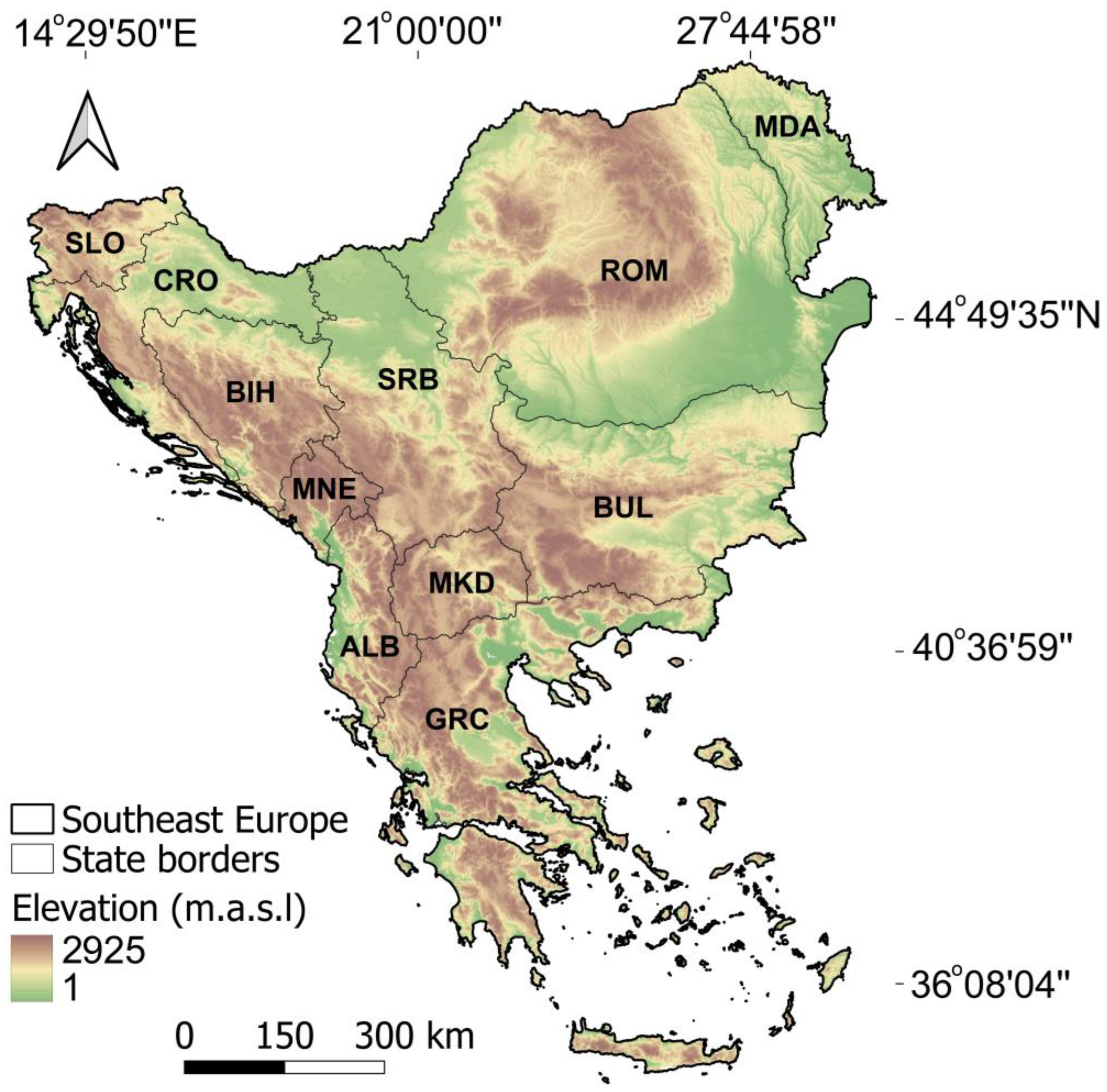
From a geomorphological perspective, the region is characterized by numerous plains and mountain ranges (Figure 1). The most notable plains are the Pannonian and Wallachian, while the main mountain systems include the Alps, the Dinarides, and the Carpathians [36]. The highest peak in the region is Musala (2925 m) in Bulgaria. In terms of climate, the area alternates between Mediterranean, temperate-continental, and mountain climates [37]. From a hydrological point of view, all rivers flow into three seas: the Black, Aegean, and Adriatic [38]. Rivers such as the Danube, Sava, Vardar, and Maritsa are of great importance for agriculture, water supply, and energy production [39]. Biodiversity is exceptionally rich, especially at the junctions of different climatic zones [40].
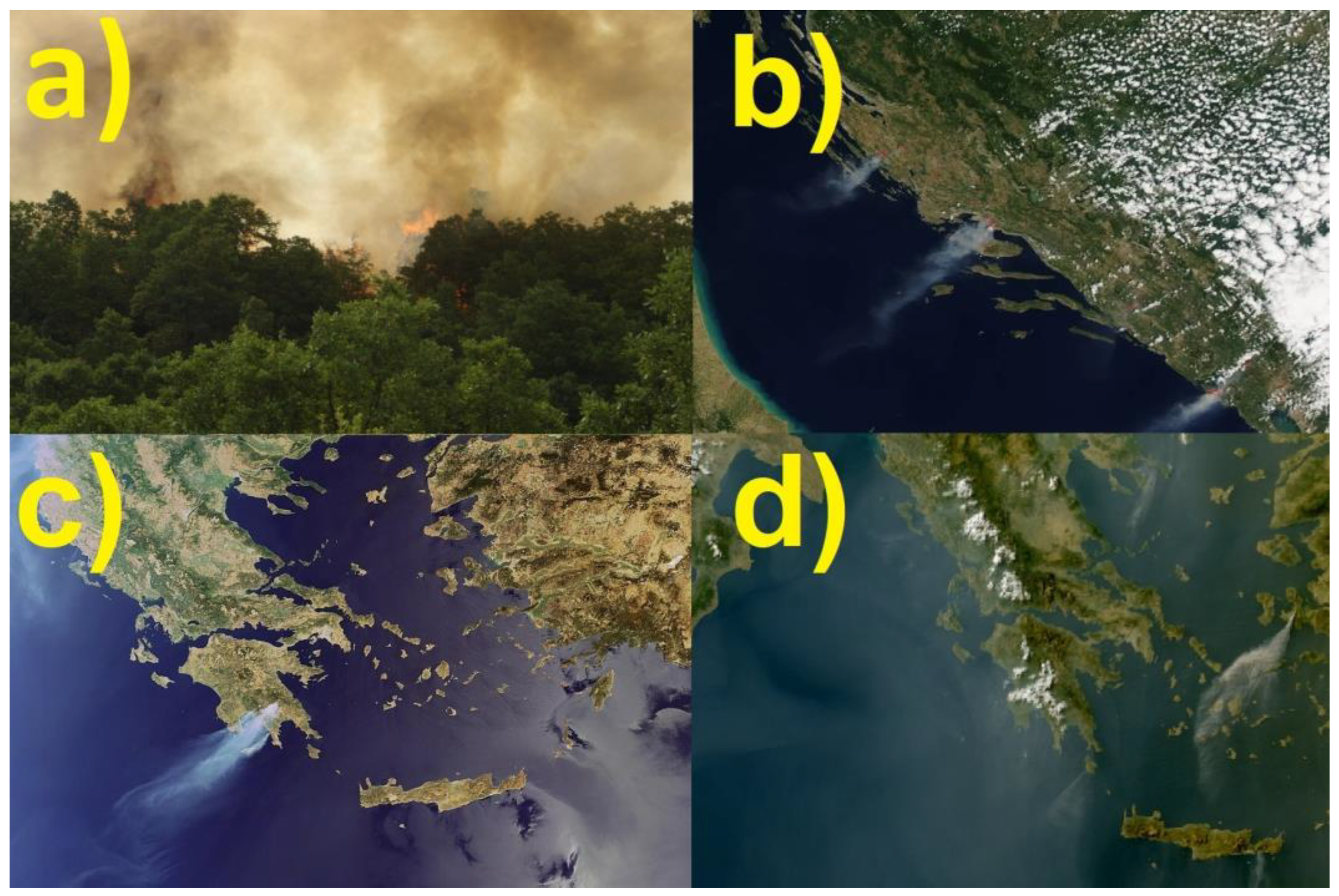
As a result of climate change and increasingly frequent extreme events, large areas of forest, meadows, and agricultural land are at risk of wildfires (Figure 2).
To effectively manage wildfire risk and protect natural areas, it is essential to develop efficient spatial prediction of wildfire susceptibility in Southeastern Europe.

2.2. Data Collection and Preparation

Spatial data were obtained from various geoportals that provide access to open-source datasets. For the map of the study area, a digital elevation model (DEM) with a 1 × 1 km spatial resolution was used [45]. Vector data on national boundaries were acquired from the United Nations Office for the Coordination of Humanitarian Affairs (OCHA) geoportal [46]. All maps were generated using the open-source GIS software QGIS v3.40.9 [47].

2.2.1. Wildfire Inventory and Historical Data

The wildfire inventory for Southeastern Europe was developed using spatial data from the Visible Infrared Imaging Radiometer Suite (VIIRS) satellite, which provides a spatial resolution of 375 m [48]. A single sensor was used to avoid data duplication from other satellites, such as MODIS. The data were normalized, georeferenced, and filtered in QGIS software, resulting in a final product that represents an inventory of wildfires.
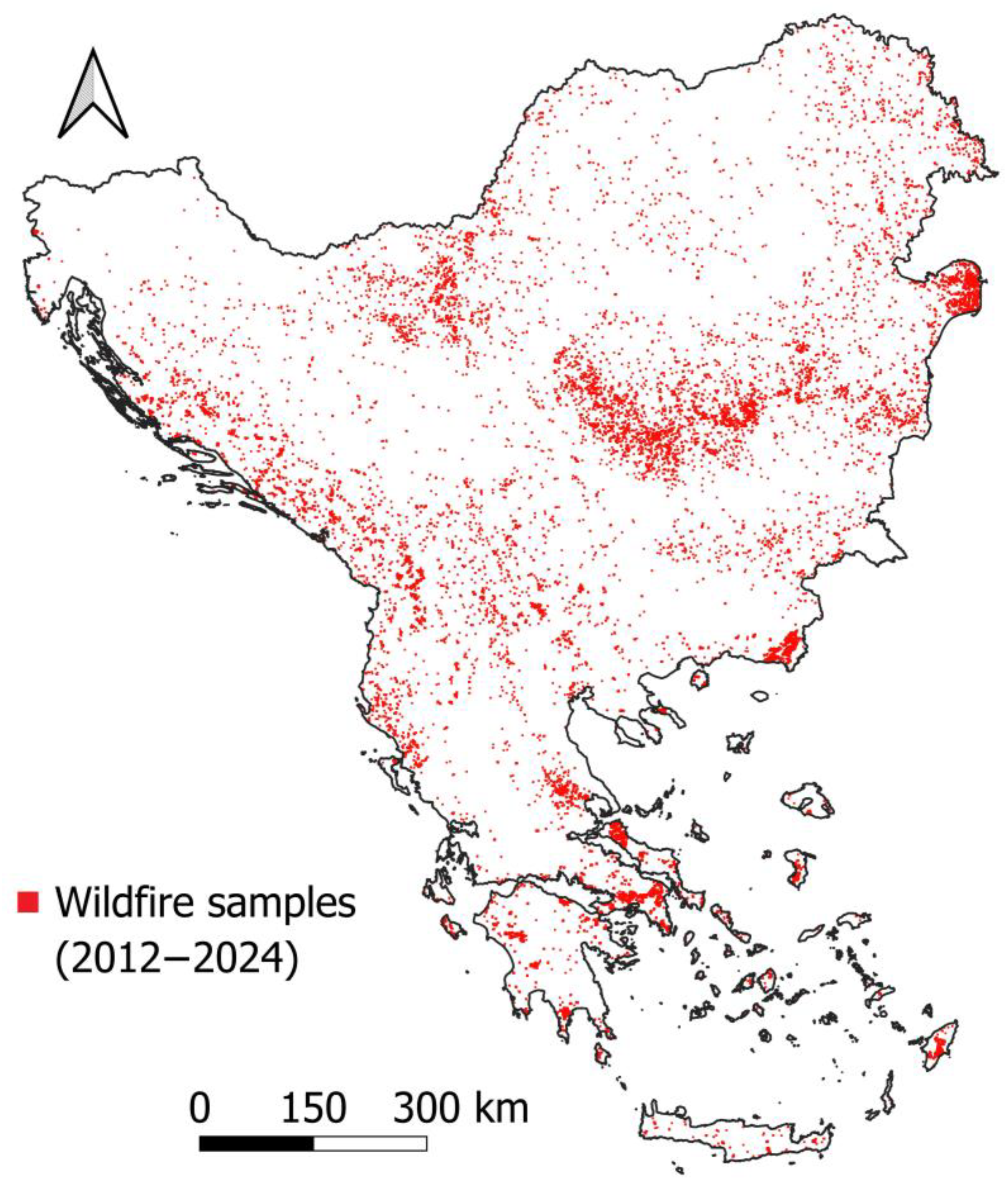
Filtering was performed by including only points with high and nominal confidence levels and Fire Radiative Power (FRP) values greater than 30 MW to improve the robustness of the fire inventory, thereby reducing false positives associated with low-intensity or short-lived thermal sources [49,50]. For the period 2012–2024, a total of 28,952 historical wildfire samples were generated, rasterized, and prepared for further processing and spatial prediction (Figure 3).

2.2.2. Geomorphological Conditions

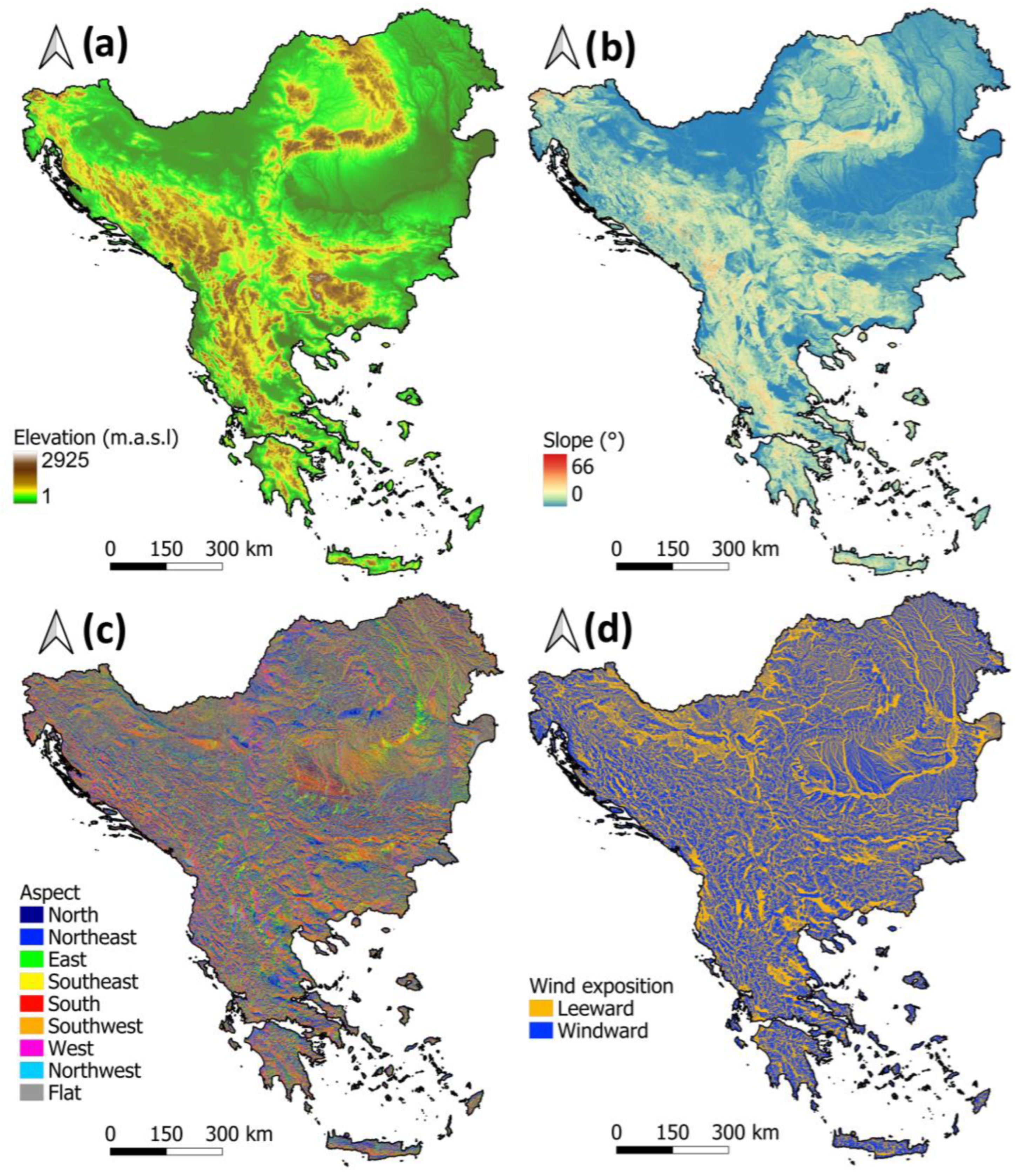
Of the topographic characteristics, the following factors were selected for spatial wildfire modeling: elevation, slope, aspect, and Wind Exposition Index (WEI) (Figure 4). All four maps were generated by processing and analyzing a Digital Elevation Model (DEM) with a 100 m spatial resolution in QGIS [51].
Elevation, slope, and aspect were derived using the Processing Toolbox—Raster Terrain Analysis. Elevation ranges from 1 to 2925 m, while the terrain slope varies between 0° and 66°. Regarding the aspect, all eight directional classes are represented, along with flat (unexposed) surfaces. For the Wind Exposition Index, a distance of 10 km, an angular step of 30°, and an acceleration factor of 1.5 were used to model wind exposure. These steps were performed using the SAGA Next Gen plugin “Wind Exposition Index”. This highlights the areas that represent windward and leeward slopes.

2.2.3. Climate Characteristics

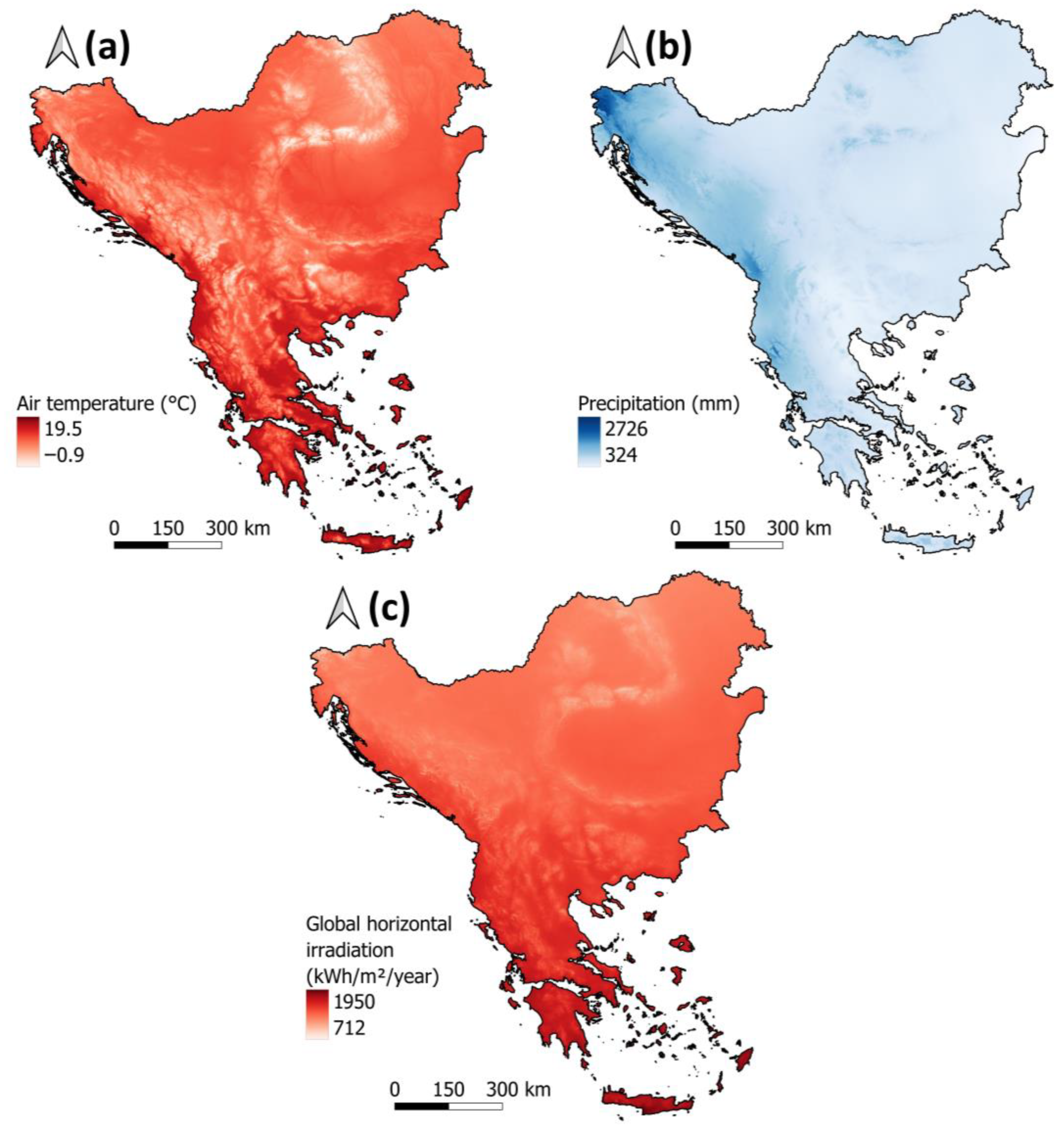
Of the climatic characteristics, the following variables were selected: mean annual temperature, annual precipitation, and global horizontal irradiance (GHI). To generate the mean annual air temperature and total (sum) annual precipitation, open-source data from the WorldClim platform were used [52]. The original datasets have a spatial resolution of 1 km and were compiled from several hundred meteorological stations over the period 1970–2000. The mean annual temperature ranges from −0.9 °C to 19.5 °C, while the annual precipitation varies between 324 mm and 2726 mm (Figure 5). These datasets were then resampled in GIS software, with values normalized to a 100 m spatial resolution.
The Global Solar Atlas platform served as the source for global horizontal irradiance (GHI) data [53]. The original data have a spatial resolution of 240 m but were resampled to 100 m to ensure consistency across all TIFF files. The GHI values range from 712 to 1950 kWh/m2/year.

2.2.4. Hydrological Characteristics

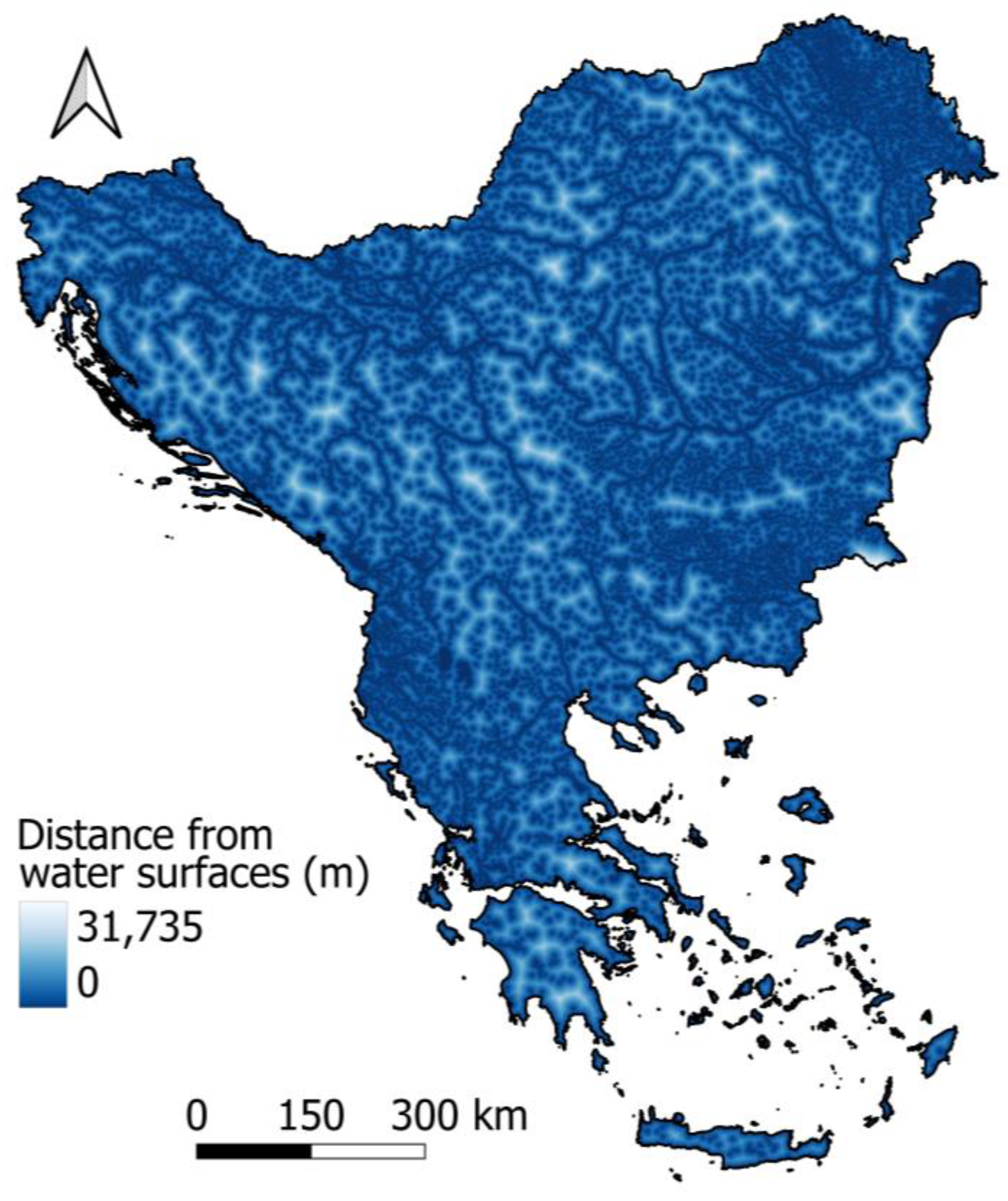
Among hydrological variables, the distance from water bodies represents the most influential factor in the spatial prediction of wildfires. Information on water surfaces was obtained from the Environmental Systems Research Institute (ESRI) platform [54]. For this purpose, Sentinel-2 satellite imagery from 2024 with a spatial resolution of 10 m was used.
After processing the data in GIS tools, the resolution was rescaled to 100 m. The dataset includes major rivers, natural and artificial lakes, and canals (Figure 6). The values range from 0 to 31.7 km.

2.2.5. Vegetation Conditions

Land use characteristics were obtained from the Sentinel-2 Land Cover Explorer, which compiles data from 2024 satellite observations [54].
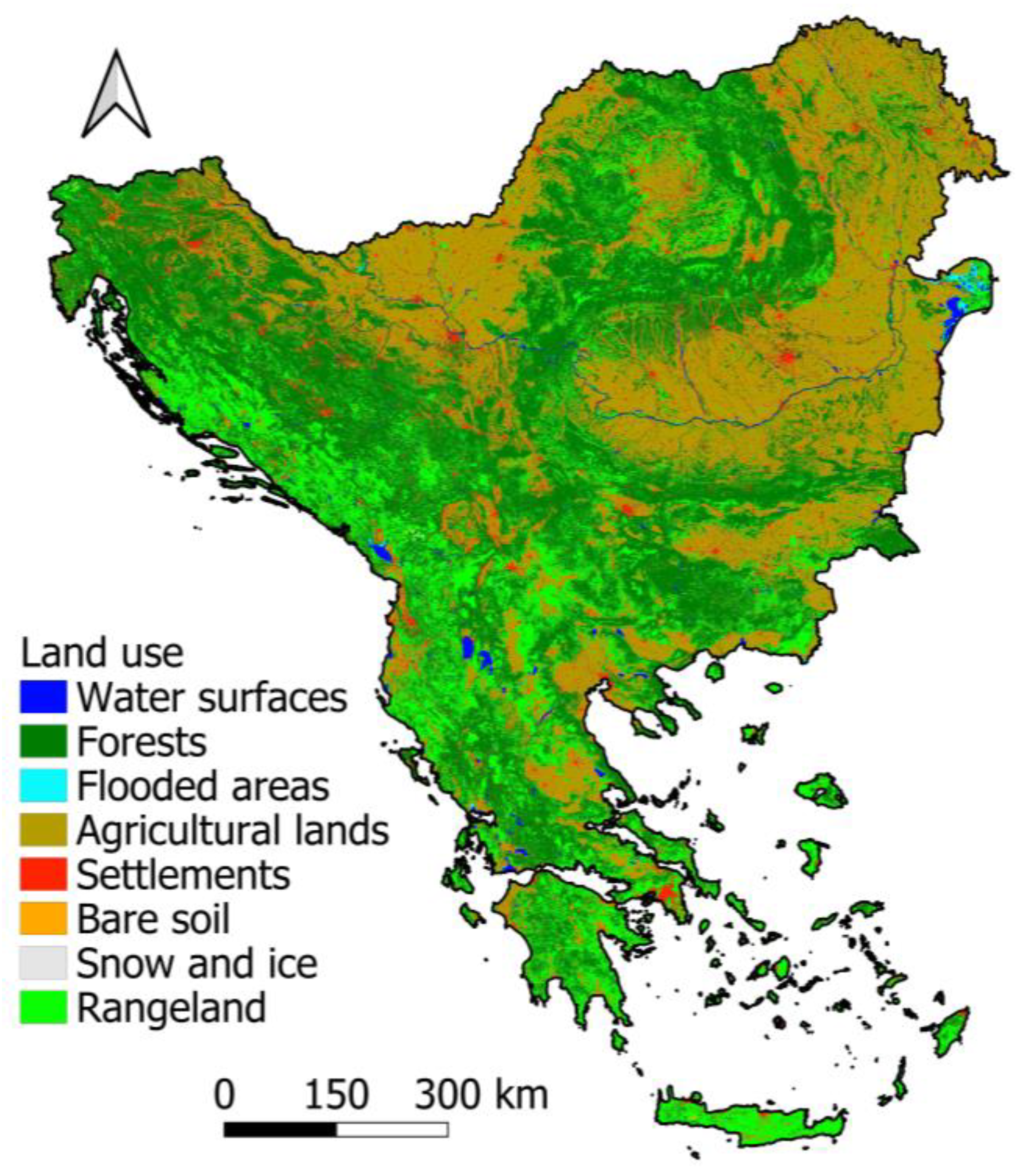
The territory of Southeast Europe includes eight dominant land cover classes: water surfaces, forests, bare soil, flooded areas, agricultural lands, settlements, snow and ice, and rangeland (Figure 7). The spatial data were also resampled from 10 m to 100 m in this case.

2.2.6. Anthropogenic Conditions

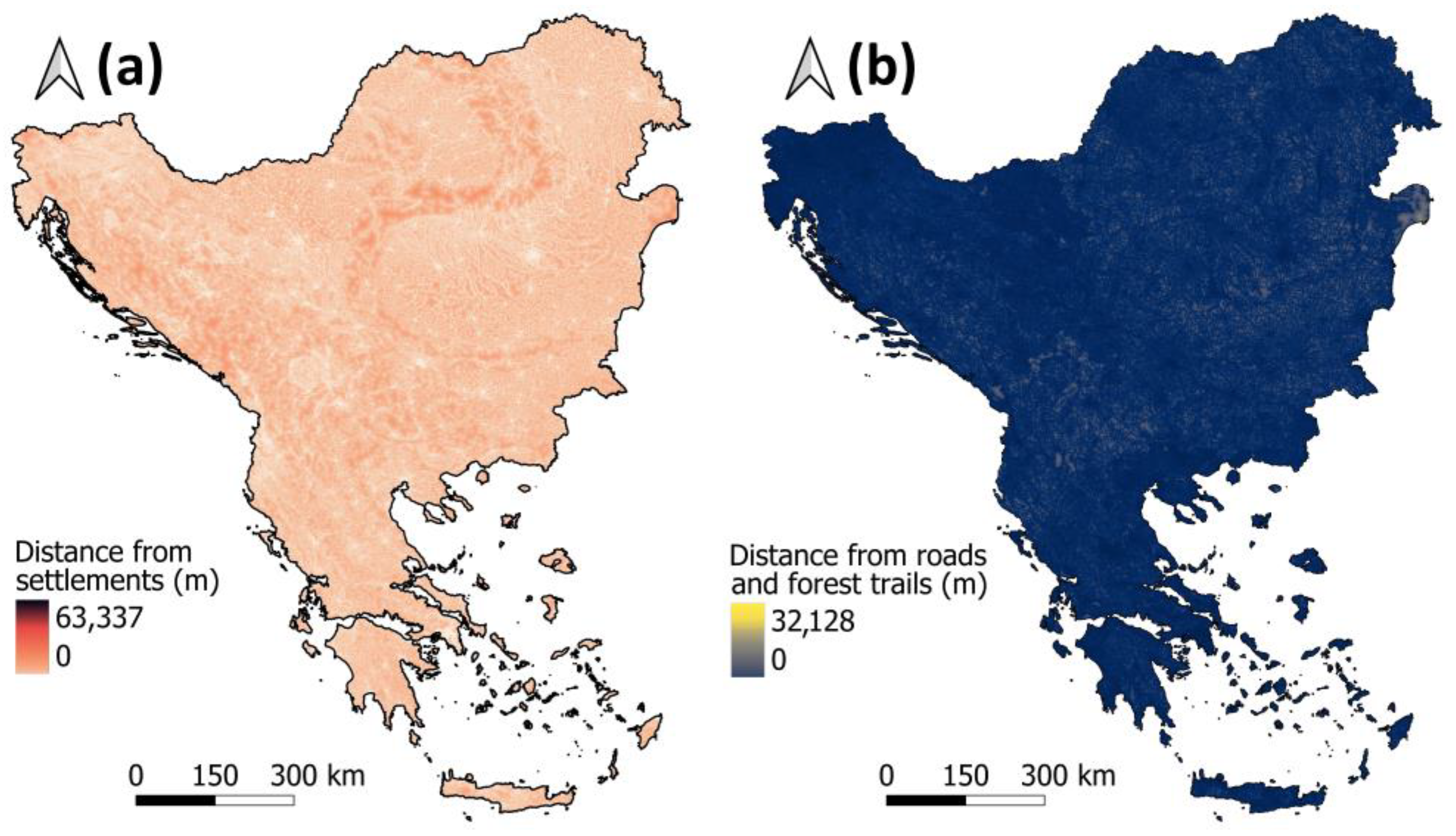
Two anthropogenic factors were included in the analysis: distance from settlements and distance from roads and forest trails (Figure 8). Settlement areas were derived from the land use dataset provided by ESRI, and the distance from each pixel to the nearest settlement was calculated in QGIS [47,54].
Roads and forest trails were obtained and digitized from the OpenStreetMap platform [55]. The distance from settlements ranges from 0 to 63.3 km, while the distance from roads and forest trails varies between 0 and 32.1 km. In both cases, the original spatial resolution of the pixels is 100 m.
All thematic and synthesis maps were rescaled to a pixel resolution of 100 m in order to achieve more accurate spatial predictions and evaluations of the applied criteria (Table 1). Continuous variables (e.g., elevation, temperature, precipitation, global horizontal irradiance, and distance-based layers) were resampled using bilinear interpolation, which preserves smooth spatial gradients, while categorical variables (e.g., land use, aspect, and wind exposure) were resampled using nearest-neighbor interpolation to avoid class mixing and preserve discrete category integrity.

2.3. Methodology

2.3.1. Machine Learning and Deep Learning Framework

The modeling framework integrates four supervised classification algorithms, RF, XGBoost, DNN, and KAN, to estimate wildfire susceptibility across Southeastern Europe. All models were trained using a harmonized geospatial dataset comprising 11 natural and anthropogenic predictors and 28,952 wildfire events recorded between 2012 and 2024. To ensure methodological consistency, all raster predictors were resampled to a 100 m grid and extracted at fire and non-fire locations. A stratified 80/10/10 split was used for training, validation, and testing.
Continuous variables were normalized prior to model training, while categorical variables (aspect, land use, wind exposure) were encoded as integer classes or expanded into one-hot representations when required. Two model families were employed: (i) tree-based ensembles (RF and XGBoost) and (ii) deep learning architectures (DNN and KAN). All models produced probability outputs rather than discrete classes, enabling threshold optimization, susceptibility mapping, and the use of threshold-independent metrics.
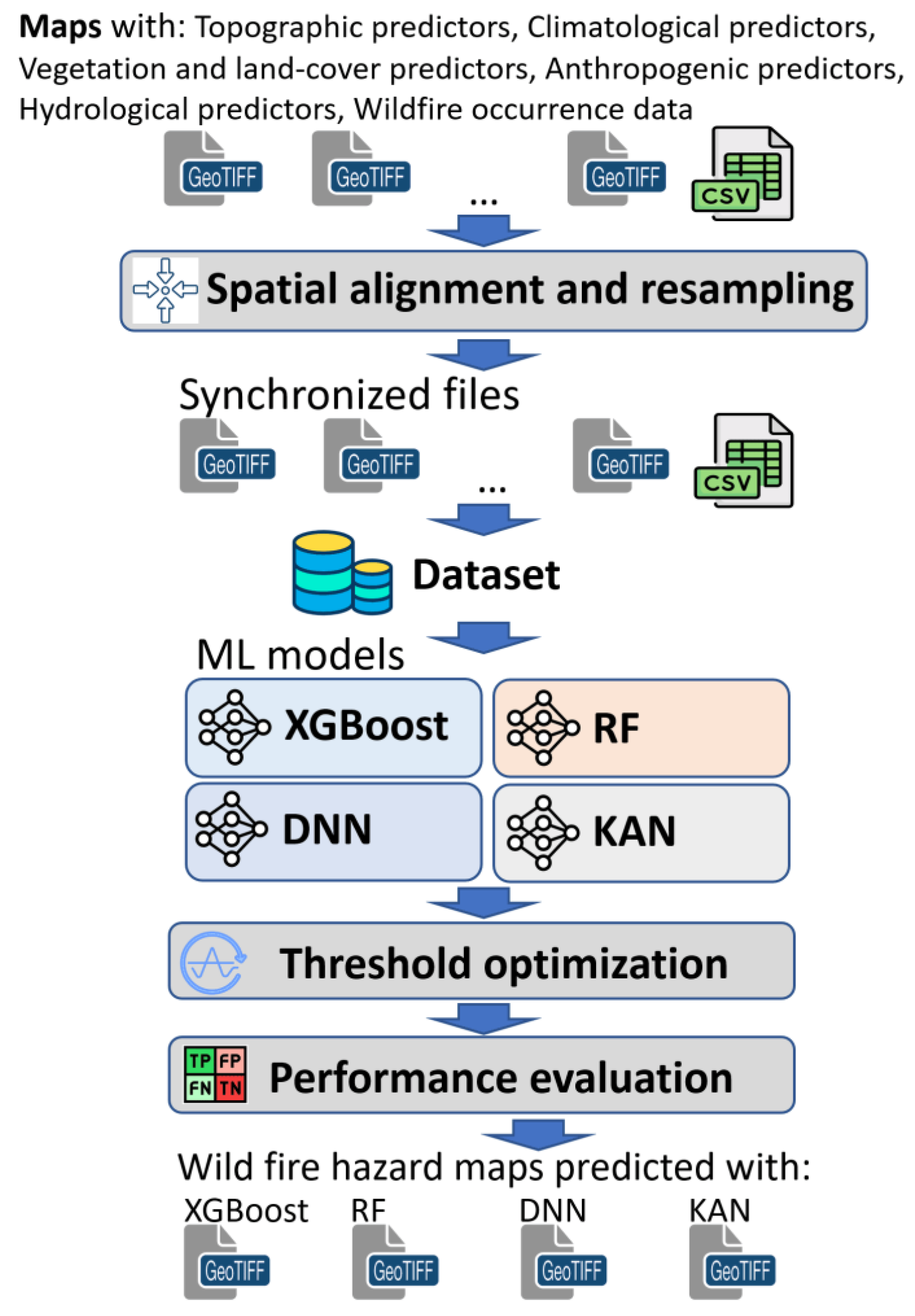
The overall workflow used in this study is shown in Figure 9, illustrating data harmonization, model configuration, validation, threshold selection, and the generation of final susceptibility maps.
The diagram visually links the heterogeneous environmental data sources and derived criteria with the four supervised learning models applied in this study, illustrating how each processing stage contributes to the final susceptibility outputs.
Model Training, Loss Functions, and Convergence
All models were trained to estimate the probability of wildfire occurrence p 0,1 using supervised binary classification, where the target variable denotes fire and non-fire locations. A stratified 80/10/10 split was applied for training, validation, and testing. Early stopping, validation-based model selection, and regularization strategies were explicitly employed to limit overfitting and ensure generalization across the study region.
For deep learning models (DNN and KAN), training minimized the binary cross-entropy loss, defined as follows:
L B C E = 1 N i = 1 N y i   · log p i + ( 1 y i ) · l o g ( 1 p i )
where y i { 0,1 } denotes the true class label, p i is the predicted wildfire probability, and N is the number of training samples. As shown in Equation (1), this loss directly optimizes probabilistic outputs and supports robust learning under class imbalance.
The Random Forest (RF) model was trained as a probabilistic ensemble using bootstrap aggregation and impurity-based splitting. Model stability was evaluated by progressively increasing the number of trees via warm-start training and monitoring validation and out-of-bag (OOB) log-loss until performance gains stabilized.
The XGBoost model employed a regularized binary logistic objective with early stopping based on validation area under the precision–recall curve (AUCPR), ensuring robust convergence under class imbalance. The final model corresponds to the best-performing boosting iteration.
The Deep Neural Network (DNN) was optimized using the AdamW optimizer with a OneCycle learning-rate schedule, gradient clipping, and early stopping based on validation loss. Input features were standardized or one-hot encoded as appropriate. Additional stabilization was achieved using mild label smoothing and stochastic weight averaging in the later training stages.
The Kolmogorov–Arnold Network (KAN) was trained using the same BCE loss, optimized with AdamW and cosine-annealing learning-rate scheduling. Gradient clipping and an exponential moving average (EMA) of model weights were applied to improve training stability and generalization, with convergence determined by validation-based early stopping.
To ensure methodological consistency across model families, hyperparameters were tuned using informed, model-specific strategies rather than exhaustive automated optimization, as identifying a global optimum was beyond the scope of this study. Because probability calibration differs across model families, final classification thresholds were determined individually for each model by maximizing the F1 score on the validation dataset, ensuring a balanced trade-off between wildfire detection sensitivity and false-alarm rates. In addition to the 28,952 wildfire locations (Target = 1), an equal number of non-fire locations (Target = 0) was randomly sampled across the study area to construct a balanced binary classification dataset. Non-fire samples were selected from areas with no recorded wildfire occurrence during the observation period, ensuring spatial consistency with the environmental predictors. Consequently, the final training dataset employed a 1:1 ratio between fire and non-fire samples.
Random Forest (RF)
The RF classifier was trained using a warm-start strategy in which the number of trees was gradually increased from 50 to 1200, allowing validation loss to be monitored as the ensemble expanded. The optimal configuration employed a maximum depth of 20, a minimum of 5 samples per leaf, a 50% feature subset per split, bootstrap aggregation with out-of-bag scoring, and balanced class weights [56]. The final model was selected according to the lowest validation log-loss. As a decorrelated ensemble of decision trees, RF provides stable, interpretable predictions and naturally accommodates mixed feature types [57,58].
Extreme Gradient Boosting (XGBoost)
The XGBoost classifier was trained using a tuned configuration stored within the serialized model file [59]. The final model consists of 6000 boosted decision trees, optimized until reaching the best iteration 5999 with a validation score of 0.8611. The feature set includes 26 predictors: eight continuous environmental variables, nine dummy-encoded aspect classes, seven land-use classes, and two wind exposure classes. The final classification threshold (0.45) was selected through F1-based optimization on the validation set. XGBoost builds a sequential series of boosted trees that progressively minimize residual error, allowing it to capture complex nonlinear interactions with high precision [60,61].
Deep Neural Network (DNN)
The DNN architecture is a multilayer feed-forward neural network designed for nonlinear tabular geospatial inference [62]. It consists of several dense layers with gradually decreasing width, using ReLU or SiLU activations to model complex relationships among topographic, climatic, and anthropogenic variables. The final architecture comprises fully connected layers with 512, 256, 128, and 64 neurons, followed by a single sigmoid-activated output neuron. Dropout regularization between layers is used to mitigate overfitting, while the final output neuron employs a sigmoid activation to produce wildfire probability estimates. Training was performed using the AdamW optimizer with early stopping based on validation loss, and mixed-precision computation was applied to improve efficiency without compromising accuracy. Standardized continuous inputs and one-hot encoded categorical features ensure stable gradient propagation throughout the network [63,64].
Kolmogorov–Arnold Networks (KAN)
KAN was implemented as a deep residual multilayer perceptron designed for smooth approximation of multivariate relationships in tabular geospatial data [65]. The architecture is inspired by the Kolmogorov–Arnold representation theorem, which states that any multivariate continuous function can be approximated as a finite sum of univariate functions and their compositions. The architecture consists of sequential hidden layers with 512, 256, 128, and 64 units, followed by a final single-output neuron. Each block integrates a linear transformation, batch normalization, SiLU activation, dropout regularization (0.20), a second linear layer with an additional normalization step, and a skip connection to preserve stable gradient flow. Training stability was further enhanced through cosine-annealing learning-rate scheduling, gradient clipping, and an exponential moving average (EMA) of model weights. Owing to its hierarchical structure and smooth functional representation, KAN effectively captures nonlinear dependencies among environmental and anthropogenic predictors [66,67].

3. Results

3.1. Performance Evaluation and Threshold Optimization

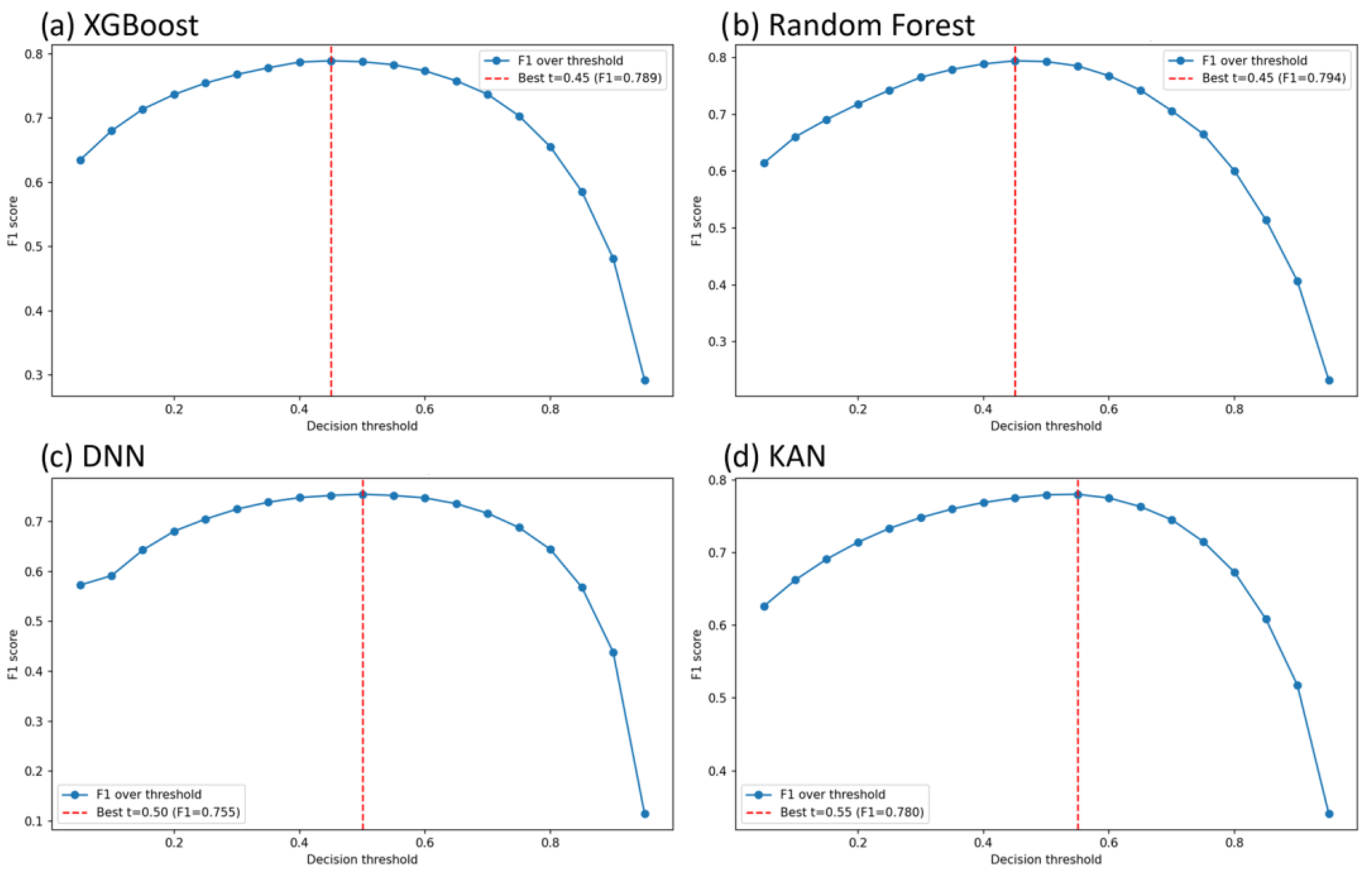
To ensure reliable comparison across all applied models, classification performance was evaluated using both threshold-dependent and threshold-independent metrics. Although model training used a balanced 1:1 fire/non-fire sample, threshold selection was designed to reflect operational decision-making, where class prevalence and misclassification costs are asymmetric. Therefore, fixing the decision threshold at 0.50 would not necessarily represent each model’s optimal operating point. Instead, a systematic threshold optimization procedure was implemented: each classifier was evaluated across thresholds from 0.05 to 0.95 in increments of 0.05, the F1 score was computed on the validation set for each threshold, and the threshold maximizing F1 was selected as optimal. The F1 score is defined as:
F 1 = 2 P r e c i s i o n R e c a l l P r e c i s i o n + R e c a l l   ,  
where Precision and Recall quantify false-alarm and missed-detection rates, respectively. As defined in Equation (2), the F1 metric provides a balanced trade-off between wildfire detection sensitivity and false positives, making it particularly suitable for wildfire prediction tasks characterized by class imbalance, unlike accuracy, which can be biased toward the majority class.
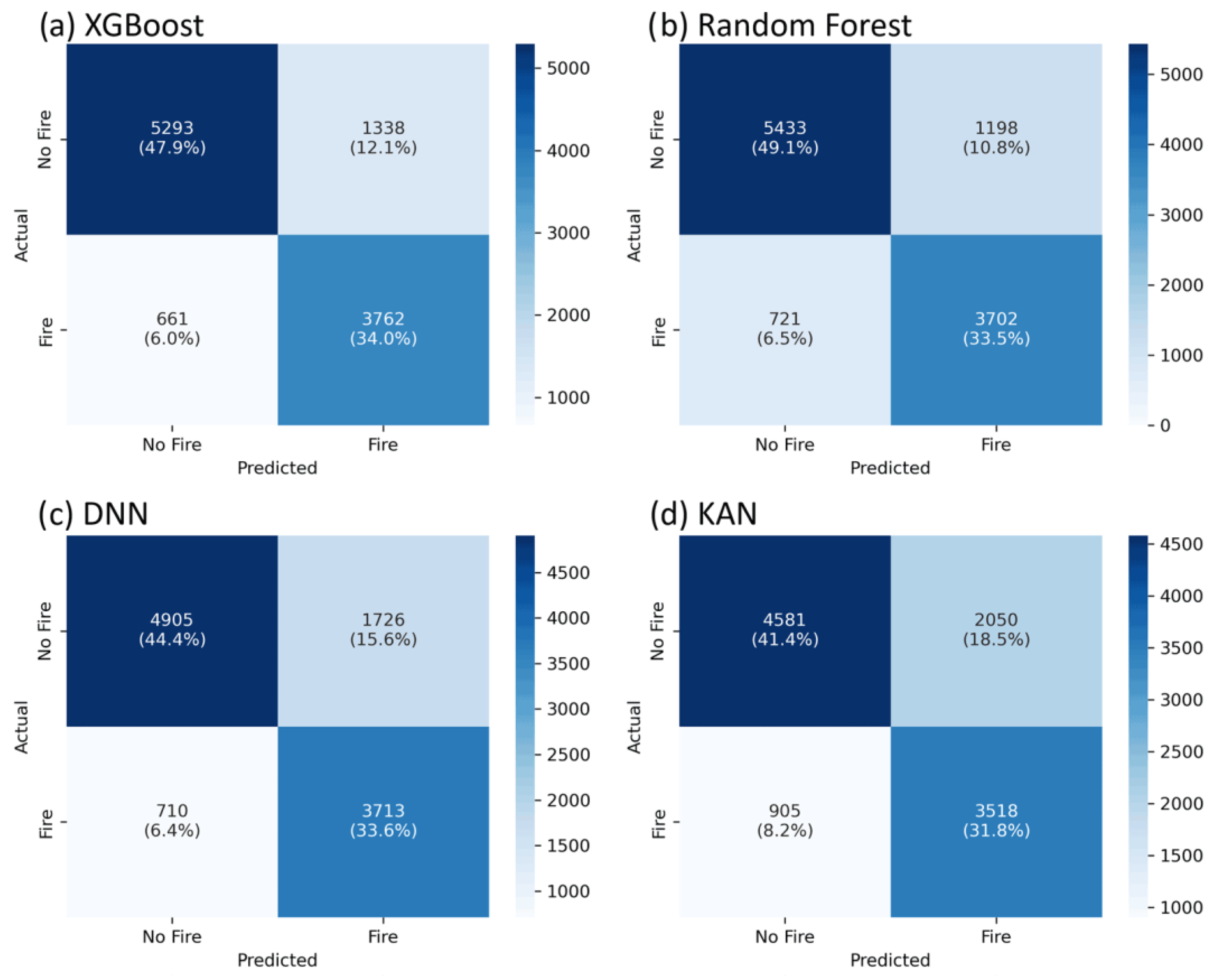
The resulting F1 threshold curves for XGBoost, Random Forest, DNN, and KAN are presented in Figure 10. All curves exhibit a characteristic concave shape, demonstrating that model performance varies substantially with the decision threshold. The ensemble tree-based models achieved their best performance at lower thresholds: XGBoost and Random Forest reached their peak F1 scores of 0.789 and 0.794 at the same optimal cutoff of 0.45. The DNN achieved its maximum F1 score (0.755) at a threshold of 0.50, while the KAN model performed best at a slightly higher threshold of 0.55, achieving an F1 score of 0.780. These results underscore the importance of individualized calibration, as different model families naturally produce probability outputs with differing internal calibration characteristics.
Once the optimal decision thresholds were identified, all four classifiers were evaluated on the held-out test set, with the corresponding accuracy and performance indicators summarized in Table 2. As shown, Random Forest and XGBoost achieved the most stable and reliable results, achieving accuracies of 0.827 and 0.826, respectively, and demonstrating the best balance between correctly classified fire and non-fire cases.
The DNN model achieved an accuracy of 0.780, performing competitively but producing a higher proportion of false positives, consistent with its tendency to overestimate fire likelihood. The KAN model achieved a similar accuracy (0.784), though with the highest false-positive count among all models, indicating a less conservative classification boundary. Overall, the metrics reported in Table 2 confirm that the tree-based ensemble models, particularly Random Forest, deliver the most dependable threshold-optimized performance, while the deep learning models exhibit higher sensitivity at the cost of reduced specificity.
In addition to AUC-based metrics, model robustness was assessed by comparing training, validation, and test performance, as well as by inspecting threshold-dependent confusion matrices and F1-score curves. The absence of strong performance divergence across these datasets indicates no pronounced overfitting.
Overall, the results from Figure 10 and Figure 11 reveal that tree-based ensembles (XGBoost and Random Forest) deliver the strongest threshold-calibrated performance across the evaluation metrics.
Deep learning models (DNN and KAN) achieve satisfactory but slightly lower discrimination capability, particularly in distinguishing fire from non-fire conditions in a highly heterogeneous regional environment. Collectively, the threshold curves and confusion matrices offer a detailed understanding of each model’s behavior, and provide the foundation for selecting the final calibrated configurations used in subsequent susceptibility mapping.

3.2. Wildfire Probability Mapping

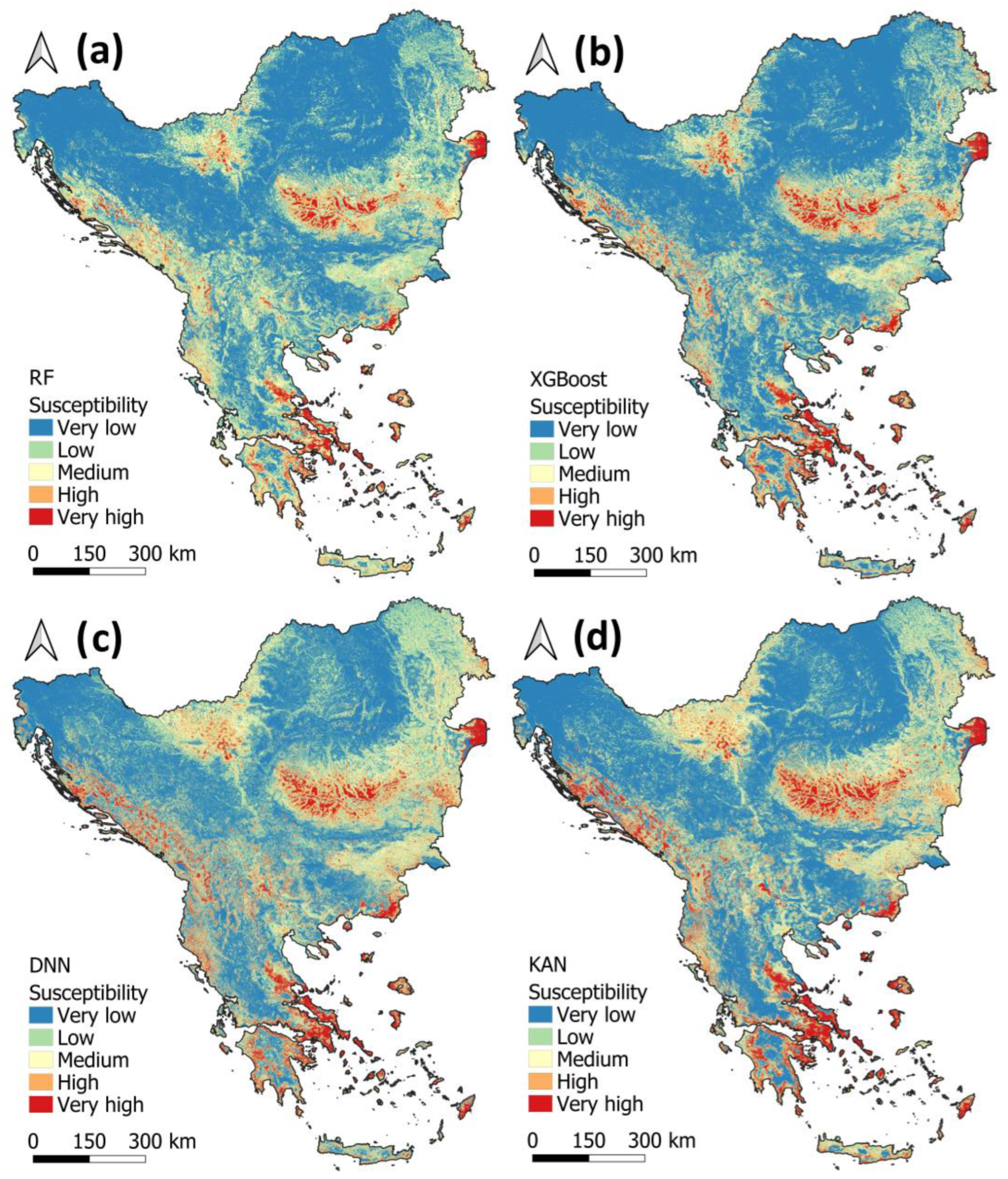
By applying 11 wildfire predictors and inventories across the 800,000 km2 of territory of Southeast Europe, synthetic susceptibility maps based on machine and deep learning models were obtained (Figure 12). From the created wildfire inventory, 50.9% of fire events were recorded on pastures and meadows, 31.9% on agricultural land, and 13.6% in forests. The smallest percentage of fires occurred near settlements (2.4%), on seasonally flooded areas (1.2%), and on bare land (0.1%).
Results illustrate the spatial susceptibility of Southeast Europe to wildfires, as determined by machine and deep learning models (Table 3). Among the algorithms evaluated, the Random Forest (RF) model produces the most conservative classification. More than half of the region (51.4%) falls into the very low susceptibility category, while an additional 26% is categorized as low. Only a small portion (about 9.6%) is classified within the high or very high susceptibility classes. This behavior reflects the averaging nature of the Random Forest approach, which combines predictions from multiple decision trees to produce a more robust result. Such an ensemble mechanism tends to smooth extreme values, and can therefore occasionally underrepresent highly localized risk areas.
The XGBoost model, though also tree-based, yields slightly higher susceptibility estimates overall. It identifies 56.7% of the region as very low and 19.6% as low, with 11.8% categorized as medium. The high and very high classes account for 7.6% and 4.4% of the area, respectively. Compared to RF, XGBoost shifts a modest portion of the landscape toward higher-susceptibility categories. This difference likely arises from XGBoost’s sequential learning design, which iteratively corrects errors made in previous trees and can therefore capture subtle spatial patterns that RF may overlook.
Deep learning models represented by the DNN and the KAN offer a contrasting perspective. The DNN model classifies 41.8% of the region as very low and 26.5% as low, but assigns noticeably higher proportions to the high (10.2%) and very high (6.3%) categories. The KAN model displays a similar distribution, with 48% of the land area in the very low class and 19.7% in the low class, while 10.9% and 6.5% are identified as high and very high, respectively. These results suggest that the deep learning methods are more responsive to complex, non-linear relationships among climatic, topographic, and land-use variables. Consequently, they tend to emphasize regions where environmental factors interact in ways that may facilitate wildfire ignition and spread, capturing risk zones that the tree-based models represent more cautiously.
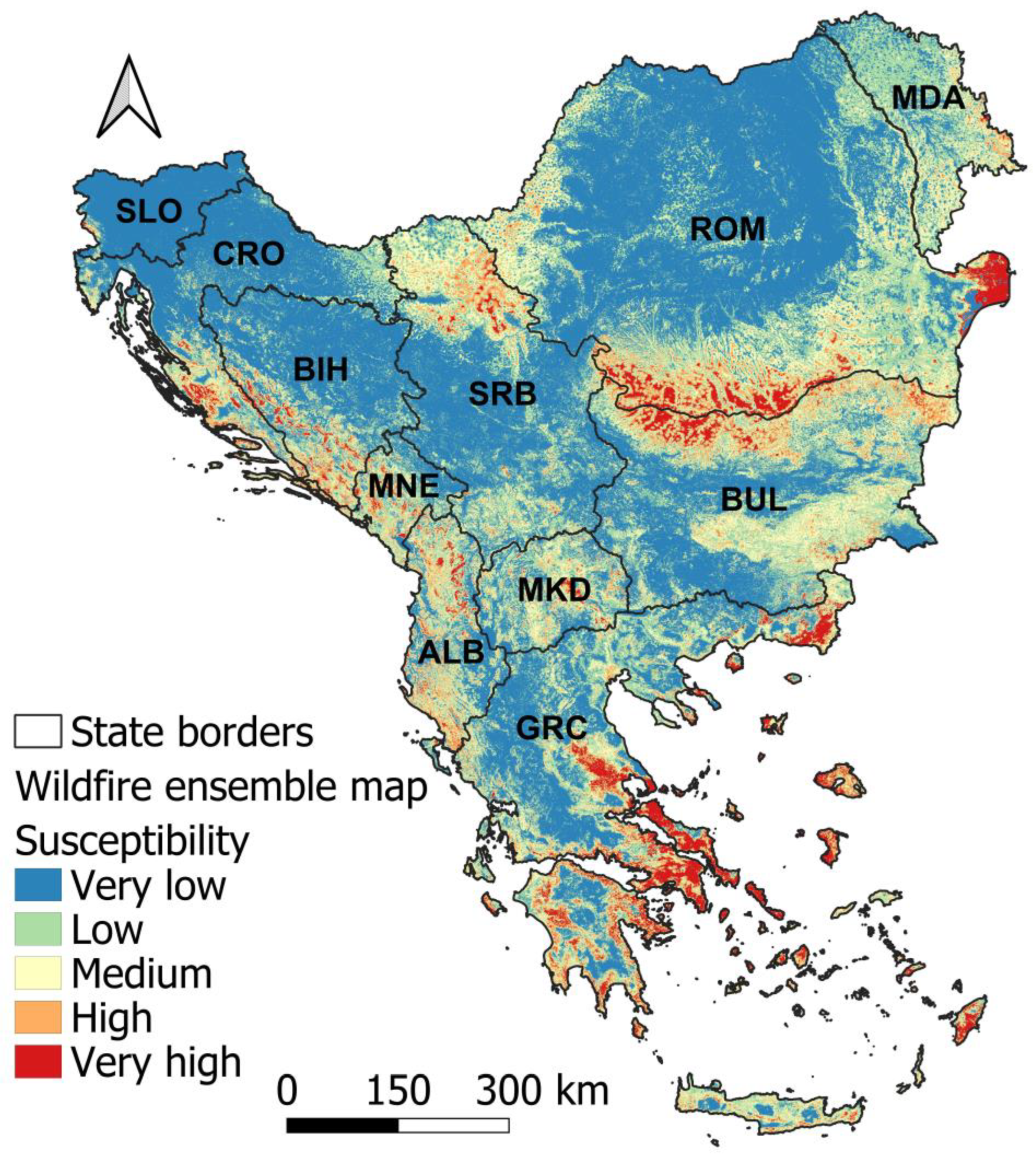
The ensemble model, which combines outputs from all four individual models, presents a more balanced susceptibility distribution (Figure 13). In this case, 48.2% of the territory is categorized as very low, 24.8% as low, and 14.9% as medium, while 8.4% and 3.7% fall into the high and very high categories, respectively. By integrating diverse modeling perspectives, the ensemble approach reduces individual model biases and stabilizes extreme predictions. Its moderate results indicate that ensemble modeling offers a reliable compromise, producing a realistic spatial representation of wildfire susceptibility.
In summary, the comparative analysis reveals a consistent regional pattern across all models, with the majority of Southeast Europe classified within the very low to medium susceptibility range. Nonetheless, deep learning approaches highlight broader areas of elevated risk, particularly where complex environmental interactions amplify fire potential. The ensemble model, by harmonizing the tendencies of the individual algorithms, appears to capture the overall landscape stability while still identifying critical zones that require closer monitoring and management.
The results in Table 4 give an overview of wildfire susceptibility across 11 countries in Southeastern Europe, as determined by the ensemble model. The findings reveal marked spatial differences that reflect the influence of each country’s distinct climate, topography, and land cover. Overall, a gradual increase in wildfire susceptibility is observed from the northwest toward the southeast, mirroring the shift from temperate to Mediterranean and semi-arid climatic zones.
Slovenia is seen to be the least fire-prone country in the region. Approximately 95.8% of its territory falls within the very low susceptibility category, while 0.7% is classified as high and very high. This outcome aligns with Slovenia’s humid and temperate environment, characterized by dense vegetation, frequent rainfall, and generally mild summer temperatures.
Croatia and Bosnia and Herzegovina also show low overall susceptibility to wildfires, although their risk levels are slightly higher in comparison to Slovenia. In Croatia, 62.2% of the country’s area is categorized as very low, whereas 8.2% falls within the high and very high classes. Bosnia and Herzegovina follows a similar trend, with 64.8% of its land classified as very low and 8.7% as high and very high combined. These figures can be attributed to the countries’ transitional temperate continental-Mediterranean climates, where moderate rainfall helps mitigate the potential for wildfire ignition and spread.
Moving further southeast, countries such as Serbia, Montenegro, Albania, and North Macedonia exhibit more diverse susceptibility distributions. These countries experience more variable environmental conditions, with regions of both low and high fire susceptibility.
Serbia, for instance, has 53% of its territory in the very low class. Still, over 22.3% falls within the medium to very high categories, reflecting its climatic gradient from the cooler northern plains to the warmer and drier southern landscapes. Montenegro records a higher share of land in the high and very high classes (17.5% combined), a pattern consistent with its rugged topography, Mediterranean-type climate, and vegetation prone to ignition during hot, dry summers.
Albania emerges as one of the most wildfire-prone countries in the region. Roughly 22.6% of its land area is classified as medium susceptibility, while an additional 21.7% falls into the high and very high categories. These results correspond well with the country’s wildfire activity, particularly along its coastal and mountainous regions, where extended dry periods and abundant flammable vegetation heighten fire potential.
In the case of North Macedonia, 22.5% of the territory is of medium susceptibility, while more than 11% is classified as being of high and very high vulnerability to wildfires, underscoring the combined influence of a dry continental climate and diverse vegetation structure.
Greece records the highest overall wildfire susceptibility among the analyzed countries. Approximately one-third of its land area falls within the very low category, but a significant 24.7% is classified as high or very high susceptibility. This result reflects Greece’s Mediterranean environment, where long, hot summers and limited rainfall create favorable conditions for the spread of fires. The dominance of shrublands and pine forests further contributes to the country’s elevated fire risk.
To the northeast, Bulgaria, Romania, and Moldova demonstrate generally lower susceptibility levels. In Bulgaria, the high and very high classes encompass about 13.9% of the territory, while for Romania this is 8.1%, and Moldova just 4.4%. These relatively low proportions correspond to their cooler, more humid continental climates.
The ensemble model identifies spatial heterogeneity across Southeastern Europe, with fire vulnerability increasing from the northern, cooler parts of the region to the southern, significantly warmer parts. The lowest susceptibility to wildfires is identified in Slovenia and Moldova, while the most vulnerable countries are Greece and Albania. This spatial distribution highlights regional differences in climatic, geomorphological, and biogeographical conditions that shape spatial patterns of wildfire prediction.

3.3. Spatial Wildfire Statistics

Exploratory spatial analysis is conducted to provide independent validation of the wildfire susceptibility models by comparing predicted patterns with real fire occurrence. It also helps clarify SHAP-based interpretations by showing how individual factors correspond to actual spatial trends. The analysis reveals consistent gradients, including higher fire density in areas with stronger solar irradiation, lower precipitation, and greater distance from water bodies. The findings highlight the dominant influence of climate and energy variables, the importance of rangeland and agricultural landscapes, and the clear contribution of human proximity through settlements and road networks.
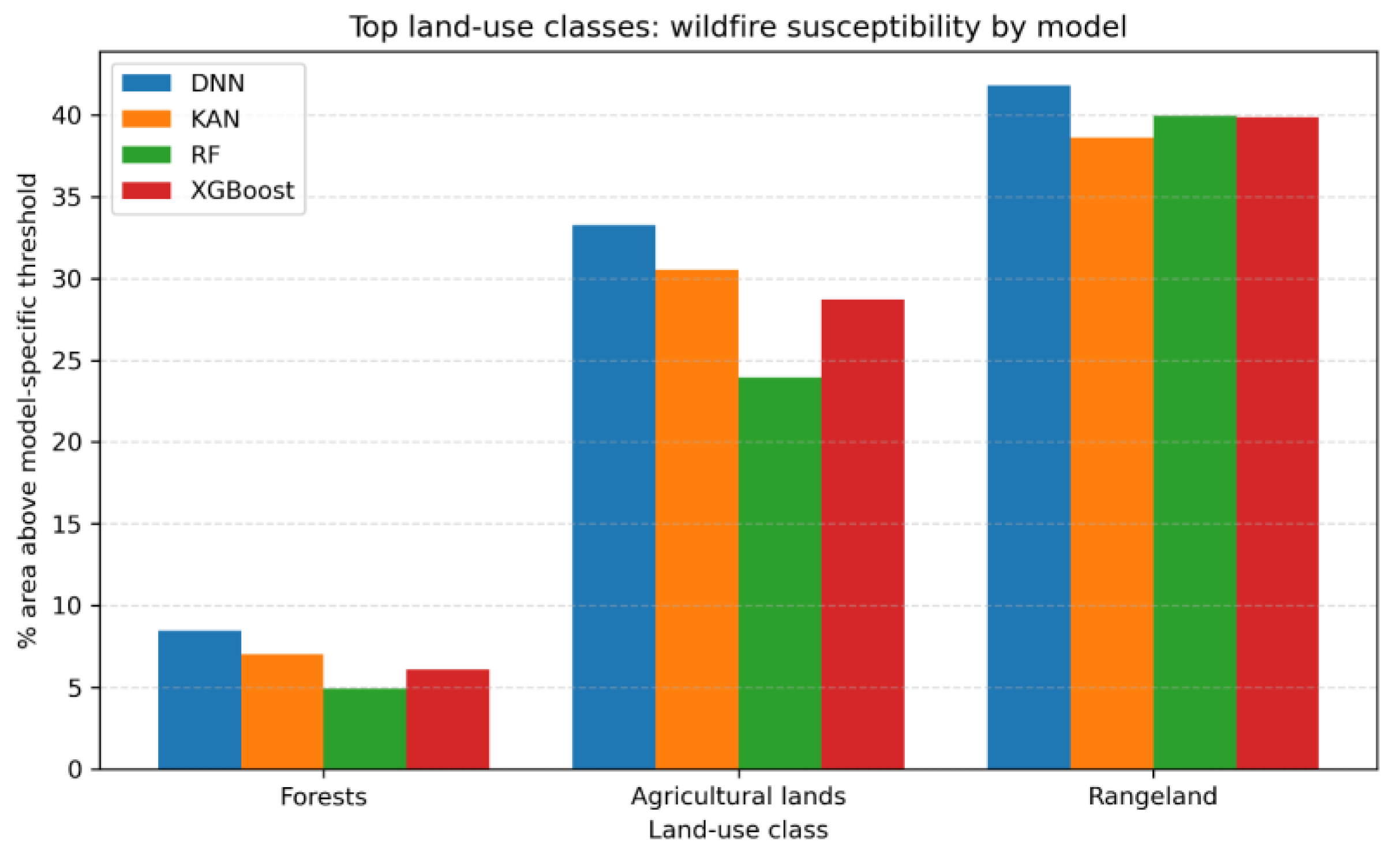
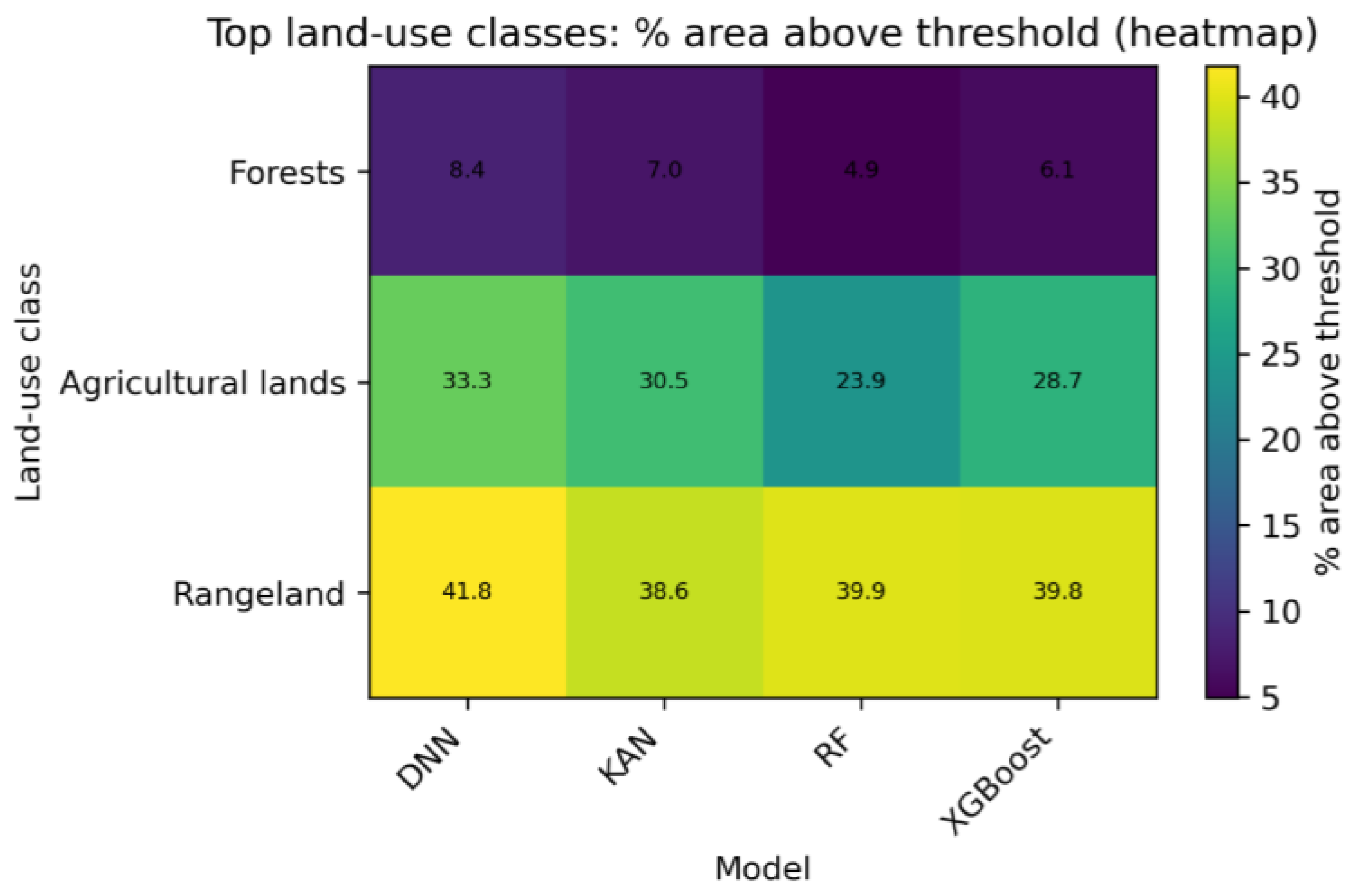
Land-use characteristics play an important role in shaping wildfire susceptibility, as different surface types vary in fuel availability, vegetation structure, and human influence. To better understand how models respond to these dominant landscape categories, we analyze the three land-use classes that exhibit the strongest association with predicted fire-prone areas: forests, agricultural lands, and rangeland (Figure 14).
The heatmap in Figure 15 illustrates the percentage of each land-use class that exceeds the model-specific susceptibility threshold, allowing a direct comparison of how different algorithms classify the same terrain. Rangeland consistently shows the highest proportion of high-risk areas across all models, while forests remain the least fire-susceptible class.
Topographic factors such as slope and elevation influence microclimate, fuel structure, and fire spread potential, making them important variables in understanding regional wildfire patterns. The spatial statistics presented here reveal how wildfire occurrence varies across characteristic terrain bands and help clarify the physical conditions that favor ignition and fire propagation.
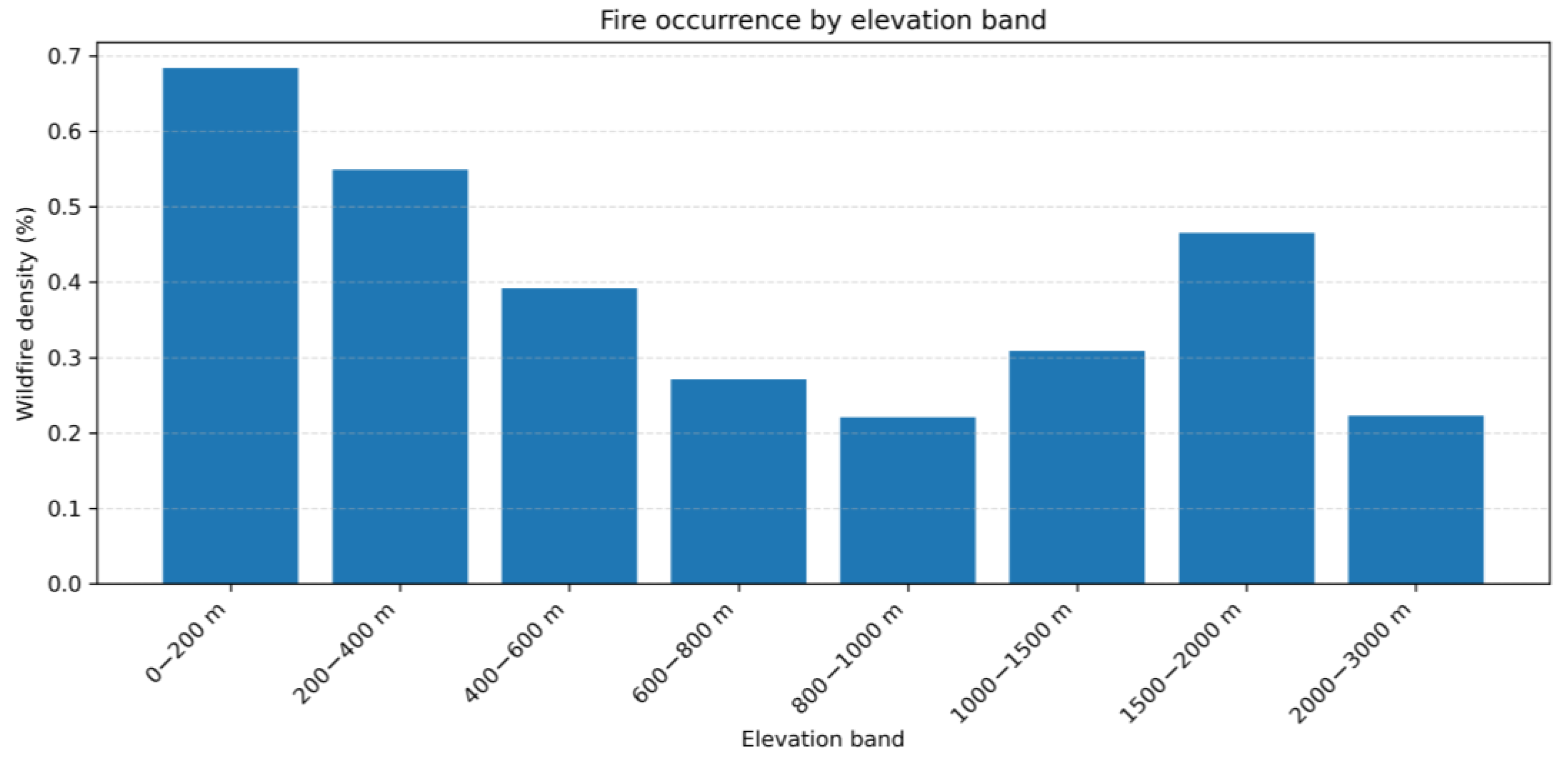
Figure 16 illustrates the distribution of wildfire density across elevation classes. The highest densities occur at low elevations, where human presence, higher temperatures, and lower moisture availability create favorable conditions for ignition and sustained burning. Fire density declines steadily with increasing elevation, except for a moderate secondary peak around 1500–2000 m, which may reflect localized vegetation and climate conditions that support occasional fire activity.
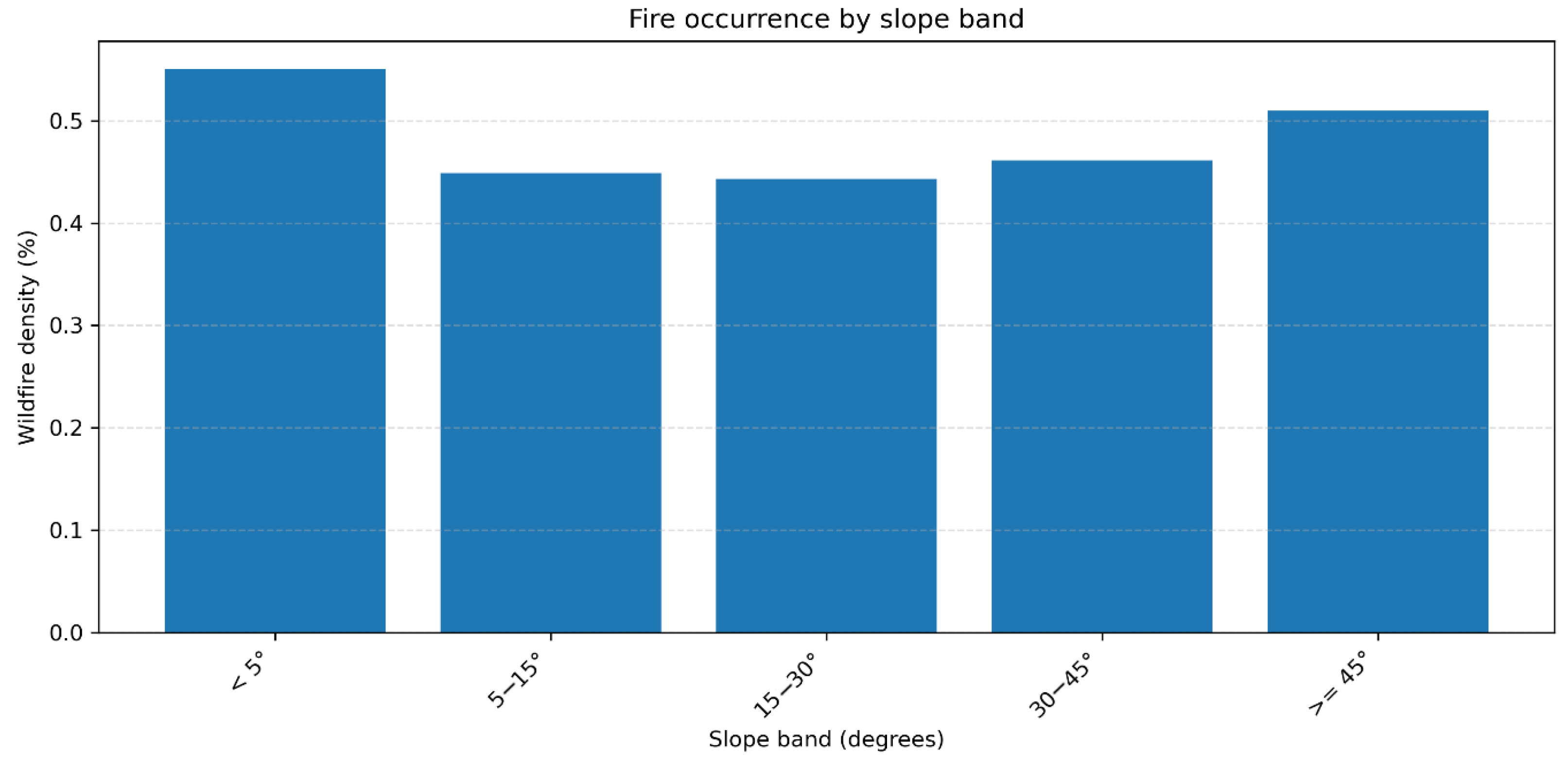
Figure 17 shows wildfire density across discrete slope intervals. Fire density is highest on very gentle terrain (<5°), likely reflecting greater human activity and fuel accumulation in low-slope landscapes. Moderate and steep slopes exhibit slightly lower and relatively uniform wildfire densities, suggesting that slope alone is not a dominant driver of fire occurrence at the regional scale.
Meteorological and surface energy-balance conditions shape the fundamental environmental constraints that govern wildfire ignition and spread. Factors such as precipitation, incoming solar radiation, and local energy availability directly influence vegetation dryness and fuel flammability, making them essential for understanding regional fire susceptibility.
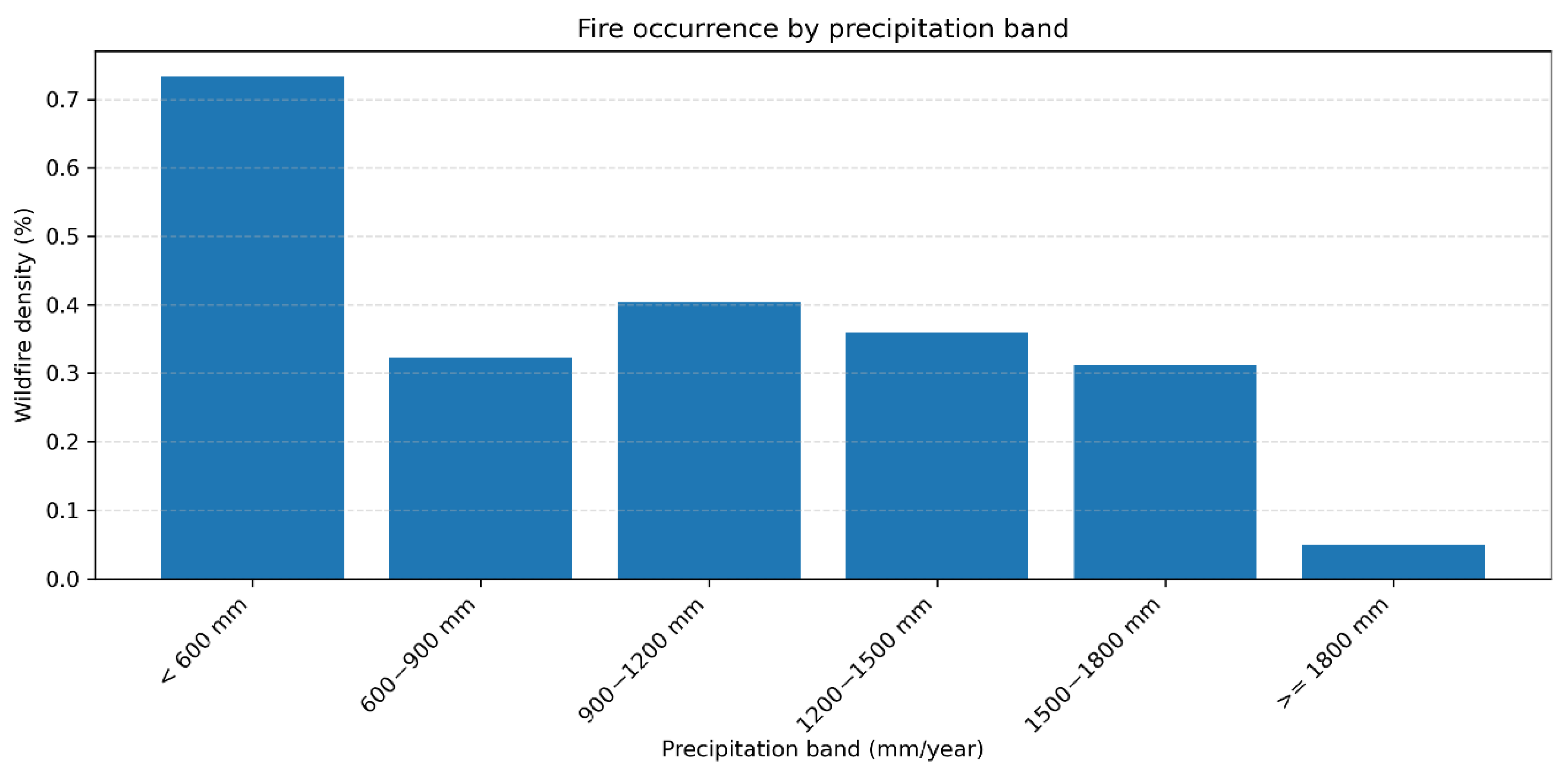
Figure 18 shows wildfire density across annual precipitation intervals and reveals a clear negative relationship between rainfall and fire occurrence. The highest wildfire densities occur in regions receiving less than 600 mm of rainfall per year, while areas exceeding 1800 mm show minimal fire activity. Intermediate precipitation bands exhibit moderate fire densities, reinforcing the importance of long-term moisture availability as a limiting factor for wildfire ignition and spread.
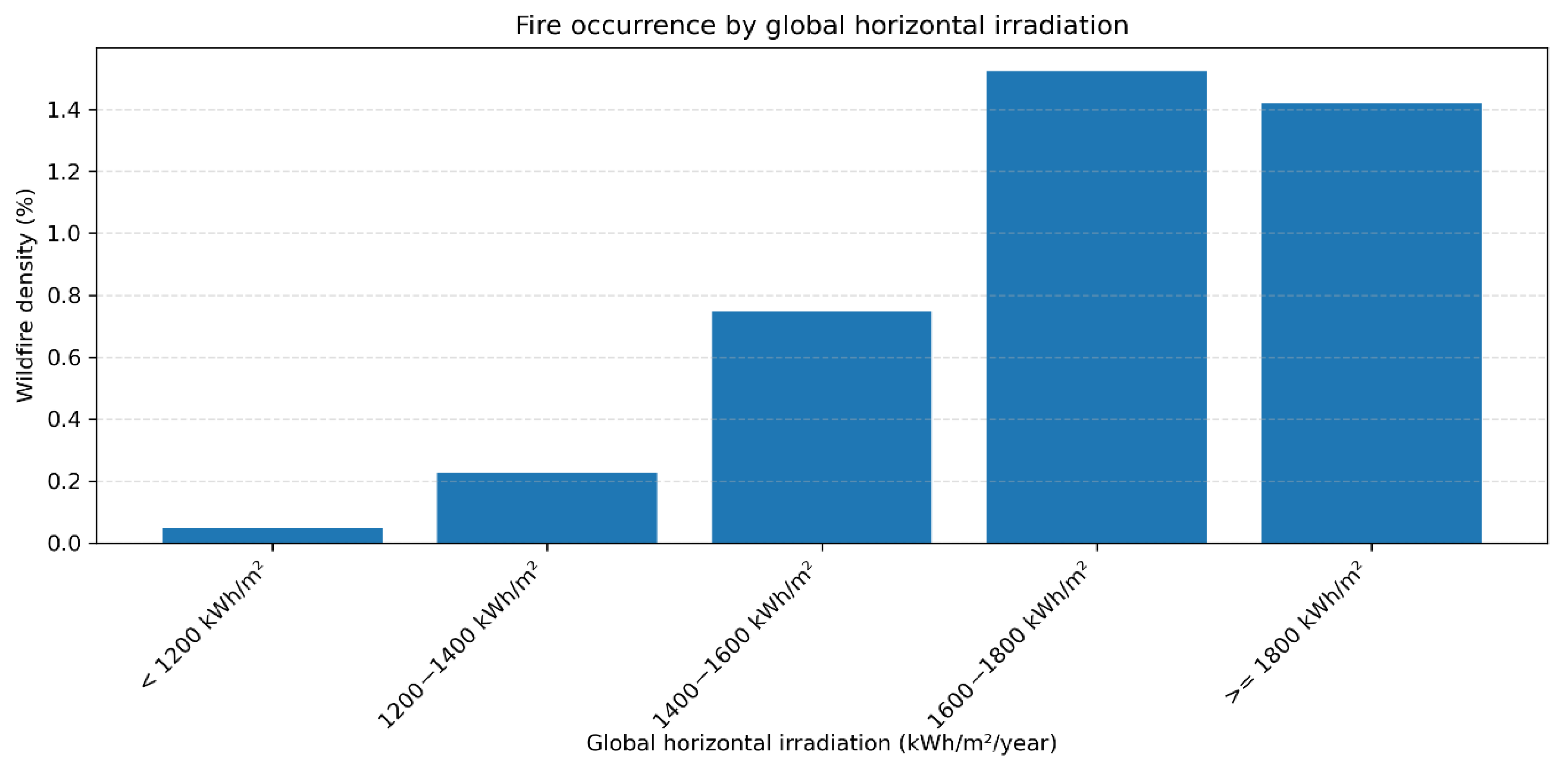
Figure 19 illustrates wildfire density across irradiation intervals, showing a clear increase in fire occurrence with higher annual solar energy input. Areas receiving less than 1400 kWh/m2 per year exhibit very low wildfire density, while regions above 1600 kWh/m2 show densities several times higher. This strong positive gradient reflects the role of intense solar radiation in accelerating fuel drying and creating more favorable conditions for ignition and sustained fire activity.
Human activities are a major source of wildfire ignitions, and proximity to settlements and transportation networks often shapes spatial patterns of fire occurrence. The following statistics examine how wildfire density varies with distance from populated areas and road infrastructure, providing insight into the strength and nature of anthropogenic influences across the region.
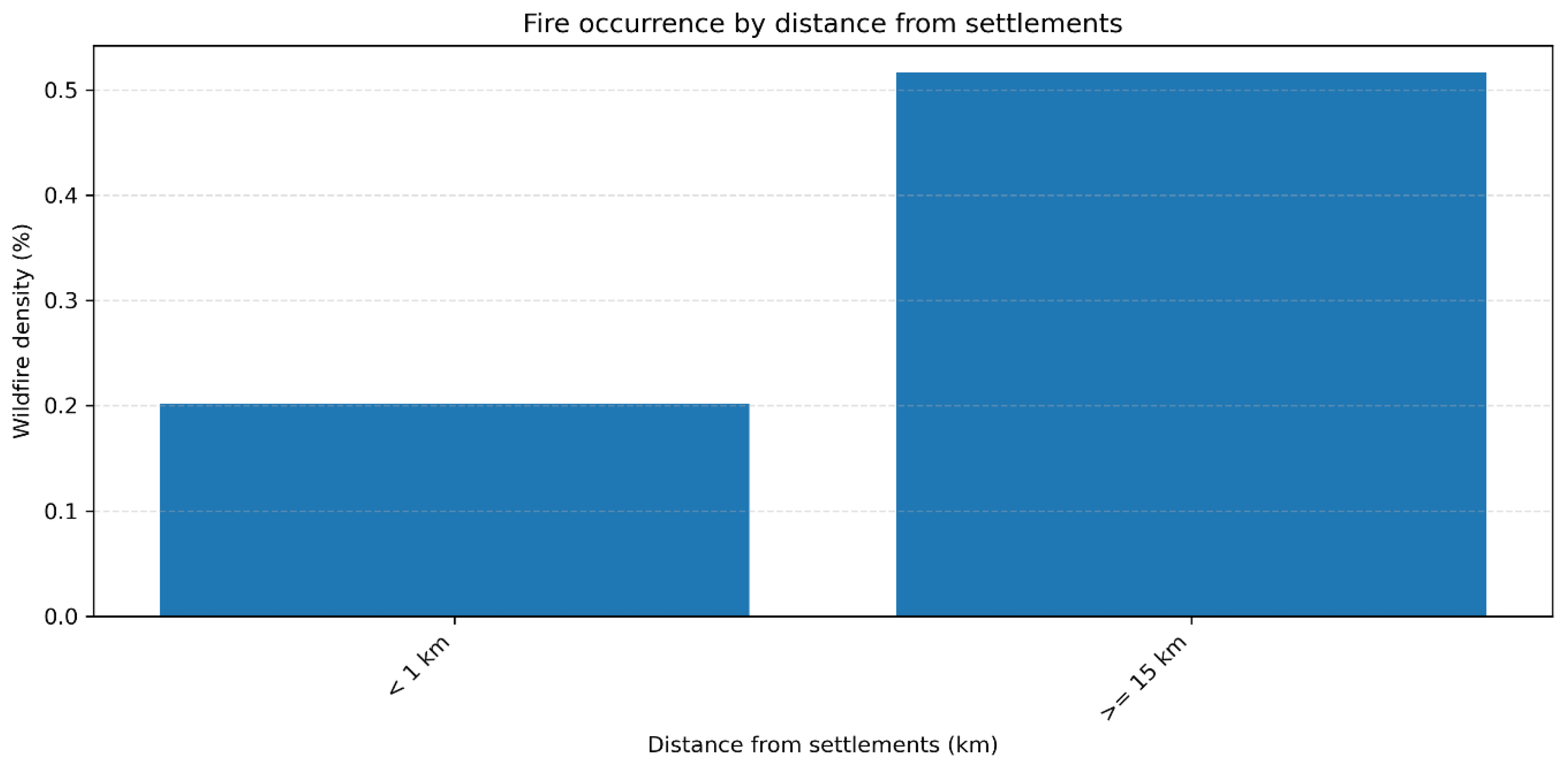
Figure 20 presents wildfire density for areas close to settlements and for regions located more than 15 km away. Fire density is notably higher in remote areas, suggesting that a substantial share of fires occur far from populated zones, likely reflecting agricultural burning, land management practices, or natural ignitions in sparsely inhabited landscapes. In contrast, zones within 1 km of settlements show lower fire density, indicating that direct proximity to urbanized areas is not the dominant driver of wildfire occurrence in this region.
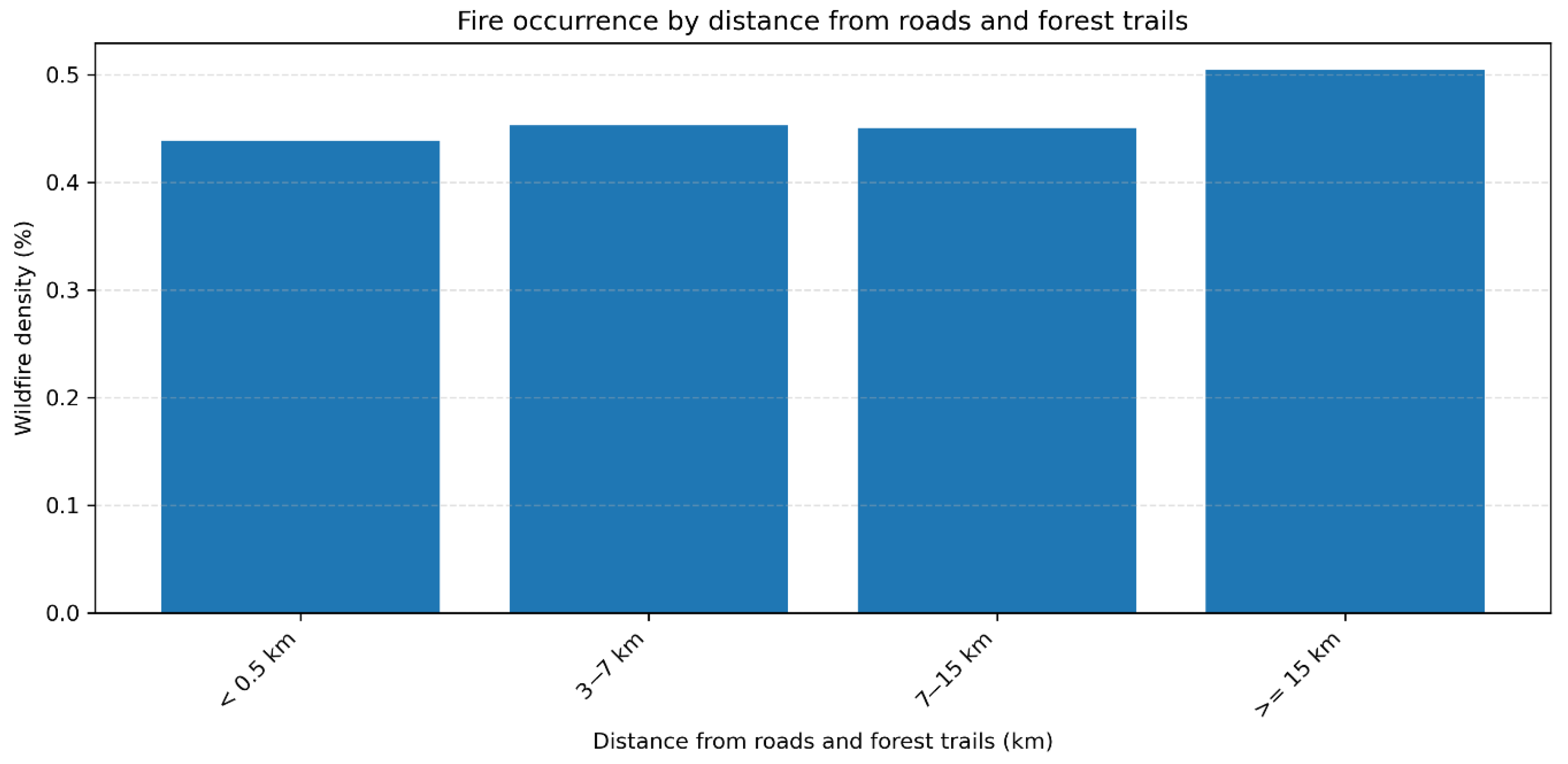
Figure 21 illustrates wildfire density across distance bands relative to road and trail networks. Fire occurrence remains relatively consistent across the first three distance intervals, implying that roadside ignitions are not strongly concentrated near transportation corridors. The highest wildfire density is observed in areas more than 15 km from roads, reinforcing the pattern seen in the settlement analysis that remote, less accessible terrain accounts for a substantial portion of wildfire activity.
Hydrological conditions influence both fuel moisture and the spatial distribution of human activity, making them an important component of wildfire susceptibility. Proximity to rivers, lakes, and other water bodies often moderates fire occurrence by maintaining higher local humidity and reducing fuel dryness, while areas farther away tend to exhibit higher ignition potential.
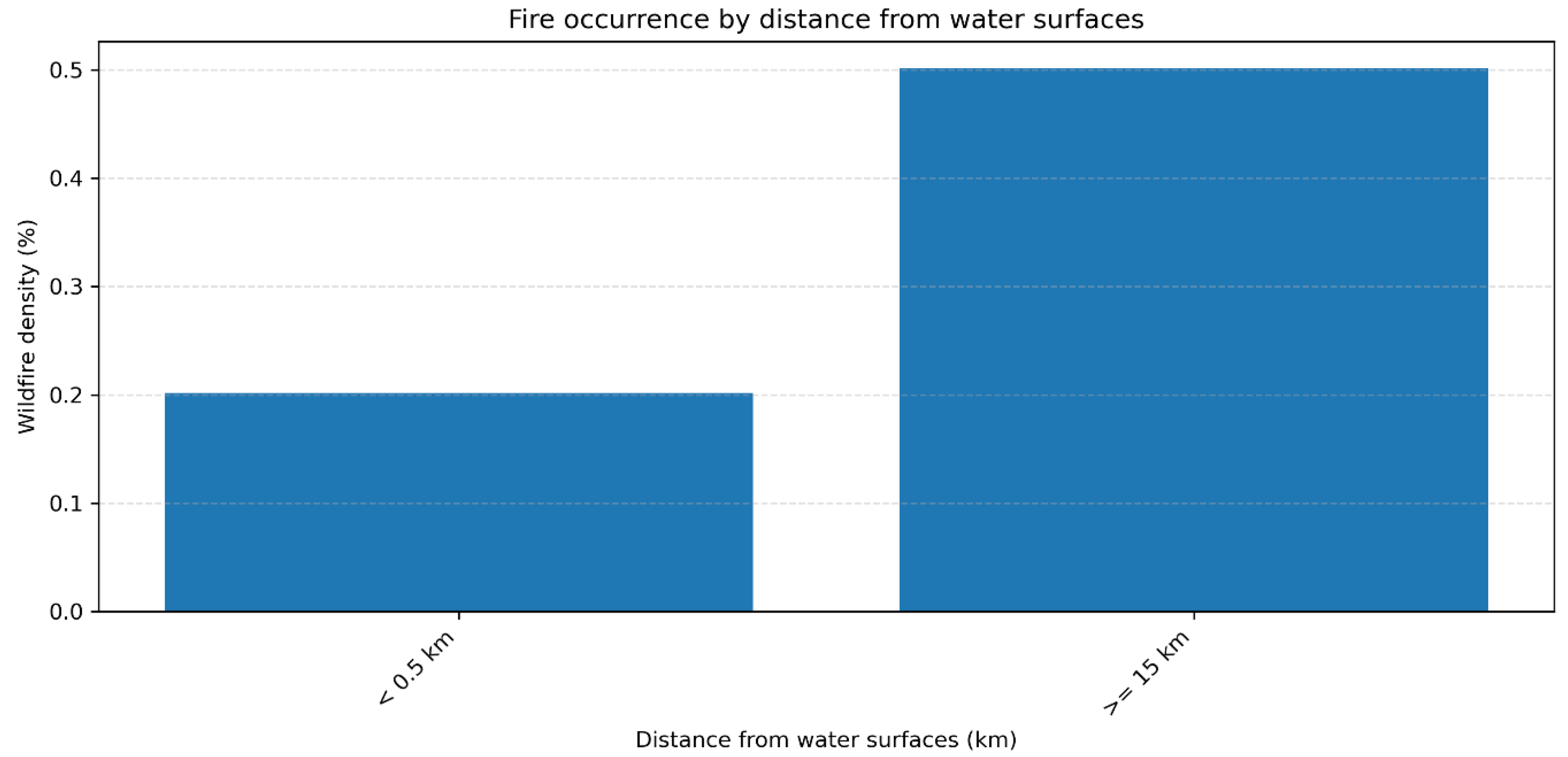
Figure 22 shows wildfire density in areas close to major water bodies and in regions located more than 15 km away. Fire density is substantially higher at greater distances from water, indicating that landscapes far from lakes and rivers are more prone to ignition and sustained burning. Areas within 500 m of water show much lower fire density, which likely reflects higher moisture availability, reduced fuel dryness, and land-use patterns that limit ignition sources near water surfaces. This pattern is consistent with expectations: proximity to water generally suppresses fire activity, while drier, more isolated terrain contributes to higher wildfire occurrence.
Summary of Key Insights:
-
Wildfire density is highest in areas combining rangeland, high solar irradiation (GHI), low annual precipitation, and locations more than 15 km away from settlements.
-
Wildfire occurrence shows substantial activity in remote areas far from settlements and roads, suggesting that many ignitions arise from agricultural burning, land-management fires, or natural causes rather than dense population centers.
-
Forests exhibit higher wildfire density than expected from their spatial coverage, suggesting elevated vulnerability under regional climatic and fuel conditions.
-
Hydrological buffer zones near major water bodies show substantially reduced fire occurrence, confirming the moderating effect of humidity and microclimatic stability.
All machine-learning models successfully capture these spatial and environmental trends, reinforcing the robustness of the spatial susceptibility mapping approach.

3.4. Evaluation of Feature Importance

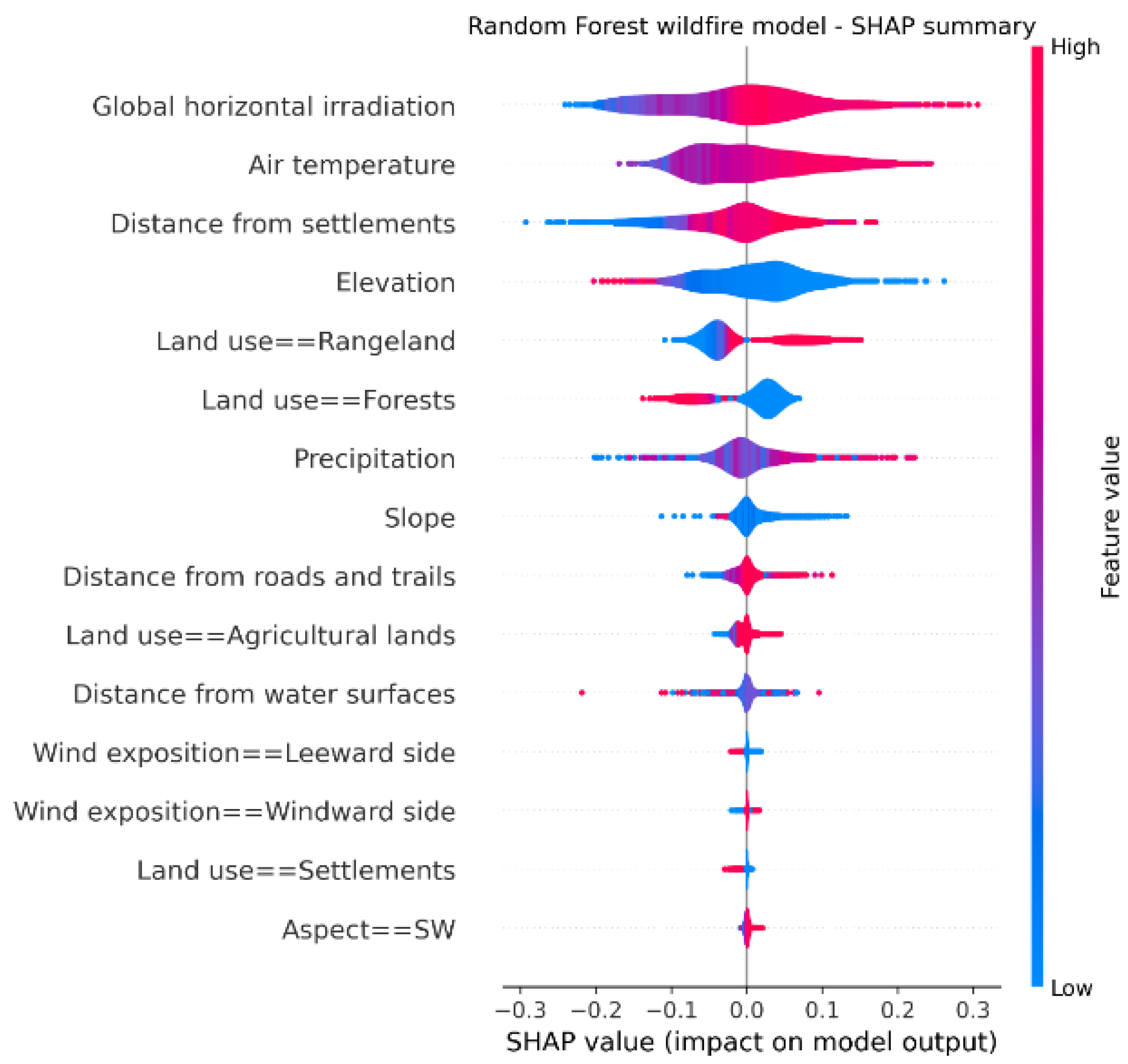
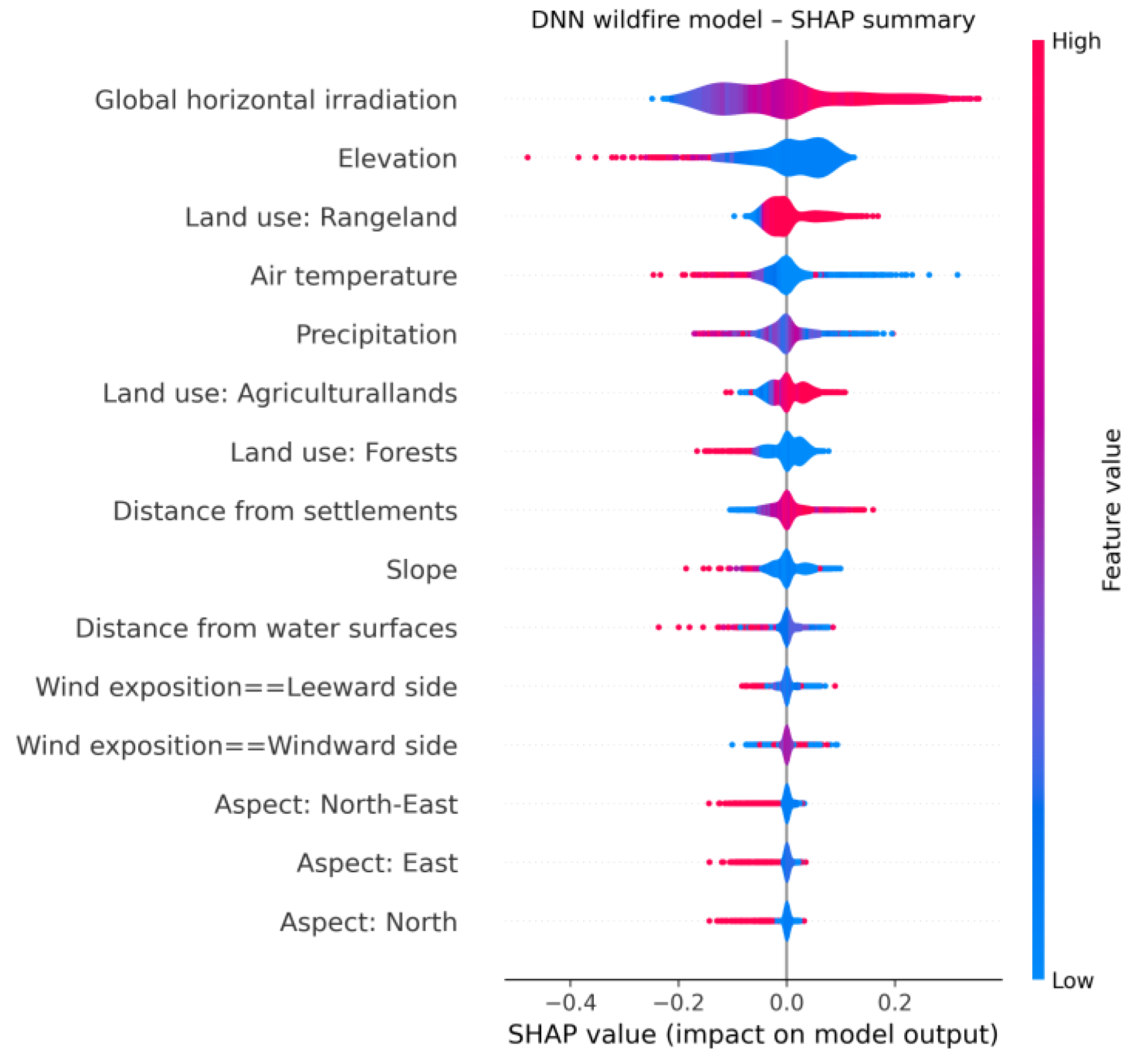
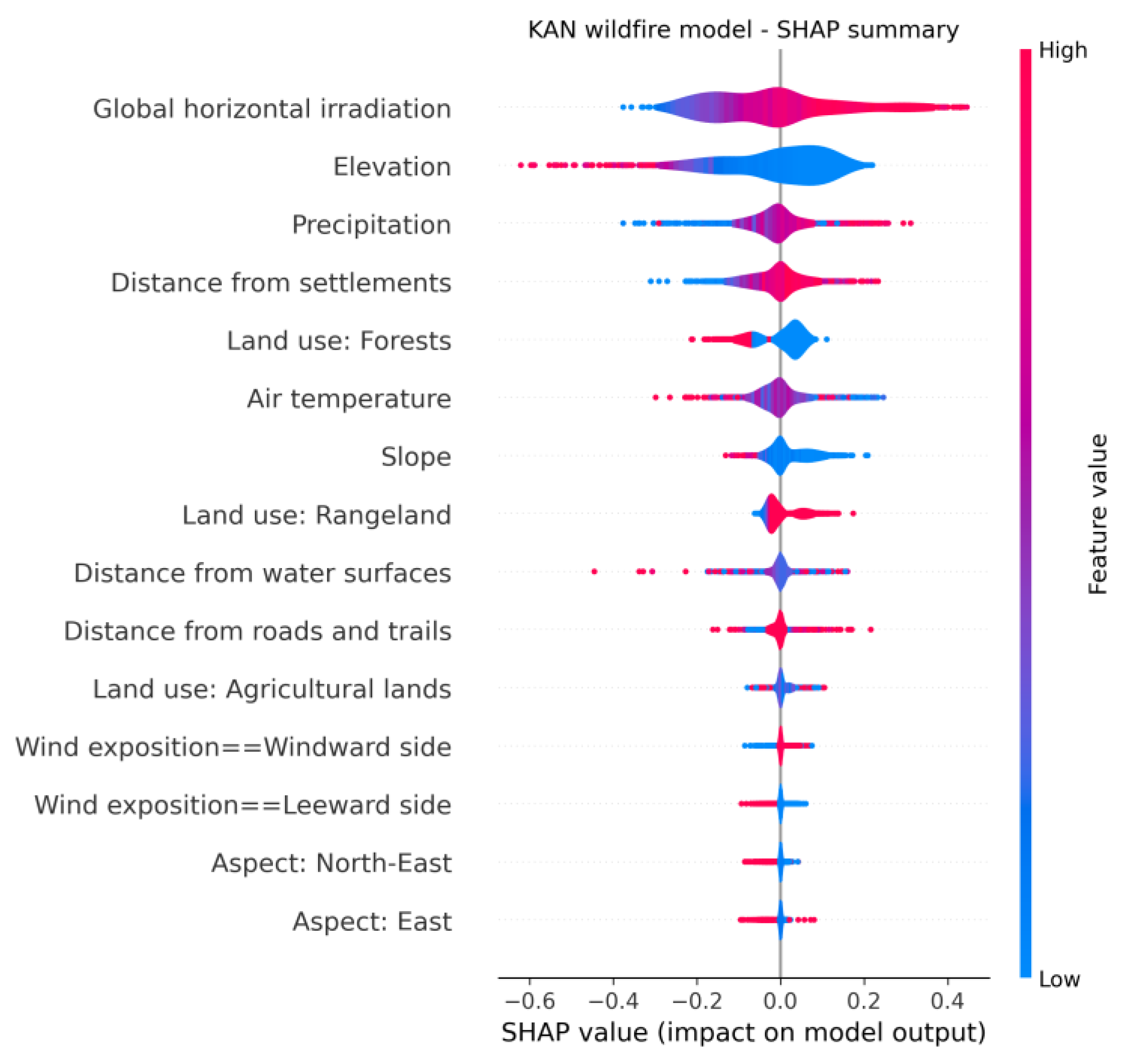
The SHAP plot illustrates the contribution of natural and anthropogenic factors to wildfire occurrence. Points on the right side increase the risk, while those on the left reduce it. The color represents the feature value, with blue indicating low values and red indicating high ones.
The most influential predictor in the Random Forest model is global horizontal irradiation. Higher levels of solar radiation increase the likelihood of wildfire occurrence, and vice versa. Intense solar radiation dries out vegetation and increases air and soil temperatures, creating favorable conditions for ignition and the spread of fire. Air temperature shows a similar pattern; higher temperatures increase risk, while lower ones reduce it (Figure 23). Together, these two features represent thermal and energetic conditions with a strong influence on wildfire prediction.
The distance from settlements shows that areas further from human habitation are more prone to wildfires, while those closer to settlements are less exposed. Near settlements, there is less available combustible material due to human activity, whereas areas further away tend to have denser vegetation, which increases the potential for naturally ignited fires.
Lower elevations tend to increase wildfire risk, whereas higher elevations tend to reduce it. This can be easily explained by the fact that precipitation generally increases with altitude, while air temperature decreases.
Land use categories also reveal strong spatial patterns. Rangelands tend to increase the probability of fire due to dry and easily flammable vegetation. In contrast, forests usually reduce wildfire likelihood because of higher moisture retention and generally cooler microclimatic conditions within dense forest stands. Agricultural land exhibits a slightly positive effect on wildfire risk, possibly due to stubble burning during farming activities.
Precipitation demonstrates a strong negative relationship to wildfire risk. Larger quantities of rainfall reduce ignition potential and help limit fire spread. Terrain slope shows weak importance, indicating that flat terrains are more favorable for fire occurrence, while steep slopes are less accessible and thus less likely to burn.
The distance from roads and forest trails reflects the effect of human presence and recreation; shorter distances increase risk, while greater distances decrease it. This highlights the impact of human ignition sources. The distance from water surfaces shows an opposite pattern: areas close to water bodies have a lower risk, whereas distant regions tend to be drier and more prone to vegetation fires. Wind exposure also produces logical results: leeward slopes slightly increase the risk due to warmer and drier microclimatic conditions, while windward slopes are cooler and more humid.
Settlements and aspects have a very weak influence. Settlements as a land use category are generally less prone to wildfire occurrence. Regarding terrain aspect, southwest-facing slopes are more exposed to sunlight, dry out faster, and are therefore more susceptible to fires. In general, the Random Forest model emphasizes that the most important factors are climatic (global horizontal irradiation, temperature, and precipitation), while aspect and wind exposure have the least influence.
The Random Forest model indicates that the likelihood of wildfires in Southeast Europe increases in warm, dry and sunny environments, at lower elevations, and on flatter terrains. Open rangelands and agricultural areas are more exposed, while forests and areas near water bodies are less threatened. The combination of intense solar radiation, high air temperature, low precipitation, and human activity defines the key risk factors for wildfire occurrence in the region.
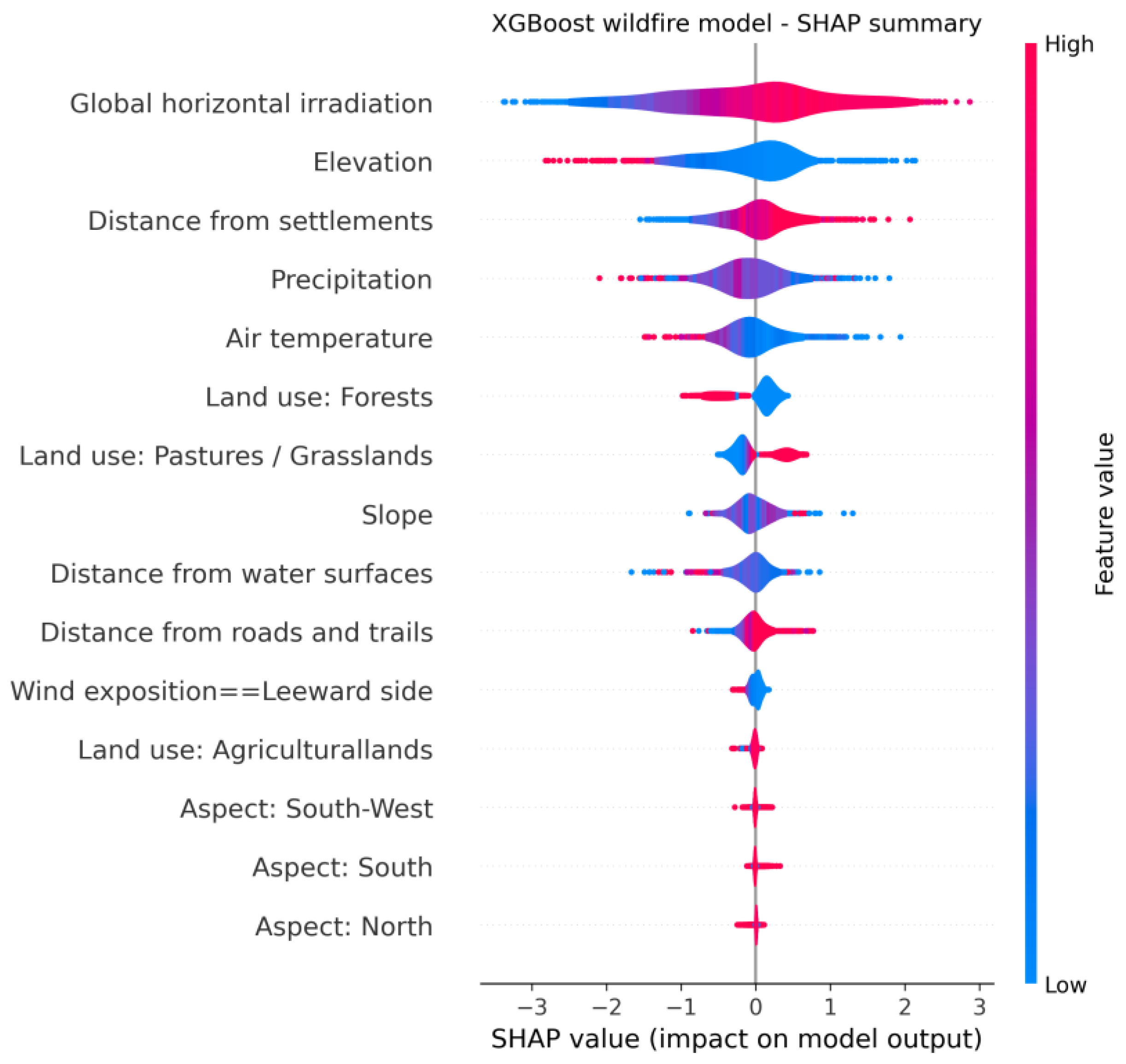
In the XGBoost model, the SHAP values are similar to those obtained using the Random Forest model. Here too, the results show that global horizontal irradiation is the most influential factor (Figure 24). However, in addition to climatic factors, the XGBoost model also identifies elevation as a key factor in wildfire prediction. This model suggests that wildfires in Southeastern Europe occur as a result of a combination of specific topographic and climatic conditions.
The third SHAP plot presents the feature importance results for the DNN model. Global horizontal irradiation, elevation, and temperature represent the most important factors. In addition to climatic conditions, the DNN model places greater emphasis on anthropogenic influences, such as the distance from settlements (Figure 25). Land use and slope have a moderate impact, while aspect shows a weak influence on wildfire prediction.
Overall, the DNN model indicates that wildfire risk is primarily determined by a combination of climatic factors (irradiation, precipitation, temperature) and human activities. In contrast, spatial characteristics such as slope and aspect play a secondary role.
According to the SHAP results for the KAN model, spatial patterns very similar to those of the DNN architecture can be observed. The most important factors are global horizontal irradiation, distance from settlements, precipitation, and elevation (Figure 26). The conclusion is that the model relies primarily on a combination of anthropogenic influences and climatic conditions. Wind exposure and aspect have the least impact. The model confirms that the likelihood of wildfires in the region is mainly associated with drought, heat, and distance from populated areas, with a moderate influence of topography and land use type.
When ranking all the criteria based on the four models, it is evident that global horizontal irradiation has the most significant influence on the occurrence of fires (Table 5). In second and third place are elevation and distance from settlements.
Among the significant factors, precipitation and air temperature also stand out. On the other hand, the least important criteria are those related to land use, such as bare soil, water bodies, and settlements, as well as unexposed slopes.
The spatial variability of SHAP-derived feature contributions can be explained by the pronounced regional heterogeneity of Southeastern Europe. The dominant influence of global horizontal irradiance and temperature reflects the prevalence of Mediterranean and sub-Mediterranean climatic regimes in the southern parts of the region, characterized by prolonged dry summers and high solar energy input. In contrast, the decreasing contribution of elevation-related risk and the increasing role of precipitation at higher altitudes correspond to cooler and more humid conditions in mountainous systems such as the Alps, Dinarides, and Carpathians. The strong contribution of distance from settlements highlights the importance of sparsely populated rangelands and agricultural landscapes, which are widespread across the Balkan interior and are often associated with land-management and seasonal burning practices. These regional characteristics explain the observed SHAP contribution patterns and support the physical interpretability of the model predictions.

3.5. Spatial Distribution of Model Errors

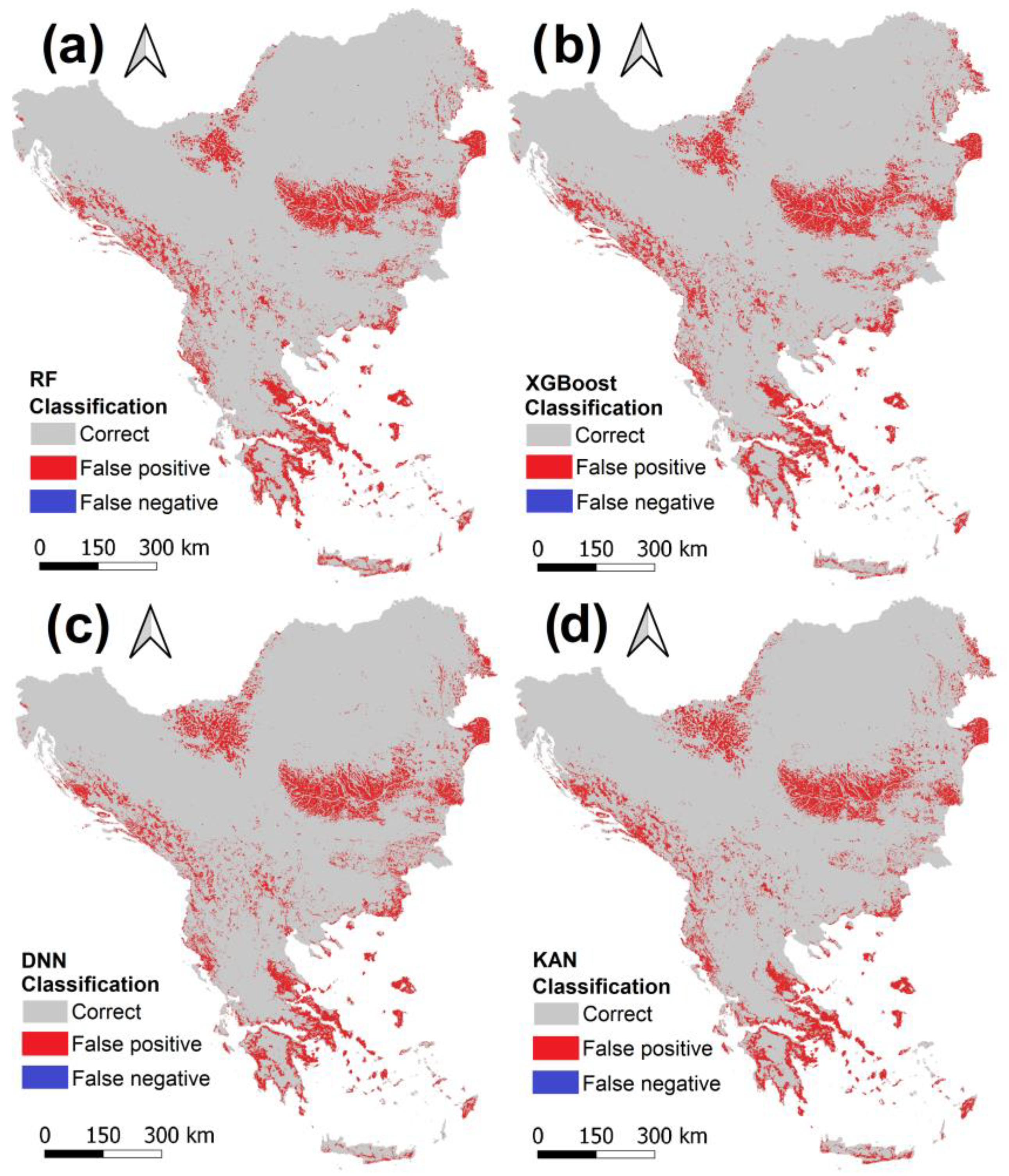
To evaluate where the models systematically fail under different environmental settings, spatial error analysis was performed using the pixel-wise classification error maps of all four models (RF, XGBoost, DNN, and KAN). First, probabilistic prediction rasters were thresholded to obtain binary fire–nonfire maps, which were then compared with the VIIRS-based fire inventory to derive pixel-level error classes (true positives, true negatives, false positives, and false negatives).
Since pixel-level visualization is noisy and difficult to interpret at continental scale, these error rasters were aggregated into coarser spatial units using a block-based approach, and each block was assigned a dominant error type. Regions dominated by correct classifications are shown in gray, areas with systematic false positives in red, and areas dominated by false negatives in blue, while white pixels denote non-modeled areas (Figure 27). These aggregated error maps reveal coherent spatial structures of model failure rather than random noise, enabling clear identification of geographical zones where the models tend to overestimate or underestimate wildfire susceptibility. Such regional error visualization directly supports interpretation of model limitations in relation to climate, terrain, and land-cover settings, thereby addressing the reviewer’s request for spatial distributions of model errors and failure modes.
The spatial error analysis is broadly consistent with the post-training evaluation results: while absolute false-positive counts are higher when applied to the full spatial grid due to the extreme real-world class imbalance and the fact that susceptibility mapping identifies many potentially fire-prone locations where fires did not actually occur, the relative behavior of the models (high recall and comparatively low false negatives) remains consistent with the original validation results.
The largest proportion of pixels in the study area belongs to Forests, Agricultural Lands, Rangeland, and Bare Soil (Table 6). Forested regions exhibit the lowest relative error rates, with a small fraction of false positives, indicating that the models are generally stable and reliable in dense vegetated environments. In contrast, Agricultural Lands and Rangeland show higher false-positive fractions, suggesting that the models tend to overestimate fire susceptibility in open and semi-natural landscapes where environmental conditions resemble those of observed fire locations but fires do not always occur. Bare Soil areas also display noticeable false-positive behavior, likely reflecting model sensitivity to highly exposed, dry surfaces. Overall, these results indicate that model uncertainty is primarily concentrated in non-forested landscapes, whereas performance is more consistent in forest-dominated regions.

4. Discussion

4.1. Wildfire Studies Conducted in Southeastern Europe

The number of fire-related studies varies from country to country across Southeastern Europe. A large number of studies focus exclusively on forest fires, which provides a misleading and incomplete picture of the overall fire potential outside urban areas.
In Slovenia, during research conducted in 2013, the public stated that they did not consider fires a significant threat to forest ecosystems [68]. Čahojová et al. (2024) studied forest fires in marginal areas of the Mediterranean climatic and biogeographical region, where fires had not previously been a frequent phenomenon [69]. The study confirmed that analyses of satellite data, orthophoto interpretation, and field vegetation sampling provide equivalent information on fire intensity, which opens up the possibility of applying the acquired knowledge to similar fire-affected areas in the future without the need for field sampling.
In Bosnia and Herzegovina, no studies on fire prediction exist at the national level, with existing ones being locally limited. Sabljić et al. (2025) investigated the susceptibility of the Sana River Basin to forest fires using various satellite indices [70]. The conclusion was that a total of 168.77 km2 of meadows and pastures, 35.2 km2 of forested areas, and 17.95 km2 of agricultural land were exposed to moderate, high, and very high fire intensity. It was estimated that more than 19,000 residents were affected by these fires.
For Croatia, there are several studies addressing fire-related issues, although not yet covering the entire country. Horvat and Karleuša (2024) investigated wildfire risk at the meso-scale within three catchments in Dalmatia using the Analytic Hierarchy Process (AHP) method, identifying vulnerable zones [71]. Čavlina Tomašević et al. (2023) conducted a comparative analysis of two major wildfires: one in Split and another in Tasmania [72]. For the Split area, a connection was confirmed between the bora wind and an upper-level trough, which caused the subsidence of dry air and consequently rapid drying of fuels [72]. Šiljeg et al. (2024) examined natural hazards on Dugi Otok using the AHP method and high-resolution data [73]. The local population further confirmed that fires represent the greatest threat among all natural hazards. Tekić et al. (2024) studied the causes of the increased wildfire risk and changes in fire regimes and behavior in the Dinaric Karst region [74]. The conclusion was that vulnerability to fires increases due to the spread of Mediterranean shrub vegetation into abandoned pastures, leading to an accumulation of highly flammable fuel in the landscape.
For Serbia, a study exists addressing wildfire prediction at the national level. Durlević et al. (2025) analyzed Serbia’s susceptibility to wildfires using multi-sensor satellite data fusion and three ML and DL models (XGBoost, KAN, and DNN) [33]. In that study, a large dataset of nearly 200,000 fire events and 16 quantitative variables was used. The results showed that 12.7% of Serbia’s territory is very highly susceptible to wildfires. Machine learning models were also applied by Milanović et al. (2021) for forest fire prediction in eastern Serbia [75]. Based on Logistic Regression and Random Forest models, the results indicated that 32.6–36.3% of the study area is highly endangered. At the local level, Ćurić et al. (2022) performed a spatial prediction of forest fires in the Svrljiški Timok basin [76], identifying a very high susceptibility across 20.81% of the area. From an ecological perspective, within Serbia’s protected areas, several studies have analyzed fire susceptibility: in Šar Mountains National Park, Golija Nature Park, and Djerdap Geopark. For the Šar Mountains National Park, a Wildfire Susceptibility Index (WSI) was developed, identifying high and very high susceptibility zones across 21.3% of the study area [40]. Novković et al. (2021) applied GIS, fuzzy AHP, and Technique for Order Preference by Similarity to Ideal Solution (TOPSIS) methods to assess the vulnerability of Golija Nature Park to forest fires [77]. Areas of very high and high susceptibility to forest fires covered between 25.75% and 26.85% of the park’s territory. For Djerdap Geopark, VIIRS and Sentinel-2 data were used along with machine and deep learning methods (XGBoost, CNN, DNN, and KAN), with a highly susceptible area of 96.79 km2 being identified [78].
For the territory of Montenegro, there are two studies related to wildfire prediction. The first one is focused on the vulnerability of the municipalities of Rožaje and Budva. Nikolić et al. (2023) applied GIS, AHP, and fuzzy AHP methods, along with the evaluation of nine natural and anthropogenic criteria, to produce vulnerability maps [79]. The results indicate a degree of wildfire predisposition in Rožaje (2.5–2.9%), whereas in Budva, the percentage is significantly higher, reaching approximately 36%. In another nationwide study using MODIS sensor data, it was identified that the Maximum Entropy (MaxEnt) method demonstrated much stronger performance (0.81) compared to the AHP model (0.51), for wildfire spatial prediction [80].
Although Albania is one of the countries most affected by wildfires, there are very few studies on the spatial prediction of wildfires. Hysa and Teqja (2020) investigated wildfire susceptibility at the national level using the AHP method [81]. The analysis included the following categories: social, environmental, physical, and fuel. Another study examined the vulnerability of areas covered by serpentine soils. According to the obtained results, serpentine geological formations in Albania are highly prone to wildfire ignition and spread [82].
National-level research is lacking for North Macedonia. However, some studies investigate wildfires at the local level, such as in the case of the Makedonska Kamenica municipality. Aleksova et al. (2024) employed GIS tools and multi-criteria analysis, finding that less than one-third of the municipality is highly or very highly susceptible to forest fires [83].
For Bulgaria, there are no studies on wildfire hazard covering the entire territory. Avetisyan et al. (2022) investigated the process of forest vegetation recovery after fire in the southeastern part of the Rhodope Mountains, near the town of Ardino [84]. Other studies in Bulgaria focus on improving methodologies and software for wildfire prediction [85,86].
No studies on spatial wildfire prediction at the national or local level based on GIS, multi-criteria analysis, or machine learning exist at present for Moldova.
For the territory of Romania, a study has been conducted to assess the country’s vulnerability to forest fires using machine learning algorithms, including Maximum Entropy and XGBoost. Lorenț et al. (2025) used a database of 25 predictive variables to obtain final results indicating a very high vulnerability level of 5.49–6.86% [87]. Another study employs the Wildfire Ignition Probability/Wildfire Spreading Capacity Index to assess the probability of wildfire ignition and fire spread capacity in vegetated areas. The results show that vegetated surfaces in the eastern and southern regions of Romania exhibit the highest values of the Wildfire Spreading Capacity Index (WSCI) [88].
Greece is by far the country most prone to wildfires, and, as a result, the largest number of studies employing various methodological approaches exist for its territory. Symeonidis et al. (2025) applied advanced machine learning techniques (XGBoost, Gradient Boosting Machine [GBM], Light Gradient Boosting Machine [LGBM], and CatBoost) to develop wildfire susceptibility maps for Greece [28]. According to the results and developed metrics, the Ensemble Mean model classified 50% of the territory as low-risk areas and 21% as high-risk areas, while the Ensemble Max model identified 38% as low-risk and 33% as highly prone to fire occurrence. Kostopoulou et al. (2025) assess wildfire risk using the Fire Weather Index [89]. The results indicate that the southern parts of Greece, particularly Crete and the Dodecanese, will experience the most significant increase in risk. Other studies are focused on specific local areas, such as the National Park Forest Dadia-Lefkimi-Soufli, Holy Mount Athos, and others [90,91,92,93,94].
Compared to other studies, our research has several advantages:
-
The first regional spatial susceptibility prediction for 11 countries using medium spatial resolution data (100 m);
-
Creation of a large geospatial database containing 28,952 reliable fire events and 11 quantitative variables;
-
Comparative analysis of the performance of deep learning and machine learning models;
-
Identification of influential factors contributing to fire occurrence based on SHAP analysis;
-
Assessment of wildfire susceptibility for each country individually.
What also distinguishes this study from others is the finding that wildfire susceptibility decreases with an increase in forested areas. The reason for this lies in the fact that the microclimate within dense forests significantly differs from the surrounding environment. Inside forests and beneath the canopy, there is less solar radiation, lower temperatures, and higher humidity, which reduces the likelihood of ignition.

4.2. Comparative Performance of ML and DL Approaches for Wildfire Prediction

Due to the increasing availability of training and testing datasets for wildfire mapping and management, over the past five years a large number of authors worldwide have based their research results on machine learning and deep learning models [95,96,97,98,99,100,101,102,103,104,105].
In the Mediterranean region of Turkey, Abujayyab et al. (2022) utilized advanced machine learning algorithms (XGBoost, CatBoost, Gradient Boost, AdaBoost, and LightGBM) for wildfire susceptibility mapping [106]. The results indicated that the CatBoost algorithm achieved the highest testing accuracy (95.47%), followed by LightGBM (94.70%), XGBoost (88.8%), AdaBoost (86.0%), and GBM (84.48%).
Random Forest and logistic regression were employed to predict wildfires in regions with distinct physical characteristics (Okanogan region, USA, and Jamésie region, Canada). Performance analysis demonstrated that RF (AUC > 98%) significantly outperformed logistic regression (AUC < 88%) [107]. Thies (2025) applied the Random Forest algorithm in order to identify wildfire-prone zones in Germany [108]. The model achieved an accuracy of 89%, confirming its high effectiveness [108]. Sapkota et al. (2025) conducted wildfire prediction in Nepal using four advanced machine learning algorithms: Random Forest, Radial Basis Function Neural Network, Artificial Neural Network, and Support Vector Machine [109]. The results confirmed that Random Forest outperformed all other algorithms, achieving the highest accuracy (88.6%) and predictive reliability (AUC = 0.96).
Wildfire risk prediction was also carried out for the southwestern region of Saudi Arabia. Liao and Zhu (2025) applied Maxent, Logistic Regression, Random Forest, XGBoost, and Support Vector Machine, with Maxent achieving the highest predictive performance (AUC = 97.4%) [110]. Bihari et al. (2025) investigated seasonal wildfire probability mapping using the Random Forest model on the Google Earth Engine (GEE) platform [111]. The model achieved an AUC value of 84.1% for the 2016–2023 dataset and 84.8% for the 2024 data, demonstrating strong discriminative capability despite additional spatio-temporal variability introduced by the sample design [111].
Due to the growing number of available datasets, recent years have seen a notable increase in studies relying on deep learning models [112,113,114,115]. Bjånes et al. (2021) analyzed two regions in Chile for wildfire susceptibility using two deep learning networks [116]. The ensemble model achieved the highest AUC (95.3%), followed by CNN-1 (90.2%). The ensemble model also outperformed others in terms of accuracy, sensitivity, specificity, negative predictive value, and F1 score.
Bahadori et al. (2023) applied two deep learning algorithms: LSTM and RNN for wildfire mapping in western Iran [24]. The results revealed that RNN (MODIS) (AUC = 97.1%) and RNN (Landsat-8) (AUC = 96.6%) achieved the highest modeling accuracy. He et al. (2024) predicted wildfire risk across six eastern Chinese provinces using a combination of ConvLSTM networks [3]. Results showed excellent performance, with accuracy, Kappa coefficient, and AUC values of 92.79%, 84.48%, and 97.90%, respectively. Guo et al. (2024) used convolutional neural network (CNN) models to comprehensively analyze factors influencing forest fire occurrence in central China [117]. The model demonstrated strong performance on both training and validation datasets, with 86.0% accuracy, 88.0% precision, 87.0% recall, an F1 score of 87.5%, and an AUC of 90.5%. Jiang et al. (2024) predicted wildfires in Guangdong Province using a CNN-based deep learning model [4]. This model outperformed traditional machine learning algorithms, achieving an AUC of 96.2% [4]. Li et al. (2024) assessed forest fire susceptibility in eastern China using a deep learning approach [118]. The model demonstrated strong validation performance, achieving 80.6% accuracy, an F1 score of 81.6%, and an AUC of 88.2%, confirming its practical applicability [118].
In Serbia, wildfire prediction was performed using Kolmogorov-Arnold networks, Deep Neural Networks, and XGBoost. The DNN achieved the highest predictive performance (accuracy = 83.4%, ROC-AUC = 92.3%), followed by XGBoost and KAN, both demonstrating strong predictive accuracy (ROC-AUC > 90%) [33]. Papakis et al. (2025) conducted wildfire mapping across Greece using two convolutional neural networks optimized for spatial image processing and LSTM networks for temporal pattern recognition [119]. The LSTM model with the Daynight parameter achieved the highest AUC value of 92% [119]. Dong et al. (2025) applied an integrative Transformer–XGBoost framework for wildfire detection in Yunnan Province, China [120]. The model achieved an F1 score of 0.88, representing a performance improvement exceeding 30% compared to conventional deep learning models with fixed thresholds [120].
Future research should aim to combine advanced machine learning and deep learning techniques with spatio-temporal wildfire patterns and available high-resolution data to achieve more precise and reliable predictions [121,122,123,124,125,126,127,128,129,130,131,132,133]. The improvement and further integration of spatial data with GIS will enable better prevention for the protection of the population, as well as natural and cultural assets [134,135,136].

5. Limitations of the Study

A relevant methodological consideration of this study is that model hyperparameters were optimized using informed, model-specific tuning strategies rather than fully automated optimization frameworks. Although these procedures ensured stable and well-calibrated models, they may not have fully explored the entire hyperparameter space, and automated optimization could potentially provide further refinements. Due to scope and computational constraints, AutoML tools (such as Optuna, Ray Tune, or Ax) were not applied in this study. However, their integration in future work may help further enhance model calibration and confirm the robustness of the results.
A second limitation concerns the temporal dimension of the input data. Climatic variables are represented by long-term averages for the period 1970–2000, whereas wildfires were mapped for 2012–2024. Although these data describe structural predisposing conditions rather than short-term variability, this temporal mismatch may influence model calibration and the interpretation of climate–fire relationships. Moreover, the present framework does not explicitly capture intra-annual variability, extreme events, or evolving land-use patterns.
Third, the VIIRS-based inventory primarily captures medium and large fires, meaning that smaller, short-lived events are underrepresented. While this enhances reliability by filtering noise, localized ignition patterns may be underestimated. Finally, the models are optimized for regional-scale prediction at 100 m resolution; local applications in highly heterogeneous terrain may require finer-resolution data and area-specific recalibration.
A fourth limitation of this study arises from its intentional reliance on open-access satellite and environmental datasets. While this choice was made to ensure transparency, reproducibility, and the potential for application across different geographic contexts, it also entails working with data sources that differ substantially in their native spatial resolution. Openly available datasets are typically designed for specific observational purposes and are therefore distributed at resolutions suited to those objectives. As a result, the input data used in this study combine high-resolution optical information, such as Sentinel-2 imagery at 10 m, with much coarser climatic variables, which are commonly available at kilometer-scale resolutions. To enable joint analysis, all predictors were resampled to a common spatial grid of 100 m. However, this harmonization step does not add new spatial detail to the coarser climatic layers, which continue to represent spatially averaged conditions over relatively large areas.
Taken together, these limitations highlight the need for future research integrating automated optimization and higher-resolution spatiotemporal datasets to improve further wildfire probability mapping and operational applicability in Southeastern Europe.

6. Conclusions

The trend of wildfire occurrences in Southeastern Europe is increasing due to the intensification of climate extremes. The severe consequences of wildfires impact the environment and ecosystems, threatening human lives, property, biodiversity, and the natural landscape. One of the primary and most effective measures for wildfire management is identifying locations that are susceptible to wildfire occurrence. This study utilizes remote sensing datasets (VIIRS, Sentinel-2) and climatological data from meteorological stations to spatially predict wildfires in Southeastern Europe. The input data includes the processing of 11 natural and anthropogenic criteria, as well as an inventory of 28,952 historical fires for the period 2012–2024. Methodologically, four models were applied: two machine learning models (RF, XGBoost) and two deep learning models (DNN, KAN). All input criteria, as well as the synthetic hazard maps, were created using QGIS software.
The results showed that the very high wildfire susceptibility class in Southeastern Europe varies depending on the applied model, ranging from 2.9% to 6.5%. From an administrative perspective, Greece is the most susceptible country to wildfires. According to the ensemble map, which represents an optimized model based on the four applied algorithms, the percentage of terrain of very high susceptibility in Greece is 10.5%. At the same time, there is also a significant proportion of land classed as being of high susceptibility, at 14.2%. Other countries with a high degree of susceptibility to wildfires are Montenegro and Albania. Moderately susceptible countries include Serbia, Bulgaria, Romania, Croatia, Bosnia and Herzegovina, and North Macedonia. Significantly fewer fire events were recorded in Moldova and Slovenia, making these two countries stand out as very low-risk areas, with an area less than 0.5% belonging to the very high susceptibility class.
Regarding the performance of classifiers, RF shows the highest accuracy (0.827) and the largest ROC-AUC (0.907), indicating strong stability in regional wildfire prediction over large areas. The XGBoost model has a high F1 score (0.790), which reflects an adequate balance between correctly identifying fires and detecting all real fire events. DNN and KAN, as deep learning algorithms, demonstrated weaker performance compared to machine learning models, which limits their application in large-scale spatial wildfire prediction.
When identifying the influence of factors using the SHAP approach, it was found that global horizontal irradiation has the highest importance across all models. Highly influential factors also include elevation, air temperature, precipitation and distance from settlements. On the other hand, bare land, unexposed surfaces, and flooded areas were identified as the least influential factors. What makes this study distinct from others is that the results clearly show that the largest forested areas in Southeastern Europe exhibit very low wildfire susceptibility. Moreover, this is the first study in this region to provide a wildfire susceptibility assessment across 11 countries, utilizing innovative methods and data with adequate spatial resolution.
The significance of this study is substantial, as the final data can be used to develop an effective strategy for emergency management, particularly for wildfire control. The research has international relevance, as it connects 11 countries, enabling decision-makers to manage wildfires at local, national, and international levels. Joint cooperation is especially important for protected natural areas located within and along the borders of the studied countries, where a coordinated and efficient approach to environmental protection is required. An integrated approach would include intensified environmental monitoring through patrolling, the deployment of drones, and the installation of smoke detection sensors in highly vulnerable locations. In addition to the spatial aspect, future research should integrate a temporal dimension to facilitate a better understanding of the spatio-temporal patterns of wildfire occurrence.

Author Contributions

Conceptualization, U.D.; methodology, V.I.; software, U.D. and V.I.; validation, V.I.; formal analysis, B.A.; investigation, B.A.; resources, U.D.; data curation, V.I.; writing—original draft preparation, U.D. and V.I.; writing—review and editing, U.D.; visualization, V.I.; supervision, B.A.; project administration, U.D.; funding acquisition, U.D. All authors have read and agreed to the published version of the manuscript.

Funding

This research was funded by the Ministry of Science, Technological Development and Innovation of the Republic of Serbia (Contract number 451-03-136/2025-03/200172).

Institutional Review Board Statement

Not applicable.

Informed Consent Statement

Not applicable.

Data Availability Statement

The raw data supporting the conclusions of this article will be made available by the authors on request.

Conflicts of Interest

The authors declare no conflicts of interest.

References

  1. Gómez-González, J.L.; Cantizano, A.; Caro-Carretero, R.; Castro, M. Leveraging National Forestry Data Repositories to Advocate Wildfire Modeling towards Simulation-Driven Risk Assessment. Ecol. Indic. 2024, 158, 111306. [Google Scholar] [CrossRef]
  2. Mansoor, S.; Farooq, I.; Kachroo, M.M.; Mahmoud, A.E.D.; Fawzy, M.; Popescu, S.M.; Alyemeni, M.; Sonne, C.; Rinklebe, J.; Ahmad, P. Elevation in Wildfire Frequencies with Respect to Climate Change. J. Environ. Manag. 2022, 301, 113769. [Google Scholar] [CrossRef]
  3. He, Z.; Fan, G.; Li, Z.; Li, S.; Gao, L.; Li, X.; Zeng, Z.-C. Deep Learning Modeling of Human Activity Affected Wildfire Risk by Incorporating Structural Features: A Case Study in Eastern China. Ecol. Indic. 2024, 160, 111946. [Google Scholar] [CrossRef]
  4. Jiang, W.; Qiao, Y.; Zheng, X.; Zhou, J.; Jiang, J.; Meng, Q.; Su, G.; Zhong, S.; Wang, F. Wildfire Risk Assessment Using Deep Learning in Guangdong Province, China. Int. J. Appl. Earth Obs. Geoinf. 2024, 128, 103750. [Google Scholar] [CrossRef]
  5. Xu, Z.; Li, J.; Cheng, S.; Rui, X.; Zhao, Y.; He, H.; Guan, H.; Sharma, A.; Erxleben, M.; Chang, R.; et al. Deep Learning for Wildfire Risk Prediction: Integrating Remote Sensing and Environmental Data. ISPRS J. Photogramm. Remote Sens. 2025, 227, 632–677. [Google Scholar] [CrossRef]
  6. Yue, W.; Ren, C.; Liang, Y.; Lin, X.; Liang, J. Method of Wildfire Risk Assessment in Consideration of Land-Use Types: A Case Study in Central China. Forests 2023, 14, 1393. [Google Scholar] [CrossRef]
  7. Jones, M.W.; Abatzoglou, J.T.; Veraverbeke, S.; Andela, N.; Lasslop, G.; Forkel, M.; Smith, A.J.P.; Burton, C.; Betts, R.A.; van der Werf, G.R.; et al. Global and Regional Trends and Drivers of Fire under Climate Change. Rev. Geophys. 2022, 60, e2020RG000726. [Google Scholar] [CrossRef]
  8. Valjarević, A.; Morar, C.; Živković, J.; Niemets, L.; Kićović, D.; Golijanin, J.; Gocić, M.; Bursać, N.M.; Stričević, L.; Žiberna, I.; et al. Long Term Monitoring and Connection between Topography and Cloud Cover Distribution in Serbia. Atmosphere 2021, 12, 964. [Google Scholar] [CrossRef]
  9. Tedim, F.; Leone, V.; Lovreglio, R.; Xanthopoulos, G.; Chas-Amil, M.-L.; Ganteaume, A.; Efe, R.; Royé, D.; Fuerst-Bjeliš, B.; Nikolov, N.; et al. Forest Fire Causes and Motivations in the Southern and South-Eastern Europe through Experts’ Perception and Applications to Current Policies. Forests 2022, 13, 562. [Google Scholar] [CrossRef]
  10. Moreira, F.; Viedma, O.; Arianoutsou, M.; Curt, T.; Koutsias, N.; Rigolot, E.; Barbati, A.; Corona, P.; Vaz, P.; Xanthopoulos, G.; et al. Landscape–Wildfire Interactions in Southern Europe: Implications for Landscape Management. J. Environ. Manag. 2011, 92, 2389–2402. [Google Scholar] [CrossRef]
  11. Sinko, V. 620 Wildfires in Serbia over 12 Hours; Two Firefighters and Four Civilians Injured. Available online: https://www.blic.rs/vesti/drustvo/pozari-sirom-srbije-620-zabelezenih-incidenata-u-jednom-danu-povredjeni-vatrogasci/9lf3djl (accessed on 29 August 2025).
  12. Bui, D.T.; Bui, Q.-T.; Nguyen, Q.-P.; Pradhan, B.; Nampak, H.; Trinh, P.T. A Hybrid Artificial Intelligence Approach Using GIS-Based Neural-Fuzzy Inference System and Particle Swarm Optimization for Forest Fire Susceptibility Modeling at a Tropical Area. Agric. For. Meteorol. 2017, 233, 32–44. [Google Scholar] [CrossRef]
  13. Masinda, M.M.; Li, F.; Qi, L.; Sun, L.; Hu, T. Forest Fire Risk Estimation in a Typical Temperate Forest in Northeastern China Using the Canadian Forest Fire Weather Index: Case Study in Autumn 2019 and 2020. Nat. Hazards 2021, 111, 1085–1101. [Google Scholar] [CrossRef]
  14. Tang, X.; Machimura, T.; Li, J.; Yu, H.; Liu, W. Evaluating Seasonal Wildfire Susceptibility and Wildfire Threats to Local Ecosystems in the Largest Forested Area of China. Earth’s Future 2022, 10, e2021EF002199. [Google Scholar] [CrossRef]
  15. Bot, K.; Borges, J.G. A Systematic Review of Applications of Machine Learning Techniques for Wildfire Management Decision Support. Inventions 2022, 7, 15. [Google Scholar] [CrossRef]
  16. Tadić, J.M.; Ilić, V.; Ilić, S.; Pavlović, M.; Tadić, V. Hybrid Machine Learning and Geostatistical Methods for Gap Filling and Predicting Solar-Induced Fluorescence Values. Remote Sens. 2024, 16, 1707. [Google Scholar] [CrossRef]
  17. Ilić, V.; Stojković, M.; Dodevska, Z.; Ilić, S. Machine Learning Model for Prediction of Indicative Water Parameters on the Danube River Based on Satellite Data. In Disruptive Information Technologies for a Smart Society; Trajanović, M., Filipović, N., Zdravković, M., Eds.; Lecture Notes in Networks and Systems; Springer: Cham, Switzerland, 2024; Volume 860, pp. 1–12. [Google Scholar] [CrossRef]
  18. Kondylatos, S.; Prapas, I.; Ronco, M.; Papoutsis, I.; Camps-Valls, G.; Piles, M.; Fernández-Torres, M.; Carvalhais, N. Wildfire Danger Prediction and Understanding with Deep Learning. Geophys. Res. Lett. 2022, 49, e2022GL099368. [Google Scholar] [CrossRef]
  19. Nikolaychuk, O.; Pestova, J.; Yurin, A. Wildfire Susceptibility Mapping in Baikal Natural Territory Using Random Forest. Forests 2024, 15, 170. [Google Scholar] [CrossRef]
  20. Cutler, D.R.; Edwards, T.C., Jr.; Beard, K.H.; Cutler, A.; Hess, K.T.; Gibson, J.; Lawler, J.J. Random Forests for Classification in Ecology. Ecology 2007, 88, 2783–2792. [Google Scholar] [CrossRef]
  21. LeCun, Y.; Bengio, Y.; Hinton, G. Deep Learning. Nature 2015, 521, 436–444. [Google Scholar] [CrossRef]
  22. Zhang, G.; Wang, M.; Liu, K. Deep Neural Networks for Global Wildfire Susceptibility Modelling. Ecol. Indic. 2021, 127, 107735. [Google Scholar] [CrossRef]
  23. Csiszar, I.; Schroeder, W.; Giglio, L.; Ellicott, E.; Vadrevu, K.P.; Justice, C.O.; Wind, B. Active Fires from the Suomi NPP Visible Infrared Imaging Radiometer Suite: Product Status and First Evaluation Results. J. Geophys. Res. Atmos. 2014, 119, 803–816. [Google Scholar] [CrossRef]
  24. Bahadori, N.; Razavi-Termeh, S.V.; Sadeghi-Niaraki, A.; Al-Kindi, K.M.; Abuhmed, T.; Nazeri, B.; Choi, S.-M. Wildfire Susceptibility Mapping Using Deep Learning Algorithms in Two Satellite Imagery Datasets. Forests 2023, 14, 1325. [Google Scholar] [CrossRef]
  25. Masrur, A.; Yu, M. Spatiotemporal Attention ConvLSTM Networks for Predicting and Physically Interpreting Wildfire Spread. In Artificial Intelligence in Earth Science; Cristea, N., Rivas, P., Eds.; Elsevier: Amsterdam, The Netherlands, 2023; pp. 119–156. [Google Scholar] [CrossRef]
  26. Han, K.; Wang, Y.; Chen, H.; Chen, X.; Guo, J.; Liu, Z.; Tang, Y.; Xiao, A.; Xu, C.; Xu, Y.; et al. A Survey on Vision Transformer. IEEE Trans. Pattern Anal. Mach. Intell. 2023, 45, 87–110. [Google Scholar] [CrossRef] [PubMed]
  27. Horn, K.H.; Vulova, S.; Li, H.; Kleinschmit, B. Modelling Current and Future Forest Fire Susceptibility in North-Eastern Germany. Nat. Hazards Earth Syst. Sci. 2025, 25, 383–401. [Google Scholar] [CrossRef]
  28. Symeonidis, P.; Vafeiadis, T.; Ioannidis, D.; Tzovaras, D. Wildfire Susceptibility Mapping in Greece Using Ensemble Machine Learning. Earth 2025, 6, 75. [Google Scholar] [CrossRef]
  29. Das, K. Deep Learning Techniques for Predicting Wildfires in Calabria, Italy Using Environmental Parameters. In New Trends in Database and Information Systems. ADBIS 2024; Tekli, J., Gamper, J., Chbeir, R., Manolopoulos, Y., Sassi, S., Ivanovic, M., Vargas-Solar, G., Zumpano, E., Eds.; Communications in Computer and Information Science; Springer: Cham, Switzerland, 2025; Volume 2186. [Google Scholar] [CrossRef]
  30. Caiado, J.; Marques, M. Predicting Wildfire Occurrences in Portugal Using Machine Learning Classification Models. Ecol. Inform. 2025, 92, 103455. [Google Scholar] [CrossRef]
  31. Shaik, R.U.; Laneve, G.; Fusilli, L. An Automatic Procedure for Forest Fire Fuel Mapping Using Hyperspectral (PRISMA) Imagery: A Semi-Supervised Classification Approach. Remote Sens. 2022, 14, 1264. [Google Scholar] [CrossRef]
  32. Biswas, N.; Biswas, J.; Ul Shahid, I.; Sabuj, M.H. Mapping Wildfire Dynamics: GeoAI-Driven Comparative Analysis of Deep and Machine Learning Ensembles for Susceptibility Prediction in California. Geomatica 2025, 77, 100081. [Google Scholar] [CrossRef]
  33. Durlević, U.; Ilić, V.; Valjarević, A. Wildfire Susceptibility Mapping Using Deep Learning and Machine Learning Models Based on Multi-Sensor Satellite Data Fusion: A Case Study of Serbia. Fire 2025, 8, 407. [Google Scholar] [CrossRef]
  34. Chervenkov, H.; Slavov, K. Evaluation and Projection of Degree-Days and Degree-Days Categories in Southeast Europe Using EURO-CORDEX. Atmosphere 2025, 16, 1153. [Google Scholar] [CrossRef]
  35. World Bank. Population, Total. The World Bank Group: Washington, DC, USA. Available online: https://data.worldbank.org/indicator/SP.POP.TOTL (accessed on 9 November 2025).
  36. Chervenkov, H.; Slavov, K. Population-Weighted Degree-Days over Southeast Europe—Near Past Climate Evaluation and Future Projections with NEX-GDDP CMIP6 Ensemble. Climate 2025, 13, 66. [Google Scholar] [CrossRef]
  37. Đodan, M.; Nicolescu, V.-N.; Perić, S.; Jazbec, A.; Bartlett, D. Long-Term Effects of Thinning in Sub-Mountainous Thermophilic Sessile Oak (Quercus petraea Mill.) and European Beech (Fagus sylvatica L.) Coppices in the Croatian Dinarides. Sustainability 2024, 16, 9340. [Google Scholar] [CrossRef]
  38. Motta, G.; Vellani, V.; Piccardo, M.; De Luca, M.; Ciriaco, S.; Segarich, M.; Peratoner, L.; Spoto, M.; Terlizzi, A.; Renzi, M.; et al. Monitoring the Status of Mesophotic Biogenic Reefs in the Northern Adriatic Sea: Comparing a Biotic Index and Multivariate Community Patterns. Environments 2025, 12, 124. [Google Scholar] [CrossRef]
  39. Asvesta, A. Geochemistry and Petrogenesis of Permo–Triassic Silicic Volcanic Rocks from the Circum-Rhodope Belt in the Vardar/Axios Zone, Northern Greece: An Example of a Post-Collision Extensional Tectonic Setting in the Tethyan Realm. Geosciences 2025, 15, 48. [Google Scholar] [CrossRef]
  40. Durlević, U.; Srejić, T.; Valjarević, A.; Aleksova, B.; Deđanski, V.; Vujović, F.; Lukić, T. GIS-Based Spatial Modeling of Soil Erosion and Wildfire Susceptibility Using VIIRS and Sentinel-2 Data: A Case Study of Šar Mountains National Park, Serbia. Forests 2025, 16, 484. [Google Scholar] [CrossRef]
  41. Eumetsat. This Week’s Image is of Smoke from Large Wildfires That Have Been Affecting Türkiye and Greece. The Image Was Captured on 2 July by the Meteosat-12 Weather Satellite in Geostationary Orbit, 36,000 km Above the Earth. Available online: https://www.eumetsat.int/image-week-wildfires-eastern-mediterranean?utm_source (accessed on 21 October 2025).
  42. Kalfas, D.; Kalogiannidis, S.; Chatzitheodoridis, F.; Margaritis, N. The Other Side of Fire in a Changing Environment: Evidence from a Mediterranean Country. Fire 2024, 7, 36. [Google Scholar] [CrossRef]
  43. NASA. NASA Sees Smoke from Fires in Croatia and Montenegro. Available online: https://www.nasa.gov/image-article/nasa-sees-smoke-from-fires-croatia-montenegro/ (accessed on 25 October 2025).
  44. ESA. On 24 August 2007 Envisat Captures Billowing Smoke from Fires Raging Across Greece’s Southern Peloponnese Peninsula, Where Fires Have Claimed the Lives of at Least 60 People Since They Began. Available online: https://commons.wikimedia.org/wiki/Category:Satellite_pictures_of_wildfires_in_Greece#/media/File:Fires_raging_across_Peloponnese_peninsula_in_2007_ESA234768.jpg (accessed on 30 October 2025).
  45. European Environment Agency (EEA). Digital Elevation Model of Europe (1 km × 1 km). Available online: https://eea.europa.eu/data-and-maps/data/digital-elevation-model-of-europe/1-km-x-1-km-zip-compressed-tiff-format-raster-data (accessed on 26 October 2025).
  46. OCHA Services. Administrative Boundaries and Divisions Dataset. Humanitarian Data Exchange (HDX). Available online: https://data.humdata.org/ (accessed on 25 October 2025).
  47. QGIS Development Team. QGIS Geographic Information System v3.40.09 with GRASS. Open Source Geospatial Foundation Project, 2025. Available online: http://qgis.osgeo.org (accessed on 30 June 2025).
  48. Fire Information for Resource Management System [FIRMS]. Archive Download. 2025. Available online: https://firms.modaps.eosdis.nasa.gov/download/ (accessed on 25 February 2025).
  49. Schroeder, W.; Oliva, P.; Giglio, L.; Csiszar, I.A. The New VIIRS 375 m Active Fire Detection Data Product: Algorithm Description and Initial Assessment. Remote Sens. Environ. 2014, 143, 85–96. [Google Scholar] [CrossRef]
  50. Laurent, P.; Mouillot, F.; Moreno, M.V.; Yue, C.; Ciais, P. Varying Relationships between Fire Radiative Power and Fire Size at a Global Scale. Biogeosciences 2019, 16, 275–288. [Google Scholar] [CrossRef]
  51. Neteler, M.; Haas, J.; Metz, M. Copernicus Digital Elevation Model (DEM) for Europe at 100 Meter Resolution (EU-LAEA) Derived from Copernicus Global 30 Meter DEM Dataset (1.0.0). Zenodo. 2022. Available online: https://zenodo.org/records/6211990 (accessed on 5 October 2025).
  52. Fick, S.E.; Hijmans, R.J. WorldClim 2: New 1 km Spatial Resolution Climate Surfaces for Global Land Areas. Int. J. Climatol. 2017, 37, 4302–4315. [Google Scholar] [CrossRef]
  53. World Bank; ESMAP. Solargis. In Global Solar Atlas; The World Bank: Washington, DC, USA, 2025; Available online: https://globalsolaratlas.info (accessed on 25 February 2025).
  54. Environmental Systems Research Institute (ESRI). Sentinel-2 Land Cover Explorer; ESRI: Redlands, CA, USA, 2024; Available online: https://livingatlas.arcgis.com/landcoverexplorer/#mapCenter=21.076%2C42.197%2C13&mode=step&timeExtent=2017%2C2023&year=2023 (accessed on 12 August 2025).
  55. Humanitarian OpenStreetMap Team. Serbia Roads (OpenStreetMap Export). HDX—Humanitarian Data Exchange. 2025. Available online: https://data.humdata.org/dataset/hotosm_srb_roads (accessed on 13 February 2025).
  56. Xu, Y.; Fan, X. Street View Image-Based Emotional Perception Modeling of Old Residential Communities: An Explainable Framework Integrating Random Forest and SHAP. ISPRS Int. J. Geo-Inf. 2025, 14, 471. [Google Scholar] [CrossRef]
  57. Li, Z.; Feng, Y.; Liu, Y.; Dong, Z.; Chen, Y.; Zhang, Y.; Jiang, C. A Shallow-Water Substrate Classification Method Based on the Fusion of Multitemporal Remote Sensing Images Using a Random Forest Model. J. Mar. Sci. Eng. 2025, 13, 2268. [Google Scholar] [CrossRef]
  58. Prados-Privado, M. Predicting Critical Failure Zones in Dental Implants: A Comparison of MLP and Random Forest Classifiers. Algorithms 2025, 18, 752. [Google Scholar] [CrossRef]
  59. Wang, Z.; Shao, Z.; Chen, R.; Zhao, M.; Jia, Z.; Ma, Y.; Xie, W.; Zhang, Y.; Zhang, B. NRBO-XGBoost-Optimized High-Fidelity Temperature Correction for UAV-Based TIR Imagery and Its Application for Monitoring Coal Fire. Fire 2025, 8, 462. [Google Scholar] [CrossRef]
  60. Monteiro, T.V.P.; Castor, G.J.B.C.; Castillo Correa, C.G.; Arias, H.R.C.; Ñaupari Huatuco, D.Z.; Molina Rodriguez, Y.P. A Hybrid Machine Learning Framework for Electricity Fraud Detection: Integrating Isolation Forest and XGBoost for Real-World Utility Data. Energies 2025, 18, 6249. [Google Scholar] [CrossRef]
  61. Liu, J.; Guan, D.; Liu, X. Comparative Performance Analysis of Machine Learning Models for Compressive Strength Prediction in Concrete Mix Design. Math. Comput. Appl. 2025, 30, 128. [Google Scholar] [CrossRef]
  62. Zhou, L.; Cheng, X.; Liu, S.; He, C.; Peng, W.; Zhang, M. Individual-Tree Crown Width Prediction for Natural Mixed Forests in Northern China Using Deep Neural Network and Height Threshold Method. Forests 2025, 16, 1778. [Google Scholar] [CrossRef]
  63. Joh, J.S.-u.; Nghiem, S.V.; Kafatos, M.; Liu, J.; Kim, J.; Kim, S.H.; Lee, Y. AI-Based Mapping of Offshore Wind Energy Around the Korean Peninsula Using Sentinel-1 SAR and Numerical Weather Prediction Data. Energies 2025, 18, 6252. [Google Scholar] [CrossRef]
  64. Khan, A.R.; Almuhaideb, S. TRex: A Smooth Nonlinear Activation Bridging Tanh and ReLU for Stable Deep Learning. Electronics 2025, 14, 4661. [Google Scholar] [CrossRef]
  65. Djebko, K.; Schurk, P.; Baumann, T.; Puppe, F.; Montenegro, S. Condensing AI-Based Attitude Control Using Kolmogorov–Arnold Networks for Memory Efficiency. Aerospace 2025, 12, 1039. [Google Scholar] [CrossRef]
  66. Luna-Villagómez, E.; Mahalec, V. Exploring Kolmogorov–Arnold Networks for Unsupervised Anomaly Detection in Industrial Processes. Processes 2025, 13, 3672. [Google Scholar] [CrossRef]
  67. Liu, Z.; Ye, S.; Cui, F.; Ma, Y. Physical Information-Guided Kolmogorov–Arnold Networks for Battery State of Health Estimation. Energies 2025, 18, 5865. [Google Scholar] [CrossRef]
  68. Mavsar, R.; Japelj, A.; Kovač, M. Trade-Offs between Fire Prevention and Provision of Ecosystem Services in Slovenia. For. Policy Econ. 2013, 29, 62–69. [Google Scholar] [CrossRef]
  69. Čahojová, L.; Jakob, A.; Breg Valjavec, M.; Čarni, A. Response of Vulnerable Karst Forest Ecosystems under Different Fire Severities in the Northern Dinaric Karst Mountains (Slovenia). Fire Ecol. 2024, 20, 38. [Google Scholar] [CrossRef]
  70. Sabljić, L.; Perić, Z.M.; Bajić, D.; Marković, S.B.; Adžić, D.; Lukić, T. Advancing Wildfire Monitoring: Remote Sensing Techniques and Applications in the Sana River Basin, Bosnia and Herzegovina. Nat. Hazards 2025, 121, 18321–18360. [Google Scholar] [CrossRef]
  71. Horvat, B.; Karleuša, B. Conceptual Model for Integrated Meso-Scale Fire Risk Assessment in the Coastal Catchments in Croatia. Remote Sens. 2024, 16, 2118. [Google Scholar] [CrossRef]
  72. Čavlina Tomašević, I.; Vučetić, V.; Cheung, K.K.W.; Fox-Hughes, P.; Beggs, P.J.; Telišman Prtenjak, M.; Malečić, B. Comparison of Meteorological Drivers of Two Large Coastal Slope-Land Wildfire Events in Croatia and South-East Australia. Atmosphere 2023, 14, 1076. [Google Scholar] [CrossRef]
  73. Šiljeg, A.; Šiljeg, S.; Milošević, R.; Marić, I.; Domazetović, F.; Panda, L. Multi-Hazard Susceptibility Model Based on High Spatial Resolution Data—A Case Study of Sali Settlement (Dugi Otok, Croatia). Environ. Sci. Pollut. Res. 2024, 31, 40732–40747. [Google Scholar] [CrossRef]
  74. Tekić, I.; Fuerst-Bjeliš, B.; Durbešić, A.; Radeljak Kaufmann, P.; Cvitanović, M. Landscape Change and Fire Risk in the Croatian Dinaric Karst: Looking Back and Moving Forward. In Environmental Histories of the Dinaric Karst; Springer: Cham, Switzerland, 2024; pp. 109–139. [Google Scholar] [CrossRef]
  75. Milanović, S.; Marković, N.; Pamučar, D.; Gigović, L.; Kostić, P.; Milanović, S.D. Forest Fire Probability Mapping in Eastern Serbia: Logistic Regression versus Random Forest Method. Forests 2021, 12, 5. [Google Scholar] [CrossRef]
  76. Ćurić, V.; Durlević, U.; Ristić, N.; Novković, I.; Čegar, N. GIS Application in Analysis of Threat of Forest Fires and Landslides in the Svrljiški Timok Basin (Serbia). Glas. Srp. Geogr. Drus. 2022, 102, 107–130. [Google Scholar] [CrossRef]
  77. Novković, I.; Marković, G.B.; Lukić, D.; Dragićević, S.; Milošević, M.; Đurđić, S.; Samardžić, I.; Lezaić, T.; Tadić, M. GIS-Based Forest Fire Susceptibility Zonation with IoT Sensor Network Support, Case Study—Nature Park Golija, Serbia. Sensors 2021, 21, 6520. [Google Scholar] [CrossRef] [PubMed]
  78. Durlević, U.; Čegar, N.; Ilić, V.; Tadić, P.; Kovjanić, A. Machine Learning and Deep Learning Approaches for Wildfire Susceptibility Prediction: A Case Study of the Djerdap Geopark, Serbia. In Earth Systems and Environment; Springer: Berlin/Heidelberg, Germany, 2025. [Google Scholar] [CrossRef]
  79. Nikolić, G.; Vujović, F.; Golijanin, J.; Šiljeg, A.; Valjarević, A. Modelling of Wildfire Susceptibility in Different Climate Zones in Montenegro Using GIS-MCDA. Atmosphere 2023, 14, 929. [Google Scholar] [CrossRef]
  80. Vujović, F.; Grozdanić, G.; Đurović, R.; Valjarević, A.; Milevski, I. Comparative Assessment of GIS-Based Multi-Criteria Decision Analysis (AHP) and Machine Learning (MaxEnt) Approaches for Wildfire Susceptibility Modeling in Montenegro. Egypt. J. Remote Sens. Space Sci. 2025, 28, 724–736. [Google Scholar] [CrossRef]
  81. Hysa, A.; Teqja, Z. Counting Fuel Properties as Input in the Wildfire Spreading Capacities of Vegetated Surfaces: Case of Albania. Not. Bot. Horti Agrobot. Cluj-Napoca 2020, 48, 1667–1682. [Google Scholar] [CrossRef]
  82. Hysa, A.; Teqja, Z.; Bani, A.; Libohova, Z.; Cerda, A. Assessing Wildfire Vulnerability of Vegetated Serpentine Soils in the Balkan Peninsula. J. Nat. Conserv. 2022, 68, 126217. [Google Scholar] [CrossRef]
  83. Aleksova, B.; Milevski, I.; Dragićević, S.; Lukić, T. GIS-Based Integrated Multi-Hazard Vulnerability Assessment in Makedonska Kamenica Municipality, North Macedonia. Atmosphere 2024, 15, 774. [Google Scholar] [CrossRef]
  84. Avetisyan, D.; Velizarova, E.; Filchev, L. Post-Fire Forest Vegetation State Monitoring through Satellite Remote Sensing and In Situ Data. Remote Sens. 2022, 14, 6266. [Google Scholar] [CrossRef]
  85. Stoyanov, T. Preliminary Assessment of the Wildfire Risks as a Tool for Their Management: The Case of Bulgarian Forests. In Fire Hazards: Socio-Economic and Regional Issues; Springer: Cham, Switzerland, 2024; pp. 83–94. [Google Scholar] [CrossRef]
  86. Dobrinkova, N.; Cardil, A. Fire Simulator Capable to Analyze Fire Spread in Real Time with Limited Field Weather Data: Case Study—Kresna Fire (2017). In Recent Advances in Computational Optimization; Springer: Cham, Switzerland, 2020; pp. 33–48. [Google Scholar] [CrossRef]
  87. Lorenț, A.; Petrila, M.; Apostol, B.; Capalb, F.; Chivulescu, Ș.; Șamșodan, C.; Marcu, C.; Badea, O. Assessing and Mapping Forest Fire Vulnerability in Romania Using Maximum Entropy and eXtreme Gradient Boosting. Forests 2025, 16, 1156. [Google Scholar] [CrossRef]
  88. Hysa, A.; Spalevic, V.; Dudic, B.; Roșca, S.; Kuriqi, A.; Bilașco, Ș.; Sestras, P. Utilizing the Available Open-Source Remotely Sensed Data in Assessing the Wildfire Ignition and Spread Capacities of Vegetated Surfaces in Romania. Remote Sens. 2021, 13, 2737. [Google Scholar] [CrossRef]
  89. Kostopoulou, E.; Stavridis, G. Wildfire Risk Assessment Using the Fire Weather Index (FWI) in Greece. Climate 2025, 13, 109. [Google Scholar] [CrossRef]
  90. Maniatis, Y.; Doganis, A.; Chatzigeorgiadis, M. Fire Risk Probability Mapping Using Machine Learning Tools and Multi-Criteria Decision Analysis in the GIS Environment: A Case Study in the National Park Forest Dadia-Lefkimi-Soufli, Greece. Appl. Sci. 2022, 12, 2938. [Google Scholar] [CrossRef]
  91. Chaleplis, K.; Walters, A.; Fang, B.; Lakshmi, V.; Gemitzi, A. A Soil Moisture and Vegetation-Based Susceptibility Mapping Approach to Wildfire Events in Greece. Remote Sens. 2024, 16, 1816. [Google Scholar] [CrossRef]
  92. Mallinis, G.; Mitsopoulos, I.; Beltran, E.; Goldammer, J. Assessing Wildfire Risk in Cultural Heritage Properties Using High Spatial and Temporal Resolution Satellite Imagery and Spatially Explicit Fire Simulations: The Case of Holy Mount Athos, Greece. Forests 2016, 7, 46. [Google Scholar] [CrossRef]
  93. Kalabokidis, K.; Palaiologou, P.; Gerasopoulos, E.; Giannakopoulos, C.; Kostopoulou, E.; Zerefos, C. Effect of Climate Change Projections on Forest Fire Behavior and Values-at-Risk in Southwestern Greece. Forests 2015, 6, 2214–2240. [Google Scholar] [CrossRef]
  94. Sifakis, N.I.; Iossifidis, C.; Kontoes, C.; Keramitsoglou, I. Wildfire Detection and Tracking over Greece Using MSG SEVIRI Satellite Data. Remote Sens. 2011, 3, 524–538. [Google Scholar] [CrossRef]
  95. Abohaia, Z.; Elkhouly, A.; Barachi, M.E.; Al-Khatib, O. Explainable AI-Driven Wildfire Prediction in Australia: SHAP and Feature Importance to Identify Environmental Drivers in the Age of Climate Change. Fire 2025, 8, 421. [Google Scholar] [CrossRef]
  96. Ejaz, N.; Choudhury, S. A Comprehensive Survey of the Machine Learning Pipeline for Wildfire Risk Prediction and Assessment. Ecol. Inform. 2025, 90, 103325. [Google Scholar] [CrossRef]
  97. Masoudian, E.; Mirzaei, A.; Bagheri, H. Assessing Wildfire Susceptibility in Iran: Leveraging Machine Learning for Geospatial Analysis of Climatic and Anthropogenic Factors. Trees For. People 2025, 19, 100774. [Google Scholar] [CrossRef]
  98. Ahajjam, A.; Allgaier, M.; Chance, R.; Chukwuemeka, E.; Putkonen, J.; Pasch, T. Enhancing Prediction of Wildfire Occurrence and Behavior in Alaska Using Spatio-Temporal Clustering and Ensemble Machine Learning. Ecol. Inform. 2025, 85, 102963. [Google Scholar] [CrossRef]
  99. Perello, N.; Meschi, G.; Trucchia, A.; D’Andrea, M.; Baghino, F.; degli Esposti, S.; Fiorucci, P. Machine Learning-Driven Dynamic Maps Supporting Wildfire Risk Management. IFAC-Pap. Online 2024, 58, 67–72. [Google Scholar] [CrossRef]
  100. Singh, H.; Ang, L.-M.; Paudyal, D.; Acuna, M.; Srivastava, P.K.; Srivastava, S.K. A Comprehensive Review of Empirical and Dynamic Wildfire Simulators and Machine Learning Techniques Used for the Prediction of Wildfire in Australia. Technol. Knowl. Learn. 2025, 30, 935–968. [Google Scholar] [CrossRef]
  101. Malashin, I.P.; Masich, I.; Nelyub, V.; Borodulin, A.; Gantimurov, A.; Tynchenko, V. Assessing Wildfire Extents in Siberian Forests Using Machine Learning. Sci. Rep. 2025, 15, 32834. [Google Scholar] [CrossRef] [PubMed]
  102. Lee, C.; Choi, E.H.; Han, Y.; Lee, Y. Year-Round Daily Wildfire Prediction and Key Factor Analysis Using Machine Learning: A Case Study of Gangwon State, South Korea. Sci. Rep. 2025, 15, 29910. [Google Scholar] [CrossRef] [PubMed]
  103. Klimas, K.B.; Yocom, L.L.; Murphy, B.P.; David, S.R.; Belmont, P.; Lutz, J.A.; DeRose, R.J.; Wall, S.A. A Machine Learning Model to Predict Wildfire Burn Severity for Pre-Fire Risk Assessments, Utah, USA. Fire Ecol. 2025, 21, 8. [Google Scholar] [CrossRef]
  104. Caron, N.; Noura, H.N.; Nakache, L.; Guyeux, C.; Aynes, B. AI for Wildfire Management: From Prediction to Detection, Simulation, and Impact Analysis—Bridging Lab Metrics and Real-World Validation. AI 2025, 6, 253. [Google Scholar] [CrossRef]
  105. Tang, Z.; Liu, X.; Chen, H.; Hupy, J.; Yang, B. Deep Learning-Based Wildfire Event Object Detection from 4K Aerial Images Acquired by UAS. AI 2020, 1, 166–179. [Google Scholar] [CrossRef]
  106. Abujayyab, S.K.M.; Kassem, M.M.; Khan, A.A.; Wazirali, R.; Coşkun, M.; Taşoğlu, E.; Öztürk, A.; Toprak, F. Wildfire Susceptibility Mapping Using Five Boosting Machine Learning Algorithms: The Case Study of the Mediterranean Region of Turkey. Adv. Civ. Eng. 2022, 2022, 3959150. [Google Scholar] [CrossRef]
  107. Moghim, S.; Mehrabi, M. Wildfire Assessment Using Machine Learning Algorithms in Different Regions. Fire Ecol. 2024, 20, 104. [Google Scholar] [CrossRef]
  108. Thies, B. Machine Learning Wildfire Susceptibility Mapping for Germany. Nat. Hazards 2025, 121, 12517–12530. [Google Scholar] [CrossRef]
  109. Sapkota, S.; Joshi, K.P.; Kuikel, S.; Kuinkel, D.; Bhandari, B.; Wu, Y.; Bing, H.; Marahatta, S.; Aryal, D.; Wang, S.-Y.S. Advancing Wildfire Prediction in Nepal Using Machine Learning Algorithms. Environ. Res. Commun. 2025, 7, 055003. [Google Scholar] [CrossRef]
  110. Liao, L.; Zhu, X. Predicting Wildfire Risk in Southwestern Saudi Arabia Using Machine Learning and Geospatial Analysis. Remote Sens. 2025, 17, 3516. [Google Scholar] [CrossRef]
  111. Bihari, E.; Dyson, K.; Johnston, K.; Torre, D.M.G.; Chaiyana, A.; Tenneson, K.; Sittirin, W.; Poortinga, A.; Tanpipat, V.; Wanthongchai, K.; et al. Modeling Seasonal Fire Probability in Thailand: A Machine Learning Approach Using Multiyear Remote Sensing Data. Remote Sens. 2025, 17, 3378. [Google Scholar] [CrossRef]
  112. Davis, M.; Shekaramiz, M. Desert/Forest Fire Detection Using Machine/Deep Learning Techniques. Fire 2023, 6, 418. [Google Scholar] [CrossRef]
  113. Andrianarivony, H.S.; Akhloufi, M.A. Machine Learning and Deep Learning for Wildfire Spread Prediction: A Review. Fire 2024, 7, 482. [Google Scholar] [CrossRef]
  114. Sykas, D.; Zografakis, D.; Demestichas, K. Deep Learning Approaches for Wildfire Severity Prediction: A Comparative Study of Image Segmentation Networks and Visual Transformers on the EO4WildFires Dataset. Fire 2024, 7, 374. [Google Scholar] [CrossRef]
  115. Rocha, W.J.S.F.; Vasconcelos, R.N.; Duverger, S.G.; Costa, D.P.; Santos, N.A.; Rocha, R.O.F.; de Santana, M.M.M.; Alencar, A.A.C.; Arruda, V.L.S.; da Silva, W.V.; et al. Mapping Burned Area in the Caatinga Biome: Employing Deep Learning Techniques. Fire 2024, 7, 437. [Google Scholar] [CrossRef]
  116. Bjånes, A.; De La Fuente, R.; Mena, P. A Deep Learning Ensemble Model for Wildfire Susceptibility Mapping. Ecol. Inform. 2021, 65, 101397. [Google Scholar] [CrossRef]
  117. Guo, Y.; Hai, Q.; Bayarsaikhan, S. Utilizing Deep Learning and Spatial Analysis for Accurate Forest Fire Occurrence Forecasting in the Central Region of China. Forests 2024, 15, 1380. [Google Scholar] [CrossRef]
  118. Li, J.; Huang, D.; Chen, C.; Liu, Y.; Wang, J.; Shao, Y.; Wang, A.; Li, X. Prediction of Forest-Fire Occurrence in Eastern China Utilizing Deep Learning and Spatial Analysis. Forests 2024, 15, 1672. [Google Scholar] [CrossRef]
  119. Papakis, I.; Linardos, V.; Drakaki, M. A Multimodal Ensemble Deep Learning Model for Wildfire Prediction in Greece Using Satellite Imagery and Multi-Source Remote Sensing Data. Remote Sens. 2025, 17, 3310. [Google Scholar] [CrossRef]
  120. Dong, L.; Wang, Y.; Li, C.; Zhu, W.; Yu, H.; Tian, H. A Joint Transformer–XGBoost Model for Satellite Fire Detection in Yunnan. Fire 2025, 8, 376. [Google Scholar] [CrossRef]
  121. Milenković, M.; Ducić, V.; Obradović, D.; Dedić, A.; Burić, D. Climatic and Anthropogenic Impacts on Forest Fires in Conditions of Extreme Fire Danger on Sandy Soils. J. Geogr. Inst. Jovan Cvijić SASA 2023, 73, 155–168. [Google Scholar] [CrossRef]
  122. Abedi Gheshlaghi, H.; Feizizadeh, B.; Blaschke, T. GIS-Based Wildfire Risk Mapping Using the Analytical Network Process and Fuzzy Logic. J. Environ. Plan. Manag. 2020, 63, 481–499. [Google Scholar] [CrossRef]
  123. Milenković, M.; Yamashkin, A.; Ducić, V.; Babić, V.; Govedar, Z. Forest Fires in Portugal—The Connection with the Atlantic Multidecadal Oscillation (AMO). J. Geogr. Inst. Jovan Cvijić SASA 2017, 67, 27–35. [Google Scholar] [CrossRef]
  124. Chen, C.; Xu, T.; Sun, F.; Zhao, D. A Fire Danger Index Assessment Method for Short-Term Pre-Warning of Wildfires: A Case Study of Xiangxi, China. Saf. Sci. 2023, 167, 106287. [Google Scholar] [CrossRef]
  125. Deng, J.; Wang, W.; Gu, G.; Chen, Z.; Liu, J.; Xie, G.; Weng, S.; Ding, L.; Li, C. Wildfire Susceptibility Prediction Using a Multisource and Spatiotemporal Cooperative Approach. Earth Sci. Inform. 2023, 16, 3511–3529. [Google Scholar] [CrossRef]
  126. Milenković, M.; Ducić, V.; Mihajlović, J.; Burić, D.; Babić, V. Forest Fires in Finland—The Influence of Atmospheric Oscillations. J. Geogr. Inst. Jovan Cvijić SASA 2021, 69, 75–82. [Google Scholar] [CrossRef]
  127. Shao, Y.; Wang, Z.; Feng, Z.; Sun, L.; Yang, X.; Zheng, J. Assessment of China’s Forest Fire Occurrence with Deep Learning, Geographic Information and Multisource Data. J. For. Res. 2023, 34, 963–976. [Google Scholar] [CrossRef]
  128. Živanović, S.; Gocić, M. Forest Fires in Serbia—Influence of Humidity Conditions. J. Geogr. Inst. Jovan Cvijić SASA 2022, 72, 221–228. [Google Scholar] [CrossRef]
  129. Radovanović, M.; Pereira Gomes, J.F.; Yamashkin, A.A.; Milenković, M.; Stevančević, M. Electrons or Protons: What Is the Cause of Forest Fires in Western Europe on 18 June 2017? J. Geogr. Inst. Jovan Cvijić SASA 2017, 67, 213–218. [Google Scholar] [CrossRef]
  130. Keerthinathan, P.; Sandino, J.; Mahendren, S.; Uthayasooriyan, A.; Galvez, J.; Hamilton, G.; Gonzalez, F. Advancing Real-Time Aerial Wildfire Detection Through Plume Recognition and Knowledge Distillation. Drones 2025, 9, 827. [Google Scholar] [CrossRef]
  131. Potić, I.M.; Ćurčić, N.B.; Potić, M.M.; Radovanović, M.M.; Tretiakova, T.N. Remote Sensing Role in Environmental Stress Analysis: East Serbia Wildfires Case Study (2007–2017). J. Geogr. Inst. Jovan Cvijić SASA 2017, 67, 249–264. [Google Scholar] [CrossRef]
  132. George, M.B.; Liu, Z.; Okafor, I.O. Modeling Moisture Factors in Grassland Fire Danger Index for Prescribed Fire Management in the Great Plains. Fire 2025, 8, 469. [Google Scholar] [CrossRef]
  133. Nikolić, N. Assessing Wildfire Impact on Vegetation in Protected Areas Using the dNBR Index: Insights from the Designated Location in Serbia. J. Geogr. Inst. Jovan Cvijić SASA 2025, 75, 453–460. [Google Scholar] [CrossRef]
  134. Valjarević, A.; Mijajlović, Ž.; Živković, D.; Novović, M.; Mihajlović, M. GIS Methods and Analysis of Archaeological Layers in the Toplica District (Serbia). J. Geogr. Inst. Jovan Cvijić SASA 2019, 69, 175–182. [Google Scholar] [CrossRef]
  135. Djouani, I.; Dehimi, S.; Redjem, A. Evaluation of the Efficiency and Quality of the Tram Route of Setif City, Algeria: Combining AHP and GIS Approaches. J. Geogr. Inst. Jovan Cvijić SASA 2022, 72, 85–102. [Google Scholar] [CrossRef]
  136. Slimani, N.; Raham, D. Urban Growth Analysis Using Remote Sensing and GIS Techniques to Support Decision-Making in Algeria—The Case of the City of Setif. J. Geogr. Inst. Jovan Cvijić SASA 2023, 73, 17–32. [Google Scholar] [CrossRef]
Figure 1. Geographical map of Southeast Europe.
Ai 07 00021 g001
Figure 2. Wildfires: forest fire in Greece (a), satellite image of a fire in Montenegro and Croatia (b), satellite view of fires in Greece (c,d) [41,42,43,44].
Ai 07 00021 g002
Figure 3. Wildfire inventory for Southeastern Europe (2012–2024).
Ai 07 00021 g003
Figure 4. Geomorphological conditions: (a) elevation; (b) slope; (c) aspect; (d) wind exposition index.
Ai 07 00021 g004
Figure 5. Climate characteristics: (a) air temperature; (b) precipitation; (c) global horizontal irradiation.
Ai 07 00021 g005
Figure 6. Hydrological condition: distance from water surfaces.
Ai 07 00021 g006
Figure 7. Vegetation characteristics: land use.
Ai 07 00021 g007
Figure 8. Anthropogenic conditions: (a) distance from settlements; (b) distance from roads and forest trails.
Ai 07 00021 g008
Figure 9. Workflow of all procedures and methods used in the study.
Ai 07 00021 g009
Figure 10. F1-score curves across decision thresholds for the four applied models: (a) XGBoost; (b) Random Forest; (c) Deep Neural Network (DNN); (d) Kolmogorov–Arnold Networks (KAN). The red dashed line indicates the optimal classification threshold determined on the validation set, corresponding to the maximum F1-score for each model.
Ai 07 00021 g010
Figure 11. Row-normalized confusion matrices for the four wildfire classification models: (a) XGBoost; (b) Random Forest; (c) Deep Neural Network (DNN); (d) Kolmogorov–Arnold Networks (KAN). Each matrix displays the proportion and count of correctly and incorrectly predicted fire and non-fire cases using the model-specific optimized threshold.
Ai 07 00021 g011
Figure 12. Maps of Southeastern Europe’s susceptibility to wildfires: (a) RF; (b) XGBoost; (c) DNN; (d) KAN.
Ai 07 00021 g012
Figure 13. Wildfire ensemble susceptibility map of Southeastern Europe.
Ai 07 00021 g013
Figure 14. Barplot interpretation.
Ai 07 00021 g014
Figure 15. Heatmap interpretation.
Ai 07 00021 g015
Figure 16. Fire occurrence by elevation band.
Ai 07 00021 g016
Figure 17. Fire occurrence by slope band.
Ai 07 00021 g017
Figure 18. Fire occurrence by precipitation band.
Ai 07 00021 g018
Figure 19. Fire occurrence by global horizontal irradiation band.
Ai 07 00021 g019
Figure 20. Fire occurrence by distance from settlements.
Ai 07 00021 g020
Figure 21. Fire occurrence by distance from roads and forest trails.
Ai 07 00021 g021
Figure 22. Fire occurrence by distance from water surfaces.
Ai 07 00021 g022
Figure 23. SHAP summary plot for the Random Forest model.
Ai 07 00021 g023
Figure 24. SHAP summary plot for the XGBoost model.
Ai 07 00021 g024
Figure 25. SHAP summary plot for the Deep neural network.
Ai 07 00021 g025
Figure 26. SHAP summary plot for the Kolmogorov-Arnold Networks.
Ai 07 00021 g026
Figure 27. Spatial distribution of classification outcomes (FP, FN, and correct predictions) (a) RF; (b) XGBoost; (c) DNN; (d) KAN.
Ai 07 00021 g027
Table 1. Applied criteria, resolution and data sources.
CriteriaYearResolution (m)Reference
Elevation2022100[51]
Slope2022100[51]
Aspect2022100[51]
Wind exposition index2022100[51]
Air temperature1970–2000100 (resampled from 1 km)[52]
Precipitation1970–2000100 (resampled from 1 km)[52]
Global horizontal irradiation2025100 (resampled from 240 m)[53]
Distance from water surfaces2024100 (resampled from 10 m)[54]
Land use2024100 (resampled from 10 m)[54]
Distance from settlements2024100 (resampled from 10 m)[54]
Distance from roads and forest trails2025100[55]
Table 2. Predictive performance of machine learning and deep learning models for wildfire susceptibility.
ModelAccuracyF1-ScorePR-AUCROC-AUC
Random Forest0.8270.7940.8690.907
XGBoost0.8190.7900.8630.905
Deep Neural Network0.7850.7440.8160.867
Kolmogorov-Arnold Networks0.7840.7430.8190.867
Table 3. Wildfire susceptibility based on ML and DL models in Southeastern Europe.
ModelWildfire Susceptibility (%)
Very LowLowMediumHighVery High
RF51.426136.72.9
XGBoost56.719.611.87.64.4
DNN41.826.51510.26.3
KAN4819.714.910.96.5
Ensemble48.224.814.98.43.7
Table 4. Wildfire spatial susceptibility based on the ensemble map.
CountryWildfire Susceptibility (%)
Very LowLowMediumHighVery High
Slovenia95.82.70.80.50.2
Croatia62.220.19.562.2
Bosnia and Herzegovina64.818.38.26.22.5
Serbia5324.714.56.90.9
Montenegro30.832.319.413.24.3
Albania27.927.822.616.94.8
North Macedonia3234.422.59.21.9
Greece33.124.817.414.210.5
Bulgaria3728.420.711.22.7
Romania57.522.511.95.13
Moldova33.443.618.64.10.3
Table 5. Ranking of criteria by importance.
FeatureRFXGBoostDNNKANTotal
Global horizontal irradiation11111
Elevation42222
Distance from settlements33843
Precipitation74534
Air temperature25465
Land use = Rangeland57386
Land use = Forests66757
Slope88978
Distance from water surfaces1191099
Distance from roads and trails910201010
Land use = Agricultural lands101261111
Wind exposition = Leeward side1211111312
Aspect = S1614182113
Aspect = SW1513212014
Wind exposition = Windward side1322121215
Aspect = N2115151916
Aspect = NE1719131417
Aspect = E2216141518
Aspect = W1818172219
Aspect = SE1920161820
Aspect = NW2021191721
Aspect = Unexposed2317242422
Land use = Flooded areas2523232523
Land use = Settlements1424221624
Land use = Water surfaces2425252325
Land use = Bare soil2626262626
Table 6. Error distribution by terrain.
ModelLand UseTotal PixelsCorrectFPFNFP FractionFN FractionError Fraction
RFForests32,618,37331,024,9571,574,57018,8460.04830.00060.0489
Agricultural lands25,040,37019,143,8935,878,77217,7050.23480.00070.2355
Bare soil66,11156,6179431630.14270.00100.1436
Rangeland16,437,54810,043,9546,383,96796270.38840.00060.3890
XGBoostForests32,618,37330,652,8441,947,85617,6730.05970.00050.0603
Agricultural lands25,040,37017,948,3537,073,48118,5360.28250.00070.2832
Bare soil66,11158,1497905570.11960.00090.1204
Rangeland16,437,54810,063,2116,364,87694610.38720.00060.3878
DNNForests32,618,37329,879,9302,719,51218,9310.08340.00060.0840
Agricultural lands25,040,37016,789,1648,222,04629,1600.32840.00120.3295
Bare soil66,11153,78212,275540.18570.00080.1865
Rangeland16,437,5489,733,0186,690,61613,9140.40700.00080.4079
KANForests32,618,37330,332,5712,263,33322,4690.06940.00070.0701
Agricultural lands25,040,37017,464,3167,541,53434,5200.30120.00140.3026
Bare soil66,11161,14348251430.07300.00220.0751
Rangeland16,437,54810,245,1506,173,37119,0270.37560.00120.3767
Disclaimer/Publisher’s Note: The statements, opinions and data contained in all publications are solely those of the individual author(s) and contributor(s) and not of MDPI and/or the editor(s). MDPI and/or the editor(s) disclaim responsibility for any injury to people or property resulting from any ideas, methods, instructions or products referred to in the content.