Abstract
This study uses satellite altimeter data from the new AVISO dataset to investigate the coupling between sea level variability in the Sicily Channel and the Ionian Sea. The dataset spans the last three decades (1993–2024) and provides high spatial resolution coverage of the Mediterranean Sea (1/16°, or approximately 7 km). We analyze the variability of the sea surface height through Empirical Orthogonal Function and Singular Value Decomposition techniques applied to the Absolute Dynamic Topography. While the dominant modes of long-term variability reflect the known dynamics of the North Ionian Gyre, the singular value analysis allows us to identify a coherent spatial structure extending from the Sicily Channel to the Northern Ionian Sea. This provides the first observation-based, robust evidence of a dynamical coupling between the two basins, indicating that in the last thirty years the Northern Ionian Gyre is part of a broader, dynamically connected regional system integrating flows from the Sicily Channel. These findings are consistent with previous work, based on a hindcast simulation covering 1980–2010, in which we highlighted the key role of the Atlantic Ionian Stream in shaping interannual to decadal variability in the Northern Ionian Sea. Here, we extend the analysis to the present day, providing the most up-to-date, observation-based assessment of the regional dynamics.
1. Introduction
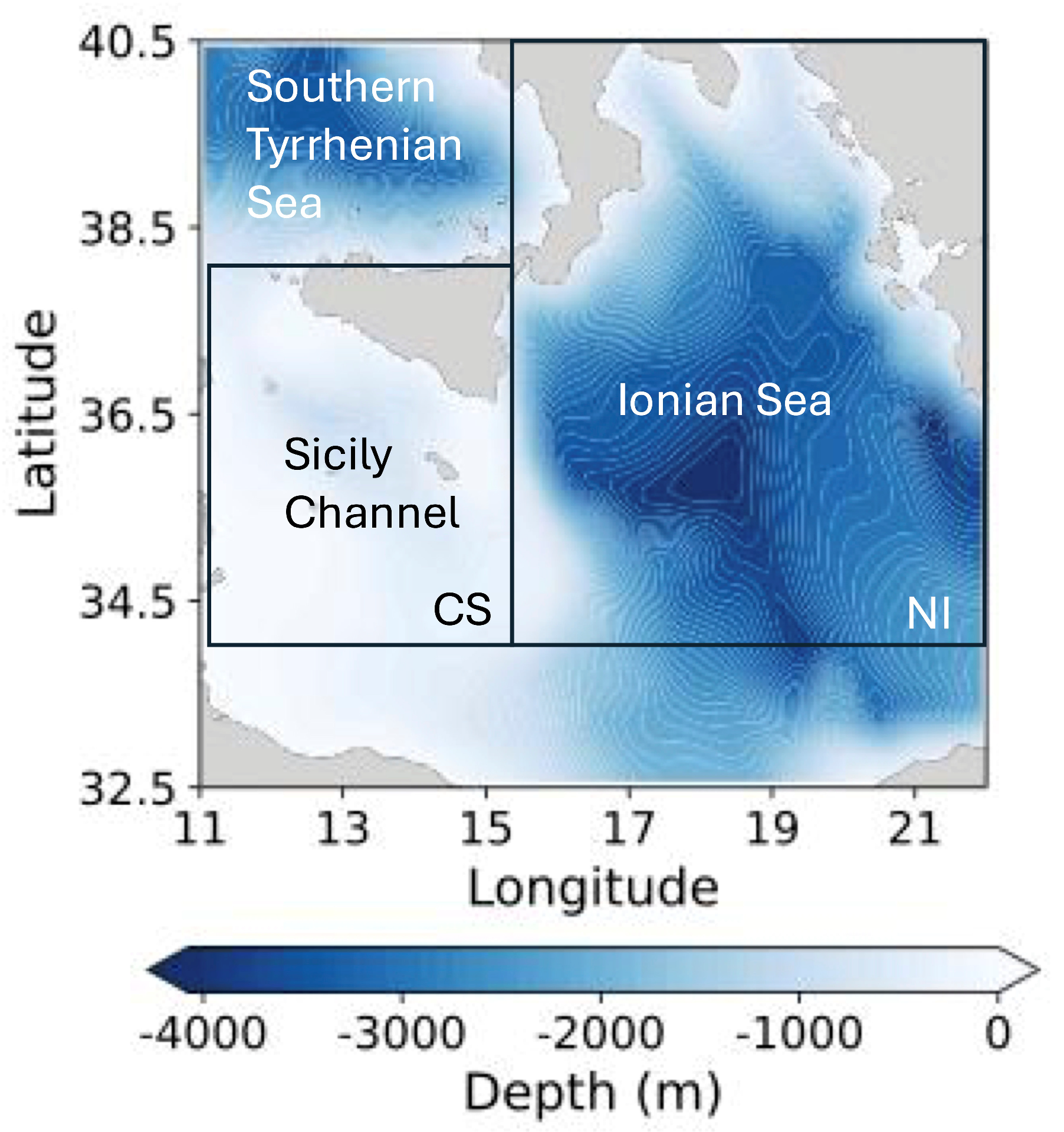
Since the 1980s, dedicated national and international research programs (e.g., POEM—Physical Oceanography of the Eastern Mediterranean, [1]) have been instrumental in deepening our understanding of the physical and biogeochemical processes of the Eastern Mediterranean Sea. These efforts led to the identification of the Eastern Mediterranean Transient (EMT), the largest climatic oceanic anomaly observed in the basin over the last century [2]. In addition to this major discovery, intensive research has provided detailed insights into the circulation and dynamics of sub-basins, including the Ionian Sea. In this context, an important aspect emerged in the 1990s concerning the long-term variability of the upper pycnocline circulation in the Northern Ionian Sea (see Figure 1), with significant implications for the basin-scale thermohaline circulation.
Figure 1.
The bathymetry of the Channel of Sicily (CS)–Ionian Sea domain (NI). The boxes are those used for Singular Value Decomposition.
The dominant circulation structure in the region, the North Ionian Gyre (NIG), was found to undergo reversals from anticyclonic to cyclonic and vice versa on time scales ranging from interannual to sub-decadal. These reversals drive the redistribution of heat and salt in the eastern Mediterranean, thereby playing a key role in modulating the basin-scale thermohaline circulation [3].
Early work emphasized the important role of the long-term variability of the NIG in modulating the occurrence of dense water in the southern Adriatic Sea and in the Levantine basin [3]. Based on these studies, a conceptual framework was proposed, the so-called Bimodal Oscillation System (BiOS), which was referred to as a recurrent large-scale mechanism in which the alternation between cyclonic and anticyclonic NIG phases controlled the exchange of water masses between the Ionian Sea and the southern Adriatic Sea and the Aegean-Levantine basin, thereby influencing dense-water formation processes in those regions.
Over the last decade, investigations based on laboratory experiments [4] and numerical simulations [5] have highlighted the importance of both internal dynamics (the redistribution of mass and vorticity resulting from changes in boundary conditions at depth) and atmospheric forcing in driving NIG variability. Hindcast simulations suggest that alternating deep-water production between the Adriatic and Aegean Seas contributes to the NIG oscillation: when Adriatic waters are denser, the Atlantic Ionian Stream (AIS) shifts northward, whereas denser Aegean waters restore eastward flow [6]. However, Pinardi et al. [7] indicate that local atmospheric forcing may also play a role in modulating the NIG variability.
Recently, theoretical and modeling work have emphasized the role of baroclinic dynamics and lateral AIS forcing. Two-layer models [see the review 4] show that the release of potential energy can induce damped oscillations consistent with long-term sea level changes, and Eusebi Borzelli et al. [8] indicate that the first baroclinic mode dominates the low-frequency sea level signal, with maximum energy concentrated near the Malta Plateau, where the AIS enters the Ionian Sea. The role of the surface lateral forcing due to the AIS has been examined for the first time by Napolitano et al. [9]. Their analysis indicates that periods of low AIS energy favor a northward deflection of the flow and the establishment of an anticyclonic NIG cell, whereas high AIS energy leads to current separation and the development of a zonal jet towards the Levantine basin, thereby promoting cyclonic circulation in the Northern Ionian Sea, modulated by the wind stress curl. Vorticity diagnostics show that nonlinear terms dominate the surface-layer vorticity budget, whereas internal dynamical processes contributed only during the EMT phase (1993–1995), when they acted to reinforce the anticyclonic circulation.
The work presented here was prompted by the results of Napolitano et al. [9] and is based on the hypothesis that the AIS, crossing the Sicily Strait, plays a key role in driving the variability of the Northern Ionian circulation. Within this framework, here we aim to investigate more closely the dynamical relationship between the Sicily Channel and the Northern Ionian Gyre, taking advantage of the recently released high-resolution AVISO dataset (1993–2024) for the Mediterranean Sea. The use of the AVISO dataset also allows us to extend the temporal coverage of the analysis. While Napolitano et al. focused on a model simulation spanning the period 1980–2010, the AVISO observations provide a continuous record from 1993 to 2024, enabling a broader and more up-to-date assessment. We analyze the long-term variability of the system by examining the satellite-derived Absolute Dynamic Topography (ADT) and the associated geostrophic circulation through Empirical Orthogonal Function (EOF) analysis and Singular Value Decomposition (SVD) applied to the ADT fields. The analysis will allow us to confirm and extend the results obtained from the hindcast simulations presented in [9]. The paper is organized as follows. Section 2 describes the materials and methods used in this study. Section 3 presents the results deriving from the EOF and Singular Value Decomposition analysis. Finally, Section 4 provides an overall discussion and conclusions.
2. Materials and Methods
Sea Level Anomaly (SLA) and Absolute Dynamic Topography (ADT) fields were obtained from the latest release of the SSALTO/DUACS gridded products distributed by COPERNICUS MARINE SERVICES(CMEMS, Mercator Ocean International, 2 avenue de l’Aérodrome de Montaudran 31400 Toulose, France) (https://data.marine.copernicus.eu/product/SEALEVEL_EUR_PHY_L4_MY_008_068/, accessed on 1 September 2025). In this work, we used the regional Mediterranean L4 (Delayed-Time/Reprocessed) products, provided on a 1/16° grid, corresponding to an approximate spatial resolution of 6–7 km at Mediterranean latitudes, with daily temporal sampling. These L4 products are generated using the SSALTO/DUACS multiscale optimal interpolation algorithm, which merges data from multiple altimeter missions and applies all standard orbital and instrumental corrections. In addition to SLA and ADT, the dataset also provides geostrophic velocity components, derived consistently from ADT and SLA fields within the DUACS processing chain. The geostrophic velocities from AVISO provide a lower-bound estimate of the true surface currents in regions such as the Sicily Channel and the Ionian Sea, where the flow has a strong nonlinear component. However, using spatially filtered fields (every three grid points) and long-term means still yields a robust characterization of the mean circulation patterns and its variability.
Over the past decade, significant advances have been made in the processing and quality of DUACS L4 products. Recent reprocessing efforts have improved the effective spatial resolution of the regional L4 products with a notable improvement in mesoscale signal representation compared to previous versions. Advances in atmospheric and barotropic ocean models have led to more accurate corrections for ocean responses to wind and pressure forcing. Additionally, improvements in modeling and assimilation techniques have enhanced barotropic ocean tide corrections, and new model corrections have addressed coherent internal gravity wave signals. The introduction of Synthetic Aperture Radar (SAR) technology in missions like CryoSat-2 and Sentinel-3 has significantly reduced measurement noise, especially at short wavelengths. New waveform retracking techniques have further minimized residual noise levels, enhancing the quality of the data [10]. The DUACS DT-2024 reprocessing introduced new methodologies for mapping and computing geostrophic currents, leading to improved representation of mesoscale features in the L4 products (see duacs.cls.fr, accessed o, 1 September 2025). These advances have enhanced the accuracy and spatial resolution of DUACS L4 products, making them more suitable for detailed oceanographic studies.
EOF and Cross-Basin Coherence via Singular Value Decomposition (SVD)
We analysed the ADT signal by using both EOF and SVD decomposition.
We detrended the L4 ADT and then applied an EOF analysis. This procedure is consistent with previous work dealing with the same topic (e.g., [3,9]) and enables the total variance of the ADT field to be quantified and distributed among the dominant modes, including the seasonal one.
The SVD decomposition is widely used in climate studies and oceanic applications (e.g., [11,12,13,14,15]). Differently from the EOF analysis, this method allows us to isolate and maximize the shared dynamical signal between the Sicily Channel (CS) and the north-central Ionian Sea (NI). SVD analysis of ADT data is performed after detrending and removing the seasonal signal to explicitly investigate variability from interannual to decadal scales.
In summary, the EOF analysis mainly focuses on maximizing the total variance of a single field, whereas the SVD technique provides a very useful statistical diagnosis for extracting coupled modes of coherent variability.
The SVD is applied on the cross-covariance matrix (K), which is defined as the product of the two vectors XCS and XNI, containing ADT values from CS and NI regions respectively. See Figure 1 where the two boxes represent the two regions. This matrix is formally defined as:
where N is the number of time frames. The matrix K quantifies the covariance between every grid point in the CS domain and every grid point in the NI domain. The SVD decomposes the cross-covariance matrix using the matrix factorization method:
where the diagonal elements of the matrix Σ (the singular values) define the maximum achievable covariance for each mode, and their squared values represent the percentage of the total cross-covariance captured by that mode.
The resulting spatial patterns are defined by the Singular Vectors (or SVD modes). In our case, the Left Singular Vectors (U) represent the spatial structures in the SC domain, defining the ADT pattern that must occur to achieve maximum correlation with the Ionian Sea. Conversely, the Right Singular Vectors (V) define the coupled spatial structure in the NI domain. The pair of singular vectors for each mode (K) thus defines the coupled spatial distribution of the signal, illustrating how ADT changes manifest simultaneously across both regions when their covariance is maximized. The associated Principal Components (PCs) for each mode are the time series that represent the temporal evolution of this coupled cross covariance signal. These PCs are derived by projecting the original data (XCS and XNI) onto the respective singular vectors (U and V). The SVD PCs for a given mode are maximally correlated in time, reflecting the strength of the synchronous dynamical coupling. Consequently, SVD is particularly useful for extracting coupled signals that reflect long-term coherent variability between two regions.
3. Results
3.1. EOF Decomposition of the ADT
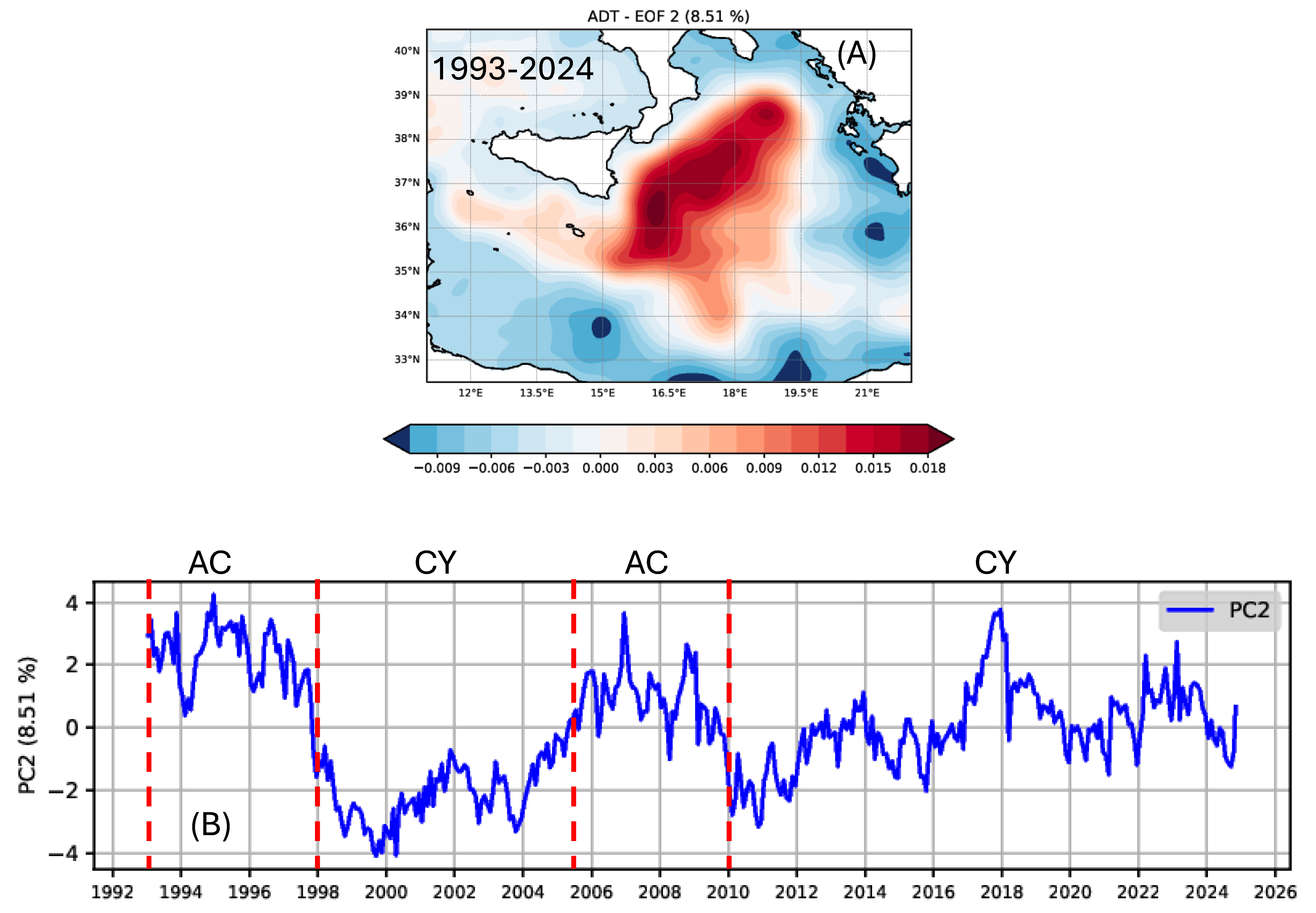
Figure 2 displays the map (panel A) of the second EOF (EOF2) of the detrended ADT for the period 1993–2024, together with its associated principal component time series (panel B). The first EOF, which primarily represents the seasonal cycle and explains approximately 88% of the total variance, is not shown here, as we focus on the long-term variability. The principal component of the EOF2 reproduces the well-known long-term variability traditionally attributed to the Northern Ionian Gyre (NIG) dynamics [3,9].
Figure 2.
(A) Second EOF for ADT (Absolute Dynamic Topography) for period 1993–2024, (B) Time series of principal component for EOF2.
The spatial pattern of the EOF in Figure 2A highlights a coherent positive phase extending from the Sicily Channel to the central and northern Ionian Sea, suggesting a single, region-wide dynamical process acting synchronously across this area.
The variability captured by the EOF2 reflects the interplay of local circulation and atmospheric pressure, with steric effects contributing as residuals. While atmospheric pressure acts on broader spatial scales, local circulation appears to dominate the observed ADT variability. Remote or atmospheric forcings, such as variations in the Atlantic inflow through the Sicily Channel or wind patterns across the region, could also act coherently, reinforcing the regional signal. Figure 2B shows the time series of the PC of the EOF2 and dashed lines indicate the phases associated with the well-known long-term variability in the Northern Ionian region, extensively discussed in the literature; a comprehensive review is provided by [3]. During the periods 1993–1998, 1998–2004, and 2005–2009, the PC time series exhibits alternating positive and negative phases lasting approximately 6–7 years.
Since 2010, the time series exhibits a pronounced attenuation of the previously dominant oscillatory signal, with alternating positive and negative anomalies of reduced amplitude and a stronger expression of interannual variability. This behavior marks a clear departure from the more energetic decadal oscillations observed during the 1993–2010 period. A weakening of the Northern Ionian variability in the post-2010 years has also been reported by [3] (The authors analysed data from 1993–2020), and the present analysis confirms this feature using the extended altimetric record up to 2024.
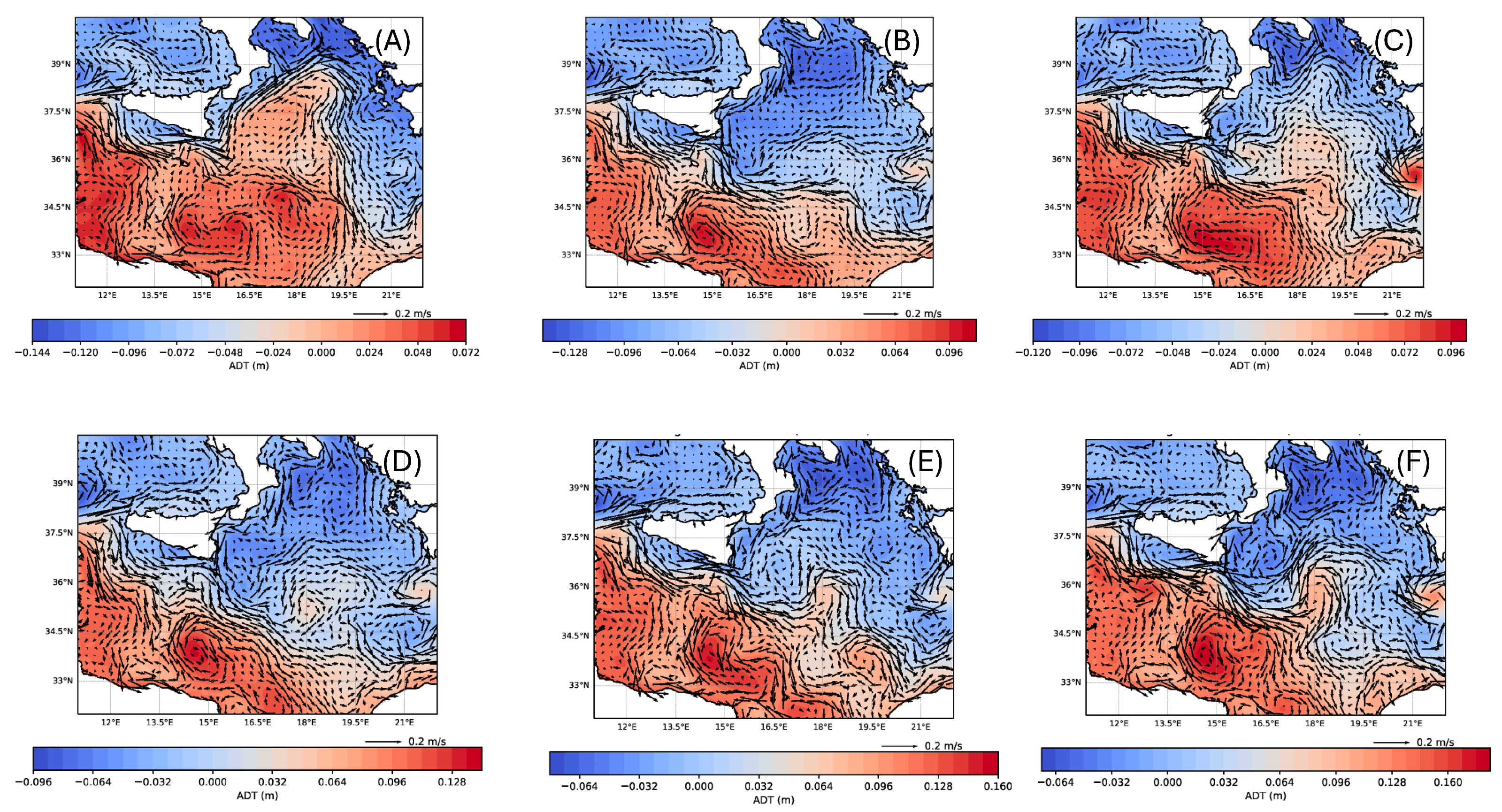
As the variability represented by the PC is closely linked to changes in the circulation pattern, we show in Figure 3 the mean geostrophic circulation for the following periods: (A) 1993–1997, (B) 1998–2004, (C) 2005–2009, (D) 2010–2016, (E) 2017–2020, and (F) 2021–2024. The period 1993–2010 was marked by well-documented circulation inversions in the NIG; since then, the region has been characterized by a prevailing cyclonic circulation.
Figure 3.
Geostrophic circulation averaged over the periods: (A) 1993–1997, (B) 1998–2004, (C) 2005–2009, (D) 2010–2016, (E) 2017–2020, (F) 2021–2024.
3.2. Singular Value Decomposition (SVD)
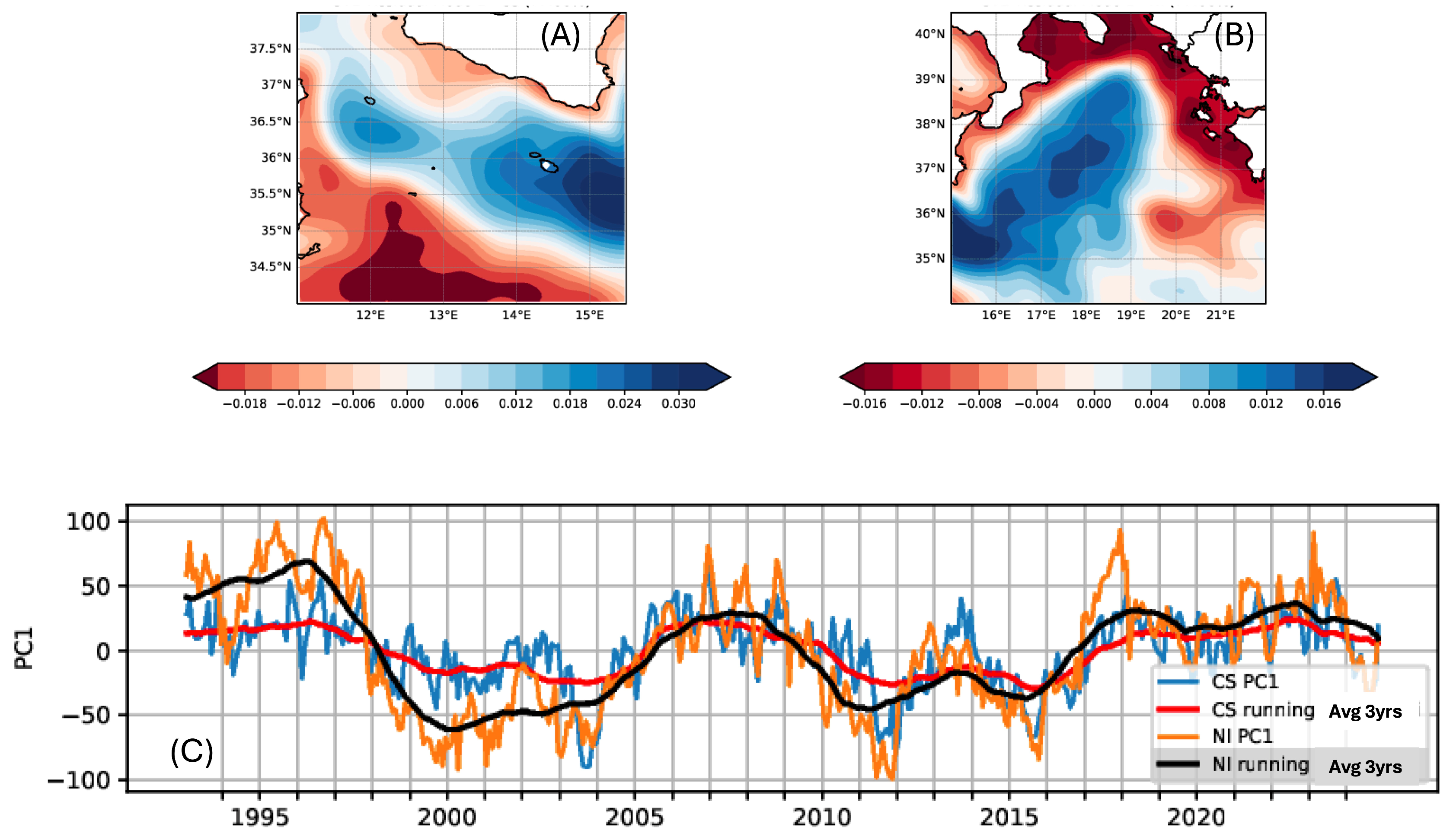
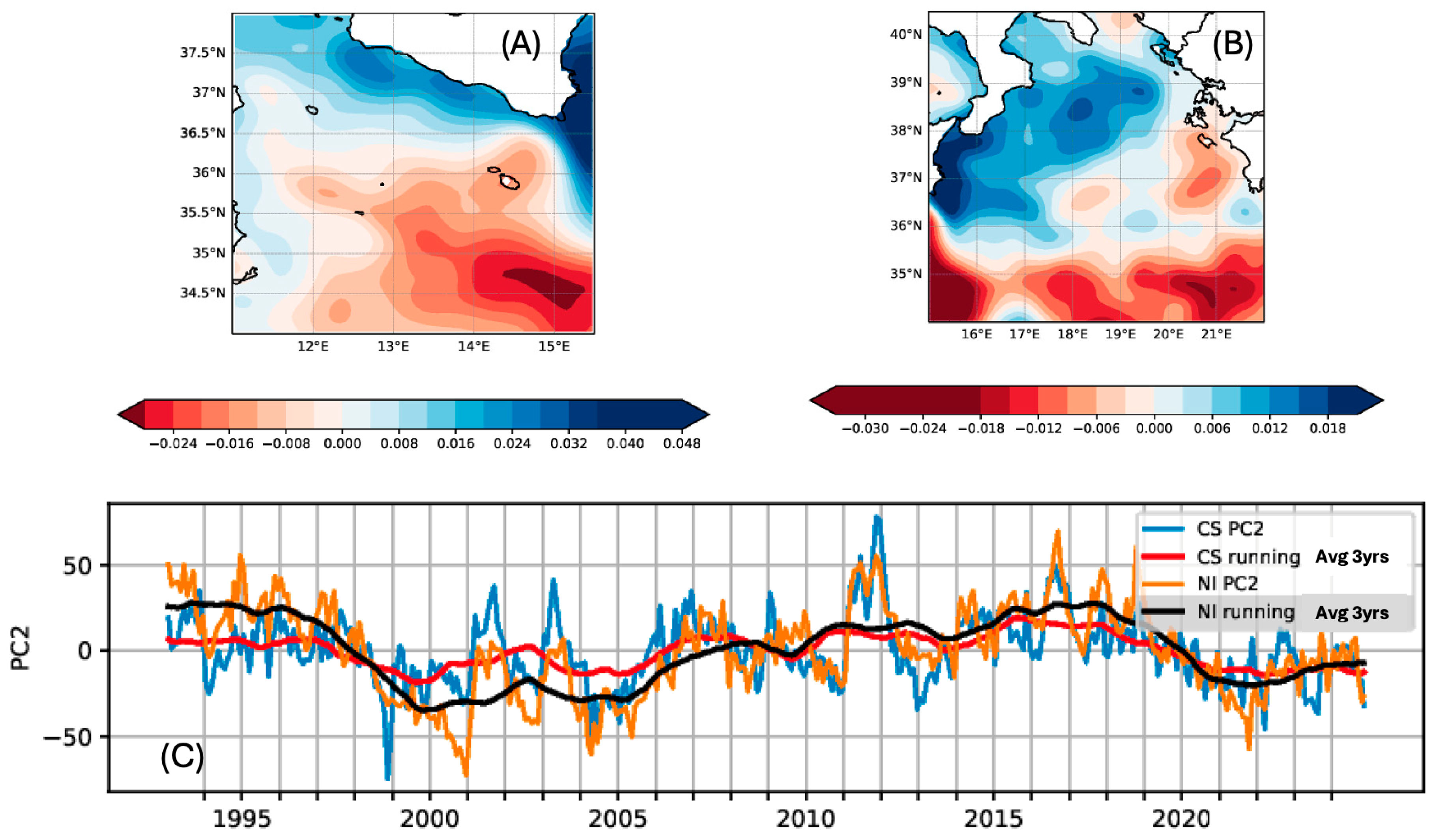
In this section, we present the results of the SVD analysis applied to the ADT of the CS and the NI. Figure 4 and Figure 5 show the spatial patterns of the first (Mode 1) and second (Mode 2) coupled modes identified by the SVD, respectively. Regions displaying the same color indicate areas exhibiting co-variability, thereby highlighting coherent patterns across the two basins. The temporal variability of the coupled patterns is represented by the corresponding Principal Components (PCs). The first two modes (Figure 4A,B and Figure 5A,B) explain 77.7% and 11.1% of the total cross-covariance, indicating a strong and coherent dynamical relationship between the two regions. These results emphasize that the variability in these two regions is not independent, but rather interconnected through well-defined coupled modes.
Figure 4.
SVD Mode 1 analysis (CS and NI). (A,B): The spatial patterns of the first SVD mode (Mode1, 77.66% explained variance) for the CS and the NI basins. (C): The time series of the corresponding Principal Component (PC1) for CS (blue) and NI (orange). The running 3-year averages (red and black) highlight the coupled low-frequency variability between the two basins.
Figure 5.
SVD Mode 2 analysis (CS and NI). (A,B): The spatial patterns of the second SVD mode (Mode2, 11.19% explained variance) for the CS and NI basins. (C): The time series of the corresponding Principal Component (PC1) for CS (blue) and NI (orange). The running 3-year averages (red and black) highlight the coupled low-frequency variability between the two basins.
In Figure 4A,B, the spatial pattern of Mode 1 reveals that strong negative anomalies (blue) are distributed along the main pathways of the AIS in both regions (see Figure 3), whereas positive anomalies (red) outline counter-rotating gyre/eddies and recirculation features adjacent to the main current. The temporal evolution of this mode (Figure 4C) shows that the PC1 time series for the CS (blue) and the NI (orange) are highly correlated, even after applying a three-year running mean. This coherence indicates that sea level variability is tightly linked between the two basins from the interannual to decadal time scales.
Figure 5A,B illustrate the spatial pattern of Mode 2, which represents a secondary configuration of coupled sea level variability. This mode highlights concurrent changes in the path and intensity of the AIS. Negative anomalies (blue) mark regions where the current remains closely attached to the southern Sicilian coast and the NI, while positive anomalies (red) trace the main flow pathways extending from the Sicily Channel toward the southern Ionian. The pattern of cross-covariance in Figure 5 can be associated with the typical bifurcation pattern of the AIS [9], which occurs less frequently. The corresponding PC2 time series (blue and orange lines Figure 5C) displays strong temporal coherence between the CS and NI, indicating that Mode 2 represents a consistent, basin-scale dynamical adjustment that modulates the regional circulation patterns defined by Mode 1.
The PC time series for both modes (Figure 4C and Figure 5C) shows that the NI components (PC1NI and PC2NI) are characterized by larger oscillations than those in the CS over 1993–2004 for PC1 and 1993–2007 for PC2. This difference is the key to understanding the regional dynamics: during the whole period, the coupled variability between the CS and NI exerted a dominant influence on the total variance within the NI. As first, such behavior is consistent with the expectation that the NI, as a broad and deep basin, is characterized by stronger dynamical adjustment to large-scale forcing, amplifying the coupled modes through internal processes. Moreover, the maximum amplitudes of PC1NI and PC2NI occur between 1993 and 2003–2004.
The large amplitude of ADT modes in NI is consistent with the results presented in [9], which showed that the increased energy of currents in NI was due to baroclinic adjustments triggered by the advection of unusually deep, dense waters from the Aegean Sea during the EMT. Such adjustments, in turn, amplified the sea level variability and in turn the amplitudes of the PCs of the coupled SVD modes.
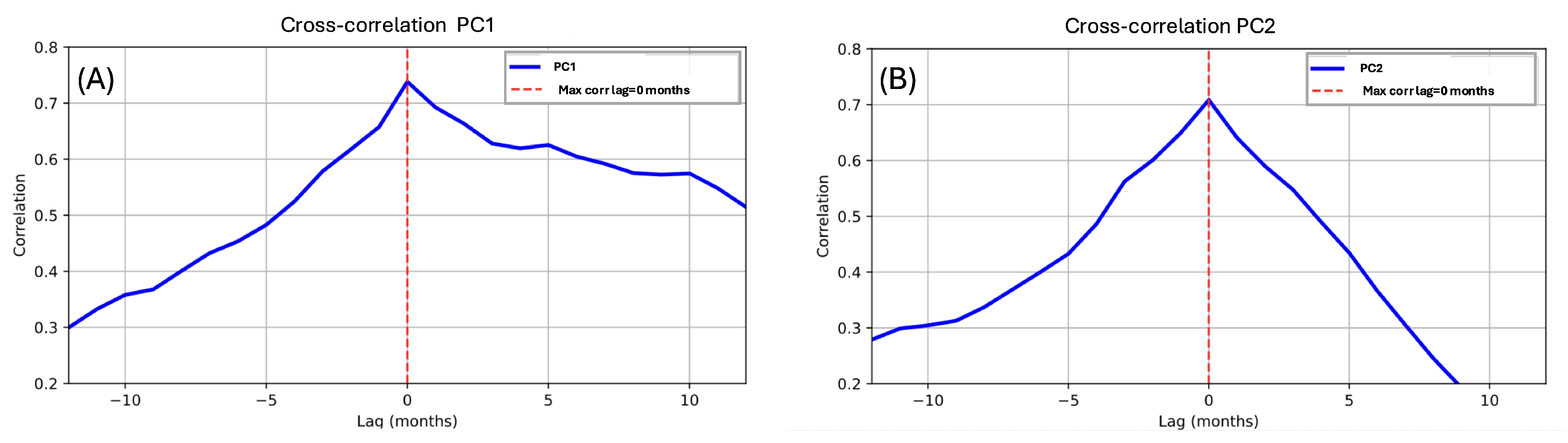
We now examine the temporal relationship between the cross-covariance patterns in the CS and NI, quantified through the cross-correlation function (Figure 6) of their respective residual Principal Component series (PC1 and PC2). We focus on the first 12 months only, since at longer time lags the cross-correlation signal progressively decorrelates. The lagged cross-correlation function between two time series and is commonly used to quantify their temporal relationship. For each lag (in months), the normalized cross-correlation is defined as:
where and denote the temporal means of the two series, and ranges from −L and L where in our case L = 12 months. The coefficient rxy(τ), that can assume values between −1 and +1, is a measure of the strength and direction of the linear relationship between x and y at lag τ A positive lag () indicates that variations in x lead those in y while a negative lag (τ < 0) means that y leads x. The maximum rxy(τ) identifies the lag corresponding to the strongest linear relationship between the two series.
Figure 6.
Cross-correlation between the first PC1 (A) and second PC2 (B) SVD Principal Components for the two basins (temporal relationship between the cross-covariance patterns in the CS and NI).
In the present case the cross-correlation with lag is calculated as R(PCcs(t),PCni(t+τ)) where the sign of lag (τ) defines the direction of influence. According to the formalism used to construct the cross-covariance matrix (see Section 2), a positive lag (τ > 0) indicates that the variability in the CS (U vector) leads that in the NI (V vector), whereas a negative lag (τ < 0) indicates that the variability in the NI (V vector) leads that in the CS (U vector).
Figure 6 shows that both SVD Mode 1 and Mode 2 have their maximum cross-correlation peak at Lag τ = 0 months (0.73 for PC1; 0.70 for PC2). This rapid (over the scale of 1 month) response suggests that the primary driver of the coupled sea level variability is a large-scale external forcing (e.g., atmospheric pressure or wind stress) acting simultaneously across the domain. The synchronous response is also consistent with the short advective time scale of the AIS. With typical speeds of about 0.5 m/s [16], AIS signals are transferred from the CS to the NI in less than one month, driving a rapid transport of mass that can trigger a rapid geostrophic adjustment. This adjustment reflects local changes in the mass and volume balance, as manifested in the sea level field.
The dominant Mode 1 (PC1) (Figure 6A) shows a characteristic slow and long-lasting decay for τ > 0 with a more rapid decay for τ < 0. This asymmetry means that the CS dynamic maintains an influence over time on the future state of the NI pattern (PCni(t + τ)). Hovewer this persistence is sustained by the NI, acting as the energetic amplifier and reservoir of memory. The larger amplitude of PCni oscillations (see Figure 4C) indicate that the NI expresses the coupled signal with maximum energy, retaining it over time and determining the system’s persistence. This effect is more pronounced during the 90s when the EMT takes place. Instead the steep rise in the cross-correlation curve for negative lags representing NI anticipating CS, indicates a rapid adjustment between the basins, which quickly compensates the ADT anomalies. Thus, negative lags (τ < 0) formally mean: the temporal variation of the coupled mode in the NI (PCni) leads the variation in the CS (PCcs) through the rapid response of the system to the mass/volume balance.
In contrast, the secondary Mode 2 (PC2) exhibits a significantly faster and more symmetric decay than PC1. The comparable decay rates for τ > 0 and rise rates for τ < 0 imply a bidirectionally balanced relationship. Mode 2 thus captures a signal that lacks the strong unidirectional persistence (memory) found in PC1, dissipating rapidly once the instantaneous external forcing subsides.
4. Conclusions
In this work we have given for the first time a quantitative characterization of the coherent behavior of the sea level long-term variability in the two basins (the Sicily Channel and the North Ionian Sea) in the last thirty years, through a robust analysis of the full record of satellite altimeter observations.
This study, based on state-of-the-art altimeter observations, confirms and extends the results of the work by Napolitano et al. [9] showing that the long-term variability of sea level and circulation in the NI is the result of a strong dynamical coupling between the Sicily Channel and Northern Ionian regions. The results also indicate that the CS–NI system responds synchronously to an external forcing acting coherently over the entire Central Mediterranean. This synchronous behavior suggests that large-scale modes of atmospheric or thermohaline variability modulate the internal dynamics of the coupled system, imposing common phases of intensification or weakening along the AIS pathway.
The strong coupling revealed by our analysis offers a dynamical explanation for the long-term variability of the NIG, including the decadal reversals of its circulation highlighted in the literature (e.g., [3]).
In other words, the NIG variability emerges not only from local processes or intermediate/deep water variability (e.g., [3]), but also as a direct consequence of the integrated dynamics of the CS–NI system, which acts as a coherent dynamical unit mediating energy redistribution and large-scale adjustments.
In addition, the extension of the altimetric record up to 2024 confirms and refines previous observations of changes in the low-frequency variability of the coupled system. In particular, the oscillatory behavior characterizing the Northern Ionian region during the 1993–2010 period, which exhibited pronounced decadal variability, is followed by a period of attenuation after 2010, as already highlighted in the literature (e.g., [3]). What is particularly noteworthy in the present study is that the coupled CS–NI system responds synchronously across all critical phases observed over the last three decades, including both the period of maximum oscillatory amplitude (1993–2010) and the subsequent attenuation (2010–2024). This synchronized behavior is evident in both the basin-averaged sea level anomalies (Figure 2B) and in the temporal evolution of the leading SVD mode (Figure 4C), providing a robust observational indication of the integrated dynamics of the CS–NI system.
Basin-scale atmospheric regimes can generate coherent anomalies in sea level pressure and surface stress curl, while remote oceanic signals associated with thermohaline variability may propagate across the basin and contribute to delayed large-scale adjustments. However, assessing the role of these mechanisms in the coupled CS–NI variability would require a dedicated analysis, which is beyond the scope of this present work.
Within this framework, the coherent variability observed between the CS and NI can be also interpreted as the surface expression of a basin-scale baroclinic response [8], where energy and mass are redistributed along the AIS pathway. In agreement with the findings of [8,9], the first SVD mode of the ADT captures this large-scale baroclinic adjustment, while the second mode reflects regional reorganizations of the AIS and its branching toward the Ionian interior. The enhanced variance observed during the EMT period further emphasizes the sensitivity of this system to basin-scale shifts in stratification and circulation. The amplification of ADT variability and its interbasin covariance suggests that part of the energy injected at intermediate depths during the EMT may have been transferred upward through baroclinic modes, influencing the surface flow and the mesoscale activity in both regions.
Overall, these results indicate that the Sicily Channel–Northern Ionian region acts as an integrated dynamical system, responding both to internal forcing and to externally atmospheric, coherent forcings. This coupled behavior represents a fundamental pathway for energy redistribution within the Central Mediterranean, linking local circulation variability and large-scale climatic oscillations, and emphasizing the role of the Central Mediterranean as a sensitive node in the Mediterranean basin.
Author Contributions
Conceptualization, E.N.; methodology, E.N.; formal analysis, E.N.; investigation, E.N.; A.C.; R.I.; G.E.B. and M.V.S.; writing—original draft preparation, E.N.;A.C.; R.I.; G.E.B. and M.V.S.; writing—review and editing, E.N.; A.C.; R.I.; G.E.B. and M.V.S. All authors have read and agreed to the published version of the manuscript.
Funding
This research received no external funding.
Institutional Review Board Statement
Not applicable.
Informed Consent Statement
Not applicable.
Data Availability Statement
The original contributions presented in this study are included in the article. Further inquiries can be directed to the corresponding author.
Conflicts of Interest
The authors declare no conflicts of interest.
Abbreviations
The following abbreviations are used in this manuscript:
| ADT | Absolute Dynamic Topography |
| AIS | Atlantic Ionian Stream |
| BIOS | Bimodal Oscillation System |
| CS | Sicily Channel |
| EA_WR | East Atlantic–Western Russia pattern |
| EA | East Atlantic pattern |
| EOF | Empirical Ortogonal Functions |
| NI | North Ionian |
| NIG | North Ionian Gyre |
| SLA | Sea Level Anomaly |
| SVD | Singular Value Decomposition |
References
- Malanotte-Rizzoli, P.; Robinson, A.R. POEM: Physical Oceanography of the Eastern Mediterranean. Eos Trans. AG 1988, 69, 194–203. [Google Scholar] [CrossRef]
- Roether, W.; Manca, B.B.; Klein, B.; Bregant, D.; Georgopoulos, D.; Beitzel, V.; Kovacevic, V.; Luchetta, A. Recent changes in eastern Mediterranean deep waters. Science 1996, 271, 333–335. [Google Scholar] [CrossRef]
- Civitarese, G.; Gačić, M.; Batistić, M.; Bensi, M.; Cardin, V.; Dulčić, J.; Garic, R.; Menna, M. The BiOS mechanism: History, theory, implications. Prog. Oceanogr. 2023, 216, 103056. [Google Scholar] [CrossRef]
- Rubino, A.; Gačić, M.; Bensi, M.; Kovačević, V.; Malačič, V.; Menna, M.; Negretti, M.E.; Sommeria, J.; Barreto, R.; Zanchettin, D.; et al. Experimental evidence of long-term oceanic circulation reversals without wind influence in the North Ionian Sea. Sci. Rep. 2020, 10, 1905. [Google Scholar] [CrossRef] [PubMed]
- Reale, M.; Crise, A.; Farneti, R.; Mosetti, R. A process study of the Adriatic-Ionian System baroclinic dynamics. J. Geophys. Res. Oceans 2016, 121, 5872–5887. [Google Scholar] [CrossRef]
- Theocharis, A.; Krokos, G.; Velaoras, D.; Korres, G. An internal mechanism driving the alternation of the Eastern Mediterranean dense/deep water sources. In The Mediterranean Sea: Temporal Variability and Spatial Patterns; Eusebi-Borzelli, G., Gacic, M., Lionello, P., Malanotte-Rizzoli, P., Eds.; AGU Geoph Monograph Serie: Washington, DC, USA, 2014; pp. 113–137. [Google Scholar]
- Pinardi, N.; Zavatarelli, M.; Adani, M.; Coppini, G.; Fratianni, C.; Oddo, P.; Simoncelli, S.; Tonani, M.; Lyubarstev, V.; Dobricic, S.; et al. Mediterranean Sea large-scale low-frequency ocean variability and water mass formation rates from 1987 to 2007: A retrospective analysis. Prog. Oceanogr. 2025, 132, 318–332. [Google Scholar] [CrossRef]
- Eusebi Borzelli, G.L.; Napolitano, E.; Carillo, A.; Struglia, M.V.; Palma, M.; Iacono, R. Hydrographic vs. Dynamic Description of a Basin: The Example of Baroclinic Motion in the Ionian Sea. Oceans 2024, 5, 383–397. [Google Scholar] [CrossRef]
- Napolitano, E.; Carillo, A.; Struglia, M.V.; Iacono, R.; Palma, M.; Borzelli, G.E.; Sannino, G. The role of the Atlantic-Ionian stream in the long-term variability of the surface circulation in the Northern Ionian Sea: Results from a hindcast simulation. Prog. Oceanogr 2025, 234, 103472. [Google Scholar] [CrossRef]
- Pujol, M.-I.; Dupuy, S.; Vergara, O.; Sánchez Román, A.; Faugère, Y.; Prandi, P.; Dabat, M.-L.; Dagneaux, Q.; Lievin, M.; Cadier, E.; et al. Refining the Resolution of DUACS Along-Track Level-3 Sea Level Altimetry Products. Remote Sens. 2023, 15, 793. [Google Scholar] [CrossRef]
- Wallace, J.M.; Gutzler, D. Teleconnections in the geopotential height field during the Northern Hemisphere winter. Mon. Wea. Rev. 1981, 109, 784–812. [Google Scholar] [CrossRef]
- Bretherton, C.S.; Smith, C.; Wallace, J. An intercomparison of methods for finding coupled patterns in climate data. J. Clim. 1992, 5, 541–560. [Google Scholar] [CrossRef]
- Von Storch, H.; Zwierz, F. Statistical Analysis in Climate Research; Cambridge University Press: Cambridge, UK, 2002. [Google Scholar]
- Czaja, A.; Frankignoul, C. Influence of the North Atlantic SST on the atmospheric circulation. Geophys. Res. Lett. 1999, 26, 2969–2972. [Google Scholar] [CrossRef]
- Li, L.; Schmitt, R.W.; Ummenhofer, C.C.; Karnauskas, K.B. North Atlantic salinity as a predictor of Sahel rainfall. Sci. Adv. 2016, 2, e1501588. [Google Scholar] [CrossRef] [PubMed]
- Robinson, A.R.; Sellschopp, J.; Warn-Varnas, A.; Leslie, W.G.; Lozano, C.J.; Haley, P.J., Jr.; Anderson, L.A.; Lermusiaux, P.F.J. The Atlantic ionian stream. J. Mar. Syst. 1999, 20, 129–156. [Google Scholar] [CrossRef]
Disclaimer/Publisher’s Note: The statements, opinions and data contained in all publications are solely those of the individual author(s) and contributor(s) and not of MDPI and/or the editor(s). MDPI and/or the editor(s) disclaim responsibility for any injury to people or property resulting from any ideas, methods, instructions or products referred to in the content. |
© 2026 by the authors. Licensee MDPI, Basel, Switzerland. This article is an open access article distributed under the terms and conditions of the Creative Commons Attribution (CC BY) license.