
Monitoring the Ecological and Geochemical Impacts of Coastal Development and Management on the Oualidia Lagoon

 , ,
, ,  , , and
Abstract
1. Introduction
2. Materials and Methods
2.1. Study Area Description
2.2. Sediment Samples Collection and Physical Preparation
3. Geochemical Analysis
3.1. Organic Matter Content Determination
3.2. Grain Size Distribution Determination
3.3. Inductively Coupled Plasma Optical Emission Spectrometry (ICP-OES)
4. Ecological and Environmental Indices
4.1. Geo-Accumulation Index (Igeo)
4.2. Contamination Factor (CF), Degree of Contamination (Cd), Modified Degree of Contamination (mCd), and (PI Nemerow)
4.3. Pollution Load Index (PLI)
4.4. Enrichment Factor (EF)
4.5. Adverse Effects Index (AEI)
4.6. Toxic Unit (TUs)
5. Results and Discussions
5.1. Superficial Sediments Characteristics: (Grain Size, Organic Matter (OM), and Total Carbon (TC) Content)
5.2. Heavy-Metal Concentrations: Hotspots and Trends
5.3. Correlation Among Heavy Metals and Sediment Parameters
6. Assessment of Pollution Level Using Environmental and Ecological Indices
6.1. Enrichment Factor
6.2. CF, mCd, PLI, and PI Nemerow
- —
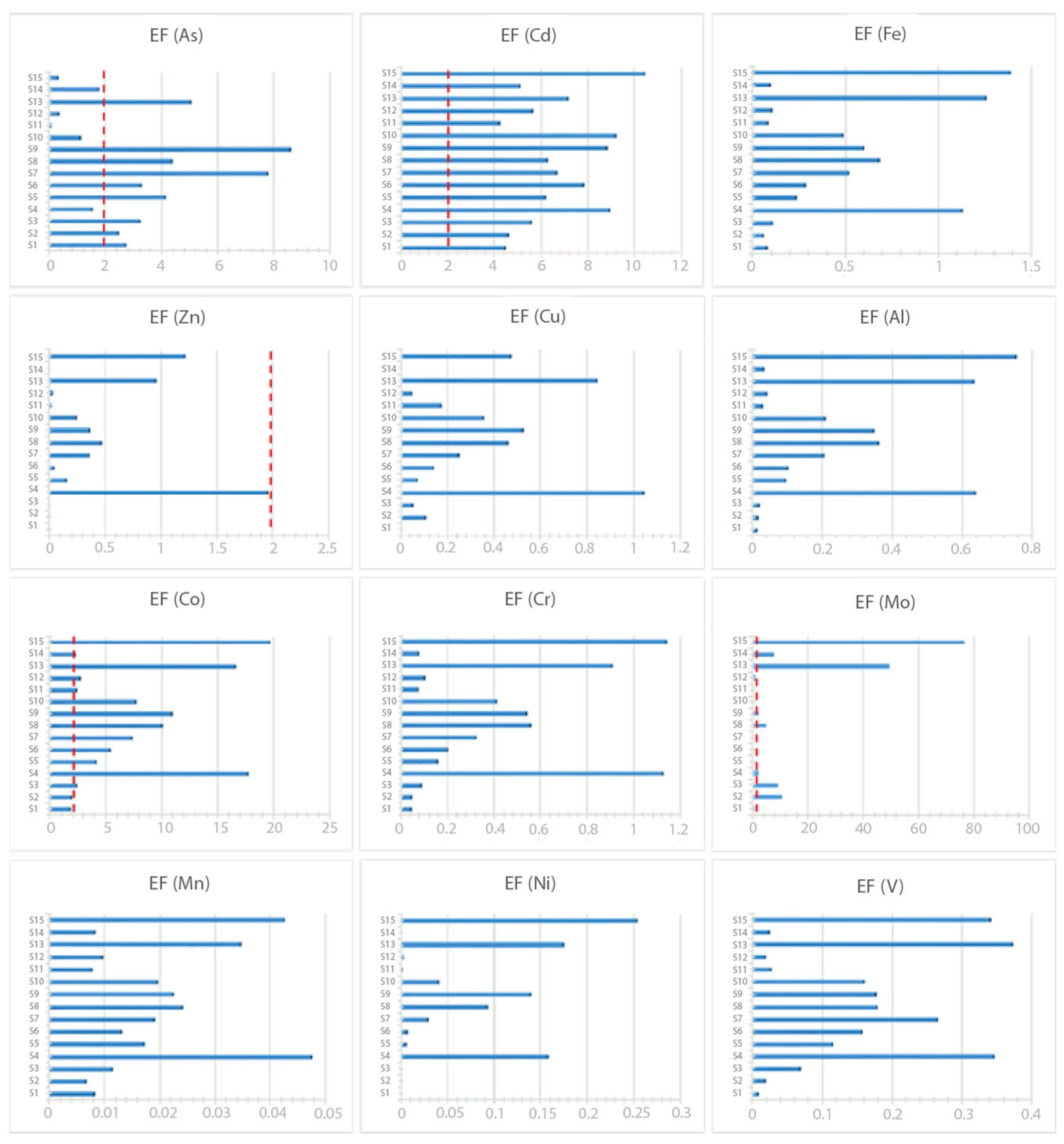
- Cd, Co, As, and Mo are the dominant contaminants with the highest CF values reflecting anthropogenic origins, mainly agricultural runoff and the excessive use of fertilizers as the lagoon is surrounded by agricultural lands and urban discharges as well as industrial effluent.
- —
- V, Mn, and Ni are less dominant, suggesting natural lithogenic origin.
- —
- Contamination is mainly concentrated in S13 and S15 sites where the mud content is high and near to human activities. S15 is collected in the confined part of the lagoon where the hydrodynamic conditions are low, and fine fraction is the most dominant which enable the accumulation of pollutants.
- —
- The lowest values were recorded in S1–S3 and S11–S12. These stations are characterized by the sand fraction dominance, while S1 and S2 were collected near the sandpit where the hydrodynamic conditions are high, which does not allow for pollutant accumulation. It also suggests less anthropogenic influence compared to other stations.
6.3. Geo-Accumulation Index (IGeo)
6.4. Adverse Effects Index (AEI) and Toxic Unit (TUs)
7. Conclusions
Author Contributions
Funding
Institutional Review Board Statement
Informed Consent Statement
Data Availability Statement
Conflicts of Interest
References
- Benmohammadi, A.; Griboulard, R.; Zourarah, B.; Carruesco, C.; Mehdi, K.; Mridekh, A.; El Moussaoui, A.; Mhammdi Alaoui, A.; Carbonel, P.; Londeix, L. Hyperactive neotectonic near the South Rifian front. Lifted Late Quat. Lagun Aldeposits Atl. Moroc. C. R. Geosci. 2007, 339, 831–839. [Google Scholar] [CrossRef]
- Larras, J. Embouchures, Estuaires, Lagunes et Deltas; Editions Eyrolles: Paris, France, 1964; 172p. [Google Scholar]
- Mejjad, N.; Safhi, A.E.M.; Laissaoui, A.; El Aouidi, S.; Hilal, I. Valuing the ecological and socio-economic interests of the Oualidia Lagoon (Morocco): An ecosystem services framework. Eng. Proc. 2023, 56, 77. [Google Scholar]
- Levin, D.R. Tidal inlet evolution in the Mississipi River Delta Plain. J. Coast. Res. 1993, 9, 462–480. [Google Scholar]
- Mejjad, N.; Laissaoui, A.; Benkdad, A.; Taous, F.; El Bouch, M.; Otmani, A.; Benmansour, M. Blue carbon sequestration and storage potential has increased in seagrass sediments from Northern Morocco. Commun. Earth Environ. 2025, 6, 1011. [Google Scholar] [CrossRef]
- Rodrigues-Filho, J.L.; Macêdo, R.L.; Sarmento, H.; Pimenta, V.R.A.; Alonso, C.; Teixeira, C.R.; Pagliosa, P.R.; Netto, S.A.; Santos, N.C.L.; Daura-Jorge, F.G.; et al. From ecological functions to ecosystem services: Linking coastal lagoons biodiversity with human well-being. Hydrobiologia 2023, 850, 2611–2653. [Google Scholar] [CrossRef] [PubMed]
- Hester, R.E.; Harrison, R.M. Ecosystem Services. Issues in Environmental Science and Technology; Royal Society of Chemistry: Cambridge, UK, 2010; Volume 30. [Google Scholar]
- Anthony, A.; Atwood, J.; August, P.; Byron, C.; Cobb, S.; Foster, C.; Fry, C.; Gold, A.; Hagos, K.; Heffner, L.; et al. Coastal lagoons and climate change: Ecological and social ramifications in US Atlantic and Gulf coast ecosystems. Ecol. Soc. 2009, 14, 8. [Google Scholar] [CrossRef]
- Maanan, M. «Impact des changements de l’occupation des sols sur l’état de l’environnement dans des écosystèmes côtiers: Cas des lagunes d’Oualidia et de Moulay Bousselham (façade atlantique marocaine)». Ph.D Thesis, Nantes Université, Nantes, France, 2013. [Google Scholar]
- Mejjad, N.; Laissaoui, A.; El-Hammoumi, O.; Benmansour, M.; Benbrahim, S.; Bounouira, H.; Benkdad, A.; Bouthir, F.Z.; Fekri, A.; Bounakhla, M. Sediment geochronology and geochemical behavior of major and rare earth elements in the Oualidia Lagoon in the western Morocco. J. Radioanal. Nucl. Chem. 2016, 309, 1133–1143. [Google Scholar] [CrossRef]
- Mejjad, N.; Laissaoui, A.; El-Hammoumi, O.; Fekri, A.; Amsil, H.; El-Yahyaoui, A.; Benkdad, A. Approches géochimiques, radiométriques et environnementales pour l’évaluation de l’intensité et de la chronologie de la contamination métallique dans les carottes sédimentaires de la lagune d’Oualidia (Maroc). Environ. Sci. Pollut. Res. 2018, 25, 22872–22888. [Google Scholar] [CrossRef] [PubMed]
- Maanan, M.; Saddik, M.; Maanan, M.; Chaibi, M.; Assobhei, O.; Zourarah, B. Environmental and ecological risk assessment of heavy metals in sediments of Nador lagoon. Moroc. Ecol. Indic. 2014, 48, 616–626. [Google Scholar] [CrossRef]
- Maanan, M.; Zourarah, B.; Carruesco, C.; Aajjane, A.; Naud, J. The distribution of heavy metals in the SidiMoussa lagoon sediments (Atlantic Moroccan Coast). J. Afr. Earth Sci. 2004, 39, 473–483. [Google Scholar] [CrossRef]
- Conesa, H.M.; Jiménez-Cárceles, F.J. «The Mar Menor lagoon (SE Spain): A singular natural ecosystem threatened by human activities». Mar. Pollut. Bull. 2007, 54, 839–849. [Google Scholar] [CrossRef]
- Kader, S.; Raimi, M.O.; Spalevic, V.; Iyingiala, A.A.; Bukola, R.W.; Jaufer, L.; Butt, T.E. A concise study on essential parameters for the sustainability of Lagoon waters in terms of scientific literature. Turk. J. Agric. For. 2023, 47, 288–307. [Google Scholar] [CrossRef]
- Pérez-Ruzafa, A.; Marcos-Diego, C.; Ros, J.D. Environmental and biological changes related to recent human activities in the Mar Menor (SE of Spain). Mar. Pollut. Bull. 1991, 23, 747–751. [Google Scholar] [CrossRef]
- Pérez-Ruzafa, A.; Marcos, C.; Pérez-Ruzafa, I.M.; Barcala, E.; Hegazi, M.I.; Quispe, J. Detecting changes resulting from human pressure in a naturally quick-changing and heterogeneous environment: Spatial and temporal scales of variability in coastal lagoons. Estuar. Coast. Shelf Sci. 2007, 75, 175–188. [Google Scholar] [CrossRef]
- Bennouna, A. Etude du Phytoplancton Nuisible et de son Environnement dans la Lagune de Oualidia et de Sidi Moussa (Maroc). Ph.D. Thesis Faculté des Sciences, El Jadida, Morocco, 1999; 153p. [Google Scholar]
- Cheggour, M.; Langston, W.J.; Chafik, A.; Texier, H.; Kaimoussi, A.; Bakkas, S.; Boumezzough, A. Metals in the bivalve molluscs Scrobicularia plana (Da costa) and Cerastoderma edule (L) and associated surface sediments from Oum Er Rbia estuary (Moroc can Atlantic coast). Toxicol. Environ. Chem. 2000, 77, 49–73. [Google Scholar] [CrossRef]
- El Attar, J. Contribution à la Détermination de l’origine de la Contamination fécale dans la Lagune de Oualidia (Maroc) et Étude de la Contamination Bactériologique de L’huître « Crassostera Gigas » en Conditions Naturelles et Expérimentales. Ph.D. Thesis, Faculté des Sciences, El Jadida, Morocco, 1998; 124p. [Google Scholar]
- Ekponon, K.S.F.; Bi, T.J.G.I.; Yao, N.G.J.P.; Affian, K. Profils géochimiques des métaux lourds (pb, cd, cu et zn) des carottes sédimentaires de la baie d’abouabou, lagune ebrié. Rev. Ivoir. Sci. Technol. 2024, 43, 73–87. [Google Scholar]
- Mejjad, N.; Laissaoui, A.; Fekri, A.; Benmhammed, A.; El Hammoumi, O.; Cherif, E.K. Does human activities growth lead to biodiversity loss in the Moroccan coastal lagoons? A diagnostic comparison study. In Proceedings of the 4th Edition of International Conference on Geo-IT and Water Resources 2020, Geo-IT and Water Resources; Association for Computing Machinery: New York, NY, USA, 2020; pp. 1–5. [Google Scholar]
- Coulibaly, A.S.; Monde, S.; Wognin, V.A.; Aka, K. Analyse des éléments traces métalliques (ETM) dans les baies estuariennes d’Abidjan (Côte d’Ivoire). Afr. Sci. 2009, 5, 77–96. [Google Scholar]
- El Asri, F.; Zidane, H.; Maanan, M.; Tamsouri, M.; Errhif, A. Taxonomic diversity and structure of the molluscan fauna in Oualidia lagoon (Moroccan Atlantic coast). Environ. Monit. Assess. 2015, 187, 545. [Google Scholar] [CrossRef]
- El Hamoumi, R. l’Avifaune Aquatique du Complexe Lagunaire de Sidi Moussa-Walidia (Maroc). Ph.D. Thesis, Faculté de Science, Casablanca, Morocco, 2000; 241p. [Google Scholar]
- Anne, T.; Peter, T.; Pauline, K.; Françoise, L.G.; Jean-Baptiste, D. Modélisation dynamique théorique de la transmission de norovirus par la consommation d’huîtres contaminées et par transmission interhumaine. Bull. Académie Vétérinaire 2014, 167, 235–240. [Google Scholar] [CrossRef]
- Florian, G.; Le Pevedic, A. Arcade—Approche Intégrée du Fonctionnement Hydro-Bio-Sédimentaire du Bassin d’Arcachon: Dynamiques et Evolutions; Rapport Final 2020–2023; Institut français de recherche pour l’exploitation de la mer (Ifremer): Plouzané, France, 2024. [Google Scholar]
- Anbuselvan, N.; Senthil Nathan, D.; Sridharan, M. Heavy metal assessment in surface sediments off Coromandel Coast of India: Implication on marine pollution. Mar. Pollut. Bull. 2018, 131, 712–726. [Google Scholar] [CrossRef] [PubMed]
- Cañedo-Argüelles, M.; Rieradevall, M.; Farrés-Corell, R.; Newton, A. Annual characterisation of four Mediterranean coastal lagoons subjected to intense human activity. Estuar. Coast. Shelf Sci. 2012, 114, 59–69. [Google Scholar] [CrossRef]
- Bouchkara, M.; El Khalidi, K.; Benazzouz, A.; Erraji Chahid, N.; Joudar, I.; Zourarah, B.; Maanan, M. Study of morphodynamic and sedimentological changes in the oualidia lagoon (morocco) using bathymetric data: First investigations after the sediment trap dredging. Int. Arch. Photogramm. Remote Sens. Spatial Inf. Sci. 2022, 46-4/W3-2021, 53–63. [Google Scholar] [CrossRef]
- Fadili, A.; Najib, S.; Mehdi, K.; Riss, J.; Malaurent, P.; Makan, A. Geoelectrical and hydrochemical study for the assessment of seawater intrusion evolution in coastal aquifers of Oualidia, Morocco. J. Appl. Geophys. 2017, 146, 178–187. [Google Scholar] [CrossRef]
- Makaoui, A.; Idrissi, M.; Agouzouk, A.; Larissi, J.; Baibai, T.; Ouehabi, Z.E.; Laamel, M.A.; Bessa, I.; Ettahiri, O.; Hilmi, K. Etat océanographique de la lagune de Oualidia, Maroc (2011–2012). Eur. Sci. J. 2018, 14, 93. [Google Scholar] [CrossRef]
- Bouchkara, M.; Erraji Chahid, N.; El Khalidi, K.; Varangalil, N.; Joudar, I.; Minoubi, A.; Benazzouz, A.; Zourarah, B. Multi-timescale analysis of morpho-evolution in a Coastal Lagoon: A case study Oualidia Lagoon, Morocco. Euro-Mediterr. J. Environ. Integr. 2026, 11, 11. [Google Scholar] [CrossRef]
- Bouchkara, M.; Erraji Chahid, N.; Joudar, I.; Khalfaoui, O.; El Behja, H.; Benazzouz, A.; Zourarah, B.; El Khalidi, K. Effect of hydrodynamic regimes on sediment transport and grain size distribution in the Oualidia Lagoon (Morocco): A numerical modeling approach. J. Afr. Earth Sci. 2026, 235, 105980. [Google Scholar] [CrossRef]
- Bouchkara, M.; Erraji Chahid, N.; Joudar, I.; Hilmi, K.; Benazzouz, A.; Mellas, S.; Zourarah, B.; El Khalidi, K. Hydrodynamic modeling of the Oualidia lagoon, Atlantic Coast of Morocco. Front. Sci. Eng. Int. J. 2022, 12, 55–64. [Google Scholar] [CrossRef]
- El Behja, H.; El M’rini, A.; Nachite, D.; Bouchkara, M.; El Khalidi, K.; Maanan, M.; Zourarah, B.; Abioui, M. Exploring morphometry, hydrodynamics, and surface sediment composition in Khenifiss lagoon: Insights from a shallow coastal environment in Southern Morocco. Adv. Sp. Res. 2024, 75, 2550–2568. [Google Scholar] [CrossRef]
- El Behja, H.; El, M.A.; El Nachite, D.; Bouchkara, M.; Khalidi, K.; El Zourarah, B.; Uddin, G. Evaluating coastal lagoon sustainability through the driver-pressure-state-impact-response approach: A study of Khenifiss Lagoon, southern Morocco. Sec. Mar. Geosci. 2024, 12, 1322749. [Google Scholar] [CrossRef]
- El Behja, H.; El M’rini, A.; Nachite, D.; Bouchkara, M.; El Khalidi, K.; Zourarah, B. Hydrodynamic modeling of Khenifiss coastal lagoon, Southern Atlantic Coast of Morocco: Implications for sediment infilling. Thalass. An Int. J. Mar. Sci. 2025, 41, 7. [Google Scholar] [CrossRef]
- Erraj Chahid, N.; Bouchkara, M.; Canu, D.M.; El Khalidi, K.; Zourarah, B. Assessing the dynamics of the Moulay Bousselham Lagoon: An integrated DPSIR approach to understand drivers, impacts, and human response. Proceedings 2023, 87, 31. [Google Scholar] [CrossRef]
- Erraji Chahid, N.; Bouchkara, M.; Joudar, I.; Benazzouz, A.; Zourarah, B.; EL Khalidi, K. Assessing geomorphological changes in coastal lagoon inlet using geospatial tools: A case study Moulay Bousselham lagoon, Morocco. J. Afr. Earth Sci. 2024, 216, 105300. [Google Scholar] [CrossRef]
- Oujidi, B.; Aitali, R.; El Bouch, M.; Layachi, M.; Kabriti, M.; Abid, A.; El Ouamari, N.; Skalli, A.; Chahban, M.; Akodad, M.; et al. SWOT analysis of the integrated coastal zone management (ICZM) in Marchica Lagoon Ecosystem, Morocco. E3S Web Conf. 2024, 502, 02002. [Google Scholar] [CrossRef]
- Tnoumi, A.; Angelone, M.; Armiento, G.; Caprioli, R.; Crovato, C.; De Cassan, M.; Montereali, M.R.; Nardi, E.; Parrella, L.; Proposito, M.; et al. Teneur en métaux lourds et évaluation des risques écologiques potentiels des sédiments du parc national de la lagune de Khnifiss (Maroc). Environ. Monit. Assess. 2022, 194, 356. [Google Scholar] [CrossRef] [PubMed]
- Aknaf, A.; Akodad, M.; Layachi, M.; Baghour, M.; Oudra, B.; Vasconcelos, V. La caractérisation chimique et sa relation avec la contamination par les métaux lourds dans les sédiments de surface de la lagune méditerranéenne de Marchica (nord du Maroc). Rech. Sci. Environ. Pollut. 2022, 29, 4159–4169. [Google Scholar] [CrossRef] [PubMed]
- El Khalidi, K.; Bourhili, A.; Bagdanavičiūtė, I.; Minoubi, A.; Hakkou, M.; Zourarah, B.; Maanan, M. Occupation des sols côtiers et évolution du trait de côte le long de la lagune de Nador au Maroc. Geocarto Int. 2021, 37, 7445–7461. [Google Scholar] [CrossRef]
- Saltani, Z.; Benmohammadi, A.; Belabed, M. Origine du phénomène d’ensablement déduite par combinaison entre télédetection et techniques sédimentolgiques: Application au bassin côtier de tarfaya, sud-ouest marocain. Afr. Sci. 2015, 11, 268–276. [Google Scholar]
- Zourarah, B.; Maanan, M.; Carruesco, C.; Aajjane, A.; Mehdi, K.; Freitas, M.C. Fifty-year sedimentary record of heavy metal pollution in the lagoon of Oualidia (Moroccan Atlantic coast). Estuar. Coast. Shelf Sci. 2007, 72, 359–369. [Google Scholar] [CrossRef]
- Maanan, M.; El Barjy, M.; Hassou, N.; Zidane, H.; Zourarah, B.; Maanan, M. Origin and potential ecological risk assessment of trace elements in the watershed topsoil and coastal sediment of the Oualidia lagoon, Morocco. Hum. Ecol. Risk Assess 2017, 24, 602–614. [Google Scholar] [CrossRef]
- El Mahrad, B.; Abalansa, S.; Newton, A.; Icely, J.D.; Snoussi, M.; Kacimi, I. Social- Environmental analysis for the management of coastal Lagoons in North Africa. Front. Environ. Sci. 2020, 8, 37. [Google Scholar] [CrossRef]
- El Mahrad, B.; Kacimi, I.; Satour, N.; Newton, A.; Icely, J.D.; Snoussi, M.; Abalansa, S. Environmental conditions, vulnerability and future perspective of coastal water bodies in Morocco. In Proceedings of the 4th Edition of International Conference on Geo-IT and Water Resources 2020, Geo-IT and Water Resources 2020; Association for Computing Machinery: New York, NY, USA, 2020. [Google Scholar] [CrossRef]
- Beaubrun, P.C. Les huîtres au Maroc et l’ostréïculture dans la lagune de Oualidia. Bull. Inst. Pêches Marit. 1976, 22, 13–143. [Google Scholar]
- Mejjad, N.; El Aouidi, S.; Laissaoui, A. Assessment of Potential Ecological Risks of Cr, Cd, Pb, and As in Coastal Sediments. Proceedings 2024, 102, 53. [Google Scholar] [CrossRef]
- Mejjad, N.; Laissaoui, A.; El Hammoumi, O.; Fekri, A.; El Aouidi, S. Analyse géostatistique de la relation teneur en métaux–granulométrie dans les carottes de sédiments lagunaires à l’aide d’une analyse multivariée. Euro-Mediterr. J. Environ. Integr. 2024, 10, 1149–1159. [Google Scholar] [CrossRef]
- Laissaoui, A.; Mejjad, N.; Ziad, N.; Ait Bouh, H.; El Hammoumi, O.; Benkdad, A.; Fekri, A. Evidence for a recent 661 increase in delivery of atmospheric 210Pb to Oualidia lagoon, coastal Morocco. Environ. Monit. Assess. 2018, 190, 642. [Google Scholar] [CrossRef]
- Carruesco, C. Genèse et Évolution de Trois Lagunes du Littoral Atlantique Depuis l’Holocène: Oualidia, Moulay Bou Salham (Maroc) et Arcachon (France). Ph.D Thesis, Université Bordeaux-1, Talence, France, 1989; pp. 442–485. [Google Scholar]
- Zourarah, B. Les Processus Côtiers Actuels et Leur Impact sur l’Environnement Littoral des Doukkala (Côte Atlantique Marocaine): Approche Hydrodynamique, Morphologique, Sédimentologique et Géochimique. Ph.D Thesis, Université Chouaïb Doukkali, El Jadida, Morocco, 2002; 232p. [Google Scholar]
- Carruesco, C.; Bidet, J.C. Sédimentologie d’un environnement lagunaire actuel: L’Oulja de Oualidia (côte atlantique marocaine). Océanologica Acta 1982, n° SP, 29–37. [Google Scholar]
- El Khalidi, K.; Zourarah, B.; Aajjane, A. Evolution récente de la morphologie de delta de flot et son effet sur la dynamique hydro-sédimentaire de la lagune de Oualidia (côte atlantique, Maroc): Approche par photographie aérienne. Estud. Quaternário 2011, 7, 73–78. [Google Scholar] [CrossRef]
- Koutitonsky, V.G.; Orbi, A.; Ouabi, M.; Ibrahimi, I. L’étude du comportement hydro-sédimentaire du système lagunaire Oualidia par la modélisation mathématique. Phase 1: Synthèse des données et simulation de la réfraction des houles; Direction des Ports et du Domaine Public Maritime—Ministère de l’Equipement et du Transport du Maroc: Rabat, Morocco, 2023; 150p. [Google Scholar]
- Koutitonsky, V.G.; Zourarah, B.; Zyserman, J. Direction des Ports et du Domaine Publique Maritime; Ministère de l’Équipement et du Transport (Royaume du Maroc, 2012): Rabat, Morocco, 2012. [Google Scholar]
- Koutitonsky, V.; Zyserman, J.A.; Zourrarah, B.; Orbi, A.; El-Khalidi, K.; Benali, A. Tidal asymmetry and mud transport in Oualidia Lagoon: Actual conditions in 2012 and rehabilitation scenarios. Water Sci. Eng. 2024, 17, 344–351. [Google Scholar] [CrossRef]
- Bouchkara, M. Modélisation Multidate des Processus Hydrodynamiques et Morpho-sédimentaires des Milieux Lagunaires: Le cas de La lagune de L’oualidia, Côte Atalntique Maroccaine. Sciences de l’environnement. PhD Thesis, Université Chouaib Doukkali, El Jadida, Morocco, 2024. [Google Scholar] [CrossRef]
- Boothroyd, J.C.; Hubbard, D.K. Genesis of Bedforms in Mesotidal Estuaries. In Geology and Engineering; Cronin, L.E., Ed.; Academic Press: Cambridge, UK, 1975; pp. 217–234. [Google Scholar] [CrossRef]
- Bouchkara, M.; Mejjad, N.; El Khalidi, K.; Melaku Canu, D.; Zourarah, B. An Integrated Environmental Assessment of a coastal lagoon: The Case of the Oualidia lagoon (Morocco). E3S Web Conf. 2021, 298, 02003. [Google Scholar] [CrossRef]
- El Khalidi, K.; Bouchkara, M.; Mejjad, N.; Hilmi, K.; Khalid, M.; Sahabi, M.; Zourarah, B. Multi-Date Tidal Delta Morphodynamics of the Oualidia Lagoon: Decadal and Annual Scale Change Assessment. Front. Sci. Eng. 2022, 12, 45–54. [Google Scholar] [CrossRef]
- Bouchkara, M.; Khalidi, K.E.; Erraji Chahid, N.; Joudar, I.; Koutitonsky, V.; Benazzouz, A.; Minoubi, A.; Zourarah, B. Evaluation of Hydrodynamic Conditions in the Oualidia Lagoon (Atlantic Coast of Morocco). Proceedings 2023, 87, 40. [Google Scholar] [CrossRef]
- Hilmi, K.; Makaoui, A.; Ettahiri, O.; Idrissi, M.; Larissi, J.; Abdellaoui, B.; El Ouehabi, Z.; Obri, A. Fonctionnement hydrodynamique de la lagune de Oualidia (Maroc) Avant l’aménagement de la souille. Int. J. Adv. Res. 2017, 5, 2015–2027. [Google Scholar] [CrossRef]
- Hilmi, K.; Makaoui, A.; Bessa, I.; Idrissi, M.; Ettahiri, O.; Chair, A.; Khalidi, K.; El Akelay, K.; Khalil, K.; Maanan, M.; et al. Long-term offshore climatic and oceanographic characteristics of the Oualidia-Sidi Moussa lagoonal complex (Morocco) under the period 1958–2021. Front. Sci. Eng. Int. J. 2022, 12, 7–19. [Google Scholar] [CrossRef]
- Somoue, L.; Demarcq, H.; Makaoui, A.; Hilmi, K.; Ettahiri, O.; Ben Mhamed, A.; Agouzouk, A.; Baibai, T.; Larissi, J.; Charib, S.; et al. Influence of Ocean–Lagoon exchanges on spatio-temporal variations of phytoplankton assemblage in an Atlantic Lagoon ecosystem (Oualidia, Morocco). Reg. Stud. Mar. Sci. 2020, 40, 101512. [Google Scholar] [CrossRef]
- Fakir, Y.; Claude, C.; El Himer, H. Identifying groundwater discharge to an Atlantic coastal lagoon (Oualidia, Central Morocco) by means of salinity and radium mass balances. Environ. Earth Sci. 2019, 78, 626. [Google Scholar] [CrossRef]
- Elyaagoubi, S.; Umgiesser, G.; Maanan, M.; Maicu, F.; Mėžinė, J.; Hilmi, K.; Razinkovas-Baziukas, A. Effects of groundwater inputs to the hydraulic circulation, water residence time, and salinity in a Moroccan Atlantic lagoon. J. Mar. Sci. Eng. 2022, 10, 69. [Google Scholar] [CrossRef]
- Chafik, A.; Cheggour, M.; Rharbi, N.; Bouhallaoui, A. Evaluation de la salubrité de la lagune de Oualidia: étude de la contamination métallique de l’huître creuse Crassosteras gigas. In Travaux et Documents INRH; N° 93; Institut National de Recherche: Halieutique, Morocco, 1996. [Google Scholar]
- Heiri, O.; Lotter, A.F.; Lemcke, G. Loss on ignition as a method for estimating organic and carbonate content in sediments: Reproducibility and comparability of results. J. Paleolimnol. 2001, 25, 101–110. [Google Scholar] [CrossRef]
- Allen, S.E.; Grimshaw, H.M.; Rowland, A.P. Chemical analysis. In Methods in Plant Ecology; Moore, P.D., Chapman, S.B., Eds.; Blackwell Scientific Publication: Hoboken, NJ, USA, 1986; pp. 285–344. [Google Scholar]
- Minoubi, A.; Mejjad, N.; El Khalidi, K.; Bouchkara, M.; Fadili, A.; Chaibi, M.; Zourarah, B. Spatial distribution and contamination level assessment of marine sediment of the Safi Bay (Moroccan Atlantic Coast). Océans 2023, 4, 331–349. [Google Scholar] [CrossRef]
- Muller, G. Index of geoaccumulation in the sediments of the Rhine River. GeoJournal 1969, 2, 108–118. [Google Scholar]
- Turekian, K.K.; Wedepohl, K.H. Distribution of the elements in some major units of the earth’s crust. Geol. Soc. Am. Bull. 1961, 72, 175–192. [Google Scholar] [CrossRef]
- Tomlinson, D.L.; Wilson, J.G.; Harris, C.R.; Jeffrey, D.W. Problems in the assessment of heavy-metal levels in estuaries and the formation of a pollution index. Helgoländer Meeresunters. 1980, 33, 566–575. [Google Scholar] [CrossRef]
- Sakan, S.M.; Djordjevic, D.S.; Manojlovic, D.D.; Polic, P.S. Assessment of heavy metal pollutants accumulation in the Tisza river sediments. J. Environ. Manag. 2009, 90, 3382–3390. [Google Scholar] [CrossRef]
- Reyhane, M.; Nezha, M.; De-la-Torre, G.E. Geochemical speciation, ecological risk, and source identification of heavy metal(loid)s in sediments and waters from Musa Estuary, Persian Gulf. Mar. Pollut. Bull. 2023, 190, 114836. [Google Scholar]
- Shi, Q.; Leipe, T.; Rueckert, P.; Zhou, D.; Harff, J. Geochemical sources, deposition and enrichment of heavy metals in short sediment cores from the Pearl River estuary, Southern China. J. Mar. Syst. 2010, 82, S28–S42. [Google Scholar] [CrossRef]
- Yan, C.; Zhuang, T.; Bai, J.; Wen, X.; Lu, Q.; Zhang, L. Assessment of As, Cd, Zn, Cu and Pb pollution and toxicity in river wetland sediments and artificial wetland soils affected by urbanization in a Chinese delta. Wetlands 2020, 40, 2799–2809. [Google Scholar] [CrossRef]
- Kouali, H.; Chaouti, A.; Achtak, H.; Elkalay, K.; Dahbi, A. Contamination and ecological risk assessment of trace metals in surface sediments from coastal areas (El Jadida, Safi and Essaouira) along the Atlantic coast of Morocco. J. Afr. Earth Sci. 2022, 186, 104417. [Google Scholar] [CrossRef]
- Hilmi, K.; Koutitonsky, V.G.; Orbi, A.; Lakhdar Idrissi, J.; Chagdali, M. Oualidia lagoon, Morocco: An estuary without a river. Afr. J. Aquat. Sci. 2025, 30, 1–10. [Google Scholar] [CrossRef]
- Lamrani, M.; Mouchane, M.; Taybi, H.; Mouadili, A. Comprehensive Review on the Adsorption Properties of Clay Minerals for Enhanced Removal of Toxic Dyes and Heavy Metals. J. Water Environ. Nanotechnol. 2025, 10, 85–107. [Google Scholar] [CrossRef]
- Serpaud, B.; Al-Shukry, R.; Casteignau, M.; Matejka, G. Adsorption des métaux lourds (Cu, Zn, Cd et Pb) par les sédiments superficiels d’un cours d’eau: Rôle du pH, de la température et de la composition du sédiment. J. Water Sci. 1994, 7, 343–365. [Google Scholar] [CrossRef]
- Orbi, A.; Hilmi, K.; Larissi, J.; Zidane, H.; Zizah, S.; El Moussaoui, N.; Lakhdar, J.I.; Sarf, F. Hydrologie et Hydrodynamique des Côtes Marocaines: Milieux Paraliques et Zones Côtières; Commissariat général Expo’98: Lisbonne, Portugal, 1998; 68p. [Google Scholar]
- Benmhammed, A.; Laissaoui, A.; Mejjad, N.; Ziad, N.; Chakir, E.; Benkdad, A.; Bouh, H.A.; Elyahyaoui, A. Recent 734 pollution records in Sidi Moussa coastal lagoon (western Morocco) inferred from sediment radiometric dating. J. 735 Environ. Radioact. 2021, 227, 106464. [Google Scholar] [CrossRef]
- Ouaty, O.E.; Elmrini, A.; Nachite, D.; Marrocchino, E.; Rodella, I. Sediment Quality Indices for the Assessment of 740 Heavy Metal Risk in Nador Lagoon Sediments (Morocco) Using Multistatistical Approaches. Sustainability 2024, 16, 1921. [Google Scholar] [CrossRef]
- Idardare, Z.; Moukrim, A.; Chiffoleau, J.F.; Ait Alla, A.; Auger, D.; Rozuel, E. Evaluation de la contamination métallique dans deux lagunes Marocaines: Khnifiss et Oualidia. Rev. Mar. Sci. Agron. Vét. 2013, 2, 58–67. [Google Scholar]
- Barhoumi, B.; Elbarhoumi, A.; Clérandeau, C.; Al-Rawabdeh, A.M.; Atyaoui, A.; Touil, S.; Driss, M.R.; Cachot, J. Utilisation d’une approche intégrée pour évaluer la qualité des sédiments d’une lagune méditerranéenne, la lagune de Bizerte (Tunisie). Écotoxicologie 2016, 25, 1082–1104. [Google Scholar] [CrossRef]
- Abidi, M.; Yahyaoui, A.; Amor, R.B.; Chouba, L.; Gueddari, M. Evaluation of heavy metal pol-lution risk in surface sediment of the South Lagoon of Tunis by a sequential extraction proce-dure. Sci. Mar. 2022, 86, e028. [Google Scholar] [CrossRef]
- Rigollet, V.; Sfriso, A.; Marcomini, A.; De Casabianca, M.L. Seasonal evolution of heavy metal concentrations in the surface sediments of two Mediterranean Zostera marina L. beds at Thau lagoon (France) and Venice lagoon (Italy). Bioresour. Technol. 2004, 95, 159–167. [Google Scholar] [CrossRef]
- Badreddine, B.; Beldean-Galea, M.S.; Al-Rawabdeh, A.M.; Roba, C.; Martonos, I.M.; Bălc, R.; Kahlaoui, M.; Touil, S.; Tedetti, M.; Driss, M.R.; et al. Occurrence, distribution and ecological risk of trace metals and organic pollutants in surface sediments from a Southeastern European river (Someşu Mic River, Romania). Sci. Total Environ. 2019, 660, 660–676. [Google Scholar] [CrossRef]
- Wedepohl, K.H. La composition de la croûte continentale. Geochim. Cosmochim. Acta 1995, 59, 1217–1232. [Google Scholar] [CrossRef]
- Bartoli, G.; Papa, S.; Sagnella, E.; Fioretto, A. Heavy metal content in sediments along the Calore River: Relationships with physical–chemical characteristics. J. Environ. Manag. 2012, 95, S9–S14. [Google Scholar] [CrossRef]
- Sarf, F. Dynamique Sédimentaire et état de Pollution de la Lagune de Oualidia. Ph.D. Thesis, Faculté des Sciences, Rabat, Morocco, 1999; 121p. [Google Scholar]
- N’Doua, A.D.Y.S.; Adjessan, M.A.M.N.; Koffi, K.M. Détermination du Niveau de Contamination en Métaux Lourds (Arsenic, Cadmium, Mercure et Plomb) de Quatre Espèces de Poissons Consommées par les Familles de Pêcheurs de Jacqueville. Eur. Sci. J. 2024, 20, 53. [Google Scholar] [CrossRef]
- Singh, R.; Singh, S.; Parihar, P.; Singh, V.P.; Prasad, S.M. Arsenic contamination, consequences and remediation techniques: A review. Ecotoxicol. Environ. Saf. 2015, 112, 247–270. [Google Scholar] [CrossRef]
- BGS; DPHE. Arsenic Contamination of Groundwater in Bangladesh (Four Volumes); BGS technical report WC/00/19; British Geological Survey: Keyworth, UK, 2001. [Google Scholar]
- Chappaz, A.; Gobeil, C.; Tessier, A. Geochemical and anthropogenic enrichments of Mo in sediments from perennially oxic and seasonally anoxic lakes in Eastern Canada. Geochim. Cosmochim. Acta 2008, 72, 170–184. [Google Scholar] [CrossRef]
- Smedley, P.L.; Kinniburgh, D.G. Molybdenum in natural waters: A review of occurrence, distributions and controls. Appl. Geochem. 2017, 84, 387–432. [Google Scholar] [CrossRef]
- Rharbi, N.; Ramdani, M.; Berraho, A.; Lakhdar, J.I. Caractéristiques hydrologiques et écologiques de la lagune de Oualidia: Milieu paralique de la côte atlantique marocaine. Mar. Life 2001, 11, 3–9. [Google Scholar]
- Mhammdi Alaoui, A.; Choura, M.; Maanan, M.; Zourarah, B.; Robin, M.; Freitas Conceição, M.; Andrade, C.; Khalid, M.; Carruesco, C. Metal fluxes to the sediments of the Moulay Bousselham lagoon, Morocco. Environ. Earth Sci. 2010, 61, 275–286. [Google Scholar] [CrossRef]
- Hokanson, L. Ecological risk index for aquatic pollution control, a sedimentological approach. Water Res. 1980, 14, 975–1001. [Google Scholar] [CrossRef]



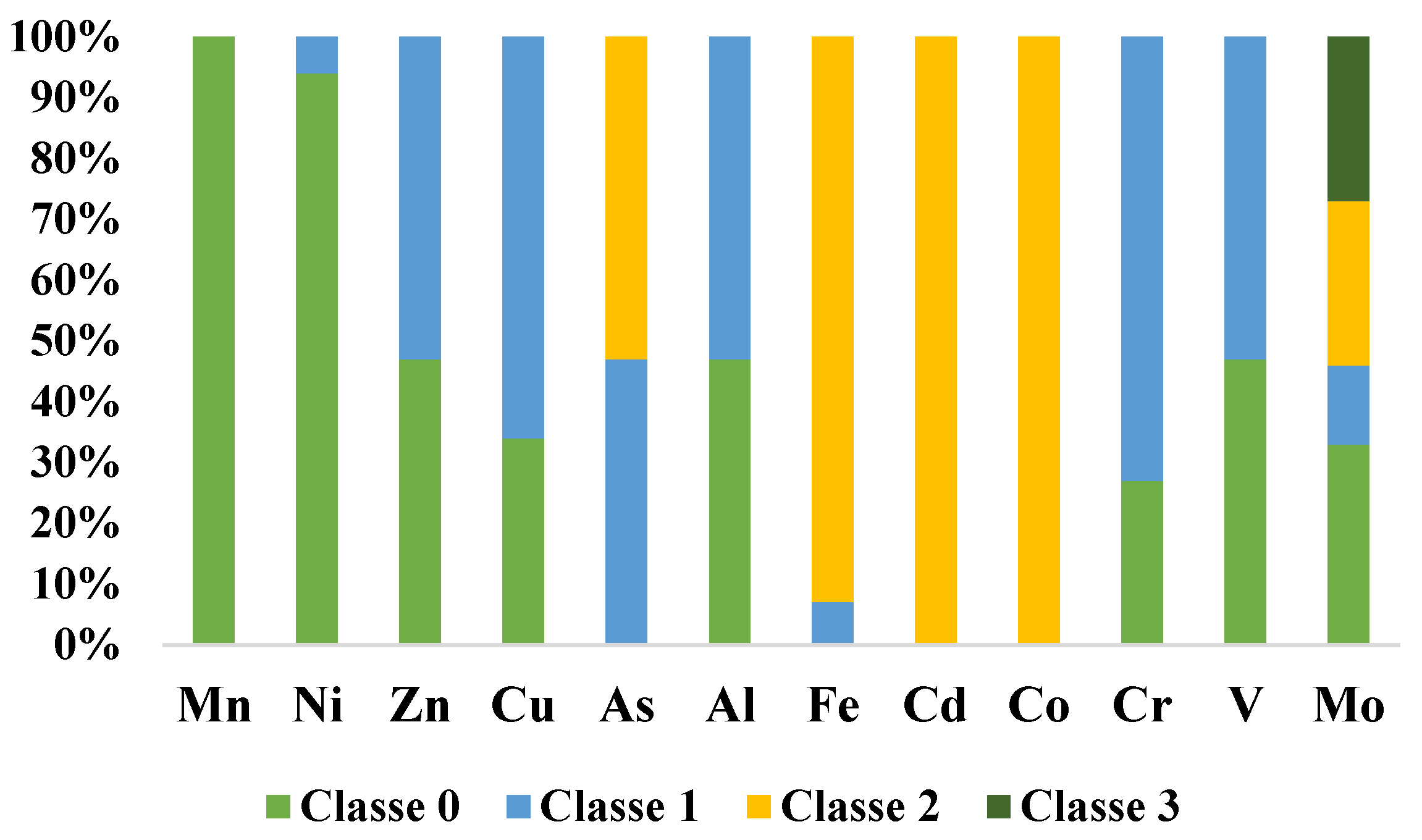
| Class | Value | Pollution Level Description |
|---|---|---|
| 0 | Igeo ≤ 0 | Unpolluted |
| 1 | 0 < Igeo < 1 | Unpolluted to moderately polluted |
| 2 | 1 < Igeo < 2 | Moderately polluted |
| 3 | 2 < Igeo < 3 | Moderately to heavily polluted |
| 4 | 3 < Igeo < 4 | Heavily polluted |
| 5 | 4 < Igeo < 5 | Heavily to extremely polluted |
| 6 | 5 < Igeo | Extremely polluted |
| Index | Interpretation Thresholds |
|---|---|
| CF (Contamination Factor) | CF < 1 → Low contamination 1 ≤ CF < 3 → Moderate 3 ≤ CF < 6 → Considerable CF ≥ 6 → Very high contamination |
| Cd (Degree of Contamination) | Cd < 8 → Low 8–16 → Moderate 16–32 → Considerable >32 → Very high contamination |
| mCd (Modified degree of contamination) | <1.5 = low; 1.5–2 = moderate; >2 = considerable |
| PLI (Pollution Load Index) | PLI = 1 → baseline level; <1 → no pollution; >1 → polluted |
| PI Nemerow | PI < 1 = clean; 1–2 = slight pollution; 2–3 = moderate; >3 = heavy pollution |
| Value | Classification |
|---|---|
| EF < 2 | No enrichment and no anthropogenic input detectable in sediment |
| EF > 2 | Enrichment and an anthropogenic source of metals. |
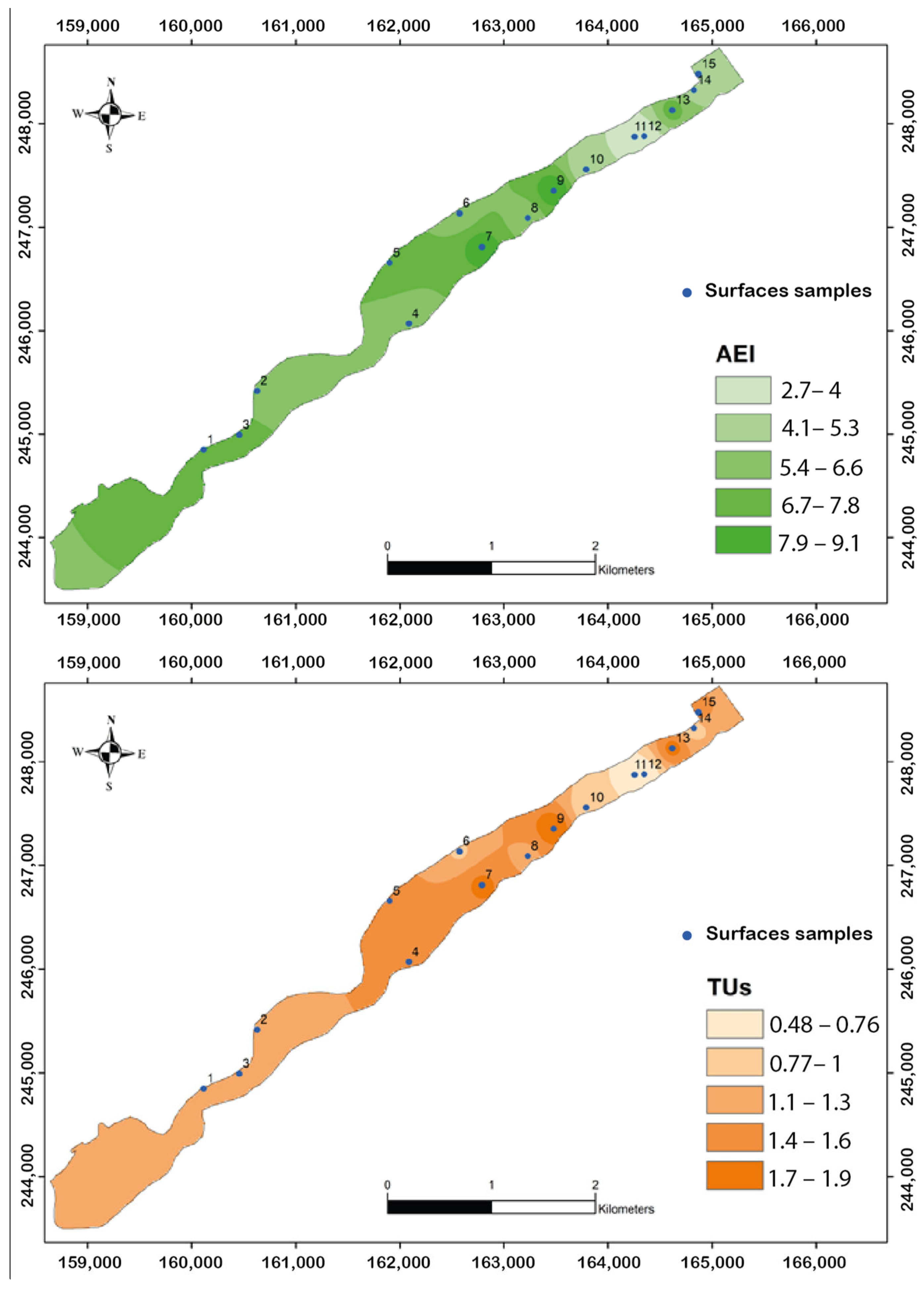
| AEI Value | Interpretation |
|---|---|
| AEI < 1 | Not enough to induce an adverse biological effect (or a moderate impact is suspected) |
| AEI > 1 | Adverse effects on biota are likely. |
| ΣTUs Value | Interpretation |
|---|---|
| ΣTUs < 4 | Low toxicity for an ecosystem |
| ΣTUs > 4 | Moderate ecosystem toxicity |
| Station | Latitude | Longitude | Sand% | Mud% | OM% | TC% |
|---|---|---|---|---|---|---|
| S1 | 1,601,144 | 244,848.9 | 97.4 | 2.6 | 8.79 | 5.10 |
| S2 | 160,628.9 | 245,416.5 | 89.63 | 10.37 | 9.81 | 5.69 |
| S3 | 160,457.9 | 244,991 | 93.92 | 6.08 | 13.16 | 7.63 |
| S4 | 162,086.6 | 246,066.2 | 24.18 | 75.82 | 15.59 | 9.04 |
| S5 | 161,901 | 246,654.3 | 76.48 | 23.52 | 10.21 | 5.92 |
| S6 | 162,573.3 | 247,133.6 | 83.36 | 16.64 | 13.19 | 7.65 |
| S7 | 162,790 | 246,808.4 | 35.82 | 64.18 | 14.67 | 8.51 |
| S8 | 163,229.7 | 247,088.1 | 39.61 | 60.39 | 16.6 | 9.63 |
| S9 | 163,478.2 | 247,351.6 | 28.33 | 71.67 | 16.39 | 9.50 |
| S10 | 163,789.6 | 247,557.1 | 30.78 | 69.22 | 13.09 | 7.59 |
| S11 | 164,255.5 | 247,874.7 | 84.37 | 15.63 | 14.93 | 8.66 |
| S12 | 164,347.3 | 247,879.5 | 82.02 | 17.98 | 15.78 | 9.15 |
| S13 | 164,618.7 | 248,130.2 | 6.77 | 93.23 | 19.10 | 11.08 |
| S14 | 164,825.9 | 248,325 | 82.9 | 17.01 | 10.90 | 6.32 |
| S15 | 164,867.4 | 248,480.6 | 5.86 | 94.14 | 19.18 | 11.12 |
| Station | As | Cd | Fe | Zn | Cu | Al | Co | Cr | Mo | V | Mn | Ni |
|---|---|---|---|---|---|---|---|---|---|---|---|---|
| S1 | 30.63 | 1.73 | 3440.46 | 0 | 0.09 | 640.7 | 2.12 | 5.7 | 1.89 | 2.1 | 100.46 | 0 |
| S2 | 25.80 | 1.69 | 2433.36 | 0 | 4.48 | 694.87 | 2.01 | 5.71 | 43.68 | 4.01 | 76.85 | 0 |
| S3 | 28.07 | 1.68 | 3618.1 | 0 | 1.81 | 822.55 | 2.11 | 8.84 | 32.35 | 11.8 | 109.15 | 0 |
| S4 | 5.30 | 1.06 | 14,817.35 | 132.73 | 14.17 | 9082.04 | 5.99 | 41.9 | 2.64 | 23.45 | 176.76 | 10.678 |
| S5 | 32.05 | 1.67 | 7171.8 | 24.19 | 2.30 | 3125.83 | 3.24 | 13.48 | 0 | 17.91 | 145.79 | 0.983 |
| S6 | 19.12 | 1.59 | 6495.77 | 5.43 | 3.29 | 2491.79 | 3.15 | 12.97 | 0 | 18.36 | 84.83 | 0.821 |
| S7 | 41.16 | 1.23 | 10,640.06 | 38.07 | 5.24 | 4551.96 | 3.87 | 18.96 | 0.09 | 28.02 | 110.96 | 3.084 |
| S8 | 18.72 | 0.93 | 11,286.86 | 40.14 | 7.86 | 6492.32 | 4.29 | 26.15 | 8.29 | 15.28 | 113.10 | 7.939 |
| S9 | 37.36 | 1.33 | 10,128.38 | 31.73 | 9.15 | 6372.07 | 4.76 | 25.96 | 3.34 | 15.34 | 107.26 | 12.116 |
| S10 | 5.26 | 1.49 | 8761.29 | 23.09 | 6.58 | 4055.99 | 3.59 | 20.92 | 0 | 14.87 | 99.76 | 3.774 |
| S11 | 1 | 1.37 | 3013.09 | 4.03 | 6.44 | 1204.35 | 2.28 | 7.65 | 0 | 5.14 | 79.85 | 0.415 |
| S12 | 2.72 | 1.58 | 3182.59 | 4.88 | 1.55 | 1463.32 | 2.24 | 9.31 | 3.11 | 3.18 | 85.33 | 0.489 |
| S13 | 20.26 | 1 | 19,530.98 | 76.60 | 13.53 | 10,646.94 | 6.65 | 40.07 | 78.78 | 29.86 | 152.57 | 14.006 |
| S14 | 16.29 | 1.63 | 3382.03 | 0.88 | 0 | 1293.11 | 2.13 | 7.95 | 27.99 | 4.5 | 84.07 | 0 |
| S15 | 1.2 | 1.34 | 19,721.55 | 89.34 | 6.95 | 11,600.57 | 7.2 | 45.91 | 112.2 | 25.01 | 171.46 | 18.6 |
| Min | 1 | 0.93 | 2433.36 | 0 | 0 | 640.7 | 2.01 | 5.7 | 0 | 2.1 | 76.85 | 0 |
| Max | 41.16 | 1.73 | 19,721.55 | 132.73 | 14.17 | 11,600.57 | 7.2 | 45.91 | 112.2 | 29.86 | 176.76 | 18.6 |
| Mean | 18.99 | 1.42 | 8508.24 | 31.41 | 5.56 | 4302.56 | 3.71 | 19.43 | 20.96 | 14.59 | 113.2 | 4.86 |
| Cd | Cr | Cu | Ni | Zn | As | Mo | Co | V | Fe | Al | Mn | References | |
|---|---|---|---|---|---|---|---|---|---|---|---|---|---|
| Oualidia lagoon (Morocco) | 1.42 | 19.43 | 5.56 | 4.86 | 31.41 | 18.99 | 20.96 | 3.71 | 14.59 | 8508.24 | 4302.56 | 113.2 | Present study |
| Oualidia lagoon (Morocco) | 0.66 | 102.2 | 17.72 | 15.73 | 75.86 | 10.99 | - | 13.1 | 76.93 | 37,700 | - | 11,100 | [11] |
| Oualidia lagoon (Morocco) | 0.3 | 64 | 58 | - | 229.9 | - | - | - | - | 69,000 | 110,000 | - | [9] |
| Oualidia lagoon (Morocco) | 0.2 | 52.5 | 36.4 | - | 227 | - | - | - | - | 69,000 | - | - | [46] |
| Oualidia lagoon (Morocco) | 0.58 | 68 | 17 | 28 | 104 | - | - | - | - | 27,000 | - | 244 | [89] |
| Oualidia lagoon (Morocco) | - | - | 23 | 21 | 63 | - | - | - | - | 9000 | - | 148 | [56] |
| S.moussa lagoon (Morocco) | 1.87 | 96.33 | 15.73 | 26.59 | 57.83 | 6.43 | - | 23.51 | 67.27 | 12,050 | 7160 | 130.7 | [87] |
| Nador lagoon (Morocco) | 1.6 | 71.6 | 150.8 | 45.2 | 554.9 | - | - | - | - | - | - | - | [12] |
| Nador lagoon (Morocco) | - | 372.95 | 45.9 | 124.8 | 163.25 | - | - | - | - | - | - | - | [88] |
| Safi bay (Morocco) | 0.39 | 11.34 | 3.85 | 10.69 | 36.54 | - | - | - | - | - | - | - | [74] |
| Ebrié lagoon (Côte d’Ivoire) | 0.71 | 157.9 | 28.2 | - | 149 | 6.96 | - | 8.32 | 72.6 | 31,000 | - | 120 | [23] |
| Bizerte lagoon (Tunis) | 0.9 | 21.6 | 23.1 | 142.9 | 834 | - | - | - | - | 13,428 | - | 171.9 | [90] |
| Bizerte lagoon (Tunis) | 1.51 | - | 27.28 | 71.81 | 148.52 | - | - | - | - | 41,727 | - | - | [91] |
| Venice lagoon (Italy) | 0.42 | 47.3 | 8.4 | 12.7 | 61.6 | - | - | - | - | 13,383 | - | 339 | [92] |
| Thau lagoon (France) | 0.28 | 21.8 | 18.7 | 8.9 | 36.1 | - | - | - | - | 6098 | - | 190 | [92] |
| Mic River (Romania) | 0.16 | 22.62 | 32.62 | 26.58 | 97.71 | - | - | - | - | 18,410 | - | 694.8 | [93] |
| LBV (Oualidia lagoon) | 0.127 | 43.47 | 5.27 | 19 | 23.57 | 11.89 | - | 7.86 | 33.46 | 11,299 | - | 100 | [11] |
| LBV (Oualidia lagoon) | 0.15 | 38.4 | 26.6 | 206 | 142.3 | - | - | - | - | - | - | - | [9] |
| Upper Continental Crust | 0.102 | 35 | 14.3 | 83 | 52 | 2 | 1.4 | 11.6 | 53 | 30,890 | 77,440 | 527 | [94] |
| Station | CF (As) | CF (Cu) | CF (Zn) | CF (Co) | CF (Cd) | CF (V) | CF (Mo) | CF (Cr) | CF (Ni) | CF (Fe) | CF (Al) | CF (Mn) | Cd | mCd | PLI | PI Nemerow |
|---|---|---|---|---|---|---|---|---|---|---|---|---|---|---|---|---|
| S1 | 30.63 | 0.02 | ND | 21.25 | 49.62 | 0.1 | 4.74 | 0.51 | ND | 0.88 | 0.15 | 0.09 | 134.2 | 7.45 | 0.99 | 35.49 |
| S2 | 25.80 | 1.12 | ND | 20.09 | 48.31 | 0.2 | 109.2 | 0.51 | ND | 0.62 | 0.16 | 0.06 | 247.6 | 13.7 | 1.64 | 77.83 |
| S3 | 28.07 | 0.45 | ND | 21.15 | 48.08 | 0.59 | 80.89 | 0.8 | ND | 0.93 | 0.19 | 0.09 | 216.3 | 12 | 1.79 | 57.82 |
| S4 | 5.30 | 3.54 | 6.63 | 59.91 | 30.28 | 1.17 | 6.62 | 3.8 | 0.53 | 3.81 | 2.16 | 0.16 | 194.8 | 10.8 | 2.93 | 43.05 |
| S5 | 32.05 | 0.57 | 1.2 | 32.4 | 47.85 | 0.89 | ND | 1.22 | 0.04 | 1.84 | 0.74 | 0.13 | 153.1 | 8.5 | 1.44 | 34.36 |
| S6 | 19.12 | 0.82 | 0.27 | 31.56 | 45.68 | 0.91 | ND | 1.17 | 0.04 | 1.67 | 0.59 | 0.07 | 138 | 7.66 | 1.28 | 32.76 |
| S7 | 41.16 | 1.31 | 1.9 | 38.75 | 35.31 | 1.4 | 0.22 | 1.72 | 0.15 | 2.74 | 1.08 | 0.1 | 176 | 9.78 | 1.79 | 29.91 |
| S8 | 18.72 | 1.96 | 2 | 42.97 | 26.77 | 0.76 | 20.72 | 2.37 | 0.39 | 2.9 | 1.54 | 0.1 | 189.1 | 10.5 | 2.51 | 31.28 |
| S9 | 37.36 | 2.28 | 1.58 | 47.65 | 38.2 | 0.76 | 8.35 | 2.36 | 0.6 | 2.61 | 1.51 | 0.09 | 191.3 | 10.6 | 2.44 | 34.52 |
| S10 | 5.26 | 1.64 | 1.15 | 35.9 | 42.6 | 0.74 | ND | 1.9 | 0.18 | 2.25 | 0.96 | 0.09 | 136.6 | 7.59 | 1.66 | 30.6 |
| S11 | 1 | 1.61 | 0.2 | 22.89 | 39.2 | 0.25 | ND | 0.69 | 0.02 | 0.77 | 0.28 | 0.07 | 109.7 | 6.09 | 0.83 | 28.05 |
| S12 | 2.72 | 0.38 | 0.24 | 22.4 | 45.34 | 0.15 | 7.79 | 0.84 | 0.02 | 0.82 | 0.34 | 0.07 | 127.7 | 7.09 | 0.96 | 32.44 |
| S13 | 20.26 | 3.38 | 3.83 | 66.51 | 28.65 | 1.49 | 196.96 | 3.64 | 0.7 | 5.03 | 2.53 | 0.13 | 426.1 | 23.6 | 0.96 | 140.27 |
| S14 | 16.29 | ND | 0.04 | 21.37 | 46.77 | 0.22 | 69.98 | 0.72 | ND | 0.87 | 0.3 | 0.07 | 199 | 11 | 1.48 | 50.1 |
| S15 | 1.2 | 1.73 | 4.46 | 72.02 | 38.37 | 1.25 | 280.5 | 4.17 | 0.93 | 5.08 | 2.76 | 0.16 | 497.8 | 27.6 | 3.07 | 199.3 |
| Mean | 18.9 | 1.39 | 1.57 | 37.12 | 40.73 | 0.72 | 52.4 | 1.76 | 0.24 | 2.19 | 1.02 | 0.1 | 209.20 | 11.62 | 1.7 | 57.18 |
| Min | 1 | 0.02 | 0.04 | 20.09 | 26.77 | 0.1 | 0.22 | 0.51 | 0.02 | 0.62 | 0.15 | 0.06 | 109.7 | 6.09 | 0.83 | 28.05 |
| Max | 41.16 | 3.54 | 6.63 | 72.02 | 49.62 | 1.49 | 280.5 | 4.17 | 0.93 | 5.08 | 2.76 | 0.16 | 497.8 | 27.6 | 3.07 | 199.3 |
Disclaimer/Publisher’s Note: The statements, opinions and data contained in all publications are solely those of the individual author(s) and contributor(s) and not of MDPI and/or the editor(s). MDPI and/or the editor(s) disclaim responsibility for any injury to people or property resulting from any ideas, methods, instructions or products referred to in the content. |
© 2026 by the authors. Licensee MDPI, Basel, Switzerland. This article is an open access article distributed under the terms and conditions of the Creative Commons Attribution (CC BY) license.
Share and Cite
Bensemlali, H.; El Khalidi, K.; Minoubi, A.; Mejjad, N.; Bouchkara, M.; Nasrellah, H.; Zourarah, B. Monitoring the Ecological and Geochemical Impacts of Coastal Development and Management on the Oualidia Lagoon. Oceans 2026, 7, 15. https://doi.org/10.3390/oceans7010015
Bensemlali H, El Khalidi K, Minoubi A, Mejjad N, Bouchkara M, Nasrellah H, Zourarah B. Monitoring the Ecological and Geochemical Impacts of Coastal Development and Management on the Oualidia Lagoon. Oceans. 2026; 7(1):15. https://doi.org/10.3390/oceans7010015
Chicago/Turabian StyleBensemlali, Hafssa, Khalid El Khalidi, Abdenaim Minoubi, Nezha Mejjad, Mohammed Bouchkara, Hamid Nasrellah, and Bendahhou Zourarah. 2026. "Monitoring the Ecological and Geochemical Impacts of Coastal Development and Management on the Oualidia Lagoon" Oceans 7, no. 1: 15. https://doi.org/10.3390/oceans7010015
APA StyleBensemlali, H., El Khalidi, K., Minoubi, A., Mejjad, N., Bouchkara, M., Nasrellah, H., & Zourarah, B. (2026). Monitoring the Ecological and Geochemical Impacts of Coastal Development and Management on the Oualidia Lagoon. Oceans, 7(1), 15. https://doi.org/10.3390/oceans7010015