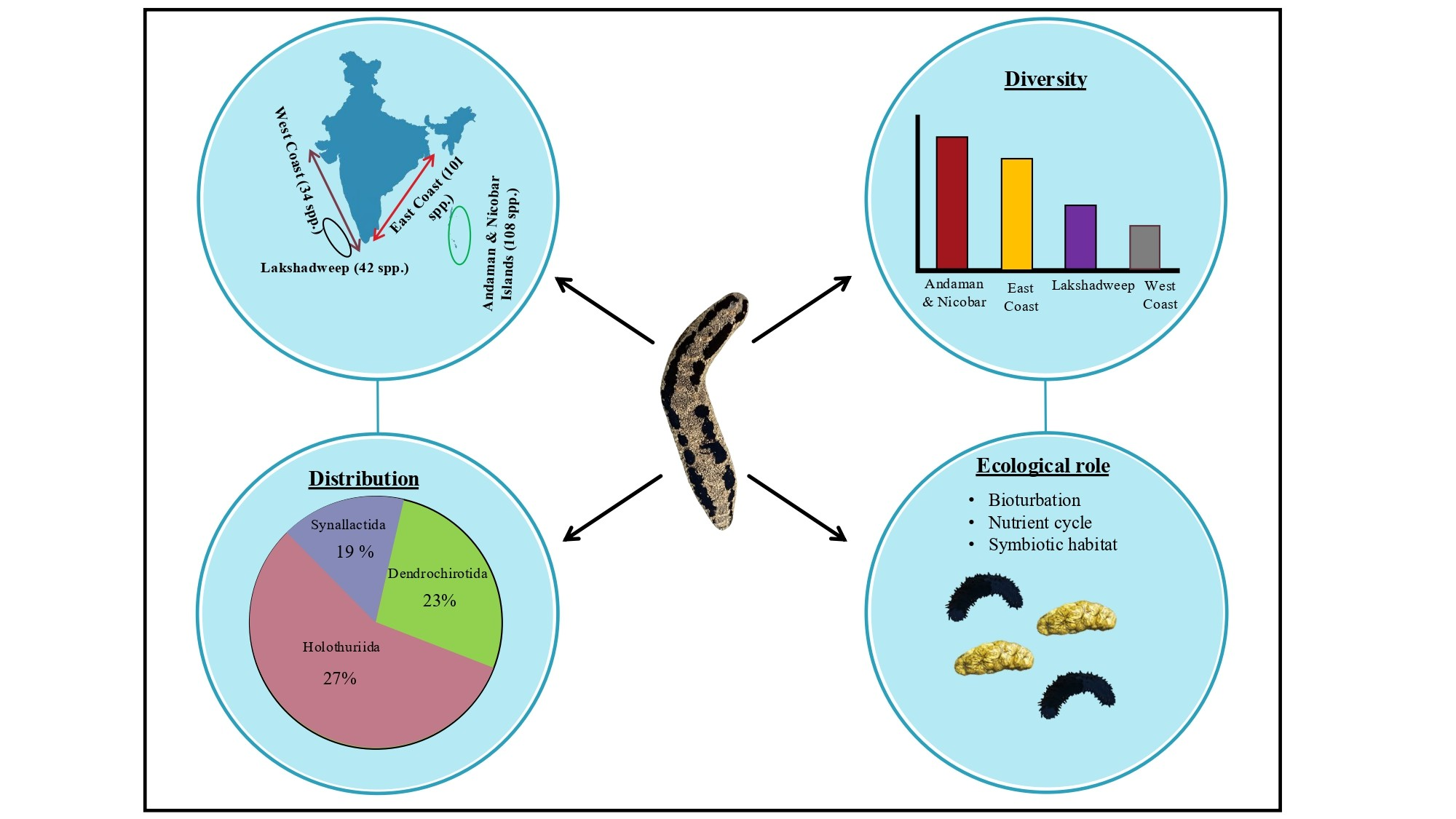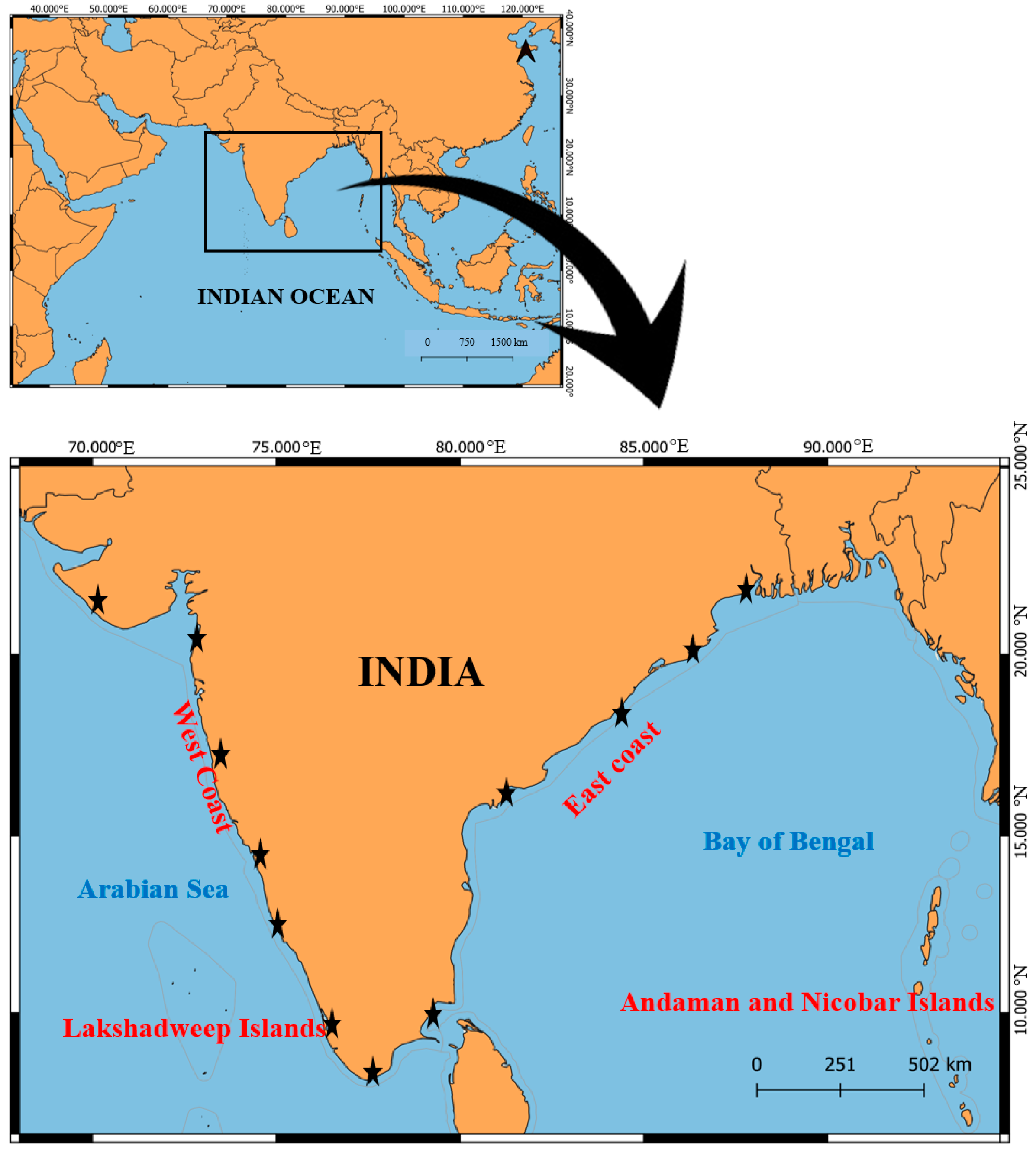

Annotated Checklist and Biodiversity of Sea Cucumbers (Holothuroidea) in Indian Waters



Abstract
1. Introduction
2. Materials and Methods
3. Results
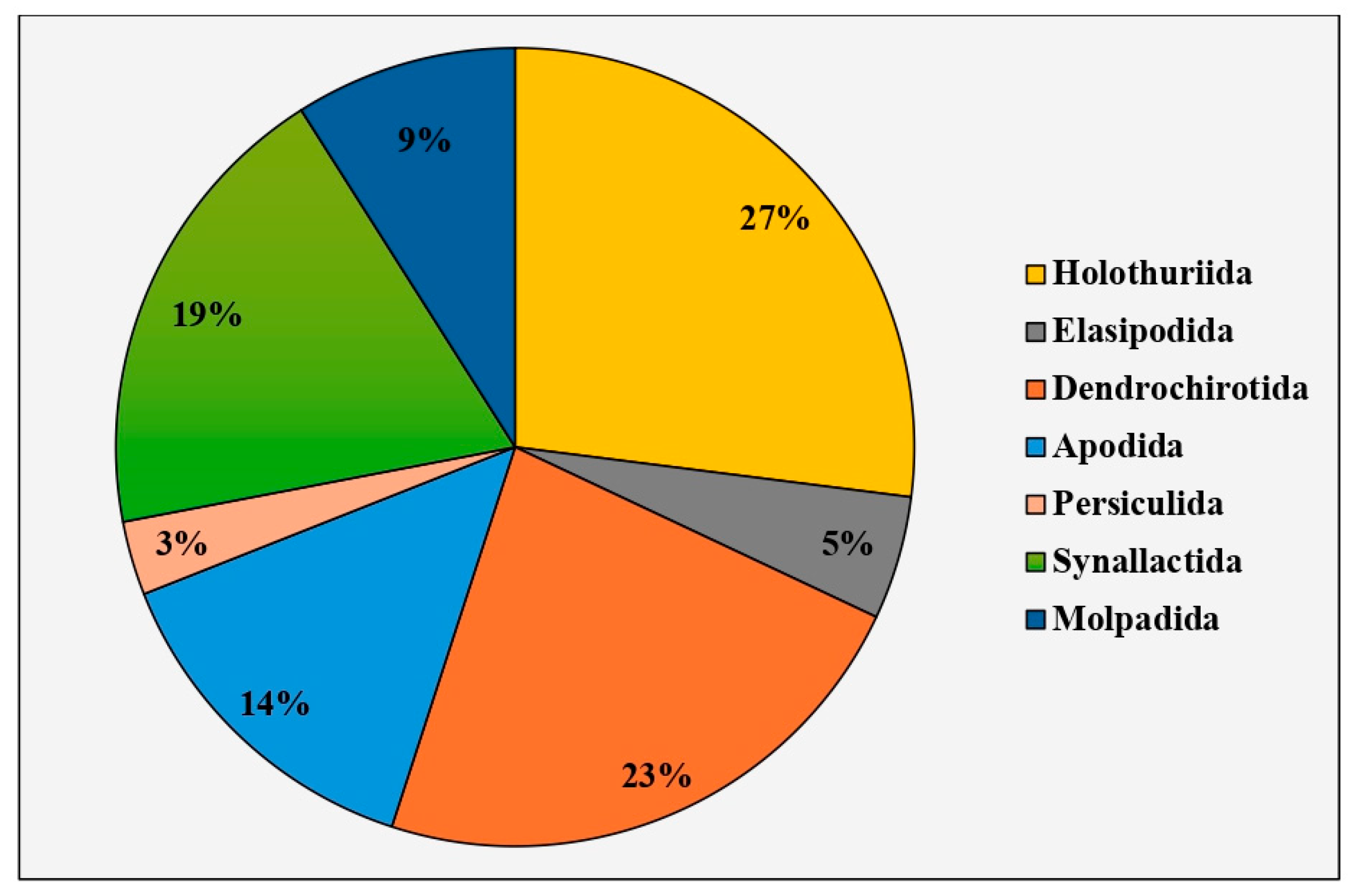
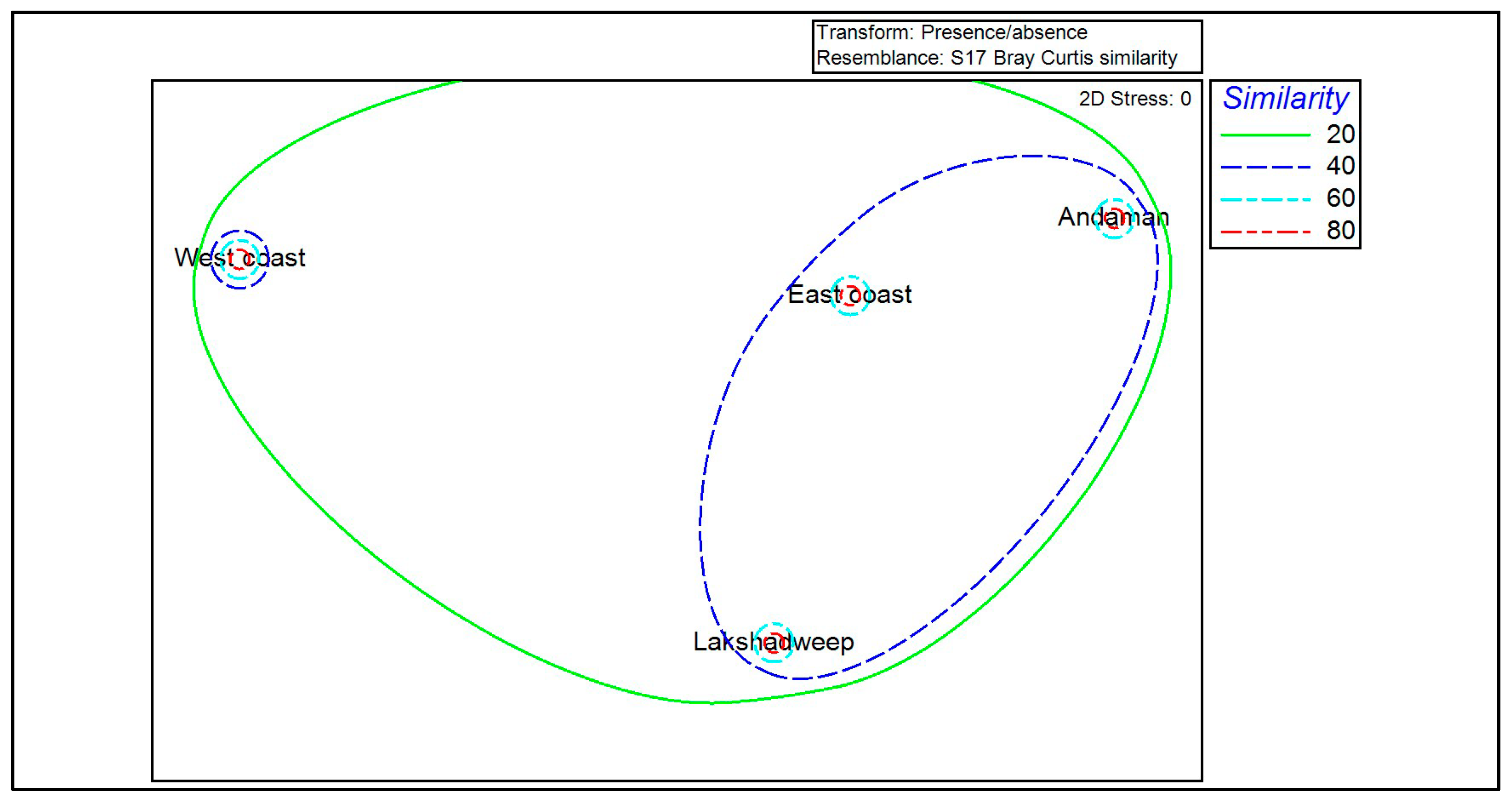
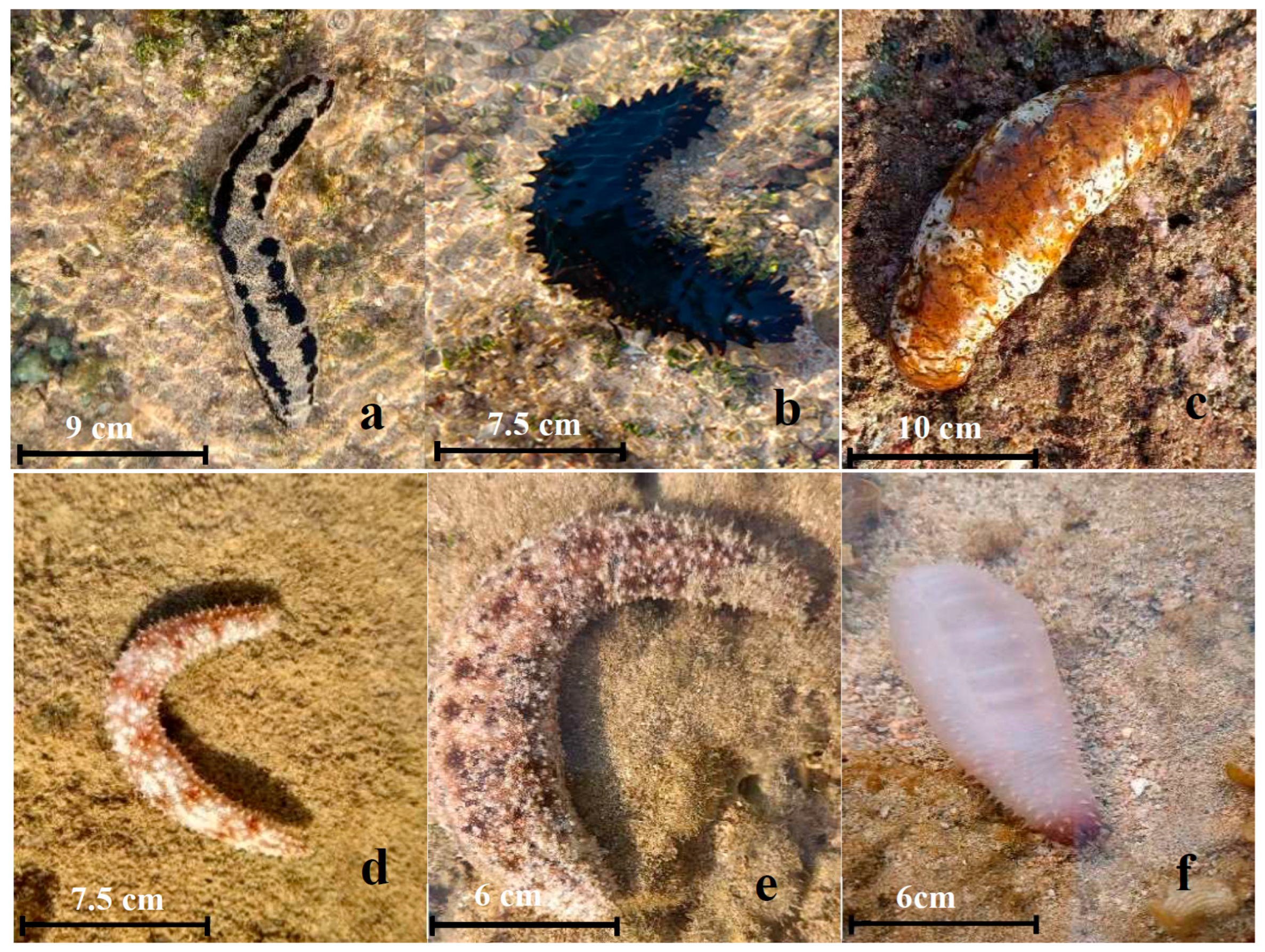
Diversity
4. Discussion
5. Conclusions
Author Contributions
Funding
Institutional Review Board Statement
Informed Consent Statement
Data Availability Statement
Acknowledgments
Conflicts of Interest
References
- Gallo, N.D.; Cameron, J.; Hardy, K.; Fryer, P.; Bartlett, D.H.; Levin, L.A. Submersible- and lander-observed community patterns in the Mariana and New Britain trenches: Influence of productivity and depth on epibenthic and scavenging communities. Deep Sea Res. Part I 2015, 99, 119–133. [Google Scholar] [CrossRef] [Scilit]
- Harini, R.; Natarajan, V.; Sunil, C.K. Sea cucumber significance: Drying techniques and India’s comprehensive status. J. Food Sci. 2024, 89, 3995–4018. [Google Scholar] [CrossRef] [Scilit] [PubMed]
- Fransen, C.H.J.M.; Hoeksema, B. Going for the stars: Extending the host record for the reef-dwelling Emperor shrimp, Periclimenes imperator (Pontoniinae). Mar. Biodivers. 2014, 44, 465–466. [Google Scholar] [CrossRef] [Scilit]
- James, D.B. Indian echinoderms: Their resources, biodiversity, zoogeography and conservation. In Glimpses of Aquatic Biodiversity; Natarajan, P., Jayachandran, K.V., Kannaiyan, S., Ambat, B., Agustine, A., Eds.; Rajiv Gandhi Chair Special Publication: Kochi, India, 2008; Volume 7, pp. 120–132. [Google Scholar]
- Koehler, R.; Vaney, C. An Account of the Deep-Sea Holothurioidea Collected by the Royal Indian Marine Survey Ship Investigator. In Echinoderma of the Indian Museum: Holothurioidea; Alcock, A., Ed.; Indian Museum: Calcutta, India, 1905; pp. 1–124. [Google Scholar]
- Koehler, R.; Vaney, C. An Account of the Littoral Holothurioidea Collected by the Royal Indian Marine Survey Ship Investigator. In Echinoderma of the Indian Museum: Holothurioidea; Alcock, A., Ed.; Indian Museum: Calcutta, India, 1908; pp. 1–54. [Google Scholar]
- James, D.B. Studies on Indian echinoderms on Protankyra tuticorenensis sp. nov. and other apodous holothurians from the Indian seas. J. Mar. Biol. Assoc. India 1982, 24, 92–105. [Google Scholar]
- James, D.B. Research on Indian echinoderms-A review. J. Mar. Biol. Assoc. India 1983, 25, 91–108. [Google Scholar]
- Soota, T.D.; Mukhopadhyay, S.K.; Samanta, T.K. On some holothurians from the Andaman and Nicobar Islands. Rec. Zool. Surv. India 1983, 80, 507–524. [Google Scholar]
- Mukhopadhyay, S.K.; Samanta, T.K. On a collection of shallow-water Holothurians from the Lakshadweep. Rec. Zool. Surv. India 1983, 81, 299–314. [Google Scholar] [CrossRef] [Scilit]
- James, P.S.; Thomas, P.A.; Pillai, C.S.G.; Achari, G.P.; Thomas, M.M.; James, D.B. Catalogue of types and of sponges, corals, polychaetes, crabs and echinoderms in the reference collections of the Central Marine Fisheries Research Institute. CMFRI Bull. 1969, 7, 60–66. [Google Scholar]
- Purcell, S.W.; Lovatelli, A.; Gonzalez Wanguemert, M.; Solis Marin, F.A.; Samyn, Y.; Conand, C. Commercially Important Sea Cucumber; FAO: Rome, Italy, 2023. [Google Scholar]
- James, D.B. Resources, exploitation, conservation and management of holothurians: Holothurian resources from India and their exploitation. CMFRI Bull. 1994, 46, 27–31. [Google Scholar]
- Netchy, K.; Samyn, Y.; Paulay, G. Dividing the monopoly: The most broadly distributed Actinopyga is two species (Holothuroidea: Holothuriidae). Zootaxa 2025, 5673, 27–44. [Google Scholar] [CrossRef] [Scilit]
- Purcell, S.W.; Conand, C.; Uthicke, S.; Byrne, M. Ecological Roles of Exploited Sea Cucumbers. In Oceanography and Marine Biology; CRC Press: Boca Raton, FL, USA, 2016; pp. 375–394. [Google Scholar]
- Rasyid, A.; Yasman, Y.; Putra, M.Y.Y. Current prospects of nutraceutical and pharmaceutical use of sea cucumbers. Pharmacia 2021, 68, 561–572. [Google Scholar]
- Siahaan, E.A.; Pangestuti, R.; Munandar, H.; Kim, S.K. Cosmeceutical properties of sea cucumbers: Prospects and trends. Cosmetics 2017, 4, 26. [Google Scholar] [CrossRef] [Scilit]
- Khotimchenko, Y. Pharmacological potential of sea cucumbers. Int. J. Mol. Sci. 2018, 19, 1342. [Google Scholar] [CrossRef] [Scilit] [PubMed]
- Siddiqui, R.; Boghossian, A.; Khan, N.A. Sea cucumber as a therapeutic aquatic resource for human health. Fish. Aquat. Sci. 2022, 25, 251–263. [Google Scholar] [CrossRef] [Scilit]
- Barzkar, N.; Attaran-Fariman, G.; Taheri, A.; Venmathi Maran, B.A. Extraction and characterization of collagen and gelatin from body wall of sea cucumber Stichopus horrens and Holothuria arenicola. PeerJ 2024, 12, e18149. [Google Scholar] [CrossRef] [Scilit]
- Choo, P.S. Population Status, Fisheries and Trade of Sea Cucumbers in Asia; FAO: Rome, Italy, 2008. [Google Scholar]
- Liao, Y.L. Fauna Sinica, Phylum Echinodermata, Class Holothuroidea; Science Press: Beijing, China, 1997; 334p. [Google Scholar]
- Jeng, M.–S. Shallow-water echinoderms of Taiping Island in the South China Sea. Zool. Stud. 1998, 37, 137–153. [Google Scholar]
- Chao, S.M. Shallow Water Sea Cucumbers of Taiwan; National Museum of Natural Science: Taichung, Taiwan, 1998; 170p. [Google Scholar]
- Otero-Villanueva, M.; Ut, V.T. Sea cucumber fisheries around Phu Quoc Archipelago: A cross-border issue between South Viet Nam and Cambodia. SPC Bech Mer Inf. Bull. 2007, 25, 32–36. [Google Scholar]
- Massin, C. Reef dwelling Holothuroidea (Echinodermata) of the Spermonde Archipelago (South-West Sulawesi, Indonesia). Zool. Verh. 1999, 329, 1–144. [Google Scholar]
- Forbes, R.; Ilias, Z.; Baine, M.; Choo, P.S.; Walbank, A. A Taxonomic Key and Field Guide to the Sea Cucumbers of Malaysia; Heriot-Watt University: Edinburgh, UK, 1999; 62p. [Google Scholar]
- Zaidnuddin, I. Sea Cucumber Species Diversity and Abundance from the South-Western Waters of Balik Pulau, Penang. In Workshop on the Impact of Development on the Coastal Fisheries off South-West Penang Island; Choo, P.S., Ismail, I., Chee, P.E., Chuah, T.T., Eds.; Fisheries Research Institute: Penang, Malaysia, 2002; pp. 57–62. [Google Scholar]
- Bussarawit, S.; Thongtham, N. Sea Cucumber Fisheries and Trade in Thailand. In The Conservation of Sea Cucumbers in Malaysia: Their Taxonomy, Ecology and Trade, Proceedings of an International Conference, Kuala Lumpur, Malaysia, 25 February 1999; Baine, M., Ed.; Heriot-Watt University: Edinburgh, UK, 1999; pp. 26–36. [Google Scholar]
- Mucharin, A.; Putchakarn, S. New Thai record: Holothuria (Stauropora) discrepans Semper, 1868. Thail. Nat. Hist. Mus. J. 2005, 1, 1–8. [Google Scholar]
- Muthiga, N. Field observations of sea cucumbers at North Male Atoll in the Maldives. SPC Bech Mer Inf. Bull. 2008, 27, 33–37. [Google Scholar]
- Lampe-Ramdoo, K.; Pillay, R.M.; Conand, C. An assessment of holothurian diversity, abundance and distribution in the shallow lagoons of Mauritius. SPC Beche Mer Inf. Bull. 2014, 34, 17–24. [Google Scholar]
- Mahdy, A.; Omar, H.A.; Nasser, S.A.M.; Abd El-Wakeil, K.F.; Obuid-Allah, A.H. Community structure of echinoderms in littoral zone of the Red Sea coast of Egypt. Egypt. J. Aquat. Biol. Fish. 2019, 22, 483–498. [Google Scholar] [CrossRef] [Scilit]
- Ahmed, Q.; Ali, Q.M.; Mubarak, S.; Farooq, S. Studies on the seasonal abundance and diversity of echinoderms (Asteroidea, Ophiuroidea, Echinoidea, and Holothuroidea) from coastal areas of Karachi (Northern Arabian Sea). Pak. J. Mar. Sci. 2016, 25, 101–117. [Google Scholar]
- Moazzam, M.; Moazzam, N. Annotated checklist of sea cucumbers from Pakistan with new records of Holothuria (Theelothuria) hamata (Pearson, 1913) and Stichopus herrmanni (Semper, 1868). SPC Beche Mer Inf. Bull. 2020, 41, 32–39. [Google Scholar]
- Clark, A.M.; Rowe, F.W.E. Monograph of Shallow-Water Indo-West Pacific Echinoderms; Trustees of the British Museum: London, UK, 1971; pp. 171–210. [Google Scholar]
- Dissanayake, D.C.T.; Stefansson, G. Abundance and distribution of commercial sea cucumber species in the coastal waters of Sri Lanka. Aquat. Living Resour. 2010, 23, 303–313. [Google Scholar] [CrossRef] [Scilit]
- James, D.B. The holothurian resources. R&D Ser. Mar. Fish. Resour. Manag. 1986, 10, 1–4. [Google Scholar]
- Hornell, J. Indian beche-de-mer industry: Its history and recent revival. Madras Fish. Bull. 1917, 11, 119–150. [Google Scholar]
- Asha, P.S.; Diwakar, K.; Santhanavalli, G.; Manisseri, M.K. Comparative distribution and habitat preference of the sea cucumber Holothuria atra Jaeger at protected and unprotected sites in Thoothukudi region of Gulf of Mannar, south-east coast of India. Indian J. Fish. 2015, 62, 52–57. [Google Scholar]
- Conand, C.; Claereboudt, M.; Dissayanake, C.; Ebrahim, A.; Fernando, S.; Godvinden, R.; Friedman, K. Review of fisheries and management of sea cucumbers in the Indian Ocean. West. Indian Ocean J. Mar. Sci. 2022, 21, 125–148. [Google Scholar] [CrossRef] [Scilit]
- Asha, P.S.; Vinod, K.; Ranjith, L.; Johnson, B.; Vivekanandan, E. Conservation and Sustainable Use of Sea Cucumber Resources in India: Suggestions and Way Forward; CMFRI Marine Fisheries Policy Series No. 7; Central Marine Fisheries Research Institute: Kochi, India, 2017; pp. 1–77. [Google Scholar]
- World Register of Marine Species (WoRMS). Flanders Marine Institute (VLIZ). Available online: https://www.marinespecies.org (accessed on 5 December 2025).
- Chandra, K.; Raghunathan, C. Faunal Diversity of Biogeographic Zones: Islands of India; Zoological Survey of India: Calcutta, India, 2018; pp. 1–523. [Google Scholar]
- Rao, G.C. On a new interstitial species of Trochodota (Apodida, Holothurioidea) from Andamans, India. Curr. Sci. 1975, 44, 508–509. [Google Scholar]
- Sastry, D.R.K. Echinodermata of India: An Annotated List. Rec. Zool. Surv. India Occas. Pap. 2007, 271, 1–387. [Google Scholar]
- James, D.B. Echinoderms of Lakshadweep and their zoogeography. Marine Living Resources of the Union Territory of Lakshadweep: An Indicative Survey with Suggestions for Development. CMFRI Bull. 1989, 43, 97–144. [Google Scholar]
- Rao, G.C. Occurrence of some juvenile stages referable to the apodous holothurian Patinapta ooplax (Marenzeller) in the intertidal sands of Andaman Islands. Proc. Indian Acad. Sci. B 1973, 77, 225–233. [Google Scholar] [CrossRef] [Scilit]
- Mukhopadhyay, S.K. On some holothurians from the Gulf of Mannar, India. Rec. Zool. Surv. India 1988, 85, 1–17. [Google Scholar] [CrossRef] [Scilit]
- Sadhukhan, K.; Raghunathan, C. A general account on community structure of echinoderms in North Andaman. Int. J. Biol. Pharm. Allied Sci. 2012, 1, 44–56. [Google Scholar]
- Sastry, D.R.K.; Rao, Y.K.V.; Ganesh, T.; Rao, M.S.; Sateesh, N.; Bharati, A.; Raman, A.V. On some collections of Echinodermata from Andhra Pradesh and Orissa coasts of India. Rec. Zool. Surv. India 2012, 112, 61–87. [Google Scholar] [CrossRef] [Scilit]
- Kumar, J.S.Y.; Geetha, S. Distribution and new additions to the Class: Holothuroidea in the Gulf of Mannar Islands, India. Int. J. Adv. Biol. Res. 2013, 3, 116–122. [Google Scholar]
- James, D.B. Studies on Indian echinoderms-15. On Psolus mannarensis sp. nov. and other Dendrochirotids from the Indian Seas. J. Mar. Biol. Assoc. India 1984, 26, 109–122. [Google Scholar]
- James, D.B. Sea Cucumbers. In Marine Fisheries Research and Management; Central Marine Fisheries Research Institute (CMFRI): Kochi, India, 2000; pp. 124–153. [Google Scholar]
- Padmini, K.; Ummath, A. First report of the sea cucumber, Bohadschia atra Massin, Rasolofonirina, Conand and Samyn, 1999 (Echinodermata, Holothuroidea), from the Andaman Islands (Indian Ocean). Nat. Acad. Sci. Lett. 2024. [Google Scholar] [CrossRef] [Scilit]
- James, D.B. Taxonomic studies of the species of Holothuria (Linnaeus, 1767) from the seas around India Part I. J. Bombay Nat. Hist. Soc. 1995, 92, 43–62. [Google Scholar]
- James, D.B. Taxonomic studies of the species of Holothuria (Linnaeus, 1767) from the seas around India Part II. J. Bombay Nat. Hist. Soc. 1995, 92, 190–204. [Google Scholar]
- Sastry, D.R.K.; Marimuthu, N.; Rajan, R. Echinodermata of Lakshadweep, Arabian Sea with the description of a new genus and a species. Rec. Zool. Surv. India 2019, 119, 348–372. [Google Scholar] [CrossRef] [Scilit]
- Bell, F.J. Report on a collection of Echinodermata from the Andaman Islands. Proc. Zool. Soc. Lond. 1887, 55, 139–145. [Google Scholar] [CrossRef] [Scilit]
- James, D.B. Echinoderm Fauna of the Proposed National Marine Park in the Gulf of Mannar, Proceedings of the Symposium on Endangered Marine Animals and Marine Parks; Marine Biological Association of India: Kochi, India, 1988; pp. 403–406. [Google Scholar]
- Clark, A.H. Monograph of Shallow-Water Indo-West Pacific Echinoderms; British Museum (Natural History): London, UK, 1971; p. 234. [Google Scholar]
- Sastry, D.R.K. Echinodermata of Andaman and Nicobar Islands, Bay of Bengal: An Annotated List; Occasional Papers No. 233; Zoological Survey of India: Calcutta, India, 2005; pp. 1–207. [Google Scholar]
- James, D.B. Studies on Indian Echinoderms–7. On a new family Labidodematidae (Holothurioidea: Aspidochirotida) with a detailed description of Labidodemas rugosum (Ludwig) from the Andamans. J. Mar. Biol. Assoc. India 1981, 23, 82–85. [Google Scholar]
- James, D.B.; Gandhi, A.D.; Palaniswamy, N.; Rodrigo, J.X. Hatchery techniques and culture of the sea-cucumber Holothuria scabra. CMFRI Spec. Publ. 1994, 57, 1–40. [Google Scholar]
- Venkatraman, C.; Padmanaban, P. On a collection of shallow-water echinoderms of the Gulf of Mannar Biosphere Reserve, southern India. Rec. Zool. Surv. India 2013, 113, 95–114. [Google Scholar] [CrossRef] [Scilit]
- Bell, P.J. Report on a Collection of Echinoderms made at Tuticorin, Madras, by Mr. Edgar Thurston, CMZS, Superintendent, Government Central Museum, Madras. Proc. Zool. Soc. Lond. 1888, 56, 383–389. [Google Scholar] [CrossRef] [Scilit]
- Gopalakrishnan, A.; Divya, P.R.; Basheer, V.S.; Swaminathan, R.; Pandian, K.A.; Bineesh, K.K.; Jena, J.K. Macro Flora & Fauna of the Gulf of Mannar: A Checklist; National Bureau of Fish Genetic Resources: Lucknow, India, 2012; ISBN 978-81-905540-8-4. [Google Scholar]
- James, D.B. Studies on Indian Echinoderms-2. The Holothurian Stolus buccalis (Stimpson) with notes on its systematic position. J. Mar. Biol. Assoc. India 1966, 8, 285–289. [Google Scholar]
- James, D.B. Studies on Indian Echinoderms–6. Descriptions of two little-known holothurians with a note on an early juvenile of Holothuria scabra Jaeger from the Indian Seas. J. Mar. Biol. Assoc. India 1976, 18, 55–61. [Google Scholar]
- Venkatraman, C.; Venkataraman, K.; Rajkumar, R.; Shrinivaasu, S.; Padmanaban, P.; Paramasivam, K.; Sivaperuman, C. Diversity and distribution of Echinoderms in Palk Bay and Gulf of Mannar Biosphere Reserve, Southern India. In Ecology and Conservation of Tropical Marine Faunal Communities; Venkataraman, K., Sivaperuman, C., Raghunathan, C., Eds.; Springer: Berlin/Heidelberg, Germany, 2013; pp. 197–212. [Google Scholar] [CrossRef] [Scilit]
- Koehler, R.; Vaney, C.; Clark, A.H. Echinoderma of the Indian Museum; Order of the Trustees of the Indian Museum: Calcutta, India, 1909. [Google Scholar]
- Asha, P.S.; Muthiah, P. Reproductive biology of the commercial sea cucumber Holothuria spinifera (Echinodermata: Holothuroidea) from Tuticorin, Tamil Nadu, India. Aquac. Int. 2008, 16, 231–242. [Google Scholar] [CrossRef] [Scilit]
- Parameswaran, U.V.; Sanjeevan, V.N.; Abdul Jaleel, K.U.; Jacob, V.; Gopal, A.; Vijayan, A.K.; Sudhakar, M. An updated checklist of echinoderms of the southeastern Arabian Sea. Mar. Biodivers. 2018, 48, 2057–2079. [Google Scholar] [CrossRef] [Scilit]
- Nagabhushanam, A.K.; Rao, G.C. An ecological survey of the marine fauna of Minicoy Atoll (Laccadive Archipelago, Arabian Sea). Mitt. Mus. Nat. Kd. Berl. Zool. Reihe 2008, 48, 265–324. [Google Scholar] [CrossRef] [Scilit]
- Nithyanandan, M.; Marimuthu, N. A new record of holothuriid sea cucumber, Bohadschia atra Massin, Rasolofonirina, Conand and Samyn, 1999 (Echinodermata: Holothuroidea) from India. Thalassas 2021, 37, 813–816. [Google Scholar] [CrossRef] [Scilit]
- Katariya, K.; Hitesh, K.; Gadhiya, S.; Motivarsh, Y.; Kiran, G. Echinodermata diversity along Sikka coast of Gujarat. J. Exp. Zool. India 2021, 24, 649–656. [Google Scholar]
- Deshmukh, A.; Ingole, B.S.; Mukharjee, I.; Sivadas, S.K. First record of the synaptid holothurian Protankyra bidentata (Woodward and Barrett, 1858) from the Indian Ocean. Indian J. Fish. 2015, 62, 157–160. [Google Scholar]
- Anu, S.; Ravinesh, R.; Shijith, B.V.; Kumar, B.A. Biodiversity associated with the mussel beds of Vizhinjam coast, Kerala, India. J. Aquat. Biol. Fish. 2017, 5, 36–53. [Google Scholar]
- Deepa, R.P.; Kumar, A.B. New records of the sea cucumbers Holothuria (Semperothuria) imitans Ludwig and Stichopus herrmanni Semper (Echinodermata: Holothuroidea) from the southwestern coast of India. J. Threat. Taxa 2010, 2, 712–715. [Google Scholar] [CrossRef] [Scilit]
- Bhatt, S.; Mankodi, P.C.; Joshi, D. Diversity of echinoderms at the west coast of Gujarat, India. J. Glob. Biosci. 2022, 11, 9182–9188. [Google Scholar]
- Samuel, V.K.D.; Krishnan, P.; Sreeraj, C.R.; Chamundeeswari, K.; Parthiban, C.; Sekar, V.; Ramesh, R. An updated checklist of Echinoderms from Indian waters. Zootaxa 2017, 4354, 1–68. [Google Scholar] [CrossRef] [Scilit]
- Vinithkumar, N.V.; Sathish, T.; Das, A.K.; Sivaperuman, C.; Raghunathan, C.; Dharani, G.; Kirubagaran, R.; Sujathkumar, N.V. Marine ecosystems of Andaman and Nicobar Islands—Species abundance and distribution. In Biodiversity and Climate Change Adaptation in Tropical Islands; Academic Press: Cambridge, MA, USA, 2018; pp. 217–256. [Google Scholar]
- Raghunathan, C.; Mondal, T.A.M.A.L.; Nigam, N.K. Echinoderm diversity of India. In Current Status of Marine Faunal Diversity in India; Zoological Survey of India: Calcutta, India, 2016; pp. 353–381. [Google Scholar]
- Asha, P.S.; Ranjith, L.; Vivekanandan, E.; Johnson, B.; Subin, C.S.; Sheik Mohamed, M. Spatial variations in the population characteristics of sea cucumber resources in Gulf of Mannar and Palk Bay, south-east coast of India. Indian J. Fish. 2019, 66, 1–11. [Google Scholar] [CrossRef] [Scilit]
- MOEF. Committee Constituted to Holistically Address the Issue of Poaching in the Andaman and Nicobar Islands; Government of India, Ministry of Environment and Forests: New Delhi, India, 2011; p. 29. [Google Scholar]
- Kiruba-Sankar, R.; Lohith Kumar, K.; Saravanan, K.; Praveenraj, J. Poaching in Andaman and Nicobar coasts: Insights. J. Coast. Conserv. 2019, 23, 95–109. [Google Scholar] [CrossRef] [Scilit]
- Arivazhagan, R.; Jamadhagni, S.; Umarhathab, S. Maritime transnational crime: An analysis of coastal Tamil Nadu. YMER Digit. 2022, 21, 610–644. [Google Scholar] [CrossRef] [Scilit]
- Bruckner, A.W.; Johnson, K.A.; Field, J.D. Conservation strategies for sea cucumbers: Can a CITES Appendix II listing promote sustainable international trade? SPC Bech Mer Inf. Bull. 2003, 18, 24–33. [Google Scholar]





| Sl. No | Species | Subclass: Order: Family | Distribution | Reference |
|---|---|---|---|---|
| 1 | Polycheira rufescens (Brandt, 1835) | Paractinopoda Ludwig,1891: Apodida Brandt, 1835: Chiridotidae Östergren, 1898 | Andaman & Nicobar Islands | [7,8,9,44] |
| 2 | Psammothuria ganapati Rao, 1968 | Andaman & Nicobar Islands | [44] | |
| 3 | Taeniogyrus havelockensis (Rao, 1975) | Andaman & Nicobar Islands | [44,45] | |
| 4 | Leptosynapta sp. | Synaptidae Burmeister, 1837 | Andaman & Nicobar Islands | [44] |
| 5 | Labidoplax sp. | Andaman & Nicobar Islands | [46] | |
| 6 | Opheodesoma grisea (Semper, 1867) | Andaman & Nicobar Islands | [7,8,9,11,44,47] | |
| 7 | Patinapta ooplax (Von Marenzeller, 1882) | Andaman & Nicobar Islands | [44,48] | |
| 8 | Protankyra errata Koehler & Vaney, 1905 | Andaman & Nicobar Islands | [9,44] | |
| 9 | Protankyra pseudodigitata (Semper, 1867) | Andaman & Nicobar Islands | [44,49] | |
| 10 | Rynkatorpa timida (Koehler & Vaney, 1905) | Andaman & Nicobar Islands | [44] | |
| 11 | Synapta maculata (Chamisso & Eysenhardt, 1821) | Andaman & Nicobar Islands | [7,9,11,44,50] | |
| 12 | Synaptula recta (Semper, 1867) | Andaman & Nicobar Islands | [9] | |
| 13 | Actinocucumis typica Ludwig, 1875 | Actinopoda Ludwig,1891: Dendrochirotida Grube, 1840: Cucumariidae Ludwig, 1894 | Andaman & Nicobar Islands | [51] |
| 14 | Aslia forbesi (Bell, 1886) | Andaman & Nicobar Islands | [44] | |
| 15 | Leptopentacta bacilliformis (Koehler & Vaney, 1908) | Andaman & Nicobar Islands | [9,44] | |
| 16 | Pseudocnus alcocki (Koehler & Vaney, 1908) | Andaman & Nicobar Islands | [9] | |
| 17 | Pseudocolochirus violaceus (Theel, 1886) | Andaman & Nicobar Islands | [52] | |
| 18 | Psolidium rugosum Koehler & Vaney, 1905 | Psolidae Burmeister, 1837 | Andaman & Nicobar Islands | [46] |
| 19 | Psolus mannarensis James, 1984 | Andaman & Nicobar Islands | [46] | |
| 20 | Phyrella fragilis (Mitsukuri & Ohshima in Ohshima, 1912) | Phyllophoridae Ostergren, 1907 | Andaman & Nicobar Islands | [44,46,53] |
| 21 | Phyllophorus (Phyllothuria) celer Koehler & Vaney, 1908 | Andaman & Nicobar Islands | [44,46] | |
| 22 | Phyllophorella spiculata (Chang, 1935) | Andaman & Nicobar Islands | [44,50] | |
| 23 | Stolus buccalis (Stimpson, 1855) | Andaman & Nicobar Islands | [44] | |
| 24 | Thyone dura Koehler & Vaney, 1908 | Andaman & Nicobar Islands | [44,46] | |
| 25 | Afrocucumis africana (Semper, 1867) | Sclerodactylidae Panning, 1949 | Andaman & Nicobar Islands | [44,46,53] |
| 26 | Cladolabes aciculus (Semper, 1867) | Andaman & Nicobar Islands | [9,44,46] | |
| 27 | Ohshimella ehrenbergii (Selenka, 1868) | Andaman & Nicobar Islands | [44,51] | |
| 28 | Ypsilothuria bitentaculata (Ludwing, 1893) | Ypsilothuriidae Heding, 1942 | Andaman & Nicobar Islands | [9,44] |
| 29 | Apodogaster alcocki Walsh, 1891 | ElasipodidaThéel, 1882: Laetmogonidae Ekman, 1926 | Andaman & Nicobar Islands | [9,44] |
| 30 | Enypniastes eximia Théel, 1882 | Pelagothuriidae Ludwig, 1893 | Andaman & Nicobar Islands | [9,44] |
| 31 | Benthodytes sanguinolenta Théel, 1882 | Psychropotidae Théel, 1882 | Andaman & Nicobar Islands | [9] |
| 32 | Benthodytes typica Théel, 1882 | Andaman & Nicobar Islands | [9,44] | |
| 33 | Actinopyga echinites (Jaeger,1833) | Actinopoda: Holothuriida Miller, Kerr, Paulay, Reich, Wilson, Carvajal & Rouse, 2017: Holothuriidae Burmeister, 1837 | Andaman & Nicobar Islands | [9,11,44,50,54] |
| 34 | Actinopyga lecanora (Jaeger, 1833) | Andaman & Nicobar Islands | [9,44,50] | |
| 35 | Actinopyga mauritiana (Quoy & Gaimard, 1834) | Andaman & Nicobar Islands | [9,11,44,50,54] | |
| 36 | Actinopyga miliaris (Quoy & Gaimard, 1834) | Andaman & Nicobar Islands | [9,44,50,52,54] | |
| 37 | Actinopyga serratidens Pearson, 1903 | Andaman & Nicobar Islands | [8] | |
| 38 | Bohadschia atra Massin, Rasolofonirina, Conand & Samyn, 1999 | Andaman & Nicobar Islands | [55] | |
| 39 | Bohadschia argus Jaeger, 1833 | Andaman & Nicobar Islands | [50,54] | |
| 40 | Bohadschia marmorata Jaeger, 1833 | Andaman & Nicobar Islands | [9,11,44] | |
| 41 | Bohadschia vitiensis (Semper, 1868) | Andaman & Nicobar Islands | [11,44] | |
| 42 | Holothuria (Acanthotrapeza) coluber Semper, 1868 | Andaman & Nicobar Islands | [44,50] | |
| 43 | Holothuria (Acanthotrapeza) pyxis Selenka, 1867 | Andaman & Nicobar Islands | [9,44,46,50,56] | |
| 44 | Holothuria (Cystipus) inhabilis Selenka, 1867 | Andaman & Nicobar Islands | [9,44,46] | |
| 45 | Holothuria (Cystipus) rigida (Selenka, 1867) | Andaman & Nicobar Islands | [9,44,46,57] | |
| 46 | Holothuria atra Jaeger, 1833 | Andaman & Nicobar Islands | [9,44,52,58] | |
| 47 | Holothuria edulis Lesson, 1830 | Andaman & Nicobar Islands | [9,50,52,57] | |
| 48 | Holothuria (Lessonothuria) pardalis Selenka, 1867 | Andaman & Nicobar Islands | [9,11] | |
| 49 | Holothuria (Mertensiothuria) hilla Lesson, 1830 | Andaman & Nicobar Islands | [9,11,50,56] | |
| 50 | Holothuria leucospilota (Brandt, 1835) | Andaman & Nicobar Islands | [9,11,49,50,52] | |
| 51 | Holothuria (Metriatyla) albiventer Semper, 1868 | Andaman & Nicobar Islands | [44,46] | |
| 52 | Holothuria scabra Jaeger, 1833 | Andaman & Nicobar Islands | [50] | |
| 53 | Holothuria nobilis (Selenka, 1867) | Andaman & Nicobar Islands | [44,57] | |
| 54 | Holothuria (Platyperona) difficilis Semper, 1868 | Andaman & Nicobar Islands | [9,10,44] | |
| 55 | Holothuria (Selenkothuria) erinacea Semper, 1868 | Andaman & Nicobar Islands | [9,44,46,56] | |
| 56 | Holothuria (Selenkothuria) glaberrima Selenka, 1867 | Andaman & Nicobar Islands | [9] | |
| 57 | Holothuria (Selenkothuria) lubrica Selenka, 1867 | Andaman & Nicobar Islands | [49,56] | |
| 58 | Holothuria (Selenkothuria) moebii Ludwig, 1883 | Andaman & Nicobar Islands | [44] | |
| 59 | Holothuria cinerascens (Brandt, 1835) | Andaman & Nicobar Islands | [9,11] | |
| 60 | Holothuria (Stauropora) fuscocinerea Jaeger, 1833 | Andaman & Nicobar Islands | [44,50,56] | |
| 61 | Holothuria (Stauropora) modesta Ludwig, 1875 | Andaman & Nicobar Islands | [9,44,46] | |
| 62 | Holothuria (Stauropora) pervicax Selenka, 1867 | Andaman & Nicobar Islands | [44,56] | |
| 63 | Holothuria (Theelothuria) cadelli Bell, 1887 | Andaman & Nicobar Islands | [59] | |
| 64 | Holothuria (Theelothuria) spinifera Théel, 1886 | Andaman & Nicobar Islands | [60] | |
| 65 | Holothuria (Thymiosycia) arenicola Semper, 1868 | Andaman & Nicobar Islands | [9,11] | |
| 66 | Holothuria (Thymiosycia) gracilis Semper 1868 | Andaman & Nicobar Islands | [44,46,61] | |
| 67 | Holothuria (Thymiosycia) impatiens (Forsskål, 1775) | Andaman & Nicobar Islands | [9,10,11,50,56] | |
| 68 | Holothuria (Thymiosycia) remollescens Lampert, 1885 | Andaman & Nicobar Islands | [9,44,46,62] | |
| 69 | Labidodemas rugosum Ludwig, 1875 | Andaman & Nicobar Islands | [8,9,11,63] | |
| 70 | Labidodemas semperianum Selenka, 1867 | Andaman & Nicobar Islands | [9,44,46] | |
| 71 | Pearsonothuria graeffei (Semper, 1868) | Andaman & Nicobar Islands | [44,50,64] | |
| 72 | Acaudina molpadioides (Semper, 1867) | Actinopoda: Molpadida Haeckel, 1896: Caudindae Heding, 1931 | Andaman & Nicobar Islands | [9,65] |
| 73 | Paracaudina australis (Semper, 1868) | Andaman & Nicobar Islands | [9,44] | |
| 74 | Eupyrgus scaber Lütken, 1857 | Eupyrgidae Semper, 1867 | Andaman & Nicobar Islands | [44] |
| 75 | Molpadia andamanensis (Walsh, 1891) | Molpadiidae Müller, 1850 | Andaman & Nicobar Islands | [9,44] |
| 76 | Molpadia brevicaudata (Koehler & Vaney, 1905) | Andaman & Nicobar Islands | [9,44] | |
| 77 | Molpadia elongata (Koehler & Vaney, 1905) | Andaman & Nicobar Islands | [9,44] | |
| 78 | Molpadia musculus Risso, 1826 | Andaman & Nicobar Islands | [9] | |
| 79 | Molpadia undulata (Koehler & Vaney, 1905) | Andaman & Nicobar Islands | [9] | |
| 80 | Apostichopus japonicus * (Selenka, 1867) | Actinopoda: Synallactida Miller, Kerr, Paulay, Reich, Wilson, Carvajal & Rouse, 2017: Stichopodidae Haeckel, 1896 | Andaman & Nicobar Islands | [9,44] |
| 81 | Stichopus chloronotus Brandt, 1835 | Andaman & Nicobar Islands | [9,58] | |
| 82 | Stichopus herrmanni Semper, 1868 | Andaman & Nicobar Islands | [58] | |
| 83 | Stichopus horrens Selenka, 1867 | Andaman & Nicobar Islands | [9,44,49] | |
| 84 | Stichopus vastus Sluiter, 1887 | Andaman & Nicobar Islands | [44,46,50] | |
| 85 | Thelenota ananas (Jaeger, 1833) | Andaman & Nicobar Islands | [46,50,58] | |
| 86 | Deima validum validum Théel, 1879 | DeimatidaeThéel, 1882 | Andaman & Nicobar Islands | [9,44] |
| 87 | Orphnurgus glaber Walsh, 1891 | Andaman & Nicobar Islands | [9,44] | |
| 88 | Allopatides dendroides Koehler & Vaney, 1905 | Synallactidae Ludwig, 1894 | Andaman & Nicobar Islands | [9,44,46,62] |
| 89 | Amphigymnas woodmasoni (Walsh, 1891) | Andaman & Nicobar Islands | [9,44,46] | |
| 90 | Bathyplotes cinctus Koehler & Vaney, 1910 | Andaman & Nicobar Islands | [9,44,46] | |
| 91 | Bathyplotes crenulatus Koehler & Vaney, 1905 | Andaman & Nicobar Islands | [9,44,46] | |
| 92 | Bathyplotes natans (M. Sars, 1868) | Andaman & Nicobar Islands | [46] | |
| 93 | Bathyplotes variabilis Koehler & Vaney, 1905 | Andaman & Nicobar Islands | [46] | |
| 94 | Paelopatides dissidens Koehler & Vaney, 1910 | Andaman & Nicobar Islands | [9,44,46,62] | |
| 95 | Paelopatides gelatinosus (Walsh, 1891) | Andaman & Nicobar Islands | [9,44,46] | |
| 96 | Paelopatides incerta (Koehler & Vaney, 1905) | Andaman & Nicobar Islands | [46] | |
| 97 | Paelopatides insignis Koehler & Vaney, 1905 | Andaman & Nicobar Islands | [46] | |
| 98 | Paelopatides modestus Koehler & Vaney, 1905 | Andaman & Nicobar Islands | [9,44,46,62] | |
| 99 | Paelopatides mollis Koehler & Vaney, 1905 | Andaman & Nicobar Islands | [9,44,46] | |
| 100 | Paelopatides ovalis (Walsh, 1891) | Andaman & Nicobar Islands | [9,44,46] | |
| 101 | Paelopatides verrucosus Koehler & Vaney, 1905 | Andaman & Nicobar Islands | [9,44] | |
| 102 | Synallactes horridus Koehler & Vaney, 1905 | Andaman & Nicobar Islands | [9,44] | |
| 103 | Synallactes profundus (Koehler & Vaney, 1905) | Andaman & Nicobar Islands | [9,44,46] | |
| 104 | Synallactes rigidus Koehler & Vaney, 1905 | Andaman & Nicobar Islands | [9,44] | |
| 105 | Pseudostichopus elegans (Koehler & Vaney, 1905) | Actinopoda: Persiculida Miller, Kerr, Paulay, Reich, Wilson, Carvajal & Rouse, 2017: Pseudostichopodidae Miller, Kerr, Paulay, Reich, Wilson, Carvajal & Rouse, 2017 | Andaman & Nicobar Islands | [9,44] |
| 106 | Pseudostichopus occultatus Marenzeller Von, 1893 | Andaman & Nicobar Islands | [9,44] | |
| 107 | Benthothuria cristata Koehler & Vaney, 1905 | Andaman & Nicobar Islands | [9,44,46] | |
| 108 | Benthothuria distorta Koehler & Vaney, 1905 | Andaman & Nicobar Islands | [46] | |
| East Coast | ||||
| 1 | Polycheira rufescens (Brandt, 1835) | Paractinopoda: Apodida: Chiridotidae | Gulf of Mannar | [65,66,67] |
| 2 | Psammothuria ganapati Rao, 1968 | Andra Pradesh | [51] | |
| 3 | Anapta gracilis Semper, 1867 | Synaptidae | Andra Pradesh | [7,8,51] |
| 4 | Labidoplax sp. | Bay of Bengal | [7] | |
| 5 | Opheodesoma grisea (Semper, 1867) | Gulf of Mannar | [66,67] | |
| 6 | Protankyra assymmetrica (Ludwig, 1875) | Gulf of Mannar | [65] | |
| 7 | Protankyra conferta Koehler & Vaney, 1905 | Andra Pradesh | [51] | |
| 8 | Protankyra denticulata Koehler & Vaney, 1905 | Andra Pradesh | [51] | |
| 9 | Protankyra inflexa Koehler & Vaney, 1905 | Andra Pradesh | [51] | |
| Bay of Bengal | [51] | |||
| 10 | Protankyra pseudodigitata (Semper, 1867) | Gulf of Mannar | [49,67] | |
| 11 | Protankyra similis (Semper, 1867) | West Bengal | [7] | |
| Andra Pradesh | [51] | |||
| 12 | Protankyra tristis Koehler & Vaney, 1905 | Andra Pradesh | [51] | |
| 13 | Protankyra tuticorenensis James, 1832 | Gulf of Mannar | [7,8] | |
| 14 | Synapta maculata (Chamisso & Eysenhardt, 1821) | Gulf of Mannar | [49,65,66,67] | |
| 15 | Synaptula media Cherbonnier & Feral, 1985 | Gulf of Mannar | [52] | |
| 16 | Synaptula recta (Semper, 1867) | Gulf of Mannar | [7,8,11,65,66,67] | |
| Bay of Bengal | [9] | |||
| 17 | Synaptula varians (Nair, 1946) | Gulf of Mannar | [7,10] | |
| 18 | Actinocucumis typica Ludwig, 1875 | Actinopoda: Dendrochirotida: Cucumariidae | Gulf of Mannar | [11,49,53,60,67] |
| Andra Pradesh | [51] | |||
| 19 | Aslia forbesi (Bell, 1886) | Gulf of Mannar | [66] | |
| 20 | Colochirus cylindricus Semper, 1867 | Gulf of Mannar | [67] | |
| 21 | Colochirus quadrangularis Troschel, 1846 | Gulf of Mannar | [11,49,53,60,65] | |
| 22 | Leptopentacta imbricata (Semper, 1867) | Gulf of Mannar | [49,66,67] | |
| Orissa | [49,51] | |||
| Andra Pradesh | [51] | |||
| 23 | Plesiocolochirus armatus (Von Marenzeller, 1882) | Gulf of Mannar | [66,67] | |
| 24 | Pseudocnus echinatus (Von Marenzeller, 1882) | Andra Pradesh | [51] | |
| Orissa | [51] | |||
| 25 | Pseudocolochirus violaceus (Theel, 1886) | Gulf of Mannar | [11,52,53,60,65,67] | |
| Orissa | [49,51] | |||
| Andra Pradesh | [51] | |||
| Bay of Bengal | [53] | |||
| 26 | Staurothyone rosacea (Semper, 1869) | Gulf of Mannar | [67] | |
| 27 | Roweia frauenfeldi (Ludwig, 1882) | Gulf of Mannar | [49] | |
| 28 | Psolidium complanatum (Semper, 1867) | Psolidae | Gulf of Mannar | [49,67] |
| 29 | Psolus mannarensis James, 1984 | Gulf of Mannar | [46,65] | |
| 30 | Hemithyone semperi (Bell, 1884) | Phyllophoridae | Bay of Bengal | [53] |
| Gulf of Mannar | [11,49,53,60] | |||
| 31 | Phyllophorus brocki Ludwig, 1888 | Gulf of Mannar | [65,67] | |
| 32 | Phyllophorus dubia (Bedford, 1899) | Andra Pradesh | [46] | |
| 33 | Phyllophorus(Phyllothuria) cebuensis (Semper, 1867) | Gulf of Mannar | [46,67] | |
| 34 | Phyllophorella perforata (Clark, 1932) | Gulf of Mannar | [49] | |
| 35 | Phyllophorella spiculata (Chang, 1935) | Gulf of Mannar | [9,53,65,67] | |
| 36 | Stolus buccalis (Stimpson, 1855) | Gulf of Mannar | [11,49,53,60,65,66,67,68] | |
| Andra Pradesh | [51] | |||
| 37 | Stolus conjungens (Semper, 1867) | Gulf of Mannar | [65,67] | |
| 38 | Pseudostolus rapax (Koehler & Vaney, 1908) | West Bengal | [62] | |
| 39 | Thorsonia investigatoris (Koehler & Vaney, 1908) | West Bengal | [62] | |
| 40 | Thyone fusca Pearson, 1903 | Gulf of Mannar | [67] | |
| 41 | Thyone papuensis Theel, 1886 | Gulf of Mannar | [49,65] | |
| 42 | Afrocucumis africana (Semper, 1867) | Sclerodactylidae | Gulf of Mannar | [11,65,66] |
| 43 | Havelockia ardens (Koehler & Vaney, 1908) | Orissa | [51,62] | |
| 44 | Havelockia versicolor (Semper, 1867) | Gulf of Mannar | [49,53,60,65,69,70] | |
| 45 | Ohshimella ehrenbergii (Selenka, 1868) | Andra Pradesh | [51] | |
| Gulf of Mannar | [67] | |||
| 46 | Mitsukuriella inflexa (Koehler & Vaney, 1908) | Vaneyellidae Pawson & Fell, 1965 | Orissa | [51] |
| 47 | Actinopyga echinites (Jaeger,1833) | Actinopoda: Holothuriida: Holothuriidae | Gulf of Mannar | [54,66,67] |
| 48 | Actinopyga varians (Selenka, 1867) | Gulf of Mannar | [66] | |
| 49 | Actinopyga lecanora (Jaeger, 1833) | Gulf of Mannar | [66,67] | |
| 50 | Actinopyga mauritiana (Quoy & Gaimard, 1834) | Gulf of Mannar | [53,66,67,70] | |
| 51 | Actinopyga miliaris (Quoy & Gaimard, 1834) | Gulf of Mannar | [52,54,65,66,67] | |
| 52 | Actinopyga serratidens (Pearson, 1903) | Gulf of Mannar | [67] | |
| 53 | Bohadschia argus Jaeger, 1833 | Gulf of Mannar | [9,49,66,67] | |
| 54 | Bohadschia marmorata Jaeger, 1833 | Gulf of Mannar | [9,49,66,67] | |
| Bay of Bengal | [9] | |||
| 55 | Bohadschia ocellata Jaeger, 1833 | Gulf of Mannar | [49,67] | |
| 56 | Bohadschia vitiensis (Semper, 1868) | Gulf of Mannar | [49,67] | |
| 57 | Holothuria (Acanthotrapeza) pyxis Selenka, 1867 | Gulf of Mannar | [66] | |
| 58 | Holothuria (Cystipus) rigida (Selenka, 1867) | Gulf of Mannar | [9,46] | |
| 59 | Holothuria atra Jaeger, 1833 | Gulf of Mannar | [46,49] | |
| 60 | Holothuria edulis Lesson, 1830 | Gulf of Mannar | [9,11,49,60,66,67] | |
| 61 | Holothuria (Lessonothuria) pardalis Selenka, 1867 | Gulf of Mannar | [11,49,52,56,60,66,67] | |
| 62 | Holothuria (Lessonothuria) verrucosa Selenka, 1867 | Gulf of Mannar | [11,49,60,65,66,67] | |
| 63 | Holothuria (Mertensiothuria) hilla Lesson, 1830 | Gulf of Mannar | [11,49,60,65,66,67] | |
| 64 | Holothuria leucospilota (Brandt, 1835) | Gulf of Mannar | [11,49,56,60,65,66,67] | |
| 65 | Holothuria scabra Jaeger, 1833 | Gulf of Mannar | [11,49,52,60,65,66,67] | |
| 66 | Holothuria (Microthele) fuscogilva Cherbonnier, 1980 | Gulf of Mannar | [9,11,49,60,65,67] | |
| 67 | Holothuria nobilis (Selenka, 1867) | Gulf of Mannar | [46] | |
| 68 | Holothuria (Platyperona) difficilis Semper, 1868 | Gulf of Mannar | [54] | |
| 69 | Holothuria (Selenkothuria) erinacea Semper, 1868 | Gulf of Mannar | [67] | |
| 70 | Holothuria (Selenkothuria) lubrica Selenka, 1867 | Gulf of Mannar | [67] | |
| 71 | Holothuria (Selenkothuria) moebii Ludwig, 1883 | Gulf of Mannar | [49,56] | |
| 72 | Holothuria cinerascens (Brandt, 1835) | Gulf of Mannar | [11,49,57,60,65,67] | |
| 73 | Holothuria (Semperothuria) imitans Ludwig, 1875 | Gulf of Mannar | [9,11,49,56,65,67,70] | |
| 74 | Holothuria (Stauropora) fuscocinerea Jaeger, 1833 | Gulf of Mannar | [66] | |
| 75 | Holothuria (Stauropora) pervicax Selenka, 1867 | Gulf of Mannar | [66,67] | |
| 76 | Holothuria (Theelothuria) kurti Ludwig, 1891 | Gulf of Mannar | [66] | |
| 77 | Holothuria (Theelothuria) spinifera Théel, 1886 | Andra Pradesh | [11,46,49,71] | |
| Gulf of Mannar | [46,49,65,66,67,71,72] | |||
| 78 | Holothuria (Thymiosycia) arenicola Semper, 1868 | Gulf of Mannar | [49,57,60,65,66,67,70,73] | |
| 79 | Holothuria (Thymiosycia) impatiens (Forsskål, 1775) | Gulf of Mannar | [65,67,70] | |
| 80 | Labidodemas rugosum (Ludwig, 1875) | Bay of Bengal | [65,66,67] | |
| 81 | Mesothuria squamosa Koehler & Vaney, 1905 | Mesothuriidae Smirnov, 2012 | Tamil Nadu | [49] |
| 82 | Acaudina leucoprocta (H.L. Clark, 1938) | Actinopoda: Molpadida: Caudinidae | Tamil Nadu | [46] |
| 83 | Acaudina molpadioides (Semper, 1867) | Gulf of Mannar | [49] | |
| West Bengal | [60,66] | |||
| Andra Pradesh | [51] | |||
| Orissa | [51] | |||
| 84 | Hedingia albicans (Théel, 1886) | Andra Pradesh | [51] | |
| 85 | Paracaudina australis (Semper, 1868) | Gulf of Mannar | [11,49] | |
| Bay of Bengal | [49] | |||
| 86 | Molpadia concolor (Koehler & Vaney, 1905) | Molpadiidae | Andra Pradesh | [51] |
| 87 | Molpadia contorta (Koehler & Vaney, 1905) | Andra Pradesh | [51] | |
| 88 | Molpadia ecalcarea (Koehler & Vaney, 1905) | Tamil Nadu | [46] | |
| 89 | Molpadia musculus Risso, 1826 | Andra Pradesh | [44,51] | |
| 90 | Molpadia paupera (Koehler & Vaney, 1905) | Tamil Nadu | [46] | |
| 91 | Molpadia polymorpha (Koehler & Vaney, 1905) | Andra Pradesh | [51] | |
| 92 | Apostichopus japonicus * (Selenka, 1867) | Actinopoda: Synallactida: Stichopodidae | Gulf of Mannar | [11] |
| 93 | Stichopus chloronotus Brandt, 1835 | Gulf of Mannar | [11,49,58,60,66] | |
| 94 | Stichopus herrmanni Semper, 1868 | Gulf of Mannar | [58,65,67,70] | |
| 95 | Stichopus horrens Selenka, 1867 | Gulf of Mannar | [11,49,52,65,66,67] | |
| 96 | Stichopus monotuberculatus (Quoy & Gaimard, 1834) | Gulf of Mannar | [46] | |
| 97 | Stichopus naso Semper, 1868 | Gulf of Mannar | [52] | |
| 98 | Parastichopus tremulus *(Gunnerus, 1767) | Gulf of Mannar | [56] | |
| 99 | Thelenota ananas (Jaeger, 1833) | Gulf of Mannar | [46] | |
| 100 | Bathyplotes pellucidus (Koehler & Vaney, 1905) | Synallactidae Ludwig, 1894 | Andra Pradesh | [46,51] |
| 101 | Paelopatides insignis Koehler & Vaney, 1905 | Andra Pradesh | [51] | |
| Lakshadweep | ||||
| 1 | Euapta godeffroyi (Semper, 1868) | Paractinopoda: Apodida: Synaptidae | Lakshadweep | [7,8,11,41,49,61] |
| 2 | Leptosynapta sp. | Lakshadweep | [61] | |
| 3 | Opheodesoma grisea (Semper, 1867) | Lakshadweep | [41] | |
| 4 | Synapta maculata (Chamisso & Eysenhardt, 1821) | Lakshadweep | [8,9,11,41] | |
| 5 | Synaptula recta (Semper, 1867) | Lakshadweep | [74] | |
| 6 | Neothyonidium intermedium (Koehler & Vaney, 1908) | Actinopoda: Dendrochirotida: Phyllophoridae | Lakshadweep | [46,49] |
| 7 | Phyrella fragilis (Mitsukuri& Ohshima in Ohshima, 1912) | Lakshadweep | [46,47] | |
| 8 | Afrocucumis africana (Semper, 1867) | Sclerodactylidae | Lakshadweep | [46,47,53] |
| 9 | Havelockia ariana (Koehler & Vaney, 1908) | Lakshadweep | [49] | |
| 10 | Psychropotes minuta Koehler & Vaney, 1905 | Actinopoda: Elasipodida: Psychropotidae | Lakshadweep | [46] |
| 11 | Actinopyga echinites (Jaeger,1833) | Actinopoda: Holothuriida: Holothuriidae | Lakshadweep | [47,54] |
| 12 | Actinopyga mauritiana (Quoy & Gaimard, 1834) | Lakshadweep | [9,11,41,61] | |
| 13 | Actinopyga miliaris (Quoy & Gaimard, 1834) | Lakshadweep | [11,41,74] | |
| 14 | Actinopyga serratidens Pearson, 1903 | Lakshadweep | [64] | |
| 15 | Bohadschia atra Massin, Rasolofonirina, Conand& Samyn, 1999 | Lakshadweep | [75] | |
| 16 | Bohadschia argus Jaeger, 1833 | Lakshadweep | [46,47] | |
| 17 | Bohadschia marmorata Jaeger, 1833 | Lakshadweep | [9,11,65,72,74] | |
| 18 | Bohadschia vitiensis (Semper, 1868) | Lakshadweep | [64] | |
| 19 | Holothuria (Cystipus) rigida (Selenka, 1867) | Lakshadweep | [47,56] | |
| 20 | Holothuria atra Jaeger, 1833 | Lakshadweep | [9,52,58,74] | |
| 21 | Holothuria (Lessonothuria) pardalis Selenka, 1867 | Lakshadweep | [9,74,76] | |
| 22 | Holothuria (Lessonothuria) verrucosa Selenka, 1867 | Lakshadweep | [11] | |
| 23 | Holothuria (Mertensiothuria) hilla Lesson, 1830 | Lakshadweep | [11,47,56,74] | |
| 24 | Holothuria leucospilota (Brandt, 1835) | Lakshadweep | [11,47,49,52] | |
| 25 | Holothuria nobilis (Selenka, 1867) | Lakshadweep | [9,11,47,57,74] | |
| 26 | Holothuria (Platyperona) difficilis Semper, 1868 | Lakshadweep | [10,11,47,56,74] | |
| 27 | Holothuria (Theelothuria) kurti Ludwig, 1891 | Lakshadweep | [75] | |
| 28 | Holothuria cinerascens (Brandt, 1835) | Lakshadweep | [11,47] | |
| 29 | Holothuria (Stauropora) fuscocinerea Jaeger, 1833 | Lakshadweep | [10] | |
| 30 | Holothuria (Stauropora) pervicax Selenka, 1867 | Lakshadweep | [11,47,56] | |
| 31 | Holothuria (Thymiosycia) arenicola Semper, 1868 | Lakshadweep | [47,56] | |
| 32 | Holothuria (Thymiosycia) impatiens (Forsskål, 1775) | Lakshadweep | [9,10,11,47,56,74] | |
| 33 | Holothuria (Vaneyothuria) integra Koehler & Vaney, 1908 | Lakshadweep | [10,71] | |
| 34 | Labidodemas rugosum Ludwig, 1875 | Lakshadweep | [10] | |
| 35 | Pearsonothuria graeffei (Semper, 1868) | Lakshadweep | [31,64] | |
| 36 | Stichopus chloronotus Brandt, 1835 | Actinopoda: Synallactida: Stichopodidae | Lakshadweep | [9,47,50,58] |
| 37 | Stichopus herrmanni Semper, 1868 | Lakshadweep | [58] | |
| 38 | Stichopus horrens Selenka, 1867 | Lakshadweep | [47,49,74] | |
| 39 | Parastichopus tremulus * (Gunnerus, 1767) | Lakshadweep | [56] | |
| 40 | Thelenota ananas (Jaeger, 1833) | Lakshadweep | [10,47,58,74] | |
| 41 | Oneirophanta conservata Koehler & Vaney, 1905 | Deimatidae | Lakshadweep | [46] |
| 42 | Dendrothuria similis Koehler & Vaney, 1905 | Synallactidae | Lakshadweep | [46] |
| West Coast | ||||
| 1 | Protankyra bidentata (Woodward & Barrett, 1858) | Paractinopoda: Apodida: Synaptidae | Goa | [77] |
| 2 | Actinocucumis typica Ludwig, 1875 | Actinopoda: Dendrochirotida: Cucumariidae | Maharashtra | [49] |
| Gulf of Kutch | [53] | |||
| 3 | Aslia forbesi (Bell, 1886) | Kerala | [78] | |
| 4 | Staurothyone rosacea (Semper, 1869) | Kerala | [78] | |
| 5 | Trachasina crucifera (Semper, 1869) | Kerala | [79] | |
| 6 | Psolus levis Koehler & Vaney, 1906 | Psolidae | Kerala | [46] |
| 7 | Psolus membranaceus Koehler &Vaney, 1905 | Kerala | [46] | |
| 8 | Neothyonidium intermedium (Koehler & Vaney, 1908) | Phyllophoridae | Kerala | [46] |
| 9 | Phyllophorus (Phyllothuria) cebuensis (Semper, 1867) | Kerala | [79] | |
| 10 | Phyllophorus(Phyllothuria) celer (Koehler & Vaney, 1908) | Maharashtra | [46] | |
| 11 | Stolus buccalis (Stimpson, 1855) | Gulf of Kutch | [49] | |
| 12 | Athyone sp. | Sclerodactylidae | Maharashtra | [46] |
| 13 | Havelockia ariana (Koehler & Vaney, 1908) | Kerala | [46] | |
| 14 | Ohshimella ehrenbergii (Selenka, 1868) | Gulf of Kutch | [46] | |
| 15 | Benthogone fragilis (Koehler & Vaney, 1905) | Actinopoda: Elasipodida: Laetmogonidae | Goa | [46] |
| 16 | Laetmogone violacea Théel, 1879 | Kerala | [46] | |
| 17 | Holothuria atra Jaeger, 1833 | Actinopoda: Holothuriida: Holothuriidae | Karnataka | [58] |
| Kerala | [58] | |||
| 18 | Holothuria (Lessonothuria) pardalis Selenka, 1867 | Gulf of Kutch | [9,49] | |
| Maharashtra | [49] | |||
| 19 | Holothuria (Lessonothuria) verrucosa Selenka, 1867 | Gulf of Kutch | [11] | |
| 20 | Holothuria leucospilota (Brandt, 1835) | Kerala | [9,11,49] | |
| Karnataka | [9] | |||
| 21 | Holothuria scabra Jaeger, 1833 | Gulf of Kutch | [9,11,49] | |
| 22 | Holothuria (Microthele) fuscogilva Cherbonnier, 1980 | Gujarat | [80] | |
| 23 | Holothuria (Selenkothuria) moebii Brandt, 1883 | Kerala | [9,11,56] | |
| 24 | Holothuria cinerascens (Brandt, 1835) | Kerala | [9,11,56,78] | |
| 25 | Holothuria (Semperothuria) imitans Ludwig, 1875 | Kerala | [67,79] | |
| 26 | Holothuria (Vaneyothuria) integra Koehler & Vaney, 1908 | Kerala | [10] | |
| 27 | Mesothuria abbreviata Koehler & Vaney, 1905 | Mesothuriide | Kerala | [46] |
| 28 | Mesothuria incerta Koehler & Vaney, 1905 | Kerala | [46] | |
| 29 | Mesothuria multipes (Ludwig, 1893) | Kerala | [46] | |
| 30 | Acaudina molpadioides (Semper, 1867) | Actinopoda: Molpadida: Caudindae | Gujarat | [51] |
| 31 | Eupyrgus scaber Lütken, 1857 | Eupyrgidae | Kerala | [46] |
| 32 | Stichopus herrmanni Semper, 1868 | Actinopoda: Synallactida: Stichopodidae | Kerala | [79] |
| 33 | Paelopatides magna (Koehler & Vaney, 1905) | Synallactidae | Goa | [46] |
| 34 | Pseudothuria duplex (Koehler & Vaney, 1905) | Karnataka | [46] | |
| Unknown Location | ||||
| 1 | Dactylapta dubiosa (Koehler & Vaney, 1905) | Paractinopoda: Apodida: Synaptidae | [81] | |
| 2 | Opheodesoma radiosa (Lesson, 1830) | [81] | ||
| 3 | Rynkatorpa pawsoni Martin, 1969 | [81] | ||
| 4 | Psychroplanes rigida (Théel, 1882) | Actinopoda: Elasipodida: Elpidiidae Théel, 1882 | [81] | |
| 5 | Psychropotes verrucosa (Ludwig, 1893) | Psychropotidae | [81] | |
| 6 | Molpadia acuta (Koehler & Vaney, 1905) | Actinopoda: Molpadida: Molpadiidae | [81] | |
| 7 | Molpadia granulata (Ludwig, 1893) | [81] | ||
| 8 | Paelopatides mammillatus (Koehler & Vaney, 1905) | Actinopoda: Synallactida: Synallactidae | [81] | |
| 9 | Scotothuria herringi Hansen, 1978 | [81] | ||
| 10 | Synallactes dubius Koehler & Vaney, 1905 | [81] | ||
| 11 | Pseudostichopus peripatus (Sluiter, 1901) | Actinopoda: Persiculida: Pseudostichopodidae | [81] | |
| Region | S | N | d | J’ | H’ | (1 − λ) |
|---|---|---|---|---|---|---|
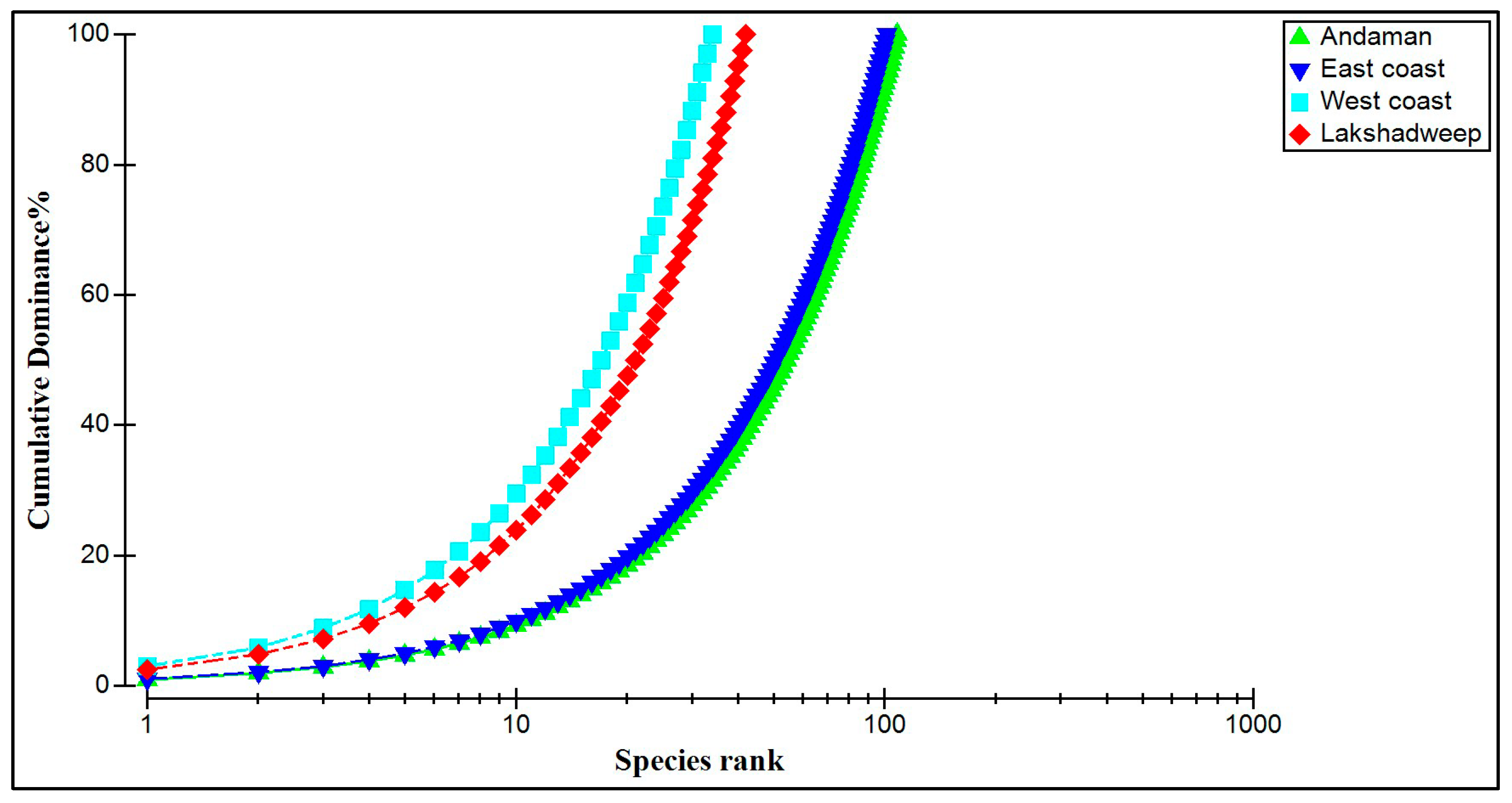
| West Coast | 12 | 34 | 3.07 | 0.86 | 2.149 | 0.86 |
| East Coast | 13 | 101 | 2.6 | 0.8 | 2.065 | 0.82 |
| Andaman & Nicobar | 18 | 108 | 3.638 | 0.77 | 2.237 | 0.83 |
| Lakshadweep | 8 | 42 | 1.911 | 0.67 | 1.39 | 0.63 |
Disclaimer/Publisher’s Note: The statements, opinions and data contained in all publications are solely those of the individual author(s) and contributor(s) and not of MDPI and/or the editor(s). MDPI and/or the editor(s) disclaim responsibility for any injury to people or property resulting from any ideas, methods, instructions or products referred to in the content. |
© 2025 by the authors. Licensee MDPI, Basel, Switzerland. This article is an open access article distributed under the terms and conditions of the Creative Commons Attribution (CC BY) license (https://creativecommons.org/licenses/by/4.0/).
Share and Cite
Padmini, K.; Ummath, A.; Shaikh, A.; Venmathi Maran, B.A. Annotated Checklist and Biodiversity of Sea Cucumbers (Holothuroidea) in Indian Waters. Oceans 2025, 6, 85. https://doi.org/10.3390/oceans6040085
Padmini K, Ummath A, Shaikh A, Venmathi Maran BA. Annotated Checklist and Biodiversity of Sea Cucumbers (Holothuroidea) in Indian Waters. Oceans. 2025; 6(4):85. https://doi.org/10.3390/oceans6040085
Chicago/Turabian StylePadmini, Karthika, Ameen Ummath, Atikulla Shaikh, and Balu Alagar Venmathi Maran. 2025. "Annotated Checklist and Biodiversity of Sea Cucumbers (Holothuroidea) in Indian Waters" Oceans 6, no. 4: 85. https://doi.org/10.3390/oceans6040085
APA StylePadmini, K., Ummath, A., Shaikh, A., & Venmathi Maran, B. A. (2025). Annotated Checklist and Biodiversity of Sea Cucumbers (Holothuroidea) in Indian Waters. Oceans, 6(4), 85. https://doi.org/10.3390/oceans6040085