
Two New Species of Free-Living Marine Nematodes (Nematoda) from the Yellow Sea, China


Abstract
1. Introduction
2. Materials and Methods
3. Results and Discussion
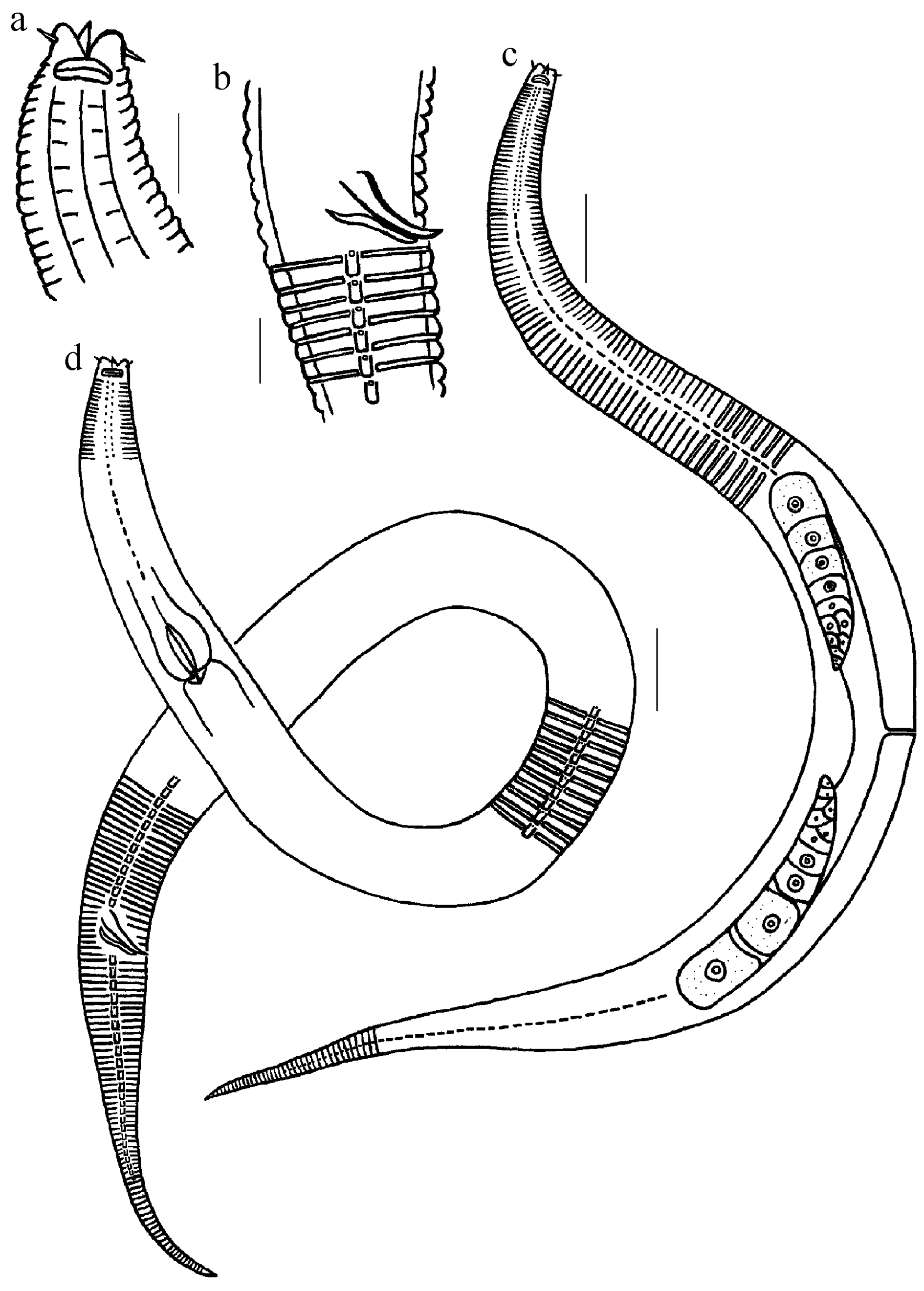
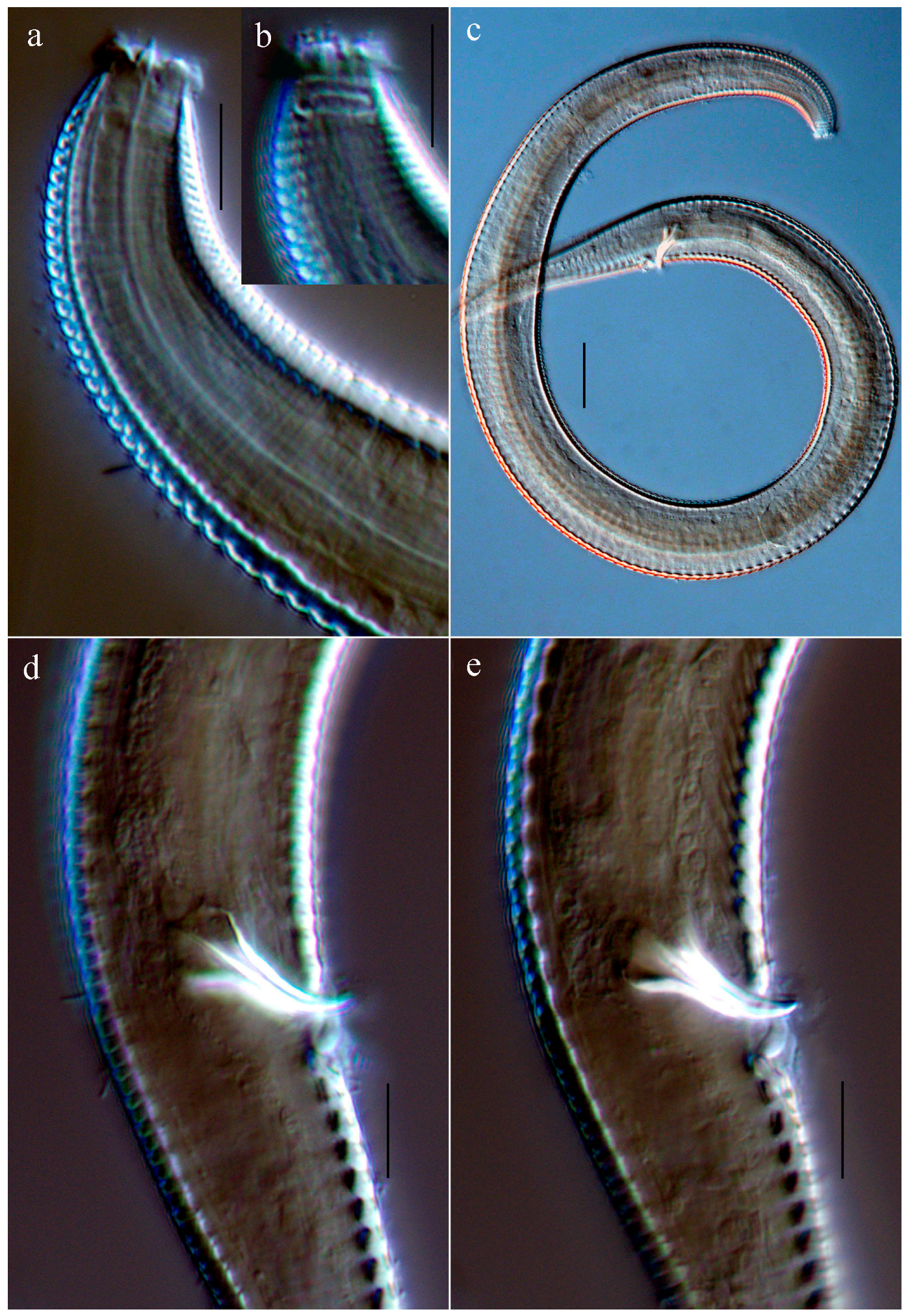
3.1. Description of Actinonema sinica sp. nov. (Figure 1 and Figure 2)


3.1.1. Type Material
3.1.2. Type Locality and Habitat
3.1.3. Etymology
3.1.4. Measurements
3.1.5. Description
3.1.6. Differential Diagnosis and Discussion
- 1 Head end with six sclerotic cones .......................................................................................... 2
- – Head end without sclerotic cones ........................................................................................... 5
- 2. Cephalic setae 1 μm long; tail elongate, posterior flagellum exceeding 70% of total tail length................................................................................ A. dolichurum Gagarin & Long, 2017
- – Cephalic setae > 2 μm long; tail short, lacking distinct posterior flagellum...................... 3
- 3. Dorsal tooth large; cuticle lacking V-shaped lateral differentiation........................... A. pachydermatum Cobb, 1920
- – Dorsal tooth small; cuticle with V-shaped lateral differentiation ..................................... 4
- 4. Body slender (a = 32–44); spicules absent .............. A. smolae Muthumbi and Vincx, 1998
- – Body thick (a = 22–23); spicules present ....................................... A. parvum Gagarin, 2015
- 5. Tail long with posterior flagellum exceeding 70% of total tail length ............................. 6
- – Tail short; posterior flagellum absent or indistinct.............................................................. 7
- 6. Males with cuticular extension anterior to cloaca ........ A. longicaudatoides Gagarin, 2015
- – Males without cuticular extension anterior to cloaca ……A. longicaudatum (Steiner 1918) Wieser 1954
- 7. Spicules present in males........................................................................................................ 8
- – Spicules absent in males......................................................................................................... 12
- 8. Telamon absent ....................................................................................................................... 9
- – Telamon present ...................................................................................................................... 11
- 9. Dorsal tooth small; males lacking distinct gubernaculum……...A. fidatum Vitiello, 1970
- – Dorsal tooth large; males with distinct gubernaculum……………………………..…….10
- 10. Spicules slender (24–31 μm), with narrow proximal end ………….A. grafi Jensen, 1991
- – Spicules conical (18–19 μm), with broad proximal end ……. megamphida (Boucher, 1971)
- 11. Pharynx with double posterior bulbs ................. A. diplobulba Chu, Hao & Huang, 2023
- – Pharynx with a single posterior bulb ............................................... A. celtica Boucher, 1976
- 12. Telamon present, falciform; gubernaculum absent…….A. falciforme Shi, Yu & Xu, 2018
- – Both telamon and gubernaculum present…………………………………………………..13
- 13. Telamon L-shaped, broad at mid-length.........A. paraceltica Muthumbi and Vincx, 1998
- – Telamon horn-shaped, broad proximally, tapering posteriorly………. A. sinica sp. nov.
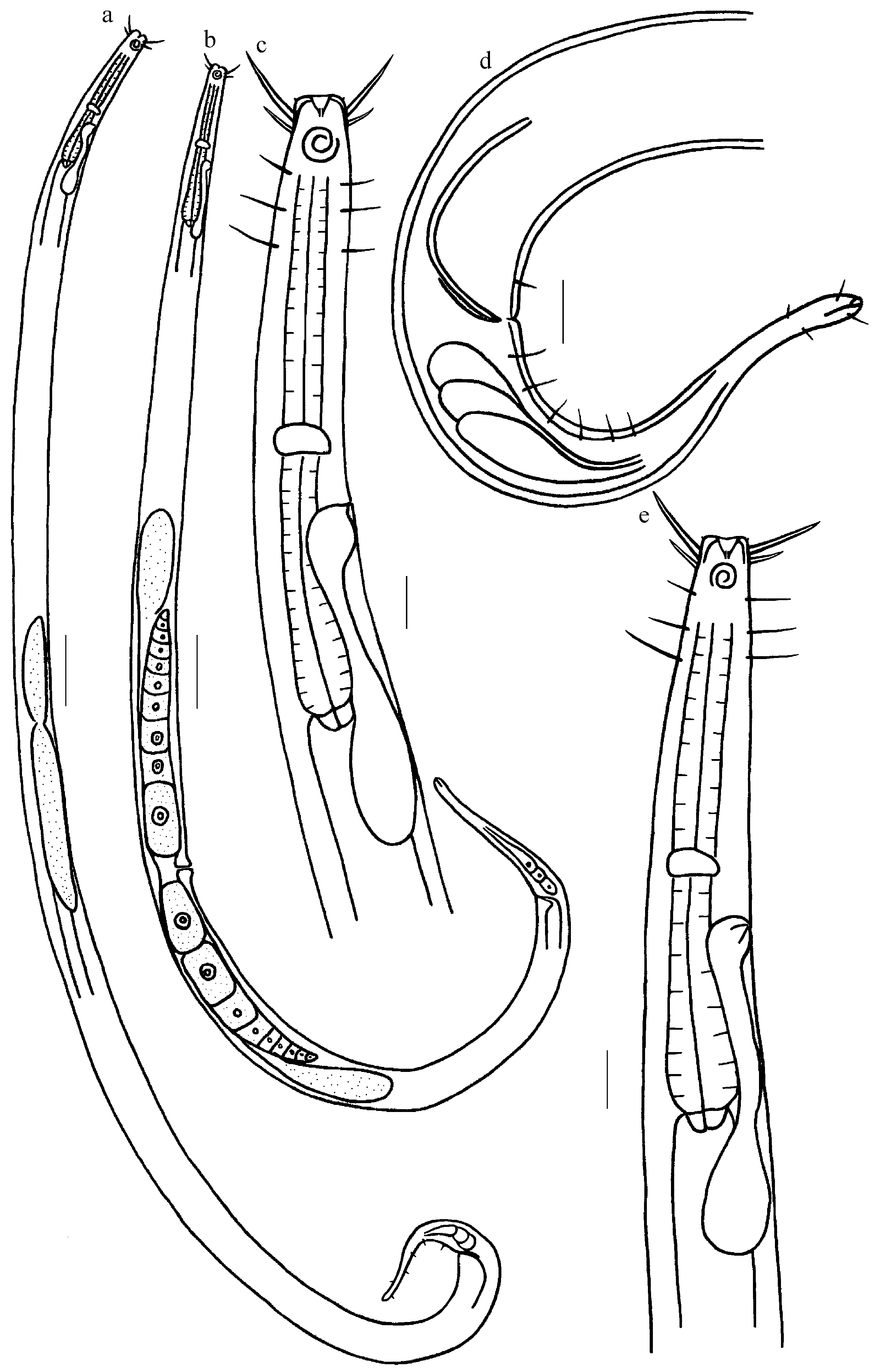
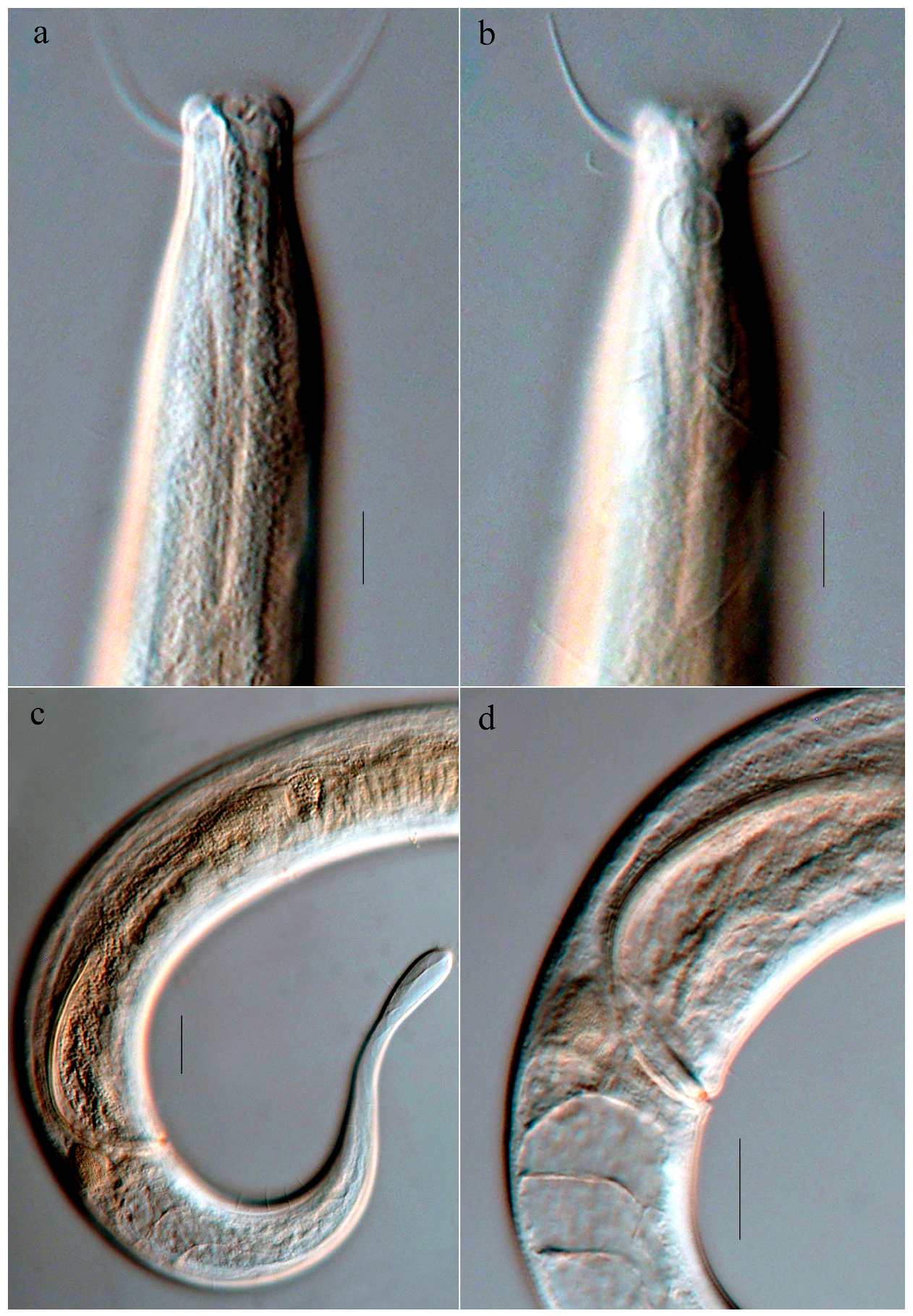
3.2. Comesoma zhangi sp. nov. (Figure 3 and Figure 4)


3.2.1. Type Material
3.2.2. Type Locality and Habitat
3.2.3. Etymology
3.2.4. Measurements
3.2.5. Description
3.2.6. Diagnosis and Discussion
- 1. Body thick; de Man ratio a equal or less than 30................................................................. 2
- – Body slender; de Man ratio a higher than 30........................................................................ 4
- 2. Cephalic setae longer than 1 hd; spicules 6.3 a.b.d…..…… C. minimum Chitwood, 1937
- – Cephalic setae 0.7–0.9 hd; spicules shorter than 4 a.b.d. …...……………………………..3
- 3. Body length shorter than 2 mm; amphidial fovea with 2.5 to 2.75 turns……………….C. quattuordecimsupplementata Xiao & Guo, 2023
- – Body length longer than 3 mm; amphidial fovea with 1.75 turns……………….. C. solum Pastor de Ward, 1984
- 4. Spicules longer than 270 μm; amphidial fovea with 2 turns…… C. arenae Gerlach, 1956
- – Spicules shorter than 200 μm; amphidial fovea with 2 to 2.75 turns……………………. 5
- 5. Body length 3.6–4.6 mm; spicules 165–198 μm…………………………………………… 6
- – Body length less than 3.5 mm……………………………………………………………….. 7
- 6. Body length 4.6 mm long; spicules 165 μm …………….. C. stenocephalum Filipjev, 1918
- – Body length 3.6 mm long; spicules 198 μm ……………………... C. vulgare Bastian, 1865
- 7. Spicules longer than 150 μm……………………………………………………………….. 8
- – Spicules shorter than 120 μm……………………………………………………………….11
- 8. Cuticle with longitudinal rows of markings; transverse markings absent………………
- .............................................................................................................. . C. profundi Bastian, 1865
- – Cuticle lacking longitudinal markings; transverse punctations present………………... 9
- 9. Cephalic setae 0.6–0.8 hd; de Man ratio b = 7.6–9.1……… C. hermani Chen & Vincx, 1998
- – Cephalic setae 1.3–1.5 hd; de Man ratio b = 8.2–12……………………………………… 10
- 10. Cuticle with lateral differentiation; de Man c = 8.5–11.3 ………….. C. bermudense Jensen & Gerlach, 1977
- – Cuticle lacking lateral differentiation; de Man c = 12–17………. C. sinica Fu, Cai, Leduc & Lin, 2022
- 11. Body length 1.6 mm; amphidial fovea with 2.5 turns; de Man ratio c = 9………………...
- ………………………………………………………………. C. tenuispiculum (Ditlevsen, 1921)
- – Body length 2.1–2.5 mm; amphidial fovea with 2 turns; de Man ratio c = 11.5–12.8……..
- …………………………………………………………………………………C. zhangi sp. nov.
Author Contributions
Funding
Institutional Review Board Statement
Informed Consent Statement
Data Availability Statement
Acknowledgments
Conflicts of Interest
References
- Sun, X.Y.; Bai, R.B.; Zhai, H.X.; Huang, Y. Species list of free-living marine nematodes in the Yellow Sea, China. J. Liaocheng Univ. 2024, 37, 34–52. [Google Scholar] [CrossRef]
- Huang, M.; Zhai, H.X. Two new species of the genus Halichoanolaimus (Nematoda, Selachinematidae) from the intertidal zone of the Yellow Sea, China. ZooKeys 2024, 1208, 259–274. [Google Scholar] [CrossRef] [Scilit] [PubMed]
- Hao, Y.D.; Chu, M.D.; Huang, Y. Trefusia brevicauda sp. nov. and Conilia parasinensis sp. nov. (Nematoda: Enoplida) from the Yellow Sea, China. Cah. Biol. Mar. 2022, 63, 257–267. [Google Scholar] [CrossRef]
- Sun, L.Y.; Zhai, H.X.; Huang, Y. Three new species of the order Enoplida (Nematoda) from the Yellow Sea China. J. Oce. Lim. 2025, 43, 984–995. [Google Scholar] [CrossRef] [Scilit]
- Huang, M.; Sun, X.Y.; Bai, R.B. Two new species of Eleutherolaimus Filipjev, 1922 (Nematoda: Linhomoeidae) from the Yellow Sea, China. J. Nat. Hist. 2025, 59, 1127–1140. [Google Scholar] [CrossRef] [Scilit]
- Zhai, H.X.; Liu, L.; Huang, M. Two new nematode species of the family Sphaerolaimidae (Nematoda, Monhysterida) from the Yellow Sea, China. Zootaxa 2025, 5631, 335–348. [Google Scholar] [CrossRef] [Scilit] [PubMed]
- Cobb, N.A. One hundred new nemas (type species of 100 new genera). Contributions to a science of nematology. Contrib. A Sci. Nematol. 1920, 9, 217–343. [Google Scholar]
- Nemys: World Database of Nematodes. Available online: https://www.marinespecies.org/imis.php?dasid=66&doiid=366 (accessed on 1 August 2025).
- Chu, M.D.; Hao, Y.D.; Huang, M. Two new species of Chromadorida (Nematoda) from the inter-tidal zone of the Yellow Sea, China. J. Nat. Hist. 2023, 57, 1364–1376. [Google Scholar] [CrossRef] [Scilit]
- Boucher, G.; de Bovée, F. Trochamus carinatus gen. et sp. n. et Adeuchromadora megamphida gen. et sp. n. Chromadoridae Nematoda) à dix soies céphaliques de la vase terrigène côtière de Banyuls-sur-Mer. Vie Milieu. 1971, 22, 231–241. [Google Scholar]
- Muthumbi, A.W.; Vincx, M. Chromadoridae (Chromadorida: Nematoda) from the Indian Ocean: Difficulties in morphological identification of Actinonema Cobb, 1920 and Rhips, Cobb, 1920. Hydrobiologia 1998, 364, 155–167. [Google Scholar] [CrossRef] [Scilit]
- Shi, B.Z.; Yu, T.T.; Xu, K.D. A new free-living nematode, Actinonema falciforme sp. nov. (Nematoda: Chromadoridae), from the continental shelf of the East China Sea. Acta Oceanol. Sin. 2018, 37, 152–156. [Google Scholar] [CrossRef] [Scilit]
- Bastian, H.C. Monograph of the Anguillulidae, or Free Nematoids, Marine, Land, and Freshwater; with Descriptions of 100 New Species. Tran. Lin. Soc. Lond. 1865, 25, 73–184. [Google Scholar] [CrossRef] [Scilit]
- Fu, S.J.; Cai, L.Z.; Leduc, D.; Lin, H.S. One new species of Comesoma Bastian, 1865 (Nematoda: Araeolaimida: Comesomatidae) and redescription with molecular characterisation of Sphaerolaimus callisto Zograf, Pavlyuk, Trebukhova & Nguyen, 2020 (Nematoda: Monhysterida: Sphaerolaimidae) from the South China Sea. Nematology 2022, 24, 1139–1155. [Google Scholar]
- Xiao, Y.P.; Guo, Y.Q. Three new free-living marine nematode species of the family Comesomatidae from Mangrove wetlands in Jinmen County, Taiwan. Zootaxa 2023, 5369, 513–532. [Google Scholar] [CrossRef] [Scilit] [PubMed]
- de Jonge, V.N.; Bouwman, L.A. A simple density separation technique for quantitative isolation of meiobenthos using the colloidal silica Ludox-TM. Mar. Biol. 1977, 42, 143–148. [Google Scholar] [CrossRef] [Scilit]
- McIntyre, A.D.; Warwick, R.M. Meiofauna techniques. In Methods for the Study of Marine Benthos; Holme, N.A., McIntyre, A.D., Eds.; Blackwell Scientific Publications: Oxford, UK, 1984; pp. 217–244. [Google Scholar]
- Tchesunov, A.V. Order Chromadorida. In Handbook of Zoology; Schmidt-Rhaesa, A., Ed.; De Gruyter: Berlin, Germany, 2014; Volume 2, pp. 373–398. [Google Scholar]
- Fonseca, G.; Bezerra, T.N. Order Araeolaimida. In Handbook of Zoology; Schmidt-Rhaesa, A., Ed.; De Gruyter: Berlin, Germany, 2014; Volume 2, pp. 435–465. [Google Scholar]
- Gerlach, S.A. Zur Kenntnis der freilebenden marinen Nematoden von San Salvador. Z. Für Wiss. Zool. 1955, 158, 249–303. [Google Scholar]
- Cobb, N.A. Australian free-living marine nematodes. Proc. Linn. Soc. New South Wales 1898, 23, 383–407. [Google Scholar]

| Species | A. sinica sp. nov. | C. zhangi sp. nov. | ||||||
|---|---|---|---|---|---|---|---|---|
| Morphological Characteristics | ♂1 | ♂2 | ♂3 | ♀1 | ♀2 | ♀3 | ♂1 | ♀1 |
| a | 21.2 | 24.6 | 21.8 | 19.4 | 22.6 | 19.5 | 46.3 | 37.0 |
| b | 6.1 | 6.2 | 5.9 | 5.5 | 5.5 | 5.7 | 11.6 | 10.7 |
| c | 6.0 | 6.2 | 6.0 | 5.5 | 5.5 | 5.8 | 12.8 | 11.5 |
| c′ | 4.8 | 5.0 | 5.0 | 6.3 | 7.0 | 6.9 | 5.0 | 5.4 |
| Total body length | 720 | 739 | 785 | 697 | 767 | 798 | 2500 | 2182 |
| Maximum body diameter | 34 | 30 | 36 | 36 | 34 | 41 | 54 | 59 |
| Head diameter | 9 | 9 | 9 | 9 | 9 | 10 | 15 | 15 |
| Length of cephalic setae | 3 | 3 | - | 3 | - | 3 | 27 | 28 |
| Width of amphidial fovea | 7 | 7 | 6 | 8 | 7 | 8 | 12 | 8 |
| c.b.d. of amphid | 12 | 11 | 11 | 11 | 11 | 12 | 16 | 15 |
| Nerve ring from anterior end | 77 | - | - | 72 | - | - | 120 | 118 |
| Length of pharynx | 118 | 120 | 133 | 127 | 140 | 140 | 216 | 203 |
| c.b.d. of pharynx | 31 | 27 | 29 | 29 | 30 | 31 | 41 | 42 |
| Spicules length along arc | 22 | 23 | 20 | - | - | - | 101 | - |
| Length of gubernaculum | 16 | 12 | 17 | - | - | - | 26 | - |
| Tail length | 120 | 120 | 130 | 126 | 140 | 137 | 195 | 190 |
| c.b.d. of cloaca or anus | 25 | 24 | 26 | 20 | 20 | 20 | 39 | 35 |
| Vulva from anterior end | - | - | - | 340 | 387 | 377 | - | 1112 |
| c.b.d. of vulva | - | - | - | 36 | 34 | 41 | - | 54 |
| V% | - | - | 48.8 | 50.5 | 47.2 | - | 50.9 | |
| Species | L | Cs | At | a | b | c | Spic | Ps |
|---|---|---|---|---|---|---|---|---|
| C. arenae | 2180 | 23 | 2.0 | 36 | 7.8 | 12.1 | 273 | - |
| C. bermudense | 2380–3035 | 27–38 | 2–2.5 | 32–46 | 8.2–11.4 | 8.5–11.3 | 150–194 | 18–22 |
| C. hermani | 1694–2108 | 13 | 2.5 | 30.3–40.9 | 7.6–9.1 | 9.5–12.1 | 169–184 | present |
| C. heterosetosum | 2219–3480 | 42 | 2.0 | 57–73 | 10.1–14.8 | 13.4–19.8 | - | - |
| C. minimum | 1370–1520 | 1.1 hd | 2.3 | 23–24 | 7.7 | 8.2 | 6.3 a.b.d. | present |
| C. profundi | 2800 | - | - | 37.0 | 11.1 | - | 178 | - |
| C. quattuordecimsupplementata | 1293–1498 | 9–10 | 2.5–2.75 | 23.3–30.6 | 7.3 | 9–9.7 | 120–128 | 14 |
| C. simile | 3300 | 26 | - | - | - | - | - | - |
| C. sinica | 2366–2925 | 24–32 | 2.5 | 34–52 | 10–12 | 12–17 | 166–179 | 20 |
| C. solum | 3400 | 25 | 1.75 | 26.1 | 11.3 | 13.6 | 270 | 9 |
| C. stenocephalum | 4600 | 22 | 2.3 | 55 | 14 | 14 | 165 | - |
| C. tenuispiculum | 1600 | 1.5 hd | 2.5 | 42 | 8.7 | 9.0 | 112 | - |
| C. vulgare | 3600 | - | - | 31.7 | 9.1 | - | 198 | - |
| C. zhangi sp. nov. | 2182–2500 | 27–28 | 2 | 37–46.3 | 10.7–11.6 | 11.5–12.8 | 101 | absent |
Disclaimer/Publisher’s Note: The statements, opinions and data contained in all publications are solely those of the individual author(s) and contributor(s) and not of MDPI and/or the editor(s). MDPI and/or the editor(s) disclaim responsibility for any injury to people or property resulting from any ideas, methods, instructions or products referred to in the content. |
© 2025 by the authors. Licensee MDPI, Basel, Switzerland. This article is an open access article distributed under the terms and conditions of the Creative Commons Attribution (CC BY) license (https://creativecommons.org/licenses/by/4.0/).
Share and Cite
Sun, X.; Huang, Y. Two New Species of Free-Living Marine Nematodes (Nematoda) from the Yellow Sea, China. Oceans 2025, 6, 82. https://doi.org/10.3390/oceans6040082
Sun X, Huang Y. Two New Species of Free-Living Marine Nematodes (Nematoda) from the Yellow Sea, China. Oceans. 2025; 6(4):82. https://doi.org/10.3390/oceans6040082
Chicago/Turabian StyleSun, Xiaoyi, and Yong Huang. 2025. "Two New Species of Free-Living Marine Nematodes (Nematoda) from the Yellow Sea, China" Oceans 6, no. 4: 82. https://doi.org/10.3390/oceans6040082
APA StyleSun, X., & Huang, Y. (2025). Two New Species of Free-Living Marine Nematodes (Nematoda) from the Yellow Sea, China. Oceans, 6(4), 82. https://doi.org/10.3390/oceans6040082